

Without even the appearance of doing something good for the country, the Senate plunged ahead.
I admit it: Senate Republicans surprised me this week.
I know, it shouldn’t be shocking that Republicans would give a big windfall to corporations and the very rich. It’s what they do. Just last summer, they came within one vote of taking healthcare away from 20-some million Americans so that the wealthy could pay less tax.
Usually, though, they do a better job of giving themselves cover. The fringe of the party includes people like Susan Collins and John McCain, who try to retain at least the appearance of a conscience. It also includes clever apologists, whose arguments often obscure what’s really going on and make it possible to claim some noble purpose.
But by early Saturday morning, when the Senate passed its tax reform proposal on a nearly party-line vote, those justifications were all gone. This bill was about paying off the big donors and enriching the Trump family, and everybody knew it. Some senators continued mouthing words like growth and middle-class families, but they weren’t arguing any more, they were just lying. They weren’t fooling anybody, and they didn’t seem to care.
In the end, 51 Republicans voted for the bill, with only Bob Corker opposed. All 48 Democrats voted against it. (Remember that, the next time someone claims there’s no difference between the parties.) One by one, the last holdouts had tossed away their fig leaves and jumped into the mire.
- John McCain, who gave such a moving speech about returning to regular order before he cast the deciding vote against ObamaCare repeal in July, was unperturbed by a very similar process this time, in which the 479-page bill was not available for inspection until a few hours before the vote.
- Susan Collins, who in the summer seemed to worry deeply about people losing their health insurance, stopped worrying and accepted the Senate leadership’s promises about future legislation that I will be very surprised to see pass the House (unless it’s paired with a whole bunch of really bad things).
- Jeff Flake, who (like just about all Republicans) seemed to believe during the Obama years that the deficit was a looming catastrophe, and who supposedly had achieved his independence by choosing not to run for re-election, decided that an extra trillion or two of debt really wasn’t worth getting excited about.
So this is where we are: A similar-but-not-identical bill passed the House in mid-November, so a conference committee will have to work out a compromise bill that both houses can pass. In other words, there is still room for something to go wrong, but some bill of this form is increasingly likely to become law by the end of the year.
The numbers. All along, independent analyses from the Tax Policy Center, the Penn-Wharton Budget Model, and even Congress’ own CBO had been telling a very consistent story: The bill would lead to major increases in the deficit with little-to-no long-term benefits for anybody but the wealthy.
This conclusion was supported by anecdotal evidence. The centerpiece of the bill — lowering the corporate tax rate from 35% to 20% — was supposed to generate massive new investments in production, creating so many jobs that workers would have bargaining power again, raising wages for everybody. But whenever actual corporate CEOs were consulted, they said they would pass the money on to shareholders through dividends or stock buy-backs rather than build new factories or pay workers more. Bloomberg reported:
That money is also unlikely to spur hiring because companies are already well-capitalized and can bring on as many employees as they need, said John Shin, a foreign-exchange strategist at Bank of America Merrill Lynch.
“Companies are sitting on large amounts of cash. They’re not really financially constrained,” Shin, who conducted a survey of more than 300 companies asking their plans for a tax overhaul, said in an interview. “They’re still working for their shareholders, primarily.”
Right up until Thursday, though, Republicans were hoping more favorable numbers would appear. Congress’ Joint Committee on Taxation hadn’t weighed in yet, and they were known to use the dynamic-scoring model conservatives favor, the one that figures in the effects of tax-cut-induced growth. The Treasury Department supposedly had over 100 people churning out analyses; presumably Secretary Mnuchin had seen their preliminary results when he claimed that the proposal wouldn’t just be deficit neutral, it would “pay down debt” by generating more new revenue than the tax cuts gave up.
The JCT analysis came out Thursday, just hours before the Senate was scheduled to vote. Its most favorable dynamic scoring said that increased economic growth would restore about 1/3 of the revenue lost, so that the deficit would only increase by $1 trillion rather than the nominal $1.5 trillion. A third is better than nothing, but even if you allowed for growth, the deficit was going up.
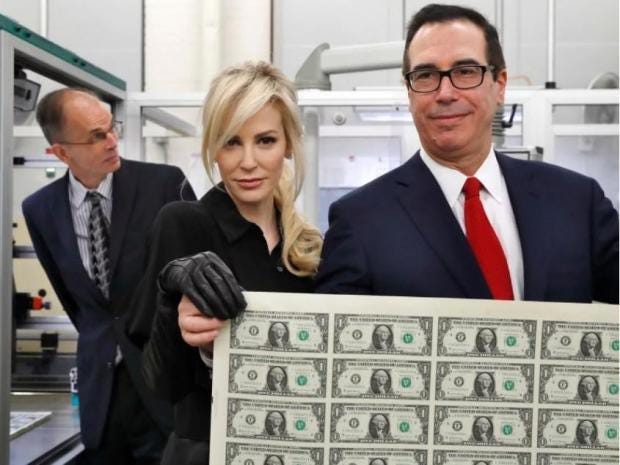
Would this guy lie to you?
But what about Mnuchin and the Treasury? It turned out that they had no analysis, or at least none they were willing to make public.
Those inside Treasury’s Office of Tax Policy, which Mr. Mnuchin has credited with running the models, say they have been largely shut out of the process and are not working on the type of detailed analysis that he has mentioned. An economist at the Office of Tax Analysis, who spoke on the condition of anonymity so as not to jeopardize his job, said Treasury had not released a “dynamic” analysis showing that the tax plan would be paid for with economic growth because one did not exist.
So Mnuchin’s many public statements about tax reform had been airy nonsense, grounded in nothing. Meanwhile, here’s what the JCT projected for American families:
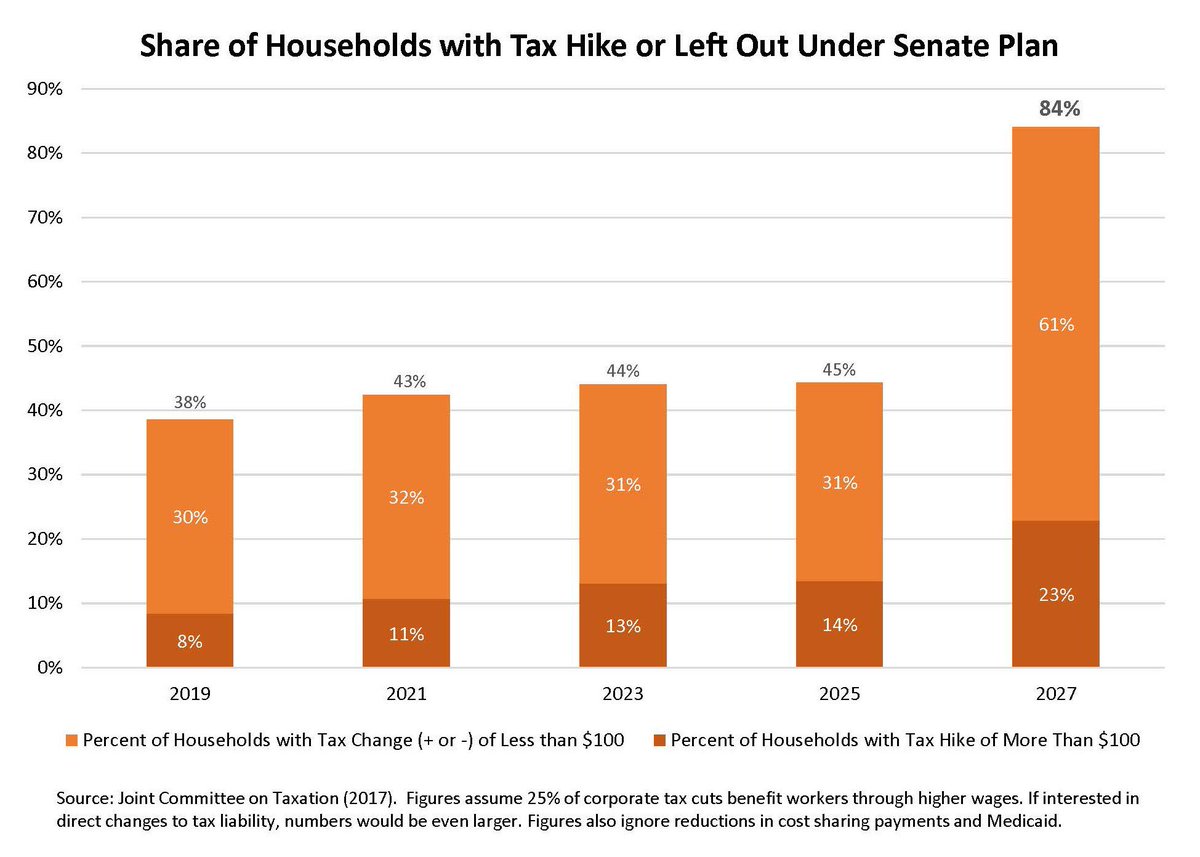 (Here’s the same information as a series of charts.) In other words: More than 1/3 of U.S. households will never get anything out of this bill, not even in the first few years. That situation gets progressively worse until nearly all the individual cuts expire in 2027, at which point about 1 in 4 are paying higher taxes, while only 16% still see a tax cut of more than $100.
Senate Republican Whip John Cornyn dealt with this convergence of expert analysis by saying, “I think it’s pretty clear they’re wrong.” Just because.
Full speed ahead. The original plan had been for the Senate to vote on Thursday. But the surprising (to some) revelation that the JCT analysis agreed in principle with all the other analyses, that nothing to the contrary would being coming out of the Treasury, and so the claims they were making had literally no basis — it threw a wrench into the process.
Many options were possible at that point. The bill could have gone back to committee to be scaled down into a defensible form. Maybe 20% was a bridge too far, and corporations would have to be satisfied with a 25% tax rate. That would create some room to fulfill the original stated purpose of the bill: cutting middle-class taxes for real this time.
Maybe the deficit didn’t have to go up, either. Back in 2012, President Obama had proposed a 28% rate that he claimed would produce more revenue than the 35% rate, without any analytic sleight-of-hand. Both parties have acknowledged for years that our high-rates-with-many-loopholes corporate tax system is inefficient. With a little genuine give-and-take, leaders on both sides might assemble a bipartisan coalition of 60 votes or more, avoiding the reconciliation process entirely.
Or, Mitch McConnell could scrawl a few last-minute changes in the margins to assuage the doubts the last few Republican hold-outs, and the Senate could shamelessly go forward with a bill to borrow an extra trillion dollars or more so that the GOP could give a big Christmas present to the very rich. But if they were going to do it, they’d better do it fast, before the public was able to organize against this already very unpopular bill.
By now, you know which choice they made.
The people they betrayed. One way the Senate got its bill to fit onto the procrustean bed of the $1.5 trillion-over-ten-years price tag authorized by the FY2018 budget resolution was to make of a now-you-see-it, now-you-don’t gimmick Paul Krugman refers to as Schroedinger’s tax hike. The budget numbers work because only the corporate tax cuts are permanent; the individual cuts mostly phase out, resulting in this graph from the JCT.
 (These numbers refer to an earlier version of the bill, but I believe a similar graph could be drawn for the current version.)
Republicans are arguing that those tax breaks [for individuals] won’t actually be temporary, that future Congresses will extend them. But they also need to assume that those tax breaks really will expire in order to meet their budget numbers. So the temporary tax breaks need, for political purposes, to be both alive and dead.
So either individual taxes will turn sharply upwards in 2025, or the tax-reform bill costs a whole lot more than $1.5 trillion. It’s one or the other. Ezra Klein points out the “pure fraud” in the deficit arguments Republicans have been making for years.
The GOP spent the Obama years in a frenzy over debt and deficits. Now they are passing a tax bill that will add trillions to the national debt, complete with budget gimmicks that, if they play out the way Republicans are publicly hoping they will play out, will lead to an even higher price tag.
When a Democrat is in the White House, the national debt is an existential crisis that threatens to bring down the Republic. But that threat magically vanishes when a Republican takes office.
So if you believed what Republicans told you about the deficit then, they’ve betrayed you now. But they’ve also betrayed you if you believed the populist side of Trump’s 2016 message. Because here’s where we are, prior to this bill becoming law: The national debt is around $20 trillion, and is already projected to increase to $30 trillion over the next ten years. Rather than do anything about that, Congress is in the act of tossing another trillion or two on top it. (BTW: In the speech where he announced his candidacy, Trump said: “$24 trillion— we’re very close— that’s the point of no return. $24 trillion. We will be there soon. That’s when we become Greece. That’s when we become a country that’s unsalvageable. And we’re gonna be there very soon.”)
So what about that big infrastructure project Trump talked about? (“So we have to rebuild our infrastructure, our bridges, our roadways, our airports. You come into La Guardia Airport, it’s like we’re in a third world country.”) Where’s the money for that going to come from? How’s he going to keep his promise not to cut Medicare, Medicaid, and Social Security, once the trillion-a-year deficits start happening? (“Save Medicare, Medicaid and Social Security without cuts. Have to do it.”)
He won’t keep that promise. He’s already breaking it.
If this passes, there will be no money left for populism, and no money left to save the programs the middle class depends on. They’ll have given it all to the rich.
They’re doing it as you read this, and they’re being totally brazen about it.




 The televised

 Sociologist Arlie Russell Hochschild started studying the Trump base years before anybody knew they’d be the Trump base. In her book
 /about/Trump-Delusional-Disorders-589eaef63df78c4758904771.jpg)

 The Weekly Sift