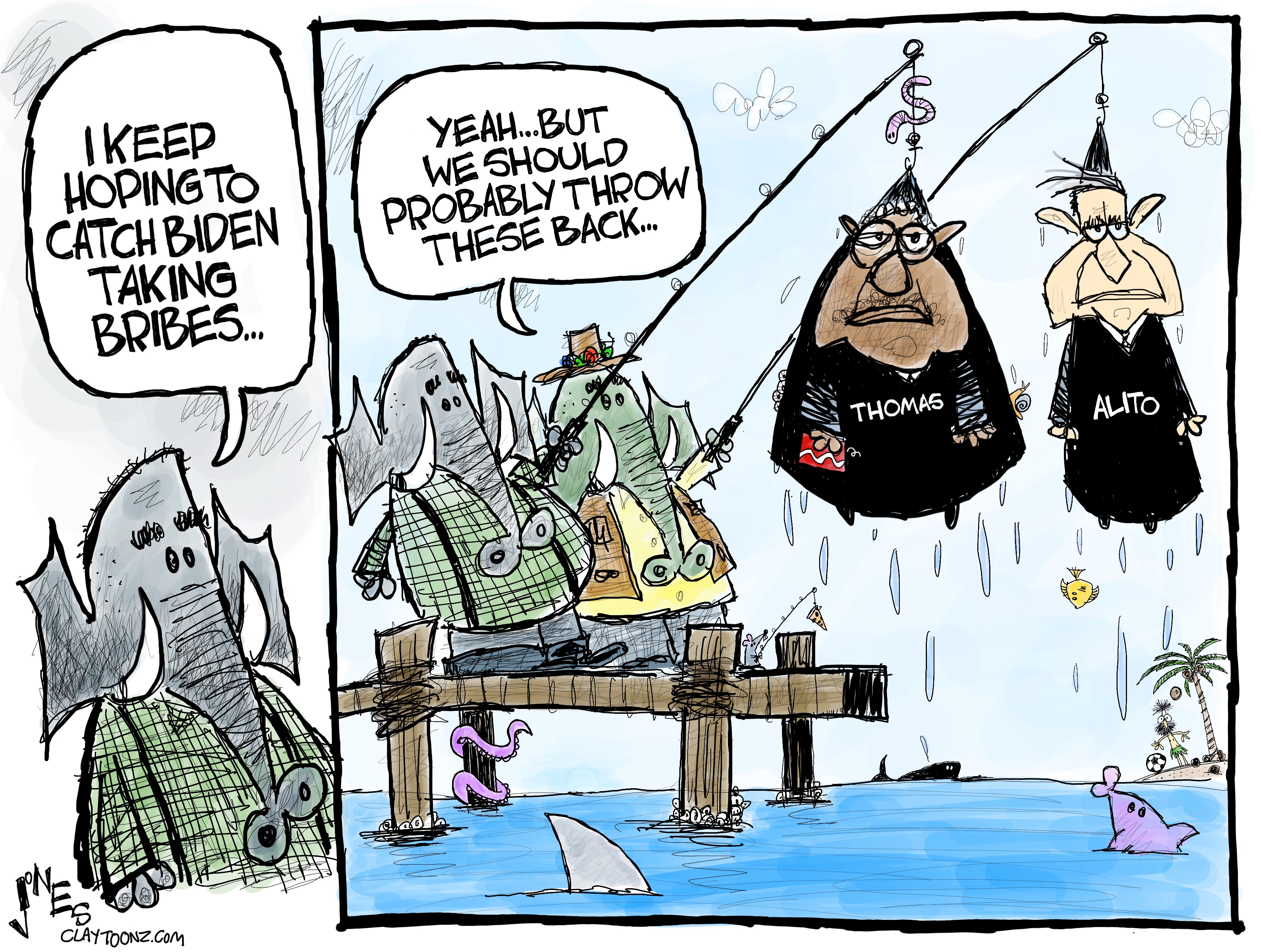
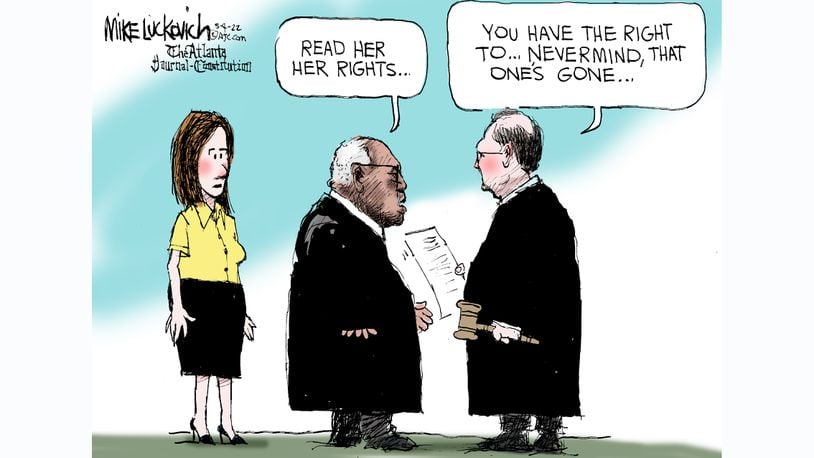
No, lifelong Republicans have not established a liberal Deep State at the FBI.
In 2021, I raised the question “What makes a good conspiracy theory?” People obviously do conspire to do bad things from time to time, so we shouldn’t reject out of hand every claim that some group of malefactors is conspiring. But can we at least limit ourselves to good conspiracy theories, i.e., ones that at least have a chance to be true?
In that post I identified one clear marker of a bad conspiracy theory: The size of the conspiracy has to keep increasing as more facts come out. The deeper people dig, the larger the conspiracy has to grow to account for all the pieces that don’t fit the original theory. (Really good conspiracy theories, on the other hand, tend to shrink. The better you understand how things work, the more you realize that a few well-placed conspirators really could pull this off.)
With that principle in mind, every time a conspiracy theorist says “They must be in on it too”, you should reevaluate the whole conspiracy. If you would have rejected a massive they’re-all-in-on-it claim at the start, you shouldn’t let yourself drift into accepting one without a good reason.
Lately we’ve been seeing a lot of expansion in the Right’s Biden-crime-family conspiracy theory. Consider David Weiss, the Trump-appointed US attorney that Trump-appointed Attorney General Bill Barr assigned to run the Hunter Biden investigation. Weiss was one of the few Trump US attorneys Biden left in place, probably because it would have looked bad to pick his own guy to investigate his son.
Weiss filed some tax charges and a firearms charge against Hunter, and negotiated a plea deal that most experts say is not out of line with what any defendant in a similar situation could get: repay the taxes and accept two years probation, but don’t go to jail.
“If you are a Trump, you will be prosecuted. If you are a Biden, you will be protected,” said Rep. Wesley Hunt, claiming a double standard in the justice system.
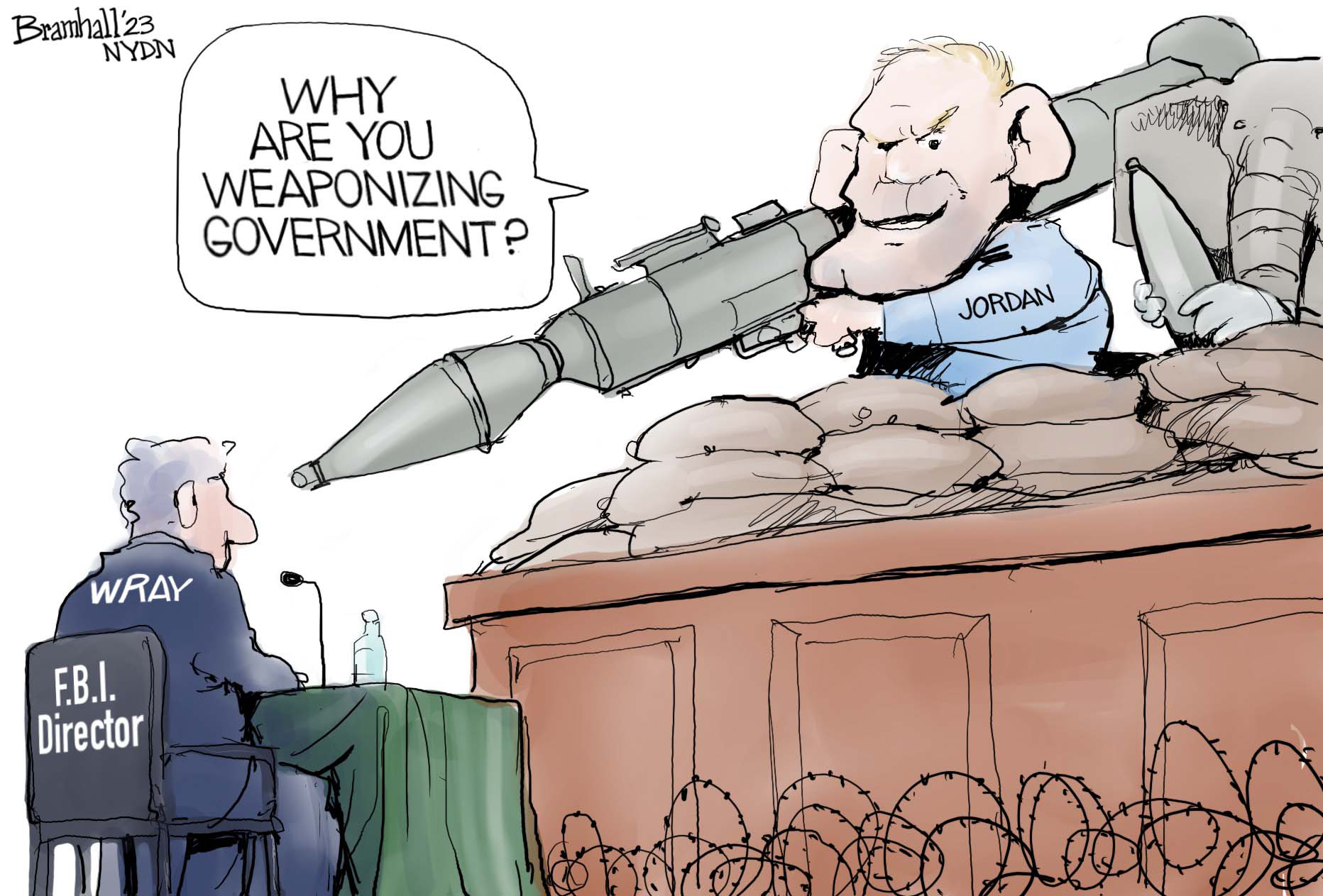
Wray seemed to have a hard time taking such claims seriously.
“The idea that I’m biased against conservatives seems somewhat insane to me given my own personal background,” said Wray, a Republican who served in President George W. Bush’s Justice Department.
Equally insane is the idea that the FBI (in Sean Hannity‘s words) “has now sadly been transformed into nothing short of an arm of the Democratic Party.”
As I’ve explained in the past, there really is a Deep State — an entrenched bureaucracy that resists certain kinds of top-down change — but it arises in a fairly natural way: The reason young people decide to join an organization and commit themselves to it (the way you have to to rise in the ranks) is that the organization’s mission harmonizes with their values.
So if direction from on high conflicts with an organization’s perceived mission, people up and down the chain of command will resist: Items will fall off the agenda, orders will be carried out in ineffective ways, and so on. Probably the resisters don’t even need to conspire, because people at all levels just know that “that’s not how we do things here”.
Top-down pressure can change the culture of an organization, but it requires either consistent attention over a very long time or a large-scale purge of the rank-and-file employees. (Trump is planning such a purge if he gets another term: “MAGA Republicans believe that they will be able to enact their programme only if they first defang the deep state by making tens of thousands of top civil servants sackable. Around 50,000 officials would be newly subject to being fired at will, under a proposed scheme known as Schedule F.”)
Now think about why idealistic young people make a career at the FBI: They want to catch the bad guys. Fundamentally, it’s a rules-and-punishments mindset, which tends to appeal to conservatives. (Stereotypically, liberals are more driven to understand the bad guys, and to figure out why they don’t find places in lawful society.) That’s why law enforcement in general tends to be a bastion of conservatism. (Think about it: When you meet someone and find out that they’re a cop, what expectations do you have about their opinions?)
So yes, there would naturally be a Deep State in the FBI: a conservative Deep State. The fantasy of a liberal Deep State at the FBI, led by lifelong Republicans like Chris Wray and James Comey, is truly nutty.
So what’s the FBI been up to as it investigates Donald Trump? Not persecuting conservatives, but catching the bad guy.
The Supreme Court’s term ended last week. But there’s still a lot of legal news to discuss.
When the final flurry of Supreme Court decisions came out late last week, you might have expected the legal world to go quiet for a while. Instead, this week
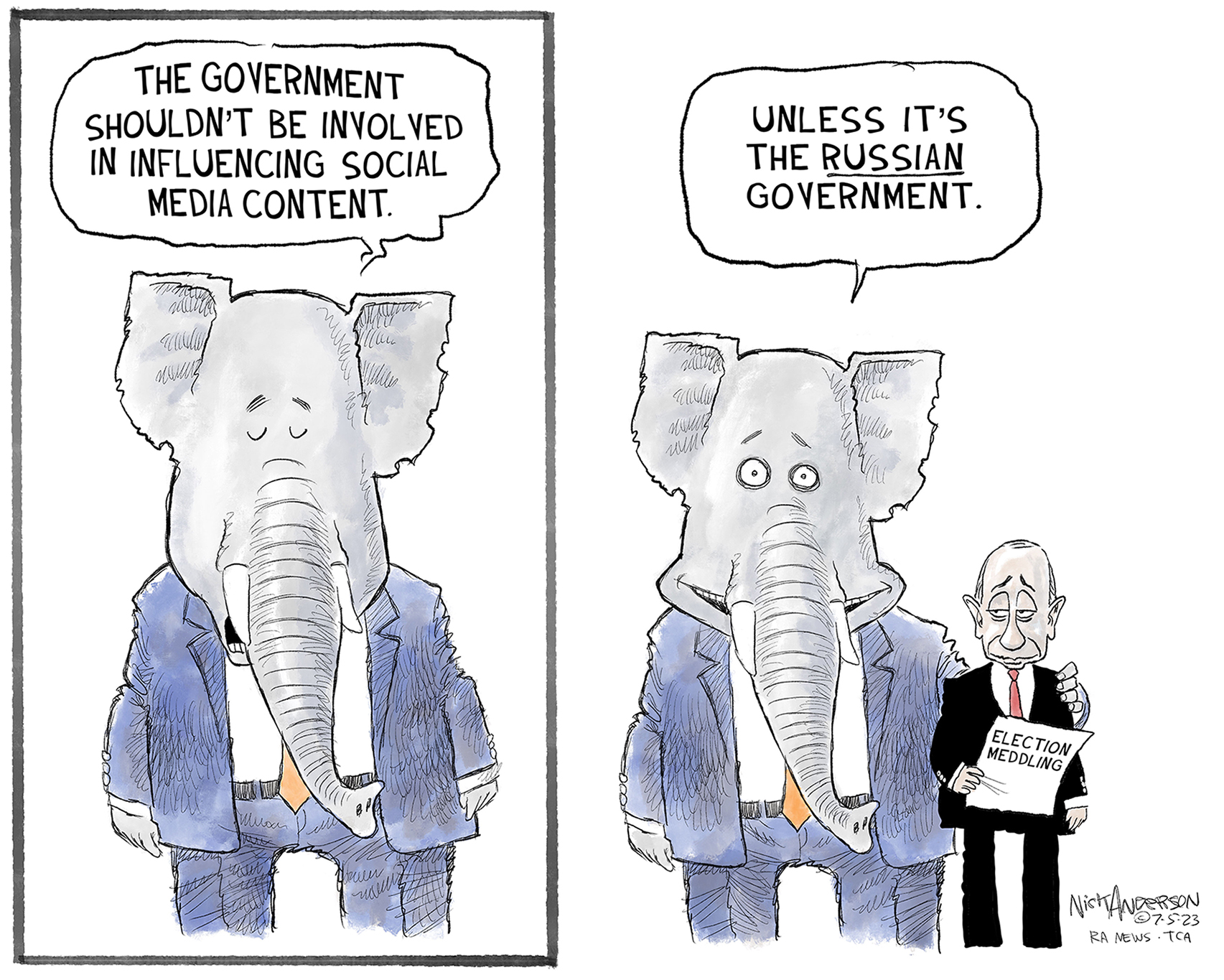
A Trump-appointed judge took a long list of conservative conspiracy theories seriously, and issued an injunction banning large chunks of the executive branch from talking to social media companies. So if somebody puts on a lab coat and makes a YouTube claiming that the whooping cough vaccine turns kids into werewolves, the CDC has to sit on its hands.
WaPo’s Ruth Marcus called attention to a ruling Federal District Court Judge Carlton Reeves of Mississippi made the previous week — a devastating attack on Clarence Thomas’ pro-gun ruling last year in Bruen. In a legal judo move, Reeves applied Bruen as written, ruling in favor of a convicted felon who claims the 1938 federal law barring him from owning guns is unconstitutional. Along the way, Reeves made it clear that he knows how ridiculous his ruling is, but he has to follow the Supreme Court’s lead.
An appeals court overturned an injunction blocking Tennessee’s ban on gender-affirming care for minors. The law went into effect immediately.
Let’s take the three in one-by-one.
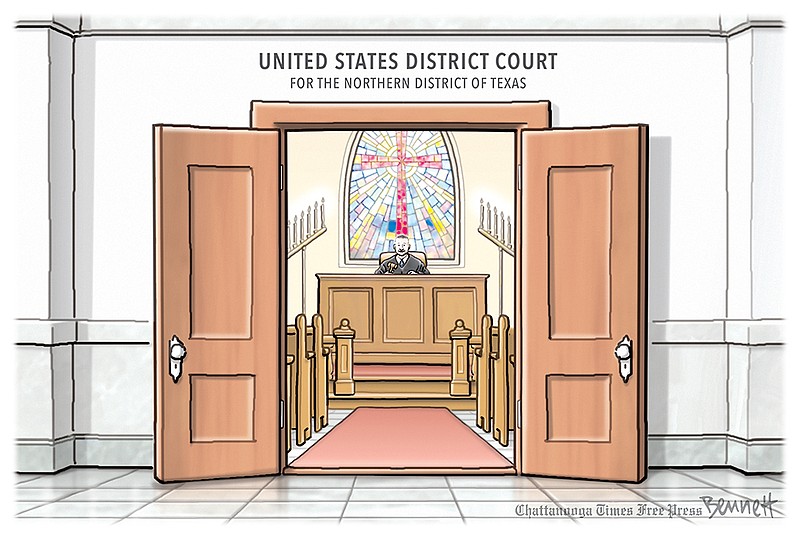
Opening the disinformation floodgates. On July 4, a date clearly chosen for its symbolic significance rather than because his court was open, US District Judge Terry Doughty of Louisiana, issued a 155-page memorandum justifying his injunction ordering large chunks of the Biden administration — the White House, State Department, FBI, CDC, et al — to have no contact with social media companies concerning disinformation.
The ruling makes dull reading, because it is mostly a rehash of claims made by the plaintiffs (the states of Louisiana and Missouri and several individuals) about “censorship” by the Biden administration. The judge appears not to have fact-checked at all, and most of the “violations” take the following form:
Somebody posted a provably false claim on social media, containing dangerous misinformation about Covid or vaccines in general, or perhaps falsely attacking election officials in ways likely to provoke violence against them.
Somebody in the government noticed, flagged the post for the platform the claim was posted on, and pointed out that the post violated the company’s own policies.
The company took the post down, and may have sanctioned the poster’s account in some way.
This collection of examples has been spun into a conspiracy theory about the Biden administration’s sinister plot to silence conservative voices on the internet. The judge swallows this theory hook, line, and sinker, and responds accordingly.
The upshot of the injunction (if higher courts let it stand) is that if some video claims that vaccines could turn your child trans, the CDC just has to watch it go viral. Similarly, if a Russian troll farm starts a rumor among Black voters that they can vote over the internet, or that their mail-in ballots are fake and won’t be counted, the Cybersecurity and Infrastructure Security Agency (CISA) can’t do anything to stop the spread.
Given that I can’t recommend reading the judge’s memo itself, the best summary I’ve found is by Mike Masnick at TechDirt. What I like best about his account is that he gives the Devil his due: A few of the issues the judge raises are actually issues and should get public attention.
In particular, there is an issue with government pressuring private companies to do things that would be illegal for the government to do on its own. One form such pressure can take is threatening the companies with changes in the regulations that govern those companies.
There were some examples in the lawsuit that did seem likely to cross the line, including having officials in the White House complaining about certain tweets and even saying “wondering if we can get moving on the process of having it removed ASAP.” That’s definitely inappropriate. Most of the worst emails seemed to come from one guy, Rob Flaherty, the former “Director of Digital Strategy,”
However, most of the examples in the ruling are “made up fantasyland stuff”. And none were remotely as bad Ron DeSantis punishing Disney for speaking out against his Don’t Say Gay law, or Donald Trump threatening Amazon in order to pressure the Bezos-owned Washington Post to give him more favorable coverage. (Those examples are mine, not Masnick’s.)
Doughty seems incredibly willing to include perfectly reasonable conversations about how to respond to actually problematic content as “censorship” and “coercion,” despite there being little evidence of either in many cases … In doing so, Doughty often fails to distinguish perfectly reasonable speech by government actors that is not about suppressing speech, but rather debunking or countering false information — which is traditional counterspeech.
Masnick highlights the example of Dr. Fauci countering misinformation in the anti-lockdown Great Barrington Declaration, which Doughty frames as government censorship. Similarly, the influence of the CDC on social media companies is not an example of government coercion.
I mean, the conversation about the CDC is just bizarre. Whatever you think of the CDC, the details show that social media companies chose to rely on the CDC to try to understand what was accurate and what was not regarding Covid and Covid vaccines. That’s because a ton of information was flying back and forth and lots of it was inaccurate. As social media companies were hoping for a way to understand what was legit and what was not, it’s reasonable to ask an entity like the CDC what it thought.
Finally, he comes to the injunction itself, which has the kind of contradictory vagueness that characterizes so many conservative efforts (like anti-critical-race-theory laws). The injunction includes reasonable-sounding exceptions allowing communication about “criminal activity” or “national security threats” or “threats that threaten the public safety or security of the United States” and a few other things. However, most of the examples the judge casts as violations actually fall into one of his exceptional areas.
It seems abundantly clear that nearly all of the conversations were about legitimate information sharing, but nearly all of it is interpreted by the plaintiffs and the judge to be nefarious censorship. As such, the risk for anyone engaged in activities on the “not prohibited” list is that this judge will interpret them to be on the prohibited list.
So like Florida teachers, Biden-administration officials have no way to know what is legal and what isn’t. And so the injunction will have a chilling effect well beyond its text’s actually meaning.
Lower-court judges are bound to follow the law as decreed by the Supreme Court. They aren’t bound to like it. And so, lost amid the end-of-term flurry at the high court, came another remarkable ruling by U.S. District Judge Carlton W. Reeves of Mississippi.
Reeves declared that the court’s interpretation of the Second Amendment compels the unfortunate conclusion that laws prohibiting felons from having guns violate the Second Amendment. He took a swipe at the conservative justices’ zealous protection of gun rights even as they diminish other constitutional guarantees. And, for good measure, he trashed originalism, now “the dominant mode of constitutional interpretation” of the Supreme Court’s conservative majority.
Reeves explained what forced his hand in making a ruling he clearly finds ridiculous:
Firearm restrictions are now presumptively unlawful unless the government can “demonstrate that the regulation is consistent with this Nation’s historical tradition of firearm regulation.” New York State Rifle & Pistol Ass’n, Inc. v. Bruen
In the case before him, a convicted felon caught with firearms was arguing that a 1938 law permanently banning felons from owning firearms violates his Second Amendment rights.
Reeves accepts the accuracy of the government’s claim that 120 post-Bruen federal court decisions have applied the law without noting such a violation. But …
In none of those cases did the government submit an expert report from a historian justifying felon disarmament. In none of those cases did the court possess an amicus brief from a historian. And in none of those cases did the court itself appoint an independent expert to help sift through the historical record.
Of course, Reeves has not done so either, but that’s OK, because neither did the Supreme Court in its gun-rights cases. Both Scalia in Heller and Thomas in Bruen relied instead on “law office history” that was “selected to “fit the needs of people looking for ammunition in their causes”. He summarizes the problem:
The federal felon‐in‐possession ban was enacted in 1938, not 1791 or 1868—the years the Second and Fourteenth Amendments were ratified. The government’s brief in this case does not identify a “well‐established and representative historical analogue” from either era supporting the categorical disarmament of tens of millions of Americans who seek to keep firearms in their home for self‐defense.
So “the government failed to meet its burden” in claiming that the law is constitutional.
Reeves’ ruling is worth bookmarking, because in contains an excellent history of the shifting interpretations of the Second Amendment. (Some years ago, I explained this difference of opinion by claiming that the Amendment doesn’t have any real meaning any more, so judges forced to interpret it have to make something up.)
But what’s really striking is Reeves’ closing section, which raises a question more people should be asking: Why doesn’t the Supreme Court defend all constitutional rights as zealously as it defends Second-Amendment rights?
In breathing new life into the Second Amendment, though, the Court has unintentionally revealed how it has suffocated other fundamental Constitutional rights. Americans are waiting for Heller and Bruen’s reasoning to reach the rest of the Constitution.
He starts with one obvious example: The Sixth Amendment guarantees all defendants a “speedy trial”. According to the historical record, what did the Founders consider “speedy”? Certainly not five years, which the Court endorsed in Barker v Wingo.
And then there are voting rights, which the Court has found to be “fundamental”, but it has erected much higher barriers to claiming that the government has violated your voting rights than it has set for violations of gun rights.
Maybe the Supreme Court is correct that in this country, to “secure the Blessings of Liberty to ourselves and our Posterity,” the government should have the burden of justifying itself when it deprives people of their constitutional rights. Perhaps the Court is also correct that constitutional rights should be defined expansively. The Court just isn’t consistent about it.
We have one Constitution. All of it is law. It has been enforced today as best as this Judge can discern the Bruen Court’s holding and reasoning. And, one hopes, a future Supreme Court will not rest until it honors the rest of the Constitution as zealously as it now interprets the Second Amendment.
Gender-affirming care. Fourteen states have passed laws banning gender-affirming care for minors. While the science justifying such treatments is far from settled, the majority of current medical opinion goes the other way. Also, by putting its own judgment above that of both doctors and parents, these red states expose the hollowness of the “parents rights” rhetoric they embrace in other contexts.
District court judges in Arkansas, Alabama, Florida, Indiana, Kentucky, and Tennessee have issued injunctions blocking these laws from taking effect. But Saturday was the first time an appellate court weighed in: A panel of Sixth Circuit judges ruled 2-1 to overturn the Tennessee injunction and let the law take effect. The Sixth Circuit also includes Kentucky, but this ruling does not directly effect Kentucky.
The ruling remains preliminary, as the 6th Circuit court plans to issue a full ruling by Sept. 30 after hearing arguments for a full appeal of the ban. In a filing Saturday, the court indicated it would decide the pending Kentucky case alongside Tennessee’s and set an accelerated schedule for briefing on those cases. However the schedule runs into next month and the next regularly scheduled argument session for the 6th Circuit after those deadlines is not until October.
Unless the other appellate courts follow the Sixth Circuit’s example, the issue is likely headed to the Supreme Court.
You may or may not care about affirmative action, LGBTQ rights, or student debt. But this week’s Supreme Court rulings should disturb you anyway.
Until this week, the final week of its annual term, the Supreme Court seemed to be backing away from the rogue behavior of last year, in which it had repeatedly ignored precedent, invented fanciful readings of history, and generally found excuses to go wherever its right-wing ideology might lead.
Recall that last year, the Court didn’t merely eliminate abortion rights, its logic in Dobbs rejected the doctrine of substantive due process, potentially setting up the elimination of all rights that rely on that doctrine: same-sex marriage, access to birth control, the right of consenting adults to choose their own expressions of sexuality, and many others. In Bruen, it not only threw out a century-old New York State gun control law, it cast doubt on all gun-control laws that are not “consistent with the Nation’s historical tradition of firearm regulation” as Justice Thomas interprets that history. The direct impact of Carson might have been small — a religious school in Maine will get a small amount of state money — but the decision blew a huge hole in the wall between Church and State. Who can say what rude beast will slouch through that hole in the future?
Until this week, the Court seemed to be charting a more moderate course this year. Perhaps, some speculated, it had been stung by the backlash to last year’s rulings. (Dobbs in particular became a major issue in the 2022 midterms, and probably prevented Republicans from regaining control of the Senate. Supreme Court justices are supposed to be above caring about such partisan outcomes, but Chief Justice Roberts clearly does care.) Or perhaps the conservative majority was sensitive to the damage the Court’s reputation has suffered from the exposure of the blatant (and unpunished) corruption of Justices Thomas and Alito.
Maybe, it seemed, this Court wasn’t as bad as we had thought.
I will give myself credit for remaining suspicious. Last week I wrote:
My guess is that Roberts has manipulated the calendar so that the Court’s most controversial decisions will come last. The cases decided recently have been divided between liberal and conservative wins, building up Roberts’ “centrist” credibility.
Unlike last year’s Dobbs decision, though, none of these cases strikes a live wire of American politics. The direct victims of these decisions — Black students hoping to get into a good college (or go to college at all), young people drowning under student debt, and LGBTQ people wanting not to be second-class citizens — are probably not going to swing the 2024 elections the way that previously Republican suburban women swung the 2022 elections by staying home or supporting Democrats. Blacks, the young, and LGBTQ voters are already Democratic constituencies that partisan Republicans (like John Roberts) probably don’t mind pissing off.
So while it’s tempting to dive into the details of each case, point out the dubious logic the majority employs, and quote extensively from the ringing dissents by Justices Sotomayor, Jackson, and Kagan, I think that approach misses the larger story and would probably make many readers’ eyes glaze over. But looking at these three rulings as a whole, and setting them in the context of last year’s decisions, reveals a larger pattern that should disturb everyone: This Court is increasingly untethering itself from all traditional restraints on judicial power.
What limits the Supreme Court? A quick reading of the Constitution might leave you with a modest view of the powers of the Court. The Constitution establishes Congress in Article I, the presidency in Article II, and the judiciary in Article III, giving a hint that the Founders saw it as the least important and least powerful of the three branches of government. While the powers of Congress and the President are spelled out at length, Article III is much shorter, and about half of that space is taken up guaranteeing trial by jury and defining treason.
However, the Constitution left one important power unassigned: Congress writes the laws and the President enforces them, but who says what the law is? When statutes seem to contradict each other or the Constitution, who sorts things out?
The unique property of judicial review is that this power is virtually unchecked by the other branches or by the People. If Congress can muster a supermajority, it can remove justices by impeachment, or it can start the constitutional amendment process. But otherwise, there’s not much anyone can do about the Court’s ruling that some act is unconstitutional. The Court is literally supreme; there is no further appeal.
And in some situations that’s obviously a good thing. Like me, you may think the Court got Bush v Gore wrong. But even I have to admit that somebody has to have the last word on a disputed election. Otherwise we’ll end up fighting in the streets.
In the absence of the usual checks and balances, the Court is restrained by a number of its own traditions:
precedent. The doctrine of stare decisis (literally, “let the decision stand”) requires that in the absence of a clear error, courts are obliged to view each new case through the lens of past decisions. The interpretation of the laws should not change from case to case or judge to judge.
standing. The Court cannot insert itself into every issue on which its majority has an opinion. The Court has to wait until someone brings it a case, and the party bringing the case can’t just be a convenient busybody; the case must be brought by someone who has a direct interest in its outcome.
rules of interpretation. The Court’s rulings cannot be based purely on its own opinions and intuitions. Rulings have to be tied to specific laws, and the way legal terms and phrases are interpreted is also subject to stare decisis.
respect for lower courts. In the absence of clear error, the Court should respect the findings of lower courts. In particular, when lower courts have held extensive hearings on the facts of a case, the Court should not ignore those findings and collect its own facts.
What we’ve seen these last two years, and saw particularly this last week, is an increasing disregard of these constraints. Even Americans who don’t care about this week’s cases (or agree with their outcomes) should find that disturbing. Without these constraints, the Supreme Court comes to resemble the Supreme Leader of Iran — an unelected and unaccountable authority with lifetime tenure that has the power to weigh in wherever it chooses.
Standing. Two of this week’s major cases had standing issues that made them almost laughable. The Court had no business hearing either one.
In the student-loan-forgiveness case, the HEROES Act of 2003 gives the Secretary of Education the power to “waive or modify” the terms of student loans for borrowers affected by a national emergency. The Biden administration proposed to use this law and the declared emergency of the Covid pandemic to forgive up to $20,000 of loans for borrowers making less that $150K a year.
If you don’t owe student loans yourself, or you make more than $150K, you may not care about this policy. You may even think it’s a bad idea; many people do. But how did this issue make it to the Supreme Court? Because the Biden administration was sued by the Republican attorneys general of six states.
But wait: Why are the states anything more than busybodies? They don’t make the loans or collect the payments. What injury do they suffer if the federal government forgives student loans? (And notably, none of the six — or any other state — sued when the Trump administration used the same law and the same emergency to suspend loan repayments in 2020. Their interest is not to redress some injury they’ve suffered, but to thwart the Biden administration.)
In his majority opinion, Chief Justice Roberts accepts a ridiculous argument that Justice Kagan completely demolishes in her dissent: One of the six states, Missouri, had created an independent public corporation, the Missouri Higher Education Loan Authority (MOHELA), to administer student loans. MOHELA contracts with the Department of Education to service loans, and its fees might decrease by $44 million next year if the loan forgiveness goes through. So MOHELA potentially suffers an injury and has standing to sue.
However, as Justice Kagan points out, Missouri is not MOHELA. Missouri created MOHELA to be financially independent, and gave MOHELA its own power to sue, which MOHELA has chosen not to do. MOHELA has not even submitted an amicus brief; it has shown no interest in this case whatsoever.
Is there a person in America who thinks Missouri is here because it is worried about MOHELA’s loss of loan-servicing fees? I would like to meet him. Missouri is here because it thinks the Secretary’s loan cancellation plan makes for terrible, inequitable, wasteful policy. And so too for Arkansas, Iowa, Kansas, Nebraska, and South Carolina. And maybe all of them are right. But that question is not what this Court sits to decide.
In short, the State of Missouri and its conservative attorney general are convenient busybodies that the Court used to insert itself into a public-policy debate that was none of its business. (The justification of its decision was also specious, but we’ll get to that later.)
The challenge to Colorado’s anti-discrimination law was even flimsier: A graphic designer in Colorado (Lorie Smith) has a one-woman corporation (303 Creative) that creates websites for products and events. She wants to start offering wedding-announcement websites, but claims that her “Christian” beliefs will not allow her to work with same-sex couples. This religion-based bigotry, she fears, will put her in violation of Colorado’s anti-discrimination law, so she is seeking an injunction to prevent Colorado from enforcing the law against her.
Picture the situation: Smith currently has no wedding-website-design business, and we don’t know that she ever will. That prospective business has no clients yet, and no same-sex couples are seeking to become its clients. So she has not rejected any same-sex clients, and the State of Colorado has had no occasion to cite her with any violation.
So what’s this case about?
For comparison, it’s as if the Scopes Monkey Trial had taken place after John Scopes merely thought about teaching evolution, or Plessy v Ferguson had gone to the Supreme Court without Homer Plessy ever trying to board the whites-only train car. Maybe Jane Roe could have challenged Texas’ abortion laws as soon as she and her husband started thinking about having sex.
You might also wonder how such a small operator gets such a weak lawsuit all the way to the Supreme Court. (Could you do that if you were imagining starting a business?) It’s simple: Smith’s suit was taken up by the Alliance Defending “Freedom”, which is part of the network of right-wing legal organizations clustered around Leonard Leo, the matchmaker who introduced Justices Thomas and Alito to their billionaire sugar daddies, and spent millions of dark money on ads to block the appointment of Merrick Garland to the Court while pushing for the approval of Justices Gorsuch, Kavanaugh, and Barrett.
From ADF’s Christian-nationalist point of view, the vaporous nature of the case is in fact an advantage. If Smith had actually violated the anti-discrimination law, some same-sex couple would be her victims. They might appear on TV shows and garner sympathy from the general public, which overwhelmingly disapproves of bigotry and discrimination. But instead, ADF can cast Smith as a victim of the state, albeit in a purely theoretical sense.
And since the case has no actual facts, the Court’s majority can frame its hypothetical facts however it wants.
In this case, Colorado seeks to force an individual to speak in ways that align with its views but defy her conscience about a matter of major significance.
Kagan’s dissent disputes that characterization, but who can say? Colorado has not taken any real-world action at all, so whatever it might be “seeking” in some future timeline is open to any conjecture.
In this reality, though, Smith has suffered no injury and has no standing to sue anybody. But none of that matters, because this Court will rule on whatever issues it wants, whether anyone has brought it a legitimate case or not.
Precedent. Other than its direct effect on the lives of millions of American women, including endangering the lives of a not-inconsiderable number of them, the most striking thing about last year’s Dobbs decision was that nothing of significance in the external world had changed since the last time the Court had reviewed abortion rights. But the Court had new justices, so there was a new outcome.
That’s exactly what stare decisis is supposed to prevent.
But OK, you could imagine that was a one-off: Maybe Roe was just an unusually poorly decided case that needed to be reversed. It happens. As Justice Kavanaugh reminded us during the oral arguments in Dobbs, some of the Court’s proudest decisions are reversals of mistakes, like when Brown reversed Plessy’s separate-but-equal ruling.
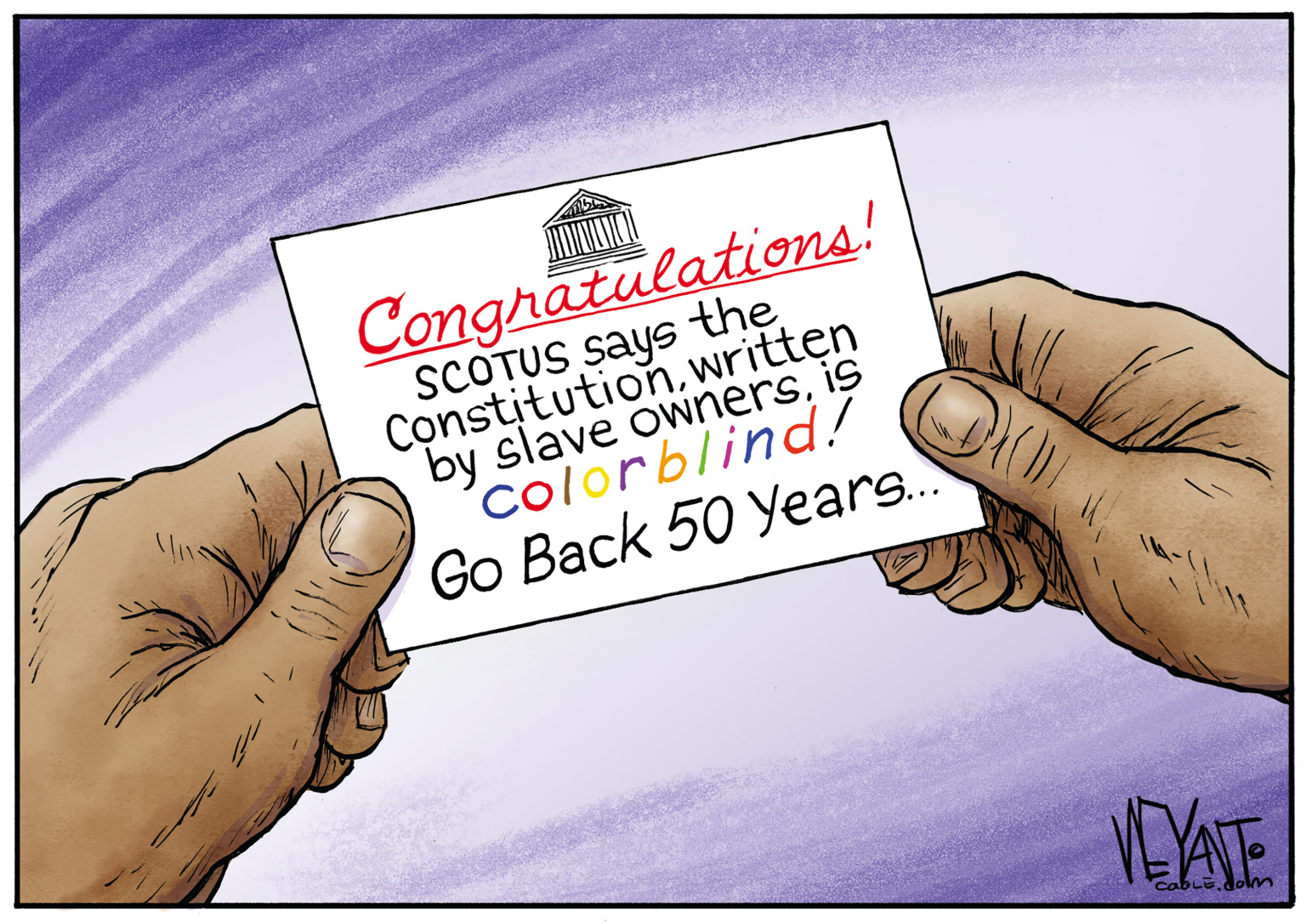
But the longer we watch this Court, the more obvious it becomes that precedent has lost its power. When precedents can be used to support a desired conclusion, (like Justice Harlan’s reference to a “colorblind constitution”) they are quoted with great respect, though not always in proper context. (Harlan was objecting to race-based rules that maintain the power of the dominant caste, not ones that undermine that power.) But inconvenient precedents are just mistakes to be rectified.
In the affirmative action case, for example, little of legal significance has changed since the Grutter decision of 2003.
In a majority opinion joined by four other justices, Justice Sandra Day O’Connor held that the Constitution “does not prohibit the law school’s narrowly tailored use of race in admissions decisions to further a compelling interest in obtaining the educational benefits that flow from a diverse student body.”
But the composition of the Court has changed since 2003, so O’Connor’s conclusion no longer holds. The benefits of a diverse student body are the same as they were 20 years ago — if anything, they are becoming more significant as the US becomes less white and the world economy more globalized — but today those benefits are, in Chief Justice Roberts’ words “not sufficiently coherent for purposes of strict scrutiny”. Roberts instead constructs a Catch-22: If the needed amount of diversity can be quantified, then it is a quota, which is illegal. But if it can’t, then the concept is too incoherent to constitute a compelling interest.
Roberts won’t say it, but Justice Thomas will:
The Court’s opinion rightly makes clear that Grutter is, for all intents and purposes, overruled.
Respect for lower courts. The affirmative action decision is a daunting read: 237 pages long. One reason it has to be so long is that Roberts’ majority opinion ignores the inconvenient factual findings of the district court, which were upheld by the appellate court. Instead, he pulls facts from the plaintiff’s (SFFA’s) filings and other sympathetic sources, which the dissents then need to refute by compiling their own facts. Sotomayor’s dissent cites examples like this one:
The Court ignores these careful [district court] findings and concludes that Harvard engages in racial balancing because its “focus on numbers is obvious.” Because SFFA failed to offer an expert and to prove its claim below, the majority is forced to reconstruct the record and conduct its own factual analysis. It thus relies on a single chart from SFFA’s brief that truncates relevant data in the record. That chart cannot displace the careful factfinding by the District Court, which the First Circuit upheld on appeal under clear error review.
Roberts never explains why the district court’s findings are unreliable. He just doesn’t like them, so he doesn’t mention them.
Rules of interpretation. The rhetoric of conservative legal scholars is all about strictly constructing the exact text of the laws. Conservative Supreme Court justices often refer to their interpretative technique as “textualism” or “originalism” — the notion that phrases in the laws and the Constitution should be interpreted as they would have been commonly understood at the time the words were written.
You might expect that this responsibility to read the text closely would limit the power of judges to insert their own views into the law, but as practiced by the current justices, it does the exact opposite. Understanding how words were commonly understood at some point in the past is a job for historians, and the justices are not historians. Nor do they typically respect the consensus of the people who are historians.
Instead, we are treated to excursions into history that — voila! — always reach the desired result. If you’ve ever delved deeply into history yourself, you should understand how unlikely this is. History, researched honestly, frequently jars your preconceived notions. But the conservative justices are never jarred off their favored course.
Two of last year’s cases model how this works: Justice Alito justified his Dobbs decision with examples going back to the Middle Ages (because of course we should be guided by medieval views of women’s rights). But when Justice Thomas (writing for Alito as well as himself) overturned a New York gun-control law in Bruen, gun-control history from the 1600s was too early to matter and Wild West gun control too late. Inconvenient laws and rulings from the era Thomas focused on were “outliers” or “clearly erroneous”. And so Thomas also found historical backing for his interpretations.
This week’s student-loan decision presented an example of another “doctrine” that the Court has invented out of whole cloth to increase its own power: the major questions doctrine. The major questions doctrine is violated whenever an executive agency makes a ruling that seems to the Court to be too big for the provision in the law it cites. Congress, the justices decide, couldn’t have intended to put so much power into such a small package.
In other words, major-questions is a way for the Court to second-guess both executive agencies and the text of the laws.
In the student-loan case (which, as I noted above, the Court had no business considering at all), Congress passed the HEROES Act in 2003 to give the Secretary of Education special powers over student loans during a national emergency. It was a sequel to laws passed in 1991 and 2002 that responded to specific emergencies (the Gulf War and 9-11).
Self-evidently, it is the nature of emergencies to be unforeseen, and bigger emergencies will require bigger responses. Congress surely knew this in 2003.
The Covid pandemic was an emergency affecting the entire country, and it justified trillions of dollars in relief spending. But Chief Justice Roberts applies the major-questions doctrine to Covid-related debt cancellation and finds that it is too big. Congress could not have intended to delegate that much power.
He bases this conclusion on nothing in the law itself. Congress could have put a cap on emergency responses or limited them in some other way, but it didn’t.
As Justice Kagan points out in her dissent, Congress may have been unwise to delegate so much power, and the Biden administration’s attempt to use that power could also turn out to be unwise. Voters might have come to that conclusion and disciplined the politicians responsible in future elections.
But voters won’t have to make that judgment, because the Court — based on nothing — has inserted itself into the debate and made that judgment for them.
Conclusion. In short, the text of the law matters — unless it can be explained away with historical hocus-pocus, or unless the Court’s retrospective mind-reading reveals that Congress could not have intended some particular use of the law it wrote. Precedent matters if it can be construed to support what the conservative majority wants to do, but otherwise it is a mistake to be fixed. Standing doesn’t matter at all any more; if the Court wants to weigh in on a topic, it will find a way to do so. And facts? Well, the best cases are ones that have no facts, because they provide the most open fields for judgment.
These are the principles the current Court operates under. If that doesn’t bother you, you haven’t been paying attention. Or maybe you envy the way Iran has structured its government.
This week, Pro Publica reported that Justice Samuel Alito accepted a flight on billionaire Paul Singer’s private jet, so that the two of them could go on an outing at a thousand-dollar-a-day Alaskan fishing lodge. (Another rich conservative donor covered the cost of the lodge. Since he owned the lodge, this was — arguably, but also debatably — “personal hospitality”, which is allowed.) The outing was organized by the Federalist Society’s Leonard Leo, who also suggested Singer provide Alito’s transportation.
Alito did not report the trip as a gift, and later voted with a 7-1 Supreme Court majority that ruled in Singer’s favor in a dispute with the government of Argentina. Singer’s hedge fund made billions as a result.
Pro Publica says it would have cost $100K for Alito to charter a similar jet himself, though it’s hard to say what that number means. If he had been forced to find his own transportation, Alito would undoubtedly have found something cheaper, so it’s hard to estimate the value of the ride to him. (Imagine that a rich friend drives me to the airport in his Rolls Royce. It might cost me thousands to duplicate that experience on my own. But if he hadn’t offered, I’d probably have just spent $100 on a cab. Would I have spent $300 on a Rolls Royce cab, were such a deal available? Probably not.)
Anyway, ProPublica quotes law professor Charles Geyh, who gets to the heart of the matter:
If you were good friends, what were you doing ruling on his case? And if you weren’t good friends, what were you doing accepting this?
The Wall Street Journal printed Alito’s response to the article before the article itself came out, which strikes me as a blight on the reputation of the WSJ. ProPublica’s editor commented: “We’re curious to know whether the Journal fact-checked the essay before publication.” (Several observers wonder if this level of access is payback for Alito leaking secret court information to the WSJ. Or, as the Above the Law blog comments: “Sam Alito just went out of his way to confirm for everyone that he’s talking directly to the WSJ editors — who were as deep in the Dobbs leak as any publication except Politico.”)
Alito’s defense is a technical (and self-serving) reading of the rules on recusal and disclosure. The recusal rules say “There is an appearance of impropriety when an unbiased and reasonable person who is aware of all relevant facts would doubt that the Justice could fairly discharge his or her duties.” Alito boldly declares:
No such person would think that my relationship with Mr. Singer meets that standard.
[C]an anyone say with a straight face that no “unbiased and reasonable person” would question the justice’s impartiality when he votes for someone who gave him a valuable gift? Isn’t there at least the appearance that something other than the strict application of the rule of law is at work?
I’m reminded of a quote often attributed to Jesse Unruh, a mid-20th-century California legislator of somewhat dubious reputation: “If you can’t take their money, drink their liquor, fuck their women, and then come in here the next day and vote against them, you don’t belong here.”
However, even discussing the technical legality of Alito’s actions and disclosures misses the point: If the rules say that it’s OK for justices to receive expensive gifts and favors from billionaires and then rule in their favor, then the rules are wrong.
The WaPo’s Ruth Marcus applies some common sense to Alito’s self-justification:
The game here isn’t — at least it shouldn’t be — to figure out how much you can take in the way of freebies and keep that hidden. It should be to behave in a way that is above reproach and comply with the spirit of the ethics rules. Justices scouring the code for loopholes that seem to shield their bad behavior is not a good look.
Defenses of the current Supreme Court ethics policy rely on a very narrow definition of corruption: quid pro quo. In other words, we make an explicit agreement that you’ll pay me money and I’ll rule in your favor. TPM’s David Kurtz admits we’re not seeing that kind of deal-making:
The reporting so far isn’t revealing sketchy quid pro quos. The justices aren’t for sale. They’re not crafting opinions based on these freebies.
What’s actually going on is a much more subtle and insidious: The Right, under the guidance of Leonard Leo, has created an environment in which conservative justices can live the high life of free yacht cruises and luxury resort vacations, as long as they remain conservatives in good standing. If, however, they should follow the path of former Republican appointees like David Souter and John Paul Stevens and stray into liberalism, all those invitations from billionaires would dry up.
Of course Alito and Thomas know that. And it can’t help but influence their thinking. They’re in a position similar to a mega-church pastor who can’t let himself examine his doubts about God too closely. There may not be any quid-pro-quos here, but it’s corruption all the same.
It’s hardly a new observation that the Right engages in projection: What they accuse the Left of doing is usually little more than a confession of what they’re doing themselves. But even knowing how common the pattern is, this Leonard Leo statement is striking:
We all should wonder whether this recent rash of Pro Publica stories questioning the integrity of only conservative Supreme Court Justices is bait for reeling in more dark money from woke billionaires who want to damage this Supreme Court and remake it into one that will disregard the law by rubber stamping their disordered and highly unpopular cultural preferences.
Someday soon, a perfectly safe abortion drug could become unavailable nationwide, even in states that defend reproductive rights. That sounds so crazy that most of us have a hard time taking it seriously. (Wasn’t the whole point of reversing Roe to turn the abortion question over to the states?) You hear the claim and then think, “That can’t really be happening.” But it is.
Here’s how it works.
Trump left us a kangaroo federal court. The Amarillo division of the Northern District of Texas has only two federal judges, and one of them, Matthew J. Kacsmaryk, hears 95% of the civil lawsuits. Kacsmaryk is the very model of a Trump judge. He was a lawyer for the right-wing First Liberty Institute until Trump tapped him for a federal judgeship in 2017. Since then, he’s become famous for out-of-the-mainstream legal opinions that are reliably right-wing, but not terribly well reasoned or well rooted in the law.
While on the bench, Kacsmaryk has made a string of controversial rulings: He declared Biden administration protections for transgender workers unlawful; twice ordered the administration to enforce the Trump-era “Remain in Mexico” policy; and attackedTitle X, the only federal program designed to provide birth control to low-income and uninsured people.
The beauty of this arrangement, if you’re an right-wing culture warrior, is that Amarillo has become the perfect place to file a controversial suit, particularly if it’s based on ideology rather than law. You’re practically guaranteed to get Kacsmaryk, which means you’re practically guaranteed to win, at least until there’s an appeal. [It’s worth pointing out that political activists on all sides try to venue-shop like this. But nowhere in America is as well-greased for liberals as Amarillo is for conservatives.] And even if you ultimately lose, you still might win for a considerable chunk of time, because Kacsmaryk might issue an injunction that favors you until the Supreme Court gets around to reversing his opinion, which could take months or even years.
That’s what happened when he forced the Biden administration to continue Trump’s remain-in-Mexico immigration plan. The Supreme Court ultimately reversed Kacsmaryk’s decision 6-3. (Yes, that’s how far-right his reasoning was: Not even John Roberts and Brett Kavanaugh were convinced.) Nonetheless, an injunction kept remain-in-Mexico in place for more than a year while the case was under consideration.
That shouldn’t have happened, but both courts above Kacsmaryk, the 5th Circuit Court of Appeals and the Supreme Court, are dominated by conservative judicial activists. They aren’t so unprincipled that they could endorse Kacsmaryk’s ridiculous reasoning, but they have more wiggle room when deciding whether or not to lift a temporary injunction. Both courts used that discretion to screw the Biden administration. (Trump’s requests to set aside injunctions got much more favorable consideration.)
So what is the current case?
Mifepristone.More than half of all abortions in the US are now through medication rather than surgery. That’s bad news from the anti-abortion perspective, because there’s no abortion clinic to picket or shoot up, and it’s easier to smuggle pills into a handmaid’s-tale state than to run an underground surgery clinic in one. So now that Roe v Wade has been reversed and states are outlawing abortion, the pills are the next big target. Friday, Wyoming became the first state to outlaw them.
If you live in a blue state like California or Vermont, you may roll your eyes: Wyoming is like that. But your state guarantees abortion rights, so the effort to limit access couldn’t possibly affect you or the women you care about, right?
Not so fast.
A typical medication abortion combines two drugs: mifepristone and misoprostol. So a coalition of anti-abortion groups and individuals have filed suit to make mifepristone illegal nationwide, claiming that the FDA made a mistake when it declared the drug safe in 2000.
The suit would be laughed out of any legitimate court, for reasons that former Anton Scalia law clerk Adam Unikowsky explains in detail in his blog Adam’s Legal Newsletter:
The plaintiffs’ theory of standing is irreconcilable with Supreme Court precedent.
The statute of limitations has expired on plaintiffs’ challenge to the FDA’s approval of mifepristone. The plaintiffs claim that the FDA “constructively reopened” that approval in 2016, thus restarting the statute of limitations, but that’s clearly wrong.
The plaintiffs did not exhaust their claims, even though a regulation explicitly required them to do so.
Although the plaintiffs claim that the FDA’s actions are contrary to the Food, Drug, and Cosmetic Act (FDCA), the plaintiffs have failed to identify any particular provision of the FDCA that the FDA has actually violated.
Problems like that would be fatal to an ordinary lawsuit. But wait, there’s Amarillo, where ordinary legal reasoning doesn’t apply. “What’s Amarillo got to do with anything?” you might ask. The FDA isn’t located in Amarillo and mifepristone isn’t manufactured there. Amarillo appears to have no connection at all to mifepristone. But the venue is appropriate, according to the lawsuit, because one of the suing organizations is located there.
This district and this division are where Plaintiffs Alliance for Hippocratic Medicine, including the doctors of its member associations, and Dr. Shaun Jester are situated and are injured by Defendants’ actions.
AHA appears to be “a front group for the Catholic Medical Association, the Coptic Medical Association of North America, the American College of Pediatricians, the Christian Medical & Dental Associations, and the American Association of Pro-Life Obstetricians and Gynecologists.” It was founded last August, after Roe was reversed in June, apparently for the specific purpose of filing this lawsuit in Amarillo.
And what “injury” are the local doctors alleging? Unikowsky summarizes:
The plaintiff-doctors’ theory of standing is, in a nutshell, that if mifepristone stays on the market, other doctors will prescribe mifepristone to their pregnant patients, the pregnant patients will suffer side effects, and then the patients will switch doctors and come to the plaintiff-doctors. This, in turn, will injure the plaintiff-doctors because it will divert their attention from their other patients, potentially force them to complete “unfinished abortions,” and possibly expose them to malpractice lawsuits. By contrast, if mifepristone is off the market, these women will elect to carry their babies to term (as opposed to seeking surgical abortions), thus preventing the plaintiff-doctors from facing these risks.
If that “injury” sounds a little too roundabout to be credible, that’s because it is. Unikowsky cites Supreme Court rulings that have already rejected similar standing claims.
As for safety, the FDA’s original studies are now backed up by more than two decades of experience, both here and abroad. CNN summarizes:
Data from hundreds of studies and 23 years of approved use has shown that mifepristone is highly safe and effective, according to 12 of the country’s most respected medical associations, including the American College of Obstetricians and Gynecologists and the American Medical Association, which signed an amicus brief in the Texas case.
This medicine combination for abortion is also available in more than 60 other countries.
Since its approval in the US in 2000, there have been 5 deaths associated with mifepristone for every 1 million people who used it, according to the US Food and Drug Administration. That means the death rate is 0.0005%.
Mifepristone’s safety is on par with those of common over-the-counter pain relievers like ibuprofen and acetaminophen, studies show.
Data analyzed by CNN shows that mifepristone is even safer than some of the most common prescription medications. The risk of death from penicillin, an antibiotic used to treat bacterial infections like pneumonia, for example, is four times greater than it is for mifepristone. The risk of death after taking Viagra – used to treat erectile dysfunction – is nearly 10 times higher.
If there actually were a safety issue, you might expect some women’s-health organizations to sign onto the lawsuit, but none have. The suing organizations all have prior religious or political orientations. For some it is right in their name, like the American Association of Pro-Life Obstetricians and Gynecologists and the Christian Medical and Dental Associations. The one whose name sounds like it might be objective, the American College of Pediatricians, isn’t:
The group’s primary focus is advocating against abortion and the adoption of children by gay or lesbian people. It also advocates conversion therapy. … ACPeds has been listed as a hate group by the Southern Poverty Law Center for pushing “anti-LGBTQ junk science”.
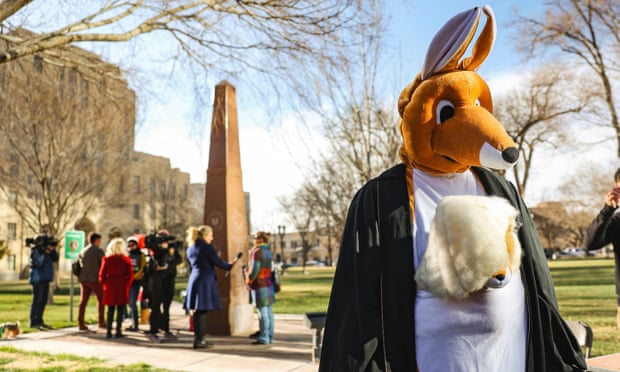
Hearings. Kacsmaryk held hearings this week, and seemed open to the plaintiffs’ arguments. Of course, no one can say for certain what he will do until he does it, and perhaps the intense attention his kangaroo court has gotten lately — some protesters have come dressed as kangaroos — will intimidate him into backing off. Ordinarily, I advise readers not to get riled up about events that haven’t happened yet and may not happen. But if Kacsmaryk does what he is expected to do, and issues a nationwide injunction making mifepristone illegal, the effects will be sweeping and instantaneous.
An anti-Kacsmaryk protester dressed in judicial robes and a kangaroo mask.
Ordinarily, when an injunction disrupts an otherwise uneventful status quo, you can expect a higher court to set it aside pending review. But they don’t have to. Higher courts don’t even need to endorse whatever justifications Kacsmaryk offers for his injunction; all they have to do to promote right-wing policies they favor is drag their feet. That would get mifepristone off the market for a year or maybe longer, for no legal reason whatsoever.
If they do, women could still use misoprostol alone to induce an abortion. That is slightly less effective than a smaller dose combined with mifepristone, and causes more discomfort and side effects. (Remember: The most likely way for women to get caught when they induce a medication abortion in a state that bans them is to have side effects that take them to the emergency room.) Worse, misoprostol would then become a single target: Finding a way to ban it could end about half the abortions in the US.
Of course, there’s no legal reason to ban misoprostol, so it ought to be safe. But maybe not in Amarillo, where the law doesn’t matter any more.
On September 10, the New York Post ran the headline “Chief Justice John Roberts defends Supreme Court legitimacy“. His speech the previous evening at a conference of judges in Colorado inspired discussions on several news networks around the question: Is the current Supreme Court legitimate?
I was reminded of this passage from the 1948 political novel All the King’s Men.
It was one of those embarrassing questions like “Do you think my wife is virtuous?” or “Did you know I am a Jew?” which are embarrassing, not because of anything you might say for an answer, the truth or a lie, but because the fellow asked the question at all.
The problem isn’t so much how anyone might answer the question of the Court’s legitimacy, but that we have to answer it at all. It didn’t used to be up for debate; but now it is. The Court has done that to itself.
Polls show the Court’s approval rating at record lows. Court-packing — expanding the Court [1] so that new justices can be appointed — had been off the table politically since FDR tried it in the 1930s. But in a Marquette Law School poll taken earlier this month, 18% strongly favored increasing the number of justices, and 33% somewhat favored it, adding up to a slim majority. With some demographic groups, court-packing was fairly popular:
Expanding the court was favored by larger majorities of a number of groups: 63% of Black respondents, 61% of Hispanic respondents, 60+% of those ages 18-44, 60% of women and 56% of those making less than $30,000 per year.
These kinds of numbers matter, not because Congress is likely to take up a court-packing proposal, much less pass one, but because the whole idea constitutes a blasphemy against the mythology of the Court. The Supreme Court is supposed to be a kind of priesthood, whose lifetime appointments remove them from the hurly-burly of worldly concerns. In his confirmation hearing in 2005, Roberts waxed idealistic:
Mr. Chairman, I come before the committee with no agenda.
I have no platform.
Judges are not politicians who can promise to do certain things in exchange for votes.
I have no agenda, but I do have a commitment. If I am confirmed, I will confront every case with an open mind. I will fully and fairly analyze the legal arguments that are presented. I will be open to the considered views of my colleagues on the bench. And I will decide every case based on the record, according to the rule of law, without fear or favor, to the best of my ability. And I will remember that it’s my job to call balls and strikes and not to pitch or bat.
So what’s Roberts’ defense of the Court now?
Simply because people disagree with opinions, is not a basis for questioning the legitimacy of the court
But the problem isn’t just that the Court’s reversal of Roe — or its rulings on guns or voting rights or campaign finance or the separation of church and state — aren’t popular. The Court’s legitimacy problem runs much deeper.
The law changed not because anything changed in the world, but because new justices joined the Court.
It’s not unheard of for the Supreme Court to reverse a precedent that has stood for many years. Plessy v Ferguson, for example, established the separate-but-equal principle in 1896, and was reversed by Brown v Board of Education in 1954. But the contrast between the Brown and Dobbs reversals is striking.
The Brown reversal was unanimous, not a 5-4 decision where the three most recently appointed justices made the difference. The arguments in Brown represented a change in tactics from those in Plessy. And the world had changed around Plessy: The Brown decision cited recent psychological research on the effects of segregation on Black children; the federal government submitted a brief about how racial discrimination was hurting the United States in the Cold War competition in Africa and Asia; Black soldiers had fought for the US in two world wars; and the supposed inferiority of Black people had been challenged in sports by athletes like Jesse Owens, Joe Louis, and Jackie Robinson.
But what created the Dobbs decision was the appointment of new justices. Donald Trump had run on the promise that his judicial nominations would be “all picked by the Federalist Society“, which opposed abortion rights. He fulfilled that promise: He made three appointments, all of whom voted to overturn Roe.
Squaring that record with Roberts’ confirmation-hearing idealism requires a lot of unconvincing verbal gymnastics: True, Gorsuch, Kavanaugh, and Barrett didn’t get votes in the Senate by promising to overturn Roe. (Quite the opposite, they secured the final votes they needed by promising to respect precedent, which they did not do.) The political process was more roundabout: Trump promised to let the Federalist Society pick his judges, and Gorsuch, Kavanaugh, and Barrett sent the Federalist Society sufficient signals to convince them that they would overturn Roe.
So yes, they are politicians who got their positions by (indirectly) promising to do certain things. They were put on the Court to pitch and bat, not to call balls and strikes. That fact was widely known, and anti-abortion legislatures intentionally teed up laws that would allow the new justices to overturn Roe.
The Court’s conservative majority is due to political shenanigans in the Senate.
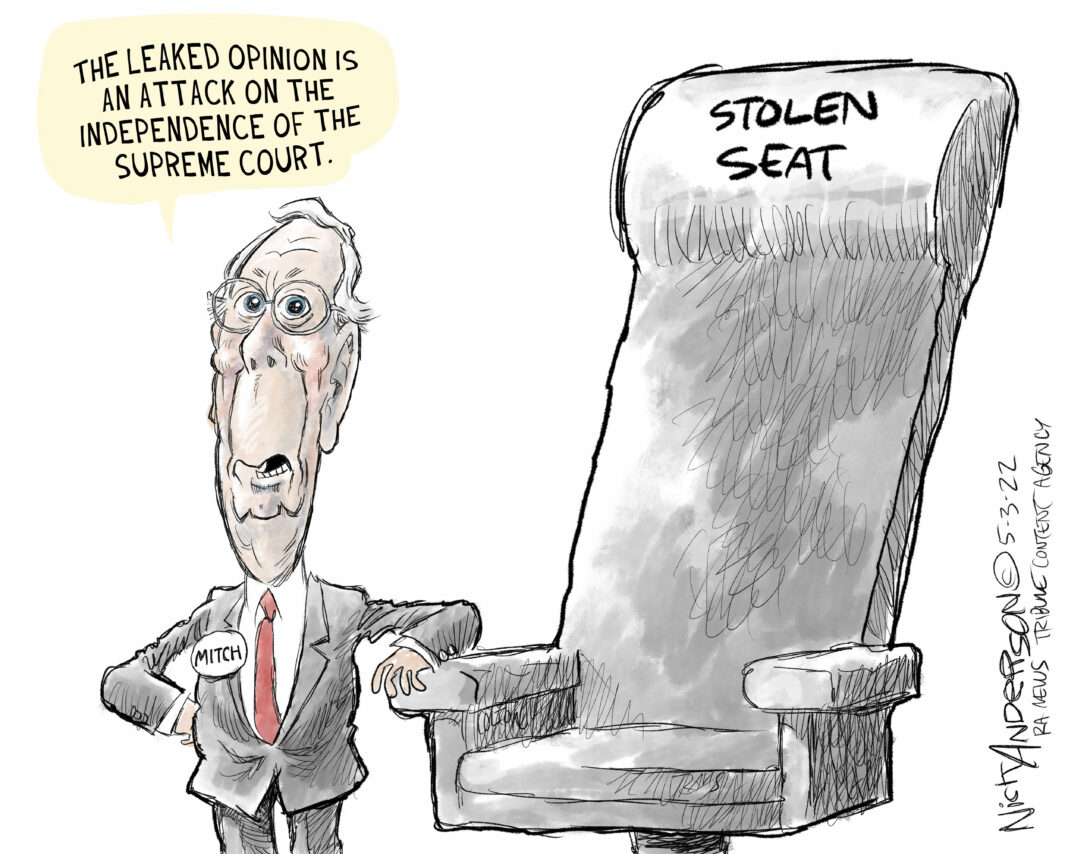
When Justice Scalia died, President Obama nominated Merrick Garland to replace him. Garland had a spotless record that left Republican senators no excuse to vote against him. So instead Majority Leader Mitch McConnell just refused to recognize that Garland had been nominated at all, ignoring the Constitutional directive to advise and consent on nominations, giving the excuse that the Garland nomination was too close to the 2016 election. That argument went out the window, though, when Ruth Bader Ginsburg died, and Barrett’s nomination was raced through the Senate so that she could be seated in time for any 2020 election controversies.
The exchange below is instructive: Al Franken says the Garland/Barrett hypocrisy “destroyed the legitimacy of the Court”. Republican Alice Stewart argues that the Garland maneuver is what happens “historically” when the Senate is controlled by a different party than the White House. And Franken refuses to let that lie pass: “When has it ever happened before?” he demands, and won’t stop asking the question, because Stewart can’t answer. It had never happened before.
The Court’s conservative majority is the result of minority rule.
The Founders strongly believed in the sovereignty of the People, but they left two major loopholes in the Constitution that have opened the door to minority rule: the Electoral College and the Senate. The Court’s current majority could not exist without both of them.
For the last thirty years, Republican Senate majorities have relied not on the support of a majority of American voters, but on using small-state victories to overcome large-state defeats. Since 1990, there has been only one six-year election cycle (i.e., the period during which all Senate seats come up for election) when Republican Senate candidates got more votes than their Democratic opponents. It hasn’t happened since the 1994/1996/1998 cycle. [3]
In other words, if the Senate represented the American people, Mitch McConnell would never have been majority leader.
Under a majority-rule constitution, a Democratic-majority Senate would have seated Merrick Garland, Hillary Clinton would have nominated Ruth Bader Ginsburg’s replacement to a Democratic-majority Senate, and Justice Kennedy would be hoping to live long enough to see a Republican president. Liberals would have a 5-4 majority, counting the sometimes-liberal Kennedy as part of the conservative 4.
The Court actively participates in a minority-rule vicious cycle.
It would be one thing if happenstance (such as who dies when) had created the conservative Court majority, and that Court went on to make impartial principled rulings about elections.
But conservative justices on the Court have been actively promoting the minority rule that installed them. Justice Roberts, for example, wrote the 5-4 opinion that gutted the Voting Rights Act, and has continued to chip away at what remains of it. [4]
That opinion has allowed Republicans to pass voter suppression laws in swing states like Georgia and Wisconsin, which might well decide which party controls the Senate next year. Roberts’ ruling could make the difference that puts Mitch McConnell back into a position where he could block a Biden nominee if some member of the Court’s conservative majority should happen to die or retire unexpectedly.
It’s a vicious cycle: A Court approved by minority rule extends minority rule.
The Roberts Court has put its thumb on the electoral scales in a variety of other ways, consistently favoring Republicans. It has refused to ban gerrymandering, arguing the absurd point that the voters should take action against the very gerrymandering that makes their votes irrelevant. It has opened the spigots of corporate campaign donations and dark money, which overwhelmingly flows to conservative candidates.
Again, we can see the results: Democrats currently lead in the generic congressional ballot polls by an average of 1.3%. And yet Republicans are favored to control the House. Why? Because Democrats have to win by 3-5% to gain a majority of seats.
Compare two recent “wave” elections. In 2018, 53.4% of voters supported Democratic House candidates, compared to 44.8% who supported Republicans. Those votes gave Democrats a 235-199 majority.
In 2010, 51.7% voted for Republican House candidates compared to 44.9% for Democrats. The resulting Republican majority? 242-193.
Fewer Republican votes yield more Republican seats. That’s a problem for people who believe in democracy, but not for the Roberts Court. The more Republican seats, the better.
It could soon get worse. The Court has decided to hear Moore v Harper, a case which raises the once-absurd “independent state legislature” doctrine. Under this theory, rules for federal elections are set by state legislatures, and no one can overrule them: governors can’t veto and state supreme courts can’t find that they violated the state constitution.
When you consider that some state legislatures are so gerrymandered that they aren’t really democratic institutions any more [5], giving them total control of federal elections is a recipe for permanent minority rule.
The Court has an ethics problem.
The only ethics code that applies to the justices is the vague “good behavior” standard in the Constitution. Each justice makes his own decisions about conflicts of interest and whether to recuse from a case. The current justices are abusing that lack of standards.
The most egregious recent case is Clarence Thomas, who rules on cases where his wife has an interest.
But also, a federal panel in 2018 dismissed 83 ethics complaints against Brett Kavanaugh, not because they weren’t serious, but because “there is no existing authority that allows lower court judges to investigate or discipline Supreme Court justices.” And we have since discovered that the FBI investigation into Christine Blasey Ford’s sexual assault accusation against Kavanaugh was rigged to find nothing.
Unpopularity is just the beginning.
Any judge has to be ready to bear the heat of making an unpopular decision, if that’s what the rule of law requires. But when changes on the Court immediately lead to changes in the meaning of the laws, the public is right to be suspicious.
And when those changes on the law are based on a minority’s ability to change the Court without ever changing the minds of the electorate, that’s a problem. Vox’ Ian Millhiser sums that problem up:
The Dobbs decision is the culmination of a decades-long effort by Republicans to capture the Supreme Court and use it, not just to undercut abortion rights but also to implement an unpopular agenda they cannot implement through the democratic process.
Worse, the Court is abusing its power to change the democratic process itself, and so is rewarding the party that installed it.
That — and not a few unpopular decisions — is the source of the Court’s legitimacy problem.
[1] Many people think the number of justices is set in the Constitution, but it isn’t. Article III says simply:
The judicial Power of the United States, shall be vested in one supreme Court, and in such inferior Courts as the Congress may from time to time ordain and establish.
leaving the details of the Court totally up to Congress. The actual number of justices has changed many times. The original court had six justices. The nine-justice court was established in 1869, and has stayed at nine ever since.
The objection to court-packing is obvious: It sets up the possibility of a tit-for-tat cycle, where new justices are approved whenever a new party takes power. But accepting that argument leaves a question unanswered: The Court has already been packed. What should be done about that?
[2] Some people add Justice Alito to this total, because he was appointed by George W. Bush, who lost the popular vote to Al Gore in 2000. However, Bush nominated Alito during his second term, after winning the popular vote in 2004. You can argue that if Gore had been elected in 2000, Bush couldn’t have been re-elected in 2004. But that argument takes us a little too far down the alternate-history rabbit hole. Gore might have lost his re-election bid in 2004, and the Republican who beat him might have appointed someone like Alito.
[3] The Senate that confirmed Amy Coney Barrett in 2020 is a good example. During the 2014/2016/2018 election cycle (when the senators serving in 2020 were elected), Democratic Senate candidates got 50.3% of the votes compared to the Republicans’ 43.3%. But that minority of votes netted the Republicans a 53-47 majority.
[4] It’s impossible to read Roberts’ 2013 Voting Rights Act decision as a legal argument; it’s a political argument, pure and simple. Here’s my summary at the time:
The VRA was vaguely justified in 1965 and is vaguely unjustified now, because “things have changed”. If I were a congressman, I would have no idea how to revise the VRA so that it passes constitutional muster. If Congress does revise it, lower court judges who rule on it will just be guessing about its constitutionality. It will have to go back to the Supreme Court before anyone knows whether it’s really a law again, because there are no standards in Roberts’ opinion by which a revision can be judged.
59 million Americans live under minority rule in their U.S. state legislatures following the 2018 elections. Minority rule is defined as the party with the minority of votes in the most recent election nevertheless controlling the majority of seats in the state legislature subsequent to that election. Six U.S. state legislatures were drawn by legislatures or partisan-leaning committees that resulted in minority rule following the 2018 elections. These states are Michigan, North Carolina, Ohio, Pennsylvania, Virginia, and Wisconsin
Note that all six of those states were Republican legislatures ruling over a Democratic electorate.
Scrapping abortions rights got the headlines. But don’t ignore the Court’s assault on gun regulations and the separation of church and state.
Late June tends to be a big time for the Supreme Court. Like freshmen who have put off writing their term papers until the last minute, the Court typically unleashes a flurry of decisions just before leaving town for the summer.
The end of this term has been more significant than most. Last week, three major decisions were published, along with several lesser decisions. The Dobbs decision reversing Roe v Wade was immediately consequential, as abortion has already effectively become illegal in a number of states, with more to follow soon. But it also laid the groundwork for future decisions reversing a number of rights: the right to marry someone of the same sex or a different race, to access contraception, or to choose (with your consenting partner) your own sexual practices.
The week’s other two decisions had fewer immediate consequences, but similarly looked like the first steps down a long road. Carson v Makin directly affects only a few families in rural Maine, but announces the Court’s intention to drastically redraw the line between Church and State. NY State Rifle & Pistol v Bruen tosses out a New York gun regulation that has stood for a century, but similarly calls all gun regulations into question.
Justice Alito’s majority opinion tried to minimize the consequences of this decision, which on the surface only [only!] reversed Roe, but also created a blueprint for throwing out all the substantive-due-process rights. Justice Thomas, on the other hand was explicit about where he wants the Court to go next:
in future cases, we should reconsider all of this Court’s substantive due process precedents, including Griswold, Lawrence, and Obergefell. Because any substantive due process decision is “demonstrably erroneous,”, we have a duty to “correct the error” established in those precedents. After overruling these demonstrably erroneous decisions, the question would remain whether other constitutional provisions guarantee the myriad rights that our substantive due process cases have generated.
Thomas forgot to mention one other substantive-due-process case: Loving v Virginia, which makes his own interracial marriage legal. (I can see how that might start a difficult conversation: “Sorry, honey, but we were never really married.”) Given the anti-miscegenation laws that existed when the 14th Amendment passed in 1868, it’s hard to see how Loving survives the kind of historical analysis the Court did this week in both Dobbs and Bruen.
Leaning the other way, Justice Kavanaugh not only ignored future reversals, but tried to gloss over the radical nature of this one:
On the question of abortion, the Constitution is therefore neither pro-life nor pro-choice. The Constitution is neutral and leaves the issue for the people and their elected representatives to resolve through the democratic process in the States or Congress—like the numerous other difficult questions of American social and economic policy that the Constitution does not address.
The obvious implication of that statement is that Kavanaugh would not overrule Congress if it did codify reproductive rights. However, given how duplicitous Kavanaugh has already been on this issue, I wouldn’t count on him following through if such a case reached the Court.
He also waxed philosophical:
The Constitution does not grant the nine unelected Members of this Court the unilateral authority to rewrite the Constitution to create new rights and liberties based on our own moral or policy views.
I’ll be interested to see if Kavanaugh stands by this position the next time a corporate personhood case comes before the Court. The Constitution says nothing about corporations, and yet conservative judges have had no trouble reading between the lines to find “new rights and liberties” for these wealthy and immortal beings.
As I predicted in March, Chief Justice Roberts concurred in upholding Mississippi’s ban on abortions after 15 weeks, but not in overturning Roe completely.
Our abortion precedents describe the right at issue as a woman’s right to choose to terminate her pregnancy. That right should therefore extend far enough to ensure a reasonable opportunity to choose, but need not extend any further—certainly not all the way to viability. Mississippi’s law allows a woman three months to obtain an abortion, well beyond the point at which it is considered “late” to discover a pregnancy.
That’s typical Roberts, as you’ll see below in the Carson case. He also would destroy Roe, but do it over a period of years by pecking it to death. In this dissent, he makes a doctrine out of that approach:
If it is not necessary to decide more to dispose of a case, then it is necessary not to decide more.
Going back to the corporate personhood example, Roberts didn’t recommend this kind of restraint in Citizens United.
The Court’s three liberal justices — Breyer, Kagan, and Sotomayor — wrote a common dissent. Interestingly, they agreed with Thomas that abortion rights are tied to all the other substantive-due-process rights.
The lone rationale for what the majority does today is that the right to elect an abortion is not “deeply rooted in history”: Not until Roe, the majority argues, did people think abortion fell within the Constitution’s guarantee of liberty. The same could be said, though, of most of the rights the majority claims it is not tampering with. The majority could write just as long an opinion showing, for example, that until the mid-20th century, “there was no support in American law for a constitutional right to obtain [contraceptives].” So one of two things must be true. Either the majority does not really believe in its own reasoning. Or if it does, all rights that have no history stretching back to the mid-19th century are insecure. Either the mass of the majority’s opinion is hypocrisy, or additional constitutional rights are under threat. It is one or the other.
The dissent challenges the legitimacy of ignoring stare decisis to reverse the Roe and Casey precedents.
No recent developments, in either law or fact, have eroded or cast doubt on those precedents. Nothing, in short, has changed. … The Court reverses course today for one reason and one reason only: because the composition of this Court has changed. Stare decisis, this Court has often said, “contributes to the actual and perceived integrity of the judicial process” by ensuring that decisions are “founded in the law rather than in the proclivities of individuals.” Today, the proclivities of individuals rule.
It attacks Alito’s history-alone reasoning. If “liberty” means exactly what it did in 1868, that has a lot of unfortunate consequences, particularly for women.
The Court [in Casey] understood, as the majority today does not, that the men who ratified the Fourteenth Amendment and wrote the state laws of the time did not view women as full and equal citizens. A woman then, Casey wrote, “had no legal existence separate from her husband.” Women were seen only “as the center of home and family life,” without “full and independent legal status under the Constitution.” But that could not be true any longer: The State could not now insist on the historically dominant “vision of the woman’s role.”
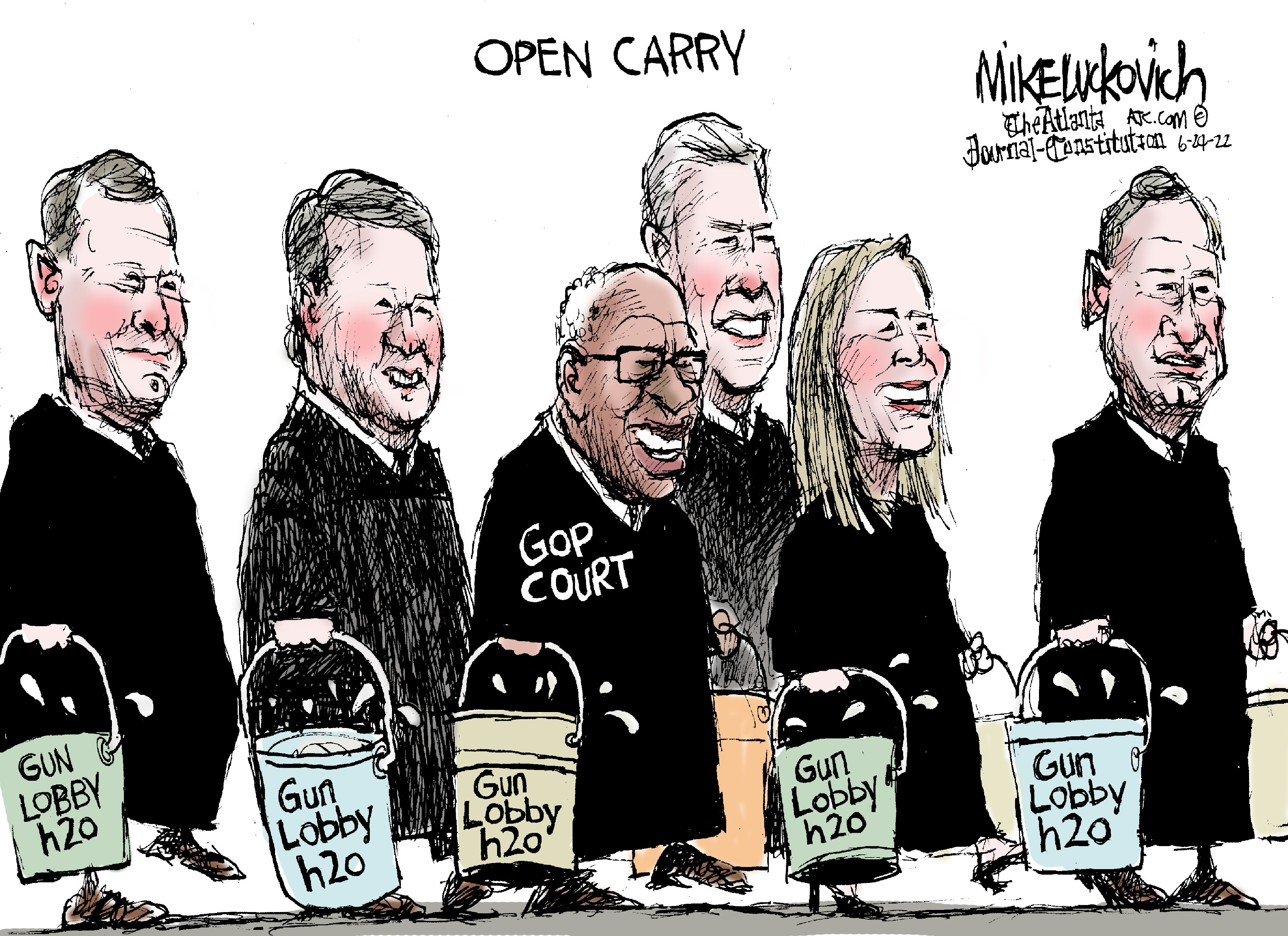
Guns. In Bruen, Justice Thomas writes for the six conservative justices. Thomas is the justice whose thought process seems most alien to me, and here he loses me early on:
In keeping with Heller, we hold that when the Second Amendment’s plain text covers an individual’s conduct, the Constitution presumptively protects that conduct.
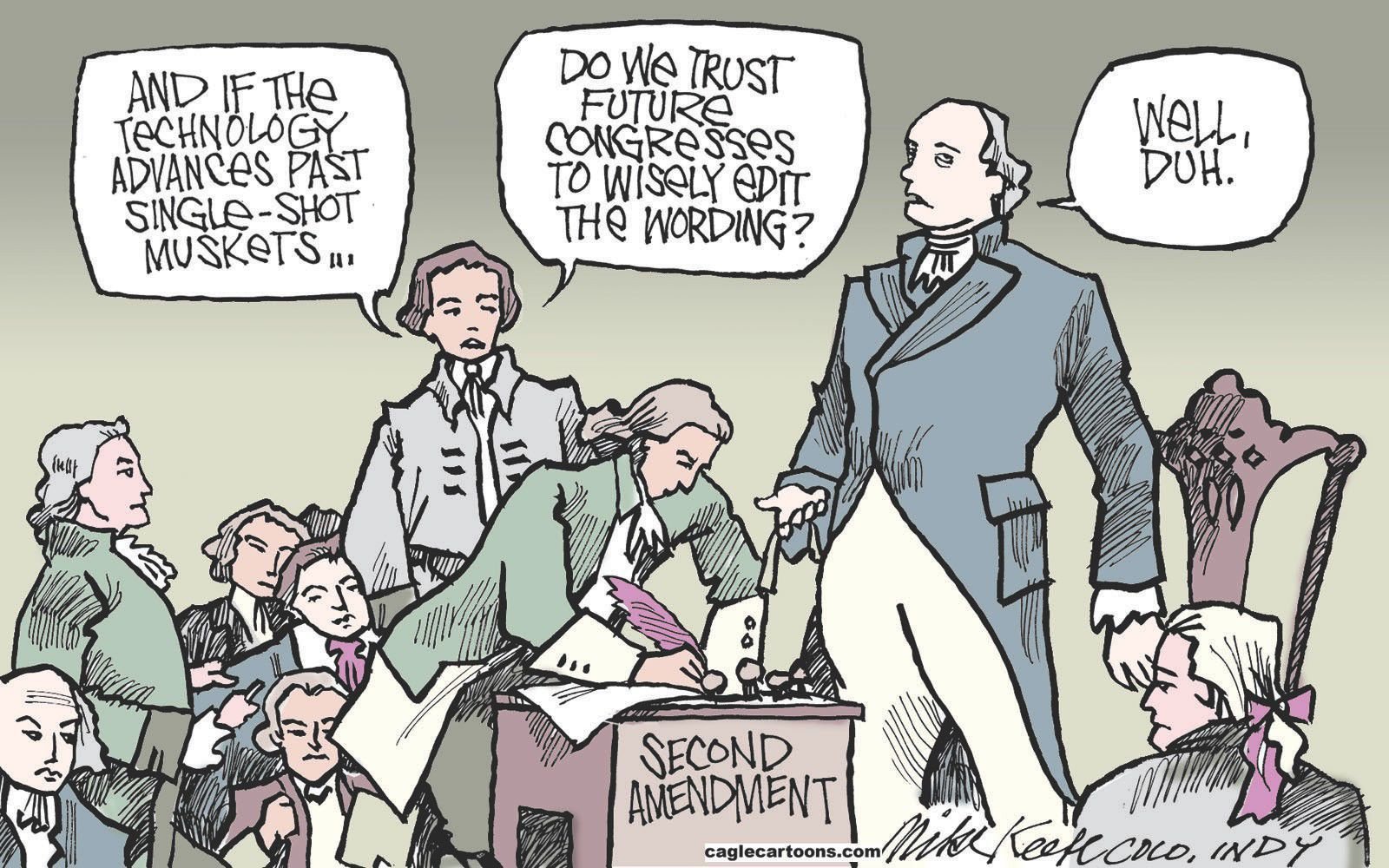
Heller is the 2008 case in which Justice Scalia invented an individual right to bear arms, independent of any notion of “a well-regulated militia”, as if the Founders just threw that phrase into the Second Amendment on a whim.
Judges and legal scholars before Scalia had laughed at this interpretation, which had not figured in any previous Supreme Court decision since the beginning of the Republic. In 1990, retired Chief Justice Warren Burger, who had been appointed by Richard Nixon and at the time was not anyone’s idea of a liberal, called such an interpretation of the Second Amendment “a fraud on the American public“. John Paul Stevens, who wrote the primary dissent in Heller, called it “the Supreme Court’s worst decision of my tenure“.
And then we get to “the Second Amendment’s plain text”. I have explained previously (and at length) why I don’t think the text of the Second Amendment means anything at this point. (Briefly, the Founders’ vision of the role of the militia bears no resemblance to any institution that currently exists: not the National Guard, and certainly not self-appointed yahoos who run around in the woods wearing camo. History just went a different way. The Second Amendment, basically, is a signpost on a road not taken.) So the idea that the Second Amendment has a “clear text” that “covers” something in today’s world — that’s just wrong. If we can’t repeal it and start over, the most sensible approach would be to ignore it.
The government must then justify its regulation by demonstrating that it is consistent with the Nation’s historical tradition of firearm regulation. Only then may a court conclude that the individual’s conduct falls outside the Second Amendment’s “unqualified command.”
The regulation in question in this case is New York’s state law that requires gun owners to have a license, and which denies licenses for people to carry guns outside their homes unless they “demonstrate a special need for self-protection distinguishable from that of the general community.” The two New Yorkers bringing suit claim that it should be up to them to decide if they need a gun for self-defense, not up to the state.
Thomas then has to judge whether this regulation is “consistent with the Nation’s historical tradition of firearm regulation”. But he then edits that history in a very convenient way: Pre-colonial English history is too early to matter (though it wasn’t when assessing abortion laws in Dobbs). Gun regulations in the Wild West come too late. Even colonial and federal-era history can be swept away with the proper hand-waving.
Thus, even if these colonial laws prohibited the carrying of handguns because they were considered “dangerous and unusual weapons” in the 1690s, they provide no justification for laws restricting the public carry of weapons that are unquestionably in common use today.
And two post-Civil-War cases in Texas “support New York’s proper-cause requirement”, but they can be dismissed as “outliers”. When the Kansas Supreme Court upheld a “complete ban on public carry enacted by the city of Salina in 1901”, its decision was “clearly erroneous”. And the New York law Thomas is overturning was passed in 1911. (Justice Breyer’s dissent correctly sums up Thomas’ historical analysis as “a laundry list of reasons to discount seemingly relevant historical evidence.” The dissent in Dobbs makes fun of how Thomas’ cramped view of history in this case contrasts with Alito’s expansive citation of sources back to the Middle Ages in Dobbs. Thomas, naturally, signed on to Alito’s opinion, and his concurrence did not correct Alito’s historical analysis.)
Thomas’ whole historical method ignores the possibility that early American legislators believed they had a perfect right to regulate firearms, but didn’t see any special need at the time. (Breyer: “In 1790, most of America’s relatively small population of just four million people lived on farms or in small towns. Even New York City, the largest American city then, as it is now, had a population of just 33,000 people. Small founding-era towns are unlikely to have faced the same degrees and types of risks from gun violence as major metropolitan areas do today, so the types of regulations they adopted are unlikely to address modern needs.”)
And so, having adopted Heller’s interpretation of the Second Amendment and eliminated any conflicting examples from consideration, Thomas reaches his conclusion.
At the end of this long journey through the Anglo-American history of public carry, we conclude that respondents have not met their burden to identify an American tradition justifying the State’s proper-cause requirement. The Second Amendment guaranteed to “all Americans” the right to bear commonly used arms in public subject to certain reasonable, well-defined restrictions. Those restrictions, for example, limited the intent for which one could carry arms, the manner by which one carried arms, or the exceptional circumstances under which one could not carry arms, such as before justices of the peace and other government officials. Apart from a few late-19th-century outlier jurisdictions, American governments simply have not broadly prohibited the public carry of commonly used firearms for personal defense. Nor, subject to a few late-in-time outliers, have American governments required law-abiding, responsible citizens to “demonstrate a special need for self-protection distinguishable from that of the general community” in order to carry arms in public.
Justice Breyer’s dissent raises the central failing of Thomas’ dogmatic approach.
The question before us concerns the extent to which the Second Amendment prevents democratically elected officials from enacting laws to address the serious problem of gun violence. And yet the Court today purports to answer that question without discussing the nature or severity of that problem.
In other words, Thomas loses himself in estimating how many angels could dance on a pinhead in the 1790s, without any concern for what is happening today. (Alito’s concurrence berates Breyer for even daring to consider the present-day problem the law in question is trying to address.) Breyer finds that “decisions about how, when, and where to regulate guns [are] more appropriately legislative work”, and that judges should show “modesty and restraint” in overruling legislatures who take on that work. And he raises this key question:
[W]ill the Court’s approach permit judges to reach the outcomes they prefer and then cloak those outcomes in the language of history?
Church and State. Because John Roberts doesn’t sign on to decisions like Alito’s reversal of Roe, he has gotten an image as the “moderate” on the Court. I don’t think that’s exactly true. Roberts is every bit as radical as the five who signed Alito’s opinion. He just moves towards his extreme goals in a stealthier, more step-by-step fashion. Roberts is like the thief who doesn’t strip your whole orchard in one night; but he leaves a hole in the fence and keeps coming back.
Campaign finance is a good example. Roberts didn’t destroy Congress’ ability to control political contributions in one fell swoop. He ate away at it over a period of years.
His majority opinion in Carson v Makin is similarly one of a series of cases that eats away at separation of church and state. On the surface, this decision doesn’t do much: A handful of families who live in rural areas of Maine will be able to get state support to send their children to conservative Christian schools, in spite of the Maine legislature’s attempt not to fund such schools. (And even they won’t get support for the schools they want, because Maine’s law also disqualifies schools that discriminate against gays and lesbians.)
To get that tiny result, though, Roberts blows a big hole in the wall between church and state. New cases will be coming through that hole for years to come, and the principles established in Carson will funnel more and more public funding to the Religious Right.
Here’s the background: Some rural areas of Maine have so few students that it’s not worth supporting a public high school. Instead, some of them contract with high schools in neighboring districts to take their students. But some don’t even do that. If you live in one of those, you can get tuition reimbursement from the state to send your children to a private high school that meets certain requirements. One requirement is that the school be “nonsectarian”. That condition was added in 1981, after the state attorney general ruled that paying tuition to a sectarian school would violate the Establishment Clause of the First Amendment.
Maine has a fairly narrow definition of “sectarian”. It’s OK for a school to be founded by or associated with a church or other religious organization. But public money was banned from going to a school which
in addition to teaching academic subjects, promotes the faith or belief system with which it is associated and/or presents the material taught through the lens of this faith.
The two families that brought suit against this policy live in Glenburn (population 4,648) and Palermo (1,570). They want Maine to help them pay tuition to schools that clearly are sectarian. For example, one of the schools, Temple Academy, has as its mission statement:
Temple Academy exists to know the Lord Jesus Christ and to make Him known through accredited academic excellence and programs presented through our thoroughly Christian Biblical world view.
It goes on to pledge
To provide a sound academic education in which the subject areas are taught from a Christian point of view.
To help every student develop a truly Christian world view by integrating studies with the truths of Scripture.
So Temple is not like a nominally Catholic or Baptist school where students of other faiths might opt out religion classes or worship services. Students who attend any classes at all are being indoctrinated in a conservative Christian worldview, and part of every teacher’s job is to promote a particular version of Christianity.
Also, the Maine law is not like a voucher program, where the legislature delegates choice of schools to parents, understanding that some parents will choose sectarian schools. Maine’s legislature tried NOT to fund religious indoctrination; but Roberts’ decision says that it MUST.
This is new, and it is radical.
Justice Breyer’s dissent (Breyer, who is retiring and will be replaced next term by Ketanji Brown Jackson, is going out with a bang) is a good introduction to how the Court has historically interpreted the First Amendment, which bars any government “establishment of religion” but also guarantees individual citizens “free exercise” of their religious faith. Breyer says that these two clauses are “often in tension” but express “complementary values”. Quoting previous Court decisions, Breyer imagines what motivated the amendment’s two religion clauses.
Together they attempt to chart a “course of constitutional neutrality” with respect to government and religion. They were written to help create an American Nation free of the religious conflict that had long plagued European nations with “governmentally established religion[s].” Through the Clauses, the Framers sought to avoid the “anguish, hardship and bitter strife” that resulted from the “union of Church and State” in those countries.
“Conflict” is a bit of an understatement here. In England, the Anglican/Catholic/Puritan struggle dominated the 1600s, resulting in the beheading of Charles I, a long civil war, and the Glorious Revolution of 1688. On the Continent, the Thirty Years War killed at least 4.5 million people. The Founders knew this history and desperately wanted to avoid repeating it.
Previous Courts held that the tension between the two religion clauses created “play in the joints”. In other words, states had room to navigate between them. One state might choose to draw the line in a different place than another.
States enjoy a degree of freedom to navigate the Clauses’ competing prohibitions.
Roberts started taking that freedom away when he wrote the majority opinion in the 2017 Trinity Lutheran case, where Missouri was forced to include religious schools in a grant program to make playgrounds safer. Breyer can live with that outcome (in 2017 he wrote a partial concurrence), but doesn’t think that decision forces this one.
Any Establishment Clause concerns arising from providing money to religious schools for the creation of safer play yards are readily distinguishable from those raised by providing money to religious schools through the program at issue here—a tuition program designed to ensure that all children receive their constitutionally guaranteed right to a free public education. After all, cities and States normally pay for police forces, fire protection, paved streets, municipal transport, and hosts of other services that benefit churches as well as secular organizations. But paying the salary of a religious teacher as part of a public school tuition program is a different matter.
It’s striking that in this case (as in the gun case above) it is Breyer and the liberals, not Roberts (or Thomas) and the conservatives, who are defending states rights.
We have never previously held what the Court holds today, namely, that a State must (not may) use state funds to pay for religious education as part of a tuition program designed to ensure the provision of free statewide public school education.
The cases Roberts cites as precedents, Breyer says, don’t justify this shift from permission to requirement.
In the majority’s view, the fact that private individuals, not Maine itself, choose to spend the State’s money on religious education saves Maine’s program from Establishment Clause condemnation. But that fact, as I have said, simply permits Maine to route funds to religious schools. It does not require Maine to spend its money in that way.
This particular decision may not affect many Americans. But Breyer sees clearly where Roberts is headed.
What happens once “may” becomes “must”? Does that transformation mean that a school district that pays for public schools must pay equivalent funds to parents who wish to send their children to religious schools? Does it mean that school districts that give vouchers for use at charter schools must pay equivalent funds to parents who wish to give their children a religious education? What other social benefits are there the State’s provision of which means—under the majority’s interpretation of the Free Exercise Clause—that the State must pay parents for the religious equivalent of the secular benefit provided? The concept of “play in the joints” means that courts need not, and should not, answer with “must” these questions that can more appropriately be answered with “may.”
And doesn’t Roberts’ policy implicitly favor more popular religions?
Members of minority religions, with too few adherents to establish schools, may see injustice in the fact that only those belonging to more popular religions can use state money for religious education.
After all, who but Christians will be able to find a market for religious schools in rural Maine? This is a problem I have had with the conservative view of “religious freedom” all along: In practice, it only gives rights to conservative Christians — or, completely by accident, to other religious groups who happen to agree with conservative Christians on a particular issue like abortion or homosexuality.
So it may be amusing to imagine how this ruling might someday be used to make Evangelical taxpayers support a Muslim madrassah, or some other school they would abhor. But I question whether such a thing will ever happen. This Court’s sectarian majority believes in special rights for Christians. It will find ways around extending those rights to anyone else.
Here’s how Sherry Kolb put it in “Are Religious Abortions Protected?“, where she examines the argument (raised in a recent lawsuit filed by a Florida synagogue) that a Jewish doctor may feel religiously obligated to perform an abortion in situations where a state has banned them.
Despite appearances to the contrary, this Court is not especially friendly to Free Exercise claims. … Its rulings instead reflect its friendliness to conservative Christianity and, accordingly, to Judaism and Islam where the ask is minimal or the traditions happen to be the same. Christians can violate the anti-discrimination laws for religious reasons because they are Christians. The sooner we come to understand that the Court is all about Christianity rather than some capacious vision of religious liberty for all, the sooner we will begin the process of finding solutions to our modern-day theocracy problem that do not ask the Court to behave with integrity or consistency.
The only change since the last time I covered this issue is that more people have died.
From your cousin on social media to TV talking heads and syndicated columnists, everybody who comments on current events is facing the same conundrum: What do you say when nothing has changed since the last time you spoke out? There are no new insights to offer, no arguments that didn’t prove to be futile last time.
And yet, how can you stay silent? Silence is complacency that can even be interpreted as consent. Ten-year-olds get massacred in a public school? Grandmothers get killed for shopping-while-Black? Asians get shot at a church luncheon? It happens. This is America. Things that don’t happen anywhere else happen here, sometimes one right after another. And in spite of all the other countries that have responded to horrifying mass killings by taking effective action, nothing can be done here. This is America.
This week, I’ve decided to be open about the fact that I have nothing new to say. December 14 will be the tenth anniversary of the Sandy Hook massacre of 20 six- and seven-year-olds. April 20 was the 23rd anniversary of Columbine. So I’ve had decades to compose my thoughts on mass shootings and gun control. There’s very little I can write that I haven’t written before.
So rather than repeat everything as if I just thought of it, I’ve decided to post a guide (and partial update) to my previous posts on guns. [1]
My most serious look at America’s gun problem was “How Should We Rewrite the Second Amendment?” in 2019. Google, in its great algorithmic wisdom, recommended that post to people interested in the Second Amendment, netting me more than 18,000 page views and 300 comments, almost all of them negative.
The gist of my essay was that we argue so vociferously about the Second Amendment because it no longer has any recoverable meaning relevant to current issues. From the Supreme Court to that loud guy at the bar, anybody who “interprets” the Second Amendment and “applies” it to today’s world is really just making stuff up. We yell our own particular interpretations so loudly because interpretation is all we have at this point. To the extent that we can discern the “original intent” of the Founders at all, it’s completely tangential to anything happening today.
So I proposed that we replace the Second Amendment with a new amendment to capture what we really want out of guns in this era. The core of my rewrite was:
Congress shall make no law preventing individuals from securing adequate means to defend their homes and persons, or preventing state or local governments from equipping police forces adequate to enforce their laws and ensure public safety.
I gave the federal government explicit permission to regulate interstate transportation and sale of guns, while granting states the power to regulate guns within their borders.
In the face of the pushback, I wrote a sequel the next week to summarize and address my critics’ points. In retrospect, I’m surprised how much good humor I maintained after all that abuse.
As for what the Constitution doesn’t say about guns, see my 2018 post “Three Misunderstandings about Guns and the Constitution“. In particular, the Second Amendment was never intended to facilitate an armed uprising against the federal government.
The “well-regulated militia” it envisioned was supposed to make a large federal standing army unnecessary, not to fight against one. Militias, in the Founders’ vision, would enable state and local governments to maintain public peace and enforce their laws without begging the feds for help. Because of the militias, the federal army would only be needed in case of war with a foreign power like Britain or Spain, and otherwise would be a tiny force that wouldn’t tempt an unpopular president to stage a coup.
Not a militiaman
One reason why I later proposed rewriting the amendment was that all the ships in the Founders’ harbor sailed long ago. The outcome the Founders wanted to avoid when they wrote the Second Amendment is already here: We do have a large standing army with forts all over the country, as well as various kinds of federal police from the FBI to DEA to Treasury to TSA to ICE. We can still argue about whether any of that was a good idea. But one way or the other, here we are.
People who feel safer with a gun than with guaranteed medical insurance don’t yet have a fully adult concept of scary.
One reason the gun debate goes nowhere is that the two sides aren’t really discussing the same issue. Gun-control advocates are looking at a public-health problem: Guns kill tens of thousands of Americans every year. What can be done to lower that total?
But most pro-gun arguments are story-based, because gun advocates are addressing something else entirely: Sometimes a dark fantasy gets stuck in your head and you can’t get it out. What do you do about that? Armed intruders invading your home, your daughter getting raped in the park, roaming street gangs killing people at random — those images can disrupt your peace of mind, no matter what the statistics say about their probability. Some policy change that experts predict would cut rapes in half, for example, doesn’t really help you deal with the what-if in your brain.
That’s what a gun is for. It’s a magical talisman that enables a counter-fantasy you can invoke to dispel whatever dark fantasy might be plaguing you. Home invaders? You’ll win a shoot-out with them. Your daughter? She’ll manage to get the gun out of her backpack and plug the guy before he can take it away and shoot her instead. (And the gun will never haunt her imagination on days when she’s feeling suicidal.) Gangs? You, the neighbors, and your AR-15s will form an impromptu urban warfare platoon to take them out.
Will any of that work in reality? Hardly ever, as ABC demonstrated with this gun-training exercise. But realistic thinking misses the point. If the problem lives in your personal fantasy world, a fantastic solution works just fine.
That’s why even the most common-sense gun reforms get bogged down in improbable scenarios. As in this argument against limiting the size of gun magazines: “Criminals don’t always act alone. It is often necessary to have enough ammunition to hold off multiple assailants.” Often? Would that be “often in the author’s experience” or “often in the author’s dark fantasies”?
Meanwhile, the NRA’s mouthpieces float action-movie ideas that may help you overcome your paralyzing my-child-gets-killed-at-school nightmare, but are totally disconnected from reality.
But maybe Paxton is imagining something more like Kindergarten Cop, where Arnold Schwarzenegger is an LAPD detective who goes undercover as a teacher. No doubt that movie character would fare much better against a shooter than my sister would. Which raises the question: What if we stopped recruiting teachers from wimpy liberal arts colleges and instead hired, say, ex-special-forces operatives (without raising pay, of course)? Or maybe it would be more cost effective to train the kids to defend themselves, in a scenario something like Spy Kids, or maybe Home Alone.
The two featured posts today look at the leaked Alito opinion overturning Roe v Wade through two very different lenses. The other post goes through the text of the opinion and examines its claims and arguments. This one considers the question: How did we get here?
In particular, whose fault is it that women in about half the states are going to lose their right to bodily autonomy, and their ability to plan their lives?
Let’s start with those most directly responsible.
Justices Alito, Barrett, Gorsuch, Kavanaugh, and Thomas. Or, as Stephen Colbert described them: “four old dudes and a woman who thinks The Handmaid’s Tale is a rom-com”.
Sometimes when we start assessing secondary blame, we lose sight of the primary blame. (Yeah, you shouldn’t have left your keys in the ignition, but the main reason your car got stolen was that some thief stole it.) Let’s not do that here: Roe is being overturned because five Supreme Court justices are putting their personal religious opinions above their duty to respect established precedents.
But a reversal is typically done after the Court has tried and failed to make the precedent work. That’s what happened, for example, when Brown v Board of Education (1954) reversed the “separate but equal” doctrine of Plessy v Ferguson (1893). In a series of cases from 1938 to 1950, the Court ordered students admitted to previously segregated white schools because the separate educational path provided for Black students was not really equal. In Brown, the Court drew a conclusion from that experience: Separate-but-equal schools were unworkable, because states with segregated schools would never provide a truly equal education to Black students.
But (in spite of what Alito claims, which I discussed in the other post) nothing about Roe and Casey has proven to be unworkable. The only major thing that has changed since Roe was decided in 1973 and upheld in 1992 is the composition of the Court. Alito, Barrett, Gorsuch, Kavanaugh, and Thomas are overturning Roe because they want to.
What’s more, they were all deceptive about this in their confirmation hearings. It’s arguable that they did not “lie”, depending on how tightly you define that word. (Thomas, I would argue, clearly did lie, though his lie may not be provable. It is simply unbelievable that, even though he was in law school when Roe was decided, he never participated in a discussion about it.) When asked about their approach to the Roe precedent, all five gave lawyerly answers that, in retrospect, were designed to deceive. If they could be cross-examined somewhere about their statements (which they can’t be, short of an impeachment hearing), all would have to say something similar to Bill Clinton’s “It depends on what the definition of ‘is’ is.”
Mitch McConnell. The reason Trump got to appoint three justices in four years is that McConnell played shenanigans in the Senate.
When Antonin Scalia died 11 months before the end of President Obama’s term, Obama nominated Merrick Garland to the Court. This was in no way a radical choice: Garland was already the chief judge on the most powerful appeals court in the country; he had been confirmed for that job by 73 senators; he was widely regarded as a moderate; and at the age of 63, he would probably only hold the seat for about 20 years, rather than 30 or 40.
In short: Obama was bending over backwards to be reasonable.
McConnell knew he could not present a valid reason not to confirm Garland, so he simply refused to hold hearings or bring the nomination to a vote, which is the process the Constitution calls for. The reason he gave was that an election was coming up, and the American people should have a chance to weigh in on this decision. (They did: Hillary Clinton got millions more votes than Donald Trump, but Trump got to make the appointment, who turned out to be Neil Gorsuch.)
McConnell also pushed Brett Kavanaugh’s nomination, and rubber-stamped the sham investigation of the sexual assault charge against him. When Ruth Bader Ginsburg died two months before the 2020 election, McConnell completely reversed his 2016 rhetoric about giving the American people a voice, and rammed Amy Coney Barrett’s nomination through in record time to give Trump his third justice.
The anti-democratic structure of the Senate. If the Senate were a democratic institution, Mitch would never have been majority leader to begin with, because the GOP would not have achieved a Senate majority any time in the last 24 years.
Here’s how that works: Every state gets two senators, no matter how many people it has. So Wyoming gets one senator for every 140,000 registered voters, while California gets one for every 11 million registered voters. In other words, it takes about 70 California voters have as much influence on the Senate as one Wyoming voter.
Sounds fair, right?
But you might be thinking: “Sure, blue California is under-represented compared to red Wyoming, but red Texas is also under-represented compared to blue Vermont. So maybe it all washes out.”
It doesn’t wash out. If you run the numbers, the last time Republican senators got more votes (over a complete 6-year Senate election cycle) than Democratic senators was 1994-1998. But in the 24 years since 1998, Republicans have held a Senate majority for 12 years: half the time.
In 2016, for example, when Mitch McConnell was using his Republican “majority” to keep President Obama from appointing Merrick Garland, sitting Democratic senators had gotten 50.7% of the total six-year Senate vote, compared to the Republicans’ 44.1%.
In a democratic country, Mitch wouldn’t have been majority leader at all, and Merrick Garland would be on the Court instead of Neil Gorsuch.
Similarly, during the Trump and Bush years, a democratic Senate would have had a Democratic majority. Bush probably could have gotten Alito and Roberts through anyway, because in those rose-colored days senators were not as partisan about the Court. (Alito was approved 58-42, and Roberts 78-22.) But Gorsuch, Kavanaugh, and Barrett would not have been confirmed.
Next, you might be wondering how we got such a skewed Senate. Historical accident, right?
After 1888, when we get the installment of Benjamin Harrison in the White House, he loses the popular vote by about 100,000 votes. But he’s installed thanks to the Electoral College. The Republicans under Harrison between 1889 and 1890, they let in six new states in 12 months. That was the largest acquisition of new states in American history since the original 13 and it’s never been matched again. They let in North Dakota, South Dakota, Montana, Washington, and then Idaho and Wyoming to go ahead and make sure that they would continue to control the Senate, and the Electoral College. And they’re not hiding this. They actually go onto their media which is their equivalent of the Fox News channel at the time and say, by letting in these states, we’re going to hold onto the Senate for all time and we’re going to make sure we hold onto the White House for all time.
So if you’ve ever wondered why one Dakota wasn’t enough, that’s the reason: Republicans were packing the Senate. The Senate remains skewed in their favor to this day.
It’s almost impossible to unmake states, and hard to imagine passing a constitutional amendment to give larger states more senators, so the easiest way to change the Senate to better reflect the voting public would be to grant statehood to Puerto Rico and D.C., which presumably would elect four Democrats to the Senate. (If Democrats wanted to imitate Republicans, they could give statehood to East and West Puerto Rico, each of which could have a population roughly equal to the two Dakotas put together.) That won’t happen, McConnell says, because eliminating the Senate’s Republican bias would be “full-bore socialism“.
Also, admitting Puerto Rico and D.C. would let a lot of Hispanics and Blacks cast meaningful votes, so that’s a non-starter.
The Electoral College. Like Benjamin Harrison, Donald Trump was never elected by the American people; he was installed by the Electoral College. In 2016, he got 46% of the vote, almost 3 million votes less than Hillary Clinton’s 48%. But his 46% produced 304 electoral votes to Clinton’s 227.
A less extreme miscarriage of democracy happened in 2000. That election has often been described as “close”, but it really wasn’t that close: Al Gore got half a million more votes than George W. Bush, so there was no doubt who the People chose. But after Florida was adjudicated in his favor (the vote in Florida really was close), Bush’s fewer votes turned into a 271-266 Electoral College win. (Sixteen of those electoral votes come from the aforementioned Montana, Idaho, Wyoming, and the two Dakotas. If they were all one state, it would have 5 million people, or 9 electoral votes; Bush loses.) Bush went on to appoint Justice Alito and Chief Justice Roberts.
Minority-vote presidents aren’t an accident; that’s what the Electoral College was designed to do: make some Americans’ votes count more than others. So in 2016, a few thousand voters in Wisconsin, Michigan, and Pennsylvania overruled much larger majorities in states like California, New York, and Illinois. If you’re a Californian, your vote just doesn’t matter as much as a purple-state vote. Sucks to be you.
Why did the Founders curse us with this unjust system? In a word: slavery. Votes in slave states were supposed to count more than votes in free states.
In 1787, the slave states wanted federal power comparable to their full populations (including slaves), but for obvious reasons they didn’t want to give the vote to slaves (or women, or men who didn’t own enough property). In school, most of us learned about one result of this desire to wield power in the name of people whose rights you totally deny: the 3/5ths Compromise. In setting the number of representatives a slave state got in Congress, its slave population would be included, but at a 40% discount.
That settled the House. The Senate was already undemocratic, so no problem there. But that left the presidency: If presidents were elected by the People, states that let more people vote would have more influence on the outcome.
Can’t have that, so the Electoral College was born. Each state got one electoral vote for each senator or congressman. So no matter how few people a state let vote, its influence on the presidency was guaranteed.
As Shakespeare had Marc Antony say: “The evil that men do lives after them.” Slavery ended with the 13th Amendment in 1865, but the blatant injustice of the Electoral College lives on. Women can thank it for the loss of their bodily autonomy.
Theocrats. There are people who honestly believe that an ovum acquires a complete human soul the instant it bonds with a sperm. That sounds nutty to me (and it’s completely non-Biblical, so don’t tell me it’s the “Christian” position). But your religion is your own; it doesn’t have to make sense to me.
Where I lose patience is the point where people decide that their theological speculations give them the right to interfere in other people’s lives. You can believe whatever you want about fetuses and souls and abortion. But if you’re not the pregnant woman, what happens to the pregnancy is not your decision. And if no pregnant woman is asking for your advice, your opinion doesn’t matter.
The gullibility of purportedly pro-choice senators. Susan Collins isn’t the only one, but she is definitely on the poster.
My favorite Susan Collins joke describes how she gets lunch in the Senate cafeteria: She studies the menu for half an hour, and then orders the same thing as Mitch McConnell.
That’s pretty literally what happened during the Kavanaugh confirmation. Collins was one of the last senators to commit to Kavanaugh, who was confirmed 50-48. (Collins and Democrat Joe Manchin were the deciding votes.) For weeks, her agonizing decision process had us all speculating about what she would do. In the end, though, after all that dithering, she voted with Mitch McConnell, just as she had on the deficit-busting billionaire-boosting Trump tax cut, and as she did on Trump’s first impeachment. (She said Trump had learned “a pretty big lesson” from being impeached, and predicted that “he will be much more cautious in the future”. She voted to convict on his second impeachment, and says she’s “very unlikely” to support him in the 2024 Republican primaries. But in the general election? She leaves it open. Maybe failing to overthrow democracy on 1-6 taught him something.)
Our discussion then turned to the right of privacy, on which the Supreme Court relied in Griswold v. Connecticut, a case that struck down a law banning the use and sale of contraceptives. Griswold established the legal foundation that led to Roe eight years later. In describing Griswold as “settled law,” Judge Kavanaugh observed that it was the correct application of two famous cases from the 1920s, Meyer and Pierce, that are not seriously challenged by anyone today. Finally, in his testimony, he noted repeatedly that Roe had been upheld by Planned Parenthood v. Casey, describing it as “precedent on precedent.” When I asked him would it be sufficient to overturn a long-established precedent if five current justices believed it was wrongly decided, he emphatically said “no.”
Kavanaugh had obviously lied numerous times during is confirmation hearings, but Collins took his affirmations of Roe’s status at face value. Now she describes Kavanaugh’s apparent vote to overturn Roe as “completely inconsistent” with what he told her, but she accepts no responsibility for being such a stooge.
Pro-choice voters who refused to vote for Hillary Clinton. Who could have foreseen that electing Donald Trump might risk ending abortion rights? Well, everyone, actually. This is from an AP article written in May, 2016:
Scalia’s death was a shock, but the next few years are almost certain to produce more vacancies. Justice Ruth Bader Ginsburg is 83, Justice Anthony Kennedy turns 80 in July and Justice Stephen Breyer will be 78 before the end of the summer. A Trump nominee in any of those seats would cement conservative domination of the court for years, if not decades. By contrast, a victory by the Democrats in November probably would lead to the most liberal Supreme Court in a half-century. …
Advocates on both sides of the abortion debate were quick to react in ways that pointed to the importance of the presidential election. “Donald Trump’s list of potential Supreme Court nominees are a woman’s worst nightmare. Their records reveal a lineup of individuals who would likely overturn Roe v. Wade if given the chance, gutting what’s left of abortion access in this country and heaping punishment on women,” said Ilyse Hogue, president of NARAL Pro-Choice America. On the other side of the issue, Susan B. Anthony List President Marjorie Dannenfelser said Trump’s list was especially strong and stood in contrast to judges Democratic front-runner Hillary Clinton would choose. “There is no question Clinton would only nominate judges who stand in lock-step with the abortion lobby and would strike down even the most modest abortion limits,” Dannenfelser said.
Ruth Bader Ginsburg is fine and the New York Times writes that she has “no interest in retiring.” Justice Scalia isn’t stepping down from the U.S. Supreme Court soon and will only contemplate retirement when he “can’t do the job well.” Anthony Kennedy is in “no rush” to leave the Supreme Court. Justice Breyer has no plans to step down but will “eventually” retire one day.
The paranoid legions, frightful of voting their conscience and actually upholding our democracy, can rest assured that all four Supreme Court justices mentioned are still capable of lasting four more years.
It turned out that Scalia didn’t last six months. But even after his death reminded everyone that you never know, here’s an article advocating that gay progressives vote for Jill Stein, because even if those votes did happen to cost Hillary the election, “Trump would be an acceptable setback for the ultimate greater good.”
Many are quick to point out that this election is actually about who gets to nominate Supreme Court judges and I agree that it is better to elect a candidate who would nominate liberals to these positions.
But anyone who knows politics knows that all of the potentially vacant seats are currently occupied by conservatives, so in the worst case scenario, after Obama nominates, liberals will still have a 5-4 advantage.
That worked out great, didn’t it? Obama would choose Scalia’s replacement, Ginsburg would live forever, and Kennedy was already a “conservative”, so nobody needed to worry about a Federalist Society extremist replacing him. Supreme Court? Not a problem.
Every pro-choice American who has treated abortion as a secondary issue. For nearly fifty years, pro-choice politicians have hidden behind the Supreme Court, and pro-choice voters have let them do it.
Now that Roe is being overturned, Democrats are beginning to work on protecting abortion rights through federal legislation. But given their narrow majority in the Senate and a few Democratic senators’ unwillingness to end the filibuster, they will be unable to pass that legislation.
But Democrats have had Senate majorities about half the time in recent decades, and for about six months during the Obama administration, they had a filibuster-proof majority. Roe could have been codified then. Or the filibuster could have been eliminated long ago, when the party had a few votes to spare, and then Roe could have been codified.
Even if they could not pass legislation, they could have made Republicans vote it down again and again. They could have challenged those legislators to explain that vote to their constituents.
But it was easier to rely on the Court. As a result, after the Supreme Court’s protection of abortion rights ends, there is no second line of defense. Abortion rights are already gone in Texas, and will vanish in many other states in June.
A summary of his arguments, and how they might be used to take away other constitutional rights.
A week ago, Politico released a leaked draft of Supreme Court Justice Samuel Alito’s opinion overturning Roe v Wade. Politico claimed this was to be the majority opinion, representing not just Alito, but supported by Justices Thomas, Gorsuch, Kavanaugh, and Barrett as well. The draft dates from February, and we do not know what revisions may have been made since. The decision on the case (Dobbs v Jackson Women’s Health) is expected to be released before the Court’s current term ends in June.
The case concerns a Mississippi law that bans abortions after 15 weeks, in violation of the existing Supreme Court precedents. The Court has three basic options:
Respect the Roe and Casey precedents by invalidating the Mississippi law.
Create a loophole that allows the law to take effect, and chips away at abortion rights in general, but does not overturn Roe in its entirety.
Overturn Roe, allowing states to regulate or ban abortions as they see fit.
So it’s clear which approach Roberts will favor: Don’t make headlines by reversing Roe, but chew away at it by creating a loophole for Mississippi, maybe by changing the definition of “viability”. The language of such a decision could subtly invite states to push the boundary further, until a woman’s right to control her own pregnancy would have little practical meaning. Roe would continue to stand, but like a bombed-out building without walls or a roof, would protect no one.
That probably won’t happen, though, for a simple reason: When Barrett replaced Ruth Bader Ginsburg, Roberts lost control of the Court. He is no longer the swing vote, so he loses 5-4 decisions when he sides with the Court’s three surviving liberals.
And I warned that reversing Roe would not be the final chapter of this saga.
Roe doesn’t stand alone. It is part of a web of substantive due process decisions on a variety of issues. Reversing Roe will send ripples through the whole web, putting all those rights up for grabs.
So here we are. Unless something inside the Court has drastically changed since February, the constitutional right to abortion, which has existed for 49 years, will vanish sometime in June, and a number of other rights will be in doubt, including the right to use birth control, for consenting adults to choose their own sexual practices, and for two people of any race or gender to marry.
What does Alito’s ruling do? Alito has written an unambiguous reversal of Roe.
We hold that Roe and Casey must be overruled. The Constitution makes no reference to abortion, and no such right is implicitly protected by any constitutional provision. … Roe was egregiously wrong from the start. Its reasoning was exceptionally weak, and the decision has had damaging consequences.
Unenumerated rights. No one claims that the word “abortion” appears in the Constitution. But there are several places where a judge might find implicit protection for rights not specifically listed:
The Ninth Amendment, which says “The enumeration in the Constitution, of certain rights, shall not be construed to deny or disparage others retained by the people.” This recognizes the existence of rights beyond those the Constitution mentions, but provides little basis for identifying them.
The Equal Protection Clause of the 14th Amendment, which guarantees “any person” within the jurisdiction of the states “the equal protection of the laws”. Judges at many levels have, for example, rooted same-sex marriage here — same-sex couples are guaranteed the equal protection of the marriage laws — but Justice Kennedy’s majority opinion in Obergefell gave equal protection a secondary role.
The Due Process Clause of the 14th Amendment, which says that no one can be deprived of “liberty” without due process of law. Abortion and the related privacy rights have been rooted here, in a doctrine called “substantive due process”, which I described in March.
Another place to look for an unenumerated right is in Supreme Court precedents themselves. Under the doctrine of stare decisis, the Court will usually stand by a previous decision, even if the current justices believe the case was wrongly decided. For example, corporate personhood arises from a bad decision the Court made in 1886. It continues to be upheld despite the fact that the word “corporation” does not appear in the Constitution.
His arguments. Alito dismisses the equal-protection option like this:
[I]t is squarely foreclosed by our precedents, which establish that a State’s regulation of abortion is not a sex-based classification and is thus not subject to the “heightened scrutiny” that applies to such classifications. The regulation of a medical procedure that only one sex can undergo does not trigger heightened constitutional scrutiny unless the regulation is a “mere pretext designed to effect an invidious discrimination against one sex or the other.”
Due-process rights not otherwise mentioned in the Constitution, Alito writes, have to pass what is called the Glucksberg Test:
[T]he Court has long asked whether the right is “deeply rooted in [our] history and tradition” and whether it is essential to our Nation’s “scheme of ordered Liberty.”
He concludes that the right to abortion does not pass this test.
Until the latter part of the 20th century, there was no support in American law for a constitutional right to obtain an abortion. Zero. None. No state constitutional provision had recognized such a right. Until a few years before Roe was handed down, no federal or state court had recognized such a right. Nor had any scholarly treatise of which we are aware. …
Not only was there no support for such a constitutional right until shortly before Roe, but abortion had long been a crime in every single State.
Much of the opinion’s 98 pages consists of a long history lesson about state laws and common law cases.
Alito also addresses the possibility that a right to abortion is part of a broader right to privacy, which does pass Glucksberg.
Casey described it as the freedom to make “intimate and personal choices” that are “central to personal dignity and autonomy”. Casey elaborated: “At the heart of liberty is the right to define one’s own concept of existence, of meaning, of the universe, and of the mystery of human life.”
Alito also dismisses this justification in what is by far the weakest part of his argument, consisting mostly (in my opinion) of question-begging and because-I-said-so.
Our nation’s historical understanding of ordered liberty does not prevent the people’s elected representatives from deciding how abortion should be regulated. … This attempts to justify abortion through appeals to a broader right to autonomy and to define one’s “concept of existence” prove too much. Those criteria, at a high level of generality, could license fundamental rights to illicit drug use, prostitution, and the like.
What sharply distinguishes the abortion right from the rights recognized in the cases on which Roe and Casey rely is something that both those decisions acknowledged: Abortion destroys what those decisions call “potential life” and what the law at issue in this case regards as the life of an “unborn human being.” None of the other decisions cited by Roe and Casey involved the critical moral question posed by abortion. They are therefore inapposite. They do not support the right to obtain an abortion
And finally he dismisses stare decisis.
In this case, five factors weigh strongly in favor of overruling Roe and Casey: the nature of their error, the quality of their reasoning, the “workability” of the rules they imposed on the country, their disruptive effect on other areas of the law, and the absence of concrete reliance.
I found this part bizarre. Alito’s first two factors just reiterate that he disagrees with the original decision, which is a precondition for stare decisis being relevant at all. (If you agree with a precedent, you don’t need a doctrine to tell you to follow it.) His examples of the “unworkability” and “disruptive effect” of the Roe framework (as adjusted by Casey) are mostly examples of state legislatures persistently attempting to find loopholes that allow them to harass women seeking abortions, and engaging in bad-faith efforts to sneak harassment in as health regulations, building codes, and other Trojan horses.
Would Alito find gun-right decisions (like Heller) “unworkable” if blue states persistently harassed gun owners and forced courts to keep striking down bad-faith laws by the dozens year after year? I doubt it.
And as for “reliance”, I look at my own reliance on Roe (which I explained ten years ago): My wife and I planned our life together around the assumption that we would not have children. We took precautions to prevent pregnancy, but ultimately we could not have fully trusted our plans if abortion had not been an option.
This is not something special about us. Around the nation, women are planning their lives and careers based on the belief that they will not have to carry a fetus, give birth, or raise a child until they decide to do so. In a very real sense, women are not equal to men in a world without abortion.
More critically, since any form of birth control can fail, women whose lives will be in danger if they get pregnant will have to give up sex if abortion is not available.
So Alito’s assertion that there are no “reliance interests” in Roe is just absurd. He doesn’t rely on Roe, so he thinks no one does.
The problem with “deeply rooted in this Nation’s history and tradition”. You know what definitely is “deeply rooted in this Nation’s history and tradition”? Sexism, racism, and bigotry of all sorts. If “liberty” is going to be defined by what that word meant when the 14th Amendment passed in 1868, then only straight White Christian men will ever have unenumerated rights protected by substantive due process. Justice Kennedy acknowledged as much in his Obergefell opinion:
If rights were defined by who exercised them in the past, then received practices could serve as their own continued justification and new groups could not invoke rights once denied.
There is nothing in [the Constitution] about women at all. Most consequentially, there is nothing in that document—or in the circumstances under which it was written—that suggests its authors imagined women as part of the political community embraced by the phrase “We the People.” There were no women among the delegates to the Constitutional Convention. There were no women among the hundreds of people who participated in ratifying conventions in the states. There were no women judges. There were no women legislators. At the time, women could neither hold office nor run for office, and, except in New Jersey, and then only fleetingly, women could not vote. Legally, most women did not exist as persons.
… Women are indeed missing from the Constitution. That’s a problem to remedy, not a precedent to honor.
Think about the common-law authorities Alito cites, and some of their other opinions. In addition to opinions about abortion, for example, Sir William Blackstone’s Commentaries on the Laws of England also includes this assessment of a wife’s personhood:
By marriage, the husband and wife are one person in law: that is, the very being or legal existence of the woman is suspended during the marriage, or at least is incorporated and consolidated into that of the husband: under whose wing, protection, and cover, she performs every thing; and is therefore called in our law-french a feme-covert; is said to be covert-baron, or under the protection and influence of her husband, her baron, or lord; and her condition during her marriage is called her coverture.
but the husband cannot be guilty of a rape committed by himself upon his lawful wife, for by their mutual matrimonial consent and contract the wife hath given up herself in this kind unto her husband, which she cannot retract.
Lepore notes the opinions that Alito does not cite:
Alito cites a number of eighteenth-century texts; he does not cite anything written by a woman, and not because there’s nothing available. “The laws respecting woman,” Mary Wollstonecraft wrote in “A Vindication of the Rights of Woman,” in 1791, “make an absurd unit of a man and his wife, and then, by the easy transition of only considering him as responsible, she is reduced to a mere cypher.” She is but a part of him. She herself does not exist but is instead, as Wollstonecraft wrote, a “non-entity.”
So Alito’s litany that prior to the 20th century abortion rights can be found in
no state constitutional provision, no statute, no judicial decision, no learned treatise
is much less impressive when you realize that no woman had any input into these documents. I find it hard to argue with Lepore’s conclusion:
To use a history of discrimination to deny people their constitutional rights is a perversion of logic and a betrayal of justice.
How should we justify unenumerated rights? History is a fine tool to use when judging what unenumerated rights the Constitution implicitly guarantees to individuals and groups who were enfranchised and empowered at the time (such as straight White Christian men). But in order to keep those rights from further enlarging the unfair advantages those individuals and groups already have, we need to combine those historical findings with a generous respect for the equal protection of the laws.
Justice Kennedy recognized just such a conjunction of prinicples in Obergefell:
The Due Process Clause and the Equal Protection Clause are connected in a profound way, though they set forth independent principles. Rights implicit in liberty and rights secured by equal protection may rest on different precepts and are not always co-extensive, yet in some instances each may be instructive as to the meaning and reach of the other. In any particular case one Clause may be thought to capture the essence of the right in a more accurate and comprehensive way, even as the two Clauses may converge in the identification and definition of the right.
For example: Do men have a traditional right to bodily autonomy, even when someone else’s life is at stake? Of course they do. American law has never forced a man to, say, donate a kidney to someone who will die without it. That would be absurd. But if a woman can be forced to risk her own lives to save the life of a fetus, does she enjoy the equal protection of the laws? I don’t think so.
Many of the same men who would force a woman to give up months of her life or even risk death for a fetus also believe that the Constitution protects them against the comparatively trivial inconvenience of a vaccine shot that might save not just their own lives, but the lives of the fellow citizens that they might otherwise infect. This is not equality under the law.
And about that history … A number of authors suggest that Alito’s reading of the history of abortion is biased. One of the more amusing examples of the historical acceptance of abortion in America is Ben Franklin’s abortion recipe, which he published in 1748 as part of a textbook.
And a brief prepared for this case by the American Historical Association contradicts Alito:
The common law did not regulate abortion in early pregnancy. Indeed, the common law did not even recognize abortion as occurring at that stage. That is because the common law did not legally acknowledge a fetus as existing separately from a pregnant woman until the woman felt fetal movement, called “quickening,” which could occur as late as the 25th week of pregnancy. This was a subjective standard decided by the pregnant woman alone and was not considered accurately ascertainable by other means.
Are other rights at risk? Alito explicitly denies that his reasoning leads to the end of other rights associated with substantive due process:
As even the Casey plurality recognized, “abortion is a unique act” because it terminates “life or potential life”. … And to ensure that our decision is not misunderstood or mischaracterized, we emphasize that our decision concerns the constitutional right to abortion and no other right. Nothing in this opinion should be understood to cast doubt on precedents that do not concern abortion.
While it is true that lower courts cannot directly quote Alito’s ruling to support eliminating other privacy rights, anti-abortion extremists also describe the pill, Plan B, and IUDs — and basically all birth control other than barrier methods — as “abortificants”. If states can ban abortion, they can ban these as well.
A bill currently advancing through the Louisiana legislature would define personhood as beginning “at fertilization”, which would make the use of an IUD attempted murder. This law would probably pass muster with Alito, who says that abortion laws going forward need only pass a rational basis test, the loosest possible legal standard.
And nothing stops these same five justices from walking the same path for a different issue on a different case. Consider what Alito writes about a right to abortion:
Not only are respondents and their amici unable to show that a constitutional right to abortion was established when the Fourteenth Amendment was adopted, but they have found no support for the existence of an abortion right that predates the latter part of the 20th century — no state constitutional provision, no statute, no judicial decision, no learned treatise.
This statement is equally true if you replace “abortion” with “same-sex marriage” or “interracial marriage” or “sodomy”. Why would the radical conservative justices not make that substitution in some future case?
Vox’ Ian Millhiser points out that Alito has already made a similar argument against same-sex marriage.
Though Alito’s Dobbs opinion largely focuses on why he believes that the right to abortion fails the Glucksberg test, there is no doubt that he also believes that other important rights, such as same-sex couples’ right to marry, also fail Glucksberg and are thus unprotected by the Constitution. Alito said as much in his Obergefell dissent, which said that “it is beyond dispute that the right to same-sex marriage is not among those rights” that are sufficiently rooted in American history and tradition.
Every issue, when you come down to it, is “unique” in some way. If criminalization in 1868 shows that a right does not exist, then clearly the right of consenting adults to choose their own sexual practices, for example, is not “deeply rooted in this Nation’s history and tradition” or “implicit in the concept of ordered liberty”. Neither is the right to marry the person of your choice.
This is where it matters that Alito and his fellow conservative justices made so many misleading and deceptive statements during their confirmation hearings. Could Alito’s statement that he does not “cast doubt on precedents that do not concern abortion” be one more deceptive reassurance that will only last until the five radical justices find a more convenient opportunity to take away other rights that contradict their conservative interpretations of Christianity?
The Court can draw whatever distinctions it likes and dodge the cases it doesn’t. But the draft of Dobbs v. Jackson Women’s Health Organization stresses that states were criminalizing abortion. True enough. But in the late 19th century, Congress passed the Comstock Amendment, which criminalized contraception. States criminalized same-sex intimacy.
The draft suggests that abortion is different because of the state’s impact on fetal life. This language — and the draft’s historically questionable narrative about the doctors who originally pushed to ban abortion — will encourage antiabortion leaders to ask the conservative justices to declare that a fetus is a rights-holding person under the Fourteenth Amendment — and that abortion is unconstitutional in blue as well as red states.
If this is where a final opinion ends up, the Court has painted itself into a corner — and maybe by design. Whether abortion is different or not, the Court will not likely send this back to the states for good. It will simply invite conservatives back for the next round.
In short, anyone who trusts Alito’s statement, and so believes that birth control (Griswold), same sex marriage (Obergefell), interracial marriage (Loving), and homosexuality (Lawrence) are secure, is a fool.
We know who Samuel Alito is, and he is not trustworthy.