Tag Archives: law

Down to the Wire

Having admitted (in the previous article) to being wrong about the debate, I might as well confess something else: I had expected the Supreme Court to release their Trump immunity decision Friday, the second-to-last day of this term.

Obviously, the Court’s Republican majority wants to delay as long as possible, in order to make sure that their party’s presidential candidate doesn’t stand trial again before the election. (Such political considerations used to be beneath the Supreme Court, but little is beneath the Roberts court.) Jack Smith asked them to take the case back in December, and his prosecution of Trump’s post-2020-election conspiracy has been frozen ever since. (The trial should be over by now.) The Court actually took it in February, they heard oral arguments in April, and subsequently they have been sitting on their hands for more than two months. We can all see what they’re (not) doing.

But the Court pretends to be oblivious to politics, so delaying every possible second would make the game a little too obvious, or so I thought. Announcing their decision on the last day, I anticipated, would be too big a fuck-you to the American people.

Well, guess what, American people? I gave them too much credit. Today is when they will announce their last rulings of the term, and the immunity decision still hasn’t come out as of 10:30 EDT.

What they did announce this week was serious enough. The Court always procrastinates to a certain extent, so every year there’s a flurry of decisions in the last few days. But this year is extreme, and I (like several other observers) wonder whether that’s intentional: When you release hundreds and hundreds of pages of legal reasoning in a few days, who has time to process it all and inform the voters about it before the news cycle moves on to something else?

Not me, apparently. This week I haven’t done the kind of detailed analysis I’ve done the last two weeks. So while I’ve dipped into the text of the decisions, I’ve also had to rely on other people’s summaries. Here’s what the Court did this week.

They legalized bribery. Not in so many words, of course, but that’s the upshot. As Amy Howe delicately put it on SCOTUSblog, they “limited the scope of anti-bribery laws”.

The gist of Brett Kavanaugh’s opinion (supported by the entire conservative faction: Gorsuch, Barrett, Thomas, Alito, and Roberts) is that bribery is when a public official is paid off before making a decision. If he’s paid off afterwards, it’s a gratuity, which is fine. So going forward, paying officials to do you a favor will only be a crime if you do it stupidly. (“No, no, I’m tipping you for last week’s decision. Tomorrow’s decision is completely up to you. Do whatever you think is best.”)

There’s been a lot of conservative rhetoric lately about Trump’s prosecution making the US a “third-world country”. But (until now) one important feature has separated the US from the bad-example kind of small countries: Public officials don’t ordinarily expect gratuities for doing their jobs. For example, I’ve never tipped the people who process my driver’s license renewals at the DMV. In some countries, I’d be expected to. Maybe that’s the direction Kavanaugh pictures us going.

Typically, in order to illustrate just how bad a decision is, you have to make up some hypothetical example that takes the decision’s logic to an extreme, like “What if a president had Seal Team 6 assassinate his rivals?” Here, though, you just have to recount the facts of the case at hand (which Kavanaugh doesn’t do, but Justice Jackson’s dissent does): While he was mayor of Portage, Indiana, James Snyder oversaw the purchase of new garbage trucks at a cost of $1.1 million.

Snyder put one of his friends, Randy Reeder, in charge of the bidding process, despite Reeder’s lack of experience in administering public bids. Evidence presented at Snyder’s trial showed that Reeder tailored bid specifications for two different city contracts to favor Great Lakes Peterbilt, a truck dealership owned by brothers Robert Buha and Stephen Buha. Evidence also showed that during the bidding process, Snyder was in contact with the Buha brothers, but no other bidders. … Reeder testified that he crafted some specifications, including delivery within 150 days, knowing they would favor Great Lakes Peterbilt. The board of works voted to award Great Lakes Peterbilt the contract. Evidence at trial showed that the city could have saved about $60,000 had it not prioritized expedited delivery. …

Shortly after the second contract was awarded, Snyder paid the Buha brothers a visit at their dealership. “I need money,” he said. He asked for $15,000; the dealership gave him $13,000. When federal investigators heard about the payment and came calling, Snyder told them the check was for information technology and health insurance consulting services that he had provided to the dealership. He gave different explanations for the money to Reeder and a different city employee.

Employees at Great Lakes Peterbilt testified that Snyder never performed any consulting work for the dealership. And during the federal investigation, no written agreements, work product, evidence of meetings, invoices, or other documentation was ever produced relating to any consulting work performed by Snyder. All of this confirmed testimony from the dealership’s controller, who had cut the check to Snyder: Snyder had instead been paid for an “inside track.”

Kavanaugh doesn’t dispute those facts, he just chooses not to mention them, while ruling that this kind of thing is OK now. Any other interpretation of the law, he says, would criminalize harmless gratuities, such as “gift cards, lunches, plaques, books, framed photos, or the like”. But Jackson points to the word “corruptly” in the law. In order to convict an official, a jury has to believe that the gratuity was large enough that its anticipation corrupted the official’s judgment. A plaque probably wouldn’t do that, but $13,000 goes a long way in Portage.

Kavanaugh also reasons that he is only monkey-wrenching the federal anti-corruption law, so Snyder might still be prosecuted under local law. This entirely misses the point of federal anti-corruption laws. Local corruption needs to be subject to federal oversight, because local processes may have been corrupted. That’s why Eliot Ness’ Untouchables could take down Al Capone when the Chicago police had failed.

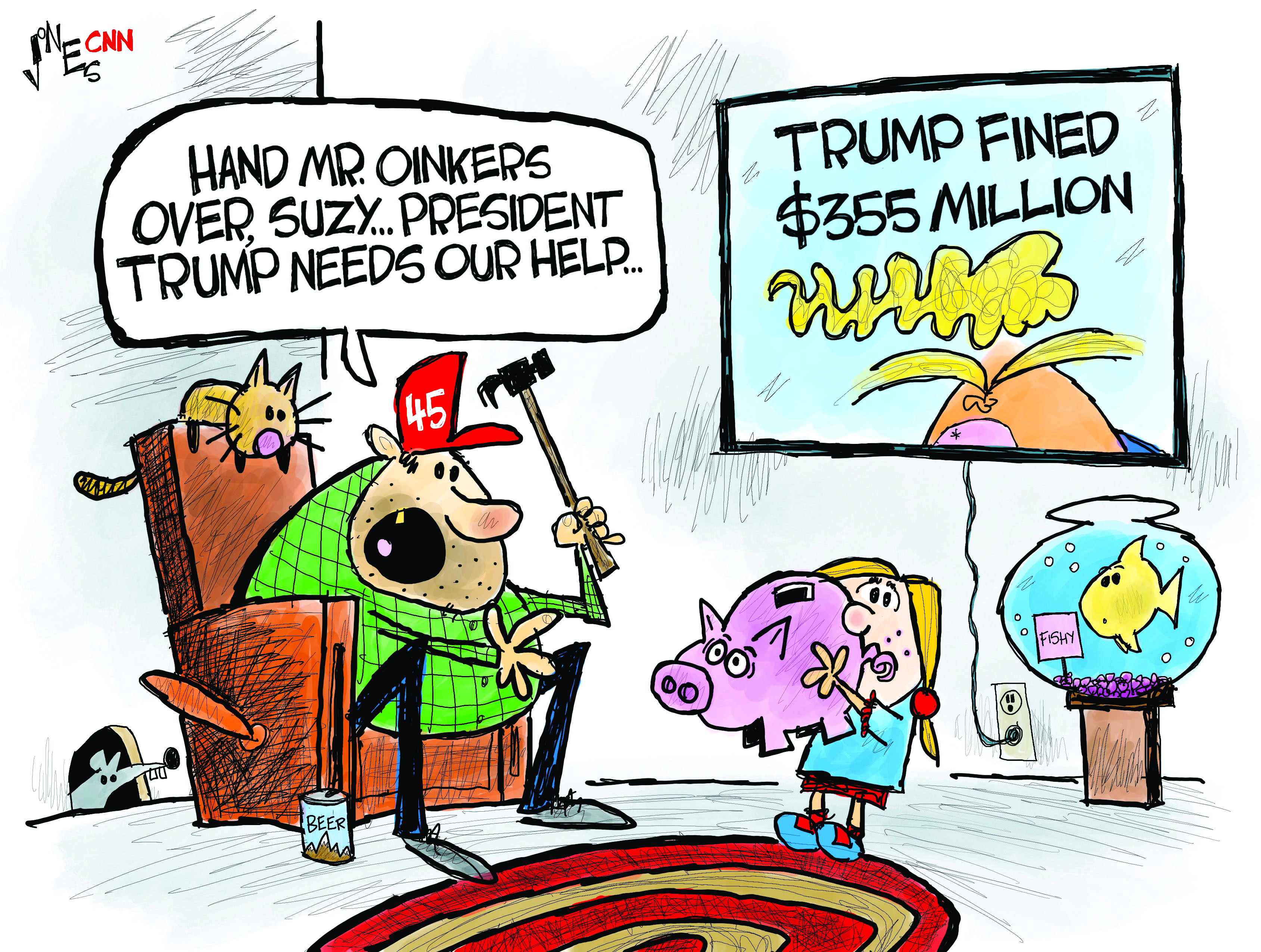
I think the cartoonist is on to something: Presumably, it would now be OK if James Snyder wrote Brett Kavanaugh a check in appreciation of his fine judicial wisdom and his grasp of political reality in towns like Portage. (Did I mention that corrupt Clarence Thomas signed on to Kavanaugh’s opinion?) The best summary of the situation comes from Elie Mystal:

According to Brett Kavanaugh and the conservatives, it’s only bribery if it comes from the Bribérie region of France. Everything else is just sparkling corruption.

They allowed local governments to criminalize homelessness. Again, that’s not said in so many words, at least not until you get to Justice Sotomayor’s dissent. The case centers on a law in Grants Pass, Oregon that “prohibits activities such as camping on public property or parking overnight in the city’s parks”. Here’s why Sotomayor thinks that’s a problem:

Sleep is a biological necessity, not a crime. For some people, sleeping outside is their only option. The City of Grants Pass jails and fines those people for sleeping anywhere in public at any time, including in their cars, if they use as little as a blanket to keep warm or a rolled-up shirt as a pillow. For people with no access to shelter, that punishes them for being homeless. That is unconscionable and unconstitutional. Punishing people for their status is “cruel and unusual” under the Eighth Amendment.

But Justice Gorsuch says the law doesn’t punish homelessness, because the law applies to everybody, not just the homeless.

Grants Pass’s public-camping ordinances do not criminalize status. The public-camping laws prohibit actions undertaken by any person, regardless of status. It makes no difference whether the charged defendant is currently a person experiencing homelessness, a backpacker on vacation, or a student who abandons his dorm room to camp out in protest on the lawn of a municipal building.

So if Elon Musk unrolled his Patagonia sleeping bag in a Grants Pass park, he’d be arrested too. What better illustration could there be of what Anatole France wrote in 1894?

In its majestic equality, the law forbids rich and poor alike to sleep under bridges, beg in the streets, and steal loaves of bread.

In his concurrence, Clarence Thomas wants to go further than Gorsuch and overturn the precedent this case is based on. In other words, you should be able to criminalize someone’s status.

Gorsuch and Sotomayor paint very different pictures of what Grants Pass is trying to accomplish. Gorsuch mostly ignores Grants Pass itself, but talks about other cities with similar laws. (Notice the pattern: The conservative justices want to discuss anything other than the specific facts of the cases at hand.) Cities like San Francisco, Gorsuch claims, are making a good-faith attempt to help the homeless by getting them into shelters, using anti-camping laws as the stick in a carrot-and-stick approach. But Sotomayor sees Grants Pass hoping the homeless will leave and become some other town’s problem:

For someone with no available shelter, the only way to comply with the Ordinances is to leave Grants Pass altogether. … The Grants Pass City Council held a public meeting in 2013 to “identify solutions to current vagrancy problems.” The council discussed the City’s previous efforts to banish homeless people by “buying the person a bus ticket to a specific destination,” or transporting them to a different jurisdiction and “leaving them there.”

That was unsuccessful, so the council discussed other ideas, including a “ ‘do not serve’ ” list or “a ‘most unwanted list’ made by taking pictures of the offenders . . . and then disseminating it to all the service agencies.” The council even contemplated denying basic services such as “food, clothing, bedding, hygiene, and those types of things.” … The council president summed up the goal succinctly: “[T]he point is to make it uncomfortable enough for [homeless people] in our city so they will want to move on down the road.”

They grabbed power away from federal agencies and claimed it for themselves. The Chevron doctrine is a legal principle that you will probably never run into in your personal life, but it has a bankshot effect on everything the government does. What’s at stake here is Congress’ ability to write open-ended laws whose details can be nailed down by the relevant federal agencies. Here’s an example I gave in January:

A typical example is the Clean Air Act. The CAA was first passed in 1963 and then overhauled in 1970. It established air quality standards (NAAQS) for a few well-known pollutants like carbon monoxide, sulfur dioxide, and lead, but then it defined a general category of “hazardous air pollutants” (HAPs) made up of other gases and particulates that “threaten human health and welfare”. It tasked the EPA with making and maintaining a list of HAPs and creating emission regulations for controlling them.

Hold that in your mind for a minute: In passing the CAA, Congress banned or controlled substances that the members of Congress had never even heard of. That’s how the regulatory system works.

If the CAA didn’t work that way, Congress would have to pass a new law every time some company created a new pollutant. Corporations move faster than Congress does, so our lives would be constantly in danger. (Plus, corporations can now give “gratuities” to congressmen who procrastinate on new laws. See above.)

In 1984, the Supreme Court decided the Chevron case, establishing the principal that if a law Congress wrote is vague about something, and if an agency’s interpretation of that vagueness is reasonable, then courts should defer to the agency’s interpretation. This deference makes sense for two reasons:

  • Courts can’t match the expertise assembled in federal agencies like the EPA or the FDA.
  • Federal agencies are overseen by presidents, who can be voted out of office. Courts are overseen by judges appointed for life.

The Chevron precedent has stood for forty years. Friday the Court tossed it out, without identifying any significant problem they were solving.

I didn’t manage to read the whole opinion, so I refer you to Joyce Vance.

Want to know if you can use the abortion drug mifepristone? Despite studies confirming the drug is safer than Viagra and Tylenol, that decision is up to Judge Matthew Kacsmaryk in Amarillo, Texas. If he decides the FDA was wrong to approve it, well then, he can deny women access to medication abortion. What happens if a company that builds airplanes objects to an agency decision that requires them to use, say, six bolts to attach an engine to a plane? They can go to court and make their case to a federal judge. And then, that judge—a lawyer, not an engineer—gets to decide how it will work. The arbitrary action the court expresses concern agencies might take is replaced by arbitrary action from far less qualified federal judges—possibly shopped for in the infamous one-judge-divisions like the one that gave us the mifepristone case. Do you feel less safe suddenly?

Set up a future showdown on abortion — after the election. So Idaho law only allows abortions that save a woman’s life, while a federal law (EMTALA — the Emergency Medical Treatment and Labor Act) mandates that hospitals receiving federal money (i.e. Medicare) stabilize any patient who shows up in their emergency rooms, including pregnant women who will suffer serious health consequences without an abortion.

But there’s a gray area, where a woman faces serious consequences but isn’t about to die. For women who fall into that gap, state law forbids what federal law mandates. A district court issued an injunction allowing the abortions, on the principle that federal law preempts state law. In January, the Supreme Court stayed that injunction, leaving the Idaho ban in place. Justice Kagan lays out the consequences of that move:

With that stay in effect, Idaho could enforce its abortion ban even when terminating a pregnancy was necessary to prevent grave harm to the woman. The on-the-ground impact was immediate. To ensure appropriate medical care, the State’s largest provider of emergency services had to airlift pregnant women out of Idaho roughly every other week, compared to once in the prior year (when the injunction was in effect). … Those transfers measure the difference between the life-threatening conditions Idaho will allow hospitals to treat and the health-threatening conditions it will not, despite EMTALA’s command.

So this week the Court’s three liberals (Kagan, Sotomayor, and Jackson) got together with three conservatives (Roberts, Barrett, and Kavanaugh) to lift the stay and rule that the Court should not have gotten involved in this case yet.

That’s good as far as it goes; for the next few months, Idaho hospitals can stop airlifting women to Oregon or wherever. But the case is likely to come back next term. And even if it doesn’t, other states’ abortion laws also conflict with EMTALA.

So both Jackson and Alito want to know why the case can’t be decided now: The Court has heard all the arguments and knows everything it’s going to know when the case comes back. (Both think the proper decision is obvious, but they disagree about what it is.)

But it looks like Roberts, Barrett, and Kavanaugh have made a political move: Denying health care to women with serious pregnancy-related health problems is really unpopular, so pushing such a decision to the other side of the election helps Trump and other Republicans. “It is so ordered.”

Let some January 6 rioters off the hook. This case, Fischer, looks more complicated than the others, because even though the margin (6-3) is familiar, two justices have switched sides: Barrett joined the liberals and Jackson joined the conservatives.

This fell off my stack, so here’s Amy Howe’s summary:

The Supreme Court on Friday threw out the charges against a former Pennsylvania police officer who entered the U.S. Capitol during the Jan. 6, 2021, attacks. By a vote of 6-3, the justices ruled that the law that Joseph Fischer was charged with violating, which bars obstruction of an official proceeding, applies only to evidence tampering, such as destruction of records or documents, in official proceedings.

Friday’s ruling could affect charges against more than 300 other Jan. 6 defendants. The same law is also at the center of two of the four charges brought by Special Counsel Jack Smith against former President Donald Trump in Washington, D.C.

In other words, obstructing an official proceeding physically, by taking over the building, isn’t covered by this law.

I still don’t grasp the impact of this ruling. Several lawyers writing for MSNBC claim only a small number of January 6 defendants will be affected, and even the ones who are won’t go free, since they were convicted of other offenses as well. Many articles claim this interpretation will help Trump in his January 6 case, but the MSNBC article claims the opposite. It will take a while for me to sort this out.

The Limits of Originalism

The Rahimi case isn’t getting a lot of coverage, because (as an 8-1 victory for common sense), it doesn’t make good clickbait. But the conservative judges are having an important discussion about the future of originalism.


Imagine you’re at a dinner party. On your way back from the bathroom, you happen to overhear a snatch of conversation from the kitchen: Your hosts have been discussing whether to poison your meal, and decide not to.

How should you feel about that? Relieved? Poisoning is a bad thing, and it’s not going to happen to you tonight. Angry? Why? Murder is wrong, and your hosts have decided not to do it. They’ve made the moral choice. Good for them.

Or maybe you focus on this question: Why were they having that conversation to begin with?

The Rahimi case. Now you can imagine how I feel about the outcome of United States v Rahimi, which the Supreme Court announced Friday. They decided that Congress does have the right to pass laws that take guns away from domestic abusers who are under restraining orders. Or, looking at it from the other side of the gun, men who have been judged by a court to pose a credible threat to their intimate partners do not have an absolute right to bear arms.

Good job, justices. With only one dissent (corrupt Clarence Thomas) they made the right call. Good for them. But why were they having that conversation to begin with? Why did anyone think that in one of the most obvious potential-murder situations imaginable [1], our legal system is banned from offering a woman even the simplest kind of protection?

In particular, why did anyone think it might be unconstitutional to disarm Zackey Rahimi, who perfectly exemplifies why domestic abuse laws exist? Rahimi didn’t just threaten the estranged mother of his child with a gun and then violate the restraining order she got for her own (and her child’s) protection, he also was involved in several other shooting incidents, some related to his personal anger-control issues and others stemming from his professional role as a drug dealer.

That guy. Even worse, Rahimi was making what is known as a facial challenge to the law disarming domestic abusers. In ordinary English, the law is unconstitutional on its face; there are no conceivable situations in which the law could be applied without violating the Second Amendment.

Why would anybody take that claim seriously enough that the Supreme Court should have to decide it?

Two reasons, really:

  • Two years ago, in the Bruen case (which was announced almost simultaneously with the Dobbs decision reversing Roe v Wade), the Court proclaimed a new test for Second Amendment constitutionality that called nearly all American gun laws into question.
  • And then in 2023, one of the few courts even more batshit crazy than the Supreme Court itself (the Fifth Circuit Court of Appeals) applied the Bruen test to Zackey Rahimi and ordered the government to give him back his guns.

So that’s where we were as of Thursday: Unless the Court acted, Rahimi was getting his guns back, and the mother of his child had just better watch out. Not only wouldn’t the government help her, it was constitutionally barred from ever doing so, no matter what Congress or any other elected officials might think.

The Bruen test. You’ll never guess who wrote the majority opinion in Bruen. OK, maybe you will: corrupt Clarence Thomas, with the backing of the other five conservative justices, including all three of the Trump justices. The heart of that ruling is this:

[W]e hold that when the Second Amendment’s plain text covers an individual’s conduct, the Constitution presumptively protects that conduct. The government must then justify its regulation by demonstrating that it is consistent with the Nation’s historical tradition of firearm regulation. Only then may a court conclude that the individual’s conduct falls outside the Second Amendment’s “unqualified command.”

In a hearing before the Fifth Circuit, the government offered various colonial or founding-era analogues of the domestic abuse law in question, and the judges found none of them quite analogous enough. Justice Sotomayor’s concurrence with Friday’s decision explained why this might be:

Given the fact that the law at the founding was more likely to protect husbands who abused their spouses than offer some measure of accountability, see, e.g., R. Siegel, “The Rule of Love”: Wife Beating as Prerogative and Privacy, 105 Yale L. J. 2117, 2154–2170 (1996), it is no surprise that that generation did not have an equivalent to [the law Rahimi has challenged]. Under the dissent’s [i.e. Thomas’] approach, the legislatures of today would be limited not by a distant generation’s determination that such a law was unconstitutional, but by a distant generation’s failure to consider that such a law might be necessary. History has a role to play in Second Amendment analysis, but a rigid adherence to history, (particularly history predating the inclusion of women and people of color as full members of the polity), impoverishes constitutional interpretation and hamstrings our democracy.

Putting her point more bluntly: When the Second Amendment was ratified in 1791, women were not really people, and wives in particular were subject to the whims of their husbands in ways we no longer accept. So you’re not going to find much in the way of domestic-violence legislation from that era, much less laws disarming domestic abusers. But that’s because the founding generation just didn’t think domestic violence was a problem worthy of government action, not necessarily because they endorsed the right of dangerous people to be armed.

But the Fifth Circuit didn’t look at it that way: Nobody disarmed the Zackey Rahimis of 1791, so we shouldn’t be able to disarm Zackey Rahimi today.

Originalism. Like Justice Alito’s majority opinion in Dobbs, Thomas’ opinion in Bruen (and his dissent in Rahimi) is an example of a method of constitutional interpretation known as originalism. All six conservative justices claim to be originalists. In his Rahimi concurrence, Justice Kavanaugh restates the fundamental notion of originalism:

The first and most important rule in constitutional interpretation is to heed the text—that is, the actual words of the Constitution—and to interpret that text according to its ordinary meaning as originally understood.

Originalism was popularized by the late Justice Anton Scalia, who spent most of his career in the minority, writing rousing dissents. But in recent years, originalists have become the majority on the Court, raising a significant issue: How do you turn a critical theory into a governing theory? [2] Most of the time, Scalia didn’t have to worry about the practical implications of his views, because they weren’t going to be adopted anyway. Now, though, originalists have to be concerned with consequences, like arming the Zackey Rahinis of the world.

In arguing against originalist interpretations, it’s important to understand precisely where originalists are and aren’t coming from. The point isn’t that the Founders were divinely inspired lawgivers like Moses (though some conservatives do believe this). Originalism says something more fundamental about the basis of law in a constitutional democratic republic like the United States: For laws to be binding on the People, the People must at some point have accepted that burden. So any legitimate originalist analysis [3] revolves around the questions: When did the People accept this restriction or give the government this power?

So, for example, look back at another case in this term: Cargill, the bump-stock case. That case revolves around two questions: When did the American people give up their right to own machine guns? And what did they think a “machine gun” was at that time? The answer to the first question is that (through their elected representatives) they gave up that right in the National Firearms Act of 1938. The NFA contains a definition of machine gun, which the justices then argue about.

The blurring effects of time. The root problem with originalism is that a text’s “ordinary meaning as originally understood” is way more complicated than Kavanaugh makes it sound. Individual people living in the same era think at different levels of abstraction. So consider the “bear arms” phrase in the Second Amendment. To one American living in 1791, the Amendment might apply abstractly to all “bearable arms” — any weapon that can be carried by one person. [4] His neighbor might have a more specific way of thinking, and so picture “arms” as the weapons he has seen or handled personally: flintlocks, sabres, and bows. A third citizen might think about the effects of arms: To him, the Amendment applies to anything that does roughly the same amount of damage as flintlocks, sabres, and bows. He might not have been picturing African blowguns, but if you described them to him he would probably see them as “arms” as well.

At that one particular moment in 1791, those three ways of thinking were in alignment: The arms that could be borne were flintlocks, sabres, and bows, but not cannons. The three citizens have different mental notions, but they will agree on any specific case that comes up.

But as the world changes, notions that once agreed come out of alignment. Transport our three founding-era citizens to World War II and show them a bazooka. The first citizen sees a weapon bearable by one person, the second sees something totally unlike any weapon he has used, and the third sees something more analogous to a cannon than a flintlock. So what is the “original meaning” of Second Amendment “arms” as applied to a bazooka?

That’s why our jurisprudence is so inconsistent in its originalism. (My advice: Don’t try to buy a bazooka.) Take the NFA of 1938 for example. Our first citizen looks at a 1938 Thompson submachine gun (or our era’s combat-ready M-16) and sees a bearable weapon, so to him the NFA’s ban on such weapons is clearly unconstitutional. But none of our current “originalist” justices took that position in Cargill.

The blurring legal environment. Sometimes what changes isn’t technology, but the context of other laws that surround a given law. That’s what happened with same-sex marriage. The Obergefell decision that legalized same-sex marriage nationally in 2015 was based on the 14th Amendment, which was ratified in 1868. [5]

But did the people of 1868 or their elected representatives realize they were legalizing same-sex marriage? Of course not. In the legal environment of the time, same-sex marriage didn’t even make sense. At the time, husbands and wives had different rights and responsibilities under the law, so “Which one of you is the husband and which one is the wife?” was a legitimate question. Also, men had more legal rights than women — most obviously the right to vote, but many others as well. So all opposite-sex households had one vote, but a same-sex household had either zero votes or two. How could that be justified?

By 2015, though, all those legal problems had gone away, for reasons that had nothing to do with homosexuality. Under the law, there are two spouses with legal equality, and neither role requires any special rights only available to one gender or the other. So the only reason to write marriage laws restricted to opposite-sex couples is prejudice against same-sex couples — something “equal protection of the laws” doesn’t allow.

Americans of 1868 couldn’t have foreseen how “equal protection of the laws” would apply to marriage in 2015. But they understood what “equal protection” meant as a principle, and they agreed to it.

Back to Rahimi. Except for Thomas himself, all the justices — liberal and conservative alike — recognize that the originalist logic of Bruen has led the Court to the edge of an abyss: Rahimi should get his guns back. This obviously is a bad outcome, and who knows what worse monsters might also regain their arms and go on to murder their intimate partners or ex-intimate partners? This result is not only bad in itself, but — like Dobbs — will incite a voter backlash against the Court, and against the Republican Party that appointed this conservative majority.

That majority, above all, is partisan. Thomas and Alito clearly want to retire, but will only do so if a Republican president can replace them. The others (with the possible exception of Barrett, who hasn’t done enough yet to earn my negative judgment) enjoy being in the majority and don’t want a re-elected President Biden to shrink that majority by appointing liberals.

Possibly even worse is the effect Bruen has had on the lower courts. The standard of keeping the laws “consistent with the Nation’s historical tradition of firearm regulation” is not only impossibly vague, but the example Bruen sets — cherry-pick history until you get the result you want — invites the worst kind of judicial activism.

Justice Jackson (who hadn’t joined the Court yet when Bruen was decided) lays this out as politely as possible.

This case highlights the apparent difficulty faced by judges on the ground. Make no mistake: Today’s effort to clear up “misunderst[andings],” [from Roberts’ majority opinion] is a tacit admission that lower courts are struggling. In my view, the blame may lie with us, not with them.

The message that lower courts are sending now in Second Amendment cases could not be clearer. They say there is little method to Bruen’s madness. It isn’t just that Bruen’s history-and-tradition test is burdensome (though that is no small thing to courts with heavier caseloads and fewer resources than we have). The more worrisome concern is that lower courts appear to be diverging in both approach and outcome as they struggle to conduct the inquiry Bruen requires of them. Scholars [in an amicus brief on this case] report that lower courts applying Bruen’s approach have been unable to produce “consistent, principled results,” and, in fact, they “have come to conflicting conclusions on virtually every consequential Second Amendment issue to come before them”.

So Bruen needs to be fixed somehow, or at least reined in. But how?

Liberal interpretation. Everyone on the Court is an originalist up to a point: If the text of a law is clear, if its “ordinary meaning as originally understood” can be ascertained, and the varied understandings of people at the time are still more-or-less in alignment, then that well-understood text should be respected. If such a law needs to be fixed according to our current notions of justice, Congress should do it, not the Court.

Conservatives claim liberals don’t believe this [6], but we do.

On most issues controversial enough to reach the Supreme Court, though, liberals recognize that there is no “original understanding” that covers the contemporary situation. (See the examples above.) And yet there is a case that needs to be decided: Rahimi either gets his guns back or he doesn’t.

To state the liberal view more simplistically than probably any of the current liberal justices would: Liberals want to give the original lawmakers the benefit of the doubt. Maybe they couldn’t have foreseen the current situation, but they didn’t intend for us to do something stupid with their words. And while much has changed since the 1700s — women and the non-European races have become people, as Sotomayor points out — certain abstract notions of justice are closer to timeless, and are still more-or-less the same. So we can use those shared values to update our interpretation of the text.

Ideally, the most important texts come up fairly often, so that the record of judicial precedents represents a continuous updating rather than an abrupt break with the past (as Dobbs, Bruen, and Heller were). Like the laws themselves, precedents should be read generously, because the justices of the past also wouldn’t want us to do something stupid with their words.

Of course, this approach requires that current justices have some measure of wisdom and aren’t too humble to use it. That openly confident wisdom is anathema to originalists, who insist that any application of contemporary wisdom must happen covertly, by manipulating history and then claiming to follow it.

Originalism trying to fix itself. Every conservative justice but Alito wrote an opinion on this case. Thomas’ lonely dissent doubles down on Bruen: If the logic of Bruen sends us over a cliff, then here we go. But the other four aren’t willing to jump with him, and feel obligated to explain why not. All of them are sneaking some version of liberal interpretation into their thinking, while denying that they do so.

Roberts’ majority opinion claims that a law can be “consistent with the Nation’s historical tradition of firearm regulation” even if there is no exact parallel, as long as it is analogous to laws from the colonial or founding eras. How close does the analogy need to be? How many parallel regulations establish a “tradition” rather than an anomaly? He doesn’t precisely say. The point is to get enough wiggle room that we don’t have to give back Rahimi’s guns, an outcome that violates “common sense”.

Taken together, the surety and going armed laws confirm what common sense suggests: When an individual poses a clear threat of physical violence to another, the threatening individual may be disarmed.

Such an appeal to contemporary common sense clearly doesn’t sit well with the other conservative justices, who have to write concurrences to put their own spin on it. Kavanaugh’s opinion in particular is a long and fairly dull exposition of originalism that rarely mentions the current case. (As I read, I kept saying “Dude, write a textbook.”) To me, he seems to need to repledge his fealty to originalism precisely because he knows he’s violating it.

The only conservative concurrence that seems honest to me is Barrett’s. (I am developing a grudging affection for Barrett. She’ll probably disillusion me soon, but I have to give credit where it’s due.) Like Jackson, she recognizes that lower courts have had trouble applying Bruen, as well as the inherent limitations of the historical method Kavanaugh extols at such length.

[I]mposing a test that demands overly specific analogues has serious problems. To name two: It forces 21st-century regulations to follow late-18th-century policy choices, giving us “a law trapped in amber.” And it assumes that founding-era legislatures maximally exercised their power to regulate, thereby adopting a “use it or lose it” view of legislative authority. Such assumptions are flawed, and originalism does not require them.

“Analogical reasoning” under Bruen demands a wider lens: Historical regulations reveal a principle, not a mold.

Examining founding-era firearms regulations reveals the “contour” of the right the Founders thought they were recognizing, but doesn’t always lay down its precise terms. Barrett recognizes that being a judge requires applying a certain amount of wisdom to past examples, to draw out the abstract principles behind them. It’s not just “calling balls and strikes” as Roberts claimed at his confirmation hearing and Kavanaugh endorsed in his concurrence. She ends up deciding that the majority opinion in this case “settles on just the right level of generality”, and so she concurs.

I read that as a statement of confidence in her contemporary wisdom, not an effort to hide her judgment behind a fog of historicism.

Conclusion. The Rahimi case is not getting a lot of press coverage, largely because it came to a common-sense conclusion: Rahimi (and other malefactors like him) shouldn’t be armed. It is within the power of Congress and state legislatures to make such decisions.

But the conservative judges are subtly arguing about how to sneak contemporary wisdom (sometimes disguised as “common sense”) back into judicial reasoning. As a governing theory, originalism will have to recognize that the wisdom of the past does not solve all our problems. At some point, judges have be judicious.


[1] According to the Department of Justice:

Of the estimated 4,970 female victims of murder and nonnegligent manslaughter in 2021, data reported by law enforcement agencies indicate that 34% were killed by an intimate partner … Overall, 76% of female murders and 56% of male murders were perpetrated by someone known to the victim. About 16% of female murder victims were killed by a nonintimate family member—parent, grandparent, sibling, in-law, and other family member

[2] This problem parallels the one in the House of Representatives, where MAGA rebels suddenly have real power.

[3] I use the word legitimate because, as I’ve stated in other posts, I don’t believe that most originalist arguments are made in good faith. By cherry-picking historical examples and engaging in opportunistic reasoning no historian studying that era would vouch for, a judge can almost always find an “originalist” justification for whatever conclusion he wants to come to.

Justice Alito’s majority opinion in Dobbs, in my opinion, was an example of this kind of bad-faith historicism. And so was Justice Scalia’s opinion in 2008’s Heller case, which (as Justice Jackson puts it in her concurrence) “unearthed” a new individual right to bear arms, upsetting a consensus interpretation of the Second Amendment that Justice Breyer’s dissent in Heller claimed “ha[d] been considered settled by courts and legislatures for over two centuries”.

Justice Kavanaugh can’t admit that Scalia invented his Heller interpretation out of nothing, but does say: “Second Amendment jurisprudence is still in the relatively early innings, unlike the First, Fourth, and Sixth Amendments, for example. That is because the Court did not have occasion to recognize the Second Amendment’s individual right until recently.”

[4] This is the position Justice Scalia laid out in Heller:

the Second Amendment extends, prima facie, to all instruments that constitute bearable arms, even those that were not in existence at the time of the founding.

[5] Justice Kennedy’s majority opinion rooted his argument in the 14th Amendment’s Due Process clause, but (like some of the concurring justices) I think the 14th Amendment’s guarantee of “the equal protection of the laws” is a cleaner justification.

[6] Kavanaugh’s concurrence warns against “an approach where judges subtly (or not so subtly) impose their own policy views on the American people”, which he sees as the only alternative to originalism’s historical method of interpreting “vague” text.

This week’s legal decisions

A temporary victory for abortion pills, the effective legalization of machine guns, and lower court protection for families with trans children. Meanwhile, continued stalling to protect Donald Trump from prosecution.


We’re getting near the end of the Supreme Court’s term, so the rulings will come hot and heavy for the rest of the month. Several important cases are still pending, but a few decisions came in this week.

The abortion pill mifepristone got a reprieve. As I’ve explained in the past, there is a federal district around Amarillo where cases are wired to go in front of a Christian nationalist judge, Matthew Kacsmaryk, and go from there to the nation’s most conservative appeals court, the Fifth. In the spring of 2023, anti-abortion groups (established in Amarillo precisely to take advantage of this legal pipeline) targeted mifepristone, the drug used in more than half of abortions nationally.

Predictably, Kacsmaryk suspended the FDA’s approval of mifepristone, effectively banning it nationally. That decision was partially reversed by the Fifth Circuit, and then totally stayed by the Supreme Court, pending its own decision. (So far, no one has been prevented from using mifepristone in states where it would otherwise be permitted.)

There are many ways to reverse Kacsmaryk’s decision, because it is baseless both legally and scientifically. Vox described the scientific situation like this:

The case has virtually no scientific merit, and challenging the use of a drug that has been studied and safely used for over two decades is highly unusual. Jack Resneck Jr., the president of the American Medical Association, said in a statement Friday night that Kacsmaryk’s “disregard for well-established scientific facts in favor of speculative allegations and ideological assertions will cause harm to our patients and undermines the health of the nation.”

But the Court decided not to go there. Instead, it pointed to the legal ridiculousness of the lawsuit: The plaintiffs have no standing to sue. [1]

As was obvious from the beginning, these plaintiffs — primarily doctors who don’t prescribe mifepristone — have no standing. They made up, and two levels of federal courts accepted, a ridiculous explanation of how mifepristone harms them: On the rare occasions when mifepristone fails, a woman caught in the middle of a miscarriage might show up on their doorsteps or emergency rooms, and they might have to do a procedure they morally object to in order to save her life.

Putting aside the issue of how any principle requiring a doctor to do nothing while he watches a woman die can be considered “moral”, Justice Kavanaugh (writing for a rare 9-0 Court) noted that federal conscience protections already protect the doctors, so they are not injured. So the suit should never have been heard in the first place. Slate’s Dahlia Lithwich and Mark Joseph Stern comment:

A doctor who opposes abortion, the court affirmed, may stand by and watch a patient bleed out rather than treat her in contravention of his conscience. Ironically, then, an anti-abortion statute that protects anti-abortion doctors played a key role in defeating the plaintiffs’ claim. Their own lavish safeguards against terminating a pregnancy—or even just treating a patient who already terminated a pregnancy—helped defeat their attempt to pull mifepristone off the market.

They go on to observe:

Yet the decision was not a total defeat for anti-abortion activists. Among other things, Kavanaugh slipped language into his opinion that could expand protections for physicians who refuse to provide emergency abortions, potentially imperiling the lives of patients.

The Court’s ruling also left open the fundamental issue — whether the FDA was right (or within its legal authority) to approve mifepristone at all. The most likely course forward from here is that new plaintiffs with different explanations of why they are not busybodies will pick up the suit, and the whole circus will start again.

One path flows from a brief line near the end of the Alliance opinion: “[I]t is not clear that no one else would have standing to challenge FDA’s relaxed regulation of mifepristone.” Last January, Kacsmaryk ruled that three red states — Idaho, Missouri, and Kansas — could join this lawsuit and press the claim that mifepristone should be banned. 

It is far from clear how these states are injured by the mere fact that mifepristone is legal. But Kacsmaryk’s (and the Fifth Circuit’s) behavior in this case and others shows that he’s willing to bend the law into pretzels in order to rule against abortion rights. It is likely, in other words, that Kacsmaryk will simply make up some reason why the red states have standing to sue and then issue a new order attempting to ban mifepristone.

In other words, this isn’t over. Another path forward is that Trump could win the election and instruct the FDA to rescind its approval or impose new restrictions on mifepristone’s use, or reinterpret the Comstock Act of 1873 to prevent distribution of mifepristone by mail. Good luck getting a straight answer out of him on those questions.

It’s now legal to alter your AR-15 to function as a machine gun. If you’ve ever watched a gangster movie set in the Al Capone era, you’ve seen the destructive power of that era’s submachine guns, the weapon of choice in the St. Valentine’s Day Massacre of 1929.

Responding to that problem, Congress made tommy guns and other fully automatic weapons illegal for civilian use in the National Firearms Act of 1934. By 2002, though, a new technology had inserted a loophole in that ban: the bump stock. A bump stock is an add-on piece of equipment that uses a semiautomatic rifle’s recoil to release and pull the trigger over and over again, so that the shooter’s experience resembles firing a machine gun.

Most explanations of bump stocks available on the internet are by pro- or anti-gun activists, and so should be taken with a grain of salt. However, this one comes from a general how-things-work channel, Zack Nelson’s JerryRigEverything. The video was made while bump stocks were legal.

Zack refuses to state an opinion on whether bump stocks should be legal or not, saying ambiguously: “Personally, I think guns are a great hobby, but not everyone in the world is sane.”

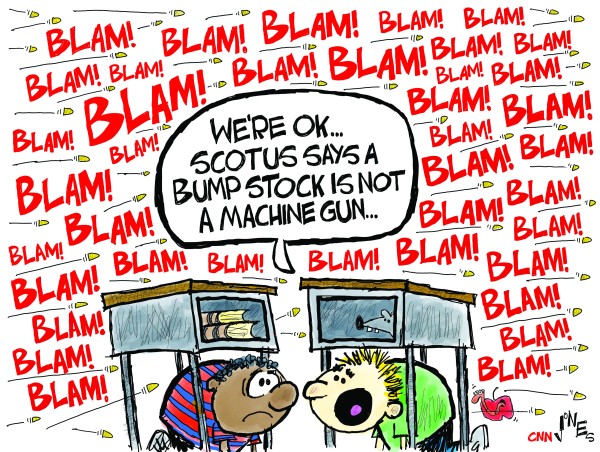
Most people had never heard of bump stocks until the Las Vegas massacre of 2017, when a gunman used one to fire more than 1,000 rounds down on a crowd gathered for a music festival. He killed 60 and wounded over 400, with an almost equal number injured in the stampede of people trying to get to safety. (Like tommy guns, bump-stocked AR-15s aren’t very accurate, making them poor sniper weapons. But if you’re firing at thousands of people, accuracy isn’t that important.) To the untrained ear, audio from the massacre certainly sounds like somebody is firing a fully automatic weapon. (For what it’s worth, real gun people claim otherwise, that a fully automatic machine gun fires even faster.)

Responding to public outrage, the Trump administration Bureau of Alcohol Tobacco and Firearms (ATF) changed its interpretation of the NFA’s machine gun ban, ruling that a bump stock converted a semiautomatic weapon into an automatic weapon, and so was illegal. That ruling was challenged in court, and the case has taken six years to make it to the Supreme Court.

Friday, the Court struck down the bump stock ban in a ruling that split 6-3 along the usual ideological divide. The majority opinion was written by the corrupt Justice Clarence Thomas [2]. It centers on the exact definition of “machinegun” in the NFA:

any weapon which shoots, is designed to shoot, or can be readily restored to shoot, automatically more than one shot, without manual reloading, by a single function of the trigger.

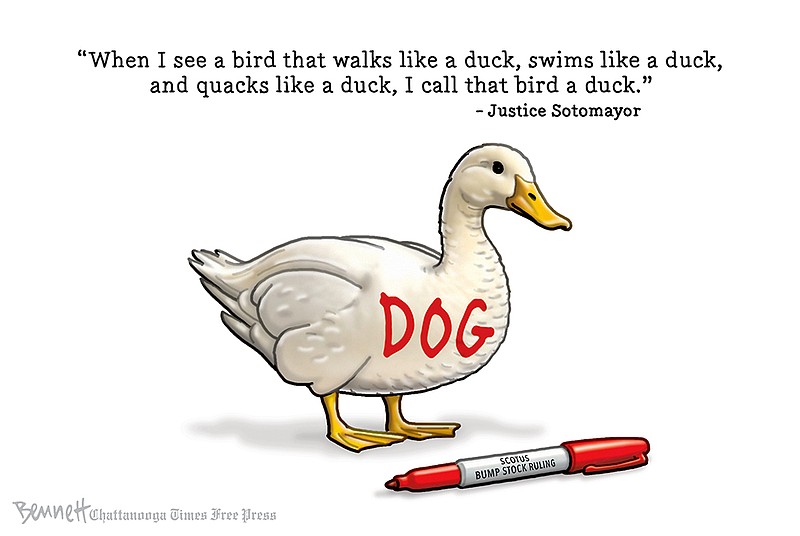
Thomas goes on to focus on the “function of the trigger” in its mechanical sense: As far as the gun is concerned, its trigger is being pulled once for each shot. In her dissent, Justice Sonya Sotomayor focuses on the experience of the shooter, who pulls the trigger once and keeps his finger stationary as the gun bucks back and forth against it. The Congress of 1934, I suspect, intended to focus on the experience of the victims, but they didn’t phrase the law that way, so here we are.

In an ideal world, it’s obvious what would happen next: Congress would say “oops” and would amend the NFA based on some other criteria, like perhaps the rate of fire. That’s what President Biden wants [3], and what Justice Alito’s concurrence suggests, perhaps disingenuously.

There is a simple remedy for the disparate treatment of bump stocks and machineguns. Congress can amend the law—and perhaps would have done so already if ATF had stuck with its earlier interpretation. Now that the situation is clear, Congress can act.

The reason I suggest Alito’s recommendation might not be completely serious is that he knows his right-wing allies won’t allow this to happen. I would be amazed if Speaker Johnson allowed even the narrowest possible bump-stock ban to make it to the House floor for a vote, and Republicans would almost certainly filibuster such a bill in the Senate.

Sunday, possible Trump VP Senator Tim Scott dodged taking any position on a bump stock ban, while another Trump VP hopeful from the House, Byron Donalds went full gaslight:

A bump stock does not cause anybody to be shot in the United States. That is the shooter that does that.

Donalds might want to explain that to the families of the Las victims, many of whom would probably be alive if the shooter had not been able to use a bump stock. It’s also worth pointing out that Donalds’ logic justifies legalizing any weapon, no matter how destructive. After all, nuclear weapons don’t destroy cities, people destroy cities.

Meanwhile, a spokesman for the Republican Party’s lord and savior, convicted felon Donald Trump, for once expressed faith in our justice system.

The court has spoken and their decision should be respected.

This pattern is not a coincidence: If you make Congress dysfunctional and unresponsive to the people, and then interpret the laws and the powers of agencies like the ATF strictly, the result is that when technology changes, old regulations lapse and can’t be updated. That’s not some unfortunate bit of happenstance; it’s two sides of the same strategy. Today it results in the effective legalization of machine guns. Tomorrow the loophole will be in the Clean Air Act or the antitrust rules. When the laws stand still, malefactors adapt.

Gender-affirming care. In an important lower-court case, a judge found a Florida law banning gender-affirming care for minors to be unconstitutional. This ruling differs from the case of a similar Alabama law, which was upheld by the 11th Circuit appeals court (where this case is headed) in that Judge Robert Hinkle found malice on the part of the legislature. That issue wasn’t raised in the Alabama case.

The plaintiffs have shown that animus motivated a sufficient number of statutory decisionmakers.

Judge Hinkle found that “gender identity is real” and is distinct from an individual’s “external sexual characteristics and chromosomes”. He also noted that the treatments at issue — puberty blockers and hormones like estrogen and testosterone [4] — are legal in Florida for other purposes.

[C]onsider a child that a physician wishes to treat with GnRH agonists to delay the onset of puberty. Is the treatment legal or illegal? To know the answer, one must know whether the child is cisgender or transgender. The treatment is legal if the child is cisgender but illegal if the child is transgender, because the statute prohibits GnRH agonists only for transgender children, not for anyone else.

If these treatments have risks, parents of non-trans kids (in consultation with doctors) are allowed to judge those risks for themselves. But in trans cases, the state’s judgment prevails.

Susan Doe, Gavin Goe, and Mr. Hamel have obtained appropriate medical care. Qualified professionals have properly evaluated their medical conditions and needs in accordance with the well-established standards of care. The minors, to the extent of their limited ability, and their parents, and Mr. Hamel, all in consultation with the treating professionals, have determined that the benefits of their gender-affirming care will outweigh the risks. The parents’ and Mr. Hamel’s ability to evaluate the benefits and risks of this treatment in their individual circumstances far exceeds the ability of the State of Florida to do so.

Judge Hinkle found a motive for the State of Florida assuming the power to overrule parental and medical judgment:

The defendants [i.e., the State of Florida] have explicitly admitted that prohibiting or impeding individuals from pursuing their transgender identities is not a legitimate state interest. But the record shows beyond any doubt that a significant number of legislators and others involved in the adoption of the statute and rules at issue pursued this admittedly illegitimate interest.

The ruling quotes numerous statements by legislators or Governor DeSantis that show animus, such as referring to transgender witnesses at hearings as “mutants” and “demons”, denying the reality of gender identity, or exaggerating gender-affirming care by talking about “castrating” young boys. The fact that no one supporting the anti-care bill contested these statements, according to the judge, was evidence that such sentiments were widespread in the legislature.

Trump’s immunity. The Court continues to sit on the apparently simple issue of Donald Trump’s absolute-immunity claim, which has been rejected by every lower-court judge who heard it. By taking the case and refusing to rule promptly, the Court has made it all-but-certain that no trial can be held prior to the election on Trump’s plot to stay in power after losing in 2020. Without the Court’s interference, the public would already have heard testimony under oath from key witnesses like Mike Pence and Mark Meadows.

Particularly given the apparent bias of Justices Alito (whose home and vacation home were the site for pro-insurrection flags) and Thomas (whose wife traded texts with Mark Meadows to encourage resistance to accepting the will of the voters), it’s hard to see the Court’s actions as anything other than an attempt to put its thumb on the scale to Trump’s benefit.

My prediction is that the immunity ruling will come out on the second-to-last day of the term. Putting it last would underline the Court’s intent to delay justice, so the conservative majority will probably sacrifice a day or two of delay to avoid that poor appearance.


[1] Standing is one of the basic concepts of civil lawsuits: A court can only rule on a situation if a suit is brought by someone actually affected. For example, I can’t sue for divorce on behalf of one of my friends, no matter how convinced I am that she needs to be out of that marriage. Requiring that a plaintiff have standing is basically a no-busybodies rule.

[2] I am going to use the word corrupt whenever Thomas’ name comes up until he is either removed from the Court or is called to account in some other way. This week we found out that Thomas has received even more billionaire gifts than the $4 million that were previously known.

Thomas claims these gifts are not bribes, but fall into a loophole for gifts from “friends”. However, Thomas’ rich friends are right-wing donors he had never met before joining the Court.

So as far as this blog is concerned, “corrupt Justice Clarence Thomas” is his full name.

[3] Biden would also like to see an assault weapon ban in that amended bill, but is likely to sign a smaller reform if he gets the chance.

[4] Gender-affirming surgeries on minors, according to the judge, “are extraordinarily rare and are not involved in this litigation.”

Alito’s Flags Aren’t the Worst of It

While we were watching the flags, Alito wrote a decision that greenlights racial gerrymanders and opens a door for Jim Crow to come back.


Samuel Alito has long been my least favorite Supreme Court justice, even before his anti-American-democracy flags (which I’ll cover in the weekly summary post that will follow this one), and even before he wrote the Dobbs decision. You might think I just dislike him because his judicial philosophy is different from mine, but I don’t think that’s it. You see, I’m not convinced he has a judicial philosophy.

What makes Alito a frustrating judge for me is that his rulings seem to have nothing to do with the law. In just about any case, you can predict Alito’s opinion by asking three simple questions:

  • Does one outcome favor the Republican Party?
  • Does one outcome favor the Catholic Church?
  • Does one outcome favor the Haves over the Have-Nots?

If the answer to any of those questions is “yes”, that’s where Alito will come down. You can safely make that prediction without knowing anything about the facts of the case or the relevant laws. All the stuff people argue about in law school is irrelevant.

Other justices will sometimes surprise. Even bought-and-paid-for Clarence Thomas has a few legal hobby horses that occasionally cause him to take a position I wouldn’t have expected. But as best I can tell, Alito has none. He has partisan commitments and he votes to support them; end of story.

Whenever I read an Alito opinion, I’m reminded of a distinction that occurs in religion, between theology and apologetics. Theology attempts to ascertain truths about God, but apologetics develops convincing arguments to defend prior religious beliefs. The two often resemble each other: When Thomas Aquinas claims to prove the existence of God through reason, is he nailing down something previously in doubt (theology), or is he evangelizing to rational people who otherwise might not believe in God (apologetics)? It can be hard to tell.

Similarly, Alito’s written opinions often resemble legal reasoning. He cites precedents, makes deductions, and in general constructs arguments that lead to conclusions. But the arguments appear to have nothing to do with how he reached those conclusions. Instead, they give a gloss of legality to Alito’s prior convictions.

The Dobbs decision is an obvious example: Ostensibly, Alito argues that

Our nation’s historical understanding of ordered liberty does not prevent the people’s elected representatives from deciding how abortion should be regulated.

The Dobbs opinion is one long history lesson justifying that claim. But its history is carefully edited, and Alito does not address the points made in an amicus brief by actual historians. [1] He appears to have no interest in history beyond how it might justify fulfilling the Catholic goal of overturning Roe v Wade.

This week gave us another example, whose importance is in danger of being lost in the controversy over Alito’s flags: He wrote the majority opinion in Alexander v South Carolina NAACP, a decision that Vox’ Ian Milhiser calls “a love letter to gerrymandering“. This decision gives states a green light to engage in all manner of racial gerrymandering; the practice is still technically unconstitutional, but under the standards of Alexander, it becomes nearly impossible to establish in court.

Gerrymandering. Let’s review a little: Gerrymandering means drawing the lines of electoral districts so that your side can win a decisive majority in some legislative body with only a minority of actual votes. There are numerous examples of this happening in state legislatures and even in the U.S. Congress. In extreme examples, a near-50/50 state can wind up with a legislative supermajority for one party. (Basically, you pack all of the other party’s voters into a few districts, which they win with 90% majorities. Then you distribute your voters so that you have reliable 55-45 wins in the other districts.)

On paper, gerrymandering is a cross-partisan problem, and there are states where Democrats gerrymander. But Democrats have tried to ban the practice, and on the whole it favors Republicans, whose rural voters are already more distributed geographically, and who have less shame generally about subverting democracy.

Not that many years ago, optimists thought partisan gerrymandering might get banned by the courts as a violation of basic democratic principles. That hope went out the window in the 2019 Rucho decision, where Chief Justice Roberts declared partisan gerrymanding “nonjusticiable”, meaning that whatever damage the practice might do to democracy, courts have no power to stop it.

But racial gerrymandering, where you draw lines to diminish the voting power of some racial minority, is still considered a violation of the 14th Amendment. The problem is how to tell the difference when a racial minority has predictable voting patterns. If South Carolina moves voters from one congressional district to another, how do we know whether they’re being moved because they’re Black (unconstitutional) or because they’re Democrats (nonjusticiable)?

The Alexander case. Here’s how Alito makes that determination in the current case:

The Constitution entrusts state legislatures with the primary responsibility for drawing congressional districts, and redistricting is an inescapably political enterprise. Legislators are almost always aware of the political ramifications of the maps they adopt, and claims that a map is unconstitutional because it was drawn to achieve a partisan end are not justiciable in federal court. Thus, as far as the Federal Constitution is concerned, a legislature may pursue partisan ends when it engages in redistricting. By contrast, if a legislature gives race a predominant role in redistricting decisions, the resulting map is subjected to strict scrutiny and may be held unconstitutional.

These doctrinal lines collide when race and partisan preference are highly correlated. We have navigated this tension by endorsing two related propositions. First, a party challenging a map’s constitutionality must disentangle race and politics if it wishes to prove that the legislature was motivated by race as opposed to partisanship. Second, in assessing a legislature’s work, we start with a presumption that the legislature acted in good faith.

In Alexander, Alito’s assumption of the legislature’s good faith bulldozes all evidence to the contrary. In particular, it bulldozes the deference higher courts are supposed to give to the factual findings of lower courts. In Alexander, a three-judge panel held a trial where they listened to witnesses and compiled a record that runs thousands of pages. That panel concluded unanimously that South Carolina’s gerrymander was motivated by race.

On appeal, higher courts are supposed to accept such judgments unless there is a clear error in the record. (The reason for this is simple: The appellate judges can read the record, but they didn’t hear the testimony. They have no basis for rejecting the lower-court judges’ conclusions about who was or wasn’t telling the truth.) But Alito rejects the lower-court findings because the three-judge panel made the “clear error” of not giving him the finding he wanted. They should have accepted South Carolina’s claims that race was not the motive if there was any possibility that it might be true.

Justice Kagan’s dissent shreds this argument, and concludes:

What a message to send to state legislators and mapmakers about racial gerrymandering. For reasons I’ve addressed, those actors will often have an incentive to use race as a proxy to achieve partisan ends.
And occasionally they might want to straight-up suppress the electoral influence of minority voters. Go right ahead, this Court says to States today. Go ahead, though you have no recognized justification for using race, such as to comply with statutes ensuring equal voting rights. Go ahead, though you are (at best) using race as a short-cut to bring about partisan gains—to elect more Republicans in one case, more Democrats in another. It will be easy enough to cover your tracks in the end: Just raise a “possibility” of non-race-based decision-making, and it will be “dispositive.” And so this “odious” practice of sorting citizens, built on racial generalizations and exploiting racial divisions, will continue.

Disrespect for precedent. Kagan also points out that the Court heard a nearly identical case in 2017: Cooper v Harris. In that case, Alito made a nearly identical argument, but he lost 5-3, and the lower court’s rejection of North Carolina’s map was upheld.

Cases like that are supposed to be binding precedents, but this Court no longer respects precedent, so it reached the opposite conclusion in this case.

What changed since 2017? Were new laws or constitutional amendments passed? Did we learn something new about gerrymandering that called previous conclusions into question?

Not at all. As with Dobbs, the only thing that has changed is the composition of the Court. With the addition of the Trump justices, the three dissenters in Cooper have become the majority. Kagan writes:

Today, for all practical purposes, the Cooper dissent becomes the law.

Going forward. As with Dobbs, the arguments in the decision have much broader implications. When you read Alito’s opinion, it’s easy to forget that the Court’s precedents against racist laws come out of an ugly history. Ignoring this history, Alito expresses great sympathy for state officials who might find themselves accused of racism

[W]hen a federal court finds that race drove a legislature’s districting decisions, it is declaring that the legislature engaged in “offensive and demeaning” conduct that “bears an uncomfortable resemblance to political apartheid.” We should not be quick to hurl such accusations at the political branches.

But you will search Alito’s opinion in vain to find any expression of sympathy for the victims of racism. It’s as if racism exists only as an “accusation”, something disreputably used to stain the reputations of White people, who deserve our “presumption of good faith”.

Kagan calls out Alito’s message to legislatures that want to gerrymander away the electoral power of non-White voters: “Go ahead.” But the Alexander decision is even bigger than that. It says “Go ahead” to any legislative attempt to reestablish Jim Crow. If legislatures just avoid announcing their racist intentions openly, if they create plausible cover stories for laws that disadvantage racial minorities, the Supreme Court will “start with a presumption that the legislature acted in good faith” and be quick to dismiss any evidence to the contrary.


[1] The historians’ brief begins:

When the United States was founded and for many subsequent decades, Americans relied on the English common law. The common law did not regulate abortion in early pregnancy. Indeed, the common law did not even recognize abortion as occurring at that stage. That is because the common law did not legally acknowledge a fetus as existing separately from a pregnant woman until the woman felt fetal movement, called “quickening,” which could occur as late as the 25th week of pregnancy.

The Supreme Court is breaking America’s faith in the law

It’s no longer possible to explain the justices’ behavior
without accounting for partisan politics and corruption.


Hacks? Back in 2021 at the University of Louisville, Justice Amy Comey Barrett addressed criticism of the Court she had joined less than a year before:

“My goal today is to convince you that this court is not comprised of a bunch of partisan hacks,” the conservative Barrett said, according to the Louisville Courier Journal. She said the high court is defined by “judicial philosophies” instead of personal political views. “Judicial philosophies are not the same as political parties,” Barrett said.

Most of the legal experts who have appeared on MSNBC or CNN since then have more-or-less given that view the benefit of the doubt. Sure, some things have been hard to explain. In particular, the Court’s “originalist” rulings — “originalism” being one of the philosophies Barrett cited — have been suspiciously selective about the “history” that informed their majority opinions, and overall the originalist justices have shown little interest in history as it is taught by professional historians. On its shadow docket, the Court was far more responsive to the Trump administration’s requests to move quickly than it has been to the Biden administration. And then there’s Clarence Thomas, who takes six-figure gifts from billionaire “friends” he had never met before he ascended to the Court.

But hackery? No. Surely not. This is the Supreme Court we’re talking about.

These talking-head legal experts are almost entirely institutionalists: ex-prosecutors, retired judges, law professors, and even one ex-Acting-Solicitor-General. They’re deeply invested in the idea that the legal system works.

They’ve had a tough week.

Thursday, the Court heard oral arguments on Donald Trump’s claim that he has “absolute immunity” for anything he did as president. That claim is holding up his federal prosecution in the January 6 case.

Partisan delay. It’s already been clear that the Court has been shading the process in Trump’s favor. The original purpose of this immunity claim was to delay Trump’s trial past the election, so that he can order the Justice Department to dismiss the case if he becomes president again. Both the district court and the appellate court found no legal merit in “absolute immunity” — or in any kind of immunity that would cover this case — and the Supreme Court didn’t have to hear the appeal at all.

But instead, the Court has dragged its feet. Back in December, Jack Smith asked the Court to hear the appeal immediately, skipping the appeals court, so that Trump’s trial could get under way. They refused, waited for the appellate ruling, and then spent weeks deciding whether to review that ruling. When they finally did decide to hear the case, they scheduled oral arguments on the last day of the term for hearing arguments, burning as much time as possible.

But still, the institutionalist commentators told us, while the conservative majority might manipulate the calendar in a partisan fashion, it wouldn’t distort the law to favor Trump. Surely it would find, as both lower courts did, that there was no legal merit in this claim.

After Thursday’s hearing, though, that outcome is seriously in doubt. The conservative justices gave Trump’s attorney a far more sympathetic hearing than he deserved.

Breaking faith. Slate’s Dahlia Lithwick expressed a disillusionment I heard from many professional commentators:

As a blinkered institutionalist, I’m getting blowback along the lines of: “I told you so. They’re a bunch of partisan hacks.” I truly believed that at least seven members of the court would take the potential failure of democracy as a proposition seriously enough that the partisan valence of this case went away. That didn’t happen.

Former Assistant US Attorney Andrew Weissmann said, “Big picture: I’m in a very, very depressed mode.” And his podcasting cohost Mary McCord (a former Assistant Attorney General) replied “It’s been a rough several weeks of listening to Supreme Court arguments.”

Weissmann characterized the justices’ discussion of presidential immunity as “almost like a policy debate in Congress”. (It’s worth listening to this part, because you can hear the heartbreak in his voice.)

What was missing from that [discussion] was the text of the Constitution, the intent of the Framers, the history of the United States. I mean, it so belied the originalism/textualism credo of the so-called conservative justices. … And then, even within that policy debate, what was missing from the conservative justices was any record support, in terms of 200 years of history. …

It was remarkable to me the antipathy towards the actual criminal justice system that you were hearing from Alito and Gorsuch. Which was Alito saying, “You know, you can indict a ham sandwich.” I mean, this is our criminal justice system! … It was remarkable to me that you had people sitting in the Supreme Court denigrating the entire infrastructure of and edifice of our criminal justice system that they are a huge part of creating.

Slate’s Mark Joseph Stern summarized this same discussion with equal amazement and horror:

Alito had [Michael] Dreeben [representing the special prosecutor’s office] walk through the layers that protect a president from a frivolous or vindictive prosecution. Then he dismissed each one out of hand. So Dreeben said: First, you need a prosecutor who’s willing to bring charges; then you need a grand jury to indict; then there’s a criminal proceeding in open court where a jury of his peers decides whether he’s been proved guilty. And Alito just laughs it off as though it’s a big joke. Because we all know Justice Department attorneys are hacks who’ll do whatever they want, right? And a grand jury will indict a ham sandwich—nobody believes a grand jury will do anything worthwhile. And then, oh, sure a jury of his peers, like that’s going to do anything. [1]

This is the justice who is, by far, the most friendly to prosecutors and hostile to criminal defendants in case after case. Who could not for the life of him find a violation of the right to trial by jury or due process. But when the defendant is Trump, he suddenly thinks this entire system of criminal prosecution is such a bad joke that the Supreme Court has to step in and essentially quash this prosecution, because we can’t trust the system to work. The system that is incarcerating so many other people whose convictions Sam Alito just rubber-stamps.

And Lithwick replied:

I felt like that was the turn for me—it was Alito winking to Dreeben, saying, in short, “We both worked in the Justice Department; we know what a racket that crap is.” This was another one of those moments when I thought, sorry: Did one of the justices of the United States Supreme Court just imply that everything that happens at the Justice Department is hackery and rigged prosecutions? …

For his part, bribe-taking Clarence Thomas said little, but his very presence in the room said much: His wife Ginny traded texts with Mark Meadows in the lead-up to January 6. She probably won’t be called as a witness, but she could be. Under any sane system of ethics, he should have recused himself from this case.

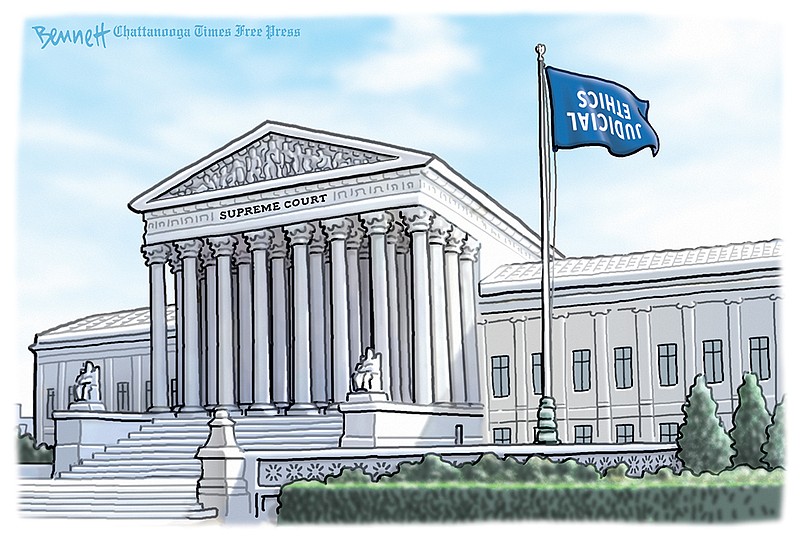
But this is Clarence Thomas. He has no ethics. And this is the Supreme Court, where ethical standards have no enforcement mechanism. So there he sat. He will presumably vote on this case and perhaps even write a self-serving opinion.

Restraint? Another longstanding principle of conservative jurisprudence is judicial restraint: A court should decide the case brought before it, and not make wide-ranging rulings that are not needed to decide that case.

But Thursday, the conservative justices could not be bothered to discuss the actual case — Trump’s attempt to stay in office despite losing the 2020 election. Kavanaugh said as much: “I’m not as concerned about the here and now, I’m more concerned about the future.” Gorsuch echoed: “I’m not concerned about this case, but I am concerned about future uses of the criminal law to target political opponents based on accusations about their motives.” And Alito added: “I want to talk about this in the abstract.”

These justices seemed to take for granted that this case is precisely the kind of vindictive prosecution Trump’s lawyers warned about, and to discount entirely that a president might abuse his power to stay in office illegally, as a grand jury has indicted Trump for doing. These prior assumptions are entirely political assessments of the situation. They cited no facts of the case that would point in this direction, and no legal problems with the indictment.

What happens next? What seems likely to come out of these arguments is a ruling — probably on the very last day of the term in June, continuing to burn as much time as possible — that attempts to define a doctrine that is not really needed in this case, and has not been needed in the two centuries of American history so far: drawing a line between presidential acts that are immune from subsequent prosecution and those that are not. Having drawn this line, the Court can remand the case to Judge Chutkan with instructions to apply the new doctrine. Her ruling, whatever it is, can then be appealed back up the ladder, pushing the trial well past the election.

Fly free, Mr. Trump!

Jay Kuo, however, finds hope in an ironic place: Amy Coney Barrett. Barrett, Kuo reports, actually seemed to be paying attention to the case at hand, and might be looking for a way for the legal system to do its job, rather than grind its gears until the case is moot. So perhaps it will fall to her to fashion a way around the partisan hacks whose existence she denied in 2021.

As I remarked in my piece yesterday, so much of our future, and indeed even the plight of the world, has depended on just one or a few traditional conservatives still managing to do the right, principled thing. It might happen again here, who knows?

Barrett was interested in drawing a line between a president’s private acts and his officials acts.

Okay. So, in the Special Counsel’s brief, on pages 46 and 47, he urges us, even if we assume that there’s—even if we were to decide or assume that there was some sort of immunity for official acts, that there was sufficient private acts in the indictment for the trial to go, for the case to go back and the trial to begin immediately.

Barrett outlined scenarios that included much of Trump’s indicted conduct, such as the conspiracy to present false electors to Congress. Kuo speculates that Barrett might convince Roberts and the three liberal justices to support a majority opinion along these lines.

Another possible way forward consists of Judge Chutkan taking the remand and getting creative with it. In deciding which of Trump’s acts might fit the Court’s brand-new definition of immunity, she might have to hold an evidentiary hearing — not a trial — in which much of the prosecution’s case could be presented. It would not result in a jury verdict, but at least testimony from witnesses like Mike Pence and Mark Meadows could get onto the record.

This is decidedly a second-best (or third- or fourth-best) result. In a nation with an uncorrupted Court, a full trial would be completed and a jury verdict reached before the election. But we don’t live in such a nation. At least until Democrats can win enough elections to rebalance the Court — hopefully naming honest jurists with liberal philosophies rather than just more partisan hacks who lean left rather than right — we’re stuck with the corrupt Court we have.


[1] It’s worth pointing out that juries were the difference between the legitimate performance of Special Counsel Robert Mueller and the politically motivated Barr-Trump special counselship of John Durham. Mueller obtained convictions of a number of Trump associates like Paul Manafort and Roger Stone. But Durham’s drawn-out expensive investigation resulted in only two jury verdicts, both unanimous acquittals.

Juries are in fact what Trump is afraid of in his current cases. If his indictments were indeed the political witch hunts he claims, he should want a jury to expose this fraud to the voters. Instead, he seeks every delay possible, so that if a jury rules at all, it will come to late to inform the electorate.

The Arizona Abortion Ruling

The result is horrible, but it’s a correct reading of the the legislature’s mess.


Before he was appointed to the Supreme Court, Judge Oliver Wendell Holmes is supposed to have admonished an idealistic lawyer: “This is not a court of justice, young man. It is a court of law.” In other words, courts exist to apply the laws, not to fix them.

I was holding that idea in mind when I read the Arizona Supreme Court’s ruling reinstating an 1864 abortion law. Undoubtedly, this result — that all abortions are banned excepting only those that protect a woman’s life, and not excepting cases of rape or incest or even health consequences short of death — is horrible. But it could nonetheless be a correct reading of Arizona’s laws.

So here’s the timeline, as I understand it.

In 1864, the territorial legislature passed a law that said:

A person who provides, supplies or administers to a pregnant woman, or procures such woman to take any medicine, drugs or substance, or uses or employs any instrument or other means whatever, with intent thereby to procure the miscarriage of such woman, unless it is necessary to save her life, shall be punished by imprisonment in the state prison for not less than two years nor more than five years.

That wording got adopted as part of the penal code approved by the legislature in 1913, shortly after Arizona became a state.

The statute’s constitutionality got challenged in 1971, before Roe v Wade, and after some back-and-forth, an appeals court ruled it constitutional. Then the US Supreme Court’s Roe decision came in 1973, and Arizona courts recognized that the 1864 law was unconstitutional under Roe’s recognition of a federal constitutional right to abortion. But this didn’t stop the legislature from testing the boundaries of Roe.

Between 1973 and 2022, and conforming to the federal abortion right established in Roe, the Arizona Legislature codified dozens of abortion statutes in Title 36. … To the extent permitted by Roe and its progeny, all of these statutes restricted abortions, including adding many procedural requirements for physicians performing abortions.

In 2022, shortly before Dobbs was officially announced, the legislature passed S. B. 1164, which amended Title 36 of the state laws. The main thrust of S.B. 1164 was to ban abortions after 15 weeks, which would violate the rights established in Roe. This was one of many laws red-state legislatures passed after Trump’s three judges joined the Supreme Court. The purpose was to see if the new Supreme Court would chip away at Roe’s protections. What’s relevant for this case is the exact wording:

A. Except in a medical emergency, a physician may not perform, induce or attempt to perform or induce an abortion unless the physician or the referring physician has first made a determination of the probable gestational age of the unborn human being and documented that gestational age in the maternal patient’s chart and, if required, in a report required to be filed with the department . …

B. Except in a medical emergency, a physician may not intentionally or knowingly perform, induce or attempt to perform or induce an abortion if the probable gestational age of the unborn human being has been determined to be greater than fifteen weeks.

Notice that both provisions are phrased negatively: “a physician may not perform …”. Under the prevailing legal interpretation of 2022, i.e. Roe, the abortions not explicitly prohibited would be allowed. But nothing in S. B. 1164 says they are allowed. Quite the opposite:

This act does not: (1) Create or recognize a right to abortion or alter generally accepted medical standards. The Legislature does not intend this act to make lawful an abortion that is currently unlawful. (2) Repeal, by implication or otherwise, section 13-3603, Arizona Revised Statutes, or any other applicable state law regulating or restricting abortion

Section 13-3603 was the descendant of the 1864 law.

So then the Supreme Court’s Dobbs decision reversed Roe. This undid the 1973 finding that the 1864 law was unconstitutional, leaving the current state court to pick up the pieces.

Arizona’s Democratic attorney general argued that by banning abortions after 15 weeks, S. B. 1164 implicitly authorized them prior to 15 weeks, and implicitly repealed the 1864 law. A dissenting opinion in the decision agrees with this argument, but I think the majority got it right: There is no affirmative language in S. B. 1164 that authorizes any abortions.

I agree completely with the moral arguments denouncing this outcome: It’s barbaric that Arizona’s women’s rights are constrained by a law passed before statehood and before women had a right to vote. No court of justice would allow this. But we don’t have courts of justice; we have courts of law.

What can be done? The obvious way to repair this situation is for the legislature to do explicitly what the dissenting opinion thinks it did implicitly when it passed S. B. 1164: repeal 13-3603. That would leave Arizona with a 15-week abortion ban recognizing certain exceptions — maybe not the ideal outcome, but a far better one than the current situation.

Democrats in the legislature proposed this solution, but Republicans blocked it.

The Supreme Court will have to carry this case to term

The mifepristone suit from Amarillo is so embarrassingly bad that even the Court’s conservative majority can’t justify doing what it wants.


The anti-abortion-pill case that right-wing culture-war groups primed to get to the Supreme Court got to the Supreme Court. Oral arguments happened Tuesday, and did not go nearly as well as anti-abortion groups probably imagined when they filed the case. Even Amy Coney Barrett seemed skeptical.

There probably won’t be a decision until June, so there’s no sense going into great detail now. But there are a couple of things worth noting:

  • When you grease the way for a case to make it to the Supreme Court, you wind up with a greasy Supreme Court case. Legally, this was a bad argument that never should have come this far, and even some conservative justices seemed embarrassed by it.
  • US courts continue to entertain notions of “Christian conscience” that are so expansive as to be passive aggressive. The rest of us are expected to change our lives so that right-wing Christians can have a buffer zone around extensions of “conscience” they have intentionally constructed to control us.

I explained the greased slide that brought this case to the Supreme Court back when the case was first being heard in Amarillo, almost exactly a year ago: The Northern District of Texas, which contains Amarillo, has one judge who hears just about all the cases. That judge, Matthew Kacsmaryk, is a right-wing culture warrior who can be counted on to rule in the “right” way, independent of facts or the law. The Northern District sits inside Fifth Circuit, whose appellate court is not quite as lawless as Kacsmaryk, but has a similar right-wing bias and will not examine his rulings too closely.

So in this case, foes of abortion rights incorporated their group in Amarillo precisely so they could file their suit in Kacsmaryk’s court. (The Judicial Conference has since changed the rules to limit this kind of judge shopping.) Kacsmaryk did his part and issued a nationwide injunction stopping the sale of mifepristone. The 5th circuit cut that injunction down a little, leaving mifepristone legal but limiting the possibilities for prescribing it. The Supreme Court previously stayed both rulings pending its own examination of the injunction.

That’s what they were discussing Tuesday.

The big reason the case should never have come this far is the plaintiffs’ lack of standing. In non-legalese, they can’t show how the availability of mifepristone harms them, so there’s no injury for the court to try to correct.

According to the doctors, their concrete injury is that someone might take mifepristone, might experience medical complications, might go to the hospital for care, and then the physicians in question might have to complete the abortion despite their moral objections to doing so.

Standing is supposed to be real, not speculative. The injury is supposed to be either happening, or so close to happening that it seems bound to happen without an injunction. A maybe-maybe-maybe argument doesn’t give you standing. There’s a good reason for this requirement: Otherwise, judges could make pronouncements about any topic that interested them, and the awesome power our system gives the courts could be abused.

A lot of articles have covered the case’s standing issue. But I was pleased to see Dahlia Lithwick and Mark Joseph Stern raise the passive aggression issue in Slate. (They don’t use that terminology, which I started using in 2013.) Under questioning, plaintiff lawyer Erin Hawley (wife of the famously swift senator) made an even stronger claim than the quote above would imply. When you read “complete the abortion”, you probably pictured a woman taking mifepristone, her body starting to eject the fetus, but not quite succeeding in getting it out. She might then show up in an emergency room, where an ER doctor opposed to abortion might have to complete the removal of a fetus that is doomed but not yet entirely dead.

However, that grisly scenario is exceedingly unlikely. A far more likely complication (still rather uncommon) is that the woman takes mifepristone, miscarries, but then doesn’t stop bleeding afterward. In this scenario, the abortion is over, the fetus is dead, and now an ER doctor needs to treat a bleeding woman.

The plaintiffs don’t want to, because patching up a woman who has taken a drug to give herself an abortion would make them “complicit” in the abortion.

Hawley … then approached the lectern and cleared up any confusion: Yes, she insisted, treating a patient who has undergone a medication abortion violates the conscience of the plaintiff physicians even if there is no “live” fetus or embryo to terminate anymore. “Completing an elective abortion means removing an embryo fetus, whether or not they’re alive, as well as placental tissue,” Hawley told Kagan. So the plaintiffs don’t object just to taking a “life.” They also object to the mere act of removing leftover tissue, even from the placenta.

Of course, these doctors must remove “dead” fetal tissue and placentas all the time—from patients who experienced a spontaneous miscarriage. By their own admission, the plaintiffs regularly help women complete miscarriages through surgery or medication. Those women they will gladly treat. Other women, though—the ones who induced their own miscarriage via medication—are too sinful to touch. Before the plaintiffs can administer even lifesaving emergency treatment, they need to know the circumstances of this pregnancy loss: Spontaneous miscarriages are OK; medication abortions are not.

It’s impossible to imagine this logic being accepted in any non-abortion circumstance. Suppose a guy gets drunk and drives his car into a tree. When he shows up in the ER, would a doctor (maybe from a religious sect that forbids alcohol) refuse to treat him in order to avoid being complicit in his drunk driving? ERs don’t work that way. In any other circumstance, injured people show up and get treatment. The guy who stitches up participants in a barroom brawl doesn’t need to know what started it or who was right.

It is a twisted line of logic, one that should never have reached the Supreme Court in the first place. But it is also a product of the court’s past indulgence of outlandish claims about moral “complicity.” … All this is reminiscent of Little Sisters of the Poor, a case about a Catholic charitable group that was afforded an exemption from the Affordable Care Act’s contraception mandate. The Little Sisters were asked to check a box signaling to the government that they could not comply with the mandate, at which point the government would step in to cover their employees. But the Little Sisters refused, viewing this action—the checking of a box to opt out of coverage—as “complicity” in abortion because it would in turn trigger government payment for contraception (which they viewed as abortifacients). The Supreme Court and the Trump administration ultimately indulged the Little Sisters’ claim.

It may violate conservative political correctness to say so, but the Little Sisters were just being assholes in that suit. They invented an extravagant claim of conscience in order to screw up ObamaCare and interfere in other women’s lives.

Refusing to bake cakes or make web sites for same-sex weddings (other situations the Supreme Court has treated seriously) are similar examples of passive aggression. Going far beyond any legitimate Christian concern, such cases involve constructing an enormous hypersensitive conscience that will feel “complicit” in anyone’s behavior that it fails to control. Making the world safe for such a construction restricts the freedom of everyone else.

No non-Christian religious group would be allowed to do this. And Christians will keep extending such notions of “complicity” until courts tell them to stop. That should have happened a long time ago.

A Big Week in the Trump Trials

This was a week where you couldn’t tell the players without a program. Important things were happening in multiple Trump trials at once — a phenomenon I think we’ll see more of in the months ahead. But before going into the details, I want to talk about the general phenomenon: Why does Donald Trump keep losing in court?

Why Trump keeps losing. Friday, New York Judge Arthur Engoron issued his decision in the New York civil fraud case against Donald Trump, his adult sons, several Trump Organization companies, and two major Trump Organization executives: a $355 million “disgorgement” penalty, plus interest.

This is a huge amount of money, and it is just the latest of a series of Trump losses in court: the two E. J. Carroll lawsuits for defamation and sexual assault, which resulted in $88 million in damages; the criminal tax-fraud case against the Trump Organization ($1.6 million from the company and jail time for ex-CFO Allen Weisselberg); the Trump University civil fraud suit (settled out of court for $25 million), the Trump Foundation lawsuit ($2 million and dissolution of the foundation), and 61 of the 62 suits Trump filed in his attempt to overturn his loss in the 2020 election. (The one he won affected a tiny number of votes and had no effect on the election’s outcome.)

Trump, of course, paints this as years of harassment by a corrupt legal system, but I learn a much simpler lesson: Bullshitters don’t do well in court. A talented bullshitter can succeed in politics and/or business, but judges don’t have to put up with bullshit, and most of them won’t.

When he’s been caught doing something wrong, Trump’s usual damage-control technique is to spin out several mutually inconsistent stories until he sees which one is catching on. (January 6 is a great example: At first, the rioters were antifa rather than his supporters. Then they were his supporters, but they were conducting a mostly peaceful protest. Or maybe it was a riot, but he didn’t incite it. And now we’ve reached the point where it was a riot and they were his supporters, but they are patriots being railroaded by the same corrupt legal system that is railroading him.) His supporters latch on to whichever explanation rings true to them, ignoring the fact the Trump himself may have moved on to a different story.

He tried something similar in the NY civil-fraud trial: He claimed his financial statements weren’t false. Or maybe they were false, but they had a disclaimer. Besides, accuracy was the accountants’ responsibility, not Trump’s. In real estate, everybody’s financial statements are false. And the bankers are sophisticated people who should have known not to believe Trump’s claims. Pick whichever answer appeals you.

Trump’s string of losses demonstrates that his tactic doesn’t work in court, where the legal process is designed to reach a single narrative of events. Shifting back and forth from one excuse to another will just annoy a judge, who will communicate that annoyance to a jury, if there is one.

Another thing that doesn’t work in court is restarting arguments you’ve already lost. Trump’s lawyers keep repeating defenses that Engoron had already ruled against. (Like: The loans were repaid, so there was no fraud. More about this below.) That kind of doggedness can pay off in politics, because the public easily forgets how some point was debunked. But in court it just pisses a judge off.

The $355 million civil fraud decision. Here’s Judge Engoron’s 92-page decision. Or you can read the NYT-annotated version.

The judge also added interest to the penalty, bringing the total to around $450 million. He denied the state’s request to ban Trump permanently from doing business in New York, and instead banned him for only three years, with sons Eric and Don Jr. banned for two. Engoron also decided not to revoke the Trump Organization’s certification to do business in New York (part of his earlier summary judgment that an appeals court had put a stay on), which would have effectively dissolved the company, since it is incorporated in New York.

The decision is dull reading, because Engoron goes through the witnesses one-by-one, summarizing what each one said and why it was believable, unbelievable, or irrelevant. Then he goes through Trump’s fraudulently valued properties one-by-one and lays out the evidence of fraud. This is important material to record for Trump’s inevitable appeal (since the appellate court won’t hold its own trial), but it can be tiresome to plow through.

Here are a few simple things I gleaned from the decision:

First, the shape of the fraud: When The Trump Organization was looking for loans during the 2010s, Deutsche Bank’s Private Wealth Management Division was the only bank that wanted to do business with them. In a series of deals, it offered two loan possibilities: a loan secured only by the real estate collateral, or a loan secured by the collateral plus Trump’s personal guarantee. The second loan had a significantly lower interest rate, and it was based on assertions about Trump’s net worth and available cash. Trump was then obligated to give Deutsche Bank annual statements of financial condition (SFCs) verifying that his net worth and available cash were still above certain thresholds.

Those SFCs are the fraudulent business records, and they were off by a lot. One type of fraud was to value Trump’s properties “as if” rather than “as is”. So for example, Mar-a-Lago is worth a lot more if it can be sold as a private residence, but its deed restricts it to being a social club. (Trump got a lower real-estate tax rate by agreeing to that restriction.) The SFCs list the value as if that restriction could be made to go away. Similar things happen all over the Trump empire: One property is valued as if Trump had permission to build 2500 residences, when in fact he only had permission to build 500. And so on.

Second, where did the $355 million figure come from? Engoron didn’t just pull it out of a hat, and punitive damages play no role. It is a disgorgement of ill-gotten gains. Basically, it’s the interest Trump saved by making the fraudulent guarantees, plus the capital gain from the sale of the Old Post Office hotel near the White House (which Trump would not have been able to buy without the fraudulently obtained loan). Eric and Don Jr. each give up $4 million, because that was their share of the Old Post Office gain.

Third, the fact that the penalty is a disgorgement is why Trump’s there-is-no-victim rhetoric is off-base. The point here isn’t to compensate a victim, it’s to protect “the integrity of the marketplace” by punishing fraud. Engoron quotes a precedent:

Disgorgement is distinct from the remedy of restitution because it focuses on the gain to the wrongdoer as opposed to the loss to the victim . Thus, disgorgement aims to deter wrongdoing by preventing the wrongdoer from retaining ill-gotten gains from fraudulent conduct.

By asking for the personal guarantee and demanding evidence of the wealth to back it up, Deutsche Bank was trying to protect itself against a possible downturn in real estate in general and in Trump’s fortunes in particular. As it happens, those risks didn’t manifest and the loans were repaid. But Engoron observes: “The next group of lenders to receive bogus statements might not be so lucky.”

This kind of disgorgement happens all the time in insider-trading cases: The SEC makes the traders give up their gains, even if it’s impossible to figure out exactly who they cheated. And the purpose is the same: to protect the integrity of the market by preventing cheaters from prospering.

Finally, I want to turn around one standard conservative criticism, which you’ll hear whenever Biden tries to forgive college loan debt: “But what about the people who follow the rules, the ones who took their debts seriously and paid them off? What do you say to them?”

In this case, what about the people who have been denied loans (or had to pay a higher sub-prime interest rate) because they filled out their applications honestly? Or people who can’t afford to pay an accountant to lie for them, the way Trump can? What do Trump’s defenders say to them?

The hush-money criminal case will go to trial March 25. This is the red-headed stepchild of the Trump indictments, but it looks like it will be the first one to go to trial. Slate’s Robert Katzberg expresses what I think everybody is thinking:

While the conduct charged is, no doubt, criminal, it feels a bit like prosecuting John Gotti for shoplifting. The Bragg prosecution is also clearly the weakest of the four outstanding indictments from an evidentiary perspective, especially when compared to the D.C. slam-dunk. … In an ideal world the D.C. prosecution would be first, allowing the world to see just how close we came to having the 2020 election overturned and the frightening degree to which the former president is a threat to our democracy. However necessary and appropriate that would have been, it is not where we are now. The Bragg case, while hardly the most desirable opening act, at least gets the show on the road.

This case stems from Trump paying off porn star Stormy Daniels to keep their affair secret during the 2016 presidential campaign. But the sex itself isn’t a crime and the fact of the payoff isn’t what’s being prosecuted: It’s the lengths Trump went to in order to hide the payoff from voters in 2016. He had Michael Cohen pay Daniels. Then the Trump Organization created a false paper trail to reimburse Cohen, and recorded the reimbursement as a business expense when it was actually a campaign expense. So the charge is falsification of business records.

The Georgia case. The RICO case against Trump and his election-stealing co-conspirators is currently on hold while the judge decides whether DA Fani Willis should be disqualified.

The issue is her romantic entanglement with another prosecutor on the case, who she hired, and the claim that he kicked back some of the money she is paying him by spending it on her during their affair, which they both claim is now over. (They both claim she paid her own way by reimbursing him in cash, leaving no records — which is a sensible thing to do if you hope to keep the affair secret.)

The stakes in this are huge, because if Willis is disqualified, quite possibly nobody else picks the case up and Trump walks. Certainly the case won’t be tried before the election.

On the other hand, that outcome seems unlikely to a number of observers, for this reason: Willis’ affair is certainly salacious and embarrassing, and it may even be unethical enough to result in some kind of discipline against Willis outside this case. But disqualifying her from this case requires showing prejudice against these defendants. And nothing they’ve put forward so far proves that.

As a matter of both common sense and Georgia law, a prosecutor is disqualified from a case due to a “conflict of interest” only when the prosecutor’s conflicting loyalties could prejudice the defendant leading, for example, to an improper conviction. None of the factual allegations made in the Roman motion have a basis in law for the idea that such prejudice could exist here – as it might where a law enforcement agent is involved with a witness, or a defense lawyer with a judge. We might question Willis’s judgment in hiring Wade and the pair’s other alleged conduct, but under Georgia law that relationship and their alleged behavior do not impact her or his ability to continue on the case.

My social media is full of a point that may not be legally relevant, but packs a political punch:

So Clarence Thomas can accept hundreds of thousands in gifts but Fani Willis can’t go dutch on dinner?

Jack Smith and presidential immunity. The question of whether former presidents are immune from prosecution for anything they did in office is now with the Supreme Court. Both Judge Chutkan and the DC Court of Appeals have rejected Trump’s immunity claim, which appears to be far-fetched and intended as a delaying tactic.

So far the delaying strategy is working: The trial in this case was originally supposed to start March 4.

Other than Trump and his lawyers, I haven’t heard anyone predict that the Supreme Court will reverse the lower courts’ rulings and stop Jack Smith’s January 6 case in its tracks. However, it remains to be seen to what extent Trump allies on the Court will cooperate with his strategy to delay the case past Election Day.

(As I’ve commented before, Trump’s delay strategy is essentially an admission of guilt. An innocent man who believed he was being prosecuted purely for political reasons would want the case to be tried as soon as possible, so that he could get the vindication of a jury’s not-guilty verdict. But Trump knows that a jury that sees the evidence will convict him, so his best hope is to get reelected and then instruct his attorney general to drop the case.)

The key documents have already been filed with the Court: Trump’s application for a stay that will continue delaying the trial, Jack Smith’s response, and Trump’s reply to Smith. The arguments Trump’s lawyers are making are the same ones the lower courts rejected, and amount to “No, they’re wrong.” (BTW: I love that this case is Trump v the United States.)

The Court has a number of options, which Joyce Vance outlines, ranging from refusing to hear the appeal and letting the case continue as soon as possible, to scheduling lengthy briefings and not ruling on the case soon enough for the trial to be heard before the election.

Disqualification. We’re still waiting for the Supreme Court to rule on whether the 14th Amendment’s disqualification clause applies to Trump (because of his role in the January 6 insurrection), and whether states (like Colorado) can enforce that disqualification from public office by refusing to list him on presidential ballots.

The judges sounded skeptical during the oral arguments, so it would be a shock if they ruled Trump ineligible. But it will be a challenge to square a Trump-is-eligible ruling with the conservative justices’ originalist philosophies. The Court works on its own clock, so a ruling could come tomorrow, at the end of the term in June, or any time in between.

Monkeywrenching the Regulations that Protect Our Lives

The Supreme Court’s attempt to scuttle the Chevron Doctrine is part of a much larger program.


Over the last few weeks, Court-watchers have been trying to sound the alarm about the prospect of scuttling what had (until recently) been a fairly arcane bit of legal interpretation: the Chevron Doctrine. Lawyers understand how important it is (the Court has applied it in over 100 cases in the last 40 years), but it’s tough to get the general public to pay attention, much less to be up in arms about its possible demise. But there actually are good reasons to be up in arms.

A fairly standard thing to do at this point would be to tell you what the Chevron Doctrine is and where it comes from. I’ll eventually get around to doing that — click the link if you really can’t wait — but I’d rather have you keep reading for a few more paragraphs before you bookmark this page with the idea of getting back to it when you have more time.

Blood money. So instead I’ll back up a few levels and start with the underlying problem: In a complex modern economy, there are countless ways for corporations to make money by killing people. They can kill their customers by selling products that will crash them into trucks or suck them out of airliners or cause heart attacks or give customers cancer or salmonella or some other disease. They can kill their employees with unsafe workplaces. They can kill their neighbors by pumping poisons into the air or water. As AI catches on, products may start killing people and we won’t even know why.

Sometimes corporations very consciously make the money-for-lives tradeoff, as the tobacco companies did for decades, and as the gun manufacturers are still doing. But sometimes they just don’t know, at least at first. They have a product, they make money off of it, customers seem happy with it, so why look any deeper than that? Diacetyl makes microwave popcorn taste more buttery — what’s not to like?

As individuals, we’re more or less helpless to protect ourselves. No one has the time or the expertise to analyze every single thing they use or come into contact with. That’s why we rely on government regulation, agencies like the FDA, EPA, FSIS, and others, to protect our lives. (Other agencies, like the SEC and the FDIC, protect our money from the kinds of scams that were endemic prior to the New Deal.)

Government regulators get their power from two sources: Congress and the President. Congress creates the agencies, defines their missions, and funds them each year. Meanwhile, the President appoints the people who set the policies to accomplish those missions. Ultimately, Congress and the President get their power from the voters.

But here’s the problem: The marketplace moves much faster than our political system. New products, new drugs, new food additives, new pollutants, and so forth appear every week. Imagine the dystopia we’d be living in if Congress, which strains to pass basic legislation to keep the government’s doors open, had to pass a new law to regulate each one.

Well, you may not have to imagine much longer, because the Supreme Court’s conservative majority seems hellbent on taking us there.

Delegated power. The way the regulatory system currently works is that Congress passes a few foundational laws that give the agencies abstract goals, and then lets the agencies hire experts who figure out how to pursue those goals.

A typical example is the Clean Air Act. The CAA was first passed in 1963 and then overhauled in 1970. It established air quality standards (NAAQS) for a few well-known pollutants like carbon monoxide, sulfur dioxide, and lead, but then it defined a general category of “hazardous air pollutants” (HAPs) made up of other gases and particulates that “threaten human health and welfare”. It tasked the EPA with making and maintaining a list of HAPs and creating emission regulations for controlling them.

Hold that in your mind for a minute: In passing the CAA, Congress banned or controlled substances that the members of Congress had never even heard of. That’s how the regulatory system works.

That’s a lot of delegated power, particularly power over corporations that don’t like being controlled. And yes, their wealth does give the companies opportunities to influence the system — say by bribing or otherwise inducing congresspeople to give them various exemptions, or by letting regulators know they can have cushy jobs after they leave government if they behave themselves — but it’s never enough.

What corporations would really like to do is monkey-wrench the regulatory system in general. And the best way to do that is to interrupt the flow of delegated power from Congress to the agencies: Make Congress pass a new law every time there’s some new thing to regulate. In a Congress where even saving lives can be a partisan issue, and where a bunch of small-state senators can lock things up with a filibuster, even the most obvious new regulations can be stalled indefinitely or watered down to nothing.

So the basic strategy for restoring corporations’ ability to profit by killing people has two pieces

  • Logjam Congress.
  • Prevent Congress from delegating its regulatory power to anybody else.

A three-pronged attack. With the second part of that plan in mind, corporate money begat the Federalist Society, and the Federalist Society (with the assistance of presidents who lost the popular vote and Senate “majorities” that don’t represent a majority of voters) begat the six conservative justices on the Supreme Court. Since gaining control of the Court, those justices have been working hard to fulfill the mission their corporate masters assigned them.

The most direct idea for keeping Congress from empowering regulatory agencies is known as the Nondelegation Principle: basically, that Congress can’t, as a matter of constitutional principle, delegate power that is inherently legislative. Some version of this idea is necessary, because otherwise Congress could authorize the president to be a dictator and then go home. But since 1928 delegation has been considered OK if Congress provided an “intelligible principle” for the agency to follow (like protecting human health and welfare from air pollutants).

But in a dissent in the Gundy case in 2019, Justice Gorsuch proposed a much stricter limit: Agencies can only “fill in the details” of laws, and can’t do something sweeping like, say, compile a list of dangerous pollutants to regulate. Fortunately, he didn’t get the majority to go along with him on that. But he’s still working on it, and the composition of the Court has changed since then. Expect to hear more about nondelegation sometime soon.

A second idea for reining in regulatory agencies is the Major Questions Doctrine, which the Court has created out of whole cloth over the last 25 years. Major Questions is a response to something that happens fairly often: Circumstances change in such a way that a provision in a law that seemed relatively minor at the time it was passed ends up granting an agency significant power. Major Questions allows the Court to say, “No, no, no. The law may say that, but Congress didn’t really mean it. If they’d intended to delegate such a large power, they’d have said so explicitly.”

So, for example, the Obama administration EPA decided that (due to the previously unforeseen problems of climate change), the Clean Air Act gave it the power to regulate carbon dioxide emissions from power plants. The Court nixed that in West Virginia v EPA. Carbon emissions, it said, are so central to the workings of our economy that (regardless of the text of the CAA) Congress would never have delegated that power without an explicit statement.

Now, there are four major objections to the Major Questions Doctrine:

  • The Constitution never mentions it.
  • The Court has never clearly defined what a “major question” is, so it has given itself permission to interfere (or not) whenever it feels like it.
  • The law says what it says, even if Congress didn’t foresee all the possible applications.
  • If Congress really didn’t intend to delegate that much power, it could pass a law to take power back. (But of course, that puts the logjam-Congress shoe on the other foot.)

One recent use of Major Questions was to torpedo OSHA’s rules about large employers vaccinating their workers against Covid. Yes, OSHA’s mission is to protect workers from unsafe working conditions, and yes, working next to an unvaccinated person during an epidemic is unsafe, but … Congress couldn’t really have intended that, could it?

One thing you’ll notice about Major Questions: It allows the Court to substitute its own judgment for both the plain reading of the law and for an agency’s interpretation of that law. And that brings us (finally) to the Chevron Doctrine.

Chevron. Back in the Reagan administration, all the ideological arrows pointed in the other direction: Reagan’s appointees were conservative, while judges tended to be liberal. In particular, the EPA was run by Justice Gorsuch’s mom, Anne Gorsuch.

Anne’s EPA had drastically limited its interpretation of what a “source” of pollution meant under the CAA. Previously, just about any change that introduced new pollution was considered a new source, and required EPA approval. But the new interpretation said that, say, an entire factory or power plant was the source of pollution, and could be substantially reconstructed without triggering EPA supervision.

The Natural Resources Defense Council sued to try to block something Chevron was building, but the Court ruled in Chevron’s favor by creating the Chevron Doctrine: When some part of a law is ambiguous, a court should defer to the interpretation of a regulating agency rather than impose its own interpretation of what Congress really meant. An agency couldn’t make up a ridiculous interpretation, but as long as its reading was plausible, the courts should yield to it. (An eye-glazingly detailed history of the Chevron case is in this interview between David Roberts and Dvid Doniger.)

But remember: the ideological arrows were pointing in the opposite direction from today, so Chevron was a conservative principle that was championed by conservative justices like Anton Scalia. The arguments he made were the same ones liberals are making today: Agencies have technical expertise that courts can’t compete with, and (because they ultimately get their power from Congress and the President), they’re closer to the voters than judges are. So Chevron is not just prudent, it’s democratic.

This kind of humility is sometimes called judicial restraint. For many many years, it was the hallmark of conservative jurisprudence: Activist liberal judges should restrain themselves, because they’re not as smart as they think they are, and because it’s undemocratic to remove issues from the political process.

But now conservatives have control of the courts, so humility is out the window. Apparently, judicial restraint was never actually a conservative principle, it was just a rhetorical device to keep liberal judges in check. Activist conservative judges, on the other hand, should have free rein to do whatever they want.

So Chevron has to go. The Court is using two fairly obscure cases (involving fees paid by the fishing industry to the National Marine Fisheries Service) to tee up an attack on Chevron. No one knows exactly what the ruling will say yet, but the questions the justices were posing during oral arguments point at a complete revision of Chevron that could make the Supreme Court also the Supreme Regulator; whether any given agency was interpreting its authorizing legislation properly would be for the Court to determine.

The practical implications of sinking Chevron could be enormous: Literally thousands of cases have been decided on that basis in the last 40 years, and any of them could come up for a rehearing. Plus, literally every regulation on the books will become a legal battleground, with the Supreme Court’s six conservative justices being the ultimate deciders.

In short, a committee made up of six foxes is about to take over the regulation of every chicken coop in the country.

DoJ, the FBI, and the Biden-crime-family conspiracy theory

No, lifelong Republicans have not established a liberal Deep State at the FBI.


In 2021, I raised the question “What makes a good conspiracy theory?” People obviously do conspire to do bad things from time to time, so we shouldn’t reject out of hand every claim that some group of malefactors is conspiring. But can we at least limit ourselves to good conspiracy theories, i.e., ones that at least have a chance to be true?

In that post I identified one clear marker of a bad conspiracy theory: The size of the conspiracy has to keep increasing as more facts come out. The deeper people dig, the larger the conspiracy has to grow to account for all the pieces that don’t fit the original theory. (Really good conspiracy theories, on the other hand, tend to shrink. The better you understand how things work, the more you realize that a few well-placed conspirators really could pull this off.)

With that principle in mind, every time a conspiracy theorist says “They must be in on it too”, you should reevaluate the whole conspiracy. If you would have rejected a massive they’re-all-in-on-it claim at the start, you shouldn’t let yourself drift into accepting one without a good reason.

Lately we’ve been seeing a lot of expansion in the Right’s Biden-crime-family conspiracy theory. Consider David Weiss, the Trump-appointed US attorney that Trump-appointed Attorney General Bill Barr assigned to run the Hunter Biden investigation. Weiss was one of the few Trump US attorneys Biden left in place, probably because it would have looked bad to pick his own guy to investigate his son.

Weiss filed some tax charges and a firearms charge against Hunter, and negotiated a plea deal that most experts say is not out of line with what any defendant in a similar situation could get: repay the taxes and accept two years probation, but don’t go to jail.

The conspiracy theorists’ initial reaction was that Merrick Garland must have blocked Weiss from filing the real charges (i.e., massive bribery schemes that implicated his father). But Weiss himself has been going out of his way to deny that this happened. So Weiss must be in on it.

Same thing for Trump-appointed FBI Director Chris Wray, who was grilled by the House Judiciary Committee on Wednesday. “Are you protecting the Bidens?” Rep. Matt Gaetz demanded. Republicans also accused Wray of persecuting Donald Trump, the January 6 rioters, and conservatives in general.

“If you are a Trump, you will be prosecuted. If you are a Biden, you will be protected,” said Rep. Wesley Hunt, claiming a double standard in the justice system.

Wray seemed to have a hard time taking such claims seriously.

“The idea that I’m biased against conservatives seems somewhat insane to me given my own personal background,” said Wray, a Republican who served in President George W. Bush’s Justice Department.

Equally insane is the idea that the FBI (in Sean Hannity‘s words) “has now sadly been transformed into nothing short of an arm of the Democratic Party.”

As I’ve explained in the past, there really is a Deep State — an entrenched bureaucracy that resists certain kinds of top-down change — but it arises in a fairly natural way: The reason young people decide to join an organization and commit themselves to it (the way you have to to rise in the ranks) is that the organization’s mission harmonizes with their values.

So if direction from on high conflicts with an organization’s perceived mission, people up and down the chain of command will resist: Items will fall off the agenda, orders will be carried out in ineffective ways, and so on. Probably the resisters don’t even need to conspire, because people at all levels just know that “that’s not how we do things here”.

Top-down pressure can change the culture of an organization, but it requires either consistent attention over a very long time or a large-scale purge of the rank-and-file employees. (Trump is planning such a purge if he gets another term: “MAGA Republicans believe that they will be able to enact their programme only if they first defang the deep state by making tens of thousands of top civil servants sackable. Around 50,000 officials would be newly subject to being fired at will, under a proposed scheme known as Schedule F.”)

You could see that Deep State resistance happening in the Trump EPA. Trump appointed directors who wanted to give industry more freedom to pollute, and that’s not why people chose to make a career at the EPA. Similarly, the Pentagon resisted Trump’s efforts to draw its troops into domestic politics.

Now think about why idealistic young people make a career at the FBI: They want to catch the bad guys. Fundamentally, it’s a rules-and-punishments mindset, which tends to appeal to conservatives. (Stereotypically, liberals are more driven to understand the bad guys, and to figure out why they don’t find places in lawful society.) That’s why law enforcement in general tends to be a bastion of conservatism. (Think about it: When you meet someone and find out that they’re a cop, what expectations do you have about their opinions?)

So yes, there would naturally be a Deep State in the FBI: a conservative Deep State. The fantasy of a liberal Deep State at the FBI, led by lifelong Republicans like Chris Wray and James Comey, is truly nutty.

So what’s the FBI been up to as it investigates Donald Trump? Not persecuting conservatives, but catching the bad guy.