Tag Archives: culture wars

Laboratories of Autocracy

The 20th-century Supreme Court Justice Louis Brandeis once called the American states “laboratories of democracy”. But recently the red states have been experimenting with something else entirely.


In his 2018 book Reconstructing the Gospel, Christian minister Jonathan Wilson-Hartgrove reflected on one of the paradoxes of religious fervor.

Even as we feel guilty about doing the things we know we ought not to do, and strive to do more of the good we want to do, our very worst sins are almost always things we know to be our Christian duty.

He illustrated the point with examples: the Crusades, the high priests who condemned Jesus, and the Southern “Redeemer” movement, whose violent terrorism ended Reconstruction and inaugurated Jim Crow.

Over and over, Christians support and participate in atrocious evil, not because we choose to do wrong, but because we think we’re doing the right thing — the righteous thing, even.

Not wanting to pick on Christianity, I’ll add some secular examples: the Reign of Terror, Mao’s Cultural Revolution, and the Bush administration’s torture policy. Wilson-Hartgrove is pointing to a human thing, not a uniquely Christian thing. Cruelty is often practiced by people who imagine themselves to be heroes.

Seekins-Crowe. I recalled Wilson-Hartgrove’s observation this week, when Rep. Kerri Seekins-Crowe‘s moving and highly emotional speech went viral.

Seekins-Crowe gave the speech in March, during the debate over Montana’s new law banning gender-affirming care for minors. (The bill passed and was signed Friday by Governor Greg Gianforte.) The main argument against the bill was that it would cost lives. (We’ll get to Rep. Zooey Zephyr’s “blood on your hands” comment later on.) Teens struggling with their gender identity have a high suicide rate; gender-affirming care is often an attempt to save their lives. So banning it may well increase teen suicides.

Seekins-Crowe did not shy away from that argument. She did not scoff at it or trivialize it, but took the bull by the horns. She explained that she had lived for three years with a suicidal daughter, and so she knows that some things are more important than saving your child’s life.

That seems like a brutal summation of her words, so I feel obligated to quote her at length and provide a video.

One of the big issues that we have heard today and we’ve talked about lately is that without surgery the risk of suicide goes way up. Well, I am one of those parents who lived with a daughter who was suicidal for three years. Someone once asked me, “Wouldn’t I just do anything to help save her?” And I really had to think. And the answer was, “No.”

I was not going to give in to her emotional manipulation, because she was incapable of making those decisions and I had to make those decisions for her. I was not going to let her tear apart my family and I was not going to let her tear apart me, because I had to be strong for her. I had to have a vision for her life when she had none, when she was incapable of having [one].

I was lost. I was scared. I spent hours on the floor in prayer. Because I didn’t know that when I woke up if my daughter was going to be alive or not. But I knew that I had to make those right decisions for her so that she would have a precious, successful adulthood.

Monstrous as it is, I can’t watch that video without feeling Seekins-Crowe’s sincerity. She believes what she is saying, and believes that letting her daughter suffer for three years was the right thing to do. (I have no idea how that story came out. After three years, did the daughter stop being suicidal, or just reach adulthood?) And now, she believes that passing this law is the right thing to do. I have little doubt that she would describe it as her Christian duty.

That speech is, I think, an almost perfect distillation of the authoritarian mindset: People who see the world differently than I do are deluded, so I have to be strong enough to make their decisions for them, even if it kills them.

There is, of course, room for debate about when parents ought to overrule their children’s desires. Nearly every parent, at some time or another, has forced a toddler to go to bed, or refused to let one eat all the candy. Those calls get harder as children grow, and I don’t know any clear rule about when someone is old enough to make their own decisions about gender-affirming medical interventions.

But now Seekins-Crowe has taken the next step, and is making “right decisions” for all the parents in Montana, particularly those who might not be “strong” enough to ignore their children’s anguish, or sure enough of their own convictions to close their ears to whatever their children might say. Those “weak” parents need a strong government, full of strong people like Seekins-Crowe herself.

Providing that strength is her Christian duty.

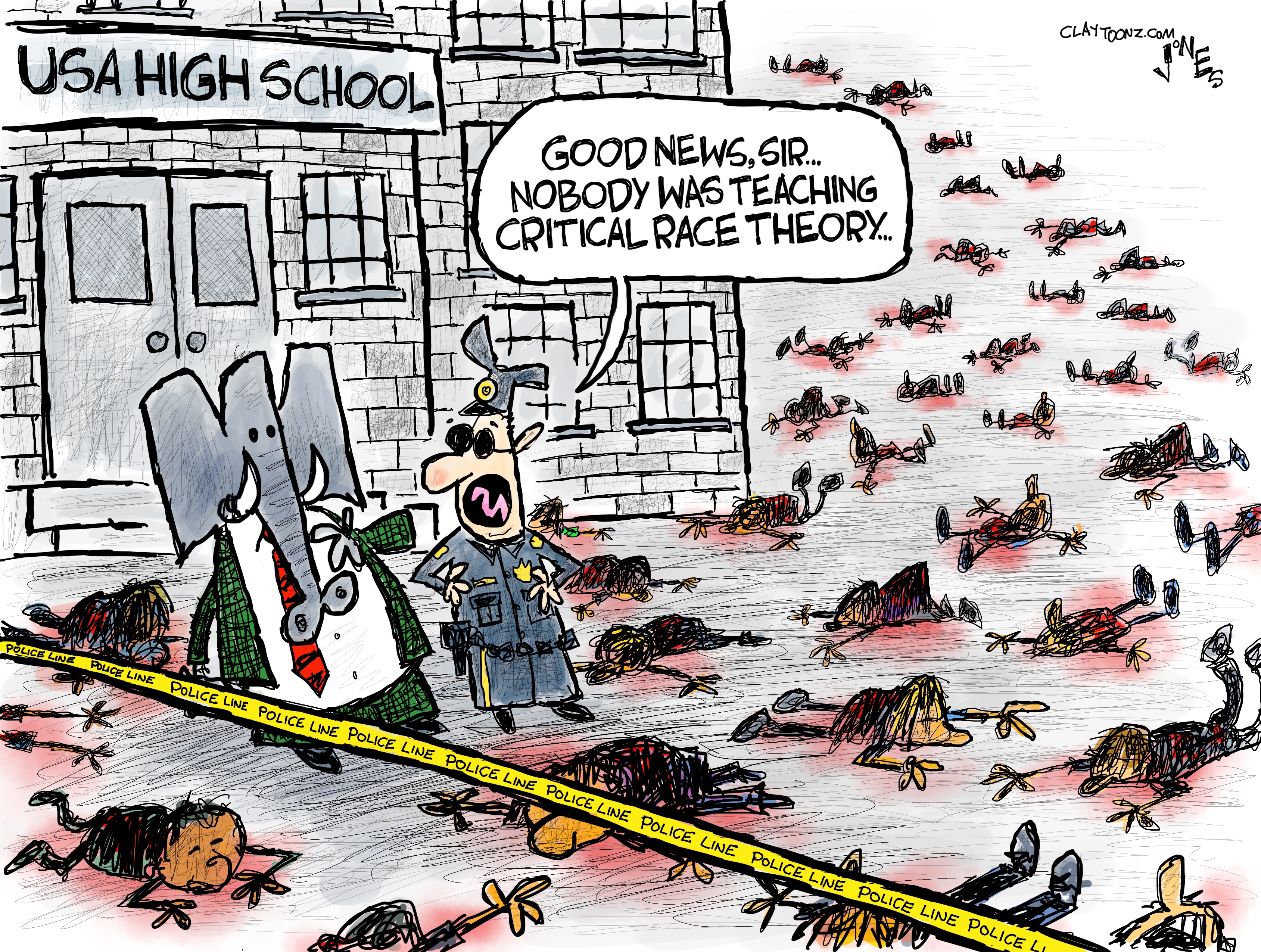
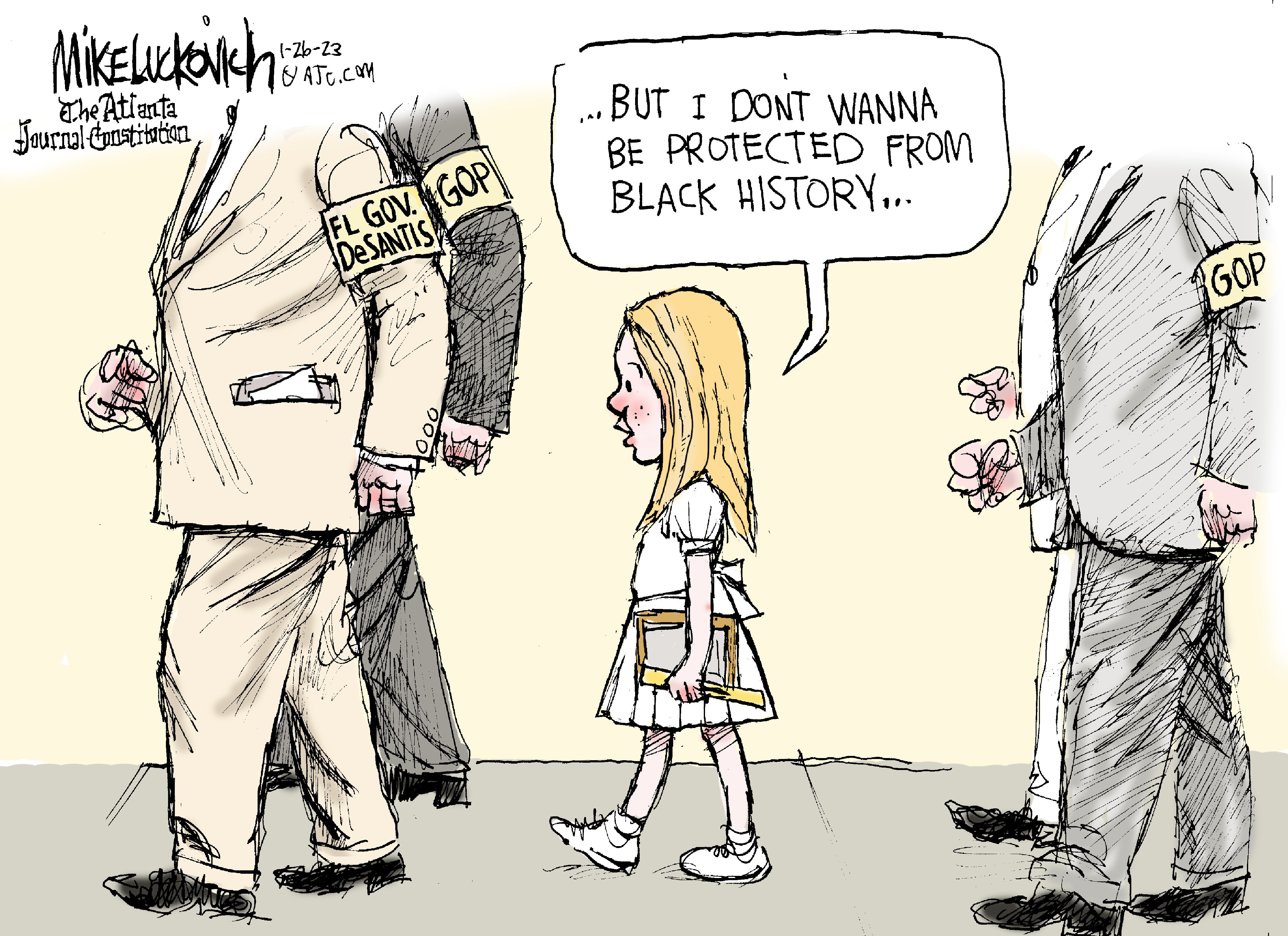
Watching Seekins-Crowe’s speech makes me realize that conservative leaders like Donald Trump and Ron DeSantis have spoiled me, because their villainy is so direct and uncomplicated. I have no doubt that Trump knows he is a grifter, and that he is consciously taking advantage of the people who support him. Likewise, DeSantis knows that critical race theory is not a thing, and that Florida’s librarians and grade school teachers are not grooming children for pedophilia.

If everyone on the other side were like that, life would be simple. But instead the world is full of Abrahams whose willingness to sacrifice Isaac makes them feel closer to their God.

What can we do with them?

I don’t have an answer for that question, so I’m just going to continue talking about the Montana legislature, and red-state governments in Texas and Florida that also gave us insight into authoritarianism this week.

Zooey Zephyr. One thing authoritarians don’t do is tolerate dissent, particularly from people they deem inferior. A few weeks ago, the Tennessee House decided not to tolerate Justin Jones and Justin Pearson, who are Black. The Justins delayed the business of the House for an hour or so by encouraging pro-gun-control demonstrators in the gallery, so they were expelled from office. But the people of their districts put them right back.

This week, the Republican supermajority in the Montana House did something similar to Zooey Zephyr, a trans woman (whose adulthood, in Seekins-Crowe’s terms, must not be “precious” or “successful”). On April 18, during debate on the bill banning gender-affirming care for minors (and several other anti-trans bills), she was blunt:

This body should be ashamed. If you vote yes on this bill and yes on these amendments I hope the next time there’s an invocation, when you bow your heads in prayer, you see the blood on your hands.

In response, the ironically-named Freedom Caucus in the Montana House called for “his” censure because of that “threatening” comment. Majority Leader Sue Vinton responded directly (and self-righteously) to the “shame” comment:

We will not be shamed by anyone in this chamber. We are better than that.

The censure resolution was not immediately taken up, but the Speaker refused to recognize Rep. Zephyr when she rose to speak, and said that he would not do so until Zephyr apologized, which she refused to do.

Last Monday, hundreds of pro-Zephyr demonstrators came to the Capitol. When Zephyr rose and was ignored, they loudly chanted “Let her speak.” The Speaker still did not recognize Zephyr, and the House ground to a halt for half an hour until the demonstrators could be removed. On his way to jail, one demonstrator explained:

In this country you don’t get many rights but one of the things you do get is an elected representative, and 11,000 Montanans are waiting for Zooey Zephyr to speak for them, to represent the interest of trans people in the state who belong in the state as well. It’s not just … the old white men who run the show over here. It’s every single person. Montana is big enough for all of us, and I think it has space for all of us.

Republicans have since inaccurately described the demonstrations as “violent” and “an insurrection”. (I commented two weeks ago on the Right’s practice of breaking words that have been used against them. Ever since January 6 they have been trying to break insurrection through misuse. It falls flat to claim that January 6 was merely a “protest”, so they have been characterizing any liberal protest as an insurrection.)

Zephyr was blamed for this breech of “decorum” (the same offense charged against the Justins). So she was banned from the House floor for the remainder of the session (which ends May 5). The resolution banning her did not also bar her from serving on committees, but all the committees she serves on then had their remaining meetings cancelled.

Like the Justins, Zephyr returned home to a large rally of her supporters. (Remember: “Large” means something different in Montana, where each House district has only about 11,000 people.) Since the legislature only meets in odd-numbered years, her term is effectively over. But she’ll be running for reelection in 2024.

Universities. Another thing authoritarians do not tolerate is an alternative source of institutional authority. That’s why the current crop of red-state authoritarians is working so hard to bring the universities under control. Universities do not wield power directly, but they are recognized sources of authoritative opinion. So they cannot be allowed to remain independent.

A number of German words have already made it into the American vocabulary — zeitgeist, schadenfreude, realpolitik, gestalt, wanderlust. Well, it’s time to learn another one: gleichschaltung, whose root words mean “same circuit”. Originally an engineering term translated as “coordination” or “synchronization”, gleichschaltung was adapted in the 1930s to describe the process of unifying German society and culture under Nazi ideology. Simply controlling the national government wasn’t good enough; the kind of German renewal the Nazis promised could only be accomplished by a unified society whose institutions all pulled in the same direction. So local governments, corporations, unions, professional associations, universities, social clubs, and youth organizations all needed “coordination”.

This week, Texas took a step towards its own gleichschaltung when its Senate passed SB-18, which would eliminate tenure in the state’s universities.

An institution of higher education may not grant an employee of the institution tenure or any type of permanent employment status.

Current tenured faculty are grandfathered in, but no new tenured appointments would be made after September 1. The Texas Tribune claims that the bill “faces an uphill battle at the Texas House”, so perhaps Texas’ university system will be spared for another term or two.

The argument for the bill is primarily political, not educational.

[Lieutenant Governor Dan] Patrick’s push to end tenure in Texas started more than a year ago after some University of Texas at Austin professors passed a nonbinding resolution defending their academic freedom to teach about issues like racial justice. The resolution came as Republicans hinted that they wanted to extend restrictions on how race is discussed in K-12 classrooms, which were approved by the Texas Legislature in 2021, to the state’s public universities.

The resolution outraged Patrick, who accused university professors of “indoctrinating” students with leftist ideas and argued that the state must stop awarding tenure because faculty with the benefit don’t face any repercussions for it.

But that’s precisely the justification for tenure: It allows academics to do their jobs without worrying about offending the politicians currently in power. In a liberal democracy, universities are not supposed to be “coordinated” with the ruling party.

Florida is another state trying to synchronize its educational institutions with government ideology. Governor DeSantis’ Stop WOKE Act created a list of ideas that cannot be taught in Florida public schools, including the state universities. The part affecting the universities has been blocked by a federal judge, whose ruling says:

The First Amendment does not permit the State of Florida to muzzle its university professors, impose its own orthodoxy of viewpoints, and cast us all into the dark.

But acts of the legislature are only one path to gleichschaltung. The governor also has executive power to appoint trustees to university boards. DeSantis’ new trustees are in the process of coordinating New College in Sarasota. At a recent meeting, all five faculty members up for tenure — including three in the supposedly apolitical hard sciences — were rejected, and the faculty chair (who had been broadly criticized for being too accommodating to the new regime) quit.

Disney. I mentioned corporations in the list of things that need to be synchronized with the ruling ideology. Well, after DeSantis passed his Don’t Say Gay law, Disney had the temerity to put out a statement saying that it opposed the law and would continue to work against it through the systems our constitution provides for reversing government actions:

Our goal as a company is for this law to be repealed by the legislature or struck down in the courts, and we remain committed to supporting the national and state organizations working to achieve that.

All in all, it was pretty tepid stuff, but it marked Disney as a company not marching to the DeSantis drum. That led DeSantis to strike at Disney in ways that fell comically flat: A bill to dissolve the special taxing district around Disney World had to be undone when nearby counties noticed they might wind up responsible for about $1 billion in bonds the district had outstanding. Then DeSantis announced a takeover of the board that oversees the district, but was again outsmarted by an agreement Disney signed with the outgoing board.

Now DeSantis is trying to get the legislature to nullify that agreement, and Disney decided it had had enough: It filed a federal lawsuit claiming that DeSantis is illegally retaliating against Disney for speech protected by the First Amendment.

There is no room for disagreement about what happened here: Disney expressed its opinion on state legislation and was then punished by the State for doing so. … This is as clear a case of retaliation as this Court is ever likely to see. …

It is a clear violation of Disney’s federal constitutional rights—under the Contracts Clause, the Takings Clause, the Due Process Clause, and the First Amendment—for the State to inflict a concerted campaign of retaliation because the Company expressed an opinion with which the government disagreed. … In America, the government cannot punish you for speaking your mind.

The reason there’s “no room for disagreement” is that DeSantis didn’t just announce in public that he was abusing state power to punish Disney for making a political statement, he wrote about it in his book. DeSantis clearly could have benefited from the class Stringer Bell taught in The Wire:

Is you taking notes on a criminal f**king conspiracy? What the f**k is you thinking, man?

DeSantis’ defense of his actions is that Disney’s control of the special taxing district around Disney World is an inappropriate merging of state and corporate power, so he is right to take it away. And in the abstract, that may even be true. But legal and even reasonable exercises of government power become unconstitutional when they are used to punish speech protected by the First Amendment, as these actions clearly were.

David French looked up the appropriate legal precedent: O’Hare Towing Service v City of Northlake (1996). Speaking for a 7-2 majority, Justice Kennedy wrote:

If the government could deny a benefit to a person because of his constitutionally protected speech or associations, his exercise of those freedoms would in effect be penalized and inhibited. Such interference with constitutional rights is impermissible.

But in spite of the governing precedent, French is still not entirely sure how the case will come out.

At the beginning of this piece, I said that DeSantis should lose, not that he will lose. Court outcomes are never completely certain, but this much is correct: A Disney defeat would represent a dangerous reversal in First Amendment jurisprudence and cast a pall of fear over private expression.

French is afraid, in other words, that gleichschaltung may already have reached the Supreme Court.

Reflections on driving across America

Why aren’t rural people even crazier than they are?


Over the last month, I’ve driven nearly six thousand miles. My wife and I started in Massachusetts, where we live, and went first to central Illinois, where I grew up. From there we struck out towards Sedona, where the red rocks are, and towards the Georgia O’Keefe landscape of Santa Fe, home of one of my favorite cuisines. On the way home, we saw family in Nashville.

Between those highlights, we strung together a series of roadside attractions, like the otherwise undistinguished corner in Winslow that the Eagles sang about, or the figuratively (but not literally) tasteless Uranus Fudge Factory in Missouri. We considered stopping for many other diversions, like the Superman statue in Metropolis, Illinois, but kept driving. We passed maybe dozens of Route 66 museums, and countless Native American trading posts that seemed far too small to contain all the wonders promised by miles and miles of billboards. My best eating days being behind me, I did not try to win the free 72-ounce steak in Amarillo.

In other words, I have been seeing America, the “real America” that gets lauded at Republican rallies and NRA conventions.

A lot of it struck me as depressing. Through much of the drive, I was plagued by the thought “Why does anybody live here?” Or, more accurately, “Why will anybody live here?”

Of course I knew why people had settled the farm country where I grew up: The soil was rich, the Native Americans had vanished through some process we preferred not to think about, and the Homestead Act had divided the newly empty land into 160-acre plots that an ordinary White man could afford. Thomas Jefferson’s vision of a nation of yeoman farmers — who might never get rich, but would have the independence that comes from owning the land they tilled — was becoming real.

That agricultural land produced surplus, which needed to get to the cities somehow. So there were river ports like Cincinnati and Louisville and (eventually) St. Louis. In return, the farmers needed whatever tools and luxuries they couldn’t produce themselves, so trading posts developed into small towns, where doctors, dentists, lawyers, and accountants could hang a shingle. Eventually you had a real economy.

When industrialization happened, those small towns turned out to be ideal places to site factories. They had transportation, and surplus labor coming off the mechanizing farms. So you had John Deere in Moline, Caterpillar in Peoria, and countless lesser enterprises dotted across the landscape.

In the mid-20th century, it all made a lot of sense. But it doesn’t any more.

For decades I’ve been making the 300-mile drive from Chicago to my hometown, Quincy, Illinois. Quincy itself has been holding steady at around 40,000 people. It’s the biggest thing for 100 miles in any direction, so it has become the regional retail center. It has lost most of the factories I remember from my youth, and the ones that remain employ far fewer people, but there appear to be jobs (of a sort) at the Home Depot and the Walmart. The small hospital where I had pneumonia when I was three is now a sprawling campus that gets bigger every time I visit. Upper-middle-class people from St. Louis or Chicago can retire to Quincy and build mansions, so a number of them do.

Population-wise, it more or less balances out.

But the drive from Chicago goes through a lot of dying towns, ones that are too small or too close to something else to become regional centers. Homestead Act farms have been amalgamated into agribusinesses that support far fewer families. As the countryside depopulates, the towns lose their supermarkets and general stores, and then eventually even their gas stations. Where two or three restaurants used to compete, now there’s maybe enough traffic to support a bar. If you live there and want a gallon of milk, you need to drive a few dozen miles to a regional center like Quincy.

While the voices coming through my satellite radio debated the future impact of artificial intelligence, I was picturing electric robot combines roaming across the endless prairie, powered by automated windmills.

Why will anybody need to live here at all? And if some people want to live here, maybe because their families have lived here for generations, what will they do?

On the way from the fudge factory to Nashville, I resisted the macabre urge to see Cairo (pronounced KAY-ro). Cairo sits at the confluence of the Ohio and the Mississippi, which sounds like it ought to be the site of a great city. St. Louis, Pittsburgh — lots of cities have been founded at the confluence of rivers. The rich, fertile land surrounding Cairo is said to be the source of the region’s nickname “Little Egypt”. As Jacob’s sons made their way to Egypt to escape a Biblical famine, so did the surplus of Little Egypt feed the areas around it.

So Cairo’s original settlers must have had visions of empire. It never quite worked out that way, but the town did prosper as a minor transportation hub, growing to about 15,000 people by the 1920s. Mansions were built there in the late 1800s.

But transportation routes changed. Symbolically, Cairo used to be a stop on the City of New Orleans train made famous by Steve Goodman’s song. But although that train has still not disappeared (as Goodman mournfully envisioned) it doesn’t stop in Cairo any more. Hardly anybody does.

In addition to its economic challenges, Cairo had a history of lynching, and did a bad job managing the racial conflicts of the 1960s. And now the town is down to about 1700 people, barely a tenth of its previous size. The downtown is mostly boarded up.

I grew up picturing ghost towns as artifacts of the western deserts. Mines created boom towns, but then the mines played out and there was no reason to live there any more. As a child, I could not have imagined ghost towns in the farm country, but now I can.

The outlook gets even worse as you go west. Much of the agriculture of the Great Plains is based on pumping water out of the ground, which has gradually depleted aquifers like the Ogallala. Long term, that land won’t even support the robot combines. As far back as 1987, Deborah Epstein Popper and Frank J. Popper were envisioning letting the whole region go back to nature, restoring the “buffalo commons” that existed before the White man came.

Driving through this empty land gives you a lot of time to think, and one of the questions I considered was “What does living in a place with no future do to your outlook on life?”

Of course, the individuals who grow up in these places do have viable paths into the future. They can, for example, do what I did: Get a scholarship to a state university and earn a marketable credential they can cash in somewhere else. In this era of diminishing state education budgets and correspondingly higher student debt, that path is not as smooth as it used to be. But it is still there.

But what if you love your home in more than just a sentimental way? What if the people and the landscape and the way of life has burrowed deep into your soul? What if catching a lifeboat out seems less like an exciting adventure and more like exile?

And what if you’re older? What if you have children and grandchildren you’d dearly love to keep around you, but you know you can’t? For their own sakes, they need to go. And they need to leave you behind.

What does that do to your outlook on the world? Maybe in that situation, you wouldn’t like thinking of yourself as the victim of History’s impersonal forces. Maybe you’d prefer to imagine conspiracies that have stolen your future from you. Maybe those conspiracies would center on your children, on pulling them away from you or turning them against you or making them unrecognizable. Somebody — let’s call them “liberals” (or maybe “Jews”) — wants to make them “woke”, or turn them gay or trans, or replace them with dark-skinned immigrants.

Imagining such things may not give you hope, but at least it gives you someone to blame. Maybe that helps.

Last week I was writing (yet again) about fascism. I observed that the Trumpist brand of fascism isn’t even pretending to offer solutions to its rural supporters. Rather than a new deal, Trump promises vengeance. “I am your retribution,” he has been telling his rallies.

Maybe that’s what passes for “telling it like it is” in certain circles. Once you see that the future is hopeless, then it’s the people making plans and promises who sound like grifters. The “straight talkers” just promise to make other people suffer, which you are confident they can do.

How do we deal with this? I keep coming back to that Obama “Hope” poster. Somehow, we have to address the widespread sense of hopelessness in America without sounding like bigger grifters than Trump is. In a contest of solutions, liberals have it all over conservatives. But if there are no solutions, why not just lash out against the people you hate?

So anyway, I have been to the wilderness and seen a vision. Now I’m trying to get it out of my head so I can get on with life. If I’ve transferred that vision into your head, I apologize.

Can the anti-woke mob define “woke”?

Does the word still mean anything, or is the whole point to throw around a meaningless buzzword?


The controversy started Tuesday, when conservative author Bethany Mandel’s appearance on The Hill’s “Rising” podcast went viral. Host Briahna Joy Gray asked a question that, in some other circumstance, might have been a softball:

Would you mind defining “woke”? Because it’s come up a couple of times and I just want to make sure we’re on the same page.

As Gray emphasized later, this was not intended as a gotcha.

I wanted to be able to figure out whether I agreed with her on certain points, as I had done earlier in the interview. Alternatively, I want to be able to articulate why we differed on other aspects of her argument without devolving into the typical shouting matches.

Mandel, who claims she spent an entire chapter of her new book Stolen Youth: How radicals are erasing innocence and indoctrinating a generation defining “woke”, floundered. Her humiliation quickly spread across liberal social media, because it appears to illustrate something many of us have been claiming for some while: Woke is the latest in a long series of right-wing pejorative terms like cancel culture and political correctness. Their purpose is not to point to any real ideas, but to identify someone as an enemy. The MAGA base has been trained like Pavlov’s dogs to react to these terms without thinking, so calling something “woke” is just a way to say “sic ’em”.

Amanda Marcotte puts it like this:

The inability to define “woke” is a feature, not a bug. “Woke” is very much meant to be a word that cannot be pinned to a definition. Its emptiness is what gives it so much power as a propaganda term. “Woke” is both everything and nothing. It can mean whatever you need it to mean, and you can deny that it means what it obviously means. The ephemerality of “woke” is what makes it so valuable. “Woke” morphs into being when a right-winger needs to feel outrage and evaporates into thin air should anyone try to ask a rational question about it.

It’s the vagueness of woke that allows it to be used more or less whenever Mr. Burns wants to release the hounds. Silicon Valley Bank collapsed, for example, because it was “woke”. So there’s no need to talk about deregulation or interest rates or risk management or any other headache-producing idea. Instead, we can cut off discussion by invoking unthinking hostility. Woke: bad.

And I’m still trying to figure out why Tucker Carlson thinks M&Ms are woke.

But not all liberals gloried in Mandel’s failure. Center-left commentator Jonathan Chait was more generous.

She may be wrong, but she’s not an idiot. She just froze up on TV. It happens.

Freezing up does happen, particularly to people who are used to writing rather than responding in real time. But the incident also points to something significant: Mandel clearly did not prepare for this question. She anticipated being able to throw the word around without being asked what it means. For comparison, before I started referring to Trump as a fascist, I wrote an article explaining what I mean by that term. I don’t carry all my writings in my head, though, so if you stopped me on the sidewalk and asked for a concise definition of fascist, I might flounder too. But if I were planning to use such an emotive word in an interview, I would anticipate being challenged to define it and would prepare an answer.

Mandel clearly didn’t think that was necessary. That strikes me as telling.

She’s not the first anti-woke warrior to be put on the spot like this. When he was asked in court what woke means, Ron DeSantis’ General Counsel Ryan Newman defined it as: “the belief there are systemic injustices in American society and the need to address them”. That’s a perfectly fine definition a lot of liberals would agree with. The problem for Newman (and DeSantis) is that it doesn’t justify a Pavlovian negative response: Does the DeSantis administration really want to claim that there are no systemic injustices in America, or that (if there are) nothing should be done about them? Is that what all the shouting is about?

The next line of conservative defense is to put aside the gotcha moment — which the viral clip became, whether Gray intended that to happen or not — and get the discussion back on track by producing the answer Mandel should have given. Mandel herself later offered this definition:

A radical belief system suggesting that our institutions are built around discrimination, and claiming that all disparity is a result of that discrimination. It seeks a radical redefinition of society in which equality of group result is the endpoint, enforced by an angry mob.

She avoids Newman’s what’s-so-bad-about-that problem by inserting a bunch of pejorative judgments into her definition. I mean, why not just tell us what wokeness is, and let us judge for ourselves whether it’s radical, angry, or mob-oriented? If you take out the judgments and just include the definitional parts, you wind up with “The belief that group inequality is caused by discrimination that is built into our institutions, and that a fundamental reorganization of society is necessary to correct this problem.” When you think about it, that’s not far from “systemic injustices and the need to address them”. And like Newman’s definition, it also doesn’t capture what the shouting is about.

So we start to see the Scylla and Charybdis a good conservative definition of woke has to navigate between:

  • The definition should mean something.
  • What it means should justify how conservatives have been using the term.

I’ve been looking around, but I haven’t seen one that does both jobs.

Ross Douthat more-or-less gives up on the idea of a concise definition, but instead describes a worldview and a narrative (which he says he doesn’t believe). It starts like this:

What is America all about, at its best? Equality and liberty. What is the left all about, at its best? Transforming those ideals into lived realities.

But this project keeps running into limits, disappointments and defeats. Everywhere you look, terrible disparities persist. And that persistence should force us to look deeper, beyond attempts to win legal rights or redistribute wealth, to the cultural and psychological structures that perpetuate oppression before law and policy begins to play a part. This is what the terminology of the academy has long been trying to describe — the way that generations of racist, homophobic, sexist, and heteronormative power have inscribed themselves, not just on our laws but our very psyches.

And once you see these forces in operation, you can’t unsee them — you are, well, “awake” — and you can’t accept any analysis that doesn’t acknowledge how they permeate our lives.

Up to there, I give him points for accuracy: Yes, those are all things I believe. From there his narrative gets a little more suspect, but what’s really disappointing is his column’s ending: It’s all about feelings.

If you find a lot of this narrative persuasive, even filtered through my conservative mind, then whatever “woke” describes, it probably describes you.

If you recoil from it, welcome to the ranks of the unwoke.

He doesn’t cite any reason to reject the narrative he describes, he just observes that people like him “recoil from it”. Again, this emotional “recoil” doesn’t explain why books have to be banned and drag shows have to be outlawed, or why the state has to intervene to prevent parents, children, and their doctors from assessing their own problems and choosing courses of action. Why can’t Douthat “recoil” over in the corner and leave the rest of us alone?

Douthat at least seems to be writing in good faith. So does Thomas Chatterton Williams, who expresses sympathy for some of what conservatives are trying to capture with wokeness, but eventually reaches a conclusion I can agree with:

But perhaps we can all agree, at bare minimum, to set ourselves the task of limiting our reliance on in-group shorthand, and embracing clear, honest, precise, and original thought and communication. If we want to persuade anyone not already convinced of what we believe, we are going to have to figure out how to say what we really mean.

I am pessimistic that this view will catch on, though, because I don’t think people like Ron DeSantis are interested in “clear, honest, precise, and original thought and communication”. I think they find it far more useful to wield a meaningless term that evokes a Pavlovian response.

Imaginary problems, real laws, real victims

In red states, a barrage of new laws are diminishing freedom, violating parents’ rights, and mandating that schools teach conservative dogma. It’s not clear what real problems these laws are attempting to solve, but it is clear who’s being hurt.


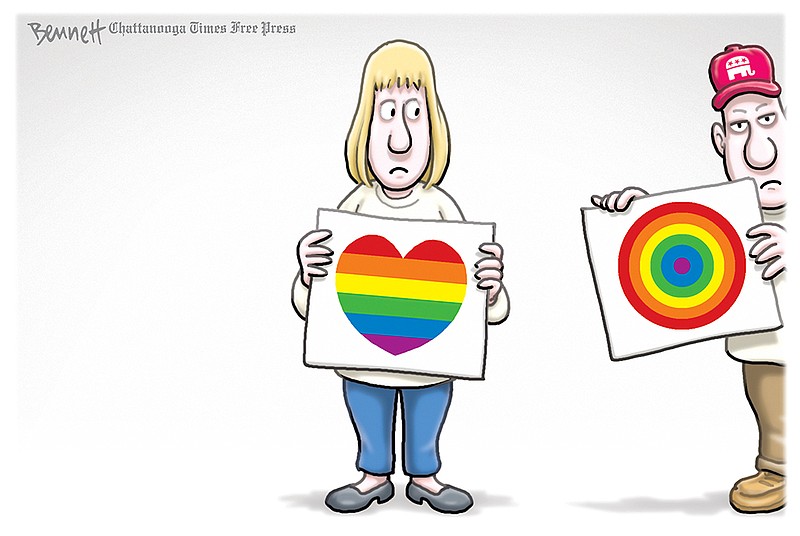
This week, Tennessee passed a law banning drag shows in public spaces, or anywhere else they might be seen by children, and NBC reports that 15 states are considering similar laws. The state also passed a law banning gender-affirming medical care for minors, and permitting minors to sue their parents if the parents authorized such treatment. The Williams Institute at the UCLA School of Law says 15 states have either already passed similar laws or are considering them.

One proposed Florida bill goes even further: It legalizes a parent kidnapping a child from another state and bringing the child to Florida in order to “protect” the child from gender-affirming care, and orders Florida courts to ignore any other state’s child-custody rulings in such cases. [1]

A court may not treat a parent′s removal of a child from another parent or from another state as unjustifiable conduct or child abuse if the removal was for the purpose of protecting the child from one or more of the prescriptions or procedures referenced in paragraph (a) and if there is reason to believe that the child was at risk of or was being subjected to the provision of such prescriptions or procedures. … A court of this state has jurisdiction to vacate, stay, or modify a child custody determination of a court of another state to protect the child from the risk of being subjected to the provision of sex-reassignment prescriptions or procedures as defined in s. 456.001. The court must vacate, stay, or modify the child custody determination to the extent necessary to protect the child from the provision of such prescriptions or procedures.

Last year, Florida’s legislature began an effort to turn its schools into indoctrination centers with the Parental Rights in Educationt Act (a.k.a. Don’t Say Gay) and STOP WOKE Act that banned the teaching of specific lists of ideas and caused entire counties to remove books from their classrooms. [2] Several states have passed similar laws, and a national Don’t Say Gay bill (the Stop the Sexualization of Children Act) has been introduced in the House. A new bill in Florida would expand the restrictions of Don’t Say Gay from third grade to eighth grade. [3] Another new bill would expand Governor DeSantis’ power to give ideological marching orders to the state universities.

In an administrative move, Alaska’s State Commission for Human Rights has downgraded “sexual identity and gender orientation” from the list of always-illegal bases for discrimination to the list of discrimination that is illegal “in some instances”. According to Pro Publica and The Anchorage Daily News

it began refusing to investigate complaints. Only employment-related complaints would now be accepted, and investigators dropped any non-employment LGBTQ civil rights cases they had been working on.

The onslaught of such legislation is so intense that I’m sure I’ve missed something important. But let’s take a closer look at a couple of these bills.

Controlling Florida’s universities. This year the top-down effort to control what is discussed in Florida’s K-12 classrooms is being extended into the state universities. (To a certain extent it was already there in STOP WOKE.) Governor DeSantis has used his administrative power to appoint a new board to govern New College in Sarasota, with the expressed goal of turning it into an academic center of right-wing ideology similar to Hillsdale College in Michigan, which is privately funded and explicitly Christian. [4]

A bill currently in the legislature would impose similar controls on the state university system as a whole: It adds a new mission to the university system “the education for citizenship of the constitutional republic”. [5] It instructs each “constituent university to examine its programs for the inclusion of any specified major or minor in critical race theory, gender studies, or intersectionality or any derivative major of these belief systems, that is, any major that engenders beliefs in those concepts defined in [STOP WOKE]” and to submit documentation of “the university’s process to remove from its course catalogues any specified major or minor” in the same subjects.

Each university’s board is empowered to review the tenure of any faculty member at any time, and power to appoint new faculty members is centered in the board, which is explicitly “not bound by recommendations or opinions of faculty or other individuals or groups”. No money — not even private donations — can be used for any programs that “that espouse diversity, equity, and inclusion or critical race theory rhetoric”.

Previously established programs at University of Florida and Florida State are now expanded into “colleges” that can hire faculty and enroll students. These colleges appear to have a Hillsdale-like purpose resembling the ideological mission DeSantis has given New College.

This bill so far has just been filed and the legislature has taken no action, but it looks serious. Similar bills are filed in both the House and Senate, and it seems like a fulfillment of DeSantis’ previous statements. Inside Higher Education says:

The bill mirrors much of the governor’s recent rhetoric and revisits draft legislation from DeSantis that never made it into the 2022 legislative session.

Tennessee’s anti-drag law. This one leaves me (and, I suspect, a lot of other people) shaking my head. Men dressing as women is a comic trope that goes back more-or-less forever. Shakespeare is full of gender-switching roles, and if you go back far enough, every female role was played in drag, as putting women on the stage was considered inappropriate.

Governor Bill Lee himself (who signed the bill) dressed in drag for his high school yearbook, something he has dismissed as a “lighthearted school tradition” that bears no resemblance to the “obscene, sexualized entertainment” the law restricts.

But if that’s true, his critics argue, then why is a new law necessary? Tennessee already has laws against obscenity and public indecency. So what is it about cross-dressing that should bring additional rules into play? If an act is too pornographic for male or female impersonators to perform in front of children, does it become OK if the performers wear gender-appropriate costumes instead? Conversely, if a dance routine is acceptable for, say, the Tennessee Titan cheerleaders (who I assume are women) would it suddenly become obscene if it were performed by a man wearing the same outfit?

Like the Florida education laws, the anti-drag law takes advantage of vagueness. In the key phrase “male or female impersonators who provide entertainment that appeals to a prurient interest”, the term “prurient interest” is never defined, and is largely in the eye of the beholder. (Do the Titan cheerleaders “appeal to a prurient interest”? Sometimes, I guess, maybe. I’m not sure.) The upshot of that vagueness is that promoters will be afraid to schedule drag shows, no matter how benign their content might be. Similarly, Florida teachers and professors are afraid to say anything about race or gender. Nobody wants to be sued, even if they believe they would ultimately win.

Conversely, vagueness gives conservatives cover: Ron DeSantis can deny that he told any teacher or librarian to ban any particular book. All he did was sign a law that might get them fired or sued if they leave the wrong books on the shelf.

The issue of “obscene, sexualized” drag shows also demonstrates a common propaganda technique: Something widely considered unsavory or disreputable becomes a special problem requiring special action when an out-of-favor group does it. The classic example is how the Nazi newspaper Völkischer Beobachter focused on the issue of “Jewish crime”. Jews are people and people commit crimes, so the VB didn’t have to invent Jewish crimes (though it probably exaggerated a few). The propaganda element was the implication that “Jewish crime” was a special problem that needed a special solution, as opposed to just better law enforcement generally.

In the 1980s, there was a national panic about gay high-school teachers seducing their students, as if this problem had nothing to do with straight high-school teachers seducing their students. More recently, the Trump administration ran the Nazi play almost move-for-move when it established the Victims Of Immigration Crime Engagement Office (VOICE), as if the victims of crimes by undocumented immigrants were somehow different from other crime victims.

This shouldn’t need to be said, but clearly it does: It is not a crime for a man to cross-dress. And an otherwise legal action should not become a crime if a cross-dressing man does it. So there is no need for a special law.

Why now? To my knowledge, there has been no drag-queen crime wave. So why do legislators in 15 states find it necessary to pass anti-drag laws their states never needed before? The answer has more to do with changes in Republican politics than changes in American society.

The elections that have followed Donald Trump’s yuge 2020 defeat [6] have given Republicans a lot to think about, both positive and negative.

Negatively, they have learned that a pure backward-looking Trumpism weighs down their candidates; it only works in places where a more traditional Republican would win easily. In New Hampshire, for example, a Reagan/Bush Republican like Chris Sununu won the governor’s race by over 15%, while MAGA Republican Don Bolduc lost the Senate race by over 9%. Arizona’s 2022 Republican candidates were all-in on election denial, and got swept by the Democrats. Candidates closely identified with Trump lost winnable Senate races in Pennsylvania (Dr. Oz) and Georgia (Herschel Walker). And while J. D. Vance did win in Ohio, he ran well behind the far less Trumpy Republican Governor Mike DeWine, who cruised with a 25% victory margin.

More positively, in 2022 crime and inflation were issues Republicans could win congressional races on. But that’s a lesson with a limited shelf life, given that Republicans have no policies to address either one, and inflation is likely to fade on its own by 2024.

But Republican wins in two governors’ elections stand out as possibly repeatable examples: Glenn Youngkin’s 2021 victory in Virginia and Ron DeSantis’ 2022 Florida landslide. Both largely ignored typical kitchen-table issues like jobs or health care to focus on a much vaguer anxiety about our changing society. Both talked a lot about education, but not in the usual sense of raising test scores or creating opportunity. The next generation needs protection, they claim, but not against observable threats like mass shootings or scientifically predictable threats like the looming catastrophes of climate change. Instead, the villains of this narrative are undefinable boogeymen like “critical race theory” and “wokeism”.

In essence, CRT and Wokeism, like “cancel culture” and “political correctness” before them, are Rorschach tests: If you are afraid of some societal trend, you see it those shapeless blobs.

And if you poke at any of that too hard, you have to invent conspiracy theories with improbable villains: Teachers are conspiring to turn your kids gay or make them hate America. Parents are pushing gender changes onto their children, who go along because everybody else is doing it. Rich Jews are convincing Guatemalans to leave perfectly fine lives so that they can steal jobs from all the good Americans who want to clean our toilets and pick our tomatoes.

Why drag queens? Back in 2015, when famous Olympic champion Bruce Jenner came out as trans and announced a new name, Caitlyn, I introspected and got philosophical about my own discomfort. (In hindsight, that article is clumsy in a lot of ways, because I still had a lot to learn. But I stand by the flow of ideas.) In essence, I decided, I was responding to my own insecurity and denial. The human mind can’t handle the task of conceiving the Universe as it is, so we collect real objects into categories and treat similarly categorized objects as if they had a unity they don’t actually have. Hence man/woman, Christian/Muslim/Jew, gay/straight, rich/poor, Black/White/Asian/Hispanic and so on. But all those categories are just arbitrary markings on a continuum. Deep down we know we’re telling ourselves a story, and that knowledge makes us anxious.

If you think seriously about how flawed the fundamental building blocks of our thinking are, it’s scary. At any moment, some part of the Universe you’ve been assuming away could come back to bite you. That’s the human condition.

That’s why we get such an oogy feeling whenever we see an example of something we were raised to think didn’t exist: an effeminate man, two women kissing, a child with dark brown skin and frizzy red hair. It’s a reminder that we don’t really grasp the Universe; we just apply kludgy notions that more-or-less work most of the time.

… At its root, social conservatism is a way to deny that fear and transmute it into anger. Conservatism reassures us that the categories in our heads are real. We didn’t make them up; God created them. They’re natural.

Drag is specifically designed to get into the boundarylands where our usual categories fail. The illusion is designed to be imperfect. A man who managed to be indistinguishable from Liza Minnelli might as well be Liza Minnelli; he wouldn’t be doing drag any more.

That lingering in the boundrylands is precisely what many people find scary about drag: It points out that while your sexual organs are real, your gender is a performance that could fall anywhere on a continuum from he-man to girly-girl. The people you meet are not necessarily one thing or the other. The world is more complicated than you usually allow yourself to realize.

But that boundaryland experience is also why some parents want to take their children to drag shows. (And why it’s a violation of freedom for Tennessee to tell them they can’t.) Some children may want to be told what their roles in society are, so that they can get on with learning to play them. But others experience the most common roles as oppressive. Seeing someone smash through those roles demonstrates that life holds more possibilities than just the obvious ones. It’s liberating.


[1] I often warn people not to get upset about bills that have no chance to become law. This bill might be in that category, but I can’t tell yet: It has only one sponsor, who introduced it this week. No committee has heard it or voted on it. Even if the bill passes, I suspect there are constitutional issues here having to do with the Full Faith and Credit Clause.

[2] DeSantis insists this is a “fake narrative”. Of course he does.

[3] Think about what that means. By eighth grade, students often know (or at least strongly suspect) who in their class is gay or trans or contemplating a gender transition, and bullying is already well underway. Under the proposed bill, it would be illegal for teachers or administrators to recognize potential problems or take steps to deal with them through classroom instruction. Any effort to teach 14-year-olds to accept or tolerate one another’s gender identities or sexual preferences would be illegal.

The same bill would also declare — as a matter of state law — that “it is false to ascribe to a person a pronoun that does not correspond to such person’s sex” which is “an immutable biological trait”.

[4] DeSantis-appointed trustee Chris Rufo (arguably the architect of the crusade against “critical race theory”) is very explicit about his goals:

We will be shutting down low-performing, ideologically-captured academic departments and hiring new faculty. The student body will be recomposed over time: some current students will self-select out, others will graduate; we’ll recruit new students who are mission-aligned.

I went to a state university (Michigan State) in the 1970s. Michigan had a Republican governor at that time, but I don’t recall ever having to worry that I might not be “aligned” with his “mission” for the university, or that any member of the university’s governing board was hoping I might “self-select out” because of my political views. This kind of ideological repression is new in America.

Today’s NYT notes a similar ideological battle over North Idaho College, which may lose accreditation as a result.

[5] That mission may sound benign until you realize how it’s going to be defined and interpreted. “Performance metrics and standards” for achieving such goals are to be part of a strategic plan the law instructs the DeSantis-appointed Board of Governors to write. Previously, the missions of the university system were apolitical ones, like “the academic success of its students”.

[6] Even reality-respecting Republicans who don’t claim massive fraud in 2020 often falsely portray the 2020 election as close. But it wasn’t. In terms of raw vote totals, Trump came within 500 votes of breaking Herbert Hoover’s record for the biggest loss ever by an incumbent president. Trump was 7,059,526 votes behind Joe Biden, while Hoover lost to Franklin Roosevelt in 1932 by 7,060,023 votes.

How can Democrats win back rural America?


Rural voters increasingly resent Democrats,
but Republican policies aren’t helping them.


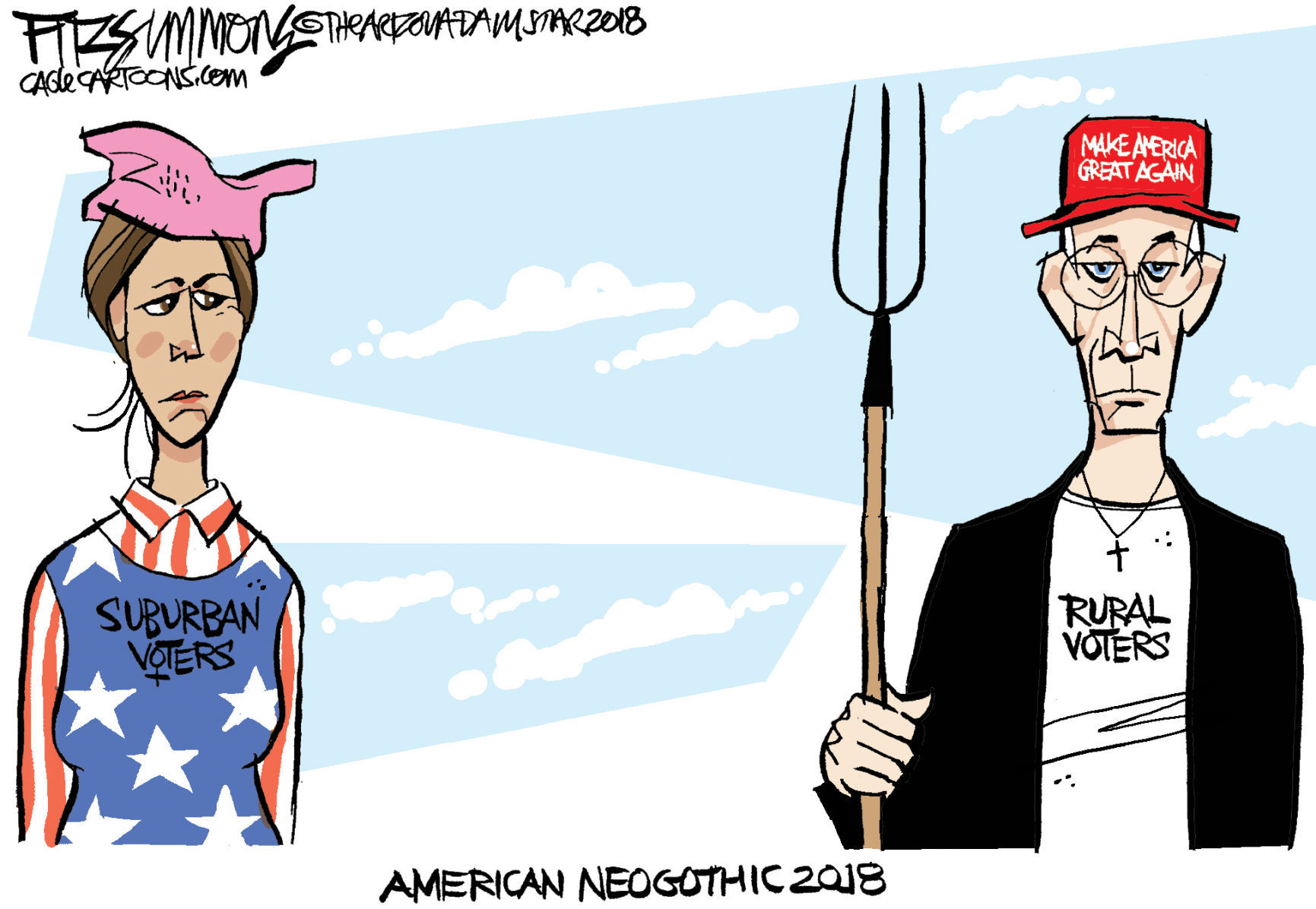
Not so long ago, Democrats got big majorities in the cities, which Republicans balanced by carrying the suburbs, small towns, and rural areas by narrower margins. More recently, Democrats have continued dominating the cities, but MAGA policies and incivility have made the suburbs more competitive (especially by alienating educated women). Now Republicans make up the gap with big majorities in rural areas and small towns.

Two recent NYT articles have focused on how they do that, and whether Democrats can do anything about it. Thomas Edsall’s “The Resentment Fueling the Republican Party is Not Coming from the Suburbs” lays out the problem:

The anger and resentment felt by rural voters toward the Democratic Party are driving a regional realignment similar to the upheaval in the white South after Democrats, led by President Lyndon Johnson, won approval of the Civil Rights Act of 1964.

Edsall presents Wisconsin as a prime example. Senator Ron Johnson is pro-insurrection, believes climate change is “bullshit”, and wants to make cutting Social Security and Medicare easier by shifting those programs from “mandatory” to “discretionary” spending. If you’re an urban or suburban voter, you might think those positions would make him an easy target. But in fact he narrowly won reelection in 2022 by running up huge margins in rural counties. Clearly, people think differently there.

Edsall cites the book The Politics of Resentment by University of Wisconsin Professor Katherine Cramer, who attributes the rural conservative surge to three factors.

(1) a belief that rural areas are ignored by decision makers, including policymakers, (2) a perception that rural areas do not get their fair share of resources and (3) a sense that rural folks have fundamentally distinct values and lifestyles, which are misunderstood and disrespected by city folks.

So a straightforward approach to winning rural areas back would be for Democrats to stop doing those things. But Paul Krugman points out a serious problem with that strategy: Strictly speaking, none of those three beliefs are true. There are many government policies (farm subsidies, special programs to support rural housing, rural utilities, etc.) that focus on rural areas; the federal government spends far more on rural areas than it gets back in taxes; and the respect gap runs mostly in the other direction: Democratic politicians hardly ever denigrate small towns or denounce rural values the way that Republicans target New York City or San Francisco.

It’s a problem that Democrats face across the board: How do you convince people that you’ve stopped doing things you’ve never actually done? How do you respond to parents upset about public schools teaching critical race theory or grooming children to be gay or trans, when public schools don’t actually do those things? How do you stop discrimination against Christians when in fact there is no discrimination against Christians? (Examples to the contrary are nearly always cases where Christians are not getting the special rights they feel entitled to.)

Given that level of misperception, it’s hard to even approach the problem without thinking in a paternalistic way that any Democratic constituency would resent: Consider about how justifiably upset the Black or Hispanic communities get when White “experts” ignore their policy preferences and instead tell them what they “should” want.

I come from the kind of community Edsall and Krugman are talking about: Illinois’ Adams County voted for Trump nearly 3-to-1 in both 2016 and 2020. It’s in the IL-15 congressional district, where a MAGA congressional candidate tallied 71% last fall.

And in some sense I represent the root problem: I grew up there, got an education, saw no attractive opportunities, and moved away to have a successful career in the suburbs of Boston. At my high-school reunions, the primary divide is between those who left and those who stayed. (It’s no wonder being “left behind” plays such a large role the Evangelical mythology popular in rural areas. The fantasy of being raptured to Heaven while unbelievers suffer the tribulations must be a very satisfying turnabout.)

The problems of rural America are very real and deserve national attention, so it’s completely understandable that rural Americans would channel their discontent into a political party. Sadly, though, they’ve united around a party that wants to feed them myths and flatter them rather than do anything that might help.

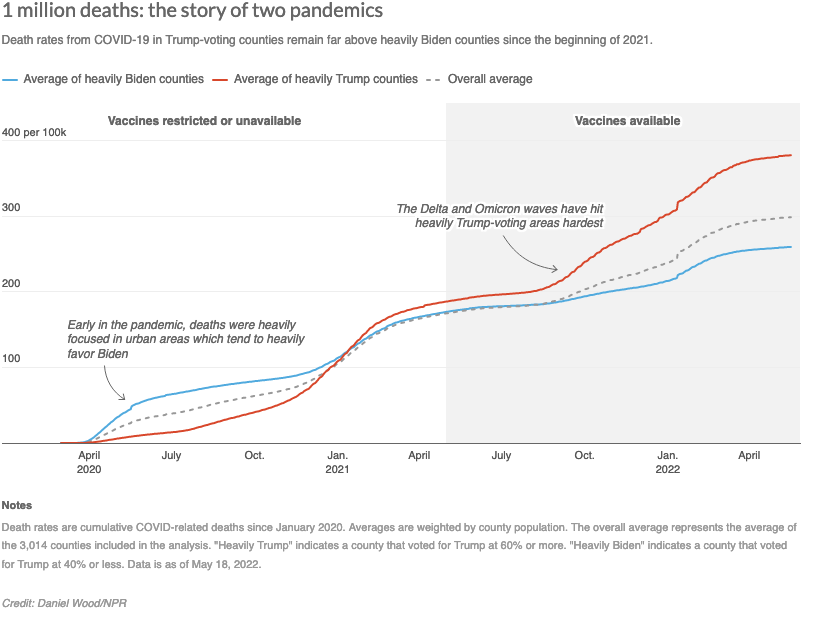
Cutting safety-net programs like Medicaid will do significant damage in places like Adams County, while Biden’s infrastructure package includes quite a bit of investment in rural areas. Conservative anti-vaccine conspiracy theories have contributed to higher Covid death rates in Trump-supporting counties, and that’s just the latest chapter in a longer-term story of anti-public-health policy choices in red states.

I know I overuse Weimar analogies (which come easily to mind as I’ve been binging Babylon Berlin and reading Philip Kerr novels) but it’s hard to ignore the parallels: Germany really had lost a war, its economy suffered badly in the dislocations of the 1920s, and what opportunities still existed were centered in the cosmopolitan cities rather than the nativist countryside. But the defeat-excusing stab-in-the-back myth was not true, Jews and libertine urban culture weren’t the real problems, and fascism was not the answer.

Likewise today, fascism won’t provide an answer to the real challenges rural and small-town America faces. But I’m not sure how to help rural and small-town voters figure that out.

Gas stoves, freedom, and the politics of distraction

Don’t worry about your Social Security, medical care, or bodily autonomy.
Instead, focus your attention on gas stoves, light bulbs, X-boxes, M&Ms,
and the Democrats’ quest to achieve “Soviet America”.


After narrowly winning a House majority by running against inflation and crime (and paying the price whenever they ran a candidate focused on election denial and other MAGA issues), the GOP has begun laying out its agenda for the 118th Congress: not inflation and crime. Instead, it’s gearing up to force a debt-ceiling crisis in order to extort long-term cuts in Social Security and Medicare out of President Biden and Senate Democrats. In addition, it’s getting revenge on Democrats and on government officials who investigated the crimes of President Trump.

When a party defies public opinion like this, they need to wave around a lot of shiny objects to keep their voters distracted.

Cooking with gas. This month’s shiniest object has been: Democrats are coming for your gas stove!

Gas stoves do cause some problems. They’ve been linked to increased incidence of asthma, especially in children. (This conclusion is debatable, but I believe it because I started noticing some mild bronchial irritation after I moved to an apartment with a gas stove — which I otherwise like. So for the last few months I’ve been wearing a mask when I cook, running the exhaust fan at higher levels, and making smaller dishes in the electric toaster oven. It seems to help.)

And then there’s climate change. Long term, the best plan for minimizing carbon emissions is to electrify everything and then generate as much electricity as possible without burning fossil fuels. Fortunately, new induction cooktops and ranges have a lot of advantages, so switching from gas to electric doesn’t have to be a hardship. (That said, while I might try out a portable induction burner, I’m not buying new stove any time soon. The path of least resistance is to make do with what’s already here.)

In short, there are good long-term reasons for America as a whole to shift away from gas stoves. But are the Kitchen Police coming to rip your (or my) gas stove out of the wall? No. No one has even been proposing that they should.

What really happened. January 9, in an interview with Bloomberg News (behind a paywall), Richard Trumka Jr, who is one of the commissioners on the Consumer Product Safety Commission, noted the hazards associated with gas stoves and suggested strengthening safety regulations on new stoves.

This is not a new or strange idea. In December, a letter 20 Democratic members of Congress wrote to the CPSC suggested several such regulations, such as mandating range hoods with exhaust fans, and tightening standards on methane leakage when the stove is off. Notably, they did not suggest a ban.

In his Bloomberg interview, Trumka considered the possibility that if yet-to-be-done research proves that yet-to-be-written safety regulations are insufficient, new gas stoves could be taken off the market: “Products that can’t be made safe can be banned.” In a responsible article, a statement like would be qualified by noting where the CPSC is in its process. Back in December Trumka said CPSC was about to start looking at gas-stove regulations.

Richard Trumka Jr., a commissioner on the Consumer Product Safety Commission (CPSC), said during a virtual webinar on Wednesday that the commission will put out a formal request by March for information on hazards associated with gas stoves and possible solutions. 

“This public request for information is the first step in what could be a long journey toward regulating gas stoves,” he said. 

But instead of providing that context, Bloomberg chose to ignore the “long journey” to regulation and headlined the January interview as “US Safety Agency to Consider Ban on Gas Stoves Amid Health Fears“. The next day NBC went with “Ban new gas stoves, a federal safety commissioner proposes“, and the game of telephone was on. By that evening, Fox News was summarizing like this:

News that the Biden administration may soon ban gas stoves set off Twitter on Monday.

Manufacturing outrage. Republican politicians were quick to jump into the telephone game. Remember: These aren’t just random internet trolls. These are public officials with staff that could fact-check things if their bosses wanted them to.

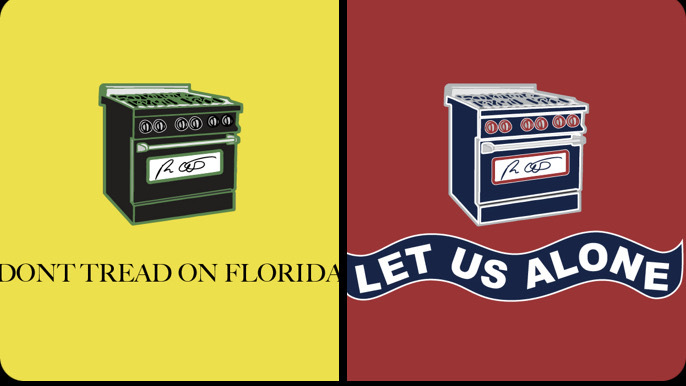
“Don’t tread on Florida, and don’t mess with gas stoves!” tweeted Florida Gov. Ron DeSantis (R) last week in response to comments from a member of the federal Consumer Product Safety Commission (CPSC) that a ban might one day be possible given health concerns about the stoves.“God. Guns. Gas stoves,” tweeted Rep. Jim Jordan (R-Ohio), while Sen. Ted Cruz (R-Texas) listed banning gas stoves as being among policies that he described as “Democrat authoritarian impulses.”

Texas Congressman Ronny Jackson (you remember, the guy who was known around the White House as “the candy man” when he was President Trump’s doctor) saw DeSantis’ Gadsden flag reference and raised him a molon labe.

I’ll NEVER give up my gas stove. If the maniacs in the White House come for my stove, they can pry it from my cold dead hands. COME AND TAKE IT!!

And because its viewers presumably weren’t steamed enough yet, Fox informed them that stoves are just the beginning.

“There’s bad news for almost every room in the house,” Ben Lieberman, a senior fellow at the Competitive Enterprise Institute, told Fox News Digital in an interview. … “If advanced appliances make sense for consumers, they would sell themselves without mandates,” Lieberman told Fox News Digital. “I think that’s a good rule of thumb with very, very few exceptions.

That’s because the broader interests of society never conflict with motives on the individual level, at least in the conservative fantasyland.

Then someone found a 2020 photo of Jill Biden sauteing spinach over a gas stove. Hypocrisy! (Because the Bidens should have remodeled their kitchen in anticipation of CPSC starting to look into regulating new gas stoves 2 1/2 years later.)

The Washington Free Beacon then found eight additional Democrats who have “used a kitchen appliance they want to ban you from owning”. (When they get to John Fetterman, they note that “Exposure to carbon monoxide can put otherwise healthy adults at an increased risk of stroke”. So, you know, he had it coming.)

“Rules for me but not for thee,” Ted Cruz tweeted. He probably cribbed that line from Ron DeSantis’ communications aide Christina Pushaw, who had tweeted the same photo a few hours earlier:

Biden will ban gas stoves for normal people. Not for elites. This is Soviet America: Rules for thee, not for me.

So this is how far ahead of the facts Republicans got: Still unformulated safety regulations for new gas stoves became a looming ban on all gas stoves (plus other appliances), which will be implemented unfairly. Because — you know — Democrats are like that.

Setting the record straight is “caving”. Biden administration officials (including Biden himself) then clarified: There isn’t (and never was) a proposal to ban gas stoves. The CSPC chair issued a statement denying a ban was in the works and reiterating the timetable for starting the regulatory process:

Research indicates that emissions from gas stoves can be hazardous, and the CPSC is looking for ways to reduce related indoor air quality hazards. But to be clear, I am not looking to ban gas stoves and the CPSC has no proceeding to do so. … [L]ater this spring, we will be asking the public to provide us with information about gas stove emissions and potential solutions for reducing any associated risks. 

In typical fashion, Fox News could not possibly admit that it had gotten its viewers outraged about nothing, so instead it framed the clarification by saying that the Biden administration had “reversed course” and “caved” to public outrage.

It’s kind of like when dogs bark at passing cars, and then feel good about themselves for chasing the cars away.

Subsequent outrages. You know what else conservatives are upset about? X-boxes. Microsoft is making them “the first carbon-aware consoles“, via software updates that would allow users to schedule future updates at times when the most sustainable electricity is available, or to change settings to use less energy in general. Fox News Radio host Jimmy Failla explained Microsoft’s sinister motive:

We understand what this is. It’s not that it’s actually going to offset emissions, okay—the level of reduction is infinitesimal. But they’re trying to recruit your kids into climate politics at an earlier age; make them climate conscious now.

And Fox & Friends host Ainsley Earhardt agreed. “You’re right. They’re going after the children.”

But it isn’t all outrage at Fox. There is at least some cause for celebration: Tucker Carlson has won his war against the M&M spokescandies. The Mars Wrigley Corporation announced its surrender last Monday.

The freedom narrative. The Hill explains the larger Republican strategy:

“It’s your stove, it’s your lightbulb, and those are consumer issues and economic issues, they’re also culture war issues,” said Republican strategist Doug Heye, referring to another flashpoint in incandescent versus LED bulbs. 

“It’s part of how Republicans feel that Democrats are targeting parts of Americans’ everyday lives,” Heye added. …

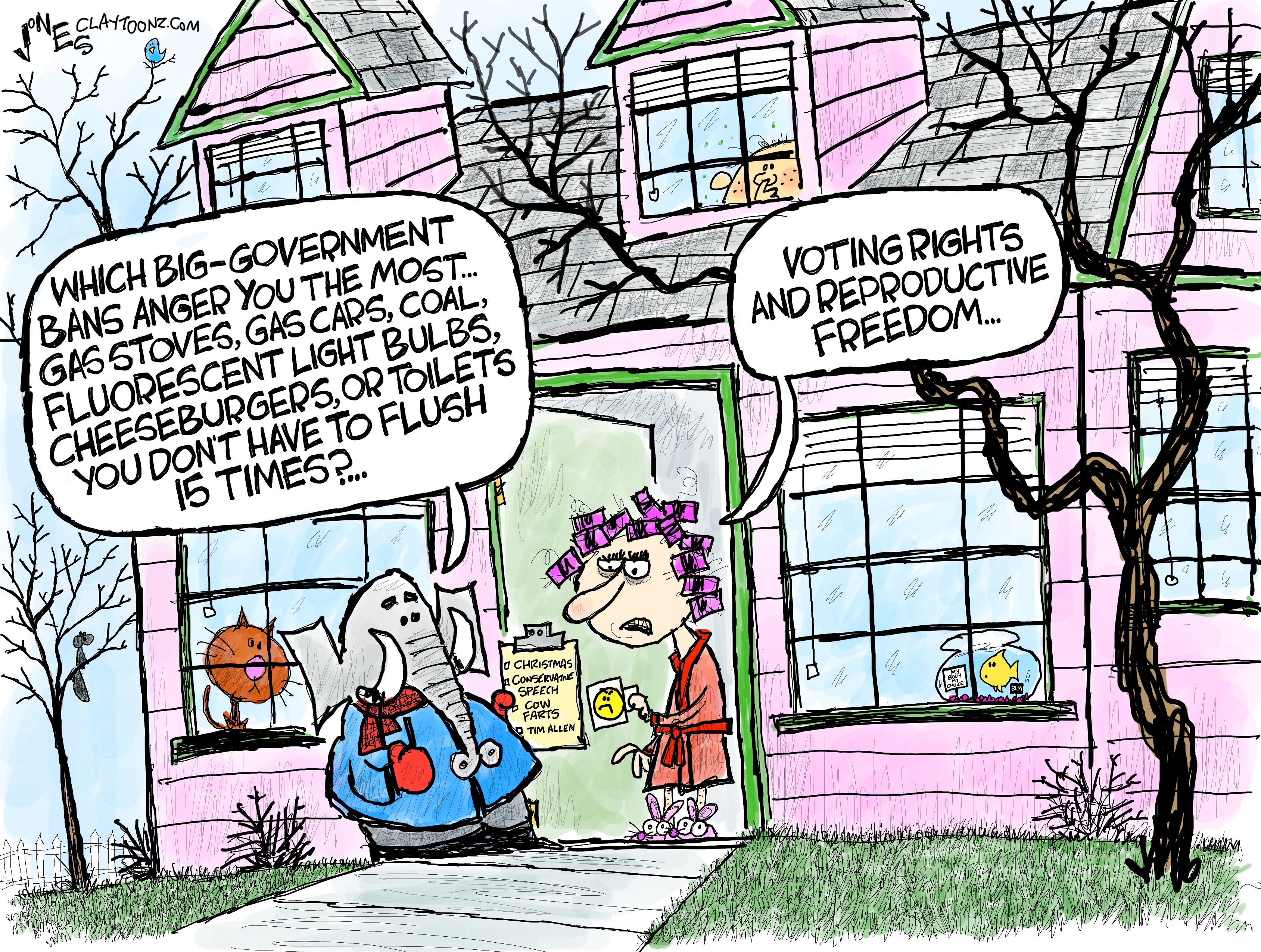
This is not the first time that Republicans have sought to attack Democrats on policies related to household items. During his rallies, then-President Trump railed against showers and toilets that did not have enough water pressure, as well as against energy-efficient light bulbs.  Some have gone even further, claiming that the administration is coming after red meat, which the administration described as a “fabrication.” …

[Republican strategist Keith Naughton] said he doesn’t think any individual issue is “Earth-shaking,” but pieced together they can form a larger narrative, namely that Democrats are “never going to stop until there’s somebody in your home monitoring everything you do.”

But Amanda Marcotte points out that the freedom/control narrative may work better if you reverse the parties.

Republicans do face a real conundrum. On one hand, conservatism is fundamentally a puritanical ideology. On the other hand, being a bunch of joy-killers tends to be unpopular. So they’re always looking for chances to flip the script, to pretend that it’s the left that is out to destroy your good time. So we get these fake culture war controversies in which the right pretends to be under assault by a “nanny state.”

Of course, when you look past all the hand-waving about “freedom,” it becomes clear that very little of what they wish to protect is actually fun at all. Indoor smoking, being a Nazi on Twitter, and dying of COVID-19 because you wouldn’t get vaccinated are all technically freedoms, but only in the most pathetic sense. They don’t resemble the actual freedoms most people want, such as the right to read what you want or have sex the way you like, which are under assault from Republicans.

So if you want your child to get advanced-placement credit in African-American studies, too bad for you: The content of the course violates the official ideology of Commissar DeSantis, so the “Free State of Florida” won’t allow it. Ditto for wanting to encourage your kid to read: In order to comply with new state laws, Manatee County has ordered teachers to remove all books from their classrooms until they can be “vetted” for compliance. (Compliance doesn’t sound like a freedom-word to me.) Because, as we all know, unvetted books are dangerous. Better ten children should grow up illiterate than one child read about the existence of gay people, or that Black people have not always been treated well in America. And if you’re a corporation or baseball team that wants to take a position contrary to the DeSantis regime, well, you better watch out.

In another free state, Oklahoma, you are free to run over protesters with your car, but if you want to be free to protest without getting run over, that’s dicier. (The law says nobody can run over you intentionally, but in practice intent is hard to prove.)

No state has yet criminalized crossing state lines to get an abortion, but

The Thomas More Society, a conservative legal organization, is drafting model legislation for state lawmakers that would allow private citizens to sue anyone who helps a resident of a state that has banned abortion from terminating a pregnancy outside of that state. The draft language will borrow from the novel legal strategy behind a Texas abortion ban enacted last year in which private citizens were empowered to enforce the law through civil litigation.

Last summer Republicans filibustered a bill that would protect the right to travel for an abortion. And as for whether you can receive abortion-inducing drugs by mail, that still needs to be worked out in court. It hangs on interpreting the Comstock Act of 1873, which no court has looked at since 1973, when the Roe decision made it irrelevant. But since Dobbs overturned Roe, it’s relevant again.

If you want to own weapons of war and carry them with you to the supermarket, Republicans will protect your freedom (at least if you’re White). But if you would rather walk freely through large crowds without worrying about snipers, you should probably be a Democrat.

In short, which party represents “freedom” to you very much depends on the kinds of things you want to do.

The debunking dilemma. When the point of raising an issue is distraction, it’s hard to know how to respond. If you take time to debunk the nonsense (as I just did and tempted you into spending time on), aren’t you just taking the bait?

It’s a conundrum. President Trump may have been a dim bulb in a lot of ways, but he was brilliant at manipulating public attention. One of his favorite tricks, whenever the news cycle was turning against him, was to pick a fight with some Black celebrity like LeBron James. (Legendary NBA coach Gregg Popovich was actually a much more outspoken Trump critic. But he’s White, so arguing with him wouldn’t serve Trump’s purposes.) The more outrageous and/or racist he got, the better at seizing attention and directing it back to the Trump-against-uppity-Black-people frame that plays well to his base.

Ron DeSantis’s AP African American Studies ban is basically the same trick. It puts him back in the headlines and fills the airwaves with Black people criticizing him. In some sense it barely matters that he deserves the criticism: Arguing with Black (or gay or trans) people is a good look for him as he seeks the Republican nomination in 2024.

So how do you cover that? Call attention to it, which DeSantis wants, or ignore it and let an injustice pass without comment?

My compromise, as you can deduce from this post, is to dip into these dark wells occasionally without letting them dominate my attention. And when I do, I try not to lose sight of what I’m being distracted from.

Is Club Q just the beginning?

It seems weird to say that one mass shooting is more disturbing than another. Whatever the details, people are dead for reasons that have little to do with the lives they thought they were leading. They didn’t do anything wrong or take foolish risks. They just happened to be in the way when someone started shooting.

Instinctively, we want to draw lessons from other people’s misfortunes, hoping to find some rule to protect us from similar harm. But mass shootings defy that impulse, because (on a personal level) there’s little to learn from them short of “Stay home and barricade the door.”

The six victims who died in the Chesapeake shooting Tuesday were just people who showed up for work. The three University of Virginia football players killed two weeks ago were on a class bus trip coming back from a play, and one of them was asleep. The five killed in Colorado Springs nine days ago were out at a club. There’s no cautionary tale to tell about them. Their deaths just remind us that we could die too, suddenly, without any prior awareness that we were walking into that kind of story.

So how could one such event be any more disturbing than another (in any way other than quantitatively — more dead, more wounded)? When I mentioned Club Q last week, one commenter wasn’t interested in whether or not it was a hate crime, because that distinction could hardly make it worse. Mass shootings are “wrong on so many levels, finding out why the perpetrator thought they needed to do this heinous thing is at the absolute bottom of my list of questions.”

I get that. And yet, I find myself ruminating over the Club Q shooting more than the others. This shooting seems different to me, because it looks so repeatable.

But even that observation doesn’t quite capture it, because in a sense every mass shootings is a repeat of all the previous ones. The stories have different details, but only a handful of plots: Someone feels insignificant, and believes that killing others will make him consequential. Or feels insulted or threatened or picked on, and wants to act out revenge on the largest possible scale. Or becomes convinced that some grievous wrong is happening in the world, one that they must fix themselves through violence. Or something similar.

Our country is awash in weapons of war. Our culture glorifies violence. We are constantly exposed to conspiracy theories that claim to expose great wrongs and the villains who perpetrate them. So we seldom go more than a week or two without a mass shooting, and sometimes they cluster, so that a new one happens before the news cycle of the previous one has played out.

We know the pattern is going to repeat. Next week, two weeks from now, there will be another shooting, another shooter, another list of dead people, another town that is probably not your town, but probably not so different.

But the Club Q shooting is repeatable in a much more specific way. Conspiracy theories about LGBTQ people, especially trans people, are circulating widely and are no longer just on the fringe: They’re being pushed by leaders in conservative media and politics. Among the theories regularly touted on the right, you will find:

Violence is often suggested as a proper response to these “assaults” on children. In April, Tucker Carlson said:

I don’t understand where the men are. Like where are the dads? You know, some teacher’s pushing sex values on your third grader. Why don’t you go in and thrash the teacher?

The Proud Boys, a group known for violence, several of whom are on trial for their role in the January 6 riot, have been disrupting drag story hours at libraries around the country. Boston Children’s Hospital received bomb threats after right-wing media accused it of “child abuse” for its gender-affirming care.

And then there’s Club Q: Someone kills five and wounds 19 others at an LGBTQ club in Colorado Springs on the eve of the Transgender Day of Remembrance, when an all-ages drag show was scheduled.

No doubt the shooter has some unique story, but this was not in any sense a lone-wolf attack. An entire political movement has been plowing the ground and planting the seeds for something like this to happen. And they’re not stopping. On only his second show after the Club Q shooting, Tucker Carlson repeated the tropes I listed above, and interviewed anti-trans activist Jaimee Michell, who said:

Saying that “groomer” is an anti-LGBTQ slur, that is doing irreparable damage to us as a whole, and it’s putting a really large target on our backs. And unfortunately, you know, the tragedy that happened in Colorado Springs the other night, it was expected and predictable. Sadly I don’t think it’s going to stop until we end this evil agenda that is attacking children.

I don’t know how to interpret that in any other way than “They had it coming.”

Usually, opinion leaders who campaign against a group are at least momentarily silenced when that group is violently attacked. They may not take any responsibility or make any long-term change in their rhetoric, but they do at least go silent for a while. When the El Paso shooter targeted Hispanics in a WalMart, for example, President Trump did not immediately double down on the “invasion” frame that the shooter had taken literally. He came back to it later, but not right away.

But this time is different. People like Carlson and Michell did double down. They may not have explicitly called for more violence, but they repeated the distorted chain of logic that led to that violence.

The way to start a pogrom against a group of people has been understood for centuries: You tell such a vicious lie about them that, to those who believe your lie, anything done in response seems fair. Anti-Jewish pogroms were started by the blood libel: Jews needed the blood of a Christian child to consecrate their matzohs for Passover. So any child who went missing at the wrong time of year might have been murdered by Jews. “When will these outrages stop?” Christians asked each other, and before long a mob would be in the Jewish quarter bashing heads and burning homes.

That looks to be what’s going on here. In actual fact,

  • Trans people and drag queens pose no threats to your children.
  • No men-claiming-to-be-women are waiting in public bathrooms to attack your daughters.
  • No teachers, counselors, therapists, or doctors are plotting to convince your children to change their genders.
  • Seeing a same-sex couple, either in person or on TV, is no more “sexual” than seeing an opposite-sex couple.
  • Diversity curricula in schools are not grooming your children for pedophiles.

Those are all blood libels. Their purpose is to start a pogrom. And it might be working.

Does anything matter?

https://www.washingtonpost.com/opinions/2022/10/04/necessary-roughness/

For the Republican base, individual candidates don’t matter. The only thing on the ballot is control of the Senate.


In living memory, all kinds of scandals could topple a candidacy, including some that today wouldn’t be scandals at all. Way back in 1972, Democratic presidential nominee George McGovern had to replace his running mate, Missouri Senator Tom Eagleton, when it came out that (years before) Eagleton had been hospitalized for depression. Newt Gingrich resigned as Speaker of the House for multiple hypocrisies: He profited from the same kind of shady book deal he had targeted previous Speaker Jim Wright for, and he was having an extramarital affair with a much younger woman at the same time he was impeaching Bill Clinton for doing precisely that. (None of that stopped him from being a serious presidential contender a few years later.)

Gingrich’s designated successor Bob Livingston soon resigned after his own affairs became public, giving way to Dennis Hastert, who (it later turned out) had sexually abused at least four male students when he was a high school teacher and wrestling coach.

Two New York governors have had to resign under fire: Andrew Cuomo for sexual harrassment, and Eliot Spitzer for patronizing prostitutes. Minnesota Senator Al Franken resigned after accusations of groping. Louisiana politician David Vitter survived his prostitution scandal for years, and was even reelected to the Senate, but it came back to bite him when he ran for governor. Idaho Senator Larry Craig was arrested for “lewd behavior” in a public restroom, and several gay men described encounters with Craig, but he backed away from his announced intention to resign from the Senate, and instead decided not to seek reelection. Mark Foley resigned from Congress after sexually suggestive texts and emails he sent to teen-aged male congressional pages became public.

But all that was in a different era. In 2016, Donald Trump toughed out the Access Hollywood scandal, along with numerous accusations from women who claimed that his “grab them by the pussy” quote was more than just the “locker room talk” he claimed it was. Later it was revealed that he paid two women (one a porn star) to keep quiet about sexual affairs while he was married to Melania. His political career not only survived, but he continues to be the hero of Evangelical Christians and other “family values” voters.

During the Clinton/Lewinsky scandal of 1998, Evangelical leader James Dobson wrote:

As it turns out, character DOES matter. You can’t run a family, let alone a country, without it. How foolish to believe that a person who lacks honesty and moral integrity is qualified to lead a nation and the world! Nevertheless, our people continue to say that the President is doing a good job even if they don’t respect him personally. Those two positions are fundamentally incompatible. In the Book of James the question is posed, “Can both fresh water and salt water flow from the same spring” (James 3:11 NIV). The answer is no.

But when Christianity Today supported Trump’s first impeachment, Dobson forgot James 3:11 and jumped to Trump’s defense with talk about policy, not character. (He also completely ignored the existence of Vice President Pence.)

The editors didn’t tell us who should take his place in the aftermath. Maybe the magazine would prefer a president who is passionately pro-abortion, anti-family, hostile to the military, dispassionate toward Israel, supports a socialist form of government, promotes confiscatory taxation, opposes school choice, favors men in women’s sports and boys in girl’s locker rooms, promotes the entire LGBTQ agenda, opposes parental rights, and distrusts evangelicals and anyone who is not politically correct.

Trump’s refusal to be shamed, and Evangelical leaders’ unwillingness to hold it against him, inaugurated the nothing-matters era, at least in the GOP. (Franken’s resignation was in 2018, and Cuomo’s in 2021. But they were Democrats.) As late as 2004, National Review’s Jonah Goldberg could title a Clinton-administration retrospective “Character Matters“, and conclude: “The man never had the character for the job.”

But character apparently doesn’t matter any more. All that matters is which side you’re on.

Herschel Walker. Walker’s candidacy to replace Raphael Warnock as one of Georgia’s senators looked sketchy from the beginning. As as Georgia’s Republican Lieutenant Governor Geoff Duncan put it

Herschel Walker won the primary because he scored a bunch of touchdowns back in the 80’s and he’s Donald Trump’s friend.

Walker repeatedly exaggerated (or just invented) his accomplishments. He not only didn’t graduate in the top 1% of his class at the University of Georgia, he didn’t graduate at all. He didn’t work in law enforcement. He falsely claimed to “own” or to have “started” several businesses. He has a record of domestic violence. It’s not even clear that he lives in Georgia. He published a book about struggles with mental illness that dwarf anything Tom Eagleton went through.

After the primary, it came out that he has three more out-of-wedlock children than the public knew about.

But never mind: The bad stuff, he claimed, was all in the past. He got help for his dissociative personality disorder and Jesus has forgiven him, so he’s a new man now. Nothing in his past should count except for the touchdowns and his friendship with Trump.

The abortion scandal. This week serious scandal blew up again: The Daily Beast reported that Walker paid for a girlfriend’s abortion, in contradiction to the no-exceptions anti-abortion position he takes in public. Subsequently, his son went off on him on social media, raising once again the issues of Walker’s violence, lying, and hypocrisy.

Walker claimed not to know who The Daily Beast might be talking to, but a follow-up report narrowed it down for him: She’s also the mother of one of the children Walker has acknowledged.

Saturday, the NYT reported that it had independently verified the Beast’s article.

A woman who has said Herschel Walker, the Republican Senate nominee in Georgia, paid for her abortion in 2009 told The New York Times that he urged her to terminate a second pregnancy two years later. They ended their relationship after she refused.

In a series of interviews, the woman said Mr. Walker had barely been involved in their now 10-year-old son’s life, offering little more than court-ordered child support and occasional gifts.

Both pregnancies took place after the 2008 book in which Walker claimed to have turned his life around.

When the first Daily Beast article came out, Walker said he would file a lawsuit “tomorrow morning”. But he hasn’t.

Parties, not individuals. One reason politicians used to respond to scandal by resigning or withdrawing was that other politicians treated them like lepers. The thing to do when someone had been tainted by scandal was to get far away from them, lest you be drawn into the scandal yourself. (As a song that turns 100 next year puts it: “Nobody knows you when you’re down and out.“) That fickleness was one reason why Harry Truman famously quipped “If you want a friend in Washington, get a dog.”

But something more than public morality and judgment has changed: All elections have been nationalized. The names on the ballot may be Walker and Warnock, but what Georgia voters are really deciding is whether Republicans or Democrats will control the Senate.

And that matters, in turn, because of the increasing partisanship within the Senate. Whether or not judges will be confirmed, for example, depends less on the character or qualifications of the nominees than on the party of the president who nominated them. Whether senators are trying to boost the economy or sabotage it depends on whether or not they belong to the president’s party. (If Republicans get control of either house this year, you can expect another debt ceiling crisis in 2023. And maybe this time they’ll force the US into default.)

The result is a more tribal party that sticks together in crisis, and circles the wagons around any embattled candidate, no matter how undeserving that individual may be. And while Republicans are much further down that road than Democrats, I feel the pull myself: What could I possibly find out about his opponent that would make me root for Walker to win?

https://www.facebook.com/photo?fbid=656001989204566&set=a.305833804221388

That’s the tacit message in all the “X is on the ballot” slogans. Democracy is on the ballot. Abortion is on the ballot. The planet is on the ballot. Compared to those stakes, what do Herschel Walker and Raphael Warnock — or any competing pair of candidates — matter? You may not know or care who the candidates are in your district, but you should vote anyway.

Conservative radio host and NRA spokesperson Dana Loesch, for example, tweeted

IF true, Walker paid for one broad’s abortion compared to Warnock who wants your tax dollars to pay for EVERY broad’s abortion-as-birth control with no limitations. This isn’t a difficult choice and conservatives shouldn’t look to the left to validate their vote.

(But wait: Warnock isn’t pushing any woman to get an abortion, as Walker did. He’s just supporting women who make that decision for themselves.)

Also Loesch:

I want to control the senate and you should, too. The end.

The individual hypocrisy — for his own convenience, Walker pushed his girlfriend to exercise options he wants to take away from all the women he didn’t impregnate — doesn’t even figure. Nor does the “personhood” of a fetus matter. Republicans claim to believe fetuses are babies and that abortion is murdering a child. So if Walker had paid someone to murder one of his four breathing-and-walking-around children, would that not count either? Would conservative talking heads say “That’s just one murder. How many more murders will there be if Democrats control the Senate?”

So does anything matter? Watching Republicans circle their wagons around Walker, it’s tempting to conclude that all this, bad as it obviously is, will make no difference.

But if you think that, you’re looking in the wrong direction. OK, hardcore MAGA types are not going to change their minds. They have convinced themselves that Democrats are going to destroy America, so if the only way to prevent that is to elect grifters, hypocrites, or even outright criminals to high office, so be it.

But if the hardcore supporters of either party were the only people who voted, nobody would bother to campaign. And while it seems to be true that the number of persuadable swing voters is shrinking, there’s still a considerable pool of folks who (whatever they think) may or may not vote.

WaPo quotes conservative radio host Erick Erickson:

Every dribble of new stuff between now and the election I think increases the pool who say, ‘Screw this, let’s vote for Brian Kemp and let’s not do the other race at all.’ Those people exist in Georgia.

Those are the people who might be swayed. It’s not that some ultra-conservative Georgian is going to get pissed enough at Walker to vote for Warnock. But a sizeable number of the voters any Georgia Republican needs are racists who didn’t really want to vote for a Black guy anyway, even if he did win the Heisman. A lot are people who lean Republican, but sometimes don’t vote because they think politicians are all crooks. If they get disgusted enough with Walker, they might just forget to show up at the polls, decide at the last minute to skip the Walker/Warnock line on the ballot, or maybe write in the name of some YouTube influencer they really agree with.

Conversely, watching Christian Walker rail against his Dad on social media might convince a few young men to get off their butts and register to vote. Seeing yet another example of the hypocrisy of the religious Right might give some marginal female voters a push to go protect their bodily autonomy.

If you want to know what difference this scandal will make, you have to look there, not at the Dana Loeschs.

One final note on Christianity. Walker is responding to the scandal obliquely, with an ad his campaign calls “Grace“.

Raphael Warnock’s running a nasty, dishonest campaign. Perfect for Washington. The Reverend doesn’t even tell my full story. My true story. As everyone knows, I had a real battle with mental health. I even wrote a book about it. And by the grace of God, I’ve overcome it. Warnock’s a preacher, who doesn’t tell the truth. He doesn’t even believe in redemption. I’m Herschel Walker, saved by grace, and I approve this message.

This ad is an opportunistic mishmash of themes. On the one hand it hints at a denial: Warnock’s campaign is “dishonest”, so whatever they’re accusing me of, I didn’t do it. On the other hand, maybe I did do it, but God has forgiven me. So anyone who brings up the bad things I did or tries to hold me responsible for them “doesn’t believe in redemption”.

If there still are any Trump-era conservatives who have anything more than an opportunistic relationship with Christianity, I have a theological question: In what theory of grace does God forgive you for stuff that you still deny you did? What kind of repentance allows you to keep saying that your accusers are liars?

All the theologians I know refer to this kind of grace disdainfully as “cheap grace”, which Dietrich Bonhoeffer defined as “forgiveness without repentance”. Your sin goes away because taking responsibility for it is inconvenient. Or, as the mother of the child Walker wanted aborted put it: “He picks and chooses where it’s convenient for him to use that religious crutch.”

Amanda Marcotte points out the long-term cost Christianity is paying and will continue to pay for this kind of hypocrisy: The adults may not believe what they’re saying, but the kids do — until they realize it’s all a con.

The kids are watching. Young people raised in churches often DO believe the lies about chastity and “pro-life.” This hypocrisy exposes them to the truth before they’re too deep to extract themselves. And they turn their backs on their parents. I have met SO MANY people who became liberals because of the hypocrisy of the conservative environments they grew up in. It’s a major reason every generation is more liberal than the last. So this shit matters.

When Christians lament about the decline of their religion and the growing number of Americans with no religious affiliation, they shouldn’t vaguely blame “the culture” or “Hollywood liberals”, because they’re doing it to themselves. Christianity is losing its children because the kids see their elders saying one thing and doing something else.

The January 6 hearings are accomplishing more than you think

https://jensorensen.com/2022/06/22/january-6-hearings-democracy-cartoon/

You may not see it, if you don’t understand how conservatives change their minds.


After more than two years of Covid, persistent inflation, and a year or so of Democrats failing to either eliminate the Senate filibuster or pass anything significant in spite of it, lots of us have gotten depressed. One result of that widespread depression is that every news story is seen through a lens that is dim to the point of blackness: Nothing good is happening, because nothing good can happen. That’s just how the world is. Even stuff that looks good for a while will ultimately turn out badly.

So it’s no wonder that even the January 6 hearings — which have contained startling new information and dramatic testimony, presented with considerable narrative skill — are often being construed as yet another disappointment, yet another example of America’s endemic hopelessness: Sure, the ratings have been better than expected, but the only people watching are the people who don’t need to watch. They were already convinced Trump was guilty. That’s why they’re watching.

Fox News, on the other hand, is pretending the hearings aren’t happening, and the MAGA cultists are averting their eyes. Sean Hannity and Tucker Carlson are talking about Biden falling off his bicycle or some other trivia. So what’s being accomplished?

Let me suggest a radical reinterpretation of these facts: MAGAworld refusing to engage is a good sign. This is exactly what you should have expected to see if things were going well.

https://www.gocomics.com/garymarkstein/2022/06/18

That reframing depends on understanding two things: First, nothing gets watched by everybody, and yet somehow the information gets out. You didn’t have to watch the Super Bowl to learn that the Rams won. People who have never seen Star Wars know who Luke Skywalker and Darth Vader are; if you talk about a “flaw in the Death Star”, they’ll get the metaphor. Hit songs you don’t like nonetheless get into your head. Personally, I have done my best not to keep up with the Kardashians, but there seems to be no way to avoid it.

So don’t think Trumpists aren’t learning anything from these hearings.

https://theweek.com/political-satire/1014494/if-a-tree-falls

But the more important thing you need to appreciate is how conservatives change their minds. They do it without ever admitting they were wrong. Typically the process goes like this:

  1. “I believe X, and anybody who denies X hates America.”
  2. Silence.
  3. “I never believed X. The people behind X were never true conservatives.”

Blocking out the hearings is Step 2. They’re looking away because they know they have no answers. If they thought they could take on this argument and win, at least in their own eyes, they’d be all over it. Fox News could be doing nightly counter-programming, tearing apart the committee’s witnesses and letting John Eastman and Rudy Giuliani and Jeff Clark explain their side of the story. Mike Pence and Pat Cipollone could be begging to testify under oath, so they could refute all the other witnesses’ testimony.

It’s not happening. Even the most blinder-wearing Trumpist understands that his side doesn’t dare take the field in this battle. Even if they don’t understand why, it’s got to be undermining their confidence.

Instead, there’s silence. Step 2.

The clearest historical example of the three-step process is White Evangelicals and segregation. During the 50s and 60s when the issue was being decided, White Evangelicals almost unanimously defended Jim Crow. Jerry Falwell, for example, preached in 1958:

If Chief Justice Warren and his associates had known God’s word and had desired to do the Lord’s will, I am quite confident that the 1954 decision [to desegregate public schools] would never have been made. The facilities should be separate. When God has drawn a line of distinction, we should not attempt to cross that line.

Today, if you look, you can still find openly white-separatist branches of Christianity. But they’re on the fringes. No big-name preacher of the Religious Right would denounce Brown v Board of Education in the stark terms Falwell used.

But you know what you won’t find? A come-to-Jesus moment when some major preacher announced that he had been wrong about race, begged God’s forgiveness for his errors, and implored his congregation to turn themselves around in a similar way.

It never happened.

Instead, sometime in the 70s most right-wing preachers just stopped talking about the bad old days of Jim Crow. (Falwell’s segregationist sermons quietly disappeared from his church’s web site. Today, the only place you’ll find the quote above is in anti-Falwell articles.) And years later, when they started talking about the Civil Rights movement again, they had always been on the right side of it. After all, Martin Luther King Jr. was a Baptist, right?

Same thing with George W. Bush and the Iraq War. In 2002, nobody was hotter to invade Iraq than conservatives, and after the initial invasion overran the country quickly with few American casualties, right-wingers were arguing about just how high Bush should rank on the list of our greatest presidents. (Probably not in the Washington/Lincoln stratosphere. But maybe in the Reagan/Truman tier.)

Sometime during his second term, though, they started to go silent about Bush’s greatness, and by 2010, the Tea Party was claiming that Bush had never really been a conservative at all. Bush went from the highest presidential approval rating ever recorded — 90% in 2001 — to one of the lowest — 25% in 2008. During that whole time, though, I don’t remember hearing anyone admit that they’d been wrong about him.

There was no I-have-seen-the-light moment about Iraq comparable to Walter Cronkite turning against the Vietnam War. Conservatives just went silent for a while, and when they spoke up again, it was to claim that they had always been on the other side. Donald Trump is a perfect example. At first he was for the invasion. Then he thought it was a good idea that Bush had screwed up. Then he had always been against it.

So if you’re depressed that no MAGA types are facing up to the way that Trump fooled them, don’t be. That was never going to happen. But it doesn’t mean that Trump won’t someday be a friendless pariah.

I feel very confident in predicting that there will never be a we-were-wrong-about-Trump moment, either for the GOP in general or for your cousin who posted all those MAGA memes on social media. But you know what could happen? They might focus their outrage on something else for a while — critical race theory or transgender people or something — and then at some point start saying, “Trump did a lot of good things, and I like his Supreme Court picks, but I never bought all his bullshit.”

That could be happening right now.

Three Supreme Court decisions with long-term consequences

https://claytoonz.com/2022/06/26/scotus-erode-us/

Scrapping abortions rights got the headlines. But don’t ignore the Court’s assault on gun regulations and the separation of church and state.


Late June tends to be a big time for the Supreme Court. Like freshmen who have put off writing their term papers until the last minute, the Court typically unleashes a flurry of decisions just before leaving town for the summer.

The end of this term has been more significant than most. Last week, three major decisions were published, along with several lesser decisions. The Dobbs decision reversing Roe v Wade was immediately consequential, as abortion has already effectively become illegal in a number of states, with more to follow soon. But it also laid the groundwork for future decisions reversing a number of rights: the right to marry someone of the same sex or a different race, to access contraception, or to choose (with your consenting partner) your own sexual practices.

The week’s other two decisions had fewer immediate consequences, but similarly looked like the first steps down a long road. Carson v Makin directly affects only a few families in rural Maine, but announces the Court’s intention to drastically redraw the line between Church and State. NY State Rifle & Pistol v Bruen tosses out a New York gun regulation that has stood for a century, but similarly calls all gun regulations into question.

Let’s take them one by one.

Abortion. Justice Alito’s majority opinion striking down Roe v Wade has barely changed since I wrote about the draft that leaked out in May. So I won’t repeat that material, but instead will focus on the concurrences and dissents from other justices.

Justice Alito’s majority opinion tried to minimize the consequences of this decision, which on the surface only [only!] reversed Roe, but also created a blueprint for throwing out all the substantive-due-process rights. Justice Thomas, on the other hand was explicit about where he wants the Court to go next:

in future cases, we should reconsider all of this Court’s substantive due process precedents, including Griswold, Lawrence, and Obergefell. Because any substantive due process decision is “demonstrably erroneous,”, we have a duty to “correct the error” established in those precedents. After overruling these demonstrably erroneous decisions, the question would remain whether other constitutional provisions guarantee the myriad rights that our substantive due process cases have generated.

https://www.washingtonpost.com/opinions/2022/06/24/first-domino/

Thomas forgot to mention one other substantive-due-process case: Loving v Virginia, which makes his own interracial marriage legal. (I can see how that might start a difficult conversation: “Sorry, honey, but we were never really married.”) Given the anti-miscegenation laws that existed when the 14th Amendment passed in 1868, it’s hard to see how Loving survives the kind of historical analysis the Court did this week in both Dobbs and Bruen.

Leaning the other way, Justice Kavanaugh not only ignored future reversals, but tried to gloss over the radical nature of this one:

On the question of abortion, the Constitution is therefore neither pro-life nor pro-choice. The Constitution is neutral and leaves the issue for the people and their elected representatives to resolve through the democratic process in the States or Congress—like the numerous other difficult questions of American social and economic policy that the Constitution does not address.

The obvious implication of that statement is that Kavanaugh would not overrule Congress if it did codify reproductive rights. However, given how duplicitous Kavanaugh has already been on this issue, I wouldn’t count on him following through if such a case reached the Court.

He also waxed philosophical:

The Constitution does not grant the nine unelected Members of this Court the unilateral authority to rewrite the Constitution to create new rights and liberties based on our own moral or policy views.

I’ll be interested to see if Kavanaugh stands by this position the next time a corporate personhood case comes before the Court. The Constitution says nothing about corporations, and yet conservative judges have had no trouble reading between the lines to find “new rights and liberties” for these wealthy and immortal beings.

As I predicted in March, Chief Justice Roberts concurred in upholding Mississippi’s ban on abortions after 15 weeks, but not in overturning Roe completely.

Our abortion precedents describe the right at issue as a woman’s right to choose to terminate her pregnancy. That right should therefore extend far enough to ensure a reasonable opportunity to choose, but need not extend any further—certainly not all the way to viability. Mississippi’s law allows a woman three months to obtain an abortion, well beyond the point at which it is considered “late” to discover a pregnancy.

That’s typical Roberts, as you’ll see below in the Carson case. He also would destroy Roe, but do it over a period of years by pecking it to death. In this dissent, he makes a doctrine out of that approach:

If it is not necessary to decide more to dispose of a case, then it is necessary not to decide more.

Going back to the corporate personhood example, Roberts didn’t recommend this kind of restraint in Citizens United.

The Court’s three liberal justices — Breyer, Kagan, and Sotomayor — wrote a common dissent. Interestingly, they agreed with Thomas that abortion rights are tied to all the other substantive-due-process rights.

The lone rationale for what the majority does today is that the right to elect an abortion is not “deeply rooted in history”: Not until Roe, the majority argues, did people think abortion fell within the Constitution’s guarantee of liberty. The same could be said, though, of most of the rights the majority claims it is not tampering with. The majority could write just as long an opinion showing, for example, that until the mid-20th century, “there was no support in American law for a constitutional right to obtain [contraceptives].” So one of two things must be true. Either the majority does not really believe in its own reasoning. Or if it does, all rights that have no history stretching back to the mid-19th century are insecure. Either the mass of the majority’s opinion is hypocrisy, or additional constitutional rights are under threat. It is one or the other.

The dissent challenges the legitimacy of ignoring stare decisis to reverse the Roe and Casey precedents.

No recent developments, in either law or fact, have eroded or cast doubt on those precedents. Nothing, in short, has changed. … The Court reverses course today for one reason and one reason only: because the composition of this Court has changed. Stare decisis, this Court has often said, “contributes to the actual and perceived integrity of the judicial process” by ensuring that decisions are “founded in the law rather than in the proclivities of individuals.” Today, the proclivities of individuals rule.

It attacks Alito’s history-alone reasoning. If “liberty” means exactly what it did in 1868, that has a lot of unfortunate consequences, particularly for women.

The Court [in Casey] understood, as the majority today does not, that the men who ratified the Fourteenth Amendment and wrote the state laws of the time did not view women as full and equal citizens. A woman then, Casey wrote, “had no legal existence separate from her husband.” Women were seen only “as the center of home and family life,” without “full and independent legal status under the Constitution.” But that could not be true any longer: The State could not now insist on the historically dominant “vision of the woman’s role.”

https://theweek.com/political-satire/1014636/open-carry

Guns. In Bruen, Justice Thomas writes for the six conservative justices. Thomas is the justice whose thought process seems most alien to me, and here he loses me early on:

In keeping with Heller, we hold that when the Second Amendment’s plain text covers an individual’s conduct, the Constitution presumptively protects that conduct.

Heller is the 2008 case in which Justice Scalia invented an individual right to bear arms, independent of any notion of “a well-regulated militia”, as if the Founders just threw that phrase into the Second Amendment on a whim.

Judges and legal scholars before Scalia had laughed at this interpretation, which had not figured in any previous Supreme Court decision since the beginning of the Republic. In 1990, retired Chief Justice Warren Burger, who had been appointed by Richard Nixon and at the time was not anyone’s idea of a liberal, called such an interpretation of the Second Amendment “a fraud on the American public“. John Paul Stevens, who wrote the primary dissent in Heller, called it “the Supreme Court’s worst decision of my tenure“.

And then we get to “the Second Amendment’s plain text”. I have explained previously (and at length) why I don’t think the text of the Second Amendment means anything at this point. (Briefly, the Founders’ vision of the role of the militia bears no resemblance to any institution that currently exists: not the National Guard, and certainly not self-appointed yahoos who run around in the woods wearing camo. History just went a different way. The Second Amendment, basically, is a signpost on a road not taken.) So the idea that the Second Amendment has a “clear text” that “covers” something in today’s world — that’s just wrong. If we can’t repeal it and start over, the most sensible approach would be to ignore it.

Anyway, Heller is the archetypal “originalist” decision: It does some grammatical sophistry that has basically nothing to do with the issues the Founders actually cared about, and then — surprise! — deduces that the Founders agreed with the author.

This is what Thomas is building on.

Thomas follows the statement above with:

The government must then justify its regulation by demonstrating that it is consistent with the Nation’s historical tradition of firearm regulation. Only then may a court conclude that the individual’s conduct falls outside the Second Amendment’s “unqualified command.”

The regulation in question in this case is New York’s state law that requires gun owners to have a license, and which denies licenses for people to carry guns outside their homes unless they “demonstrate a special need for self-protection distinguishable from that of the general community.” The two New Yorkers bringing suit claim that it should be up to them to decide if they need a gun for self-defense, not up to the state.

Thomas then has to judge whether this regulation is “consistent with the Nation’s historical tradition of firearm regulation”. But he then edits that history in a very convenient way: Pre-colonial English history is too early to matter (though it wasn’t when assessing abortion laws in Dobbs). Gun regulations in the Wild West come too late. Even colonial and federal-era history can be swept away with the proper hand-waving.

Thus, even if these colonial laws prohibited the carrying of handguns because they were considered “dangerous and unusual weapons” in the 1690s, they provide no justification for laws restricting the public carry of weapons that are unquestionably in common use today.

And two post-Civil-War cases in Texas “support New York’s proper-cause requirement”, but they can be dismissed as “outliers”. When the Kansas Supreme Court upheld a “complete ban on public carry enacted by the city of Salina in 1901”, its decision was “clearly erroneous”. And the New York law Thomas is overturning was passed in 1911. (Justice Breyer’s dissent correctly sums up Thomas’ historical analysis as “a laundry list of reasons to discount seemingly relevant historical evidence.” The dissent in Dobbs makes fun of how Thomas’ cramped view of history in this case contrasts with Alito’s expansive citation of sources back to the Middle Ages in Dobbs. Thomas, naturally, signed on to Alito’s opinion, and his concurrence did not correct Alito’s historical analysis.)

Thomas’ whole historical method ignores the possibility that early American legislators believed they had a perfect right to regulate firearms, but didn’t see any special need at the time. (Breyer: “In 1790, most of America’s relatively small population of just four million people lived on farms or in small towns. Even New York City, the largest American city then, as it is now, had a population of just 33,000 people. Small founding-era towns are unlikely to have faced the same degrees and types of risks from gun violence as major metropolitan areas do today, so the types of regulations they adopted are unlikely to address modern needs.”)

And so, having adopted Heller’s interpretation of the Second Amendment and eliminated any conflicting examples from consideration, Thomas reaches his conclusion.

At the end of this long journey through the Anglo-American history of public carry, we conclude that respondents have not met their burden to identify an American tradition justifying the State’s proper-cause requirement. The Second Amendment guaranteed to “all Americans” the right to bear commonly used arms in public subject to certain reasonable, well-defined restrictions. Those restrictions, for example, limited the intent for which one could carry arms, the manner by which one carried arms, or the exceptional circumstances under which one could not carry arms, such as before justices of the peace and other government officials. Apart from a few late-19th-century outlier jurisdictions, American governments simply have not broadly prohibited the public carry of commonly used firearms for personal defense. Nor, subject to a few late-in-time outliers, have American governments required law-abiding, responsible citizens to “demonstrate a special need for self-protection distinguishable from that of the general community” in order to carry arms in public.

Justice Breyer’s dissent raises the central failing of Thomas’ dogmatic approach.

The question before us concerns the extent to which the Second Amendment prevents democratically elected officials from enacting laws to address the serious problem of gun violence. And yet the Court today purports to answer that question without discussing the nature or severity of that problem.

In other words, Thomas loses himself in estimating how many angels could dance on a pinhead in the 1790s, without any concern for what is happening today. (Alito’s concurrence berates Breyer for even daring to consider the present-day problem the law in question is trying to address.) Breyer finds that “decisions about how, when, and where to regulate guns [are] more appropriately legislative work”, and that judges should show “modesty and restraint” in overruling legislatures who take on that work. And he raises this key question:

[W]ill the Court’s approach permit judges to reach the outcomes they prefer and then cloak
those outcomes in the language of history?

I think we know the answer to that one.

https://www.reformaustin.org/author/nick-anderson/

Church and State. Because John Roberts doesn’t sign on to decisions like Alito’s reversal of Roe, he has gotten an image as the “moderate” on the Court. I don’t think that’s exactly true. Roberts is every bit as radical as the five who signed Alito’s opinion. He just moves towards his extreme goals in a stealthier, more step-by-step fashion. Roberts is like the thief who doesn’t strip your whole orchard in one night; but he leaves a hole in the fence and keeps coming back.

Campaign finance is a good example. Roberts didn’t destroy Congress’ ability to control political contributions in one fell swoop. He ate away at it over a period of years.

His majority opinion in Carson v Makin is similarly one of a series of cases that eats away at separation of church and state. On the surface, this decision doesn’t do much: A handful of families who live in rural areas of Maine will be able to get state support to send their children to conservative Christian schools, in spite of the Maine legislature’s attempt not to fund such schools. (And even they won’t get support for the schools they want, because Maine’s law also disqualifies schools that discriminate against gays and lesbians.)

To get that tiny result, though, Roberts blows a big hole in the wall between church and state. New cases will be coming through that hole for years to come, and the principles established in Carson will funnel more and more public funding to the Religious Right.

Here’s the background: Some rural areas of Maine have so few students that it’s not worth supporting a public high school. Instead, some of them contract with high schools in neighboring districts to take their students. But some don’t even do that. If you live in one of those, you can get tuition reimbursement from the state to send your children to a private high school that meets certain requirements. One requirement is that the school be “nonsectarian”. That condition was added in 1981, after the state attorney general ruled that paying tuition to a sectarian school would violate the Establishment Clause of the First Amendment.

Maine has a fairly narrow definition of “sectarian”. It’s OK for a school to be founded by or associated with a church or other religious organization. But public money was banned from going to a school which

in addition to teaching academic subjects, promotes the faith or belief system with which it is associated and/or presents the material taught through the lens of this faith.

The two families that brought suit against this policy live in Glenburn (population 4,648) and Palermo (1,570). They want Maine to help them pay tuition to schools that clearly are sectarian. For example, one of the schools, Temple Academy, has as its mission statement:

Temple Academy exists to know the Lord Jesus Christ and to make Him known through accredited academic excellence and programs presented through our thoroughly Christian Biblical world view.

It goes on to pledge

To provide a sound academic education in which the subject areas are taught from a Christian point of view.

To help every student develop a truly Christian world view by integrating studies with the truths of Scripture.

So Temple is not like a nominally Catholic or Baptist school where students of other faiths might opt out religion classes or worship services. Students who attend any classes at all are being indoctrinated in a conservative Christian worldview, and part of every teacher’s job is to promote a particular version of Christianity.

Also, the Maine law is not like a voucher program, where the legislature delegates choice of schools to parents, understanding that some parents will choose sectarian schools. Maine’s legislature tried NOT to fund religious indoctrination; but Roberts’ decision says that it MUST.

This is new, and it is radical.

Justice Breyer’s dissent (Breyer, who is retiring and will be replaced next term by Ketanji Brown Jackson, is going out with a bang) is a good introduction to how the Court has historically interpreted the First Amendment, which bars any government “establishment of religion” but also guarantees individual citizens “free exercise” of their religious faith. Breyer says that these two clauses are “often in tension” but express “complementary values”. Quoting previous Court decisions, Breyer imagines what motivated the amendment’s two religion clauses.

Together they attempt to chart a “course of constitutional neutrality” with respect to government and religion. They were written to help create an American Nation free of the religious conflict that had long plagued European nations with “governmentally established religion[s].” Through the Clauses, the Framers sought to avoid the “anguish, hardship and bitter strife” that resulted from the “union of Church and State” in those countries.

“Conflict” is a bit of an understatement here. In England, the Anglican/Catholic/Puritan struggle dominated the 1600s, resulting in the beheading of Charles I, a long civil war, and the Glorious Revolution of 1688. On the Continent, the Thirty Years War killed at least 4.5 million people. The Founders knew this history and desperately wanted to avoid repeating it.

Previous Courts held that the tension between the two religion clauses created “play in the joints”. In other words, states had room to navigate between them. One state might choose to draw the line in a different place than another.

States enjoy a degree of freedom to navigate the Clauses’ competing prohibitions.

Roberts started taking that freedom away when he wrote the majority opinion in the 2017 Trinity Lutheran case, where Missouri was forced to include religious schools in a grant program to make playgrounds safer. Breyer can live with that outcome (in 2017 he wrote a partial concurrence), but doesn’t think that decision forces this one.

Any Establishment Clause concerns arising from providing money to religious schools for the creation of safer play yards are readily distinguishable from those raised by providing money to religious schools through the program at issue here—a tuition program designed to ensure that all children receive their constitutionally guaranteed right to a free public education. After all, cities and States normally pay for police forces, fire protection, paved streets, municipal transport, and hosts of other services that benefit churches as well as secular organizations. But paying the salary of a religious teacher as part of a public school tuition program is a different matter.

It’s striking that in this case (as in the gun case above) it is Breyer and the liberals, not Roberts (or Thomas) and the conservatives, who are defending states rights.

We have never previously held what the Court holds today, namely, that a State must (not may) use state funds to pay for religious education as part of a tuition program designed to ensure the provision of free statewide public school education.

The cases Roberts cites as precedents, Breyer says, don’t justify this shift from permission to requirement.

In the majority’s view, the fact that private individuals, not Maine itself, choose to spend the State’s money on religious education saves Maine’s program from Establishment Clause condemnation. But that fact, as I have said, simply permits Maine to route funds to religious schools. It does not require Maine to spend its money in that way.

This particular decision may not affect many Americans. But Breyer sees clearly where Roberts is headed.

What happens once “may” becomes “must”? Does that transformation mean that a school district that pays for public schools must pay equivalent funds to parents who wish to send their children to religious schools? Does it mean that school districts that give vouchers for use at charter schools must pay equivalent funds to parents who wish to give their children a religious education? What other social benefits are there the State’s provision of which means—under the majority’s interpretation of the Free Exercise Clause—that the State must pay parents for the religious equivalent of the secular benefit provided? The concept of “play in the joints” means that courts need not, and should not, answer with “must” these questions that can more appropriately be answered with “may.”

And doesn’t Roberts’ policy implicitly favor more popular religions?

Members of minority religions, with too few adherents to establish schools, may see injustice in the fact that only those belonging to more popular religions can use state money for religious education.

After all, who but Christians will be able to find a market for religious schools in rural Maine? This is a problem I have had with the conservative view of “religious freedom” all along: In practice, it only gives rights to conservative Christians — or, completely by accident, to other religious groups who happen to agree with conservative Christians on a particular issue like abortion or homosexuality.

So it may be amusing to imagine how this ruling might someday be used to make Evangelical taxpayers support a Muslim madrassah, or some other school they would abhor. But I question whether such a thing will ever happen. This Court’s sectarian majority believes in special rights for Christians. It will find ways around extending those rights to anyone else.

Here’s how Sherry Kolb put it in “Are Religious Abortions Protected?“, where she examines the argument (raised in a recent lawsuit filed by a Florida synagogue) that a Jewish doctor may feel religiously obligated to perform an abortion in situations where a state has banned them.

Despite appearances to the contrary, this Court is not especially friendly to Free Exercise claims. … Its rulings instead reflect its friendliness to conservative Christianity and, accordingly, to Judaism and Islam where the ask is minimal or the traditions happen to be the same. Christians can violate the anti-discrimination laws for religious reasons because they are Christians. The sooner we come to understand that the Court is all about Christianity rather than some capacious vision of religious liberty for all, the sooner we will begin the process of finding solutions to our modern-day theocracy problem that do not ask the Court to behave with integrity or consistency.