For the last few weeks, I’d been treating Roy Moore’s victory as a done deal. Alabama’s mainstream Republicans, I was sure, would bemoan their fate and agonize about their choice, but in the end they’d do what Republicans always do and vote Republican, no matter how reprehensible Moore was. And mostly they did, but there were just enough defectors that a big turnout of black voters could push Doug Jones over the top.
I’m using that upset as a current-events hook for an article I’ve been working on for a while: a discussion of Daniel Ziblatt’s book Conservative Parties and the Birth of Democracy. Ziblatt is a historian and his book is about the evolution of democracy in Europe from 1848-1950, but it’s hard not to make the connection to the Trump era in America. Ziblatt claims that countries that developed a healthy conservative party (like Britain) had a smooth evolution towards democracy, while countries without such a party zig-zagged from revolution to counter-revolution (like Germany).
Ziblatt’s focus is the rise of democracy, but it’s an obvious extension to wonder about its decline: We have a very unhealthy conservative party, one that has come unmoored from its traditional stances. The party leadership can’t stand up to outside forces (i.e., big donors and pressure groups like the NRA), while its base has drifted towards being a personality cult.
It’s tempting for Democrats to react with glee when the GOP nominates beatable candidates like Roy Moore, but it’s also an ominous development: Democracy needs a healthy conservative party, and America has a sick one. I’ll examine that idea in more detail in “Should We Care What Happens to the GOP’s Soul?” That should be out around 9 EST.
The weekly summary has a lot to cover: not just the nitty-gritty of the Jones/Moore results, but also tax reform, the attacks against the Mueller investigation, the end of net neutrality, seven words Trump won’t let the CDC use, and more. It will be out later than usual, maybe not until after noon.
As young girls, we feel like maybe now is a good time to just throw something out there. See if it sticks. A PSA to all grown men on the face of the Earth: We do not want to have sex with you. … If you remember where you were on 9/11, you’re too old for us. Did just thinking about that make you feel old? That’s because you’re old. You’re all a thousand to us. Your faces make us sad.
If you’ve ever wondered what I talk about at churches, here’s a video of a talk I gave on “Foundational Faith and Visionary Faith” at First Parish in Bedford, MA in November. If you want to skip the hymns and other churchy stuff, start around the 16 minute mark for the readings, and then go to 25:55 for the sermon. (A week before, I did roughly the same talk at the Unitarian Church of Quincy, IL. They posted the text.)
This week everybody was talking about men resigning from Congress
Democrats Al Franken and John Conyers resigned from Congress after accusations of sexual misconduct. Republican Trent Franks resigned for a somewhat stranger reason, which I’ll discuss below. Donald Trump remains in office in spite of evidence far more compelling than anything we’ve seen against Franken. Blake Farenthold stays in Congress pending an investigation of why taxpayers spent $84K to settle a sexual harassment claim against him, and Roy Moore seems likely to win a seat in the Senate tomorrow, even though evidence is piling up against his denials of sexual misconduct.
Franks’ (not Franken’s) case appears to be The Handmaid’s Tale playing out in real life. Franks and his wife have failed to conceive, and so (according to AP), Franks offered a female staffer $5 million to be a surrogate mother. That seems a bit excessive, because Surrogacy America says:
Typically a surrogate mother’s fee will range from $35,000 to $40,000 plus expenses, depending on experience.
The sources said Franks approached two female staffers about acting as a potential surrogate for him and his wife, who has struggled with fertility issues for years. But the aides were concerned that Franks was asking to have sexual relations with them. It was not clear to the women whether he was asking about impregnating the women through sexual intercourse or in vitro fertilization. Franks opposes abortion rights as well as procedures that discard embryos.
Allow me to read between the lines: The typical in vitro process involves fertilizing multiple ova in a laboratory, letting the embryos develop a little, and then discarding all but the most viable ones. BioEdge reports:
It appears that of every 100 eggs fertilised in an IVF laboratory, only 5 will become live births. In other words, 95% of all IVF embryos are discarded, perish in the Petri dish or die in the womb.
That 95% slaughter of what the pro-life movement calls “unborn babies” must be a horror to someone like Franks, who founded the Arizona Family Research Institute. Hence the temptation to go the way of Abraham and Jacob, who fathered children on female servants.
Dahlia Lithwick writes a thoughtful essay on an issue I’m still struggling with: We’re at a moment in public discourse where no standards of purity will protect liberals from charges of hypocrisy, because conservatives make those charges in bad faith to create false equivalence.
For example, now that Franken and Conyers have resigned, will Republicans acknowledge that Democrats are serious about this issue, and decide that they need to get serious too to protect their public image? Will they start demanding explanations from Moore and Trump, or taking action against them?
Don’t be silly. Of course not. New examples of liberal “hypocrisy” will be found, and will become new subjects for the whataboutism that derails any criticism of conservatives’ vanishing moral standards.
Who knows why the GOP has lost its last ethical moorings? But this is a perfectly transactional moment in governance, and what we get in exchange for being good and moral right now is nothing. I’m not saying we should hit pause on #MeToo, or direct any less fury at sexual predators in their every manifestation. But we should understand that while we know that our good faith and reasonableness are virtues, we currently live in a world where it’s also a handicap.
In an ideal Senate, Al Franken would probably have to leave. But sacrificing Franken won’t give us an ideal Senate, especially once Republicans seat Roy Moore — as they undoubtedly will, despite occasional rumblings to the contrary.
Michigan’s Republican Governor Rick Snyder has delayed the election to replace Conyers until August, which effectively keeps a Democratic district unrepresented for nearly a year. What if, in the meantime, some anti-woman measure passes the House by one vote?
What if that’s not the end of the story? What if dozens of Congressmen are accused in the next few months, with the precedent that Democrats resign immediately and Republicans hang on as long as they can (except for truly bizarre cases like Franks)? What then happens in Congress? It’s hard to find the right balance between idealism and pragmatism.
Moore’s sexual issues are only one of many reasons why he shouldn’t be allowed anywhere near the Senate. In September, the LA Times reported on a Moore rally:
In response to a question from one of the only African Americans in the audience — who asked when Moore thought America was last “great” — Moore acknowledged the nation’s history of racial divisions, but said: “I think it was great at the time when families were united — even though we had slavery — they cared for one another…. Our families were strong, our country had a direction.”
It’s hard to express just how horrible this is. Some of those “strong families” of the slavery era consisted of women and the children they conceived after being raped by their masters. Other families were broken up when its members were sold to new masters hundreds of miles apart.
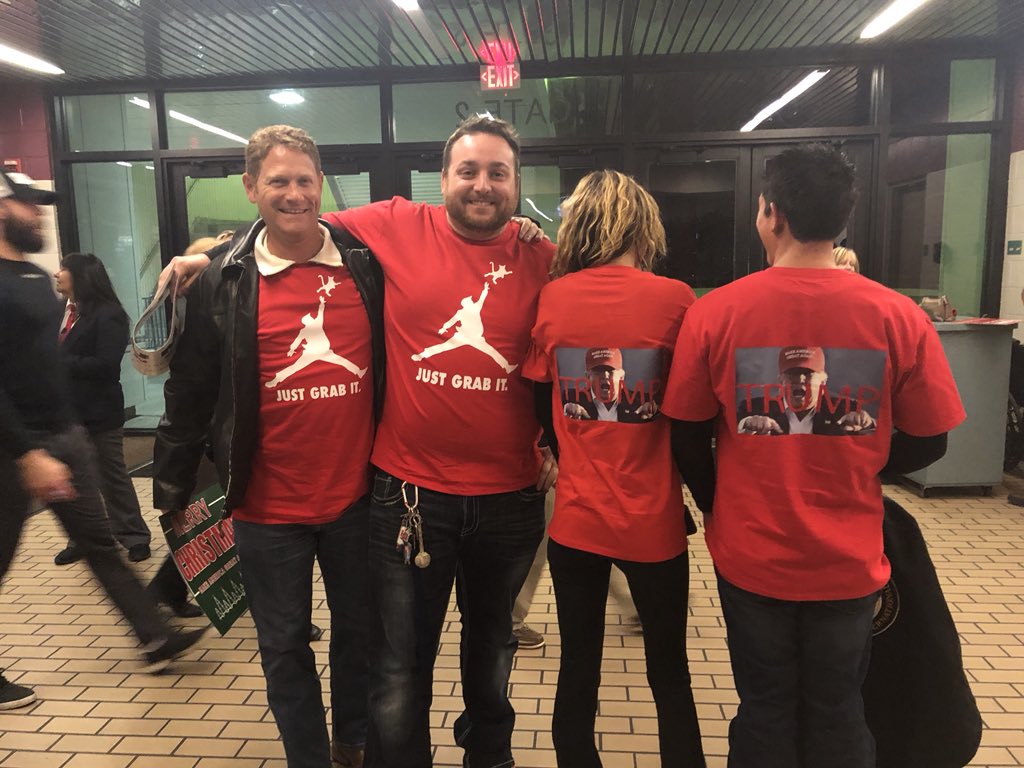
BuzzFeed’s Grace Wyler, covering Trump’s pro-Moore rally just outside Alabama:”This sort of sums up the general feeling on sexual harassment allegations at the Pensacola Bay Center tonight.”
In case you can’t make it out, the red t-shirts have a picture of Trump on the back. The front is a parody of the Nike Michael Jordan logo, with the silhouette of Trump reaching for a pussy cat and the Nike “Just do it” slogan replaced by “Just grab it”.
and the wedding cake case
I’ve already explained why the Masterpiece Cakeshop case is an easy call under the law: The same-sex couple should win and the baker should lose, because the baker refused to consider making them the exact same cake he would make for an opposite-sex couple. That makes it a pure discrimination case; all the free-speech and free-exercise-of-religion arguments are irrelevant. This is how all the lower courts have ruled.
But that simple clarity doesn’t mean that the Supreme Court will see it that way, because the Hobby Lobby case was also an easy call under the law: The owners had a legal responsibility to offer health insurance, and what the employees chose to do with their insurance was none of the owners’ business. So the owners’ religious beliefs about birth control were irrelevant.
Hobby Lobby’s owners won anyway. The problem is that the Court’s conservative bloc is not controlled by the law. Contrary to the Constitution, it sees no problem in granting special rights to people who hold popular Christian beliefs. That’s what Hobby Lobby was really about, and what this case is about too.
If the baker’s religious convictions caused him to refuse service to blacks or Jews, we wouldn’t be having this conversation — not because nobody’s religion would go that way, but because those views would be unpopular, even among most Christians. If he were a religious pacifist whose convictions required him to refuse service to members of the military, we wouldn’t be having this conversation. Similarly, if Hobby Lobby had been a Hindu business trying to stop its employees from eating meat rather than using birth control, that case would have come out differently.
But the Supreme Court may choose to treat religious bias against gays as if it were a completely different animal from religious bias against blacks, just as it regards abortion and birth control as fundamentally more serious moral issues than pacifism or vegetarianism. That’s because the conservative justices believe that Catholics and popular types of conservative Protestants should have special rights; the law should give their issues a level of respect that the issues of Quakers or Hindus (or religious white supremacists) don’t deserve.
Like so many other controversial cases, this one is likely to come down to Justice Kennedy’s opinion. As long-time readers know, I don’t have a lot of respect for Kennedy as a judge. Even though he has often decided cases the way I want, he writes mushy opinions that (while they may be full of quotable rhetoric) consistently fail to define clear principles that lower courts can apply to new cases. (Justice Roberts sometimes does the same thing, as in his Voting Rights decision a few years ago. But I suspect him of conscious obfuscation rather than mushy thinking.)
That’s what I expect here, with the majority opinion being written by Kennedy if the gay couple wins or by Roberts or Alito if the baker wins. (Gorsuch and Thomas will file principled but off-the-wall opinions in the baker’s favor. Ginsburg will analyze the case clearly and correctly.) Whatever the decision, it will not illuminate the intersection of anti-discrimination laws, religious freedom, and freedom of speech. This murky outcome will inspire more people to file lawsuits, and, finding no clear guidance in Masterpiece Cakeshop, lower-court judges will decide those future cases in divergent ways. So the underlying issues will keep coming back to the Supreme Court for resolution.
In my view, it’s inaccurate to attribute the baker’s refusal to his “Christian beliefs”.
Traditional forms of bigotry and the practices that maintain them are often attributed to a traditional religion, even if they are purely cultural practices tangential to the religion. One example is the practice of “honor killings”, in which families kill daughters who “dishonor” the family by having sexual relations with men the families won’t accept as husbands. These killings are often attributed to Islam, both by Muslims who kill their daughters and by outsiders who cite this practice as evidence of Islam’s moral backwardness.
In fact, honor killings are not mandated by Islam, and they happen predominantly in regions of the world where such killings were part of the culture before Islam. So the cause-and-effect works backwards from the way most people think: It’s not that families kill their daughters because of Islam; rather, Muslims who believe in honor killings for cultural reasons interpret Islam in a way that justifies them.
Something similar is happening with Christianity and same-sex marriage. There are a small number of Bible verses that can be interpreted to condemn same-sex marriage. But no one who sat down to read the Bible with an open mind would come to the conclusion that this is the defining moral crisis of our era, or that homosexuality even compares as a moral issue with poverty or violence. (The same could be said about abortion, which existed in Biblical times, but barely seemed worth mentioning.)
In America today, prejudice against gays and lesbians is primarily cultural, not religious. Anti-gay Christians look to the Bible to justify their bigotry, but that’s not where they learned it.
and Jerusalem
I thought I was going to have to write my own article (it was going to be part of the Misunderstandings series) about why Trump’s decision to move the U.S. embassy in Israel from Tel Aviv to Jerusalem is such a big deal. It has been easy to find articles about all the outrage the decision is provoking, but hard to find a start-from-scratch explanation of why anyone considers it outrageous. Pro-Palestinian talking heads on TV have exacerbated the problem: For the most part they have jumped straight into venting their outrage, and have skipped the educational prologue that most Americans need. So I could easily picture a low-information voter (and maybe even a not-so-low-information voter) asking: “Don’t we usually put our embassy in the city that the host nation tells us is their capital?”
Saturday, the New York Times did the article I had been looking for: “The Jerusalem Issue, Explained“. The explanation has two main pieces, one having to do with Jerusalem itself, and the other with the United States’ complicated and conflicted role regarding the whole Palestine/Israel issue. As for Jerusalem:
The city’s status has been disputed, at least officially, since the 1948 Arab-Israeli War. Before that, the United Nations had designated Jerusalem as a special international zone. During the war, Israel seized the city’s western half. It seized the eastern half during the next Arab-Israeli war, in 1967.
In most two-state-solution models, West Jerusalem winds up being the capital of Israel and East Jerusalem the capital of Palestine. But prior to any peace agreement, most countries — including our NATO allies — regard the status of the entire city as an unsettled issue. (A satirical article makes this point by claiming that the Palestinian Authority is about to recognize Texas as part of Mexico and will move its Mexican consulate to Houston. President Abbas expresses his hope that this decision “will help ease the tension between the two countries over security and immigration.”) Meanwhile, Israel regards Jerusalem as its historic capital since days of King David, and refuses to give up a single block of it.
What makes such a move particularly controversial for the United States is that we have two very different roles in the conflict: We’re Israel’s closest ally, and we’re also the global superpower who is trying to broker peace in the region. Previous administrations have tried to juggle those two contradictory roles, but increasingly it looks like Trump has decided to stop juggling: We are Israel’s ally and not a broker of peace. That means that no one is a broker of peace.
U.S. credibility with the Arab and Muslim worlds is also undermined by the fact that Trump has assigned the Israel/Palestine issue to Jared Kushner, who is both a diplomatic novice and an American Jew whose family foundation (at a time when he was a director) has financially supported the Israeli settlement movement. Trump’s Special Representative for International Negotiations, Jason Greenblatt, is also Jewish. So Palestinians might see little difference between negotiating with Americans and negotiating with Israelis.
The Palestinians would get a state of their own but only noncontiguous parts of the West Bank and only limited sovereignty over their own territory. The vast majority of Israeli settlements in the West Bank, which most of the world considers illegal, would remain. The Palestinians would not be given East Jerusalem as their capital and there would be no right of return for Palestinian refugees and their descendants.
Both the U.S. and Saudi Arabia deny officially that any such plan is in the works. But it remains to be seen whether Palestinians will be offered anything they could regard as justice, or whether the U.S. and Saudi Arabia will join Israel in insisting that they recognize the reality that they are powerless and have to accept whatever Israel is willing to offer them.
You might wonder why Salman would do this. The explanation (again, not confirmed by the Saudis) is that the Palestinians have become expendable. Saudi Arabia is more concerned with possibility of a Muslim civil war between the Sunnis (led by Saudi Arabia) and the Shia (led by Iran). Abandoning the Palestinians might be a small price to pay if it leads to U.S. and Israeli cooperation in that larger struggle.
The embassy is not moving immediately. According to CNN: “It will take years for the US to build the new embassy.”
This is yet another example of Trump following Putin’s lead. Russia recognized Jerusalem as Israel’s capital in April. But if the Sunni/Shia conflict does move to the center stage, it might recreate a Cold War situation, with Russia backing Iran.
and tax reform
It should be obvious that writing a tax reform bill isn’t like writing a freshman term paper: You can’t make a bunch of edits just before it’s due and expect things to go well. The Senate, though, didn’t see it that way, and so they made a tiny $289 billion mistake in the way they brought the corporate alternate minimum tax (AMT) back into the bill at the last minute. The move was supposed to raise $40 billion; it actually raises $329 billion. Oops.
The conference committee between the House and Senate (which starts meeting Saturday) will fix that, of course. But there is one consequence: If something goes wrong in the Senate, and it can’t pass the bill that comes out of the conference committee, one alternative would have been for the House to pass the Senate bill as written. (Democrats did something similar to pass ObamaCare after they lost their 60-vote majority in the Senate.) Now that can’t happen, because the Senate bill is so screwed up.
There are a number of other issues for the committee to work out, and things could still go wrong (or right, depending on your point of view). One thing that seems clear: Paul Ryan and House Republicans in general feel no commitment to the deal Susan Collins made with Mitch McConnell to stabilize the health insurance markets. When she gets stiffed, will she still support the bill?
House Republicans from high-state-tax states like California and New York may yet revolt against eliminating the deduction for state and local taxes. It’s going to be hard for them to run on a “tax-cut” bill that actually raises taxes on many of their constituents. And everything that gets taken out of the bill requires something else to be added in, so that the deficit totals work out. Every add-on creates a new issue for somebody.
and natural disasters
Not a movie special effect: I-405 in Los Angeles. I’ve been to the Getty Center, so I may have driven this road.
The number of deaths in Puerto Rico that have been attributed to Hurricane Maria and its aftermath is 62. But somehow, the number of excess deaths since Maria hit — deaths beyond what totals from recent years would tell you to expect — is 1052. I have to believe that if something similar were happening to white people on the mainland, it would get a lot more attention and action.
but here’s something more people should pay attention to
Congress responded to the financial crisis of 2007-2008 by passing Dodd-Frank. One of the things that law did was establish within the Treasury Department the Financial Stability Oversight Council, which is supposed to keep an eye on excessive risks to the U.S. financial system — things like the explosive growth of derivative investments that turned a slump in the U.S. real-estate market into a global catastrophe. (As the Wikipedia article on the 2007-2008 crisis points out, complex financial instruments “enabled a theoretically infinite amount to be wagered on the finite value of housing loans outstanding”. As a result, when people began to default on their mortgages, the losses at the big financial institutions far exceeded the total value of the defaulted loans.)
Working for the FSOC is the Office of Financial Research, which collects and analyzes data from the banks and other big financial players, looking for early warning signs of a flaw in the system that could lead to a crash. Washington Monthly called it “the most important agency you’ve never heard of” and explained its creation like this:
The idea for the OFR took root in early 2009 during the fallout from the financial crisis. Regulators struggled to make decisions during the height of the meltdown in part because they lacked real-time information about which banks were connected through financial relationships, and how. The crisis also exposed how little federal regulators knew about the world of “shadow banking,” such as the vast market for credit default swaps, collateralized debt obligations, and other complex securities that played a role in the meltdown. Regulators had no idea how much money was at risk in these activities, let alone who was involved or what the results would be if there were massive defaults.
OFR employs a little more than 200 people and has a budget around $100 million, so each year it costs about 30 cents for each American. So if OFR saved us from a financial crisis once every thousand years or so, it would be well worth the cost. But in fact, you don’t even pay your 30 cents, because OFR is funded by fees on banks.
The downside is that banks hate paying fees and hate having the government looking over their shoulders. And their point-of-view is the one that matters, so naturally the Trump administration is proposing big cuts at OFR. Matt Yglesias points out that this is part of a pattern:
From a short-term point of view, you can almost always make or save money by taking on more risk: Drop the insurance you carry on your health or house or car, and you’ll have more change in your pocket, at least for a little while. Put all your savings in the stock market rather than holding any government-insured investments like bank CDs, and most years you’ll do well. Better yet, borrow back all the equity in your house and put that money into the market too. Most years you’ll make money.
Most years. If you’d done that in 2008, though, it wouldn’t have worked out so well. Ygelsias explains the analogy to the larger economy.
The nature of a banking crisis is you probably won’t have one in any given year, regardless of how shoddy your regulatory framework is. As long as asset prices are trending upward, it just doesn’t matter. In fact, as long as asset prices are trending upward, a poorly regulated banking sector will be more profitable than a well-regulated one.
It’s all good. Unless things blow up. But if your bad policymaking takes us from a one-in-500 chance of a blow-up in any given year to a one-in-20 chance, you’re still in a world where things will probably be fine across even an entire eight-year span in office. Probably.
That’s been Trump’s way of doing business his whole life: Take big risks, and hope that somebody else is holding the bag when it all goes bust.
The new law expands on earlier legislation that provided equality to same-sex couples in areas like government benefits, employment and taxes, and it changes the definition of marriage from “the union of a man and a woman” to “the union of two people.” It automatically recognizes same-sex marriages from other countries.
Police getting away with murder is not just a black issue any more. After a police officer was acquitted of second-degree murder and reckless manslaughter in Mesa, Arizona on Thursday, the judge released the officer’s body-cam video. It’s horrific, so I’ll link to it rather than embed it. A white man, Daniel Shaver, is clearly scared witless and doing his best to obey the shouted commands of the officer as he lies on the floor of the hall outside his motel room. But he fails and the officer kills him.
It gets worse when you know the backstory. Shaver was a traveling pest control worker who was drinking in his room with two people he had met in the elevator. They asked him about a pellet gun he had. While showing it to them, he pointed it out the window; somebody in the motel’s hot tub noticed and called the police. Shaver was drunk, but not at all belligerent, when six police officers showed up. The police were in complete control of the situation right up to the moment one of them killed him.
Pointing the pellet gun out the window was dumb, but everything else Shaver did is easy to empathize with. He’s away from home and bored, so he gets drunk in his room. He’s confused when the police show up, but he tries his best to comply with their commands. He has no weapons other than the pellet gun, which is still in the room when he’s on the floor in the hall. He winds up dead.
The officer made the usual claim: He was afraid that Shaver was going for a gun. (The more likely explanation is that Shaver’s shorts were starting to fall down as he obeyed the command to crawl towards the officer, so he reached back to tug on the waistband.) Various experts testified that the officer was acting in accordance with his training, and maybe he was. And I don’t know what instructions the judge gave the jurors, so it’s hard to say what I would have done in their shoes. (It’s a lot to ask of jurors that they reverse the result of a bad system. I’m reminded of the mock trial in Salem, where you get to vote on whether to indict a woman for witchcraft. If you put yourself in the mindset of the times, if you respect the opinions of the established church’s witchcraft experts, and respect the law as the judge explains it to you, there’s really no honest way to let her go.)
But if this really is what we train police officers to do, something is very, very wrong. And if you imagine that this is somebody else’s problem, that it can’t possibly touch you, you need to think again.
NBA star Steph Curry is serious about supporting the NFL players anthem protests, and about supporting veterans. There’s no contradiction there.
From the beginning, it was obvious that the Ireland/Northern Ireland border was going to be a problem when Brexit got implemented. Northern Ireland as a whole voted against Brexit, and wants to keep its easy-going border with Ireland. PM May thought she had a deal to do that, but an anti-Irish-unification party is part of her coalition, and wouldn’t support it.
Remember a year ago, when President-elect Trump negotiated something that was supposed to save all those manufacturing jobs in Indiana? Trump and the TV cameras are elsewhere now, and things aren’t going so well.
Trump caused a lot of speculation when he ended his statement on Jerusalem Wednesday by slurring several words. To me and a bunch of other people, it looked and sounded like a denture starting to slip, which the White House denied. But a brain specialist has a different opinion:
In turning my attention to the president, I see worrisome symptoms that fall into three main categories: problems with language and executive function; problems with social cognition and behavior; and problems with memory, attention, and concentration. None of these are symptoms of being a bad or mean person. Nor do they require spelunking into the depths of his psyche to understand. Instead, they raise concern for a neurocognitive disease process in the same sense that wheezing raises the alarm for asthma.
Trump’s Pensacola rally Friday included a bunch of bold, blatant lies. Not spin, not stuff that you can justify if you parse every word just so. Lies about simple, checkable things. For example: “Black homeownership just hit the highest level it has ever been in the history of our country.” Nope. It was 42% in the third quarter, down from 42.7% in the first quarter, and well below the peak of 49.7% in 2004.
Also: “Factories are pouring back into our country.” Not at all. AP says:
Spending on the construction of factories has dropped 14 percent over the past 12 months. There has been a steady decline in spending on factory construction since the middle of 2015
Trump claimed wages are going up “for the first time in 20 years”.
The latest jobs report shows average hourly earnings up 2.5 percent over the past 12 months, roughly the same pace of growth as the year before, when Barack Obama was president. Wages were rising faster in December 2016, up by 2.9 percent.
Another week with a lot to talk about: Franken, Conyers, and Franks all resigned from Congress amid accusations of sexual misconduct, while Roy Moore continues to cruise towards a narrow victory with Trump’s support. The Supreme Court began hearing the wedding-cake case, while Australia legalized same-sex marriage. Trump announced he’s moving the U.S. embassy in Israel to Jerusalem. Tax reform went to a House/Senate conference committee, where there are still ways the deal might fall apart. The LA area has some horrific wildfires. Another police officer got acquitted for a totally unnecessary killing, with two new wrinkles: This time we have body-cam footage, and the victim is a white guy.
In addition to all that, there are issues people ought to be paying attention to that aren’t getting much coverage. I’m going to focus on this one: Trump wants to slash the budget of the office in the Treasury Department that is supposed to pay attention to systemic risk in the banking system. What could possibly go wrong?
Just writing a few paragraphs on each of those things has made the weekly summary much longer than usual, so there won’t be a featured post this week. I’m going to try to get the summary out between 10 and 11 EST.
What it all boils down to is that racism – white racial grievance, immigration restriction, generalized bashing of basically any political or cultural assertion by African-Americans – is the only consistent and persistent line connecting the campaign to the presidency. This is not quite the same as saying that that’s the only real bottom line for his supporters – though there’s a lot of truth to that. But for Trump, that’s clearly the only thing that isn’t opportunistic and situational. Those all fall away. The only thing that doesn’t is the ethno-nationalism and racism. It’s the real him.
Last week we knew that Flynn’s lawyers had stopped cooperating with the President’s lawyers, so many speculated that Flynn was about to make a deal with Robert Mueller’s investigation. This week it happened: Flynn pleaded guilty to one count of lying to the FBI, and is cooperating with Mueller. This isn’t a trivial crime, in that it could lead to as much as five years in jail. But it’s also far less than Mueller could have gone for, and Flynn’s son has not been charged with anything.
It is easy to start speculating about what Flynn might know and be willing to share. The particular crime in his guilty plea seems chosen to reveal as little as possible. Trump supporters have jumped on this to imply Mueller has nothing, but those familiar with how plea deals work are pointing in another direction. Vox asked 9 legal experts for their reactions, and got stuff like this:
The fact that Flynn was charged with, and is pleading guilty to, such a minor crime suggests a bombshell of a deal with prosecutors. Flynn was facing serious criminal liability for a variety of alleged missteps, including his failure to register as an agent of a foreign power. If this is the entirety of the plea deal, the best explanation for why Mueller would agree to it is that Flynn has something very valuable to offer in exchange: damaging testimony on someone else.
In general, prosecutors use small fish to catch big fish. Flynn was Trump’s National Security Adviser, so there aren’t a lot of bigger fish Mueller could be using him against.
That could explain why Trump has been so wiggy lately, even by his own standards.
He’s denying the Access Hollywood tape is real. He’s back to saying Barack Obama wasn’t born in the United States. Then publicly he retweeted those anti-Muslim hate group videos from the UK. Yesterday we heard he’s telling advisors a government shutdown would be good for him. He’s gotten more aggressive attacking other politicians accused of sexual misconduct while more aggressively backing Roy Moore, notwithstanding the copious list of accusations against him. All of it together amounts to acting out.
Legal experts said this could be used as evidence that the president was trying to obstruct justice when he allegedly asked James Comey to take it easy on Flynn and then, when he didn’t, fired him as FBI director.
The ongoing mystery of Flynn’s lies to the FBI is how he could be that stupid. As a former head of the Defense Intelligence Agency, Flynn had to know that conversations with the Russian ambassador were monitored, and that he would be caught in his lie if anybody bothered to check. So why do it?
Josh Marshall, who is working from publicly available information and knows nothing more than the rest of us do, has put some thought into this and has as good a working theory as I’ve seen. The short version is that Flynn wanted to get a new Russia policy installed before revelations of Russia’s campaign meddling made that impossible. So it was important to be doing groundwork during the transition period, when he had no authority to do it, and to hide that groundwork as long as possible from both the still-in-power Obama administration and the people within the intelligence services who would fight against the new policy. The new Russia relationship
had to become a fait accompli before the full story emerged. Indeed, if the Trump Team could get in place before most of the information was revealed it might never become known at all since they would take over the key agencies doing the investigating.
ABC initially reported that Flynn reached out to the Russians on Trump’s behalf before the election, but has withdrawn the report and suspended the reporter.
These last few weeks, I’ve been struggling with how to express my own complicity in the culture’s objectification of women without presenting myself as either better or worse than I’ve actually been.
In “7 Reasons So Many Guys Don’t Understand Sexual Consent” David Wong does a great job writing the kind of article I haven’t been able to produce. In particular, he captures the shame so many of us felt about failing to achieve the truly fucked-up vision of manliness we were taught to admire: the James Bond kind of man, who can force himself on women and make them like it.
I never, in any of my public school years, had a lesson saying you needed to wait for verbal consent before touching a woman. I saw the quarterback of the football team slap girls on the butt, I saw guys reach around and grab girls’ boobs as a prank, I saw mistletoe hung over doorways and was told if you and a girl stood under it, she had to kiss you. One time when we were playing volleyball at the beach, Dr. Dre ran up and unhooked a girl’s bikini top.
Again, I never did any of those things. Not because I thought they were wrong, but because I was too nervous.
And I fucking hated myself for it.
Have I mentioned that yet? How much shame I felt at the time for not being a “real man”?
By my 20s, I think I had developed a reasonably healthy respect for women as human beings, but in high school and earlier I remember “pranks” and “jokes” (like the ones Wong mentions) as fairly common. There was a “game” going on between the two sexes: Boys were supposed to try to get away with stuff and girls were supposed to try to stop them. Our collective mythology said it was all in good fun, even if a few spoilsports didn’t get it.
At the time, I think we’d have laughed at anyone who suggested that we were training to be rapists (which I don’t recall that anyone did suggest). But in retrospect, of course we were.
[R]idding guys of toxic attitudes toward women is a monumental task. I’ve spent two solid decades trying to deprogram myself, to get on board with something that, in retrospect, should be patently obvious to any decent person. Changing actions is the easy part; changing urges takes years and years. It’s the difference between going on a diet and training your body to not get hungry at all.
In the meantime, to act like it’s crazy that a particular guy doesn’t see the clear line between consent and assault is misguided. The culture has intentionally blurred those lines and trained that man to feel shame for erring on either side.
meanwhile, Roy Moore is probably going to the Senate
The RCP polling average was in Doug Jones’ favor for about ten days, but Moore caught up on November 27 and appears to be surging ahead. This is not because there has been any good news for Moore. Alabamans have just gotten used to the idea that they’re going to elect a child molester, because he’s the Christian candidate.
It also looks like the Senate will let him take his seat. Sunday, Mitch McConnell said “We’re going to let the people of Alabama decide, a week from Tuesday, who they want to send to the Senate.”
Last Monday, The Washington Post revealed an attempted sting by Project Veritas, the James O’Keefe group responsible for a number of deceptively edited videos to smear liberal groups, including ACORN (his original, successful operation, which forced the organization to close, even if O’Keefe himself did end up paying a $100K settlement).
In a series of interviews over two weeks, the woman shared a dramatic story about an alleged sexual relationship with Moore in 1992 that led to an abortion when she was 15.
But rather than jumping on the chance to besmirch Moore, the Post became increasingly suspicious of the woman’s story, and eventually tracked her back to Project Veritas.
We can only guess what would have happened if the Post had been less careful and the sting had worked, but I assume it would have been used to undermine the credibility not just of the Post, but of all of Moore’s accusers.
While commenting on the strange announcement of Kellyanne Conway as the White House’s point person on opioids, The Atlanticsummarizes the opioid effort as a whole:
The Trump administration has no opioid policy, beyond just continuing to arrest people who violate the (lax) existing drug laws. Throughout, Trump has treated the opioid tragedy as a messaging challenge, not a real-world disaster that calls for a real-world response: pretend to care while doing nothing, because the administration lacks the competence and capacity to do something. The idea that it would seek to appoint as head of the Office of National Drug Control the single member of the House of Representatives who did most to worsen the opioid crisis had a beautiful fitness to it.
So maybe after all Kellyanne Conway would be the right person for the “opioid czar” job. Trump’s concern for opioids is a cruelly deceptive fiction. And who propagates cruelly deceptive fictions more persistently and brazenly than Conway?
BTW, that “single member of the House of Representatives who did the most to worsen the opioid crisis” is Tom Marino. After 60 Minutes exposed his function as a tool of Big Pharma, he withdrew from consideration as drug czar. He continues to represent Pennsylvania’s 10th district.
Filmmaker Sierra Pettengil:
I was struck by the way the word “history” was blankly lobbed as a defense of the [Confederate] monuments. Take Trump’s reaction, for one: “They’re trying to take away our history.” My instinct was, “Okay, then: Let’s look at the history.”
In particular, her short film Graven Image looks at the Stone Mountain monument in Georgia, where a gigantic carving of Robert E. Lee, Jefferson Davis, and Stonewall Jackson is known as “the South’s Mount Rushmore”. The film recalls Stone Mountain as the site of the KKK’s rebirth in 1915, and chronicles how progress on the monument paralleled Georgia’s resistance to civil rights.
Inmy film, a voiceover from a 1972 Stone Mountain promotional film says, “Remember how it used to be? It’s still that way for you to enjoy at Stone Mountain Park.” I want this film to make us remember how it actuallyused to be.
and let’s close with something magical
“The magician is the most honest of professionals,” said Karl Germain. “He promises to deceive you, and then he does.” Here, a guy I’ve known since he was a baby (and his partner in crime, who I didn’t meet until last spring) fulfills that promise. And in the finest magical tradition, they do it with mirrors.
Without even the appearance of doing something good for the country, the Senate plunged ahead.
I admit it: Senate Republicans surprised me this week.
I know, it shouldn’t be shocking that Republicans would give a big windfall to corporations and the very rich. It’s what they do. Just last summer, they came within one vote of taking healthcare away from 20-some million Americans so that the wealthy could pay less tax.
Usually, though, they do a better job of giving themselves cover. The fringe of the party includes people like Susan Collins and John McCain, who try to retain at least the appearance of a conscience. It also includes clever apologists, whose arguments often obscure what’s really going on and make it possible to claim some noble purpose.
But by early Saturday morning, when the Senate passed its tax reform proposal on a nearly party-line vote, those justifications were all gone. This bill was about paying off the big donors and enriching the Trump family, and everybody knew it. Some senators continued mouthing words like growth and middle-class families, but they weren’t arguing any more, they were just lying. They weren’t fooling anybody, and they didn’t seem to care.
In the end, 51 Republicans voted for the bill, with only Bob Corker opposed. All 48 Democrats voted against it. (Remember that, the next time someone claims there’s no difference between the parties.) One by one, the last holdouts had tossed away their fig leaves and jumped into the mire.
John McCain, who gave such a moving speech about returning to regular order before he cast the deciding vote against ObamaCare repeal in July, was unperturbed by a very similar process this time, in which the 479-page bill was not available for inspection until a few hours before the vote.
Susan Collins, who in the summer seemed to worry deeply about people losing their health insurance, stopped worrying and accepted the Senate leadership’s promises about future legislation that I will be very surprised to see pass the House (unless it’s paired with a whole bunch of really bad things).
Jeff Flake, who (like just about all Republicans) seemed to believe during the Obama years that the deficit was a looming catastrophe, and who supposedly had achieved his independence by choosing not to run for re-election, decided that an extra trillion or two of debt really wasn’t worth getting excited about.
So this is where we are: A similar-but-not-identical bill passed the House in mid-November, so a conference committee will have to work out a compromise bill that both houses can pass. In other words, there is still room for something to go wrong, but some bill of this form is increasingly likely to become law by the end of the year.
The numbers. All along, independent analyses from the Tax Policy Center, the Penn-Wharton Budget Model, and even Congress’ own CBO had been telling a very consistent story: The bill would lead to major increases in the deficit with little-to-no long-term benefits for anybody but the wealthy.
This conclusion was supported by anecdotal evidence. The centerpiece of the bill — lowering the corporate tax rate from 35% to 20% — was supposed to generate massive new investments in production, creating so many jobs that workers would have bargaining power again, raising wages for everybody. But whenever actual corporate CEOs were consulted, they said they would pass the money on to shareholders through dividends or stock buy-backs rather than build new factories or pay workers more. Bloomberg reported:
That money is also unlikely to spur hiring because companies are already well-capitalized and can bring on as many employees as they need, said John Shin, a foreign-exchange strategist at Bank of America Merrill Lynch.
“Companies are sitting on large amounts of cash. They’re not really financially constrained,” Shin, who conducted a survey of more than 300 companies asking their plans for a tax overhaul, said in an interview. “They’re still working for their shareholders, primarily.”
Right up until Thursday, though, Republicans were hoping more favorable numbers would appear. Congress’ Joint Committee on Taxation hadn’t weighed in yet, and they were known to use the dynamic-scoring model conservatives favor, the one that figures in the effects of tax-cut-induced growth. The Treasury Department supposedly had over 100 people churning out analyses; presumably Secretary Mnuchin had seen their preliminary results when he claimed that the proposal wouldn’t just be deficit neutral, it would “pay down debt” by generating more new revenue than the tax cuts gave up.
The JCT analysis came out Thursday, just hours before the Senate was scheduled to vote. Its most favorable dynamic scoring said that increased economic growth would restore about 1/3 of the revenue lost, so that the deficit would only increase by $1 trillion rather than the nominal $1.5 trillion. A third is better than nothing, but even if you allowed for growth, the deficit was going up.
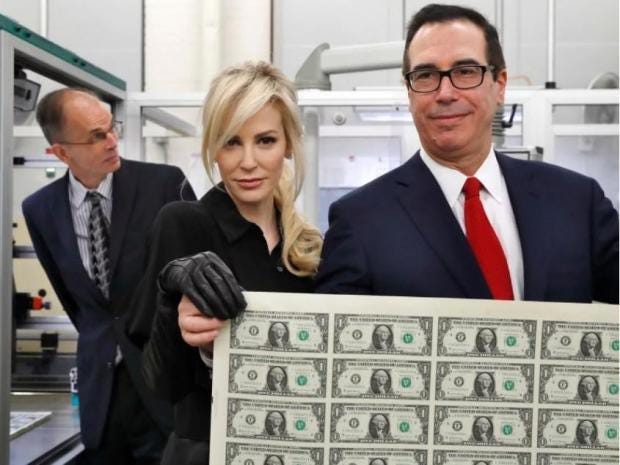
Would this guy lie to you?
But what about Mnuchin and the Treasury? It turned out that they had no analysis, or at least none they were willing to make public.
Those inside Treasury’s Office of Tax Policy, which Mr. Mnuchin has credited with running the models, say they have been largely shut out of the process and are not working on the type of detailed analysis that he has mentioned. An economist at the Office of Tax Analysis, who spoke on the condition of anonymity so as not to jeopardize his job, said Treasury had not released a “dynamic” analysis showing that the tax plan would be paid for with economic growth because one did not exist.
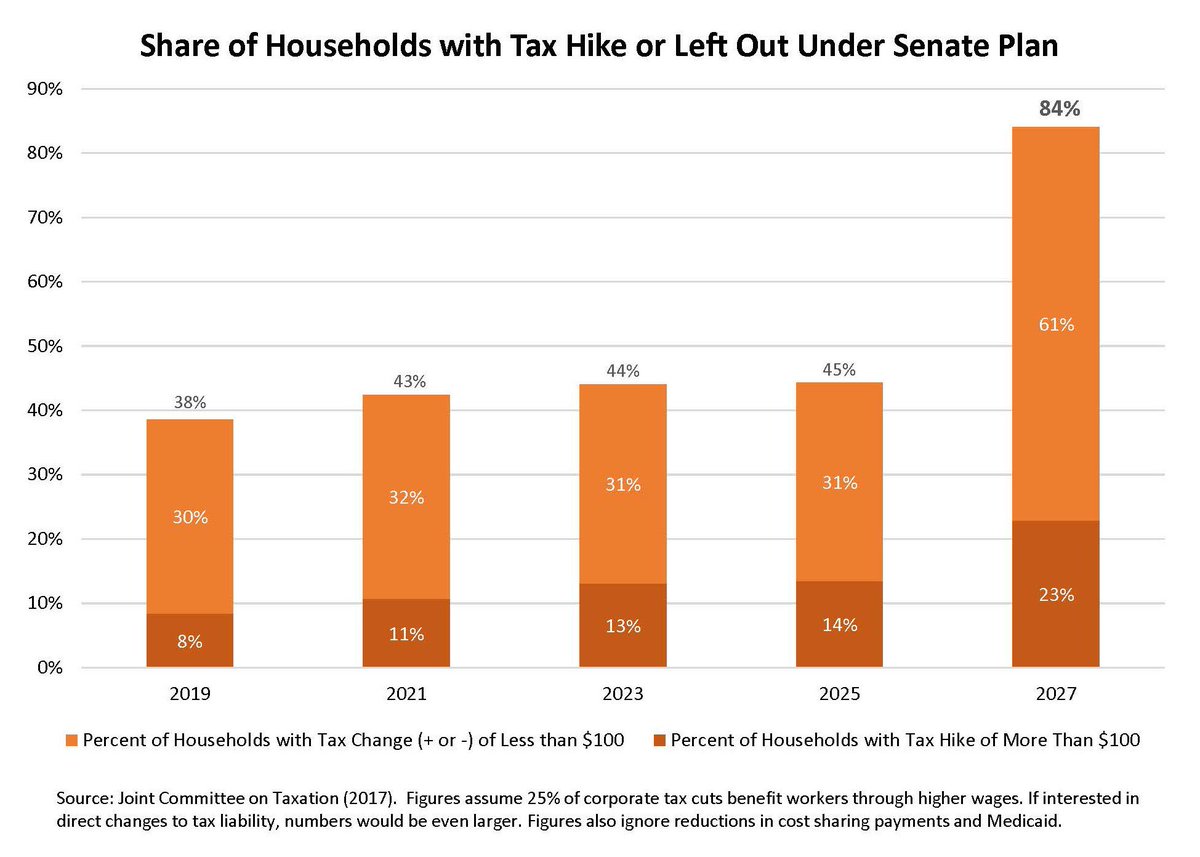
So Mnuchin’s many public statements about tax reform had been airy nonsense, grounded in nothing. Meanwhile, here’s what the JCT projected for American families:
(Here’s the same information as a series of charts.) In other words: More than 1/3 of U.S. households will never get anything out of this bill, not even in the first few years. That situation gets progressively worse until nearly all the individual cuts expire in 2027, at which point about 1 in 4 are paying higher taxes, while only 16% still see a tax cut of more than $100.
Full speed ahead. The original plan had been for the Senate to vote on Thursday. But the surprising (to some) revelation that the JCT analysis agreed in principle with all the other analyses, that nothing to the contrary would being coming out of the Treasury, and so the claims they were making had literally no basis — it threw a wrench into the process.
Many options were possible at that point. The bill could have gone back to committee to be scaled down into a defensible form. Maybe 20% was a bridge too far, and corporations would have to be satisfied with a 25% tax rate. That would create some room to fulfill the original stated purpose of the bill: cutting middle-class taxes for real this time.
Maybe the deficit didn’t have to go up, either. Back in 2012, President Obama had proposed a 28% rate that he claimed would produce more revenue than the 35% rate, without any analytic sleight-of-hand. Both parties have acknowledged for years that our high-rates-with-many-loopholes corporate tax system is inefficient. With a little genuine give-and-take, leaders on both sides might assemble a bipartisan coalition of 60 votes or more, avoiding the reconciliation process entirely.
Or, Mitch McConnell could scrawl a few last-minute changes in the margins to assuage the doubts the last few Republican hold-outs, and the Senate could shamelessly go forward with a bill to borrow an extra trillion dollars or more so that the GOP could give a big Christmas present to the very rich. But if they were going to do it, they’d better do it fast, before the public was able to organize against this already very unpopular bill.
By now, you know which choice they made.
The people they betrayed. One way the Senate got its bill to fit onto the procrustean bed of the $1.5 trillion-over-ten-years price tag authorized by the FY2018 budget resolution was to make of a now-you-see-it, now-you-don’t gimmick Paul Krugman refers to as Schroedinger’s tax hike. The budget numbers work because only the corporate tax cuts are permanent; the individual cuts mostly phase out, resulting in this graph from the JCT.
(These numbers refer to an earlier version of the bill, but I believe a similar graph could be drawn for the current version.)
Republicans are arguing that those tax breaks [for individuals] won’t actually be temporary, that future Congresses will extend them. But they also need to assume that those tax breaks really will expire in order to meet their budget numbers. So the temporary tax breaks need, for political purposes, to be both alive and dead.
So either individual taxes will turn sharply upwards in 2025, or the tax-reform bill costs a whole lot more than $1.5 trillion. It’s one or the other. Ezra Klein points out the “pure fraud” in the deficit arguments Republicans have been making for years.
When a Democrat is in the White House, the national debt is an existential crisis that threatens to bring down the Republic. But that threat magically vanishes when a Republican takes office.
So if you believed what Republicans told you about the deficit then, they’ve betrayed you now. But they’ve also betrayed you if you believed the populist side of Trump’s 2016 message. Because here’s where we are, prior to this bill becoming law: The national debt is around $20 trillion, and is already projected to increase to $30 trillion over the next ten years. Rather than do anything about that, Congress is in the act of tossing another trillion or two on top it. (BTW: In the speech where he announced his candidacy, Trump said: “$24 trillion— we’re very close— that’s the point of no return. $24 trillion. We will be there soon. That’s when we become Greece. That’s when we become a country that’s unsalvageable. And we’re gonna be there very soon.”)
So what about that big infrastructure project Trump talked about? (“So we have to rebuild our infrastructure, our bridges, our roadways, our airports. You come into La Guardia Airport, it’s like we’re in a third world country.”) Where’s the money for that going to come from? How’s he going to keep his promise not to cut Medicare, Medicaid, and Social Security, once the trillion-a-year deficits start happening? (“Save Medicare, Medicaid and Social Security without cuts. Have to do it.”)
If this passes, there will be no money left for populism, and no money left to save the programs the middle class depends on. They’ll have given it all to the rich.
They’re doing it as you read this, and they’re being totally brazen about it.
Some weeks the important things are obvious: the tax reform bill and Mike Flynn.
Thursday afternoon, when the Joint Committee on Taxation report removed the last possibility of arguing with a straight face that the tax cut wouldn’t blow up the deficit, or that middle-class families would be major beneficiaries, I didn’t immediately jump to the conclusion that the bill was dead. But I thought some kind of retreat would happen, because the gist of the whole thing had become pretty clear: “We’re going to borrow a bunch of money and hand it out to the very rich.” I didn’t see how they could go forward with that.
They did. I admit it; I was stunned. I’m still kind of amazed. So that’s the subject of this week’s featured post, “The Brazen Cynicism of the Tax-Reform Vote”. It should be out around 9 EST.
The weekly summary covers Flynn up to a point, but I’m trying to let events unfold without obsessing over speculation. I also mention the week’s other depressing development (after tax reform): Without any new development in his favor, Roy Moore’s popularity seems to be rebounding. There’s a new short film putting the Stone Mountain Confederate monument into perspective, and a few other things have been happening. I’ll close with a card-trick video I can’t explain.
I’ve been saying all along, for the past few years, as I talk about sexual harassment, that when it comes down to it and when all the facts are brought out and into play, that we are going to have make some very tough decisions about people who we otherwise admire. And I think this is really something that we haven’t come to terms with.
This week everybody was talking about sexual abuse
I have long admired Al Franken. Giant of the Senate is a fabulous book. I was rooting for Hillary to pick him as VP, and was looking forward to seeing him in 2020 presidential debates.
Shit, Al.
A bunch of the debate these last two weeks has been about the accusations against Franken, which he has at least partially confessed to or admitted the possibility of. And the question has been: Should he resign? Since then, stuff has come out about Rep. John Conyers, who so far is keeping his House seat, but stepping down from an important committee assignment.
I still haven’t figured out what I think about all this. On one side, it would be simple and idealistic for the Democratic Party to pitch itself as the party with zero tolerance for any behavior that disrespects women. On the other, I don’t think it is going to be that simple, no matter what Franken and Conyers do. If them resigning meant that the Democratic role in the scandal would be over, and we could move forward as the Party of Righteousness, it would probably be worth it. But I don’t think that’s the choice.
I suspect we’re a lot closer to the beginning of this scandal than the end. If everything were known about everybody, we might not just be talking about Franken and Conyers and Roy Moore and Donald Trump, we might be talking about hundreds of men with various degrees of political power, from Congress to the administration to state governments. If the Democrats all resign and the Republicans don’t, the short-term balance of power could shift in an anti-woman direction.
I expect those charges to appear in all degrees of seriousness and credibility. In general, I imagine three levels of seriousness:
negligible
forgivable, requiring an apology and the acceptance of some kind of public penalty or humiliation,
unforgivable, requiring resignation.
and three levels of credibility
unlikely claims
credible claims
claims so well supported that a denial is not credible.
Wherever you think the boundaries between those levels should go, there’s going to be some case that challenges it. We need to think this through both well and fast, a combination that very seldom happens.
Roy Moore is pretty close to denial-is-not-credible territory. Slate’s William Saletan does the details, but the gist is that on one issue after another, Moore’s accusers have provided supporting evidence or testimony, while Moore hasn’t (or has put forward objections that turn out to be false, such as claiming the restaurant where he was supposed to have met one of the accusers didn’t exist at the time). Moore’s denials are often not quite denials, and he hasn’t been willing to submit to follow-up questions from anyone this side of Sean Hannity.
The idea that all these girls, their mothers, their sisters, and their friends began coordinating a massive lie decades ago—and somehow conspired to keep it quiet through Moore’s many previous political campaigns, saving it for a special Senate election in 2017—is completely preposterous.
I could imagine the truth being shifted somewhat from accusers’ version: maybe he was marginally more deferential and less grabby than they remember him, for example. But the overall picture of a creepy 30-something guy trying to get it on with girls half his age — that’s looking pretty solid.
and tax reform
The House has passed its version and the Senate is still working on its own. As with ObamaCare, it will take three Republican defections to kill a bill. This time, it looks like Lisa Murkowski won’t be one of them. But there might be a defection from deficit hawks like Jeff Flake or Bob Corker. (The CBO expects the package to add $1.4 trillion to the national debt over 10 years, even after taking growth effects into account.)
The claims that the tax cuts will unleash massive economic growth are not catching on outside partisan Republican circles. A University of Chicago survey of 42 top economists found only 1 who believed that GDP would be substantially higher a decade after passing the tax cut than it would have been under the status quo.
One bit of sleight-of-hand in the Senate bill: They get around the limits on how much revenue the plan can lose by time-limiting the tax breaks on individuals, while writing the business benefits as permanent. The argument is that future Congresses won’t really let those time limits expire, so they both count and don’t count, depending on the scenario. Paul Krugman refers to this as “Schroedinger’s Tax Hike“. The graph takes the Republican bill as written, without assuming that a future Congress will amend it.
Remember the sanctions-against-Russia bill that Congress passed and Trump signed in August? Trump didn’t like it, but there was no point in vetoing it because it passed by such huge margins. So instead the administration has been slow-rolling it. There was an October 1 deadline for releasing guidance on how it would implement the sanctions. That was ignored, and guidance finally came out 26 days later. Now new deadlines are looming, and Congress is wondering whether they’ll be met or not, and what they can do about it if Trump just decides to ignore the law he signed.
Another Russia-related news story is that we finally have details about that May 10 meeting Trump had with the Russian ambassador in the Oval Office, the one where he gave away sensitive intelligence we had gotten from the Israelis. But it wasn’t like nobody could have seen this coming:
It was against this reassuring backdrop of recent successes and shared history, an Israeli source told Vanity Fair, that a small group of Mossad officers and other Israeli intelligence officials took their seats in a Langley conference room on a January morning just weeks before the inauguration of Donald Trump. The meeting proceeded uneventfully; updates on a variety of ongoing classified operations were dutifully shared. It was only as the meeting was about to break up that an American spymaster solemnly announced there was one more thing: American intelligence agencies had come to believe that Russian president Vladimir Putin had “leverages of pressure” over Trump, he declared without offering further specifics, according to a report in the Israeli press. Israel, the American officials continued, should “be careful” after January 20—the date of Trump’s inauguration. It was possible that sensitive information shared with the White House and the National Security Council could be leaked to the Russians.
It’s almost like Trump doesn’t know where his real loyalties lie.
During the 2016 election, the directions from the Kremlin were less subtle than usual. “Me and my colleagues, we were given a clear instruction: to show Donald Trump in a positive way, and his opponent, Hillary Clinton, in a negative way,” he said in his speech. In a later interview, he explained to me how the instructions were relayed. “Sometimes it was a phone call. Sometimes it was a conversation,” he told me. “If Donald Trump has a successful press conference, we broadcast it for sure. And if something goes wrong with Clinton, we underline it.”
“The Kremlin is of course very proud of this whole Russian interference story. It shows they are not just a group of old K.G.B. guys with no understanding of digital but an almighty force from a James Bond saga,” Mr. Volkov said in a telephone interview. “This image is very bad for us. Putin is not a master geopolitical genius.”
but other ominous things are happening with less fanfare
The Trump administration is blocking one corporate consolidation: the AT&T/Time Warner merger. This is very out of character, and “a major shift in antitrust policy from previous administrations”, so you have to wonder if getting back at CNN (a Time Warner property) figures in this somewhere. If so, that would have very ominous implications for media freedom to criticize the administration.
Those estimates of how fast sea level will rise are based on a model of how the big glaciers will melt. But what if their internal dynamics causes pieces to break off and melt much faster?
After the 2010 census, Republicans advanced the art of gerrymandering to new levels, creating a situation where Democrats have to win by 7-8% nationally in order to have a chance to have a House majority. In some state legislatures, the Republican advantage is even larger.
But this time, Trump seems to be planning to build an unfair advantage into the census itself. It’s hard to know what else to make of his pick for the #2 spot at the Census Bureau, who is both unqualified and has said ominous things. He is one of the few people who will publicly defend gerrymandering, and has written a book subtitled “Why Competitive Elections are Bad for America.”
The appointment is even trickier than it looks: There is no head of the Census Bureau, so the new guy would be running things. And he’d be running things without having gone through Senate confirmation, as a new director would have to do.
As for the kinds of tricks that might be in store:
For instance, there are concerns that Trump may issue an executive order requiring the 2020 Census to include a question about citizenship, which could result in fewer responses from minority and immigration populations, ultimately leading to their underrepresentation in the Census.
and you also might be interested in …
The Supreme Court will hear arguments on the Masterpiece Cakeshop case (in which a baker refused to sell a same-sex couple a wedding cake) on December 5. I’ve previously given my opinion on this case: I think the baker should lose, because it’s a discrimination case, not a free-speech case. The baker didn’t object to some symbol or message the couple wanted him to put on the cake, he objected to selling any wedding cake to a same-sex couple, even one indistinguishable from a cake he would sell to an opposite-sex couple.
If the Court would decide in the baker’s favor (as no lower court has), the majority opinion would have to argue that anti-gay discrimination is fundamentally different from, say, anti-black or anti-Jewish discrimination, which some religion might also mandate. Otherwise it would insert a religious loophole into all anti-discrimination laws. An ACLU attorney points out:
There’s nothing in the theories that are being presented by the bakery in this case, or other parties in other cases, that would limit these arguments to LGBT couples in this very context.
Two presidential Thanksgiving messages make “a painful contrast“, says Matt Yglesias. Obama tweets a charming picture of his family, and wishes you a day “full of joy and gratitude”. Trump brags about his dubious accomplishments, because that’s what he does on any occasion.
One of the silliest things to grab headlines this week was Trump’s tweet-war with Lavar Ball, father of one of the UCLA basketball players recently arrested for shoplifting in China (and then released). Greg Sargent nailed it:
Trump’s rage-tweets about LaVar Ball are part of a pattern. Trump regularly attacks high-profile African Americans to feed his supporters’ belief that the system is rigged for minorities.
Trump has often gone after black athletes: Colin Kaepernick, Steph Curry, Marshawn Lynch, and others. It isn’t just that they said bad things about him first. San Antonio Spurs Coach Gregg Popovich has said worse things about Trump without inciting him, and he’s done it more than once. So has Golden State Warriors Coach Steve Kerr. But they’re white guys; going to war with them wouldn’t rile up Trump’s base.
And it’s not just sports. Trump didn’t just go after a gold-star family and a war widow, he went after a Muslim gold-star family and a black war widow. It may seem like all the usual norms of presidential behavior are out the window, but not if you’re a white guy. For the most part, white guys still get the respect all citizens deserve.
While we’re on this subject, the stereotype of the ungrateful Negro (which Trump has invoked both against Ball and against the black football players protesting during the national anthem) has a long history. In the Slavery Era, blacks were supposed to be grateful that whites had civilized them and brought them to Christianity. And then whites died to free blacks from the slavery that whites had condemned them to. Post-slavery, whites provided low-paying, dangerous jobs for blacks, and generously treated some of them like human beings (as long as they behaved themselves). Since the Great Society, white taxes have paid the lion’s share of various forms of government assistance that help blacks survive in an economic system rigged against them. So why aren’t they grateful?
On Thanksgiving, Trump lamented on Twitter that in the NFL “The Commissioner has lost control of the hemorrhaging league. Players are the boss!” And Marc Faletti summed up how I feel about that: “If the league were ever actually owned by the people who give their bodies and brains to the sport, that would be maybe the first true justice in American sports history.” When the major sports leagues were starting out, owners were actual entrepreneurs and promoters. Today, however, they are just parasites. The players are the sport.
Should the economy be organized to benefit producers and consumers, or a few big middlemen? We’ve been answering that question wrong since Ronald Reagan, and we’re about to do it again.
The FCC, with its new Republican majority, is proposing to end the era of net neutrality. If you’re some kind of internet nerd, you probably already know exactly what that means and have had a strong opinion about it for a long time. If not, though, it probably sounds like one of those intense debates nerds often have about mysterious topics like databases or user interfaces: You have no idea what they’re talking about, you don’t bother to find out, and whatever results from the argument, it never seems to bite you.
This one is going to bite you. When the bite comes, it might arrive in a form you won’t easily connect back to this decision. But it is going to bite you. It’s going to bite the whole economy.
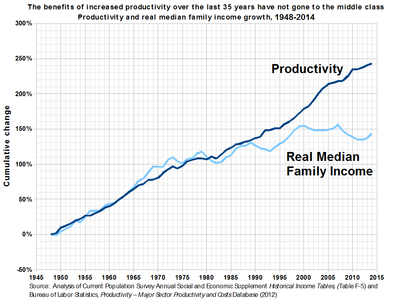
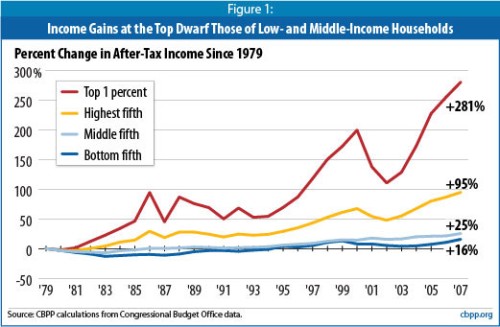
To explain how and why, let me detour through a subject you probably do care about: economic inequality. Here’s a graph I keep posting in one form or another, because I think it points to the most significant fact in American politics: Up until around 1980, median income closely tracked productivity. And then something happened to disconnect them. Productivity kept increasing, but median income stagnated.
Unsurprisingly, this has led to a concentration of income at the top: The people who make wages have lost ground, while the people who pay wages have gained.
And the greatest concentration has been at the very tip-top: The share of wealth held by the top tenth of a percent has reached levels not seen since the Great Depression.
So what happened in 1980? The facile answer is that Ronald Reagan was elected president. But that explanation is too simple, because a president doesn’t deal out national wealth like a deck of cards. What did Reagan do, if anything, that touched off this new Gilded Age of concentrated wealth?
Again, there’s a too-simple answer: He cut taxes on the rich, and he broke unions. Those actions certainly did help the wealthy and harm the middle class, but they’re not enough to explain what happened. If that were all he did, subsequent presidents should have been able to undo it.
To really understand the Reagan impact, you need to apply David Graeber’s definition of a successful revolution: Reagan changed the political common sense of his era in a way that has stuck ever since. Since Reagan, one of the basic debates in American politics has been framed as Freedom vs. Regulation, with a corollary debate of Productivity vs. Regulation. In each case, Regulation was framed as the wrong side to be on: It limits our freedom and strangles our productivity.
The result has been a completely reshuffled economy, which I first started discussing in a 2012 post “Monopoly’s Role in Inequality“.
[M]arkets are created by rules, and the rules can be structured to favor either the ends (producers and consumers) or the middle. Producers and consumers benefit from transparent markets, where the rules force middlemen to treat everyone more-or-less the same.
But markets can also be structured to give middlemen as much freedom as possible. The most profitable way to use that freedom is to create choke-points where a toll can be extracted or one producer can be played off against another. In an opaque market, the way to get rich is not to produce things, but to build middleman power that allows you to dictate terms up and down the supply chain.
What we have today, after nearly 40 years of freedom-for-the-middleman de-regulation, is an economy full of choke points. The path to vast wealth is not to make something people want (as Henry Ford made cheap automobiles) or to discover something people need (as J. Paul Getty and H. L. Hunt found oil), but to insinuate yourself between producers and consumers, create a monopolistic choke point, and charge tolls.
WalMart and Amazon, for example, are choke points; if you want to sell a product to the general public, you have to deal with them on their terms. Visa and MasterCard are choke points; retailers need them, and have to pay whatever fees they set. Cable companies are choke points; creators of TV shows can’t reach viewers without them. Google is a choke point; if you’re hoping to get around WalMart and Amazon by selling over the internet, your website needs to show up when people search for your type of product. [1]
The upshot is that post-Reagan America is no longer a place where you can build a better mousetrap and expect the world to beat a path to your door. Instead, you build the mousetrap, and then you pay off the owners of the choke points between yourself and the mousetrap-buying public. Maybe some small profit will be left for you and maybe it won’t, but the choke-point owners will do well. [2]
There are a few things worth noticing about this situation:
In the short run, the choke-point owners often look like the good guys. Amazon has low prices; Visa gives you cash back. Middlemen often temporarily align with consumers in order to gain more power over producers. But the pattern of all monopolists remains: Once power is consolidated, it will encroach in both directions.
We all need producers. You’re not just a consumer who spends money, you need to make money too. And since ordinary people have no chance of owning their own choke points, most of us have to make money by finding a place on the productive side of the economy, by participating in the delivery of some good or service. Choke points stop middle-class people from moving up by starting their own businesses, and they siphon money away from the kinds of productive businesses that hire people.
“Freedom” can be anti-productivity. Given the prevailing post-Reagan political common sense, that sounds like a contradiction, but it really isn’t. If middlemen have freedom to play producers off against each other and keep the lion’s share of profits for themselves, then more of the economy’s investment will be in middlemen, and less in producers. Conversely, regulations that limit the power of middlemen are pro-productivity.
Now let’s get back to net neutrality: The point of net neutrality regulations is to control middlemen who own a major chunk of our economic infrastructure: the internet service providers like Comcast, Verizon, and AT&T. Once they’re freed from regulation, you can expect them to set up choke points and charge tolls. (This is how it works in Portugal.)
If you provide some service over the internet, for example, you will find yourself competing for the favor of ISPs rather than consumers. Maybe Netflix will pay Verizon so that its streaming service comes in faster and with higher quality than Amazon Prime; or maybe Amazon will outbid it. [3] In either case, the new revenue stream for Verizon either means higher prices for consumers or less spent by Amazon or Netflix on new content. It’s basically just a wound through which Verizon can suck blood out of the productive economy.
Wired suggests that we guess how the ISPs will use this power by looking at what they already do in data-limited plans:
When AT&T customers access its DirecTV Now video-streaming service, the data doesn’t count against their plan’s data limits. Verizon, likewise, exempts its Go90 service from its customers’ data plans. T-Mobile allows multiple video and music streaming services to bypass its data limits, essentially allowing it to pick winners and losers in those categories.
Consumers will likely see more arrangements like these, granting or blocking access to specific content … Net neutrality advocates have long worried that these sorts of preferential offerings harm competition, and by extension, consumers, by making it harder for smaller providers to compete. A company like Netflix or Amazon can likely shell out to sponsor data, but smaller companies don’t necessarily have the budget. … the future internet, then, could look a more extreme version of today’s mobile plans, with different pricing tiers for different levels of video quality for different apps. That means more customer choice, but perhaps not in the way anyone actually wants.
In the conservative fantasy world, the toll collectors will use some fraction of their windfall profits to improve their broadband networks (just as corporations in general will generously use their Trump tax cuts to hire more workers and pay them higher wages). In reality, though, it will be one more opportunity for parasites to latch on to the productive economy. The parasites will do well; ordinary people, not so much.
[1] Apple is an interesting hybrid. It makes things people want, like iPhones. But it too sees how the post-Reagan economy works and wants to evolve into a choke-point company. Already, its App Store is a choke point for software builders, iTunes is a choke point for music producers, and it would like ApplePay to become a choke point upstream from Visa and MasterCard.
[2] A choke point I face on this blog is Facebook. Three years ago, Facebook’s algorithms allowed posts on no-name blogs to go viral. (2014’s “Not a Tea Party, a Confederate Party” got more than half a million hits.) Now that’s much harder. (2017’s most popular Sift post has less than 4,000 hits.) Meanwhile, I’m constantly bombarded with suggestions that I should pay Facebook to get more visibility. I suspect Google does something similar to video bloggers on YouTube.
The analogy isn’t quite perfect, because I’m not trying to make money off my readers. But Josh Marshall at TPM is trying to make money, in an environment he described recently as a “digital media crash“. The situation was tough to begin with, and then …
Then came the platform monopolies: Google, Facebook and a few others. Over the last five years or so but accelerating rapidly in the last 24 months, they’ve gobbled up almost all of the growth in advertising revenue and begun to engross a substantial amount of the existing advertising revenue as well.
That increased flow of money to the platform monopolies takes it away from the actual journalists who find out things and explain them to you.
Net neutrality’s dubious value is made obvious by the misleading way Democrats and many news outlets reported the decision. “F.C.C. plans net neutrality repeal in a victory for telecoms,” wrote the New York Times. Missing from the headline or lede was that the decision was a loss for Netflix, Amazon, Google, and other corporate giants that provide content.
The logic of this should be obvious: Amazon and Google are on the side of the general public on this issue, but for their own reasons: They don’t want new choke points to be constructed upstream from their choke points.
Having taken a week off from the Sift, you’d think I’d have a bunch of great stuff ready to go. Well, not exactly: Since I last posted, I’ve spoken in two churches 1200 miles apart — here’s what I said — and spent the week in between driving across the country and nursing a cold that is still not completely gone. So stuff will come out slowly this morning.
The big things I want to cover are sexual harassment and abuse (because that’s what everybody has been talking about) and the looming end of net neutrality (because more people should be talking about it). In each case, I want us to have a larger focus: Sexual misbehavior in politics isn’t just Roy Moore and Al Franken; it’s probably hundreds of people we don’t know about yet. We need to think this through in general, not just respond based on the way we feel about those currently in the spotlight.
And net neutrality isn’t just some nerdish issue about the internet. It’s part of the major economic trend of the last forty years, which has played a big role in increasing economic inequality: Under the guise of “freedom”, the United States has chopped down regulations that limit the power of middlemen to insert themselves between producers and consumers. The result is an economy whose fruits go not to the productive, but to those who own choke-points where tolls can be charged.
Until now, government regulations have forced your internet service provider to be a relatively passive participant in all your online adventures. But if net neutrality goes away, your ISP will be “free” to fence you in, and to charge tolls to any online service that wants access to you. That set-up will be immensely profitable, but not at all productive.
Anyway, probably one of those topics will be in a separate post and the other will get incorporated into the weekly summary; I still haven’t decided which is which. When any of it will actually appear is anybody’s guess.
One side note: My previous experience of blogging while slightly feverish is that the number of typos goes way up. If you point them out in the comments I’ll fix them.
This week everybody was talking about the Democrats’ wins
(Well, except Fox News. Elections? Were there elections Tuesday?) The big race was Ralph Northam beating Ed Gillespie for the governorship in Virginia, which I discuss in one of the featured posts.
But it wasn’t just the governor’s race: Democrats took the other major statewide offices and gained substantially in the Virginia House of Delegates, making it close enough that control depends on recounts. But it’s a measure of the power of gerrymandering that the seats split almost evenly, despite the total Democratic vote crushing the total Republican vote 53%-44%. Anyone who believes in democracy has to be deeply disturbed that 44% of the vote might be enough for Republicans to maintain control.
And it wasn’t just Virginia: Democrat Phil Murphy replaced Chris Christie as governor of New Jersey, beating Christie’s lieutenant governor 56%-42%. By a wide margin, Maine voted to expand Medicaid.
and Roy Moore
I talked about this in the other featured post. In particular, adult men pursuing girls in their mid-teens isn’t just a quirk of Roy Moore. It’s something that happens in an extremely conservative Christian subculture.
One thing I didn’t put into that article: I’m not the least bit shocked that there’s something icky in Moore’s past. When you style yourself as “the Ten Commandments Judge“, you’re compensating for something. Most Christians don’t need to install 5000-pound granite monuments to prove how upright they are.
and Veterans Day
As I watched all the ways veterans were honored this weekend, it reinforced my impression that America has a strangely bifurcated relationship with its military. On the one hand, military service has never been more distant from the lives of most Americans. Soldiers serve and are in danger all over the globe, in places (like Niger) that most of us couldn’t find on a map. We fight wars (like Iraq or Afghanistan) without any of the impacts on everyday life that previous generations took for granted: no rationing, no tax increases, no products missing from the shelves. If you didn’t follow the news you might not even know it was happening.
Simultaneously, we also mythologize our military and its personnel more than I can ever remember. At sporting events, we have them stand up to be applauded. We stick pro-military slogans to our bumpers. Those who don’t stand for the national anthem are condemned not for disrespecting our country, but for disrespecting our veterans. Politicians constantly tell us our soldiers are the best in the world, or the best among us.
And yet again, we only sort of care whether they’re treated right. It’s a scandal from time to time how badly the VA takes care of their medical needs, but it goes away, and most of us don’t bother to find out whether anything was done. When our attention is drawn to veterans issues, we demand the best for them. But we don’t follow through. We’re embarrassed when we realize that we haven’t done well by them, but we don’t really care.
and tax reform
The Senate came out with its tax-reform bill, which differs from the House bill in a number of ways, but keeps many of the features that make it a bonanza for rich people: big cuts in corporate taxes, getting rid of the alternative minimum tax, and cutting taxes on income from pass-through business entities (such as most of Donald Trump’s investments). (One report says that the rich don’t get the biggest cuts in percentage terms, but they’re not taking into account where the business tax breaks end up.) Like the House bill, it adds $1.5 trillion to the national debt over ten years. It differs mainly in which deductions it preserves or eliminates, but that’s barely worth talking about for one big reason: This still isn’t the bill they intend to pass.
Senate Finance Committee aides said they planned to make adjustments to the legislation because it probably does not comply with the rules for a special Senate procedure they hope to use to pass the bill with 50 votes, rather than the 60 votes typically needed to beat a filibuster.
The big problem is that it will continue increasing the deficit after ten years, which reconciliation rules don’t allow. This isn’t just a frill that can be cut away without affecting the big picture; it comes from the revenue cuts that are what the bill is all about. So fixing it will require a lot more than mere “adjustments”.
So this is where we are: The plan is still for the House to pass its bill by Thanksgiving, and for the House and Senate to agree on something they can deliver to Trump’s desk by Christmas. But they still haven’t told us what that will be, and both the House and the Senate know that the bill they are currently discussing can’t be it. In other words, it’s all still playing out like I predicted two weeks ago.
Tuesday, on a phone conference with 12 Democratic senators, Trump made this outrageous claim:
My accountant called me and said “you’re going to get killed in this bill”.
Not only is there not much in this bill that would presumably hurt the president, but it kind of seems like it’s specifically designed to help him.
Of course, Trump could lay this debate to rest by releasing his tax returns, which (unlike every president since Nixon) he refuses to do. In the one year where we have some Trump tax information (2005), Trump paid $38 million in taxes on $150 million in income, about 25%. But $31 million of that total was due to the alternative minimum tax (AMT), which current proposals eliminate. Without the AMT, he would have paid less than 5%.
but Trump’s Russia comments are very disturbing
Saturday, Trump called former leaders of America’s intelligence agencies (James Clapper, John Brennan, and James Comey) “political hacks”, and insisted that he believes Vladimir Putin’s assurances that he didn’t meddle in the 2016 U.S. elections. The whole controversy, he claimed, “was set up by Democrats.”
Former Bush speechwriter David Frum commented that although we don’t yet have proof that Trump conspired with the Russian interference at the time,
What is becoming ever-more undeniable is Trump’s complicity in the attack after the fact—and his willingness to smash the intelligence and counter-intelligence agencies in order to protect Putin, Russia, and evidently himself. …
A year after the 2016 election, the Trump administration has done nothing to harden U.S. election systems against future interference. It refuses to implement the sanctions voted by Congress to punish Russia for election meddling. The president fired the director of the FBI, confessedly to halt an investigation into Russia’s actions—and his allies in Congress and the media malign the special counsel appointed to continue the investigation.
These are not the actions of an innocent man, however vain, stubborn, or uniformed.
“Beyond a reasonable doubt” is the standard for criminal justice. It’s not the standard for counter-intelligence determinations. The preponderance of the evidence ever-more clearly indicates: In ways we cannot yet fully reckon—but can no longer safely deny—the man in the Oval Office has a guilty connection to the Russian government. That connection would bar him from literally any other job in national security except that of head of the executive branch and commander- in-chief of the armed forces of the United States.
There’s nothing ‘America First’ about taking the word of a KGB colonel over that of the American intelligence community. There’s no ‘principled realism’ in cooperating with Russia to prop up the murderous Assad regime, which remains the greatest obstacle to a political solution that would bring an end to the bloodshed in Syria. Vladimir Putin does not have America’s interests at heart. To believe otherwise is not only naive but also places our national security at risk.
Demonstrators with faces covered chanted “Pure Poland, white Poland!” and “Refugees get out!”. A banner hung over a bridge that read: “Pray for Islamic Holocaust.”
In the Roy Moore post I mentioned Jim Ziegler invoking Joseph and Mary to justify an adult man’s pursuit of a teen-age girl. But that wasn’t the week’s worst piece of theology: Rev. Hans Fiene of River of Life Lutheran Church in Channahon, Illinois (part of the Missouri Synod that I was raised in) takes that prize for this observation about the Sutherland Springs church shooting.
For those with little understanding of and less regard for the Christian faith, there may be no greater image of prayer’s futility than Christians being gunned down mid-supplication. But for those familiar with the Bible’s promises concerning prayer and violence, nothing could be further from the truth. When those saints of First Baptist Church were murdered yesterday, God wasn’t ignoring their prayers. He was answering them.
You see, when Christians ask God to “deliver us from evil” in the Lord’s Prayer, they are asking to be delivered from evil not just in the here and now, but eternally.
So when a madman with a rifle sought to persecute the faithful at First Baptist Church on Sunday morning, he failed. Just like those who put Christ to death, and just like those who have brought violence to believers in every generation, this man only succeeded in being the means through which God delivered his children from this evil world into an eternity of righteousness and peace.
So remember that, the next time a minister asks you to join in reciting the Lord’s Prayer. Unless you’re prepared for gunmen to burst through the doors and mow down your whole family, you might want to opt out.
Fiene’s essay is based on the romantic view of persecution that causes so many Christians to imagine they are being persecuted for their religion when they’re really not. The Sutherland Springs Baptists suffered exactly the same persecution as Sikhs in Wisconsin, country music fans in Las Vegas, and gay night-clubbers in Orlando: the persecution that we all risk by living in a gun-crazy society.
American Christians, who dominate this country only a little less completely than they used to, indulge in persecution fantasies the way that teen-agers safe in their parents’ basements indulge in horror movies. Someone might try to force me to sell a gay couple the same cake I would sell a straight couple! Or to provide health insurance for my employees! It’s just exactly like the stoning of Stephen, or facing the lions in Rome.
Oh, crap. We’re losing Louis C. K. to the rolling sexual abuse scandal. At least he owned up to the accusations, rather than trying to convince us that his accusers are lying. But we’ve got to stop tolerating this kind of stuff.