How to Fix ObamaCare

It needs a number of wonky adjustments, not a dramatic overhaul.


Other than a fairly vague “we know it’s not perfect”, elected Democrats have been reluctant to criticize ObamaCare while it was facing the prospect of a full repeal. Even fairly mild criticism, they feared, might lead to “Even Democrats Hate ObamaCare” headlines and feed the repeal movement. Worse, if Democrats settled on a fix-ObamaCare plan, McConnell and Ryan might take one or two minor ideas from it and claim that their new repeal plan was bipartisan, even as it gutted the larger purpose of ObamaCare.

But even though ObamaCare repeal keeps rising from the dead, maybe the its most recent defeat leaves an opening for an honest effort to improve the system. That will be tricky, because it means putting aside an enormous amount of widely believed lies and focusing on what the real problems are.

What ObamaCare was supposed to do. One reason all the Republican repeal-and-replace bills have been so unpopular is that no one could say exactly what they were supposed to accomplish, other than fulfill the promise to repeal ObamaCare. Repeal has become an end in itself, independent of anything it might do to help or hurt the American people.

By contrast, all Democratic healthcare plans are based on a simple principle: Sick or injured people should get the care they need, and they shouldn’t have to go bankrupt paying for it. Large majorities of Americans believe in that vision, and Democrats have been trying for decades to make it real. ObamaCare has always been an imperfect implementation, but it was a significant step in the right direction.

Why not single-payer? The most direct (and, in my opinion, the most efficient) way to implement that principle is some kind of single-payer, Medicare-for-all system like just about every other advanced country already has. It’s been tested in nations all over the world, and it works. Germany or Australia, for example, spend far less per capita than we do on healthcare, and their people live longer. [Update: See the comments for a correction. I have used “single-payer” as a synonym for “universal health insurance”, which is not accurate. In particular, Germany achieves universal coverage differently.]

I suspect that in their hearts, all the Democrats running for president in 2008 would have preferred a single-payer system, but most of them believed Congress would never pass it. So Obama and his main competitors (Hillary Clinton and John Edwards) all proposed very similar systems, roughly based on the program that Republican Governor Mitt Romney had already started in Massachusetts. Dennis Kucinich had the single-payer supporters all to himself in the New Hampshire primary, where he got 1.35% of the vote.

Single-payer advocates find this kind of timidity mysterious — or they attribute it to bribery by the big insurance companies — because if you poll single-payer by itself, it does pretty well. So why not go for it?

What makes even honest politicians nervous is that lots of things poll well until a campaign begins, when the negative ads and outright lies start to fly. HillaryCare polled well at first too, until Republicans and insurance companies started going after it. In no time it all, it morphed from an unstoppably popular proposal to the reason the Democrats lost the House in 1994.

Whenever a proposal fails, you can point to plenty of mistakes its backers made. (Supporters of successful proposals also make a lot of mistake, which are quickly forgotten.) But it also seems to be true that the American people harbor a deep well of distrust for politicians and their promises. If a negative ad tells people you’re going to take something away from them, they believe it. If you respond that you’re going to give them something better, they don’t.

Nobody wants to believe that this applies to them as well as their opponents, but it does. Republicans, I’m sure, have been shocked these last six months to discover that many of the same people who distrusted ObamaCare now distrust their replacement plans even more. (ObamaCare repeal as an abstract idea has long polled in the 40s. All the specific repeal bills discussed recently have polled in the teens.) As soon as Republicans gained enough power to implement actual changes, they became the new owners of the well of distrust.

Single-payer supporters on the Democratic left are making a similar mistake today, I believe, when they imagine that the wave of public distrust they’ve helped raise against establishment Democrats won’t wash back on them if they ever take power.

Three options. When you come down to it, there are really only three ways government can handle the problem of the uninsured.

  1. Ignore it. When the uninsured get sick, either private charity will take care of them or they’ll die.
  2. Have one system that covers everybody.
  3. Have a crazy-quilt of different programs that all have their own rules and justifications, and hope that not that many people slip through the gaps.

ObamaCare is a type-3 plan. TrumpCare failed because it could never decide whether it was a type-1 plan or just another type-3 plan with more gaps.

The ObamaCare Rube Goldberg machine. Public distrust of change is one major reason ObamaCare was designed to minimize the number of people facing significant disruption. If you got your healthcare through Medicare, Medicaid, the VA, or your employer’s group plan (like my wife and I did and do), you probably didn’t notice much difference. Obama’s “If you like your health plan you can keep it” may have been Politifact’s Lie of the Year, but it was actually more of an exaggeration than a lie. After the ACA passed, the vast majority of people with good health insurance just kept doing whatever they’d been doing.

Maintaining all those legacy programs guaranteed that covering the uninsured would be complicated. So ObamaCare covered uninsured people like this:

  • The poor continue to get Medicaid.
  • Those just above the poverty line — who presumably can manage day-to-day expenses like food and rent, but have nothing left over to insure against emergencies — get covered by extending Medicaid (though the Supreme Court allowed states to opt out of this).
  • Low-to-middle working-class people whose jobs don’t include health insurance can get a subsidy to buy individual insurance on an ObamaCare exchange. (The subsidies phase out as incomes increase.)
  • Better-off people whose jobs don’t include health insurance can buy policies on the exchanges at full price.

Gaming the system. In addition to the complexity of how you got covered, there were changes in the rules of coverage. Mostly, this is about keeping players from gaming the system.

When insurance companies compete on price and service, the public benefits. But prior to ObamaCare, a lot of insurance competition was about something else: making sure that their own insurance pool was healthier than the other companies’. So insurers got really good at figuring out who was a bad risk and cancelling their polices. That helped the company’s bottom line, but was bad for public health. (And if your wife is a cancer survivor, it’s terrifying.)

So the biggest (and most popular) rule change was that insurance companies have to offer coverage to everybody, no matter how unhealthy they are or might get. Nobody is uninsurable any more.

But that created a new opportunity to game this system: Healthy individuals might go without insurance, figuring that they could pick it up later if they ever needed it. Taking healthy people out of the insurance pool ruins the whole idea of insurance — imagine if you could put off buying fire insurance until after your house burned — so that had to be prevented somehow. That’s where the individual mandate comes in: Even if you’re healthy, you either carry insurance or pay a tax.

So

  1. no discrimination against pre-existing conditions,
  2. a mandate for individuals to carry insurance, and
  3. subsidies so that even individuals just above the poverty line can afford the insurance they’re obligated to carry

is sometimes called the “three-legged stool” of ObamaCare. The system is unstable unless you have all three.

Where there are problems. The problems with ObamaCare have been wildly exaggerated by Republican talk of a “meltdown” or “collapse” or “death spiral“. But ObamaCare has run into three main problems:

  • The Supreme Court allowed states to opt out of Medicaid expansion, and a number of the red states have, at great cost to their citizens and hospitals. Policies on the ObamaCare exchanges are not designed for households near the poverty line; the deductibles on the cheapest (bronze) plans are far too high for them, and they may not qualify for the subsidies. The Medicaid-denied people who do sign up on the exchanges tend to be the very sick, whose expenses raise premiums for everyone.
  • Not enough healthy people are signing up to keep premiums low. The original projections didn’t anticipate that HHS would use its PR budget to undermine ObamaCare [1], that private sources would launch a well-funded advertising campaign against signing up, or that refusing to sign up would become part of a political identity.
  • Not enough insurance companies are participating (particularly in rural areas [2]) to keep the exchanges competitive.

The last two should not be all that surprising. If you look at the description of ObamaCare above, it depends on inducing people to cooperate, not forcing them. (That’s why it’s ironic that it’s been attacked as an assault on “freedom”.) For the program to work smoothly, the inducements — subsidies to individuals, reinsurance for insurance companies, the income level where Medicaid expansion ends and private-sector policies begin, the tax on the uninsured — have to be calibrated right.

Healthcare experts made their best estimates when the law was written, but everyone expected to make adjustments as the real-world results started coming in. This is not unusual with big new social programs. Social Security, Medicare, and Medicaid all required some fine-tuning as they got off the ground, and still get re-jiggered periodically.

But no one foresaw that Republicans would immediately gain control of the House, and then take the attitude that the only acceptable adjustment was complete repeal. It’s hard to grasp now how big a change this is from all previous American history. Typically, opposition parties in America have not tried to sabotage programs they disapprove of. Until the current era, small changes that improve the working of an existing program have been uncontroversial, even among congresspeople who voted against the program originally.

The sabotage problem has gotten worse since Trump became president. He gleefully talks about letting ObamaCare implode, and creates uncertainty in the insurance markets by threatening to delay or withhold payments. Insurance is all about managing risk, so adding any new uncertainties to the system is monkey-wrenching.

How to fix them (if you want to). It should go without saying that the first step in fixing something is to stop trying to break it. But beyond that, there are some obvious things to do.

Ten House Democrats — including my NH-2 rep, Annie Kuster — have put out a plan to stabilize the individual insurance markets. The main planks are:

  • a permanent reinsurance program to protect insurers against unexpectedly high claims. This would encourage insurers to compete in more markets. ObamaCare had such a program initially, but it has expired.
  • reduce deductibles and co-pays for people with low incomes. There’s already a program in the ACA that does this: The government is supposed to make “cost sharing reduction” payments to insurance companies that keep these costs low. But there’s a dispute working its way through the courts about whether Congress has to appropriate this money year-by-year (which it hasn’t done) and Trump is threatening to withhold the payments.
  • market better. HHS needs to start spending its advertising budget to promote ObamaCare rather than denigrate it. One simple suggestion: Make the ObamaCare open enrollment period line up with the April 15 tax deadline, so that people who have just seen how the tax subsidies and the individual mandate affect them could immediately take action for next year.
  • enforce the individual mandate, which the IRS is currently not doing.
  • let people over 55 buy into Medicare. This will shift some of the most expensive people out of the ObamaCare risk pools, lowering premiums for everyone else.
  • give bigger subsidies to older people in rural areas.

Other ideas are out there as well. Saturday’s NYT listed at least two (in addition to some of the ideas already mentioned).

  • reduce drug prices. If there’s real competition, then anything that makes healthcare less expensive makes health insurance less expensive. At the very least, lower drug prices would help people who have high deductibles and co-pays. And everyone agrees that the current system — which lets drug companies with patents dictate a price which the government and insurance companies are obligated to pay — is rigged in drug companies’ favor. Part of the Democrats’ “Better Deal” proposal is a federal agency that guards against price gouging.
  • extend ObamaCare-exchange subsidies to people in the Medicaid gap. It’s crazy that many states still haven’t accepted Medicaid expansion, but that seems to be the way it is.

538 passes on something clever Nevada is doing: Insurers who offer plans on the ObamaCare exchange in Nevada are more likely to be chosen to manage the state’s Medicaid plan. A similar idea (which I didn’t invent, but can’t remember where I saw it) is to force insurers who want to compete in lucrative urban markets to also cover rural areas.

Mending is boring, but insurance ought to be boring. None of this is the kind of sweeping change that inspires people. It’s more like when a football team works on blocking and tackling better, rather than coming up with new trick plays.

But it also shouldn’t scare people. The original structure of the plan is still sound. It just needs some adjustments.

The question is whether congressional Republicans want to make those adjustments, or the Trump administration wants to implement them. They can, if they want, make ObamaCare collapse.

If they do that, though, they may convince the public that type-3 crazy-quilt plans don’t work. And if the public has to choose between a type-1 let-them-die program and a type-2 Medicare-for-all plan, I don’t think Republicans will like how that decision comes out.


[1] The Daily Beast reports:

To date, [HHS] has released 23 videos. A source familiar with the video production says that there have been nearly 30 interviews conducted in total, from which more than 130 videos have been produced.

Each testimonial has the same look, feel, and setting, with the subjects sitting before a gray backdrop and speaking directly to camera about how Obamacare has harmed their lives. They were all shot at the Department’s internal studio, according to numerous sources who worked for or continue to work at HHS.

The videos openly suggest Congress repeal ObamaCare. The one featuring Robert Dean ends like this:

I really hope that the Trump administration and the U. S. Congress, Republicans in the Senate and House, can get their act together and deliver relief to the American people.

Given this openly political — and even partisan — message, I suspect that spending public money to produce and distribute these videos is illegal. If HHS Secretary Tom Price knew about this and condoned it, he should resign.

[2] As the liberal Center for Economic Policy and Research think tank notes, lack of competitive exchanges is particularly a problem in Republican states that have done their best not to cooperate with ObamaCare. It provides the following chart:
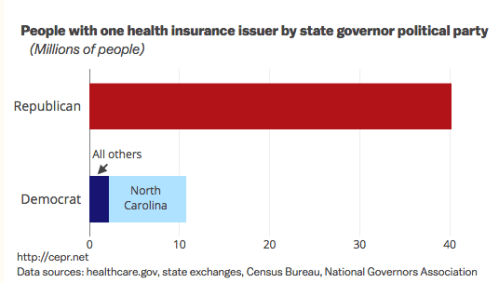
In part this is a coincidence caused by the fact that largely rural states tend to have Republican governors. But so is the frequently cited statistic that 1/3 of counties have only one insurer: Those counties tend to be sparsely populated, so the number of people they represent is far less than 1/3 of the country.

The are lots of reasons why rural areas are especially hard hit. Most obviously: Having fewer people makes them a less robust insurance pool, increasing risk to the insurer. Also, healthy young people tend to seek opportunity in the bigger cities, leaving older, sicker people behind.

The Monday Morning Teaser

Well, that week happened.

Since Trump’s inauguration, most of us have gotten used to much higher level of background craziness than America has seen in our lifetimes. A lot of ridiculous statements and absurd proposals just kind of bounce off my ears now, the way a hard rain bounces off a sidewalk. Even as we warn each other not to “normalize” Trump, we do get inured to him and his circus after a while.

And then you have a week like this one. McCain’s middle-of-the-night vote to shoot down the latest version of ObamaCare repeal made great drama, but only if your suspension-of-disbelief had already processed that a major piece of legislation could be kept secret until two hours before the voting started, and that senators could beg for guarantees that the bill they were about to vote for wouldn’t become law.

Oh, and when was the last time the Boy Scouts had to apologize for exposing their boys to the President of the United States? (Hint: never.)

The White House Communications Director — the guy who’s supposed to keep everybody else on message — made anatomically impossible on-the-record suggestions about another major White House staffer, and both of them are going to work this morning. (Forget that C. J. would never have said something like that about Leo. Hamilton would never have said something like that about Burr.) Trump spent a bunch of the week humiliating his own attorney general. Police departments are putting out statements reassuring the public that they don’t do the things the President just told them to do. And when the Commander in Chief announced a new policy over Twitter, the Pentagon acted like he was just some drunk guy ranting in a bar. Orrin Effing Hatch stepped up to defend transgender soldiers against Trump.

That’s the kind of week it was. Oh, and by the way, North Korea tested a missile that could hit Chicago, or maybe Boston if it was having a good day. You may not have noticed that with all the other stuff going on. (Trump responded by criticizing China, which acted like he was just some drunk guy ranting in a bar.)

In this environment, there’s a certain amount of absurdity involved in continuing to discuss public issues as if they were serious things, even though they are serious things. But I think we have to continue doing it, or at least trying.

So this week I attempt to keep on keeping on by asking: What if Congress made a serious attempt to fix ObamaCare? It’s not “imploding” or in a “death spiral” as Republicans keep claiming, but it’s also not working as well as it was supposed to for certain people, particularly in rural areas. What can or should be done about that? I’ll try to have that posted by 9 EDT, or 10 at the latest.

This week I was uninspired by the misunderstandings I ran into, so I decided not to put out a “Three Misunderstandings” piece. The series will continue, but I don’t want my weekly deadline to force it to continue at a lower quality. Expect more misunderstandings soon, but not today.

The weekly summary … did I mention it was a crazy week? I’ll try to cover all that and post something before noon.


Nobody Begs for Dirty Water

I think it’s important to note that the Congress has cut the [Environmental Protection] Agency quite a bit before you got there. Quite a bit recently, in relative terms. And so, speaking only for myself, I would expect to take those cuts into account and echo my colleague’s sentiments about you may be the first person to get more than you asked for. Because, quite frankly, as many people have made the point, nobody is standing on the rooftops begging for dirty water, dirty air, dirty soil, and those sorts of things.

– Rep. Mark Amodei (R-Nevada) to EPA Administrator Scott Pruitt
hearing of the House Appropriations Subcommittee on Interior, Environment, and Related Agencies
7-15-2017, (at about the 1:42 mark)

This week’s featured post is Kipling’s “If” adapted for the Trump family: “Fatherly Advice to Eric and Don Jr.“. This week’s three misunderstandings: the census, the economic impact of environmental regulations, and who killed the coal-mining jobs.

This week everybody was talking about the apparent failure of TrumpCare

The Senate’s TrumpCare bill changed several times this week, and all the versions failed to get 50 of the 52 Republican senators to approve moving forward. This issue is never over, because Republicans agree that they have to do something, but they can’t agree on what.

I could almost feel sorry for them if they hadn’t done this to themselves. They ran on some unspecified “replacement” for ObamaCare that Trump promised would cover everybody better and cheaper. It’s now clear that no such plan ever existed, and that Trump has never had two consecutive coherent thoughts about healthcare. So either Republicans do nothing and look ineffective, or they do something that falls way short of the expectations they built up.

Their position was designed for undermining President Clinton, who would bail them out with a veto the same way Obama always did. Trump wasn’t supposed to win.


But beyond this particular no-win moment, Republican free-market rhetoric is unsuited to healthcare in a more basic way. Markets don’t see people, they see money. So if you can’t afford to pay for what you want, your desires are invisible. (The corresponding economic concept is effective demand; wanting something you can’t afford isn’t effective in a market economy.)

That’s why the market will never provide affordable effective healthcare for the poor and lower working class. At best, they’ll be left facing the kinds of trade-offs no one should have to make: Do you send the kids to school with clothes they’ve outgrown over the summer, or do you pay the health insurance premium? A lot of people facing such a dilemma will “choose” to take a chance on staying healthy. If they lose that gamble, the market would let them die.

But that’s not the kind of society most Americans want to live in. On most issues, we’re willing to let the market allocate goods and services. I’m willing to accept, for example, that my desire for seafront property is ineffective. Richer people can have the ocean views and private jets and varieties of wine that I will never taste. I’m fine with that. But when we’re talking about who lives and who dies, money shouldn’t be the deciding factor.

The only way to change that situation is to put in government money. Republicans are still struggling with that basic fact, which is why they can’t come up with any reasonable plan.


The Senate parliamentarian just made ObamaCare repeal that much harder: Several provisions of the current bill, including the anti-abortion ones, don’t fit under the reconciliation rules that avoid filibuster. So they need 60 votes rather than 50, which they’re not going to get.

and whether Trump will accept being investigated

Almost every day last week, something new came out that increased the odds of the Constitutional-crisis nightmare scenario: Trump scuttles the Mueller investigation, pardons anybody in his administration who might have done something wrong (including himself), and leaves Congress to either accept this fait accompli or impeach him. I still don’t think this is the most probable scenario (though Josh Marshall does), but it’s way more likely than I’m comfortable with.

Wednesday, Trump was interviewed in the Oval Office by three New York Times reporters, revealing that he thought it would be a “red line” if Special Counsel Robert Mueller investigated his finances (which Bloomberg was simultaneously revealing that Mueller is doing), and lambasting Attorney General Sessions for doing the ethical thing by recusing himself from an investigation where he might become a target. Thursday, the NYT revealed that Trump’s defense team is investigating Mueller and his people for conflicts of interest they can use to discredit the investigation or maybe justify shutting it down, and WaPo reported that Trump was looking into pardons, even possibly pardoning himself. (Experts disagree: Would that be unconstitutional, or did the framers just regard it as unthinkable?) Friday it came out that Jeff Sessions might still not have come clean about his meetings with the Russian ambassador.

Will Sessions hang on as attorney general? If he goes, will Trump replace him with someone he can count on to fire Mueller? Will the Senate go for that? Will they OK Trump’s FBI pick? What will Jared Kushner reveal in his testimony today? What about Don Jr. and Paul Manafort?

Why does this all feel like we’re building up to a season-ending cliffhanger?


Dahlia Lithwick is Slate‘s top law writer, but she writes an illuminating piece about the limits of law to control people like Trump.

The rule of law is precisely as robust as our willingness to fight for it. And to fight for it is not quite the same thing as to ask, “Isn’t there a law?” While a nation founded on laws and not men is a noble aspiration, I am not certain that what the Framers anticipated was a constitutional regime predicated on the Harry Potter hope that all the lawyers would fix all the stuff while everyone else crossed their fingers and prayed. … What is increasingly clear is that Trump’s lawlessness isn’t a problem to be solved by other people’s attorneys. Like it or not, we are all public interest lawyers now.


Friday Sean Spicer resigned and hedge-fund manager Anthony Scaramucci became communicators director, because apparently if you can make money, you can do anything. (I know it’s an ethnic stereotype, but Scaramucci really does look like a Sopranos character. Maybe Spicer isn’t the wartime consigliere Trump believes he needs.) Sarah Huckabee Sanders moves up to press secretary, a job she was occasionally filling anyway.

Hedge fund manager, VP at Goldman Sachs, degree from Harvard Law — Scaramucci is the perfect manifestation of populist anger, don’t you think?


Senate Intelligence Chair Richard Burr seems unimpressed by one of the fake controversies Trump defenders have spun out of the Russia inquiry: that Obama’s National Security Adviser Susan Rice improperly “unmasked” the names of people whose conversations were captured by the NSA.  Blaming his House counterpart, Burr told CNN: “The unmasking thing was all created by Devin Nunes.”


Journalism Professor Jay Rosen takes a deeper look at Trump’s NYT interview. All the assumptions of the political interview, he tweets, are out the window with Trump:

One premise of interviewing a public official is that the official is more “in the know” than the journalist. Everything the Times reporters asked about health care shredded that premise. He knows far less than the people seeking answers from him!

When a subject says something confusing or wrong, you usually hope that the interviewer asks a follow-up question. But Trump’s speaking style (in which he rarely produces a complete, coherent idea, and is more likely to interrupt his own train of thought than to elaborate) makes that tactic useless.

the most likely outcome of seeking clarification by way of a follow-up is that he will introduce some new and further confusion.

But Rosen also points to a more fundamental confusion: Trump’s entire sense of self depends on being seen by others. So in an interview he isn’t presenting himself so much as making himself.

You don’t get a sense that he’s explaining what existed prior to its being asked about in the interview— or that it will persist after.

and John McCain

This week we found out that Senator McCain has an aggressive form of brain cancer. News reports don’t usually speculate about whether somebody is going to die soon, but that seemed like the read-between-the-lines message.

One of the benefits of living in New Hampshire is that you get to see presidential candidates close up. Of all the candidates I’ve seen since I started going to these campaign events in 2000, the one who connected with a room the best is John McCain. He’s personable, loves to answer questions, and has an impressive range of knowledge. Even as a liberal, I would always come away trying to rationalize voting for him. (In the 2000 primary, I crossed over and voted for him against Bush. Given how the Bush administration turned out, I’m not sorry.) I saw him several times in both the 2000 and 2008 cycles, and the quality of his performance never wavered.

At a 2008 rally in Minnesota, he did the last magnanimous thing I can remember a Republican presidential candidate doing: When an elderly woman started talking about not trusting Obama because he’s “an Arab” and (by implication) a Muslim terrorist sympathizer, McCain interrupted and corrected her before she could spread any more falsehoods about his opponent: “No, ma’am. He’s a decent family man [and] citizen that I just happen to have disagreements with on fundamental issues and that’s what this campaign’s all about.”

but you should pay more attention to Iran

In 2015, the Obama administration worked out a deal with Iran: We and our allies would relax our economic sanctions and let Iran access its money that we had frozen in our banking system, and in exchange Iran would stop its nuclear-weapons program, shut down a bunch of centrifuges, turn over its stash of weapon-ready radioactive material, and permit inspections to give us confidence that they weren’t restarting it all. Every 90 days the President is supposed to report to Congress on whether Iran is upholding its end of the deal.

During the campaign Trump regularly attacked this deal, though there was no indication that he understood it any better than he understood any of the other stuff he talked about. (Where is that marvelous healthcare plan he promised?) Speaking to a pro-Israel group, he said, “My number-one priority is to dismantle the disastrous deal with Iran.”

To keep that promise, all Trump has to do is report to Congress that Iran isn’t complying, and ask them to reinstate sanctions. But Iran is upholding the deal. Rex Tillerson’s State Department says so, and the other defense-and-foreign-policy adults in the administration — Defense Secretary James Mattis, National Security Advisor H.R. McMaster, and Joint Chiefs of Staff Chairman Joseph Dunford — agree. Facing that united front, Trump felt like he had no choice this week; he verified Iran’s compliance.

But Trump hates having his actions dictated by experts and their “facts”. So Foreign Policy reports that he has instructed White House staffers to work around Tillerson.

Withholding certification “wasn’t a real option available to me,” Trump reportedly told the staffers. “Make sure that’s not the case 90 days from now.”

Here’s the problem with that course: The original sanctions worked because Secretary of State Clinton convinced a significant international coalition (including Russia, China, and the EU) to cooperate. That coalition isn’t likely to reinstate sanctions just because Trump says so. So after he blows up this deal, Trump will be in a weaker negotiating position than Obama was.

and you also might be interested in …

Was it the massive street demonstrations? Pressure from the rest of the EU? A rift in the ruling party? Whatever the cause, I’ll take it: Polish President Andrzej Duda vetoed two bills that would have given the authoritarian ruling party nearly complete control of the judiciary.

If you’re saying “What authoritarian ruling party?”, take a few minutes to read David Frum’s “How to Build an Autocracy” from March. Right-wing parties in Poland and Hungary are following the Putin model of how to corrupt a democracy. For more something more specific to Poland, look at The Washington Post‘s “In Poland, a window on what happens when populists come to power” from December.


Thursday, it was hard to avoid coverage of O. J. Simpson, who got paroled from the armed robbery charge that has kept him in prison the last nine years. I have nothing against O.J. personally, but I don’t want to hear about him any more. If he has a quiet, happy old age that never again makes headlines, that would be fine with me.


538’s Perry Bacon has an educational piece about stories with unnamed sources: As a journalistic insider, when does he take such stories seriously and when not.


Putin’s decision to back Trump continues to pay dividends. Wednesday we found out that the U.S. will no longer arm rebels against Syrian President Assad, a Putin ally.

“This is a momentous decision,” said a current official, who spoke on the condition of anonymity to discuss a covert program. “Putin won in Syria.”

In general, Syria is a mess and intelligent people can disagree about what we should be doing there. I just wish I could be confident that our new policy is based on someone’s vision of American interests, rather than paying off whatever debt Trump owes Putin.


Trump is nominating a climate-denier with no scientific background to be the top scientist at the Department of Agriculture. This isn’t just a bad idea, it violates a 2008 law:

The Under Secretary shall be appointed by the President, by and with the advice and consent of the Senate, from among distinguished scientists with specialized training or significant experience in agricultural research, education, and economics.

We’ll see if the Senate allows this. Sam Clovis has a bachelor’s degree in political science and a doctorate in public administration. He was the Iowa campaign chair for another know-nothing Trump appointee: Energy Secretary (and custodian of the nuclear arsenal) Rick Perry.


Another nominee: Andrew Wheeler to be the second-in-command at EPA. Wheeler is a coal-industry lobbyist and a former aide to Senator Inhofe, who famously disproved global warming by bringing a snowball to the floor of the Senate.


Joel Clement is a government scientist who is blowing the whistle on the administration’s attempt to get its scientists to leave.

and let’s close with something unusual

Stephen Colbert visits the home of Mikhail Prokhorov in hopes of learning how to be a Russian oligarch.

Three Misunderstood Things 7-24-2017

This week: census, environmental regulations, coal jobs


I. The census

What’s misunderstood about it: How can counting people be a partisan issue?

What more people should know: A lot rides on the census. The Census Bureau knows it gets the answers wrong, but Republicans have a partisan interest in not letting it do better. In 2020, it’s being set up to fail.

*

When the Founders wrote the Constitution, they knew the country was changing fast. New people were pouring into America — some coming by choice and others by force. If Congress was going to represent these people into the distant future, it would have to change as the country changed. So somebody would have to keep track of how the country was changing. That’s why Article I, Section 2 says:

The actual Enumeration shall be made within three Years after the first Meeting of the Congress of the United States, and within every subsequent Term of ten Years, in such Manner as they shall by Law direct.

Congress has implemented that clause by setting up the Census Bureau, which tries to count everyone in America in each year that ends in a zero. You can look at this as a rolling peaceful revolution: Via the census, states like Virginia and Massachusetts have gradually surrendered their founding-era power to new states like California and Texas.

No doubt you learned in grade school that counting is an objective process that produces a correct answer — the same one for everybody who knows how to count. But in practice, when a bunch of people count to 325 million, agreement starts to break down. Now imagine that you’re counting a field full of 325 million cats, most running around and jumping over each other, and a few actively hiding from you. How do you come up with an answer you have faith in?

That’s the Census Bureau’s fundamental problem: Americans won’t stand still long enough to be counted, and some are actively suspicious of anybody from the government who comes around asking questions. Inevitably, then, not everybody gets counted, and some people get counted more than once. This is not a secret; the Census Bureau admits that it gets the wrong answer.

That might not be so bad if the errors were random, but they’re not. Basically, the more stable your life is, the more likely you are to be counted correctly. If, for example, you’re still living in the same house with the same people that a census worker counted ten years ago, they’re going to count you again. But if you’re sleeping on your friend’s couch for a few weeks while you’re waiting for a job to turn up, and thinking about moving back in with Mom if you can’t find one, then you might get missed.

Stability isn’t a randomly distributed quality. The LA Times spells it out:

The last census was considered successful — that is, the 2010 results were considered to be within an acceptable margin of error. But by the Census Bureau’s own estimates, it omitted 2.1% of African Americans, 1.5% of Latinos and nearly 5% of reservation-dwelling American Indians, while non-Latino whites were overcounted by almost 1%. The census missed about 7% of African American and Latino children 4 or younger, a rate twice as high as the overall average for young children.

But that raises an epistemological question: How do you know your count is wrong if you don’t have a correct count to compare it to? And if you have that correct count, why not just use it?

The answer to the first question is statistics. Imagine, for example, that you’re trying to count all the species that live in your back yard. You go out one day and count 50. Then you go out longer with a bigger magnifying glass and find 10 more. Then the next couple of times you don’t find anything new. But then you find two. Are you confident that’s all of them now? What’s your best guess about how many are really out there?

Now extend that to every yard in the neighborhood. Imagine that after each household does its own count, you all converge on one yard for a more intensive search than you’d be willing to do on every yard. That search finds even more new species. Now how many do you think you missed in the other yards?

Statisticians have thought long and hard about questions like that, and have a variety of well-tested ways to estimate the number of things that haven’t been found yet. If you apply those techniques to the census, you get more accurate estimates of the total.

So why not just use those estimates? Two reasons:

  • It sounds bad: Ivory-tower eggheads are using a bunch of mumbo-jumbo Real Americans can’t understand to invent a bunch of blacks and Hispanics that nobody has ever seen.
  • Republicans have a partisan interest in keeping the count the way it is.

The Census determines two very important things: how many representatives (and electoral votes) each state gets, and how hundreds of billions of dollars in federal money for programs like Medicaid and highway-building get distributed among the states. The miscount gives more power and money to mostly white (and Republican) states like Wyoming and Kansas, and less to a majority non-white (and Democratic) state like California. Within a state, Republican gerrymandering works by crowding Democratic-leaning urban minorities into a few districts, leaving a bunch of safely Republican rural and suburban districts. That minority-packing is even easier to do if a chunk of those people were never counted to begin with.

The 2020 census is already headed for trouble. The Census Bureau is being underfunded, taking no account of the fact that it has more people to count than last time. Plans to modernize its technology went badly. And it is currently leaderless: The bureau chief resigned at the end of June, and Trump has nominated no one to replace him.

So we’re set up for an even bigger uncount of minorities this year. And that’s got to make Paul Ryan happy.

II. Environmental regulations

What’s misunderstand about it: Many people believe that a clean environment is a costly luxury.

What more people should understand: Externalities. That’s how well-designed environmental regulations can save more money than they cost.

*

Nobody should come out of Econ 101 without an understanding externalities — real economic costs that the market doesn’t see because they aren’t borne by either the buyer or the seller.

Pollution is the classic example: Suppose I run a paper mill, and I use large quantities of chlorine to make my paper nice and white. At the end of the process I dump the chlorine into my local river, because that’s the cheapest way for me to get rid of it. Because I use such an inexpensive (for me) disposal process, I can keep my prices low. That makes me happy and my customers happy, so the market is happy too. Any of my competitors who doesn’t dump his chlorine in the river is going to be at a disadvantage.

The problems in this process only accrue to people who live downstream, especially fishermen and anybody who wants to swim or eat fish. They suffer real economic losses — losses that are probably much bigger than what I save. But since their loss is invisible to the paper market, nothing will change without the some outside-the-market action — like a government regulation, a court order, or a mob of fishermen coming to burn down my mill.

Now suppose the government tells me I have to stop dumping chlorine. I have to find either some environmentally friendly paper-whitening technique or a way to treat my chlorine-tainted wastewater until it’s safe to put back into the river. Either solution will cost me money, and I will have no trouble calculating exactly how much. So you can bet there will be an article in my local newspaper (which now has to pay more for the newsprint it buys from me) about how many millions of dollars these new regulations cost. The corresponding gains by fishermen, riverfront resort owners whose properties no longer stink, and downstream towns that don’t have to get the chlorine out of their drinking water — that’s all much more diffuse and hard to quantify. So the newspaper won’t have any precise number to weigh my cost against. Chances are its readers will see the issue as money vs. quality of life. They won’t realize that the regulations also make sense in purely economic terms.

That’s an abstract and somewhat dated example, but similar issues — and similar news stories — appear all the time. The costs of new regulations are borne by specific industries who can calculate them exactly, while the benefits — though very real — are more diffuse, and may accrue to people who don’t even realize they’re benefiting. (Companies are very aware of what they’ll have to spend to take carcinogens out of their products, but nobody ever knows about the cancers they don’t get.) But that doesn’t mean that the benefits aren’t bigger than the costs, even in dollar terms.

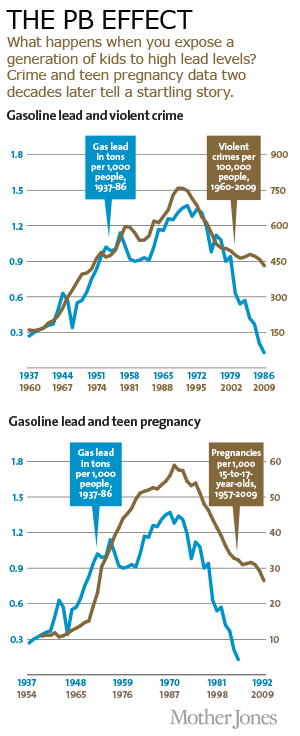
The best example from my lifetime is getting the lead out of gasoline. If you were alive at the time, you probably remember that the new unleaded gasoline cost a few cents more per gallon. Spread over the whole economy, that amounted to billions and billions. What we got out of that, though, was far more than just the vague satisfaction of breathing cleaner air. Without so much lead in their bloodstreams, our children are smarter, less violent, and less impulsive. The gains — even in purely material terms — have been overwhelmingly positive.

III. Coal jobs.

What’s misunderstood about it: What happened to them? Environmentalists are often blamed for destroying these jobs.

What more people should know: No doubt environmentalists would kill the coal industry if they could. But the real destroyers of coal jobs are automation and competition from other fuels.

*

Coal miners are the heroes of one of the classic success stories of the 20th century. Mining was originally a job for the desperate and expendable, but miners were among the first American workers to see the benefits of unionization. Year after year, coal mining became safer [1], less debilitating, and better paying, until by the 1960s a miner no longer “owed his soul to the company store“, but could be the breadwinner of a middle-class family, owning a home, driving a nice car or truck, and even sending his children to college. Sons and daughters of miners could become doctors, lawyers, or business executives. Or if they wanted to follow their fathers into the mines, that promised to be a good life too.

However, the total number of coal-mining jobs in the United States peaked in 1923.

Was that because Americans stopped using coal? Not at all. Coal production kept going up for the next 85 years.

The difference was automation. Mines employed three-quarters of a million men in the pick-and-shovel days, but better tools allow 21st-century mines to produce more coal with far fewer workers.

If you take a closer look at that employment graph, you’ll notice a hump in the 1970s, when coal employment staged a brief comeback. That corresponded to the Arab Oil Embargo of 1973 and the increased oil prices of the OPEC era. For decades after that, coal was the cheaper, more reliable energy source. Americans who dreamed of energy independence dreamed of coal. In a 1980 presidential debate, candidate Ronald Reagan said:

This nation has been portrayed for too long a time to the people as being energy-poor, when it is energy-rich. The coal that the President [Carter] mentioned — yes, we have it, and yet 1/8th of our total coal resources is not being utilized at all right now. The mines are closed down. There are 22,000 miners out of work. Most of this is due to regulation.

However, all that changed with the fracking boom. Depending on market fluctuations, natural gas can be the cheaper fuel. Meanwhile, the price-per-watt of renewable energy is falling fast, and is now competitive with coal for some applications. So if a utility started building a new coal-fueled plant now, by the time it came on line a renewable source might be more economical — even without considering possible carbon taxes or environmental regulations.

The dirtiness of coal is a huge externality (see misunderstanding II, above), so regulations disadvantaging it make good economic sense. Looking at the full cost to society, coal is the most expensive fuel we have, and should be phased out as soon as possible.

Statements like that make good fodder for politicians (like Trump or Reagan) who want to scapegoat environmental regulations for killing the coal industry. However, dirty coal is like the obnoxious murder victim in an Agatha Christie novel: Environmentalists are only one of the many who wanted it dead, and other suspects actually killed it.


[1] The number of coal-mining deaths peaked at 3,242 in 1907. In 2016 that number was down to 8. As a comment below notes, though, that doesn’t count deaths from black lung disease, which are on the rise again.

Fatherly Advice to Eric and Don Jr.

[with no apologies at all to that loser Rudyard Kipling]

If you can duck the blame when all about you
Have seen with their own eyes that it was you;
If you can demand trust when men should doubt you,
And call down vengeance for their doubting too;
If you can dodge and not be tired by dodging,
Or having lies exposed, hold to your lies,
Or being hated, hit them back with hating,
Yet always claim that you are good and wise;

If you can scheme, your schemes will make you master.
Let others think—their doubts will keep them tame.
But you can meet with Triumph and Disaster,
And claim them both as “winning” just the same;
If you can find a dream that men seek madly,
And tart it up to bait a trap for fools,
And take the things they worked their lives for, gladly,
And walk away as if there were no rules;

If you can get the banks to loan you billions
And risk it on a scheme you should have tossed,
And lose, and say good-bye to your pavilions,
But never pay a cent of what you’ve lost;
If you can force your wind and nerve and bluster
To serve your turn long after they’ve grown thin,
And so hold on when all that you can muster
Is just the Will that says you have to win.

If you can rouse a rabble into violence,
And cozy up to Russian oligarchs,
Intimidate good people into silence,
And not forget your fans are just your marks;
If you can jam each analytic minute
With the most relentless spinning ever spun,
Then you can grab the World and all that’s in it,
And—which is more—you’ll be a Trump, my son!

The Monday Morning Teaser

Don Jr. suddenly becoming a center of scandalous attention made me wonder: What kind of life wisdom does someone like Trump try to pass on to his children? And then I thought of Kipling’s classic poem “If” … and I knew what I had to do.

If you can duck the blame when all about you
have seen with their own eyes that it was you;

… and so on for four stanzas. You may remember my “Casey at the Bat” parody “Donnie in the Room” about TrumpCare — it’s like that.

Anyway, that’s the featured post this week: “Fatherly Advice to Eric and Don Jr.”, which should post around 9 EDT. Like Kipling, I’m focusing on the boys; probably he gave slightly different advice to Ivanka. Maybe some other time. (BTW: I have a hunch this one could go viral. You could help it along by sharing it on social media.)

The week’s three misunderstood things are: why counting people is a partisan issue, the economic impact of environmental regulations, and what happened to the coal-mining jobs. That should appear between 10 and 11.

The weekly summary covers the once-again apparent demise of TrumpCare, the possibility that Trump would rather have a constitutional crisis than an investigation of his finances, John McCain’s brain cancer, Trump setting up to break the Iran nuclear deal, Poland takes a pause on its road to autocracy, and Trump appoints two more people to undermine government science, before closing with Stephen Colbert getting how-to-be-an-oligarch lessons from Mikhail Prokhorov. That should post before noon.

Wanting to Work

It wasn’t just Trump Junior. Campaign manager Paul Manafort and Jared Kushner knew, too. They were forwarded the emails. They knew exactly what this meeting was. And they were there. They wanted the documents. They wanted to work with the Russians.

– Ezra Klein, “The Trump administration isn’t a farce. It’s a tragedy.” (7-11-2017)

This week’s featured post is “Getting Through This“, in which I describe how the mindset I developed when my wife was fighting cancer is helping me survive the Trump Era. The three misunderstandings concern healthcare costs, the Biblical view of abortion, and sanctuary cities.

This week everybody was talking about Trump’s collusion with Russia

Trump Jr., at least. Here are this week’s new revelations, summed up by Nicholas Kristof:

Donald J. Trump Jr. received an email in June 2016, eight days after his father clinched the Republican nomination for president, that said the Kremlin had “offered to provide the Trump campaign with some official documents and information that would incriminate Hillary. … This is obviously very high level and sensitive information but is part of Russia and its government’s support for Mr. Trump.”

… Trump Jr. didn’t call the F.B.I.; instead, he responded, “I love it.” He apparently arranged a phone call to discuss the material (we don’t know that the call happened or, if it did, its content), and then set up a meeting for him, Kushner and campaign chairman Paul Manafort to meet with a person described in the emails as a “Russian government attorney.” [more than that, in fact]

In other words, informed of a secret Kremlin effort to use highly sensitive information about a former secretary of state (presumably obtained by espionage, for how else?) to manipulate an American election, Trump Jr. signaled, “We’re in!”

Two big consequences:

  • This news conclusively demonstrates that many, many denials by Trump and his people were lies. They knew that campaign officials had at least tried to collude with the Russian government against Clinton, even as they were deriding the whole story as fake news or a hoax. The administration’s relentless dishonesty has gotten to be too much even for some Fox News hosts.
  • It broke the nothing-happened version of events. Something happened. The investigation still needs to pin down exactly what it was and how far it went. Trump defenders have now retreated to a but-nothing-came-of-it line. We’ll see how defensible that is as the investigation unfolds. Josh Barro is skeptical: “But the people telling us that nothing came of the meeting are people who were in the meeting and would have reason to want us to believe that nothing came of the meeting. And they’re also lying liars who have been lying about all sorts of stuff, including, for months, whether there were contacts between the Trump campaign and agents of the Russian government.”

Vox summarizes what we currently know. Ezra Klein underlines what this week’s revelations mean:

Donald Trump Jr. knew exactly what he was being offered. The email he got was crystal clear. His source is referred to as a “Russian government attorney.” The invitation for the meeting explains that she will “provide the Trump campaign with some official documents and information.” The intermediary assures Trump Jr. that “this is obviously very high level and sensitive information but is part of Russia and its government’s support for Mr. Trump.”

His reply, it cannot be said often enough, was “if it’s what you say I love it especially later in the summer” — and late in the summer is exactly when the hacked Democratic emails actually began to be released.

It wasn’t just Trump Jr. Campaign manager Paul Manafort and Jared Kushner knew, too. They were forwarded the emails. They knew exactly what this meeting was. And they were there. They wanted the documents. They wanted to work with the Russians.


The best previous evidence of Trump-campaign collusion with Russia came from a series of scoops in late June by Wall Street Journal reporter Shane Harris: Peter Smith, a wealthy Republican with a long history of funding opposition research against Democrats, organized an effort to contact Russian hackers and funnel whatever dirt they had on Clinton to the Trump campaign via Michael Flynn. A major source for the story was Smith himself, who Harris had interviewed.

Harris knew when he published the story that Smith, 81, had died a little over a week later. But this week something else came out: Smith committed suicide. He left a note blaming ill health. Naturally, there are conspiracy theories floating around, but it’s a measure of the left/right difference that those theories aren’t getting nearly the play on the Left that comparable stories (Seth Rich, for example, or Vince Foster) get on the Right.


BTW, Trump is still calling the Russia story a hoax.


To his credit, the conservative Weekly Standard‘s Jonathan Last proposes Republicans take “the Earth 2 test“: What if Hillary had won and was doing the exact same stuff Trump is getting away with now?

If Clinton were president and you saw an email from the campaign where Chelsea had been informed that the Russian government had damaging information about Trump and she jumped at the chance to get it and said she’d really love to use it later in the summer and rushed to have a meeting with the Russians — would you think it was all just an overblown media story that didn’t matter?

Of course not.

Earth 2, he says, tests for tribalism — the belief that it’s OK if my side does it, but not if the other side does.

Everyone believes “their team” is better than “the other guys.” That’s why they’re on the team to begin with. But the problem with that view is that there’s no limiting principle to it. Once you subscribe to “us good/them bad,” then you can rationalize anything.

The Earth-2 test applies to liberals too, of course. I recommend everybody take it from time to time.

and the ObamaCare Repeal

At the moment, McConnell still doesn’t have the votes. He has no Democrats, and all the Republicans he can afford to lose — Rand Paul and Susan Collins — have announced opposition. He needs everybody else to vote yes, which is why John McCain’s unexpected surgery has delayed the vote. Collins has estimated that 8 to 10 senators are still undecided.

but we should pay more attention to the NASA budget cuts

In stories about Trump’s proposed budget for fiscal 2018 (which starts in October), NASA budget cuts usually rate only a tiny mention. (It didn’t make The Washington Post‘s six worst cuts list, for example.) In particular, the budget for space missions gets cut only about 1% ($53 million out of $5.7 billion). Compared to a proposed 31% cut at EPA or 11% at NSF, that doesn’t seem like much.

Hidden in that near-level funding, though, was a major cut in NASA’s earth-science missions — the ones that gather data on climate change. Scientific American describes four scrapped missions, including a truly astounding cut involving the DSCOVR satellite, which is already in orbit. DSCOVR has one set of instruments pointed at the Sun, and another at the Earth. The data is already flowing, but if this budget passes we’ll simply start ignoring data from the Earth-viewing instruments; there’s no money allocated to collect or process it. It’s the scientific equivalent of putting your fingers in your ears and singing “la-la-la” really loud.

NASA’s agency-wide budget cut is also too small to get headlines: $19.1 billion next year compared to $19.6 billion in the current year. But that involves a total zeroing-out of NASA education office. (All it gets is the $37 million necessary to shut down.) So whatever NASA does discover about climate change will remain in the ivory towers of science, where it won’t threaten the profits of fossil fuel companies.


While it’s still there, you should check out NASA’s climate web site. The evidence page features a clearer image of this graph of the amount of carbon dioxide in the atmosphere:

I’ve long believed that atmospheric CO2 is the right place to begin if you’re trying to convince an intelligent person that climate change is real. Unlike global average temperature, it’s a direct measurement that is not as noisy as temperature: CO2 has an annual cycle, but goes up every year. Also, the CO2 graph directly addresses the religious protest that only God can change the climate: Man has already changed the atmosphere by burning fossil fuels. Once you understand that the atmosphere has changed, it’s not a big leap to imagine the climate changing. Then you’re ready to hear about how greenhouses gases trap infrared radiation, and then when you see graphs of global average temperature, the warming trend is just what you’d expect.


Like most agencies in the Trump Era, NASA has somebody running a rogue Twitter account. This one is Sarcastic Rover, which claims to be the voice of the AI that drives the autonomous Mars Rover. This morning it commented on Sarah Silverman’s tweet suggesting NASA scientists strike over climate change:

No more new planets until you learn to take care of the one you’ve got!

Some of the tweets express a definite AI point of view, like its take on Donald Trump Jr.’s self-destructive release of the emails leading up to his meeting with Russians.

Pretty sure Don Jr. just broke the third law of robotics.

and you also might be interested in …

A big new iceberg: Something the size of Delaware just broke off of Antarctica. This particular chunk of ice was already part of an ice shelf, so it was mostly floating anyway. That means its breaking-off won’t directly raise ocean levels. But if the break-up of Antarctic ice shelves leads to land-borne ice sliding into the ocean, that will raise ocean levels.

and let’s close with something out of this world

While I’ve got you thinking about NASA, take a look at their humorous Exoplanet Travel Bureau, where you can find travel posters for the planets NASA has been discovering in distant star systems. HD 40307g, for example, is classified as a “super Earth” (bigger than Earth, smaller than Neptune). It has an atmosphere and higher gravity, so sky-driving there would probably be very exciting.
Kepler 186f might have surface water and is a good candidate to support life. But if it does, its red sun could change the color spectrum of photosynthesis. So its poster advertises a planet “where the grass is always redder”. PSO J318.5-22 is a rogue planet that doesn’t orbit any star at all, so that’s “where the nightlife never ends”.

The images are free for download, and various online vendors will print them beautifully for you for not a lot of money.

My inside source at NASA assures me that this is all after-hours fun, and no taxpayer dollars are actually spent on designing exoplanet travel posters. Yet.

Getting Through This

Since the election, I’ve been trying to get comfortable with uncertainty rather than maintain a positive mental attitude.


I spent last week vacationing on an island with almost 300 Unitarians of all ages. We listened to chautauqua-style talks, played games, flew kites, and did a great deal of staring out to sea.

Unitarians, for the most part, are liberals. And liberals, you may have noticed, can be pretty depressing people these days. In the course of the week, I had many conversations like these:

  • A minister told me he can name 30 people in his (not terribly big) town who have been “disappeared” by ICE.
  • An EPA employee is watching her agency get disassembled, and deciding whether to keep fighting or give up and take a buy-out package.
  • A mother has serious doubts about her children’s future, both in a global-warming and a where-will-the-jobs-be sense.
  • A NASA researcher described administration proposals to simply turn off instruments on functioning satellites because they might provide data documenting climate change.
  • A grandmother raged about the early warning signs of a police state.
  • A former state Democratic Party official worries that the divisions of 2016 won’t heal in time for 2018 or even 2020.

And that’s not to mention all the people who expressed shame because they can’t make themselves pay attention to the news. They are the kind of folks who until recently have prided themselves on being committed and informed, but lately they’re choosing not to know things that they believe would only make them angry or frustrated or depressed. (These news-avoiders appear to be a fairly big club, though they never hold meetings.)

But the strangest thing, at least for me personally, was the number of people I already know, who read this blog, or the columns I write for UU World magazine, and expected me to provide a hopeful vision, one in which Right and Justice must ultimately prevail.

I’m not sure where they got this idea. I certainly have never advertised myself as a purveyor of hope, or posted a “5 Reasons the Good Guys Have to Win” article. The best I can figure is that it’s my affect: They know I dive deeply into the news, week after week, and yet I don’t seem to be depressed or angry or in despair. How do I do it? Maybe they think the secret sauce is that I’ve seen the ending already in my rose-colored crystal ball: I know the cavalry arrives in the final reel and saves everybody. Or maybe I have some deep insight into the Platonic essence of the Universe, which tells me that the Form of the Good is eternally triumphant, and the Trumps of this world can never ultimately prevail.

That’s not it. I mean, I do have a deep belief that the Trumps can never ultimately prevail, but that’s only because nobody ever ultimately prevails. If you look far enough into the future, people die, empires fall, civilizations crumble, and species go extinct. Ultimately, the Sun blows up, and if you keep looking far enough past that, the Universe goes cold. We may or may not save the world this time, but even if we do, the world won’t stay saved. It never does.

So anybody who is looking for an everything-well-be-fine message from me is barking up the wrong tree. My grand cosmic perspective is that shit keeps happening until it stops, and then (at some point) nothing ever happens again. If you find that comforting, you’re welcome. My bill is in the mail.

But I suppose that leaves a mystery: I see the same appalling developments everyone else does. So why aren’t I depressed or angry or driven by some desperate energy?

The answer to that one is simple: I’ve been here before.

I don’t mean that in a spooky deja-vu sense. But during a life crisis many years ago, I developed some habits and attitudes that are serving me well now.


Back in 1996, my wife was diagnosed with stage-2 breast cancer. At the time, that was right on the borderline of survivability. Again and again, people told us hopeful stories of their friends or relatives who lived through breast cancer, but invariably it was the less serious stage-1 version. In the media, we found a few stage-3 or stage-4 survival stories, but they were miraculous. Stage 2 was a genuine toss-up. With the best possible treatment, maybe you’d live and maybe you wouldn’t.

The medical advice we got was to hit it hard, because you really only got one shot. Survivals of recurrence were another set of miracle stories, and not anything you wanted to count on. In other words, “saving” some treatment in case the first ones didn’t work was a bad idea. So we set up a truly arduous 9-month plan that shot all the fireworks, one after another. This was going to take over our lives for most of a year, and there was no guarantee it would even work.

There is a whole branch of the publishing industry devoted to the mental attitude you’re supposed to maintain during such a process. Most authors at the time recommended staying relentlessly positive: This is going to work. Forget the statistics, forget how you feel today, this is going to work.

We were tempted to go for that, but the more we looked into it, the more brittle such an attitude seemed. Some people maintained it all the way to recovery, but others broke. They stayed positive until they couldn’t any more, and then they crashed into despair.

So instead, we decided to try to accept the uncertainty. We didn’t know what was going to happen, and if everything went well we wouldn’t know until sometime in the distant future when we would look back and said, “I guess we got through that.” In the meantime, we would do whatever we could with the quantity and quality of life we were allowed to spend together. (It turned out to be a lot; 21 years this August.)


Like most people I know, in the aftermath of Election Day I felt overwhelmed. How could this have happened? What did it mean? What would happen to us?

And then, without recognizing it until a month or two later, I slipped back into my cancer-treatment mindset. I started doing whatever I could think to do, and tried to accept that I have no idea whether it will work.

I see lots of people around me either getting depressed, trying not to think about it, or working to maintain a positive mental attitude. The PMA folks reach for anything they can pin their hopes to: Trump will self-destruct, he’ll be impeached, his voters will realize they’ve been conned, the 2018 election will put the Democrats back on the path to power, Trump’s abuses will just make the Revolution come faster, and so on.

And who knows? Maybe one of those things will turn out to be true. But once again, PMA seems like a brittle strategy to me: It will keep you going until one day it doesn’t, and then it will fail spectacularly.

Instead, I’ll advise you to do whatever you can think to do to defend whatever you think is worth defending. Take your best shot, not because it will necessarily work, but because it’s your best shot. Enjoy the country and democracy you have for as long as you have it. Resist those moments — both positive and negative — when you think you know how it all turns out.

You don’t know. None of us do. So do whatever you can think to do, and what happens will happen. If things go well, we won’t know until someday years from now, when we look back and say, “We got through this.”

Three Misunderstood Things, 7-17-2017

This week: healthcare costs, the “Biblical” view of abortion, and sanctuary cities.


I. Cutting healthcare costs.

What’s misunderstood about it: Liberals and conservatives both talk about cutting costs, but mean different things. Liberals are usually talking about cutting the cost to society as a whole, while conservatives focus on cutting the cost to the federal government. Either side might be talking about cutting the cost to certain individuals.

The right follow-up question: When a proposals claims to “cut healthcare costs”, are those costs going away, or just being passed on to someone else? Or did that money pay for some needed care that someone is now going to do without?

*

Nearly everyone agrees that American healthcare is too expensive. Americans spend far more on healthcare, both per capita and as a percentage of GDP, than any other country in the world. That might be fine if our extra money bought us better health, but in fact the reverse is true: Our life expectancy at birth is similar to much poorer countries like Costa Rica and Cuba, and on average Americans die four years sooner than the Japanese or the Swiss.

So cutting healthcare costs is a sure applause line for a politician. But what does it mean?

An win/win outcome would be to deliver the same or better care more efficiently and effectively: Hospitals make fewer mistakes and produce fewer unnecessary complications. Treatment gets targeted better, so that no one has to suffer through (or pay for) a test or treatment had no chance of helping. Drugs replace surgeries, and diet/exercise regimens replace drugs. Preventive care catches conditions before they become serious (and expensive). Environmental and job-safety and product-safety standards expose people to fewer health-threatening risks.

Admittedly, it’s not always obvious how to get those win/win results. ObamaCare made some small steps in this direction, but we really don’t know yet whether they’re working, and those changes may not survive the ObamaCare repeal process.

So most cost-cutting proposals are not about those win/win solutions. Liberals often try to offer the same treatment for less money by squeezing providers: cutting insurance companies out of the loop via single-payer plans, capping the prices that drug companies or hospitals can charge, or paying doctors less. Those are great ideas unless you’re an insurance company, a drug company, a hospital, a doctor, or a lobbyist for one of those powerful vested interests.

Conservatives often cut costs by getting somebody to do without healthcare they would otherwise want, usually rationing by cost: Everything is available if you can pay, but you might “choose” not to pursue some treatment that would bankrupt your family. Perhaps Americans (especially poor and working-class Americans) really do seek massive amounts of unnecessary treatments, and they would stop if only they had more “skin in the game“, but I haven’t seen that in my own life. What I have seen is my wife taking monstrously expensive drugs to keep her cancer from coming back. If we were poor and had to pay for them ourselves, it would be really tempting to cross our fingers and hope.

And finally, both sides talk about cutting costs by transferring those costs to somebody else. For liberals, “somebody else” is usually the government, or (passing the buck one step further) the taxpayer. For conservatives, it’s the individual — especially if he or she is unhealthy. Capping what the government is willing to put into Medicare or Medicaid, for example, may help the government control its budget deficit, but it doesn’t do anything to lower the need for treatment or the cost of providing it.

Similarly, letting individuals design their own (cheaper) health insurance — letting people opt out of insurance for care they won’t need, like prenatal care for men or geriatric care for young people — may lower some people’s individual expenses, but the total number of pregnancies and old people hasn’t changed. The cost of caring for them hasn’t gone away, it has just shifted to somebody else.

II. Christianity and abortion.

What’s misunderstand about it: The belief that a newly fertilized ovum has the full moral worth of a baby (or an adult) is often described as the “Christian” or even “Biblical” position.

What more people should know: The Bible says nothing about conception, and what it does say about fetuses and souls points in a different direction. The current ensoulment-at-conception dogma didn’t solidify among conservative Protestants until well after Roe v Wade.

*

Religiously, the question of whether abortion is murder comes down to when the fetus acquires a soul. Souls, after all, are the difference between murder and what butchers have done for millenia. (If you believe a chicken has an immortal soul, you really should be a vegetarian.) Anti-abortion arguments often (and usually inaccurately) point to the number of weeks before a fetus has a heartbeat or can feel pain, but such physical traits are just placeholders for a metaphysical trait that can’t be recognized in a secular setting like a legislature or a courtroom: the presence of a soul.

Unfortunately, microscopes and ultrasound machines didn’t exist when the Bible was being written, so scripture never mentions the miraculous moment when a sperm enters an ovum, nor gives a detailed description of fetal development. The observable sequence at the time was: sex, the woman shows signs of pregnancy, the fetus begins to move on its own, and birth. No one knew how to break the process down much finer than that, and apparently God never whispered His superior knowledge into anybody’s ear.

But anti-abortion Christians really, really want Biblical support for their position, so they thrust an enormous amount of interpretation onto a handful of texts that are either vague or really about something else. For example, Jeremiah 1:5, which you will occasionally see on billboards: “Before I formed you in the womb I knew you.” That might be a lyrical way of saying that God had been planning Jeremiah’s mission for a long time, or it might more literally say that Jeremiah’s soul existed before his conception, but it actually doesn’t say anything about precisely when that soul entered the body that was forming in his mother’s womb.

Which is not to say that the Bible is silent about souls entering bodies. There is a text — I believe it’s the only one — that quite explicitly describes a soul entering a body. But it doesn’t say what anti-abortion folks want to believe, so it seldom gets mentioned in abortion arguments. I’m talking about Genesis 2:7, which describes the creation of Adam.

And the Lord God formed man of the dust of the ground, and breathed into his nostrils the breath of life; and man became a living soul.

In other words: God formed Adam’s body completely, and then his soul entered that body with the breath. The obvious implication is that a fetus is soulless until it breathes. The Christian Left blog does a more detailed discussion of how this view aligns with other places where the Bible mentions pregnancy and miscarriage.

From the early Christian era through the Middle Ages, many Christian thinkers identified the soul with motion, and so held that it entered the fetus at the quickening, which was variously identified at anywhere from 40 to 120 days.

The Catholic Church has been against abortion in any form at least since the 1600s, when it began hoping for Catholic families to outpopulate Protestant families. But Protestant opinion varied widely, even among theological conservatives, until after abortion became a unifying conservative political issue in the late 1970s: The theology appears to have followed the politics, rather than leading it. The history of this discussion has been completely written over in the ensuing years. Slacktivist characterizes this process with a line from George Orwell’s 1984: “We have always been at war with Eastasia.”

As for why this corruption of church history and biblical interpretation is necessary, I believe the root issue is female promiscuity. Pregnancy is a great blessing to families that are ready to raise children, but traditionally it has also been the ultimate comeuppance for unmarried women who think they can have sex without consequences. When abortion is freely available, pregnancy becomes a much less effective threat for keeping women in line. That’s what social conservatives are really worried about, and why they don’t see effective birth control as a solution to the abortion problem.

III. Sanctuary cities

What’s misunderstood about them: What they are. In no American city, whether it identifies as a “sanctuary city” or not, do local officials actively prevent federal immigration officials from detaining or deporting undocumented immigrants. The issue is entirely about the extent to which local officials help ICE.

What more people should understand: Federalism. Under the Constitution, state or local government officials can’t block federal agents from enforcing federal laws, but they don’t have to help.

*

The word sanctuary evokes the idea that once you get there, you’re safe. That’s certainly how it worked for Esmeralda in The Hunchback of Notre Dame.

No city in the United States is a sanctuary for undocumented immigrants in that sense. Federal agents of Immigration and Customs Enforcement (ICE) can go anywhere in the country and arrest anyone they believe has broken federal immigration laws. Local officials can’t stop them, any more than they could stop the FBI from arresting terrorists or the Secret Service from arresting counterfeiters. (Legally, churches aren’t sanctuaries either, even though many of them — including the one I belong to (that’s me in the back, under the chandelier) — are supporting a sanctuary movement. So far ICE hasn’t been willing to break down church doors to haul somebody away, but fear of public opinion is all that stops them.)

However, unlike in some other countries, American state and local governments are not divisions or departments of the national government. The system we know as federalism prevents the national government from simply issuing orders to state and local officials. In particular, cooperation between various levels of law enforcement is mostly voluntary. (This is not an entirely liberal or conservative thing; conservatives want local police not to cooperate with federal gun laws.)

Vox has a pretty clear video explaining the situation.

Whenever local police arrest somebody, fingerprints are taken and submitted to the FBI, which then shares them with ICE. If ICE recognizes those fingerprints as belonging to someone they want to deport, they can send the local police a request to hold the person for an additional 48 hours, which gives ICE time to send out its own agents to make an arrest. But local police don’t have to comply.

Depending on where you live, local police might respond on a case-by-case basis, or the local government might establish a policy. The extent to which that policy refuses cooperation is what defines a sanctuary city.

A separate issue is whether the national government can cut off funds to uncooperative cities. (Again, this is a not a strictly liberal/conservative issue. The Affordable Care Act said that states that didn’t expand Medicaid in the way the law described would lose all federal Medicaid money. But the Supreme Court ruled against that kind of strong-arming.) In January, Trump issued an executive order threatening to pull federal funding from sanctuary cities, but, a judge blocked the enforcement of this order, writing:

Federal funding that bears no meaningful relationship to immigration enforcement cannot be threatened merely because a jurisdiction chooses an immigration-enforcement strategy of which the president disapproves.

In May, the Trump administration appeared to back off. Attorney General Sessions issued a definition of sanctuary cities that applied to very few places, and the restricted funds were only law enforcement grants from the Departments of Justice or Homeland Security.

[BTW: If you show a Trump supporter the Vox video, they’ll likely respond with this video from 1791L. However, that video does not actually identify any mistakes in the Vox video.]

The Monday Morning Teaser

I spent my week off on an island with 300 Unitarians and a featured speaker from NASA, so several NASA tidbits will be sprinkled through the weekly summary, closing with the Exoplanet Travel Bureau.

Several people who read this blog have noticed that I immerse myself in the news each week and yet don’t seem to be depressed, so they imagine I must have some secret reason to believe everything eventually turns out OK. Unfortunately, I had no rose-colored crystal ball to show them. (In my considered opinion, things might turn out OK or they might not. The bill for that precious insight is in the mail.) But I will share what keeps me going — it’s also not drugs — in the featured post “Getting Through This”. It should be out around 10 or so EDT.

Before that, I’ll continue the feature I started last time with three more misunderstood things: healthcare costs, the “Biblical” view on abortion, and sanctuary cities. That should be out between 8 and 9.

The obvious thing to cover in the weekly summary is Trump Jr.’s attempt to collude with the Russian government in helping his father become president. Also, where the Senate is on ObamaCare repeal, why the proposed NASA budget cuts are more sinister than the (comparatively small) top-line cut would imply, the giant new iceberg, and a few other things. Let’s predict that for 11 or 12.