

In a republic, executive powers are tied to executive responsibilities. In an autocracy, executive powers are personal prerogatives, subject to the whim of whomever the Executive happens to be.
For a lot of reasons, it’s hard to make a victim out of John Brennan.
- The ex-CIA chief is well known, outspoken, and has lots of influential friends.
- Government service generally has a nice retirement program, and I suspect MSNBC pays its contributors decently, so he’s probably doing OK financially.
- The privileges he lost when Trump took away his security clearance are ones that the rest of us get along fine without. Clearances typically lapse after people leave the jobs that require them, but high-ranking intelligence officers like Brennan are an exception to that general rule.
- Losing his clearance probably does not even inconvenience him much. Brennan says that he’s not currently accessing any classified information. He has been available if the CIA wants to consult with him about anything, but he hasn’t sought briefings from them about current situations.
- Far from being silenced by Trump’s action, Brennan’s point of view is getting a lot of attention these days. Rachel Maddow did an extended interview with Brennan Friday night, and he had a column in The New York Times on Thursday.
So you might be wondering why you should care about Brennan’s clearance, especially at a time when the Trump administration is carrying out much more egregious injustices. For example, hundreds of the children separated from their parents at the border are still in government custody, including 24 who are younger than 5. The children Trump is damaging and the parents who worry about them are much better targets for your sympathy than John Brennan. Why should you care about him?
Bipartisan protest. Let’s start by noting that a lot of people do care, including many who are not reflexively against everything Trump does. Retired Admiral William McRaven (who headed the Special Operations Command when it planned and carried out the raid that killed Osama bin Laden, and who has not taken any public political stands until now) published an open letter in The Washington Post, telling Trump that
I would consider it an honor if you would revoke my security clearance as well, so I can add my name to the list of men and women who have spoken up against your presidency.
Twelve other retired intelligence officials, including six CIA chiefs going back to William Webster from the Reagan administration, signed a statement of protest:
we all agree that the president’s action regarding John Brennan and the threats of similar action against other former officials has nothing to do with who should and should not hold security clearances – and everything to do with an attempt to stifle free speech. … We have never before seen the approval or removal of security clearances used as a political tool, as was done in this case.
Three others (including Robert Gates, who was not only CIA Chief under Bush the First, but also Secretary of Defense under Bush the Second and Obama) added their names later. An additional 60 CIA officers issued their own statement:
Our signatures below do not necessarily mean that we concur with the opinions expressed by former Director Brennan or the way in which he expressed them. What they do represent, however, is our firm belief that the country will be weakened if there is a political litmus test applied before seasoned experts are allowed to share their views.
So is this really a big deal, or is the Deep State just closing ranks around one of its own?
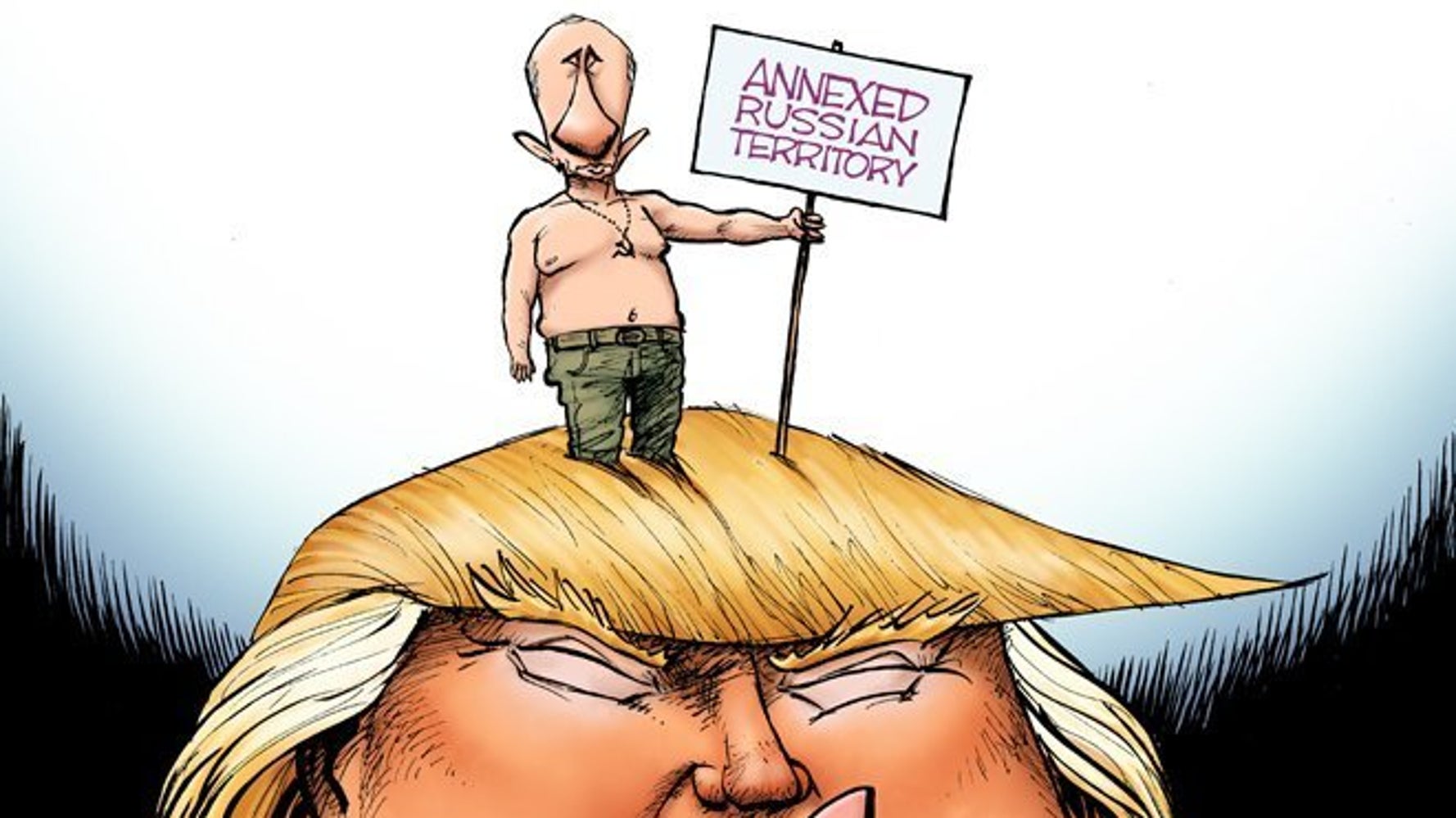
Presidential power. It’s really a big deal, for a number of reasons. Some of those reasons are specific to the intelligence community, but the more general issue is that Trump is redefining presidential power in a way that is moving us ever closer to a Putin-style autocracy. He has been pushing in that direction almost from the moment he took office, but this is a major new step.
During the last two years, a number of books have come out about how a republic can degrade into an autocracy. Studying the ominous examples of Russia, Hungary, Turkey, and Poland, we see that none of them had a revolution or a coup, and all of them still have elections and parliaments and many other trappings of democracy. Nonetheless, in each of them the essence of republican government is either entirely gone or significantly diminished. How does that happen?
The answer is through the erosion of norms, those underlying principles so basic that constitutions don’t even mention them, or the common-sense practices that enforce those principles. Norms are not written laws and cannot be enforced by courts. They are largely unarticulated traditions that are enforced politically, through public outrage.
Since he took office, Donald Trump has broken a lot of norms. That’s a fancy way of saying that he doesn’t act the way we expect presidents to act. His insult-laden tweet storms, his intertwining of public and private business, his lack of financial transparency, his lack of shame when he denies some obvious fact or contradicts today what he said yesterday (or even a few minutes ago) — it’s all either brand new or on a scale that we’ve never seen before.
But how much of it matters? Breaking a norm might just be a change in personal style, or even a breath of fresh air. Or it might be dangerous. How do we tell the difference?
Here’s a norm that is key to separating a republic from an autocracy: In a republic, executive powers are tied to executive responsibilities. In an autocracy, executive powers are personal prerogatives, subject to the whim of whomever the Executive happens to be.
Revoking John Brennan’s security clearance is the clearest example yet of Trump’s autocratic view of executive power. Presidents have power over security clearances because they are responsible for safeguarding the nation’s secrets. But Brennan, and the other government or ex-government officials whose clearances Trump threatens to revoke next, have not even been accused of endangering classified information. Trump is just taking a swing at people he sees as his enemies.
In other words, he’s treating his power over clearances as a personal prerogative, rather than as a public trust that must account for.
It’s not the only power he’s been using that way.
Pardons. The Constitution grants the president the pardon power (except in cases of treason) and says nothing about how to use it. But traditions going back to Federalist #74 explain its purpose: to correct injustice and show mercy.
The criminal code of every country partakes so much of necessary severity, that without an easy access to exceptions in favor of unfortunate guilt, justice would wear a countenance too sanguinary and cruel.
In other recent administrations, there has been a process that starts with the Pardon Attorney at the Department of Justice. You apply, the Pardon Attorney studies your case, and recommendations wind their way up to the president, who makes the final decision.
Trump, by contrast, views pardons as Get Out of Jail Free cards that he carries in his pocket. There was nothing unjust or cruel in the criminal convictions of Joe Arpaio or Dinesh D’Souza. Arpaio willfully violated a court order, and D’Souza funneled campaign contributions through straw donors. Arpaio was facing at most six months in prison and D’Souza got no prison time at all.
Both were pardoned because they were political allies of the President. Arpaio appeared at Trump campaign rallies in Las Vegas and Phoenix, and spoke at the Republican Convention. D’Souza is paying Trump back for his generosity with a new film that equates Trump with Lincoln and the Democrats with Nazis.
The Office of the Pardon Attorney seems to have played no role in either decision. Trump just wanted to pardon these guys, so he did. He routinely tosses around thoughts of pardoning other people (like Martha Stewart) with no process and for no particular reason. (Possibly Trump thinks pardoning Stewart would strike a blow against James Comey, who prosecuted her.)
Law enforcement. Trump has frequently put forward the point of view that Attorney General Jeff Sessions should be working for him rather than for the United States. Again and again Trump has faulted Sessions for failing to “protect” him from the Russia investigation. Again and again he has complained that the Justice Department should be investigating his enemies, not his friends. “I have absolute right to do what I want to do with the Justice Department,” he told The New York Times.
The most obvious example of Trump doing “what I want” with the Justice Department was the firing of FBI Director James Comey. FBI Directors have 10-year terms precisely to insulate them from political interference. The only other time an FBI Director has been fired was when President Clinton fired William Sessions in 1993. That FBI director had “stubbornly refused to resign despite Justice Department ethics findings that he abused his office”.
The Justice Department report found, among other things, that [William] Sessions had engaged in a sham transaction to avoid paying taxes on his use of an FBI limousine to take him to and from work, that he had billed the government for a security fence around his home that provided no security and that he had arranged business trips to places where he could meet with relatives.
Comey had been accused of misjudgments, but no ethical lapses. He seems to have be fired for his role in the Russia investigation.
Tariffs and Immigration. During the Kennedy administration, the Trade Expansion Act granted the President power to impose tariffs on products “being imported into the United States in such quantities or under such circumstances as to threaten or impair the national security”. Before Trump used it to raise tariffs on steel and aluminum, that power had been dormant since 1982. You could sort of imagine how it might apply to imports from rival powers like China or Russia: What if our ability to build fighter jets depended on getting aluminum from Russia? But Trump put tariffs on Canadian aluminum as well. Seriously? It threatens national security if we become dependent on Canadian aluminum?
Well, no, and Trump has admitted as much in a tweet: “Our Tariffs are in response to [Canada’s] of 270% on dairy!” The dairy industry, I will point out, does not have national-security significance. But the law has given Trump a power, so he uses it as he pleases.
The Muslim Ban is another example. During the campaign, Trump announced:
Donald J. Trump is calling for a total and complete shutdown of Muslims entering the United States until our country’s representatives can figure out what is going on.
Imposing a religious test on people entering the country is completely unconstitutional, and the first two versions of his Muslim Ban were overturned by the courts. But the administration studied to determine how much of a Muslim Ban could be shoe-horned into presidential powers that existed for other reasons. The Supreme Court, to its shame, has let them get away with this. Lawfare’s Susan Hennessy comments:
The President of the United States expresses in his own words that he is motivated by racial and religious animus — so he says, “I am enacting this immigration policy because I want to prevent Muslims from entering the country”. He says that clear as day. He says it multiple times. And then, the Department of Justice offers a different reason for that. They say, “No. This is within the President’s appropriate authority regarding immigration. This has a real security rationale.” And then the President again and again, even after those filings, not only does not disavow his statements, but makes them again and reaffirms them.
[The issue is] whether or not the Court, which traditionally extends deference to the executive branch says, “Well, we’re going to believe what you say. We’re going to examine the facial representation that you’re making about why you’re doing this.”, whether or not they’re allowed to look beyond the pure formal actions, at what the President is saying. So what the Court decided was: No, they are going to continue to extend traditional national security deference to the Executive, even in the face of blatant, open contradiction by the Executive himself.
And so that case really is an example of elevating legal formalism above the plain facts. And that is something where Trump really has been able to quite strategically and shrewdly play institutional commitments to these deeper principles against the very institutions themselves. It’s allowed him to get away with things — and get away with things really brazenly and openly — that I think even three years ago we would have said was impossible.
Security clearances. The security clearance process exists for a reason: to determine who is or isn’t likely to protect classified information.
At various times in a previous career, I held Secret and Top Secret clearances (which have lapsed; I currently have no clearances and don’t need or want any). To get those clearances, I submitted ID information, told the government where I’d lived, listed references of people who knew me there, and gave dates and reasons for every time I’d left the United States. I answered questions about my finances and what drugs I’d used. The themes of the investigations were easy to trace: Am I who I claim to be? Am I generally a responsible person? Am I vulnerable to foreign influence or blackmail?
No one ever asked me who I voted for or whether I supported the current administration. (I got my first clearance during the Reagan administration, which I did not support.) Whether I believed in the American system of government was deemed important, but whether I agreed with the current president wasn’t.
That’s how we do things in America.
But that’s not how Trump does things. The president sits at the top of the executive branch, and consequently he is the ultimate arbiter of every executive process, including the clearance process. So he has the power to grant and revoke security clearances.
I know of no case where any previous president has gotten directly involved in these decisions, but I can imagine how it might become necessary. (In case of a military coup attempt, for example, the president might need to freeze the conspirators out of the government without taking the time to go through any formal process.)
None of the circumstances I can imagine, though, apply to the Brennan situation: No one questions his loyalty to the United States or his discretion in protecting classified information. He is not involved in any emergency that requires quick action, or in some unique circumstance that the ordinary clearance-reviewing processes can’t handle. He’s just somebody the President doesn’t like.
Trump himself explained removing Brennan’s clearance to the Wall Street Journal like this:
I call [the Trump/Russia investigation] the rigged witch hunt, [it] is a sham,” Mr. Trump said in an interview. “And these people led it! So I think it’s something that had to be done.
“These people” include everyone else involved in launching the investigation: James Clapper, James Comey, Michael Hayden, Andrew McCabe, Bruce Ohr, Lisa Page, Susan Rice, and Sally Yates. Press Secretary Sarah Sanders read a presidential statement saying that their clearances are being reviewed as well.
Trump doesn’t like being investigated, and he has power over security clearances, so he’s using that power to strike back at the people he blames for the investigation. This is not some cynical interpretation of Trump’s actions; it’s what he and his people are openly saying. (If you want a cynical interpretation, Rachel Maddow has one: Trump’s targets aren’t just the people who started the investigation, they are also potential witnesses in an impeachment hearing. Without clearances, they will be unable to review their own files from the relevant period before testifying, and so will be less effective witnesses against Trump.)
George W. Bush’s CIA Director Michael Hayden, who also finds himself on Trump’s enemies list, draws an obvious conclusion:
The White House just messaged the entire American intelligence community if you stand up and say things that upset the president or with which he disagrees, he will punish you. And that is a horrible message to be sending to folks who are there to tell you objective truth.
Just as the Republican appointees on the Supreme Court averted their eyes from the improper history of the Muslim Ban, Republicans in Congress are finding excuses to support Trump now. Senator Orrin Hatch, for example, responded by saying “I’m surprised it took him so long. Brennan has not been a friend of the administration at all.” But Hatch knows that under no previous president has being “a friend of the administration” been a factor in whether or not you held a clearance. Until Trump, it would have been scandalous to suggest that it should be.
And Rep. Jim Jordan of the House Autocracy Freedom Caucus fully embraces Trump’s autocratic view of clearances:
I don’t even see frankly why there is a debate. If the commander in chief of the United States thinks these people should have their clearance revoked, I don’t see why they should have their clearance.
No process, no criteria — security clearances are just a matter of the president’s personal whim, and are not related to any presidential responsibility.
Where this goes. It’s easy to go wild on slippery-slope arguments. (That’s what the NRA does with gun control. Any restrictions on assault rifles will inevitably lead to complete public disarmament, leaving us all at the mercy of armed police and criminals.) At the same time, sometimes there are slippery slopes, and each concession you make puts you in a worse position to fight future concessions. Principles make good lines in the sand: Once you start accepting violations of the principles, you lose your most easily defended positions.
The abstract principle here is that presidential powers are not personal prerogatives, they are tied to presidential responsibilities. In this case, the president’s power over security clearances is tied to his responsibility for securing the governments’ secrets. Any security-clearance decision that can’t be justified in those terms is illegitimate, even if it is technically legal.
If we lose this principle, if Trump is allowed not just to occasionally rationalize his way around it, but to openly deny it and pay no price, then I honestly don’t know where this slide towards autocracy stops. Looking at the way Republicans like Hatch and Jordan are defending Trump, and the many other Republicans (like Paul Ryan) who are dodging the question of his autocratic inclinations, it’s hard to argue with Paul Krugman’s vision:
Make no mistake: if Republicans hold both houses of Congress this November, Trump will go full authoritarian, abusing institutions like the I.R.S., trying to jail opponents and journalists on, er, trumped-up charges, and more — and he’ll do it with full support from his party.
Some examples of Trump’s autocracy are complicated. This one isn’t. If Republicans won’t stand up to Trump here, where does it stop?
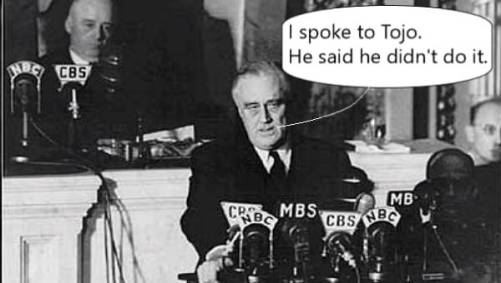


 [2] This might be a good place to mention how much heat President Obama took for his so-called “apology tour”.


 Someday — maybe sooner, maybe later — Bob Mueller is going to issue his report on the Trump campaign’s relationship with Russia, whether Trump has been attempting to obstruct justice, and possibly other Trump-related scandals. When that happens, Congress and the American people will have to look at what has been found and decide what to do about it. Is it enough for an impeachment or not?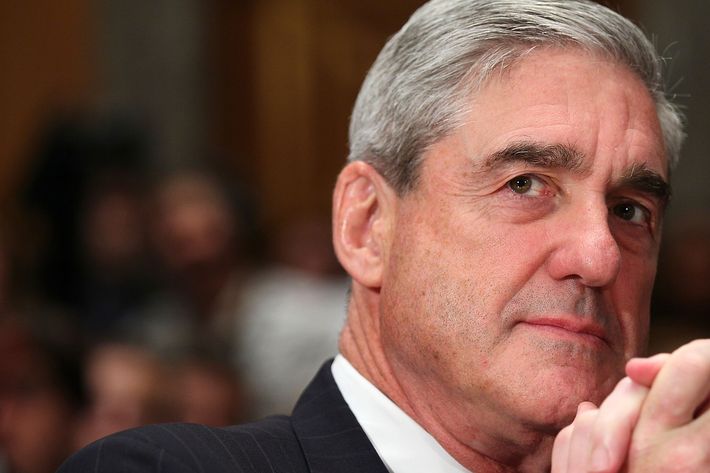



 The Weekly Sift