Tag Archives: law

Replacing Scalia (or not)

As I pointed out last week, the Constitution is pretty clear about what should happen now: President Obama should nominate a replacement and the Senate should either approve or disapprove of the nominee’s ability to handle the job. (Article II, Section 2 says “he shall nominate”. The shall indicates a duty, rather than may, which would offer an option.)

Retired Justice Sandra Day O’Connor (appointed by President Reagan) sees it that way. Asked whether the process should wait until we have a new president, she said: “I don’t agree. I think we need somebody there now to do the job, and let’s get on with it.”

When Alexander Hamilton defended the Constitution’s appointment process in Federalist #76, he expected the Senate to examine an individual nominee’s character and ability, but never considered the possibility that the Senate might engage in the kind of blanket obstruction Republicans are proposing.

But might not [the president’s] nomination be overruled? I grant it might, yet this could only be to make place for another nomination by himself. The person ultimately appointed must be the object of his preference, though perhaps not in the first degree. It is also not very probable that his nomination would often be overruled. The Senate could not be tempted, by the preference they might feel to another, to reject the one proposed; because they could not assure themselves, that the person they might wish would be brought forward by a second or by any subsequent nomination. They could not even be certain, that a future nomination would present a candidate in any degree more acceptable to them; and as their dissent might cast a kind of stigma upon the individual rejected, and might have the appearance of a reflection upon the judgment of the chief magistrate, it is not likely that their sanction would often be refused, where there were not special and strong reasons for the refusal.

But, as I have often pointed out before, republics don’t run just on their rules, but also on their norms and mores. So it’s legitimate to wonder whether there might be some long-standing gentlemen’s agreement or common courtesy that would prevent Obama from nominating Scalia’s replacement. The answer is pretty clearly no. Republicans have been claiming all sorts of unwritten rules to that effect, all of which resemble the rules of Calvinball.

It is true that there have not been a lot of election-year Supreme Court vacancies. (I assume justices see an election year as an inconvenient time to retire, though I don’t really know.) The closest recent example is the vacancy filled by Justice Kennedy: Justice Lewis Powell retired in June, 1987, and Kennedy was not confirmed until February, 1988 — President Reagan’s last year in office. (The delay was caused by the Senate’s refusal to confirm Robert Bork, and then by the withdrawal of Reagan’s second nominee.)

If you go further back, you get clearer parallels: Presidents Taft, Hoover, and Franklin Roosevelt nominated justices in election years and got them confirmed. Wilson got two justices confirmed in 1916. Eisenhower (1956) and Johnson (1968) failed to get their election-year picks confirmed but (according to Amy Howe of SCOTUSblog) “neither reflects a practice of leaving a seat open on the Supreme Court until after the election.” In Eisenhower’s case, the Senate was already adjourned for the fall campaign (so he made a recess appointment). Johnson’s pick was the target of a bipartisan filibuster, having to do with the nominee’s ethical issues.

No one has come up with an example that supports the Republican position: a Supreme Court seat that was left open for a year to allow the next president to fill it. That would be unprecedented in the last 150 years.

There is also no unwritten rule saying that a new justice should fill the same ideological role as the justice s/he replaces. Arch-conservative Clarence Thomas, for example, replaced one of the Court’s most liberal judges, Thurgood Marshall.

It’s worth pointing out that even if any of these unwritten rules really existed, Senate Republicans are in a poor position to claim them. Throughout the Obama administration, they have blasted through the previous norms and mores of Senate behavior: making the filibuster routine; blocking nominees not for individual reasons, but in order to screw up the organizations they were supposed to head; brinksmanship with the debt ceiling; and many other examples. They have consistently refused to be bound by any unwritten rules of courtesy, so why should they get the advantage of one now?


There have been several attempts to claim hypocrisy on the part of Democrats who want to follow the constitutional process. One frequently cited example is a 2007 quote from Chuck Schumer to the effect that the Democratic Senate “should not confirm any Bush nominee to the Supreme Court except in extraordinary circumstances.”

Two things stand out about that: First, no more vacancies came up during Bush’s term, so we don’t know to what extent Schumer (who was just an ordinary senator at that time, and spoke only for himself) was just posturing in front of a liberal audience. (If today’s Republicans posture about blocking all nominees, but then go ahead and do their constitutional duty anyway, that would be fine.) Second, the quote is plucked out of its context, as Josh Marshall explains (with video of Schumer’s remarks):

What Schumer actually said was that Senate Democrats had been hoodwinked by President Bush’s first two Supreme Court picks – Roberts and Alito. They’d accepted assurances that they were mainstream conservative judges who would operate within the precedents and decisions of the Rehnquist Court but hadn’t. (Certainly, the experience since 2007 has more than ratified this perception.) Schumer said Democrats should try to block any future Bush nominees unless they could prove that they were ‘in the mainstream’ and would abide by precedent. …

Schumer quite explicitly never said that the Bush shouldn’t get any more nominations. He also didn’t say that any nominee should be rejected. He said they should insist on proof based on judicial history, rather than just promises that they were mainstream conservatives rather than conservative activists, which both have proven to be. But again, set all this aside. He clearly spoke of holding hearings and being willing to confirm Bush nominees if they met reasonable criteria.

Another attempt is to cite a 1960 sense-of-the-Senate resolution which the conservative American Thinker blog characterizes as “against election-year Supreme Court appointments”.

Except that’s not what it says. The resolution opposed recess appointments to the Supreme Court, which put a justice on the Court temporarily without Senate approval, not election-year appointments. Since Obama is not making a recess appointment — Republicans having fought tooth-and-nail to limit Obama’s recess-appointment power — the 1960 resolution has no connection to the current situation.


A tweet from Ken Wissonker puts a different slant on the wait-for-the-next-president idea:

As a friend put it: “Apparently, the GOP thinks that Black Presidents only get 3/5ths a term.”

The attempt to imply that Obama’s nominee will somehow be illegitimate is part of the larger effort to de-legitimize Obama’s entire presidency. And it’s hard to escape the conclusion that race has played a role in this project.

From the beginning, his opponents have never granted Obama the respect due a president of the United States. Whether it’s shouting “You lie!” during the State of the Union, or encouraging members of military to refuse orders, or spreading baseless rumors about his birth or religion, or complaining whenever he does things all presidents do, or expressing frustration that impeachment requires evidence, or warning foreign leaders not to make agreements with him — the consistent message has been that Barack Obama is not a legitimate president of the United States.

So we elect our first black president, and he’s treated with less respect than all previous presidents. Who could have guessed?

Is Kim Davis a Martyr?

Thursday, the story of the Kentucky county clerk who refused to issue marriage licenses (now that same-sex couples can marry) reached its inevitable conclusion. Having been turned away by the Supreme Court, Davis was out of legal options for delaying the moment of truth: She had to either obey a court order to issue marriage licenses, including licenses to same-sex couples, or be in contempt of court.

She chose contempt and has been jailed, while her office has begun issuing licenses in her absence. Federal Judge David Bunning had the lesser option of fining her, but concluded (correctly, I think) that fines would simply delay the resolution of the case: Davis would not pay them and would continue showing contempt for the court’s order, forcing Bunning to jail her at some later date.

Response. Presidential candidates courting the religious-right vote immediately began characterizing Davis as a martyr for her beliefs. Ted Cruz issued a statement beginning with this line:

Today, judicial lawlessness crossed into judicial tyranny. Today, for the first time ever, the government arrested a Christian woman for living according to her faith.

Mike Huckabee compared Davis to Abraham Lincoln, who “disregarded the Dred Scott 1857 decision that said black people aren’t fully human.” [1] He also tweeted that “Kim Davis in federal custody removes all doubts about the criminalization of Christianity in this country”, and is planning a rally tomorrow outside the jail where she’s being held. (Some other Republican candidates have been less supportive. Lindsey Graham has been the most blunt: “As a public official, comply with the law or resign.”)

Other voices on the right portray Davis in larger-than-life terms. RedState.com founder Erick Erickson sees her case as a harbinger of civil war. Conservative Review‘s Daniel Horowitz casts Davis as this era’s Rosa Parks, and Steve Deace wants her to run for president. (Critics compare her to a different character in the civil rights movement: George Wallace standing in the doorway of the University of Alabama, unsuccessfully trying to block integration.)

Martyrdom. The Christian tradition is rich with martyr stories, going all the way back to the stoning of Stephen and the imprisonment of Paul in the New Testament. In the Lutheran school I attended through eighth grade, we were sometimes asked to imagine facing a choice between denying our faith and punishment or death. (I have heard similar stories from Catholics.) Like Muslim suicide bombers, we were promised glories in Heaven that would more than compensate for any earthly suffering.

But is that what’s happening here? Does Kim Davis deserve the enthusiastic admiration of conservative Christians, and even the grudging respect of those who disagree with the stand she’s taking? Or is she undermining the rule of law and usurping the powers of her office to implement her personal religious agenda? [2]

What the judge said. Before deciding that question, it’s worthwhile to examine the court order she’s defying. In that order, Judge Bunning considers Davis’ arguments and explains why he is rejecting them.

Davis argues that by signing a license for a same-sex marriage, she would be expressing approval of such marriages, which her religion denies. Bunning counters:

The form does not require the county clerk to condone or endorse same-sex marriage on religious or moral grounds. It simply asks the county clerk to certify that the information provided is accurate and that the couple is qualified to marry under Kentucky law. Davis’ religious convictions have no bearing on this purely legal inquiry.

(Let me amplify that a little: Marriage-under-the-law and marriage-in-the-eyes-of-God have always been two different concepts. No one is asking Davis to affirm that same-sex marriages are valid in the eyes of God.)

A footnote spells out what the legal qualifications are:

A couple is “legally qualified” to marry if both individuals are over the age of eighteen, mentally competent, unrelated to each other and currently unmarried.

Davis also protests on free-speech grounds, claiming that an order that she sign the license form is compelled speech banned by the First Amendment. Bunning disagrees:

Because her speech (in the form of her refusal to issue marriage licenses) is a product of her official duties, it likely is not entitled to First Amendment protection.

In support of this view, he quotes a precedent from 1971:

When a citizen enters government service, the citizen by necessity must accept certain limitations on his or her freedom.

And Bunning does not see a violation of the First Amendment’s free-exercise-of-religion guarantee:

Davis remains free to practice her Apostolic Christian beliefs. She may continue to attend church twice a week, participate in Bible Study and minister to female inmates at the Rowan County Jail. She is even free to believe that marriage is a union between one man and one woman, as many Americans do. However, her religious convictions cannot excuse her from performing the duties that she took an oath to perform as Rowan County Clerk.

Bunning does not mention this quote, but the principle goes back to an 1892 decision in which Oliver Wendell Holmes ruled against a policeman fired for something he said:

The petitioner may have a constitutional right to talk politics, but he has no constitutional right to be a policeman.

Davis is perfectly free to practice her religion in her personal life, but when she assumes the role of a public official, she has to act according to law. [3]

Cashing in? Hypocrisy? It’s a safe bet that St. Paul’s imprisonment wasn’t part of his grand plan to become a celebrity and get rich. But Dan Savage has been making this prediction since Davis first hit the headlines:

No one is stating the obvious: this isn’t about Kim Davis standing up for her supposed principles—proof in a moment—it’s about Kim Davis cashing in. There’s a big pile of sweet, sweet bigot money out there waiting for her. If the owners of a pizza parlor could raise a million dollars just by threatening not to cater the gay wedding no one asked them to cater… just imagine how much of that sweet, sweet bigot money Kim Davis is going to rake in. I’m sure Kim Davis is already imagining it.

In an interview on MSNBC, Savage spelled it out:

She will have written for her a ghost-written book, she will go on the lecture circuit, and she’ll never have to do an honest day’s work again.

Savage’s “proof in a moment” is a reference to Davis’ own checkered marital history: She’s been married four times and divorced three times, a practice which (unlike homosexuality) is explicitly condemned by Jesus in the Gospels.

Ad hoc purity. I have a more general complaint than hypocrisy, one that applies not just to government officials like Davis, but also to the baker [4] and florist who have been claiming persecution when they are not allowed to discriminate against same-sex couples: Their position relies on two principles, and one of them they just made up for this purpose.

The first principle is the one right-wing Christians always want to focus on: Homosexuality is sinful. Whether or not the rest of us agree, it’s incontestable that they believe it and have for a long, long time.

But since no one is asking them to commit homosexual acts, that principle by itself doesn’t create an issue. Their position requires a second principle: Christians should live according to a standard of purity that doesn’t allow them to involve themselves in other people’s sins.

Kim Davis has to imagine a pretty broad purity zone around herself, if verifying that two men are “over the age of eighteen, mentally competent, unrelated to each other and currently unmarried” involves her in the sin of their homosexuality. And the bakers who won’t sell a cake to a same-sex wedding reception — giving them no connection whatsoever to the actual marriage ceremony — must have an even broader purity zone.

Religious purity.

Now, there are religious people who try to live their lives according to extremely high standards of purity (like the Jain monks who wear masks so as not to kill any tiny insects they might otherwise breath in). But that does not include any of the right-wing Christians who are claiming persecution. Their Christian practice did not require an expanded purity zone until now, and even now it only applies to situations that involve gays.

For example, apparently the clerks who gave Kim Davis her marriage licenses didn’t balk at the fact that (according to Jesus) some of those marriages were adulterous. I’ll bet she didn’t have any trouble renting a hall or buying flowers or cakes. Even the most conservative Christians simply didn’t care about this kind of purity before same-sex marriage became legal, and still don’t care about it in any other context.

Here’s what that says to me: This isn’t about religion, not when it depends on a “sincerely held belief” that was invented solely for this purpose. So either it’s about personal animus against gays, or it’s about protesting the politics of same-sex marriage. Neither is the kind of moral or constitutional issue that Kim Davis’ defenders want to make it.


[1] I’m not sure which act of Lincoln’s Huckabee is referring to, and I suspect he doesn’t know either. Dred Scott laid out some general principles about slavery before Lincoln was elected, but what specifically did the Supreme Court order Lincoln to do? How did he defy that order?


[2] As satirized in this image and this story from The Onion. I suspect conservative Christians are picturing a world in which only conservative Christian public officials have the right to bend their duties around their religion. But a friend suggested this example, which corresponds pretty well to the Davis case: What if a Jewish meat inspector decides that his religious convictions require him to reject all pork? I’ve also seen this example: What if an official refuses to issue hunting and fishing licenses, because he takes “Thou shalt not kill” literally?

Some of the Kim Davis satire doesn’t have a political point, it’s just funny. For more humor, check out the hijacked #FreeKimDavis tag on Twitter.

[3] A common complaint by conservative pundits is that liberals are fine with liberal officials ignoring laws. President Obama’s recent executive orders on immigration are a frequently cited example. But there are some significant differences between the two cases, as becomes clear when you compare the justifications.

Obama’s action is justified in a memo from the Justice Department’s Office of Legal Counsel (which I summarized at the time). Unlike Davis, the OLC memo never appeals to an authority higher than the law.

Instead, the memo outlines the executive branch’s strategy for handling the impossible situation Congress has created: The law would deport 11.3 million undocumented immigrants, but Congress has provided funding for dealing with only a tiny fraction of that number. Consequently, the administration must prioritize whom to deport.

When a court disagreed with the administration’s reasoning and issued an injunction against parts of the order, the administration stopped implementing it — except for one mix-up, which is being rectified without the judge needing to fine or jail anyone for contempt.

[4] As Dan Savage might have predicted, the bakers have made out like bandits. In the United States, being persecuted as a Christian is extremely profitable.

Two Cheers for Justice Kennedy

By all means, celebrate. But, looking to future gay-rights cases, Justice Kennedy gave us more rhetoric than precedent.


Friday, the Supreme Court ended the decades-long legal debate on marriage equality, making same-sex marriage legal for the entire nation in Obergefell v Hodges. Across the country, supporters of gay rights were jubilant as they read to each other delicious paragraphs out of Justice Kennedy’s majority opinion. But I have a complaint: Justice Kennedy got the right result for the wrong reasons, and that will eventually cost us.

Not in other marriage cases — that’s over, just like everybody says. But Kennedy’s soaring rhetoric about the dignity of gay relationships wasn’t supported by a sound legal framework that we can use in, say, employment equality cases.

The DOMA hangover. As regular Sift readers know, I have mixed feelings about Justice Kennedy, particularly on the subject of gay rights. He tends to rule the way I want, and he’s often the swing vote that puts my position over the top. But being the swing vote, he usually ends up writing the majority opinion, and he writes it badly. That’s what happened when the Court threw out the Defense of Marriage Act (DOMA) two years ago, which I covered (along with Chief Justice Roberts’ hamstringing of the Voting Rights Act) in an article I demurely called “This Court Sucks“. And it happened again Friday.

The reason Obergefell came to the Court in the first place was that lower courts could not follow Kennedy’s mushy reasoning in the DOMA case. The Supreme Court is supposed to do more than just decide the current case, it’s supposed provide interpretive frameworks for lower courts to apply, so that future cases can be decided without involving the Supremes again. But when Judge Kean was throwing out Oklahoma’s ban on same-sex marriage, for example, he wrote that he had “gleaned” — not quoted, gleaned — two principles from Kennedy’s DOMA opinion. Other courts gleaned other principles and disagreed, so the highest court had to sort it out.

This time, Kennedy has made marriage equality the law of the land, but he’s done it with another piece of mushy reasoning that is a poor climax to the distinguished series of lower-court decisions supporting same-sex marriage, going all the way back to the 2003 Goodridge decision in Massachusetts. Instead of following the compelling logic laid out by one lower court after another, Kennedy’s opinion looks like exactly what critics of marriage equality say it is: a judge redefining marriage according to his own values. His ruling is full of beautiful tributes to the dignity of same-sex couples, but short on the kind of step-by-step legal thinking you can find in the lower-court rulings, which I summarized last month.

Due process isn’t enough. Every pro-marriage-equality judge I know of, other than Kennedy, has centered the argument on the 14th Amendment‘s guarantee of “the equal protection of the laws”. As I summarized:

In practice, that phrase has been interpreted to mean that if the government treats some people differently than others, it has to have a good reason. The more significant the discrimination, the weightier the reason needs to be.

That’s why laws that provide a marriage option to opposite-sex couples but deny it to same-sex couples are in trouble: because it’s increasingly hard to say what legitimate reason the government might have for that discrimination.

… So the claim that gays and lesbians want to “redefine marriage” has it exactly backwards. During the last century-and-a-half, marriage has already been redefined. And in marriage as it exists today — rather than during the Revolution or the Civil War — what’s our justification for refusing its advantages to same-sex couples?

Instead, Kennedy focuses on the 14th Amendment’s due-process clause, and finds a fundamental right to marry in the word liberty. His rhetoric is inspiring if you already agree with him, but if you don’t, his reasoning isn’t compelling. The dissents by Roberts, Thomas, Scalia, and Alito eviscerate his argument, and rightly so.

Kennedy’s biggest problem is that the Constitution doesn’t require governments, either federal or state, to recognize marriage at all. (If Oregon wanted to become “the free love state” and stop performing marriages entirely, that would be up to Oregonians.) Liberty traditionally means being left alone by the government, not that the government must help you in some way. So Roberts makes an argument that appears in some form in all the dissents:

Our cases have consistently refused to allow litigants to convert the shield provided by constitutional liberties into a sword to demand positive entitlements from the State.

The question Kennedy should have raised is: Once the State has defined the “positive entitlement” of marriage for some people, what’s its justification for denying those benefits to others? But that’s an equal-protection issue, not a liberty issue.

In short: the ruling came out the right way, but the people who still want to hold out against marriage equality feel vindicated in their view that the Court has usurped the power of the legislative branch by “redefining marriage”. It didn’t have to be like this. Why, oh why, couldn’t Justice Ginsburg have written this ruling?

Why it’s important. The lower courts nearly all used the equal-protection framework: Define a level of scrutiny appropriate to laws that discriminate against gays, and then examine the government’s reasons for discriminating under that level of scrutiny. One of the issues to decide, if you go that way, is whether gays and lesbians are a class that has traditionally faced discrimination, and so how much benefit of the doubt a legislature or electorate should get as to its motives.

Racial discrimination, for example, faces the highest level of scrutiny. As a matter of judicial precedent, laws that discriminate against traditionally disadvantaged racial groups are inherently suspect. Similarly, laws that discriminate against women are inherently suspect. It’s possible that some particular race- or gender-discriminating law can be justified, but a court will not give the government any benefit of the doubt.

The traditional discrimination against gays and lesbians certainly would justify giving laws against them some heightened level of scrutiny, but the Supreme Court has never done so. Kennedy doesn’t do so either.

Pro-marriage-equality judges who don’t invoke heightened scrutiny are forced to give the legislative branch the benefit of the doubt. And so they end up having to argue that same-sex marriage bans are completely irrational. That argument has been made, and was sitting there for Kennedy to endorse. He didn’t.

Going either way would have established a precedent for fighting other anti-gay discrimination: Either anti-gay discrimination would face heightened scrutiny in the future, or there would be a precedent for saying that certain kinds of anti-gay discrimination are irrational.

Instead, Justice Kennedy gave us just this result, justified by a lot of effusive rhetoric that has no further legal consequences.

The “threat to American democracy”. All four dissents lamented a judicial usurpation of powers properly belonging to the democratic branches — which is in fact a fair criticism of the argument Kennedy made. The place for flowery rhetoric is in the legislature or on the campaign trail. But it wouldn’t have been a fair criticism of the equal-protection argument Kennedy avoided.

Dahlia Lithwick raised the right question:

And all I could keep thinking was, “Where was all this five unelected judges chatter when you all handed down Citizens United? Or Shelby County? Why does this rhetoric about five elitist out-of-touch patrician fortune-cookie writers never stick when you’re in the five?”

The most-quoted Roberts line was:

Indeed, however heartened the proponents of same-sex marriage might be on this day, it is worth acknowledging what they have lost, and lost forever: the opportunity to win the true acceptance that comes from persuading their fellow citizens of the justice of their cause.

If you’re a straight person very distant from the gay community, this might sound convincing. But if you imagine yourself in the place of a same-sex couple, it isn’t convincing at all. Would you rather have widespread social approval ten years from now, or the equal protection of the laws today? The answer is pretty obvious.

The comparison to interracial marriage is apt. XKCD draws the chart:

Our fellow citizens are being persuaded of the justice of marriage equality — not, for the most part, by referendum campaigns, but by living in society with same-sex couples. That process will continue apace.

In these the-sky-will-fall-if-we-allow-this situations, most people have to see something in action before they realize the panic-mongers are conning them. As I predicted back in 2003:

Personally, I expect the same-sex marriage issue to follow the same course as interracial marriage. After a few years of Chicken-Little panic, the vast majority of Americans will recognize that the sky has not fallen, and that the new rights of homosexuals have come at the expense of no one.

Today, no one cares how interracial couples got the right to marry. Most young people have trouble believing it was ever an issue. (Have you ever tried to explain to a teen-ager why his friend’s parents’ marriage would have been illegal 50 years ago? I have.) So it will be for same-sex marriage.

Turning the Theocracy Against Itself

What happens when atheists claim the new kind of “religious freedom”?


Ever since the Tea Party sweep of 2010, conservative Christians have been on offense in state legislatures, pushing a variety of laws that distort religious freedom — a fine principle that goes back to the foundation of our country — into something the Founders would not recognize at all: the power (not freedom) to shape society so that it doesn’t rub Christians the wrong way.

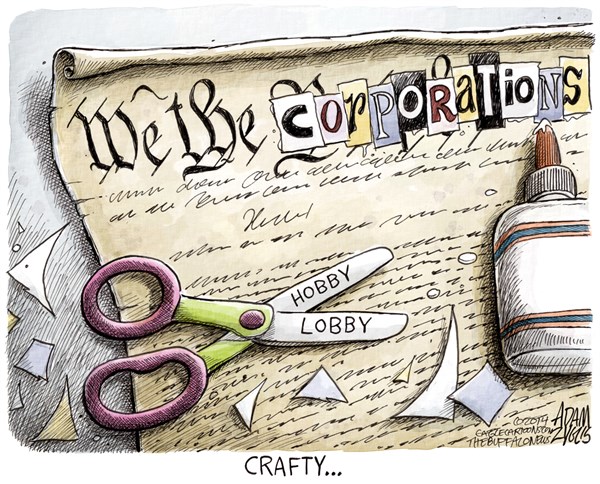
The hole in this “religious freedom” rhetoric is that in practice only Christians (and only certain kinds of them) can wield such power. The people who push these laws are shocked whenever someone wants to extend the same kind of consideration to, say, Muslims or atheists. (Muslims, after all, can’t even take for granted the original meaning of religious freedom, which included the ability to build a house of worship.) Justice Alito’s majority opinion in the Hobby Lobby case more-or-less just laughed off the idea that employers with less mainstream religious views — Christian Scientists, say, who reject virtually all modern medicine — might claim the right to control their employees’ health insurance too.

In recent months progressives have been playing whack-a-mole with anti-gay “religious freedom” laws in various states, threatening boycotts and mostly succeeding in avoiding the worst.

But the way the new “religious freedom” will ultimately be brought down is to force courts to consider its laws in the light of the 14th Amendment’s guarantee of “equal protection under the law”. If “religious freedom” laws end up giving atheists and Muslims the same consideration Christians are claiming, Christians will repeal those laws themselves.

In other words, non-Christians need to insist — in court — that society shouldn’t rub them the wrong way either. There will often be an aspect of the ridiculous in these cases, like the statue Satanists want to install on the grounds of the Oklahoma statehouse, now that religious statues are allowed.

A very interesting legal argument is being put forward by atheist Michael Newdow, who is famous for taking the case against the “under God” part of the Pledge of Allegiance to the Supreme Court, which denied his standing to sue. This time Newdow is targeting the “in God we trust” motto on the currency. (Like “under God” the motto does not go back to the Founders, who would have been horrified. It appeared on some bills during the Civil War, but wasn’t established as the national motto until 1956.)

Newdow has failed to banish “in God we trust” before, but this time he’s basing his argument not just on the Establishment Clause of the First Amendment, but on Justice Alito’s interpretation of the Religious Freedom Restoration Act.

The RFRA says:

Government may burden a person’s exercise of religion only if it demonstrates that application of the burden to the person — (1) furthers a compelling governmental interest; and (2) is the least restrictive means of furthering that compelling governmental interest.

The Hobby Lobby decision put forward a very expansive notion of what it means to “burden a person’s exercise of religion”. It used to just mean things like forcing Jews to work on Saturday or lose their jobs. But the Hobby Lobby decision extended it to forcing a corporation to fund health insurance that its employees might choose to use in ways that the offend the corporate owners.

Newdow argues that under this expansive interpretation, the government burdens atheists’ exercise of religion when it forces them to choose between

  • carrying around and distributing pieces of paper saying they trust in God,
  • forgoing the convenience of using the public currency.

And since putting “In God we trust” on the currency accomplishes no useful purpose whatsoever, this burden does not further any compelling governmental interest.

In case anybody out there wants to volunteer, Newdow is seeking plaintiffs from legal jurisdictions where no existing ruling supports “In God we trust”, especially Alabama, Florida, Georgia, Maine, Massachusetts, New Hampshire, Puerto Rico, and Rhode Island.

The time commitment will be minimal (as you help write the prose relevant to your particular circumstances) and there will be no obligation to provide any financial contribution … What we need mostly are families with minor children since the Supreme Court has indicated that it is more likely to uphold constitutional (and, presumably, statutory) principles when children are involved. Please be advised that the identities of any families with children will be kept “under seal” in order to protect the children from any harms.

I don’t have children, and my published opinions on God are sufficiently ambiguous that I’d make a lousy plaintiff anyway. But I’m sure there are Sift readers out there who are just perfect for the job. One of my friends was a plaintiff in one of the important religious-freedom cases of the 1960s (when religious freedom still had its original meaning). His family’s experience was more difficult than what Newdow pictures (because their name was public) but half a century later, I think he still looks back on it with pride.

Civics For Dummies: Judicial Review

Or: Why Mike Huckabee should have flunked 9th grade.


The possibility that the Supreme Court might soon rule in favor of same-sex marriage, resulting in its legality in all 50 states, is causing a certain amount of panic on the Religious Right. In response, presidential candidates whose campaigns hope to exploit that panic have been spreading dangerously ignorant ideas about the Constitution and the judicial branch of government. And, as ignorant people often do, they’ve been claiming that everyone else is ignorant, while they alone grasp the true nature of the Founders’ vision.

For example, when NewsMax asked Dr. Ben Carson about same-sex marriage, he responded:

First of all, we have to understand how the Constitution works. The president is required to carry out the laws of the land, the laws of the land come from the legislative branch. So if the legislative branch creates a law or changes a law, the executive branch has a responsibly to carry it out. It doesn’t say they have the responsibility to carry out a judicial law.

And Mike Huckabee presented a similar perspective in more detail:

Getting a decision from the Court is not tantamount to saying, “That settles it. It’s the law of the land.” And when I hear people say that I just cringe, and I’m thinking: “How many people passed 9th-grade civics?” This is not that complicated.

There are three branches of government, not one. We don’t like it if the executive branch overreaches, and pretends that it can act in indifference to the other two. And neither can we sit back and allow the Court — one branch of government — to overrule the other two.

And so when a court rules that same-sex marriage is OK, it doesn’t mean that the next day marriage licenses should be issued for same-sex couples. It simply means that if the legislature agrees with that court decision, and the representatives of the people, the elected officials, if they then put this into legislation, and it is signed and enforced by the executive branch, then you have same-sex marriage. But until those other two branches act, what you have is a court opinion and nothing else.

Clearly, Governor Huckabee’s 9th-grade civics teacher has a lot to answer for, because he seriously misunderstands how our system of government works. So let’s back up and answer a simple civics question: How does the Supreme Court come to have the power to say what laws mean and even to determine that some of them are unconstitutional?

Where judicial review comes from. People who dislike particular court rulings often imagine that this power of judicial review wasn’t in the Founders’ original vision at all; somewhere along the line the Supreme Court just usurped it. But in fact the Founders foresaw judicial review and approved.

If you want to know what the Founders thought the Constitution meant, one of the best places to look is in The Federalist, a series of essays Alexander Hamilton, James Madison, and John Jay wrote to explain the new Constitution and encourage states to ratify it. In Federalist #78, dated June 14, 1788, Hamilton wrote:

The interpretation of the laws is the proper and peculiar province of the courts. A constitution is, in fact, and must be regarded by the judges, as a fundamental law. It therefore belongs to them to ascertain its meaning, as well as the meaning of any particular act proceeding from the legislative body. … [W]henever a particular statute contravenes the Constitution, it will be the duty of the judicial tribunals to adhere to the latter and disregard the former.

So where does the power of judicial review come from? From the Founders. It goes all the way back.

Without judicial review, our constitutional rights are meaningless. This idea is easiest to explain through a hypothetical: Imagine that a Clinton landslide in 2016 sweeps in large Democratic majorities in both houses of Congress. When the new Congress takes office in January, 2017, it passes this one-sentence law:

Whereas Ben Carson and Mike Huckabee are pernicious individuals whose continued liberty is detrimental to well-informed public discourse, they shall be imprisoned in the federal penitentiary in Leavenworth, Kansas for a period of ten years.

President Hillary Clinton signs the law. Federal agents arrest Carson and Huckabee and drag them to Leavenworth. What happens next?

First, notice that even though the Carson-Huckabee Imprisonment Act of 2017 went through the process the Constitution lays out for passing a law, it is still blatantly unconstitutional. In technical terms it’s a bill of attainder, which the Constitution specifically forbids in Article I, Section 9:

No Bill of Attainder or ex post facto Law shall be passed.

But how does that fact do Carson and Huckabee any good? They can complain to the agents who arrest them. They can complain to their Leavenworth guards and cell mates. But so what? “Yeah, yeah, join the club,” they’ll be told. “Everybody in here is innocent.”

Short of counting on friends with guns to break them out, there is only one effective thing they can do: file a writ of habeas corpus, (another Article I right). In other words, Carson and Huckabee can make their jailers justify themselves before a judge. That judge then has the power to say that the Carson-Huckabee Imprisonment Act is unconstitutional. And the very instant that decision comes down, they have to be released.

Notice what doesn’t happen here: There is no “judicial law”, no Carson-Huckabee Release Act that the judge has to pass. And the judge’s ruling is not a suggestion that the other two branches might want to revise or repeal the Carson-Huckabee Imprisonment Act. Carson and Huckabee don’t have “a court opinion and nothing else”. They have their freedom.

If they didn’t, then the Constitution’s protection against bills of attainder would be meaningless. Congress could just refuse to pass a Release Act, or President Clinton could veto it, or just not get around to enforcing it. And Ben and Mike would sit in jail, no matter what rights they had in theory.

All our rights are like that. If you can’t bring your case before a judge who has the power to tell the other branches “Stop doing that right now!”, then in practical terms you don’t have any rights.

Interpretation. I intentionally made that last example simple: a one-line law that stood on its own and did something obviously wrong. But lawmakers with bad intentions are usually sneakier than that.

A much more likely scenario is that Carson-Huckabee imprisonment would be a page of legalese somewhere in the middle of a 300-page bill that built a dam and changed food-stamp requirements and made Al Sharpton’s birthday a national holiday. It wouldn’t mention Carson or Huckabee by name; it would just give the administration power to imprison people who fit some abstract description. Of the people described, only Carson and Huckabee would be worth bothering to arrest. Or maybe 100 people would get arrested, of whom 98 really would be dangerous to the public.

However it shook out, the effect would be the same: Ben and Mike would find themselves in Leavenworth without a trial. But now their habeas corpus case is more complicated, because it isn’t obvious that the Omnibus Reconciliation Act of 2017 — which contains that one significant page — is a bill of attainder. Somebody has to interpret it, and weigh its effects against the abstract definition of a bill of attainder, or against the 14th Amendment’s abstract guarantee of “due process of law”. Exactly how much “process of law” were Carson and Huckabee “due”, and did they receive it? Lawyers from the Clinton Justice Department might concoct some very slick arguments saying that they did.

And that brings us back to Hamilton: “The interpretation of the laws is the proper and peculiar province of the courts.” If the courts are prevented from doing that job, then a clever lawmaker or a hostile administration can take away your rights.

Change. Another way my example is simple is that “bill of attainder” means pretty much the same thing today as it did when the Constitution was written in 1787: a law that sends people to prison without a trial. But it’s reasonably certain that the Constitutional Convention of 1787 had no idea it might be creating a right for same-sex couples to marry, and neither did the people who drafted and passed and ratified the 14th Amendment after the Civil War.

So how can a judge “find” that right in the Constitution today? Did the Founders and subsequent amendment-drafters not understand what they were writing? Were all previous judges stupid not to see this right that judges see today? Or if you don’t believe those absurd things, how is marriage equality not a total abuse of the power of judicial review?

The answer is that even when the text of a law doesn’t change, the practical meaning of that law can change as the world changes around it. Today we have lots of “constitutional” rights that the Founders could not have imagined. When they wrote the Second Amendment, they weren’t picturing AR-15s. When they guaranteed “freedom of the press”, they weren’t thinking about blogs. The Fourth Amendment protection against “unreasonable searches and seizures” didn’t originally have anything to do with the pictures on your smart phone, or the possibility that police might see through your walls with infrared devices.

Today, those kinds of issues come up all the time, along with examples of extended rights we probably shouldn’t have. (If a nuclear weapon can be shrunk down to a suitcase that I can carry, should I have a right to “bear” those “arms”?) In a perfect world, maybe we’d be constantly updating the Constitution to make this stuff clear. But judges don’t get to live in that perfect world; they have to decide the cases that come before them on the basis of the laws on the books.

One solution would be for a court to throw up its hands whenever a case involved something lawmakers hadn’t foreseen. (“How should I know what to do with bazookas?”) In an era with fast technological change and a dysfunctional Congress, increasingly large parts of life would move outside the law. So you’d have the right to bear the same kind of ball-and-powder weapons the Minutemen used, or to print whatever you wanted on a press like Ben Franklin’s. Beyond that, though, your rights would start to evaporate.

Instead, in the American legal tradition, judges read the laws as embodiments of principles, which can then be abstracted and applied to new situations. You really wouldn’t want it the other way.

Marriage equality. In the case of same-sex marriage, the main thing that has changed since the Founding era isn’t the Supreme Court, it’s opposite-sex marriage. In 1789, any gay or lesbian couple claiming they had a right to marry would have been laughed out of John Jay’s Supreme Court, and rightfully so.

That’s because in a truly “traditional” marriage husband and wife are legally distinct roles that can only be filled by people of the appropriate gender. As Blackstone’s authoritative Commentaries on the Laws of England put it in 1765:

By marriage, the husband and wife are one person in law: that is, the very being or legal existence of the woman is suspended during the marriage, or at least is incorporated and consolidated into that of the husband. … The husband also, by the old law, might give his wife moderate correction. For, as he is to answer for her misbehaviour, the law thought it reasonable to intrust him with this power of restraining her, by domestic chastisement, in the same moderation that a man is allowed to correct his apprentices or children; for whom the master or parent is also liable in some cases to answer.

Only the husband could own property or sign contracts. No wife could enter into employment without her husband’s approval. There was also no concept of marital rape; for all practical purposes, a wife’s body was her husband’s property, so if he chose to use that property in the ways that husbands typically did, the law saw no issue.

(BTW: Anybody who uses the phrase “traditional marriage” and doesn’t mean what I just described is playing games with words. A marriage of spouses equal under the law is not at all “traditional”, even if the spouses are of opposite genders.)

In that legal environment, a same-sex couple trying to marry would be doing something absurd. Who would be the husband and who the wife? Whose contractual agreements would be valid? Which spouse could discipline the other? And in an era when only men could vote, wouldn’t democracy be undermined if some households had two votes and others none? Nonsense!

But all those circumstances changed. As Justice Ginsburg framed the issue last month:

Marriage was a relationship of a dominant male to a subordinate female. That ended as a result of this court’s decision in 1982 when Louisiana’s Head and Master Rule was struck down … Would that be a choice that states should [still] be allowed to have? To cling to marriage the way it once was?

In current law, the roles of husband and wife are virtually interchangeable. There continue to be social and cultural differences, and many religions still encourage husbands and wives to take on distinct roles. But nothing in the law forces them to do so.

So under the law as it currently exists, same-sex marriage is not absurd, and it exists without causing any apparent problems in about half the country, as well as in several other countries.

Equal protection. In addition to “due process”, the 14th Amendment guarantees each American “the equal protection of the laws”. In practice, that phrase has been interpreted to mean that if the government treats some people differently than others, it has to have a good reason. The more significant the discrimination, the weightier the reason needs to be.

That’s why laws that provide a marriage option to opposite-sex couples but deny it to same-sex couples are in trouble: because it’s increasingly hard to say what legitimate reason the government might have for that discrimination. Salon summarized Justice Breyer‘s analysis like this:

When states try to justify denying same-sex couples the right to marry, “the answer we get is, well, people have always done it,” observed Breyer. That answer won’t do, because it was used to justify racial segregation. “Or, two, because certain religious groups do think it’s a sin.” That can’t justify a law either. “And then when I look for reasons three, four and five, I don’t find them. What are they?”

So the claim that gays and lesbians want to “redefine marriage” has it exactly backwards. During the last century-and-a-half, marriage has already been redefined. And in marriage as it exists today — rather than during the Revolution or the Civil War — what’s our justification for refusing its advantages to same-sex couples?

In short, the Constitution and the 14th Amendment haven’t changed, but the world has changed around them. Nor is the Supreme Court being asked to “redefine marriage” or to pass a “judicial law” legalizing it. That’s not what a court is for. But we do need the Court to tell us what “equal protection” is going to mean in the context of today’s marriage laws.

That’s a use of judicial power I think Alexander Hamilton would understand.

5 Things to Understand About the Torture Report

You don’t have to read the full 525-page executive summary of the “torture report” — officially the Senate Select Committee on Intelligence’s Committee Study of the Central Intelligence Agency’s Detention and Interrogation Program — to get the gist. The 19-page “Findings and Conclusions” section begins right after Senator Feinstein’s six-page introduction and is very readable.

When something this long and detailed comes out and says things a lot of people don’t want to hear, it’s easy to get drawn off into arguments that miss the point. So here are my “findings”, the main things that I think the average American needs to understand:

  1. We tortured people.
  2. A lot of people.
  3. We gained virtually nothing from it.
  4. It was illegal.
  5. No one has been held accountable for it.

1. We tortured people. Past public discussions of torture focused primarily on waterboarding, but this report makes it clear that “enhanced interrogation” also included beatings, sleep deprivation (“up to 180 hours, usually standing or in stress positions”), ice water baths (at least one detainee died of exposure), threats against detainee’s families (“threats to harm the children of a detainee, threats to sexually abuse the mother of a detainee, and a threat to “cut [a detainee’s] mother’s throat”), and “rectal feeding without documented medical necessity”.

In addition, inexperienced and poorly trained interrogators sometimes made up their own unauthorized torture techniques, and were not punished for doing so.

Compare this to the definition in Article 1 of the United Nations Convention Against Torture, which President Reagan signed in 1988 and the Senate ratified in 1994,* making it “the supreme Law of the Land” according to Article VI of the Constitution:

For the purposes of this Convention, the term “torture” means any act by which severe pain or suffering, whether physical or mental, is intentionally inflicted on a person for such purposes as obtaining from him or a third person information or a confession, punishing him for an act he or a third person has committed or is suspected of having committed, or intimidating or coercing him or a third person, or for any reason based on discrimination of any kind, when such pain or suffering is inflicted by or at the instigation of or with the consent or acquiescence of a public official or other person acting in an official capacity.

If you are having any doubt about whether the acts described in the report are torture, imagine a foreign government doing them to an American. John McCain doesn’t have to imagine this, he can remember it, so he has no trouble calling the CIA’s program torture.

2. A lot of people. The public arguments about waterboarding usually led to the claim that we had only done it to three very bad people. But the report says the CIA applied “enhanced interrogation” to 119 people, many of whom didn’t meet the program’s own standards for inclusion.

These included an “intellectually challenged” man whose CIA detention was used solely as leverage to get a family member to provide information … and two individuals whom the CIA assessed to be connected to al-Qa’ida based solely on information fabricated by a CIA detainee subject to the the CIA’s enhanced interrogation techniques.

And remember: that’s just the CIA. It doesn’t count all the prisoners abused by the Army at Abu Ghraib and elsewhere. For an account of that torture, I recommend Fear Up Harsh by former Army interrogator Tony Lagouranis, who wrote:

Once introduced into war, torture will inevitably spread, because ticking bombs are everywhere. Each and every prisoner, without exception, has the potential to be the one that provides the information that will save American lives. So if you accept the logic that we have to perform torture to prevent deaths, each and every prisoner is deserving of torture.

3. We gained virtually nothing from it. Torture’s effectiveness in getting information out of people has been hotly debated all along. Dick Cheney and others claimed it was invaluable, while the sources Jane Mayer and Phillippe Sands talked to said otherwise. After reviewing the CIA’s records, the Senate Intelligence Committee began its findings by calling BS on torture advocates’ effectiveness claims.

#1: The CIA’s use of its enhanced interrogation techniques was not an effective means of acquiring intelligence or gaining cooperation from detainees.

The shocking thing you learn as you get into the history of the program is that there was never any real reason to think it would be effective. The program was not designed by experienced interrogators, but by a consulting psychologist with no experience, based not on techniques that had gotten information out of prisoners in the past, but on a program we ran to teach our own soldiers how to resist torture. In other word, “enhanced interrogation” was designed to be torture, not to get information.

The repeated claims that torture “saved American lives” were based on several types of deception: giving torture credit for everything a tortured detainee told us, even if he told us before he was tortured; giving torture credit for thwarting “plots” that were never more than a few terrorist wannabees talking big to each other; and picking out rare nuggets of truth from a spew of lies and nonsense after we’d gotten the same information some other way.

People under torture will start saying things to make it stop. If there’s a story you want to hear, they will tell it to you; that’s why torture is so good at forcing false confessions out of people. But it doesn’t seem to be a good way to get them to tell you the truth.

In addition to gaining us nothing, the torture program cost the United States a great deal, not just in money, but in our moral standing around the world, and our international relations. The report describes how U. S. ambassadors to various countries were not cleared to know about the secret prisons the CIA had arranged to build in those countries. We can only imagine how the rulers laughed when their U.S. ambassadors pressed them to be more transparent about human rights.

4. It was illegal. The memos written by the Bush administration’s Office of Legal Counsel were already bizarre distortions of the applicable law, ignoring the clear statements of Article 2.2 of the Convention Against Torture:

No exceptional circumstances whatsoever, whether a state of war or a threat of war, internal political instability or any other public emergency, may be invoked as a justification of torture.

and the Eighth Amendment:

Excessive bail shall not be required, nor excessive fines imposed, nor cruel and unusual punishments inflicted.

These OLC torture memos have been repudiated by President Obama.

But the Senate report now informs us that the CIA was not telling the Bush OLC what their program was really doing, and was lying about its effectiveness.

OLC memoranda signed on May 30, 2005, and July 20, 2007, relied on these representations, determining that the techniques were legal in part because they produced “specific, actionable intelligence” and “substantial quantities of otherwise unavailable intelligence” that saved lives. … The CIA’s representations to the OLC about the techniques were also inconsistent with how the techniques would later be applied.

So the CIA lied to the OLC about what it was doing and whether it was working, and the OLC lied to the President about whether the program (as the CIA had described it) was legal. This was a frequent pattern in the Bush administration, which also turned up in the “evidence” that Saddam had an active WMD program: Some low-level analyst would shade his conclusions to correspond to what his boss wanted to hear; his boss would shade them further for his boss; and so on up the ladder.

What we don’t know for sure is whether Bush, Cheney, or other top officials wanted it this way. Were their underlings out of control and deceiving them about it? Or was this a wink-and-nod arrangement that gave the higher-ups deniability?

5. No one has been held accountable for it. In the early months of his administration, President Obama pledged that he would not prosecute the torturers at the CIA, justifying his position like this:

It is our intention to assure those who carried out their duties relying in good faith upon legal advice from the Department of Justice, that they will not be subject to prosecution.

That sort of made sense: Maybe you realize what you’re doing is dicey under the law, but you’re not a lawyer and the lawyers say you’re OK. It shouldn’t be a crime to trust them.

But now the Senate report makes it clear that at least some people at the CIA were manipulating the Department of Justice’s Office of Legal Counsel, feeding it false information about the nature and success of their program, and then doing more than the OLC torture memos authorized. Nevertheless, Obama has shown no signs of changing his position.

Subsequent to his boss’ declaration, Obama’s chief of staff elaborated that the policy-makers who OK’d torture and the lawyers who invented bogus justifications for it would also not be prosecuted. He didn’t explain, but simply said, “That’s not the place that we go.” So the Obama administration ratified what law professor Jonathan Turley had dubbed “Mukasey’s Paradox” in honor of Bush attorney general Michael Mukasey:

Under Mukasey’s Paradox, lawyers cannot commit crimes when they act under the orders of a president — and a president cannot commit a crime when he acts under advice of lawyers.

In other words, if a president orders his OLC lawyers to find a way to justify him doing whatever, they all get off scot free.

But then there’s that pesky Convention Against Torture again, and that whole constitutional thing about treaties being the supreme law of the land. Countries that sign the CAT — like the United States — are obligated to investigate and prosecute cases of torture within their jurisdiction. Republicans love to call President Obama “lawless” and accuse him of failing to “faithfully execute the laws” as the Constitution mandates. I’ve argued in the past that those claims are bogus, but in this case — a case where nearly all Republicans agree with him — Obama really is failing to execute the laws.

University of Chicago law professor Eric Posner offers this argument against prosecution:

When the president takes actions that he sincerely believes advance national security, and officials throughout the government participate for the same reason, then an effort to punish the behavior—unavoidably, a massive effort that could result in trials of hundreds of people—poses a real risk to democratic governance.

Obama’s problem is that if he can prosecute Republican officeholders for authorizing torture, then the next Republican president can prosecute Obama and his subordinates for the many questionable legal actions of the Obama administration—say, the drone strike that killed Anwar al-Awlaki and three other American citizens.

In practice, this honor-among-thieves argument comes dangerously close to Nixon’s adage that “when the President does it, that means that it is not illegal.” Nobody is willing to follow it as far as it would go. A president might order genocide out of a sincere belief that the targeted race constitutes a risk to national security, and underlings might carry out those orders for the same reason. (I suspect most of the world’s genocides can be made to fit that pattern.) Should they get off?

I want to stand Posner’s argument on its head: What endangers democratic governance is the tacit agreement that neither party will prosecute its predecessors (except for Blagojevich-style personal corruption) no matter what laws they break. I’m a Democrat who voted for Obama twice, but I would welcome an investigation of the legality of the drone program. If it’s a war crime, then people should stand trial, up to and including President Obama himself.

Posner may be right that no jury would convict a CIA torturer, or someone like Bush or Cheney — or Obama for that matter. But that’s a jury’s decision to make, and not anyone else’s.

So what about ticking bombs? In the ticking-bomb scenario torture defenders love to cite, you are absolutely certain that

  • a hidden nuclear bomb is about to destroy some city like New York, killing millions
  • a guy you are holding knows where it is and how to disarm it
  • he’ll tell you if you torture him, but not otherwise

It’s worth noting that this was not the case for any of the 119 detainees the CIA tortured. So we’re weighing a made-for-TV movie scenario against 119 real people.

In any real situation, you wouldn’t know any of this. You’d have unconfirmed reports about a bomb, which might or might not work, set to go off sometime. You’d suspect this guy was part of the plot. You’d hope he had the information you need. And maybe torture would get it out of him, or maybe it would just solidify his resolve — which otherwise might have melted at the last minute as the enormity of the crime became real to him. So you’d be acting on a hunch, with the possibility that maybe you want torture this guy out of frustration with your own helplessness rather than because it would accomplish anything.

But suppose you’re convinced that torture will make the difference here and save New York. What should happen? I think you save New York, but then you turn yourself in and throw yourself on the mercy of a jury (hopefully a jury of New Yorkers). If you’re not willing to take that risk, then you’re no hero. You’re willing to make somebody else suffer to save lives, but not willing to risk suffering yourself.

There should never be a process that can give prior approval to torture, or hide it after the fact. Everybody who decides to torture in America’s name should have to face his fellow citizens.

Truth and reconciliation. One suggestion to preserve at least some of the integrity of our legal system is that President Obama could offer formal pardons to the Americans involved in torture, from President Bush on down to the guys who poured the water during waterboarding. ACLU Executive Director Anthony Romero explains:

The spectacle of the president’s granting pardons to torturers still makes my stomach turn. But doing so may be the only way to ensure that the American government never tortures again. Pardons would make clear that crimes were committed; that the individuals who authorized and committed torture were indeed criminals; and that future architects and perpetrators of torture should beware. Prosecutions would be preferable, but pardons may be the only viable and lasting way to close the Pandora’s box of torture once and for all.

Jonathan Bernstein agrees, hoping that generous pardons would take the partisanship out of torture, and allow Republicans to condemn it. But he adds:

A final step has to be a truth and reconciliation commission to detail what happened and how counterproductive it was. … The only way to get the truth, in other words, is to make it clear that a commission will treat the people involved generously, even if its investigation shows the horrors of what they did.

Truth and reconciliation commissions have been used in many countries — notably South Africa — to move on after a national moral catastrophe. I have my doubts it would work here (and so does Bernstein). But if the alternative is to do nothing …


* The Convention Against Torture was ratified with official reservations. But none of the reservations mention Article 1 or Article 2.2.

Republican Judges Take Another Shot at ObamaCare

If ObamaCare were a TV series, every episode would be a cliffhanger.


Like a superhero’s girlfriend or a soap opera heroine, ObamaCare always seems to be in danger. It survived several apparently fatal crises on its way to passing Congress. After it passed, the new Republican House was going to repeal it or defund it. Then conservative lawyers created a completely new theory of the Commerce Clause to make it unconstitutional — and got five Supreme Court justices to agree with them — only to see Chief Justice Roberts rescue the law at the last minute by re-interpreting a penalty as a tax. (But the Court did allow states to opt out of Medicaid expansion, keeping millions of the working poor from getting health care, and probably killing thousands of them.) Then Ted Cruz was going to lead a campaign to force President Obama to accept repeal by shutting down the government and threatening to wreck the world economy.

After the program started to get rolling, the web site was never going to work, and people were never going to sign up, and the people who did sign up would be old and sick, and the rates were going to astronomical, and more people would lose coverage than gain it, and it just was all going to collapse of its own weight. Democrats would kill ObamaCare themselves, just to keep the disaster from destroying their party forever.

If ObamaCare were a TV series, every episode would be a cliffhanger.

But like TV cliffhangers, the disaster never really arrives. ObamaCare shows every sign of working more-or-less the way it was designed to, except for those minimum-wage folks in Texas (and other red states) who can’t get Medicaid.

But it’s still not out of the woods. Tuesday, two Bush-appointed judges on the D. C. Court of Appeals lobbed the latest bomb in ObamaCare’s direction: The way the law is worded, people in 36 states are ineligible for the subsidies that put the “affordable” in the Affordable Care Act. In an opinion piece at Fox News, Betsy McCaughey — the woman who created the “death panels” hoax that Sarah Palin made famous — announced that the ruling had sent ObamaCare into a “death spiral”.

I’ll get into the details of this in a minute, but first let me spoil the suspense: I don’t think this bullet is going to kill ObamaCare either. Not because the legal ruling is bogus and partisan — it is, but the Supreme Court has five conservative judges who might be happy to issue another bogus partisan ruling against ObamaCare — but because the stock price of health insurance companies didn’t budge when the D. C. Appeals Court’s surprise came out.

Politicians and pundits might predict all kinds of things, and who knows whether they really believe any of it. But what people do with their money reflects what they genuinely expect.

ObamaCare is great for insurance companies. (That’s the biggest liberal complaint about it.) And as the good news about ObamaCare has rolled in, health insurance stocks have had a nice run. United Health, for example, started 2014 at $71.65 and climbed steadily upward to open Monday at $84.68. Back on Inauguration Day, 2009, you could have bought a share for $24.16.

So the beginning of an ObamaCare death spiral would be bad for insurance companies and should have sent investors heading for the exits. (Take your profits. Sell, sell, sell!) But UNH closed Tuesday at $86.05, and closed Friday right back where it opened Monday, at $84.68. The whole week was a total non-event for UNH.

Just about by definition, investors are people with money. And people with money tend to be Republicans, who are more likely than most to live inside the conservative bubble and take bad news about ObamaCare seriously. But they’re not taking this threat seriously. So I’m not either.

Now let’s get down to the legal arguments. Fortunately, we get to look at the same facts from two different angles, because on the same day the Fourth Circuit Court of Appeals ruled the opposite way on a virtually identical case. The D.C. court’s judges vote 2-1 and the Fourth Circuit 3-0, so the net vote was 4 judges to 2 in favor of the ObamaCare subsidies.

The issue. The original plan in the Affordable Care Act was for each state to set up its own health-insurance exchange, like kynect in Kentucky or Covered California. But just in case one or two states didn’t, the law empowered the federal government to set up an exchange for a state.

At the time, I don’t think anyone in the administration expected the level of obstruction the program has faced. Common sense would tell you that a state government would jump at the chance to tailor the program the way it wants rather than have the feds make all the decisions. But these are not sensible times, so there are 36 states with federally-run exchanges.

The basic logic of ACA is achieve near-universal healthcare coverage by

  • expanding Medicaid to cover the working poor.
  • subsidizing insurance premiums via a tax credit for those somewhat better off.
  • using a tax/penalty to push everyone who isn’t already covered by either an employer or the government to buy private insurance on his/her state exchange.

But the line in the law that authorized the tax credits was worded so that they applied to taxpayers who are

covered by a qualified health plan … that was enrolled in through an Exchange established by the State under section 1311

So if you interpret that line in a context-free way, you might think that people in those 36 states with federally-created exchanges don’t get the tax credits. That completely screws up the logic of the plan, and absolutely no one at the time the law was passed thought it would work that way. (In particular, I don’t believe this point ever came up when states were debating whether or not to establish exchanges.) But words mean what they mean, right?

How this would resolve in a sane world. This is what is known as a drafting error, and they happen from time to time. If they aren’t too serious, everybody ignores them. (If a law would happen to mis-spell Connecticut, judges wouldn’t decide that Congress intended to refer to some previously unknown state.) But if the error looks like it will cause some real issue, Congress just fixes it. Or at least it used to. Former Bush Treasury official Phillip Swagel was focused on different errors last fall when he wrote:

It should be possible for the larger (and incredibly heated) debate over the merits of Obamacare to proceed even while specific flaws in the legislation are addressed

He gave the example of a 2005 transportation bill that contained earmarks for projects that no longer existed. A subsequent bill fixed this. But Swagel makes a major understatement:

Legislation to make “technical corrections” has become relatively infrequent as Congressional partisanship has mounted over the decades

These kinds of fixes didn’t used to be partisan issues. It didn’t matter whether or not you supported the original law, you wanted mistakes fixed. But not any more. Now, the worse a law works, the better for the party that opposed it to begin with. Bad for the country, but good for the party. And the party is what’s really important.

How the IRS tried to resolve it. Implementing tax credits falls to the IRS, which now had to implement something that didn’t quite make sense. They did the sensible thing and interpreted the law so that the federal government would be acting in the role of the state when it established a state exchange. So in practice “an Exchange established by the State” meant an exchange established by the state or by the federal government acting for the State. It explained:

[T]he relevant legislative history does not demonstrate that Congress intended to limit the premium tax credit to State Exchanges. Accordingly, the final regulations maintain the rule in the proposed regulations [i.e., that policies bought on federally-established exchanges still qualify for tax credits] because it is consistent with the language, purpose, and structure of section 36B and the Affordable Care Act as a whole.

How this became a court case. Courts can’t just rule on whatever issues they feel like addressing. Somebody has to bring them a case, and the person who brings it has to have “standing”. In other words, the person who sues has to present a real injury that was caused by whoever is being sued and that a court has the power to remedy. (So “My girl friend doesn’t love me any more” might be a real injury caused by a specific woman, but what do you expect the court to do about it?)

Finding a plaintiff with standing took some doing in this case, because who exactly is being hurt if people get tax credits to help pay for their health insurance? (You might think, “the taxpayers”, but those kinds of suits are always thrown out of court. An injury needs to be more specific than just your tax money being spent in some way you find inappropriate.) Eventually, ObamaCare opponents came up with this plan: The individual mandate only applies to people who can find health insurance for less than 8% of their income. So if a guy is just poor enough that unsubsidized insurance would be more than 8% of his income, but subsidized insurance would be less than 8%, then the subsidy is what makes the individual mandate apply to him. That’s his injury.

The government argued that giving people a good deal on health insurance doesn’t really injure them, but neither court bought it. Both the D.C. Circuit and the Fourth Circuit said the suits had standing. Politically, though, it’s still a point worth making: This was the kind of legal contortion conservatives had to come up with to file this suit.

What the four judges said. Naturally, there is precedent for this kind of thing. I’ll let Judge Robert Gregory of the Fourth Circuit explain:

Because this case concerns a challenge to an agency’s construction of a statute, we apply the familiar two-step analytic framework set forth in Chevron U.S.A., Inc. v. Natural Res. Def. Council, Inc., 467 U.S. 837 (1984). At Chevron’s first step, a court looks to the “plain meaning” of the statute to determine if the regulation responds to it. If it does, that is the end of the inquiry and the regulation stands. However, if the statute is susceptible to multiple interpretations, the court then moves to Chevron’s second step and defers to the agency’s interpretation so long as it is based on a permissible construction of the statute.

Notice where the burden of proof lies: In order to win their case, the plaintiffs have to convince the court that the statute is unambiguous and that the IRS is just making stuff up to interpret it any other way. (Gregory, BTW, is the only judge of the six to rule opposite to the party that appointed him: Though he was originally a temporary recess appointment by Bill Clinton, he owes his permanent appointment to George W. Bush.)

The argument over what Congress intended was wide-ranging, covering how similar words are used in other parts of the law, how this provision fits or doesn’t fit with other provisions, how it works in the overall structure of ObamaCare, and the “legislative history”, i.e., what the Congresspeople were actually talking about when they passed it.

Unfortunately, Congress never argued about whether or not the subsidies should apply on federal exchanges — probably because no one involved ever conceived that they wouldn’t; it just wasn’t an issue. But that means there is no clear legislative history. It’s like that down the line: Judge Gregory allows that the IRS interpretation seems more likely to him, but that there’s not a smoking gun either way. But …

when that is so, Chevron dictates that a court defer to the agency’s choice.

and so the subsidies stand.

Senior Judge Andre Davis was even less persuaded by the plaintiffs:

They have a clear choice, one afforded by the admittedly less-than-perfect representative process ordained by our constitutional structure: they can either pay the relatively minimal amounts needed to obtain health care insurance as provided by the Act, or they can refuse to pay and run the risk of incurring a tiny tax penalty. What they may not do is rely on our help to deny to millions of Americans desperately-needed health insurance through a tortured, nonsensical construction of a federal statute whose manifest purpose, as revealed by the wholeness and coherence of its text and structure, could not be more clear.

What the two judges said. Judge Thomas Griffith of the D. C. Circuit also cited the Chevron case, but placed the bar of interpretation much higher:

We therefore give the absurdity principle a narrow domain, insisting that a given construction cross a “high threshold” of unreasonableness before we conclude that a statute does not mean what it says. Cook, 594 F.3d at 891. A provision thus “may seem odd” without being “absurd,” and in such instances “it is up to Congress rather than the courts to fix it,” even if it “may have been an unintentional drafting gap.” Exxon Mobil Corp. v. Allapattah Servs., Inc., 545 U.S. 546, 565 (2005)

Griffith goes on to examine all the places in the law where differentiating between the state-established and federal-established exchanges might seem odd, and is able to find possible (though occasionally convoluted) meanings that Congress might have intended.

Senior Judge Raymond Randolph agreed, but the dissent by Senior Judge Harry Edwards is blunt:

This case is about Appellants’ not-so-veiled attempt to gut the Patient Protection and Affordable Care Act (“ACA”). … The majority opinion ignores the obvious ambiguity in the statute and claims to rest on plain meaning where there is none to be found. In so doing, the majority misapplies the applicable standard of review, refuses to give deference to the IRS’s and HHS’s permissible constructions of the ACA, and issues a judgment that portends disastrous consequences. … Simply put, §36B(b) interpreted as Appellants urge would function as a poison pill to the insurance markets in the States that did not elect to create their own Exchanges. This surely is not what Congress intended.

What happens next? The next step is to appeal the D. C. court’s ruling to the full court, rather than the three-judge panel. Since this is a partisan ruling that only a partisan Republican judge will uphold, the full court will reverse it.

One of the Republican moves that pushed the Senate’s Democratic majority to eliminate the filibuster on judicial nominations (other than the Supreme Court) was the blanket filibuster on any judge President Obama might appoint to the D. C. circuit. At the time, the court had a 4-4 balance of Republican and Democratic appointees and three vacancies. Republicans charged that filling the vacancies (as the Constitution instructs the President to do) would be “court packing“. After the filibuster change, Obama’s nominees were approved, so the full court has a 7-4 majority of Democratic appointees.

If the two appeals courts remained in disagreement, the case would have to go the Supreme Court (because you can’t have a law mean one thing in one circuit and another somewhere else). But if the full D. C. court reverses its three-judge panel’s ruling, the Supremes could decide whether or not they want to get involved.

If they do, I don’t think they’ll overturn the subsidies. The Roberts Court practices conservative activism, but prefers to do it by stealth. (That’s why Roberts nixed the first attempt to skewer ObamaCare in the courts, IMHO.) This would be a nakedly political, we’re-sticking-it-to-the-Democrats ruling. WaPo’s Paul Waldman summarizes:

Now pause for a moment and consider what it is Republicans are asking the courts to do here. They want millions of Americans to lose the subsidies they got this year, in many if not most cases making health insurance completely unaffordable for them, and their justification is this: We found a mistake in the law, so you people are screwed.

I can imagine Thomas, Alito, and Scalia going that way, but Roberts and Kennedy will be reluctant. ObamaCare will escape this cliff, and survive until the next episode.

How Threatening is the Hobby Lobby Decision?

The Court’s five male Catholic justices outvoted its three Jews and lone female Catholic. Is that a problem?


It is easy to be confused by the commentary on the Supreme Court’s 5-4 ruling that Hobby Lobby and Conestoga are exempt from the contraception mandate of the Affordable Care Act. The ruling, say some, is narrow; it will affect only a handful of business-owners in a more-or-less identical situation, and their female workers’ coverage will not suffer. No, say others, the consequences of the ruling are sweeping; it puts all workers’ health coverage at the mercy of whatever religions their employers’ corporations decide to adopt, and could have further consequences unrelated to healthcare.

Each of those views is right in its way. Justice Alito’s majority opinion emphasizes its limitations; cases that seem analogous, he says several times, may turn out differently. An important point in Alito’s argument is that the government might easily achieve its purpose — covering contraceptive care for women whose employers have religious objections — by pushing the small expense of the coverage back on the insurance companies, as it already does for some religious organizations like churches, hospitals, and colleges. Such a simple fix is probably unavailable if companies object to covering vaccines or blood transfusions, much less seeking exemptions from civil rights laws.

But Justice Ginsburg was not comforted by Alito’s assurances of what may or might happen. Analogous cases may turn out differently, but they might not. Countless numbers of them will work their way through the system for years to come, creating unnecessary chaos as lower courts explore the consequences of Alito’s new interpretations of religious liberty and corporate law.

And who knows? The Court has committed itself to nothing, so maybe those cases will lead to new sweeping rulings by the Court’s increasingly activist conservative (and male Catholic) majority. The government’s “easy” fix to the contraception mandate is itself challenged in a case that the Court will probably hear next year; immediately after the Hobby Lobby ruling, the Court issued an emergency order demonstrating that it takes that case seriously.

What does the ruling say? Here’s the full opinion of the Court — Alito’s 49-page ruling and Ginsburg’s 35-page dissent, plus a few paragraphs from other justices. Law professor Eugene Volokh summarized Alito’s ruling in 900 words, and Ezra Klein got it down to three sentences:

  1. A federal law called the Religious Freedom Restoration Act was written to protect individuals’ religious freedoms — and on Thursday, the Supreme Court ruled that, under RFRA, corporations count as people: their religious freedoms also get protection.

  2. The requirement to cover contraception violated RFRA because it mandated that businesses “engage in conduct that seriously violates their sincere religious belief that life begins at conception.”

  3. If the federal government wanted to increase access to birth control — which they argued was the point of this requirement — the Court thinks it could do it in ways that didn’t violate religious freedom, like taking on the task of distributing contraceptives itself.

Alito clearly thinks (or wants us to think) that his ruling is narrowly targeted:

This decision concerns only the contraceptive mandate and should not be understood to hold that all insurance-coverage mandates, e.g., for vaccinations or blood transfusions, must necessarily fall if they conflict with an employer’s religious beliefs. Nor does it provide a shield for employers who might cloak illegal discrimination as a religious practice.

But Ginsburg’s dissent begins:

In a decision of startling breadth, the Court holds that commercial enterprises, including corporations, along with partnerships and sole proprietorships, can opt out of any law (saving only tax laws) they judge incompatible with their sincerely held religious beliefs.

And later she explains:

Although the Court attempts to cabin its language to closely held corporations, its logic extends to corporations of any size, public or private. Little doubt that RFRA claims will proliferate, for the Court’s expansive notion of corporate personhood—combined with its other errors in construing RFRA—invites for-profit entities to seek religion-based exemptions from regulations they deem offensive to their faith.

Ginsburg sees four dangerous new principles in Alito’s ruling:

  • Originally, the Religious Freedom Restoration Act of 1993 was meant to restore an interpretation of the First Amendment’s free-exercise clause that the Supreme Court backed away from in 1990. Alito has cut the RFRA loose from history of First Amendment interpretation, giving future Courts broad license to expand the notion of religious liberty.
  • Alito has granted RFRA rights to for-profit corporations, extending the legal fiction of corporate personhood into a previously unexplored realm, and blowing away the long-observed distinction between for-profit corporations and specifically religious organizations (like churches) created to serve their members.
  • The meaning of a “substantial burden” on religious liberty has been significantly weakened and made subjective.
  • The “corporate veil” — the legal separation between corporations and their shareholders — has been turned into a one-way gate. The rights of the shareholders now flow through to the corporation, but the debts, crimes, and responsibilities of the corporation still don’t flow back to the shareholders.

Let’s take those one by one.

The RFRA goes beyond any previous history of First Amendment interpretation.

For decades, the Court applied what it called the Sherbert test to First Amendment, religious-liberty-infringement cases: A law could require a person to violate his/her religion — say, by working on the Sabbath — only if the law was the least restrictive way to achieve a compelling government interest. But in 1990 it backed away from that principle in the Smith decision: If a law had a larger purpose and didn’t specifically target a religion, it didn’t have to be quite so accommodating.

Congress then passed the Religious Freedom Restoration Act to reinstate the Sherbert Test by statute. That’s what the law says and that’s how it has been interpreted. But you can’t justify the Hobby Lobby decision from the pre-Smith precedents, because you run into the 1982 Lee decision, concerning whether an Amish employer had to pay Social Security taxes:

Congress and the courts have been sensitive to the needs flowing from the Free Exercise Clause, but every person cannot be shielded from all the burdens incident to exercising every aspect of the right to practice religious beliefs. When followers of a particular sect enter into commercial activity as a matter of choice, the limits they accept on their own conduct as a matter of conscience and faith are not to be superimposed on the statutory schemes which are binding on others in that activity. Granting an exemption from social security taxes to an employer operates to impose the employer’s religious faith on the employees.

Alito doesn’t answer Lee, he just blows it away:

By enacting RFRA, Congress went far beyond what this Court has held is constitutionally required.

In other words, in spite of its name the RFRA doesn’t “restore” anything; it’s a revolutionary assertion of new religious rights unrelated to the First Amendment. How far do those new rights go? Alito doesn’t say. A more detailed analysis of this issue is in Slate. Daily Kos’ Armando has an interesting response: If the RFRA really does mean what Alito claims, then the RFRA itself is an unconstitutional establishment of religion.

The RFRA extends to for-profit corporations.

The RFRA uses the word person and doesn’t define it, so Alito argues that the definition must come from the Dictionary Act of 1871, which says

the words ‘person’ and ‘whoever’ include corporations, companies, associations, firms, partnerships, societies, and joint stock companies, as well as individuals.

The Worship of Mammon

(If the Dictionary Act rings a bell in your head, here’s where you’ve heard of it before: The way the Defense of Marriage Act affected thousands of laws in one swoop was by amending the Dictionary Act’s definition of marriage.) But Ginsburg points out that the Dictionary Act “controls only where context does not indicate otherwise.” Since “the exercise of religion is characteristic of natural persons, not artificial legal entities” the context of a law concerning the exercise of religion already excludes corporations.

Alito wants to claim his ruling only applies to “closely-held corporations”, but that’s not what the Dictionary Act says. If Bank of America wants to admit that it worships Mammon — a religion at least as old and popular as Christianity — it can claim free-exercise rights.

Alito’s reasoning has already had one very unintended consequence: A Guantanamo detainee was previously denied protection of the RFRA, because a court decided that the meaning of “person” in his case was not the Dictionary Act definition. Now that the Supreme Court has gone on record saying the “person” in the RFRA has the Dictionary Act meaning, he is claiming his case should be re-considered.

The meaning of “substantial burden” was weakened.

ObamaCare didn’t require the owners of Hobby Lobby to use, manufacture, distribute, or even necessarily buy contraceptives. They were merely required to provide health insurance that would cover contraceptives if the employees decided to use them. If Hobby Lobby employees agreed with the owners’ scruples, no violation of those scruples would take place.

Ginsburg did not find this burden “substantial”.

It is doubtful that Congress, when it specified that burdens must be “substantial,” had in mind a linkage thus interrupted by independent decisionmakers (the woman and her health counselor) standing between the challenged government action and the religious exercise claimed to be infringed.

But Alito did:

The belief of the Hahns and Greens implicates a difficult and important question of religion and moral philosophy, namely, the circumstances under which it is immoral for a person to perform an act that is innocent in itself but that has the effect of enabling or facilitating the commission of an immoral act by another. It is not for the Court to say that the religious beliefs of the plaintiffs are mistaken or unreasonable.

But surely any clever person can find a link of some sort between whatever they don’t want to do and the commission of some act they consider immoral by someone else. Alito is encouraging Christians to develop hyper-sensitive consciences that will then allow them to control or mistreat others in the name of religious liberty, a pattern I described last summer in “Religious ‘Freedom’ Means Christian Passive-Aggressive Domination“.

I focus on Christians here for a very good reason: Given that this principle will produce complete anarchy if generally applied, it won’t be generally applied. Contrary to Alito’s assertion, judges will have to decide whether the chains of moral logic people assert are reasonable or not. For example, elsewhere in his opinion he brushes off the objection that corporations will claim religious benefits to increase their profits:

To qualify for RFRA’s protection, an asserted belief must be “sincere”; a corporation’s pretextual assertion of a religious belief in order to obtain an exemption for financial reasons would fail.

But how would it fail, if “it is not for the Court to say” whether asserted religious beliefs are unreasonable? If Randism is repackaged as a free-market-worshipping religion, won’t any regulation infringe on it? Who could claim that Koch Industries is “insincere” in its Randism?

In practice, a belief will seem reasonable if a judge agrees with it. That’s what happened in this case: Five male Catholic judges ruled that Catholic moral principles trump women’s rights. Three Jews and a female Catholic disagreed.

The nature of corporations was re-imagined.

Ginsburg:

By incorporating a business, however, an individual separates herself from the entity and escapes personal responsibility for the entity’s obligations. One might ask why the separation should hold only when it serves the interest of those who control the corporation.

Alito brushes away this separateness:

A corporation is simply a form of organization used by human beings to achieve desired ends. An established body of law specifies the rights and obligations of the people (including shareholders, officers, and employees) who are associated with a corporation in one way or another. When rights, whether constitutional or statutory, are extended to corporations, the purpose is to protect the rights of these people.

Alito waves his hand at employees, but his ruling only applies to owners, i.e., rich people. So in Alito’s reading of corporate law, corporations protect rich people’s rights while shielding them from responsibilities. It is a way to write inequality into the law.

friend-of-the-court brief written by “forty-four law professors whose research and teaching focus primarily on corporate and securities law and criminal law as applied to corporations” says Alito’s “established body of law” doesn’t work the way he says, and that making it work that way will open “a Pandora’s box”.

The first principle of corporate law is that for-profit corporations are entities that possess legal interests and a legal identity of their own—one separate and distinct from their shareholders. … [T]he most compelling reasons for a small business to incorporate is so that its shareholders can acquire the protection of the corporate veil. … Allowing a corporation, through either shareholder vote or board resolution, to take on and assert the religious beliefs of its shareholders in order to avoid having to comply with a generally-applicable law with a secular purpose is fundamentally at odds with the entire concept of incorporation. Creating such an unprecedented and idiosyncratic tear in the corporate veil would also carry with it unintended consequences, many of which are not easily foreseen.

The brief spells out some of the foreseeable consequences: battles between shareholders (perhaps spilling into court) about a corporation’s religious identity, weakening of the shareholders’ shielding against the debts and/or crimes of the corporation, corporations whose religious identities exempt them from certain laws might obtain advantages over their competitors, minority shareholders might sue a management that refused to take on an advantageous religious identity (because it failed to maximize profit), and many more. They conclude:

Rather than open up such a Pandora’s box, the Court should simply follow well-established principles of corporate law and hold that a corporation cannot, through the expedient of a shareholder vote or a board resolution, take on the religious identity of its shareholders.

Conclusion: The Box is Open.

More cases are already in the pipeline, cases that object to all forms of contraception, not just the four Hobby Lobby’s owners view as abortion-causing. One objects to paying for “related education and counseling”, so even seeing your doctor to discuss contraceptive options might be out. Religious employers are already asking to be exempt from rules about hiring gays and lesbians. Photographers and bakers want to be free to reject same-sex marriage clients. Beyond that, who can say what plans are being hatched in religious-right think tanks or corporate law offices?

The Court did not endorse these claims in advance, but it laid out sweeping new principles and did not provide any tests to limit them.

Restoring the Constitution Is Now a Liberal Issue

Justice Stevens proposes constitutional amendments to fix right-wing judicial over-reach.


Once upon a time, judicial activism was an issue that belonged to conservatives. Unelected liberal judges, they claimed, had re-interpreted the Constitution to mean things that neither the Founders nor any amending super-majority had ever intended, and so some plain-spoken constitutional amendments were necessary to put our legal house back in order: a Human Life Amendment to undo Roe v Wade, a School Prayer Amendment to undo Engel v Vitale and Abington School District v Schemppa Flag Desecration Amendment to undo Texas v Johnson, and so on. Occasionally conservatives would propose an amendment to fix an oversight of the Founders — why didn’t they insist on term limits or a balanced budget? — but mostly the theme was: The Founders had it right, we just need to restore the Constitution to what it originally meant before liberal activist judges twisted it out of shape.

Levin’s Eleven versus Stevens’ Six. Given that history, it’s interesting to look at the 11 amendments talk-radio host Mark Levin proposed in his recent popular-on-the-Right book The Liberty Amendments. His rhetoric is still about restoration. (The book’s subtitle is “Restoring the American Republic”, and the National Review review  — from which I get the list of amendments; I haven’t read the book — styles it as “how to restore the Founders’ original vision of government”.) But only one of the 11 proposed amendments (a much-restricted Commerce Clause) is even arguably fixing a judicial misinterpretation.

Two of the 11 alter the clear intent of previous constitutional amendments: One repeals the 17th Amendment; it takes election of senators away from the people and returns the choice to the state legislatures. The other limits the income tax to 15%. That changes the 16th Amendment, which left the specifics of the income tax up to Congress, and corresponds in general with the Founders’ belief that regular elections are sufficient to restrain excessive taxation*.

But the other eight “liberty amendments” fix what Levin seems to regard as the Founders’ mistakes: They didn’t foresee what future generations would do within their Constitution, and so they should have locked things down better. Levin’s Founder-correcting amendments include: term limits on Congress and the Supreme Court, allowing 3/5ths of Congress to overturn a Supreme Court decision**, allowing 3/5ths of the states to reverse an act of Congress, requiring an across-the-board 5% budget cut if Congress fails to enact a balanced budget (not exceeding 17.5% of GDP) by a deadline, requiring government compensation for regulations that affect property values, requiring photo ID and proof of citizenship to vote, requiring Congress to reauthorize each federal agency every three years, and allowing 2/3rds of the states to approve a constitutional amendment without Congress’ involvement.

Other than photo ID, these are all things the Founders could have written into the Constitution, but they didn’t. And that should tell you something: Levin’s book isn’t about restoring anybody’s “original vision”; it’s about radically reshaping the American government into something it never was and was never intended to be.

Contrast this with the proposals in retired Supreme Court Justice John Paul Stevens’ new book Six Amendments. Only one of Stevens’ amendments — adding a phrase to the Eighth Amendment to define the death penalty as cruel and unusual punishment — would change what Stevens’ argues was the Founders’ original intent. (Hanging and the firing squad were common in the founding era.) He composed the other five to reverse the drift of wrong-headed judicial interpretation.

Anti-Commandeering and Sovereign Immunity. Two of Justice Stevens’ amendments address somewhat technical issues that are not widely debated by the general public. (So skip this section if you’re not interested.) In the Supremacy Clause (Article VI) the Constitution specifically says that federal laws outrank state laws and “the Judges in every State shall be bound thereby, any Thing in the Constitution or Laws of any State to the Contrary notwithstanding.” In the 1997 case Printz v United States, the Court interpreted this to mean that only judges are so bound, and that Congress is prohibited from (in Stevens’ words) “requiring state officials to perform federal duties”. Stevens points to the role state officials were assigned in the World War I draft as an example of “historical events in which the federal government relied on state officials to carry out federal programs” without lawsuits or other protests from the states.

The fact that throughout our history the federal government has required the states to play a critical role in providing the manpower to fight our wars demonstrates that the anti-commandeering rule was invented by the Printz majority.

Stevens’ amendment would change the Supremacy Clause’s “Judges” to “Judges and other public officials”.

Sovereign immunity is a principle we inherit from English common law, which said that the king could not be sued without his consent. After the Supreme Court ruled in Chisolm v Georgia in 1793 that the states did not have sovereign immunity, the Eleventh Amendment was passed:

The Judicial power of the United States shall not be construed to extend to any suit in law or equity, commenced or prosecuted against one of the United States by Citizens of another State, or by Citizens or Subjects of any Foreign State.

Through Reconstruction, this amendment was interpreted to prevent federal courts from ordering states to pay their debts to citizens of other states. It did not begin to become a blanket sovereign immunity until the 1890 decision Hans v. Louisiana. Stevens thinks that (and subsequent decisions relying on it) was a mistake, and would fix it by this amendment:

Neither the Tenth Amendment , the Eleventh Amendment, nor any other provision of this Constitution, shall be construed to provide any state, state agency, or state officer with an immunity from liability for violating any act of Congress, or any provision of this Constitution.

Gerrymandering. Gerrymandering means drawing the boundaries of districts of representation in an attempt to pre-determine the results of elections. (The current Republican majority in the House is largely the result of gerrymandering in states like Pennsylvania, where Republicans control 13 of the 18 congressional seats despite getting fewer total votes than Democrats.) Wisconsin Republican Congressman Reid Ribble described the situation like this:

I think the American people have a misperception of elections. We’re at a place now in this country where voters are not picking their representatives anymore. Representatives, through the gerrymandering process and redistricting, are picking their voters.

Current Supreme Court interpretation says that gerrymandering is illegal if its purpose is to disenfranchise a minority group — by, say, dividing up the black neighborhoods so that no city council district has a black majority — but that the courts can’t touch a gerrymander whose purpose is to gain advantage for one political party over another. In an era in which Republicans are increasingly becoming the “white man’s party“, it can be hard to tell the difference: Does Texas’ map under-represent Hispanic Democrats because they’re Hispanic, or because they’re Democrats?

That conundrum is an artifact of judicial interpretation rather than anything in the Constitution. Whether your right to choose your representatives is being undermined because of your ethnicity or your party, you’re still not getting the “equal protection of the laws” citizens are promised by the 14th Amendment, or the “Republican Form of Government” promised in Article IV, Section 4. In order to get back to the Founders’ one-man-one-vote vision, Stevens proposes:

Districts represented by members of Congress, or by members of any state legislative body, shall be compact and composed of contiguous territory. The state shall have the burden of justifying any departures from this requirement by reference to neutral criteria such as natural, political, or historic boundaries or demographic changes. The interest in enhancing or preserving the political power of the party in control of the state government is not such a neutral criterion.

Campaign Finance. You can’t blame the Founders for not addressing campaign finance or corporate rights, because neither was a major part of their world***. But Congress passed and Teddy Roosevelt signed a ban on corporate campaign contributions back in 1907, and it wasn’t particularly controversial.

For decades thereafter, Congress, most state legislators, and members of the Supreme Court apparently assumed that it was both wise and constitutional to impose greater restrictions on corporate participation in elections than on individuals.

That position was supported by a unanimous Supreme Court decision in Federal Election Commission v. National Right to Work Committee as recently as 1982. But then conservative justices started inventing the corporate right to free speech and discounting the corrupting effect of large contributions.

Such was the consensus that the first opinions written by any member of the Court arguing that corporate expenditures in election campaigns are entitled to the same constitutional protection as the activity of individual voters were not announced until 1990.

But that recent legal development is now the majority opinion on the Court. A similar evolution has happened with regard to large contributions from rich individuals. The Citizens United and McCutcheon decisions have moved towards a money-is-speech doctrine that has a perverse effect on democracy.

Unlimited expenditures by nonvoters in election campaigns —whether made by nonresidents in state elections or by Canadian citizens, by corporations, by unions, or by trade associations in federal elections —impairs the process of democratic self-government by making successful candidates more beholden to the nonvoters who supported them than to the voters who elected them.

Stevens focuses his free-speech concern on making sure that voters have access to all relevant information, not on the right of the rich to shout louder than everyone else. So while he worries that limits on campaign contributions might be set too low, he sees no problems with limits in general. He points to the limits the Court itself sets on the arguments it hears:

There are, however, situations in which rules limiting the quantity of speech are justified by the interest in giving adversaries an equal opportunity to persuade a decision maker to reach one conclusion rather than another. The most obvious example is an argument before the Supreme Court. Firm rules limit the quantity of both oral and written speech that the parties may present to the decision maker. Those rules assume that the total quantity permitted is sufficient to enable the Court to reach the right conclusion; they are adequately justified by interests in fairness and efficiency.

And so he proposes this amendment:

Neither the First Amendment nor any other provision of this Constitution shall be construed to prohibit the Congress or any state from imposing reasonable limits on the amount of money that candidates for public office, or their supporters, may spend in election campaigns.

Gun control. The Second Amendment is often abbreviated as “the right to bear arms”. But that right is set in a context:

A well regulated militia being necessary to the security of a free state, the right of the people to keep and bear arms shall not be infringed.

In the era of the Founders, this had nothing to do with sovereign citizens arming themselves in case they need to overthrow the government, as gun-rights enthusiasts sometimes claim today, twisting Founder quotes about arms and tyranny out of their original context.

You need to remember the security situation at the time: The federal standing army was miniscule, while state and local governments faced numerous local threats — armed gangs and Indian raids on the frontier, pirates on the coast, and slave rebellions in the South. Those threats were handled by citizen militias who were authorized and organized by the state and local governments. They were not self-appointed gangs of armed vigilantes or revolutionaries, like those currently at the Bundy Ranch.

The Founders worried about the possibility that the federal government might disarm the militias and create a need for an internal standing army, which then might either become the enforcers of a federal tyranny or arbiters of local laws. (For example, an abolitionist president might drag his feet about putting down a slave revolt.) The purpose of the Second Amendment was to ensure that state and local governments would maintain the right to their own law enforcement, rather than depending on a federal army.

The Second Amendment was understood that way for two centuries.

For over two hundred years following the adoption of that amendment federal judges uniformly understood that the right protected by that text was limited in two ways: first, it applied only to keeping and bearing arms for military purposes, and second, while it limited the power of the federal government, it did not impose any limit whatsoever on the power of states or local governments to regulate the ownership or use of firearms. … During the years when Warren Burger was chief justice, from 1969 to 1986, no judge or justice expressed any doubt about the limited coverage of the amendment, and I cannot recall any judge suggesting that the amendment might place any limit on state authority to do anything.

But then the NRA perpetrated what Chief Justice Burger called “one of the greatest pieces of fraud, I repeat the word ‘fraud,’ on the American public by special interest groups that I have ever seen in my lifetime.” In the Heller decision of 2008, the Roberts Court signed on to that fraud. Out of thin air, it decided that the Second Amendment protects weapons “typically possessed by law-abiding citizens for lawful purposes” from regulation by state and local governments. (Heller is an example of a Roberts-Court phenomenon I noted last month: the covert reversal. In practice, Heller reverses the Miller decision of 1939, but the Court never admits that it is doing so.)

As a result of the rulings in Heller and McDonald, the Second Amendment, which was adopted to protect the states from federal interference with their power to ensure that their militias were “well regulated,” has given federal judges the ultimate power to determine the validity of state regulations of both civilian and militia-related uses of arms.

He fixes it by changing the Second Amendment’s “right to keep and bear Arms” to “right to keep and bear Arms when serving in the Militia”.

Summary. The role of Constitution-amender is so powerful that it’s easy to be corrupted by it. At least in fantasy, you are re-writing the supreme law of the land, so it’s tempting to get all your digs in. Bad amendments are targeted at specific current outcomes that get over-specified, like Levin’s 15% income tax or limiting government spending to 17.5% of GDP. (Who knows what “income” or “GDP” will even mean 100 years from now?)

With that in mind, I find Justice Stevens amendments not just well intentioned and well thought out, but elegantly written. They are not wordy, they don’t create arbitrary limits and rules, they don’t invent procedures that have no precedent in American history, and they leave future Congresses and judges the room to do their jobs. I think I could support all of them.


* The taxing clause in Article I Section 8 (“The Congress shall have the power to lay and collect taxes”) is one of the most open-ended grants of power in the Constitution. Interestingly, the 16th Amendment was itself intended to overrule the Supreme Court’s limitation on that power. The first income tax was passed to finance the Civil War in 1861, but the Court found such a tax unconstitutional in the 1895 case Pollock v Farmers’ Loan and Trust, leading to the passage of the 16th Amendment in 1909 and its ratification in 1913.

** It’s widely believed on the Right that the Supreme Court’s power to declare a law unconstitutional was created out of thin air by Chief Justice John Marshall in Marbury v Madison in 1803, and so represents a judicial usurpation that the Founders never foresaw. Consequently, allowing Congress to reverse a Supreme Court decision might be seen as restoring the Founders’ vision. This is all completely false. Federalist #78, written by Alexander Hamilton in 1788 while the Constitution was being ratified, says:

The interpretation of the laws is the proper and peculiar province of the courts. A constitution is, in fact, and must be regarded by the judges, as a fundamental law. It therefore belongs to them to ascertain its meaning, as well as the meaning of any particular act proceeding from the legislative body. … [W]henever a particular statute contravenes the Constitution, it will be the duty of the judicial tribunals to adhere to the latter and disregard the former.

Hamilton went on to explain why the Founders had rejected one of Levin’s other proposals, term limits for the Supreme Court:

If, then, the courts of justice are to be considered as the bulwarks of a limited Constitution against legislative encroachments, this consideration will afford a strong argument for the permanent tenure of judicial offices, since nothing will contribute so much as this to that independent spirit in the judges which must be essential to the faithful performance of so arduous a duty.

*** But you should read Thom Hartman’s account of the Boston Tea Party as an anti-corporate (rather than anti-government) protest.

More Than Just Affirmative Action

The Court has decided to trust majority rule to defend minority rights. That didn’t work very well the last time.


It’s hard to appreciate this week’s Supreme Court decision on affirmative action without knowing about a case from the 19th century.

The Civil Rights Cases. In 1883, just a few years after Union troops stopped occupying the states of the former Confederacy, the Supreme Court ruled on five cases it combined into the Civil Rights Cases (Wikipedia, text of decision). Eight justices ruled unconstitutional the Civil Rights Act of 1875, which banned racial discrimination in “accommodations, advantages, facilities, and privileges of inns, public conveyances on land or water, theaters, and other places of public amusement”. The Court said that Congress had overstepped its power, because the 13th and 14th Amendments only gave it “corrective” power to reverse state laws that denied blacks their civil rights. Congress couldn’t legislate directly to guarantee those rights.

And then the Court went on to make a more sweeping statement:

When a man has emerged from slavery, and, by the aid of beneficent legislation, has shaken off the inseparable concomitants of that state, there must be some stage in the progress of his elevation when he takes the rank of a mere citizen and ceases to be the special favorite of the laws, and when his rights as a citizen or a man are to be protected in the ordinary modes by which other men’s rights are protected.

In other words, if the former slaves needed this kind of protection, they should seek it from their state governments, the way white people would. No doubt that sounded very reasonable to most whites, even most Northern white liberals: Slavery was over; the former slaves were citizens now; they should avail themselves of the protections the law had made for other citizens.

But Douglas Blackmon observed in Slavery By Another Name that things didn’t quite work out that way.

Civil rights was a local, not federal issue, the Court found. The effect was to open the floodgates for laws throughout the South specifically aimed at eliminating those new rights for former slaves and their descendents. … [A] declaration by the country’s highest courts that the federal government could not force states to comply with the constitutional requirement of the equal treatment of citizens, regardless of race, opened a torrent of repression.

As reasonable as it may have sounded at the time, from the perspective of history the Civil Rights Cases decision was the opening bell for the Jim Crow era. Due process and equal protection under the laws had become pro forma rights; if a state preserved certain outward appearances, it need not provide any real equality. Or, more accurately, the state continued to have a moral obligation to provide equality, but the federal government had no authority to enforce that obligation. The lone dissent of Justice John Harlan (not to be confused with his grandson, John Harlan II, a 20th-century Supreme Court justice whose opinions figure as precedents in this week’s ruling) was prophetic:

[I]f the recent amendments are so construed … we shall enter upon an era of constitutional law when the rights of freedom and American citizenship cannot receive from the nation that efficient protection which heretofore was unhesitatingly accorded to slavery and the rights of the master.

Harlan also was the lone dissent in the 1896 Plessy v Ferguson decision that enshrined separate-but-equal. He deserves to be more famous than he is.

Michigan. Now let’s talk about this week’s decision, Schuette v Coalition to Defend Affirmative Action. Like most race cases these days, there has been a back-and-forth that makes the underlying principles hard to sort out: Until 2003, the University of Michigan used race as a consideration for admission to both its undergraduate program and its law school. That year, the Supreme Court ruled on both: It threw out the undergraduate system in the Gratz decision but upheld the law school system in Grutter.

Both cases hung on the same issues, and Justices O’Connor and Breyer were the swing votes. Previous cases had identified only one interest that could justify affirmative action by a state university: the overall educational advantage provided by a diverse student body. In other words, the state couldn’t favor one race for the simple purpose of giving that race an advantage, but it could decide that a diverse student body provides a better education for everyone. (Imagine studying the Civil War in an all-white classroom versus a classroom where other races are represented. Probably the discussions would be very different, and a university might legitimately decide that the mixed-race classroom experience is better.) But the Court insisted that the particular plan to promote diversity had to be narrowly tailored for that purpose, rather than resembling a racial quota system. The law-school plan passed muster under the narrowly-tailored standard; the undergraduate plan didn’t.

But Michigan’s anti-affirmative-action groups weren’t satisfied with a split decision, so in 2006 (as a direct response to Grutter), a referendum added an amendment to the Michigan Constitution banning “preferential treatment to any individual or group on the basis of race, sex, color, ethnicity, or national origin” in education, hiring, or contracting by the state or any public institution under the authority of the state. Overall, the amendment passed with a clear 58%-42% majority, but the exit poll showed major demographic splits: White men voted for it 70%-30%, while non-white women opposed it 82%-18%. If you work out the numbers, the entire margin of victory came from white men (42% of the electorate), while everyone else split almost evenly.

So you wind up with two separate levels of dispute: affirmative action itself, but also the limits of democracy. In other words, if the majority doesn’t get its way for some reason, under what circumstances can it change the rules?

The Political Process doctrine. The history of the Civil Rights movement since 1883 has been a story of the white majority changing the rules whenever the black minority seemed about to rectify some disadvantage. If the 15th Amendment gave blacks the right to vote, poll taxes and literacy tests could take it away, while grandfather clauses protected poor or illiterate whites from disenfranchisement. If Arkansas couldn’t keep blacks out of Little Rock’s Central High, the governor could shut the school down. Slavery By Another Name is about how Southern whites circumvented the elimination of slavery itself by inventing bogus crimes that blacks could be convicted of and then sentenced to hard labor.

The Supreme Court cases on race — from the Civil Rights Cases to Brown and beyond into enforcing Brown‘s requirement of integrated schools — revolve around the Court’s increasing realization that it couldn’t deal with state and local governments under the assumption of good faith. The white majority simply did not want blacks to receive due process and equal protection under the laws, and any high principles announced by the Court would be examined for loopholes rather than implemented.

As a result, the Court evolved what came to be called the Political Process doctrine: If a minority achieves one of its goals through the ordinary decision-making process — courts, school boards, elections, etc. — and the majority responds by changing the rules to move the decision to a different body where the minority will lose, that rule-change deserves special scrutiny from the courts. If there was no compelling reason to change the process beyond frustrating the minority, the change is invalid.

Justices Sotomayor, Ginsberg, Scalia, and Thomas all agree that the Political Process doctrine applies to this case. Sotomayor and Ginsberg want to invoke it to invalidate the Michigan constitutional amendment, while Scalia and Thomas want to take this opportunity to reverse the doctrine entirely. The plurality opinion (written by Justice Kennedy, and joined by Roberts and Alito), is another example of something I complained about two weeks ago: covertly reversing decisions without appearing to do so. After Schuette, the Political Process doctrine is dead. While it remains as a precedent, it’s hard to imagine a situation where it could be invoked.

And that development has consequences beyond affirmative action.

The opinions. The plurality opinion (representing Kennedy, Roberts, and Alito) was written by Justice Kennedy. If you’ve been reading the Sift since last summer, you know I don’t think much of Justice Kennedy’s writing style and the muddled mind it seems to represent. (Lower court judges seem not to know how to apply Kennedy’s rulings, which tells you something.) I suspect that’s why the Chief Justice chose Kennedy to write this opinion rather than doing it himself. Any judge who tries to invoke the Political Process doctrine in the future will have to glean some principles of application from Kennedy’s opinion; probably they will just throw up their hands and decide the case on some other basis.

Kennedy reminds us that “It cannot be entertained as a serious proposition that all individuals of the same race think alike”, that there are no clear legal standards for determining the interests of a racial group, or even of defining who is in or out of the group, and so on. If the Court allows that there are racial interests that prevent rule changes, race might be dragged into any number of issues in order to freeze the process in place.

In short, if racial majorities decide to act in bad faith, judges are simply not clever enough to catch them. Kennedy concludes:

Democracy does not presume that some subjects are either too divisive or too profound for public debate.

as if anyone had ever made that claim.

Scalia’s dissent (joined by Thomas) is painful to read, because as he gets older, Scalia is less and less able to pretend that he respects anyone who disagrees with him. So his opinions increasingly contain more attitude than law. But at least he does go through the relevant precedents, explaining why they were all wrongly decided. I would love to hear Justice Scalia’s opinion on the Civil Rights Cases, or whether rule changes that disadvantage a minority should ever be thrown out by the Court. Most of all, I want to hear how he will square all this with what he rules in the upcoming Hobby Lobby case, where the minority seeking protection is abortion-opposing Christian employers.

Justice Breyer’s concurrence shows more honest inner conflict than any of the others. He wants to support both the democratic process and minority rights, but has to come down on the side of democratic process.

the principle that underlies [the Political Process doctrine precedents] runs up against a competing principle, discussed above. This competing principle favors decisionmaking through the democratic process. Just as this principle strongly supports the right of the people, or their elected representatives, to adopt race-conscious policies for reasons of inclusion, so must it give them the right to vote not to do so.

Justice Sotomayor’s dissent (joined by Ginsberg) is as long as all the rest put together, probably because she alone is arguing that the Court needs to pay attention to nuance. Like Scalia, she takes the precedents seriously, but she wants to apply those precedents rather than reverse them. She also thinks the Court needs to consider where the Michigan constitutional amendment fits in the long history of changing the rules to short-circuit minority victories.

As a result of [the amendment], there are now two very different processes through which a Michigan citizen is permitted to influence the admissions policies of the State’s universities: one for persons interested in race-sensitive admissions policies and one for everyone else. A citizen who is a University of Michigan alumnus, for instance, can advocate for an admissions policy that considers an applicant’s legacy status by meeting individually with members of the Board of Regents to convince them of her views, by joining with other legacy parents to lobby the Board, or by voting for and supporting Board candidates who share her position. The same options are available to a citizen who wants the Board to adopt admissions policies that consider athleticism, geography, area of study, and so on. The one and only policy a Michigan citizen may not seek through this long-established process is a race-sensitive admissions policy that considers race in an individualized manner when it is clear that race-neutral alternatives are not adequate to achieve diversity. For that policy alone, the citizens of Michigan must undertake the daunting task of amending the State Constitution.

But that point of view lost. As in last summer’s Voting Rights decision (in which Chief Justice Roberts announced the profound legal principle that “things have changed”) the history of racism and racial progress in America is not considered relevant by the Roberts Court. Going forward, the Court appears ready to assume good faith on the part of the white majority. Let’s hope it works out better this time.