Tag Archives: culture wars

Five Pretty Lies and the Ugly Truths They Hide

A week after Todd Akin’s “legitimate rape” comment, we should be long past the “OMG — I can’t believe he said that!” stage. It’s time to take a longer view and ask ourselves what the Akin incident says about the larger picture.

You can find takeaways at many levels. First, contrary to Akin’s personal damage control, he didn’t “misspeak“. He really believes that many pregnant women — like maybe this one — make up their rape stories.

At a slightly more general level, and contrary to Republican damage control, you can observe that Akin is typical of the party. Not only is his no-rape-pregnancy lie common, but Paul Ryan agrees with him about redefining rape, and the official party platform calls for banning abortion with no rape exception. (Mitt Romney claims to support such an exception, but as usual, he’s speaking out of both sides of this mouth. Whose delegates are writing this platform? And if he won’t actively oppose a no-exceptions party platform, what makes you think he’ll veto a no-exceptions bill when Congress sends it to him?)

But here’s what I think is the most important Akin takeaway. When confronted with an ugly consequence of his policies — women forced by law to bear their rapists’ babies — Akin papered it over by telling a pretty lie: It doesn’t happen; the female body doesn’t work that way.

Isn’t that pretty? Wouldn’t the world be nicer if no woman who “really” got raped had to worry about pregnancy? Of course it would.

Akin may not have intended to lie; maybe he believes what he said. But does he believe this bogus biology because it makes sense? Of course not. Because an expert told him? The “expert” is someone he sought out precisely for that purpose; real experts would have told him the opposite.

I have a simpler explanation: Akin believes the lie because it’s pretty. The lie tells him that he’s not a monster. It helps him avoid the ugliness of his beliefs.

That thought pattern makes him absolutely typical of the conservative movement today. When implemented, conservative policies cause a lot of ugliness. And when confronted with these ugly consequences, conservatives rarely adopt a more compassionate position. A few brave ones talk about necessary sacrifices and breaking eggs to make omelets, but most just paper over the ugliness with a pretty lie.

“Raped women don’t get pregnant” is just the first lie on my list. Here are four others:

2. The uninsured can get the medical care they need in the ER.

The lie. As he prepared to veto a 2007 bill providing health insurance to children, President Bush said it very clearly:

People have access to health care in America. After all, you just go to an emergency room.

That’s what Governor Rick Perry meant during his presidential campaign when he said:

Everyone in the state of Texas has access to health care, everyone in America has access to health care.

Mississippi Governor Halley Barbour agreed: “there’s nobody in Mississippi who does not have access to health care”

Why it’s pretty. It’s so distressing to hear statistics like 50 million Americans don’t have health insurance. (Texas and Mississippi rank #1 and #2 in percentage of the population uninsured.) But wouldn’t it be nice if that number didn’t really mean anything? if insurance was just a bookkeeping device, and nobody really went without care?

Why you shouldn’t believe it. It’s true that the uninsured can get emergency care. If you’re in a car accident, if you’re having a heart attack, if you’re not breathing when they fish you out of the lake — EMTs and the ER will do their best to save your life even if you can’t pay. But as the Houston Chronicle points out, emergency care can’t replace regular care:

About half of uninsured adults have a chronic disease like cancer, heart disease or diabetes. The lack of regular care for the uninsured is why they have death rates 25 percent higher than those with insurance; more than half of uninsured diabetics go without needed medical care; those with breast and colon cancer have a 35 percent to 50 percent higher chance of dying from their disease; and they are three times more likely to postpone needed care for pregnancy. Clearly, the uninsured don’t get the care they need

What it hides. Lack of health insurance kills people. It kills lots of people — more than car accidents or our recent wars. The technical public-health term is amenable mortality — the number of people who die unnecessarily from treatable conditions. An article in the journal Health Policy says:

If the U.S. had achieved levels of amenable mortality seen in the three best-performing countries—France, Australia, and Italy—84,300 fewer people under age 75 would have died in 2006–2007.

France, Australia, and Italy don’t have smarter doctors or better medical technology, but they do have something conservatives are determined to see that Americans never get: universal health insurance. When a questioner confronted Rick Santorum with these facts, he replied:

I reject that number completely, that people die in America because of lack of health insurance.

Of course he does. If he accepted what the public health statistics say, he’d have to admit that his policies condemn tens of thousands of people to death every year. “Pro-life” indeed.

3. Tax cuts pay for themselves.

The lie. The most recent vintage is from the Wall Street Journal’s defense of the Romney tax plan:

Every major marginal rate income tax cut of the last 50 years — 1964, 1981, 1986 and 2003 — was followed by an unexpectedly large increase in tax revenues

Or you could hear it from Mitch McConnell:

That there’s no evidence whatsoever that the Bush tax cuts actually diminished revenue. They increased revenue, because of the vibrancy of these tax cuts in the economy.

The claim is pretty widespread on the Right: Cutting taxes stimulates the economy so much that the government ends up collecting more revenue even at the lower rates.

Why it’s pretty. Everybody likes a tax cut, but deep down we all know that taxes pay for important things: roads, schools, defending the country, keeping the poor from dying in the streets, and so on. But wouldn’t it be great if we could pay less tax and pretend that money for all those things will appear by magic?

Why you shouldn’t believe it. This has been tried over and over again. It never works. Pointing out that it didn’t work for Bush is shooting fish in a barrel — nothing worked for Bush — but this didn’t even work when Reagan tried it. The Economist’s “Democracy in America” column looked up the numbers:

The federal government’s receipts for 1981-86, in billions of 2005 dollars:

1981    1,251.1
1982    1,202.6
1983    1,113.4
1984    1,173.9
1985    1,250.5
1986    1,277.2

Do you see the “unexpectedly large increase in tax revenues” resulting from the 1981 marginal rate income tax cut? Me neither! It took five years just to get back to par.

What it hides. A huge transfer of wealth to the rich. This lie is the first move in a cruel shell game: First, cut taxes with the promise that it won’t cause a deficit. Then, when it causes a deficit (as it always does), don’t respond “Oh, we were wrong. Let’s raise taxes back to where they were.” Say: “Government spending is out of control! We have to cut food stamps, education, Medicare …”

Stir the two steps together, and you get a cocktail voters would never have swallowed in one gulp: We’re going to cut programs people rely on so that the rich can have more money.

4. Gays can be cured

The lie. Homosexuality is a choice that results in an addiction, but (like alcoholics and drug addicts) gays can learn to choose differently and become ex-gay.

Why it’s pretty. Suppose you think gays are going to Hell, and then your son turns out to be gay. Or suppose you’ve been brought up to believe gays are evil, and then in junior high you start feeling same-sex attractions yourself. Of course you’re going to want to believe that this situation is fixable.

Why you shouldn’t believe it. It’s almost impossible to 100% prove a negative like “Gays can’t be cured”. But if a well-funded movement to teach people to fly had been running for years, and yet no one actually flew, reasonable people would develop a strong conviction that this wasn’t going to work.

That’s the situation with the ex-gay movement. The extreme lack of success has reached the point where the movement itself has started to splinter. The original ex-gay group, Exodus International, now rejects attempts to “cure” gays and instead focuses on “helping Christians who want to reconcile their own particular religious beliefs with sexual feelings they consider an affront to scripture.” This has caused a schism, with the new group, Restored Hope Network, continuing to promote therapies to cure gays.

What it hides. Pure bigotry is the only reason to discriminate against gays.

As discrimination wanes, it becomes obvious that unrepentant gays can find love, form long-term relationships, raise children who are a credit to the community, and (in short) do all the things that are usually thought of as part of a good life. They can also serve in the military, be good teachers, have productive careers in the private sector, pay taxes, do volunteer work — everything that constitutes good citizenship.

To prop up anti-gay discrimination (and even to try to reinstate it in places where it has been torn down), and to do so even though the people discriminated against didn’t choose to be gay and can’t change it — that’s pretty ugly.

5. Obama’s election proves racism is over.

The lie. John Hawkins put it like this:

So, the moment Obama was elected, people started asking the obvious question, “How serious of a problem can racism still be in the United States if a black man can be elected President?” The honest answer to that question is, “Not very.”

Just this summer, Boston Globe columnist Jeff Jacoby reacted the same way to a black man becoming head of the Southern Baptist Convention:

The pervasive racism [Martin Luther King] confronted is primarily a historical memory now, while King himself is in the American pantheon. … America’s racist past is dead and gone.

Why it’s pretty. Pat yourself on the back, white America! You used to have a problem, but you kicked it.

So if any blacks or liberals are still complaining, feel free to ignore them. They just want the government to give them “more free stuff” by taking what you earned, or to use the charge of racism as “their sledgehammer … to keep citizens who don’t share the left’s agenda from participating in the full array of opportunities this nation otherwise affords each of us”. If anybody’s really oppressed these days, it’s whites.

Why you shouldn’t believe it. Barack Obama’s election was definitely a sign of racial progress, just like Jackie Robinson joining the Dodgers in 1947, Jesse Owens’ Olympic gold medal in 1936, or Jack Johnson becoming heavyweight champion in 1908. But racism didn’t end in 2008 any more than it ended in 1908.

Let’s start by debunking the logic: In 2008, a year when everything broke wrong for the Republicans, Obama got 53% of the vote. For the sake of argument, let’s say that’s more-or-less what a white Democrat would have polled. Does that prove racism is over? No, it just proves that Republicans already had the racist vote.

Then we get to evidence that points the other way: Trayvon Martin. (Nobody jumps to the defense of black men who shoot unarmed white teen-agers.) Birtherism. (No white president has faced this kind of persistent, baseless accusation.) The racial dog-whistles in the Romney campaign. The racist anti-Obama pictures and cartoons that circulate in viral emails. (But don’t you get it? These are jokes. Like the “Don’t Re-Nig in 2012” bumper sticker. Clever, huh?) The attempt to legalize anti-Hispanic racial profiling in Arizona and other states. I could go on.

It’s not just that 1 in 3 black men will spend time in jail, it’s that this fact isn’t seen as an emergency that requires outside-the-box solutions. If white men were imprisoned at the same rate (no matter what they were imprisoned for), the number of possible explanations and solutions would skyrocket. But black men … that’s just how they are; what can you do?

(For a longer discussion of racism in the Obama era, see Ta-Nehisi Coates’ article in the current Atlantic.)

What it hides. Indifference to human suffering. At a time when poverty is at a level we haven’t seen in decades, the House has passed bills to gut safety-net programs like Medicaid and food stamps.

That can only happen if the white middle class is convinced that the poor are different and deserve their fate. And the best way to accomplish this is through racial stereotyping: The poor are black, and blacks are lazy. Both statements are false, but they work.

How to respond. This is far from an exhaustive list; I just picked the pretty lies I could document and refute fairly quickly, and I didn’t even touch well-covered lies like “Global warming is a hoax.” or “Abstinence-only sex education works.” But I hope the five I’ve listed are varied enough to establish the pattern.

If you have any conservatives friends, relatives, or co-workers, you probably hear pretty lies all the time. (“The poor have it good in America. They’re the lucky duckies who don’t have to work, because the rest of us are paying for their X-boxes and cable TV.”) Probably you’ve already tried to respond by googling up facts and presenting them, so you understand that this never works.

I sympathize with your frustration.

But it’s important take the next step and ask why presenting the facts doesn’t work. It’s simple: Facts are not the source of the belief. Conservatives aren’t mistaken, they’re hiding something.

What they’re usually hiding is cruelty. Conservative policies are cruel, but individual conservatives usually aren’t, or at least they don’t want to see themselves like that. The only way to square that circle is with a lie.

Once the lie is in place, “facts” will be found to support it. A whole industry is devoted to supplying fake facts. And since fake facts are easier to manufacture than to refute, you will never fight your way through the swarm.

I don’t have a foolproof method for converting conservatives, but I can tell you this much: You don’t understand a pretty lie until you’ve seen all the way through to the ugly truth it’s hiding.

That’s where you should be focusing your energy. Don’t just refute the lie. Expose the truth.

Paul Ryan: Veteran of the War on Women

tumblr_m8rxr8rmj71rdkw6yo1_500

Right after Paul Ryan was named as Mitt Romney’s VP, I did what every other political blogger in the world did: wrote an article almost entirely about his economic policies. Of course I did and we did. In minds of politics-watchers everywhere, Ryan means the Ryan budget, with its strange combination of bold detail and cowardly vagueness. Just mentioning Ryan’s name launches an argument about taxes and Medicare and long-term deficits.

But a day or two later, I felt a wave of deja vu. Isn’t this exactly what happened in 2009 and 2010?

The Tea Party. Remember? The Tea Party burst onto the scene in April, 2009, billing itself as a non-partisan, grass-roots movement of people fed up with taxes and deficits. Taxed Enough Already — remember? The culture wars could wait; the problems of debt and government spending were too urgent.

An occasional liberal Jeremiah tried to warn us how phony this framing was, but for the most part we let them get away with it.

And then what happened? As soon as the election was over and Republicans (so much for non-partisan) controlled the House in D.C. and the entire state government in places like Wisconsin and Florida, their first priorities turned out to be abortion and all the other “values” issues they had swept under the rug during the campaign.

As the new Congress was settling in, Rep. Mike Pence segued like this:

Our economy is struggling and our national government is awash in a sea of debt. Amidst these struggles, some would have us focus our energies on jobs and spending. … I agree. Let’s start by denying all federal funding for abortion at home and abroad. The largest abortion provider in America should not also be the largest recipient of federal funding under Title X. The time has come to deny any and all federal funding to Planned Parenthood of America.

Annual Planned Parenthood funding under Title X was about $70 million. Take that, trillion-dollar deficit!

Rachel Maddow was one of the early major-media people to sound the alarm, in a series of segments she labelled Really, Really Big Government.

That is the message they campaigned on in November—freedom, liberty, letting people do what they want!

And then they arrived in Washington and immediately started working on putting government in charge of every single pregnancy in America. Even as they slowed the legislative calendar way down, stopped doing much of anything else, they advanced not one, not two, but three super radical bills to restrict abortion rights.

Ryan’s Role. Paul Ryan was co-sponsoring every one of the Religious Right’s “super radical bills”. The National Right to Life Committee says:

Ryan has maintained a 100 percent pro-life voting record on all roll call votes scored by National Right to Life through his entire tenure in the House, which began in 1999.

It’s important to understand just how radical the recent stuff is, because we’re used to the abortion struggle taking place on a fairly small battlefield — Medicaid funding, late-term abortions, parental notification — where the issues really are debatable. But since the Tea Party came into power, we’ve been fighting over issues that used to be on the fringe or completely off the table.

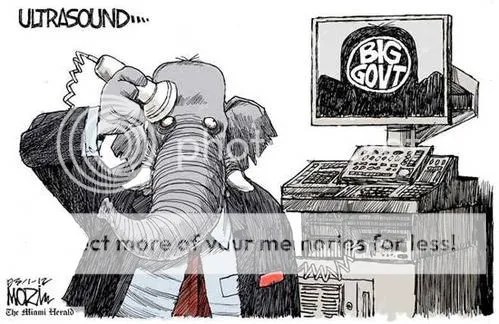
Forced ultrasounds. The general public didn’t catch on to the changing battlelines until women protested the Virginia forced transvaginal ultrasound law this March: In the original version of the bill, women seeking an abortion would be forced to have an ultrasound probe shoved up their vaginas. (Texas already started enforcing a similar law in February.) The legislature had no medical justification; they just figured women who want to abort are too dumb to understand what a fetus is unless the government forces them to look. Or maybe the point is to humiliate women before granting them their constitutional rights.

Maddow and others began calling Virginia Governor Bob McDonnell “Governor Ultrasound” — a nickname that probably pushed him off Romney’s VP short list.

Well, Paul Ryan is Congressman Ultrasound. He co-sponsored the federal Ultrasound Informed Consent Act. Women would be forced to submit to and pay for a medically unnecessary procedure because Paul Ryan believes they’re “uninformed”. (I wonder how he’d feel about making anybody who wants to buy a gun observe the autopsy of a gunshot victim. Don’t they deserve to be “informed” too?)

Rights for single-celled organisms. Another radical addition to the abortion debate are “personhood” laws, which define a fertilized ovum as a human being deserving the full protection of the laws.

Such a law would not only outlaw all abortions, it would also ban any form of birth control that works by interfering with the zygote’s ability to implant in the uterus — like the Pill.

The birth control pill, for example, prevents pregnancy in three ways: The pill thickens the cervical mucus to make it more difficult for sperm to reach the egg; it suppresses ovulation by mimicking pregnancy-level hormones in the body, preventing eggs from being released from the ovaries; and finally, as a fail-safe, the pill makes the lining of the uterus inhospitable to any fertilized egg that might slip through. The time between fertilization and implantation (when a pregnancy becomes medically detectable) usually takes about a week.

In public, advocates of personhood bills deny they’d ban the Pill. But among themselves they sound more like this:

A justly written personhood amendment should ultimately outlaw all abortions  including both the intentionally induced “miscarriages” of the hormonal birth control pill and the blatant infanticide of the partial birth abortion.

Personhood laws would also outlaw in vitro fertilization as currently practiced, because the test-tube zygotes that aren’t implanted must eventually be destroyed. A pro-life article that tries to dispel this “absurdity” actually verifies it:

Couples trying to get pregnant through IVF procedures would have nothing to fear from Personhood legislation unless they consented to the intentional destruction of their embryonic children. [emphasis added]

Who would support such a radical law? Not voters. No personhood referendum has come close to passing, even in Mississippi.

But Paul Ryan is a more radical culture warrior than the average Mississippian. He co-sponsored the Sanctity of Human Life Act, which says:

the Congress declares that … the life of each human being begins with fertilization, cloning, or its functional equivalent, irrespective of sex, health, function or disability, defect, stage of biological development, or condition of dependency, at which time every human being shall have all the legal and constitutional attributes and privileges of personhood

Ryan’s defenders sometimes claim this bill merely empowers states to protect the personhood rights of fertilized ova, but it says what it says. If this passed, how long would it take the Thomas More Society to file a class-action suit against birth-control-pill manufacturers on behalf of zygotes?

Employers’ Rights Trump Workers’ Rights. Ryan voted against the Lilly Ledbetter Fair Pay Act that eliminated a hole in the equal-pay-for-women laws.

Ryan also co-sponsored the Religious Freedom Tax Repeal Act of 2012. Motivated by the concerns trumped up against ObamaCare’s contraception mandate — Wheaton College had to stop covering contraception so that it could join the lawsuit against being forced to cover contraception — Ryan’s bill goes way beyond that case, to prevent the government from enforcing any coverage “if an employer with respect to such plan is opposed to such coverage by reason of adherence to a religious belief or moral conviction.”

So the Christian Science Monitor wouldn’t have to cover any cancer treatment beyond prayer. And what if an employer just has a “moral conviction” against spending money on workers?

In his own voice. Finding Ryan’s name in a list of co-sponsors doesn’t tell you much about his level of commitment or the thinking behind it. For that you have to turn to his writings and speeches.

In September, 2010 (when the Tea Party was playing down culture-war issues) Ryan wrote The Cause of Life Can’t Be Severed From the Cause of Freedom, which explains why “freedom” requires forcing women to obey the tenets of Ryan’s religion.

I recommend reading the entire article, because you will learn a lot about how Ryan’s mind works. No actual pregnant women are mentioned or even imagined. His argument is entirely abstract; the lives and situations of real people carry no weight.

What’s more — and this style is very familiar if (like me and Paul Ryan) you read way too much Ayn Rand in high school — all the important ideas are hidden in the framing, so the argument consists entirely of tautologies. (The third and concluding part of Atlas Shrugged is titled “A is A”, as if something important could be deduced from that.)

So how does Ryan defend the absurd idea that zygotes deserve all the rights of fully-developed human beings? He doesn’t; he just labels them “people” and then defends the rights of people. He compares Roe v Wade to Dred Scott — there being no noteworthy differences between black slaves and single-celled organisms — and concludes:

I cannot believe any official or citizen can still defend the notion that an unborn human being has no rights that an older person is bound to respect. I do know that we cannot go on forever feigning agnosticism about who is human.

Zygotes have rights because “I cannot believe” otherwise. And if you claim not to believe it, or not to be certain enough to use government power to force women to bear their rapists’ babies, you are “feigning”. Ryan knows you agree with him deep down; you’re just pretending not to.

That’s how he thinks.

And if he ever ascends to the presidency, or if he becomes the family-values point man in a Romney administration, that’s the level of public debate we can expect.

What Free Market?

Do you think it’s hard to get your child into Harvard? Try getting a new product onto the shelf of a big chain of stores in the United States.

— Barry Lynn, Cornered: The New Monopoly Capitalism
and the Economics of Destruction 
(2010)


This week everybody was talking about the Olympics

but you knew that.

… and Chick-fil-A and Mitt Romney’s foreign tour

I covered Chick-fil-A in Is That Sandwich Political?, but let’s deal with Romney’s trip here.

Romney’s tour of Britain, Israel, and Poland was designed to add foreign-policy heft to his image, but the British leg didn’t work out.

That pretty well covers it. Prime Minister David Cameron is a British conservative, but Romney exasperated him to the point where he stuck this knife in:

Of course it’s easier if you hold an Olympic Games in the middle of nowhere.

Some anonymous Romney adviser really did talk about the “Anglo-Saxon heritage” Obama can’t appreciate, which is even a step beyond calling him “foreign“. Why not just say, “White people shouldn’t vote for Obama because he’s black” and get it over with?

These stumbles happen abroad for the same reason they happen at home: Romney’s lack of empathy gives him a tin ear. Slate’s Fred Kaplan points out that Romney’s business experience differs greatly from previous generations of businessmen-turned-statesmen, who actually built things and sold them, and so had to learn to deal with workers and customers. But Bain’s brand of financial manipulation

is not the sort of enterprise that requires even the most elementary understanding of diplomacy, courtesy, or sensitivity to other people’s values, lives, or perceptions.

Instead, it

breed[s] an insularity, a sense of entitlement, a disposition to view all the world’s entities through a single prism and to appraise them along a single scale.

Growing up as the rich son of the governor probably didn’t help either.

I agree with Kevin Drum’s analysis the foreign-policy speech that kicked Romney’s tour off: He’s trying to cast a striking image without saying anything. What little remains beyond the I-will-be-strong-where-Obama-is-weak rhetoric is either vague, outside the president’s power, or exactly what Obama is already doing.

… but I also wrote about monopolies

  • Monopoly’s role in inequality. In my previous discussions of rising inequality, I’ve always felt like a piece of the puzzle was missing. I think I found it.

and you might also be interested in …

The death of first-female-astronaut Sally Ride put a face on the injustice of the Defense of Marriage Act. Most of us learned that Ride was a lesbian only when her obituary named Tam O’Shaughnessy as her 27-year domestic partner. Under DOMA, O’Shaughnessy will not receive the federal survivor benefits that a male husband would get.


The guy who all but invented the too-big-to-fail bank has changed his mind. Former Citicorp honcho Sandy Weill now says

What we should probably do is go and split up investment banking from banking, have banks be deposit takers, have banks make commercial loans and real estate loans, have banks do something that’s not going to risk the taxpayer dollars, that’s not too big to fail.

In short, let’s just pretend the last two decades never happened.


How does a bill become law? Not the way it used to.


The NYT op-ed Israel’s Settlers Are Here to Stay by settler Dani Dayan underlines just how intractable the Israel/Palestine conflict is. Dayan presents a we’re-right-they’re-wrong history of the conflict and says a two-state solution is unworkable because

Our presence in all of Judea and Samaria — not just in the so-called settlement blocs — is an irreversible fact. Trying to stop settlement expansion is futile

If a two-state solution is out, then what happens to the Palestinians? I can only see three options:

  • ethnic cleansing: Perhaps Israel could use the Spanish Expulsion of 1492 as a model.
  • democratic annexation: Palestinians become citizens of a democratic Greater Israel, which might not have a Jewish majority. (This is sometimes called the one-state solution.)
  • status quo: Palestinians remain a subject population ruled by Israel.

Dayan opts for the status quo, which he thinks is “immeasurably better than any other feasible alternative”. It could be improved, but only if Palestinians would accept the irreversibility of their subjugation and stop resisting.

Checkpoints are a necessity only if terror exists; otherwise, there should be full freedom of movement.

If Dayan speaks for some sizable and committed bloc of Israelis — and the NYT apparently thinks he does — then I can’t see this conflict resolving for at least another generation.


He may or may not be a reliable witness, but a Florida Republican is blowing the whistle on voter-ID laws, or, as he puts it “keeping blacks from voting”. And Harold Meyerson asks: What if it works? If Romney wins, and his margin in key states is clearly the result of voter suppression, are we all just going to go along?


Pastor Rick Warren appeared to blame the Aurora shooting on evolutionists, tweeting:

When students are taught they are no different from animals, they act like it.

It’s weird how people demonize animals, who aren’t nearly as nasty as humans. How do you think this young mountain gorilla (being comforted by a park ranger in the Congo after his parents were killed by poachers) feels about human morality?


The next installment of the Nuns vs. the Inquisition saga is about to start. In our last episode, board members of the Leadership Conference of Women Religious went to Rome, where Grand Inquisitor Levada said they should regard Rome appointing a man to watch over them as “an invitation to obedience”. (I think I would have issued a counter-invitation for Levada to do something impossible with his anatomy, but I guess that’s why I’m not a nun.)

This week the LCWR will meet in St. Louis to discuss

at least six options that range from submitting graciously to the takeover to forming a new organization independent of Vatican control, as well other possible courses of action that lie between those poles.


When Republicans liked the Arab Spring rebellions, they gave the credit to Bush’s freedom agenda. Now that they’ve decided they don’t like the Arab Spring, they claim it was caused by Obama abandoning Bush’s freedom agenda.


I don’t understand why everyone isn’t saying the obvious things Elizabeth Warren says: Our infrastructure is crumbling, people need jobs, and the government can borrow money at rates lower than inflation. What’s the downside?

It might even save money in the long run: If, say, we buried our power lines, we wouldn’t lose all that productivity every time the weather turned bad.


The WaPo debunks Five myths about why the South seceded. The truth is pretty simple: The southern states seceded to defend slavery; they said so themselves in their secession statements. And then Lincoln went to war to preserve the Union, not to free the slaves.

To understand why articles like this are necessary, read the comments.


President Obama isn’t saying the kind of outrageous things the Romney campaign wants to run against, so they’re editing tape to create gaffes. Ezra Klein covers this issue seriously,

And Lewis Black approaches it humorously, but Mike Luckovich captures what’s going on in one image:

Finally, ABC’s Jake Tapper has solved the mystery of the Churchill bust. Will the Romney campaign stop telling the story now that we know there’s nothing going on, or is that too much to ask?

Is That Sandwich Political?

Last week, when I was first tempted to write about Chick-fil-A, it was just another story about a religious-right one-percenter shooting off his mouth. Now, everyone from the Muppets to Sarah Palin is involved, and that waffle fry in your hand has become a weapon in the culture wars. Your gang at the office can’t go out to lunch without first debating politics and religion.

How did we get here?

For decades, Chick-fil-A has been a fast-food chain run by the founding Cathy family, a clan of conservative Christians. The Christian influence was subtle (no hellfire-and-brimstone pamphlets at the door) but real (closed on Sundays, even in food courts).

CfA has long given away a substantial portion of its profits. In recent years, a lot of that money has gone to “pro-family” or “anti-gay” organizations. This wasn’t secret, but it flew under the radar of most Chick-fil-A customers.

Then in June, CfA’s president and son-of-the-founder Dan Cathy went on the Ken Coleman syndicated radio show and said:

I think we’re inviting God’s judgment on our nation when we shake our fist at him and say we know better than you as to what constitutes a marriage. And I pray God’s mercy on our generation that has such a prideful, arrogant attitude that thinks we would have the audacity to redefine what marriage is all about.

[Cathy’s interview runs from 21:30 to 33:30. The religious/political part of the interview starts at 30:00. The quote above is at 31:18.]

The Human Rights Campaign responded with a pledge that went right up to the edge of calling for a boycott:

While I respect Mr. Cathy’s right to his personal opinions, I strongly urge Chick-fil-A to stop using money from customers as part of a larger effort to oppress LGBT Americans. Until then, I will have to reconsider whether I spend my money at Chick-fil-A.

(Other people have since called for a boycott.)

Then the Muppets weighed in:

The Jim Henson Company has celebrated and embraced diversity and inclusiveness for over fifty years and we have notified Chick-fil-A that we do not wish to partner with them on any future endeavors.

CfA struck back by not waiting for “future endeavors”. It pulled Muppet toys out of its meals, recalled toys already distributed, and implied that Muppet toys are unsafe.

And then … oh, I’ll let Gizmodo describe it:

Instead of owning up to the fact that The Jim Henson Company stopped doing business with them because they’re overrun with bigots, the chicken sandwich company appears to have made fake Facebook accounts to defend its honor on the social network.

(CfA has since denied creating social-network sock-puppets, but it’s clear somebody did.)

Then Mike Huckabee declared this Wednesday to be Chick-fil-A Appreciation Day and asked all right-thinking people to eat there. Rick Santorum, Mr. Man-on-Dog himself, agreed.

Not to be outdone by conservative extremists, Boston Mayor Mike Menino wrote a letter to Cathy:

I urge you to back out of your plans to locate [a Chick-fil-A franchise] in Boston.

And the Boston Herald quoted Menino saying:

If they need licenses in the city, it will be very difficult — unless they open up their policies.

A Chicago alderman threatened to block a Chick-fil-A there, and Chicago Mayor Emmanuel and San Francisco Mayor Lee have also been sabre-rattling, though I haven’t seen any specific threats from them.

I wish I could just take the pro-gay side, but nobody is looking particularly good right now. Let me try to sort out what I can and can’t support.

First, I support the freedom of everybody involved:

  • Dan Cathy has the right to say any stupid or bigoted thing he wants.
  • Radio shows have the right to put Cathy on the air.
  • The Cathy family can spend their profits however they please.
  • Any individual personally disgusted by Cathy’s opinions or any company that believes associating with CfA is bad for business has the right to stop dealing with CfA.
  • Cathy’s critics have the right to state their opinions in public. Calling Cathy a bigot does not in any way infringe on his First Amendment rights. When you start making moral judgments in public, you open yourself up to public moral judgment. That’s a free exchange of opinions, not intolerance.

But politicians should use their power carefully. The American Prospect’s Scott Lemieux has it right:

If Chick-fil-A had a history of denying service to people based on their sexual orientation, or discriminating against LGBT employees or job applicants, [Alderman] Moreno’s actions would be entirely justified. But … Cathy’s comments [by themselves] are not a legitimate reason to deny Chick-fil-A a permit.

I mean, do you really want Chicago aldermen vetting the political opinions of business owners? And if you do, what about aldermen in Salt Lake City or Dallas?

Specific stories of CfA discriminating are hard to find, though there is one lawsuit charging that discrimination against women. (A former manager claims she was fired because her boss thought she should be at home with her kids.)

I also want to point out that Ken Coleman’s defense of Cathy on CNN (that he is a good Christian man who is not hateful) has not been borne out by CfA’s actions. Vindictively lying about the safety of Muppet toys and creating fake Facebook identities to spread those lies is not my idea of good Christian behavior.

But none of that answers the really important question: What should you do? Can you still eat at Chick-fil-A in good conscience?

Well, not on Wednesday. After the Huckabee/Santorum nonsense, anybody at a CfA on Wednesday appears to endorse Cathy’s anti-gay opinions.

Beyond that, part of me resents the whole issue: Does everything have to be political? Can’t I just eat lunch?

But another part of me recognizes that it will be a long time before I can walk into a Chick-fil-A without remembering that its president called me “prideful” and “arrogant” on the radio (even though I’d never done anything to him), or that the company intentionally spread a vile rumor to get revenge on the Muppets. And it will be even longer before I can hand over my money without wondering how much of it will be used to take rights away from people I care about.* I expect that will darken my Chick-fil-A experience for some while, probably enough to keep me from going at all.

If that looks like a boycott, well, it’s not a very militant one.

So in general, I’m against balkanizing the economy into liberal and conservative sectors. If you really like Chick-fil-A’s food, I don’t think you should let anybody guilt you out of it (after Wednesday). But if Cathy has left a taste in your mouth that a super-sized Coke won’t wash away, don’t let anybody guilt you about that either.

You feel what you feel, so follow your heart. And enjoy your lunch, wherever you eat.


* I should probably mention that I have personal friends who benefit from same-sex marriage. Last weekend a lesbian couple was showing my wife and I their wedding pictures, which are as adorable as anybody’s. Paging through that album, the whole idea that their marriage is a threat to our marriage, to public morality, or to “the future of humanity” — it just seemed nutty.

Reading Humanae Vitae

You may not have noticed, but we are in the middle of Natural Family Planning Awareness Week. Each year, the Catholic Church dedicates this week to educating its members about acceptable and unacceptable methods of birth control.

By its own admission, the Church hasn’t been doing this very well — particularly in America, where Catholics use the pill, condoms, and other unacceptable methods at the same rates everybody else does. Meanwhile, the acceptable method — so-called “natural family planning”, in which couples keep track of the woman’s fertility cycle and only have sex during the infertile periods — is more-or-less ignored. Huffington Post reports:

A 2011 survey shows that just two percent of American Catholic women at risk of unintended pregnancy rely on the method. And an overwhelming majority of U.S. Catholics reject the church’s ban on artificial birth control.

HP then quotes the lamentations of Bishop Rhoades of Indiana:

Sadly, the majority of Catholics still do not know about Church teachings on married love nor understand why the Church considers artificial contraception immoral. This, tragically, is due to inconsistent education and formation since 1968.

There is, of course, another possibility: Maybe American Catholics know and understand the Church’s position perfectly, but the Church is just wrong.

And that is how Bishop Rhoades and I reach a point of agreement: We both think people should study this issue. That’s why I went back read the papal encyclical letter at the root of it all: Humanae Vitae (Of Human Life), written by Pope Paul VI in 1968.

Like Supreme Court opinions, papal encyclicals make much better reading than you might expect. Like the Court, the Vatican knows that it’s far more effective to persuade than to give orders (even if you retain the right to give orders). So pontiffs typically write in a clear voice that does not go over the heads of ordinary people.

Papal encyclicals can also surprise those of us who know the Catholic Church mainly through it’s public image — a point I made seven years ago when I looked at the stunning (to me, at least) economic liberalism of John Paul II’s Laborem Exercens.

So I came to Humanae Vitae willing to be surprised. But I also came with expectations/prior opinions/biases, which I might as well spell out:

  • I’m generally skeptical of anyone’s attempt to speak for God, no matter what institutional roles they play or how well-intentioned they are. To me, the highest marks of divine inspiration are clarity of thought and surprising simplicity. So if your opinion doesn’t make sense no matter how hard I try to understand it, claiming the authority of God isn’t going to impress me.
  • I’m also skeptical of claims that specific cultural practices are “natural”. I don’t reject the theoretical possibility of finding an authentic “human nature” and a culture that is most in tune with it. But people have an unfortunate tendency to believe that the way they grew up is natural, and that subsequent developments are artificial. (Extreme example: Old folks who think it’s natural to make a phone call but unnatural to text or use Facebook.)

Humanae Vitae considers contraception purely in the setting of a married couple, that being the only setting where the Church considers sex permissible.

It starts well, demonstrating that Pope Paul understood what was at issue. The pro-pill position he considers is not a licentious strawman, but something very similar to what I put forward in my defense of abortion. The Pope asks:

could it not be accepted that the intention to have a less prolific but more rationally planned family might transform an action which renders natural processes infertile into a licit and provident control of birth? Could it not be admitted, in other words, that procreative finality applies to the totality of married life rather than to each single act?

That is followed by a discussion of marriage in general. Unlike my wife and I (who decided to be childless), the Pope believes

[marital] love is fecund. It is not confined wholly to the loving interchange of husband and wife; it also contrives to go beyond this to bring new life into being.

It’s fine if married couples turn out to be infertile — they’re still married — but

each and every marital act must of necessity retain its intrinsic relationship to the procreation of human life. … Men rightly observe that a conjugal act imposed on one’s partner without regard to his or her condition or personal and reasonable wishes in the matter, is no true act of love, and therefore offends the moral order in its particular application to the intimate relationship of husband and wife. If they further reflect, they must also recognize that an act of mutual love which impairs the capacity to transmit life which God the Creator, through specific laws, has built into it, frustrates His design which constitutes the norm of marriage, and contradicts the will of the Author of life.

(It’s this metaphor of God as a “partner” in the conjugal act that Stephen Colbert irreverently lampooned as “a divine and ineffably beautiful three-way”.)

Now, you might think from that passage that any attempt to avoid pregnancy was illicit. But Pope Paul provides an out:

married people may then take advantage of the natural cycles immanent in the reproductive system and engage in marital intercourse only during those times that are infertile, thus controlling birth in a way which does not in the least offend the moral principles which We have just explained.

So understanding the human body well enough to predict when a woman is infertile is “natural”, but understanding it well enough to know that metabolizing certain substances will interrupt the menstrual cycle is “unnatural”. And understanding a man’s role in the process well enough to design an effective condom is “unnatural” too.

You lost me.

The birth control pill — like everything science makes — doesn’t work by invoking demons; it depends on our understanding of natural processes. A process isn’t unnatural just because it wasn’t understood in the Middle Ages.

It may seem unnatural, but that seeming depends on the technology you grew up with. If you grew up hunter-gatherer, plowing and planting seems unnatural. (Shouldn’t a plant’s seeds fall where God drops them?)

Having established his point (to his own satisfaction), the Pope then adds secondary arguments like this: Birth control

could open wide the way for marital infidelity and a general lowering of moral standards. Not much experience is needed to be fully aware of human weakness and to understand that human beings—and especially the young, who are so exposed to temptation—need incentives to keep the moral law, and it is an evil thing to make it easy for them to break that law.

Here, though, the problem is not that the Pill is unnatural, but that it works. If “natural” methods worked just as well, they’d cause the same problems.

The problem here is that the Church has strayed off its turf. I can easily imagine putting forward a moral vision of marriage, sex, and procreation that puts more stress on social, community, and spiritual interests and less on individual convenience. But Humanae Vitae doesn’t do that. Instead, it postulates a natural/unnatural distinction that is itself artificial.

Either nothing about civilization is natural — including our ability to count and chart cycles — or all of it is. There is no point in evolution where “natural” happened or stopped happening.

So yes, Catholics, use this week to educate yourself about the Church’s teaching on contraception. You will find it based on shoddy thinking. To attribute these ideas to God is blasphemous.

Demonizing the Girl Scouts

An outrageous part of the culture war that isn’t getting enough press is the Religious Right’s demonization the Girl Scouts. The gist of the attack (found here) is typical guilt-by-association stuff: If there’s some reason to name the Girl Scouts in the same sentence as Person X or Organization Y, then the Scouts are responsible for anything X or Y can be accused of doing.

Last month, Catholic bishops joined in by starting an investigation. Like Americans in general, about 1/4 of Girl Scouts are Catholic, and many Scout troops are associated with Catholic parishes. What are the bishops worried about? The WaPo explains:

Critics of the Girl Scouts contend their materials shouldn’t have any links to groups like the Sierra Club, Doctors Without Borders and Oxfam, or other groups that support family planning and contraception. Other critics are unhappy that the American Girl Scouting organization is a member of an international scouting association that supports contraception access.

Some parents have reported that when their daughters go out to sell Girl Scout cookies, they have had doors slammed in their faces by people refusing to buy their treats because they think the profits go to support abortion and birth control.

Why would people think that? Because the Right has been linking the Girl Scouts to that demon of demons, Planned Parenthood. (Indiana Congressman Bob Morris called the Scouts “a tactical arm of Planned Parenthood”, and his regional Girl Scout organization responded.) How can anyone argue with logic like this from the Washington Times?

The best evidence that the Girl Scouts have not actually severed ties with Planned Parenthood is that Planned Parenthood has not tried to destroy them.

(Weirdly, the guilt-by-association thing doesn’t apply to the Washington Times itself, which was founded by the Moonies in 1982 and has been owned and operated by them ever since. The Religious Right is fine with the WT being America’s flagship conservative newspaper.)

A good overview of the actual Girl Scouts and why they enrage the Right was published last September on Slate.  From the beginning, Amanda Marcotte argues, Boy Scouts and Girl Scouts were set on different paths.

While scouting for boys was about preserving the tradition of rugged, outdoorsy masculinity, scouting girls looked to the future, shucking off Victorian models of women as delicate flowers and replacing them with physically capable and adventurous women. …

These origins set the two organizations on strikingly different paths, despite their common emphasis on physical activity and volunteerism. The Boy Scouts still employ a nostalgic worldview, while the Girl Scouts focus more on keeping with the times.  …

It’s telling that Christian right critics avoid dealing directly with the group’s “go girl!” brand of empowerment, choosing instead to promote lurid tall tales. Maybe their tactic amounts to a tacit acknowledgement of just how mainstream the Girl Scouts’ feminism is, and just how far from the mainstream the anti-feminist views of the Scouts’ Christian right critics have become. The Girl Scouts focus on building self-esteem, teaching girls to care for their health, and promoting educational opportunities that help the girls’ economic futures. Its Christian right critics cling to a tradition where women exist primarily to serve.

This is part of a larger pattern: Increasingly, the Christian Right is rejecting the traditional American model of a melting pot and embracing a kosher-kitchen view of society, in which everything must be in its proper cabinet, safe from contamination.

Any organization founded on the view that we can put aside doctrinal differences to pursue common goals — Girl Scouts, public schools, public universities, umbrella charities like the United Way, and so on — is targeted either for takeover, destruction, or replacement by a group that has been cleansed and purged. (The most absurd replacement is Conservapedia, which is necessary because Wikipedia is unclean.) The attack is always the same: These groups mix us. They expose us to the views of others. They stir our time, money, and effort into the same pot with the time, money, and effort of people who might disagree with us on other issues.

For example, the Right’s problem with the Susan Komen Foundation wasn’t that Komen funded abortions. (It’s an anti-cancer organization that has nothing to do with abortion.) But by mixing with the anti-cancer activities of Planned Parenthood, Komen became unclean. It has to be purified, destroyed, or pushed beyond the pale before it in turn contaminates the righteous women who want to cure breast cancer.

Girl Scouts is a melting-pot organization. Girls who might have different beliefs or goals or heroines mix together around the common goal of maturity, empowerment, and making the world a better place. But as they color their visions of a better world, girls might discover outside-the-lines groups like the Sierra Club or Doctors Without Borders.

Contamination! Unclean! Unclean!

Challenging the Inquisition

In April I linked to a Religious News Service article about the Vatican’s attempt to rein in American nuns. Boiled down, Rome’s Congregation for the Doctrine of the Faith (or, as it was called in its glory days, the Inquisition) complained that the nuns were thinking for themselves rather than letting the bishops think for them, and letting human suffering distract them from fighting the culture wars.

Rome’s solution was to put a man in charge of the Leadership Conference of Women Religious*, which represents 45,000 American nuns. Seattle Archbishop Peter Sartain, will (in his own words) “review, guide and approve, where necessary, the work of the L.C.W.R.”

Picking up the gauntlet. Apparently, LCWR will not take this meekly. After a three-day meeting, LCWR’s board released a statement saying (more or less) that the Inquisitors don’t know what the Hell they’re talking about:

[LCWR] board members raised concerns about both the content of the doctrinal assessment and the process by which it was prepared. Board members concluded that the assessment was based on unsubstantiated accusations and the result of a flawed process that lacked transparency. Moreover, the sanctions imposed were disproportionate to the concerns raised and could compromise their ability to fulfill their mission. The report has furthermore caused scandal and pain throughout the church community, and created greater polarization.

Unsubstantiated accusations, lack of transparency, and a flawed process, leading to disproportionate sanctions that cause scandal and pain … who would expect this from the Inquisition, given its sterling historical reputation?

LCWR’s president and executive director plan to go to Rome on June 12 to “raise and discuss the board’s concerns” with Sartain and his boss, Prefect (or, as the office used to be called, Grand Inquisitor) Cardinal William Levada.

Even after meeting the Grand Inquisitor face-to-face, the LCWR does not promise to obey, but only to “gather its members both in regional meetings and in its August assembly to determine its response”.

Conscience vs. obedience. So far, the Inquisition show no signs of being worried about the nuns’ response. Sartain’s recent article in the Catholic weekly America reads like the kind of flattery you shower on subordinates you expect to have no trouble with. (“That’s a good girl. Daddy’s proud of you.”**) He refers only obliquely and abstractly to his new role and mission, while effusively praising the obedient nuns of the past.

But in spite of having all the institutional power on its side, perhaps the Inquisition should be worried. A responding America article from Fordham University ethics professor Christine Firer Hines (not a nun) paints a more challenging picture:

Catholics sometimes compare the church to a corporation or a military organization, with clergy, religious, and laity answerable to bishops and pope as their top executives and CEO. From this (ecclesiologically dubious) vantagepoint, “wayward” behavior of L.C.W.R. members or their affiliates endangers the church’s discipline, and requires firm correction …

As Vatican II affirms, the episcopal office uniquely serves the revealed truth of the gospel. But that truth resides in and with the whole church. Beholden to military or business organizational models, pundits who deride L.C.W.R. sisters for posturing falsely as a “magisterium of nuns” disrespect the authentic authority not only of religious communities, but of the laity in their various charisms and vocations. Because the official magisterium does not have a monopoly on gospel truth, office-holders must constantly listen for that truth in the whole church …

From this point of view, the Vatican intervention, intended to “assist the L.C.W.R. in implementing necessary reforms” to bring it more fully in line with “an ecclesiology of communion,” cannot be properly understood as a one-way street. The very meaning of “communion” forbids this. … If bridges toward communion are to be strengthened in this process, what John Paul II calls the “dialogue that leads to repentance” must work in both directions.

In addition to implying that Rome’s treatment of women might have left it with something to repent, Hines’ implicit framing (“the magisterium” vs. “the whole church”) invites lay Catholics to interpret the hierarchy’s disrespect for the nuns as disrespect for them as well: Only the conscience of a bishop is valid; all others must simply get in line.

On the blog Catholic Moral Theology, St. John’s University theology professor Christopher Vogt uses similar framing:

It seems to me that one of the questions at the heart of this controversy is whether acting in conscience is primarily about being obedient to authority or about conscientious discernment.

He quotes the Inquisition’s assessment of LCWR:

Some speakers claim that dissent from the doctrine of the Church is justified as an exercise of the prophetic office.  But this is based upon a mistaken understanding of the dynamic of prophecy in the Church: it justifies dissent by positing the possibility of divergence between the Church’s magisterium and a ‘legitimate’ theological intuition of some of the faithful.

The assessment denies that possibility, leading Vogt to comment:

According to this framework, there is no possibility for the bishops ever to learn anything from the laity.  The bishops are never wrong; they don’t need any help.  Such a view collapses the tension we find in the [Second Vatican] Council documents which try to balance an affirmation of the importance and legitimacy of magisterial authority with the recognition that sometimes the Holy Spirit speaks authentically to the faithful in a manner that doesn’t pass through Rome – in the depths of their hearts.

It’s not just lay Catholic intellectuals who have taken up the nuns cause. The NYT reports:

Catholics in more than 50 cities held vigils and more than 52,000 have signed a petition in support of the sisters, organized by the Nun Justice Project, a coalition of liberal Catholic groups. The project is telling Catholics to withhold their donations to Peter’s Pence, a special collection sent to the Vatican, and give the money instead to local nuns’ groups.

Whose religious freedom? This argument comes at a time when the hierarchy is invoking “religious freedom” against the contraception provisions of Obamacare. But they defend an odd kind of religious freedom that America’s Founders would barely recognize: the freedom of religious institutions, a right virtually unrelated to (and sometimes at odds with) the consciences of individuals who are not bishops.

Meanwhile, Sister Carol Keehan, head of the Catholic Health Association — a consortium of organizations more directly affected by the contraception mandate — was happy with the compromise the Obama administration offered:

We are pleased and grateful that the religious liberty and conscience protection needs of so many ministries that serve our country were appreciated enough that an early resolution of this issue was accomplished.

Commonweal, a left-leaning Catholic political journal, described the bishops’ argument as “hyperbolic” and warned:

If defending religious freedom becomes a partisan issue or, worse, an electoral ploy, it will engender enormous cynicism in an electorate in which a significant majority of voters already think religion is too politicized. … In their simplistic rhetoric, the bishops sound more like politicians than pastors.

Catholic Washington Post columnist E. J. Dionne commented: “Many bishops seem to want this fight.” And on the NYT Opinionator blog, Notre Dame philosophy professor Gary Gutting first dissects the bishops’ arguments, then says:

their often demagogic reaction suggests political rather than religious concerns. There is, first, the internal politics of the Church, where the bishops find themselves, especially on matters of sexuality, increasingly isolated from most Church members; they seem desperate to rally at least a fervid core of supporters around their fading authority. But the timing of their outbursts also suggests a grasp for secular political power.

The wider issue. The Commonweal editorial quotes research from sociologists David Campbell and Robert Putnam showing that the politicization of churches is causing young adults to disengage from organized religion, a message similar to the one David Kinnaman (president of the evangelical Protestant research organization the Barna Group) put forward in the 2007 book unChristian

A similar message based on personal experience was in the blog post “How to win a culture war and lose a generation” I linked to two weeks ago, in which Rachel Held Evans described her 20-something generation as “ready to stop waging war and start washing feet”.

This is an issue that crosses denominational lines. In one sense, it is Christianity’s perennial doctrinal purity vs. good works conflict. But it seems to be striking this generation with particular force. More and more young adults want to know not which religion is winning or even which religion is right, but whether any religion does any good.

Through their lives of service, the nuns are showing one way to answer that question. The bishops seem deaf to it.***


* Translation from the Catholic: religious in this context comes from the Latin religata, meaning bound. In other words, these are not just women who have “got religion”, but women bound by their vows to the Church; i.e., nuns.

** Not a direct quote.

*** Probably you’ve already run into the story of Cardinal Dolan’s threat that Catholic organizations will halt their charitable work rather than comply with the contraception mandate. I’m not linking to that claim because I still haven’t found an unedited tape or transcript of enough of Dolan’s remarks to convince me he wasn’t taken out of context.

“If you can’t hear it from me …” — 3 voices that might get through to your conservative friends

If you’re a liberal who has any conservative friends or relatives, you know how well defended they are against anything you might say. Any fact you know is wrong. Any source you might quote is biased: Academia is biased (except for institutes funded by the Koch Brothers). Major newspapers are biased (except for the Washington Times). TV news is biased (except for Fox). Government agencies are biased (unless a Republican president has had their reports vetted by a political appointee) … and so on.

Here are three points of view that might sneak under the conservative radar, because of where they come from and how they’re pitched.

Now let’s look at those one-by-one.

BYU’s Barry Bickmore on climate-change denial. Bickmore’s talk isn’t about climate change. It’s about “How to Avoid the Truth about Climate Change“. (If you don’t have time to watch, scroll down the comments to Anna Haynes’ notes on the talk.) In other words: What techniques make it possible for honest and intelligent people to deny something that virtually all the experts in the field believe?

Bickmore knows why people don’t believe in climate change, because he used to agree with them on two points: There’s lot’s of scientific controversy about global warming, and the is theory based solely on complex computer models which are easy to screw up.

When he looked into the issue more closely, though, Bickmore discovered that each of those points is wrong: Around 97% of actively publishing climate scientists believe that human activity is causing the planet to get hotter, and their opinion is verified by a variety of techniques that may not give exactly the same projections, but do agree within the bounds of the published error estimates.

He wondered: Why didn’t I already know that? What led to my confusion?

First, there were those “thousands of scientists doubt global warming” articles. Bickford explains the strategy that generates them: First, expand the field of “experts” to include a lot of people who aren’t really experts at all, and second, report a raw number that sounds big rather than doing a poll and getting a percentage.

So the Oregon Petition (claiming there is “no convincing scientific evidence” of human-caused global warming) claims 30,000 signers. But signers don’t have to be experts or even scientists. They need only have a bachelors degree, not necessarily in a relevant field.

So why is this impressive to people — 30,000 scientists? … People think about scientists as “Well, you know science, so why don’t you tell me?” Right? But in reality we’re much more specialized than that. If you have cancer, you don’t go to your podiatrist. You go to your oncologist.

Ditto for the 900 peer-reviewed journal articles skeptical of climate change. It sounds like a big number, but in what universe of journals? Apparently, a universe big enough to include journals that publish “research” articles on dog astrology and UFO abductions.

Bickford continues, similarly destroying the “What about Galileo?” and “We don’t need experts” objections, leading to this conclusion:

There’s always room for doubt. But there has to be a point — if we’re going to make any attempt at all at trying to be objective — that we have to admit that we’re trying too hard [to avoid the truth]. And I think that for people who are on the side I was a few years ago, I think we should admit that we’ve reached that point.

Rachel Held Evans on the damage Christianity is suffering from the culture wars. After reviewing some research showing how young adults (even those raised in Christian households and even young church-goers) view Christianity’s anti-gay image negatively and are shamed by what they see as un-Christ-like hostility towards their gay and lesbian friends, Evans gives her personal observations. When she speaks at Christian colleges, she finds that “every single student I have spoken with believes that the Church has mishandled its response to homosexuality.

On the evening when North Carolina’s anti-gay Amendment One was passing by a wide margin, Evans saw a pattern in her Twitter feed:

Christians over 40 were celebrating. Christians under 40 were mourning. Reading through the comments, the same thought kept returning to my mind as occurred to me when I first saw that [pro-amendment] Billy Graham ad:

You’re losing us.

I’ve said it a million times, and I’ll say it again…(though I’m starting to think that no one is listening):

My generation is tired of the culture wars.

Back when gays were in the closet, you could make them out to be any kind of hobgoblins you wanted. All the scary talk about a “gay agenda” depends on that image: sinister conspirators out to destroy everything good and decent in the world.

But to folks under 40, gays and lesbians are their friends from high school. They decorated homecoming floats together and washed cars side-by-side to raise money to send the French Club to Paris.

We know too many wonderful people from the LGBT community to consider homosexuality a mere “issue.” These are people, and they are our friends. When they tell us that something hurts them, we listen.

Evans says her generation wants to “stop waging war and start washing feet”. Translating for those who don’t speak Christian: They want to help people rather than beat them down, and practice their religion humbly rather than be authoritarian ideologues. If they can’t do that inside the church, she says, they’ll do it somewhere else.

Nick Hanauer. This guy was an early investor in Amazon, and then made several other piles of money by starting little-fish companies that he eventually sold to bigger fish like Microsoft. In other words: not a communist, not a fifth-generation Rockefeller who has forgotten where his trust fund came from, not an academic economist who has never made or sold anything.

Hanauer’s 6-minute TED talk addresses one question: Who are the job creators? You might expect him to answer, “People like me.” But he doesn’t.

If there was no one around who could afford to buy what we had to sell, all those companies [I helped start] and all those jobs would have evaporated. That’s why I can say with confidence that rich people don’t create jobs. Nor do businesses, large or small.

Jobs are a consequence of a circle-of-life-like feedback loop between customers and businesses. And only consumers can set in motion this virtuous cycle of increasing demand and hiring. In this sense, an ordinary consumer is more of a job creator than a capitalist like me.

… Anyone who’s ever run a business knows that hiring more people is a course of last resort for capitalists. It’s what we do if and only if rising consumer demand requires it.

After displaying graphs of rising income and falling tax rates for the rich since 1980, he comments:

If it was true that lower taxes for the rich and more wealth for the wealthy led to job creation, today we would be drowning in jobs.

But when the middle class thrives, businesses grow and everyone does better. So he concludes:

In a capitalistic economy, the true job creators are middle-class consumers. And taxing the rich to make investments that make the middle class grow and thrive, is the single shrewdest thing we can do for the middle class, for the poor, and for the rich.


At first, Hanauer’s talk didn’t appear on the TED website — not all of them do — leading National Journal to bill the talk as “too hot for TED“. This prompted a TED official to post “the real story“, claiming that the audience gave the talk mediocre ratings:

a non-story about a talk not being chosen, because we believed we had better ones, somehow got turned into a scandal about censorship.

Even that spin, though, implies that TED and its audience are not very representative. Once the YouTube got out, it quickly went viral and has been seen (so far) by over 400,000 people.

Everybody will support same-sex marriage by 2030

OK, everybody may be an exaggeration. Let’s just say every politician of any significance: every presidential candidate, every governor, every member of congress, and the leadership of every party in every house of every state legislature.

Two charts tell you all you need to know about the politics of same-sex marriage. First, it has long-term momentum:

Second, it has the most inexorable kind of momentum there is: generational. Each day a few more supporters turn 18 and a few more opponents die. That’s how it’s going to be for a long, long time.

Explain it to the kids. That’s why President Obama explained his own change of heart this way:

Malia and Sasha, they have friends whose parents are same-sex couples. There have been times where Michelle and I have been sitting around the dinner table and we’re talking about their friends and their parents. And Malia and Sasha, it wouldn’t dawn on them that somehow their friends’ parents would be treated differently. It doesn’t make sense to them and, frankly, that’s the kind of thing that prompts a change in perspective.

This is how taboos fall. One generation genuinely believes in the taboo. The next follows it out of habit, but can’t defend it. And finally there’s a generation that challenges: The kids ask “Why?” and their parents have no answer.

Many of those parents will stay stuck in their ways, but politicians can’t afford to. They have to follow the majority, even if it goes against what they’ve stood for in the past.

We’ve seen this happen before.

Race and the Owens-Louis kids. When Jesse Owens won Olympic gold in Munich in 1936, and then Joe Louis defended his boxing title against Max Schmeling in a sold-out Yankee Stadium in 1938, the rooting wasn’t black vs. white. It was America vs. Nazi Germany.

To many of the white American kids who listened to those two events on the radio, it only made sense to let Jackie Robinson play major league baseball in 1947, and later, to start breaking down color barriers all across society.

When Guess Who’s Coming to Dinner? raised the interracial marriage taboo in 1967, the Owens-Louis kids were the generation in between the Tracy-Hepburn parents and their Sidney-Poitier-dating daughter. They knew interracial marriage was still beyond the pale. Most of them would never consider it themselves. But they couldn’t explain why.

When the Owens-Louis generation reached middle age in the 1970s, segregationist politicians had to capitulate. In 1963 George Wallace could pledge “segregation forever”. In 1970 he successfully ran a race-baiting campaign for governor. But by 1979 he was saying, “I was wrong. Those days are over and they ought to be over.”

The 1970s didn’t end racism — racists can still dog-whistle and use code words — but they ended the days when a politician could stake out an openly racist position and hope to win on it, even in Alabama.

Today, the Owens-Louis kids are the old folks, and returning to Jim Crow is as unthinkable as returning to slavery. Whenever same-sex marriage proponents are allowed to make the link to interracial marriage, the argument is over. No public figure will defend banning interracial marriage — a practice that was controversial even to talk about in 1967.

The Willow-Tara generation. In its acceptance of gays and lesbians, sports has trailed the culture rather than leading it. The characters who changed our thinking about homosexuality are more likely to be fictional ones we met through TV and movies.

In the late 1970s, it was edgy for Jack even to pretend to be gay on Three’s Company. Gay and lesbian minor characters started appearing on dramas like Hill Street Blues in the 1980s. Tom Hanks won an Oscar for his starring role as a sympathetic gay character in Philadelphia in 1993. From 1998-2006 Will and Grace (cited by Vice President Biden) centered on a gay man’s friendship with a straight woman.

I decided to symbolize this generation with a fictional same-sex couple almost exactly the age of the oldest Millennials: Willow and Tara on Buffy the Vampire Slayer, whose relationship began right around the turn of the millennium.

Earlier pop-culture characters got viewers sympathizing with the problems of gay and lesbian individuals and their same-sex relationships. But for most of two seasons Willow and Tara raised a different question: What if there is no problem? What if two people of the same gender meet and fall in love and are happy together?

Like Willow and Tara, the oldest Millennials are about 50 years younger than the Owens-Louis kids. So as a guess, let’s set the 2020s as the decade of capitulation on gay rights: Every major politician will either leave the business or have a change-of-heart by 2030. Even conservatives, even in the Bible Belt.

Remember the Dixiecrats. Does that seem unthinkable? What about Sarah Palin, Rick Santorum, and younger politicians who seem eager to follow their lead? But what about Strom Thurmond, who during his Dixiecrat presidential campaign of 1948 said:

that there’s not enough troops in the army to force the Southern people to break down segregation and admit the Negro race into our theaters, into our swimming pools, into our homes, and into our churches.

In 1971 Senator Thurmond integrated his staff, and in 1983 he voted to honor Martin Luther King with a federal holiday. The sincerity of his transformation may be dubious, but he had to make it.

Biden first. The leading edge of gay-rights capitulation is in the Northeast and among Democrats. So it’s no coincidence that President Obama was put on the spot by Vice President Biden. Whatever happens in 2012, Biden is looking down the road to the Democratic primaries of 2016. No way a Democrat with an ambivalent gay-rights position wins in New Hampshire (where same-sex marriage is already legal) in 2016.

Politicians can read trend lines. If you hope to win statewide office in the Northeast or in California in 2020 — or anywhere in 2030 — you can’t be against same-sex marriage. The question isn’t whether you’ll change, it’s when.

The ancient ship Homophobia has had a long run, but it is going down. While it may take years to sink completely, no politician wants to go down with it. Those with any sense are already checking the exits and plotting their departure.

77 Cents

Last week I linked to a sexist exchange on Meet the Press where Alex Castellanos all but pinched Rachel Maddow’s cheek and told her she’s cute when she’s angry. (He didn’t quite go that far, but it would have been a logical next step.)

Lots of people (including Rachel herself Monday evening) came back to that argument (probably making it one of the most widely viewed MTP segments in some while), asking the proper now-that-the-dust-has-settled question: Forget how outrageous Castellanos’ manner was or how well Maddow responded – who was right?

Context. The subject was the political gender gap, and Rachel was arguing that it is based on policy rather than image. Romney can’t win over women voters just by giving his wife a more prominent role in the campaign or sending other female surrogates out to campaign for him, because his policies give women good reasons not to like him.

To support that point, she brought up gender inequality in the workplace: Women make less than men. President Obama pushed and signed the Lily Ledbetter Fair Pay Act, making it easier for women to sue for workplace discrimination. Romney won’t say whether he would have signed that bill or not. (But he has promised not to try to repeal it.) So in terms of substantive policy, what is Romney’s plan for ending gender discrimination in the workplace?

She didn’t get that far. As soon as she said “Women in this economy still make 77 cents on the dollar for what men make” Castellanos interrupted, saying “there are reasons” why women make less than men. When asked specifically, “Do women make less than men for the same work?” he answered “No.”

So who’s right? I find this kind of discussion hard to follow on TV, where it’s so easy for each side to talk past the other, shifting the argument to a slightly different issue rather than directly refuting or admitting the point just made by the other side. But now that I’m sitting at my computer, with time on my side and Google and Wikipedia strapped onto my utility belt, who’s right?

First observation: Who’s right about what?

The argument has one major issue in the background: Do women face workplace discrimination? Several similar-but-not-identical factual questions relate to that issue:

  • On average, do working women make less money that working men? This one is easy, and the answer is yes. The Bureau of Labor Statistics says that men working fulltime in 2011 averaged $832 a week, while women working fulltime made $684 – 82 cents on the dollar. (The 77 cents number came from 2010 and was based on annual earnings rather than weekly. I’m not completely sure why that makes a difference.) In general, things have been slowly equalizing; the weekly-earnings number was 62 cents in 1979.
  • Do women make less money than men for the same quantity and quality of the same work? This is a tougher question, because how do you define “same quantity and quality”? For any two workers, you can almost always find some difference in their qualifications or duties or output. The question is whether we’re talking about legitimate distinctions or ones dreamed up after-the-fact to justify discrimination. It seems undeniable that some women make less for the same quantity and quality of the same work – Lilly Ledbetter, for example. If this never happened, Romney could cheerfully support the Fair Pay Act knowing that it makes no actual difference.
  • How much of the pay gap between men and women is due to discrimination? This has come to be the center of the debate, and it’s what I wanted to focus on, but I can’t because the research either wasn’t as clear or as easy to find as I wanted. So I offer an IOU: I’ll get back to it next week after I’ve had more time to sift through the numbers.

Here’s what I’m looking for: The insidious thing about this argument is that pay-gap-due-to-discrimination is not something you can measure directly. All you can do is start with the 82 cents on the dollar and see how much of that deficit you can attribute to some legitimate cause. After you allow for everything reasonable you can think of, you can say with some confidence that the rest of the pay gap is unreasonable.

So what I’d like to find is a study that chips away: X cents is due to men and women being in different professions. Y cents is due to women entering high-paying professions recently and so still being relatively younger than their male colleagues. Z cents comes from having less seniority because they interrupted their careers to have children. And so on, leading to D cents that is inexplicable unless employers discriminate.

I can find pieces of that, but I’ll hold them for next week in hopes of painting a clearer picture.

In the remainder of this post, I’d like to knock off some side-issues.

The just-so story. On Meet the Press, Castellanos made this argument: If the 77 cents thing were true, then

every greedy businessman in America would hire only women, save 25% and be hugely profitable.

Let me turn that logic back on itself: If Castellanos’ argument were true, then there would never have been any wage discrimination in America against any group ever.

All through the 1930s, any greedy owner of a major league baseball team could have hired can’t-miss stars like Satchell Paige or Josh Gibson for peanuts. (Gibson, the “black Babe Ruth” died at 35, three months before Jackie Robinson broke the color barrier in 1947. Paige arrived in the majors in 1948, well past his prime. At age 47, he was still good enough to pitch in the 1953 All-Star game.)

No owners did. Why? You’d have to ask them. But discrimination does happen. It can’t be dismissed with a just-so story about capitalism.

Are statistics the whole story? If gender discrimination happens at all, it’s wrong and should be illegal, independent of whether it happens often enough to affect the averages. Since when do we decide moral issues by statistics? (Compare: Pro-life activists are not mollified by the fact that partial-birth abortions are an insignificant percentage of all abortions.)

What’s reasonable? Kevin Drum was all over this point: A lot of what is considered a “reasonable” explanation of the pay gap is just discrimination by a different name.

When all’s said and done, women are punished financially in three different ways: because “women’s jobs” have historically paid less than jobs dominated by men; because women are expected to take time off when they have children, which reduces their seniority; and because even when they’re in the same job with the same amount of experience, they get paid less than men. All of these things are part of the pay gap. Whether you call all three of them “discrimination” is more a matter of taste than anything else.

What’s a problem? As Kevin pointed out, many women interrupt their careers for children. For the moment, leave aside the question of whether men’s careers should be equally disrupted. I just want to point out that there was a time in American history when large numbers of men had their careers disrupted: World War II.

When they came back from the war, our country decided that those interrupted careers were a problem, and something should be done about it. Hence, the G.I. Bill of Rights, which paid for millions of returning servicemen to go to college or get some other kind of training.

When women come back to the workforce after raising children, though, they’re on their own. That’s a kind of discrimination right there.