Tag Archives: 2012 election

Sorry, Jill: I’m not voting Green

You don’t have to have read a lot of Weekly Sift articles to figure out that I’m voting for Obama. Last week I put together the positive case for why he deserves a second term, and I have been a relentless critic of Mitt Romney, Paul Ryan, the Republican Party in general, and conservatism as a movement.

So when I take the “I Side With” quiz, I should come out as an Obama voter, right? Well, not exactly:

Jill Stein: 96%
Barack Obama: 88%
Mitt Romney 6%

Philosophically, I’m more Green than Democratic. Some of that 12% disagreement with Obama is pretty important stuff: I’d rather have a single-payer system than ObamaCare. I wish we’d start rolling back our military commitments and cutting defense spending. (I still want us to be the strongest country in the world, I just don’t think we need to be stronger than the next five or six countries put together.) I think we should only blow up things in countries we’re at war with.

Most of all (and I’ve been bitching about this since the Bush administration) I don’t believe in the National Security State. I believe in the Fourth Amendment, the one that says the government needs a warrant to search your stuff; and I think the wording of that amendment is sweeping enough (“persons, houses, papers, and effects” constituted everything the Founders could think of that the government might want to search.) that “stuff” includes your cellphone calls, your email, your library records, and just about anything else you would rather keep private.

I think torture isn’t just bad policy, it’s a war crime that should be prosecuted from the torturer to the policy-maker, and everyone in between. And I don’t care if some American citizen has been hanging around with jihadists, as long as he’s not physically pointing a weapon at somebody at the moment, you can’t legally kill him without due process of law. And by definition, due process of law can’t take place entirely inside the executive branch.

So: Obama voter, yes. Totally happy camper, no.

People like me must frustrate the heck out of Jill Stein. “What do I have to say?” I imagine her asking.

But here’s the problem: my 6% agreement with Mitt Romney.

George Wallace used to say there wasn’t a dime’s worth of difference between the two major parties. And when he said it, it was almost true. My first presidential vote went to Gene McCarthy in 1976 — me and 740,000 other people. Jimmy Carter was running against Jerry Ford that year, and you’ll never convince me that the future of the Republic hung in the balance.

If the Republicans had nominated some 2012 equivalent of Jerry Ford, I’d probably vote for Jill.

In 2000, a lot of people (but not me) thought Bush Jr. was Bush Sr. with a more convincing Texas accent. If that had been true, voting for Ralph Nader might have made some sense.

If the Republicans had nominated some 2012 equivalent of Bush Sr., I might vote for Jill.

I didn’t vote for Nader in 2000. If I had, I would still feel guilty about it. Florida got all the attention that year, but if the Nader voters in my state of New Hampshire had voted for Gore, Gore would have been president.

Nobody can say for sure in what ways history would be different, but I’ll propose two: We wouldn’t have wasted 4000 lives and a trillion dollars in Iraq, and we would be doing something about global warming.

So that’s another way in which I’m green: with envy for that alternate timeline.

This year, the Republican Party didn’t nominate Jerry Ford or George H. W. Bush, they nominated Mitt Romney.

Some people will tell you that at his core, Mitt Romney is a moderate, like Ford or Bush Sr. They point to his record as governor of Massachusetts, and how unconvincing he sounds mouthing extreme-right rhetoric.

But I don’t believe Mitt Romney has a core. I think he’s the very model of a modern corporate CEO: he says and does whatever it takes to complete the deal.

As a Republican candidate, he has needed to take extreme-right positions: for personhood laws that would outlaw the Pill, for “self-deportation” of undocumented immigrants, for doing nothing about global warming, for disenfranchising marginal voters, for extreme cuts to Medicaid, massive defense spending increases, and now we find out that his chosen advisers want to bring back “enhanced interrogation”.

Whether Romney actually believes any of that stuff is irrelevant. He needs to take those positions, so he does. McDonalds doesn’t “believe” in apple pockets or fish sandwiches, but if they’ll sell, they’re on the menu.

After he becomes president, his “core beliefs” will still be irrelevant. He’ll need extreme-right support to be renominated, and he’ll court it just as he courts it now. So yes, he really will try to carry out that benighted stuff he has proposed in the campaign. And he certainly won’t veto anything that comes out of a far-right Republican Congress.

And if he does … well, Paul Ryan is a true believer and he’s just a bullet away. I doubt I’m the only person who’s thought of that.

So don’t give me the it-makes-no-difference argument. It makes a huge difference. I agree 88% with Obama and 6% with Romney.

Where I sympathize with Stein supporters is in their criticism of the two-party system, which is failing to give us the choices we should be debating. As Rachel Maddow pointed out last week, we aren’t having a public discussion about the Afghan War or about drone strikes. And how do you express your desire for single-payer health care if you limit yourself to Republicans or Democrats?

In the general election, you don’t. The place for that debate is in the primaries. If you don’t think that works, ask Republican senators like Richard Lugar, who lost his job for being too moderate, or Orrin Hatch, who took a hard right turn to hang on. Primary challenges could work on the left, too, if we built a constituency for progressive policies.

And progressives need to face up to this reality: A progressive candidate who can’t win a Democratic primary has no chance in a general election. Reforming one of the two parties is far easier than winning and governing as a third party. (Ask the Reagan Republicans.)

More generally, you need to ask whether we still want a two-party system. I’d say no. But the way to get that result is to make common cause with right-wingers around some change to the voting system, like instant-runoff voting or approval voting. Splitting the left-of-center vote is just going to get us right-wing rule.

Obama’s Positive Case

Like every two-person race, Romney vs. Obama has four major narratives: pro-Romney, anti-Romney, pro-Obama, and anti-Obama. So far both sides have focused mainly on the anti narratives: You shouldn’t vote for Romney because he’s out of touch with the middle class; his policies harm women, gays, immigrants, and the poor; he brazenly makes up his own facts; he has no defense or foreign-policy experience; his proposals have no details and their numbers don’t add up; his only firm conviction is that he should be president. And so on.

Conversely, you shouldn’t vote for Obama because he hasn’t gotten the economy on track; he isn’t sufficiently pro-Israel or anti-Iran; he “apologizes for America” and projects a weak image to both our allies and enemies; he has increased the national debt by trillions of dollars; he favors Big Government and wants to enlarge the class of government dependents; and there’s just something generally suspicious about him that you can’t quite put your finger on (but it can’t possibly have anything to do with him being black, because you’re not a racist).

All I can say is that it will be a sad day for America if we elect a president entirely on a negative narrative, because he wasn’t the other guy.

I suspect we will never hear a serious pro-Romney case; his campaign doesn’t seem to be laying the groundwork for one. (I may be wrong, but I suspect “Obama Isn’t Working” is the first example of a presidential campaign’s main slogan containing the opponent’s name rather than the candidate’s. Remember “All the Way with LBJ” and “Nixon’s the One”?) If Romney is elected, I’ll hang on every word of his inaugural address, because it will be the first real indication of what his administration intends to do.

However, I’ve been predicting for a while that (after spending the summer defining the otherwise vacuous Romney) the Obama campaign will end on a positive note. Republicans have been saying that Obama has gone negative because he can’t defend his record or provide a convincing plan for the future. But I think they’re wrong. We began to hear some of the pro-Obama narrative during the Democratic Convention, and I think we’ll hear more of it as Election Day approaches.

This is my version of Obama’s positive case:

The stimulus, auto bailout, and other emergency measures of 2009 ended the crash.

It’s amazing how quickly the panic that gripped the nation in January, 2009 has been forgotten. Bankruptcies were dominoing: Across the country, apparently healthy companies were discovering that their accounts receivable were worthless because their customers couldn’t pay. And so they were now bankrupt too and couldn’t pay the next company down the line.

Giant enterprises like General Motors and giant states like California couldn’t pay their bills. If those debts went bad, how many other employers would go down? Then how many local shops and restaurants would fail when their customers lost their jobs?

In the pre-Obama era, a stimulus was an uncontroversial response to a recession. President Bush passed a stimulus in 2002 and again in 2008, both times without significant protest from congressional Republicans. Liberal and conservative economists alike were calling for a stimulus in 2009. Republicans had their own 2009 stimulus proposal – a mere $713 billion and weighted more towards tax cuts, but nonetheless a stimulus.

Obama’s proposal was designed to be centrist: A third of the $800 billion total was tax cuts. Another big chunk was aid to the states (to prevent massive layoffs of teachers and construction workers). Another chunk extended unemployment benefits (which made sense given that there were no jobs for the unemployed to find). The remainder was also pretty well spent on a variety of infrastructure and social-investment projects. The definitive analysis is in The New New Deal by Michael Grunwald.

And it worked. Again, both liberal and conservative economists estimate that the stimulus saved a considerable number of jobs, as shown in the following chart (more up-to-date version here).

Obama’s critics have made a big deal of his administration’s projection (they incorrectly call it a “promise”) that the stimulus would keep unemployment below 8%. The mistake here had nothing to do with the effect of the stimulus: In early 2009, everyone was still underestimating the number of jobs that had already been lost in the 4th quarter of 2008.

Obama focused on Al Qaeda (hasta la vista, Osama), ended the Iraq War, is winding down the Afghanistan War, and – best of all! – didn’t start any new wars.

In the 1950s, critics of President Eisenhower said he was a do-nothing president. In retrospect, some of Eisenhower’s not-doings look wise, like not sending troops to Vietnam after the French defeat at Dien Bien Phu. We can only wish Presidents Kennedy and Johnson had maintained Ike’s standards of military idleness.

By Bush standards, Obama has been a do-nothing president in the Muslim world. He hasn’t bombed Iran, he didn’t prop up the Egyptian dictator Mubarak, and he has kept our troops out of Libya and Syria. Let’s keep them out.

The Affordable Care Act is a major step towards health security for all Americans.
Universal health care has been a goal of every Democratic president since Truman, and Republicans like Nixon have also had ambitions in that direction. The Affordable Care Act did not get all the way there, but it gets us closer than we’ve ever been.

Currently, 48.6 million Americans are uninsured – most of them in red states like Texas. The ACA was projected to drop that number below 20 million, though now that a partisan Supreme Court has nixed the Medicaid expansion (and Republican governors like Texas’ Perry are threatening not to take the federal money to expand Medicaid), no one can estimate the exact number.

The ACA does not completely take effect until 2014, but you may already be benefitting if you are old (it closed the “donut hole” in Medicare drug coverage), young (parents’ insurance can cover their children up to age 26), or sick (you can’t be denied coverage for a pre-existing condition). It might even have gotten you a refund from your health insurance company.

Like the stimulus, the ACA is a centrist program that has been smeared as radical: It mimicks RomneyCare in Massachusetts, which was designed by the conservative Heritage Foundation. The ideas behind it only became “socialist” and “unconstitutional” when Obama adopted them.

Obama’s Supreme Court appointments kept the corporatist and theocratic agendas at bay.

Obama got to replace two liberal justices with two slightly-less-liberal justices, so that Justice Kennedy remains the swing vote. (Though Roberts was the swing vote on the ACA decision.) If President McCain had instead appointed two justices resembling Alito or Thomas, the Court would have only two liberals, so even convincing Kennedy and Roberts wouldn’t be enough. The swing vote would be Scalia, believe it or not.

The main theme of the Roberts Court was summed up in 2010 by Al Franken:

What conservative legal activists are really interested in is this question: What individual rights are so basic and so important that they should be protected above a corporation’s right to profit?

And their preferred answer is: None of them. Zero.

That may sound like an exaggeration, but the rest of Franken’s speech backs it up.

Without Obama’s appointments, decisions would be even more pro-corporate, and you could add Christian supremacy to that agenda.

And of course Roe v. Wade would be toast.

He defended women’s right to equal pay, which the Roberts Court had gutted.

The first bill Obama signed was the Lily Ledbetter Fair Pay Act. And what other women’s rights will be gutted if the Roberts Court gets conservative reinforcements?

He stopped deporting good kids who know no country other than this one.

Naively, Obama assumed that Republicans (like John McCain) who had publicly supported immigration reform in the past would continue to support it. Instead, Republicans have unified against their own previous proposals and blocked any progress on immigration, including the DREAM Act (which Orrin Hatch co-sponsored and then voted against) and even Mario Rubio’s watered-down version of the DREAM Act.

President Obama has gone about as far as he can without Congress’ cooperation: He has suspended deportations of undocumented teen-agers who were brought here as small children and are on their way to becoming Americans we can be proud of.

Don’t Ask Don’t Tell is history, and the country has turned the corner on gay rights.

President Obama hasn’t been a crusader for gay rights, but he did manage to tip-toe through the minefield of gays in the military.

It’s worth noting that the DADT repeal has caused virtually no problems. Remember how unit cohesion was going to collapse, recruitment would plummet, and chaplains would resign in droves once the Pentagon de-institutionalized bigotry against gays and lesbians? None of it happened. (But I’ll bet none of the false prophets in the pundit class lost their jobs for being wrong. They never do.)

Obama’s personal support for same-sex marriage has no direct impact, but it did seem to be a tipping point in public opinion. His refusal to defend the Defense of Marriage Act in court may help get rid of that unjust law (though not if President Romney gets to appoint some Supreme Court judges first).

This fall we may start seeing anti-gay referendums lose. Increasingly, gay rights has become a why-not issue rather than a why issue. Expect Obama to continue to ride the public-opinion wave rather than lead it or block it.

In short: Regardless of who the Other Guy is, Barack Obama has been a good president in tough times. He deserves re-election.

Ayn, Paul, and Me

A year ago, when I posted Why I’m Not a Libertarian, I thought I was done talking about my misspent Objectivist youth. Yes, I read Atlas Shrugged six times, and all of Ayn Rand’s other published works at least twice. Yes, I realize how much I could have learned by investing that effort more wisely. Let’s not dwell on it. What’s done is done.

So in April, when Paul Ryan’s love/hate relationship with the Catholic bishops led me to write Jesus Shrugged — Why Christianity and Ayn Rand Don’t Mix, I left my personal history out of it. Ryan’s policy proposals were the issue then, not his personality or character, so any insight I might gather from our common obsession was beside the point.

It’s not beside the point now. When you start talking about a person as a potential vice president — which necessarily makes him a potential president — character matters as much as policy, maybe more. Paul Ryan may end up leading our country through challenges and crises we cannot foresee. We need to know who he is.

It should go without saying that I can’t give you the final word on Ryan. I’ve never spoken to him. As far as I know, we’ve never been in the same room. But I can tell you what kind of young man is attracted to Rand’s philosophy, how it changes him, where you can see Rand’s influence on Ryan’s thinking today, and what it says that he carries those beliefs into middle age. Along the way, we may learn something about Rand’s influence on the conservative movement in general.

What Rand stood for: selfishness. In a nutshell, Rand’s philosophy is the anti-gospel. She’s explicit about this, as I have previously noted.

In the gospel worldview, people need to choose between selfishly piling up wealth for themselves and virtuously helping others. So Jesus says, “You cannot serve both God and money” and advises the rich young man to sell everything he owns and give the proceeds to the poor.

Rand flips that value system upside-down. To her, selfishness is virtue. All good things, even social goods, come from individuals acting selfishly: Thomas Edison wants to be rich and famous, so he invents the light bulb that benefits all of us.

It follows that capitalism is the only moral economic system, because it best expresses selfish virtue. (If you’re having trouble grasping this, combine the theories of trickle-down economics, the invisible hand of the market, and homo economicus — then multiply by a thousand.)

The relationships between Rand’s heroic characters demonstrate how friendship and even love can be re-interpreted as selfish. Some people make the love-is-selfish point cynically, but not Rand: In her mind she’s redeeming friendship and love by attaching them to the selfishness that she believes is the prime virtue.

Tellingly, there are no hero-parents in Rand’s novels, and Rand had no children herself. Also, the relationship-value of her heroes never crashes, so we don’t know how Dominique Francon would react if Howard Roark developed Alzheimer’s.

What Rand stood for: elitism. In Rand’s telling of history, all human progress comes from a tiny creative elite (think Edison’s light bulb again) and they alone deserve the fruits of that progress. In the speech that epitomizes Atlas Shrugged, John Galt says:

If you worked as a blacksmith in the mystics’ Middle Ages, the whole of your earning capacity would consist of an iron bar produced by your hands in days and days of effort. How many tons of rail do you produce per day if you work for Hank Rearden? Would you dare to claim that the size of your pay check was created solely by your physical labor and that those rails were the product of your muscles? The standard of living of that blacksmith is all that your muscles are worth; the rest is a gift from Hank Rearden.

Rearden the inventor/industrialist not only owns his innovations, he and his fellow capitalists are the sole heirs of humanity’s technological legacy. Workers inherit nothing from the geniuses of the past, except through their employers’ generosity. (I’ve written about that aspect of Rand’s philosophy here.)

The non-creative masses attach to the Reardens like leeches or barnacles. Christianity, socialism, and other philosophies that make selfishness a vice are tricks by which the “parasites” make the producers feel guilty about claiming what is rightfully theirs. The Fountainhead‘s hero Howard Roark voices the eternal victimhood of the creative elite:

Thousands of years ago, the first man discovered how to make fire. He was probably burned at the stake he had taught his brothers to light. … Centuries later, the first man invented the wheel. He was probably torn on the rack he had taught his brothers to build.

The plot of Atlas Shrugged stands the labor movement upside-down: The job-creators go on strike, vanishing with their wealth (even their inherited wealth) and leaving the parasites to suck each other’s blood. “If you desire ever again to live in an industrial society,” strike-leader John Galt says, “it will be on our moral terms.” Naturally, the economy collapses, and the novel ends with the newly-appreciated strikers preparing to return and reinvigorate the impoverished world with their productive genius.

Why this appeals. Like polio, Randism typically strikes in adolescence — for good reasons.

One of the most frustrating things about adolescence is the way grown-ups use your lack of experience to discount your opinions. So teens are particularly attracted to theories that turn experience inside-out: Adults aren’t experienced, they’re indoctrinated. Our corrupt culture looks at everything backwards, so the longer you have lived in it uncritically, the further you are from reality.

The most attractive teen philosophies are bit-flips: The wrongness of the culture can be summed up in one idea, where the culture says true instead of false or yes instead of no. Once you reverse that single bad decision everything becomes clear, so a college student who has flipped that bit is infinitely wiser than any uncorrected greybeard professor.

Second, in the same way that my-real-parents-are-royal is the characteristic fantasy of childhood, my-unique-potential-is-unappreciated is the characteristic fantasy of adolescence. Tell a teen-age boy that there is a hidden aristocracy of talent, and he will start designing his coat-of-arms. The much higher probability that he was born to be a drudge never registers.

Finally, Rand’s ideas are particularly seductive to boys. I’ve never been clear on the exact socio-biological mechanisms, but boys in general have a harder time learning empathy than girls do. It’s not that we don’t care about others, it’s that seeing their point-of-view is work. It doesn’t come naturally. The boy who happily gobbles down the last donut may be honestly distressed to look up and realize that other people wanted it.

To become mature, men need to discipline themselves to imagine how other people’s legitimate interests might conflict with their own. Until you learn that habit — OK, until I learned that habit — I was constantly running afoul of rules that seemed arbitrary and restrictions that I imagined had been contrived purely to frustrate me.

So my elders told me that selfishness was a vice, but Rand flipped that bit and made it the essence of virtue. What a relief to know that my basic wiring was right all along, and that the only point-of-view I ought consider was my own! All those authority figures lecturing about respect for others were just trying to enmesh me in the culture’s fundamental corruption.

In addition to being male, I was white and healthy, and (though not as well-to-do as Ryan) I grew up with all the opportunities middle-class kids used to take for granted. Liberals might try to call me to account for my privileges — how did I justify them? what social responsibilities did they place on me? — but Rand set all that aside. Instead, I could identify with a victimized upper class of Roark-like geniuses.

Why it fades. Eventually, teens get the life experience their elders faulted them for not having. You meet people of many types, see how they approach life, and how (over time) it works out for them. As I did that, here’s what I noticed:

  • Self-interest is a really crappy model for love and friendship. I force-fit it for a while, but eventually I noticed that the people whose relationships I envied didn’t live that way.
  • Greed is ugly. When I look back on things I did out of greed, I’m rarely proud of myself.
  • Life is complicated. No One Big Idea explains what’s right or wrong with the world.
  • There is no aristocracy of talent — most people are good at something — and while the correlation between wealth and talent or hard work is positive, it’s not that high.

Most of all, as I got into life and began to have my own modest successes, the need to think of myself as special or tortured (like Rand’s mythical discoverer of fire) lost its power. The world will little note nor long remember what I do, but I’ve enjoyed it. It’s been important to me, so I’m content to let other people’s lives be important to them. I don’t need to see others as an undeserving mass trying to usurp the glory that is rightfully mine.

Rand and Ryan. Like me and so many others, Ryan found Rand as a teen-ager. He told the Atlas Society in 2005:

I grew up reading Ayn Rand and it taught me quite a bit about who I am and what my value systems are, and what my beliefs are. It’s inspired me so much that it’s required reading in my office for all my interns and my staff.

He tries to play his Randism down when he would rather appear Catholic, but it never really goes away. In 2009 he said:

It doesn’t surprise me that sales of Atlas Shrugged and The Fountainhead have surged lately with the Obama administration coming in. Because it’s that kind of thinking, that kind of writing, that is sorely needed right now. And I think a lot of people would observe that we are right now living in an Ayn Rand novel.

Ryan buys into Rand’s framing of the great fight between individualism and collectivism, and he admires her for laying out “the moral case for capitalism”. That moralism is what makes compromise impossible: Good cannot compromise with Evil. Any compromise between Purity and Corruption is a victory for Corruption.

Rand’s villains never have a legitimate point of view. Some are evil incarnate, while others refuse to understand the truth because of its inconvenience. But always, the truth is readily apparent to anyone who wants to know it.

I can see that mindset working in Ryan in more than just his pro-1% policies. In his Atlas Society talk, Ryan notes that unreformed government spending is projected to grow eventually to 26% of GDP and concludes “Autopilot will get them where they want to go.”

Them? The conspiring collectivists — Dick Gephardt, Nancy Pelosi, and Ted Kennedy. They’re not trying to solve any social problems, they’re just trying to make government bigger for its own sake. So if Medicare costs more, they win.

Similarly, in a 2010 anti-abortion article he says “we cannot go on forever feigning agnosticism” about the full human rights of fertilized eggs. Pro-choicers can’t really doubt the infinite moral value of zygotes or the government’s competence to make that judgment, we’re just “feigning”.

But most of all, Rand is the source of Ryan’s Makers vs. Takers worldview. Like many other Republicans, Ryan has connected two statistics: that about half the population doesn’t owe income tax and half live in a household getting some kind of government assistance to paint a false picture of two fixed and separate classes: those who work and those who mooch.

In reality, the two groups overlap and flow into each other: People who paid into Social Security while they had jobs are now retired and drawing out. The hard-working minimum-wage WalMart clerk needs food stamps to feed her children. In another household, one spouse works while the other collects unemployment, or both work while their college student gets a Pell grant or S-CHIP helps care for their sick toddler. Only in Randist mythology does society divide into Makers and Takers.

Why didn’t it fade for Ryan. This is where I can only speculate. But three explanations make sense to me.

First, even at age 42, Ryan hasn’t had much life experience. He went to Washington as a congressional intern at 21, and he has lived in the conservative echo chamber ever since. During that time, he hasn’t made a product or had a customer. Since 28, when he entered Congress, he hasn’t had a boss.

Second, the company he keeps. One of the most interesting chapters in The Audacity of Hope has senate-candidate Obama riding to a fund-raiser on a private jet. He contemplates how much time he spends raising money from the very wealthy. How much, he wonders, is this constant need to appeal to the rich changing the way he thinks?

I don’t believe Ryan has that level of introspective intelligence. As the Koch brothers’ favorite congressman, Ryan spends more time with richer people than Obama ever could have. Plutocrats love his high-school convictions, so why change?

And finally, in many ways Ryan is living his adolescent dream. He can put out a budget full of holes, with numbers that don’t add up, and read about how brave and brainy he is. He is the ideological leader of the Republican caucus, the true star of the 2012 convention. If he grew up wanting to be Howard Roark, lots of people are telling him he succeeded.

Ryan does remind me of some fictional characters, but not Roark or Galt. To me, Paul Ryan resembles David St. Hubbins and Nigel Tufnel, the middle-aged rockers of Spinal Tap. Probably they were good boys once, but the rock-star life has robbed them of the experiences they needed to grow up. Proclaimed as geniuses at an early age, they enter their 40s believing that the puerile thoughts of their teens are still deep and weighty.

[This article completes my Ryan trilogy: I Read Everything About Paul Ryan So You Don’t Have To and Paul Ryan: Veteran of the War on Women are the other parts. I hope I can move on now.]

Five Pretty Lies and the Ugly Truths They Hide

A week after Todd Akin’s “legitimate rape” comment, we should be long past the “OMG — I can’t believe he said that!” stage. It’s time to take a longer view and ask ourselves what the Akin incident says about the larger picture.

You can find takeaways at many levels. First, contrary to Akin’s personal damage control, he didn’t “misspeak“. He really believes that many pregnant women — like maybe this one — make up their rape stories.

At a slightly more general level, and contrary to Republican damage control, you can observe that Akin is typical of the party. Not only is his no-rape-pregnancy lie common, but Paul Ryan agrees with him about redefining rape, and the official party platform calls for banning abortion with no rape exception. (Mitt Romney claims to support such an exception, but as usual, he’s speaking out of both sides of this mouth. Whose delegates are writing this platform? And if he won’t actively oppose a no-exceptions party platform, what makes you think he’ll veto a no-exceptions bill when Congress sends it to him?)

But here’s what I think is the most important Akin takeaway. When confronted with an ugly consequence of his policies — women forced by law to bear their rapists’ babies — Akin papered it over by telling a pretty lie: It doesn’t happen; the female body doesn’t work that way.

Isn’t that pretty? Wouldn’t the world be nicer if no woman who “really” got raped had to worry about pregnancy? Of course it would.

Akin may not have intended to lie; maybe he believes what he said. But does he believe this bogus biology because it makes sense? Of course not. Because an expert told him? The “expert” is someone he sought out precisely for that purpose; real experts would have told him the opposite.

I have a simpler explanation: Akin believes the lie because it’s pretty. The lie tells him that he’s not a monster. It helps him avoid the ugliness of his beliefs.

That thought pattern makes him absolutely typical of the conservative movement today. When implemented, conservative policies cause a lot of ugliness. And when confronted with these ugly consequences, conservatives rarely adopt a more compassionate position. A few brave ones talk about necessary sacrifices and breaking eggs to make omelets, but most just paper over the ugliness with a pretty lie.

“Raped women don’t get pregnant” is just the first lie on my list. Here are four others:

2. The uninsured can get the medical care they need in the ER.

The lie. As he prepared to veto a 2007 bill providing health insurance to children, President Bush said it very clearly:

People have access to health care in America. After all, you just go to an emergency room.

That’s what Governor Rick Perry meant during his presidential campaign when he said:

Everyone in the state of Texas has access to health care, everyone in America has access to health care.

Mississippi Governor Halley Barbour agreed: “there’s nobody in Mississippi who does not have access to health care”

Why it’s pretty. It’s so distressing to hear statistics like 50 million Americans don’t have health insurance. (Texas and Mississippi rank #1 and #2 in percentage of the population uninsured.) But wouldn’t it be nice if that number didn’t really mean anything? if insurance was just a bookkeeping device, and nobody really went without care?

Why you shouldn’t believe it. It’s true that the uninsured can get emergency care. If you’re in a car accident, if you’re having a heart attack, if you’re not breathing when they fish you out of the lake — EMTs and the ER will do their best to save your life even if you can’t pay. But as the Houston Chronicle points out, emergency care can’t replace regular care:

About half of uninsured adults have a chronic disease like cancer, heart disease or diabetes. The lack of regular care for the uninsured is why they have death rates 25 percent higher than those with insurance; more than half of uninsured diabetics go without needed medical care; those with breast and colon cancer have a 35 percent to 50 percent higher chance of dying from their disease; and they are three times more likely to postpone needed care for pregnancy. Clearly, the uninsured don’t get the care they need

What it hides. Lack of health insurance kills people. It kills lots of people — more than car accidents or our recent wars. The technical public-health term is amenable mortality — the number of people who die unnecessarily from treatable conditions. An article in the journal Health Policy says:

If the U.S. had achieved levels of amenable mortality seen in the three best-performing countries—France, Australia, and Italy—84,300 fewer people under age 75 would have died in 2006–2007.

France, Australia, and Italy don’t have smarter doctors or better medical technology, but they do have something conservatives are determined to see that Americans never get: universal health insurance. When a questioner confronted Rick Santorum with these facts, he replied:

I reject that number completely, that people die in America because of lack of health insurance.

Of course he does. If he accepted what the public health statistics say, he’d have to admit that his policies condemn tens of thousands of people to death every year. “Pro-life” indeed.

3. Tax cuts pay for themselves.

The lie. The most recent vintage is from the Wall Street Journal’s defense of the Romney tax plan:

Every major marginal rate income tax cut of the last 50 years — 1964, 1981, 1986 and 2003 — was followed by an unexpectedly large increase in tax revenues

Or you could hear it from Mitch McConnell:

That there’s no evidence whatsoever that the Bush tax cuts actually diminished revenue. They increased revenue, because of the vibrancy of these tax cuts in the economy.

The claim is pretty widespread on the Right: Cutting taxes stimulates the economy so much that the government ends up collecting more revenue even at the lower rates.

Why it’s pretty. Everybody likes a tax cut, but deep down we all know that taxes pay for important things: roads, schools, defending the country, keeping the poor from dying in the streets, and so on. But wouldn’t it be great if we could pay less tax and pretend that money for all those things will appear by magic?

Why you shouldn’t believe it. This has been tried over and over again. It never works. Pointing out that it didn’t work for Bush is shooting fish in a barrel — nothing worked for Bush — but this didn’t even work when Reagan tried it. The Economist’s “Democracy in America” column looked up the numbers:

The federal government’s receipts for 1981-86, in billions of 2005 dollars:

1981    1,251.1
1982    1,202.6
1983    1,113.4
1984    1,173.9
1985    1,250.5
1986    1,277.2

Do you see the “unexpectedly large increase in tax revenues” resulting from the 1981 marginal rate income tax cut? Me neither! It took five years just to get back to par.

What it hides. A huge transfer of wealth to the rich. This lie is the first move in a cruel shell game: First, cut taxes with the promise that it won’t cause a deficit. Then, when it causes a deficit (as it always does), don’t respond “Oh, we were wrong. Let’s raise taxes back to where they were.” Say: “Government spending is out of control! We have to cut food stamps, education, Medicare …”

Stir the two steps together, and you get a cocktail voters would never have swallowed in one gulp: We’re going to cut programs people rely on so that the rich can have more money.

4. Gays can be cured

The lie. Homosexuality is a choice that results in an addiction, but (like alcoholics and drug addicts) gays can learn to choose differently and become ex-gay.

Why it’s pretty. Suppose you think gays are going to Hell, and then your son turns out to be gay. Or suppose you’ve been brought up to believe gays are evil, and then in junior high you start feeling same-sex attractions yourself. Of course you’re going to want to believe that this situation is fixable.

Why you shouldn’t believe it. It’s almost impossible to 100% prove a negative like “Gays can’t be cured”. But if a well-funded movement to teach people to fly had been running for years, and yet no one actually flew, reasonable people would develop a strong conviction that this wasn’t going to work.

That’s the situation with the ex-gay movement. The extreme lack of success has reached the point where the movement itself has started to splinter. The original ex-gay group, Exodus International, now rejects attempts to “cure” gays and instead focuses on “helping Christians who want to reconcile their own particular religious beliefs with sexual feelings they consider an affront to scripture.” This has caused a schism, with the new group, Restored Hope Network, continuing to promote therapies to cure gays.

What it hides. Pure bigotry is the only reason to discriminate against gays.

As discrimination wanes, it becomes obvious that unrepentant gays can find love, form long-term relationships, raise children who are a credit to the community, and (in short) do all the things that are usually thought of as part of a good life. They can also serve in the military, be good teachers, have productive careers in the private sector, pay taxes, do volunteer work — everything that constitutes good citizenship.

To prop up anti-gay discrimination (and even to try to reinstate it in places where it has been torn down), and to do so even though the people discriminated against didn’t choose to be gay and can’t change it — that’s pretty ugly.

5. Obama’s election proves racism is over.

The lie. John Hawkins put it like this:

So, the moment Obama was elected, people started asking the obvious question, “How serious of a problem can racism still be in the United States if a black man can be elected President?” The honest answer to that question is, “Not very.”

Just this summer, Boston Globe columnist Jeff Jacoby reacted the same way to a black man becoming head of the Southern Baptist Convention:

The pervasive racism [Martin Luther King] confronted is primarily a historical memory now, while King himself is in the American pantheon. … America’s racist past is dead and gone.

Why it’s pretty. Pat yourself on the back, white America! You used to have a problem, but you kicked it.

So if any blacks or liberals are still complaining, feel free to ignore them. They just want the government to give them “more free stuff” by taking what you earned, or to use the charge of racism as “their sledgehammer … to keep citizens who don’t share the left’s agenda from participating in the full array of opportunities this nation otherwise affords each of us”. If anybody’s really oppressed these days, it’s whites.

Why you shouldn’t believe it. Barack Obama’s election was definitely a sign of racial progress, just like Jackie Robinson joining the Dodgers in 1947, Jesse Owens’ Olympic gold medal in 1936, or Jack Johnson becoming heavyweight champion in 1908. But racism didn’t end in 2008 any more than it ended in 1908.

Let’s start by debunking the logic: In 2008, a year when everything broke wrong for the Republicans, Obama got 53% of the vote. For the sake of argument, let’s say that’s more-or-less what a white Democrat would have polled. Does that prove racism is over? No, it just proves that Republicans already had the racist vote.

Then we get to evidence that points the other way: Trayvon Martin. (Nobody jumps to the defense of black men who shoot unarmed white teen-agers.) Birtherism. (No white president has faced this kind of persistent, baseless accusation.) The racial dog-whistles in the Romney campaign. The racist anti-Obama pictures and cartoons that circulate in viral emails. (But don’t you get it? These are jokes. Like the “Don’t Re-Nig in 2012” bumper sticker. Clever, huh?) The attempt to legalize anti-Hispanic racial profiling in Arizona and other states. I could go on.

It’s not just that 1 in 3 black men will spend time in jail, it’s that this fact isn’t seen as an emergency that requires outside-the-box solutions. If white men were imprisoned at the same rate (no matter what they were imprisoned for), the number of possible explanations and solutions would skyrocket. But black men … that’s just how they are; what can you do?

(For a longer discussion of racism in the Obama era, see Ta-Nehisi Coates’ article in the current Atlantic.)

What it hides. Indifference to human suffering. At a time when poverty is at a level we haven’t seen in decades, the House has passed bills to gut safety-net programs like Medicaid and food stamps.

That can only happen if the white middle class is convinced that the poor are different and deserve their fate. And the best way to accomplish this is through racial stereotyping: The poor are black, and blacks are lazy. Both statements are false, but they work.

How to respond. This is far from an exhaustive list; I just picked the pretty lies I could document and refute fairly quickly, and I didn’t even touch well-covered lies like “Global warming is a hoax.” or “Abstinence-only sex education works.” But I hope the five I’ve listed are varied enough to establish the pattern.

If you have any conservatives friends, relatives, or co-workers, you probably hear pretty lies all the time. (“The poor have it good in America. They’re the lucky duckies who don’t have to work, because the rest of us are paying for their X-boxes and cable TV.”) Probably you’ve already tried to respond by googling up facts and presenting them, so you understand that this never works.

I sympathize with your frustration.

But it’s important take the next step and ask why presenting the facts doesn’t work. It’s simple: Facts are not the source of the belief. Conservatives aren’t mistaken, they’re hiding something.

What they’re usually hiding is cruelty. Conservative policies are cruel, but individual conservatives usually aren’t, or at least they don’t want to see themselves like that. The only way to square that circle is with a lie.

Once the lie is in place, “facts” will be found to support it. A whole industry is devoted to supplying fake facts. And since fake facts are easier to manufacture than to refute, you will never fight your way through the swarm.

I don’t have a foolproof method for converting conservatives, but I can tell you this much: You don’t understand a pretty lie until you’ve seen all the way through to the ugly truth it’s hiding.

That’s where you should be focusing your energy. Don’t just refute the lie. Expose the truth.

How Lies Work

If you’ve ever seen a five-year-old stand over a broken vase and say, “I didn’t do it”, you might think lying is easy. But as Mark Twain observed: “An awkward, unscientific lie is often as ineffectual as the truth.”

Effective lying in a political campaign is very hard work. The soil has to be tilled and the lie planted just so. You have to water it over and over again. And then, at just the right moment, you add that special ingredient that makes it sprout and flower.

Let’s look at the most effective lie currently spreading: President Obama is a threat to your Medicare. I live in a swing state (New Hampshire), so I’ve been seeing it in this ad:

At first glance, this looks like a rubber/glue lie: The guy who wants to turn Medicare into a privatized voucher program and then not fund it properly is Paul Ryan. How can the Romney/Ryan campaign turn that around and make themselves the defenders of Medicare?

They’re doing it, and it seems to be working. I can feel the pull of their ad, even though I know it’s false. How does that work? It’s a master class in propaganda.

Start with a kernel of truth. Whether or not you believe that current deficits are necessary to stimulate the economy, you should worry about the rising cost of health care: It’s not just that in the long run Medicare, Medicaid, and veteran’s medical benefits threaten to swamp the federal budget, it’s that health-care spending in general threatens to swamp the economy.

You can get spending growth down in two ways: Reform the system to deliver care more efficiently or deliver less care. The Affordable Care Act (ObamaCare) pushes the deliver-more-efficiently approach. Medicare benefits don’t change, but hospitals get reimbursed less for delivering them. (Some of the profit built into hospital payments covers the emergency-room costs of the uninsured. ObamaCare lowers the number of uninsured, so hospitals don’t need to charge the insured as much.) Also, the government curtails Medicare Advantage, a wasteful Republican attempt to build a private option into Medicare. (The private plans cost more, because the private sector is less efficient at things like this. The government has been picking up the difference.)

The result is an estimated $716 billion in savings over ten years.

That’s the kernel of truth: Because of ObamaCare, the government will spend $716 billion less on Medicare.

Till the dirty soil. Bad propaganda boomerangs, because people who recognize your ugly falsehoods resent you for telling them. So you never want to be caught telling a nasty lie.

However … you can’t be blamed for the false information, irrational prejudices, and ugly stereotypes that already sit inside people’s heads, waiting to be exploited. So good propaganda contains only enough false or repulsive information to leverage the ignorance and misinformation that’s already out there.

If you want to convince people that President Obama is sabotaging the Medicare they deserve, you’ve got a lot to work with.

Obama is black. Romney doesn’t say, “You can’t trust Obama because he’s black”, because even whites who don’t trust blacks would be horrified to hear it said out loud. In this post-civil-rights-movement era, it’s rare to meet an open I-hate-niggers racist.

Still, race matters. White America does not give Obama the level of trust or respect a white president of either party would get. (Picture the outrage if a black congressman had interrupted President Bush’s state-of-the-union address by yelling, “You lie!”) And it’s different when blacks do things we accept whites doing. (Picture armed blacks protesting in a Tea-Party-like manner, with signs calling for revolution. Picture a black senate candidate threatening “second amendment solutions” if his side loses the election.)

You till this soil by talking about how “foreign” Obama is, and how someone needs to teach him “how to be an American“. If you just imply “Obama isn’t like you”, many whites will fill in the racist parts for themselves.

Blacks are lazy. They want the government to give them what white people earned. When Newt Gingrich calls Obama “the Food Stamp president”, he’s counting on his audience to fill this in. If they aren’t making the racial connection, Gingrich gives a nudge:

I’m prepared, if the NAACP invites me, I’ll go to their convention and talk about why the African-American community should demand paychecks and not be satisfied with food stamps.

How did the NAACP get into this? Did they ever say they prefer food stamps to paychecks? No? Then what’s Newt talking about?

Ditto when Rick Santorum said:

I don’t want to make black people’s lives better by giving them somebody else’s money.

In context, that statement is a complete non sequitur unless the government-gives-white-money-to-blacks idea is sitting your head.

Romney himself has tilled this ground with the Obama-gutted-welfare’s-work-requirement lie, which he dispatched Gingrich to defend.


Liberals favor people who don’t work over people who work. They’ve been tilling this one for years. But the weekend, overtime pay, safe workplaces, and Social Security and Medicare themselves — those are liberal ideas. Conservatives were against them every step of the way.

Nobody knows what’s hidden in the Affordable Care Act’s 2000 pages. Of course, if it had been 10 pages critics could say, “Nobody knows how ObamaCare will be implemented, because they left out all the details.” There’s always an angle.

This ground was tilled with Sarah Palin’s “death panel” lie — Politifact’s 2009 Lie of the Year.

As a result, many of the simple things the ACA does are not understood — like getting rid of the donut hole in Medicare prescription drug coverage. (That’s just one of the benefits seniors get from the bill. It isn’t “not for you”.) The pieces of ObamaCare are actually fairly popular, when people find out what they are.

The middle class is vanishing because all the money is going to poor people. In reality, all the money is going to rich people, but that process is complicated. The story that your hard-earned money is being taxed away and given to layabouts is much easier to understand.

A bunch of related misconceptions help out, like “Illegal immigrants steal our jobs.” The common element is that if you’re looking for someone to resent, look down, not up. The rich are heroes, “job creators” — not vultures who made a killing outsourcing everything to China.

Plant. Now look at what the Romney ad says: You (an aging white man) paid into Medicare “every paycheck” (because you worked for a living). But now Obama has siphoned $716 billion of those dollars into ObamaCare, a “massive new government program” which is “not for you”.

So who is it for? People not like you — the young, the non-white, the people who didn’t work.

Years of effort have pushed the idea that ObamaCare is a suspicious program put forward by an illegitimate president in order to give healthcare away to people who don’t work. If you’ve been buying the Republican message so far, you’ve been expecting something like what this ad is telling you.

Supply “independent” verification. Most people are too smart to believe something just because a TV ad says so. Instead, they look for independent verification. So they shrug off the claim that something is “the #1 movie in America” until they find out whether anybody at work has seen it.

But Americans have a lot less direct human contact than they used to. The difference is taken up by voices on the radio or emails from strangers who sound real. Many of them are not real, and conservatives have learned to exploit this avenue of false verification.

Last November, a “brain surgeon” called in to the Mark Levin show to say that ObamaCare would deny brain surgery to anyone over 70. He had the inside scoop, because he’d just come from a American Association of Neuro-Surgeons meeting where the new HHS guidelines document had circulated.

A viral email picked that up, amplified it, and kept people accessing the clip online. A hospital employee heard a doctor repeat it.

It was all fake. There was no meeting; there was no document; the guy who called in wasn’t a brain surgeon. He was just a voice in the ether, telling you something that somebody wanted you to believe.

Now this is going around:

Your Medicare premiums are going to double because of ObamaCare! There it is — the exact numbers! — independently verified by somebody who leaked the information out of BlueCross. But it hasn’t appeared publicly because of Obama’s 2012 campaign!

Except … it’s all fake. BlueCross has nothing to do with it. The numbers are made up.

It’s just something somebody wants you to believe. And it rockets around the country from cousin to co-worker to classmate. Inside information! Conveniently verifying the false thing that Mitt Romney is telling you.

No one knows how many of these fakes are out there, and by the time they get noticed and debunked the deed is done.

Nobody has succeeded in tracing such hoaxes back their sources, other than to note that they are overwhelmingly conservative. But they can’t just happen. No one can accidentally create such well-designed lies.

Don’t underestimate the power of lies. You may see some ad like Romney’s and say, “Nobody’s going to buy that.” But the ad is just the tip of the iceberg. It’s the visible piece of a complete propaganda campaign, much of which happens in places you don’t see.

Paul Ryan: Veteran of the War on Women

tumblr_m8rxr8rmj71rdkw6yo1_500

Right after Paul Ryan was named as Mitt Romney’s VP, I did what every other political blogger in the world did: wrote an article almost entirely about his economic policies. Of course I did and we did. In minds of politics-watchers everywhere, Ryan means the Ryan budget, with its strange combination of bold detail and cowardly vagueness. Just mentioning Ryan’s name launches an argument about taxes and Medicare and long-term deficits.

But a day or two later, I felt a wave of deja vu. Isn’t this exactly what happened in 2009 and 2010?

The Tea Party. Remember? The Tea Party burst onto the scene in April, 2009, billing itself as a non-partisan, grass-roots movement of people fed up with taxes and deficits. Taxed Enough Already — remember? The culture wars could wait; the problems of debt and government spending were too urgent.

An occasional liberal Jeremiah tried to warn us how phony this framing was, but for the most part we let them get away with it.

And then what happened? As soon as the election was over and Republicans (so much for non-partisan) controlled the House in D.C. and the entire state government in places like Wisconsin and Florida, their first priorities turned out to be abortion and all the other “values” issues they had swept under the rug during the campaign.

As the new Congress was settling in, Rep. Mike Pence segued like this:

Our economy is struggling and our national government is awash in a sea of debt. Amidst these struggles, some would have us focus our energies on jobs and spending. … I agree. Let’s start by denying all federal funding for abortion at home and abroad. The largest abortion provider in America should not also be the largest recipient of federal funding under Title X. The time has come to deny any and all federal funding to Planned Parenthood of America.

Annual Planned Parenthood funding under Title X was about $70 million. Take that, trillion-dollar deficit!

Rachel Maddow was one of the early major-media people to sound the alarm, in a series of segments she labelled Really, Really Big Government.

That is the message they campaigned on in November—freedom, liberty, letting people do what they want!

And then they arrived in Washington and immediately started working on putting government in charge of every single pregnancy in America. Even as they slowed the legislative calendar way down, stopped doing much of anything else, they advanced not one, not two, but three super radical bills to restrict abortion rights.

Ryan’s Role. Paul Ryan was co-sponsoring every one of the Religious Right’s “super radical bills”. The National Right to Life Committee says:

Ryan has maintained a 100 percent pro-life voting record on all roll call votes scored by National Right to Life through his entire tenure in the House, which began in 1999.

It’s important to understand just how radical the recent stuff is, because we’re used to the abortion struggle taking place on a fairly small battlefield — Medicaid funding, late-term abortions, parental notification — where the issues really are debatable. But since the Tea Party came into power, we’ve been fighting over issues that used to be on the fringe or completely off the table.

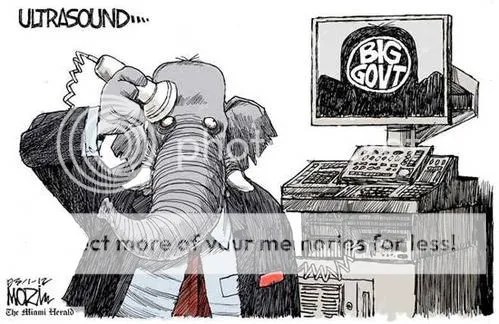
Forced ultrasounds. The general public didn’t catch on to the changing battlelines until women protested the Virginia forced transvaginal ultrasound law this March: In the original version of the bill, women seeking an abortion would be forced to have an ultrasound probe shoved up their vaginas. (Texas already started enforcing a similar law in February.) The legislature had no medical justification; they just figured women who want to abort are too dumb to understand what a fetus is unless the government forces them to look. Or maybe the point is to humiliate women before granting them their constitutional rights.

Maddow and others began calling Virginia Governor Bob McDonnell “Governor Ultrasound” — a nickname that probably pushed him off Romney’s VP short list.

Well, Paul Ryan is Congressman Ultrasound. He co-sponsored the federal Ultrasound Informed Consent Act. Women would be forced to submit to and pay for a medically unnecessary procedure because Paul Ryan believes they’re “uninformed”. (I wonder how he’d feel about making anybody who wants to buy a gun observe the autopsy of a gunshot victim. Don’t they deserve to be “informed” too?)

Rights for single-celled organisms. Another radical addition to the abortion debate are “personhood” laws, which define a fertilized ovum as a human being deserving the full protection of the laws.

Such a law would not only outlaw all abortions, it would also ban any form of birth control that works by interfering with the zygote’s ability to implant in the uterus — like the Pill.

The birth control pill, for example, prevents pregnancy in three ways: The pill thickens the cervical mucus to make it more difficult for sperm to reach the egg; it suppresses ovulation by mimicking pregnancy-level hormones in the body, preventing eggs from being released from the ovaries; and finally, as a fail-safe, the pill makes the lining of the uterus inhospitable to any fertilized egg that might slip through. The time between fertilization and implantation (when a pregnancy becomes medically detectable) usually takes about a week.

In public, advocates of personhood bills deny they’d ban the Pill. But among themselves they sound more like this:

A justly written personhood amendment should ultimately outlaw all abortions  including both the intentionally induced “miscarriages” of the hormonal birth control pill and the blatant infanticide of the partial birth abortion.

Personhood laws would also outlaw in vitro fertilization as currently practiced, because the test-tube zygotes that aren’t implanted must eventually be destroyed. A pro-life article that tries to dispel this “absurdity” actually verifies it:

Couples trying to get pregnant through IVF procedures would have nothing to fear from Personhood legislation unless they consented to the intentional destruction of their embryonic children. [emphasis added]

Who would support such a radical law? Not voters. No personhood referendum has come close to passing, even in Mississippi.

But Paul Ryan is a more radical culture warrior than the average Mississippian. He co-sponsored the Sanctity of Human Life Act, which says:

the Congress declares that … the life of each human being begins with fertilization, cloning, or its functional equivalent, irrespective of sex, health, function or disability, defect, stage of biological development, or condition of dependency, at which time every human being shall have all the legal and constitutional attributes and privileges of personhood

Ryan’s defenders sometimes claim this bill merely empowers states to protect the personhood rights of fertilized ova, but it says what it says. If this passed, how long would it take the Thomas More Society to file a class-action suit against birth-control-pill manufacturers on behalf of zygotes?

Employers’ Rights Trump Workers’ Rights. Ryan voted against the Lilly Ledbetter Fair Pay Act that eliminated a hole in the equal-pay-for-women laws.

Ryan also co-sponsored the Religious Freedom Tax Repeal Act of 2012. Motivated by the concerns trumped up against ObamaCare’s contraception mandate — Wheaton College had to stop covering contraception so that it could join the lawsuit against being forced to cover contraception — Ryan’s bill goes way beyond that case, to prevent the government from enforcing any coverage “if an employer with respect to such plan is opposed to such coverage by reason of adherence to a religious belief or moral conviction.”

So the Christian Science Monitor wouldn’t have to cover any cancer treatment beyond prayer. And what if an employer just has a “moral conviction” against spending money on workers?

In his own voice. Finding Ryan’s name in a list of co-sponsors doesn’t tell you much about his level of commitment or the thinking behind it. For that you have to turn to his writings and speeches.

In September, 2010 (when the Tea Party was playing down culture-war issues) Ryan wrote The Cause of Life Can’t Be Severed From the Cause of Freedom, which explains why “freedom” requires forcing women to obey the tenets of Ryan’s religion.

I recommend reading the entire article, because you will learn a lot about how Ryan’s mind works. No actual pregnant women are mentioned or even imagined. His argument is entirely abstract; the lives and situations of real people carry no weight.

What’s more — and this style is very familiar if (like me and Paul Ryan) you read way too much Ayn Rand in high school — all the important ideas are hidden in the framing, so the argument consists entirely of tautologies. (The third and concluding part of Atlas Shrugged is titled “A is A”, as if something important could be deduced from that.)

So how does Ryan defend the absurd idea that zygotes deserve all the rights of fully-developed human beings? He doesn’t; he just labels them “people” and then defends the rights of people. He compares Roe v Wade to Dred Scott — there being no noteworthy differences between black slaves and single-celled organisms — and concludes:

I cannot believe any official or citizen can still defend the notion that an unborn human being has no rights that an older person is bound to respect. I do know that we cannot go on forever feigning agnosticism about who is human.

Zygotes have rights because “I cannot believe” otherwise. And if you claim not to believe it, or not to be certain enough to use government power to force women to bear their rapists’ babies, you are “feigning”. Ryan knows you agree with him deep down; you’re just pretending not to.

That’s how he thinks.

And if he ever ascends to the presidency, or if he becomes the family-values point man in a Romney administration, that’s the level of public debate we can expect.

I Read Everything About Paul Ryan So You Don’t Have To

Much ink was spilled this weekend about Paul Ryan. Here are the ten best observations I found:

1. This was Plan B for Romney.

Steve Kornacki:

The most important thing to know about Mitt Romney’s running-mate choice is this: It’s not the move he would have made if the campaign was going the way he hoped it would.

Plan A was to frame the election as Barack Obama vs. Somebody Else, and Mitt all but changed his name to Somebody Else. Beyond a few believe-in-America platitudes, the Romney campaign has been the anti-Obama campaign.

That strategy led to what Ezra Klein called a “policy gap” — not a gap between Obama’s policies and Romney’s policies, but

Obama has proposed policies. Mitt Romney hasn’t. … Romney’s offerings are more like simulacra of policy proposals. They look, from far away, like policy proposals. They exist on his Web site, under the heading of “Issues,” with subheads like “Tax” and “Health care.” But read closely, they are not policy proposals.

Klein gives many examples, including:

On financial regulation, Romney would ‘repeal Dodd-Frank and replace with streamlined, modern regulatory framework.’ That is literally his entire plan. Three years after a homegrown financial crisis wrecked the global economy, the likely Republican nominee for president would repeal the new regulatory architecture and replace it with … something.

Romney’s plan to “repeal and replace” ObamaCare is equally light on the “replace” part. The Romney website lists a lot of virtues his plan will have, but only hints at how it will achieve those virtues.

Until Saturday, everything about the Romney candidacy was fuzzy, even whether or not he supports RomneyCare. He bowed to all the conservative icons during the primary campaign, but his Massachusetts record pointed the other way, and Romney spokesman Eric Fehrnstrom indicated that Romney’s primary commitments might be null and void after the convention:

I think you hit a reset button for the fall campaign. Everything changes. It’s almost like an Etch-A-Sketch. You can kind of shake it up and restart all of over again.

In hindsight, the hole in that strategy is obvious: Not only did this looming betrayal make the base edgy, but Romney’s refusal to define himself let Obama define him as the slash-and-burn financier who destroyed American industry and walked away with all the money.

All summer, Romney has been helpless against the assault. Does he want to make women bear their rapists’ children? Does he want to raise taxes on the middle class? Did he pay any taxes himself? All possible responses would force Mitt to be Somebody, when he really wanted to be Somebody Else.

The results showed up immediately in Romney’s unfavorable rating.

Romney’s overall favorable/unfavorable score remains a net negative – a trait no other modern presumptive GOP presidential nominee (whether Bob Dole, George W. Bush or John McCain) has shared.

And eventually Obama started to pull away in the head-to-head polls.

Time for Plan B.

2. Ryan’s voting record is very, very conservative.

Nate Silver notes that Ryan’s Congressional voting record gives him a DW-Nominate rating “roughly as conservative as Representative Michele Bachmann”. Ryan may not be as physically wild-eyed as Bachmann, but ideologically they’re very similar. That makes him the most ideologically extreme VP candidate from Congress since at least 1900. (See chart below.)

Given Mitt’s fuzziness and Ryan’s high-contrast definition, Ryan’s positions are now the Romney-Ryan positions. The Etch-a-Sketch option is gone.

Those Romney-Ryan policies include privatizing Social Security, turning Medicare into a voucher program, and drastically cutting Medicaid. (Ryan hopes that some magic wand at the state level will create efficiencies, but the Urban Institute estimates some 14 million poor people would lose coverage.)

3. Ryan is both a Catholic and a follower of atheist author Ayn Rand.

He’s very anti-abortion but completely ignores the long series of socio-economic encyclicals that started with Pope Leo’s Rerum Novarum in 1891.

The U.S. Conference of Catholic Bishops wrote letters criticizing the Ryan budget, which Ryan falsely rejected as not representing “all the Catholic bishops”.

Catholics have a real decision to make in this election. Are they single-issue anti-abortion voters? Or does the Sermon on the Mount still count for something?

4.The Ryan pick focuses the election on the deficit.

Matt Yglesias complains:

focusing attention on the big-picture disagreement between Democrats and Republicans about long-term fiscal policy means we won’t be focusing attention on what ought to be the most pressing economic policy issue of our time—mass unemployment and the tragic waste of human and economic potential it represents.

This cuts both ways. On the one hand, it plays into the popular misconception that lowering the deficit would create jobs. (Both Econ 101 and the experience of Britain say that cutting the deficit will destroy jobs.) That favors Romney.

On the other hand, Obama’s balanced plan for dealing with the long-term deficit is much more credible than the Ryan/Romney plan to cut rich people’s taxes even more, increase defense spending, and make up the difference by closing unspecified loopholes and cutting unspecified spending.

Ezra Klein explains how steep those cuts would have to be:

Ryan says that under his budget, everything the federal government does that is not Medicare, Medicaid or Social Security will be cut to less than 3.75 percent of GDP by 2050. That means defense, infrastructure, education, food safety, energy research, national parks, civil service, the FBI — all of it. Right now, that category of spending is 12.5 percent of GDP.

Another way to put 3.75% in context: Romney has already promised to put “a floor of 4 percent of GDP” under the defense budget alone.

5. Ryan’s reputation as a deficit hawk is undeserved.

Ezra Klein:

the real north star of Ryan’s policy record isn’t deficits or spending, though he often uses those concerns in service of his agenda. It’s radically reforming the way the federal government provides public services, usually by privatizing or devolving those public services away from the federal government.

More bluntly: The deficit is just an excuse to shrink government. If the deficit went away, Ryan would rebuild it by cutting rich people’s taxes and letting corporations skim a bigger profit out of public services.

Paul Krugman says Ryan’s budget-sausage contains $4.6 trillion in “mystery meat”: Like Romney, he claims his tax cuts for the rich will be balanced by closing loopholes, but he doesn’t identify any of those loopholes.

We’ve heard this song before: Republicans always claim their tax cuts won’t increase the deficit, but they always do. Reagan’s did, Bush’s did, and Romney’s will too.

They will try to claim that Ryan’s cuts to Medicare, Medicaid, and every other non-defense program are necessary to save our children from the deficit. (MoveOn points out the ways in which the cuts harm our children — like making it harder for them to get an education if their parents aren’t rich.) The election probably hangs on making the public realize that those cuts have nothing to do with the deficit and will instead go straight into the pockets of the rich.

Early focus groups indicate that sale won’t be hard for Obama to make.

6. He’s not as smart as he thinks he is. 

Ryan has benefitted from what President Bush (in another context) called “the soft bigotry of low expectations”. The prevailing media prejudice is for “balance”. But the reality of the last few years has been a reasonable administration facing an opposition that abandoned anything resembling facts or logic in favor of pure obstructionism and open hatred.

How to balance that? Paul Krugman explains:

What these people need is reasonable Republicans. And if such creatures don’t exist, they have to invent them. Hence the elevation of Ryan — who is, in fact, a garden-variety GOP extremist, but with a mild-mannered style — to icon of fiscal responsibility and honest argument, despite the reality that his proposals are both fiscally irresponsible and quite dishonest.

I don’t think Ryan understands this process, so I expect him to be totally floored when the media starts covering him more rigorously and asking reasonable questions.

The Republican rank-and-file also don’t understand. They believe Ryan is really, really smart and expect him to wipe the floor with that doofus Joe Biden.

I think they’ll be surprised.

7. Ryan is a creature of Washington.

Wisconsin reporter John Nichols describes him as “Dick Cheney with nice hair”.

he is a guy who went to Washington as soon as he could, rooted himself in the establishment, got himself elected as soon as he could and became a major player

Joan Walsh offers him as an example of “the fakery at the heart of the Republican project today”.

The man who wants to make the world safe for swashbuckling, risk-taking capitalists hasn’t spent a day at economic risk in his entire life.

If you want to make an Ayn Rand character out of him, Wesley Mouch is a closer match than John Galt. Walsh continues:

guys like Ryan … somehow become the political face of the white working class when they never spent a day in that class in their life. Their only tether to it is their remarkable ability to tap into the economic anxiety of working class whites and steer it toward paranoia that their troubles are the fault of “other” people – the slackers and the moochers, Ayn Rand’s famous “parasites.”

8. He voted for all the budget-busting policies of the Bush administration.

According to the LA Times, Ryan voted for TARP, the unfunded Bush prescription drug benefit, the Iraq War, and (of course) all the Bush tax cuts.

Deficits only became a problem after Obama was elected

9. Obama owns foreign policy now.

Romney and Ryan look good posing in front of a mothballed battleship, but that’s the only qualification either brings to the job of Leader of the Free World. Meanwhile, Obama is the guy who finally got Bin Laden and ended the unpopular Iraq War.

Thomas Schaller observes that until now

at least one candidate on every GOP presidential ticket during the past half-century could boast at least some foreign policy, diplomatic or defense chops.

Foreign Policy’s Joshua Keating comments:

Romney seems to be wagering that foreign policy will not be a major issue in the campaign.

10. Ryan would be the real power in a Romney administration. And if Romney loses, Ryan is already the front-runner for 2016.

When Romney introduced Ryan as “the next president of the United States” Steve Kornacki heard a Freudian slip:

while it will be the former Massachusetts governor who is sworn-in as the 45thpresident if the GOP ticket prevails this November, it will be Ryan who sets the new administration’s policy direction.

The New Republic’s Michael Kazin predicts Ryan would be more powerful than Dick Cheney.

Republicans have never before nominated someone for V.P. in hopes that he, and not the would-be President, would define the critical domestic policies of the entire federal government.

MSNBC’s Alex Wagner agrees:

Republicans envision an administration in which Romney has relegated
himself to a kind of head of state role … with Ryan as the actual head of government

Why? Well, Ryan has a philosophy and a real constituency in the Party and in Congress. He also carries the standard of the Koch brothers. Romney has none of that.

Already on Saturday, Nate Silver tweeted:

If Obama wins, most likely 2016 match-up is: Paul Ryan vs. Hillary Clinton. That would be pretty epic.

Kornacki describes Ryan 2016 as “the Right’s long game”.

But even if Ryan’s budget proves an albatross for Romney and the GOP ticket goes down, it’s not hard to see conservatives rationalizing away the defeat: The problem was Romney couldn’t sell the message – that’s why the next time we need Ryan at the top of the ticket!

After all, right-wingers still haven’t admitted that Palin was a liability to McCain. As Digby put it years ago: “Conservatism cannot fail, it can only be failed.”

Believe in America, Mitt

Now available on t-shirts. Click the image.

When Mitt Romney wrapped up the Republican nomination in April, I framed the next phase of the campaign in terms of four narratives: pro/anti-Obama and pro/anti-Romney. The anti-Romney narrative was:

You should vote against Romney because he’s not on your side. His policies favor the rich because he’s rich, he’s always been rich, and the rich are the only people he understands or cares about.

In the last few weeks we’ve seen Obama’s people establishing that narrative and Romney’s people floundering to counter it. The threads of that story are Romney killing American jobs while he was at Bain Capital and Romney maneuvering around taxes by running his money through Bermuda, the Cayman Islands, and Switzerland.

When this stuff came up in the Republican primaries, Romney toughed it out by saying his critics were jealous of his successhe did nothing illegal, and he wasn’t going to talk about it.

Those answers worked then for two reasons:

But Romney should fire whoever told him the same answers would work now. The Republican establishment may have whipped Gingrich and Perry into line, but they can’t make Obama back off. And general-election swing voters do see tax evasion as a moral issue. It’s not enough for Romney’s high-priced accountants to follow the letter of the law. When the rich wriggle out of taxes by using special dodges not available to working people, that’s not clever, it’s sleezy.

Plus, it undermines the pro-Romney narrative, which I phrased like this:

This country is going the wrong way and Romney is a smart executive who knows how to turn things around.

Sure, Romney is smart. But is he Steven Jobs smart or Bernie Madoff smart? Swiss bank accounts, Bermuda shell corporations, deals where Romney walks away with all the money and everybody else gets screwed … what does that sound like?

Once you get past first impressions, the argument over Bain turns technical, which is never good for a politician trying to dispel a bad odor. (That’s what Lee Atwater meant when he said, “If you’re explaining, you’re losing” — a line Romney misquoted and apparently doesn’t understand.) Romney’s defense against the job-exporter charge is that Bain outsourced to Mexico and China only after Romney left in 1999 to run the Salt Lake City Olympics. That answer temporarily convinced New York Magazine’s Jonathan Chait, who, in a remarkably balanced analysis, concluded that Obama’s attacks were false … until the next shoe dropped and he had to write an update.

The next shoe was the Boston Globe uncovering filings with the SEC in which Bain listed Romney as CEO up to 2002 and said he made a six-figure salary for what he now claims was a no-show job. Also, when Massachusetts Democrats challenged his residency prior to his 2002 run for governor (partly because Romney had been avoiding state taxes by listing his Utah home as his primary residence), Mitt claimed he was merely “on leave” from Boston-based Bain, making Massachusetts his real home.

So where Romney lives, who he works for, and the location of his money all vary depending on who’s asking and why.

Shifty. Sleezy. And in retrospect, maybe not as clever as he thought.

On Friday, Romney broke out of his bubble and let himself be interviewed by every major news network other than MSNBC. Unfortunately for him, he doesn’t understand the playbook for such situations. Unlike, say, Barack Obama trying to settle the Jeremiah Wright controversy or the Clintons responding to Gennifer Flowers’ charges, Romney offered no deeper insight into himself and no broader frame for the story as a whole. Instead, he just put his own face behind the unconvincing denials his people had already offered.

Two media responses to the Romney interview blitz sum up how ineffective it was. Rachel Maddow (of the spurned MSNBC) laughed at the situation:

And Forbes’ T. J. Walker captured how little Romney had settled in 35 Questions Mitt Romney Must Answer About Bain Capital Before The Issue Can Go Away.

Meanwhile, there’s some evidence that the Bain story is moving the polls in swing states, where Obama is running ads like this one.

But at this stage, the main thing is the narrative, not the polls. Come November, both Romney and Obama will need a closing argument to convince those last few undecideds. That argument will have to build on the stories being established now. “I’m a smart executive” is not going to do the job.

What Senate Candidates Deserve Your Support?

Last week a Sift-reading friend told me she had set aside some money to contribute to Senate candidates, and wondered where I thought it would be best spent.

We agreed that this is a good time to contribute. In general, early money is more valuable than late money, but (if you’re like me) you’d usually rather see your money spent in the general election than during the primary. So one of best times to contribute is right after the primaries bring the race down to a Democrat vs a Republican.

There are 33 Senate races this year, but a few simple criteria will narrow down the candidates worth contributing to or volunteering for.

I’ve never claimed to be non-partisan. (I try hard to keep the Sift honest, but I’m not trying to be neutral. I write what I believe, not just what I want you to believe.) So it shouldn’t surprise anybody that my first criterion is that I’m only considering candidates who will caucus with the Democrats. (That would include independents like Bernie Sanders of Vermont and probably Angus King of Maine.) Anybody committed to vote for Mitch McConnell as majority leader is off my list.

Second, the race should be close. I love Bernie Sanders, but I expect him to win with or without me. Real Clear Politics currently rates 8 races as toss-ups: Florida, Massachusetts, Missouri, Montana, Nevada, North Dakota, Virginia, and Wisconsin.

Whether that’s your serious-support list or not depends on how optimistic/pessimistic you are about what will happen between now and November. If you expect a big Democratic surge that isn’t showing up in the polls yet, then you might want to reach for one of RCP’s “leans Republican” seats, like Arizona, where Richard Carmona currently trails by about 11%. If you expect the opposite, you might want to defend one of the “leans Democratic” candidates, like Sherrod Brown in Ohio, ahead by 8%.

I don’t really have a hunch about the trend, so I’ll stick with the toss-ups. Next, I want strong progressive voices in the Senate. I want somebody who’s going to make me proud, not just be slightly better than a Republican. That takes Bill Nelson of Florida (not to be confused with Ben Nelson of Nebraska, who is worse) off my list. He has a history of joining Republicans on issues like eliminating the estate tax, and he’s generally one of the last Democrats to get on board for things like raising the debt ceiling. So, Bill, I’ll be rooting for you on election night, but I can think of people more deserving of my time and money.

Elizabeth Warren

Two candidates that jump right out at me are Elizabeth Warren in Massachusetts and Tammy Baldwin in Wisconsin. Both of them will face an avalanche of out-of-state money, Warren from the financial industry and Baldwin from the religious right.

Elizabeth Warren. Warren you’ve probably heard of, even if you’re not from Massachusetts. I first noticed her when she was chair of the Senate’s TARP Oversight Committee. She did several very plain-spoken, hard-hitting interviews on Rachel Maddow’s show where she laid out exactly how opaque the program was and how few of the underlying problems were being fixed.

The best argument for putting Warren in the Senate was the Jamie Dimon testimony to the Senate Banking Committee. (More about that in the Nuggets.) Warren is exactly the person who should have been in that room.

She’s a Harvard law professor, so her opponent Sen. Scott Brown is trying to tar her with the Harvard elitist label. But she wasn’t born into the Harvard strata of society, she started in the working class and climbed the ladder. She understands ordinary people and wants to be in a position to watch their backs.

Current polls are about as close as polls can be: Brown 43.8%, Warren 43.5%. I expect Warren to win a close race for three reasons: Undecideds have a tendency to break against the incumbent, Massachusetts is a blue state, and Warren’s supporters are genuinely enthusiastic about her. But Wall Street really hates Warren, so Brown will have a lot of money to spend.

Tammy Baldwin. Unless you live in Wisconsin, you may not know much about Tammy Baldwin. She’s been in Congress for 14 years, and is the only openly lesbian congresswoman. (She was already out of the closet when she ran in 1998. Up until that time, the only gay representatives had come out while in office.) In 2010, National Journal’s ratings had her tied for being the most liberal member of the House.

Now, my first thought on hearing those facts would be: She’s going to get crushed. But so far that’s not happening. The Republican primary isn’t until August, and the RCP average has her trailing former Governor Tommy Thompson by 8.7%. But that average is skewed by a Rasmussen poll with a huge Republican bias (Thompson ahead 52%-36%).  The other two polls have her behind Thompson by manageable numbers: 4% and 6%, which could just be name recognition. Marquette University’s poll has her ahead of the other two likely Republican candidates.

There’s also no guarantee Thompson wins the primary, or gets through unscathed with the Club for Growth gunning for him. Chuck Todd sums up the race and interviews Baldwin:

Other toss-up Democrats. Claire McCaskill isn’t exactly an inspiring progressive voice. (National Journal rates her exactly in the middle as the 50th most liberal senator.) But this is Missouri we’re talking about; what did you expect? I think she’s doing as much as the voters will allow, and that holding this seat is key to holding the Senate. Polls: Rasmussen has her behind by double digits, but PPP says the race is tied.

Jon Tester in Montana is another incumbent Democrat in a Republican state. Don’t expect his support on, say, gun control. But his heart is in the right place when it comes to keeping Wall Street in check. PPP and Rasmussen disagree about who is ahead.

Immigration is likely to be a huge issue in the Nevada race. Shelley Berkley is challenging the incumbent Dean Heller, who was appointed when John Ensign resigned in disgrace. Nevada is a swing state that’s been trending blue as the Hispanic vote increases, but Republicans keep offering far-right candidates. Heller is a typical senate Republican, rated the 73rd most liberal senator. Berkley supports the DREAM Act; Heller wants to build a bigger border fence. The non-Rasmussen polls have this as a neck-and-neck race.

In Virginia, Tim Kaine vs. George Allen is a marquee match-up. Kaine has been governor and Allen senator. (Allen famously lost to Jim Webb in 2006 after the Macaca gaffe.) So far, I haven’t found anything thrilling on Kaine’s web site, and he seems to be running a vague I-was-a-good-governor campaign. But he’s narrowly ahead in the swingiest of swing states.

I confess I had never heard of North Dakota candidate Heidi Heitkamp until this morning. She’s running in a red state as a former state attorney general who fights for the people. Her web site is focused on local North Dakota issues, and I really have no idea how progressive she’d be. (She favors the Keystone Pipeline that environmentalists oppose.) Polls have her neck-and-neck with Rep. Rick Berg.

What Happened in Wisconsin?

Short version: The long anticipated recall of Governor Scott Walker fizzled. Walker won the rematch against Milwaukee Mayor Tom Barrett by almost exactly the same margin (53%-46%) as their 2010 race.

Longer version: Split decision. The Democrats appear to have won one of the four state senate recall elections. The Republican hasn’t conceded and a recount seems likely, but if the 779-vote margin holds up, Democrats will control the Wisconsin senate.

So the upshot is that the union-busting Walker has already done will stand for another two years, as will his education cuts and the voter suppression law (if it ultimately survives its court challenge). But Walker won’t get any new shenanigans through the legislature until at least 2013, if then. That’s a big improvement on the way things were when the demonstrations started in February, 2011. Then Walker had solid majorities in both houses and could do pretty much whatever he wanted.

What it means. Everybody has been working hard to spin the result. Republicans want it to be a vindication of Walker’s policies and a sign that Romney can win Wisconsin in the fall. Democrats want to read it either as a rejection of the recall process itself, with little meaning for President Obama or even for Walker’s re-election in 2014, or as a sign of the Citizens United apocalypse, in which massive contributions from the very wealthy can buy a result.

Exit polls. The big reason to doubt Obama is in trouble in Wisconsin is Tuesday’s exit poll: Obama over Romney 51%-44%.

Republicans spin this by claiming the poll had a Democratic bias:

Considering the exit polls the media relied on showed a razor-thin difference between Walker and his Democratic opponent, Milwaukee Mayor Tom Barrett, the logic behind some huge lead for Obama, produced by the same exit polls, melts away. Walker defeated Barrett by a 7-point margin.

Apply that same analysis to Obama’s 7-point lead in the same exit polls and the race in Wisconsin is actually closer to being dead even.

This point is bogus. The early exit poll, reflecting only people who voted in the morning, showed a neck-and-neck race between Walker and Barrett. But Obama’s 7-point lead comes from the final exit poll, which shows Walker winning by about the right margin. (Atlantic’s Molly Ball describes how exit polls work.)

Doubting the process. Walker got 53% of the vote. But according to the exit poll, 70% of the voters were dubious about whether a recall was appropriate at all. Of the 10% who said a recall was “never” appropriate, 94% voted for Walker. 60% believe in recalls “only for official misconduct”; Walker got 68% of their votes.

I think the wording of the choices skewed this result a little. The only other option — that a recall is appropriate “for any reason” — is too loose.  The actual justification for the recall — that compared to Walker’s radical policies, his vaguely conservative 2010 campaign amounted to fraud — might have gotten more than 27% agreement.

Still, it does seem that many voters set Walker a lower bar than he’d face in a regular election. For them, the question wasn’t whether Walker or Barrett would be a better governor, but whether Walker had done anything so egregious that the 2010 election should be overturned.

A good comparison here was the Clinton impeachment. Many people who disliked Clinton’s policies and thought his sexual escapades were shameful nonetheless believed that impeachment was unwarranted.

Not like Ohio. Another instructive comparison is Ohio, where Governor Kasich’s similarly vague cut-spending/create-jobs 2010 campaign led to a similarly radical ALEC agenda after the election. As in Wisconsin, Kasich’s attack on workers’ rights led to a popular backlash.

But Ohio’s constitution allows the voters to go after laws directly. So last November Ohio repealed Kasich’s anti-union S.B. 5 in a referendum by a 61%-39% margin.

In Wisconsin, the voters’ only recourse was to recall the people it had just elected, and the recall couldn’t begin until the officials had served a year in office. As a result, Tuesday’s recall was the culmination of more than a year of political turmoil: Democratic senators escaping to Illinois to deny Walker a quorum, the April 2011 Supreme Court election, and the state senate recall elections of last summer.

So it’s not surprising that some fed-up voters would be angry the recall itself. As one questioner at Netroots Nation’s Wisconsin post-mortem panel commented Friday: “If Wisconsin had had the same mechanism as Ohio, if we’d been able to go directly after the law, we would have gotten the same result.” (I watched the session’s livestream and haven’t re-watched the tape, so my quotations are only approximate. The fuzzily-sourced quotes below are due to my sketchy notes.)

Madison was the first Occupation

The message disconnect. The massive demonstrations in Madison in 2011 were the prototype for Occupy Wall Street. The Wisconsin protests had the same grass-roots, horizontally organized structure and the same independence from parties and candidates. As Harry Waisbren put it at Netroots Nation:

This movement is not about electing Democrats, it’s about ending the corporate subversion of our democracy.

But that led to a problem: The Occupy-style grass-roots movement was great at collecting one million signatures for the recall-Walker petition. But as soon as that petition was filed, the focus of the process necessarily shifted to electing Democrats — precisely what the movement is not about. Election campaigns continue to be top-down political-consultant-driven operations.

Things got worse after the primary, which was won by the centrist Barrett rather than the activists’ favorite candidate, Kathleen Falk. So rather than a referendum to restore workers’ rights, public education, and environmental protections, the campaign became a generic do-over of the 2010 Walker/Barrett race. As one Netroots Nation panelist put it:

Barrett never really focused on the messages that were coming up from the grass roots.

Now, maybe Barrett looked at his polling and decided those issues were losers. Who knows? But as a result, the logic of the recall slipped away. “The narrative was lost,” Waisbren commented. That led directly to the sense of the recall’s illegitimacy that was expressed in the exit poll.

Walker’s money advantage. This was the most expensive campaign in Wisconsin history, and Walker had an overwhelming money advantage. Mother Jones provides this chart:

In addition to these millions, millions more were spent by outside groups like the Koch brothers’ Americans for Prosperity on “issue ads” that couldn’t directly say “Vote for Walker”, but left little doubt who you should support. All told, the Center for Public Integrity estimates that $63.5 million was spent. Walker’s ads started appearing back in November. As one Netroots Nation panelist said:

No one who lives in Wisconsin could doubt that Walker owned the airwaves.

What money can do. A lot of people are skeptical that it’s possible to buy an election. History is full of well-financed candidates who went nowhere, like Rudy Giuliani in 2008 or Phil Gramm in 1996. As Giulani now says:

Campaign spending doesn’t mean anything because you can spend it incorrectly.

Similarly, Rudy could say that being seven feet tall doesn’t mean anything in basketball, because you might be clumsy. But what if you’re not? What can you do with a cash advantage like Walker’s if you spend it correctly?

Obviously, nobody’s going to vote for Walker just because they’ve heard “Vote for Walker” 100 times and “Vote for Barrett” only 10-15 times. Where Walker-level money comes into play isn’t just in repetition, it’s in re-defining reality.

The jobs issue was a key example. The slogan of Walker’s controversial 2011 budget was “Wisconsin is Open for Business“. His agenda’s whole point was that industry would create jobs if the state cut corporate taxes, broke unions, and stopped protecting workers and the environment.

It hasn’t worked. The Wisconsin Budget Project looked at statistics from the Federal Reserve and concluded:

If we use December 2010 as our baseline for analysis, the newly released data indicate that only one other state (Alaska) has experienced slower growth than Wisconsin.

And Bloomberg News — hardly a left-wing outfit — reported:

Wisconsin was ranked last among states and the District of Columbia in economic health in 2011, the first year of Walker’s tenure, according to the Bloomberg Economic Evaluation of States.

Walker didn’t like those numbers, so he made up his own. The Bureau of Labor Statistics said Wisconsin had lost 33,900 jobs. But Walker’s re-analysis said that Wisconsin had gained 23,321 jobs. And then he blanketed the airwaves with this ad:

As Netroots Nation panelist Emily Mills pointed out, any state could adjust its numbers in the same way:

Whatever metric you use on jobs, if you apply the same metric to every state, Wisconsin is still dead last.

But nobody had millions of dollars to spread that message across the state, so Walker’s message stood.

That’s Wisconsin’s lesson for the post-Citizens-United era: The best use of money in politics is to define reality. Don’t just tell citizens to vote for you, create a virtual world in which voting for you makes sense.

What it means for November. Mitt Romney has a lot of disadvantages: He’s not very likeable. He’s a bad campaigner who has a habit of saying things like “I like to be able to fire people” and “I’m not concerned about the very poor.” He’s a wooden debater who has yet to appear outside the conservative bubble. He has taken a lot of radical right-wing positions that he’ll have a hard time running away from. And he’s the poster boy for income inequality and financiers run amok.

But you have to give Romney this: He knows how to raise vast amounts of money and bury his opponents with it. And he has no scruples about redefining reality.

Limitless amounts of money are going to be spent in the fall. And while Obama is no slouch as a fund-raiser, he’s going to be outspent by a wide margin, especially if you count the corporate-funded outside groups like the Chamber of Commerce and Karl Rove’s Crossroads, whose ads I’ve already seen repeatedly during the NBA playoffs.

The bulk of that money isn’t going to be spent saying “Vote for Romney”. It’s going to be used to redefine reality. Millions already believe (falsely) that Obama raised their taxes, that he cut defense, that he isn’t really an American citizen, that he’s secretly Muslim, that the stimulus didn’t create jobs, and on and on and on. By November, millions more will believe other false things that make it logical to support Romney over Obama.

In Wisconsin, Obama currently benefits a little from Walker’s redefinition of reality: If the Wisconsin economy is getting better, maybe Obama isn’t so bad.

But now that Walker is safe until 2014, the up-is-down campaign will reverse itself. Wisconsinites can expect to start hearing that they’re in a depression, that things were never this bad under President Bush, and so on. It will make a difference.

A 7% difference? Too soon to tell.