The Week That Broke Trump’s Brand

Officially, Trump was acquitted. But he still lost, and the Republican Party lost with him.


[I’m not sure who to credit for the cartoon above, but I found it here.]

At this rate, the fourth impeachment will nail him. (No. Seriously, I hope this is the last impeachment article I ever have to write.)

The Senate vote. When Trump was impeached in 2020, a majority voted for acquittal: 52-48 on the abuse-of-power article and 53-47 on obstruction of Congress. Only one Republican (Mitt Romney) voted to convict, and him only on abuse of power.

Saturday, in contrast, seven Republicans voted against Trump, resulting in a 57-43 majority for conviction. That was still ten short of the 2/3rds supermajority needed, but makes laughable Trump’s characterization of the trial as “the greatest witch hunt in the history of our Country”.

The seven Republicans with spines were Romney again, the two “moderate” women who always come up when Democrats are looking for bipartisan support (Lisa Murkowski of Alaska and Susan Collins of Maine), the guy who is positioning himself to be the take-back-the-GOP-from-Trump 2024 presidential candidate (Ben Sasse of Nebraska), two guys who don’t have to worry about a primary challenge because they’re retiring (Pat Toomey of Pennsylvania and Richard Burr of North Carolina), and Bill Cassidy of Louisiana, whose term runs until 2026, and who gave a refreshingly simple explanation of his vote: “I voted to convict President Trump because he is guilty.” (That vote got him immediately censured by his state GOP.)

https://theweek.com/cartoons/966255/political-cartoon-trump-impeachment-constitution

The guilty-but-acquitted faction. You might think Cassidy’s explanation goes without saying — that of course people who thought he was guilty voted to convict — but in today’s intimidated Republican Party it doesn’t. Mitch McConnell also thought Trump was guilty, but he voted to acquit anyway, because that’s the kind of guy McConnell is.

The speech McConnell gave immediately after the vote, when he could just blow smoke without any consequences, resembled a summation for the prosecution. He called the insurrection “a disgrace” caused by Trump’s “disgraceful dereliction of duty”. He held Trump “practically and morally responsible” for the attack on the Capitol, because “The leader of the free world cannot spend weeks thundering that shadowy forces are stealing our country and then feign surprise when people believe him and do reckless things.” After the insurrection began, Trump’s response was “unconscionable”. “He didn’t take steps so federal law could be faithfully executed, and order restored.”

McConnell didn’t convict because he manufactured a constitutional reason not to, one in conflict with the practice of the framing era, against a precedent set in the 19th century, and rejected by the Senate itself just a few days ago: “We have no power to convict and disqualify a former officeholder who is now a private citizen.”

Other too-timid-to-vote-their-conscience GOP senators — Thune, Portman, Capito, and maybe more — also hid behind this bogus “constitutional” principle. I predict this interpretation will go out the window if it ever protects a Democrat.

McConnell went on to say (in a section of his speech he apparently added at the last minute, because it wasn’t in the pre-speech transcript his office provided):

President Trump is still liable for everything he did while he was in office. … He didn’t get away with anything yet. Yet. We have a criminal justice system in this country. We have civil litigation. And former presidents are not immune from being accountable by either one.

This idea will go out the window even sooner. If Trump does get criminally prosecuted, expect McConnell and all the other “constitutional” objectors to denounce his indictment as a politicization of the justice system. Republicans never admit that they have placed Trump above the law, but any forum that tries to hold him accountable is the wrong one.

The witness controversy. Saturday morning there was a flurry of uncertainty, as the House managers asked have a witness: Republican Rep. Herrera Beutler, who had reported on House Minority Leader Kevin McCarthy’s phone conversation with Trump:

When McCarthy finally reached the president on January 6 and asked him to publicly and forcefully call off the riot, the president initially repeated the falsehood that it was antifa that had breached the Capitol. McCarthy refuted that and told the president that these were Trump supporters. That’s when, according to McCarthy, the president said: ‘Well, Kevin, I guess these people are more upset about the election than you are.’

This incident is damning, because it emphasizes not just that Trump wasn’t eager to call the mob off, but that he was using the attack to pressure Congress; he wanted them not to finalize his loss by accurately counting the electoral votes.

The problem with Beutler’s account is that it’s hearsay; the story of the call was “relayed to me” by McCarthy. Her testimony would backfire if Trump’s lawyers then called McCarthy to the stand and he denied that the incident ever happened. If Trump’s lawyers wanted to call a lot of witnesses — they claimed they would, but that was probably a bluff — the trial might have continued for two weeks or more.

In the end, a compromise was worked out: An affidavit from Beutler was entered into the record, no witnesses were called, and the trial wrapped up on Saturday as planned.

On my Twitter feed, I saw the progressives I follow — both national figures and my personal friends — react in outrage. DailyKos founder Markos Moulitsas tweeted (and was retweeted by Amanda Marcotte):

The storyline just changed from “soulless Republicans acquit guilty Trump” to “cowardly Democrats abandon case”

I don’t see it. (And as a matter of record, that was not the Sunday morning headline.) To me it looks like this: As of Saturday morning, the prosecutors had achieved everything they were going to achieve. They had performed flawlessly and made a convincing case to the country, while Trump’s lawyers looked pathetic. They had persuaded enough Republican senators to invalidate Trump’s predictable claim of a “witch hunt”, but not enough to convict.

The wonderful thing about a trial is that it cuts through the cacophony of conflicting voices and focuses attention on a single narrative, or two competing narratives. Trump’s scattershot approach — Antifa! the George Floyd riots! — may work on social media, but he had no answer for the story the House managers told: After Trump had lost the election, he tried to hang onto power through lies and violence.

America heard that story.

Keeping the trial going for another week or two would not have changed the outcome. It’s possible those two weeks would have gilded the lily. Maybe Republicans would squirm more and look worse to the public. But another possibility was that something unpredictable would give Trump’s supporters a talking point. (Imagine, say, that another police shooting had led to violence from groups Democrats support.) Maybe the trial would bog down in procedural issues and the nation would tune out. Maybe the politics would turn as voters wondered why the Senate was talking about Trump rather than Covid relief.

If I had been in the Democrats’ strategy room, I think I’d have said, “We’ve got what we’re going to get. Let’s end this before anything goes wrong.”

Trump lost. One reason I feel that way is that I agree with David Frum: Trump lost. As the NYT’s Peter Baker put it, the vote was “an escape, not an exoneration”.

I think the 57-43 vote, in which Democrats stayed united and Republicans fractured, is the final episode of the 2020 election — the loss that concludes four months of Trump losing.

Ever since the vote totals started moving decisively towards Biden late on Election Night, Trump has been assuring his supporters that vindication was coming: Election boards would refuse to validate Biden’s win. No matter how many times Trump’s lawyers failed, the next court case would be the big one. Republican governors would refuse to certify the election results. Republican legislatures would appoint their own electors. Mike Pence would refuse to recognize the swing state votes; and if he didn’t, January 6 would be “wild”.

https://www.cicero.de/el-paso-duff-moses-donald-trump-cartoon-hate

I hope that someday, somebody in Trump’s inner circle lets us know what he thought was going to happen when he sent his mob to the Capitol. His pre-insurrection speech didn’t instruct them just to protest the inevitable culmination of the electoral process, he told them to stop it: “stop the steal”. But how did he imagine they would do that? Just standing outside the Capitol waving Trump flags clearly would not do it. And even their violent riot only delayed Trump’s defeat by a few hours. So what was his plan for victory? Did he really expect them to hang Pence? Hunt down Pelosi? Use those zip-ties to take members of Congress hostage? Capture or destroy the electoral-vote ballots? What?

Whatever he imagined, it didn’t work. The insurrection was another defeat. His QAnon supporters then had elaborate fantasies of what would happen on Inauguration Day, but that vision only yielded another disappointment. And this week, if you were waiting for Trump himself or his brilliant legal team to humiliate his accusers, you were disappointed again.

The broken brand. When I think about Trump’s appeal, I remember a line out of Robert Penn Warren’s classic political novel All the King’s Men. Weeks after the Boss, Governor Willie Stark, has been assassinated, the narrator runs into Stark’s stuttering driver Sugar Boy. “They w-w-wasn’t n-n-nobody like the B-B-Boss,” he says. “He could t-t-talk so good.”

People look for things in their heroes that they find lacking in themselves. In Trump, people who felt like they were losing identified with a winner. Americans who felt voiceless and powerless identified with someone who was loud, unafraid to say outrageous things, and impossible to ignore. If they feared being called “racist” or wearing some other negative label, they loved that Trump never took such criticism lying down, but always gave back better than he got. I’ve heard his White House’s communications strategy described like this: Every day should be a drama in which Trump defeats his enemies.

That’s been his brand: a fighter, a winner. And this week completely wrecked it. Day after day, the House managers described his “Big Lie” of election fraud, and how it led to the failed insurrection. And no one struck back. He was invited to testify and chickened out. His lawyers had a giant stage on which to prove to the world that Biden stole the presidency, but (like the lawyers in most of his court cases) they didn’t try. Instead, they argued narrow legal points: The Constitution doesn’t allow the Senate to convict a former president. The First Amendment gave him a right to say what he did, whether it was true or not.

Rather than defend him, Republican senators hid behind technicalities. No talented lawyers would take his case, so he was left with clowns that Jamie Raskin’s crew completely outclassed. At times it seemed as if Trump’s lawyers hadn’t even talked to their client. When did Trump find out the riot was happening? asked Senators Collins and Murkowski, two potential swing votes. There was no way to know, claimed Michael Van Der Veen (a personal injury lawyer suddenly called up to the big leagues), because the House managers had refused to investigate. Later, Van Der Veen whined that the trial was “the most miserable experience I’ve had down here in Washington, D.C.”, setting Raskin up to respond: “For that I guess we’re sorry, but man, you should have been here on January 6th.”

Trump is no longer the larger-than-life winner his followers need him to be. He’s a loser surrounded by losers. (And that’s only going to get worse as lawsuits and indictments unrelated to January 6 start to roll in.) Trump was supposed to make people stop laughing at his supporters, but if you’ve been echoing his repeated claims of vindication, you keep getting embarrassed when they come to nothing.

Now that the trial has ended, the country’s attention will shift back to the battle against Covid, and to Biden’s $1.9 trillion proposal to repair the economic damage it has done. For months — even while he was still president — Trump has had nothing to say about the pandemic. And now, no one cares what he thinks.

The broken party. The Senate outcome — Democrats united, Republicans divided — symbolizes a larger political reality going forward. The split wasn’t between those who believed the Democratic narrative and those who don’t. A bipartisan consensus of Americans understand now that Trump tried to stay in power through lies and violence. Democrats are united in believing this was bad. Republicans are split about it.

CNN’s Ronald Brownstein examines the polling and finds a disturbing fault line in the GOP.

One-sixth to nearly one-fifth of Republicans have praised the January 6 attack in polling from PBS NewsHour/Marist and Quinnipiac. That’s a far higher percentage than among the public overall (just 8% in the Marist survey and 10% in Quinnipiac.) In the American Enterprise Institute poll, about 3-in-10 Republicans said they believed the QAnon conspiracy theory.

The share of Republican voters who express support for the use of force to advance their political goals in general is considerably larger. In the American Enterprise Institute survey, 55% of Republicans agreed that “we may have to use force to save” the “American way of life.” Roughly 4-in-10 agreed with an even more harshly worded proposition: “If elected leaders will not protect America, the people must do it themselves even if it requires taking violent actions.”

Brownstein suggests that what Mitch McConnell has described as a “cancer” in the party may have gotten so big that it is inoperable. Maybe the conspiracy-theory-and-violence faction of the GOP is too small to win with, but too big to win without.

I don’t think anybody over there has an answer for that.

The Monday Morning Teaser

Whenever I do a philosophical post like last week’s “Why You Can’t Understand Conservative Rhetoric“, I wonder how well it will catch on, and worry that I’m basically just talking to myself. It turns out I shouldn’t have worried this time: The post is as close to viral as the Sift gets these days. It’s got over 9K page views so far and should pass 10K before it’s done. It’s the most popular Sift post since NRA types realized that they hatedHow Should We Rewrite the Second Amendment?” in 2019. (Of course, neither post compares with ones from the golden age of viral blogs, before social-media algorithms added more friction to the system. Between them, “Not a Tea Party, a Confederate Party” and “The Distress of the Privileged” have over a million page views.)

Anyway, this week there’s really no choice about where to focus: The impeachment trial was historic, significant going forward, and the center of the public’s attention. You can take a glass-half-empty view that Trump should have been convicted and banned from future office, or a glass-half-full view that the trial fractured the Republicans and leaves Democrats united.

I take a half-full approach in this week’s featured post “The Week That Broke Trump’s Brand”, which should be out around 10 EST. The House managers’ narrative — that Trump lost the election, but tried to hang onto power through lies and violence — is pretty widely accepted now. The senators differed on how they feel about lies and violence as a political strategy. Democrats rejected it, and Republicans split three ways: some rejected it along with the Democrats, some continue to favor it, and a sizeable chunk in the middle doesn’t want to get on the wrong side of those who favor it.

This is going to be a problem for the country, but we’ll figure it out. The Republican Party, though, is in a serious fix. The lies-and-violence faction is too big to alienate, but not big enough to win with. The 2022 Republican primaries are going to be a circus.

Anyway, there’s still a pandemic to discuss, and a $1.9 trillion package waiting for Congress to act on. That will be the main subject of the weekly summary, which I guess will appear around noon.

Oathbreaker

This trial arises from President Donald J. Trump’s incitement of insurrection against the Republic he swore to protect.

House impeachment manager’s pre-trial brief

This week’s featured post is “Why You Can’t Understand Conservative Rhetoric“.

This week everybody was talking about the impeachment trial

Which starts tomorrow. Both the prosecution and the defense have filed briefs outlining their positions. The prosecution (technically the “impeachment managers from the House”, but I think that’s a needless mouthful of words) requested that Trump himself testify, and he has refused.

He could be subpoenaed, but that would undoubtedly set off a long litigation that Democrats would rather avoid. Instead, I believe the purpose of asking for Trump’s testimony was to make it clear that it’s his choice not to speak under oath, where his lies could result in perjury charges. Whenever the ex-President’s lawyers make some claim about what he was thinking or what he intended, prosecutors can point out that this is hearsay, and that they wanted to get direct testimony but were rebuffed.

If he did testify, this cartoon from his first impeachment would be relevant again.

https://www.timesfreepress.com/cartoons/2018/aug/11/perjury-trap/3581/

CNN explains why both sides want a speedy trial: Democrats don’t want the Senate distracted from approving Biden’s nominees for too long, and Republicans want the country to stop thinking about the January 6 insurrection.

It looks like the lawyers have prevailed on Trump not to use the impeachment trial to repeat lies about his “landslide” victory over Biden, and how it was stolen from him. Instead, they’ll claim (falsely) that it’s unconstitutional to hold an impeachment trial for an ex-president. That allows Republican senators to acquit for procedural reasons, without supporting or justifying the insurrection Trump incited.

BTW: Every statement coming out of the Trump camp refers to him as the “45th President”. He is not allowing his people to call him the “ex-president” or “former president”, presumably because he still does not acknowledge that Biden (or anyone else) is the 46th president.

However, his lawyer’s claim that the proceedings are unconstitutional rests on the fact that he is no longer president. One reason he doesn’t want to testify, in my opinion, is that he could be asked questions like “Is Joe Biden the President of the United States?” or “Did Dominion voting machines send results overseas to computers that flipped your votes to Biden?”, where his answers would mark him as either delusional or a liar.

and the Covid relief bill

https://theweek.com/cartoons/965020/editorial-cartoon-covid-variant-vaccines

It’s good to see Biden avoiding the bipartisan trap Obama fell into in 2009. The point of “unity” is to give Republicans a bill they could support, and that many of their voters do support, but Biden can’t control whether any Republicans will vote for it. Biden knows the public will hold him responsible for the results, so his first priority is passing the bill the country needs. That’s why he hasn’t backed off of his $1.9 trillion proposal.

It seems likely the House will pass it with few changes. The question is whether it gets through the Senate, which it will if all 50 Democrats vote for it and Vice President Harris provides the tie-breaking vote. Friday, the Senate passed a budget resolution on party lines. That is a procedural prerequisite for invoking the filibuster-proof reconciliation process to pass Covid relief.

Republicans are complaining about this tactic, which they used to pass the Trump tax bill, claiming that it shows a lack of commitment to bipartisanship. But in reality, the only hope of getting Republican support is to have a Plan B if they won’t get on board.

In general, I think Democrats should compromise in only two situations:

  • What Republicans are asking for is actually a good idea.
  • The changes Republicans want don’t make the bill significantly worse, and they will vote for the bill if it is changed.

Too often, the Obama administration compromised with Republicans, got none of their votes anyway, and then were blamed by the public for the less-effective bill.

The big question is whether the Senate Democrats can hold together. Joe Manchin of West Virginia is the most likely defector, but so far he is staying on board. He is insisting on a “bipartisan process”, but says that means “Democrats and Republicans will have amendments”, not that the bill will be held hostage until it can get Republican votes. It helps that West Virginia’s Republican governor has come out in favor of a big relief package.

and the Covid statistics turn

Fewer Americans are now hospitalized with Covid than at any time since the Thanksgiving wave started. New cases are down sharply, to 107K Saturday from 318K on January 8. Deaths are edging lower, but not by nearly as much: The average number of daily deaths for the past week is 2800, down from several days above 3300 in mid-January. Deaths are always the last statistic to turn. In a week or two the daily average should be well under 2000.

Those are all numbers we would have considered horrifying in October. But at least they’re headed in the right direction now.


Everyone is complaining about the vaccine distribution process, but it is happening. By yesterday, 31.6 million Americans had gotten at least one dose, and 9.1 million were fully vaccinated.

The interesting question is how demand will hold up. Right now, many more people want to be vaccinated than can get appointments. But at some point, all the people who describe themselves as “eager” to be vaccinated (like me) will have had their shots. Then the burden will shift to coaxing reluctant people to be vaccinated. Nobody is sure when that shift will happen.


Johnson & Johnson has applied for approval of its vaccine, which is simpler but somewhat less effective. It is one shot instead of two, and can be stored in an ordinary refrigerator. The AstraZeneca/Oxford vaccine is nearly ready to apply for approval as well. It is a two-dose vaccine, but can be stored in a refrigerator.


HuffPost posted the article “It’s Not Just You. A Lot of Us Are Hitting a Pandemic Wall Right Now.” I realize that’s supposed to be reassuring: There’s nothing wrong with you; it’s perfectly normal to want to run naked through the streets with an AR-15.

Somehow, though, I’m not comforted by the thought that everybody else in the world is just as close to the end of their rope as I am.

and the QAnon lady* in Congress

[* I’ve heard MSNBC’s Nicolle Wallace refer to her that way, and I kind of like it.]

As I pointed out last week, freshman Georgia Congresswoman Marjorie Taylor Greene has promoted a lot of truly horrific ideas over the last few years, both orally and on social media. Wednesday, the House Republican caucus decided she is not a problem, and no disciplinary action is needed.

Democrats were not having that, so Thursday evening the full House voted to kick her off of the committees the GOP had assigned her to: Education and Budget. Only 11 Republicans voted for that resolution; the rest support her.

In the debate over that resolution, Greene gave a self-justifying speech; some Republicans have said it was similar to the speech she gave to the Republican caucus before it decided not to punish her. I link to the full text so that you can judge it in context, without relying on me (or anybody else) to interpret it correctly.

Having provided that backstop, here’s what I see in her speech.

  • She avoided taking responsibility. “The problem with that is though is I was allowed to believe things that weren’t true and I would ask questions about them and talk about them.” Who “allowed” her to repeat all those crazy things? What does that even mean?
  • She falsely claimed that her objectionable statements are all from years ago, and all from social media. “If it weren’t for the Facebook posts and comments that I liked in 2018, I wouldn’t be standing here today and you couldn’t point a finger and accuse me of anything wrong.” Actually, things she has said and done in person are just as disturbing, and she was defending QAnon as recently as December 11: “Asked by @ryanobles on Pelosi saying GOP has ‘QAnon in [their] caucus,’ Marjorie Taylor Greene said ‘I don’t think there’s anything wrong w/ people looking things up & not believing things in the news…it’s unfair to criticize regular Americans looking things up on the internet’.” On December 4, she praised a pro-Q news article.
  • She falsely claimed that her words have been taken out of context. “Big media companies can take teeny tiny pieces of words that I’ve said, that you have said, any of us and can portray us and to someone that we’re not, and that is wrong.” The full context of her statements usually makes them worse, not better. Last week I called your attention to a completely unhinged 40-minute video she uploaded to YouTube in 2018. Even if she had completely repudiated all the claims she made then, people’s habits of thinking don’t turn over that quickly (at least not without some kind of medication). The lunatic in that video should not be making decisions for our country.
  • She equated QAnon with the mainstream media, and in particular equated believing that the Trump campaign colluded with Russia to the conspiracy theories of QAnon. “I started seeing things in the news that didn’t make sense to me like Russian collusion, which are conspiracy theories also, and have been proven so … Will we allow the media that is just as guilty as QAnon of presenting truth and lies to divide us?” Reports from both the Mueller investigation and the bipartisan Senate Intelligence Committee concluded that Russia intended to help Trump get elected, that Trump knew they were helping, and that (at least in some instances) his campaign welcomed that help. That doesn’t sound like Jewish space lasers to me.
  • She vaguely alluded to changes in her views, but did not specifically deny any previous claim. For example, she said “School shootings are absolutely real. … 9/11 absolutely happened.” But she did not say that the Parkland school shooting (the one she badgered survivor David Hogg about in 2019) really happened, or that a plane really did strike the Pentagon on 9/11. While saying in general that she had “stopped believing” parts of QAnon, describing it as “a mixture of truth and lies”, she never said which parts she denies and which she still thinks are true. Does she, for example, still believe that top Democrats are pedophiles who drink children’s blood? (On January 31 she tweeted: “What would the list of the anti-Trump pedos and associates look like? It would likely contain all of the people currently frothing with MTG hate.”) At a bare minimum, I think Greene should submit to questioning about such things. I’d start with: “Is David Hogg a crisis actor, or was he present at a real event where his classmates were murdered?”
  • She did not acknowledge that she advocated violence against other members of the House, apologize for advocating violence, or disavow violence going forward. CNN’s KFile claims to have seen videos Greene has since deleted from her Facebook page, which she said that Nancy Pelosi was guilty of treason, which was “punishable by death”. She liked comments that talked about executing Pelosi and other Democrats by hanging or firing squad.

Weirdly, in a tweet the day after the Capitol Insurrection, Greene accused numerous Democrats of being “accomplices” to “Antifa/BLM terrorism”, and added: “Those who stoke insurrection & spread conspiracies have blood on their hands. They must be expelled.”


Josh Marshall makes a good point:

Q is not a “conspiracy theory”. The faked moon landing was a conspiracy theory. Perhaps birtherism was a conspiracy theory, though one with similarities to QAnon because of its strong ideological valence. But Q is not a conspiracy theory. It’s a fascistic political movement which predicts and advocates mass violence against liberals (and everyone else outside its definition of true Americans) in an imminent apocalyptic political reckoning. What we call the ‘conspiracy theories’ are simply the storylines and claims that justify that outcome. They could easily be replaced by others which serve the same purpose.

In other words – and this is still a very basic confusion – the Q phenomenon is not a factual misunderstanding that more credible news sources or prevalent fact-check columns would deflate and tame.

In the big picture, it’s not all that important whether or not Greene believes that the Clintons sabotaged JFK Jr.’s airplane or George Soros started a California wildfire with a space laser. But whether she is still part of “a fascistic political movement which predicts and advocates mass violence against liberals” matters a great deal.

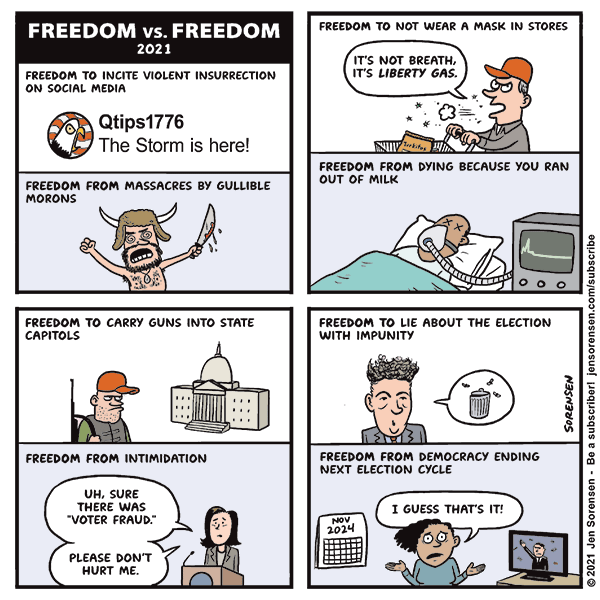
https://jensorensen.com/2021/01/26/freedom-vs-freedom-2021-coronavirus-authoritarianism/

and protests against Putin

Alexei Navalny, the opposition leader Putin had poisoned, returned to Russia on January 17 after recuperating in Germany, and was sentenced to 2 1/2 years in prison for violating his probation on an embezzlement charge that he claims was trumped-up to discredit him. Since returning, he has been a symbol of opposition to Putin, inspiring protests around the country.

The center of the protests is not Navalny’s personal popularity, but the failures of the Putin regime, which is corrupt, has let economic inequality get worse, and has not handled the pandemic well.

But economic inequality is the reason that people are most unhappy with Putin, according to research by Moscow-based independent pollster, the Levada-center. Some 45% of respondents faulted Putin for “failing to ensure an equitable distribution of income in the interests of ordinary people” in 2018, up from 39% in 2015. In Russia, the top 10% own 83% of the country’s wealth, making it the most unequal of the world’s largest economies followed by the U.S. and China, according to Credit Suisse Research Institute in 2019.

and you also might be interested in …

A memo from new Defense Secretary Lloyd Austin:

We will not tolerate actions that go against the fundamental principles of the oath we share, including actions associated with extremist or dissident ideologies. Service members, DoD civilian employees, and all those who support our mission, deserve an environment free of discrimination, hate, and harassment. … I am directing commanding officers and supervisors at all levels to select a date within the next 60 days to conduct a one-day ” stand-down” on this issue with their personnel. Leaders have the discretion to tailor discussions with their personnel as appropriate, but such discussions should include the importance of our oath of office; a description of impermissible behaviors; and procedures for reporting suspected, or actual, extremist behaviors in accordance with the DoDI. You should use this opportunity to listen as well to the concerns, experiences, and possible solutions that the men and women of the workforce may proffer in these stand-down sessions.

A number of former and active-duty military people were involved in the Capitol Insurrection, and there are other signs that the military has a problem with white supremacist groups recruiting in the ranks.


Biden is taking steps to get ICE under some kind of control.

“They’ve abolished ICE without abolishing ICE,” said one distraught official who spoke on the condition of anonymity because that person was not authorized to speak to the media.

I suspect the distraught official is exaggerating, but I wouldn’t be sorry if he weren’t. Trump’s ICE was a rogue agency that knew nobody above them cared about the people they could detain.


I find it weird that lawsuits by corporations are the most effective ways to strike back at political disinformation.

A voting technology company swept up in baseless conspiracy theories about the 2020 election filed a monster $2.7 billion lawsuit on Thursday against Fox News, some of the network’s star hosts, and pro-Trump attorneys Rudy Giuliani and Sidney Powell, alleging the parties worked in concert to wage a “disinformation campaign” that has jeopardized its very survival.

I can’t vouch for how they figure the $2.7 billion, but the basic idea of this suit makes a lot of sense: A group of people knowingly spread lies about Smartmatic, and those lies had dire financial consequences for the company. Another lied-about voting-tech company, Dominion, has already sued.

Within days, Fox News had axed Lou Dobbs, who helped spread many of Trump’s election-fraud conspiracy theories on the air.

Suits like Smartmatic’s are rare, because they’re hard to win — unless the person who smeared you does it really blatantly. Josh Marshall explains:

The Supreme Court rightly put a very high bar on success in libel suits for public people and entities. You have to be wrong. And you have to have known you were wrong or have had a malicious indifference to whether you were right or wrong. It’s very hard to [meet] that standard. …

The Smartmatic/Dominion cases are the first case at scale that seems almost to try out the Sullivan standard. Fox and various other pro-Trump entities made numerous, repeated and HIGHLY damaging claims which certainly in the cases of the institutions and almost certainly with the individuals (with Lindell he may simply be crazy) they [knew] were false.


The Texas Republican Party has endorsed legislation that would ask the voters whether they want the state to secede. I wonder what they would do if they didn’t love America so much.


Politico:

The U.S. trade deficit over the four years of President Donald Trump’s presidency soared to its highest level since 2008, despite his tough tariff tactics intended to bring it down, a new Commerce Department report showed on Friday.

The combined U.S. goods and services trade deficit increased to $679 billion in 2020, compared to $481 billion in 2016, the year before Trump took office. The trade deficit in goods alone hit $916 billion, a record high and an increase of about 21 percent from 2016.

Like most of what he did, Trump’s trade policy was mainly a reality show. It was always more about creating the appearance of action than achieving results.


President Biden has decided that Trump should not get intelligence briefings, which former presidents usually have access to. While he was president, Trump occasionally let some valuable piece of intelligence slip, but Biden refused to speculate about what he might do now. What Biden did say was revealing:

I just think that there is no need for him to have the — the intelligence briefings. What value is giving him an intelligence briefing? What impact does he have at all, other than the fact he might slip and say something?

The main reason former officials of all sorts are given access to intelligence is that current officials might want to consult them about ongoing situations that have roots in the former official’s tenure. When he says there’s “no need”, Biden is really saying that he can’t imagine a situation where he’d want Trump’s advice. It’s a subtle but devastating barb.

and let’s close with something unexpected

Who knew that a two-cello mash-up of Beethoven’s Fifth and Led Zeppelin’s “Whole Lotta Love” would work?

Why You Can’t Understand Conservative Rhetoric

It’s not just that conservatives define terms differently. Sometimes their relationship to words defies definition entirely.


If you’re like most liberals, you probably from time to time take a walk on the other side of the line. Maybe you channel-scan through Fox News or even Newsmax. Or click on some of the links your Trump-adoring relatives send you. Or listen to a speech by some politician you can’t stand. Maybe you go so far as to read entire books written by people like Tucker Carlson or Newt Gingrich, or by academic types who are probably liberals themselves, but have spent years studying Trump supporters in rural Louisiana or in Evangelical churches.

And you still don’t get it.

It’s worse than just that you can’t follow the arguments, such as they are. You can’t even understand the words. Why is it “cancel culture” when Josh Hawley loses his book contract after cheerleading an insurrection, but not when Colin Kaepernick gets drummed out of the NFL for protesting racism? What does it mean when conservatives say “America is a Republic, not a Democracy“, as if that explained something obvious? Why are college professors and Hollywood actors “the elite”, but billionaires like the Kochs and the Mercers aren’t? Why is it “socialism” to subsidize windmills, but not coal mines? And who exactly are these “real Americans” that Donald Trump speaks for, when the American electorate rejected him by over seven million votes?

https://theweek.com/cartoons/964993/political-cartoon-kaepernick-gop-cancel-culture

The cancel-culture example. The usual liberal response when we run into one of these one-sided pejorative terms, terms that apply to us but never to them, is to charge hypocrisy. From the way the term applies to us, we intuit a definition, then ask why conservatives don’t apply that definition consistently. [1]

Wil Wilkinson, formerly a vice president at the liberal Niskanen Center, is sometimes pointed out as an ironic victim of “cancel culture”, because he recently lost his job after making an unfortunate joke on Twitter. [2] The irony comes from the fact that Wilkinson has been a critic of the whole cancel-culture conversation. To some conservatives, Wilkinson getting “canceled” is like the moment in a horror movie when the monster attacks the guy who’s been claiming there’s no monster.

Interestingly, though, Wilkinson himself still doesn’t believe cancel-culture is a thing. He defends his skepticism by stating his faith in something else: the power of definitions.

I also tend to believe that terms that successfully pick out real things in the real world — terms that aren’t merely vehicles for yay! / boo! sentiments — can usually be given a definition that allows us to get at least a rough handle on what’s included and excluded from the category. But I’ve yet to encounter a definition of “cancel culture” that overcomes my suspicion of sloganized epithets.

Wilkinson quotes L.D. Burnett: “There is no such thing as ‘cancel culture’. There is only culture.” In other words, societies have norms, and violating those norms leads to consequences. If you behave in ways your community considers unacceptable, people will shun you in an attempt to shame you into compliance.

In the Burnett/Wilkinson model, the examples of so-called cancel culture are just situations where norms are changing. Actions that used to be acceptable (like a male executive referring to his female secretary as “my girl”) have become unacceptable, and actions that used to be forgivable examples of bad taste (like making racist or sexist jokes at the expense of a co-worker) are now firing offenses.

If you still believe in the old norms, then the consequences that follow from violating the new norms are extreme over-reactions. But instead of openly debating the old norms versus the new norms, old-norm advocates simply apply a pejorative label to the new-norm consequences.

Slogans like “cancel culture” and “political correctness” are used again and again to short-circuit debate, avoid the underlying substantive controversy, and shift the entire burden of justification onto advocates of the rival position. … That’s why “cancel culture” tends to strike me as more of an evasive maneuver than a coherent idea with determinate content.

I was glad to see Wilkinson bring in “political correctness”, because that is an important example of the same phenomenon: Groups that used to be politically and culturally powerless, or even invisible, (like non-whites, women in the workplace, gays and lesbians, or Hindus) can now demand to be treated respectfully. If you show the kind of disrespect that used to be common, you will face consequences.

Instead of debating that norm-change openly, though, people who refuse to adjust to the new norms apply the pejorative label “political correctness” to the consequences. Like “cancel culture”, the term has no definition.

https://jensorensen.com/2015/07/28/advice-conservatives-never-give-themselves/

Let’s go meta. Burnett points out that labeling some action as “cancel culture” is itself an attempt to induce shame. In other words, it tries to enforce what the shamer sees as a norm.

Wilkinson’s article is also trying to enforce an unstated norm, one about how people are supposed to think and argue: Words are supposed to have definitions, and not be “merely vehicles for yay! / boo! sentiments”. Arguments are supposed to appeal to universal principles that go beyond just “my side is right and your side is wrong”. People who violate those norms should be ashamed of themselves, and the rest of us should refuse to take their arguments seriously until they change.

In academic circles, those standards go without saying. No one in any field would write in a journal article: “I’ve decided to leave ‘the elite’ undefined, so that I can apply the term pejoratively to my enemies but not my friends.” From the academy, similar norms have trickled down to the educated classes — who don’t always respect or observe them, but nonetheless accept that they ought to respect and observe them.

We sometimes forget, though, that not everyone thinks this way. In fact, there was a time when no one thought that way. Entire civilizations have functioned without definitions or universal principles.

Definition versus usage. If you’re a physicist, the word “red” has a very precise definition for you: light with a wavelength between 620 and 720 nanometers. For the rest of us, not so much. I’ve been using “red” for as long as I can remember, and I didn’t know that definition until I just looked it up.

It’s not that I have some other definition of “red”. I don’t have one at all, and yet I never feel the lack of it. I have a very clear idea what “red” means. I just can’t express it in words.

I don’t remember learning “red”, but I suspect it was the same way I’ve seen parents teach it to their children: Somebody pointed at red things and said “red”. When I tried to imitate them, they corrected my mistakes and cheered when I got it right. Eventually my performance became flawless.

Sometimes an undefined term has a paradigmatic example. At the paint store, “red” is specified by a color card: If something resembles the color card, it’s red. Similarly, “sweet” is the taste of sugar. To the extent that a taste resembles sugar, it’s sweet.

You could live your whole life without ever learning the dictionary definition of anything. Your community would train you in the proper usage of words, and when people disagreed, some paradigmatic example could resolve the dispute. The idea that you’re supposed to be able to define your words in terms of other words would just go right past you.

That’s what’s going on with “cancel culture”, “political correctness”, and the conservative phrases I listed above. They don’t have definitions, they have usages. People learn how to use these terms by hearing other people use them, then doing trial-and-error until their usage matches the rest of the conservative community.

So why isn’t Colin Kaepernick an example of cancel culture? Because it’s not used that way. If someone pointed at a dandelion or a banana and said “red”, I would just know that they’re wrong. I couldn’t explain why they’re wrong; they just are. “Red” isn’t used that way.

What does “America is a republic, not a democracy” mean? Nothing, actually. The phrase has a usage, not a meaning. Conservatives say it when liberals object to some minority-rule tactic like gerrymandering or the Electoral College or giving Wyoming the same number of senators as California, but DC and Puerto Rico none at all. If you’re hoping for some definition of “republic” that turns that usage into a meaning, though, you’re not going to get one.

Oral culture versus literate culture. If you want to see a society just beginning to grasp how to use the definitions and principles of logical thought, go read one of Plato’s dialogues. Most of them follow the same formula: Socrates is talking to somebody who uses a word, like “courage” (Laches) or “temperance” (Charmides) or “justice” (Republic). Socrates asks them what the word means, and they give him an example of its proper usage. So Laches says: “He is a man of courage who does not run away, but remains at his post and fights against the enemy.” Socrates points out that an example isn’t a definition, and they go round and round from there.

What becomes clear in these dialogues is that in Golden Age Greece, definitions were kind of a new thing, and the idea that you ought to be able to define the terms you use was novel, even a bit weird. Literate culture was still being invented, and it was trying to replace an oral culture where words had proper usages, but not definitions. Folks like Laches clearly expected a process like this: If two people aren’t sure they mean the same thing by a word, they trade examples (“Fire trucks are red.” “Ripe strawberries and tomatoes are red.”) until the agreement is clear.

Universal principles were similar innovations of literate culture. In the previous oral culture, traditional wisdom consisted of stories, and of aphorisms that might be the morals of stories. Aphorisms typically are not even trying to be universally true, like principles, but often come in contradictory pairs. So “Always look before you leap” contradicts “He who hesitates is lost”. Oral-culture discernment revolves around understanding the story you happen to be in. Is the current situation part of a look-before-leaping story or a hesitate-and-lose story? A stop-and-smell-the-roses story, or a make-hay-while-the-sun-shines story? [3]

Discernment is primarily a community process that depends heavily on tradition and authority. That gives it a resilience and stability, but also makes it prone to perpetuating a community’s bigotry and justifying the self-serving pronouncements of corrupt authorities. (It’s way too tempting to discern that we’re in a you-have-to-yield-to-me story.) Literate culture’s logic aimed at replacing discernment with more individual and algorithmic processes like measurement, calculation, and deduction.

In spite of its books and intellectuals, Evangelical Christianity is fundamentally an oral culture. Trumpist conservatism is built on top of it. One of the challenges conservative Christians have faced since pledging their allegiance to Trump is how to justify supporting a man who has literally no Christian virtues, and who appears to understand nothing about the Christian religion.

The answer they found was a story: the end of the Babylonian Captivity and the refounding of the Temple in Jerusalem. A key player in that story is Cyrus the Great of Persia, who was not a follower of Jehovah, but nonetheless was used by Israel’s God to fulfill His promise to Jeremiah and the Jewish people.

For believers who subscribe to this account, Cyrus is a perfect historical antecedent to explain Trump’s presidency: a nonbeliever who nevertheless served as a vessel for divine interest. For these leaders, the biblical account of Cyrus allows them to develop a “vessel theology” around Donald Trump, one that allows them to reconcile his personal history of womanizing and alleged sexual assault with what they see as his divinely ordained purpose to restore a Christian America.

That’s how oral culture works: This is the story we’re in, so we should do these things. No principles of action are being proposed, so you can’t argue about it in a Socratic sense. It arises from a process of community discernment, not a process of logical thought.

If you push further on Trump’s transgressions, you’re likely to hear that Christians believe in forgiveness. A text from the Bible will be quoted to prove it. Of course, they didn’t believe in forgiving Bill Clinton, but that also is Biblical, because the Bible contains both harsh and forgiving verses. Clinton was a harsh-verse situation, and Trump is a forgiving-verse situation. [4] If you can’t see that, you’re not part of the community. [5]

If you look at how QAnon works, it too is an oral culture. A few weeks ago, The New York Times profiled a “digital warrior” of QAnon.

For her, QAnon was always less about Q and more about the crowdsourced search for truth. She loves assembling her own reality in real time, patching together shards of information and connecting them to the core narrative. (She once spent several minutes explaining how a domino-shaped ornament on the White House Christmas tree proved that Mr. Trump was sending coded messages about QAnon, because the domino had 17 dots, and Q is the 17th letter of the alphabet.)

When she solves a new piece of the puzzle, she posts it to Facebook, where her QAnon friends post heart emojis and congratulate her.

This collaborative element, which some have likened to a massively multiplayer online video game, is a big part of what drew Ms. Gilbert to QAnon and keeps her there now.

“I am really good at putting symbols together,” she said.

Q has identified the story we are living inside [6], and the community now attempts to discern how current events fit into that narrative.

How should we respond? I wish I had a better answer. The main advice I have is to recognize what’s happening and stop doing things that don’t work, even if you think they should work.

The factor you have the most control over is your own thinking. So: Don’t read meaning into things that don’t have any meaning. And don’t respond as if they meant the things you think they ought to mean. “Cancel culture” and “political correctness”, for example, are a sticks-and-stones situation. If they meant something negative, and that meaning applied to something you were doing, then you should probably feel bad about it. But they don’t mean anything; they’re just words that are said in particular settings.

Rather than answer based on the meaning you imagine a phrase has, question it. If the person you’re talking to thinks a term has a meaning, let them explain it. Chances are that they can’t. Let them be frustrated rather than you. (WWSD. What would Socrates do?)

When dealing with people you know well, consider the possibility that they don’t know (or have forgotten) that literate culture and logical thought are even possible. Providing an example of a different way of thought will probably not produce sudden results. But over time it might be significant.


[1] A few conservatives also interpret this behavior as hypocrisy. Robby Soave of Reason wrote:

If you only criticize cancel culture when it’s your side being canceled, then you aren’t really attacking the concept—you’re just playing defense for your team.

[2] “If Biden really wanted unity,” Wilkinson tweeted, “he’d lynch Mike Pence.” The joke — that if Biden did lynch Pence, he’d be carrying out an ambition of radical Trumpists, thereby promoting unity — was lost on his bosses, who focused on the apparent call for violence. They don’t let conservatives get by with the it’s-a-joke excuse for endorsing violence, so they didn’t accept that excuse from one of their own either.

[3] Eric Havelock’s Preface to Plato is all about life on the boundary between oral culture and literate culture. The reason Plato was so hostile to poets, in Havelock’s telling, was that poetry was the source of the aphorisms that competed with principles. As long as people revered the poets as fonts of muse-inspired wisdom, logical thought would never take hold.

[4] “The Christian’s Bible is a drug store. Its contents remain the same, but the medical practice changes.” – Mark Twain, Europe and Elsewhere, “Bible Teaching and Religious Practice”

[5] An example of how the same narrative can be either positive or negative: Compare the Biblical characters of Esther and Jezebel. Both are women who marry foreign kings, and use their influence to make the king more accepting of the religion of their homeland.

Esther is one of the Old Testament’s great heroines, and Jezebel one of its villainesses. The difference is almost entirely a my-team/their-team thing: Esther is a Jewish queen of Persia who uses her influence to save Jews from persecution. Jezebel is Phoenician queen of Israel who induces King Ahab to open Israel to the religion of Baal. (Trumpist pastors have begun calling Kamala Harris “Jezebel”. It appears to mean nothing more than that she’s a powerful woman they don’t like.)

[6] The story is that “elites” at the top of the media and the Democratic Party (but also some Republicans) are Satan worshipers who practice pedophilia and drink human blood. Donald Trump is the hero who is going to bring them down. The exposure and punishment of these crimes, leading to mass arrests and executions, is always just around the corner.

The Monday Morning Teaser

This week presents a challenge I think I’ll be stuck with for some while: The Biden administration and Democrats in Congress are doing some very important things, but it’s hard to pull my eyes away from the Republicans as they set themselves on fire.

So: a $1.9 trillion Covid relief bill is steaming ahead, and stands a chance of passing before long. Biden continues to announce major changes in policy; we should soon hear how he plans to control the Gestapo-like organization ICE had turned into under Trump. The new administration is struggling to deal with the vaccine-distribution mess Trump left behind, while the new-infection numbers are finally turning around. Little by little, Biden’s cabinet is getting approved.

But meanwhile, Trump’s impeachment trial starts tomorrow, and he just refused to testify voluntarily. While state GOP organizations are censuring life-long conservatives like Ben Sasse and Liz Cheney, Republicans in the House nearly all supported keeping QAnon lunatic Marjorie Taylor Greene on major committees after she gave a lie-laden speech in her own defense. The GOP leadership in both houses is digging in to oppose a Covid relief bill that 2/3rds of the voters want.

What to pay attention to? Serious sensible governance during a time of crisis? Or raving lunacy?

You’ll see my quandary this week: I’ll try to highlight governance, but I’ll also mention the other stuff — and once I start talking about it, it’s hard to stop. MTG is a case in point: I hate to give her this much attention, but I don’t feel like I can leave that speech alone.

Anyway, the featured post, which should be out soon, focuses on Republicans, but in a more philosophical way: “Why You Can’t Understand Conservative Rhetoric”. I end up claiming that conservative rhetoric arises out of what is fundamentally an oral culture, and that liberals make a mistake when we try to understand it from a literate-culture point of view. We waste a lot of time trying to decipher and respond to notions like “cancel culture” and “political correctness” as if they had logical content, when actually they don’t.

The weekly summary goes back and forth: from impeachment to the Covid bill to the Covid pandemic to MTG’s speech to anti-Putin protests in Russia and so on. I’m still picking a closing, but there are several good ones to choose from. I’m going to try to get that out by noon.

Tell the Story

Probably the story of our time in politics is that the Republican Party is radicalizing around an explicitly anti-democratic violent white nationalist ideology, and that most of elite establishment media is uninterested or editorially incapable of accurately telling that story

Brian Murphy

This week’s featured posts are “The Biden Blitz” and “The Republican Party Chooses Not to Change“.

This week everybody was talking about the Biden administration

One featured post goes through the flurry of executive orders that Biden has already issued. For the most part they are important orders that turn the country in the right direction. But to really be successful, Biden has to get legislation through Congress. The first item on his agenda is his Covid relief plan. It provides economic relief to individuals, sends money to states to use distributing vaccines, funds the changes necessary to reopen schools, and institutes a national testing-and-contact-tracing plan.

Ten Republican senators — exactly the number needed to overcome a filibuster — have approached Biden with a much smaller effort: $618 billion rather than $1.9 trillion. I’m not sure exactly what the differences are. Biden is meeting with the senators today.

Biden has three avenues open: Pass something small with bipartisan support (assuming all ten of these senators stay on board, which I regard as a large assumption); pass something large through the reconciliation process with only (or almost entirely) Democratic votes; or pass a small bipartisan bill now and then come back with a larger Democratic bill later. (This would give Republicans cover: They voted for something and opposed something.)

I’ve been pleased that so far Biden has been unwilling to close off his options without getting any concessions back. If he had pledged, say, not to use reconciliation, then I doubt Republicans would be making a counter-proposal.


Chuck Schumer did something similar with the filibuster.

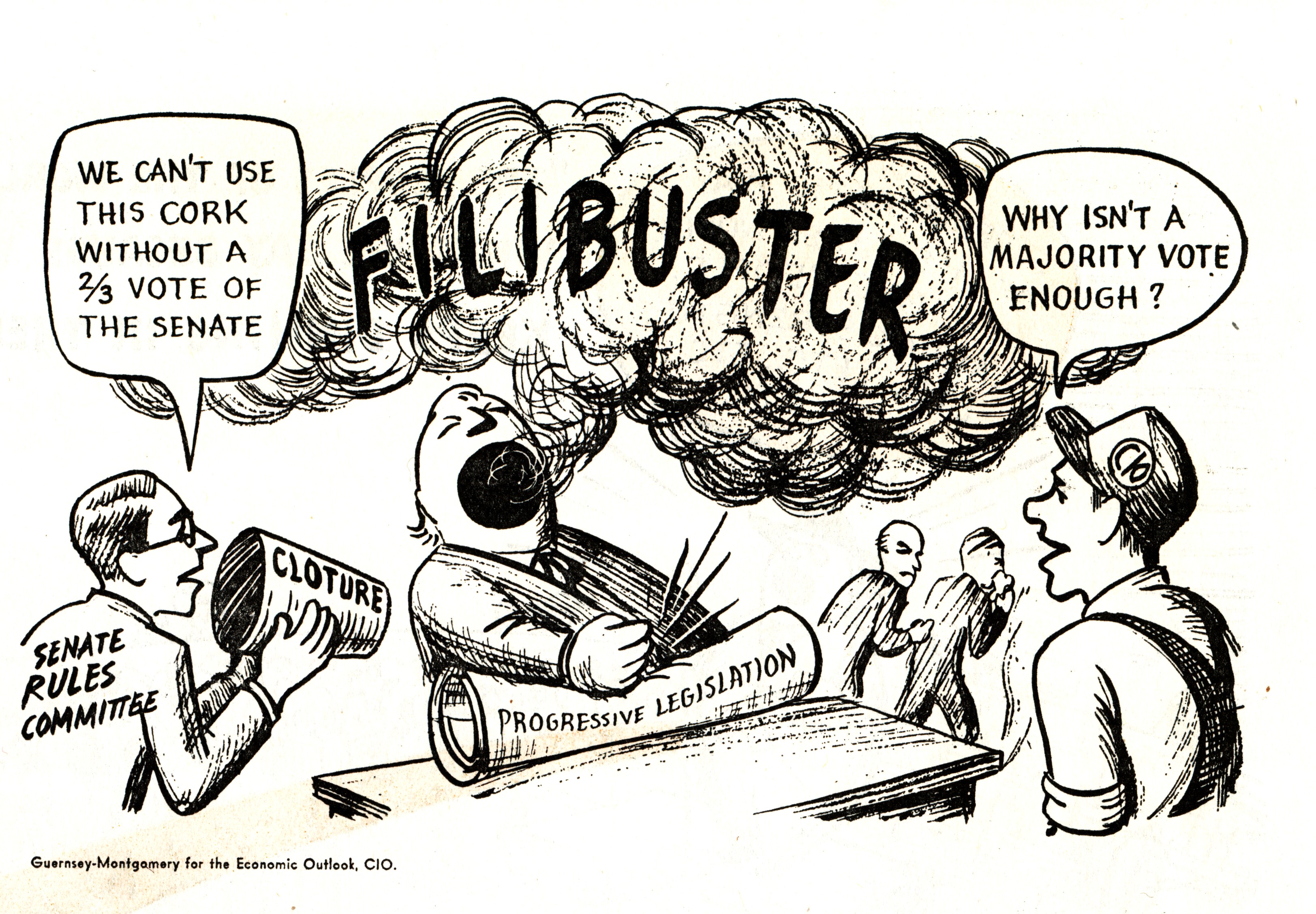
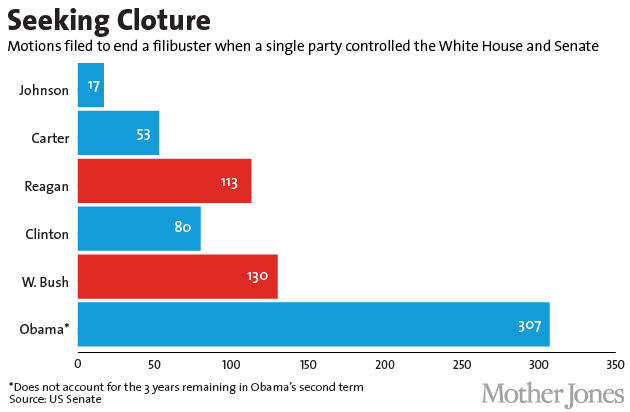
Two weeks ago, I wrote about why the Senate should abolish the filibuster. (My argument transcended any particular legislation that might get filibustered: If a tiny slice of the electorate — say, small majorities in the 21 smallest states — can block what most of the country wants, the American people are going to lose faith in democracy.)

Well, this week Mitch McConnell essentially filibustered to save the filibuster: He blocked the organizing resolution that would allow the Democratic majority to replace the Republican committee chairs, holding out for a stipulation that the Senate would not alter the filibuster during these next two years. Chuck Schumer held out for the agreement Tom Daschle and Trent Lott worked out the last time there was a 50-50 Senate, which made no such promises.

Schumer held his ground and McConnell yielded. What McConnell got instead of an amended resolution was that two Democrats, Joe Manchin and Kyrsten Sinema, repeated filibuster-supporting promises they each made when they were elected in 2018.

It’s important to understand that this all about appearances: Whatever the organizing resolution says, and whatever individual senators might pledge, Democrats can end the filibuster any time they want — if they are unanimous. The question is how the politics would shake out: Will Manchin and Sinema look bad to their voters if they change their minds? Would the entire Democratic Senate majority look bad if they had passed a resolution defending the filibuster and then later reversed themselves?

And the answer to those questions is entirely situational: What will McConnell use the filibuster to block? That partly depends on how clever Democrats are in using the filibuster-avoiding maneuver known as reconciliation (which is how Republicans passed the Trump tax cut and nearly repealed ObamaCare).

If some very important, very popular legislation gets filibustered, that creates an opportunity for Manchin and Sinema to say “When I supported the filibuster, I never imagined Republicans would misuse it like this.” (Both say they’re not open to changing their minds, but who knows if they will? Neither comes up for reelection until 2024, and by then the filibuster could be ancient history.) Or maybe Schumer will come up with some trick for negating the filibuster in that particular case without getting rid of it completely, giving Manchin and Sinema some cover.

In short, this is not the best time fight this battle, and Schumer wouldn’t have the votes to win right now even if he wanted to fight it. That explains why the party’s progressive wing isn’t pushing too hard for it right now. At the moment, it’s an abstract battle about Senate procedure. Soon the terrain will shift to something voters care about, and then the situation will change.

Having the option of eliminating the filibuster pushes the Republicans to negotiate in good faith. Democrats should not give that up without getting something back.

and impeachment, which is all about where the Republican Party is going

Most of what I had to say about this is in one of the featured posts. But a few odds and ends didn’t fit.

The trial starts a week from tomorrow. But Trump is having a hard time finding lawyers willing to defend him.

Former President Donald J. Trump has abruptly parted ways with five lawyers handling his impeachment defense, just over a week before the Senate trial is set to begin, people familiar with the situation said on Saturday. … Mr. Trump had pushed for his defense team to focus on his baseless claim that the election was stolen from him, one person familiar with the situation said.

And that’s a problem because, unlike the Republican Party, the legal profession has standards.

Any defense attorney holds a broad obligation to represent his or her client zealously. That’s a crucial part of our adversarial justice system. But there are limits on what a defense attorney can argue. For example, per the American Bar Association, it would be unethical for any attorney to raise an argument “that he knows to be false.” The “rigged election” narrative certainly fits that description.

According to the NYT, something similar happened as early as November 12: Trump’s lawyers told him there was no fraud on a scale sufficient to flip the election in his favor, so they parted ways and Rudy Giuliani took over.

Thursday the 12th was the day Mr. Trump’s flimsy, long-shot legal effort to reverse his loss turned into something else entirely — an extralegal campaign to subvert the election, rooted in a lie so convincing to some of his most devoted followers that it made the deadly Jan. 6 assault on the Capitol almost inevitable.


Conservatives sometimes try to divert attention from Majorie Taylor Greene with the “What about left-wing radicals in Congress?” ploy. But Democrats are responding with a bring-it-on attitude. And they should: AOC, like Bernie Sanders, is more liberal than some Democrats want to be, but I think everybody understands that she lives in the real world. Progressives want the US to be more like Denmark, not Camelot. Denmark is a real place that is doing fine.

Greene, on the other hand, does not live in the real world.


Another typical whataboutist move diverts discussion of the Capitol Insurrection by bringing up the violence associated with the George Floyd protests (most of which were peaceful). The best description of the difference between those two incidents comes from Tom Robinson on Quora:

One of these things was protesting murder while the other was protesting Democracy.


Typically, an American political party that loses the presidency by seven million votes asks how it can appeal to a larger slice of the electorate. The GOP is asking how it can stop Democrats from voting.


An MTG-endorsed conspiracy theory (about how Jewish-funded space lasers caused a California wildfire) makes this Mel Brooks clip timely again.


and Christianity has some introspecting to do

An Atlantic article on impeachment-supporting Republican Rep. Adam Kinzinger focuses more on his criticism of his church than of his party.

The problems that led to the January 6 insurrection are not just political. They’re cultural. Roughly half of Protestant pastors said they regularly hear people promote conspiracy theories in their churches, a recent survey by the Southern Baptist firm LifeWay Research found. “I believe there is a huge burden now on Christian leaders, especially those who entertained the conspiracies, to lead the flock back into the truth,” Kinzinger tweeted on January 12.

I think conservative Christians won’t solve this problem until they realize how deep it goes. The original “fundamentalists” in the early 20th century were reacting against two developments in modern thought: Darwinian evolution and the “higher criticism” of the Bible, which applied to scripture the techniques of interpretation scholars had invented to understand ancient texts like the Homeric epics. The fundamentalist response was to avoid these challenges by encouraging the development of bad thinking habits among Christians. Any kind of denial or logical fallacy was fine if it came to the right conclusions.

Well, a century later, those bad thinking habits have been exploited by purveyors of all kinds of nonsense: climate-change denial, Covid denial, QAnon, “Stop the Steal”. The conservative Christian mind is now like a poorly designed software application; it has back doors that allow hackers to circumvent the usual protocols and make the app serve purposes unrelated to its designers’ intent. That’s how we arrive at the situation Kinzinger diagnoses so clearly:

There are many people that have made America their god, that have made the economy their god, that have made Donald Trump their god, and that have made their political identity their god.

Christianity in general is not going to fix this problem until until it goes back to the source: It needs to figure out how to deal with the reality of evolution, and with the uncanny resemblance of the Bible’s oldest sections to many other texts from the same eras. A few of the more liberal sects did this work a long time ago, but the bulk of the movement would rather build a fortress around its errors than change.

and you also might be interested in …

What if an electric car could recharge in five minutes?


Ever since the Inauguration, the Bernie meme has been everywhere. This is my favorite.

Space.com collected some other Bernie-in-space images. He’s also been in famous paintings, at historic events, and in classic movie scenes.

Several writers have tried to explain what this phenomenon “means”. Like, why is it happening? Why Bernie? Why this particular image? I think it’s not hard to understand: The original Bernie-at-the-Inauguration photo captured a truth we all recognized: Wherever Bernie goes, he’s still Bernie. The historic grandeur of an inauguration doesn’t change him, so why would anything else?


Biden had a phone conversation with Putin.

In his first phone call with Vladimir Putin since taking office, President Biden pressed his Russian counterpart on the detention of a leading Kremlin-critic, the mass arrest of protesters, and Russia’s suspected involvement in a massive cyber breach in the United States.

In short: we’re an independent country again. Our president is no longer under the thumb of the Russian president.


Hakeem Jefferson on this weekend’s snowstorm:

DC’s so white today the GOP might vote to grant it statehood.

and let’s close with something musical

I can’t decide between a good-bye-Trump or a hello-Biden song, so I’ll post one of each. On the last day of the Trump administration, James Corden did this wonderful send-up of “One Day More” from Les Miserables.

And after President Biden suggested that Janet Yellin — the first female Treasury Secretary — should get a musical just like the first male Treasury Secretary did, Marketplace got Dessa, a member of the hip-hop collective Doomtree and one of the artists who contributed to “The Hamilton Mixtape” working on it. That led to “Who’s Yellin Now?

The Republican Party Chooses Not to Change

https://www.washingtonpost.com/opinions/2021/01/29/civil-war-soul-of-gop-over-trump-won/

Impeachment is a chance to put the Trump Era in its rearview mirror, but instead the GOP is doubling down on authoritarianism and conspiracy theories.


Less than a month ago, then-President Donald Trump incited a mob to attack Congress, for the purpose of hanging onto power in spite of having decisively lost the November election. At the time, that crime seemed to put the capstone on the most lawless administration at least since Richard Nixon’s, and maybe in all of American history.

Republican members of Congress, who (like Democrats) had to evacuate the House and Senate chambers in fear for their lives, briefly seemed willing to reconsider where their unquestioning support of Trump had brought them. Trump’s attempted coup — the culmination of a months-long plot attempt to undo his loss and effectively end American democracy — brought to a head a theme that the country has been debating since 2015: How far will Republicans let Trump go?

Back then, the debate was about norm-violations that look small compared to insurrection, but had previously been beyond the pale: calling Mexican immigrants rapists, or claiming that American POWs are not heroes, or ridiculing a reporter by imitating his disability, or encouraging his supporters to be violent, or bragging about sexually assaulting women.

Trump critics raised a reasonable question: If those actions aren’t over the line, where is the line? We never got an answer, but instead were accused of paranoia. Trump was unorthodox and not “politically correct”, but imagining that he was dangerous to the American Republic was just “Trump Derangement Syndrome”, a particular form of craziness induced by an irrational hatred of a man most of us didn’t care about one way or the other before he began running for president.

Closing ranks. This week we got some additional information: For the majority of the GOP, physically attacking Congress and trying to end democracy isn’t over the line either.

Tuesday, 45 of the 50 Republican senators signaled their unwillingness to hold Trump accountable for inciting the Capitol lnsurrection by voting not to hold an impeachment trial at all, on the grounds that the Constitution doesn’t allow impeachments of former officials. (That’s not a credible position, as explained in the Appendix.) Among the 45 was Senate Minority Leader Mitch McConnell, who previously had seemed open to conviction.

House Minority Leader Kevin McCarthy, meanwhile, made a pilgrimage to Mar-a-Lago to get back in Trump’s good graces. In the wake of running for his life, McCarthy had said Trump “bears responsibility” for the insurrection. But Thursday he needed to kiss the ring.

Purging anti-Trumpists. Instead, the party has decided to punish those Republicans who showed some loyalty to America’s constitutional system of government. Rep. Matt Gaetz (R-Florida), went to Wyoming to raise ire against Rep. Liz Cheney, who said “There has never been a greater betrayal by a President of the United States of his office and his oath to the Constitution” than Trump inciting a mob to attack Congress, and then voted for impeachment. Don Jr. spoke to the anti-Cheney rally by phone. A state senator has already announced a primary challenge.

The Arizona Republican Party has censured Governor Ducey, ostensibly for taking action against Covid, but the fact that he refused to misreport Trump’s electoral loss was probably also a factor. South Carolina’s Republican Party has censured Rep. Tom Rice for his pro-impeachment vote. Trump is calling for Georgia Governor Brian Kemp to face a primary challenger, again because he refused to overrule the voters and give Georgia’s electoral votes to Trump.

Defending extremism. Simultaneously, the GOP is doing little to distance itself from Marjorie Taylor Greene, a Trump-supporting freshman Congresswoman from Georgia who has brought a new level of insanity to the Capitol. Here’s one good summary of the full range of Greene’s unhinged-ness and here’s another one.

But if you prefer to see for yourself and make your own judgments, Greene posted a 40-minute rant to YouTube in 2018. (Warning: that’s 40 minutes of your life you’ll never get back. I recommend skipping the first half, which is mainly about how Facebook is censoring her — by applying the same community standards it applies to everybody.) If you’re looking for a point to it all, she never really gets around to making one. But along the way you’ll learn such fascinating things as

  1. Hillary Clinton had JFK Jr. murdered to clear the field for her Senate race in 2000. It was “another one of those Clinton murders”.
  2. No plane actually hit the Pentagon in the 9/11 attack.
  3. Getting rid of Saddam Hussein was part of an intentional plan to destabilize the Middle East, so that the US could be “invaded” by Muslim refugees. “And that happened under Barack Obama’s presidency.” George W. Bush barely comes up in the entire 40 minutes.
  4. Obama was also responsible for the immigration lottery (which goes back to 1989) and chain migration (back to 1924 and expanded in 1965).
  5. White liberals who voted for Obama are “really the racists”.
  6. MS-13 gangsters were “the henchmen of the Obama administration” who did “the dirty work” like murdering Seth Rich.

The GOP House leadership has appointed Greene to the House Committee on Education and Labor. McCarthy intends to have a talk with her this week, but it’s hard to imagine that talk leading to any discipline, since Trump is backing her. (AOC to Chris Hayes: “What is [McCarthy] going to tell [Greene]? Keep it up?”)

Rep. Jimmy Gomez (D-CA) is introducing a resolution to expel Greene from Congress, but without some Republican support it won’t get the 2/3s majority needed to pass.

Prague Spring. The best analysis of the GOP I’ve seen came from New York Magazine’s Jonathan Chait, who used a Soviet analogy. While the post-insurrection openness to criticizing Trump may at first have looked like Glasnost, it was actually a Prague Spring, “a brief flowering of dissent and questioning of dogma quickly suppressed by a remorseless crackdown.”

Chait breaks the Party into three factions:

  • Never Trumpers. Flake, Romney, Kasich, and a bunch of mainstream-media columnists.
  • Violent authoritarians. Marjorie Taylor Greene, Lauren Boebert, QAnon, the Proud Boys. They’re sorry Trump’s insurrection failed to keep him in power, but have no other regrets about it.
  • Soft authoritarians. McConnell, McCarthy, Rupert Murdoch and his media empire. (To my mind, these folks are equivalent to the Hindenburg conservatives of the Weimar Republic.)

The heady predictions that the party would break free of the Trumpist grip already seem fanciful. If anybody is suffering repercussions for their response to Trump’s autogolpe, it is the Republicans who criticized it. Conservative Republicans are threatening to strip Liz Cheney of her leadership post after she voted to impeach Trump. … Adam Kinzinger, another pro-impeachment Republican, is facing censure. The Michigan Republican member of the state board of canvassers, who broke with his party to certify the state’s election results, is losing his job as a result of his refusal to go along with Trump’s lie. Fox News is firing journalists associated with its election call that Biden won Arizona. …

The path of least resistance for the soft authoritarianism will be to oppose Trump’s conviction on technical grounds, and then hope he fades away quietly.

https://theweek.com/cartoons/963651/political-cartoon-gop-right-wing-romney

Least resistance. The sad thing is that the soft authoritarians could get their wish if they weren’t such cowards. They have the power to push Trump off the stage, if they would only use it. But they won’t.

McConnell, McCarthy, and the rest need to ask themselves where this going. Trump’s behavior is not going to improve. The domestic terrorist movement he has allied with isn’t going to stop. Next-generation Trumps like Greene aren’t going to tone it down. The soft authoritarians are tying themselves to people whose actions they can neither control nor predict.

This is how bad it’s gotten: Eric Cantor is the voice of reason. The GOP’s problems didn’t start with Trump, he writes. They started when Republican politicians started pandering to their base voters’ fantasies rather than telling them what is and isn’t true or possible.

For Cantor, the government shutdown of 2013 was a key moment. Ted Cruz and some other leaders told the base that the party could defund ObamaCare, if only its leaders fought hard enough. They couldn’t and didn’t, but pretending that they could put the nation through a pointless crisis. Here’s how Cantor sees the path forward:

In many ways, it is the classic prisoner’s dilemma. If the majority of Republican elected officials work together to confront the false narratives in our body politic — that the election was stolen (it wasn’t), that there is a QAnon-style conspiracy to uproot pedophiles at the heart of American government (there isn’t), that a Democratic-controlled government means the end of America (it doesn’t; it may produce worse policy, but the republic has survived 88 years of Democrats occupying the White House) — all Republicans will be better off. If instead most elected Republicans decide to protect themselves against a primary challenge through their silence or even their affirmation, then like the two prisoners acting only in their own interests, we will all be worse off.

Trump’s impeachment trial is a golden opportunity to start rooting out those false narratives. But for that to happen, Mitch McConnell will have to provide leadership. That seems unlikely.

Appendix: The Constitutionality of Impeaching Former Officials

Slate does a good job explaining why former officials can be impeached. It’s not even a close call.

Let’s start with the Constitution, which never directly addresses the question. Article I says that the House “shall have the sole Power of Impeachment” and the Senate “shall have the sole Power to try all Impeachments”. It limits the punishments for the convicted to “removal from Office, and disqualification to hold and enjoy any Office of honor, Trust or Profit under the United States”, leaving any further punishment to the courts. Article II stipulates that convicted officials “shall be removed from office” after conviction, but it is silent about whether former officials can be disqualified from future office.

That’s all the guidance it gives. The implication of these sparse instructions is that people at the time of the founding already knew what impeachment meant. (Similarly, the Constitution also doesn’t define “Money” or “credit” when it gives Congress power “To borrow Money on the credit of the United States”.)

What everyone would have known was how Great Britain handled impeachments. (In Federalist #65, Alexander Hamilton said the Constitution’s notion of impeachment derived from Great Britain’s.) They also would have known how the already-existing state governments did it. Slate spells it out:

Indeed, the British impeachment that most informed the Framers’ thinking about the impeachment power was the impeachment of Warren Hastings for improprieties as the governor-general of Bengal. Hastings had been out of this office for two years before his impeachment by the House of Commons. Moreover, at least two states—Virginia and Delaware—had established that their impeachment power extended to former officers.

Also, Congress has faced this issue before, and resolved it during the Grant administration:

Congress has also expressly addressed this question and resolved it in favor of the original understanding. In 1876, the House drafted articles of impeachment against President Ulysses S. Grant’s Secretary of War, William Belknap, but Belknap resigned before the House could vote on the articles. The House debated whether Belknap’s resignation deprived the House of jurisdiction. After the debate, the House voted to impeach Belknap, implicitly rejecting the argument that it lacked jurisdiction. The Senate also took up the issue and voted 37–29 that Belknap’s resignation did not deprive it of jurisdiction.

So the question has an obvious answer, for those who are willing to know it: Trying Trump after he has left office is entirely constitutional. Claiming it isn’t is just an excuse to let Trump off the hook without considering the evidence against him.

The Biden Blitz

What the new president’s flurry of executive orders do and don’t do.

https://theweek.com/cartoons/963405/political-cartoon-biden-executive-orders-bigotry

As I’ve discussed elsewhere, all the issues facing the Biden administration have a background theme: proving democracy still works. Beating Trump at the ballot box and thwarting his attempted coup didn’t end the threat of authoritarianism in America. (That’s clear from the way Republicans are circling the wagons around Trump now, even after he launched an insurrection to try to hold on to power.) Most likely, Biden is going to wind up resembling one of two political leaders from the 1930s: Franklin Roosevelt, who held the line against a global wave of authoritarianism by leading the US through a major transformation without abandoning democracy; or Fritz Von Papen, the German chancellor whose floundering induced President Hindenburg to bring Adolf Hitler into the government (in spite of Hitler having previously led an insurrection).

The best way to prove democracy still works is to get major legislation through Congress. We’ll see how that goes, but even if it works, it will take time. To his credit, though, Biden has grasped the need to demonstrate quickly that his election matters. The people voted, so things will change.

What he can do quickly is issue executive orders — 22 in his first week, as opposed to Trump’s four and Obama’s five. ABC News has listed 33.

This is a tricky business, because a government that runs by executive order is not a democracy, even if the executive was elected. So it’s important that Biden’s orders have three qualities: They need to be popular, so that he is seen to be speaking for the American people rather than dictating to them. (Maybe a few could be unpopular, but the broad sweep of his orders needs to garner public support.) They also need to effective, because orders that sound like something but turn out to be nothing will just erode trust in democracy even more.

But most of all they need to be legal, so that he’s not furthering the authoritarian drift of the last four years. That legality needs to be bulletproof, because the judicial branch is now full of Trump appointees who would be happy to find a reason to block Biden’s efforts. So he can’t appropriate money (as Trump did for his wall), or change laws.

He is even limited in the ways he can alter or revoke regulations, once an agency has officially announced them in the Federal Register. Congress has specified a procedure for promulgating new regulations, which may require official studies, reports, or public hearings — all of which take time. (Most of the Trump executive orders that got hung up in court suffered from failures of process.) That’s why many of Biden’s orders instruct some department or agency to begin a process, rather than implement some change immediately.

But that doesn’t mean the new president is powerless, as we’ve seen. Let’s take the Biden EOs by subject.

Covid and public health

Executive orders can’t appropriate money; that’s what Biden’s Covid-relief plan in Congress is for. But the Trump administration often worked at cross purposes with itself: one department saying one thing, a different department something else, and the White House pushing some other point of view entirely, which might change from one day to the next. As a result, the country was denied something only the federal government is in a position to provide: a coherent plan for moving forward, based on the kind of data only the federal government is in a position to collect.

The US is rejoining the World Health Organization. Quitting it was one of Trump’s dumber ideas, which this letter undoes.

Mask-wearing and social distancing have been mandated in federal buildings.

to protect the Federal workforce and individuals interacting with the Federal workforce, and to ensure the continuity of Government services and activities, on-duty or on-site Federal employees, on-site Federal contractors, and other individuals in Federal buildings and on Federal lands should all wear masks, maintain physical distance, and adhere to other public health measures, as provided in CDC guidelines.

A separate order mandates masks in airports, airplanes, trains, intercity buses, ferries, and all other forms of public transportation. This takes the onus off private companies like the airlines, who can now tell recalcitrant customers: “We may not like it either, but it’s not our call. Those are the rules.”

School reopening. The legislation Biden has proposed would appropriate money to pay the expenses associated with schools reopening safely, something he can’t do by himself. But he has ordered his administration to produce a single coherent set of guidelines and practices for safe in-person schooling.

Creating a White House Covid-19 Response Coordinator. This sounds a lot like what Mike Pence was supposed to be doing in the Trump administration. We can hope that Biden’s team — a Coordinator (Jeff Zients) who knows how government works and a Deputy Coordinator (Vivek Murthy) who knows public health — will be allowed to do their jobs without so much political interference.

OSHA will make guidelines for Covid-safe workplaces.

A Pandemic Testing Board will produce and coordinate a national strategy for Covid testing.

The government will also take responsibility for organizing the supply chain of material needed to fight the pandemic, invoking the Defense Production Act as necessary. There will be a plan for helping local hospitals, including using the National Guard where appropriate.

Climate and the Environment

The US rejoins the Paris Climate Agreement. By itself, this announcement doesn’t change US greenhouse gas emissions. But it is a powerful symbolic step.

The permit to construct the Keystone XL Pipeline is revoked. This is part of a long order with many parts. It also put a halt on oil leases in the Alaskan National Wildlife Refuge. Trump had announced a leasing program last August; a lease sale was held on January 6; and the first leases were announced publicly on Trump’s last day in office.

It’s not clear how much of that Biden can undo. He can certainly prevent any new leases. Whether he can undo the ones already granted probably depends on how serious the “legal deficiencies” in Trump’s program are.

In light of the alleged legal deficiencies underlying the program, including the inadequacy of the environmental review required by the National Environmental Policy Act, the Secretary of the Interior shall, as appropriate and consistent with applicable law, place a temporary moratorium on all activities of the Federal Government relating to the implementation of the Coastal Plain Oil and Gas Leasing Program, as established by the Record of Decision signed August 17, 2020, in the Arctic National Wildlife Refuge. The Secretary shall review the program and, as appropriate and consistent with applicable law, conduct a new, comprehensive analysis of the potential environmental impacts of the oil and gas program.

Yale School of the Environment website E360 outlines the difficulties Biden faces. Basically, it’s the same problem anybody might run into: Once the government signs a contract, it’s hard to back out.

The same order instructs departments to examine all Trump-era environmental regulations and see what can be rolled back. It mentions specifically Trump’s shrinking of several national monuments, including Bears Ears; allowing gas-drilling and gas-transporting companies to leak more methane; rolling back automobile fuel-economy standards; and rolling back energy standards on new appliances. (Looking at all those actions in one list makes me realize just what a force for evil the Trump administration was.)

Electric vehicles. In the comments he made Monday on his “Buy American” executive order, Biden announced his intention to phase fossil-fuel-burning vehicles out of the federal fleet. That provision didn’t actually appear until “Executive Order on Tackling the Climate Crisis at Home and Abroad” came out on Wednesday.

The plan shall aim to use, as appropriate and consistent with applicable law, all available procurement authorities to achieve or facilitate … clean and zero-emission vehicles for Federal, State, local, and Tribal government fleets, including vehicles of the United States Postal Service.

This is both a great idea and a big deal.

It’s a great idea because much of what the federal fleet does is a perfect job for electric vehicles. Think postal trucks, for example (225,000 of them): They don’t take long trips that would expose EVs’ range problems, and they return to the same depots every night, so they’re not going to get stranded somewhere in Montana, far from any charging station.

It’s a big deal because the federal fleet is huge: 645,000 vehicles, of which only 3,215 were electric as of last July. Knowing that those purchases are coming would put a floor under the US electric vehicle industry, creating economies of scale that would make EVs more affordable for the general public.

This order is also a sweeping policy statement whose full implications are hard to predict. In general, the US pledges to use its international influence to fight climate change rather than sabotage that fight, as the Trump administration had been doing.

It’s hard to know whether to post this under climate or public health, but Biden also has elevated the role of science in this administration by establishing a President’s Council of Advisors on Science and Technology, similar to the existing Council of Economic Advisors.

Immigration

The easiest and most obviously legal changes Biden can make is to undo Trump’s executive orders, many of which were legally shaky to begin with.

Ending the Muslim ban. Probably the most egregiously bad of Trump’s immigration executive orders was his Muslim ban, which required several iterations even to become legal. Biden’s rescinding order calls the ban “a stain on our national conscience”, “inconsistent with our long history of welcoming people of all faiths and no faith at all”, and “a moral blight that has dulled the power of our example the world over”.

He promises “a rigorous, individualized vetting system” for people applying to come to the US, and orders US embassies “resume visa processing in a manner consistent with the revocation of the Executive Order and Proclamations specified in section 1 of this proclamation”.

The countries that had been subject to the ban were: Iran, Libya, Somalia, Syria, Yemen, Venezuela, Nigeria, Myanmar, Eritrea, Kyrgyzstan, Sudan, and Tanzania.

DACA deportations halted (maybe). By itself, Biden’s executive order on DACA doesn’t appear to do much; it simply instructs DHS to “take all actions [deemed legal and appropriate] to preserve and fortify DACA”. Trump frequently used such language to appear to be doing something when he really wasn’t.

But Biden’s order led to a memo from the acting secretary of DHS ordering “a 100-day pause on certain removals”. The Texas attorney general filed suit to invalidate the 100-day pause, which led to a temporary restraining order from a Trump-appointed judge. It’s not clear how this will play out.

The phony border emergency is over. When Congress refused to fund Trump’s border wall, even after he forced a government shutdown, he declared a state of emergency and moved funds from the Defense budget into wall construction. Congress passed a resolution canceling the emergency, but Trump vetoed it and Congress was unable to muster the 2/3 vote to override his veto. In effect, this meant that the President plus 1/3 of one house of Congress can appropriate money.

Biden has terminated the emergency and paused border-wall construction while his administration looks into legal options for canceling the existing construction contracts.

[B]uilding a massive wall that spans the entire southern border is not a serious policy solution. It is a waste of money that diverts attention from genuine threats to our homeland security. … It shall be the policy of my Administration that no more American taxpayer dollars be diverted to construct a border wall.

Trump’s Executive Order 13768 is rescinded. The EO-13768 tried to do a variety of things. It restricted “sanctuary cities” from getting certain kinds of federal grants; increased the number of immigrants defined as “priorities for removal”; attempted to raise public ire against undocumented immigrants by publishing a weekly list of crimes they had committed; and tried to deputize local law enforcement to enforce federal immigration law. A lot of that had already been blocked by the courts, but Biden’s order ends it.

Liberian refugees can stay a while longer. In 1991, President Bush the First granted temporary protected status to refugees form the Liberian civil war. (In this context, it’s worth noting the historical connection between the US and Liberia, a country established by freed American slaves.) Their legal situation has been complicated ever since, and then Trump targeted them for repatriation in 2018. Various obstacles have prevented their expulsion, which Biden has now blocked.

The census will count undocumented immigrants. Trump tried to change the census so that the population figures used to apportion representation in the House of Representatives (and consequently, electoral votes of the states) would only count US citizens and documented immigrants, rather than all inhabitants. This was counter to the 14th Amendment:

Representatives shall be apportioned among the several States according to their respective numbers, counting the whole number of persons in each State, excluding Indians not taxed.

Biden is changing it back.

At no point since our Nation’s Founding has a person’s immigration status alone served as a basis for excluding that person from the total population count used in apportionment. … [T]he Secretary [of Commerce] shall report the tabulation of total population by State that reflects the whole number of persons whose usual residence was in each State as of the designated census date in section 141(a) of title 13, United States Code, without regard to immigration status.

Discrimination and Racial Equity

Phasing out federal contracts with private prisons. The order is self-explanatory:

The Attorney General shall not renew Department of Justice contracts with privately operated criminal detention facilities, as consistent with applicable law.

This is not an explicitly racial issue, but is deeply intertwined with mass incarceration of people of color. NPR interviews the ACLU’s David Fathi:

[T]he order to the Justice Department to end its contracts with private prisons is a very important step. It will not by itself end mass incarceration, but it will curb an industry that has a financial interest in perpetuating mass incarceration.

Letting these contracts run to the end of their term will take years, and the order doesn’t apply to the private prisons holding detained immigrants. Reportedly, Biden is considering such an order, but some sources don’t expect it to happen. I’ll take a wild guess about the obstacle: So many immigrants are detained that no existing federal facilities can hold them, and Biden still doesn’t know exactly how many such immigrants he wants to continue detaining. Releasing just one guy who turns out to be dangerous — think Mike Dukakis and Willie Horton — could be a political disaster.

The “gag rule” is on its way out. Current law doesn’t allow federal money to pay for abortions or to be used in family-planning clinics that also perform abortions. Biden can’t change that by himself. But HHS regulations go further, and stipulate that a federally-funded family planning clinic can’t even tell a woman how to get an abortion or refer her to a clinic that does them. Similarly, regulations deny federal funding abroad to organizations that have anything to do with abortion, even if they use non-US-federal money to do those things.

To the extent those policies are enshrined in regulations, Biden can just ask the regulating agencies to review their policies and start a regulation-altering process. To the extent he can order more than that directly, he is.

Trump’s order banning diversity training is revoked. In September, Trump issued an executive order that labeled diversity training — basically, any program that mentions “white privilege” or “male privilege” — as “race or sex stereotyping or scapegoating”, and banned federal agencies and contractors from spending money on it. Biden’s order rescinds Trump’s order.

The same order revokes Trump’s order establishing his 1776 Commission, which produced a very shoddy report telling a whitewashed story of American history in which racism barely figures, and “progressivism” is covered in the same chapter as fascism and communism. Trump had hoped that report would form the center of an American history curriculum counteracting the NYT’s 1619 Project. No federal money will now go towards that purpose, though of course the report exists and can still be adopted by local school districts that want to propagandize their children.

The order includes more abstract things that could turn out to be important, like this policy statement.

Affirmatively advancing equity, civil rights, racial justice, and equal opportunity is the responsibility of the whole of our Government. Because advancing equity requires a systematic approach to embedding fairness in decision-making processes, executive departments and agencies (agencies) must recognize and work to redress inequities in their policies and programs that serve as barriers to equal opportunity.

So we can hope that we’ve seen the last of roomfuls of white men discussing women’s health or racial discrimination.

Transgender troops can serve in the military again.

Therefore, it shall be the policy of the United States to ensure that all transgender individuals who wish to serve in the United States military and can meet the appropriate standards shall be able to do so openly and free from discrimination.

The order instructs the Secretaries of Defense and Homeland Security (which covers the Coast Guard) to “immediately prohibit involuntary separations, discharges, and denials of reenlistment or continuation of service on the basis of gender identity or under circumstances relating to their gender identity”. People already drummed out of service will have their service records “corrected”, presumably to eliminate any less-than-honorable discharge associated with their gender identity.

Where appropriate, the department concerned shall offer such individuals an opportunity to rejoin the military should they wish to do so and meet the current entry standards.

A different order denounces discrimination on the basis of gender identification or sexual orientation and instructs all agencies to review their regulations with that in mind, but it’s not clear what the practical effects will be.

Respecting tribal sovereignty. This is more of a policy-and-process announcement than an immediate change. It should give Native American tribes more weight when they protest against actions (like the Keystone XL pipeline) that threaten the environment on tribal lands.

It is a priority of my Administration to make respect for Tribal sovereignty and self-governance, commitment to fulfilling Federal trust and treaty responsibilities to Tribal Nations, and regular, meaningful, and robust consultation with Tribal Nations cornerstones of Federal Indian policy. The United States has made solemn promises to Tribal Nations for more than two centuries. Honoring those commitments is particularly vital now, as our Nation faces crises related to health, the economy, racial justice, and climate change — all of which disproportionately harm Native Americans.

Other

Another order freezes changes to federal regulations that had not been finalized by the end of the Trump administration, and advises departments to delay implementation of changes that got in under the wire for 60 days, so that they can be reviewed.

Biden extended a Trump order to stop collecting on federal student loans and temporarily stop charging interest on the outstanding balance.

The Path to Unity

No Sift next week. The next new posts will appear on February 1.

All Donald Trump has to say to calm tensions down is one sentence: “The election was not stolen.

Rep. Ted Lieu

This week’s featured posts are “The Orwellian Misuse of ‘Orwellian’” and “To Save Democracy, End the Filibuster“.

This week everybody was talking about impeachment

The Economist sums up pretty well why Trump must be convicted by the Senate:

Stand back, for a moment, and consider the enormity of his actions. As president, he tried to cling to power by overturning an election that he had unambiguously lost. First, he spread a big lie in a months-long campaign to convince his voters that the election was a fraud and that the media, the courts and the politicians who clung to the truth were in fact part of a wicked conspiracy to seize power. Then, having failed to force state officials to override the vote, he and his henchmen whipped up a violent mob and sent them to intimidate Congress into giving him what he wanted. And last, as that mob ransacked the Capitol and threatened to hang the vice-president, Mike Pence, for his treachery, Mr Trump looked on, for hours ignoring lawmakers’ desperate pleas for him to come to their aid.

… The proper place to defend the constitution is the venue the constitution itself provides: Congress. That is why the House was right to vote to impeach Mr Trump and why the Senate should move fast to convict him.

… His supporters argue that impeachment is divisive just when America needs to become united. That is self-serving and wrong. Nobody has sown discord as recklessly as Mr Trump and his party. You do not overcome division by pretending that nothing is wrong, but by facing it. Were Mr Trump to be convicted, the healing might genuinely begin.


Here’s an example of what can happen when a democracy fails to defend itself against an authoritarian threat.

In 1924, after his first attempt to take power by force, Hitler served only eight months of an already lenient five-year sentence for treason. (He used the down-time to write Mein Kampf.) When he was released, The New York Times printed “Hitler Tamed By Prison“. It opined that the “demi-god of the reactionary extremists” had learned his lesson.

He looked a much sadder and wiser man today … It is believed he will retire from public life and return to Austria, the country of his birth.

The root of the fascist claim to power is that democracy is too weak and corruptible to defend das Volk — in America, straight white Christians — from domination by a sinister Other (Blacks, Hispanics, Muslims, blood-drinking pedophiles …). When fascists fail to overthrow democracy and are treated leniently, that very lenience is seen as evidence in favor of their claim: Democracy cannot even defend itself, much less the People.

If the insurrectionists — from Trump on down to the buffalo-horn guy — walk away unscathed, they will be back, and will strike harder next time.


https://www.ajc.com/news/luckovich-blog/0113-mike-luckovich-last-stop/6HNGT4UR6JBAJPVNSRQZS3OPHQ/

Watching the business community pull away from Trump and his supporters, I am reminded of Mafia history. American organized crime has long understood that it is a parasite on the larger society, and so needs to stay in its niche, lest it either kill its host or provoke an immune response. From time to time, then, the bosses turn on one of their own who is getting out of hand. Such overreach, they say, is “bad for business”.

Two examples: In 1935, Dutch Schultz was under pressure from Tom Dewey, a special prosecutor who had been appointed to crack down on organized crime in New York City. (On the strength of his crime-fighting reputation, Dewey would later become governor and eventually the Republican nominee for president in 1944 and 1948.) When Schultz started plotting to have Dewey killed, New York’s other crime bosses decided he was going too far, and had him killed instead. They had no love for Dewey either, but killing him would only have incited a larger anti-crime campaign.

Ironically, the mobster who told the bosses about Schultz’s planned assassination of Dewey eventually became a second example: Albert Anastasia, head of the legendary Murder Incorporated. By 1950, he was killing people unrelated to organized crime, more or less on a whim. When he killed Arnold Schuster, who tipped the police on how to find escaped bank robber Willie Sutton (an independent operator with no Mafia connection), the other bosses decided the attention Anastasia was drawing was bad for business. So he also was killed.

Anyway, that’s my interpretation of, say, Charles Koch and other big conservative donors pulling away from the Republicans who backed Trump’s effort to overturn the election. It’s not that they’ve suddenly seen the light about democracy. Charles and his brother David (before his death in 2019) were major backers of the GOP’s push for minority rule through gerrymandering, voter suppression, and taking advantage of the undemocratic nature of the Senate and the Supreme Court. But sending a mob to attack the Capitol is bad for business.


Wondering if there are 17 Republican senators willing do to their duty and convict Trump, I feel like Abraham hoping there might be ten righteous people in Sodom.

Ben Sasse might be one of them. In the Atlantic, he at least says the right things: The problem isn’t just one man or one event, but a series of bad decisions that started some while ago.

Until last week, many party leaders and consultants thought they could preach the Constitution while winking at QAnon. They can’t. The GOP must reject conspiracy theories or be consumed by them. Now is the time to decide what this party is about.


Trump has been blowing up our norms of government for four years. Former Deputy Director of National Intelligence Susan Gordon suggests a norm Biden should blow up: allowing his predecessor access to intelligence briefings.

and just how bad the Capitol invasion was

The best article on the topic is Luke Mogelson’s “Among the Insurrectionists” in The New Yorker. The video he shot with his phone became public yesterday, and it is mind-boggling. One thing becomes clear from Mogelson’s reporting: We may never know exactly what percentage of Trump voters were motivated by racism, but the folks willing to take up arms to keep Trump in office after he lost the election are overwhelmingly white supremacists. BuzzFeed agrees.

Probably some of the invaders just got swept up in the moment, and may not have gone to Trump’s rally with any clear intention of what they would do next. But others may have intended to capture or kill members of Congress and/or Vice President Pence. (Sources disagree about this.) At times the mob was only a short distance away from people they intended to harm.


In addition to whatever action is taken against Trump, Congress has to investigate whether its own members were involved in the insurrection. New Jersey Democrat Mikie Sherrill claims that some of her Republican colleagues were giving “reconnaissance tours” to insurrectionists the day before.


Some evangelicals see how far astray their movement went in backing Trump. And some don’t.


Slate verifies something I noticed whenever I channel-scanned through Fox News this week: They just aren’t talking about the riot at the Capitol. On Fox, the lead news story was how horrible it is that Twitter decided to stop helping Trump incite violence.

https://www.startribune.com/sack-cartoon-mourning/600009447/

and what Biden wants to do about Covid

Using FEMA and the National Guard to set up more vaccination sites, invoking the Defense Production Act to knock down any bottlenecks in the production process, a new round of stimulus, money to help schools reopen safely, expanded testing to find not just asymptomatic carriers but new strains of the virus, a national contact-tracing effort, … what amazes Ezra Klein is not that it’s so brilliant, but that it’s so obvious. “Most elements of the plan are surprising only because they are not already happening.”

but you should pay more attention to Trumpist attempts to change the language

That’s the topic of the featured post “The Orwellian Misuse of ‘Orwellian’“.

and you also might be interested in …

The NRA filed for bankruptcy Friday. Like Trump’s many bankruptcies, this seems to be a move to stiff creditors and evade oversight, rather than organizational death. The NRA is incorporated in New York, and faces a lawsuit from the New York attorney general alleging management fraud and self-dealing. It plans to dissolve in New York and reincorporate in Texas. Whether the same management will continue to scam NRA members in the same ways remains to be seen.

In August, I used that lawsuit’s charges to illustrate the industry of grifters set up to fleece the gullible conservative faithful in “The NRA and the Long Con“.


I admit, it’s petty to focus on stuff like this. But Ivanka and Jared not letting the Secret Service use any of their half-dozen bathrooms, and the $100K the government has spent to rent agents a nearby room of their own, is so in tune with my general impression of what it means to be a Trump.


It has taken more than six years, but former Michigan Governor Rick Snyder is finally facing some kind of accountability for his role in the Flint water crisis, in which 12 people died of Legionnaire’s Disease and 6,000-12,000 Flint children were exposed to high levels of lead.

Snyder has been charged with willful neglect of duty, a misdemeanor with a maximum sentence of one year in prison.

Ordinarily, we think of police shootings when we hear the phrase “Black lives matter”, but it also refers to situations like this, where officials are slow to notice harm done to communities that are predominantly Black, and slow to respond after they do notice. A report from the Michigan Civil Rights Commission

says one theme was common in the hearings where the public spoke. People said predominantly white cities like Ann Arbor or Birmingham, near Detroit, would have been treated differently by the state. The report quotes a resident who said: “If this was in a white area, in a rich area, there would have been something done. I mean, let’s get real here. We know the truth.”


and let’s close with something absurd

The Yes classic “Roundabout”, performed by the characters from Peanuts.

To Save Democracy, End the Filibuster

American democracy only works if the Senate works.


At the moment the two biggest stories in American politics are the impeachment of Donald Trump and the long-anticipated inauguration of Joe Biden. Both stories, at their root, are about the continuance of democracy.

Biden’s inauguration may be sparsely attended, socially distanced, and observed by enough troops to conquer a medium-sized country, but fundamentally it will be a celebration of the peaceful transfer of power. In spite of a long list of bad-faith challenges, culminating in a right-wing mob attacking the Capitol itself, the American People will get the president they elected.

Trump’s impeachment is in some sense the flip side of that same coin. When a president tries to hang on to power in spite of the People, even to the point of inciting violence against the government he supposedly heads, there must be consequences. One lesson of history is that democracies must be willing to defend themselves. Letting would-be authoritarians walk away and try again only validates anti-democracy propaganda: that democracies are fundamentally weak, and that advocates of democracy secretly admire and envy the self-styled Leader and his followers for their love of country and the courage of their convictions. “If we got away with this,” the anti-democratic forces wonder, “what else can we get away with?”

So count me among those who approve of both these stories. But at the same time, I recognize that each offers our constitutional republic only a short-term salvation. The longer-term problem is the widespread perception that our system is not working, and that it grows more dysfunctional year by year. If Trump is convicted, American fascism might be stuffed back into its box for a few years. And if Biden uses his powers wisely, he may spark a short-term rise in the nation’s self-confidence. Certainly, he should be able to quickly reverse the corrosive effect of the last year, when our president appeared to have lost interest in a plague that killed (and continues to kill) thousands of Americans each day.

But long-term, the health of any democracy relies on public faith in one simple idea: The most effective and most legitimate way to seek change is to convince other citizens to agree with you, so that the public will elect a government that will achieve the changes you seek. Conversely, a democracy is in trouble if its citizens begin to see elections as empty spectacles that change nothing.

Now it only takes 60 votes, but the same principle applies.

Legislative failure. In the past several cycles, Democrats and Republicans have each won wave elections that left the party in control of the presidency and both houses of Congress. But neither produced an FDR- or LBJ-like list of legislative accomplishments. Instead, each managed only one big thing: ObamaCare for the Democrats and the Trump tax cut for the Republicans.

In spite of broad support from their voters, the Democrats couldn’t pass cap-and-trade to fight climate change, ObamaCare’s public option, any significant gun control, or immigration reform. Republicans couldn’t repeal ObamaCare, pass an infrastructure program, or fund Trump’s wall.

Voters on both sides were left wondering: What was all that for?

Admittedly, both parties faced obstacles beyond the Senate filibuster. Obama thought he had more time: His filibuster-proof 60-Democrat Senate didn’t last two years, but only half a year; Republican lawsuits delayed Al Franken’s arrival in the Senate until July, and the next January the Democrats unexpectedly lost the Massachusetts seat vacated when Ted Kennedy died. (Only a parliamentary maneuver allowed ObamaCare to become law.)

Trump’s GOP suffered from a lack of real programs to pass. “Repeal and replace ObamaCare” turned out to be an empty slogan; neither Trump nor any other Republican had a replacement plan, and three Republican senators wouldn’t vote for repeal without one. Trump eventually announced an infrastructure plan, but couldn’t get his own party to buy into it.

Each party suffered from the implacable opposition of the other. It is striking to look back at big legislation of the past. Medicare got 70 votes in the Senate, including 13 Republicans. Social Security got 77 votes (16 Republicans), and the Voting Rights Act got 77 (30 Republicans; the main opposition came from Southern Democrats). The National Environmental Protection Act (which, among other things, established the EPA) passed unanimously. But both ObamaCare and the Trump tax cut were party-line votes.

In part, the polarization of the Senate is due to the polarization of the voters. But the polarization of each party’s special interests is also an important factor. Polls show considerable bipartisan support for giving some kind of legal status to the Dreamers (undocumented immigrants brought into the US as children, many of whom remember no other country), for simple gun-control measures like universal background checks, for limits on medical malpractice lawsuits, and a number of other measures. But base voters oppose them, and so do organizations like the NRA or the National Trial Lawyers. So they don’t pass, to the great frustration of the majority of Americans.

Issues that used to be negotiable have now been cast as matters of principle. Republicans cannot support any tax increase, no matter what concession they might get in exchange. Many Democrats draw a line in the sand on entitlement reform. As recently as 2013, the Senate could pass a bipartisan immigration reform bill. But today that bill (which might also have passed the House if Speaker Boehner had allowed a vote) seems like a relic from a bygone era.

But all these factors come back to how easy it is to block things in the Senate. In a polarized environment with powerful special interests, it’s hard to get 60 votes for even the most popular bills. One of the levers that previously induced senators to compromise was the argument: “This bill is going to pass anyway. You might as well get on board and see if you can win any concessions in exchange for your support.” (This still works for must-pass bills like the ones that keep the government open.) But if the bill is likely not going to pass, why risk the attack ads that a yes-vote might generate?

Filibusters have become the rule, not the exception. The filibuster has existed since a rule change in 1806, which is sometimes blamed on the villainous Aaron Burr. It is not in the Constitution. On the contrary, the Constitution explicitly requires Congress to have supermajorities only for a few highly significant actions: removing a President or other official via impeachment, passing a constitutional amendment, and ratifying a treaty. But the Founders never intended a supermajority requirement to apply to ordinary legislation. In Federalist #22, Alexander Hamilton railed against those who would ask for a supermajority provision:

The public business must, in some way or other, go forward. If a pertinacious minority can control the opinion of a majority, respecting the best mode of conducting it, the majority, in order that something may be done, must conform to the views of the minority; and thus the sense of the smaller number will overrule that of the greater, and give a tone to the national proceedings. Hence, tedious delays; continual negotiation and intrigue; contemptible compromises of the public good. And yet, in such a system, it is even happy when such compromises can take place: for upon some occasions things will not admit of accommodation; and then the measures of government must be injuriously suspended, or fatally defeated. It is often, by the impracticability of obtaining the concurrence of the necessary number of votes, kept in a state of inaction. Its situation must always savor of weakness, sometimes border upon anarchy.

… When the concurrence of a large number is required by the Constitution to the doing of any national act, we are apt to rest satisfied that all is safe, because nothing improper will be likely TO BE DONE, but we forget how much good may be prevented, and how much ill may be produced, by the power of hindering the doing what may be necessary, and of keeping affairs in the same unfavorable posture in which they may happen to stand at particular periods.

Filibusters were purely theoretical until the 1830s, and fairly rare thereafter. The Senate tended to think of itself as a gentlemen’s club; grinding business to a halt was ungentlemanly behavior. For years, filibusters were reserved for only the most important issues. For example, Southern senators used them to stifle civil-rights legislation, which they saw as a direct threat to the white supremacist society of the Jim Crow states. (Filibustering was, in essence, an alternative to seceding again.) But then the frequency of filibusters took off.

https://www.motherjones.com/kevin-drum/2013/11/charts-explain-why-democrats-went-nuclear-filibuster/

Today, the press simply takes for granted that everything will be filibustered, and routinely reports that it takes 60 votes to get anything through the Senate. For example, the post-Sandy-Hook-massacre effort to get background checks through the Senate failed 54-46, with the 54 voting for it. This was reported as if it were business as usual. Effectively, the Senate now has the supermajority requirement that Hamilton so opposed, with exactly the unfortunate results he predicted.

Spreading effects of Congressional dysfunction. People from both parties (or neither) frequently complain about two other unfortunate trends in American governance: the imperial presidency and the ever-expanding reach of the Supreme Court. Both of these developments are promoted by the dysfunction of Congress.

Increasingly, presidents push the boundaries of executive orders. It’s easy to criticize Trump’s excesses, like the phony emergency he declared in order to redirect money to his border wall. But it’s also instructive to note Obama’s overreaches, like DACA, which protected the Dreamers from deportation and allowed them to work legally, and the DAPA program that would have covered parents of American citizens if the Supreme Court had allowed it.

In Obama’s remarks announcing DACA, he pleaded for Congress to turn a popular cause into a law.

Now, let’s be clear — this is not amnesty, this is not immunity. This is not a path to citizenship. It’s not a permanent fix. This is a temporary stopgap measure that lets us focus our resources wisely while giving a degree of relief and hope to talented, driven, patriotic young people. … Precisely because this is temporary, Congress needs to act. There is still time for Congress to pass the DREAM Act this year, because these kids deserve to plan their lives in more than two-year increments. And we still need to pass comprehensive immigration reform that addresses our 21st century economic and security needs.

He stretched the power of executive orders because the American people supported something that Congress refused to do, or even bring to a vote. This is a common pattern in executive orders: Something needs to happen and Congress is log-jammed, so the president just does it on dubious authority.

Trump’s trade wars followed the same pattern. Tariffs are supposed to be set by Congress, but an obscure and seldom-used clause of a law delegated that power to the president under extreme circumstances. Trump decided those conditions were met and abused this power. But getting tougher on foreign imports was popular, so Congress did nothing to reclaim its prerogatives.

Much judicial overreach is similar. Take, for example, John Roberts’ rewrite of the Affordable Care Act. He was part of a conservative majority that ruled (wrongly, in my opinion) that the law’s insurance mandate couldn’t be justified by previous Supreme Court interpretations of the Constitution’s interstate commerce clause. Roberts, however, recognized that Congress has sweeping constitutional power to tax, so he reinterpreted the mandate’s penalty as a tax, allowing ObamaCare to stand.

In earlier eras, the Court might simply have voided the law, but delayed the implementation of its ruling to allow Congress to adjust. After a simple legislative fix — change the word “penalty” to “tax” — the program would have gone forward. But Roberts knew that in the current era, legislation only passes when the planets align. Voiding ObamaCare for any reason would have meant ending it for the foreseeable future. He wasn’t willing to be the reason why tens of millions of Americans lost their health insurance, so instead he rewrote the law himself.

A similar pattern accounts for the various administrative changes Obama made during the implementation of the ACA. It is common for big new programs to need fine tuning, because nothing complicated ever works exactly as its designers expect. In past eras, Congress would quickly pass such changes, recognizing that they improved an ongoing program. But ObamaCare’s opposition wanted to see it crash, and would not allow any legislative fine tuning. So Obama stretched his executive power to make the program work.

In the Founders’ vision, Congress is the vehicle for channeling public opinion into action. But that channel is blocked, so the other branches of government expand their power to compensate. This is not healthy for democracy: The expanding power of the president tilts us in the direction of an elected dictatorship, while the the Supreme Court’s extended range of action removes power from the political system entirely. But complete inaction in the face of well-recognized problems is also not healthy for democracy.

Stop the decay. The danger in this process should be obvious, because we see it happening all around us: People are becoming more cynical, and losing faith in the power of their vote. If passing, say, Medicare for All requires electing 60 Democratic senators, what’s the point of trying? Even expanding ObamaCare is more likely to happen via a Biden executive order than by an act of Congress. And if you oppose that executive power grab, you will look to the Supreme Court to save you, not Congress.

The filibuster is far from the only anti-democratic provision in our system. The Senate itself allows a collection of small states that represent far fewer than half the country to gain control. The Electoral College makes it possible for a minority to elect the president. Gerrymandering and voter suppression make the House undemocratic.

But the simplest and most direct way to restore the vitality of Congress is to end the filibuster. If you can convince enough people to agree with you to elect majorities in both houses, you should be able to get legislation passed. If that legislation turns out badly, a new majority should be able to get it repealed. That’s what makes elections meaningful.

If elections stop being meaningful, people will not stop seeking change. They’ll just have to promote it through undemocratic means. Eventually, a Caesar will come and sweep the whole jammed system aside. And the People will probably cheer, just as the People cheered Caesar.