Answering 7 Questions about the Georgia Election Law

https://www.democraticunderground.com/100215302521

The new law really is bad, but not every bad thing said about it is true.


A lot of hot air about this law is being blown in both directions. There are good reasons to oppose it, and I believe Georgia Republicans had bad motives for passing it. But it’s easy (and counterproductive, I think) to overstate the case against it.

So let’s back up and start at the beginning.

After 2020, are there good reasons to pass new election laws?

Actually, yes, but not the reasons that Republicans are giving.

Around the country, states adjusted to the pandemic by improvising new practices for the 2020 elections. State after state made it easier to vote by mail, vote early, vote at the curb of a polling place, or get a ballot by mail and cast it in a drop box. Some states made those changes by an act of the legislature, some by court order, and some by executive decision at either the state or local level.

Wherever the decision was made, it was extensively litigated before the election, which is the appropriate time to do it. [1] Across the board, the two parties followed the conventional wisdom that Democrats do better when more people vote. [2]

So in jurisdictions controlled by Democrats, officials aggressively responded to the pandemic by making voting easier, and were challenged in court by Republicans (who claimed the Democrats exceeded their authority or promoted fraud). In jurisdictions controlled by Republicans, voting rules were changed reluctantly or not at all, and were challenged in court by Democrats (who argued that making people stand in line during a pandemic infringed on their right to vote). I think it’s fair to say that even before Election Day, the 2020 elections were already the most litigated elections in American history, with the possible exception of Bush v Gore in 2000.

But whoever made the pandemic election rules, they were largely made on the fly and under time pressure. So it would be entirely reasonable for a legislature to review their pandemic election procedures now, when they can do the research, look at lessons learned, and hold the extensive debate there wasn’t time for in 2020.

Of course, that’s not at all what happened in Georgia or is happening in other Republican-controlled legislatures around the country.

Republicans in Georgia sped a sweeping elections bill into law Thursday, making it the first presidential battleground to impose new voting restrictions following President Joe Biden’s victory in the state. The bill passed both chambers of the legislature in the span of a few hours before Republican Gov. Brian Kemp signed it Thursday evening.

What happened in 2020?

When you sweep away the partisan noise about the 2020 elections, two facts stand out:

  • The easier voting procedures led to a record turnout.
  • The election results have stood up to scrutiny wherever they’ve been challenged.

The turnout is indisputable. Nationwide, around 158 million votes were cast in the presidential election, compared to 137 million in 2016 and 129 million in 2012. In Georgia, 5 million people voted for president in 2020, 4.1 millon in 2016, and 3.9 million in 2012.

In part that increase is due to population growth, and some may be evidence of highly motivated voters on both sides. But to a large extent this is an if-you-build-it-they-will-come effect: When voting gets easier, more people vote.

One thing we can be very sure of (in spite of Trump’s claims otherwise) is that the votes were counted accurately, particularly in Georgia. Because the race was so close, Georgia’s voting-machine results were re-tallied, followed by a hand recount of paper ballots. There were minor differences in the three counts (as there always are), but nothing approaching the scale of Biden’s 11K-vote victory.

A second Trump claim was that substantial numbers of mail-in ballots were fraudulent. Again, the evidence says otherwise. The Republican secretary of state conducted a review of signatures on mail-in ballots in one large county, finding that the Cobb County Elections Department had “a 99.99% accuracy rate in performing correct signature verification procedures.”

One Georgia election official — also a Republican — characterized Trump’s subsequent fraud claims as “whack-a-mole“. As soon as one was disproved, another would pop up. What Trump really had was a desired conclusion — that he really won — and his people kept manufacturing baseless arguments to reach that conclusion.

What lessons should legislators learn from the 2020 results?

If you believe in democracy, the two outcomes above — high turnout, accurate results — are entirely good. So the obvious and simple lesson of 2020 is that many of the irregular procedures motivated by the pandemic ought to be regularized.

In particular, mail-in ballots work. This should not surprise anyone, since vote-by-mail was already the default system in five states (Washington, Oregon, Hawaii, Colorado, and Utah) plus the District of Columbia. Fraud has not been a major issue in any of these states. There is still no credible evidence that it was a problem in any state that expanded vote-by-mail in 2020. [3]

It would be entirely legitimate, though, for legislatures (in those extensive hearings that Georgia did not hold) to examine their systems to eliminate fraud possibilities that were not exploited in 2020. Republicans undoubtedly would do this in bad faith, but a good-faith effort would be possible.

What lessons did Republicans learn?

The lesson Republicans appear to have learned from 2020 is “We lost because too many people voted.”

The most disturbing post-election change is that many in the GOP are now openly speaking out against democracy. In Arizona, for example, a state legislator said “Everybody shouldn’t be voting. … Quantity is important, but we have to look at the quality of votes, as well.” And Utah Senator Mike Lee tweeted: “We want the human condition to flourish. Rank democracy can thwart that.”

Some conservative intellectuals are making arguments that are simply fascist: America has been contaminated by citizens who are not “true” Americans. They should not be allowed to elect the officials that govern the country.

Most people living in the United States today — certainly more than half — are not Americans in any meaningful sense of the term. They do not believe in, live by, or even like the principles, traditions, and ideals that until recently defined America as a nation and as a people. It is not obvious what we should call these citizen-aliens, these non-American Americans; but they are something else. …

The US Constitution no longer works. What is actually required now is a recovery, or even a refounding, of America as it was long and originally understood but which now exists only in the hearts and minds of a minority of citizens. … Overturning the existing post-American order, and re-establishing America’s ancient principles in practice, is a sort of counter-revolution, and the only road forward.

In other words, rule by the minority that remains true to “America’s ancient principles” is justified and good. That fascist viewpoint may not represent the majority of Republicans (yet). But more and more it is tolerated, and even pandered to, as a legitimate voice in the intra-party debate.

What does the Georgia law do?

Good summaries have been published by The Washington Post and The New York Times. Oversimplifying slightly the law (1) changes the rules, and (2) changes who implements the rules. The significance of (1) has been overblown somewhat, but (2) hasn’t gotten as much attention as it deserves.

The rule-changes almost all go in the wrong direction (making voting harder and less likely), but mostly are not out of line with what goes on in other states. For example: Absentee ballots will be harder to get, but the new standards are not draconian in themselves. Rather than being able to request an absentee ballot six months in advance of the election, you now have to do it within 78 days. Absentee ballots will be harder to fill out and probably more mistakes will be made that allow the ballots to be tossed. For example, you can’t just sign the ballot any more, you also have to copy your driver’s license number (or some other number from a list of acceptable IDs) onto the ballot. (Georgia already had a voter-ID law for in-person voting.) If you’ve ever tried to copy a long meaningless number, you can imagine that a lot of people — especially old, sick, or poorly educated people — will screw that up. So their votes won’t count.

Small counties (which mostly vote Republican) will get more ballot drop-boxes, but large counties (mostly Democratic) will get fewer. The boxes have to be taken indoors in off-hours, an inconvenience that hits people who work during the day and can’t easily take unsupervised breaks. Small counties will extend their early-voting periods, but large counties were already at the maximum. Even granting that, though, there are many parts of the country that have even less early voting and/or ballot drop-boxes.

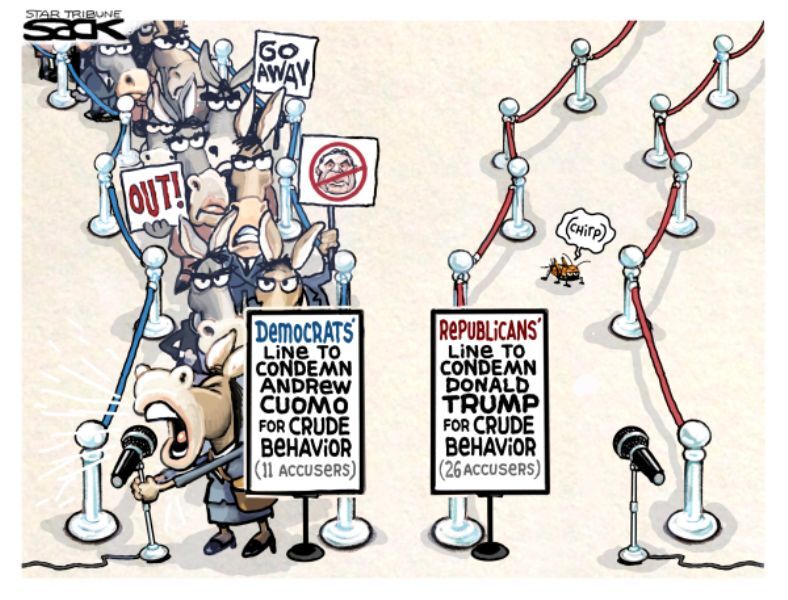
The change that gives the game away, though, is that distributing food or water to people waiting in line to vote is now considered electioneering at a polling place and is a misdemeanor. [4] So while many of the other changes will result in more people voting on Election Day, with correspondingly longer lines in areas with large populations (i.e. Democratic Atlanta), this change will make waiting in line an endurance test.

None of that is as blatant as the cartoon below, but all of it raises the question: Why? Did something bad happen in 2020 that makes all this necessary? The only real answer to that is: Too many people voted and Republicans lost. That’s the problem this law is trying to solve.

https://www.startribune.com/sack-cartoon-georgia-gop-get-out-the-vote-drive/600040819/

What about the implementation changes?

To me, this is the part that is most sinister. Again and again in 2020, Trump pressured Republican officials to overturn the election results. (The best known case is the Raffensperger phone call, when he pushed the Georgia secretary of state to “find” enough votes for him to win, and threatened him with prosecution if he didn’t. But Trump also pressured the US attorney in Georgia, a Georgia elections investigator, state legislators in Michigan, and probably many others we don’t know about.)

What Ted Cruz et al were hoping to accomplish on January 6 was to make an opening for Republican legislatures in Pennsylvania, Arizona, Georgia, and Michigan to overrule the voters and install their own slate of pro-Trump electors. Fortunately, most Republicans in Congress did not go along with this anti-democracy scheme.

Trump failed in his attempt to hang onto power in spite of the voters, largely because Republican officials refused to commit crimes or exceed their authority to reverse the election that he lost so decisively. But many of those officials have subsequently been punished. The Michigan election-board member who noted that his board had no authority to throw out the county-level certifications — he was not renominated. Raffensperger is going to be primaried by a Trumpist, and is expected to lose.

Similarly, most of the Republicans who voted to uphold democracy by impeaching Trump for inciting a riot against Congress — they’ve been censured by their local Republican parties.

The message from the Trump base is clear: Republican officials should not have integrity. They should be partisans first, and cheat if necessary to make sure elections come out “right”. (This makes perfect sense if you believe that “Most people living in the United States today — certainly more than half — are not Americans in any meaningful sense of the term.”)

This context makes the implementation changes in the Georgia bill ominous. The Secretary of State (i.e., Raffensperger) is removed from the State Election Board, which is now more completely under the control of the legislature. And the State Election Board is given power to remove and replace county election officials. It’s easy to see the target here: Fulton County, where Atlanta is.

So the next time a Trump wants to throw out a bunch of ballots in inner-city Atlanta, the state mechanisms are in place to make that happen.

What is being done to protest this law?

One purpose of rushing the law through so quickly was to prevent an effective response, which takes time to organize. (Think about it: If there were good reasons for this law and it enjoyed wide support, Republicans should have played it for all it was worth: Hold extensive public hearings about all the election fraud it would prevent. Explain in detail the destructive effects of handing out bottles of water to people waiting in hours-long lines. Lay out the case for why Atlanta shouldn’t be allowed to manage its own elections. And so on.)

As a result, big Georgia corporations like Coke and Delta didn’t oppose the law until after it passed, and they faced the threat of boycotts. (Home Depot and Aflac still haven’t commented.) The owner of the Atlanta Falcons football franchise did not mention the law specifically, but issued a statement saying “The right to vote is simply sacred. We should be working to make voting easier, not harder for every eligible citizen.” Major League Baseball pulled the All Star Game, which had been scheduled to happen in suburban Atlanta on July 13. (In addition to its fans, MLB also needs to consider its players, particularly the big-name players whose voluntary participation makes the All Star Game worth watching.) It’s not clear how far this movement will spread.

Republicans have been striking back. Ted Cruz and Mike Lee are calling for Congress to end MLB’s exemption from antitrust laws, which has been in place since 1922. The Georgia House voted to revoke a tax break for Delta. [5]

RNC Chair Ronna McDaniel tweeted:

Guess what I am doing today? Not watching baseball!!!!

And the WaPo conservative columnist Hugh Hewitt proclaimed MLB “an arm of the Democratic Party … with values opposed to the Constitution and representative government.”

It’s the conservative version of cancel culture.

One thing Republicans are adamant about is that this is not racist, so all the comparisons to Jim Crow are over the top. But some of the comments they make clearly are racist, like this tweet from Mike Huckabee.

I’ve decided to “identify” as Chinese. Coke will like me, Delta will agree with my “values” and I’ll probably get shoes from Nike & tickets to @MLB games. Ain’t America great?

Democratic Congressman Ted Lieu from California decided not to take that lying down. (He usually doesn’t. If you’re not following him on Twitter, you should.)

Hey Mike Huckabee, I asked around and Coke likes me, Delta agrees with my values, I wear Nikes and my hometown Dodgers won the World Series. But it’s not because of my ethnicity. It’s because I’m not a sh*thead like you who is adding fuel to anti-Asian hate.


[1] That’s one reason why many of Trump’s post-election lawsuits were thrown out without hearing evidence: Although Trump’s lawyers were claiming fraud in the press, when they went to court they often didn’t mention fraud, but focused on voting or vote-counting procedures that should have been — and often had been — litigated before the election. American courts look skeptically at parties that participate in an election, lose, and only then complain about the rules.

Before an election, courts can remedy a situation by ordering that bad rules be changed. Afterwards, the only possible remedy is to throw out ballots that legitimate voters cast in good faith. Judges are understandably reluctant to do this.

[2] It’s not completely obvious this is in fact true, and if it is, nobody knows exactly how big that high-turnout advantage is for Democrats. But it’s fair to say that both parties have acted as if they believe high turnout favors Democrats.

A lawyer for the Arizona Republican Party admitted as much to the Supreme Court. One issue in that case concerned voters who go to a polling place in the wrong precinct. Democrats want to handle this situation by counting their votes, but only for the offices they would have been entitled to vote on had they gone to the correct precinct. Republicans want to throw their ballots out. Remember: these are legal voters casting ballots in elections they are legally entitled to vote on, but getting confused and doing it in the wrong place — and so possibly giving officials an excuse not to count their votes.

“What’s the interest of the Arizona RNC in keeping, say, the out-of-precinct ballot disqualification rules on the books?” Justice Amy Coney Barrett asked, referencing legal standing.

“Because it puts us at a competitive disadvantage relative to Democrats,” said Michael Carvin, the lawyer defending the state’s restrictions. “Politics is a zero-sum game. And every extra vote they get through unlawful interpretation of Section 2 hurts us”

In theory, the extra votes the Democrats’ interpretation would allow might benefit Republicans, but the ARNC lawyer seemed to discount that possibility.

[3] Again and again, the apparently credible evidence you may have heard about in November or December collapsed under scrutiny.

[4] The only time I’ve ever seen snacks used as electioneering was in 2004, when I was given a Clark bar at a Wesley Clark rally. Doing something like that a polling place (which I don’t think Clark did) should be illegal.

[5] I’m struck by the lack of any justifying connection. Both seem to be pure power moves: We don’t like what you did, so we’re going to hurt you.

There is no legitimate tit-for-tat here. Like individuals, private-sector businesses have every right to comment on the actions of government and take whatever actions they deem appropriate. There is no comparable right in the other direction. Individual government officials are free to express their opinions, but governments are obligated to pursue the public good. Delta’s political views are not relevant to whether or not a tax break on jet fuel is in the public interest. For contrast, I don’t believe that Hobby Lobby suffered any official reprisals for challenging ObamaCare.

The Monday Morning Teaser

It’s hard to know where to start this week. President Biden began the push for an infrastructure package. It’s over $2 trillion and fits the FDR mold that progressives want the Biden presidency to fill out. To reprise Biden’s own characterization of ObamaCare, it’s a BFD.

But there’s also the Chauvin trial. It’s hard to escape the view that it’s really America and American justice that are on trial. We’ve had a week of moving testimony that communicated just how disturbing it still is, nearly a year later, to have witnessed a murder and not have been able to do anything about it, because the police are the murderers.

And then there’s Matt Gaetz. I think the world will little note nor long remember him after his political career goes down the tubes, but it’s hard to look away.

And the debate over the Georgia vote-suppression law heated up, as big corporations and institutions like Major League Baseball got involved.

And we’re still in a pandemic. The new-case numbers have turned upward, even as vaccinations set new records. Wisely or unwisely, the economy continues to open up; nearly a million new jobs were added in March.

After some internal debate, I decided I have the most to offer on the voting-rights/vote-suppression story, which has been plagued by misinformation and bogus arguments from both sides. (I am definitely opposed to the Georgia law, but I want to oppose it for the right reasons.) So that’s the featured post, which I’m guessing will be out between 10 and 11 EST. Everything else goes into the weekly summary, which includes a way-too-long Matt Gaetz note that I refuse to promote to a featured post. Let’s say that goes out between noon and 1.

Senselessness

No one, no matter where he lives or what he does, knows who next will suffer from some senseless act of violence. Yet it goes on and on in this country of ours. Why?

Senator Robert F. Kennedy

This week’s featured post is “Two Parties, Two Worlds“.

This week everybody was talking about guns

Just about every political article this week could have started with the line: “The Senate is broken.” I suspect that is going to be true every week until the filibuster is eliminated.

So we had another mass shooting. This one was in a grocery in Boulder. (I was in Boulder one summer in the late 80s. It’s an idyllic mountain college town. The week I was there it showered briefly each afternoon, so that the clouds could move on and give us a rainbow. The thought that buying groceries there is dangerous really brings home the RFK quote at the top of the page.)

The Boulder shooting kicked the Atlanta shooting off the front pages, even though we hadn’t really gotten a clear account yet of the shooter’s motive or how it all went down. (A New Yorker article contrasted how the Atlanta shootings affected a local Korean Baptist church and the mostly white Southern Baptist church that the shooter attended. As I might have predicted, the shooter’s church did zero introspection. The murders are “the result of a sinful heart and depraved mind for which Aaron is completely responsible.” The church’s repressive teachings about “sex addiction” require no rethinking.)

Two shootings so close together once again raised issues of gun control.

In the two mass shootings that unfolded over the past two weeks in the U.S., both suspected shooters purchased weapons shortly before their attacks. The suspect in the Atlanta-area spa shootings purchased a 9mm semi-automatic pistol hours before he used it to kill eight people on March 16. The suspect in the King Soopers attack in Boulder, Colorado, bought a Ruger AR-556 pistol six days before he killed 10 people on Tuesday, according to the arrest warrant affidavit. Police recovered a rifle and handgun at the scene but didn’t indicate if either was the Ruger.

Every few years, some shooting or group of shootings reminds us that this problem isn’t going away on its own. And again we wonder, “This time, will it be enough? Will we see some meaningful action?” Many thought the Sandy Hook shooting in 2012 would tip the balance, because it was children. Or maybe the Parkland shooting in 2018 would, because the survivors were such articulate young people.

Neither massacre resulted in anything passing the Senate. After Sandy Hook, an assault-weapon ban failed to get a majority in the Senate, and an extremely watered-down background-check proposal — background checks regularly polling above 80% — got 54 votes but couldn’t overcome a filibuster. After Parkland, schools got more money for metal detectors, but Congress did nothing about guns.

https://theweek.com/cartoons/974163/political-cartoon-gop-gun-control

The rhetoric has become so predictable that it virtually satirizes itself. On social media, “thoughts and prayers” has become an eye-rolling way of saying “I’m not going to lift a finger to help you.” An iconic Onion article sums up: “No Way To Prevent This,” Says Only Nation Where This Regularly Happens.

Now, the very predictability of inaction has become a reason to attempt nothing. Tuesday Ted Cruz told the Senate Judiciary Committee:

Every time there’s a shooting, we play this ridiculous theater where this committee gets together and proposes a bunch of laws that would do nothing to stop these murders.

https://www.charlotteobserver.com/opinion/article250150339.html

There are laws that arguably could make a difference, short of the full-scale rewriting of the Second Amendment I proposed (to a shower of hostile comments) in 2019. Enforcing a waiting period on gun purchases might have interrupted the process that led to both of the recent shootings. An assault-weapon ban decreased mass shootings during the ten years it was in effect, and could again. Shooters are most vulnerable while they reload, so limiting the size of gun magazines could at least reduce the body count.

But the Senate is broken, so we’re left with thoughts and prayers.

and voting rights

I discuss this in more detail in the featured post, but basically this is where we are: Republicans at the state level have decided that they lost the 2020 elections because they let too many people vote. So in red states across the country, bills are pending (or have passed already) to make voting harder, make it easier to stay in power with a minority of votes, or maybe just let the legislature overrule the voters completely.

Democrats are fighting back at the federal level, with the For the People Act, and the John Lewis Voting Rights Act which would set some minimum national standards for elections and voter rights. For the People has passed the House, but will face a filibuster in the Senate. John Lewis has not been voted on in this Congress, but likely will take similar path: pass the House, filibuster in the Senate. Democrats could use this opportunity to nuke the filibuster, but West Virginia’s Joe Manchin (and maybe Arizona’s Kyrsten Sinema) don’t seem to be on board with that.

Until they change their minds, the Senate is broken and nothing will happen.

The most outrageous anti-voter bill so far was signed this week in Georgia. It’s worth remembering the reason Brian Kemp is governor of Georgia in the first place: As Secretary of State, he managed to throw tens of thousands of Black voters off the rolls. Successful voter suppression leads to more voter suppression.


Steve Benen is wondering the same thing I am:

what happens after GOP senators make clear to Manchin that they will not cooperate on voting rights. The West Virginian wrote, “We can and we must reform our federal elections together.” OK, but when Republicans tell him they have no intention of reforming federal elections, or even working in good faith on the issue, Manchin will … do what exactly?


This might be a good time to remind you of “I Was Undocumented in Arizona“. Back in 2012 (so, well after the post-9/11 security regime started), I found myself in line at the airport when I remembered that I had left my driver’s license in the pocket of my jogging shorts. (If I ever have a heart attack while jogging, I want the ER to know who to contact.) I flew from Boston to Phoenix, and back a week later, with no photo ID. It turned out that TSA had work-arounds, because they were trying to identify me, not to prevent me from traveling. But Republican voter-ID laws don’t have work-arounds, and in fact are quite picky about what kinds of ID they’ll accept. (For example, student IDs often aren’t good enough. Neither are expired driver’s licenses. The poll-worker might be your next-door neighbor and have no doubt who you are, but that doesn’t matter.) That’s because they ARE trying to prevent people from voting.

https://www.sltrib.com/opinion/bagley/2021/03/26/bagley-cartoon-gop-agenda/

and the border

Last week I said I couldn’t find an article that handled the border situation well. This week I have one: “9 questions about the humanitarian crisis on the border, answered” on Vox.

https://jensorensen.com/2021/03/23/border-blather-immigration-crisis-voting/

In general, I’ve been seeing a lot of irresponsibly sensational coverage of the Biden-wants-open-borders variety, partially balanced by people who try to explain the whole situation away. The Vox article presents the issues and problems in what I regard as their proper perspective. For example: the framing in the headline. The current situation on the border is a “humanitarian crisis” — people are suffering there. But it is not a security crisis — we’re not being “invaded” by “terrorists”. And it’s not a health crisis — we’re not being overrun by diseased foreigners.

and Biden’s first press conference

President Biden did not hold his first press conference until Thursday, more than two months into his administration. For me, this was a non-issue, so I wasn’t surprised that it concluded in a non-event. The press conference did not break any major news or produce any headline-grabbing gaffes.

Ideally, reporters would demonstrate the value of professional journalism by getting important information out of Biden that ordinary people wouldn’t have known how to ask for. But that didn’t happen.

Instead, the questions showed the public how poorly the White House press corps’ interests align with ours. There were no questions about the pandemic, but one reporter was already focused on 2024: Is Biden running? (He thinks so, but doesn’t seem to have any clear plans yet.) Will Harris be his VP again? (What president in his third month would ever say no to this question?) Does he expect to run against Trump again? (Who the hell cares what Biden expects Republicans to do three years from now?)

The Insight blog suggests “Ten Questions the Press Should Have Asked President Biden“, any one of which would have been better than the questions they asked.

https://www.ajc.com/news/luckovich-blog/326-mike-luckovich-low-bar/RMQV7PTKGFG4TLJHUX7WFZV5PI/

Historical note: Obviously, George Washington gave no televised press conferences. This modern innovation is not part of the president’s constitutional duties.

The presidential press conference became a big deal because JFK was particularly good at them. He was charming and funny, and those qualities came through as he bantered with reporters. For more than half a century, the press has been wishing for another JFK and being disappointed.

Since Nixon, presidents have often cast reporters in the role of the Enemy. This tendency reached its peak during the Trump administration, when the press was openly branded “the enemy of the People“. The purpose of a Trump press conference (or of briefings by his press secretaries) was not to inform the public, but to stage a drama in which the President triumphed over his enemies in the media.

Beyond the theater of press conferences, the more important issue is whether the American People can get answers from their government, and whether those answers are true. As we saw last year when Trump was holding daily Covid briefings, it doesn’t matter how available the President is if he uses those opportunities to lie to us. (Like: “Anybody that wants a test can get a test.” or “Everything [the governors] need they get, and we are taking good care. We have tremendous supplies and a great supply chain.”)

By that standard, the Biden administration is doing quite well. The achievements that he noted in his introductory remarks Thursday (vaccinations are going faster than he promised, nearly half of K-8 classrooms are open five days a week, 100 million people have gotten payments through the American Rescue Plan, jobless claims are down) are real. The fact-checks on his news conference are fairly minor; often they depend on omitting a single word (WaPo flags Biden for a statement about corporations that pay no “taxes”, when he should have said “federal taxes”), or dueling interpretations. (AP disputed Biden’s claim that 83% of the benefits of the Trump tax cut go to the top 1%, but went on to admit that the 83% figure is true, if you measure over the plan’s full ten-year projection, and assume that the middle-class provisions that are set to expire actually will expire.)

But even without presidential press conferences, a lot of true information is coming out of this administration. Press Secretary Jen Psaki’s briefings are frequent and quite good — though, of course, she can’t announce decisions that haven’t been made yet. She fields hostile questions without creating unnecessary drama, and communicates much that is true and useful. (Trump press secretary Kayleigh McEnany has criticized Psaki for how often she promises to get back to reporters when she doesn’t know the answer to their questions. But McEnany had the option of responding to a question immediately by attacking the reporter, making something up, or lying, all of which Psaki tries to avoid.) Plus, government experts like Dr. Fauci or the scientists at the EPA can now speak freely, without interference from political commissars.

and the stuck ship

The stuck ship is a great reminder of the physicality of the economy. It’s easy to get caught up in apps and memes and hacks and digital rights — and forget the importance of gross physical objects that have to fit in the spaces they’ve been assigned. Once you get a giant container ship wedged sideways in the Suez Canal, you’re not going to get it out without a lot of old-fashioned brute force.

Late this morning, the ship was finally freed.

Grist looks at the complex environmental tradeoffs the ship embodies. Larger container ships are supposed to use less fossil fuel than an equivalent number of smaller ships, but blocking the canal has left about 300 ships idling, and caused countless others to take the longer route around Africa. Many ports need to dredge deeper channels to accommodate such ships, and that usually involves using a substantial amount of fossil fuel, in addition to whatever environmental damage the dredging itself does.

Meanwhile, the ship has become the subject of many jokes, and a metaphor for anything that blocks a process — including why the Senate is broken.

https://www.startribune.com/sack-cartoon-complete-the-phrase-ship-of/600038670/

But my favorite take on the ship comes from the Twitter account “I’m not a girl I’m a wolf“, where you can find this parody of a rhyme from The Lord of the Rings. (Hat tip to Jonathan Korman.)

All that is gold does not glitter,
Not all those who pass here can float;
The boat that is long does not fit here,
Whose bow is dug into this moat.

From the sand a small digger is woken,
Some tugs from the shadows shall spring;
Re-float shall the boat that was stuck in,
Its cargo again shall it bring.

and you also might be interested in …

My vengeful heart is going to enjoy watching Trump’s liars squirm as they defend the defamation lawsuits filed by Dominion Voting Systems. They have a simple problem: They’re guilty. They knowingly lied about fraudulent vote-counting, and those lies injured a corporation with deep enough pockets to make them pay.

This week we saw Trump’s (sometimes) lawyer Sidney Powell’s defense: If you were fooled by all that silly stuff she was saying, it’s your own fault.

reasonable people would not accept such statements as fact but view them only as claims that await testing by the courts through the adversary process

Here’s a question worth asking: How many of the participants in the Capitol Insurrection actually did “accept such statements as fact”? How do they feel now that they know Powell does not view them as “reasonable people”?

Meanwhile, Dominion filed a new lawsuit, this one seeking $1.6 billion from Fox News for its “orchestrated defamatory campaign”. It’s already having an effect: When Trump called in to Laura Ingraham’s show Thursday and started to repeat his election-fraud bullshit, Ingraham cut him off. “Speaking as a lawyer, we’re not going to relitigate the past.”


Jay Rosen points to a prime example of bad reporting at the NYT:

Democrats say that Republicans are effectively returning to one of the ugliest tactics in the state’s history — oppressive laws aimed at disenfranchising voters

And he comments:

“Democrats say…” Okay. But what do you say, @nytpolitics? Do these laws make it harder to vote? Or do they fix problems with election security? And if your answer is “depends on who you ask,” does that meet the quality bar for Times reporting?

Lazy reporting tells you what people say. Good reporting investigates until it figures out what the truth is.


QAnon isn’t catching on in Japan. “It’s too naïve for our readership,” says the editor of Mu, Japan’s top magazine for believers in Bigfoot and ancient astronauts. He urges people to “boost their ‘conspiracy theory literacy,’ by regularly reading our magazine”.


Israel has now totaled up its fourth election in two years, and this result looks just as murky as all the others. It’s hard to see how Netanyahu can pull together a governing coalition. But it’s also hard to see how anybody else can.

and let’s close with something portentous

And in the fullness of time, the vision of St. Paul became manifest.

https://www.facebook.com/choirx3/photos/a.3767329213371370/6269161066521493/?type=3

Two Parties, Two Worlds

https://www.ajc.com/news/luckovich-blog/311-mike-luckovich-different-priorities/A537HIH76ZBDVDX5REEQLX4CEA/

Democrats in Washington are talking about one set of issues. Republicans in the state capitals have a different vision entirely.


Within living memory, Republicans and Democrats competed over “swing voters” who were assumed to be living in the political “center”. That meant that candidates mostly talked about the same issues, and sometimes even proposed similar solutions, or at least had similar rhetoric.

In 2000, for example, it was hard to tell at a glance which would be more right or left: George W. Bush’s “compassionate conservatism” or Al Gore’s “New Democrat” agenda. Both seemed to be tempering their party’s typical stances, and where precisely they had wound up was not immediately clear. Ralph Nader claimed that it made no difference at all; if you wanted anything to change, you had to vote for a third party.

In 2012, Obama and Romney disagreed, but were talking about the same things: ObamaCare should either be expanded or repealed. Taxes on the rich should go up or down. There should be either more or fewer restrictions on abortion. But both wanted an all-of-the-above energy plan, and both wanted to end the wars in Afghanistan and Iraq in some kind of honorable way.

But right now, the difference between the two parties seems particularly stark. They aren’t just proposing to go in different directions; they’re talking about different worlds. Rather than competing solutions, they offer competing realities.

The Biden agenda. President Biden and Democrats in Congress have put forward a very clear list of what they think America needs:

  • Federal leadership in fighting Covid through vaccinations, treatments, and rallying Americans to practice good public health hygiene.
  • Financial help for individuals who have lost their income due to the pandemic and the lockdowns that combat the pandemic. (This was covered in the American Rescue Plan Act.)
  • Financial help for state and local governments to make the necessary adjustments to open schools safely, and to maintain public services in the face of falling revenues. (Also in the American Rescue Plan Act.)
  • Investments in public infrastructure, from fixing crumbling roads and bridges to building a 21st-century electrical grid. (An infrastructure bill currently being written.)
  • Protecting and restoring democracy by ending gerrymandering, making it easier to vote, and lessening the influence of big donors on our political system. (The For the People Act, which has passed the House.)
  • At a minimum, letting immigrant children who grew up in the US can stay and make a life for themselves. Beyond that, passing a larger immigration reform bill that would give the 11 million undocumented immigrants some kind of legal status. (The American Dream and Promise Act, passed by the House earlier this month.)

So far, this agenda has met with no cooperation from Republicans in Congress. The American Rescue Plan passed (through the filibuster-avoiding reconciliation process) with no Republican votes. The For the People Act passed the House with no Republican votes, and Mitch McConnell has predicted it will get none in the Senate. McConnell ally John Cornyn described it as “an existential threat, I think, to our election system and to our democracy”.

Already, before an official version is even announced, Republicans are staking out reasons to oppose Biden’s infrastructure plan. (Apparently, dividing the plan into two pieces, giving Republicans the opportunity to support a consensus bill and oppose a more partisan one, is a “cynical ploy”. To me, it looks like a strategy to make sure that contentious issues don’t get in the way of actions everyone agrees are needed.)

The American Dream and Promise Act got nine Republican votes in the House. It seems unlikely to get the 10 Republican senators it needs to survive a filibuster.

Meanwhile, in the states where Republicans control the governorship and the legislature, a different set of priorities are central.

  • Making it harder to vote.
  • Barring transgender students from school sports.
  • Creating more loopholes in anti-discrimination laws.
  • Preventing schools from teaching an anti-racist curriculum.
  • Stopping cities from fighting Covid with business closures or mask mandates

Voting. Georgia’s new election law — the one that makes it illegal to give water or snacks to people waiting in line to vote — got all the attention this week, but it’s one of many. The Brennan Center is tracking 253 bills in 43 states that involve some form of

  • restricting absentee voting, early voting, and voting by mail
  • tightening voter-ID requirements
  • limiting voter-registration drives
  • purging voters from registration lists

A recent law in Iowa allows less time for early voting and closes the polls an hour earlier. Perhaps the most disturbing aspect of the Georgia law is the legislature’s new control over the counties.

The law allows the State Elections Board to temporarily suspend county elections directors and boards that it deems in need of review. At the same time, the secretary of state will be removed as chair of the state board and will be made an ex-officio, nonvoting member.

Those provisions have raised particular concerns among Democrats, who say that it will give far-reaching control over state and local elections procedures to partisan legislators and allow them to determine, for example, which ballots to count.

The racial aspect here should be obvious: The white-dominated Republican legislature could take election control away from a majority-black county like Fulton, where Atlanta is.

Transgender kids in sports. Mississippi, Arkansas, and Tennessee have passed laws banning transgirls from participating in sports in public middle schools and high schools. Similar bills are pending in many other states.

[Tennessee Governor Bill] Lee has said transgender athletes would “destroy women’s sports” and remarked that transgender athletes would put “a glass ceiling back over women that hasn’t been there in some time.”

A well-publicized track meet in Connecticut in 2019 resulted in two trans athletes winning the top two places in the girls’ 55-meter dash, but so far such results are rare. The WNBA has at least one transwoman, but seems to be in no danger of the “destruction” Governor Lee fears. The LPGA has been open to trans golfers since 2010, but they are still relatively uncommon.

None of the supporters of the Tennessee measure could cite a single instance of transgender girls or boys having caused problems. A review by The Associated Press found only a few instances in which it has been an issue among the hundreds of thousands of American teenagers who play high school sports.

Megan Rapinoe of the National Women’s Soccer League writes in today’s Washington Post:

Already this year, lawmakers in more than 25 states have introduced legislation to ban transgender young people from sports. … These bills are attempting to solve a problem that doesn’t exist. Transgender kids want the opportunity to play sports for the same reasons other kids do: to be a part of a team where they feel like they belong. Proponents of these bills argue that they are protecting women. As a woman who has played sports my whole life, I know that the threats to women’s and girls’ sports are lack of funding, resources and media coverage; sexual harassment; and unequal pay.

Anti-discrimination exemptions. Friday, Arkansas Governor Asa Hutchinson signed a law “allowing doctors to refuse to treat someone because of religious or moral objections”.

Opponents have said types of health care that could be cut off include maintaining hormone treatments for transgender patients needing in-patient care for an infection, or grief counseling for a same-sex couple. They’ve also said it could also be used to refuse to fill prescriptions for birth control, or by physicians assistants to override patient directives on end of life care.

Banning anti-racism. Jeffrey Sachs outlines the various states passing laws to limit the teaching of anti-racist ideas. A proposed New Hampshire bill has a heading “Unlawful propagation of divisive concepts”.

Similar bills are being debated in West Virginia and Oklahoma. Meanwhile in Georgia, a GOP representative has ordered every public college and university to prepare a list identifying which courses are teaching students about concepts like “privilege” and “oppression.” Faculty there say it’s already having a chilling effect.

There’s more. In Arkansas, debate has begun on a bill that would prevent public schools and universities from offering any course, class, event, or activity that “promotes division between, resentment of, or social justice for” a race, gender, political affiliation, or social class.

Banning public-health restrictions. Texas Governor Greg Abbott not only ended the state’s mask mandate, but has banned cities from having their own mandates. Austin is currently fighting in court to preserve its mandate. A bill in Idaho that forbids any government entity to require masks is working its way through the legislature. Florida’s legislature is working on a law to take away local governments’ emergency public-health powers.


So which world do you live in? The Democratic world, where you feel threatened by the spread of the virus, worry about the state of our democracy, want to rebuild our public infrastructure, and think kids who grew up in America should have a way to stay here? Or the Republican world, where too many people are voting, virus restrictions are too onerous, you feel threatened by transathletes, and you wish you could do more to express your Christian disapproval of deviant lifestyles?

https://jensorensen.com/2021/03/06/naked-partisans-both-sidesism/

The Monday Morning Teaser

If there’s a theme in recent political news, it’s that Republicans and Democrats seem to be living in different worlds.

I live in the Democratic world, so the issues Democrats talk about — Covid; the economic effect of Covid on ordinary people; protecting the right to vote; repairing crumbling 20th-century infrastructure and building for the current century; climate change; racism, sexism, and various other forms of bigotry; mass shootings; and letting DREAMers stay in the country — look real to me. Meanwhile Republican priorities — making it harder to vote; keeping transgirls out of school sports; changing discrimination laws to increase conservative Christians’ opportunities to express their disapproval of other people’s lifestyles; encouraging more people to carry guns in more situations; more tightly regulating which bathrooms people use; not letting cities require masks; and protecting Mr. Potato Head from cancel culture — are all weirdly divorced from any problems I can see.

Not too many cycles ago — say, when Bush ran against Gore or Kerry — both parties were trying to appeal to swing voters, so at times their messages could seem fairly similar. Ralph Nader’s claim that there was no real difference between Republicans and Democrats was never quite true, but was at least a defensible position. If you actually were a conscientious moderate voter, you needed to do a certain amount of research to determine which party best represented your views in any particular year.

Now I’m having a hard time picturing that moderate voter. If you listen to any politician for more than a few sentences, either they’re talking about a world that seems real to you or they aren’t. That’s the subject of this week’s featured post “Two Parties, Two Worlds”. It should be out around 10 EDT.

This week’s summary talks about the news from my Democratic world: the Boulder shooting and how little will probably be done to prevent future mass shootings, the upturn in Covid cases, voting rights, the filibuster, the border, Biden’s first presidential press conference, the stuck ship, and a few other things. It should be out around noon.

Against Violence

The best thing you can do today is to speak out against violence toward Asians in this country, especially if you yourself are not Asian.

George Takei

This week’s featured post is “Race in US History: 4 Facts Every American Should Know“.

This week everybody was talking about the Atlanta shootings

Tuesday night, a gunman killed eight people at three spas or massage parlors in the Atlanta area. Six of the victims were Asian-American women. He used a gun purchased only hours before. He was apprehended on his way to Florida, where he presumably intended to kill more people.

The shootings touched off a number of discussions: First, about anti-Asian violence, which has been growing during this past year, as Asians get blamed for Covid-19’s origin in China. Rather than try to tamp this down (as President Bush sometimes tried to calm anti-Muslim sentiment after 9-11), Trump often seemed to be intentionally stoking it, going out of his way to use inflammatory phrases like “the China virus” or “Kung Flu”.

Another discussion concerned misogyny: The shooter appeared to blame women for the temptation of his “sex addiction”. Much of the media struggled with the intersectionality of racism and sexism, as if the motive had to be one or the other. AP seemed to handle it best:

While the U.S. has seen mass killings in recent years where police said gunmen had racist or misogynist motivations, advocates and scholars say the shootings this week at three Atlanta-area massage businesses targeted a group of people marginalized in more ways than one, in a crime that stitches together stigmas about race, gender, migrant work and sex work.

In short: Sexism makes women objects, and racism makes Asian women a particular kind of object.


A discussion the media generally handled even worse than intersectionality was the role of religion in this killing spree. The shooter blamed his crime on “sex addiction”. Apparently he was killing women in the sex industry (if indeed they were; that hasn’t been established) to eliminate temptation.

This is a peculiarly evangelical narrative. Repressive religion turns ordinary desires into sins, which can complicate the challenge rather than resolve it. Blaming women for the desires they raise in men also has a long history in patriarchal religion. The shooter’s church, meanwhile, seemed more interested in escaping blame than doing anything useful.

In accordance with the biblical pattern and our church bylaws, Crabapple First Baptist Church has completed the process of church discipline to remove Robert Aaron Long from membership since we can no longer affirm that he is truly a regenerate believer in Jesus Christ.

As Jesus said: “I was sick and in prison and you did not look after me.”


Finally, the shooting and the police response brought up issues of white privilege. Some wondered whether a non-White shooter (particularly if he had killed White women) would have been apprehended without injury. A sheriff department spokesman seemed far too sympathetic when he summed up the crime spree like this:

He was pretty much fed up and kind of at the end of his rope. Yesterday was a really bad day for him and this is what he did.

In general, the media assumes White murderers are anomalous in a way that Black or Muslim murderers aren’t. Coverage is far too likely to generate explanations of how a good boy went bad, rather than promote the idea that White people are dangerous. News sites seem to worry a lot less about giving people the idea that Blacks or Muslims are dangerous.

McSweeney’s, as it so often does, uses humor to say something deadly serious in “Editorial Template for Every Time a White Person Commits an Atrocious Crime“.

and the border

I’m having trouble finding a good reference that puts the border story in its proper perspective. There’s been a surge in the number of unaccompanied minors arriving at the US/Mexico border. The Trump administration had been sending them back, but the Biden administration isn’t, so it has the problem of where to put them while it determines whether someone in the US is willing and able to take care of them until their asylum status can be assessed.

People are being far too glib about comparing this situation to the one that arose from Trump’s family-separation policy. In this case, the family separated itself and sent a child here. The US government didn’t take the child away by force. Under Trump’s policy, cruelty was the point: He wanted people thinking about coming here to know that we’d take their children. That threat was supposed to keep them from coming. Under Biden, kids are showing up and we’re doing the best we can with them.

Any fair discussion of the border also needs to point out that Biden inherited an unsustainable situation: Trump’s policy of ignoring migrants’ right to claim asylum violated both our laws and our treaty obligations. Biden has to do something different.

and Russia’s support for Trump

This week gave us many opportunities to appreciate just how often and how blatantly the Trump administration lied to us. The Biden administration released a declassified version of the report “Foreign Threats to the 2020 US Federal Elections” that the National Intelligence Council submitted on January 7, when Trump was still president.

The upshot: No foreign actor influenced the counting of votes, as Trump lawyers often claimed. Of the nations trying to influence voters, the most egregious was Russia, who once again supported Trump. In Max Boot‘s words: “there are suspiciously strong parallels between Trump’s propaganda and Russia’s.” Such as: manufactured stories of the Biden family’s corrupt dealings with Ukraine, fearmongering about the untrustworthy nature of mailed ballots, and manufactured stories about the sinister origins of Covid-19.

One country the report says didn’t interfere in the 2020 election was China. China “considered but did not deploy influence efforts” because it “did not view either election outcome as being advantageous enough for China to risk blowback if caught”.

Rachel Maddow found the video of Trump, Bill Barr, and other Trump officials claiming the exact opposite: that China, not Russia, was the major power interfering. They claimed to base this opinion on intelligence that we couldn’t see. Now that we see it, we know they were lying. “None of that was true when they said it, and they knew it.”

Another claim that unraveled was that the post office in Erie, Pennsylvania backdated the postmarks on ballots so that more votes would count. More votes counting is a bad thing in Republican circles, so this was a key part of the stolen-election conspiracy theory. This week, the Post Office inspector general report came in, and found no evidence to support the claim.

Meanwhile, four Proud Boy leaders were indicted for conspiring to attack the Capitol on January 6.

and the virus

Numbers: The new-case-per-day averages have flattened out again, running in the 55K-56K range all week. Deaths continue to go down; the 7-day average is now under 1,000 per day for the first time since early November.

Michigan has the most disturbing statistics: The 7-day average of new-cases-per-day bottomed out a little over 1,000 on February 21, and have risen back up to just under 3,000. Deaths per day have also started increasing, but not nearly so much: After bottoming at 16 per day, they’re now up to 20 per day. In the past week, Covid-related hospitalizations in Michigan went up 32.5%. Nationally, hospitalizations are still falling, down 4.2% last week. Local experts speculate that a combination of factors might be responsible for the Michigan surge: the more-contagious U.K. variant of the disease, “Covid fatigue” that caused people to be less careful, looser restrictions on restaurants and other businesses, and the resumption of school sports programs.

As of yesterday, 81.4 million Americans had received at least one vaccine shot, and 44.1 million were fully vaccinated.

and cancel culture

I’m resisting doing a third-week-in-a-row article, because I’m afraid I’m falling into the right-wing culture-war distraction trap. But the commenters on last week’s “Is an Intelligent Discussion of Cancel Culture Possible?” posted a lot of good links that did in fact point in the direction of an intelligent discussion. So I’ll eventually get back to this topic (after paying attention to some other timely issues). But for now I’ll just take note of this week’s developments.

Using opposition to cancel culture as an excuse to keep displaying the bust of Nathan Bedford Forrest in the Tennessee state capitol could be an SNL skit if it weren’t really happening. (Forrest — slave trader, war criminal, KKK founder — is essentially the patron saint of white supremacy.) The state’s Republican governor appointed a historical commission to decide what to do with the statue, and when the commission recommended moving it to a museum, even-further-right members of the legislature started pushing to dissolve that commission and appoint a new one.

Even National Review isn’t buying it.

We need to get better at having direct and honest conversations about the ethical boundaries of our culture. … I’m sure if we put our heads together and tried some public moral reasoning for a change we could come up with a way of canceling the Klan without canceling Dr. Seuss. The question isn’t whether or not we’re going to have a “cancel culture,” it’s what we’re going to cancel people for.

This week’s other development was Teen Vogue letting go of new editor Alexi McCammond before she even started, apparently because of a staff revolt over 10-year-old tweets, which now look homophobic and anti-Asian. (I’m saying look because I haven’t read the tweets myself, so I make no judgment on what they are.)

Atlantic’s Graeme Wood laments that “American has forgotten how to forgive“, but I think he’s missing something. He’d be totally right if Atlantic or the NYT fired a new editor for something she posted when she was 17 and now recognizes as a mistake. But to the limited extent that I understand Teen Vogue, I think it’s committed to the idea that teens do things that matter. They can’t shrug off McCammond’s tweets with “Eh, she was just a teen-ager.”

and you also might be interested in …

Here’s the difference between dormant and extinct: Mount Fagradalsfjall in Iceland hadn’t erupted for 6,000 years — until Friday night.

One reason Iceland is so geologically interesting is that North America and Europe meet near there, just a bit below sea level. Here a diver bridges the gap between the continents.

https://constative.com/facts-file/perspective/38/

Maybe the saddest thing about QAnon is all the loved ones people leave behind when they vanish down the rabbit hole.


Conservative Supreme Court justices have been voicing support for a strict view of the separation of powers that is called the “nondelegation doctrine“. Wikipedia defines it as

the theory that one branch of government must not authorize another entity to exercise the power or function which it is constitutionally authorized to exercise itself

That sounds abstract and technical, but it has real implications. If making rules is a legislative function, then Congress can’t delegate that power to an agency like the EPA or the FCC. In practice, this would make regulations rigid and cumbersome. Since polluters, con-men, and other bad actors can adjust their tactics much faster than Congress can pass laws (particularly if it retains the filibuster), large segments of the economy would essentially go unregulated, at least at the federal level.

A recent article in Columbia Law Review “Delegation at the Founding” points out that although non-delegation is pushed by judges who claim to be “originalists”, there’s nothing original about it: The Founders did not view the separation of powers in this way.

The nondelegation doctrine has nothing to do with the Constitution as it was originally understood. You can be an originalist or you can be committed to the nondelegation doctrine. But you can’t be both.

and let’s close with something strangely appropriate

I can’t think of any widely known song that has ever been so appropriate for timely parodies as “My Shot” from Hamilton. In its original context, “My Shot” is the young Hamilton pledging that he will not miss his chance to succeed. The song defines his character as a man who can’t stop, because he will always see opportunities to accomplish more and rise higher. It contrasts with the song his wife sings later, “That Would Be Enough“, in which she urges him to be happy with all that life has offered them. The tragedy of Hamilton is that he can’t hear this message; nothing will ever be enough.

But now, of course, we’re all waiting for our shot of a vaccine — or maybe we’re avoiding it for some crazy reason. Either way, we’re singing about our shot.

Seven doctors in the Sacramento area have formed Vax’n 8 and made a video to promote vaccination. I haven’t found an embeddable version yet, but here’s a TV report on the backstory.

But of course Dr. Liu couldn’t possibly be the only person to think of this. Adam Shain says “I’m not gonna delay my shot.

Last summer already, the Holderness Family did a Covid/Hamilton medley to encourage mask-wearing.

And Inverse K uses “My Shot” to make fun of the anti-vaxxers.

Race in US History: 4 Facts Every American Should Know

In “Why You Can’t Understand Conservative Rhetoric“, I described a process by which certain words and phrases lose all real meaning and become nothing more than pejorative labels that the Right attaches to whatever it doesn’t like. Through repetition, the movement’s followers have been trained to respond to “political correctness” and “cancel culture” like a bull to the color red; whatever those labels get attached to makes them angry, independent of whatever might be going on underneath the label.

An extreme example of this phenomenon is this week’s opposition to removing the bust of war criminal and KKK grand wizard Nathan Bedford Forrest from a prominent place in the Tennessee state capitol and placing it in the Tennessee State Museum, where General Forrest’s memory might be assessed objectively rather than simply glorified. (Far from a liberal plot, this is the recommendation of the historical commission appointed by the Republican governor.) But rather than asking “Do we want Tennessee and its legislature to be identified with a key figure in the origin of the Klan?”, moving Forrest’s statue has been labeled “cancel culture”, which must be resisted at all costs.

The latest phrase to get the political-correctness treatment is “critical race theory”. For example, Wednesday when Florida Governor Ron DeSantis announced a proposal to overhaul civics education, he made it clear that certain views of American history should not be taught:

Let me be clear: there’s no room in our classrooms for things like critical race theory. Teaching kids to hate their country and to hate each other is not worth one red cent of taxpayer money.

Bills to ban critical teaching about race in American history are being proposed in Republican controlled legislatures around the country. (Sometimes the ideas being banned are connected to the New York Times 1619 Project or anti-racism.) In nearly every case, critical race theory is never defined, but rather is given a negative description like DeSantis’ phrase “teaching kids to hate their country and to hate each other”. These bills are often accompanied with proposals to teach a more traditional, all-positive view of American history, as South Dakota’s Governor Noem proposes:

I have tasked my administration with creating instructional materials and classroom resources on America’s founding, our nation’s history, and the state’s history. We must also do a better job educating teachers on these three subjects. Through all of this, our common mission and key objective needs to be explaining why the United States of America is the most special nation in the history of the world.

Similarly, former President Trump called for educational programs that teach students “to love America with all of their heart and all of their soul.” Such a rah-rah view of American history and the US’s role in the world gets contrasted with the “indoctrination” and “ideology” of critical race theory. As DeSantis said:

Our schools are supposed to give people a foundation of knowledge, not supposed to be indoctrination centers, where you’re trying to push specific ideologies.

These efforts build on the rhetoric in two Trump executive orders: One banned anti-racism training at companies that contract with the government, and the other established a 1776 Commission to push a US history curriculum opposed to the 1619 Project. Neither order used the phrase “critical race theory”, but instead denounced “a series of polemics grounded in poor scholarship” that “has vilified our Founders and our founding”.

This ideology is rooted in the pernicious and false belief that America is an irredeemably racist and sexist country; that some people, simply on account of their race or sex, are oppressors; and that racial and sexual identities are more important than our common status as human beings and Americans.

As I pointed out in “Why You Can’t Understand Conservative Rhetoric”, phrases picked out for vilification are never defined, they are just labeled and described in a pejorative way. (Often they are described falsely. For example, anti-racist training would serve no purpose if America actually were “irredeemably racist”. Redemption is the whole point.)

So what is this “pernicious and false” doctrine? Time magazine described it as “a way of seeing the world that helps people recognize the effects of historical racism in modern American life”.

The intellectual movement behind the idea was started by legal scholars as a way to examine how laws and systems uphold and perpetuate inequality for traditionally marginalized groups.

But I think it’s important not to get lost in abstraction. Most Americans are not abstract thinkers, and when confronted with theories that are too airy to grasp, they often do what Trump, DeSantis, and the others are urging them to do: Give the abstraction a label and accept or reject it once and for all.

So instead, I want to offer a small number of facts that I believe (1) are essential to understanding the significance of race in American history, and (2) are never going to be taught in the kinds of courses Trump, DeSantis, and Noem are picturing.

1. From the turn of the 19th century to the Civil War, slavery was at the center of the American economy.

Yale historian David Blight:

by 1860, there were more millionaires (slaveholders all) living in the lower Mississippi Valley than anywhere else in the United States. In the same year, the nearly 4 million American slaves were worth some $3.5 billion, making them the largest single financial asset in the entire U.S. economy, worth more than all manufacturing and railroads combined.

Obviously, slavery was central to the Southern economy. In just a few decades time, the entire states of Mississippi and Alabama were taken from Native American tribes, were converted to farm land by enslaved Africans, and became the most productive cotton fields in the world.

But the importance of slavery went much further: Although Virginia did not grow much cotton, its prosperity depended on exporting slaves to the developing slave states. The factories of the North were largely textile mills that gained advantage over English mills from easy and tariff-free access to Southern cotton. So from one end of the country to the other, American prosperity was based on slavery.

Slavery is also the hidden backstory to much of American history. For example, the motivation for Texas to secede from Mexico was that Mexico was beginning to enforce its anti-slavery laws. In that sense, the battle of the Alamo really was about freedom, but not in the way I was taught in high school.

To follow up on these facts, look at The Half Has Never Been Told by Edward Baptist, The American Slave Coast by Ned and Constance Sublette, and Empire of Cotton by Sven Beckert.

2. The melting-pot miracle was based on creating a new White identity that rejected and stood above Blackness.

Something genuinely wonderful about American history is the way that Europeans from warring countries could come to America and live in peace. Certainly there was rivalry and sometimes conflict between European ethnic groups. (The HBO series Broadwalk Empire centers on the struggle between Irish and Italian gangs to dominate the Prohibition booze trade.) But it was truly marvelous how French and German and Polish people could homestead western lands and become neighbors, while their relatives back in Europe continued to hate each other.

It is pleasant to tell this story as a unified “American” identity replacing previous identities as Czechs and Serbs, but there’s more to it than that: Russians and Swedes didn’t just learn to be American, they learned to be White. The same deal was not available to Black or Chinese people. (Whether it was available to Jews varied by location and era.) By identifying as White, Europeans came into the American caste system at a level one or two steps above the bottom rung of the ladder, which was reserved for non-Whites.

You can learn more about this process in Learning to be White by Thandeka.

3. The public investments that created the great American middle class intentionally excluded Black Americans.

The most obvious example is the segregated public school system, which helped poor White children gain the skills they needed to rise in the world, but either formally or informally herded Black children into schools with much less to offer. The New Deal and G. I. Bill programs that created the American Dream as we know it contained loopholes that Blacks consistently fell through: Social Security and the minimum wage didn’t apply to occupations with substantial numbers of Black people, like agricultural and domestic workers. The government would not guarantee home loans in the “red-lined” neighborhoods where most Black people lived. Black veterans of World War II could get help paying for college, but only if they found a college willing to accept them. And so on.

Learn more about this in When Affirmative Action Was White by Ira Katznelson.

4. White support for those programs faded after LBJ extended them to Black people.

By the 1950s, New Deal programs (and the high tax rates on the wealthy that paid for them) were no longer controversial. In a 1954 letter to his brother, Republican President Eisenhower wrote:

Should any political party attempt to abolish social security unemployment insurance and eliminate labor laws and farm programs you would not hear of that party again in our political history. There is a tiny splinter group of course that believes you can do these things. Among them are a few other Texas oil millionaires and an occasional politician or business man from other areas. Their number is negligible and they are stupid.

But then the Civil Rights movement happened. 1954 was the year the Supreme Court ordered school desegregation. The 1958-59 school year became “the Lost Year” after Governor Faubus of Arkansas closed all of Little Rock’s public high schools rather than integrate them. In 1963, President Kennedy had to federalize the Alabama National Guard to move Governor Wallace aside so that the first Black student could enroll in the University of Alabama. 1964 brought the Civil Rights Act banning racial discrimination. It was followed by the Voting Rights Act of 1965 which ended Jim Crow disenfranchisement.

Lo and behold, the Eisenhower consensus went away. When government programs offered Blacks the same helping hand they had been offering Whites for decades, Whites didn’t like them any more. Right-wing rabble-rousers stigmatized government programs as a way to tax Whites and give money to Blacks, and a small-government anti-tax movement started. Democrats became identified as the party of government, and no Democratic presidential candidate has received a majority of the White vote since LBJ in 1964.

As a result, tuition-free state universities are gone, inflation has eaten away the value of the minimum wage, and we argue about issues like whether children should get medical care.

Read more about this in The Sum of Us by Heather McGhee.

The Monday Morning Teaser

Last week’s “Is an Intelligent Discussion of Cancel Culture Possible?” led to a discussion in the comments that (I have to admit) was quite intelligent. I learned a lot. I’m tempted to write a post this week summarizing the best points, but that would be three weeks in a row with cancel-culture posts. I’m starting to worry that I have taken the conservative bait and gotten distracted from more important issues. So I’ll get back to it, but not this week.

Something else that caught my eye this week was the attempt to stigmatize critical race theory, and more-or-less any telling of American history that isn’t totally rah-rah. An important piece of the stigmatization process is abstraction, so I thought I would bring the discussion down to specifics. This week’s featured post is “Race in US History: 4 Facts Every American Should Know”. It should be out around 10 EDT.

In the weekly summary, the Atlanta murders raised the issues of anti-Asian racism and misogyny. (It hasn’t — but should have — raised discussion of how repressive religious doctrines turn ordinary lust into dysfunctions like “sex addiction”.) Reports came out that underlined just how blatantly Trump administration people lied to us about Russian and Chinese interference in the 2020 election, about voter fraud, and about the Capitol insurrection. The Covid new-case rate has flattened out again, and is shooting upwards in a few places like Michigan — even as vaccination continues apace. I couldn’t resist commenting on the week’s two biggest cancel-culture stories: Nathan Bedford Forrest’s bust and sacking the Teen Vogue editor. And an Icelandic volcano went off for the first time in 6,000 years (which I think is before God is supposed to have created the world).

A fun virus story — hard to believe I just wrote that phrase — is a collection of vaccine-related parodies of “My Shot” from the Hamilton musical. There’s some other stuff to throw in, and I still need a closing, but you get the idea. That should be out noonish.

Hope and dreams

Greater than the death of flesh is the death of hope. The death of dreams. Against this peril we can never surrender.

– J. Michael Straczynski

This week’s featured posts are “Is an Intelligent Discussion of Cancel Culture Possible?” and “What Makes a Good Conspiracy Theory?

This week everybody was talking about the American Rescue Act

Thursday, President Biden signed the $1.9 trillion American Rescue Act. The day before, the House had passed the Senate’s version of the bill, which had passed the Senate by one vote the previous Saturday. No Republican in either house voted for the bill.

https://www.facebook.com/stuart.carlson.12/posts/10159630782384172

Biden has not tried to hide the fact that this bill is big: A lot of Americans need help to get through this crisis, and the government is going to give it to them. He’s not pretending that this isn’t the “big government” that Bill Clinton said was over.

The political result of all this will test whether the Reagan Era is finally over.


New Yorker satirist Andy Borowitz: “Rand Paul Saddened to See Government Flagrantly Helping People”.

In closing, Paul castigated his Senate colleagues who voted for the bill, accusing them of “ushering in a dangerous new era of Washington politicians intrusively abetting people’s efforts to survive.”

“You have broken your most solemn oath, which is, ‘First, do no good,’ ” he said.

More seriously, Fox News published an op-ed by Paul, who has said the spending puts the US on the path to becoming the next Venezuela. Paul has his own theory on how to fix the economy: Stop fighting the virus.

Instead of printing more money and making believe that this money will retain its value as it is sprinkled across the land, we could remove the government shackles that have caused a depression in the restaurant, retail, and entertainment sectors of our economy.

His op-ed closes with a misappropriation of a famous John Maynard Keynes quote:

The economist John Maynard Keynes famously said that stimulus works in the short run and he didn’t much care about the future because we’d all be dead. I will vote against any more ‘free’ money because I care about my kid’s future and the future of our great country.

Misquotes are often more revealing than quotes. This reading of Keynes has little to do with Keynes, but is the way Keynes is presented in Ayn Rand’s Atlas Shrugged. (Rand apparently got that interpretation from Hayek.) What Keynes actually meant was that it’s hard to get people to sacrifice for policies that economists think are best “in the long run”, when the imagined benefits are so far in the future that those making the sacrifices won’t live to see them. (“It is not wise to look too far ahead; our powers of prediction are slight, our command over results infinitesimal.”)

A good example of what Keynes was talking about is Paul himself, who can’t be convinced to care about climate change, no matter what it will do to his kids’ future.

and Biden’s speech

Thursday night, which marked both the signing of the bill and the one-year anniversary of WHO declaring a global pandemic, Biden gave a televised address (transcript, video). Maybe the last four years have lowered my standards, but I thought it was masterful.

The speech wove a complex emotional tapestry. It mourned the losses we have all suffered this past year (lost loved ones, lost jobs, lost experiences, lost opportunities), regretted the ways we had been turned against each other (battles over masks, racist reprisals against Asian Americans), pointed to the progress being made (every adult will be vaccine-eligible by the beginning of May, enough vaccine will be available to cover all of us by the end of May, schools will soon be ready to reopen safely), asked for the public’s help (keep wearing your mask, practice social distancing, wash your hands frequently, get vaccinated when you have the chance), envisioned a realistic goal (safe July 4 cook-outs with friends and family), and expressed a high hope (“My fervent prayer for our country is that, after all we have been through, we’ll come together as one people, one nation, one America.”).

Biden lacks the soaring rhetorical ability of Barack Obama, but he has a different set of strengths: He embodies sincerity. He is the guy who will level with you, the guy who has taken on a difficult job and is working hard to do it well. He has suffered with you, and has not lost hope.


Jonathan Chait is onto something here:

Joe Biden has reaped the normal rewards that come from behaving like a normal president — perhaps benefitting more than most due to the contrast with his unhinged predecessor. This has naturally infuriated Republicans, who see Biden’s strategy of reaping positive coverage by acting normal as a form of cheating.

On the other hand, Biden suffers from fact-checkers needing to fill space. Fairly small exaggerations get flagged, while a comparable Trump speech would include so many whopping lies that they couldn’t all be covered.

https://www.facebook.com/steve.sack.16/posts/10215856943651267

At this point, a novelist or movie director would make the previous president pop up and say something that underlined the contrast. And so it came to pass. Wednesday, Trump issued a statement emphasizing what is most important to him: getting credit whether he deserves it or not. No one should forget the (completely ridiculous and untrue) fact that without him, vaccines wouldn’t exist for another five years, if ever.


One attempt to manufacture an issue against Biden is his lack of press conferences. David Frum argues that this is good strategy: In the current environment, presidents are polarizing. The more Biden can project the idea that action is being taken by the government rather than the President, the better.

Another advantage is that Biden is not being pressured to take positions on things that are none of his business: Should Andrew Cuomo resign? Is the British royal family racist? And so on. Unlike Trump, Biden doesn’t want to opine on everything under the sun.

and fighting the virus

This week marked a lot of different Covid-19 anniversaries. A year ago, many things started happening quickly: The WHO declared a global pandemic. One of the nation’s top sports events (the “March Madness” NCAA basketball tournament) got cancelled. Schools started going virtual. I remember picking up a friend’s son at a public-transit station. He thought he was coming home for spring break, but he actually wouldn’t return to college until January.

The thing that strikes me looking back at the pandemic restrictions is how few of us knew what we were facing. The initial school closure in my town was for two weeks. Only serious pessimists were saying that we wouldn’t have this figured out by fall.


Steady as she goes: The number of Americans with one vaccine shot (69.8 million) or a complete vaccination (36.2 million) continues to rise. The number of cases (7-day daily average 55K) is still falling, but not very fast. Deaths (1,235) are coming down faster. But we are still at levels that would have been alarming last summer.

Biden’s appointees

Whenever someone gets a raw deal, people hope for them to “get justice” someday. Well, this week Merrick Garland really did get Justice. Three cabinet nominees — Becerra at HHS, Haaland at Interior, Walsh at Labor — still need to be confirmed by the Senate. Neera Tanden’s nomination at OMB was withdrawn; a replacement hasn’t been announced.

and you also might be interested in …

Last week I nudged you to support an Amazon boycott because of the union organization effort in Alabama. Commenters pointed out that the union organizers themselves were not asking for a boycott. Best to let them decide on their own strategy.

So last week, if you didn’t send your money to a rapacious giant that is taking over the world, maybe you should have. Sorry for misleading you.


The immigrant my church has been sheltering from deportation is leaving sanctuary after three years.

“Glorious news!” wrote First Parish minister John Gibbons in an email sent to parishioners and volunteers. “This morning, Maria received official confirmation that she has a one-year stay of deportation.”

For our congregation (and the volunteers from other congregations who pitched in), this is a starfish-on-the-beach story. We all knew that the pointless cruelty Trump’s immigration policy dwarfed any response we could muster. But here was one person who needed help. That was something we could do.


Part of me says I already spent too much time on the Dr. Seuss controversy last week. But there are a couple more things worth mentioning. First, the Seussical poem “The Day Children’s Literature Died” is hilarious. Second, PDFs of all six of the books no longer being published are here — mislabeled as “banned” books, but otherwise open to inspection. (Legally? I have no idea. If the link stops working, you’ll know what happened.) If you want to form your own opinions, it helps to see the work in its full context. My opinion: I’d figure out a way to save On Beyond Zebra, which is a cute concept marred by one illustration that should be easy to fix. The others are no big loss.


Talking about things that get too much attention: I stopped caring about the British royal family in 1776, when I was minus-180 years old.


Hard to know how much attention to give to speculation about Trump’s legal problems. Lots of dark clouds are forming around him, but I don’t want to get too excited before any rain falls.

Ditto for Mike Flynn. The Pentagon was investigating him for emoluments-clause violations when that investigation got subsumed by the Mueller investigation that eventually prosecuted him for lying to the FBI. After Trump pardoned him for that crime, the old investigation reopened.


A nasty story has a happy ending. As I mentioned in one of featured posts, an announcer had an open-mic moment during a girls high-school basketball tournament in Oklahoma, racially insulting girls who knelt during the national anthem. Well, Saturday, that team won the state championship.


George Floyd’s family is getting a $27 million settlement from the City of Minneapolis. Someday cities are going to figure out that good policing is cost effective.


I have not seen HBO’s Allen v Farrow, but it’s been intriguing to watch people react to it, like Ginia Bellafante, who published “Why My Teen-Age Self Gave Woody Allen a Pass” in Thursday’s NYT. The comments on that story are mixed: Some clueless older men think Woody has gotten a raw deal; a larger number of commenters of either gender condemn him in a fairly orthodox way; some women recount personal horror stories of exploitation by older men; and a few women still remember their intergenerational relationships fondly.

To me, the interesting issue isn’t what Woody did or didn’t do, how to reevaluate his movies, or who is telling the truth. It’s watching American culture use this case to think through its changing ideas and values.

My opinion: When we raise girls to have Cinderella-like fantasies, where a powerful man swoops out of nowhere and makes her a queen, we’re grooming them for exploitation. OTOH: Protecting young women can sometimes be an excuse for refusing to let them grow up.

Also, age-of-consent (which comes up often in the pro-Allen Bellafante comments) is a blunt instrument doing delicate work. People mature on different schedules, so any one-size-fits-all age is going to throw some young women to the wolves while unjustly telling others that they aren’t wise enough to make their own decisions.

That’s why this issue needs to have a social component in addition to a legal component. Legally, a middle-aged man may be in the clear if he has sex with a young woman on her 16th or 17th or 18th birthday. But the situation may still be creepy enough that the rest of us want to shun him. (OTOH, I have never understood why the law should get involved if a boy who just turned 16 has sex with his two-weeks-younger girlfriend, and she is not complaining about it.)

and let’s close with something well timed

Somebody hit the button at exactly the right instant to capture this frisbee-catching dog.

What Makes a Good Conspiracy Theory?

https://www.thesuburban.com/opinion/editorial_cartoons/napoleon-s-cartoon-conspiracy-theories/image_8291e550-5e3d-523c-9d22-262dae2f4ca5.html

We’ll never get rid of them, but can we at least process them better?


On this blog I frequently debunk conspiracy theories that spread among conservatives: QAnon, Obama’s birth certificate, Dominion voting machines, Antifa’s role in the Capitol insurrection, and so on. But this week a liberal conspiracy theory kept showing up in my social-media news feeds: The accusations against Andrew Cuomo are part of a scheme to install a Republican as governor of New York, so that he can use his pardon power to protect Donald Trump from New York state prosecutions.

Debunking the Cuomo theory. Before I start using this as an example of a conspiracy theory, though, let’s dismiss it as a sensible interpretation of events: Suppose Cuomo resigns or is impeached. His replacement is the Democratic Lieutenant Governor Kathy Hochul, who has no reason to pardon Trump. Next in the line of succession are the Temporary President of the Senate, the Speaker of the Assembly, and the Attorney General — all Democrats.

Then comes the 2022 election. New York electing a Republican governor is not unheard of: George Pataki served three terms from 1995-2006. But Pataki Republicans are not exactly Trumpists, and in recent cycles Democrats have done quite well in New York. Cuomo won his last election (2018) by 23%. But he doesn’t have some unique ability to pull in votes that puts the governorship in danger if he can’t run. Biden beat Trump in New York in 2020 by 23% as well. Kirsten Gillibrand won the New York senate race in 2018 by 34%. Letitia James won the 2018 Attorney General race by 27%. And the names being discussed as 2022 Republican challengers are not ones that should cause Democrats to quake in fear, particularly if a Trump pardon becomes one of the issues.

In short, raising phony accusations against Cuomo in order to keep Trump out of jail would be a wild scheme that had almost no chance to succeed. Not even Trumpists are crazy enough to invest the kind of resources even a failed attempt would require. And besides, there’s a far more mundane explanation for Cuomo’s problems: Being an asshole finally caught up to him.

My rare attempt at bipartisanship. If conspiracy theories appear in both parties, then sensible people in both parties should want to debunk them. That’s why I was pleased to see someone I rarely agree with, New York Times conservative columnist Ross Douthat, contribute to that effort a little while ago with “A Better Way to Think About Conspiracies“.

He starts with the following observation: The only way to get rid of conspiracy theories completely is to induce everyone to accept the expert consensus on everything. Not only is that never going to happen, it shouldn’t happen, because sometimes the expert consensus is self-serving or corrupt or just wrong in the ordinary people-make-mistakes way. I mean, how many experts told us that Saddam had WMDs, or that Trump couldn’t possibly beat Hillary? Worse, occasionally there are real conspiracies, like Nixon’s Plumbers or the baseball owners’ free-agency collusion.

So if we can’t just deny all conspiracies, or insist that people believe whatever the experts say, what can we do?

If you assume that people will always believe in conspiracies, and that sometimes they should, you can try to give them a tool kit for discriminating among different fringe ideas, so that when they venture into outside-the-consensus territory, they become more reasonable and discerning in the ideas they follow and bring back.

Douthat suggests a few sorting principles that can keep people from falling down the Q-Anon rabbit hole.

  • Simple theories are better than baroque ones.
  • Be skeptical of theories that seem tailored to reach a predetermined conclusion.
  • Take fringe theories more seriously when the mainstream narrative has holes.
  • Don’t start accepting all fringe theories just because one of them looks right to you.

To illustrate the simple vs. baroque distinction, he contrasts two origin-of-Covid-19 conspiracy theories: One says “it was designed by the Gates Foundation for some sort of world-domination scheme”, and the other that “it was accidentally released by a Chinese virology lab in Wuhan, a disaster that the Beijing government then sought to cover up”. Douthat rejects the former out of hand, but finds the latter plausible — not true, necessarily, but possibly worth investigating further.

The difference is that the Gates theory requires postulating a whole bunch of other stuff not in evidence. (What powers those nano-chips in the vaccine once they get into your bloodstream?) But the lab-accident theory just has one unusual event, after which a lot of people behave the way we know a lot of people behave: They would rather lie than accept blame. [1]

He illustrates the predetermined-conclusion point by looking at Trump’s various stolen-election theories. If you’ve ever argued with a Trumpist about this, you’ve probably observed what Douthat did: When you disprove one election-fraud theory, the Trumpist doesn’t reconsider his position, but just comes back with another election-fraud theory. If Georgia’s hand-recount disproves the corrupted-voting-machine-software theory (it does), then what about Detroit having more votes than voters? After you debunk that, what about dead people voting? And so on. The conclusion (Trump really won) remains fixed; the conspiracy theories are just roads to get there.

That should count against them.

Douthat’s point about holes in the mainstream narrative is similar to Thomas Kuhn’s account of scientific revolutions: Novel theories shouldn’t dislodge an accepted theory unless the accepted theory is having trouble explaining anomalies. As Einstein reflected, “If the Michelson–Morley experiment had not brought us into serious embarrassment, no one would have regarded the relativity theory as a (halfway) redemption.”

The example Douthat gives is Jeffrey Epstein. Epstein’s career is so unlikely that you can hardly blame people for trying to place him in a larger story. I would point to the pee-tape theory of Putin and Trump. There is essentially no evidence of a pee tape, but Trump’s defenders have never offered an alternative explanation of why he was so subservient to Putin. Instead, they just denied what we could all see. If the alternative to the conspiracy theory is believing that the Trump/Putin news conference in Helsinki is perfectly normal behavior for an American president, then I’ll keep looking for a pee tape.

The fourth point ought to go without saying, but there is a strong pull in the opposite direction: Once you leave the mainstream, other outside-the-mainstream folks feel like compatriots. (Once you accept alien visitors, why shouldn’t Atlantis be real?) Douthat makes a good point, though: All the world’s revealed religions have stressed that not every voice that pops into somebody’s head is the voice of God. You have to practice discernment.

I’ll support him by pointing out that even though the experts aren’t always right, they usually are. So when you believe a conspiracy theory, you’re betting on a long shot. Long shots occasionally come in, but no gambler makes a successful career out of betting on one long shot after another.

My additional principles. I agree with all of Douthat’s principles, but I don’t think he goes quite far enough. I want to add some ideas that I can easily imagine him agreeing with. And even if he doesn’t …

You don’t have to accept the convention wisdom, but you should know what it is. If you reject it, you should have a reason. Before you retweet something bizarre, take a moment to google a news story on the topic, or check some reference like Wikipedia. Is there a widely accepted explanation you hadn’t considered? Is there a reason not to accept it? If you have such a reason, fine. But at least consider a non-conspiracy explanation.

Evil people face the same problems you do. Have you ever tried to organize something? It’s hard. It gets harder the more people you need to coordinate, and harder still if it’s something like a surprise party, where it’s supposed to be secret, so you can’t just blast out an announcement.

It’s not any easier to organize something nefarious. If you can’t imagine how a richer, more powerful version of yourself could pull something off, be skeptical that somebody else is managing it.

Who are “they”? One way to avoid realizing just how big and complicated a conspiracy would have to be is to attribute it to a nebulous “them”, as Donald Trump Jr. does in this clip: “There’s no place that they won’t go. This week alone, they canceled Mr. Potato Head, they canceled the Muppets. They’re canceling Dr. Seuss from reading programs.” They who?

Everybody in a conspiracy needs a motive. The reason the baseball-owner-collusion theory was plausible (even before it turned out to be true) was that all 32 owners had the same financial incentive: paying their players less.

Now consider the theory that ICUs are faking the Covid pandemic. Everybody who works there needs to be in on it: nurses, doctors, cleaning staff, and so on. Either they’re not telling their loved ones, or the loved ones are in on it too. What motives could possibly unify all those people?

Very few people are motivated by evil for its own sake. A theory I heard fairly often as same-sex marriage cases were working their way through the courts was that same-sex couples weren’t actually interested in getting married, they were just trying to destroy marriage for the rest of us. We are all occasionally tempted to do something out of spite, but seriously: Would you devote a big chunk of your life to a project that gained you nothing, but just destroyed something for somebody else? Not many people would. [2]

As new information comes in, bad conspiracy theories have to grow. A good conspiracy theory might even shrink. A sure sign of a bad theory is that every objection is met by expanding the conspiracy. “They’re in on it too.”

But if you imagine organizing a conspiracy yourself, you wouldn’t be constantly trying to bring more people in, because each new person is a new risk. Instead, you’d try to identify the smallest possible group that could pull the operation off.

So if you’re on the trail of an actual conspiracy, the more you find out, the closer you should get to understanding the vision of the planner. Rather than “He’s in on it too”, you should start to realize how a small group of people really could do this. [3]

Contrast this with the nanobots-in-the-vaccine theory. Anybody who has access to a Covid vaccine might put it under a microscope and see those bots. Why aren’t they saying anything? They must all be in on it.


[1] My favorite Kennedy-assassination conspiracy theory is similar: After Oswald fires that first non-fatal shot, a Secret Service agent’s gun goes off by mistake, killing JFK. The agent’s superiors then try to cover that up, and things spiral from there.

Having brought up the Kennedy assassination, which educated my whole generation in conspiracy theories, I have to tell this joke: Two authors of JFK-assassination-conspiracy books are sharing a car as they drive to a convention where they’ll both be on a panel. Unfortunately, they are involved in a highway accident and die. But they’re both virtuous people, so they arrive together in the afterlife.

Their introductory tour of Heaven is given by God Himself, and somewhere between the infinite beach and the endless ice cream bar he tells them that there are no secrets in Heaven. “So if you ever want to know anything — about Heaven, about the Earth, about Me — you just have to ask.”

So one of the authors raises the question he’s been wrestling with for years: “Who really did kill Kennedy?”

And God answers, “Oswald, acting alone, pretty much the way the Warren Report says.”

The authors go silent for a while, until eventually one leans over to the other and whispers, “This goes up much higher than we ever imagined.”

[2] This is one reason I suspect that conspiracy theories do better among religious groups that believe in an active Devil. Unlike anybody you actually know, the Devil is motivated by evil for its own sake. And if the Devil has minions, they also are just trying to do harm.

[3] One of my favorite Kennedy-assassination conspiracy books was Best Evidence by David Lifton. (I’m not endorsing his theory, I’m just illustrating a point.) His theory revolves around how investigators think: They trust some kinds of evidence more than others, and they’ll explain away less-trusted evidence if it contradicts more-trusted evidence.

In a murder case, the best evidence is the body; or, after the body is out of reach, the autopsy. So if you could control that evidence, then you wouldn’t need to involve the whole FBI; they would naturally discount eye-witnesses who saw something that the autopsy says didn’t happen.