
This week’s events in Ferguson have tested all of us, not just police and politicians.
In a classic South Park bit, Stan’s Dad is on Wheel of Fortune. The category is “People Who Annoy You”, and the letters showing are
N-_-G-G-E-R-S
The solution is naggers, but Mr. Marsh is so overwhelmed by the horror/forbidden-pleasure of saying “niggers” on TV that he can’t think of anything else. Watching for the first time, neither could I. Surely no TV-game-show puzzle could have niggers as its solution, but it instantly jumps to mind anyway. And once you’ve had that thought, calmly running through the other vowels to find a more probable solution doesn’t seem like an option any more.
By the time he blurts out “Niggers!”, Mr. Marsh even seems proud of himself for having found the courage to overcome political correctness and speak the truth as he sees it. But it isn’t truth. It’s just an idea that shines so brightly in his head that he can’t see any alternatives.
That’s how unconscious racism works.
Stan’s Dad is not an I-hate-black-people kind of racist, and undoubtedly he would be offended to be described as any kind of racist at all. In most ways, he’s a fairly typical middle-class white parent. He didn’t wake up that morning thinking, “I’m going to say ‘nigger’ today, and don’t let anybody try to stop me.” He knows what attitudes and behaviors are acceptable and unacceptable in today’s society, and he does his best to pretend that his mind really works that way.
But it just doesn’t. Whatever his conscious intentions, his mental reflexes have been passed down from another era, when racism was as common as air.
Reacting to presidents. Earlier this year, I described how unconscious racism figures in people’s responses to President Obama. Being president and living in the White House has always been a pretty sweet ride. Protocol requires everyone to defer to you. Wherever you go, no expense is spared to keep you and your family comfortable and safe.
The public has known and accepted this for a long time. The President symbolizes the United States, so of course the Kennedys or Reagans or Bushes should be treated with utmost respect. But when the First Family became black, all that luxury and deference suddenly looked different. Why were the Obamas lording it over us like this?
So, those white folks who didn’t even notice when Reagan’s or JFK’s feet were on the desk, but who see Obama’s and think “He was raised so badly.” — are they also secretly thinking “Who does that uppity nigger think he is, acting like he’s a real president or something?” Maybe a few here or there, but mostly no. They aren’t consciously hating Obama because he’s black. But they can’t look at a black president the same way they looked at the 43 white presidents. Things just look different when Obama does them.
And once the thought “Why are the Obamas lording it over us?” pops into your head, it’s genuinely difficult to back up and think: “Wait a minute. Are there other ways to look at this? Would I be interpreting the situation this way if he were white?” In fact, not voicing that bright and shiny “truth” feels like cowardice. The racial influence is long forgotten: Who does this Obama guy think he is, acting like he’s President of the United States or something?
Unconscious racism in the police. At this point, we don’t really know what Darren Wilson was thinking when he killed Michael Brown, sparking more than a week of civil unrest in Ferguson, Missouri. But we know that there’s a long history of police officers reacting differently to black citizens than to whites. Ezra Klein put it bluntly:
Incidents of excessive force are commonplace, and increasingly, there’s a list of young black men who have died for no other reason than that they ran into a police officer at the wrong time and in the wrong way.
Earlier this month, for example, 22-year-old John Crawford was killed by police in a WalMart in Ohio. After he picked up a realistic-looking air rifle from the shelf, another customer called police about an armed man in the store. Crawford was talking to his girlfriend on the phone when police demanded he drop the weapon. While he tried to explain that it wasn’t a real weapon, they killed him.
By contrast, white open-carry activists have been showing up in public places like Target or Home Depot, prominently displaying actual deadly weapons. None of them have provoked a similar misunderstanding. In Aurora, Colorado (site of the 2012 movie-theater massacre) an 18-year-old white man was carrying a shotgun down a public street. When stopped by police, he argued with them and refused to turn over the gun or show any ID. They let him continue on his way, gun in hand.
Most of this disparity, I suspect, is unconscious. I sincerely doubt that Crawford’s killers went to work that morning thinking, “I hate those young black bucks. I’m going to shoot me one today if I get the chance.” But police have to deal with emergency situations that may require quick action. Somebody seems to have a gun and people might be in danger — do you calmly talk him down or go in shooting? There may be no time to work through a checklist and make an objective decision; you have to go with your gut.
But what if your gut is prejudiced? What if seeing a young black man in an emergency situation is like seeing N-_-G-G-E-R-S on the puzzle board? One possibility — that he’s a dangerous criminal and innocent people will die unless you shoot him right now — pops to mind and blots out all others.
The Ferguson test. “This is a test,” Missouri Governor Jay Nixon said. But it’s not just the people of Ferguson or the police or Nixon himself who are being tested this week. It’s all of us. As we watch events unfold, in how many ways do they just look different because of race? How hard is it to back up, re-examine our initial framing, and ask ourselves what we’d be thinking if race were not a factor?
The Ferguson police as an organization. Looking at their initial treatment of the Brown shooting, it’s hard to avoid the conclusion that Ferguson police didn’t think killing a black teen-ager was a big deal, or that his family or the community deserved any answers about how it happened or who did it or why. Shielding the shooter appeared to be the paramount concern.
When protests did erupt, police seemed to see only the public order and safety issues rather than the community relations issues. Instead of working with community leaders to balance public safety concerns with the public rights of assembly and free expression, police attempted to dictate to the community, and to enforce their edicts with overwhelming force.
The fact that the police version of the shooting was at odds with the accounts of eye-witnesses, including at least two who did not know Michael Brown, did not seem to bother them. Witnesses and the family’s private autopsy (results of the police autopsy haven’t been revealed) paint the picture of an intentional, unnecessary killing: shots aimed at Brown’s back while he attempted to run away, and then more shots after Brown turns with his hands in the air. After interviewing one witness, MSNBC’s Lawrence O’Donnell assesses her testimony as a description of first degree murder, and the legal experts on his show agree. And yet the officer has not been arrested or charged with any crime at all.
When police finally released Wilson’s name, they simultaneously released video of Brown apparently stealing cigars from a convenience store. That video has no relevance to the legal case — officers can’t shoot down suspects trying to surrender, no matter what they are suspected of doing — but it did have public relations value. It fed the storyline that focuses on black lawbreaking and violence to the exclusion of police misconduct.
Political leaders. It was obvious early on that local officials in Ferguson were making the situation worse, and yet higher authorities were slow to intervene or comment. The swing voters in Missouri are rural or suburban whites, and Governor Nixon has been careful not to look too pro-black. You have to wonder: If police were treating a white community like an occupied war zone, and if large numbers of local whites and their elected representatives were protesting, would it take that long to get a response?
 Media. Some reporters are doing their best to get the facts out and portray them fairly, but it is far too easy to treat Ferguson residents as one big black blob. If there is looting and violence, then the citizens of Ferguson are violent looters. No wonder police are shooting them in the street and riding around in tanks and paying no attention to their concerns. Let them stop breaking the law and then maybe we’ll listen to them.
It’s hard to imagine a white community getting this kind of treatment. Whites who break the law are typically presented in the media as aberrations. Often they are portrayed as crazy loners, even when they belong to groups that promote precisely the kinds of crimes they commit. If you’re a law-abiding white homeowner with complaints about your local government, you stand very little chance of being lumped together with thieves and vandals who live in your neighborhood and also happen to be white.
Again, maybe a few journalists or TV personalities are thinking, “Here’s a chance to smear blacks”, but I doubt that’s the primary motivation. I think rioting black ghetto is another one of those bright shiny notions. Get it in your head and it’s hard to get it out.
Also, I can’t count the number of times I’ve run into the comment that we shouldn’t “jump to conclusions” because “we don’t know all the facts” or “we don’t know what really happened”. If several white eyewitnesses gave consistent accounts of excessive force by a black police officer, would we be instructed to ignore them in the same way? Or does the fact that the witnesses are black make it easier to discount their testimony? Does the whiteness of the police chief make his version more authoritative?
All of us. We can blame the police for laying out self-justifying and community-diminishing narratives, and we can blame the media for promoting them. But why do we fall for them?
And I do mean we. Like Randy Marsh, I was raised at time when racism was common as air. When I take a step back, I can see the effects of that training in the way my pre-conscious processes shape the perceptions that my conscious mind then wants to treat as facts.
Situations involving black people just look different. Their lives seem less consequential, their deaths less tragic. When I hear of their misfortunes or the injustices they suffer, part of me is waiting for the explanation of how they brought this on themselves. Their stories and testimonies are easily discounted. The thought, “I need to do something about this” does not arise on its own, unless the something involves defending myself and other respectable white people. A crowd of blacks easily stops being a collection of individual humans and becomes a malevolent unit. I expect violence and lawlessness, and when it appears it dominates the picture I see. “Well, there you go,” I think.
I can see how unfair those thoughts are, when I take a step back. But it’s so easy not to.
Unitarian Universalist minister Meg Riley writes:
As a white person in the U.S., I am conditioned from birth to see whiteness as safety — white neighborhoods, white people, white authority figures. My lived experience, my conversations with people of color, and my study of history have shown me over and over that this is a wild and cruel perversion of the truth. But the cultural conditioning is strong. Unless I fight it every day, white superiority seeps into my brain in slow, almost undetectable ways.
A lot of whites get offended by the suggestion that America is a racist society. They know that the vast majority of whites are not KKK-style racists, actively plotting evil against non-whites. (Some are, of course, but it’s not fair to judge the many by the misdeeds of the few — at least not when we’re talking about whites.)
My point is: We don’t have to be KKK-style racists. We can maintain a racist society quite well just by letting our minds do what they do: assemble age-old stereotypes into the narratives we’ve been hearing all our lives.
We can do that, or we can “fight it every day”. I invite you to take the Ferguson Test and see how you’re doing in that fight.


 The Lost Cause. At about the same time my American history class was leaving a blank spot after 1865, I saw Gone With the Wind, which started filling it in like this: Sadly, the childlike blacks weren’t ready for freedom and full citizenship. Without the discipline of their white masters, many became drunks and criminals, and they raped a lot of white women. Northern carpetbaggers used them (and no-account white scalawags) as puppets to control the South, and to punish the planter aristocrats, who prior to the war had risen to the top of Southern society through their innate superiority and virtue.


 It’s not a Tea Party. The Boston Tea Party protest was aimed at a Parliament where the colonists had no representation, and at an appointed governor who did not have to answer to the people he ruled. Today’s Tea Party faces a completely different problem: how a shrinking conservative minority can keep change at bay in spite of the democratic processes defined in the Constitution. That’s why they need guns. That’s why they need to


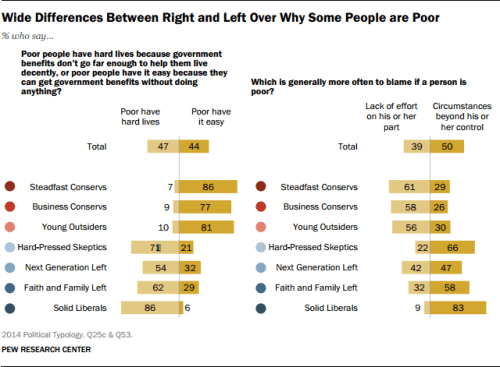 I mean, what else could it be? Poverty can’t be capitalism’s fault, because


