Waves

Arabs could be swung on an idea as on a cord. … They were incorrigibly children of the idea, feckless and colour-blind, to whom body and spirit were for ever and inevitably opposed. … They were as unstable as water, and like water, would perhaps finally prevail. Since the dawn of life, in successive waves they had been dashing themselves against the coasts of flesh. Each wave was broken, but, like the sea, wore away ever so little of the granite on which it failed, and some day, ages yet, might roll unchecked over the place where the material world had been, and God would move upon the face of those waters. One such wave (and not the least) I raised and rolled before the breath of an idea, till it reached its crest and toppled over and fell at Damascus. The wash of that wave, thrown back by the resistance of vested things, will provide the matter of the following wave, when in the fullness of time the sea shall be raised once more.

— Lawrence of Arabia, The Seven Pillars of Wisdom (1922)

The terrible reductive conflicts that herd people under falsely unifying rubrics like “America,” “the West,” or “Islam” and invent collective identities for large numbers of individuals who are actually quite diverse, cannot remain as potent as they are, and must be opposed. … Rather than the manufactured clash of civilizations, we need to concentrate on the slow working together of cultures that overlap, borrow from each other, and live together in far more interesting ways than any abridged or inauthentic mode of understanding can allow. But for that kind of wider perception we need time, and patient and skeptical inquiry, supported by faith in communities of interpretation that are difficult to sustain in a world demanding instant action and reaction.

— Edward Said, preface to the 2003 edition of Orientalism

This week’s featured post is “Terrorist Strategy 101: a review“. Maybe ISIS acts like our worst nightmare because they want us to attack them.

This week everybody was talking about ISIS

The featured post is about ISIS, and how it needs America to play the Great Satan role. But lots of other people were talking about ISIS too, like satirist Andy Borowitz:

Arguing that his motto “Don’t do stupid stuff” is not a coherent foreign policy, critics of President Obama are pressuring him to do something stupid without delay. Arizona Senator John McCain led the chorus on Tuesday, blasting Mr. Obama for failing to craft a stupid response to crises in Iraq, Syria and Ukraine. “If I were President, you can bet your bottom dollar I would have done plenty of stupid stuff by now,” McCain said.


I won’t go line-by-line through the op-ed McCain and Lindsey Graham published in the NYT, because Peter Beinart already did. Short summary: McCain/Graham push President Obama to combine stuff he’s already doing (but they pretend he isn’t doing) with stuff beyond the power of any president. (“Any strategy … requires an end to the conflict in Syria, and a political transition there.”) Then they sprinkle in lots of what Beinart calls “happy words” like acting deliberately and urgently, and make completely unsupported pronouncements like “ISIS cannot be contained.”


Conor Friedersdorf asks the kind of question hardly anybody pursues: John McCain has a long record of foreign policy pronouncements. Is he ever right? And if not, why are we still listening to him?

Friedersdorf recalls this gem, from 2003:

no one can plausibly argue that ridding the world of Saddam Hussein will not significantly improve the stability of the region and the security of American interests and values.

That’s why Iraq is such a rock of stability now, because we fought what McCain called “The Right War for the Right Reasons”.


Peter Beinart had a second good piece this week, in which he recalled Walter Russell Mead’s four-part typology of American foreign policy views:

  • Wilsonians who export grand American visions like democracy, Christianity, or capitalism.
  • Hamiltonians who defend the international trade our economy depends on.
  • Jeffersonians who want the U.S. to stay out of international conflicts, for fear war abroad will damage liberty at home.
  • Jacksonians who avenge insults to our national honor.

Beinart attributes the recent push to crush ISIS mainly to Jacksonians, who see those YouTube beheadings as unforgivable insults. Obama’s “Don’t do stupid stuff” mantra is mainly anti-Jacksonian, because “honor” is the only one of four values unrelated to any pragmatic interest.


Rand Paul continues to re-affirm my opinion about him: He is a lightweight who hasn’t thought through the slogans he inherited from his Dad. If he looks like a threat to win the 2016 nomination when the Republican debates begin, sharper candidates like Ted Cruz or Chris Christie will tear him apart.

A couple weeks ago on Meet the Press, Paul sounded Jeffersonian:

I think that’s what scares the Democrats the most, is that in a general election, were I to run, there’s gonna be a lot of independents and even some Democrats who say, “You know what? We are tired of war. We’re worried that Hillary Clinton will get us involved in another Middle Eastern war, because she’s so gung-ho.”

A few days later, AP quoted an email Paul wrote to supporters, which pushed a more Jacksonian line:

If I were President, I would call a joint session of Congress. I would lay out the reasoning of why ISIS is a threat to our national security and seek congressional authorization to destroy ISIS militarily.

In each case, it sounded good, so he said it. There’s no coherent thought process behind either statement.

and naked pictures on the internet

You would think online pictures of naked women would be old news, but this week everybody was talking about new naked pictures: Upwards of 100 celebrities had their iCloud accounts hacked, resulting in the release of nude selfies of movie star Jennifer Lawrence, supermodel Kate Upton, and other famous women.

Against my usual policy, I’m going to comment without making any effort to examine the original source material — and no, none of the links here will get you any closer to those pictures — because that’s kind of the point. This is a violation. It’s like taking pictures through a keyhole or pulling down a stranger’s bikini top at the beach. (“Why did she wear something that flimsy anyway?”) This time you’ll almost certainly get away with it. But seriously, is that the kind of person you want to be? Lena Dunham summed it up:

Remember, when you look at these pictures you are violating these women again and again. It’s not okay.


Watching the online reaction to the photos has been like lifting up a rock and seeing verminous beasties that usually stay underground. It’s amazing to read all the well-don’t-take-nude-pictures-then and she-shouldn’t-have-trusted-the-cloud comments that appear over and over in just about every comment thread. They’re like the she-was-asking-for-it response to rape.

Part of the motivation is the usual human bad-things-won’t-happen-to-me-because-I’m-smarter-than-most-people thing, which lost its charm for me when my wife got cancer. But there’s also an undercurrent of misogyny, and what feminists call “the rape culture”: the idea that women exist for men’s amusement, and that once a woman has made any concession to male voyeurism, she’s abandoned her right to draw a line anywhere.

Salon‘s Andrew Leonard and Jezebel’s Mark Shrayber have collected and commented on the outrage expressed on Reddit as the site tries to restrict distribution of the photos. Some men apparently believe that if naked photos exist anywhere, they have a God-given right to see them.


Slate‘s Emily Bazelon makes a good legal point:

Every day, movie and TV producers succeed in getting videos that have been posted without their consent taken down from major websites. … Yet in the days since Jennifer Lawrence and other celebrities discovered that their nude images were stolen, and then posted without their consent on sites like Reddit and 4Chan, the stars can’t get the images taken down. … This is crazy. Why should it be easy to take down Guardians of the Galaxy and impossible to delete stolen nude photos?

Answer: Because Congress’ top priority is protecting corporate profits. As with so many issues, the trail leads back to campaign finance reform.


Included in the release are pictures of Olympic gymnast McKayla Maroney taken when she was under 18, so under the law they’re child pornography. You really, really don’t want them found on your hard drive.


For what it’s worth, Apple says it’s not their fault: Hackers brute-forced the passwords on the accounts rather taking advantage of some Apple software flaw. But they have announced new features to warn you when there are signs your account has been hacked. (“Here is a photo of your horse running away. Would you like to shut the stable door now?”)


And finally, if you want to see racy pictures of Kate Upton, Sports Illustrated has gobs of them. They’re shot in exotic locations by world-class photographers, and some of them are pretty hot. And here’s the best part: Kate consented to have them published. So the only point in looking instead at pictures she wanted to keep private is to violate her privacy. If violation and lack of consent make pictures sexier to you, you need to have a long conversation with yourself.

and Governor Ultrasound’s guilt

Ex-Virginia Governor Bob McDonnell was found guilty of corruption, and his wife was convicted as a co-conspirator. Rachel Maddow was the first national-news pundit to take this story seriously, and has been on it ever since, so her coverage of the verdict includes the most background.

Who he was and how he became governor in the first place was through the televangelist, hard-core, social conservative, family values power structure, in which he promised us that he would be the man to save marriage in Virginia, that his personal family values would become the public policy of the state of Virginia. He would remake the state’s Christian morality in the image of his own Christian family and his own Christian marriage.

McDonnell’s defense turned all that upside-down. Under the law, his wife wasn’t a public official, so she could only be an accomplice to corruption; if he wasn’t guilty, she couldn’t be. So the defense was that it was all her fault. She was the one who solicited gifts from a Virginia businessman and implied he would get something from the governor in exchange. And their relationship was so strained they were incapable of conspiring.

Reportedly, McDonnell had previously turned down a plea-bargain deal that would have avoided a trial, kept his wife out of jail, and convicted him of only one count. Amanda Marcotte draws the lesson:

McDonnell has dedicated his career to the idea that women should sacrifice everything for the good of “family,” including bodily autonomy and personal safety, but the second he’s called upon to take on the responsibility of a good Christian husband to protect his wife, he ran away and tried to foist as much as the blame as he could on her. Turns out family values wasn’t about men and women sacrificing together for family, just a cover story to excuse male dominance over women.

and Democrats letting Independents carry the ball against right-wingers

Two similarly odd stories this week: Democrats withdrawing from a race so that an independent would have a chance to defeat a far-right Republican.

In Alaska, Democratic gubernatorial nominee Byron Mallott announced he and independent Bill Walker would form a unity ticket against Republican incumbent Gov. Sean Parnell. Walker will get the top spot and Mallott will run for lieutenant governor. Hard to say if this maneuver will work: Parnell had a 42%/42% approval/disapproval rating in a recent poll, and was winning the three-way race with only 37% support. I haven’t seen any post-announcement one-on-one polling of the Parnell/Walker race.

In the Kansas Senate race, Democratic nominee Chad Taylor announced he was dropping out of the race in favor of independent Greg Orman in their race against Republican incumbent Pat Roberts. But Republican Secretary of State Kris Kobach (already famous for his voter suppression efforts) says Taylor’s name will have to stay on the ballot.

Again, it’s hard to say if this will work, whether Taylor stays on the ballot (but doesn’t campaign) or not. Nate Silver is skeptical of a pre-announcement poll that said Orman would win a head-to-head race, but he doesn’t pretend to know that anything else will happen either.

Also unknown is what Orman would do if his vote were the difference between Harry Reid or Mitch McConnell becoming majority leader. If his vote is decisive, he promises only to “sit down with both parties and have a real frank discussion about the agenda they want to follow.”

If I were Orman, I’d start answering that question with a complete fantasy: “I’ll organize a controlling bloc of moderate senators on each side who are sick of gridlock and want to get something done.”

and you also might be interested in …

New stuff about the Michael Brown shooting. Two new witnesses tell a familiar story: Brown had his hands up and wasn’t endangering Darren Wilson.

No witness has ever publicly claimed that Brown charged at Wilson. The worker interviewed by the Post-Dispatch disputed claims by Wilson’s defenders that Brown was running full speed at the officer.

“I don’t know if he was going after him or if he was falling down to die,” he said. “It wasn’t a bull rush.”

Also, the Ferguson police chief was lying about why he released the surveillance tape that seemed to show Michael Brown stealing cigars from a convenience store. Chief Thomas Jackson said he had to release the tape, because reporters had made FOIA requests for it. The Blot reports:

a review of open records requests sent to the Ferguson Police Department found that no news organization, reporter or individual specifically sought the release of the surveillance tape before police distributed it on Aug. 15.

Last month, TheBlot Magazine requested a copy of all open records requests made by members of the public — including journalists and news organizations — that specifically sought the release of the convenience store surveillance video. The logs, which were itself obtained under Missouri’s open records law, show only one journalist — Joel Currier with the St. Louis Post-Dispatch — broadly requested any and all multimedia evidence “leading up to” Brown’s death on Aug. 9.

Other records that would have been subject to Currier’s request, including 9-1-1 call recordings and police dispatch tapes, have yet to be formally released by the agency.

So the release was part of an intentional smear of Michael Brown, which Chief Jackson covered up by lying. Makes you wonder what else the Ferguson police have lied about.


NYC Police probably didn’t know Chaumtoli Huq was a human-rights lawyer when they arrested her for standing outside the restaurant where her husband and kids were using the bathroom. They just knew she was a dark-complexioned person near a pro-Palestine rally.


Guess what? When your political system is based on money, foreign money has a vote. Sunday’s NYT exposed how money from foreign governments influences think tanks whose research wields considerable influence in Congress.

As a result, policy makers who rely on think tanks are often unaware of the role of foreign governments in funding the research.


The WaPo’s “The Fix” blog disagrees with my assessment of Hillary Clinton’s statement on Ferguson (from last week), finding it “surprisingly bold” and “among the most substantive”.


NY Review of Books’ article “The Dying Russians” is both fascinating and horrifying. For decades, Russia has simultaneously had a low birth rate and an inexplicably high death rate. So it’s de-populating in a way that has never been seen in peacetime absent some major plague.

Another major clue to the psychological nature of the Russian disease is the fact that the two brief breaks in the downward spiral coincided not with periods of greater prosperity but with periods, for lack of a more data-driven description, of greater hope.


Tuesday at Idaho State, an armed professor shot himself in the foot during class. Is this a great idea or what? That was on the sixth day of class. How long before one of these bozos kills somebody?

Meanwhile, in the I-can’t-believe-we’re-even-debating-this department, a gun control group is trying to get Kroger to take a stand against openly carrying firearms into its grocery stores.


Fast food workers — from McDonald’s, Burger King, Wendy’s and KFC — demonstrated for higher wages and a union in several cities Thursday.


After years carrying water for Wall Street interests, Eric Cantor now has a $2-million-a-year job for an investment bank. It makes you understand why congresspeople have no fear of the voters.


The Obama executive orders on immigration we’ve been expecting … well, wait until after the election.

Obama faced competing pressures from immigration advocacy groups that wanted prompt action and from Democrats worried that acting now would energize Republican opposition against vulnerable Senate Democrats. Among those considered most at risk were Democratic Sens. Mark Pryor of Arkansas, Mary Landrieu of Louisiana and Kay Hagan of North Carolina. … White House officials said aides realized that if Obama’s immigration action was deemed responsible for Democratic losses this year, it could hurt any attempt to pass a broad overhaul later on.

and let’s close with a map that shows our real divisions

Terrorist Strategy 101: a review

What if ISIS acts like our worst nightmare because it needs us to attack?


It’s been ten years since I wrote “Terrorist Strategy 101: a quiz” explaining how Osama bin Laden’s apparent insanity actually made sense. In retrospect, I overestimated Al Qaeda’s ability to launch attacks in the U.S. — a popular mistake at the time — but the general framework holds up pretty well. Replace “Bin Laden” with “al-Baghdadi” and “al Qaeda” with “ISIS”, and the main points still apply today.

The core message of TS-101 is that if you are a violent extremist with a big dream, your toughest problem isn’t that there are violent extremists on the other side ready to oppose you. Your toughest problem is that almost all the people who (at least at some level) share your big dream have better things to do with their lives. They have jobs and kids and classes, bands that might hit it big, possible lovers to flirt with, and novels they’re sure would be best-sellers if only they could get them finished.

If you’re a would-be Supreme Leader, it’s a huge challenge: Around the world, people would rather get on with the business of living than give their all to the Great Struggle.

Somehow you have to screw that up.

So your big mission — which, ironically, you share with the extremists on the other side of the spectrum — is to flatten the bell curve. In order to bring your air-castles to Earth, you need to make the center untenable. All those folks who consider themselves moderates — if you let them, they’ll muddle along while you get old and the Great Historical Moment slips away. You need everyone to realize right now that compromise is impossible, the other side can’t be trusted, and we all have to kill or be killed.

Perversely, your best allies in this phase of the struggle are the people you hate most, who also hate you. Of course you’d never actually conspire with them, minions of Satan that they are. But you don’t need to, because the steps in your dance are obvious from either tail of the distribution: rachet up the rhetoric and escalate an attack-and-reprisal cycle until compromise really is impossible and everyone is radicalized. Only after the center is gone do the two extremes meet in the second round of the play-offs. It’s a very basic pattern of history, and it never changes: from Caesar/Pompey to Bin Laden/Cheney, extremists have to come in pairs, because they need each other.

What ISIS has.

OK, so now imagine you’re Abu Bakr al-Baghdadi, leader of ISIS. At the moment, you control a large swath of not very much. In Iraq, the Shiite government holds the southern oil fields around Basra, and the Kurds have the northern fields around Kirkuk. You’ve got the western desert. In Syria, flip it around: All the good stuff is in the west, and you’ve got the east. You made headlines by expanding your map-area really fast, but that’s because there wasn’t much there in the first place. (John McCain and Lesley Graham describe your territory as “the size of Indiana“, but a better analogy would be the parts of Nevada that don’t include Reno or Vegas.)

But you do have one important asset. You are the current holder of the Big Dream: a re-unified Caliphate, all the Muslims in the world (or at least the Sunnis) joined in the kind of empire that made Harun al-Rashid a storybook legend. Once, before the West cut the Dar-al-Islam into little pieces and put puppet kings and sticky-fingered generals in charge of each one, Baghdad was the jewel of the world, the center of the greatest empire on Earth.

It could be again.

Lots and lots of the world’s billion-or-so Muslims share that dream at a low level, the way suburban Methodists share the dream of Jesus’ return. It’ll happen someday and that’ll be great, but … you know … I’ve got to get ready for that thing at the office Monday afternoon, and then there’s little Jamal’s soccer game in the evening.

You need to screw that up — all the distracting stuff that gives Muslims from Morocco to Indonesia more to live for than the dream of the Caliphate — and you can’t do it alone. You need help if you’re going to radicalize enough idealistic young men and women to overthrow the current governments of Jordan, Egypt, Saudi Arabia, Pakistan, and a dozen other places.

A restored Islamic Caliphate.

You need America.

In particular, you need a big, blundering, violent America that kills children and calls it “collateral damage” as if Muslims weren’t human at all. You need American troops kicking down doors of innocent families and looking under the chadors of virtuous women in case they might have weapons down there. You need the American president acting like he’s Emperor of the World, drawing other countries’ borders and deciding who can be involved in their governments.

You need an America that says it’s at war with all of Islam — not just you, all of it. Nobody believes you when you say that, but when Americans say it, they will.

You need an America that won’t let its own Muslims assimilate, that harasses them whenever they try to fly or build houses of worship or just walk around looking like Muslims.

You need an America that is scared of you. Nobody cares if you proclaim yourself Grand High Poobah of Everything. But if Americans are on global TV, telling the world that you’re the Baddest Baddy in the History of Badness … you can work with that. That looks great on your website. Deep down, lots of the people whose allegiance you are seeking wish they had what it takes to make U.S. senators quiver with fear or quake with anger. If you have that special something, they’re going to want to identify with you.

Maybe you need to wave a red handkerchief at the American bull to get him to charge. So don’t just execute the Americans you find. (Any thug can do that.) Cut off their heads and put the videos on YouTube. You and I both know that it makes no difference — dead is dead, after all, whether the instrument of death is a barbaric sword or a civilized missile from a high-tech aerial drone. But Americans go crazy when you do shit like that. Maybe crazy enough to come back and start killing people again, crazy enough to return their soldiers to places where ordinary people can get a shot at them. And then the cycle will become self-stoking, because the dead can’t have died in vain, can they? Once you get the feedback loop started, death justifies more death.

So far, it seems to be working.

And so you don’t have to be a mind-reader to know what al-Baghdadi is thinking right now: Thank you John McCain and Lindsey Graham. Thank you, Joe Biden. Thank you, Phil Robertson and Sean Hannity. Thanks to all the other crazy right-wing Christian preachers far too numerous to list. Thanks to everybody who is making it impossible for President Obama to follow his own advice not to “do stupid stuff“.

The stupid stuff ISIS needs from America is on its way, so al-Baghdadi is grateful to all of you. You’re doing a job he could never do for himself.

But he owes you nothing, because it’s a fair trade: He’s radicalizing your followers just like you’re radicalizing his. The bell curve is flattening. The center is becoming untenable.

It’s amazing what extremists can accomplish when they share a common goal.

The Monday Morning Teaser

How time flies: It’s been ten years since I wrote “Terrorist Strategy 101: a quiz” to explain why Bin Laden’s worst enemies in the Bush/Cheney administration were actually his best friends — they radicalized his base and in exchange he radicalized theirs.

Well, lo and behold, this decade has its own evil insane terrorist superman who will destroy us all unless we get him first: Abu Bakr al-Baghdadi, the leader of ISIS. And all the same logic applies, as I’ll spell out in this week’s featured article “Terrorist Strategy 101: a review”.

The weekly summary will contain other links to the ISIS story, as well as a discussion of the celebrity nude photo leak, the guilty verdict on the McDonnells, and a number of other short notes.

Expect the terrorist strategy article to post around ten, and the summary around eleven, EDT.

Normal Behavior

Is [St. Louis County] particularly bad in terms of the quotient of police officers who act like this? Or is this just normal, and we just happened to have the cameras pointed there?

— Chris Hayes

This week’s featured post is “5 Lessons to Remember as Ferguson Fades into History“. Last week’s featured post “What Your Fox-Watching Uncle Doesn’t Get About Ferguson” was popular, getting over 7,500 page views. August as a whole was the highest-traffic month in Sift history, with 163K views — most of them for “Not a Tea Party, a Confederate Party“.

This week everybody was talking about police and black people

At least on the liberal side of the media, incidents where innocent blacks are harassed or otherwise mistreated by police are starting to be covered as a pattern, rather than as isolated events that may not be newsworthy on their own. That’s one of the topics discussed in “5 Lessons to Remember as Ferguson Fades into History“.

If you like the Norman Rockwell parody in that post, here’s a higher-art-quality version of the same idea.


Salon examines how a totally false “fact” — that Michael Brown fractured Officer Wilson’s eye socket — spread from a conspiracy-theory web site all the way to the Washington Post, without anybody bothering to check it until after it was national news.

and sexual harassment in the Senate

New York Senator Kirsten Gillibrand has a new book coming out, and what everyone wants to talk about is her account of rude sexist interactions with male senators. (I suspect those take up a fairly small portion of the book.) Like this one recounted in The New York Post:

one of her favorite older senators walked up behind her, squeezed her waist, and intoned: “Don’t lose too much weight now. I like my girls chubby.”

Politico‘s John Bresnahan tweeted:

I challenge this story. Sorry, I don’t believe it.

But female journalists were far from shocked. MSNBC’s Andrea Mitchell sounded like Casablanca‘s Captain Renault.

Men behaving badly on Capitol Hill? What a surprise.

and Market Basket

If you want a feel-good story for Labor Day, this is it. Workers and customers got together and fired management. It required a billion-dollar deal to buy out his cousin’s controlling interest, but Artie T is back in charge. Lawrence O’Donnell (who clearly enjoyed his chance to drop some R’s, i.e. “Mahket Basket”, “Ahty T” ) drew the lesson:

How many workers in America would do that? Go on strike because their very rich CEO was pushed out in a family feud power play? … That’s what it takes to be a beloved CEO: exactly what you think it would take. Pay well, know employees by name, care about them, talk to them, know what they want and what they need to do a better job.

Until these last six weeks I hadn’t realized that any of the local grocery chains treated workers better than the others, so I usually went to whichever store I happened to be passing when I realized I wanted something. But I stayed away from MB during the controversy, and observed that all the other stores were crowded with people who were also avoiding Market Basket. Now that the fight is over, Market Basket has won my loyalty.

and you also might be interested in …

AlterNet and DailyKos offer a precise estimate of the danger ISIS terrorists pose to U.S. cities: Zero.

How likely is it that a genuine ISIS cell is hiding in the United States lining up, let’s say, zeppelins of death right now? Very, very, very unlikely. So unlikely that even planning for it would prove we’re the ones who are insane.


So what are the odds that Republicans will eventually join Democrats in backing a carbon tax, which could both fight global warming and replace taxes they hate more? Also zero. Grist‘s Ben Adler is “sorry to burst your bubble“. But Republicans won’t support a carbon tax until they start accepting science, which they show no signs of doing.


Follow up to my comment about Hillary Clinton two weeks ago: Clinton’s tepid response to the Michael Brown shooting and the Ferguson protests hasn’t reassured me about her potential candidacy. It took until Thursday — 18 days after the shooting — for her to say anything, and then her comments had a little something for everybody.

Everybody sympathizes at some level with the Brown family, so Clinton started there: “my heart just broke for his family because losing a child is every parent’s greatest fear and an unimaginable loss.” Like everybody, she wants a “thorough and speedy investigation”. On the violence, she said: “This is what happens when the bonds of trust and respect that hold any community together fray. Nobody wants to see our streets look like a war zone.”

And that’s the problem: She’s criticizing Nobody. Whether you think police over-reacted or that their military response was appropriate in the face of black violence, she’s with you. It’s a tragedy; no one is to blame.

And even in the part of her remarks most sensitive to the black experience, she identified we with whites. OK, she was at a tech conference and the audience was probably pretty pale, but still:

Imagine what we would feel, what we would do if white drivers were three times as likely to be searched by police at a traffic stop as black drivers, instead of the other way around. If white offenders received prison sentences 10 percent longer … if a third of all white men — look at this room, take one third — went to prison during their lifetime. Imagine that.

Here’s what I’m imagining: A Democratic candidate who promotes Democratic ideals. One big advantage Republicans have had the last few decades is that in every election, their candidates tell the voters why they should embrace the conservative worldview. Democratic candidates typically “move to the center”, with the result that many voters never hear an empassioned liberal message.

I take Elizabeth Warren seriously when she says she won’t run and supports Clinton. Bernie Sanders is thinking about running. I love Bernie, but truthfully, I hope someone younger and cooler will carry the progressive flag.


This graph summarizes Pew Research polls about the views of members of various religious groups. It reminds me why I’m a Unitarian Universalist. Can the Anglicans really be that economically conservative? And the UCC, where Jeremiah Wright preaches?

We need a word for …

the sense of frustration you feel when you can’t join a boycott, because you never use that product anyway. Burger King is buying Tim Horton’s so that it can become a Canadian company and stop paying U. S. taxes. Good luck selling burgers to all those Canadian tourists, because patriotic Americans should stop buying them. Ohio Senator Sherrod Brown suggests two alternatives:

Burger King’s decision to abandon the United States means consumers should turn to Wendy’s Old Fashioned Hamburgers or White Castle sliders. Burger King has always said ‘Have it Your Way’; well my way is to support two Ohio companies that haven’t abandoned their country or customers.

Unfortunately, the loss of my business is not going to do BK much damage.

Let’s close with some feminism in an unexpected place

Namely, country and western music. Maddie and Tae want guys to know what it’s like to be “The Girl in the Country Song”, so they made a role-reversing video.

And Kira Isabella gets serious about date rape in “Quarterback“.

5 Lessons to Remember as Ferguson Fades into History

If you learned anything from Ferguson, how are you planning to hang on to it?


Remember the days right after the Newtown Massacre? For a week, maybe two, it seemed like the country had finally woken up and nothing would ever be the same. Twenty innocent children were dead, along with six adults who tried to protect them. And it was our fault. Mass shootings had been happening more and more often for years, and — unlike Australia, which had the same problem and solved it — we’d done nothing. But now that was all going to change.

Be a Target(ed) shopper.

It didn’t. Within months, all the vested interests that benefit from our crazy lack of gun laws had re-asserted themselves, and nothing happened. Or rather, things continued getting worse, with the momentum still on the side of the guns-everywhere movement. Instead of trying to get rid of assault rifles (or at least keep them away from the mentally ill), we’re debating whether or not you can hang one over your shoulder while you shop for Oreos. (The ad to the right is a parody, but the picture is genuine.)

So now we’ve had Ferguson, another national trauma that has mesmerized the media and caused a number of people to see the light on some important issues. Maybe someday we’ll look back and see the Michael Brown shooting and the ensuing protests as a tipping point, a moment when things started to turn around. Or maybe we have just briefly tossed in our sleep and will soon settle back down.

In part, that decision is up to all of us. Will we let the things we’ve learned these last few weeks slip away like the trig identities we crammed into our heads for the big math test? Or will we hang on to our new understandings and not settle back into the same old conversations? Will we demand that our news sources and our political representatives recognize these realities? Or not?

The first step in hanging on to new knowledge is spelling it out clearly. Here’s my attempt to isolate five simple Ferguson lessons that we shouldn’t forget or let the country forget. I admit they’re not rocket science. If they were, we’d already be forgetting them.

1. Police mistreat black people. It’s not a fantasy created by “the grievance industry” and it’s not a few isolated incidents caused by a handful of bad apples, it’s a pattern.

Some parts of the national media have finally started covering it like a pattern, and drawing attention to incidents that by themselves wouldn’t usually get national attention. Just this week I ran across the following stories.

  • New information the John Crawford shooting came out. On August 5, a 22-year-old black man was killed by police in a WalMart in Ohio because he was carrying an air rifle that he had picked up from a shelf. We had already heard from his girl friend, who was talking to him on the phone as he was being shot. Tuesday, we heard that the shooting was captured on WalMart’s surveillance video. It has not been released (though information favorable to the police has been), but Crawford’s parents and their attorney have been allowed to see it. The attorney said that Crawford was facing away from officers when they killed him, and that “John was doing nothing wrong in Walmart, nothing more, nothing less than shopping.” One of the officers involved in the shooting is back on the job. (A fake news site’s story of a second WalMart shooting got taken seriously by a number of people, but didn’t actually happen.)
  • Chris Lollie was arrested and tased by police in St. Paul while he was waiting for his kids to get out of school. He was trying to walk away from police when they got violent with him. The incident was recorded on his cellphone when it happened in January, but only became public recently after charges against Lollie were dropped and he got his phone back. St. Paul police have defended their officers’ actions, which is hard to imagine as I watch the tape.
  • Kametra Barbour and her four young children were pulled over in Texas, even though their car was a different color than the one police received a complaint about. The police dashcam video shows the terrified woman being forced at gunpoint to walk backwards towards the police cruiser, protesting all the while that they’re making her leave her frightened children alone in the car. The confrontation doesn’t end until her 6-year-old son also gets out of the car and walks toward police with his hands up. (What if he’d come out some other way?) “Do they look young to you?” one officer finally asks the other.
  • A week and a half ago TV producer Charles Belk was walking back to his car from a Beverly Hills restaurant when his evening took a bad turn. “I was wrongly arrested, locked up, denied a phone call, denied explanation of charges against me, denied ever being read my rights, denied being able to speak to my lawyer for a lengthy time, and denied being told that my car had been impounded…..All because I was mis-indentified as the wrong ‘tall, bald head, black male,’ … ‘fitting the description.’ ” It was six hours before his lawyer convinced police to watch the surveillance video and recognize that the bank robber’s accomplice was obviously not Belk. According to his lawyer (as summarized by ThinkProgress) “many other individuals who found themselves in Belk’s situation without his resources would likely have been detained at least until Monday”.
  • Rev. Madison T. Shockley II published similar stories from his own life, his father’s, and his son’s. “I fit the description. I was a black man.”

What makes these stories hit home is that they’re not about purse-snatchers who got roughed up a little too much. They’re about people who did nothing and suffered for it.

I know blacks must look at this lesson and say, “Well, duh.” But for the most part, whites — and the media that caters to whites — have refused to take it seriously until these last few weeks. Many of us came to a similar insight after Trayvon Martin, and then backslid into denial. Let’s not do it again.

2. Police kill a lot of people in America. Responding to the racism charge, some conservatives put forward a bizarre police-kill-white-people-too case centered on the shooting of Dillon Taylor in Salt Lake City — as if that should make everybody more sanguine about Michael Brown or John Crawford. But if white deaths are what it takes to get a certain segment of the public excited about police violence, then let’s publicize them. Because whether you break things down by race or not, there’s a problem.

You can say policing is a tough, dangerous job — and it is. But somehow police in other countries manage to do that job without killing nearly so many people. No government agency totals the exact number — it’s like we don’t really want to know — but various available statistics point to around 400 police killings a year in the United States. Here’s how that stacks up internationally.

If you want some real contrast, look at Iceland, where last December police shot and killed someone for the first time in the country’s history. Admittedly, Iceland is a thousand times smaller than the U.S., but even so, at our rate you’d expect Icelandic police to shoot someone dead every two or three years, rather than once since World War II.

3. We need better ways to hold police accountable. One inescapable feature of the Michael Brown investigation is that the Ferguson police are an interested party, and are not simply seeking to bring the truth to light. (For example, the only detail they were willing to release from Brown’s autopsy was that he tested positive for marijuana. And they released a video that they claimed was Brown stealing cigars from a convenience store, but not an incident report on his death.) It’s crazy to believe that they — or a prosecutor who works hand-in-glove with them every day — will investigate Brown’s death fairly and see that justice is done.

And yet, that is the standard situation whenever a citizen feels mistreated: Police will investigate themselves and find that whatever they did was justified. After police killed his white son, Michael Bell did the research:

In 129 years since police and fire commissions were created in the state of Wisconsin, we could not find a single ruling by a police department, an inquest or a police commission that a shooting was unjustified.

Police will also control — and distort — the flow of official information to the media. Reporters, in turn, depend on police leaks for their scoops, so they are often active participants in smearing victims. (It’s the same pattern we saw in the lead-up to the Iraq War, when reporters whose careers depended on their relationships with Bush administration sources published whatever they were told as if it were fact.)

Civil rights attorney Norman Siegel (whose interview with Chris Hayes starts around the 14-minute mark) suggests a common-sense reform:

There should be a civilian review board in Ferguson and in every city in America. And what that means is that you can’t allow the police to investigate the police. You have to have independent civilians looking at the complaint. We need a permanent special prosecutor for police misconduct so we can finally get accountability.

In April, Wisconsin passed a law requiring an outside investigation whenever someone dies in police custody. Every state should follow.

There has been some limited accountability for the most outrageous police behavior during the Ferguson protests. Dan Page, the frighteningly paranoid St. Louis officer I described last week, has been allowed to retire; he’ll get full pension and benefits, but at least he’s not wearing a badge any more. Ray (“I will fucking kill you”) Albers was forced to resign. Matthew (“These protesters should be put down like a rabid dog the first night”) Pappert was fired. Chris Hayes asks the right follow-up question:

The national media came to one (in some ways) random metro area suburb, St. Louis Country, with a hundred cameras for two weeks. And you’ve got at least four police officers essentially caught on camera doing really awful things, and a bunch more unnamed. It was almost a random audit. And the thing I can’t help thinking is “OK. There’s two ways to interpret this. Is this area particularly bad in terms of the quotient of police officers who act like this? Or is this just normal, and we just happened to have the cameras pointed there?”

What if we put the cameras right on the police? Events in Ferguson have added momentum to the notion that all police cars should have dash-cams and all officers should wear cameras on their uniforms. Private sources have donated enough body cameras for every Ferguson officer to wear one. Let’s see if they do.

4. White privilege is real. Stephen Colbert advised the Ferguson protesters to learn from Cliven Bundy and his friends in the militia movement.

By the way, black people, why can’t you be more like these guys? They were armed, and they dared the cops to shot them, and nothing happened. Just figure out whatever was different about them, and you’ll be fine.

But being treated with more respect by police is just one aspect of white privilege, which affects everything from hailing a cab to whether your resume will get you an interview. Pre-Ferguson, most whites reacted to talk about white privilege as if it were just an Ivy League way to call them racists or tell them to STFU.

But recently more whites have started to get it and explain it to others. One of the most approachable explanations is in “What My Bike Has Taught Me About White Privilege” posted by Pastor Jeremy Dowsett on his blog A Little More Sauce. Dowsett, who is white but has non-white children, compared being black in America to his own experience riding a bicycle on the busy streets of Lansing.

[Bike riders] have the right to be on the road, and laws on the books to make it equitable, but that doesn’t change the fact that they are on a bike in a world made for cars. Experiencing this when I’m on my bike in traffic has helped me to understand what privilege talk is really about.

Now most people in cars are not intentionally aggressive toward me. But even if all the jerks had their licenses revoked tomorrow, the road would still be a dangerous place for me. Because the whole transportation infrastructure privileges the automobile. It is born out of a history rooted in the auto industry that took for granted that everyone should use a car as their mode of transportation. It was not built to be convenient or economical or safe for me.

And so people in cars—nice, non-aggressive people—put me in danger all the time because they see the road from the privileged perspective of a car.

Similarly, our laws promise racial equality and not all whites are racists, but our society was built with whites in mind. Systems that seem perfectly natural and transparent if you’re white are problematic if you’re not.

Elaborating on Dowsett’s metaphor from my biking perspective: I can’t count how many times I’ve nearly fallen off a no-shoulder country road because car drivers have no idea how loud a “light” beep of the horn sounds to someone not enclosed in a glass-and-metal bubble. (Apparently they worry that their internal-combustion engine might “sneak up” on me because it seems so quiet to them.) Keep that in mind the next time you offer a “reasonable” criticism of the black experience.

Jon Stewart’s epic response to conservative fury that blacks “make everything about race” is worth watching from the beginning, but it came down to this:

Race is there, and it is a constant. You’re tired of hearing about it? Imagine how f*cking exhausting it is living it.

How are we whites going to keep this increased consciousness of privilege from fading away? Christian Lander, who writes the blog Stuff White People Like, suggests making it the next ice-bucket challenge. He observes that what whites really need to raise their awareness of (far more than any deadly disease) is what it’s like to be a black teen. So he proposes the BT Challenge: Video yourself doing something that is dangerous for a black teen — like, say, walking to the convenience store for Skittles — and post it on social media.

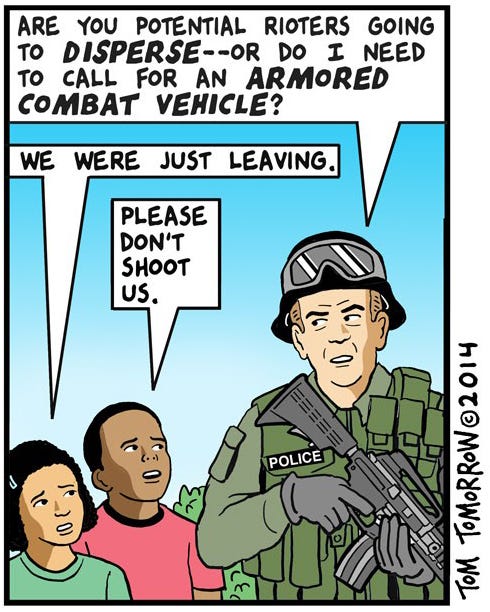
5. We need to de-militarize our society. Americans from coast to coast were repulsed and alarmed by the images of mine-resistant military vehicles roaming American streets with camo-clad police snipers perched on top of them. It was way beyond ironic that equipment created to defend an occupying army in a guerrilla war was being deployed against American citizens protesting excessive force from police.

The militarization of police has been roundly denounced — most effectively by John Oliver — and it deserved every word of that denunciation.

That public outcry has even started to have some effect. Anchorage police have rescinded their request for military vehicles. Claire McCaskill will be chairing Senate hearings on police militarization.

But while MRAPs are obviously over the top, Ladd Everitt from the Coalition to Stop Gun Violence told Business Insider that some advanced weaponry is justified by the level of armament police might face (from someone other than mostly non-violent protesters).

 “We see this as a product of the continuing arms race between law enforcement and civilians that has been going on for decades.” Everitt said the increasingly sophisticated weaponry being sold to U.S. civilians is forcing police to keep up, with both sides purchasing ever more powerful weapons. The arms race means “police officers have legitimate fears about the nature of the firepower they are confronting on a daily basis,” he said.

So the problem isn’t just the militarization of American police, it’s the militarization of American society.

That puts a different spin on the gap in police killings between the U.S. and every other first-world nation. American police are on a hair trigger because, in a country with over 300 million firearms, the possibility that a suspect might start shooting at them is never far from their minds. Over the course of a long career, it just doesn’t seem safe to take the more laid-back approach of a German or English policeman.

Bear that in mind the next time the NRA frames guns-everywhere as purely a question of personal rights. No matter how responsible and well-intentioned that gun-toting Oreo shopper might be, his presence raises the temperature in the room. All of us — and especially police — have to shorten our response times, given how fast a situation can turn deadly. So whether I choose to carry a gun or not, that raised room temperature might get me killed someday.

And that brings me full circle, back to gun control. Remember Newtown?

The Monday Morning Teaser

Happy Labor Day. If you have a paid holiday today, thank the unions.

This week’s featured article is titled “5 Lessons to Hold on to as Ferguson Fades into History”, though I’m still monkeying with the wording. Often it seems like the country learns something from a traumatic news story, but then it all goes away in a month or two. Let’s not do that this time.

In the weekly summary, Market Basket gave us a feel-good Labor Day story, Senator Gillibrand’s book has everybody talking about sexual harassment in the Senate, Burger King wants to have corporate taxes its way, Hillary Clinton’s Ferguson statement seems late and weak, and there really is feminist country & western.

I’m aiming to post the 5 Lessons article around ten EDT, and the summary by noon.

Unwarranted

Ferguson is a city located in northern St. Louis County with 21,203 residents living in 8,192 households. … Despite Ferguson’s relative poverty, fines and court fees comprise the second largest source of revenue for the city, a total of $2,635,400. In 2013, the Ferguson Municipal Court disposed of 24,532 warrants and 12,018 cases, or about 3 warrants and 1.5 cases per household.

— Arch City Defenders, “Municipal Courts White Paper“

This week’s featured post is “What Your Fox-Watching Uncle Doesn’t Get About Ferguson“. The featured post from two weeks ago “Not a Tea Party, a Confederate Party” continued its viral spread last week. It’s now over 100,000 page views, making it the second most popular Sift post ever. But it’s still got a ways to go to catch “The Distress of the Privileged” at 332K. (Those numbers make the 2,000 views of last week’s “The Ferguson Test” seems puny, but it’s actually quite good by normal Weekly Sift standards.)

This week everybody was still talking about Ferguson

Wednesday, MSNBC’s Lawrence O’Donnell nailed the NYT for police reporting that reminds me of the reporting Judith Miller did for them in the lead-up to the Iraq War: Leaks from government sources are reported as facts, the official framing of events is accepted uncritically, and contradictory evidence is discounted.


A different angle on Ferguson comes from Arch City Defenders, a group that “strives to provide holistic criminal and civil legal services to the homeless and working poor in the St. Louis Region.”

In a white paper on the St. Louis area municipal courts published before Mike Brown’s death, ACD focused on Ferguson and two other municipalities that it described as “chronic offenders” for abuses of the justice system like

being jailed for the inability to pay fines, losing jobs and housing as result of the incarceration, being refused access to the Courts if they were with their children or other family members, and being mistreated by the bailiffs, prosecutors, clerks and judges in the courts.

… In many municipalities, individuals who are unable to pay whatever fines they are assessed are incarcerated — sometimes repeatedly over many years. One defendant described being incarcerated fifteen or sixteen times over a decade on the same municipal charge.

In short, if you are poor in Ferguson, getting a speeding ticket can wreck your life. But it makes money for the town.

Court costs and fines represent a significant source of income for these towns. According to the St. Louis County two municipalities alone, Ferguson and Florissant, earned a combined net profit of $3.5 million off of their municipal courts in 2013.

ACD’s Thomas Harvey says:

The courts in those municipalities are profit-seeking entities that systematically enforce municipal ordinance violations in a way that disproportionately impacts the indigent and communities of color.

St. Louis County municipal courts typically don’t provide public defenders, so even if the law makes allowance for poverty, the poor may not know how to claim their rights. Those who can afford lawyers often can deal with minor violations without a court appearance, with the result that (as one resident put it) “You go to all of these damn courts, and there’s no white people.”

ACD’s white paper draws an obvious conclusion: “This interaction … shapes public perception of justice and the American legal system.”


St. Louis police released a cellphone video of two of their officers killing a different black man. The video contradicts several parts of the police account of the killing, but nonetheless the shooting is judged by experts to be justified. Watching it gives you some idea of what police are allowed to get away with.


Three of the officers involved in policing the Ferguson protests have been disciplined. The first was Ray Albers of the St. Ann police force, who was videotaped waving a gun at the crowd and yelling, “I will fucking kill you.” He’s been suspended indefinitely.

The second is Glendale officer Matthew Pappert, who was suspended after tweeting: “These protestors should have been put down like a rabid dog the first night.”

But the scariest is Dan Page of the St. Louis force. He’s been relieved of duty after St. Louis Post-Dispatch released a video of an hour-long talk he gave to a meeting of the local Oath Keepers chapter in April. The articles about him pick out the easy sound bites: his hostility to gays, women, the Supreme Court, and President Obama, as well as several statements expressing pride in being “a killer”. But if you watch the whole talk, what’s really frightening is Page’s paranoid thought process, and the fact that the gym-full of people he appears to be talking to seem to approve.

I have listened to certifiably paranoid people before, and this talk is exactly what they sound like. They present “evidence” for their dark fantasies that you look at and think “Huh?” Page wanders through the Constitution, the Bible, the Declaration of Independence, and various other apparently authoritative sources, referencing bits that (if you look them up) have little to do with what he’s saying. (At the 25 minute mark: “In Psalms 83, Russia invades Israel. They are beat back, eight-fifths of their army are killed.”)

At around the 17-minute mark he presents a slide he says came from a talk by the Secretary of the Army. The untitled, unannotated slide is simply a list of ten regions. (“1. America, Canada, Mexico … 10. Remainder of Africa”.) Page finds this slide deeply threatening: “World government, folks. Anybody who resists it is dead.”

The idea that Dan Page is on the street with a gun is scary enough, much less that he has wielded the authority of a police officer for 35 years.


Online arguments about the Brown shooting are so formulaic that The Daily Dot has a taxonomy of the ten kinds of trolls you’ll run into.


As part of a long article that is well worth reading end-to-end, an ex-cop compares Ferguson to the Bundy Ranch showdown.

On the Bundy Ranch, armed protesters were violently obstructing law enforcement from performing their duties.  Sniper rifles were pointed at those law enforcement officers. Then those “snipers” openly gloated about how they had the agents in their sights the entire time. And what was the police response?  All out retreat.  Nobody was arrested. No tear gas deployed. No tanks were called in. No Snipers posted in the neighborhood. No rubber bullets fired. Nothing. Police officers in mortal danger met with heavily armed resistance and no one had to answer for it.

… Just imagine if there were 150 black folks walking around Ferguson with assault rifles right now. Imagine if a couple of them took up sniper positions on the tops of buildings with their rifles pointed at the police officers.  Take a quick guess at how that story ends.

and ISIS

The Islamic State of Iraq and Syria beheaded American journalist James Foley — and posted the video on YouTube — after the U.S. government refused a 100 million Euro ransom demand and a rescue attempt failed. This sparked a lot of discussion about widening the U.S. involvement in Iraq beyond the current air strikes.

I don’t doubt that a lot of people in ISIS are bad guys. But it gets old watching the pro-war spin machine work. Once again, we face a group of insane, unstoppable monsters far worse than the last group of insane, unstoppable monsters we were warned about. Rick Perry thinks they’re coming over the Mexican border, and a former CIA deputy director warns us that they could get an AK-47 and shoot up a mall — not because either man has any evidence that such things are in the process of happening, but because we have a new name for the Boogie Man.

The problem with the panic-mongering is that it just raises the pressure to do something. It doesn’t increase the effectiveness of any of the somethings we might do. Couldn’t we someday have a rational discussion of what our options really are, and what good or bad things are likely to result from the various things we might do?

and Ukraine/Russia

The Ukrainian government forces seem to be advancing against the pro-Russian rebels who hold several cities near the Russian border. Russia is moving what it claims is humanitarian aid across the border, but Ukraine says it’s military re-supply for the rebels. It’s hard for American journalists to verify anybody’s story.

and you also might be interested in …

It’s still in the laboratory (at my alma mater, BTW), but wow is this cool: transparent solar cells. Someday, your windows could generate electricity without blocking the view.


The pressure to change the name of the Washington NFL team continues its slow, inexorable build. The editorial board of The Washington Post announced Friday that it will no longer refer to the team as “Redskins” in its editorials. (Presumably, the announcement itself was the last time.) That move was mostly symbolic, since the R-team isn’t mentioned that often on the editorial page, and the news and sports sections of the paper will continue to print “Redskins”. But it’s something.

As of June, The Seattle Times won’t use the name at all. It’ll be interesting to see how they cover the Seattle-Washington Monday Night Football game on October 6. Maybe this article from The Kansas City Star could be a model.

Wednesday it came out that longtime NFL referee Mike Carey had been quietly boycotting Washington games since 2006. When confronted with the fact that he had not refereed a Washington game in many years, Carey owned up:

The league respectfully honored my request not to officiate Washington. … It just became clear to me that to be in the middle of the field, where something disrespectful is happening, was probably not the best thing for me.

Carey has retired from the NFL and now works for CBS’ football coverage team as a rules analyst. He was the first African-American to referee a Super Bowl. A coaches’ poll once named him (tied with another guy) as the league’s best referee.

CBS’ Phil Simms and NBC’s Tony Dungy have said they will try to avoid saying “Redskins” while announcing or commenting on games.

Sooner or later, these little grains of sand will turn into a landslide. For now, not cooperating with the misnamed team requires an explanation. But we’re approaching a tipping point, where those who do cooperate will be expected to explain.

and let’s close with some creative law-breaking

Cracked has compiled a list of “The 7 Most Badass Acts of Vandalism Ever Photographed“. I mean, would you have thought to paint a giant penis on a drawbridge, so that would rise every time the bridge goes up? Or turn a Soviet monument in Bulgaria into colorful American comic-book characters and other mythical beings like Santa Claus and Ronald McDonald? Or let half a million brightly colored plastic balls bounce down the Spanish Steps in Rome? Somebody did.

What Your Fox-Watching Uncle Doesn’t Get About Ferguson

It doesn’t matter how many details you know. If you start the story in the wrong place, you won’t understand it.


Part of my regular news-watching cycle is to check in on Fox News from time to time. It keeps me honest and helps me anticipate the kinds of arguments I’m likely to start hearing from conservatives.

Watching Fox was particularly interesting in the early part of this week, because in the evenings they (like MSNBC and CNN) gave a lot of air time to their reporters on the streets in Ferguson, Missouri. So it was a rare opportunity to see all three cable news networks cover the same controversial events at the same time. Most days, the difference between the networks lies mainly in what they choose to cover — a new report on climate change might lead the news on MSNBC, while Fox focuses on Benghazi hearings in Congress. But for a few days the what of the news was obvious and inescapable, so Fox’s unique perspective on the world could only express itself in the how.

Some of the difference in coverage has been on the detail level and is easy to filter out if you’re aware of the various networks’ points of view. When police would start moving in on demonstrators, for example, Fox would report as fact whatever they were hearing from police — that, say, shots had been fired from the crowd — while MSNBC would stick closer to what they could see (police moving in), express ignorance as to why it was happening, and then later report what police were saying (shots were fired from the crowd) as a claim they couldn’t verify. Whether you were pro-demonstrator or pro-police, you could watch either network and make a good guess about what the other was reporting.

But there has been a much more subtle, harder-to-compensate-for difference in the way each network answers the fundamental question: What are the demonstrations in Ferguson all about?

On Fox, the answer to that question is very simple. Demonstrators in Ferguson are reacting angrily to a single, one-of-a-kind event: White police officer Darren Wilson shot and killed an unarmed black 18-year-old, Michael Brown. That restricted context drives the rest of their narrative.

The apparent mystery. Like any good narrative hook, Fox’s omission of context creates a mystery: Why do so many people in Ferguson care so much about that particular event? Of course, Michael Brown’s family would be upset, and even Fox’s audience can cut them some slack if they want Officer Wilson nailed to the wall. But what about all those other people on the street night after night? It’s safe to say that most of them never even met Michael Brown. Why were they giving up their evenings and risking arrest or worse?

Once you have that question in your head, several answers suggest themselves: Maybe they’re all just crazy. Fox’s resident psychologist, Dr. Keith Ablow, says “the psyche of the community” deserves as much investigation as the actions of police.

Or maybe most of the protesters really don’t care about Brown, and the demonstrations are just an exciting thing to do in a boring town. At night on the streets, you’re where it’s all happening. You might even get on national TV. That’s the interpretation Fox correspondent Steve Harrigan was promoting when he described the demonstrations late Monday night as a “media event” and “child’s play”. (In response, he got cussed out on camera by one of the black “children” he was demeaning: “We go through this shit every day,” the young man reported. Harrigan did not follow up on that observation.)

An even more sinister solution to the mystery evokes racial stereotypes that Fox doesn’t need to spell out. A hint is enough: Maybe these young black men are just wired for anarchy and violence. The Brown shooting was nothing more than an excuse for doing what they’d do all the time if police weren’t stopping them. And once you raise the stereotype of the lawless black savage, the incidents of looting take on a significance far beyond their number or the number of people responsible: This isn’t about Brown or the police at all, it’s about grabbing some free liquor or a new pair of Air Jordans.

In addition, the why-do-they-care mystery leads right into a question Fox raises at every opportunity: Why do blacks only go to the streets about white-on-black cases like Brown and Trayvon Martin, when black-on-black violence [see endnote 1] kills far more people? How street demonstrations could prevent black-on-black violence is a question they never address. (Demonstrations speak to governments and the national electorate, and have little effect on criminals or hot-headed youth.) But Fox presents the Brown and Martin demonstrations as pointless anyway, so why shouldn’t there be equally pointless demonstrations against black-on-black violence instead?

Second, restricting your attention to that one context-free event makes the crowd look like a lynch mob. Why are they so sure Officer Wilson wasn’t justified in shooting Brown? Why can’t they wait for the investigative process to play out? And why can’t they cooperate with police now to keep the peace?

And finally, the mystery-framing makes the politics of the situation look purely venal. How outrageous it seems that liberals — they must be liberals — are exploiting the Brown shooting to register Ferguson’s black population to vote!

What makes Fox’s frame so convincing to its audience is that you can feel well-informed inside it. You can know how many people were arrested each night and which stores they looted. You can learn details of the shooting (though anonymous leaks from police will be reported more authoritatively than eye-witness testimony from black citizens). You can learn statistics about black crime in America. You can know just how rare police killings are compared to drug killings or other black-on-black murders. You’re not ignorant; you’re a walking storehouse of the kinds of information MSNBC would never tell you.

But in spite of that well-informed feeling, you don’t understand what’s really going on, because Fox is leaving out key background information and then beginning the story in the wrong place. The right story begins not with Officer Wilson’s bullets, or even with Michael Brown in the convenience store, but with a community where lesser forms of police abuse are an everyday occurrence.

Start by asking. Slate‘s Jamelle Bouie did what Fox reporters (or most individual whites) hardly ever do: ask the black community what they’re concerned about and listen to their answers.

Talk to anyone in Ferguson and you’ll hear a story about the police. … Everyone—or at least, every black person—can recall an incident. Everyone can attest to friends and relatives who have been harassed, assaulted, or worse by the police.

The right story begins here: A majority-black community feels abused by its almost entirely white police force. [2] And complaining to the white-dominated local government does no good. (As a report from Arch City Defenders spells out, the town of Ferguson gets significant revenue from assessing fines against poor people.)

If you start there, the narrative takes a completely different path. When a policeman shot Michael Brown six times on a city street in broad daylight in front of witnesses, the Ferguson community was not shocked (the way I would be if one of my white friends were gunned down by police in my majority-white town). Quite the opposite, this was the kind of incident they found all too believable, given the police behavior they see all the time.

So the reaction we’ve been seeing on the streets isn’t “OMG! How can something like this happen?”, it’s “This shit has to stop.”

No mystery. So it’s no mystery at all why people who never met Michael Brown have been out on the streets. Brown’s death is part of a bigger issue that they all have a stake in: How can the police be gotten under community control, and disciplined to treat the community with respect?

Their tactics are also no mystery: When the political process is unresponsive, the streets are the only communication channel left. Trayvon Martin’s mother is supposed to have said, “If they won’t hear us, make them feel us.” And Ja’han Jones put it more aggressively on Salon: “What if being peaceful won’t change a thing?”

As far as Officer Wilson is concerned, the crowds are not rushing to judgment, they are speaking from experience. Yes, police act this way, and the result is always the same: If the incident isn’t ignored completely, it is shunted into an opaque “process” in which eyewitnesses are ignored and no quantity of physical evidence is sufficient to bring charges. Ferguson police have shown every indication of wanting to go that way: keeping back relevant information as long as possible, smearing Michael Brown, responding to protests with even more excessive force, leaking bogus “facts” that support Wilson, and arresting reporters.

What’s rare about the Brown shooting isn’t the shooting itself, but how visible everything is: The body was lying in the street for hours. The eyewitnesses have been on TV. Nothing in the autopsy or other available evidence contradicts their testimony. If the police don’t have to answer for this, then what are the limits? Is there anything they can’t sweep under the rug?

Once you understand where the story really starts and what it’s really about, then the whole detour into black-on-black crime is revealed to be “the politics of changing the subject“. Other than corpses, the two issues have nothing in common. It’s like asking Sean Hannity, “Why have you spent so much time on the four Americans who died at Benghazi when tens of thousands of Americans die in car accidents?”

My reality and theirs. Demographically, I look more like a Fox viewer than a Ferguson protester. I’m white, over 50, and have an above-median household income. I barely notice when a police car goes by, and when I have had occasion to deal with my local police — usually because I approached them with a question — they have been unfailingly polite. When I arrange to meet people socially or promise to be somewhere, I don’t allow extra time for the possibility that I might be stopped and frisked, or taken down to the police station and questioned about some crime I never heard of. That kind of stuff never happens to guys like me.

If I did find myself in an unexpected and unpleasant run-in with police, it would feel like snow in July. My instinct would be to wait it out until polite normality re-asserted itself. So I could easily follow the advice of LAPD’s Sunil Dutta:

if you don’t want to get shot, tased, pepper-sprayed, struck with a baton or thrown to the ground, just do what I tell you. Don’t argue with me, don’t call me names, don’t tell me that I can’t stop you, don’t say I’m a racist pig, don’t threaten that you’ll sue me and take away my badge. Don’t scream at me that you pay my salary, and don’t even think of aggressively walking towards me. Most field stops are complete in minutes. How difficult is it to cooperate for that long? … Save your anger for later, and channel it appropriately. Do what the officer tells you to and it will end safely for both of you. We have a justice system in which you are presumed innocent; if a cop can do his or her job unmolested, that system can run its course. Later, you can ask for a supervisor, lodge a complaint or contact civil rights organizations if you believe your rights were violated. Feel free to sue the police! Just don’t challenge a cop during a stop. [3]

Great advice for me, but I don’t believe it has much to do with the reality of places like Ferguson, or even parts of Dutta’s own Los Angeles.

What if I weren’t a middle-aged middle-class white guy? What if police abuse is normal in my experience? What if I’ve cooperated before, and before, and before that … and the stop wasn’t “complete in minutes” and I got tased, pepper-sprayed or worse anyway? What if I “saved my anger for later” and the appropriate channels laughed at me? What if I have dead or injured friends whose attempts to cooperate didn’t “end safely”, and other friends who weren’t “presumed innocent” in court, and are now in prison on sketchy or manufactured evidence?

What’s your advice for me then, Officer Dutta?

What your Fox-watching uncle doesn’t get. The frustrated citizens of Ferguson are pursuing a plan that makes sense: Wait for an incident so egregious that it can’t be swept under the rug, and then get out on the streets in large numbers. Tell your story to the country, put your political leaders on the spot, and show the world how “justice” works in your town. Shine a spotlight on the usual shadowy self-investigation process, and dare the powers-that-be to work their usual trickery in front of a national audience.

That plan might not work — it didn’t work in Florida — but what more likely plan have you got for them? They can’t just be quiet and wait for justice to be served. They’ve got to do something.

Because “we go through this shit every day”, and that shit has to stop.


[1] Reason‘s Steve Chapman asks:

Most crimes are committed by males, but we don’t refer to “male-on-male crime.” Whites in the South are substantially more prone to homicide than those in New England, but no one laments “Southerner-on-Southerner crime.” Why does crime involving people of African descent deserve its own special category?

[2] Unlike Bill O’Reilly, Ferguson residents aren’t giving police credit for all the people they stop and don’t kill. What’s up with that? And what about the 3/4ths of the people police across the nation kill who aren’t black?

[3] This advice was funnier when Chris Rock was giving it.

The Monday Morning Teaser

It’s been another week of unusually high traffic at the Sift. Two weeks ago the blog had 71K hits, last week 58K. That’s more than half the hits the blog has had in all of 2014. The reason is “Not a Tea Party, a Confederate Party“, which is now over 100K page views and still running. Last week’s “The Ferguson Test” looks anemic by comparison at 1.9K, but that’s actually pretty good by normal standards.

This week I’m continuing to look at Ferguson, focusing on the different ways of telling the story, and how that affects what you think about it. If you start with the wrong frame, you can believe you’re very well informed and still be getting it completely wrong. The featured post will be “What Your Fox-Watching Uncle Doesn’t Get About Ferguson”.

Ferguson also leads the weekly summary: It came out that Ferguson’s court system is actually a money-making business, and fines — mostly levied against poor people — are a major revenue source. That might have some effect on the faith Fergusonians have in their justice system. Also, the video of an hour-long talk one St. Louis cop gave came out, and it’s scary to picture this guy with a gun and a badge.

This week ISIS and Ukraine/Russia also got a lot of attention. And the heat about the Washington Redskins’ name notched up a couple degrees. But there was good news from my alma mater, Michigan State: transparent solar cells. And we’ll close with seven amazingly creative acts of vandalism from around the world.

Predicting when posts will appear is a little more difficult this week. I’m aiming to have the Ferguson post out around 10 EDT and the weekly summary between 11 and noon.

Conditioning

As a white person in the U.S., I am conditioned from birth to see whiteness as safety — white neighborhoods, white people, white authority figures. My lived experience, my conversations with people of color, and my study of history have shown me over and over that this is a wild and cruel perversion of the truth. But the cultural conditioning is strong. Unless I fight it every day, white superiority seeps into my brain in slow, almost undetectable ways.

— Rev. Meg Riley, “Up to Our Necks“

Last week’s “Not a Tea Party, a Confederate Party” had the hottest first week in Weekly Sift history, with over 62,000 hits so far. It has slowed down a little, but is still getting thousands a day. Already it’s the third most popular Sift post ever.

This week’s featured article is “The Ferguson Test“. Rather than focus on breaking news (something a one-man weekly blog can’t hope to do well) this post asks you to take a step back and examine your own reactions to Ferguson. How is race influencing the way you perceive the facts?

This week everybody was talking about the Ferguson protests

Very short version, for people who have been cut off from civilization all week: A young black man was shot by police under suspicious circumstances in a mostly-black suburb of St. Louis. The police stonewalled (but the family has released its own autopsy), the community protested (mostly peacefully, but with violent incidents), and the local police responded with military weapons and tactics until Governor Jay Nixon put the state police in charge, which temporarily calmed things down. Over the weekend, things heated up again and now the National Guard has been called in.

To get a handle on this, the continuously updated Vox card stack “Everything you need to know about the Ferguson, MO protests for Michael Brown” is a good place to start. The NYT has a day-by-day timeline. But maybe nobody does a better job of pulling it all together than John Oliver.

Here’s the thing the [Ferguson] mayor doesn’t understand. As a general rule, no one should ever be allowed to say, “There is no history of racial tension here.” Because that sentence has never been true anywhere on Earth.

And he responds to Governor Nixon’s scolding of the community (with the “profoundly patronizing” tone of “a pissed-off vice principal trying to restore order at an assembly”) by turning it around.

That should go both ways. I know the police love their ridiculous unnecessary military equipment. So here’s another patronizing test: Let’s take it all away from them. And if they can make it through a whole month without killing a single unarmed black man, then (and only then) can they get their fucking toys back.

Articles about Ferguson have explored several inter-related issues.

The specifics of the Brown shooting. See the above-mentioned Vox card stack. And an editorial in The St. Louis American gives some important political and economic background. In an era where downtowns are gentrifying, the poor are increasingly ending up in the first ring of suburbs, in places like Ferguson. But as whites flee to the more distant suburbs or return to the city, the white-dominated political power structure is often the last thing to go.

Racism in policing and the justice system. Ezra Klein’s article puts this together well.

Officer Friendly has changed.

The militarization of police in American cities. Due to a program that distributes unneeded military equipment to local police forces, towns as small as Franklin, Indiana now have the kind of mine-resistant personnel carriers that even the Army didn’t have in the early days of the Iraq occupation. And John Oliver’s rant (above) makes fun of Keene, New Hampshire’s suggestion that such a vehicle might be needed if terrorists strike the annual fall Pumpkin Festival (which I’ve been to and survived without incident).

The problem? Clothes make the man. If you see the public out the window of an armored vehicle, they don’t look the way they might if you were walking among them. And they don’t look at you the same, either. Worse, military veterans trained in this kind of hostile crowd control tell us that the Ferguson police are doing it wrong.

Andrew Exum tweeted:

Ferguson is useful in that it separates those who actually worry about the power of the state from those who just hate Obama and want to wave a Gadsden Flag around with their friends.

Michael Bell is a white retired Air Force officer whose article: “What I Did After Police Killed My Son” raises a more general question of police accountability.

In 129 years since police and fire commissions were created in the state of Wisconsin, we could not find a single ruling by a police department, an inquest or a police commission that a shooting was unjustified.  … The problem over many decades, in other words, was a near-total lack of accountability for wrongdoing; and if police on duty believe they can get away with almost anything, they will act accordingly.

and Robin Williams

who apparently committed suicide last Monday. There were three types of articles about him:

  • news articles about his suicide, most of which have been blessedly short on details. Like most of the public, I often compulsively seek out details and then wish I didn’t know them. A late-breaking detail was that he was suffering some early Parkinson’s symptoms.
  • tributes to his career, which had amazing breadth. I saw him live only once, at a benefit in Boston that he did for John Kerry’s Senate campaign. (I think in 1990.) I can’t remember a single word he said, but it was brilliant.
  • discussions of depression, which have ranged from clueless to extremely interesting. I got the most insight out of David Wong’s “Robin Williams and Why Funny People Kill Themselves“.

Lynn Ungar points out that the Ferguson and Williams stories have something in common: They both offer us the choice of whether to try to understand people in distress or stand in judgment over them. Both stories have an element of “if you haven’t been there, you don’t know.”

I have a personal interest in depression. Both of my parents had age-related depression in their later years, and (from the early warning signs) I suspect I will too. Among other things, the brain is an organ that processes neurotransmitters, like a big kidney that also happens to think. Like many people’s kidneys, it may do its job less and less well as it ages.

The biggest thing people don’t get about depression is that when you’re depressed, your brain is broken. (I think the TV show Homeland has done a brilliant job of showing how a person struggles to think when she knows her brain is broken. Carrie suffers from mania, which is a different malfunction, but many of the same principles apply.) Paying attention to your stream of emotions is like listening to a radio mystery during an electrical storm; bursts of static wipe out key details, other programs bleed in, and you struggle to hang on to the story you tuned in for.

In spite of mirror neurons and empathy and all that, you can never really know what’s going on in another person’s brain, even if both of you are icons of mental health. When malfunctions start to cloud the picture, we’re all just guessing. So I find it impossible to stand in judgment of Robin Williams, either to condemn him or grant him absolution. I have no idea what it was like to be in his head.


In any other week, the death of Lauren Bacall would have been the top entertainment-news story. She was not just a great actress in her own right, but because she came of age as the old Hollywood system was ending and lived to be 89, her death marks the passing of a generation.

and Hillary Clinton

In an interview with The Atlantic‘s Jeffrey Goldberg, Clinton began the process of distancing herself from President Obama, apparently in preparation for a 2016 presidential run. The most-quoted parts of that interview criticize Obama’s handling of Syria:

The failure to help build up a credible fighting force of the people who were the originators of the protests against Assad—there were Islamists, there were secularists, there was everything in the middle—the failure to do that left a big vacuum, which the jihadists have now filled

and his cautious approach to intervention in general:

Great nations need organizing principles, and ‘Don’t do stupid stuff’ is not an organizing principle.

As James Fallows points out, most of her interview stayed in harmony with Obama’s policies; but she should have known that the headlines would be about the differences.

If the former interpretation is right, Clinton is rustier at dealing with the press than we assumed. Rustier in taking care with what she says, rustier in taking several days before countering a (presumably) undesired interpretation. I hope she’s just rusty. Because if she intended this, my heart sinks. … Yeah, we should have “done something” in Syria to prevent the rise of ISIS. But the U.S. did a hell of a lot of somethings in Iraq over the past decade, with a lot more leverage that it could possibly have had in Syria. And the result of the somethings in Iraq was … ?

Fahred Zakaria critiques “The Fantasy of Middle Eastern Moderates“.

Asserting that the moderates in Syria could win is not tough foreign policy talk, it is a naive fantasy with dangerous consequences.

I’ve been resisting writing about 2016, because I think it’s a too-easy way to fill space with speculation that sounds a lot more important than it is. But these days a serious presidential campaign is a nationwide, multi-million-dollar enterprise that can’t be thrown together at the last minute. So we’re approaching the first big decision point: Who’s going to run? Clinton is the obvious front-runner, so the question is: If she runs, will any Democrat mount a serious challenge? And should liberals be hoping someone does, or not?

Up until this week, I’ve been focused on the importance of the Democrats hanging on to the White House, so I’ve been OK with Hillary going mostly unchallenged. If you’re focused on winning in November, you want the primaries to be like preseason football: Your team gets to run through its plays in a game-like situation, but faces no consequential threat. And you don’t want what the Republicans are shaping up to have: a big mudfest that someone wins by pandering to the party’s least attractive elements, and saying a lot of things that will come back to haunt him/her in the fall.

But the Goldberg interview reminded me of what I’ve long disliked about both the Clintons: Everything seems so calculated. I’m not sure whether there’s a real worldview in there, or just a political strategy. Bill’s two terms were a mixed bag. By preventing a Bush re-election, he gave us Ruth Bader Ginsburg on the Supreme Court rather than another Clarence Thomas. But after eight years spent constantly trying to find the center, the question, “What is the Democratic Party about?” seemed hopelessly muddled.

Here’s what I fear Hillary is thinking: If liberal votes can be taken for granted, then the best message for convincing swing voters is probably: “I’m tougher than Obama.” Tougher on Muslims, tougher on controlling the border, tougher on violence on our city streets. But if that message wins, where can she go with it?


And what if America is moving left, like Thomas Ricks.

and you also might be interested in …

Rick Perry got indicted for abuse of power, but I’m having a hard time getting excited about it. Steve Kornacki is skeptical and Jonathan Chait thinks it’s “unbelievably ridiculous”. They’re not Perry’s usual defenders.


Google just got a little creepier. Here’s a map of a smartphone user’s wanderings.


Kentucky’s proposed “Ark Encounter” theme park wants to get state subsidies while only hiring fundamentalist Christians.

and let’s close with something America should envy

Copenhagen’s “Cycle Snake”, a beautiful new elevated bikeway.