A Conservative-to-English Lexicon, 2nd edition

Preface to the Second Edition

The popularity and inadequacy of the First Edition led its readers to submit many terms which had unfortunately been overlooked. While still far from complete, the Second Edition (I hope) will make far more Conservative speech comprehensible to non-residents of the conservative echo chamber.

But before listing the terms new to the Second Edition, other comments motivate me to say a few words about the origin and intentions of the Lexicon.

Origin of the Lexicon. While researching “Not a Tea Party, a Confederate Party“, I discovered many examples of language drift among conservatives. The great majority of the new usages are transparent, and can be easily understood by readers without my help. (When, for example, Paul Ryan says “inner city” he means “black”.) But confusion became likely when the drifting terms began to interact.

One example in particular required unpacking, because it was key to the Tea/Confederate identification: Many in the so-called Tea Party talk about their “Second Amendment rights”, by which they mean their right to the means to resist or even overthrow the government of the United States, if it should become “tyrannical”.  By itself, this seems a reasonable — some might even say laudable — goal, one in line with their identification with the original Tea Party protest against the tyranny of George III.

However, when I then looked into the current conservative usage of tyranny, I discovered that it has virtually nothing to do with George III, or even with the more recent Hitler/Stalin models that most Americans picture when they hear the word. Instead, tyranny refers to the implementation of any progressive policy at all — ObamaCare, immigration reform, cap and trade, taxation with representation, and many others — even when that policy is enacted via the constitutional process of our duly elected representatives passing legislation. Tyranny even includes any proposed gun control measures, no matter how slight, which completes a vicious cycle: We can’t have gun control, because we will need our guns to overthrow the tyranny of gun control.

Fully translated, then, the Tea Party’s Second Amendment rhetoric amounts to: We need the means to resist or overthrow the government of the United States, in case liberals win too many elections and start implementing the agenda they were elected on.

That sounds a lot different.

Intention of the Lexicon. Some of the First Edition’s commenters seemed to be interpreting the Lexicon as a work of mockery, born out of frustration, bitterness, or anger. This response was independent of ideology: Some conservatives felt themselves victims of a bitter, angry attack, while some liberals expressed satisfaction with an expression of their own frustration and bitterness, which I presumably shared.

This is a misinterpretation. The Lexicon should be read as a light-hearted presentation of a serious message. If, while reading, you find yourself feeling bitter or angry — either at me or at conservatives — I recommend taking a walk. The extreme strain of conservatism found in America today is only one of life’s many absurdities. If the absurdity of life makes you angry, let me suggest that you are suffering from what the Buddhists call attachment. Life is life; your anger is irrelevant to it. (If you are monotheistic, let me put it differently: God clearly tolerates life’s absurdity; you should too.)

However, the light-heartedness of the Lexicon doesn’t mean that it is nothing but a joke. A non-bitter, non-angry response of: “Wow, this is way more fucked up than I thought!” — similar, I imagine, to how biologists felt when they discovered the platypus — is completely appropriate, and mirrors the attitude I had while compiling the Lexicon.

Seriousness of the Lexicon. The light-heartedness of the Lexicon should not be misread as mere mockery, in which the mocker attaches to his target whatever negative images might stick. The Lexicon is serious. The intention of the definitions is to match the actual usage of terms within the conservative echo chamber, thereby interpreting conservative statements in ways that are more coherent, more comprehensible, and more likely to be true than when those statements are interpreted in standard English.

For example, the frequently uttered syllables, “Obama is a Marxist” are gibberish if Marxist is interpreted in the literal English sense of “a proponent of the philosophy of Karl Marx”. Actual Marxists believe that Obama represents their eternal enemy: the Wall Street capitalists. Just this week, I found this Obama-resenting comment in The Socialist Worker:

If liberals learn anything from the bitter taste Obamaism left in their mouths, it should be that ‘progressive’ and ‘populist’ talk from politicians is cheap–especially when they’re running for office.

However, if you look at the full usage of Marxist among conservatives and consider what all the people they classify as Marxists have in common — Elizabeth Warren, Jim Wallis, Thomas Piketty, Paul Krugman, Harry Reid, anybody involved in Occupy Wall Street, etc. — you get the definition I presented in the First Edition: “one who regrets the increasing concentration of wealth.” Using that definition, “Obama is a Marxist” is coherent, comprehensible, and probably true.

This combination of light-heartedness and seriousness has a fine tradition, going back at least to Ambrose Bierce’s The Devil’s Dictionary from 1906. Look, for example at Bierce’s definition of aboriginies: “Persons of little worth found cumbering the soil of a newly discovered country.” Or peace: “In international affairs, a period of cheating between two periods of fighting.”

Bierce was not simply trying to be funny. He was pointing to incongruities between the definitions in a standard dictionary and the actual usage of words in his era. So am I.

Terms New to the Second Edition

The Second Edition incorporates all the terms found in the First Edition and adds the following:

Activist judge. A judge who applies the Constitution and other laws, rather than the Bible or the Constitution written by the Founding Fathers.

Amnesty. The basic English meaning is unchanged since Bierce: “The state’s magnanimity to those offenders whom it would be too expensive to punish.” In conservative usage, amnesty is an abandonment of all moral standards if applied to undocumented immigrants, but “makes perfect sense” when applied to corporate profits held off-shore to avoid taxes. To spin amnesty positively, use holiday. Example: a tax holiday, but not an immigration holiday.

Bankrupt. Requiring taxes that the wealthy do not want to pay. Usage: “The government is bankrupt.”

Celebrity. A disparaging term applied to a liberal who can draw a crowd. Usage: Barack Obama “is the biggest celebrity in the world.” Not to be confused with a politician who is popular in Real America, like Sarah Palin, or with statesmen like Arnold Schwarzenegger or Ronald Reagan.

Class warfare. When the 99% fight back against the 1%. Usage: “Obama’s priority is class warfare.  That’s why he relentlessly denounces job creators as ‘millionaires and billionaires.’ That’s why he demands that they be punished with higher tax rates.”

Collateral damage. Humans whose deaths would rattle the conscience of a nation not blessed with American exceptionalism.

Common sense. The opinion of the People, as opposed to the opinion of experts who have devoted their lives to studying the subject. See: science, junk science.

Common sense solution. A (usually unspecified) way to make a problem vanish without inconveniencing any job creators or real Americans, or making them pay taxes. Usage: “All across this country, women are standing up and speaking out for common sense solutions.”

Contract. An inviolable pledge, except when made to a union.

Dividing the country. Starting a class war by encouraging the 99% to fight back. Usage: President Obama “won by dividing the country.”

Elite, Elitist. Those who challenge common sense by insisting on facts. Usage: “The power of the knowledge elite does not stem primarily from money, but in persuading, instructing and regulating the rest of society.”

Family. A group of people related by blood to, and under the control of, straight white man wealthy and powerful enough to protect and control them.

Holiday. A temporary suspension of tyranny. Usage: “tax holiday”

Illegal immigrants (or illegals). Hispanics. Usage: “the more illegals that vote, the better the Obama administration thinks it will do.”

Impeachable offenses. Anything President Obama does or fails to do.

Impeachment. A means of reversing elections, when voters mistakenly choose Democrats. Established by the Constitution, impeachment requires impeachable offenses.

Junk science. Research not funded by a corporation whose profits depend on the outcome. Examples: climate research not funded by fossil fuel companies, tobacco research not funded by cigarette companies, etc. All you really need to know about the term is that JunkScience.com is run by Steve Milloy, who is also Director of External Policy and Strategy for Murray Energy, the largest privately owned American coal company. Usage: “It’s just an excuse for more government control of your life. I’ve never been for any [greenhouse-gas reducing] scheme or even accepted the junk science behind the whole [climate change] narrative.” See sound science.

Lucky Ducky. Anyone whose income is low enough to escape the punishment of income tax. Collectively, lucky duckies are known as “the 47%“. Usage: “Who are these lucky duckies? They are the beneficiaries of tax policies that have expanded the personal exemption and standard deduction and targeted certain voter groups by introducing a welter of tax credits for things like child care and education.”

The People (or We the People). All real Americans, considered collectively. Usage: “I believe Owen Hill is one of those future leaders and must be supported by ‘we the people’ to take back our country and to restore our constitution as the law of the land.”

Personhood. A quality shared by fertilized ova and corporations, but not by Afghans, Iraqis, or Pakistanis who become collateral damage. Usage: “Corporations are people, my friend.”

Punishing success. Restoring upper-level tax rates to their levels during the Clinton administration, a dark time of peace and prosperity when no one bothered to become rich because it was too painful. Usage: “If you want to punish successful people, vote for Democrats.” Synonym: punishing job creators. Usage: “We shouldn’t be punishing job creators.”

Rammed through Congress. Passed by majority vote, without granting a extra-constitutional veto power to the conservative minority. Usage: “Senate Democrats rammed through what would later be called ObamaCare … The vote on Monday, in the dead of night, was 60 to 40.”

Rammed (or forced) down the throat of the People. Any government action taken against the will of a majority of real Americans. Usage: “They’re going to do what they have to, the Democrats are, to force this [ObamaCare] down our throats.”

Real America. Rural areas and small towns, where the majority of voters are real Americans. Usage: “the best of America is in these small towns that we get to visit, and in these wonderful little pockets of what I call the real America.”

Real American. 1. A white conservative Christian born in the United States at least 30 years ago. 2. A typical resident of real America. Usage: “Real Americans do not recognize [Obama] as a president.”

Science. 1. A religion devoted to conquering the world in the name of the No God it worships. Usage: “Science, like God in the Old Testament, behaves jealously against any other religion. So science will say to its followers: ‘You shall have no other gods before me’. If you have any doubts, try asking an audience at a scientific convention to join you in a prayer.” 2. A conspiracy to impose world government through hoaxes like global warming. Usage: “Global warming is not about science, but about politics — that is, about expanding the power of elites using the coercive instruments of government to control the lives of people everywhere.”

Social justice. A plot to turn mainstream Christian denominations Communist. Usage: “I beg you, look for the words ‘social justice’ or ‘economic justice’ on your church Web site. If you find it, run as fast as you can. Social justice and economic justice, they are code words.”

Sound science. The opposite of junk science. Coined by The Advancement of Sound Science Coalition, “a front group set up by Philip Morris in 1993 … to question the science showing detrimental effects of cigarette smoke.”

States rights. 1. The belief that the 14th Amendment‘s guarantee of “the equal protection of the laws” was never intended to be taken seriously. Usage: “I believe in states’ rights … and I believe that we’ve distorted the balance of our government today by giving powers that were never intended in the Constitution to that federal establishment.” — said by Ronald Reagan near the site of the KKK’s Mississippi Burning murders, which were solved by federal investigators after being covered up by local police.

Take back our country. Restoring the dominance of the People. As Hank Williams Jr. sang in “Take Back Our Country“: “Move over little dog, cause the big dog’s moving in.” Usage: “It’s time to take our country back.”

Thug. 1. Young black male. Usage: “Trayvon Martin was a thug. His parents know that, you know that, I know that.” and “The Ferguson thugs aren’t alone. The overwhelming majority of violent crime across America is conducted by young, black males.” 2. An agent of government tyranny who might descend upon real Americans at any moment. Usage: “”jack-booted government thugs [who have] more power to take away our constitutional rights, break in our doors, seize our guns, destroy our property, and even injure or kill us.” 3. A union organizer.

Traditional marriage. The type of marriage commonly portrayed in the media when the speaker was a child. Does not include common features of marriage from earlier eras, such as the inability of the wife to own property, the impossibility of divorce (except by act of the Pope), the right of the husband to beat his wife, or the right of the husband to take multiple wives. (Biblical marriage may not have been Adam and Steve, but it was Jacob and Leah and Rachel and Bilhah and Zilpah. Don’t think too hard about why the link also has a picture of a sheep.)

The Monday Morning Teaser

I got so many good suggestions after last week’s “A Conservative Lexicon With English Translation” that I’ll be putting out the Second Edition this week. In addition to new entries, the Second Edition has a Preface that discusses origin of the Lexicon, and corrects misperceptions about the intentions behind it. It should appear around 10.

It’s been another busy week for news. In the weekly summary, I’ll talk about the Hong Kong protests, Ebola, the possible successors for Eric Holder, the Secret Service uproar, and the National Geographic Photo Contest. The closing is an amazing piece about how the reintroduction of wolves into Yellowstone changed not just the ecology of the park, but even its geography. Look for the summary around noon.

Appeasement

Conservatives love to vilify anyone who doesn’t want to immediately throw down as “appeasers”. But when you’re dealing with terrorists whose aim is to bait us into overreaction, and you oblige them, aren’t you the appeaser?

— Bill Maher

This week’s featured posts are “A Conservative Lexicon with English Translation” and “Classism and Corporal Punishment“.

This week everybody was talking about Eric Holder

The Attorney General is retiring as soon as President Obama names and the Senate confirms a replacement. So this week was a time for retrospectives on Holder’s tenure.

If you are liberal, you criticize Holder for not prosecuting fraud on Wall Street and failing to protect civil liberties against NSA snooping, but you admire his defense of voting rights against voter-suppression laws. If you’re conservative, Holder is the villain of countless conspiracy theories like Fast & Furious, and you hate his defense of voting rights against voter-suppression laws.

One Holder policy is already showing results: This year the number of Americans in federal prison dropped for the first time since 1980. The U.S. incarceration rate “leads” all major nations (behind only Seychelles among countries of any sort) with 707 per 100K. Canada manages to avoid anarchy with only 118 inmates per 100K, so our rate could probably stand to come down.


If Republicans gain control of the Senate, confirming Holder’s replacement could be a major headache, no matter who it is. Republicans are already raising the constitutionally bizarre idea that it would be illegitimate for the Senate to confirm Holder’s replacement in the lame-duck session after the election.

Historically, cabinet appointments have been confirmed without much fanfare, unless some scandal is found in the appointee’s background. Only during the Obama administration have appointments been contested in general, independent of the individual appointed. Compare, for example, President Bush’s most difficult appointment: John Bolton as U. N. ambassador. Senate Democrats objected to Bolton personally, not to the idea of Bush appointing an ambassador to the U.N.

and war

The air war against ISIS expanded to Syria this week. Vox observes:

This is a huge success for Bashar al-Assad. The Syrian leader has now convinced the world’s most powerful country, which was threatening to bomb him just a year ago, to instead bomb his enemies. There is a strong indication that this was his plan all along.

And we also attacked a Syrian jihadist group not previously in the headlines: Khorasan, which the administration claims is plotting attacks inside the U.S.

Consensus opinion is that ISIS can’t be defeated purely from the air; somebody is going to have to provide troops. The Kurdish Peshmerga is effective fighting force in the Kurdish region of Iraq, but it remains to be seen whether they will want to advance into Kurdish regions of eastern Syria … or what will happen if they do. Kurdish unity and independence is one of the longstanding issues of the region, and our NATO ally Turkey is firmly against it.

and the fall election

Apparently Republicans believe women vote by falling in love with a dreamy candidate, rather than by thinking about issues like men do. At least, that’s the image this ad presents: a young, pretty, woman of indeterminate race who’s ready to “break up” with Obama and vote against “his friends” in 2014.

Naturally, the ad was created by one man (Rick Wilson) and paid for by another (John Jordan). Because who understands women better than men do, amirite? Joan Walsh calls it “condescending” and Vox finds it “weird“. I wouldn’t be surprised if more liberal blogs are linking to it than conservative ones.

It’s hard to imagine that any woman who isn’t already anti-Obama will be swayed, but maybe that’s the point. Maybe Republicans are trying to keep their already-committed women in line, lest they defect to a female senate candidate like Kay Hagan, or to a male candidate who respects them like Mark Udall.


Dr. Ben Carson hasn’t formally announced yet, but he seems to be running for president. This is the kind of thoughtful commentary you can expect in the 2016 Republican primaries:

WALLACE: You said recently that there might not even be elections in 2016 because of widespread anarchy. Do you really believe that?

CARSON: I hope that that’s not going to be the case. But certainly there’s the potential because you have to recognize that we have a rapidly increasing national debt, a very unstable financial foundation, and you have all these things going on like the ISIS crisis that could very rapidly change things that are going on in our nation. And unless we begin to deal with these things in a comprehensive way and in a logical way there is no telling what could happen in just a couple of years.

Saturday, Carson finished second to Ted Cruz in the presidential straw poll at the Values Voters Summit.

and spanking

The Adrian Peterson controversy provoked me to write “Classism and Corporal Punishment“.

and occasionally people have been talking about this blog

I hope someday it will seem like no big deal to notice Digby’s Hullabaloo or David Brin (you’ll have to scroll down some) discussing a Sift post, but that day has not yet come. I still get little chills from stuff like that.

but not nearly enough people talked about the People’s Climate March

If you’d ever bought into the idea of liberal media bias, the People’s Climate March should have snapped you out of it. Hundreds of thousands of people (organizers claimed 400K, but I haven’t found a disinterested estimate) turned out last Sunday (the 21st), with supporting rallies in over 200 cities around the world. The network news shows that day discussed it not at all.

Imagine if the same number had showed up to demand a balanced budget or a new Benghazi investigation or something. It would have driven ISIS off the front pages.

Nothing to see here. Move along.


At least Jon Stewart talked about it, and connected it to the infuriating display of stupidity that is the House Committee on Science, Space, and Technology.

How far back to the elementary school core curriculum do we have to go to get someone on the House Committee on Science, Space, and Technology caught up? Do we have to bring out the paper mache and the baking soda so you can make a fucking volcano? Is that what we have to do?

and you also might be interested in …

Another amazing John Oliver rant, this time about the Miss America Pageant.


A can’t-miss interview with the Notorious RBG.


A very thought-provoking article by Ezekiel Emmanuel, the director of clinical ethics at NIH: “Why I Hope To Die at 75“. He’s my age (57) and in good health. He’s not proposing suicide, euthanasia, or medical rationing. He’s just saying that extending your life past 75 comes with an ever-increasing risk of disability, depression, or dementia.

The article has drawn a lot of my-Dad-is-89-and-doing-great comments — and hey, look at RBG at 81 — but that misses the point. Emmanuel thinks extended life is a bad gamble, so personally, he plans to start cutting back on medical tests and treatments as he approaches 75. If he turns out to be healthy as a horse at 90 anyway, great — he won the lottery.

Because of Emmanuel’s role in drawing up ObamaCare, his article has also draw a lot of weird we-knew-there-were-death-panels comments from the tin-foil-hat people, including the predictable National Review types, whose bizarre fantasies and nightmares often get in the way of understanding what anyone else says.


The bogus Obama “scandals” I talked about in “What Should Racism Mean?” are still happening.


I’ve had a soft spot in my heart for Emma Watson ever since she punched out Draco Malfoy. But her UN speech opens the door to a more mature admiration.

I want men to take up this mantle. So their daughters, sisters and mothers can be free from prejudice but also so that their sons have permission to be vulnerable and human too—reclaim those parts of themselves they abandoned and in doing so be a more true and complete version of themselves.

Then there was that whole little drama about someone threatening to release nude photos of her in revenge for that speech — which turned out to be a hoax leading to another hoax, neither of which had anything to do with Watson.

What is the world coming to when you can’t even trust the people threatening to release nude photos of celebrities? I’m reminded of the sad comment bank robber Willie Sutton made in his autobiography Where the Money Was, explaining why his accomplices kept turning him in. “You involve yourself with a very low grade of person when you become a thief.” Maybe the same is true when you go looking for involuntary porn.


As a former high school newspaper editor, my sympathies are with Neshaminy High School student editor Gillian McGoldrick and her faculty supervisor, who have both been suspended over the paper’s refusal to use the name of the school’s team: Redskins.

The school administration is giving you a fabulous education, Gillian. The lesson they’re teaching is not the one they think they’re teaching, but you will value this experience for the rest of your life.

As for the faculty advisor Tara Huber: You probably knew that lesson already, but I hope it’s some comfort to realize that your students will never forget you.


Two recent novels have interesting stuff to say about technology about the possibly destructive interplay between new technology and giant corporations. In The Circle by Dave Eggers, the Circle is a Google/Amazon/Apple/Facebook/Twitter combination that is idealistically trying to “complete the circle” by making all human experience available to everybody. “Privacy is theft” because it denies other people information they have a right to know. The novel recounts the narrator’s gradual absorption by the cultish corporate culture, where “smiles” and “frowns” from strangers replace all genuine human relationships.

The Word Exchange by Alena Graedon examines the issue of letting corporations control access to our cultural heritage. (Picture Amazon’s control of book distribution, or NetFlix’ increasing monopoly on our film library.) What if a monopolistic online “word exchange” drove dictionaries to extinction? The corporation would then have an interest in seeing language change quickly, so that you’d have to look up more words. And then things get out of hand.


It’s been blocked on YouTube, but you can still see Greenpeace’s rising-seas version of “Everything Is Awesome”, a song from The Lego Movie.


Privatization in action: The multinational corporation that bought the operating rights to the Indiana Toll Road just filed for bankruptcy. It turns out that things don’t get magically more efficient as soon as government is out of the picture.


We used to say, “If we can send a man to the Moon, why can’t we … ?” Maybe the new version should be “If India can send a spacecraft to Mars for less than a billion dollars, why can’t we … ?”

and let’s close with something amazing

When you watch Ana Yang perform, and then consider what she must know about the tensile strength of various liquids and the ways their bubbles behave when blown up with certain gases, it brings home the old Arthur Clarke adage: Sufficiently advanced technology really does look like magic.

Classism and Corporal Punishment

The Adrian Peterson controversy started a national discussion about parental discipline techniques. What Peterson did is obviously over-the-top and deserves the condemnation it has gotten. But I understand why there has been push-back. The argument has focused mainly on racial differences in discipline styles, but to me this seems more like a class issue.

I fear to tread here, because I have no children myself and my position is complicated. I grew up in the white working class, where it was assumed that all families spanked. My parents stopped when I was four, not because they were against the practice in general, but because it didn’t seem to work very well on me. I have no memories of being spanked. (I’ve heard my father tell the story of the last time he spanked me. He seemed more traumatized by it than I was.)

Having watched most of my professional-class friends raise children without spanking, I think that’s what I’d recommend if anyone thought my opinion was worth seeking out. But I’m appalled at the level of classism I hear whenever this issue gets discussed. Lots of otherwise thoughtful people talk as if working-class parents routinely beat their kids up for amusement.

Here’s what I observed growing up: For the vast majority of the households I knew, spanking was part of a well-thought-out system of discipline. It was rare — used only when a series of lesser punishments had failed — and relied more on its symbolic value than the physical pain inflicted. It was not supposed to be done in anger. (That was the whole point behind, “Wait till your father comes home.”) My friends were not going to the emergency room or showing up at school with visible welts and bruises.

Child abuse seems to me to be something else entirely, and it happens in families across the class spectrum. Slapping your toddler’s hand when he reaches for the burner on the stove is a completely different thing than breaking his collarbone because you had a bad day. It’s not a difference of degree.

In every era, the upper classes rationalize why they are better and more deserving than the lower classes. Usually there is some core of truth behind their justifications. (In Victorian England, the upper classes could quote fine poetry, sometimes in Latin or Greek, which is an admirable skill.) I-never-raise-a-hand-to-my-child has taken on that role in our era. There’s a core of truth; in general, professional-class discipline probably is better for the child than working-class discipline. But this class virtue is being exploited for the sinister purpose of justifying class differences in general: Those working-class barbarians. No wonder they live in squalor.

A Conservative Lexicon With English Translation

Yes, you can understand what conservatives are saying.


Liberals and moderates often find statements by conservatives to be nonsensical or even incomprehensible. Sarah Palin, just to name one example, is frequently accused of speaking in “word salad“, a style in which terms are thrown together without apparent attention to syntax or meaning.

I have come to believe that this view does conservatives an injustice. What has actually happened is that conservatives, like tribes marooned on inaccessible islands, have developed what is essentially a new language. While language-drift in the wild may take generations or even longer, conservative word use has diverged from English far more quickly due to (1) the speed of modern communication, (2) the very tight circles of conservative discourse (sometimes described as an “echo chamber”) in which outside input is discounted or viewed as sinister, and (3) the neologisms of conservative candidates facing election, who often need to seem to be saying something different than they actually are.

Consequently, the new Conservative language outwardly resembles English, but its terms have been redefined and repurposed in ways that create the seeming unintelligibility. For example, statements like “Voter ID laws are necessary to reduce voter fraud” may seem delusional to someone who interprets voter fraud in the standard English sense of “votes cast by people legally ineligible to vote”, since this very rarely happens, and (when it does) happens in ways voter-ID laws would not affect (i.e., absentee ballot fraud or hacking vote-counting machines). But once you understand the true conservative meaning of voter fraud (“votes cast by people whose demographic profile makes them likely to vote Democratic”), the statement makes perfect sense.

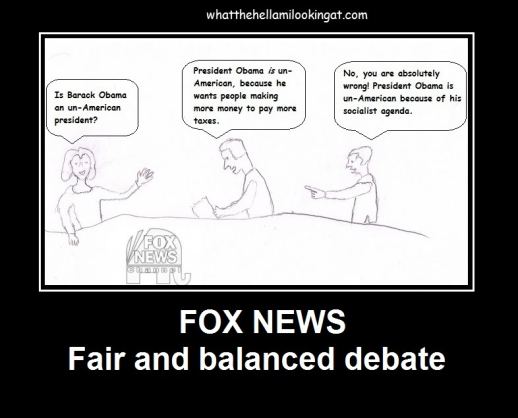
In a similar way, seemingly bizarre utterances like “Obama is a Marxist” or “Fox News is fair and balanced” are perfectly coherent, understandable, and even true once you have access to the proper definitions.

Previous lexicons have been attempted (here, for example), but I don’t think they have captured the systemic nature of Conservative, i.e., the way its terms interact to describe a complete worldview.

And so, in hope that Americans of all political persuasions will better understand what conservatives are really saying (rather than write off their statements as harmless nonsense), I present this incomplete Conservative-to-English lexicon.

American exceptionalism. The belief that the United States is exempt from all legal and moral standards. Example: Waterboarding is a capital crime when done to Americans, but legally and morally acceptable when practiced by Americans.

Appeasement. Hesitating before attacking or overthrowing the unfriendly government of an oil-rich nation.

Balance. 1. Providing Democrats as well as Republicans the opportunity to criticize President Obama. 2. Providing blacks as well as whites the opportunity to indict black culture. Usage: “Fox News is fair and balanced.”

Color-blindness. Fighting racial injustice by refusing to see it, much as an ostrich avoids danger by sticking its head into the sand.

Confederacy. An early attempt to restore the freedom envisioned by the Founding Fathers. Still an object of nostalgia in the GOP’s southern base.

Constitution. A holy scripture written by the Founding Fathers. Like the Bible, it means whatever conservatives want it to mean, regardless of its actual text. The Constitution, for example, protects corporate personhood, and the near-infinite powers it assigns to Republican presidents vanish when a Democrat takes office. Unlike the real-life Constitution, the Constitution includes the Declaration of Independence, and so really does mention God.

Controversial. An adjective applying to any fact or set of facts that conservatives don’t want to believe. Examples: evolution and climate change. Once facts have been labeled controversial, stating them as facts is evidence of liberal bias.

Dependent on government. Anyone receiving welfare, encompassing retirees, students, and the disabled. Usage: “there are 47 percent … who are dependent upon government, who believe that they are victims, who believe the government has a responsibility to care for them, who believe that they are entitled to health care, to food, to housing, to you-name-it.”

Europe. A hellish dystopia governed by liberals, where people belong to unions, have guaranteed health care, and earn high wages with long vacations. Soon to be overrun by Muslims. Usage: “I want you to remember when our White House reflected the best of who we are, not the worst of what Europe has become.”

Fair. Favoring the wealthy. Usage: “A true free market is always fair.”

Fascism. An insult with no meaningful content, similar to “bastard” or “asshole”. The previously well established Mussolini/Hitler sense of the term —  a militarist, nativist, corporatist style of totalitarianism claiming to restore a nation to the greatness of its mythic past — is now archaic, having been successfully jammed by tangential usages like Islamo-fascism and oxymorons like liberal fascism.

Founding Fathers. Loosely based on the American generational cohort that fought the Revolution and wrote the Constitution, the conservative Founding Fathers are heroes of a great mythic past constructed by pseudo-historians like David Barton. Divinely inspired, the Founding Fathers intended to create a non-denominational Christian theocracy, but inexplicably failed to mention God in the Constitution. They were implacably opposed to Big Government, even as they were writing a constitution that vastly extended the powers of the national government beyond those laid out in the previous Articles of Confederation. They “worked tirelessly” to end slavery, while owning hundreds of slaves themselves, and without actually ending slavery until long after they were all dead.

Free market. A system of decision-making based on the only fair principle: one dollar, one vote.

Freedom. 1. The ineffable quality that exempts the United States from all moral standards. (See American exceptionalism). Usage: “They hate our freedom.” 2. The right of the powerful to use their power as they see fit. Usage: “The minimum wage is a freedom killer.” 3. The right of job creators to use public infrastructure without paying taxes, or to exploit common resources (like air, water, or public land) without regulation. Example: Cliven Bundy.

Freedom of religion. The right of conservative Christians to shape society and define social acceptability. Intended by the Founding Fathers only to protect expressions of religion, not atheism or Islam.

Freedom of speech. 1. The right of a conservative to speak and write publicly without criticism. (See persecution.) Example: Sarah Palin’s objection in 2008 to the characterization of her charge that Barack Obama was “paling around with terrorists” as “negative campaigning”. “If [the media] convince enough voters that that is negative campaigning, for me to call Barack Obama out on his associations, then I don’t know what the future of our country would be in terms of First Amendment rights and our ability to ask questions without fear of attacks by the mainstream media.” While no one had disputed Palin’s right to say what she said, the fact that she faced criticism for it violated her freedom of speech. 2. In election campaigns, the right of the rich to drown out all competing voices.

God. Jehovah, the father of Jesus, as revealed by a literal reading of the Bible. Non-Christians do not believe in God, but in other supernatural beings like Allah. Some liberals claim to believe in God, but they use the word incorrectly.

Hate. Criticism of conservative ideas or disputation of facts alleged by conservatives. See persecution.

Innocent human life. The unborn, who possess souls of infinite worth. At birth, a child inherits the soul-value of his parents, which — if they are black or poor — does not amount to much. Consequently, abortion in the United States is a moral crisis equivalent to the Holocaust, while our third-worldish infant mortality rate (34th in the world, just behind Cuba) is no big deal.

Job creator. A wealthy person, who may or may not be an employer, and who may even have become wealthy by firing people or shipping jobs overseas. Usage: “Let’s cut taxes for job creators.” Does not apply to public works, public schools, or any other government program, no matter how many Americans such a program might productively employ.

Judicial activism. When judges rule against corporate interests or white supremacy, or in favor of separating Church from State.

Liberal media bias. The fading tendency of certain portions of the journalistic establishment to require supporting facts before promoting a conspiracy theory. For an example of the frustration this causes conservatives, consider the following quote from Jonah Goldberg shortly before the 2012 election: “If you want to understand why conservatives have lost faith in the so-called mainstream media, you need to ponder the question: Where is the Benghazi feeding frenzy?”

Marxist. One who regrets the increasing concentration of wealth. Unrelated to any theories contained in the writings of Karl Marx. Usage: “Elizabeth Warrren, who has almost confessed to her Marxist views”. (Synonyms: communist, socialist, liberal.)

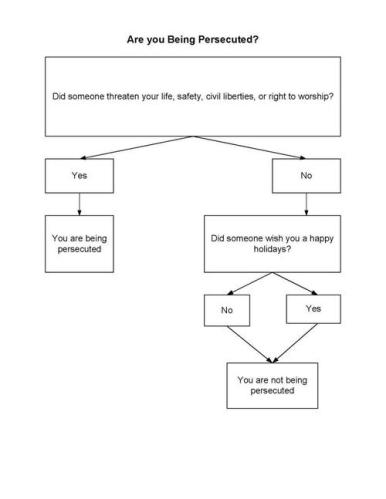
Persecution. (1) Denying conservatives the special rights they believe they are entitled to. Example: The War on Christmas, in which conservative Christians are persecuted if they are not allowed to dominate all public space for the month of December. (2) Criticism directed at conservatives. Example: If a conservative says something racist and you point that out, you are persecuting him. (See freedom of speech.) (3) Enforcing laws broken by conservatives. Example: Dinesh D’Souza.

Political correctness. The bizarre liberal belief that whites, men, straights, Christians, the rich, and other Americans in positions of privilege should treat less privileged people with respect, even though such people have no power to force them to.

Poor. Lacking in gumption or virtue, undeserving, black.

Racism. Calling attention to racial injustice with an intention to rectify it. Also called “playing the race card”. (See color-blindness.) Example: the Fox News commentator who said, “You know who talks about race? Racists.”

Religion. Christianity, not including degraded liberal variants that accept evolution or gay rights.

Second Amendment rights. The right of whites, Christians, the wealthy, and other traditionally privileged groups to commit violence when their privileges are threatened by democratic processes. (People not from privileged groups may be gunned down by police — with full conservative support — if they are even suspected of being armed.) Best expressed by Sharron Angle in her 2010 Senate campaign: “if this Congress keeps going the way it is, people are really looking toward those Second Amendment remedies.” Also by Virginia Republican Catherine Crabill: “We have a chance to fight this battle at the ballot box before we have to resort to the bullet box. But that’s the beauty of our Second Amendment right. I am glad for all of us who enjoy the use of firearms for hunting. But make no mistake. That was not the intent of the Founding Fathers. Our Second Amendment right was to guard against tyranny.”

Taxes. A method of stealing money from job creators and giving it to poor people. Unrelated to Social Security, Medicare, roads, schools, lowering the deficit, or any other useful goal.

Terrorist. 1. A Muslim. 2. Any violent person conservatives don’t like. Cannot be applied to violent anti-abortionists, white supremacists, or tax resisters. (See Second Amendment rights.)

Tyranny. When a Marxist gets elected and then tries to carry out the platform the people voted for. Example: ObamaCare.

Values. Beliefs that condemn gays or promiscuous women. Usage: the Values Voters Summit.

Voter fraud. Any votes cast by people whose demographic profile makes them likely to vote Democratic, i.e., blacks, Hispanics, or students. Alternate form: election fraud. Usage: “Obama likely won re-election through election fraud.”

Welfare. Any payment from the government, including (when convenient) Social Security, unemployment compensation, or student loans. Usage: “Unemployment compensation is just another welfare program.”

While far from complete — please suggest additional entries in the comments — I hope this lexicon will make conservative speech more comprehensible to the general public, and persuade voters that the apparent gibberish spoken by conservative candidates actually expresses a unified worldview that should be taken more seriously.

The Monday Morning Teaser

I’m still deciding whether there will be one or two featured posts today. The one I’m sure of is “A Conservative Lexicon With English Translation”. It doesn’t look like it, but it’s sort of a follow-up to “Not a Tea Party, a Confederate Party“. In that post I observed that to the Tea/Confederate Party, tyranny meant using the democratic process to change society, through things like same-sex marriage or national health care, and Second Amendment rights meant the right of conservatives to stop democratic change by violence.

When you think about it for a while, you realize that’s just the tip of the iceberg. There’s a whole conservative language, where words mean something very different than they do in standard English. Voter fraud means black people voting. Freedom of speech means that a conservative should not face criticism for speaking out. The Founding Fathers are a complete fantasy bearing no real resemblance to the people who actually wrote the Constitution. And so on.

If you understand those definitions, a lot of apparent gibberish suddenly makes sense and is scary. So I decided to collect them all in one place, or at least as many as I could think of. I realize I’m not the first person to try this, but I hope I’m advancing the field a little.

The second possible article is my reaction to the Adrian Peterson story, which has morphed into a discussion about parental discipline techniques. As a class immigrant (raised working class, now in the professional class) I’ve had a chance to observe both sides of what is basically a class divide. If this doesn’t become an article, a few paragraphs will make it into the weekly summary.

In the summary: Eric Holder, extending the air war into Syria, the media ignoring the Climate March, and an epic rant from Jon Stewart about the scientific ignorance of the House Committee on Science, Space, and Technology. Oh, and somebody solved the “Washington Redskins” problem: They can keep the name if they just change their helmets.

Let’s figure the lexicon to appear around 10 and the summary about noon.

Discernible Gains

Both [world] wars were fought, really, with a view to changing Germany. … Yet, today, if one were offered the chance of having back again the Germany of 1913 — a Germany run by conservative but relatively moderate people, no Nazis and no Communists, a vigorous Germany, united and unoccupied, full of energy and confidence, able to play a part again in the balancing-off of Russian power in Europe … in many ways it wouldn’t sound so bad, in comparison with our problems of today. Now, think what this means. When you tally up the total score of the two wars, in terms of their ostensible objective, you find that if there has been any gain at all, it’s pretty hard to discern.

— George Kennan, American Diplomacy (1951).

No Sift next week. The next articles will appear September 29.

This week’s featured articles are “Infrastructure, Suburbs, and the Long Descent to Ferguson” and “Is Ray Rice’s Video a Game-Changer?“.

This week everybody was talking about war against the Islamic State

Look at the Kennan quote above, and think about this: If, right now, there were a secular Sunni leader who could hold Iraq together, keep the religious radicals in check, and serve as a regional counterweight to Shiite Iran, that wouldn’t sound so bad.

I’ve just described Saddam Hussein.

That ought to make us humble about what American military power can achieve in Iraq, or Syria, or anywhere else in the Middle East. At great expense in both lives and money, we fought two wars and lost no battles. But if there has been any gain at all in the overall situation, it’s pretty hard to discern.

Nonetheless, the march into a third Iraq War — expanded to include Syria this time — continues. In a speech Wednesday night, President Obama admitted that “we can’t erase every trace of evil from the world” (an implicit criticism of President Bush), but pledged that “We will degrade, and ultimately destroy, ISIL through a comprehensive and sustained counterterrorism strategy.”

And when we’ve done that, then will the situation be better than it was in 2002 or 1990?


For some mysterious reason, Dick Cheney is advising congressmen on what to do in Iraq, rather than testifying at his war crimes trial. Thom Hartmann:

When we, the supposed leaders of the free world, don’t punish the worst political criminals in our history, it sets a terrible example for the rest of the world. … [W]hen we do terrible things and nobody is held accountable, that gives the green light for everyone else to do the same.

Leaving aside moral considerations, the country listened to Cheney during the run-up our Iraq invasion of 2003. Pretty much every fact he told us was false, and every piece of advice he gave was wrong. Why would anyone ever listen to him again? (Except when he testifies at his trial, of course. We owe him that much.)

and Ray Rice

You can’t un-see the video of Ray Rice decking his wife in the elevator. I think a lot of the men who see it are going to have a harder time explaining away future stories of domestic violence. That point gets spelled out in more detail in “Is Ray Rice’s Video a Game-Changer?“.

and Apple

It’s amazing how much buzz surrounds the announcement of any new Apple product. Three were announced this week

  • iPhone 6, which is bigger, thinner, faster and so on, but really not that revolutionary. If you have both an iPhone 5 and an iPad mini, you might be able to replace both of them with one device.
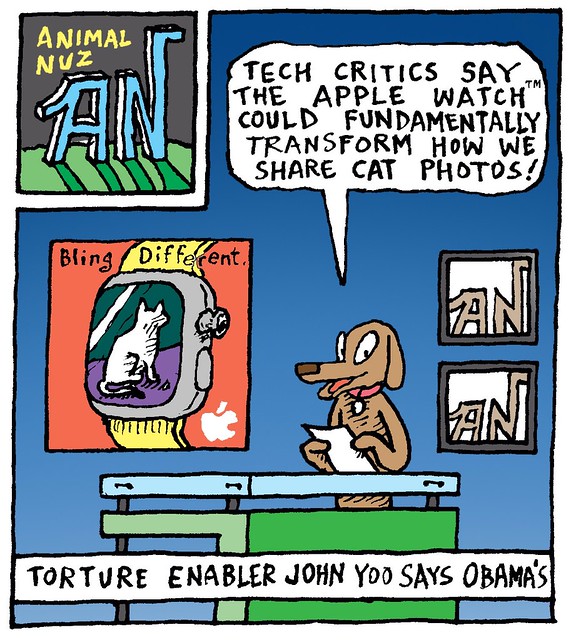
  • Apple Watch, (I guess iWatch sounded too voyeuristic) which is promised for early 2015. It’s a time-telling thing that you wear on your wrist and costs hundreds of dollars, but otherwise it clashes with all our traditional notions of an expensive watch. Previously, such a watch was an heirloom to hand down through the generations, not a gadget to replace every two or three years. It’ll be interesting to see whether Apple can change that. First responses: some people like the idea, some don’t.
  • Apple Pay. (Again, iPay doesn’t sound right.) Someday, somebody is going to get the electronic wallet right, and that will change everything. Is this it? Maybe. Maybe not.

[full disclosure: I own Apple stock. I’ve tried not to let it bias me.]

but I’m still talking about Ferguson

I know, it’s starting to look like an obsession. But the example of Ferguson illustrates some previously hard-to-grasp theories about how our society might decline. I connect the dots in “Infrastructure, Suburbs, and the Long Descent to Ferguson“.

and you also might be interested in …

The Senate debated a constitutional amendment to reverse the Citizens United decision and allow Congress to pass laws regulating campaign finance again. 42 Republican senators voted to filibuster, so the auction of our highest offices will continue.

It was a party-line vote. Remember that the next time a Republican senator like Susan Collins — or any Republican candidate — claims to be a moderate or independent-minded or something. Or when someone tells you that a Democrat like Landrieu or Manchin might as well be a Republican.

On important issues like this, the individual candidates don’t matter. Only the party matters. You may wish it weren’t that way, but it is.


The ObamaCare “train wreck” keeps refusing to wreck. Connecticut was supposed to be evidence of the wreck; it’s second-year premiums were going to go up 12.5%. And then they went down instead. Premiums are also expected to drop in Arkansas. Costs to the federal government have been lower than expected. An update from Washington state shows that other train-wreck predictions are also failing: More people continue to sign up as they become eligible, and the number of people who stop paying their premiums has been small.

Weren’t the death panels supposed to be up and running by now? What’s taking so long?

The Daily Show sent a reporter out to get an ObamaCare “disaster” story, and he did indeed find someone who lost her job: a nurse in a free clinic in Tacoma, which has closed because they got all their patients signed up for insurance. The parody of media attempts to spin continuing good news as bad news is hilarious. The clinic’s former patients are happy with ObamaCare, but they are “obviously biased by their personal positive experiences”. When the nurse says that she has moved on to work on other important causes like human trafficking, the reporter imagines his headline: “ObamaCare Forces Nurse Into Sex Slave Trade”.


From ESPN:

Nearly three in 10 former NFL players will develop at least moderate neurocognitive problems and qualify for payments under the proposed concussion settlement, according to documents filed by the league and the players. … Former players between 50 and 59 years old develop Alzheimer’s disease and dementia at rates 14 to 23 times higher than the general population of the same age range, according to the documents. The rates for players between 60-64 are as much as 35 times the rate of the general population, the documents reported.


Air Force Times reports that an atheist airman will have to sign an oath that ends “so help me God” if he wants to re-enlist. Otherwise he will have to leave the Air Force when his current term expires in November. The Air Force claims its hands are tied by Congress, which mandated the oath.

Article VI of the Constitution says:

no religious Test shall ever be required as a Qualification to any Office or public Trust under the United States.

I wonder if all those congressmen who talk so much about the Constitution and religious freedom will support changing this clear violation.


On lighter religious note: When the Rapture comes, what’s going to happen to all the pets left behind? Not to worry, After the Rapture has you covered. For a one-time fee of $10, they’ll add your pet to their database and promise that their Rapture-proof heathen care-givers will give him/her a good home.

Is this a joke, a scam, or a serious attempt to fill a need? Your guess is as good as mine.

 and let’s close with something I am never ever going to do

… skateboard the Alps.

Is Ray Rice’s Video a Game-Changer?

The reality of domestic abuse gets harder to deny.


Star NFL running back Ray Rice’s assault on his then-fiancée/now-wife is old news. He was arrested in February, and plea-bargained from criminal charges down to court-supervised counseling. (Emily Bazelon explains: “when a victim refuses to cooperate with the prosecution, the calculus for prosecutors shifts away from trial and conviction.”) Way back then, TMZ released a video showing Rice dragging the unconscious mother-of-his-daughter out of an elevator in an Atlantic City casino.

The NFL suspended him for two games, a punishment that raised a furor in light of the season-long suspension of receiver Josh Gordon for “substance abuse”, presumably marijuana. The NFL claimed it was bound by its previous policies, which it changed so that any future domestic violence incident would draw at least a six-game suspension. (But abusers keep playing while their cases work through the legal system.)

The Rice family.

None of that is new. But this week TMZ released a video of what happened inside the elevator. In it, we see Rice throw the punch that knocked Janay Palmer out. In an abstract sense, the new video didn’t tell us anything we didn’t already know: We knew he knocked her out, we just hadn’t seen him do it. It shouldn’t have changed anything.

But it did. Almost immediately, the Baltimore Ravens released Rice, who otherwise would have been their main ball-carrier when his original suspension ended next week. The NFL then made his suspension “indefinite”, and New England Patriots’ owner Robert Kraft speculated that Rice would never play in the NFL again.

One of the most striking reactions came from ESPN analyst and former player Mark Schlereth, who nearly dissolved into tears as he imagined a player in his own locker room, someone he would have identified with and felt loyal to, doing such a thing. It’s worth watching.

[The video] put a face to domestic violence. I’m not saying Ray Rice’s face, I’m saying the act of domestic violence. Because it was so shocking. And as the father of two daughters, and the [grand]father of a granddaughter, it was frightening for me to see that. The violence that occurred, the callous nature with which that violence occurred … I guess I had never really gone through that mentally before, to really understand what that looks like. And that put it together for me, of how vicious in nature this is.

I’m sure a lot of women are shaking their heads in a well-duh sort of way: You discovered that domestic abuse is callous and vicious? Your Nobel Prize is in the mail, Mark.

But if Schlereth is typical of a larger group of men — and I believe he is — then the Rice video may be a tipping point in the public discussion of domestic violence. Until now, when men have heard accounts of domestic violence, a lot of us have at some level empathized with the abuser, as if he might be like us on a really bad day. Just as an ordinary man might snap in the middle of an argument and say something he doesn’t mean and later regrets, or maybe act out physically by slamming a door or punching a wall, maybe an abuser does something reflexive that — unintentionally, almost accidentally — results in physical harm.

That’s obviously not what happens in this video. Rice just decks his fiancée. Yeah, they are tussling physically, but the much larger and stronger Rice could easily have fended off Palmer’s blows or held her wrists and waited for her to calm down. Instead, he knocks her out, then looks down at her limp body as if he’s seen all this before.

Witnessing that reality could significantly change the way men listen to accounts of domestic violence. Like Schlereth, many men had “never really gone through it mentally before”, and now they have. Now they understand viscerally that this isn’t something any man might have done on a sufficiently bad day. The man in this video doesn’t deserve a single ounce of our sympathy.

Related short notes

Not to say that there aren’t still some men who will make excuses for Ray Rice. And even some women.


Meanwhile, women have been writing about Janay Palmer, who is now Janay Rice. An anonymous writer on The Frisky wrote “Why I Married My Abuser“.

when I saw the footage of ex-Baltimore Ravens player Ray Rice punching his then-fiancée Janay Palmer, I wasn’t surprised that she was now his wife. It isn’t — as many of the commenters on the original TMZ video have said — “all about the money,” or “she doesn’t care about taking a punch,” and it’s especially not that “she is telling all women it’s okay for your man to beat you.”

… It’s beyond silly to say that any woman who is getting smacked around thinks it’s acceptable to be smacked around. No one knows better than a woman who is being abused that it is wrong. Not leaving isn’t the same as consent. I stayed because I was traumatized and isolated. I believed that Hank really loved me and that no man with less passion/ anger (those words were conflated for me) would ever love me like him.

There’s a whole Twitter feed of stories like this: #WhyIStayed. And a companion: #WhyILeft. As with #YesAllWomen, it’s not abstract argument, it’s people telling their stories. The sheer accumulation of them is hard to explain away.


The NFL and the Ravens came out looking really bad — more interested in managing a PR problem than anything else. They claim they didn’t see the inside-the-elevator video until it became public, but that seems doubtful. Schlereth certainly didn’t buy it:

A Rice souvenir repurposed.

Protecting the shield means that we’re supposed to honor and understand the privilege of playing in the league, not supposed to cover up our mistakes and accept those. And that’s where the NFL in my mind is really letting me down, and let every guy who plays in this league down. Because I can’t imagine saying “No, we don’t have access to that video” and you saying, “OK, well, that’s good enough for me. We’ll move forward.” That’s unacceptable.

And besides, what the video changed is the depth of the public anger, not our factual understanding of what happened.


Jon Stewart’s reaction is also worth watching.


If you’re looking for a male hero in this story, I propose this girl’s Dad.

Infrastructure, Suburbs, and the Long Descent to Ferguson

Three dots connected.


Dot 1. The Long Descent. The most pessimistic book I’ve ever reviewed in the Sift is John Michael Greer’s The Long Descent: a user’s guide to the end of the industrial age. Greer paints a very plausible picture of how, over centuries, industrial civilization might fall apart.

The short version is that as the climate degrades and fossil fuels become simultaneously more expensive and less useable, each generation inherits from its more prosperous ancestors an infrastructure that it can’t afford to maintain. Society muddles through from year to year — sometimes even seeming to advance — until some part of that poorly maintained infrastructure snaps and causes major destruction. The destroyed area may get rebuilt, but not to its previous level. The resulting community has less infrastructure to maintain, but is also less prosperous, and so the cycle continues into the next generation.

New Orleans is one example. Hurricane Katrina was an act of Nature (and possibly a consequence of global warming), but the reason it destroyed so much of New Orleans was the failure of the city’s infrastructure. As Jed Horne reported in The Washington Post:

key levees, including the 17th Street and London Avenue canals in the heart of the city, failed with water well below levels they were designed to withstand. As the Army Corps [of Engineers] eventually conceded, they were breached because of flawed engineering and collapsed because they were junk. … The Corps and local levee boards that maintain flood barriers pinched pennies, and suddenly Katrina became the nation’s first $200 billion disaster.

For a rising city like London in 1666 or Chicago in 1871, such large-scale destruction is an opportunity to rebuild bigger and better. But New Orleans has rebuilt smaller, losing almost a quarter of its population between 2000 and 2012. The flood protection system has been rebuilt, but still not to a level that could withstand the next Katrina.

The collapse of Detroit lacks a Katrina-level catastrophe, but follows a similar pattern: Detroit’s sinking tax base can’t maintain a major city, and every attempt to either raise taxes or spend less just exacerbates the decline.

At any particular moment, you can always find something else to blame: corruption, say, or mismanagement. But rising cities are also corrupt and mismanaged, maybe more so — see Tammany Hall. It’s not that declining communities lack virtue, it’s that flourishing communities can afford vice.

Greer imagines the same scenario on a planetary scale. He sees places like New Orleans and Detroit not as unique examples of dysfunction, but as coal-mine canaries. The same vicious cycles that are driving them downward will eventually manifest everywhere.

Dot 2. The suburban Ponzi scheme. In June, 2011, Charles Marohn published “The American suburbs are a giant Ponzi scheme” at Grist (also reviewed in the Sift). His point is that car-oriented suburbs create only the illusion of wealth. In the long run, they are enormous bad investments that create unmaintainable communities.

America’s early suburbs were outlying towns that were gradually engulfed by urban sprawl in a more-or-less natural way — Oak Park, Illinois and Arlington, Massachusetts come to mind. But the 20th century created car-oriented commuter towns out of nothing. Everything was new at the same time: new houses, new roads, new schools, new stores, new sidewalks, new bridges, new sewers, and so on.

As a result, nothing needed fixing right away, so taxes could be low. Sound accounting would have required these towns to build up big maintenance funds for the day when things started wearing out. But under sound accounting, those communities wouldn’t have been quite so attractive in the first place. And whatever the accountants said, why would voters tolerate higher taxes if the town was sitting on a pile of money?

As long as there was rapid growth — new subdivisions, new roads, new malls, etc. — the game could continue: Even after the potholes started, the tax base was still big compared to the relatively small part of the suburb that needed fixing. That’s why Marohn calls it a Ponzi scheme: Just as Ponzi’s later investors paid the dividends of the early investors, the suburb’s new neighborhoods pay for the maintenance of its old neighborhoods.

But trees don’t grow to the sky, so eventually a suburb reaches its carrying capacity. And when growth plateaus, the maintenance time bomb starts ticking. A decade or two later, everything seems to wear out at once, while the tax base stays comparatively flat. Now the local government faces a choice: raise taxes or let things start falling apart. Either option makes the town a less attractive destination for the high-income families and high-margin businesses it needs — especially in comparison with fresher suburbs still in their low-tax, low-maintenance, everything-is-new growth phase.

That starts a slow-but-steady decline, until eventually you have not just high tax rates, but also cracked sidewalks, pot-holed streets, underfunded schools, dingy libraries, litter-filled parks … and the kind of residents who can’t afford to live anywhere nicer.

Eventually, in other words, you have Ferguson, whose population reached its current level in 1960. Marohn spelled it out in late August.

When places like this hit the decline phase – which they inevitably do – they become absolutely despotic. This type of development doesn’t create wealth; it destroys it. The illusion of prosperity that it had early on fades away and we are left with places that can’t be maintained and a concentration of impoverished people poorly suited to live with such isolation. … Unfortunately, nothing I’ve brought up here is really unique to Ferguson. All of our auto-oriented places are somewhere on the predictable trajectory of growth, stagnation and decline. Racial elements aside, I think we are going to see rioting in a lot of places as this stuff unwinds.

Dot 3. The Ferguson revenue structure. As I’ve discussed before, Ferguson didn’t erupt simply because Darren Wilson shot Michael Brown. That was just the spark. Combustible anger had been building up in Ferguson for a long time.

Ferguson erupted because the less affluent black majority resented being in a predator/prey relationship with the mostly white police. It would be bad enough if that relationship were entirely based on racism or abuse of power, but it goes deeper than that: It’s economics. Reuters reports:

Traffic fines are the St. Louis suburb’s second-largest source of revenue and just about the only one that is growing appreciably. Municipal court fines, most of which arise from motor vehicle violations, accounted for 21 percent of general fund revenue and at $2.63 million last year, were the equivalent of more than 81 percent of police salaries before overtime.

That’s why in 2013, Ferguson police issued 3 warrants for every household in the city, raising $321 per household. According to Thomas Harvey of Arch City Defenders:

Some of our municipalities are seeking to raise revenue through the use of their municipal courts. This is not about public safety. The courts in those municipalities are profit-seeking entities that systematically enforce municipal ordinance violations in a way that disproportionately impacts the indigent and communities of color.

Charles Mudede of Slog widens his view to include a statistic from AP: The “homicide clearance rate”, i.e., the percentage of murders that police solve in America, has dropped from 91% in 1963 to 61% in 2007.  Mudede suggests a simple explanation:

Catching murderers costs money. Cities do not have money.

In other words, why have your police out spending the town’s money investigating serious crimes when they could be making money for the town by hassling jaywalkers like Michael Brown? In an era when your businesses are already moving away and your property values are stagnant or sinking, how else are you going to raise revenue?

Mostly, that revenue is going to come from poor people who can’t afford lawyers and have no place to move to. That may seem harsh, but if you change the practice, you’ll have to come up with an alternative revenue stream, preferably one that won’t chase away more businesses and more professional-class families. What could it be?

And so, concludes Reuters, changing the way Ferguson polices its people is going to be “easier said than done”.

Put it together. For the last couple centuries, we’ve had a simple formula for increasing wealth: Take something that people used to do with their muscles and figure out a way to do it by burning fossil fuels. Augmenting human effort with the energy stored in coal, oil, and gas has created a level of luxury that would have seemed magical to our ancestors.

During that time of increase, you didn’t have to worry much about either the fuel you were burning — there was more where that came from — or the atmosphere you were burning it into. Now we’re starting to hit limits on both sides. We have to go to extremes — deep in the ocean, deep underground, far into the polar regions — to find new fuel; and if we burn all that we have discovered, the change in our climate could be catastrophic.

So you don’t have to go all the way to Greer-level pessimism to realize that creating wealth will be trickier in the centuries to come. Many of the things that may look like wealth-creation actually aren’t; they just shove someone else into poverty, or create debt that will eventually have to be written off — like the “profits” investment banks booked during the housing bubble.

When generation-to-generation economic growth is large and reliable, you don’t have to worry too much about the long term, because your grandchildren will be rich enough to handle the messes you leave for them. So it makes a certain amount of sense to push costs off into the future. But if we genuinely don’t know whether generations-to-come will be richer or poorer than we are, then it’s important that we do our accounting right. It’s also important that we build robustly, so that communities are viable under a wide variety of scenarios. Assuming that everybody will have a car or that food can be imported cheaply creates brittle communities that someday may have to be abandoned. A flourishing society can afford such write-offs. But if maintaining the infrastructure we inherit is the difference between advance and decline, we’ll have to be smarter.

And finally, we need to figure out how to rebuild or write off the mistakes of the past. Places like Ferguson — and there are a lot of them — are not sustainable in their current form. They will never generate the capital to remake themselves, and the outside capital they attract will be mainly from vultures who want to squeeze the last bits of value out of the community’s decline and despair.

In the short term, the easiest way to deal with that dysfunction is to blame it on the people who live there and lack more viable options. Their local governments can figure out ever more inventive ways to squeeze money out of them and leave them in squalor, while the rest of us lecture them about their lack of middle-class values. But the fundamental mistakes are not theirs. Those mistakes were made decades ago, and have been quite literally set in stone.

The Monday Morning Teaser

This week will have two featured posts that cover very different topics. The first is “Infrastructure, Suburbs, and the Long Descent to Ferguson”. I know, I’ve done a lot of Ferguson posts in the last month. But bear with me: This one uses Ferguson to illustrate the kind of big societal issue it’s hard to get a handle on otherwise.

Following the argument in John Michael Greer’s book The Long Descent, I think the central issue in whether the 21st century will see growth or decline is whether we are productive enough to maintain the infrastructure we inherit. (In Detroit, for example, the answer is pretty clearly “no”.) That in turn depends on how sustainably that infrastructure was designed in the first place, which is the main topic of Charles Marohn’s blog Strong Towns. Marohn argues that the car-oriented suburb is fundamentally unmaintainable, and that after a several-decades-long period of illusory prosperity, most of those suburbs will find themselves unable to support a level of economic activity that keeps the potholes fixed and the utilities running.

That’s where Ferguson is now, and that’s why it has to rely on misdemeanor fines for a substantial portion of its town budget. When the suburban car-culture illusion pops, you’re left with broken infrastructure and residents who can’t afford to move anywhere nicer. Your easiest way to raise revenue is to use the police to squeeze more fines out of the captive population. No wonder resentment builds.

Marohn expects to see a lot more Fergusons.

The second article will be “Is Ray Rice’s Video a Game-Changer?”. I think it is. Seeing domestic violence happen is different than just hearing about it, and I think a lot men who used to make excuses for abusers have had their eyes opened.

The weekly summary starts with a quote that made my jaw drop when I first read it twenty years ago, and the prospect of another Iraq War has made it very topical. The summary will also sample the wide range of opinions on the Apple Watch, point out that the “ObamaCare train wreck” continues not to wreck, and demonstrate once again that the real religious discrimination in this country isn’t against Christians, it’s against atheists. (Muslims too, but the example that popped up this week concerned atheists.)

Expect the Ferguson article around 9, the Ray Rice article at 10, and the weekly summary by 11. (All times EDT.)