Category Archives: Uncategorized

Pacts

guy has a trillion dollars, 0 friends, and has never landed a joke. I know a pact with the devil when I see one.

Amy (@lolennui.bsky.social)

This week’s featured post is “What to make of Graham Platner“.

Ongoing stories

  • Trump’s assault on American democracy. Our rapidly declining empire has hit its bread-and-circuses phase. For the Mad King’s birthday yesterday, we witnessed the corrupt spectacle of a UFC cage match on the White House lawn.
  • Climate change. You don’t have to deny scientific data you never collect. So the Trump regime is dismantling our ocean sensors.
  • Iran war. An agreement was announced yesterday, but we don’t have the text, and the most contentious issues were put off until the next round. If we’re lucky, it will get us back to where we were before Trump launched his ill-fated war.
  • Ukraine. This week’s update from Phillips O’Brien focuses on Ukraine’s effort to cut Crimea off from Russia. If they succeed, Crimea becomes a drain on Russia’s war effort rather than a strategic asset.

This week’s developments

This week everybody was talking about the Iran agreement

After months of Trump claiming a deal was at hand and Iran saying no, some kind of agreement was announced yesterday and is supposed to take effect Friday. No specific text was released, so I can’t tell you exactly what is in it. We just have to go on what various leaders are saying about it.

Apparently, the Strait of Hormuz will be open again, as it was before the US and Israel attacked Iran. The US will drop its blockade of Iranian ports, so Iran will be able to sell oil as it did before the attack. The US and Iran will be negotiating about the future of Iran’s nuclear program and the fate of the Iranian assets frozen in the US-controlled banking system, as they were doing before the attack. The ceasefire will be extended 60 days and will include Israeli forces in Lebanon, which Israel may not accept.

The obvious question now is: What did we gain from launching this war? Trump and Hegseth have been claiming victory since the first day, but what did we win? Aren’t we just back where we were before we got 15 of our own people and God knows how many Iranian civilians killed, spent hundreds of billions, depleted our stockpile of missiles and other weapons, cost American consumers billions at the gas pump, and disrupted the world economy?

Michael Sellers:

The right comparison is not between today and yesterday’s worst-case scenario. The right comparison is between today and the day before the war began.

And we may not even be back to where we started. There appear to be several points of possible misunderstanding, like this one:

[Iran’s Deputy Foreign Minister Kazem] Gharibabadi said those negotiations [over Iran’s nuclear program] would only begin once Iran can verify that the U.S. has complied with the current agreement, which he said included unfreezing Iranian assets and lifting the naval blockade. U.S. officials, however, said Iranian assets would not be unfrozen until Tehran had demonstrated compliance with the agreement.

Sellers lists the possible issues in the agreement, and offers practical tests for judging them. Example: “does Hormuz return to normal freedom of navigation, or does Iran emerge with a new coercive role over passage?”

Whatever the reality, Trump will spend the next several weeks claiming he got concessions that aren’t in the agreement, in order to tell his base that his claims of victory weren’t lies. Iran will not validate these claims, but we’ll see if they will be content to let Trump do what he does. That would give the world 60 days of breathing space before reality must be faced again.

My best guess: Something like this agrement will eventually take effect, but first it will have to come apart a couple more times. Maybe Israel will scuttle it, or the “memorandum of understanding” will fail to reflect a mutual understanding of its terms. And maybe Trump will just blow it up when his MAGA base starts to accuse him of weakness.

Meanwhile, the global markets seem to be taking this agreement at face value. I’ve never been a commodities trader, but if I were, I’d be tempted to buy oil futures and wait for the first glitch. If this does all come apart, a true catastrophe looms: The world has been burning through its oil reserves, and the tanks seem to be a month or two from running dry.

and about symbolic milestones

So Elon Musk’s net worth crossed $1 trillion (due to the SpaceX IPO I warned you to avoid last week). And after a bunch of legal flailing by Trump’s puppet board, his name came off the Kennedy Center. (I think.)

Trump used his power under the Defense Production Act to put $700 million of your tax dollars behind the coal industry, which is doomed for economic reasons even if you ignore the environmental damage it does. In May, for the first month ever, the US used more solar energy (12.8% of total electricity use) than coal (12.2%). Remember when Republicans wanted the market rather than the government to sort out energy use?


Musk’s trillionaire status has sparked debate about what our economic system rewards or doesn’t reward. Exemplars of vast wealth are always controversial, but it seems to me that previous ones gave their fans more to work with than Musk has. If you drove a car, you understood what Henry Ford had done. John D. Rockefeller and Andrew Carnegie represented oil and steel, which anyone could appreciate.

Bill Gates exemplified the personal computer revolution (whether it would have happened without him or not). For better or worse, Jeff Bezos and Sam Walton changed the way we shopped.

But Musk? His fortune is based on dreams of a future that may never come to pass, or may be made real by a competitor rather than Musk himself: self-driving cars, humanoid robots, colonies on Mars. Tesla and Starlink are real, but so far they account for very small parts of the car or communications industries.

Paul Krugman elaborates:

But these achievements weren’t enough to make Musk the world’s richest man. His wealth has, instead, historically rested mainly on self-fulfilling faith — investors believing in Musk’s genius have piled into stocks in Musk-controlled companies, and the rising value of these companies has enhanced his reputation for genius.

We have a term for enterprises that look successful because they keep drawing in new investors and keep drawing in new investors because they look successful. They’re called Ponzi schemes. And Elon Musk is basically a human Ponzi scheme. … Which brings me to my final point. The immense human Ponzi scheme that is Elon Musk will eventually collapse.

In a different post, Krugman compares our era to the Gilded Age.

So, are we living in a second Gilded Age? If only. We surpassed Gilded Age levels of income and wealth inequality decades ago. We’re now in an era of oligarchy in which the power of great wealth and the abuse of that power by a tiny elite eclipse anything we saw in the late 19th and early 20th century. And the super-wealthy themselves are far more lacking in redemptive qualities than their predecessors.

If you really enjoy seeing someone dunk on Musk, follow Will Lockett’s substack. In particular, this post examines the one piece of SpaceX that is supposed to be profitable already: Starlink. But is it really profitable, or do those earnings come from an accounting game enabled by Trump’s Big Beautiful Bill?


Then there’s Musk’s most serious downside: Current Affairs interviews Nicholas Enrich, who has a book out about the destruction of USAID during Musk’s months as head of DOGE. And Musk was involved: He bragged about “feeding USAID into the wood chipper”.

[USAID] was kind of the embodiment of American generosity overseas. We operated under a flag of people shaking hands that said “from the American people”, but it wasn’t just a charity organization. I think that that’s it’s really important. It was an implement of national security. It kept Americans safe from infectious diseases. You know, we had developed a global early warning system, so that countries could detect and respond to infectious diseases before they could potentially threaten us. We built partnerships over decades with countries that enhanced stability and increased American soft power around the world, that really allowed for Americans to thrive in a stable world order for over 60 years.

Enrich gives a few simple examples of threats to national security: When the Ebola outbreak started in Uganda, USAID wanted to screen passengers boarding international flights out, because “that’s how you get an international catastrophe”. The funding was denied. Clinical trials of drugs to fight currently drug-resistant tuberculosis were stopped, creating a risk of new TB strains resistant to those experimental drugs.

Enrich wasn’t prepared for the level of ignorance he encountered from the DOGE people.

There was another political appointee who told me, when I was pushing to restart lifesaving Ebola activities, he told me just that Ebola is a scam.

The first signs of the unfolding disaster were

families that had spent all day walking to a clinic in Sudan—you know, with the USAID logo on it—expecting to get food and medical supplies, seeing that clinic ends up being shuttered and were then forced to go home and then make the heart-wrenching decision of which of their children to feed. And there were pregnant women who were unable to access emergency childbirth services because the ambulance service that provided them was cut off and they ended up perishing. These were just like the initial anecdotal experiences that we started to hear that have since expanded.

Now we’re seeing conservative estimates show that 750,000 people have already died, most of those are children, and that’s within the first year. And unfortunately, what we’re learning is that really this is just the tip of the iceberg. It’s what we’re going to see in the next few years, where new babies who are born are no longer getting the immunizations we used to provide, babies are being born with HIV at high rates in some clinics, where just a year ago those rates were near zero. The impacts of this are going to—we’re not going to see the full effects of them for four years. I mean, I honestly believe that when the dust settles on the Trump administration, his cuts to USAID will end up being a major part of his legacy, because of just how far-reaching those impacts really are.

The Lancet medical journal published a study anticipating the results from a global cut in official development aid (ODA).

Sudden and severe reductions in ODA funding could have catastrophic consequences, with a potential global death toll comparable to—or even exceeding—that of the COVID-19 pandemic. Even modest defunding that simply extends current downward trends is likely to lead to sharp increases in preventable adult and child mortality, potentially resulting in tens of millions of excess deaths in the coming years.

It’s important to understand the full evil of Musk’s actions. For decades, I’ve been hearing conservative rhetoric about how private aid should replace government aid. But not only does Musk (unlike Bill Gates or Warren Buffett) give essentially nothing from his vast wealth to help the world’s least fortunate. (The Musk Foundation has focused on self-dealing with his businesses, and funding schools his children attended.) But he uses his wealth to buy political power, and then uses that power to prevent any help from reaching the poor.


Trump is being as petty as possible about taking his name off the Kennedy Center. Legal challenges went to the last minute, and then a 12-hour extension was granted. After the name came off, they left the tarp up so that no one can see the place where his name was taken down. The tarp serves no purpose but to avoid giving Trump’s enemies the satisfaction of defeating him.

News articles about taking down Trump’s name quote a lot of opinions about whether he deserves such an honor. The answer seems obvious to me, but it’s an irrelevant point: Trump and his puppet board had no power to change the name of the Kennedy Center. Only Congress can do that.

This is typical of a lot of Trump’s legal controversies. Whether what he wants to do is a good idea or not — I usually think not — he gets into trouble because he exceeds his legal powers. The tariffs are a prime example. Whether the US would benefit from higher tariffs is something reasonable people can argue about. But under the law, Trump had no power to impose his tariffs. The right argument to have there isn’t against tariffs, but against dictatorship.

Consider this exchange in the court case about Trump destroying the East Wing of the White House and beginning to build his gilded ballroom. Trump’s DoJ is arguing that courts have no power to intervene.

“If the government decides, very quickly, to bulldoze the Statue of Liberty,” asked Judge Patricia Millett, “[if] the government moved too fast…nothing can be done?”

“I think that’s right, yes,” [DoJ attorney] Roth replied, which, according to ABC News, “sparked audible gasps in the courtroom.”

Now, nothing in the Constitution commits the US government to maintaining the East Wing (or the Statue of Liberty). But under our system of government, such decisions aren’t based on the whims of one man.

Republicans would recognize this truth immediately if the one man were a Democrat. President Obama was denounced (more than once) for putting his feet up on the Resolute Desk. (“The picture of Obama with his feet on the desk in the Oval Office shows that he has never been taught manners. That desk is history and should be treated with respect.”) Imagine if he’d torn down a wing of the White House purely on his own authority.

and Graham Platner

See the featured post.

and Social Security

As if Republicans running for Congress this fall didn’t face enough problems, Speaker Johnson just gave them one more: If he’s still speaker after the elections, he has a plan for Social Security, Medicare, and Medicaid to be “adjusted and fixed“.

We know what this means, because it’s been a staple on the Right for decades: Any government spending that benefits people creates a budget problem. But there is infinitely much money available to pursue wars, cut billionaires’ taxes, and glorify God-Emperor Trump.

In particular, a Heritage Foundation article from 2024 proposes to “fix” Social Security by raising the retirement age to 69 or 70, establishing a “more accurate” (i.e., less generous) inflation metric, and partially privatizing the program.

The ostensible reason to “fix” Social Security is that the SS trust fund will run out of money in the early 2030s. If no other funding is provided by Congress, benefits will be limited to the Social Security taxes that come in, necessitating cuts.

However, the trust fund has always been a bookkeeping device rather than anything real. As Paul Krugman explains, the real question is whether the country wants to keep funding its elders at this level, not whether it can afford to.

and a war crime

Almost since the beginning of the Iran War, Trump has been threatening to commit war crimes. Occasionally, people have debated whether something we’ve done in Iran is a war crime or not. Bombing the girls school, for example, would be a war crime if it had been done intentionally. Attacking bridges and power plants might be war crimes, if the intent was to destroy economic infrastructure rather than impede Iran’s military.

Tuesday, all doubt was removed. After Trump unleashed another round of war-crime threats on Truth Social, this happened:

On the evening of June 9, the USA, with what seems to be intent, attacked two reservoirs and a water treatment facility in southern Iran. Almost immediately afterwards, water was cut off to about 20,000 Iranian civilians who live around the southern Iranian town of Sirik.

Why was this most likely a deliberate attack? Well, there seems to have been nothing nearby of military value and the destruction was precise.

When asked about this attack and the possibility that it was a war crime, Pete Hegseth offered no defense.

Well, it’s precisely the kind of disingenuous question that I’m used to from the media, impugning the motives of the folks on our side who are incredibly professional and incredibly effective.

and Trump’s birthday

Yesterday Trump held a UFC cage match on the White House lawn. Not only was this garish and violent, it often turned partisan. Also, it was another example of Trump profiting off his office: He owns stock in the TKO Group, which sponsors UFC fights. And the White House was not the only federal property involved: Weigh-ins and other pre-match festivities took place at the Lincoln Memorial.

and you also might be interested in …

Don Moynihan raises an interesting point about the Supreme Court’s assault on Black representation in Congress. It really comes in two parts:

  • States can’t intentionally create majority-minority districts because that violates the Court’s “color-blind” interpretation of the Constitution.
  • States can gerrymander for partisan purposes, which in red states has the effect of eliminating majority-minority districts that might arise naturally, i.e., in urban areas with large minority populations.

Moynihan considers what would happen if both partisan and racial gerrymandering were unconstitutional.

By accepting partisan gerrymandering as a regrettable but inevitable part of American democracy, the courts made racial justifications, rather than broadly democratic justifications, the last basis for maintaining constraint on gerrymandering. So isolated, it became easier to eliminate this last line of defense.

Nothing about this was inevitable. Imagine an alternative scenario, where the courts decided that both racial considerations and partisan gerrymandering were unconstitutional. Commentators like Rubenfeld could still have trumpeted the end of “the racial districting game” but Black and Democratic voters would still have had a realistic chance at representation.

A new analysis at the New York Times by Nate Cohn and Eve Washington adds numbers to the debate. It makes clear how monumental the decision to accept partisan gerrymandering was to blocking a truly colorblind map.

A map that was organized more simply around the non-partisan values of natural geographic settings would preserve a similar number of Democratic and minority-leaning opportunities.

Video of a crime committed by one particular Sudanese asylum-seeker in Southhampton went viral and resulted in an anti-immigrant riot in Belfast. Wired examines the role a far-right youth group played in making the riots happen. The New Yorker has a longer, deeper article on how anti-immigrant politics is spreading in the UK and elsewhere.


Approaching the 10-year anniversary of the Brexit vote, the UK economy is clearly doing worse outside the EU than it would have done remaining inside.


One of the more controversial parts of FISA surveillance law is Section 702, which allows intelligence agencies to monitor the communications of certain foreign nationals, even when they communicate with Americans that the agencies are not supposed to spy on. Section 702 gets reauthorized from time to time, because it’s been too controversial to make permanent.

The tricky point is what the agencies can do with their databases of collected information. Maybe the NSA (say) has no justification to surveil you, but it has your conversations with foreign nationals in its database. Can it search that database for your communications without a warrant, essentially spying on you via its spying on other people?

Anyway, the appointment of Trump attack dog Bill Pulte as acting DNI raised the profile of this issue, and Congress failed to renew the authority when it lapsed last week.
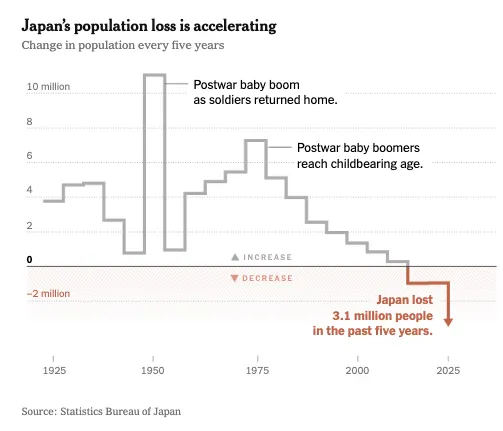

Japan is depopulating.

Laurie Garrett explains:

young men aren’t eager to marry, and Japanese women are more than happy to pursue life without them. Marriage rates continue to plummet, along with birth rates. This is less about policy initiatives the government might take than it is due to a wide gender gap in hopes, dreams, aspirations, concepts of family and cultural interests.

But of course, the US is developing similar gender gaps, and a similar (if less extreme) drop in births-per-woman.

Japan is not the exception – rather, it is the avant garde, the cutting edge, the leader the rest of us ought to pay close attention to as it struggles to find the right combination of humanity, gender equity, financing and social policy to care for its elders, encourage its young adults, bridge the political and economic gaps between men and women, and grow its children.

This is an issue conservatives recognize, but their approach is 180 degrees off. The decline in White reproduction is a key part of the Great Replacement conspiracy theory. The true part of the theory is that if our economy continues to create jobs and our people don’t produce children to fill them, immigration is the obvious way to keep the wheels spinning. This will inevitably shift the racial demographics.

But the MAGA approach to increasing fertility is basically to roll the clock back, so that women have fewer choices in life and are essentially forced into motherhood. Garrett suggests another path: Change male culture so that men take more responsibility for children. If men and women see equivalent costs and rewards for raising children, their expectations will begin to align.


If you’re wondering about the current legal situation around Trump’s slush fund for the January 6 criminals, the best summary is here. Two courts are still wrestling with issues related to the fund, and the regime is claiming the courts’ concerns are moot, because the fund isn’t happening. At least one judge wants a written commitment from the Justice Department that the fund really is dead and won’t be revived. We’ll see if DoJ gives that commitment.


The Trump administration is dismantling the Ocean Observatories Initiative,

a $386 million network of more than 900 instruments funded by the U.S. government’s National Science Foundation (NSF), which has provided real-time data on the world’s oceans for more than a decade. The sensors are distributed across both the Atlantic and Pacific oceans to monitor coastal environments, marine ecosystems, and ocean currents that influence the global climate.

The decision to end OOI, described by the foundation as a “descoping,” will remove nearly all in-water infrastructure located off the states of Alaska, Washington, Oregon and North Carolina, and the Irminger Sea, an area between Iceland and Greenland. The OOI was designed as a 25-to-30-year project specifically to capture long-term climate signals, which scientists say require at least three decades of continuous data to be meaningfully detected. The network has achieved just 10 years of observations.

The simplest way to deny climate change is to refuse to gather data on it.

and let’s close with something precious

“Rare photo of a mother wrench feeding her young. Breathtaking.” – ScottH

What to make of Graham Platner

Can we buy a redemption story without sinking into the same moral morass Republicans have?


In spite of a variety of accusations (some of which he has admitted and apologized for), Graham Platner won the Maine Democratic primary to run for Susan Collins’ seat in the Senate.

His victory has prompted a lot of soul-searching among Democrats, including me. In a cycle when we want to spotlight the moral slime of the Trump administration and the Republican Party in general, we’d like more than ever to have squeaky-clean candidates like James Talarico in Texas. (Imagine being so blameless that when your opponents start lying about you, the best they can come up with is that you might be vegan.)

A lot of the case against Susan Collins is not so much that she is slimy herself, but that she enables slimeballs like Brett Kavanaugh, Donald Trump, and a host of others. She may be “concerned” about their conduct, but when push comes to shove her party can count on her vote. (The “believe women” campaign started with Christine Blasey Ford’s sexual assault accusation against Kavanaugh, which Collins paid lip service to, but ultimately wrote off. She also believed Kavanaugh’s assurances that Roe v Wade was safe, and believed the empty assurances Mitch McConnell gave her in exchange for her vote on the 2017 Trump tax cut. “Believe powerful men” is the actual rule Collins follows.)

So now we have another believe-women situation: a former Platner girlfriend (who happens to be a Republican political operative) says he was violently controlling (but never struck her).

he regularly grabbed her by the shoulders — sometimes hard enough to leave marks — and, on one occasion, yanked her out of a cab by her wrist after an argument when she wanted to stay in the car.

During one argument, she recalled, he twisted her arm behind her back, shoved her into a bedroom and held the door closed from the other side so she couldn’t get out, telling her to remain there until she was “calm.” Eventually, Ms. Fifield said, she fell asleep and left the next morning.

I wish I didn’t have to deal with this, but I do. To what extent am I willing to support a less-than-perfect candidate for the sake of the greater good? I’m inclined to go a long way, given the perilous state our democracy is in if Congress continues to refuse to contain the authoritarian drive of the Trump regime. But I’m aware that MAGA types make similar arguments for tolerating Trump’s moral/legal failings: They grossly exaggerate the harm they think Democrats are doing or would do, and see Trump as the lesser evil.

I also resent that the public only seems to have standards for Democrats. Trump can be a convicted felon, found by a jury to have sexually assaulted a woman, found by numerous courts to have committed fraud, and so on — and none of it matters. Only Democrats have to exhibit good character and live moral lives. In particular, I have no patience for Republicans (and supposedly “liberal” media outlets like the NYT) who find fault with Platner, but have far less to say about Ken Paxton, who is by far the scummier character.

But still, it rankles to be complicit in the racheting down of moral standards in American politics. And consequently it raises the question: If we support Platner, are we just doing what they’re doing?

The most thoughtful article I’ve found on this topic is “Rupture and Repair: When Problematic Figures Ask For Our Support“, written by Jay Kuo for The Big Picture blog. Kuo compares Democrats’ treatment of Platner and Hunter Biden (who is developing something of a following online) to Republicans’ treatment of Paxton and Pete Hegseth.

Several figures from both sides of the political spectrum have raised this very question. Some seek redemption for conduct they acknowledge. Others seek power for conduct they deny. The distance between those two postures turns out to matter enormously, even when the underlying behavior looks similar on the surface.

Kuo proposes a simple test: What if the accusations are true? What does that say about the person’s future conduct, and in particular about how they would use the power they are seeking?

The contrast with Biden and Platner is not that their alleged conduct was less serious than Hegseth’s and Paxton’s, though it objectively is. The contrast is structural. Hegseth’s alleged conduct was directly relevant to the specific institution he was being asked to lead. Paxton’s alleged crimes are the exercise of the very power he is seeking more of. Rather than acknowledge the rupture of trust and seek repair and forgiveness from supporters, they have demanded to be believed over their accusers. Their party, calculating that the political stakes justified the cost, has obliged.

(Kuo’s distinction seems meaningless to Megan McArdle, who sees Platner and Paxton alike as men of low character.) For the moment, let’s put aside the whattaboutism of Hegseth and Paxton, and focus that test on Platner. He got (and later covered) a tattoo that was based on an SS symbol. He posted derogatory things online about women and minorities. He is accused of treating a girlfriend badly and possibly cheating on his current wife. He acknowledges the majority of that behavior, claims ignorance about the symbolism of the tattoo, and denies the violent aspects of the girlfriend’s charges. He casts those events in a narrative in which he was scarred by combat and took some while to work things out.

The question Kuo would have us focus on is: Does anything in Platner’s current life or political positions resonate with a pro-Nazi, anti-woman, or anti-minority past? If something does, he should lose any benefit of the doubt.

What matters most though is not the rupture [of trust] itself but the repair that follows. Character is revealed in the willingness to face the damage, attempt repair and accept that forgiveness is not guaranteed. A child who breaks something and hides it learns only fear and concealment. A child who breaks something, admits it, and works to make it right learns something far more valuable. …

Importantly, repair cannot simply be declared by the person who caused the rupture. And it cannot become a way to sweep aside serious problems, particularly around misogyny and toxic behavior. It has to be tested over time, especially by how seriously a candidate like Platner treats the objections of the people harmed and the concerns of voters still unwilling to trust him.

So the next thing to do is listen to the people most likely to be harmed if Platner has not reformed and is still not who he is claiming to be.

Shay Stewart-Bouley is a Black Mainer who writes about race issues. In her opinion, Platner is nearly unique among Maine’s White politicians in his outreach to non-White and immigrant communities.

I can’t speak to who Graham Platner was when he was posting hurtful things on the internet, but I can say that in the nine months since he launched his campaign, I have seen a white man who has done a lot more community-building across racial lines than the majority of those who judge him—particularly the left-leaning progressives and leftists who are horrified that he has a legitimate shot at becoming the U.S. senator. Most certainly more than the average politician or aspiring politician. The fact that he chooses to build behind closed doors rather than turning BIPOC people into props to redeem himself is also a choice. For those who seek the performative, there is no doubt that a few shots of him speaking with Black and Brown audiences and seeing their reactions would probably steady their nerves—but do photo ops allow for depth and true connection?

… I don’t need a perfect candidate and watching him show up consistently for Maine’s BIPOC community and not use the community to repair his battered image matters to me. In some ways, knowing for months that at any moment he could have chosen to “prove” that he has changed by taking relational moments and turning them into soundbites and photo ops—but he didn’t—reveals a level of integrity that is important to me.

If you want to understand the positive aspects of his candidacy, and why so many Mainers chose to stand by him in the primary, read Sebastian Junger’s “I Just Had Breakfast with Graham Platner“. What comes through in this article is how the constant sniping about details of his past and background serves to divert attention from his message.

The heart and soul of what Platner had to say to me – and to voters – is that American politics are deeply corrupt, and that Democrats are often as bad as Republicans. He went on to say that the true division in this country isn’t between liberals and conservatives but between economic elites and everyone else. These elites, in his opinion, have fomented political divisions to stay in power because their main goal is economic monopoly; politics simply serve that purpose.

Perhaps The New York Times and Washington Post would prefer we not have that discussion. Junger goes on to quote Platner directly:

Here is my real point of contention with the liberal pundit class. Which is that they celebrate the suffering of working people who were tricked into voting for someone that was going to fuck them over. You shouldn’t celebrate that, you should be horrified by it…you should have compassion and empathy. Those people were tricked, they were propagandized, they were lied to. We are all in many ways being exploited and manipulated by the elites. To sit around and say, Ha, ha, you get what you voted for – no, man. Those are people in pain. You don’t laugh at people in pain, you help them, for Christ’s sake.

… The Ukrainians are resisting an armed invasion, and I absolutely support [them]. But I do think it makes it hard to support them when we are also supporting the Saudi regime and the Israelis in Lebanon right now. I’m an internationalist. I believe our foreign policy should be rooted in international institutions that we respect consistently. Vietnam wasn’t good for working Americans. Fucking around in South America in the 1980s was not good for working Americans. The wars in Iraq and Afghanistan were not good for working people. I’d like to see us invest money in the United States rather than in a bloated military apparatus. We have helped set up all these international court systems that are specifically designed to to protect corporate power and capital around the world…why don’t we do that to protect, say, labor rights around the world? [We need alliances so that] if a company flees one country to avoid taxation, other countries will impose the same tax rate.

… Establishment Democrats and normie liberal types love talking about fascism and authoritarianism. They use the words and then nobody does anything to prepare. I do believe these people [in the Trump administration] are fascists and will try to maybe interfere in the elections come November, weaponize or militarize federal law enforcement as a political tool. So, that’s why you have to fucking organize now…just saying so on MSNBC isn’t enough. Talk to the labor unions, talk to the community organizers, start building the mechanisms that we’re going to need. Resistance isn’t magic; it requires time and discipline and energy. The Trump administration is full of incompetent morons; of all the versions of this we can beat, it’s this version. What I’m very much worried about is if we don’t resist and defeat this version now, then the next version is actually competent.

All things considered, is that a point of view I want represented in the Senate? I think it is. You may make your own decision, but I encourage you to take a long look at Platner, and not just respond based on a few headlines in the corporate press.

No Sift Next Monday

The next new articles will appear on June 8.

Woe

Woe to those who manipulate religion and the very name of God for their own military, economic and political gain, dragging that which is sacred into darkness and filth.

Pope Leo XIV

This week’s featured post is “Can Democrats gain from MAGA discontent?

Ongoing stories

  • Trump’s assault on American democracy. The Justice Department is working increasingly hard to support Trump’s conspiracy theories about rigged elections.
  • Climate change. Rising sea levels is looking like a bigger problem than previously thought.
  • The Iran/Lebanon war. The Strait is closed again. Trump wants us to believe that he’ll achieve a victory-like peace any day now. But it’s not happening.
  • Ukraine. Ukraine is coping with its shortage of soldiers by fielding more robots.

This week’s developments

This week everybody was talking about the war

Last week I predicted that Trump’s anti-blockade-blockade would fail to convince Iran’s leaders they are defeated.

In a few days it will be clear that this move didn’t work either, so Trump will go back to threatening to kill Iran’s “whole civilization“.

Well, here we are. Yesterday morning Trump tweeted:

We’re offering a very fair and reasonable DEAL, and I hope they take it because, if they don’t, the United States is going to knock out every single Power Plant, and every single Bridge, in Iran. NO MORE MR. NICE GUY!

I see no end in sight here. Trump won’t stop the bombing until he has an agreement he can spin as a victory, and there is no victory to be had. So he will keep doing what he’s been doing: destroying stuff and killing people, then stopping the bombing and announcing that Iran has made concessions it hasn’t actually made, then getting angry when Iran doesn’t do what he said they would do, then resuming the destruction and killing.

I am amazed the news media and the stock market keep taking Trump’s statements seriously. Thursday, for example, he claimed Iran had agreed to give up its enriched uranium. The claim got lots of headlines and a rise out of the stock market, which set records on Friday. But it was just a fantasy, so Sunday we’re back to threatening to commit war crimes.


Meanwhile, Trump’s approval is not exactly “cratering”, as some claim. Rather, it’s just inexorably headed downward, week by week. It’s not any one development that’s turning people around. Rather, it’s the unending bad decisions and outrageous behavior. Every day brings something new. Half the country now disapproves “strongly” of his overall performance, with another 13% disapproving “somewhat”.

and Trump vs. the Pope

I would like to ignore the Trump-versus-Pope story, because it’s another one of those stories that gets people wound up for no real purpose. (I mean: If Trump were generally governing justly and well, but just couldn’t get along with the Pope, it wouldn’t bother me.) But I have to comment on the ridiculous ways Trump’s sycophants have tried to support him. Nominally a Catholic himself, J. D. Vance warned:

I think it’s very, very important for the pope to be careful when he talks about matters of theology.

and said that the Vatican should “stick to matters of morality“– as if war were not a moral issue. And Speaker Mike Johnson — not a Catholic, but someone who brings religion up quite often — claimed that the Pope doesn’t understand the Just War doctrine.

Let’s think about that for a second. A war can be fought justly if all the following conditions apply:

  • Going to war is a last resort, after all non-violent means fail.
  • The war’s sole purpose is to redress an injustice.
  • The war is not for a hopeless cause, but has a reasonable chance of succeeding.
  • The goal must be a reestablishment of peace.
  • The violence of the war is proportional to the injustice being redressed.
  • Every effort is taken to avoid civilian casualties.

No matter how you spin the facts, that is not a description of the current war.


Phillips O’Brien:

To understand why the USA is where it is today, all you need to do is see that Trump cannot tolerate even the mildest, insightful criticism from the Pope, but Trump will allow Putin to humiliate him deeply and constantly, while still craving Putin’s approval.

and you also might be interested in …

As predicted last week, Eric Swalwell hasn’t just ended his campaign for governor of California, he has resigned from Congress. Simultaneously, Republican Tony Gonzales resigned. He’s the guy whose female staffer committed suicide after Gonzales pressured her for sex. The cases proceeded at very different speeds: The Swalwell allegations only surfaced about a week before his resignation. Gonzales had been in trouble since September.


Remember the Dreamers, undocumented people who were brought to America as small children and know no other country? Giving them a path to citizenship has been popular since the Obama administration first offered them protection. Well, Trump’s ICE has deported 174 of them.


The DOGE bros who destroyed USAID had no idea what it did.


California’s high minimum wage appears not to have killed jobs and barely raised prices.


Having no answers for any of Texans’ real issues, the Texas GOP is trying to push Islamophobia.


ICE is doing a better job of avoiding headlines than it did pre-Minneapolis. But it is still a lawless gang of thugs. A federal judge in the Eastern District of New York explains his release order for two men unlawfully detained:

Respondents [i.e., ICE] have arrested individuals, detained them, and then afterwards issued arrest warrants that document the basis for the arrest. Sadly, ICE’s own “testimony confirmed that this illegal practice has become standard procedure for ICE enforcement efforts in this district.” … Police and law enforcement cannot operate as roving bands, detaining individuals, figuring out the reasons later, and papering over their failures afterwards. This sadly is the practice in many other parts of the world. But in the United States, the law prohibits such conduct.


NPR looks at how Iowa’s school-voucher program affects students in Cedar Rapids. Mostly, the results follow the obvious predictions:

  • Charter schools have to maintain a lot of public school standards (like admitting anyone), but they benefit from massive donations from rich supporters. They have better, newer facilities than legacy public schools.
  • Private schools can pick and choose students, so they get state money while avoiding expensive special ed students and students considered “disruptive”. They grow, and also become a destination for white flight, as well as for parents who consider the public schools dangerous.
  • Public schools lose students and funding, and have to worry about closing.

RFK Jr. has pulled research funding from lots of MRNA vaccine programs. But one has just shown impressive results in treating pancreatic cancer, which currently has a low survival rate.


The Trump regime is stacking the deck in order to get more indictments of his perceived enemies. They have defined a “grand conspiracy” case that claims all the investigations of Trump’s illegal acts were part of a single plot, and they are pushing that case in a Florida district where corrupt Trump judge Aileen Cannon can oversee it. They’ve fired the career prosecutor and replaced her with a Trump puppet.


The NYT has found hundreds of AI-generated pro-Trump influencers on social media. They have diverse appearances, but similar messages.


Utah is constructing a 1300-bed facility for the homeless. It’s seven miles from Salt Lake City’s center and isn’t planned to include public transportation. Common Dreams fears it could become a forced-labor camp.

and let’s close with a rerun

This mash-up of Bruno Mars’s music with Hollywood’s dancing is one of my favorite closings. I have used it before, but that was years ago.

Stop Asking

Boil it all down and what do we have? We have a military operation with no clear ends at all. Stop asking what the US government’s intentions are, they do not exist outside of the personal interests of Donald Trump. They can and will therefore change in a heartbeat as he searches desperately for whatever end gives him the best chance to declare victory. He has made the national interest entirely personal.

Phillips P. OBrien

This week’s featured post is “Why this? Why now?

Ongoing stories

  • Trump’s assault on American democracy. The Iran attack further undermines the role of Congress in our democracy. But congressional Republicans seem content to watch their institution fade into irrelevance.
  • Epstein. From the beginning, I’ve been in denial about the depth and persistence of this scandal. It’s not going away. So I’m moving it onto the Ongoing list.
  • Climate change. My limited attention didn’t spot anything this week.
  • Gaza. The US has opened two consular offices in West Bank settlements that past administrations of both parties have deemed illegal.
  • Ukraine. Ukraine seems to have survived the “battle of winter”, gaining more territory than it lost during February.

This week’s developments

This week everybody was talking about the attack on Iran

In the featured post I focus on how little Trump seems to care about either Congress’ approval or the public’s.

and the State of the Union

In past years I’ve often devoted a featured post to analyzing the State of the Union, but this one doesn’t deserve that kind of attention. Ordinarily, a president whose party controlled Congress would list things he wants Congress to do in the coming year, and use his public platform to build popular support behind those proposals. But Trump views himself as a dictator, so he didn’t bother to ask Congress for much of anything — not even for approval of the Iran attack that was undoubtedly already in the works.

The one noteworthy thing is a speculative theme I’ve seen in several places, notably from David Frum in The Atlantic: Trump has now broken the State of the Union tradition so badly that Democrats should put an end to it if they hold the House majority next year.

Lots of people think the State of the Union address is mandated by the Constitution, but in fact it isn’t. Here’s the relevant text:

He shall from time to time give to the Congress Information of the State of the Union, and recommend to their Consideration such Measures as he shall judge necessary and expedient

Notice: no set schedule and no requirement for an in-person speech. Washington and Adams did speak to Congress on a more-or-less annual basis, usually sometime in early December. Jefferson began sending written messages instead, a practice that continued until Woodrow Wilson revived the in-person speech in 1913.

If you look at old state-of-the-union messages, they are not political speeches. What they resemble instead are the reports corporate presidents send to their boards of directors: This is what your government has been doing this last year and what we plan to do in the coming year. They aren’t full of well-crafted phrases and soaring rhetoric. But they did have policy announcements: James Monroe announced the Monroe Doctrine in the 1823 SOTU.

The first SOTU broadcast over radio was Calvin Coolidge’s in 1923. The first televised SOTU was by Harry Truman in 1947. Broadcasting changed the nature of the speech, turning it into an address to the nation rather than a message to Congress. Now it’s an annual pageant for the president to try to whip up support.

This year’s address was shameful, as so many of Trump’s speeches are. It was full of lies, way too long, and insulting to the Democrats in Congress. It contained no proposals of substance. It’s sole point was that Americans should love Trump and hate his enemies.

Before the speech, Democrats debated among themselves about whether to attend or boycott. Why subject yourself to two hours of lies and insults? I “boycotted” in the sense that I had better things to do with two hours of my life. (I scanned the transcript.)

Here’s the piece of the SOTU ritual that Trump has forgotten and needs to be reminded of: He is not the master of this event; he is a guest of the Speaker of the House. He comes in response to an invitation. Guests should act with a certain decorum. In particular, they should not gratuitously insult their hosts.

The Democrats are widely expected to regain the House majority in the fall. So when it’s time for the 2027 SOTU, the Speaker may be a Democrat like Hakeem Jeffries. He should not invite Trump to come speak in person. Trump should not be invited back at all until he pledges to behave as a guest should.

and ICE

Every week, more horror stories.

Nurul Amin Shah Alam, a refugee from Burma who was nearly blind, died after Border Patrol agents took him into custody, determined that they couldn’t hold him, and then abandoned him outside a closed Tim Horton’s franchise on a freezing-cold night in Buffalo. His family (who put up fliers asking if anyone had seen him) wasn’t told about his release or where to find him. His body was found five days later.


A Nashville man who was in this country legally and had a work permit was stopped, had his windows broken, and was taken away. His wife says he showed the agents his papers but they didn’t care.


The Portland Press Herald has found 35 Maine residents (out of the 206 swept up by ICE in the recent Operation Catch of the Day) who have been arrested and detained, but were then released by immigration judges who found that the government had no reason to hold them. Many of them have done nothing wrong.

[South Portland resident Evaristo] Kalonji’s name was on ICE’s target list even though the agency knew he had no criminal record, according to notes the government submitted in court that were viewed by the Press Herald. He said he had left his native Angola, completed an ardous journey up through the Americas and arrived in California a few years ago. He presented himself at the border, he said, then applied for asylum, so the Department of Homeland Security knew he was here.

He spent weeks in custody, paid a $3000 bond, and was released back into the same situation he was abducted from: He’s living with his family and working while he waits for his next asylum hearing.

“People were held in detention facilities for weeks for an immigration judge to essentially find that they were not a danger or a flight risk and should be released,” said Jenny Beverly, an immigration attorney in Portland and a former immigration judge. “That tells me that the arrests were needless to begin with.”

Being in detention meant Kalonji and others missed paychecks. Some lost their jobs. Their families and friends scrambled to raise money to continue to pay their bills, to pay bond, while waiting anxiously for news.

Here’s what grinds on me: The Maine detainees were brought to a detention facility in Burlington, Massachusetts — the next town over from where I live. The site was built to be a temporary processing center, but has turned into an overcrowded jail where people spend weeks or months under “inhumane” conditions. I’ve protested outside this facility, which is a quick walk from the popular Burlington Mall, with its Nordstrom’s and Victoria’s Secret. (Mall police chase away protesters who try to use the mall’s parking.) But those of us who live nearby have no way of knowing what goes on inside.

You may feel like all this Gestapo activity is far away from you. But it probably isn’t.


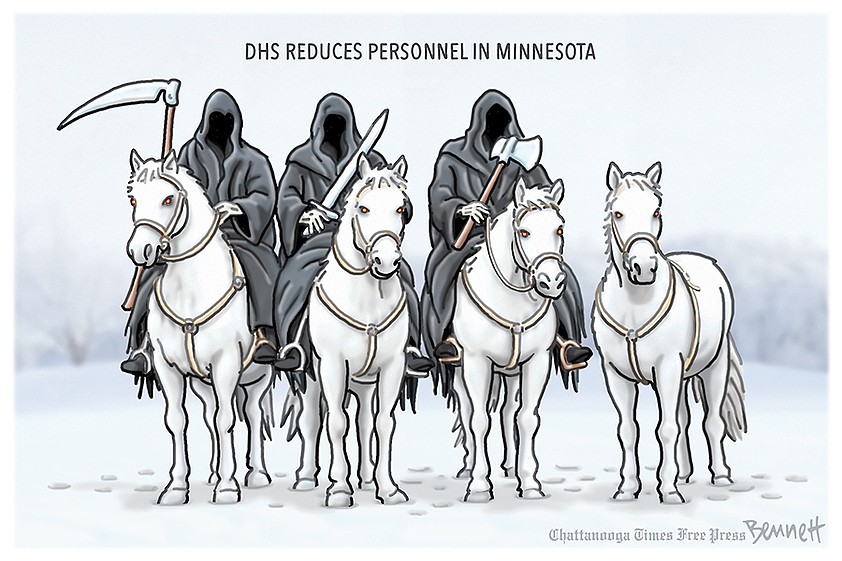
Politico tells the inside story of Minnesota officials dealing with Trump’s crackdown, and what lessons they have for other cities.

and Epstein

So now Bill and Hillary Clinton have both testified before the House Oversight Committee that is investigating the Epstein files. Reportedly, they answered every question. Both denied wrongdoing, and Hillary said she had never met Jeffrey Epstein, although she did know Epstein’s accomplice, Ghislaine Maxwell.

There is way more evidence linking Trump to Epstein than either of the Clintons. So why isn’t he testifying?

and deadly AIs

The Pentagon was negotiating a contract to use Anthropic’s AI app Claude, a competitor of ChatGPT. They hit a snag when Anthropic wanted the contract to ban Claude “being used for the mass surveillance of Americans or deployed in autonomous weapons with no humans involved”.

That demand didn’t just result in Anthropic losing the contract, but being declared a “supply chain risk“, which would blacklist the company from just about any government work. Axios says this designation is “usually reserved for companies from adversarial countries, such as Chinese tech giant Huawei”.

The future is not working out the way Isaac Asimov pictured. Sticking to his three laws of robotics will get you punished.

and you also might be interested in …

Florida is making it virtually impossible to teach introductory sociology at their state universities.

In 2023 the Florida Legislature passed a bill that bans curriculum at state-funded schools that supposedly teaches identity politics or diversity, equity and inclusion, or that suggests racism, sexism and other forms of oppression are embedded in American institutions.

You might wonder what kind of sociology textbook Florida professors could find that stays clear of all that. Well, Florida has made its own.

Florida’s new 267-page sociology textbook is an abbreviated version of the 669-page free and open-source “Introduction to Sociology 3e” and excludes chapters not just on race and ethnicity and gender and sexuality — the usual targets — but also on media and technology, global inequality and social stratification.

The word “racism” appeared 115 times in the original textbook, but just six times in the censored version. Sociology Professor Robyn Autry comments:

Because sociology aims to better understand “today’s most divisive issues,” it’s hard to imagine how any sociology course, especially an introductory one, can be taught without delving into topics that have been censored. And that appears to be the point for Florida Gov. Ron DeSantis and his allies on the board of governors. It’s rational to conclude that they don’t want sociology taught at all, and that it’s not just particular topics but the discipline as a whole that bothers them.

Robert Cassanello, president of the United Faculty of Florida, warns:

I have it on good authority that next year they’re going to look at the psychology and American history textbooks. It’s an assault on critical thinking.


Hegseth won’t allow officers to take courses at Ivy League universities. Anything that interferes with the indoctrination he wants the military to have is off the table.


India has shifted towards Israel because they are both ethno-nationalist states now.


How does MAGA want to make ObamaCare plans cheaper? By raising the annual deductible to $31,000.


Trump’s Trumpiest judge isn’t satisfied with just blocking his prosecution for his document-stealing crimes. She has also banned Jack Smith from releasing volume 2 of his report.

and let’s close with something slick

What do Canadian dads get up to when their wives aren’t looking? Curling with the baby in a car seat.

Until I went looking for that video, I never realized that “Dads unsupervised” is a popular YouTube search term. Here’s something else it will get you.

The Tariff Decision

At least for now, the power to tax still belongs to Congress.


I had been starting to wonder if we still had a Supreme Court.

Again and again, starting with two cases before the election (the ballot-access case in March, 2024, where the Court more-or-less took Section 3 of the 14th Amendment out of the Constitution; and the immunity case, where they placed Trump above the law) and proceeding through a series of shadow-docket cases in 2025, the high court has seemed to be just another agency in the Trump regime, and not at all an independent branch of government. After spending four years trying to limit executive power when it was wielded by Joe Biden, the Court has been expanding the reach of the Trump presidency well past legal limits that seemed clear to judges in lower courts.

But the Court’s creeping abandonment of the rule of law at least paused on Friday, when it ruled that the emergency law Trump had been using to justify his tariffs, the International Emergency Economic Powers Act (IEEPA), doesn’t actually give him that power. So the approximately $130 billion of IEEPA tariffs to date have been collected illegally.

I thought the law in this case was clear, so I can’t say that I was surprised by the outcome. But I was (at the very least) grateful that the six conservative justices didn’t make up some completely new legal principle to let Trump continue to do whatever he wants. (Only three of them did — not enough to form a majority.)

Several pundits are trying to read some great meaning into this decision, like that the Court is drawing a line on Trump’s power grabs. In other words, John Roberts has finally seen where all this is going and decided to take a stand. But I don’t think so. In order to understand what happened, you need to break the nine Supreme Court justices into three camps:

  • The partisan hacks: Alito, Thomas, and Kavanaugh. Whatever Republican presidents do is fine. Whatever Democratic presidents do is unconstitutional.
  • The liberals: Kagan, Sotomayor, and Jackson. They look at the statute Trump says authorizes his tariffs and can’t find an authorization there. They don’t think any novel constitutional doctrine is needed to see this.
  • The long-gamers. Roberts, Gorsuch, and Barrett. They’ve worked to establish new constitutional doctrines (Major Questions, Non-delegation) that limit regulation and unleash corporations to do whatever they want. Denying that those doctrines apply here would undermine their long-term program to hogtie the administrative state.

The votes of the hacks and the liberals were both predictable before any arguments were presented. The question was what the long-gamers would do: They are also partisan Republicans, as the immunity decision showed. (Barrett less so than Roberts and Gorsuch.) So they must have wanted to let the tariffs stand. But Trump’s justification for his tariffs flies in the face of Major Questions decisions the Court made during the Biden administration. Finding for Trump here would give the game away: Major Questions is just a rhetorical trick for constraining Democratic presidents; it doesn’t apply to Republican presidents.

Delegated powers. OK, let’s explain what these doctrines are. When Congress passes a law, sometimes small turns of phrase turn out to have big consequences. (I’ll give you a simple example from the Constitution: When the Founders gave the federal government the power to regulate interstate commerce, they never imagined that eventually nearly all commerce would have some interstate component. What they imagined to be a specialized power has turned into a sweeping power.) Both Major Questions and Non-delegation are supposed to limit this possibility.

  • Major Questions says that an executive action with huge consequences can’t be based on a subtle reading of an apparently minor phrase. So Biden couldn’t cancel all student debt, even though a law allowed him to change the terms of any particular student loan. Congress couldn’t have imagined that this simple provision could be the basis for a trillion-dollar action.
  • Non-delegation says that there are powers Congress can’t delegate, even if it wants to. It couldn’t, for example, delegate the power of the purse, essentially telling the president: “Tax and spend however you want.” Even if a law said that, the courts should disallow it.

Both of these ideas make sense in extreme cases, if the courts apply them fairly. But they both allow the Supreme Court to grab power away from the executive branch, and they’re both open to ideological bias. There’s no clear definition of the powers that can’t be delegated, or exactly when an executive action becomes “major”. So the Court has essentially given itself as much veto power as it chooses to claim.

Up until now, the Court’s conservative majority has been using that power in a partisan way, but they usually don’t even need to: Both provisions inherently favor de-regulation, because corporations tend to move much faster than Congress. For example, corporations can create new compounds faster than Congress can pass laws to regulate them. So the Clean Air Act specifically empowers the EPA to identify new pollutants and make rules about them. (The Obama administration used that power to find that climate change makes CO2 is a pollutant, allowing the EPA to regulate things like coal-burning power plants. The Trump regime has recently unmade that scientific finding, which the Court was probably going to undo anyway.) Disallowing delegations like that favors corporate malefactors over government regulators.

On the surface, both doctrines seem to be pro-democracy: If the government is going to do something significant, Congress should debate it and vote. That sounds lovely in the abstract, but it ignores the dysfunctionality of our Congress. Senate filibuster rules require a supermajority to pass new laws, and a presidential veto requires an even bigger supermajority to overcome. In practice, this means that very few new laws will get passed. So either major problems will go unaddressed, or other branches of government will have to use the powers Congress has abdicated.

This case. (The text of all the justices’ opinions is here.) The problem for the long-game faction is that the Trump tariffs are clearly a bigger intervention in the economy than Biden’s student-loan cancellation was. Biden wanted to take a one-time charge against the national balance sheet. But Trump wants to take hundreds of billions out of the private sector every year, and do it in a way that re-arranges the global trading system. So if student loan cancellation is a major question, massive tariffs must be too.

In 2021, Barrett famously declared that the Court “is not a bunch of partisan hacks”. Taking Trump’s side in this case would have exposed that as a lie.

So, here’s the issue this case presents: The Constitution gives Congress (and not the president) the power to tax. Tariffs are taxes. So a president can only impose a tariff if Congress has somehow delegated that particular taxing power to him or her. In his majority opinion, Roberts writes:

the President must “point to clear congressional authorization” to justify his extraordinary assertion of the power to impose tariffs. He cannot.

Trump takes the IEEPA as the congressional delegation he needs. But IEEPA doesn’t specifically mention tariffs, or any equivalent term. Kagan’s concurring opinion summarizes:

That text authorizes the President, upon finding a foreign threat and declaring an emergency, to “regulate” the “importation” of foreign goods.

Trump’s lawyers interpret “regulating” imported goods as including the power to tax them. But it can’t point to any other law where “regulate” carries that meaning. Roberts writes:

The Government concedes, for example, that the Securities and Exchange Commission cannot tax the trading of securities, even though it is expressly authorized to “regulate the trading of . . . securities.”

(Wouldn’t that be a bombshell, if the next Democratic president could impose a sales tax on NYSE transactions, and change the tax rate according to whatever whim possessed him that day?)

To the liberals, that’s the end of the story; it doesn’t matter whether the tariffs are major or minor, they’re just unauthorized by Congress. (To the charge of hypocrisy, in supporting Biden’s loan cancellation while opposing Trump’s tariffs, the liberals might point to this: Biden stretched a provision that is really in the law. But Trump is making up an authorization that doesn’t exist at all.)

But the long-gamers feel obligated to have an argument about why and how this falls under the Major Questions doctrine, which the liberals don’t recognize at all, and Barrett appears to regard as minor. That argument takes up about half of the 170 pages of opinions, and is well worth skipping.

The consequences. So according to the BBC, the regime has so far collected about $130 billion in illegal tariffs. Legally, that money ought to be returned. It’s a mess, made worse by the length of time the Court took to decide the case.

But who should it get returned to, and how? Directly, tariffs are paid by importers, so they presumably can sue to get their money back. (Or there’s an administrative procedure to claim tariff refunds, a process that undoubtedly will get swamped soon.) Importers like, say, WalMart or General Motors have plenty of lawyers, so they’ll eventually get their money back.

Indirectly, the tariffs have been paid by ordinary American consumers. A recent report from the New York branch of the Federal Reserve estimates that about 90% of the tariff costs were passed on to consumers in the form of higher prices. But absent some unlikely legislation to pay us back out of the Treasury, we’re just out of luck. You didn’t directly write a check to the government, so you can’t get a refund.

Next steps. Trump responded to his legal defeat in two ways: First, he lashed out at individual members of the Court, accusing them of being “swayed by foreign interests” and “fools and lapdogs for the Rhinos and the radical left Democrats”. His own appointees — Gorsuch and Barrett — weren’t exempted. He called their opinions “an embarrassment to their families, to one another”.

Second, he announced new illegal tariffs: First 10% across the board, which he then raised to 15%. (Since the IEEPA lawsuit was first decided in a lower court last June, and was filed months before that, you’d think Trump would have had a clear plan of what to do if he lost. Apparently he didn’t, and just started making stuff up on the fly.)

The new tariffs are based on a different law, Section 122 of the 1974 Trade Act. That law allows tariffs up to 15% that last for 150 days. However, there are conditions, which Trump has ignored:

the actual language of the Trade Act lists requirements that don’t exist today, including a “large and serious” balance-of-payments deficit. While the U.S. has run a trade deficit for decades, it’s been offset by capital inflows as foreign investors pour billions into financial markets, resulting in a net balance of zero.

Bryan Riley, director of the National Taxpayers Union’s Free Trade Initiative, wrote in a blog post last month that Section 122 only makes sense under a fixed exchange rate, which hasn’t existed in the U.S. in more than 50 years.

Expect lawsuits to be filed as soon as the new tariffs take effect. Trump will lose that case too.

However, winning may not actually be the point. The Supreme Court decision made Trump look weak, and responding with a new power grab makes him look strong again, at least for now. To the MAGA faithful, he remains a valiant warrior against the Deep State, which now includes two people he appointed to the Supreme Court himself.

One last point. Maybe at this point you are asking an obvious question: The Court didn’t say that tariffs are illegal, just tariffs unauthorized by Congress. Republicans control Congress, so why doesn’t Trump ask for authorization?

Two reasons: First, Trump’s authoritarian takeover relies on establishing that he doesn’t need Congress. A tariff he imposes on his own authority is better, in that view, from a tariff Congress gives him permission to impose. And second, Congress wouldn’t do it. The tariffs are unpopular, economists of all stripes say they’re a bad idea, and the Republican majorities in each house are small. Asking for permission and not getting it would make Trump look weak (because he is weak). From an authoritarian-takeover point of view, it’s the worst possible outcome.

Uncooperative Responses

No Sift next week. The next new posts will appear on February 23.

Our response should not be “This response to Bad Bunny’s inclusion shows how divided we are, how can we stop this polarization?” Our response should be uncooperative: “The response to Bad Bunny’s inclusion shows just how racist our society is. Racists are angry about the halftime show? Good! Everything about our society should make racists feel alienated. How do we make racists feel even more alienated from even more of society?

– A. R. Moxon, The Reframe

This week’s featured posts are “Non-Cooperation” and “Dying in Broad Daylight: The Washington Post“.

Ongoing stories

  • Trump’s assault on American democracy. This week he threatened to “nationalize” vote-counting in 15 states, and continued the violent occupation of Minneapolis.
  • Climate change. Trump’s war against renewable energy is having results: Last year, for every new dollar committed to renewable energy projects, three dollars were rolled back.
  • Gaza. The ceasefire is holding more or less, but it can’t hold forever if Gazans’ lives don’t start improving.
  • Ukraine. The question is less who is winning than who will crack first. Russia’s economy is in serious trouble, and Ukraine is running out of soldiers.

This week’s developments

This week everybody was talking about election interference

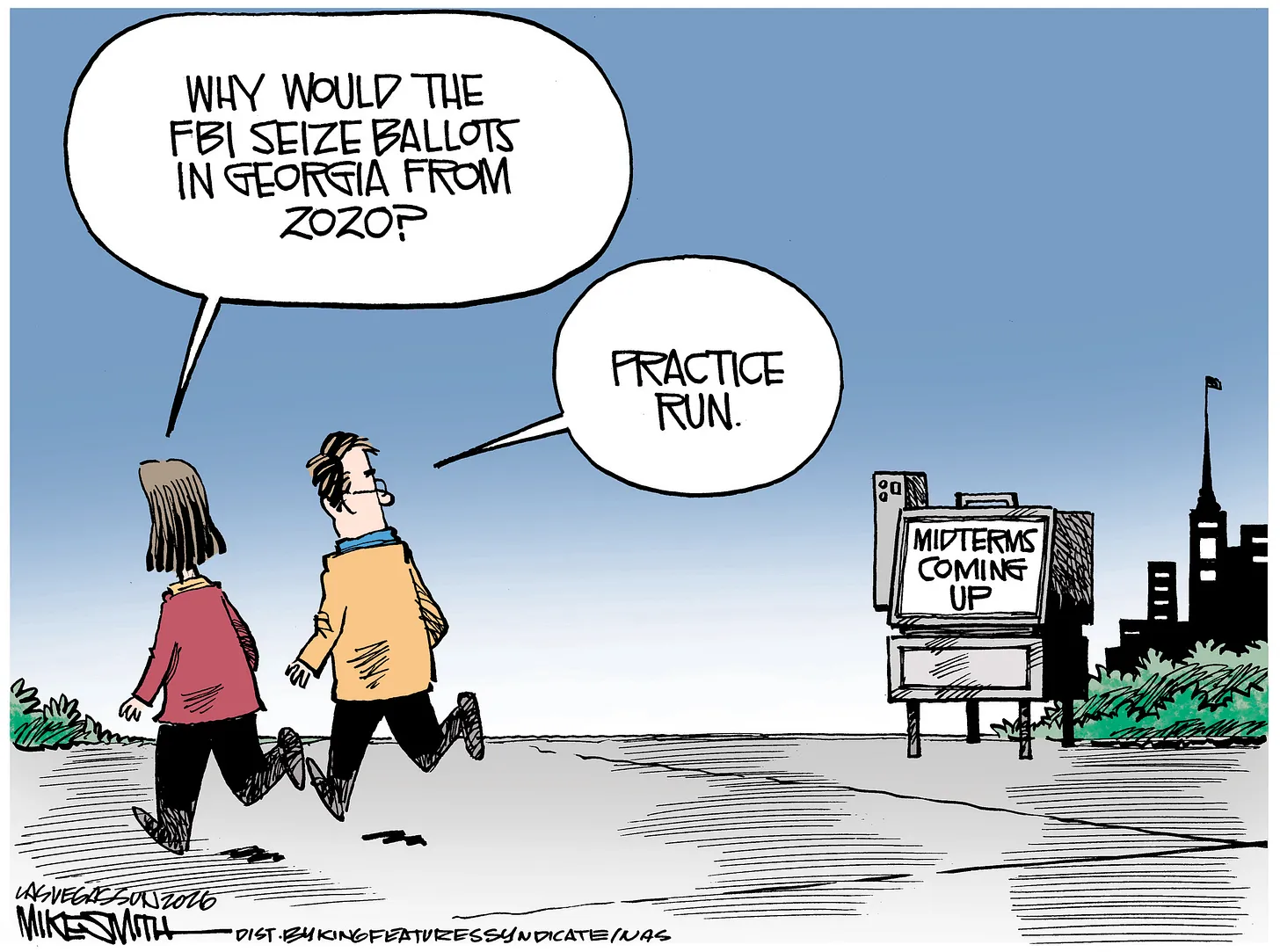
In the wake of the regime’s seizure of Georgia’s 2020 ballots and election records, and Trump threatening to “nationalize” the midterm elections rather than let states run them (as the Constitution mandates), it’s hard to decide how alarmed to be. Trump may daydream about counting the ballots himself and proclaiming his lackeys the winners, but what can he actually get away with?

Hakeem Jeffries sounds very confident: “What Donald Trump wants to do is try and nationalize the election – translation: steal it. And we’re not going to let it happen. This is going to be a free and fair election. [It] is going to be conducted like every other election where states and localities have the ability to administer the laws.”

Democracy Docket’s Marc Elias gets down into the weeds a little and has a more nuanced take on the situation. He starts with the strange fact that the warrant for the Georgia seizure came from a Missouri prosecutor, Thomas Albus, rather than from any Georgia prosecutor. It turns out that Albus has been named a “special assistant” to the attorney general. That gives him national scope, and might allow him to seize ballots anywhere in the country.

But Elias thinks seizing ballots in an ongoing election might be more difficult.

It is one thing to seize old ballots; it is quite another to imagine federal agents seizing ballots from county offices on election night or the day after. And that’s only the beginning of the chaos he could unleash. States and counties have limited supplies of voting machines and tabulators, and Trump has already threatened to unilaterally decertify certain machines. A federal prosecutor willing to abuse his power would be a potent tool in achieving Trump’s stated goals. The same is true of mail-in ballots and other forms of voting that Trump seeks to outlaw or disrupt.

But Albus would need cooperation from other prosecutors, FBI agents, and local judges. While Albus might be willing to corruptly serve his boss, others might not be.

Vox interviewed the Brennan Center’s Wendy Weiser, who has a similar opinion.

There is a very high risk that the administration will use every tool at its disposal to get voting machines or ballots in the course of an upcoming election. But I don’t think there is a high risk that they will succeed. I think every magistrate judge in the country would understand the difference between a search warrant to seize materials for an election that happened five years ago and a search warrant to seize election materials from an election in progress. I understand why people are worried. But it’s not remotely the same.

The Vox article also addresses the worry that ICE will create chaos in Democratic cities in swing states — maybe Atlanta or Philadelphia or Milwaukee. The point would be to lower voter turnout and shift the state Republican. However, it’s just as likely that a heavy ICE presence would energize Democratic voters rather than deter them. Weiser concludes:

There is clearly an effort afoot to interfere in our elections and that is something that people should be alarmed about. But this can be thwarted. And it must be.

and Minneapolis (still)

If you think the regime has changed its tactics in Minneapolis, think again. Watch this video, for example. A woman is following an unmarked ICE vehicle when agents jump out with guns drawn on her. The quickness with which agents draw their guns tells you everything you need to know. Has there been a single incident in Minneapolis in which an agent drawing a gun was an appropriate response? I think not.

More senseless gun-drawing and tear-gassing is recorded here. And then there’s this incident:

Four days after ICE arrested a Rochester man who is the recipient of a kidney transplant, federal authorities still have not given him the life-saving medications he needs to prevent his body from rejecting the donated kidney, according to the man’s wife.

There hasn’t been a headline-grabbing ICE murder in the last couple of weeks. But that doesn’t mean anything has fundamentally changed.


Speaking of murder, Trump explains to NBC’s Tony Llamas how unfair it is to judge his immigration crackdown by the completely unjustified killings of Renee Good and Alex Pretti: “two people out of tens of thousands, and you get bad publicity”.

Has anybody in history ever been treated more unfairly than Donald Trump? I mean, I get that two people are dead and their families will never see them again, but Trump has had to suffer through bad publicity. How can you not sympathize with him?


Yesterday I spoke to my minister, who was part of the clergy demonstrations in Minneapolis two weeks ago. He described a church in Minneapolis that invited families who are afraid to leave their homes to sign up online to have groceries delivered to them. They expected to get maybe a dozen responses, but instead they got hundreds. And they mobilized volunteers to deliver the food.

Fox News loves to describe the resistance in Minnesota as “a national network of socialist, communist and Marxist-Leninist cells in the United States” who are funded by “foreign adversaries“. But it’s neighbors helping neighbors, using free online tools (like Sign-Up Genius) to organize themselves.


Springsteen’s “Streets of Minneapolis” was the most-downloaded song in the country last week.


Law Dork discusses a remarkable court transcript in Minnesota. You may have heard one quote from it, where the administration’s lawyer fantasizes about being held in contempt so that she can get some sleep.

The larger story is that lawyers and prosecutors have been resigning from the Minnesota office because the administration’s policies challenge them ethically. Simultaneously, ICE is arresting so many people for no reason that it’s hard to process all the court orders releasing them. So they remain in custody for no reason.

The judge, understandably, disapproves. “What you cannot do is detain first and sort out lawful authority later.”

and Trump’s racism

As anyone with a shred of objectivity knows, Donald Trump has been racist his whole life. NYT columnist Jamelle Bouie sums up:

For years, a cottage industry of political observers has contorted itself to obscure and occlude the obvious. That regardless of what others see in him, Trump’s entire political career — from his embrace of birtherism to his hatred of birthright citizenship — cannot be understood outside the context of his bitter, deep-seated racism.

Thursday night, he ended all legitimate doubt by posting a one-minute video that included an image of Barack and Michelle Obama as apes, a common racist trope. After expressions of outrage even from friendly Republicans like South Carolina Senator Tim Scott, the post was removed. But Trump insisted that he would not apologize because “I didn’t make a mistake.” He claimed he hadn’t watched the video all the way through, and so had missed the Obamas-as-apes part. Of course, reposting to millions of people videos you haven’t watched all the way to the end is not a “mistake”, and the people who do watch it to the end don’t deserve an apology.

White House Press Secretary Karoline Leavitt denounced the “fake outrage” the video provoked. Obviously, no one could be genuinely offended by the President of the United States promoting a centuries-old slander that casts your people as subhuman.


A federal judge blocked Kristi Noem’s attempt to end temporary protected status for over 350K Haitians living in the US. The judge points out that Noem has attempted to block all 12 of the TPS designations that have come up for renewal during her tenure. The law establishing TPS had very specific condition for ending TPS status, and Noem has completely ignored them.

Notice, this has nothing to do with “illegal” immigration. TPS recipients come here legally, work, and play significant roles in some communities. These are the same people that J. D. Vance slandered as eating their neighbors’ dogs and cats.

and the Washington Post

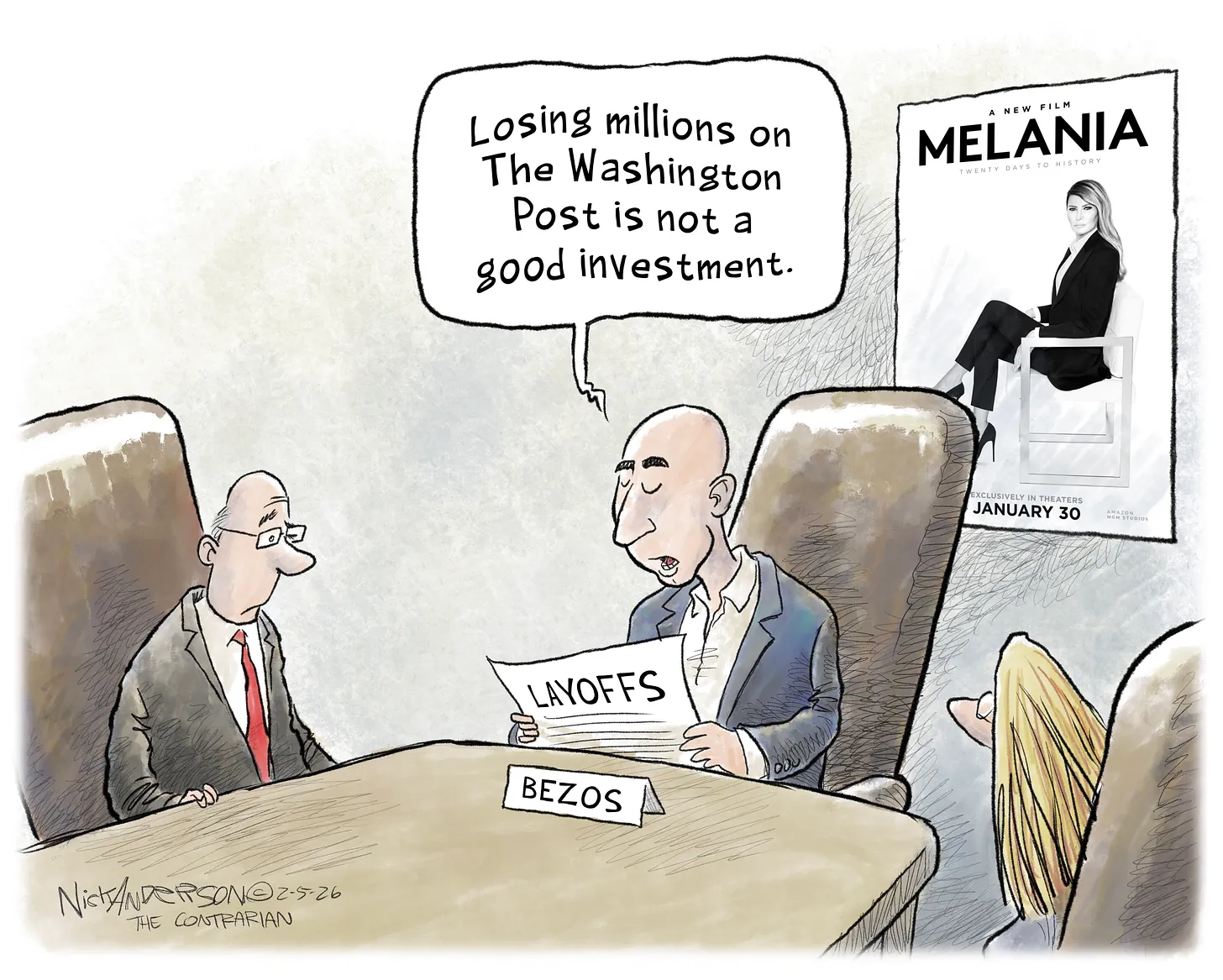
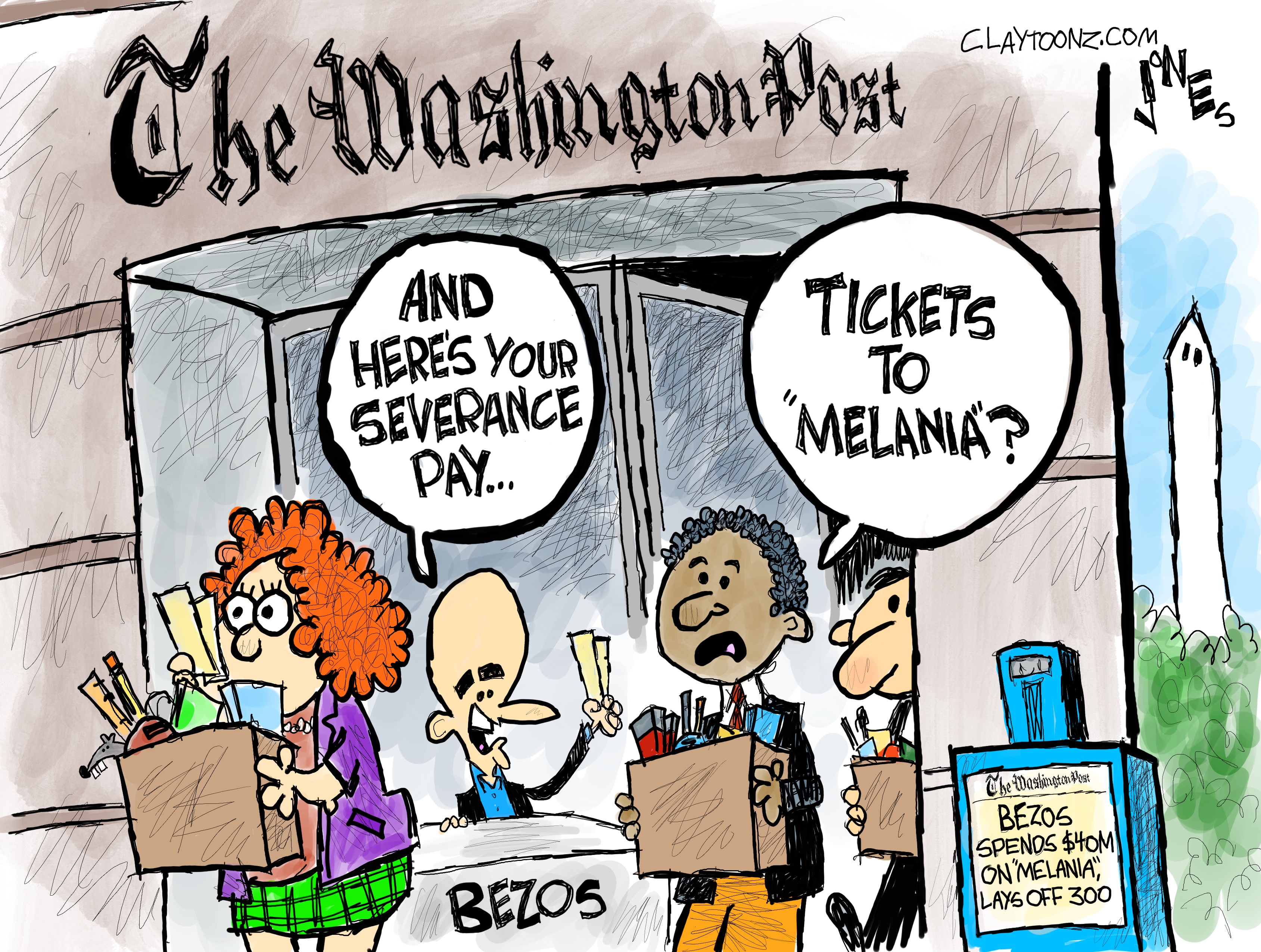
That’s covered in one of the featured posts.

but I want to introduce you to somebody

The other featured post links to The Reframe, a Substack written by A. R. Moxon.

and the Kennedy Center

Putting Trump’s name on the Kennedy Center resulted in audiences staying away and artists canceling their performances. So Trump decided to take his ball and go home: The Trump-Kennedy Center will close for two years for renovations, starting on July 4.

The “Construction, Revitalization, and Complete Rebuilding” is supposed to cost $200 million, which will either come from private donations or from money for “capital improvements” in the Big Beautiful Bill. NPR doesn’t see how this is possible, given that renovations on the David Geffen Hall in Lincoln Center in New York cost $550 million for a less complicated space.

The Center has contracts that go beyond July 4: scheduled performances, employees contracted to work there, and so on. It’s not clear what will happen to them, or if anybody has even thought about them. Five unions issued a joint statement:

At this time, no formal notice or briefing has been provided to the unions of arts workers whose labor sustains the John F. Kennedy Center for the Performing Arts. We only know of public statements issued by President Trump and an internal message to some Kennedy Center employees that reiterated the President’s social media remarks. A pause in Kennedy Center operations without due regard for those who work there would be harmful for the arts and creative workers in America. Should we receive formal notice of a temporary suspension of Kennedy Center operations that displaces our members, we will enforce our contracts and exercise all our rights under the law. We expect continued fair pay, enforceable worker protections, and accountability for our members in the event they cannot work due to an operational pause. Our members remain steadfast in bringing to life theatrical, music, opera, dance, and other live artistic performances in the nation’s capital that speak to and resonate with all Americans.

During his second term, Trump has put a lot of effort into making a mark on DC and the country that will live on after him. This project, I think, is doomed to fail. As soon as he is gone, the country will undo virtually everything he has done. From the Kennedy Center to the Gulf of Mexico, everything will get its pre-Trump name back. His battleship class will never sail. His ballroom will become something else entirely. His triumphal arch, if it gets built at all, will be torn down. The Trump Era is going to be remembered as a time of American shame. By the time he’s gone, not even his current supporters will want to commemorate it.

and you also might be interested in …

Economist Oren Cass wrote an important piece in the NYT: “The Finance Industry is a Grift. Let’s Start Treating it That Way“. Once, the banking industry was how people’s spare cash turned into houses, railroads, and factories. But the vast majority of what the finance industry does today is disconnected from the productive economy, and its profits are largely parasitic.


The Epstein survivors have released a new ad calling on Pam Bondi: “It’s time for the truth”.


When the Trump administration gets beat, it turns vindictive. We’ve seen that spiteful side in their unending persecution of Kilmar Abrego Garcia, who they were forced to return to his family after illegally sending him to a concentration camp in El Salvador. Now we’re seeing the same hate unleashed against the family of Liam Ramos, the five-year-old whose detention became national news. A week ago Saturday, a federal judge ordered Liam and his father released from the concentration camp in Texas where they had been held since January 20. His ruling was scalding.

But of course, the regime can’t let that stand. So Wednesday they petitioned to expedite deportation hearings on Liam’s father, who came to the border legally, requested asylum from persecution in his home country of Ecuador, and is cooperating with the legal asylum process. Friday, a federal judge granted a continuance, slowing the process down. The reports I’ve seen so far don’t say for how long.


J. D. Vance got booed during the opening ceremony of the Winter Olympics in Milan. But if you were watching live in the US, you didn’t hear it; the rest of the world did. Best response is from Keith Oregel: “Imagine getting booed for being a fascist in Italy.”

Dying in Broad Daylight: The Washington Post

We’ve seen newspapers go into a death-spiral before. But who thought it could happen to The Washington Post?


Maybe you’ve seen this pattern with your own local newspaper: It has financial problems, so it lays off staff. Then the paper shrinks and has less to offer, so its readership declines, creating new financial problems. So the cycle repeats: more layoffs, less coverage, fewer readers, less revenue.

When that happens to a small-town paper (as it has, many, many times in the last 20 years or so), it’s tragic for the community the paper serves, but the rest of us barely notice. Now, however, it’s happening to one of the most storied, most influential newspapers in the United States: The Washington Post.

It wasn’t supposed to be this way. When the Graham family sold The Post, it looked for someone who had both the will and the resources to do right by one of the crown jewels of American journalism. And at the time, Amazon founder Jeff Bezos looked like the right choice. In The New Yorker, Post veteran Ruth Marcus described the moment like this:

On September 4, 2013, the Amazon founder Jeff Bezos held his first meeting with the staff of the Washington Post, the newspaper he had agreed to purchase a month earlier from the Graham family, for two hundred and fifty million dollars. It had been a long and unsettling stretch for the paper’s staff. We—I was a deputy editor of the editorial page at the time—had suffered through years of retrenchment. We trusted that Don Graham would place us in capable hands, but we did not know this new owner, and he did not know or love our business in the way that the Graham family had. Bezos’s words at that meeting, about “a new golden era for the Washington Post,” were reassuring. Bob Woodward asked why he had purchased the paper, and Bezos was clear about the commitment he was prepared to make. “I finally concluded that I could provide runway—financial runway—because I don’t think you can keep shrinking the business,” he said. “You can be profitable and shrinking. And that’s a survival strategy, but it ultimately leads to irrelevance, at best. And, at worst, it leads to extinction.”

For a while, Bezos and The Post had favorable winds. The controversies of the first Trump administration drove the public’s interest in political coverage, and The Post rode that wave to build its online readership. Then the Biden administration set out to be boring (as good government often is) and largely succeeded. The Post began losing money, and even Trump’s return hasn’t turned that around.

Then Bezos stepped away from his white knight role and began interfering in the newsroom. He cancelled the Post’s endorsement of Kamala Harris at the last minute, shifted The Post’s stable of columnists sharply to the Right, and began currying favor with Donald Trump, who has the power to give or take billions from Amazon’s bottom line. Bezos’ most blatant and most corrupt move is playing out right now: He gave First Lady Melania Trump $40 million for the rights to make the Melania propaganda vehicle, and spent another $35 million promoting it. Yahoo reports that the film’s $7 million opening weekend was larger than expected [1] and high for a documentary, but

It’s hard to imagine a scenario where the film ends up making the $75 million back.

From the beginning, it was obvious that giving Melania $40 million could not be justified economically. It was a bribe.

Bezos appeared to miss one of the key factors about The Post’s potential audience: It appeals to people who want sound, fact-based coverage. But in the Trump era, those people are mostly liberals. Like Elon Musk before him, by bowing to Trump he was alienating most of his market base.

On the flip side, The Post hasn’t been able to bow sufficiently low to attract many MAGA readers.

So Wednesday, Bezos ordered a massive layoff, about 1/3 of The Post’s workforce. The sports department is gone, and the Books section, along with big chunks of its international coverage. (For example, the Ukraine bureau and the Middle East bureau.) The Metro section shrinks from around 40 staff members (already well below its peak) to maybe 12.

NPR analyzes:

Now the Post appears poised to appeal primarily to readers interested in issues about the U.S. government, with an emphasis on national security and American politics. … Several former editors said it appeared the paper was seeking to compete more with such specialized publications as Politico and Punchbowl rather than The New York Times.

Here’s how I think about it: Historically, the Post has been the local newspaper of a company town: the town is D. C. and the company is the US government. That made the Post interesting to a national audience, in addition to the people who wanted to keep up with the Redskins or know what was happening on the National Mall. The recent layoffs look like a decision to stop being a local newspaper in any but the most superficial sense. But simultaneously, Bezos’ decision to position the Post as a MAGA-friendly billionaire-favoring news outlet is alienating its mostly non-MAGA national base. Besides, Fox News and The Wall Street Journal already own that market.

The rest of the mainstream press has been mourning for what the Washington Post used to be, and blaming Bezos for failing to come up with a solution other than entering the doom-loop of diminishing quality and diminishing returns. Many have referenced the scene in Citizen Kane where Kane says he doesn’t care how much money his newspaper loses, because he can go on losing at this rate for sixty years.

Bezos is far richer than Kane (or William Randolph Hearst, the model for Kane). The Post’s losses are just a rounding error on Bezos’ net worth. He could go on losing at this rate forever.

However, it’s a bit unfair to blame him for refusing the Charles Foster Kane role. We, the news-consuming public, have no real claim on the Bezos fortune. [2]

For that reason, one of the most interesting takes on the Post’s situation is from Josh Marshall, who has shepherded Talking Points Memo from a one-man blog to a profitable news site. The necessities of business leave him little room for being sentimental about journalism. “Making payroll,” he says, “is a brutal taskmaster.”

He sees the Bezos/Post saga as one more example of the “billionaire white knight press baron doom cycle” (previously observed when Chris Hughes bought The New Republic in 2012). The billionaire comes in as a hero, ready to spend what it takes to turn around the flagging fortunes of some iconic news source. Why doesn’t that work? In a prophetic post last July, Marshall observed:

The super rich don’t like losing money, even if it’s at scales that are essentially meaningless to them. … Why did things go wrong when Bezos got involved and started making big changes [at the Post]? A big part of the answer is the consultants, the particular ones a guy like Bezos would gravitate toward. In short, he gravitated toward the ones who speak billionaire. Which is to say, the language of leverage, commercial paper, efficiencies, disruption, innovation, the big idea, etc. Why would he go to those people? Because that’s his social world. To the extent Bezos has peers they live in that world, work with those consultants, think in that way. … They have these ideas because, like Bezos, they are heavily plugged into the tech business, its assumptions, its business models. Critically, they are hyper-focused on scale and efficiencies — two things which can be positives but are mostly neither here nor there in terms of the challenges facing most news publications.

Marshall takes a both-sides-are-wrong attitude towards the Post. The business model of the 20th-century metro newspaper is dead, but Bezos is

defaulting to what was probably the biggest error of the first two decades of the 21st century on the business side of the journalism business: the idea that the dynamics, business concepts and mores of the tech world were applicable to the news business. They’re mostly not.

Bezos will probably bring in a new batch of non-journalist consultants when The Post’s decline continues, and so the doom loop will continue, until Bezos either closes the doors or sells to someone who understands what The Post can be in the current era.


[1] Possibly because military commanders pressured their subordinates to see the movie. Viewership dropped considerably in its second week.

[2] I will leave aside whether multi-billionaires like Bezos should face higher taxes, or whether the antitrust laws should apply to online monopolies like Amazon. I strongly support both propositions, but that’s a different conversation.

Through the Looking Glass

To those who continue to work for ICE: Resign. To those who control this facility: Leave. Through your use of violence and the trampling of the Constitution, you have lost all legitimacy and replaced it with shame. To those who continue to make these sickening decisions, go home, look in a mirror, and ask yourselves why you have gassed children. Ask yourselves why you continue to work for an agency responsible for murders on American streets. No one is forcing you to lie to yourself, even as your bosses continue to lie to the American people.

Keith Wilson, Mayor of Portland, Oregon

This week’s featured post is “Did We Win?” about the situation with ICE in Minneapolis.

Ongoing stories

Once again, I’m dropping the ball on climate change and various wars to focus on the battle for democracy here in the United States. I hope things seem less urgent next week.

This week’s developments

This week everybody was still talking about ICE

ICE and the resistance against it is the focus of this week’s featured post, but there’s a lot I couldn’t get to there.


The five-year-old in the bunny hat is back home. Liam Ramos and his father were both released from a Texas detention center Sunday and flown back to Minneapolis. They had been in ICE custody since January 20. The release was ordered by a federal judge on Saturday.

US district judge Fred Biery said in his ruling on Saturday that “the case has its genesis in the ill-conceived and incompetently-implemented government pursuit of daily deportation quotas, apparently even if it requires traumatizing children”.

The regime claimed that when they took Liam’s father they had no choice but to take him too, because otherwise the child would have been “abandoned”. The superintendent of his school district disputes this, claiming that “another adult living in the home was outside and begged the agents to let them take care of the small child, but was refused”.

But here’s the piece often left out of the story. Not only did ICE have no reason to take Liam, they had no reason to take his father either. He had entered the country legally, by turning himself in at the border and asking for asylum, claiming that he faced persecution back in Ecuador. His lawyer says:

These are not illegal aliens. They were following all the established protocols, pursuing their claim for asylum, showing up for their court hearings, and posed no safety, no flight risk and never should have been detained.

The judge’s order says it best:

the Court finds that the Constitution of these United States trumps this administration’s detention of petitioner Adrian Conejo Arias and his minor son, L.C.R. The Great Writ and release from detention are GRANTED pursuant to the attached Judgment. Observing human behavior confirms that for some among us, the perfidious lust for unbridled power and the imposition of cruelty in its quest know no bounds and are bereft of human decency. And the rule of law be damned.


One of the zombie lies about anti-Trump protests is that the protesters aren’t actual concerned citizens, they’re professional agitators paid by George Soros or some similar conspiracy-theory villain. (When the protesters are Black, which they mostly aren’t this time but were during the George Floyd demonstrations, the paid-by-Soros story plugs into a longstanding antisemitic/racist narrative: Jews are organizing and bankrolling Blacks to overturn White Christian society. This story has the advantage of validating stereotypes in both directions: Blacks wouldn’t be smart enough to organize on their own, without some scheming Jew behind it all.) I’m not sure exactly when this conspiracy theory got started, but it was certainly spreading at the time of the Women’s March in 2017.

If you think about this theory for more than two seconds, you’ll see how easy it would be to infiltrate and expose the whole operation, if it were actually happening: Soros is supposedly recruiting tens or even hundreds of thousands of people. Somehow he’s reaching out to them and convincing them to join. How hard would it be to cosy up to some left-wing acquaintance and get yourself recruited into Antifa, or whoever is supposed to be carrying this out? Then you could record everything, keep track of who paid you and how, and write a big expose’ for the right-wing media. You could be the Whittaker Chambers of the 21st century.

So after nine years, where is that story? Where are the names named and the receipts published? (And where’s my check, George?)

Anyway, the story never dies despite the complete lack of evidence, so I doubt that my two-seconds-of-thought is going to dissuade anybody. So the proper response is probably ridicule. With that in mind, check out this article from the humor site McSweeney’s: “I Am the Payroll Accountant for Professional Protestors in Minnesota, and I Am Swamped“. It’s a collection of memos about being sure accounting has your right name (rather than Fight D. Power), and reminding protesters to fill out their timesheets and come to the office to pick up their checks.


Fox News continues to try to make the Minnesota resistance sound sinister. Friday, they published an “analysis” by a former CIA agent identifying the “insurgency” tactics being used in Minnesota.

“All of the evidence I’ve seen indicates to me that the insurgency is funded by foreign adversaries who want to see violence and Americans fighting each other,” said de la Torre, now founder of Tower Strategies, an advisory firm based in Washington, D.C.

If you’re looking for what that evidence might be, though, the article won’t help you. The analysis is de la Torre’s personal hobby horse. If you want to believe him, you can. But if you’re skeptical, nothing here is even slightly convincing.

I’m particularly amused by the “funded” part. The resistance uses whistles, cell phones people have already, and free internet tools like Facebook and YouTube and Signal and Google Sheets. How much “funding” does that require? (Yesterday, somebody at my church was collecting money to buy handwarmers for the people who have been standing by our local road holding protest signs during the current cold snap. I suspect the involvement of the Chinese Communist Party, or maybe just a handful of my friends.)

A week ago Thursday, a group of white-haired protesters blocked the entrance to an ICE facility in Williston Vermont. Suspecting an operation by sleeper agents from Iran, I asked a friend in Vermont if she knew any of the people involved. She did, and would have gone herself if she hadn’t been involved in a different resistance activity.

The day a drone takes out an ICE SUV, talk to me about “funding”. Nothing we’ve seen so far requires “funding”.


Paul Krugman looks at the same level of organization and sees an American “color revolution”, like the Orange Revolution in Ukraine or the Rose Revolution in Georgia.

and the Epstein files

DoJ released over three million pages of Epstein files Friday, only a month and a half after the deadline in the Epstein Files Transparency Act. That’s barely more than half the six million files prosecutors were talking about previously, but Deputy Attorney General Todd Blanche insists this is the last release.

Once again, DoJ is claiming they have no evidence on which to prosecute anyone other then Epstein himself (who is dead) and his girlfriend Ghislaine Maxwell (who is already in prison). And that may true, as far as it goes. But if these documents aren’t enough to get convictions, it seems like there ought to be plenty to predicate investigations. Who might be called in and questioned? Are there other records that could be gotten through search warrants?

Despite the extra time taken to produce the documents, identities of the victims were not protected. Worse:

The Justice Department published dozens of unredacted nude images on its website, showing young women or possibly teenagers whose photos were contained in files related to the wealthy sex offender Jeffrey Epstein.

I don’t think we’ve heard the end of this yet.

and election tampering

There are two ways to look at the FBI seizing Georgia’s 2020 election ballots and records Wednesday. Either this is

  • one more Trump attempt to prove that Joe Biden didn’t kick his butt in the 2020 election, which he lost by 7 million votes
  • the opening salvo in Trump’s attempt to rig this fall’s midterm elections

Kristin Nabers, the Georgia state director of All Voting is Local, explains the first view:

I think the FBI is doing the president’s bidding and trying to create a criminal case against Georgia. And by carrying out this farce of an investigation, they’re just trying to placate his delusions. It’s all a power grab. They can’t come to grips with the fact that they lost. They really have this unending obsession with the 2020 election results in Georgia and using lies to compensate for the fact that they lost.”

and the second:

I think they’re using Georgia as a blueprint to see what they can get away with elsewhere, because if they’re allowed to seize election materials here, what would stop them from doing it in other states during the midterms?

David French imagines a variety of ways Trump could rig the election without controlling the count. For example, imagine ICE continues to racially profile non-Whites as potentially illegal immigrants, and continues to temporarily detain even legal residents and citizens in brutal conditions. Then ICE opens an operation near polling places in blue cities, so that non-Whites are afraid to show up.

Court orders might try to stop this, but the regime already ignores court orders.

and Don Lemon

Ex-CNN host Don Lemon, who was let go by CNN in 2023 and has since started his own YouTube channel (with over a million subscribers), was arrested Friday under two federal statutes, for covering a protest in St. Paul on January 18. I haven’t done extensive research, but as far as I know this is unprecedented in the United States. Journalists are sometimes charged with trespassing when they follow protesters into some place they shouldn’t be, but even those charges are usually dismissed. This looks like part of the regime’s continuing effort to intimidate, co-opt, and otherwise control the press.

Let’s start at the beginning: There’s a Southern Baptist church in St. Paul with a pastor David Easterwood, whose weekday job has him leading the St. Paul ICE field office. On January 18, 30 or 40 protesters disrupted the church’s Sunday service by chanting “ICE out” and “Justice for Renee Good”. None of the accounts mention violence by the protesters, but congregants reported being frightened. One woman broke her arm when she fell while rushing to get out.

By the time police arrived, the protesters had moved outside the church. I don’t know if the church went on to complete its planned service, but it could have. In the accounts, I can’t see any mention of people being arrested at the scene by St. Paul police.

Then the regime’s “Justice” Department got involved. There is a federal FACE Act (Freedom of ACcess to Entrances), which was passed in 1994 to prevent anti-abortion protesters from blocking the entrances of clinics. It also applies to churches:

Whoever … by force or threat of force or by physical obstruction, intentionally injures, intimidates or interferes with or attempts to injure, intimidate or interfere with any person lawfully exercising or seeking to exercise the First Amendment right of religious freedom at a place of religious worship … shall be subject to the penalties provided [elsewhere in the statute]. … The term “intimidate” means to place a person in reasonable apprehension of bodily harm to him- or herself or to another.

Penalties for a first offense without violence are up to a $10,000 fine and six months in jail. However, the law also says

Nothing in this section shall be construed … to prohibit any expressive conduct (including peaceful picketing or other peaceful demonstration) protected from legal prohibition by the First Amendment to the Constitution

So arresting protesters or the leaders of the protesters is already a bit of a stretch, and the case against them relies on proving that the protesters intended to inspire a “reasonable apprehension of bodily harm” in the congregants. In other words, it’s not enough that a woman was frightened enough to break her arm leaving church. Her fear has to be reasonable, and the protesters had to intend to inspire that fear.

No way there will ever be a conviction here. A second charge is even more speculative: violating the Conspiracy Against Rights law, which was passed after the Civil War as an anti-Klan measure. People violate CAR

If two or more persons conspire to injure, oppress, threaten, or intimidate any person in any State, Territory, Commonwealth, Possession, or District in the free exercise or enjoyment of any right or privilege secured to him by the Constitution or laws of the United States, or because of his having so exercised the same

That can get you up to ten years in prison.

This is an even bigger stretch, because the intention to intimidate can’t just be a vague idea: Two or more people had to agree on a plan to do it. So OK, arresting protesters on these charges is more harassment than an actual threat of conviction. But the regime took it a step further: They arrested two independent journalists — Don Lemon and Georgia Fort — for covering the protest.

Lemon was live-streaming, so whatever he did is there in the video. (Clips of it were shown during his show.) I haven’t watched it, but apparently he did not participate in the demonstration. He didn’t, for example, do any slogan-chanting. He just followed the protesters in and interviewed people.

and you also might be interested in …

Paul Krugman writes about Trump’s hostility towards Canada.


Supreme Court arguments on Trump’s challenge to birthright citizenship will begin on April Fools Day.


Another factoid that I am absolutely not making up: DHS Secretary Noem‘s full name is Kristi Lynn Arnold Noem. So if you want to refer to her by her initials, in an FDR or JFK style, it’s KLAN. We seem to be living in a bad novel.


Heather Cox Richardson called out something Stephen Miller posted on social media:

Plenty of countries in history have experimented with importing a foreign labor class. The West is the first and only civilization to import a foreign labor class that is granted full political rights, including welfare & the right to vote. All visas are a bridge to citizenship. In America, for generations now, the policy has been that anyone who would economically benefit from moving to the US can do so, exercise the franchise in the US and their children, the moment they are born, will be full American citizens with all the rights and benefits therein. Put another way: the easier your immigration policy makes it for newcomers to vote the more discerning your immigration policy must be.

Miller, in this post, does not say explicitly that it’s a mistake to give a foreign laboring class full rights. But we know from his other statements that he’s against it. He’s against birthright citizenship and a clear path to citizenship for immigrants. Being the “first and only” civilization to do this, in his mind, is foolish. The previous day he had denounced Sherrod Brown for proposing to “Protect Ohio’s Haitian community” by preserving their TPS legal status.

Under what definition are Haitian illegal migrants flown here by the Biden Administration an “Ohio community”? Democrats just flatly reject any concept of nationhood that has ever existed in human history.

Richardson points out how “History is doing that rhyming thing again.” Miller’s hierarchical view of society, with a laboring class that can never aspire to anything higher, echoes arguments pre-Civil-War Southerners made for slavery and the subordination of women.

The hierarchical system Miller embraces echoes the system championed by those like [South Carolina Senator James Henry] Hammond, who imagined themselves the nation’s true leaders who had the right to rule. They were not bound by the law, and they rejected the idea that those unwilling to recognize their superiority should have either economic or political power.

These are not the principles America was built on.

and let’s close with something that should have happened

Sadly, the ICE-chasing-a-rolling-finger video is AI-generated. Somewhere, there is a better world where this really happened.

Did We Win?

Trump is back-pedaling on Minneapolis. But has anything really changed yet?


At this point, just about all observers agree that the occupation of Minneapolis has been a political and public-relations disaster for the Trump regime. The unjustifiable shooting deaths of Renee Good and Alex Pretti, blatantly and absurdly lying about Good and Pretti from the highest levels of government, detaining five-year-old Liam Ramos and sending him to a camp in Texas, pepper-spraying a guy whose head was already being smashed to the ground, indulging a quick trigger-finger on pepper spray, drive-by gassing a crowd of protesters with no apparent purpose beyond causing harm — it just got to be too much.

The abuses of power had gone far beyond any reasonable misunderstanding or the actions of a few bad apples. Either ICE’s Minneapolis invasion force was all bad apples, top to bottom, or (worse) they were doing precisely what Trump and Stephen Miller wanted them to do: terrorize a city that hadn’t supported Trump in any of his three races.

That was, to put it mildly, a bad look. Polls were turning against ICE, and against the regime’s handling of immigration as a whole, turning what had been Republicans’ best issue against them. Even Republicans in Congress were beginning to speak up. Democrats in the Senate were emboldened to demand curbs on ICE abuses be added to the DHS funding bill.

Something had to be done. So Trump

For his part, Homan announced three apparent changes in strategy, including giving Minnesota credit for the level of cooperation it had extended all along — possibly creating a “concession” he can point to as a reason to draw down force levels.

All of which raised a question: It sounds good, but how much has really changed? The 3000 militarized federal agents are still in Minneapolis. PBS is reporting little change on the ground.

A group of protesters blew whistles and pointed out federal officers in a vehicle on a north Minneapolis street. When the officers’ vehicle moved, a small convoy of activists followed in their cars for a few blocks until the officers stopped again. Associated Press journalists were in the neighborhood covering the enforcement actions. When the journalists got out of their car to document the encounter, officers with the federal Bureau of Prisons pushed one of them, threatened them with arrest and told them to get back in their car despite the reporters’ identifying themselves as media.

Officers from multiple federal agencies have been involved in the enforcement operations. From their car, the AP journalists saw at least one person being pepper sprayed and one detained, though it was unclear if that person was the target of the operation or a protester. Agents also broke car windows.

This weekend, anti-ICE protests were held across the country. In many cities these protests passed without incident. But some DHS troops continued to treat protesting Americans as the enemy. Saturday in Portland, Oregon DHS troops attacked protesting crowds with multiple chemical agents. Governor Tina Kotek released a statement:

Indiscriminate and unlawful uses of crowd control tools by federal agents must stop. Whether in Eugene or Portland, or in any city in Oregon, a federal presence that meets the public with unnecessary force is fundamentally unacceptable in our nation.

Portland Mayor Keith Wilson’s response was more pointed:

To those who continue to work for ICE: Resign. To those who control this facility: Leave. Through your use of violence and the trampling of the Constitution, you have lost all legitimacy and replaced it with shame. To those who continue to make these sickening decisions, go home, look in a mirror, and ask yourselves why you have gassed children. Ask yourselves why you continue to work for an agency responsible for murders on American streets. No one is forcing you to lie to yourself, even as your bosses continue to lie to the American people.

In this video from Portland, a phalanx of DHS troops retreats into a federal building while raining gas canisters down on protesters who seem to be doing nothing illegal, violent, or threatening.

In short, the regime’s response so far has been to try to shift the narrative without noticeably changing policies.

It remains to be seen what changes Congress will demand as it holds the DHS funding bill for two more weeks. Senate Democrats are proposing fairly modest reforms: ICE agents should lose their masks [1] and wear identification, be subject to the same use-of-force regulations as local police, and wear body cameras. They should stop entering homes on purely administrative warrants rather than warrants approved by a judge. [2]

Reforms discussed but not demanded

include an explicit ban on racial profiling during immigration stops; a prohibition on ICE raids at “sensitive locations” such as schools and churches; the elimination of arrest quotas; the withdrawal of federal agents from Minneapolis; a ban on the detainment of US citizens; and a mandatory review of all use-of-force incidents.

And one question remains unanswered: Even if Congress does pass a law reining ICE in, will it obey? A Minnesota judge has listed 96 court orders ICE has flouted. ICE routinely violates rights protected by the Constitution. Will it obey an explicit law or not?

To sum up: ICE’s abusive uses of force have turned the American public against that agency, and have stained the Trump regime in general. In retrospect, we may someday see that as a turning point in restoring American democracy. But that only happens if we don’t let up. Keep demonstrating, keep speaking out, keep holding Democrats’ feet to the fire, and do everything you can to break the Republican majorities in Congress come the fall elections.


[1] Believe it or not, unmasking is controversial. Republicans are afraid that ICE agents will be publicly identified and face harassment from the public. An official ICE FAQ says:

ICE law enforcement officers wear masks to prevent doxing, which can (and has) placed them and their families at risk.

All I can say to that is: cowards. State and local police don’t wear masks. DEA agents challenge murderous drug cartels, but they don’t wear masks. The FBI agents who searched Mar-a-Lago didn’t wear masks. Members of Congress don’t wear masks (even though Ilhan Omar got attacked this week). The prosecutors and judges in Trump’s trials didn’t wear masks. But the precious snowflakes of ICE have to wear masks.

[2] Jay Kuo explains why Democrats can’t just stop funding ICE altogether: Usually, lines in a budget bill have to be followed up by an appropriations bill. (That’s what Congress has been passing recently.) But Trump’s “Big Beautiful Bill” (which passed through the reconciliation process without Democratic votes) didn’t just budget money for ICE, it appropriated the money. In short: ICE is already funded. As long as Republicans have congressional majorities and party discipline, they can keep doing this.

If we really want to end ICE, we need to retake the House and Senate in 2026, then hold those chambers while winning the White House in 2028. For that reason, I can understand a long-game approach on reasonable and popular reforms, one that splinters the GOP now and helps win back congressional majorities in Congress for Democrats. Nothing is more important in the end, even if we must painfully accept that we can’t get every reform we want right now.

Back in December, Slate’s Mark Joseph Stern promoted the idea that the next Democratic president has to use the executive powers the Supreme Court has given Trump:

First, let’s remember that the Supreme Court has now effectively granted the president authority to impound federal funds duly appropriated by Congress and to abolish federal agencies established and funded by Congress. I think that is terrible and anti-constitutional. But thanks to the Supreme Court, that is now the law. So let’s talk about what President AOC can do with those powers in 2029. On Day 1, she needs to impound ICE’s budget. She needs to refuse to spend the billions of dollars that Congress has appropriated to the agency and fire tens of thousands of immigration agents immediately, starting with those who committed acts of violence and discrimination—which, by that point, may be almost all of them. Close as many immigrant detention facilities as possible and free the detainees.

Then turn to Customs and Border Protection. Fire CBP chief Greg Bovino. Fire every single agent who participated in the horrific operations in Chicago, D.C., and L.A. Refuse to pay out a penny in benefits to any agent who broke the law. Release all the information about ICE and CBP’s immigration sweeps, including the names of every agent who participated. Start investigations and prosecutions of any law-breaking agent whom Trump doesn’t pardon. Repurpose the billions of dollars in savings as a reparations fund for every victim. Run the reparations program through a new agency established by executive order. Pay to return noncitizens who were wrongly deported back to the country. Transform ICE and CBP’s headquarters into the nerve center of a new Truth and Reconciliation Agency, and use this extra money to pay out damages to the victims of the mass deportation campaign. This would be 100 percent legal under the precedent established by Trump and the Supreme Court.