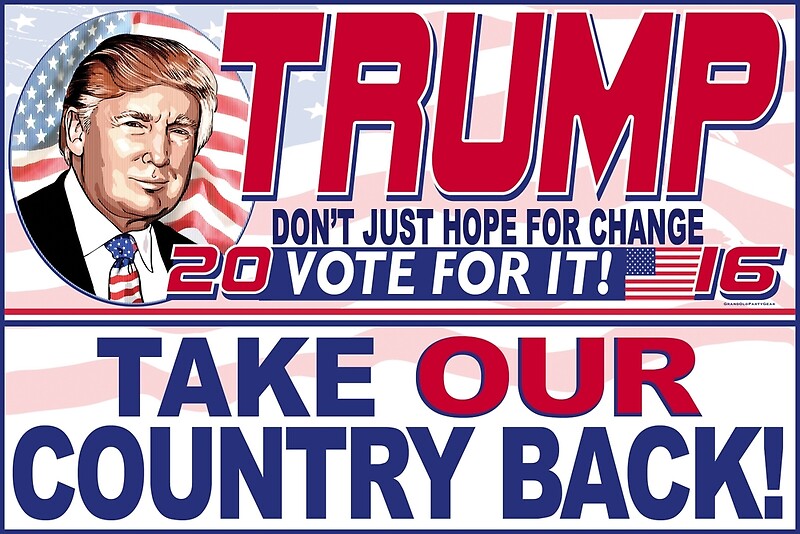
Dark Woods

This is the deepest part of the deep dark woods. Nobody speaks for the prez-elect, not even himself.

Charles Pierce

This week’s featured post is “How Populism Goes Bad“.

This week everybody was talking about Trump’s feud with the intelligence services over Russia

Friday, Trump got briefed by Director of National Intelligence James Clapper, CIA Director John Brennan and FBI Director James Comey about Russian attempts to influence the 2016 presidential election. Also on Friday, an unclassified report on the findings of the CIA, FBI, and NSA was released to the public. (Actual content begins on page 6. The report says it was based on a “highly classified” document. The conclusions are the same but some “supporting information” was left out.)

We assess with high confidence that Russian President Vladimir Putin ordered an influence campaign in 2016 aimed at the US presidential election

This effort seems to have unfolded on three levels: first, a “longstanding desire to undermine the US-led liberal democratic order”, then a specific animus against Hillary Clinton, and finally a desire to help elect Donald Trump.

When it appeared to Moscow that Secretary Clinton was likely to win the election, the Russian influence campaign then focused on undermining her expected presidency. … Starting in March 2016, Russian Government–linked actors began openly supporting President-elect Trump’s candidacy in media aimed at English-speaking audiences.

The report describes a wide-ranging effort, including hacking of the DNC and the Clinton campaign emails that were released by WikiLeaks, direct propaganda on Russian-government supported outlets like the RT news network, internet trolls, and fake news sources.

Russia’s effort to influence the 2016 US presidential election represented a significant escalation in directness, level of activity, and scope of effort compared to previous operations aimed at US elections.

Until Friday, Trump had minimized any implication that Russia helped him get elected, saying that there was no way to know who had done the hacking, and describing the Russian-influence controversy as a “witch hunt“. His statement Friday didn’t double down on that, but changed the subject. He continued to acknowledge no special role for Russia, and shifted attention to hacking voting machines, which has been sometimes rumored but seems not to have happened.

While Russia, China, other countries, outside groups and people are consistently trying to break through the cyber infrastructure of our governmental institutions, businesses and organizations, including the Democrat National Committee, there was absolutely no effect on the outcome of the election, including the fact that there was no tampering whatsoever with voting machines

In short: Russia played a key role in getting Trump elected, and he’s still carrying water for them. How far the pro-Russian tilt of his administration will go is still anybody’s guess.


BTW, if you believe the NYT’s interviews in Lousiana, Trump supporters don’t care. That’s disturbing, but I think it’s important not to confuse the enthusiastic Trumpers with the 46% who elected him. The 46% included a lot of Republicans with doubts about him.


In possibly related news, former CIA director James Woolsey resigned from the Trump transition team. According to the WaPo:

People close to Woolsey said … that Woolsey had grown increasingly uncomfortable lending his name and credibility to the transition team without being consulted.

and ObamaCare

President Obama, writing in the New England Journal of Medicine about the proposed repeal of ObamaCare.

If a repeal with a delay is enacted, the health care system will be standing on the edge of a cliff, resulting in uncertainty and, in some cases, harm beginning immediately. Insurance companies may not want to participate in the Health Insurance Marketplace in 2018 or may significantly increase prices to prepare for changes in the next year or two, partly to try to avoid the blame for any change that is unpopular. Physician practices may stop investing in new approaches to care coordination if Medicare’s Innovation Center is eliminated. Hospitals may have to cut back services and jobs in the short run in anticipation of the surge in uncompensated care that will result from rolling back the Medicaid expansion. Employers may have to reduce raises or delay hiring to plan for faster growth in health care costs without the current law’s cost-saving incentives. And people with preexisting conditions may fear losing lifesaving health care that may no longer be affordable or accessible.

Does anybody remember the deal that came out of the debt-ceiling crisis of 2011? We were assured that the sequester, which would cut spending across the board without regard to its importance, would never come to pass. It was just an enforcement mechanism to make sure that the bipartisan “Supercommittee” really did come up with $1.5 trillion of deficit reduction over the next ten years. And they would, because nobody wanted the sequester.

Well, threatening the committee with something awful didn’t magically make the partisan deadlock go away: Republicans still wouldn’t consider any tax increases, and Democrats still weren’t willing to offer $1.5 trillion of spending cuts without any tax increases. So the sequester happened, even though everybody swore it wouldn’t.

Same thing here: We’re told that if ObamaCare is repealed, effective two or three years in the future, then Congress will be forced to come up with a replacement, because nobody wants to be responsible for 20 million people losing their health insurance and everybody losing protection against being locked out of the insurance system by a pre-existing condition.

And that’s exactly right: Nobody wants to be responsible. So when it happens they’ll all do their best to duck the responsibility.


Repeal-and-delay or repeal-now-and-replace-someday may have trouble in the Senate, where it only takes three Republican dissenters to derail the plan. So far

Rand Paul (R-KY), Bob Corker (R-TN), Tom Cotton (R-AR), and Susan Collins (R-ME) are all signaling a potential break from the rest of their party. Though it’s not yet clear whether these senators will cast a vote against Obamacare repeal, the growing unease in the Senate puts the GOP on shaky ground.

They’re not coming out as ObamaCare defenders by any means, but each is reluctant to vote for repeal without knowing what the replacement proposal will be.

There’s a distinction to make here between sharp, hard-nosed tactics and irresponsibility. Much of the repeal of ObamaCare can be done through a reconciliation process that can’t be filibustered, but a replacement proposal would need 60 votes to get through the Senate, which it is unlikely to get at the moment.

So it makes tactical sense for the Republicans to separate the two votes, figuring that after ObamaCare is repealed, some Democrats will come around to a Republican replacement plan rather than revert to the broken healthcare system we had in 2009. What’s irresponsible, though, is that the replacement plan doesn’t even exist yet, and it’s not at all clear that Republicans can agree on one, even among themselves. They’ve had seven years to concoct a plan; it’s a mystery why the 8th or 9th year would be the charm.


Various Republicans are insisting that no one will be worse off under their plan, whatever it turns out to be. They almost certainly can’t make good on that, “since they are backing themselves into having no money to insure 20 or 25 million people” (as Josh Marshall observes), “But they’re on the record.”

For what it’s worth, Trump said during the campaign: “Everybody’s going to be taken care of much better than they’re taken care of now.” This week, spokeswoman Kellyanne Conway said: “We don’t want anyone who currently has insurance to not have insurance.”

Paul Ryan: “Clearly there will be a transition and a bridge so that no one is left out in the cold, so that no one is worse off.” But later, his people walked that back, claiming that the Speaker was talking only about the transition period before the replacement took effect.

but I’m thinking about resistance

There are a number of events you could go to, either this weekend or next. You can search for something near you at the Our Revolution event page. (There are probably other event pages; if you know of any, mention them in the comments.)

The big ones, of course, are the Women’s Marches January 21, a week from Saturday and the day after the Inauguration. The central one in D.C. is expected to draw hundreds of thousands, and there are sister marches in cities all over the country.

If you’re the kind of person who doesn’t usually do this kind of thing, one question you might be asking yourself is: If I go, what difference will it make?

I won’t try to convince you that you’ll have some major impact on Trump himself, or on most of his supporters either. But a big news-making crowd might make congresspeople of both parties think twice before they sign on to Trump’s agenda, and also affect the way the media covers the administration going forward. We want to short-circuit the narrative that says the public is coming around on Trump, that nobody really cares about his conflicts of interest, his racist chief strategist and attorney general, his targeting of Muslim Americans and Hispanic immigrants, his anti-woman proposals and personal history, his pro-billionaire agenda, and all the rest of it.

But beyond all those good effects (which I admit that one more person would advance only marginally), you should think about the effect that going to a march will have on yourself. By getting out and marching on the first full day of the new administration, you start to change your self-image and your political identity. Rather than being someone who just pays attention to the news and votes, you start becoming someone who is more involved and does things on a regular basis. You may meet other people who get involved and do things, or discover that people you already know are out there with you. You may start feeling less helpless and hopeless. You may do less yelling at the TV and more planning how to respond. Seeds will get planted, and who can predict what will sprout from them?

So sure, do it for the country. But also do it for yourself.


As for affecting Congress, some ex-staffers for Democratic congresspeople have used their inside knowledge to put together Indivisible: a practical guide for resisting the Trump agenda. It’s about tactics for forming constituent groups and influencing your members of Congress.

It includes a number of tips that are obvious once you’ve read them, but that not everybody would think of. Like this one for attending town-hall meetings:

SHOULD I BRING A SIGN?
Signs can be useful for reinforcing the sense of broad agreement with your message. However, if you’re holding an oppositional sign, staffers will almost certainly not give you or the people with you the chance to get the mic or ask a question. If you have enough people to both ask questions and hold signs, though, then go for it!


The House Republicans’ attempt to do away with the independence of the Office of Congressional Ethics failed. After an immediate public outcry, they backed down. I’m sure we haven’t heard the last of this issue, but it points out that the public’s voice still matters, if we choose to use it.


Sleeping Giants “is an organization dedicated to stopping racist, sexist, homophobic, xenophobic and anti-Semitic news sites by stopping their ad dollars.” The main tactic seems to be pointing out to companies that their online ads are appearing next to horrible content, implying that the company endorses such views. Current target: Addidas.

We’ve reached a point in our country where sitting it out isn’t an option. If you’re a part of ad dollars flowing to racist sites like Breitbart, then you’re part of the ugliness undermining a strong, diverse America.

and here’s the most important story nobody’s paying attention to

From ProPublica, an organization that has a history of doing good, accurate reporting:

The rate of pregnancy-related deaths in Texas seemed to have doubled since 2010, making the Lone Star State one of the most dangerous places in the developed world to have a baby.

The increase is largest among African-American women, and the timing corresponds to a funding cut for family-planning centers that serve low-income women. Coincidence?

and you might also be interested in

Meryl Streep at the Golden Globes: “Disrespect invites disrespect. Violence incites violence. When the powerful use their position to bully others we all lose.” Read the whole thing. Or watch it.

Trump, of course, doesn’t have the grace to let something like that stand — imagine if President Obama had felt obligated to respond to every bad thing said about him — so he tweeted:

Meryl Streep, one of the most overrated actresses in Hollywood, doesn’t know me but attacked last night at the Golden Globes. She is a Hillary flunky who lost big

“Overrated” is also how he described Hamilton, so it’s starting to look like a badge of honor. Being called “overrated” by Trump is something to aspire to.


If you want to know how bad things could get, look to Brazil. After President Dilma Rousseff of the Workers’ Party was impeached in August, the current un-elected president, Michel Temer, took over, despite being just as corrupt as Rousseff. Temer has pushed through a constitutional amendment to freeze public spending on all social programs at current levels (plus inflation) for the next 20 years. A whopping 24% of the public supports that limit — 43% of Brazilians were unaware of the plan a short time before the Senate approved it — but the business community loves it, so it passed.

The United Nations Special Rapporteur on extreme poverty and human rights, Philip Alston, says the freeze “clearly violates Brazil’s obligations under the International Covenant on Economic, Social and Cultural Rights” and “will place Brazil in a socially retrogressive category all of its own”.

A separate pension-reform proposal forbids retirement before age 65, in a country where the life expectancy in many poorer communities is lower than that. Labor laws are also under attack. In many, many ways, the government is taking an attitude of: Yeah, it’s unfair and unpopular, but so what?


I frequently link to Pressthink by Jay Rosen, a journalism professor at Columbia who is one of the sharpest people thinking about American news coverage. Recently he had a very good two-part series about the challenge Trump poses to journalism and some (admittedly incomplete) suggestions about how to respond.

One of the problems he cites:

A crisis of representation around covering Trump in which it is not clear that anyone can reliably tell us what his positions are, or explain his reasons for holding them, because he feels free to contradict advisers, spokespeople, surrogates, and previous statements he made. As Esquire’s Charles Pierce put it to me: “Nobody speaks for the prez-elect, not even himself.” … [E]xisting methods for “holding power to account” rest on assumptions about how it will behave. A man in power untroubled by contradictions and comfortable in the confusion he creates cannot be held accountable by normal means.

The usual model of trying to gain access to high-ranking officials can backfire in such a regime: What if your inside source has no more idea what the President thinks than you do?


Hearings are starting on Trump’s appointees, even though background checks on conflicts of interest are unfinished. How are senators supposed to know what to ask about?


It looks like Trump is going to ask Congress to pay for the wall. Supposedly, Mexico will reimburse us later. I think this is a pattern we’ll see a lot of: Magical things are going to happen someday to fulfill Trump’s promises, but in the meantime something else will happen.


Yonatan Zunger has a different metaphor for talking about tolerance, and it gets around the tolerating-intolerance issue: He thinks of tolerance not as a virtue, but as a peace treaty. You tolerate those who sign onto the treaty, but not those who reject it.

There may be bad consequences to this view that I haven’t identified yet, but I’m going to think about it.


At the Pink Panthers blog, dissident liberal Christians are asking for secular help getting their message out.

Obviously, a religious establishment which would pressure their followers elevate a man like Donald Trump to office and claim that this pleases God is, at the least, dangerous to our survival as a nation. Most of what passes for Christianity in this country is nothing more than complicated explanations for how a person can reject everything Jesus ever said while remaining Christian. Which is a travesty. Real Christianity is something which most human beings would look at and say, “even if I can’t believe in the religious stuff, I can see that this is good and right. It makes sense.” But right now, that kind of Christianity has been rendered all but voiceless both inside and outside the church.

Which is why I am asking secular, liberal America to start sharing the voices of Christian dissent on social media.


The Wall Street Journal (link behind paywall; summary at ThinkProgress) reports that Trump businesses owe far more than the $315 million he has admitted to.

Last May, Mr. Trump filed a financial-disclosure form with the Federal Election Commission that listed 16 loans worth $315 million that his businesses had received from 10 companies, including Deutsche Bank AG. But that form reported debts only for companies he controls, excluding more than $1.5 billion lent to partnerships that are 30%-owned by him.

ThinkProgress adds:

[The] financial institutions [that hold this debt] include many firms that are under the scrutiny of the federal agencies that Trump will soon control. Wells Fargo, for example, which services over $900 million in loans connected to Trump, “is currently facing scrutiny from federal regulators surrounding its fraudulent sales practices and other issues.”

and let’s close with something adorable

One of my friends has been working on this project for some while now, but has had to be circumspect about discussing it until the company was ready to announce, which it did this week at the annual Consumer Electronics Show in Las Vegas. Kuri, a gender-nonspecific name pronounced like the spicy Indian dish, is a different take on the idea of a home robot: It’s more of a pet than an appliance, and isn’t trying to look like a human or replace your maid service. So it won’t vacuum your rug, but it will roll around your house looking cute and evoking interactions — kind of like a puppy on wheels, but without the mess.

Its appearance owes more to R2D2 than C3PO. Techcrunch describes Kuri as “an Amazon Echo designed by Pixar”, and in fact somebody who used to work at Pixar did have a hand in the design. After decades of sci-fi about emotionless androids who are preternaturally competent and useful (i.e., Star Trek‘s Data), the idea that emotional connection needs to happen first is a fascinating reversal.

NBC News covered it like this:

How Populism Goes Bad

Perversely, sometimes “We the People” are anti-democratic


The word populism sounds like it ought to mean something close to democracy. Both are based on ancient words for “the People” (demos and populi), so you might expect them to be just different ways of saying the same thing: rule by the People.

The Trump campaign has been widely (and I think accurately) described as populist. He has constantly talked about “giving government back to the People”. The Tea Party rhetoric he built on was all about “We the People”. I don’t think that rhetoric was cynical: Tea Partiers really believe that they represent the People.

And yet Trump has also been widely described (again accurately, I think) as authoritarian and anti-democratic. Populist and anti-democratic: How is that even possible?

Like this: Populism differs from democracy in a few important ways:

  • In populism, “the People” isn’t everybody.
  • While democracy is “government of the People, by the People, and for the People”, populism can get so focused on the for that it stops caring about the of and by.
  • Because democracy is of and by the People, democratic government is defined by process. But populist movements want results.

Let’s go through that in more detail.

Who are the People? By its nature, populism is oppositional. In addition to the People, there is also an Elite they need to struggle against. As John Judis puts it in The Populist Explosion:

Leftwing populists champion … a vertical politics of the bottom and the middle arrayed against the top. Rightwing populists champion the people against an elite that they accuse of coddling a third group, which can consist, for instance, of immigrants, Islamists, or African American militants.

But in fact the problem in rightwing populism lies even deeper. In my Conservative-to-English Lexicon, I make fun of the Tea Party practice of describing some Americans as more “real” than others.

Real America. Rural areas and small towns, where the majority of voters are real Americans. Usage: “the best of America is in these small towns that we get to visit, and in these wonderful little pockets of what I call the real America.”
Real American. 1. A white conservative Christian born in the United States at least 30 years ago. 2. A typical resident of real America. Usage: “Real Americans do not recognize [Obama] as a president.”

But this isn’t just a quirk of language, it points to a genuine difference in worldview. For comparison, consider what people mean when they describe someone as “a real man”. Being biologically male isn’t the half of it. To be real, a man has to match a cultural ideal of how men are supposed to look, think, and act. So gays are out, as are men who have effeminate voices or gestures, are too fat or too skinny, or  aren’t interested in sports.

Similarly, in populism “the People” are the real people — the real Americans, real British, real Poles, real Austrians. There is an implied ideal of the kind of people the nation is “for”. Some people match that ideal model and some don’t.

For Trump/Tea Party populists, the real Americans are as I described: mature white conservative Christians. They’re also English-speaking (with a native-born accent), straight, and pro-capitalist. They are comfortable with the gender they were assigned at birth, and if they happen to be unemployed, divorced, or without children, it’s not their fault; they identify as hard-working family people, whether they really are or not.

If you define the People that way, then I suspect Trump did win the “massive landslide victory” he claimed. The “millions of people who voted illegally” he tweeted about might be a pants-on-fire lie, but the notion in his supporters’ minds that millions — even tens of millions — of votes were cast by someone other than the People is absolutely true. Black lesbian Spanish-speaking atheist socialists voted, and those votes counted just as much as their own. It doesn’t seem right to them, because America is for real Americans, not just the people who satisfy the legal requirements to become citizens and vote.

This is why they aren’t bothered by what Democrats describe as “voter suppression”. If blacks or immigrants or people who don’t speak English have to jump through some extra hoops before they vote, and if some large number of them get frustrated and give up before they manage to cast their votes, that’s all good. The franchise wasn’t really meant for them anyway.

A lot of liberals interpret this attitude as hatred of the left-out groups, but it doesn’t feel that way from the inside. More accurately, it is a sense of ownership and entitlement: It’s my country, not your country, but I’m content to let you live here in peace as long as you recognize that. The hatred only shows up when that ownership feels challenged.

For, not of or by. As the Trump administration took shape after the election, most of the key positions went either to billionaires, generals, or people connected to Goldman Sachs. The top-level departments (State, Defense, Treasury, Justice, Homeland Security, Intelligence) are all to be headed by white men. Of the top White House staffers, all are white men but Kellyanne Conway, who holds the vague title of “counselor”.

It’s been a long time since an administration looked so little like America.

The white male dominance comes from what we just talked about — who “the People” are, and what it means to be “real”. (Real women don’t want to rule the world. Even Conway had to explain how she could work in the White House but still put her family first. Nobody raises this question about Trump’s male appointees, and Trump himself has no similar worries about his responsibilities to his 10-year-old son Barron, who at least for now will remain in New York with Melania.) But it’s hard to understand how the stereotypic white-working-class Trump voter can see himself in the 3G (Goldman, generals, and gazillionaires) axis.

And the answer is: He doesn’t expect to see himself, any more than he sees any resemblance between his own life and Trump’s ostentatious lifestyle of celebrity and wealth. Trump is supposed to be his champion, not his buddy. Likewise, he expects the Trump administration to be for him, but not to listen to him or be filled with people like him.

Results, not process. If you look at the Constitution, you’ll see that it says practically nothing about results. The Preamble is a mission statement expressing broad hopes about what the new government might accomplish with the powers the Constitution defines. But beyond that, the document is all process: This is how you pass a law. This is how you elect Congress and the President. This is how judges get appointed, treaties get approved, and so on.

It doesn’t tell you much of anything about the results that will come out of that process: who will serve in the government and what laws or treaties they might approve. It doesn’t specify a maximum tax rate, a balanced budget, the size of the army, an official language, or much of anything else.

The reason for that focus on process is that government of and by the People doesn’t happen by itself. A constitution for an absolute monarchy could just be one line: “Do what the King says.” But any large group of people is a cacophony. The larger the group and the more democratic it wants to be, the more processing it needs. (Occupy Wall Street encampments were famous for their General Assemblies, whose meetings could go on for hours each day.)

But populists typically don’t care that much about simply being heard or having representation. They are fighting a battle against the Elite (whatever that term means in their particular situation) and they want to win it.

To his critics, one of the most mystifying aspects of Trump’s nomination and election has been why the voters didn’t hold him responsible for his repeated violations of democratic norms. Every major-party candidate since Nixon has released his tax returns, but Trump never did and apparently never will. Presidents since Lyndon Johnson have used blind trusts or generic investments like government bonds or index funds to avoid financial conflicts of interest, but not Trump.

His supporters don’t seem to care. If foreign governments want to put money in Trump’s pocket by holding events in his hotels or by giving regulatory favors to his construction projects, they’re free to do so. It may seem incestuous for Trump to have regulatory authority over banks he owes money to, but so what? Who cares whether he holds press conferences, whether there’s any way to make him answer a question, or whether his answers bear any resemblance to reality (or even to what he said last week)?

Those are process issues. His supporters want stop illegal immigration, and perhaps legal immigration as well. They want manufacturing jobs to come back from China, and coal miners to be able to make the kinds of wages their fathers did. They want to stop gays from getting married and women from getting abortions. They want terrorist attacks to stop, ISIS to fall, and America’s enemies to be sorry they messed with us.

They’re sick of good process, and of politicians who check the right boxes and say the right things, but don’t get the results they want.

How democracies die. Democracy does have a way of getting tangled in its own processes, and American democracy has gotten more and more tangled as polarization has increased. Back in October, I listed a series of situations where the country is stuck in a status quo that nobody wants: millions of undocumented immigrants living off the books, a budget process that yields perpetual deficits and lurches from one threatened government shutdown to the next, unfilled judicial vacancies, and a Medicare system that creeps ever closer to bankruptcy.

At some point, people stop caring about good process, they just want it all fixed. If a Julius Caesar can come in and make things happen, that sounds like an improvement. (I’ve been discussing this prospect for a while in my “Countdown to Augustus” posts.)

But all those processes are there for a reason, as countries that discard them usually find out fairly quickly.

How populism turns very, very bad. If a populist movement’s definition of the People matches the voting rolls closely enough, or if it includes a lot of people who can’t vote but wish they could, then that movement will be pro-democracy, as Occupy Wall Street or the Bernie Sanders campaign were.

But that’s not the only way things can go. If a populist movement feels blocked by the checks-and-balances of democracy, or by the votes of people it thinks shouldn’t have a vote at all, then democracy itself can become the enemy. If it is forced to choose between democracy and the results it wants, it may choose the results.

That’s why authoritarian populism is not a contradiction. The pattern of a popular dictator enacting laws to defend the common people against an entrenched aristocracy goes back not just to Caesar, but before that to the Greek tyrants. (The word tyrant didn’t pick up its cruel, negative connotation until Plato — an aristocrat — wrote about tyranny generations later.)

The ultimate example of populism gone bad is Nazism. We don’t usually tell the story that way: In pop-culture references, Hitler’s regime is usually presented as a totalitarian pyramid of fear, which nearly everyone would have liked to topple if they hadn’t been so intimidated. [1] And many certainly were cowed into submission, but most were not. The sad truth of Nazism is that for most of its reign, the Hitler regime was popular.

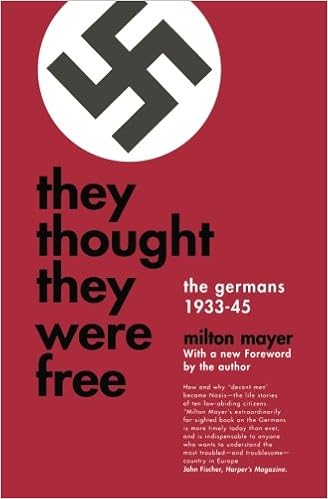
This comes through in a book I mentioned last week, They Thought They Were Free by Milton Mayer. After the war, Mayer went to Germany and befriended ten low-level Nazis in a small town. Almost unanimously, they faulted Hitler only for making tactical errors, like attacking Russia. But until the war, or even until the war started going badly, they felt that Hitler had come through for them: He pulled Germany out of the Depression. Good jobs were plentiful. Roads got built. Social services (for the People) improved. Law and order was restored. Germany was great again.

Unless you were Jewish, of course, or belonged to some other disapproved or disloyal group. But if you were a member in good standing of the German Volk, you were probably doing OK. A few thugs were expected to do horrible things in the name of the regime, but most people only had to avert their eyes from time to time, and not wonder too much about those who had been sent away.

Having a restrictive definition of the People, letting a leadership cadre govern for you without much oversight, ignoring process issues to focus on results … it doesn’t necessarily have to go to a bad place, but it certainly can.

The present moment. It’s usually a mistake to invoke the Nazis in a political discussion. [2] In our pop culture they’ve become cartoon villains [3], so associating them with your opponents often becomes a cheap shot.

So I should explicitly state that I don’t think Trump is Hitler, and I have no specific reason to think he wants to be. A few of his supporters are openly Nazis, but the vast majority are not. I invoke the Hitler regime as a cautionary tale, not a prediction.

If we want to make sure that the Third Reich continues to be nothing more than a cautionary tale, though, we need to learn its lessons.

  • It’s dangerous to exclude anyone from the People. Any time some infringement of rights has an implicit justification of “It’s only Muslims” or “It’s only inner-city blacks”, that implication needs to be called out. It’s hard to explicitly defend the contention that certain people don’t count, but it’s easy to slip such an assumption into the background.
  • The inability of democratic government to make progress on widely recognized problems is itself an argument for authoritarianism. So Democrats need to be very careful about how they use obstruction. “Turnabout is fair play” is a dangerous principle. We should block things because they’re bad, not just because we want to be as big a nuisance to Trump as Republicans were to Obama.
  • While continuing to call Trump to account for ignoring good process, we can’t make our stand entirely on process issues. We always need to be looking for the connection between bad process and bad results. It’s not enough to point out that there’s a hole in the fence; we need to catch the sheep getting out or the wolves getting in. For example, it’s not going to bother most Trump supporters if he profits from being president, but it will bother them if he sold them out.

We always need to keep in mind: Trump a the symptom, not the disease. Healthy democracies don’t get taken down by demagogues. Trump’s version of “the People” may not be everybody, but it is a lot of folks. The way to save democracy is to make it work for everybody, them included.


[1] That’s the reason so many believe the Hitler-confiscated-the-guns myth that so often comes up in gun control debates. He certainly didn’t want Jews to have weapons, but Jews were not part of “the People” as he defined it. Racially pure Germans (as Hitler defined them) remained armed, because there was no reason for them not to be. By and large, they supported the regime.

[2] I could also have used the Reconstruction South as an example. Here the People means Southern whites, and the KKK is their champion against the Yankees above and the blacks below. A semblance of democracy is maintained, but only after blacks are disenfranchised. This is justified by the assumption that America isn’t really for blacks.

[3] An occasionally disturbing exception is the current Amazon TV series The Man in the High Castle, which often brings out the ordinariness of the American Nazi regime, and at times even shows how human generosity can still express itself. In an early episode of the second season, Juliana, who has been approved as racially pure, is being resettled in the Reich by the wife of an SS officer. The officer has ulterior motives, but the wife doesn’t know that. “I don’t know what to say,” Juliana tells the wife.

“You don’t have to say anything,” she responds. “You’ve come a place where good people take care of each other.” If good means “racially pure”, she’s not entirely wrong.

The Monday Morning Teaser

My focus this week is on the difference between populism and democracy, exploring the question of how a populist movement can also be anti-democratic, as I think the Trump movement is. That post will be titled “How Populism Goes Wrong”, and it should be out around 10 EST.

The weekly summary discusses Trump’s dispute with the intelligence community about Russian meddling in his election win, the looming repeal of ObamaCare, how to start resisting the Trump administration’s agenda, the disturbing increase in pregnancy-related deaths in Texas, and a number of other things, before closing with a video of an adorable home robot. Expect that around 11.

Raising Doubt

Trump doesn’t care if we think he’s telling the truth – he just wants his supporters to doubt that anyone’s telling the truth.

Jon Favreau

This week’s featured post is “All Democrats have some introspecting to do“.

This week everybody was looking back at 2016

If good thing happened in your personal life last year, I’m happy for you. But in collective terms, 2016 was a nightmare.

CNN has a photo gallery of people who died in 2016: Muhammed Ali, David Bowie, John Glenn, and many others.

TPM presented the annual Golden Dukes awards, for outstanding achievement in “public corruption, outlandish behavior, The Crazy, nonsense and all relevant betrayals of the public trust”.


The stylistic contrast between the old and new presidents in a nutshell:

Conclusion of the Obama New Year message:

It’s been the privilege of my life to serve as your President. And as I prepare to take on the even more important role of citizen, know that I will be there with you every step of the way to ensure that this country forever strives to live up to the incredible promise of our founding—that all of us are created equal, and all of us deserve every chance to live out our dreams. And from the Obama family to yours—have a happy and blessed 2017.

The Trump New Year tweet:

Happy New Year to all, including to my many enemies and those who have fought me and lost so badly they just don’t know what to do. Love!

and talking about Israel

The relationship between the Obama administration and the Netanyahu administration is ending with a lot of shouting. The U.S. refused to veto a Security Council resolution condemning Israeli settlements on the West Bank. Israeli Prime Minister Netanyahu accused the Obama administration of a “disgraceful anti-Israel maneuver”. And John Kerry gave a speech highly critical of current Israeli policy.

I may comment at length after I’ve had time to sort through the details, but for now I’ll rely on analysis from Vox.


For decades, every military crisis between Israel and the Palestinians has ended with the U.S. pressuring the Israeli government to stand down. And many of us have wondered how much real effect that pressure had. Maybe the Israeli leaders had completed whatever they wanted to do and used American pressure as cover against their political right flank at home. Or maybe they really were about to wreak massive vengeance, but America stopped them. Nobody really knew.

During the Trump administration, I think we’re going to find out. Because I don’t think Trump cares what happens Palestinian civilians. His people think we’re in a global war between Christendom and Islam, and anybody fighting Muslims is on our side. So if you’re an Israeli right-winger who has secretly been pining to do some ethnic cleansing, or to herd Palestinians into impoverished, unsustainable bantustans on the apartheid model (or the Gaza model, for that matter), the next four years are your chance. We’ll see who tries to take advantage of it.


While I was researching this issue, I ran across this thought-provoking essay by Uriel Abulof at Jewish Daily Forward. It doesn’t have a nice, pithy summary, but it’s basically about the temptation of tribalism, and its political consequences: We want to be free individuals, but we also have a deep need to belong to something.

The liberal conclusion has since crystalized: Tame the tribe! Turn those perilous peoples into civic, multicultural, cosmopolitan societies, rationally administrated by the state. Globalization, with the European Union as its beloved offspring, should have fostered that vision.

But it is not turning out that way. Liberalism’s advantage — the primacy of the individual — is also its Achilles’ heel: It captures a yearning for independence, but fails to grasp the equally powerful drive to belong. Consequently, in recent years, neoliberalism’s inadvertent repression of that yearning has spurred Rousseau’s revenge: the return of the tribe. And now the tribe is intent on taking over the state that sought to tame it.

and Milo

Unless you’ve been paying attention to the alt-Right, you may never have heard of Milo Yiannopoulos. On the other hand, if you read Breitbart, you think he’s a rock star — he’s just “Milo“, like Madonna or Beyoncé. Or even “MILO”.

Milo is a professional troll who came to public attention in the Gamergate controversy of 2014. He says and does outrageous things and profits from the attention they draw. That description could apply to any number of people, a few of whom I admire. But Milo takes it a step further, using his fame to focus his fans’ persecution on individuals, like actress Leslie Jones and this transgender student in Wisconsin.

He’s in the news now because he just got a $250K book deal from the respected publishing house of Simon & Schuster. This has incited a backlash against S&S, including such moves as The Chicago Review of Books announcing that it will not review any S&S books in 2017 or independent bookstores refusing to stock their titles.

It’s important to understand exactly what kind of protest this is, and why it’s really not a free-speech or freedom-of-the-press issue. No one is attacking either Milo’s legal right to write a book or Simon’s legal right to publish it. That’s the law and no one disputes it. The point is that S&S can’t promote this kind of garbage and remain a respected publisher. If Milo wants to self-publish, or if Breitbart wants to publish his book, fine. People who want to buy it should be able to. And if Simon & Schuster wants to become an alt-Right publishing house, that’s up to them. But no law says I have to respect them.

and you might also be interested in

Inauguration Day is January 20, two weeks from Friday. The next day is the Women’s March on Washington.

The Women’s March on Washington is quick to say it is not an anti-Trump protest. “We’re not targeting Trump specifically. It’s much more about being proactive about women’s rights,” said Cassady Fendlay, spokeswoman for the march.

I expect a certain amount of solidarity with other groups who feel threatened by Trump, like immigrants and Muslims. If you can’t make it to Washington, there are sister marches in at least 30 other cities. I plan to go to the Boston one.

I think this kind of thing is important to do. Trump has shown absolutely no interest in reaching out to the majority that voted against him, or the plurality that voted for Clinton. We need to establish that we haven’t gone away, and we need to start building the connections that we’ll need for more issue-specific protests as the Trump administration starts doing things.

I also agree with the framing: Trump hasn’t had a chance to do anything as president yet, so it’s premature to protest against him. But people worried about the Trump administration need to know they have support.


North Carolina can no longer be considered a democracy, according to a report by the Electoral Integrity Project. I’m withholding further comment on this until I can read the report, which I haven’t been able to find on the EIP web site.


Fascinating piece in Wired: Obesity might have more causes than just diet and exercise or genes. In particular, a virus might rewire your system to crave food and build fat.


Maybe comedians can succeed where more serious voices fail. Seth Meyers devotes 9 minutes to the Trump administration and climate change.

and let’s close with something beautiful

A video from the Beauty of Science channel on YouTube.

All Democrats have some introspecting to do

No matter who you supported in the primaries, you have a lot to think about.


As soon as the 2016 election winners take office, Democrats will be wielding far less power than they have for a very long time. The Presidency and both houses of Congress are under Republican control. The Senate blockade of Merrick Garland’s nomination to the Supreme Court has apparently succeeded, setting up a return to the 5-4 conservative majority the Court had before Justice Scalia’s death. If Justice Kennedy or any of the four liberal justices were to quit or die in the next four years — a real possibility considering that Kennedy is 80 and Justice Ginsburg is an 83-year-old cancer survivor — we could be looking at the most conservative Court since the New Deal.

It’s no better at the state level. When the 2016 victors take office, Democrats will hold only 16 of the 50 governorships, with even states as blue as Massachusetts, Vermont, and Illinois having Republican governors. In 32 states, Republicans control both houses of the legislature, in some cases by supermajorities of 2/3s or more.

Some liberals may not consider themselves Democrats — Bernie Sanders, for example, is an independent who caucuses with the Democrats in the Senate — but so far they haven’t found a path to power that doesn’t include the Democratic Party. So liberalism as also out in the cold right now.

You might think this situation would cause some soul-searching, but so far it seems to have produced mainly finger-pointing. Having watched a lot of back-and-forth on social media and elsewhere about why Democrats lost in 2016, I’ve been struck by how self-serving it is, on both the pro- and anti-Clinton sides. Everyone seems to be saying, “If everybody had just listened to me, we’d be fine. So I just need to keep saying and doing what I’ve been saying and doing all along.”

I’m not finding that message convincing. Not from anybody.

The pro-Clinton case. Clinton apologists have a long list of she-could-have-won-if points, all of which have some limited amount of validity. She won the popular vote by 2%, almost three million votes, so she’d have won if not for the Electoral College. The Russian interference in the election seems real, and given how small Trump’s margin was in many key states, that probably made the difference. Jim Comey’s last-minute re-raising of the email issue, for what turned out to be no good reason, was another bit of dirty pool that helped put Trump over the top. If Clinton’s internal polling had recognized how she was slipping in the upper Midwest, campaign resources that turned out to be wasted in places like Arizona could have been brought to bear on Wisconsin and Michigan. If Jill Stein hadn’t run, if the national news media hadn’t created a false equivalence between Clinton’s integrity problems and Trump’s, if social media had the kind of anti-false-news provisions it’s trying to develop now …

There’s no end to it, and it’s all more-or-less true as far as it goes. I’m sure that in most parallel universes, it’s Clinton who is getting ready to take the oath of office. Too bad for us that we live in an unlucky one.

But let’s imagine we could look in on one of those other universes, say the one where Comey kept his mouth shut about ongoing investigations, as FBI directors are supposed to do. Let’s imagine Clinton wins the popular vote there by 3% or 4%, rather than the 2% she won by in our universe, and that’s enough to tip the Electoral College in her favor.

OK, now consider this question: Is the Democratic Party in good shape? Is liberalism on track?

We still don’t get the Senate back, because even though Pennsylvania’s seat might also flip, there isn’t a second Senate race that the Republicans won with a razor-thin margin. You could imagine that a House race flips here or there, but again, it’s not enough to give Nancy Pelosi the Speaker’s gavel. And how exactly did Comey (or Putin) influence the governors’ races, or the state legislatures?

In a practical sense, then, Clinton winds up where Obama has been since 2010: unable to push an agenda through Congress, and relying on the veto and other executive powers to keep Republicans from trashing things too badly. Maybe she makes a Supreme Court appointment, or maybe the Senate blockade continues. (I suspect she does, but again, that mostly just prevents disasters; a liberal Court majority doesn’t put us on a path to a new liberal awakening.)

So OK: Clinton beats the Orange Menace with 49% or 50% of the vote instead of 48%, ObamaCare survives another four years, and the country continues to muddle along. That’s better than the situation we’re in now, but my impression is that disaster has just been forestalled a little while, not that we’re on the path to turning things around.

Even under President Clinton, then, the Democratic Party would have some serious rethinking to do.

Anti-Clinton. Inside certain echo-chambers of Bernie Sanders’ supporters, it’s obvious that Democrats just nominated the wrong candidate. Bernie would have beaten Trump, and everything would be wonderful. Trump won because voters wanted an outsider and Clinton was an insider. Or they would have responded to an authentic liberal, but Clinton isn’t one. Or something.

The main evidence for this view is that during the primaries Bernie did better than Clinton in the head-to-head polling match-ups with Trump. A lot of polls showed him winning by double digits, sometimes as much as 15%. But of course, Clinton also had some double-digit leads in polls, some of them fairly late in the campaign. We saw how quickly such leads can evaporate. Since Sanders was less well known than Clinton, and since Republicans had largely treated him with kid gloves that would have come off in a general election campaign, I would expect opinions about him to be more volatile in a general election, not less. So a polling lead over Trump in April is not very convincing evidence.

But the real reason not to buy the liberal-victory or outsider-victory scenario is that as best I can tell, nobody made that message work in downballot elections. If the Bernie-wins theory were correct, I’d expect to see some state or congressional district where Trump beat Clinton, but some plucky liberal outsider candidate pulled an upset win over a Republican incumbent senator or governor or representative. I can’t think of any such example. (The most notable downballot candidate to win a Trump state was Roy Cooper in the North Carolina governor’s race. But he’s not an outsider and his positions on key issues seem pretty Clintonish to me.)

Take Iowa, for example. In past elections it has been a swing state leaning blue. Bush won it in 2004, but Gore won Iowa in 2000 and Obama carried it twice. Trump won it decisively, 51%-42%. So Iowans must really have been fed up with the status quo and ready to throw out all the insiders, right? Well, not exactly. Other than Mitch McConnell, probably nobody is a bigger Washington insider than Iowa’s Chuck Grassley, who has been in the Senate since 1980. He got re-elected by an even bigger margin, 60%-37%.

Or look at Wisconsin, which Clinton lost very narrowly, 47.2%-46.5%. Russ Feingold, a liberal hero who in 2001 was the sole dissenting vote in the Senate against the Patriot Act, lost by a bigger margin, 50%-47%.

It’s not a hard or unreasonable test: Find some electoral district where Trump won, but a downballot Democrat also won by running either as an anti-Establishment outsider or on a Bernie-like progressive agenda. I don’t believe there is one.

Another argument is that Bernie could have won just by not being Hillary Clinton. But the voters seemed to have no special distaste for Clinton in comparison to other Democrats. In Pennsylvania, a state that hadn’t gone Republican in a presidential election since 1988, and which Obama won 52%-47% in 2012, Clinton lost by 44,000 votes out of nearly 6 million. But in the senatorial election, Katie McGinity lost a close race by a slightly worse margin, 116,000. The story in New Hampshire was similar, but on the opposite side: Clinton won by 3,000 votes, and the Democratic senate candidate won by 1,000.

In other words, it was the party that lost, not just the candidate. Simply being not-Clinton didn’t gain Democrats anything.

So what should we be thinking about? First, I think we need to lose the Clinton and Sanders labels, because I don’t see the point in refighting that. It’s not like either of them is likely to run for president again, so there’s no need to keep your arguments against them sharp.

There will continue to be a struggle going forward, but let’s focus on ideas and approaches rather than personalities. On the one hand, there are the centrist, focus-on-what’s-possible-today, work-within-the-power-structure, gradual-change Democrats. On the other, the more radical, big-picture, go-for-it, overthrow-the-power-structure Democrats (or liberals who don’t call themselves Democrats because Democrats are too tame). Each group has some important introspecting to do.

The first group needs to answer questions like this: How are we going to inspire anyone? What’s my elevator speech, the simple statement that tells low-information voters what the Democratic Party is about and why they should support it? The half of the country that isn’t interested enough in politics to vote — what in my message will wake them up and get them involved? How can I explain to people that the small step I want to take right now is just the first step on a journey that goes someplace exciting? And — maybe most important of all — does it go someplace exciting? On an issue like climate change, for example, the clock is ticking. Does the gradualist approach deliver change fast enough to avoid global disaster?

Finally, the first group needs to stop waiting for something to happen. Stop waiting for the Republicans to cross some line that will finally make Americans realize that they’ve gone insane and look to us instead. Stop waiting for demographic change to create the electorate we want. Power will not come to us because it’s our turn; we have to earn it.

The second group needs to let go of a myth: There is no hidden liberal majority in America. The non-voters aren’t disillusioned left-wing radicals who are just waiting for a true believer to blow the battle horn. Bernie did that and he lost. [1] Even if he had won, he’d be one guy dealing with the same obstacles Obama has been facing. [2] The only way there ever will be a liberal majority in America is if we figure out how to make one.

I still believe the model I put forward last February in “Say – you want a revolution?“: The vast majority of non-voters are people who don’t have a political identity at all. If you ask the right poll questions, you can get them to express liberal ideas on specific issues. [3] You can sometimes get a number of them to show up in one election just by fielding an appealing candidate (i.e., Obama) or having a good slogan (“Yes We Can”), but that doesn’t change the long-term political balance of the country. Next time it might be the other guys who field an appealing (or energizingly appalling) candidate and have a good slogan (“Make America Great Again”).

Long-term political change involves people joining things that change their identities, the way that the blue-collar union workers of the 1960s became the evangelical church members of the 1980s. Where are we making that happen now? Do we have the vision, the stamina, and the local-organizing ability to facilitate that kind of change?

The turn-the-world-around movement won’t instantly coalesce around the right presidential candidate with the right message. It will start someplace small, with a new approach to very specific, very local concerns. Where are we running those experiments and giving lightning a chance to strike? [4]

So whether you think of yourself as belonging to the Democratic Party or the progressive movement, our power is at a low ebb right now. Nobody — I mean nobody — has cause to feel smug about this. It isn’t that she failed or they failed, but I’m all right. We’re where we are right now because I failed, you failed, we all failed. Each of us needs to be looking in a mirror and asking what we’re going to do differently.

Extra credit question. While researching an article I’ll probably post next week, I read the 1955 classic They Thought They Were Free by Milton Mayer, in which he relates his conversations with ten low-level small-town Nazi Party members after the war. I was struck by this comment from a high school teacher.

For the first time in my life I was really the peer of men who, in the Kaiser time and in the Weimar time, had always belonged to classes lower or higher than my own, men whom one had always looked down on or up to, but never at. In the [National Socialist] Labor Front— I represented the teachers’ association— I came to know such people at first hand, to know their lives and to have them know mine. Even in America— perhaps; I have never been there— I suspect that the teacher who talks about ‘the common people’ has never known one, really known one, not even if he himself came from among them, as I, with an Army officer as a father, did not. National Socialism broke down that separation, that class distinction. Democracy— such democracy as we had had— didn’t do it and is not doing it now.

In other words, in a cultural sense the Nazi regime felt more democratic to him than the Weimar Republic. As a Nazi, he felt that he was part of the German Volk, no better or worse than any other German. He believed this was a common perception among his acquaintances.

There’s a lesson here about how Trump won. It seems to me that Democrats have lost that sense of cultural democracy, and that this is why the stereotypic poorly-educated white working-class Trump voter resents us. Instead, our leaders (of all factions) seem to identify with the meritocracy, which is a fancy way of saying that some people are just better than others. Hal Walker explains why this is a problem:

Economic disenfranchisement becomes an issue of who did well at school and who didn’t, not structural forces acting on society. What should be a progressive politics becomes just another version of the bootstraps myth, with grades and scholarships standing in for sweat and prudent personal budgeting. … In the end, the snobs lost to the slobs, but true to the character of the well-educated, they simply will not hear criticism that does not come from the similarly credentialed.

Trump was able to nail Clinton — and would have been able to nail Bernie and most of the rest of us — as the kid who sat in the front of the classroom and always had her hand up. Every time we fact-checked him, his fans were identifying with him, not us. “I know. They think I’m stupid too.”

I’m really not sure what to do about this. It’s one of the things I’m introspecting about. The meritocracy says that people in the lower classes are just losers, particularly if they can’t point to some form of discrimination that has kept them down unfairly. Without turning our backs on facts and science, how do we establish and project a sense that all people have worth?


[1] Legitimately. In the primaries, Clinton got about 3.8 million more votes. Bernie-or-bust folks tried to de-legitimize that result in two ways, but in neither case does the quality of the logic rise above the conspiracy-theory level.

The more specific version was a direct election-rigging claim that foreshadowed Trump’s baseless claims in the Fall. For example, there was this report from Election Justice USA. Here’s one of the points from the executive summary:

Analyses in [this report] show that voter purges [in New York] also disproportionately affected Sanders’ vote totals: the percentage of purged voters for each precinct was a significant predictor of Clinton’s vote share.

Anybody who understands the first thing about statistics should see that the conclusion doesn’t follow. If you’re aiming at a group of people, you’ll hit more of them in places where they congregate. So if a voter purge were targeted at likely Sanders voters, you’d expect to see the exact opposite result: More voters would be purged in precincts that Sanders won. (And no, the rest of the report doesn’t explain or justify that backwards conclusion.)

The whole report is like that. If something looked off somewhere, it must have been part of the grand anti-Sanders conspiracy.

The more vague argument was that the all-powerful DNC somehow manipulated those 3.8 million people into voting for Clinton. The evidence for this is supposedly in those emails that Russia hacked and WikiLeaks released.

I can’t say I’ve gone through the whole trove, but I read the emails that made headlines, the ones Bernie supporters point to. You know what isn’t in them? References to some specific anti-Sanders action that they carried out. I am not shocked to learn that when they talked among themselves, DNC folks weren’t neutral. They’re professional politicians; they couldn’t possibly be neutral in their hearts. I’m also not shocked that they discussed anti-Sanders arguments or strategies. But did they do any of them? That’s what’s missing.

Here’s the parallel that rings true for me: I’ll bet that if you bugged the umpires’ dressing room in a major league baseball stadium, you’d hear lots of resentment against players who make the umps look bad and fantasies of things they could do to those players. And since umpires are baseball people, they’re probably also fans and have players they admire. But (absent other compelling evidence) I would not interpret those conversations as a plot to throw the game.

And even if they had wanted to throw the election, they couldn’t have done it. The DNC is not a masters-of-the-universe club. Primary elections are run by state election commissions, not the national parties.

The fact needs to be faced: Clinton beat Sanders by 3.8 million votes.

[2] On Day 1, President Sanders sends a Medicare-for-everybody plan to Congress. On Day 2, Speaker Ryan assigns it to a committee that decides not to hold hearings or have a vote. What happens on Day 3?

[3] You shouldn’t interpret polls on particular issues as expressions of the public’s political identity, because issue-polling has persistent paradoxes. For example, if you ask whether the government spends too much or too little, a solid majority will say “too much”. But if you then start asking about specific cuts — “Should we cut Social Security?”, “Should we cut defense?” — all the major spending lines have majority support. If you could balance the budget by ending foreign aid to countries that hate us, the public would be all over that. But the things we actually spend big money on are fairly popular.

In short: Public opinion on a list of issues does not typically cohere into a worldview. Interpreting it as if it did will cause you to make mistakes.

[4] I think that’s the message to take from Roy Cooper’s win in North Carolina. It’s not Cooper himself, it’s the Moral Mondays movement that is changing the conversation.

The Monday Morning Teaser

Happy New Year, everybody.

The featured post this week addresses the tendency I’m seeing among Democrats to finger-point rather than self-examine. Clinton people have a million reasons (well, almost three million) to claim she should have won, so they’re not the problem. Sanders people claim that the only problem is that the party didn’t listen to them. Meanwhile, Democrats (and liberals more broadly) wield less power than at any point in my lifetime. And that’s true not just nationally, but at the state and local levels as well. I think we’ve all got some rethinking to do.

That post is “All Democrats have some introspecting to do”, and I expect it to post by 8 EST.

The weekly summary is currently strewn all over my Bookmark folder, so I’m not sure how long it will take to assemble. Certainly it’s out by noon, probably earlier.

The Yearly Sift 2016

The past is never where you think you left it.

Katherine Anne Porter

The opening quotes of the Weekly Sifts of 2016 are collected in “Sift Quotes of 2016

One of the things I like best about writing the Sift is that it keeps me focused in the present, with an eye to the future. But once a year I try to take a broader perspective on where we’ve been.

2016 was the most dismal year I’ve had to look back on since this blog started — leading, as it did, to the present moment, in which President-elect Trump is assembling his henchmen and deciding which aspects of the world order to screw up first. Not only was I very consistently wrong about what would happen next in 2016, but looking back at the plausible arguments and scenarios I laid out only emphasizes how many times and in how many ways events could have taken a turn for the better, but didn’t — right up to election night, when shifting a handful of votes from one state to another would have changed the outcome.

But prognostication has never been the primary purpose of the Weekly Sift. (In fact, one of my major criticisms of mainstream media is that it spends too much time on speculation, rather than telling us what is happening and why.) Primarily, I’m trying to cut through the hype and propaganda to focus my readers’ attention on what is real and give them tools to think about it effectively. But that doesn’t mean you’re going to know what will happen next, because I certainly don’t.

The themes

I’ve broken the primary theme out into its own article “The Year of This-can’t-be-happening“. It covers my repeated attempts — from the beginning of the year to the end — to understand how anyone could support Donald Trump and what could be done to persuade them not to.

A second theme of the year was also Trump-related: The decline of Truth as a political value, and a corresponding rise in propaganda. Those posts were: “No facts? What does that mean?“, “The Big Lie in Trump’s Speech“, “The Skittles Analogy“, and “Four False Things You Might Believe About Donald Trump“. (The most insightful article I linked to on this theme was David Roberts’ “The question of what Trump ‘really believes’ has no answer“.)

And finally, there were a number of posts about the Bernie/Hillary split in the Democratic Party. Early in the year, I had to decide who to vote for in the New Hampshire primary. Bernie better expressed my ideals, but I had more faith in Hillary as a candidate. (I still think Bernie’s supporters underestimate how vulnerable he would have been if Republicans had ever taken him seriously, a position I laid out in “Smearing Bernie: a preview” and “Do we still have to worry about the McGovern problem?“) My decision process — ultimately resulting in a Bernie vote — played out in “Undecided with 8 days to go” and “Imperfections“.

Late in the year, I tried to persuade Bernie supporters to unite around Hillary — a position in line with the one Bernie ultimately took himself (which I explained in “Why Bernie Backed Hillary“.)

And finally, one long-term theme of the Sift is the decline of democratic norms and institutions. In March, I updated that with “Tick, Tick, Tick … the Augustus Countdown Continues“. As Democrats have to decide just how obstructionist to be during the Trump years, I’m sure I’ll have many opportunities to update it further. Another perennial theme is race and privilege, which led to  “My Racial Blind Spots“, “Sexism and the Clinton Candidacy“, “The Asterisk in the Bill of Rights“, “What Should ‘Racism’ Mean? Part II“, and “A Teaching Moment on Sexual Assault“.

Themes for 2017

In general, I never saw the Bernie/Hillary argument as being about goals. Rather, it seemed to me to revolve around methods and tactics: Is it better to push for big, revolutionary changes or to head in the same direction in incremental steps? And I was skeptical that electing a progressive president could actually bring about that revolution without a more fundamental re-education of the electorate, as I spelled out in “Say — You Want a Revolution?

That’s an argument that continues into the future, even if neither Hillary nor Bernie runs again. I’m not sure why it has been so hard for candidates to straddle the difference: This is where we want to go ultimately, and this is the next step we want to take to get there. Preserving and patching up ObamaCare is not an end in itself, but we’re also not going to pass single-payer any time soon.

A theme I announced after the election, which I hope to continue into 2017, is that liberals have to begin re-arguing issues we used to think were long decided, but which the Trump victory proves are still open. The first of those posts was “Should I Have White Pride?“.

The numbers

The blog’s traffic statistics tell two contrasting stories. On the one hand, this year the Sift had no breakout viral posts, or posts from previous years that went on a viral second run. As a result, the overall page view numbers are down: from 782,000 in 2015 and even 415K in 2014 to somewhere around 350K this year (with a few days to go).

On the other hand, all the signs of regular readership are up. The number of people following the blog (according to WordPress; I have no idea exactly what they’re counting, but I assume it’s comparable from year to year) rose from 3820 to 4269. Hits on the home page, weeklysift.com, held the gains of 2015: from 44K in 2014 to 100K in 2015 to 101K this year. (I interpret that as views from people who are not looking for any particular post, but have the site bookmarked and want to see what’s new.)

Two years ago, a 1000-view post seemed like a big deal; sometimes I’d go a whole month without one. This year, the featured post each week almost always topped 1000.

Most encouragingly, the number of comments continued its upward trend: from 879 in 2014 to 1432 in 2015 to 1751 so far in 2016.

So what happened to the total page views? In 2015, a post from 2014, “Not a Tea Party, a Confederate Party“, had a second run bigger than its original run, getting 302K views. Another golden oldie, “The Distress of the Privileged” from 2012, added 52K. 2015 had its own viral post, “You Don’t Have to Hate Anybody to Be a Bigot” at 102K.

By contrast, “Not a Tea Party” and “Distress” put together garnered about 45K hits for 2016, and the most popular posts written in 2016 were “Why Bernie Backed Hillary” (17K), “Tick, Tick, Tick … the Augustus Countdown Continues” (11K), and last week’s “How Will They Change Their Minds?” (7K and counting).

Viral posts, as I point out every year, are unpredictable. Some years they happen, some years they don’t. Hall of Fame baseball player George Brett used to claim that most of his home runs were mistakes: He was trying to hit line drives, but sometimes he swung just slightly under a pitch and it went up and out of the park. If he tried to do that, he knew, he might hit a few more home runs, but he’d also wind up with a lot more pop-ups and strikeouts.

That’s how I feel about viral posts. Every week, I’m trying to serve the needs of my regular readers. If once in a while that intention produces something that gets the attention of a larger public, that’s great. But if I tried to swing for those home runs, I think the overall quality of the blog would decline.

The Year of “This Can’t Be Happening”

In the 2015 Yearly Sift, I wrote:

I started 2015 with clear expectations about how I’d cover the campaign. But by Fall, I had to back up and try to answer a more fundamental question than the ones I ‘d been addressing: WTF? … I think I’ll be working on that question for a considerable chunk of the year to come.

That was the best prediction I made all year. For me, the continuing mystery of 2016 was why anyone was voting for Donald Trump. I believed about him then more or less what I believe about him now: He has no qualifications to be president, and no insights about America that deserve a serious person’s attention. Truth means nothing to him. His life demonstrates no interest in anyone but himself and no discernible moral code. He brings out the worst in his followers, encouraging them to be more selfish, more hateful, and less thoughtful.

So why do so many people want him to be our president?

My first post of the new year flashed back to a post I wrote about the Tea Party in 2011: Working-class voters’ rage is like the famous wrong-way touchdown Jim Marshall scored in 1965. They have a right to be angry and to want to “take our country back”, but they’re trying to take it back from the wrong people. It’s not government and bureaucrats who have been stealing their opportunities, it’s corporations and billionaires. The Tea Party’s success had in fact given power to congressional Republicans who were doing their best to empower those oppressors and keep working people down. In short: They’re running the wrong way.

The only time working people have actually succeeded in taking the country back and bettering their lot was when they got behind a liberal: FDR.

You know who is offering a program to take our country back? Bernie Sanders. Like FDR, he wants to create jobs by rebuilding America’s infrastructure, investing money in things that produce economic growth, like roads and rail lines and airports and the electrical grid — not a wall across the middle of the desert. He has offered the only realistic plan to replace ObamaCare without cutting off millions of people’s health insurance. He’s behind a higher minimum wage. He wants everybody to be able to afford a college education. He advocates breaking up the big banks, so that they never again have the economy over a barrel like they did in 2008. He has proposed a constitutional amendment that gives Congress back the power the Supreme Court took away with the Citizens United decision: the power to keep billionaires from buying our political system.

Those plans would make a real difference in the lives of working people. But there is a downside, if you want to call it that: Rich people and corporations would have to pay more tax, and Wall Street would have to pay a tax that would discourage financial manipulations by introducing some friction into their transactions.

I didn’t really expect Trump voters to switch to Bernie, but I thought the case needed to be made.

As for what they were doing with Trump, my explanation (in February) was that Trump was an “opportunistic infection” Republicans had left themselves open to.

All the weapons another candidate might use to take Trump down have been systematically dismantled. Are his “facts” wrong? Mitt Romney already burned that bridge in 2012. Do experts say his proposals are nonsense? There are no experts any more; if you feel a need for expert support, go invent your own experts like the Koch brothers and right-wing Christians do. Are his speeches full of racist dog-whistles? Politically correct nonsense! Racism ended in the 60s, except reverse-racism against whites. And if Republicans had to expel anybody who dog-whistled about Obama, they’d have no party left. Are there echoes of fascism in his giant rallies and cult of personality? In his celebration of real and imaginary violence against hecklers? In his fear-mongering about unpopular ethnic or religious groups? In his implication that specific policies are unnecessary, because all will follow from installing a Leader with sufficient Will? More nonsense: There is no fascism any more, unless you mean liberal fascism or Islamofascism.

With all the legitimate arguments of political discourse unavailable, other candidates were left to fight each other and wait for Trump to go away. And when Marco Rubio recently decided he finally had to take Trump on, the only weapon at hand was to tease him like a third-grader, suggesting that he wet his pants during a debate.

But by early March, I thought I knew what the right anti-Trump argument was: He’s a con man. Tear down his image as a master businessman and replace it with the more accurate view that he’s a predatory parasite. The Trump supporters hadn’t been horrified by his attacks on Mexicans or Muslims or the disabled or Megan Kelly, because they didn’t identify with any of those people. But the victims of Trump U and Trump Tampa and all the other Trump business scams do look like them.

Up until now, arguing with Trump supporters has been like telling your 17-year-old daughter that her 29-year-old boyfriend is no good for her: It’s obvious to you, but everything you say just reinforces the me-and-him-against-the-world mystique that has been driving the relationship from the beginning.

… You know what finally gets through to the 17-year-old? Meeting her boyfriend’s previous three teen-age girlfriends, the ones he dumped when they got pregnant. They look just like her — or at least they used to, before the single-mom lifestyle started to drag them down. Realizing that he told them all the things he’s telling her … that starts to mean something.

And that’s the message that’s emerging: Not that Trump is crude (which he is) or racist (which he is) or a proto-fascist (which he is) or unprepared for the presidency (which he is) or any of that. But he’s a con-man, and he hasn’t been conning Mexicans or Muslims or Megyn Kelly (who is too smart to fall for his bullshit). No, his career is all about conning the kind of people who support him now.

By September, he had been nominated, and his core supporters seemed impervious to any argument, including the con-man one. So I assembled a bunch of articles about who they were and what they might be thinking (especially Arlie Russell Hochschild’s account of their “deep story”) in “Trump voters: Where they’re coming from, where they’re going“.

Trump capitalizes on that white hopelessness by offering scapegoats: Immigrants and foreigners and the other line-cutters have taken all the opportunities, and that’s why you (and your children) don’t have any. Liberals have our own story to tell here, and we need to tell it loudly, putting aside our fear of offending rich donors: You have so few opportunities because wealth has gotten over-concentrated at the top. America has had decent (if unspectacular) economic growth for seven years now, but it all flows up the pyramid, not down to people who get paid by the hour.

Ultimately, though, no matter how hard I tried to understand them, I just couldn’t respect anyone so misguided and misinformed as to want to turn the country over to an ignorant huckster like Trump. That frustration boiled over in my election-eve post “I don’t know why we’re having this conversation“.

When did avoiding political correctness become a blanket excuse for being an asshole?

When Trump waves his arms around to make fun of a disabled man, when he suggests that Natasha Stoynoff isn’t attractive enough to assault, when he critiques Hillary Clinton’s butt in front of thousands of cheering fans, when he says that an Indiana-born Hispanic judge can’t be fair to him because “he’s a Mexican“, when he taunts a bereaved mother of a decorated Muslim-American soldier — that’s not “politically incorrect”. He’s just an asshole.

One my many failures of foresight this year was that I did not at all foresee Trump winning. The week after the election, I was in the Midwestern town where I grew up, asking “How did my home town become Trumpland?

All those people who stayed here without a family business to inherit, how did the town look to them? The promising kids who move away and never come back. The good jobs going to foreigners and to corporate climbers who are spending a few years in the sticks in hopes of returning to headquarters at a higher level. The acres of mansions that you can’t figure out who lives in them. How do they feel about all that?

The word that popped into my mind was colonized. Like this wasn’t their town any more.

But as much as I might (at times) empathize or sympathize with those Trump voters who don’t fit into one of the deplorable categories (racist, sexist, homophobe, xenophobe, Islamophobe), I’m left with the belief that they’ve done something stupid for both the country and themselves. Because whether my con-man argument convinced any of them or not, it’s true. The people who voted for him are the marks, and when his presidency starts to have real effects on the country, even they will see it. As I wrote last week in “How will they change their minds?

Working class whites are going to see their safety net shredded and power further consolidate among the wealthy, with no turnaround in the collapse of the kind of good-paying manufacturing and mining jobs people could count on a generation ago. They will lose health insurance, their public schools will decline, their children will have a harder time paying for college, and many will be victims of preventable environmental or public-health disasters. … Eventually people catch on, even if they don’t begin each day with The New York Times and end it with PBS Newshour. You don’t have to believe the “liberal media” when the news is happening to you and the people you love.

… Trumpism will fail as a political movement because the people who voted for Trump will look at their own undeniable experiences and change their minds. It’s something they will do for themselves, not something we can do to them or for them.

That’s a story I intend to keep following in 2017: What effects are Trump’s actions having on the people who voted for him, and are any of them starting to notice?

The Monday Morning Teaser

By tradition, the last Sift of the year is “The Yearly Sift”, where I look back on what I’ve been writing and pick out the larger themes. Typically, that’s an enjoyable exercise for me, but not this year — not only because the year ended in the disaster of Donald Trump forming his administration, but because all year I was wrong about whether that was going to happen.

So the theme of the year is “The Year of This-can’t-be-happening”. The post on that theme will pull together everything I wrote during the year trying to understand or argue with Trump supporters. It should be out by 8:30 or so EST.

“The Yearly Sift” itself should be out shortly afterward, since all I have to do is check that the links work. It will look at a few less prominent themes: the decline of truth as a political value, the Bernie/Hillary split in the Democratic Party, the decline of the norms of democracy, and race/privilege.

The annual page collecting the year’s opening quotes is up already.

Exhaustive Methods

The point of modern propaganda isn’t only to misinform or push an agenda. It is to exhaust your critical thinking, to annihilate truth.

Garry Kasparov, Russian dissident and former world chess champion

The ideal subject of totalitarian rule is not the convinced Nazi or the convinced Communist, but people for whom the distinction between fact and fiction (i.e., the reality of experience) and the distinction between true and false (i.e., the standards of thought) no longer exist.

Hannah Arendt

This week’s featured post is “How will they change their minds?” The “they” refers to Trump supporters.

You also might be interested in the talk I gave last week.

This week everybody was talking about Russian manipulation

The FBI and CIA now seem to be in agreement: Russia hacked Democratic emails and gave them to WikiLeaks because Putin wanted Trump to win. The NYT did an extensive article about how it happened.

It’s no mystery why Putin would favor Trump. I was describing that motive already back in August. Steve Benen gives the story a broader perspective by reviewing Trump and Putin’s comments about each other over the past year. Basically, Trump has surrounded himself with pro-Russian advisers (including people like Paul Manafort who took large sums of money from the now-overthrown pro-Russian government of Ukraine), and has consistently spoken highly of Putin and defended Russia’s point of view whenever it became an issue.

The Russian interference ought to horrify any American, independent of party, but of course Democrats seem much more concerned about it than Republicans. But several Republican senators have a long history of hostility to Russia and Putin — McCain and Graham, most obviously — and they don’t seem inclined to reverse themselves that easily. So some kind of hearings will be held, and we’ll see what comes out.


Masha Gessen at The New York Review of Books has an insightful article about the stylistic similarities between Trump and Putin. For example:

Lying is the message. It’s not just that both Putin and Trump lie, it is that they lie in the same way and for the same purpose: blatantly, to assert power over truth itself.


In an interview with RT, a Russian state-funded news source, WikiLeaks’ Julian Assange claimed the leaked Democratic emails did not come from the Russian government. Given the partisan role WikiLeaks played in the election — they didn’t just dump the Clinton emails on the public, they attempted to raise as much anti-Clinton buzz as possible in the way they released and tweeted about them — I have doubts about Assange’s objectivity.

and the Electoral College

It votes today. Theoretically, the electors could defect from Trump and throw the election into the House, where he might win anyway. But probably they’ll just elect him.

and the near-completion of Trump’s cabinet

CNN and the NYT are both keeping a running lists of who has been nominated. A few trends:

  • lots of white guys. Nominees for all the top positions — State, Defense, Treasury, Attorney General, and Homeland Security — are white men. Carson, Chao, and Haley are the only appointees of non-European ethnicity. Chao, Haley, DeVos, and McMahon are the only women.
  • lots of rich people. Republican cabinet choices (and some Democrats as well) are usually fairly well-to-do, but the Trump cabinet is off the scale. Betsy DeVos’ family is worth over $5 billion. Wilbur Ross has $2.5 billion. Rex Tillerson made $27 million as CEO of Exxon Mobil in 2015, and Andrew Puzder has made as much as $10 million in a year from CKE Restaurants.
  • lots of generals. Mattis at Defense, Kelly at Homeland Security, and Flynn as National Security Adviser.
  • not a lot of relevant education or experience. The poster boy for this is Rick Perry at the Department of Energy. DoE’s primary mission is overseeing everything nuclear, from power plants to nuclear weapon stockpiles to radioactive waste disposal. Obama’s energy secretaries were two distinguished Ph.D. physicists: Nobel-prize winner Steven Chu and Ernest Moniz. Perry majored in Animal Science and generally got bad grades. Similarly, Education Secretary DeVos has never studied education or worked in a school, Secretary of State Tillerson has no foreign policy experience, and neither does U.N. Ambassador Nikki Haley. Ben Carson is educated — he’s a doctor — but it’s not clear he knows anything about Housing and Urban Development.
  • no draining the swamp. Tillerson at State is from Exxon Mobil and Mnuchin at Treasury is from Goldman Sachs. DeVos, Ross, Puzder, and McMahon at SBA were all big donors to the Trump campaign.

We also know Trump’s choice for ambassador to Israel: David Friedman, who would be considered a right-winger among Israelis. He has described the two-state solution as “a con” and wrote in 2015:

Judea and Samaria historically have deep Jewish roots and were validly captured 48 years ago in a defensive war – far more legitimately than through the atrocious acts that today dictate the borders of most countries. … As a general rule, we should expand a community in Judea and Samaria where the land is legally available and a residential or commercial need is present – just like in any other neighborhood anywhere in the world. Until that becomes the primary consideration for development, how can we expect to be taken seriously that this is our land?

In general, I worry about any ambassador who uses “we” and “our” when talking about the country he will be posted to.

and Trump’s conflicts of interest

Trump cancelled a press conference in which he was going to announce his plans for handling his businesses while in office. Originally scheduled for last Thursday, it’s been put off until some unspecified date in January. (NPR lists seven questions it would have liked to ask.) Many are speculating that it will never happen; at some point we’ll just get a statement about what the arrangements are, and he will never answer questions about them.

During the campaign, Trump proposed turning management of his businesses over to his children, who presumably would not be part of the government. Now, even that separation is becoming tenuous. Ivanka and her husband Jared Kushner apparently will have roles in the Trump administration. Eric and Donald Jr. might be slated to take over the business, but they also have been involved in the transition, including the selection of the Interior Secretary. So even if there is to be some kind of line between the Trump administration and the Trump Organization, everybody seems to already be on both sides of that line.

The issue that is likely to arise first concerns the new Trump International Hotel located in D.C.’s Old Post Office building, which is owned by the U.S. government and leased to the Trump Organization. The lease explicitly prohibits “any elected official of the Government of the United States” from “any benefit that may arise” from the lease.

The Brookings Institution published a scholarly assessment of the various ways President Trump “would arrive in office as a walking, talking violation of the Emoluments Clause of the Constitution”, which prohibits officials of the U.S. government from accepting gifts from foreign governments or making other profitable arrangements with them. The document is a clear exposition of the history motivating the Clause and how it has been interpreted. The authors (Norman Eisen, Richard Painter, and Lawrence Tribe) conclude that no solution proposed or hinted at by Trump or his campaign comes close to eliminating the conflicts of interest the Clause prohibits. Unfortunately, the only recourses they propose involve action by either the Electoral College (today) or the Republican-controlled Congress.


One silly way that Trump’s conflict-of-interests surface is how personally he takes any attack on his businesses. Recently, Vanity Fair published a damning review of Trump Grill, the steakhouse in the lobby of Trump Tower. Our President-Elect then felt compelled to tweet back an attack on how badly the magazine is doing under its current editor. And that naturally made headlines and resulted in a huge jump in Vanity Fair subscriptions. Thanks, Donald! Could you go after The New Yorker next?


Washington Monthly believes Trump will face resistance from Republicans in Congress.


Time proclaimed Trump “Person of the Year“. That really isn’t an honor, it’s an answer to the question: “Who was most central to the news this year?” They couldn’t have chosen anybody else. Trump’s story drove the campaign, which dominated the year. If you could go back in time and tell yourself who you should keep your eye on in 2016, how could it be anybody but Trump?

and you might also be interested in …

To no one’s great surprise, Dylann Roof was found guilty of killing nine members of Charleston’s Mother Emanuel Church. The death penalty is still a possibility. Most coverage of the story still makes him sound like a disturbed individual, rather than a terrorist radicalized by the white-supremacist movement. This is typical; I’ve been writing about the same phenomenon for more than four years.


Another example of the norms of fair play being tossed aside: After losing the governorship in North Carolina, Republicans in the legislature changed the law to drastically limit the power of the incoming Democratic governor. It’s entirely legal, but they’re not even pretending to respect the will of the voters any more.

I could do a long rant on the importance of norms to democracy, but I’ve already done it. Paul Waldman points out how the illegitimacy cascades:

In this closely divided swing state, Republicans enjoy supermajorities in both houses of the state legislature because of aggressively gerrymandered legislative districts that pack African-Americans together in order to dilute their power. The districts were declared unconstitutional by a federal court earlier this year, and the state has been ordered to redraw them and hold special elections next year.

So while they still have that ill-gotten supermajority, they’re using it to change the rules further in their favor.


Josh Marshall acknowledges that you can blame Hillary Clinton’s loss on Clinton herself, or that you can blame it on external factors like Russia or the FBI or the Electoral College. (Any close election has many difference-making factors.) But since neither Clinton nor Bernie Sanders is likely to run again in 2020, we could probably find a better use of our time than trying to refight the primary battle.


Fake news is a real problem. But if we don’t use the term carefully, it won’t mean anything. Already, it’s starting to become an insult rather than a description.


There was a sort-of-happy ending to an otherwise disturbing story out of the University of Minnesota: The football team backed off of its threat not to play the Holiday Bowl in San Diego on December 27. They were defending 10 of their teammates suspended after an alleged sexual assault on September 2.

Police had decided not to charge the players with a crime, but the University’s internal process has a lower standard of proof (preponderance-of-evidence rather than beyond-reasonable-doubt). The University’s Office of Equal Opportunity and Affirmative Action has recommended expulsion for five of the players, and either suspension from the University or probation for the other five. A hearing on that report is scheduled for January. In the meantime, the Athletic Director has suspended all ten from the football team.

Thursday, the team assembled as a group in uniform and read a statement demanding that the players be reinstated. They wanted a private meeting with the regents (i.e., without either the athletic director or the University president) about “how to make our program great again”. (It’s hard not to interpret that as a political statement: Trump has been elected, so the country is done with all this political correctness about sexual assault.)

The players’ case is that the sex was consensual, and a 90-second video of part of the 90-minute encounter has been offered as proof. (Think about that: The players’ defense is that they were involved in a group sex act where people videoed each other, but that it was all consensual. That may be a fine legal defense, but does the University want these guys representing the school?) The team’s coaches seemed to be supporting them rather than the administration.

Big money was at stake for the University. Last year’s Holiday Bowl paid $2.83 million to the participating schools, and additional advertising and ticketing revenue is at risk, not to mention the fund-raising bump a school gets when it’s alumni watch its team on national TV.

Fortunately, the administration didn’t back down. The team got its meeting with the regents and the president and athletic director, during which “it became clear that our original request of having the 10 suspensions overturned was not going to happen.” If it had, how could anyone justify sending a daughter to the University of Minnesota?


One of the things I said I’d be watching for in the Trump administration is “Taking credit for averting dangers that never existed.” Well, former Trump campaign manager Corey Lewandowski has proclaimed victory in the War on Christmas.

Merry Christmas, which you can say again because Donald Trump is now the president. You can say it again! It’s okay to say—it’s not a pejorative word anymore.

If Trump wants to declare an imaginary victory in an imaginary war, how can you argue with him?


Wisconsin conservative talk-radio host Charlie Sykes is retiring. A never-Trump Republican to the end, Sykes’ farewell message is blistering:

We destroyed our own immunity to fake news, while empowering the worst and most reckless voices on the right.

This was not mere naïveté. It was also a moral failure, one that now lies at the heart of the conservative movement even in its moment of apparent electoral triumph. Now that the election is over, don’t expect any profiles in courage from the Republican Party pushing back against those trends; the gravitational pull of our binary politics is too strong.


I’ve been resisting covering speculation about what the Trump administration might do, because there’s just too much of it and I think reality already gives us enough to worry about. But the alternatives for repealing ObamaCare are starting to sound fairly solid, so let’s talk about them.

To start with, it seems unlikely that Republicans in the Senate can unify around eliminating the filibuster, and they have only 52 votes rather than 60, so just a straight repeal can’t pass the Senate unless they come up with a way to start rolling Democrats, which so far they’re not doing.

The way around the filibuster is a process called “reconciliation“, which is complicated, but basically requires a bill to be entirely fiscal. However, there are also non-fiscal aspects to ObamaCare, and leaving them in place while repealing the taxes and subsidies would make a huge mess:

What the health care policy experts consulting with GOP staff have been arguing is that repealing Obamacare’s subsidies and individual mandate – but leaving market regulations that require insurers to cover people with pre-existing conditions (which the 2015 reconciliation model would do) – would have catastrophic effects for the insurance market.

Exactly what is and isn’t fiscal is outlined here.

The alternative would be to repeal the whole thing through reconciliation, but that requires a way to work around the Senate parliamentarian, who is likely to rule against such a move. In other words, it requires tossing aside another democratic norm: We’re the majority, so we get to say what the rules mean, even if a good-faith interpretation says they mean something else.

The one thing still missing from either approach — nearly seven years after ObamaCare became law — is the “replace” part of repeal-and-replace. There is still no official Trump administration or congressional Republican plan for replacement. Repeal-without-replace takes healthcare coverage away from about 20 million people.

and let’s close with something that goes all the way

If we’re in a post-truth world, maybe it’s flat.