Poor People Need BETTER Health Insurance than the Rest of Us, Not Worse

In every other aspect of life, we assume that the poor can get by with fewer goods of lower quality than the rest of us consume. But when it comes to health insurance, the exact opposite is true.


One common assumption runs through all our anti-poverty programs: The poor and less well-to-do don’t need to live as well as the rest of us. So public housing consists largely of small, poorly appointed apartments in bad neighborhoods, not mansions or suburban ranch houses. It is considered scandalous if food stamps are used to buy luxury foods like steak or lobster, and several states have put long lists of restrictions on how welfare benefits can be spent (even if there’s little evidence they were ever being spent that way). Conservative media often expresses surprise at how many poor families have ordinary modern conveniences like refrigerators and dishwashers, not to mention Xboxes or iPhones.

In its extreme manifestations this attitude becomes petty, but there is also some widely held common sense behind it: If I’m going to pay taxes to support someone else’s lifestyle, at the very least they shouldn’t live better than I do.

So it’s no surprise that the same idea has percolated through to healthcare policy. It’s not controversial that Medicaid patients lack the same choice of doctors as the rest of us, and may have to wait longer for an appointment. And when ObamaCare offered to subsidize health insurance for families with incomes beyond the Medicaid cut-off (which it tried to increase, but was thwarted in 19 states), the fact that many families could now only afford “bronze” plans, with high co-pays and deductibles, wasn’t a big issue: Shouldn’t they be happy to have health insurance at all?

Now that Republicans control Congress and the presidency, even ObamaCare’s bronze plans are considered too luxurious. Their ObamaCare replacement bill calls for the Medicaid extension to be phased out beginning in 2020, and its block-grant provision puts financial pressure on states to throw more and more people off of Medicaid as the years go by. Health-insurance subsidies for the working poor and lower middle class will be turned into tax credits based on age, not income, and generally made smaller. Regulations will be relaxed so that insurance companies can offer plans with fewer benefits and higher co-pays and deductibles — and presumably lower premiums. Economic necessity will force many low-income families (who will have less government help) into these low-premium, low-benefit, high-co-pay policies, or to forego health insurance altogether.

For many middle-class and upper-class Americans, these facts do not set off alarm bells. After all, it’s just common sense that the poorer people have to get by with less. What’s the advantage of making money if those with lower incomes get the same quality of health insurance we have?

In this article I want to argue that health insurance is a unique commodity, and in this instance our common sense is just wrong: The poorer you are, the better your health insurance needs to be. In this one situation, it’s the poor who should get the mansions and lobsters, while the rest of us occasionally make do with less.

I understand how outrageous that sounds. And in order explain why, I’m going to have to back up and explain the basic logic of insurance in general.

1. Even good insurance is usually a bad deal. The first thing to understand about insurance is that, if it’s going to work at all, it has to be a bad deal for most of the people involved.

That’s easiest to see in the case of fire insurance. The reason fire insurance works is that most people’s houses never burn down. If that weren’t true, if houses were burning down left and right, then insurance companies would have to charge astronomical rates that most people couldn’t afford. But it is true, so fire insurance is affordable.

My parents, for example, were homeowners for almost 60 years, and never filed a fire-insurance claim. Year after year, they paid the insurance company, and the insurance company never paid them. What a crummy deal!

Most homeowners are like that. And even the ones who do file a claim or two in their lifetimes probably still lose out: They have a little kitchen fire that requires replacing some cabinets and countertops — but nothing like the value of a lifetime’s worth of premiums.

So fire insurance is not an investment. Unless you’re planning an arson fraud, you don’t buy it expecting to come out ahead.

Even so, it’s not a stupid thing to do. The reason you buy fire insurance is to protect your vision of the future. The odds of your house burning down might be small, but a house is such a large portion of your net worth that losing it would be catastrophic. Without insurance, not only couldn’t most people rebuild anything like their original home, but everything else they had planned to do with their money — retire, pay for their kids’ education, and so on — would be up in smoke as well. The life they had envisioned before the fire would be over.

2. How much insurance you need depends on how tight your finances are. Whenever you buy an electronic gadget, the store will also try to sell you some kind of insurance. Maybe they’ll call it a “buyer’s protection plan” or an “extended warranty”, but basically it’s insurance: If something bad happens to your new phone or computer or TV, they’ll replace it.

Like all insurance, it’s a bad deal for most people. Unless you’re incredibly unlucky or accident-prone, over your lifetime you’d be better off saving up that extended-warranty money and replacing broken gadgets yourself.

But there’s a situation where you might want to pay for the insurance anyway: Imagine you’re buying a very expensive camera to start your own photography business. You’ve stretched yourself really tight to start this business, so tight that if that camera broke, you wouldn’t be able to replace it and your fledgling business would go down the tubes. Now camera insurance starts to resemble fire insurance on your house: You need it to protect your vision of the future.

In general, the right question to ask when you’re thinking about insurance is: “If I don’t have insurance and the Bad Thing happens, what happens next?” If the answer is: “I’ll replace what I’ve lost and life will go on as before”, then you don’t need insurance. But if it’s “Important aspects of my vision of the future will have to change”, you do. So a typical middle-class American doesn’t need an extended warranty on a $100 camera, but does need fire insurance on a house.

3. If you’re rich, you can do without. This aspect of insurance is hard to wrap your mind around, because it works backwards from most of the other expenses in life. For most goods and services, you expect that if you got richer you’d buy the higher-priced version. If you’re living on mac-and-cheese now, you imagine that if you got rich you’d eat filet mignon. You’d trade in your 10-year-old rust-bucket for a new BMW. The apartment you share with friends would become a sprawling private mansion, and so on. You don’t picture doing without anything.

But rich people can afford to forego insurance that poor and middle-class people need. Think about it: If you own ten houses and can afford to buy ten more, why should you insure any of them? If one of them burns down, it’s like the $100 camera: you’ll just replace it and life will go on. Insurance is a bad deal you can afford not to make.

One place where middle-class people run into this consideration is with collision deductibles on their car insurance. If you have a high deductible, you’re essentially buying less insurance, so your premiums go down. If you can go a number of years without an accident and put aside what you save in premiums, you’ll easily cover a higher deductible.

So a high deductible is a good deal if you can afford it. If you have the money lying around, a $1,000 deductible on your repair bill can be an annoyance soon forgotten. But for the working poor and even many in the middle class, an unexpected $1,000 expense can be catastrophic: You can’t repair the car at all, and then you can’t get to work, and then your life spirals down the drain of poverty.

So a well-to-do person can afford to have less insurance, but a lower-income person needs more.

4. No matter what you owe, bankrupt is bankrupt. For someone who doesn’t have sufficient savings or credit, high-deductible collision insurance can be as bad as no insurance at all. Where a middle-class person might pay $1,000 of a $10,000 repair and be glad to have insurance, a minimum-wage worker could be driven into bankruptcy by a $1,000 expense just as surely as by a $10,000 expense. And bankrupt is bankrupt, so the difference between no insurance and high-deductible insurance becomes completely invisible.

5. Poor people’s bodies work just like rich people’s bodies. One thing that hides poorer people’s greater need for insurance is that richer people own more expensive stuff. So even though a millionaire family could replace an ordinary middle-class house without breaking a sweat, it probably lives in a well-furnished-and-decorated mansion that it can’t easily replace. Ditto for the new Mercedes compared to a burger-flipper’s aging Ford. So even though the rich have many more resources with which to replace losses, the increased scale of their possible losses means that they probably spend more on insurance than the poor do.

But that reasoning doesn’t apply when you talk about health insurance. A rich guy’s body works just like a poor guy’s body. It’s prone to the same diseases and accidents and breakdowns. (Maybe more, because poor neighborhoods are likely to be more polluted, and low-paying jobs are often riskier than high-paying jobs. Not many mine owners have died of black lung disease.) If she’s going to have the same chance to survive, a poor woman’s breast cancer needs the same treatments as a rich woman’s, and those treatments cost just as much to provide.

6. What is real health insurance? Having health insurance should mean that your vision of your financial future is protected against a health catastrophe. In other words, if you get sick:

  • You get the care you need.
  • You don’t go bankrupt paying for it.

(Even if you get the care you need, you still might die or wind up unable to work, and that might wreck your vision of your family’s future. But that’s death and disability insurance, which is different topic.)

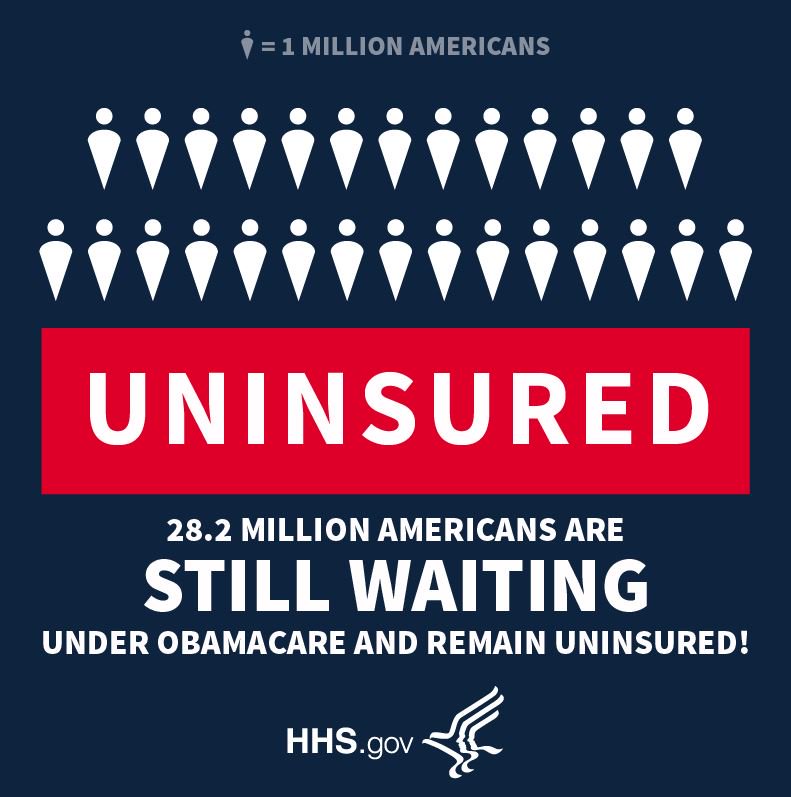
Most discussions of the Affordable Care Act (a.k.a. ObamaCare) center on the number of uninsured: By some estimates there were 49 million Americans uninsured before the ACA, and that number has come down by something like 20-25 million. Similarly, the percentage of Americans who tell Gallup that they’re uninsured has dropped from 18% in 2013 (before ObamaCare fully took effect) to 10.9% at the end of 2016.

What the uninsured rate ignores, though, is that many of the people who thought they were insured before the ACA only had insurance only up to a point. Millions had policies with annual or lifetime caps on the benefits, or provisions that allowed the insurance company to drop them if they got too sick. In other words, they were covered if they broke a leg slipping on the ice, but they still faced bankruptcy if they waged a multi-year battle with cancer or an expensive chronic disease like MS or HIV.

The best article about this is a Time cover story from March, 2009: Time‘s reporter on the healthcare-reform beat, Karen Tumulty, recounted how her brother thought he was insured until he was diagnosed with a chronic kidney disease.

When we talk about health-care reform, we usually start with the problem of the roughly 45 million (and rising) uninsured Americans who have no health coverage at all. But [Tumulty’s brother] Pat represents the shadow problem facing an additional 25 million people who spend more than 10% of their income on out-of-pocket medical costs. They are the underinsured, who may be all the more vulnerable because, until a health catastrophe hits, they’re often blind to the danger they’re in.

… While Pat had been continuously covered since 2002 by the same company, Assurant Health, each successive policy treated him as a brand-new customer. In looking back over Pat’s medical records, the company noticed test results from December, eight months earlier. Though Pat’s doctors didn’t determine the precise cause of the problem until the following July, his kidney disease was nonetheless judged a “pre-existing condition” — meaning his insurance wouldn’t cover it, since he was now under a different six-month policy from the one he had when he got those first tests.

The ACA did several things to turn kinda-sorta insurance like this into real insurance: eliminate caps and cancellations, as well as waivers that allowed insurance not to pay for pre-existing conditions. But there’s still a flaw.

7. Deductibles and co-pays. Just like car insurance, a healthcare policy might have a deductible: The company will only start paying after you’ve covered the first $500 or $5000 of your healthcare expenses for the year. The policy might also require co-pays: If you have 10% co-pay and run up a $1000 bill, you have to pay $100 of it.

Put together, those are called “out-of-pocket costs”, and they work just like the deductible on your car insurance: By accepting a higher out-of-pocket cost, you’re buying less insurance, so you’ll be charged a smaller premium.

And since insurance is a bad deal for most people, buying less insurance is a good deal for most people if you can afford it.

If you’re a middle-aged middle-class person and you have to pay the first $5,000 of the $200,000 treatments that cure your cancer, you’ll use the money you were saving for your next car or vacation, or get a home equity loan, or tap your IRA — and thank God you have insurance. If you’re too young to have established yourself financially yet, maybe you’ll stretch your credit cards and your middle-class parents will have to pitch in, but you’ll cover the $5,000 somehow.

Now suppose you’re a minimum-wage worker with no savings, no house, no credit, and no IRA, whose parents are in no better financial shape. To you, $5,000 is an astronomical sum; you can’t pay it, so you’ll have to go bankrupt. And bankrupt is bankrupt, whether it’s for $5,000 or $200,000.

So financially, your insurance has done you no good at all.

8. What does “affordable” really mean? ObamaCare caps out-of-pocket costs, but at a level that can be unapproachable for the working poor and lower-middle-class. The 2017 out-of-pocket limit is $7,150 for an individual or $14,300 for a family. That’s fine if you’re healthy, reasonably well off, and could afford a lower-out-of-pocket plan, but figure that you’ll come out ahead in the long run by buying less insurance. But if you’re forced into that plan because that’s the largest premium you can cover, you’re in a Catch-22: The only plan you can afford to pay the premiums on is one that you can’t afford to use.

Fortunately, the designers of ObamaCare took that into account (at least up to a point).  If your income is below a certain level — currently $29,700 for an individual and $60,750 for a family of four, increasing with each additional family member — you qualify for an additional out-of-pocket cost reduction: Below 4/5 of that number, the 2015 limit was $2,250 for an individual and $4,500 for a family, then increasing to $5,200 and $10,400. (Presumably, the 2017 limit has gone up with inflation, but I couldn’t lay my hands on it.)

I still have trouble imagining how a person making $23,760 a year comes up with $2,250, but at least it’s less than $7,150.

But that reduction is part of the income-based subsidies that are going away under TrumpCare. (This was hard to track down, but the web site ObamaCareFacts.com has a TrumpCare page that says: “The bill … gets rid of out-of-pocket cost assistance.”) So if you could imagine someone near the federal poverty limit wriggling through the Catch-22 of ObamaCare, that door is shut under TrumpCare.

9. TrumpCare slams the door on the working poor. For now, the very poor still have Medicaid, which is designed to have low out-of-pocket costs. But TrumpCare eventually jettisons federal responsibility for Medicaid, instead giving the states block grants whose value will not keep up with healthcare inflation. So whether Medicaid will remain as usable as it is now will depend on what state you’re in.

But those just above the Medicaid level — the people who get subsidies in the ObamaCare markets now — are going to wind up without usable insurance. Because they are less well off than the average American, their need for insurance is greater: They need not just coverage, but coverage whose out-of-pocket costs they can handle. A policy that would be fine for a rich or middle-class family will do them no good at all.

The relaxed regulations on coverages and out-of-pocket costs will probably bring premiums down somewhat, but that will only create the illusion of health insurance. Many will still face the horrible choice between foregoing treatment and going bankrupt. In other words, they won’t really be insured at all.

The Monday Morning Teaser

I guess I finally have to stop saying that the Republicans have no plan for replacing ObamaCare: Their replacement legislation is out now, and it doesn’t do most of the things they claimed it would. Trump has endorsed it, despite the fact that it doesn’t do any of the things he promised during the campaign. Remember? “Better healthcare for more people at a lesser cost.”

Anyway, I don’t have to do a post outlining what’s in the bill and how bad it is, because lots of more qualified people have already done that. I’ll link to them in the weekly summary. Instead, the featured post is going to make an outrageous claim: The poorer you are, the better your health insurance needs to be. We’re so used to making the assumption that the poor should get by on less than the rest of us — smaller apartments, lower-quality food, fewer luxuries — that we automatically carry it into discussions of healthcare. So we end up arguing about how much worse low-income people’s health insurance should be instead of how much better.

In order to justify that claim, I’ll go back to first principles and write what is essentially a primer on insurance, including such stuff as why you need fire insurance on your house but you probably don’t need an extended warranty on your camera. Expect that to come out between 9 and 10 EDT.

The weekly summary will organize a bunch of other people’s analyses of TrumpCare, and also of the revised Muslim ban. I’ll briefly cover the U.S. attorney firings, and developments in the administration’s various brewing scandals. And I’ll note a question other people have raised: Now that the public has learned to discount or ignore most of what the President says, what’s going to happen if there’s a real emergency like an Ebola outbreak or a Fukushima disaster? There are certain situations where the public is inclined to panic, and it needs trusted leadership to calm it down and get everybody to do some simple things to save lives. But we don’t have trustworthy leadership. Expect that around 11.

Worrying About Progress

If you’re worried that technological progress will lead to mass unemployment — and especially if you think this process is already underway — you should be very interested in what the Federal Reserve does.

Timothy Lee

This week’s featured post is “Jobs, Income, and the Future“: Technologists worry that robots are going to make most humans unemployable, and economists scoff at that worry. Who’s right?

I was in Florida last week, where I spoke to the Unitarian Universalists of Lakewood Ranch. This group is only a year-or-so old, so I raised the question “Why Be a Congregation?

This week everybody was talking about Russia again

It’s hard to restate the situation more succinctly than Paul Begala:

So:
1 Russia hacked Dems
2 Leaks were timed to aid Trump
3 Trump aides had contact w/Russians
4 They lied about contacts

Nope. Nothing here

So far, we have a lot of circumstantial evidence suggesting a quid-pro-quo relationship between the Trump campaign and the Putin government, but nothing that rises to the level of proof. For some reason, though, Trump’s people all start obfuscating, misdirecting, and lying whenever the subject comes up, and his allies in Congress really, really don’t want to investigate it.

That’s the mystery. Disgraced National Security Adviser Michael Flynn had to resign when it came out that he lied about his conversations with the Russian ambassador (and got Vice President Pence to lie for him). And this week we found out that Attorney General Jeff Sessions lied during his confirmation hearings about meeting the Russian ambassador. These are serious matters: Lying to the FBI (Flynn) and to Congress (Sessions) are both crimes. (I’m waiting for Republicans to start chanting “Lock them up!”, but so far there are no charges, and Sessions continues to be our top law-enforcement officer.) So why take those risks unless there’s something serious worth hiding?

I have to agree with Josh Marshall:

[B]ig, big scandals work like this. People who don’t even appear to be that close to the action keep getting pulled under for what seem like needless deceptions. The answer is usually that the stuff at the center of the scandal is so big that it requires concealment, even about things distant from the main action, things that it would seem much better and less damaging simply to admit.

He also makes an interesting point about cover-ups:

We’ve all heard the old saw: It’s never the crime, it’s the cover-up. This is almost never true. Covering scandals for any length of time is enough to tell you that. People are generally able to make judgments about how much trouble they’re in. We think the ‘cover up’ is worse than the crime because it’s actually very seldom that the full scope of the actual crime is ever known. The cover up works better than you think. The other reason the cover up is a logical response is that it usually works. You only find out about it when it doesn’t. So it’s a good bet.


Another Trump campaign person changed his story about how the Republican platform plank on Ukraine was softened in Russia’s favor. At the time he claimed Trump and then-campaign-manager Paul Manafort weren’t involved, but now he says they were.


Marshall makes his best attempt at an “innocent explanation” of what we know about Trump and Russia: Basically, Trump went through a period in the 90s where the only investment capital he could raise came from Russian oligarchs, and given his what’s-good-for-Trump-is-good-period narcissism, he came to share an oligarch’s worldview: Putin good, sanctions against Russia bad, and so on. Putin recognized the value Trump could have for him, and did his best to put Trump in the White House.


The administration’s response to the Sessions revelation, instantly picked up by Fox News and individual Trump fans commenting via social media, was that Democrats have also met with the high Russian officials, as if that were the problem. Chuck Schumer pointed out the lameness of this retort by volunteering to testify under oath about his 2003 encounter with Putin, and daring Trump and his people to do the same about their meetings.

The second response is to throw out a bright shiny object to distract everyone: Trump’s so-far baseless claim that President Obama wiretapped him in Trump Tower. Not only has he not explained why we should believe this, he hasn’t even said why he believes it.

Notice the response he never gets close to: If there really were no story here, he could score a lot of points with a defiant, bring-it-on attitude towards an investigation.


The Washington Post gets a legal opinion about Sessions’ false testimony to Congress:

Under Title 18 of the U.S. Code, Sections 1001 and 1621, perjury before Congress is punishable by up to five years imprisonment. To prove that offense, a prosecutor would have to establish that Sessions’s answer was false, that he knew it was false when made and that the subject matter of the answer was “material” to the congressional inquiry in which he was testifying. Those elements all appear to be present.


From Vox:

and Trump’s speech to Congress

It’s kind of amazing how low the bar is for this guy. He reads a speech off a teleprompter that doesn’t sound totally crazy — but does misrepresent a number of material facts — and pundits are thrilled. It’s as if I got arrested for indecent exposure, but because I keep my pants zipped in court, the jury decides I must be a changed man.


NPR’s reporters do a good job of annotating the text:

President Trump very slowly and emphatically used the term “radical Islamic terrorism” to describe the threat facing the nation. It is a term he used constantly during his presidential campaign. By repeating it Tuesday, he may be rebuking his own national security adviser, Lt. Gen. H.R. McMaster, who reportedly told his National Security Council staff last week that the term may not help efforts to enlist the support of Muslim allies in the fight against ISIS because ISIS terrorism is actually “un-Islamic.” Former Presidents George W. Bush and Obama shared McMaster’s view.

“Radical Islamic terrorism” plays well among Trump’s base, and in this administration domestic politics will always come before national security.

The reason the phrase is bad framing should be obvious if you translate it to Christianity, or some other religion you feel more sympathy for. If you’re a Christian, “radical Christianity” sounds like it ought to be a good thing. (For that matter, if you’re a humanist, “radical humanism” sounds pretty good.)

ISIS and other jihadist groups argue that they practice the “real” Islam, and that all the more liberal or pro-Western Muslims are compromisers who bend the true word of Allah to the worldly powers. If we call their ideology “radical Islam”, we’re validating their claim, and helping them recruit young Muslims.


Another important annotation:

although Trump has cited the danger of attacks by people traveling from the countries affected by his travel restrictions, all the lethal attacks by radicalized Muslims in the U.S. since 2001 have been carried out by U.S. citizens or people who were in the country lawfully.


From the speech:

I have ordered the Department of Homeland Security to create an office to serve American Victims.  The office is called VOICE –- Victims Of Immigration Crime Engagement.  We are providing a voice to those who have been ignored by our media, and silenced by special interests.

One of the common techniques of bigotry is to treat misdeeds by the targeted group as somehow special, and so stereotype the group by those behaviors. So, for example, terrorism by Muslims is different than terrorism by Christians, sexual abuse of students by gay teachers is different than abuse by straight teachers, and so on. Here, Trump is continuing to build on the theme of his convention speech last summer, that undocumented immigrants present some special crime threat.

The reality is that any large-enough group of people will include criminals. If we separated out all the Americans named Donald, I’m sure we’d find that some are rapists, some are killers, and some (I assume) are good people. That separation would promote the (probably unfair) impression that people named Donald are somehow unsavory.

This is yet another fascist resonance in the Trump administration. Andrea Pitzer tells Amy Goodman:

Back in Nazi Germany there was … a Nazi paper called Der Stürmer, and they had a department called “Letter Box,” and readers were invited to send in stories of supposed Jewish crimes. And Der Stürmer would publish them, and they would include some pretty horrific graphic illustrations of these crimes, as well. And there was even a sort of a lite version of it, if you will, racism lite, in which the Neues Volk, which was more like a Look or a Life magazine, which normally highlighted beautiful Aryan families and their beautiful homes, would run a feature like “The Criminal Jew,” and they would show photos of “Jewish-looking,” as they called it, people who represented different kinds of crimes that one ought to watch out for from Jews.

But having said that, I need to balance with this quote from “Godwin’s President” by Chris Ladd:

Trump is not Hitler. Hitler was someone else’s sin, someone else’s dragon unleashed. Trump is what Hitler represents, the embodiment of our nightmares, a living vision of a nation at her lowest, darkest, and most suicidally dangerous. Darkness that we once confined in our collective national basement we’ve now loosed on the world.

America’s shadow is not necessarily as dark as Depression-era Germany’s shadow.

but I decided to think about things other than Trump

The featured post looks at the long-term issue of the future of work and income. Ordinary macroeconomic policy should be enough to maintain more-or-less full employment for now, but eventually we’re going to need some kind of basic income program. Making that work will be a social problem, not just an economic problem.


Ross Douthat makes a conservative case for (admittedly limited) reparations to descendants of slaves. He offers this concession as part of a deal to end affirmative action.


Occasionally you’ll see lists purporting to be large numbers of scientists who don’t believe in climate change. The sheer number of names is supposed to prove that climate change is still a hotly contested scientific issue.

In The Guardian, John Abraham (who actually does research on how to monitor the climate) takes a closer look at one such a list of 300 names. He finds what you always find: The people listed are “scientists” only in the weakest and most general sense. They have degrees or jobs that are somehow related to science or technology, but no particular expertise in climate research.

Within the community of actual climate-science experts, it is a settled fact that the Earth is getting warmer and that burning fossil fuels is an important cause.


Sam Brownback’s Kansas tax experiment might be on its last legs. In February, the Republican-controlled legislature voted for a large tax increase, which Brownback vetoed. The House managed a 2/3rds majority to override the veto, but the override fell two votes short in the Senate. So, for now, no tax increase.

However, that veto does not solve the underlying problem: Absent a tax increase, Kansas faces a major budget shortfall. And that situation got worse Thursday when the Kansas Supreme Court ruled unanimously that the current spending plan falls short of the legislature’s responsibility under Article 6 of the state constitution to “make suitable provision for finance of the educational interests of the state.”


In the UK, the Churches Conservation Trust owns a lot of abandoned churches, many of them centuries old. Rather than just let them sit there, the CCT has begun promoting “champing” — camping out in old abandoned churches. They provide beds and electric candles, though their ad says nothing about the possible ghost problem.


I spent my week off in Florida, where I happened to attend a lecture by Bernard Haykel, a professor of Near Eastern Studies at Princeton. I learned something simple about 9-11, which I was amazed I hadn’t heard in the previous 15 years: an answer to the question “Why were so many of the 9-11 hijackers Saudis?”

Haykel’s answer: because Bin Laden picked them that way. He did that for two reasons: (1) At the time it was easier for Saudis to get visas than people from other Muslim countries. (2) He wanted to drive a wedge into the U.S./Saudi alliance.


Also while in Florida, I got to see a sandhill-crane chick for the first time. The adult sandhills are absolutely fearless in the face of humans, and see no reason not to claim a new suburban development as their territory. While out for walks near the friends’ house where I was staying, I would occasionally turn my head and find myself a few feet from a sandhill giving me an eye-to-eye stare, and showing not the slightest hint of alarm.

But they’re a bit more reclusive during hatchling season, so it was only on my last day before heading home that I caught a glimpse of this youngster, a straw-colored fluffball not all that different from chicken hatchlings, albeit with a longer neck.

chick4

and you might also be interested in

As governor of Indiana, Mike Pence conducted public business over a private email account, and got hacked. Chris Hayes commented:

This is going to be a very bitter pill for all those voters for whom server management was their top issue.

I could fill the Sift every week with hypocrisy stories like this, where issues that were considered vital to the survival of the Republic before Trump took office now seem not to matter. In a few weeks, Trump will most likely produce a budget that the CBO will analyze as having a big deficit, and we’ll see whether Tea Partiers are alarmed by that or not. I predict not. All that 2010 rhetoric about going the way of Greece will be left unplugged.

To me, such examples just underline what does matter, which I spelled out two weeks ago: identity politics. The Trump base voter is nostalgic for an America where white Christians are dominant, where genders and gender roles are clearly defined, and where languages other than English are heard only inside certain big-city ghettos. All other issues are tactical; positions on them can turn on a dime.

For example, this is why terrorism by Muslims is a huge deal, but terrorism by white racists is not. Terrorism is a tactical issue; the core issues are about identity: race, language, religion, and gender roles.


One point of building the Keystone XL Pipeline was that it was going to use American steel. “Going to put a lot of workers, a lot of steelworkers, back to work,” Trump said. But that was then, this is now.


One of the more ominous things that happened these last two weeks was when Customs and Border Protection agents boarded a domestic flight from San Francisco to New York and demanded to see everyone’s ID. The Atlantic‘s Garrett Epps can find no legal justification for this, and pledges to refuse to present his documents if he winds up in this situation.


The EPA is undoing Obama’s standards for vehicle emissions and gas mileage. Because climate change is a myth, so why do anything to try to mitigate it?


The EU Parliament voted to drop the United States from its visa waiver program. Immediately, this does nothing, because the actual decision would be made by the European Commission. But it is a step in the direction of requiring Americans to get a visa before visiting Europe.

I read this as a shot across the bow: Inside the US, we discuss our immigration and trade policies in a one-sided way, as if we can treat other countries however we want and they’ll just accept it. But if we disrespect or disadvantage foreign visitors, immigrants, and products, American visitors, immigrants, and products will be disrespected and disadvantaged in return.


Tuesday, Attorney General Sessions announced a policy change: The Justice Department will no longer be “dictating to local police how to do their jobs, or spending scarce federal resources to sue them in court”.

In other words, there will be no future investigations like the ones Obama’s DoJ did into Ferguson or Baltimore or Chicago police. So the next time there is a police killing like Michael Brown or Freddie Gray or Laquan McDonald, the fix will be in from the beginning. Local police can run a cover-up instead of an investigation, and not worry about anyone looking over their shoulders.

Conservatives often ask why it’s necessary to have a Black Lives Matter movement, or why it’s not sufficient to affirm that “all lives matter”. It’s because to people like Jeff Sessions, the lives of young black men like Brown or Gray or McDonald don’t matter. If police want to kill them, it’s no big deal.


A local pastor gives his account of taking his 11-year-old daughter to Trump’s rally in Melbourne, Florida on February 18. He seems not to have been a Trump supporter, but wanted his daughter to take advantage of the rare opportunity to see the President of the United States in person.

I’m trying to separate how I actually feel about this man and his campaignisms. I know why people voted for him; I know why people voted against his opponent. But, at the end of the day, what I felt from his leadership in this experience was actually horrifying. There was palpable fear in the room. There was thick anger and vengeance. He was counting on it. I don’t think I’m exaggerating when I say that it would not have taken very much for him to have called this group of people into some kind of riotous reaction.

Now, not everyone in the room was a part of the angry mob mentality – I looked around the room and saw many people who could quite easily be folks from my neighborhood, folks from my church, folks who were planning to go grab a bite to eat at Cracker Barrel afterwards. Folks who truly wanted to see America “great.” The people who support the Republican Party want to see some needed changes in the government – the people that were there for that reason, are by and large good folks. But those are not the people the President was inciting – they are not the people he was leading. He was rallying the angry, vigilant ones.

and let’s close with something sadly amusing

Patrick Stewart and Stephen Colbert star in “Waiting for Godot’s Obamacare Replacement“.

Jobs, Income, and the Future

What “the jobs problem” is depends on how far into the future you’re looking. Near-term, macroeconomic policy should suffice to create enough jobs. But long-term, employing everyone may be unrealistic, and a basic income program might be necessary. That will be such a change in our social psychology that we need to start preparing for it now.


Historical context. The first thing to recognize about unemployment is that it’s not a natural problem. Tribal hunter-gatherer cultures have no notion of it. No matter how tough survival might be during droughts or other hard times, nothing stops hunter-gatherers from continuing to hunt and gather. The tribe has a territory of field or forest or lake, and anyone can go to this commonly held territory to look for food.

Unemployment begins when the common territory becomes private property. Then hunting turns into poaching, gathering becomes stealing, and people who are perfectly willing to hunt or fish or gather edible plants may be forbidden to do so. At that point, those who don’t own enough land to support themselves need jobs; in other words, they need arrangements that trade their labor to an owner in exchange for access to the owned resources. The quality of such a job might vary from outright slavery to Clayton Kershaw’s nine-figure contract to pitch for the Dodgers, but the structure is the same: Somebody else owns the productive enterprise, and non-owners needs to acquire the owner’s permission to participate in it.

So even if unemployment is not an inevitable part of the human condition, it is as old as private property. Beggars — people who have neither land nor jobs — appear in the Bible and other ancient texts.

But the nature of unemployment changed with Industrial Revolution. With the development and continuous improvement of machines powered by rivers or steam or electricity, jobs in various human trades began to vanish; you might learn a promising trade (like spinning or weaving) in your youth, only to see that trade become obsolete in your lifetime.

So if the problem of technological unemployment is not exactly ancient, it’s still been around for centuries. As far back as 1819, the economist Jean Charles Léonard de Sismondi was wondering how far this process might go. With tongue in cheek he postulated one “ideal” future:

In truth then, there is nothing more to wish for than that the king, remaining alone on the island, by constantly turning a crank, might produce, through automata, all the output of England.

This possibility raises an obvious question: What, then, could the English people offer the king (or whichever oligarchy ended up owning the automata) in exchange for their livelihoods?

Maslow. What has kept that dystopian scenario from becoming reality is, basically, Maslow’s hierarchy of needs. As basic food, clothing, and shelter become easier and easier to provide, people develop other desires that are less easy to satisfy. Wikipedia estimates that currently only 2% of American workers are employed in agriculture, compared to 50% in 1870 and probably over 90% in colonial times. But those displaced 48% or 88% are not idle. They install air conditioners, design computer games, perform plastic surgery, and provide many other products and services our ancestors never knew they could want.

So although technology has continued to put people out of work — the railroads pushed out the stagecoach and steamboat operators, cars drastically lessened opportunities for stableboys and horse-breeders, and machines of all sorts displaced one set of skilled craftsmen after another — new professions have constantly emerged to take up the slack. The trade-off has never been one-for-one, and the new jobs have usually gone to different people than the ones whose trades became obsolete.  But in the economy as a whole, the unemployment problem has mostly remained manageable.

Three myths. We commonly tell three falsehoods about this march of technology: First, that the new technologies themselves directly create the new jobs. But to the extent they do, they don’t create nearly enough of them. For example, factories that manufacture combines and other agricultural machinery do employ some assembly-line workers, but not nearly as many people as worked in the fields in the pre-mechanized era.

When the new jobs do arise, it is indirectly, through the general working of the economy satisfying new desires, which may have only a tangential relationship to the new technologies. The telephone puts messenger-boys out of business, and also enables the creation of jobs in pizza delivery. But messenger-boys don’t automatically get pizza-delivery jobs; they go into the general pool of the unemployed, and entrepreneurs who create new industries draw their workers from that pool. At times there may be a considerable lag between the old jobs going away and the new jobs appearing.

Second, the new jobs haven’t always required more education and skill than the old ones. One of the key points of Harry Braverman’s 1974 classic Labor and Monopoly Capital: the degradation of work in the 20th century was that automation typically bifurcates the workforce into people who need to know a lot and people who need to know very little. Maybe building the first mechanized shoe factory required more knowledge and skill than a medieval cobbler had, but the operators of those machines needed considerably less knowledge and skill. The point of machinery was never just that it replaced human muscle-power with horsepower or waterpower or fossil fuels, but also that once the craftsman’s knowledge had been built into a machine, low-skill workers could replace high-skill workers.

And finally, technological progress by itself doesn’t always lead to general prosperity. It increases productivity, but that’s not the same thing. A technologically advanced economy can produce goods with less labor, so one possible outcome is that it could produce more goods for everybody. But it could also produce the same goods with less labor, or even fewer goods with much less labor. In Sismondi’s Dystopia, for example, why won’t the king stop turning his crank as soon as he has all the goods he wants, and leave everyone else to starve?

So whether a technological society is rich or not depends on social and political factors as much as economic ones. If a small number of people wind up owning the machines, patents, copyrights, and market platforms, the main thing technology will produce is massive inequality. What keeps that from happening is political change: progressive taxation, the social safety net, unions, shorter work-weeks, public education, minimum wages, and so on.

The easiest way to grasp this reality is to read Dickens: In his day, London was the most technologically advanced city in the world, but because political change hadn’t caught up, it was a hellhole for a large chunk of its population.

The fate of horses. Given the long history of technological unemployment, it’s tempting to see the current wave as just more of the same. Too bad for the stock brokers put out of work by automated internet stock-trading, but they’ll land somewhere. And if they don’t, they won’t wreck the economy any more than the obsolete clipper-ship captains did.

But what’s different about rising technologies like robotics and artificial intelligence is that they don’t bifurcate the workforce any more: To a large extent, the unskilled labor just goes away. The shoe factory replaced cobblers with machine designers and assembly-line workers. But now picture an economy where you get new shoes by sending a scan of your feet to a web site which 3D-prints the shoes, packages them automatically, and then ships them to you via airborne drone or driverless delivery truck. There might be shoe designers or computer programmers back there someplace, but once the system is built, the amount of extra labor your order requires is zero.

In A Farewell to Alms, Gregory Clark draws this ominous parallel: In 1901, the British economy required more than 3 million working horses. Those jobs are done by machines now, and the UK maintains a far smaller number of horses (about 800K) for almost entirely recreational purposes.

There was always a wage at which all these horses could have remained employed. But that wage was so low that it did not pay for their feed.

By now, there is literally nothing that three million British horses can do more economically than machines. Could the same thing happen to humans? Maybe it will be a very long time before an AI can write a more riveting novel than Stephen King, but how many of us still have a genuinely irreplacable talent?

Currently, the U.S. economy has something like 150 million jobs for humans. What if, at some point in the not-so-distant future, there is literally nothing of economic value that 150 million people can do better than some automated system?

Speed of adjustment. The counter-argument is subtle, but not without merit: You shouldn’t let your attention get transfixed by the new systems, because new systems never directly create as many jobs as they destroy. Most new jobs won’t come from maintaining 3D printers or manufacturing drones or programming driverless cars, they’ll come indirectly via Maslow’s hierarchy: People who get their old wants satisfied more easily will start to want new things, some of which will still require people. Properly managed, the economy can keep growing until all the people who need jobs have them.

The problem with that argument is speed. If technology were just a one-time burst, then no matter how big the revolution was, eventually our desires would grow to absorb the new productivity. But technology is continually improving, and could even be accelerating. And even though we humans are a greedy lot, we’re also creatures of habit. If the iPhone 117 hits the market a week after I got my new iPhone 116, maybe I won’t learn to appreciate its new features until the iPhone 118, 119, and 120 are already obsolete.

Or, to put the same idea in a historical context, what if technology had given us clipper ships on Monday, steamships on Tuesday, and 747s by Friday? Who would we have employed to do what?

You could imagine, then, a future where we constantly do want new things that employ people in new ways, but still the economy’s ability to create jobs keeps falling farther behind. Since we’re only human, we won’t have time either to appreciate the new possibilities technology offers us, or to learn the new skills we need to find jobs in those new industries — at least not before they also become obsolete.

Macroeconomics. Right now, though, we are still far from the situation where there’s nothing the unemployed could possibly do. Lots of things that need doing aren’t getting done, even as people who might do them are unemployed: Our roads and bridges are decaying. We need to prepare for climate change by insulating our buildings better and installing more solar panels. The electrical grid is vulnerable and doesn’t let us take advantage of the most efficient power-managing technologies. Addicts who want treatment aren’t getting it. Working parents need better daycare options. Students could benefit from more one-on-one or small-group attention from teachers. Hospital patients would like to see their nurses come around more often and respond to the call buttons more quickly. Many of our elderly are warehoused in inadequately staffed institutions.

Some inadequate staffing we’ve just gotten used to: We expect long lines at the DMV, and that it might take a while to catch a waitress’ eye. In stores, it’s hard to get anybody to answer your questions. But that’s just life, we think.

That combination of unmet needs and unemployed people isn’t a technological problem, it’s an economic problem. In other words, the problem is about money, not about what is or isn’t physically possible. Either the people with needs don’t have enough money to create effective demand in the market, or the workers who might satisfy the needs can’t afford the training they need, or the businessmen who might connect workers with consumers can’t raise the capital to get started.

One solution is for the Federal Reserve to create more money. At Vox, Timothy Lee writes:

When society invents a new technology that makes workers more efficient, it has two options: It can employ the same number of workers and produce more goods and services, or it can employ fewer workers to produce the same number of goods and services.

Jargon-filled media coverage makes this hard to see, but the Federal Reserve plays a central role in this decision. When the Fed pumps more money into the economy, people spend more and create more jobs. If the Fed fails to supply enough cash, then faster technological progress can lead to faster job losses — something we might be experiencing right now.

So if you’re worried that technological progress will lead to mass unemployment — and especially if you think this process is already underway — you should be very interested in what the Federal Reserve does.

Another option is for the government to directly subsidize the people whose needs would otherwise go unmet. That’s what the Affordable Care Act and Medicaid do: They subsidize healthcare for people who need it but otherwise couldn’t afford it, and so create jobs for doctors, nurses, and the people who manufacture drugs, devices, and the other stuff used in healthcare.

Finally, the government can directly invest in industries that otherwise can’t raise capital. The best model here is the New Deal’s investment in the rural electric co-ops that brought electricity to sparsely populated areas. It’s also what happens when governments build roads or mass-transit systems.

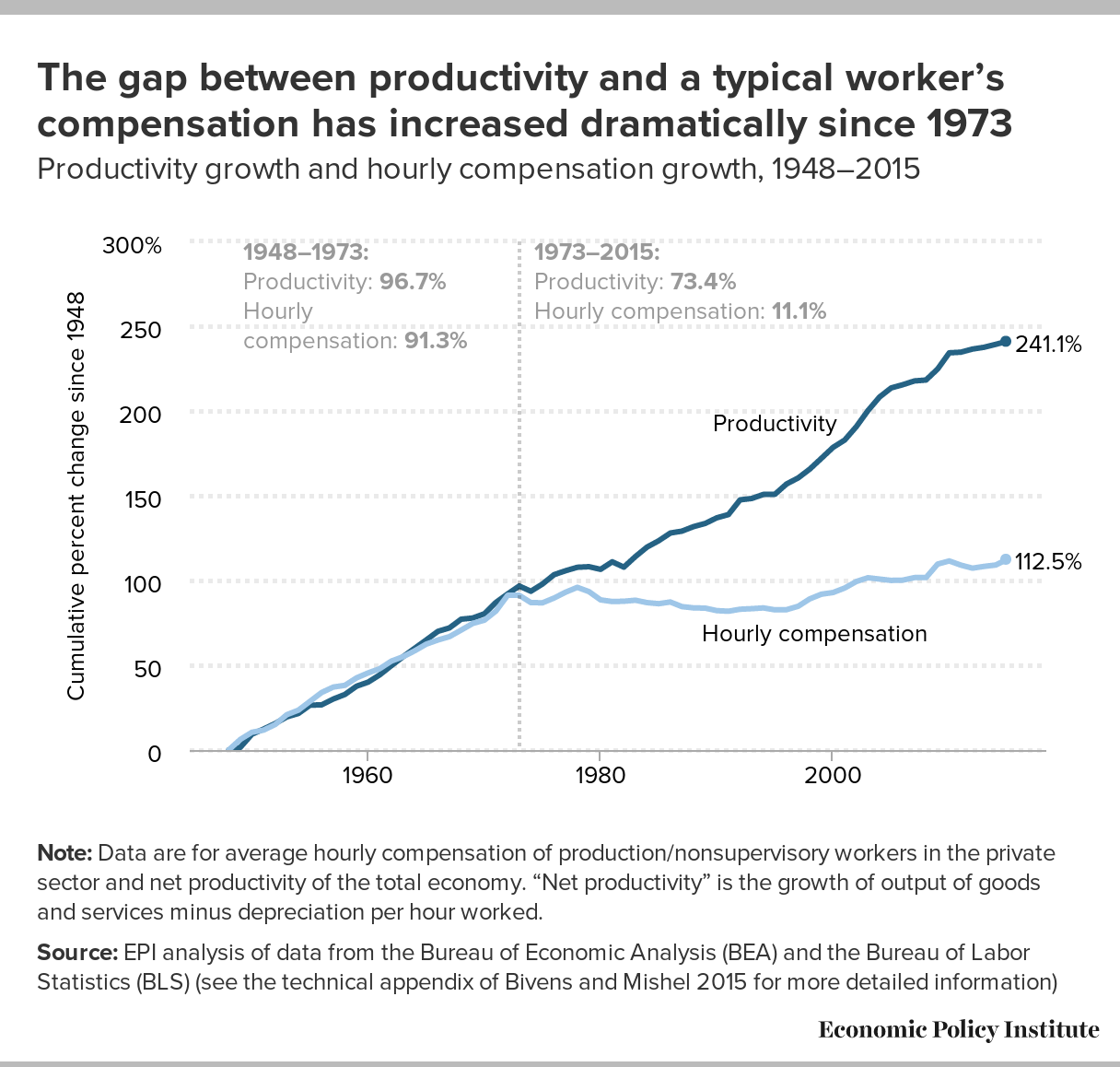
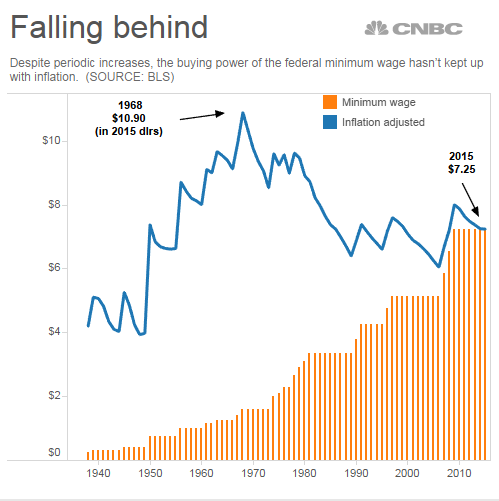
When you look at things this way, you realize that our recent job problems have as much to do with conservative macroeconomic policy as with technology. Since Reagan, we’ve been weakening all the political tools that distribute the benefits of productivity: progressive taxation, the social safety net, unions, shorter work-weeks, public education, the minimum wage. And the result has been exactly what we should have expected: For decades, increases in national wealth have gone almost entirely to owners rather than workers.

In short, we’ve been moving back towards Dickensian London.

The long-term jobs problem. But just because the Robot Apocalypse isn’t the sole source of our immediate unemployment problem, that doesn’t mean it’s not waiting in the middle-to-far future. Our children or grandchildren might well live in a world where the average person is economically superfluous, and only the rare genius has any marketable skills.

The main thing to realize about this future is that its problems are more social and psychological than economic. If we can solve the economic problem of distributing all this machine-created wealth, we could be talking about the Garden of Eden, or various visions of hunter-gatherer Heaven. People could spend their lives pursuing pleasure and other forms of satisfaction, without needing to work. But if we don’t solve the distribution problem, we could wind up in Sismondi’s Dystopia, where it’s up to the owners of the automata whether the rest of us live or die.

The solution to the economic problem is obvious: People need to receive some kind of basic income, whether their activities have any market value or not. The obvious question “Where will the money for this come from?” has an obvious answer “From the surplus productivity that makes their economic contribution unnecessary.” In the same way that we can feed everybody now (and export food) with only 2% of our population working in agriculture, across-the-board productivity could create enough wealth to support everyone at a decent level with only some small number of people working.

But the social/psychological problem is harder. Kurt Vonnegut was already exploring this in his 1952 novel Player Piano. People don’t just get money from their work, they get their identities and senses of self-worth. For example, coal miners of that era may not have wanted to spend their days underground breathing coal dust and getting black lung disease, but many probably felt a sense of heroism in making these sacrifices to support their families and to give their children better opportunities. If they had suddenly all been replaced by machines and pensioned off, they could have achieved those same results with their pension money. But why, an ex-miner might wonder, should anyone love or appreciate him, rather than just his unearned money?

Like unemployment itself, the idea that the unemployed are worthless goes way back. St. Paul wrote:

This we commanded you, that if any would not work, neither should he eat.

It’s worth noticing, though, that many people are already successfully dealing with this psycho-social problem. Scions of rich families only work if they want to, and many of them seem quite happy. Millions of Americans are pleasantly retired, living off a combination of savings and Social Security. Millions of others are students, who may be working quite hard, but at things that have no current economic value. Housespouses work, but not at jobs that pay wages.

Countless people who have wage-paying jobs derive their identities from some other part of their lives: Whatever they might be doing for money, they see themselves as novelists, musicians, chess players, political activists, evangelists, long-distance runners, or bloggers. Giving them a work-free income would just enable them to do more of what they see as their calling.

Conservative and liberal views of basic income. If you talk to liberals about basic income, the conversation quickly shifts to all the marvelous things they would do themselves if they didn’t have to work. Conservatives may well have similar ambitions, but their attention quickly shifts to other people, who they are sure would lead soulless lives of drunken society-destroying hedonism. (This is similar to the split a century ago over Prohibition: Virtually no one thought that they themselves needed the government to protect them from the temptation of gin, but many believed that other people did.)

So far this argument is almost entirely speculative, with both sides arguing about what they imagine would happen based on their general ideas about human nature. However, we may get some experimental results before long.

GiveDirectly is an upstart charity funded by Silicon Valley money, and it has tossed aside the old teach-a-man-to-fish model of third-world aid in favor of the direct approach: Poor people lack money, so give them money. It has a plan to provide a poverty-avoiding basic income — about $22 a month — for 12 years to everybody in 40 poor villages in Kenya. Another 80 villages will get a 2-year basic income. Will this liberate the recipients’ creativity? Or trap them in soul-destroying dependence and rob them of self esteem?

My guess: a little bit of both, depending on who you look at. And both sides will feel vindicated by that outcome. We see that already in American programs like food stamps. For some conservatives, the fact that cheating exists at all invalidates the whole effort; that one guy laughing at us as he eats his subsidized lobster outweighs all the kids who now go to school with breakfast in their stomachs. Liberals may look at the same facts and come to the opposite conclusion: If I get to help some people who really need it, what does it matter if a few lazy lowlifes get a free ride?

So I’ll bet some of the Kenyans will gamble away their money or use it to stay permanently stoned, while others will finally get a little breathing room, escape self-reinforcing poverty traps, and make something of their lives. Which outcome matters to you?

Summing up. In the short run, there will be no Robot Apocalypse as long as we regain our understanding of macroeconomics. But we need to recognize that technological change combines badly with free-market dogma, leading to Dickensian London: Comparatively few people own the new technologies, so they capture the benefits while the rest of us lose our bargaining power as we become less and less necessary.

However, we’re still at the point in history where most people’s efforts have genuine economic value, and many things that people could do still need doing. So by using macroeconomic tools like progressive taxation, public investment, and money creation, the economy can expand so that technological productivity leads to more goods and services for all, rather than a drastic loss of jobs and livelihoods for most while a few become wealthy on a previously unheard-of scale.

At some point, though, we’re going to lose our competition with artificial intelligence and go the way of horses — at least economically. Maybe you believe that AIs will never be able to compete with your work as a psychotherapist, a minister, or a poet, but chess masters and truck drivers used to think that too. Sooner or later, it will happen.

Adjusting to that new reality will require not just economic and political change, but social and psychological change as well. Somehow, we will need to make meaningful lives for ourselves in a work-free technological Garden of Eden. When I put it that way, it sounds easy, but when you picture it in detail, it’s not. We will all need to attach our self-respect and self-esteem to something other than pulling our weight economically.

In the middle-term, there are things we can do to adjust: We should be on the lookout for other roles like student and retiree, that give people a socially acceptable story to tell about themselves even if they’re not earning a paycheck. Maybe the academic idea of a sabbatical needs to expand to the larger economy: Whatever you do, you should take a year or so off every decade. “I’m on sabbatical” might become a story more widely acceptable than “I’m unemployed.” College professors and ministers are expected to take sabbaticals; it’s the ones who don’t who have something to explain.

Already-existing trends that lower the workforce, like retraining mid-career or retiring early, need to be celebrated rather than worried about. In the long run the workforce is going to go down; that can be either a source of suffering or a cause for rejoicing, depending on how we construct it.

Most of all, we need to re-examine the stereotypes we attach to the unemployed: They are lazy, undeserving, and useless. These stereotypes become self-fulfilling prophecies: If no one is willing to pay me, why shouldn’t I be useless?

Social roles are what we make them. The Bible does not report Adam and Eve feeling useless and purposeless in the Garden of Eden, and I suspect hunter-gatherer tribes that happened onto lands of plentiful game and endless forest handled that bounty relatively well. We could to the same. Or not.

The Monday Morning Teaser

A few years ago I established the practice of cancelling the Sift on Mondays following Sundays where I spoke in a church. The Sunday/Monday expenditure of energy seemed like too much for me. But in those days I only spoke two or three times a year, so I needed the breaks anyway. This year my speaking schedule has picked up, and I seem to be cancelling about one Sift a month, which I think is too much. It throws off my rhythm, and creates doubt in readers’ minds about whether there is a Sift this week or not.

So in March I’m planning to try something different: When I speak in a church on March 26, I’ll follow on the 27th with half a Sift: a weekly summary, but no featured post. We’ll see how that works.

Anyway, I’m back this week with another one of those long articles I’ve been thinking about for a while: “Jobs, Income, and the Future”. If you’re sick of reading my articles about the Trump administration, this one’s for you.

For years, I’ve been reading stuff by two kinds of people:

  • economists, who think job-destroying technologies have been a constant part of the economic landscape for centuries, and consequently believe that fiscal and monetary policy can deal with the new waves of job destruction that will come from robotics and artificial intelligence;
  • technologists, who say it’s different this time — AI and robotics challenge not just individual professions, but the fundamental economic competitiveness of human beings. Ultimately, then, we need to move away from a job-based economy into some other method of supporting everyone, like a basic income.

My uncertainty comes from the fact that both types are saying what their profession always says: Technologists always think it’s different this time, and economists never believe it. But no system lasts forever, so someday it will be different. Are we there yet or not?

What I come around to believing is: almost. Right now, proper macroeconomic policy is still capable of bringing us to full employment in decent jobs — though not if we continue on the market-worshiping path we’ve been on the last few decades. But the Robot Apocalypse is coming, and will require the kind of social change that we need to start working on right away.

That post still needs a little work, so let’s predict it appearing around 10.

Sadly, the weekly summary takes us back to the world of Trump: Russia, his speech to Congress, rolling back Obama’s climate-change initiatives, taking the Justice Department out of the business of reining in racist local police, reneging on his promise that the Keystone Pipeline will use American steel, and so on.

But there are also a few non-Trump items: I learned something new about 9-11, Brownback’s low-tax Kansas experiment stumbles towards an ending, and I took a cute picture of a sandhill crane chick. The closing is Patrick Stewart and Stephen Colbert doing “Waiting for Godot’s ObamaCare Replacement”.

The Chaos President

No Sift next week. The next new articles will appear on March 6

Donald, you know, is great at the one-liners, but he’s a chaos candidate, and he’d be a chaos president.

– Jeb Bush, 12-15-2015

This week’s featured post is “The Peril of Potemkin Democracy“. It’s my attempt to put the Trump threat in perspective.

If you happen to be near the Lakewood Ranch development outside of Sarasota, Florida next Sunday, I’ll be speaking to the Unitarian Universalist fellowship there.

This week everybody was talking about the Flynn firing

National Security Advisor Michael Flynn resigned under pressure last Monday night “following reports that he misled senior Trump administration officials, including Vice President Mike Pence, about the nature of talks he held with the Russian ambassador in December before he took office.”

It was later revealed that Trump had known about Flynn’s situation for weeks. What appears to have caused Flynn’s resignation/firing was that The Washington Post revealed to the public what Trump already knew.


The role of leaks from the intelligence community in Flynn’s ouster led to several cautionary articles about the unseemliness of this misuse of America’s spying apparatus. Eli Lake wrote:

In normal times, the idea that U.S. officials entrusted with our most sensitive secrets would selectively disclose them to undermine the White House would alarm those worried about creeping authoritarianism. Imagine if intercepts of a call between Obama’s incoming national security adviser and Iran’s foreign minister leaked to the press before the nuclear negotiations began? The howls of indignation would be deafening.

I judge the Flynn leaks on the same scale I use for any whistle-blowing leak: (1) Does the public-interest value of the information outweigh the inappropriateness of the source? (2) Did the leakers try to go through appropriate channels first? Here, the answers seem to be yes.

Josh Marshall:

you can’t really have any serious discussion of this question without recognizing that while these are extraordinary and in most cases unacceptable remedies, we are in an extraordinary situation. A hostile foreign power used its intelligence services to commit statutory crimes in the United States with the aim and quite possibly the effect of changing the outcome of a national election. The beneficiary’s aides and advisors were in what appears to have been active and ongoing communication with agents of that foreign power when this campaign to manipulate our elections was going on. The President has numerous financial dealings with people in and around Russia: but most of the most basic information about his finances, financials dealings and more, he refuses to disclose. The beneficiary, the President, has routinely and consistently made floridly glowing comments about the leader of the hostile foreign power and in a few specific cases taken specific actions which shift US policy to assist his country. This is not a normal situation. Even what we know is all but incomprehensible and the issue is what we don’t know. … The things that are being leaked are specific facts that are highly newsworthy and highly disturbing. They’re not stories of sexual peccadillos or things that are politically damaging but not fundamentally relevant to the work of government.

David Frum asks:

If the information about the Trump campaign’s apparent collusion with the Russians were not leaked, it would have been smothered and covered up. Congress refused to act. The Department of Justice has shown zero interest. The president’s occasional remarks about the matter carry all the conviction of O.J. Simpson’s vow to search for the real killers.

What, exactly, were investigators supposed to do with their information if they did not share it with the public?


The Trump administration has two leak problems: One set of leaks comes from what is sometimes called the “Deep State”: career professionals who staff the government and have an independent sense of what their mission is. These include, for example, the leaks that seem to come from inside the intelligence agencies, like the ones that brought down Flynn. I don’t doubt that as the Trump anti-environmental policies start to take effect, we’ll see a similar wave of leaks from inside the EPA or NOAA. If you signed up with OSHA because you felt committed to keeping American workers safe, you’re likely not to be a happy camper when, say, you get instructed to ignore evidence of real danger.

But a completely different source of leaks is the Trump White House itself, which seems to have divided into factions faster than any White House since John Adams had to contend with both Thomas Jefferson as his vice president and Alexander Hamilton as Secretary of the Treasury. A lot of the news articles we’ve seen about Trump’s behavior in the White House or his phone calls to foreign leaders most likely came from Trump’s own people.

The leader of one faction within the White House is Steve Bannon, whose previous job was running the right-wing Breitbart News. So it’s a reasonable speculation that Breitbart is now the voice of the Bannon White House faction. Vox analyzes one particular Breitbart article based on “sources close to the president”: It improbably blames Chief of Staff (and rival faction leader) Reince Preibus for the problems of the Bannon-written anti-Muslim executive order (which is currently not in effect, pending a court challenge), and says that Preibus’ job is in danger. Preibus doesn’t have a similar Pravda to do his bidding, so we don’t have a comparable response from his faction.

and Trump’s escalating war on the media

Back in January, Steve Bannon told The New York Times that the media was “the opposition party“, an opinion that Trump later echoed. This week Trump escalated with a tweet that called the NYT, CNN, NBC, CBS, ABC “the FAKE NEWS media” and “the enemy of the American people”.

This flashed me back to an interview Rachel Maddow did with NBC foreign correspondent Richard Engel shortly after the election. She asked for his observations of how authoritarian governments take over democracies.

If you start to hear the word “traitor” being used a lot about the opposition, that’s a red flag. If those criticisms escalate to “cancer”, that’s an even worse sign. So I think we should be listening for things like that.

It seems to me that “enemy of the American people” is a similarly bad sign.


Interesting response by CNN’s Don Lemon when a Trump supporter claimed his segment on the cost of protecting the Trump family was “fake news”. Lemon first defined fake news (“a story to intentionally deceive someone”) and explained why this story did not fit that definition. Then he admonished his panelist to stop calling stories “fake” just because he didn’t like them. (His actual point seemed to be that the story wasn’t newsworthy, which is a different thing entirely.) When the panelist went back to the “fake news” talking point, Lemon cut off the segment. “Thanks everyone. Thanks for watching. Have a great weekend.”

I’m not sure whether this is the right answer, but the media can’t go on debating obviously bogus points as if they were legitimate. That just plays into the hands of the Trumpists.


MSNBC’s Morning Joe has stopped booking Kellyanne Conway. Co-host Mika Brzezinski explained: “Every time I’ve ever seen her on television, something’s askew, off or incorrect.” And Joe Scarborough claimed she doesn’t know what she’s talking about: “She’s just saying things, just to get in front of the TV set and prove her relevance because behind the scenes — behind the scenes, she’s not in these meetings.”

The point of interviewing administration officials is to get information for your audience. But if the level of disinformation gets too high, it’s not worth it. After listening to Conway, you often have a worse idea of what’s going on than you did before.

and ObamaCare replacement is still going nowhere

For years, Republicans have kept announcing that they’ll reveal a “plan” to replace ObamaCare soon. When the promised meeting happens, though, what they present is a collection of ideas — health savings accounts, tax credits, high-risk pools — that presumably will someday make up a plan. But there is never anything detailed enough that either the CBO could determine what it will cost or that you could look at and figure out whether or not you’ll be covered. The latest event in this series happened Thursday.

Vox‘s Andrew Prokop explains what the hold-up is: five big issues that Republicans still disagree on.


Any plan to replace ObamaCare is probably also going to drastically restructure Medicaid.

but we should start paying more attention to John McCain

Like the rest of congressional Republicans, McCain has so far done little to stand up to Trump. For example, he has voted to approve all Trump’s cabinet nominees.

However, he seems to be establishing the rhetorical base to justify taking Trump on in some way. Friday, he gave a biting speech at the Munich Security Conference in Germany, arguing that the very idea of “the West” is in danger. He did not name Trump as the threat, but the implication was clear.

The next panel asks us to consider whether the West will survive. In recent years, this question would invite accusations of hyperbole and alarmism. Not this year. If ever there were a time to treat this question with a deadly seriousness, it is now.

The threat he identifies is not conquest from the outside; he does not paint a picture of losing a global war against Islam, for example. It is corruption from within, as the principles that define the West are allowed to erode.

From the ashes of the most awful calamity in human history [i.e., World War II]  was born what we call the West — a new, and different, and better kind of world order … one based not on blood-and-soil nationalism, or spheres of influence, or conquest of the weak by the strong, but rather on universal values, rule of law, open commerce, and respect for national sovereignty and independence. Indeed, the entire idea of the West is that it open to any person or any nation that honors and upholds these values.

… What would [the post-war] generation say if they saw our world today? I fear that much about it would be all-too-familiar to them, and they would be alarmed by it.

They would be alarmed by an increasing turn away from universal values and toward old ties of blood, and race, and sectarianism.

They would be alarmed by the hardening resentment we see toward immigrants, and refugees, and minority groups, especially Muslims.

They would be alarmed by the growing inability, and even unwillingness, to separate truth from lies.

They would be alarmed that more and more of our fellow citizens seem to be flirting with authoritarianism and romanticizing it as our moral equivalent.

That’s a reference to Trump’s widely condemned defense of Vladimir Putin in an interview with Bill O’Reilly. When O’Reilly challenged Trump’s statement that he respected Putin by pointing out that “he’s a killer”, Trump responded: “There are a lot of killers. You think our country’s so innocent?”

But what would alarm them most, I think, is a sense that many of our peoples, including in my own country, are giving up on the West, that they see it as a bad deal that we may be better off without.

That’s a reference both to Brexit (which Trump applauded) and to Trump’s criticisms of NATO and the EU. When McCain says “this is what our adversaries want”, he seems to be talking more about Putin than about ISIS (neither of which is named).

By itself, such a speech means nothing. McCain could still be planning to maintain a rhetorical independence from Trump without doing anything substantive to get in his way. But I’m beginning to think he has something else in mind. If he doesn’t, he’s starting to paint himself into a corner.

and you might also be interested in

The winner of this year’s World Press Photo Contest is “The Face of Hatred”. Put yourself in the shoes of Burhan Ozbilici, the Associated Press photographer who snapped this photo. Mevlut Mert Altintas has just assassinated the Russian ambassador to Turkey, and is still standing there with the gun in his right hand. Your immediate reaction is not to run in terror or drop to the ground or stand there paralyzed, but to take his picture.

Sometimes I look at award-winning photos and think that they’re just luck. Somebody happened to be in the right place at the right time, and that’s the difference between them and me. Not this time.


If you live in states that have a Democratic senator up for re-election in 2018, you’ve probably seen this ad for confirming Judge Gorsuch. As far as I know, this kind of politicization of a Court nomination is unprecedented (except for the same organization’s ads against Merrick Garland last year; I haven’t found any totals for that campaign, but they spent at least $200K in West Virginia alone). Someone should check the graves of Founding Fathers for signs of rolling; the system set up by the Constitution was intended to insulate the judiciary from politics as much as is possible in a system where power ultimately comes from the People.

The ad is part of a $10 million campaign by Judicial Crisis Network. If you’re wondering where that money comes from, good luck finding out. SourceWatch says:

JCN is registered with the IRS as a 501(c)(4) nonprofit. JCN does not disclose its funders, but all of its reported revenue in 2012 and 2013 (its most recently available tax filings) came from large contributions of more than $10,000, and contributions of more than $1 million providing more than 80 percent of JCN’s total revenue in both years.

So whoever is funding this, they’re very, very rich and think that writing a check for $1 million or more to maintain the Supreme Court’s conservative majority is a good investment. You can bet they’re not doing this because they expect Trump’s nominee to stick up for the little guy.


Quincy Larson at Free Code Camp explains why you should avoid leaving the country with your smartphone or laptop: Border control officials can refuse to let you into a country unless you give up the password to your devices, at which point they’re free to vacuum up all your personal data. The U.S. might do it to a U.S. citizen before letting them come back.

That’s already started happening.

On January 30th, Sidd Bikkannavar, a US-born scientist at NASA’s Jet Propulsion Laboratory flew back to Houston, Texas from Santiago, Chile.

On his way through through the airport, Customs and Border Patrol agents pulled him aside. They searched him, then detained him in a room with a bunch of other people sleeping in cots. They eventually returned and said they’d release him if he told them the password to unlock his phone.

Bikkannavar explained that the phone belonged to NASA and had sensitive information on it, but his pleas fell on deaf ears. He eventually yielded and unlocked his phone. The agents left with his phone. Half an hour later, they returned, handed him his phone, and released him.

Larson has recommendations:

When you travel internationally, you should leave your mobile phone and laptop at home. You can rent phones at most international airports that include data plans.

If you have family overseas, you can buy a second phone and laptop and leave them there at their home.

If you’re an employer, you can create a policy that your employees are not to bring devices with them during international travel. You can then issue them “loaner” laptops and phones once they enter the country.

Of course, you might say to yourself: “I don’t need to take those kinds of precautions, because nothing about me should make border agents suspicious. I’m white, Christian, native-born, and look just like a normal American.” Bookmark that thought, and retrieve it the next time you feel offended because somebody has called you “privileged”.

and let’s close with an invitation to creativity

You can generate your own photos of Trump executive orders.

screen-shot-2017-02-20-at-10-52-17-am

The Peril of Potemkin Democracy

Trump doesn’t have to be Hitler to bring an end to the Republic.


One of the most difficult puzzles of the Trump administration is figuring out which dystopian scenario to worry about. Depending on who you listen to, everything Trump does is a feint meant to misdirect us away from the main threat, which is somewhere else.

Maybe Kellyanne Conway’s “alternative facts“, Stephen Miller’s assertion that the president’s power “will not be questioned“, or the president’s own declaration that CNN and the other mainstream news sources are “enemies of the American People” are assaults on the fundamental basis of democratic governance, or maybe they’re shiny objects intended to distract the press from digging into Trump’s radical appointments. Or maybe putting a buffoon like Rick Perry in charge of our nuclear energy programs is itself meant to split Congress on partisan lines so that neither party will get around to investigating Trump’s relationship with Russia. Maybe Russia is a red herring, and we ought to be paying attention to all the ways Trump and his cronies are setting themselves up to profit from his presidency. Or maybe the profiteering is small potatoes next to the alt-right influence of Steve Bannon, whose prophecy of a global war with Islam might be self-fulfilling if Islamophobic policies like the Muslim ban recruit enough young people into terrorism. Or maybe the Muslim ban is just a stalking horse meant to produce a clash with the judiciary, which Trump hopes to crush in the ensuing constitutional crisis.

I could keep going. Like a comic-book villain, Trump seems to be advancing towards the Apocalypse in all directions at once. Does that mean all roads need to be guarded equally? Or are all but one or two of the threats just distractions intended to split opposition forces? Is each proposal just the first step on a long march towards tyranny? Or is Trump like any other new president, checking off boxes on his list of campaign promises and hoping his various constituencies will be satisfied with a few symbolic baubles, so he can eventually focus on the things he really cares about? And what are those things?

Uncertainty of threat leads to uncertainty of response. Should we focus on throwing Trump’s allies out of Congress in 2018, or will that be too little too late? Right now, should we be calling our congresspeople? Marching in the streets? Planning our escape to Canada or Sweden? Or stockpiling arms for the inevitable civil war? Is paranoia making you worry too much? Or is denial making you too complacent?

A key point in Trumpian strategy is to keep your opponents rattled, and in that he is definitely succeeding. Probably the best line in SNL’s People’s Court skit wasn’t trying to be funny at all. The judge says: “I want one day without a CNN alert that scares the hell out of me.” Lots of us do.

So, acknowledging the uncertainties and the twin risks of paranoia and complacency, let’s see if we unrattle ourselves and focus our concern in the right places.

Why do people do what they do? This observation isn’t terribly deep, but it does help organize my analysis: What people do is always a combination of what they intend and the opportunities they happen across. For example, some people are in the careers they’ve pictured since they were kids, while others went wherever the jobs were when they graduated. Two people might work across a desk from each other, but one got there through a long-term plan and the other happened into it.

World leaders are the same way: They do some things because that’s why they set out to become world leaders in the first place. They do other things because the opportunity presents itself or some situation thrusts itself upon them. Lyndon Johnson launched the Great Society because that’s what he always wanted to do; he saw himself as a protege of FDR, so he wanted to be remembered as the president who completed the New Deal. But his response to an unanticipated challenge also made him the Vietnam War president.

So there are two parts to figuring out what to fear from Trump. First, what drives him, so that he will set out to make it happen? And second, where are the opportunities he might try to exploit?

Drives. Let me start by saying that I’ve never met Donald Trump, so all my opinions about him come at a distance. But at the same time, he has been in the public eye for decades and hasn’t exactly hidden his personality, so I’m not just shooting blind.

My take on Trump is that his drives are all personal, and he has no fixed political goals at all. This is the biggest reason why comparisons to Hitler are misguided. Hitler was ideological. Any unscrupulous German politician might have opportunistically used anti-Semitism to rabble-rouse. But Hitler was so identified with it that he carried out the Final Solution in secret, and speeded it up as the war began to go badly. He seemed haunted by the idea that he might lose power before he finished his genocide. Similarly, he was always planning to attack Russia; the German people needed to expand in the east at the expense of the racially inferior Slavs.

You’ll search in vain for any similar fixed political goals, good or bad, in Trump. He’s been both pro- and anti-abortion. He’s been a libertine and the candidate of the Religious Right. He was for the Iraq War until he decided he had always been against it. During the campaign, his policy prescriptions were all over the map: The government spends too much, but should start a massive infrastructure project. It should both get out of healthcare and make sure everybody gets covered. He is simultaneously a hawk and an isolationist, a champion of both the working stiff and the billionaire who keeps wages low.

One reason Congress is so frozen at the moment is that even after face-to-face meetings where public pandering can be put aside, Ryan and McConnell still have no idea what Trump really wants them to do. Even ObamaCare repeal — which every Republican from Trump on down pledged to do on Day 1 — is frozen, largely because Trump has not committed himself. He has left Congress to face the real-life difficulties of healthcare, while he floats vaguely above them, ready to tweet out his wrath if Congress’ program doesn’t fulfill his impossible promises.

But Trump is a bundle of personal drives: He wants to be the center of attention, to be admired and idolized. He needs to win, to never be wrong, and to be better than whoever people might compare him to. Fame and TV ratings and crowds are a few ways he measures his success, but the biggest is money and the appearance of money.

Politics is just another game that he can win, and so prove his superiority. And if being president also makes him a lot of money, that’s a double win. Everything else is just a move in that game. Does he hate Muslims or Mexicans? Not really, I think. But a lot of people do, and they’ll cheer for him if he says and does anti-Muslim or anti-Mexican stuff.

While he is not ideologically racist, he is favorably inclined towards any argument that justifies his own superiority. In practice, that can sometimes lead to the same result. Sexism, I believe, runs a little deeper: Women are simultaneously individuals to be dominated as well as chips in his competition with other men. Being shown up grates on him, but being shown up by a woman is doubly galling.

What I don’t see in him is an urge to remake society in his own image. He has no vision like a thousand-year Reich, a new Soviet man, or anything else that would lead to a micro-managed totalitarian system.

The opportunity that doesn’t exist. Even if Trump didn’t intend to go there, you might still imagine him opportunistically drifting into a Hitler-shaped or Stalin-shaped hole in American society. I firmly believe that there is no such hole. The 21st-century authoritarian model is quite different (as we’ll discuss below).

Germany in 1933 and Russia in 1917 were both countries in great economic distress, dealing with the aftermath of a humiliating defeat in war. Both had nostalgia for a former era when a strong ruler was firmly in charge.

Trump’s appeal is based on a dim echo of that situation. Many Americans are disappointed in their economic prospects, but compared to Depression-era Germany, few are desperate. (Wondering whether your salary will ever justify your student loans is a world away from wondering what bread will cost next week.) America’s persistent inability to wipe out enemies in Iraq, Afghanistan, or Syria is frustrating, but doesn’t compare to Russia’s or Germany’s humiliating defeat in World War I.  Trump’s rhetoric is nostalgic, but the leaders of those warmly-recalled eras were grandfatherly men like Eisenhower or Reagan, not iron-fisted czars or kaisers.

Trump has many fans, but Trumpism runs shallow compared to Hitlerism. In 1933, virtually every part of German society had its own Nazi movement eager to take power. In 2017, it’s hard to picture what a Trumpist takeover of the universities or of California would even mean, much less who would do it or how. The difficulty Trump is having staffing his administration is a symptom of this shallowness. He won with 46% of the vote, after all, and many who voted for him were not happy about it.

The appeal of Potemkin democracy. While America as a nation is not experiencing the kind of despair and defeat that leads to totalitarianism, many groups within America have seen a long-term decline in their influence and status, with no end in sight. Many members of these groups are deeply nostalgic, and prior to Trump’s election felt the kind of hopelessness that yearns for radical change.

These are the people I described in 2012 in “The Distress of the Privileged“: whites, men, conservative Christians, native-born English-speakers, and so on. These groups have never been oppressed in America and face no prospect of it, but they used to dominate society to an extent that they no longer do. That relative loss of power feels like persecution, even if in reality it is nothing more than a loss of privilege. [1]

But many of them experience that pseudo-persecution intensely, and believe it is being thrown in their faces constantly: when their doctrines are no longer taught or their prayers recited in public schools; when they have to compete in the workplace on near-equal terms with blacks and immigrants and women; when courts take the side of gay couples against the Christians who want to discriminate against them; when they express their distress in public and do not see their problems move immediately to the top of the agenda; when history classes call attention to the flaws of their heroes, or to the contributions of members of other groups; and on many other occasions. Those who look for these insults to their pride, and seek out media that highlights and exaggerates them, can find something every day.

These are the people who make up the bulk of Trump’s base, and who will be willing to watch democracy crumble if it allows them to regain the privileges they believe are rightfully theirs. While the extreme edge of this group contains open white supremacists, theocratic Dominionists, and even self-proclaimed Nazis, for the most part its members are not that radical: They’re happy with an American-style democracy as long as they’re comfortably in the majority and the elected government favors them. That’s what they’re nostalgic for.

But as they have sunk towards minority status, more extreme methods have begun to appeal: suppressing other voters in the guise of preventing “voter fraud”, gerrymandering legislative districts so that their minority of votes can dominate Congress and the state legislatures, shutting down immigration from people not like them, suppressing protest with police violence, and so on.

For the most part, their ideal America would be a Potemkin democracy. It would have the appearance of free institutions: elections, media not directly controlled by the government, opposition politicians not in jail, and so on. But the outcomes of those elections would never be in doubt, and democratic methods would never be sufficient to achieve equality for non-whites, non-Christians, or those that white Christians disapprove of (like gays).

The autocracy model that works. In a recent article in The Atlantic, David Frum described how democracy slipped away in 21st-century countries like Hungary, South Africa, and Venezuela. The Washington Post paints a similar (if less fully developed) picture of the year-old populist government in Poland.

What has happened in Hungary since 2010 offers an example—and a blueprint for would-be strongmen. Hungary is a member state of the European Union and a signatory of the European Convention on Human Rights. It has elections and uncensored internet. Yet Hungary is ceasing to be a free country.

The transition has been nonviolent, often not even very dramatic. Opponents of the regime are not murdered or imprisoned, although many are harassed with building inspections and tax audits. If they work for the government, or for a company susceptible to government pressure, they risk their jobs by speaking out. Nonetheless, they are free to emigrate anytime they like. Those with money can even take it with them. Day in and day out, the regime works more through inducements than through intimidation. The courts are packed, and forgiving of the regime’s allies. Friends of the government win state contracts at high prices and borrow on easy terms from the central bank. Those on the inside grow rich by favoritism; those on the outside suffer from the general deterioration of the economy. As one shrewd observer told me on a recent visit, “The benefit of controlling a modern state is less the power to persecute the innocent, more the power to protect the guilty.”
Prime Minister Viktor Orbán’s rule over Hungary does depend on elections. These remain open and more or less free—at least in the sense that ballots are counted accurately. Yet they are not quite fair. Electoral rules favor incumbent power-holders in ways both obvious and subtle. Independent media lose advertising under government pressure; government allies own more and more media outlets each year. The government sustains support even in the face of bad news by artfully generating an endless sequence of controversies that leave culturally conservative Hungarians feeling misunderstood and victimized by liberals, foreigners, and Jews.

In Poland:

In merely a year, critics say, the nationalists have transformed Poland into a surreal and insular place — one where state-sponsored conspiracy theories and de facto propaganda distract the public as democracy erodes.

In the land of Law and Justice, anti-intellectualism is king. Polish scientists are aghast at proposed curriculum changes in a new education bill that would downplay evolution theory and climate change and add hours for “patriotic” history lessons. In a Facebook chat, a top equal rights official mused that Polish hotels should not be forced to provide service to black or gay customers. After the official stepped down for unrelated reasons, his successor rejected an international convention to combat violence against women because it appeared to argue against traditional gender roles.

The national broadcasting network has lost much of its independence, and the Catholic media outlets are happy with the new regime, so the overall news coverage is positive. Cosmopolitan Warsaw is dumbstruck, but in the countryside the new government is quite popular. Some say its economic policies — subsidizing couples with children and lowering the retirement age — aren’t sound in the long term, but facts and numbers aren’t making much of an impact on the public debate.

The ultimate model of a 21st-century autocrat, of course, is Vladimir Putin, whose praises Trump often sings. Putin’s situation gives him many advantages that Trump lacks: Pre-Putin Russia in many ways resembled the pre-totalitarian societies I discussed earlier, with extreme economic distress, national pride wounded by defeat in the Cold War and the collapse of its Soviet empire, and nostalgia for past dictators. But even as Putin becomes (by some accounts) the world’s richest individual, and as his hold on government is increasingly unassailable, Russia continues to have many of the trappings of democracy. There are elections, even if it’s hard to participate in them. [2] Some limited media criticism is tolerated, though sufficiently annoying critics do sometimes drop dead under suspicious circumstances. Putin even respected Russia’s presidential term-limit law, stepping into the Prime Minister’s role for a term to let someone else serve as a figurehead president.

Frum sums up:

Outside the Islamic world, the 21st century is not an era of ideology. The grand utopian visions of the 19th century have passed out of fashion. The nightmare totalitarian projects of the 20th have been overthrown or have disintegrated, leaving behind only outdated remnants: North Korea, Cuba. What is spreading today is repressive kleptocracy, led by rulers motivated by greed rather than by the deranged idealism of Hitler or Stalin or Mao. Such rulers rely less on terror and more on rule-twisting, the manipulation of information, and the co-optation of elites.

First steps. It’s not hard to find steps Trump has already taken down the Potemkin democracy path. As often as he verbally attacks CNN, there is virtually no chance of troops seizing its studios in a totalitarian coup. But Jared Kushner has already met with a high executive of CNN’s corporate master, Time Warner, to criticize CNN’s coverage of the new administration. According to The Wall Street Journal, he called out two commentators by name: Van Jones (a black) and Ana Navarro (a Nicaraguan immigrant). The implied threat is all too obvious: Billions of dollars hang on whether the Trump administration approves Time Warner’s proposed merger with AT&T.

There is no need for Trump critics like Jones or Navarro to wind up in Guantanamo. It is sufficient if he can get them shunted off to media outlets that only liberals or people of color pay attention to.

Similarly, Trump has talked about expanding the scope of libel laws to make it easier to sue news organizations. Melania is already suing one, using the lawyer that Peter Thiel used to kill Gawker. The point, apparently, is not to recover damages, but to put critics out of business.

Under the guise of “reforming the bureaucracy” or “draining the swamp”, Trump seeks to populate government service with people loyal to him rather than to the missions of their departments.

His refusal to separate himself in any meaningful way from his business empire, his lack of transparency about his finances, and his flagrant use of his position as president to promote his profit-making properties are all part of this pattern. Frum projects these trends into 2020:

Most Americans intuit that their president and his relatives have become vastly wealthier over the past four years. But rumors of graft are easy to dismiss. Because Trump has never released his tax returns, no one really knows.

The repeatability of 2016. As Trump is fond of reminding us, the experts said he couldn’t win in 2016, and they were wrong.

But it’s worth considering exactly what they were wrong about. What made Trump’s victory so implausible was that he consistently spoke to a base that was nowhere near a majority of the American people. It seemed obvious that his appeal could not translate into a majority of the votes cast.

And it didn’t: He got 46% of the vote to Hillary Clinton’s 48%, a difference of nearly three million votes. What everyone failed to see was that:

  1. The combination of sexism, a long-term build-up of anti-Hillary hype, Trump’s relentless lock-her-up negativity, and unethical meddling by Russia and the FBI would make Clinton unacceptable to enough voters that the election would be close, despite Trump’s general unpopularity.
  2. The inherent gerrymandering of the Electoral College would allow Trump to win despite being outvoted by a clear margin.

After taking office, Trump has continued to speak only to his base, which is still an electoral minority. Unsurprisingly, a whopping 55% of Americans now view him unfavorably after only one month of his presidency.

But couldn’t the same strategy work again in 2020? Given enough repetition, a sufficiently cowed media, new illicit meddling (maybe by a Trump-tamed NSA this time), and relentless efforts to smear whoever the leading Democrat turns out to be — “Pocahontas” Warren, for example — couldn’t he repeat the same trick and be re-elected with no more popularity than he had in 2016?

What to expect. What Trump wants and has always wanted is to make vast amounts of money, to be courted by his fellow billionaires, and to have the power to take revenge on those who slight him. The repressive kleptocracy model offers all that.

To stay in power — and ideally to hand power off to a chosen successor like son-in-law Kushner or daughter Ivanka — Trump must keep the loyalty of his distressed/privileged base. In order to do that, he will offer them some substantive benefits. But ultimately he has no loyalty to them, so he will consistently attempt to give them symbolic victories that cost him nothing, or to take credit for far more than he actually does. The most efficient way for him to maintain their loyalty is to keep them constantly agitated by imaginary insults from their enemies, which Trump will defend them against. [3]

That base will continue to be an ever-shrinking minority, but by making it increasingly harder for others to vote, for immigrants to enter the country, for resident aliens to become citizens, for opposition parties to bring their case to the general public, and for voting majorities to achieve actual power, Trump will endeavor to enlarge that minority’s power far beyond its numbers. In doing so, he will simply be extending and exaggerating policies the Republican Party and the conservative media have pursued for many years.

Accompanying these policies will be the constant attempt to increase public cynicism. Sure, Trump lies, Trump profits from government, Trump bends the rules in his favor, but that’s just politics. Everybody lies, everybody cheats, all news is fake.

The threat, then, isn’t that some Reichstag-fire incident will set off a well-planned takeover that overnight makes America unrecognizable. On the contrary, America in 2020 will be very recognizable, as long as you don’t look too deeply.


[1] This is not to say that some members of these groups don’t have genuine problems worthy of government help — ex-workers of dying industries in dying-industry towns, like West Virginia coal miners, for example. But even here, what thrusts them into public attention isn’t the degree of their distress, it’s that they’re native-born English-speaking white men in distress. It’s the my-problem-should-move-to-the-top-of-the agenda privilege.

Tim Wise comments:

When white people are hurting economically we’re supposed to feel their pain and “bring the jobs back” to their dying rural towns. But when people of color lack jobs in the cities (in large part because of the decline of manufacturing over 40 plus years, as well as discrimination) we tell them to “move,” to go to school and gain new skills, and we lecture them on pulling themselves up by their bootstraps because the government doesn’t owe them anything. But apparently we DO owe white coal miners and assembly line workers their jobs back because remember, out of work white men are “salt of the earth” while out of work people of color are lazy.

[2] Garry Kasparov discusses the difficulties of getting on the ballot and campaigning in Russia in his book Winter is Coming. For example, the rules require your party to have a nominating convention of a certain size, but what if no one is willing to displease the government by renting you space for it?

[3] A good example was his rally this week in Florida, which Melania opened with the Lord’s Prayer. Not only does that give conservative Christians a we’re-still-in-charge-here thrill at no cost to Trump, it allowed the pro-Trump side of the media to further their Christian-persecution narrative.

Supposedly liberals were up in arms about the prayer, but I would never have heard about it if not for Fox News’ coverage of how up-in-arms people like me are. The liberal web sites I regularly cruise didn’t find it worth mentioning. (Fox’ sources are social-media posts by ordinary people. You could find similar posts objecting to more-or-less anything that happens.)

In fact, a campaign rally is a private event, so opening it with prayer does not violate church-state separation. If Trump wants to signal to non-Christians that they are not welcome at his rallies, that’s up to him. I was not offended and I suspect very few liberals were.

The Monday Morning Teaser

The most difficult thing about watching the Trump administration is separating the tragedy from the farce. When he does something that appears absurd, is that a blunder, or is it a canny move to shake up our standards of reasonability? Is he an inexperienced politician ticking down the list of his campaign promises, or a master manipulator implementing his plan to achieve domination?

In particular, which dystopian vision should we be guarding against? Is Trump a potential Hitler? Or more of a grifter opportunistically grabbing what he can get while the getting is good?

This week I’ll try to split the difference between complacency and paranoia, and lay out what I think Trump is trying to do or might do if we leave the option available. That’s in a fairly long piece I’ve been working on for weeks, which I call “The Peril of Potemkin Democracy”. I’m not sure when it will be out, but I’m hoping for about 10 EST.

The weekly summary has a lot to cover: the Flynn resignation, the continuing attacks on the press, who’s funding those pro-Gorsuch ads, John McCain’s amazing speech in Germany, why ObamaCare replacement has stalled, and a bunch of other stuff. I hope to have that out by noon.

Protest that Endures

Much protest is naive; it expects quick, visible improvement and despairs and gives up when such improvement does not come. Protesters who hold out longer have perhaps understood that success is not the proper goal. If protest depended on success, there would be little protest of any durability or significance. History simply affords too little evidence that anyone’s individual protest is of any use. Protest that endures, I think, is moved by a hope far more modest than that of public success: namely, the hope of preserving qualities in one’s own heart and spirit that would be destroyed by acquiescence.

Wendell Berry

This week’s featured posts are “Your Sift-Archive Review for the Trump Era” and “White House, Inc.“.

This week everybody was talking about the appeals court ruling

which went against the Trump administration and its prototype Muslim ban, which I discussed in detail last week. This was a 3-0 ruling that included agreement from Bush appointee Richard Clifton. The judges wrote a unified per curiam opinion rather than the usual practice of one judge writing a majority opinion with dissents and concurrences from the other judges. This seemed intended to emphasize that they were of one mind.

This was the state of play going in: Trump had signed an executive order; the states of Washington and Minnesota had sued; a federal judge in Seattle had issued a temporary restraining order (TRO) preventing the most odious parts of the order from taking effect until the his court could have a full hearing and make a definitive ruling. The administration then asked the 9th Circuit Court of Appeals to set aside the TRO. That request is what got turned down Thursday, so the executive order continues to be blocked for the time being.

Despite the occasional flamboyant writer like the late Justice Scalia, judges tend to be circumspect in their language. They usually write in a stone-faced style, so if you catch an occasional frown sneaking into the prose, you can surmise that they’re probably royally pissed off. The appellate court’s 29-page ruling is full of frowns.

Charlie Savage’s summary in the NYT is pretty concise and seems accurate. The biggest frown in the text is the judges’ response to the Trump argument that his order is “unreviewable” by the courts.

There is no precedent to support this claimed unreviewability, which runs contrary to the fundamental structure of our constitutional democracy.

The most serious problem in the order was its treatment of legal permanent residents. The administration argued that the White House counsel had interpreted the order so that it no longer applied in these cases. The judges weren’t inclined towards trust:

[I]n light of the government’s shifting interpretations of the executive order, we cannot say that the current interpretation by White House counsel, even if authoritative and binding, will persist past the immediate stage of these proceedings.

And finally, the judges seemed put off by the administration’s arrogant assumption that its unreviewability argument would fly, so further support for its position was unnecessary.

Despite the district court’s and our own repeated invitations to explain the urgent need for the executive order to be placed immediately into effect, the government submitted no evidence to rebut the states’ argument

During questioning, Clifton sometimes seemed skeptical that the order was motivated by hostility against Muslims, or that it should be viewed as a watered-down version of the “Muslim ban” Trump campaigned on. The ruling made no judgment on that point, presumably to maintain unanimity.

The next stop is the Supreme Court, which still has only 8 justices. A 4-4 tie would leave the appellate court ruling in place.

Trump could easily improve his legal position by rescinding the order and re-issuing a more carefully constructed one. He’s talking about doing that, but he is also never going to admit that the original order was a mistake. So it will be interesting to see how he squares that.


The ban gets all the headlines, but Trump is cracking down in a lot of other ways. The CBC reports this story about a Canadian citizen from a Montreal suburb, who was attempting to drive to Burlington, Vermont with two of her children and an adult cousin. They all had Canadian passports, but were turned back after a four-hour delay at the border. Her crime? She is a hijab-wearing Muslim born in Morocco (which is not one of the seven countries covered by the ban). The border patrol asked questions about her religion and attitudes towards President Trump and his policies. The two adults were required to  surrender the passwords to their phones, and then denied entry when the phones contained videos of Arabic prayer services.

“I felt humiliated, treated as if I was less than nothing. It’s as if I wasn’t Canadian,” Alaoui told CBC News in an interview Wednesday.

She now has to decide whether she wants to risk a similar experience over spring break, when she had planned to visit her parents in Chicago.

The L.A. Times reports that Trump’s January 25 executive order “Enhancing Public Safety in the Interior of the United States” (which is really about deportation of undocumented immigrants, the vast majority of whom pose little or no threat to public safety) goes way beyond targeting the “bad hombres” he liked to talk about in his rallies.

Up to 8 million people in the country illegally could be considered priorities for deportation, according to calculations by the Los Angeles Times. They were based on interviews with experts who studied the order and two internal documents that signal immigration officials are taking an expansive view of Trump’s directive.

Far from targeting only “bad hombres,” as Trump has said repeatedly, his new order allows immigration agents to detain nearly anyone they come in contact with who has crossed the border illegally. People could be booked into custody for using food stamps or if their child receives free school lunches.

Anyone charged with a crime can be deported, without that charge ever seeing the inside of a courtroom. So local police can deport undocumented people just by arresting them on a bogus charge and notifying ICE. It’s hard to believe that this kind of arbitrary power won’t be abused.

and White House, Inc.

This note got so long that I broke it out into a separate post.


A nostalgic add-on for people my age and older: Remember how scandalous it was when Jimmy Carter’s ne’er-do-well brother used his sudden notoriety as an unreconstructed good-ole-boy to launch Billy Beer?

Simpler times.

and the silencing/spotlighting of Elizabeth Warren

In the Senate debate over Jeff Sessions’ nomination to be Attorney General — he was approved — Majority Leader Mitch McConnell invoked the little-used Rule 19 against Elizabeth Warren. On a party-line vote, the Senate determined that Warren was improperly impugning the character of a fellow senator (which Sessions still was), and so she was banned from speaking for the rest of the Sessions debate.

The immediate result was the reverse of everything McConnell appeared to be trying to accomplish: Warren got a wave of positive publicity, the anti-Sessions Coretta Scott King letter she was reading to the Senate got far more attention than it otherwise would have, and McConnell’s justification has become an iconic example of patriarchal arrogance: “She was warned. She was given an explanation. Nevertheless, she persisted.”

But there’s something strange about this whole incident. It’s odd that McConnell, ordinarily a cautious and canny politician, would make a move that backfired so badly, so quickly. And as many people have noted, McConnell then stayed silent when male Democrats continued reading the King letter. What did he think he was trying to accomplish?

We got a hint from a comment Trump made in a private meeting with Democratic senators: “Pocahontas is now the face of your party.” That presents a weird possibility: Maybe McConnell was intentionally building Warren up:

“It’s to Republicans’ benefit to elevate her as the voice for the Democratic Party, particularly heading into 2018,” said GOP Strategist Brian Walsh, referring to the upcoming midterm elections in which Democrats will be defending seats in 10 states that Trump won. “Her views being taken as the mainstream of current Democratic thought would put her red state colleagues in a difficult situation.”

Trump’s invocation of his Pocahontas smear suggests that he foresees a 2020 repeat of the 2016 strategy, with Warren in the Clinton role: Over a period of years, gin up a bunch of bogus issues about a Democratic woman, then hope for an I-can’t-vote-for-her reaction from otherwise wavering Republicans. So targeting Warren early and often would have a dual purpose: It would build up her negatives among Republican voters, while making Democrats more determined to nominate her.


Amanda Marcotte gives an alternative interpretation of what made the Coretta Scott King letter so threatening:

That letter angers Republicans, because in the years since Martin Luther King Jr. was assassinated in 1968, there’s been a conservative effort to remake King in their own image. Warren’s attempt to read the letter by King’s widow into the record served as an embarrassing reminder that King’s politics had nothing in common with modern conservatism.

Call it the “dead progressive” problem. Conservatives love a dead progressive hero, because they can claim that person as one of their own without any bother about the person fighting back. In some cases, the right has tried to weaponize these dead progressives, claiming that they would simply be appalled at how far the still-breathing have supposedly gone off the rails and become too radical. The Kings are just two prominent victims of this rhetorical gambit.

but we should be paying more attention to the Flynn scandal

Thursday night, The Washington Post opened a new chapter in the Putin/Trump story: After the election, but while Obama was still president, Trump National Security Adviser Michael Flynn appears to have interfered in foreign policy. Apparently he reassured the Russians that the moves Obama was taking to punish Russia for interfering in the U.S. elections would be reconsidered after Trump took office.

Previously, Flynn had denied that his conversations with the Russian ambassador had mentioned any sanctions, and Vice President Pence had backed him up on national TV. Now the WaPo claims to have “nine current and former officials, who were in senior positions at multiple agencies at the time of the calls” who say otherwise.

All of those officials said ­Flynn’s references to the election-related sanctions were explicit. Two of those officials went further, saying that Flynn urged Russia not to overreact to the penalties being imposed by President Barack Obama, making clear that the two sides would be in position to review the matter after Trump was sworn in as president.

Flynn himself is now backing off of his blanket denial, and Trump and Pence are not commenting. If the scandal doesn’t die down, the likely outcome is that Flynn will take the fall: He just went rogue, reassured the Russians on his own authority, and then lied to Pence about it.

But a far more disturbing possibility ought to be investigated: What if Flynn wasn’t going rogue? What if the Trump campaign had an ongoing, long-standing relationship with Russia, and there was always some explicit quid-pro-quo promised in exchange for Russia’s hacking of the Democrats? If true, that starts to sound like an impeachable offense.

and you might also be interested in

Some idiot in the College Republicans club of Central Michigan University thought it would be clever to distribute a Hitler-themed Valentine card, I guess because the Holocaust is so hilarious.

I’m not going to claim that this represents some universal-but-hidden anti-Semitism at the heart of the GOP, or even among CMU Republicans. Probably most Republicans find this card as repulsive as I do. But I think Romney-and-McCain Republicans need to connect this dot with the Heil-Trump Nazi video, the KKK endorsement, Milo Yiannopoulos, and a bunch of similar dots: There’s a certain kind of racist asshole who feels very comfortable in your party these days. Whether they represent the majority or not, shouldn’t that worry you?

BTW, this is the proper context in which to consider Trump’s Holocaust Remembrance Day proclamation, which somehow managed not to mention Jews. It was a wink to Holocaust deniers, Nazis, and other anti-Semites, who have become an important Trump constituency.


Now that Megyn Kelly has left Fox News, it’s good to see that her replacement, Tucker Carlson, is holding the Trump administration to the highest possible standards. Say what you will about Steve Bannon, he’s better than Abu Bakr al-Baghdadi!

I’m bemused by how qualified these categories are: used chemical weapons on Kurds, mass executions of Christians. It’s as if Carlson wants to be covered in case Bannon unleashes chemical weapons on the Dutch or orders mass executions of Rastafarians.


The second SNL appearance of Melissa McCarthy as Sean Spicer is just as funny as the first:

And Alec Baldwin’s imitation of Trump got a rare compliment: A newspaper in the Dominican Republic published Baldwin’s picture, apparently thinking it was Trump.


Thursday, in a phone conversation with Chinese President Xi Jinping, Trump reaffirmed the United States’ “One China policy” which formally recognizes Taiwan as a province of China while simultaneously supporting the island’s practical independence. Prior to his inauguration, Trump had spoken on the phone to Taiwanese President Tsai Ing-wen — something no president or president-elect had done in decades — and later said that the U.S. should insist on concessions from China in exchange for continuing to recognize One China.

In the world of U.S./China diplomacy, every little nod and adjective is interpreted as portentous, so China-watchers have been buzzing about whether Thursday’s “reversal” is a defeat for Trump, or convinces China that he is a “paper tiger”.

My interpretation is that Trump says a lot of crap, and very little of it actually means anything. So if either Xi or Tsai attach any importance to those calls, they’re fooling themselves. This lack of seriousness will come back to bite Trump eventually. Someday he’ll have to blow something up in order to get China’s attention, because by then everyone will be ignoring his words and symbolic actions.

From the beginning of his campaign until this moment, Trump has done his best to surround himself with a fog. (For example, the normal budget process would have him submitting an FY 2018 budget this month, and still no one has the faintest idea what to expect. He has raised expectations about tax cuts, an ObamaCare replacement, a big infrastructure project, increased military spending, protecting Social Security and Medicare, and balancing the budget. What in all that is real, and what is just smoke?) When you’re a slippery businessman hoping to cheat everyone you deal with, a fog like that is useful. But you don’t hold together coalitions and alliances that way, or get the long-term cooperation you sometimes need from rival powers like China.


Speaking of the soon-to-be-unveiled budget, this is a worthwhile graphic to keep in mind. (It seems to come from the CBO by way of Senator Ron Johnson, but I pulled it off Rand Paul’s Facebook page.)

It’s a good snapshot to keep bookmarked, because it points out what people really are proposing when they say they want substantial cuts in government spending. (In other words, you can’t balance the budget by cutting foreign aid and the National Endowment for the Arts.) Most of the things people talk about cutting are down in the All Other category, and probably would be invisible if they were called out separately. The red bars are non-discretionary, i.e., entitlements and other payments mandated by law.


The Atlantic‘s Conor Friedersdorf has always considered liberal political correctness a bigger problem than I do: Most of the examples of “political correctness run wild” that I hear about either didn’t happen exactly the way the complaint claims, or is nothing more than the dominant culture being forced to give respect to people and points of view it used to happily ignore.

But OK, let’s grant for the sake of argument the conservative criticism that political correctness has this chilling effect on the national conversation that makes it much harder to discuss important issues. Is Trump actually undoing such political correctness, or just turning it around to serve conservative purposes?

Friedersdorf makes a good argument for the latter. Trump’s conservative political correctness, for example, makes it impossible to talk about white supremacist terrorism, or right-wing terrorism of any kind. He can’t criticize Vladimir Putin.

Trump displays all the flaws attributed to “Social Justice Warriors”—thin skinned, quick to take offense, a bullying presence on Twitter, aggressively disdainful of comedy that pokes fun at him, delighting in firing people—just without any attachment to social justice. On matters as grave as counterterrorism and as inconsequential as the size of crowds, Trump is more contemptuous of the truth, and as driven by what is politically correct, than any president of recent years. That shouldn’t bother those who only complained about political correctness as a cover for bigotry. But everyone who complained on principle, knowing a country cannot thrive when disconnected from reality, should demand better.

and let’s close with an attempt to learn from failure

Cards Against Humanity analyzes “Why Our Super Bowl Ad Failed“. Strangely, 30 seconds of the camera silently staring at a potato failed to build the brand.

White House, Inc.

How can something be a “conflict of interest” if the people who do it don’t seem conflicted about it? Josh Marshall raises a good point.

[S]top talking about ‘conflicts of interest’. Those are guide rails meant to help ethical people to stay ethical or unethical people put on a show of it. There’s no show here. Trump is openly using the Presidency as the world’s greatest marketing opportunity.

So, for example, his Mar-a-Lago Club (where he has been spending a lot of weekends and recently met with the Japanese Prime Minister) doubled its membership fees after the election, to $200K per year. It’s a direct payment for access to the president (or the appearance of access).

Melania’s defamation lawsuit against The Daily Mail is pretty explicit about the marketing opportunities she sees in being First Lady:

The economic damage to Plaintiff’s brand, and licensing, marketing and endorsement opportunities caused by publication of the Mail Online’s defamatory article is multiple millions of dollars. Plaintiff had the unique, once-in-a-lifetime opportunity, as an extremely famous and well-known person, as well as a professional model and brand spokesman, and successful businesswoman, to launch a broad-based commercial brand in multiple product categories, each of which could have garnered multi-million dollar business relationships for a multi-year term during which Plaintiff is one of the most photographed women in the world.

In retrospect, wasn’t it silly of Michelle Obama to waste her eight years of fame on unmarketable causes like childhood obesity? Pity poor Lady Bird Johnson, who spent her term as FLOTUS trying to “Make American Beautiful”, or foolish Nancy Reagan, who frittered away her “once-in-a-lifetime opportunity” telling kids to “Just Say No” to drugs. How much cold, hard cash did any of them get for their efforts?

This week, Ivanka Trump’s prospects for plunder were in the spotlight. When Nordstrom’s dropped her brand because of falling sales, the President of the United States called them out. Richard Painter, who was an ethics lawyer in the Bush White House and is now at University of Minnesota, commented:

The president’s tweet — posted on his personal account and then re-sent from his White House account — is an act of intimidation. Nordstrom interacts with many executive branch agencies: the Department of Labor, the Federal Trade Commission, the Securities and Exchange Commission, the Internal Revenue Service and others. Each one of these agencies will be headed by Trump appointees. Most will be staffed with other political appointees as well. The president is telling all of these people that he is very angry with Nordstrom. The message is clear, and it won’t take much for a political appointee in some agency to conceive of an ingenious way of ingratiating himself with the White House by making life difficult for the store chain.

… And now every other department store knows that it had better not make a similar “business decision” that displeases the president. In other words, do business with the Trump family and help the Trump family promote its products, or else.

Kellyanne Conway ingratiated herself with the president by doing some Ivanka marketing from the White House briefing room.

“It’s a wonderful line. I own some of it,” Conway told “Fox & Friends.” “I fully — I’m going to give a free commercial here. Go buy it today, everybody. You can find it online.”

Conway’s remark appears to violate the executive branch’s ban on staff endorsing products or companies. The regulation, from the Office of Government Ethics, also prohibits using public office for private gain of oneself or friends or relatives.

And I’m sure it’s just a coincidence that Heather Nauert from Fox and Friends is looking for a job at the White House and also tweeting about buying Ivanka stuff “in solidarity”. She couldn’t possibly think that Trump family marketing is part of a government job, could she? Wherever would she get such a notion?

What makes this behavior particularly galling to Democrats is the hypocrisy of it: Not so long ago Trump was regularly attacking Hillary Clinton for the apparent (though not particularly real) conflict between her management of the State Department and her connection to the Clinton Foundation, from which the Clintons have never received any direct benefit. Now government employees are openly working to put money into the pockets of the Trumps, and it’s all good.

The Trump defense for this egregious behavior is his usual somebody-else-started-it: Ivanka’s brand was targeted by an social-media boycott campaign #GrabYourWallet. “They’re using her to get to him,” Conway said.

Here’s the point that observation should bring to mind: Trump and his advisors (which formally includes Ivanka’s husband Jared Kushner and in every practical sense includes Ivanka herself) should have divested their business interests and put their assets into blind trust. When public officials are actively involved in business, that opens them not just to bribery, but also to pressure from boycotts. But if the Trumps’ assets were in blind trust where they belong, #GrabYourWallet would be no threat to them.

As far as I can tell, no one in the White House is drawing that conclusion. Nothing I’m hearing from White House, Inc. indicates any sense of conflict over using the presidency to further the Trump family’s business interests. So if you want to talk about “conflicts of interest” talk about governing: It’s Trump’s responsibilities to the American people that he’s conflicted about, not his profiteering.