
Whatever you think of the results, the majority opinions in both the Voting Rights Act and the DOMA cases are unworthy of the highest court in the land.
Sometimes I imagine that a judge is brilliant just because he or she agrees with me, or that judges are idiots when they don’t do what I want. That’s what made this week’s Supreme Court decisions so interesting for me.
On Tuesday the Court announced a decision whose result I thought was terrible (Voting Rights Act) and on Wednesday one I thought was great (Defense of Marriage Act). Reading the two back-to-back qualifies me to make the following non-partisan judgment: This Court sucks. Whether you love or hate the consequences, both decisions are awful pieces of legal reasoning.
Justice Kennedy’s DOMA decision. Let me start with the decision whose conclusion I like: DOMA. I’ve read all the major same-sex marriage decisions since 2003, and they are all structured the same way because they all hang on the same two issues:
- Do laws discriminating against gays and lesbians deserve heightened scrutiny? Laws that single out a class of citizens for better or worse treatment can’t be arbitrary; some rational thought process needs to connect the discrimination to some legitimate goal of government. How good that reasoning needs to be depends on how likely it is that the law is based on simple bigotry. If a history of bigotry against the singled-out group makes that explanation seem very likely (as in race or gender cases), then the law faces some form of heightened scrutiny. At the lowest level of scrutiny, the law just needs to have some rational connection to some legitimate goal. At the highest level (strict scrutiny) the government has to have a very important goal, and the discrimination in the law has to be the minimal amount necessary to achieve it.So in a same-sex marriage case the first thing a judge needs to do is announce a standard of scrutiny: Does a history of bigotry against gays and lesbians make a law restricting their rights inherently suspect? How much so?
- Do the justifications of the law in question meet that standard? If you want to uphold a law discriminating against same-sex couples, you announce a low standard of scrutiny and argue that the law’s justifications meet that standard. Conversely, a decision overturning a discriminatory law will announce a high standard and say that the law’s justifications don’t meet it. Really sweeping decisions, like the original 2003 Goodridge decision establishing same-sex marriage in Massachusetts, say that the law can’t even meet the lowest standard, because treating same-sex couples differently has no rational relationship at all to any legitimate government goal.
For ten years, lower courts have been practically begging the Supremes to settle the level-of-scrutiny issue with respect to gays and lesbians. With that in mind, Justice Kennedy’s majority opinion on DOMA reads like mush. When the decision was released, the initial commentary said he had defined a new standard, careful consideration. But that turned out to give him too much credit. Kennedy used the phrase, but when analysts had time to read more closely they saw that he must have meant it in its everyday sense, because he never defined it as a legal term. He just meant that he was considering carefully.
Gay-rights advocates (among whose ranks I count myself) love quoting from Kennedy’s opinion, because it is full of polemic sound-bites about “second-tier marriage” like:
The differentiation demeans the couple, whose moral and sexual choices the Constitution protects, see Lawrence, 539 U. S. 558, and whose relationship the State has sought to dignify. And it humiliates tens of thousands of children now being raised by same-sex couples.
Now that sounds really bad, but legally it amounts to nothing, because governments demean and humiliate people all the time. (I feel demeaned and humiliated when I have to take off my belt and shoes at the airport, and then let them blast me with radiation to make an image of my naked body.) The question is why they do it and how their reasons stack up against our rights.
Kennedy never lays that out. He lists many ways that DOMA disadvantages same-sex married couples, and then concludes:
The federal statute is invalid, for no legitimate purpose overcomes the purpose and effect to disparage and to injure those whom the State [of New York], by its marriage laws, sought to protect in personhood and dignity.
That’s exactly the result I want, Justice Kennedy, but how did you get there? The purposes Congress imagined DOMA serving — whatever they were; you don’t list them or examine them — don’t “overcome”, but are they failing to overcome a high standard or a low standard? Or are you saying that Congress didn’t have a legitimate purpose at all, or even that none can be imagined after the fact? That would be really sweeping … if that’s what you’re saying. But who can tell?
As my high school algebra teacher used to say: “Show your work.” You’re an effing Supreme Court justice! You can’t just list a bunch of facts and then state a conclusion, as if the logic connecting them must be obvious to everybody.
Justice Roberts’ VRA decision. I was primed to find fault with Kennedy’s decision because just the day before Justice Roberts had published a similarly mushy decision tossing out Section 4 of the Voting Rights Act, and so making Section 5 meaningless. Roberts’ failures jumped out at me, because I disagree with his conclusion and think his decision will lead to major injustices.
Some quick background: After the Civil War, black men’s right to vote was established by the 14th and 15th amendments. (Black women got the right to vote at the same time white women did, with the 19th amendment in 1920.) During Reconstruction, blacks were a majority in several southern states, and many were elected to office. But after federal troops left the South in 1877, white paramilitary groups like the KKK intimidated black voters sufficiently for whites to regain control of state governments. That led to a series of laws and practices that effectively disenfranchised blacks.
The Supreme Court initially upheld such laws (to the shame of otherwise great justices like Oliver Wendell Holmes Jr.), but started over-ruling them in 1915. The legislative process works faster than the judicial process, though, so for half a century new disenfranchising laws were passed faster than courts could throw them out. Justice Roberts notes that at the time the Voting Rights Act was passed in 1965, only 6.4% of the black population of Mississippi was registered to vote.
The VRA [text] has two key provisions: Section 2 concisely restates the rights implied by the 15th amendment:
No voting qualification or prerequisite to voting, or standard, practice, or procedure shall be imposed or applied by any State or political subdivision to deny or abridge the right of any citizen of the United States to vote on account of race or color.
And Section 5 says that areas with a history of disenfranchisement have to pre-clear any changes in their voting laws with the Justice Department. Section 4 spells out how those areas are defined. Mostly that turns out to be southern states, but a few other places (including parts of my state of New Hampshire) have had to endure the Justice Department looking over their shoulders whenever they change voting laws.
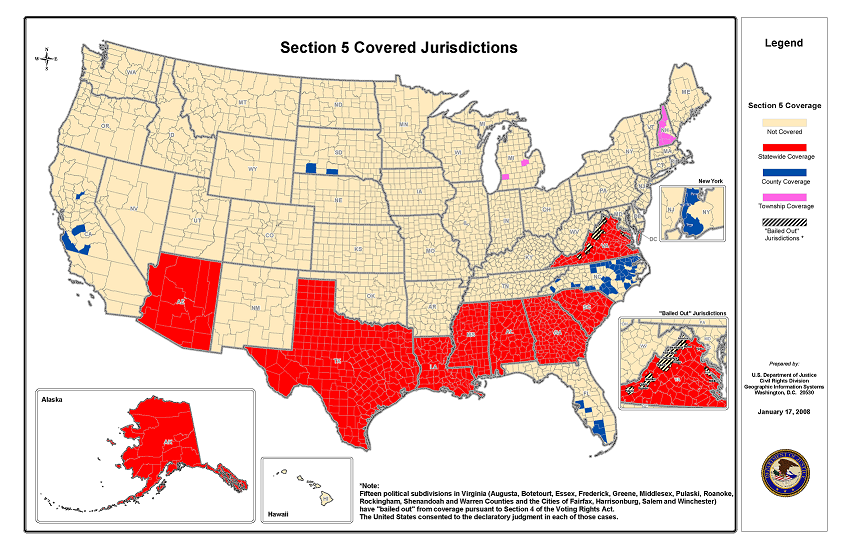 But in essence, the VRA puts the South on probation. Initially that was for 5 years, but the term keeps getting renewed; most recently it was renewed for another 25 years in 2006.
That’s what Roberts has a problem with. Section 4 is based on evidence that was current in 1965, and the basic formula has barely changed since. In the same way that laws need to have a reason to discriminate between citizens, they have to have really good reasons to discriminate between states, which are assumed to have “equal sovereignty”.
Past Supreme Courts have weighed the VRA’s justifications and found them sufficient. Jim Crow was an exceptional problem that required an exceptional solution. (My personal opinion: If you’re going to make an exception, voting rights is a good place to make it, because once voting gets screwed up all the non-judicial ways our system corrects itself are screwed up too.) But Roberts notes that:
Nearly 50 years later, things have changed dramatically.
This is a point you’ll hear often in conservative circles. Nobody wants to explicitly defend Jim Crow any more, but that’s all ancient history. The Age of Obama is post-racial. Things have changed.
Roberts goes on at some length about how things have changed. Minority voter-registration rates are close to parity with white Anglos, and in some elections minority turnout is above average. Minority candidates now get elected to Congress in section-5 states like Texas or South Carolina.
In 1965, the States could be divided into two groups: those with a recent history of voting tests and low voter registration and turnout, and those without those characteristics. Congress based its coverage formula on that distinction. Today the Nation is no longer divided along those lines, yet the Voting Rights Act continues to treat it as if it were. … Congress—if it is to divide the States—must identify those jurisdictions to be singled out on a basis that makes sense in light of current conditions.
Of course, Robert’s characterization of the VRA is not exactly true, because it has a bail-out provision: States and counties can permanently escape section 5 by convincing a court that they’ve stopped trying to discriminate. Parts of Virginia, North Carolina, and New Hampshire have all successfully used that procedure. So a state’s failure to bail out is itself a “current condition”. The plaintiff, Shelby County, could not meet that condition, because it continues to try to disenfranchise blacks. (During oral arguments, Justice Kagan summed it up: “You’re objecting to the formula, but under any formula Congress could devise, it would capture Alabama.”)
But never mind all that, because even making that point draws us down the rabbit hole Roberts has dug. Here’s what’s important: “Things have changed” is not a legal argument. It’s a fine point to make on a blog or at a dinner party, but a Supreme Court justice has to do better than that.
If Roberts were being a real judge here, he’d spell out what “equal sovereignty” has and hasn’t meant in American legal history. He’d enunciate an abstract standard by which Jim Crow was “exceptional” in 1965 and which justified the steps taken then. He’d explain how that standard was violated by the renewal of the VRA in 2006. And he’d lay down a set of conditions that Congress would need to satisfy to make the VRA acceptable today. (If you want to see what a real legal opinion looks like, read Justice Ginsburg’s dissent. Whether you agree with her or not, she is clearly doing something far more rigorous than what Roberts is doing.)
Roberts doesn’t do any of that. The VRA was vaguely justified in 1965 and is vaguely unjustified now, because “things have changed”. If I were a congressman, I would have no idea how to revise the VRA so that it passes constitutional muster. If Congress does revise it, lower court judges who rule on it will just be guessing about its constitutionality. It will have to go back to the Supreme Court before anyone knows whether it’s really a law again, because there are no standards in Roberts’ opinion by which a revision can be judged.
This isn’t law. It’s politics. It’s mush.
So after “careful consideration” of how “things have changed”, this is my judgment: Whether you agree with its conclusions or not, this Court sucks.


 This week’s big story was the series of revelations about government spying on ordinary Americans. I don’t see the Weekly Sift as a breaking-news blog, but before we can get around to reflecting on how upset we should be and what we should do about it, let’s establish what happened.


 The Weekly Sift