Category Archives: Articles

The Message in Joe Arpaio’s Pardon

[Disclosure: I was part of a protest outside of Tent City in 2012. That’s the trip I wrote about in “I Was Undocumented in Arizona“. I had misplaced my driver’s license before leaving home. But being white, I had no problems.]

President Trump’s pardon of Joe Arpaio got a lot of attention this weekend, but no one seemed to be pulling together everything we know.

Who is Arpaio and why do people have such strong feelings about him? For background on Arpaio’s 24-year reign of terror against Arizona’s Latinos, I recommend Rolling Stone‘s “The Long, Lawless Ride of Sheriff Joe Arpaio” from 2012. Arpaio is best known for his Tent City

the infamous jail he set up 20 years ago, in which some 2,000 inmates live under canvas tarps in the desert, forced to wear pink underwear beneath their black-and-white-striped uniforms while cracking rocks in the stifling heat. … From the start, the jail was notorious for its minimalist living conditions, which Arpaio says have saved Maricopa County millions of dollars in building and operational costs. Arpaio fed prisoners two meals a day (valued at 30 cents each), banned cigarettes and coffee, and boasted that temperatures in the summer can hit 141 degrees.

Any savings, though, have been more than eaten up by legal settlements paid to abused prisoners or their heirs. Way back in 2007, Phoenix New Times calculated:

[T]he cost to insure for and defend against Arpaio lawsuits totals $41.4 million.

Francisco Chairez gives a first-person account of serving a year in Arpaio’s jails on a drunk-driving charge. Reading it makes sense of what PNT found regarding the death rate in Arpaio’s jails.

[P]eople hang themselves in the sheriff’s jail at a rate that dwarfs other county lockups. And many of the deaths are classified as having occurred in the county hospital or in a cell without further explanation. People die and no one asks how; no one asks why.

Asking Arpaio’s office for the number of dead prisoners proved useless, but the coroner documented 157 deaths: 39 by hanging. 34 prisoners were found dead in the jail with no cause of death given, and 39 other unexplained deaths came after prisoners were transferred to the county hospital.

That’s 73 deaths — nearly half of all deaths — that county authorities list as “who knows?”

A 2011 report from the Justice Department found “a chronic culture of disregard for basic legal and constitutional obligations.”

Based upon our extensive investigation, we find reasonable cause to believe that [Maricopa County Sheriff’s Office] … engages in racial profiling of Latinos; unlawfully stops, detains, and arrests Latinos; and unlawfully retaliates against individuals who complain about or criticize MCSO’s policies or practices.

MCSO also

routinely punishes Latino [limited English proficient] inmates for failing to understand commands given in English and denies them critical services provided to the other inmates, all in violation of Title VI and its implementing regulations.

… MCSO has implemented practices that treat Latinos as if they are all undocumented, regardless of whether a legitimate factual basis exists to suspect that a person is undocumented.

DoJ brought in “a leading expert on measuring racial profiling through statistical analysis” who

concluded that this case involves the most egregious racial profiling in the United States that he has ever personally seen in the course of his work, observed in litigation, or reviewed in professional literature.

DoJ also found “a pattern of retaliatory actions intended to silence MCSO’s critics”.

MCSO command staff and deputies have arrested individuals without cause, filed meritless complaints against the political adversaries of Sheriff Arpaio, and initiated unfounded civil lawsuits and investigations against individuals critical of MCSO policies and practices.

For example, the two founders of PNT received a $3.75 million settlement from the County to compensate for Arpaio arresting them in the middle of the night on bogus charges.

The opposite of law and order. The manpower and resources for Arpaio’s anti-Latino crusade seem to have been drawn away from investigations of crimes with actual victims, making a joke out of Trump’s claim that “He kept Arizona safe!” The DoJ report says:

The Sheriff’s office has acknowledged that 432 cases of sexual assault and child molestation were not properly investigated over a three-year period ending in 2007. These cases only came to light after a review by the El Mirage Police Department of a period in which MCSO was under contract to provide policing services to that community. It appears that many of the victims may have been Latino.

Phoenix’ local CBS station highlighted the case of Sabrina Morrison, who at age 13 was raped by her uncle. MCSO told her mother that there was no evidence of a rape. “So I thought she was lying the whole time.”

What the family did not know was the sheriff’s detective sent the rape kit to the state crime lab. Two weeks later, the crime lab sent a notice to the MCSO Special Victim’s Unit confirming the sample contained semen, and asking for a blood sample from the suspect, Patrick Morrison.

Instead of making an arrest, a detective filed the crime lab note and closed the case for four years. It was five years before they arrested Patrick Morrison.

Meanwhile, Patrick continued raping Sabrina, who became pregnant, had an abortion, and was sent to live in a group home for “acting out”. An internal MCSO memo “blames a high case load, says the special victims unit had gone from five detectives to just three, and the detectives left were often called off their cases to investigate special assignments.” The County had to pay $3.5 million on that one, though it’s hard to imagine how any amount of money could truly compensate.

As outrageous as all that seems, county sheriff is an elected position, so as long as Arpaio had the support of the voters of Maricopa County — and vast quantities of outside money to convince those voters — there wasn’t much anybody else could do. Arpaio finally was defeated in 2016.

What he was convicted of. Crimes by law enforcement officers are notoriously hard to prove beyond a reasonable doubt, particularly when those crimes happen inside jails, where the perpetrators themselves control the crime scene. That’s why most of the cases against Arpaio have been tried in civil court, where the standard of proof is lower, but judgments are limited to monetary damages.

The crime Arpaio was pardoned for is criminal contempt of court, which carries a maximum sentence of six months in prison. Convicting him of contempt was somewhat like nailing Al Capone for tax evasion: It was far from the worst thing he did, but at least the evidence was clear. The satisfaction for Arpaio’s victims was mostly symbolic. Finally he had been recognized as a criminal.

That case has its origins in a 2007 civil suit about racial profiling. (Dan Magos, who joined the suit later and testified against Arpaio, describes what it’s like to be stopped and searched without any cause other than your ethnicity.) Vox tells how it became a criminal matter:

In 2011 … the judge in the racial profiling lawsuit issued an injunction preventing Arpaio from apprehending or detaining anyone purely on the basis of being a suspected unauthorized immigrant or turning such people over to federal agents.

In 2013, Arpaio officially lost the civil suit. But by that point, it had become clear that his department hadn’t actually been complying with Judge Murray Snow’s 2011 injunction. They’d continued to engage in immigration “sweeps,” turn people over to ICE (or, when ICE stopped accepting detainees from Arpaio’s deputies, Border Patrol), and hold suspected immigrants in jail after they’d otherwise be released for federal agents to pick them up.

After a series of hearings about the Maricopa Sheriff’s Office’s failure to comply with the 2011 order, Judge Snow cited Arpaio and a handful of his subordinates for civil contempt of court in 2015. Then, in 2016, he asked the US Attorney’s Office to charge Arpaio and three others with criminal contempt — which someone can only be convicted of if it’s shown they were willfully refusing to obey the court order, not just failing to make sure it was obeyed.

What job was he doing? During his recent rally in Phoenix, Trump asked the crowd “Was Sheriff Joe convicted for doing his job?” which strongly yelled its agreement that he was. Former Solicitor General Walter Dellinger tweeted:

Of bad pardons, this is the worst because it is an assault on law itself. Says Joe’s “job” was violating a federal court order.

And The Week ‘s Scott Lemieux commented:

To allow [Arpaio] to go unpunished is to celebrate the arbitrary use of state violence and to show contempt for the legal restraints public officials are supposed to be constrained by.

The best case for the just-doing-his-job point was made by Arizona Republic columnist Robert Robb. The court order didn’t just tell Arpaio to stop racial profiling — which would have been hard to enforce, since individual examples are easy to explain away. Instead, the judge ordered Arpaio to stay clear of the situations that led to abuses.

He ordered Arpaio to get out of the immigration enforcement business altogether. Even with a legal stop, Arpaio was to either charge people with a state crime or let them go. No detaining them or turning them over to federal officials for immigration violations. … Arpaio wasn’t criminally convicted for illegally using race in traffic stops. He was criminally convicted for turning illegal immigrants over to federal officials. And here things get messy.

To me, though, this is no more messy than getting convicted of violating a restraining order in a domestic violence case. Robb’s complaint (or Arpaio’s behalf) is like the guy who says, “They didn’t catch me hitting her again, they just arrested me for walking behind her on the street.”

Even Robb admits:

even if Snow’s order was an overreach, Arpaio’s duty was to obey it while appealing it.

“Constitutional” sheriffs. However, there’s another point of view at issue: Robb is assuming that federal judges have authority over county sheriffs. Not everybody, and not all sheriffs, agree.

One radical right-wing movement that gets little publicity has to do with so-called “constitutional sheriffs“. The idea is that the county sheriff is the only elected law enforcement officer, and so his authority is primary within his jurisdiction, superseding the authority of state and federal officials. So if agents of the FBI or IRS or BLM show up in your town, the county sheriff has the authority to tell them to go away. (So far as I know, no court recognizes this authority.)

If you have run into these folks before, it was probably during the standoff with the Bundy militia at Malheur National Forest last year. The constitutional sheriffs and the Bundies draw from the same well of crazy.

Like Nazis and Klansmen, constitutional sheriffs (and the people who support them) are part of a small radical fringe that Trump panders to and refuses to offend. Often he dog-whistles by using phrases that mean something special to them. The idea that Arpaio was “doing his job” rather than following federal court orders is right up their alley.

Sending a message. We have to wonder why the Arpaio pardon happened when it did, because the case was not in any sense ripe. Arpaio still had options to appeal his conviction. If the Supreme Court agreed with Robert Robb, that the order Arpaio disobeyed was an over-reach by the judge, they might have thrown the whole thing out. Even if the conviction stood, he hadn’t been sentenced yet, and might not have gotten jail time at all. (Since he isn’t sheriff any more, courts might not be motivated to teach him a lesson.)

So Trump might have gotten the result he wanted just by watching and doing nothing. If not, he could have intervened down the road, before Arpaio began serving his sentence. So why now?

One obvious implication is that the pardon is meant to send a message: to Trump’s base, obviously, but also to other law enforcement officers, to the courts, and to Trump associates who might be tempted to cut a deal with the Mueller investigation.

Law enforcement people have to see this as part of a package with other messages: Trump’s speech urging police to be “rough” with Hispanic gang suspects, his even-handed approach to Nazis and the people who protest against Nazis, and his unwillingness to speak out against the bombing of a Minneapolis mosque.  Put together, those all say: Violence is OK, as long as people Trump likes are doing it to people Trump doesn’t like. In particular, if you are in law enforcement and feel like violating the civil rights of non-whites or non-Christians, don’t worry; the President has your back.

Judges have to see the pardon as an attack on the independence of the judiciary. Contempt of court is the only real enforcement mechanism behind judicial injunctions. If a pardon is an option for local officials who follow the Trump agenda in defiance of court orders, that shakes up the balance of power between the judicial and executive branches of government.

Finally, it seems more and more apparent that the Mueller investigation is closing in on Michael Flynn, Paul Manafort, and maybe some lesser figures associated with them. If this were an investigation into a Mafia family or a corrupt corporation, investigators would be expecting to flip one of these underlings against the guy at the top. In this case, however, the guy at the top wields the pardon power. Trump just reminded everybody that he isn’t afraid to take heat for using it.

Fascism as a Unifying Principle

Trump is scary when he tries to divide Americans against each other. But his vision of unity is even scarier.


The televised speech Donald Trump gave last Monday evening was billed as the introduction of a new military strategy for Afghanistan, but it began with a plea for national unity.

During the previous week, the President had been taking heat for his statements about the white supremacy rally in Charlottesville, which he said was attended by “very fine people” in addition to the obvious Nazis and Klansmen. The rally’s violence, which culminated in a white supremacist ramming his car into a crowd of counter-protesters, killing Heather Heyer and injuring 19 others, was the fault of “both sides”.

Critics (like me) saw Trump siding with racists and bigots, and refusing to hold them to the same standards he applies so enthusiastically to Hispanics and Muslims. Across much of the mainstream liberal-to-conservative spectrum, pundits wondered: Couldn’t he at least try to be a little bit presidential and say something unifying rather than divisive?

In the Afghanistan speech, he tried. I don’t want to take him out of context, so I quote at length:

Since the founding of our republic, our country has produced a special class of heroes whose selflessness, courage, and resolve is unmatched in human history.

American patriots from every generation have given their last breath on the battlefield for our nation and for our freedom. Through their lives — and though their lives were cut short, in their deeds — they achieved total immortality.

By following the heroic example of those who fought to preserve our republic, we can find the inspiration our country needs to unify, to heal, and to remain one nation under God. The men and women of our military operate as one team, with one shared mission, and one shared sense of purpose.

They transcend every line of race, ethnicity, creed, and color to serve together — and sacrifice together — in absolutely perfect cohesion. That is because all servicemembers are brothers and sisters. They’re all part of the same family; it’s called the American family. They take the same oath, fight for the same flag, and live according to the same law. They are bound together by common purpose, mutual trust, and selfless devotion to our nation and to each other.

The soldier understands what we, as a nation, too often forget: that a wound inflicted upon a single member of our community is a wound inflicted upon us all. When one part of America hurts, we all hurt. And when one citizen suffers an injustice, we all suffer together.

Loyalty to our nation demands loyalty to one another. Love for America requires love for all of its people. When we open our hearts to patriotism, there is no room for prejudice, no place for bigotry, and no tolerance for hate.

The young men and women we send to fight our wars abroad deserve to return to a country that is not at war with itself at home. We cannot remain a force for peace in the world if we are not at peace with each other.

As we send our bravest to defeat our enemies overseas — and we will always win — let us find the courage to heal our divisions within. Let us make a simple promise to the men and women we ask to fight in our name that, when they return home from battle, they will find a country that has renewed the sacred bonds of love and loyalty that unite us together as one.

I got chills listening to that, but not in a good way.

Probably most Americans who heard the speech didn’t share my sense of ominous foreboding. If you’re a Trump supporter, you probably heard the kind of bold patriotic sentiments you wish our leaders would express more often. And even those who listen to Trump cynically probably heard only boilerplate rhetoric: Our country is good, our soldiers are brave, so let’s all wave our flags and try to get along.

But there’s something deeper going on in this passage. It expresses a vision deeply at odds with the traditions of the American Republic.

The vision of the Founders, which they embodied in the Constitution, is of a social contract: In order to secure our own rights, we recognize the rights of others. Because we want respect for ourselves, we grant respect to to our neighbors. “As I would not be a slave,” Abraham Lincoln said when he was running for the Senate not quite four-score years later, “so I would not be a master. This expresses my idea of democracy.”

Lincoln said nothing about “loving” the slaves, because in the American tradition that’s not where rights come from. America has never been about love, neither love for each other nor even love for the Nation as an abstract entity. (On the other side of the Mason-Dixon line, many were denying any emotional connection at all with the Nation. The States, they held, had merely formed a confederation, which had no claim whatsoever on the loyalty of individuals.)

What Trump is describing on the other hand, is a sort of emotional socialism. In economic socialism, the Nation collects money and redistributes it to make sure everybody gets a share. But in Trump’s vision the Nation is the focus of our love, which it then redistributes to all our fellow citizens. “When we open our hearts to patriotism, there is no room for prejudice, no place for bigotry, and no tolerance for hate.”

This is not a new idea for Trump; it was in his Inaugural Address:

At the bedrock of our politics will be a total allegiance to the United States of America, and through our loyalty to our country, we will rediscover our loyalty to each other. When you open your heart to patriotism, there is no room for prejudice.

The basic pattern goes back much further, to a Masonic phrase that was taken up by many 19th-century Christians: “The brotherhood of Man under the fatherhood of God.” You should love other people, because you love God and God loves them.

But Trump’s formulation has one very significant twist: America is playing the role of God. In a nutshell, that’s what nationalism is: an idolatry in which the Nation becomes the central object of worship — God the Fatherland.

Now look at the other concepts Trump is presenting: total allegiance, loyalty, patriotism, heroes sacrificing themselves to become immortal, the obedient military as the ideal to which the rest of society should aspire, and our dead heroes as the symbol of the moral debt we owe to our country.

These are the emotional underpinnings of fascism.

You may not recognize them as such, because all our lives we’ve been told that fascism is ugly. These sentiments, though, don’t seem ugly at all, at least at first glance. On the contrary, they are moving and inspiring, noble and even beautiful in their own way. We all want to be immortal, we want see ourselves as selfless heroes, we want to love and be loved by those around us. Particularly at this cynical moment in history, we want to believe that something is worthy of our total allegiance.

We are like crusaders who have trained all our lives to battle a dark and hideous Devil, and so are completely unprepared when we encounter Lucifer, the Morning Star, the shining Angel of Light.

Fascism in its original form wasn’t all book-burnings and death camps. It was also a good job building the autobahn, wholesome outings with the Hitler Youth, and a feeling that your country was moving again; France and Britain weren’t going to kick it around any more.

I’ve urged you before to watch Triumph of the Will, the classic propaganda film that recorded the pageantry surrounding the Nazi Party Congress of 1934. You will find nothing ugly in it, other than your own knowledge of what comes next. In one rally after another, different groups of Germans focus their love on Hitler, the symbol of the German Fatherland, who reflects it back to them.

It’s beautiful. Hitler talks not about himself, but only of Germany and the greatness of the German people. He calls for them to be unified as never before. A group of infrastructure workers march by, in uniform, each carrying a spade as a soldier would a rifle (because the military is the model all should aspire to). Hitler tells them:

The concept of labor will no longer be a dividing one but a uniting one, and no longer will there be anybody in Germany who will regard manual labor any less highly than any other form of labor.

To a group of children he says:

We want to be a united nation, and you, my youth, are to become this nation. In the future, we do not wish to see classes and castes, and you must not allow them to develop among you. One day, we want to see one nation.

Only in hindsight do we see the flaw in this system: If we focus our love on the Nation (and on the Leader who symbolizes the Nation), and the Nation reflects that love to its citizens, then the Nation can cut off the flow of love to anyone it decides no longer belongs to it. In Germany, the exclusion process started with Jews and Socialists, and then spread until it reached people like Martin Niemöller. The suffering of the excluded wasn’t worthy of compassion, because they were never respected for what was inherent in their humanity. Germans had only loved them because they thought (wrongly, as they were later informed) that such people belonged to their Nation.

You can already see a similar exclusion starting to happen in Trump’s speech. Did you catch that “one nation under God”? Where are America’s atheists and agnostics in that vision? When we love America, do we love them as well? Or have they already been cast out?

And how specific is Trump intending to be when he says “God”? Americans who worship Allah or Brahma or some larger pantheon — are they under God, as Trump and his evangelical base understand the term? What about Jews or Unitarians, who fail to recognize two-thirds of the Trinity? Or liberal Christians, who may have a more deistic, impersonal view of the Creator? When we unify as “one nation under God”, who are we intending to leave out?

Another (largely Catholic) group is so obviously excluded that it need not even be mentioned: immigrants from Hispanic or other not-recognized-as-white cultures. They are being cast out in a literal, physical sense. So when ICE knocks on their doors in the middle of the night, we can avert our eyes and feel nothing. We need not inquire where they are going or what will happen to them. No one should be held accountable for abusing or mistreating them. The Nation and its Leader does not love them, so neither should we.

A Few Points About Confederate Monuments

Confederate monuments and what they represent has been an issue I keep coming back to. In 2014’s “Not a Tea Party, a Confederate Party” I made the case that these are “victory monuments” for the eventual triumph of white supremacy in the South after the overthrow of Reconstruction. After the Charleston massacre in 2015, I urged people to “Please Take Down Your Confederate Flag“, arguing that pro-Confederate symbols of all types are hopelessly entangled in racism, no matter what you may intend when you display them.

Those points have only been magnified by the recent Unite the Right rally in Charlottesville. Undeniably, Nazi, KKK, and other alt-Right groups take inspiration from Confederate monuments, and regard Jefferson Davis, Robert E. Lee, and Stonewall Jackson as heroes because they fought for white supremacy. All over the country, monuments are being toppled or moved or transformed-in-place by the addition of explanatory plaques or statues of civil rights heroes.

A number of white supremacists and people who claim they aren’t white supremacists, including President Trump, are defending the monuments. But the points they’re making are almost entirely bogus. Here are my responses.

The Confederacy can’t be separated from slavery. Claims to the contrary usually hinge on a few half-truths. Abraham Lincoln, for example, didn’t run for president on a platform of ending slavery, but only of preventing its expansion. Once the war started he was slow to embrace it as an abolitionist crusade, and sometimes explicitly denied that purpose. (The Emancipation Proclamation didn’t take effect until January 1, 1863, more than two years after the first southern state seceded. Congress didn’t pass the 13th Amendment until the war was nearly over.) Although Lincoln hoped for slavery’s eventual end, war-for-emancipation was not his method of choice.

But the Confederate states, on the other hand, had no similar ambivalence. South Carolina’s “Declaration of Immediate Causes” for its secession pointed to Lincoln’s opposition to slavery as the most immediate cause:

A geographical line has been drawn across the Union, and all the States north of that line have united in the election of a man to the high office of President of the United States, whose opinions and purposes are hostile to slavery.

A few weeks before war broke out, Confederate Vice President Alexander Stephens gave his “Cornerstone Speech“, in which he found fault with Jefferson’s statement that “all men are created equal”.

Our new government is founded upon exactly the opposite ideas; its foundations are laid, its cornerstone rests, upon the great truth that the negro is not equal to the white man; that slavery, subordination to the superior race, is his natural and normal condition. This, our new government, is the first, in the history of the world, based upon this great physical, philosophical, and moral truth.

A long list of similar quotes could be produced. Slavery was the Confederacy’s reason to exist. The war to defend the Confederacy was seen at the time as a war to defend slavery; the two causes were identical. Only after the South’s defeat did the Lost Cause mythology postulate alternative causes for the war.

We should never forget our history, but not all of it deserves to be celebrated. In his speech just before the removal of a Lee statue, New Orleans Mayor Mitch Landrieu said: “There is a difference between remembrance of history and reverence of it.”

To see that difference, contrast the Charlottesville statue of Robert E. Lee (particularly as it sat in Lee Park, before the city renamed it) to The Topography of Terror museum in Berlin, where the Gestapo’s headquarters used to stand. The Germans could have “remembered” that site by turning it into Himmler Park, and centering it on a triumphant statue of the Gestapo’s commander, but they chose not to.

Lee, of course, was not Himmler. A better German parallel would be Field Marshall Erwin Rommel, a brilliant military tactician whose genius was applied in the defense of an evil regime. Rommel actually deserves a somewhat better place in history than Lee, because of his suspected role in a plot against Hitler. Nonetheless, Germans don’t name their high schools after him. (According to the Southern Poverty Law Center, 109 American public schools are named for Lee, roughly twice as many as are named for Benjamin Franklin, a far greater American. What’s that about?)

Vox underlines this contrast:

But unlike in Germany, where memorials to the victims of the Holocaust are erected on the ruins of Nazi buildings as a way to teach future generations about the sins and horrors of the past, most Confederate statues were designed to glorify the sins and horrors of the past.

Present-day defenders of the Confederacy create a false choice between celebrating Confederate history and erasing it. No one wants America to forget slavery and the rebellion that sought to preserve it. Critics of Confederate monuments simply want to stop glorifying the Slave Empire, particularly in cities like New Orleans, where so many citizens are descended from slaves.

Many Confederate monuments were built to promote false history. Mayor Landrieu noted that the South’s monuments are at best a selective remembrance.

So when people say to me that the monuments in question are history, well what I just described is real history as well, and it is the searing truth. And it immediately begs the questions: why there are no slave ship monuments, no prominent markers on public land to remember the lynchings or the slave blocks; nothing to remember this long chapter of our lives; the pain, the sacrifice, the shame … all of it happening on the soil of New Orleans.

So for those self-appointed defenders of history and the monuments, they are eerily silent on what amounts to this historical malfeasance, a lie by omission.

Sometimes the lies aren’t by omission, but are direct Lost Cause propaganda. For example, the inscription on the Confederate monument in Decatur, Georgia tells a glorious story of the Confederacy that has nothing to do with slavery. It was erected in 1908, when Lost Cause mythology had become Southern dogma.

Reconstruction history has been similarly misrepresented. One of the most shameful episodes of the Reconstruction Era was the Colfax Massacre, where a disputed election led white Democrats to attack blacks defending a county courthouse and murder those who surrendered. Such violence was a key element in whites regaining control of southern state governments and ultimately disenfranchising blacks completely. The official marker describes it like this:

Many Confederate monuments were intentionally built to celebrate white supremacy and intimidate uppity blacks.  “Historical” monuments are rarely entirely about the era depicted; usually their builders are also trying to make a symbolic statement about their own era.

You can see that in the following graph of the creation of Confederate monuments. There are two peak periods: During (and just after) the establishment of Jim Crow early in the 20th century, and when Jim Crow is being disestablished during the Civil Rights era of the 1950s and 60s; this is also when the Confederate flag regained popularity.

Wikipedia:

Between 1890 and 1910, ten of the eleven former Confederate states, starting with Mississippi, passed new constitutions or amendments that effectively disenfranchised most blacks and tens of thousands of poor whites through a combination of poll taxes, literacy and comprehension tests, and residency and record-keeping requirements.

National Geographic:

Once the Dixiecrats got a hold of it as a matter of defiance against their Democratic colleagues in the north and the African Americans in their midst, then the Confederate battle flag took on a new life, or a second life. In the 1950s, as the Civil Rights Movement built up steam, you began to see more and more public displays of the Confederate battle flag, to the point where the state of Georgia in 1956 redesigned their state flag to include the Confederate battle flag.

The timing suggests that Confederate symbolism has less to do with remembering the Civil War than with reminding blacks that whites are in power.

There is no slippery slope from Robert E. Lee to George Washington. In his Tuesday new conference, Trump asked:

So this week, it is Robert E. Lee. I noticed that Stonewall Jackson is coming down. I wonder, is it George Washington next week? And is it Thomas Jefferson the week after? You know, you really do have to ask yourself, where does it stop?

George Washington did indeed own slaves. Thomas Jefferson not only owned slaves, he fathered children with one of them and raised those children as his slaves. None of these facts should make Americans proud, and the monuments we build to Washington and Jefferson should acknowledge such failings. (Mount Vernon and Monticello do acknowledge them.)

In each case, our challenge is to see our Founders as people of their time and place, rather than as faultless gods. Slave-owning complicates our pictures of Washington and Jefferson, but doesn’t undo the positive roles they played in creating the United States, defining ideals we still struggle to live up to, and leading the nation through its difficult early decades.

The difference between the Founders and Confederate heroes like Lee, Jackson, and Davis is that the Confederacy is their only claim to historical significance. When we honor them, then, what we are honoring is their defense of slavery, because they have no positive accomplishments of comparable importance. You cannot, for example, separate the Charlottesville statue of a uniformed Lee on his horse from what he is doing on that horse: leading the defense of a government created to protect the right of whites to enslave blacks.

By contrast, I know of no monuments to Washington and Jefferson as slave owners — no statues showing Washington with a whip in his hand and blacks cowering before him, and none honoring Jefferson’s sexual abuse of Sally Hemmings. If there are any, they should come down; those are not the things we want to celebrate about Washington and Jefferson. But monuments to the Declaration of Independence, the Yorktown victory, and the early presidencies should stand.

What should be done with Confederate monuments? Each one should be judged separately according to

  1. what the purpose of the monument is, and
  2. how the local community feels about it.

Let me start by describing two monuments I think should stay. After the war, Robert E. Lee became president of Washington College, which is now Washington and Lee University. He is buried on campus beneath Lee Chapel, where there is a statue of him sleeping. The statue is clearly a remembrance of the man rather than a celebration of white supremacy. Similarly, Stonewall Jackson was a professor at the Virginia Military Institute before the war; it is entirely appropriate for VMI, a military school, to honor their most famous general.

Other remembrances should stay as well: Plaques and monuments enhance cemeteries and battlefields, as long as the inscriptions are accurate. And of course there should be museums that give a broader context to historical events.

No one really wants history forgotten, least of all the victims.

But a monument is suspect if it glorifies people or events that those who have to live with it find shameful or insulting. (To bring that point home to white Southerners, someone started a Facebook page proposing to erect a statue of General Sherman in Atlanta.) Some historical names are so offensive they could pass for inventions of The Onion, like the majority-black high school in Florida that until recently was named for KKK founder Nathan Bedford Forrest. (Forrest had no personal connection to the area. The name appears to have been chosen in the 1950s to protest court-mandated school desegregation.) If Arlington, Virginia wants to rename its segment of the Jefferson Davis Highway, it should be allowed to do so.

One hopes that local people can meet each other with empathy and work out compromises. Sometimes moving a statue to a more obscure park or to a museum would suffice. A critical plaque could be added, or the impact of a monument balanced by new competing monuments. What will not do is an attitude of “We like it, so deal with it.” That’s what supremacy is all about.

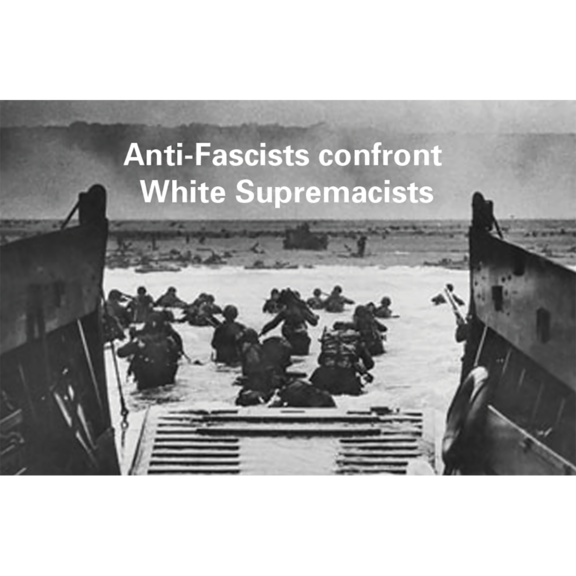
What to Make of Antifa?

Until this week, I held the standard establishment view of the anti-fascist group Antifa and the “black blocs” they resemble: They’re anarchist or leftist mirror-images of the right-wing thugs they fight. I have heard personal friends say things similar to what Hullabaloo’s Tom Sullivan wrote Saturday:

The local Indivisible chapter organized a peace vigil downtown here last Sunday in solidarity with Charlottesville. It was one of many such vigils around the country. Not a Nazi symbol in sight. Yet the local antifa group that attended seemed bent on taking over what was intended to be a peaceful rally. There was a shouting match with police the organizers had requested. Later, the group split off and marched through downtown chanting slogans. To the usual “Whose streets? Our streets!” they added “Cops and the Klan go hand in hand.” and “What do we want? DEAD NAZIS. When do we want ’em? NOW!

The mirror-image-thug frame was present when CNN talked to a police spokesman from Portland, Oregon:

It is new, and this, like, this rumble mentality of, “I’m going to bring my friends, you’re going bring your friends, and we’re going to fight it out in the park” — it’s not something we’ve seen here. It’s not good for the city. People are just frustrated by it. It’s affecting their livability. It’s affecting their business. It’s affecting their commute.

The same piece quotes Cal State academic Brian Levin making a common liberal criticism:

It’s killing the cause — it’s not hurting it, it’s killing it, and it will kill it. We’re ceding the moral high ground and ceding the spotlight to where it should be, which is shining the spotlight on the vile. … No, it’s not OK to punch a Nazi. If white nationalists are sophisticated at anything, it’s the ability to try to grasp some kind of moral high ground when they have no other opportunity, and that’s provided when they appear to be violently victimized. That’s the only moral thread that they can hang their hats on. And we’re stupid if we give them that opportunity.

Trump took advantage of that opportunity in his controversial post-Charlottesville press conference on Tuesday:

What about the ‘alt-left’ that came charging at, as you say, the ‘alt-right’? Let me ask you this: What about the fact they came charging — that they came charging with clubs in their hands, swinging clubs? Do they have any problem? I think they do.

It’s Trump, of course, so you have to take “fact” with a grain of salt. But it sounds bad.

You get a different picture, though, from a number of eye-witness accounts of Charlottesville. Like this Democracy Now! interview:

CORNEL WEST: You had a number of the courageous students, of all colors, at the University of Virginia who were protesting against the neofascists themselves. The neofascists had their own ammunition. And this is very important to keep in mind, because the police, for the most part, pulled back. The next day, for example, those 20 of us who were standing, many of them clergy, we would have been crushed like cockroaches if it were not for the anarchists and the anti-fascists who approached, over 300, 350 anti-fascists. We just had 20. And we’re singing “This Little light of Mine,” you know what I mean? So that the—

AMY GOODMAN: “Antifa” meaning anti-fascist.

CORNEL WEST: The anti-fascists, and then, crucial, the anarchists, because they saved our lives, actually. We would have been completely crushed, and I’ll never forget that.

In the heat of the moment I doubt West counted precisely, so I’ll remain skeptical of his numbers. But Slate‘s Dahlia Lithwick collected several accounts of what I take to be the same event. Rebecca Menning told her:

No police officers in sight (that I could see from where I stood), and we were prepared to be beaten to a bloody pulp to show that while the state permitted white nationalists to rally in hate, in the many names of God, we did not. But we didn’t have to because the anarchists and anti-fascists got to them before they could get to us. I’ve never felt more grateful and more ashamed at the same time. The antifa were like angels to me in that moment.

Brandy Daniels described Antifa as respectful and helpful:

Some of the anarchists and anti-fascist folks came up to us and asked why we let [the white supremacists] through and asked what they could do to help. Rev. Osagyefo Sekou talked with them for a bit, explaining what we were doing and our stance and asking them to not provoke the Nazis. They agreed quickly and stood right in front of us, offering their help and protection.

And Rev. Seth Wispelwey added:

I am a pastor in Charlottesville, and antifa saved my life twice on Saturday. Indeed, they saved many lives from psychological and physical violence—I believe the body count could have been much worse, as hard as that is to believe. Thankfully, we had robust community defense standing up to white supremacist violence this past weekend.

I wasn’t there, and have never seen Antifa with my own eyes. But here’s how it looks to me: Antifa is based on an anarchist worldview, in which state institutions like the police are not to be trusted. When that assumption is false — when, say, organizers and police have made a plan for an orderly, peaceful demonstration and that plan is flowing smoothly — then having Antifa show up can be a real nuisance.

But when that assumption is true, and the police are not going to protect you from right-wing violence, then it’s good to have some “robust community defense” around.

So if you’re disturbed by the rise of Antifa — whether you’re a conservative worried about leftist violence, a local government trying to maintain order, or a liberal group hoping to protest peacefully — the long-term way to shrink their numbers is clear: Don’t create the conditions that make them right.

When state institutions work well, and work for the benefit of the vast majority, then anarchists look like nut jobs. But when they don’t work, when the people have to start organizing their own defenses outside the system, and when the only path of protest liberals offer is nonviolent martyrdom, then anarchists who come prepared to face violence start to make a lot of sense.

The Battles Within the White House are Even Crazier Than You Think

A conspiracy theory that belongs on InfoWars is at the heart of a National Security Council power struggle.


By now, anyone who has been paying attention has figured out that the Trump White House is a pretty odd workplace. From Trump himself tweeting against allies like Jeff Sessions and Mitch McConnell, to Steve Bannon’s pseudo-news organization (Breitbart) attacking then-Chief-of-Staff Reince Preibus and Trump son-in-law Jared Kushner, to Bannon in turn being accused by the then-communications-director of “trying to suck [his] own cock“, it’s been clear that something beyond ordinary office politics is going on here.

But the memo that got Rich Higgins fired from the National Security Council staff opens up cans of crazy that go far beyond anything that’s gotten public attention so far, and illuminates how deep the conflicts within the administration go. The seven-page document explains a decades-long and largely successful plot by “cultural Marxists” to destroy America “both as an ideal and as a national and political identity”. It claims that cultural Marxist narratives are now embedded in the Deep State, the establishments of both political parties, academia, the mainstream media, and international banks — and are even promoted by Islamists, because (in some unfathomable way) the same “nihilism” that cultural Marxists are using to destroy monotheistic Christianity also prepares the ground for monotheistic Islam.

Higgins attributes the current struggles of the Trump administration to a campaign by cultural Marxists, who see Trump as a threat to their domination. They have unleashed “political warfare memes based on cultural Marxist narratives” that are “designed to first undermine, then delegitimize and ultimately remove the President”. The memo concludes:

The recent turn of events give rise to the observation that the defense of President Trump is the defense of America. In the same way President Lincoln was surrounded by political opposition both inside and outside of his wire, in both overt and covert forms, so too is President Trump. Had Lincoln failed, so too would have the Republic.

There’s a lot to unpack here. First, how did Rich Higgins ever get into the NSC to begin with? Who fired him? And is anybody taking him seriously? (Apparently yes. Somehow the memo found it’s way to Donald Trump Jr., who passed it on to the President. Trump reportedly “gushed” over it, and was upset to discover that the author had been fired.) And what the heck is “cultural Marxism” anyway?

The Flynn connection. Higgins was appointed to the NSC by Michael Flynn during his brief tenure as National Security Adviser.

Flynn is a source of crazy all his own, and is at the center of one of the deep mysteries of the Russia scandal. During the transition period between the election and the inauguration, Flynn seems to have been running his own Russia policy in competition with the Obama administration, which was still in power. During the time he was Candidate Trump’s main national-security adviser, he had been — and maybe still was after he officially joined the administration — an undeclared foreign agent of the Turkish government. (He was still carrying out his duties for the Turks as late as November 8, otherwise known as Election Day.) The extent of his connections to the Putin government is still unknown.

On January 26, acting Attorney General (and Obama holdover) Sally Yates began warning the new administration that Flynn had been lying to them about his contacts with Russian officials, and that he might be vulnerable to Russian blackmail. Nothing was done with this information — and Flynn continued to participate in national-security meetings at the highest level — until The Washington Post published it February 9. Flynn resigned February 13.

You have to wonder: If not for leaks to The Post (which Trump denounced as “criminal”), would Flynn still be National Security Adviser? And why did Trump — a man not known for maintaining inconvenient loyalties — stand by Flynn, to the point of improperly urging then-FBI-Director James Comey to “let this go” because Flynn is “a good guy”?

McMaster. After several people turned down a job ordinarily considered a career-crowning prize, H. R. McMaster replaced Flynn as National Security Adviser. However, his early attempts to clean house of Flynn’s appointments were stymied by Flynn allies Steve Bannon and Jared Kushner. (Kushner and Flynn, you might remember, had a strange meeting with Russian Ambassador Kislyak, during which they requested a “back channel” to Moscow that American intelligence couldn’t tap. Even Kislyak found that odd.) Recently, though, McMaster seems to have gained the upper hand; Higgins is not the only Flynnite to have been sent packing.

But McMaster, in turn, is now the target of a backlash. Politico reports that “The conservative news site Breitbart has waged a nonstop campaign against national security adviser H.R. McMaster.” A little over a week ago, “two former senior NSC officials” told The Daily Caller that “Everything the President wants to do, McMaster opposes.

Trump wants to get us out of Afghanistan — McMaster wants to go in. Trump wants to get us out of Syria — McMaster wants to go in. Trump wants to deal with the China issue — McMaster doesn’t. Trump wants to deal with the Islam issue — McMaster doesn’t. You know, across the board, we want to get rid of the Iran deal — McMaster doesn’t. It is incredible to watch it happening right in front of your face. Absolutely stunning.

In typical conspiratorial fashion, McMaster isn’t presented as his own man with his own beliefs, but rather as “a sycophant” of somebody else: retired General David Petraeus. Alt-right blogger Mike Cernovich has started a McMaster Leaks site to publish negative information about McMaster. (Josh Marshall provides background on Cernovich.) He illustrates one article with a cartoon depicting McMaster and Petraeus as dancing puppets of arch-nemesis billionaire George Soros, who in turn is a puppet of the Saudis.

Most disturbing of all, Salon reports:

attacks on McMaster from right-wing media figures coincide with a coordinated troll campaign, according to a newly launched website that tracks Russian propaganda. Using hashtags like #FireMcMaster and #deepstate, accounts linked to Russian-backed bot campaigns shared several anti-McMaster stories this week.

In other words: The Flynn/Bannon/Putin alliance still seems to be functioning.

Cultural Marxism. Probably I had run across this phrase before I saw it in Higgins’ memo, but if I did it didn’t make any impression. Apparently, though, it is widely discussed by right-wing conspiracy theorists. You can get an in-depth introduction to the concept, at least as it is used on the far right, from this 90-minute video.

The video’s account begins with some actual history: As World War I broke out, Communists around the world hoped that workers would refuse to fight for their own country’s capitalists against the workers of other countries. But that dream went unfulfilled; each belligerent country was able to beat the drums of patriotism and inspire incredible levels of sacrifice from even its most oppressed citizens. Assessing what went wrong, many Communists concluded that physical revolution could only happen after a considerable amount of cultural change.

But from there, the Glenn-Beck-whiteboard mindset takes over: All the cultural changes we’ve seen since the Great Depression — the end of Jim Crow, women’s liberation, the sexual revolution, gay rights, etc. — originate in the 1930s with the prison notebooks of Italian Marxist Antonio Gramsci, and continue through the Frankfurt School of social theorists who started in Germany and then escaped Hitler by coming to America. Who knew that a handful of intellectuals could wield so much influence?

The point of this conspiracy was and is to destroy the family, Christianity, western culture, the middle class, the Constitution, reverence for the Founding Fathers, and ultimately America itself. This continuing cultural Marxist conspiracy — and not anything Trump himself did or didn’t do — is the source of the administration’s difficulties.

The conspiracy-theory sidestep. Think about how believing this theory might change your mindset: Anything that was actually wrong with pre-New-Deal America, or that continues to be wrong with America today, becomes irrelevant. If you believe that an apocalyptic battle is going on between “America as an ideal and as a national and political identity” and a mysterious cabal of “cultural Marxists” who have been plotting against America since the 1930s, then anything that looks like a legitimate criticism of American traditions is just a way for the plotters to score points.

So the civil rights movement wasn’t really about lynching, segregation, or the right to vote; it was a way to divide America against itself and undermine Americans’ confidence in the righteousness of their country. Feminism wasn’t really about giving women the freedom to find their own places in the world, rather than be channeled into a small number of subservient roles; it was about destroying the male and female archetypes that God defined in the Garden of Eden. The sexual revolution wasn’t caused by improved birth control, widespread affluence, or new opportunities for women to be economically independent; it was designed by cultural Marxists to undermine Christianity and the American family. Schools now teach about the Founders’ slaves and the Native Americans who were slaughtered to make way for white settlers, not because those things are true — that’s irrelevant — but to destroy students’ American patriotism.

Similarly, current issues need not be considered on their individual merits — all those details are similarly irrelevant — but for their effects on the apocalyptic battle. Same-sex marriage has nothing to do with gays and lesbians finding a place in society; it’s about destroying marriage and the social structure that depends on it. ObamaCare isn’t about saving lives or preventing medical bankruptcies; it’s about extending dependence on government. The goal of Black Lives Matter isn’t to keep police from killing blacks on slight pretexts, but to tear down law and order. If you do anything but dismiss these issues — and especially if you get drawn into the stories of the so-called “victims”– you’re just letting cultural Marxists distract you from what’s really important.

Trump. Now look again at the Higgins memo. Attacks against Trump are not “politics as usual”,

but rather political warfare at an unprecedented level that is openly engaged in the direct targeting of a seated president through manipulation of the news cycle. It must be recognized on its own terms so that immediate action can be taken. At its core, these campaigns run on multiple lines of effort, serve as the non-violent line of effort of a wider movement, and execute political warfare agendas that reflect cultural Marxist outcomes. The campaigns operate through narratives. Because the hard left is aligned with Islamist organizations at local (ANTI FA working with Muslim Brotherhood doing business as MSA and CAIR), national (ACLU and BLM working with CAIR and MPAC) and international levels (OIC working with OSCE and the UN), recognition must given to the fact that they seamlessly interoperate at the narrative level as well. In candidate Trump, the opposition saw a threat to the “politically correct” enforcement narratives they’ve meticulously laid in over the past few decades. In President Trump, they see a latent threat to continue that effort to ruinous effect and their retaliatory response reflects this fear.

The first thing that should strike anyone engaged in actual anti-Trump action is the sheer unreality of this vision. Probably you are straining to keep Bernie Democrats and Hillary Democrats from turning on each other. The idea that you might “seamlessly interoperate at a narrative level” with the Muslim Brotherhood and the UN is absurd to a point beyond humor. (I am reminded of John Maynard Keynes’ post-Great-Depression comment on the theory of a world-spanning bankers’ conspiracy: “If only there were one.”)

But once you believe that Trump is the key roadblock to the evil plans of the cultural Marxists, and that the narratives against him are “political warfare”, whether those narratives are true or false becomes irrelevant.

Higgins identifies the anti-Trump “meta-narratives” as

  • Trump is illegitimate.
  • Trump is corrupt.
  • Trump is dishonest.

and “supporting narratives” as

  • Russia hacked the election.
  • obstruction of justice
  • hiding collusion
  • Putin puppet.

So patriotic Americans need never consider questions like: Are the things Trump says actually true? Are his companies making money from his presidency? Why won’t he release his tax returns? Why did he fire James Comey? Why won’t he criticize Putin? Why did the Russian government’s social-media assets promote so much anti-Clinton fake news just before the election? Why did it take so long to fire Flynn? Why did so many of Trump’s people meet with Russian officials and then either hide it or lie about it? How far back do his business dealings with Russian oligarchs go?

Plausible answers to such questions are not necessary, because just asking them promotes the cultural Marxist narrative. Remember: “The defense of President Trump is the defense of America.” So forget the insignificant details. Which side are you on?

Spy vs. spy. The most important thing to understand about conspiracy theorists is: Whatever they imagine the conspiracy doing against them, they will be tempted to do “in response”. So if they see a battlespace where weaponized narratives compete independent of fact or truth, then that’s where they will fight.

Conspiracy theorists are prone to betray their plans through projection. Whatever they wish they could do — and would do if they had the power — they imagine that their near-omnipotent enemies are already doing.

What’s new? Conspiracy theories have been around for a very long time. (When I was in high school in the 1970s, I humored a friend by reading some of his John Birch Society paperbacks. The ideas were similar.) Such fantasies are a psychological defense against the complexity of the real world, and an opportunity to feel superior to the sheep who remain oblivious to the dark patterns behind events. As Alan Moore put it in 2003:

Conspiracy theorists actually believe in a conspiracy because that is more comforting. The truth of the world is that it is chaotic. The truth is, that it is not the Jewish banking conspiracy or the grey aliens or the 12 foot reptiloids from another dimension that are in control. The truth is more frightening: Nobody is in control. The world is rudderless.

The desire for such comfort is perennial, so no one should be surprised to find conspiracy theories flourishing on the fringes of society.

The existence of an InfoWars web site, then, is not alarming. But when InfoWars-type arguments are happening at the highest levels of the American government, and when they are reaching the President and finding approval there — that is very, very disturbing.

Returning to the Well of White Resentment

As Republicans in Congress back away from Trump, he throws red meat to his base.


When things go wrong, you go back to basics. As the down-home saying has it: “I’ll dance with who brung me.”

What “brung” Donald Trump to the White House was not the support of establishment Republicans like Paul Ryan or Mitch McConnell, but the white resentment that had built up during the eight years of the Obama administration. And as Congressional Republicans start to back away from him, Trump is responding by going back to that well.

Sociologist Arlie Russell Hochschild started studying the Trump base years before anybody knew they’d be the Trump base. In her book Strangers in Their Own Land,  she summed up their “deep story” — the narrative of how life feels to them — like this:

You are patiently standing in the middle of a long line stretching toward the horizon, where the American Dream awaits. But as you wait, you see people cutting in line ahead of you. Many of these line-cutters are black — beneficiaries of affirmative action or welfare. Some are career-driven women pushing into jobs they never had before. Then you see immigrants, Mexicans, Somalis, the Syrian refugees yet to come. As you wait in this unmoving line, you’re being asked to feel sorry for them all. You have a good heart. But who is deciding who you should feel compassion for? Then you see President Barack Hussein Obama waving the line-cutters forward. He’s on their side. In fact, isn’t he a line-cutter too? How did this fatherless black guy pay for Harvard? As you wait your turn, Obama is using the money in your pocket to help the line-cutters. He and his liberal backers have removed the shame from taking. The government has become an instrument for redistributing your money to the undeserving. It’s not your government anymore; it’s theirs.

It’s tricky to argue with this narrative, because they’re not wrong about being stuck in an unmoving line: Middle-class wages have been stagnating for decades. The jobs you can get without a college education are going away, except for the insecure ones that don’t pay much. And college is increasingly a highly leveraged gamble: If you don’t finish your degree, or just guess wrong about where the future jobs will be, you may end up so deep in debt that you’re worse off than if you hadn’t tried.

What’s wrong with that deep story is in who it blames: Immigrants, blacks, and Muslims, not the CEOs who send jobs to Indonesia, or the tax-cutting politicians who also cut money for education and training, or the lax anti-trust enforcement that keeps monopolies from competing for workers and funnels so much of America’s economic growth to corporations that occupy a few key choke points. The story, in a nutshell is: Get angry about the real problems in your life, and then let yourself be manipulated into blaming people who are even worse off than you.

Writing in The Washington Post on Friday, Christine Emba summarized how Trump uses this deep story.

First, Trump taps into a mainstream concern, one tied to how America’s economic system is changing and how some individuals are left at the margin: Employment? Immigration? College? Take your pick. Then, instead of addressing the issue in a way that embraces both its complexity and well-established research, [administration] officials opt for simplistic talking points known to inflame an already agitated base: Immigrants are sneaking into the country and stealing your jobs! Minorities are pushing you out of college!

Misdirecting blame onto well-chosen scapegoats is the heart of the Trump technique. Two weeks ago I described how environmentalists have been scapegoated for the decline in coal-mining jobs, taking the real causes — automation and fracking — out of the conversation. This week, in the wake of TrumpCare’s failure, a brewing rebellion in Congress, and the increasing likelihood that the special counsel’s investigation into the Trump campaign’s collusion with Russia will actually get somewhere, those dastardly immigrants and minorities were front-and-center again.

Why can’t working-class kids get into Harvard? Tuesday, the NYT’s Charlie Savage reported that the Justice Department’s Civil Rights Division is looking for lawyers interested in “investigations and possible litigation related to intentional race-based discrimination in college and university admissions.” This appears to presage an attack on affirmative action programs which disadvantage white and sometimes Asians applicants.

Such cases have been litigated for decades, with the outcome so far that affirmative action programs are OK if they are narrowly tailored to serve the goal of creating a diverse student body, which can improve the university’s educational experience for all its students. (Two examples: A history class’ discussion of slavery is going to be more real if some participants are black. And an all-white management program might be poor preparation for actual management jobs.)

Black comedian Chuck Nice lampooned the affirmative-action-is-keeping-my-kid-out-of-Harvard view Friday on MSNBC’s “The Beat”:

I am so happy this has finally come to the fore the way it should be, because whenever I walk onto an Ivy League campus, I always say to myself “Where are the white people?”

Emba’s article was more analytic:

Affirmative action is a consistent hobbyhorse on the right because it combines real anxieties with compelling falsehoods.

The real concern is how hard it is for children of the white working class to either get a top-flight education or succeed without one. Nobody’s laughing about that. But the compelling falsehood is to scapegoat blacks, who have an even smaller chance of getting ahead. The truly blameworthy people who get taken off the hook are the rich, and particularly the old-money families whose children have been going to Yale for generations. They’re the ones who are sucking up all the opportunity.

At Harvard, Yale, Princeton, Georgetown and Stanford universities, the acceptance rate for legacy applicants is between two and three times higher than the general admissions rate.

If you want to blame somebody for why your children didn’t get into their first-choice schools, consider Jared Kushner. Daniel Golden had already researched Jared’s case for his 2006 book, The Price of Admission. In November, when Trump’s win made Jared (and Golden’s book) newsworthy, Golden summarized his findings:

My book exposed a grubby secret of American higher education: that the rich buy their under-achieving children’s way into elite universities with massive, tax-deductible donations. It reported that New Jersey real estate developer Charles Kushner had pledged $2.5 million to Harvard University in 1998, not long before his son Jared was admitted to the prestigious Ivy League school. At the time, Harvard accepted about one of every nine applicants. (Nowadays, it only takes one out of twenty.)

I also quoted administrators at Jared’s high school, who described him as a less than stellar student and expressed dismay at Harvard’s decision.

“There was no way anybody in the administrative office of the school thought he would on the merits get into Harvard,” a former official at The Frisch School in Paramus, New Jersey, told me. “His GPA did not warrant it, his SAT scores did not warrant it. We thought for sure, there was no way this was going to happen. Then, lo and behold, Jared was accepted. It was a little bit disappointing because there were at the time other kids we thought should really get in on the merits, and they did not.”

It’s not that Somali immigrants are cutting in line ahead of your kid. It’s that there’s a different line for the very rich; your kid was never allowed to get into it.

Let’s shut down immigration, especially by people who don’t speak English. Donald Trump literally loves immigrants; that’s where his mom came from, and two of his three wives. His Mom, though, came from Scotland, where they speak something closely resembling English. And while Melania has a distinct Eastern-European accent, she was what Julia Ioffe calls “the right kind of immigrant. She is a beautiful white woman from Europe, and we like those.”

Those grubby brown Spanish-speaking immigrants, though, something has to be done about them. So Wednesday Trump endorsed a plan by Republican Senators Cotton and Perdue to cut legal immigration in half, and introduce a point system that favors English-speaking, youth, wealth, and education. (Homework: Try to figure out whether your own ancestors could have made it into the country under this system. I’m not sure about mine.)

The plan has virtually no chance of becoming law. Since it was introduced in the Senate a few months ago, no new sponsors have signed on. A number of other Republican senators criticized it, and it seems unlikely even to come up for a vote.

So the point of Wednesday’s push by the White House was purely to throw some red meat to the base. It also gave White House adviser Stephen Miller (who you may remember from his chilling quote in February that “the powers of the president to protect our country are very substantial and will not be questioned”) a chance to get in front of the cameras and repeat a number of falsehoods about immigrants and their effect on the economy.

He also got to dog whistle to white nationalists. When CNN’s Jim Acosta challenged how this plan aligns with the inscription on the base of the Statue of Liberty (“Give me your tired, your poor, your huddled masses yearning to breath free … ), Miller waved aside the poem as something that was “added later” and accused Acosta of “cosmopolitan bias”.

The added-later part is true, sort of. Emma Lazarus wrote “The New Colossus” as part of a fund-raising campaign for the statue’s base, and it has been part of the monument for only 114 of its 131 years. The idea that its addition was somehow a usurpation of the statue’s original meaning is popular on the alt-right:

We’re having this “great war of national identity” because our New York-based Jewish elite no longer has the power to control the Narrative. The fake news Lügenpresse has steadily lost its legitimacy. Thanks to the internet, the smartphone and social media, they are losing control over everything from radio to publishing to video. I now have the capability to fire an Alt-Right cruise missile of truth from rural Alabama right back at David Brooks in New York City.

The “Occidental Dissent” blog recognized that Miller was repeating its case and felt suitably validated.

Chances are, you have never heard cosmopolitan used as an insult before, either. But that’s because you travel in the wrong circles. Nationalist movements have often used it to denote fellow citizens they thought might fit in better somewhere else. Stalin used it against Jews. It also traces back to Mussolini and Hitler. American white nationalists know this kind of history, which is what makes the word a good dog whistle.

Both these incidents go with Trump’s endorsement of police violence last week, the transgender ban, and his attempt to revive anti-Hillary-Clinton animus in West Virginia Wednesday. Governing is proving to be difficult, so he is trying to relive the glory days of the campaign. We should expect to see a lot more of it.

Was TrumpCare’s Failure a Turning Point?

Republicans in Congress are still a long way from revolting against Trump. But most of them have stopped covering for him. That won’t create a sharp break in his (already small) support from the public, but it could lead to a long, slow erosion.


Right now it is hard to remember, but the story of the fall campaign and the early days of the new administration was how the various wings of the Republican Party were making peace with Trump’s leadership. Libertarians overlooked his authoritarian side. Theocrats forgave his amoral life and his complete ignorance of Christianity. Corporatists looked forward to tax cuts and deregulation, while agreeing to disagree with him about trade and immigration. NeoCons chose to listen to his belligerent rhetoric (defeat ISIS in 30 days) rather than his isolationist rhetoric (re-evaluate our commitment to NATO).

It’s hard to estimate exactly, but probably only about half of Trump’s voters were truly happy about his victory. The other half had reservations, but eventually came around to the idea that any Republican president, no matter how superficial his connection to the causes that had previously defined the party, would be better than Hillary Clinton. Even Ted Cruz, who famously refused to endorse Trump during his speech at the Republican Convention in July, and who had good reason to remember Trump’s scurrilous attacks against his wife and father, announced in September “after many months of careful consideration, of prayer and searching my own conscience” that he would vote for Trump.

Would Democrats fold? After the election, Trump benefited from a somewhat smaller version of the public goodwill that goes out to all new presidents. His favorables never reached 50% (45.5% on Inauguration Day according to 538’s weighted average), but they exceeded his unfavorables (41.3%). Americans like to give the new guy a chance, and so the transition-period talk was not about the continuing resistance of the never-Trump Republicans, but instead about whether red-state Democrats like Joe Manchin (WV) or Heidi Heitkamp (ND) could be coaxed into supporting him on specific issues. And if Trump chose to begin his administration with proposals that leaned Democratic — a Bernie-Sanders-like infrastructure program or using the government’s negotiating power to beat down drug prices (both issues he had raised during the campaign) — Democratic resistance in Congress might well crumble.

Those of us who feared Trump’s fascist leanings — contempt for democratic traditions and the rule of law, self-dealing, lack of transparency, scapegoating of racial and religious minorities, encouragement of violence, and total disregard for truth — more than his policy commitments had every reason to worry that his authoritarianism might wind up being popular.

If you were among the millions who showed up for one of the Women’s Marches on January 21, you may have wondered what you were accomplishing, beyond having a feel-good moment with like-minded people. In retrospect, the marches were pivotal: They (and the bunker-mentality response from Trump and his people) all but ended talk of Democrats giving in to Trump. That was the first turning point.

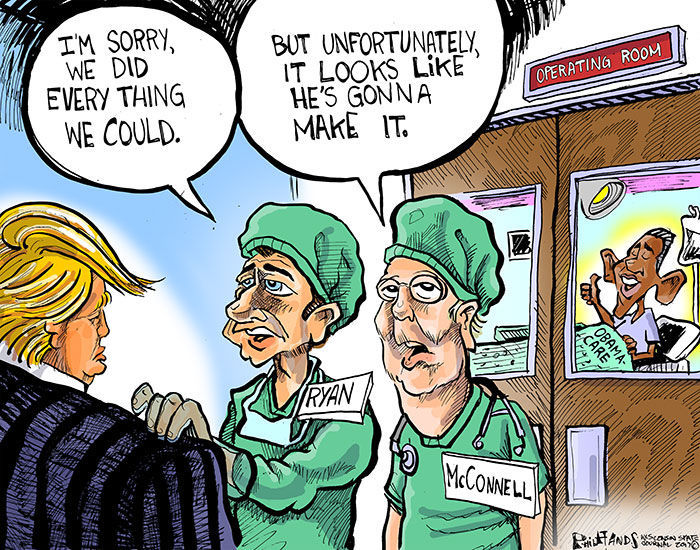
The Faustian bargain. Nonetheless, it seemed to go without saying that congressional Republicans would get in line behind him, and they did. Mitch McConnell and Paul Ryan muted their criticism of the clearly unconstitutional first version of Trump’s travel ban. McConnell shepherded Trump’s somewhat bizarre cabinet appointments through the Senate, and blocked the creation of an independent commission to investigate the Russia scandal. Ryan backed up Intelligence Committee Chair Devin Nunes when he tried to subvert the House’s Russia investigation, and defended Trump’s firing of James Comey. Both of them turned a blind eye to Trump’s widespread conflicts of interest.

The implied agreement seemed to go like this: Whatever leaders like Ryan and McConnell thought of Trump as a man or a leader, unified Republican control of the branches of government would open the way to a long list of conservative proposals, which Ryan and McConnell would assemble. Trump, having few real policy ideas of his own, would sell those proposals to his supporters (who probably would be hurt by many of them) and then sign the bills once Congress passed them. The possibility of making Medicaid a block grant to the states and putting a hard cap on its growth, Ryan said, was something he’d been dreaming about since college. Why should he screw those dreams up by fulfilling Congress’ constitutional duty to check and balance the executive branch?

So: sweep Russia under the rug, let Trump get away with whatever scams he wants to run, and in exchange get a hard-right majority on the Supreme Court, repeal of ObamaCare, significant cuts to safety-net programs, big tax breaks for Republican special interests, and cover from the Justice Department for voter-suppression and gerrymandering efforts that could guarantee Republican domination of Congress into the indefinite future. What a deal!

ObamaCare repeal was supposed to be the easy part of that agenda. During the campaign, Trump promised “immediate” repeal. And even after things got real, when the new Congress began meeting in January, legislation was supposed to be on President Trump’s desk by February 20. But we are now in Congress’ August recess, with ObamaCare repeal in ruins and the rest of the legislative agenda still stuck on Square One.

There’s plenty of blame to go around, but one problem is that Trump has proved to be a terrible salesman. Aside from occasionally tweeting about how “terrific” and “beautiful” the Republican healthcare plan was — whichever one seemed most likely to pass at the moment — he did nothing to rally public support, and little to corral reluctant Republican votes in Congress. His self-created reputation as a great deal-maker proved to be empty. He never spoke to the nation as a whole about healthcare or made a case for his administration’s vision, whatever it is. He was quick to take credit for successes and distance himself from failures. The House bill that he celebrated in May was “mean” just a few weeks later.

Worse, media attention that might have been marshaled behind the Republican agenda has again and again been diverted by Trump himself and the circus atmosphere of his White House. In addition to his personal spats and the infighting of his people, the Russia scandal that he swore was nothing keeps looking more and more like something. Again and again, his people have been forgetful or dishonest about their meetings with Russians, and Trump himself has participated in misleading the public. Even Republicans who want to cover for their party’s president have to wonder what exactly he’s covering up.

In short, congressional Republicans may not have ever liked Trump or approved of him as the leader of their party, but they would have been happy to march behind him to victory. What they’re not prepared to do is follow him off the cliff to defeat.

The second turning. So here’s what we’ve seen recently.

  • Congress overwhelmingly passed new Russia sanctions, which Trump can’t remove without congressional approval.
  • After the TrumpCare defeat, Trump demanded the Senate try again, and not consider any other legislation or leave for vacation until they passed something on healthcare. The Senate ignored him.
  • Some Republican senators are looking for a bipartisan fix for the ObamaCare exchanges (along the lines I discussed last week).
  • The Senate didn’t officially adjourn for the August recess. This prevents Trump from replacing Jeff Sessions via a recess appointment without Senate hearings, which was part of the most likely fire-Mueller scenario. This signal of distrust is something the Senate majority has never before done to a president of its own party.
  • Two bipartisan proposals are being floated to prevent Trump from firing Mueller.
  • A number of Republicans (including Mike Pence, though he denies it) are making preliminary moves in Iowa, as if they didn’t expect Trump to be a factor in 2020. John Kasich and/or Ben Sasse might be planning to challenge Trump if he does run. John McCain comments: “They see weakness in this president. Look, it’s not a nice business we’re in.”
  • Congress shows no signs of taking up the immigration plan the White House endorsed this week.

The current face of Republican resistance to Trump is Senator Jeff Flake, author of the new book Conscience of a Conservative, a section of which was published recently in Politico Magazine:

If by 2017 the conservative bargain was to go along for the very bumpy ride because with congressional hegemony and the White House we had the numbers to achieve some long-held policy goals—even as we put at risk our institutions and our values—then it was a very real question whether any such policy victories wouldn’t be Pyrrhic ones. If this was our Faustian bargain, then it was not worth it. If ultimately our principles were so malleable as to no longer be principles, then what was the point of political victories in the first place?

This isn’t how things were supposed to go. By now, Republicans were supposed to be basking in the glow not just of stealing a Supreme Court seat, but of repealing ObamaCare, awarding their donors a tax cut, and maybe even creating some jobs with an infrastructure program. If any Republicans in Congress harbored doubts about the Trump administration, they would be quiet for fear of a primary challenge from his supporters. Red-state Democrats and maybe even the party leaders would be submissive, looking for ways to argue that they could work with Trump.

If the Women’s Marches were the first turning away from that scenario, I believe we are in the middle of the second.

It would be a mistake to expect this turning to go very far very fast. Elected Republicans are not likely to join the resistance anytime soon. But we also shouldn’t underestimate the effect they can produce just by going silent and working behind the scenes.

For example, look at Trump’s effort to undermine the Mueller investigation. He has been building a witch-hunt narrative and claiming that Mueller is motivated by conflicts of interest, with the obvious intent to justify firing Mueller and shutting his investigation down. Establishment Republicans could be echoing those points. They could have left the door open for a recess-appointed attorney general who could then fire Mueller. That would have left their own hands clean, and they could have tut-tutted about the firing without doing anything.

Instead, most congressional Republicans continue to endorse Mueller’s integrity, and they closed the back door to his firing.

They will continue to support the administration when it puts forward policies that are long-term pieces of the broader Republican agenda. But as Trump continues to make bad decisions, spew outrageous misinformation, and pick fights with whoever raises his ire from moment to moment, more and more he will be defended only White House flacks like Kellyanne Conway, or dedicated Trumpists like Newt Gingrich or Rudy Giuliani. Republicans of independent authority will stand aside.

That silence will be felt. It will not lead to a sudden crash in Trump’s approval among Republicans (which is still fairly high). But the continuing lack of credible defense will cause a slow erosion. And at some point, that erosion might make direct Republican resistance a politically viable course.

How to Fix ObamaCare

It needs a number of wonky adjustments, not a dramatic overhaul.


Other than a fairly vague “we know it’s not perfect”, elected Democrats have been reluctant to criticize ObamaCare while it was facing the prospect of a full repeal. Even fairly mild criticism, they feared, might lead to “Even Democrats Hate ObamaCare” headlines and feed the repeal movement. Worse, if Democrats settled on a fix-ObamaCare plan, McConnell and Ryan might take one or two minor ideas from it and claim that their new repeal plan was bipartisan, even as it gutted the larger purpose of ObamaCare.

But even though ObamaCare repeal keeps rising from the dead, maybe the its most recent defeat leaves an opening for an honest effort to improve the system. That will be tricky, because it means putting aside an enormous amount of widely believed lies and focusing on what the real problems are.

What ObamaCare was supposed to do. One reason all the Republican repeal-and-replace bills have been so unpopular is that no one could say exactly what they were supposed to accomplish, other than fulfill the promise to repeal ObamaCare. Repeal has become an end in itself, independent of anything it might do to help or hurt the American people.

By contrast, all Democratic healthcare plans are based on a simple principle: Sick or injured people should get the care they need, and they shouldn’t have to go bankrupt paying for it. Large majorities of Americans believe in that vision, and Democrats have been trying for decades to make it real. ObamaCare has always been an imperfect implementation, but it was a significant step in the right direction.

Why not single-payer? The most direct (and, in my opinion, the most efficient) way to implement that principle is some kind of single-payer, Medicare-for-all system like just about every other advanced country already has. It’s been tested in nations all over the world, and it works. Germany or Australia, for example, spend far less per capita than we do on healthcare, and their people live longer. [Update: See the comments for a correction. I have used “single-payer” as a synonym for “universal health insurance”, which is not accurate. In particular, Germany achieves universal coverage differently.]

I suspect that in their hearts, all the Democrats running for president in 2008 would have preferred a single-payer system, but most of them believed Congress would never pass it. So Obama and his main competitors (Hillary Clinton and John Edwards) all proposed very similar systems, roughly based on the program that Republican Governor Mitt Romney had already started in Massachusetts. Dennis Kucinich had the single-payer supporters all to himself in the New Hampshire primary, where he got 1.35% of the vote.

Single-payer advocates find this kind of timidity mysterious — or they attribute it to bribery by the big insurance companies — because if you poll single-payer by itself, it does pretty well. So why not go for it?

What makes even honest politicians nervous is that lots of things poll well until a campaign begins, when the negative ads and outright lies start to fly. HillaryCare polled well at first too, until Republicans and insurance companies started going after it. In no time it all, it morphed from an unstoppably popular proposal to the reason the Democrats lost the House in 1994.

Whenever a proposal fails, you can point to plenty of mistakes its backers made. (Supporters of successful proposals also make a lot of mistake, which are quickly forgotten.) But it also seems to be true that the American people harbor a deep well of distrust for politicians and their promises. If a negative ad tells people you’re going to take something away from them, they believe it. If you respond that you’re going to give them something better, they don’t.

Nobody wants to believe that this applies to them as well as their opponents, but it does. Republicans, I’m sure, have been shocked these last six months to discover that many of the same people who distrusted ObamaCare now distrust their replacement plans even more. (ObamaCare repeal as an abstract idea has long polled in the 40s. All the specific repeal bills discussed recently have polled in the teens.) As soon as Republicans gained enough power to implement actual changes, they became the new owners of the well of distrust.

Single-payer supporters on the Democratic left are making a similar mistake today, I believe, when they imagine that the wave of public distrust they’ve helped raise against establishment Democrats won’t wash back on them if they ever take power.

Three options. When you come down to it, there are really only three ways government can handle the problem of the uninsured.

  1. Ignore it. When the uninsured get sick, either private charity will take care of them or they’ll die.
  2. Have one system that covers everybody.
  3. Have a crazy-quilt of different programs that all have their own rules and justifications, and hope that not that many people slip through the gaps.

ObamaCare is a type-3 plan. TrumpCare failed because it could never decide whether it was a type-1 plan or just another type-3 plan with more gaps.

The ObamaCare Rube Goldberg machine. Public distrust of change is one major reason ObamaCare was designed to minimize the number of people facing significant disruption. If you got your healthcare through Medicare, Medicaid, the VA, or your employer’s group plan (like my wife and I did and do), you probably didn’t notice much difference. Obama’s “If you like your health plan you can keep it” may have been Politifact’s Lie of the Year, but it was actually more of an exaggeration than a lie. After the ACA passed, the vast majority of people with good health insurance just kept doing whatever they’d been doing.

Maintaining all those legacy programs guaranteed that covering the uninsured would be complicated. So ObamaCare covered uninsured people like this:

  • The poor continue to get Medicaid.
  • Those just above the poverty line — who presumably can manage day-to-day expenses like food and rent, but have nothing left over to insure against emergencies — get covered by extending Medicaid (though the Supreme Court allowed states to opt out of this).
  • Low-to-middle working-class people whose jobs don’t include health insurance can get a subsidy to buy individual insurance on an ObamaCare exchange. (The subsidies phase out as incomes increase.)
  • Better-off people whose jobs don’t include health insurance can buy policies on the exchanges at full price.

Gaming the system. In addition to the complexity of how you got covered, there were changes in the rules of coverage. Mostly, this is about keeping players from gaming the system.

When insurance companies compete on price and service, the public benefits. But prior to ObamaCare, a lot of insurance competition was about something else: making sure that their own insurance pool was healthier than the other companies’. So insurers got really good at figuring out who was a bad risk and cancelling their polices. That helped the company’s bottom line, but was bad for public health. (And if your wife is a cancer survivor, it’s terrifying.)

So the biggest (and most popular) rule change was that insurance companies have to offer coverage to everybody, no matter how unhealthy they are or might get. Nobody is uninsurable any more.

But that created a new opportunity to game this system: Healthy individuals might go without insurance, figuring that they could pick it up later if they ever needed it. Taking healthy people out of the insurance pool ruins the whole idea of insurance — imagine if you could put off buying fire insurance until after your house burned — so that had to be prevented somehow. That’s where the individual mandate comes in: Even if you’re healthy, you either carry insurance or pay a tax.

So

  1. no discrimination against pre-existing conditions,
  2. a mandate for individuals to carry insurance, and
  3. subsidies so that even individuals just above the poverty line can afford the insurance they’re obligated to carry

is sometimes called the “three-legged stool” of ObamaCare. The system is unstable unless you have all three.

Where there are problems. The problems with ObamaCare have been wildly exaggerated by Republican talk of a “meltdown” or “collapse” or “death spiral“. But ObamaCare has run into three main problems:

  • The Supreme Court allowed states to opt out of Medicaid expansion, and a number of the red states have, at great cost to their citizens and hospitals. Policies on the ObamaCare exchanges are not designed for households near the poverty line; the deductibles on the cheapest (bronze) plans are far too high for them, and they may not qualify for the subsidies. The Medicaid-denied people who do sign up on the exchanges tend to be the very sick, whose expenses raise premiums for everyone.
  • Not enough healthy people are signing up to keep premiums low. The original projections didn’t anticipate that HHS would use its PR budget to undermine ObamaCare [1], that private sources would launch a well-funded advertising campaign against signing up, or that refusing to sign up would become part of a political identity.
  • Not enough insurance companies are participating (particularly in rural areas [2]) to keep the exchanges competitive.

The last two should not be all that surprising. If you look at the description of ObamaCare above, it depends on inducing people to cooperate, not forcing them. (That’s why it’s ironic that it’s been attacked as an assault on “freedom”.) For the program to work smoothly, the inducements — subsidies to individuals, reinsurance for insurance companies, the income level where Medicaid expansion ends and private-sector policies begin, the tax on the uninsured — have to be calibrated right.

Healthcare experts made their best estimates when the law was written, but everyone expected to make adjustments as the real-world results started coming in. This is not unusual with big new social programs. Social Security, Medicare, and Medicaid all required some fine-tuning as they got off the ground, and still get re-jiggered periodically.

But no one foresaw that Republicans would immediately gain control of the House, and then take the attitude that the only acceptable adjustment was complete repeal. It’s hard to grasp now how big a change this is from all previous American history. Typically, opposition parties in America have not tried to sabotage programs they disapprove of. Until the current era, small changes that improve the working of an existing program have been uncontroversial, even among congresspeople who voted against the program originally.

The sabotage problem has gotten worse since Trump became president. He gleefully talks about letting ObamaCare implode, and creates uncertainty in the insurance markets by threatening to delay or withhold payments. Insurance is all about managing risk, so adding any new uncertainties to the system is monkey-wrenching.

How to fix them (if you want to). It should go without saying that the first step in fixing something is to stop trying to break it. But beyond that, there are some obvious things to do.

Ten House Democrats — including my NH-2 rep, Annie Kuster — have put out a plan to stabilize the individual insurance markets. The main planks are:

  • a permanent reinsurance program to protect insurers against unexpectedly high claims. This would encourage insurers to compete in more markets. ObamaCare had such a program initially, but it has expired.
  • reduce deductibles and co-pays for people with low incomes. There’s already a program in the ACA that does this: The government is supposed to make “cost sharing reduction” payments to insurance companies that keep these costs low. But there’s a dispute working its way through the courts about whether Congress has to appropriate this money year-by-year (which it hasn’t done) and Trump is threatening to withhold the payments.
  • market better. HHS needs to start spending its advertising budget to promote ObamaCare rather than denigrate it. One simple suggestion: Make the ObamaCare open enrollment period line up with the April 15 tax deadline, so that people who have just seen how the tax subsidies and the individual mandate affect them could immediately take action for next year.
  • enforce the individual mandate, which the IRS is currently not doing.
  • let people over 55 buy into Medicare. This will shift some of the most expensive people out of the ObamaCare risk pools, lowering premiums for everyone else.
  • give bigger subsidies to older people in rural areas.

Other ideas are out there as well. Saturday’s NYT listed at least two (in addition to some of the ideas already mentioned).

  • reduce drug prices. If there’s real competition, then anything that makes healthcare less expensive makes health insurance less expensive. At the very least, lower drug prices would help people who have high deductibles and co-pays. And everyone agrees that the current system — which lets drug companies with patents dictate a price which the government and insurance companies are obligated to pay — is rigged in drug companies’ favor. Part of the Democrats’ “Better Deal” proposal is a federal agency that guards against price gouging.
  • extend ObamaCare-exchange subsidies to people in the Medicaid gap. It’s crazy that many states still haven’t accepted Medicaid expansion, but that seems to be the way it is.

538 passes on something clever Nevada is doing: Insurers who offer plans on the ObamaCare exchange in Nevada are more likely to be chosen to manage the state’s Medicaid plan. A similar idea (which I didn’t invent, but can’t remember where I saw it) is to force insurers who want to compete in lucrative urban markets to also cover rural areas.

Mending is boring, but insurance ought to be boring. None of this is the kind of sweeping change that inspires people. It’s more like when a football team works on blocking and tackling better, rather than coming up with new trick plays.

But it also shouldn’t scare people. The original structure of the plan is still sound. It just needs some adjustments.

The question is whether congressional Republicans want to make those adjustments, or the Trump administration wants to implement them. They can, if they want, make ObamaCare collapse.

If they do that, though, they may convince the public that type-3 crazy-quilt plans don’t work. And if the public has to choose between a type-1 let-them-die program and a type-2 Medicare-for-all plan, I don’t think Republicans will like how that decision comes out.


[1] The Daily Beast reports:

To date, [HHS] has released 23 videos. A source familiar with the video production says that there have been nearly 30 interviews conducted in total, from which more than 130 videos have been produced.

Each testimonial has the same look, feel, and setting, with the subjects sitting before a gray backdrop and speaking directly to camera about how Obamacare has harmed their lives. They were all shot at the Department’s internal studio, according to numerous sources who worked for or continue to work at HHS.

The videos openly suggest Congress repeal ObamaCare. The one featuring Robert Dean ends like this:

I really hope that the Trump administration and the U. S. Congress, Republicans in the Senate and House, can get their act together and deliver relief to the American people.

Given this openly political — and even partisan — message, I suspect that spending public money to produce and distribute these videos is illegal. If HHS Secretary Tom Price knew about this and condoned it, he should resign.

[2] As the liberal Center for Economic Policy and Research think tank notes, lack of competitive exchanges is particularly a problem in Republican states that have done their best not to cooperate with ObamaCare. It provides the following chart:

In part this is a coincidence caused by the fact that largely rural states tend to have Republican governors. But so is the frequently cited statistic that 1/3 of counties have only one insurer: Those counties tend to be sparsely populated, so the number of people they represent is far less than 1/3 of the country.

The are lots of reasons why rural areas are especially hard hit. Most obviously: Having fewer people makes them a less robust insurance pool, increasing risk to the insurer. Also, healthy young people tend to seek opportunity in the bigger cities, leaving older, sicker people behind.

Fatherly Advice to Eric and Don Jr.

[with no apologies at all to that loser Rudyard Kipling]

If you can duck the blame when all about you
Have seen with their own eyes that it was you;
If you can demand trust when men should doubt you,
And call down vengeance for their doubting too;
If you can dodge and not be tired by dodging,
Or having lies exposed, hold to your lies,
Or being hated, hit them back with hating,
Yet always claim that you are good and wise;

If you can scheme, your schemes will make you master.
Let others think—their doubts will keep them tame.
But you can meet with Triumph and Disaster,
And claim them both as “winning” just the same;
If you can find a dream that men seek madly,
And tart it up to bait a trap for fools,
And take the things they worked their lives for, gladly,
And walk away as if there were no rules;

If you can get the banks to loan you billions
And risk it on a scheme you should have tossed,
And lose, and say good-bye to your pavilions,
But never pay a cent of what you’ve lost;
If you can force your wind and nerve and bluster
To serve your turn long after they’ve grown thin,
And so hold on when all that you can muster
Is just the Will that says you have to win.

If you can rouse a rabble into violence,
And cozy up to Russian oligarchs,
Intimidate good people into silence,
And not forget your fans are just your marks;
If you can jam each analytic minute
With the most relentless spinning ever spun,
Then you can grab the World and all that’s in it,
And—which is more—you’ll be a Trump, my son!

Getting Through This

Since the election, I’ve been trying to get comfortable with uncertainty rather than maintain a positive mental attitude.


I spent last week vacationing on an island with almost 300 Unitarians of all ages. We listened to chautauqua-style talks, played games, flew kites, and did a great deal of staring out to sea.

Unitarians, for the most part, are liberals. And liberals, you may have noticed, can be pretty depressing people these days. In the course of the week, I had many conversations like these:

  • A minister told me he can name 30 people in his (not terribly big) town who have been “disappeared” by ICE.
  • An EPA employee is watching her agency get disassembled, and deciding whether to keep fighting or give up and take a buy-out package.
  • A mother has serious doubts about her children’s future, both in a global-warming and a where-will-the-jobs-be sense.
  • A NASA researcher described administration proposals to simply turn off instruments on functioning satellites because they might provide data documenting climate change.
  • A grandmother raged about the early warning signs of a police state.
  • A former state Democratic Party official worries that the divisions of 2016 won’t heal in time for 2018 or even 2020.

And that’s not to mention all the people who expressed shame because they can’t make themselves pay attention to the news. They are the kind of folks who until recently have prided themselves on being committed and informed, but lately they’re choosing not to know things that they believe would only make them angry or frustrated or depressed. (These news-avoiders appear to be a fairly big club, though they never hold meetings.)

But the strangest thing, at least for me personally, was the number of people I already know, who read this blog, or the columns I write for UU World magazine, and expected me to provide a hopeful vision, one in which Right and Justice must ultimately prevail.

I’m not sure where they got this idea. I certainly have never advertised myself as a purveyor of hope, or posted a “5 Reasons the Good Guys Have to Win” article. The best I can figure is that it’s my affect: They know I dive deeply into the news, week after week, and yet I don’t seem to be depressed or angry or in despair. How do I do it? Maybe they think the secret sauce is that I’ve seen the ending already in my rose-colored crystal ball: I know the cavalry arrives in the final reel and saves everybody. Or maybe I have some deep insight into the Platonic essence of the Universe, which tells me that the Form of the Good is eternally triumphant, and the Trumps of this world can never ultimately prevail.

That’s not it. I mean, I do have a deep belief that the Trumps can never ultimately prevail, but that’s only because nobody ever ultimately prevails. If you look far enough into the future, people die, empires fall, civilizations crumble, and species go extinct. Ultimately, the Sun blows up, and if you keep looking far enough past that, the Universe goes cold. We may or may not save the world this time, but even if we do, the world won’t stay saved. It never does.

So anybody who is looking for an everything-well-be-fine message from me is barking up the wrong tree. My grand cosmic perspective is that shit keeps happening until it stops, and then (at some point) nothing ever happens again. If you find that comforting, you’re welcome. My bill is in the mail.

But I suppose that leaves a mystery: I see the same appalling developments everyone else does. So why aren’t I depressed or angry or driven by some desperate energy?

The answer to that one is simple: I’ve been here before.

I don’t mean that in a spooky deja-vu sense. But during a life crisis many years ago, I developed some habits and attitudes that are serving me well now.


Back in 1996, my wife was diagnosed with stage-2 breast cancer. At the time, that was right on the borderline of survivability. Again and again, people told us hopeful stories of their friends or relatives who lived through breast cancer, but invariably it was the less serious stage-1 version. In the media, we found a few stage-3 or stage-4 survival stories, but they were miraculous. Stage 2 was a genuine toss-up. With the best possible treatment, maybe you’d live and maybe you wouldn’t.

The medical advice we got was to hit it hard, because you really only got one shot. Survivals of recurrence were another set of miracle stories, and not anything you wanted to count on. In other words, “saving” some treatment in case the first ones didn’t work was a bad idea. So we set up a truly arduous 9-month plan that shot all the fireworks, one after another. This was going to take over our lives for most of a year, and there was no guarantee it would even work.

There is a whole branch of the publishing industry devoted to the mental attitude you’re supposed to maintain during such a process. Most authors at the time recommended staying relentlessly positive: This is going to work. Forget the statistics, forget how you feel today, this is going to work.

We were tempted to go for that, but the more we looked into it, the more brittle such an attitude seemed. Some people maintained it all the way to recovery, but others broke. They stayed positive until they couldn’t any more, and then they crashed into despair.

So instead, we decided to try to accept the uncertainty. We didn’t know what was going to happen, and if everything went well we wouldn’t know until sometime in the distant future when we would look back and said, “I guess we got through that.” In the meantime, we would do whatever we could with the quantity and quality of life we were allowed to spend together. (It turned out to be a lot; 21 years this August.)


Like most people I know, in the aftermath of Election Day I felt overwhelmed. How could this have happened? What did it mean? What would happen to us?

And then, without recognizing it until a month or two later, I slipped back into my cancer-treatment mindset. I started doing whatever I could think to do, and tried to accept that I have no idea whether it will work.

I see lots of people around me either getting depressed, trying not to think about it, or working to maintain a positive mental attitude. The PMA folks reach for anything they can pin their hopes to: Trump will self-destruct, he’ll be impeached, his voters will realize they’ve been conned, the 2018 election will put the Democrats back on the path to power, Trump’s abuses will just make the Revolution come faster, and so on.

And who knows? Maybe one of those things will turn out to be true. But once again, PMA seems like a brittle strategy to me: It will keep you going until one day it doesn’t, and then it will fail spectacularly.

Instead, I’ll advise you to do whatever you can think to do to defend whatever you think is worth defending. Take your best shot, not because it will necessarily work, but because it’s your best shot. Enjoy the country and democracy you have for as long as you have it. Resist those moments — both positive and negative — when you think you know how it all turns out.

You don’t know. None of us do. So do whatever you can think to do, and what happens will happen. If things go well, we won’t know until someday years from now, when we look back and say, “We got through this.”