Biden’s announcement ends not just to our war in Afghanistan, but 20 years of fantasies about what “six more months” can accomplish there.
Wednesday, President Biden announced that our troops (and those of our NATO allies) will leave Afghanistan by September 11. Unlike previous dates for withdrawal, this one isn’t based on achieving some kind of stability or other goals first; we’re just getting out.
That announcement touched off a lot of comment, both pro and con. Pro: Leaving saves American lives and resources, and gives our military more flexibility to confront challenges more central to our well-being, as may come from Russia (in Ukraine) or China (in Taiwan). Con: Without us, the Afghan government will probably fall to the Taliban. That will definitely be bad for the Afghan people, and could also harm us if the Taliban starts sheltering terrorist groups like Al Qaeda again.
But one argument has been conspicuous by its absence: If we stay for six more months, or a year, or three years, Afghan democracy will stabilize, the Afghan Army will finally have enough training, and the government we leave behind in Kabul will be able to sustain itself.
The generals and their media allies have been making that argument for almost 20 years, and I was pleased to hear Biden blow it up:
So when will it be the right moment to leave? One more year, two more years, ten more years? Ten, twenty, thirty billion dollars more above the trillion we’ve already spent? …
“Not now” — that’s how we got here. And in this moment, there’s a significant downside risk to staying beyond May 1st without a clear timetable for departure.
If we instead pursue the approach where [the US] exit is tied to conditions on the ground, we have to have clear answers to the following questions: Just what conditions [will] be required to allow us to depart? By what means and how long would it take to achieve them, if they could be achieved at all? And at what additional cost in lives and treasure?
I’m not hearing any good answers to these questions. And if you can’t answer them, in my view, we should not stay.
Biden acknowledges the possibility of a terrorist resurgence in Afghanistan, but plans to deal with that if and when it happens.
We’ll not take our eye off the terrorist threat. We’ll reorganize our counterterrorism capabilities and the substantial assets in the region to prevent reemergence of terrorists — of the threat to our homeland from over the horizon. We’ll hold the Taliban accountable for its commitment not to allow any terrorists to threaten the United States or its allies from Afghan soil.
I think of The Washington Post as the hometown paper of the defense and foreign-policy establishment, and it has been playing that role this week. The Post’s editorial board responded to Biden’s plan by predicting that “the likely result will be disaster”. But even they acknowledged that their alternative path offers no exit.
A strategy of leaving troops in the country in an effort to force the Taliban to compromise could extend the U.S. commitment for years without achieving a durable peace.
And WaPo columnist Max Boot offered a much-scaled-down version of the usual rosy scenario:
To avert such a dire contingency, Biden would not have to wage a “forever war.” He would merely have to keep a relatively small number of U.S. forces to advise and assist the Afghans who already undertake almost all of the fighting.
So: a forever skirmish, not a forever war. We’ve recently gone a whole year without a combat death in Afghanistan. Maybe that happy circumstance will continue, and the price of freezing the status quo will be low enough to tolerate indefinitely.
Or maybe not. Maybe the Taliban will tire of trying to wait us out, and will go back to trying to drive us out. And if combat deaths go back up, that will be its own reason to stay, so that the troops we are losing will not have died in vain.
But notice: This disagreement is between two sides that each have at least one foot in reality. Maybe the cost of staying in Afghanistan forever will be tolerable, or maybe we’ll find some better way of dealing with the increased terrorism threat of a Taliban-ruled Afghanistan. But nobody is counting on the Freedom Fairy to sprinkle her dust over Kandahar.
So whether you agree with Biden on this or not, you should at least thank him for bringing some honesty into the conversation.
Having written more-or-less even-handedly up to this point, I’ll take a side: I’m with Biden on this.
Way back in 2005, I expressed very similar ideas (about Iraq) in a 2005 essay I provocatively titled “Cut and Run“. At the time, “serious” foreign-policy experts were finally admitting that the 2003 Iraq invasion had been a mistake and we needed to get our troops out. But they always paired that concession with some sort of “after we fix what we’ve broken” caveat. (This became known as the Pottery Barn rule.) Typically, the sages thought our troops needed six more months to “stabilize the country” or “establish democracy” or achieve some other worthy but nebulous goal. (NYT columnist Thomas Friedman rolled his six-more-months projections forward with such regularity that six months became known as a Friedman unit.)
In “Cut and Run” I demanded a measurable answer to the question “What are we fixing?” Because in my opinion our military presence wasn’t fixing anything. After six more months, Iraq would still need “stabilizing”, and our troops would have to stay longer.
We can leave Iraq now, or we can leave after our losses have grown. That is the only choice we have.
I feel the same about Afghanistan today, after nearly 20 years of war. Whatever our original intentions might have been, by now it’s clear that we’re not building a secular, democratic, pro-Western government that will someday be strong enough to stand on its own.
There’s a lesson here, and it’s the same lesson we should have learned from Vietnam: In order to install a new form of government in a country, people on the ground have to be buying what you’re selling. As The Boston Globe’s H. D. S. Greenway puts it: In both Vietnam and Afghanistan
our clients could never shake the impression that they were puppets fighting for foreigners, while the Viet Cong and the Taliban were able to present themselves as the true patriots fighting to rid their country of colonialism.
In South Vietnam, all we had to work with was the remnant of the old French colonial administration, which local people joined for the sake of power and profit, not because they believed in the French Empire or anti-Communism or some other idealistic notion. In Afghanistan, we have a corrupt government in Kabul supported (up to a point) by a patchwork of warlords in the countryside. The Afghan people don’t believe in it, because they shouldn’t believe in it.
Over the last two decades, hundreds of thousands of American troops have served in Afghanistan — most of them honorably and some heroically. It is a shame that their effort and sacrifice has not produced a lasting result that our nation can point to with pride. But more effort and sacrifice will not redeem what bad policy has already wasted. We need to leave.
Wednesday, Rachel Maddow brought up another good point about this war, illustrated by the experience of Taliban hostage David Rhode, the Pulitzer-winning NYT journalist who was held for seven months in 2008-2009. Rhode was actually only a prisoner in Afghanistan for a week; for the half-year beyond that, the Taliban kept him in parts of Pakistan where they had free rein.
Knocking the Taliban out of power in Afghanistan was one thing. Defeating them in some kind of larger war, preventing them from ever rising again in Afghanistan, that was something that a US military conflict in Afghanistan was never going to be able to do. Not when the Taliban wasn’t confined to Afghanistan and wasn’t really based there.
In August 2010, a former Pakistani intelligence officer approached the U.S. embassy station chief in Islamabad and offered to reveal bin Laden’s location, in return for the $25 million reward, according to a retired senior U.S. intelligence official.This story was corroborated by two U.S. intelligence officials speaking to NBC News, and had been previously reported by intelligence analyst Raelynn Hillhouse. The Pakistani official informed U.S. intelligence that bin Laden had been located by the Pakistani intelligence service ISI in 2006, and held under house arrest near Pakistani intelligence and military centers ever since.
According to the retired senior U.S. intelligence official speaking to [journalist Seymour] Hersh, bin Laden was ill at this point, financially supported by some within Saudi Arabia, and kept by the ISI to better manage their complex relationship with Pakistani and Afghan Islamist groups.
So a fully military solution to the Afghan problem would mean, at a minimum, expanding the war into Pakistan, and taking down factions within the Pakistani government. Pakistan, you may recall, is a nuclear power.
I don’t think anybody wants to open that can of worms.
The new law really is bad, but not every bad thing said about it is true.
A lot of hot air about this law is being blown in both directions. There are good reasons to oppose it, and I believe Georgia Republicans had bad motives for passing it. But it’s easy (and counterproductive, I think) to overstate the case against it.
So let’s back up and start at the beginning.
After 2020, are there good reasons to pass new election laws?
Actually, yes, but not the reasons that Republicans are giving.
Around the country, states adjusted to the pandemic by improvising new practices for the 2020 elections. State after state made it easier to vote by mail, vote early, vote at the curb of a polling place, or get a ballot by mail and cast it in a drop box. Some states made those changes by an act of the legislature, some by court order, and some by executive decision at either the state or local level.
Wherever the decision was made, it was extensively litigated before the election, which is the appropriate time to do it. [1] Across the board, the two parties followed the conventional wisdom that Democrats do better when more people vote. [2]
So in jurisdictions controlled by Democrats, officials aggressively responded to the pandemic by making voting easier, and were challenged in court by Republicans (who claimed the Democrats exceeded their authority or promoted fraud). In jurisdictions controlled by Republicans, voting rules were changed reluctantly or not at all, and were challenged in court by Democrats (who argued that making people stand in line during a pandemic infringed on their right to vote). I think it’s fair to say that even before Election Day, the 2020 elections were already the most litigated elections in American history, with the possible exception of Bush v Gore in 2000.
But whoever made the pandemic election rules, they were largely made on the fly and under time pressure. So it would be entirely reasonable for a legislature to review their pandemic election procedures now, when they can do the research, look at lessons learned, and hold the extensive debate there wasn’t time for in 2020.
In part that increase is due to population growth, and some may be evidence of highly motivated voters on both sides. But to a large extent this is an if-you-build-it-they-will-come effect: When voting gets easier, more people vote.
One thing we can be very sure of (in spite of Trump’s claims otherwise) is that the votes were counted accurately, particularly in Georgia. Because the race was so close, Georgia’s voting-machine results were re-tallied, followed by a hand recount of paper ballots. There were minor differences in the three counts (as there always are), but nothing approaching the scale of Biden’s 11K-vote victory.
A second Trump claim was that substantial numbers of mail-in ballots were fraudulent. Again, the evidence says otherwise. The Republican secretary of state conducted a review of signatures on mail-in ballots in one large county, finding that the Cobb County Elections Department had “a 99.99% accuracy rate in performing correct signature verification procedures.”
One Georgia election official — also a Republican — characterized Trump’s subsequent fraud claims as “whack-a-mole“. As soon as one was disproved, another would pop up. What Trump really had was a desired conclusion — that he really won — and his people kept manufacturing baseless arguments to reach that conclusion.
What lessons should legislators learn from the 2020 results?
If you believe in democracy, the two outcomes above — high turnout, accurate results — are entirely good. So the obvious and simple lesson of 2020 is that many of the irregular procedures motivated by the pandemic ought to be regularized.
In particular, mail-in ballots work. This should not surprise anyone, since vote-by-mail was already the default system in five states (Washington, Oregon, Hawaii, Colorado, and Utah) plus the District of Columbia. Fraud has not been a major issue in any of these states. There is still no credible evidence that it was a problem in any state that expanded vote-by-mail in 2020. [3]
It would be entirely legitimate, though, for legislatures (in those extensive hearings that Georgia did not hold) to examine their systems to eliminate fraud possibilities that were not exploited in 2020. Republicans undoubtedly would do this in bad faith, but a good-faith effort would be possible.
What lessons did Republicans learn?
The lesson Republicans appear to have learned from 2020 is “We lost because too many people voted.”
The most disturbing post-election change is that many in the GOP are now openly speaking out against democracy. In Arizona, for example, a state legislator said “Everybody shouldn’t be voting. … Quantity is important, but we have to look at the quality of votes, as well.” And Utah Senator Mike Lee tweeted: “We want the human condition to flourish. Rank democracy can thwart that.”
Some conservative intellectuals are making arguments that are simply fascist: America has been contaminated by citizens who are not “true” Americans. They should not be allowed to elect the officials that govern the country.
Most people living in the United States today — certainly more than half — are not Americans in any meaningful sense of the term. They do not believe in, live by, or even like the principles, traditions, and ideals that until recently defined America as a nation and as a people. It is not obvious what we should call these citizen-aliens, these non-American Americans; but they are something else. …
The US Constitution no longer works. What is actually required now is a recovery, or even a refounding, of America as it was long and originally understood but which now exists only in the hearts and minds of a minority of citizens. … Overturning the existing post-American order, and re-establishing America’s ancient principles in practice, is a sort of counter-revolution, and the only road forward.
In other words, rule by the minority that remains true to “America’s ancient principles” is justified and good. That fascist viewpoint may not represent the majority of Republicans (yet). But more and more it is tolerated, and even pandered to, as a legitimate voice in the intra-party debate.
What does the Georgia law do?
Good summaries have been published by The Washington Post and The New York Times. Oversimplifying slightly the law (1) changes the rules, and (2) changes who implements the rules. The significance of (1) has been overblown somewhat, but (2) hasn’t gotten as much attention as it deserves.
The rule-changes almost all go in the wrong direction (making voting harder and less likely), but mostly are not out of line with what goes on in other states. For example: Absentee ballots will be harder to get, but the new standards are not draconian in themselves. Rather than being able to request an absentee ballot six months in advance of the election, you now have to do it within 78 days. Absentee ballots will be harder to fill out and probably more mistakes will be made that allow the ballots to be tossed. For example, you can’t just sign the ballot any more, you also have to copy your driver’s license number (or some other number from a list of acceptable IDs) onto the ballot. (Georgia already had a voter-ID law for in-person voting.) If you’ve ever tried to copy a long meaningless number, you can imagine that a lot of people — especially old, sick, or poorly educated people — will screw that up. So their votes won’t count.
Small counties (which mostly vote Republican) will get more ballot drop-boxes, but large counties (mostly Democratic) will get fewer. The boxes have to be taken indoors in off-hours, an inconvenience that hits people who work during the day and can’t easily take unsupervised breaks. Small counties will extend their early-voting periods, but large counties were already at the maximum. Even granting that, though, there are many parts of the country that have even less early voting and/or ballot drop-boxes.
The change that gives the game away, though, is that distributing food or water to people waiting in line to vote is now considered electioneering at a polling place and is a misdemeanor. [4] So while many of the other changes will result in more people voting on Election Day, with correspondingly longer lines in areas with large populations (i.e. Democratic Atlanta), this change will make waiting in line an endurance test.
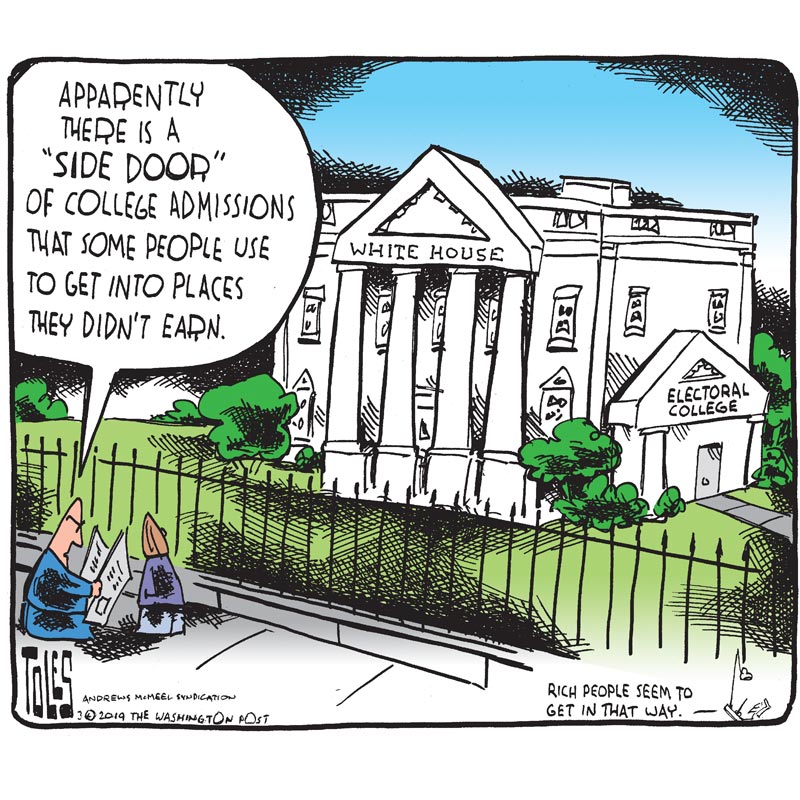
None of that is as blatant as the cartoon below, but all of it raises the question: Why? Did something bad happen in 2020 that makes all this necessary? The only real answer to that is: Too many people voted and Republicans lost. That’s the problem this law is trying to solve.
To me, this is the part that is most sinister. Again and again in 2020, Trump pressured Republican officials to overturn the election results. (The best known case is the Raffensperger phone call, when he pushed the Georgia secretary of state to “find” enough votes for him to win, and threatened him with prosecution if he didn’t. But Trump also pressured the US attorney in Georgia, a Georgia elections investigator, state legislators in Michigan, and probably many others we don’t know about.)
What Ted Cruz et al were hoping to accomplish on January 6 was to make an opening for Republican legislatures in Pennsylvania, Arizona, Georgia, and Michigan to overrule the voters and install their own slate of pro-Trump electors. Fortunately, most Republicans in Congress did not go along with this anti-democracy scheme.
Trump failed in his attempt to hang onto power in spite of the voters, largely because Republican officials refused to commit crimes or exceed their authority to reverse the election that he lost so decisively. But many of those officials have subsequently been punished. The Michigan election-board member who noted that his board had no authority to throw out the county-level certifications — he was not renominated. Raffensperger is going to be primaried by a Trumpist, and is expected to lose.
Similarly, most of the Republicans who voted to uphold democracy by impeaching Trump for inciting a riot against Congress — they’ve been censured by their local Republican parties.
The message from the Trump base is clear: Republican officials should not have integrity. They should be partisans first, and cheat if necessary to make sure elections come out “right”. (This makes perfect sense if you believe that “Most people living in the United States today — certainly more than half — are not Americans in any meaningful sense of the term.”)
This context makes the implementation changes in the Georgia bill ominous. The Secretary of State (i.e., Raffensperger) is removed from the State Election Board, which is now more completely under the control of the legislature. And the State Election Board is given power to remove and replace county election officials. It’s easy to see the target here: Fulton County, where Atlanta is.
So the next time a Trump wants to throw out a bunch of ballots in inner-city Atlanta, the state mechanisms are in place to make that happen.
What is being done to protest this law?
One purpose of rushing the law through so quickly was to prevent an effective response, which takes time to organize. (Think about it: If there were good reasons for this law and it enjoyed wide support, Republicans should have played it for all it was worth: Hold extensive public hearings about all the election fraud it would prevent. Explain in detail the destructive effects of handing out bottles of water to people waiting in hours-long lines. Lay out the case for why Atlanta shouldn’t be allowed to manage its own elections. And so on.)
As a result, big Georgia corporations like Coke and Delta didn’t oppose the law until after it passed, and they faced the threat of boycotts. (Home Depot and Aflac still haven’t commented.) The owner of the Atlanta Falcons football franchise did not mention the law specifically, but issued a statement saying “The right to vote is simply sacred. We should be working to make voting easier, not harder for every eligible citizen.” Major League Baseball pulled the All Star Game, which had been scheduled to happen in suburban Atlanta on July 13. (In addition to its fans, MLB also needs to consider its players, particularly the big-name players whose voluntary participation makes the All Star Game worth watching.) It’s not clear how far this movement will spread.
Guess what I am doing today? Not watching baseball!!!!
And the WaPo conservative columnist Hugh Hewitt proclaimed MLB “an arm of the Democratic Party … with values opposed to the Constitution and representative government.”
It’s the conservative version of cancel culture.
One thing Republicans are adamant about is that this is not racist, so all the comparisons to Jim Crow are over the top. But some of the comments they make clearly are racist, like this tweet from Mike Huckabee.
I’ve decided to “identify” as Chinese. Coke will like me, Delta will agree with my “values” and I’ll probably get shoes from Nike & tickets to @MLB games. Ain’t America great?
Hey Mike Huckabee, I asked around and Coke likes me, Delta agrees with my values, I wear Nikes and my hometown Dodgers won the World Series. But it’s not because of my ethnicity. It’s because I’m not a sh*thead like you who is adding fuel to anti-Asian hate.
[1] That’s one reason why many of Trump’s post-election lawsuits were thrown out without hearing evidence: Although Trump’s lawyers were claiming fraud in the press, when they went to court they often didn’t mention fraud, but focused on voting or vote-counting procedures that should have been — and often had been — litigated before the election. American courts look skeptically at parties that participate in an election, lose, and only then complain about the rules.
Before an election, courts can remedy a situation by ordering that bad rules be changed. Afterwards, the only possible remedy is to throw out ballots that legitimate voters cast in good faith. Judges are understandably reluctant to do this.
[2] It’s not completely obvious this is in fact true, and if it is, nobody knows exactly how big that high-turnout advantage is for Democrats. But it’s fair to say that both parties have acted as if they believe high turnout favors Democrats.
A lawyer for the Arizona Republican Party admitted as much to the Supreme Court. One issue in that case concerned voters who go to a polling place in the wrong precinct. Democrats want to handle this situation by counting their votes, but only for the offices they would have been entitled to vote on had they gone to the correct precinct. Republicans want to throw their ballots out. Remember: these are legal voters casting ballots in elections they are legally entitled to vote on, but getting confused and doing it in the wrong place — and so possibly giving officials an excuse not to count their votes.
“What’s the interest of the Arizona RNC in keeping, say, the out-of-precinct ballot disqualification rules on the books?” Justice Amy Coney Barrett asked, referencing legal standing.
“Because it puts us at a competitive disadvantage relative to Democrats,” said Michael Carvin, the lawyer defending the state’s restrictions. “Politics is a zero-sum game. And every extra vote they get through unlawful interpretation of Section 2 hurts us”
In theory, the extra votes the Democrats’ interpretation would allow might benefit Republicans, but the ARNC lawyer seemed to discount that possibility.
[3] Again and again, the apparently credible evidence you may have heard about in November or December collapsed under scrutiny.
[4] The only time I’ve ever seen snacks used as electioneering was in 2004, when I was given a Clark bar at a Wesley Clark rally. Doing something like that a polling place (which I don’t think Clark did) should be illegal.
[5] I’m struck by the lack of any justifying connection. Both seem to be pure power moves: We don’t like what you did, so we’re going to hurt you.
There is no legitimate tit-for-tat here. Like individuals, private-sector businesses have every right to comment on the actions of government and take whatever actions they deem appropriate. There is no comparable right in the other direction. Individual government officials are free to express their opinions, but governments are obligated to pursue the public good. Delta’s political views are not relevant to whether or not a tax break on jet fuel is in the public interest. For contrast, I don’t believe that Hobby Lobby suffered any official reprisals for challenging ObamaCare.
Democrats in Washington are talking about one set of issues. Republicans in the state capitals have a different vision entirely.
Within living memory, Republicans and Democrats competed over “swing voters” who were assumed to be living in the political “center”. That meant that candidates mostly talked about the same issues, and sometimes even proposed similar solutions, or at least had similar rhetoric.
In 2000, for example, it was hard to tell at a glance which would be more right or left: George W. Bush’s “compassionate conservatism” or Al Gore’s “New Democrat” agenda. Both seemed to be tempering their party’s typical stances, and where precisely they had wound up was not immediately clear. Ralph Nader claimed that it made no difference at all; if you wanted anything to change, you had to vote for a third party.
In 2012, Obama and Romney disagreed, but were talking about the same things: ObamaCare should either be expanded or repealed. Taxes on the rich should go up or down. There should be either more or fewer restrictions on abortion. But both wanted an all-of-the-above energy plan, and both wanted to end the wars in Afghanistan and Iraq in some kind of honorable way.
But right now, the difference between the two parties seems particularly stark. They aren’t just proposing to go in different directions; they’re talking about different worlds. Rather than competing solutions, they offer competing realities.
The Biden agenda. President Biden and Democrats in Congress have put forward a very clear list of what they think America needs:
Federal leadership in fighting Covid through vaccinations, treatments, and rallying Americans to practice good public health hygiene.
Financial help for individuals who have lost their income due to the pandemic and the lockdowns that combat the pandemic. (This was covered in the American Rescue Plan Act.)
Financial help for state and local governments to make the necessary adjustments to open schools safely, and to maintain public services in the face of falling revenues. (Also in the American Rescue Plan Act.)
Investments in public infrastructure, from fixing crumbling roads and bridges to building a 21st-century electrical grid. (An infrastructure bill currently being written.)
Protecting and restoring democracy by ending gerrymandering, making it easier to vote, and lessening the influence of big donors on our political system. (The For the People Act, which has passed the House.)
At a minimum, letting immigrant children who grew up in the US can stay and make a life for themselves. Beyond that, passing a larger immigration reform bill that would give the 11 million undocumented immigrants some kind of legal status. (The American Dream and Promise Act, passed by the House earlier this month.)
So far, this agenda has met with no cooperation from Republicans in Congress. The American Rescue Plan passed (through the filibuster-avoiding reconciliation process) with no Republican votes. The For the People Act passed the House with no Republican votes, and Mitch McConnell has predicted it will get none in the Senate. McConnell ally John Cornyn described it as “an existential threat, I think, to our election system and to our democracy”.
Already, before an official version is even announced, Republicans are staking out reasons to oppose Biden’s infrastructure plan. (Apparently, dividing the plan into two pieces, giving Republicans the opportunity to support a consensus bill and oppose a more partisan one, is a “cynical ploy”. To me, it looks like a strategy to make sure that contentious issues don’t get in the way of actions everyone agrees are needed.)
The American Dream and Promise Act got nine Republican votes in the House. It seems unlikely to get the 10 Republican senators it needs to survive a filibuster.
Meanwhile, in the states where Republicans control the governorship and the legislature, a different set of priorities are central.
Making it harder to vote.
Barring transgender students from school sports.
Creating more loopholes in anti-discrimination laws.
Preventing schools from teaching an anti-racist curriculum.
Stopping cities from fighting Covid with business closures or mask mandates
Voting. Georgia’s new election law — the one that makes it illegal to give water or snacks to people waiting in line to vote — got all the attention this week, but it’s one of many. The Brennan Center is tracking 253 bills in 43 states that involve some form of
restricting absentee voting, early voting, and voting by mail
The law allows the State Elections Board to temporarily suspend county elections directors and boards that it deems in need of review. At the same time, the secretary of state will be removed as chair of the state board and will be made an ex-officio, nonvoting member.
Those provisions have raised particular concerns among Democrats, who say that it will give far-reaching control over state and local elections procedures to partisan legislators and allow them to determine, for example, which ballots to count.
The racial aspect here should be obvious: The white-dominated Republican legislature could take election control away from a majority-black county like Fulton, where Atlanta is.
Transgender kids in sports.Mississippi, Arkansas, and Tennessee have passed laws banning transgirls from participating in sports in public middle schools and high schools. Similar bills are pending in many other states.
[Tennessee Governor Bill] Lee has said transgender athletes would “destroy women’s sports” and remarked that transgender athletes would put “a glass ceiling back over women that hasn’t been there in some time.”
A well-publicized track meet in Connecticut in 2019 resulted in two trans athletes winning the top two places in the girls’ 55-meter dash, but so far such results are rare. The WNBA has at least one transwoman, but seems to be in no danger of the “destruction” Governor Lee fears. The LPGA has been open to trans golfers since 2010, but they are still relatively uncommon.
None of the supporters of the Tennessee measure could cite a single instance of transgender girls or boys having caused problems. A review by The Associated Press found only a few instances in which it has been an issue among the hundreds of thousands of American teenagers who play high school sports.
Megan Rapinoe of the National Women’s Soccer League writes in today’s Washington Post:
Already this year, lawmakers in more than 25 states have introduced legislation to ban transgender young people from sports. … These bills are attempting to solve a problem that doesn’t exist. Transgender kids want the opportunity to play sports for the same reasons other kids do: to be a part of a team where they feel like they belong. Proponents of these bills argue that they are protecting women. As a woman who has played sports my whole life, I know that the threats to women’s and girls’ sports are lack of funding, resources and media coverage; sexual harassment; and unequal pay.
Opponents have said types of health care that could be cut off include maintaining hormone treatments for transgender patients needing in-patient care for an infection, or grief counseling for a same-sex couple. They’ve also said it could also be used to refuse to fill prescriptions for birth control, or by physicians assistants to override patient directives on end of life care.
Banning anti-racism.Jeffrey Sachs outlines the various states passing laws to limit the teaching of anti-racist ideas. A proposed New Hampshire bill has a heading “Unlawful propagation of divisive concepts”.
Similar bills are being debated in West Virginia and Oklahoma. Meanwhile in Georgia, a GOP representative has ordered every public college and university to prepare a list identifying which courses are teaching students about concepts like “privilege” and “oppression.” Faculty there say it’s already having a chilling effect.
There’s more. In Arkansas, debate has begun on a bill that would prevent public schools and universities from offering any course, class, event, or activity that “promotes division between, resentment of, or social justice for” a race, gender, political affiliation, or social class.
So which world do you live in? The Democratic world, where you feel threatened by the spread of the virus, worry about the state of our democracy, want to rebuild our public infrastructure, and think kids who grew up in America should have a way to stay here? Or the Republican world, where too many people are voting, virus restrictions are too onerous, you feel threatened by transathletes, and you wish you could do more to express your Christian disapproval of deviant lifestyles?
In “Why You Can’t Understand Conservative Rhetoric“, I described a process by which certain words and phrases lose all real meaning and become nothing more than pejorative labels that the Right attaches to whatever it doesn’t like. Through repetition, the movement’s followers have been trained to respond to “political correctness” and “cancel culture” like a bull to the color red; whatever those labels get attached to makes them angry, independent of whatever might be going on underneath the label.
An extreme example of this phenomenon is this week’s opposition to removing the bust of war criminal and KKK grand wizard Nathan Bedford Forrest from a prominent place in the Tennessee state capitol and placing it in the Tennessee State Museum, where General Forrest’s memory might be assessed objectively rather than simply glorified. (Far from a liberal plot, this is the recommendation of the historical commission appointed by the Republican governor.) But rather than asking “Do we want Tennessee and its legislature to be identified with a key figure in the origin of the Klan?”, moving Forrest’s statue has been labeled “cancel culture”, which must be resisted at all costs.
The latest phrase to get the political-correctness treatment is “critical race theory”. For example, Wednesday when Florida Governor Ron DeSantis announced a proposal to overhaul civics education, he made it clear that certain views of American history should not be taught:
Let me be clear: there’s no room in our classrooms for things like critical race theory. Teaching kids to hate their country and to hate each other is not worth one red cent of taxpayer money.
Bills to ban critical teaching about race in American history are being proposed in Republican controlled legislatures around the country. (Sometimes the ideas being banned are connected to the New York Times 1619 Project or anti-racism.) In nearly every case, critical race theory is never defined, but rather is given a negative description like DeSantis’ phrase “teaching kids to hate their country and to hate each other”. These bills are often accompanied with proposals to teach a more traditional, all-positive view of American history, as South Dakota’s Governor Noem proposes:
I have tasked my administration with creating instructional materials and classroom resources on America’s founding, our nation’s history, and the state’s history. We must also do a better job educating teachers on these three subjects. Through all of this, our common mission and key objective needs to be explaining why the United States of America is the most special nation in the history of the world.
Similarly, former President Trump called for educational programs that teach students “to love America with all of their heart and all of their soul.” Such a rah-rah view of American history and the US’s role in the world gets contrasted with the “indoctrination” and “ideology” of critical race theory. As DeSantis said:
Our schools are supposed to give people a foundation of knowledge, not supposed to be indoctrination centers, where you’re trying to push specific ideologies.
These efforts build on the rhetoric in two Trump executive orders: One banned anti-racism training at companies that contract with the government, and the other established a 1776 Commission to push a US history curriculum opposed to the 1619 Project. Neither order used the phrase “critical race theory”, but instead denounced “a series of polemics grounded in poor scholarship” that “has vilified our Founders and our founding”.
This ideology is rooted in the pernicious and false belief that America is an irredeemably racist and sexist country; that some people, simply on account of their race or sex, are oppressors; and that racial and sexual identities are more important than our common status as human beings and Americans.
As I pointed out in “Why You Can’t Understand Conservative Rhetoric”, phrases picked out for vilification are never defined, they are just labeled and described in a pejorative way. (Often they are described falsely. For example, anti-racist training would serve no purpose if America actually were “irredeemably racist”. Redemption is the whole point.)
So what is this “pernicious and false” doctrine? Time magazine described it as “a way of seeing the world that helps people recognize the effects of historical racism in modern American life”.
The intellectual movement behind the idea was started by legal scholars as a way to examine how laws and systems uphold and perpetuate inequality for traditionally marginalized groups.
But I think it’s important not to get lost in abstraction. Most Americans are not abstract thinkers, and when confronted with theories that are too airy to grasp, they often do what Trump, DeSantis, and the others are urging them to do: Give the abstraction a label and accept or reject it once and for all.
So instead, I want to offer a small number of facts that I believe (1) are essential to understanding the significance of race in American history, and (2) are never going to be taught in the kinds of courses Trump, DeSantis, and Noem are picturing.
1. From the turn of the 19th century to the Civil War, slavery was at the center of the American economy.
by 1860, there were more millionaires (slaveholders all) living in the lower Mississippi Valley than anywhere else in the United States. In the same year, the nearly 4 million American slaves were worth some $3.5 billion, making them the largest single financial asset in the entire U.S. economy, worth more than all manufacturing and railroads combined.
Obviously, slavery was central to the Southern economy. In just a few decades time, the entire states of Mississippi and Alabama were taken from Native American tribes, were converted to farm land by enslaved Africans, and became the most productive cotton fields in the world.
But the importance of slavery went much further: Although Virginia did not grow much cotton, its prosperity depended on exporting slaves to the developing slave states. The factories of the North were largely textile mills that gained advantage over English mills from easy and tariff-free access to Southern cotton. So from one end of the country to the other, American prosperity was based on slavery.
Slavery is also the hidden backstory to much of American history. For example, the motivation for Texas to secede from Mexico was that Mexico was beginning to enforce its anti-slavery laws. In that sense, the battle of the Alamo really was about freedom, but not in the way I was taught in high school.
2. The melting-pot miracle was based on creating a new White identity that rejected and stood above Blackness.
Something genuinely wonderful about American history is the way that Europeans from warring countries could come to America and live in peace. Certainly there was rivalry and sometimes conflict between European ethnic groups. (The HBO series Broadwalk Empire centers on the struggle between Irish and Italian gangs to dominate the Prohibition booze trade.) But it was truly marvelous how French and German and Polish people could homestead western lands and become neighbors, while their relatives back in Europe continued to hate each other.
It is pleasant to tell this story as a unified “American” identity replacing previous identities as Czechs and Serbs, but there’s more to it than that: Russians and Swedes didn’t just learn to be American, they learned to be White. The same deal was not available to Black or Chinese people. (Whether it was available to Jews varied by location and era.) By identifying as White, Europeans came into the American caste system at a level one or two steps above the bottom rung of the ladder, which was reserved for non-Whites.
3. The public investments that created the great American middle class intentionally excluded Black Americans.
The most obvious example is the segregated public school system, which helped poor White children gain the skills they needed to rise in the world, but either formally or informally herded Black children into schools with much less to offer. The New Deal and G. I. Bill programs that created the American Dream as we know it contained loopholes that Blacks consistently fell through: Social Security and the minimum wage didn’t apply to occupations with substantial numbers of Black people, like agricultural and domestic workers. The government would not guarantee home loans in the “red-lined” neighborhoods where most Black people lived. Black veterans of World War II could get help paying for college, but only if they found a college willing to accept them. And so on.
4. White support for those programs faded after LBJ extended them to Black people.
By the 1950s, New Deal programs (and the high tax rates on the wealthy that paid for them) were no longer controversial. In a 1954 letter to his brother, Republican President Eisenhower wrote:
Should any political party attempt to abolish social security unemployment insurance and eliminate labor laws and farm programs you would not hear of that party again in our political history. There is a tiny splinter group of course that believes you can do these things. Among them are a few other Texas oil millionaires and an occasional politician or business man from other areas. Their number is negligible and they are stupid.
Lo and behold, the Eisenhower consensus went away. When government programs offered Blacks the same helping hand they had been offering Whites for decades, Whites didn’t like them any more. Right-wing rabble-rousers stigmatized government programs as a way to tax Whites and give money to Blacks, and a small-government anti-tax movement started. Democrats became identified as the party of government, and no Democratic presidential candidate has received a majority of the White vote since LBJ in 1964.
As a result, tuition-free state universities are gone, inflation has eaten away the value of the minimum wage, and we argue about issues like whether children should get medical care.
We’ll never get rid of them, but can we at least process them better?
On this blog I frequently debunk conspiracy theories that spread among conservatives: QAnon, Obama’s birth certificate, Dominion voting machines, Antifa’s role in the Capitol insurrection, and so on. But this week a liberal conspiracy theory kept showing up in my social-media news feeds: The accusations against Andrew Cuomo are part of a scheme to install a Republican as governor of New York, so that he can use his pardon power to protect Donald Trump from New York state prosecutions.
Debunking the Cuomo theory. Before I start using this as an example of a conspiracy theory, though, let’s dismiss it as a sensible interpretation of events: Suppose Cuomo resigns or is impeached. His replacement is the Democratic Lieutenant Governor Kathy Hochul, who has no reason to pardon Trump. Next in the line of succession are the Temporary President of the Senate, the Speaker of the Assembly, and the Attorney General — all Democrats.
Then comes the 2022 election. New York electing a Republican governor is not unheard of: George Pataki served three terms from 1995-2006. But Pataki Republicans are not exactly Trumpists, and in recent cycles Democrats have done quite well in New York. Cuomo won his last election (2018) by 23%. But he doesn’t have some unique ability to pull in votes that puts the governorship in danger if he can’t run. Biden beat Trump in New York in 2020 by 23% as well. Kirsten Gillibrand won the New York senate race in 2018 by 34%. Letitia James won the 2018 Attorney General race by 27%. And the names being discussed as 2022 Republican challengers are not ones that should cause Democrats to quake in fear, particularly if a Trump pardon becomes one of the issues.
In short, raising phony accusations against Cuomo in order to keep Trump out of jail would be a wild scheme that had almost no chance to succeed. Not even Trumpists are crazy enough to invest the kind of resources even a failed attempt would require. And besides, there’s a far more mundane explanation for Cuomo’s problems: Being an asshole finally caught up to him.
My rare attempt at bipartisanship. If conspiracy theories appear in both parties, then sensible people in both parties should want to debunk them. That’s why I was pleased to see someone I rarely agree with, New York Times conservative columnist Ross Douthat, contribute to that effort a little while ago with “A Better Way to Think About Conspiracies“.
He starts with the following observation: The only way to get rid of conspiracy theories completely is to induce everyone to accept the expert consensus on everything. Not only is that never going to happen, it shouldn’t happen, because sometimes the expert consensus is self-serving or corrupt or just wrong in the ordinary people-make-mistakes way. I mean, how many experts told us that Saddam had WMDs, or that Trump couldn’t possibly beat Hillary? Worse, occasionally there are real conspiracies, like Nixon’s Plumbers or the baseball owners’ free-agency collusion.
So if we can’t just deny all conspiracies, or insist that people believe whatever the experts say, what can we do?
If you assume that people will always believe in conspiracies, and that sometimes they should, you can try to give them a tool kit for discriminating among different fringe ideas, so that when they venture into outside-the-consensus territory, they become more reasonable and discerning in the ideas they follow and bring back.
Douthat suggests a few sorting principles that can keep people from falling down the Q-Anon rabbit hole.
Simple theories are better than baroque ones.
Be skeptical of theories that seem tailored to reach a predetermined conclusion.
Take fringe theories more seriously when the mainstream narrative has holes.
Don’t start accepting all fringe theories just because one of them looks right to you.
To illustrate the simple vs. baroque distinction, he contrasts two origin-of-Covid-19 conspiracy theories: One says “it was designed by the Gates Foundation for some sort of world-domination scheme”, and the other that “it was accidentally released by a Chinese virology lab in Wuhan, a disaster that the Beijing government then sought to cover up”. Douthat rejects the former out of hand, but finds the latter plausible — not true, necessarily, but possibly worth investigating further.
The difference is that the Gates theory requires postulating a whole bunch of other stuff not in evidence. (What powers those nano-chips in the vaccine once they get into your bloodstream?) But the lab-accident theory just has one unusual event, after which a lot of people behave the way we know a lot of people behave: They would rather lie than accept blame. [1]
He illustrates the predetermined-conclusion point by looking at Trump’s various stolen-election theories. If you’ve ever argued with a Trumpist about this, you’ve probably observed what Douthat did: When you disprove one election-fraud theory, the Trumpist doesn’t reconsider his position, but just comes back with another election-fraud theory. If Georgia’s hand-recount disproves the corrupted-voting-machine-software theory (it does), then what about Detroit having more votes than voters? After you debunk that, what about dead people voting? And so on. The conclusion (Trump really won) remains fixed; the conspiracy theories are just roads to get there.
That should count against them.
Douthat’s point about holes in the mainstream narrative is similar to Thomas Kuhn’s account of scientific revolutions: Novel theories shouldn’t dislodge an accepted theory unless the accepted theory is having trouble explaining anomalies. As Einstein reflected, “If the Michelson–Morley experiment had not brought us into serious embarrassment, no one would have regarded the relativity theory as a (halfway) redemption.”
The example Douthat gives is Jeffrey Epstein. Epstein’s career is so unlikely that you can hardly blame people for trying to place him in a larger story. I would point to the pee-tape theory of Putin and Trump. There is essentially no evidence of a pee tape, but Trump’s defenders have never offered an alternative explanation of why he was so subservient to Putin. Instead, they just denied what we could all see. If the alternative to the conspiracy theory is believing that the Trump/Putin news conference in Helsinki is perfectly normal behavior for an American president, then I’ll keep looking for a pee tape.
The fourth point ought to go without saying, but there is a strong pull in the opposite direction: Once you leave the mainstream, other outside-the-mainstream folks feel like compatriots. (Once you accept alien visitors, why shouldn’t Atlantis be real?) Douthat makes a good point, though: All the world’s revealed religions have stressed that not every voice that pops into somebody’s head is the voice of God. You have to practice discernment.
I’ll support him by pointing out that even though the experts aren’t always right, they usually are. So when you believe a conspiracy theory, you’re betting on a long shot. Long shots occasionally come in, but no gambler makes a successful career out of betting on one long shot after another.
My additional principles. I agree with all of Douthat’s principles, but I don’t think he goes quite far enough. I want to add some ideas that I can easily imagine him agreeing with. And even if he doesn’t …
You don’t have to accept the convention wisdom, but you should know what it is. If you reject it, you should have a reason. Before you retweet something bizarre, take a moment to google a news story on the topic, or check some reference like Wikipedia. Is there a widely accepted explanation you hadn’t considered? Is there a reason not to accept it? If you have such a reason, fine. But at least consider a non-conspiracy explanation.
Evil people face the same problems you do. Have you ever tried to organize something? It’s hard. It gets harder the more people you need to coordinate, and harder still if it’s something like a surprise party, where it’s supposed to be secret, so you can’t just blast out an announcement.
It’s not any easier to organize something nefarious. If you can’t imagine how a richer, more powerful version of yourself could pull something off, be skeptical that somebody else is managing it.
Who are “they”? One way to avoid realizing just how big and complicated a conspiracy would have to be is to attribute it to a nebulous “them”, as Donald Trump Jr. does in this clip: “There’s no place that they won’t go. This week alone, they canceled Mr. Potato Head, they canceled the Muppets. They’re canceling Dr. Seuss from reading programs.” They who?
Everybody in a conspiracy needs a motive. The reason the baseball-owner-collusion theory was plausible (even before it turned out to be true) was that all 32 owners had the same financial incentive: paying their players less.
Now consider the theory that ICUs are faking the Covid pandemic. Everybody who works there needs to be in on it: nurses, doctors, cleaning staff, and so on. Either they’re not telling their loved ones, or the loved ones are in on it too. What motives could possibly unify all those people?
Very few people are motivated by evil for its own sake. A theory I heard fairly often as same-sex marriage cases were working their way through the courts was that same-sex couples weren’t actually interested in getting married, they were just trying to destroy marriage for the rest of us. We are all occasionally tempted to do something out of spite, but seriously: Would you devote a big chunk of your life to a project that gained you nothing, but just destroyed something for somebody else? Not many people would. [2]
As new information comes in, bad conspiracy theories have to grow. A good conspiracy theory might even shrink. A sure sign of a bad theory is that every objection is met by expanding the conspiracy. “They’re in on it too.”
But if you imagine organizing a conspiracy yourself, you wouldn’t be constantly trying to bring more people in, because each new person is a new risk. Instead, you’d try to identify the smallest possible group that could pull the operation off.
So if you’re on the trail of an actual conspiracy, the more you find out, the closer you should get to understanding the vision of the planner. Rather than “He’s in on it too”, you should start to realize how a small group of people really could do this. [3]
Contrast this with the nanobots-in-the-vaccine theory. Anybody who has access to a Covid vaccine might put it under a microscope and see those bots. Why aren’t they saying anything? They must all be in on it.
[1] My favorite Kennedy-assassination conspiracy theory is similar: After Oswald fires that first non-fatal shot, a Secret Service agent’s gun goes off by mistake, killing JFK. The agent’s superiors then try to cover that up, and things spiral from there.
Having brought up the Kennedy assassination, which educated my whole generation in conspiracy theories, I have to tell this joke: Two authors of JFK-assassination-conspiracy books are sharing a car as they drive to a convention where they’ll both be on a panel. Unfortunately, they are involved in a highway accident and die. But they’re both virtuous people, so they arrive together in the afterlife.
Their introductory tour of Heaven is given by God Himself, and somewhere between the infinite beach and the endless ice cream bar he tells them that there are no secrets in Heaven. “So if you ever want to know anything — about Heaven, about the Earth, about Me — you just have to ask.”
So one of the authors raises the question he’s been wrestling with for years: “Who really did kill Kennedy?”
And God answers, “Oswald, acting alone, pretty much the way the Warren Report says.”
The authors go silent for a while, until eventually one leans over to the other and whispers, “This goes up much higher than we ever imagined.”
[2] This is one reason I suspect that conspiracy theories do better among religious groups that believe in an active Devil. Unlike anybody you actually know, the Devil is motivated by evil for its own sake. And if the Devil has minions, they also are just trying to do harm.
[3] One of my favorite Kennedy-assassination conspiracy books was Best Evidence by David Lifton. (I’m not endorsing his theory, I’m just illustrating a point.) His theory revolves around how investigators think: They trust some kinds of evidence more than others, and they’ll explain away less-trusted evidence if it contradicts more-trusted evidence.
In a murder case, the best evidence is the body; or, after the body is out of reach, the autopsy. So if you could control that evidence, then you wouldn’t need to involve the whole FBI; they would naturally discount eye-witnesses who saw something that the autopsy says didn’t happen.
fail to define what they’re talking about, making me wonder if “cancel culture” is really a thing at all,
use a bunch of imaginary examples that fall apart as soon as you look at them, like the “cancellation” of Mr. Potato Head or Dr. Seuss. [1]
Mostly this is a debate between the Right and the Left, with conservatives prophesying the fall of civilization and liberals wondering what the problem is. But a segment of the mainstream commentariat has tried to stake out a middle position, recognizing that Green Eggs and Ham is in no danger and Pepe Le Pew should have disappeared a long time ago, but still repeating right-wing talking points about the Jacobin nature of the “woke mob”.
Bai and Hennessey. Case in point: Matt Bai, warning in Friday’s Washington Post about the dangers of the ongoing “cultural revolution” (and admitting that he’s invoking Mao intentionally). He brushes off the Fox News freakout about Mr. Potato Head, but then takes aim at people like me. [2]
the overwhelming leftist response to Republican hysteria has been to say that there is no such thing as “cancel culture,” no actual threat to free expression. It’s all just a lot of Trumpian nonsense, propagated by racists and sexists.
This isn’t true, and it isn’t helpful.
You know what would be helpful? If folks like Bai would define their terms and offer actual examples that can be be analyzed and compared, so readers don’t just have to take his word for what is or isn’t true. But instead, he makes this sweeping but totally unsupported claim:
A culture of self-censorship pervades media and the arts — a fear that using the wrong word or recommending the wrong book can derail a career.
We are, in fact, witnessing the most direct assault on free expression in my lifetime, mainly because a loud segment of younger activists view free expression as a convenient excuse for perpetuating oppression.
Despite the once-in-a-lifetime gravity of this situation, Bai does not find it necessary to identify a single career that has actually been derailed for “using the wrong word or recommending the wrong book”.
So what exactly is he talking about? If I don’t already know, he’s not going to tell me.
Most sensible liberals I talk to — in politics, news, entertainment or academia — understand this. But there’s a palpable fear of getting on the wrong side of the woke mob, and it doesn’t seem worth the risk.
Who is in this “woke mob”? He doesn’t say, beyond “younger activists” (which, sad to say, leaves me out as I research my Medicare options). But apparently my advanced age has not made me “sensible”, because I have no idea what he means.
Bai is not an isolated example. One of my unimpeachably liberal Facebook friends linked approvingly to this New York Post article by Matthew Hennessey, which tries to rally Gen-Xers against cancel culture’s “millennial Maoists”. (What is it about Mao?) Predictably, Hennessey also doesn’t define “cancel culture”, and (unlike Bai) recites the right-wing litany of imaginary examples. (The article’s illustrations include images from The Cat in the Hat and Gone With the Wind, both of which remain readily available.) And he perversely advocates fighting back against cancel culture by canceling anti-racists:
We will have to engage in a thousand tiny battles every day and it will be terribly uncomfortable. It’ll be hard standing up to school administrators pushing an ‘anti-racist’ curriculum on your kids.
Yeah, how dare the still-unidentified “woke mob” try to teach your children about slavery or structural racism? You absolutely need to protect freedom of speech by censoring that curriculum before the kids ever learn anything from it.
OK, I’ve got that out of my system now. Let’s see if it’s possible to find something here we can think about with some amount of rigor.
Outlines of a reasonable discussion. I suspect the term “cancel culture” is now poisoned beyond recovery. But let’s see if we can tease some kernel of legitimate concern out of the mass of nonsense. Let’s begin with some ground rules.
The phenomenon we end up discussing can’t have political bias built into it, as “cancel culture” currently does. I’m not willing to adopt a frame in which, by definition, only conservatives can have a grievance. If Gina Carano is a victim of whatever-it-is, then so are Colin Kaepernick and the Dixie Chicks.
Whatever-it-is has something to do with the proper limits of free speech. And that discussion needs to start by acknowledging that some limits, both legal and cultural, are necessary and proper. For example, there is room to argue about whether Trump’s January 6 speech should qualify as an illegal “incitement to riot”. But if he had openly said, “Now go to the Capitol and do whatever you need to do to stop Congress from counting the electoral votes”, he should go to jail. Freedom of speech can’t be absolute.
As for cultural limits, consider the example of an announcer’s I-didn’t-know-the-mic-was-live moment at a girls high-school basketball game in Oklahoma Thursday night. (When some of the student athletes knelt during the national anthem, he commented: “Fucking niggers.” [3]) I don’t think you have to be a Maoist to believe he should be fired for that. Not jailed, not lynched — but there should be consequences when somebody goes that far over the line.
And finally, there’s a difference between tolerating someone’s right to say something and providing them a platform so they can say it again. That’s another aspect of the basketball-announcer example. If a guy sitting in a bar makes the same comment to the TV screen, the people who hear it should give him strange looks, and that might well be the end of it. But should a network keep giving this guy a microphone?
To give another example, The Birth of a Nation is a racist movie from 1915, which you can watch in its entirety on YouTube. I’m fine with that, and I’d also be fine with Google (which owns YouTube) deciding not to host it. I would oppose a law that made distributing or watching the movie illegal.
But providing a public venue to screen the movie is a more complex discussion. If I were part of a university community — as either faculty or student — I’d be fine with an on-campus group showing it as part of a larger conversation about racism in film, one that allowed for discussion of the ways it misrepresents the Reconstruction Era. But I would protest if the movie were brought to campus without any context, in a hey-you-might-like-this way, or in any other way that used the university as a platform to promote the film’s racist point of view. [4]
So: It would be valuable for American culture to have a broad conversation about the proper limits of free speech and the proper ways of responding to offensive speech. A worthy goal would be to develop impartial standards that balance what I can do against what can be done to me, regardless of whether I am liberal or conservative.
Another valuable conversation would involve how we want to look at our history. How should we judge people who lived in other eras, when cultural values were different? What points of view have been systematically excluded from our history, and how does the story change when we let those points of view in?
I’ve heard a lot of people claim that eventually we’ll be renaming the Washington Monument, but I’ve never heard anybody seriously propose that. As in the previous discussion: What are the proper limits? Acknowledging someone’s historical significance is not the same as continuing to celebrate that person. We can leave people in the history books without naming schools after them.
Is anybody having that discussion? Maybe, a little. I’ll point you to a couple of worthwhile recent contributions.
First, Scott Illing’s interview with Jeffrey Sachs at Vox. Sachs has recently written an article at ARC on the bills state legislatures are considering (and even passing) that suppress critical race theory. In the interview, he contrasts the left-wing and right-wing threats to free expression.
I’m not comfortable either saying that one side is more dangerous than the other. What I will say is that the threats from the left tend to involve informal mechanisms of sanction, and they are no less censorious for that informality. They can do enormous damage, and it’s a significant problem that can be addressed if more college and university administrators grow a backbone and stand up to that kind of behavior.
Whereas the censorious instinct on the right is largely coming from off campus, and it involves much quieter tools that escape the notice of many commentators.
“Quieter” mainly because the national media doesn’t cover small-state legislatures like South Dakota, where a bill under consideration would
prohibit the use of any material designed to promote an ideological view of history, but simultaneously Gov. Kristi Noem has proposed or has requested $900,000 to overhaul the state’s history curriculum in order to promote the idea that “the United States of America is the most special nation in the history of the world.”
I hope Sachs eventually tells us specifically about the “enormous damage” to colleges and universities that he sees the Left doing. But the distinction — the Left operating mainly on campus and using social pressure, while the Right uses its political power in red-state legislatures — is useful.
Another worthwhile article is “Cancel Culture is Not a Movement” by Benjamin Wallace-Wells in the New Yorker. Wallace-Wells looks at particular cases and questions whether the “woke mob” operates more as a fear-inducing mirage than as a political force.
To Dr. Seuss Enterprises, it might have seemed possible that a progressive mob was waiting, ready to turn on “McElligot’s Pool” and “Mulberry Street.” But it is also possible—to me, it seems likely—that there was no such consensus at all. …
The college president, the city-council subcommittee, the panel of experts: these figures are often described by their political opponents as if they were as coherent and determined as a closed fist—that there is something cohesive that could be called cancel culture. My own sense is that something close to the opposite is true. The claims of racial justice have upended liberal élites in interesting and profound ways, and left them deeply uncertain: about how much history should be revised, about what kinds of retributive steps should be taken, and, above all, about how many people, really, want radical change.
Just about everyone left of center recognizes that white supremacy persists and is unjust, but “white supremacy” isn’t just a law that can be repealed or a corporate policy the board can change at its next meeting. So the desire to be on the right side of history often runs up against practical uncertainties: What can someone in my position actually do? And how much political capital does the will to change actually have? Will the apparent support for organizational change evaporate if I ask people to commit serious resources or accept significant change in their own lives?
The result can be bold announcements that lack bold follow-through, like Minneapolis City Council members vowing to “end policing as we know it”, but not allowing a police-defunding proposal to go to the voters. Or symbolic actions of little real impact, like San Francisco renaming its schools, or Speaker Pelosi wearing a kente-cloth stole to a demonstration.
College administrators can fire the people at the center of incidents, and sometimes do so too quickly and without due process, because they feel a need to demonstrate that they take the incidents seriously. Tech companies like Facebook and Twitter can boot people off their platforms, but the algorithms that identify such people are often no better than the algorithms that show us so many off-base advertisements. Publishers can decide not to publish objectionable books, either before or after someone objects to them. Stores can pull products off their shelves. Individuals can carry signs at Black Lives Matter demonstrations. Such actions display concern, but how well thought-out are they, and what next steps do they lead to?
The sum total of these actions can create the impression of a vast conspiracy reaching out to change every aspect of our lives, when the reality is quite different: A small group of activists has identified a problem that a much larger group of sympathizers recognizes as legitimate. But the larger group is fumbling to decide both what it can do about it, and how much it is willing to do.
[1] Jeff Tiedrich expressed this point with a little more vigor than I usually do.
[2] I would be amazed if Bai has ever heard of me or this blog, but he’s aiming directly at the arguments I’ve been making here. It’s hard not to take it personally.
[3] It’s always a question whether to quote exactly what someone said or alter it in some way, like “f**king ni**ers” or “effing N-words”, or to refer vaguely to “a racial slur”. When I’m tempted to do one of those things, I always ask myself, “Who would I be protecting?” In this case, I think I’d be protecting the announcer, by making his words sound less serious than they actually were, so I repeated the offending phrase as he said it.
This policy is open for discussion. The one caution I would give is: Don’t try to speak for other people. I want to know what offends you, not what you think would offend someone else.
[4] In giving these examples, I’m modeling the kind of conversation I’d like to see. In particular, they make the conversation real in a way that the Bai and Hennessey articles are unreal.
If the only message you have is to stoke your base’s grievances, occasionally you have to make some up.
This week contained a lot of important news, so you might imagine that conservative news networks would have a lot to talk about. You might even say they had work cut out for them.
President Biden’s $1.9 trillion (with a T) spending bill was being debated in Congress, and the opposition message wasn’t getting through to the American people. In one poll, the proposal won support from 68% of Americans, including 37% of Republicans.
The battle against the Covid pandemic had major developments: Biden announced that enough vaccine for all adult Americans would be available by the end of May, two months earlier than previously thought. Meanwhile, Republican governors in Texas and Mississippi were removing mask mandates and other pandemic-related restrictions from their economies, and others were thinking of following suit — despite the fact that daily case-numbers and death-totals are either worse or not much different than when those restrictions were announced.
The Senate has been holding hearings on the January 6 insurrection, including testimony from the FBI director.
A big-state Democratic governor is battling scandal.
The Senate still has Biden nominees to confirm. Surely one or more of them has done something worth getting upset about.
Biden is planning another trillion-with-a-T infrastructure bill to rebuild America in ways that Trump promised but never delivered on.
Serious stuff. Worth calling viewers’ attention to. Some of it even invites a conservative spin.
But instead, right-wing hosts like Tucker Carlson and Sean Hannity filled entire segments of their shows with Mr. Potato Head and Dr. Seuss, two purported examples of “cancel culture” that (1) are trivial by comparison to several of the issues I just listed, and (2) don’t stand up to even a small amount of scrutiny.
Let’s examine the reality at the root of these controversies.
Mr. Potato Head. Not quite two weeks ago, Hasbro announced that it was changing how it markets its Mr. Potato Head toys:
Hasbro is officially renaming the MR. POTATO HEAD brand to POTATO HEAD to better reflect the full line.
In other words, Hasbro is de-centering masculinity: Instead of being an “accessory” to her husband, Mrs. Potato Head is now an equal member of the family. Horrors! Your daughter might get the idea that she can find her own place in the world, and doesn’t need a man to define her. And then the Hasbro announcement got even more sinister:
Launching this Fall, the CREATE YOUR POTATO HEAD FAMILY is a celebration of the many faces of families allowing kids to imagine and create their own Potato Head family with 2 large potato bodies, 1 small potato body, and 42 accessories. The possibilities to create your own families are endless with mixing and mashing all the parts and pieces.
So the toy is no longer hetero-normative. If they want, children can build a family with two Mommies or two Daddies. The branding no longer fights that. (Like that matters. I mean, you never cross-dressed Barbie and G. I. Joe, right? Sure. Me neither.) Of course, if you want a Potato Head Family with a Mommy, a Daddy, and a Tater Tot of your own gender, that still works too. (And you can still remove Daddy’s mouth, so he can’t yell at the Tot.) As best I can see, there are no losers here.
In 1993 she founded Dr. Seuss Enterprises, whose stated mission was to “protect the integrity of the Dr. Seuss books while expanding beyond books into ancillary areas.”
Dr. Seuss — who died in 1991 — was one of the top-earning dead celebrities of 2020, with $33 million in total earnings, according to Forbes. That’s up from $9.5 million in 2015. His estate actually earned more than any late celebrity except for Michael Jackson, whose estate earned $48 million.
So maybe they know their business, and their judgement deserves the benefit of the doubt. Tuesday, Dr. Seuss Enterprises announced that six of its more obscure titles would no longer be published.
Dr. Seuss Enterprises, working with a panel of experts, including educators, reviewed our catalog of titles and made the decision last year to cease publication and licensing of the following titles: And to Think That I Saw It on Mulberry Street, If I Ran the Zoo, McElligot’s Pool, On Beyond Zebra!, Scrambled Eggs Super!, and The Cat’s Quizzer. These books portray people in ways that are hurtful and wrong.
“And to Think That I Saw It on Mulberry Street,” one of the six books pulled by the estate, sold about 5,000 copies last year, according to BookScan. “McElligot’s Pool” and “The Cat’s Quizzer” haven’t sold in years through the retailers BookScan tracks.
For comparison, DSE sold over half a million of Oh, the Places You’ll Go!.
So what about these particular six books is “hurtful and wrong”? Unless you have copies lying around — and most people don’t, that’s what it means to be unpopular — it’s hard to judge for yourself. In situations like this, mainstream publications don’t want to call your attention to something just to demonstrate how hurtful it is. (And nether do I, so I’ll provide links you can chase if you’re curious rather than post the images themselves.)
The problem isn’t with the text of the books so much as the illustrations. None of them that I have seen is aggressively racist, like Nazi caricatures of Jews often were, but they contain demeaning stereotypes of Africans and Asians. (The anti-Japanese cartoons Geisel drew after Pearl Harbor, though, are aggressively racist, as many cartoons of the era were. None of them are currently being published by DSE.) You’re not supposed to hate these books’ non-white characters so much as find them different and strange. (The theme of Mulberry Street is that you don’t have to go far to see bizarre things, like “a Chinaman who eats with sticks“.) And a lack of diversity doesn’t help: The monkey-like African natives in If I Ran the Zoo would be less problematic (though still far from acceptable) if they weren’t the book’s only black characters.
(For what it’s worth, I’ll tell a story on myself: When I was three, I had pneumonia and my parents took me to the hospital. In the waiting room, I saw a Black family, maybe the first real-life Black people I had ever noticed. Dark skin was something I only knew from cartoons, when characters fell into mud puddles or got blown up with dynamite. “Mommy!” I announced (or so I’ve been told). “Those people are dirty.”)
If you’ve watched many old Disney or Warner Brothers cartoons — a lot of which have quietly been taken out of circulation — you know that none of this is unusual for the era. Explicitly non-white characters were rare, and the ones that do show up represent something “other”; you’re supposed to react to them, not identify with them. So the problem isn’t that Dr. Seuss was a bad man in the context of his time — in many ways his books were more progressive than their competitors — but that some of his work has aged badly.
What should be done about that depends on what you want Dr. Seuss to be in 2021. If he’s to be a historical figure — a leading children’s-book author of the mid-to-late 20th century — then his work should speak for itself. Leave it alone, and organize a conversation around it, as HBO Max did when it briefly withdrew and then re-launchedGone With the Wind. (GWTW is a spectacular example of 1930s movie-making, as well as a valuable artifact in the history of America’s attitudes towards race. So I encourage you to watch it. Just don’t imagine that its Lost Cause mythology is an accurate depiction of the Old South or the Reconstruction Era.)
But if Theodore Geisel’s legacy is supposed to be timeless — Audrey’s vision — if his work is supposed to live through our era and beyond, then it needs to be curated. Parents and grandparents should be able to trust the Dr. Seuss brand. When you sit down to read to your four-year-old, you should be able to pick up a Dr. Seuss book without worrying that you might put something bad into a developing mind.
That curation is precisely what Dr. Seuss Enterprises was doing when it removed these six books from its catalog. By taking this action, DSE is making it more likely that kids will still be reading The Cat in the Hat or How the Grinch Stole Christmas in 2050.
The conservative policy vacuum. To understand the overblown response to the Potato Head and Dr. Seuss news, think back for a moment to Reagan Era conservatism. Whether you loved it or hated it — and even if you believed some ulterior motive was hiding in its background — you knew its defining principles:
Bold foreign policy that maintains America’s military strength and isn’t afraid to use it.
Free trade.
Less regulation, lower federal spending, and lower taxes.
Local self-determination with less central control from Washington.
That all went out the window with Trump. He liked to spend a lot of money on weapons, brag about American military strength, and occasionally threaten other nations with “fire and fury”. But he also pulled back from wars in Iraq, Afghanistan, and Syria; distanced the US from allies like NATO, Japan, and South Korea; and let Vladimir Putin do whatever he wanted wherever he wanted to do it. Mao was probably wrong when he referred to the US of his era as a “paper tiger“, but Trump’s America really was one.
Free trade was replaced by tariffs and trade wars. Some regulations went away — particularly those protecting the environment — but others he stretched to interfere more aggressively in the decisions of US and foreign corporations. Big spending (and big deficits) weren’t worth mentioning any more. And no president in my lifetime did quite so much to impose federal policy on cities and states that didn’t want it. (Last summer, only resistance from the Pentagon kept him from invoking the Insurrection Act and sending active-duty troops into American cities.)
As a result of this reversal, and the absence of any new guiding principles to explain it, today’s Republican Party no longer has a policy agenda. The 2020 Republican platform was to support Trump — period. When the GOP controlled the White House and both houses of Congress, it couldn’t decide what to do with that power, other than pass one big tax cut for rich people. It couldn’t even fulfill its promise to repeal ObamaCare, because that would leave a void that it had no idea how to fill. “Complain all you want that the covid-19 relief bill has been packed with all sorts of unrelated stuff from the Democratic wish list,” Megan McArdle wrote yesterday. “At least the Democrats have a wish list. What’s the Republican equivalent?”
Conservatism today is defined not by principles or programs, but by a Leader, an identity, and (most of all) an attitude: Conservatives are mad as hell and aren’t going to take it any more. Mad at “Them” — the libs, the Deep State, Big Tech, the blood-drinking pedophiles — who keep threatening and insulting them.
But the Biden administration is policy-centered, so to the extent that Biden is driving the national conversation, Republicans have little to say. If they wanted to oppose Biden on substance, they’d need to have a Covid relief proposal of their own. (Ten GOP senators did make a laughably low-ball offer that they knew Biden couldn’t accept, but even they only represented themselves. The Republican leadership offered no proposal at all.) Or a coherent response to January 6 and the larger problem of domestic terrorism. Or an infrastructure plan. Or an immigration plan. Or something.
With no ideas to offer, they can only keep their base riled by promoting a never-ending string of “outrages”. Otherwise they’ve got nothing.
The cancel-culture freak-out. The essence of Trump’s message to his base (a message no other Republican is in a position to compete with) is grievance: Somebody is trying to take something from you, so you need a strong authoritarian leader to fight for you.
Some of these threats may be exaggerated, but they have at least a foothold in reality. Many Democrats really would like to take away assault rifles and other military-grade weaponry, or at least stop Americans from buying more. But the number proposing to “disarm” the country entirely is vanishingly small. Many Americans do compete for jobs with foreigners abroad and immigrants at home, though trade and immigration also create jobs and the balance is debatable.
This week’s Seuss/Potato story has made this technique really obvious, because the frame fits so badly. Nothing is being taken away from anybody. Whatever you had hoped to do with Mr. Potato Head, you can still do. No one is coming for your Dr. Seuss books. And if you want more, you can buy more, except for a few books you probably had forgotten even existed. What’s more, the rights to those books never belonged to you anyway; if Dr. Seuss Enterprises thinks its brand is healthier without them, that’s up to them.
Conservative rabble-rousers did their best to pretend something else was happening. “They are banning Dr. Seuss books,” said Glenn Beck. They. Not the legal owners of the copyrights, or the organization created by Seuss’ widow to protect his legacy, but a nebulous “panel of ‘educators’ and ‘experts’.”
How much more do you need to see before all of America wakes up and goes “This is fascism!”? This is fascism. You don’t destroy books. What is wrong with us, America? Go out and buy those books today. Find out if you can get them. Buy Mr. and Mrs. Potato Head, because it’s the end of an era. It is the end of freedom in America.
Beck is so strongly attached to these six books — none of which are being destroyed — that he gets some of their names wrong.
He wasn’t alone. On Fox & Friends, Donald Trump Jr. also warned about the sinister “they”, and seemed to imply The Cat in the Hat had been canceled.
There’s no place that they won’t go. This week alone, they canceled Mr. Potato Head, they canceled the Muppets. They’re canceling Dr. Seuss from reading programs. … I literally know The Cat in the Hat by heart without the book there because I read it so many times to my children.
Kevin McCarthy similarly implied that the most beloved Dr. Seuss books were being canceled — not by the organization charged with maintaining his brand, but by people who don’t like Dr. Seuss. He tweeted “I still like Dr. Seuss” and then read Green Eggs and Ham on Twitter. Why didn’t he read If I Ran the Zoo and show us the primitive African natives?
Tuesday morning, as Christopher Wray verified that white supremacist groups were involved in the Capitol insurrection and Antifa wasn’t, Ted Johnson noticed a subtle difference in what news networks were covering.
Over the course of the past week, Fox News has spent 4 hours and 38 minutes on Dr. Seuss, Mr. Potato Head and Biden’s comments about Neanderthals, according to a tally by the liberal watchdog Media Matters for America. That compared to 42 minutes from CNN and 39 minutes from MSNBC on those topics.
Fox News on Tuesday alone devoted an hour and nine minutes to Dr. Seuss — more than the combined amount it spent on the coronavirus vaccine and FBI testimony about the Jan. 6 insurrection.
So this is what conservative media has come to: If you have nothing to say to America, and yet you need to keep your base riled up, then you need to rile them up about nothing.
The country now depends on its most dysfunctional branch of government.
Joe Biden began his presidency with a flurry of executive orders, concerning everything from public health to immigration to racial equality. But the United States is not (and should not be) a dictatorship, so executive orders can only go so far. Executive orders can redecorate the rooms of our government, but they can’t remodel the building. To make real change, you need Congress to appropriate money and pass laws.
So as the Biden administration enters its sixth week, the action has shifted to Congress. Congress (as I have pointed out before) is the most dysfunctional branch of American government, and its weakness is the root cause the dysfunction of the other two branches: Both the White House and the courts overreach, because someone has to pick up the responsibilities that Congress drops.
Syria. We saw an example this week, when Biden ordered an air strike on Syria. The legality of this is questionable, because Congress has never specifically authorized military action in Syria. But the last few administrations have justified whatever they wanted to do in the Middle East by stretching the Authorization for the Use of Military Force (AUMF) resolutions that Congress passed in 2001 after 9-11 and in 2002 prior to the Iraq invasion. The entire Obama/Trump campaign against ISIS, which culminated in Syria, happened under authority that Congress never realized it was granting two decades ago.
But the blame here belongs to Congress. A responsible legislative body would debate the exact bounds of presidential war-making in the area, and pass a new AUMF that repealed the previous two. Some — Senators Tim Kaine (D-VA) and Todd Young (R-IN), for example — have pushed for this, but most congresspeople would rather dodge responsibility and then complain later if things go wrong in either direction.
In this case, you can be sure that if the US suffered some major reversal in the Iraq/Syria theater — say, a high-casualty attack against our forces or a resurgence of ISIS — many of the same congresspeople who complain about unauthorized military action now would be complaining then that the President hadn’t done enough. Again, this pattern is independent of parties. It was equally true in the Trump and Obama administrations, and under congressional leadership of Republicans and Democrats alike.
Covid relief. The biggest bill facing Congress right now is the $1.9 trillion Covid relief package, which passed the House Saturday without a single Republican vote and two Democrats defecting. The Washington Post summarizes the content:
Beyond the minimum-wage increase, the sprawling relief bill would provide $1,400 stimulus payments to tens of millions of American households; extend enhanced federal unemployment benefits through August; provide $350 billion in aid to states, cities, U.S. territories and tribal governments; and boost funding for vaccine distribution and coronavirus testing — among myriad other measures, such as nutritional assistance, housing aid and money for schools.
The bill is popular with the American people, as well as with many Republican governors and mayors. But that isn’t enough to get it Republican votes in Congress. Mitch McConnell and Kevin McCarthy have imprinted the lesson they learned during the Obama administration: If you monkey-wrench the economy, ultimately the party in the White House will get blamed for it.
The Democrats will be able to pass a bill popular with more than 3 out of 4 of us only because they have a slight majority in the House and can use a special budget measure to work around the Republican senators who represent 41.5 million fewer Americans than the Democrats do.
The coronavirus relief bill illustrates just how dangerously close we are to minority rule.
Minimum wage. Meanwhile, the Senate parliamentarian ruled that raising the minimum wage doesn’t fit inside the rules defining the reconciliation process. So if Senate Democrats use that process to pass Covid relief — as it looks like they must to overcome the expected Republican filibuster — the minimum wage won’t be in it. Raising the minimum wage is also popular on its own, and will probably be offered as a stand-alone bill. But popularity with the American people probably won’t garner it enough Republican support to overcome a filibuster.
The New Yorker blows up one central argument against raising the minimum wage:
The fast-food chains insist that if they were to pay their employees more they would have to raise menu prices. Their wages are “competitive.” But in Denmark McDonald’s workers over the age of eighteen earn more than twenty dollars an hour—they are also unionized—and the price of a Big Mac is only thirty-five cents more than it is in the United States. There are regional American fast-food chains that take the high road with their employees. The starting wage at In-N-Out Burger, which is based in Southern California, and has two hundred and ninety-five restaurants in California and the Southwest, is eleven dollars. Full-time workers receive a complete benefits package, including life insurance—and the burgers are cheap and good.
The genius of America is you need a 60-vote supermajority to raise the minimum wage, but the president can bomb some militia in Iran based on … I dunno … an AUMF from two decades ago that was about something else entirely or something.
The Equality Act. Thursday, the House passed the Equality Act, which would explicitly protect Americans against discrimination based on their sexual orientation or gender identity. It’s not inconceivable that the bill could also pass the Senate and become law, but getting the ten Republican votes necessarily to overcome a filibuster looks like an uphill struggle.
Whether it passes or not, the bill is becoming a hot-button culture war issue for conservatives, raising all kinds of dark fantasies that have little basis in reality. Most conservative attempts to argue this point don’t even try to assemble evidence, and the few that do are unconvincing. For example, a Heritage Foundation report against allowing access to single-sex facilities according to gender identity includes a nine-page appendix listing “Individuals charged with sex crimes in intimate facilities”, including such incidents as voyeuristic men dressing as women to enter women’s bathrooms.
I’m sure Heritage believes its readers should be impressed with this mound of “evidence”. But the question is not whether such incidents happen, or whether they continue to happen in venues that allow trans access to bathrooms corresponding to their gender identity. The question is whether changing the rules causes such incidents to increase. A trans-friendly bathroom policy exists in enough places now that the question should be answerable.
The Heritage report also does not consider the danger that a transwoman faces if the law forces her to use a men’s bathroom. It’s as if violence and harassment directed at transgender people should not count.
I also note another example of the selectivity of conservative care: They regard the possibility of opposite-sex voyeurism in bathrooms as a world-shaking problem. But men entering men’s bathrooms to look at boys elicits no policy response at all; the status quo is just fine.
The looming filibuster battle. I can imagine readers asking “What’s the point? Why pass bills in the House that Republicans can successfully filibuster in the Senate? They’re not going to change anything.”
That question has both a principled and a practical answer. The principled answer is that you always want to give people a chance to do the right thing, even if you don’t think they will. When politicians make excuses for not serving the people, they should never be able to say, “Nobody asked me.” All the major advances in civil rights started with people making demands that (in the short term) they knew would be turned down. Asking the question is how you get from a vague “It’s just not possible” to a specific “It would happen if those people stopped blocking it.”
The practical answer is that a showdown over the filibuster is looming, and Democrats need to be united to win it. Currently they’re not: Both Joe Manchin of West Virginia and Krysten Sinema of Arizona have come out against eliminating the filibuster.
Turning them around is going to require building popular support. But the filibuster itself is a procedural Senate thing that the average voter doesn’t care about. So the debate will turn on what the filibuster means to ordinary people as they live their lives. Popular bills need to come up and go down — along with the For the People Act, which would ban gerrymandering and many voter suppression tactics, as well as controlling dark money and encouraging small-donor campaign financing — to connect the filibuster with problems that people can see.
Defenders of the filibuster sometimes warn that Democrats will be sorry if they end the filibuster and then lose the Senate, as they might in 2022 (while still representing more voters than the GOP). But that observation ignores how the Republican Party has changed in the last decade: It has no legislative program beyond tax cuts, which can pass through reconciliation.
Conversely, Democrats are more likely to lose the Senate if voters see that a Democratic Senate can’t accomplish its goals.
PBS Newshour notes the “pattern of minority nominees encountering more political resistance than white counterparts”. A look at Politico’s list demonstrates that the difference isn’t across-the-board. Some Black (UN Ambassador Linda Thomas-Greenfield, Defense Secretary Lloyd Austin), female (Greenfield, Treasury Secretary Janet Yellin, Director of National Intelligence Avril Haines), Latino (Homeland Security Secretary Alejandro Mayorkas), and gay (Transportation Secretary Pete Buttigieg) nominees have gotten through the process relatively unscathed.
But where Republicans have unleashed fireworks, the targets have largely been people of color, particularly women, and white transwoman Rachel Levine, who endured some abusive questioning from Rand Paul. The Newshour article focuses on Deb Haaland, who seems likely to become the first Native American Secretary of the Interior, but took some harsh grilling from Republicans on the Energy Committee. Afterwards, John Kennedy of Louisiana told reporters she was “a neo-socialist, left-of-Lenin whack job”. (Haaland’s sin appears to be a desire to phase out fossil fuels. I suspect Lenin was pro-fossil-fuel, so Kennedy may not be completely wrong.)
The confirmation of Neera Tanden, who would be the first Indian American to head the Office of Management and Budget, was thrown into doubt when it lost support from Democratic Sen. Joe Manchin of West Virginia. He cited her controversial tweets attacking members of both parties.
Critics also have targeted Vanita Gupta, an Indian American and Biden’s pick to be associate attorney general, and California Attorney General Xavier Becerra as Health and Human Services secretary. Conservatives launched campaigns calling Gupta “dangerous” and questioning Becerra’s qualifications.
I think the apparent racism is less personal animosity than an attempt to exploit the implicit racism of the Republican base. (Manchin is a Democrat, but needs Republican votes to stay in office.) The GOP strategy is to paint Biden’s nominees as way-out, far-left, bomb-throwing extremists. As Republicans noticed during the Obama administration, and later refined in their attacks on the Squad, that kind of mud doesn’t stick as well to a white man as it does to a woman of color. (That’s why when Bernie Sanders and AOC support the same thing, the attack goes against AOC. The GOP has made AOC the face of the Green New Deal, while poor cosponsor Ed Markey can barely get any credit.) The base doesn’t even have to notice that they’re responding in a racist or sexist fashion, they just have to unquestioningly accept accusations against the chosen targets that they might doubt if the same things were said about white men.
What Haaland actually brings — and what the Republican Party seems to consider so dangerous — are experiences and perspectives that have never found representation in the leadership of the executive branch. In fact, Republicans’ depiction of the first Native American ever nominated to the Cabinet as a “radical” threat to a Western “way of life” revealed something about the conservative id: a deep-seated fear that when the dispossessed finally attain a small measure of power, we will turn around and do to them what their governments and ancestors did to us.
Presidential elections are rigged in favor of Republicans. North Dakota wants to keep it that way.
As we’ve seen in the last two elections, the Electoral College gives the Republican candidate about a 3-4% advantage, which might be growing as the rural areas (which the EC over-weights) get more conservative and the cities (which it underweights) more liberal.
Hillary Clinton won the 2016 popular vote by 2.1% but still lost the election, and Biden’s 4.4% victory in 2020 goes away if you lower his margin by .7% across the board. (He loses Arizona, Georgia, and Wisconsin, leading to a 269-269 tie that the House — with one vote per state delegation — would have decided in Trump’s favor.) Hillary would still have lost if you similarly boosted her margin in every state by .7%.
So the Electoral College’s thumb-on-the-scale was worth about 2.8% in 2016 and 3.7% in 2020. Republicans like to talk about “rigged elections”. Well, they’re right: Presidential elections are rigged in their favor.
The straightforward way to unrig our elections would be to pass a constitutional amendment eliminating the Electoral College and awarding the presidency to the candidate who gets the most votes. But that path requires a 2/3rds majority in both houses of Congress and ratification by 3/4ths of the states, so it can’t pass without bipartisan support. Few Republicans have a sense of fair play or respect for democracy, so they’re not going to give up the unfair advantage the EC gives them. [1]
An alternative scheme for unrigging our elections is the National Popular Vote Interstate Compact: States agree to appoint electors for the candidate who wins the national popular vote, even if that candidate didn’t win in their particular state. If states representing 270 electoral votes all passed a law joining the compact and fulfilled their commitments, the Electoral College would never screw the American people again.
I have mentioned before that, as much as I like this idea, I would never trust this agreement. In 2020, we saw how many bad-faith actors hold positions of authority in the Republican Party. (Though most Republican election officials did their jobs honestly; Biden could not have won without them.) It was hard enough to feel secure that Republican legislatures wouldn’t step in and illegitimately award their electors to Trump, even though he got fewer votes both in their states and in the nation as a whole. If a Republican legislature in a place like Georgia or Wisconsin could give a Republican the White House just by agreeing with the voters in their state, I have to believe they would, no matter what commitments they might have made previously. [2]
Well, it looks like messing up the NPVIC is even easier than I had thought. North Dakota, owner of exactly three electoral votes, may be about the skewer the whole thing: The state senate has passed a law that forbids state election officials to release their popular vote totals until after the Electoral College meets.
[A] public officer, employee, or contractor of this state or of a political subdivision of this state may not release to the public the number of votes cast in the general election for the office of the president of the United States until after the times set by law for the meetings and votes of the presidential electors in all states
The upshot is that there would be no official national popular vote total. Compare this to the process laid out in the NPVIC:
Prior to the time set by law for the meeting and voting by the presidential electors, the chief election official of each member state shall determine the number of votes for each presidential slate in each State of the United States and in the District of Columbia in which votes have been cast in a statewide popular election and shall add such votes together to produce a “national popular vote total” for each presidential slate.
The chief election official of each member state shall designate the presidential slate with the largest national popular vote total as the “national popular vote winner.”
The presidential elector certifying official of each member state shall certify the appointment in that official’s own state of the elector slate nominated in that state in association with the national popular vote winner.
If everyone involved would carry out the spirit of this agreement in good faith, probably there would be no problem. It’s extremely unlikely that North Dakota’s votes would make the difference in the national popular vote, so even without knowing their totals, the popular-vote winner should be apparent. In 2016, for example, only 344K votes were cast in North Dakota, and Hillary won nationally by 2.9 million.
But now let’s talk about the real world, where bad-faith actors abound. If I’m, say, a Republican official in 2016 Wisconsin, where a good-faith application of the NPVIC would have me appoint pro-Hillary electors even though Trump won my state, I can claim that without the North Dakota votes the conditions of the NPVIC have not been fulfilled. Would the Republican legislature or a Republican-appointed judge overrule me? I kind of doubt it.
So I think the National Popular Vote Interstate Compact is dead. This particular hole could be patched without a constitutional amendment, if Congress could pass a law (over a Republican filibuster) mandating that states release their vote totals in a timely fashion. But I think this would just start a game of whack-a-mole. And what if a red state whose vote totals do matter, like Texas, decides to play?
I think the monkey-wrenchers win this battle, and we’re stuck with the Electoral College until we can muster a constitutional amendment.
[1] Electoral College advocates sometimes hide their partisan intentions by making arguments that sound good, but don’t hold up to even a small amount of scrutiny. For example:
A presidential campaign aimed at achieving a popular vote majority would completely ignore most states and focus, instead, on a few populous states containing the nation’s largest cities. This urban-centric strategy would silence the political voice of most regions of the country.
Anybody who has lived in a state with a big city knows this isn’t true. If it were, no Illinois candidate would ever leave Chicago, Texas campaigns would only happen in Houston and Dallas, and Florida candidates would camp out in Miami. They don’t — and for good reason. Consider, for example, the map of the Ted Cruz/Beto O’Rourke Senate race of 2018. Cruz lost just about all the cities — Houston, Dallas, San Antonio, El Paso — but won anyway because the rural areas came through for him.
In a popular-vote system, candidates look for votes wherever they think they can get them, because all votes count the same. Convincing somebody to vote for you in Chugwater, Wyoming counts just as much as convincing somebody in Los Angeles.
In fact, if you apply the make-them-campaign-everywhere argument honestly, it will point you in exactly the opposite direction: Because of the Electoral College, presidential candidates only campaign in swing states like Pennsylvania and Florida, and ignore most of the American people. Here’s a map where states are sized according to how many presidential campaign events happened there in 2012. Three of the four biggest states — California, Texas, and New York — don’t even show up. But neither do small states like Alaska, Utah, or Rhode Island, because nobody bothers to compete in states where the electoral votes aren’t up for grabs.
In a popular-vote system, it would make sense for a Democratic candidate to campaign in, say, the Black neighborhoods of Memphis or the Hispanic areas around El Paso — because there are people there who might be convinced to vote for you. Similarly, a Republican candidate should hold rallies in upstate New York or conservative Chicago suburbs. But they don’t, because in the Electoral College system, competing for votes that won’t tip a whole state is wasted effort.
So in fact it’s the Electoral College that silences “the political voice of most regions of the country”.
[2] The Compact tries to deal with the question of states changing their minds:
Any member state may withdraw from this agreement, except that a withdrawal occurring six months or less before the end of a President’s term shall not become effective until a President or Vice President shall have been qualified to serve the next term.
But there is no enforcement mechanism, and a basic principle of our system of government says that no legislature can claim power over a future legislature. (As Jefferson put it: “The dead should not rule the living.”) So if Wisconsin, Pennsylvania, and Michigan had joined the compact in 2015, and then in 2016 one of them passed a law refusing to award their electors to Hillary, I think Trump still becomes president. States might sue each other later, but the deed would be done.
This week’s human tragedy was caused by a political failure that no one is taking responsibility for.
This week’s Texas disaster has really been three related stories:
The situation on the ground has been horrific. Millions of people were significantly inconvenienced, many thousands had to leave their homes, and dozens died.
Bad weather was the immediate cause, but the deeper cause was bad policy. Texans’ hardships arose directly from the state’s short-sighted, low-regulation, keep-the-government-out-of-my-business political philosophy.
The response of the Republican politicians who hold power in Texas has been reprehensible.
It’s important to keep all three stories in mind, and not let the entirely justified outrage you feel about Ted Cruz running away to Cancun or Greg Abbott blaming renewable energy divert your attention from the underlying human tragedy. So let’s examine the three aspects of this week’s events in their appropriate order.
What happened. A major winter storm hit most of the country this week. In the Midwest and Northeast, people expect that kind of thing from time to time, so we’re ready for it. Here in Massachusetts, we began the week with a foot of snow already on the ground from the previous storm. But even here, winter weather still causes problems: We haven’t put all our powerlines underground where they belong, so occasionally a heavy snow will bring one down and black out a neighborhood or two for a few days. But it seldom leads to a widespread calamity like Texas experienced.
Winter storms are much rarer in the South, so Southerners are not as well prepared. For example, it turns out that Memphis only has 13 snowplows for its 7,500 miles of streets. The situation was probably not much better in places like Mobile or Little Rock or Tulsa.
But nowhere else in the United States experienced the kind of cascading disasters that unfolded in Texas. By Sunday, the weather was more-or-less back to normal, with temperatures in the 60s and 70s across much of the state. But the crisis is far from over. CNN summarizes:
At least 26 people died across the state since February 11. Millions lost their power, forcing families to huddle over a fireplace, scavenge for firewood or spend nights in their car trying to stay warm. Others spent hours searching for food as shelves emptied and weather conditions led to food supply chain problems. The frigid temperatures caused pipes to burst, leading to water disruptions for roughly half the state’s population. Covid-19 relief efforts, including food banks, were shuttered. Vaccine shipments were delayed and many appointments were canceled.
It could have been even worse. According to unnamed officials quoted by The Texas Tribune, as demand increased and suppliers dropped out of the system, the state’s power grid was “minutes and seconds” away from “a catastrophic failure that could have left Texans in the dark for months”.
The worst case scenario: Demand for power outstrips the supply of power generation available on the grid, causing equipment to catch fire, substations to blow and power lines to go down.
If the grid had gone totally offline, the physical damage to power infrastructure from overwhelming the grid could have taken months to repair, said Bernadette Johnson, senior vice president of power and renewables at Enverus, an oil and gas software and information company headquartered in Austin.
What would that worst case look like? Probably something like this:
As a result of the blackouts, at least three Texans died of carbon monoxide poisoning because they ran their cars in unventilated garages. Elsewhere, the freeze affected local water-treatment systems, creating situations where people needed to boil their tap water (with what power source?) before drinking.
Some 13.5 million people throughout Texas have experienced water disruptions, with nearly 800 water systems reporting issues like frozen or broken pipes, according to Toby Baker, executive director for the Texas Commission on Environmental Quality. About 725 systems are under a boil-water advisory, Baker said. …
In Austin alone, the state capital’s water supply lost 325 million gallons due to burst pipes, Austin Water Director Greg Meszaros said in a Thursday news conference.
Aftermath. It will be weeks before the state’s plumbers can fix all the broken pipes, or we learn how many Texans caught Covid while gathering in the homes of whichever friends or relatives happened to have heat or water.
And the hits keep coming: In the aftermath of the natural disaster, many Texas households face an unexpected financial disaster: The New York Times profiled one Texan who suddenly found himself owing $16,732.
The steep electric bills in Texas are in part a result of the state’s uniquely unregulated energy market, which allows customers to pick their electricity providers among about 220 retailers in an entirely market-driven system.
Under some of the plans, when demand increases, prices rise. The goal, architects of the system say, is to balance the market by encouraging consumers to reduce their usage and power suppliers to create more electricity.
But when last week’s crisis hit and power systems faltered, the state’s Public Utilities Commission ordered that the price cap be raised to its maximum limit of $9 per kilowatt-hour, easily pushing many customers’ daily electric costs above $100. And in some cases, like Mr. Willoughby’s, bills rose by more than 50 times the normal cost.
That means $9 for a kilowatt-hour that usually costs [Griddy customer Karen] Cosby around 7 cents, and sometimes as little as 2 cents. … The price per megawatt-hour reached $9,000 around 10 p.m. Sunday night and stayed there for much of Monday and all of Tuesday, Wednesday and Thursday. Friday morning, it fell to $35 and kept dropping. At 4 p.m., it was 85 cents. …
While searching for a new provider, Cosby flipped the breakers connected to her heating units and moved into a small bedroom with an air mattress and her two dogs, Onie and Birkin, and shut off the rest of the house. Her energy use was limited to a space heater, making a cup of coffee in the morning and using the microwave for four or five minutes to heat her meals.
“It’s been 43 degrees in the house since Monday, and I still have a $5,000 bill,” she said.
Why it happened. One of the striking things about the crisis was not just that Texas was hit worse than neighboring states, but that some parts of the state did much better than others. On Tuesday, at the height of the power disruptions, only .04% of households tracked in El Paso County were without power, while the comparable number was 29% in Dallas County, 44% in Travis County (Austin), 41% in Tarrant County (Fort Worth), and 18% in Harris County (Houston).
The difference was that El Paso, sitting at the far western edge of the state, is outside the Texas power grid. (MSNBC frequently interviewed Beto O’Rourke, who was sitting in his brightly lit El Paso home.)
Texas is the only state that has its own grid, which it maintains in order to avoid federal regulation. The rest of the US is on either the Western power grid (like El Paso) or the Eastern Power grid, like the panhandle and a few counties on the state’s eastern border. (In Bowie County, home of Texarkana, 10% of households lost power.) So when Texas’ supply/demand situation went bad, the rest of the country couldn’t bail them out.
As for why it went bad, there’s an immediate answer and then a more general answer. The immediate answer is that at precisely the time when Texans wanted more heat, suppliers were failing to handle the cold.
The system broke down this week when 185 generating units, including gas and coal-fired power plants, tripped offline during the brunt of the storm. Wind turbines in West Texas froze as well, and a nuclear unit near the Gulf of Mexico went down for more than 48 hours. Another problem emerged: Some power plants lost their pipeline supply of gas and couldn’t generate electricity even if they wanted to capture the high prices.
The biggest shortfall in energy production stemmed from natural gas. Gas pipelines were blocked with ice or their compressors lost power. Much of the gas that was available was prioritized for heating homes and businesses rather than generating electricity. That’s helpful for people who use gas for heating but less so for those who use electric furnaces.
That’s the short-term cause, but nothing about that was inevitable. The Chicago Tribune contrasted Texas’ problems with power generation in Wisconsin.
So why does the power continue to work in places like Wisconsin, where bitter cold is a way of life? The reason is simple: Generators in the Upper Midwest are designed to work in frigid conditions, unlike those in Texas.
“We designed all our infrastructure for these bitter-cold temperatures,” said Paul Wilson, a professor of nuclear engineering at UW-Madison who studies electrical systems.
That means insulation, heated pipes, crushers to break up frozen coal.
“We design everything with the understanding that it can get down to 40 degrees below zero and even stay there for a few days,” said Madison Gas and Electric spokesman Steve Schultz. “We also test our equipment regularly to make sure it’s working properly and prepared for frigid conditions.”
Wind turbines are equipped with winter weather packages such as heating elements to keep ice off the blades and insulated gearboxes, allowing them to work at temperatures as cold as 22 below zero.
But that costs money, and the Texas system prioritizes price over reliability.
Industry experts say there are no explicit regulations that outline cold weather reliability, but there are economic incentives in regulated states like Wisconsin, where electricity rates are structured to give utilities a return on their investments in power plants.
“In a place like Texas where you’re competing to be the cheapest all the time you’re able to take those risks,” said Marcus Hawkins, a former engineer with the Wisconsin Public Service Commission who now runs a multi-state regulatory organization. “Any added capital costs makes you less attractive to the market.”
Texas has long prided itself on its wholesale power market. It was born from a legislative effort in the 1990s that broke up the state’s utility monopolies, introducing competition among a larger universe of power generators and retail electricity providers.
The result was a laissez-faire market design that rewards those who can sell power inexpensively and still recover their capital costs. That keeps prices low when demand is steady. When demand spikes, however, so do prices, which can climb as high as $9,000 per megawatt-hour to incentivize power plants of all kinds to fire up.
If an electricity producer agrees to supply power into the market and then fails to deliver, the producer has to pay for the cost of replacing it. But if a plant trips offline and stays out of the market for an extended period, as happened this week, there is no penalty besides lost revenue.
USA Today describes one of the key features making Texas’ system vulnerable:
The ERCOT grid is what’s known as an “energy only” market, in which generators are compensated only for electricity actually delivered. In an “energy plus capacity” market, they also would be compensated for generating capacity that’s maintained but kept in reserve for special or unusual circumstances.
The result is a system that runs cheaply most of the time, but is prone to catastrophic failures like the one that happened this week. Essentially, the state is like a household that decides to save money by not paying for fire insurance. As long as your house isn’t burning down — and how often does that happen? — you’re winning.
Similarly tempting personal decisions would be not changing the oil in your car, not having health insurance, or not fixing the leak in your roof. Those things cost money, so in the short term your bank balance looks better if you skip them. For a while, Karen Cosby saved money by contracting for variable-rate electricity through Griddy. But this week she lost far more than she had ever saved.
The reason we have government regulations is precisely to remove short-term temptations (for both individuals and corporations) that have negative long-term effects. You could save money by buying a car without seatbelts or airbags, for example, but the government won’t let you. When Hooker Chemical started burying barrels of chemical waste in Love Canal in the 1940s, that probably looked like the most economical way to deal with it. But a few decades later it had caused a public-health disaster that cost $400 million to clean up. So in the long run it wasn’t economical at all. If there had been an EPA in the Roosevelt administration, Hooker undoubtedly would have complained about the cost of its regulations, and how much they added to the price of chemicals. But in the long run those regulations would have saved not just lives, but money as well.
Warnings. You can’t fault leaders for failing to see something that is truly unforeseeable. But while this winter storm was certainly unusual, there had been warnings that such things were possible. The Groundhog Day Blizzard of 2011 similarly led to rolling blackouts, for the same reasons as played out this week:
Post-analysis indicated that the cold temperatures had caused over 150 generators to encounter difficulties; loss of supply, instrumentation failures, and gas well-head freezing were some of the source causes
After that event, the Texas Public Utilities Commission issued a report. The Austin Statesman article on that report quoted a previous report from 1990 about a 1989 winter storm.
“The winter freeze greatly strained the ability of the Texas electric utilities to provide reliable power to their customers. Record and near-record low temperatures were felt throughout the state resulting in a significantly increased demand for electrical power.
“At the same time that demand was increasing, weather-related equipment malfunctions were causing generating units to trip off the line.” As a result, it noted, the state suffered widespread rolling blackouts and “near loss of the entire ERCOT electric grid.”
A state senator in 2011 recalled the 1990 report and said:
What I don’t want is another storm and another report someone puts on the shelf for 21 years and nobody looks at.
But the only difference this time around is that the report only sat for 10 years rather than 21. (Which, BTW, is exactly what climate change predicts: Extreme weather events will happen more frequently.) Both reports listed ways ERCOT and the generating companies could make the system more resilient in the face of cold weather. But in typical Texas fashion, most of the recommendations were neither mandated by law nor motivated by subsidy. They were simply best practices that a responsible company should follow, even if the market pulls them in another direction.
So here we are again.
Political response. In a state like Texas, where one party has been in power since George W. Bush became governor in 1995 and the GOP gained full control of the legislature in 2003, I suppose it’s too much to expect the political leadership to say, “Wow, we really screwed up. But now we’ve got religion about winter storms and regulation, so we’re going to do better.” Even so, you might hope for a blame-free let’s-focus-on-the-future stance that more-or-less deals with the reality of the situation.
That’s not what has happened. Instead, the process seemed to go like this: What Republican talking points are lying around to respond to unreliability in the energy grid? How can we use those pre-established frames to shift the blame onto liberals?
For years, the fossil fuel industry’s criticism of solar and wind power has been that it’s unreliable: Sometimes the sun doesn’t shine and the wind doesn’t blow, but you can always burn coal or natural gas. Republican politicians like ex-President Trump frequently echoed that claim:
You know, Hillary wanted to put windmills all over the place. Let’s put up some windmills — when the wind doesn’t blow, “just turn off the television darling, please. There’s no wind — please turn off the television quickly!”
This shows how the Green New Deal would be a deadly deal for the United States of America. … Our wind and our solar got shut down, and they were collectively more than 10 percent of our power grid, and that thrust Texas into a situation where it was lacking power on a statewide basis. … It just shows that fossil fuel is necessary.
Then it got cold and the windmills froze, because that’s what happens in the Green New Deal. … Now the same energy policies that have wrecked Texas are going nationwide — coming to your state.
So it was all working great until the day it got cold outside. The windmills failed like the silly fashion accessories they are, and people in Texas died.
Trump-administration Energy Secretary Rick Perry arguably is more to blame for this week’s disaster than anyone else, because he was the governor who received and ignored that PUC report on the 2011 storm. But rather than apologize for his failures, he criticized President Biden:
If this Green New Deal goes forward the way that the Biden administration appears to want it to, then we’ll have more events like we’ve had in Texas all across the country.
If the fatal farce in Texas seems all too familiar, then you may be noticing an eerie resemblance to the botched pandemic response of the Trump administration. The impulse of Republicans in government is not to govern but to shift responsibility and try to affix blame, almost always on “liberals” or “socialists” or some other partisan goblin. What they seem utterly unable to provide are honest leadership and real solutions.
And finally we come to Ted Cruz. If these events ever become a major movie, Ted Cruz is going to be the comedy relief, the buffoon whose self-centeredness is so absurd that the audience can only laugh. You’ll see footage of a family shivering in their car or some elderly woman hoping her daughter will return soon with a fresh oxygen canister, and then you’ll see pot-bellied Ted Cruz standing in the Cancun airport wearing his flag-of-Texas face mask. (All that’s missing is somebody to play Laurel to his Hardy.)
After he’d been spotted and the story was blowing up on social media, Cruz did what any good father would do and blamed his pre-teen daughters.
Like millions of Texans, our family lost heat and power too. With school cancelled for the week, our girls asked to take a trip with friends. Wanting to be a good dad, I flew down with them last night and am flying back this afternoon.
That statement wasn’t just craven, it was misleading: Dropping the kids off wasn’t in the original plan. Ted’s original ticket had him staying through the weekend. Anyway, the jokes practically wrote themselves: When a failed state can’t provide basic services, who can blame a father for leading his family across the Mexican border to find a better life?
Almost as bad as Cruz’ original decision was the way that right-wing media defended him: He’s just a senator. What could he possibly do?
The fact that people think Ted Cruz, a United States Senator, can do anything about a state power grid, even his own, is rather demonstrative of the ignorance of so many people who cover politics.
People who can take care of themselves and their families in an emergency should take care of themselves and their families in an emergency, if only to remove the possibility of their having to be taken care of by the public. Of course, Senator Cruz probably will be more comfortable in Cancun than he would be in River Oaks, but it is no less the case that by absenting himself from the scene, he has given Houston — including its utility providers and its emergency services — one fewer person to worry about. From that point of view, Senator Cruz has a positive moral obligation to be in Cancun.
Atlantic’s David Graham makes the proper response:
Cruz’s error is not that he was shirking a duty he knew he should have been performing. It’s that he couldn’t think of any way he could use his power as a U.S. senator to help Texans in need. That’s a failure of imagination and of political ideology.
You know who thought of something he could do? Beto O’Rourke, who narrowly lost to Cruz in 2018. He organized volunteers to call Texas senior citizens, find out if they needed anything, and help them access available resources.
BIG THANKS to the volunteers who made over 784,000 phone calls to senior citizens in Texas today. You helped to connect them with water, food, transportation, and shelter. And you made sure that they knew we were thinking about them and that they matter to us.
Somebody else who came through was the congresswoman right-wingers love to hate: Alexandria Ocasio-Cortez, who used her fame and connections to raise millions of dollars for Texas relief. Ted knows a bunch of rich people who supposedly care about Texas. Do you think maybe he could have done that?
But Ted couldn’t lift a finger, because doing so would just promote the idea that the public good is a real thing, that people should expect politicians to care about them, and that government has a role to play in dealing with forces beyond the scale of individual action.
And if people started to believe things like that, the Republican Party would be toast.


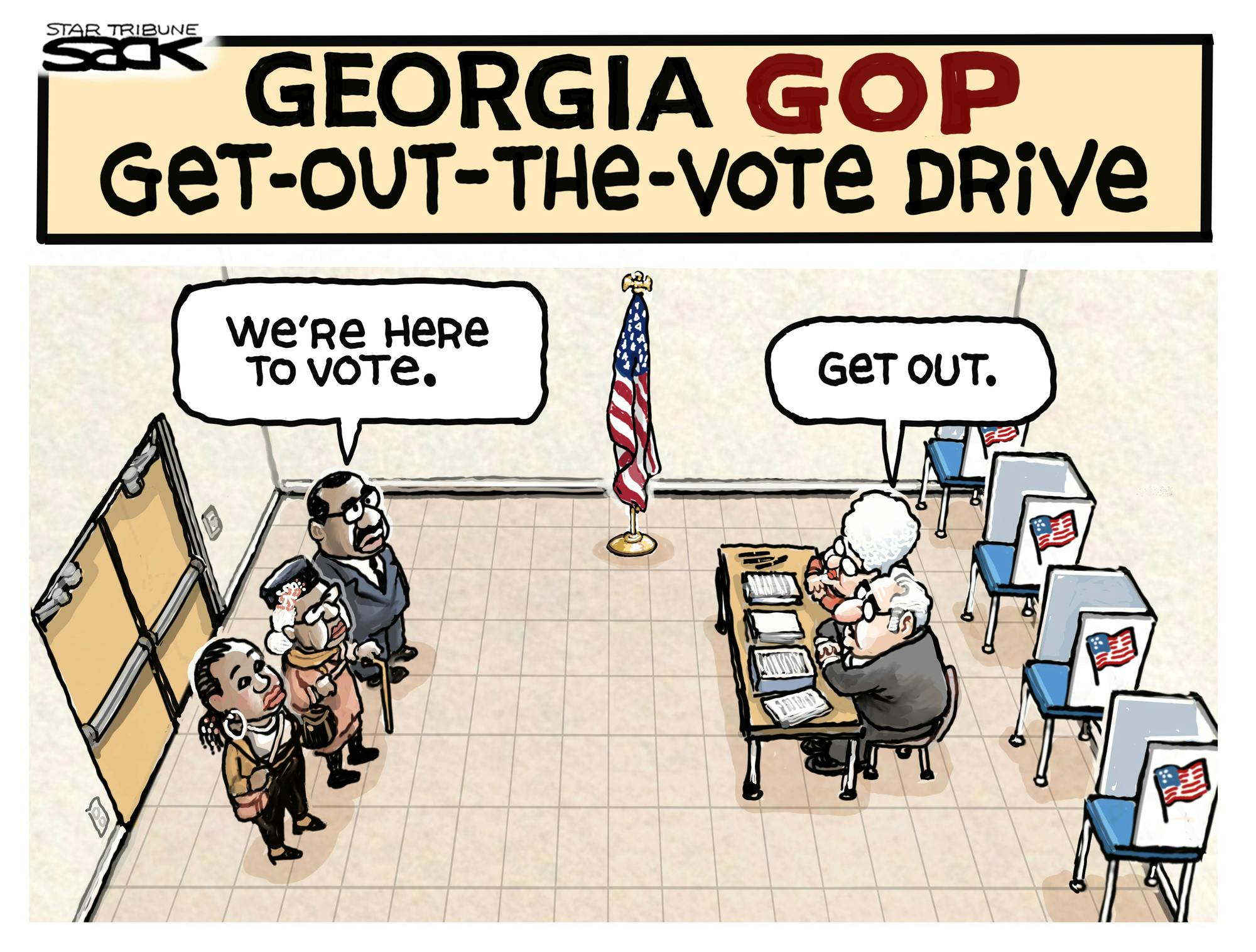




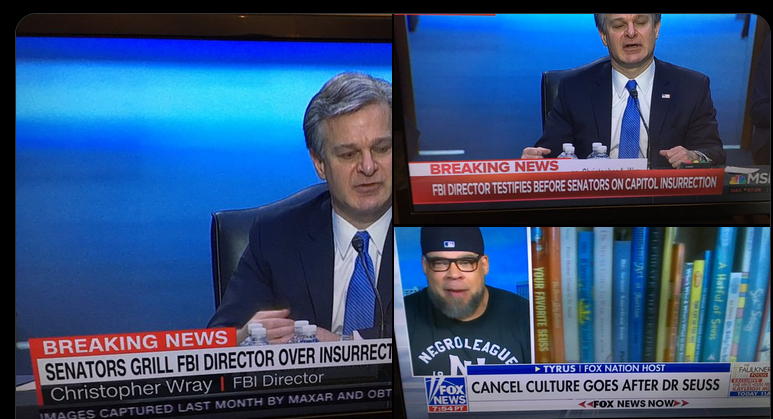




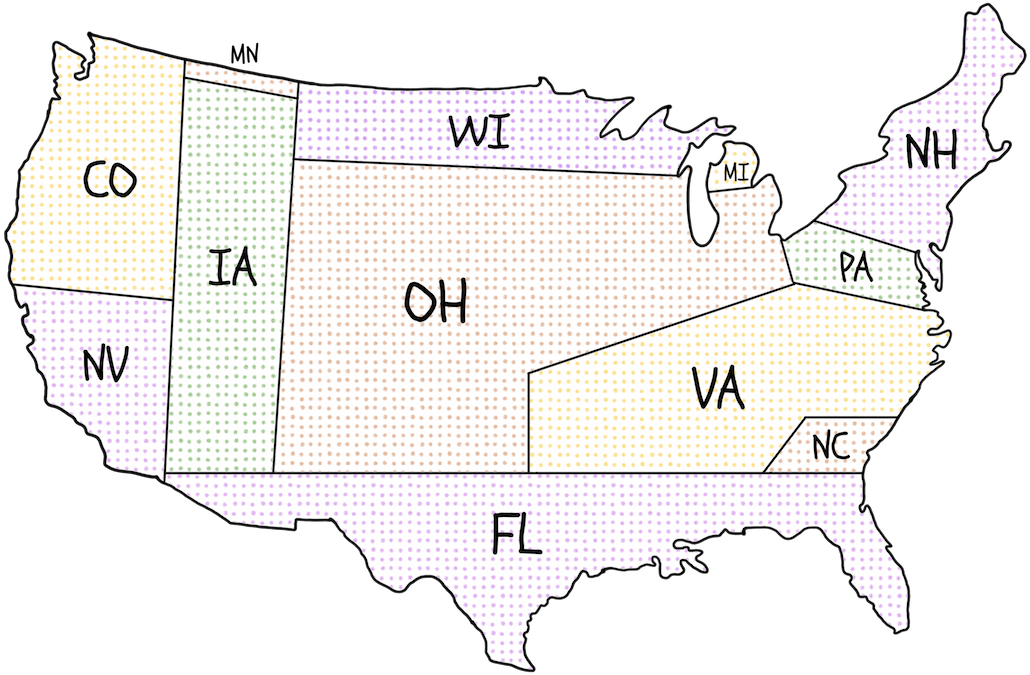

/cloudfront-us-east-1.images.arcpublishing.com/dmn/YTIAWSQ3DFCVFHZLYLRJMGQTDI.jpg)


 The Weekly Sift