Category Archives: Articles

Does anything matter?

https://www.washingtonpost.com/opinions/2022/10/04/necessary-roughness/

For the Republican base, individual candidates don’t matter. The only thing on the ballot is control of the Senate.


In living memory, all kinds of scandals could topple a candidacy, including some that today wouldn’t be scandals at all. Way back in 1972, Democratic presidential nominee George McGovern had to replace his running mate, Missouri Senator Tom Eagleton, when it came out that (years before) Eagleton had been hospitalized for depression. Newt Gingrich resigned as Speaker of the House for multiple hypocrisies: He profited from the same kind of shady book deal he had targeted previous Speaker Jim Wright for, and he was having an extramarital affair with a much younger woman at the same time he was impeaching Bill Clinton for doing precisely that. (None of that stopped him from being a serious presidential contender a few years later.)

Gingrich’s designated successor Bob Livingston soon resigned after his own affairs became public, giving way to Dennis Hastert, who (it later turned out) had sexually abused at least four male students when he was a high school teacher and wrestling coach.

Two New York governors have had to resign under fire: Andrew Cuomo for sexual harrassment, and Eliot Spitzer for patronizing prostitutes. Minnesota Senator Al Franken resigned after accusations of groping. Louisiana politician David Vitter survived his prostitution scandal for years, and was even reelected to the Senate, but it came back to bite him when he ran for governor. Idaho Senator Larry Craig was arrested for “lewd behavior” in a public restroom, and several gay men described encounters with Craig, but he backed away from his announced intention to resign from the Senate, and instead decided not to seek reelection. Mark Foley resigned from Congress after sexually suggestive texts and emails he sent to teen-aged male congressional pages became public.

But all that was in a different era. In 2016, Donald Trump toughed out the Access Hollywood scandal, along with numerous accusations from women who claimed that his “grab them by the pussy” quote was more than just the “locker room talk” he claimed it was. Later it was revealed that he paid two women (one a porn star) to keep quiet about sexual affairs while he was married to Melania. His political career not only survived, but he continues to be the hero of Evangelical Christians and other “family values” voters.

During the Clinton/Lewinsky scandal of 1998, Evangelical leader James Dobson wrote:

As it turns out, character DOES matter. You can’t run a family, let alone a country, without it. How foolish to believe that a person who lacks honesty and moral integrity is qualified to lead a nation and the world! Nevertheless, our people continue to say that the President is doing a good job even if they don’t respect him personally. Those two positions are fundamentally incompatible. In the Book of James the question is posed, “Can both fresh water and salt water flow from the same spring” (James 3:11 NIV). The answer is no.

But when Christianity Today supported Trump’s first impeachment, Dobson forgot James 3:11 and jumped to Trump’s defense with talk about policy, not character. (He also completely ignored the existence of Vice President Pence.)

The editors didn’t tell us who should take his place in the aftermath. Maybe the magazine would prefer a president who is passionately pro-abortion, anti-family, hostile to the military, dispassionate toward Israel, supports a socialist form of government, promotes confiscatory taxation, opposes school choice, favors men in women’s sports and boys in girl’s locker rooms, promotes the entire LGBTQ agenda, opposes parental rights, and distrusts evangelicals and anyone who is not politically correct.

Trump’s refusal to be shamed, and Evangelical leaders’ unwillingness to hold it against him, inaugurated the nothing-matters era, at least in the GOP. (Franken’s resignation was in 2018, and Cuomo’s in 2021. But they were Democrats.) As late as 2004, National Review’s Jonah Goldberg could title a Clinton-administration retrospective “Character Matters“, and conclude: “The man never had the character for the job.”

But character apparently doesn’t matter any more. All that matters is which side you’re on.

Herschel Walker. Walker’s candidacy to replace Raphael Warnock as one of Georgia’s senators looked sketchy from the beginning. As as Georgia’s Republican Lieutenant Governor Geoff Duncan put it

Herschel Walker won the primary because he scored a bunch of touchdowns back in the 80’s and he’s Donald Trump’s friend.

Walker repeatedly exaggerated (or just invented) his accomplishments. He not only didn’t graduate in the top 1% of his class at the University of Georgia, he didn’t graduate at all. He didn’t work in law enforcement. He falsely claimed to “own” or to have “started” several businesses. He has a record of domestic violence. It’s not even clear that he lives in Georgia. He published a book about struggles with mental illness that dwarf anything Tom Eagleton went through.

After the primary, it came out that he has three more out-of-wedlock children than the public knew about.

But never mind: The bad stuff, he claimed, was all in the past. He got help for his dissociative personality disorder and Jesus has forgiven him, so he’s a new man now. Nothing in his past should count except for the touchdowns and his friendship with Trump.

The abortion scandal. This week serious scandal blew up again: The Daily Beast reported that Walker paid for a girlfriend’s abortion, in contradiction to the no-exceptions anti-abortion position he takes in public. Subsequently, his son went off on him on social media, raising once again the issues of Walker’s violence, lying, and hypocrisy.

Walker claimed not to know who The Daily Beast might be talking to, but a follow-up report narrowed it down for him: She’s also the mother of one of the children Walker has acknowledged.

Saturday, the NYT reported that it had independently verified the Beast’s article.

A woman who has said Herschel Walker, the Republican Senate nominee in Georgia, paid for her abortion in 2009 told The New York Times that he urged her to terminate a second pregnancy two years later. They ended their relationship after she refused.

In a series of interviews, the woman said Mr. Walker had barely been involved in their now 10-year-old son’s life, offering little more than court-ordered child support and occasional gifts.

Both pregnancies took place after the 2008 book in which Walker claimed to have turned his life around.

When the first Daily Beast article came out, Walker said he would file a lawsuit “tomorrow morning”. But he hasn’t.

Parties, not individuals. One reason politicians used to respond to scandal by resigning or withdrawing was that other politicians treated them like lepers. The thing to do when someone had been tainted by scandal was to get far away from them, lest you be drawn into the scandal yourself. (As a song that turns 100 next year puts it: “Nobody knows you when you’re down and out.“) That fickleness was one reason why Harry Truman famously quipped “If you want a friend in Washington, get a dog.”

But something more than public morality and judgment has changed: All elections have been nationalized. The names on the ballot may be Walker and Warnock, but what Georgia voters are really deciding is whether Republicans or Democrats will control the Senate.

And that matters, in turn, because of the increasing partisanship within the Senate. Whether or not judges will be confirmed, for example, depends less on the character or qualifications of the nominees than on the party of the president who nominated them. Whether senators are trying to boost the economy or sabotage it depends on whether or not they belong to the president’s party. (If Republicans get control of either house this year, you can expect another debt ceiling crisis in 2023. And maybe this time they’ll force the US into default.)

The result is a more tribal party that sticks together in crisis, and circles the wagons around any embattled candidate, no matter how undeserving that individual may be. And while Republicans are much further down that road than Democrats, I feel the pull myself: What could I possibly find out about his opponent that would make me root for Walker to win?

https://www.facebook.com/photo?fbid=656001989204566&set=a.305833804221388

That’s the tacit message in all the “X is on the ballot” slogans. Democracy is on the ballot. Abortion is on the ballot. The planet is on the ballot. Compared to those stakes, what do Herschel Walker and Raphael Warnock — or any competing pair of candidates — matter? You may not know or care who the candidates are in your district, but you should vote anyway.

Conservative radio host and NRA spokesperson Dana Loesch, for example, tweeted

IF true, Walker paid for one broad’s abortion compared to Warnock who wants your tax dollars to pay for EVERY broad’s abortion-as-birth control with no limitations. This isn’t a difficult choice and conservatives shouldn’t look to the left to validate their vote.

(But wait: Warnock isn’t pushing any woman to get an abortion, as Walker did. He’s just supporting women who make that decision for themselves.)

Also Loesch:

I want to control the senate and you should, too. The end.

The individual hypocrisy — for his own convenience, Walker pushed his girlfriend to exercise options he wants to take away from all the women he didn’t impregnate — doesn’t even figure. Nor does the “personhood” of a fetus matter. Republicans claim to believe fetuses are babies and that abortion is murdering a child. So if Walker had paid someone to murder one of his four breathing-and-walking-around children, would that not count either? Would conservative talking heads say “That’s just one murder. How many more murders will there be if Democrats control the Senate?”

So does anything matter? Watching Republicans circle their wagons around Walker, it’s tempting to conclude that all this, bad as it obviously is, will make no difference.

But if you think that, you’re looking in the wrong direction. OK, hardcore MAGA types are not going to change their minds. They have convinced themselves that Democrats are going to destroy America, so if the only way to prevent that is to elect grifters, hypocrites, or even outright criminals to high office, so be it.

But if the hardcore supporters of either party were the only people who voted, nobody would bother to campaign. And while it seems to be true that the number of persuadable swing voters is shrinking, there’s still a considerable pool of folks who (whatever they think) may or may not vote.

WaPo quotes conservative radio host Erick Erickson:

Every dribble of new stuff between now and the election I think increases the pool who say, ‘Screw this, let’s vote for Brian Kemp and let’s not do the other race at all.’ Those people exist in Georgia.

Those are the people who might be swayed. It’s not that some ultra-conservative Georgian is going to get pissed enough at Walker to vote for Warnock. But a sizeable number of the voters any Georgia Republican needs are racists who didn’t really want to vote for a Black guy anyway, even if he did win the Heisman. A lot are people who lean Republican, but sometimes don’t vote because they think politicians are all crooks. If they get disgusted enough with Walker, they might just forget to show up at the polls, decide at the last minute to skip the Walker/Warnock line on the ballot, or maybe write in the name of some YouTube influencer they really agree with.

Conversely, watching Christian Walker rail against his Dad on social media might convince a few young men to get off their butts and register to vote. Seeing yet another example of the hypocrisy of the religious Right might give some marginal female voters a push to go protect their bodily autonomy.

If you want to know what difference this scandal will make, you have to look there, not at the Dana Loeschs.

One final note on Christianity. Walker is responding to the scandal obliquely, with an ad his campaign calls “Grace“.

Raphael Warnock’s running a nasty, dishonest campaign. Perfect for Washington. The Reverend doesn’t even tell my full story. My true story. As everyone knows, I had a real battle with mental health. I even wrote a book about it. And by the grace of God, I’ve overcome it. Warnock’s a preacher, who doesn’t tell the truth. He doesn’t even believe in redemption. I’m Herschel Walker, saved by grace, and I approve this message.

This ad is an opportunistic mishmash of themes. On the one hand it hints at a denial: Warnock’s campaign is “dishonest”, so whatever they’re accusing me of, I didn’t do it. On the other hand, maybe I did do it, but God has forgiven me. So anyone who brings up the bad things I did or tries to hold me responsible for them “doesn’t believe in redemption”.

If there still are any Trump-era conservatives who have anything more than an opportunistic relationship with Christianity, I have a theological question: In what theory of grace does God forgive you for stuff that you still deny you did? What kind of repentance allows you to keep saying that your accusers are liars?

All the theologians I know refer to this kind of grace disdainfully as “cheap grace”, which Dietrich Bonhoeffer defined as “forgiveness without repentance”. Your sin goes away because taking responsibility for it is inconvenient. Or, as the mother of the child Walker wanted aborted put it: “He picks and chooses where it’s convenient for him to use that religious crutch.”

Amanda Marcotte points out the long-term cost Christianity is paying and will continue to pay for this kind of hypocrisy: The adults may not believe what they’re saying, but the kids do — until they realize it’s all a con.

The kids are watching. Young people raised in churches often DO believe the lies about chastity and “pro-life.” This hypocrisy exposes them to the truth before they’re too deep to extract themselves. And they turn their backs on their parents. I have met SO MANY people who became liberals because of the hypocrisy of the conservative environments they grew up in. It’s a major reason every generation is more liberal than the last. So this shit matters.

When Christians lament about the decline of their religion and the growing number of Americans with no religious affiliation, they shouldn’t vaguely blame “the culture” or “Hollywood liberals”, because they’re doing it to themselves. Christianity is losing its children because the kids see their elders saying one thing and doing something else.

The Court’s problems run deeper than Roe

https://www.inquirer.com/opinion/cartoons/supreme-court-packing-amy-coney-barrett-confirmation-hearing-20201022.html

On September 10, the New York Post ran the headline “Chief Justice John Roberts defends Supreme Court legitimacy“. His speech the previous evening at a conference of judges in Colorado inspired discussions on several news networks around the question: Is the current Supreme Court legitimate?

I was reminded of this passage from the 1948 political novel All the King’s Men.

It was one of those embarrassing questions like “Do you think my wife is virtuous?” or “Did you know I am a Jew?” which are embarrassing, not because of anything you might say for an answer, the truth or a lie, but because the fellow asked the question at all.

The problem isn’t so much how anyone might answer the question of the Court’s legitimacy, but that we have to answer it at all. It didn’t used to be up for debate; but now it is. The Court has done that to itself.

Polls show the Court’s approval rating at record lows. Court-packing — expanding the Court [1] so that new justices can be appointed — had been off the table politically since FDR tried it in the 1930s. But in a Marquette Law School poll taken earlier this month, 18% strongly favored increasing the number of justices, and 33% somewhat favored it, adding up to a slim majority. With some demographic groups, court-packing was fairly popular:

Expanding the court was favored by larger majorities of a number of groups: 63% of Black respondents, 61% of Hispanic respondents, 60+% of those ages 18-44, 60% of women and 56% of those making less than $30,000 per year.

These kinds of numbers matter, not because Congress is likely to take up a court-packing proposal, much less pass one, but because the whole idea constitutes a blasphemy against the mythology of the Court. The Supreme Court is supposed to be a kind of priesthood, whose lifetime appointments remove them from the hurly-burly of worldly concerns. In his confirmation hearing in 2005, Roberts waxed idealistic:

Mr. Chairman, I come before the committee with no agenda.

I have no platform.

Judges are not politicians who can promise to do certain things in exchange for votes.

I have no agenda, but I do have a commitment. If I am confirmed, I will confront every case with an open mind. I will fully and fairly analyze the legal arguments that are presented. I will be open to the considered views of my colleagues on the bench. And I will decide every case based on the record, according to the rule of law, without fear or favor, to the best of my ability. And I will remember that it’s my job to call balls and strikes and not to pitch or bat.

So what’s Roberts’ defense of the Court now?

Simply because people disagree with opinions, is not a basis for questioning the legitimacy of the court

But the problem isn’t just that the Court’s reversal of Roe — or its rulings on guns or voting rights or campaign finance or the separation of church and state — aren’t popular. The Court’s legitimacy problem runs much deeper.

The law changed not because anything changed in the world, but because new justices joined the Court.

It’s not unheard of for the Supreme Court to reverse a precedent that has stood for many years. Plessy v Ferguson, for example, established the separate-but-equal principle in 1896, and was reversed by Brown v Board of Education in 1954. But the contrast between the Brown and Dobbs reversals is striking.

The Brown reversal was unanimous, not a 5-4 decision where the three most recently appointed justices made the difference. The arguments in Brown represented a change in tactics from those in Plessy. And the world had changed around Plessy: The Brown decision cited recent psychological research on the effects of segregation on Black children; the federal government submitted a brief about how racial discrimination was hurting the United States in the Cold War competition in Africa and Asia; Black soldiers had fought for the US in two world wars; and the supposed inferiority of Black people had been challenged in sports by athletes like Jesse Owens, Joe Louis, and Jackie Robinson.

But what created the Dobbs decision was the appointment of new justices. Donald Trump had run on the promise that his judicial nominations would be “all picked by the Federalist Society“, which opposed abortion rights. He fulfilled that promise: He made three appointments, all of whom voted to overturn Roe.

Squaring that record with Roberts’ confirmation-hearing idealism requires a lot of unconvincing verbal gymnastics: True, Gorsuch, Kavanaugh, and Barrett didn’t get votes in the Senate by promising to overturn Roe. (Quite the opposite, they secured the final votes they needed by promising to respect precedent, which they did not do.) The political process was more roundabout: Trump promised to let the Federalist Society pick his judges, and Gorsuch, Kavanaugh, and Barrett sent the Federalist Society sufficient signals to convince them that they would overturn Roe.

So yes, they are politicians who got their positions by (indirectly) promising to do certain things. They were put on the Court to pitch and bat, not to call balls and strikes. That fact was widely known, and anti-abortion legislatures intentionally teed up laws that would allow the new justices to overturn Roe.

The Court’s conservative majority is due to political shenanigans in the Senate.

When Justice Scalia died, President Obama nominated Merrick Garland to replace him. Garland had a spotless record that left Republican senators no excuse to vote against him. So instead Majority Leader Mitch McConnell just refused to recognize that Garland had been nominated at all, ignoring the Constitutional directive to advise and consent on nominations, giving the excuse that the Garland nomination was too close to the 2016 election. That argument went out the window, though, when Ruth Bader Ginsburg died, and Barrett’s nomination was raced through the Senate so that she could be seated in time for any 2020 election controversies.

The exchange below is instructive: Al Franken says the Garland/Barrett hypocrisy “destroyed the legitimacy of the Court”. Republican Alice Stewart argues that the Garland maneuver is what happens “historically” when the Senate is controlled by a different party than the White House. And Franken refuses to let that lie pass: “When has it ever happened before?” he demands, and won’t stop asking the question, because Stewart can’t answer. It had never happened before.

The Court’s conservative majority is the result of minority rule.

The Founders strongly believed in the sovereignty of the People, but they left two major loopholes in the Constitution that have opened the door to minority rule: the Electoral College and the Senate. The Court’s current majority could not exist without both of them.

Trump’s three justices would never have been appointed if the Electoral College in 2016 had not reversed the decision of the voters: Hillary Clinton beat Trump nationally by nearly three million votes. [2] Worse, Mitch McConnell’s Senate majority did not represent a majority of the American people.

For the last thirty years, Republican Senate majorities have relied not on the support of a majority of American voters, but on using small-state victories to overcome large-state defeats. Since 1990, there has been only one six-year election cycle (i.e., the period during which all Senate seats come up for election) when Republican Senate candidates got more votes than their Democratic opponents. It hasn’t happened since the 1994/1996/1998 cycle. [3]

In other words, if the Senate represented the American people, Mitch McConnell would never have been majority leader.

Under a majority-rule constitution, a Democratic-majority Senate would have seated Merrick Garland, Hillary Clinton would have nominated Ruth Bader Ginsburg’s replacement to a Democratic-majority Senate, and Justice Kennedy would be hoping to live long enough to see a Republican president. Liberals would have a 5-4 majority, counting the sometimes-liberal Kennedy as part of the conservative 4.

http://thecomicnews.com/edtoons/2019/0703/gerry/01.php

The Court actively participates in a minority-rule vicious cycle.

It would be one thing if happenstance (such as who dies when) had created the conservative Court majority, and that Court went on to make impartial principled rulings about elections.

But conservative justices on the Court have been actively promoting the minority rule that installed them. Justice Roberts, for example, wrote the 5-4 opinion that gutted the Voting Rights Act, and has continued to chip away at what remains of it. [4]

That opinion has allowed Republicans to pass voter suppression laws in swing states like Georgia and Wisconsin, which might well decide which party controls the Senate next year. Roberts’ ruling could make the difference that puts Mitch McConnell back into a position where he could block a Biden nominee if some member of the Court’s conservative majority should happen to die or retire unexpectedly.

It’s a vicious cycle: A Court approved by minority rule extends minority rule.

The Roberts Court has put its thumb on the electoral scales in a variety of other ways, consistently favoring Republicans. It has refused to ban gerrymandering, arguing the absurd point that the voters should take action against the very gerrymandering that makes their votes irrelevant. It has opened the spigots of corporate campaign donations and dark money, which overwhelmingly flows to conservative candidates.

Again, we can see the results: Democrats currently lead in the generic congressional ballot polls by an average of 1.3%. And yet Republicans are favored to control the House. Why? Because Democrats have to win by 3-5% to gain a majority of seats.

Compare two recent “wave” elections. In 2018, 53.4% of voters supported Democratic House candidates, compared to 44.8% who supported Republicans. Those votes gave Democrats a 235-199 majority.

In 2010, 51.7% voted for Republican House candidates compared to 44.9% for Democrats. The resulting Republican majority? 242-193.

Fewer Republican votes yield more Republican seats. That’s a problem for people who believe in democracy, but not for the Roberts Court. The more Republican seats, the better.

It could soon get worse. The Court has decided to hear Moore v Harper, a case which raises the once-absurd “independent state legislature” doctrine. Under this theory, rules for federal elections are set by state legislatures, and no one can overrule them: governors can’t veto and state supreme courts can’t find that they violated the state constitution.

When you consider that some state legislatures are so gerrymandered that they aren’t really democratic institutions any more [5], giving them total control of federal elections is a recipe for permanent minority rule.

The Court has an ethics problem.

The only ethics code that applies to the justices is the vague “good behavior” standard in the Constitution. Each justice makes his own decisions about conflicts of interest and whether to recuse from a case. The current justices are abusing that lack of standards.

The most egregious recent case is Clarence Thomas, who rules on cases where his wife has an interest.

But also, a federal panel in 2018 dismissed 83 ethics complaints against Brett Kavanaugh, not because they weren’t serious, but because “there is no existing authority that allows lower court judges to investigate or discipline Supreme Court justices.” And we have since discovered that the FBI investigation into Christine Blasey Ford’s sexual assault accusation against Kavanaugh was rigged to find nothing.

Unpopularity is just the beginning.

Any judge has to be ready to bear the heat of making an unpopular decision, if that’s what the rule of law requires. But when changes on the Court immediately lead to changes in the meaning of the laws, the public is right to be suspicious.

And when those changes on the law are based on a minority’s ability to change the Court without ever changing the minds of the electorate, that’s a problem. Vox’ Ian Millhiser sums that problem up:

The Dobbs decision is the culmination of a decades-long effort by Republicans to capture the Supreme Court and use it, not just to undercut abortion rights but also to implement an unpopular agenda they cannot implement through the democratic process.

Worse, the Court is abusing its power to change the democratic process itself, and so is rewarding the party that installed it.

That — and not a few unpopular decisions — is the source of the Court’s legitimacy problem.


[1] Many people think the number of justices is set in the Constitution, but it isn’t. Article III says simply:

The judicial Power of the United States, shall be vested in one supreme Court, and in such inferior Courts as the Congress may from time to time ordain and establish.

leaving the details of the Court totally up to Congress. The actual number of justices has changed many times. The original court had six justices. The nine-justice court was established in 1869, and has stayed at nine ever since.

The objection to court-packing is obvious: It sets up the possibility of a tit-for-tat cycle, where new justices are approved whenever a new party takes power. But accepting that argument leaves a question unanswered: The Court has already been packed. What should be done about that?

[2] Some people add Justice Alito to this total, because he was appointed by George W. Bush, who lost the popular vote to Al Gore in 2000. However, Bush nominated Alito during his second term, after winning the popular vote in 2004. You can argue that if Gore had been elected in 2000, Bush couldn’t have been re-elected in 2004. But that argument takes us a little too far down the alternate-history rabbit hole. Gore might have lost his re-election bid in 2004, and the Republican who beat him might have appointed someone like Alito.

[3] The Senate that confirmed Amy Coney Barrett in 2020 is a good example. During the 2014/2016/2018 election cycle (when the senators serving in 2020 were elected), Democratic Senate candidates got 50.3% of the votes compared to the Republicans’ 43.3%. But that minority of votes netted the Republicans a 53-47 majority.

[4] It’s impossible to read Roberts’ 2013 Voting Rights Act decision as a legal argument; it’s a political argument, pure and simple. Here’s my summary at the time:

The VRA was vaguely justified in 1965 and is vaguely unjustified now, because “things have changed”. If I were a congressman, I would have no idea how to revise the VRA so that it passes constitutional muster. If Congress does revise it, lower court judges who rule on it will just be guessing about its constitutionality. It will have to go back to the Supreme Court before anyone knows whether it’s really a law again, because there are no standards in Roberts’ opinion by which a revision can be judged.

[5] According to a report by the Schwartzenegger Institute:

59 million Americans live under minority rule in their U.S. state legislatures following the 2018 elections. Minority rule is defined as the party with the minority of votes in the most recent election nevertheless controlling the majority of seats in the state legislature subsequent to that election. Six U.S. state legislatures were drawn by legislatures or partisan-leaning committees that resulted in minority rule following the 2018 elections. These states are Michigan, North Carolina, Ohio, Pennsylvania, Virginia, and Wisconsin

Note that all six of those states were Republican legislatures ruling over a Democratic electorate.

How the Trump Grift Works

https://theweek.com/political-satire/1015579/trump-persecuted

Trump’s lawsuit against Hillary’s vast conspiracy was dismissed, and the Durham investigation is winding down without proving much of anything. But in their day, these two Trump-will-be-vindicated hoaxes kept the money flowing in.


When I was growing up fundamentalist, Jesus’ second coming was always imminent. Any day now, the Heavens would open and there He would be, declaring an end to secular history and beginning a period of judgment that would separate the believers from the unbelievers. On that day, the doubters would be proven wrong and there would be “wailing and gnashing of teeth”. The righteous, on the other hand, would “shine forth as the sun in the kingdom of their Father”.

And in the meantime, you should keep sending in your money.

You can’t fully understand Trumpism without holding that picture in mind. Whatever evidence of Trump’s criminality the “fake news media” might present, and whatever testimony the 1-6 committee gets from Trump’s own people, the real Truth is going to be revealed any day now. His persecutors will be routed, and their sinister plots will be revealed.

In the meantime, keep sending Trump your money.

Like Jesus’ second coming, Trump’s final vindication can be predicted again and again — and those predictions can fail again and again — without undermining the basic narrative that it’s coming any day now. [1] Just scrap the old details for new ones and you’re good to go. Did Trump leave the presidency without invoking Q-Anon’s “storm”? Did none of his 82 post-election lawsuits prove fraud, even when he got them heard by judges he appointed? No problem: Those fantasies kept the money rolling in until new fantasies could be ginned up.

Recently, two other major Trump-vindication vehicles have gone bust: the Hillary conspiracy lawsuit and the Durham investigation. Each was a big deal in its day, but, you know, life moves on. The suit got dismissed and the investigation is closing up shop without finding any of the crimes Trump promised.

But never mind, they kept the money flowing.

The great Clinton conspiracy. It sounds weird to say this, but one of the most amusing things I read these last two weeks was Judge Donald Middlebrooks’ dismissal of Trump’s sprawling lawsuit against Hillary Clinton, Jim Comey, and everybody else the Former Guy has ever blamed for investigating his collusion with Russia.

Middlebrooks’ opinion reads like a professor grading the work of a particularly disappointing first-year law student. The judge keeps backing up to explain fundamental things the student (i.e., Trump’s lawyers) should have read in the textbook (i.e., landmark precedents).

A complaint filed in federal court must contain “a short and plain statement of the claim showing that the pleader is entitled to relief.” Each allegation must be simple, concise, and direct. Each claim must be stated in numbered paragraphs, and each numbered paragraph limited as far as practicable to a single set of circumstances.

Plaintiff’s Amended Complaint is 193 pages in length, with 819 numbered paragraphs. It contains 14 counts, names 31 defendants, 10 “John Does” described as fictitious and unknown persons, and 10 “ABC Corporations” identified as fictitious and unknown entities. Plaintiff’s Amended Complaint is neither short nor plain, and it certainly does not establish that Plaintiff is entitled to any relief.

More troubling, the claims presented in the Amended Complaint are not warranted under existing law. …

At this stage, a court must construe the complaint in the light most favorable to the plaintiff and accept as true all the plaintiff’s factual allegations. However, pleadings that “are no more than conclusions, are not entitled to the assumption of truth. While legal conclusions can provide the framework of a complaint, they must be supported by factual allegations.” A pleading that offers “labels and conclusions, and a formulaic recitation of the elements of a cause of action will not do.”

The rest of the ruling is a series of that’s-not-what-the-law-says, the-reference-in-your-footnote-doesn’t-support-the-point-you’re-making, and so on, culminating in the judge’s refusal to let Trump’s lawyers amend their complaint a second time:

It’s not that I find the Amended Complaint “inadequate in any respect”; it is inadequate in nearly every respect. … At its core, the problem with Plaintiff’s Amended Complaint is that Plaintiff is not attempting to seek redress for any legal harm; instead, he is seeking to flaunt a 200-page political manifesto outlining his grievances against those who have opposed him, and this Court is not the appropriate forum.

I’m reminded of the scene in The Paper Chase where Professor Kingsfield says to a student, “Here is a dime. Call your mother and tell her there is serious doubt about you becoming a lawyer.”

The inescapable conclusion of Judge Middlebrooks’ critique is that no competent lawyer ever intended this complaint to be the basis for a serious lawsuit. Rather, the only credible purposes would have been to get headlines for filing the suit, and to fund-raise off of those headlines.

In short, the anti-Hillary suit was part of the continuing grift against Trump’s own followers: Neither Hillary nor any of the other defendants was ever going to pay Trump damages, but the prospect of the vast Trump-persecuting conspiracy finally being exposed would induce the MAGA cultists to keep their wallets open.

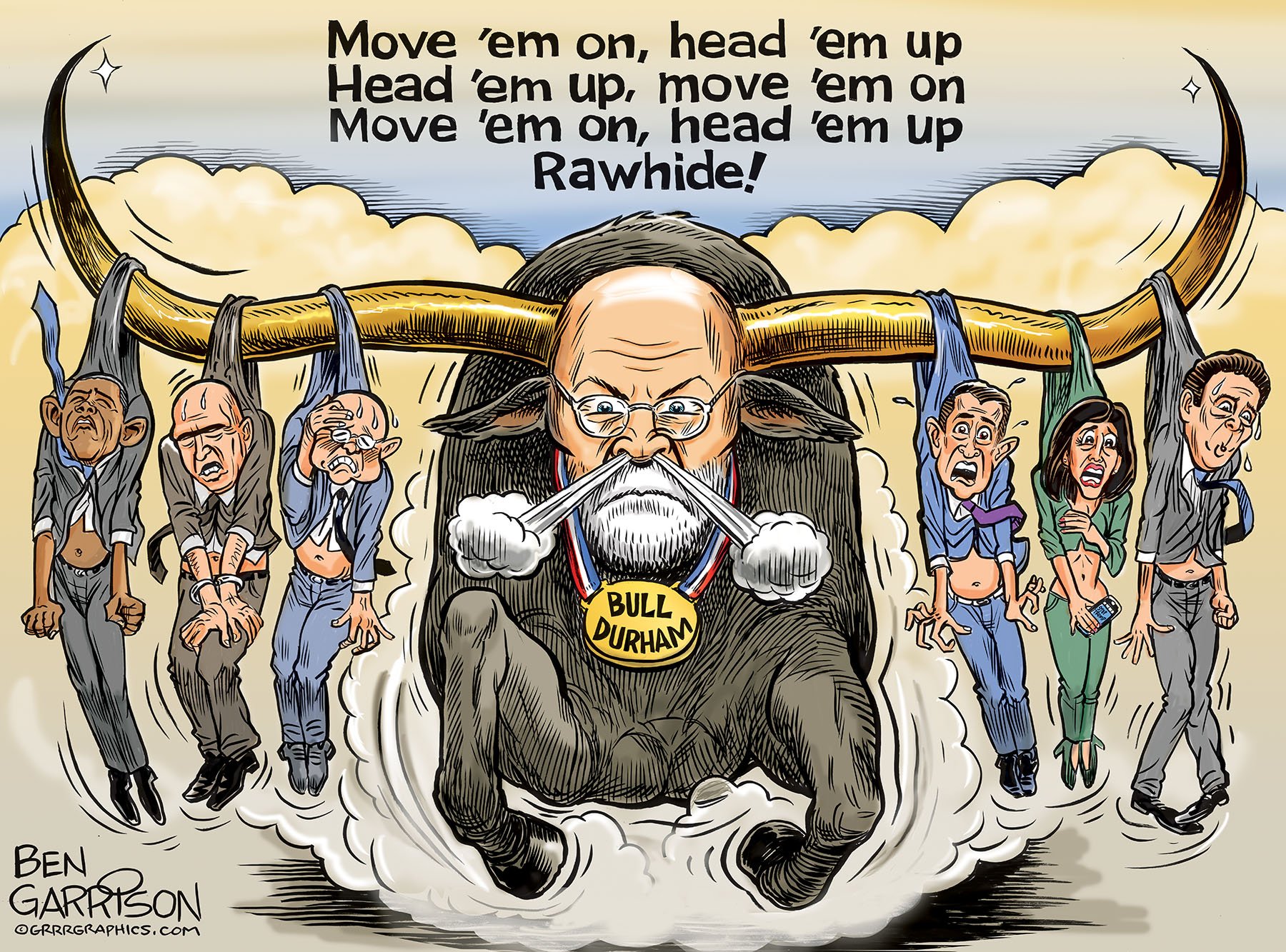
What Trump wanted out of the Durham investigation. That’s Obama on the far left. https://www.conservativedailynews.com/2019/10/bull-durham-grrr-graphics-ben-garrison-cartoon/

Durham. When Trump accuses his opponents of doing something, it’s only a matter of time before he does the same thing himself (if he hasn’t already). In his mind, the Mueller investigation was an expensive taxpayer-sponsored witch hunt against him. So of course he had to have his own expensive taxpayer-sponsored witch hunt.

When Bill Barr announced this investigation in 2019, conservatives were expecting the grand finale to the Mueller story, the counter-attack that would uncover all the illegal machinations the FBI and others had done to try to nail Trump. As recently as February, Trump was still promising that Durham was finding evidence of “the crime of the century” and “treason at the highest level”. He was “coming up with things far bigger than anybody thought possible”.

Durham may go down as a great hero in this country that will be talked about for years.

But that was all part of the grift. Trump was reacting with such glee to a court filing related to Durham’s indictment of Michael Sussman, a minor figure accused of a minor crime that Durham could not prove. (The jury acquitted Sussman after only six hours of deliberation.) No “crime of the century” involving high-profile conspirators like President Obama or Hillary Clinton.

Now the Durham investigation appears to be shutting down, having lasted longer and cost more than the Mueller probe it was supposed to be investigating. It also has accomplished far less: Mueller proved that Russia did help the 2016 Trump campaign, and that it committed crimes to do so. Mueller didn’t come up with enough evidence to indict the Trump campaign itself in the conspiracy, though he did trace a suspiciously large number of links between Trump’s people and Putin’s. The investigation dead-ended at Paul Manafort and Roger Stone, both of whom were convicted of felonies, but got pardons from Trump, presumably as a reward for their silence.

Durham has one case left: against Igor Danchenko, who is accused of lying to the FBI about the information in the Steele dossier, which Trump wants to claim was the sole source of the Trump/Russia investigation. (It wasn’t. It wasn’t even the primary source.) Again, somebody may have lied about something that, in the end, didn’t really matter. Or maybe not: Durham’s standards appear to be far lower than Mueller’s, so his Danchenko case may be no more convincing than the one against Sussman.

But while Durham’s long-running investigation may look like a flop from a legal point of view, Atlantic’s David Graham explains that it did what it was supposed to do:

Even if Durham approached the probe with earnest sincerity, the real reason he was appointed is that Donald Trump’s political con requires the promise of total vindication right around the corner. For a time, Durham provided that hope for Trump backers. But now, as Trump moves on to other ploys, the Durham probe has served its purpose, even though it has produced no major convictions or epiphanies.

The grift goes on. So now is Trump’s Save America PAC going to apologize for raising money under false pretenses and send it all back? Don’t be silly. The Great Orange Conman has indeed “moved on to other ploys”. Now that investigations on numerous fronts threaten to expose his crimes, he needs your money more than ever.

Don’t ask what he did with the quarter-billion-plus he’s already collected, or why such a fabulously wealthy man needs your money at all. [2] The Forces of Evil are still at work, conspiring to find the top-secret documents Trump stole, expose his fraudulent business practices, and piece together his conspiracy to steal the presidency. So it’s time for all red-blooded Americans to step up, forget all the times Trump has lied in the past about conspiracies against him, and send in their money. (Also, stand by to riot again if he’s indicted.)

Objectively, things may keep looking worse and worse for Trump, but that’s how this story is supposed to go: the worse, the better. Signs of the End Times just lead to the Great Judgment.

Any minute now, the trumpet will blow, and the sky will be full of angels.


[1] I am reminded of one of the great opening paragraphs of any autobiography ever. In Knee Deep in Paradise, TV actress Brett Butler wrote:

I spent the first twenty years of my life waiting for two men I was reasonably certain would never come back – my daddy and Jesus Christ. I don’t wait for them anymore. My dad, anyway. And at least with Jesus I didn’t spend all that time thinking he was gone because of something I did.

[2] Again, there’s a religious parallel. As Captain Kirk once asked: “What does God need with a starship?

The Battle for Voters’ Imaginations

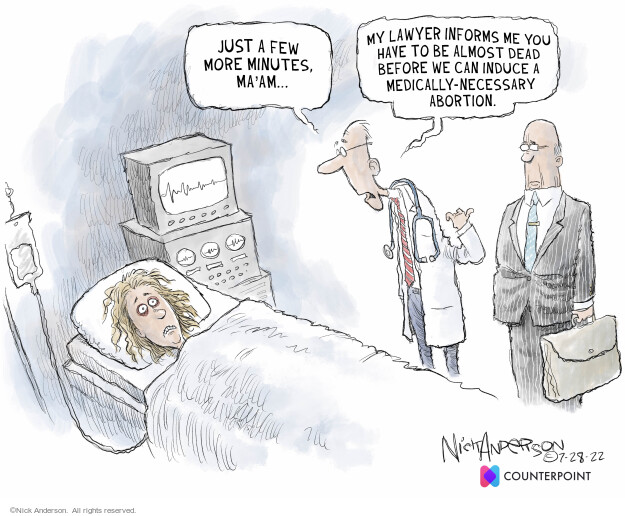
https://www.theeditorialcartoons.com/editorial-cartoon/Nick+Anderson%27s+Editorial+Cartoons/2022-07-28/195313

Post-Dobbs, voters are imagining very different abortion scenarios than the ones the pro-life movement has been pushing for years. That’s an advantage Democrats need to hold onto as the fall elections get closer.


After Sarah Palin lost Alaska’s only House seat, Democrat Pat Ryan won a special election in a purple district, and Kansas voters resounding rejected giving their legislature the power to ban abortion, Republicans are beginning to catch on that November might not be quite the cakewalk they had expected, and the Dobbs decision overturning Roe v Wade is a big reason.

In Michigan, Republicans on the Board of Canvassers are using technicalities to block a referendum that would write the Roe protections into the state constitution. It’s not hard to see why: Not only would that referendum pass, but it would raise Democratic turnout for the state’s other races. Better for Republicans that voters not be offered the choice.

That’s not how the conventional wisdom used to work: Culture-war issues used to be seen as a way to boost Republican turnout. Democrats used to be confident the Supreme Court would protect their reproductive freedom and other personal rights, but now they have to protect their own rights by voting.

Dahlia Lithwick explains:

Efforts of those who have taken the position that forced birth is somehow pleasant and rewarding, even for America’s 10-year-old rape victims, have backfired spectacularly, as have their claims that abortion rights advocates are lying about new dangers that abortion bans pose to patients with high-risk pregnancies or who are experiencing a miscarriage.

For the last six weeks, Republicans have touted their vision of a post-Roe America. It is a place in which rapists get to choose the mother of their children, even if she is 10 years old; in which patients must be dying of sepsis before they can terminate a failing pregnancy; in which doctors who follow their duty of care to perform a life-saving abortion must persuade prosecutors of their proper judgment at risk of incarceration; and in which pharmacists refuse to provide women with autoimmune treatment because they suspect it could be used for an illicit abortion. This reality unfolded in under a month, because it’s the fondest dream of a small minority of uncompromising extremists.

In under a month, even Americans who call themselves abortion opponents have come to see that when abortion is criminal, every uterus is a potential crime scene.

Those situations aren’t the ones anti-abortion activists want voters to imagine. They’d rather voters thought about foolishly promiscuous women who selfishly want to escape the consequences of their actions, not women who are being re-victimized by the law after men and circumstances have already victimized them once.

All over the country, Republican candidates are being caught between their extreme anti-abortion base, whose support has been necessary to get through Republican primaries, and the majority of general-election voters, whose views are far more moderate and nuanced.

The fall pivot. But could they turn this situation around, and make Democrats own the “extreme” views on their side? Marjorie Dannenfelser of Susan B. Anthony Pro-Life America thinks so:

[Pat] Ryan avoided specifics, couching his position in well-worn, vague terms such as “freedom to choose” and “controlling women’s bodies.” A sharp offense could have punctured this obvious vulnerability, challenging the Democrat to explain exactly what policies he wants and whether there is a single limit on abortion he would support: when the child’s heartbeat can be detected? If not then, what about a first-trimester limit, which two-thirds of Americans support? Or 15 weeks, when some new evidence indicates unborn children can feel pain — a limit 72 percent of Americans support and that sits within the European mainstream? Or like Biden and almost every congressional Democrat, does he advocate legislation that allows abortion throughout all nine months of pregnancy as long as a doctor will say it’s for the woman’s health? Only 10 percent of Americans believe abortion should be legal that late, and this broad loophole means the bill is far more radical than Democrats would have you believe.

The advantage of fantasy. What Dannenfelser is trying to regain might be called the advantage of fantasy. Whoever gets to construct the hypothetical case under discussion can imagine a favorable one, even if that situation is rare or even non-existent. Should a raped 10-year-old be forced to carry the baby to term? Should a pregnant woman with breast cancer be forced to wait months to begin treatments that would harm her fetus? An overwhelming majority of people would approve an abortion in those cases, and reject a law (or a legislator) who wouldn’t allow one.

But what if a perfectly healthy woman with a perfectly healthy 8-month fetus decides on a whim that she no longer wants to be a mother? In a matter of weeks, her pregnancy could come to a successful conclusion, an infertile couple could have a beautiful baby to raise, and the woman could get on with her life. But she chooses an abortion instead. Do you approve of that choice? Should the law allow it?

Are there such cases? It’s not clear. But if a voter can imagine it, the reality may not matter.

How to respond. If the discussion goes there, a poorly prepared Democrat could be in trouble. On the one hand, the fantasy is ugly, and a pro-reproductive-rights candidate could lose support by owning that ugliness. On the other, nuanced line-drawing is tedious and uninspiring. Why here and not there? [1] And if you draw the line based on polls, as Dannenfelser seems to suggest, your position looks calculated rather than principled. [2]

But what should a well-prepared Democrat say?

First, I think you have to acknowledge the ugliness of the fantasy and disapprove of it, as the vast majority of voters do. If that perfectly healthy pregnant woman came to me asking for my approval of her whimsical decision, I couldn’t give it. [3] My sympathies would be more with the childless couple and the possibilities the healthy 8-month fetus represents.

Very quickly, though, you have to draw the line between your personal approval and the law. The law is not a tool for making every situation come out the way you want. If a friend came to me with his plan to cheat on his wife, I would disapprove and urge him to reconsider. But that doesn’t mean I would support a law against adultery.

Third, point out that the law is a blunt instrument. You can’t just pass a law against this case. A law would necessarily identify a larger set of cases, and would impose a rule on them. In each individual case, the government’s decision would overrule the judgment of the people involved: the woman, her doctor, her family, and all the other friends and moral advisors whose opinions she might seek.

The introduction of a broader class allows you to bring reality back into the discussion, and to take back the advantage of fantasy: If we include this woman in a class, and for the entire class substitute the government’s blanket decision for the judgment of the people who are actually present, what new ugly situations have we created? More than we resolved, maybe?

And if we’re going to substitute our own judgment for theirs, don’t we have to be sure we’re right in the overwhelming majority of cases? Just more-often-that-not shouldn’t be good enough, if we’re usurping people’s most important personal decisions.

A Democratic training video. If you look up “well-prepared Democrat” in a dictionary, chances are you will see a picture of Pete Buttigieg. In a townhall discussion during his presidential campaign, Fox News moderator Chris Wallace tried Dannenfelser’s gambit of trying to make Buttigieg draw a line.

Do you believe, at any point in pregnancy … that there should be any limit on a woman’s right to have an abortion?

But Pete refused to take the bait.

I think the dialogue has gotten so caught up on where you draw the line, that we’ve gotten away from the fundamental question of, who gets to draw the line? I trust women to draw the line when it’s their own health.

Wallace tried again, framing the issue as personal approval of a hypothetical situation:

Just to be clear, you’re saying you’d be okay with a woman well into the third trimester deciding to abort her pregnancy?

And Pete protested,

These hypotheticals are usually set up in order to provoke a strong emotional [response].

When Wallace cut that answer off, saying that late-term abortions actually happen, he appeared not to realize that he had wandered back onto Pete’s turf: reality. There are about 6,000 late-term abortions each year, representing less than 1% of abortions. And now that they were talking about 6,000 real women, Pete could grab control of the audience’s imagination by painting a more realistic picture.

Let’s put ourselves in the shoes of a woman in that situation. If it’s that late in your pregnancy, that means almost by definition, you’ve been expecting to carry it to term. We’re talking about women who have perhaps chosen a name, who have purchased a crib. Families that then get the most devastating medical news of their lifetime. Something about the health or life of the mother that forces them to make an impossible, unthinkable choice… As horrible as that choice is, that woman, that family, may seek spiritual guidance, they may seek medical guidance, but that decision is not going to be made any better, medically or morally, because the government is dictating how that decision should be made.

So if you’d been picturing a flighty woman late in a problem-free pregnancy, Pete pushed you to think again. Late-term abortion decisions are full of one-of-a-kind complications. A cookie-cutter decision laid out by armchair moralists, or state legislatures guided by armchair moralists, isn’t usually going to weigh those factors as well as the people in the room will. Maybe never, and certainly not in the overwhelming majority of cases we’d need in order to justify a ban.

How to judge who’s winning. As we go into the fall, both sides are going to try to frame their opponents as captive to their party’s extreme wing. But it’s going to be important to point out that the “extremes” are not mirror images of one another: Republican extremists are extremely interested in making your reproductive decisions for you, and Democratic “extremists” are insisting that you retain those rights across the board.

If the Republican is winning that debate, the Democrat will seem licentious and morally slippery. (“I don’t care. Do whatever you want.”) If the Democrat is winning, the Republican will seem arrogant. (“It doesn’t matter what you decide. I know better.”)


[1] Disputing Dannenfelser’s dubious claims takes the debate down a rabbit hole. Anti-abortion activists are famously dishonest about where such lines actually fall. Religious Americans often imagine that someone who claims to represent a church or a religious movement wouldn’t just lie to them about scientific facts. But in fact, anti-abortion activists are some of the most shameless liars in American politics. Apparently, if you believe you are fighting to prevent millions of “murders”, a lie seems like a very small sin.

[2] Republicans drawing lines based on polls also look calculating.

[3] It’s important to understand how far into fantasyland we are here: That woman doesn’t exist, and wouldn’t seek my approval if she did. Very few people other than me care that much about my approval.

“Fascist” is a description, not an insult.

https://www.creators.com/read/andy-marlette/09/22/332870

After two years of claiming Joe Biden is senile (and deceptively editing videos to prove it), falsely claiming that his presidency is illegitimate, and pretending that “Let’s Go Brandon” and “FJB” are clever things to display on t-shirts, flags, trucks etc.; after declaring that liberals in general are groomers, pro-pedophile, communists, libtards, and baby-killers — MAGA Republicans are now deeply offended that the President has begun hitting back.

How dare he!

Biden’s counter-attack started on August 25, when he described “extreme MAGA philosophy” as “semi-fascist“. It continued in a prime-time speech Thursday night from Independence Hall in Philadelphia:

MAGA forces are determined to take this country backwards, backwards to an America where there is no right to choose, no right to privacy, no right to contraception, no right to marry who you love. They promote authoritarian leaders, and they fanned the flames of political violence that are a threat to our personal rights, to the pursuit of justice, to the rule of law, to the very soul of this country.

They look at the mob that stormed the United States Capitol on Jan. 6, brutally attacking law enforcement, not as insurrectionists who placed a dagger at the throat of our democracy, but they look at them as patriots. And they see their MAGA failure to stop a peaceful transfer of power after the 2020 election as preparation for the 2022 and 2024 elections.

They tried everything last time to nullify the votes of 81 million people. This time, they’re determined to succeed in thwarting the will of the people.

If you doubted a single word of that, Trump proved Biden’s point Thursday by promising — if he should ever become president again — to “look very, very favorably about full pardons”, with a “full apology”, no less, for his Brownshirts, the rioters he drew to Washington and incited to attack the Capitol on January 6.

Apparently, Trump supporters should be free to beat up police and intimidate Congress. The law should not apply to political violence, if that violence works to Trump’s advantage.

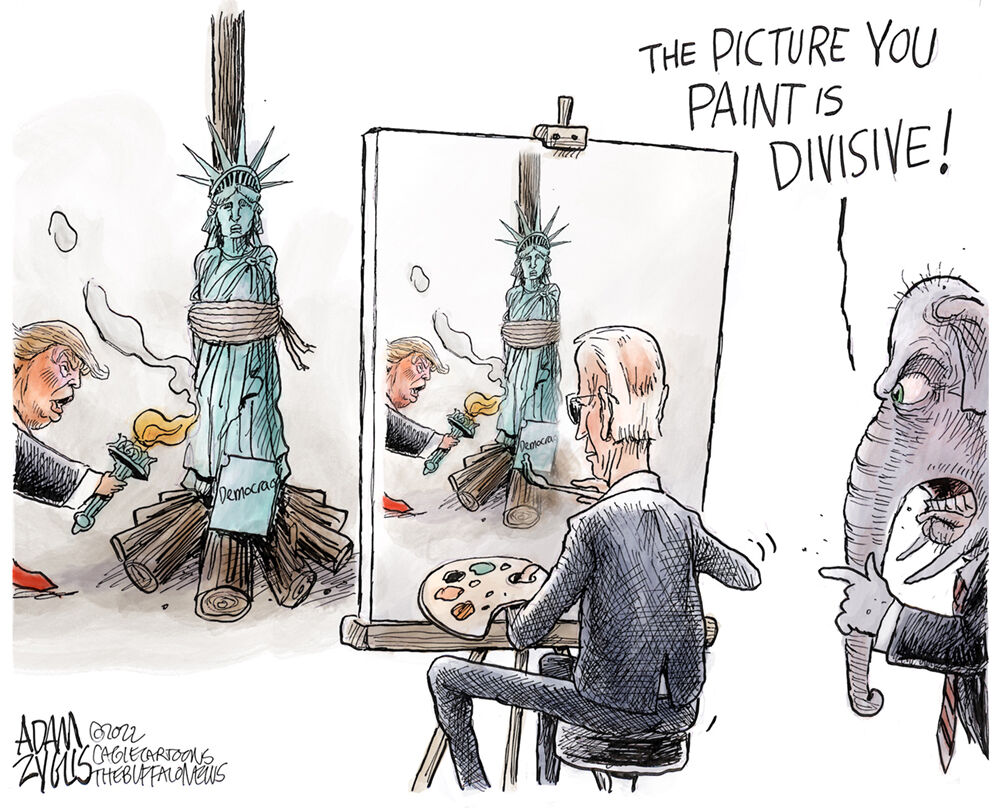
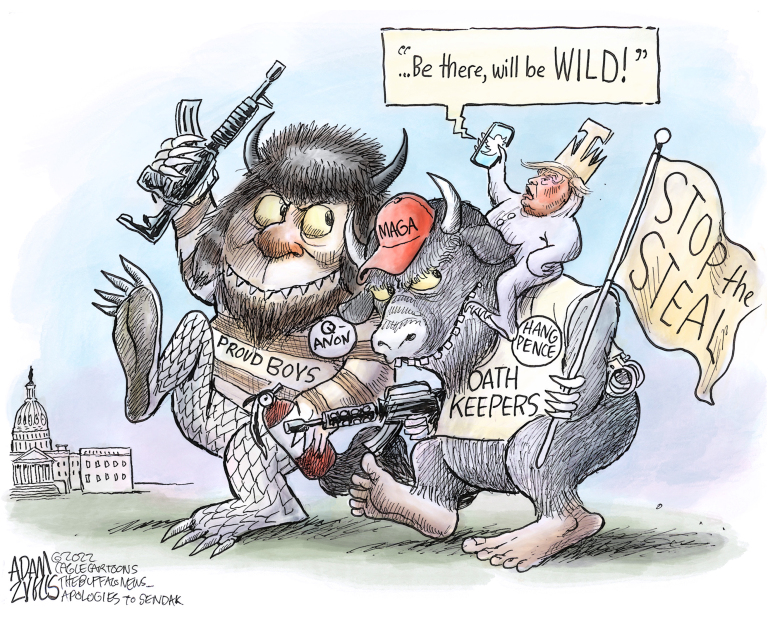
https://buffalonews.com/opinion/adam-zyglis-2022/collection_10d8d684-6f18-11ec-8781-d72e4b72c14d.html#1

But in spite of the obvious truth in Biden’s remarks, the pro-fascist voices shrieked in horror: Biden had “insulted” “half the people living in this country“, i.e. everyone who voted for Trump. (Who aren’t “half the country”, by the way. That’s why he lost.)

But two points: (1) Not all of those 74 million Trump votes came from “MAGA Republicans” or even Trump supporters; they just liked him better than Biden. And probably most of those voters did not expect Trump to try to hang onto power by inciting violence after he lost; they might not have voted for him if they had.

Immediately after January 6, lots of Republicans felt that way — not just Liz Cheney and Adam Kinzinger, but also Kevin McCarthy, Mitch McConnell, Lindsey Graham and many others. But then elected officials saw which way the wind was blowing within the GOP, and most of them weathervaned back into the MAGA fold. They aren’t Trumpists, they’re just opportunists and cowards.

So Biden carefully targeted his criticism:

Now, I want to be very clear, very clear up front. Not every Republican, not even the majority of Republicans, are MAGA Republicans. Not every Republican embraces their extreme ideology. I know, because I’ve been able to work with these mainstream Republicans.

But the MAGA folks ignored that part of the speech and continued to insist that Trump voters ARE Trump; you can’t attack him without attacking them. Which also proves Biden’s point: Telling the masses to identify with the Leader, to see his pains as their pains and his enemies as their enemies, is one of the traits of fascism.

Which brings up the second point: (2) Biden (and me and a lot of other liberals) are not using “fascism” as an insult. It is descriptive term that means something — and that meaning clearly applies to Trump and his personality cult.

In 2015, I felt obligated to write an article describing what I meant by “fascism” before I started using the word. I boiled it down to these key characteristics:

[Fascism is] a dysfunctional attempt of people who feel humiliated and powerless to restore their pride by:

styling themselves as the only true and faithful heirs of their nation’s glorious (and possibly mythical) past,

identifying with a charismatic leader whose success will become their success,

helping that leader achieve power by whatever means necessary, including violence,

under his leadership, purifying the nation by restoring its traditional and characteristic virtues (again, through violence if necessary),

reawakening and reclaiming the nation’s past glory (by war, if necessary),

all of which leads to the main point: humiliating the internal and external enemies they blame for their own humiliation.

Again, I haven’t changed that definition (not even the italics) since 2015. Trump and his movement have spent the last 7 years proving me right about them, from the demonization of Muslims to the intentional cruelty of his border policy to the mob violence of January 6.

And what unites Trump’s mob? Identification with one of the groups that might feel aggrieved by the slipping of its former dominance. If the core of your identity is to be White, male, Christian, rural, or heterosexual, and you feel wronged by a society that no longer honors you as you feel you deserve (or sufficiently punishes people who are different from you), then you are a “real American” who needs to bask in the gold-plated glow of Trump’s reflected greatness, and needs his strength to strike back at those who have looked down on you.

As I said in 2015, fascism appears mercurial because it’s not “political” in any ordinary sense; it has no characteristic ideology or economic program, just friends and enemies. Fascism is a phenomenon of social psychology. It’s about dominance and grievance and humiliation and projecting images of strength, not potential solutions to the problems of Americans’ real lives.

The GOP’s decision not to write a platform in 2020 was textbook fascism: Our policy is Trump. Today, the way a candidate gets Trump’s endorsement and the backing of his cult is not to champion a set of ideals or policies, it’s to champion Trump himself, and his made-up grievances about the 2020 election and the FBI’s “invasion” of Mar-a-Lago.

Imagine a candidate who pledged to advance all of the Trump administration policies, but said that Biden had been legitimately elected and the January 6 riot was wrong. Could that candidate get Trump’s endorsement? I think not.

Trump doesn’t have policies, he has grievances. If you also feel aggrieved, he wants you to identify your grievances with his, and to vicariously experience satisfaction when he is victorious again and achieves a humiliating revenge against his enemies.

That’s what fascism is all about.

https://www.sltrib.com/opinion/bagley/2022/09/02/bagley-cartoon-maga-meltdown/

The Return of the Bitter Politics of Envy

Plutocracy survives by pitting working people against each other. Ginning up outrage against the Americans who are getting some of their student debt cancelled is just a new verse in an old song.


Back in 2012, when presidential candidate Mitt Romney was taking heat for all the jobs he destroyed on his way to wealth, he accused his critics of practicing “the bitter politics of envy” and “class warfare“. Mitt didn’t think we should resent him just because he’s richer than the rest of us, and we also shouldn’t resent any of the hard-hearted things he did to reach that exalted position.

The year before, though, we heard a very different message about envy from another conservative presidential wannabe, Wisconsin Governor Scott Walker, who at the time was trying to kill off the state employee unions. Walker’s ally, the Club for Growth, ran ads telling Wisconsinites working in the private sector who they should really resent for the hard times that had followed the real-estate bubble of 2008: not billionaires like the ones who fund the Club for Growth, but those same state employees that Walker was trying to shaft.

All across Wisconsin, people are making sacrifices to keep their jobs. Frozen wages. Pay cuts. And paying more for health care. But state workers haven’t had to sacrifice. … It’s not fair. … It’s time state employees paid their fair share, just like the rest of us.

Is that bitter or what? The ads barely bothered to explain what benefit ordinary Wisconsinites would get from sticking it to the clerks at the DMV, other than the satisfaction of seeing those uppity state workers finally get theirs.

But strangely, Mitt’s anti-envy crusade never mentioned those ads. Because the point was never to remove envy and bitterness from politics; it was to make sure people’s resentment was directed down or sideways rather than up.

So if life seems unfair to you, don’t look at the guy on top, who is raking off vast sums of money for doing something of nebulous value, often with government help. Look instead at, say, the teachers and nurses who work for your state. If their union is making sure they still get a fair day’s pay for a day of hard work, while somebody like Mitt Romney has laid you off — well, screw those teachers and nurses!

Better yet, screw the poor family who got an extra $50 of public assistance because Jenny didn’t report her babysitting income. Such dishonesty! Ignore the corporation that got a big tax cut to create jobs, and then conveniently forgot to create jobs. Ignore the guy who claims to be a billionaire, but keeps using the bankruptcy laws to stiff his creditors. Did you know there’s a guy who buys lobster with food stamps? (Or at least there was, back in 2013. He still comes up from time to time.) That’s what’s wrong with America!

You know who else is destroying America? People who are so desperate that they risk their lives to come here so they can clean our toilets for less than minimum wage. Who do they think they are? We have laws, you know.

This is how plutocracy survives: If you’re unhappy, focus your resentment on other people like you, or maybe people worse off than you. But don’t look up with anything in your heart other than awe and gratitude. Never look up in resentment.

The current example of this trick is the attempt to raise anger about Biden’s student-debt-relief program, which was announced Wednesday.

https://claytoonz.com/2022/08/25/student-loan-forgiveness/

Before we get into the divisive rhetoric, let’s quickly review what Biden’s program does: If you have student loans and you don’t make too much money, you can get part of your debt forgiven. The amount of forgiveness is capped at $20K if you received a need-based Pell Grant, and at $10K if you didn’t. (Two-thirds of Pell Grant recipients come from families with less than $30K of annual household income.) And “make too much money” means $125K per year for an individual or $250K for a household. The Biden administration estimates that the bulk of the benefit will go to people making considerably less than the upper limit.

In addition, Biden’s executive order changes the rules around payment rates: Required payments are capped at 5% of discretionary income (down from 10%), and the definition of “discretionary” has changed to lower the payments further.

NYT columnist Jamelle Bouie points out that you don’t have to have gone to college to benefit:

If you want to haul freight for a living, you’ll need a commercial driver’s license, which means you’ll need training, which means you’ll need school. This schooling can cost thousands of dollars, and students can pay their tuition with federal student loans. So, too, can people who need training to work as medical technicians or home care workers or physical therapists or restaurant workers, among many other trades and professions.

Millions of people with blue-collar jobs owe thousands of dollars in federal student loans, and they may not have the income needed to pay them off. Biden’s plan helps them as much or more than a graduate of a four-year college with debt on the ledger. It also helps the millions of Americans who took out loans, attended college, but for one reason or another could not complete their degrees and are in the worst of all financial worlds as a result.

One of the examples in Biden’s announcement calls attention to this fact:

A typical single construction worker (making $38,000 a year) with a construction management credential would pay only $31 a month, compared to the $147 they pay now under the most recent income-driven repayment plan, for annual savings of nearly $1,400.

In short: Biden has done a pretty good job of aiming this program at middle-and-lower-class people who tried to better themselves through education and training, but didn’t strike it rich.

https://www.facebook.com/photo?fbid=626270678844364&set=a.305833804221388

But if you listened to the Republican response, or the drum-beat on Fox News, you wouldn’t grasp any of that. Conservatives are trying to turn this into a culture-war issue, with taxes from salt-of-the-Earth non-college folks paying for a benefit that goes only to privileged (but lazy) intellectual snobs.

Senate Minority Leader Mitch McConnell (net worth $35 million, and I’m not sure if that counts his wife’s $30 million) blasted the proposal:

Democrats’ student loan socialism is a slap in the face to working Americans who sacrificed to pay their debt or made different career choices to avoid debt. A wildly unfair redistribution of wealth toward higher-earning people.

Marjorie Taylor Greene (whose construction company had a $183K loan forgiven under the Paycheck Protection Program) also drew a culture-war battle line:

Taxpayers all over the country, taxpayers that never took out a student loan, taxpayers that pay their bills and maybe even never went to college, just hardworking people, they shouldn’t have to pay off the great big student loan debt for some college student that piled up massive debt going to some Ivy League school

Ted Cruz (an Ivy-Leaguer who was a Princeton undergrad before going to Harvard Law School and is married to a Goldman Sachs banker) sharpened the image of who you should resent:

If you are that slacker barista who wasted seven years in college studying completely useless things, now has loans and can’t get a job, Joe Biden just gave you 20 grand

Or maybe the reason you’re in debt over your head is that you “wasted” four years training to teach in the Texas public schools, while Ted spends over $40K per child per year on his kids’ private school.

But we don’t even need to go there, because barista is a job. That “slacker” woman does real work that keeps her on her feet all day, and Ted has just slapped her in the face.

That barista insult also points to another fault line Republicans are trying to exploit: generational resentment.

https://goimages-thevirtual.blogspot.com/2021/04/trolley-problem-student-debt-meme.html

A lot of people my age and older are making an I-suffered-so-I-want-everybody-to-suffer argument. (An aside to people who claim to reach their conservatism by way of Christianity: Can you imagine a less Christ-like position?)

Supposedly, forgiving any student debt at all is an “insult” to the people who have paid their debt in full, or paid for college without loans (as many people my age did). Similarly, emancipation was an insult to all the enslaved people who escaped to Canada without Lincoln’s help. The Covid vaccines are an insult to all the people who died of Covid before they were available. And so on. It’s not fair.

The most bizarre aspect of this debate is that there actually is a generational-justice issue here, but it points in the opposite direction: People (like me) who got our higher educations in the 1970s and 1980s received our government subsidy up front. That’s why we didn’t pile up debt.

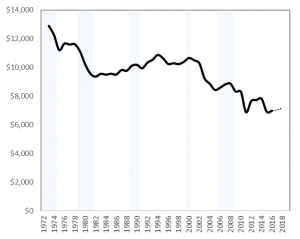
That happened in two ways. First, the grant money available from the federal government covered a much bigger percentage of student expenses.

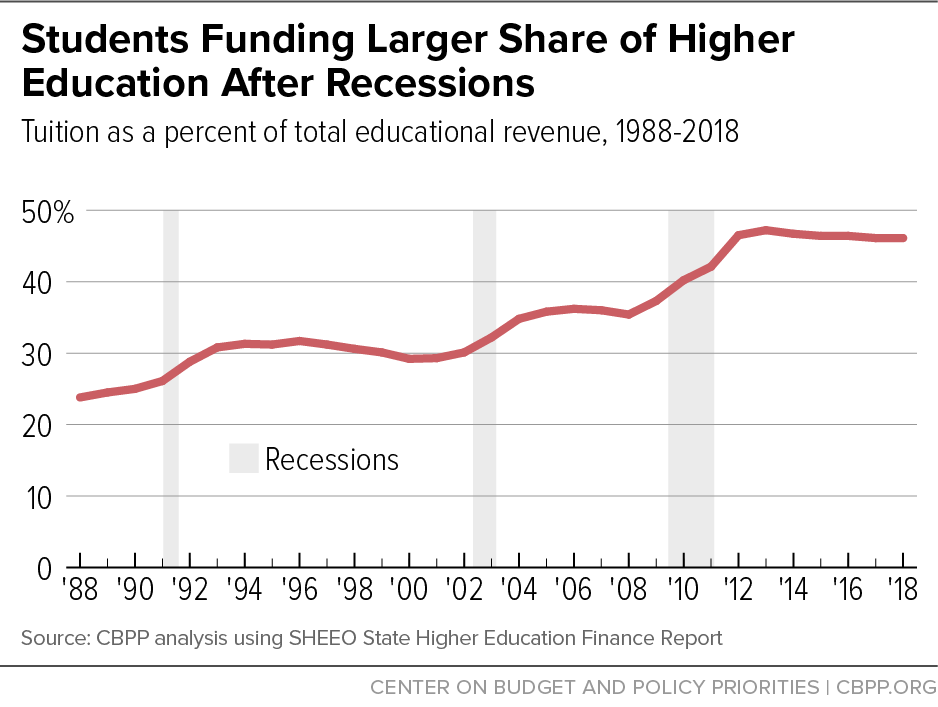
But even that graph doesn’t really capture what’s been happening. One reason the orange line rises so quickly is that state governments were cutting back on the money they spent on their university systems, which then had to cover their costs by raising tuition. And as tuition rose at top state universities like Berkeley or Michigan, private colleges and universities faced less competition, and so could raise their tuition as well.

You can see the pattern in the graph below: Every time a recession threw the states’ budgets into crisis, they cut back on higher education. But when the economy improved, the cuts were never restored. As a result, the portion of college costs that students paid through tuition nearly doubled, from about a fourth to almost half.

Here’s how that pattern played out in Wisconsin. The graph below charts the state appropriation for the University of Wisconsin system per full-time-student-equivalent per year, adjusted for inflation.

That, in a nutshell, is why Millennials are carrying so much student debt: State and federal governments put much less money into their educations than those governments had put into, for example, mine. So Millennials had to borrow to cover the difference.

But let’s add one more piece to the puzzle: the loss of other options.

http://louissytsmaap2.blogspot.com/2013/03/americas-biggest-export-our-jobs.html

At the same time higher education was getting more expensive, high-paying jobs for people without some post-high-school degree or credential were going away. And like the rise in tuition, this trend was the result of government policies: Two key parts of the Reagan revolution (which Bill Clinton mostly either let stand or actively continued) were union-busting and globalization, which sent entire manufacturing industries overseas and forced huge wage-and-benefit concessions from the workers who still had jobs.

Fifty years ago, a union job on the assembly line at GM or a truck-driving job under a Teamster contract was a plausible path to the American dream. On that one income, you could buy a house, raise children, and even send those children to (government subsidized) college if they were so inclined.

Or you could work a union job for a year or two while you lived with your parents, and save up enough money to put yourself through college.

No more.

So in these last few decades, young people born without wealth have faced an increasingly grim choice: accept that they are permanent members of an underclass that will always have to struggle financially — like the baristas Ted Cruz despises so much — or gamble on their future success by taking on enormous debts. (I anticipate the objection that there’s a third choice: start your own business. But if you don’t have parents wealthy or connected enough to get you started — like, say, Bill Gates or Jeff Bezos — that path also typically involves heavy borrowing.)

And who put them in that unfortunate position? The US government and the voters who supported its policies.

So when I look at the whole picture, I think letting some of those debtors partially off the hook is the least we can do.

And if that outcome leaves you with boiling resentment that still needs a target, I have a suggestion on which direction you should look.

Governing Party vs. Personality Cult

https://theweek.com/political-satire/1015811/pick-six

Democrats and Republicans are telling us who they are.


In political novels, authors make diverse issues converge so that competing politicians, parties, or movements can demonstrate their contrasting natures within the short time-window of a plot. That almost never happens in real life — except for these last two weeks.

Recent news has featured two very different stories: Democrats passed the Inflation Reduction Act over unanimous Republican opposition, breaking the legislative logjam that (until now) has blocked Congress from from fighting climate change, cracking down on corporations that pay no tax, or lowering prescription drug costs.

Meanwhile, Republicans did their best to raise public outrage against the FBI and DoJ after they searched for — and found — classified documents that Donald Trump was holding illegally at Mar-a-Lago. As Trump’s excuses shifted from day to day, prominent Republicans dutifully parroted each one. No member of the GOP leadership even hinted that Trump should account for his actions.

In an additional subplot, chief Trump critic Liz Cheney — former member of the House Republican leadership and daughter of a Republican vice president — was overwhelmingly rejected by the Republican voters of Wyoming. The GOP is the Trump personality cult now; anyone who won’t bow down to him belongs somewhere else.

Democrats

The Inflation Reduction Act. President Biden signed the IRA on Tuesday. The bill does several things that have been popular with voters for years, but haven’t been able to get through Congress: It lowers prescription drug costs by letting Medicare negotiate with drug companies, caps how much Medicare recipients have to pay for drugs, and cracks down on profitable corporations that pay little-to-no income tax. It extends subsidies that help people afford ObamaCare policies, and also lowers the deficit by raising more revenue than it spends.

The biggest spending items in the bill are aimed at mitigating climate change, a growing problem that has been apparent for decades, but which Congress has also been unable to muster the will to address. By 2032, the IRA is expected to lower carbon emissions 40% from what they were in 2005. It accomplishes that mainly by subsidizing both sustainable electric power and the purchase of electric vehicles.

Democrats were also united around a provision to cap the cost of insulin, a life-saving drug that is out of patent and cheap to manufacture, but can cost a lot in the US (but not in other countries) due to market failures and corporate greed. Unfortunately, arcane Senate rules wouldn’t let an across-the-board insulin cap be part of a bill that circumvented the filibuster. So the Senate couldn’t pass the cap without ten Republican votes, and only seven Republicans were willing to sign on. 43 Republican senators voted to keep the price of insulin high.

Other legislative accomplishments. The IRA was the final exclamation point on a series of bills Democrats got through Congress this summer.

  • A bipartisan gun control bill. It doesn’t do nearly as much as Biden wanted, but it does extend red-flag provisions for keeping guns out of the hands of high-risk people, closes the boyfriend loophole, cracks down on interstate gun trafficking, and makes it harder for 18-21-year-olds to buy guns. It’s the first major restriction on guns in decades.
  • A veterans health bill in which the government finally took responsibility for the effects of toxic fumes from the burn pits used to dispose of military waste in Afghanistan and Iraq.
  • The CHIPS Act, which is intended to bring high-tech manufacturing back to the US and put US tech industries into a better position to compete with China.

These bills build on a record of accomplishment from earlier in Biden’s term, like the American Rescue Plan Act (which deserves a lot of credit for the economy’s fast recovery from the Covid shutdown. Unemployment had skyrocketed during he last year of the Trump administration, but is near record lows now.) and the bipartisan infrastructure bill (which Trump had kept promising but never delivered).

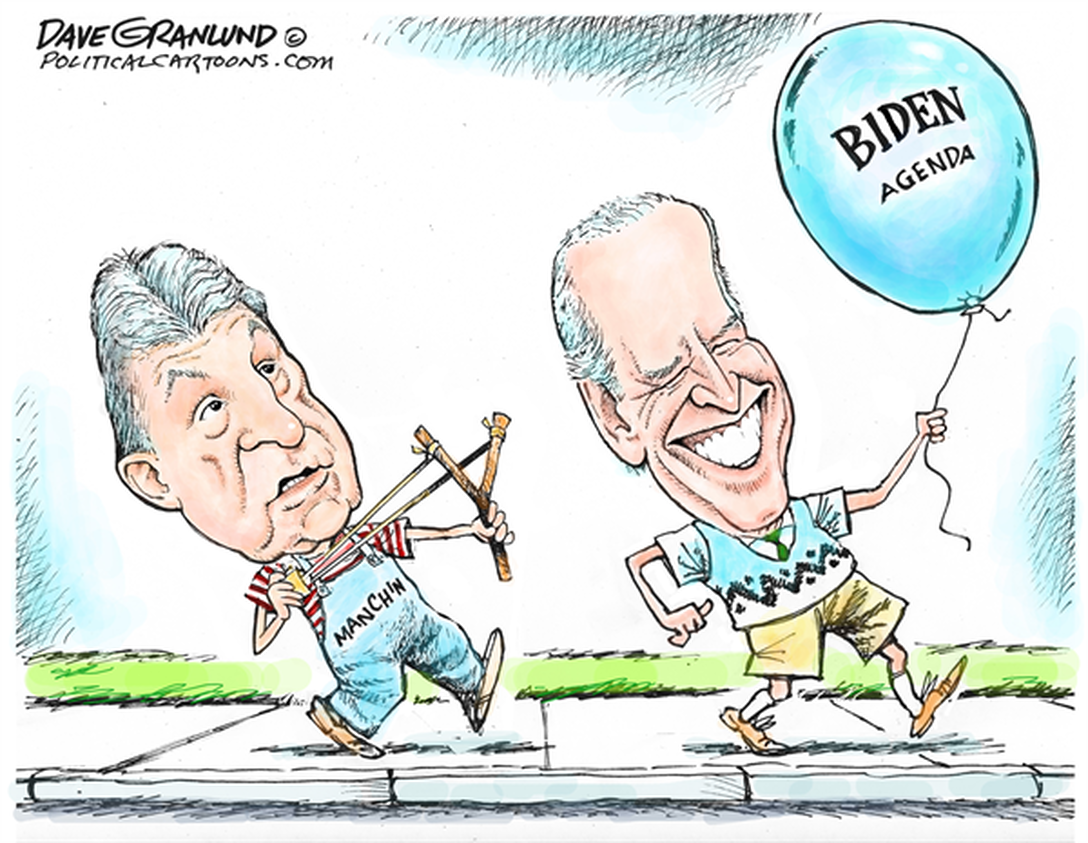
More could have been accomplished if not for the two Democratic senators who refused to scrap the filibuster. If Democrats hold the House and pick up two senate seats in the fall — still a longshot, but a growing possibility — they could protect voting rights and codify the protection American women lost when the Supreme Court trashed Roe v Wade.

That’s who the Democrats are: They are concerned with real problems (climate change, unemployment, national competitiveness, the cost of health care …) and are not just posturing about them, but taking action.

https://claytoonz.com/2022/08/15/treasonous-squirrels/

Republicans

Meanwhile, the Republicans have been displaying a different nature: a personality cult whose highest priority is to defend their leader against legal accountability for his actions.

The Mar-a-Lago search. On August 8, FBI agents executed a search warrant on Trump’s Mar-a-Lago residence, which is part of his country club. They were looking for records from his administration, which according to law, belong to the government, not to him. The National Archives and Record Administration, the agency that oversees such records, has been trying to reclaim their documents from him ever since he left office.

In January, NARA retrieved 15 boxes of documents and other materials from Mar-a-Lago, but (believing they had not gotten everything) asked the help of the Department of Justice. In May, DoJ issued a subpoena which they served to Trump’s lawyers on June 3. More documents were turned over at that time, and a Trump lawyer falsely signed a document stating that all classified material had been returned.

We do not at this point know why DoJ believed classified documents were still at Mar-a-Lago, but a judge found probable cause that evidence of several crimes, including breaking the Espionage Act, was still at Mar-a-Lago. Hence the search warrant.

The FBI found what the search warrant was seeking: more boxes of documents, some of them classified at the highest levels.

So far, no one has presented the slightest evidence that NARA, DoJ, the judge, or the FBI did anything wrong. Trump has railed against all of them, inspiring one deranged follower to attack an FBI office in Cincinnati, an action that led to the man’s death. But though he has posted lengthy diatribes on his Truth Social clone of Twitter, Trump has had nothing to say about the most important questions:

  • Why did he take the documents?
  • Why was he keeping them?
  • What did he plan to do with them?

The firehose. Instead, Trump has posted a series of excuses. Most of them contradict each other, and all of them have fallen apart quickly. Anderson Cooper summed them up.

  • Trump had been cooperating with DoJ, so there was no excuse to send in a search team. (Reality: Trump’s “cooperative” lawyer had lied to DoJ when it served the subpoena in June.)
  • There were no classified documents at Mar-a-Lago.
  • The FBI may have planted the classified documents.
  • The documents existed and weren’t planted, but Trump had magically declassified them (via a “standing order” that no one in his administration had ever heard of). [1]
  • Obama did the same thing. (NARA immediately contradicted this: “The National Archives and Records Administration assumed exclusive legal and physical custody of Obama Presidential records when President Barack Obama left office in 2017, in accordance with the Presidential Records Act.”)
  • Taking the classified documents was an honest mistake. Up until the last minute, Trump thought that he could stay in power in spite of losing the election, so when it turned out that the United States was still a democracy after all, he had to pack up the White House quickly. (But why has he kept the documents, and why did his lawyers lie about them?)
  • Trump did take the classified documents and keep them after NARA asked for them, but it’s not illegal because he didn’t destroy them or sell them. (Cooper quotes the part of the Espionage Act that says it is illegal.)

Chris Hayes put together a similar list, with videos of Trump’s Fox News puppets making the claims.

There is a name for this propaganda technique: the firehose of falsehood, pioneered by Vladimir Putin. Steve Bannon refers to it as “flooding the zone with shit“.

Cooper refers to the last excuse on his list (put forward by Rudy Giuliani) as the “perfect phone call” phase of the scandal. The reference is to the call that led to Trump’s first impeachment, when he tried to make aid to Ukraine dependent on President Zelenskyy agreeing to a bogus investigation of Joe Biden. Trump and his people had offered a similar firehose of contradictory explanations and distractions, until Trump eventually settled on the defense that he did exactly what he was accused of — and had been denying — but it wasn’t wrong; it was a “perfect phone call“. His later attempt to strong-arm Georgia Secretary of State Brad Raffensperger into “finding” enough votes for Trump to win Georgia was also a “perfect phone call“.

https://theweek.com/political-satire/1016000/who-will-protect-the-protectors

This time, though, we’ve seen one step beyond the perfect phone call: The claim that DoJ should back down (even though Trump did commit crimes) for fear of Trump’s violent followers. Thursday, Trump lawyer Alina Habba went on Newsmax to issue an implied threat to the FBI agents who carried out the Mar-a-Lago search. Commenting on the proposal that Trump release the security-camera footage of the search, she said “I would love that.” When shown a video of former FBI counter-intelligence chief Peter Strozk worrying about violence against the agents if their names and faces are identified, Habba seemed fine with that possibility.

Listen. FBI undercover agents, that’s one thing. But when you go into a president’s home, an ex-president’s home, what do you expect is going to happen? What do you expect?

I expect that there are more people out there like the guy who attacked the FBI office in Cincinnati. Habba (and Trump) know that, but they either don’t care or they’re counting on it.

Republicans against law enforcement. Every step of the way, Republican leaders have backed Trump in whichever argument he was making at the time.

Before he knew anything about the search other than that it had happened, Kevin McCarthy, who hopes to be Speaker if Republicans take the House in November, tweeted “I’ve seen enough”. Based on nothing, he immediately adopted Trump’s anti-law-enforcement rhetoric about DoJ’s “intolerable state of weaponized politicization”. He threatened an investigation of DoJ that will “leave no stone unturned”.

Also knowing nothing, and not taking a moment to find out, House Republican Conference Chair Elise Stefanik called the search “a dark day in American history” and called for “an immediate investigation and accountability into Joe Biden and his administration’s weaponizing this department against their political opponents”.

Senator Rand Paul raised the planted-documents theory on Fox News — again, based on nothing. He also called for repealing the Espionage Act that Trump appears to have violated. Numerous Republicans, including Marjorie Taylor Greene, want to defund the FBI. “I mean, we have to,” says Bo Hines, a Trump-endorsed candidate for Congress in North Carolina.

Other than a handful of exiles like Liz Cheney, no major GOP figure is asking Trump to explain why he broke the law.

As we head toward the fall elections, it’s important not to lose sight of what the two parties represent. Democrats are trying to prove that the American system of government still works, by passing laws that address the problems Americans face today, as well as the looming crises of the future. Republicans are a personality cult drumming up fear and paranoia in order to return their leader to power, no matter what he has said or done or might do in the future.


[1] As someone who once had a Top Secret clearance, I can’t let this point go without further comment. A Trump spokesman announced on Hannity:

As we can all relate to, everyone ends up having to bring home their work from time to time. American presidents are no different. President Trump, in order to prepare for work on the next day, often took documents, including classified documents, to the residence. He had a standing order that documents removed from the Oval Office and taken to the residence were deemed to be declassified the moment he removed them.

This is nonsense on many levels. First, if you work with classified documents you don’t take your work home. Ever. If classified documents are signed out to you, you have a safe in your office, and the documents are supposed to be inside the safe when you leave for the evening.

Second, the “standing order” makes no sense. You can only take it seriously if you grossly misconceive what classification means.

What is classified is information, not paper. Suppose there are ten copies of some classified report, and Trump takes one of them home. Does that mean that the report is declassified? If I have one of the other nine copies, can I sell it to the Chinese now? Does it get reclassified in the morning when Trump brings it back? Will my espionage trial hinge on what time it was when I delivered the report to our enemies?

In short, it’s not just that Trump’s “standing order” didn’t exist (as two of his chiefs of staff have verified). It couldn’t exist. By claiming that it did exist, Trump is trying to take advantage of your ignorance. You should feel insulted.

What’s the point of punishing Trump?

https://www.politico.com/cartoons/2022/06/01/matt-wuerker-cartoons-june-2022-00036472?slide=4

Or Alex Jones? Or Deshaun Watson?


The Info-warrior. Friday, a Texas jury assessed $45.2 million in punitive damages against Alex Jones, on top of the $4.1 million it previously ordered him to pay in ordinary damages. The $49.3 million total would go to Neil Heslin and Scarlett Lewis, whose 6-year-old son Jesse Lewis was killed in the Sandy Hook massacre. On his widely viewed program Info Wars, Jones repeatedly claimed that the massacre was a hoax designed to give the government an excuse to confiscate guns, that Heslin and Lewis were “crisis actors”, and that their son never existed.

Because a large number of Jones’ fans actually believe the dark fantasies he spins, Heslin and Lewis have not only seen their grief exploited for someone else’s gain, but they’ve been harassed and even in physical danger for the last nine years.

As the linked article makes clear, the total amount Jones ends up paying could go either up or down. He might appeal to get this judgement reduced, but he also faces additional cases brought by other victims of his malicious lies. Or he might wriggle out of accountability by abusing the bankruptcy laws.

Like a lot of people, I take satisfaction from the prospect of Jones paying millions of dollars. I don’t throw the word evil around lightly, but Alex Jones qualifies. He has amassed a huge fortune by slandering people who have already suffered something worse than most of us can imagine. This is purely predatory behavior, and there is no excuse for it.

The quarterback. Last Monday, another punishment was announced (pending appeal): NFL quarterback Deshaun Watson will be suspended for six games. Watson was the target of lawsuits by 24 female massage therapists. Despite playing for a team (the Houston Texans) that had its own massage therapists, Watson arranged private appointments with more than sixty women, 24 of whom claim he tried to pressure them into sexual acts.

Watson sat out all last season (with pay) while the Texans watched the progress of the cases against him and tried to decide what to do with him. (He had demanded a trade before the scandals broke, but his value was hard to determine until the criminal probes concluded.) Ultimately, Watson was not indicted and he has settled all but one of the suits. The Texans then traded him to the Cleveland Browns, who signed him to a five-year $230 million contract. The contract was structured to have a large signing bonus, but a small first-year salary. As a result, he’ll lose only $345K if he misses the six games.

Like a lot of people, I had the exact opposite reaction to this announcement: Really? That’s all? I don’t know what I thought justice would be, but this isn’t it. If the decision stands, Watson will be back on the field for the Browns’ game against Baltimore on October 23. He should barely notice the lack of $345K, and it will be as if nothing ever happened. Come February, his accusers might be watching him in the Super Bowl. [1]

The former president. Meanwhile, the mills of justice grind very slowly in the case of Donald Trump. The House January 6 Committee has put together a compelling case that he did the single worst thing any American president has ever done to the country: He lost an election and tried to stay in power anyway. The January 6 attack on the Capitol was the culmination of a much larger anti-democracy plot, which he set in motion and tried to benefit from.

If he had succeeded, the republic set up by the Founders would effectively have fallen. After ignoring the Constitution and overruling the voters in 2020, why would he ever give up power? And if he should happen to die or retire, why should any future president give up power?

Whether Trump will face any consequences for these actions is still up in the air. Mitch McConnell and his fellow Republican senators refused to hold Trump accountable in his second impeachment trial. A Georgia prosecutor is investigating the former president’s attempts to reverse that state’s 2020 election, and the Department of Justice finally appears to be going up the chain from the January 6 rioters to the plotters whose will they were carrying out.

Will any of that lead to indictments? Convictions? Jail time? It’s still not clear.

The point of punishment. I’m discussing these three men together — Jones, Watson, Trump — because their cases raise a common theme: What is punishment for? How much is enough? Thinking about Jones and Watson, I believe, can give us insight into what we should want for Trump.

As I said above, it’s satisfying to see bad men punished. That’s a very human response. Particularly when evil-doers appear to prosper, it’s easy to convince yourself that anything bad that might happen to them is justified and even good. [2]

At the same time, I believe that the propensity to glory in revenge (whether personal, vicarious, or rooted in some abstract sense of justice) is not humanity’s best feature. At some point we need to let the Past pass, so that we can move ahead unencumbered.

But when is that? When can we say “OK, enough”? [3]

Nixon. Before we think about that, I want to consider one more example: Richard Nixon. President Ford pardoned Nixon about a month after he resigned, and as a result Nixon was never held fully accountable for his crimes. He never went to prison. He never even had to stand trial, so no once-and-for-all judgement about his actions was ever recorded.

At the time (I turned 18 shortly after the pardon, so I got to vote against Ford in 1976), I thought Nixon got off too easily. OK, he had to leave power, but most of us never have much power. If being returned to the ranks of ordinary citizens counts as “punishment”, then presidents really are above the rest of us in a way that I think the Founders never intended.

But as I look back now, I’m willing to cut Ford a little more slack. Even without a trial or prison, Nixon became a cautionary tale in American politics. For decades afterwards, a stain of illegitimacy hovered over everything he did. No American politician wanted to hear his or her actions compared to Nixon’s. His name went unmentioned at Republican conventions. Post-Nixon presidents couldn’t justify their actions by citing Nixon as a precedent.

In retrospect, I think that was a good outcome.

What I want for Trump, Jones, and Watson. What I want for each of them is not some specific punishment. What I want is an outcome that makes them cautionary tales for anyone in a position to offend in similar ways.

I want current and future sports stars to consider their possible actions and think “I don’t want to become another Deshaun Watson.” I want current and future conspiracy-theory entertainers to think, “That might gain me some viewers, but it’s a little too much like Alex Jones.”

And most of all, I want a stain of illegitimacy to fall across everything Donald Trump ever did. I want the adjective “Trumpian” to become a pejorative label that every major American politician tries to deflect, just as no one wanted to be “Nixonian” for the rest of the 20th century. I want the advisors and assistants in all future administrations to consider what happened to Trump’s people and think about what they might be risking.

What kind of punishments would do that?

It’s tempting to see the Nixon example as proof that punishment isn’t necessary at all. But Nixon was a very different case: By the time he left office, his party had already turned against him. He was never again a force in American politics.

By contrast, Trump is actively trying to return to power, and remains a cult figure whose members regard him as a hero.

He won’t go quietly into the Past, so he has to be brought down. I don’t see how that happens without mug shots, a trial, and an orange jumpsuit. The evidence against him needs to be presented in a court where he is not in control, with the result (I hope) that a jury unanimously convicts him of crimes. He needs to go to jail.

His trial and sentencing will be traumatic for the country, but his own actions and lack of remorse make it necessary. There needs to be an outcome whose reality he can’t deny. His followers may continue to claim, against all evidence, that he won the 2020 election. But if he’s in jail they can’t claim that a jury acquitted him.

How much jail time? Revenge says “He tried to overthrow my country’s Constitution and sent his mob to attack my Capitol.” The rest of his life would not be long enough to satisfy my desire for Revenge.

But that’s not an urge I want to indulge. So: how long? Long enough for the country to move on, and for the Republican Party to find new leaders. A four-year political cycle needs to come and go without any expectation that he might participate.

So that’s what I want: four years.


[1] For comparison, Tom Brady served a four-game suspension at the conclusion of the Deflategate saga. The Patriots managed a 3-1 record while he was gone. After he returned, the team continued on to the Super Bowl, where Brady led a historic comeback against the Atlanta Falcons and was named MVP. That game is considered one of the highlights of his career.

[2] I believe this is where the myth of Hell comes from. For many people, the vision of bliss in Heaven would be incomplete without the knowledge that the people who abused them in life are suffering endless torment. My own beliefs about God or the afterlife are uncertain, and waver sometimes from day to day. But one thing I’m certain I don’t believe is that a loving God condemns anyone to eternal suffering.

[3] My detailed analysis is in a sermon I gave in 1999, “Forgiveness“. I stand by it.

A Week When Congress Mattered

Three important bills and what happened to them.


Most of the time in America, it’s hard to believe that the Founders intended Congress to be the center of our government. Today, our political conversation spends weeks at a time focused on what the Supreme Court did or might do, what the President did or might do, or how one of them will respond to the other’s latest move.

But wait — isn’t there a third branch? What ever happened to it?

When we talk about Congress at all, it’s usually because they’re investigating some scandal or pseudo-scandal in the executive branch. Or because the Senate is confirming a new judge. Or Congress is the backdrop where the Fed chair makes headlines by commenting on the economy or interest rates.

Of course, members of Congress can become a topic of discussion if they tweet something outrageous or share a platform with Nazis or embarrass our country in some other way. When Republicans control one house or the other, Congress occasionally manufactures a news-making event out of nothing: a government shutdown or a debt-ceiling crisis. The world would be puttering along just fine if Congress weren’t standing on an important life-line and threatening to shoot itself in the foot.

Every now and then, congressional coverage is about legislation, but the bill in question is only symbolic: The House may be voting to codify Roe (i.e. respond to the Supreme Court) or ban assault weapons or protect voting rights (again, in response to the Supreme Court letting states violate rights previously established), but its members rest secure in the knowledge that a Senate filibuster will prevent any of that from becoming law. The point isn’t to accomplish something for the country, but to get one party or the other on the record, so that their votes can be issues in the next election.

In short, we’re used to viewing Congress through a veil of Shakespearean cynicism: Its doings may be full of sound and fury, but ultimately they signify nothing.

To the country’s great surprise, though, this week was different: Congress was in the headlines for three pieces of legislation, all of which matter to people in the non-political world and stand a real chance of becoming law: One bill passed and is on President Biden’s desk. One bill that looked like a slam-dunk failed. And one that seemed dead came back to life.


The bill that Congress passed is the CHIPS Act, which subsidizes American high-tech manufacturing in an attempt to bring the semiconductor industry back to the United States. (Currently, the US imports its most advanced computer chips from Taiwan, a supply chain that China might be able to interrupt.) Promoted as a move to stay competitive with China, the bill spends $52 billion directly, and also includes a tax credit for certain kinds of investments.

The bill is aimed at the future, and won’t do much to solve the immediate chip shortage, which is hampering a variety of American industries. Vox summarizes:

The bulk of the CHIPS Act is a $39 billion fund that will subsidize companies that expand or build new semiconductor manufacturing facilities in the US. The Commerce Department will determine which companies receive the funding, which will be disbursed over five years. More than $10 billion is allocated to semiconductor research, and there’s also some support for workforce development and collaboration with other countries. The bill also includes an extensive investment tax credit that could be worth an additional $24 billion.


https://claytoonz.com/2022/07/30/toast-our-troops/

The bill that unexpectedly failed was PACT. The point of this bill is to expand VA care to veterans whose illnesses may have been caused by exposure to toxic fumes from burn pits during foreign deployments. Wikipedia says:

Burn pits were used as a waste disposal method by the United States Armed Forces during the Gulf War, the Kosovo War, the War in Afghanistan, and the Iraq War, but have since been terminated due to the toxic fumes that posed health risks to nearby soldiers. Currently, the Department of Veterans Affairs (VA) requires veterans to prove that their illness is directly related to burn pits.

From 2007 to 2020, the VA denied 78 percent of disability claims by veterans that were alleged to have been caused by burn pits. The Honoring our PACT Act would remove the requirement that veterans prove that burn pits caused their illness and retroactively pay veterans who did not receive care for their illnesses after claiming disability caused by burn pits. The Congressional Budget Office estimated the cost of the Act would be $300 billion from 2022 to 2032.

This was supposed to be a done deal. The House passed the bill in March. With only minor changes, the Senate passed the bill 84-14 in June. It then went back to the House, where “technical problems were discovered in the language of the bill”. The House made the needed technical changes and passed the bill again. Because the bill wasn’t identical to the one the Senate passed, it went back to the Senate, where passage should have been a formality. But instead Republicans blocked it.

“Why?” you might ask. Well, for reasons that have nothing to do with the bill itself, but rather with the other two bills. Democrats intend to avoid the Senate filibuster by passing the third bill, the Inflation Reduction Act (see below), via reconciliation. They can do that without any Republican votes, if they get all 50 Democratic votes. (That’s why an individual Democrat like Joe Manchin or Kyrsten Sinema has so much power.)

Passing a bill without Republican votes is a horrible miscarriage of democracy — at least if you listen to Republicans. (Of course, they passed the Trump tax cuts via reconciliation, and tried to repeal ObamaCare via reconciliation, both without the votes of any Democratic senators. But that’s fine, because that was them. When Democrats do it, it’s unthinkably awful.)

As usual when Republicans aren’t getting their way, they took hostages. McConnell promised that there would be no bipartisan CHIPS Act if Democrats went ahead with a reconciliation bill. 17 Republican senators apparently believe that the CHIPS Act is good for America — that’s why they voted for it. But they were willing to torpedo something good for America if Democrats didn’t do what they wanted. (God forbid senators should just vote for what they think is good and against what they think is bad.)

But when Joe Manchin blew up what was left of the reconciliation bill two weeks ago, Republicans decided they didn’t need a hostage any more. So the CHIPS bill passed.

And then Manchin and Schumer announced they had come to an agreement. Someone had to be punished for tricking Mitch McConnell (who is always such a straight shooter himself, right?), and the only whipping boy at hand was PACT. So McConnell blocked it. (For technical reasons, PACT doesn’t qualify as a reconciliation bill, so 41 Republican votes was enough to stop it.)

Veterans were outraged, as they should be. Veterans’ healthcare shouldn’t be collateral damage in a dispute that has nothing to do with them. Nothing should, but especially not that. (Various Republicans have given a variety of bogus reasons for blocking the bill. But nothing that they’re talking about has changed since the same senators supported the bill in June.)

Fortunately, veterans have a celebrity speaking up for them: Jon Stewart, who has been championing these sorts of issues for a long time. (Before PACT, he nagged Congress until it fully funded the September 11 Victims Compensation Fund for first responders whose health problems traced back to working in the ruins of the Twin Towers.)

Partly due to Stewart’s ability to draw attention and channel outrage, the optics of this are terrible for Republicans, especially with the fall elections approaching. So I expect them to come back from the August recess looking to fix their blunder. I hope Chuck Schumer just takes the win and gets this done.


The bill that came back from the dead was the Inflation Reduction Act, a smaller and re-jiggered version of President Biden’s Build Back Better plan.

Build Back Better started out as a massive $3.5 trillion initiative that addressed a wide range of issues, from tax policy to healthcare to infrastructure to immigration to climate change. No Republican in Congress has ever supported it, so from the beginning, the only way to pass it was to get almost every Democrat in the House to support it, and then to squeeze it to fit the arcane rules of the reconciliation process in the Senate. If that happened, then Democrats could pass it if all 50 Democratic senators supported it and Vice President Harris broke the tie.

That need for unanimity gives every Democratic senator a veto. Most Democrats have seen the bill as a chance to prove to reluctant voters (especially young voters) that Democratic control of Congress actually matters, and that important things can get done if you vote. (Conversely, the best weapon Republicans have to suppress the youth vote in the midterm elections is “It doesn’t matter. Congress never accomplishes anything anyway.”) So they’ve been easy to convince. All along, though, Kyrsten Sinema of Arizona and Joe Manchin of West Virginia have been more difficult.

Most of the attention has gone to Manchin, who represents a state that Donald Trump carried more than 2-to-1 in 2020. So Manchin wins his elections almost entirely on his own, rather than because he represents the Democratic Party. When he runs again in 2024, “He saved Joe Biden’s agenda” is likely to appear in an attack ad against him, rather than an ad in his favor. So he has been understandably careful about what he agrees to.

(On the Left, I often see people attributing his position to corruption, to having coal industry donors, and to having coal interests himself. Similarly, the Senate’s inability to pass significant climate legislation gets attributed to “the Democrats” not really wanting to do so, because of donors and whatnot. I don’t see any reason to go there. Manchin represents a poor state with substantial fossil fuel resources. He needs to get votes from people who are skeptical about climate change, and are particularly skeptical that the Democratic Party wants to solve their problems. And “the Democrats” haven’t been able to pass a bill because they need 50 people to be unanimous, which is hard. Remember when the Republicans tried to repeal ObamaCare? They had 52 senators, but they couldn’t get 50 of them to agree on any particular proposal.)

https://www.realtriv.com/sellouts.html

For a year and a half, Manchin has been hard to please. The bill kept getting whittled down to fit what he claimed to want, but the goalposts would always move again before an agreement got made. (In his defense, the issue that he said he was worried about — inflation — kept turning out to be worse than previously anticipated.) Two weeks ago, it looked like he had ended any hope of getting a bill done in this session of Congress. And if Democrats lose either house of Congress in the fall, as seems likely (especially if they can’t generate more accomplishments to run on), it might be a long time before they’ll get another shot.

From the beginning, I’ve been debating whether Manchin was serious, or was just stringing President Biden along. (Moderate Republicans played a similar game with President Obama about ObamaCare. They kept hinting that their votes were available, but then never getting to Yes.) If he was serious, I figured, then eventually he would agree to something. Two weeks ago, I concluded that he was not serious and had never been serious.

But then Wednesday, Manchin and Majority Leader Chuck Schumer announced an agreement, which they dubbed the Inflation Control Act. Vox sums up what the bill includes:

  • $739 billion in revenue increases and $433 in new spending, leaving more than $300 billion for deficit reduction over ten years.
  • $370 billion of the spending addresses climate change. Most of the money goes for renewable energy and electric vehicles. The bill also includes a new penalty to discourage methane leaks.
  • The cap on the cost of ObamaCare insurance policies (adopted as part of Covid legislation in 2021) is extended for another three years.
  • Medicare is finally allowed to save money by negotiating the price of at least some drugs.
  • The IRS will get more money to help it catch rich people who cheat on their taxes.
  • Loopholes will close so that corporations pay at least a 15% tax rate.

The wild card in this is the other renegade Democrat, Kyrsten Sinema. She’s the last veto standing, and she might use that power to either get something that she wants or to scuttle the deal entirely. We should find out this week.

Trump doesn’t have a side of the 1-6 story

https://theweek.com/political-satire/1015269/the-wild-things

Before you complain about the 1-6 hearings being “one-sided”, you might want to ask Trump what his side of the story is.


As the January 6 Committee wraps up its public hearings until September, it’s time to assess what we’ve learned and where we are. Using primarily testimony from people inside Trump’s orbit (and occasionally inside his family), the Committee has put together a compelling narrative of how the January 6 riot happened. The key points are:

  • Trump lost the election.
  • His own experts, in his campaign as well as his appointees in the government, knew that his claims of widespread election fraud were false, and told him so on numerous occasions. This was not a matter of debate among administration officials. Every official in a position to investigate came to the same conclusion.
  • Trump tried everything he could think of to stay in power in spite of the voters. At every level, he tried to influence and intimidate Republican officials to change the results in his favor.
  • He pressured Justice Department leaders to lie about the conclusions of their investigations and back his false claims of election fraud.
  • He promoted a series of dubious legal theories, ranging from the unlikely to the absurd, that would give various intermediate entities (state legislatures, Congress, the Vice President) the authority to reverse the will of the voters and keep him in power. Again, the experts within his own administration unanimously told him that these theories had no merit.
  • He encouraged Republicans in seven states to assemble false slates of electors, and to submit fake electoral-vote totals to Congress. He then pressured Vice President Pence to count those phony votes, or to illegally refuse to count the votes of legitimate electors because their slate was “disputed”.
  • When it became clear that key departments within his administration — Justice, Homeland Security, Defense — would not abuse their powers to cooperate with his schemes, he called for a massive rally on January 6, promising it would be “wild”.
  • On January 6 itself, Trump knew that some members of his audience were armed when he told them to go to the Capitol.
  • Although a march to the Capitol was not announced in advance (even in drafts of Trump’s speech), right-wing militia groups like the Oath Keepers and Proud Boys knew it was coming. Before Trump started speaking, they were already preparing to breach the Capitol’s defenses and spearhead the mob Trump would send their way.
  • He intended to go to the Capitol himself, with his armed Secret Service detail, but the Secret Service refused to take him there. Instead, they returned him to the White House.
  • For three hours as the attack unfolded, he sat in the Oval Office dining room watching Fox News. The official White House records from that period are blank — no phone records, no photographs. During that time, virtually his entire staff pleaded for him to do something to stop the riot. But he made no effort to interfere with the attack, either by asking the mob to go home, or by mobilizing federal resources to aid the Capitol Police. Such orders, when they finally came, were given by Vice President Pence.
  • He knew that the mob was already angry with the vice president when he tweeted “Mike Pence didn’t have the courage to do what should have been done to protect our Country and our Constitution”. He never called Pence to make sure he was safe. Meanwhile, members of Pence’s Secret Service detail were sending messages to their families in case they died.
  • Although the White House call record for those three hours is blank, President Trump was calling Republican congressmen, urging them to continue the work of the mob by delaying further the counting of electoral votes.
  • Only when the tide had already turned, and law enforcement was beginning to regain control of the situation, did Trump ask the rioters to go home. In that video message, he repeated the false stolen-election claims that had inflamed the mob, and told the rioters “We love you. You’re very special.”

If Trump supporters are forced to comment on this narrative, they nearly always say, “That’s just the Democrats’ version. The hearings don’t present Trump’s side of the story.”

I’ve heard various responses to this point, all of which are true as far as they go:

But there is a more fundamental answer that I seldom hear: Trump doesn’t have a side of the story to tell.

I know that sounds crazy: We’re often told that every story has at least two sides. But Trump has had every opportunity to tell his side of the story, and he has offered us nothing. If he wants to get his version out, he has immediate access to the vast resources of right-wing media, including Fox News, which I’m sure would love to be running shadow hearings orchestrated by his followers.

But in the last year and a half, Trump and his loyalists have made literally no positive contribution to the public record of the Capitol riot. From the beginning, Trump’s position has been consistent: No one should talk about January 6. No one should investigate it. No one should testify about it. (Josh Marshall comments on what Jim Jordan et al might have added to the hearings: “The point is to find out what happened … not to have a public presentation of findings along with another group making fart sounds and jeering and generally trying to throw the presentation or testimony off track.”)

Such comments on the hearings as Trump and his people have made are entirely negative: This event never happened, that witness shouldn’t be trusted, this testimony is hearsay, and so on.

But what did happen, Mr. Trump?

Crickets.

Well, that’s not entirely true: TrumpWorld does occasionally offer some transparent gaslighting about January 6, like when Trump described the mob that injured 150 police officers as “loving“, or Republican Congressman Andrew Clyde compared the Capitol invasion to “a normal tourist visit“, or the Republican National Committee characterized mob violence as “legitimate political discourse“.

But if any of the points in the Committee’s narrative are false, it shouldn’t be hard to assemble an alternative narrative and flesh it out with evidence. Did some investigator inside Trump’s Departments of Justice or Homeland Security (and not just amateur yahoos like Sidney Powell and the My Pillow guy) find evidence of the kind of widespread fraud that could have turned the election? (And not just a handful of people submitting false ballots, many of them for Trump?) Was there a faction — or even one person — inside DoJ’s Office of Legal Counsel or the White House Counsel’s office who supported Trump’s Pence-can-decide-what-votes-to-count theory? Can Trump tell us about any call he made to send help to the Capitol Police, and get the person he called to back him up? What’s the innocent explanation of how the Oath Keepers and Proud Boys knew ahead of time that a mob was coming to storm the Capitol?

Tell us about it. That would constitute another side of the story.

Or Trump could discuss his intentions. When he told the mob that he would go with them to the Capitol, did he mean it? Where exactly was he planning to go? What was he planning to do when he got there? Why didn’t he tell his supporters to go home sooner?

Other Trumpists could also tell us interesting facts, if they were so inclined. We know Roger Stone spent a lot of time with right-wing militia leaders prior to January 6. Maybe he could tell his side of that story (rather than pleading the Fifth in response to every question). Steve Bannon seems to have been tipped off about the riot. (“All hell is going to break loose tomorrow,” he said on his January 5 podcast. “It’s not going to happen like you think it’s going to happen.”) I’d love to discover how he knew, but he’d rather go to jail than talk about 1-6 under oath.

Mike Flynn retweeted a call for then-president Trump to declare martial law and hold a new election, and called for similar actions himself in public speeches. Other Trump officials have testified that Flynn wanted Trump to order the military to seize voting machines. Maybe he could tell us what he had in mind, rather than pleading the Fifth to a basic civics question like “Do you believe in the peaceful transition of power in the United States of America?”

Those accounts could turn into another side of the story. But it’s not the 1-6 Committee that’s preventing you from hearing such a narrative. It’s Trump.

So if you’re still a Trump supporter in spite of the evidence accumulated and presented by the Committee so far, your problem isn’t that Bennie Thompson and Liz Cheney are suppressing Trump’s side of the story.

Your problem is that Trump doesn’t have a side.