Tag Archives: race

Race, Sports, and a Doomed Civilization

I just watched ESPN’s Ghosts of Ole Miss about the University of Mississippi in 1962, a year when they had a great football team and the campus rioted in an unsuccessful attempt to stop integration.

“Mississippi in the fall of 1962,” the narrator says, “is a doomed civilization at its peak.”

If such rhetoric sounds overblown, look at this Sports Illustrated cover. What country is that?

The narrator is ESPN’s Wright Thompson, a Mississippi native too young to remember 1962, but embedded in the white culture that has tried to forget it, minimize it, or whitewash it. His article in ESPN: the Magazine inspired the film, which beautifully walks the line between shame and nostalgia. He never loses sight of the ugliness of racism, but also does his best to make comprehensible the white-supremacist Ole Miss of 1962.

One hundred and one years earlier, all but four students at Ole Miss dropped out of school to form Company A of the 11th Mississippi Infantry. The University Greys. On July 3, 1863, at Gettysburg, the unit rose from safety and made a futile rush from Seminary Ridge. Everyone was killed or injured, and history named their suicide mission Pickett’s Charge. The school’s sports teams would be called Rebels to honor their sacrifice. The young men and women in the stands today are just three generations removed from those soldiers.

When the governor won’t negotiate James Meredith’s admission to Ole Miss, President Kennedy sends U.S. marshals to take over the Lyceum, the building at the center of campus where students are registered. The students riot, rowdies join in from far and wide, people are killed, and the marshals can’t contain it. So the 82nd Airborne (“Union troops”) has to finish what Thompson describes as the last battle of the Civil War. (The riot was covered, coincidentally, by a very young Dan Rather.)

Meanwhile, there’s a football team having the only undefeated season in Ole Miss history. When Meredith wants to be an ordinary student and go to a game, the decision goes all the way up to Attorney General Bobby Kennedy: No. The federal government isn’t willing to commit enough resources to keep him safe there.

Thompson pulls a timeless, universal theme out of his subject: If you can’t deal with the bad things in the past, the good things — like the 1962 Rebels — get lost too. And he makes personal the process of sorting the past’s relics, culling what is too ugly to be preserved from what is too beautiful to lose. The stars-and-bars, he concludes, has to go — both at Ole Miss and as the state flag. Colonel Reb as mascot — he’s out too. But what about the Rebel name and Pickett’s Charge?

And “Dixie”, which can still make Thompson cry when they play it slow. Can he keep “Dixie”?


GoOM reminded me of several other articles and books that examine the intersection of race and sports.

Blindsided By History — A 2007 Sports Illustrated article on the 50th anniversary of another undefeated football team whose achievement was overshadowed by a shameful racial controversy: the 1957 Central High Tigers of Little Rock, Arkansas. They didn’t repeat in 1958 because Governor Faubus closed the school to prevent a second year of integration.

Thornridge: the perfect season in black and white by Scott Lynn. This is the other side of the race/sports coin: How one of the greatest basketball teams in Illinois high school history helped a white suburb accept integration. (This was Quinn Buckner’s team. I was there when they beat my high school in the state finals.)

If Only You Were White: the life of Leroy Satchell Paige by Donald Spivey. Paige was the greatest player of the late Negro Leagues, and stayed good long enough to follow Jackie Robinson into the majors in his 40s. Spivey not only makes Jim Crow real for a generation that didn’t live through it, but captures the compromises successful blacks had to make. Paige could be proud and “uppity”, but he could also play to the clown/minstrel stereotype when he needed white acceptance.

Some of the issues around integrating the majors (which killed the Negro Leagues) have been forgotten. For example, the Negro Leagues provided jobs for hundreds of black athletes and opportunities for black promoters. The majors accepted a comparative handful of black players, and no owners, managers, or executives for a long, long time. Paige wanted something more like a merger, in which two or three of the best Negro League teams would be admitted to the majors intact. But that was too much to ask for in 1947.

Five Pretty Lies and the Ugly Truths They Hide

A week after Todd Akin’s “legitimate rape” comment, we should be long past the “OMG — I can’t believe he said that!” stage. It’s time to take a longer view and ask ourselves what the Akin incident says about the larger picture.

You can find takeaways at many levels. First, contrary to Akin’s personal damage control, he didn’t “misspeak“. He really believes that many pregnant women — like maybe this one — make up their rape stories.

At a slightly more general level, and contrary to Republican damage control, you can observe that Akin is typical of the party. Not only is his no-rape-pregnancy lie common, but Paul Ryan agrees with him about redefining rape, and the official party platform calls for banning abortion with no rape exception. (Mitt Romney claims to support such an exception, but as usual, he’s speaking out of both sides of this mouth. Whose delegates are writing this platform? And if he won’t actively oppose a no-exceptions party platform, what makes you think he’ll veto a no-exceptions bill when Congress sends it to him?)

But here’s what I think is the most important Akin takeaway. When confronted with an ugly consequence of his policies — women forced by law to bear their rapists’ babies — Akin papered it over by telling a pretty lie: It doesn’t happen; the female body doesn’t work that way.

Isn’t that pretty? Wouldn’t the world be nicer if no woman who “really” got raped had to worry about pregnancy? Of course it would.

Akin may not have intended to lie; maybe he believes what he said. But does he believe this bogus biology because it makes sense? Of course not. Because an expert told him? The “expert” is someone he sought out precisely for that purpose; real experts would have told him the opposite.

I have a simpler explanation: Akin believes the lie because it’s pretty. The lie tells him that he’s not a monster. It helps him avoid the ugliness of his beliefs.

That thought pattern makes him absolutely typical of the conservative movement today. When implemented, conservative policies cause a lot of ugliness. And when confronted with these ugly consequences, conservatives rarely adopt a more compassionate position. A few brave ones talk about necessary sacrifices and breaking eggs to make omelets, but most just paper over the ugliness with a pretty lie.

“Raped women don’t get pregnant” is just the first lie on my list. Here are four others:

2. The uninsured can get the medical care they need in the ER.

The lie. As he prepared to veto a 2007 bill providing health insurance to children, President Bush said it very clearly:

People have access to health care in America. After all, you just go to an emergency room.

That’s what Governor Rick Perry meant during his presidential campaign when he said:

Everyone in the state of Texas has access to health care, everyone in America has access to health care.

Mississippi Governor Halley Barbour agreed: “there’s nobody in Mississippi who does not have access to health care”

Why it’s pretty. It’s so distressing to hear statistics like 50 million Americans don’t have health insurance. (Texas and Mississippi rank #1 and #2 in percentage of the population uninsured.) But wouldn’t it be nice if that number didn’t really mean anything? if insurance was just a bookkeeping device, and nobody really went without care?

Why you shouldn’t believe it. It’s true that the uninsured can get emergency care. If you’re in a car accident, if you’re having a heart attack, if you’re not breathing when they fish you out of the lake — EMTs and the ER will do their best to save your life even if you can’t pay. But as the Houston Chronicle points out, emergency care can’t replace regular care:

About half of uninsured adults have a chronic disease like cancer, heart disease or diabetes. The lack of regular care for the uninsured is why they have death rates 25 percent higher than those with insurance; more than half of uninsured diabetics go without needed medical care; those with breast and colon cancer have a 35 percent to 50 percent higher chance of dying from their disease; and they are three times more likely to postpone needed care for pregnancy. Clearly, the uninsured don’t get the care they need

What it hides. Lack of health insurance kills people. It kills lots of people — more than car accidents or our recent wars. The technical public-health term is amenable mortality — the number of people who die unnecessarily from treatable conditions. An article in the journal Health Policy says:

If the U.S. had achieved levels of amenable mortality seen in the three best-performing countries—France, Australia, and Italy—84,300 fewer people under age 75 would have died in 2006–2007.

France, Australia, and Italy don’t have smarter doctors or better medical technology, but they do have something conservatives are determined to see that Americans never get: universal health insurance. When a questioner confronted Rick Santorum with these facts, he replied:

I reject that number completely, that people die in America because of lack of health insurance.

Of course he does. If he accepted what the public health statistics say, he’d have to admit that his policies condemn tens of thousands of people to death every year. “Pro-life” indeed.

3. Tax cuts pay for themselves.

The lie. The most recent vintage is from the Wall Street Journal’s defense of the Romney tax plan:

Every major marginal rate income tax cut of the last 50 years — 1964, 1981, 1986 and 2003 — was followed by an unexpectedly large increase in tax revenues

Or you could hear it from Mitch McConnell:

That there’s no evidence whatsoever that the Bush tax cuts actually diminished revenue. They increased revenue, because of the vibrancy of these tax cuts in the economy.

The claim is pretty widespread on the Right: Cutting taxes stimulates the economy so much that the government ends up collecting more revenue even at the lower rates.

Why it’s pretty. Everybody likes a tax cut, but deep down we all know that taxes pay for important things: roads, schools, defending the country, keeping the poor from dying in the streets, and so on. But wouldn’t it be great if we could pay less tax and pretend that money for all those things will appear by magic?

Why you shouldn’t believe it. This has been tried over and over again. It never works. Pointing out that it didn’t work for Bush is shooting fish in a barrel — nothing worked for Bush — but this didn’t even work when Reagan tried it. The Economist’s “Democracy in America” column looked up the numbers:

The federal government’s receipts for 1981-86, in billions of 2005 dollars:

1981    1,251.1
1982    1,202.6
1983    1,113.4
1984    1,173.9
1985    1,250.5
1986    1,277.2

Do you see the “unexpectedly large increase in tax revenues” resulting from the 1981 marginal rate income tax cut? Me neither! It took five years just to get back to par.

What it hides. A huge transfer of wealth to the rich. This lie is the first move in a cruel shell game: First, cut taxes with the promise that it won’t cause a deficit. Then, when it causes a deficit (as it always does), don’t respond “Oh, we were wrong. Let’s raise taxes back to where they were.” Say: “Government spending is out of control! We have to cut food stamps, education, Medicare …”

Stir the two steps together, and you get a cocktail voters would never have swallowed in one gulp: We’re going to cut programs people rely on so that the rich can have more money.

4. Gays can be cured

The lie. Homosexuality is a choice that results in an addiction, but (like alcoholics and drug addicts) gays can learn to choose differently and become ex-gay.

Why it’s pretty. Suppose you think gays are going to Hell, and then your son turns out to be gay. Or suppose you’ve been brought up to believe gays are evil, and then in junior high you start feeling same-sex attractions yourself. Of course you’re going to want to believe that this situation is fixable.

Why you shouldn’t believe it. It’s almost impossible to 100% prove a negative like “Gays can’t be cured”. But if a well-funded movement to teach people to fly had been running for years, and yet no one actually flew, reasonable people would develop a strong conviction that this wasn’t going to work.

That’s the situation with the ex-gay movement. The extreme lack of success has reached the point where the movement itself has started to splinter. The original ex-gay group, Exodus International, now rejects attempts to “cure” gays and instead focuses on “helping Christians who want to reconcile their own particular religious beliefs with sexual feelings they consider an affront to scripture.” This has caused a schism, with the new group, Restored Hope Network, continuing to promote therapies to cure gays.

What it hides. Pure bigotry is the only reason to discriminate against gays.

As discrimination wanes, it becomes obvious that unrepentant gays can find love, form long-term relationships, raise children who are a credit to the community, and (in short) do all the things that are usually thought of as part of a good life. They can also serve in the military, be good teachers, have productive careers in the private sector, pay taxes, do volunteer work — everything that constitutes good citizenship.

To prop up anti-gay discrimination (and even to try to reinstate it in places where it has been torn down), and to do so even though the people discriminated against didn’t choose to be gay and can’t change it — that’s pretty ugly.

5. Obama’s election proves racism is over.

The lie. John Hawkins put it like this:

So, the moment Obama was elected, people started asking the obvious question, “How serious of a problem can racism still be in the United States if a black man can be elected President?” The honest answer to that question is, “Not very.”

Just this summer, Boston Globe columnist Jeff Jacoby reacted the same way to a black man becoming head of the Southern Baptist Convention:

The pervasive racism [Martin Luther King] confronted is primarily a historical memory now, while King himself is in the American pantheon. … America’s racist past is dead and gone.

Why it’s pretty. Pat yourself on the back, white America! You used to have a problem, but you kicked it.

So if any blacks or liberals are still complaining, feel free to ignore them. They just want the government to give them “more free stuff” by taking what you earned, or to use the charge of racism as “their sledgehammer … to keep citizens who don’t share the left’s agenda from participating in the full array of opportunities this nation otherwise affords each of us”. If anybody’s really oppressed these days, it’s whites.

Why you shouldn’t believe it. Barack Obama’s election was definitely a sign of racial progress, just like Jackie Robinson joining the Dodgers in 1947, Jesse Owens’ Olympic gold medal in 1936, or Jack Johnson becoming heavyweight champion in 1908. But racism didn’t end in 2008 any more than it ended in 1908.

Let’s start by debunking the logic: In 2008, a year when everything broke wrong for the Republicans, Obama got 53% of the vote. For the sake of argument, let’s say that’s more-or-less what a white Democrat would have polled. Does that prove racism is over? No, it just proves that Republicans already had the racist vote.

Then we get to evidence that points the other way: Trayvon Martin. (Nobody jumps to the defense of black men who shoot unarmed white teen-agers.) Birtherism. (No white president has faced this kind of persistent, baseless accusation.) The racial dog-whistles in the Romney campaign. The racist anti-Obama pictures and cartoons that circulate in viral emails. (But don’t you get it? These are jokes. Like the “Don’t Re-Nig in 2012” bumper sticker. Clever, huh?) The attempt to legalize anti-Hispanic racial profiling in Arizona and other states. I could go on.

It’s not just that 1 in 3 black men will spend time in jail, it’s that this fact isn’t seen as an emergency that requires outside-the-box solutions. If white men were imprisoned at the same rate (no matter what they were imprisoned for), the number of possible explanations and solutions would skyrocket. But black men … that’s just how they are; what can you do?

(For a longer discussion of racism in the Obama era, see Ta-Nehisi Coates’ article in the current Atlantic.)

What it hides. Indifference to human suffering. At a time when poverty is at a level we haven’t seen in decades, the House has passed bills to gut safety-net programs like Medicaid and food stamps.

That can only happen if the white middle class is convinced that the poor are different and deserve their fate. And the best way to accomplish this is through racial stereotyping: The poor are black, and blacks are lazy. Both statements are false, but they work.

How to respond. This is far from an exhaustive list; I just picked the pretty lies I could document and refute fairly quickly, and I didn’t even touch well-covered lies like “Global warming is a hoax.” or “Abstinence-only sex education works.” But I hope the five I’ve listed are varied enough to establish the pattern.

If you have any conservatives friends, relatives, or co-workers, you probably hear pretty lies all the time. (“The poor have it good in America. They’re the lucky duckies who don’t have to work, because the rest of us are paying for their X-boxes and cable TV.”) Probably you’ve already tried to respond by googling up facts and presenting them, so you understand that this never works.

I sympathize with your frustration.

But it’s important take the next step and ask why presenting the facts doesn’t work. It’s simple: Facts are not the source of the belief. Conservatives aren’t mistaken, they’re hiding something.

What they’re usually hiding is cruelty. Conservative policies are cruel, but individual conservatives usually aren’t, or at least they don’t want to see themselves like that. The only way to square that circle is with a lie.

Once the lie is in place, “facts” will be found to support it. A whole industry is devoted to supplying fake facts. And since fake facts are easier to manufacture than to refute, you will never fight your way through the swarm.

I don’t have a foolproof method for converting conservatives, but I can tell you this much: You don’t understand a pretty lie until you’ve seen all the way through to the ugly truth it’s hiding.

That’s where you should be focusing your energy. Don’t just refute the lie. Expose the truth.

White Right-Wing Christian Terrorist

Tuesday, when CBS News did a segment on the man who killed seven at a Sikh Temple in Wisconsin, one word was conspicuously absent: terrorist. All the pieces to make that judgment were in place: Wade Michael Page had a long history in white supremacist groups. (The album covers of his white-supremacist bands are pictured at the bottom of this article, where you can easily avoid looking at them.) His victims were non-Christian and non-white, and they gathered at a non-Christian temple.

His massacre was violence against civilians, apparently for the political purpose of terrorizing the racial or religious groups they belong to. That’s terrorism.

No white Christian terrorists. But the mainstream media doesn’t often call white Christians terrorists, and even if they express their motives in Christian or white-supremacist terms, you seldom run across the phrase “white Christian terrorist”. Almost by definition, terrorists are Muslims. And conversely, violent Muslims are terrorists.

When someone does tie a terrorist act to Christianity, you can count on seeing a lot of pushback — articles begging for nuance, emphasizing how out of the Christian mainstream the terrorist’s views are, refusing to take seriously a childhood connection to Christianity, and instead demanding specific evidence of a religious motive (which hasn’t shown up yet in Page’s case). Again, these principles don’t apply when the killer has brown skin and a Muslim name.

The white killer also gets portrayed with more sympathy. The CBS report includes pictures of Page as a cute boy, and shows his step-mother describing him as “kind and gentle and loving”.

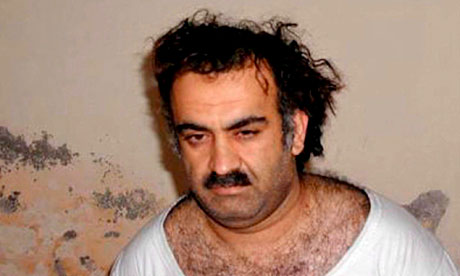
I’ll bet Khalid Sheik Mohammed was a cute child once, but this is the picture of him I’ve seen over and over.

No right-wing terrorists. You also don’t hear the term “right-wing terrorist” very often. In 2009, a report by the Department of Homeland Security called attention to the problem of right-wing violence, and identified “disgruntled military veterans” as targets for recruitment by right-wing hate groups. It quoted a civil rights organization:

large numbers of potentially violent neo-Nazis, skinheads, and other white supremacists are now learning the art of warfare in the [U.S.] armed forces.

The potential recruits were “a small percentage” of veterans, but a small percentage of a large number can still be disturbingly large.

Page was precisely the kind of veteran the report was talking about. But it’s too late for the report’s author (Daryl Johnson) to get credit in DHS, because he’s long gone. The report raised a furor in the right-wing media, which interpreted it as a slander against both veterans and the rising Tea Party movement.

Michelle Malkin wrote in the Washington Times:

It’s no small coincidence that Ms. Napolitano’s agency disseminated the assessment just a week before the nationwide April 15 Tax Day Tea Party protests.

Her column ended: “We are all right-wing extremists now. Welcome to the club.” That message was echoed by Fox News and Republican leaders: Right-wing terrorism was something the Obama administration dreamed up to slander all conservatives.

DHS responded to the furor by dissolving Johnson’s team, and Johnson himself left DHS a year after the report was published.

What I think is going on. There is an underlying narrative in mainstream culture that People Like You are threatened by People Like Them. If a story fits neatly into that frame, then OK, go with it.

But if the obvious interpretation of an event is that People Like You are the threat, that’s a problem. Nobody wants to hear that. And so Juan Cole’s Top Ten differences between White Terrorists and Others includes:

6. White terrorists are random events, like tornadoes. Other terrorists are long-running conspiracies.

 Atlantic’s Conor Friedersdorf puts it like this:

Watching Oak Creek, that subset of Americans was put in a position to realize that a day prior they’d have identified with the terrorist more than his victims. And so they quickly looked away.

Instead, we want to hear that the Threatening One is really not like us after all. He’s not a member of a group; he’s a loner. He’s not acting on beliefs that we share; he’s crazy. And his action is not a one-sided eruption of our hate onto their innocence; he’s a tortured soul who once had the potential for goodness; the suffering he inflicts arises from his own suffering.

The same thing happens on smaller scales. A couple years ago, the director of my church’s religious education program was describing the articles she’d been reading about bullying. They all discussed how to help your child deal with being bullied. “None of them,” she told me, “addressed the possibility that your child might be the bully.”

But the bully is always someone’s child. And no one wants to hear that.

I Was Undocumented in Arizona

Real Americans carry ID

When I turned 50 a few years ago, I started doing something sort of paranoid: I always jog with my driver’s license and medical card, in case I have a heart attack. So far it’s never come in handy, but I keep doing it.

Paranoia has its costs, though. Almost two weeks ago, I was at Logan Airport in Boston when I flipped my wallet open and stared at an empty plastic window. My driver’s license was in a t-shirt pocket in my laundry hamper. I had no other photo ID.

My first thought was to change my flight and come back tomorrow, but that would mean missing a whole day of the conference I was going to – the Unitarian Universalist General Assembly in Phoenix – so I went with my second thought: See what happens.

I got a boarding pass from a machine that didn’t care what I looked like, then waited in line with everybody else and apologetically told my story to the TSA guy. He called over a supervisor, who looked at what I did have: two credit cards and prescription bottle. Making no promises about what would happen when I tried to come home, he let me through.

Eight days later, TSA in Phoenix was more thorough. They scoffed at my credit cards and pill bottle, as well as at my business card (which has a photo), and the ID the conference had given me. They asked about my health-insurance card, which of course was keeping my driver’s license company in the laundry hamper. They would have liked to have seen some mail with my address on it or maybe a utility bill, which I might have packed if I had known I was going to forget all my other ID.

So they called up a government database and started asking me questions about myself: my address and phone number, my wife’s maiden name, other towns I had lived in, and so on. Some of the stuff I didn’t know, like the names of the neighbors in my apartment building. Eventually they did an explosives-residue test on my hands, and then let me through.

At no time was I treated with anything other than respect. No one implied that I was a criminal or that I was trying to get away with something.

While I was undocumented, I learned two things of political significance:

First, those advocates of voter-ID laws who claim it’s no big deal because you already need a photo ID to do absolutely everything else in this society – they’re just wrong. A lot of people will ask for a photo ID, but if you don’t have one they work around it. For example, some places took my credit card without asking. When someone did ask, nobody batted an eye when I said, “Oh, never mind, I’ll pay cash” or called my wife over to charge it on her card. They may have had other work-arounds, but I didn’t ask.

TSA definitely will work with what you have, because they’re just trying to verify your identity, not stop you from traveling. On the other hand, when you try to vote in a Republican state, you run into a process that absolutely won’t work if you don’t have an official state-issued photo ID, and even a state-university ID isn’t good enough. That’s unusual, and you have to wonder if that’s because the purpose is to stop you from voting.

Second, it was ironic that I was on my way to Phoenix, and that one of the things I would do there was protest the Arizona immigration law, S.B. 1070, which is sometimes known as the papers-please law.

I wandered around Arizona for a week with no proof that I’m a US citizen other than my white skin, my Illinois accent, and a nice pair of khakis. Nobody cared. I never had to explain myself and I never had cause to be afraid.

Everybody who heard my license-in-the-hamper anecdote thought it was funny and wanted to know how I got through TSA. But if I’d been brown, poor, and speaking with a heavy Hispanic accent, the story might not have been so entertaining.

So I was undocumented in Arizona and nothing happened. No drama, no excitement.

That’s how white privilege usually shows up: Nothing happens. Think about that the next time you’re out in public and nothing is happening.

Everybody will support same-sex marriage by 2030

OK, everybody may be an exaggeration. Let’s just say every politician of any significance: every presidential candidate, every governor, every member of congress, and the leadership of every party in every house of every state legislature.

Two charts tell you all you need to know about the politics of same-sex marriage. First, it has long-term momentum:

Second, it has the most inexorable kind of momentum there is: generational. Each day a few more supporters turn 18 and a few more opponents die. That’s how it’s going to be for a long, long time.

Explain it to the kids. That’s why President Obama explained his own change of heart this way:

Malia and Sasha, they have friends whose parents are same-sex couples. There have been times where Michelle and I have been sitting around the dinner table and we’re talking about their friends and their parents. And Malia and Sasha, it wouldn’t dawn on them that somehow their friends’ parents would be treated differently. It doesn’t make sense to them and, frankly, that’s the kind of thing that prompts a change in perspective.

This is how taboos fall. One generation genuinely believes in the taboo. The next follows it out of habit, but can’t defend it. And finally there’s a generation that challenges: The kids ask “Why?” and their parents have no answer.

Many of those parents will stay stuck in their ways, but politicians can’t afford to. They have to follow the majority, even if it goes against what they’ve stood for in the past.

We’ve seen this happen before.

Race and the Owens-Louis kids. When Jesse Owens won Olympic gold in Munich in 1936, and then Joe Louis defended his boxing title against Max Schmeling in a sold-out Yankee Stadium in 1938, the rooting wasn’t black vs. white. It was America vs. Nazi Germany.

To many of the white American kids who listened to those two events on the radio, it only made sense to let Jackie Robinson play major league baseball in 1947, and later, to start breaking down color barriers all across society.

When Guess Who’s Coming to Dinner? raised the interracial marriage taboo in 1967, the Owens-Louis kids were the generation in between the Tracy-Hepburn parents and their Sidney-Poitier-dating daughter. They knew interracial marriage was still beyond the pale. Most of them would never consider it themselves. But they couldn’t explain why.

When the Owens-Louis generation reached middle age in the 1970s, segregationist politicians had to capitulate. In 1963 George Wallace could pledge “segregation forever”. In 1970 he successfully ran a race-baiting campaign for governor. But by 1979 he was saying, “I was wrong. Those days are over and they ought to be over.”

The 1970s didn’t end racism — racists can still dog-whistle and use code words — but they ended the days when a politician could stake out an openly racist position and hope to win on it, even in Alabama.

Today, the Owens-Louis kids are the old folks, and returning to Jim Crow is as unthinkable as returning to slavery. Whenever same-sex marriage proponents are allowed to make the link to interracial marriage, the argument is over. No public figure will defend banning interracial marriage — a practice that was controversial even to talk about in 1967.

The Willow-Tara generation. In its acceptance of gays and lesbians, sports has trailed the culture rather than leading it. The characters who changed our thinking about homosexuality are more likely to be fictional ones we met through TV and movies.

In the late 1970s, it was edgy for Jack even to pretend to be gay on Three’s Company. Gay and lesbian minor characters started appearing on dramas like Hill Street Blues in the 1980s. Tom Hanks won an Oscar for his starring role as a sympathetic gay character in Philadelphia in 1993. From 1998-2006 Will and Grace (cited by Vice President Biden) centered on a gay man’s friendship with a straight woman.

I decided to symbolize this generation with a fictional same-sex couple almost exactly the age of the oldest Millennials: Willow and Tara on Buffy the Vampire Slayer, whose relationship began right around the turn of the millennium.

Earlier pop-culture characters got viewers sympathizing with the problems of gay and lesbian individuals and their same-sex relationships. But for most of two seasons Willow and Tara raised a different question: What if there is no problem? What if two people of the same gender meet and fall in love and are happy together?

Like Willow and Tara, the oldest Millennials are about 50 years younger than the Owens-Louis kids. So as a guess, let’s set the 2020s as the decade of capitulation on gay rights: Every major politician will either leave the business or have a change-of-heart by 2030. Even conservatives, even in the Bible Belt.

Remember the Dixiecrats. Does that seem unthinkable? What about Sarah Palin, Rick Santorum, and younger politicians who seem eager to follow their lead? But what about Strom Thurmond, who during his Dixiecrat presidential campaign of 1948 said:

that there’s not enough troops in the army to force the Southern people to break down segregation and admit the Negro race into our theaters, into our swimming pools, into our homes, and into our churches.

In 1971 Senator Thurmond integrated his staff, and in 1983 he voted to honor Martin Luther King with a federal holiday. The sincerity of his transformation may be dubious, but he had to make it.

Biden first. The leading edge of gay-rights capitulation is in the Northeast and among Democrats. So it’s no coincidence that President Obama was put on the spot by Vice President Biden. Whatever happens in 2012, Biden is looking down the road to the Democratic primaries of 2016. No way a Democrat with an ambivalent gay-rights position wins in New Hampshire (where same-sex marriage is already legal) in 2016.

Politicians can read trend lines. If you hope to win statewide office in the Northeast or in California in 2020 — or anywhere in 2030 — you can’t be against same-sex marriage. The question isn’t whether you’ll change, it’s when.

The ancient ship Homophobia has had a long run, but it is going down. While it may take years to sink completely, no politician wants to go down with it. Those with any sense are already checking the exits and plotting their departure.

Too Racist for the National Review and other short notes

It’s rare to see white racism this explicit. National Review writer John Derbyshire (writing for Taki’s Magazine, not NR; the traffic nearly brought Taki’s web site down Saturday afternoon; you may still have trouble raising that “white racism” link to the article), wrote a “non-black version” of “the Talk” parents give their kids about race. (Various black parents had previously published their version of the Talk, for example Daryl Owens.)

Among other dubious advice, Derbyshire tells his son to avoid events that are likely to attract a lot of blacks, and to leave if an unexpectedly large number of blacks show up. He should also not “play the Good Samaritan” to blacks in distress or settle in a town where black politicians are in control. And of course:

Before voting for a black politician, scrutinize his/her character much more carefully than you would a white.

(I guess that’s why we all had to see Obama’s birth certificate and listen to his minister’s sermons — things I don’t recall ever doing for a white candidate.)

Derbyshire lays it on the line that “The mean intelligence of blacks is much lower than for whites.” And of course they hate you anyway, so always use the white clerk at the DMV if you have a choice.

Finally, on the rare occasions when you can find an IWSB — intelligent, well-socialized black (Derbyshire’s acronym) — make friends with them, because

In addition to the ordinary pleasures of friendship, you will gain an amulet against potentially career-destroying accusations of prejudice.

For some reason, that amulet didn’t save Derbyshire this time. National Review fired him. That’s what happens when you forget to use your dog whistle.


Daily Kos’ Bill in Portland puts two and two together:

The Supreme Court says corporations are people. The Supreme Court also says that people can be strip-searched for any reason whatsoever. Therefore, corporations can now be strip-searched for any reason whatsoever. Let’s start with…[Snaps rubber gloves]…oh, how ’bout Koch Industries.


Alternet’s Sara Robinson sees conservatives mobilizing for an all-out attack on state universities.


Democrats introduced an amendment to the FCC Process Reform Act of 2012 that would have allowed the FCC to block FCC-regulated companies from requiring employees to reveal their Facebook passwords. It failed, because all Republicans in the House voted against it. I haven’t found any reason beyond a general distaste for workers’ rights.


Nicholas Kristof’s Easter column “Learning to Respect Religion” is worth reading whether you are religious or not.


Executive pay: Obscenely high and still rising.


Large numbers of journalists continue to believe that it’s not their job to question whether what a candidate says is true.


Prejudice, Bigotry, and “Reasonable” Racism

As the national argument about the killing of Trayvon Martin continues, the people who sympathize with Martin’s killer keep bringing up this point: Yes, it’s racist to be suspicious of young black men for no reason beyond their youth, blackness, and manhood – but given the crime statistics, isn’t that reasonable?

Before I start addressing that question, I need to tell you that I spent nearly six years as a graduate student at the University of Chicago, which at the time (the Eighties) was an oasis of middle-to-upper class, integrated-but-mostly-white America, surrounded by a predominantly black ghetto. (Since then, the siege has been lifted by an army of gentrifiers marching south down Michigan Avenue from the Magnificent Mile.) Just about everybody I knew had been a crime victim at some time or other. Personally, I was never threatened with bodily harm, but I had a car stolen once, and my bike was stolen out of my girlfriend’s car.

Like just about all my classmates, I developed a special awareness of young black men (despite the fact that one of them was a fellow grad student whose office was just down the hall from mine). I spotted them at a great distance, and might cross the street if I couldn’t figure out what they were up to.

Sometimes, my wariness turned out to be so ridiculous I had to laugh at myself. Once, I remember, closer inspection showed that the “young men” were more like 12, and the mysterious objects they were carrying were musical instruments. What they had done to raise my suspicion was mill around on the sidewalk waiting for someone to unlock the door to their recital.

Clearly I had been just minutes from death.

Prejudice. During those years I came to understand that there is a difference between prejudice and bigotry. Prejudice is exactly what it sounds like: a pre-judgment, an opinion that you have before you learn any specific facts about the situation. Your prejudices may be justified or unjustified, they may save your life or create dangerous confrontations out of nothing. But you can’t help having some, because the human mind constantly creates expectations of the near future. A well-trained mind will base those expectations on facts if it has some, but if it doesn’t it will expect something anyway.

So anybody who tells you that they’re not prejudiced is blowing smoke. Everybody is prejudiced. Your prejudices may or may not be racial (though if you grew up in America they probably are), but if you’re dropped into a situation you know nothing about, you’ll react to it somehow, based on some pre-judgment.

Bigotry. Prejudice is universal, but bigotry is more sinister; it’s an attachment to your prejudices. Sometimes people fall in love with their prejudices to the point that they don’t want to know the facts. If confronted with facts that conflict with their prejudices, they will ignore them and make up new facts.

So imagine that you’re a white admissions officer at an Ivy League college. Your mail today includes two applications, one from a white student at an upscale suburban high school, the other from a black student at a ghetto school. If your snap expectation is that the white kid will have higher SAT scores than the black kid, that’s prejudice.

But what you do next determines whether or not you’re a bigot. When the test scores become available, do you look? If it turns out that the ghetto kid’s scores are higher, do you accept them or do you assume something funny must have happened? Do you scour the application looking for evidence that he’s not really that smart?

If you’re not a bigot, you look at the scores and change your opinion accordingly. And the next time you get an applicant from the same ghetto high school, your prejudice will be a little less sure of itself.

Everybody has prejudices. But reasonable people hold those prejudices lightly, re-judge a situation when facts become available, and continually re-train their prejudices to be more accurate.

Zimmerman and Martin. OK, now imagine you’re George Zimmerman doing your Neighborhood Watch thing. You spot a black teen you’ve never seen before, and it sets your alarm bells ringing. That’s prejudice, but so what? Maybe it’s got some reasonable basis.

When I listen to Zimmerman’s 911 call, though, I hear bigotry. He can’t point to a single suspicious thing Martin is doing, but he’s trying hard to interpret anything he sees so that it will confirm his prejudice. Mostly, he reports judgments rather than facts. Martin is “up to no good”, he “looks like he’s on drugs” and so on. (Actually, we know, Martin is staying with someone in the neighborhood, has been to the store and is on his way back. He’s talking to his girlfriend on the phone, which might be why he’s in no hurry.) “They” always get away with it. And so on, right up to the much-debated “fucking coons” comment.

So anyway, I’m willing to cut Zimmerman some slack for his original suspicions. Who knows, maybe I’d have been suspicious too. But what should he have done then?

How about this: No gun, no 911 call. You just walk up to Martin with a smile and say, “Hi, I’m with the Neighborhood Watch. I didn’t recognize you so I thought I’d introduce myself. I’m George Zimmerman and I live over on XYZ Street. Do you live around here or are you visiting someone?” Maybe you get an answer and go on your way. Maybe Martin tells you to go fuck yourself. Maybe he runs. Maybe (for all you know before you ask) he really is the thug you’re afraid of, and he pulls a handgun out of his hoody and starts blasting.

I think that’s the chance you have to take. If you’re not brave enough to take it, you’ve got no business being out there in the first place. Stay home, lock your door, and let somebody else watch the neighborhood.

When is racism reasonable? Finally, we come to the question of whether suspicion of blacks is a reasonable prejudice in the first place. After my Trayvon Martin post last week, a reader emailed me a link to FBI crime statistics broken down by race. If that’s where your analysis ends, being suspicious of black men looks reasonable.

But chaunceydevega on Daily Kos went a little further and challenged the basis of those statistics. How much black crime do police find simply because they are looking for it?

As compared to white neighborhoods, black and brown communities are also subject to more severe surveillance and aggressive police tactics.

And how often is a white let off with a warning where a black might be charged? (It seems particularly ironic to quote crime statistics when discussing Martin and Zimmerman. So far, Zimmerman killing Martin doesn’t register as a crime. How many similar cases don’t draw national attention and so never show up in crime statistics?)

Sometimes when illegal drug use is measured in ways unrelated to the criminal justice system, whites turn out to be at least as guilty as blacks and Hispanics. Yet, they are arrested, charged, convicted, and jailed far less often. Maybe that’s true of other crimes as well.

So where does that leave us? In my Chicago days, I doubt chaunceydevega’s arguments would have convinced me. (Even though I never actually saw the people who stole my car. For all I know, Saul Bellow and Bruno Bettelheim took it for a midnight joy ride. Their alibis were never checked.) I thought I knew what I thought I knew, so young black men scared me.

As any white-knuckle flier can testify, telling scared people not to be scared usually doesn’t work very well, even if you have statistics. Or reason to challenge the prevailing statistics.

Here’s my hope: Maybe encouraging scared people to be brave works a little better. Whether you think your prejudices are justified or not, keep your eyes open and try not to give in to fear too quickly. Hold your prejudices lightly. Watch carefully for evidence that contradicts them.

Otherwise you might end up running from 12-year-old musicians. Or shooting Trayvon Martin.

Trayvon Martin: the Racism Whites Don’t Want to See

I tend to filter out crime stories, because so often they get more coverage than they deserve, like O. J. Simpson. So I’ve been slow to catch on to the significance of the Trayvon Martin story. But lately this has turned into a meta-story: reactions to the killing say even more about our country than the killing itself did.

The basic facts are simple: A white-Hispanic neighborhood-watch volunteer (George Zimmerman) got suspicious of a 140-pound black teen-ager (Trayvon Martin) for no apparent reason. He called 911, and the dispatcher told him not to follow the kid. Zimmerman followed anyway. Some kind of confrontation ensued and he shot Martin dead. Martin was unarmed and had nothing easily mistaken for a weapon, but the police accepted Zimmerman’s self-defense claim (in spite of at least one witness who denied it) and let him walk away. That all happened back on February 26, there’s still been no arrest, and the local African-American community is getting pretty upset about it.

The story points out the continuing presence of racism in America. To some segment of the population, being black raises suspicion all by itself. Probably Zimmerman is not the kind of racist who would go out hunting black teens at random. Probably he really believed that Martin was planning some kind of mischief, and that Martin must be armed, so that he had to shoot first once the confrontation started. But why did he think that? Why did he frame the situation in such a way that shoot-to-kill seemed sensible?

And why did the police find his story credible and his actions excusable? You’re an armed white adult chasing an unarmed black teen-ager you outweigh by about 100 pounds. Naturally, you would feel threatened.

That’s the kind of racism that is still endemic in every nook and cranny of America. We’re almost entirely past the “I don’t hire niggers” phase, but still in a phase of “he just doesn’t look trustworthy to me”. What would look like a well-deserved break for a white employee is goofing off when a black does it. An ordinary mental glitch becomes evidence of low intelligence, and so on.

Being black is no longer three strikes against you, but it’s still one or two.

By and large, White America doesn’t want to believe that. Last year a poll found that 51% of whites (also 60% of Republicans and 68% of people who name Fox as their most trusted news source) say that reverse discrimination against whites is at least as big a problem as discrimination against minorities.

You can see just how badly White America doesn’t want to believe in its continuing racism by how it has reacted to the Martin story. Fox News did its best to ignore the whole thing. ThinkProgress totaled up how much attention each cable news network gave the Martin story during its first three weeks:

Compare this to Fox’s obsessive coverage of a series of scary-black-people stories. For example, it devoted 95 segments totaling 8 hours of air time to the trumped-up voter-intimidation charges against the New Black Panther Party.

Or check out how the Glenn-Beck-founded blog The Blaze has covered Martin’s death. Searching on the word “Trayvon” got me 15 stories, five of which were about the scary ways black people are reacting to the incident — the New Black Panther Party (of course), Louis Farrakhan, Al Sharpton, Barack Obama, and the New Black Liberation Militia. The Sharpton post ends by raising more suspicion about Martin. (He was on a 10-day suspension from school, and “Sources sympathetic to Martin say he was suspended for ‘excessive tardiness’.” But the Blaze makes sure we know all the more serious stuff that a 10-day suspension could be about.)

A sixth Blaze post quotes Beck himself, who is worried not about white vigilantes, but about black extremists “winding everybody up”:

“We have this extremist African-American militia group that says they’re just going to come in and handle it. You’re got Al Sharpton winding everybody up. You’ve got Color For Change winding everybody up.” … Beck ceded that the man who shot Trayvon could indeed be a racist, but that many of his detractors are driven by a racial agenda too, and thus are everything they claim to stand against.

Got that? You should focus not on what actually happened to an innocent black teen, but on what “extremist” black groups might do. Zimmerman could be a racist, but blacks and liberals upset by the Martin story are racists.

So the beat goes on: For the part of the media that panders to I-am-not-a-racist whites, the Martin story is just one more example of racism against whites and one more reason for white people to be afraid of black people.


Among the presidential candidates, only Newt Gingrich directly pandered to white racists by turning the incident into a reverse-racism story. President Obama had reached out to Martin’s parents, saying “If I had a son, he’d look like Trayvon.”

Gingrich’s response:

Is the president suggesting that if it had been a white who had been shot, that would be OK because it didn’t look like him? That’s just nonsense dividing this country up. … When things go wrong to an American, it is sad for all Americans. Trying to turn it into a racial issue is fundamentally wrong. I really find it appalling.

Gingrich glossed over the whole walking-while-black angle that makes the story important: If Trayvon Martin had been white, he might not have been shot at all. George Zimmerman “turned it into a racial issue”, not President Obama.


While researching this case, I learned something interesting about the law: Self defense falls into a class known as affirmative defenses. In other words, at your trial you’re not just looking at the state and saying “Prove I did it”, you’re making assertions about facts that are supposed to exonerate you. When you do that, part of the burden of proof shifts to you.

So the state does not have to prove beyond a reasonable doubt that Zimmerman did not act in self defense. In making a self-defense plea, Zimmerman would be conceding that he killed Martin, and he would then need to convince the jury of his self-defense claim by a preponderance of evidence (not beyond reasonable doubt).


Want some background music to read this piece by? Try Eminem’s “White America“:

Look at these eyes:
Baby blue, baby, just like yaself.
If they were brown, Shady lose,
Shady sits on the shelf.

Jim Crow Returns

A fascinating new analysis technique has added weight to the claim that voter-ID laws are functioning as “Jim Crow 2.0“.

In state after state, the Republican governors elected in 2010 have been pushing voter-ID laws that follow the ALEC template. The Brennan Center for Justice has been on this issue for a long time, pointing out how these laws erect unfair barriers to voting by the young, the old, minorities, and many women (particularly those recently married or divorced, who might not have ID in their current names) — all constituencies that tend to vote Democratic.

Ostensibly, these laws are intended to prevent the voter fraud that allegedly alters elections through the high-risk/low-reward process pictured below:

Lately, judges and the Justice Department have been agreeing with the Brennan Center that disenfranchising marginal voters is not just an unfortunate side-effect, but is the true intention behind these laws.

Prior to the Voting Rights Act of 1965, blacks had been virtually disenfranchised in many southern states. The Act dismantled the Jim Crow laws that enforced that disenfranchisement, and gave the Justice Department veto-power over any new laws in Jim Crow states that would affect the voting rights of minorities (rather than letting the laws take effect and requiring disenfranchised voters to sue). The Justice Department has used that power to invalidate voter-ID laws in South Carolina and Texas.

The Texas law is particularly egregious. ColorLines reports:

Texas has no driver’s license offices in almost a third of the state’s counties. Meanwhile, close to 15 percent of Hispanic Texans living in counties without driver’s license offices don’t have ID. A little less than a quarter of driver’s license offices have extended hours, which would make it tough for many working voters to find a place and time to acquire the IDs.

Now Texas has struck back: Its lawsuit claims the Voting Rights Act is unconstitutional, because southern states aren’t being treated the same as northern states. The Supreme Court is probably going to have to decide this.

When they do, I hope they take a hard look at the work of LeoT on Daily Kos. LeoT examines the historical frequency-of-use of terms like election fraud, vote fraud, and voter fraud. (Don’t you just love the Google tools that make this possible?)

All the terms have similar usage patterns except voter fraud. The term was virtually unknown until around 1960, then mysteriously in 1965 its usage began a steady increase, uncorrelated with the other election-fraud terms, until now it gets more usage that vote fraud.

LeoT interprets:

“voter fraud” … increased in usage 15,000% (150x) between 1965 and 2008, while “election fraud” increased 250% (2.5x) in the same period. Apparently, “voter fraud” didn’t matter until you weren’t allowed to disenfranchise minority voters.

Conclusion: The voter fraud issue has been manufactured to justify Jim Crow 2.0.