Tag Archives: race

No, Donald Sterling Isn’t the Victim

Wednesday, NBA Commissioner Adam Silver announced his response to the recordings in which L. A. Clippers owner Donald Sterling makes racist statements: Sterling is fined $2.5 million and banned for life from interacting with the Clippers or any other NBA team. Silver can’t force Sterling to sell his team, but he says the other NBA owners collectively can, and he’s going to ask them to do so.

Trust Fox News’ Megan Kelly* to address the side of the story the liberal media doesn’t want to face: Isn’t the rich white guy the real victim here?

The question is whether the deprivation of his property rights — in terms of his ownership rights of a sports team … of basically taking away his livelihood, is a slippery slope. … Is this the future of America, where private conversations between two people who are supposedly in a relationship wind up going public and then somebody who makes clearly inappropriate remarks (to put it charitably) has everything taken away from them?

In this telling of the story, Sterling is the victim of two injuries: the original invasion of privacy, and then the reaction of the NBA commissioner, which might force Sterling to sell his team.

In response, I would paraphrase Supreme Court Justice Oliver Wendell Holmes: An NBA owner has a constitutional right to be a racist, but he has no constitutional right to be an NBA owner.

The invasion of privacy is definitely an injury, but it’s the kind of thing that has been happening to public figures (and occasionally non-public figures) for some time, usually without negative comment from Kelly. Just this week, there was another Rob Ford crack-smoking video. Remember the rant Alec Baldwin left on his daughter’s answering machine or when he was recorded yelling homophobic slurs at paparazzi? Or Mel Gibson? John Kerry got in trouble this week because someone leaked a recording of a closed-door meeting. Both Romney and Obama had trouble with secret recordings. The whole ACORN sting video was based on secret recordings (which were then edited to make them sound worse). Linda Tripp secretly recorded Monica Lewinsky. ESPN’s Erin Andrews was filmed naked through a hotel-room peephole, and let’s not even get into all the sex tapes and nude photos of ordinary people that have become public without their consent. (Here’s an example of someone who really lost her livelihood.)

I’m happy Megan Kelly has finally noticed this issue, now that there’s a racist billionaire to defend.

But “property rights” is a complete red herring. First, the obvious: Being forced to sell something is not the same as having it (or “everything”) taken away from you. Sterling will get a good price for the Clippers and continue to be a billionaire. His “livelihood” is not at stake.

Second, an NBA team is not an independent business like a barber shop or a diner. The NBA is a cartel, not a collection of independent businesses, and the value of the Clippers comes from its membership in the cartel, not its potential earnings as an independent basketball team. The cartel has rules that the owners have agreed to. If we start defending Sterling’s right to do what he wants with his team, regardless of what the league agreement says, then we’d also have to defend the other owners’ right to do what they want with their teams — like refuse to schedule games against the Clippers, making Sterling’s team more-or-less worthless.

There’s a reason sports teams are called “franchises”. You may own a McDonald’s franchise, but if you bring shame to the McDonald’s chain, I’m sure they have a way to get that franchise away from you. Same thing here.

In addition to shame, Sterling is bringing labor problems to the NBA.

Players’ union Vice President Roger Mason Jr. said Tuesday he spoke to representatives from every playoff team about the possibility of boycotting the upcoming postseason games in solidarity against any ruling that didn’t include a mandate for Sterling to sell the Clippers.

The NBA is 76% black, and the idea that the white (but for Michael Jordan) owners don’t respect them because of their race must always be in the background. In addition, Sterling’s remarks made it clear that he has a paternalistic view of ownership in general. Asked about his players, Sterling said:

I support them and give them food, and clothes, and cars, and houses. Who gives it to them? Does someone else give it to them? … Who makes the game? Do I make the game, or do they make the game?

The players don’t earn their money — much less earn money for Sterling — Sterling “gives it to them”. This is straight out of Atlas Shrugged, when John Galt tells the workers at Hank Rearden’s steel mill:

Would you dare to claim that the size of your pay check was created solely by your physical labor and that those rails were the product of your muscles? The standard of living of [a medieval] blacksmith is all that your muscles are worth; the rest is a gift from Hank Rearden.

So players are threatening work stoppages, sponsors are pulling out, and fans are protesting. In the lingo of another famous cartel — the Mafia — Sterling’s continued ownership is “bad for business”. The other bosses need to take him out.


* Kelly was the first one to draw my attention, but in fairness Sterling-as-victim has been a popular topic in the conservative media. See also Donald Trump, Rush Limbaugh, Alex Jones, John Hinderaker, National Review

More Than Just Affirmative Action

The Court has decided to trust majority rule to defend minority rights. That didn’t work very well the last time.


It’s hard to appreciate this week’s Supreme Court decision on affirmative action without knowing about a case from the 19th century.

The Civil Rights Cases. In 1883, just a few years after Union troops stopped occupying the states of the former Confederacy, the Supreme Court ruled on five cases it combined into the Civil Rights Cases (Wikipedia, text of decision). Eight justices ruled unconstitutional the Civil Rights Act of 1875, which banned racial discrimination in “accommodations, advantages, facilities, and privileges of inns, public conveyances on land or water, theaters, and other places of public amusement”. The Court said that Congress had overstepped its power, because the 13th and 14th Amendments only gave it “corrective” power to reverse state laws that denied blacks their civil rights. Congress couldn’t legislate directly to guarantee those rights.

And then the Court went on to make a more sweeping statement:

When a man has emerged from slavery, and, by the aid of beneficent legislation, has shaken off the inseparable concomitants of that state, there must be some stage in the progress of his elevation when he takes the rank of a mere citizen and ceases to be the special favorite of the laws, and when his rights as a citizen or a man are to be protected in the ordinary modes by which other men’s rights are protected.

In other words, if the former slaves needed this kind of protection, they should seek it from their state governments, the way white people would. No doubt that sounded very reasonable to most whites, even most Northern white liberals: Slavery was over; the former slaves were citizens now; they should avail themselves of the protections the law had made for other citizens.

But Douglas Blackmon observed in Slavery By Another Name that things didn’t quite work out that way.

Civil rights was a local, not federal issue, the Court found. The effect was to open the floodgates for laws throughout the South specifically aimed at eliminating those new rights for former slaves and their descendents. … [A] declaration by the country’s highest courts that the federal government could not force states to comply with the constitutional requirement of the equal treatment of citizens, regardless of race, opened a torrent of repression.

As reasonable as it may have sounded at the time, from the perspective of history the Civil Rights Cases decision was the opening bell for the Jim Crow era. Due process and equal protection under the laws had become pro forma rights; if a state preserved certain outward appearances, it need not provide any real equality. Or, more accurately, the state continued to have a moral obligation to provide equality, but the federal government had no authority to enforce that obligation. The lone dissent of Justice John Harlan (not to be confused with his grandson, John Harlan II, a 20th-century Supreme Court justice whose opinions figure as precedents in this week’s ruling) was prophetic:

[I]f the recent amendments are so construed … we shall enter upon an era of constitutional law when the rights of freedom and American citizenship cannot receive from the nation that efficient protection which heretofore was unhesitatingly accorded to slavery and the rights of the master.

Harlan also was the lone dissent in the 1896 Plessy v Ferguson decision that enshrined separate-but-equal. He deserves to be more famous than he is.

Michigan. Now let’s talk about this week’s decision, Schuette v Coalition to Defend Affirmative Action. Like most race cases these days, there has been a back-and-forth that makes the underlying principles hard to sort out: Until 2003, the University of Michigan used race as a consideration for admission to both its undergraduate program and its law school. That year, the Supreme Court ruled on both: It threw out the undergraduate system in the Gratz decision but upheld the law school system in Grutter.

Both cases hung on the same issues, and Justices O’Connor and Breyer were the swing votes. Previous cases had identified only one interest that could justify affirmative action by a state university: the overall educational advantage provided by a diverse student body. In other words, the state couldn’t favor one race for the simple purpose of giving that race an advantage, but it could decide that a diverse student body provides a better education for everyone. (Imagine studying the Civil War in an all-white classroom versus a classroom where other races are represented. Probably the discussions would be very different, and a university might legitimately decide that the mixed-race classroom experience is better.) But the Court insisted that the particular plan to promote diversity had to be narrowly tailored for that purpose, rather than resembling a racial quota system. The law-school plan passed muster under the narrowly-tailored standard; the undergraduate plan didn’t.

But Michigan’s anti-affirmative-action groups weren’t satisfied with a split decision, so in 2006 (as a direct response to Grutter), a referendum added an amendment to the Michigan Constitution banning “preferential treatment to any individual or group on the basis of race, sex, color, ethnicity, or national origin” in education, hiring, or contracting by the state or any public institution under the authority of the state. Overall, the amendment passed with a clear 58%-42% majority, but the exit poll showed major demographic splits: White men voted for it 70%-30%, while non-white women opposed it 82%-18%. If you work out the numbers, the entire margin of victory came from white men (42% of the electorate), while everyone else split almost evenly.

So you wind up with two separate levels of dispute: affirmative action itself, but also the limits of democracy. In other words, if the majority doesn’t get its way for some reason, under what circumstances can it change the rules?

The Political Process doctrine. The history of the Civil Rights movement since 1883 has been a story of the white majority changing the rules whenever the black minority seemed about to rectify some disadvantage. If the 15th Amendment gave blacks the right to vote, poll taxes and literacy tests could take it away, while grandfather clauses protected poor or illiterate whites from disenfranchisement. If Arkansas couldn’t keep blacks out of Little Rock’s Central High, the governor could shut the school down. Slavery By Another Name is about how Southern whites circumvented the elimination of slavery itself by inventing bogus crimes that blacks could be convicted of and then sentenced to hard labor.

The Supreme Court cases on race — from the Civil Rights Cases to Brown and beyond into enforcing Brown‘s requirement of integrated schools — revolve around the Court’s increasing realization that it couldn’t deal with state and local governments under the assumption of good faith. The white majority simply did not want blacks to receive due process and equal protection under the laws, and any high principles announced by the Court would be examined for loopholes rather than implemented.

As a result, the Court evolved what came to be called the Political Process doctrine: If a minority achieves one of its goals through the ordinary decision-making process — courts, school boards, elections, etc. — and the majority responds by changing the rules to move the decision to a different body where the minority will lose, that rule-change deserves special scrutiny from the courts. If there was no compelling reason to change the process beyond frustrating the minority, the change is invalid.

Justices Sotomayor, Ginsberg, Scalia, and Thomas all agree that the Political Process doctrine applies to this case. Sotomayor and Ginsberg want to invoke it to invalidate the Michigan constitutional amendment, while Scalia and Thomas want to take this opportunity to reverse the doctrine entirely. The plurality opinion (written by Justice Kennedy, and joined by Roberts and Alito), is another example of something I complained about two weeks ago: covertly reversing decisions without appearing to do so. After Schuette, the Political Process doctrine is dead. While it remains as a precedent, it’s hard to imagine a situation where it could be invoked.

And that development has consequences beyond affirmative action.

The opinions. The plurality opinion (representing Kennedy, Roberts, and Alito) was written by Justice Kennedy. If you’ve been reading the Sift since last summer, you know I don’t think much of Justice Kennedy’s writing style and the muddled mind it seems to represent. (Lower court judges seem not to know how to apply Kennedy’s rulings, which tells you something.) I suspect that’s why the Chief Justice chose Kennedy to write this opinion rather than doing it himself. Any judge who tries to invoke the Political Process doctrine in the future will have to glean some principles of application from Kennedy’s opinion; probably they will just throw up their hands and decide the case on some other basis.

Kennedy reminds us that “It cannot be entertained as a serious proposition that all individuals of the same race think alike”, that there are no clear legal standards for determining the interests of a racial group, or even of defining who is in or out of the group, and so on. If the Court allows that there are racial interests that prevent rule changes, race might be dragged into any number of issues in order to freeze the process in place.

In short, if racial majorities decide to act in bad faith, judges are simply not clever enough to catch them. Kennedy concludes:

Democracy does not presume that some subjects are either too divisive or too profound for public debate.

as if anyone had ever made that claim.

Scalia’s dissent (joined by Thomas) is painful to read, because as he gets older, Scalia is less and less able to pretend that he respects anyone who disagrees with him. So his opinions increasingly contain more attitude than law. But at least he does go through the relevant precedents, explaining why they were all wrongly decided. I would love to hear Justice Scalia’s opinion on the Civil Rights Cases, or whether rule changes that disadvantage a minority should ever be thrown out by the Court. Most of all, I want to hear how he will square all this with what he rules in the upcoming Hobby Lobby case, where the minority seeking protection is abortion-opposing Christian employers.

Justice Breyer’s concurrence shows more honest inner conflict than any of the others. He wants to support both the democratic process and minority rights, but has to come down on the side of democratic process.

the principle that underlies [the Political Process doctrine precedents] runs up against a competing principle, discussed above. This competing principle favors decisionmaking through the democratic process. Just as this principle strongly supports the right of the people, or their elected representatives, to adopt race-conscious policies for reasons of inclusion, so must it give them the right to vote not to do so.

Justice Sotomayor’s dissent (joined by Ginsberg) is as long as all the rest put together, probably because she alone is arguing that the Court needs to pay attention to nuance. Like Scalia, she takes the precedents seriously, but she wants to apply those precedents rather than reverse them. She also thinks the Court needs to consider where the Michigan constitutional amendment fits in the long history of changing the rules to short-circuit minority victories.

As a result of [the amendment], there are now two very different processes through which a Michigan citizen is permitted to influence the admissions policies of the State’s universities: one for persons interested in race-sensitive admissions policies and one for everyone else. A citizen who is a University of Michigan alumnus, for instance, can advocate for an admissions policy that considers an applicant’s legacy status by meeting individually with members of the Board of Regents to convince them of her views, by joining with other legacy parents to lobby the Board, or by voting for and supporting Board candidates who share her position. The same options are available to a citizen who wants the Board to adopt admissions policies that consider athleticism, geography, area of study, and so on. The one and only policy a Michigan citizen may not seek through this long-established process is a race-sensitive admissions policy that considers race in an individualized manner when it is clear that race-neutral alternatives are not adequate to achieve diversity. For that policy alone, the citizens of Michigan must undertake the daunting task of amending the State Constitution.

But that point of view lost. As in last summer’s Voting Rights decision (in which Chief Justice Roberts announced the profound legal principle that “things have changed”) the history of racism and racial progress in America is not considered relevant by the Roberts Court. Going forward, the Court appears ready to assume good faith on the part of the white majority. Let’s hope it works out better this time.

Cliven Bundy and the Klan Komplex

Why the rancher’s racist rant shouldn’t have surprised anybody


If you’ve been paying attention to the Cliven Bundy situation at all (as I started doing last week) you no doubt heard that Wednesday night he went off script in front of a New York Times reporter:

“I want to tell you one more thing I know about the Negro,” he said. Mr. Bundy recalled driving past a public-housing project in North Las Vegas, “and in front of that government house the door was usually open and the older people and the kids — and there is always at least a half a dozen people sitting on the porch — they didn’t have nothing to do. They didn’t have nothing for their kids to do. They didn’t have nothing for their young girls to do.

“And because they were basically on government subsidy, so now what do they do?” he asked. “They abort their young children, they put their young men in jail, because they never learned how to pick cotton. And I’ve often wondered, are they better off as slaves, picking cotton and having a family life and doing things, or are they better off under government subsidy? They didn’t get no more freedom. They got less freedom.”

Reactions varied. Bundy’s own first reaction was to claim he had been misquoted — “I didn’t say nothing about picking cotton” — until Media Matters released the video of him saying it.

Mainstream Republicans who had made a hero of Bundy — Rand Paul and Sean Hannity in particular — claimed to be shocked, and dropped the rancher like a hot rock. But the true believers promoted a smeared-by-the-liberal-media theme. InfoWars posted a longer version of the video that it claims vindicates Bundy: “his argument is actually anti-racist in that it laments the plight of black families who have been caught in the trap of dependency on government.” (I invite you to click through and examine the larger context for yourself. I don’t think it vindicates much of anything, probably because I already see the “dependency on government” meme as a racist dog whistle. I mean, we all know who those dependent-on-government people are, don’t we? We’re not talking about my white mother depending on Medicare to pay her hospital bills.)

One of the best responses came from satirist Andy Borowitz, whose invented quotes nail the hidden meaning of the mainstream Republican reaction:

“We Republicans have worked long and hard to develop insidious racial code words like ‘entitlement society’ and ‘personal responsibility,’ ” said Sen. Rand Paul (R-Kentucky). “There is no excuse for offensive racist comments like the ones Cliven Bundy made when there are so many subtler ways of making the exact same point.”

Fox News also blasted the rancher, saying in a statement, “Cliven Bundy’s outrageous racist remarks undermine decades of progress in our effort to come up with cleverer ways of saying the same thing.”

If you hear someone saying that Bundy just wasn’t “politically correct” — or that the problem is “an old man rancher isn’t media trained to express himself perfectly” —
that’s what they really mean: It’s fine to imply that slavery wasn’t so bad and to characterize black people receiving government assistance (i.e., all of them) as lazy and promiscuous and criminal, but you have to use the right words, like Paul Ryan did in March:

We have got this tailspin of culture, in our inner cities in particular, of men not working and just generations of men not even thinking about working or learning the value and the culture of work. There is a real culture problem here that has to be dealt with.

Ryan presumably does have some media training, so he didn’t say Negro or mention slavery or picking cotton —  and it’s those words (and not the ideas behind them) that make Bundy’s quote racist, right? Ryan criticized the “culture” of the “inner city” rather than black people, so his comment couldn’t be racist — “I don’t have a racist bone in my body” he said afterward — even though everybody knew who he was talking about and what he meant.

By contrast to the apparent shock of Sean Hannity, liberals mainly expressed surprise that anybody would be surprised by the discovery that Bundy is a racist. Matt Yglesias found it “clarifying” that Bundy had gone off on race “because race has not been far from my mind since the story first hit the papers.”

On Bill Mahr’s Real Time, Daily Beast editor John Avlon explained:

The reason it’s predictable is that we’ve seen a pattern, especially at a time when the face of the federal government is an African-American. The association with racists is becoming the black lung disease of the conservative movement. It’s an occupational hazard. … You start seeing a pattern and at some point you’ve got to confront it: “How come we keep making common cause with racists?” Maybe it’s got something to do with some of the appeals they’re making.

Rachel Maddow did the best job of laying that pattern out: Much of what Bundy had been saying all along were the kinds of bizarre ideas that are not themselves racist, but are way more popular in white supremacist circles than anywhere else. (It’s like an accent; you don’t have to be Canadian to end a question with “eh”, but if you do you probably are.) Rachel drilled down into the history of one particular strange notion: that county sheriffs are the ultimate in legitimate legal authority. Bundy had been urging his own county sheriff to disarm the federal agents, as if the sheriff’s authority were paramount. (In 2012, a fringe candidate for sheriff in my own Hillsborough County, NH professed a similar view of the job he imagined himself to be running for. He lost.) Rachel chased that notion back through the 20th-century Posse Comitatus movement, and from there back to the Southern resistance to Reconstruction in the 19th century.

Something I’m just beginning to appreciate is how influential the Southern anti-Reconstruction movement that birthed the KKK has been in forming the ideas that are still running around on the extreme Right. If you want initiate yourself into this mindset, I recommend reading Thomas Dixon’s 1905 best-seller The Clansman: a Historical Romance of the Ku Klux Klan, which inspired the 1915 movie classic The Birth of a Nation, and whose themes were still echoing in 1936’s Gone With the Wind. Dixon drops you into a world where the Klan are the good guys. Evil Washington politicians have conspired with corrupt and rapacious local blacks to upend the natural order and create a black-dominated society. Unable to take any more, the noble Southern whites arm and organize themselves into a freedom-seeking secret society, the KKK. Once they do, the fundamentally cowardly black troops that Washington has tried to stand up against them scatter like nine-pins.

This “historical romance” has essentially nothing to do with the actual history of the KKK, which from the beginning was focused on terrorizing blacks out of claiming their rights.

But there’s a configuration of ideas we might call the Klan Komplex — a combination of Lost Cause mythology, John Calhoun’s* misinterpretation of the Constitution and miscasting of the Founders, love of guns, and hatred of the federal government — that survives to this day in radical right-wing fringe groups. Today many of these ideas sound like nonsense to outsiders, but the whole Komplex makes sense if you picture yourself as a defeated Southern aristocrat watching victorious Union troops side with your former slaves against you, and looking to the heroic knights of the KKK to restore you to your rightful dominance.

  • The federal government is illegitimate, having grossly exceeded the authority legitimately granted by the Constitution. Government officials have no claim to represent the American people.
  • The Founders were divinely inspired men whose vision has been betrayed.
  • The true federal government was an agreement among the states, and had no direct authority over the American people.
  • The Founders intended states’ rights to be paramount and the federal government to be weak.
  • Slavery in the old South was a benevolent institution. Through slavery, African savages were civilized and taught Christianity. They were treated well by their masters.
  • Slavery is the worst thing that can happen to a white man. Any time the federal government forces a white man to do something he doesn’t want to do, he is being enslaved.
  • Federal taxes are confiscation.
  • The federal government has corrupted blacks by removing them from the benevolent authority of whites and giving them goods that it has confiscated from whites. Blacks are addicted to these government handouts, and through that addiction the government dominates them more completely than their masters ever did.
  • The United States was founded to be a white Christian nation. Non-whites and non-Christians have been generously allowed to settle and prosper here, but now they are illegitimately taking over.
  • States can nullify federal laws.
  • States have the right to secede, and the South was right to do so.
  • The Second Amendment was put into the Bill of Rights so that citizens could overthrow the federal government if it exceeded its authority.
  • The vast armament of private citizens is the only thing that keeps the federal government from establishing tyranny. Armed citizens ready to revolt against the federal government are the true American patriots.

The three-percenters are fighting a new American Revolution.

Those ideas are not related to each other in any logical sense, so it would certainly be possible to believe a few of them without the others. But they originated together in the defeated South and have spread through the same channels ever since. As a result, although lots of people believe one or two of these ideas, if you hear more than a few of them from someone, probably you’ll eventually hear all the rest. When well-armed white men are rabidly opposed to the federal government and talk at length about their love of their own freedom, chances are excellent that they will eventually start waxing nostalgic about slavery, as Cliven Bundy did.

That shouldn’t surprise anyone.


* I keep meaning to write a longer article on the seminal influence of Calhoun on the Right. (Sam Tanenhaus has already done one, but I have a different take.) Whenever right-wingers talk about “the Founders” or “the Constitution” in ways that make no historical sense, they are probably invoking John Calhoun without realizing it. Calhoun re-interpreted (i.e., misinterpreted) the Founders in a way that allowed Jefferson Davis and the other Confederate secessionists to claim that they were the true heirs of the Revolution. In particular, Calhoun cast the Constitution as a confederation agreement among the states (similar to the Articles of Confederation it replaced), ignoring that it begins “We the People” rather than “We the States”.

Combining freedom-loving rhetoric with a positive attitude towards slavery goes back to Calhoun’s 1837 Senate speech “Slavery a Positive Good“. Slave-holding founders like Washington and Jefferson had been ambivalent about slavery, regarding it as an evil but not willing to support any of the schemes to end it. (Jefferson described slavery as holding “a wolf by the ear, and we can neither hold him, nor safely let him go.” Lincoln’s campaign platform that slavery should not be extended the territories — the cause of the South’s secession — was originally Jefferson’s idea.) But by the 1830s, abolitionism had progressed to such a point that Calhoun foresaw the slave system’s destruction unless the South full-throatedly defended it as good. Already in the first paragraph, though, he uses slavery as a vision of horror, if it should happen to white people.

[E]ncroachments must be met at the beginning, and those who act on the opposite principle are prepared to become slaves.

So Calhoun urges Southern whites to stand up to the abolitionists, lest they metaphorically become slaves of the North. But he holds literal slavery to be a good thing, when it happens to an inferior race like the Africans. That fundamental hypocrisy has been with us ever since.

Rights Are for People Like Us

Those high-flown principles put forward by the militiamen defending Cliven Bundy’s rights … do they apply to anybody else?


The best summaries I’ve seen of the conflict between Nevada rancher Cliven Bundy and the federal Bureau of Land Management are from the local St. George News and the Washington Post. Cutting it down somewhat: the BLM charges that Bundy has been grazing his cattle on public land without paying grazing and tresspass fees for 20 years. (They got their first court order telling him to stop in 1998; he ignored it.) The claimed fees now amount to over $1 million, and so April 5 the BLM started seizing some of Bundy’s illegally grazing cattle.

Self-appointed defender of Freedom.

Armed militiamen who support Bundy started gathering at a camp on April 10, and on April 12 the BLM backed down after what the Las Vegas Review-Journal described as “a 20-minute standoff … [w]ith rifles pointing toward each side”. The BLM released a statement:

Based on information about conditions on the ground, and in consultation with law enforcement, we have made a decision to conclude the cattle gather because of our serious concern about the safety of employees and members of the public.

The Bundy Ranch blog described the scene like this:

The result was a group of Bundy’s family members and supporters making a slow advance on a line of armed agents who kept ordering them to halt. At one point, the protesters were even told “one more step and you’re dead,” but the group kept coming, eventually walking easily through the line of federal agents and SWAT members who obviously didn’t have the courage of their convictions. According to InfoWars, the BLM had already announced it was leaving, but the county sheriff refused Bundy’s demand to disarm the federal agents and return his cattle. Within about a half hour, the cattle were released from the federal pen.

In other words, federal agents tried to enforce the law, were met with armed resistance from a mob, and decided to temporize rather than start killing people. On the extreme Right, this was celebrated as a victory for Freedom. Bundy’s son said, “The people have the power when they unite. The war has just begun.”

And the mainstream Right went along. The Powerline blog wrote “Why You Should Be Sympathetic Toward Cliven Bundy” while admitting “legally, Bundy doesn’t have a leg to stand on.” National Review‘s Kevin Williamson made “The Case for a Little Sedition“, saying

Of course the law is against Cliven Bundy. How could it be otherwise? The law was against Mohandas Gandhi, too

Fox News commentator Andrew Napolitano described the BLM (and not the miltiamen) as “a group of thugs dressed in military uniform with loaded M16s pointed at a rancher and his family.” Fox News produced this sympathetic segment, in which National Review editor Rich Lowry described the resistance as “in the finest American tradition of civil disobedience going back to Henry David Thoreau.”

To me, the Bundy incident has captured much of the basic sickness of conservatism in America: The rhetoric is full of high principle, but it’s hard to find any actual principle that would apply to anyone other than People Like Us — people like the people who belong to the conservative fringe.

It’s tempting to characterize this kind of thing as racism. Certainly that’s what the NYT’s Timothy Egan is suggesting with:

If you changed that picture to Black Panthers surrounding a lawful eviction in the inner city, do you think right-wing media would be there cheering the outlaws?

But it’s more subtle than that. Probably a black man who behaved like a far-fringe-rightist in all other ways could become People Like Us and come to have similar “rights” recognized. But the Black Panthers are clearly not People Like Us, so it would be an absolute horror if they were to arm themselves and resist the law. Likewise, it would be a horror if a Hispanic militia decided to liberate one of Sheriff Arpaio’s detention camps for immigrants. If some miltiamen got killed in such an attempt, I doubt Fox News would lament about “government overreach”. The Occupy protesters weren’t People Like Us, so they could be thrown off public land with impunity. Imagine the outrage if Occupy had militarized Zuccotti Park!

One of the reasons Bundy is supposed to deserve sympathy is that “his family has been ranching on the acres at issue since the late 19th century”. You can imagine how far similar sympathy would extend if armed Native Americans were threatening to kill whites over land their people had been hunting and fishing on for thousands of years. Hispanics have been wandering back and forth across the Rio Grande for centuries, but if they do it today, we have to enforce the Rule of Law. If people get killed, well, so be it.

But not People Like Us. When we feel wronged and take up arms, everyone should sympathize, the government should show restraint, and the media should re-litigate our case to the general public.

A number of Bundy’s sympathizers are rehashing the bizarre claims he has made in court: that the federal government can’t own land inside a state, or that the federal government is itself illegitimate. Bundy repeatedly refers to the federal government’s ownership as “unconstitutional”, probably because his reading of the Constitution never got as far as Article IV:

The Congress shall have Power to dispose of and make all needful Rules and Regulations respecting the Territory or other Property belonging to the United States

This is why we have courts, to adjudicate disputes like this. Bundy made his argument in court and lost. Most people don’t then get to appeal their case to the Court of Nuts With Guns. But People Like Us do.

Whenever Bundy supporters are given media time, I would like to see them challenged to state their position in such a way that they would support similar rights for people not at all like them and not already part of the conservative movement. And I’d like to see mainstream conservative pundits confronted with a different challenge: Are there any limits to what you will support if the people doing it are on your side?

Slavery Lasted Until Pearl Harbor

One of the trick questions American History teachers ask their classes is: “When did slavery end?”

The answer that is both obvious and wrong is: with President Lincoln’s Emancipation Proclamation, which you might count either as 1862 (when it was announced) or 1863 (when it went into effect).

It’s a trick question because the Emancipation Proclamation by itself freed almost nobody. It only applied to the Confederate states (not the slave-holding border states that stayed in the Union), and those were precisely the places where no one was paying attention to President Lincoln’s proclamations. Those states had their own president, and he thought slavery was just fine.

The answer the teacher is probably looking for is: with the 13th Amendment, which (as the Lincoln movie dramatized) passed Congress in early 1865. The amendment is short and gets right to the point:

Section 1. Neither slavery nor involuntary servitude, except as a punishment for crime whereof the party shall have been duly convicted, shall exist within the United States, or any place subject to their jurisdiction.

Section 2. Congress shall have power to enforce this article by appropriate legislation.

It became part of the Constitution that December, when newly reconstructed Georgia became the 27th state to ratify it.

But in his 2008 Pulitzer-Prize-winning book Slavery by Another Name, (which in 2012 PBS made into a documentary that you can watch free online) Wall Street Journal reporter Douglas Blackmon came a different conclusion:

Certainly, the great record of forced labor across the South demands that any consideration of the progress of civil rights remedy in the United States must acknowledge that slavery, real slavery, didn’t end until 1945 — well into the childhoods of the black Americans who are only now reaching retirement age.

The loophole. The reason slavery was able to last so long is that the 13th Amendment has a loophole. (Did you notice it? It went right past me.) The loophole is “except except as a punishment for crime whereof the party shall have been duly convicted”. So if you can rig the local laws and get the cooperation of the local law enforcement and court system, you can convict people of “crimes” pretty much whenever you want. Then they can be sentenced to hard labor, and the  state or county can auction them off to the highest bidder until their sentence (or their useful working life) is up.

That’s what happened across the South when whites regained control of state governments after Reconstruction. Vaguely worded laws created crimes like “vagrancy”, enforced almost exclusively against blacks. For other crimes like petty larceny or disorderly conduct, the say-so of a law-enforcement officer or a white “victim” was sufficient to convict, particularly after blacks were disenfranchised and banned from juries. For minor crimes, justices of the peace were empowered to assess fines without a jury, and when inflated court costs were added to a misdemeanor fine, the total was often far beyond any amount that a black worker could raise. He could then be sentenced to forced labor until the state or county recouped the debt through the “rent” paid by an employer. In this way, even a minor offense could result in months or even years of forced labor without pay, under whatever conditions the employer chose.

Instead of true thieves and thugs drawn into the system over decades, the records demonstrate the capture and imprisonment of thousands of random indigent citizens, almost always under the thinnest chimera of probable cause or judicial process. The total number of workers caught in this net had to have totaled more than a hundred thousand and perhaps more than twice that figure.

In the PBS documentary, Blackmon says the convict market was driven by demand, not supply:

In the fall, when it was time to pick cotton, huge numbers of black people are arrested in all of the cotton-growing counties. There are surges in arrests in counties in Alabama in the days before, coincidentally, a labor agent from the coal mines in Birmingham is coming to town that day to pick up whichever county convicts are there.

Industrial slavery. One of the arguments made by apologists for slavery — it goes back at least to John Calhoun’s 1837 speech to the Senate, “Slavery a Positive Good“, and you can still hear it occasionally today — is that the black slaves on Southern plantations were in fact treated better than the immigrant industrial workers of the North, whose bosses did not live side-by-side with them or care about them in the personal way that, say, Scarlett O’Hara cared about Mammy.

Reading Blackmon’s book, in which slaves are used in the mines and furnaces of Birmingham’s growing steel industry, you see that (to the extent that there is anything to it at all) this observation tells you more about the difference between agrarian and industrial society than about slavery. When you compare apples to apples, the evil of slavery is undiminished: Hired field hands in the North were treated better than plantation slaves in the South, and industrial slaves in the South were treated worse than free industrial workers in the North.

That was true even under the Confederacy, but post-Reconstruction industrial slavery was far worse: The slave was rented rather than owned, and so was treated as renters typically treat property. As historian Adam Green says in the PBS documentary: a leased convict could be “worked literally to death. … when [one] worker died, one simply had to go and get another convict.”

Green Cottenham. To give his story a face, Blackmon focuses on Green Cottenham, a Alabaman arrested for vagrancy in 1908 and sentenced to work for a subsidiary of U. S. Steel in the Pratt mines outside of Birmingham.

There he was chained inside a long wooden barrack at night and required to spend nearly every working hour digging and loading coal. His required daily “task” was to remove eight tons of coal from the mine. Cottenham was subject to the whip for failure to dig the requisite amount, at risk of physical torture for disobedience, and vulnerable to the sexual predations of  other miners — many of whom already had passed years or decades in their own chthonian confinement. … Forty-five years after President Abraham Lincoln’s Emancipation Proclamation freeing American slaves, Green Cottenham and more than a thousand other black men toiled under the lash at Slope 12. Imprisoned in what was then the most advanced city of the South, guarded by whipping bosses employed by the most iconic example of the modern corporation emerging in the gilded North, they were slaves in all but name.

Cottenham died of disease before his sentence was up and was buried in an unmarked grave near the mine.

Tip of the iceberg. It’s tempting to compare Blackmon’s 100,000-200,000 estimate to the four million slaves held at the start of the Civil War and see at least some progress. But leased convicts were just the extreme edge of a more general slavery.

Another common practice was for wealthy whites to pay the misdemeanor fines of able-bodied blacks, in exchange for a “contract” pledging to work for a specified period of time. Once “employed”, they were chained and subject to the whip. Often they were kept beyond their contract period, because they had no way to claim their freedom.

One level removed from this were the sharecroppers, who by contract could only sell their crop to their landlord, for whatever price he named. Typically they borrowed from the landlord to buy seed, and never got out of debt. Bankruptcy laws did not apply to them, and running out on a debt was illegal — and could result in being sold to work the mines in Birmingham. Similarly, if you worked as a house servant or in a shop, the name of your white employer was your only defense should the sheriff come looking for “vagrants” he could sell to U.S. Steel.

Freedom was largely an illusion, not just for the leased convicts, but for all blacks.

False dawn. All this was clearly against the federal Civil Rights Act of 1875, but the Supreme Court held in the Civil Rights Cases of 1883 that Congress had no authority to overrule state laws in this way. Effectively, the states could do as they liked, as long as they didn’t call it slavery.

In 1903, President Theodore Roosevelt appointed a U. S. attorney in Alabama who naively decided to enforce federal laws against “peonage” — slavery for debt. A federal judge took his indictments seriously, and a handful of whites were put on trial. But as it became clear that these were not isolated cases, and that truly enforcing the law would disrupt the entire economy of the South, the Justice Department lost its nerve. The attorney was re-assigned, the attorney general got another job, and the main defendant was pardoned without ever spending time in prison.

Pearl Harbor. When the U.S. entered World War II, the Franklin Roosevelt administration realized that the continued existence of involuntary servitude in the South undermined the propaganda war against the Axis. Less than a week after Pearl Harbor, Attorney General Francis Biddle issued a directive to all federal prosecutors instructing them to prosecute cases of “involuntary servitude and slavery”. Finally, the law would be enforced.

It was a strange irony that after seventy-four years of hollow emancipation, the final delivery of African Americans from overt slavery and from the quiet complicity of the federal government in their servitude was precipitated only in response to the horrors perpetrated by an enemy country against its own despised minorities.

Significance today. Taking this story seriously reframes the Civil Rights movement and the entire history of race in America. Those who marched with Martin Luther King were not just the grandchildren of slaves; some had probably been slaves themselves. Likewise, when the Supreme Court demanded the desegregation of schools in 1954 or President Johnson signed the Civil Rights Act of 1965, the South was not a century past slavery, but only a few years.

In my previous posts about race, I have often run into comments about the long history of black crime, or comparisons to the Chinese, many of whom were also brought to America under forced-labor conditions in the 1800s. But that “long history” evaporates if the original post-slavery “crime wave” was actually instigated by whites seeking to re-enslave African Americans.

And no American race or ethnic group faced anything remotely resembling the black experience. Whatever hardships the Chinese or the Irish or any other immigrant group faced, once things turned around, they turned around. Only blacks experienced multiple false dawns, where rights were granted only to be later taken back or ignored. When today’s blacks look skeptically at authority or seem paranoid about the hidden intentions of whites, they are not reacting to the slavery experiences of great-great-grandparents they never met, but possibly of the parents who raised them.

In short: Slavery is a much fresher wound than most of us have been led to believe.

Are You Sure You’re White?

Daniel Sharfstein tells the story of three families who crossed the color line, and their descendents who forgot.


One of Dave Chappelle’s most memorable bits is his portrayal of Clayton Bigsby, a blind white supremacist who doesn’t know he’s black. Bigsby writes racist books whose readers also think he’s white. He lives in a remote area with few neighbors, and only appears in public in his KKK hood. A few white supremacist friends know the truth, but they keep the secret because “He’s too important to the movement.”

Bigsby is an exaggerated version of Mr. Oreo, a character created as a thought experiment by philosopher Charles W. Mills of Northwestern. Mr. Oreo was born to parents who identified as black and he appears black himself, but he has always thought of himself and described himself as white. At some point he goes through a medical process that alters his features, hair, and skin color so that he becomes indistinguishable from whites. Is he white? Or is there an unalterable underlying reality to his blackness?

According to professors who have discussed Mr. Oreo in class, students almost unanimously judge Mr. Oreo to be black. As David Livingston Smith explains in Less Than Human (his fascinating book on dehumanization, which devotes a lot of time to the belief that certain races are subhuman), our culture commonly believes that some personal traits are changeable (a weak man can go through a muscle-building process to become a strong man) while others, like race, are not.

We tend to think — perhaps in spite of ourselves — that black people constitute a natural kind, whereas weak people don’t. … We say a person has large muscles, but we say they are of a certain race. … A person can gain or lose muscle while remaining the same person, but we tend to think that if they were to change their race, it would amount to becoming an entirely different person.

Real life provides its own examples, some even more compelling than Mr. Oreo. In her 1949 autobiographical essay collection Killers of the Dream, Lillian Smith recalls Janie, a white-skinned little girl taken from a poor black family newly arrived in the colored part of town. (They “must have kidnapped her”, the local whites decided.) Janie was brought to live with the Smiths, and Lillian fell into a big-sister role.

It was easy for one more to fit into our ample household and Janie was soon at home there. She roomed with me, sat next to me at the table; I found Bible verses for her to say at breakfast; she wore my clothes, played with my dolls, and followed me around from morning to night.

But in a few weeks, word came from a distant colored orphanage: Janie only appeared to be white; she was “really” black and had to return to the black family who had adopted her. At first, Lillian could not see the sense in this, but eventually she yielded to superior adult wisdom.

I was overcome with guilt. For three weeks I had done things that white children are not supposed to do. And now I knew these things had been wrong.

In The Invisible Line: a secret history of race in America, Daniel J. Sharfstein tells a more elaborate and challenging story, one that “has been hiding in plain sight” for centuries. He describes it as a “hidden migration”:

African Americans began to migrate from black to white as soon as slaves arrived on the American shore. This centuries-long migration fundamentally challenges how Americans have understood and experienced race, yet it is a history that is largely forgotten.

In earlier eras historians have acknowledged the passing-for-white phenomenon, but considered it virtually untraceable. After all, anyone motivated to pass for white was even more motivated to hide the evidence. But the genealogy boom (empowered by easy access to records over the internet and the possibility of analyzing your DNA for information about your ancestors) has unleashed thousands of amateur investigators and turned up many new cases. Lots of Americans are not as white as they think they are, and some are starting to find out.

Sharfstein traces three families who crossed the color line at different points in American history.

The Gibsons. Prior to Bacon’s Rebellion of 1676, race was not nearly as significant in Virginia as it later became. White indentured servants had more in common with the black slaves than with their upper-class masters, and mixed-race children were not unusual. The law classed a child as belonging to the same race as its mother. Gibby and Hubbard Gibson were mixed-race children of a white mother, and so were free. They moved inland, cleared land, and intermarried with the other frontier property-owning families.

As racial standards tightened generation-by-generation, the Gibsons stayed just on the favored side of the color line, and just far enough away from the race-conscious coastal cities that few cared enough to make an issue of their darker-than-average skin. They moved to North Carolina, and then to the wild western side of South Carolina. By the time they reached Kentucky and Louisiana in the 1800s, no one remembered that the family’s race had ever been an issue.

Gibson boys became officers in the Confederate Army, and Yale-educated Senator Randall Gibson of Louisiana played a key role in the negotiations that resolved the contested 1876 presidential election by trading Southern electoral votes for President Hayes’ promise to end Reconstruction. Randall also was a major player in the founding of Tulane University, convincing Paul Tulane to revise his bequest from “serve young men in the City of New Orleans” to “serve young white men in the City of New Orleans”.

A later generation married into the Marshall Field family of Chicago. As curator of the Field Museum of Natural History, Henry Field commissioned a series of sculptures illustrating over a hundred separate “races” for the Hall of Races of Mankind that opened in 1933. He had no clue he was anything but 100% European.

If anyone out there has media connections, I think The Gibsons would make a fabulous miniseries.

The Walls. Stephen Wall was a North Carolina plantation owner who never married, but fathered several children with his female slaves. In the 1830s he appeared to be selling his children to a plantation in Alabama, but in fact this was a ruse. Instead, a family friend delivered the Wall children to a Quaker settlement in Indiana, where Stephen provided resources for them to be raised and educated.

One of those children, O.S.B. Wall, was instrumental in convincing the Ohio governor to field a black regiment in the Civil War. He recruited black soldiers across the state and became a captain, though he arrived at the front too late to see combat. After the war, Wall moved to Washington, D.C., where he became part of a budding freedman aristocracy and held several positions in the local political machine.

But D. C. became one of the first places to disenfranchise blacks after the war. When the city ran into financial difficulties in the Panic of 1873, the federal government took direct authority over local affairs, shunting local elected officials aside for decades. When Democrats (who at the time openly identified themselves as “the white man’s party”) came to power with Grover Cleveland in 1884, white supremacy followed.

Captain Wall married a light-skinned woman, and his children found that they were frequently mistaken for white. His son Stephen married a white woman, but continued to identify as the son of a prominent leader in the black community, for all the good it did him. He was repeatedly let go from his job in the government printing office without cause, only to be rehired later. The final straw came when his indistinguishable-from-white daughter was barred from the public school in his suburban neighborhood, and he lost a series of court cases to have her reinstated, despite being legally in the right. (By prevailing definitions, Isabel’s black ancestry was sufficiently diluted that she should have been considered white. But whatever the text said, the spirit of the law was to protect white families from “falling” into the black community due to the discovery of an unexpected dark ancestor, not to allow a Negro man to marry a white woman and launch his children into white society.)

The family moved, changed its name to Gates, and began passing for white. Two generations later, Thomas Murphy (a “white” Georgian with considerable prejudice against blacks) got a nasty shock from his genealogy research. “You can’t call me a racist because I is one of you,” he told his black co-workers at the Atlanta airport.

The Spencers. Freed slaves had a hard time finding a place for themselves. Slave-owners viewed freedom as a contagious notion, so they didn’t want the freedmen around, and no state wanted to advertise itself as a destination for other states’ former slaves. For many, the solution was to go someplace without a lot of neighbors.

George Freeman and Jordan Spencer (who might been his son) were mixed-race freed slaves (of the white Spencer family) who settled in the hill country of eastern Kentucky in the early 1800s. They married sisters from a white family that passed through and left their daughters behind. When they ran into legal trouble from the local whites, Freeman stayed and hired a lawyer, but Spencer moved deeper into the wilderness. After he arrived in Johnson County, Kentucky, he didn’t exactly proclaim himself a white man, but he just started acting like one. White men, for example, were required to muster with the local militia and drill, while black men were forbidden to have weapons. Spencer showed up for drills, and nobody took it on themselves to tell him he shouldn’t.

At the time, even the South Carolina Supreme Court was recognizing the extent to which race was socially constructed. In an 1835 case, Justice William Harper wrote:

The condition of the individual is not to be determined solely by the distinct and visible mixture of negro blood, but by reputation, by his reception into society, and his having commonly exercised the privileges of a white man. But his admission to these privileges, regulated by the public opinion of the community in which he lives, will very much depend on his own character and conduct; and it may be well and proper, that a man of worth, honesty, industry, and respectability, should have the rank of a white man, while a vagabond of the same degree of blood should be confined to the inferior caste.

The hill country was more focused on clans than on races, and over time the Spencers became just another clan, darker than most, but respectable in their way. Jordan’s children intermarried with other clans — some of whom were not too clear about their own ancestry — who then found it convenient to describe the Spencers as white, if they were forced to describe them at all.

Two generations later, slavery was gone and Jim Crow had begun. Suddenly, one provable drop of “black blood” might be all it took to find yourself on the wrong side of the color line. George Spencer had moved across the border to the hill country of western Virginia, where he was doing fine until a feud started with a wealthier family, who started spreading rumors that the Spencers were “God damned negroes”. A slander trial ensued, with detectives going back to Kentucky to interview old people about where Jordan Spencer might have come from and whether he anyone had ever suggested he might not be white. A jury found against the Spencers, but the Virginia Supreme Court threw the verdict out and the case was never retried. That was enough for the locals to go on treating the Spencers as white, maybe with an occasional wink or nod.

Summing up. We look back on American history and say that people (including our own ancestors) were “white” or “black” as if those words had some natural meaning that remained constant through time and space. But in fact, the lines between the races have fluctuated, and even the apparent rules have applied differently to one family than to another. Sometimes all you had to do to cross the color line was move somewhere new and let people make assumptions about you.

At all times in American history, being considered white has brought certain advantages, and in every generation there have been light-skinned people who didn’t see why they or their children shouldn’t have those advantages. Both sides of the racial divide have had reason to minimize this phenomenon. For whites, the fact that the color line was fluid and permeable undermined the whole concept of white superiority. For blacks, those who forsook their black heritage lent credence to the notion that African ancestry was something to be ashamed of. And those who crossed over had reason to hope no one would ever find out, including, perhaps, their own children.

But reclaiming the “hidden migration” has a role to play in ending racism and healing the racial divide. Not only is racial purity an unworthy goal, it is a myth. We have never had racial purity in America. We are a lot closer to being one big family than most of us ever suspected.


BTW, I thought I’d head off an obvious comment: I realize that this post’s title assumes the reader is white (or thinks s/he is). I ask the indulgence and forgiveness of the Sift’s non-white readers. No inclusive title I could think of brought the issue to a head quite so sharply.

What Should “Racism” Mean?

There’s a type of faux scandal that’s been happening … well, I haven’t exactly kept track, but it seems like there’s a new one every month or two. They all fit this pattern: President Obama does something that symbolically asserts his status as president, and the right-wing press gets outraged by how he’s “disrespecting” something-or-other related to the presidency.

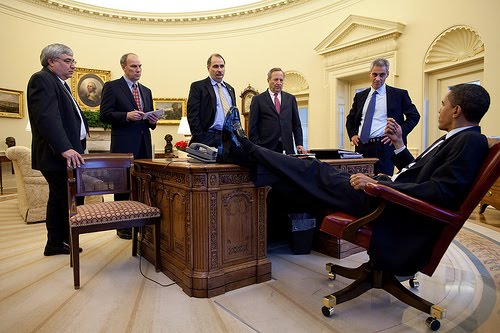
So, for example, in January, 2010 this photo caused FoxNation.com to ask whether Obama was “disrespecting the Oval Office” by putting his feet up on the antique desk.

Of course, it didn’t take long to uncover similar photos of previous presidents, none of which had raised any particular outrage at the time. But everybody forgot again, and so we had an almost identical flap last September. “This just makes me furious,” one woman tweeted. “He was raised so badly.”

Or remember last May when marines held umbrellas over President Obama and visiting Turkish Prime Minister Recep Erdogan. Horrors! He’s treating our revered warriors like servants! How dare he! It was front-page news.

Once again, it wasn’t too hard to find similar photos of previous presidents, which weren’t front-page news — or any kind of outrage at all.
Other such “scandals” involve the First Lady: Did you know that Michelle had the audacity to wear an expensive gown to a recent state dinner, like first ladies have been doing, well, forever? Compare to this 2005 WaPo column in which Laura Bush is said to look “regal” — and that’s a compliment. Until 2009, the First Lady was supposed to look regal. Remember Jackie Kennedy? But when Michelle dresses up, she’s Marie Antoinette.

The Obama’s vacations are another issue, and how much taxpayers spend to protect them outside the White House. But of course when the Bush twins celebrated their 25th birthdays in Buenos Aires, nobody cared what it cost the Secret Service to keep them safe in an exotic locale. They were the president’s daughters, so of course we protected them.

The entire White House lifestyle is an issue: The Obamas are “living large” claimed National Review (and mentioned Marie Antoinette again). The Washington Post fact-checker investigated and concluded: “there appears to be no appreciable difference between Obama’s expenses and Bush’s.” If you read the NR article carefully — and most of the other articles raising this faux issue — you’ll realize they never said there was. It’s just that the Bushes living large never bothered anybody.

Town Hall criticized the extravagance of having Beyonce perform at the Obama White House. But when Frank Sinatra performed for the Reagans, nobody looked at it that way. Why would they?

Even the Obamas’ Christmas cards became an issue. This one, from 2011, disrespects the Christian holiday because it is secular and features the president’s dog:

But this one, from the Bushes in 2005, is fine.

I could go on and on. Whenever President Obama acts like the President of the United States, or the Obamas act like the First Family, it just looks wrong to a lot of people.

So here’s the $64,000 question: Is that racist?

It depends on what you think racist means. Conservatives will not only answer the question “No”, they’ll be insulted that you even raised it (and will probably launch into their canned everybody-who-disagrees-with-Obama-is-a-racist-to-you-people riff). That’s because conservatives have adopted a very restricted definition of racism: Racism is conscious hatred towards people of another race.

So, those white folks who didn’t even notice when Reagan’s or JFK’s feet were on the desk, but who see Obama’s and think “He was raised so badly.” — are they also secretly thinking “Who does that uppity nigger think he is, acting like he’s a real president or something?” Maybe a few here or there, but mostly no. They aren’t consciously hating Obama because he’s black. But they can’t look at a black president the same way they looked at the 43 white presidents. Things just look different when Obama does them.

What do you call that?

I’m asking that question seriously, not rhetorically. I sympathize with people who want to reserve racism for Adolf Hitler ordering the Final Solution to the Jewish problem or George Wallace standing in the door to block black students from enrolling at the University of Alabama. The men who lynched Emmett Till or the grand jury that refused to indict them — those people were racists. I get that it doesn’t seem right to put them in the same category with the people who only just realized in 2009 that life in the White House is pretty sweet.

But all the same, lots of whites look at Obama and can’t think “president” without thinking “black president” — and they go on to judge his actions more harshly than those of white presidents. They go on to treat him with less respect than white presidents have always received — like interrupting the State of the Union to yell “You lie!” or questioning his birth certificate when there was never any reason to do so. (This satire, which applies the same standards to Ronald Reagan’s birth certificate, is hilarious precisely because it would never have been taken seriously.)

Congressmen saying it would be “a dream come true” to impeach the President (while admitting they have no evidence of an impeachable offense), or listening patiently while constituents publicly say the President “should be executed as an enemy combatant” — that would have been unthinkable during the 43 white administrations. But today it’s considered acceptable behavior.

If you don’t want to call it racism, fine. But it’s a real phenomenon; it needs a name. What do you call it?

I’ve narrowed my focus to President Obama, but really the phenomenon is much broader. For example, read Tim Wise’s “What if the Tea Party Were Black?” or just about anything about Trayvon Martin. If Michael Dunn had been a black man shooting up a car full of white boys, I doubt jurors would have bought his I-thought-I-saw-a-gun argument.

For a lot of whites who don’t harbor any conscious racial malice, things just look different when blacks do them. What do you call that?

Teasing out the different stances that might be called “racism” is at least half the value of Ian Haney Lopez’ recent book Dog Whistle Politics. Lopez notes that racism changes from one era to the next, and somebody changes it. “Racism is not disappearing,” he says, “it’s adapting.”

Lopez uses the word “racism” for most of the possible meanings, and differentiates with adjectives. Here are some of the ones he finds:

  • racism-as-hate. The most restrictive definition, and the most comforting for whites. “For the public at large, racism-as-hate provides self-protecting clarity: if racists are like those in the 1950s who screamed at black school children and burned crosses, then most everyone can safely conclude that they, at least, are not racists. … Since conservatives on the Supreme Court adopted a malice conception of racism in 1979, when using this approach the Court has rejected every claim of discrimination against nonwhites brought before it.”
  • structural or institutional racism. This is racial injustice that seems to be the fault of nobody in particular, because it’s embedded in the way society works. Vicious cycles (like poverty leading to dysfunctional behavior which leads back to poverty) may trace back to past sins like slavery or Jim Crow, but now they are self-replicating. “Structural racism is racism without racists. All that said, precisely because institutional racism implies a need to change society, it was rejected long ago by conservatives, including those on the Supreme Court who repudiated this understanding of racism in the early 1970s.”
  • implicit bias. This is the it-just-looks-different response I have been describing, or the kind that shows up in Implicit Association Test you can take online.
  • commonsense racism. “The social world through which we move reflects centuries of racism that extends right up to the present. But this is hard to grasp in its particulars. Instead, we see clearly only the results, and with the underlying causes hidden, we tend to accept the extant world as a testament to the implacable truth of racial stereotypes.” The commonsense racists “are not hate-filled bigots but decent folks who see racial injustice as a normal feature of society. … For many, it simply seems ‘true,’ an unquestioned matter of commonsense, that blacks prefer welfare to work, that undocumented immigrants breed crime, and that Islam spawns violence.”
  • strategic racism. New appeals to racial prejudice and new rationalizations for racial injustice don’t create themselves. When the old racial manipulations stop working, somebody figures out new ones. “Strategic racism refers to purposeful efforts to use racial animus as leverage to gain material wealth, political power, or heightened social standing. … [B]ecause strategic racism is strategic, it is not fundamentally about race. … [S]trategic racists act out of avarice rather than animus.”

Lopez retells a lot of American history to illustrate how when one avenue for racial injustice was blocked, another was usually found in short order. (His discussion of how in the Reconstruction Era convict leasing developed into a new form of forced black labor to replace slavery, and continued in that form well into the 20th century, was new and eye-opening to me.) He sees this not as blind evolution, but as clever people working out the new arrangements and constructing ways to rationalize them to the masses.

Lopez also describes the usual course of racial conversation these days: If you introduce any of the above ideas into a conversation, conservatives will interpret it as an explicit or veiled accusation of racism-as-hate; you are saying they are like the white supremacists who yelled obscenities at the black little girls trying to integrate public schools. They will experience this as an injustice, and then see themselves as the victims rather than the people whose suffering you were trying to point out.

Strategic racists have turned this into

the rhetorical punch, parry, and kick of dog whistle racial jujitsu. Here are the basic moves: (1) punch racism into the conversation through references to culture, behavior, and class; (2) parry claims of race-baiting by insisting that absent a direct reference to biology or the use of a racial epithet, there can be no racism; (3) kick up the racial attack by calling any critics the real racists for mentioning race and thereby “playing the race card.”

“Most racists,” Lopez recognizes, like the South African whites Lopez met during the apartheid era “are good people. This is not a book about bad people. It is about all of us.” Most whites — even the most conservative whites — are not haters. But so many on the Right have been trained in the recast-yourself-as-the-victim reflex that it has become hard to have any kind of discussion at all about the more subtle and pervasive forms of racism. And until we get to the bottom of that, our democracy will always be vulnerable to the manipulations of the strategic racists.

The Sifted Bookshelf: Angry White Men

They may not feel powerful, but they do feel entitled to feel powerful.


One of the privileges that still comes with being white or male is that you get to be an individual. When you do something unusually good or bad, the media doesn’t take you as a representative of all whites or all men. You’re just you; you did something; it’s news.

So nobody remarked on George W. Bush being the United States’ 43rd consecutive white male president, but 2008 buzzed with speculation that the 44th might be black or female. For example, pundits questioned whether a woman could be tough enough to be commander-in-chief of the military, but nobody has ever successfully made an issue of whether a man can be compassionate enough to be nurse-in-chief of Medicare, or understand small children well enough to be teacher-in-chief of Head Start.

Nobody ever asked why a white man had killed President Kennedy or tried to kill President Reagan. The gunmen had names; their stories were presumed to be personal. When Bernie Madoff conned his investors out of billions, nobody asked “What makes a white man do something like that?” or “What should be done about the white male swindler problem?”

Sikh temple shooter.

Even when the perpetrators themselves frame whiteness or masculinity as an issue, the media tends not to pick it up. Anders Behring Breivik, who killed 69 people at a camp for liberal youth in Norway, saw himself as a crusader against a Muslim takeover of Europe. His manifesto advocated a restoration of European “monoculturalism” and “patriarchy”. Wade Michael Page, killer of six in the Sikh Temple shooting in Wisconsin, was acting on his long-held white supremacist views. In each case, this motivation was spun mostly as a symptom of personal instability, and not of a dangerous cancer in the white community.

Mad as hell.

The upshot is that although we are surrounded by angry white men — on talk radio, on the internet, on the highways, in the workplace, in the NRA and the Tea Party, in the “men’s rights” movement, and in countless acts of domestic violence or public mayhem from Columbine to Sandy Hook — we aren’t having a national discussion about the anger problem of whites or men or white men. That’s because we don’t see them as “white men”; we see them as individuals whose stories reflect unique psychological, political, or social issues. (By contrast, consider how little Michelle Obama has to do to evoke the angry-black-woman stereotype.)

Enter Michael Kimmel and his book Angry White Men.

Chapter by chapter, Kimmel calls attention to angry white men wherever they are found: the loudest voices on the radio, the school shooters, the anti-feminist men’s-rights movement and its Dad’s-rights subculture, the wife beaters, the workers who go postal, and the white supremacists. He asks and answers the question you seldom hear: What makes white men so angry?

What links all these different groups … is a single core experience: what I call aggrieved entitlement.

Aggrieved entitlement is the belief that you have been cheated out of status and power that should have been part of your birthright. (It’s a close relative of what I have called privileged distress: the feeling that advantages you never consciously acknowledged are slipping away from you.) White men are angry, Kimmel claims, because

They may not feel powerful, but they do feel entitled to feel powerful.

How it was supposed to be.

High standards and failure. White men also feel judged (and judge themselves) according to the standards of fathers and grandfathers who received the full white-male birthright, who didn’t have to compete with other races on an almost-level playing field, and who could count on subservient wives, mothers, daughters, and Girls Friday at the office to rally behind their leadership rather than outshine them or make demands.

You want a recipe for anger? Here it is: I’m a failure and it’s not my fault.

The seldom-examined setting for white male anger is failure, or at least failure according to the standards of another era. Dad and/or Grandpa supported a family on one job, and when he got home he commanded respect from his family. His marriage lasted, and his kids were not being raised by a resentful ex-wife on the other side of the country. When Dad or Grandpa was young, he was comfortable in his masculinity. He hunted deer and lettered in football. Girls waited by the phone for him to call, and when he paid for dinner they knew they owed him something.

It’s not that way any more, and it’s not my fault. Don’t look at me like that.

The rich and powerful speak for me.

The visible spokesmen for angry white men may be millionaires like Rush Limbaugh or Donald Trump. But such success is what their listeners wish they had, not what they do have or will ever have. Kimmel observes:

It’s largely the downwardly mobile middle and lower middle classes who form the backbone of the Tea Party, of the listeners of outrage radio, of the neo-Nazis and white supremacists— in many cases literally the sons of those very farmers and workers who’ve lost the family farms or shuttered for good the businesses that had been family owned and operated for generations.

Violence. This sense of being cheated out of what was promised — and being judged as if it had been delivered — interacts badly with another part of the traditional male identity: Men have the privilege/right/duty to make things right by violence.

I don’t want to be violent, but I can be.

That is the plot of just about every action movie with a male hero: A man who would rather be left alone to live his life and take care of his family is confronted with an injustice that can only end if he becomes violent and defeats it. If he successfully wields violence he is a hero. If he remains peaceful he is a wimp.

And so, while many women also feel cheated and judged unfairly, they tend not to snap in a violent way. Kimmel observes that all the recent rampage school shooters (other than the Korean Virginia Tech shooter, whose race evoked a discussion, and another Korean shooter since Kimmel finished writing) have been white males, mostly from rural and suburban areas. Kimmel imagines what would happen if they’d all been, say, inner-city black girls

Can you picture the national debate, the headlines, the hand-wringing? There is no doubt we’d be having a national debate about inner-city poor black girls. The entire focus would be on race, class, and gender. The media would doubtless invent a new term for their behavior, as with wilding two decades ago.

Likewise,

In my research, I could find no cases of working women coming into their workplaces, packing assault weapons, and opening fire, seemingly indiscriminately.

The explanation is simple: When a man feels disrespected — on the job, in his school, in his family — the disrespect threatens not just his personal identity, but his identity as a man. (The archetypal Man is entitled to respect; if you are not being respected, you are failing as a man.) The obvious response is to re-assert manhood through violence, simultaneously righting the scales both socially and psychologically.

The Real and the True. One point I made in “The Distress of the Privileged” was that the “distress” part of privileged distress is very real: If you have convinced yourself that you don’t have any unfair advantages, and then those advantages start to go away, it feels like persecution. You’re not making it up; there are real events you can point to.

Kimmel covers this ground by distinguishing between what is “real” and what is “true”.

White men’s anger is “real”— that is, it is experienced deeply and sincerely. But it is not “true”— that is, it doesn’t provide an accurate analysis of their situation.

And what is most likely to be untrue is the object of the anger. When your well-paid factory job is shipped overseas and you can’t find another one, the villain isn’t the teen-age Chinese girl who does your old job for fifty cents an hour. If you can’t support a family on your income, the villain isn’t your working wife or her reasonable demand that you share the housewife duties she doesn’t have time for any more. If the value of your house crashes, the villain isn’t the black family that got talked into a sub-prime mortgage it couldn’t afford. If you judge yourself by the standards of another era, the villains are not the people whose fair competition keeps you from meeting those standards.

The collapsing pyramid. Patriarchy and racism are both systems of dominance that are coming apart. The white men who feel the change first are the ones just one step up from the bottom: Their step collapses, throwing them in with the “lesser” blacks and women, and the pyramid resettles on top of them. The white men higher up the pyramid want the victims of this collapse to identify with them and with the pyramid that gives them their status: What’s wrong isn’t that the pyramid itself is unfair — as you now can clearly see, being at the bottom of it. What’s wrong, they want you to believe, is that the pyramid is collapsing. You should defend the pyramid, blame the other bottom-dwellers for your loss of status, and maybe one day your one-step-up can be restored.

They know that’s not going to happen; they’re just counting on you not figuring it out. The Masters of the Universe are not going to bring your job back from China. Wal-Mart is not going to make room for your family shop to re-open. Bank of America is not going to forgive your underwater mortgage. Agri-business is not going to rescue your family farm.

The rich white men are not going to rebuild the lower step of the pyramid, no matter how much power they get. And nobody is making room for you on the upper levels.

If you have to blame someone, blame the people who promised you something they couldn’t (or decided not to) deliver. They sold you a bill of goods. Don’t buy another bill of goods from them.

But the best solution of all would be to get past the anger, forget about how things were supposed to be, and just start dealing with the situation as it is. Like a lot of people you never expected to have anything in common with, you find yourself at the bottom of the pyramid. It’s an unfair pyramid.

Let’s bring it down.

Mandela’s Memorial Was All About Us

How do you pitch a foreign funeral to a nation of Homer Simpsons?
Manufacture America-centered controversy.


Nelson Mandela’s public memorial service was held Tuesday in a vast stadium in Johannesburg. Leaders from all over the globe attended, and several of them spoke about Mandela, his significance in history, and how his life inspired people around the world.

The mood was generally upbeat, more like a New Orleans jazz funeral or an Irish wake than the somber kind of remembrance. But still you can imagine Homer Simpson pointing his remote at the TV and announcing his judgment: “BOR-ing.” A day devoted to some dead guy on the other side of the world and the stuff he did in some other century? Where’s the drama?

Khrushchev and Kennedy

So instead American news networks made the story all about us: The big news out of Johannesburg wasn’t anything about Mandela, it was President Obama shaking hands with Raul Castro.

To me, it looked like one of those awkward running-into-your-ex’s-new-boyfriend moments you might have at a wedding reception, and Obama handled it graciously. He’s shaking hands as he makes his way to the podium and suddenly there’s Castro, so Obama just keeps shaking hands like it’s no big deal.

Nice save, Mr. O.

Except — OMG!!!! — he’s shaking hands with Raul Castro! Rev up the outrage machine. It’s, like, Chamberlain shaking hands with Hitler or something!

Mao and Nixon

For the everything-Obama-does-is-an-outrage crowd, two bizarre ideas are at work: First, that Cuba’s government is something special among dictatorships, and second, that until now American presidents have maintained a hands-that-hold-whips-shall-never-hold-mine purity standard when it comes to tyrants.

The first point is best left to comedians like Jon Stewart:

[singing] Raul Castro is not Adolf Hitler. [/singing] … Raul Castro is not even Fidel. He’s like Cuba’s Jim Belusi. … And by the way, Cuba’s not the only country with a spotty record of imprisoning people in Cuba.

Second, not only is there a long history of American leaders meeting and greeting Communist dictators — Nixon and Mao, Kennedy and Khrushchev, and Nixon even gave Brezhnev a Lincoln Town Car — but we also have a long history of supporting some of the world’s most brutal dictators: Stalin was our ally in World War II, and who can forget such friends-of-America as the Shah of Iran, the Somoza dynasty in Nicaragua, General Pinochet in Chile, Saddam Hussein, or even the current regime in Turkmenistan?

So the only thing outrageous here is the outrage. When it comes to tyrants, America’s hands haven’t been clean for at least a century.


The other Obama-outrage from the funeral was this picture:

So here’s Obama and British Prime Minister Cameron taking a selfie with some red-hot blonde described by The Daily Mail as “flirty” and by the New York Post as a “Danish tart”. Fox News couldn’t stop chortling. The Post decided Obama-and-the-white-chick was a front-page scandal.

Who’s the mystery vixen? Prime Minister Helle Thorning-Schmidt of Denmark, a country where neither blondes nor powerful women are so rare as to make headlines. The selfie is of three world leaders, not Obama and some blonde.

I’m not sure what’s worse: The racist where-the-white-women-at angle or the sexist who’s-that-slut angle. What’s a girl gotta do to get some respect?


On Michelle’s apparently disapproving expression, Atlantic’s Garance Franke-Ruta offered a more mundane explanation:

[It’s] the look of a person with jetlag who flew halfway around the world overnight, spent four hours at a hotel early in the morning, and then had to go to a memorial service.”

Maybe that explains Laura Bush’s similarly sour expression when her man had a similarly animated conversation with an attractive female world leader, Jordan’s Queen Rania. (Oddly, that triangle drew virtually no international media attention.)

Salon’s Roxane Gay finds a race/gender issue in the media’s focus on and interpretation of that one image of Michelle (as opposed to others where she seems to be having a good time):

More than anything, the response to these latest images of Michelle Obama speaks volumes about the expectations placed on black women in the public eye and how a black women’s default emotional state is perceived as angry. The black woman is ever at the ready to aggressively defend her territory. She is making her disapproval known. She never gets to simply be.


Ted Cruz walked a fine line in Johannesburg. On the one hand, he wanted to appear statesmanlike on the world stage. But earlier in the week he got stung by his supporters when he tried to be gracious to Mandela on his Facebook page. So Cruz made his own Cuba moment Tuesday by walking out during Castro’s speech. Because that’s what the memorial services of great peacemakers are for: expressing your disapproval of the other mourners.


PolicyMic points out how differently the memorial might have been covered, even if you wanted an America-centric angle. The Bushes, Clintons, and Obamas all traveled together on Air Force One. Pictures suggest they got along and were even chummy. But again, where’s the drama in that? BOR-ing.

White Santa, White Jesus, White Christmas

Santa’s not alienating, but white supremacy is.


It all started Tuesday, when Slate’s Aisha Harris suggested replacing the fat-old-white-man version of Santa Claus with a penguin.

Why? Well, she found it confusing to grow up with a black Santa at home and a white Santa everywhere else. Her Dad’s ingenious explanation (that Santa magically changes race to match each household he visits) sounded phony.

I didn’t buy it. I remember feeling slightly ashamed that our black Santa wasn’t the “real thing.” … That this genial, jolly man can only be seen as white—and consequently, that a Santa of any other hue is merely a “joke” or a chance to trudge out racist stereotypes—helps perpetuate the whole “white-as-default” notion endemic to American culture

But since Santa is a cultural invention anyway

we can certainly change him however we’d like—and we have, many times over. … Isn’t it time that our image of Santa better serve all the children he delights each Christmas?

You may be charmed by this idea or just find it harmlessly goofy — unless you watch  a lot of Fox News. Then you’d realize that this change-Santa nonsense is a symptom of the political correctness and everything-is-up-for-grabs attitude that’s ruining America. Megyn Kelly laid it out:

For all you kids watching at home, Santa just is white.

And then she very sympathetically gave black people the bad news.

Just because it makes you feel uncomfortable doesn’t mean it has to change. You know, I mean, Jesus was a white man too. … He was a historical figure. That was a verifiable fact.

Forensic reconstruction of Saint Nicholas

These things are facts, people. In Fox Nation, they’re not up for discussion.

Historical Saint Nicholas. Monica Crowley, a member of Kelly’s all-white panel, elaborated:

Santa Claus is based on Saint Nicholas, who was an actual person, a Greek bishop, and was a white man. … You can’t take facts and then try to change them to try to fit some sort of a political agenda or a sensitivity agenda.

But on Chris Hayes’ MSNBC show, Harris pushed back:

Santa now looks nothing like that Santa [i.e. the historical Saint Nicholas]

So how white was Saint Nicholas, anyway? Kathleen Manning blogged for U.S. Catholic:

15th-century Saint Nicholas icon

In 2008, British anthropologists did a facial reconstruction of Saint Nicholas of Myra, based on his remains. The fourth-century Turkish bishop who signed the Nicene Creed looks less like Clement Clarke Moore’s description and more like the cabbie who drove you to the airport to catch your Christmas flight home.

And unlike Coca-Cola ads, religious icons often portray Saint Nicholas as a dark-skinned man whose race is hard to determine. He’s also skinny. And as I study those smaller panels on the pictured icon, I can’t find reindeer anywhere.

So if we want to stick to the historical facts, rather than “change them to try to fit some sort of a political agenda”, that’s what we get: a skinny, racially ambiguous Santa whose Turkish workshop is far from the land of reindeer.

If not reindeer …

Maybe he could drive a wagon instead of a sleigh, and borrow Thor’s flying goats to pull it.

Yeah, but Jesus was white. Wasn’t he? It depends on your definition of white. Jesus was a first-century Middle Eastern Jew. How white were they?

Probably not very. Religion News Service’s Jeffrey Weiss suggests Yasser Arafat or Osama bin Laden as comparable. Atlantic’s Jonathan Merritt says: “If he were taking the red-eye flight from San Francisco to New York today, Jesus might be profiled for additional security screening by TSA.”

Maybe. As a brownish, outspoken social activist from the Middle East with a Jerusalem police record of assault against money-lenders, I think he’d go straight to the no-fly list.

Would you sit next to this guy on an airplane?

What is “white” anyway? It’s easy to poke fun at people who believe their cultural happenstance represents eternal truth, the kind who will tell you “Where I come from people don’t have an accent.” But Chris Hayes got to the deeper issue:

Jesus wasn’t white because the category white didn’t exist when Jesus was around in the Roman Empire. That is a construction that was made later on for very intense social reasons.

The Romans had a word for white, albus, but it was a color, not a race. The same was probably true in Aramaic. First-century folks were Jews, Romans, Gauls, Egyptians, and so forth. Gauls tended towards blonde and some Egyptians could be very dark. But I believe first-century rabbis would have been quite perplexed by the idea that they belonged to a “white race”. True, a sub-Saharan African would have seemed like someone from another world, but so would a Pict from north of (what would soon become) Hadrian’s wall, and what the rabbis might have made of the central-Asian ancestors of the Rus is anybody’s guess.

Much later, Shakespeare pictured dark-skinned Othello as an outsider in Venice society, but no more so than the Jewish Shylock.

In Learning to be White, Thandeka traces the beginnings of the white-race concept to the late 1600s, when the founders of Virginia’s plantation system needed to discourage their English and Irish indentured servants from making common cause with their African and Native American slaves, as happened during Bacon’s Rebellion of 1676. So they divided the underclass by giving a few small rights and privileges to the European servants.

A new multiclass “white race” would emerge from the Virginia laws as one not biologically engineered but socially constructed. … The laws and the racial contempt they generated would sever ties of previous mutual interest and goodwill between European and African servants and workers, provide the ruling elite with a “buffer” of poor whites between themselves and the slaves to keep blacks down, and prevent either group from separately challenging the class interests of the elite.

In the North in the 1800s, the construction of the “white race” became the key to socializing America’s non-English-speaking European immigrants. They arrived identifying themselves as Polish, Russian, Irish, Italian, or some other ethnicity with its own distinctive language, history, and practices. In America they were homogenized as “whites” and their native xenophobia channeled against Africans and other people of color.

So Hayes is absolutely correct. Jesus would have been puzzled by any Roman who welcomed him as a member of the gens alba. He was a Jew, not a Roman, and being “white” didn’t mean anything at all until many centuries later.

Who’s a racist? In a follow-up segment, Megyn Kelly realized she needed a black on the panel, so she invited frequent Fox News contributor Zerlina Maxwell. Maxwell more-or-less agreed with Harris, which led Kelly to challenge her:

Why is white skin alienating? And why is that not racist?

This is the color-blind, flat-playing-field view of race currently popular among white conservatives: Since white supremacy is built into the cultural infrastructure, I (as a white) can live without thinking about race. If non-whites try to make me think about race, well then, that’s them being racist.

I mean, Santa and Jesus and Batman and all the other cultural icons just are white, so I don’t have to think about their race at all. When I look at pictures of Santa, I don’t see white Santa, I just see Santa. If it bothers you that all the cultural icons are white … whatta you, racist or something? What’s wrong with being white?

It comes down to two very different views of what American culture is. Is it the culture of all the people who live here? Or is it a historically white culture that some non-whites have been allowed to join, on the condition that they accept it the way it is and change themselves rather than seek to change the culture? Post-Martin-Luther-King, the public position of white conservatives (never mind what they say behind closed doors) is to treat people of all races as honorary whites. Isn’t that good enough? Or are you saying there’s something wrong with being white?

So Megyn Kelly is perfectly content to let your black children imagine that her white Santa is bringing presents to your black home. Isn’t that good enough? Or are you hostile to Santa because he’s white? “And why is that not racist?”

Untwisting Kelly’s pretzel takes more time than TV’s sound-bite culture allows, so Maxwell just had to dodge the reverse-racism charge. You can’t have a discussion about the particulars until you challenge several background assumptions.

First, there is no flat playing field. The privilege of ignoring race in America belongs to whites. Non-whites are confronted with race every day, no matter how much they might want to ignore it. The let’s-just-ignore-race notion really means: Let’s ignore the white supremacy built into everything.

Second, focusing on the whiteness of just Santa (or any other individual icon) misses the point. Because there is nothing wrong with Santa being white in isolation. By changing Santa, Harris was addressing her sense of encirclement, of growing up in a culture where all the major icons are white, and blackness seems like an aberration, even when you see it in the mirror.

To make a gender analogy: There’s nothing wrong with Barack Obama being a man. What’s wrong is that the 44 presidents have all been men. If a girl examines that line of portraits and feels alienated from the presidency, she’s not being sexist; she’s recognizing her country’s built-in male supremacy.

Life in the Garden of Sweden

And finally, Santa and Jesus and all the other icons aren’t white because of historical facts. They became white through a long social process. Coca-Cola’s Santa is considerably whiter than Saint Nicholas. The portrait of Jesus on the wall of my Lutheran grade school was much whiter than any first-century Palestinian Jew. In White Like Me, Tim Wise recalls growing up with picture-books — I had them too — that presented a white Adam and Eve, who frolicked in what Wise now calls “the Garden of Sweden”.

To say that this process is now at an end, that whiteness is now baked into our cultural icons and can’t be changed, is to say that white supremacy is baked into American culture and can’t be changed.

That’s what’s alienating, Megyn Kelly. And no, feeling alienated by white supremacy is not racist.