

Throughout American history, most bigots have been nice folks who had sincere religious reasons for treating other people badly.
Social conservatives were all over the airwaves and print media this week, explaining how and why the battle over marriage equality is not over. The Supreme Court may have spoken, but the other branches of government, they promised, could still step in somehow, if we elect the right people. Or county clerks could just refuse to issue licenses. Or ordinary people could practice civil disobedience in some unspecified way. There are, Glenn Beck has promised us, ten thousand pastors willing to “go to prison or to death” over this issue (though exactly what charges will brought against them or who might try to kill them is a bit vague).
To me, the most revealing moment of this Alamo-like refusal to surrender came when Texas Senator Ted Cruz was interviewed by Savannah Guthrie on The Today Show. Cruz was defending the “religious freedom” of Texas clerks not to issue marriage licenses to same-sex couples, when Guthrie made an analogy:
GUTHRIE: If a state clerk refused to issue a marriage license to an interracial couple, would you agree with that too?
CRUZ: There’s no religious backing for that.
 Religion and interracial marriage. To anyone who remembers the 1960s or has read the history of interracial marriage (or civil rights in general), Cruz’ response is simply ridiculous. Opposition to interracial marriage was constantly expressed in religious terms.
For example, the reason the Supreme Court had to decide Loving v. Virginia, the case that legalized interracial marriage nationwide in 1967, was that when Richard and Mildred Loving tried to get their conviction for miscegenation overturned (so that they could legally come back to Virginia), Judge Leon M. Bazile was having none of it:
Almighty God created the races white, black, yellow, malay and red, and he placed them on separate continents. And, but for the interference with his arrangement, there would be no cause for such marriages. The fact that he separated the races shows that he did not intend for the races to mix.
Judge Bazile’s decision says nothing about hating black people or even interracial couples. Yahoos on the street might have taunted Richard Loving as a “nigger lover”, but the judge did no such thing. He just saw the sense in a Virginia law that upheld God’s plan for the races.
Segregation. Opposition to school desegregation could be similarly respectful and devout. In 1958, Rev. Jerry Falwell preached a sermon “Segregation or Integration: Which?”. (Like all of Falwell’s pro-segregation sermons, this one is sadly unavailable online. Perhaps Liberty University might want to rectify this.) In it, he expressed his religious objection to the Supreme Court’s Brown v. Board of Education decision.
If Chief Justice Warren and his associates had known God’s word and had desired to do the Lord’s will, I am quite confident that the 1954 decision would never have been made. The facilities should be separate. When God has drawn the line of distinction, we should not attempt to cross that line.
That polite-but-concerned religious defense of segregation goes all the way back to 1867, when the Pennsylvania Supreme Court OK’d segregated passenger trains. Chief Justice Daniel Agnew wrote:
We declare a right to maintain separate relations, as far as is reasonably practicable, but in a spirit of kindness and charity, and with due regard to equality of rights, it is not prejudice, nor caste, nor injustice of any kind, but simply to suffer men to follow the law of races established by the Creator himself, and not to compel them to intermix contrary to their instincts.
 Slavery. Even slavery had religious justifications, and the breakup of the Union was presaged by the splits in major religious denominations between Northern churches who found slavery immoral and Southern churches who taught that it was part of God’s plan. As Josiah Priest wrote in 1852:
“If God appointed the race of Ham judicially to slavery, and it were a heinous sin to enslave one, or all the race, how then is the appointment of God to go into effect? …. God does never sanction sin, nor call for the commission of moral evil to forward any of his purposes; wherefore we come to the conclusion, that is is not sinful to enslave the negro race, providing it is done in a tender, fatherly and thoughtful manner.”
Hatred of men, or love of God? Like most people who oppose marriage equality for gays and lesbians today, past opponents of racial equality were not necessarily the screaming haters we see in the more dramatic videos from the civil rights movement. Far more were sedate and thoughtful people who were not aware of hating anyone. They just held a sincere belief — “in a spirit of kindness and charity”, they would tell you — that blacks were an inferior race who were better off among their own kind, or perhaps under the “tender, fatherly and thoughtful” guidance of a white master.
Most believed that God agreed with them, and could cite you chapter and verse to prove it. Freeing the slaves, desegregating the schools, allowing interracial marriage — at the time, those changes were all seen as aggressions against the religion of large numbers of American Christians.
And it is a mistake to think that such beliefs are dead relics of an era long past. There are still white supremacist churches today. As the web site of Thomas Robb Ministries in Harrison, Arkansas puts it:
For the mission God has bestowed upon His chosen people, the white race, he requires their separation. They must honor their heritage, not despise it. Other races must honor their heritage as well. In a well ordered world, this is God’s way.
Granted, such groups are small compared to the Catholics or Southern Baptists. But your First Amendment rights don’t depend on the size of your congregation. If the religious freedom Ted Cruz wants for himself applies to Thomas Robb’s parishioners as well, then of course the county clerk must be able to refuse a marriage license to an interracial couple.
Conservatism and progress. It’s not hard to see why Cruz doesn’t want to remember or identify with the historical tradition of social conservatism: When we look back from today’s perspective, we see that the slavers and segregationists were wrong. Most of them were probably very nice people if you met them in the right circumstances, but they were wrong. They had sincerely held beliefs that were firmly anchored in their understanding of Christianity, but they were wrong.
So hardly anybody wants to claim their legacy today.
That’s the general pattern of social conservatives and progress: Eventually, progress catches up to them as well, so they can look back and see that the previous revolution in social practices and public morality was justified. The slaves should have been freed. Blacks should have been served at the Greensboro lunch counter. Women should be allowed to vote and run for office and enter the professions. (I didn’t get into the religious arguments for keeping women in the kitchen, but trust me, they were plentiful, and are also still with us.)
But this time it’s different! It always is. With no one left to defend them, our memory of the social conservatives of the past reduces to Simon Legree, KKK lynch mobs, police unleashing dogs and fire hoses against peaceful marchers, and the white rabble screaming obscenities at little black girls on their way to school. The thoughtful, intellectual, devout defenders of an unjust status quo are forgotten, because their memory embarrasses their heirs.
Consequently, in every generation, the well-considered, devout bigotry of nice people is presented to the world as a new thing. They’re nothing like the villains we recall from past social-justice movements. This time they have good reasons to block progress. They have looked deep into their souls and read their Bibles and taken it to the Lord in prayer. They don’t hate anybody, they just believe that the world as it was when they were growing up was endorsed by God, and they want to stop today’s amoral radicals from upsetting God’s appointed order.
In other words, they are just like every generation of social conservatives before them. The analogy with Josiah Priest and Chief Justice Agnew and Judge Bazile and the young Jerry Falwell (who later reversed himself, removed his segregation sermons from circulation, and quietly pretended he had never believed anything else) could not be more apt.
Bigotry is not the same as hate. Bigotry just means believing that certain groups of people do not deserve the same kind of consideration you want for yourself. Their suffering and distress doesn’t count, or they must have brought it on themselves in some obscure way. You don’t have to hate those people any more than you hate your dog when you keep him penned in your yard, or hate your children when you make them eat something they hate. (The analogy of parents and children, in fact, was often applied by pro-slavery writers to the master/slave relationship. Husbands, similarly, needed to make decisions for their wives, because women were pure but unworldly creatures. That’s what men loved about them.)
I don’t know precisely why Ted Cruz or the four dissenting judges in Obergefell believe that gays and lesbians don’t deserve the equal protection of the laws, but I doubt hate has much to do with it. It doesn’t have to. The Tennessee clerks who resigned rather than issue same-sex marriage licenses — I’ll bet they’re nice people with sincere beliefs. But they’re also bigots.
Conservatives blanch in horror at that word, when someone applies it to them. In Justice Alito’s dissent, he imagines this dystopian future:
I assume that those who cling to old beliefs will be able to whisper their thoughts in the recesses of their homes, but if they repeat those views in public, they will risk being labeled as bigots and treated as such by governments, employers, and schools.
How unfair, that those who find their neighbors’ relationships unworthy might themselves be examined and found wanting. How unfair, that they might be lumped together with the past bigots they so closely resemble. Don’t we understand that it’s different this time? That these are nice, thoughtful people of sincere beliefs?
We understand quite well.
Hidden residue. On the surface, bigotry against gays and lesbians may seem unrelated to racial bigotry. But when you deny your unattractive roots rather than repent and atone for them, their influence can linger in the back of your mind, occasionally peeking out at inopportune moments.
In an Alternet article picked up by Salon, Tim Wise called attention to the lingering racial bigotry implicit in some prominent denunciations of the recent marriage-equality ruling. Congressman Louie Gohmert, for example, warned of divine retribution:
God’s hand of protection will be withdrawn [from America] as future actions from external and internal forces will soon make clear. I will do all I can to prevent such harm, but I am gravely fearful that the stage has now been set.
Gohmert is far from the only person to make this point, and his statement contains no overt racism. But think about its implications: God kept the U.S. under His special protection and showered us with blessings while we committed genocide against the Native Americans and enslaved Africans by the millions. But as soon as we celebrate people of the same gender living together in loving, committed relationships, He’s done with us.
I don’t see an alternative to Wise’s interpretation: Gohmert’s statement only makes sense if you assume that the suffering of non-whites is beneath God’s notice.
Wise goes on to discuss another Ted Cruz interview, this one with Sean Hannity. The Obergefell decision coming so closely on the heels of the Court’s refusal to gut ObamaCare made for “some of the darkest 24 hours in our nation’s history”. (“I couldn’t say it more eloquently,” Hannity responded.)
Put aside the many-people-died events in American history (like Pearl Harbor or 9-11 or the bloodiest battles of the Civil War) and just restrict your attention to Supreme Court history. Cruz graduated magna cum laude from Harvard Law, so I assume he knows about the Korematsu decision that OK’d putting Japanese-Americans in concentration camps; and Dred Scott, where the Court declared blacks had “no rights which the white man was bound to respect”; and the 1883 decision in the Civil Rights Cases, which gave the green light to Jim Crow. To be some of the darkest 24 hours in the Court’s history, preserving ObamaCare and establishing marriage equality has to rank with those.
Again, it’s hard to avoid the conclusion that the suffering of non-whites just doesn’t count. Wise draws his conclusion:
Sometimes, racism is manifested in the subtle way a person can dismiss the lived experiences of those racial others as if they were nothing, utterly erasing those experiences, consigning them to the ashbin of history like so much irrelevant refuse.
You don’t have to hate anybody to be bigoted against them. Believing that they don’t count is more than enough.
Summing up. There’s nothing new about nice, salt-of-the-Earth people who sincerely believe that certain other people are undeserving of empathy or respect or fair treatment. There’s nothing new about those beliefs being expressed and justified in religious terms, or put forward by ministers and theologians.
Quite the opposite, that’s the normal situation. Throughout American history, most people have been pretty nice — even the bigots. America has seen nice slaveholders, nice segregationists, nice male chauvinists. And from the beginning, we have been a religious people, who could not have lived with ourselves if we couldn’t justify our bigoted beliefs in religious terms.
So we did, and we do. It’s normal.
Bigotry has a long history in the United States. And while that tradition includes haters, they’ve never been the majority. Today’s non-hateful bigots, with their sincere beliefs and their Biblical justifications, stand in a line that goes back to the beginnings of our nation. But the people in that line have consistently been wrong, and eventually even the people further up the line see it.
That’s why they never claim their legacy or own the authenticity of their place in that line. But the rest of us don’t have to humor their historical blindness. Bigotry today looks no different than bigotry 50 or 100 or 200 years ago. There’s no reason to call it anything else.
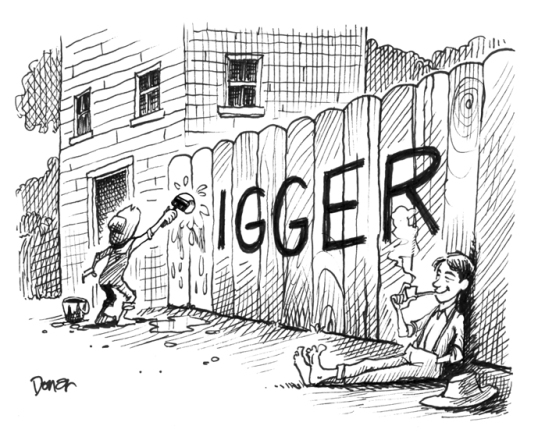


 I know you think your flag says something positive. But you need to understand that your intention does not control the message. You’re not saying what you think you’re saying.


/cdn0.vox-cdn.com/uploads/chorus_asset/file/2912048/Charlie_Hebdo_Mohammed_overwhelmed.0.png)


