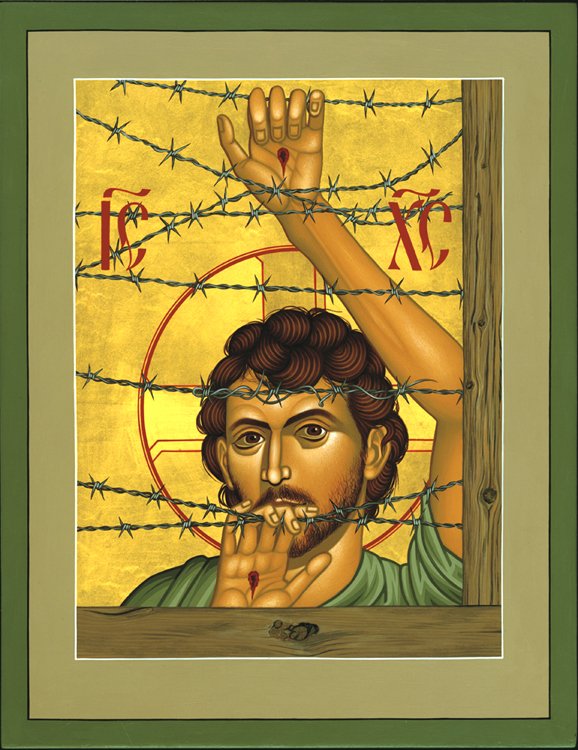
Tag Archives: immigration

In times of hysteria

Six things ordinary people can do to restore sanity.


One of the most difficult experiences of democracy is to watch your country going crazy, and feel responsible. In a dictatorship you could just zone out: The Powers That Be will do what they do, and your opinion doesn’t matter anyway. Your neighbors, your friends, your co-workers — their opinions don’t matter either, so there’s no point in arguing with them, or even letting them know you disagree. You might as well just binge-watch something light on TV, and wait for the wave to pass.

In a democracy it’s different: We are the wave. Politicians really do respond to certain kinds of public opinion, sometimes to our shame. So, for example, my Democratic governor (Maggie Hassan of New Hampshire, who I have voted for, given money to, and was planning to support for the Senate) called for a halt on admitting Syrian refugees. (She later reduced it to a “pause“, “until intelligence and defense officials can assure that the process for vetting all refugees is as strong as possible to ensure public safety.” But the damage was done: Any governor who wants to come out against refugees can claim bipartisan support.) My representative (Annie Kuster of NH-2, who I have also voted for and given money to) voted Yes on the American Security Against Foreign Enemies Act, which at a minimum would delay any new refugee resettlements by 2 or 3 months, and might snafu the process altogether. [1] (Check your representative’s vote here.)

If my side has been characterized by politicians timidly letting the panic sweep them away, on the other side it’s been bedlam. Ben Carson is openly dehumanizing refugees with metaphors about “rabid dogs”. Donald Trump is talking about closing mosques, because “we’re going to have no choice”. He has advocated forcing American Muslims to register with the government, so that they can be tracked in a database. Marco Rubio expanded Trump’s proposal to call for shutting down “anyplace where radicals are being inspired”. Ted Cruz and Jeb Bush want a religious test for refugees: We should accept Christians, but not Muslims. John Kasich wants to create a government agency to promote “Judeo-Christian values” around the world. [2]

Chris Christie says we shouldn’t even let in little kids. Like, say, this Syrian girl, who mistook the photographer’s camera for a gun and tried to surrender.

And remember this Syrian boy? His photo evoked international compassion a couple months ago, but that never lasts, does it?

When Governor Jay Nixon didn’t try to block Syrian refugees, state Rep. Mike Moon called for a special session of the legislature to stop “the potential Islamization of Missouri“. But the bull goose loony (to borrow Ken Kesey’s phrase) was a Democrat: Roanoke Mayor David Bowers, who justified his refusal to cooperate with resettling refugees by citing FDR’s Japanese internment camps during World War II. That national disgrace is now a precedent. (Who knows? Maybe slavery or the Native American genocide will become precedents too.)

I had never heard of Rep. Moon or Mayor Bowers before, but none of the Republican presidential candidates seemed this insane when they started campaigning. So I suspect they’re just saying what they think will appeal to their voters. They may be pandering to the public fear, attempting to benefit from it, and playing their role in spreading it, but they didn’t start it.

We did that. Ordinary people like us. Our friends, our relatives, our co-workers, the people we know through social media. And so I suspect it’s up to us to stop it.

I have to confess I didn’t see this coming. After the Paris attacks, I expected a push to hit ISIS harder, maybe even to re-invade Iraq and add Syria to the occupation zone. (Jeb Bush recently joined Ben Carson, John Kasich, and Lindsey Graham in calling for ground troops, though he was vague about how many.) I didn’t foresee an Ebola-level panic [3] focused on the refugees who are running from the same people we want to fight, much less the yellow-starring of American citizens who practice an unpopular religion.

But OK, here we are. Our country is going crazy and we are right in the middle of it. What do we do now?

1. Don’t make it worse. In particular, don’t be the guy hysterically running around and yelling at other people not to panic. Sanity begins within. You have to find it in yourself before you can transmit it to other people.

So: calm down. If you need help, seek out other calm voices. The needed attitude is a firm determination to slow this panic down, not a mad urge to turn the mob around and run it in the opposite direction.

Once you start to feel that determination, you’re ready to engage: Participate in conversations (both face-to-face and in social media). Write letters to the editor. Write to your representatives in government.

Don’t yell. Don’t humiliate. Just spread calm, facts, and rationality. When engagement starts to make you crazy, back away. Calm down again. Repeat.

2. Disrupt the spread of rumors. Panics feed on fantasies and rumors. Fantasies tell people that horrible things could happen. Rumors assert that they already are happening.

Social media is the ideal rumor-spreading medium, so it takes a lot of us to slow a rumor down. But you don’t have to be a rhetorical genius to play your part. Simple comments like “I don’t think this is real” or “That’s been debunked” are often sufficient, especially if you have the right link to somebody who has checked it out. The debunking site Snopes.com has tags devoted to Paris attack claims and Syrian refugees.

Here are a couple of the false rumors I’ve run into lately:

Current Syrian refugees resettled in America are not “missing”. I heard this one during a Trump interview with Sean Hannity. Trump refers to “people” who are missing — with the implication that they have gone off the grid and joined some kind of underground. Hannity corrected to “one person … in New Orleans”. (Think about that: It’s gotten so bad that Sean Hannity has to tone stuff down.) But Catholic Charities has debunked that story: They resettled the guy in Louisiana, and then he moved. He’s not missing. (The source of this rumor was probably the desperate David Vitter campaign for governor, which tried to ride the refugee panic to a comeback victory. It didn’t work.)

No, lying to further the cause of Islam is not a thing. Under the doctrine of taqiya, a Muslim may lie about his faith to escape serious persecution or death. Anti-Muslim propagandists have tried to turn this into a sweeping principle that justifies any lie to an unbeliever — and consequently justifies non-Muslims in disbelieving anything Muslims say. But it doesn’t work that way. Now, I’m sure ISIS has undercover operatives (just like we do) and that Muslim leaders lie (just like leaders of other faiths). But there’s no special reason to think Muslims are less truthful than the rest of us.

I won’t try to predict what further rumors will arise. But when you run into one, check Snopes, google around a little, and see if somebody has already done the hard work of checking it out.

As you participate, remember: In social media, you’re not just talking to the person you’re responding to (who might be hopeless), you’re also talking to his or her friends. Some of those friends might have been ready to like or share the rumor until they saw your debunking comment. You’ll never know who they are, but their hesitation is your accomplishment.

3. Make fantasies confront reality. Fearful fantasies work best when they’re vague and open-ended. For example: Terrorists are going to sneak in as refugees and kill us!

Think about that: A terrorist is going to submit to a one-or-two-year screening process, establish a life in this country, and then drop off the grid, strap on a suicide vest, and blow himself up in some crowded place.

Does that scenario make any sense? Wouldn’t it be simpler to come as a tourist? An aspiring terrorist could get in much faster with less scrutiny, spend a few weeks visiting Disney World or hiking the Grand Canyon, and then start killing us, while his fake-refugee brothers-in-arms are still tangled in red tape.

Sometimes the most devastating response to a nightmare fantasy is the simple question: “How does that work, exactly?” If you can get a person to admit “I don’t know”, you’ve restored a little sanity to the world.

4. Call out distractions. The Slacktivist blog makes this point so well that I barely need to elaborate.

As a general rule with very few exceptions, whenever you encounter someone arguing that “We [America] shouldn’t be doing X to help those people over there until we fix Y over here for our own people,” then you have also just encountered someone who doesn’t really give a flying fig about actually doing anything to fix Y over here.

So if somebody says we shouldn’t be taking in Syrian refugees while there are still homeless children or veterans or whatever in this country, the right response is to ask what they’re currently doing to help the people they say are more deserving. Odds are: nothing. Their interest in homeless American vets begins and ends with the vets’ value as a distraction from helping refugees.

Once you grasp this tactic, you’ll see it everywhere. So: “All those resources you want to devote to fighting climate change would be better spent helping the poor.” “OK, then, what’s your plan for using those resources to help the poor? Can I count on your vote when that comes up?” Silence.

When people argue that there’s a limited amount of good in the world, so we shouldn’t waste it on anybody but the most deserving, ultimately they’re going to end up arguing that they should keep the limited amount of good they have, and not use it help anybody but themselves.

5. Make sensible points. If you can capture somebody’s attention long enough to make a point of your own, try to teach them something true, rather than just mirror the kind of bile they’re spreading. This is far from a complete list, but in case you’re stuck I have a few sensible points to suggest:

The process for vetting refugees is already serious. Time explains it here, and Vox has an actual refugee’s account of how she got here.

America needs mosques. Research on terrorism (not to mention common sense) tells us that the people to worry about aren’t the ones who are pillars of their communities. The young men most likely to become terrorists are not those who feel at home in their local houses of worship, but the loners, or the ones have only a handful of equally alienated friends. (That’s not just true for Muslims like the Tsarnaev brothers, but also white Christian terrorists like Dylann Roof.) When you can’t connect face-to-face, that’s when you start looking around online for other radical outcasts you can identify with.

So it would be bad if American mosques just magically went away, as if they had never existed. But it would be infinitely worse for the government to start closing them. What could be more alienating to precisely the young men that ISIS wants to recruit?

Religious institutions aide assimilation. Imagine what would have happened if we had closed Italian Catholic churches to fight the Mafia, or Irish Catholic churches for fear of the IRA, or Southern Baptist churches that had too many KKK members.

The Founders envisioned American religious freedom extending to Muslims. As Ben Franklin wrote:

Even if the Mufti of Constantinople were to send a missionary to preach Mohammedanism to us, he would find a pulpit at his service.

We seldom look back with pride on decisions made in a panic. This is where the Japanese internment precedent should be quoted: That’s the kind of stuff we do when we get caught up in a wave of fear and anger. So should our refusal to take in Jewish refugees from Nazi Germany. The Red Scare is another precedent. More recently: Everybody who jumped from 9-11 to “Invade Iraq!” or “We need to torture people!” — are you proud of that now?

6. Look for unlikely allies, and quote them. Listening to Trump, Cruz, and the rest, it’s easy to imagine that everybody in the conservative base is part of the problem. But that’s not true. Here are a few places you may not realize you have allies.

Christians. I know: The self-serving Christians [4] so dominate the public conversation that sometimes it’s hard to remember the existence of actual American Christians, i.e., people trying to shape their lives around the example and teachings of Jesus. But if you screen out the clamor of “Christians” focused on the competition between their tribe and the rival tribe of Muslims, you will hear people who are trying to figure out what the Good Samaritan would do.

And I’m not just talking about liberal Christians from the mainstream sects. Lots of evangelical Christian churches have been involved in resettling refugees in their local areas. They know exactly how bad it is for refugees, and can put faces on the issue. They’re not happy with the people who are trying to demonize Jamaal and Abeela and their three kids.

The Mormon community retains its collective memory of being outcasts. [5] So Utah stands out as a red state whose governor has not rejected settling Syrian refugees.

Ryan Dueck sums up:

as Christians, there are certain things that we just don’t get to do.

We don’t get to hunt around for excuses for why we don’t need to include “those people” in the category of “neighbour.”

We don’t get to look for justifications for why it’s better to build a wall than open a door.

We don’t get to label people in convenient and self-serving ways in order to convince ourselves that we don’t have to care for them.

We don’t get to speak and act as if fear is a more pragmatic and useful response than love.

We don’t get to complain that other people aren’t doing the things that we don’t want to do.

We don’t get to reduce the gospel of peace and life and hope to a business-as-usual kind of political pragmatism with a bit of individual salvation on top.

We don’t get to ask, as our default question, “How can I protect myself and my way of life?” but “How does the love of Christ constrain and liberate me in this particular situation?”

And all of this is, of course, for the simple reason that as Christians, we are convinced that ultimately evil is not overcome by greater force or mightier weapons or higher walls or more entrenched divisions between “good people” and “bad people,” but by costly, self-sacrificial love. The kind of love that God displayed for his friends and his enemies on a Roman cross.

If you read the comments on that post, or look at this rejoinder from National Review, you’ll see that Dueck’s point of view is not universal among people who think of themselves as Christians. But it’s out there.

Libertarians. Some parts of the libertarian right understand that oppression is unlikely to stop with Muslims. So Wednesday the Cato Institute posted its analysis: “Syrian Refugees Don’t Pose a Serious Security Threat“. Conservatives who won’t believe you or Mother Jones might take Cato more seriously.

Scattered Republican politicans. I don’t want to exaggerate this, but here’s at least one Republican trying to slow the hysteria down: Oklahoma Congressman Steve Russell. He said this on the floor of the House:

America protects her liberty and defends her shores not by punishing those who would be free. She does it by guarding liberty with her life. Americans need to sacrifice and wake up. We must not become them. They win if we give up who we are and even more-so without a fight.

Russell eventually knuckled under to the pressure and voted for the SAFE Act, but says that he got something in return from the Republican leadership: the promise of a seat at the table in the subsequent negotiations with the Senate and the White House. We’ll see if that makes a difference.


These next few days, I think it’s particularly important for sensible people to make their voices heard, and to stand up for the courageous American values that make us proud, rather than the fear and paranoia that quake at the sight of orphan children.

Every time you stick your neck out — even just a little — you make it easier for your neighbor to do the same. Little by little, one person at a time, we can turn this around.


[1] What disturbs me most about the supporters of the SAFE Act is that they’re not calling for any specific changes in the way refugees are screened, they just want more of it. I suspect most of the congresspeople who voted for the act have no idea how refugees are vetted now, much less an idea for improving that process.

As we have seen in the discussion of border security, more is one of those desires that can never be satisfied. If this becomes law and in 2-3 months the administration comes out with its new refugee-screening process, we will once again face the cries of “More!”, along with the same nightmare fantasies about killer refugees.

[2] Actually, the main thing wrong with Kasich’s proposal is that he sticks an inappropriate religious label on the values he wants to promote: “the values of human rights, the values of democracy, freedom of speech, freedom of religion, and freedom of association.” Russian dissident (and former chess champion) Garry Kasparov has a better term for these: modern values.

In the West, these values were championed by Enlightenment philosophers, many of whom were denounced as heretics and atheists by the Christian and Jewish authorities of their era. So no, these are not Judeo-Christian values.

[3] The two panics have a number of similarities, as John McQuaid points out. In each case “a terrifying and poorly-understood risk has stirred up apocalyptic fantasies and brought out the worst in the political system.”

If you want a paradigm for fear-mongering, you can’t beat this Donald Trump quote, which combines the appearance of factuality with no actual content whatsoever:

Some really bad things are happening, and they’re happening fast. I think they’re happening a lot faster than anybody understands.

One similarity between the two panics is noteworthy: Both times Republicans attributed President Obama’s sane and measured response to his lack of loyalty to the United States. During Ebola, Jodi Ernst said Obama hadn’t demonstrated that he cares about the American people, and recently, Ted Cruz said Obama “does not wish to defend this country.”

Strangely, though, over-reacting during a panic seems to carry no political cost, because everyone forgets your excesses while they are forgetting their own. In a sane world, Chris Christie’s over-the-top response to Ebola would disqualify him from further leadership positions — especially since it turned out that the CDC was right and he was wrong. But no one remembers, so he is not discouraged from flipping his wig now as well.

[4] You know who I mean: The ones who find the Bible crystal clear when it justifies their condemnation of somebody they didn’t like anyway, but nearly impenetrable when it tells them to do something inconvenient. So the barely coherent rant of Romans 1 represents God’s complete rejection of any kind of homosexual relationship, but “Sell your possessions and give to the poor” is so profoundly mysterious that it defies interpretation.

[5] My hometown of Quincy, Illinois took in a bunch of them after they were expelled from Missouri in 1838. That event has its own little nook in the local history museum, because generous decisions are the ones descendants are proud of.

BTW, you read that right: The Mormons were expelled from Missouri. Just as pre-Civil-War states could establish slavery, they could also drive out unpopular religious groups. Didn’t hear about that in U.S. History class, did you?

One-and-a-Half Cheers for Executive Action

When democracy is failing, somebody still has to solve problems.


Imagine that something in your house’s infrastructure is broken: a pipe is leaking, an electric circuit is shorting out — something like that. There’s a guy in town who deals with such problems, but he isn’t coming. Maybe he’s too busy, maybe he doesn’t like you … whatever, he’s just not coming. You know enough to throw together a temporary fix, something that will keep the water damage from spreading or the house from catching fire, but it won’t be the right way to fix the problem and it certainly won’t be up to code.

Worse, given how things have been working around town lately, you don’t know that it will ever be up to code. You could imagine that the professional will be along to fix things the right way next week or in a few weeks, but what’s more likely is that your kludgy fix will lead to another “temporary” kludge the next time something goes wrong, and little by little your whole house will diverge from the standard practices that make houses liveable. Anybody who tries to fix anything in the future will have to know not just plumbing or electrical systems, but the specific lore of your house and the strange things that have been done to it through the years.

Knowing all this, how do you feel about your kludge? Good, sort of. You’re keeping things from falling down or burning up. But you also know you’re taking one more step down a path you don’t really want to follow.

That’s pretty close how I feel about the executive action on immigration that President Obama announced Thursday night. In the short run, I love it. If we can bring four million people out of the shadows, so that they will no longer be exceptions to the systems that keep society working properly, that will be a huge positive for all of us. But it also continues the pattern I described last year in “Countdown to Augustus“, where partisan conflict causes a tit-for-tat series of moves that are all technically legal, but which erode the social and moral norms that the republic is based on. Eventually democracy becomes so dysfunctional that the people cheer when a man on horseback sweeps it all away.

There’s a lot to unpack there, so let’s start by reviewing the immigration problem.

The shadow population. Nobody is really happy about how our immigration system has been working. I can’t think of a single major political figure who will defend it, who will stand up in public and say, “We shouldn’t change anything. Everything is just fine the way it is.”

The government estimates that 11.3 million people live in the United States without proper documentation. Most are Hispanic and more arrive all the time. The total has stayed fairly steady — and maybe even gone down a little — since the Great Recession. But that’s not a stable situation. Eventually there will be some crisis in Mexico at a time when our economy is doing well, and the in-flow will resume.

In the aggregate, these immigrants are probably good for our economy. (You can tell the story in such a way that people working difficult jobs for low wages victimize the rest of us, but that seems like a stretch to me.) It’s possible that native-born unskilled workers are hurt by the competition for jobs. But even here, it’s the shadowy nature of undocumented workers that is the real threat. An employer might prefer an undocumented worker because s/he can’t complain about abuse, unsafe working conditions, or wage theft. Pulling that worker out of the shadows makes the competition with native-born workers more fair.

The biggest problem the undocumented cause is not anything they do as individuals, but that their need to stay in the shadows gums up systems that depend on people coming forward. We have been lucky so far, but imagine if an epidemic of bird flu or drug-resistant tuberculosis got loose in the shadow population, and they not only didn’t show up at hospitals, but kept trying to work (in restaurant kitchens and as janitors and nannies) because no one gives sick days to undocumented workers. The undocumented are also unlikely to report crimes they see, either at the workplace or in their neighborhoods, for fear of being questioned about their status. And the existence of a shadow population provides a natural hiding place for the small number of border-crossers we really should be afraid of, like terrorists or drug-smugglers.

We can’t secure the border. “Secure the border” is a slogan like “end poverty” or “world peace”. It expresses an aspiration that cannot be achieved by any country resembling the current United States.

Ignore the Mexican border for a moment and just consider our Canadian border. Most of it is in remote areas that are not marked by any natural obstruction. (The green areas on the map are the places where there is no water barrier.) In the wilds of Montana or Maine or Alaska, crossing the border is just a walk in the woods; you might have to hop a fence, or you might not even know you’ve crossed. The idea that we’re going to surround our country with five thousand miles of Berlin-Wall-style fortifications is ludicrous.

People can walk into the United States. That’s not going to change anytime soon, no matter who’s president or what laws we pass.

If you don’t want to walk, come as a tourist or student and just stay; that’s how about half the undocumented got here. Are we really going to follow every visitor to Disney World or the Grand Canyon to make sure they go home? The old East German Stasi might have been up to a job like that, but no police system we want to have in America could do it.

Ditto for tracking down and arresting all 11.3 million of our current undocumented residents. A police force capable of that … what else could it do? I don’t think we want to find out, but I would love to hear the conspiracy theories if President Obama proposed a realistic — fully staffed, fully funded — plan to secure the borders and deport the undocumented. Police state! Tyranny!

So we’re not solving this problem by enforcement alone.

The irresponsibility of Congress. In my leaky-pipe metaphor, the professional-who-won’t-come is Congress. President Bush pushed Congress to do something, but it wouldn’t. Under President Obama, the Senate passed a bipartisan immigration reform plan, but the House has done nothing. I mean, literally nothing: It didn’t vote on the Senate’s bill, it didn’t pass an alternative, nothing.

Which would be dandy if the House leadership’s position was that our immigration system is A-OK and nothing needs to be done. If you think nothing is the right solution, then fine, do nothing. (That, for example, is how the global-warming debate is going. Congressional Republicans think no action is needed, so they block any attempt at action. They’re wrong, but at least their position is internally consistent.)

But if you are an official branch of government and you think the country has a serious problem, then you have a moral obligation to work on a solution. The House has totally failed to meet that obligation. House Republicans would rather have the impossible “secure the border” slogan to run on than take responsibility for any constructive action.

So there’s President Obama, watching his pipes leak and knowing that the plumber isn’t coming. So he does something. It’s a kludge. It is meant to be temporary, but might have to hold up for a long time. How should we feel about that?

What the order does and doesn’t do. President Obama’s executive order does not grant anyone legal status under our immigration laws. No one becomes a citizen or permanent legal resident. People who would have been near the bottom of the deportation list anyway — mainly parents of U.S. citizens or permanent residents who have been here four years or more, but also a smaller class of students and other people with economically valuable skills — are invited to come forward and apply for a temporary deferral of deportation. If that request is granted, they will then have legal permission to work in the United States while their deportation is deferred.

The administration estimates that about four million people could qualify.

Is it legal? Last week, before the policy was announced, The Wall Street Journal challenged President Obama to produce “the missing memo“, the opinion from the Justice Department’s Office of Legal Counsel on whether he had the power to do this — implying that he might be so lawless that he had not even asked for a legal analysis. And much has been made of a 2011 townhall meeting President Obama had with Hispanic students, in which he seemed to admit that such an action would be illegal:

With respect to the notion that I can just suspend deportations through executive order, that’s just not the case.

The OLC memo was released before Obama’s speech, and it makes refreshing reading (for those of us who read such things). Moreover, it supports both Obama’s executive order and his townhall statement.

Before I get into the details, I’d like to recall the kinds of memos the OLC was writing during the Bush administration: ones explaining how the President could unilaterally nullify the Convention Against Torture, or why the President had the power to declare American citizens to be “enemy combatants” and lock them up indefinitely without charges or trials. One standard feature of those memos was that they were open-ended: They explained why the President could do what he wanted now, but never described the limitations he might run into if he wanted to do more later. In one, for example, the OLC’s John Yoo wrote:

Article II, Section I makes this clear by stating that the “executive Power shall be vested in a President of the United States of America.” That sweeping grant vests in the President the “executive power” and contrasts with the specific enumeration of the powers — those “herein”– granted to Congress in Article I.

In other words, Bush’s OLC believed the President’s constitutional powers were “sweeping”, while Congress’ powers were limited to the ones specifically enumerated.

By contrast, the Obama OLC’s immigration memo lays out the principles limiting the President’s power, and says that some of what had been suggested is legal and some isn’t. (The part that isn’t — deferring deportation of parents of the “Dreamers” who were the subject of the Deferred Action for Childhood Arrivals order of 2012 — had been rumored to be part of this executive order, but was left out — possibly because the OLC determined it was beyond the President’s power.)

Quoting numerous Supreme Court decisions, the memo lays out four principles that limit the kind of executive action that had been proposed:

  1. “enforcement decisions should reflect ‘factors which are peculiarly within [the enforcing agency’s] expertise’.”
  2. “the Executive cannot, under the guise of exercising enforcement discretion, attempt to effectively rewrite the laws to match its policy preferences. … In other words, an agency’s enforcement decisions should be consonant with, rather than contrary to, the congressional policy underlying the statutes the agency is charged with administering.”
  3. “the Executive Branch ordinarily cannot, as the Court put it in Chaney, ‘consciously and expressly adopt a general policy that is so extreme as to amount to an abdication of its statutory responsibilities’.”
  4. “a general policy of non-enforcement that forecloses the exercise of case-by-case discretion poses ‘special risks’ that the agency has exceeded the bounds of its enforcement discretion.”

If, for example, the President were to simply stop deporting people — “just suspend deportations through executive order”, as he put it in 2011 — he would violate Principle 3. The law says to deport people, so the President can’t just say no. But Congress has not provided the resources to deport everyone who is in the country illegally.

DHS has informed us that there are approximately 11.3 million undocumented aliens in the country, but that Congress has appropriated sufficient resources for ICE to remove fewer than 400,000 aliens each year, a significant percentage of whom are typically encountered at or near the border rather than in the interior of the country.

As a result, the executive branch has to prioritize which 400,000 undocumented immigrants it wants to go after each year. Its prioritization can’t be arbitrary, and can’t rely “on factors which Congress had not intended it to consider”. Past Congressional action has emphasized deporting terrorists and other violent criminals, so there’s no problem putting them at the top of the deportation list. Deferring deportation for “humanitarian” reasons has also been recognized by Congress, and keeping families together has been recognized as humanitarian. Also, there is a long history (recognized by Congress) of deferring deportation of people who are in the middle of a lengthy process that might eventually grant them legal status.

Unless they are dangerous criminals, parents of U.S. citizens and permanent residents fit all these criteria. And the executive branch will continue deporting people at the rate its resources allow, giving temporary deferrals — revocable on a case-by-case basis — to low-priority enforcement targets.

But OLC doesn’t find that the same humanitarian concerns apply to parents of the beneficiaries of DACA.

Many provisions of the INA reflect Congress’s general concern with not separating individuals who are legally entitled to live in the United States from their immediate family members. … But the immigration laws do not express comparable concern for uniting persons who lack lawful status (or prospective lawful status) in the United States with their families.

The DACA executive order did not (and could not) give the Dreamers legal standing to petition for the admission of their parents, as citizens and legal residents can. So there is no basis for deferring the parents’ deportation while we wait to see what happens to that petition.

Is this a bad precedent? Vox considered the question: “What could a Republican president do with Obama’s executive power theories?” Their answer is: not much that Bush wasn’t already doing.

Various ideas have been floated for what the executive orders of a Republican president might do through selective enforcement: change the tax laws, give polluters carte blanche to violate the Clean Air Act, waive all the requirements of ObamaCare, etc.

The problem in most of the cases is that debts and penalties accumulate rather than evaporate. Maybe President Perry wouldn’t prosecute you for failing to pay more than whatever flat-tax number he had in mind, but your debt to the IRS would keep accumulating until some future president made you pay, plus interest and penalties. So taking advantage of the offer would not be a prudent move.

In general, I’m not afraid of what a Republican administration might do if it sticks to the four limiting principles the OLC laid out. So the problem is more political than legal: To the extent that Republicans convince the country that Obama is doing something illegal, the next president will have rhetorical justification for doing illegal things too.

That is in fact the longer-term pattern: When conservatives falsely accuse liberals of something, they’re usually laying the groundwork for really doing something similar themselves later on. For example, liberal Supreme Courts were accused of “making up rights” for women and minorities; so when conservatives took over the Court, they felt justified in making up rights for corporations.

Now they’re telling us that the Democratic president is writing his own laws. Whether that is true in some literal legal sense or not — and I don’t believe it is — in their own minds the groundwork is being laid for future Republican decrees.

What to do? The frustrating thing about the pattern laid out in “Countdown to Augustus” is that there’s never a good place to make a stand against it. The encroachments are usually in the realm of norms rather than laws. Typically, you see a disaster looming or an injustice happening, but your opponents have taken some legal-but-unprecedented action to block the usual way the Republic would take action against it. You have the legal power to act anyway, but in a way that just isn’t done. If you act, your opponents feel themselves put in a similar situation, and they then look for further norms they can break to regain the upper hand. Eventually, people are finding loopholes in the laws against murder and treason.

But do you let your opponents gain advantage by breaking norms, without responding? Do you let the injustices continue or the disasters strike, just to preserve a norm of political behavior that the other side won’t respect anyway?

President Obama has patched a pipe in a kludgy way. In an ideal world, it would only have to hold until the plumber can get here. But the plumber’s not coming. So I’m glad the patch is there. But I’m not happy.

Rethinking Immigration

We don’t understand “illegal”. We just think we do.


My favorite books are the ones that take the stuff everybody knows and ask “Really?”.

David Graeber’s Debt: the first 5,000 years was like that. At a party in Westminster Abbey, an activist lawyer says to Graeber, “Surely one has to pay one’s debts!” as if nothing could be more obvious, no matter how liberal you are. His entire book is a challenge to that certainty: Really? What is debt? Where does it come from? He finds that the history of debt is all tangled up with slavery, and that even today debt is often an expression of power relationships that we would challenge in any other setting.

Aviva Chomsky’s* Undocumented is another “really?” book. What everybody knows about immigration is that undocumented Hispanic immigrants have broken the law, and there have to be consequences for that. “What part of ‘illegal’ don’t you understand?” demand the protest signs. We have to secure our borders, and you can’t just let people walk into the United States.

Really? Chomsky writes: “The purpose of this book is to denaturalize illegality.” In other words, we don’t really understand “illegal immigrant”; we just think we do. Realizing how strange an idea it is, and the historical freight it carries, is a step forward.

So before we even start imagining our future immigration policy, we have some things to unlearn about the past.

1. For the longest time, we did just let people walk into the United States. Whether they became citizens or not depended on their race. If you’re white and your family has been in the U.S. for several generations, you probably think they came “the right way”, through some sort of legal process comparable to our current immigration procedures. That’s not true. Back in the 1840s, my German ancestors didn’t get visas or put their names on the waiting list for the next year’s German immigrant quota. They just got on a boat and came.

Before the Civil War, it was taken for granted that white people who turned up on our doorstep would become citizens and non-whites wouldn’t. The Naturalization Act of 1790 limited naturalization to “free white aliens” of “good character”. White people could just show up, and if they lived here for two years (later extended to five) without incident, they could apply to any local court for citizenship.

Of course the rules were different for blacks, who were mostly slaves in the South, and weren’t wanted as citizens in many northern states. Indiana’s constitution of 1851 said “No Negro or Mulatto shall come into, or settle in, the State, after the adoption of this Constitution.” In the West, the cheap labor was Chinese; and while they weren’t exactly slaves, they were never going to become Americans either.

The 14th Amendment changed all that, making any baby born in the United States a citizen (except for Indians). So suddenly it was important who was allowed across the border. The Chinese Exclusion Act of 1882 kept out the Chinese, and the Immigration Act of 1917 extended the ban to all Asians. The early 20th-century flood of immigrants from Eastern Europe — Jews! Catholics! anarchists! — was throttled in 1921 by restricting annual immigration from any country to 3% (later 2%) of the number of Americans who claimed that ancestry on the 1910 (later 1890) census.

So (except for Asians) national origin replaced race as the decisive factor. But the national origin of American blacks was defined in such a way that the annual immigration quota from all of non-Egyptian Africa was only 1,100.

That law was the baseline for refusing entry to Holocaust survivors after World War II: Nothing against you personally, but (even though you’re Jewish) we classify you as Czech, and the quota is low because there weren’t many Czech-Americans in 1890.

2. Mexican immigration has always been a special case. Until 1965, the law didn’t consider Mexicans who crossed the border to be immigrants at all. They were migrant workers who would someday return to Mexico. So there was no reason not to let them in, no reason not to deport them whenever the economy went south, and no clear path to citizenship for the ones who stayed. 

By 1965 our openly racist immigration laws had become an embarrassment, so we changed them. For the first time, Mexicans were considered immigrants, and seasonally wandering back and forth across the border became illegal. The “illegal Mexican immigrant” was born — not because a flood of law-breaking Mexicans surged over the border, but because we re-classified the traditional migration pattern of many Mexican workers.

Chomsky points out that some of the stereotypes about fence-jumping Mexicans are wrong.

  • The easier way to cross the border is to get a tourist visa, fly in, and forget to leave. About half of our undocumented residents got here that way. They tend to be the wealthier ones. But if the incentives are high enough, just building a wall isn’t going to stop people from coming.
  • A lot of undocumented immigrants were recruited to come here by middlemen working for American employers. Some from more remote areas didn’t even know they were breaking our rules.
  • Free-trade agreements have flooded Mexico with cheap American corn, making many small-scale Mexican farms unsustainable. A set of rules that allows us to keep out the Mexican farmers made destitute by our exports isn’t really fair.

3. Our current policy maintains a two-tier labor market that has its roots in slavery. Throughout our history, America has had two classes of workers; one that had a chance to move up and one that didn’t. Chomsky writes:

From the eighteenth and, especially, the nineteenth centuries on , the United States benefited from its place in the global industrial economy, and white people in the United States benefited from their place in the racial order. A dual labor market developed in which some workers began to become upwardly mobile and enjoy the benefits of industrial society, while others were legally and structurally stuck at the bottom.

The Northeast mechanized, and lower-tier work that was hard to mechanize (mostly in fields or mines) shifted to the South (where it was done by blacks, first as slaves and then as victims of Jim Crow) or the West (where Chinese and then Mexicans did it).

The justification for separating the two tiers of workers has shifted with time. Originally the separating criterion was race, then partly race and partly national origin. Now it’s legal status. In spite of what our laws say, our economy still creates and depends on millions of sub-minimum-wage jobs where first-tier standards of job safety and protection against abuse don’t apply. They aren’t limited to the South and West any more, they’re everywhere. But they’re no longer done by blacks or Chinese or even Mexicans (per se); they’re done by illegals.

From Chomsky’s point of view, the point of our laws about “illegal immigrants” isn’t to get rid of these people or even to keep more from coming; it’s to make their labor more exploitable. Being “illegal”, they can’t demand their rights or complain about their mistreatment.**

4. So the place to start isn’t “What are we going to do about these people?”. It’s “What are we going to do about these jobs?”

Our fundamental argument about the “illegals” bounces between two poles, neither of which is quite right.

  • They steal American jobs.
  • They do necessary jobs that Americans won’t do.

The truth is that the terms offered to undocumented workers — wages, working conditions, etc. — would be unacceptable (and often even illegal) for American workers. If the undocumented workers weren’t there (a situation dramatized in the movie A Day Without a Mexican, and played out in real life in Georgia, until the old ways re-asserted themselves), those jobs — and the economy based on them — would have to change.

Some of those jobs would go away. If, say, you could only hire documented American residents to be your live-in nanny — even if you could hire the same undocumented woman suddenly documented, protected by American laws, and open to a wider range of employment opportunities — you might decide a day-care center was a better option. Maybe farmers would conclude that growing certain labor-intensive crops in the U.S. isn’t economical (or is economical only in small quantities for foodies willing to pay high prices), so we would import more Mexican vegetables and fewer Mexican workers. Those farmers would grow something else, buy more machinery, and probably make less money; the market value of their land would go down accordingly. Some loans collateralized by that land would go underwater, and some banks might fail.

Others jobs would upgrade, and the products based on them would become more expensive.*** You might have to pay more at restaurants, or more to get someone to clean your house. But the wages paid for those upgraded jobs would increase demand for the kinds of things American workers buy, creating new jobs that might or might not balance the ones that went away.

In short, it’s not just a question of “kick them out” or “secure the border” or even “crack down on the employers”. The whole economy would change if we had a one-tier system of labor rather than the two-tier system we’ve had for our entire history. Until we’re ready to face that change, all our debates about “illegals” will go round in circles. Because if you don’t want the people, but you do want their labor, you’ve got a problem.


* Yes, she is related to Noam. He’s her Dad.

** There’s an obvious parallel to prison labor, whose workers are similarly limited and unprotected because of their legal status. Prison labor is also largely non-white, as Michelle Alexander explains in The New Jim Crow.

*** Though maybe not by as much as you think. William Finnegan writes in The New Yorker: “But in Denmark McDonald’s workers over the age of eighteen earn more than twenty dollars an hour—they are also unionized—and the price of a Big Mac is only thirty-five cents more than it is in the United States.”

7 Liberal Lessons of Ebola

Disease should make us think like a species, not like rugged individualists.

One perverse aspect of the public reaction to Ebola is the way it seems to be playing politically, at least in the short run. Ebola is making people afraid, and pushing them towards the party whose central narrative is about fear and anger: the Republicans.

Republican politicians are certainly playing up this angle: exaggerating the threat, and calling for xenophobic actions to combat it — cut off contact with Africa, seal the border against … well it’s not clear against who. Candidates have been amalgamating all the current fear-objects into one nightmare narrative: ISIS terrorists are going to infect themselves with Ebola, then sneak across our southern border to spread it here.

Senator Ron Johnson and Rep. Joe Wilson have put it most bluntly, but Republican Senate candidates around the country — Scott Brown, Thom Tillis, Cory Gardner — have been highlighting the pieces of this dark fantasy and hoping voters will assemble it for themselves: Ebola, ISIS, southern border.

Like most nightmares, this one evaporates as soon as you look at it by daylight: Ebola sucks as a bio-weapon, because it’s so hard to spread, and by the time the carriers were contagious they’d mostly just want to sleep; they certainly wouldn’t be able to swim the Rio Grande or hike the Arizona desert. Except in fantasy, no one has found any links between ISIS and Mexico. And unlike Texas, Mexico has no Ebola cases so far; if anybody should want to seal the border, it should be them, not us.

But nightmares — even very, very unlikely ones — raise fear, and fear makes people vote Republican. Or at least that’s what Republicans believe.

A rational person, though, ought to become more liberal when they think about Ebola, not more conservative. Here’s why.

1. Ebola points out why we need government. Libertarian rhetoric about sovereign individuals has a lot of superficial charm. But biology knows nothing about that; humanity is a species, and sometimes we have to act as a species. We do this through government.

If you want to get some distance on these issues, I recommend reading John Barry’s The Great Influenza, about the 1918-19 epidemic that killed as many as 100 million people around the world. The cities that did well with that plague were the ones whose governments were most draconian about it. As you read, try to imagine a plague hitting Galt’s Gulch, where each sovereign ubermensch would do his own research and make up his own mind about the disease and how to handle it. I don’t think they’d do very well.

There’s a lot of thankless, profitless work involved in controlling Ebola. For example, tracking down all the people who have been in contact with an infected person, and testing or quarantining them. It’s hard to imagine a free-market system that would do this well. The most obvious libertarian system would make individuals responsible for tracking their own exposure, and if some more complicated system created a profit motive for controlling a small outbreak, waiting until it’s a larger outbreak would be even more profitable.

2. Ebola points out why we need a fully funded government. When there’s no immediate threat of disease, government agencies like the CDC look like bureaucratic waste. When Rand Paul put out a “Tea Party budget” in 2011, it included a big cut in the CDC, and virtually no explanation as to how this would affect its mission. As I explained at the time:

sometimes you don’t get even that much justification, and the cut seems to be based on little more than an ideological assumption that waste must be in there somewhere. Take the CDC again. It’s our front line against plagues and epidemics, the folks we depend on to helicopter down in astronaut suits if SARS or ebola breaks out or drug-resistant tuberculosis gets out of hand. It has a total budget of $6.342 billion in 2011, so $1.165 billion represents a 28% cut for the final 2/3 of the year (assuming Paul’s bill could be passed immediately).

How should the CDC fulfill its mission with 28% less money? Given how disastrous a mistake could be, you might hope for some kind of expert justification, maybe a new strategy based on a medical study or two. Nope. The overview just suggests “focusing on domestic priorities rather than spending billions on overseas initiatives.” So basically, the CDC should stop worrying about plagues in other countries, and wait until they show up here. In Rand Paul’s world, that kind of thinking saves money.

I quote from my 2011 article to make this point: Hindsight wasn’t necessary to grasp how misguided this was.

NIH Director Francis Collins has speculated that we’d have an Ebola vaccine by now if not for the budget cuts that did get made: The $37 million we spent on Ebola vaccine research in 2010 was down to $18 million by 2014. Various other people have pushed back against that speculation. (And then Mike the Mad Biologist pushed forward again.) But the bottom line is simple: If you could reach back in time and reverse those cuts, wouldn’t you?

Now ask yourself: How many other cuts are like that? How many other agencies not currently in the headlines are we looking at as “wasteful spending” when it’s just that we don’t personally need them right now? And is it possible that events might make us wish we’d spent more before the emergency hit?

3. Ebola points out why we need a fully staffed government. Wouldn’t it be nice to have a surgeon general about now? (Just as it would have been nice to have had an ambassador to Russia when the Ukraine thing broke out or a Turkish ambassador as we were trying to get Turkey’s cooperation in opposing ISIS.) As former Surgeon General Regina Benjamin put it:

The surgeon general is America’s doctor. Delivering information to the American people in a language they can understand. Not having one right now, you don’t have that face and that person that the American people can identify with as their doctor who’s looking out for them on a large scale.

But we don’t have one because of the NRA. President Obama nominated Dr. Vivek Murthy back in March. But it turned out that Murthy views gun violence as a public health problem. (So does the AMA.) That makes him unacceptable to the NRA, so the Senate has been unable to confirm him (and a recent Supreme Court ruling prevents Obama from installing him as a recess appointment).

It wasn’t so long ago that the Senate believed in staffing the government, without making every appointment into a political football. But today’s Republicans have blocked Obama’s appointments on principle, even when they have no issue with the nominee. If they get control of the Senate in the upcoming election, expect the government to remain understaffed at least until the next administration.

If you’ve ever worked in an understaffed department, you know what that means: Stuff falls through the cracks. When that inevitably happens, Republicans will blame “government” rather than the true culprit: understaffed government.

4. Ebola demonstrates why we need to fund foreign aid. Foreign aid is one of the most unpopular parts of the federal budget (possibly because Americans grossly overestimate how much we spend on it). But viruses point out that the world is more interconnected than our political systems account for.

Bush administration officials used to tell us that we had to fight terrorism “over there” or else we’d eventually have to fight it over here. That’s debatable when it comes to terrorism, but it’s absolutely the fact when you talk about contagious diseases.

Ebola is controllable — previous outbreaks have been controlled, and the world has gone entire years without new cases. But ultimately it has to be controlled at the source, in west Africa.

Now widen your view a little: Anyplace in the world where people are living in unhealthy and unhygienic conditions, the next super-bug might be evolving. Any population that is “off the grid” of the global medical establishment might where a pandemic gets rolling before anyone notices.

5. The specter of a deadly infection demonstrates why we need universal health care. Conservative rhetoric revolves around individuals, and in particular how wrong it is to “give” individuals benefits — like health care — that they haven’t “earned”. Such individuals become “dependent on government” and take money away from “job creators”. It’s even worse if some of those benefits reach people who entered the country illegally or stayed past the expiration of their visas.

But when an infection gets loose, you want everybody who might be sick to seek treatment. You don’t want them to stay away from doctors because they can’t pay, or avoid the emergency room for fear of being deported, or not tell anybody about that undocumented cousin they might have infected.

I’m still not terribly worried about the spread of Ebola in the United States. (The number of cases and the likelihood of spreading the infection are both low.) But we might not be so lucky with the next disease. That’s why we should all be tremendously grateful that (so far) ObamaCare has gotten health insurance to ten million more people, and we should be working to plug the holes in that system rather than tear it down.

If a real epidemic got rolling, where would you rather be? In Massachusetts, where the model for ObamaCare, RomneyCare, became law in 2006, and only 1.2% of the population lacks health insurance? Or in a conservative wonderland like Texas, where 24.8% — probably including the Hispanics who clean your office or work in the kitchen at your favorite restaurant — are uninsured?

6. The Ebola panic demonstrates the danger of legitimizing conspiracy theories. During a plague, you need affected people to cooperate with the containment plan — seek treatment, accept quarantine, and report all their contacts truthfully — while unaffected people stay calm rather than doing panicky, stupid things. That’s when it’s important that the country trust its scientific establishment and its government.

Now of course it is important that the media and the political process police the trustworthiness of both those institutions. On those rare occasions when scientists fake data, they should be exposed. When the government lies, the media should investigate and seek the truth.

But what we’ve been seeing inside the conservative news bubble during these last six years goes way beyond that. Political opportunism has been seeking every opportunity to tear down public trust, even when — maybe especially when — the accusations are baseless.

And so, much of the public believes that the scientific community is involved in an elaborate conspiracy to promote a climate change “hoax”, or to destroy the Christian religion via the theory of evolution. So how can we believe what the doctors are telling us about Ebola?

And the Obama administration? If President Obama faked his birth certificate to hide the fact that he’s not really eligible to be president, if he’s been plotting to destroy the U.S. since he was a student, if he has a gun-confiscation plan that’s always just a month or two from implementation, if he is funding “death panels” that will decide whether your life is worth saving, if he has a “Kenyan, anti-colonial” worldview, if he “hates white people” or “has a deep-seated hatred of white people or the white culture” … why would his administration tell us the truth about Ebola? Fox News’ resident psychologist Keith Ablow lays it out:

[Obama’s] affinities, his affiliations are with [Africans]. Not us. That’s what people seem unwilling to accept. He’s their leader … we don’t have a president. We don’t have a president who has the American people as his primary interest.

This is irresponsibility on a grand scale. Every era has a lunatic fringe with paranoid notions. But this kind of stuff comes from governors, members of Congress, a news network, and lots of other folks who seem to be part of a trustworthy establishment. And major national leaders — I’m looking at you, John Boehner and Mitch McConnell — sit at the same table and humor the purveyors of this destructive nonsense.

So it’s no wonder we’re seeing all kinds of weird behavior out there: Like the school in Maine that suspended a teacher for 21 days (the incubation period of Ebola) because she’s been to Dallas. Her hotel was less than ten miles from the hospital where two nurses got infected, so how can we have her in the same room with our children? (The local news report on this mentions a local parent who believes the government has “downplayed risk factors”. I wonder where he gets his news.) Thursday, several entire schools closed in Texas and Ohio because of Ebola contagion fears.

What would happen if we were having a real epidemic? I think mobs would be roaming the streets, burning down the houses of suspected carriers — all because the conservative movement and the Republican Party have prioritized destroying Obama over maintaining public trust in trustworthy institutions.

Pandering to people’s worst instincts may seem like a political freebie. But it isn’t. There’s a big social cost to this kind of stuff. But “social cost” is one of those things that conservatives are trained not to see. And that’s a 7th reason why you should be a liberal.

Being Them

It’s easy sometimes for the [immigration] discussion to take on a feeling of us versus them. And when that happens, a lot of folks forget that most of us used to be them.

— President Barack Obama (Tuesday)

This week everybody was talking about immigration

The early part of a new presidential term is a magic moment for discussing the country’s real problems and what might be done about them. At the beginning of Obama’s first term we talked about how to stimulate the economy and expand access to healthcare. This time we’re talking about guns, immigration, and (maybe soon) climate change.

There’s no guarantee anything will get done, but isn’t it wonderful to be talking about something real? “Why can’t we do this all the time?” you wonder, and I have no answers.

So this week a bipartisan group of senators presented their immigration framework and President Obama responded by presenting his. (A bipartisan group in the House is still working on its plan.) Each has four parts, and the parts are remarkably similar: border security, a path to citizenship for people currently in the country illegally, and stopping undocumented workers from getting jobs are mentioned in both. Obama talks about “streamlining our legal immigration system” while the senators’ proposal seems a little more specifically business-focused: “admitting future workers to serve our nation’s workforce needs” — but those goals seem compatible.

At this point, both proposals are just lists of principles; there is no actual immigration bill yet. So a lot can still go wrong. Maybe the details will be hard to hash out, or maybe the two sides aren’t as serious as they look. We’ll see.

Republicans and the Hispanic vote. The one lesson Republicans seem to have learned from November is that they need more Hispanic votes. But opinions on how to get them vary.

Some think it will be enough to showcase more Hispanic names and faces. Put Marco Rubio or maybe Ted Cruz on the 2016 ticket, they think, and the Hispanic problem goes away. (The same people thought Sarah Palin would bring Hillary Clinton’s female supporters to John McCain. It didn’t work out.)

Another school believes Republicans just have to change their rhetoric. Stop talking about “sending them all back” or “anchor babies”, stop taking public stands against immigration reform, and presto!

Another faction thinks it’s pointless even to try. National Review promotes the same you-aren’t-good-enough-to-vote-for-us message that worked so well for Mitt Romney:

While many [Hispanics] are in business for themselves, they express hostile attitudes toward free enterprise in polls. They are disproportionately low-income and disproportionately likely to receive some form of government support. More than half of Hispanic births are out of wedlock. Take away the Spanish surname and Latino voters look a great deal like many other Democratic constituencies. Low-income households headed by single mothers and dependent upon some form of welfare are not looking for an excuse to join forces with Paul Ryan and Pat Toomey. Given the growing size of the Hispanic vote, it would help Republicans significantly to lose it by smaller margins than they have recently. But the idea that an amnesty is going to put Latinos squarely in the GOP tent is a fantasy.

Finally, somewhere inside the GOP may lie a faction that genuinely wants to represent Hispanic Americans and solve the nation’s immigration problem. Maybe they will succeed, or maybe the party will be happy just to have a plausible way to blame the Democrats when immigration reform fails yet again. We’ll see.

Guest workers. Most pundits are focusing on border security, but I think the detail most likely to sink the whole plan is how to handle “guest workers” — people we allow to enter the country to do a job, and then send back home without any chance for permanent residency or citizenship.

Guest workers make sense in two circumstances: if our need for workers is genuinely temporary (as it was when so many of our citizens were overseas fighting World War II), or if the workers themselves have no interest in staying. (A young Mexican might want to come north for the tomato harvest or to work in a kitchen for a year or so, and then go home with a little spending money.) But if we’re bringing in workers to fill a long-term need, then it should be up to them whether they want to stay and pursue citizenship. Otherwise we’re just giving the business community an exploitable working class that can’t vote.

The labor market. I am sick of hearing about “jobs Americans won’t do”. This is the only kind of market failure conservatives believe in. I believe that there are many jobs Americans won’t do for a Mexican wage, but there is a market-clearing wage that will get those jobs done in America by Americans.

People who believe in jobs-Americans-won’t-do point to the experience of Georgia and Alabama, where anti-immigrant laws resulted in crops rotting in the fields. To me, this is what would happen in any import-dominated market if imports (in this case, imported workers) were suddenly cut off. If we banned imports of, say, laptop computers, there would be a shortage in the stores until the domestic manufacturers tooled up. But that wouldn’t imply that “there are products American companies won’t make”.

What we found out in Georgia and Alabama is that low-skill work like harvesting vegetables isn’t no-skill work. You can’t take random people out of the unemployment line and expect them to have the required skill and stamina. Again, if you are paying an illegal-immigrant wage and people aren’t sure whether the immigrants will come back or not, native Alabamans and Georgians are not going to invest a lot of effort in improving their harvesting.

If growers had to pay an American wage to get their vegetables harvested, a lot of current arrangements wouldn’t make sense, and it would take a while for the market to adjust. (Maybe there are some crops that it doesn’t make sense to grow in America, or maybe consumers will have to get used to paying higher prices.) But many industries suffer cost shocks of one sort or another, and the market works it out eventually.

That’s exactly what markets are good at, as conservatives ought to know.

If we discover that we are generally short of workers after the market settles on an American wage for jobs currently being done by undocumented immigrants, then we need more documented immigrants who have the option of seeking citizenship, not guest workers.

… and we’re still talking about guns

which is kind of amazing when you think about it. Six weeks after Sandy Hook, the NRA still hasn’t managed to shut this down.

Different this time?

Increasingly, the NRA is having trouble defending itself and its minions, much less achieving its goals. Groups like the Coalition to Stop Gun Violence, Mayor Bloomberg’s Independence USA PAC, and Mayors Against Illegal Guns (whose SuperPAC also has Mayor Bloomberg’s financial backing) are making politicians pay a price for their NRA A-rating. Here, CSGV goes after Georgia Democratic Congressman John Barrow, using footage from his own pro-gun campaign ad.

IndependenceUSA ran this ad against Debbie Halvorson, a candidate running in a special election congressional primary in Chicago:

In a debate, one of Halvorson’s rivals said, “I got an F (grade) from the NRA, something I’m proud of.”

This doesn’t work all over the country yet, but it doesn’t have to. In recent years, the NRA’s agenda has gotten support from representatives whose constituents lean the other way, just because there has been no perceived price to giving in to the powerful gun lobby. Now there is.

The NRA itself is facing an increasing level of criticism. Long-term, the most damaging charge is probably this one, taken from an article by Tim Dickinson in the current Rolling Stone:

Billing itself as the nation’s “oldest civil rights organization,” the NRA still claims to represent the interests of marksmen, hunters and responsible gun owners. But over the past decade and a half, the NRA has morphed into a front group for the firearms industry, whose profits are increasingly dependent on the sale of military-bred weapons like the assault rifles used in the massacres at Newtown and Aurora, Colorado.

On paper the NRA is governed by its members, but member-power is hard to exercise. NRA members did not, for example, elect their most visible spokesman, CEO Wayne LaPierre, who has served since 1991. He was chosen by a 76-member board. One-third of that board comes up for election each year, when members who have been paying dues for at least five years are presented with a slate of candidates chosen by a 10-member nominating committee (which I think is also chosen by the board). Theoretically it would be possible for the members to change leadership by electing write-in candidates, but in practice it’s hard to imagine. One charismatic reformer in one election couldn’t do it. A reform movement would have to field a slate of candidates over several years, and by the second year gun-industry money would pour into the incumbent campaigns.

Dickinson lays out the money trail, estimating that corporate donors like Ruger, Beretta, Browning, and Remington have given the NRA $52 million in recent years.

Much like elite funders of a major political party, these Golden Ringers enjoy top access to decision-makers at the NRA. Their interests, not the interest of the $35-a-year member, rule the roost. “They’ve got this base of true believers that they mail their magazines out to,” says policy analyst Diaz. “But the NRA is really about serving this elite.”

It’s one thing for a politician to point to an A-grade from the NRA as support from America’s sportsmen. It’ll be a different matter entirely if the public comes to see it as evidence that s/he has been bought by the firearms industry.

This kind of thing — turning an organization’s support into a negative — has happened before: Conservatives did it to the ACLU, most notably in the Dukakis/Bush race of 1988. ACORN was driven out of existence entirely. They’re trying — unsuccessfully, so far — to do the same to Planned Parenthood.

I can’t remember liberals ever pulling this trick off against a conservative organization. But it deserves to happen to anybody, it deserves to happen to the NRA.


Stephen King has written a very interesting piece called “Guns”. It’s available as a Kindle single for 99 cents, or Amazon Prime members can borrow it for free.

The most interesting section is when King discusses his own role in school shootings and what he did about it. As a teen-ager, he wrote a school-shooting novel called Rage. More than one school shooter, King discovered years later, had been reading Rage.

He does not apologize for writing it, because he believes it expresses a certain truth about the teen-boy experience. And he doesn’t believe that his novel “broke” the shooters; rather “they found something in my book that spoke to them because they were already broken.”

Nonetheless he did take Rage off the market, because it’s an “accelerant”, as he puts it.

I didn’t pull Rage from publication because the law demanded it; I was protected under the First Amendment, and the law couldn’t demand it. I pulled it because in my judgment it was hurting people, and that made it the responsible thing to do.

Ultimately, King’s proposals are similar to President Obama’s: background checks, assault weapon ban, ban on large magazine clips, and so on. But what’s most interesting is how he imagines these changes coming about: Gun owners (like him) need to demand them — in spite of the NRA — because it’s the responsible thing to do.


The Atlantic takes on the argument that the Second Amendment is a defense against tyranny. When people make that claim, they’re usually picturing the Minutemen, who really were a “well-organized militia” accountable to the community. (They also didn’t have much to do with winning the Revolutionary War.) But self-selected gangs of armed civilians are only effective defenders of democracy in fantasies like Red Dawn.

The right parallel in American history isn’t Lexington and Concord in 1776, it’s Bleeding Kansas in 1856-58, when pro- and anti-slavery gunmen traded atrocities.

a citizen uprising at any point in the foreseeable future would probably not involve like-minded constitutionalists taking up arms to defend democracy and liberty. It would more likely be a matter of one aggrieved social group attacking another. And for the most criminal and vicious members of society, the rationale of “protecting” their own rights would be a convenient justification for straight-up looting, robbery, and bloodshed.


The week’s stupidest controversy happened after the New Republic asked President Obama “Have you ever fired a gun?” and Obama replied “Up at Camp David, we do skeet shooting all the time.”

Since this off-hand remark was apparently the most important thing happening in America, conservatives from Fox News to Congress to CNN’s Erin Burnett demanded proof. Even the WaPo’s fact-check column weighed in, as if this were a claim about Saddam’s weapons of mass destruction or something.

“If he is a skeet shooter, why have we not heard of this?” asked Congresswoman Marsha Blackburn. “Why have we not seen photos?” — a question that Jon Stewart rephrased as: “Why won’t the black man half the country lives in fear of release a picture of himself with a gun?”

Maybe they were hoping for another Dukakis-in-a-tank photo. But Obama doesn’t look too bad. BagNews (a blog focused on analyzing political imagery) comments:

the critics and conservatives have short-sightedly forced Obama into releasing one of the most advantageous photos of his presidency.

Are they happy now? Or can we expect Donald Trump and Sheriff Arpaio to declare the picture a fake? StoptheACLU.com notes that the photo was posted “after all the uproar” and says that in spite of the White House’s claims  “When this photo was taken is anybody’s guess.” Why didn’t I think of that? Obama must have flown someplace where the leaves are still green so that he could fake a photo to end this damaging “uproar”.

… and you also might be interested in …

Wednesday, the Sift’s most popular post of all time (“The Distress of the Privileged“) got its 200,000th page view.


As the fiscal debate shifts to the defense cuts in the looming sequester, it’s worth taking a look at how our defense spending compares with the rest of the world.

You’ll sometimes see a smaller number — something in the $525 billion range — but that’s just “core” defense spending. It leaves out the cost of the wars we’re fighting, plus defense-oriented spending that appears in the intelligence or energy budgets. Columbia Journalism Review lays out the range of numbers that have some claim to measure “defense spending”. Even the $711 billion pictured above leaves out stuff like military pensions.


If you watched the Super Bowl, maybe you saw an ad for SodaStream, the company that wants you to save money and the environment by carbonating your own water, adding flavorings yourself, and reusing the same bottles many times.

But you didn’t see this cute ad, because CBS censored it, apparently because it directly makes fun of Coke and Pepsi, who are much bigger CBS advertisers.

It was OK for Pepsi to make fun of Coke in past Super Bowl ads, but that’s Goliath-on-Goliath action. In the “free” market (where CBS is “free” to censor ads it doesn’t want to show), Davids have to play by different rules. If you want a marketplace where everybody plays by the same rules … that requires government regulation. And (as we all know) regulation kills “freedom”.


Be careful what “news” articles you share on Facebook; the satire at The Daily Currant is getting harder and harder to separate from real life. I was almost fooled by Lehman Brothers CEO Arrested For Accounting Fraud, and the headlines Ann Coulter Refuses to Board Airplane With Black Pilot and Rush Limbaugh Denied Service at Mexican Restaurant are kinda-sorta plausible (especially if you never liked those two anyway). As you get deeper into the stories, though, you ought to catch on — like when Tim Pawlenty is quoted saying this about the Lehman arrest:

“I don’t mind being tough on crime. But I would prefer if the government stuck to prosecuting black and Latino people for drug offenses.”


But the pastor who stiffed the waitress at Applebee’s — that really happened. And the story just keeps getting worse.

It wasn’t enough for Pastor Alois Bell to cross out the 18% automatic tip that Applebee’s computer generates for large parties. (The $34.93 is Bell’s part of a split check, not the total.) It wasn’t even enough to add “I give God 10%. Why do you get 18?” and append “Pastor” to her signature.

When a photo of the ticket went viral on Reddit and the story was picked up by news sites all over the country, Bell had a chance to turn the other cheek, or maybe even treat the waitress to a Triple Chocolate Meltdown and see if they can’t laugh about this together now that it’s in the past. I mean, WWJD?

[OK, Jesus probably wouldn’t stiff a waitress and then brag about tithing in the first place, but WWJD is supposed to apply to all kinds of situations Jesus would never get into.]

We all picture Jesus in our own ways, but I doubt he would call Applebee’s and demand that everyone responsible for the embarrassment be fired, as Bell did. So the $3.50-an-hour waitress who photographed and posted the check (not the stiffed waitress, at least) is out on the street. I’m sure that will solve Bell’s public relations problem.

Fortunately for Pastor Bell, her God is more merciful than she is. A less forgiving deity might demand that everyone responsible for His embarrassment be “fired”.


I don’t watch HBO’s Girls. I tried in Season 1, but I’m not young enough, female enough, or New Yorky enough to get into it.

But Season 2 has sparked some fascinating discussion of Lena Dunham’s nude scenes. Now, naked women on HBO is old news. (Game of Thrones rarely makes it through half an episode without somebody’s breasts getting into the picture somehow.) But unlike the babes of Westeros, Dunham doesn’t have the kind of body you see in the Sports Illustrated swimsuit issue. She looks … the way the rest of American 20-somethings look without their clothes.

Apparently that’s a problem for some people. And their problem is an interesting topic for the rest of us. The Independent’s Nat Guest (a woman) writes:

there’s something progressive – almost revolutionary, in fact – about the approach to nudity in Girls. Rather than being sexualised flesh, designed to titillate, this is matter-of-fact flesh; uninhibited flesh that owns its own sexuality, and reminds us that there can be other reasons for nudity other than satisfying the male gaze.

The Atlantic’s Ta-Nahisi Coates (a man) described Girls as

one of the most democratic – and everyhuman – depictions of sex to ever exist in pop culture. The more I thought about this, the more important it became to me.


This head-slapping video demonstrates that we’ve all been using Chinese take-out containers wrong.


What does “white privilege” mean? It means being able to carry a nice TV a few blocks to your friend’s house after dark — without worrying how you’ll look to the police. What does “Christian privilege” mean? Crystal St. Marie Lewis explains:

For Christians in America, religious privilege means boarding an airplane while holding their Bibles in plain view without incurring suspicion. The same isn’t true for people who “look like” Muslims in our country.

Privilege is seldom the kind of thing that makes you strut around thinking, “Damn, I’m privileged.” Usually it’s the stuff that you can do without thinking about it at all — and other people have to be very careful about.


Since I’m unlikely to make it to Kamchatka myself, AirPano watches the erupting volcanoes for me.

Spiegel explains how remarkable this is:

Given that volcano experts don’t believe that the four volcanoes are being fed from the same magma source, the parallel eruptions would seem to be the geological equivalent of winning the lottery.


And finally, can you watch an Oscar-nominated romantic comedy in six and a half minutes? Yes, you can.

What the Court Decided About Immigration

Last Monday, the Supreme Court struck down three of the four challenged sections of Arizona’s anti-immigrant law, S.B. 1070. As usual, the media covered the event as if it were nothing but a pivotal game in a partisan play-off series, and went back and forth on whether this was victory or defeat for the Obama administration.

Don’t be distracted or confused. If you read the decision, the outcome is pretty clear: It’s a victory for people who want to see immigrants (documented or undocumented) treated fairly. It’s a defeat for anybody who wants the police to hound Hispanics out of Arizona.

S. B. 1070 was passed by the Arizona legislature and signed by Governor Jan Brewer in April, 2010. The Obama administration challenged the law in court before it could take effect, and a federal injunction has prevented Arizona from enforcing it until the case was settled.

Well, now it’s settled. Three of the four challenged provisions were struck down immediately:

  • Section 3 made it a state crime for a non-citizen to fail to carry documentation authorizing their presence in the country.
  • Section 5C made it a state crime for an undocumented alien to seek or accept employment.
  • Section 6 authorizes Arizona state police to arrest without a warrant any non-citizen who they have reason to believe has committed an offense that would make them deportable.

Justice Kennedy wrote the majority opinion, with Chief Justice Roberts and three justices from the Court’s liberal wing (Breyer, Ginsburg, and Sotomayor) concurring. Justice Kagan recused herself because she was in the Obama administration when the case was being prepared, and so might appear to have a conflict of interest. (Recusal decisions are up to the justices themselves. Liberal justices take these decisions seriously. Conservatives like Thomas and Scalia do not, even when money is involved.)

The reason Governor Brewer claimed victory and some liberals complained of defeat was that the Court did not strike down the fourth provision, 2B, which Justice Kennedy summarized like this:

Section 2(B) of S. B. 1070 requires state officers to make a “reasonable attempt . . . to determine the immigration status” of any person they stop, detain, or arrest on some other legitimate basis if “reasonable suspicion exists that the person is an alien and is unlawfully present in the United States.” Ariz. Rev. Stat. Ann. §11–1051(B) (West 2012). The law also provides that “[a]ny person who is arrested shall have the person’s immigration status de­termined before the person is released.”

This section is why S.B. 1070 became known as the “papers please” law. It conjures up visions of police harassing anybody with brown skin or an accent, and locking them up until they can prove they’re in the country legally. (You always go swimming with your passport, don’t you?) Such behavior is certainly in line with the expressed purpose of the law, which is to pressure undocumented immigrants until they “self-deport”. And I’m projecting here, but I’d guess that many S.B. 1070 supporters will consider it a bonus if legal Hispanic immigrants leave the state too.

So why didn’t the Court strike 2B down? Justice Kennedy’s reasoning shouldn’t give any comfort to the people who want to harass Mexicans. It all hangs on the timing of the case and on that phrase “reasonable attempt”.

The administration sued before the law went into effect, before Arizona police came up with enforcement guidelines, and before the state courts had a chance to rule on whether those guidelines follow the state constitution. Kennedy doesn’t want to assume that those people won’t do their jobs properly.

At this stage, without the benefit of a definitive interpretation from the state courts, it would be inappropriate to assume §2(B) will be construed in a way that creates a conflict with federal law.

Justice Kennedy could imagine state courts toning 2B’s interpretation down to something like this: As long as we’re holding you for something else already, we might as well check with ICE to see if you’re in the country legally, and if not, see what they want us to do with you.

However, Kennedy also envisioned an interpretation where police would hold brown-skinned jaywalkers (rather than just ticketing them as usual) or extend the detention of other suspects while waiting for immigration information, which (since the rest of the ruling established that immigration is federal territory) is none of their business anyway. Kennedy left little doubt that this would be seen as an unreasonable attempt to determine a person’s immigration status.

So the Court didn’t endorse 2B, it just let Arizona off with a warning. If 2B comes back to the Court as a racial profiling case with actual victims, it will get struck down then.

If you doubt that reading of the Court’s decision, think about this: None of the liberal justices felt the need to write a dissenting opinion. That should tell you who won.

I Was Undocumented in Arizona

Real Americans carry ID

When I turned 50 a few years ago, I started doing something sort of paranoid: I always jog with my driver’s license and medical card, in case I have a heart attack. So far it’s never come in handy, but I keep doing it.

Paranoia has its costs, though. Almost two weeks ago, I was at Logan Airport in Boston when I flipped my wallet open and stared at an empty plastic window. My driver’s license was in a t-shirt pocket in my laundry hamper. I had no other photo ID.

My first thought was to change my flight and come back tomorrow, but that would mean missing a whole day of the conference I was going to – the Unitarian Universalist General Assembly in Phoenix – so I went with my second thought: See what happens.

I got a boarding pass from a machine that didn’t care what I looked like, then waited in line with everybody else and apologetically told my story to the TSA guy. He called over a supervisor, who looked at what I did have: two credit cards and prescription bottle. Making no promises about what would happen when I tried to come home, he let me through.

Eight days later, TSA in Phoenix was more thorough. They scoffed at my credit cards and pill bottle, as well as at my business card (which has a photo), and the ID the conference had given me. They asked about my health-insurance card, which of course was keeping my driver’s license company in the laundry hamper. They would have liked to have seen some mail with my address on it or maybe a utility bill, which I might have packed if I had known I was going to forget all my other ID.

So they called up a government database and started asking me questions about myself: my address and phone number, my wife’s maiden name, other towns I had lived in, and so on. Some of the stuff I didn’t know, like the names of the neighbors in my apartment building. Eventually they did an explosives-residue test on my hands, and then let me through.

At no time was I treated with anything other than respect. No one implied that I was a criminal or that I was trying to get away with something.

While I was undocumented, I learned two things of political significance:

First, those advocates of voter-ID laws who claim it’s no big deal because you already need a photo ID to do absolutely everything else in this society – they’re just wrong. A lot of people will ask for a photo ID, but if you don’t have one they work around it. For example, some places took my credit card without asking. When someone did ask, nobody batted an eye when I said, “Oh, never mind, I’ll pay cash” or called my wife over to charge it on her card. They may have had other work-arounds, but I didn’t ask.

TSA definitely will work with what you have, because they’re just trying to verify your identity, not stop you from traveling. On the other hand, when you try to vote in a Republican state, you run into a process that absolutely won’t work if you don’t have an official state-issued photo ID, and even a state-university ID isn’t good enough. That’s unusual, and you have to wonder if that’s because the purpose is to stop you from voting.

Second, it was ironic that I was on my way to Phoenix, and that one of the things I would do there was protest the Arizona immigration law, S.B. 1070, which is sometimes known as the papers-please law.

I wandered around Arizona for a week with no proof that I’m a US citizen other than my white skin, my Illinois accent, and a nice pair of khakis. Nobody cared. I never had to explain myself and I never had cause to be afraid.

Everybody who heard my license-in-the-hamper anecdote thought it was funny and wanted to know how I got through TSA. But if I’d been brown, poor, and speaking with a heavy Hispanic accent, the story might not have been so entertaining.

So I was undocumented in Arizona and nothing happened. No drama, no excitement.

That’s how white privilege usually shows up: Nothing happens. Think about that the next time you’re out in public and nothing is happening.

Crimes Uncovered

We must make atonement for all the terrible crimes we read of in the newspapers. We must make atonement for the still worse ones, which we do not read about in the papers.

— Albert Schweitzer

In this week’s Sift:


Tortured Coverage: Two Problems in 21st Century News

Two recent stories about torture expose different aspects of what’s wrong with American journalism.

In the first, a study by students at Harvard’s Kennedy School of Government demonstrated that major newspapers’ characterization of waterboarding abruptly changed in 2004, when it came out that the U.S. government was doing it. Prior to public knowledge of American involvement, 44 out of 54 New York Times stories that mentioned waterboarding characterized it as torture, but only 2 out of 143 subsequent articles did. The LA Times was also studied and its numbers showed a similar pattern.

The raw numbers are bad enough, but then you get to the NYT’s self-justification:

As the debate over interrogation of terror suspects grew post-9/11, defenders of the practice (including senior officials of the Bush administration) insisted that it did not constitute torture. When using a word amounts to taking sides in a political dispute, our general practice is to supply the readers with the information to decide for themselves.

Translation: The Bush administration told us not to call it torture, so we stopped. Similarly the Washington Post:

After the use of the term ‘torture’ became contentious, we decided that we wouldn’t use it in our voice to describe waterboarding and other harsh interrogation techniques authorized by the Bush administration.

What’s wrong here? Waterboarding-as-torture didn’t become “contentious” because some new information threw previous judgments into doubt. It became contentious because an interested party — the U.S. government — started contending against it in defiance of all previous objective standards.

And the major newspapers buckled. By backing off of a word the government didn’t want them to use, reversing their previous judgments about its meaning and proper use, they did take a side in the political dispute. I’ll let Glenn Greenwald sum up:

We don’t need a state-run media because our media outlets volunteer for the task: once the U.S. Government decrees that a technique is no longer torture, U.S. media outlets dutifully cease using the term. That compliant behavior makes overtly state-controlled media unnecessary.

The second story is also about torture, but on a much smaller scale: A former Chicago police lieutenant was just convicted of torturing sometimes-false confessions out of suspects, some of whom have subsequently been released from death row and won a suit against the city. The case came out of a series of articles investigative reporter John Conroy wrote for the Chicago Reader, starting in 1990.

Chicago public radio station WBEZ lucked out in its coverage of the trial: Conroy was available to blog about it because he’s unemployed. Like most big-city papers, the Reader has been laying off reporters — obviously not just the deadwood.

So who’s going to catch the next torturing cop? And who’s going to look into the stories of the people who are still in jail based on their tortured confessions? Not Conroy — now that the trial’s over, he needs to go find a job.


Immigration Reform: Comprehensive or Cartoon?

The Obama administration did two things to push the immigration issue forward in the past two weeks: President Obama gave a speech outlining what immigration reform ought to look like, and the Justice Department filed suit to keep Arizona from enforcing its papers-please law, S.B. 1070. [text of federal complaint. text of 1070]

The course of the immigration debate boils down to this: The problem is simple to describe, and there’s a simple-minded solution that feels satisfying but is cartoonishly unrealistic. Nobody wants to hear complicated answers this year, so every discussion founders on why we can’t just do the cartoonish thing.

WileECoyote.jpg

Here’s the simple problem: Millions — nobody’s sure exactly how many millions — of people came to this country illegally and live here either under false identities or off the books entirely. This has both good and bad effects on our economy (which I’ll discuss next week). It creates a big hole in our homeland security (because malevolent foreigners might hide in the crowd of harmless people who sneak into the U.S. and live here illegally). And it undermines our worker-protection and public-health laws (because undocumented workers won’t complain to the authorities, and who knows whether their children get vaccinations).

The simple-minded solution is that you build a wall at the border, then pick up the millions of illegal immigrants and dump them on the other side. Patrol the wall with enough troops to shoot anybody who tries to come back. Done.

As soon as you start adding details to that picture, though, the whole thing falls apart. For instance: If a wall will solve the problem, then why is there an illegal Chinese immigrant problem in Israel? They didn’t walk there.

We want foreigners to come here as tourists, students, and on business of various sorts. And we want to be the kind of open society where the government doesn’t keep track of our every move and force us to keep proving that we’re legal. So unless we’re willing to assign Soviet-style minders to every foreign family that goes to Disney World, we’re going to have illegal immigrants.

Now start imagining the Gestapo you’d need to round up millions of people, many of whom have been here for years and have friends and relatives who are legal residents with attics and basements. At a bare minimum, you’d need national ID cards, surprise house-to-house searches, and big penalties for those giving shelter. Where does that go? Years from now, high school students in Germany might be reading the tragic diary of some teen-age Anna Francisco from Indianapolis.

So if you think about the issue for more than a minute or two, you begin to see that we can’t solve this problem unless the vast majority of our undocumented residents cooperate. We can track down some of them, but we’ll need most them to come in voluntarily and register. And that means that our program has to have more carrots than sticks.

Conservatives hate that, because their instinctive reaction to any problem is to punish some non-wealthy person who doesn’t resemble them. But no punishment-based program can solve this problem.

We need what President Obama (and President Bush before him) described: a comprehensive plan that tightens the border, cracks down on employers, and offers undocumented residents legal status if they jump through a series of hoops. Such a program won’t bring the undocumented population down to zero — nothing short of ethnic cleansing will. But it should cut the problem down a few sizes.

Unfortunately, you have to get past the Wile E. Coyote solutions before you can even talk about anything realistic. And even Republican senators who know better aren’t willing to stand up to their radical base.


The federal suit against Arizona has a simple point: Regulating immigration is a federal responsibility, and the federal government needs to have the discretion to handle it. For example, it’s federal policy not to deport refugees who come here fleeing oppression. The Arizona law has no provision for that.


The best place I’ve found for studying the immigration issue is the Immigration Policy Center.


Obama’s immigration enforcement techniques are less showy and more effective than Bush’s.


The NYT has a fascinating article about the long-term unemployed. On the third page we find this:

“I would take a gardening job,” said a 58-year-old woman who had earned $24 an hour as an office manager. “I would clean toilets if I could, but I can’t take that job. Millions of people in California are illegal and they’re taking our jobs.”

A long list of factors went into explaining what had happened to the American economy so that former professionals conversant in spreadsheets and mutual funds were now chagrined to be denied the opportunity to scrub toilets. To a student of macroeconomics, the arrival of illegal immigrants seemed far down the list, somewhere after weak long-term job growth and the near collapse of the financial system.

But to unemployed people trying to divine a cause through the miasmatic haze of their own situations, the presence of illegal immigrants was the explanation they could see most clearly. You could spot them on street corners, waiting for work. You could see them crammed into rental homes, or hear their music blaring from pickup trucks. Joblessness was disorienting. Illegal immigrants formed the only putative cause that lived next door.


DOMA is Unconstitutional

Thursday, a federal judge in Massachusetts ruled that a big chunk of the Defense of Marriage Act (DOMA) is unconstitutional.

The case. It’s easy for the facts of a case like this to get lost in the subsequent debate, so I’ll state them up front: Seven same-sex couples who are legally married in Massachusetts applied for federal benefits that opposite-sex married couples routinely get (like family health insurance for federal employees), but they were denied because of DOMA. Three surviving same-sex spouses applied for federal survivor benefits under Social Security and were also denied.

Judge Joseph Tauro ruled that they should get their benefits (with one exception on a technicality). From here the case will almost certainly go to an appellate court and then to the Supreme Court before it is finally resolved.

DOMA. Congress passed DOMA in 1996, shortly after a case in Hawaii raised the possibility that same-sex marriage might become legal in that state. (It still hasn’t happened. Hawaii’s governor vetoed a same-sex civil-union law Tuesday. Same-sex marriage became legal in Massachusetts in 2004 and is now also legal in Connecticut, Iowa, New Hampshire, Vermont, and the District of Columbia. Maryland, New York, and Rhode Island recognize same-sex marriages performed in other states. Wikipedia has the details.)

DOMA says two main things:

  • States don’t have to recognize same-sex marriages performed in other states.
  • Every reference to “marriage” in federal law means opposite-sex marriage.

Judge Tauro ruled that the second is unconstitutional. The first provision is also constitutionally suspect (Article IV: “Full faith and credit shall be given in each state to the public acts, records, and judicial proceedings of every other state.”), but it didn’t come up in this case, so it is unaffected.

The reasoning. Most of the coverage of this decsion has emphasized the 10th Amendment states-rights angle. (In ratifying the Consitutiton, the states never surrendered their right to define marriage.) But that’s not the argument that does the heavy lifting.

If you’ve read any other decision that defended same-sex marriage, this one looks a lot the same. They all start with the 14th amendment, which promises “equal protection under the laws” to every person under the jurisdiction of the United States.

In practice, this means that if the government treats one class of citizens differently from another, it needs to have a good reason. How good a reason depends several factors, but the lowest hurdle a law has to jump is the rational basis test:

A law that touches on a constitutionally protected interest must be rationally related to furthering a legitimate government interest.

In other words, Congress can’t pass a law just to screw with some group it doesn’t like. For example, the laws against burglary were passed in order to protect property (a legitimate government interest), not just to screw with burglars because their lifestyle offends Congress’ sense of morality.

Judge Tauro went through the reasons originally given when DOMA was passed, plus a couple of others put forward by the Justice Department (which defended the case on behalf of the government — more about that later), and found that denying federal benefits to legally married same-sex couples is not rationally related to any of those goals.

[For example, the administration argued that the federal government has an interest in the simplicity of standardizing benefits state-to-state. Judge Tauro found that the federal government had never before worried about the different standards for marriage in the various states, and does not now worry about it with respect to any other issue:

a thirteen year-old female and a fourteen year-old male, who have the consent of their parents, can obtain a valid marriage license in the state of New Hampshire. Though this court knows of no other state in the country that would sanction such a marriage, the federal government recognizes it as valid simply because New Hampshire has declared it to be so.

Worse, this new desire to choose which state-approved marriages it will recognize has actually complicated the federal government’s process rather than simplifying it.]

Putting Tauro’s conclusion very simply: The disadvantages DOMA inflicts on married same-sex couples aren’t unfortunate side-effects of a law with some other good purpose. Disadvantaging same-sex couples is the purpose of the law. And that’s not rationally related to any legitimate government interest.

The Obama Administration’s Role. This case puts the administration in a difficult position. The executive branch has an obligation to defend the laws as written. (Article II, Section 3: The president “shall take care that the laws be faithfully executed.”) So when someone sues to have a law declared unconstitutional, the Justice Department defends.

On the other hand, President Obama is on record saying that DOMA ought to be repealed. One way to get rid of it would be not to defend suits against it. But that’s a bad process, and is exactly the kind of abuse of executive power I complain about in other contexts.

Taken to an extreme, this practice would allow the president and one federal judge to repeal any law they don’t like: You file a test case in the judge’s district, and then the president orders the Justice Department not to appeal when the judge finds the law unconstitutional. Bye-bye law.

Imagine, say, a President Palin or Huckabee refusing to defend a suit against the insurance mandate of the health care reform law. We don’t want to go there. The administration should hold its nose and appeal, and I’m sure they will.


Israel, Palestine, and the New York Times

Without any intention on my part, this week’s whole Sift revolves around the virtues and vices of the New York Times. Maybe I’m just reading articles I used to skim or skip over, but it looks to me like the Times made a conscious decision to deepen its Israel/Palestine coverage after the Gaza flotilla raid.

Usually our news media looks at the world through frogs’ eyes. It only sees motion, so issues can drop out of its sight just by standing still. Israel/Palestine is exactly the kind of topic it covers badly: an ongoing situation where one day looks a lot like the next. These situations may be important, but they’re not “news” in the very literal sense that nothing new happened today.

That was the whole point of the Gaza flotilla. The Israeli government has been very good at pressing the Palestinians without making news, and the flotilla was an attempt to create a newsworthy event that would draw attention to the larger situation.

It’s been working, at least at the NYT, which lately has been sending people out to cover Palestine-related situations that lack any eye-catching event. On July 5 it published a long article about American charities aiding West Bank settlements that the Israeli government considers illegal. Israelis would not be able to get tax deductions for making such contributions, but Americans do.

The money goes mostly to schools, synagogues, recreation centers and the like, legitimate expenditures under the tax law. But it has also paid for more legally questionable commodities: housing as well as guard dogs, bulletproof vests, rifle scopes and vehicles to secure outposts deep in occupied areas.

Interestingly, some of the most radical of the American groups are evangelical Christians, known as Christian Zionists.

This article was followed up on July 7 by a “Room for Debate” segment where eight writers answered the question: “Do U.S. donors drive Israeli politics?

NYT columnist Nicholas Kristof has been spending time in the region. Thursday’s column drew attention to dissident opinion within Israel, like Rabbi Arik Ascherman of Rabbis For Human Rights.

Rabbis for Human Rights has helped Palestinians recover some land through lawsuits in Israeli courts. And Rabbi Ascherman and other Jewish activists escort such farmers to protect them. The settlers still attack, but soldiers are more likely to intervene when it is rabbis being clubbed.

Kristof draws attention to something that I also have been struck by as I’ve dug deeper into these issues:

The most cogent critiques of Israel’s treatment of Palestinians invariably come from Israel’s own human rights organizations. The most lucid unraveling of Israel’s founding mythology comes from Israeli historians. The deepest critiques of Israel’s historical claims come from Israeli archeologists (one archeological organization, Emek Shaveh, offers alternative historical tours so that visitors can get a fuller picture). This more noble Israel, refusing to retreat from its values even in times of fear and stress, is a model for the world.

In Kristof’s previous column he visited a smuggler’s tunnel on the Egyptian side of Gaza. He reports that there are many such tunnels running 24/7 — enough that “shops are filled and daily life is considerably easier than when I last visited here two years ago.”

Far from hurting Hamas, Kristof claims, the blockade has created a tunnel economy that Hamas can more easily tax and control, while ruining the Gazan business community that otherwise might be a moderating force.


Short Notes

The Sift has a new look online. That’s partly because I decided to redesign, and partly because changes in Google Docs broke the way I used to do things. Comments are welcome both on the overall look and on things that don’t work they way you expect them to.


More and more people — the NYT, for example — are starting to notice that judicial activism is a conservative vice, not a liberal one.


It’s dangerous to heckle a comic.


Bonddad gives a primer on the lagging employment picture. And here’s another link to that NYT article about long-term unemployment.


Sharon Angle is working hard to blow what should be an easy job: beating Harry Reid in Nevada in an anti-incumbent year. Salon lists her latest blunders.

This one’s my favorite: After winning the Republican primary, she scrubbed her web site of a lot of the wacky right-wing positions that would hurt her in the general election. OK, everybody does stuff like that to a certain extent. But Harry Reid had saved the old Angle web-site material, and when he reposted it, Angle threatened to sue. How dare Reid make Angle’s previous positions available to the voters in her own words!


You know who’s most likely to walk away from a bad mortgage? Rich people.