Tag Archives: abortion

How Threatening is the Hobby Lobby Decision?

The Court’s five male Catholic justices outvoted its three Jews and lone female Catholic. Is that a problem?


It is easy to be confused by the commentary on the Supreme Court’s 5-4 ruling that Hobby Lobby and Conestoga are exempt from the contraception mandate of the Affordable Care Act. The ruling, say some, is narrow; it will affect only a handful of business-owners in a more-or-less identical situation, and their female workers’ coverage will not suffer. No, say others, the consequences of the ruling are sweeping; it puts all workers’ health coverage at the mercy of whatever religions their employers’ corporations decide to adopt, and could have further consequences unrelated to healthcare.

Each of those views is right in its way. Justice Alito’s majority opinion emphasizes its limitations; cases that seem analogous, he says several times, may turn out differently. An important point in Alito’s argument is that the government might easily achieve its purpose — covering contraceptive care for women whose employers have religious objections — by pushing the small expense of the coverage back on the insurance companies, as it already does for some religious organizations like churches, hospitals, and colleges. Such a simple fix is probably unavailable if companies object to covering vaccines or blood transfusions, much less seeking exemptions from civil rights laws.

But Justice Ginsburg was not comforted by Alito’s assurances of what may or might happen. Analogous cases may turn out differently, but they might not. Countless numbers of them will work their way through the system for years to come, creating unnecessary chaos as lower courts explore the consequences of Alito’s new interpretations of religious liberty and corporate law.

And who knows? The Court has committed itself to nothing, so maybe those cases will lead to new sweeping rulings by the Court’s increasingly activist conservative (and male Catholic) majority. The government’s “easy” fix to the contraception mandate is itself challenged in a case that the Court will probably hear next year; immediately after the Hobby Lobby ruling, the Court issued an emergency order demonstrating that it takes that case seriously.

What does the ruling say? Here’s the full opinion of the Court — Alito’s 49-page ruling and Ginsburg’s 35-page dissent, plus a few paragraphs from other justices. Law professor Eugene Volokh summarized Alito’s ruling in 900 words, and Ezra Klein got it down to three sentences:

  1. A federal law called the Religious Freedom Restoration Act was written to protect individuals’ religious freedoms — and on Thursday, the Supreme Court ruled that, under RFRA, corporations count as people: their religious freedoms also get protection.

  2. The requirement to cover contraception violated RFRA because it mandated that businesses “engage in conduct that seriously violates their sincere religious belief that life begins at conception.”

  3. If the federal government wanted to increase access to birth control — which they argued was the point of this requirement — the Court thinks it could do it in ways that didn’t violate religious freedom, like taking on the task of distributing contraceptives itself.

Alito clearly thinks (or wants us to think) that his ruling is narrowly targeted:

This decision concerns only the contraceptive mandate and should not be understood to hold that all insurance-coverage mandates, e.g., for vaccinations or blood transfusions, must necessarily fall if they conflict with an employer’s religious beliefs. Nor does it provide a shield for employers who might cloak illegal discrimination as a religious practice.

But Ginsburg’s dissent begins:

In a decision of startling breadth, the Court holds that commercial enterprises, including corporations, along with partnerships and sole proprietorships, can opt out of any law (saving only tax laws) they judge incompatible with their sincerely held religious beliefs.

And later she explains:

Although the Court attempts to cabin its language to closely held corporations, its logic extends to corporations of any size, public or private. Little doubt that RFRA claims will proliferate, for the Court’s expansive notion of corporate personhood—combined with its other errors in construing RFRA—invites for-profit entities to seek religion-based exemptions from regulations they deem offensive to their faith.

Ginsburg sees four dangerous new principles in Alito’s ruling:

  • Originally, the Religious Freedom Restoration Act of 1993 was meant to restore an interpretation of the First Amendment’s free-exercise clause that the Supreme Court backed away from in 1990. Alito has cut the RFRA loose from history of First Amendment interpretation, giving future Courts broad license to expand the notion of religious liberty.
  • Alito has granted RFRA rights to for-profit corporations, extending the legal fiction of corporate personhood into a previously unexplored realm, and blowing away the long-observed distinction between for-profit corporations and specifically religious organizations (like churches) created to serve their members.
  • The meaning of a “substantial burden” on religious liberty has been significantly weakened and made subjective.
  • The “corporate veil” — the legal separation between corporations and their shareholders — has been turned into a one-way gate. The rights of the shareholders now flow through to the corporation, but the debts, crimes, and responsibilities of the corporation still don’t flow back to the shareholders.

Let’s take those one by one.

The RFRA goes beyond any previous history of First Amendment interpretation.

For decades, the Court applied what it called the Sherbert test to First Amendment, religious-liberty-infringement cases: A law could require a person to violate his/her religion — say, by working on the Sabbath — only if the law was the least restrictive way to achieve a compelling government interest. But in 1990 it backed away from that principle in the Smith decision: If a law had a larger purpose and didn’t specifically target a religion, it didn’t have to be quite so accommodating.

Congress then passed the Religious Freedom Restoration Act to reinstate the Sherbert Test by statute. That’s what the law says and that’s how it has been interpreted. But you can’t justify the Hobby Lobby decision from the pre-Smith precedents, because you run into the 1982 Lee decision, concerning whether an Amish employer had to pay Social Security taxes:

Congress and the courts have been sensitive to the needs flowing from the Free Exercise Clause, but every person cannot be shielded from all the burdens incident to exercising every aspect of the right to practice religious beliefs. When followers of a particular sect enter into commercial activity as a matter of choice, the limits they accept on their own conduct as a matter of conscience and faith are not to be superimposed on the statutory schemes which are binding on others in that activity. Granting an exemption from social security taxes to an employer operates to impose the employer’s religious faith on the employees.

Alito doesn’t answer Lee, he just blows it away:

By enacting RFRA, Congress went far beyond what this Court has held is constitutionally required.

In other words, in spite of its name the RFRA doesn’t “restore” anything; it’s a revolutionary assertion of new religious rights unrelated to the First Amendment. How far do those new rights go? Alito doesn’t say. A more detailed analysis of this issue is in Slate. Daily Kos’ Armando has an interesting response: If the RFRA really does mean what Alito claims, then the RFRA itself is an unconstitutional establishment of religion.

The RFRA extends to for-profit corporations.

The RFRA uses the word person and doesn’t define it, so Alito argues that the definition must come from the Dictionary Act of 1871, which says

the words ‘person’ and ‘whoever’ include corporations, companies, associations, firms, partnerships, societies, and joint stock companies, as well as individuals.

The Worship of Mammon

(If the Dictionary Act rings a bell in your head, here’s where you’ve heard of it before: The way the Defense of Marriage Act affected thousands of laws in one swoop was by amending the Dictionary Act’s definition of marriage.) But Ginsburg points out that the Dictionary Act “controls only where context does not indicate otherwise.” Since “the exercise of religion is characteristic of natural persons, not artificial legal entities” the context of a law concerning the exercise of religion already excludes corporations.

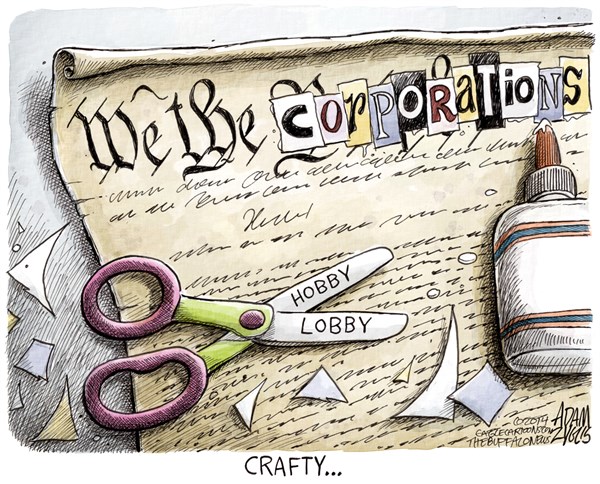
Alito wants to claim his ruling only applies to “closely-held corporations”, but that’s not what the Dictionary Act says. If Bank of America wants to admit that it worships Mammon — a religion at least as old and popular as Christianity — it can claim free-exercise rights.

Alito’s reasoning has already had one very unintended consequence: A Guantanamo detainee was previously denied protection of the RFRA, because a court decided that the meaning of “person” in his case was not the Dictionary Act definition. Now that the Supreme Court has gone on record saying the “person” in the RFRA has the Dictionary Act meaning, he is claiming his case should be re-considered.

The meaning of “substantial burden” was weakened.

ObamaCare didn’t require the owners of Hobby Lobby to use, manufacture, distribute, or even necessarily buy contraceptives. They were merely required to provide health insurance that would cover contraceptives if the employees decided to use them. If Hobby Lobby employees agreed with the owners’ scruples, no violation of those scruples would take place.

Ginsburg did not find this burden “substantial”.

It is doubtful that Congress, when it specified that burdens must be “substantial,” had in mind a linkage thus interrupted by independent decisionmakers (the woman and her health counselor) standing between the challenged government action and the religious exercise claimed to be infringed.

But Alito did:

The belief of the Hahns and Greens implicates a difficult and important question of religion and moral philosophy, namely, the circumstances under which it is immoral for a person to perform an act that is innocent in itself but that has the effect of enabling or facilitating the commission of an immoral act by another. It is not for the Court to say that the religious beliefs of the plaintiffs are mistaken or unreasonable.

But surely any clever person can find a link of some sort between whatever they don’t want to do and the commission of some act they consider immoral by someone else. Alito is encouraging Christians to develop hyper-sensitive consciences that will then allow them to control or mistreat others in the name of religious liberty, a pattern I described last summer in “Religious ‘Freedom’ Means Christian Passive-Aggressive Domination“.

I focus on Christians here for a very good reason: Given that this principle will produce complete anarchy if generally applied, it won’t be generally applied. Contrary to Alito’s assertion, judges will have to decide whether the chains of moral logic people assert are reasonable or not. For example, elsewhere in his opinion he brushes off the objection that corporations will claim religious benefits to increase their profits:

To qualify for RFRA’s protection, an asserted belief must be “sincere”; a corporation’s pretextual assertion of a religious belief in order to obtain an exemption for financial reasons would fail.

But how would it fail, if “it is not for the Court to say” whether asserted religious beliefs are unreasonable? If Randism is repackaged as a free-market-worshipping religion, won’t any regulation infringe on it? Who could claim that Koch Industries is “insincere” in its Randism?

In practice, a belief will seem reasonable if a judge agrees with it. That’s what happened in this case: Five male Catholic judges ruled that Catholic moral principles trump women’s rights. Three Jews and a female Catholic disagreed.

The nature of corporations was re-imagined.

Ginsburg:

By incorporating a business, however, an individual separates herself from the entity and escapes personal responsibility for the entity’s obligations. One might ask why the separation should hold only when it serves the interest of those who control the corporation.

Alito brushes away this separateness:

A corporation is simply a form of organization used by human beings to achieve desired ends. An established body of law specifies the rights and obligations of the people (including shareholders, officers, and employees) who are associated with a corporation in one way or another. When rights, whether constitutional or statutory, are extended to corporations, the purpose is to protect the rights of these people.

Alito waves his hand at employees, but his ruling only applies to owners, i.e., rich people. So in Alito’s reading of corporate law, corporations protect rich people’s rights while shielding them from responsibilities. It is a way to write inequality into the law.

friend-of-the-court brief written by “forty-four law professors whose research and teaching focus primarily on corporate and securities law and criminal law as applied to corporations” says Alito’s “established body of law” doesn’t work the way he says, and that making it work that way will open “a Pandora’s box”.

The first principle of corporate law is that for-profit corporations are entities that possess legal interests and a legal identity of their own—one separate and distinct from their shareholders. … [T]he most compelling reasons for a small business to incorporate is so that its shareholders can acquire the protection of the corporate veil. … Allowing a corporation, through either shareholder vote or board resolution, to take on and assert the religious beliefs of its shareholders in order to avoid having to comply with a generally-applicable law with a secular purpose is fundamentally at odds with the entire concept of incorporation. Creating such an unprecedented and idiosyncratic tear in the corporate veil would also carry with it unintended consequences, many of which are not easily foreseen.

The brief spells out some of the foreseeable consequences: battles between shareholders (perhaps spilling into court) about a corporation’s religious identity, weakening of the shareholders’ shielding against the debts and/or crimes of the corporation, corporations whose religious identities exempt them from certain laws might obtain advantages over their competitors, minority shareholders might sue a management that refused to take on an advantageous religious identity (because it failed to maximize profit), and many more. They conclude:

Rather than open up such a Pandora’s box, the Court should simply follow well-established principles of corporate law and hold that a corporation cannot, through the expedient of a shareholder vote or a board resolution, take on the religious identity of its shareholders.

Conclusion: The Box is Open.

More cases are already in the pipeline, cases that object to all forms of contraception, not just the four Hobby Lobby’s owners view as abortion-causing. One objects to paying for “related education and counseling”, so even seeing your doctor to discuss contraceptive options might be out. Religious employers are already asking to be exempt from rules about hiring gays and lesbians. Photographers and bakers want to be free to reject same-sex marriage clients. Beyond that, who can say what plans are being hatched in religious-right think tanks or corporate law offices?

The Court did not endorse these claims in advance, but it laid out sweeping new principles and did not provide any tests to limit them.

The Filibuster and the War on Women

The abuse of the filibuster is a hard issue to get people excited about. It’s one of those technical political things that takes too long to explain and is hard to connect to problems voters care about.

This week, making those connections was a little easier. If you care about a woman’s right to decide whether she gets pregnant or has a baby, the connection to the filibuster was all too clear. Here are three of this week’s big stories:

  • Senator John Cornyn threatened to filibuster anyone President Obama nominates to the D. C. federal appeals court. He’s not making objections to the specific judges Obama has picked, he’s arguing that Obama shouldn’t be allowed to make any picks at all. The court’s current 4-4 conservative/liberal balance should be locked in, no matter how many elections Democrats win.
  • That same court issued a temporary injunction to suspend ObamaCare’s contraception mandate for certain firms, in anticipation of a permanent ruling that employers’ religious freedom gives them power over employees’ health decisions. The judge who wrote the majority opinion is a radical conservative that Democrats tried to block when President Bush nominated her, but they had to back down when Republicans threatened the “nuclear option” to eliminate the filibuster permanently.
  • Another judge from that same batch of Bush appointees lifted a lower-court injunction against a Texas anti-abortion law that (among other restrictions) instantly closes about 1/3 of Texas abortion clinics, leaving large areas of the state without abortion services, again in anticipation of the law’s ultimate approval.

Let’s take those one at a time.

Filibuster abuse and the D. C. court. Wikipedia describes the federal appeals court for the District of Columbia circuit like this:

While it has the smallest geographic jurisdiction of any of the United States courts of appeals, the D.C. Circuit, with eleven active judgeships, is arguably the most important inferior appellate court. The court is given the responsibility of directly reviewing the decisions and rulemaking of many federal independent agencies of the United States government based in the national capital, often without prior hearing by a district court. Aside from the agencies whose statutes explicitly direct review by the D.C. Circuit, the court typically hears cases from other agencies under the more general jurisdiction granted to the Courts of Appeals under the Administrative Procedure Act. Given the broad areas over which federal agencies have power, this often gives the judges of the D.C. Circuit a central role in affecting national U.S. policy and law.

A judgeship on the D.C. Circuit is often thought of as a stepping-stone for appointment to the Supreme Court.

The court has 11 active judgeSHIPs, but only 8 active judges. (It had only 7 — and a 4-3 conservative majority — until Obama finally got his first pick approved in May. It also has six semi-retired senior judges. If you count them, the court has a 9-5 conservative majority.) That’s because there are three vacancies. The Constitution (Article II, Section 2) specifies how those vacancies should be filled:

The President … shall nominate, and by and with the Advice and Consent of the Senate, shall appoint Ambassadors, other public Ministers and Consuls, Judges of the supreme Court, and all other Officers of the United States, whose Appointments are not herein otherwise provided for

The filibuster is a historical accident. The Founders didn’t envision it, and although an 1806 rule change made filibusters possible, the first one didn’t happen until 1837. They were rare until the 1970s, and truly skyrocketed when the Republicans became the Senate minority after the 2006 election.

Filibusters of presidential nominations were rare until the Clinton administration, and then Democrats retaliated during the Bush years. But even then, the justification for a filibuster was always some alleged problem with the individual nominee. (Bush nominee Janice Rogers Brown, for example, was filibustered for a history of inflammatory decisions, having once written of Social Security: “Today’s senior citizens blithely cannibalize their grandchildren because they have the right to get as much ‘free’ stuff as the political system will permit them to extract.”)

What’s new in the Obama years is the use of the filibuster to nullify a federal office by refusing to approve anyone to head it, regardless of character or qualifications. Until Senate Democrats threatened to invoke the so-called nuclear option in July, Republicans were on track to invalidate the entire National Labor Relations Board, essentially nullifying all laws protecting workers’ rights to organize unions and bargain collectively in good faith.

Cornyn proposes an extension of this unprecedented tactic: using the filibuster to nullify the three vacancies on the D. C. court, ostensibly because the court’s case load doesn’t require 11 judges. (He wasn’t bothered by an even lower case load when Bush appointed Rogers.)

If over-staffing of the D.C. court is indeed a problem (and not just a pretext to stave off a liberal majority), the Constitution provides a way to solve it in Article I, Section 8:

The Congress shall have Power … To constitute Tribunals inferior to the supreme Court

In other words, Congress could pass a law shrinking the D. C. court, if that were really a problem. But legislation requires a majority vote in both houses and the signature of the President, which Cornyn can’t get because his party can’t win national elections.

This is what the filibuster has become: not just a way to block new laws or objectionable appointments, but a way for a minority to repeal legislation already passed or to achieve its goals without passing laws at all.

Who needs to win elections?

The contraception mandate. Thursday, the previously mentioned Janice Rogers Brown (of Social-Security-is-cannibalism fame) was the deciding vote in a 2-1 decision by the D. C. appeals court to grant an injunction blocking enforcement of ObamaCare’s contraception mandate on a business owned by two Catholic brothers. The ruling isn’t a final decision in the case, but it reads like one, because one key consideration in granting such an injunction is a belief that the injunction-seeking side is likely to prevail.

Fortunately, Rogers stopped short of declaring that corporations are protected by the First Amendment’s free-exercise-of-religion clause, which would have produced true chaos. But the 400-employee company is owned by two brothers who claim to operate according to Catholic principles (i.e., having pro-life bumper stickers on their trucks), so the brothers’ religious freedom is violated by the requirement that they provide contraception coverage to their female employees.

I’ve stated my position on this issue at length before: I believe these claims of “religious freedom” are actually passive aggression, stretching claims of one’s own moral purity to ridiculous lengths in order to control the behavior of others. I was pleased to see many of my own favorite arguments show up in the dissenting opinion of  Senior Judge Harry Edwards (the only Democratic appointee among the senior judges) (I’m not claiming Edwards reads the Sift or that the arguments are original to me):

It has been well understood since the founding of our nation that legislative restrictions may trump religious exercise. Braunfeld v. Brown, 366 U.S. 599, 603 (1961). Were it otherwise, “professed doctrines of religious belief [would be] superior to the law of the land, and in effect permit every citizen to become a law unto himself.”

and illustrates the point with an example Sift readers will recognize:

A Christian Scientist, whose religion has historically opposed conventional medical treatment, might claim that his corporation is entitled to a religious exemption from covering all medical care except healers who treat medical ailments with prayer.

Edwards sees the conflict between the owners’ religious beliefs and the mandate, but does not find that it meets the legal standard of a “substantial burden”, using another analogy I’ve used here.

The Supreme Court has never applied the Free Exercise Clause to find a substantial burden on a plaintiff’s religious exercise where the plaintiff is not himself required to take or forgo action that violates his religious beliefs, but is merely required to take action that might enable other people to do things that are at odds with the plaintiff’s religious beliefs.

… The Gilardis do not contend that their religious exercise is violated when Freshway pays wages that employees might use to purchase contraception, and the Mandate does not require the Gilardis to facilitate the use of contraception any more directly than they already do by authorizing Freshway to pay wages.

Edwards quotes a 1982 Supreme Court decision:

Congress and the courts have been sensitive to the needs flowing from the Free Exercise Clause, but every person cannot be shielded from all the burdens incident to exercising every aspect of the right to practice religious beliefs. When followers of a particular sect enter into commercial activity as a matter of choice, the limits they accept on their own conduct as a matter of conscience and faith are not to be superimposed on the statutory schemes which are binding on others in that activity.

If not for the filibuster, that might be the majority opinion.

Texas abortion law. One of the other Bush judicial appointees who made it through the Senate under threat of the nuclear option was Priscilla Owen, whose appointment the Houston Chronicle opposed with these words:

The problem is not that Owen is “too conservative,” as some of her critics complain, but that she too often contorts rulings to conform to her particular conservative outlook. It’s saying something that Owen is a regular dissenter on a Texas Supreme Court made up mostly of other conservative Republicans.

No less a conservative than Alberto Gonzales once characterized Owen’s opinion in a Texas abortion case as “an unconscionable act of judicial activism”. In other words, even among conservative judges, she stood out as particularly radical.

The stipulation in the recent Texas abortion law (the one Wendy Davis delayed for a session with her famous state-legislature filibuster) that doctors who perform abortions have admitting privileges in local hospitals is one of a number of regulations designed to close clinics, and is largely devoid of any legitimate purpose. The lower-court judge found that the law was “without a rational basis and places a substantial obstacle in the path of a woman seeking an abortion.” Similar laws in Wisconsin and other states have been blocked by federal judges.

But thanks to Judge Owen, this one is allowed to take effect. Abortion clinics are already closing, and it is estimated the 1/3 of all abortion clinics in Texas — already not that common — will be unable to meet the requirement.

End the filibuster. Right now, conservatives are benefitting from the fact that Senate Republicans have been more willing to play hardball than Democrats. Democrats under Bush attempted to block only the most outrageous nominees, and for the most part they failed. Those judges are on the bench now, fighting the war on women.

That’s just one front of the struggle, the one whose dots were most easily connected this week. Ultra-conservative judges have brought us Citizens United, came close to constructing an entirely novel interpretation of the Commerce Clause specifically to torpedo ObamaCare, and across-the-board have extended the rights of corporations and the rich over workers, consumers, and the general public.

President Bush did not try to be “reasonable” in his appointments or seek uncontroversial nominees. He nominated the most activist conservative judges he could find, and Senate Republicans refused to let the Democrats filibuster even the worst of them.

Now that the tables have turned, the filibuster has been expanded into a general tool of minority rule. It’s time to end it, once and for all.

To Succeed, Fail Boldly

Five doomed proposals for changing the national conversation


From one point of view, it all came to nothing.

Two weeks ago, liberals around the country thrilled to the story of Wendy Davis’ filibuster. With a few minutes of help from a raucous gallery of protesters, Texas State Senator Davis’ 11-hour speech ran out the clock on the special session of the legislature that Governor Rick Perry had called to pass a draconian anti-abortion bill.

Victory!

For two weeks, anyway. But Perry was still governor, so he called yet another special session. And the Republicans still had majorities in the legislature, so Friday the same bill passed the Senate and was on its way to Perry’s desk. In spite of massive protests, in spite of a viral video that made another new heroine out of Sarah Slamen, the legislative result is the same as if everyone had just stayed home.

Soon we’ll probably be able say the same thing about Moral Mondays in North Carolina. The Republicans have a supermajority in the legislature and they’re not afraid to use it, so they’re going to pass whatever they want, no matter how many religious leaders protest, no matter how many Carolinians they have to arrest.

So it’s pointless, right?

In the long term, no, it’s not pointless. This is the only way things change.

Losing my shrug. Let’s start with the obvious, even if it doesn’t seem all that consequential. A few months ago I’d have shrugged if you told me Texas and North Carolina were about to pass a series of laws that would impose real hardships on women and the poor. “The South,” I’d probably have said, “what can you expect?”

Well, Wendy Davis and William Barber have taken away my shrug. Like lots of other blue-state folks, I have been reminded not to write off Texas and North Carolina. Red states are not monolithic blocks of small-minded people. Progressive forces may be losing there right now, but they’re fighting. And people who keep fighting just might win someday.

If you don’t believe that, recall how the Religious Right and the Tea Party got where they are today. For decades, right-wing extremists rallied for proposals they couldn’t hope to pass into law, and mostly still haven’t: human life amendments, balanced budget amendments, the gold standard, defunding the U.N., and so forth. They failed and they failed again. And sometimes they succeeded when no one had given them a chance. (When the Equal Rights Amendment passed the Senate 84-8 in 1972, its ratification seemed a foregone conclusion.) But today their point of view has to be dealt with, and in some states is dominant.

Before you can win, you have to change the conversation. And the only way to do that is to fight battles the conventional wisdom says you can’t win. You’ll lose most of them. For a while you’ll lose all of them, because the conventional wisdom isn’t stupid. But that’s how things change.

The only way to change the direction of the wind is to keep spitting into it.

How conventional wisdom shifts. I have written in more detail elsewhere about how conservatives manipulate the supposedly liberal media. Journalism is not a conspiracy, but there is an unconscious group process that decides what news is, what can be stated as a simple fact, and what has be covered as controversial. Partisan groups can pressure that process and get their desired response, independent of whether most individual journalists agree or disagree with their views.

In that article I focused on how outside pressure can make known facts seem controversial. So, for example, global warming is almost always covered as if it were in dispute, when in a scientific sense it is well established. But powerful voices will argue with journalists who say global warming is a fact, so instead they write he-said/she-said articles, or leave the global-warming angle out of a story entirely.

Today I want to focus on the opposite side of that same unconscious media groupthink: Anything that is stated forcefully by one side and not contested by the other will be covered as if it were a fact.

So: Texans are all conservatives. Only people on the right care about “morality” or “the family”. “Moral issues” are the ones about sex — abortion, contraception, homosexuality — and the moral position is the conservative position. Feeding the hungry, caring for the sick, making sure workers get a fair wage — all that sermon-on-the-mount stuff — those aren’t “moral” issues.

If you don’t regularly and loudly contest those notions, they’ll get reported as facts. They’ll provide the background assumptions that frame the coverage of everything else.

Wolf Blitzer’s evangelism. The clearest recent example of this principle was Wolf Blitzer’s embarrassing interview with an atheist mother after the tornado in Moore, Oklahoma in May. Blitzer badgered the woman to “thank the Lord” for her and her child’s survival until she finally had to confess her atheism.

So is Blitzer is an evangelical Christian trying to push his religion on CNN? Nope. Wikipedia says Blitzer is a Jew, the son of Holocaust survivors. I can’t say from that precisely what he believes about God, but he was almost certainly not pressuring this woman to proclaim her Judaism.

Instead, Blitzer was applying two seldom-contested stereotypes:

  • Oklahoma is in the so-called Bible Belt, so everybody must be some kind of conservative Christian.
  • There are no atheists in the foxholes. When life and death hang in the balance, everybody becomes religious.

Probably Wolf had been hearing loud proclamations of Christian faith all day, and no voices on the other side. (This is another kind of groupthink. It’s not considered rude to thank Jesus in these circumstances — even in the presence of people whose loved ones Jesus apparently chose not to save. But conservative Christians would take offense if you said, “Stuff like this just shows that everything’s random and you can’t take it personally.”) So it became a background “fact” of his reporting that the people of Moore were having an evangelical Christian response to their survival.

Candle-lighting vs. darkness-cursing. We can wish for harder-working more-objective journalists who will seek out the truth and cover it fairly, regardless of the power dynamics. But in the meantime journalism is what it is, and we’re just being stupid if we let conservatives manipulate it and don’t fight back.

The facts on the ground today are that the media will challenge a pro-choice Catholic to reconcile the contradiction between his politics and his faith, but not an Evangelical who votes to cut Food Stamps or reject Obamacare’s Medicaid expansion. (Matthew 25:35-36: “For I was hungry and you fed me. … I was sick and you cared for me.”) Want to change that? Join the Moral Mondays protests in Raleigh, or start something similar in your own state capital.

In the short term, you may not change any votes in the legislature. But if enough people contest the previously uncontested “facts”, those “facts” leave (what Jay Rosen and Daniel Hallin call) “the Sphere of Consensus” and enter “the Sphere of Legitimate Controversy”. The conventional wisdom changes.

From defense to offense. So far the big progressive protests have been efforts to resist conservative aggression: rollbacks of women’s rights in Texas, unemployment insurance in North Carolina, workers’ rights in Michigan and Ohio.

It’s time to go on offense. In addition to resisting the regressive agenda of the right and timidly putting forward small proposals like universal background checks for gun buyers, progressives need a blue-sky positive agenda that we keep making people notice. Just because we can’t pass it in this term of Congress doesn’t make it impractical. (When have conservatives ever been constrained by that?) You have to keep proposing it until people get used to hearing it; only then will they look at it seriously.

So here are five bold proposals that are “doomed” according to the conventional wisdom. Their complete impracticality is a “fact” and will continue to be so until loud voices move them into the Sphere of Controversy, from which they can get serious consideraton.

  • The Equal Rights Amendment. The ERA passed Congress in 1972 and fell three states short of ratification when the ratification deadline passed in 1982. Supporters of the three-state strategy claim the deadline doesn’t count and in 2011 got ratification through one house of the Virginia legislature. But the ERA gets re-introduced in every session of Congress, most recently in March. Only the fact that the conventional wisdom says it can’t pass, protects politicians from explaining why they disagree with “Equality of rights under the law shall not be denied or abridged by the United States or by any state on account of sex.”
  • Single-payer health care. Of all the existing plans to help the 50 million Americans who lack health insurance, Obamacare is the most conservative. (It’s Romneycare, after all.) Conservatives opposing Obamacare have offered no plan to fulfill the “replace” part of their “repeal and replace” slogan. And yet, if you watch Sunday morning political shows on TV, Obamacare is the “liberal” position. It’s better than the status quo, and I support it on those terms. But single-payer is what gives Europe, Japan, and the industrialized parts of the British Commonwealth lower costs and higher life expectancies than we currently have. It would do the same for the United States.
  • End corporate personhood. Few actual humans defend the idea that corporations should be people with full constitutional rights. A variety of constitutional amendments have been proposed to reverse this piece of conservative judicial activism (which in particular has no basis whatsoever in the originalist constitutional interpretation conservatives claim to favor). Bernie Sanders’ Saving American Democracy Amendment says: “The rights protected by the Constitution of the United States are the rights of natural persons and do not extend to for-profit corporations.” Everybody who runs for office should be challenged to state a position on that.
  • A federal Reproductive Rights Act. The current reproductive-rights situation in states like Texas resembles Jim Crow: Women’s constitutional rights are not repealed directly, but are made impractical by a series of restrictions transparently introduced for that purpose. In the same way that the Voting Rights Act protected minorities’ right to vote (until recently), a federal Reproductive Rights Act should impose federal oversight on states that have a history of infringing women’s rights.
  • Replace the Second Amendment. The overall situation of weapons and society has changed so much since 1787 that it’s hard to attach any meaning at all to the full text of the Second Amendment. I don’t have a revised text in mind yet, but I think the amendment should defend the right of individuals to procure appropriate tools to defend their homes, while giving Congress the power to control military hardware.

“Religious Freedom” means Christian Passive-Aggressive Domination

In an Orwellian inversion, “freedom” is now a tool for controlling others.


It’s over. Try something else.

For many anti-gay activists, the recent Supreme Court decisions on DOMA and Proposition 8 were the handwriting on the wall.

It wasn’t just that they didn’t get the result they wanted, but that in DOMA the Court’s majority simply didn’t buy the argument that homosexuality represents a threat to society. Neither does the general public, which supports that decision 56%-41%. (The margin under age 40 is 67%-30%, with 48% approving strongly.) The big post-DOMA public demonstrations expressed joy, not anger.

Just a few years ago anti-marriage-equality referendums were winning in states all over the country, but in 2012 one failed in Minnesota, while referendums legalizing same-sex marriage won at in Washington, Maryland, and Maine. Ten years ago, the first legislatures to make same-sex marriage legal were dragged by their state courts, but this year Delaware, Rhode Island, and Minnesota went there voluntarily, bringing the number of states where same-sex marriage is legal (as of August 1) to 13, plus the District of Columbia. (I’ll guess Oregon and Illinois will go next.)

It’s even clear why this is happening: Because gay millennials are not in the closet, everybody under 30 has gay and lesbian friends who dream about meeting their soulmates just like straight people do. To young Americans, laws blocking that worthy aspiration are pointlessly cruel and ultimately will not stand — not in Alabama, not in Utah, not anywhere.

So the generational tides run against the bigots of the Religious Right. Some still aren’t admitting it, but wiser heads are recognizing that it’s time to switch to Plan B.

The new face of bigotry: “freedom”. Fortunately for them, there’s a well-worked-out back-up plan: religious “freedom”.

Accept the inevitability of gay rights, advises Ross Douthat, but “build in as many protections for religious liberty as possible along the way.” Here’s the idea: If your disapproval of certain kinds of people can be rooted in church doctrine or a handful Biblical proof-texts, then forbidding you to mistreat those people violates the “free exercise” of religion you are promised by the First Amendment.

To make this work, conservative Christians need to divert attention from the people they are mistreating by portraying themselves as the victims. And that requires cultivating a hyper-sensitivity to any form of involvement in activities they disapprove of. So rather than sympathize with the lesbian couple who gets the bakery door slammed in their faces, the public should instead sympathize with the poor wedding-cake baker whose moral purity is besmirched when the labor of his hands is used in a celebration of immorality and perversion.

There’s a name for this tactic: passive aggression. It’s like on Sanford & Son when Fred would clutch his heart and start talking to his dead wife because Lamont planned to do something he disapproved of. Passive aggression is the last resort of people who have neither the power to get their way nor any reasonable argument why they should.

In fact the baker will be fine, as Willamette Week demonstrated by calling two such religious-liberty-defending bakeries and ordering cakes to celebrate a variety of other events conservative Christians disapprove of: a child born out of wedlock, a divorce party, a pagan solstice ritual. The bakers did not object, because their hyper-sensitive moral purity is an invention, a convenient excuse for treating same-sex couples badly.

But Jim DeMint insists that

A photographer in New Mexico, a florist in Washington, and a baker in Colorado have already been victims of such intolerant coercion.

And Matthew Franck is horrified that religious universities will have to provide same-sex married-student housing; religious “schools, universities, hospitals, hospices, and clinics; social service agencies, retirement homes, eldercare and childcare facilities, food pantries, and soup kitchens” who employ “teachers, doctors, nurses, psychologists, counselors and clinicians, caregivers, food-service workers, housekeeping and grounds staff, even pool lifeguards” won’t be able to refuse employment to people with same-sex spouses. Adoption services, marriage counselors, divorce lawyers, artificial insemination clinics etc. will have to deal with gay and lesbian couples … as if they were real human beings or something.

The race parallel. We worked this stuff out during the civil rights movement, because all the same ideas show up with regard to race.

Plenty of people claim a sincere religious belief in white supremacy, and root it in Biblical texts like the Curse of Ham. (This goes way back: American slave-owners found Biblical license for keeping their “property”.) But the law does not honor these claims, and somehow religion in America survives.

Here’s the principle that has served us well: In private life, you can associate with anybody you like and avoid anybody you don’t like. But if you offer goods or services for sale to the public, you don’t get to define who “the public” is. So when you’re making lunch at your house, you can invite anybody you like and snub anybody you don’t like, but if you run a lunch counter you have to serve blacks.

We’ve been living with principle for decades, and (other than Rand Paul) no one worries much about the racists’ loss of freedom.

That should apply to same-sex couples now: If your chapel is reserved for members of your congregation, fine. But if you rent it to the public for wedding ceremonies, same-sex couples are part of the public just like interracial couples are. You don’t get to define them away.

If that makes you reconsider whether you want to be open to the public, well, that’s your decision.

The sky will not fall. We just went through this with the Don’t Ask, Don’t Tell repeal, which supposedly would violate the religious “freedom” of evangelical military chaplains (who apparently had never before needed interact respectfully with people they believed were sinners). The Family Research Council’s Tony Perkins predicted:

You have over 200 sponsoring organizations that may be prevented from sponsoring chaplains because they hold orthodox Christian views that will be in conflict with what the military says is stated policy.

That stated policy was: “All service members will continue to serve with others who may hold different views and beliefs, and they will be expected to treat everyone with respect.”

AP went looking for chaplains who couldn’t live with that and found “perhaps two or three departures of active-duty chaplains linked to the repeal.” A Catholic priest overseeing 50 other chaplains reported “I’ve received no complaints from chaplains raising concerns that their ministries were in any way conflicted or constrained.”

If any of Perkins’ 200 religious organizations has stopped sponsoring chaplains because DADT is gone, I haven’t heard about it. The chaplains’ hyper-sensitivity to openly gay soldiers was imaginary, and went away when the government refused to take it seriously.

The abortion parallels. The reason the Religious Right believes their passive-aggressive “religious freedom” approach will work on same-sex marriage is that the same approach is already working on reproductive rights.

It all started with a reasonable compromise: After the Religious Right lost the battle to keep abortion illegal, laws guaranteed that doctors who believe abortion is murder can’t be forced to perform one. This is similar to letting pacifists be conscientious objectors in war, and I completely support it.

But from there, Religious Right “freedom” has become a weapon to beat down the rights of everyone else. Since 1976, Medicaid has not paid for abortions — at a considerable cost to the government, since birth and child support are far more expensive — because pro-life taxpayers shouldn’t have to fund something they think is immoral. There’s no parallel to this anywhere else: The taxes of pacifist Quakers pay for weapons; the taxes of Jews and Muslims pay the salaries of federal pork inspectors.

Conservatives like to accuse gays and blacks of claiming “special rights”, well this is a special right: The conservative conscience gets considerations that nobody else’s conscience gets.

And conservative special rights keep growing. The argument for defunding Planned Parenthood is that public money not only shouldn’t pay for abortions, it shouldn’t even mix with money that pays for abortions. (“Giving taxpayer funds to abortion businesses that also provide non-abortion services subsidizes abortion,” says one petition.) I had a hard time imagining a parallel, but I finally came up with one: What if Jews were so sensitive to violations of the kosher rules that Food Stamps couldn’t be used (by anyone, for anything) in groceries that sold pork?

That would be absurd, wouldn’t it?

In some states, medical “conscience” laws now protect anyone in the medical system who wants to express their moral condemnation: If the pharmacist disapproves of your contraceptives, he doesn’t have to fill your prescription. One of the examples cited by the model conscience law of Americans United for Life as something that needs to be fixed is “an ambulance driver in Illinois being fired for refusing to take a woman to an abortion clinic”.

Clearly that ambulance driver’s immortal soul was at risk. The hyper-sensitive pro-life conscience needs to be protected from any contact with women making use of their constitutional rights.

Religious “freedom” and contraception. The other front in the religious “freedom” battle is contraception.

The Obama administration has had a lot of trouble finding the proper religious exemption to the contraception provisions of the Affordable Care Act. That’s because it’s hard to find the “right” version of something that shouldn’t exist at all. Contraception coverage does not violate any legitimate notion of religious freedom for any religious organizations, religious affiliated organizations, or religious individual employers. Their claims should be rejected without compromise.

The principle here ought to be simple: The employer isn’t paying for contraception or any other medical procedure; the employer is paying for health insurance. Health insurance is part of a worker’s earnings, just like a paycheck. And just like a paycheck, what the employee chooses to do with that health insurance is none of the employer’s business. If I’m the secretary of an orthodox rabbi, his religious freedom isn’t violated when I cash my paycheck and buy a ham sandwich. Ditto for contraceptives, health insurance, and the secretary of the Archbishop of Boston.

Religious organizations’ hyper-sensitive consciences are pure passive aggression. The classic example here is Wheaton College, which couldn’t join other religious organizations in their suit against the ACA because it discovered that it had inadvertently already covered the contraceptives that the tyrannical ACA was going to force it to cover. This was such a huge moral issue for the college that nobody there had noticed.

Worst of all is the Hobby Lobby lawsuit, which got a favorable ruling on an injunction recently. The Hobby Lobby case is the mating of two bad ideas — corporate personhood and employers’ right to control the medical choices of their employees — to produce something truly monstrous. HL’s case hangs on its claim that it is a “person” with regard to the Religious Freedom Restoration Act of 1993, and so its corporate “religious freedom” allows it to restrict its employees’ access to contraception.

Persecution or Privilege? Here are the kinds of sacrifices I make for my readers: I listened to the full half-hour of James Dobson’s post-DOMA radio show, where Dobson, Perkins, and Bill Becker threw around phrases like “the collapse of Western civilization in one day” and “the whole superstructure … can come down”. They described Christians as “an oppressed minority” and agreed that “persecution is likely in the days to come”.

But what is “persecution” exactly?

Tony Perkins expresses the challenge like this:

Do you believe God’s word is true and therefore you’re going to live your life based upon that truth, or are you going to shrink back in the fear of man and of them calling you bigots.

Whenever Christians discuss their “oppression”, fear of being called bigots plays a central role. According to CNN’s Belief Blog,

[Peter] Sprigg and other evangelicals say changing attitudes toward homosexuality have created a new victim: closeted Christians who believe the Bible condemns homosexuality but will not say so publicly for fear of being labeled a hateful bigot.

In other words: Christians are oppressed unless they can express their moral condemnation of others without being subject to moral condemnation themselves.

Why would anyone imagine the existence of such a one-sided right? Simple: In practical terms, that’s a right they have had until recent years. Not so long ago, the James Dobson types were so intimidating that they could preach any kind of vicious nonsense about gays and face no response.

So what they are experiencing now isn’t persecution, it’s privileged distress, the anxiety a privileged class feels as its privileges fade and it slides towards equality with others. And rather than try to get over their distress and soothe their anxiety, they are intentionally pumping it up in a passive-aggressive attempt to claim victimhood and control the rest of us.

That bubble needs to be popped.

Government Theology is Un-American

If Congressman Mourdock wants to interpret the will of God to the People, he should move to a country where government officials do that, and leave my country alone.

This week, Indiana’s Richard Mourdock became the latest Republican candidate to make the political mistake of spelling out the consequences of his ideology: Not only would he make abortion illegal in all ordinary circumstances, but he sees no reason for a rape exception. He wants the government to force women to bear their rapists’ children.

Politics being what it is, a Rapist Procreation Act could never make it through Congress, even as an amendment to a larger Forced Motherhood Act. So euphemisms and rationalizations have to be employed.

Senate candidate Akin. Two months previously, Missouri senate candidate Todd Akin had made headlines by abusing science to support rapist procreation: Rape exceptions are unnecessary, he claimed, because rape pregnancies don’t happen. At least they don’t happen in cases of “legitimate rape”, i.e., the kind where the woman is penetrated by violence. “The female body has ways to try to shut that whole thing down,” he said.

Ignore the fact that no legitimate scientist believes this, so Akin had to search out a phony “expert” who is primarily another anti-abortion extremist. Even giving Akin’s words their most generous interpretation — that he meant to say “violent” rather than imply that the rape itself could be “legitimate” — they’re monstrous. In his view, for example, raped women who are drugged rather than beaten are not worth the law’s notice.

A friend of a friend once met a knife-wielding stranger on a stairwell. He said he wanted to kill her, but she negotiated him down to having sex instead. That also would not be a legitimate rape in Todd Akin’s view, so any possible pregnancy would be the woman’s responsibility, not the knifeman’s.

Or consider this account of an incest pregnancy. Sometimes her father raped her “legitimately” by violence. Sometimes threats were enough, and sometimes she submitted to save her younger sisters. What kind of rape got her pregnant? She doesn’t know.

Akin’s government would punish such men, presumably, but would also make sure that their reproductive strategy succeeds and their DNA is multiplied in the next generation.

Walsh. Illinois Republican Congressman Joe Walsh went a step further than Akin. Not only is a rape exception unnecessary, but a life-of-the-mother exception is unnecessary too — and for the same reason: It never happens. “With modern technology and science,” he said, “you can’t find one instance” of a medically necessary abortion.

Non-ideologues quickly came up with the example of ectopic pregnancy, which killed 876 American women between 1980 and 2007.

Mourdock. Having seen how much heat Akin took for abusing science, Mourdock decided to abuse theology instead. For Mourdock, the magic pregnancy-prevention intervention doesn’t come from the mysteries of female biology, it comes from God. If a woman gets pregnant through rape, that must be “something that God intended to happen.”

Again, let’s give Mourdock’s words their most generous interpretation, the one he begged for the next morning. (Consider the irony: We’re granting Mourdock a morning-after pill, so that his statement doesn’t bear any unwanted fruit.) He didn’t mean to say that God sends rapists to impregnate women. (“I don’t think God wants rape,” he said, in one of the strangest denials ever.) But once the sperm sights the ovum, it is up to God whether or not conception occurs.

This is the traditional God-of-the-gaps theology: Well-understood processes follow scientific cause-and-effect, but anything that happens mysteriously is God’s will. (Lightning strikes, for example, were God’s will until Ben Franklin thwarted God by understanding electricity and inventing the lightning rod.)

Personal vs. public. I find this view of God absurd, but that’s just me. If you want to interpret every unpredictable event as a message from your Creator, don’t let me stop you. If Mourdock’s family were to suffer a rape pregnancy (not that I’m wishing it on them), maybe they really would welcome the rapist’s baby as a “gift from God”. If they went on to raise that boy up to be a far better man than his father, I might even admire them for it.

But here’s where I get off the train: Mourdock the individual and the Mourdock Family should be free to believe what makes sense to them, and to organize their lives accordingly. But Congressman Mourdock and wannabee Senator Mourdock have no business telling the American people what God wants.

That’s not how America works. That is, in fact, what the Founders revolted against.

Old Europe vs. New America. In the old system of European monarchy, the King had a special relationship to God, and so his government stood between God and the People. In the same way that the bishops channeled God’s religious will, the King channeled God’s political will. The People may or may not understand why God wants them to go to war with Spain or pay a higher toll at the bridge, but no matter: The King and God had it all worked out, and it was the People’s duty to obey.

The American system of democracy reversed all that. In America, the People stand between God and the government.

In America, we believe that God pays no attention to rank; God speaks to everyone, and not just to high government officials.

In America, Congress is supposed to interpret the will of the People, not the will of God.

In America, it is up to the People to interpret the will of God for the government. It is not up to the government to interpret the will of God for the People.

Biology vs. Theology. One reason this anti-American tendency on the Right gets so little attention is that they have carefully framed their theological reasoning in biological terms: They claim to be talking about “when human life begins”, which sounds biological.

If you buy into that false framing, their favored answer “human life begins at conception” seems obvious: The fertilized ovum may be a one-celled organism that looks more like an amoeba than a baby, but it is alive and has human DNA, so it’s clearly “human life”.

But this is a strangely materialistic piece of logic that the Religious Right would not accept in any other case. Something makes killing a human being murder, but killing a pig dinner. Is that difference in the DNA somewhere? Can we hope that science will someday identify the “worth gene” that gives humans their incommensurable value?

Of course not. Imagine the outcry if someone claimed to pinpoint such a gene and showed that it was absent in certain birth defects.

Worth is not about DNA, it’s about soul. (If you don’t ordinarily use the word soul, you can take that as a functional definition: Whatever makes a human’s life more valuable than a pig’s is soul. Whether you think of it as a mystical whatever or as a socio-legal convention is, in practice, irrelevant.)

So the question of abortion is not when “human life” begins, it’s when the soul enters the body. (Or, for secularists, it’s when the law decides to take fetuses under its protection.)

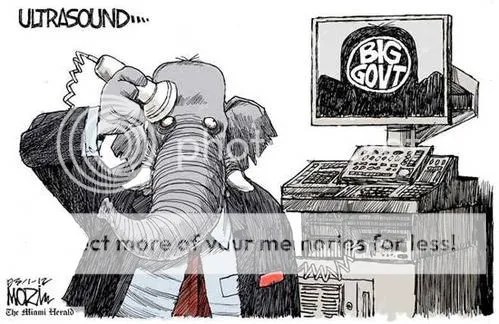
All the biological evidence that is usually offered on the abortion question — when a fetus has a heartbeat or brainwaves or reacts in ways that resemble pain — is beside the point. A pig fetus at a similar stage would also have a heartbeat, brainwaves, and a cringing reflex. Paul Ryan might describe the “bean” that he saw on the ultrasound as a “baby”, but if a prankster had rigged the ultrasound to show Ryan the fetus of a pig or chimp, I doubt he’d have known the difference.

The difference between murder and dinner is not physical, it’s metaphysical. It’s a question for theologians, not biologists.

Government humility. And that means the government should stay out of it unless some compelling public interest is involved, which it isn’t. (In a post-apocalyptic world in need of repopulation, for example, the government would have such an interest.)

The ensoulment question has been debated as long as the Judeo-Christian tradition has existed, and the experts have often disagreed. (One frequently taken view was that ensoulment happened around 90 days — coincidentally corresponding to the first trimester when Roe v. Wade allows the fewest restrictions on abortion.) Other religious traditions have their own opinions on the matter. (Many, for example, would find the pig to be of comparable value to the human, and have a different notion of soul entirely. If they can build a majority somewhere, should the law reflect their theology? Or should they simply practice their beliefs without forcing vegetarianism on non-believers?)

In the American system, government takes a humble position in matters of theology: It recognizes that it has no special expertise, so it leaves such questions to the individual.

That’s what should happen here: Each sect should be free to put forward its own view of when a fetus acquires the incommensurable value of a human soul, and its practitioners should be free to practice that view.

That’s the American way.

Five Pretty Lies and the Ugly Truths They Hide

A week after Todd Akin’s “legitimate rape” comment, we should be long past the “OMG — I can’t believe he said that!” stage. It’s time to take a longer view and ask ourselves what the Akin incident says about the larger picture.

You can find takeaways at many levels. First, contrary to Akin’s personal damage control, he didn’t “misspeak“. He really believes that many pregnant women — like maybe this one — make up their rape stories.

At a slightly more general level, and contrary to Republican damage control, you can observe that Akin is typical of the party. Not only is his no-rape-pregnancy lie common, but Paul Ryan agrees with him about redefining rape, and the official party platform calls for banning abortion with no rape exception. (Mitt Romney claims to support such an exception, but as usual, he’s speaking out of both sides of this mouth. Whose delegates are writing this platform? And if he won’t actively oppose a no-exceptions party platform, what makes you think he’ll veto a no-exceptions bill when Congress sends it to him?)

But here’s what I think is the most important Akin takeaway. When confronted with an ugly consequence of his policies — women forced by law to bear their rapists’ babies — Akin papered it over by telling a pretty lie: It doesn’t happen; the female body doesn’t work that way.

Isn’t that pretty? Wouldn’t the world be nicer if no woman who “really” got raped had to worry about pregnancy? Of course it would.

Akin may not have intended to lie; maybe he believes what he said. But does he believe this bogus biology because it makes sense? Of course not. Because an expert told him? The “expert” is someone he sought out precisely for that purpose; real experts would have told him the opposite.

I have a simpler explanation: Akin believes the lie because it’s pretty. The lie tells him that he’s not a monster. It helps him avoid the ugliness of his beliefs.

That thought pattern makes him absolutely typical of the conservative movement today. When implemented, conservative policies cause a lot of ugliness. And when confronted with these ugly consequences, conservatives rarely adopt a more compassionate position. A few brave ones talk about necessary sacrifices and breaking eggs to make omelets, but most just paper over the ugliness with a pretty lie.

“Raped women don’t get pregnant” is just the first lie on my list. Here are four others:

2. The uninsured can get the medical care they need in the ER.

The lie. As he prepared to veto a 2007 bill providing health insurance to children, President Bush said it very clearly:

People have access to health care in America. After all, you just go to an emergency room.

That’s what Governor Rick Perry meant during his presidential campaign when he said:

Everyone in the state of Texas has access to health care, everyone in America has access to health care.

Mississippi Governor Halley Barbour agreed: “there’s nobody in Mississippi who does not have access to health care”

Why it’s pretty. It’s so distressing to hear statistics like 50 million Americans don’t have health insurance. (Texas and Mississippi rank #1 and #2 in percentage of the population uninsured.) But wouldn’t it be nice if that number didn’t really mean anything? if insurance was just a bookkeeping device, and nobody really went without care?

Why you shouldn’t believe it. It’s true that the uninsured can get emergency care. If you’re in a car accident, if you’re having a heart attack, if you’re not breathing when they fish you out of the lake — EMTs and the ER will do their best to save your life even if you can’t pay. But as the Houston Chronicle points out, emergency care can’t replace regular care:

About half of uninsured adults have a chronic disease like cancer, heart disease or diabetes. The lack of regular care for the uninsured is why they have death rates 25 percent higher than those with insurance; more than half of uninsured diabetics go without needed medical care; those with breast and colon cancer have a 35 percent to 50 percent higher chance of dying from their disease; and they are three times more likely to postpone needed care for pregnancy. Clearly, the uninsured don’t get the care they need

What it hides. Lack of health insurance kills people. It kills lots of people — more than car accidents or our recent wars. The technical public-health term is amenable mortality — the number of people who die unnecessarily from treatable conditions. An article in the journal Health Policy says:

If the U.S. had achieved levels of amenable mortality seen in the three best-performing countries—France, Australia, and Italy—84,300 fewer people under age 75 would have died in 2006–2007.

France, Australia, and Italy don’t have smarter doctors or better medical technology, but they do have something conservatives are determined to see that Americans never get: universal health insurance. When a questioner confronted Rick Santorum with these facts, he replied:

I reject that number completely, that people die in America because of lack of health insurance.

Of course he does. If he accepted what the public health statistics say, he’d have to admit that his policies condemn tens of thousands of people to death every year. “Pro-life” indeed.

3. Tax cuts pay for themselves.

The lie. The most recent vintage is from the Wall Street Journal’s defense of the Romney tax plan:

Every major marginal rate income tax cut of the last 50 years — 1964, 1981, 1986 and 2003 — was followed by an unexpectedly large increase in tax revenues

Or you could hear it from Mitch McConnell:

That there’s no evidence whatsoever that the Bush tax cuts actually diminished revenue. They increased revenue, because of the vibrancy of these tax cuts in the economy.

The claim is pretty widespread on the Right: Cutting taxes stimulates the economy so much that the government ends up collecting more revenue even at the lower rates.

Why it’s pretty. Everybody likes a tax cut, but deep down we all know that taxes pay for important things: roads, schools, defending the country, keeping the poor from dying in the streets, and so on. But wouldn’t it be great if we could pay less tax and pretend that money for all those things will appear by magic?

Why you shouldn’t believe it. This has been tried over and over again. It never works. Pointing out that it didn’t work for Bush is shooting fish in a barrel — nothing worked for Bush — but this didn’t even work when Reagan tried it. The Economist’s “Democracy in America” column looked up the numbers:

The federal government’s receipts for 1981-86, in billions of 2005 dollars:

1981    1,251.1
1982    1,202.6
1983    1,113.4
1984    1,173.9
1985    1,250.5
1986    1,277.2

Do you see the “unexpectedly large increase in tax revenues” resulting from the 1981 marginal rate income tax cut? Me neither! It took five years just to get back to par.

What it hides. A huge transfer of wealth to the rich. This lie is the first move in a cruel shell game: First, cut taxes with the promise that it won’t cause a deficit. Then, when it causes a deficit (as it always does), don’t respond “Oh, we were wrong. Let’s raise taxes back to where they were.” Say: “Government spending is out of control! We have to cut food stamps, education, Medicare …”

Stir the two steps together, and you get a cocktail voters would never have swallowed in one gulp: We’re going to cut programs people rely on so that the rich can have more money.

4. Gays can be cured

The lie. Homosexuality is a choice that results in an addiction, but (like alcoholics and drug addicts) gays can learn to choose differently and become ex-gay.

Why it’s pretty. Suppose you think gays are going to Hell, and then your son turns out to be gay. Or suppose you’ve been brought up to believe gays are evil, and then in junior high you start feeling same-sex attractions yourself. Of course you’re going to want to believe that this situation is fixable.

Why you shouldn’t believe it. It’s almost impossible to 100% prove a negative like “Gays can’t be cured”. But if a well-funded movement to teach people to fly had been running for years, and yet no one actually flew, reasonable people would develop a strong conviction that this wasn’t going to work.

That’s the situation with the ex-gay movement. The extreme lack of success has reached the point where the movement itself has started to splinter. The original ex-gay group, Exodus International, now rejects attempts to “cure” gays and instead focuses on “helping Christians who want to reconcile their own particular religious beliefs with sexual feelings they consider an affront to scripture.” This has caused a schism, with the new group, Restored Hope Network, continuing to promote therapies to cure gays.

What it hides. Pure bigotry is the only reason to discriminate against gays.

As discrimination wanes, it becomes obvious that unrepentant gays can find love, form long-term relationships, raise children who are a credit to the community, and (in short) do all the things that are usually thought of as part of a good life. They can also serve in the military, be good teachers, have productive careers in the private sector, pay taxes, do volunteer work — everything that constitutes good citizenship.

To prop up anti-gay discrimination (and even to try to reinstate it in places where it has been torn down), and to do so even though the people discriminated against didn’t choose to be gay and can’t change it — that’s pretty ugly.

5. Obama’s election proves racism is over.

The lie. John Hawkins put it like this:

So, the moment Obama was elected, people started asking the obvious question, “How serious of a problem can racism still be in the United States if a black man can be elected President?” The honest answer to that question is, “Not very.”

Just this summer, Boston Globe columnist Jeff Jacoby reacted the same way to a black man becoming head of the Southern Baptist Convention:

The pervasive racism [Martin Luther King] confronted is primarily a historical memory now, while King himself is in the American pantheon. … America’s racist past is dead and gone.

Why it’s pretty. Pat yourself on the back, white America! You used to have a problem, but you kicked it.

So if any blacks or liberals are still complaining, feel free to ignore them. They just want the government to give them “more free stuff” by taking what you earned, or to use the charge of racism as “their sledgehammer … to keep citizens who don’t share the left’s agenda from participating in the full array of opportunities this nation otherwise affords each of us”. If anybody’s really oppressed these days, it’s whites.

Why you shouldn’t believe it. Barack Obama’s election was definitely a sign of racial progress, just like Jackie Robinson joining the Dodgers in 1947, Jesse Owens’ Olympic gold medal in 1936, or Jack Johnson becoming heavyweight champion in 1908. But racism didn’t end in 2008 any more than it ended in 1908.

Let’s start by debunking the logic: In 2008, a year when everything broke wrong for the Republicans, Obama got 53% of the vote. For the sake of argument, let’s say that’s more-or-less what a white Democrat would have polled. Does that prove racism is over? No, it just proves that Republicans already had the racist vote.

Then we get to evidence that points the other way: Trayvon Martin. (Nobody jumps to the defense of black men who shoot unarmed white teen-agers.) Birtherism. (No white president has faced this kind of persistent, baseless accusation.) The racial dog-whistles in the Romney campaign. The racist anti-Obama pictures and cartoons that circulate in viral emails. (But don’t you get it? These are jokes. Like the “Don’t Re-Nig in 2012” bumper sticker. Clever, huh?) The attempt to legalize anti-Hispanic racial profiling in Arizona and other states. I could go on.

It’s not just that 1 in 3 black men will spend time in jail, it’s that this fact isn’t seen as an emergency that requires outside-the-box solutions. If white men were imprisoned at the same rate (no matter what they were imprisoned for), the number of possible explanations and solutions would skyrocket. But black men … that’s just how they are; what can you do?

(For a longer discussion of racism in the Obama era, see Ta-Nehisi Coates’ article in the current Atlantic.)

What it hides. Indifference to human suffering. At a time when poverty is at a level we haven’t seen in decades, the House has passed bills to gut safety-net programs like Medicaid and food stamps.

That can only happen if the white middle class is convinced that the poor are different and deserve their fate. And the best way to accomplish this is through racial stereotyping: The poor are black, and blacks are lazy. Both statements are false, but they work.

How to respond. This is far from an exhaustive list; I just picked the pretty lies I could document and refute fairly quickly, and I didn’t even touch well-covered lies like “Global warming is a hoax.” or “Abstinence-only sex education works.” But I hope the five I’ve listed are varied enough to establish the pattern.

If you have any conservatives friends, relatives, or co-workers, you probably hear pretty lies all the time. (“The poor have it good in America. They’re the lucky duckies who don’t have to work, because the rest of us are paying for their X-boxes and cable TV.”) Probably you’ve already tried to respond by googling up facts and presenting them, so you understand that this never works.

I sympathize with your frustration.

But it’s important take the next step and ask why presenting the facts doesn’t work. It’s simple: Facts are not the source of the belief. Conservatives aren’t mistaken, they’re hiding something.

What they’re usually hiding is cruelty. Conservative policies are cruel, but individual conservatives usually aren’t, or at least they don’t want to see themselves like that. The only way to square that circle is with a lie.

Once the lie is in place, “facts” will be found to support it. A whole industry is devoted to supplying fake facts. And since fake facts are easier to manufacture than to refute, you will never fight your way through the swarm.

I don’t have a foolproof method for converting conservatives, but I can tell you this much: You don’t understand a pretty lie until you’ve seen all the way through to the ugly truth it’s hiding.

That’s where you should be focusing your energy. Don’t just refute the lie. Expose the truth.

Paul Ryan: Veteran of the War on Women

tumblr_m8rxr8rmj71rdkw6yo1_500

Right after Paul Ryan was named as Mitt Romney’s VP, I did what every other political blogger in the world did: wrote an article almost entirely about his economic policies. Of course I did and we did. In minds of politics-watchers everywhere, Ryan means the Ryan budget, with its strange combination of bold detail and cowardly vagueness. Just mentioning Ryan’s name launches an argument about taxes and Medicare and long-term deficits.

But a day or two later, I felt a wave of deja vu. Isn’t this exactly what happened in 2009 and 2010?

The Tea Party. Remember? The Tea Party burst onto the scene in April, 2009, billing itself as a non-partisan, grass-roots movement of people fed up with taxes and deficits. Taxed Enough Already — remember? The culture wars could wait; the problems of debt and government spending were too urgent.

An occasional liberal Jeremiah tried to warn us how phony this framing was, but for the most part we let them get away with it.

And then what happened? As soon as the election was over and Republicans (so much for non-partisan) controlled the House in D.C. and the entire state government in places like Wisconsin and Florida, their first priorities turned out to be abortion and all the other “values” issues they had swept under the rug during the campaign.

As the new Congress was settling in, Rep. Mike Pence segued like this:

Our economy is struggling and our national government is awash in a sea of debt. Amidst these struggles, some would have us focus our energies on jobs and spending. … I agree. Let’s start by denying all federal funding for abortion at home and abroad. The largest abortion provider in America should not also be the largest recipient of federal funding under Title X. The time has come to deny any and all federal funding to Planned Parenthood of America.

Annual Planned Parenthood funding under Title X was about $70 million. Take that, trillion-dollar deficit!

Rachel Maddow was one of the early major-media people to sound the alarm, in a series of segments she labelled Really, Really Big Government.

That is the message they campaigned on in November—freedom, liberty, letting people do what they want!

And then they arrived in Washington and immediately started working on putting government in charge of every single pregnancy in America. Even as they slowed the legislative calendar way down, stopped doing much of anything else, they advanced not one, not two, but three super radical bills to restrict abortion rights.

Ryan’s Role. Paul Ryan was co-sponsoring every one of the Religious Right’s “super radical bills”. The National Right to Life Committee says:

Ryan has maintained a 100 percent pro-life voting record on all roll call votes scored by National Right to Life through his entire tenure in the House, which began in 1999.

It’s important to understand just how radical the recent stuff is, because we’re used to the abortion struggle taking place on a fairly small battlefield — Medicaid funding, late-term abortions, parental notification — where the issues really are debatable. But since the Tea Party came into power, we’ve been fighting over issues that used to be on the fringe or completely off the table.

Forced ultrasounds. The general public didn’t catch on to the changing battlelines until women protested the Virginia forced transvaginal ultrasound law this March: In the original version of the bill, women seeking an abortion would be forced to have an ultrasound probe shoved up their vaginas. (Texas already started enforcing a similar law in February.) The legislature had no medical justification; they just figured women who want to abort are too dumb to understand what a fetus is unless the government forces them to look. Or maybe the point is to humiliate women before granting them their constitutional rights.

Maddow and others began calling Virginia Governor Bob McDonnell “Governor Ultrasound” — a nickname that probably pushed him off Romney’s VP short list.

Well, Paul Ryan is Congressman Ultrasound. He co-sponsored the federal Ultrasound Informed Consent Act. Women would be forced to submit to and pay for a medically unnecessary procedure because Paul Ryan believes they’re “uninformed”. (I wonder how he’d feel about making anybody who wants to buy a gun observe the autopsy of a gunshot victim. Don’t they deserve to be “informed” too?)

Rights for single-celled organisms. Another radical addition to the abortion debate are “personhood” laws, which define a fertilized ovum as a human being deserving the full protection of the laws.

Such a law would not only outlaw all abortions, it would also ban any form of birth control that works by interfering with the zygote’s ability to implant in the uterus — like the Pill.

The birth control pill, for example, prevents pregnancy in three ways: The pill thickens the cervical mucus to make it more difficult for sperm to reach the egg; it suppresses ovulation by mimicking pregnancy-level hormones in the body, preventing eggs from being released from the ovaries; and finally, as a fail-safe, the pill makes the lining of the uterus inhospitable to any fertilized egg that might slip through. The time between fertilization and implantation (when a pregnancy becomes medically detectable) usually takes about a week.

In public, advocates of personhood bills deny they’d ban the Pill. But among themselves they sound more like this:

A justly written personhood amendment should ultimately outlaw all abortions  including both the intentionally induced “miscarriages” of the hormonal birth control pill and the blatant infanticide of the partial birth abortion.

Personhood laws would also outlaw in vitro fertilization as currently practiced, because the test-tube zygotes that aren’t implanted must eventually be destroyed. A pro-life article that tries to dispel this “absurdity” actually verifies it:

Couples trying to get pregnant through IVF procedures would have nothing to fear from Personhood legislation unless they consented to the intentional destruction of their embryonic children. [emphasis added]

Who would support such a radical law? Not voters. No personhood referendum has come close to passing, even in Mississippi.

But Paul Ryan is a more radical culture warrior than the average Mississippian. He co-sponsored the Sanctity of Human Life Act, which says:

the Congress declares that … the life of each human being begins with fertilization, cloning, or its functional equivalent, irrespective of sex, health, function or disability, defect, stage of biological development, or condition of dependency, at which time every human being shall have all the legal and constitutional attributes and privileges of personhood

Ryan’s defenders sometimes claim this bill merely empowers states to protect the personhood rights of fertilized ova, but it says what it says. If this passed, how long would it take the Thomas More Society to file a class-action suit against birth-control-pill manufacturers on behalf of zygotes?

Employers’ Rights Trump Workers’ Rights. Ryan voted against the Lilly Ledbetter Fair Pay Act that eliminated a hole in the equal-pay-for-women laws.

Ryan also co-sponsored the Religious Freedom Tax Repeal Act of 2012. Motivated by the concerns trumped up against ObamaCare’s contraception mandate — Wheaton College had to stop covering contraception so that it could join the lawsuit against being forced to cover contraception — Ryan’s bill goes way beyond that case, to prevent the government from enforcing any coverage “if an employer with respect to such plan is opposed to such coverage by reason of adherence to a religious belief or moral conviction.”

So the Christian Science Monitor wouldn’t have to cover any cancer treatment beyond prayer. And what if an employer just has a “moral conviction” against spending money on workers?

In his own voice. Finding Ryan’s name in a list of co-sponsors doesn’t tell you much about his level of commitment or the thinking behind it. For that you have to turn to his writings and speeches.

In September, 2010 (when the Tea Party was playing down culture-war issues) Ryan wrote The Cause of Life Can’t Be Severed From the Cause of Freedom, which explains why “freedom” requires forcing women to obey the tenets of Ryan’s religion.

I recommend reading the entire article, because you will learn a lot about how Ryan’s mind works. No actual pregnant women are mentioned or even imagined. His argument is entirely abstract; the lives and situations of real people carry no weight.

What’s more — and this style is very familiar if (like me and Paul Ryan) you read way too much Ayn Rand in high school — all the important ideas are hidden in the framing, so the argument consists entirely of tautologies. (The third and concluding part of Atlas Shrugged is titled “A is A”, as if something important could be deduced from that.)

So how does Ryan defend the absurd idea that zygotes deserve all the rights of fully-developed human beings? He doesn’t; he just labels them “people” and then defends the rights of people. He compares Roe v Wade to Dred Scott — there being no noteworthy differences between black slaves and single-celled organisms — and concludes:

I cannot believe any official or citizen can still defend the notion that an unborn human being has no rights that an older person is bound to respect. I do know that we cannot go on forever feigning agnosticism about who is human.

Zygotes have rights because “I cannot believe” otherwise. And if you claim not to believe it, or not to be certain enough to use government power to force women to bear their rapists’ babies, you are “feigning”. Ryan knows you agree with him deep down; you’re just pretending not to.

That’s how he thinks.

And if he ever ascends to the presidency, or if he becomes the family-values point man in a Romney administration, that’s the level of public debate we can expect.

Five Take-Aways From the Komen Fiasco

Now that the dust from the Susan Komen/Planned Parenthood mess is starting to settle, it’s time to ask: What should we learn from all this?

Background. I’m sure many of you have already heard more about this story than you wanted to know, but it came out in (sometimes deceptive) dribs and drabs. So before we start drawing conclusions, let’s get our facts straight. (Feel free to skip ahead.)

The context for this week’s events is a long-term campaign to annihilate Planned Parenthood that has been fought at the federal and state government level, as well as in the board rooms of private organizations like Komen. (If you want an even longer context, the attack on Planned Parenthood is part of a defund-the-Left campaign that has already taken down ACORN and is working on the public employees unions and NPR.)

The Susan Komen for the Cure Foundation has been under pressure from anti-abortion* groups for years now, and it began crumbling well before this week. Last April, Komen hired Karen Handel as their VP for Public Policy. Handel was a Sarah-Palin-endorsed candidate for Governor of Georgia who pledged to defund Planned Parenthood if elected. Jezebel comments:

How curious! A person with what looks like a personal vendetta against Planned Parenthood joins the ranks of an organization that provides funding to Planned Parenthood, and soon, that organization “defunds” Planned Parenthood.

LifeNews.com claimed that Komen had also given in on another abortion-related issue: embryonic stem cells. But the press release they link to has since vanished from the Komen site and nobody is sure what’s going on.

Tuesday, Planned Parenthood announced that Komen had told it that it would not be eligible for future grants because a new rule prevented grants to organizations that are under local, state, or federal investigation. Planned Parenthood is being investigated by Rep. Cliff Stearns, but a congressional investigation doesn’t have to be based on anything more than a committee chair’s whim, and this one seems not to be.

Critics have since pointed to Komen’s continuing relationships with other investigated organizations, like Penn State, so this all has the appearance of an elaborate rationalization. Atlantic’s Jeffrey Goldberg reported:

three sources with direct knowledge of the Komen decision-making process told me that the rule was adopted in order to create an excuse to cut off Planned Parenthood.

The public backlash started immediately, and everyone agrees that Komen handled it badly. (I’m guessing they expected Planned Parenthood to slink away quietly rather than take the dispute public.) A communications specialist for nonprofits summed up: Komen had “accidentally rebranded” itself.

Komen for the Cure, it seems, is no longer a breast cancer charity, but a pro-life breast cancer charity.

Komen didn’t start getting its message out until late Wednesday, and it was garbled. Jay Rosen described Komen CEO and Founder Nancy Brinker’s interview with Andrea Mitchell on Thursday as “a train wreck”. Brinker didn’t say anything about investigations, but tried to turn attention to other policy changes that, once again, seemed to apply to no one other than Planned Parenthood.

Friday Brinker issued an apology to the public for “recent decisions” and said that “disqualifying investigations must be criminal and conclusive in nature and not political”. Most people are taking that as capitulation. But it may not be. Maybe when new Planned Parenthood grant proposals come in, Komen will find new excuses to reject them. Handel is still on the job, after all.

OK, now some observations.

1. Be hopeful but not cocky. Twice in the last few weeks we’ve seen an outrageous attack get beaten back by public outrage. The corporatists had to retreat on SOPA and the theocrats on Planned Parenthood. Events like these are energizing, and it’s tempting to think that right-wing forces are on the run.

They’re not. The big media companies already have a new plan to control the Internet, and the campaign against Planned Parenthood will continue as well. When these forces operate in full public view and underestimate their opposition, they get beat. That’s encouraging, but you have to figure they’ll learn to be more careful.

2. The Christian Right continues to move towards apartheid. The whole premise of Komen is that “cure breast cancer” is such a simple and obviously good goal that we should all be able to unite around it, despite our other differences. The Christian Right is saying no to this. If Komen won’t define itself as an anti-abortion breast cancer charity, they won’t support it.

(Somebody is bound to comment that the Left is doing the same thing if Komen won’t fund Planned Parenthood. Not at all. If Komen had identified somebody else who would provide the same services better — no problem. Instead, Komen made a political decision to appease right-wingers and gave a series of bogus after-the-fact rationalizations. That’s what was outrageous.)

You can see the same thing happening all around us. At my local baseball stadium I have heard between-innings announcements for a Christian taxi service. God forbid a Muslim or an atheist should drive me somewhere.

3. There are other reasons not to like Komen. Komen had managed to identify itself as THE anti-breast-cancer charity, and no one wants to be pro-breast-cancer. So lots of people had been sitting on their criticism.

The Planned Parenthood mess gave them permission to come out of the closet and gave the general public permission to listen. These are the main points.

  • Less than half of Komen’s budget is spent on research, screening, or treatment. Overhead and marketing take up 22%, and education 36%. Of the education chunk, much is worthwhile, but a certain amount of marketing and overhead seems hidden there as well.
  • Komen is litigious. Komen spends almost $1 million a year making sure that no other anti-cancer charity uses its trademarked “for the cure” phrase. I don’t think anyone has totalled up what these suits cost the small charities Komen sues.
  • Corporations get a big marketing bang for a small charitable buck. Think Before You Pink asks some skeptical questions about those pink-ribbon products. BTW, the pink handgun looks like a hoax. But the KFC pink bucket is real.
  • Pinkwashing. Corporations whose products increase breast cancer risk can hide behind a pink ribbon. (BTW, anti-abortion groups try to turn this around by saying that abortion causes breast cancer. This is long-debunked nonsense repeated only by anti-science types like Rick Santorum.) Komen gets so much corporate cooperation precisely because it soft-pedals environmental causes and regulatory solutions, and instead focuses breast-cancer awareness on individual actions like mammograms and treatment. There’s a subtle victim-blaming vibe there. Pay no attention to that corporate carcinogen behind the curtain.

4. Charity has its limits. A common conservative/libertarian fantasy is that private charity can replace the functions of government. Wouldn’t it be wonderful if all that good-deed-doing stuff could happen through voluntary generosity, with no taxes or audits or anything?

When you look at the big McCharities like United Way and a handful of others — a stratosphere Komen has recently entered — you see what’s wrong with that idea. All of them end up doing an enormous amount of marketing, image-building, and other rah-rah stuff to keep both themselves and their issues from slipping people’s minds. (My wife, a 15-year breast cancer survivor, hit her limit when football teams started wearing pink accessories that clash with their uniforms.)

The amount that shows up as overhead on a McCharity’s annual report is just a fraction of the true overhead. How much time and effort do participating corporations put into their United Way drives? How much money do individuals waste buying merchandise they don’t need and wouldn’t have bought without the charity tie-in? If you total up not just what the McCharity takes in, but what the donors and volunteers actually put out, you see that the true overhead is astronomical.

Mass-market private charity is a really, really inefficient way to do just about anything.

Like cure breast cancer. Almost every woman is at risk to some degree. Almost every man has a mother, wife, sister, daughter, or friend at risk. So curing breast cancer is in the general interest.

And breast cancer is not going away this year or next, and maybe not for a long time. So we may be facing decades of wide receivers wearing pink gloves just to keep our interest and awareness sufficiently high.

Imagine: Wouldn’t it be great if there were some way to decide once and for all that we as a people want to beat breast cancer? We wouldn’t have to stay perpetually amped-up about it, we could just commit to finding a cure and get on with our lives.

Amazingly, there is a way! We could elect representatives who could all meet somewhere and decide what each person’s fair share is. Then we could have that amount deducted from our paychecks automatically, without all the hoopla and overhead and waste.

Government — that’s what it’s called. Whenever we want to do something in the general interest and to keep doing it year after year, the right tool for the job is government.

5. Supporters of abortion rights need to take the initiative. All we accomplished with Komen this week was to preserve the status quo. The other side continues to pick the battlefields and hammer away. Sometimes we stop them and sometimes we don’t. That’s not recipe for victory.

Daily Kos’ Meteor Blades says “So, clearly, self-defense is crucial. But we need offense as well.” He then outlines steps to advance the family-planning* cause, including the repeal of TRAP laws, opening new women’s-health clinics, and ending government funding of abstinence-only sex education “which amounts, in many cases, to no education at all.”

Blades doesn’t go far enough. We also need to take the intellectual, moral, and religious initiative.

Here’s a place to start: The  anti-abortion movement’s most extreme positions (opposition to embryonic stem cell research and to post-conception forms of birth control like IUDs and the morning-after pill) follow from the belief that a one-celled organism, the newly fertilized ovum, has the full moral value of an infant.

Anti-abortion advocates usually get away with presenting this as a principled religious conviction, part of that old-time religion.

We need to point out loudly and often that in fact this is a nutty idea that has no historical, traditional, or scriptural basis. People don’t oppose abortion because they believe on religious principle that a zygote has the moral value of a child. Quite the opposite: This an ad hoc belief invented for the purpose of opposing abortion, and the faithful simply ignore many of its inconvenient consequences.

The Wikipedia article on ensoulment is worth reading in this regard. Aristotle, the Talmud, and all early Christian sources agreed that the soul entered the body well after conception — 40 days at the earliest. Nobody dreamed up ensoulment-at-conception until the Middle Ages, and even then the infallible popes went back and forth about it for centuries.

The very idea of a “moment” of ensoulment is one of those theological contrivances rejected by every folk culture that has ever existed, including ours. Intuitively, we all understand that the moral value of the fetus (like everything else about it) develops gradually, beginning somewhere around zero at conception and becoming immeasurable by the time of birth. In actual practice everyone — even a conservative Christian who “believes” in ensoulment-at-conception — understands that late miscarriages are more tragic than early miscarriages, and that the death of an infant is more tragic yet.

Consider, for example, that the majority of fertilized ova fail to implant in the uterus and abort spontaneously without the woman even being aware of her pregnancy. Anyone who honestly believed these were full-fledged human souls would regard failure-to-implant as the greatest health problem and greatest human tragedy of all time. But where is the religious monument to these billions of souls? Where is the big research program to do something about this holocaust?

Nowhere, because deep down no one really believes that a fertilized ovum has the moral value of a baby. The whole idea has been trumped up to justify opposition to abortion. It does not deserve the respect it is typically granted.


*I am sick of the jockeying over labels on both sides. Pro-life and pro-choice both sound good to focus groups, but they are neither precise nor accurate. So I’ll call you “pro-life” only if you have an across-the-board life agenda: not just anti-abortion, but anti-death-penalty, anti-war, pro-universal-healthcare, and maybe even vegetarian. If you’re just against abortion, I’ll call you “anti-abortion” or maybe “pro-fetus-rights”.

Similarly, I could imagine an across-the-board pro-choice agenda — not just abortion rights but drug legalization, anti-gun-control, right to die, open borders, and so on — but I don’t see many people pushing that either. So if you’re just in favor of a woman’s right to choose an abortion, I’ll describe your position as “abortion rights” or “pro-family-planning”.