The Monday Morning Teaser

The Sift’s featured article this week will be a look at the Religious Right’s fallback position as it loses its ability to dictate the law on issues like same-sex marriage: redefining “religious freedom” to mean that their values should continue to dominate. By cultivating a passive-aggressive hyper-sensitivity to anything they disapprove of, the traditional-values crowd can claim persecution whenever they are forced to recognize that other people have rights.

In the weekly summary, I punt on the Egyptian revolution/coup/civil war because I have no idea what’s really going on. (Wouldn’t you love to hear Wolf Blitzer admit that sometime?) I also punt on the SFO plane crash, because other sources cover breaking news much better than I do. And I’m still ignoring Zimmerman and Snowden for reasons I explained last week.

So what’s left? Well, the NYT’s Pulitzer-winning Eric Lichtblau pulled back the FISA Court’s curtain of secrecy, and what he found should worry you. Also, the National Journal told us about the ransom demands the House Republicans plan to make in the fall, when they take the debt ceiling hostage again. I found both of those stories far more consequential than the Zimmerman trial.

The best patriotic 4th of July clip I found was still a 2002 recitation of the Declaration of Independence led by Morgan Freeman. And there’s some fun stuff going around. I really enjoyed the world map that takes all the place-names back to their roots, so that Panama becomes “Abundance of Fish” and Australia “Land of the South Wind”.


Making Lives Better

You guys for a generation have argued that public policy ought to demean gay people as a way of expressing disapproval of the fact that we exist. But you don’t make any less of us exist, you are just arguing for more discrimination. And more discrimination doesn’t make straight people’s lives any better.

Rachel Maddow to Jim DeMint on Meet the Press yesterday

This week everybody was talking about the Supreme Court

The Supreme Court is like a college student who gets his term papers done at the last minute. The Court’s term ended this week, so Tuesday it overturned the part of the Voting Rights Act that forces states with a history of discrimination to pre-clear their voting laws with the Justice Department, and Wednesday it released two major same-sex-marriage decisions: The federal government has to recognize all marriages blessed by the states, even the same-sex marriages DOMA was designed not to recognize; and same-sex marriages can be performed again in California, because a lower court ruling overturning Proposition 8 stands.

The texts of the decisions are here: Voting Rights Act, DOMA, Prop 8.

Because I agreed with the DOMA decision and disagreed with VRA, reading them back-to-back put me in a good position to write a calm, thoughtful analysis of the quality of the Roberts Court’s jurisprudence: This Court Sucks.

Within 48 hours of the VRA decision, Republicans in Texas, Mississippi, Alabama, Arkansas, South Carolina, and Virginia all moved forward with plans designed to make it harder for blacks, Hispanics, and college students to vote. This tactic backfired on Republicans in 2012, and I think it will continue to backfire. Why? Seeing how hard it is for people-like-you to vote really convinces you that people-like-you need to vote. And Republican outreach to youth or Hispanics is doomed as long as the GOP targets those voting blocs as the Enemy.

The Prop 8 decision also had immediate effects: Plaintiffs Kris Perry and Sandy Stier got married Friday.

As a liberal, I love the optics of all this. Conservative decisions lead to angry people stopping other people from voting. Liberal decisions lead to happy people celebrating a new chapter in their lives.

BTW, those anti-same-sex-marriage arguments you’ve been hearing on the talk shows are all bogus. ThinkProgress goes through them one-by-one so I don’t have to.

and immigration reform

The Senate passed a bill. Unfortunately, we have a bicameral system and the dysfunctional House still has to weigh in, so what happens next is anybody’s guess.

and massive demonstrations overseas

Egypt is the latest, but it’s not over yet in Brazil or Turkey either. In each country the demonstrations seem to be about something different, but the similarities of form are striking.

When I reviewed David Graeber’s The Democracy Project in the previous Sift, I was impressed by his observation that revolutions should be judged as “planetwide transformations of political common sense”, not by whether or not they take over the government. I wonder if that’s what we’re seeing here. If so, the first people to grasp the new common sense will have a huge advantage.

and a lot of stuff that wasn’t worth your time

These last two weeks had such a large concentration of addictive stories-that-aren’t-really-news that simply ignoring them (as I usually do) didn’t seem sufficient. Instead, in Are You a “News” Addict? I explain why you shouldn’t waste your time on the Zimmerman trial, the search for Edward Snowden, Paula Deen, or Aaron Hernandez.

More people should have been talking about President Obama’s climate speech

Like so many things President Obama does, it was half a loaf. You could hope for more, but thank God we’re at least getting this much: He said clearly that climate change is happening and it’s time to act rather than argue with deniers. (“We don’t have time for a meeting of the Flat Earth Society.”) He instructed the EPA to regulate the carbon pollution from existing power plants, rather than just new ones. (The Devil’s in the details there: What will the new regulations say?) He hinted something about the Keystone Pipeline, but didn’t say anything you could take to the bank. And he announced a number of smaller initiatives that look really good, but (you know) they’re small.

The text of the speech is here. Slate has a good article laying out what it means.

and this stuff is also worth a look

The IRS “scandal” isn’t quite dead yet, but it’s definitely on life support. The Benghazi “stand down” myth is also pretty well debunked at this point.


A fascinating study shows that when people are shown another person’s picture and asked to estimate how much pain that person would feel from a variety of mishaps (getting shampoo in their eyes, stubbing their toes, etc.) they consistently estimate black people’s pain lower than white people’s.

Why? First guess was racism, but then it turned out that blacks also imagine whites suffer more from similar events.

A better explanation seems to be a princess-and-the-pea theory: If you think someone has had a hard life, you believe they can “take it”, while more privileged people are seen as more sensitive. It’s like: “You’ve suffered? Then it’s no big deal if you suffer some more.”


Things I learned while driving from New Hampshire to Kentucky/Tennessee/North Carolina and back during my week off:

  • Louisville is a way cooler, more cosmopolitan city than my New-England-centered worldview had led me to believe. Check out the museum-hotel 21C or the NuLu district. (The 21C souvenir t-shirt says “I Slept With Art”.)
  • Another surprise about the upper South: good local Mexican restaurants close to the interstates. I never had to resort to McDonalds or Cracker Barrel.
  • The absolute best way to avoid boredom on a long drive is Public Radio Remix, which collects quirky human-interest stories (like this one) from public radio stations all over the country. XM channel 123, and also available on the web.

Let’s end with something fun

This online test measures how well you see color. I got a 15.

This Court Sucks

Whatever you think of the results, the majority opinions in both the Voting Rights Act and the DOMA cases are unworthy of the highest court in the land.


Sometimes I imagine that a judge is brilliant just because he or she agrees with me, or that judges are idiots when they don’t do what I want. That’s what made this week’s Supreme Court decisions so interesting for me.

On Tuesday the Court announced a decision whose result I thought was terrible (Voting Rights Act) and on Wednesday one I thought was great (Defense of Marriage Act). Reading the two back-to-back qualifies me to make the following non-partisan judgment: This Court sucks. Whether you love or hate the consequences, both decisions are awful pieces of legal reasoning.

Justice Kennedy’s DOMA decision. Let me start with the decision whose conclusion I like: DOMA. I’ve read all the major same-sex marriage decisions since 2003, and they are all structured the same way because they all hang on the same two issues:

  • Do laws discriminating against gays and lesbians deserve heightened scrutiny? Laws that single out a class of citizens for better or worse treatment can’t be arbitrary; some rational thought process needs to connect the discrimination to some legitimate goal of government. How good that reasoning needs to be depends on how likely it is that the law is based on simple bigotry. If a history of bigotry against the singled-out group makes that explanation seem very likely (as in race or gender cases), then the law faces some form of heightened scrutiny. At the lowest level of scrutiny, the law just needs to have some rational connection to some legitimate goal. At the highest level (strict scrutiny) the government has to have a very important goal, and the discrimination in the law has to be the minimal amount necessary to achieve it.So in a same-sex marriage case the first thing a judge needs to do is announce a standard of scrutiny: Does a history of bigotry against gays and lesbians make a law restricting their rights inherently suspect? How much so?
  • Do the justifications of the law in question meet that standard? If you want to uphold a law discriminating against same-sex couples, you announce a low standard of scrutiny and argue that the law’s justifications meet that standard. Conversely, a decision overturning a discriminatory law will announce a high standard and say that the law’s justifications don’t meet it. Really sweeping decisions, like the original 2003 Goodridge decision establishing same-sex marriage in Massachusetts, say that the law can’t even meet the lowest standard, because treating same-sex couples differently has no rational relationship at all to any legitimate government goal.

For ten years, lower courts have been practically begging the Supremes to settle the level-of-scrutiny issue with respect to gays and lesbians. With that in mind, Justice Kennedy’s majority opinion on DOMA reads like mush. When the decision was released, the initial commentary said he had defined a new standard, careful consideration. But that turned out to give him too much credit. Kennedy used the phrase, but when analysts had time to read more closely they saw that he must have meant it in its everyday sense, because he never defined it as a legal term. He just meant that he was considering carefully.

Gay-rights advocates (among whose ranks I count myself) love quoting from Kennedy’s opinion, because it is full of polemic sound-bites about “second-tier marriage” like:

The differentiation demeans the couple, whose moral and sexual choices the Constitution protects, see Lawrence, 539 U. S. 558, and whose relationship the State has sought to dignify. And it humiliates tens of thousands of children now being raised by same-sex couples.

Now that sounds really bad, but legally it amounts to nothing, because governments demean and humiliate people all the time. (I feel demeaned and humiliated when I have to take off my belt and shoes at the airport, and then let them blast me with radiation to make an image of my naked body.) The question is why they do it and how their reasons stack up against our rights.

Kennedy never lays that out. He lists many ways that DOMA disadvantages same-sex married couples, and then concludes:

The federal statute is invalid, for no legitimate purpose overcomes the purpose and effect to disparage and to injure those whom the State [of New York], by its marriage laws, sought to protect in personhood and dignity.

That’s exactly the result I want, Justice Kennedy, but how did you get there? The purposes Congress imagined DOMA serving — whatever they were; you don’t list them or examine them — don’t “overcome”, but are they failing to overcome a high standard or a low standard? Or are you saying that Congress didn’t have a legitimate purpose at all, or even that none can be imagined after the fact? That would be really sweeping … if that’s what you’re saying. But who can tell?

As my high school algebra teacher used to say: “Show your work.” You’re an effing Supreme Court justice! You can’t just list a bunch of facts and then state a conclusion, as if the logic connecting them must be obvious to everybody.

Justice Roberts’ VRA decision. I was primed to find fault with Kennedy’s decision because just the day before Justice Roberts had published a similarly mushy decision tossing out Section 4 of the Voting Rights Act, and so making Section 5 meaningless. Roberts’ failures jumped out at me, because I disagree with his conclusion and think his decision will lead to major injustices.

Some quick background: After the Civil War, black men’s right to vote was established by the 14th and 15th amendments. (Black women got the right to vote at the same time white women did, with the 19th amendment in 1920.) During Reconstruction, blacks were a majority in several southern states, and many were elected to office. But after federal troops left the South in 1877, white paramilitary groups like the KKK intimidated black voters sufficiently for whites to regain control of state governments. That led to a series of laws and practices that effectively disenfranchised blacks.

The Supreme Court initially upheld such laws (to the shame of otherwise great justices like Oliver Wendell Holmes Jr.), but started over-ruling them in 1915. The legislative process works faster than the judicial process, though, so for half a century new disenfranchising laws were passed faster than courts could throw them out. Justice Roberts notes that at the time the Voting Rights Act was passed in 1965, only 6.4% of the black population of Mississippi was registered to vote.

The VRA [text] has two key provisions: Section 2 concisely restates the rights implied by the 15th amendment:

No voting qualification or prerequisite to voting, or standard, practice, or procedure shall be imposed or applied by any State or political subdivision to deny or abridge the right of any citizen of the United States to vote on account of race or color.

And Section 5 says that areas with a history of disenfranchisement have to  pre-clear any changes in their voting laws with the Justice Department. Section 4 spells out how those areas are defined. Mostly that turns out to be southern states, but a few other places (including parts of my state of New Hampshire) have had to endure the Justice Department looking over their shoulders whenever they change voting laws.
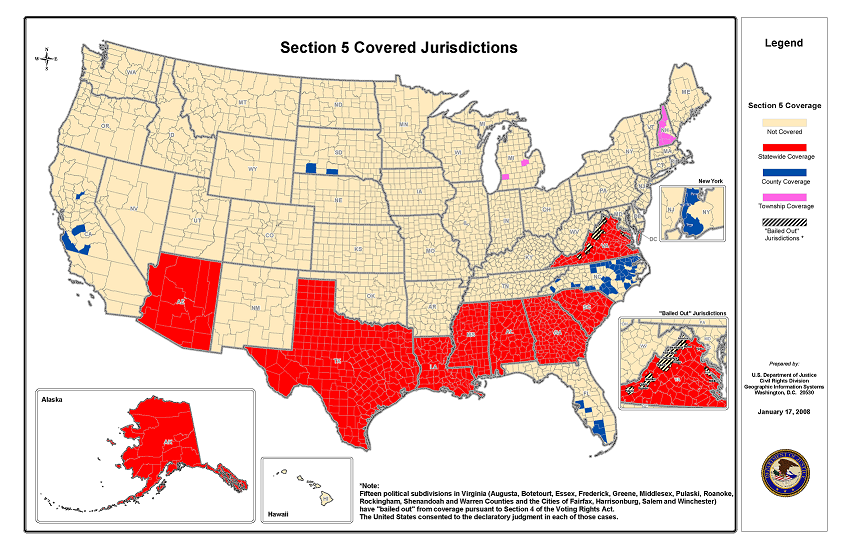
But in essence, the VRA puts the South on probation. Initially that was for 5 years, but the term keeps getting renewed; most recently it was renewed for another 25 years in 2006.

That’s what Roberts has a problem with. Section 4 is based on evidence that was current in 1965, and the basic formula has barely changed since. In the same way that laws need to have a reason to discriminate between citizens, they have to have really good reasons to discriminate between states, which are assumed to have “equal sovereignty”.

Past Supreme Courts have weighed the VRA’s justifications and found them sufficient. Jim Crow was an exceptional problem that required an exceptional solution. (My personal opinion: If you’re going to make an exception, voting rights is a good place to make it, because once voting gets screwed up all the non-judicial ways our system corrects itself are screwed up too.) But Roberts notes that:

Nearly 50 years later, things have changed dramatically.

This is a point you’ll hear often in conservative circles. Nobody wants to explicitly defend Jim Crow any more, but that’s all ancient history. The Age of Obama is post-racial. Things have changed.

Roberts goes on at some length about how things have changed. Minority voter-registration rates are close to parity with white Anglos, and in some elections minority turnout is above average. Minority candidates now get elected to Congress in section-5 states like Texas or South Carolina.

In 1965, the States could be divided into two groups: those with a recent history of voting tests and low voter registration and turnout, and those without those characteristics. Congress based its coverage formula on that distinction. Today the Nation is no longer divided along those lines, yet the Voting Rights Act continues to treat it as if it were. … Congress—if it is to divide the States—must identify those jurisdictions to be singled out on a basis that makes sense in light of current conditions.

Of course, Robert’s characterization of the VRA is not exactly true, because it has a bail-out provision: States and counties can permanently escape section 5 by convincing a court that they’ve stopped trying to discriminate. Parts of Virginia, North Carolina, and New Hampshire have all successfully used that procedure. So a state’s failure to bail out is itself a “current condition”. The plaintiff, Shelby County, could not meet that condition, because it continues to try to disenfranchise blacks. (During oral arguments, Justice Kagan summed it up: “You’re objecting to the formula, but under any formula Congress could devise, it would capture Alabama.”)

But never mind all that, because even making that point draws us down the rabbit hole Roberts has dug. Here’s what’s important: “Things have changed” is not a legal argument. It’s a fine point to make on a blog or at a dinner party, but a Supreme Court justice has to do better than that.

If Roberts were being a real judge here, he’d spell out what “equal sovereignty” has and hasn’t meant in American legal history. He’d enunciate an abstract standard by which Jim Crow was “exceptional” in 1965 and which justified the steps taken then. He’d explain how that standard was violated by the renewal of the VRA in 2006. And he’d lay down a set of conditions that Congress would need to satisfy to make the VRA acceptable today. (If you want to see what a real legal opinion looks like, read Justice Ginsburg’s dissent. Whether you agree with her or not, she is clearly doing something far more rigorous than what Roberts is doing.)

Roberts doesn’t do any of that. The VRA was vaguely justified in 1965 and is vaguely unjustified now, because “things have changed”. If I were a congressman, I would have no idea how to revise the VRA so that it passes constitutional muster. If Congress does revise it, lower court judges who rule on it will just be guessing about its constitutionality. It will have to go back to the Supreme Court before anyone knows whether it’s really a law again, because there are no standards in Roberts’ opinion by which a revision can be judged.

This isn’t law. It’s politics. It’s mush.

So after “careful consideration” of how “things have changed”, this is my judgment: Whether you agree with its conclusions or not, this Court sucks.

Are you a “news” addict?

Every week, the so-called “news” provided by 24/7 cable channels and their web sites includes a hefty helping of gossip: stuff you really don’t need to know that is designed to snag your attention. Worse, this kind of stuff is addictive; you can find yourself thinking about it when you’re supposed to be working or resting or listening to your spouse. Like any addict, your mind drifts into wondering when you’ll be able to turn on the TV or check the internet to get your next dose.

Believe me, I speak from experience. Back in the 90s, my attention got captured by addictive stories like the O. J. Simpson and the Microsoft antitrust trials. They seemed harmless at first, but before long my brain was not my own. They took mental cycles away from the important issues in my personal life, and from the issues that needed my attention as a citizen. Instead, my thoughts and emotions were focused on whatever CNN* decided to hype that week, stuff that usually had nothing to do with me.

One beautiful summer day I went to a peaceful park, imagining that I would work out the plot holes in a piece of fiction I’d been trying to write. Instead, I spent the time raging about Elian Gonzalez. That was when I knew I had a problem. I had to go cold turkey.

That’s why the Weekly Sift is the way it is. I designed it to be the informational equivalent of a coffee-and-juice bar for former alcoholics. You can hang out here, stay informed about the things a citizen needs to know, and never hear about the Casey Anthony trial. We can even talk politics without agonizing over whether Hillary is going to run again or not**.

Most weeks, providing that hype-free space feels like enough. But these last two weeks have seen such an enormous concentration of addictive not-news or almost-news stories that simply ignoring them doesn’t seem sufficient. (I had to listen to President Obama’s climate speech on C-SPAN, because CNN, Fox, and MSNBC all had junk news to cover instead.) Many of my regular readers, I suspect, have been captured by these stories, because it’s hard not to be. So this week I’m doing an intervention. If you’re obsessing over any of the stories below (or something similar), think about whether that’s the best use of your time, your mind, and your emotional energy.

As I said, I’ve been there, so I know how you want to respond: “OK, maybe I am spending too much time on this, but I enjoy it. What’s wrong with that?”

Alcoholics will tell you the same thing. They enjoy drinking. They enjoy barfing in your car. They enjoy waking up with a headache and not knowing how they got here.

Take a step back from your “enjoyment” of addictive stories and look at their larger effects. Do you really enjoy staying up until 2 a.m. to put the 400th comment on some internet article (because otherwise the 399th guy wouldn’t understand what a jerk he is)? When you finally leave the TV, are you happier than when you sat down in front of it? More relaxed? Better able to deal with the rest of your life?

Or have the gossip pushers gotten their hooks into you? Has your mind stopped being your own?

The Zimmerman trial. Trials are classic soap opera, but the only people who should devote day-by-day attention to them are defendants, jurors, and the lawyers and judges who are paid for their time. Everybody else should just wait to see how they come out. A typical day at a trial produces maybe a paragraph’s worth of new information, but that paragraph can take hours to unfold and then pundits can speculate endlessly about what tomorrow’s paragraph will say. Minus the 15 seconds it takes to read a paragraph, all that time is wasted.

The Zimmerman trial is particularly insidious, because you can almost convince yourself it’s news. The Trayvon Martin case as a whole is worth knowing about, because of what it says about racism in America. (So was O. J.’s case, if you could keep the long view and not develop an opinion about Kato Kaelin’s character.) That’s why I covered it twice last year (Trayvon Martin: the Racism Whites Don’t Want to See and Prejudice, Bigotry, and “Reasonable” Racism). When the trial is over, it may be worth looking back to see how those social issues played out in this context. But don’t waste hours pondering the daily drip-drip-drip of information.

You don’t know George Zimmerman, and whether he spends 20 years in prison or walks away free has no effect on your life. So if you find yourself reacting emotionally to obscure points in the rules of evidence, consider the possibility that you may have a problem.

The Snowden chase. Like the Zimmerman trial, this spins out of a legitimate news story, but isn’t news. As I explained in the previous Sift, Edward Snowden is Not the Issue. So far, Snowden has told us a bunch of stuff about NSA spying that the government should have told us a long time ago. Why he did it, how he did it, where he is now, and whether he’ll make it to a country willing to grant him asylum — it’ll be a great movie someday, but it doesn’t matter. The Fourth Amendment matters; the NSA spying on innocent American citizens matters.

Paula Deen. This story contains a tiny sliver of some important issues: How much should we care about what TV stars do when they’re off camera? And if you imagined that racism was ancient history in America, well, clearly not.

But those issues came and went in a brief flicker. Now it’s about whether she’s been sufficiently contrite, and whether white people are persecuted by “reverse racism” or “political correctness” or some other nonsense. (I’ve already said everything I have to say about that in The Distress of the Privileged.)

If you never watched Deen’s show on the Food Network, then the story has no effect on you whatsoever. If you loved her show, don’t worry, she’ll have another one before long. Don Imus came back; so will Paula Deen.

Aaron Hernandez. I’m a Patriot fan, I’ve enjoyed watching Hernandez run after making a catch, and I still refuse to pay attention to this case. O. J.’s runs were even more fun to watch, but his murder trial took up a chunk of my life that I’ll never get back.

I’m going to continue to worry about whether Tom Brady will have anybody to throw to next season. But the Patriots have released Hernandez and the rest of us should too. A jury will decide whether he’s a murderer. The rest of us don’t need to have an opinion.

What is news anyway? News is a recent or ongoing public event that affects you either in your personal life or in your role as a citizen. You could imagine doing something about news. If it’s large-scale news, it might change how you vote or cause you to contact your elected representatives. Maybe you’ll write a check or attend a demonstration or organize to help the victims. Or maybe you won’t end up doing any of those things, but you could, because the story affects your life.

Smaller-scale news concerns stuff you might do in your personal life: a new restaurant is opening, the highway is under construction, 4th of July fireworks will be somewhere different this year.

Sometimes news changes your perspective or opens your eyes to wonder. Apollo 17’s Big Blue Marble photo was news.

Addictive gossip raises the same do-something feelings as a war or a famine, but since it doesn’t really touch any part of your life, all you can “do” is invest more energy in the story itself. So you learn more details, form more opinions about the characters, speculate about what might happen next, and generally just get more and more wound up. Perversely, you end up more motivated to do something — but there’s nothing you can do — than you feel in response to personal and political situations that are crying out for your action.

Worst of all, the addictive story gives you a chance to keep repeating all those maxims that make you unhappy and prevent you from achieving your potential: The world is rigged against people like you, nasty people are everywhere, justice never really triumphs. Maybe your negative maxims are different, but you know what they are.

Take a step back and look around. Are you really enjoying this? If you never thought about it again, would it ever come back to bite you?

Let it go. There’s a world out there that needs your attention.


* The Fox/MSNBC shouting match hadn’t developed yet. It was a simpler time.

** It’ll be fine. Either way, there will be someone worth voting for, at least in the primaries. Trust me on this.

The Monday Morning Teaser

The Sift returns today after taking last week off.

It’s been an eventful two weeks: The Supreme Court term ended its term with some major decisions and President Obama announced his climate-change plan. But as I drove thousands of miles and listened to the satellite-radio audio of the TV news networks, I was struck by how hard it was sometimes to get any real news at all. Instead, coverage was often dominated by stories that were basically soap opera or gossip: Paula Deen, the search for Edward Snowden, or the painfully slow drip-drip-drip of information from the George Zimmerman trial. I had to listen to Obama’s climate speech on C-SPAN, because the other networks thought they had better things to cover.

My original motive to do something like the Weekly Sift comes from a period in the 90s when I suffered from what I came to call “CNN addiction”. I got obsessed with whatever the hyped “news” story of the day was — O. J. Simpson, Elian Gonzalez, and so on — to the point that I had trouble focusing on the things that I actually needed to think about.

That’s why the Sift filters that stuff out and tries to present just the news that actually does deserve your attention. Normally it’s enough just to ignore the other stuff, but there’s so much of it around right now that I feel the need to do an intervention. So this week’s first article — it should appear within the next hour — is “Are you a ‘news’ addict?”.

The other featured article will be a sober, dispassionate analysis of the Supreme Court’s DOMA and Voting Rights Act decisions called “This Court Sucks”. Reading those two poorly justified decisions on consecutive days — one that I agreed with and one that I didn’t — convinced me that it’s not just my liberal bias talking: The Roberts Court really does suck. Both Roberts and Kennedy wrote political mush that has no business calling itself a legal decision. Scalia’s DOMA dissent was a temper tantrum that should embarrass our entire judiciary. The only opinion in the batch that sounded like a judge writing about the law was Ginsburg’s dissent on the VRA decision.

The weekly summary will look at the impact of those decisions, Obama’s climate announcement, the immigration bill, Obama “scandals” that continue to fizzle out, the best radio station for passing the time on a long drive, and some other stuff I thought was fun.

Dissidents

No Sift next week. The next articles will be posted on July 1.

At the hands of the press,
and in the eyes of the Government,
I fell from grace.
I too became a dissident.

— Thomas Dolby, “Dissidents” (lyrics, audio)

This week everybody was talking about Edward Snowden

And that misses the point. If you’re talking about Snowden — whether he’s a hero or a traitor, why he did it, what should happen to him, etc. — then you’re not talking about the NSA, what it’s doing, and what should be done to corral it.

The NSA loves that.

So no matter how many bright shiny objects the establishment press tries to distract you with — look! his girl friend is a pole dancer! — keep your eye on the ball. The issue that matters is the NSA, not Snowden. I flesh those ideas out, and cover what else we learned about the NSA this week, in Edward Snowden Is Not the Issue.

You know who does do a good job of laying out the issues? Juice Rap News.

and Syria

The Obama administration has become convinced that the Assad regime has used chemical weapons against the rebels. And governments can’t be allowed to do that, so we have to do something. But that doesn’t mean we know what to do, or how not to get sucked into another long war with nothing to win.

The British newspaper The Independent reports that Iran is sending 4,000 members of its Revolutionary Guard to help Assad. It frames Obama’s move to arm the rebels as the U.S. taking sides in the region-wide sectarian struggle between Sunni and Shia.

Foreign Policy explains why the Pentagon has been dragging its feet on intervention.

With some notable exceptions, top brass believe arming Syrian rebels, creating a no-fly zone and intervening in other ways militarily, amounts to a risky approach with enormous costs that won’t likely give the Syrian opposition the lift it needs.

And at that point do we say, “Oh well, at least we tried.”? Or do we have to go in deeper to justify what we’ve done already?

and Turkey

Turkish protestors make Les Miserables their own. I wish that didn’t fill me with foreboding.

I can’t say I really understand what the Turkish protests are about, but this article helps.

and DNA patents

Maybe my cynicism level has gotten too high. I was sure that a few of the corporatist justices on the Supreme Court would figure out a way to justify granting patents on naturally-occurring human DNA; I wouldn’t have been totally shocked if that view had won a 5-4 majority. Eventually, I figured, some mega-corp will patent lungs and charge the rest of us royalties for breathing.

Didn’t happen.

Instead, Thursday the Court unanimously decided that “separating [a] gene from its surrounding genetic material is not an act of invention” and is therefore not patentable. The decision specifically applied to Myriad Genetics’ claim of a patent on the BRCA1 and BRCA2 genes implicated in breast cancer. Because of those patents, Myriad had a monopoly on testing for those genes and was able to charge high prices. (Angelina Jolie launched those tests into the headlines a few weeks ago by having her apparently healthy breasts removed after seeing her results.)

But I wrote about Apocalyptic Optimism

It’s easy to be an optimist if you think the right people are in power and have things more-or-less in hand. But Gar Alperovitz’s What Then Must We Do? and David Graeber’s The Democracy Project are upbeat books by people who think our current system is falling apart.

and how to make the NSA’s job harder

I try out some simple anonymizing tools in Herd Immunity Against Online Spying.

and these things also caught my eye

The usual Brewer/Obama relationship.

In one of the year’s most fascinating political surprises, Arizona Governor Jan Brewer (famous for the anti-immigrant “papers please” law S. B. 1070) succeeded in pushing Obamacare’s Medicaid expansion through the legislature. Brewer had begun carrying out her threat to veto every bill until Medicaid expansion passed.

300,000 Arizonans will now get health insurance. The Medicaid expansion is important because it rationalizes healthcare for the working poor. Currently, many of them wait until health problems get out of hand, then go to the emergency room, generating huge bills they can’t pay. Some of those costs are absorbed by the hospitals (who make it up by overcharging the rest of us), and some costs eventually are borne by cities and states. Since the cost of Medicaid expansion is largely borne by the federal government, Arizona saves money by agreeing to it.


Nate Silver says the odds of a second Massachusetts Senate upset are slim.


Undoubtedly some everyday sexual harassment — pinching, grabbing, leering, etc. — is done with conscious malice. But I suspect most harassers have just never tried to imagine what being on the receiving side is really like. So they think: “It’s a game”, “women expect it”, “it’s no big deal”, “they should be flattered”, and so on. Well, for those guys, there’s this video:


Parody news sites are getting harder to spot. They’re more subtle than they used to be, and the level of craziness in real news keeps going up. So newslo.com fools quite a few people with stories like Texas Board of Education Revises Textbooks: Slaves were “Unpaid Interns”.

Every news-satire site should adopt Newslo’s help feature: the Show Facts button at the bottom of each story. Clicking it highlights the parts of the story that are true.


After another Republican man says something stupid about rape, Ta-Nehisi Coates comments on the value of diversity:

If you are not around people who will look at you like you are crazy when you make stupid claims about other people’s experiences, then you tend to keep saying stupid things about other people’s experiences.

Diversity in positions of power isn’t just a kumbaya thing or a way to buy off politically important minorities. If you’re about to embarrass yourself, your party, or your country by saying something stupid about (or doing something stupid to) people you don’t understand, a diverse leadership group has ways of shutting that whole thing down.


Ah, the perverse state government of Scott Walker’s Wisconsin. While the legislature has been in the process of passing one of those war-on-women forced-ultrasound laws, the amount of dissent tolerated in the galleries has been shrinking. Thursday they hit a new low: Women who protested by putting duct tape over their mouths were removed from the gallery. Somebody want to explain to me again how conservatism is all about freedom?

Edward Snowden Is Not the Issue

Focusing Snowden distracts us from the NSA. The NSA loves that.


Whether Edward Snowden is a hero or a traitor* makes for great talking-head debates. Why did he do it? Will he get away with it? What’s he going to do next?

Let me ask a better question: Why do you care? You’re not going to invite Snowden over for dinner or offer him a job, so why do you need to know whether he’s a good person or not? On the other hand, if you’re planning to keep living in the United States, or in any country under the influence of the United States, how the NSA might be spying on you is important. That’s where your attention should be.

I know, I know. Making Snowden the issue lets journalists interview Snowden’s attractive girlfriend (an ABC News article — with picture, naturally — describes her as “an acrobatic pole performer“), her father, and even some woman who lives next door to his mother. (He “seemed like a nice young man”.)

Pole dancer!

Great stuff for ratings, but completely beside the point — what the logicians call an ad hominem fallacy. It’s also standard operating procedure when anybody blows the whistle on wrong-doing in high places: First make the whistleblower the issue, and then assassinate his or her character.

Leaving pole dancers out of it for a few minutes, let’s review the important questions:

Are the programs Snowden described real? Yes. So far the government is not denying the authenticity of the documents Snowden has leaked. Much of it they have verified.

Are they as invasive as the Guardian article made them sound? Unclear. As the techies look at the leaked PRISM documents, many are concluding that one key slide was misinterpreted. It doesn’t really mean that the NSA has a pipe into the central servers at Google and Facebook, from which it can grab whatever it wants at will. There seems to be more process involved than that.

On the other hand, AP reports:

But interviews with more than a dozen current and former government and technology officials and outside experts show that, while Prism has attracted the recent attention, the program actually is a relatively small part of a much more expansive and intrusive eavesdropping effort.

CNET reports the NSA admitting in a congressional briefing that their analysts can listen to phone calls on their own authority, just as Snowden said he could. But other sources are saying that also is based on a misunderstanding. Julian Sanchez does a good job of sorting out what we know and don’t know.

Legally speaking, the analysts don’t have carte blanche. In other words, this isn’t “warrantless wiretapping” so much as “general warrant wiretapping.” They can’t just tap any old call or read any old e-mail they strikes them as “suspicious.” They’ve got to be flagging content for interception because they believe it’s covered by a particular §702 authorization, and observe whatever “targeting procedures” the FISA Court has established for the relevant authorization.

On the third hand, it’s not clear who is enforcing those rules or whether the analysts ever break them.

Are they legal? It depends on what the meaning of is is.  If you mean: “Can the government point to laws and procedures that they are following?”, then the answer seems to be yes. But if the question is whether those laws and procedures fulfill the Fourth Amendment‘s guarantee of “the right of the people to be secure in their persons, houses, papers, and effects, against unreasonable searches and seizures”, I would say no.

Are the safeguards protecting the privacy of innocent people working? We don’t yet have an egregious example of them not working. But if it makes you feel safe that a secret court has to approve these programs, you should read what retired Judge Nancy Gertner says:

As a former Article III judge, I can tell you that your faith in the FISA Court is dramatically misplaced.

The judges appointed to this court aren’t representative of the judiciary as a whole, and chosen precisely because they are sympathetic to government power.

it’s not boat rockers. … To suggest that there is meaningful review it seems to me is an illusion.

Congressional oversight also looks more impressive on paper than it seems to be in practice. WaPo reporter Bruce Gellman said on Face the Nation:

Aside from the members of the intelligence committees, there is something near zero members of Congress who have a member of their staff who is cleared to know anything about this.

He described a “locked room” where Congressmen can go to read unbelievably complicated documents for themselves, “and the number of members who do that is zero.”

What’s the effect on democracy if those safeguards fail? The country would effectively be ruled by the people who know everybody else’s secrets. How many congressmen could vote against them? What president could shut them down?

Do these programs really catch terrorists? I’m impressed that Al Franken says they do. But I’m not impressed that we have to take other people’s word for it. It’s like the torture debate: The government can say it works, but if we’re not cleared to look at the evidence, then why should we believe them?

And none of these claims assess how much domestic terrorist recruitment is aided by Americans’ sense that they are subjects of a government beyond their control or understanding.

Why do they have to be secret? Senator Tester denies that Snowden’s leaks harmed national security. And it’s hard to imagine a terrorist cell that wouldn’t already be thinking about people tapping its phones and reading its email.

Some details need to be secret — plans for the H-bomb, dates for the D-Day invasion, and so on. But the government’s interpretations of the laws should never be secret. The American people are owed a map of the rights they have lost, and at every wall that keeps them from knowing more, we are owed an explanation of why we can’t know more. We haven’t gotten that yet.


*Notice what a hero/traitor dichotomy assumes. If what the government is doing is evil, then Snowden could be both a hero and a traitor.

Herd Immunity Against Online Spying

Can people like us make the NSA’s job harder?


Unlike Senator Lindsey Graham, I’m not “glad” the NSA is hoovering my data into a big database that they pledge (cross their hearts and hope to die) not to access without court authorization and Congressional oversight.

Last time I checked I wasn’t conspiring with terrorists, and off the top of my head I can’t think of any big secrets I’m hiding, but the whole thing just makes me uneasy, given what has happened in the past. The meaning of “terrorist” sometimes gets stretched from jihadist mass murderers to, say, environmentalists who sabotage bulldozers or maybe even Martin Luther King. And while I don’t know how seriously to take Steven Rambam’s claim that it’s “routine” for authorities to log all the cell phones at demonstrations like Occupy Wall Street, I can’t call it unbelievable either.

So, as I said last week, I’m inclined to monkey-wrench a little, and to encourage others to do the same.

The problem is, I’m not a hacker. I’m pretty good at finding things with Google, and I can usually follow step-by-step instructions as long as nothing (and I mean nothing) has changed since the author wrote them, but configuring software isn’t fun for me. I don’t think of it as an artistic outlet. Mostly, I just want stuff to work so I can get on with whatever I sat down to do.

In short, it’s very unlikely that anything I do as an individual is going to give the NSA much of a headache. But there are lots and lots of people at my middling level of sophistication. Are there simple things we could do collectively to make government surveillance more difficult?

That’s what I started playing with this week. Starting with some suggestions from Timothy Lee’s Five Ways to Stop the NSA From Spying On You, I tried out some simple anonymizing tools. I ignored the ones that depend convincing my friends to learn encryption, and focused on things I can do on my own.

I’d like to see more people use these and similar tools for a very simple reason: herd immunity. If only one person is trying to hide his information from the government, that by itself makes him look suspicious. But if lots and lots of people are doing it, then the people with nothing to hide provide cover for any Martin Luther Kings that the government tries to spy on.

Saying the same thing more technically: Data mining like the NSA is doing has a false-positive problem. It might identify a revolutionary (as this clever Paul Revere example illustrates), but it might also pick out a thousand other people who have nothing to do with whatever the government is investigating. So if we all start acting more suspiciously, maybe we can increase the false positives to the point that the whole program becomes useless.

TOR. TOR stands for The Onion Router. (No connection to the satire-news site The Onion. I think the image is supposed to represent something that has layers within layers and can’t be peeled.) Wikipedia says: “Tor directs Internet traffic through a free, worldwide volunteer network consisting of thousands of relays to conceal a user’s location or usage from anyone conducting network surveillance or traffic analysis.”

The Tor browser is free, and easy to install and use. It works with the Windows, Mac, or Linux operating systems. You can download it here.

The first thing I noticed using Tor is that it’s a little sluggish. It’s not agonizingly slow, but if you’re used to web pages popping up instantly, you’ll notice a lag — just long enough to make you realize that your data is zipping and zapping all over the world. (Like Louis CK says about cell phones: “It’s going to space. Can you give it a second?”)

Second — and this is so obvious in retrospect that I feel stupid mentioning it — remaining anonymous is the exact opposite of identifying yourself. So Facebook keeps asking me security questions, because (even though I’m on my home desktop machine) I don’t appear to be anyplace I usually log in from. And I can never guess what country’s home page CNN is going to serve up.

So whether I’m hiding anything from the NSA or not, I’m pretty sure I’m keeping Google confused.

Finally, some stuff is inherently insecure, so Tor either recommends you not install it or just won’t work with it. For example, using Flash with Tor kind of defeats the purpose. So I’ve been using Tor in combination with another browser. When I want to log in to something or watch a video, I’ll jump over to FireFox.

If you start using Tor regularly — or you just like the idea of it — you might want to contribute to the Tor Project.

TorMail. If you worry about Google or Yahoo turning your mail over to the NSA — email that sits on a server gets none of the constitutional protection of snail mail or phone calls — then TorMail is your answer.

It’s web-based email, just like you’re used to. But the system is designed in an admirably paranoid way. Your traffic goes through the Tor network, so you can only access it with the Tor browser. (People claim you can use the Thunderbird email client as a front end, but I wasn’t able to make that work. And you still need to be connected to the Tor network.) Mail servers that send and receive from the Tor network are pure relays that don’t have any mail sitting on them. So there’s nothing to seize and nobody to serve a warrant to.

LPS. This is the coolest thing I played with, and I was surprised how easily it worked for me. Lightweight Portable Security is something the Air Force wrote to allow their people to do secure work on insecure machines. Here’s the idea: LPS is a very small operating system that you put on a CD or a thumbdrive. Insert that disk into anybody’s machine and tell it to reboot. (You don’t even need their password, because you’re not using their operating system or opening their files.)

LPS takes about 3-5 minutes to load, and then you have a minimal Linux-based desktop with a FireFox browser. After you connect to the local network (maybe you’ll need a password there), you’re free to roam the internet. I checked my mail, edited files on my Google drive, and posted to Facebook. And when I shut down and took my disk, no trace of me remained on the machine I’d been using, because I’d never touched its file system. Likewise, my files didn’t pick up any of the viruses or spyware that might have been on the host machine.

I think the Air Force wants its LPS users to immediately log on to some super-secure Department of Defense network. I can’t do that, so my next project is to add a Tor browser to LPS. That should make me both invisible to the machine I’m using and anonymous to the web sites I visit. (OK, maybe I am starting to enjoy this a little.)

If you’ve been trying out anything the rest of us should know about, mention it in the comments.

Apocalyptic Optimism

It’s the end of the world as we know it*, but Gar Alperovitz and David Graeber feel fine.


Lately Robert Jensen has been importing religious terms into journalism. Borrowing from the seminal theologian Walter Brueggermann, Jensen defines three stances from which a journalist can report:

  • royal, relaying the vision of the Powers That Be
  • prophetic, calling the Powers That Be to repent and reform, as the prophets confronted the kings in the Old Testament
  • apocalyptic, announcing that the status quo is beyond reform and calling on the people to think in dramatically new ways

It’s easy for a royalist to be optimistic, because the system is basically sound and a few policy tweaks — a tax cut, a jobs bill, a new general with an improved strategy — will fix whatever temporary problems we might be having. A prophet may rail against current trends, but prophetic warnings rest on the optimistic subtext that we still have time to change our ways. If we just end the war or restore the Constitution or throw the crooks out, we’ll be back on track.

“I was planning to rebuild anyway.”

But the rarest kind of optimism is apocalyptic. The apocalyptic reporter sees that the cavalry won’t arrive in time or isn’t coming at all or will just make the destruction more complete. To be an apocalyptic optimist, you need to see the new seeds already sprouting in the shadow of the doomed sequoia.

In his new book What Then Must We Do?, Gar Alperovitz recognizes all the signs that the American-system-as-we-know-it can’t survive.

  • Even after crashing the world economy in 2008, the big banks are still too powerful to regulate, and the private-profit/public-risk dynamic still dominates. So given time, they’ll crash the economy again.
  • Greenhouse gases keep accumulating in the atmosphere, but even now that we’re seeing the results in droughts, heat waves, and violent storms, we still can’t raise the will to do anything about it.
  • Inequality keeps growing, regardless of which party holds power. For decades, all the apparent growth in the economy has been captured by the rich. The  average person’s standard of living is not improving at all, even as valuable intangibles (like job security) are being lost.
  • Our health-care system gets ever more expensive, and yet we get worse results than the other wealthy countries.
  • The unlimited corporate money pouring into political campaigns has captured both parties. The Democrats may be slightly less receptive to the corporate agenda, but they can’t stand against it either.

And while he by no means rejects traditional political organizing and movement-building, Alperovitz doesn’t think politics will solve the problem. Historically, progressive change in America happened in two big bursts — the New Deal and the Great Society — and both depended on external circumstances that aren’t likely to recur. The New Deal needed not just the desperation of the Depression, but a conservative president (Hoover) to blame for it. If things had shaken out differently, all that despair could have energized the Right, as in Germany. (Imagine the nativist backlash if the immigrant-backed Catholic liberal Al Smith had won in 1928 and been in the White House when the bottom fell out in 1929.) The Great Society couldn’t have happened without the confidence and generosity that resulted from two decades of widely-shared growth; and that couldn’t have happened if World War II hadn’t wrecked all our industrial competitors.

So yes, political reform movements can make a difference, but only in the presence of circumstances we can’t count on. And that’s pretty much what we’ve been seeing: We had three consecutive wave elections: Democratic in 2006 and 2008, and Republican  in 2010. But how much actual change did they bring?

And if we somehow managed the political will to, say, break up the too-big-to-fail banks, wouldn’t they just merge back together as soon as our attention shifted? Isn’t that what the old AT&T phone monopoly did?

Looking at things that way should make a person pessimistic, right? Not exactly. Alperovitz’s introductory chapter ends like this:

as a historian and political economist, it is obvious to me that difficult historical times do not always or even commonly persist forever. In my judgment “we shall overcome” is not simply a slogan but in fact the likely, though not inevitable, outcome of the long struggle ahead.

It is possible, quite simply, that we may lay the groundwork for a truly American form of community-sustaining and wealth-democratizing transformative change—and thereby also the reconstitution of genuine democracy, step by step, from the ground up.

The key phrase here is “long struggle”. We can’t just be socially conscious and politically active for a few months, elect President Wonderful, and then go back to sleep. We tried that; it didn’t work.

Alperovitz’s long struggle isn’t purely political. It’s more than just a series of marches and demonstrations that you attend before returning to your old life. The struggle he envisions involves creating institutions that democratize wealth: co-ops, credit unions, employee-owned businesses, and so on. Alperovitz envisions replacing the flighty government/capitalist partnerships of today with more stable alliances joining local governments with fixed local institutions (like hospitals and universities) and the worker-and-consumer-owned businesses that could service and supply them.

The seeds of that revolution are all around us. (I suggested painless ways you can start participating two weeks ago.) And Alperovitz believes they may sprout first and best in the places where the old system has failed most completely — rust belt wastelands like Detroit or Cleveland. (He cites Cleveland’s Evergreen Cooperatives, which are modeled on the successful Mondragon Cooperatives of the Basque region of Spain.) His logic is perverse but compelling: As long as capitalists can threaten to move the factory to China, they have the community over a barrel. But after the factory is gone, why listen to capitalists any more?

Alperovitz foresees a snowballing process as each new democratizing institution changes the consciousness of the people who participate and enlarges the constituency for democratically managed solutions. Before long, the resources that communities waste enticing corporations to locate there will instead become available to invest in the community solving its own problems.

David Graeber’s new book The Democracy Project, presents a somewhat different brand of apocalyptic optimism. (His last book, which I also reviewed, was a marvelous work of economic anthropology called Debt: the first 5,000 years.)

Graeber is one of the architects of Occupy Wall Street, and is at least partly responsible for coining the term “the 99%”. That makes him a leading voice in what The New Yorker has dubbed “the anarchist revival“, and puts him in something of a delicate situation: In order to promote anarchism, he has to shut down the media’s attempt to anoint him as the movement’s leader. Graeber is a “horizontal” activist who believes in groups finding consensus, not a “vertical” activist who wants to tell folks what to do. If you think people should either lead, follow, or get out of the way, Graeber is not for you.

The essence of Graeber’s worldview is a question: How would groups co-operate if they knew from the beginning that they couldn’t force dissenters to go along with what the group decides? That makes him more radical than a Libertarian, because Libertarians believe in a police-enforced property system.

Like Alperovitz, Graeber sees the approaching end of the current system, which he believes is based ever-more-nakedly on extracting value by force, under the pretense of increasingly empty rituals like elections and loans and trade agreements. Today’s young people, for example, face a choice between accepting unstable careers at minimum wage or borrowing heavily to get an education, then working as unpaid interns before beginning to earn money to pay off their debts. How different is that from feudalism or slavery?

But he also is optimistic that new ways are sprouting in the shadow of the old. The establishment view of Occupy is that it failed because it didn’t produce a set of demands that could become the platform of a political party. But to Graeber that outcome would have been failure. (In Jensen/Brueggermann terms, it would recast OWS as prophetic rather than apocalyptic.) To make that case, The Democracy Project not only retells the history of Occupy from the inside, it retells the history of American democracy and of revolutionary movements in general.

And the punch line is: The really successful revolutions don’t seize power, they change our common sense about what power is and what it can do. The French and Russian revolutions failed to the extent that they became new governments; Robespierre and Stalin represent the defeat of the revolutionary ideals, not their victory. But both revolutions succeeded as “planetwide transformations of political common sense”. The French Revolution ended monarchy as a viable option for forming new governments, and the Russian Revolution drew a line in the sand that capitalists didn’t dare cross. The New Deal and the social democracy of postwar Europe never would have happened happen without the Russian Revolution.

Similarly, Graeber points to another so-called “failure” — the antiwar movement of the Johnson/Nixon years. Arguably, it didn’t shorten the Vietnam War. But American governments have avoided high-casualty wars for the four decades since. (Put together, the Iraq and Afghan Wars have produced about 1/10th the number of combat deaths as each of the Vietnam and Korean Wars.) That attempt to avoid casualties led to increased “collateral damage” as we bombed from a distance rather than aimed down a barrel. That stiffened local resistance and

pretty much guarantee[d] that the United States couldn’t achieve its military objectives. And remarkably, the war planners seemed to be aware of this. It didn’t matter. They considered it far more important to prevent effective opposition at home than to actually win the war. It’s as if American forces in Iraq were ultimately defeated by the ghost of Abbie Hoffman.

So as Occupy morphs into the future, its goal should not be to launch a new party or seize control of an old one. It should be trying to change political common sense. Graeber closes his book by suggesting places where a change in common sense could make a significant difference. Most have to do with the nature of work, the virtue of working long hours, the value of helping people rather than producing more stuff, and bureaucracy as a problem in both the public and private sectors — a problem that could be avoided if groups organized in ways that didn’t require forcing dissenters to co-operate.

Graeber does not minimize or wish away the signs of global catastrophe, but Occupy has made him hopeful because

the age of revolutions is by no means over. The human imagination stubbornly refuses to die. And the moment any significant number of people simultaneously shake off the shackles that have been placed on that collective imagination, even our most deeply inculcated assumptions about what is and is not politically possible have been known to crumble overnight.


* I’ve never thought about R.E.M. and the Tarot in the same sitting before, so I never noticed: Isn’t that the Fool’s dog in the End of the World video?

The Monday Morning Teaser

An afternoon appointment is going to force me to get the Sift out promptly today; the first two articles will go out as fast as I can proof-read them.

And then tomorrow I head to Louisville for the Unitarian Universalist General Assembly, which will keep me too busy to put out a Sift next Monday.

Today’s first article will have the unlikely title “Apocalyptic Optimism”. Two recent books have something interesting in common: Gar Alperovitz’s What Then Must We Do? and David Graeber’s The Democracy Project are upbeat books based on the premise that America-as-we-know-it is falling apart. I’m classifying them as “apocalyptic” using the royalist/prophetic/apocalyptic framework that journalist Robert Jensen borrowed from theologian Walter Brueggermann. What makes them upbeat? Well, as Graeber says in his last paragraph, “The human imagination stubbornly refuses to die.”

The second article “Herd Immunity Against Online Spying” is more of a how-to. The recent revelations about the NSA have re-awakened my interest in ways to be more anonymous online. I’ll ignore things that require you to become a hacker or convince your friends to use encryption, and focus instead on changes you can make simply on your own: the Tor browser, Tormail, and a neat little program the Air Force uses called Lightweight Portable Security. Maybe you have nothing to hide, but the more people who use these kinds of tools, the harder the NSA’s job gets.

Third, I’ll summarize a bunch of what we learned about the NSA this week and warn you not to get distracted by the hero-or-traitor debate in “Edward Snowden Is Not the Issue”.

The weekly summary is called “Dissidents” after a Thomas Dolby song. Syria, Turkey, DNA patents, the unlikely Brewer-Obama alliance, and why taping your mouth shut is more speech than Wisconsin can tolerate.