If

If you can keep your head when all about you are losing theirs, and blaming it on you …

Rudyard Kipling

It is no accident that President Obama’s America has given rise to Donald Trump.

Ben Domenech

This week’s featured posts are “How Republicans Trumped Themselves” and “The Leadership We Need“.

This week everybody was trying to figure out what to do about Donald Trump

In “How Republicans Trumped Themselves” I pull together a chorus of voices that diagnose the Trump phenomenon as a symptom of a larger ill: The GOP has been pandering to bigotry for decades, and conservative media has created a safe zone for every kind of conspiracy theory, no matter how poorly grounded in reality it might be. Now that bigotry and that disregard of facts is being used against them.

In “The Leadership We Need” I take a more abstract look at leadership, and describe how to tell a Leader from a Demagogue.


Meanwhile, this guy knows how he wants to respond.


In “How Republicans Trumped Themselves“, I briefly quoted Heather Hogan’s article “This is How Fox News Brainwashes Its Viewers“. That article examines the complete Fox propaganda cycle and deserves to be read end-to-end.

and the Paris climate agreement

Grist does a good balancing of the good and bad.

The COP21 conference brought every country to the table, they all accepted the science of climate change, and they agreed to work together to do something about it. But some proved more ambitious than others, and the rich countries didn’t come up with enough money to get the best deal possible.

The bottom line is that the agreement gets us far closer to containing climate change than we were two weeks ago, but still far short of where we need to go. In fact, we won’t even know for years what it will accomplish. How much the agreement reduces greenhouse gas emissions, and through that reduces warming, will depend on whether countries meet their targets for curbing emissions and deploying renewable energy and whether they ramp up their ambition in the years ahead.

and the aftermath of mass shootings

Here’s what we now know about the San Bernardino shooting. 14 people were killed and 22 injured by a married couple, Syed Rizwan Farook and Tashfeen Malik, who were killed in a subsequent shootout with police. In the attack they used two semi-automatic rifles, two semi-automatic pistols, and an “explosive device”.

The weapons were acquired legally by Farook and his friend and next-door neighbor, Enrique Marquez. They were illegally modified to accept larger magazines. Farook took out a $28K loan two weeks before the attack, which may have been used to buy guns, ammunition, and other supplies for the attack.

Farook was born in the United States. He was a Sunni Muslim who traveled to Saudi Arabia more than once. In 2014 he met Malik there, and she came to the U.S. under a fiancé visa. While they appear to have had online contact with terrorist groups, so far there’s no indication that they actively belonged to a larger cell, or that anyone (with the possible exception of Marquez) helped them plan or finance their attack.

Apparently, they were both already “radicalized” when they met. Farook attended a mosque, but stopped going there a few weeks before the attack, so it seems unlikely that somebody there whipped him up to do this. There is no evidence that anybody else at the mosque was involved.

In short, San Bernardino does not seem to be an example of the kind of thing we’re being told to fear, and wouldn’t have been prevented by the anti-Muslim proposals we’re hearing: The attackers weren’t infiltrated into the U.S. by ISIS, they weren’t recruited at a mosque, and it’s not even clear that keeping Malik from entering the country would have prevented Farook from launching an attack.

To me, Farook and Malik look a lot like Robert Lewis Dear, the Planned Parenthood shooter, or Dylann Roof, the Charleston church shooter. None of them seem to have been agents of a larger conspiracy, but they are all examples of what can happen when unstable people believe the kind of hateful, irresponsible rhetoric that is so easy to find these days, and then easily acquire deadly weapons.

To me it barely matters which crazy set of beliefs your violence arises from, whether it’s that ISIS is the proper political heir to Muhammad, that the white race is facing a battle for its survival, or that Planned Parenthood is dismembering babies for profit. As responsible people, we should be trying to prevent all crazy ideologies from inspiring violence.

Amanda Marcotte put it well:

Liberals understand that there are theological and political differences between the different kinds of radical fundamentalism that lead to terrorism, but we are keenly aware that people who pick up a gun in the name of God have more in common with each other than they do with the rest of us.


The Daily Show‘s Jordan Klepper discovers that becoming an effective good guy with a gun is harder than it looks.


Meanwhile, Canadian Prime Minister Justin Trudeau welcomed the first planeload of the 25,000 Syrian refugees he has promised to take in by the end of February. So Canada, a country with a fraction of our population, is taking in 2 1/2 times as many refugees.

But I’m sure that when the Canadian experiment goes smoothly, and none of their refugees gets involved in terrorist attacks, American conservatives will see the err of their ways and happily increase the number of Syrians we’re giving refuge to. Won’t they?

and Islam

For some reason, this year I haven’t gotten around to writing all the book reviews I planned. So as a down payment on a longer post, I’ll leave you with two quotes from recent books about Islam. Both books portray Islam as more diverse and more flexible than is commonly imagined by the American media.

From Michael Muhammad Knight’s Why I Am a Salafi:

A text’s repeatability in part depends on the potential for its old words to produce new results. A verse remains powerful not because it imposes its meaning on the future, but because it accommodates the future’s needs: The verse is not bound to its author or its first audience.

From Shahab Ahmed’s What is Islam?:

Some years ago, I attended a dinner at Princeton University where I witnessed a revealing exchange between an eminent European philosopher who was visiting from Cambridge, and a Muslim scholar who was seated next to him. The Muslim colleague was indulging in a glass of wine. Evidently troubled by this, the distinguished don eventually asked his dining companion if he might be so bold as to venture a personal question: “Do you consider yourself a Muslim?” “Yes,” came the reply. “How come, then, you are drinking wine?” The Muslim colleague smiled gently. “My family have been Muslims for a thousand years,” he said, “during which time we have always been drinking wine.” An expression of distress appeared on the learned logician’s pale countenance, prompting the further clarification: “You see, we are Muslim wine drinkers.” The questioner looked bewildered. “I don’t understand,” he said. “Yes, I know,” replied his native informant, “but I do.”

and Peanuts

Marking the 50th anniversary of A Charlie Brown Christmas, how the whole thing came to be, including a certain amount of the spiritual journey of Charles Schulz.


An attempt to enlist the Peanuts characters in the War on Christmas yielded some pushback.


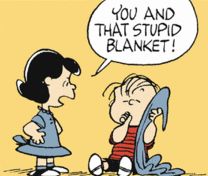
I’m not the only one who’s been making the analogy between guns and security blankets.

and you might also be interested in

On a blog he shares with his son, Sift reader Bill Camarda recently posted a piece he called “My America“, in which he presented a personal, positive vision of what America has been and could become. My point in mentioning it is not so much that this particular post should go viral, as that the idea behind should: What if people all over the country started writing their own “My America” and posting it to whatever blog, Facebook page, or other outlet they had access to? That might be a constructive response to the bigotry and hatefulness that seems to be running so wild these days — more constructive than wringing our hands and saying “Isn’t what Trump just said awful?”

I’m not sure what mine would say, but I’m thinking about it.


We’re not quite at the point of a government shutdown yet, but the agreement to prevent one is proving hard to work out.


Jon Stewart came back to The Daily Show briefly to try to shame Congress into taking care of the 9-11 first responders.


The irony of global interdependence:

Russian production of T-shirts with anti-Turkish slogans has been delayed by disruptions in fabric imports from Turkey, Russian media reports said Wednesday.


President Obama’s reluctance to plunge deeper into the Syrian mess looks a lot better when you compare him to less cautious leaders, like Putin. Knowing when not to act is as big a part of leadership as knowing what to do.

and let’s close with some fascinating possibilities

Up until now, attempts to replace meat with vegetable products have ranged from unsatisfying to downright awful. But here are two attempts to attack the problem on a deeper level. First meat

and then eggs.

In either case, the point isn’t to do away with animal products. But what if the number of situations where doing without them feels like a hardship got much smaller? That could make a huge difference in both public health and the environment.

The Leadership We Need

When Donald Trump’s supporters are asked what they like about him, one phrase that always comes up is “strong leader”, and a contrast is drawn between Trump and President Obama, who is a “weak leader”.

People who think that way must have a very different view of leadership than I do. But this is the kind of thing we don’t talk about much. In our public discussion, leadership is like art: We all think we know it when we see it, so we don’t need to define it.

But I’m thinking we do need to define it, so I’m going to take a few paragraphs to say what I think leadership is, and how our current would-be leaders are succeeding or failing at it.

Here’s what leadership means to me: the ability to see a practical path to a better world, and to convince enough people to join you on the journey that you can actually get there together.

Given that definition, there are several ways that would-be leaders can fall short:

  • Idealists envision a better world, but have no practical plan for getting there.
  • Visionaries get so far ahead of the People that few can follow them.
  • Academics lack the ability to communicate their vision or persuade the People to believe in it.
  • Panderers do not present a vision at all, but simply tell the People what they want to hear.
  • Demagogues take advantage of the People’s ignorance, greed, and fear to gain power for themselves. If they lead anywhere, it is to a harsher, more hate-filled, and more violent world.

This doesn’t correspond directly to a Left/Right spectrum, but there is a broad correlation: Liberals have a weakness for Idealists (of course a book about a “better world” with a view from space on its cover is liberal) and Visionaries, while Conservatives love their Demagogues. All political movements have their Academics and Panderers.

A good way to sum up the Clinton/Sanders argument among Democrats is that Clintonistas see Sanders as a Visionary, while Sanders supporters see Clinton as a Panderer. Sanders’ program sounds great to most Democrats, but the question is whether the larger public is ready for it. And Clinton is saying a lot of progressive things right now, but will she still be saying them in the general election when she has a different audience?

One test of leadership that all the Republican presidential candidates are failing is to tell the American people the truth about climate change: It’s happening, it’s caused by burning fossil fuels, and there will be serious economic, humanitarian, and even military consequences if we don’t take dramatic action. No one on the Right wants to hear that (and people on the Left aren’t wild about it either), so the conservative candidates (most of whom are smart people who probably know better) avoid the problem when they can and openly deny it when it comes up. That’s pandering.

Democrats pander in a more subtle way. Candidates (especially Clinton) are reluctant to face the gap between the size of the country’s problems and the size of their proposed solutions. Raising the minimum wage or re-jiggering student loan programs isn’t going to reverse the country’s polarization into rich and poor. Effective gun control will require more than just background checks and assault-weapon bans. And so on.

There’s a tricky road to walk here: A Leader would be pushing for the small steps s/he can hope to take in the short term, while continuing to build support for actions big enough to make a difference. (One possible role model is how before Pearl Harbor FDR walked the narrow path between Visionary and a Panderer as he coaxed the public towards entering World War II. He didn’t seek a premature declaration of war that Congress would have voted down, but he prepared for war with the nation’s first peacetime draft and an increased defense budget. And by swapping destroyers to Britain and then getting the Lend-Lease program through Congress, he clearly identified the country with the Allies.)

The difference between a Leader and a Demagogue can be hard to see when you get caught up in the passions of the moment, but if you introspect a little you can feel it in your heart. A Leader calls out the best in his or her followers. Under the influence of a Leader, you feel more courageous, more hopeful, more generous, and generally more heroic.

These famous words of JFK’s inaugural address could come from either a Leader or a Demagogue:

Let every nation know, whether it wishes us well or ill, that we shall pay any price, bear any burden, meet any hardship, support any friend, oppose any foe to assure the survival and the success of liberty.

What marks that address as leadership is what so many of the people he inspired went on to do: join the Peace Corps, or go to Mississippi for the Freedom Summer. They took risks and inconvenienced themselves for the benefit of others. Listening to Kennedy made them better people.

But those who listen to Donald Trump (and to a lesser extent several other Republican candidates) become angrier, more fearful, and more self-centered. They want to make their enemies suffer. They want to send other people to fight in the deserts of the Middle East, but they don’t volunteer to go themselves. Trump tells his followers not that they need to sacrifice, but that they’ve sacrificed too much already. It’s time for other people to sacrifice: the Hispanics, the Muslims, the Syrian refugees, the inner-city blacks.

Both Leaders and Demagogues will call on you to be strong, but the Leader will have you focus your strength on the real enemy, and take the risks associated with opposing strength to strength. The Demagogue will offer you scapegoats, weaker people you can beat up on.

Both a Leader and a Demagogue will leave you feeling energized, but if you introspect honestly, you can tell the difference: The Leader calls on you to find virtues you didn’t know you had, to be better than you have ever been. The Demagogue gives you permission to be worse.

You can tell.

How Republicans Trumped Themselves

You can’t complain just because somebody demagogues better than you do.


This week the airwaves were full of Republicans wringing their hands: What can the Party do about the wave of bigotry and hatred that Donald Trump has unleashed on their presidential primary race? How can they avoid a backlash that could wash away their 2016 chances?

That sentiment had been brewing for months, but it came to a head last Monday afternoon, when Trump made his proposal to ban Muslims from entering the United States. So let’s start there: Exactly what did Trump propose?

Keeping Muslims out. His initial announcement wasn’t very specific — Trump’s proposals seldom are — and the first campaign spokesperson who elaborated said that American Muslims who leave the country wouldn’t be able to come back. (“Mr. Trump says ‘everyone’.”) But Trump backed off of that. So fine, Shaq can attend the Rio Olympics if he wants, and Dave Chappelle can do a show in London. They don’t have to quit America for good because of their religion.

But if a businessman from Indonesia wants to come over to negotiate a deal, or his wife wants to shop on Rodeo Drive, or his children want to see Disney World or study engineering at Purdue — no. They can’t come, because they’re Muslims. Now, their passports don’t have MUSLIM stamped on them, so it’s not clear how we’d know to keep them out. (Asking would only keep out the honest Muslims, which kind of misses the point. Maybe the Trump administration could require everybody who goes through customs to spit on a Qu’ran or something.) But let’s not get lost in the details of enforcement. Trump hasn’t thought about them, so why should we?

Trump supporters wave off criticism by pointing out that the ban is supposed to be temporary. But Trump defined the end point as “until our country’s representatives can figure out what is going on”. When CNN’s Don Lemon asked what that meant, Trump replied:

Why is there such hatred and such viciousness? Why is somebody willing to fly airplanes into the World Trade Center? … Where does this hatred come from? Why does it come? We need to figure it out.

In other words, lifting the ban is tied to a question from 14 years ago, one that has been answered many times, but with an answer that Trump and his followers don’t like. Why do they hate us? Because for decades we overthrew their attempts at democratic governments and installed brutal dictators who would sell us oil. Because our troops kicked down their doors and dragged their fathers off to hellholes like Abu Ghraib. Because we send our killer drones wherever we want, and deny that most of the people we kill are innocent. In short, many of the people who hate us have very good reasons that Trump and his supporters have no interest in doing anything about, except possibly adding to them.

So basically, Trump’s ban would stay in place until he’s willing to learn things he doesn’t want to know. That doesn’t sound very temporary to me.

This time he’s done it. The immediate talking-head response to Trump’s proposal was that this time he had finally gone too far: The American people would recoil in horror at the thought of turning away refugees and immigrants and students and tourists because we don’t approve of their religion, a religion shared by millions of loyal American citizens, decorated American soldiers, and two members of Congress.

Well, most of the American people, maybe. Whether or not they are horrified, 57% told an NBC/WSJ poll that they disagree with keeping Muslims out of the country, while only 25% agree. (Count CNBC pundit Larry Kudlow among those who disagree, but only because he wants something more sweeping: “I say seal the borders. … We need a wartime footing if we are going to protect the American homeland.” And Laura Ingraham: “I’d do a pause on all immigration.”)

However, this is a primary campaign, not a general election. And Republican respondents were split: 38% for Trump’s proposal and 39% against. So in a multi-candidate field, the Muslim ban seems to be helping him. His lead in the RCP polling average is as big as it has ever been.

Locking up the racist/fascist vote. The anti-Muslim proposal increased the number of people willing to describe Trump as either a racist or a fascist — a term I discussed two weeks ago. But whatever you think of that usage, the undeniable racists and fascists have started welcoming Trump to their ranks. Former KKK leader David Duke has endorsed Trump, saying that he “understands the real sentiment of America”.

Buzzfeed reports:

Visitors to the website for the Council of Conservative Citizens — a white nationalist group cited by Charleston church shooter Dylan Roof — will find a steady stream of pro-Trump articles.

BF quotes the white supremacist website American Renaissance:

If Mr. Trump loses, this could be the last chance whites have to vote for a president who could actually do something useful for them and for their country.

and neo-Nazi Stormfront radio personality Don Advo:

whether or not Trump wins, his campaign is “gonna give people the ability to come openly out of the shadows and really work very hard for something that will have a lasting effect.”

“This anger, this fire, is not going to go away,” he said. “It’s not going to go away at all. And that has not been noticed by the neocons — or perhaps we should them neo-Cohens — in the Republican Party.”

The Establishment still doesn’t understand. Republican establishment types may not grasp the implications of being “neo-Cohens” yet, but they finally do seem to be getting the message that Trump could be nominated, with catastrophic short-and-long-term effects on the Party. A year ago, it seemed possible that Jeb Bush or Marco Rubio might finesse a campaign that appealed to the Republicans’ Southern white base without being so blatantly bigoted as to drive Hispanics and all other non-whites and non-Christians into a coalition against them. But that option has pretty well vanished. (Second place in national polls and first place in Iowa have been taken by Ted Cruz, who is not that different from Trump.)

What Republicans still don’t seem to grasp, though, is that they did this to themselves. William Greider traces the problem back to the deal between Richard Nixon and Strom Thurmond that created the modern GOP, the “Southern strategy”. All that time, country-club Republicans and racist working-class whites have had little in common, but

Nixon and his successors hid behind ideology and obscured the contradictions by pursuing a strategy I would call “no-fault bigotry.” Every now and then, especially in election seasons, the Republicans played the race card in dog-whistle fashion to smear Democrats, with savage effect. The GOP never attempted to repeal civil-rights legislation but sought cheap ways to undermine enforcement and remind whites, South and North, that the party was on “their” side.

So what caused the current rebellion in the GOP ranks? It finally dawned on loyal foot soldiers in the odd-couple coalition that they were being taken for suckers. Their causes always seemed to get the short end of the stick. The GOP made multiple promises and fervent speeches on the social issues, but, for one reason or another, the party establishment always failed to deliver. … the Republican establishment brought this crisis on itself by cynically manipulating its own rank and file.

Paul Krugman echoes the point:

But there is a strong element of bait-and-switch to this strategy. Whatever dog whistles get sent during the campaign, once in power the G.O.P. has made serving the interests of a small, wealthy economic elite, especially through big tax cuts, its main priority — a priority that remains intact, as you can see if you look at the tax plans of the establishment presidential candidates this cycle.

Sooner or later the angry whites who make up a large fraction, maybe even a majority, of the G.O.P. base were bound to rebel … So along comes Donald Trump, saying bluntly the things establishment candidates try to convey in coded, deniable hints, and sounding as if he really means them.

And Timothy Egan writes:

What [Trump has] done is to give marginalized Americans permission to hate. He doesn’t use dog whistles or code. His bigotry is overt. But the table was set by years of dog whistles and code. The very “un-American” sentiment that Republican elders now claim to despise has been a mainstay of conservative media for at least a decade.

When truth stops mattering. One more point is needed to complete the picture: the Republican embrace of post-truth politics. A party that exploits ridiculous conspiracy theories to energize its base — Birtherism, known falsehoods about Benghazi, Obama is a Muslim, the persecution of American Christians, the “war on cops” — has no defense when a better liar comes along.

Republican Congressman Deven Nunes has only been in office since 2002, but he reports a startling change in his communications from constituents.

“I used to spend ninety per cent of my constituent response time on people who call, e-mail, or send a letter, such as, ‘I really like this bill, H.R. 123,’ and they really believe in it because they heard about it through one of the groups that they belong to, but their view was based on actual legislation,” Nunes said. “Ten per cent were about ‘Chemtrails from airplanes are poisoning me’ to every other conspiracy theory that’s out there. And that has essentially flipped on its head.” The overwhelming majority of his constituent mail is now about the far-out ideas, and only a small portion is “based on something that is mostly true.” He added, “It’s dramatically changed politics and politicians, and what they’re doing.”

This trend may have gotten worse recently, but it isn’t new. David Frum wrote about it in 2011:

Backed by their own wing of the book-publishing industry and supported by think tanks that increasingly function as public-relations agencies, conservatives have built a whole alternative knowledge system, with its own facts, its own history, its own laws of economics. Outside this alternative reality, the United States is a country dominated by a strong Christian religiosity. Within it, Christians are a persecuted minority. Outside the system, President Obama—whatever his policy ­errors—is a figure of imposing intellect and dignity. Within the system, he’s a pitiful nothing, unable to speak without a teleprompter, an affirmative-action ­phony doomed to inevitable defeat. Outside the system, social scientists worry that the U.S. is hardening into one of the most rigid class societies in the Western world, in which the children of the poor have less chance of escape than in France, Germany, or even England. Inside the system, the U.S. remains (to borrow the words of Senator Marco Rubio) “the only place in the world where it doesn’t matter who your parents were or where you came from.”

And AutoStraddle‘s Heather Hogan more recently described the effect on a personal level:

Over the last ten years, everyone I know has lost a friend or family member or mentor to Fox News. Like me, they have watched helplessly as people they love have become part of the conservative punditry herd and, over time, traded their compassion for paranoia; their thoughtful opinions for manufactured outrage; and their empathy for hateful rhetoric.

It seems quaint now that, back in 2008, John McCain corrected a questioner who said that she couldn’t trust Barack Obama because he was “an Arab”. He defended Obama as “a decent family man and citizen that I just happen to have disagreements with on fundamental issues”. (Trump, facing an even more outrageous questioner this September, did nothing of the kind. He later criticized McCain’s response, saying McCain was “harsh” when he “ripped the microphone out of the woman’s hands”. Actually, McCain reached for the microphone while saying, “No, ma’am.”)

But the McCain of 2008 was already a dinosaur in Republican circles. His younger running mate, Sarah Palin, catered to misperceptions of her audience, understanding that anything goes if it whips up your supporters.

Eight years later we have Donald Trump, who doesn’t know or care much about reality, but is really good at whipping up his supporters. Unreality, along with the irrational fears and passions it commands, is a powerful weapon in politics. The problem is that no one can own it. If you use it, you have no safe refuge when someone turns it against you.

The Monday Morning Teaser

A few hours after last week’s Sift got finished, Donald Trump made his don’t-let-any-Muslims-in proposal, which seemed to be about all anybody could talk about for the rest of the week. Not to write about that would feel like dodging, but at the same time I don’t want to repeat the same oh-isn’t-that-horrible reaction you’ve been hearing all week.

Not that it isn’t horrible, but you know that already. Is there anything more insightful to say about it? The articles that I found interesting this week focused on where this stuff comes from and why there is an audience for it: Republicans and their conservative media have been building that audience for years, using white Christian identity politics to manipulate working-class whites into supporting the candidates of the corporate establishment. They’ve built an echo chamber where bizarre conspiracy theories and simplistic views of economics and foreign affairs can avoid the friction of the real world. Now that Trump is playing their game better than they do, they want to call a foul.

I’ll sum up that point of view in the first featured post “How the Republicans Trumped Themselves”. That should be out shortly.

But there’s something else that I think needs to get out there. What Trump’s fans love about him is that he is a “strong leader”, and I feel like that idea needs to be taken on more directly — because what he’s doing doesn’t fit my notion of leadership at all. So the second featured post will be “The Leadership We Need”. That still needs work, so I’m not sure what time it will post.

The weekly summary will discuss the aftermath of the recent mass shootings, quote two new books that illustrate the complexity and diversity of Islam, and pull together a few of the Peanuts references that have accompanied the 50th anniversary of A Charlie Brown Christmas, before closing with two attempts to enlist high tech in the effort to replace meat and eggs.

Thoughts and Prayers

Your “thoughts” should be about steps to take to stop this carnage. Your “prayers” should be for forgiveness if you do nothing – again.

Senator Chris Murphy (D-Connecticut)

Just another day in the United States of America, another day of gunfire, panic, and fear.

BBC intro to the San Bernardino shootings

This week’s featured posts are “Guns are security blankets, not insurance policies” and “The 2016 Campaign: a mid-course assessment“.

Last week’s post about fascism, “The Political F-word“, had one of the best first weeks in Weekly Sift history: At 7700 hits so far, it’s already the 15th most popular Sift post ever.

This week everybody was talking about mass shootings and terrorism

It’s been fascinating to watch the radically different responses to two terrorist attacks that happened within a few days of each other: San Bernardino and Planned Parenthood. Liberals had just about the same response to each: It’s way too easy in the United States for somebody to get guns and start shooting people.

For conservatives, on the other hand, the Planned Parenthood shooting in Colorado Springs was just one of those things. It’s the price of living in a free society and there’s really nothing to be done about it. The San Bernardino shooting, though, was something Muslims did, so it is a national emergency that requires carpet bombing or maybe a ground war.

Personally, I don’t care whether the person who shoots me is a Muslim extremist or a Christian extremist. Heck, if there are Zoroastrian extremists, I don’t want them to shoot me either. (Funny how you never hear about somebody gunning people down for atheism.) Mass shootings are the problem we need to solve, not just a particular kind of mass shootings.


President Obama’s speech Sunday night was basically a stay-the-course speech. It was well-reasoned (because what we’re doing to fight ISIS is mostly well-reasoned already), but I suspect it did little to slow down the national panic.

The problem Obama is facing is that most of the dramatic actions he could take — indiscriminate bombing or a ground invasion of Syria, harassing Muslims in the U.S., etc. — would do more harm than good. He’s quite correct that ISIS is hoping for those kinds of responses. It’s worth noting that hardly any of the public figures who criticize Obama for not doing enough have offered any detailed suggestions. They want to “get tough” and take strong action, but exactly what those actions would be is left vague.

Strangling an insurgency without creating a new insurgency is a long, slow process. As sad as that thought is, we’re lucky to have a president who understands it.

Peter Beinart wrote an insightful article about Obama’s thinking on terrorism.

Obama is a kind of Fukuyamian. Like Francis Fukuyama, the author of the famed 1989 essay “The End of History,” he believes that powerful, structural forces will lead liberal democracies to triumph over their foes—so long as these democracies don’t do stupid things like persecuting Muslims at home or invading Muslim lands abroad. His Republican opponents, by contrast, believe that powerful and sinister enemies are overwhelming America, either overseas (the Rubio version) or domestically (the Trump version).

For them, the only thing more terrifying than “radical Islam” is the equanimity with which President Obama meets it. And, to their dismay, that equanimity was very much on display on Sunday night.

and guns

I tried to keep “Guns are security blankets, not insurance policies” focused, so I had to edit out this second point:

Guns don’t protect freedom, they threaten it. One of the what-if fantasies that justifies a well-armed civilian population is: What if the government becomes tyrannical? Won’t we want to have the ability to launch a Red-Dawn-like insurgency?

A bunch of things are wrong with this fantasy, the biggest being that my handgun or hunting rifle wouldn’t be much use against the U.S. Army, if it ever came to that. The historical references people back this point with are also usually dead wrong. (No, Hitler didn’t confiscate the German people’s guns.) The actual examples of tyrants being overthrown in recent history aren’t stories of civilian militias shooting it out with the army. Instead, they involve mass demonstrations by unarmed people, raising the prospect either of the army or powerful foreign protectors turning against the government. (See: Arab Spring, or the overthrow of the Shah of Iran.)

There is, however, one example from American history that fits the civilian-militia scenario perfectly: the Ku Klux Klan’s resistance to the occupation of the South after the Civil War. (I have written about this before; for a more detailed discussion, read the recent book After Appomattox by Gregory Downs or Eric Foner’s Reconstruction.) At the end of the Civil War, the U.S. government recognized that simply freeing the slaves on paper wasn’t enough, because the white-supremacist power structure of the Southern states would quickly re-assert itself and deny any real rights to black citizens. Tens of thousands of Northern troops occupied the South for several years, attempting to establish a social order in which blacks and whites were equal under the law.

To the former rebels, this was tyranny imposed by a distant government in Washington DC. They wanted to restore the pre-war whites-only power structure, in which blacks were subject to separate, harsher laws that they had no voice in either making or enforcing. To that end, the KKK unleashed a campaign of political terror, attacking not Army units, but political gatherings of blacks and pro-government loyalists, and assassinating numerous public officials who attempted to enforce the federally-mandated laws.

Ultimately, the KKK succeeded in throwing off the “tyranny” of Washington, resulting in the Jim Crow era.

In other words, in the historical example that best fits the pro-gun rhetoric, it was the federal government that was fighting for real democracy and freedom, while the armed civilian militias were fighting to take rights away from the new citizens (who we think of as minorities, but who actually constituted a majority in Mississippi and South Carolina).

Something similar is happening today in the recent abortion-clinic violence: The federal government protects the right of women to make their own decisions about their pregnancies, while an armed minority wants to make those decisions as dangerous as possible, and ultimately to intimidate citizens into not using their rights. The point isn’t to fight the Army, it’s to assassinate doctors and terrorize pregnant women.


I hate to admit it, but I understand why Congress doesn’t want to ban people on the no-fly list from buying guns. The no-fly list is already a little constitutionally suspect, because it works a real hardship on people without due process of law. You don’t know whether you’re on the list or why, and you have no recourse for getting your name off. The list is a product of the executive branch without any judicial involvement, so theoretically you could wind up on it just because somebody in the White House doesn’t like you. (I used to bitch about this kind of thing all the time during the Bush administration, so I sort of need to stay consistent.)

We tolerate the no-fly list because we all believe we’ll never be on it. We ought to be figuring out some more acceptable way to replace it, not increasing its influence.

and prayer

The New York Daily News called attention to the cynical use of prayer as a response to a massacre, and Connecticut Senator Chris Murphy offered the tweet at the top of this post.

I’ve updated the Conservative-to-English Lexicon to include a definition of prayer:

A way to appear to take action on issues you don’t actually care about. Example: the prayers routinely offered for the families of victims of mass shootings.

Naturally, conservatives took offense at the aptness of remarks like Senator Murphy’s, or the Daily News cover to the right, charging that they denigrated religion and the power of prayer. Ted Cruz called it “prayer shaming“.

Nothing of the kind is happening. The point is that we can all pray for ourselves, we don’t need to elect representatives to do it for us. We elect representatives to exercise the powers of government, which Republicans refuse to do whenever action would offend the NRA.

I have a suggestion: Whenever Republican candidates are asked about how they plan to combat ISIS or limit government spending, they should offer their prayers and move on to the next question. I think any candidate who tries this will soon discover exactly how much stock the conservative base puts in the power of prayer unsupported by any direct human action.

and the Paris climate talks

The shootings have driven the Paris climate summit off the front pages, but it’s still happening. In the long run, it might be the most important thing that’s happening right now.

and you might also be interested in

The House has been repealing ObamaCare every month or two for years now. Well, they finally got a repeal through the Senate, using the “reconciliation” procedure that is immune to filibusters. So this is the first ObamaCare repeal that has made it to President Obama’s desk, and he will veto it.

MaddowBlog’s Steve Benen notes that this was a vote to increase the number of uninsured Americans by 22 million, and that it’s a trial run of a repeal procedure that presumably will work in 2017 if Republicans win the White House. However, it’s not clear that Senate Republicans could stick together if they were really taking health insurance away from millions of Americans. (Two Senate Republicans defected on this bill; more might if they couldn’t count on a presidential veto.)

Meanwhile, Paul Ryan promised:

we think this problem is so urgent that, next year, we are going to unveil a plan to replace every word of Obamacare.

Benen observes that it’s only been six years since ObamaCare became law, and that Republicans have been promising to unveil a replacement any minute now for most of that time. Somehow, the “urgent” replacement never comes together.

This point is routinely lost on much of the chattering class, but Republicans don’t actually like health care reform, which is why we’ve waited so many years to see a plan that still doesn’t exist. GOP lawmakers didn’t see the old system – the bankruptcies, the uninsured rates, the deaths, Americans paying more for less – as a problem requiring a solution, which is precisely why they haven’t invested time and energy in writing a detailed reform blueprint.


So coal baron Don Blankenship was convicted of conspiring to violate coal mine safety standards. Those violations played an important role in the Upper Big Branch mine disaster that killed 29 miners in 2010. But assuming Blankenship can’t get his conviction overturned on appeal, at worst he faces one year in prison, and he might get off with a fine.

“The jury’s verdict sends a clear and powerful message,” U.S. Attorney Booth Goodwin said. “It doesn’t matter how rich you are, or how powerful you are — if you gamble with the safety of the people who work for you, you will be held accountable.”

To me the “clear and powerful message” seems a little different: If your gamble results in a deadly disaster that makes the national news, then, years later, you might face some fairly minimal consequences. If my spouse or parent were one of those 29 dead miners, I wouldn’t feel vindicated.


Trump’s bogus claim that Muslims in Jersey City cheered on 9-11 reminded me to recommend a comic book: the current Ms. Marvel is a Muslim high-school girl from Jersey City. The comic is well-written, and the main characters are very believable teen-agers.


It’s the season for politicians to send their supporters cards with heart-warming holiday themes, like the Confederate flag, or the whole family standing in front of the tree with guns.


I believe I’ve previously posted my opinion that Ben Carson is a crackpot. Here, he tells a group of Jewish Republicans a tall tale about how the Star of David (that Carson sees) on the one-dollar bill came to (not) be there.

Meanwhile, Donald Trump made sure Jewish Republicans understand that he sees them in terms of stereotypes.


In Tuesday’s NYT, Thomas Edsall’s column “Donald Trump’s Appeal” didn’t use the word fascism, but otherwise echoed a lot of the themes in last week’s Sift article “The Political F-word“: the need for a social-psychology explanation, a focus on the white working class, and supporting Trump as a response to humiliation.


When I first saw the picture, I assumed Dick Cheney had been put into stasis, like when Han Solo was frozen in carbonite. But no: A bust of the former VP is being displayed at the Capitol.

and let’s close with something you won’t hear at the office

You know the kind of motivational consultants who do presentations at big companies, teaching everybody how to relax and focus? I don’t think they’re going to use this guided meditation.

Runner-up: the Dalek Relaxation Tape.

The 2016 Campaign: a mid-course assessment

We’re still almost two months away from the Iowa caucuses, but it already seems like the 2016 presidential campaign has been going on forever. Pundits started speculating about it even before all the 2014 races were decided. And although I resisted that temptation as long as I could, I’ve been writing about it since the spring. So I think it’s time to take a step back and assess both how the campaign is going and how I’ve been doing at covering it.

Before I do that, though, I need to set up the proper expectations. I’ve been covering the campaign as a Democrat. (The claim I make is only that The Weekly Sift is honest, not that it’s unbiased or non-partisan.) So my coverage of the Democratic race centers on my own decision as a New Hampshire voter about who I’m going to support in the primary. Conversely, my coverage of the Republican race is sizing up the opposition:  Who are we likely to face in the general election? What forces are brewing in the Republican electorate, and how can we counter them?

With that distinction in mind, I’ll discuss each party individually.

Democrats. Clinton is now leading Sanders 60%-30% nationwide, according to Quinnippiac, up from 53%-35% a month ago. More and more, it looks like the Republicans sealed Clinton’s nomination at the Benghazi hearings.

The silver lining for Sanders is that he performs slightly better in head-to-head match-ups with Republicans: Clinton beats Trump (47%-41%) and Cruz (47%-42%) while Sanders’s leads are larger (49%-41% and 49%-39%).

I’m inclined to discount that Sanders advantage for a simple reason: The Republican attack machine that has been after the Clintons since 1992 hasn’t really taken aim at Sanders yet. So far, Republican anti-Sanders comments have been more-or-less generic attacks on a socialist running for president. They haven’t gone after him personally yet, and they haven’t started making up complete crap about him — which they will if he gets nominated.

If you think Bernie’s upright nature protects him from this, you’re kidding yourself. Anybody can be lied about. (Remember Kitty Dukakis burning the American flag? Or Michelle Obama’s “whitey” speech? George W. Bush — the guy who dodged Vietnam by using political pull to score a cushy stateside National Guard spot — managed to turn John Kerry’s war record against him.) Picture Sanders wanting to talk about the minimum wage or his infrastructure-building jobs plan, but instead having to fend off totally baseless questions about illegitimate children or male prostitutes. How hard would it be to get some Russian emigre to claim he was in the KGB in the 1980s, and Sanders was his agent? I doubt Bernie has the temperament to deal with that kind of stuff, while Hillary clearly does.

I can claim deep insight into exactly one New Hampshire Democrat — me. Here’s what I’ve been thinking: I agree with Sanders’ positions more than Hillary’s, but I think Hillary is the stronger general-election candidate for the reason I just gave: She comes pre-slimed, while we don’t know yet what a slimed Bernie looks like. That leads to this perverse logic: The more convinced I am that Clinton will be nominated, the likelier I am to vote for Sanders.

The scenario I worry about with Hillary is that she’ll make a strategic decision to move to the right for the general election. For example, she picks a red-state Democrat for VP — some white male who is NRA-acceptable, wants a more active war against ISIS, and repeats a lot of Republican talking points about “religious freedom” and “all lives matter” and so on. Not only would that bode ill for a Clinton administration, it’s also the only way I can see her losing — by depressing turnout among the young and non-white parts of the Obama coalition.

So while I want Clinton to be nominated, I also want her to know that the party has a left wing she can’t take for granted. I doubt Elizabeth Warren wants to be VP — I think she likes the job she has — but if not her, I want some other very solidly liberal VP like Sherrod Brown or Al Franken. I want Clinton to run to raise turnout, presenting a strong contrast with the GOP on climate change and guns and income inequality and racism. (Incidentally, raising turnout is also the best way to get the Senate back and narrow the gap in the House.) When the primary rolls around, the best way to send Clinton that message might be for me to vote for Bernie.

Republicans. According to CNN, Trump is solidly atop the Republican field with 36% and Ted Cruz is second at 16%. (Cruz’ showing represents a 12-point surge since the mid-October poll.) Pre-season favorite Jeb Bush is sixth at 3%.

It’s time to start reviewing some of the assertions I’ve made about the Republican field. The boldest one (from July) was that Trump isn’t running a serious campaign, because when the time came to put up real money — in November and December, I thought — he won’t do it.

That’s what happens when the crystal ball shows you a half-truth: Trump hasn’t been putting up serious money: The NBC News pie chart on the right shows him spending just $217,000 on TV ads, compared to Bush’s $28.9 million. (Here in New Hampshire, I still haven’t seen a Trump ad.) What I didn’t foresee was that money would be having so little impact this late in the campaign. Will Trump ever need to put up significant amounts of his own money? If that time arrives, will he do it? We still don’t know.

My comments about Chris Christie look a little better: After seeing a Christie town hall meeting in April, I predicted that his skill in that format would pay off in New Hampshire — maybe not enough to win the primary, but enough to do better than pundits were predicting at that time. That seems to be happening. A recent PPP poll has Christie rising into fourth place in NH with 10%, leading Carson (9%) and Bush (5%).

I discounted Rubio’s chances because he was everybody’s second choice, but didn’t clearly represent any of the GOP’s four factions. That was also in April, when I didn’t foresee that the leading Corporatist candidates (Bush and Walker) would run such terrible campaigns. Today, Rubio looks like the Corporatists’ only chance for an acceptable nominee.

Sticking with the four-faction (Corporatist, Theocrat, Libertarian, and NeoCon) analysis, the big news is in the Theocrat wing, where Huckabee and Santorum have failed to catch fire, and Cruz is starting to edge out Carson. The Libertarian wing of the party has proven to be a non-factor. (Early on, Rand Paul decided he had to transcend his Libertarian base if he was going to win the nomination, and no one has tried to pick it up from him. As a result, both Paul and the Libertarians are nowhere.) What nobody could have foreseen was Trump’s appeal to NeoCon voters: When there’s a terrorist attack, he surges. But Trump seems to be transcending the factions: He also gets considerable Theocrat support, despite having no religious credibility at all.

In March I wrote:

The hardest factor to predict is how well candidates will perform on the campaign trail. … I expect Cruz and Christie to perform well, and Jindal and Paul to perform badly. (Watch Paul’s interview with Rachel Maddow.) The big wild card is Bush, who has never campaigned for national office, or for anything at all since 2002.

Well, now we know about Bush: He’s an absolutely terrible campaigner and debater. All the money in the world can’t save him.

So my four-faction analysis has shrunk to three factions, and at the moment it produces Trump, Rubio, and Cruz as finalists. If you’re wondering why I focus so much on which Democrat can do better in the general election, just say “President Cruz” a few times and I think you’ll understand.

Guns are security blankets, not insurance policies

The famous sci-fi author William Gibson once tweeted:

People who feel safer with a gun than with guaranteed medical insurance don’t yet have a fully adult concept of scary.

That simple observation actually explains quite a bit about the gun-control debate.

If you’ve ever wandered into an argument over guns and gun control, you’ve undoubtedly noticed that the two sides talk past each other. Proponents of gun control quote statistics: how many more shooting deaths we have in America than there are in countries with fewer guns, how many more suicides or police deaths there are in well-armed states, and so on.

Pro-gun advocates are more likely to tell stories, and often those stories are dark what-if fantasies: What if home invaders came to kill you, kidnap your baby, or rape your teen-age daughter? What if you were a hostage in a bank robbery? What if you were at a restaurant or grocery store when terrorists broke in and started killing people? Wouldn’t you wish you had a gun then?

Such stories are easily stretched to indict even the mildest forms of gun control, like limiting magazines to ten shots: Picture your wife hiding in a closet with a handgun. Before she hid, she already gotten off a few shots at the invaders, and now she’s not sure how many shots she has left. Don’t you wish now you’d been able to buy her a gun with a larger magazine?

What we’re seeing here is that there are two very different ways to think about risk and security. In the one Gibson describes as the adult way, you focus on the most likely risks and come up with ways to mitigate them.

Shortly after 9-11, I remember seeing a security expert interviewed on TV. (I wish I could remember enough details to google up a link.) The host asked what Americans could do to be safer, and the expert responded: “Wear seat belts and don’t smoke.” His point was that although spectacular risks like terrorist attacks may plague your imagination and call for spectacular remedies, more mundane risks like car accidents or cancer are far more significant, and there are a number of dull-but-effective things you can do about them. [1] If you’re just trying not to die, that’s the place to focus your efforts.

But you can also think about risk the way that children think about monsters in their closets. In that mode of thought, the problem isn’t the real-life probability of danger, it’s that a dark fantasy has gotten into your head and you can’t get it out. If you’ve ever dealt with a frightened child or remember being one, you know that you can’t solve a closet-monster problem by finding statistics to demonstrate how low being-eaten-by-a-closet-monster ranks among childhood death risks. Instead, you need to come up with some talisman or ritual that creates an aura of safety. The child needs a security blanket or a teddy bear, not more accurate information about relative risks. [2]

That’s the need that guns fulfill for most of their owners. [3] They’re security blankets, not insurance policies. The point isn’t that home invasion is a major risk in your life, that you are well-trained enough to win a middle-of-the-night shoot-out if home invaders show up, or even that you have a practical way to get the gun out of its safe-storage location in time to use it at all; it’s that when the home-invasion fantasy plagues you, you can tell yourself, “It’s OK. I have a gun.”


[1] One of those risks is suicide, and owning a gun increases it. Everyone has suicidal thoughts from time to time, and gun-owners have a very convenient and effective way to take action on such thoughts. Statistically, you are far more likely to kill yourself with a gun than to kill a terrorist or a home invader.

[2] Fear of flying is a second example of this pattern: If you’re afraid to fly, statistics about the safety of commercial air travel miss the point. The problem isn’t that you have incorrectly assessed the relative risks of flying vs. driving; it’s that you can imagine being completely helpless while the plane is crashing. What you need is some talisman or ritual that will keep that thought out of your head for a few hours.

[3] Of course, there are people who have real security problems whose solutions involve guns: presidents, for example. That’s why the complaint that it’s hypocrisy for Obama to advocate gun control while armed men protect him and his family is so off-base. Four of our 44 presidents (Lincoln, Garfield, McKinley, and Kennedy) have died by assassination, several others have been shot at, and all frequently receive threats. If you’re president, assassination isn’t a monster in your closet, it’s your most significant risk of dying.

Likewise, if you deal drugs, or regularly transport large quantities of cash to the bank, or have some other risk factor that makes death-by-violence more than just a what-if, your gun might be more than a security blanket. But if so, you are in a small minority of gun owners.

The Monday Morning Teaser

I didn’t get as much done this weekend as I usually do, and I still haven’t digested the President’s speech last night, so I’m not making predictions about when today’s posts will appear. I can say that there will be two featured posts and a weekly summary.

The first post will short (by recent Sift standards), making a simple point about the gun-control debate and why the two sides talk past each other. It will be called “Guns are security blankets, not insurance policies”.

The second catches up with the presidential race in a somewhat more detailed way than I can do in a weekly summary. On the Democratic side, I’m going to discuss where I am in deciding who to vote for in the New Hampshire primary, and on the Republican side I’m going to review several of the predictions/observations I’ve been making, to see how events have been treating them. (No, I did not foresee Trump at the top of the polls this late in the process.) I think the political pundits on TV should do more of that, so I’m going to apply those standards to myself.

The weekly summary will include a bunch of points about guns that I combed out of the first post to focus it better. (Some posts get long because a big theme has broad implications, and some get long because I keep saying “and another thing …”.) Also, the Paris climate talks may have been driven off the front pages, but they’re happening; coal baron Don Blankenship finally faces (not nearly enough) consequences for his role in the Upper Big Branch mine disaster; Republicans in Congress take a further step in their never-dying effort to repeal ObamaCare (while making yet another promise that their replacement plan will appear really, really soon — they’ve only kept us waiting for six years); sadly, Dick Cheney has not been frozen in carbonite Han-Solo-style; and the closing will be a guided meditation that you will probably never hear from one of those motivational consultants at the office.

Immature Forms

If we think that we can only identify the rise of fascism by the arrival of its mature form — the goosestepping brownshirts, the full-fledged use of violence and intimidation tactics, the mass rallies — then it will be far too late. Fascism sprang up in fact as a much more atomized phenomenon, arising at first mostly in rural areas and then spreading to the cities; and if we are to look at those origins, then it’s clear that similar movements can already be seen to exist in America.

— David Neiwert
Rush, Newspeak, and Fascism (2003)

This week’s featured post is “The Political F-word: When and how should we talk about fascism?

This week everybody was talking terrorist attacks in America

but most people haven’t been calling them that. There were two major ones: the gunman who killed three at a Planned Parenthood clinic in Colorado Springs, and the shooting of Black Lives Matter demonstrators in Minneapolis.

It took a while for Republican candidates to figure out how to respond to the Planned Parenthood attack, and most seemed to come to the same conclusion: profess ignorance about how something like this could happen. Mike Huckabee called it “absolutely unfathomable” and a John Kasich tweet described it as a “tragedy” and “senseless”.

But the attack is totally fathomable and makes perfect sense: If you believe the outrageous lies Republicans have been promoting about Planned Parenthood, that it encourages abortions so that it can profit from selling fetal organs, and if you believe that the government — even the Republican majority in Congress — is either unwilling or incapable of stopping this horror, then it’s downright logical that individuals will step up and try to stop it themselves. We don’t have a full manifesto from the attacker yet, but somebody in law enforcement quotes him as saying “no more baby parts“.

Mother Jones points out that this is part of a trend of increased violence since the release of the doctored videos at the center of the baby-part-profiteering lie.

In the four months following the release of the videos, there have been at least four suspected arsons that targeted abortion clinics, compared with just one in all of 2014 and none in 2013. There have been at least five cases of vandalism since August. In comparison, there were 12 total cases of clinic vandalism in all of 2014 and just five cases in 2013, according to federation figures.


Last Monday, white supremacists wearing masks and bulletproof vests taunted BLM demonstrators protesting the killing of Jamar Clark by police, and when organizers tried to herd them away, they opened fire.

Again, how do such things happen? They’re not senseless; they make perfect sense inside the alternative reality of the conservative bubble: If BLM really did advocate assassinating policemen, if the racism they protest were imaginary or just an excuse for lawlessness, if they were the real racists themselves, and if the Powers That Be seemed either unable or unwilling to take action against them … well, shouldn’t ordinary citizens be trying to do something about that if they can?

You can’t promote a false image so offensive that it seems to call for a violent response, and then be amazed when someone responds with violence.


Having linked to all that poisonous propaganda, I have to post an antidote. Or two.


Ted Cruz’ response to the Planned Parenthood shooting is off the scale: He is spreading the idea that the shooter is a “transgendered leftist activist” — based on more-or-less nothing.


It’s fascinating to watch anti-abortion activists be outraged that anyone could connect them to the shooter. He’s a lone wolf, they claim, so they shouldn’t have to answer for him. But how many of them will show that kind of consideration to Muslims?

and a Chicago cop charged with murder

A white police officer was charged with murdering a 17-year-old black male, Laquan McDonald, 13 months after the event. A dashcam video shows that the teen-ager had a knife, but made no threatening moves with it. The officer shot him 16 times, including several shots in the back, in full view of several other officers. The arrest was made almost simultaneously with the release of the video, which the police department had kept secret until ordered by a judge to release it. The city had previously paid a $5 million settlement to the family, but had not fired the officer.

The Chicago Police tried to cover up the murder, and would have succeeded if a whistleblower had not tipped off local reporters that the police report did not match the autopsy. No witness statements were taken on the scene, the security footage from a nearby Burger King was erased, and the official report said that McDonald had been shot once in the chest after lunging at the officer. ThinkProgress comments:

Today, even with the official story of McDonald’s death in tatters, city officials appear eager to limit the blame to Van Dyke. “One individual needs to be help accountable,” Mayor Rahm Emanuel said on a conference call with community leaders Monday.

Once Van Dyke is prosecuted, the mayor said, “we can go as a city and begin the process of healing.” That process seems unlikely to include accountability for Van Dyke’s colleagues who abetted the official story about why and how he killed McDonald.

We can only wonder how many previous murders Chicago police have swept under the rug, murders in which there was no video, or no one told the press about the cover-up.


In late October, the minister at my church preached an amazing sermon. In 1988, while serving in a different town, he witnessed local police killing an unarmed young black man. As white citizens did in those days, he assumed it was justified and put it out of his mind, to the point that until recently he barely remembered at all. When the Black Lives Matter movement started, he began looking back and wondering: What exactly did I see? Who was that young man? Was his death necessary? And why didn’t any of these questions occur to me before? [The YouTube is of the entire service; the sermon begins at the 34 minute mark.]

but hardly anybody was talking about this

Someday we may look back on November 11 as a negative milestone: The last day that the CO2 measurement at the Mauna Loa Observatory in Hawaii was below 400 ppm.

Unlike global temperature, global CO2 levels don’t bounce around that much: There’s a yearly cycle, but every year the measurements are higher than the year before. (The cycle bottoms out at the peak of the northern growing season, when plants have absorbed as much CO2 as they’re going to. Mauna Loa, being high and remote, is a good proxy for a global CO2 measure.)

It made news back in 2013 when Mauna Loa’s CO2 measurement went over 400 ppm for the first time, but it only stayed there a few days. Each year the period of 400+ measurements has increased. In the last cycle, it went above 400 ppm in February and stayed there until July.

It crossed 400 ppm again on November 12, maybe for good this time.

and you might also be interested in

The Washington NFL team didn’t grasp that some people might be offended by this tweet (which appears to have been deleted since people started linking to it).


Interesting side-effect of the well-publicized trend of young people distancing themselves from organized religion: They’re also much more likely to accept the theory of evolution.

and let’s close with something wonderful

If you just want to spend some time staring and being amazed, check out the National Geographic Photo Contest, which includes this image:


The Political F-word

When and how should we talk about fascism?


Satirical Trump campaign logo.

When Donald Trump started talking about closing American mosques and perhaps even having Muslims register with the government, when he called for a “deportation force” to search out and expel the 11 million Hispanic immigrants estimated to be in the country illegally, and then when he justified his supporters in “roughing up” a protester at his rally, a number of his fellow Republicans began to use the word fascist.

Once you start viewing Trump through that lens, a number of his previous statements — many of which were seen at the time as so outrageous they would doom his campaign — take on a different significance, particularly his xenophobic comments about immigrants and the way his speeches rely more on assertions of his own greatness than on any identifiable policies or political philosophy. (It also wasn’t the first time he had justified the violence of his followers.)

Pundits have reacted to labeling Trump a fascist in three different ways:

None of those reactions is entirely wrong, as we’ll see. But that conclusion just raises a larger question: Would we have a basis for calling any contemporary figure a fascist? Or has the word just become an insult with no identifiable content? What is fascism, anyway?

If you try to answer that question by looking at expert opinion, you’ll find a muddle. Just about any good article on fascism starts by explaining why it’s so hard to define. Here’s how David Neiwert puts it:

In contrast [to communism], hardly anyone can explain what it is that makes fascism, mainly because all we really know about it is the regimes that arose under its banner. There are no extant texts, only a litany of dictatorships and atrocities. When we think of fascism, we think of Hitler and perhaps Mussolini, without even understanding what forces they rode to power.

Communism has a very concise description: public ownership of the means of production under the dictatorship of the proletariat. Liberal democracy is a government elected by the majority but constitutionally restrained from violating minority rights. For fascism, well, we’ve got the example of Hitler. But what was it about Hitler that made him Hitler? [1] Given that we don’t want another Hitler regime, or anything remotely like it, what should we be looking for and trying to avoid?

In his influential essay “Ur-Fascism“, Umberto Eco warns:

It would be so much easier, for us, if there appeared on the world scene somebody saying, “I want to reopen Auschwitz, I want the Black Shirts to parade again in the Italian squares.” Life is not that simple.

You can’t identify fascism by blindly correlating policies. Hitler built the autobahn and Eisenhower built the interstate highway system, but Eisenhower was not a Hitler. Reagan and Hitler both increased military spending, but Reagan was not a Hitler. Fascism also is not a political philosophy. (Eco: “Mussolini did not have any philosophy: he had only rhetoric.”) It’s not an economic theory, and it’s not tied to a particular religion.

In his book In God’s Country (about the American Patriot movement of the 1990s), Neiwert adopts this definition (which he attributes to “historians and sociologists”):

a political movement based in populist ultranationalism and focused on an a core mythic ideal of phoenix-like societal rebirth, attained through a return to “traditional values.”

But Eco, who grew up under Mussolini, avoided all definitions, writing that “fascism had no quintessence”. Instead he tried to find deeper, pre-rational roots: “Fascism was philosophically out of joint, but emotionally it was firmly fastened to some archetypal foundations.” and “behind a regime and its ideology there is always a way of thinking and feeling, a group of cultural habits, of obscure instincts and unfathomable drives.”

He reduced these “unfathomable drives” to 14 traits of what he called Ur-Fascism, upon which any specific form of fascism would be based. These 14, he said, “cannot be organized into a system; many of them contradict each other, and are also typical of other kinds of despotism or fanaticism.” The traits include a cult of tradition, anti-intellectualism [2], equating disagreement with treason, fear of difference, permanent warfare, and contempt for the weak. But the one that I want to focus on is #6:

Ur-Fascism derives from individual or social frustration. That is why one of the most typical features of the historical fascism was the appeal to a frustrated middle class, a class suffering from an economic crisis or feelings of political humiliation, and frightened by the pressure of lower social groups. [italics in the original]

This points to what I see as the real difficulty of defining fascism as a political movement: It’s not fundamentally about politics at all. Fascism is primarily a phenomenon of social psychology. I would summarize it as a dysfunctional attempt of people who feel humiliated and powerless to restore their pride by:

  • styling themselves as the only true and faithful heirs of their nation’s glorious (and possibly mythical) past,
  • identifying with a charismatic leader whose success will become their success,
  • helping that leader achieve power by whatever means necessary, including violence,
  • under his leadership, purifying the nation by restoring its traditional and characteristic virtues (again, through violence if necessary),
  • reawakening and reclaiming the nation’s past glory (by war, if necessary),
  • all of which leads to the main point: humiliating the internal and external enemies they blame for their own humiliation. [3]

Now, I think, we’re in a position to talk about Donald Trump and his relationship to the conservative movement. Trump may or may not harbor fascist ambitions himself, but his campaign targets a segment of the population that is psychologically ready for fascism: working-class white Christian males, who have seen their privileged place in American society erode as blacks, women, gays, non-English-speakers, and non-Christians get closer to equality. What’s more, the good-paying no-college-necessary jobs that allowed their fathers to achieve the American dream have vanished, leaving them incapable of carrying forward their patriarchal legacy.

In his scapegoating of immigrants at home and foreign enemies abroad, and his vague promises to “make America great again” by applying his own greatness to a government that for decades has been run by “losers”, Trump is playing the role of a charismatic fascist leader.

But the audience he is appealing to didn’t pop out of nowhere. Its sense of grievance has been carefully nurtured and cultivated by decades of conservative propaganda, which has diligently pointed its resentment  downward at scapegoat groups like blacks, Muslims, and Hispanic immigrants, rather than upward at the wealthy bosses who profited by shipping jobs overseas.

In their defense, the propagandists probably didn’t intend to create a fascist movement. Instead, from one election to the next, it was easy to split the natural constituency of the Left by appealing to a sense of victimization among the white working class, using xenophobia, racism, and hot-button religious issues to turn them against the non-white working class, against women and gays, and against the liberal politicians who looked out for the interests of the emerging minorities. [4] As Neiwert concluded in 2004 after an analysis of Rush Limbaugh’s rhetoric:

What this exercise reveals is not so much that Limbaugh is a fascist, but rather, that he is making a career out of transmitting the themes and memes upon which fascism feeds to a mainstream conservative audience.

The result is the confusion that Trump has sown inside the Republican establishment. Fascistic themes of wounded pride and affronted identity were supposed to keep working-class white Christian men voting against their economic interests. [5] But nobody was supposed to take things this seriously.

Now that Trump is doing so, establishment Republicans are starting to yell “fascist!” But that won’t work at this late date, because by now “the themes and memes upon which fascism feeds” have been woven too deeply into standard conservative rhetoric. The audience that Trump has found and speaks to are the same people whose support Jeb Bush and Marco Rubio hoped to gain with winks and nods.

You can, if you want, regard that last sentence as a conclusion marking the end of the article. Or you can keep reading as we make a deeper pass through the psychology of fascism and its relationship to mainstream American conservatism.


To grasp fascism and its shape-shifting nature, you need to understand a series of concepts that can manifest differently in different times and places. What follows are some “themes and memes” of fascism, and where you can hear them in conservative rhetoric today.

Volkheit. A fascist believes that his nation has an essence, which does not evolve with the times, but is a fixed and eternal ideal. In German, an ethnic group is ein Volk, and their Volkheit (i.e. folkhood) is whatever makes them what they are.

The United States is a nation of immigrants that hasn’t seen itself as English for a long time, so its volkheit wouldn’t be strictly ethnic. For a time it was defined by the constructed ethnicity “White”, but even that characterization has become obsolete. Consequently, the “essence” that makes an American an American is hard to define.

But that doesn’t mean we don’t have a volkheit. The yearning towards a volkheit can be seen in way that various Americans feel threatened by non-English-speaking citizens, by the equality of non-whites, by multiculturalism, by non-Christian religions, and by any transnational authority like the United Nations or the WTO. Race plays a role in defining the American volk, but other factors weigh in the scale as well.

Whenever someone uses the phrase real Americans to mean something more than the people who live in or are citizens of the United States, they’re talking about our volkheit, particularly if they cite “real Americans” as the upholders of our “traditional values”.

One place you can see this playing out is in the otherwise inexplicable attempts to make President Obama an “other”: the baseless controversy over his birth certificate, the attempt to portray him as a Muslim, the unique sense of outrage when he does things many previous presidents did without anyone noticing or caring. It’s easy to read this as simple racism, but the real point being argued is that Obama doesn’t belong to the American volk. [6]

Herrenvolk. Fascism depends on a belief in the special status of our particular volk. There is a natural hierarchy of peoples, and we are meant to be at the top of it.

Herrenvolk is usually translated as “master race”, but that’s not exactly right. Herr has an aspect of master or lord — the German word for dominance is Herrschaft — but also of a respected head-of-household. (Herr Schmidt is just Mr. Schmidt.) So the herrenvolk doesn’t necessarily hold everyone else on a leash, but in a well-ordered world all the other volk recognize its natural superiority.

The contemporary American form of herrenvolk is American Exceptionalism. When de Toqueville described Americans as “exceptional” in the 1800s, he meant only that a uniquely favorable set of circumstances — like the lack of a competing power on our continent, and the absence of an established class structure and its corresponding centuries-long grudges — had given us a unique opportunity to leave behind Europe’s baggage and make a new start on civilization. That’s why our revolution could succeed, but the revolution in de Toqueville’s France got sidetracked into the Reign of Terror.

But since then, American Exceptionalism has developed into something more than just circumstantial: We are morally exceptional, so things that would be wrong for anybody else are OK for us. Consequently, we can torture people; we can start unprovoked wars; Iran shouldn’t feel threatened by our nuclear arsenal, but we’d be justified in attacking to prevent them acquiring nukes; and so on, because we’re the herrenvolk.

Grievance. Fantasies of belonging to the herrenvolk are like fantasies of secret royalty: If a child is happy with her life and home, she doesn’t need to dream about her real parents coming to claim her. This is why fascism is a product of hard times. When a nation is doing well — its ruling class feels secure, its middle class is confident in its upward mobility, and its lower classes are more docile than desperate — fascism has no place to take root.

But once you start claiming herrenvolk status, you’re left with a conundrum: Why is my life so hard? We’re better than everyone else, so why aren’t we more successful? This is the issue Trump is raising when he complains that “America doesn’t win any more.”

Fascism’s answer is that we have been robbed of our rightful place in the world. Again, fascism’s local variability comes into play. Every fascism has to claim that its volk has been robbed. But who robbed us and how can change in every country.

Neiwert:

Indeed, one of the lessons I’ve gleaned from carefully observing the behavior of the American right over the years is that the best indicator of its agenda can be found in the very things of which it accuses the left.

There is no better example of this than Bill O’Reilly’s characterization of the Left as running a “grievance industry“. O’Reilly’s show is little more than a stream of grievances, of wrongs committed against whites, against Christians, against conservatives, against men, and against Real Americans of all types.

Purity. The strength of a volk is in its purity. Conversely, fascism ties a nation’s problems to its failure to guard its purity.

In Nazism, Jews were the impurity corrupting the German volk. In contemporary America, this impurity worry focuses on non-white, non-Christian, or non-English-speaking immigrants, as well as on American blacks who seem not to be assimilating into the white-dominated society.

Purity is a primal, pre-rational concern, which is why the irritation is not soothed by analyses of the economic benefits from immigration, or the overall good behavior of undocumented Hispanics and refugees, or even the rise in deportations during the Obama administration. Meanwhile, every individual crime by an immigrant sets it off again. The belief that foreigners are corrupting the purity of America is foundational; since this impurity is the cause of all our problems, the simple fact that we still have problems is evidence of its corrosive effect.

Another aspect of impurity is moral. The idealized Real America of the white suburbs and small towns of the 1950s had no place for homosexuals or the transgendered. So their presence — and even acceptance! — in contemporary America is evidence of our impurity. Again, evidence is beside the point. Forget that the gay couple living next door trims the lawn perfectly, or that their daughter is valedictorian. If we have problems — and who can say that we don’t? — the impurities we tolerate all around us must be the cause.

Our glorious past. Fascism looks back to a time before impurity set in, when the volk lived securely in its volkheit. For Mussolini, this was the Roman Empire and il Duce was the new Augustus. American conservatives similarly idealize four golden eras: Philosophically, the Golden Age was the founding era, and the Founders are portrayed as divinely inspired prophets. Economically, the Golden Age was the Gilded Age, when capitalists worked their magic unhindered by regulations. Militarily, it was World War II, when our entire society was mobilized behind the war effort. Culturally, the Golden Age happened in the Ozzie-and-Harriet suburbs and small towns of the 1950s.

The importance of this mythology is why any accurate assessment of American history is so threatening to conservatives that they find it necessary to promote their own pseudo-historians. In his announcement speech, for example, Ben Carson attributed the rise of America to the “can-do attitude” of the “early settlers”. His point comes completely undone if you understand the role of land stolen from the Native Americans and developed by slave labor. Similarly, conservatives can only see World War II as a battle of Freedom against Barbarism; the suggestion that dropping nuclear bombs on civilians is barbaric cannot be entertained.

Any reading of history in which America is a nation like other nations, exemplifying both good and evil, is beyond the pale.

Betrayal. Any myth of a glorious past is vulnerable to the criticism Jack Burden makes in All the King’s Men:

If it was such a God-damned fine, beautiful time, why did it turn into this time which is not so damned fine and beautiful if there wasn’t something in that time which wasn’t fine and beautiful? Answer me that one.

Impurity of the volk is only a partial answer, and the machinations of our enemies can’t be a complete answer either, because they shouldn’t be able to stand against the herrenvolk. No, we are suffering now because we have been betrayed by our leaders and by the culturally influential classes.

For Hitler, this was the famous Dolschstosslegende, the myth that German armies did not lose World War I in the field, but were “stabbed in the back” by traitors in high places at home.

You can hear the current dolschstosslegende in Ted Cruz saying that President Obama “does not wish to defend this country”. Or Michele Bachmann’s description of Obama’s immigration policy:

We have this invasion because a political decision was made by our president to intentionally flaunt the laws of the land and put at risk the American people, our culture, our way of life, our economic standing, and also he’s willing to allow a pandemic of disease to come into our country.

The conservative version of recent American history is full of betrayals: FDR betrayed the cause of freedom at Yalta, JFK surrendered American sovereignty to the UN, the Democratic Congress gave away the victory Nixon had won in Vietnam, and Obama not only gave away Bush’s victory in Iraq, but negotiated a “surrender” to Iran.

What the Republican establishment never expected was that they too would be included among the betrayers. But when John Boehner announced his retirement, no one cheered louder than the Republican base. And who imagined that Eric Cantor would be tarred as a traitor to conservatism? Ben Carson says, “I’ll tell you a secret. The political class comes from both parties and it comes from all over the place.” And Ted Cruz writes:

In 2010, we were told that Republicans would stand and fight if only we had a Republican House. In 2014, we were told that Republicans would stand and fight just as soon as we won a majority in the Senate and retired Harry Reid. In both instances, the American people obliged. Now we’re told that we must wait until 2017 when we have a Republican president.

Trump is just echoing them when he says, “I am more disappointed in the Republicans than the Democrats.”

Cruelty. Psychologically, the key to fascism is the (usually unstated) belief that you can work out your own humiliation by humiliating others. Did you fight bravely in the Great War, only to see your country shamed at Versailles, and your family lose everything in the subsequent inflation and depression? Go beat up a union organizer, or throw rocks through the windows of a Jewish shopkeeper; you’ll feel better.

And maybe you do, for a while, but in the morning you return to the same life you had yesterday. So like any addiction, the temptation is to try more next time. Maybe if you’d killed the organizer or set fire to the shop, the feeling would have lasted.

A similar pattern explains the way Republican presidential candidates seem to glory in their cruelty and heartlessness. Trump mimicked and ridiculed a reporter’s disability (echoing Rush Limbaugh’s mocking of Michael J. Fox), Chris Christie didn’t just call for leaving Syrian refugees to their fate, he specifically said he would refuse entry to “orphans under the age of five”. Several candidates have called for the return of torture, even though it accomplishes little beyond making suspected terrorists suffer. The persistent weakness in the protect-traditional-marriage argument was that its proponents could not identify anybody who would benefit; the point was entirely to make gay and lesbian lives harder. Republican deportation policies will break up families, and no one benefits from sending DREAMers back to a country they don’t remember. But none of that seems to matter.

What does matter is that when a candidate says something that is harsh or offensive, his poll numbers go up. [7] The Republican base is angry and is looking for a candidate who will inflict pain on its enemies. That pain is not a regrettable side-effect of a policy that accomplishes something else; inflicting pain is the accomplishment.

What’s the matter with Kansas today? For decades, the Republican establishment has used fascist themes as a tactic: While their policies destroyed unions, empowered employers, shifted the tax burden from the rich to the middle class, allowed higher education to become unattainably expensive for families not already wealthy, and made it easier to ship blue-collar jobs overseas, they could appeal to working-class whites on a symbolic level, offering them pride rather than paychecks or opportunities.

Now those chickens are coming home to roost: Republicans have set the stage for America to have an actual fascist movement, one that will see them as part of the corruption that needs to be purged. Like the businessmen who funded Hitler as a way to distract workers from communism, they thought they could control this, but they can’t.

Donald Trump is taking advantage of this situation, but he is not the problem. Ted Cruz will happily fill his role if something goes wrong, and if the fascist movement can’t win the Republican nomination or the presidency in 2016, there’s always 2020 or 2024. Who knows who might step forward to claim its leadership?

In the long run, I can only see one way out of this trend: Democrats need to offer a program that will genuinely do something for the working class, in the same way that the New Deal headed off American fascism in the 1930s. Americans who feel frustrated and humiliated by the culture and economy of the 21st century need to know that they can get help fixing their lives; there’s no need to seek relief by making others suffer too.


[1] Jonah Goldberg’s Liberal Fascism is almost comical in its willingness to latch onto Hitler’s superficial traits (like his vegetarianism and support for universal health care) while never zeroing in on his movement’s toxic essence. The Onion could not write a line more ridiculous than this:

The quintessential Liberal Fascist isn’t an SS storm trooper; it is a female grade school teacher with an education degree from Brown or Swarthmore.

[2] The anti-intellectual nature of fascism is one reason it remains undefined. A real fascist is in the streets, not sitting in a library making up theories.

[3] The dysfunctionality of this program is why fascist regimes tend toward short-but-spectacular lives, particularly if the Leader is a true believer, and is not just using the movement to gain power. Humiliating others doesn’t really soothe your own humiliation, so the regime must constantly up the ante to maintain its supporters’ enthusiasm. Ultimately, no conquest and no level of enemy humiliation is enough. The world must fall, and the enemies must be exterminated.

[4] This is the theme of Thomas Frank’s What’s the Matter With Kansas? from 2004.

[5] For example, the struggling whites in Kentucky who just voted to eliminate their own health insurance.

[6] As you might expect, Trump voters believe these stories about Obama at a higher rate than supporters of other candidates.

[7] Josh Marshall has an interesting take on this: He believes that it isn’t Trump’s cruelty that appeals to the Republican base so much as his refusal to apologize for it.