The Monday Morning Teaser

I wish I had something important and meaningful and comforting to say about the Orlando shooting. It would be a fine thing to write some words that inspire hope and courage, and if I had those words I would gladly give them to you.

However, the kind of thing I think I do well is slow rumination, not instant response to events whose details are still coming out. I am still digesting the horror in Orlando. I don’t want to use it as an excuse to reprise a canned rant about guns or terrorism or bigotry, so today I will not say much at all about it. That’s not because I want to trivialize or ignore it.

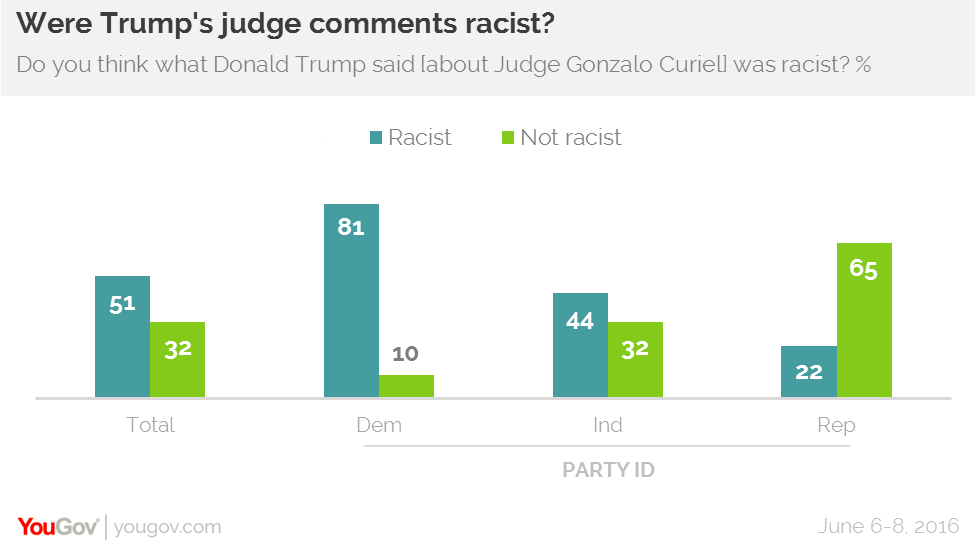
So today’s articles will be the ones I have been working on all week. The first to come out — probably within an hour — will be “What Should ‘Racism’ Mean? Part II.” This week you probably heard more than you wanted about Donald Trump’s diatribes against the “Mexican” judge, and the responses of leading Republican like Paul Ryan or Mitt Romney. But I was struck by a detail that didn’t get that much attention: a poll saying that 2/3rds of Republicans disagree with Ryan and Romney; they say Trump’s comments were not racist.

That took me back to the theme of my “What Should ‘Racism’ Mean?” article from 2014. It’s not unreasonable to want to restrict usage of the word racism to extreme cases like the Nazis or the KKK. But if you do that, how do you describe things like Trump’s comments about Judge Curiel? To me, it seems like the Right has taken a lesson from George Orwell: If you restrict words to narrow meanings and don’t provide new terminology to fill the gaps, you can restrict discussion, and ultimately restrict thought. Those poll results, I believe, stem from that restricted thinking.

The second featured article was inspired by a critical comment on last week’s Sift: that I am ignoring or trivializing the Clinton email issue, particularly the new information that has come out in the last few weeks. So I read the State Department Inspector General’s report and The Wall Street Journal‘s latest leak of information about the alleged top secret information on Clinton’s server. My summary will be in “About Those Emails”, which will be out later this morning.

The weekly summary will briefly link to accounts of the Orlando shooting, before going on to political news in each party, the Stanford rape case, Samantha Bee’s summary of the presidential primaries, and a few other things, before closing with a speaker who has reduced TED talks to their generic essence. That should come out around noon.

Float and Sting

Float like a butterfly, sting like a bee.
The hands can’t hit what the eyes can’t see.

— Muhammad Ali

This week’s featured post is “Preserving the Cult of the Job Creator“.

This week everybody was talking about Muhammad Ali

who died Friday at age 74.

Boxing has declined in the last few decades, to the point that it’s now on the fringes of most sports fans’ attention. I had to look up who the heavyweight champion of the world is now, and didn’t recognize any of the names I saw.

If you grew up in this era of decline, you may not have any notion of what the heavyweight boxing title used to mean. I can’t think of anything to compare it to today. It had a mythic quality; the Champ wasn’t just a star athlete, he was the current avatar of some essential aspect of manliness. In recent years, probably no athlete has stood as high as Michael Jordan did in the 1990s, but even he was just a man playing a game. Half a century ago, the Champion of the World was more than that.

So it mattered who the Champ was, even if you didn’t care about boxing as a sport. That a black man like Joe Louis could be Champ in the 1930s and 40s (not just beating all comers, but representing America against foreigners like Nazi Germany’s Max Schmeling) didn’t just inspire his fellow blacks, but influenced many whites’ thinking about race, and probably played a role in the acceptability of the civil rights movement in the 1950s and 60s.

In pure sporting terms, Muhammad Ali was a figure on the scale of Tiger Woods or LeBron James. He changed his sport with a style that was light and graceful. Previous champions had been powerful punchers. But Ali’s quickness made opponents miss by embarrassing margins, letting him strike back while they were off balance.

And then there was his beyond-sports significance. Joe Louis had epitomized the soft-spoken black man who knew not to overstep. Satchel Paige played the minstrel and clown, hoping to avoid white hatred by keeping things light. Jackie Robinson understood that his play on the field could be his only response to racist abuse. But Ali got in America’s face. “I am the greatest!” he announced bluntly. He set the stage for the black-power turn in the civil rights movement. Why did a successful black have to be humble and take care not to offend? Why couldn’t he be as brash as any white man?

And why did he have to be Christian? Already celebrated as Cassius Clay, he rejected that as a “slave name” when he converted to Islam. By insisting that the public use his Muslim name, Ali blazed a path later followed by Kareem Abdul-Jabbar and many other sports stars.

At the height of his career, Ali refused to be drafted for the Vietnam War, catalyzing a national debate about whether black men should fight yellow men to maintain white men’s power. (“No Viet Cong ever called me nigger,” he said.) After being refused conscientious-objector status, he was convicted of draft evasion (later overturned by the Supreme Court on a technicality) and banned from boxing for more than three years.

Then he returned to take the championship back from Joe Frazier. The three Ali/Frazier bouts were Super-Bowl-level events; for a few days all other sporting news faded to insignificance.

So if Ali’s heyday happened before your time, this is what I would like you to understand: He filled a role in society that does not exist any more. There is literally no one like him.

and (yet again this week) Donald Trump

Whatever else you may think of Trump, he is a genius at drawing media attention. Hillary Clinton got a lot of buzz for her foreign-policy speech Thursday, but only because she was talking about Trump. Afterwards, conservatives criticized Clinton’s speech because it unveiled no new foreign-policy ideas … as if anyone would have covered an actual Clinton-doctrine speech that wasn’t about Trump.

Donald Trump’s ideas aren’t just different – they are dangerously incoherent. They’re not even really ideas – just a series of bizarre rants, personal feuds, and outright lies. He is not just unprepared – he is temperamentally unfit to hold an office that requires knowledge, stability and immense responsibility.


The Trump University fraud suits got major coverage this week. The basic story is the same one I summarized in March. What was new was how Trump doubled down on vilifying the judge in the San Diego suit, claiming that he must be biased against Trump because he is “Mexican” (actually an American born in Indiana to legal Mexican-immigrant parents). He also suggested that a Muslim judge might be also be biased against him.

Try to imagine any comparable situation. Picture, say, President Nixon denouncing Judge Sirica for being Italian, or Ted Cruz blaming the same-sex marriage decision on Justices Kagan, Breyer, and Ginsburg being Jewish.

The Atlantic notes an appellate court’s comment on a case in the 90s where similar objections were made:

“Courts have repeatedly held that matters such as race or ethnicity are improper bases for challenging a judge’s impartiality,” wrote the chief judge, Ralph Winter, a Reagan appointee. “Nor should one charge that a judge is not impartial solely because an attorney is embroiled in a controversy with the administration that appointed the judge. … Finally, appointment by a particular administration and membership in a particular racial or ethnic group are in combination not grounds for questioning a judge’s impartiality. Zero plus zero is zero.”

Vox makes this observation:

For a man who’s quick to claim that “the Hispanics” love him, Trump certainly seems quick to assume that actual Hispanics do not.

Trump’s other defense was to release a video in which Trump U customers praised the seminars they attended. AP discovered that these were not “typical” Trump U customers at all, but were “beholden to Trump” in some other way. For example, one owed Trump a favor for providing a blurb for her son’s self-help book. Another is a businessman who sells products through Trump’s golf courses, restaurants, and resorts.

As for why there are lawsuits in only two states, Vox reports: “State attorneys general who dropped Trump University fraud inquiries subsequently got Trump donations.” A former Texas official told The Dallas Morning News:

The decision not to sue him was political. Had [Trump] not been involved in politics to the extent he was at the time, we would have gotten approval. Had he been just some other scam artist, we would have sued him.


Tuesday, Trump lit into the press for doing its job too well.

Recapping the story from the beginning: Back in August, Fox News hosted a Republican debate. Megyn Kelly’s questions to Trump were tougher than he liked, so he tried to intimidate Fox into removing her five months later when Fox News held the last debate before the Iowa caucuses in January. Fox refused, so Trump boycotted the debate and staged a rival event, which he promoted heavily and billed as a fund-raiser for veterans groups. He claimed to raise $6 million, of which he supposedly donated $1 million himself.

In any other campaign, reporters would routinely ask the campaign office for proof that the money had been distributed, some staffer would assemble the paperwork and put out a press release, and that would be the end of it, probably without you ever hearing about the follow-up. But the Trump campaign didn’t do its part, so The Washington Post started contacting veterans groups to see if they’d gotten the promised money.

The Post’s David Fahrentholt first wrote about it in March, when he could only account for half the money. He came back to the topic on May 21, and got Trump’s campaign manager to admit that they only collected $4.5 million. He wouldn’t say whether Trump’s million was part of that or not.

Then on May 24, the checks suddenly went out.

Summing up: When Trump made a claim that garnered him good publicity, at least one hard-working reporter checked to see if it was actually true. It turned out to be only half-true, and the reporter’s scrutiny shamed Trump into making good on his promises. That’s good journalism. Any veterans group that got a check dated May 24 should send David Fahrenthold a thank-you note.

But Trump went into a tirade against the press corps as a whole, calling an ABC reporter “a sleaze”.


The unprecedented scale of Donald Trump’s disconnection from the truth has swamped ordinary notions of fact-checking. (PolitiFact has identified 29 Trump pants-on-fire lies, compared to 3 from Clinton and none from Sanders.) How the media should adjust has become a topic of discussion. Here, CNN tried out something new: fact-checking him in real time.


A number of American writers, some as famous as Stephen King and Amy Tan, published “An Open Letter to the American People” speaking out against Donald Trump. Unfortunately, it included this line:

Because American history, despite periods of nativism and bigotry, has from the first been a grand experiment in bringing people of different backgrounds together, not pitting them against one another

which Daniel José Older described as

not only empirically false, it’s a continuation of the ongoing legacy of sanitized lies America has shoved down its own throat since its creation

I guess I’d say that from the beginning, the two impulses have struggled for dominance. In every generation, America was bringing people of diverse backgrounds together in new ways, and also pitting people against each other. (“All men are created equal,” the slave-owner wrote earnestly.) Over time, I think the bringing-people-together impulse has been slowly winning out, as movements for abolition, women’s suffrage, civil rights, gender rights, gay rights, (and so on) attest. But I think it’s a mistake to minimize either the authenticity of the idealism that has animated Americans through the centuries or its consistent failure to fully manifest in a fair society.

And yes, electing Trump would be a lurch back towards nativism and bigotry.

and the Democrats

Tomorrow is the last big round of primaries, with only D.C.’s primary next week still left. California is the big one and may be close, but probably it will also be anticlimactic. New Jersey is in the Eastern time zone and Clinton should win it easily. That should give her more than enough delegates have the nomination already clinched before California is called.

Then Wednesday, we get to the moment everyone has been speculating about: What will Bernie do? At this point I think I’ll just wait and see.


Hard to say what’s going on with the general-election polls. Some show a close race between Trump and Clinton, while others don’t.

and the gorilla that got killed

Harambe, a gorilla at the Cincinnati  Zoo, was killed the Saturday before Memorial Day after a 3-year-old boy fell into the gorilla enclosure and seemed to be in danger.

This set off a storm of social media commentary because it wasn’t Harambe’s fault, maybe the boy could have been saved without killing the gorilla (though I wouldn’t want to be the guy who made that decision if the boy then died), and so on.

One major target was the boy’s mother, for not keeping better track of him. She has four children (who I assume were all at the zoo with her, though I haven’t seen anybody verify that explicitly). The fact that the family is black raised the old stereotype of irresponsible black women who have more children than they can manage. And it came out that the children’s father had served a year in jail on a drug charge, as if that had some relevance.

It’s a shame there isn’t more sympathy for a mother who clearly must have believed her child was about to die right in front of her.

My wife and I are that couple you know who likes kids but have none of their own, so we’ve had lots of conversations with parents who were letting their hair down. I think every parent I’ve known can tell a story about a moment when their kid was suddenly gone, and then just as suddenly reappeared someplace he or she couldn’t possibly be. Kids are ingenious little buggers who can spot momentary distractions and take advantage by moving really, really fast.

Here’s my negligent-adult story: I was out in the yard with a friend’s daughter. At one point she was standing securely on my shoulders, perfectly balanced between my raised arms, which she could grab if she got unsteady. But then she jumped off at a moment and in a direction that I completely did not expect. My dive to catch her was too slow, and we stayed in eye contact all the way to the ground, which seemed like a very long time. Landing on her back scared her and knocked the wind out of her, but she was otherwise unharmed.

All the stories I know personally are like that: The shield of adult protection momentarily fails, and something really bad could happen, but it doesn’t. Cars stop inches short, human or animal predators don’t happen to appear during the defenseless instant, the ER people get the stomach pumped out in time, and so on. That’s what happens almost every time adult vigilance fails. Some people get unlucky, but the rest of us (if we’re honest) have to admit this truth: If perfection were the standard, then nobody would deserve to have healthy children.

So the reactions I empathized with were like Amanda Marcotte’s:

The expectation that you spend the next 18 years of your life never being less than perfect for a moment is one reason I don’t want kids.

And Kimberley Harrington’s:

If you want to know why mothers — especially mothers in this country — are so batshit crazy, maybe it has something to do with the fact that we are blamed for every. god damn. thing. BY STRANGERS. Work full time? Why are you letting someone else raise your kid? Stay at home mom? Why aren’t you teaching them to be independent go-getters? Breastfeeding, formula feeding, fucking wilderness schools, grit, financial savvy, watching them all of the time, watching them none of the time, free range, Tiger Mom-ing ALL OF THE THINGS OH MY GOD INTERNET MAKE UP YOUR FUCKING MINDS.

but I need to fix a mistake

Last week I got taken in by some of the bad reporting on a case of an antibiotic-resistant infection. A commenter linked to a more accurate article from Ars Technica.

While, again, this isn’t exactly good news, it’s not catastrophic. There are several last-resort antibiotics, and doctors can try different combinations and strengths of prescriptions before an infection may be deemed untreatable.

The somewhat more detailed summary goes like this:

Thursday’s report of a mcr-1-based colistin-resistant bacterial infection in a US patient is concerning, but unsurprising. The plasmid based resistant gene threatens to spread to other bacteria, potentially to ones that are already resistant to last resort drugs, such as CRE. However, the trajectory of mcr-1‘s emergence and its contribution to drug resistant infection trends is not yet clear. For now, the case serves mostly to highlight the ongoing crisis of rising antibiotic resistance and furthers the need for better stewardship of old antibiotics and development of new ones.

My mistake in falling for — and worse, promoting — the more apocalyptic version of the story (that the bacteria was resistant to all antibiotics) demonstrates a type of error I think everybody needs to watch out for: I’ve been watching the erosion of antibiotic effectiveness for years now and trying to call my readers’ attention to it. So when reputable news outlets seemed to be saying that the disaster I’d been warning about was finally here, I didn’t check the details the way I should have.

and you might also be interested in

In case you missed it, here’s the town hall meeting President Obama had Wednesday in Elkhart, Indiana.

And he answered more questions afterward, like this one about gun control.


I guess it’s not that surprising to hear that there’s a 50th-anniversary Monkees album. But the fact that it’s getting good reviews is a shock.

and let’s close with something hopeful

José Picardo is a high school assistant principal who thinks the kids might be all right. In an article published on Medium, he recalled this photo that went viral on the internet last year, apparently showing teen-agers at the Rijksmuseum in Amsterdam staring into their phones while ignoring Rembrandt’s masterpiece “The Night Watch” on the wall behind them.

Lots of folks took the photo as “a perfect metaphor for our age”, in which young people are so addicted to technology that the beauty of the real world escapes them.

But what were they doing? Texting? Playing Angry Birds? Checking how many Likes their selfies were getting?

Not exactly.

It turns out that the Rijksmuseum has an app that, among other things, contains guided tours and further information about the works on display. As part of their visit to the museum, the children, who minutes earlier had admired the art and listened attentively to explanations by expert adults, had been instructed to complete an assignment by their school teachers, using, among other things, the museum’s excellent smartphone app.

Preserving the Cult of the Job Creator

Members of the donor class must accept Trump’s personality cult to maintain their own.


Amazingly, on Wednesday somebody wrote an entire article about the presidential race that said hardly anything about Donald Trump. Even more remarkably, the article was an endorsement of Trump.

It’s true: Home Depot co-founder (and billionaire Jeb Bush donor) Bernie Marcus managed to endorse Trump without mentioning any particular thing he imagines President Trump will do, other than Make America Great Again and take the country in some unspecified “new direction”. No Mexican wall, no Muslim ban or database, no trade war with China, no deportation force rounding up 11 million people, no renegotiating the public debt, no ordering our military to commit war crimes, no nukes for Saudi Arabia. None of the positions Trump has made famous garner a single line.

OK then, maybe Marcus just dislikes Hillary Clinton. But why? That also is a little hard to get a handle on, because his denunciations of Clinton (or maybe President Obama; they’re interchangeable) are vague to the point of vanishing into rhetoric. Clinton will “push the [Supreme] court leftward for generations”, but no specific legal issue explains why Marcus believes that would be bad. Like Obama, Clinton is “hostile to free enterprise” in some unspecified way. Together, Clinton and Obama “have peddled a dangerous sentiment that government can provide for Americans better than the private sector.”

I’d be really interested to find a quote in which either Clinton or Obama actually expressed that sentiment, much less “peddled” it. (As No Democrat Ever said: “Damn this free enterprise system! Why can’t the government just own everything?”) I’ve listened to a lot of speeches from both of them, and I’ve never heard it. [1]

When otherwise intelligent people justify their actions and beliefs with vague claims that don’t stand up to scrutiny, I start to wonder what’s happening under the surface. Something about Clinton, Obama, and Democrats in general pisses Bernie Marcus off. What could it be?

Our main clue is the third major topic in Marcus’ article, one that he discusses at greater length and with more feeling than either Trump or Clinton: Home Depot, and (by inference) himself. In particular: all the wonderful opportunities that it/he has magnanimously provided for others. For example:

One young man started with us at 17 years of age, bringing carts in from the parking lot. Ultimately, he became a regional president. Imagine Americans vilifying this young man, who became a millionaire and earned every penny of it.

Indeed: imagine. You have to imagine, because in reality no one is vilifying Americans for getting ahead by working hard. If anyone were doing that, Marcus could quote them. But no one is, so he has to imagine.

He imagines a lot of other things too. What if the oppressive regulations of “Obama/Clinton-style government” had existed back in the 1970s when his wondrous Home Depot was getting started? Well, a (briefly) small business like his just couldn’t have happened under those conditions, because under Dodd-Frank, bankers would have required a solid balance sheet rather than basing their loan decisions on his “character and determination”. [2]

And Home Depot couldn’t have gone public under Sarbanes-Oxley because … I’m not sure why. IPOs continue to happen. Facebook went public. UnderArmour. Chipotle. But Home Depot wouldn’t have been able to figure it out for some reason.

And that would have been horrible for America because

the risks we took in the 1970s have resulted in millions of jobs – not just at The Home Depot, but at our suppliers, our vendors, and even our customers’ businesses.

This is where I think we start getting to the root of things, because by this point Marcus has left reality completely behind and vanished into self-glorifying mythology.

You see, Marcus may think of himself as a champion of small business and a job creator, but the reality is the exact opposite. Other than WalMart and maybe Amazon [3], I can’t think of any corporation that has destroyed more small businesses than Home Depot.

Whatever Marcus may imagine, Home Depot didn’t create the home-improvement retail market, it captured that market from other businesses that were already serving it.

Not so long ago, hardware stores and electrical supply shops and paint stores and lumber yards were just about all locally owned by businesspeople you could meet and talk to. If you were a tool-loving kind of guy [4] and could scrape some money together, you could start such a business and be your own boss. Now that’s a much dicier proposition — not because of Dodd-Frank or Sarbanes-Oxley or even ObamaCare, but mainly because of Home Depot (and its rival Lowes).

I haven’t done enough research to back this up with numbers, but looking at the merchandise and staff of my local Home Depot, I strongly suspect that (all together) those locally-owned stores of the 1970s employed more people, and probably stocked more American-made products. [5] Looking at the full picture, I’d guess that Home Depot isn’t a job creator at all, especially if we’re talking about American jobs. It’s more of a job destroyer.

So while you can argue that Home Depot captured its markets fair and square (because it provides a larger selection of products at a better price, or for some other reason), you can’t give it credit for millions of jobs, or any jobs at all.

Understanding the job-creator mythology and how divorced it is from reality puts us in a position to explain why Marcus (and so much of the donor class that supported Romney and Bush) has to come around to Trump eventually, even if all his policies and positions are too embarrassing to mention: Republicans have incorporated job-creator mythology into their larger myth of America, while Democrats have not. The reason Marcus and his compatriots think Democrats like Clinton or Obama (or me) are so hostile to “free enterprise” is that we don’t worship them the way they think they deserve to be worshiped.

Democrats readily acknowledge that billionaires like Marcus and corporations like Home Depot are currently King of the Hill. But they want to believe that they created the hill.

Republicans are happy to tell them that they did. Democrats, on the other hand, tell the story this way: Business in the United States has always been a game played under certain rules. Under the rules of the 1970s and the decades that followed, Home Depot succeeded and Marcus became a multi-billionaire. We don’t begrudge his success, or the success of his 17-year-old cart-pushing millionaire employee either (assuming that guy really exists). Marcus won the game and captured the prize, so congratulations to him.

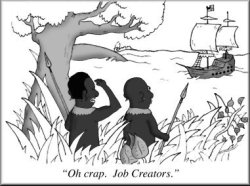
[see more Loren Fishman cartoons at https://humoresquecartoons.com/ ]

But we’d like to shift the rules so that in the future the workplace becomes safer and less discriminatory, so that workers don’t have to go bankrupt if they or their children need serious medical care, and so that those cart-pushers who don’t rise to be regional presidents still make a wage that lets them feed their families without food stamps. With those amendments, we want the game to continue, and businesspeople to keep on winning or losing according to how well they play.

Maybe Marcus and his fellow Kings of the Hill would win the game under those rules too, or maybe not. But that doesn’t matter. Either way, it’s not the end of free enterprise. Conversely, restoring the rules of the 1970s or 1950s or 1850s won’t make America great again, whatever great and again mean in that context.

Understandably, though, Bernie Marcus and his friends are not going to come around to the Democratic point of view, no matter how reality-based it is. They see themselves as Gods of the Hill, and view our attempts to landscape the hill as sacrilege. I can only hope that their self-deifying religion is still a minority faith.


[1] Preserving a role for the private sector is kind of the point of ObamaCare: How do you get healthcare to millions more Americans without the government taking over everything, by working through the existing insurance companies, drug companies, hospitals, and clinics? That’s what the conservative Heritage Foundation designed their proto-ObamaCare system to do, way back in 1989.

[2] They also couldn’t have considered his race. I wonder how many black businessmen were getting loans based on their “character and determination” back in the 1970s. I also wonder how much money the banking industry has lost over the years due to lenders making loans unjustified by financial principles. That was a major cause of the S&L crisis of the 1980s. To the extent that current law limits the discretion of federally-insured bankers, it happens for good reasons.

[3] One of my friends recently closed a local bookstore that had existed in the same location since the 1920s. I never heard him complain about government regulation, but Amazon seemed to be a much bigger problem. I suspect a lot of small businesspeople would tell a similar story.

[4] Yeah, you probably did have to be a guy. It was the 70s.

[5] You can argue that retailers sell Chinese products because that’s what’s available, but the big-box stores — especially Walmart — have been instrumental in pushing their suppliers to manufacture overseas.

The Monday Morning Teaser

This week the Republican establishment continued consolidating behind Donald Trump: Paul Ryan and John McCain are the latest converts. But the endorsement that caught my eye came from Bernie Marcus, the billionaire Home Depot co-founder and former Jeb Bush donor. In this year when Trump sometimes seems to be the only thing to write about, Marcus managed to endorse Trump while saying almost nothing about him. He spent a little more time denouncing Hillary Clinton, but only in vague and rhetorical terms. (She is “hostile to free enterprise”, an idea that I think would shock her Bernie-supporting critics.)

But a lot more of Marcus’ time and feeling went into talking about Home Depot, and (by extension) himself. To me it sounded like a god complaining that we Democrats don’t worship him well enough, and threatening to unleash his wrath in the form of President Trump. That led me to a general explanation of why the Republican donor class must ultimately come around to supporting the party’s nominee, no matter what: Democrats must be punished because we are heretics. I’ll flesh that idea out in “Preserving the Cult of the Job Creator”, which should appear around 9 EDT.

The weekly summary is made up of several notes that could be separate articles: Muhammad Ali’s death has me reflecting on what it used to mean to be heavyweight champion of the world. In that amazing way he has of drawing attention, Donald Trump was in the middle of two stories I couldn’t ignore: his racist denunciation of the judge in the Trump U fraud lawsuit, and his diatribe against the press corps for daring to check his claims about donations to veterans groups. I also had to comment on the zoo gorilla who was killed in Cincinnati after a 3-year-old fell into his enclosure, and in particular on the storm of criticism unleashed on the kid’s mother. And I’ll close with the discovery that a viral photo might not mean what we all assumed it did.

Not Thrones and Crowns

When wilt thou save the people?
Oh God of mercy when?
The people, Lord, the people
Not thrones and crowns, but men.

— “Save the People” from Godspell

This week’s featured post is “The Election is About the Country, Not the Candidates“. I also wrote a column about Humanism for UU World.

This week everybody was talking about the presidential race

The Inspector General for the State Department put out a report on the Clinton email affair. I had a hard time finding an article that I thought put the proper importance on this story, neither overblowing it nor completely writing it off. I found myself more-or-less on the same page as The New Yorker‘s Ryan Lizza:

So this scandal is like so many that have dogged the Clintons: while it’s more molehill than mountain, it does genuinely revolve around a serious issue (Clinton’s commitment to transparency); her initial response was less than forthcoming; and the critics exaggerating the degree of wrongdoing have demonstrated more interest in damaging her politically than fixing the underlying government-wide problem that the e-mail imbroglio has revealed.


Two polls of the California Democratic Party came out last Monday: PPIC had Clinton up by 2%, 46%-44%. SurveyUSA had Clinton up by 18%, 57%-39%. The close-race poll makes a better headline than the it’s-not-close poll, so that’s the one that got all the attention.

Of course both polls were before the inspector general’s report on Clinton’s emails, which can’t have done her any good.


In North Dakota Thursday, Trump laid out his energy policy, which is all fossil fuels all the time, including coal.

He did not explicitly address the scientific legitimacy of human-caused climate change, but said, “We’re going to deal with real environmental challenges, not the phony ones we’ve been hearing about. … Regulations that shut down hundreds of coal-fired power plants and block the construction of new ones — how stupid is that?”

He also pledged to restart the Keystone XL pipeline project, cancel the Paris climate agreement, and stop the Obama/Clinton policy of foreign aid to help poorer countries adapt to climate change. (Just to give one example, by 2050 rising seas are expected to drive about 18 million Bangladeshis from their homes. Where will they go?)

It’s hard for me to get excited about the climate-policy differences between Clinton and Sanders when Trump is sounding like a Bond villain.


The biggest non-story of the week was the Trump/Sanders debate, which took over the news cycle for two whole days, even though it should have been completely obvious that Trump would never do it.

It got covered as Trump-and-Sanders-will-gang-up-on-Hillary, but that’s not where Bernie was headed, and probably wouldn’t have done him any good anyway. Sanders’ closing argument is that he’s the better candidate to run against Trump, so that’s what he would have been trying to prove. Agreeing with Trump about “crooked Hillary” would have turned off more Democratic voters than it attracted.

Trump, conversely, had nothing to gain. Sanders would be trying out liberal anti-Trump arguments, letting Clinton see how Trump handles them. And even if Trump managed a smashing victory, he would just have been scoring points against somebody he wouldn’t run against anyway.

Of course, Trump would accept the initial challenge, because that’s the image he wants to project. But just as obviously, he’d make up conditions that couldn’t be met so that he could back out. And that’s what happened.

Even Rachel Maddow, who ought to be smarter than this, devoted half of a 20-minute segment to this topic Thursday, and got all whipped up about it.


Violence between pro-Trump and anti-Trump people broke out outside Trump’s San Diego rally Friday night. There had previously been protests outside Trump’s Fresno rally.

If anti-Trump protests are going to be a thing — and it looks like they are — it seems likely that there will be more fights and arrests and so forth. No matter who is actually at fault, I suspect the anti-Trump people will get blamed.

That’s why I’m hoping that Clinton will distance herself from the anti-Trump protests, and denounce any violence in strong terms. Something like: “If you want to protest peacefully against Donald Trump, that’s your right as an American. But don’t do it on my account. If you want to work for my campaign, we have lots of more useful jobs for you to do.”


Jonathan Weisman describes how he became a social-media target of Trump-supporting anti-Semites. Meanwhile, BuzzFeed‘s Rosie Gray reports on the excitement Trump has raised at the white-nationalist American Renaissance conference. That’s not to claim that Trump is actively anti-Semitic or a white nationalist himself. But at some point you do have a responsibility to notice and comment on the things that are being done in your name.


Something Trump himself did do is use 12 minutes of a public rally to bash by name the judge who presides over the San Diego version of the Trump University fraud suit. (There’s a separate New York suit. Neither will go to trial before the election.) Trump described the judge as a “Mexican” and a “hater”.

I’m telling you, this court system, judges in this court system, federal court, they ought to look into Judge Curiel. Because what Judge Curiel is doing is a total disgrace, OK?

On and on like that for 12 minutes.

James Fallows makes the historical comparison:

When the results of an established process turn against them, presidents and presidential aspirants must defend the process. That’s the difference between rule-of-law and rule-of-men. Richard Nixon disagreed with the Supreme Court’s rulings against him but did not question their legitimacy or say he would try to get back at the Justices. Al Gore had far better logical and jurisprudential grounds for questioning the ruling in Bush v. Gore, but while he made clear that he bitterly disagreed, he of course complied. He did not mention the ethnicity of the Justices or say that they should be “looked into.”

I’ll take that a step farther: When you’re talking to a room filled with your rabid fans, and your speech is likely to get covered on national TV, how hard is it to imagine one lunatic deciding to impress you by doing something about that hater judge?


VoxLiz Plank takes on Trump’s talk about Hillary’s “woman card”, when he went on to say: “We’re petrified to speak to women any more.” She lists a number of things that women might be afraid of, like, say, rape, or having their concerns ignored by a Congress that is 80% male.

But yeah, men’s fear of being labeled as sexist when they clearly say things that are definitely sexist … definitely trumps the very well documented systemic sexism that women face every day.

and you might also be interested in

Obama went to Hiroshima and said this:

Those who died, they are like us. Ordinary people understand this, I think. They do not want more war. They would rather that the wonders of science be focused on improving life and not eliminating it. When the choices made by nations, when the choices made by leaders, reflect this simple wisdom, then the lesson of Hiroshima is done.

The world was forever changed here, but today the children of this city will go through their day in peace. What a precious thing that is. It is worth protecting, and then extending to every child. That is a future we can choose, a future in which Hiroshima and Nagasaki are known not as the dawn of atomic warfare but as the start of our own moral awakening.

It’s been great, these last seven years, to have a president I can take pride in.


One of those simple stats that speaks volumes: Home ownership is at its lowest rate since 1967. The millennial generation’s path through life is going to be different than previous generations.


Thursday, health officials announced the first incidence in the U.S. of a bacterial infection that is immune to all known antibiotics. This has been coming for a long time, but now it’s here.


Venezuela is spiraling downward.


An important lesson in structural racism: A Pro Publica investigation shows that a widely used algorithm to predict whether criminals will commit more crimes — producing “risk scores” that judges and parole boards use to decide on sentences — is biased against blacks. It over-estimates the risk that blacks will commit future crimes, and under-estimates the risk that whites will.

There’s no evidence that anybody did this intentionally, but factors that seem to make sense on an individual basis have the effect of reproducing the culture of mass incarceration.

Race is not one of the questions. The survey asks defendants such things as: “Was one of your parents ever sent to jail or prison?” “How many of your friends/acquaintances are taking drugs illegally?” and “How often did you get in fights while at school?” The questionnaire also asks people to agree or disagree with statements such as “A hungry person has a right to steal” and “If people make me angry or lose my temper, I can be dangerous.”

Since blacks are imprisoned at much higher rates than whites, their children will have worse risk scores. If you attend a bad public school, with lots of violence and drugs, it will count against you. And so on.


Due to some really bad reporting, a lot of people now believe that scientists have shown at long last that cellphones cause cancer. VoxBrad Palmer does the kind of careful science reporting that is too boring for most media outlets.

So here’s what happened, more or less: Researchers bombarded some rats with more cellphone radiation than any human is likely to be exposed to, and they did get more tumors of two particular types in those rats than in the control group. On the other hand, we’ve been conducting an unofficial experiment by having lots of humans use cellphones, and we’re not seeing the kinds of increases in cancer that we would if there were a large effect. (And BTW: the irradiated mice on average lived longer than the control group.)

In short, it’s the kind of study that should make people go “Hmmm”, not “OMG, we’re all going to die!”

Look: Science moves slowly. Individual studies are often wrong, and it’s rare for one paper to completely upend everything we know about a topic. There are very few genuinely “game-changing” studies. And reporters need to do a better job of putting this incrementalism in context — rather than preying on people’s fears for clicks.

and let’s close with something cute

At the end of a long day, Momma Raccoon makes sure all the kids get home safe.

The Election Is About the Country, Not the Candidates

Citizens shouldn’t let the media make us forget about ourselves.


Judging by the amount of media attention they got, these were the most important political stories of the week: Donald Trump and Bernie Sanders agreed to debate, but then Trump backed out, leading Sanders supporters to launch the #ChickenTrump hashtag. A report on Hillary Clinton’s emails came out. A poll indicated that the California primary is closer than previously thought. Trump’s delegate total went over 50%. Elizabeth Warren criticized Trump, so he began calling her “Pocahontas”. Sanders demanded that Barney Frank be removed as the chair of the DNC’s platform committee. Trump told a California audience that the state isn’t in a drought and has “plenty of water“. Trump accused Bill Clinton of being a rapist, and brought up the 1990s conspiracy theory that Vince Foster was murdered. President Obama said that the prospect of a Trump presidency had foreign leaders “rattled“, and Trump replied that “When you rattle someone, that’s good.” Clinton charged that Trump had been rooting for the 2008 housing collapse. Pundits told us that the tone of the campaign was only going to get worse from here; Trump and Clinton have record disapproval ratings for presidential nominees, and so the debate will have to focus on making the other one even more unpopular.

If you are an American who follows political news, you probably heard or read most of these stories, and you may have gotten emotionally involved — excited or worried or angry — about one or more of them. But if at any time you took a step back from the urgent tone of the coverage, you might have wondered what any of it had to do with you, or with the country you live in. The United States has serious issues to think about and serious decisions to make about what kind of country it is or wants to be. This presidential election, and the congressional elections that are also happening this fall, will play an important role in those decisions.

That’s why I think it’s important, both in our own minds and in our interactions with each other, to keep pulling the discussion back to us and our country. The flaws and foibles and gaffes and strategies of the candidates are shiny objects that can be hard to ignore, and Trump in particular is unusually gifted at drawing attention. But the government of the United States is supposed to be “of the People, by the People, and for the People”. It’s supposed to be about us, not about them.

As I’ve often discussed before, the important issues of our country and how it will be governed, of the decisions we have to make and the implications those decisions will have, are not news in the sense that our journalistic culture understands it. Our sense of those concerns evolves slowly, and almost never changes significantly from one day to the next. It seldom crystallizes into events that are breaking and require minute-to-minute updates. At best, a breaking news event like the Ferguson demonstrations or the Baltimore riot will occasionally give journalists a hook on which to hang a discussion of an important issue that isn’t news, like our centuries-long racial divide. (Picture trying to cover it without the hook: “This just in: America’s racial problem has changed since 1865 and 1965, but it’s still there.”)

So let’s back away from the addictive soap opera of the candidates and try to refocus on the questions this election really ought to be about.

Who can be a real American?

In the middle of the 20th century (about the time I was born), if you had asked people anywhere in the world to describe “an American”, you’d have gotten a pretty clear picture: Americans were white and spoke English. They were Christians (with a few Jews mixed in, but they were assimilating and you probably couldn’t tell), and mostly Protestants. They lived in households where two parents — a man and a woman, obviously — were trying (or hoping) to raise at least two children. They either owned a house (that they probably still owed money on) or were saving to buy one. They owned at least one car, and hoped to buy a bigger and better one soon.

If you needed someone to lead or speak for a group of Americans, you picked a man. American women might get an education and work temporarily as teachers or nurses or secretaries, but only until they could find a husband and start raising children.

Of course, everyone knew that other kinds of people lived in America: blacks, obviously; Hispanics and various recent immigrants whose English might be spotty; Native Americans, who were still Indians then; Jews who weren’t assimilating and might make a nuisance about working on Saturday, or even wear a yarmulke in public; single people who weren’t looking to marry or raise children (but might be sexually active anyway); women with real careers; gays and lesbians (but not transgender people or even bisexuals, whose existence wasn’t recognized yet); atheists, Muslims, and followers of non-Biblical religions; the homeless and others who lived in long-term poverty; folks whose physical or mental abilities were outside the “normal” range; and so on.

But they were Americans-with-an-asterisk. Such people weren’t really “us”, but we were magnanimous enough to tolerate them living in our country — for which we expected them to be grateful.

Providing services for the “real” Americans was comparatively easy: You could do everything in English. You didn’t have to concern yourself with handicapped access or learning disabilities. You promoted people who fit your image of a leader, and didn’t worry about whether that was fair. You told whatever jokes real Americans found funny, because anybody those jokes might offend needed to get a sense of humor. The schools taught white male history and celebrated Christian holidays. Every child had two married parents, and you could assume that the mother was at home during the day. Everybody had a definite gender and was straight, so if you kept the boys and girls apart you had dealt with the sex issue.

If those arrangements didn’t work for somebody, that was their problem. If they wanted the system to work better for them, they should learn to be more normal.
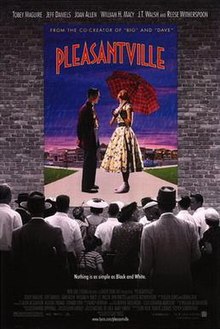
It’s easy to imagine that this mid-20th-century Pleasantville America is ancient history now, but it existed in living memory and still figures as ideal in many people’s minds. Explicitly advocating a return to those days is rare. But that desire isn’t gone, it’s just underground.

For years, that underground nostalgia has figured in a wide variety of political issues. But it has been the particular genius of Donald Trump to pull them together and bring them as close to the surface as possible without making an explicit appeal to turn back the clock and re-impose the norms of that era. “Make America great again!” doesn’t exactly promise a return to Pleasantville, but for many people that’s what it evokes.

What, after all, does the complaint about political correctness amount to once you get past “Why can’t I get away with behaving like my grandfather did?”

We can picture rounding up and deporting undocumented Mexicans by the millions, because they’re Mexicans. They were never going to be real Americans anyway. Ditto for Muslims. It would have been absurd to stop letting Italians into the country because of Mafia violence, or to shut off Irish immigration because of IRA terrorism. But Muslims were never going to be real Americans anyway, so why not keep them out? (BTW: As I explained a few weeks ago, the excuse that the Muslim ban is “temporary” is bogus. If nobody can tell you when or how something is going to end, it’s not temporary.)

All the recent complaints about “religious liberty” fall apart once you dispense with the notion that Christian sensibilities deserve more respect than non-Christian ones, or that same-sex couples deserve less respect than opposite-sex couples.

On the other side, Black Lives Matter is asking us to address that underground, often subconscious, feeling that black lives really aren’t on the same level as white lives. If a young black man is dead, it just doesn’t have the same claim on the public imagination — or on the diligence of the justice system — that a white death would. How many black or Latina girls vanish during a news cycle that obsesses over some missing white girl? (For that matter, how many white presidents have seen a large chunk of the country doubt their birth certificates, or have been interrupted during State of the Union addresses by congressmen shouting “You lie!”?)

But bringing myself back to the theme: The issue here isn’t Trump, it’s us. Do we want to think of some Americans as more “real” than others, or do we want to continue the decades-long process of bringing more Americans into the mainstream?

That question won’t be stated explicitly on your ballot this November, like a referendum issue. But it’s one of the most important things we’ll be deciding.

What role should American power play in the world?

I had a pretty clear opinion on that last question, but I find this one much harder to call.

The traditional answer, which goes back to the Truman administration and has existed as a bipartisan consensus in the foreign-policy establishment ever since, is that American power is the bedrock on which to build a system of alliances that maintains order in the world. The archetype here is NATO, which has kept the peace in Europe for 70 years.

That policy involves continuing to spend a lot on our military, and risks getting us involved in wars from time to time. (Within that establishment consensus, though, there is still variation in how willing we should be to go to war. The Iraq War, for example, was a choice of the Bush administration, not a necessary result of the bipartisan consensus.) The post-Truman consensus views America as “the indispensable nation”; without us, the world community lacks both the means and the will to stand up to rogue actors on the world stage.

A big part of our role is in nuclear non-proliferation. We intimidate countries like Iran out of building a bomb, and we extend our nuclear umbrella over Japan so that it doesn’t need one. The fact that no nuclear weapon has been fired in anger since 1945 is a major success of the establishment consensus.

Of our current candidates, Hillary Clinton (who as Secretary of State negotiated the international sanctions that forced Iran into the recent nuclear deal) is the one most in line with the foreign policy status quo. Bernie Sanders is more identified with strengthened international institutions which — if they could be constructed and work — would make American leadership more dispensable. To the extent that he has a clear position at all, Donald Trump is more inclined to pull back and let other countries fend for themselves. He has, for example, said that NATO is “obsolete” and suggested that we might be better off if Japan had its own nuclear weapons and could defend itself against North Korea’s nukes. On the other hand, he has also recently suggested that we bomb Libya, so it’s hard to get a clear handle on whether he’s more or less hawkish than Clinton.

Should we be doing anything about climate change?

Among scientists, there really are two sides to the climate-change debate: One side believes that the greenhouse gases we are pumping into the atmosphere threaten to change the Earth’s climate in ways that will cause serious distress to millions or even billions of people, and the other side is funded by the fossil fuel industry.

It’s really that simple. There are honest scientific disagreements about the pace of climate change and its exact mechanisms, but the basic picture is clear to any scientist who comes to the question without a vested interest: Burning fossil fuels is raising the concentration of greenhouse gases in the atmosphere. An increase in greenhouse gases causes the Earth to radiate less heat into space. So you would expect to see a long-term warming trend since the Industrial Revolution got rolling, and in fact that’s what the data shows — despite the continued existence of snowballs, which has been demonstrated by a senator funded by the fossil fuel industry.

Unfortunately, burning fossil fuels is both convenient and fun, at least in the short term. And if you don’t put any price on the long-term damage you’re doing, it’s also economical. In reality, doing nothing about climate change is like going without health insurance or refusing to do any maintenance on your house or car. Those decisions can improve your short-term budget picture, which now might have room for that Hawaiian vacation your original calculation said you couldn’t afford. Your mom might insist that you should account for your risk of getting sick or needing some major repair, but she’s always been a spoilsport.

That’s the debate that’s going on now. If you figure in the real economic costs of letting the Earth get hotter and hotter — dealing with tens of millions of refugees from regions that will soon be underwater, building a seawall around Florida, moving our breadbasket from Iowa to wherever the temperate zone is going to be in 50 years, rebuilding after the stronger and more frequent hurricanes that are coming, and so on, then burning fossil fuels is really, really expensive. But if you decide to let future generations worry about those costs and just get on with enjoying life now, then coal and oil are still cheap compared to most renewable energy sources.

So what should we do?

Unfortunately, nobody has come up with a good way to re-insert the costs of climate change into the market without involving government, or to do any effective mitigation without international agreements among governments, of which the recent Paris Agreement is just a baby step in the right direction. And to one of our political parties, government is a four-letter word and world government is an apocalyptic horror. So the split inside the Republican Party is between those who pretend climate change isn’t happening, and those who think nothing can or should be done about it. (Trump is on the pretend-it-isn’t-happening side.)

President Obama has been taking some action to limit greenhouse gas emissions, but without cooperation from Congress his powers are pretty limited. (It’s worth noting how close we came to passing a cap-and-trade bill to put a price on carbon before the Republicans took over Congress in 2010. What little Obama’s managed to do since may still get undone by the Supreme Court, particularly if its conservative majority is restored.)

Both Clinton and Sanders take climate change seriously. As is true across the board, Sanders’ proposals are simpler and more sweeping (like “ban fracking”) while Clinton’s are wonkier and more complicated. (In a debate, she listed the problems with fracking — methane leaks, groundwater pollution, earthquakes — and proposed controlling them through regulation. She concluded: “By the time we get through all of my conditions, I do not think there will be many places in America where fracking will continue to take place.”) But like Obama, neither of them will accomplish much if we can’t flip Congress.

Trump, meanwhile, is doing his best impersonation of an environmentalist’s worst nightmare. He thinks climate change is a hoax, wants to reverse President Obama’s executive orders to limit carbon pollution, has pledged to undo the Paris Agreement, and to get back to burning more coal.

How should we defend ourselves from terrorism?

There are two points of view on ISIS and Al Qaeda-style terrorism, and they roughly correspond to the split between the two parties.

From President Obama’s point of view, the most important thing about battle with terrorism is to keep it contained. Right now, a relatively small percentage of the world’s Muslims support ISIS or Al Qaeda, while the vast majority are hoping to find a place for themselves inside the world order as it exists. (That includes 3.3 million American Muslims. If any more than a handful of them supported terrorism, we’d be in serious trouble.) We want to keep tightening the noose on ISIS in Iraq and Syria, and keep closing in on terrorist groups elsewhere in the world, while remaining on good terms with the rest of the Muslim community.

From this point of view — which I’ve described in more detail here and illustrated with an analogy here — the worst thing that could happen would be for these terrorist incidents to touch off a world war between Islam and Christendom.

The opposite view, represented not just by Trump but by several of the Republican rivals he defeated, is that we are already in such a war, so we should go all out and win it: Carpet bomb any territory ISIS holds, without regard to civilian casualties. Discriminate openly against Muslims at home and ban any new Muslims from coming here.

Like Obama, I believe that the main result of these policies would be to convince Muslims that there is no place for them in a world order dominated by the United States. Rather than a few dozen pro-ISIS American terrorists, we might have tens of thousands. If we plan to go that way, we might as well start rounding up 3.3 million Americans right now.

Clinton and Sanders are both roughly on the same page with Obama. Despite being Jewish and having lived on a kibbutz, Sanders is less identified with the current Israeli government than either Obama or Clinton, to the extent that makes a difference.

Can we give all Americans a decent shot at success? How?

Pre-Trump, Republicans almost without exception argued that all we need to do to produce explosive growth and create near-limitless economic opportunity for everybody is to get government out of the way: Lower taxes, cut regulations, cut government programs, negotiate free trade with other countries, and let the free market work its magic. (Jeb Bush, for example, argued that his small-government policies as governor of Florida — and not the housing bubble that popped shortly after he left office — had led to 4% annual economic growth, so similar policies would do the same thing for the whole country.)

Trump has called this prescription into question.

If you think about it, the economy is rigged, the banking system is rigged, there’s a lot of things that are rigged in this world of ours, and that’s why a lot of you haven’t had an effective wage increase in 20 years.

However, he has not yet replaced it with any coherent economic view or set of policies. His tax plan, for example, is the same sort of let-the-rich-keep-their-money proposal any other Republican might make. He promises to renegotiate our international trade agreements in ways that will bring back all the manufacturing jobs that left the country over the last few decades, but nobody’s been able to explain exactly how that would work.

At least, though, Trump is recognizing the long-term stagnation of America’s middle class. Other Republicans liked to pretend that was all Obama’s fault, as if the 2008 collapse hadn’t happened under Bush, and — more importantly — as if the overall wage stagnation didn’t date back to Reagan.

One branch of liberal economics, the one that is best exemplified by Bernie Sanders, argues that the problem is the over-concentration of wealth at the very top. This can devolve into a the-rich-have-your-money argument, but the essence of it is more subtle than that: Over-concentration of wealth has created a global demand problem. When middle-class and poor people have more money, they spend it on things whose production can be increased, like cars or iPhones or Big Macs. That increased production creates jobs and puts more money in the pockets of poor and middle-class people, resulting in a virtuous demand/production/demand cycle that is more-or-less the definition of economic growth.

By contrast, when very rich people have more money, they are more likely to spend it on unique items, like van Gogh paintings or Mediterranean islands. The production of such things can’t be increased, so what we see instead are asset bubbles, where production flattens and the prices of rare goods get bid higher and higher.

For the last few decades, we’ve been living in an asset-bubble world rather than an economic-growth world. The liberal solution is to tax that excess money away from the rich, and spend it on things that benefit poor and middle-class people, like health care and infrastructure.

However, there is a long-term problem that neither liberal nor conservative economics has a clear answer for: As artificial intelligence creeps into our technology, we get closer to a different kind of technological unemployment than we have seen before, in which people of limited skills may have nothing they can offer the economy. (In A Farewell to Alms Gregory Clark makes a scary analogy: In 1901, the British economy provided employment for 3 million horses, but almost all those jobs have gone away. Why couldn’t that happen to people?)

As we approach that AI-driven world, the connection between production and consumption — which has driven the world economy for as long as there has been a world economy — will have to be rethought. I don’t see anybody in either party doing that.


So what major themes have I left out? Put them in the comments.

The Monday Morning Teaser

I spent a chunk of the weekend meditating on why I’m finding the political news shows — even the ones I usually like — so excruciatingly painful these days. That took me back to the reasons I started blogging to begin with: the media’s distorted definition of news, which so often makes it lose perspective — and encourages us to lose our perspective as well.

By definition, news has to be new: It’s all about what just happened that is different from what was happening yesterday, or five minutes ago. Political campaigns seldom change at that pace, so the news about them is almost always ephemeral: Somebody insulted somebody, who insulted them back. A poll came out. That poll indicates that some candidate’s strategy will have to change in ways that we can now speculate about. (Tomorrow, a new poll will show that yesterday’s poll was a statistical anomaly. Never mind, then.)

If you get in the habit of focusing on such stuff, all the important questions vanish: What serious challenges is the country facing, or likely to face in the near future? In what ways does our government’s approach to those challenges need to change or stay the same? How does that match up with what the various candidates want to do, or seem capable of doing?

This week, you could easily have watched entire hour-long political shows without learning anything about those questions. You might come away from such a show all wrought up about whether or not it’s appropriate for Bernie Sanders to debate Donald Trump, when it should have been obvious from the beginning that the Sanders/Trump debate was never going to happen. And if it did, so what?

It’s been that way for some while. The political news is the soap opera of candidates, not the education that citizens need to make their decisions, or even (if you know who you support already) to learn how to educate other citizens. It’s not about the country, it’s about the candidates.

So I decided to refocus. The weekly summary will, as usual, contain a lot of candidates news, because that’s what everybody is talking about. But the featured post is “The Election Is About the Country, Not the Candidates”. In it, I try to get back to the challenges the country faces, and then look at the candidates through that lens.

That post still needs work, so you should expect it around 10 EDT. The summary should be out around noon.

One Purpose

Whether you voted for me or you voted for Barack, the time is now to unite as a single party with a single purpose. We are on the same team, and none of us can afford to sit on the sidelines. … Barack Obama is my candidate, and he must be our president.

Hillary Clinton, 2008 Democratic Convention (8-26-2008)

This week’s featured post is “Fears of Democratic Disunity: talking myself down“.

This week everybody was talking about a plane crash

The usual news sites can be confusing places to keep track of an unfolding story like the loss of EgyptAir Flight 804. They focus too much on what information is new today, and it’s often hard to tell whether they’re reporting or speculating. I recommend checking the Wikipedia page from time to time. That way you get the whole story as it is currently understood.

and whether the Democrats can unify

In the featured post, I let my fears run wild and then talk myself down.

while the Republicans unite around Trump

Interesting article in The Atlantic about Trump’s message to coal country versus Clinton’s.

[Trump’s] plan is very easy to envision: You’ll have your job back, and your old lives. This is the power of Trump’s blame-based worldview. When curing a community’s malaise is as simple as getting rid of the bad actor who caused it—in this case, Obama’s environmental regulations—the rewards feel more certain, more tangible.

“When you say, ‘I’m going to give your job back,’ that’s a very immediate solution to the problem,” said Erin Cassese, an associate professor of political science at West Virginia University. “If you want to find fault with Clinton’s plan or Sanders’s plan, it’s that they’re really vague. People don’t have a clear vision of what their lives are going to be like in four years. It’s more abstract, and that’s why it has less resonance with voters.”

The problem is that Trump’s plan has almost no chance of success. A U.S. president has no power to stoke global demand for coal, or pump up the price of natural gas; the most Trump could do is repeal Obama’s environmental rules, and economists agree that would have a minimal effect on employment.

In the fall campaign, that’s going to be the argument across the board. Clinton will offer a detailed program to make things better than they are now; Trump will pledge to make things right again, but offer either no plan or one based in fantasy. It’s going to be a serious test of the wisdom of the electorate.


Trump put out a list of the 11 white people he would consider nominating to replace Antonin Scalia on the Supreme Court. In general, conservatives consider this a good list and liberals don’t, but getting into that argument misses the obvious: Once in office, Trump will do what he wants, independent of anything he’s said in past or is saying now.

Look at what we’ve already seen: He publishes a tax plan, and then distances himself from it. One of his top surrogates now says his Mexican Wall would be “virtual” and his deportation promise “rhetorical”. As Kyle Kondik of Sabato’s Crystal Ball put it:

Tackling Trump on the issues will be tricky because he just changes his positions all the time.

So in January, if Trump pulls a Caligula and nominates his horse to the Court, I can imagine what he’ll say if anybody mentions this list. “That was a good list, a great list, and those 11 judges are really top people, totally first rate. But America’s Greatness — have you seen him? — what a horse he is!”

but a lot of important things have been happening the in the world while we’ve been focused on presidential politics (and bathrooms)

I haven’t given this stuff nearly the attention it deserves. Fortunately, Vox been on the case.

Brexit. The European Union is at a tricky point. Its member countries are unified enough that the EU limits the actions of the national governments, but not so unified as to provide the kind of benefits that, say, the states of the US see from our federal government. (For example, if our states had the kind of loose relationship EU countries do, Florida might have had to go bankrupt in the 2008 real estate crash, or New Jersey after Hurricane Sandy.)

Previously, this has come to a head with regard to the Greek economic crisis, and the “Greek exit” option got smushed down to “Grexit”. (Greece decided to stay in the EU for now.) Now Britain, a much larger, richer economy, is facing a referendum to leave the EU.

Britain has always had an ambivalent relationship with the European mainland, which is symbolized by the fact that it has retained the pound, rather than merge into the EuroZone. That limits some of the hassle of being in the EU, and would limit some of the impact of a Brexit. (For example, Britain’s national debt is in its own currency, which it could print if it needed a quick way out of a debt crisis. Greece, on the other hand, owes Euros, which it doesn’t control.)

Vox has a good explanatory article. An exit vote on the UK referendum on June 23 would trigger the negotiation of an exit agreement with the EU, which would then have to be approved. So the referendum is a move towards exit, but not a direct exit.

The biggest worry, though, isn’t Brexit itself, but the larger nationalistic process it might be part of.

Brexit is the British manifestation of a broader popular revolt against European integration that is gradually spreading across Europe. If the British people choose to abandon the EU at this vulnerable moment, it might well be the catalyst that causes the cancer of populism and disintegration — which is helping to drive this campaign in the UK — to metastasize across Europe at a dramatically faster rate.

The Brazilian impeachment. Brazil’s President Dilma Rousseff has been impeached by the Senate, which under the Brazilian system means that she immediately steps down until cleared.

This is a weird story about Brazil’s weird version of democracy, in which a clear majority of Congress is under investigation for corruption.

Ever since colonial times, Brazil has been dominated by wealthy elites who thought they could get away with anything — mostly because they usually did.

Rousseff probably will be removed permanently, and it’s hard to feel too bad about that, because she is corrupt. But she might well be less corrupt than either the people who are impeaching her or the VP who will take over.

The Zika virus. Brazil is also ground zero for an outbreak of the Zika virus.

But Zika isn’t just somebody else’s problem. There’s already been a death in Puerto Rico, and much of the Southern U.S. is at risk. The Obama administration has asked for $1.9 billion to fight the disease, but this apparently is the kind of “wasteful government spending” that Republicans feel obliged to block. The Senate is trying to pass a $1.1 billion bill, while the House is only willing to spend $622 million — and funding it by taking the money away from anti-Ebola work. God forbid that we increase our public health budget just because there’s a public health problem.

Puerto Rico. It looks like Congress will pass a bill to deal with the Puerto Rican debt crisis. Matt Yglesias describes the proposal as “in effect … bankruptcy” because the lenders and bond holders will get less than 100% of what they’re owed on paper. No federal money is appropriated to bail anybody out.

and you might also be interested in

Larry Wilmore appeared on Chris Hayes’ MSNBC show Wednesday, and an interesting point came up: We’re at the point where people will start wondering what history will make of the Obama administration.

Like Wilmore, I think Obama is going to come out pretty well. Not only is ObamaCare ultimately going to be remembered as a major accomplishment, but he’s going to get credit for the way he held things together in the face of the horrible conditions he inherited from Bush and unprecedented obstruction from the opposing party.

Anyway, more about that in January. But it seemed like a good time to review my end-of-term assessment of George W. Bush in 2009. I’m standing by all of it: In hindsight, I don’t see any reason to look more kindly on what he did.


Oklahoma’s legislature just passed a bill criminalizing abortion, but the governor vetoed it. I think of these sorts of laws as Lawyer Full Employment acts. The only thing they accomplish is to create court cases whose outcomes are known before they begin.


George Zimmerman just sold the gun he used to kill Trayvon Martin for $250,000. This looks to me like a pioneering transaction that brings a whole new market into the capitalist system. Imagine the possibilities: “Of course I didn’t hire that guy to kill my parents (and besides, there wasn’t enough evidence to convict him). But after I got my inheritance, how could I turn down the opportunity to own an artifact of such personal significance to my family?”

and let’s close with something unexpected

The sidewalks of Boston are covered with secret poems that you can only see when it rains.

Fears of Democratic Disunity: talking myself down

What if the Nevada fracas is a preview of the national convention?


For months, I’ve been reassuring other Democrats that party unity wasn’t going to be a problem. Sure, the Bernie/Hillary rhetoric might sound bad sometimes, but that’s how these things go. When we got to the convention this summer and Hillary proved that she really did have the delegates, Bernie would do the right thing, just like Hillary did in 2008.

It’s easy: Hillary agrees to put some Bernie-like language in the platform (which won’t be that hard for her, since most of his proposals are just more ambitious and optimistic versions of something she’s proposing anyway), maybe some rule changes make things easier for the next insurgent candidate, the VP appeals to people in both camps (Elizabeth Warren would be ideal, but if she wants to stay in the Senate it shouldn’t be that hard to find somebody else), and everybody is happy. In a prime-time speech, Bernie gives his supporters a chance to congratulate themselves on a hard-fought campaign and yell really loud for him one last time, and then he lays out all the common values that make it essential that Clinton become president next January rather than Donald Trump. Everybody winds up on the podium waving their arms and smiling into the national-network cameras as the credits roll.

That could still happen. If I had to bet, I think I’d still say that most of it will happen. But this week for the first time I started to have some real doubts and some real fears. So I started looking into it.

Talking myself down. I’d don’t think she’s done it for years now, but Rachel Maddow’s show used to have a regular “Talk Me Down” feature. For one segment, Rachel would put aside her calm and collected persona and let her fears about something run wild. Then she’d bring on an expert guest to explain to her why that level of panic wasn’t warranted yet.

Sadly, I don’t have a rolodex full of experts I can call to talk me down. So (with some help from publicly available sources) I’m going to have to play both roles. But I think the basic format works for this topic. So I’ll start by letting my fears run.

The Sanders progression. For months now I’ve been watching the Sanders campaign shift its focus. In the beginning, it was a purely positive campaign about the kinds of goals Democrats ought never to lose sight of, whether they seem politically feasible right now or not: health care as a right, protecting democracy against the rule of big money, government infrastructure projects to create full employment, union rights, voting rights, a livable wage for all workers, and affordable education for everyone.

That was the message I was attracted to and ultimately voted for in the New Hampshire primary.

That positive message is still at the Sanders campaign’s core, but little by little it has been joined by an anti-Hillary-Clinton message: She is corrupt and untrustworthy. She is a Republican posing as a Democrat. She is a weak candidate who will lose to Donald Trump. She has taken money from the wrong people, so no matter what she is saying now, ultimately she will do their bidding.

Last summer I went on a Hillary research project, and I didn’t find much support for that vision of her. I came out liking Hillary. I think it’s important to keep pressuring her from the Left, but I expect to be mostly content with a Hillary presidency.

And more recently, a persecution narrative has become a third part of the Sanders campaign: The Democratic Establishment will stop at nothing to give the nomination to Clinton, no matter what the People want.

To a degree, that narrative was justified. For example, the original debate schedule — since adjusted to include more debates — seemed crafted to give unknown candidates as little room as possible to break out. But as the campaign has worn on, everything that didn’t benefit Sanders has become part of the persecution narrative. Sanders did better in open primaries where Independents could vote, so closed primaries — which have existed since the beginning of the primary process many decades ago — were part of the Establishment’s conspiracy. (Caucuses, which are even less democratic than closed primaries, benefited Sanders, so they were not a problem.) Any election-day glitch — even the ones caused by Republican officials, and even if the effect on the Clinton/Sanders race was unclear — was part of the Democratic Establishment’s plot to steal the election for Hillary.

Sometimes rationales flipped overnight, with no apparent soul-searching or justification. Initially, it was a horror that superdelegates might reverse the will of the People (as expressed in the primaries) and give the nomination to Clinton because they thought she was more electable. Then, as it because clear that the People were actually voting for Clinton in larger numbers than Sanders, the Sanders campaign embraced the opposite argument: Superdelegates should reverse the will of the People and give the nomination to Sanders because he is more electable.

Esquire‘s Charles Pierce expresses his opinion on the persecution narrative harshly, but he’s not wrong.

I voted for Bernie Sanders. I even wrote about why I did here at this very shebeen. But if anybody thinks that, somehow, he is having the nomination “stolen” from him, they are idiots.

Nevada. So now we come to Nevada. In the caucuses in February, the voters went for Clinton 53%-47%. But that wasn’t the end of the story, because in Nevada’s arcane process the statewide caucuses just lead to the county conventions, which then lead to the state convention where the delegates to national convention are supposed to be chosen.

The county conventions happened in April, and a combination of lackadaisical organizing by the Clinton campaign and Sanders backers finding an exploitable hole in the rules turned the tables: Now it looked like Sanders would have an advantage going into the May state convention. February’s apparent 20-15 national-convention delegate split for Clinton appeared likely to shrink to 18-17. (Imagine the outcry if everything had been reversed: if Sanders had won in February, but then Clinton supporters found a backdoor way to take some of those delegates away.)

But again, it’s an arcane process. Sanders supporters were entitled to more state-convention delegates than Clinton supporters, but there are rules about credentials. Those rules are available to both campaigns, and it’s a campaign-organizer’s job to make sure than your delegates jump through all the appropriate hoops. At this stage, the Clinton people did a better job than the Sanders people, so at the May 14 state convention, Clinton narrowly had more credentialed delegates than Sanders. The ultimate result was a return to Square One: Clinton will get the 20 national convention delegates it looked like she had won back in February.

There’s been a lot of charge and counter-charge about exactly what went down at the state convention, but the accounts that have the ring of truth to my ear are the ones from Politifact and TPM’s Tierney Sneed. (I also found this on-the-floor view from a Clinton delegate to be enlightening.)

Here’s how it looks to me: After the Sanders campaign leaders in Nevada realized they’d been out-organized by the Clinton people, they decided to bury that fact inside the persecution narrative: The Evil Democratic Establishment had stolen the convention for Clinton. The Sanders campaign had been seeding that ground for months, so their delegates accepted that explanation without question and reacted with an understandable amount of anger. (The insults and threats that expressed that anger were still over the top, though.)

Bernie’s reaction to Nevada didn’t increase my confidence in him. His condemnation of his supporters’ bad behavior seemed perfunctory. (“It goes without saying that I condemn any and all forms of violence, including the personal harassment of individuals.”) The stronger message was that the process is corrupt and his people’s reaction had been justified. Josh Marshall’s response was harsh, but not too different from what I was feeling:

This, as I said earlier, is the problem with lying to your supporters. Sanders is telling his supporters that he can still win, which he can’t. He’s suggesting that the win is being stolen by a corrupt establishment, an impression which will be validated when his phony prediction turns out not to be true. Lying like this sets you up for stuff like happened over the weekend in Nevada.

Or maybe it sets you up for an even bigger mess this summer in Philadelphia.

My fear. Most primary campaigns end the way the Republicans’ just did: As candidates get to a point where they have no credible winning scenario, they drop out. Jeb Bush, Marco Rubio, Ted Cruz … they all got to a point where they couldn’t predict victory with a straight face, so they quit.

Not everybody does that. In 2008, Clinton herself hung on until the last primary before dropping out and endorsing Obama (though that race was considerably closer than this one). Sometimes losing candidates go all the way to the convention, like Ron Paul did in 2012 or Gene McCarthy did in 1968.

When you take a campaign to a convention that is not going to nominate you, you do it for some other reason. Maybe you want to register your protest over an important issue, like the Vietnam War in 1968. Or you might be looking ahead to future elections. (The 1968 Democratic Convention started a process to change the rules that had allowed Humphrey to win the nomination without competing in the primaries. McGovern’s 1972 nomination couldn’t have happened otherwise.) Or maybe you want to use the convention battle as part of your narrative for the next cycle. (Hillary in some sense did that in 2008; her motion to nominate Obama by acclamation, her prime-time speech, and the way she and Bill campaigned for Obama in the fall impressed some Obama supporters — me, for instance — and set her up well for this year’s campaign.)

What I want to believe — and do, most of the time — is that Bernie Sanders is going to the convention looking for the kinds of things Hillary can offer: platform concessions on progressive issues, rules changes that will make the next insurgent candidate more viable, a prime time speech to inspire his supporters to become a long-term movement, and so on.

But after Nevada, I started worrying about something else: What if the thing Bernie wants out of the convention isn’t a concession? What if it’s a fight? What if the culmination he sees for his “political revolution” rhetoric and his narrative of persecution by the Democratic establishment is to have his supporters dragged out of the convention hall by force? That would probably hand the White House to Trump, but it might also rupture the Democratic Party in some way that leads to an overall realignment of the two-party system.

What if that’s the goal?

It’s always like this. Naturally, I’m not the only person to have this worry, or at least this area of worry, so I went looking for how others were dealing with it, in hopes that they might talk me down. Appropriately, one of the people I found was Rachel Maddow, who discussed it on her show Wednesday.

At this point in the primary process, it’s always like this. There is always acrimony and upset between remaining candidates at this part of the race. Parties just do this. It is to be expected. It’s very, very, very rarely fatal.

Making a similar point, Matt Yglesias pulled up video of an extremely harsh exchange between candidates Jerry Brown and Bill Clinton in 1992.

[The Clinton/Sanders contest] feels unusually intense and vicious to many heavy consumers of internet news. Thanks to social media, lots of supporters of both candidates are now spending their free time acting as amateur advocates for their preferred campaign. This makes the race more intense and immediate than many past campaigns, and there has certainly been a lot of name-calling on Twitter.

But the actual campaign has been, by the standards of campaigns, remarkably issue-oriented and low-key compared to past races.

I sort of knew that, but it was helpful to be reminded of just how ugly things got in, say, 2008, before they got better. It turns out that parties don’t just forgive their internal spats, we very often literally forget. So the next time it happens, it’s always like “It’s never been this bad before.”

Once I started remembering, I remembered all the way back to the first year I watched conventions on TV: 1968, when I was 11. Even that year, after Mayor Daley’s “police riot” and the chaos on the streets in Chicago, nearly all of the McCarthy Democrats eventually came home. (The Wallace Southern conservative white Democrats had begun their trek to the Republican Party and weren’t ever coming back, but that was a whole different story, which I’ve told before.) After falling ridiculously far behind in September, Humphrey came back almost all the way, making 1968 one of the closest presidential elections ever.

Both sides have the same scenario in mind. Those recovered memories helped a little, but I didn’t really regain my optimism until I started chasing the links that my Sanders-supporting Facebook friends were posting.

Yes, of course there were some Bernie-or-bust type posts, and some that put the worst possible construction on anything having to do with Clinton or with anybody who isn’t 100% for Sanders. But a lot of the voices are simply asking for “respect”. Sanders’ only supporter in the Senate, Jeff Merkley of Oregon, says:

If you want to bring people together, they have to feel heard and they have to feel respected and well-treated.

And then he sounds remarkably conciliatory:

I believe that once a candidate has a majority of pledged delegates — so not superdelegates, but the pledged delegates — (and) has a majority of the votes cast, that the party will have made its decision and we need to do the hard work of coming together,” he said. “Should Secretary Clinton win these key categories, I think the conversation will begin about how to bring the sides together so we can go into the convention united, go out of the convention even more united, and make sure that this charlatan, this self-promoting charlatan, Donald Trump, does not become president.

A lot of the other Sanders-supporters are mainly just saying that it’s up to Clinton to make the first move. Jason Linkins, for example:

the responsibility of unifying the party falls to the winner of the primary, not the loser. To anyone who thinks otherwise: Come on, now. This is literally the job of the person who becomes the presidential candidate, not the person who is going to be pursuing politics in some other office. An election is not a contest between warring factions, where the winner gets to spend the next four years stunting on the losers. The electoral process will decide which candidate will serve all Americans. And all Americans are owed something, no matter how the votes were cast.

This is how magnanimity works.

The more I read, the more I came to the conclusion that the majority on both sides have the same ideal scenario, the one I talked about in the first section. That seems like a long time ago now, so let me repeat it:

Hillary agrees to put some Bernie-like language in the platform, maybe some rule changes make things easier for the next insurgent candidate, the VP appeals to people in both camps, and everybody is happy. In a prime-time speech, Bernie gives his supporters a chance to congratulate themselves on a hard-fought campaign and yell really loud for him one last time, and then he lays out all the common values that make it essential that Clinton become president next January rather than Donald Trump. Everybody winds up on the podium waving their arms and smiling into the national-network cameras as the credits roll.

But — and here’s the real sticking point right now — large numbers of people on both sides are worried that the other side won’t play its role. Bernie’s supporters are worried that Clinton won’t reach out to them and Clinton’s supporters are worried that Bernie will spurn all offers so that he can stomp away mad.

My reading of this is that we’re all victims of one side or the other of the polarizing propaganda. Hillary won’t reach out because she’s a bought-and-paid-for tool of Wall Street, and Bernie will spit on her attempts to reach out because he’s a neo-Leninist bomb-thrower. The media is fanning both of those flames, because conflict draws eyeballs. (In reading all these stories, it’s important not just to read the selected quotes from campaign spokespeople, but to consider what they were asked, and whether there was any way to answer that question differently.)

But when I forget all that nonsense and re-anchor myself in reality, I wind up where Matt Yglesias is:

The differences between Clinton and Sanders are real and important, but they amount to an argument about whether to try to shift the country a little bit to the left or a lot to the left. Under the circumstances, it would be very odd for it to produce a lasting, unbridgeable divide if earlier elections have not.

Let’s flesh out that analysis by using the minimum wage as a proxy for a long list of issues. Sanders wants a $15 federal minimum wage. Clinton wants a $12 federal minimum wage with higher minimums established by state or local laws in areas with high costs of living. The current federal minimum wage is $7.25. Trump wants no federal minimum wage at all. (“Let the states decide,” he says.)

Is it really going to be that hard for Democrats to come together?

I have no way of knowing what’s going on in the minds of the two candidates right now. Maybe they really are mad at each other, or maybe not. But ultimately, I find it hard to believe that either is going to go against the general will of his or her supporters. And among Hillary supporters right now, I find very little desire to show Bernie who’s boss. Among Bernie supporters, the number who want to burn down the Democratic Party seems pretty small.

We’re due for another two weeks or so of ugliness. But after the last major primaries on June 7, the pressure on both candidates — pressure from their own supporters — to work something out is going to be enormous. So I still think we’re going to get that scene everybody wants: Clinton and Sanders standing together in Philadelphia as the credits roll.

The Monday Morning Teaser

A couple of months ago, who thought we’d be here? The Republicans seem to be uniting around Donald Trump, months ahead of what was supposed to be a party-destroying convention. Meanwhile, it’s the Democrats who seem unable to put aside their differences, and the ugliness at the Nevada state convention seems to presage an ugly national convention in Philadelphia.

Rachel Maddow used to do “Talk Me Down” segments, where she’d vent whatever fear she was feeling about some negative scenario, then bring on an expert to explain why things probably wouldn’t turn out that badly. I don’t have a stable of experts to consult, so I largely have to play both roles, but I think the format is appropriate here. This week’s featured post is “Fears of Democratic Disunity: talking myself down”. It should be out by 9 EDT or so.

The weekly summary briefly mentions EgyptAir 804, which I’m sure you’re hearing plenty about already, then goes into the meaninglessness of Trump’s list of possible Supreme Court nominees, before finding informative links about the important stories that are getting buried under all the political coverage: Brexit, Brazilian impeachment, Zika, and Puerto Rico. Then I close with the Boston’s hidden sidewalk poetry, which only appears when it rains.