This week two major issues hit the headlines, one (rising ObamaCare premiums) that has substance, and another (the emails on the Abedin/Weiner laptop) that I suspect doesn’t, but is more sensational. Which to spend my time on? These are the kinds of inner conflicts that test a blogger’s mettle.
It’ll probably kill this week’s traffic numbers, but I opted for the boring issue that probably means something: The featured post will be “What’s Up With ObamaCare (other than premiums)?” So: 2017 premiums on the ObamaCare exchanges will be up an average of 22%. Could this be the beginning of the so-called “death spiral” insurance people dread? What’s that mean, anyway? If one is starting, what can be done to stop it? Given that things can be done, will they be?
That post is just about finished, so it should be out around 9 EDT.
Of course, I do have to cover the emails — not just the FBI angle but WikiLeaks too — but that will be in the weekly summary, where I can link to other people who say just about everything worth saying. (Basically, I had the same reaction as a lot of folks: 24 hours of Chicken Little, followed by “WTF, Comey?”) Also in the summary: the Bundy acquittal (another WTF moment), Trump’s voter suppression effort, the conclusion to draw from that bizarre Newt Gingrich interview with Megyn Kelly, tips from across the pond on disrupting racism, and a few other things, closing with a nostalgic look back at being a Cubs fan in the late 70s, when an exciting loss was practically the best thing you could hope for.
This week everybody was talking about how wonderful it is that the debates are over
[Final debate: transcript, video] I think Ezra Klein really nails it in his analysis of Clinton’s debate strategy: Ordinarily, a good debate performance means making your case effectively, connecting well with the voters personally, and maybe scoring a zinger or two on your opponent that will get replayed on the news shows (like Lloyd Bentsen’s “You’re no Jack Kennedy” to Dan Quayle). You can also hope your opponent screws up, but that’s mostly out of your hands.
This time, though, Clinton recognized that Trump could be baited into screwing up, and into driving a negative news cycle against himself (like he did when he couldn’t let go of his conflicts with Judge Curiel or the Khan family). By the end of the third debate, Trump was sputtering like a kid losing a playground argument: “You’re the puppet. … I did not say that. … No, you’re the one that’s unfit. … Such a nasty woman.”
In spite of Trump’s claims that everything is rigged against him, I found Chris Wallace’s questions to have a conservative bias. Media Matters lists a few, but somehow missed the first question (addressed to both candidates), which was about the Supreme Court:
What’s your view on how the constitution should be interpreted? Do the founders’ words mean what they say or is it a living document to be applied flexibly, according to changing circumstances?
Literally no one denies that the Constitution’s words “mean what they say”. That jaundiced framing of the liberal position is conservative propaganda, pure and simple. The “living document” issue concerns whether you limit the Constitution’s meaning to the specific situations people had in mind at the time, or interpret them as abstract principles that might apply to new situations in unexpected ways. For example, today the 14th Amendment’s “equal protection of the laws” includes how marriage laws apply to same-sex couples. Granted, I doubt anyone was thinking about that application when the amendment was written, but the broader interpretation is not based on claiming that the words don’t mean what they say. Quite the opposite: Same-sex couples deserve the equal protection of the laws.
I’ll add a very simple example, which I bet I’ll bet the loonier parts of the far right will start trumpeting after Inauguration Day: When Article II of the Constitution lists the qualifications for the presidency, it doesn’t specify that the president be male. But later, when it lists the powers of the president, it uses a masculine pronoun: “he shall have power to grant reprieves and pardons for offenses against the United States” and so on. So do we need a constitutional amendment to extend those powers to a woman president, or can we assume that the Founders were describing the presidency in an abstract manner that does not change when a woman takes office?
If the latter just seems like common sense to you, then you believe the Constitution is a living document.
Trump described the Second Amendment as “under absolute siege”. The Trace summarizes the gun-related issues likely to make it to the Court in the near future. I think Trump has exaggerated bigly.
The morning-after headline from the third debate was Trump’s refusal to pledge to accept the result of the election, which he expects to be rigged. If you look at the transcript of that part of the debate, it’s even worse than the headline makes it sound. You could imagine a candidate delaying his concession, like Al Gore in 2000, or Minnesota Senator Norm Coleman when Al Franken beat him in 2008. There is a process for disputing an election result. You can ask for recounts, contest in court the validity of various ballots, and so on. Gore’s case went to the Supreme Court and Franken didn’t get to take his seat in the Senate until July.
In a really close election with legitimate issues about the count, there’s nothing undemocratic about pursuing that process as far as it goes. So it would have been legit for Trump to answer moderator Chris Wallace’s question with something like: “I’ll have to see what the issues are on election day. If my poll watchers report irregularities, if there are precincts where the totals look absurd, then I might have to go to court. It’s too soon to rule that out.”
But that’s not the set of concerns he raised. (Later, he tried to backtrack and pretend he did. “I will accept a clear election result. But I would also reserve my right to contest or file a legal challenge in the case of a questionable result.” It’s typical of Trump to put forward multiple positions like this and keep everyone guessing.) He did mention “millions of people that are registered to vote that shouldn’t be registered to vote” though he did not give any reason for believing someone will vote those registrations. But the bulk of his answer didn’t have anything to do with making sure the winner really won.
First of all, the media is so dishonest and so corrupt. And the pile-on is so amazing. The New York Times actually wrote an article about it, that they don’t even care. It’s so dishonest. And they have poisoned the minds of the voters. … So let me just give you one other thing as I talk about the corrupt media. I talk about the millions of people. I tell you one other thing. She shouldn’t be allowed to run. She’s guilty of a very, very serious crime. She should not be allowed to run. And just in that respect, I say it’s rigged. Because she should never — Chris, she should never have been allowed to run for the presidency based on what she did with emails and so many other things.
So he’s saying that he may not accept the election result even if it’s clear the voters voted against him. Because they shouldn’t have been allowed to vote for her at all and the media talked them into it and Mom always liked her best. There is no process that can resolve such claims, which would be based entirely on Trump’s feeling that he wasn’t treated fairly — like his claim that he was “screwed out an Emmy” when The Apprentice lost out to The Amazing Race.
Gore and Coleman did everything the system allows to make sure the votes were counted right. And even if they didn’t get all the court rulings they wanted, each eventually admitted that the process was over and he had lost.
Trump does not envision doing that. That would be new in American history, and it’s scary.
But what if our election system is vulnerable, and the Russians were to hack the vote and hand what polls indicated to be a clear Hillary win over to Trump? At that point, all of the folks who’ve been going on about the unassailability of our voting system would have a very hard time making the case to the public that the election was, in fact, rigged. They would have walked right into a trap, and when they attempt to climb out of it, Trump supporters and Putin’s online troll army would keep them down by bludgeoning them silly with their own quotes.
In some ways, the Russians would have an easier time hacking our election than either party. Republicans and Democrats would be trying make the results look as realistic as possible so as not to get caught. But Russian propaganda wins just by showing that American elections are suspect. So if Tim Kaine’s home precinct goes for Trump 3,000 to nothing, that might be fine with them.
and hacking the internet
Friday morning, some of the internet’s most popular websites were inaccessible for several hours. This appears to be something more sinister than just a glitch: Somebody launched a distributed denial-of-service (DDoS) attack on Dyn, a company you’ve probably never heard of that maintains an important piece of the infrastructure of the internet. (Briefly, a DDoS is when an attacker floods a server with so many fake requests for service that it can’t find the real requests. Imagine walking into an empty bar when suddenly dozens of ghost customers appear in front of you and start yelling for the bartender’s attention.)
It would be bad enough if somebody just had a grudge against Dyn, but it appears to be worse than that. Computer security expert Bruce Schneier (my wife is in the field and reports that he’s one of the top people) says this looks like one of a series of probing attacks on internet infrastructure.
Over the past year or two, someone has been probing the defenses of the companies that run critical pieces of the Internet. These probes take the form of precisely calibrated attacks designed to determine exactly how well these companies can defend themselves, and what would be required to take them down. We don’t know who is doing this, but it feels like a large a large nation state. China and Russia would be my first guesses.
So the Dark Army on Mr. Robot may be more than just Sam Esmail’s invention.
An interesting aspect of this attack is that it might have corrupted and weaponized devices that we don’t ordinarily think of as computers, the so-called “Internet of Things”, which includes “CCTV video cameras and digital video recorders”. Think about it: If your refrigerator is accessing the internet (say, to text you that it’s out of milk), how do you know it hasn’t also been corrupted into sending spam emails to thousands of complete strangers? Vendors of such online devices tend not to make security a priority, and it doesn’t occur to most of us to virus-check our smart thermostats or internet-accessible baby monitors.
Computer-security people sometimes refer to “the Internet of Compromised Things“. One of the end-of-the-world scenarios in Charles Stross’ techno-supernatural “Laundry Files” novels is Case Nightmare Yellow, when all of our smart devices become haunted and turn against us. (Laundry-agent slang calls this threat “the Internet of Things that Go Bump in the Night”.)
While we’re talking about hacking, there’s the series of hacks directed at Democrats and the Clinton campaign, the ones that have resulted in all those emails being released through WikiLeaks. The ones that came out in the last couple of weeks have been from a hack of Clinton campaign manager John Podesta.
On Thursday, private security researchers said they had concluded that Mr. Podesta was hacked by Russia’s foreign intelligence service, the GRU, after it tricked him into clicking on a fake Google login page last March, inadvertently handing over his digital credentials.
The U.S. government had already attributed the hack against the Democratic National Committee to the Russian government. But government intelligence agencies usually don’t tell us any more than they have to, so the conclusions have had a take-it-or-leave-it quality. We get a lot more details from this non-government report.
To date, no government officials have offered evidence that the same Russian hackers behind the D.N.C. cyberattacks were also behind the hack of Mr. Podesta’s emails, but an investigation by the private security researchers determined that they were the same.
Threat researchers at Dell SecureWorks, an Atlanta-based security firm, had been tracking the Russian intelligence group for more than a year. In June, they reported that they had uncovered a critical tool in the Russian spy campaign. SecureWorks researchers found that the Russian hackers were using a popular link shortening service, called Bitly, to shorten malicious links they used to send targets fake Google login pages to bait them into submitting their email credentials.
The hackers made a critical error by leaving some of their Bitly accounts public, making it possible for SecureWorks to trace 9,000 of their links to nearly 4,000 Gmail accounts targeted between October 2015 and May 2016 with fake Google login pages and security alerts designed to trick users into turning over their passwords.
and the Al Smith dinner
Ever since Kennedy and Nixon in 1960, the two major-party candidates have shown up for a white-tie fund-raising dinner for Catholic charities devoted to needy children (of all religions) in New York. Traditionally, it’s been a way to lighten up the campaign and establish that the candidates have a sense of humor. In each cycle, the Al Smith dinner reminds us that after the election we’re all supposed to be friends again.
The main thing it showed me this year is that I’m going to miss Barack Obama. Obama is a natural comedian who has made this stuff look easy: Just get your staff to write some jokes and go deliver them to people who want to laugh. In contrast, Hillary Clinton works hard not to step on her best lines, and mostly succeeds, but you can see the effort. And Trump only half gets this strange human notion of comedy; sometimes he just insults Clinton and looks pleased with himself. (His statement that Clinton was “pretending not to hate Catholics” drew boos.)
To remind yourself of what we’ll be missing when Obama goes back to private life, take a look at this video encouraging early voting:
and the Mosul offensive
Together with Turkish and Kurdish forces, the Iraqi government is trying to retake it’s second-largest city (Mosul) from the Islamic State. Success seems likely (eventually), but the questions are (1) how costly it will be in both military and civilian terms, and (2) whether this strange alliance can agree on what to do with the city afterward. But ISIS’ dream of a territory-holding caliphate seems to be crumbling.
I can’t for the life of me see the public good in a leak like this — at least one that reveals no crime or violation of any important public policy.
We all deserve privacy. The burdens of public service are insane enough without the perpetual threat that every thought shared with a friend becomes Twitter fodder. Neera has only ever served in the public (and public interest) sector. Her work has always and only been devoted to advancing her vision of the public good. It is not right that she should bear the burden of this sort of breach.
Daily Kos founder Markos Moulitsas has an optimistic reading of the long-term tea leaves: Post-Trump, the GOP fractures and the Democratic Party’s demographic advantage (and it’s youthful liberal wing) keeps growing. I don’t have a specific argument to make against his scenario (yet), but I find it hard to believe that the big-money types don’t find some way to compete.
but believe it or not, watching Clinton/Trump debates can be fun
I found it hard to make myself watch the debates. But maybe the least annoying way was to see the final debate songified by Weird Al.
Or you could watch Bad Lip Reading turn the first debate into a game show.
and let’s close with something enviable
The 20 most beautiful bookstores in the world, as of 2012. Unfortunately, I don’t live near any of them. (Two are in California and the rest in other countries.) They include this one, El Ateneo Grand Splendid in Buenos Aires. Built in 1919 as a tango hall, converted to a cinema in 1929, it’s now filled with books.
Divided government and partisan polarization have us stuck in a status quo that no one wants. Maybe we need fewer principled stands and more compromises.
For decades, Gallup has been asking people how satisfied they are with “the way things are going in the United States”. As you can see from the graph, results vary. Painting in broad strokes, most people were dissatisfied under President Carter, the country got increasingly more optimistic under Reagan, got discouraged again by Bush the First, were pretty happy by the final days of the Clinton administration, stayed happy for a while, and then became almost unanimously negative by the end of Bush the Second’s administration. Then the graph flattens out: There was an initial bump towards optimism when President Obama took office, but since then satisfaction has been running somewhere in the 20s. [1]
The last time a majority told Gallup they were satisfied was more than 12 years ago, around the time that we captured Saddam Hussein and thought the Iraq War might be over soon.
Ordinarily, you’d expect this level of dissatisfaction to lead to a series of throw-the-bums-out elections, but it hasn’t. Obama won a second term by nearly 5 million votes in 2012. Year after year in Congress, over 90% of incumbents get re-elected. President Obama’s approval rating is over 50%, and the candidate promising to continue most of his policies is far ahead in the polls. A handful of incumbent Republican senators are in trouble, but once again the majority of incumbents in both parties will return to Washington with the apparent mandate of their voters.
So we think things are screwed up, but we don’t seem to be taking it out on anybody in particular. Why not?
Neither party claims the status-quo. In a typical election year, the party in power tells us that things are going pretty well, while the party out of power says that things are bad and we need a change. So there’s a status-quo party and a change party.
The first step towards unraveling our current political mystery is to realize that neither party thinks it represents the status quo. Obama in 2012 didn’t run a stay-the-course campaign, and neither has Clinton in 2016. [2] Neither party’s congressional candidates are telling us that Congress is doing fine, so we should leave them in office to do more of it.
Both major-party presidential candidates talk extensively about the changes they want to make. Trump wants to scrap our trade deals, build a wall on the Mexican border, stop admitting immigrants and refugees from Muslim countries, cut taxes for corporations and the wealthy, reduce commitments to our NATO allies, get friendlier with Russia, repeal ObamaCare, repeal the Dodd-Frank rules on Wall Street, and reverse all of President Obama’s executive orders on climate change.
Clinton wants to raise the minimum wage, substantially increase spending on infrastructure, give undocumented immigrants a path to citizenship, let students graduate from college debt-free, put more restrictions on Wall Street, increase taxes on the wealthy, reverse the Citizens United ruling, end mass incarceration of non-whites, expand and repair ObamaCare, and invest in sustainable energy sources.
So the paradox isn’t that a status-quo-hating electorate keeps voting for the status-quo party and rejecting the change party. It’s that we have two would-be change parties dominating different parts of a divided government. Neither can achieve its vision alone, but they also can’t work together on more-or-less anything. So on issue after issue, the country is stuck in a place that no one likes, but neither side can muster the power to move it somewhere else.
Let’s look at some examples.
No one wants millions of people to keep living in the United States without legal status. The usual estimate says there are about 11 million undocumented immigrants. They have to work under the table, possibly for less than minimum wage or in unsafe or unsanitary conditions — which drags down conditions for any legal worker who competes with them. They are afraid to call the cops if they witness or are the victims of a crime. They are afraid to go to the emergency room if they’re sick, so God help us if there’s an epidemic. They may or may not dare to send their kids to school.
This is a bad situation that neither party likes, but they can’t agree on what to do about it. Throw them all out? Legalize them? Just throw out the “bad hombres”? If you legalize them, can they become citizens or just residents? Will legalization encourage more people to come, or can we prevent that somehow?
Three years ago the Senate, after much wrangling, negotiated a bipartisan compromise and passed it 68-32. And that was the last official action taken. The House has not even held hearings on that bill or any alternative. No one has any idea when or how we might resolve this situation.
No one wants to keep anticipating the next government shutdown. Back in 1974, Congress laid out a sensible budget process that used to produce a product more-or-less on time every year.
Here’s how it’s supposed to work: Each year the executive branch puts together a budget, which the president submits to Congress by February. Congress then either edits or rewrites it and passes a budget resolution by April 15. The various congressional committees then know how much money they have to work with, so they write 12 separate appropriation bills that spell out the programs in more detail and authorize the Treasury to write checks. Congress passes those bills, maybe with some amendments. The President either signs or vetoes them; if he vetoes, he and the congressional leadership work out their differences promptly, so that all 12 bills get passed and signed in plenty of time for the fiscal year to start on October 1.
There hasn’t been a successful budget process in years. In 2013, the government shut down for a little over two weeks, and we’ve had “fiscal cliffs” and a series of other scary deadlines that usually get met with only hours to spare.
This year’s struggle was comparatively tame: Authorization to keep the lights on past October 1 got passed on September 29. But that wasn’t an annual budget; it just keeps things going until December, when the lame-duck Congress can do it all again.
Nothing is gained by this brinksmanship. Whatever numbers and programs come out of the December negotiations — assuming something does come out of it — could have been agreed to by the end of summer.
No one wants a perpetual budget deficit. Most economists understand that a budget deficit can be useful in shortening a recession or necessary when fighting a war. But no one believes that a large annual deficit should be a permanent feature of the federal budget.
The federal government’s trillion-dollar annual deficits between FY 2009 and FY 2012 were worrying, but maybe not unreasonable as long as they were temporary. By FY2015, the shortfall was down to $438 billion — a number that used to seem stratospheric, but by then looked like progress. But FY2016’s deficit increased to $587 billion and seems to be headed back up. CBO projections have it returning to the trillion-a-year altitude by FY2022. That’s the baseline, and doesn’t assume any extraordinary emergencies. If there’s another major recession or war, the numbers could be much higher.
No one argues that this is a good idea, but (like the mule who starves because he can’t decide which pile of hay to head towards) we are caught between two solutions and end up pursuing neither: Conservatives won’t agree to higher taxes, and liberals won’t agree to spending cuts without higher taxes. So nothing happens, and the deficits continue to build.
No one thinks Medicare is in good financial shape or wants it to go bankrupt. Healthcare inflation has been lower since the Affordable Care Act passed, but Medicare is still expected to run out of money in 2028, when I’ll turn 72. (The Social Security trust fund is expected to hit zero in 2034, but for a variety of reasons that fix should be easier.)
Medicare is an enormously popular program, because no one wants to see themselves or their parents face a choice between death and bankruptcy. And there are many ways to keep it going well past 2028: raise taxes, cut benefits, raise the age of eligibility, or fold it into a larger universal healthcare program with a new funding stream. But we can’t decide which way to go, so the bankruptcy clock continues to tick down.
No one wants to leave Supreme Court seats vacant. The Constitution describes a simple process: the President
shall nominate, and by and with the advice and consent of the Senate, shall appoint ambassadors, other public ministers and consuls, judges of the Supreme Court, and all other officers of the United States, whose appointments are not herein otherwise provided for
Justice Scalia died in February, and his seat is still unfilled. President Obama nominated Merrick Garland in March. But the Senate has not seen fit to hold hearings or votes on his nomination, so no one has had to explain to the public why Garland should or shouldn’t be on the Supreme Court.
Senator McCain recently said that the Senate might continue refusing to fill the seat after the election, if Clinton wins. If Trump were to win and Democrats regained control of the Senate, they might feel that turnabout is fair play. So there’s no telling when that seat might be filled, or what will happen if some other justice dies or retires.
Without a new justice, the Court often has a 4-4 deadlock, which leaves lower court rulings intact but does not establish any new national precedents. The longer this goes on, the more issues there are on which the country has no official interpretation of its laws.
You may blame the Senate for not acting, blame President Obama for not nominating someone Senate Republicans like better, or blame both of them for letting their relationship reach this low point. But you can’t argue that this is a good practice or a good outcome.
I could go on, but I think you get the idea well enough to find your own examples.
How did the Republic last this long? When the Founders wrote the Constitution, they were mostly worried about tyranny, so they created a system of checks and balances that kept any one person from having too much power. To get anything done in the Founders’ system, a political leader either needs overwhelming support from the public or has to cooperate with leaders of other parties or factions.
No one really knows how the game is played,
the art of the trade,
how the sausage gets made.
We just assume that it happens,
but no one else is in the room where it happens.
Hamilton comes out of that room with the votes for his financial plan, and Jefferson gets the national capital located next to Virginia.
We’ve made deals like that all through our history. Henry Clay was known as “the Great Compromiser” for the ways that he kept the slavery issue from wrecking the country. (In retrospect, he delayed the Civil War by several decades.) Think about that: These days it’s an insult to call someone a “compromiser”. We’re all supposed to be people of firm principles, not compromisers — much less “great” ones.
President Eisenhower and Majority Leader Johnson
When FDR was preparing the country to enter World War II, he didn’t try to run over Republican opposition, he appointed Republicans to be his War Secretary and Navy Secretary — and they accepted.
We’ve had a number of periods of divided government before, and presidents of both parties have worked amicably with congressional opposition leaders, like President Eisenhower with Sam Rayburn and Lyndon Johnson, and President Reagan with Tip O’Neill [3]. The historic Clean Air Act of 1970 came out of President Nixon’s cooperation with an overwhelmingly Democratic Congress.
Traitors and the principle budget. The last such bipartisan pairing was President Clinton and Speaker Newt Gingrich, who managed to shrink the deficit to the point that Clinton could claim a surplus after Gingrich left office. Clinton ended his term not just with a budget surplus, but with low inflation, low unemployment, and the nation at relative peace.
President Bush and Speaker Pelosi never developed such a relationship. Neither did President Obama and Speaker Boehner or Speaker Ryan.
Principled, on the other hand, is an entirely good word. We all want to be principled. We admire the man or woman who takes a strong principled stand and refuses to be moved. If we have a choice between framing our positions as good ideas and framing them as principles of the highest order, we choose the later. It just feels stronger and purer.
Here’s the thing, though: We can’t afford too many principled stands. Our system of government isn’t set up that way. It’s set up for people who will take half a loaf and keep the process moving. In our history, we have had one period where principle won out over all other considerations: the Civil War. It was, by many descriptions, a glorious time during which giants walked the Earth. But it was also the fucking Civil War. It was the bloodiest, most destructive period in our history, and the Republic would not have survived if we’d tried something like that more often.
So I want to throw out a radical idea: Rather than trying to found our entire platform on unshakeable principles, we should be giving ourselves a principle budget: Is this the issue we want to be principled about? Is this short list of issues the hill we’re prepared to die on?
By all means, we should have principles and try to do right by them. But at some point we all need to accept a mixture of the things we want and the things our opponents want. The alternative is to wind up with things that nobody wants.
[1] Real Clear Politicsaverages a lot of polls asking similar questions, and shows a similar result: All through the Obama years, the “on the right track” number has struggled to stay above 30%.
[2] Most of us don’t even remember what a stay-the-course campaign sounds like. But examine some past presidential re-election slogans. War-time presidents Lincoln in 1864 and Roosevelt in 1944 ran on “Don’t swap horses in midstream”. In 1956, Eisenhower edited his 1952 slogan: “I still like Ike.” Reagan in 1984 optimistically claimed “It’s morning again in America”. “Stay the course” was not literally a Nixon slogan in 1972, but he said it a lot. His actual slogan was “Now more then ever”.
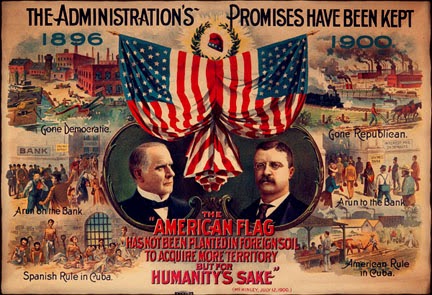
But my favorite has to be McKinley in 1900, who ran for re-election under the unbelievably modest: “Leave well enough alone.”
No, my father and Reagan weren’t close friends. Famously, after 6 p.m. on quite a few work days, they would sit down for drinks at the White House. But it wasn’t the drinks or the conversation that allowed American government to work. Instead, it was a stubborn refusal not to allow fund-raisers, activists, party platforms or ideological chasms to stand between them and actions — tempered and improved by compromise — that kept this country moving.
One of the oddities of this election cycle has been that no one seems happy. Not conservatives, not liberals, not the mainstream, not the fringe — nobody. This week’s featured post “Why so frustrated, America?” will look at this anomalous situation and offer this frame for it: Divided government plus extreme polarization means that both parties want their own kind of change, and neither can achieve it. As a result, on a long list of issues the country is stuck with a status quo that no one likes or is willing to defend.
Immigration is a paradigm of this dysfunction: You may want to give them papers or you may want to throw them out, but literally no one — well, except for sweatshop owners and document forgers — thinks it’s a good idea for 11 million people to live here indefinitely with no legal status. Yet that situation continues with no end in sight. Neither Trump’s deportation force nor Clinton’s path to citizenship are likely to pass Congress anytime soon, so we all cheer for our candidates without really believing their plans will come to fruition.
If you look around, you can see that pattern everywhere: What we’re currently doing is obviously wrong, but neither party has enough power to change it alone, and they’re not capable of working together. So we lurch from one government-shutdown deadline to the next, leave the Supreme Court in a 4-4 deadlock, and watch the bankruptcy clock on Medicare keep ticking.
All that raises obvious questions: How did the American Republic survive this long? What’s different about this era? Can we do anything about it?
I don’t promise a complete answer, but I’ll at least try to frame the questions better. That post should be out between 10 and 11 EDT.
In the weekly summary, I’ll thank God that the debates are finally over, and endorse Ezra Klein’s analysis of Clinton’s winning strategy. Friday’s internet outage looks more like a harbinger of things to come than a temporary annoyance. The Mosul offensive is on. The debates yielded some funny videos. And we’ll close with a look at the most beautiful bookstores in the world.
In other Sift news, the post “Not a Tea Party, a Confederate Party” has passed the 500,000 page-view mark. It’s the most popular Sift post ever.
This week everybody was talking about Donald Trump and sexual assault
Since this story has dominated the news all week, I’m going to assume that anybody who wants to follow the details has been able to. So rather than rehash it all, I’ll just hit the low points:
A week ago Friday, a video from 2005 came out in which Trump boasted about how easy it is to get away with sexual assault (unwanted kissing, grabbing women “by the pussy”) when you’re a star like him.
Two days later, in his second debate with Hillary Clinton, Trump said that what he said on the tape was just “locker room talk” (which didn’t happen in a locker room, but seems to mean: false bragging that men do to impress each other when no women are around). He said that had never actually committed such assaults.
Beginning this Wednesday, women started coming forward to say that Trump assaulted them in precisely the ways he described.
Huffington Post has been keeping a list of the women and their charges, updated as new charges arise. To me, the accounts vary in their persuasiveness. Kristin Anderson’s story would probably not be newsworthy if not for its similarity to the others: She recalls a 30-second encounter in a New York nightclub in which Trump put his hand up her skirt, but she can’t recall a date any more exact than “the early 1990s”, or who she was with who might corroborate her account, or even be certain which club it was. Not that it didn’t happen, but it’s hard to imagine an account so vague getting published in a different news environment.
At the other extreme, I found Natasha Stoynoff’s account compelling: She had regularly covered Trump for People magazine, and was well known to both Trump and his wife Melania. While she was at Mar-a-Lago to interview the couple for a first-anniversary feature, Trump lured her into a side room “and within seconds he was pushing me against the wall and forcing his tongue down my throat.” She didn’t tell her editor, finished the feature (which was published without mention of the incident), and made sure she was never assigned to cover Trump again.
These events never, ever happened, and the people that said them, meekly, fully understand. You take a look at these people, you study these people, and you’ll understand also.
About Stoynoff in particular he said:
Take a look. You take a look. Look at her, look at her words, you tell me what you think. I don’t think so.
While he was at it, he also body-shamed Hillary Clinton. Answering the criticism that he stalked Clinton during the second debate, he blamed her for walking in front of him, and then said:
She walks in front of me, you know. And when she walked in front of me, believe me, I wasn’t impressed.
To me, that just sums it all up. She’s a grandmother who will turn 69 in two weeks. She’s been First Lady, Senator, Secretary of State, and Democratic nominee for President. And we’re supposed to judge her by her butt.
Trump has also attacked People and The New York Times, which started the deluge by publishing the first two accounts Wednesday. When Trump’s lawyer sent a letter threatening a lawsuit, The Times lawyer fired back what can only be described as a bring-it-on challenge:
We did what the law allows: We published newsworthy information about a subject of deep public concern. If Mr. Trump disagrees, if he believes that American citizens had no right to hear what these women had to say and that the law of this country forces us and those who would dare to criticize him to stand silent or be punished, we welcome the opportunity to have a court set him straight.
The next step here is easy to predict: Trump may file a lawsuit to grab a one-day headline and get his side on the record, but he cannot afford to pursue it. In a previous unsuccessful lawsuit against a reporter, giving a deposition under oath forced him to make a number of embarrassing admissions.
Trump’s other response to his problems has been to go further down the rabbit-hole of conspiracy theories and fascist tropes. In the West Palm Beach speech — which you can watch in its entirety via PBS — he painted himself as a savior. Typical American political rhetoric warns of future problems unless we change our ways, or unless the speaker’s movement or philosophy gains power. But Trump made it about himself: The political establishment
has taken our jobs away, out of this country, never to return unless I am elected president.
He repeated a claim he has made before: “I am the only one who can fix it.”
This is a struggle for the survival of our nation. Believe me. And this will be our last chance to save it, on November 8.
Trump blamed the sexual-assault allegations on a conspiracy that includes “the Clinton machine”, “the corporate media” as a unified entity “with a total political agenda”, and “international banks” plotting “the destruction of U.S. sovereignty”.
As Yochi Dreazen points out, only one word is missing from what is otherwise an ancient libel:
it’s true that Trump’s allegation Thursday that a global financial cabal is secretly working hand in hand with the media to destroy the United States doesn’t include the word “Jew.”
But here’s the thing: It doesn’t need to. Trump is using barely coded words that directly echo one of the most ancient of all anti-Semitic libels. Jews have long been accused of controlling the global financial system. Jews have long been accused of controlling the media. And Jews have long been accused of being disloyal citizens secretly working to maneuver governments to pursue disastrous policies solely for their own benefit. Trump has now chosen to combine all of those charges into a single paranoid and hate-filled rant.
If you need someone to supply that word, Trump’s alt-right allies are happy to oblige. The neo-Nazi Daily Stormer, ex-KKK grand wizard David Duke, and numerous other far-right sources are promoting the theory that the Access Hollywood tape that started this whole furor was leaked by a Jewish aide to Paul Ryan. A Daily Stormer editor posted:
The 35% or so of the country that is hardcore pro-Trump is going to know that it wasn’t “liberals” that defeated Trump, but traitors within the party who abandoned him. And they are going to want to know why that happened.
It didn’t fit into the frame of that post, but subsequent to Jessica Leeds’ story, Slate did a story about airlines and sexual assault.
and more Clinton campaign email leaks from Russia by way of WikiLeaks
In particular, we now have transcripts of Clinton’s three speeches to Goldman Sachs in 2013. Personally, I’m glad they’re out. As long as they remained secret, Clinton-haters could imagine they contain some secret plot to do whatever. Now that they’re out, it’s clear that they don’t.
It turns out they aren’t even speeches, they’re Q&A sessions that mostly cover foreign policy. I found them educational, particularly the notion that the Chinese military is a power not completely under control of the central government, and that it is the force most supportive of North Korea.
I’m not sure what the point of keeping the transcripts secret was, or why Clinton refuses to verify their authenticity now. But I wonder if it has more to do with foreign governments than with the American public. For example, it might be convenient to maintain deniability of that China/Korea statement the next time she has to deal with either government.
As far as the other emails that have been released, there’s a lesson we all should have learned after the ClimateGate email dump in 2009: Whether you’ve done anything wrong or not, you never look good when your enemies get to comb through emails you thought were private and publish the excerpts they find most damaging. Countless investigations in both the US and the UK found no wrong-doing in the ClimateGate emails, but to this day climate deniers believe they revealed some nefarious conspiracy.
In emails to known associates, people say the same kinds of things they might say face-to-face: At times they are flip, snide, and short-tempered. They blow off steam to people they think will be sympathetic, and make statements they couldn’t support well enough to say them on the record. They float outrageous ideas, sometimes seriously, sometimes in jest.
I occasionally read articles in the right-wing press about some particular batch of WikiLeaks Clinton-campaign emails. Like this one where the main thing that strikes me is how tame it all is.
The emails, published by WikiLeaks after a hack of Clinton campaign chairman John Podesta’s private account, also show Clinton campaign officials and Democratic leaders disparaging supporters of Sen. Bernard Sanders as “self-righteous” whiners, calling Hispanic party leaders such as Bill Richardson “needy Latinos,” labeling CNN anchor Jake Tapper “a d—k” and even lambasting longtime Clinton ally Sidney Blumenthal.
Horrors! In the middle of high-pressure situations, Clinton campaign staffers privately said unkind things about people who were making their lives difficult. I fear for the future of the free world if such monsters get their hands on the levers of power. But wait, there’s worse:
The Clinton campaign’s biggest problem may be its assault on Catholics.
Podesta didn’t participate in this exchange himself, but he was copied on emails that Clinton campaign spokeswoman Jennifer Palmieri received from someone outside the campaign: John Halpin of the Center for American Progress.
In the exchange, Mr. Halpin mocks media mogul Rupert Murdoch for raising his children in the Catholic faith and said the most “powerful elements” in the conservative movement are all Catholic.
“It’s an amazing bastardization of the faith. They must be attracted to the systematic thought and severely backwards gender relations and must be totally unaware of Christian democracy,” Mr. Halpin said.
It’s actually a good point: Catholic economic doctrine is not even remotely conservative, and hasn’t been for over a century. So there actually is a mystery here. Palmieri had a fairly boring response:
I imagine they think it is the most socially acceptable politically conservative religion. Their rich friends wouldn’t understand if they become evangelicals.
This is the “assault on Catholics” that The Washington Times thinks Palmieri should be fired for. And Paul Ryan believes Palmieri’s single line about the social status of Catholics compared to evangelicals “reveal[s] the Clinton campaign’s hostile attitude toward people of faith in general.”
I wonder how many emails they had to read before they found such a bombshell.
The other issue raised by the series of WikiLeaks releases of Clinton documents is the role of Russia.
There is mounting evidence that the Russian government is supplying WikiLeaks with hacked emails pertaining to the US presidential election, US officials familiar with the investigation have told CNN.
NBC News claims to know that U.S. intelligence officials had briefed Trump on this before the second debate, in which Trump asserted that Clinton “doesn’t know if it’s the Russians doing the hacking. Maybe there is no hacking.”
I think there’s no question that the evidence continues to point in that direction [of Russian responsibility]. There should be severe consequences to Russia or any sovereign nation that is compromising the privacy or the security of the United States of America.
This is a problem we haven’t had to deal with before, and it’s hard to know how to think about it. On the one hand, the WikiLeaks dumps are what they are, and it seems silly to avoid knowing what’s in them. On the other hand, how do we assess the fact that one of our chief rivals wants Donald Trump to win?
Good news for the climate: 197 nations just agreed to cut way down on their use of hydrofluorocarbons (HFCs), which are used in air conditioners. Originally, they were supposed to replace the CFCs that were killing the ozone layer. (And they succeeded, the ozone hole seems to be filling in.) But HFCs are powerful greenhouse gases 10,000 times as effective as carbon dioxide. Estimates say that the agreement will shave anywhere from .2 to .44 of a Celsius degree off the average global temperature by the end of the century.
A fascinating story in The Washington Post about the conversion of Derek Black, son of the founder of the white-nationalist Stormfront web site, who as a teen-ager had his own radio show where he helped popularize the notion of white genocide. He has now left the white-nationalist movement, which has created a family crisis.
His story reminds me of a New Yorker article from last November about Megan Phelps-Roper, granddaughter of Fred Phelps of the Westboro Baptist Church, the people who picket funerals with “God Hates Fags” signs.
In both stories, conversion away from a hateful ideology happens not through logical argument, but by getting to know and admire people that the ideology condemns. The personal relationship opens up a channel for new ideas to come in.
Bob Dylan won the Nobel Prize for Literature. A popular songwriter had never won before, but I guess the times, they are a-changing. I’d have voted for Thomas Pynchon myself, but what do I know?
A plot by anti-Muslim “Crusaders” was broken up before the group could blow up an apartment building in Garden City, Kansas. They were hoping to kill a lot of Somali immigrants and “ignite a religious war”.
A Republican Party office was firebombed in North Carolina Saturday night. Donald Trump immediately attributed it to “Animals representing Hillary Clinton and Dems”. Clinton denounced the bombing, and other Democrats raised $13K to help the Republicans rebuild.
So far, nobody knows who did this. If the perps think this helps the Democrats, they’re wrong and they need to stop before the “help” any more. Others have suggested a false-flag operation to gain sympathy for Republicans, but that’s a big claim to make without any evidence. Let’s hope the authorities solve the case soon so we can all stop speculating.
Washington Post editor Fred Hiatt got philosophical on MSNBC’s Hardball Friday:
I’ve covered a lot of countries — dictatorships, democracies, everything in between — and the key thing to a democracy … I mean, there are really two things that are key. You have an election, and the loser acknowledges that they lost, and the winner lets the loser survive for another day. Trump is challenging both of those things. He’s saying “If I lose, it’s not legitimate” and “If I win, I’m going to lock her up.” This is the Putin model. It’s not democracy.
Political science professor Shaun Bowler makes a related point: After every election, people who voted for the loser are tempted to doubt the result. One key to whether a democracy succeeds or fails is whether losing candidates try to soothe or enflame those responses.
and believe it or not, you should listen to Rush Limbaugh
Wednesday, Limbaugh unleashed the most amazing rant about how hypocritical it is for liberals to invoke moral standards against Donald Trump. The point, which he borrows from therapist Michael Hurd, is that liberals have no standards when it comes to sex, so how can we invent a standard to apply to Trump? Limbaugh explains this mystery, but does so in a tone of outrage and anger.
You know what the magic word, the only thing that matters in American sexual mores today is? One thing. You can do anything, the left will promote and understand and tolerate anything, as long as there is one element. Do you know what it is? Consent. If there is consent on both or all three or all four, however many are involved in the sex act, it’s perfectly fine. Whatever it is. But if the left ever senses and smells that there’s no consent in part of the equation then here come the rape police. But consent is the magic key to the left.
I and every liberal I’ve mentioned this to have had a well-duh reaction: What consenting adults do is their own business, but as soon as somebody stops consenting and another party keeps going, then you’ve got rape.
and let’s close with something amazing and hopeful
Researchers at the University of Pittsburgh have given a paralyzed man a robot armthat feels. Not only can his brain control the arm, but tiny electrodes in his brain allow him to know when a finger is being touched or pressed.
“It’s only been a week,” Liz Plank tweeted. “But we’ve all aged a year.”
Despite how ugly it’s been, though, the last ten days of the presidential campaign does have one redeeming feature: Sexual assault is being discussed in a setting where the whole country is listening.
I’m not naive enough to think that everyone is going to “get it” now and take a more enlightened attitude. (As someone once told me, “I can explain it to you, but I can’t understand it for you.”) But men who are open to understanding the topic better might be paying attention now. Women who had repressed thinking about it, or comparing experiences with other women, might now be having those thoughts and conversations. Teens and even younger boys and girls might be learning that things they had come to accept as normal, or even OK, are really not.
I believe the country as a whole is getting a powerful lesson about four things:
how ubiquitous sexual assault is,
the myths so many of us believe about it,
why women often don’t tell anyone about it,
the tactics men use to get away with it.
#notokay. Twitter is famous for insults and snark, but the most powerful hashtags are the ones that gather testimony. Shortly after Trump’s Access Hollywood tape came out, author Kelly Oxford tweeted:
Women: tweet me your first assaults. they aren’t just stats. I’ll go first: Old man on city bus grabs my “pussy” and smiles at me, I’m 12.
Last I checked, that had been re-tweeted more than 13 thousand times. Oxford reported that over the next weekend tweets came in at the rate of 50 per minute. On October 9, her Twitter feed got more than 20 million views.
Eventually she created the hashtag #notokay to move the discussion off her personal feed and open it to more than just first-assault stories.
This is something that pre-internet journalism couldn’t do. A 20th-century reporter could uncover one paradigmic story, or at most a handful of them, and tell those stories in a way that invited readers to identify or empathize, maybe adding a statistical claim that X% of women have had similar experiences. But there was no way to capture the sheer avalanche of testimony. Scrolling down the responses to Oxford’s original tweet, I was struck by their unity-in-diversity. The settings are infinitely varied: a bus, up against a door at granny’s, a couch at home, a bedroom at an aunt’s house, a Halloween party, a friend’s apartment, at work, at the supermarket. The perpetrators are strangers, neighbors, colleagues, bosses, cousins, uncles, teachers. Each tweet has its own unique details, yet pounds the same theme like a hammer.
And the hammer doesn’t stop. A TV news segment or a newspaper feature has to end, so you can leave with a feeling of being done. But a viral tweet defeats you; at some point you just decide to quit reading, knowing that there’s more and will always be more.
Liz Plank took that insight one step further and raised this question:
Trying to find ONE woman who has never experienced a man sexually touching her without their consent. #YesEveryWoman
Scrolling through that hashtag, I still haven’t found the “I’m the one” tweet.
Myths. The typical folk explanation of sexual assault is simple: A man’s libido overcomes his impulse control. From there it’s a short trip to a long list of standard excuses and explanations:
virility. I just have such a strong sex drive, sometimes I’m overwhelmed by it.
it’s a compliment. You’re just so sexy, how could I stop myself?
it’s your fault. Your skirt is so short; your jeans are so tight; your neckline is so low. When you just put it all out there like that, what do you think is going to happen?
it’s inevitable. Boys will be boys. You can’t expect us to control ourselves all the time. (Or, as Trump put it on Twitter: “26,000 unreported sexual assaults in the military – only 238 convictions. What did these geniuses expect when they put men & women together?”)
and so on.
This is worse than just “objectification” of women, because we would never tolerate similar thinking about actual objects: If your drive for acquisition overcomes your impulse control, you’re a thief, period. The strength of your greed does you no credit; you’re not complimenting the wealth of the people you steal from; it’s not their fault for having such nice stuff or displaying it so attractively; and we don’t give in to the inevitability of theft whenever valuable objects are visible to people who might desire them. When it comes to object-lust, self-control is the price of staying in civilization; if you can’t muster it, we’ll lock you away.
But beyond moral considerations, that libido vs. control frame loses its explanatory power when you pay attention to women’s stories, or to the complexity of the male psyche. All women (or very nearly all) get victimized, not just the sexy, popular, or flirtatious ones. Sometimes it’s specifically the unpopular women, the ones no one is looking out for, who get assaulted. Sometimes it’s girls too young to understand what they’re supposedly “asking for”. Sometimes men are seeking dominance rather than pleasure. Sometimes it’s about asserting control over a woman whose self-assurance seems threatening. Sometimes it’s part of a man’s internal process that has nothing to do with the victim at all: Maybe assaulting a stranger is a man’s way of taking revenge on his spouse, or on the women who won’t go out with him. Maybe he’s been humiliated by his boss and wants to humiliate someone else to feel less helpless.
Another myth is that all men do it, or would if they were brave enough. At the very least, they wish they could do it and envy the men who do; so when they get together and trade “locker room talk”, they brag about real or imagined assaults the way Trump did with Billy Bush.
I remember believing something similar in junior high. (Maybe the worst thing Trump has done to me personally is make me remember junior high.) To see up a girl’s skirt or down her blouse, or to touch her somewhere we weren’t supposed to — it was a game: They defended the “goal” while we tried to “score”. To put it in a childish terms, it was like Yogi Bear trying to steal picnic baskets while the ranger tried to stop him. But imagine being an older Yogi, looking back at what once had seemed like youthful highjinks and realizing: “Oh my God, I was a bear. People must have been terrified.”
The earlier we can get that message to boys and young men, the better. And in some cases we are.
One afternoon, while reporting for a book on girls’ sexual experience, I sat in on a health class at a progressive Bay Area high school. Toward the end of the session, a blond boy wearing a school athletic jersey raised his hand. “You know that baseball metaphor for sex?” he asked. “Well, in baseball there’s a winner and a loser. So who is supposed to be the ‘loser’ in sex?”
Fortunately, this week many admired and imitated athletes came forward to say that the Trump/Bush conversation is not normal locker-room banter. Like LeBron James:
What is locker room talk to me? It’s not what that guy said. We don’t disrespect women in no shape or fashion in our locker room. That never comes up. Obviously, I got a mother-in-law, a wife, a mom and a daughter and those conversations just don’t go on in our locker room. What that guy was saying, I don’t know what that is. That’s trash talk.
Even Trump’s friend Tom Brady walked away from a microphone rather than defend him on this.
Why don’t they tell? One of Trump’s main defenses against his accusers has been: Why didn’t they say anything at the time? If these incidents have been happening for decades, why is this all coming out only now, just a few weeks before the election?
In particular, he wondered about People magazine writer Natasha Stoynoff whose account of being shoved up against a wall and forcibly kissed by Trump while she was at Mar-a-Lago to interview Donald and Melania about their first anniversary seemed (to me) particularly compelling. He challenged her at a rally Thursday in Ohio:
I ask her a simple question. Why wasn’t it part of the story that appeared 12 years ago? Why didn’t they make it part of the story … if she had added that, it would have been the headline.
Picture what Trump is assuming: If Stoynoff had made such a claim against Trump, with no witnesses or physical evidence, her editors would have simply believed her, and would have been willing to put their magazine behind her in a battle against a famously litigious billionaire. Weigh the likelihood of that scenario against the explanation Stoynoff had already published before Trump spoke:
Back in my Manhattan office the next day, I went to a colleague and told her everything.
“We need to go to the managing editor,” she said, “And we should kill this story, it’s a lie. Tell me what you want to do.”
But, like many women, I was ashamed and blamed myself for his transgression. I minimized it (“It’s not like he raped me…”); I doubted my recollection and my reaction. I was afraid that a famous, powerful, wealthy man could and would discredit and destroy me, especially if I got his coveted PEOPLE feature killed.
“I just want to forget it ever happened,” I insisted. The happy anniversary story hit newsstands a week later and Donald left me a voicemail at work, thanking me.
“I think you’re terrific,” he said. “The article was great and you’re great.”
Yeah, I thought. I’m great because I kept my mouth shut.
Notice that the idea of making the assault part of the story never comes up; it’s not even suggested by Stoynoff’s colleague.
Liz Plank created the hashtag #WhyWomenDontReport, which is another assemblage of testimony like this:
Because I was a medical student and he was the attending surgeon #WhyWomenDontReport
Because he was my landlord. Because I was 21 and feared homelessness. Because my father told me to figure it out myself. #WhyWomenDontReport
Because it was easier to pretend it didn’t happen than to face the police, the courts and my perpertrator. #WhyWomenDontReport
While I was on set Wednesday night with Chris Hayes, [Trump spokesperson A.J. Delgado] said, “If somebody actually did that, Chris, any reasonable woman would have come forward and said something at the time.”
Any reasonable woman?
Was it reasonable for Jessica Leeds to come forward about her sexual assault only to have Lou Dobbs tweet her personal phone number and address, exposing her private information to his hundreds of thousands of followers? Was it reasonable for Natasha Stoynoff to come forward about her sexual assault only to have Donald Trump suggest she was too ugly for him to be interested in sexually assault her?
Trump said his accusers are “doing [it] probably for a little fame. They get some free fame. It’s a total set-up.” But who exactly wants this kind of fame? Are any women out there watching Jessica Leeds or Natasha Stoynoff and thinking “I wish people would pay attention to me like that”?
And that brings us to men’s tactics.
Tactics. Between the debate Sunday and the first wave of new accusers coming forward Wednesday, Liz Plank used Trump’s debate performance as an example of the tactics of abusive men. She listed
Humiliation. Trump’s pre-debate press conference with women who have accused Bill Clinton wasn’t about seeking justice for them. It was about humiliating Hillary Clinton.
Deflection. Trump minimized his behavior as “locker room talk”, and quickly segued to “ISIS chopping off heads”.
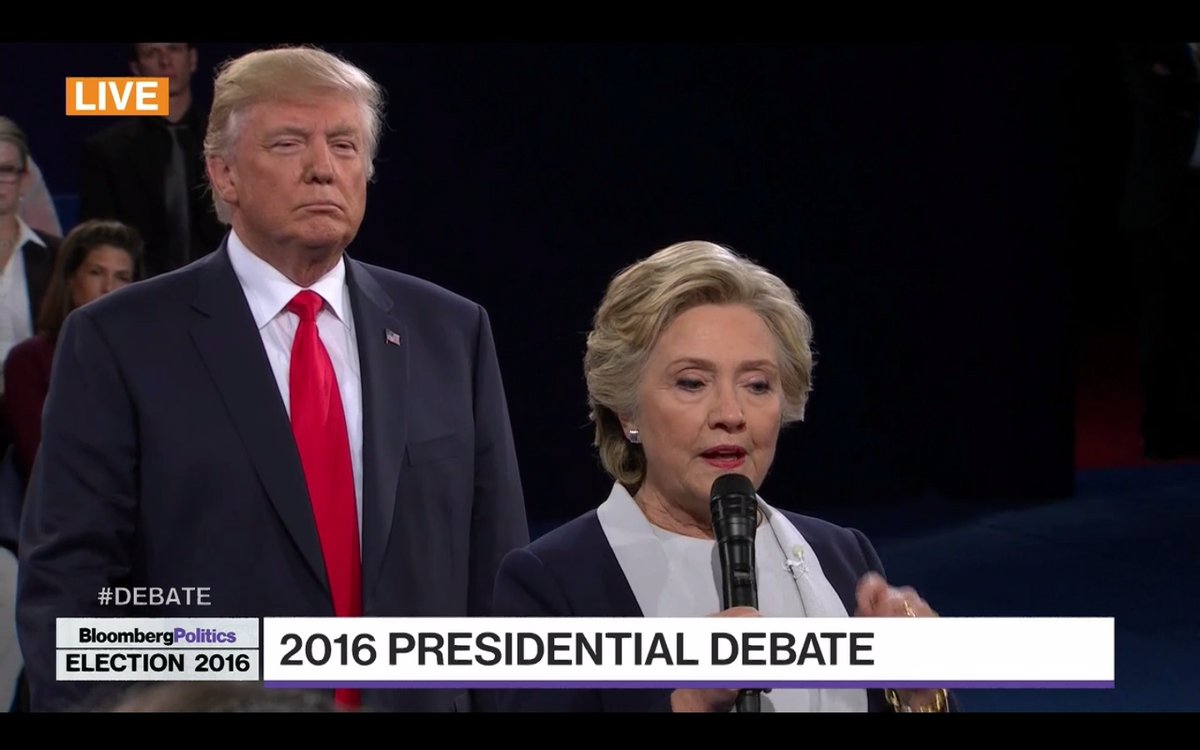
Intimidation. He threatened to put Clinton in jail, and loomed behind her “in a way that almost made me feel unsafe for her”.
Gaslighting. In other words: creating an entire alternate reality to make victims question their own perceptions and memories. For example, Trump asserted that it was Clinton, not him, who owes President Obama an apology for the birther movement. “So if you feel like you’re going insane during this election, that’s Donald Trump gas lighting you over and over and over.”
What we’ve seen since just bears this out. He’s been heaping humiliation on the women who have accused him. (They’re “horrible, horrible liars” who he obviously couldn’t have assaulted because they aren’t attractive enough.) He’s been deflecting his own guilt onto Bill Clinton (whose accusers should be believed even though Trump’s shouldn’t). He’s threatened completely ridiculous lawsuits against The New York Times and People for publishing women’s accounts of his misconduct. And (completely without evidence) he has gaslighted the nation by putting forward a theory that makes him the victim of a conspiracy involving the global financial elite and the entire corporate media. (He’s not a sleazeball who abuses women, he’s a messianic hero who suffers these outrageous attacks in order to save the common people. He’s not blowing an election Republicans might have won, he’s going to be defrauded at the polls.)
But the important thing to remember for the future is that this is not an isolated incident and Trump is not a unique character. Lots and lots of men do this kind of thing. They do it to anybody. They do it because they can. They have a standard list of excuses for doing it. They have tactics for getting women to shut up about it and men not to believe the women who don’t shut up.
The thing to remember the next time you hear something like this is that you’ve heard it before. It’s all part of the pattern.
This is one of those weeks where it’s easy to get sucked into the same story that the news channels have been talking about 24/7: the women accusing Trump of sexual assault and other unwanted boorish attention. And I will link to that stuff for those of you who haven’t already had enough of it, but the point of the Sift is to be an alternative to the news-hype machine, not to participate in it.
So instead of joining the isn’t-this-awful chorus — it is awful, but you don’t need me to tell you that — I decided to focus on the silver lining of the story: The public is getting an education about sexual assault. That could have consequences well beyond the election. This week’s featured post will be “A Teaching Moment on Sexual Assault”, and it will cover four areas where I think the public consciousness is being raised: how ubiquitous sexual assault is, the myths so many of us believe about it, why so many women don’t tell anyone about it, and the tactics men use to get away with it.
I still have some work to do on it, and it’s the kind of topic where I have to check the wording of every sentence to make sure I’m not unintentionally saying something offensive or insensitive, or perpetuating myths of my own, so it may not come out until 10 or 11. (If I do offend you, complain in the comments. There’s a good chance I’ll say “Thank you” and re-edit some part of the post.)
The weekly summary is where I’ll talk directly about the Trump scandal and his responses to it, including a really disturbing revival of what would become a Nazi conspiracy theory if you just added the word Jews to it. (Some of his followers have done that.) Also: more WikiLeaks releases of hacked Clinton-campaign stuff, including transcripts of her Goldman Sachs appearances in 2013. (It turns out they weren’t speeches, but Q&A sessions.)
There’s also a thwarted white-supremacist plot to bomb an apartment complex in Kansas where a lot of Somali Muslims live, and the firebombing of a Republican headquarters in North Carolina. An international agreement made real progress on climate change. The Scots are looking at a post-Brexit independence vote. And probably some other stuff. There will be a closing, but I haven’t picked it yet.
And I turn 60 today. I am now officially entitled to start saying: “Not bad for an old guy.”
If we’re worried about the longer-term implications of current policies, the buildup of greenhouse gases is a much bigger deal than the accumulation of low-interest debt. It’s bizarre to talk about the latter but not the former.
In addition to Trump’s sexual-assault-confessing video, which I cover in the featured post, WikiLeaks released thousands of emails hacked from the account of Clinton campaign chair John Podesta. Included in the haul are internal Clinton campaign discussions about what they would have to defend if the text of her Goldman Sachs speeches came out.
I haven’t examined the Podesta emails myself. Matt Yglesias concludes: “The lesson of Hillary’s secret speeches is she’s exactly who we already knew she was“. In other words, she is someone who works inside the system and negotiates with the powers that already exist rather than sweeping in from the outside. Yglesias is not alarmed by this, for reasons he explains. I’ll try to formulate my own opinion in future weeks.
In what passes for morality in the Republican Party, leaders are calling for the presidential candidate who hates women to be replaced by the vp candidate who hates gays.
and the weather
Hurricane Matthew swept up the Florida coast and made it all the way to North Carolina before turning out to sea. It’s been downgraded to a post-tropical cyclone.
Haitians aren’t Americans, so who cares? (This echoes my comments last week about Gary Johnson and the decline of foreign coverage.)
Most Haitians are black, and (no matter what white people might tell each other) black lives still don’t really matter.
It’s Haiti. Something bad is always happening in Haiti.
In the conspiracy-theory world many right-wingers inhabit, Matthew’s path and intensity is no mystery: the government created it.
Hurricane truthers believe the government’s goal is to create unrest and distract the masses from election fraud [in Florida] — namely, the left’s attempt to rig the election for Hillary Clinton.
“Given the unparalleled significance of the 2016 election cycle, the politicos at the federal level would love to sow seeds of chaos any way they can in order to create cover for an election theft,” WorldTruth.tv wrote.
Since climate change is a myth in this alternate universe, there must be some other reason why more powerful storms are making it further north on a regular basis. The old reliable explanation is that liberals have offended the Lord with our gay-rights agenda and overall lack of piety. But if that doesn’t convince you — how’s the reconstruction going, Tony Perkins? — a nefarious human plot backed by sci-fi technology works too.
By far the strangest moment in the debate was when Trump told Clinton:
If I win, I am going to instruct my attorney general to get a special prosecutor to look into your situation, because there has never been so many lies, so much deception. There has never been anything like it, and we’re going to have a special prosecutor.
And then followed up a bit later in this exchange:
CLINTON: It’s just awfully good that someone with the temperament of Donald Trump is not in charge of the law in our country.
TRUMP: Because you’d be in jail.
If you’re not familiar with how our justice system works, you might not realize why so many people were frightened by this. Ezra Klein, for example:
Tonight was a scary moment in American politics. In fact, it’s probably the scariest I can remember.
In our system, the Justice Department is supposed to be insulated from politics. Nothing in the Constitution says this, but it’s a principle deep in the mores of our system. The president is supposed to make policy and appoint people to carry out that policy, but is not supposed to have any direct influence on specific cases. That’s the principle Republicans were invoking when they objected to President Obama endorsing Secretary Clinton while the FBI was still investigating her. They were afraid that even the hint of the president’s opinion, without any direct orders, would affect the investigation. Democrats invoked that principle during the Bush administration when they objected to the firing of seven states attorneys for what they believed were political reasons.
Well, the President appointing a prosecutor to look at a particular person — especially a political rival, especially one the FBI has already cleared — is completely off the scale. That’s what happens in dictatorships, not in the United States. Trevor Noah was making this point about Trump already a year ago.
That denial is probably a preview of how Republicans will look back on a Trump defeat: what he actually said and stood for will go down the memory hole. Something similar happened on a larger scale after President Bush left office with historically low popularity. There was no discussion about what went wrong or how the party needed to change. Instead, they just stopped talking about Bush for a while, and when they started again they said amazing things, like “We had no domestic attacks under Bush.”
Many Republicans have expressed a hope that Pence will wind up running things. But I haven’t forgotten how Gov. Pence dodged and weaved last year in order to defend the supremacy of Christians over gays in Indiana.
They don’t get much publicity, but debates are also starting to happen in pivotal senate races. Here’s video of Hassan/Ayotte in New Hampshire.
and you also might be interested in
Columbia University’s Jay Rosen is one of the sharpest observers of the culture of political journalism. In this post on his blog PressThink, he discusses the underlying frame that most political coverage is based on, and why journalists are having so much trouble dealing with the fact that the Trump candidacy doesn’t fit in that frame.
The two major parties are similar actors with, as Baquet put it, “warring philosophies.” Elections are the big contests that distribute power between them. The day-to-day of politics is a series of minor battles for tactical advantage. The press is part of this picture because it distributes attention, but — in this view of things — it does not participate in politics itself.
But in the real world, the two political parties have gotten increasingly asymmetric and are no longer similar actors at all. Trump has taken this to an extreme, and journalists have not adjusted.
Campaign coverage is a contraption that only works if the candidates behave in certain expected ways. Up to now, they always did. But Trump violates many of these expectations. … Imagine a candidate who wants to increase public confusion about where he stands on things so that voters give up on trying to stay informed and instead vote with raw emotion. Under those conditions, does asking “Where do you stand, sir?” serve the goals of journalism, or does it enlist the interviewer in the candidate’s chaotic plan? … The premise is that a presidential campaign wants to put out a consistent message to avoid confusing people, and to deny journalists a “gotcha” moment. What if that premise is false? The rationale for interviewing the campaign manager, the running mate, or some other surrogate collapses. They say one thing, the candidate says something else and the confusion is not considered a problem. It may even be a plus.
In an some other version of the United States, an election would be a time to have discussions about really important issues. Lester Holt tried to raise one in the first debate: Should the United States have a no-first-use policy on nuclear weapons?
Sadly, neither candidate rose to the challenge: Clinton cautiously avoided saying either yes or no, while Trump boldly and unequivocally said both.
It’s actually a good question. Most Americans probably don’t realize that we don’t already have a no-first-use policy. Originally, there was a strategic reason for it: We were anticipating World War III in Europe, where the Soviet Union had an advantage in conventional forces. Since the Soviet Union was itself a European power, it could cheaply keep huge armies in a position to strike, while it was much more expensive (not to mention unpopular with the Germans) for us to keep a comparable defensive army stationed in West Germany. So if Soviet tanks started rolling west, we reserved the option of nuking them.
Russia, without its former Warsaw Pact allies and without former Soviet republics like Ukraine, isn’t nearly as formidable as the USSR was. But we still might be stuck for a non-nuclear answer if Putin decided to roll over one or more of the Baltic Republics, which we are committed to defend as members of NATO. Is that why we won’t renounce first use? Or does the Pentagon have some other scenario in mind?
I don’t believe for a minute this will actually pan out on election day, but one recent poll shows Clinton taking the lead in Arizona.
What interests me in this video is how De Niro is doing exactly what Trump does, but doing it better. They’re both 70-something guys who still know how to talk tough, but who (at this point in their lives) would probably be push-overs in any real physical confrontation. Picture the two of them joining 86-year-old Clint Eastwood in a barroom brawl. The result would play better in a slapstick comedy than in an action flick.
And Britain has a favor to ask: Could we elect Trump so that everyone forgets about their boneheaded Brexit vote?
Massachusetts is about to vote on Question 2, which would expand the number of charter schools in the state. The main argument against charters is that they drain money out of the public school system. The long-term fear is that a vicious cycle gets started, where pulling resources out of the system leads to poorer performance, which leads more families to take their kids out of the public schools, which in turn reduces state subsidies to those schools.
Examination of school funding trends in districts affected by charter school enrollments does not suggest that charter schools are over-funded, that students in district schools are suffering a loss of support, or that the per-student funding of districts is trending negatively. Rather, per-student funding has increased quite steadily across the state, and the district-charter balance has been stable.
But former state Education Secretary Paul Reville counters by pointing out that schools have many fixed costs that don’t go away when a student leaves:
Mainstream public schools would argue that the marginal savings associated with losing a student are not nearly as much as the marginal costs associated with losing a student.
But even that misses the point. The most valuable thing charter schools siphon off isn’t public money, it’s easily teachable students. My nightmare is that the kids who can sit still and process information from a teacher standing in front of a blackboard all wind up either in charters or in voucher-funded private schools. Meanwhile, the public schools are left to handle all the special needs kids, all the kids with undiagnosed vision and hearing problems, all the kids who bring their home problems to school and act out, etc. And when it costs more money per student to operate that public school, we’ll be told some nonsense about the efficiency of the private sector.
There’s a parallel to the healthcare system, particularly as it operated before the Affordable Care Act stopped insurance companies from rejecting sick people. Sometimes the way to make money isn’t to offer better service, it’s to make sure you only get the customers who don’t need service.
One bit of tax law that’s unpopular on the right, is the “Johnson amendment” from 1954, saying that churches can’t endorse candidates. The Republican platform calls for repealing it, a promise Donald Trump often makes to evangelical audiences, saying the repeal would “give churches their voice back”. Right-wing web sites call the Johnson amendment a “Christian gag rule“.
If you aren’t familiar with the details, that can sound convincing. I mean, religious convictions often go hand-in-hand with political stances, so why shouldn’t a pastor be able to speak his mind from the pulpit without worrying about his church losing its tax-exempt status? (In fact, many pastors do, and get away with it, because the rule is only enforced in egregious cases. Like when a church “placed full-page advertisements in two newspapers in which it urged Christians not to vote for then-presidential candidate Bill Clinton because of his positions on certain moral issues.”)
But the point of the Johnson Amendment is simple: Contributions to churches are tax-deductible, but contributions to political campaigns or PACs aren’t. So without some kind of restriction on church activity, churches could become money-laundering schemes: You give tax-deductible contributions to a church with the understanding that it will spend that money campaigning for your candidate. I have yet to hear any repeal-the-Johnson-amendment argument that addresses this problem.
but we should be paying more attention to Colombia
Last week I forgave Gary Johnson’s ignorance by citing the general decline in Americans’ awareness of other countries, and blamed a generational shift in news coverage. So let’s talk about what’s going on in Colombia, which produces the bulk of the cocaine Americans abuse.
One thing that makes the whole coca-growing enterprise harder to control is that Colombia has been fighting a civil war for half a century. Picture that: Our Civil War lasted only four years. If it had gone on as long as Colombia’s, we’d have been fighting until just before World War I. The BBC estimates that 260,000 people have been killed, and another six million driven from their homes. The whole country has less than 50 million people.
The government negotiated a peace deal with the guerillas (FARC, which translates to the Revolutionary Armed Forces of Colombia), which was announced at the end of August and signed with much ceremony on September 26. But in a Brexit-like reversal of government policy, the Colombian voters rejected the deal in a referendum on October 2. The vote was close: 50.2%-49.8%, to the great surprise of pollsters, many of whom had the referendum passing with over 60% of the vote.
FARC has a Marxist orientation, and claims to represent the interests of the rural poor against the landed gentry and the urban elite. The areas it controls are prime coca-growing territory, and it funds itself via the drug trade. (So if you think about it, the U.S. has been bankrolling both sides. Our tax dollars aid the government, while our drug spending keeps the opposition going.)
Vox has a good article summing up the situation, quoting extensively from the BBC about what’s in the peace agreement. The agreement sounds like a model of reasonability: FARC gives its weapons to the UN and becomes a political party guaranteed ten seats in Congress. (I’m not sure how this splits between houses. There are 166 in the lower house and 102 in the upper.). Its fighters apologize to their victims and won’t be prosecuted for the war-related crimes they confess to. (Though “crimes against humanity” don’t get this amnesty.) They get temporary financial aid to re-integrate into society.
Opponents of the agreement think that lets FARC off too easy. (One woman said: “How is it justice if I, who committed no crime, was ‘imprisoned’ in a rebel camp for four months, and these criminals get off without going to jail?” While understandable from a personal point of view, this feeling is why conflicts like this drag on decade after decade: By the time one generation gets “justice” for the wrongs committed against it, a whole new set of wrongs have been committed by both sides.) Some also don’t trust FARC to disarm, while others fear having another left-wing party in Congress.
Ironically, the voters’ rejection didn’t prevent Colombian President Juan Santos from receiving the Nobel Peace Prize Friday. Whether he’ll be able to salvage an actual peace, though, is still uncertain.
and Israel
The Obama administration is objecting to the announcement of a new Israeli settlement in the occupied territories. CNN summarizes.
and let’s close with something adorable
We could teach our children violence, or maybe we could just teach them to dance. The Irish magazine Galway Now posted this viral video.
It seemed like everybody had to comment. These people just did it better than the rest.
By now all the people who want to — and probably a lot who never wanted to — have seen the video of Donald Trump talking to Access Hollywood co-host Billy Bush in 2005, apparently without realizing he was being recorded. The Washington Postreleased the video Friday, Trump released what has been oxymoronically described as a “defiant apology” late Friday night, and the resulting firestorm dominated the news shows leading up to last night’s town-hall debate with Hillary Clinton. Many big-name Republicans who had tolerated Trump’s previous outrageous statements finally withdrew their support. [1] Trump’s running mate Mike Pence has not withdrawn his support, but has kept Trump at arm’s length, saying
I do not condone his remarks and cannot defend them. [2]
When asked about the video by Anderson Cooper early in Sunday’s debate, Trump dismissed it as “locker room talk”, a phrase he apparently wanted to leave vague, but Cooper (to his credit) insisted on unpacking: Was Trump saying that he did or didn’t do the things he bragged about, like kiss women without their consent or “grab them by the pussy”? After several attempts to get away with a general affirmation of his respect for women, Trump finally claimed that he had not done those things, i.e., that he had been lying to Bush. So Trump’s defense is that he is not a sexual abuser, he just likes to impress other guys by claiming to be one.
Cooper did not explore the trying-to-have-sex-with-a-married-woman confession in the video, so (as far as I know) Trump has not had to say whether that really happened. [3]
Obviously, there are many angles from which to react to this series of events. I’ve picked out a few that I found more insightful than the rest.
Best debate tweets.
Erin Chack: Scary Halloween costume idea: Dress up like Trump, go to a party, and stand 3-5 feet behind successful women.
Jake Beckman posts a similar image with this caption:
Here’s the debate where Donald Trump tries to not look like a sexual predator.
Every woman watching has had a creepy dude pace behind her.
Aren’t you guys supposed to be religious? Naively, you might think that the people who would abandon Trump first over stuff like this would be the family-values folks, particularly evangelical Christians. But the reverse seems to be true: Even as elected Republicans head for the exits, evangelical leaders like Ralph Reed and Jerry Falwell Jr. are standing by Trump.
The best comment I’ve seen on that is the image on the right. If looks to be a illustration from the Bible story of the three men in the fiery furnace. During the Babylonian Captivity, three young Jewish men refuse to bow down to a golden statue of King Nebuchadnezzar, and are miraculously saved from his punishment.
The image has been annotated by having one of the kneeling men say, “He’s going to appoint pro-life supreme court justices.” In other words: If you want to bow down to the ruling power, you can always find some reason to do so. In the actual Bible story, the three heroes do not discuss Nebuchadnezzar’s policies before deciding what to do.
How abusers talk after they’re caught. In a tweet storm captured by Valerie on Storify.com, Leah McElrath responded to Trump’s “defiant apology” by taking it apart phrase-by-phrase and framing it as
an eerie replica of psychological manipulations made by abusers after episodes of abuse.
What McElrath hears in Trump’s video is less an apology than an attempt to make his accusers doubt themselves and their experiences. For example
“these words do not reflect who I am” = the reality you just experienced didn’t actually happen (gaslighting)
and
“We’re living in the real world” = I’m sane and you’re crazy
His contrast between himself and Bill Clinton, who “has actually abused women” translates to “the abuse you experienced wasn’t *really* abuse”.
McElrath’s interpretation explains Trump’s bizarre demeanor throughout this video: He is glowering and angry, not contrite or ashamed.
After reading McElrath, I see the apology video as an expression of the essence of a privileged and entitled attitude: It is up to me to judge whether or not I have done wrong, and if so, what I must do or say to make it right. Anyone who won’t accept the atonement I have assigned myself and move on is being unreasonable, and if they persist I will be forced to get angry with them.
Dear GOP dudes who are suddenly realizing that Donald Trump is a flaming misogynist after more than a year of women telling you that he is, in fact, a flaming misogynist. Thanks for joining us and welcome to the club, or, as other people call it, planet earth. … So what was the moment that gave it away for you?
My favorite part of her video on this is her response to the line from Trump’s apology: “Anyone who knows me knows these words don’t reflect who I am.”
Anyone who knows you? You go out of your way to demean women. That’s your thing. That’s your brand. It’d be like saying that Mr. T doesn’t pity the fool.
How this looks if you’re black. CNN’s Van Jones went off on an epic rant, though not on CNN.
What if a black man — Candidate Obama in 2008, say — had been caught on tape talking about forcing kisses on women, groping their genitals, and trying to tempt married women into infidelity? To begin with
If Donald Trump were black, the very first word used to describe him would be thug. … The fact that we’re talking about “locker room banter” … what locker room you in?
If he were black, we’d be talking about crime.
Let’s just be very clear: Donald Trump has confessed to a sex crime. … When black people do stuff, we quickly rush to criminality. When white people do stuff, it’s like “OK, well, this is frat-boy behavior.” Whereas with us it’s thuggish behavior. … If I were to go up to Donald Trump and grab Donald Trump’s crotch and try to kiss Donald Trump, I would go to jail. I would be arrested. That’s called sexual assault. It is a crime.
… You have somebody running for president of the United States, who has confessed on tape to committing sex crimes, and people are talking about it as if there’s something wrong with the language. We’re talking about him using “lewd speech”. I don’t care about the speech. I’ve heard those words before. What I care about is the activity, the deed that he is describing.
What if Obama had had five children by three women, as Trump has?
If [Trump] were a brother, they’d be talking about the breakdown of the black family and all sort of stuff. What’s wrong with this man? Second of all, can you imagine if Barack Obama had been caught on video saying … he’s grabbing people’s crotches, he can kiss anybody he wants to, he’s a star, he’s a celebrity, he can do whatever he wants to, they like it. It would be over. We would be talking about the breakdown of values and what’s wrong with black men, and black male violence and all that sort of stuff.
To people who are sick of women “playing the gender card”, Jones asks:
What if Hillary Clinton were going around grabbing people’s crotches? Would we having this conversation or would she be on the first ship to Mars? … No black man in America could be in this situation without the entire universe coming down on the whole black community, number one. And number two: No woman could even think about going around grabbing nobody’s crotches and bragging about it, male or female.
Whose locker room? Like Jones, lots of men have a problem with describing the Trump video as “locker room talk”. Lots of men have come forward to say something like “I don’t hear that kind of talk in locker rooms.” But actually, this is a hard case to make either way, because there is no Locker Room Today that establishes national standards.
What we mean by “locker room” is groups of men talking to each other in ways they wouldn’t if women were present. And almost by definition, each of those groups is unique. For all I know there could be groups of serial killers who get together to trade stories about their latest kills. I personally don’t find myself in such groups, but really, who knows?
But we should at least pay some attention to professional male athletes, who spend large chunks of their lives hanging around with other men in literal locker rooms. AP collected several of their comments, like this one from Kansas City Chiefs receiver Chris Conley
Have I been in every locker room? No. But the guys I know and respect don’t talk like that. They talk about girls but not like that. Period.
This matches my personal experience of crude man-to-man talk: You’ll hear comments that objectify women (“Whoa, check out that butt.”) or fantasize about sex (“I wouldn’t kick her out of bed.”) or make exaggerated claims about a man’s own attractiveness (“I could totally nail her. She’s into me. You can tell.”). But even in a locker-roomish environment, I’d find it creepy and over-the-line to hear somebody brag about forcing himself on a woman the way Trump did. I don’t believe most men would confront a guy who talked like that — and I won’t claim that I would, because I think that’s a situation you have to experience before you can be sure what you’d do — but at a minimum I would expect the other guys in the room to quickly change the subject, or back away and find excuses to be somewhere else.
[1] The New York Times is keeping a list of them. For the most part, the Republicans rejecting Trump were never gung-ho about him, but previously had not been willing to take a stand against their party’s nominee. The explanation of 2008 nominee Senator John McCain is fairly typical:
I thought it important I respect the fact that Donald Trump won a majority of the delegates by the rules our party set. I thought I owed his supporters that deference. But Donald Trump’s behavior this week, concluding with the disclosure of his demeaning comments about women and his boasts about sexual assaults, make it impossible to continue to offer even conditional support for his candidacy.
On Twitter, Mr. Trump attacked the Republicans fleeing his campaign as “self-righteous hypocrites” and predicted their defeat at the ballot box. In a set of talking points sent to his supporters Sunday morning, Mr. Trump’s campaign urged them to attack turncoat Republicans as “more concerned with their political future than they are about the country.”
Someone must have pointed out to Trump that if McCain, Rob Portman, and Kelly Ayotte do get defeated and he himself somehow wins, he’ll face a Democratic Senate. But it’s not clear he cares about that.
[2] Trump, in turn, backhanded Pence during the debate. After moderator Martha Raddatz read him something critical Pence had said about Russia’s actions in Syria, a position apparently at odds with what Trump had just said, Trump’s response was bizarrely cold and abrupt: “He and I haven’t spoken, and I disagree.” Try to imagine President Obama saying that about Joe Biden.
[3] By several accounts, the unnamed married woman discussed in the video was Billy Bush’s co-host, Nancy O’Dell.
The hardest kind of week for me to sift happens when we’re all staying up Sunday night watching a major news event and still buzzing about it Monday morning. So expect everything to be slow today.
My snap judgment on the debate is that both candidates did what they needed to do. Clinton was trying to stay on track to victory, so she wanted to appeal to the majority of the country. Trump was trying to stop a meltdown in his support by rallying his base. So if you already believed that Hillary belongs in jail, you were thrilled to hear Trump all but promise to put her there. But if you came to the debate looking for an American president rather than a third-world despot, you probably weren’t impressed.
I considered writing about something not related to the debate, Trump, and his 2005 discussion of sexual assault and trying to get married women into bed. But I came to the conclusion that nobody would hear it. I think that most people who aren’t paying attention to this issue are avoiding the news altogether right now. Also, there are some things worth saying about it — and a lot of things not worth saying, as I’m sure you’ve noticed. So for the second week in a row I’m going to take the name of this blog seriously and do some sifting: The voices you should hear are already out there, for the most part. I just need to collect and annotate.
I’m not sure how long that’s going to take. I’m guessing I’ll have an article out by 10 and a weekly summary by noon or so, but I don’t really know.