 No matter who you supported in the primaries, you have a lot to think about.
As soon as the 2016 election winners take office, Democrats will be wielding far less power than they have for a very long time. The Presidency and both houses of Congress are under Republican control. The Senate blockade of Merrick Garland’s nomination to the Supreme Court has apparently succeeded, setting up a return to the 5-4 conservative majority the Court had before Justice Scalia’s death. If Justice Kennedy or any of the four liberal justices were to quit or die in the next four years — a real possibility considering that Kennedy is 80 and Justice Ginsburg is an 83-year-old cancer survivor — we could be looking at the most conservative Court since the New Deal.
It’s no better at the state level. When the 2016 victors take office, Democrats will hold only 16 of the 50 governorships, with even states as blue as Massachusetts, Vermont, and Illinois having Republican governors. In 32 states, Republicans control both houses of the legislature, in some cases by supermajorities of 2/3s or more.
Some liberals may not consider themselves Democrats — Bernie Sanders, for example, is an independent who caucuses with the Democrats in the Senate — but so far they haven’t found a path to power that doesn’t include the Democratic Party. So liberalism as also out in the cold right now.
You might think this situation would cause some soul-searching, but so far it seems to have produced mainly finger-pointing. Having watched a lot of back-and-forth on social media and elsewhere about why Democrats lost in 2016, I’ve been struck by how self-serving it is, on both the pro- and anti-Clinton sides. Everyone seems to be saying, “If everybody had just listened to me, we’d be fine. So I just need to keep saying and doing what I’ve been saying and doing all along.”
I’m not finding that message convincing. Not from anybody.
The pro-Clinton case. Clinton apologists have a long list of she-could-have-won-if points, all of which have some limited amount of validity. She won the popular vote by 2%, almost three million votes, so she’d have won if not for the Electoral College. The Russian interference in the election seems real, and given how small Trump’s margin was in many key states, that probably made the difference. Jim Comey’s last-minute re-raising of the email issue, for what turned out to be no good reason, was another bit of dirty pool that helped put Trump over the top. If Clinton’s internal polling had recognized how she was slipping in the upper Midwest, campaign resources that turned out to be wasted in places like Arizona could have been brought to bear on Wisconsin and Michigan. If Jill Stein hadn’t run, if the national news media hadn’t created a false equivalence between Clinton’s integrity problems and Trump’s, if social media had the kind of anti-false-news provisions it’s trying to develop now …
There’s no end to it, and it’s all more-or-less true as far as it goes. I’m sure that in most parallel universes, it’s Clinton who is getting ready to take the oath of office. Too bad for us that we live in an unlucky one.
But let’s imagine we could look in on one of those other universes, say the one where Comey kept his mouth shut about ongoing investigations, as FBI directors are supposed to do. Let’s imagine Clinton wins the popular vote there by 3% or 4%, rather than the 2% she won by in our universe, and that’s enough to tip the Electoral College in her favor.
OK, now consider this question: Is the Democratic Party in good shape? Is liberalism on track?
We still don’t get the Senate back, because even though Pennsylvania’s seat might also flip, there isn’t a second Senate race that the Republicans won with a razor-thin margin. You could imagine that a House race flips here or there, but again, it’s not enough to give Nancy Pelosi the Speaker’s gavel. And how exactly did Comey (or Putin) influence the governors’ races, or the state legislatures?
In a practical sense, then, Clinton winds up where Obama has been since 2010: unable to push an agenda through Congress, and relying on the veto and other executive powers to keep Republicans from trashing things too badly. Maybe she makes a Supreme Court appointment, or maybe the Senate blockade continues. (I suspect she does, but again, that mostly just prevents disasters; a liberal Court majority doesn’t put us on a path to a new liberal awakening.)
So OK: Clinton beats the Orange Menace with 49% or 50% of the vote instead of 48%, ObamaCare survives another four years, and the country continues to muddle along. That’s better than the situation we’re in now, but my impression is that disaster has just been forestalled a little while, not that we’re on the path to turning things around.
Even under President Clinton, then, the Democratic Party would have some serious rethinking to do.
Anti-Clinton. Inside certain echo-chambers of Bernie Sanders’ supporters, it’s obvious that Democrats just nominated the wrong candidate. Bernie would have beaten Trump, and everything would be wonderful. Trump won because voters wanted an outsider and Clinton was an insider. Or they would have responded to an authentic liberal, but Clinton isn’t one. Or something.
The main evidence for this view is that during the primaries Bernie did better than Clinton in the head-to-head polling match-ups with Trump. A lot of polls showed him winning by double digits, sometimes as much as 15%. But of course, Clinton also had some double-digit leads in polls, some of them fairly late in the campaign. We saw how quickly such leads can evaporate. Since Sanders was less well known than Clinton, and since Republicans had largely treated him with kid gloves that would have come off in a general election campaign, I would expect opinions about him to be more volatile in a general election, not less. So a polling lead over Trump in April is not very convincing evidence.
But the real reason not to buy the liberal-victory or outsider-victory scenario is that as best I can tell, nobody made that message work in downballot elections. If the Bernie-wins theory were correct, I’d expect to see some state or congressional district where Trump beat Clinton, but some plucky liberal outsider candidate pulled an upset win over a Republican incumbent senator or governor or representative. I can’t think of any such example. (The most notable downballot candidate to win a Trump state was Roy Cooper in the North Carolina governor’s race. But he’s not an outsider and his positions on key issues seem pretty Clintonish to me.)
Take Iowa, for example. In past elections it has been a swing state leaning blue. Bush won it in 2004, but Gore won Iowa in 2000 and Obama carried it twice. Trump won it decisively, 51%-42%. So Iowans must really have been fed up with the status quo and ready to throw out all the insiders, right? Well, not exactly. Other than Mitch McConnell, probably nobody is a bigger Washington insider than Iowa’s Chuck Grassley, who has been in the Senate since 1980. He got re-elected by an even bigger margin, 60%-37%.
Or look at Wisconsin, which Clinton lost very narrowly, 47.2%-46.5%. Russ Feingold, a liberal hero who in 2001 was the sole dissenting vote in the Senate against the Patriot Act, lost by a bigger margin, 50%-47%.
It’s not a hard or unreasonable test: Find some electoral district where Trump won, but a downballot Democrat also won by running either as an anti-Establishment outsider or on a Bernie-like progressive agenda. I don’t believe there is one.
Another argument is that Bernie could have won just by not being Hillary Clinton. But the voters seemed to have no special distaste for Clinton in comparison to other Democrats. In Pennsylvania, a state that hadn’t gone Republican in a presidential election since 1988, and which Obama won 52%-47% in 2012, Clinton lost by 44,000 votes out of nearly 6 million. But in the senatorial election, Katie McGinity lost a close race by a slightly worse margin, 116,000. The story in New Hampshire was similar, but on the opposite side: Clinton won by 3,000 votes, and the Democratic senate candidate won by 1,000.
In other words, it was the party that lost, not just the candidate. Simply being not-Clinton didn’t gain Democrats anything.
So what should we be thinking about? First, I think we need to lose the Clinton and Sanders labels, because I don’t see the point in refighting that. It’s not like either of them is likely to run for president again, so there’s no need to keep your arguments against them sharp.
There will continue to be a struggle going forward, but let’s focus on ideas and approaches rather than personalities. On the one hand, there are the centrist, focus-on-what’s-possible-today, work-within-the-power-structure, gradual-change Democrats. On the other, the more radical, big-picture, go-for-it, overthrow-the-power-structure Democrats (or liberals who don’t call themselves Democrats because Democrats are too tame). Each group has some important introspecting to do.
The first group needs to answer questions like this: How are we going to inspire anyone? What’s my elevator speech, the simple statement that tells low-information voters what the Democratic Party is about and why they should support it? The half of the country that isn’t interested enough in politics to vote — what in my message will wake them up and get them involved? How can I explain to people that the small step I want to take right now is just the first step on a journey that goes someplace exciting? And — maybe most important of all — does it go someplace exciting? On an issue like climate change, for example, the clock is ticking. Does the gradualist approach deliver change fast enough to avoid global disaster?
Finally, the first group needs to stop waiting for something to happen. Stop waiting for the Republicans to cross some line that will finally make Americans realize that they’ve gone insane and look to us instead. Stop waiting for demographic change to create the electorate we want. Power will not come to us because it’s our turn; we have to earn it.
The second group needs to let go of a myth: There is no hidden liberal majority in America. The non-voters aren’t disillusioned left-wing radicals who are just waiting for a true believer to blow the battle horn. Bernie did that and he lost. [1] Even if he had won, he’d be one guy dealing with the same obstacles Obama has been facing. [2] The only way there ever will be a liberal majority in America is if we figure out how to make one.
I still believe the model I put forward last February in “Say – you want a revolution?“: The vast majority of non-voters are people who don’t have a political identity at all. If you ask the right poll questions, you can get them to express liberal ideas on specific issues. [3] You can sometimes get a number of them to show up in one election just by fielding an appealing candidate (i.e., Obama) or having a good slogan (“Yes We Can”), but that doesn’t change the long-term political balance of the country. Next time it might be the other guys who field an appealing (or energizingly appalling) candidate and have a good slogan (“Make America Great Again”).
Long-term political change involves people joining things that change their identities, the way that the blue-collar union workers of the 1960s became the evangelical church members of the 1980s. Where are we making that happen now? Do we have the vision, the stamina, and the local-organizing ability to facilitate that kind of change?
The turn-the-world-around movement won’t instantly coalesce around the right presidential candidate with the right message. It will start someplace small, with a new approach to very specific, very local concerns. Where are we running those experiments and giving lightning a chance to strike? [4]
So whether you think of yourself as belonging to the Democratic Party or the progressive movement, our power is at a low ebb right now. Nobody — I mean nobody — has cause to feel smug about this. It isn’t that she failed or they failed, but I’m all right. We’re where we are right now because I failed, you failed, we all failed. Each of us needs to be looking in a mirror and asking what we’re going to do differently.
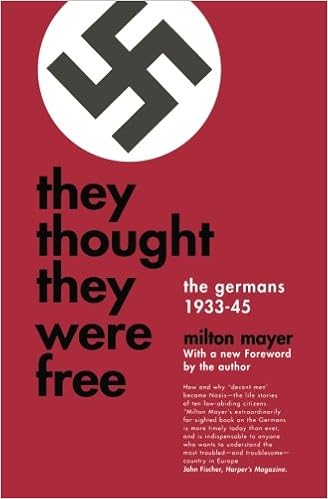 Extra credit question. While researching an article I’ll probably post next week, I read the 1955 classic They Thought They Were Free by Milton Mayer, in which he relates his conversations with ten low-level small-town Nazi Party members after the war. I was struck by this comment from a high school teacher.
For the first time in my life I was really the peer of men who, in the Kaiser time and in the Weimar time, had always belonged to classes lower or higher than my own, men whom one had always looked down on or up to, but never at. In the [National Socialist] Labor Front— I represented the teachers’ association— I came to know such people at first hand, to know their lives and to have them know mine. Even in America— perhaps; I have never been there— I suspect that the teacher who talks about ‘the common people’ has never known one, really known one, not even if he himself came from among them, as I, with an Army officer as a father, did not. National Socialism broke down that separation, that class distinction. Democracy— such democracy as we had had— didn’t do it and is not doing it now.
In other words, in a cultural sense the Nazi regime felt more democratic to him than the Weimar Republic. As a Nazi, he felt that he was part of the German Volk, no better or worse than any other German. He believed this was a common perception among his acquaintances.
There’s a lesson here about how Trump won. It seems to me that Democrats have lost that sense of cultural democracy, and that this is why the stereotypic poorly-educated white working-class Trump voter resents us. Instead, our leaders (of all factions) seem to identify with the meritocracy, which is a fancy way of saying that some people are just better than others. Hal Walker explains why this is a problem:
Economic disenfranchisement becomes an issue of who did well at school and who didn’t, not structural forces acting on society. What should be a progressive politics becomes just another version of the bootstraps myth, with grades and scholarships standing in for sweat and prudent personal budgeting. … In the end, the snobs lost to the slobs, but true to the character of the well-educated, they simply will not hear criticism that does not come from the similarly credentialed.
Trump was able to nail Clinton — and would have been able to nail Bernie and most of the rest of us — as the kid who sat in the front of the classroom and always had her hand up. Every time we fact-checked him, his fans were identifying with him, not us. “I know. They think I’m stupid too.”
I’m really not sure what to do about this. It’s one of the things I’m introspecting about. The meritocracy says that people in the lower classes are just losers, particularly if they can’t point to some form of discrimination that has kept them down unfairly. Without turning our backs on facts and science, how do we establish and project a sense that all people have worth?
[1] Legitimately. In the primaries, Clinton got about 3.8 million more votes. Bernie-or-bust folks tried to de-legitimize that result in two ways, but in neither case does the quality of the logic rise above the conspiracy-theory level.
The more specific version was a direct election-rigging claim that foreshadowed Trump’s baseless claims in the Fall. For example, there was this report from Election Justice USA. Here’s one of the points from the executive summary:
Analyses in [this report] show that voter purges [in New York] also disproportionately affected Sanders’ vote totals: the percentage of purged voters for each precinct was a significant predictor of Clinton’s vote share.
Anybody who understands the first thing about statistics should see that the conclusion doesn’t follow. If you’re aiming at a group of people, you’ll hit more of them in places where they congregate. So if a voter purge were targeted at likely Sanders voters, you’d expect to see the exact opposite result: More voters would be purged in precincts that Sanders won. (And no, the rest of the report doesn’t explain or justify that backwards conclusion.)
The whole report is like that. If something looked off somewhere, it must have been part of the grand anti-Sanders conspiracy.
The more vague argument was that the all-powerful DNC somehow manipulated those 3.8 million people into voting for Clinton. The evidence for this is supposedly in those emails that Russia hacked and WikiLeaks released.
I can’t say I’ve gone through the whole trove, but I read the emails that made headlines, the ones Bernie supporters point to. You know what isn’t in them? References to some specific anti-Sanders action that they carried out. I am not shocked to learn that when they talked among themselves, DNC folks weren’t neutral. They’re professional politicians; they couldn’t possibly be neutral in their hearts. I’m also not shocked that they discussed anti-Sanders arguments or strategies. But did they do any of them? That’s what’s missing.
Here’s the parallel that rings true for me: I’ll bet that if you bugged the umpires’ dressing room in a major league baseball stadium, you’d hear lots of resentment against players who make the umps look bad and fantasies of things they could do to those players. And since umpires are baseball people, they’re probably also fans and have players they admire. But (absent other compelling evidence) I would not interpret those conversations as a plot to throw the game.
And even if they had wanted to throw the election, they couldn’t have done it. The DNC is not a masters-of-the-universe club. Primary elections are run by state election commissions, not the national parties.
The fact needs to be faced: Clinton beat Sanders by 3.8 million votes.
[2] On Day 1, President Sanders sends a Medicare-for-everybody plan to Congress. On Day 2, Speaker Ryan assigns it to a committee that decides not to hold hearings or have a vote. What happens on Day 3?
[3] You shouldn’t interpret polls on particular issues as expressions of the public’s political identity, because issue-polling has persistent paradoxes. For example, if you ask whether the government spends too much or too little, a solid majority will say “too much”. But if you then start asking about specific cuts — “Should we cut Social Security?”, “Should we cut defense?” — all the major spending lines have majority support. If you could balance the budget by ending foreign aid to countries that hate us, the public would be all over that. But the things we actually spend big money on are fairly popular.
In short: Public opinion on a list of issues does not typically cohere into a worldview. Interpreting it as if it did will cause you to make mistakes.
[4] I think that’s the message to take from Roy Cooper’s win in North Carolina. It’s not Cooper himself, it’s the Moral Mondays movement that is changing the conversation.

 Sleeping Giants

 If you define the People that way, then I suspect Trump did win the “


