It’s hard for conservatives to talk about race. Maybe we could make it easier.
Liberal/conservative conversations about race often go like this one that happened on MSNBC at the end of March.
There is an incident (in this case Sean Spicer scolding a black female reporter, April Ryan) that shows lack of respect for a person of color. The liberal (in this case, Jason Johnson) places it in a larger context, a pattern of disrespect, and calls it out as racism. The conservative (Matt Schlapp) takes offense at the accusation and a shouting match ensues, ending any real exchange of ideas.
To an extent, I think this is a calculated tactic on the part of conservative pundits (or, at least, somebody calculated it at one point and others have imitated): There can be no discussion of patterns of disrespect based on race or gender. Any attempt to start such a discussion has to be shouted down.
Accordingly, any individual incident has to be presented as a unique occurrence and explained by the details of that particular situation. (Schlapp explains that Spicer “got feisty” with Ryan because he was under pressure to get through a lot of news that day.) Attempts to put a racial context around the incident have to be shut down. [1]
But whatever Schlapp or other talking heads might have in mind, it’s worthwhile to consider why their conservative viewers approve of this tactic and never see it for what it is: In conservative circles racism has a very specific meaning that usually doesn’t apply to the situation at hand. To conservatives, racism means conscious hatred, an intention to harm or humiliate a person purely because of his or her race. It isn’t that racism doesn’t exist, but it applies only to the KKK or the Nazis.
To Schlapp, then, it is absurd and outrageous to imagine that Sean Spicer is at his podium thinking “I’m tired of black reporters getting uppity with me, so I’m going to slap this one down.” That’s what Schlapp means when he says, “You don’t know what’s in Sean’s heart.”
But of course, Johnson had never claimed to know what was in Spicer’s heart, or to see conscious hatred there. He was pointing to a pattern of behavior both for Spicer and throughout the Trump administration, in which non-whites are shown less respect. There might be all kinds of reasons for such a pattern.
For example, what if Spicer simply sees blacks (or women) differently than he sees whites (or men)? [2] What if it’s his mental habit to interpret black actions more negatively, and to feel that harsher responses are appropriate? In that case, he might have been entirely unaware that he was treating April Ryan differently than a white White House correspondent like Peter Alexander or Jeff Zeleny, because even if Alexander or Zeleny had done the same thing, it would have looked different to him.
To the conservative mind, though, that’s not racism. If there is no conscious hatred involved, then it’s totally unfair to suggest comparisons to the KKK, as they feel racism does.
“So fine, then,” a liberal might say, “give me the word that applies to this situation and we’ll use it.”
But then you hit the root problem: There is no conservative term for the habitual and perhaps unconscious tendency to see people of another race differently, judge them more negatively, and react to them more harshly. In the absence of such a term, there is no way to point out the phenomenon and discuss it. You can’t ask about the elephant in the room, because elephant refers only to mastodons, who died out ages ago. There is no word for the big, gray animal swinging his trunk around, so any attempt to discuss him inevitably veers off in some other direction.
A conservative might respond that I’m describing an esoteric phenomenon of so little consequence that it doesn’t really need a name or a discussion. But that is completely unconvincing after eight years of the Obama administration, during which conservative media outlets repeatedly raised their audience’s outrage when Obama did things white presidents had been doing without incident for decades. I don’t claim to know what was in the hearts of the people who felt that outrage — I doubt that most of them were consciously aware they were applying different standards to Obama — but the pattern of observable behavior was clear and obvious. [3]
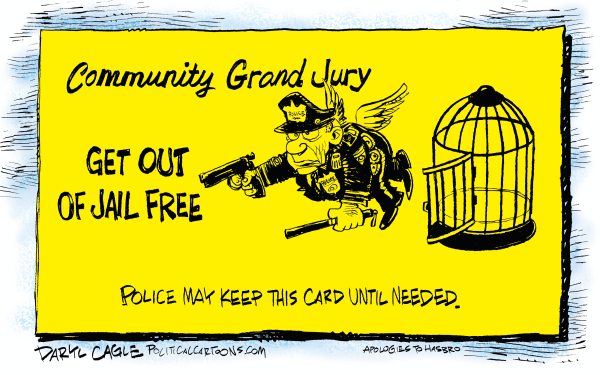
Likewise, this is the whole issue behind Black Lives Matter. It isn’t that people become cops because they like to kill blacks. (I mean, some small number probably do, but I doubt it’s typical, and I believe the system tries to weed those guys out.) But white guys can safely carry semi-automatic rifles through Target, while a black guy in Walmart gets gunned down for picking up a toy. Cops just see young black men differently, judge their actions more negatively, and respond more harshly. We can’t have a rational discussion of that issue because conservatives refuse to call it racism, but don’t offer any alternative term for it.
We could give them one.
I know this isn’t a new idea. In liberal circles, there is already a distinction between conscious and unconscious bigotry. We often talk about implicit bias, and there is even a test you can take for it on the internet. But every term I’ve heard smacks of some liberal bastion like psychology or academia. None of them would sound right rolling out of a conservative mouth. A conservative talking about implicit bias would impress his fellow conservatives about as much as a macho man talking to his locker-room buddies about relationships and commitment.
If we want a real discussion to start, what we need isn’t technical jargon appropriate for an academic journal, but some ten-cent words already in everyday use, taking advantage of some metaphor that ordinary people might come up with if they happened across the phenomenon on their own, without ever attending a course in racial studies.
Here’s a common metaphor that might work: Emotions have temperature. Hate and anger are hot. If you feel a vague aversion towards someone, you are cool to them, and if the aversion got stronger you might want to freeze them out.
If we apply that metaphor to racism, then the kind conservatives already acknowledge, the conscious hatred that Emmett Till‘s killers must have felt, is hot racism. When Richard Spencer calls for “ethnic cleansing” to turn American into a “white ethnostate”, that’s also hot racism.
Cold racism, on the other hand, doesn’t actively wish harm on people of color, but simply fails to factor in their interests or to weigh them as heavily as the interests of whites. Those who watched Eric Garner die saying “I can’t breathe” and felt motivated to make excuses for the police choking him — most of them probably weren’t feeling hatred or anger towards Garner, they were just failing to feel compassion for a fellow human being. The problem wasn’t their heat it was their coldness. [4]
The kind of racism that whites can live with and not notice — the kind that simply sees blacks differently and then acts in a way that feels appropriate to that harsher perception, without any awareness of personal animus — could be described as room-temperature racism. The room-temperature racist feels like he is the one acting normally, and doesn’t understand why others are getting upset with him.
That, I believe, describes Sean Spicer. An avowed white nationalist like Richard Spencer knows that race is an issue for him. But Spicer just believes he’s responding appropriately to what he sees. The details of the Holocaust (to bring up another recent example) just don’t stick in his head. Why, he probably wonders, are Jews so bent out of shape about that?
If liberals started consistently applying a temperature gauge to racism, I think most moderates would understand the metaphor without much explanation, and conservatives might eventually get it in spite of themselves. Some talking heads — the ones who are consciously looking to disrupt discussions of race — might keep reacting with outrage to any mention of racism, regardless of temperature. But part of their audience might realize that finding room-temperature racism in the patterns of Spicer’s responses isn’t the same as fitting him for a white hood. They might eventually recognize that there is a consistent phenomenon in the incidents that carry that label.
Elephants, they might come to understand, are not mastodons. Occasionally there is one in the room. Maybe there should be a conversation about it.
[1] Conservatives, in their usual pot-and-kettle way, claim that it is liberals who shut down discussions by bringing up racism. But this is true only if you begin with the premise that racism can never be discussed. Apparently, it is impossible for conservatives to respond to “That’s racist” with a skeptical “How?”.
[2] In this article I’m going to focus specifically on racism, but what I’m saying could apply to any form of bigotry. We could talk about hot and cold sexism, hot and cold nativism, and so on.
[3] In 2014, I documented a long series of examples, but two moments should stand out in everyone’s memory: State of the Union addresses have contained debatable statements for as long as I can remember, but no white president was ever interrupted by “You lie!“. And the entire Birther theory, which as late as last summer was still given credence by a majority of Republicans, demonstrated that a large number of Americans were ready to believe anything negative about Obama, regardless of evidence.
There are comparable examples of baseless conspiracy theories about white presidents — that George W. Bush was complicit in 9-11 or FDR was secretly Jewish. But all of them stayed on the fringes of public debate. None ever caught on like Birtherism or stayed viable in the face of clear evidence and repeated debunking.
Now, does that mean that Joe Wilson was consciously thinking, “I can’t let that nigger get away with saying that”? Am I implying that everyone who doubted Obama’s citizenship is a potential cross-burner? Not at all, but it is part of a long pattern of seeing blacks differently, judging them more negatively, and responding to them more harshly.
[4] When I google “cold racism”, most of the examples are of the form “stone cold racism”, which is a different thing. It’s the hardness of the stone that’s being evoked, not the temperature of the feeling.



 Recalling Ferguson. I remember exactly when I came to accept that Darren Wilson should not be prosecuted for killing Michael Brown: when I read