Until this week, I held the standard establishment view of the anti-fascist group Antifa and the “black blocs” they resemble: They’re anarchist or leftist mirror-images of the right-wing thugs they fight. I have heard personal friends say things similar to what Hullabaloo’s Tom Sullivan wrote Saturday:
The local Indivisible chapter organized a peace vigil downtown here last Sunday in solidarity with Charlottesville. It was one of many such vigils around the country. Not a Nazi symbol in sight. Yet the local antifa group that attended seemed bent on taking over what was intended to be a peaceful rally. There was a shouting match with police the organizers had requested. Later, the group split off and marched through downtown chanting slogans. To the usual “Whose streets? Our streets!” they added “Cops and the Klan go hand in hand.” and “What do we want? DEAD NAZIS. When do we want ’em? NOW!“
The mirror-image-thug frame was present when CNN talked to a police spokesman from Portland, Oregon:
It is new, and this, like, this rumble mentality of, “I’m going to bring my friends, you’re going bring your friends, and we’re going to fight it out in the park” — it’s not something we’ve seen here. It’s not good for the city. People are just frustrated by it. It’s affecting their livability. It’s affecting their business. It’s affecting their commute.
The same piece quotes Cal State academic Brian Levin making a common liberal criticism:
It’s killing the cause — it’s not hurting it, it’s killing it, and it will kill it. We’re ceding the moral high ground and ceding the spotlight to where it should be, which is shining the spotlight on the vile. … No, it’s not OK to punch a Nazi. If white nationalists are sophisticated at anything, it’s the ability to try to grasp some kind of moral high ground when they have no other opportunity, and that’s provided when they appear to be violently victimized. That’s the only moral thread that they can hang their hats on. And we’re stupid if we give them that opportunity.
What about the ‘alt-left’ that came charging at, as you say, the ‘alt-right’? Let me ask you this: What about the fact they came charging — that they came charging with clubs in their hands, swinging clubs? Do they have any problem? I think they do.
It’s Trump, of course, so you have to take “fact” with a grain of salt. But it sounds bad.
You get a different picture, though, from a number of eye-witness accounts of Charlottesville. Like this Democracy Now!interview:
CORNELWEST: You had a number of the courageous students, of all colors, at the University of Virginia who were protesting against the neofascists themselves. The neofascists had their own ammunition. And this is very important to keep in mind, because the police, for the most part, pulled back. The next day, for example, those 20 of us who were standing, many of them clergy, we would have been crushed like cockroaches if it were not for the anarchists and the anti-fascists who approached, over 300, 350 anti-fascists. We just had 20. And we’re singing “This Little light of Mine,” you know what I mean? So that the—
AMYGOODMAN: “Antifa” meaning anti-fascist.
CORNELWEST: The anti-fascists, and then, crucial, the anarchists, because they saved our lives, actually. We would have been completely crushed, and I’ll never forget that.
In the heat of the moment I doubt West counted precisely, so I’ll remain skeptical of his numbers. But Slate‘s Dahlia Lithwick collected several accounts of what I take to be the same event. Rebecca Menning told her:
No police officers in sight (that I could see from where I stood), and we were prepared to be beaten to a bloody pulp to show that while the state permitted white nationalists to rally in hate, in the many names of God, we did not. But we didn’t have to because the anarchists and anti-fascists got to them before they could get to us. I’ve never felt more grateful and more ashamed at the same time. The antifa were like angels to me in that moment.
Brandy Daniels described Antifa as respectful and helpful:
Some of the anarchists and anti-fascist folks came up to us and asked why we let [the white supremacists] through and asked what they could do to help. Rev. Osagyefo Sekou talked with them for a bit, explaining what we were doing and our stance and asking them to not provoke the Nazis. They agreed quickly and stood right in front of us, offering their help and protection.
And Rev. Seth Wispelwey added:
I am a pastor in Charlottesville, and antifa saved my life twice on Saturday. Indeed, they saved many lives from psychological and physical violence—I believe the body count could have been much worse, as hard as that is to believe. Thankfully, we had robust community defense standing up to white supremacist violence this past weekend.
I wasn’t there, and have never seen Antifa with my own eyes. But here’s how it looks to me: Antifa is based on an anarchist worldview, in which state institutions like the police are not to be trusted. When that assumption is false — when, say, organizers and police have made a plan for an orderly, peaceful demonstration and that plan is flowing smoothly — then having Antifa show up can be a real nuisance.
But when that assumption is true, and the police are not going to protect you from right-wing violence, then it’s good to have some “robust community defense” around.
So if you’re disturbed by the rise of Antifa — whether you’re a conservative worried about leftist violence, a local government trying to maintain order, or a liberal group hoping to protest peacefully — the long-term way to shrink their numbers is clear: Don’t create the conditions that make them right.
When state institutions work well, and work for the benefit of the vast majority, then anarchists look like nut jobs. But when they don’t work, when the people have to start organizing their own defenses outside the system, and when the only path of protest liberals offer is nonviolent martyrdom, then anarchists who come prepared to face violence start to make a lot of sense.
Another slow news week. Whatever will I find to write about?
Let’s start with Antifa, the sometimes violent anti-fascist group. I won’t say I reversed my opinion of Antifa this week, but I certainly had to think again after all the Antifa-saved-my-life testimony from clergy who went to Charlottesville to protest nonviolently. So this week’s first featured post, “What to Make of Antifa?” gives a much more balanced and nuanced view than if I’d written it before Charlottesville. That should be out around 8:30 EDT.
I’ve been talking about Confederate monuments since 2014’s “Not a Tea Party, a Confederate Party“, where footnote [1] calls them “victory monuments”. In that post (which has over half a million hits so far) I argue that if you reconsider the Civil War in the light of Iraq, and interpret Reconstruction as the guerilla phase that followed the 1861-65 battlefield phase, then the South won that longer 1861-1877 war.
So I can’t resist talking about tearing down Confederate monuments now that everybody else is. I expose several of the fallacies the monuments’ defenders are putting forward in the second featured post, “A Few Points About Confederate Monuments”. That should come out around 10.
That still leaves the weekly summary with a lot to cover. The best way to combat the alt-Right’s (and Trump’s) propaganda about Charlottesville is with video and eye-witness testimony, so I link to a bunch of that. I find that the idea of a Unite the Right rally is a lot easier to defend than the footage of people carrying swastika flags and chanting “Blood and Soil!” So the best argument to make to your conservative friends is to show them video and say, “Look at this. Are those your people?”
Then Trump’s response and the fallout from that. I call special attention to a scandalous fact that isn’t getting nearly enough coverage: Trump’s business advisory councils dissolved after he echoed Nazi talking points, but his religious advisory council didn’t. These are the same self-styled “moral leaders” who stood by Trump after Pussygate, and they demonstrate the complete corruption of the Religious Right.
Then Steve Bannon’s exit from the White House, and whether it means anything. Anything else? Oh yeah, Trump disbanded the advisory council that produces the National Climate Assessments, because who needs all that depressing information? The Justice Department wants the IP addresses of 1.3 million people who visited a Trump-resistance site. And a few other things, before I close with an amazing video of lightning striking a river.
These [white supremacist] groups seem to believe they have a friend in Donald Trump in the White House. I don’t know why they believe that, but they don’t see me as a friend in the Senate, and I would urge the president to dissuade these groups that he’s their friend.
– Senator Lindsey Graham,
Fox News Sunday, 8-13-2017
This last couple of days everybody has talking about Charlottesville
Charlottesville is where Thomas Jefferson put the University of Virginia. Like most university towns, it’s solidly blue: Clinton beat Trump 80%-13%. Like a lot of liberal areas in the South, it’s been wondering why it has all these monuments to the Confederacy. Sure, the Confederacy ought to be remembered, but does it really deserve to be celebrated?
In particular, a huge statue of Robert E. Lee on a horse was erected there in 1924. In April, the City Council voted to remove the statue, but there’s a court case based on a 1902 state law protecting war monuments, so it’s not clear what will happen.
This weekend, an alliance of alt-Right groups (including the KKK and some neo-Nazis), converged on Charlottesville for a “Unite the Right” rally centered on the Lee statue. Many came armed and in military-style riot gear, or waved Confederate or Nazi flags. Friday night there was a torchlight march, reminiscent of the torchlight parades of the Third Reich.
Counter-protesters, many of them clergy, also converged on Charlottesville. (I’m not clergy, but I’m on some of the same mailing lists as Unitarian ministers. I got a request to come to Charlottesville for the counter-protest. It did not say anything about coming armed or in riot gear.) Reportedly, there were also some anti-fascist counter-protesters (not clear how many), who believe in meeting violence with violence.
Friday night, the right-wingers marched through the university campus chanting “white lives matter” and other white supremacist slogans, including some anti-Semitic ones. Counter-protesters had gathered around a Jefferson statue; they were encircled by the marchers and some scuffling occurred, apparently with only minor injuries.
Saturday, the violence peaked with a reported Nazi sympathizer ramming his car into a crowd of protesters, killing one and injuring 19. The photo below shows the alleged driver carrying a shield with the Lee statue in the background. (He’s just below the horse’s tail.)
Piece of advice these next few days: Don’t get trolled. Some truly awful links are going around on social media, including a number to articles that I think were written purely to outrage people like me (and, I assume, you). By linking to them, we publicize the web sites they come from, which I think was the point.
You who know who really deserve to be on Southern Civil War monuments? Slaves who escaped, joined the Union Army, and came back to fight for the freedom of their people. Those are the real Southern heroes.
The President responded to this act of right-wing terrorism by listlessly reading a statement that refused to take sides between Nazis and people who protest against Nazis.
We condemn in the strongest possible terms this egregious display of hatred, bigotry and violence, on many sides, on many sides.
Our country is doing very well in so many ways. We have record, just absolute record, employment. We have unemployment the lowest it’s been in almost 17 years. We have companies pouring into our country, Foxconn and car companies and so many others. They’re coming back to our country. We’re renegotiating trade deals to make them great for our country and great for the American worker. We have so many incredible things happening in our country, so when I watch Charlottesville, to me it’s very, very sad.
Because it doesn’t matter who’s dead, everything is about him and his accomplishments. And once again he talked as if his base were the whole of America.
We are all Americans first. We love our country. We love our God. We love our flag. We’re proud of our country. We’re proud of who we are.
So if you feel mistreated by America, don’t believe in God, have mixed feelings about the flag, or if recent events — including the very event he’s supposed to be responding to — sometimes make you feel ashamed of your country, then he’s not even trying to be your president. You’re not part of the “all” he’s speaking for.
You only had to look at other Republicans to realize that getting this right is not difficult. Orrin Hatch tweeted:
We should call evil by its name. My brother didn’t give his life fighting Hitler for Nazi ideas to go unchallenged here at home.
The Nazis, the KKK, and white supremacists are repulsive and evil, and all of us have a moral obligation to speak out against the lies, bigotry, anti-Semitism, and hatred that they propagate.
How hard was that? But even after nearly two days, nothing from the President against white supremacy and Nazism.
Here’s what it comes down to. KKK types like David Duke are invoking Trump’s name and telling their followers that Trump is on their side. Trump is not telling them that they’re wrong, because they’re not wrong. He and his administration have been cultivating white supremacist support for years. He won’t criticize them because they’re his base.
Gorka, Stephen Miller, Steve Bannon — the alt-Right recognizes them as their own people inside the Trump administration.
Another place where Trump is slow to speak out is against Vladimir Putin. Putin responded to the new sanctions Congress just passed (by a near-unanimous margin that caused Trump to sign the bill rather than face a veto override) by demanding large cuts in the U.S. diplomatic mission to Russia. When asked about it by a reporter on Thursday, he thanked Putin for helping him trim the payroll.
He later claimed he was being “sarcastic“. But whether he was serious or not, he clearly avoided criticizing or opposing Putin, who seems to be the alpha in their relationship.
but before that it looked like we might go to war with North Korea
It’s starting to look like we might not go to war after all, though it’s hard to say that anything has changed in the last few days. And as Rachel Maddow keeps pointing out, it’s also not clear what changed before that to ratchet up the tensions.
Over-simplifying recent history into one paragraph: The Clinton administration recognized that we had no good military options against North Korea, so instead it bribed the Kim dynasty with aid in exchange for it not developing nuclear weapons. Then the Bush administration came in and decided to “get tough” and end Clinton’s “appeasement”. So the Clinton deal collapsed, and Bush got to posture in a manly fashion. But there were still no good “tough” options, so North Korea developed nuclear weapons. That’s how we got into this situation.
The real lesson I draw from this is that we should be extremely wary about actions which have the feeling or appearance of toughness but which are likely to have negative or even dire results because we have no viable, alternative policy. That seems very much like the situation we are moving toward with North Korea. Certainly it’s what President Trump was doing yesterday when he made wild threats he is highly, highly unlikely to follow through on.
All-out war would mean the destruction of Seoul (and possibly Tokyo, though Krasner doesn’t say so), so it’s not acceptable. “If South Korea suffered such a large loss of life as a result of a basically unilateral American strike, it would be the end not only of the South Korean-U.S. alliance but of NATO as well. No country will tie itself to the United States if the United States through its own actions can take measures that would result in hundreds of thousands of citizens in other countries being killed.”
Only China has enough influence in North Korea to bring about new leadership with less destabilizing policies.
Our best-case outcome is China’s worst-case outcome: a unified Korea allied with the United States. We can’t hope for Chinese help that makes such an outcome more likely.
His proposal:
So there is a deal that the United States could credibly offer to China: leadership change in North Korea and the end to nuclear and missile programs there, in exchange for the withdrawal of American troops from the peninsula. All U.S. forces would be removed, if China actually succeeded in engineering the ouster of Kim Jung-un and an associated end to its nuclear and missile programs. A North Korean commitment to end its nuclear program made by a leader dependent on China would be more credible than any commitment made by Kim.
China is trying to be the grown-up in the room. In contrast to Kim’s usual over-the-top rhetoric and Trump’s off-the-cuff threats, Thursday a Chinese state-owned newspaper published a carefully worded editorial that Western observers regard as a “semi-official” statement from the government.
China should also make clear that if North Korea launches missiles that threaten US soil first and the US retaliates, China will stay neutral. If the US and South Korea carry out strikes and try to overthrow the North Korean regime and change the political pattern of the Korean Peninsula, China will prevent them from doing so.
I imagine this being said in the tone of voice of a Mom drawing a line down the center of the back seat and insisting that the kids each stay on their own side.
and that Google anti-diversity memo
In case you didn’t hear about it: Google engineer James Damore posted a memo to one of Google’s internal discussion lists, criticizing Google’s program to promote race-and-gender diversity in the workforce and management. The two final bullet points in his introduction were:
Differences in distributions of traits between men and women may in part explain why we don’t have 50% representation of women in tech and leadership.
Discrimination to reach equal representation is unfair, divisive, and bad for business.
The memo got out and went viral. Google fired him. This also sparked a huge amount of discussion, and the engineer is on his way to becoming an alt-Right hero. I wouldn’t be surprised if he gets a book-and-movie deal out of it.
Rather than write my own article about these issues, I think I’ll just say a few things briefly and then point you at the commentary I found most thoughtful.
My few things:
There probably are “differences in distributions of traits” between men and women that might continue to be present in a totally non-sexist world. But society as we know it — and the tech workplace in particular — is such a contaminated environment that I don’t know how you’d do convincing research to measure how significant those differences are.
There is a long, sad history of science being used to bolster social stereotypes. To borrow a legal term, any conclusions along those lines deserve strict scrutiny.
If there is some “natural” level of women in tech — the number you’d get if there were neither sexism nor diversity programs to counter it — I’ll bet it’s higher than Google’s current 20-25%. Talking about 50% is a red herring; there are more possibilities than (1) perfect equality and (2) the status quo.
Job descriptions and the population of people who hold those jobs evolve together. Our current understanding of what it means to be a software engineer was shaped during an era when it was a job for men, so it may well depend on certain stereotypically male traits that aren’t actually necessary. If the job as currently defined is “unnatural” for women, that could be a reason to change the job.
Now let’s get to other people’s comments. The best zinger I heard was tweeted by Sarcastic Rover, the alleged voice of the AI governing the NASA Mars rover.
Some people just love a merit-based system… right up until the merit you want is “not being an asshole.”
If you want to argue the science with Damore, start here.
Claire Cain Miller writes on NYT’s “The Upshot” blog that stereotypic male nerdiness is not necessarily what software engineering is about.
Technical skills without empathy have resulted in products that have bombed in the market, because a vital step to building a product is the ability to imagine how someone else might think and feel. “The failure rate in software development is enormous, but it almost never means the code doesn’t work,” Mr. Ensmenger said. “It doesn’t solve the problem that actually exists, or it imagines a user completely different from actual users.”
Ezra Klein went meta, thinking about the reasons this incident hit such a nerve with the larger public.
Behind the furor over the memo is our unease with the unaccountable, opaque power Google in particular, and Silicon Valley in general, wields over our lives. If Google — and the tech world more generally — is sexist, or in the grips of a totalitarian cult of political correctness, or a secret hotbed of alt-right reactionaries, the consequences would be profound.
Google’s influence is much harder to avoid than McDonalds’ or WalMart’s.
Compounding the problem is that the tech industry’s point of view is embedded deep in the product, not announced on the packaging. Its biases are quietly built into algorithms, reflected in platform rules, expressed in code few of us can understand and fewer of us will ever read. And yet those hidden commands and unexamined choices can lead to discrimination in housing and jobs, to a public sphere that fosters continual harassment of women and people of color, to a world where conservative news is suppressed, to a digital commons that everyone must use but that only a certain kind of person gets to build.
… The technology industry’s power is vast, and the way that power is expressed is opaque, so the only real assurance you can have that your interests and needs are being considered is to be in the room when the decisions are made and the code is written. But tech as an industry is unrepresentative of the people it serves and unaccountable in the way it serves them, and so there’s very little confidence among any group that the people in the room are the right ones.
So long as that’s true, any indication that the builders of tomorrow are quietly against you, which is what Damore’s memo was, will be explosive.
and you also might be interested in …
Early in the week I thought I might have space to talk about final draft of the “Climate Science Special Report” of the U.S. Global Change Research Program. Key quote:
It is extremely likely that human influence has been the dominant cause of the observed warming since the mid-20th century. For the warming over the last century, there is no convincing alternative explanation supported by the extent of the observational evidence.
Attacking McConnell over Senate inaction also allows Trump to cultivate the two crucial sectors of his political support at the same time — his loyal base of less ideological voters who hate the establishment, and purist conservatives who are livid that Obamacare remains the law of the land.
One constant of Trump’s character is that nothing is ever his fault. Very little that he promised during the campaign is actually getting done, so he needs a scapegoat. But this much should be obvious: If Trump had offered the healthcare plan he promised — the one that gave everybody better coverage for less money, and was less expensive for the government too — it would have zoomed through Congress. The fact that he was lying and actually had no plan at all is his own fault, not McConnell’s.
From The Weekly Standard, which is one of the flagship publications of the conservative media:
Short-lived White House communications director Anthony Scaramucci was an utterly forgettable political hack. But he said one thing before he was dismissed that’s worth reflecting on: “There are people inside the administration that think it is their job to save America from this president. Okay?” Scaramucci was right about that. We know these people, and we admire them. We wish them every success.
Taylor Swift’s $1 countersuit against the guy who’s suing her for millions (because her complaint of sexual harassment, he claims, got him fired) could be a teaching moment for the larger society. Being famous, beautiful, well-known, rich, and so forth, Swift has advantages that most harassed women lack. So at the same time that it’s instructive and satisfying to watch the usual attacks fail to throw her off-stride, the trial also has to give you sympathy for the women who usually have to face these tactics.
If you are a Person of Color (POC), you have enough on your plate! It’s not your job to educate white people about privilege, racism, and what’s really going on in the world. If a white person is filling your social media with white nonsense – anything from overt racism to well-intentioned problematic statements – tag us and a white person will come roundup our own.
and let’s close with something brilliant
By now readers know that I love song parodies and Game of Thrones. So how could I resist “Westerosi Rhapsody”?
Be warned: The video is not safe for work, contains graphic sex and violence, and includes spoilers for most of the major plot developments through Season 6.
A conspiracy theory that belongs on InfoWars is at the heart of a National Security Council power struggle.
By now, anyone who has been paying attention has figured out that the Trump White House is a pretty odd workplace. From Trump himself tweeting against allies like Jeff Sessions and Mitch McConnell, to Steve Bannon’s pseudo-news organization (Breitbart) attacking then-Chief-of-Staff Reince Preibus and Trump son-in-law Jared Kushner, to Bannon in turn being accused by the then-communications-director of “trying to suck [his] own cock“, it’s been clear that something beyond ordinary office politics is going on here.
But the memo that got Rich Higgins fired from the National Security Council staff opens up cans of crazy that go far beyond anything that’s gotten public attention so far, and illuminates how deep the conflicts within the administration go. The seven-page document explains a decades-long and largely successful plot by “cultural Marxists” to destroy America “both as an ideal and as a national and political identity”. It claims that cultural Marxist narratives are now embedded in the Deep State, the establishments of both political parties, academia, the mainstream media, and international banks — and are even promoted by Islamists, because (in some unfathomable way) the same “nihilism” that cultural Marxists are using to destroy monotheistic Christianity also prepares the ground for monotheistic Islam.
Higgins attributes the current struggles of the Trump administration to a campaign by cultural Marxists, who see Trump as a threat to their domination. They have unleashed “political warfare memes based on cultural Marxist narratives” that are “designed to first undermine, then delegitimize and ultimately remove the President”. The memo concludes:
The recent turn of events give rise to the observation that the defense of President Trump is the defense of America. In the same way President Lincoln was surrounded by political opposition both inside and outside of his wire, in both overt and covert forms, so too is President Trump. Had Lincoln failed, so too would have the Republic.
There’s a lot to unpack here. First, how did Rich Higgins ever get into the NSC to begin with? Who fired him? And is anybody taking him seriously? (Apparently yes. Somehow the memo found it’s way to Donald Trump Jr., who passed it on to the President. Trump reportedly “gushed” over it, and was upset to discover that the author had been fired.) And what the heck is “cultural Marxism” anyway?
The Flynn connection. Higgins was appointed to the NSC by Michael Flynn during his brief tenure as National Security Adviser.
Flynn is a source of crazy all his own, and is at the center of one of the deep mysteries of the Russia scandal. During the transition period between the election and the inauguration, Flynn seems to have been running his own Russia policy in competition with the Obama administration, which was still in power. During the time he was Candidate Trump’s main national-security adviser, he had been — and maybe still was after he officially joined the administration — an undeclared foreign agent of the Turkish government. (He was still carrying out his duties for the Turks as late as November 8, otherwise known as Election Day.) The extent of his connections to the Putin government is still unknown.
On January 26, acting Attorney General (and Obama holdover) Sally Yates began warning the new administration that Flynn had been lying to them about his contacts with Russian officials, and that he might be vulnerable to Russian blackmail. Nothing was done with this information — and Flynn continued to participate in national-security meetings at the highest level — until The Washington Post published it February 9. Flynn resigned February 13.
McMaster. After several people turned down a job ordinarily considered a career-crowning prize, H. R. McMaster replaced Flynn as National Security Adviser. However, his early attempts to clean house of Flynn’s appointments were stymied by Flynn allies Steve Bannon and Jared Kushner. (Kushner and Flynn, you might remember, had a strange meeting with Russian Ambassador Kislyak, during which they requested a “back channel” to Moscow that American intelligence couldn’t tap. Even Kislyak found that odd.) Recently, though, McMaster seems to have gained the upper hand; Higgins is not the only Flynnite to have been sent packing.
But McMaster, in turn, is now the target of a backlash. Politico reports that “The conservative news site Breitbart has waged a nonstop campaign against national security adviser H.R. McMaster.” A little over a week ago, “two former senior NSC officials” told The Daily Caller that “Everything the President wants to do, McMaster opposes.”
Trump wants to get us out of Afghanistan — McMaster wants to go in. Trump wants to get us out of Syria — McMaster wants to go in. Trump wants to deal with the China issue — McMaster doesn’t. Trump wants to deal with the Islam issue — McMaster doesn’t. You know, across the board, we want to get rid of the Iran deal — McMaster doesn’t. It is incredible to watch it happening right in front of your face. Absolutely stunning.
In typical conspiratorial fashion, McMaster isn’t presented as his own man with his own beliefs, but rather as “a sycophant” of somebody else: retired General David Petraeus. Alt-right blogger Mike Cernovich has started a McMaster Leaks site to publish negative information about McMaster. (Josh Marshall provides background on Cernovich.) He illustrates one article with a cartoon depicting McMaster and Petraeus as dancing puppets of arch-nemesis billionaire George Soros, who in turn is a puppet of the Saudis.
attacks on McMaster from right-wing media figures coincide with a coordinated troll campaign, according to a newly launched website that tracks Russian propaganda. Using hashtags like #FireMcMaster and #deepstate, accounts linked to Russian-backed bot campaigns shared several anti-McMaster stories this week.
In other words: The Flynn/Bannon/Putin alliance still seems to be functioning.
Cultural Marxism. Probably I had run across this phrase before I saw it in Higgins’ memo, but if I did it didn’t make any impression. Apparently, though, it is widely discussed by right-wing conspiracy theorists. You can get an in-depth introduction to the concept, at least as it is used on the far right, from this 90-minute video.
The video’s account begins with some actual history: As World War I broke out, Communists around the world hoped that workers would refuse to fight for their own country’s capitalists against the workers of other countries. But that dream went unfulfilled; each belligerent country was able to beat the drums of patriotism and inspire incredible levels of sacrifice from even its most oppressed citizens. Assessing what went wrong, many Communists concluded that physical revolution could only happen after a considerable amount of cultural change.
But from there, the Glenn-Beck-whiteboard mindset takes over: All the cultural changes we’ve seen since the Great Depression — the end of Jim Crow, women’s liberation, the sexual revolution, gay rights, etc. — originate in the 1930s with the prison notebooks of Italian Marxist Antonio Gramsci, and continue through the Frankfurt School of social theorists who started in Germany and then escaped Hitler by coming to America. Who knew that a handful of intellectuals could wield so much influence?
The point of this conspiracy was and is to destroy the family, Christianity, western culture, the middle class, the Constitution, reverence for the Founding Fathers, and ultimately America itself. This continuing cultural Marxist conspiracy — and not anything Trump himself did or didn’t do — is the source of the administration’s difficulties.
The conspiracy-theory sidestep. Think about how believing this theory might change your mindset: Anything that was actually wrong with pre-New-Deal America, or that continues to be wrong with America today, becomes irrelevant. If you believe that an apocalyptic battle is going on between “America as an ideal and as a national and political identity” and a mysterious cabal of “cultural Marxists” who have been plotting against America since the 1930s, then anything that looks like a legitimate criticism of American traditions is just a way for the plotters to score points.
So the civil rights movement wasn’t really about lynching, segregation, or the right to vote; it was a way to divide America against itself and undermine Americans’ confidence in the righteousness of their country. Feminism wasn’t really about giving women the freedom to find their own places in the world, rather than be channeled into a small number of subservient roles; it was about destroying the male and female archetypes that God defined in the Garden of Eden. The sexual revolution wasn’t caused by improved birth control, widespread affluence, or new opportunities for women to be economically independent; it was designed by cultural Marxists to undermine Christianity and the American family. Schools now teach about the Founders’ slaves and the Native Americans who were slaughtered to make way for white settlers, not because those things are true — that’s irrelevant — but to destroy students’ American patriotism.
Similarly, current issues need not be considered on their individual merits — all those details are similarly irrelevant — but for their effects on the apocalyptic battle. Same-sex marriage has nothing to do with gays and lesbians finding a place in society; it’s about destroying marriage and the social structure that depends on it. ObamaCare isn’t about saving lives or preventing medical bankruptcies; it’s about extending dependence on government. The goal of Black Lives Matter isn’t to keep police from killing blacks on slight pretexts, but to tear down law and order. If you do anything but dismiss these issues — and especially if you get drawn into the stories of the so-called “victims”– you’re just letting cultural Marxists distract you from what’s really important.
Trump. Now look again at the Higgins memo. Attacks against Trump are not “politics as usual”,
but rather political warfare at an unprecedented level that is openly engaged in the direct targeting of a seated president through manipulation of the news cycle. It must be recognized on its own terms so that immediate action can be taken. At its core, these campaigns run on multiple lines of effort, serve as the non-violent line of effort of a wider movement, and execute political warfare agendas that reflect cultural Marxist outcomes. The campaigns operate through narratives. Because the hard left is aligned with Islamist organizations at local (ANTI FA working with Muslim Brotherhood doing business as MSA and CAIR), national (ACLU and BLM working with CAIR and MPAC) and international levels (OIC working with OSCE and the UN), recognition must given to the fact that they seamlessly interoperate at the narrative level as well. In candidate Trump, the opposition saw a threat to the “politically correct” enforcement narratives they’ve meticulously laid in over the past few decades. In President Trump, they see a latent threat to continue that effort to ruinous effect and their retaliatory response reflects this fear.
The first thing that should strike anyone engaged in actual anti-Trump action is the sheer unreality of this vision. Probably you are straining to keep Bernie Democrats and Hillary Democrats from turning on each other. The idea that you might “seamlessly interoperate at a narrative level” with the Muslim Brotherhood and the UN is absurd to a point beyond humor. (I am reminded of John Maynard Keynes’ post-Great-Depression comment on the theory of a world-spanning bankers’ conspiracy: “If only there were one.”)
But once you believe that Trump is the key roadblock to the evil plans of the cultural Marxists, and that the narratives against him are “political warfare”, whether those narratives are true or false becomes irrelevant.
Higgins identifies the anti-Trump “meta-narratives” as
Trump is illegitimate.
Trump is corrupt.
Trump is dishonest.
and “supporting narratives” as
Russia hacked the election.
obstruction of justice
hiding collusion
Putin puppet.
So patriotic Americans need never consider questions like: Are the things Trump says actually true? Are his companies making money from his presidency? Why won’t he release his tax returns? Why did he fire James Comey? Why won’t he criticize Putin? Why did the Russian government’s social-media assets promote so much anti-Clinton fake news just before the election? Why did it take so long to fire Flynn? Why did so many of Trump’s people meet with Russian officials and then either hide it or lie about it? How far back do his business dealings with Russian oligarchs go?
Plausible answers to such questions are not necessary, because just asking them promotes the cultural Marxist narrative. Remember: “The defense of President Trump is the defense of America.” So forget the insignificant details. Which side are you on?
Spy vs. spy. The most important thing to understand about conspiracy theorists is: Whatever they imagine the conspiracy doing against them, they will be tempted to do “in response”. So if they see a battlespace where weaponized narratives compete independent of fact or truth, then that’s where they will fight.
Conspiracy theorists are prone to betray their plans through projection. Whatever they wish they could do — and would do if they had the power — they imagine that their near-omnipotent enemies are already doing.
What’s new? Conspiracy theories have been around for a very long time. (When I was in high school in the 1970s, I humored a friend by reading some of his John Birch Society paperbacks. The ideas were similar.) Such fantasies are a psychological defense against the complexity of the real world, and an opportunity to feel superior to the sheep who remain oblivious to the dark patterns behind events. As Alan Moore put it in 2003:
Conspiracy theorists actually believe in a conspiracy because that is more comforting. The truth of the world is that it is chaotic. The truth is, that it is not the Jewish banking conspiracy or the grey aliens or the 12 foot reptiloids from another dimension that are in control. The truth is more frightening: Nobody is in control. The world is rudderless.
The desire for such comfort is perennial, so no one should be surprised to find conspiracy theories flourishing on the fringes of society.
The existence of an InfoWars web site, then, is not alarming. But when InfoWars-type arguments are happening at the highest levels of the American government, and when they are reaching the President and finding approval there — that is very, very disturbing.
As Calvin once said to Hobbes, “The days are just packed.”
It’s been another week where, by Monday morning, everything I thought was so important on Tuesday and Wednesday (like the debate over the Google anti-diversity memo, whose author was being fired as I was posting last week’s Sift) seems like it happened a long time ago. Even North Korea, which on Friday looked like a plausible site for Armageddon to begin, is barely denting the headlines this morning. I imagine a reader thinking: “Why are you still going on about all that?”
Today — or rather this morning; Trump has advertised a big news conference for later today, so who knows what we’ll be buzzing about by this afternoon — it’s the alt-Right violence in Charlottesville, and Trump’s lack of reaction to it.
In short, reasonable commentary is tough these days. By the time you research something well enough to know what you’re talking about, it’s ancient history.
Enough complaining. What caught my attention this week was the Higgins memo, the one that got its author fired from the National Security Council, and seems to be part of the McMaster vs. Bannon power struggle happening inside the White House. Rich Higgins is part of the Bannon faction, and the memo is — I might as well be blunt about it — insane. All the resistance to the Trump administration, it turns out, arises from a multi-decade conspiracy to destroy America by “cultural Marxists”, who have infected not just the media, but both major parties, big corporations, and the Islamists as well. I’ll bet you didn’t realize you were “inter-operating seamlessly on a narrative level” with the Muslim Brotherhood and several international organizations whose names I had to look up. Now you know.
This doesn’t seem to be the work of One Crazy Guy. It’s a point of view that has a following both on right-wing web sites and inside the White House. In particular, the Donald Trumps Sr. and Jr. both seem to be open to it. (The President reportedly was upset to discover that Higgins had been fired.) So this week’s featured post, “The Battles Within the White House Are Even Crazier Than You Think”, fleshes out the cultural Marxist conspiracy theory and how much it explains about the more rabid sort of Trump supporter. It should be out around 9 EDT.
In the weekly summary I’ll discuss (but mostly link to other people’s discussions of) Charlottesville, Google, North Korea, and some other ancient history happened days and days ago, before closing with a Queen parody that spoils the first six seasons of Game of Thrones. Lots of work still to do there, but I’ll try to have it out by noon.
If by 2017 the conservative bargain was to go along for the very bumpy ride because with congressional hegemony and the White House we had the numbers to achieve some long-held policy goals—even as we put at risk our institutions and our values—then it was a very real question whether any such policy victories wouldn’t be Pyrrhic ones. If this was our Faustian bargain, then it was not worth it.
The big thing going on this week was a single story with two parts. Republicans in Congress have begun backing away from Trump, which I cover in “Was TrumpCare’s Failure a Turning Point?” The other piece of that story is Trump going back to his base, scapegoating immigrants and minorities. That gets covered in “Returning to the Well of White Resentment“.
This week everybody was talking about Trump’s failures and his attempts to keep his base energized
That’s what the two featured posts are about.
While I’ve got the topic raised, though, I wanted to say one more thing about the Statue of Liberty: Something we always forget about it is that it’s a monument to the end of slavery. That’s why there’s a broken chain at Lady Liberty’s feet. The statue was conceived in 1865, as the defeat of the Southern slave empire opened the prospect that we might actually become worthy of the fine sentiments in the Declaration of Independence. White nationalist may claim that they’re getting back to the original purpose of the statue when they divorce it from Emma Lazarus’ inscription, but they always forget that it commemorates the defeat of their idealized Confederacy.
and race
The NAACP issued a travel advisory warning for the state of Missouri. In addition to the longstanding problems that were made evident at Ferguson, the state just passed a law making it harder to sue employers for racial discrimination. You now have to prove that race was the primary reason you lost your job, not just a contributing factor. So a little racism in the workplace is OK, as long as you don’t fire people primarily because of their race.
Procter and Gamble put out a video about racism called “The Talk“. I had a hard time imagining why anybody would object to scenes of black people talking to their kids about racism, but that just showed my lack of imagination.
I always hate to direct attention to bad examples, but if you have a strong stomach, look at Mike the Cop’s response. Mike thinks one segment (where a black mother worries about how her new-driver daughter will handle being pulled over by police) is anti-cop, because not all cops are like that.
This is yet another version of the #NotAllMen fallacy that was answered by #YesAllWomen. It just doesn’t matter that not all cops mistreat blacks. Enough of them do that just about every black has a police story. So of course, if you are a black mother, you prepare your children for the possibility of police abuse. If Mike wants to get upset with somebody, let him get upset with the racist cops that have given his profession such a bad image.
While we’re talking about racism, Colin Kaepernick still doesn’t have a job. He’s the mixed-race quarterback who silently protested American racism by not standing for the national anthem before football games.
Kaepernick is not what football people call a “franchise” quarterback, i.e., somebody you can legitimately hope to build a championship team around. (If he were, some team would ignore his issues and sign him anyway. There are 32 teams and 15-20 franchise quarterbacks.) The 49ers thought he was for a while, and made it to the Super Bowl with him in 2013. But he lost his starting job in 2015, before his protest started.
Performance-wise, he’s on the borderline between starting quarterbacks and back-up quarterbacks, which makes him way better than a lot of guys who have jobs in the NFL. But he’s “controversial” now — moreso than players who abuse drugs or beat their wives, apparently. So he’s unemployed, too hot for any team to touch.
I still believe what I said when his protest started: Sporting events shouldn’t be patriotic rituals to begin with. We don’t “honor America” before movies or concerts; why do it at football games? So Kaepernick didn’t start this; the NFL started it when it insisted that players begin each game by honoring a country that doesn’t always honor them back. (The fact that he can’t get a job now just proves his point, IMO.) Kaepernick protested in a minimally disruptive way, and should be respected for that.
but we should pay more attention to the bad turn 2020 skirmishing is already taking
Trump is already historically unpopular for a relatively new president, and Democrats have no obvious early front-runner (like Clinton was four years ago). So most pundits expect candidates to come out of the woodwork, creating a free-for-all that might resemble the Republican race in 2016. It’s not hard to find 2020 speculation in the media: Will Bernie run again, or will he be too old? Is Elizabeth Warren serious when she denies she’s running? Does Joe Biden have another run left in him, and would that be a good thing or does the party need a new face, maybe a non-white like Cory Booker, Kamala Harris, or Deval Patrick? What about relatively unknown candidates coming from nowhere, Jimmy Carter style, like John Hickenlooper? Kirsten Gillibrand? Seth Moulton? Tim Ryan?
What’s bugging me right now, though, is not how premature this all is, but the fact that the campaign is already taking a negative turn. Way-too-early presidential campaigns are supposed to be idealistic and full of hope. It’s one thing to start getting excited about somebody years in advance, but why start running people down? For example: This Salon article attacks Kamala Harris and Cory Booker, and The Week‘s Ryan Cooper adds Deval Patrick to the objectionable list. Numerous articles have made something sinister out of Harris’ meeting with some wealthy Democrats, as if they should be barred from looking for someone to support.
The Shakesville blog’s founder Melissa McEwan objects to Cooper’s bifurcation of Democrats into “big money elites on one side and Sanders Democrats on the other”. Genuine progressives, she argues, might favor an incrementalist approach to progress.
Part of the reason that Black voters and non-Black voters, especially white voters from marginalized communities, joined to deliver crucial victories to Hillary Clinton across the Southern U.S. during the primary is because Sanders’ message of revolution, which centered on upending rather than refining the system, failed to resonate. And contrary to pervasive narratives, it was not because voters in those states are too conservative or were too uninformed to appreciate Sanders’ big ideas.
It is precisely those communities living on the edge, she argues, that have the most to fear from tear-it-down-and-start-over visions.
It is a privilege, in many ways, to be able to “think big.” To have the space and safety where one can imagine seismic shifts that don’t come with the risk of falling off the edge. We don’t all have that luxury.
Washington Monthly‘s David Atkins warns both sides:
The worst elements of both sides are engaging cynically in the ongoing civil war. Some Sanders supporters eagerly want to see him run again in 2020, and are actively seeking to kneecap every potential challenger to him–especially those who might be able to more easily secure Hillary Clinton’s coalition of older and minority voters. … On the other hand, establishment moderates since the early days of the Democratic Leadership Council have sought a marriage of the much-vaunted “Emerging Democratic Majority” with an educated, upper-middle-class fiscally centrist donor class. This has been to the detriment of the economy as a whole, and to the electoral fortunes of the Democratic Party in general. They have no intention of taking a sharper stand against the predatory financial sector, and actively seek to use ideologically aligned women and minority candidates as a wedge against more radical activists who might threaten to alienate the wealthy donor class they have sought to woo away from the Republican Party since the Reagan era.
… If the fault lines once again pit more moderate minority candidates against more economically progressive white candidates, the resulting warfare will create the worst of all worlds: watered down economic policy that fails to win back disaffected white working class voters, combined with a bruising primary trading insults that could demotivate both class-conscious millennials and identity-conscious older women and minorities, depending on the eventual victor.
But the one that really got a belly laugh out of me was “American Rhapsody“. People have been asking for weeks whether Scaramucci can do the fandango, but this was the first extended parody I’ve seen. (“Transgender no! We will not let you serve.”)
Lying about trivial things has gotten to be business-as-usual in the Trump White House. Twice last week, he claimed to have received phone calls from people who say they never made them: leaders of the Boy Scouts (who were supposed to have told Trump his speech at the Boy Scout Jamboree was the best one ever) and the president of Mexico (who supposedly thanked Trump for his enforcement of the border).
Press Secretary Sarah Huckabee Sanders later admitted neither of those phone calls happened, but bristled at the suggestion that Trump had lied. But it’s hard to see what else to call it: Unless he’s delusional or suffers from dementia, Trump had to know the phone calls never happened, even as he was saying that they did.
Meanwhile, transcripts of calls Trump made to the Mexican and Australian leaders in January leaked to The Washington Post. (How do these things happen?) One thing we learn is that Trump seemed not to care whether Mexico would actually pay for the wall or not. He just didn’t want Mexico to say so in public.
That’s a little like theology: Come at it from one angle and its arguments seem very solid. Come at it from another and you don’t understand why everybody doesn’t see the holes.
As Republicans in Congress back away from Trump, he throws red meat to his base.
When things go wrong, you go back to basics. As the down-home saying has it: “I’ll dance with who brung me.”
What “brung” Donald Trump to the White House was not the support of establishment Republicans like Paul Ryan or Mitch McConnell, but the white resentment that had built up during the eight years of the Obama administration. And as Congressional Republicans start to back away from him, Trump is responding by going back to that well.
Sociologist Arlie Russell Hochschild started studying the Trump base years before anybody knew they’d be the Trump base. In her book Strangers in Their Own Land, she summed up their “deep story” — the narrative of how life feels to them — like this:
You are patiently standing in the middle of a long line stretching toward the horizon, where the American Dream awaits. But as you wait, you see people cutting in line ahead of you. Many of these line-cutters are black — beneficiaries of affirmative action or welfare. Some are career-driven women pushing into jobs they never had before. Then you see immigrants, Mexicans, Somalis, the Syrian refugees yet to come. As you wait in this unmoving line, you’re being asked to feel sorry for them all. You have a good heart. But who is deciding who you should feel compassion for? Then you see President Barack Hussein Obama waving the line-cutters forward. He’s on their side. In fact, isn’t he a line-cutter too? How did this fatherless black guy pay for Harvard? As you wait your turn, Obama is using the money in your pocket to help the line-cutters. He and his liberal backers have removed the shame from taking. The government has become an instrument for redistributing your money to the undeserving. It’s not your government anymore; it’s theirs.
It’s tricky to argue with this narrative, because they’re not wrong about being stuck in an unmoving line: Middle-class wages have been stagnating for decades. The jobs you can get without a college education are going away, except for the insecure ones that don’t pay much. And college is increasingly a highly leveraged gamble: If you don’t finish your degree, or just guess wrong about where the future jobs will be, you may end up so deep in debt that you’re worse off than if you hadn’t tried.
What’s wrong with that deep story is in who it blames: Immigrants, blacks, and Muslims, not the CEOs who send jobs to Indonesia, or the tax-cutting politicians who also cut money for education and training, or the lax anti-trust enforcement that keeps monopolies from competing for workers and funnels so much of America’s economic growth to corporations that occupy a few key choke points. The story, in a nutshell is: Get angry about the real problems in your life, and then let yourself be manipulated into blaming people who are even worse off than you.
Writing in The Washington Post on Friday, Christine Emba summarized how Trump uses this deep story.
First, Trump taps into a mainstream concern, one tied to how America’s economic system is changing and how some individuals are left at the margin: Employment? Immigration? College? Take your pick. Then, instead of addressing the issue in a way that embraces both its complexity and well-established research, [administration] officials opt for simplistic talking points known to inflame an already agitated base: Immigrants are sneaking into the country and stealing your jobs! Minorities are pushing you out of college!
Misdirecting blame onto well-chosen scapegoats is the heart of the Trump technique. Two weeks ago I described how environmentalists have been scapegoated for the decline in coal-mining jobs, taking the real causes — automation and fracking — out of the conversation. This week, in the wake of TrumpCare’s failure, a brewing rebellion in Congress, and the increasing likelihood that the special counsel’s investigation into the Trump campaign’s collusion with Russia will actually get somewhere, those dastardly immigrants and minorities were front-and-center again.
Why can’t working-class kids get into Harvard? Tuesday, the NYT’s Charlie Savage reported that the Justice Department’s Civil Rights Division is looking for lawyers interested in “investigations and possible litigation related to intentional race-based discrimination in college and university admissions.” This appears to presage an attack on affirmative action programs which disadvantage white and sometimes Asians applicants.
Such cases have been litigated for decades, with the outcome so far that affirmative action programs are OK if they are narrowly tailored to serve the goal of creating a diverse student body, which can improve the university’s educational experience for all its students. (Two examples: A history class’ discussion of slavery is going to be more real if some participants are black. And an all-white management program might be poor preparation for actual management jobs.)
Black comedian Chuck Nice lampooned the affirmative-action-is-keeping-my-kid-out-of-Harvard view Friday on MSNBC’s “The Beat”:
I am so happy this has finally come to the fore the way it should be, because whenever I walk onto an Ivy League campus, I always say to myself “Where are the white people?”
Emba’s article was more analytic:
Affirmative action is a consistent hobbyhorse on the right because it combines real anxieties with compelling falsehoods.
The real concern is how hard it is for children of the white working class to either get a top-flight education or succeed without one. Nobody’s laughing about that. But the compelling falsehood is to scapegoat blacks, who have an even smaller chance of getting ahead. The truly blameworthy people who get taken off the hook are the rich, and particularly the old-money families whose children have been going to Yale for generations. They’re the ones who are sucking up all the opportunity.
At Harvard, Yale, Princeton, Georgetown and Stanford universities, the acceptance rate for legacy applicants is between two and three times higher than the general admissions rate.
If you want to blame somebody for why your children didn’t get into their first-choice schools, consider Jared Kushner. Daniel Golden had already researched Jared’s case for his 2006 book, The Price of Admission. In November, when Trump’s win made Jared (and Golden’s book) newsworthy, Golden summarized his findings:
My book exposed a grubby secret of American higher education: that the rich buy their under-achieving children’s way into elite universities with massive, tax-deductible donations. It reported that New Jersey real estate developer Charles Kushner had pledged $2.5 million to Harvard University in 1998, not long before his son Jared was admitted to the prestigious Ivy League school. At the time, Harvard accepted about one of every nine applicants. (Nowadays, it only takes one out of twenty.)
I also quoted administrators at Jared’s high school, who described him as a less than stellar student and expressed dismay at Harvard’s decision.
“There was no way anybody in the administrative office of the school thought he would on the merits get into Harvard,” a former official at The Frisch School in Paramus, New Jersey, told me. “His GPA did not warrant it, his SAT scores did not warrant it. We thought for sure, there was no way this was going to happen. Then, lo and behold, Jared was accepted. It was a little bit disappointing because there were at the time other kids we thought should really get in on the merits, and they did not.”
It’s not that Somali immigrants are cutting in line ahead of your kid. It’s that there’s a different line for the very rich; your kid was never allowed to get into it.
Let’s shut down immigration, especially by people who don’t speak English. Donald Trump literally loves immigrants; that’s where his mom came from, and two of his three wives. His Mom, though, came from Scotland, where they speak something closely resembling English. And while Melania has a distinct Eastern-European accent, she was what Julia Ioffe calls “the right kind of immigrant. She is a beautiful white woman from Europe, and we like those.”
Those grubby brown Spanish-speaking immigrants, though, something has to be done about them. So Wednesday Trump endorsed a plan by Republican Senators Cotton and Perdue to cut legal immigration in half, and introduce a point system that favors English-speaking, youth, wealth, and education. (Homework: Try to figure out whether your own ancestors could have made it into the country under this system. I’m not sure about mine.)
The plan has virtually no chance of becoming law. Since it was introduced in the Senate a few months ago, no new sponsors have signed on. A number of other Republican senators criticized it, and it seems unlikely even to come up for a vote.
So the point of Wednesday’s push by the White House was purely to throw some red meat to the base. It also gave White House adviser Stephen Miller (who you may remember from his chilling quote in February that “the powers of the president to protect our country are very substantial and will not be questioned”) a chance to get in front of the cameras and repeat a number of falsehoods about immigrants and their effect on the economy.
He also got to dog whistle to white nationalists. When CNN’s Jim Acosta challenged how this plan aligns with the inscription on the base of the Statue of Liberty (“Give me your tired, your poor, your huddled masses yearning to breath free … ), Miller waved aside the poem as something that was “added later” and accused Acosta of “cosmopolitan bias”.
The added-later part is true, sort of. Emma Lazarus wrote “The New Colossus” as part of a fund-raising campaign for the statue’s base, and it has been part of the monument for only 114 of its 131 years. The idea that its addition was somehow a usurpation of the statue’s original meaning is popular on the alt-right:
We’re having this “great war of national identity” because our New York-based Jewish elite no longer has the power to control the Narrative. The fake news Lügenpresse has steadily lost its legitimacy. Thanks to the internet, the smartphone and social media, they are losing control over everything from radio to publishing to video. I now have the capability to fire an Alt-Right cruise missile of truth from rural Alabama right back at David Brooks in New York City.
The “Occidental Dissent” blog recognized that Miller was repeating its case and felt suitably validated.
Chances are, you have never heard cosmopolitan used as an insult before, either. But that’s because you travel in the wrong circles. Nationalist movements have often used it to denote fellow citizens they thought might fit in better somewhere else. Stalin used it against Jews. It also traces back to Mussolini and Hitler. American white nationalists know this kind of history, which is what makes the word a good dog whistle.
Both these incidents go with Trump’s endorsement of police violence last week, the transgender ban, and his attempt to revive anti-Hillary-Clinton animus in West Virginia Wednesday. Governing is proving to be difficult, so he is trying to relive the glory days of the campaign. We should expect to see a lot more of it.
Republicans in Congress are still a long way from revolting against Trump. But most of them have stopped covering for him. That won’t create a sharp break in his (already small) support from the public, but it could lead to a long, slow erosion.
Right now it is hard to remember, but the story of the fall campaign and the early days of the new administration was how the various wings of the Republican Party were making peace with Trump’s leadership. Libertarians overlooked his authoritarian side. Theocrats forgave his amoral life and his complete ignorance of Christianity. Corporatists looked forward to tax cuts and deregulation, while agreeing to disagree with him about trade and immigration. NeoCons chose to listen to his belligerent rhetoric (defeat ISIS in 30 days) rather than his isolationist rhetoric (re-evaluate our commitment to NATO).
It’s hard to estimate exactly, but probably only about half of Trump’s voters were truly happy about his victory. The other half had reservations, but eventually came around to the idea that any Republican president, no matter how superficial his connection to the causes that had previously defined the party, would be better than Hillary Clinton. Even Ted Cruz, who famously refused to endorse Trump during his speech at the Republican Convention in July, and who had good reason to remember Trump’s scurrilous attacks against his wife and father, announced in September “after many months of careful consideration, of prayer and searching my own conscience” that he would vote for Trump.
Would Democrats fold? After the election, Trump benefited from a somewhat smaller version of the public goodwill that goes out to all new presidents. His favorables never reached 50% (45.5% on Inauguration Day according to 538’s weighted average), but they exceeded his unfavorables (41.3%). Americans like to give the new guy a chance, and so the transition-period talk was not about the continuing resistance of the never-Trump Republicans, but instead about whether red-state Democrats like Joe Manchin (WV) or Heidi Heitkamp (ND) could be coaxed into supporting him on specific issues. And if Trump chose to begin his administration with proposals that leaned Democratic — a Bernie-Sanders-like infrastructure program or using the government’s negotiating power to beat down drug prices (both issues he had raised during the campaign) — Democratic resistance in Congress might well crumble.
Those of us who feared Trump’s fascist leanings — contempt for democratic traditions and the rule of law, self-dealing, lack of transparency, scapegoating of racial and religious minorities, encouragement of violence, and total disregard for truth — more than his policy commitments had every reason to worry that his authoritarianism might wind up being popular.
If you were among the millions who showed up for one of the Women’s Marches on January 21, you may have wondered what you were accomplishing, beyond having a feel-good moment with like-minded people. In retrospect, the marches were pivotal: They (and the bunker-mentality response from Trump and his people) all but ended talk of Democrats giving in to Trump. That was the first turning point.
The implied agreement seemed to go like this: Whatever leaders like Ryan and McConnell thought of Trump as a man or a leader, unified Republican control of the branches of government would open the way to a long list of conservative proposals, which Ryan and McConnell would assemble. Trump, having few real policy ideas of his own, would sell those proposals to his supporters (who probably would be hurt by many of them) and then sign the bills once Congress passed them. The possibility of making Medicaid a block grant to the states and putting a hard cap on its growth, Ryan said, was something he’d been dreaming about since college. Why should he screw those dreams up by fulfilling Congress’ constitutional duty to check and balance the executive branch?
So: sweep Russia under the rug, let Trump get away with whatever scams he wants to run, and in exchange get a hard-right majority on the Supreme Court, repeal of ObamaCare, significant cuts to safety-net programs, big tax breaks for Republican special interests, and cover from the Justice Department for voter-suppression and gerrymandering efforts that could guarantee Republican domination of Congress into the indefinite future. What a deal!
ObamaCare repeal was supposed to be the easy part of that agenda. During the campaign, Trump promised “immediate” repeal. And even after things got real, when the new Congress began meeting in January, legislation was supposed to be on President Trump’s desk by February 20. But we are now in Congress’ August recess, with ObamaCare repeal in ruins and the rest of the legislative agenda still stuck on Square One.
There’s plenty of blame to go around, but one problem is that Trump has proved to be a terrible salesman. Aside from occasionally tweeting about how “terrific” and “beautiful” the Republican healthcare plan was — whichever one seemed most likely to pass at the moment — he did nothing to rally public support, and little to corral reluctant Republican votes in Congress. His self-created reputation as a great deal-maker proved to be empty. He never spoke to the nation as a whole about healthcare or made a case for his administration’s vision, whatever it is. He was quick to take credit for successes and distance himself from failures. The House bill that he celebrated in May was “mean” just a few weeks later.
Worse, media attention that might have been marshaled behind the Republican agenda has again and again been diverted by Trump himself and the circus atmosphere of his White House. In addition to his personal spats and the infighting of his people, the Russia scandal that he swore was nothing keeps looking more and more like something. Again and again, his people have been forgetful or dishonest about their meetings with Russians, and Trump himself has participated in misleading the public. Even Republicans who want to cover for their party’s president have to wonder what exactly he’s covering up.
In short, congressional Republicans may not have ever liked Trump or approved of him as the leader of their party, but they would have been happy to march behind him to victory. What they’re not prepared to do is follow him off the cliff to defeat.
The second turning. So here’s what we’ve seen recently.
Congress overwhelmingly passed new Russia sanctions, which Trump can’t remove without congressional approval.
After the TrumpCare defeat, Trump demanded the Senate try again, and not consider any other legislation or leave for vacation until they passed something on healthcare. The Senate ignored him.
The Senate didn’t officially adjourn for the August recess. This prevents Trump from replacing Jeff Sessions via a recess appointment without Senate hearings, which was part of the most likely fire-Mueller scenario. This signal of distrust is something the Senate majority has never before done to a president of its own party.
A number of Republicans (including Mike Pence, though he denies it) are making preliminary moves in Iowa, as if they didn’t expect Trump to be a factor in 2020. John Kasich and/or Ben Sasse might be planning to challenge Trump if he does run. John McCain comments: “They see weakness in this president. Look, it’s not a nice business we’re in.”
Congress shows no signs of taking up the immigration plan the White House endorsed this week.
The current face of Republican resistance to Trump is Senator Jeff Flake, author of the new book Conscience of a Conservative, a section of which was published recently in Politico Magazine:
If by 2017 the conservative bargain was to go along for the very bumpy ride because with congressional hegemony and the White House we had the numbers to achieve some long-held policy goals—even as we put at risk our institutions and our values—then it was a very real question whether any such policy victories wouldn’t be Pyrrhic ones. If this was our Faustian bargain, then it was not worth it. If ultimately our principles were so malleable as to no longer be principles, then what was the point of political victories in the first place?
This isn’t how things were supposed to go. By now, Republicans were supposed to be basking in the glow not just of stealing a Supreme Court seat, but of repealing ObamaCare, awarding their donors a tax cut, and maybe even creating some jobs with an infrastructure program. If any Republicans in Congress harbored doubts about the Trump administration, they would be quiet for fear of a primary challenge from his supporters. Red-state Democrats and maybe even the party leaders would be submissive, looking for ways to argue that they could work with Trump.
If the Women’s Marches were the first turning away from that scenario, I believe we are in the middle of the second.
It would be a mistake to expect this turning to go very far very fast. Elected Republicans are not likely to join the resistance anytime soon. But we also shouldn’t underestimate the effect they can produce just by going silent and working behind the scenes.
For example, look at Trump’s effort to undermine the Mueller investigation. He has been building a witch-hunt narrative and claiming that Mueller is motivated by conflicts of interest, with the obvious intent to justify firing Mueller and shutting his investigation down. Establishment Republicans could be echoing those points. They could have left the door open for a recess-appointed attorney general who could then fire Mueller. That would have left their own hands clean, and they could have tut-tutted about the firing without doing anything.
Instead, most congressional Republicans continue to endorse Mueller’s integrity, and they closed the back door to his firing.
They will continue to support the administration when it puts forward policies that are long-term pieces of the broader Republican agenda. But as Trump continues to make bad decisions, spew outrageous misinformation, and pick fights with whoever raises his ire from moment to moment, more and more he will be defended only White House flacks like Kellyanne Conway, or dedicated Trumpists like Newt Gingrich or Rudy Giuliani. Republicans of independent authority will stand aside.
That silence will be felt. It will not lead to a sudden crash in Trump’s approval among Republicans (which is still fairly high). But the continuing lack of credible defense will cause a slow erosion. And at some point, that erosion might make direct Republican resistance a politically viable course.
This week I’m focusing on two related stories: Congressional Republicans are beginning to distance themselves from the White House, and Trump is shoring up the support of his base by tossing them red meat like cutting legal immigration in half and going after affirmative action programs at universities. I see these two developments as intimately related, but the details of how each one is happening are separate, so I’ll cover them in two featured posts.
The increasing distance between Trump and Congress will be in “Was TrumpCare’s Failure a Turning Point?” and Trump’s rabble rousing in “Returning to the Well of White Resentment”. They both still need some work, so I’m not sure exactly when they’ll appear.
The weekly summary should short this week, though I still have some links to collect. I’ll cover some racial issues, like the controversy over P&G’s video “The Talk”, the NAACP’s travel advisory for Missouri, and the NFL’s blacklisting of Colin Kaepernick. Naturally, there were more developments in the Russia investigation. A Vatican journal put out a condemnation of the American Catholic leadership’s political alliance with right-wing Protestantism. And I’ll close with a cleverly designed chapel that looks to me like a metaphor for religion itself.
Things will probably come out slowly today, but I expect to have everything out at least by 1 EDT.
This process is an embarrassment. This is nuclear-grade bonkers, what is happening here tonight. We are about to re-order one-fifth of the American healthcare system. And we are going to have two hours to review a bill which, at first blush, stands essentially as healthcare-system arson.
This week’s featured post is “How to Fix ObamaCare“. The “Misunderstood Things” series is taking a week off.
This week everybody was talking about the craziest week yet of the Trump administration
Every day of American politics since January 20 has had a tinge of insanity or absurdity to it, but this week stood out. You can use the links to get the details, and I’ll comment on some of these events below, but try to read the whole list before you delve deeper on any particular thing. I think it’s worthwhile to stand back for a moment and take in the full lunatic-asylum landscape:
Thursday, four Republican senators held a press conference. They described Mitch McConnell’s latest ObamaCare repeal bill as “half-assed” and “a disaster”, but offered to vote for it if Paul Ryan could guarantee them that it would never become law. (Three of them of them did vote for the bill early Friday morning, despite only having the bill’s text available for two hours before voting. The fourth — McCain — cast the vote that killed it.)
Trump spent most of the week denouncing his own attorney general as “VERY weak” and “beleaguered“. Trump said he was “very disappointed” in Jeff Sessions, but didn’t fire him. Sessions described Trump’s comments as “hurtful“, but didn’t resign.
Wednesday night, Ryan Lizza of The New Yorker got called by new White House Communications Direction Anthony Scaramucci, who spoke on the record. He described Chief of Staff Reince Preibus as “a fucking paranoid schizophrenic”, and claimed to differ from Steve Bannon because “I’m not trying to suck my own cock.” Trump backed him up, and by Friday Preibus was gone. For the moment, Bannon continues as Chief Strategist, though his contortionist abilities remain unverified.
Friday afternoon, Trump addressed police in Ronkonkoma, New York. He spoke warmly of “thugs” being “thrown” into the back of a paddy wagon “rough”, and asked officers “please don’t be too nice” when arresting people. The Suffolk County Police Department responded, “As a department, we do not and will not tolerate roughing up of prisoners.”
That speech was not the only one in which Trump reprised the false narrative of his speech at last summer’s Republican Convention, that the main criminal threat in America comes from Muslim terrorists and Hispanic gangsters. In Youngstown on Wednesday he denounced “predators and criminal aliens who poison our communities with drugs and prey on innocent young people”, talked about immigrant gangsters who “slice and dice” their victims, and said “these are the animals that we’ve been protecting for so long.”
And that’s just a quick summary.
The big question is why. Why unleash such a big dose of the Crazy now? Why take a turn back towards fear-mongering, rabble-rousing, and not-so-veiled calls for violence? I think it’s the Russia investigation. Jared had to testify this week (in closed sessions), and Don Jr. will follow soon. If they continued the patterns of their previous statements, they’ll set themselves up for perjury charges. And as Mueller investigates Trump’s past ties to Russian money-laundering, Trump alone knows what he might find.
Mueller is slow but dogged. On any given day, it’s easy to drive the investigation out of the headlines with some new bit of insanity. But its mills are grinding.
Buzzfeed’s David Mack compared the Senate floor at the moment of McCain’s vote to a Renaissance painting.
McCain had puzzled us all earlier in the week. He returned from brain surgery Tuesday to cast the deciding vote that allowed the Senate to proceed to debate the various ObamaCare repeal options, but then gave an idealistic speech calling for a return to regular order and a bipartisan process, rather than the secretive Republicans-only process that his own vote had just allowed to continue. This struck author Mike Lofgren as typical of McCain, and he wrote: “None of us vain creatures can bear scrutiny of the gap between our words and our deeds—but few, I fear, would suffer from that scrutiny more than John McCain.”
Whatever he was waiting to hear during that debate, though, he apparently didn’t hear it. Or maybe he was just waiting for a more dramatic moment.
The repeated failure of ObamaCare repeal plans make it clear that “replace” was never more than a slogan for Republicans. Their voters liked the idea of some vague “replacement” that would keep all the good things about ObamaCare and do away with all the bad things, but there never was such a plan.
The question now is: Can Congress start doing what it should have been doing since the ACA passed in 2010: look at the results and make adjustments so that ObamaCare works better. I collect some suggestions about that in the featured post.
As of today, Preibus is replaced by former Homeland Security Secretary John Kelly. I am pessimistic about his ability to fix the problems in the White House, because they all trace back to Trump himself. For example, Dara Lind points out the underlying reason for the leaking problem: Trump watches TV, but he doesn’t read memos. If a staffer wants to get the President to pay attention to an idea, s/he needs to get that idea on TV.
and you also might be interested in …
Fascinating analysis by black comedian D. L. Hughley of the Trump base and why it doesn’t care about the Russia scandal. In their view, he says, “America left them” by electing a black president and approving gay marriage and letting all those Hispanics into the country. Now “America is dead to them.” If conspiring with Russia makes it possible for Trump to give them back the America their kind of people used to dominate, then that’s fine.
Hughley compares the situation to the Bible story in which King Solomon offers to cut a baby in half to resolve two women’s claims to be its mother. (One of them actually had a different baby, who died.) Solomon knows the true mother, because she begs to surrender the child rather than let it be killed. But Trump supporters are like the other woman, who feels so aggrieved that she would let Solomon divide the baby. If her baby is dead, then the other woman’s baby might as well die too. They don’t care if Trump conspired with an enemy power, because if he kills American democracy, so what? America is already dead to them.
Trump’s Youngstown and Ronkonkoma speeches, where he talked at length about the “animals” in the MS-13 gang, were both chilling in similar ways. Vox’s Brian Resnick spells it out:
Trump doesn’t clearly differentiate between criminal and peaceful immigrants living in the United States, nor does he care to. But Trump’s language is also dangerous, because it’s blatantly dehumanizing.
When we refer to people as “animals” or anything other than “people” it flips a mental switch in our minds. It allows us to deny empathy to other people, makes us feel numb to their pain, and lets us forgive ourselves from causing them harm.
Vox’s Dara Lind described Trump’s staff reshuffle as a “dark reboot” that will re-center the administration’s message on “making America afraid again”. That fear is a justification-in-advance of the cruelty to come — the cruelty that is already here. When MS-13 is the face of all immigrants, Trump’s base can happily watch ICE rip mothers away from their children.
The backstory of Trump’s transgender ban is amazing. It starts in the House, in a disagreement between Republicans about whether the new budget should ban insurance programs for the military that might pay for gender-transition surgery. The anti-transgender Republicans were losing and appealed to Trump for help. What they got instead was:
The United States Government will not accept or allow transgender individuals to serve in any capacity in the U.S. Military.
The Republican senators who pushed back against this make quite a list, including as Orrin Hatch, John McCain, and Joni Ernst . The prevailing opinion seems to be that if you’re willing to be shot at for America, America should let you do it.
And then the Chairman of the Joint Chiefs basically said “never mind”:
“I know there are questions about yesterday’s announcement on the transgender policy by the President,” Marine General Joe Dunford, the chairman of the Joint Chiefs of Staff, wrote in an internal memo obtained by Politico. “There will be no modifications to the current policy until the President’s direction has been received by the Secretary of Defense and the Secretary has issued implementation guidance.” In what reads like a rebuke of the policy Trump outlined on Twitter, Dunford added, “In the meantime, we will continue to treat all of our personnel with respect . . . and will all remain focused on accomplishing our assigned missions.”
Some commenters are worried by the prospect of the Pentagon ignoring civilian orders, which would indeed be a worrisome thing. But a tweet is not an order. If it were, then anybody who hacked Trump’s Twitter account — don’t tell me that’s impossible — would become commander-in-chief. (To paraphrase the inscription on the hammer of Marvel’s Thor: “Whosoever hacks this account, whether he be worthy or not, shall wield the power of Trump.”) Also: one of the proper ways to respond to a vague order that comes out of the blue is to ask for more specific instructions. (i.e., “Open fire” … “On what?”) That’s what Dunford did.
In the end, though, it looks like this decision is really up to Congress, if it chooses to exercise its authority.
While we’re on the subject, my favorite response to the transgender ban came from the female writers for Seth Meyers, who trolled self-proclaimed LGBT ally Ivanka Trump.
and let’s close with something amusing
When you’re a scientist flying to or from a conference, you often wind up carrying things you have a hard time explaining to TSA, like a 3D-printed model of a mouse penis, enlarged to the size of an 11-foot mouse. Or maybe a Nobel Prize. (“Who gave this to you?” “The King of Sweden.”)









 Sociologist Arlie Russell Hochschild started studying the Trump base years before anybody knew they’d be the Trump base. In her book
 /about/Trump-Delusional-Disorders-589eaef63df78c4758904771.jpg)
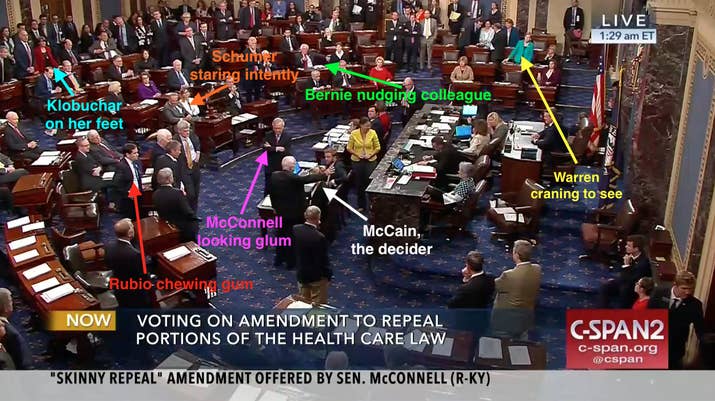

 The Weekly Sift