The Sift is going to run a little late this week. There are two featured posts. The first one is fairly short and could almost be a segment of the weekly summary, but I thought I’d put it out on its own so commenters could have a more focused discussion. It will be called “The Conor Lamb Victory: lessons for Democrats”. That should be out between 9 and 10 EDT.
The second will be “Who Are Those Guys?” which is a guide to the new faces in the Trump administration. That should be out … maybe 11. The weekly summary has all the obstruction-of-justice stuff to cover: The House Intelligence Committee getting ready to put out a sham report on a sham investigation, Trump sending a message to investigators by firing the FBI’s Andy McCabe 26 hours before he was retiring with pension, the increasingly direct attacks against Mueller and his investigation, and so on. And then there’s the student anti-gun protests, Russia’s increasingly provocative behavior, and a few other things, before closing with a video dramatizing the physiological effects of alcohol. That will be really late, maybe after 1 p.m.
There is no featured post this week. Just covering what happened in the last seven days was already overwhelming enough, without trying to go deeply into any particular story.
For those who don’t get the reference in the title: Nixon is supposed to have justified his economic policy by saying: “We are all Keynesians now.” The phrase was actually written earlier by Milton Friedman, who appears to have been making a tongue-in-cheek reference to a turn-of-the-century British politician who said, “We are all socialists now.”
This week everybody was talking about Trump meeting Kim Jong Un
By now we should be getting used to this pattern: Trump makes some bold statement that his staff knows nothing about until they hear it, and then there’s a long back-and-forth about what it means, or if it means anything. Just in the last few months, this pattern has played out with varying results on immigration, on guns, and on tariffs. During the campaign, he did the same thing with universal health care. (“The government’s going to pay for it,” he said. That turned out to mean nothing.)
This week it happened on North Korea. Thursday, South Korean national security adviser Chung Eui-yong came to the White House to talk to lower-level officials and didn’t expect to see Trump until Friday, when he would deliver the message that North Korean leader Kim Jong Un wanted a face-to-face meeting. But Trump had Chung shown in to the Oval Office, and cut him off before he was done making his pitch, saying “Tell them I’ll do it.” Chung then met the press on the White House driveway and announced
I told President Trump that, in our meeting, North Korean leader Kim Jong-un said he is committed to denuclearization. Kim pledged that North Korea will refrain from any further nuclear or missile tests. He understands that the routine joint military exercises between the Republic of Korea and the United States must continue. And he expressed his eagerness to meet President Trump as soon as possible. President Trump appreciated the briefing and said he would meet Kim Jong-un by May to achieve permanent denuclearization. [my emphasis]
I don’t know yet, until we are able to meet ourselves face to face with representatives of North Korea, whether the conditions are right to even begin thinking about negotiations.
So just a few hours later, the whole foreign policy establishment — both outside and inside the administration — was trying to figure out what Trump had agreed to. It’s not clear Trump himself knows.
“The thing that’s striking here is that there is no letter from Kim. This was an oral message conveyed by North Koreans to the South Koreans,” said Eric Edelman, who served as undersecretary of defense for policy in the George W. Bush administration.
“What they actually said, what they heard him say, and then what they transmitted to Trump could be two or three different things, and it’s not like we haven’t had that in the past,” Edelman added. “There can be elements of wishful thinking here and so I think people really need to be approaching this with a great deal of caution.”
Friday, official sources gave a range of interpretations. In the afternoon, press secretary Sarah Huckabee Sanders made the meeting sound much more iffy:
The president will not have the meeting without seeing concrete steps and concrete actions take place by North Korea.
If that’s the case, then nothing has changed: Obama also demanded concrete actions, and he didn’t get them, so there were no talks. If North Korea actually takes concrete action, or the U.S. stops demanding it as a precondition, then that would actually be news. Trump himself was all over the place at a rally in Pennsylvania Saturday night.
Who knows what’s going to happen? It could happen, it doesn’t happen. I may leave fast, or we may sit down and make the greatest deal for the world and for all of these countries, including, frankly, North Korea, and that’s what I hope happens.
My interpretation is that the recent series of North Korean missile tests is now complete: They’ve tested (and demonstrated to the world) all the new developments that seem likely to work any time soon. So there was going to be a pause anyway, while the R&D comes up with new things to test. If that’s true, North Korea has nothing lose by announcing a suspension of tests and pretending it’s a concession.
I’m skeptical that a Trump/Kim meeting would accomplish anything, but I’m also not reflexively against it.
NED STARK: Make peace with the Lannisters, you say? With the people who tried to murder my boy?
PETYR BAELISH: We only make peace with our enemies, my lord. That’s why it’s called “making peace”.
Littlefinger was a slimeball, but in this instance his principle applies: If there’s some agreement to be made that will lower the threat of nuclear war in the Far East, the Trump administration should definitely work on it, and shouldn’t demand that North Korea become Denmark first.
Another objection you often hear is that a meeting with a U.S. president in itself is something of value that we should hold back until we get something of value in return. (That seems to be what Sanders was saying. The Jeffrey Lewis article I quoted at the top agrees: “THE MEETING IS THE CONCESSION.”)
I suppose if other countries are willing to play that game, we’d be stupid not to. (If a president can get something just for showing up, there’s no sense in refusing those concessions.) But in general I don’t like the idea, because it styles the American president as Emperor of the World — other world leaders are really his subordinates, and should feel honored by his presence. I don’t think that’s a promising approach to negotiations.
So why am I skeptical? As we saw with the Obama administration and Iran, a de-nuclearization agreement is complicated. We need some way to verify that they’ve really disarmed. If we agree to end our economic sanctions in return, they’ll need some reason to believe that we won’t reimpose them as soon as they’ve gutted their nuclear program. They’ll also need some reason to believe that we won’t attack them as soon as their mutual-destruction threat is gone. Maybe the only way to establish trust is for an agreement to be divided into phases: We do this, they do that, and then later we both take the next steps. How do you arrange the phases so that each step is more-or-less equal, so that neither side is motivated to get to Step 3 and then bail?
In short, a real agreement with North Korea would have to be full of technical details. What kind of inspections need to be made? Do we do them ourselves, or does somebody else (like the UN) do them? Where is the line between acceptable civilian use of nuclear power or rockets, and unacceptable military use? What protocols are needed to assure the Koreans that our inspectors aren’t spying on a lot of other things while they’re there? And so on.
Now ask yourself: Is Donald Trump going to negotiate all that a few months from now? (I suspect he wouldn’t have the patience to hear a briefing about what all those issues are, much less understand them as well as a negotiator needs to.) Is there any agreement he and Kim could make that couldn’t be undone later in the details? (Example: Kim agrees to give up nuclear weapons in general, but his technical people insist on loopholes in the verification protocols.) That’s why negotiations happen the way they do: Lower-level people work out technical details, and when they think they’ve got something, they call in the big bosses to finalize the agreement.
I don’t believe Trump understands any of that. What he knows how to do is put on a show. That’s why the meeting he agreed to, if it happens at all, will just be a big show.
and tariffs
This week I’m wondering what Trump’s announcement about North Korea really means. Last week I was wondering the same thing about his announcement of tariffs, which equally shocked the people who thought they were working on this issue for him. (Chief economic adviser Gary Cohn resigned as a result.)
Thursday the steel and aluminum tariffs were officially announced in separate proclamations whose wording is almost identical. They claim that steel and aluminum imports are a national security issue, which I haven’t heard from anybody else. Apparently the point of this finding is to match the wording of Trade Expansion Act of 1962, which
authorizes the President to adjust the imports of an article and its derivatives that are being imported into the United States in such quantities or under such circumstances as to threaten to impair the national security.
Starting March 23, steel imports face an increased tariff of 25%, and aluminum imports 10%. Imports from Canada and Mexico are exempted. If some steel consumer in the United States complains that an equivalent product isn’t produced in the U.S., an exemption can be granted for that product.
Trump’s usual rhetoric on trade is that specific other countries (especially China) are cheating in some way, and so tariffs might be necessary to even the playing field. But by targeting everybody but Canada and Mexico (and implying that he wants some concessions out of them too as part of a NAFTA renegotiation), he seems to be saying that the U.S. steel and aluminum industries aren’t competitive with anybody, so they need broad-based protection. (China supplies only 2% of our steel, due to a targeted tariff imposed by the Obama administration.)
The proclamations invite U.S. allies to
discuss with the United States alternative ways to address the threatened impairment of the national security caused by imports from that country. Should the United States and any such country arrive at a satisfactory alternative means to address the threat to the national security such that I determine that imports from that country no longer threaten to impair the national security, I may remove or modify the restriction on steel [or aluminum] articles imports from that country and, if necessary, make any corresponding adjustments to the tariff as it applies to other countries as our national security interests require.
No one seems to know what that means. Politico reports:
The result is that even some of the U.S.’s closest trading partners are bewildered about where the announcement leaves them. After a meeting with [U.S. Trade Representative Robert] Lighthizer over the weekend Cecilia Malmström, the European Union’s top trade official, said there was still “no immediate clarity on the exact U.S. procedure for exemption,” so the discussions will continue this week.
Any U.S. industry that exports may soon face retaliation. That includes agriculture, which is particularly vulnerable, given that “the world is awash in grain“, according to one Illinois farmer.
Three out of every five rows of soybeans planted in the United States find their way out of the country; half of those, valued at $14 billion in 2016, go to China alone. Mr. Gould estimates that 90 percent of his soybeans are exported, and 70 percent of his corn.
Farmers get hit on both sides: They also buy expensive equipment made of steel, and will probably have to pay more for it because of the tariffs.
It’s easy to play games with numbers on this issue and hard to know who to trust. ABC News quotes a study by a pro-trade group, the Trade Partnership:
The tariffs would increase U.S. iron and steel employment and non-ferrous metals (primarily aluminum) employment by 33,464 jobs, but cost 179,334 jobs throughout the rest of the economy, for a net loss of nearly 146,000 jobs.
Who knows how accurate this is, but I suspect the overall point is right: More jobs will be lost than gained. What makes the political calculation tricky, though, is that the jobs gained should be easier to identify than the jobs lost. If you’re a laid-off steel worker who gets his job back, you’ll be sure Trump’s tariffs worked for you. But if the good job you would have gotten in an exporting industry never gets created, you’ll never know.
It is the Republican Party’s last stand against a total takeover by President Trump. Having ceded ground to Trump on personal character, immigration, entitlement reform and more, Republican leaders have chosen to draw the line at free trade. If they get rolled on this, Trump will have completed the transformation of the party.
I think the takeover is complete already; a few congresspeople will squawk about tariffs, but nothing will happen. In a tweetstorm yesterday, David Roberts laid it out: Despite the intellectual voices you will see touted as conservative in the mainstream media, the conservative movement today is not at all about principles or ideas.
It’s just a tangle of resentments & bigotries, driven by the erosion of white privilege. … Trump has swerved this way and that on immigration, taxes, healthcare, guns … and the base doesn’t care. They follow him this way, they follow him that way. It is the resentment, the aggrieved sense of persecution, that they respond to. That’s what US conservatism IS now.
and (still) guns
In Florida, the Parkland teens didn’t get what they asked for (an assault weapon ban), but they did something that seemed impossible a few weeks ago: Florida tightened some of its famously lax gun laws: The new law raised the age for buying firearms from 18 to 21 (it was already 21 for handguns), put a three-day waiting period on gun purchases, banned bump stocks (used in the Las Vegas massacre), established a process for courts to order the confiscation of guns from people who have threatened violence against others, and did a few other things.
On the more-guns side, it established a program for arming school employees, though not full-time teachers. The program requires the cooperation of local school boards, which could decide not to implement it.
The NRA is suing over the age restriction. It’s not clear to me that they have a case.
The big thing here, I believe, isn’t in the specifics of the law, it’s that it symbolizes a reduced status for the NRA. If the NRA can’t inflict revenge on the politicians who voted for something it opposed, the momentum on gun laws might be changing.
Anyone who claims that the text of the amendment is “plain” has a heavy burden to carry. The burden is even heavier if an advocate argues that the Second Amendment was understood to upend laws against concealed carry or dangerous weapons—both of which were in force in many parts of the country long after it was adopted.
So it may be that the amendment’s text supports something like where we are now: Dick Heller, a law-abiding citizen, can own a handgun in his home for self-protection. The text and context, however, don’t point us to an unlimited individual right to bear any kind and number of weapons by anyone, whether a minor or a felon or domestic abuser.
In “More guns do not stop more crimes, evidence shows” Scientific American looked at public-health studies on the results of having a gun in your house: It’s a health hazard. A gun in the home makes you more likely to be killed in an argument with a family member or close acquaintance, more likely to commit suicide, more likely to be shot by accident, and so on. The event people think about when they buy a gun — protection against a home invasion — is much rarer, so even if that works out, the risks don’t balance. (I talked about the NRA’s immature attitude toward risk in 2015 in “Guns are security blankets, not insurance policies“.)
The belief that more guns lead to fewer crimes is founded on the idea that guns are dangerous when bad guys have them, so we should get more guns into the hands of good guys. Yet Cook, the Duke economist, says this good guy/bad guy dichotomy is a false and dangerous one. Even upstanding American citizens are only human—they can “lose their temper, or exercise poor judgment, or misinterpret a situation, or have a few drinks,” he explains, and if they’re carrying guns when they do, bad things can ensue. In 2013 in Ionia, Mich., a road rage incident led two drivers—both concealed carry permit holders—to get out of their cars, take out their guns and kill each other.
As I drove from Scottsboro to Atlanta to catch my flight home, I kept turning over what I had seen and learned. Although we do not yet know exactly how guns affect us, the notion that more guns lead to less crime is almost certainly incorrect. The research on guns is not uniform, and we could certainly use more of it. But when all but a few studies point in the same direction, we can feel confident that the arrow is aiming at the truth—which is, in this case, that guns do not inhibit crime and violence but instead make it worse.
Deep down, the NRA knows this. That’s why it got Congress to ban CDC and NIH from studying the public health effect of guns. You don’t shut down research unless you know the truth is against you.
and sanctuary cities
The Justice Department is suing the State of California over its non-cooperation with the federal government’s efforts to deport undocumented immigrants. Resistance to ICE deportations reached a new level two weeks ago, when Oakland Mayor Libby Schaaf issued a public warning that deportation raids were coming. ICE claims that hundreds of deportable immigrants “with criminal records” may have escaped because of the mayor’s heads-up.
That sounds bad until you start hearing stories about the “criminals” ICE targets. As I mentioned a few weeks ago: Dr. Lukasz Niec, a 43-year-old Michigan physician with a green card, was picked up by ICE because of two offenses he committed as a teen-ager, one of which had been expunged from his record, but still counted against him.
Trump’s rhetoric is all about protecting the public from “bad hombres“. But ICE isn’t picking out people because they’re dangerous, it’s looking for excuses to deport as many people as it can.
and the Stormy Daniels scandal is not going away
A good summary of where we are is Michelle Goldberg’s column in Friday’s NYT. Unbelievable as it sounds, Trump having an affair with a porn star while his wife was home with a new baby ISN’T what makes this story a big deal. (Imagine reading that line about Obama while he was in office. But it’s true: We all already know that Trump is the kind of slimeball who would do something like that.) It’s the $130,000 pay-off, the unlikely story his lawyer tells about it, and that it supports the most controversial part of the Steele dossier: Trump can be blackmailed by people who know about his sexual exploits.
Evangelicals still believe in the commandment: Thou shalt not have sex with a porn star. However, whether this president violated that commandment or not is totally irrelevant to our support of him. … Evangelicals understand the concept of sin and forgiveness. Look, we are all sinners. We all need forgiveness. That forgiveness is available through Christ for anyone who asks. And whether the President needs that forgiveness for this particular allegation, whether he’s asked for it, is between him, his family, and his God.
[I have to pass on Steve Benen’s comment: “Let’s pause to note that anytime a prominent Christian evangelist begins an argument by saying, ‘Evangelicals still believe in the commandment: Thou shalt not have sex with a porn star. However…’ the sentence probably won’t end well.”]
Jeffress was basically echoing the anything-goes interpretation of forgiveness that Jerry Falwell Jr. gave in January when the Daniels scandal broke:
Our whole faith is based around the idea that we’re all equally bad, we’re all sinners.
[Benen again: “Many Christian conservatives appear to have discovered the virtues of moral relativism.”] I would guess that neither of these preachers has ever offered this vision of forgiveness to their congregations: “Do whatever you want, show no indication of remorse, and none of us will ever condemn your sin, because we will all just assume that you’re forgiven and everyone else is just as bad. In fact, we will support you in continuing to hold positions that require high moral character.”
This interpretation of Christianity isn’t meant for you and me. It’s a special gospel for the Powerful, and in particular, for powerful men who are allies of Evangelical leaders. It’s a complete reversal of the Bible’s prophetic tradition.
In addition to its integrity, support for Trump is costing the Evangelical movement the tangible progress it had made in the last few decades towards racial integration. Evangelical congregations have never been a fully representative sample of American diversity. (No major American denomination is.) But to their credit, many of them had managed to become less racially segregated than liberal churches that have made a bigger deal out of fighting racism.
The NYT describes a “quiet exodus” of blacks from majority-white Evangelical churches since the election. The stories are all different, but there’s a clear theme: The black Evangelicals had tried to ignore their church’s lack of interest in racial issues (“her fellow congregants did not seem to even know the name Trayvon Martin”), but they were shocked that Trump’s open racism wasn’t a deal-breaker for their brothers and sisters in Christ. Instead, they were told both from the pulpit and by their fellow parishioners that voting for Trump was the Christian thing to do.
Another NYT article describes another erosion: White Evangelical women are staying in their churches, but starting to have doubts about Trump.
but I’m still thinking about the Democrats’ possible strategies
Tomorrow there will be a special election in Pennsylvania’s 18th congressional district, which is just south of Pittsburgh, in the corner of the state that makes a right angle with Ohio and West Virginia. It had been represented by Republican Tim Murphy, an anti-abortion Republican who resigned in October after it came out that he (1) had an extra-marital affair, (2) got his mistress pregnant, and (3) urged her to get an abortion.
It’s a solidly Republican district. Murphy ran unopposed in 2016, and Trump beat Clinton there by 19%. A poll in January had Republican Rick Saccone ahead of Democrat Conor Lamb by 12%. But the race has tightened. Two polls have been done this month, and each has a different candidate up by 3%.
Lamb is 33 years old, a lawyer, and a former Captain in the Marines. He’s not making a big deal out of being a Democrat or opposing Trump. The big print on the home page of his web site says:
That biggest issues facing the 18th Congressional District aren’t partisan. Heroin kills both Republicans and Democrats. Health care is too expensive. The roads and bridges we all use are crumbling. But the people we send to Washington aren’t solving these problems.
He’s not big on gun control, supports Trump’s tariffs, and doesn’t support either a $15 minimum wage or Nancy Pelosi for Speaker.
Tomorrow, we’ll see if that works.
Trump held a rally in the 18th Saturday night. It was supposed to be for Saccone, but like all Trump speeches, it was really about himself, his accomplishments, and his endless struggles against his enemies. One of his claims was that he got 52% of women’s vote; actually he got 52% of white women’s votes. Apparently, women of color don’t count.
In yesterday’s NYT, four political science researchers compare two groups of 2012 Obama voters who didn’t vote for Clinton in 2016: those who voted for Trump and those who didn’t vote. Both groups are sizeable: 6 million Obama/Trump voters and 4.4 million Obama/Nobody voters. Pundits have done a lot of hand-wringing about how to appeal to the O/T voters; that’s what all those interview with middle-aged white working-class men are about.
But the researchers see the O/N people, who are younger and nearly evenly split between white and non-white, as a more promising target to win back: The O/T voters don’t identify as Democrats and are more conservative than Clinton voters on racial and social issues that the party would have a hard time compromising on.
In stark contrast, Obama-to-nonvoters share the progressive policy priorities of Democrats, and they strongly identify with the Democratic Party.
The O/T voters didn’t just turn against Clinton, they didn’t support down-ballot Democrats either. But surveys indicate that the O/N people would have supported down-ballot Democrats, if they could have been motivated to vote.
In the journal Democracy, Laura Putnam and Theda Skocpol point to a different group as the energy-center of the resistance to Trump: middle-aged, college-educated suburban women.
For those wondering who is going to rebuild the foundations of U.S. democracy— assuming the national guardrails survive—the answer across much of the U.S. heartland seems clear. The foundation rebuilders in many communities across most states are newly mobilized and interconnected grassroots groups, led for the most part by Middle America’s mothers and grandmothers. They see the work to be done and are well into accomplishing it.
If you do want to reach out to white working-class Trump voters, read “Can the Democratic Party be White Working Class Too?” in The American Prospect. It looks at the success of Democrats like Gov. Steve Bullock of Montana.
Some of the themes here resonate with the ones I outlined a few weeks ago in the context of Alaska, especially “run everywhere”, “think locally”, and “don’t settle for the people who want to run, find the people who ought to run”.
Bullock tells young people interested in politics to make a life in something else first. It will make them authentic and connect them with voters, rather than with issues, political insiders, and the process of governing.
I would change your major out of political science or law. Get a practical trade, study science or math. Go out and try to change the world in the private sector. Start a business and lose it. Start a family. … Do not learn how to run this country by working for people who already do.
Montana Democratic Party executive Nancy Keenan says:
A lot of the people who run as Democrats think that if we could just get into the depths and detail of the policy and make people understand it, then we’ll get elected. Oh, hell no! The detail doesn’t matter, people! What’s the first rule of politics? Show up. Everywhere. The second rule is: Show up where they didn’t want or ask you to come. I used to show up at the stock growers’ convention or the Chamber of Commerce conventions, and they’d all ask, “What the hell is she doing here?” And I’d tell everyone how terrific it was to be with them.
The article concludes:
Integrating Montana’s template into Democratic success will entail integrating Montana’s constituents—white, working-class, often rural voters who, despite their cultural differences, face many of the same frustrations with debt, health care, and labor as other working-class people in the Democratic coalition.
And that sounds a lot like Lamb’s message.
and you also might be interested in …
I’m barely touching the week’s craziest story, because despite all the noise about it, it seemed to have no serious consequences: Monday, Trump campaign aide Sam Nunberg was on literally ALL the TV news networks, claiming that he was going to defy a subpoena to appear before Robert Mueller’s grand jury. He seemed not to believe that Mueller would arrest him if he did that, though the lawyers on the talk shows eventually seemed to get through to him. Friday, he appeared on schedule and testified.
Now Kansas seems to have a rival for the title of the state that’s caused the most self-inflicted damage through tax cuts: Louisiana. … Louisiana’s former governor, Bobby Jindal, deserves much of the blame. A Republican wunderkind when elected at age 36 in 2008, he cut income taxes and roughly doubled the size of corporate tax breaks. By the end of his two terms, businesses were able to use those breaks to avoid paying about 80 percent of the taxes they would have owed under the official corporate rate.
At first, Jindal spun a tale about how the tax cuts would lead to an economic boom — but they didn’t, just as they didn’t in Kansas. Instead, Louisiana’s state revenue plunged.
Leonhardt suggests they simply roll back Jindal’s corporate tax cuts, but that’s not even on the table. Instead, a special session of the legislature debated raising the sales tax, couldn’t find the votes to do it, and adjourned, having done nothing to close the looming $994 million shortfall. The regular session can’t raise taxes, so they’ll be looking for cuts in things like education and health care.
He’s been terrific. He may be a globalist, but I still like him. He is seriously a globalist, there’s no question. But you know what, in his own way he’s a nationalist because he loves our country.
If you don’t pay attention to racist groups, you may read through that without seeing anything wrong. But globalist is a common right-wing euphemism for Jew, which Cohn is. A fellow “globalist”, Peter Beinart, explains:
The term “globalist” is a bit like the term “thug.” It’s an epithet that is disproportionately directed at a particular minority group. Just as “thug” is often used to invoke the stereotype that African Americans are violent, “globalist” can play on the stereotype that Jews are disloyal. Used that way, it becomes a modern-day vessel for an ancient slur: that Jews—whether loyal to international Judaism or international capitalism or international communism or international Zionism—aren’t loyal to the countries in which they live.
Trump seems to grasp this connotation, so he tempers it by reassuring everyone that Cohn “loves our country” — implying that most globalists don’t. But Trump is not anti-Semitic; some of his best friends are “globalists”.
This week the pace of the Trump Era defeated me. Keeping up with the day-to-day was about all I could manage, if that. Taking a step back to think more deeply about some particular development was all but impossible. (As Tony Kornheiser says at the end of every episode of ESPN’s Pardon the Interruption, “We’ll try to do better next time.”)
So there’s no featured article this week. Instead, the weekly summary has swallowed up the whole week’s word count with short-to-medium length notes on North Korea, tariffs, Florida’s small step toward gun control, sanctuary cities, Stormy Daniels (and Evangelical leaders’ continued betrayal of the truth-to-power tradition of the Biblical prophets), tomorrow’s special election in Pennsylvania (and differing theories on the voters Democrats should be aiming to convert), and a few other things. How did all that happen in a week that ran an hour short?
Officials in at least four countries [United Arab Emirates, China, Israel and Mexico] have privately discussed ways they can manipulate Jared Kushner, the president’s son-in-law and senior adviser, by taking advantage of his complex business arrangements, financial difficulties and lack of foreign policy experience, according to current and former U.S. officials familiar with intelligence reports on the matter.
The NYT reported that the Kushner family’s cash-strapped real estate company received massive loans after Kushner had meetings to discuss Trump-administration policy with bank executives. Everyone involved denies any wrong-doing, but Kushner (like Trump himself) has done little to insulate himself from conflicts of interest.
Mr. Kushner resigned as chief executive of Kushner Companies when he joined the White House last January, and he sold a small portion of his stake in the company to a trust controlled by his mother.
But he retained the vast majority of his interest in Kushner Companies. His real estate holdings and other investments are worth as much as $761 million, according to government ethics filings. They are likely worth much more, because that estimate has his firm’s debt subtracted from the value of his holdings. The company has done at least $7 billion of deals in the past decade.
Hope Hicks resigned as White House Communications Director Wednesday, just a day after testifying to the House Intelligence Committee. Well, she sort of testified: She refused to answer any questions related to events after Inauguration Day, though she offered no valid grounds for refusing. The Republican-controlled committee has been letting Trump’s people get away with this kind of obstruction. Also the previous day, her deputy Josh Raffel resigned.
Trump once again bashed his own attorney general for refusing to use the Justice Department to investigate Trump’s political enemies. Jeff Sessions referred the Nunes-memo nonsense about abusing the FISA process to the Justice Department Inspector General’s office, which is exactly where such questions belong. Trump objected because “Isn’t the I.G. an Obama guy?”. He assumes that everyone is as corrupt as he is; again and again he rejects the possibility of non-partisan government service.
and teachers with guns
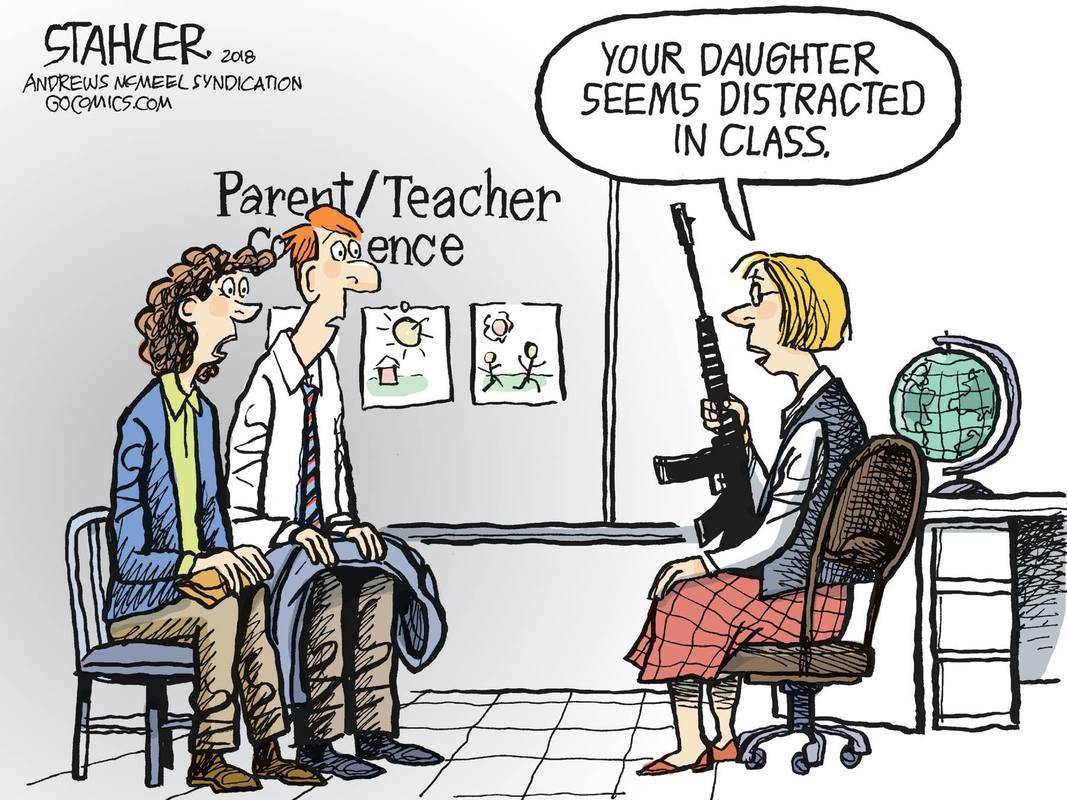
The post-Parkland conversation about gun control is fading, but not nearly as fast as it usually does after a mass shooting. I’m not optimistic enough to call this a turning point, but I think it is breaking the usual false-equivalence frame for thinking about the two sides. In this case, one side wants to start limiting the availability of weapons designed to kill large numbers of people quickly, and the other side wants your kid’s teacher to bring a gun into the classroom.
I think the sheer insanity of the latter proposal is shocking large numbers of voters, even ones who aren’t sure exactly what limits they want on guns or how effective they’d be. More and more it becomes clear that this debate is no longer between anti-gun people and pro-gun people, it’s between sane people and crazy people.
The problems inherent in having multiple non-police shooters on the scene were demonstrated February 14 (the same day as the Parkland shooting) when Tony Garces disarmed a shooter at his church — and then was shot by police as he left the church carrying the shooter’s gun.
If we arm hundreds of thousands of teachers, eventually one of them will snap and start shooting students. What’s the next step then — arm the students so that they can shoot back? I mean, otherwise they’re just sitting ducks. Isn’t that exactly the same logic that gets us to armed teachers?
Novelist Nick Harkaway’s four-year-old didn’t want to go to school for fear of a shooter. Fortunately for Harkaway, he’s British, so he could tell his son that things like that just happen in America. He feels sorry for American parents who have to come up with some other answer.
The vast majority of armed teachers will handle their responsibilities as well as can be expected, but they will face the same dilemma that gun-owning parents face in their homes: If you picture the gun being useful against an intruder, then it can’t be inside a gun safe, because you’ll need to get it out and fire it quickly. But if it’s that accessible, how do you keep it away from your children? (That’s how toddlers manage to shoot about one American each week.)
Concealed carry — the gun being on the teacher’s person at all times — is the most likely answer. But given how intimate teaching is, how concealed is that gun going to be? Do you not lean over a kid’s desk because he’ll see your shoulder holster? (Unconcealed carry is even worse. About a month ago, a third-grader fired a gun that was in the holster of a police officer working at the school. The police department statement said the officer was “unaware of the child touching his gun until the weapon was fired.” It turns out that the trigger-guard wasn’t designed for such small fingers.)
What’s more, as the NRA will tell you, concealed-carry comes with a mindset: You must constantly look out for threats (including threats to take your gun) and be prepared to deal with them, possibly with lethal force. Dan Baum described that awareness several years ago in Harper’s, contrasting Condition Yellow (constant low-level threat assessment) with Condition White (obliviousness).
Condition White may make us sheep, but it’s also where art happens. It’s where we daydream, reminisce, and hear music in our heads. Hard-core gun carriers want no part of that, and the zeal for getting everybody to carry a gun may be as much an anti–Condition White movement as anything else—resentment toward the airy-fairy elites who can enjoy the luxury of musing, sipping tea, and nibbling biscuits while the good people of the world have to work for a living and keep their guard up.
Condition White is also where the best teaching happens. You sink into a rapport with your students and let the outside world vanish for a while as you appreciate together the wonder of science or the beauty of the English language. Even if their guns stay holstered and out of sight, forcing our teachers to live constantly in Condition Yellow will have a major effect on the education our children get.
In 1999, Joel Miller explained “Why I Sold My Guns“. He trained with a gun, imagining that he could protect his family’s jewelry store in case of a burglary. Then a burglary happened, and he saw things more clearly.
If we do indeed arm 20% of our teachers, as Trump has suggested, two consequences are predictable: Teacher suicides will skyrocket, and white teachers will shoot black teens who frighten them, just as cops do.
Picture a teacher at the end of a bad day: tired, alone, feeling like a failure … and armed. Most suicides are snap decisions, not well-considered plans. (More precisely, suicides happen when a lot of vague I-should-just-kill-myself thoughts that anybody might have culminate in a snap decision.) The availability of a gun facilitates that snap decision, which is why there are over 20,000 gun-suicides in the U.S. each year. Israel lowered the suicide rate among its soldiers by discouraging them from taking their weapons home during leaves.
We’ll be telling teachers to shoot armed terrorists breaching the school. What’s really going to happen is an unarmed black truant loitering in a hallway he’s not supposed to be in who gets shot eight times by the jumpy choir director.
It’s worth picturing how any previous administration would roll out such a policy: Across the government, implementation memos would be ready to distribute to the people who need to assess and collect the tariffs. Simultaneously, either Treasury or Commerce would publish a white paper explaining the logic of the move, pointing to the legal authority behind it, and predicting what it will accomplish. The entire administration would have a messaging strategy: Economists would have an economic message ready to go, foreign-policy people would have a foreign-policy message, defense people would have a national-security message, and so on. Only then would the President step in front of a microphone and make the announcement.
It was not immediately clear whether the tariffs would be phased out over time and whether Trump would follow the advice of his national security advisers and exempt some countries from the tariffs to avoid harming key steel-producing US allies.
Trump announced the move during a hastily arranged meeting with steel and aluminum executives, even though the policy he announced is not yet ready to be implemented, let alone fully crafted. He acknowledged the policy is “being written now.”
So something is going to happen. Maybe. Or maybe next week will come and go, and tariffs will have slipped Trump’s mind because he’s too busy tweeting about the Black Panther movie. Or maybe Steph Curry or Jamele Hill will tick him off again. Maybe the media will be mean to Nazis or the KKK again, and he’ll have to stand up for them.
Assuming that some kind of tariff happens, I don’t know what to think, because neither the protectionist nor the free-trade visions really make sense to me. (I believe free trade increases global GDP in general, but I don’t believe the rising tide lifts all boats.) Paul Krugman’s wonkish column about tariffs mainly convinces me that the subject is complicated. International trade is a multi-player game where each player influences many interlocking variables (like interest rates, currency-exchange rates, and tariffs on unrelated goods). So making a simple change somewhere rarely produces the direct result you might imagine.
I had heard that it was impossible to get tickets, but in fact that’s not true. Timed passes are available for free on the NMAAHC web site every morning, so you just need to be flexible and get online early. (It may be more difficult for a bigger group that needs to plan ahead. In the cafe, I sat next to somebody who complained about how long it had taken her group to schedule a visit.)
The museum is well worth your time. I came in with ambitions of seeing everything, and I failed. (There might theoretically be enough time in a day, but you have to have way more museum stamina than I do. You also have to avoid drifting into reverie or tearing up.) If you have two days, I’d recommend doing the history floors (below ground) on one day and the culture floors (above ground) on another.
I can’t imagine what visiting the NMAAHC means for African-Americans. As a white, I was constantly amazed by how often I asked myself, “How did I not know this already? How could I never have heard of this person?” (For example, I had heard the phrase Harlem Renaissance, but I couldn’t have told you exactly when it happened or who participated in it.) I often felt uneducated and culturally deprived, feelings that I imagine blacks must experience in museums where everything “historic” or “cultural” is European.
I also often saw in a new light events I had thought I understood. (There would have been a lot more if I hadn’t done a Reconstruction reading project a few years ago.) So, for example, I had always thought of breaking the color line in baseball in terms of the opportunities it had opened up for black players. I had never seen it as a tactic for driving the black-owned Negro Leagues out of business. But it was both. Major league owners never negotiated with Negro League owners. No one ever considered letting the strongest Negro League teams, like the Kansas City Monarchs, join the major leagues, the way that the San Antonio Spurs and three other ABA teams were allowed to join the NBA in a 1976 merger without racial implications.
Instead, white teams signed top Negro League stars (like the Monarchs’ Jackie Robinson and Satchell Paige, both now in the Hall of Fame) without compensation, and then a few years later the Philadelphia Athletics moved to Kansas City.
and you also might be interested in …
When historians look back, it’s possible that the most noteworthy recent event will be the arctic heat wave at the end of February, when temperatures at the North Pole went above freezing at what ought to be the coldest part of winter. Vice reports:
temperatures at the Cape Morris Jesup weather station—one of the northernmost in the world—remained above freezing for 24 straight hours. Meanwhile, climate change is causing a secret military base in Greenland to melt out of the ice, and scientists have reported open water north of Greenland. This, all in the dead of winter, when the Arctic has constant darkness.
The recent corporate tax cut was supposed to spur investment, and several companies got some good press by giving workers one-time bonuses. But it looks like the serious money is going to go to stockholders through dividends and stock buybacks.
Russian President Putin announced plans for new “invincible” nuclear weapons that will make U.S. defenses “useless”. Our president responded by … no he didn’t respond at all. It’s Russia. They own him. They can do whatever they want.
Last Tuesday, NSA Director Michael Rogers told the Senate Armed Services Committee that he had the capability to strike back at Russia for its attack against our election process, but that he has not been directed to do so. “I believe that President Putin has clearly come to the conclusion that there’s little price to pay here … and that therefore I can continue this activity.”
Too many pundits talk about “collusion” as if it were some obscure thing for Mueller to dig out of subpoenaed documents or bully out of reluctant witnesses. But it’s happening in plain sight and has been all along. Trump expects Russian help in the 2018 midterm elections, so he’s leaving our country open to it.
As a devout young Lutheran, I found Billy Graham’s televised “crusades” quite moving, before growing away from that point of view in later life. By all means, people who share his religion should honor him and mourn his death in their churches. If presidents and other public officials want to attend his funeral, that’s up to them. But I object to giving him public honors, as was done when he became the fourth private citizen to get a memorial service in the Capitol rotunda.
Graham was an adviser and confidant of several presidents, and ministers can sometimes play an important public role that justifies public honor. (For example, Rev. Thomas Starr King, whose statue used to be displayed in the Capitol, was sometimes credited with keeping California in the Union during the Civil War.) But Graham’s career was entirely sectarian. If you are not an Evangelical Christian, it’s hard to point to anything he ever did for you. If you’re gay or lesbian, he did a number of things to harm you, including supporting a North Carolina measure to ban same-sex marriage as recently as 2012.
In short, I see public honors for Graham as yet another claim by the Religious Right that they own the country.
Trump has accomplished at least one thing I thought would never happen: He made me appreciate the Bush administration. Watch Fareed Zakaria’s interview with Condoleeza Rice (broadcast yesterday) and see if you wouldn’t happily trade our current administration to get the Bushies back.
What’s misunderstood about it. One common argument in favor of private ownership of military-style weapons like the AR-15 is that a well-armed population is a necessary defense against tyranny, i.e., that the general population needs to retain the ability to overthrow the central government by military force. Ted Cruz has written that the Second Amendment serves as “the ultimate check against government tyranny — for the protection of freedom.”
A parallel argument is that historically, dictators like Hitler disarmed the public before imposing full tyranny. Once disarmed, the argument goes, the people were as helpless as sheep. This Facebook meme is typical, and features typically misleading quotes.
Both quotes are doctored.
What’s wrong with that view? Just about everything.
The 1938 law signed by Hitler that LaPierre mentions in his book basically does the opposite of what he says it did. “The 1938 revisions completely deregulated the acquisition and transfer of rifles and shotguns, as well as ammunition,” Harcourt wrote. Meanwhile, many more categories of people, including Nazi party members, were exempted from gun ownership regulations altogether, while the legal age of purchase was lowered from 20 to 18, and permit lengths were extended from one year to three years.
The Hitler quote in the illustration refers not to German civilians, but to non-Aryans in occupied Russian territory. Obviously, he would not have referred to himself as a “conqueror” of the German nation, or to the Nazi master race as a “subjected people”.
If the NRA’s point were valid, you would expect the most democratic nations in the world to be the ones with the most guns, but if anything, the correlation runs in the opposite direction. Here are the four most democratic nations, according to the UK-based Economist Intelligence Unit.
Nation
democracy index
guns per 100 civilians
Norway
9.87
31.3
Iceland
9.58
30.3
Sweden
9.39
21
New Zealand
9.26
22.6
Even these gun-ownership numbers, I suspect, are exaggerated in comparison with the U.S., since they probably include very few weapons like the AR-15. (Norway’s parliament is reportedly ready to pass a complete ban on semi-automatic weapons, which would include a number of popular handguns as well as rifles.)
Of particular note is Japan, where the average 100 civilians own a mere 0.6 guns, but whose democracy index on a par with the U.S.: 7.88. If a disarmed population is just asking for a totalitarian takeover, why isn’t one happening in Japan?
Switzerland and Israel are frequently cited as democratic countries with a large number of guns and little civilian gun violence, but in both countries possession of a gun is associated with military service, and is strongly regulated otherwise. The BBC quotes a Swiss gun-owner, who does not keep ammunition in his house and stores his gun’s barrel in a separate part of the house from its body:
The gun is not given to me to protect me or my family. I have been given this gun by my country to serve my country.
Finally, there are those quotes from the Founding Fathers like the one in the illustration above, nearly all of which have been either taken out of context, mis-attributed, or simply invented out of nothing. The Jefferson quote above is rejected on the official Monticello web site. Other frequently-cited fake quotes from the Founders are debunked at Guncite.com.
II. The original intent of the Second Amendment.
What’s misunderstood about it. It’s believed that the Founders passed the Second Amendment to protect an individual right to own militarily useful weapons (like, in our era, the AR-15), so that the People would have the ability to resist a tyrannical federal government.
What more people need to understand. That belief is historically baseless.
Legally, it doesn’t matter whether privately-owned weapons actually deter tyranny or not. (They don’t.) If the Founders believed they did, and wrote that belief into the Second Amendment, and if no generation since has seen fit to repeal it, then it’s the law. But that’s not what the Second Amendment is about at all.
At this point it’s worthwhile to look at the full text of the Amendment, which is short.
A well regulated Militia being necessary to the security of a free State, the right of the people to keep and bear Arms, shall not be infringed.
Militiaman.
Today, we often tend to read right past the first clause and focus on the second. But it’s worth remembering what the Founders thought of when they saw the word militia: the Minutemen. In other words, a force of citizen-soldiers authorized by state or local governments, which could be called into action in a crisis. The current-day successor to the federal-era militias is the National Guard, not the self-appointed sovereign-citizen yahoos who drill up in the woods of Montana. The Constitution makes that quite clear in Article I, Section 8.
The Congress shall have Power … To provide for organizing, arming, and disciplining, the Militia, and for governing such Part of them as may be employed in the Service of the United States, reserving to the States respectively, the Appointment of the Officers, and the Authority of training the Militia according to the discipline prescribed by Congress.
The so-called militias we hear about today refuse to be organized, armed, or disciplined by Congress, or to be trained or have their officers appointed the states. So they’re not at all what the Constitution is talking about.
Not a militiaman.
Why, then, was a well-regulated militia “necessary to the security of a free State”? Not so that it could fight against the federal government. In fact, Article I, Section 8 also explicitly gives Congress the power “to provide for calling forth the Militia”, which will then (Article II, Section 2) be under the command of the President. In case of insurrection, the Constitution foresees the militia fighting for the federal government, not against it.
The vision that worried the founding generation (enough to create the Second Amendment) was that the federal government might disband the militias and replace them with a large professional standing army, which would then need to have forts and bases throughout the country. Rather than repel an Indian raid itself, for example, a frontier community would have to call for help from the Army. Slave-owning states particularly worried about the possibility of an anti-slavery president refusing to put down a slave uprising (or maybe just dragging his feet). They wanted to be sure they would retain enough local power to keep their slaves under control.
Even more, the Founders feared that professional soldiers would grow to be loyal to their Commander in Chief rather than to the nation. The existence of this force might tempt a president to launch a coup and establish a military dictatorship. The point of a militia was to make that large permanent professional force unnecessary, not to fight pitched battles against it.
You can argue that we’ve already gone a long way down the road the Founders didn’t want us to travel: We have a large standing army with nationwide bases, and towns do not drill their citizens on the town green, as Lexington and Concord did. (However, we also have state and local police departments — which didn’t exist in the Founding era — so we’re not entirely dependent on the federal government for our security.) But self-appointed Rambos arming themselves to resist the federal government was no part of the Founders’ vision. The whole point of the Constitutional system was to allow for peaceful replacement of an unpopular government. As the Supreme Court wrote in 1951:
Whatever theoretical merit there may be to the argument that there is a “right” to rebellion against dictatorial governments is without force where the existing structure of the government provides for peaceful and orderly change.
III. The weapons the Second Amendment protects.
What’s misunderstood about it. Some Americans see virtually any restriction on the weapons they can own, or even registration of those weapons, as a violation of their Second Amendment rights.
What’s wrong with that? In the entire history of the United States, no court has understood the Second Amendment that way.
Given that the Second Amendment was part of the Bill of Rights passed by the first Congress, you’d expect all its major provisions to have a long history of judicial interpretation. But in fact the individual right to own specific weapons wasn’t recognized until the 2008 Heller case, a hotly contested 5-4 decision of the Supreme Court. Prior to that, courts construed the Amendment’s “right to bear arms” as a collective right belonging to “the People” as a whole, not individual persons. Historian Michael Waldman wrote:
“A fraud on the American public.” That’s how former Chief Justice Warren Burger described the idea that the Second Amendment gives an unfettered individual right to a gun. When he spoke these words to PBS in 1990, the rock-ribbed conservative appointed by Richard Nixon was expressing the longtime consensus of historians and judges across the political spectrum.
Until Heller, the Supreme Court’s landmark gun-rights case was Miller, in which it rejected the argument that the National Firearms Act (regulating sawed-off shotguns, among other weapons) violated constitutional rights. Even the Heller decision (written by the late Justice Antonin Scalia) doesn’t endorse the NRA’s view of the Second Amendment. It struck down a District of Columbia law banning handguns, while allowing that
Like most rights, the Second Amendment right is not unlimited. It is not a right to keep and carry any weapon whatsoever in any manner whatsoever and for whatever purpose.
Challenges to the Federal Assault Weapons Ban that was in force from 1994 to 2004 never made it to the Supreme Court, though the law was upheld by lower courts.
What today’s Court would do with an assault-weapons ban, or even a complete ban on semi-automatic weapons, is very much up in the air. Scalia’s Heller opinion found an expectation that the militia would assemble carrying weapons “in common use at the time” for legal purposes. How extensive that use needs to be was not specified. Whether AR-15s and other assault weapons are “in common use” would no doubt be hotly debated. Certainly they are not as widely used as handguns were in 2008, and the main legal purpose for which handguns were used (self-defense) carries more constitutional weight than the nebulous legal uses of assault weapons.
No court decision anywhere invalidates the government’s legitimate power to register weapons.
No court has rejected the federal ban on automatic weapons or the regulation of high explosives, so there is clearly a line somewhere between weapons that can and can’t be banned. The question would be which side AR-15s fall on.
Just to give one obvious example, it would be incredibly stupid for the government to allow people who live on the flight paths of major airports to own surface-to-air missiles. And yet, the argument that individuals have to be prepared to fight a tyrannical government would seem to justify those weapons. (How are we going to resist the government if we can’t take down its air power?) Those who believe the resist-the-government interpretation of the Second Amendment should be pushed to say whether any weapons can be banned or regulated, and why exactly such limitations are consistent with their theory.
More than two weeks after the Parkland shooting, gun control is still a major topic of conversation. That says to me that something is different this time. It may not be different enough to get anything of substance done in the near future, but the tide seems to be turning.
Just to play my part, I thought I’d focus on guns this week. The featured post is another in my Misunderstandings series: “Three Misunderstandings about Guns and the Constitution”. That should be out sometime around 9 EST.
The weekly summary will cover the current chaos and infighting at the White House, the debate about arming teachers, and Trump’s announcement of a trade war. But I also have to tell you about the National Museum of African American History and Culture, which I managed to visit in D.C. as part of my drive back from Florida. (It’s amazing, even for the Smithsonian.) And then I’ll close with a video of an octopus.
One year after Trump took office, it is still unclear whether the president of the United States is an agent of a foreign power. Just step back and think about that for a moment.
One conclusion that I hope people are drawing from this: If it can happen in Parkland, it can happen anywhere in America. The National Council for Home Safety and Security, a home security industry trade association, had picked Parkland as the safest city in Florida, because only seven violent crimes were reported there in 2017. The Atlantic describes Stoneman Douglas High School as “a mostly white school in a mostly upper-middle-class area.”
This isn’t some den of hopeless poverty and drugs that Middle America can just write off. (So of course Jeff Sessions responded to the shooting by talking about “gang-infested neighborhoods“. At least Trump hasn’t used this massacre to explain why we need a border wall … yet.) No matter where you live, the kids at Stoneman Douglas can’t be looked at as an “other” whose safety has nothing to do with the safety of your kids.
The NYT argues that the problem really is guns. The number of guns is the main variable that separates the United States from other developed nations where mass shootings are rare.
Numerous people have called for banning the AR-15 from civilian use. The tricky thing here is getting the definition right: The AR-15 is one of a class of military-style weapons, and if it were banned some other assault rifle would replace it. Banning all assault rifles has been done before, but there’s a legitimate complaint that “assault rifle” is not really a class of weapons — it’s more of a surface description that doesn’t really address the heart of the problem. Vox reported:
It’s quite easy to turn a military-style gun into something that Congress wouldn’t consider an “assault weapon” under its various definitions.
The key issue isn’t whether a weapon looks like something the military would use. It’s how many bullets it’s able to spray out in a short time, how long it can be fired without reloading, and how easy it is to reload over and over without providing a time-window for potential victims to rush the shooter. Those are the features to regulate.
I’m hoping that the energy of the Parkland students merges with the energy of the #MeToo movement and gets guns out of the hands of domestic abusers. Domestic abuse is a predictor of public violence. Such a movement would also push the buttons of many right-wingers: “You mean my stupid girl friend can get my guns taken away?”
Thinking about the NRA, I’m reminded of a George Orwell quote: “Whoever is winning at the moment will always seem to be invincible.”
When the tide finally turns on them, it will turn fast. If I were running against an NRA-backed candidate in 2018, I’d focus on the complete resignation implicit in their position: Mass shootings are going to keep happening, and we’re not even going to try to do anything about them.
Liberals can also fall prey to fake news. One pseudo-fact that zoomed around social media (and even got on reputable news shows; I heard Chris Hayes repeat it, and he’s usually pretty careful) is that Parkland was the 18th school shooting already this year.
The WaPo debunks this number. It isn’t totally made up, like Pizzagate and some of the other anti-Clinton or pro-Trump stories that circulated before the election, but it has been spun out of recognition. The figure originated with a gun-control group, Everytown for Gun Safety, which defines a school shooting as “any time a firearm discharges a live round inside a school building or on a school campus or grounds.”
So the 18 figure mostly counts events that bear no resemblance to Parkland or to any other event that pops into your mind when you think “school shooting”: a gun that went off accidentally during a college criminal-justice training, hurting no one; a guy who committed suicide while parked outside a school that had been closed for seven months.
Ultimately, spreading this kind of stuff does more harm than good. When it comes to mass shootings, the truth is shocking enough. In the long run, fake news makes the real news less believable.
Just five of Everytown’s 18 school shootings listed for 2018 happened during school hours and resulted in any physical injury.
“Just five”. Think about that. After you’ve gotten outraged about 18, five shootings merits a “just”.
If you’re looking for a framework to fit these events into, look at James Risen’s “Is Donald Trump a Traitor?“, Part I of which was published by The Intercept on Friday. Risen breaks the investigation into four “tracks”:
Did Russia try to help Trump and hurt Clinton?
Was anyone from the Trump campaign knowingly working with the Russians?
Did Trump obstruct justice by interfering with the investigation?
Are Republicans in Congress conspiring to obstruct justice by undermining the investigation?
The indictment of the Russians all but settles the first question. (Trump’s National Security Adviser H.R. McMaster said “the evidence is now really incontrovertible and available in the public domain”.) It also provides a fascinating window into how Russian influence operations work. For example, the Russians used a variety of techniques (including spending money on Facebook ads) to build up a few fake social-media identities like @March_For_Trump, which could then contact legitimate pro-Trump organizations seeking “help” in organizing rallies. Part of that “help” would be purchasing the necessary supplies, using money the Russian fake organization would wire to them. From the outside, the result would look like the legitimate organizations did everything themselves.
One Russian social-media identity, @Ten_GOP, claimed to represent the Tennessee Republican Party (which complained to Twitter about it, but couldn’t get Twitter to close the account for 11 months). It acquired 136,000 followers, and was frequently quoted by conservative media as a legitimate grass-roots conservative voice.
The indictment notes that Trump campaign officials sometimes cooperated with this Russian operation “unwittingly”, but does not make any conspiracy accusations against them. It also does not clear the Trump campaign, which may have conspired in other parts of the operation, like the hacking and release of Democratic emails.
That Gates plea is bad news for Paul Manafort, and might be bad news for other Trump campaign people. But the biggest threat to Trump is if Manafort himself now has to cop a plea. This is what an anonymous White House source was talking about when he called Mueller’s strategy “a classic Gambino-style roll-up“. If Manafort flips, then we might get a clearer picture of the second track.
As interesting as the Russian indictment is in itself, it has also had a significant effect on the national conversation, which was trending in that direction anyway. For a long time, The Intercept was a haven for left-wingers skeptical of the Russian investigation. Now it’s talking about treason.
More and more people are making that point: The Russian interference operation was a direct attack on America, and our president seems not to care. Worse, he provides public cover for Russia whenever new information comes out. He says there’s “no collusion”, but the collusion seems to be happening right in front of our eyes. Max Boot writes:
The most benign explanation is that he is putting his vanity — he can’t have anything taint his glorious victory — above his obligation to “protect and defend the Constitution.” The more sinister hypothesis is that he has something to hide and, having benefited from Russia’s assistance once, hopes for more aid in 2018 and 2020. Either way, we are at war without a commander in chief.
but I decided to write about Alaska
The politics of Alaska has been changing, turning a very conservative state government into a much more moderate one, with a Democrat as Speaker of the House and voters passing several liberal referenda. How that happened doesn’t follow either the establishment-Democrat or progressive-revolution model, and has something to teach Bernie and Hillary people alike.
and you also might be interested in …
Only during the Trump administration could I almost forget to mention a new sex scandal about the president. The New Yorker’s Ronan Farrow tells the story of former Playmate of the Year Karen McDougal, who had a nine-month affair with Trump while he was married to Melania. Just before the 2016 election, her story was suppressed by The National Enquirer’s publisher American Media Inc., which paid McDougal $150K for the exclusive rights to her story and then didn’t publish it. Farrow claims that
Purchasing a story in order to bury it is a practice that many in the tabloid industry call “catch and kill.” … Six former A.M.I. employees told me that [A.M.I.’s CEO David] Pecker routinely makes catch-and-kill arrangements like the one reached with McDougal. “We had stories and we bought them knowing full well they were never going to run,” Jerry George, a former A.M.I. senior editor who worked at the company for more than twenty-five years, told me. George said that Pecker protected Trump. “Pecker really considered him a friend,” George told me. “We never printed a word about Trump without his approval.”
Also of note is a contemporaneous hand-written note that Farrow had obtained and McDougal identified as being in her own handwriting. (Presumably, that much corroboration didn’t violate her agreement with A.M.I.) It says that Trump offered her money after the first time they had sex, and that when McDougal turned it down Trump said, “You are special.”
These details make the most salacious part of the Steele dossier more credible. As Jonathan Chait points out:
So, we know Trump habitually pays for sex, and we also know he is willing to pay to keep embarrassing secrets from going public. That is to say, these secrets could be leveraged against him.
While some of the seedier allegations in Christopher Steele’s Trump-Russia dossier have not been verified, the central thesis of the dossier seems increasingly likely: that Trump’s long history of alleged affairs make him uniquely susceptible to blackmail.
A game I often play with some new Trump scandal is “What if this had happened to Obama?” Imagine if two playmate-type young women had told about their affairs with Obama, and how Obama allies had paid them six-figure sums to stay quiet. Far and away, that would have been the biggest scandal of his entire two terms. But with Trump, it almost gets lost.
A black reporter from Britain’s Channel 4 went out to interview Alt-right leader Richard Spencer. It’s an illuminating exchange, particularly the part where Spencer tells the reporter that he can never be British. “I’m living in the place of my birth,” the reporter says, “just like you.”
You know who believes that climate change is a big deal? Trump’s Director of National Intelligence. But I suspect there’s a Director of National Stupidity somewhere on Trump’s org chart, and he has more influence.
The smart house of the future has two downsides: First it may not always work properly, with Sorcerer’s Apprentice-type results. And second, it may be smart enough to be disloyal to you. Gizmodo tries an experiment: Its reporter (Kashmir) fills her home with smart gadgets, and then has someone (Surya) monitor her router to see what the house is saying about her. (Basically, Surya says, he had the same information her ISP would have.)
Getting a smart home means that everyone who lives or comes inside it is part of your personal panopticon, something which may not be obvious to them because they don’t expect everyday objects to have spying abilities. One of the gadgets—the Eight Sleep Tracker—seemed aware of this, and as a privacy-protective gesture, required the email address of the person I sleep with to request his permission to show me sleep reports from his side of the bed. But it’s weird to tell a gadget who you are having sex with as a way to protect privacy, especially when that gadget is monitoring the noise levels in your bedroom.
Surya didn’t try to break the encryption on data the devices were reporting, but Hulu didn’t even bother, so he knew not just when Kashmir was watching TV, but what. He also could tell when she got up and went to bed, when her children woke up, and even when she brushed her teeth (with her smart toothbrush).
and let’s close with something I had never imagined
One idea that popped up in the smart-home article I discussed above is the internet-enabled sex toy. At first this sounded like a joke to me, but it turns out such things actually exist — and stay in contact with their manufacturers, who may be collecting all kinds of fascinating information about their customers.
Whether this idea fascinates or horrifies you, you can check it out here.
Hillary Clinton got less than 40% of the vote and Trump won by nearly 15%, but once-solid-red Alaska now has a moderate-independent governor, and one house of its legislature is controlled by a Democrat/Independent alliance. Both the Bernie and Hillary factions in the Democratic Party have something to learn here.
Now that Republicans control the presidency, both houses of Congress, and a sizeable majority of governorships and state legislatures, one of the most contentious arguments in politics concerns how Democrats should try to turn things around. That argument is particularly bitter, because to a large extent it carries over from the Bernie/Hillary contest in the 2016 primaries. Each faction has its own vision of how to win back the country, and sees the other’s vision as a recipe for disaster.
Berners think the problem is voter apathy and the solution is a national progressive agenda for radical change: Medicare for All, a $15 minimum wage, free college, and a massive jobs/infrastructure program. The Democratic Party needs to stand for something, and the something it needs to stand for is the very specific legislative agenda Bernie Sanders ran on. In addition, Democrats need a new, younger image. (Bernie himself may not be young, but his fans are.) We can’t just trot the old war-horses out with a new focus-group-tested message and expect cynical millennials to buy it.
Clintonites look at the independents and moderate Republicans who have been alienated by Trump and see a chance for a broad non-ideological coalition, if Democrats don’t alienate centrist voters by pushing radical progressive policies in districts that historically haven’t supported them. Professional-class white women, for example, have traditionally trended Republican, but they’ve seen the GOP rally around a serial abuser who makes common cause with white supremacists, they believe what the scientists say about climate change, they worry about how their children are going to replicate their success, and they might be ready to say “Enough is enough.” However, that doesn’t mean they’ve suddenly become converts to Denmark-style socialism. Candidates who are too far left might turn them off and leave us stuck with Trump-like conservatives.
Both sides can argue that recent results support them: Berners say that the Clintonite approach has been tried and failed; shifting rightward to occupy an ever-receding center is how we got into this sad position in the first place. Clintonites can ask where the Berner approach has ever worked. Sure, it hasn’t been tried often, but where has it succeeded, other than in places (like Vermont) where Democrats would win anyway? Berner idealism sounds airy to the nuts-and-bolts politicos of the Clintonite establishment: State-by-state, district-by-district, look at the demographics and show me which voters we’re going to turn around.
Recent results. The post-2016 special elections provide fodder for both sides. In general, the elections were held in strongly Republican areas and Democrats did significantly better than in previous cycles. But how and why?
For example, the biggest headline has been Doug Jones’ upset of Roy Moore in the Alabama Senate race: Alabama, one of the reddest states in the nation, now has one senator from each party. Granted, all sorts of special circumstances (i.e., a Republican opponent who started out controversial, and then got credibly accused of sexually pursuing underage girls) had to work in Jones’ favor, but you can spin the final results either way. Jones’ margin came from overcoming voter apathy and rallying the Democratic base in the black neighborhoods of cities like Selma. But the defection of moderate Republicans from Moore was also an important factor, and Jones himself did not run a progressive campaign. On health care, for example, he defended ObamaCare and said abstractly that “healthcare is a right, not a privilege limited to the wealthy“, but he never endorsed Medicare for All. His gun control position was fairly tepid. Economically, he talked about an unspecified “living wage”, but also about “streamlining regulations” for businesses. Some progressives even argued against voting for him.
Jon Ossoff’s defeat in Georgia’s 6th congressional district was similarly spun both ways: Ossoff wasn’t progressive enough, so he lost because “he didn’t stand for anything“. But Georgia-6 is a classic suburban-Republican stronghold that Tom Price had won by 23 points just months before. Narrowing that loss to five points was a huge accomplishment that a Bernie-style progressive, centrists argued, couldn’t have equaled.
Virginia’s state elections were similarly ambiguous. New Governor Ralph Northam ran a centrist nice-guy campaign and won handily (after beating Bernie-endorsed Tom Perriello in the Democratic primary). But downballot elections demonstrated a liberal appeal that was surprising for Virginia, like trangender woman Danica Roem beating a religious conservative who authored a “bathroom bill” targeted at transgender people. Democrats didn’t just pick off competitive swing districts, they won in places where they hadn’t even run candidates in previous elections.
Northern exposure. Now let’s talk about Alaska. If you think about Alaskan politics at all, you probably think it’s dominated by conservative Republicans. Republican Don Young has held the state’s lone House seat since 1973. Senators Lisa Murkowski and Dan Sullivan are both Republicans. (However, Murkowski won as a write-in candidate in 2010 after losing the Republican primary to a more conservative candidate. She won as a Republican again in 2016.) In presidential politics, Alaska is a reliable red state. Democratic candidates rarely even go there, and none has won its 3 electoral votes since Lyndon Johnson in 1964. In 2016, Trump beat Clinton 51%-37%. Nationally, Alaska’s most famous politician is Sarah Palin.
But then there’s this: In 2014, Republican Governor Sean Parnell lost his re-election bid when two other candidates joined forces: Republican-turned-independent Bill Walker ran on a bipartisan ticket with Democrat Byron Mallott as his lieutenant governor. Something similar has happened in the 40-seat Alaska House: 17 Democrats, 2 Independents, and 3 moderate Republicans have formed a majority coalition that made Democrat Bryce Edgmon the Speaker.
The gerrymandered Alaska Senate is still solidly Republican, so those changes in the law had to come by referendum. But those referendum victories say something about where the voters are. Trump may have beaten Clinton handily, but at lower levels of politics the state is looking more purple all the time.
How did that happen?Politico credits three young men with engineering the turnaround over the last six years: Jonathan Kreiss-Tomkins (also profiled by Ozy), Forrest Dunbar, and John-Henry Heckendorn. Their strategy doesn’t follow either the Berner or the Clintonite model, though it contains pieces of both. Here are the key elements, as I glean them from several articles.
Run everywhere. The typical approach of the Democratic establishment has been to identify key swing districts and focus resources on them, rather than shotgun their efforts all over the map. The exception was Howard Dean’s 50-state strategy, which arguably played a role in the big Democratic wins of 2006 and 2008. (In 2004, Kreiss-Tomkins was a teen-age Deaniac.) Focusing on key districts overestimates the predictability of politics. (No sensible Democrat would have wasted his effort by running for the Senate in Alabama, but Doug Jones did and now he’s a senator.) What’s more, it’s a self-fulfilling prophecy for long-term failure: Every time you fail to run a serious campaign, it becomes harder to argue that the district is winnable in the next election.
Think locally. The other half of running everywhere is that you can’t manufacture cookie-cutter candidates in your state (or national) headquarters and expect them to win everywhere. Local candidates need to be able to shape their own messages around the party’s deeper values rather than sell a cast-in-stone national agenda to a district that doesn’t want it. A gun-control candidate, for example, is not going to win in rural Alaska, where almost everybody hunts. (That doesn’t mean you give up on gun control as a party. But you can’t make gun control a litmus test for that district.) Other Democratic values, though, might be viable to those same voters: Alaskan outdoorsmen are in the perfect position to see the impact of climate change and the cost of letting oil companies do whatever they want. A district with few blacks may not care about Black Lives Matter, but the rights of native peoples might be a major issue.
Don’t settle for the people who want to run, find the people who ought to run. The biggest mistake of the Democratic establishment is to favor candidates with political experience. They’ve paid their dues and they know how the game is played, but they may not be who the voters are looking for. Kreiss-Tomkins, Dunbar, and Heckendorn put a huge amount of effort into examining individual districts, finding people who are locally admired, and convincing them to run.
Where Democrats can’t win, support independents. In some districts, the Democratic brand is so toxic that putting a (D) next to a candidate’s name makes him or her unelectable. In those districts, you want to get the Democrat out of the race and rally around a candidate who can credibly run as an independent. (In Alaska, the AFL-CIO signed on to this strategy, and the Democratic Party ultimately came around.) If the person who would best represent this district used to be a moderate Republican, so be it. Better a candidate who will vote with you on half the issues than far-right candidate who will be against you on everything.
Make the nuts-and-bolts of politics as easy as you can for neophyte candidates. There’s a lot to know about running for office that has nothing to do with governing: raising money, getting media attention, organizing events, dealing with election-law paperwork. You can’t recruit new-face candidates unless you can help them leap those hurdles. Ideally, this is what the state and national party organizations would do, but it rarely works out that way. In Alaska, Heckendorn set up a political consulting firm whose mission was to “franchise” a statewide model of how a person without political experience could run for office.
One more thing. I didn’t find any example of Kreiss-Tompkins, Dunbar, or Heckendorn saying exactly this, but to me it fits right in with what they’re doing: Focus on goals, not techniques.
To explain what I mean by that, let’s talk about health care. I happen to support a Medicare-for-All model, but that’s not my primary position. What I care about primarily is the goal, not the technique: When Americans get sick, they should get the medical care they need, and they shouldn’t go bankrupt paying for it.
I support Medicare-for-All because to me it looks like the most effective technique for achieving that goal. But in truth, I don’t really care how it happens, and I don’t think voters do either. The RomneyCare/ObamaCare approach was to build on the existing crazy-quilt of coverage — employer-based insurance, Medicare, Medicaid, government-subsidized exchanges, CHIP, the VA, and so on — and keep expanding it until everybody is covered. If that gets us to the goal, I’m happy. The British approach is essentially the-VA-for-All, with the government running hospitals and hiring doctors. That could work too. When conservatives talk about market-based approaches, I’m skeptical, and I wonder if they’re entering the discussion in good faith. But if they are, I’m listening. If there really is some way the free market can play a role in getting everybody the care they need without forcing people into bankruptcy, I’m open to it.
Summing up. In order to turn things around, the Alaska model says that Democratic Party needs to focus on providing services to people who can win, not on electing its own insiders. It needs to recruit new faces who have their own accomplishments and stories to tell, not run the same people who have lost before. It needs to run everywhere, even in districts that look hopeless, and give local candidates the freedom to shape a message that best represents their districts — even if that message leaves out the word “Democrat”. It needs to project national values and goals, but not tie every candidate to specific pieces of legislation that local voters might hate.
Both Berners and Clintonites will find things to like and things not to like about that strategy. In some races, it will lead to progressive candidates winning by raising millennial fervor. In others, centrist candidates will win by converting former Republicans, like suburban Christian Moms and gun-toting environmentalists. What both factions ought to like about this strategy, though, is that there’s a glimmering example of how it can work.
Another week, another quarter’s worth of news. This week we had the Parkland high school shooting, yet another story of one of the President’s allies paying off a woman he had an extra-marital affair with, and some major developments in the Mueller investigation: an indictment of some of the Russians who interfered in the the 2016 election (with a lot of the details of how they did it), and Paul Manafort’s right-hand man (Rick Gates) made a plea deal. In addition, the White House’s story about how Rob Porter kept his job fell apart, and Israeli police announced that they had sufficient evidence to indict Prime Minister Benjamin Netanyahu for corruption, though no actual indictment has been issued yet.
So of course this week’s featured post is about none of that. For several weeks now I’ve been looking at the political change going on in Alaska, which is no longer the dead-red state you probably think it is. A few years ago, Democrats were in danger of falling below the major-party threshold in the House, which could have left them without seats on major committees. But now, both the governorship and the House are controlled by a Democrat/Independent/moderate-Republican coalition, and voters have passed a number of liberal referenda. So how did any of that happen? And what can the rest of the country learn from it? I’ll cover that in “Alaska As a Red-to-Blue(ish) Model”. That should post around 9 EST.
The weekly summary will talk about the stuff I mentioned in the first paragraph, plus a few other interesting things I’ve run across this week. I still have a lot of work to do on that, so it might not show up until noon or so.
The bottom line of this is that they protected an abuser. And guess what is a job qualification to work in this White House? To protect someone who talked favorably about sexual assault on the Access Hollywood tapes. That is a job qualification in this White House. There’s a pattern of behavior. … They protect abusers. There’s no way of getting around it, and I guess people will say, “Well, it doesn’t matter. You can still be a good president. You can still do your job.” No. If you are willing to defend someone who hurt somebody in this fashion, you have no boundaries. You have no restraint. You have no respect for the law.
Rob Porter, a top White House aide with regular access to President Donald Trump abruptly resigned on Wednesday amid abuse allegations from two ex-wives, who each detailed to CNN what they said were years of consistent abuse from Porter, including incidents of physical violence.
By early fall, it was widely known among Trump’s top aides — including chief of staff John Kelly — both that Porter was facing troubles in obtaining the clearance and that his ex-wives claimed he had abused them. No action was taken to remove him from the staff. Instead, Kelly and others oversaw an elevation in Porter’s standing. He was one of a handful of aides who helped draft last week’s State of the Union address.
Porter was serving in the White House on an interim security clearance. (Until this week, I didn’t know such a thing existed. I used to have a job that required a clearance, and you couldn’t wander around the building unescorted until your clearance came through. Your boss would have to go outside the security perimeter to visit you in your temporary office. Apparently this White House has a more lax attitude. Jared Kushner also has an interim clearance.) He hadn’t gotten a permanent clearance precisely because his ex-wives had told their stories to the FBI, who consequently worried that Porter could be blackmailed by America’s enemies.
So far, we don’t know exactly what Kelly knew when. (A Congress that was doing its job would ask him.) But he definitely had known for weeks that Porter wasn’t getting a clearance, and that the issue involved a court order against him by one of his wives. When the initial reports surfaced in the press Tuesday, Kelly’s first reaction Wednesday was to stand by Porter:
Rob Porter is a man of true integrity and honor and I can’t say enough good things about him. He is a friend, a confidante and a trusted professional. I am proud to serve alongside him.
I have worked directly with Rob Porter nearly every day for the last year and the person I know is someone of the highest integrity and exemplary character. Those of us who have the privilege of knowing him are better people because of it.
Only later in the day, when pictures like the one above started circulating, did Kelly change his tune — sort of.
I was shocked by the new allegations released today against Rob Porter. There is no place for domestic violence in our society. I stand by my previous comments of the Rob Porter that I have come to know since becoming Chief of Staff, and believe every individual deserves the right to defend their reputation.
The difference wasn’t that Kelly learned new facts, but that the pictures in the press made Porter indefensible.
Peoples lives are being shattered and destroyed by a mere allegation. Some are true and some are false. Some are old and some are new. There is no recovery for someone falsely accused – life and career are gone. Is there no such thing any longer as Due Process?
Porter’s second wife took that tweet personally. After all, Trump said “lives”, which indicates he’s talking about more than one case. In an op-ed in Time, Jennie Willloughby wrote:
The words “mere allegation” and “falsely accused” meant to imply that I am a liar. That Colbie Holderness is a liar. That the work Rob was doing in the White House was of higher value than our mental, emotional or physical wellbeing. That his professional contributions are worth more than the truth. That abuse is something to be questioned and doubted.
The really stunning part of this story is that Porter has been dating White House Communications Director Hope Hicks. Vanity Fair describes Hicks as: “one of the most powerful people in the White House, protected by Trump almost like a member of the Trump family.” We’re left with two possibilities: (1) Hicks knew that Porter had abused his two wives, and decided to date him anyway. (2) Hicks didn’t know, and Kelly was content to let her date Porter without knowing.
You might hope for some tearful apology from Porter, maybe coupled with a statement about how he had found Jesus and turned his life around. But no, he denies everything. So it’s a he-said/she-said-and-she-said-and-has-pictures story. The second staffer (David Sorenson) says he was actually the victim of his wife’s violence.
As for the rumors that Kelly might be on his way out … I’ll believe that when he’s gone.
That’s the kind of man John Kelly is, and it’s totally consistent with what we’re seeing now.
and the budget deal
The government was actually shut down for a few hours after midnight on Friday, but hardly anybody noticed. Friday morning Congress passed and Trump signed a deal that did a few things:
kept the government funded until March 23
agreed on spending levels for the rest of FY 2018, which lasts through September
raised the debt ceiling for another year
The agreement blew away spending caps that have been around since the budget sequestration agreement that ended the 2013 debt-ceiling crisis. That deal had linked caps on defense spending with caps on non-defense spending. Republicans have long wanted to do away with the defense cap, which Democrats weren’t willing to do with the non-defense cap still in place. So they circumvented both: Each of the next two years, the Defense cap goes up by $160 billion to around $700 billion, and the non-defense cap goes up $128 billion to $591 billion.
Coupled with the recent tax cut, Congress is now looking at a deficit of around $1.2 trillion for FY 2019, not counting the infrastructure proposal Trump is making today. The featured post discusses just how worried we should be about that.
Raising the budget caps, though, doesn’t actually appropriate money. That has to happen in a separate bill that has to get worked out by March 23. The appropriation bill, called an “omnibus”, has to describe where the money goes in more detail.
Beyond just “making America great again”, I haven’t seen a detailed analysis of what the Pentagon needs more money for. The non-defense part includes money for disaster relief, community health centers, the opioid problem, and infrastructure.
and the Dreamers
One thing the budget deal didn’t include was a resolution to the problem of the Dreamers, who could start being deported next month (though probably not, because of certain court decisions). Certainly there is deportation risk later in the year.
Democrats sent mixed messages. Nancy Pelosi cited the lack of a DACA fix when she voted against the budget deal herself and gave a record-setting 8-hour speech on the floor of the House. But Democratic leadership did not try to hold House Democrats together to vote down the deal, which Democrats could have done if they had stuck together (given that some Republicans were also voting no for other reasons). I’m uncertain whether the caucus would have held together if Pelosi had tried.
In the deal that resolved the last shutdown, Democrats got a commitment from Mitch McConnell to let a DACA bill come to the floor, but the bipartisan group of senators who are supposed to write such a bill haven’t been able to agree on a text yet, so McConnell’s promise hasn’t been tested.
If you think the Dreamers won’t get deported even after DACA runs out, you need to understand the kind of things ICE is doing now: About a month ago, Dr. Lukasz Niec, “a physician specializing in internal medicine at Bronson Healthcare Group in Kalamazoo”, a legal permanent resident with a green card, and the father of a 12-year-old girl (who is an American citizen), got arrested in his home. The problem: the 43-year-old physician was convicted of two misdemeanors when he was a teen-ager, so he is “subject to removal” back to Poland, where he hasn’t lived since he was five years old, when his family escaped the Communist regime then in power.
He spent about three weeks in county jail and went back to work Thursday. His deportation case is still pending while a parole board considers whether to pardon him for his crimes.
So, Dr. Niec is one of the “bad hombres” Trump was talking about.
Another bad hombre is Syed Jamal, who lives in Lawrence, Kansas and teaches chemistry at Park University in Missouri. Jamal came to the U.S. legally in 1987 as a student from Bangladesh. He stayed after his student visa ran out, married, and is raising several children (U.S. citizens) between ages 7 and 14.
Jamal was arrested while walking his children to school, and was whisked away to a jail in El Paso, from which he could have been flown back to Bangladesh at any moment. (Sometimes ICE grabs people off the street and deports them the same day.) A judge has granted him a temporary stay until Thursday, at which point no one knows what will happen.
If the Iraq War taught us anything, it should have taught us that dragging fathers away while their sons watch is a good way to nurture future terrorism.
Roberto Beristain, who lived in the U.S. for 20 years, and owned and operated Eddie’s Steak Shed in Granger, Indiana, was deported to Mexico in April. His wife, a citizen, now regrets voting for Trump; she had believed his promise that he was only interested in deporting criminals. They were raising three children together, including one from her previous marriage.
CNN talked to Beristain’s attorney, who told this story:
Beristain bounced between detention facilities — Indiana, Wisconsin, Illinois, Louisiana, New Mexico and Texas — making it more difficult for his attorneys to file legal motions in one jurisdiction. Then on Wednesday, as his legal team was expecting a ruling, they got the news: ICE had deported him to Juarez in the middle of the night.
From an immigrant shelter in Mexico, Beristain describes how it went down:
“They suddenly told me it was time to go,” Roberto Beristain was quoted as saying. “They told me to get my stuff, they put me in the back of a van and sped toward the border. They took me to another facility while in transport to sign paperwork. I asked to speak with my attorney, but was told there wasn’t time for that. At around 10 p.m., I was dropped off at the Mexico-US border and walked into Mexico.”
and the stock market
The stock market drop of the last couple weeks has been unnerving, but so far the problem seems to be more about the market economy than the real economy. In other words: Investors are worried that stock prices got too high, not that there is something wrong with the economy.
I don’t make market predictions, and you shouldn’t trust me if I did. But if you are invested in the market, you shouldn’t panic, you should just ask yourself why you own what you own. If the reasons you bought a stock are still valid — you believe in the product, the earnings and dividend numbers look good, and so on — then stand pat. But if you bought stocks because stocks were going up, well, lately they’ve been they’re going down. I don’t know what to tell you.
and (still) the Nunes memo
Last week I dissected the Republican memo that tried (and failed) to de-legitimize the Mueller investigation. This week Trump refused to allow the release of the Democrats’ memo critiquing the Republican memo. That’s where we are: The administration is openly cherry-picking classified information, releasing stuff that supports Trump and keeping secret anything it can that makes him look bad. National security is a secondary concern; propaganda comes first.
When Trump said he was “looking forward” to talking to Robert Mueller, and would do so under oath, I didn’t buy it.
If anybody expects to see Trump under oath without (or even with) an order from the Supreme Court, let me remind you of all the times he has said he would release his tax returns.
Vox listed all the stories that slipped under the radar last week while everybody was arguing about the memo: A Labor Department analysis shows that a new rule will result in restaurants stealing billions from their workers, but it isn’t releasing that information. The CDC is facing a huge cut to programs that address foreign epidemics; I guess Trump’s Wall will stop all those germs from getting here. People in public housing will face higher rents and more red tape. Ben Carson’s son is benefiting from his Dad’s job as HUD secretary. The payday lending industry is rewarding Trump for favorable treatment by holding a big conference at one of Trump’s clubs.
and you also might be interested in …
Amazing article this week in the NYT Magazine: “What Teens Are Learning From Online Porn“. Some Boston teens from a variety of high schools attended a Porn Literacy class; their conversations have a lot to teach adults. Pretty much everybody understands that the plotlines of porn videos are ridiculous. (Delivering pizzas to lonely housewives is not a good strategy for losing your virginity.) But inexperienced teens are taking porn seriously as a lesson in what kinds of things their future partners will expect them to do, and what kinds of things s/he will enjoy. And since adults refuse to recognize that kids are seeing this stuff, the lessons don’t get critiqued.
This, then, is the article we thought we would never write: a frank statement that a certain form of partisanship is now a moral necessity. The Republican Party, as an institution, has become a danger to the rule of law and the integrity of our democracy. The problem is not just Donald Trump; it’s the larger political apparatus that made a conscious decision to enable him. In a two-party system, nonpartisanship works only if both parties are consistent democratic actors. If one of them is not predictably so, the space for nonpartisans evaporates. We’re thus driven to believe that the best hope of defending the country from Trump’s Republican enablers, and of saving the Republican Party from itself, is to do as Toren Beasley did: vote mindlessly and mechanically against Republicans at every opportunity, until the party either rights itself or implodes
Jennifer Rubin, who used to work at The Weekly Standard and was a strong Mitt Romney supporter in 2012, comes pretty close to saying the same thing. She connects defending spouse-abusers in the White House with the abuse of classified documents, the abuse of Senate procedure, and the whole raft of norm-violations that have been going on for a while now. “The core mission of the GOP is now to defend abusers,” she writes.
We know humans have most flourished during times of what, warming trends. So I think there’s assumptions made that because the climate is warming, that that necessarily is a bad thing. Do we really know what the ideal surface temperature should be in the year 2100, in the year 2018? That’s fairly arrogant for us to think that we know exactly what it should be in 2100.
The stupidity here is subtle, so it probably gets past people who don’t want to think about the climate, or who have vested interests in the fossil-fuel industry.
The problem isn’t just that we’re in a warming trend, it’s that the speed of the warming is unprecedented. If global average temperature went up 4 degrees over 10,000 years or 100,000 years, various natural and human systems might adjust smoothly. But the same warming in 100 years is catastrophic.
The warming trend isn’t just happening to us, we’re causing it. So he’s got the arrogance exactly backwards: It’s arrogant to think that we can cause drastic climate change and not think about the consequences.
Closing the hole in the ozone layer is usually considered one of the victories of environmental regulation. But now there might be a new problem.
The contrast with Bitcoin is stark. The Bitcoin bubble rests on no plausible premise…. Hardly anyone now suggests that Bitcoin has value as a currency. Rather, the new claim is that Bitcoin is a “store of value” and that its price reflects its inherent scarcity. … If Bitcoin is a “store of value,” then asset prices are entirely arbitrary. As the proliferation of cryptocurrencies has shown, nothing is easier than creating a scarce asset.
Here’s the kind of clever entrepreneurship our country needs: A Girl Scout sold 300 boxes of cookies in six hours by setting up outside a legal marijuana shop in San Diego.
and let’s close with something unexpected
In New Zealand, elderly people (and others who think they might die sooner rather than later) have started forming “coffin clubs“. With help from the other members, they build their own coffins and decorate them creatively, preparing for funerals that will be celebrations of their lives rather than somber and depressing affairs. And they publicized the idea with a jazzy music video.