
I don’t think markets are properly pricing in the likely inflationary consequences of Trump’s coming war on arithmetic.
There are no featured posts this week.
This week everybody was talking about shutting down the government

It didn’t happen, but it came close, and how it came close has implications for the future.
The federal government was set to run out of money at the stroke of midnight Saturday morning. Congress hasn’t been able to pass an actual set of appropriations bills since Republicans gained “control” of the House two years ago, but the government has kept going via a series of continuing resolutions that keep kicking the can down the road. Basically, a continuing resolution says that spending can continue at current levels for a few more months. Usually, a few additional expenses get added on to a continuing resolution to respond to events unforeseen by the previous appropriations.
This time, the two parties had reached consensus on a new continuing resolution to keep things running until March, and to include extra money for hurricane relief and a few other uncontroversial things. But at the last minute, Trump and Elon Musk convinced Republicans to withdraw their support. It was a typical Trump move: Blow up an agreement by asking for one more thing.
Apparently this tactic worked for him during his business career, when he was dealing with small businessmen who had already delivered their products and foolishly expected to be paid in full. But in government all it has done is delay or completely scuttle deals that benefit both sides: Trump said he would get a better agreement when he scrapped Obama’s nuclear deal with Iran, and also when he pulled out of the Paris Accords on climate change. But to the best of my knowledge he has never actually closed one of these “better deals” he keeps talking about. (His supporters will claim the revision of NAFTA as a success, but that treaty was due for revision anyway, and the concessions from Mexico and Canada were almost entirely issues that Obama had already worked out as part of the TransPacific Partnership, another agreement Trump nixed. If Trump’s trade war with China accomplished anything, I was never able to identify what it was.)
Anyway, the one-more-thing Trump wanted this time was to eliminate the debt ceiling. The debt ceiling is a limit on how much debt the US government can issue. Currently, the Treasury is actually over the limit by about $5 trillion, but Congress had avoided a self-inflicted economic disaster by suspending the debt limit until January 1. So in a few weeks the Treasury will find itself doing tricks to avoid default, unless Congress can pass something.
I have strong feelings both ways on eliminating the debt ceiling. On the one hand, the ceiling is stupid, and other nations don’t have one for a simple reason: It can create situations where all options violate the law. (Congress has ordered the government to spend money, but not authorized any method of raising that money.) It’s not that I’m for unlimited debt, but the place to control borrowing is through the annual budget process. Once a deficit budget is approved, the government should be authorized to borrow money to cover it.
The need to keep raising the debt limit has created a series of artificial crises: Even if nothing is wrong with the actual economy, an economic disaster will ensue unless Congress acts to untangle its own knots. For the last two decades the debt limit has been a self-destruct button that Republican terrorists in Congress repeatedly threatened to push. Eliminating it would be a good thing.
On the other hand, though, after so many years of shenanigans, I don’t think Republicans should now be allowed to say, “Oh, never mind”, or to posture against unlimited debt while Democrats take the blame. I want an apology for all these past crises. I want an admission that they need to raise or circumvent the debt limit because they actually have no viable plan to control the deficit, and they foresee budget deficits extending into the years when they have unified control over the government.
If they’re actually as worried about debt as they always claim to be, they can pass unpopular tax increases or spending cuts.
Republicans may spout all kinds of nonsense about how their tax cuts will pay for themselves through higher growth — which no past tax cut ever has done. And they can fantasize about huge spending cuts that only target “waste, fraud, and abuse” without causing harm to any real American households. But when it comes time to collect money and pay it out, accounting ledgers refuse to be fooled: Something will have to cover the gap between revenue and spending.
But Trump had made his demand, so House Republicans had to respond. Speaker Johnson put together a new continuing resolution that essentially just added a two-year debt ceiling suspension to the previous deal. It failed. Two Democrats voted for it, but 38 Republicans voted against it. Then the House put together a bill more-or-less the same as the one Trump and Musk rejected, and it passed.
and what this vote portends for the new Congress

Ever since Barack Obama’s landslide election in 2008, the GOP has been the Party of No. What unites them is opposition to what Democrats want — healthcare for all, equal rights for women and minorities, the rule of law, and taking action against climate change and mass shootings, for example. But for any issue other than cutting rich people’s taxes, they struggle to get to Yes. Even during Trump’s first term, their attempt to repeal ObamaCare — a position they’d been running on for years — failed because they couldn’t agree on a replacement plan.
The vote on the continuing resolutions was similar. Trump could demand that Republicans reject the deal on the table, but he couldn’t get them to approve the resolution he wanted.
It will be interesting to see if the House will be able to function at all when the new Congress starts in January. Will Republicans be able to return Speaker Johnson to the gavel? Or agree on any speaker? What happens if they haven’t resolved that question by January 6, when they’re constitutionally obligated to count the electoral votes and announce the new president?
Going forward, Republicans in Congress will need to unite around a plan to circumvent the debt ceiling and fund the government past March. Then Trump will have an FY 2026 budget proposal. That budget will have to solidify the vague posturing he did in the 2024 campaign and is still doing. It either will or won’t implement sweeping spending cuts like the ones Musk keeps talking about. It will or won’t include billions to build the concentration camps his mass deportation plans will require. It will or won’t repeal ObamaCare or cut Social Security benefits or eliminate the Department of Education.
During the 2024 campaign, Trump created a fog of uncertainty around his plans that journalists never bothered to dispel. He will deport 10-20 million immigrants, but only the criminal ones. He will raise tariffs, deport cheap labor, and still bring down inflation. He’ll massively cut government spending without touching the programs that any particular voter cares about. And so on.
But budgets are not foggy. They fund some things but not others. They tax some things but not others. The number on the bottom line is either positive or negative.
This is the beginning of what I talked about last week: Until Trump actually takes power, he can be all things to all people. He can just claim that America is going to be great again, that all our problems will disappear, and that only bad people will be hurt by his policies. But governing involves choices, and the choices he makes will disappoint many of his voters. What those disappointments are will dictate how Democrats run against him in 2026 and 2028.
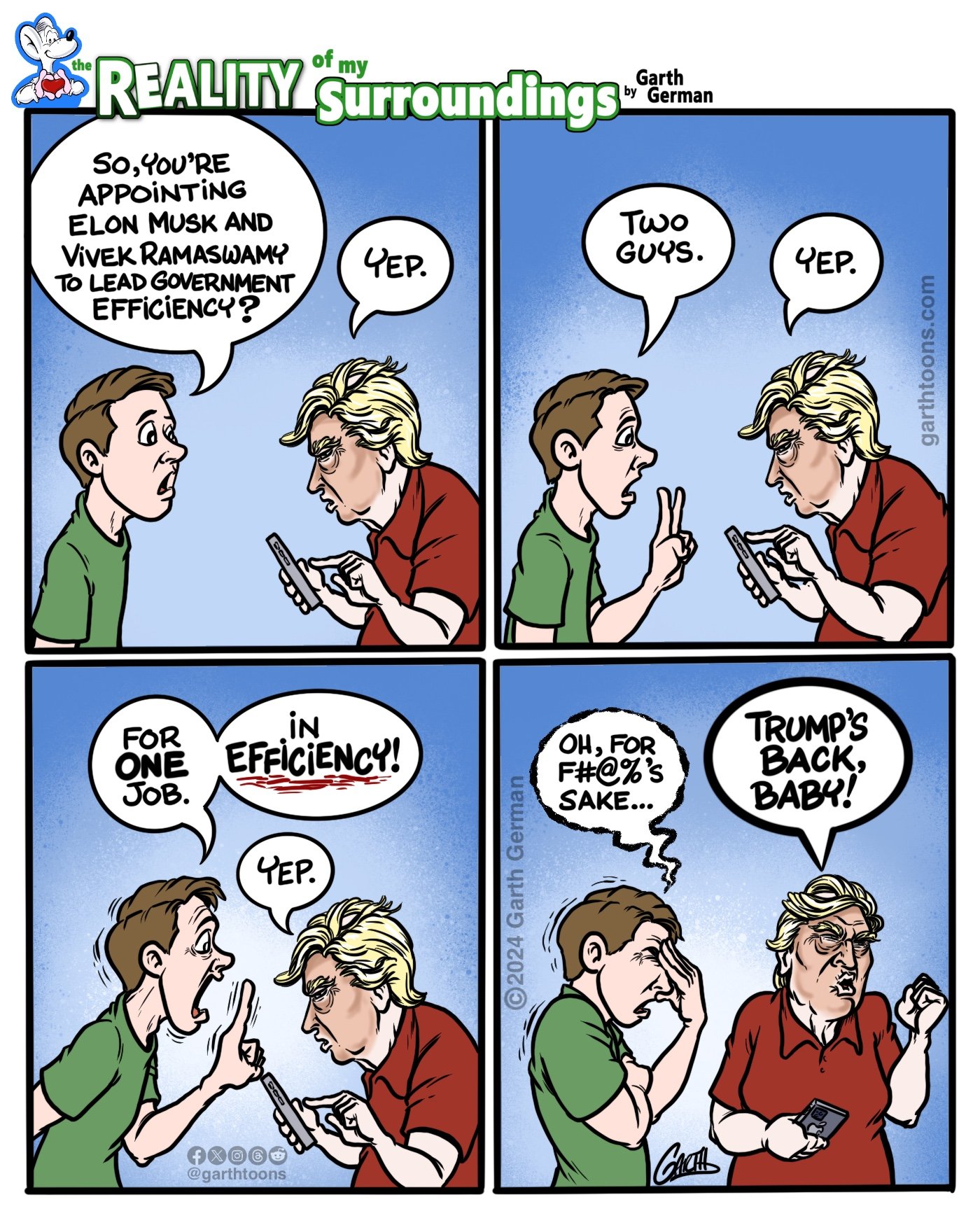
I’m late noticing this, but Paul Krugman did a good job of taking down the “waste, fraud, and abuse” claims of Musk and the other would-be budget-cutters. We’ve seen these government “efficiency” commissions before, usually better staffed and more serious that DOGE appears to be.
There is, of course, inefficiency and waste in the federal government, as there is in any large organization. But most government spending happens because it delivers something people want, and you can’t make significant cuts without hard choices.
Furthermore, the notion that businessmen have skills that readily translate into managing the government is all wrong. Business and government serve different purposes and require different mindsets.
I think Krugman has come up with a good label for the kinds of cuts the DOGE barons keep talking about: doing Willie Sutton in reverse. Sutton was the mid-20th-century thief who famously answered a question about why he robbed banks: “Because that’s where the money is.“
What’s fundamentally unserious about Musk and his partner Vivek Ramaswamy is that they keep targeting places the money isn’t, like foreign aid or federal payrolls. Cutting all foreign aid (including the money that goes to countries you like) and firing all government employees (including the ones you rely on) would not make a serious dent in the deficit.
If you want to cut government spending in any significant way, you have to cut Social Security, Medicare, Medicaid, or Defense. Defense is its own discussion, but the other three are very low-overhead programs, so the only significant cuts would be cuts to benefits.
and Trump’s media strategy

If Trump is going to succeed in his plan to turn America into a fake democracy like Orban’s Hungary, he’ll need a complacent media to keep the public complacent. His plans to achieve that are taking shape.
Fundamentally, American media is split into two parts:
- News organizations that are part of giant corporations like CNN (Warner Brothers Discovery) or MSNBC (NBC Universal).
- Stand-alone organizations like The Guardian or Pro Publica.
The Washington Post appears to stand alone, but its owner (Jeff Bezos) is also a major shareholder in Amazon. We’ll get to The New York Times in a minute.
Trump’s media-domination strategy is similarly twofold: The weakness of the conglomerate-owned sites is that their parent organizations are susceptible to government bribery or intimidation. Amazon, for example, either will or won’t receive government contracts, and could be threatened with antitrust enforcement or profit-killing regulations. In court, it would be hard to connect those bribes and threats to specific news stories, and so their effect on the freedom of the press would be deniable.
The stand-alone organizations, on the other hand, don’t have the deep pockets of a major corporation behind them, so they can be exhausted by frivolous litigation. We can see the beginnings of this already in Trump’s suit against The Des Moines Register for a pre-election poll that (erroneously) showed Trump trailing in Iowa.
If bad polls put you in legal jeopardy, there wouldn’t be a newspaper left in America, which might be the goal. There is something truly diabolical, but also very smart, about trying to spend the media into submission at this moment. It’s un-American, but it might also work.
The Register is owned by Gannett, and so is not a perfect example. But it’s easy to imagine how this strategy could unfold: Nearly every expose’ by Pro Publica could be result in a defamation suit. All the suits would be baseless, but who would cover the legal bills to defeat them?
That leaves us with The New York Times, which is large enough to field a team of lawyers, but is also a stand-alone corporation. But in view of its sorry performance in covering the 2024 campaign, Trump may not need any nefarious way to keep the NYT in check.
and the Constitution
Trumpists are already floating the third-term idea, putting out the idea that the limit is only on consecutive terms. Just so you know, here’s what the 22nd Amendment says:
No person shall be elected to the office of the President more than twice, and no person who has held the office of President, or acted as President, for more than two years of a term to which some other person was elected President shall be elected to the office of the President more than once.
So there’s nothing difficult to interpret here. Nothing ambiguous, nothing about consecutive terms. It’s no third term, period. If Trump is president beyond January 20, 2029, the Constitution has been violated.
Another Constitution-busting idea we’re going to hear a lot about is eliminating birthright citizenship. Here’s what the 14th Amendment says:
All persons born or naturalized in the United States, and subject to the jurisdiction thereof, are citizens of the United States and of the State wherein they reside.
Trump keeps saying he can end birthright citizenship by executive action. If he tries to follow through on that, we’ll have to count on the Supreme Court to decide whether the Constitution still means anything.
and you also might be interested in …
Remember the uproar over “Defund the Police”? The slogan was a political loser, but the thinking behind it is catching on. The idea is that local governments should have emergency responders with a variety of skills, and that armed police officers may not be the best people to send to every disturbance.
Well, Oklahoma City is reporting that its police department has seen a 57% drop in mental-health-related emergency calls in the past year. The reason? The city has a 988 hotline that connects people to mental-health specialists rather than police. 988 calls have sharply increased over the same period of time.
The Montana Supreme Court has agreed with a group of local teen-agers that the Montana Constitution’s promise of “a clean and healthful environment” applies to climate change. It will be interesting to see what the specific implications of this ruling are.
I’m really enjoying Paul Krugman’s post-NYT Substack blog. More and more it looks like the imprimatur of the august New York Times has been baggage that slowed Paul down.
In this column, he explains why “Health Insurance is a Racket“. The money for Americans’ healthcare coverage overwhelmingly depends on the government, whether we’re talking about direct government programs like Medicare and Medicaid or employer-sponsored programs that are motivated by tax breaks. A lot of that money passes through private health insurance companies, and they rake off a chunk of it. But what value do they really add to the process?
Paul also explains why he hasn’t supported Medicare for All proposals: They make economic sense, but they’re political losers. Most Americans covered by employer-sponsored programs report that they are happy with their coverage. So:
anyone proposing a radical reform like Medicare for all is in effect saying to large numbers of voters, “We’re going to take away insurance that you like, that you believe works for you, and replace it with something different. It will be better! Trust us!”
Still, though, even people who aren’t running on MfA proposals should be pointing out that our current system makes no sense. Something different really would be better.
To no one’s surprise, making sports betting legal and advertising it relentlessly during televised sporting events has worsened the nation’s gambling addiction problem.
According to the New York Post, Jeff Bezos is planning to spend $600 million on his second wedding. This is Gilded Age stuff.
Elon Musk isn’t just pushing fascism in the US, but in Germany as well.
Elon Musk has caused outrage in Berlin after appearing to endorse the far-right, anti-immigrant Alternative für Deutschland.
Musk, who has been named by Donald Trump to co-lead a commission aimed at reducing the size of the US federal government, wrote on his social media platform X: “Only the AfD can save Germany.”
Senator Dick Durbin interviews NCAA President (and former Republican Governor) Charlie Baker. Number of athletes competing in NCAA schools: 510,000. Number of those athletes known to be trans: 10.
That’s what the panic has been about: 10 people out of 510,000. And I wonder: Do any of those 10 really qualify as unfair competition?
All my life I’ve been reading articles promising that the long-term solution to the world’s energy problem is nuclear fusion. Well, maybe the long term is finally starting to get shorter.
Overall, it’s been a crappy year. But at least we beat the murder hornets.
and let’s close with something Christmasy

Dog owners in London put on an annual dog-centered nativity play. The little guy pictured above is playing an angel.












:quality(70)/cloudfront-us-east-1.images.arcpublishing.com/tronc/ZMSZJEBRNZDERGIVUQPHE3KY7A.jpg)



 The Weekly Sift