Category Archives: Articles

The Cain Scandal After a Week

When I was putting the Weekly Sift together last Monday morning, I had a decision to make. Politico had raised the Herman Cain sexual harassment charge the night before. Should I call your attention to it or not? I decided not to.

For most of the week, it was the top news story. And yet, when I did my headline-scan this morning, it was nowhere to be seen. The most recent opinion polls show Cain still at or near the top of the Republican field, as if nothing had happened. (Though one poll shows his favorability ratings among Republicans dropping from 66% to 57% — still higher than, say, Rick Perry, who had no scandals this week.) Cain’s Intrade shares bottomed out below 5o cents (indicating a 5% chance of him getting the nomination) on Saturday, and were rising sharply towards 65 cents this morning. Then another accuser announced a press conference and they dropped to 35 cents.

So the conventional wisdom doesn’t know what to think. If we’ve heard everything, Cain will weather the storm. If we haven’t, who knows?

Here’s the yardstick I’m using to decide what’s a big deal and what isn’t: Politically, a scandal is only important if it changes people’s minds. Which means: As satisfying as it might be for me to speculate about what Cain did or did not do and whether that does or does not dynamite all the moralistic foundations of his candidacy, my opinion makes no difference in this matter, because I was never going to vote for Herman Cain anyway.

Politically, this only matters if it changes the minds of Cain’s supporters and potential supporters. And so far, I don’t think it has.

Not that Cain’s audience doesn’t care about sexual misconduct. Quite the opposite, they’ll turn on him quickly if they start believing that he pressures women for extra-marital sex, especially if some of the women turn out to be white. (They’ll tell you that supporting Cain proves they’re not racist. But I don’t believe they’re that not-racist.)

But what would it take to convince them? They aren’t going to believe “the liberal media”. And even if one or more women come forward, Republican primary voters will say that they just wanted money, which they’re being paid (probably by all-around boogeyman George Soros) to come out of the woodwork.

As Dahlia Lithwick points out, Cain’s defenders have already gone far beyond just saying “we don’t know what happened” or “innocent until proven guilty” and are instead attacking the whole notion of sexual harassment. They know Cain is innocent because sexual harassment is a “scam” (Fred Thompson) and “a lawyer’s ramp, like racial discrimination” (John Derbyshire). The mere possibility of lawsuits “drains the humor and humanity from the workplace” (Kurt Schlichter), presumably because it’s so darn hard to make a female subordinate laugh without hinting that you want to have sex with her. Rand Paul agrees, saying he will no longer “tell a joke to a woman in the workplace, any kind of joke, because it could be interpreted incorrectly”. Lithwick concludes:

Nobody is suggesting these claims [against Cain] are necessarily true. But to claim that they must be false because all women lie and all harassers are just joking is a terrifying proposition.

Here’s the sad truth: If you care about sexual harassment and are willing to take a woman’s testimony against a powerful man seriously, you’re probably already a Democrat. So your opinion on the Cain scandal doesn’t count.

[I anticipate a sneering comment from some conservative about Bill Clinton and Paula Jones. You need context to understand Democrats’ dismissal of Jones: Jones’ story was marketed by the same people who claimed the Clintons had murdered Vince Foster. She was the Nth attempt to drum up a scandal against Clinton, after the first N-1 had been bogus.]

So there are only a few ways Cain’s harassment scandal becomes important: if there’s an embarrassing photo, if so many women come forward that the Wilt Chamberlain racial stereotype starts to apply, if people other than the victims (especially powerful men) come forward with supporting testimony, or if the pressure throws Cain so far off his truthy style that he looks guilty to his supporters.

So far all the furor is coming from people who never liked Cain anyway. Unless that changes, the scandal just has entertainment value. Politically, it doesn’t matter.

Nonviolence and the Police

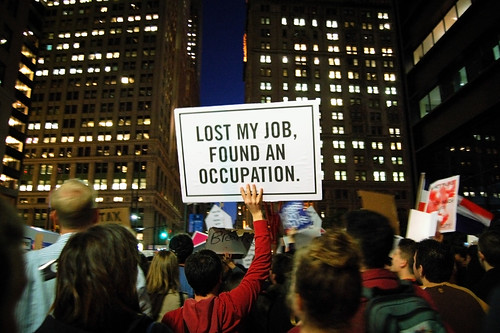
I assume that by now you’ve heard about this week’s police attacks on the Occupy protests — most outrageously in Oakland, but also in Denver and Atlanta. (If not, chase the links and watch some of the video. Descriptions don’t capture it.) These attacks resemble what had happened previously in New York and Boston.

This is a good time to review how nonviolent protest works, because a violent response challenges a nonviolent movement in two ways: First, violence makes protesters angry and tempts them to respond in kind, which hardly ever turns out well. You can’t win physically against the police, and unless it is clear that the violence comes entirely from their side, you won’t win in the media either. “They started it” wasn’t a convincing argument when you were ten, and it still isn’t.

Second, watching your nonviolent allies lose the battle — as they always do when the police are determined and ruthless enough — is discouraging. You might wonder: How can we ever win when they can be violent and we can’t?

And yet, nonviolent movements do cause major change (the Civil Rights movement), have defeated empires (the British in India), and can even overthrow dictators willing to torture and kill (most recently in the Arab Spring). How does that work?

In stages:

  1. Bring a problem to public attention and make its victims visible.
  2. Demonstrate the injustice of the system’s response.
  3. Make explicit the implicit violence that maintains the unjust system.
  4. Turn the servants of the unjust system, including (eventually) the police.

If you make it to stage 4, where the police simply refuse to follow orders, the government either gives in or falls. Governments know this, which is why they frequently give in sooner.

Now let’s go through the stages more slowly.

The Occupy Wall Street movement has already succeeded at Stage 1. FDL finds the value of the protest in

its shoving the Overton Window away from the far right end of the spectrum, far enough away to make talk of meaningful solutions possible, which is the first step towards making them politically viable. Putting a surtax on the rich and/or letting the Bush tax cuts finally expire was considered politically verboten as recently as a month ago. Then Occupy Wall Street got started, and suddenly surtaxes on millionaires start becoming very much discussed indeed.

Also, people are finally starting to pay attention to the fact that many of the financial manipulations leading up to the crash were illegal, and that the bankers/criminals are either getting away with it or paying wrist-slap fines far smaller than their ill-gotten gains.

Sometimes stage 1 is all that’s necessary to create change, but usually you need to keep going.

It’s working on stage 2, occasionally popping up to 3. The main response the authorities are making to the protests is to identify broken regulations — there’s no camping in this park — and then say “We can’t tolerate breaking the law.”

The movement hasn’t succeeded yet in making the public see the hypocrisy in this. What the system actually can’t tolerate are little people breaking little laws. When Goldman Sachs commits fraud, or Bank of America illegally repossesses people’s homes, no one is arrested and no heads get broken. But put up a tent someplace you shouldn’t and all hell breaks loose.

The next job is to get people all over America asking, “What’s up with that?”

Here’s the comparable phase in the Civil Rights movement: when ordinary white people started seeing the Whites Only signs differently. At some point, they realized that there were no separate-but-equal facilities for blacks, and that blacks’ absence did not mean that they were happier with their own kind. Instead, whites began to see Whites Only not as an organizing label (like Men and Women signs on restrooms), but as a threat to have blacks carted away by force. Ordinary white people began to see the violence implicit in their apparently peaceful segregated lunch counters.

In order to win this phase, OWS has to stay as peaceful and orderly as possible, while continuing to keep up the pressure. The disproportion between their civil disobedience and the response it draws — and the contrast with the easy law-breaking of the financial elite — is what makes the case.

One NYC protestor had it exactly right (at the 5:30 mark)

Each new depiction of the abuses of the police on the First Amendment, the more people will show up here in New York City, and the more waves of occupation will spread across this country. And you should be proud of that, police, because you are participating in our media publicity campaign. Thank you for attending.

The challenge will be to keep Wall Street in the picture, and not let the financiers disappear behind the police.

Stage 4. Sometimes you establish the injustice of the system and the violence that maintains it, and it’s still not enough. The moral pretentions of the powerful have been exposed, but they’re basically saying, “Yeah, we’re bad guys. So what? We’re still bigger than you.”

That’s when an invisible moral force begins to work in your favor. You see, most people don’t grow up wanting to be evil. Maybe a few become bankers so that they can foreclose on widows and orphans, Snidely Whiplash style, but probably not many. Maybe a few become police so that they can get away with pepper-spraying defenseless young women in the face, but probably not many.

A lot of police joined the force because they wanted to be good guys, not bad guys. Many of them still want to be good guys. That’s why they can be turned.

Turning the police takes incredible courage and persistence on the part of the protesters. Basically, you have to let them beat you up until they can’t make themselves do it any more. One event that spins out of control is usually not enough. Police have to go to bed knowing that tomorrow they will get up and beat innocent people, like they did today.

At some point they’ll just stop. The order will come down and they’ll say no. It sounds incredible, but it happens.

Usually it doesn’t come to that, because the authorities will do anything to avoid it. (In Cairo, the army forced Mubarak to resign rather than see their ranks dissolve. At Tiananmen Square, the government brought in troops from the provinces, because they were afraid local soldiers wouldn’t obey.) But whether things actually go that far or not, the ultimate threat of a nonviolent movement is to turn the police. No government can survive that.

Protesters need to understand this threat from the beginning, and treat the police accordingly: Shame them but don’t insult them, and above all don’t threaten them. They are your ultimate weapon.

This video from Occupy Boston, of protesters chanting “Who do you protect? Who do you serve?” is exactly right. Those are the questions we want cops asking each other in the privacy of their squad cars, and asking themselves late at night when they can’t sleep. We want them discussing that topic in their union meetings, and mulling it over when the 1%’s refusal to pay taxes leads to layoffs of good cops.

Who are the 99%, officer? You are. So what are you doing on that side of the barricade?

Eliminate the Work Penalty

Like clockwork every four years, Republican presidential candidates propose to “simplify” the income tax by replacing it with a “flat” tax — an income tax where all income is taxed at the same rate.

As I’ll explain below, a flat tax doesn’t simplify anything, but progressives could respond with a proposal that would: Eliminate the work penalty. Don’t tax dividends and capital gains separately from wages or at a lower maximum rate. Treat all income the same.

Fake simplification. Here’s what’s wrong with the idea that a flat tax is simple. An income tax has two parts:

  1. defining what income is
  2. saying how much tax a person at each income level pays.

If you’ve ever filled out your own tax return, you know that the complicated part is (1). Once you know your taxable income, you just look up your tax on a table.

But a flat tax only changes (2), so it doesn’t make your life simpler at all, and it doesn’t shrink the “three million words of the current tax code” that Rick Perry rails about. It slightly simplifies the formula the IRS uses to compute the tax tables, but that’s about it.

The only purpose a flat tax serves is to cut taxes for rich people and raise them for everyone else. “Simplification” is a just ruse to sell the change to people who aren’t rich.

Deductions. Now, sometimes a flat-tax proposal is coupled with eliminating a bunch of deductions. Depending on how it’s implemented, that could simplify both your tax return and the tax code. And it might or might not be a good idea, depending on which deductions get eliminated and whether or not the corresponding tax expenditures are replaced with subsidies.

But that part has nothing to do with flattening the tax. If getting rid of a bunch of deductions is a good idea, we could do that while continuing to tax the rich at a higher rate than the poor or the middle class. The two ideas are unrelated.

The Work Penalty. However, there is a way progressives can steal the tax-simplification issue, and simultaneously put the plutocrats on defense: We could propose eliminating what Andrew Tobias has aptly called “the work penalty”.

Currently, if your money makes any sizable amount of money for you through dividends and capital gains, you fill out a way-too-complicated worksheet in the instructions for Schedule D. (Check out page D-10.) That’s because we don’t really have one income tax system, we have two: One for people who make money by working, and a different one for people who make money by having money.

Guess which system has the lower rates?

For the last several years, tax rates on wages have started at 10%, jumped to 15% when a single wage-earner’s taxable income got over $8,500, gone up to 25% at $34,500, and kept rising from there to max out at 35%.

Meanwhile, the tax rate on qualifying dividends and capital gains is capped at 15%. So (because of how tax-brackets work) a wage-earner whose taxable income tops $38,750 ends up paying a higher tax rate than an idle billionaire whose income is all dividends and capital gains.

That’s a work penalty. If you work, you pay more than if you had acquired the same amount of money by being idly rich.

Herman Cain’s 9-9-9 plan would make the work penalty bigger by not taxing capital gains at all. Cain would tax dividends at the same rate as wages, but this is mostly a ruse, because corporations would stop paying dividends. Instead, they’d use their excess cash to buy back stock, which raises their stock price and so converts taxable dividends into tax-free capital gains.

Making tax simplification a liberal issue. The work penalty is the reason that Warren Buffett pays a lower tax rate than his secretary. President Obama has proposed to fix this by adding a new Buffett Rule to the tax code: a higher minimum tax rate for people whose income is higher than $1 million a year, however they acquire it.

But rather than tack on an extra rule, why not go for the heart of the beast? Eliminate the work penalty. Treat all income the same.

If we made this proposal revenue neutral, tax rates on wages could go down. (Whether we need more revenue in general should be debated separately.) The tax booklet would get slimmer. The income tax would get conceptually simpler, and the Schedule D worksheet would go away. Plus, it would eliminate all the games that make astronomical CEO and hedge-fund manager wages look like capital gains. It’s a win all around, unless you make a lot of money off your money and pay somebody else to do your taxes.

And the framing is tremendous. The work penalty captures the part of the Occupy Wall Street message that most resonates with the general public: the feeling that the rich have special privileges. (Robert Reich’s tax proposals address the work penalty, but he buries it at the end of his article, not realizing the power of the idea.)

It also follows the pattern of the marriage penalty, a concept the Right has put a lot of effort into publicizing. (Marriage and work are both traditional American values that don’t deserve to be treated badly by the tax code.) It associates liberals with working people and conservatives with the idle rich. It steals the tax simplification and tax reform memes from conservatives.

And finally, it’s just the right thing to do. Income is income. There’s no moral justification for favoring the idle rich over people with jobs.

Koch-Funded Study: “Global Warming Is Real”

A new study begun by skeptics from outside the climate-science community, funded in part by the climate-change-denying Koch Foundation, has published four papers supporting one of the key global-warming hypotheses.

To put this in context, there are three distinct ways to deny that we should take action on global warming.

  1. Claim the planet is not getting warmer. Rick Perry has taken this approach, claiming that there is in fact a “cooling trend” that scientists have “manipulated data” to cover up.
  2. Claim that the warming trend is a natural fluctuation unrelated to greenhouse gases or fossil fuels. Debunked here.
  3. Claim that possible actions are too expensive. This is the hardest point to resolve, because it depends not just on climate science, but on economic projections, speculation about future technologies, and your tolerance for catastrophic risk. See the discussion here.

Shifting from one form of denial to another (depending on how much the audience knows) is a sure sign of a charlatan. Such speakers will grant that the planet is warming in one discussion, then talk about a cooling trend in the next.

The new research is a devastating blow to type-1 denial. The work was done by the Berkeley Earth Science Temperature Study (BEST), prominent scientists from outside the usual climate-science research circles (the Economist article on this mentions and physicist and an astro-physicist, including a Nobel Prize winner), who were open to the idea that climate scientists were either misguided or dishonest. So they came up with an independent way to process raw temperature readings going back 200 years. Their conclusions matched the orthodox climate-science results (warming one Centigrade degree since the 1950s) within 2%.

As BEST scientist Richard Muller wrote in Friday’s Wall Street Journal:

Global warming is real. Perhaps our results will help cool this portion of the climate debate.

I think Muller is too optimistic, as shown by the comments WSJ’s climate-denier readership appended to his article. In a rational truth-centered world, we would stop hearing type-1 denial. But in our world type-1 denial will continue, because the new study does not change the relationship between global-warming denial and fossil-fuel-company profits (diagrammed here).

ThinkProgress’ Joe Romm examines the particular case of type-1 denier Anthony Watts. Watts was supportive of the BEST study before he knew what it would say, calling their technique “a better method” and “a novel approach that handles many of the issues that have been raised”. In March Watts pledged: “I’m prepared to accept whatever result they produce, even if it proves my premise wrong.”

But now that he’s seen the result, he’s not budging. Right now he’s saying: wait for peer review. In a few months peer review will be in, and I predict he’ll come up with another excuse.

If the public debate does eventually progress to type-2 denial, here’s a handy fact to keep in mind: The hypothesis that greenhouse gases make a planet hotter isn’t some ad hoc thing left-wingers came up with to justify a government takeover of the economy. Originally, it was developed to explain a completely non-political mystery: why Venus is so hot. (I mean: why the planet Venus has a surface temperature over 800 degrees, not why the Roman love goddess is so attractive, which should be obvious. Sorry for the ambiguity.) Only later did people begin to wonder how the same phenomena played out on Earth.

Among astrophysicists, the greenhouse-gas explanation of Venus’ climate is not at all controversial (probably because no corporation owns Venusian oil rights). Given the example of the Earth’s closest cousin in the solar system, type-2 deniers need a stronger argument than mere skepticism. They need to explain why the same processes that make Venus a furnace don’t work here on Earth.

I like the way a commenter on TPM responded to type-2 denier:

Sooooo . . . help me out here. Which part is it that you doubt, the “theory” that CO2 is transparent to visible light but opaque to infrared, the “theory” that the Earth absorbs visible light and reradiates it in the infrared spectrum, or the “theory” that burning fossil carbon emits CO2?

The complete humans-cause-global-warming hypothesis may be hard to test in one experiment, but the pieces of it are simple and well-established.

Shoot-out at the MSNBC Corral

This Rachel Maddow segment is a classic let’s-take-this-outside challenge to the billionaire Koch brothers.

Some background: First the Maddow show used the Koch brothers as an example of a failure of trickle-down the-rich-are-job-creators economic theory. The Kochs get richer and richer while destroying jobs, as shown here:

Then the show made fun of Koch Industries for touting its 1,240 job openings as if it demonstrated that a government jobs program is unnecessary. (And how many current employees will those 1,240 replace? Less than 1,240 or more?)

Then Koch Industries shot back — not at Rachel directly, but at the staff person who wrote the blog post.

And that brings us to Friday’s segment, in which Rachel refuses to refer to the Kochs as “industrialists” or “businessmen” or any of the other respectful titles they are usually given. Instead, she talks about “Daddy’s company” and “their enormous inherited fortune” before closing with this:

Charles Koch, David Koch, you are trying to intimidate the wrong people. This kind of thing is as pitiful from billionaires as it is from anyone. So I reiterate my many earlier invitations to you: Come sit for an interview. I would love to have you. Come sit for an interview and let’s talk this out. Rather than have Daddy’s company attack my producers one-by-one by name, feel free to man up any time.

Your beef is with me.

This is the point in the Westerns where the bartender ducks behind the bar and the poker players dive under their table. But I bet the Kochs wimp out and the on-air showdown never happens.

Still, when a skinny little female looks you in the eye and tells you to “man up”, that’s gotta hurt. Charles, David — they’ll never admit it to your face, but the fewer-and-fewer people you employ are passing Rachel’s link around and laughing at you.

Suck It Up: Using Our Pride Against Us

Last week I talked about the role of shame in maintaining an unjust system: A lot of people are losers in such a system, but who wants to identify with losers? The closer you are to the abyss, the stronger the temptation to deny that you bear any resemblance to the people who have already fallen in.

This week we got to see the slip side of the same phenomenon: how the rich and powerful take advantage of the legitimate pride many struggling people feel in the virtues that keep them afloat.

It started a week ago Wednesday with a cruel joke: Erick Erickson, founder of the right-wing blog Red State and recently a CNN commentator, started the We Are the 53% web site to parody the emotionally powerful We Are the 99% site I linked to last week. He posted a photo of himself disguised in a working-class t-shirt and holding up his story:

I work 3 jobs. I have a house I can’t sell. My family insurance costs are outrageous. But I don’t blame Wall Street. Suck it up, you whiners. I am the 53% subsidizing you so you can hang out on Wall Street and complain.

The “53%” are from a right-wing talking point that is debunked here and in more detail here: 47% of American households pay no net income tax, mostly because they don’t make enough money to qualify. (They pay plenty of other taxes, however, some at a higher percentage of their income than many rich people.) The point of “the 53%” is to evoke an image of a hard-working majority that pulls the weight of everyone else. It is part of the right-wing argument that minimum-wage-earners (and not the rich) should be paying more taxes.

And in Erickson’s case, it is ridiculous. His “jobs” consist of doing what he enjoys, and he could stop any time he wants. The only things he “sucks up” are money and fame, not abuse or anxiety. But one of the talents that puts Erickson firmly in the 1% is his understanding of working-class resentment and how to turn it against the weak rather than the powerful. So people with legitimate stories to tell have followed his example and posted to his site. Like this guy:


I am a former Marine. I work two jobs. I don’t have health insurance.

I worked 60-70 hours a week for 8 years to pay my way through college. I haven’t had 4 consecutive days off in over 4 years.

But I don’t blame Wall Street. Suck it up you whiners. I am the 53%. God bless the USA!

Minus the suck-it-up closing, this could be a 99% posting. This guy is a victim of the economy, but he doesn’t like being a victim, so he identifies with the lords rather than the serfs. Damn those whining serfs, for claiming to be like him.

A similar (if less in-your-face) story has been forwarded all over Facebook:

Like the ex-Marine, this woman (the fingers and handwriting look female to me) has virtues worth taking pride in: She’s talented enough to get a scholarship, hard-working, and with enough self-control to spend less than she makes. Her version of “Suck it up, you whiners” is less insulting, but just as distancing: “I am NOT the 99%, and whether or not you are is YOUR decision.”

Really? I don’t think so. We can all decide not to identify with the people who work more and more for less and less, but we can’t decide not to resemble them.

I picture this student sitting in her cheap apartment, maybe watching somebody’s cast-off picture-tube TV rather than going to the movies with her friends, eating something sensible that she cooked herself, planning to get back to her homework in another few minutes — and identifying with the 1%.

“That’s how it’s supposed to work,” she writes. She’s supposed to “work my @$$ off” for whatever she gets, and hope that she doesn’t get sick, and hope that when she picked her major she didn’t guess wrong about where the jobs would be. Meanwhile, the ever-increasing bounty of this rich planet goes to other people — many of whom aren’t as talented, didn’t scrimp and save, and don’t work their asses off.

That’s how it’s supposed to work?

It’s tempting to pour scorn on these two, but that’s just falling into Erickson’s divide-and-conquer trap. The 99% are supposed to fight each other. The field slaves are supposed to resent the house slaves, and vice versa.

So what is the right response? Max Udargo nailed it in Open Letter to that 53% Guy. It’s absolutely worth reading in its entirety (it has become the most shared post in the history of Daily Kos), but this is the key point:

I understand your pride in what you’ve accomplished, but I want to ask you something.

Do you really want the bar set this high? Do you really want to live in a society where just getting by requires a person to hold down two jobs and work 60 to 70 hours a week? Is that your idea of the American Dream?

… And, believe it or not, there are people out there even tougher than you. Why don’t we let them set the bar, instead of you? Are you ready to work 80 hours a week? 100 hours? Can you hold down four jobs? … And is this really your idea of what life should be like in the greatest country on Earth?

It would be one thing if life was just that hard, if producing enough for everybody to get by required everybody to work 70 hours a week and never make a wrong move. But that’s not true. We know it’s not, because things used to be different. Americans used to have secure 40-hour-a-week jobs that paid well enough to raise a family on one income. Per capita GDP has gone up considerably since then, but the surplus has all accumulated at the top.

That’s not natural; it didn’t happen to nearly the same extent in other countries. It happened here because the very wealthy got control of our political system and ran it for their own benefit. It happened because we changed the rules to reward financial sleight-of-hand over making things and serving people. It happened because we devalued the public sector — the schools, the roads, the parks, the safety net — and let our whole society get split into First Class and Coach.

Fixing that is what the 99% movement is about. It’s not about making talent and hard work and wise choices irrelevant. But how talented, how hard-working, how wise — and how lucky, never forget the role of luck in your success — should a person need to be to have a decent life? How unforgiving do we want to make our society?

If the 99% win and the system changes, the economic race will continue and some people will still outrun the others. Nobody grudges them that. But we don’t have to live in a society where the Devil takes the hindmost. And we can still have empathy for the people we pass. That’s a virtue too.

A View from Dewey Square

I doubt the world needs another occupation-protest eye-witness blog post. People much better known than me have already been there: Michael MooreChris Hedges, Rick Perlstein, and Jeffrey Sachs, just to name a few. And Pistols At Dawn already did the ordinary-person-checks-out-the-hype thing pretty well.

Still, when I heard there was an Occupy Boston protest at Dewey Square (at the South Station T stop across from the Federal Reserve), I couldn’t resist taking a look. And having been there, I now can’t resist writing about it. But I’ll try to restrain myself from repeating what’s already been said hundreds of times.

Two things struck me about Occupy Boston. First, Dewey Square is tiny. I didn’t do a count, but Salon’s description of a “field … filled with hundreds of tents and tarps” is a vast exaggeration. We’re talking at most a few dozen small tents, and they totally fill the available space but for a walkway. Mayor Menino’s warning “you can’t tie up a city” is similarly absurd. Any occupation confined to Dewey Square isn’t even a mosquito bite on a city the size of Boston.

Second, the way conservatives try to make the Occupation movement sound scary is ludicrous. Eric Cantor’s talk about “mobs” and Glenn Beck’s warning that “They will come for you and drag you into the streets and kill you” — we’re in Fantasyland here. People who say things like this are just hoping you don’t bother to get any genuine information.

I was at Occupy Boston on Tuesday (the same day as The New Yorker; their photo shows about a third of the encampment). Monday the camp had tried to expand to the next park down the Greenway (for obvious reasons; they’re out of space), and police violently ejected them at 1:30 in the morning. The video got national attention, and not in a way that made the police look good. Veterans For Peace positioned itself between the police and the protesters, and the police manhandled them.

So if ever the Occupiers were going to be surly and vengeful, it would have been Tuesday.

But I didn’t run into anybody surly and vengeful. Annoyed, maybe.  Some of them were amazed (in that way educated white people get) to realize that police don’t necessarily act reasonably or even obey the law. But everyone seemed to understand that the Occupation is nonviolent by definition. If they get provoked to violence, they’ve lost the argument.

Two of the people I talked to were white-haired folks who reminisced about the Vietnam War protests of their youth. One had a Santa-Claus beard and was selling anarchist pamphlets, probably for less than it cost him to photo-copy them. (I bought one for 50 cents.) The other was a woman who was trying to figure out how to start an occupation in Cambridge.

A young man wearing a pink wig was holding a sign about police abuse, so I asked him about the previous night’s confrontation. He told the same basic story I eventually heard from just about everyone (each in their own words rather than rehearsed or programmed): The police were violent and the demonstrators peaceful.

The clean-cut 20-something geeks in the media tent told me the most outrageous Monday-night story: Someone had rented a hotel room overlooking the square and were broadcasing a live feed of the police raid, until the police came up and stopped them — on no particular grounds anybody could imagine.

But as in the famous John Gilmore quote, “The Net interprets censorship as damage and routes around it.” The geeks were excitedly processing all the Monday-night video they could get their hands on and posting it to the Web. That seemed to be all the revenge they needed.

The guy at the information table was collecting bail money. At the logistics tent they were hoping for donations of tents to replace the ones the police had thrown in a garbage truck Monday night.

Everybody was careful not to speak for the group. Future strategy was going to be a topic of that evening’s General Assembly, and nobody wanted to prejudge the outcome. (The Occupiers were proud of their democratic process, though they all admitted it was tedious.)

Anger? Not so much. There was stuff to do. Venting or riling each other up wasn’t going to get it done. No one seemed hurried or panicked, but many seemed focused.

Like so many middle-aged people who see an Occupation protest, I can’t resist making a sweeping generalization: I don’t think people my age appreciate the effect a lifetime of computer games has had on the rising generation. They are both more strategic and more relentless than we expect them to be.

So they did not experience Monday’s police raid as some primitive horror; it was just the new challenge that marked the Occupation’s progress to Level 2. It’s something else to overcome, like bad weather. So the Occupiers bail people out, get more tents, and keep going until they can find the door to Level 3.

[I haven’t been to Occupy Wall Street, but the way they met the weekend’s park-cleaning challenge sounded similar. This level has a new obstacle; how do we marshal our resources to overcome it?]

If the authorities think they’re going to get rid of these protests through slow escalation, they’d better think again. They’ll just be training the protesters to reach ever-higher levels of proficiency.

Turn the Shame Around

For the longest time I didn’t get Occupy Wall Street, but then Herman Cain helped me out: He said something so monumentally wrong that my reaction against it pointed me in the right direction.

Here’s Herman:

Don’t blame Wall Street, don’t blame the big banks, if you don’t have a job and you’re not rich, blame yourself! … It is not someone’s fault if they succeeded, it is someone’s fault if they failed.

That’s when I got it. An unjust system’s first line of defense is shame. As long as we’re ashamed to admit that we’re victims, as long as we’re ashamed to identify with the other losers, we’re helpless.

It would be great to have a 10-point plan that solves everything. It would be great to have a party that endorses that plan and a get-out-the-vote movement to put that party into office. But none of that is going to happen until large numbers of us cast off our shame, until we turn the shame around: We need to stop being ashamed that we couldn’t crack the top 1%, and instead cast shame on an economic system that only works for 1%. The people who defend that immoral system and profit from it — they should be ashamed, not us.

That’s what Occupy Wall Street is about. OWS isn’t about plans and parties and votes. That all comes later. OWS is about casting off shame and learning to identify with the other losers.

I didn’t get OWS because (like a lot of other people) I kept trying to fit it into the wrong model. It’s not the 20th-century labor movement, marching for a minimum wage and a 40-hour week. It’s not Rosa Parks demanding her seat on the bus. It’s not last spring’s occupation of the state capitol in Madison, demanding  the restoration of collective bargaining rights, a reversal of education cuts, and maybe even the recall of Gov. Walker.

Those were fine movements, but they’re not this movement. This is more like feminism in the late 60s or gay rights in the 80s.  Specific demands will play their role eventually, but consciousness-raising has to come first.

Remember what we were told in those days? Feminists were women who had to work because they were too ugly to get a man. Gays were perverts too limp-wristed to defend themselves. They were losers. If you resembled them or sympathized with them, you were supposed to be ashamed.

Somebody had to be the first to go out in public and absorb that scorn. I remember my shock the first time I saw Dykes on Bikes, or a troop of guys in drag chanting “We’re here. We’re queer.” I remember trying to imagine how much courage that took, and what else must be possible if this was possible.

But other than a vague sense that they ought to be treated more like human beings, I don’t remember their demands. I wonder if they remember.

Now go look at the pictures at We Are the 99%. One person after another is saying, “Look at me. I’m losing in this economy, and I’m not ashamed who knows it.”

That’s powerful. I think everybody who looks at those pictures feels a little bit of their own shame melt.

Maybe the economic story you’re ashamed to tell is no great shakes compared to people who have lost their homes or got sick without insurance or had to move back in with Mom and Dad. But you probably have one.

Saturday night at dinner, talking about OWS led an old friend to admit to me that he had taken a pay cut. He’s got a job; he’s surviving. But still — a pay cut — that’s not the image of himself he wants a lot of people to see.

Here’s the story I don’t tell: After things started going south, I was gullible enough to believe the bankers who said they had it under control. I put a chunk of my retirement savings into Citicorp and lost it. I’m not going to be eating cat food any time soon, but the story shows me being a sucker, so I don’t tell anybody. I don’t like being a sucker. I want to project an image of the 1%, not the 99%.

That’s got to change. Just about all of us — around 99%, I figure — are losers these days. We need to stop being ashamed of it. We need to tell our stories, and when we hear each other’s stories we need to embrace them, not distance ourselves.

Most of all, we need to turn the shame around. The bankers who stole a bunch of our money and lost the rest — they should be ashamed. The CEOs who have corrupted our political system so that it serves their interests instead of the people’s — they should be ashamed. The politicians who take the billionaires’ money, rig the economy in their favor, and then tell the rest of us it’s our own fault we’re not rich — they should be ashamed.

You don’t have to tell me: Change requires more than just consciousness-raising. I know.

The old rules still apply. We’re going to need policies. We’re going to need agendas and lists of demands. We’re going to need leaders to represent us and armies of volunteers to knock on doors and make phone calls and write letters to the editor. We’re going to have to register millions of voters and get them to the polls. None of that is going to happen automatically just because people lose their shame about being victims of an economy run by and for the 1%.

But I don’t believe that stuff is going to happen at all — not on the scale we need — until people lose their shame about being victims and losers. It’s just a first step, but I don’t think we can skip it.

What Kind of King Do You Want to Be?

Whenever I teach something, I always start with the same question: Why should you care? Because I hate being an authoritarian and demanding that people learn things they don’t want to know.

Wednesday I started teaching current events to a bright, home-schooled 13-year-old. So that’s where I had to begin: Why should he care about the news? Why should anybody?

Lots of people don’t, and they get by just fine. Lots of people who do, do it so badly that they probably shouldn’t. The news is just one more reason to get depressed or angry or to feel superior to the uninformed masses. They get mad at President Obama instead of their boss, or worry more about some missing girl in Wyoming than about their own kids. Maybe the news is just an addiction, a bad habit like smoking. Why should a teen-ager start?

Here’s why: In a democracy, the People are sovereign — the People have replaced the King. That means that each of us, in our own small way, is King. All of our children are heirs to the throne. “So that’s why I’m here,” I said. “I’m training you to be King. What kind of King do you want to be? What information will you need if you’re going to be that kind of King? That’s what news is.”

You can’t explain it with economics: There’s no profit in news unless you’re a politician or a journalist or a stock trader. Homo economicus doesn’t bother with news. He doesn’t vote, either. The personal gain doesn’t justify the investment of time and effort.

And while the news can be fascinating or engaging, let’s face it: Hard news, the kind of stuff kings need to know, is never going to compete with gossip and sensation. What gets human brain chemistry stirring? Charlie Sheen’s latest rant? Britney Spears going out without underwear? Or the collateral damage of some Predator drone strike on the other side of the world? You tell me.

No, the right reason to care about news isn’t profit or even interest. It’s because we have responsibilities. When we screw up our job as King of the most powerful nation on Earth, people die.

Look at Iraq. After 9-11, We the People of the United States were scared and shaken and angry. Collectively, we wanted to kick somebody’s butt. We wanted to show the world that we were still top dog, that we couldn’t be poked in the eye like this without somebody paying for it.

Bin Laden had vanished into the wind. We chased the Taliban out of Kabul, and then they vanished into the wind too. Nobody had paid yet, or they hadn’t paid enough.

And there was Saddam Hussein. He’d been thumbing his nose at us for years. He was vaguely a Muslim and vaguely in the same part of the world. You can say Bush fooled us, but all he did was encourage us to believe what we wanted: that Saddam was behind 9-11.

So we fought an unnecessary war. You can blame it on Bush if you want. You can blame it on Congress and on Democrats who didn’t have the courage to take an unpopular stand. But kings can always blame a bad decision on their advisors.

Really it was us. We could have stopped it. The truth was there for anybody who wanted to see it, but we couldn’t be bothered. We wanted to hit somebody.

So people died for no good reason. Four thousand of our troops. Tens of thousands of insurgents. And ordinary Iraqi civilians — God knows how many. Maybe hundreds of thousands, who can say? Millions had to leave their homes and go to Jordan or Syria or some other part of Iraq. Picture it: Picking up and leaving your friends because you had to go to Canada or Mexico or Alaska to feel safe. Millions of people.

That’s what happens when we screw up.

Right now we’re screwing up our economy. Millions of Americans want to work but can’t find jobs. So they’re losing their homes, their kids aren’t going to college, and if they get sick they have no insurance.

That’s what happens when we screw up.

I know what you’re thinking: If being King is such a hard job and we’re that bad at it, we should just abdicate. Let somebody smarter do it.

That turns out to be even worse. All of human history proves it.

The power doesn’t go away just because you don’t want it. Somebody else gets it. Occasionally it’s somebody good and responsible, but that never lasts very long. Eventually power winds up in the hands of somebody who is good at seizing power.

People like that run the country for their own benefit. If you have something they want, they take it. If they want you to do something, you do it or you go to jail. If you try to take the power back from them, they kill you.

That’s why our ancestors decided to take on the responsibility of being King in the first place — because all the alternatives were worse. All over the world now, ordinary people are trying to take on kingship because they’ve seen what happens otherwise. Just this year, hundreds of thousands of people showed up in public squares in Cairo, Tunis, Damascus, and a bunch of other cities all over the Middle East.  “You don’t dare kill all of us,” they were saying to their rulers. “If you give the order, the soldiers won’t do it.”

Sometimes they were right. Sometimes they weren’t.

That took a lot of courage. And the reason they did it was that they wanted the chance — the chance! it might not even work! — to be a King like you and me.

So what kind of King do you want to be? The kind who can’t be bothered to keep track of the kingdom? The kind who lets unscrupulous advisors run things for their own benefit? The kind who is easily manipulated with lies? Who is impulsive and acts without thinking? Who is easily distracted by ginned-up controversies that don’t really matter?

I’m hoping not. I’m going to try to convince you to be a good King. And if you’re going to be a good King, there are things you need to know and understand.

That’s what news is.

ConConCon: Can the Grass Roots Find Common Ground?

I think the fundamental problem in American politics is the corruption of our political system. It’s a corruption that makes it impossible for the Left to get what the Left wants and the Right to get what the Right wants.Lawrence Lessig to Cenk Uygur at the ConConCon

Left and Right alike have proposals that poll well, but never make it through Congress: taxing the rich and a public option for health care on the Left, a balanced budget amendment and (in some polls) harsher immigration policies on the Right. The grass roots on both sides object to corporate personhood (79% in one survey) and were appalled when their government responded to the 2008 financial collapse by dishing out money to the same bankers who had screwed things up.

Originally designed to be the People’s voice, Congress has become a bottleneck controlled by special interests. Consequently, Left/Right political competition has only a limited amount of meaning. No matter how many seats either party wins, we won’t see single-payer healthcare (Left) or a flat tax (Right).

On the other hand, some ideas with little-to-no public support get through Congress easily. Lessig’s favorite example is the Sonny Bono Copyright Act of 1998, which extended the life of copyrights issued since 1923 — keeping valuable characters like Mickey Mouse and Superman out of the public domain. Copyright is a temporary monopoly that the government grants to encourage creativity, but extending the copyright of works that already exist serves no public purpose whatsoever. (“No matter what the US Congress does with current law,” Lessig observes, “George Gershwin is not going to produce anything more.”) The extension, amounted to a gift from Congress to Disney and Time Warner, who lobbied for it like 10-year-olds in December.

So who gets what they want out of Congress? Lessig calls them “the Funders” — the entities that finance political campaigns. And how can the People change the system to regain control of their government? By getting Congress to pass new laws or Constitutional amendments?

Good luck with that.

That’s the origin of this idea: Without minimizing the significance of their philosophical differences, can grass roots from the Left and Right come together in a campaign to make democracy meaningful again?

Tea Party? Lessig’s Rootstrikers organization explored this idea by getting together with Mark Meckler’s right-wing Tea Party Patriots to co-sponsor a discussion of a way to end-run Congress and fix the system another way: via a constitutional convention called by the States. Hence the Conference on the Constitutional Convention held in late September at Harvard Law School. (I “attended” via the live feed on the Web. I had hoped video of the sessions would be posted by now, but they aren’t. Consequently, all quotes are from memory or my hastily scribbled notes.)

I find that whenever I mention this co-sponsorship, people jump to the conclusion that the goal must be to generate some kind of homogenized, centrist agenda. To explain, I came up with this metaphor: Imagine two swordsmen dueling over a great prize. While they swashbuckle their way around the arena, focused on each other, somebody else walks past them, calmly stuffs the prize into a sack, and walks out.

The duel is real, but it becomes pointless if the swordsmen can’t ally to protect the prize.

The Civics of Article V. The possibility of a constitutional convention is embedded in the Constitution itself.

on the Application of the Legislatures of two thirds of the several States, [Congress] shall call a Convention for proposing Amendments

Once proposed by the convention, amendments would follow the same ratification path as constitutional amendments approved by Congress: They’d have to be ratified by 3/4ths of the states — 38 of the current 50. So any 13 states could block any of the convention’s amendments.

Because this would be an orderly process authorized by the current Constitution, speakers began referring to it as an “Article V convention” rather than a general constitutional convention that could spring from nowhere and make up its own rules. (The hallowed convention that produced our current constitution was unauthorized by the Articles of Confederation that it replaced. In particular, the Articles said that any change had to be approved by all 13 states. But the new constitution wrote its own rules and said it would go into effect if only 9 states ratified it.)

Article V is about as vague as the rest of the Constitution. But since no such convention has ever been called, Article V has two centuries of rust on it rather than the reams of precedent and case law that interprets most constitutional provisions. So there are a lot of open questions, which the ConConCon’s legal panel spelled out:

  • How do 2/3rds of the states “apply” for a convention? Every now and then, some legislature passes a call for a convention to consider such-and-such an amendment. If you total all those up, we’ve already had calls from more than 2/3rds of the states. But the general opinion is that the state’s applications have to be similar in some way; they have to be calling for the same convention, not just a convention. How similar do they need to be? Lessig proposes that states pass similar wordings that call for a convention in general, and then (in a second clause) urge the convention to consider the particular amendments popular in that state.
  • What if Congress ignores the applications? A lot of the Constitution assumes that people will act in good faith, and doesn’t specify what happens if they don’t. For example, the 12th Amendment specifies that (in the presence of Congress) the President of the Senate counts the votes of the Electoral College — the final step in electing a president. What if Senate President counts the votes wrong and declares himself president? All Hell breaks loose, I think.
    Similarly, what if Congress looks at the States’ applications for a constitutional convention and says, “Not gonna happen”? Or calls a convention under rules that make it unworkable? It’s not clear that anything other than public furor keeps Congress in line.
  • How do the conventioneers get chosen? Maybe that’s defined in Congress’ call. If not, nobody knows.
  • What if the convention breaks the rules set out in Congress’ call? Again, we’ve got a good-faith issue. Probably nothing happens; if 3/4ths of the states go ahead and ratify the amendments anyway, they become part of the Constitution.

Runaway conventions. The big question everybody asks is: What if a “runaway” convention goes wild and designs some whole new country for us? What it declares a socialist republic or a Christian theocracy or something?

The simple answer is that 13 states refuse to ratify it and the whole plan goes into the dustbin of history. There are at least 13 blue states and 13 red states, so nothing could pass without bipartisan support.

This only gets tricky if the convention does what the original convention did: writes new ratification rules for itself. (Example: What if the new constitution says it will be ratified by majority vote in a national referendum?) Then you get into the fuzzier question of legitimacy: At some point the country just ignores the process and the old government continues.

What a convention could do. The consensus of the legal panel was that constitutional amendments should be about the mechanics of government, and that more specific proposals (like Prohibition) are better left to legislation that can be easily repealed if it doesn’t work.

But the Supreme Court has boxed us into a situation where the corruption of our system can’t be rooted out without constitutional changes. So we should be looking for structural changes that make legislative change possible.

In particular, Lessig wants public funding of campaigns, through a voucher system similar to the one Ackerman and Ayres proposed in Voting With Dollars.

Fear of democracy. Lessig argues that the fear of a runaway convention results from an underlying fear of democracy and fear of each other, which the Powers That Be encourage and profit from. This is backwards, he argues: The Powers That Be (and not our fellow citizens) have proven that they’re not to be trusted.

We are used to a managed democracy, where the People only choose after the options have been very tightly scripted. (As Cake put it: “Some people drink Pepsi, some people drink Coke. The wacky morning DJ says democracy’s a joke.”) A constitutional convention would be deliberative, not managed. The conventioneers would have real responsibility, and a chance to shape the questions rather than choose from a prepared list of answers.

Lessig has faith in the deliberative powers of ordinary people, and supports Sandy Levinson‘s idea that the best way to choose conventioneers would be randomly, as juries are chosen. (The one jury I’ve served on supports his case; we rose to the occasion and did a good job.)

You got a better idea? Even Lessig is not wild about a ConCon. He’s been driven to it by the failure of everything else. Would it work? Or would it be taken over the same forces that distort the rest of our political system? Would it all come to nothing or produce some crisis of legitimacy?

He doesn’t know. But he doesn’t think we can keep doing what we’re doing.

Lessig’s keynote address was one of the most inspiring speeches I’ve ever seen. Unfortunately, the most inspiring part was in the question session, which that link doesn’t include. I’ll try to fill in from my notes and from a similar talk elsewhere.

This is how he answered the will-this-work question. First, he admitted that it probably wouldn’t. But then he asked:

If a doctor told you that your child had terminal brain cancer and there was nothing you could do, would you really do nothing? Just look at the doctor and say OK?

No you wouldn’t do nothing, because that’s what it means to love: to have the willingness to act compassionately for something, even if it seems impossible.

I am acting on the faith that all over America there are people who have this kind of love of country.

It is very rare to hear a liberal grab hold of the patriotism theme like this, and to attach it to having the courage to trust each other rather than the vicarious “courage” to send soldiers into somebody else’s country. I got shivers. It’s a powerful emotional argument.

But it also makes sense. If we can’t trust each other, then we can’t be a democracy. Where does that kind of thinking lead?