Category Archives: Articles

Politics in 2011: The Tragedy of the Tea Party

Years of American politics don’t usually boil down to one story, but to a large extent 2011 does. The main character is the Tea Party and the story is a tragedy.

Like any populist movement that catches on, the Tea Party started out embodying some simple and compelling ideas:

  • When the government plans to go another $1 trillion in debt every year, as far as the eye can see, something is seriously wrong.
  • The will of the people doesn’t seem to make much difference any more.
  • On many issues, the two parties don’t offer much of a choice.

What really brought these points home was TARP. It was proposed by a Republican administration in the middle of an election campaign. Polls said it was unpopular, but it passed anyway. Then after the Democrats had a landslide victory, the new administration carried out TARP as if the people had said nothing at all.

If those initial ideas had been all the Tea Party was about, they might have sparked a long-needed public conversation about what the government does and the way governance happens. We could have talked about

  • the cost of an aggressive foreign policy and the wars it gets us into,
  • what kind of safety net we want or can reasonably expect,
  • what a fair tax structure looks like,
  • how big a role should government take in trying to manage the business cycle,
  • what dangers we need the government to protect us from and what we can handle ourselves,
  • how to reduce the influence of special-interest money,

and many other subjects. My answers would probably have comflicted with many Tea Partiers’ answers, but at least they are the right questions.

For a variety of reasons, that conversation never happened. Nonetheless, the Tea Party dominated the elections of 2010 and entered 2011 triumphant. It had provided the energy for a stunning Republican comeback that retook the House, significantly cut down the Democrats’ advantage in the Senate, and took complete control of many state governments. Tea Partiers looked to be in a position to dictate the 2012 Republican nominee.

And then things started to go wrong.

In any tragedy the hero has a flaw, some collection of character traits that were visible even in his triumph, but which eventually bring him down. From the beginning, the Tea Party had a number of tragic flaws.

  • Anti-intellectualism. The Tea Party drew the wrong conclusion from TARP, blaming economists and bureaucrats more than bankers. In general, the Tea Party became suspicious of expertise, not of power. What developed was not a set of policies, but a few slogans like “stop the spending” and a belief that we just need to elect good people willing to “stand up for common sense solutions“. In 2011, Herman Cain could appeal to Tea Partiers by claiming not to know things like “the president of Uz-beki-beki-beki-stan-stan.”
  • Hidden motives. Simplistic slogans can mask unsavory agendas. And so a legitimate desire to see institutional power return to the people got conflated with the belief that white, English-speaking, fundamentalist Christians built this country and need to take it back. So although the Tea Party pitched itself as nonpartisan and not concerned with social issues, in practice “good people with common sense” came to mean right-wing Republican Christians.
  • A Faustian bargain. The “nonpartisan” Tea Party got much of its leadership training from FreedomWorks (run by Republican lobbyist Dick Armey), much of its funding from billionaires like the Koch brothers and their associated organizations, and much of its publicity from Fox News. (A Breitbart attempt to “debunk” these claims actually ends up supporting it if you read all the way through.) The danger of being co-opted by corporatists and billionaires was there from the beginning.

As a result, the Republicans who took power in January, 2011 had little in the way of a public agenda. In Congress, that mostly meant opposing whatever Obama wanted to do. But in the states, new governors like Scott Walker in Wisconsin and John Kasich in Ohio had enough support in the legislature to do more-or-less whatever they wanted.

On Day 1, the governors started implementing a detailed and aggressive agenda that hadn’t been part of their campaigns — the same agenda in one state after another: break the public employee unions, make it harder to vote and harder to sue corporations, cut funds for education and medical care, privatize public schools, cut taxes for the wealthy and for corporations, and slash any regulations that protect workers or the environment.

This agenda did not bubble up from the people; it came from the American Legislative Executive Council (ALEC) — a group funded and controlled by corporations, in which corporate lobbyists and conservative legislators work together to write model bills that serve corporate needs.

That agenda proved to be wildly unpopular, and energized a liberal populist backlash. In Wisconsin, two Republican senators were recalled and Governor Walker will face a recall election later this year. In Ohio, Kasich’s S.B. 5 was repealed by a wide margin in a November referendum. In states that did not allow such direct voter action, the governors’ approval ratings have plumented. (Friday Rachel Maddow reviewed how this played out during 2011.)

In addition, both in the states and in Washington, the right-wing Christians that the Tea Party had elected on economic issues turned out a series of new laws restricting abortion. (Maddow has kept track of this in her series on Really, Really Big Government.)

In Congress, the new Tea Party Republicans have identified little in the way of wasteful spending (such spending cuts as they have gotten are of the across-the-board variety), but instead have gone after the EPA and Planned Parenthood. They have carried water for Wall Street by watering down the Dodd-Frank bill (which they now want to repeal entirely, returning to the pre-crisis status quo) and for the oil companies by pushing the Keystone XL pipeline. They have opposed cutting the deficit by raising taxes on incomes over $1 million a year, even risking a tax increase on working people in order to protect the rich.

In short, a movement that billed itself as returning power to ordinary people instead has implemented a pro-corporate, pro-billionaire agenda. Vague slogans co-opted well meaning Americans at the grass roots into working to benefit the 1%. (I urged them to reconsider this summer by comparing them to football players who run the wrong way.)

By the end of 2011, the Occupy movement had seized the anti-Wall-Street pro-ordinary-people energy that used to power the Tea Party, exposing the Tea Party as a stalwart defender of the 1%. The Republican establishment is pulling its hair out over the extreme positions presidential candidates are taking to woo Tea Partiers. And in the House they’ve been embarrassed into retreating on the payroll tax bill.

In any general election, the Tea Party has become poison. By fall, no one — literally no one — will claim to be a Tea Party candidate.

How the mighty have fallen.

The State of the Sift

2011 was an expansion year for the Weekly Sift. I redesigned the blog, moved it to weeklysift.com, and added the Link of the Day feature to its Facebook and Twitter feeds.

Traffic is up: The Sift got 137,000 views since it moved in July. Pre-July statistics aren’t really comparable, since an entire week’s Sift used to be one post and now is four or five — but trust me, readership is up.

The increase, though, is mostly due to a few posts going viral. One post: Six True Things Politicians Can’t Say accounts for half of those post-July views (68K), with 58K coming on one day. Add in Why I’m Not a Libertarian (21K), and One Word Turns the Tea Party Around (18K) and you’re over 100,000. Other posts that got kiloviews are Turn the Shame Around (7.6K) and Liberal Media, Conservative Manipulation (2.7K)

Regular readership is also up, but not as dramatically. The email list is steady at a little over 100. In addition, 104 people follow the blog via WordPress, while another 140 or so subscribe via Google Reader. I’m not sure how many people get the RSS feed some other way. There may be some overlap in those numbers, but probably something like 300-500 people consider themselves subscribers in one form or another.

The viewship numbers on weeklysift.com are in addition to that. On a typical non-viral week, about 300 people view the lead post and around 100-150 read the short notes.

Also, I typically repost the week’s lead post on Daily Kos. Some of them drop like stones, while others do better there than here. (Barack, Can We Talk? got a better-than-average 611 page views on the Sift, but went crazy on Kos, drawing 806 comments and 825 recommendations. DKos doesn’t provide page-view numbers.)

Posts have gone viral over two main avenues: Reddit and Facebook, with an occasional mention from some other small blog. The next level of viral would be to get quoted by some of the big-name people I often link to: Digby, Matt Yglesias, Glenn Greenwald, or (dreaming big) Rachel Maddow.

Maybe next year.

Detention Without Trial

Wednesday, the Obama administration announced that the President would not to veto the 2012 National Defense Authorization Act (NDAA), the $600+ billion bill to fund the Pentagon for another year, into which Congress had inserted a number of other provisions.

That decision touched off a firestorm of debate among liberals: Was this a massive betrayal of human rights and civil liberties, or had Dianne Feinstein’s last-minute amendment eliminated the NDAA’s most serious problems?

Mother Jones’ Adam Serwer stated in bold:

The bill no longer authorizes the indefinite military detention of Americans captured in the US.

while Marcy Wheeler (whose EmptyWheel blog is my first stop on these kinds of issues) had the opposite view:

DiFi’s fix, which had the support of many Senators trying to protect civil liberties, probably made the matter worse.

and Steve Vladek of Lawfare wrote:

I’m not at all convinced that the conference version of the NDAA is substantially better than the House or Senate version (or that either is better than nothing)

None of these people is in the habit of making things up or is easily fooled by spin. So to sort this out, we’ll need to go back and tell the story from the beginning.

The AUMF. In the beginning was 9-11. Congress responded a week later by passing the Authorization for the Use of Military Force (AUMF) almost unanimously: 420-1 in the House and 98-0 in the Senate. Everybody wanted to go on record backing a swift and sure response.

The AUMF was short and sweeping. It authorized the President to

use all necessary and appropriate force against those nations, organizations, or persons he determines planned, authorized, committed, or aided the terrorist attacks that occurred on September 11, 2001, or harbored such organizations or persons, in order to prevent any future acts of international terrorism against the United States by such nations, organizations or persons.

But as the War on Terror developed, the Bush administration’s interpretation of “necessary and appropriate force” shocked many people, including me. It claimed the AUMF authorized not just the expected strike into Afghanistan, but also acts within the United States against American citizens. In May, 2002, Jose Padilla was arrested in O’Hare Airport and spent the next 3 1/2 years in military custody (in debilitating conditions) without any charges being filed against him.

The Bush administration framed the War on Terror as a new kind of war, where traditional notions of the battlefield and the enemy did not apply. So in practice, the battlefield was wherever the President said it was, and the enemy was anybody the President pointed his finger at.

Hundreds of non-Americans were held in a legal limbo, having neither the rights of criminals nor of POWs. That limbo was located in Guantanamo, a law-free zone which the administration said was neither part of the United States nor under the legal jurisdiction of any other country.

Traditionally, POWs are held until the war is over. But America’s nebulous “enemy” had no leader capable of announcing a general surrender. So in practice, the war would be over when the President said it was over.

The Supreme Court. These legal interpretations were tested piecemeal in a series of cases that went to the Supreme Court. The Bush administration won some and lost some. Standing against the administration was the Fifth Amendment:

No person shall be … deprived of life, liberty, or property, without due process of law

In its favor were two points: The Court has historically been reluctant to involve itself in war decisions, and past Courts have judged presidential actions according to the Jackson Test:

When the President acts pursuant to an express or implied authorization of Congress, his authority is at its maximum, for it includes all that he possesses in his own right plus all that Congress can delegate. In these circumstances, and in these only, may he be said (for what it may be worth) to personify the federal sovereignty.

So while no President can legitimately do something flat-out unconstitutional, in nebulous regions it matters whether or not he has the backing of Congress. So it matters what Congress intended the AUMF to authorize.

Jose Padilla‘s case would have clearly established the limits of the president’s detention power, but the Supreme Court was not eager to rule on it. The first time Padilla’s habeas corpus petition reached the Supremes in 2004, they dodged by ruling that Padilla had filed in the wrong venue.  A refiled petition came back to them late in 2005. Fearing a Court ruling that might clip their wings, the Bush administration made the Padilla case moot by charging him in criminal court.

So the general question of whether a president can indefinitely imprison an American citizen without charges remains unsettled.

Obama. In the 2008 Democratic primaries, liberals liked that Barack Obama was a constitutional lawyer and a champion of civil liberties. As president, he got off to a good start. In his inaugural address he said:

As for our common defense, we reject as false the choice between our safety and our ideals.

Two days later he ordered Guantanamo closed within a year, detainees treated according to the Geneva Conventions, and interrogators restricted to the techniques in the Army Field Manual rather than “enhanced interrogation” (i.e. torture).

Things have gone downhill considerably since then, as Jonathan Turley outlined last September in the LA Times.

Obama failed to close Guantanamo Bay as promised. He continued warrantless surveillance and military tribunals that denied defendants basic rights. He asserted the right to kill U.S. citizens he views as terrorists. His administration has fought to block dozens of public-interest lawsuits challenging privacy violations and presidential abuses

Worse, by doing this as a Democrat he has left liberal civil libertarians nowhere to roost. Can we expect Mitt Romney or Newt Gingrich to be better? Can we surrender every other liberal value and back Ron Paul?

NDAA and the Feinstein Amendment. The NDAA is a huge bill. Tucked into the middle of it is section 1021 — just two pages, which the Lawfare blog reproduces here.

1021 spells out the detention policies that the Bush administration interpreted into the AUMF. It “affirms” that the AUMF authorizes the detention of “covered persons” — not just members of al-Qaeda or the Taliban, but “associated forces” and people who “substantially supported” them. Detention is authorized “until the end of hostilities”.

1021 is cleverly worded not to appear to authorize anything new. Subsection 1021d says that 1021 doesn’t  “limit or expand” the President’s authority, and 1021e (the Feinstein amendment) says:

(e) AUTHORITIES.—Nothing in this section shall be construed to affect existing law or authorities relating to the detention of United States citizens, lawful resident aliens of the United States, or any other persons who are captured or arrested in the United States.

This is what Democratic congressmen mean when they say that the bill just “codifies current law”. This is technically true, but false in practical terms, because no one is sure what current law means. And when the courts try to figure out what current law means, they’ll consult the NDAA.

Example. Suppose a new Jose Padilla is arrested and held in military custody without charges or trial. (To bring home how sweeping this power is, Marcy Wheeler explained how a president could imprison banker Jamie Dimon, leading Daily Kos’ David Waldman to say tongue-in-cheek: “Too difficult to prosecute Wall Street crime? Don’t!” Just lock ’em up in a military brig without any trials.)

In court, the administration could not argue “This detention is authorized by the NDAA of 2012” because the Feinstein amendment specifically says the NDAA doesn’t do that.

However, the NDAA would come up in the following way: The administration would claim that the detention was authorized by the AUMF. The defense would counter that this is a bizarre interpretation of “necessary and appropriate force” that the Congress of 2001 never envisioned. And the administration would respond: “Yes, Congress did. We know so because Congress ‘affirmed’ that interpretation in the NDAA of 2012.”

I hope the Court would then ignore the AUMF, quote the Fifth Amendment, and tell the administration that Americans get trials. But that position would have the full force of the Jackson Test against it.

President Baggins. President Obama and the various Democrats in Congress who (along with many Republicans) supported this bill have put liberals between a rock and a hard place. So far, President Obama has used these extraordinary powers less flagrantly than President Bush. For the most part, he has been carrying the Ring like a hobbit, not wielding it like a Dark Lord.

But Obama is the wrong Baggins. Rather than take the Ring to Mount Doom like Frodo, he’s been holding it like Bilbo. His very lack of flagrancy keeps the Ring from being destroyed, because no Padilla-like case arises that will force the Supreme Court to rule.

And if he preserves the Ring long enough, maybe President Sauron will possess it after him. The Republican candidates other than Ron Paul seem eager to play the Sauron role, and President Paul would be a disaster for a lot of other reasons. So what’s a liberal to do?

I have no good answer. The Republican candidates scare me to the point that I am unwilling to undermine Obama’s re-election bid. I can’t support a primary challenge (which isn’t happening anyway), and when we get to the fall election, preserving the Ring (bad as it is) is still better than wielding it. (Marcy Wheeler sums this up as: “Vote for me or Newt will have authority to indefinitely detain you.”)

At the same time, I am not willing to pretend that this is not an issue, or let President Obama pose as a civil libertarian. We have to keep this inflated presidency out of Republican hands while simultaneously preserving the civil-liberty issue for 2016, when perhaps we can find a real champion.

Christopher Hitchens and the Politics of Atheism

I could write a long article about the strange way we mythologize the recently dead (especially if they die mid-career), and how particularly inappropriate it is to treat Christopher Hitchens that way, given how much of his writing was devoted to breaking down mythology. But since Glenn Greenwald already wrote that article, I’ll just take those ideas as a place to start.

Hitchens himself was never one to make a socially-required saccharine comment if it got in the way of driving his point home. Interviewed after the death of Jerry Falwell, he lamented that “there isn’t a hell for him to go to.” And his farewell to Jesse Helms article includes the phrase “senile racist buffoon”.

So, in honor of the spirit he didn’t believe in, I’m here to bury Christopher Hitchens, not to praise him.

The New Atheists. I have never been a fan of Hitchens or any of other New Atheists. (My review of two new-atheist classics preceded Hitchens’ God is Not Great, which I would have included.) By treating all religion as either full-throated fundamentalism or watered-down fundamentalism, they overlook the most interesting contemporary religious thinking and also misrepresent a lot of the history of ideas.

Plus, something about Islam makes them crazy. In The End of Faith, Sam Harris found torture in the context of the War on Terror to be “not only permissible, but necessary”. (It’s hard to imagine a position more out-of-step with the tradition of the Humanist Manifestos.) And Hitchens was one of the most outrageous apologists for any abuses the Bush administration could come up with, as long as they were targeted at Muslims.

But at the same time, I get where the New Atheists are coming from, and I think they’re a necessary phase in the development of a more reasonable humanism. To put it bluntly: You are not really equal until you are allowed to as a big a jackass as anybody else.

Put that idea in racial terms: As long as they had to be Booker T. Washington or Martin Luther King to get respect, black Americans were nowhere near equality. Real equality would mean that blacks can be just as obnoxious as whites and get away with it — and nearly half a century after Cassius Clay became Muhammad Ali, we’re still not all the way there.

Christopher Hitchens was an atheist Muhammad Ali. He didn’t just politely ask to be included, like Jackie Robinson or Joe Louis; he loudly pointed out that he was better than you. If he was an obnoxious jerk at times, well, that in itself was a step towards equality. During Hitchens’ career, how many high-profile Christians got away with being loud obnoxious jerks? Lots.

Anti-atheist discrimination in politics. Many American atheists are (like Hitchens) economically and educationally above average. But politically they’re still an oppressed class, ranking well behind blacks and even gays. (Let’s not even talk about the Christians who fantasize that they are oppressed because they losing their right to oppress others or to use public resources to promote their faith.)

Last time I checked, there was exactly one admitted atheist in Congress. The constitutions of several states either explicitly ban atheists from holding public office (Tennessee, Article IX), or exclude atheists from the protection of a no-religious-test-for-office clause (Maryland Declaration of Rights, Article 37).

(I haven’t verified the exact number of states that have such clauses. Some articles claim eight, but a few of their links point to obsolete constitutions.)

Bans on atheist office-holders are unenforceable because of the federal constitution, as North Carolinians found out in 2009 when they tried to keep Cecil Bothwell from taking his seat on the Asheville city council by quoting Article VI, section 8 of their constitution. But keeping them on the books is like leaving up the “whites only” signs.

And what exactly is the point of printing “in God we trust” on the money or saying “under God” in the Pledge of Allegiance? Is any public good achieved other than to remind atheists that they aren’t really Americans?

Stereotypes of atheists. In addition to discriminatory laws, personal prejudice against atheists is still socially acceptable. In polls taken over the last 30 years, the number of people who admit they would refuse to vote for an atheist candidate has stayed stuck at around 50%. (A 2007 poll by Newsweek got a 62% refusal.) Compare that to the 17% who said in 1999 that they wouldn’t vote for a Mormon or the 38% who wouldn’t vote for a Muslim.

In that same Newsweek poll, 26% thought it was not possible for an atheist to be moral. And this opinion is based on what, exactly? Have atheist leaders been raping children, like Catholic priests have? Have well known atheists been caught doing crystal meth with gay prostitutes, like a certain high-profile televangelist? Have they assassinated doctors in the name of their beliefs? Crashed airplanes into skyscrapers? What?

Mostly, American atheists have just been doing their jobs and raising their families. According to research by the evangelical Barnes Group, 21% of atheists have been divorced, compared to 24% of Mormons and 29% of Baptists. Funny how you never hear about the Baptist threat to American family values.

The immoral atheist is like the shiftless Negro or the greedy Jew — a stereotype. But it’s a stereotype you can still voice in respectable company.

The Overton window. Whether you loved Christopher Hitchens, hated him, or found him embarrassing, you’ve got give him this: He stretched the Overton Window. In the same way that the crazy ravings of Glenn Beck and virulent nastiness of Rush Limbaugh have made previously beyond-the-pale conservatives look like statesmen, Hitchens’ in-your-face style has created some space in the mainstream for softer-spoken atheists and agnostics.

Anybody whose beliefs are more complicated that just “God said it. I believe it. That settles it.” owes a little bit to Hitchens. As long as he was the guy sitting furtherest out on the limb, you didn’t have to be.

So I guess, in my own grudging way, I’ve gotten around to praising him after all.

Your 2012 Deep Background Briefing

2012 is an unusual election year. Some elections revolve around a single issue: 1860 was about slavery, 1932 about the Depression. 2002 (and to a lesser extent 2004) was about terrorism. 2006 was about the Iraq War. 2010 was about rising government spending and debt.

Some elections, particularly re-elections of incumbent presidents, are ratifications of a general direction, like Reagan’s “Morning in America” campaign from 1984 or the Democratic landslides of 1964 and 1936.

There’s always a chance that an emergency will take over an election.  No matter what anybody had planned in 2008, everything changed when the economy started collapsing in late September. Obama probably would have won anyway, but the election turned into a landslide because the country wanted a calm voice and a steady hand. McCain’s “maverick” image was suddenly exactly wrong.

Barring an emergency, 2012 is about a mood: anxiety.

Obviously, President Obama can’t run a ratification campaign in a year when there is a large and growing sense that the country is on the wrong track. But at the same time, this isn’t an issue election. Unemployment, inequality, debt, corruption, national security, health care, climate change, moral decay, and so on are all serious concerns for many voters, but in 2012 they are mainly screens onto which to project a much more diffuse fear that our country is broken — that whatever the issue, we are no longer capable even of grappling with it, much less solving it.

By its nature, anxiety is full of contradictory impulses: Any program that isn’t radical seems like re-arranging the Titanic’s deck chairs, but any particular radical change seems like jumping out of the frying pan into the fire. We want a hero to ride in and save us, and yet we are cynical about heroes on horseback. We look back fondly to a brighter, more confident era, and yet we resonate with Jack Burden’s cynical challenge to a nostalgic Anne Stanton in the classic political novel All the King’s Men:

What you mean is that it was a fine, beautiful time back then, but I mean that if it was such a God-damned fine, beautiful time, why did it turn into this time which is not so damned fine and beautiful if there wasn’t something in that time which wasn’t fine and beautiful? Answer that one.

Parties. An anxiety election is an opportunity for the party out of power, but which party is that?

A Democrat is president, but Republicans control the House and have the Senate blocked up with filibusters. An activist Republican majority on the Supreme Court keeps inventing new rights for corporations. Several swing states went Republican in 2010, and the radical programs of the new governors are wildly unpopular.

What makes Americans most anxious is that no one seems to have power. We spent the summer agonizing about the debt ceiling and how to lower the deficit, but in the end that issue got punted to the so-called supercommittee, which deadlocked. Neither party can force its view on the other, yet attempts to compromise also fail.

The Republican presidential opportunity. The challenger has an advantage in an anxiety election, but seizing that advantage requires threading a needle. You have to be on both sides of several contradictions: You are an outsider, but you are experienced; you’re a scrapper who will do whatever it takes to win, but you don’t fight dirty; you’re uncompromising but not rigid; principled but pragmatic; radical but not dangerous; able to get something done in Washington, but not willing to play the old game.

A Republican wins the presidency in November if he (we’ll ignore Michele Bachmann) represents Do Something Different and makes Obama represent Keep Doing What We’re Doing. That vague referendum would be a landslide for Do Something Different.

So the ideal Republican message would create the illusion of specificity without actually being specific. It could embrace a subtly self-contradictory slogan (like Bush’s “compassionate conservatism” from 2000) and embody vague themes (like the Hope and Change of Obama’s 2008 campaign). The perfect message would resemble Nixon’s in 1968: He confidently claimed to have a plan to get us out of Vietnam, but had reasons for not revealing its details.

That’s basically what worked in 2010: Republicans promised to “cut spending” without saying which spending. They implied that the federal budget was full of bridges-to-nowhere that could be eliminated without hurting anybody, but didn’t have to identify them.

Unfortunately for Republican candidates, that perfect November message flops completely in the primaries. The party is firmly in the hands of its radical base, to whom even the Republican establishment represents Keep Doing What We’re Doing.

The base is afraid of compromise and wants to nail candidates down on specifics. So it’s not enough to endorse a theme like traditional American values; a candidate has to oppose same-sex marriage and gays in the military. He can’t just be religious, he has to be a strong Christian who wants kids in the public schools to pray and learn creationism. Environmental pragmatism and balancing short-term economic interests against long-term environmental harm — that’s not good enough. The candidate must promise to abolish the EPA and agree that climate change is a scam.

Social Security and Medicare are so complicated that they are perfect for a Nixonian I-have-a-plan claim, but even Mitt Romney has been driven to endorse Paul Ryan’s voucher system for Medicare.

The Republican base is showing its own symptoms of anxiety. Again and again they have jumped at the vague idea of a hero on horseback, but then been disappointed when they tore into the details of the person and the plan. As long as Rick Perry was “the Jobs Governor” or Herman Cain was an inspirational biography plus a 9-9-9 plan, they rode high. Closer inspection has been fatal to both.

How Obama Can Win. Obama’s calm manner is well suited to an anxiety election, but it won’t be enough, even if his opponent looks scary. Even a radical challenger (like Reagan) could win in a year with a big wrong-path majority (like 1980).

Usually, though, an incumbent president facing a big wrong-path majority also faces a damaging primary campaign, like Carter’s against Ted Kennedy in 1980 or Johnson’s against Gene McCarthy in 1968. But not this year. The Left hasn’t been happy with Obama (see my own Barack, Can We Talk?), but after seeing the Tea Party governors like Scott Walker, few liberals are willing to risk helping the Republicans win the presidency.

Ditto for liberal third-party challengers like Nader in 2000 or Henry Wallace in 1948. Even those of us who lament the corrupting influence of Goldman Sachs or how many War-on-Terror abuses Obama has ratified — we can’t claim that it makes no difference which party wins.

So even if the Left is not happy, it will be united and even motivated in the fall.

Assuming a less-than-perfect Republican challenger, Obama’s winning message has these pieces.

1. I’ve done more than you think. The model here is an op-ed in Tuesday’s LA Times, in which a woman apologizes to President Obama for turning against him.

I’m sorry I didn’t do enough of my own research to find out what promises the president has made good on. I’m sorry I didn’t realize that he really has stood up for me and my family, and for so many others like us.

The reason? She was diagnosed with breast cancer and discovered that the Affordable Care Act makes it possible for her to get health insurance. Pre-ACA, she would have been uninsurable and might well have lost everything.

For decades, health care has been like the weather — everybody talked about it, but nobody succeeded in doing anything. You could wish for more or better than the ACA, but against the alternative of continuing to do nothing (and all the Republican proposals amount to doing nothing), ObamaCare looks pretty good. Voters may have hated the horse-trading process of passing the ACA, but they will love the personal stories of the people it is already helping.

In foreign policy, Obama ended our combat mission in Iraq and finally nailed Osama bin Laden. He helped the Libyans overthrow Gaddafi on their own and didn’t involve us in another Iraq-style mess. The trump card of Bush defenders was always to say, “He kept us safe” after 9-11. Well, we’ve been equally safe under Obama.

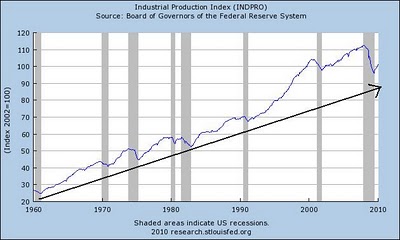
Obama gets his lowest marks on the economy, but even there he looks good if you remember just how bad things were when he took office. Expect to see more of this graph:

2. I’m on your side. Preventing big cuts in Social Security and Medicare, wanting to raise taxes on millionaires — people support that stuff. It’s going to help a lot that swing states like Ohio, Michigan, Wisconsin, and Florida have seen how Republican governors grind down the working class and favor the wealthy.

3. You like me. Even surveys that show a low job-approval rating show that people like Obama personally. The Republican base — the folks who forward emails about his Kenyan birth and his Muslim faith — want to see red-meat attacks against him. But swing voters don’t.

4. I’m running against Congress. This was the Truman strategy in 1948. Obama’s approval ratings hover in the 40s, but Congress’ are in the teens. And if voters blame Congressional Republicans for the gridlock in Washington, then Obama becomes the do-something-different candidate.

5. My plans are better than their plans. This is where the Republican’s nomination battle is going to work against them. If Obama can make the Republican candidate stand for the specific policies he endorsed to get nominated, rather than Do Something Different, he’ll win.

A lot of moderates who aren’t usually single-issue voters will discover that certain Republican positions are deal-breakers. Can you really vote for a candidate who wants to do nothing about global warming? Or roll back gay rights that already exist and don’t seem to be hurting anybody? Or take away collective bargaining rights? Undo child labor laws? Automatically treat Hispanics or Muslims like suspects? Define a fertilized ovum as a person, which turns a doctor-patient discussion of abortion into a murder conspiracy? Or privatize Social Security and replace Medicare with a voucher program?

How far do they go? A lot hinges on how long the Republican nomination stays in doubt, and how far right the nominee has to go. Their ideal winning scenario — that an early consensus would form around a candidate with an ambiguous record like Romney’s — is already not happening.  If candidates are still competing for Tea Party votes in April and May, they’ll have a hard time coming back to get moderate votes in November.

Evangelicals and the New Newt

Mainstream pundits are amazed that Newt Gingrich is surging among evangelical Christians, in spite of his sleazy personal and public history. Gail Collins sums it up like this:

[Herman Cain has] been replaced as the Tea Party’s darling by Newt Gingrich. Never has the voting public’s lack of concern for a politician’s private behavior been more crystal clear.

These are the same people who expected the religious right to reject Sarah Palin when her unmarried teen daughter turned up pregnant. How did that work out? (My 2008 coverage of that issue still looks good.)

Here’s what they don’t get: Instantaneous moral transformation is the essence of evangelical Christianity: Amazing GracePaul on the road to Damascus, and so forth.  The idea that you could be a complete sleaze for most of your life but a Man of Righteousness today — it makes perfect sense to them. For Evangelicals, the question isn’t “Did he do bad things?” but “Has he repented and changed?”

In practice, answering this question involves a lot of wishful thinking. Evangelicals tend to believe in the conversions of people they like (i.e. Newt), while people they don’t like (i.e. Bill Clinton) are faking it. (In an interesting show, Iowan Evangelical talk-radio host Steve Deace proves the exception, arguing for some kind of objective consistency.) But you’re never going to get anywhere attacking Evangelicals for wishful thinking.

What is their wish exactly? Deace captures it pretty well: Evangelicals want someone who will “play offense”, someone who will take the fight to Obama and champion their worldview. They see Newt as that champion, even though he isn’t one of their own the way Michele Bachmann and Rick Santorum are. (But Bachmann and Santorum “can’t hit that major league curve ball” according to a Deace caller. “We know Newt can.”)

So assuming (as I do) that Newt is the same self-centered con man he’s always been (though possibly with the diminished libido of a 68-year-old), how do you peel away his Evangelical support?

First, you need to realize that Newt has a gender gap, even within Evangelicals. Richard Land of the Christian Post observes that “Evangelical women are far less willing to forgive and let bygones be bygones” and advises Gingrich to address their concerns in a special speech.

As you prepare that speech, you should picture in your mind a 40-something Evangelical married woman whose 40-something sister just had her heart broken by an Evangelical husband who has just filed for divorce, having previously promised in church, before God, his wife and “these assembled witnesses” to “love, honor and cherish until death us do part.”

Better yet, picture the Evangelical woman whose cheating husband has given her the I’ve-changed line once too often. She’s going to want to hear something a little stronger than the repentance Newt has shown so far. And I don’t expect to ever hear Dr. Land’s proposed speech, because I don’t think Gingrich has it in him.

These Evangelical woman are a wild card that may not show up in the polls, because they might have their own election-day conversions and realize they just can’t vote for this guy. (If there’s an unexpected Bachman surge, that’s where it’ll come from. It’s also why Newt needs a Sarah Palin endorsement.)

Second, Gingrich needs to be pinned down on the exact timing of his conversion. Any post-conversion sleaze seriously undermines his case.

And finally, the emphasis needs to be on continuity. There is no New Newt. His recent don’t-call-it-lobbying career is of a piece with his whole life: unprincipled and benefitting no one but himself. His book-and-video efforts haven’t promoted the conservative cause so much as exploit it for personal gain. Even his campaign is a money-maker.

Perry and Parody

Rick Perry made campaign history Tuesday with this new ad:

More than 4 million people have watched it on YouTube, where it has generated over 600,000 dislikes for being anti-gay, for outrageously claiming that President Obama is fighting a “war on religion”, and for pretending that a politician needs courage to identify himself with the majority religion.

But “Strong” is so bad it’s good. Sometimes an ad inspires one really funny parody, but I can’t keep track of all the parodies of this one, and before it’s all over they’ll probably rack up even more views than the original.

First, isn’t that the jacket from Brokeback Mountain?

Maybe all Rick needs is a little editing:

I wonder how non-Christians should feel about candidates whose Christian pandering is so extreme. Let’s ask a rabbi:

Better yet, we’ll see what a godless heathen thinks:

Perry is even making some Christians uncomfortable: “I’m not ashamed to admit that I’m a Christian, but I make other people ashamed to admit that they’re Christians.”

To correct the misinformation in Perry’s ad, let’s call on a teacher:

There are many, many more parodies, but I think this guy deserves to have the last word:

Forgive Us Our Debts

It’s striking how many of the big stories in the news revolve around debt:

  • the European debt crisis, with its Greek, Italian, Irish, Spanish, and Icelandic subplots;
  • the failure of the so-called “Super Committee” to reach an agreement, which is just the latest episode in the long-running saga of the U.S. federal budget deficit;
  • the continuing not-technically-a-recession, with its roots in the debt-fueled housing bubble;
  • the increasing separation of American society into a creditor class and a debtor class;
  • popular anger — expressed in both Occupy Wall Street and the Tea Party — about the misdeeds of the too-big-to-fail banks and their special relationship with the government;
  • new revelations about the role of the Federal Reserve in creating profits for the big banks, and the role of the SEC in helping them cover up their crimes. (See this week’s Short Notes.

Each one of these stories has its own nuances. Plunging into the details, understanding why none of them is exactly what it appears to be, can be strangely comforting. It feeds the illusion that if we can get to the bottom of one of these stories, eventually we can get to the bottom of all of them.

But we also need to get to the top of the story. At some point we need to get a bird’s eye view so that we can see how all those trees make a forest: What is up with debt, anyway? Why do all our problems, no matter how disconnected they seem initially, seem to revolve around it?

Several authors have tried to provide the birds-eye view, painting a unified if somewhat disturbing picture: This isn’t just about economics. It’s about democracy.

Haslett. One recent aerial reconnaissance was Adam Haslett’s Salon article This is Our New Normal. Haslett says we can’t get into a normal recovery because we aren’t in a normal recession. Instead,

In many countries, the fundamental political and economic bargain of postwar society is in the process of coming apart.

The West’s rapid economic recovery from World War II made that bargain work for about a quarter century. Wages could rise without hurting profits or causing unemployment. The poor could be lifted up and middle class could achieve a new level of prosperity without dragging down the rich.

But growth slowed down in the 1970s, and Haslett retells economic history since then as a series of lesser problems caused by our evasion of the larger problem: What should a slow-growth social contract look like? Basically, inflation and debt are two ways to hide lackluster growth. So we had inflation in the 70s, government budget deficits in the 80s, and multiple cycles of private-investment-bubble/debt-crisis from the 1990s on.

Such growth as we have seen in the last four decades is increasingly based on finance rather than manufacturing, and concentrated on the already rich. These opportunities are not only out of most people’s reach, but beyond their understanding.

Most people can understand what political forces are at play when a union demands higher wages and a company resists, citing foreign competition. … But what happens when a politician says we must lend billions of dollars to undercapitalized banks or indebted countries in order to provide liquidity to the financial system, and if we don’t we will enter a depression or blow up the euro? The content, let alone the truth, of such a proposition is hard for most people to assess.

The result is an across-the-board loss of faith in democracy: Big-money interests are unwilling to leave their fate in the hands of the ignorant masses, while the average citizen wants to believe that somebody somewhere understands this stuff and can manage it properly. And so

the key decisions are made without democratic consultation by financial bureaucrats working with private bankers. … Financial policy becomes more like foreign policy, conducted by an executive strong-arming a parliament or legislature under conditions of emergency.

But without democratic process, public debts start to lose their legitimacy. Why shouldn’t the People simply repudiate debts that have been thrust upon them by technocrats? And if they do, will creditors absorb the loss? Mount a coup? What? Haslett has no answer, but believes that even framing that question advances the needed discussion.

Hudson. An even-higher-altitude view comes from economist Michael Hudson’s article Debt Slavery in the current issue of Counterpunch. Hudson observes that ancient societies regularly ran into trouble when creditors gained too much power.

The general pattern went like this: During droughts and other natural disasters, small landholders would need more help that they could pay for and so would be forced to borrow on the lender’s terms. (As Adlai Stevenson put it, “A hungry man is not free.”) Eventually the lenders would end up owning the land, turning the original owners into serfs, slaves, or criminals.

Since small landowners were the core of effective ancient armies, this gradual reduction to slavery was a disaster from a king’s point-of-view. So mass cancellation of debts was a frequent feature of ancient imperial governance, and got instituted in the Torah as the Jubilee Year.

If creditors became too powerful for the king to cancel debts, the empire usually fell. That is Hudson’s explanation for the fall of Rome, which lost its ability to raise an army of native landowners and had to rely instead on foreign mercenaries, who eventually over-ran the empire.

“Creditor power and stable growth rarely have gone together,” Hudson writes.

The rise of democracy in the 1600s meant that debts could be owed by the People as a whole, rather than by individuals or kings who might be overthrown. However, eventually the ancient problem re-appears:

The tendency for debts to grow faster than the population’s ability to pay has been a basic constant throughout all recorded history. Debts mount up exponentially, absorbing the surplus and reducing much of the population to the equivalent of debt peonage.

Modern democracies don’t have jubilee years, but they achieve the same purpose by progressive taxation financing a social safety net, plus government control of central banks and regulation of banking in general. In recent years, though, the creditor class has gained enough political power that it can lower its own tax rates, cut the safety net, and deregulate. Hence the current global crisis.

When banks are permitted to be self-regulating and given veto power over government regulators, the economy is distorted to permit creditors to indulge in the speculative gambles and outright fraud that have marked the past decade.

The result is the kind of tension Haslett noted: Creditors want economic decisions taken away from elected officials and turned over to technocrats. But the bankers have lost sight of the big picture: Technocratic management causes the People to lose commitment to “their” public debt, which they will eventually repudiate, as has already happened in Argentina and Iceland.

Graeber. According to an old saying, you can’t tell a fish that it swims in water. That’s a good way to think of anthropologists: They’re fish who study the water the rest of us take for granted. David Graeber’s recent book Debt: The First 5,000 Years is an anthropologist’s take on economics. And so, mixing my animal metaphors, it is the highest-flying bird of all.

Graeber is writing this book to answer the question: Why do people have to pay their debts? It’s an almost universal moral principle, but its applications are perverse. He notes what he saw while studying the highland peoples of Madagascar: IMF-imposed austerity killed the mosquito eradication program. Predictably, malaria returned, killing thousands of poor children.

Now, few people would knowingly make the moral choice “Children should die so that Madagascar can give money to Citibank”, especially since the country’s indebtedness is all bound up in its colonial history. But once expressed as debt, the logic somehow seems obvious.

There is no better way to justify relations founded on violence, to make such relations seem moral, than by reframing them in the language of debt — above all, because it makes it seem that it’s the victim who’s doing something wrong.

Banks can and have, for example, lent irrational sums of money to countries whose corrupt dictators stole it. Should the People have to repay those loans? The logic of this isn’t even good capitalism. Graeber imagines asking the Royal Bank of Scotland for a million-pound loan to bet on a horserace. Good bankers would wisely turn him down.

But, imagine there was some law that said they were guaranteed to get their money back no matter what happens, even if that meant, I don’t know, selling my daughter into slavery or harvesting my organs or something. Well, in that case, why not? Why bother waiting for someone to walk in who has a viable plan to set up a laundromat or some such?

Good capitalism, in other words, depends on foolish loans not being repaid.

Moral framing. The rest of the book is a long historical/anthropological meditation on how repaying debts came to seem like the bedrock of morality. The answer is surprisingly deep and bizarre: Our language for framing moral questions has come to be based on the metaphor of debt. Moral obligations of all sorts are expressed as what we “owe”. It’s baked into the language: ought and owe come from the same root; should comes from the German schuld, meaning debt.

Even God is pictured as maintaining a ledger of our good and bad deeds, which will be read at a Day of Reckoning — a term that comes from accounting. Afterward, some will be dragged away to an eternal debtors prison, while others will see their slates wiped clean in a massive Jubilee.

As George Lakoff teaches, “common sense” is nothing more than what is implied by the unexamined assumptions contained in our framing metaphors. Consequently, “people have to pay their debts” is common sense, even though it’s actually fairly dubious.

The net effect of Graeber’s book is to de-mystify debt, and to strip it of its undeserved moral trappings. If you’re killing children to enrich bankers, the morality of that has to stand on its own.

The hidden history of money. Graeber can’t cover debt without re-examining money, whose history has largely been hidden behind myths.

Econ 101 teaches that primitive barter economies developed money to make trade more efficient. In fact, anthropologists know that there has never been a primitive barter economy. Economies based on trade develop after money, not before. (Pre-monetary economies are like families or mafias — based on relationships of mutual obligation, not trade of goods and services.) Economists hide the history of money out of shame, because it is all bound up with slavery. It’s only a slight exaggeration to say that money developed in order to buy people.

A personal relationship is a long series of inexact exchanges of favors. Money introduces the idea that indebtedness can be precisely quantified and that the account can be settled, allowing both parties to walk away from the relationship clean. (That, Graeber explains, is why we instinctively rebel at mixing money and friendship. Settling accounts is preparation for ending the relationship.)

The true history of money shows why it has destabilized the moral structure of one traditional society after another. Money distances people from each other, and reduces everything to the status of a commodity. And so we are distanced from the consequences of our demands: I don’t want parents to starve their children or old people to go without health care — I just want a good return on my money.

Summing up. Debt and its repayment is not some technical issue to be worked out by economic experts. Ultimately, a country’s debt is only meaningful in two situations: If the People are committed to repaying it, or if the country has an undemocratic government strong enough to force repayment against the People’s will. “Technocratic” solutions start us down the second path.

And finally, what a country does with its resources is a moral choice. The morality of that choice can be hidden by the language of debt, but not forever. The sooner we see through our illusions about debt, the better.

Liberal Media, Conservative Manipulation

One of those facts “everybody knows” is that journalists are liberal. It’s even true up to a point. (Actually, it’s more accurate to say that very few journalists identify as conservatives. 53% call themselves moderates, so the typical journalistic duo is not exactly Marx and Engels.)

But in spite of Sarah Palin’s fantasies of persecution by the “lamestream media”, coverage often tilts in the opposite direction. When conservatives want something like ClimateGate or the ACORN pimp video to become a national story, it usually does, whether it deserves to or not. When public opinion differs radically from the facts — believing, say, that climate scientists are more-or-less evenly divided on global warming, that Saddam was involved in 9-11, or that Al Gore claimed he invented the internet — the error is usually in the direction pushed by conservatives.

It’s hard to see how that could happen unless actual coverage slanted to the right.

Just last week, I gave numerous examples of right-slanted coverage: Unprovoked police attacks on nonviolent Occupy protesters have been covered “even-handedly” (police and protesters “clashed” like mismatched colors) or passively (“mayhem broke out”).

So how does that work? How do left-leaning journalists regularly produce coverage that leans right? Recently, Grist’s David Roberts has written some excellent posts documenting how media bias works against environmentalists. But before we get into that, let’s back up a little: What does it even mean for coverage to slant one way or the other?

The Hallin Sphere Model. “Media bias” usually makes liberals think of the everyday trickery on Fox News. (Recently, Fox labelled  would-be Obama-assassin Oscar Ramiro Ortega-Hernandez “the Occupy shooter” even after police said he had no connection to the Occupy protests.)

I don’t want to minimize the impact of such in-your-face propaganda. (For example, repetition has inured us to hearing President Obama described as “socialist” or even a “Marxist”. It doesn’t raise the kind of ire conservatives felt when President Bush was called a “fascist”.) But the more serious damage is done subtly in mainstream outlets like CNN or the New York Times — news sources that allegedly form “the liberal media”.

A useful way to think about news coverage in general comes from Daniel Hallin’s 1986 Vietnam book The Uncensored War. Hallin says that a factual claim can be reported in one of three ways: as the consensus of knowledgable people, as a controversy that reasonable people might disagree about, or as a deviant claim believed only by a lunatic fringe. Schematically, it looks like this:

A claim in the Sphere of Consensus can be reported as a simple fact, in the journalist’s own voice, without offering a contrary view. So a news story would say “Water runs downhill”, not “According to many scientists, water runs downhill” — balanced later by a quote from an anti-water-runs-downhill spokesman.

But claims in the Sphere of Controversy call for that kind of balance; the reporter should not take sides. So a news story should not say that Obamacare’s individual mandate either is or isn’t constitutional. The reporter should describe arguments made on each side and say that the Supreme Court will rule by June.

Finally, claims in the Sphere of Deviance can be rejected outright in the reporter’s own voice, or just ignored. So an American news story about Al Qaeda will probably not consider that the jihadists might be the good guys. Some people actually hold that view, but they are deviant; they can be ignored.

The boundaries. Politically, it’s very important what claims end up in what spheres.

For example, former Louisiana Governor Buddy Roemer is running for the Republican nomination for president. He’s the only candidate in either party making a serious attack on the dominance of money in politics. But only true political junkies know that, because Roemer’s whole campaign is happening in the Sphere of Deviance. He gets no mainstream coverage and doesn’t appear in televised debates. It’s self-justifying: He gets no coverage because “he can’t win”, and he certainly can’t win if he gets no coverage.

During the health care debate in Congress, no congressperson had to explain why his/her plan was better than a single-payer system, because single-payer was in the Sphere of Deviance.

On its merits, the claim that the planet is getting hotter should be in the Sphere of Consensus and the claim that it isn’t in the Sphere of Deviance. It’s a measurement, not an opinion. But somehow both usually wind up in the Sphere of Controversy.

In short, if you want to bias your coverage, outright lying and distortion is a ham-handed way to do it. It’s much cleaner and more effective to slot claims into the spheres that serve your interests.

Process. Who makes these decisions and how? Journalism professor Jay Rosen believes that it’s an unconscious group process among journalists. They just “know” what is news, what isn’t, and what kind of news it is. Sphere placement is

an intrinsic part of what [journalists] do, but not a natural part of how they think or talk about their job. Which means they often do it badly. Their “sphere placement” decisions … are often invisible to the people making them, and so we cannot argue with those people. It’s like trying to complain to your kid’s teacher about the values the child is learning in school when the teacher insists that the school does not teach values.

No Curia or Politburo holds hearings or announces its rulings. The press makes these decisions collectively, as “an unthinking actor, which is not good”.

Manipulation. As advertisers have long known, people who make unconscious decisions are open to outside manipulation. Maybe “we cannot argue with those people”, but that doesn’t mean that they’re beyond influence by other means.

A year and a half ago I told you about a Kennedy School study documenting that the claim “waterboarding is torture” abruptly moved from the Sphere of Consensus to the Sphere of Controversy in 2004. In 2003, a reporter could have blithely written “Waterboarding is torture.” But a 2004 reporter could only say “Critics claim waterboarding is torture.”

How did that happen? I summarized several sources:

Waterboarding-as-torture didn’t become “contentious” because some new information threw previous judgments into doubt. It became contentious because an interested party — the U.S. government — started contending against it in defiance of all previous objective standards.

In short, journalists didn’t change their ideology or even rethink the specific issue of waterboarding. Instead, outside pressure manipulated their unconscious groupthink about what is controversial.

David Roberts vs. the mainstream press. In recent months, Grist’s David Roberts has been contrasting mainstream reporting of two environmental stories:

  • The Solyndra bankruptcy, which is being widely covered as a “scandal” in spite of the fact that nothing actually scandalous has yet been uncovered. Also, the loss to the public is purely financial and fairly small by U.S. government standards — a half billion dollars.
  • The proposed Keystone XL Pipeline, which promotes the use of tar sands (the most carbon-intensive of fossil fuels) and endangers ground water sources in our agricultural heartland. Environmentalists have been using everything from blogs to civil disobedience to get this story out, but it hasn’t really taken off.

Roberts comments:

Solyndra and Keystone XL are real things in [a real world], not just dueling narratives. And by any conceivable metric — energy, money, pollution, corruption — Keystone XL is a much more significant phenomenon. Solyndra was a bum loan that will be forgotten within a year as the solar industry continues its explosive growth. Keystone XL is a huge, dirty, expensive pipeline that would run down the middle of the country; it’s being pushed through via a rigged process; and its consequences for our energy system and our climate will last for decades.

Zeroing in specifically on Politico’s handling of the stories, he observed:

Republican talking points are delivered as first-order news. Liberal talking points are wrapped in meta-news about liberals and their talking points.

A few weeks later Roberts isolated a classic example of this pattern from a New York Times story about the EPA’s thwarted attempt to implement higher smog standards:

Environmental and public health groups challenged the Bush standard in court, saying it would endanger human health and had been tainted by political interference. Smog levels have declined sharply over the last 40 years, but each incremental improvement comes at a significant cost to business and government.

So the NYT presents the claim that smog endangers human health as something environmental groups say (Sphere of Controversy), and the claim that decreasing smog involves significant costs as a simple fact (Sphere of Consensus).

But the merits of the two claims are exactly reversed: It’s a provable fact that smog endangers public health, while the net economic impact of higher smog standards is debatable. (Increased costs at the smokestack are balanced by fewer sick days and higher productivity, not to mention that everything in our cities corrodes more slowly.)

That’s media bias in action. But does it happen because Politico and NYT reporters are ideologically anti-green? I suspect not.

Money buys controversy. Like the waterboarding example, environmental issues become “contentious” not because new information throws them into doubt, but because powerful actors contend against them.

In some sense this is not new: Public relations is the science of manipulating the press, and it is at least a century old. But reporters have long known to take official PR releases with a grain of salt. So when American Tobacco insisted that Lucky Strikes didn’t cause cancer, that by itself didn’t make the claim controversial.

Tobacco-causes-cancer, though, was the end of one era and the beginning of another. As outlined in the books Doubt Is Their Product and Merchants of Doubt, the Tobacco Institute and the academic research it funded was the beginning of whole new layer of corporate PR infrastructure.

Today, when you read a “balanced” story about climate change, you are probably hearing the voice of Exxon-Mobil, disguised as an “independent” researcher for an “independent” institute at some university. The economics professor quoted in an article about the deficit might have been hired directly by the Koch brothers or the bank holding company BB&T. The article will not tell you this, and the reporter may not even know. (In an era of massive newsroom lay-offs, who has time to trace the funding of everyone he quotes?)

Simultaneously, corporations and the billionaires who own them have been creating a unified pro-capitalist information infrastructure — Chamber of Commerce, American Enterprise Institute, Heritage Foundation, etc. — as envisioned by the famous Powell Memo of 1971. They have also achieved a vastly higher degree of message discipline within the Republican Party’s elected officials, and established an ideological media empire around Fox News, Rush Limbaugh, the Washington Times, the Wall Street Journal, and other outlets.

The result is what conservative-in-exile David Frum calls “an alternate reality”.

Backed by their own wing of the book-publishing industry and supported by think tanks that increasingly function as public-relations agencies, conservatives have built a whole alternative knowledge system, with its own facts, its own history, its own laws of economics.

And so blatant absurdities are now “controversial” simply because the conservative power structure chooses to assert them: Tax cuts raise revenue. Budget cuts that lay off teachers and cancel public works projects create jobs. White Christian Americans are the real victims of discrimination. Poor people and government regulators created the economic collapse. The Founders intended the Bill of Rights to apply to corporations.

Conversely, if the threat of unlimited corporate campaign spending and smearing by the conservative media empire can cow Democratic leaders into silence, the Sphere of Consensus can be expanded to include any number of shaky ideas, and their alternatives can be consigned to the Sphere of Deviance: Taxing the rich is politically impossible. Social Security is going bankrupt. The EPA costs jobs. Everyone (except the wealthy) needs to sacrifice. We can’t afford a social safety net any more (but we could afford a new war with Iran). And so on.

These ideas move from one sphere to another not because reporters have become more conservative, but because external power has changed their perceptions of which claims will be contested and which won’t.

What can liberals do to counter? Although we don’t dare abandon any battlefields completely, we can’t hope to beat the corporations financially and institutionally. And that’s why we have to be in the streets (and conversely why the Powers That Be smear and intimidate the people who are). When reporters are told that “everybody knows” one thing and “nobody really believes” something else, large numbers of ordinary people have to make it obvious that those claims are wrong.

Now Look What You Made Me Do

The last two weeks have seen a widespread violent crack-down on non-violent protesters, the like of which has not occurred in the United States in many years. So far the police have been using non-lethal weapons like pepper spray, rubber bullets, tear gas, sonic cannons, and the old-fashioned nightstick, so there is not a body count to report. But the difference between this suppression of dissent and the ones in Cairo that President Obama denounced as far back as last January is largely of degree and not of kind.

You would not suspect this from the coverage in the mainstream American media, which has been doing it’s usual even-handed he-said/she-said thing. Protesters “clash with police” reports the New York Times, not specifying that protesters’ eyes clashed with police pepper spray or that protesters’ heads and stomachs clashed with police nightsticks. “Violence erupted” said New York Magazine, as if violence were some volcanic process independent of human decisions.

AllVoices anchor Veronica Roberts reported that Iraq veteran Scott Olsen suffered a fractured skull “after he was caught in the violence that erupted between police and protesters”. Olsen was not “caught” in anything; he was protesting peacefully when police shot him in the head with a tear gas canister (perhaps intentionally). (He may have suffered brain damage and was still unable to speak several days later.)

(Even this morning’s NYT article about the coverage of Occupy Wall Street says nothing about the coverage of police attacks. The Times seems unaware that there could be an issue here.)

But this shouldn’t be a contest between my rants and the rants on Fox News. The only way to appreciate what is going on is to look at the pictures and watch the video for yourself. In this video, the camera-holder is slowly walking parallel to (and maybe 60 feet away from) a line of unthreatened Oakland police when one of them decides to shoot him with a rubber bullet — apparently just because he can.

Here, a UC Davis policeman calmly pepper-sprays students who are sitting on the ground, immobile. Other police watch and do nothing.

BTW, you should see how this incident ends: Starting at about the 5 minute mark, the police see that the crowd is neither retreating nor attacking, and they start to lose their spirit and look confused. Using the human mic device, a protester invites them to retreat, and they do, leaving the quad in control of the protesters. It’s a stunning example of how nonviolence works.

At UC-Berkeley, students are peacefully behind a line of police who suddenly start using their nightsticks.

Here, a young woman with her hands at her sides, surrounded by people armed with nothing more than cameras, is pepper-sprayed in the face by police in riot gear. The LA Times reports the incident in he-said/she-said terms: “Occupy Portland organizers allege law enforcement took an inappropriate and heavy-handed approach.”

In Seattle, police pepper-sprayed this 84-year-old former school teacher. Local TV news even-handedly reported that “mayhem took place” and “chaos erupted in downtown Seattle”.

Retired Philadelphia police captain Ray Lewis (who was arrested in New York Thursday) put it a little differently: “Corporate America is using our police departments as hired thugs.”

I have read many claims by police that protesters threatened or assaulted them in some way. With all the video cameras out there, you’d think someone would capture assaults on police if they were really happening with any frequency. I’ve looked for such video, but I can’t find it.

On YouTube, the query “occupy protesters assault police” led me to this local TV-news report from Toledo, which shows two protesters at a city council meeting “assaulting police” by flailing helplessly as they’re being dragged away. So far that’s the worst protester violence I’ve found video of.

In public-opinion terms, this “even-handed” coverage is anything but. Obviously, the reason there is an incident at all is because people are protesting, so if “violence erupts”, the reader’s natural inclination is to think that protesters caused it. Similarly, when ABC News reports that nine cities have already spent more than $10 million responding to the protests, the protesters seem to be to blame.

What actually costs money, though, is the cities’ extreme now-look-what-you-made-me-do over-reaction to the protests. The protesters are not demanding to be surrounded by armies of police in riot gear earning overtime. City mayors and police chiefs are making those choices, which are justified by what, exactly? Where is the bad example of a city that under-responded and suffered some awful consequence?

Virtually every “problem” offered as an excuse to break up the occupation protests is actually made worse when the police attack. Are the protesters “trashing” the public parks? Well, here’s what the Occupy Oakland site looked like the morning after the police violently “cleared” it.

Mayor Bloomberg has cited complaints about noise as a reason to drive protesters out of Zuccotti Park — with noise cannons. As the NYT’s Nicholas Kristof observed:

Sure, the mayor had legitimate concerns about sanitation and safety, but have you looked around New York City? Many locations aren’t so clean and safe, but there usually aren’t hundreds of officers in riot gear showing up in the middle of the night to address the problem.

When the unprovoked and counter-productive violence of the authoritarian reaction is masked by “even-handed” coverage, though, the natural reaction of the news-watching public is to grumble at the protesters who are causing trouble and wasting their tax money.

And as the mainstream media coverage suffers from false equivalence and fake even-handedness, the coverage from the right-wing media — Fox News, Rush Limbaugh, the Washington Times, the New York Post, the Weekly Standard, and (now that Murdoch owns it) the Wall Street Journal — drips with vitriol.

For weeks, Fox News has pushed two related lines of propaganda on a daily basis: invoking a Woodstock drug-taking dirty-hippy stereotype of the protesters, and de-humanizing them by focusing on their animal functions — urination, defecation, sex, etc. Karl Rove’s Crossroads PAC has put out an anti-Elizabeth-Warren ad tying her to the occupations, where “protesters attack police, do drugs, and trash public parks.”

Unsurprisingly, when one side’s propaganda goes uncorrected, the other side’s public image suffers. A PPP poll shows Occupy Wall Street’s popularity declining.

This combined police-and-media attack exposes a long-term weakness in the Left: We lack solidarity. When media coverage goes against some group we sympathize with, we distance ourselves rather than stand up for them.

The Right has dug-in, billionaire-financed infrastructure, so it will defend its clan from media attacks (as it has done with Herman Cain) even if the target is clearly in the wrong (like BP). Compare the Left’s reaction to the Dean Scream: Objectively, the scream meant nothing, but suddenly it was embarrassing to be associated with Dean, so his support melted.

It’s important that those of us who sympathize with the goals of Occupy Wall Street not melt away. Ordinary Americans have started protesting against the way that the rich (especially the parasitic financial community, which on the whole adds little if anything to our economy) have captured all the economic growth. In response, the rich have leaned on City Hall to call out the police to rough them up (except in New York, where no leaning was necessary because a finance-industry billionaire already is City Hall), and the corporate media has covered these events in a way that distributes the blame unfairly on the protesters.

We can’t let that be the end of the story.