Category Archives: Articles

Barack X, the Fictional President

One of the most surprising things The New Yorker’s Ryan Lizza learned from the Obama administration’s unreleased memos was this: President Obama really believed he could get Republican support if he based his programs on Republican programs, like Romney’s healthcare plan or Bush Sr.’s cap-and-trade.

Obama did not anticipate how effectively his political opponents would cast him as a polarizing figure.

So how did they do it? Bill Mahr explains:

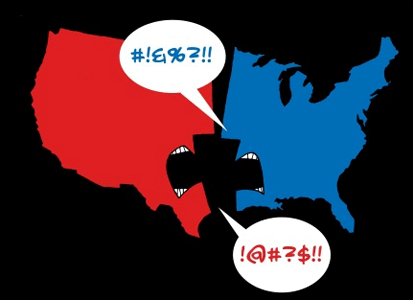
Republicans have created this completely fictional president. His name is Barack X, and he’s an Islamo-socialist revolutionary who’s coming for your guns, raising your taxes, slashing the military, apologizing to other countries, and taking his cues from Europe, or worse yet Saul Alinsky.

And this is how politics has changed. You used to have to run against an actual candidate. But now you just recreate him inside the bubble and run against your new fictional candidate.

In the end, Obama couldn’t even get Mitt Romney’s support for Mitt Romney’s healthcare plan, or John McCain’s support for the cap-and-trade system resembling the one in the McCain-Lieberman bill of 2003.

Jay Rosen explains why not:

the [Republican] party decided not to have the fight it needed to have between reality-based Republicans and the other kind. …

When I say “reality-based Republicans” I mean those who recognize the danger in trying to make descriptions of the world conform to their wishes. … [T]he tendency toward wish fulfillment, selective memory, ideological blindness, truth-busting demagoguery and denial of the inconvenient fact remains within normal trouble-making bounds for the Democratic coalition. But it has broken through the normal limits on the Republican side, an historical development that we don’t understand very well. …

Mitt Romney, the favorite to win the Republican nomination for president in 2012, is a reality-based Republican who cannot run as a reality-based Republican because he thinks he cannot win that way. Jon Huntsman’s campaign is the proof of that calculation. All the candidates, including Romney, have to make gestures toward the alternative knowledge system, with its own facts.

If those “facts” include that the Romney-inspired healthcare plan is an unconstitutional government takeover of the entire system and a step towards socialism, then Romney has to go along if he wants to win. He also has to pretend global warming is dubious, austerity will create jobs, and that we need to get our troops back into Iraq.

If I could raise one off-the-record issue with Mitt and count on getting honest answers, this is what it would be: What’s your Bizarro-world exit strategy? Do you picture bringing your campaign back to reality at some point, say, after the convention? Or if you run a fantasy-based fall campaign and win, do you plan to govern realistically? If so, how do you plan to get your base to put up with it?

Or if not, how do you plan to get Reality to put up with it?

Property vs. Freedom

If you strip it down to its essence, the battle over SOPA/PIPA is Property vs. Freedom: the media companies want to defend their intellectual property, while Internet-users want to defend their freedom.

You won’t often hear it characterized that way in the corporate media, though, because Property and Freedom are supposed to be inseparable, like Love and Marriage. Sing it, Frank:

This I tell you, brother:
You can’t have one without the other.

Or, as Ron Paul more prosaically put it in 2004:

The rights of all private property owners … must be respected if we are to maintain a free society.

Simply saying the phrase “Property vs. Freedom” marks you as some kind of extreme Leftist. All right-thinking people know that Property can’t possibly oppose Freedom.

Last summer I wrote Six True Things Politicians Can’t Say. Well, here’s another one: The relationship between Property and Freedom is highly contentious. (On second thought, the Love-and-Marriage parallel isn’t that bad.)

Get off my lawn. Why is that relationship so contentious? It’s simple: The essence of Property is the right to tell people to get off your lawn, and to sic the police on them if they don’t. If you can’t do that, it’s not really your lawn.

So naturally Property increases Freedom for the owner. Once you have the right to sic the police on trespassers, your lawn becomes available for cookouts, gardening, minimally supervised children, and all sorts of other expressions of freedom.

But look at it from the other side. What if you’re constantly being forced off other people’s lawns and own no property you can retreat to? How free is that?

Free to be Jim Crow. Now read the Ron Paul quote in its full context. On the 40th anniversary of the Civil Rights Act of 1964 (Wikipedia entry, text of bill), which banned racial discrimination in “any place of public accommodation” (like the Woolworth’s lunch counter in Greensboro) and in hiring, Paul portrayed the law in this light:

The Civil Rights Act of 1964 gave the federal government unprecedented power over the hiring, employee relations, and customer service practices of every business in the country. The result was a massive violation of the rights of private property and contract, which are the bedrocks of free society.

In other words, business owners lost some of their right to tell black people to get off their lawns. Definitely it was a diminishment of Property. But was Paul right that it was a net loss of Freedom, or did the freedom gained by blacks more than make up for the freedom lost by businesses?

Why is it your lawn anyway? Post-slavery America may look like an exceptional case, but actually it was just a particularly egregious example of a general rule: Never in the history of humankind has private property been fairly distributed. By the time American blacks stopped being property themselves, all the good stuff was already owned by whites.

Welcome to Freedom, suckers! Now get off my lawn.

One standard pro-property response to this point is that in a free economy property tends to move to the people who earn it through hard work and ingenuity, so mal-distributions even out over time. Maybe the newly-freed slaves did get a raw deal, but that was a long time ago. According to this point of view, by now their great-great-grandchildren must be pretty much where they deserve to be.

But far from an exception, the race problem is a convenient color-coding that makes the general historical pattern easier to see. Michael Hudson described that pattern like this:

The tendency for debts to grow faster than the population’s ability to pay has been a basic constant throughout all recorded history. Debts mount up exponentially, absorbing the surplus and reducing much of the population to the equivalent of debt peonage.

In other words, the typical trend is not for things to even out after a few generations, but for unfair distributions of property to get moreso. Sing it, Billie:

Them that’s got shall have.
Them that’s not shall lose.

The only exception I can think of is post-World-War-II America and Europe, where property tended for decades to become more evenly distributed. But far from the natural workings of a free economy, that outcome required inheritance taxes, progressive income taxes, public education, laws to break up monopolies and protect unions, a significant social safety net, and many other government interventions.

Freedom and public property. America’s two greatest symbols of freedom are the Cowboy and the Indian, both of whom own little, but live in a vast public common where they can hunt in the forests, drink in the streams, and swim in the lakes without worrying about ownership.

Contrast that freedom with economic blogger Noah Smith‘s account of downtown Tokyo.

there are relatively few free city parks. Many green spaces are private and gated off (admission is usually around $5). … outside your house or office, there is basically nowhere to sit down that will not cost you a little bit of money. Public buildings generally have no drinking fountains; you must buy or bring your own water. Free wireless? Good luck finding that!

Does all this private property make me feel free? Absolutely not! Quite the opposite – the lack of a “commons” makes me feel constrained.

To me the lesson is clear: For all but the fabulously wealthy, freedom is maximized by balancing public and private property. It’s nice to have your own lawn, but public property you can’t be chased off of — roads, parks, sidewalks — is even more important. It’s also nice to have public access to water and sanitation, and not to be at the proprietor’s mercy whenever you enter a store, restaurant, or theater.

Intellectual property. Applying that logic to intellectual property gets you to the kind of public/private balance we used to have: Copyrights and patents grant creators and inventors valuable temporary rights, while producing a rich public common allowing fair use of recent creations. And since everything eventually becomes public, a balanced copyright law increases the value of the public domain by encouraging the creation of works that otherwise might be impractical.

Protests of SOPA and PIPA make no sense until you understand that we have lost that balance.

Consider how the music-downloading problem arose: By controlling distribution, media corporations inserted themselves as toll-collectors between creators and users. You’d pay $20 for a CD you could easily copy for $1, knowing that precious little of the difference made it back to the artist. Napster-users had few moral scruples against “stealing” music because the system was already amoral. (Call it the Leverage Principle: “The rich and powerful take what they want. We steal it back for you.”)

Also, endless copyrights have dammed the flow of material into the public domain. When Walt Disney created Mickey Mouse in 1928, he was granted a 28-year copyright with the prospect of renewing for another 28 years. Evidently, the prospect of Mickey entering the public domain in 1984 didn’t deter Walt from creating him.

But every time that expiration date approaches, the Disney Corporation leans on Congress to extend the length of existing copyrights. Tom Bell illustrates how copyrights lengthen as Mickey ages.

Unless corporate money loses its primacy in our political system, nothing created after 1928 will ever enter the public domain. Unlike Mickey, the vast majority of that cultural treasure-trove will be orphan works that no one has the right to use. (For a book-length treatment of these issues, see The Public Domain, which the author has graciously put in the public domain.)

As Lawrence Lessig has pointed out, extending an existing copyright does nothing to promote creativity or otherwise advance the public interest:

No matter what the US Congress does with current law, George Gershwin is not going to produce anything more.

In short, the Infosphere is slouching towards Tokyo. Gradually the public common is shrinking towards the day when almost everything of value will be corporately owned.

SOPA/PIPA. The Stop Online Piracy Act in the House and the equivalent Protect Intellectual Property Act in the Senate are two more corporate attempts to buy laws that serve the private interest but not the public interest. (Interestingly, Politico covers the SOPA protests as a battle between Hollywood and Silicon Valley, as if the public were not involved.)

These laws would make search engines, internet-service providers, and other middlemen responsible for blocking access to web sites that copyright-holders claim are pirating their works. Since they bear no comparable responsibility for defending fair use, their safest course will be to block any site Disney or Time-Warner complains about.

Consider the quotes and images in this article. Traditionally, they would be considered fair use. But what if somebody complains? Is WordPress really going to pay a lawyer to read this article and write an opinion? Or are they just going to shut the Weekly Sift down?

The protests worked, for now. Websites like Wikipedia went dark on Wednesday to protest SOPA/PIPA, and a massive public response forced many lawmakers to change their positions.

But it’s naive to think that’s the end of the story. Corporate money is relentless. When public outrage dies down, we’ll soon see the basic ideas of SOPA/PIPA back in some other form.

In addition to protests, we need a fundamental rethinking of intellectual property. As long as we’re just talking about theft and how to prevent it, we’re missing the point. The right question is how we restore the public/private balance to intellectual property.

We need intellectual property lines that are widely seen as legitimate. When we have that, the problems of trespassing and theft will become much, much smaller and easier to police.

Four Fantasy Issues of the Right

In 2012, the two parties differ on a number of issues that voters really should be thinking about: the role of government in the economy, inequality of wealth and income, climate change, what to do about the 50 million Americans without health insurance, how to handle the 11 million undocumented immigrants, and so on.

It’s hard to have any of those debates, though, because in addition to the legitimate issues that divide Republicans from Democrats, conservatives have trumped up a number of issues that are pure fantasies — they are based on nothing that is really happening.

The construction of pure fantasy issues is a tactic so outrageous that most Americans have trouble grasping it. Voters are used to hearing exaggerations, rhetoric that makes mountains out of molehills. But making a mountain out of the pure flat plain is something totally different and relatively new. “Surely,” the average voter thinks, “there is some fire under all that smoke.”

But these four issues are pure smoke. There is absolutely no fire under there anywhere.

1. Creeping Sharia.

Supposedly, Islamic law (i.e. Sharia) is being surreptitiously introduced into the American justice system “with the goal of transforming American society from within”. This is sometimes called a stealth jihad.

At first, this fake issue was confined to a fringe represented by Pamela Geller, Chuck Norris, or the American Family Association’s talkradio host Brian Fischer. But like Birtherism and other fringe issues, it has crept into the Republican mainstream, with endorsements by Republican presidential candidates like Newt Gingrich and Michele Bachmann. A constitutional amendment against Sharia passed in Oklahoma, and similar amendments have been proposed in other states.

The reality? In a decision denying Oklahoma’s appeal of a lower court’s injunction against the Oklahoma law, the 10th Circuit Court of Appeals wrote:

Appellants do not identify any actual problem the challenged amendment seeks to solve.  Indeed, they admitted at the preliminary injunction hearing that they did not know of even a single instance where an Oklahoma court had applied Sharia law or used the legal precepts of other nations or cultures, let alone that such applications or uses had resulted in concrete problems in Oklahoma.

In examining instances where “creeping Sharia” is alleged outside Oklahoma, I haven’t found a single one that stands up to scrutiny. (The “halal turkey” is no more creeping Sharia than kosher franks are creeping Judaism.) Typically, the cases involve Muslims demanding the same respect that Christians and Jews take for granted, and say nothing at all about Sharia.

In this case, for example, a small-college adjunct professor cherry-picked offensive quotes out of the Quran and presented them as representative of all Islam. When Muslim students objected and the college administration refused to discipline them, he resigned. Brian Fischer then presented him as “a victim of Sharia law“.

In truth, there is no court in America where Sharia is being granted the force of law, and neither party is proposing that there should be.

2. Things Obama never said.

Mitt Romney’s New Hampshire Primary victory speech was full of references to things President Obama has “said”.  For example:

this President wakes up every morning, looks out across America and is proud to announce, “It could be worse.”

I went looking for this quote. Several Republican blogs and radio hosts attribute “It could be worse” to this event, where the words “It could be worse” actually don’t appear. In spite of the quotation marks, it’s a paraphrase. Obama was actually saying that, while unemployment was still too high, it would have been higher without the stimulus.

So a paraphrase of something that Obama almost sort-of said a year and half ago has become a verbatim quote that he says “every morning”.

What else? Obama “believes America’s role as leader in the world is a thing of the past.” That’s a quote from a right-wing book about Obama, not Obama himself.

“He apologizes for America.” Back in February, the Washington Post fact-checker awarded this claim its lowest truth rating — four Pinocchios, reserved for “whoppers”. But Romney keeps repeating it because … well, he’s running a post-truth campaign.

When caught misquoting Obama in an ad, the Romney campaign admitted the deception, but defended doing it.

The Romney campaign was forthcoming about the entire context of the quote in its press release and in its comments to the press Monday night. And indeed, they seemed to be reveling in the fact that we were now talking about that particular part of the ad.

And then Romney said Obama had called Americans “lazy” — another four Pinocchios.

So in general, if you think President Obama has said something that makes you angry — especially if you heard it from Mitt Romney — look for the YouTube or the transcript. (The transcript of every official Obama speech is on the whitehouse.gov site.) If you can’t find it, chances are excellent he actually said nothing of the kind.

3. Voter fraud.

No one denies that America has a colorful history of vote fraud. Election officials have been known to lose or find ballot boxes, mis-program voting machines, fake absentee ballots, or otherwise misrepresent electoral results.

What we don’t have, though, is a history of widespread voter fraud. Americans do not often show up at polling places claiming to be someone else. Why would we? It’s time consuming, and there’s always a risk that somebody at the precinct knows either you or whoever you’re impersonating. (One conservative trying to prove how easy voter fraud is recently got caught this way.)

Even if you get away with it, all you’ve done is steal one vote. If you’re that committed, you can probably change more votes through legitimate campaigning. Go work a phone bank or something.

Nonetheless, it has become a truism on the Right that this kind of fraud is so widespread that we need a whole new system of voter-ID laws to prevent it. But even advocates of these laws can’t provide examples of actual voter fraud. When Kansas Secretary of State Kris Kobach claimed illegal immigrants were voting by impersonating dead people, he gave one example. The Wichita Eagle then found the “dead” guy raking leaves in his yard. Another allegedly dead voter turned up right here in Nashua this week.

If these laws were just useless, we might shake our heads at the waste. (Wisconsin’s Legislative Fiscal Bureau estimates their new voter-ID bill will cost $5.7 million.) But they’re actually sinister. People who don’t already have drivers’ licenses, passports, or other recognized photo-IDs are mostly in groups that vote Democratic: the poor, the disabled, the very old, students, and recently naturalized citizens. Discouraging them from voting is the real point.

4. Obama is a Kenyan Muslim Marxist.

The Birther lie has been widely debunked, but it still gets winked at by folks like Donald Trump, one of the Romney sons, Rick Perry, and Fox News. In the 2010 cycle, most Republican congressional wouldn’t go full-on Birther, but would instead call on Obama to settle the “legitimate questions” that the Birthers raised. John Boehner expressed his personal belief that Obama was American, but wouldn’t rein in the Birthers in his caucus.

All that, in spite of the fact that there was never any reason to doubt that Obama was born where and when he said he was. Not one.

Muslim? Again, no reason at all to raise that question. Obama and his long-time church agreed that he was a Christian.

Marxist? Other than gay rights (where he has been following public opinion, not leading it), Obama’s program is what moderate Republicanism used to look like. Is it Marxist to roll out RomneyCare nationwide? to attack global warming by the same cap-and-trade system Bush Sr. used to fight acid rain? to want to restore the tax rates Bill Clinton negotiated with Newt Gingrich?

It’s tempting to say, “That’s politics.” But it isn’t. There are no comparable lies in the mainstream of the Left. Obscure liberal blogs might have promoted the fact-free tabloid rumors that 9-11 was an inside job, or that Bush had started drinking again, but high-ranking Democrats never pandered to them.

All these charges are attempts to give substance to the vague feeling that there’s something “not right” about Barack Obama. But you know what the substance really is? He’s black. That vague sense that there’s something “wrong” with him that you just can’t put your finger on — that’s what subconscious racism feels like. Deal with it.

What is Job Creation?

Tuesday the Washington Post’s fact-checker awarded three Pinocchios (“significant factual error and/or obvious contradictions”) to Mitt Romney’s claim to have created 100,000 jobs through his work at Bain Capital.

Meanwhile, Romney’s opponents were assailing him as a job destroyer, a “predatory corporate raider” according to a pro-Gingrich SuperPAC. Rick Perry accused Bain of looting companies and “getting rich off failure“.

Lost in all this attack-and-defense is the question: What does it mean to create a job, anyway? Let me repeat something I wrote a little over a year ago:

A bunch of factors need to come together to create a job. There has to be something worth doing, a worker willing and able to do it, a capitalist to pull together all the tools and materials of production, and a customer willing and able to pay for the product or service.

So the economic environment needs to supply an opportunity and people need to fill three roles: worker, capitalist, and customer. Conservatives assume that workers and customers always appear by magic, so a job is created whenever a capitalist shows up. If that were true, then conservative economics would make perfect sense: Keep rich people’s taxes low, and they’ll be able to fill the capitalist role in more and more places, creating more and more jobs.

In fact, though, any one of the three roles might be scarce. Picture a rural hospital that would love to have a cardiologist. The money and the customers are there, they just don’t have a worker. (We don’t usually think of cardiologists as “workers”, but they are.)

During construction booms, production might be held up by all kinds of worker shortages — plumbers, electricians, carpenters. Maybe the only thing holding up a new restaurant in Tulsa is that the local workforce doesn’t include the right kind of chef. In these cases, it’s the worker who is the “job creator”, not the capitalist. What triggers the existence of the job is the arrival of the scarce worker, who could be hired by any of a number of interchangeable capitalists.

In the recent recession, workers and capitalists have both been abundant, but customers have been scarce. Business Insider puts it like this:

If a company is going to hire someone, then a crucial question they must ask is: Is this person going to help make or do something that someone is going to buy. You can talk all you want about taxes or regulation, but if end demand for a product or service isn’t there, there’s no reason for a company to hire.

That’s the logic of stimulus: Put more money in people’s pockets and they will create jobs by becoming customers.

(That insight, by the way, provides the proper response to the slogan “I never got a job from a poor person”. You’ll also never get a job from a capitalist with no customers, no matter how rich he is or how little tax he pays.)

Finally, let’s consider the economic environment. Suppose a new interstate gets built, with an exit near a town that has a lot of unemployment. Three local businessmen want to build a fast-food franchise on a choice piece of land near the exit, and the Burger King franchisee outbids the McDonalds and Dunkin Donuts franchisees. So the Burger King gets built and employs 15 burger-flippers.

As soon as the new interstate changed the economic environment, all three roles were abundant. So who “created” those 15 jobs? The government did, by building the interstate. Government infrastructure projects have created jobs as far back as the Erie Canal, which made Buffalo into a grain-processing center.

But wait. Government can’t create jobs. Everybody knows that: Rick Perry, Ron Paul, Herman Cain, Eric Cantor, everybody. If you’re too stupid to understand why not, this conservative economist will explain it to you.

Maybe they all need to think it through again.

But let’s get back to the original topic: How many jobs did Mitt Romney create or destroy during the business career that netted him a quarter billion dollars?

Quite possibly none. If capitalists weren’t the scarce commodity in the deals he did, Romney might have been just another interchangeable cog in the economic machine. He probably is no more responsible for the jobs at Staples than the clerks who man the counters or the people like me who get our copying done there. Maybe the store would be in a different place, wear a different name, and employ different people, but as far as the overall economy is concerned it would make no difference.

Ditto for the job destruction in companies like AmPad. Money was there for pirates to capture, and there were plenty of them around. Mitt was the pirate who captured that particular treasure ship (and he’ll have to work out the ethics of it with his conscience and his God) but did he change anything? Ultimately, probably not.

Escalating Bad Faith, Part I: Recess Appointments

This week conservatives had a new reason to be outraged at President Obama: He appointed Richard Cordray head of the new Consumer Finance Protection Bureau, plus he added three members to the National Labor Relations Board.

What’s the problem with that? Well, these are recess appointments, a power that the Constitution gave the President so that vital posts wouldn’t go unfilled during the months when Congress was out of session.

In the era of cell phones and jet planes, recess appointments are an anachronism, because it’s quick and easy to call Congress back into session for anything really important. But in the last few administrations they’ve become part of an escalating power struggle between Congress and the President. As the struggle continues, the positions of both institutions (under either party) get further and further from anything the Founders wanted or should have wanted.

The point of this series (for which recess appointments are just the most timely example) is to highlight a crisis that gets very little attention in the mainstream media: escalating bad faith in government. Whoever started it (being a Democrat, I see most fault on the Republican side), these downward spirals are very hard to stop, and they’re extremely dangerous to the future of democracy.

History. The recess-appointment struggle starts with Article II Section 2 of the Constitution:

[The President] … by and with the Advice and Consent of the Senate, shall appoint Ambassadors, other public Ministers and Consuls, Judges of the supreme Court, and all other Officers of the United States, whose Appointments are not herein otherwise provided for, and which shall be established by Law … The President shall have Power to fill up all Vacancies that may happen during the Recess of the Senate, by granting Commissions which shall expire at the End of their next Session.

For years that clause was interpreted to mean that the two branches would work together in good faith: The President would nominate reasonably acceptable people and the Senate would approve them unless they found something seriously wrong. Just disagreeing with a nominee was generally not enough — to reject him or her you needed to find a scandal of some sort. (That’s the plot of the 1959 Pulitzer-winning political novel Advise and Consent.)

Until recent decades, rejections were rare. In 1968, the Senate filibustered President Johnson’s appointee for Chief Justice, pointing to some questionable speaking fees. (The vote was roughly bipartisan, with 19 Democratic senators voting not to end the filibuster.) In 1989, President Bush’s nomination of John Tower as Secretary of Defense was rejected because of his personal life. (Only one Republican senator voted against him.)

President Reagan and the Democratic Senate both escalated the battle in 1987: Reagan slapped the new Democratic majority in the face by nominating the extreme conservative Robert Bork to the Supreme Court, and the Senate slapped back by rejecting the nomination on ideological grounds, without finding a scandal.

Filibusters on ideological grounds, at least for judicial nominations, became standard during the Clinton and Bush Jr. administrations, but most posts within the executive branch continued to be filled with only minor friction, on the principle that the President should be able to work with people of his own choosing.

Two major non-judicial nominations the Democrats held up during the Bush years were John Bolton as UN ambassador and Steven Bradbury as head of the Justice Department’s Office of Legal Counsel. Bush Jr. used a series of temporary recess appointments to put them in office long-term — clearly not what the Constitution meant that power for. The Senate struck back by holding pro forma sessions — leaving a skeleton crew in Washington to open and close the Senate every week, so that it would not legally be in recess — even though it was in recess in any practical sense.

Since their numbers increased in 2010, the Senate’s Republican minority has escalated again: Nominees are filibustered (or their nominations are simply ignored) not even because of their ideology, but because of general policy issues unrelated to the nominee. Republicans don’t want the NLRB or the Consumer Finance Protection Bureau to function at all. But they don’t have the votes to abolish them, so they refuse to consider nominations for those positions. They have defended that refusal against recess appointments with the same pro-forma-session technique the Democrats used against Bush. (With this added wrinkle: The Senate’s Democratic majority can’t end the session because the Constitution won’t let it as long as the Republican-controlled House is in session.)

Now Obama has re-escalated by refusing to recognize the pro forma sessions and making recess appointments anyway. This, Republicans say, is a “tyrannical abuse of power“.

And it is, in some sense. But without it the Senate minority’s abuse of power stands unchallenged. The Founders never intended any of this.

This is part of a pattern in which all sides are acting in bad faith, and have been for decades. (And it’s not the only example, as I’ll discuss next week. Signing statements are another.) It creates a vicious cycle in which each escalation challenges the other side to either accept a defeat that seems illegitimate or to escalate further. There seems to be no obvious place for this to stop.

Next week: At the end of this road democracy unravels, because democracy depends as much on good faith as on elections and constitutions.

The Four Flavors of Republican

As I’ve explained elsewhere, the news media does a good job at telling us what is new today, but a bad job of explaining the context-providing frames that the insiders have known all along.

That is showing up big-time in the coverage of the Republican presidential campaign. Let a new poll come out or one candidate launch a new sound bite at another, and CNN is all over it, whether it actually makes any difference or not. That’s how we wind up with so much coverage of manufactured events like August’s Iowa Straw Poll, which in retrospect did not even say much about last Tuesday’s Iowa Caucus, which in itself was a bit of a manufactured event.

On the other hand, the background truths that insiders take for granted are never “new”, so they don’t make headlines.

I thought I’d fill in one of those gaps by asking: What is this thing called “the Republican Party”? What are its components? How do they fit together? And how do the various candidates relate to them?

The four components. Republicans come in one of four basic flavors: NeoCons, Corporatists, Libertarians, and Theocrats. I don’t call them factions because the boundaries between them aren’t clear-cut. You can pitch many of the same pitch ideas to all four, but each requires its own spin.

Take global warming. All four flavors are potential climate-change deniers, but each requires its own argument: Tell Corporatists that regulating or taxing carbon will cut profits. Tell Libertarians that global warming is a conspiracy to impose world government. Theocrats will also buy the conspiracy angle, if you emphasize that the plot was concocted by the same evil scientists behind the evolution conspiracy. Tell NeoCons that any carbon restrictions we accept will work to the advantage of the Chinese.

But they aren’t just tribes speaking different languages. Their substantive differences show up most clearly on drugs. Libertarians want to legalize drugs, because what business is it of the government’s anyway? This position is anathema to the Theocrats, who see the government as the guardian of public morality. NeoCons fundamentally don’t care, while Corporatists would happily make money selling either heroin in elementary schools or helicopters to the DEA or both.

Get the idea? Now let’s go through them one by one.

  • NeoCons are the people who gave us the Iraq War. Their highest priority is that the United States remain the top military power in the world, and that we use our power to prevent the rise of any rival powers. Their #1 issue in this election is Iran. When a candidate says we have to do “whatever it takes” to prevent Iran getting a nuclear weapon, he (now that Bachmann has dropped out I’ll refer to candidates as he) is appealing for NeoCon support. Of all the remaining candidates, Newt Gingrich is the clearest NeoCon choice.
  • Corporatists champion the interests of corporations and want to weaken government, unions, or any other power that might resist corporate dominance. Often they borrow the individualistic rhetoric of the Libertarians, but their motivation is different: They want decisions made by individuals because individuals are no match for corporations. Mitt Romney was the corporatist candidate even before he said, “Corporations are people, my friend.
  • Libertarians want government restricted to defending people and property against crime, defending the borders against invasion, and enforcing contracts. If you don’t want the government to restrict your neighbor’s right to build a nuclear power plant in his back yard, you’re a Libertarian and your candidate is Ron Paul.
  • Theocrats (a.k.a. Social Conservatives or the Religious Right) believe that morality is eternal and established by God, and that society will collapse if it diverges from this God-given script. Therefore the government should promote true morality and punish deviance. They are especially obsessed with anything that changes gender roles: abortion, gay rights, and even contraception.

It’s possible to organize them on two axes, as in the diagram: Corporatists and Libertarians want weak government, while Theocrats and NeoCons want government strong enough to control your bedroom and tap your phone. Libertarians and Theocrats have a populist/outsider mentality that is suspicious of experts and prone to conspiracy theories. Corporatists and NeoCons have an elitest/insider mentality, believing that people are stupid and need to be manipulated into doing what’s best. Insiders see outsiders as useful idiots; outsiders sense this attitude and resent it.

Trust and volatility. This coalition goes back to Reagan, who virtually invented the useful-idiot theory, using social issues as bright, shiny objects to get Theocrats’ attention, but not actually doing anything about them once in office. As Thomas Frank put it in What’s the Matter With Kansas?:

Values may “matter most” to voters, but they always take a backseat to the needs of money once the elections are won. … Vote to stop abortion, receive a rollback in capital gains taxes. Vote to make our country strong again; receive deindustrialization. Vote to screw those politically correct college professors, receive electricity deregulation. Vote to get government off our backs; receive conglomeration and monopoly everywhere from media to meatpacking. Vote to stand tall against terrorists, receive Social Security privatization. Vote to strike a blow against elitism; receive a social order in which wealth is more concentrated than ever before in our lifetimes, in which workers have been stripped of power and CEOs are rewarded in a manner beyond imagining.

The outsider groups have been catching on lately, which is how they turned the tables in the 2010 elections: The Tea Party was supposedly all about economic issues, but once in office the first priority was restricting abortion.

That’s why the Republican electorate has been so jittery in the 2012 cycle, jumping from candidate to candidate and asking who the “real” conservative is. Everybody is afraid of getting played — except for the Corporatists, who have complete confidence in Romney.

Agree/Disagree. Four groups means six relationships.

  • Corporatist/NeoCon. Agree: Control the world’s oil. Install pro-capitalist, pro-globalization governments. Disagree: Iran (Corporatists want to make money trading with them) and immigration (NeoCons worry about the border, Corporatists want cheap labor).
  • Corporatist/Libertarian. Agree: Cut taxes and regulations, including regulations on campaign contributions. Disagree: convergence of Wall Street and Washington (Libertarians want to abolish the Fed, Corporatists want cheap loans from it).
  • Corporatist/Theocrat. A diagonal relationship; mostly they can co-operate because their issues have so little to do with each other. Agree: oppose anti-poverty programs, see wealth as a sign of God’s blessing. Disagree: globalization.
  • NeoCon/Libertarian. Another diagonal relationship, but more fraught. Agree: on substance, not much. Disagree: foreign wars, civil liberties.
  • NeoCon/Theocrat. Onward Christian soldiers. Agree: American exceptionalism, Pro-Israel, anti-Muslim, no gays in the military. Disagree: NeoCon indifference to social issues.
  • Libertarian/Theocrat. Agree: against liberal judges. Disagree: government as a moral watchdog.

Unifying rhetoric. Talking out of four sides of your mouth is a good trick, even for a professional politician. So spinmeisters have developed variety of rhetorical tropes so that the same words are heard differently by different people.

To give just one example, Theocrats and Libertarians share attitudes, but not policies. Both are nostalgic: Libertarians for the Robber Baron era of the late 1800s, Theocrats for the Great Awakening of the 1700s.

Worshipful rhetoric about the Founders is designed to appeal to both. Theocrats believe the Founders established a Christian Republic, while Libertarians identify the Founders with limited government — too limited to get into your bedroom or your medicine cabinet. So a candidate need only say “the Founders” and each group will fill in the picture it likes.

Fault lines. Ronald Reagan and George W. Bush unified the four flavors, but this year no candidate does. NeoCons can’t support Ron Paul, Libertarians can’t support Rick Santorum, and Theocrats can’t support Mitt Romney. That’s why Republican insiders keep having fantasies about some new candidate — it’s basically the same fantasy they had about Rick Perry before he turned out to be an idiot: a tough-talking, pro-business, Christian Reconstructionist who wants to abolish the EPA.

Each non-fantasy candidate exposes a different fault line, so expect Obama to run differently depending on who the Republican nominee is. His increasing economic populism of late is evidence that he expects to run against Romney.

Is a Boom Coming in 2012?

One of the big debates on the economic blogs right now is whether the upbeat end of 2011 was just a blip or the beginning of a genuine trend.

What upbeat end to 2011?” I hear you ask. So let’s back up and start there.

Recent numbers. The most obvious thing was the decrease in the unemployment rate from 9.1% in September to 8.6% in November.

By itself, though, that number isn’t too impressive, particularly since it’s only partly due to new jobs and partly to people leaving the work force. But other numbers support the idea that things are turning around: In November and December, housing starts began to increase and more people bought new cars. Plus, Christmas spending was up.

The optimistic view (championed by Karl Smith at the economic blog Modeled Behavior and popularized by Slate’s Matt Yglesias) says that (1) these things are important, and (2) they will continue.

Houses and cars matter. At the most immediate level, recessions happen because people stop spending. That causes production to drop, so other people lose their jobs. Then they also stop spending, and things spiral downward.

But this is like saying that you’re hungry because you haven’t eaten enough — it’s true, but it ignores any underlying causes. You might be dieting or hunger-striking. Or maybe there’s a famine or you’re poor in a rich country or your jailer has cut your rations. Telling a hungry person “You should eat more” isn’t wrong, but it’s not always helpful.

Bearing in mind that why we haven’t been spending might matter, a huge part of how we haven’t been spending is that we haven’t been buying cars and houses. Smith points at this graph of domestic spending with (red) and without (blue) housing and transportation.

The blue graph looks like a relatively mild recession, while the red one reflects the deep recession we really had. Smith says that the drop in (red) spending amounted to $400 billion, of which $200 billion was decreased construction. Over a somewhat longer period, the construction-spending drop was $500 billion and the automobile-spending drop was $240 billion.

And that makes sense: If (like most people) you continued to have an income during the recession, you probably didn’t stop eating or paying your utilities. But you quite likely did get anxious enough to put off buying a new car or house.

Why the up-tick might continue. Trends always spread too far and last too long. People who are honestly worried about losing their jobs really shouldn’t buy new cars or houses. Once a recession gets going, though, even people who need, want, and can afford new stuff will delay buying it out of a general sense of uneasiness.

But eventually those people get tired of waiting for the sky to fall, and go out and buy stuff anyway. When they do, a virtuous cycle replaces the vicious cycle of recession: Their spending gives other people jobs, so those people also spend more, and so on.

Smith and Yglesias see pent-up demand that is about to burst out. Seattle TV station KOMO reports:

Back in 2008, when Consumer Reports asked people about their primary vehicle, the average age was 5 years old. Today, it’s 9 years old.

Ditto for housing: We more-or-less stopped building houses in 2008, but new households keep forming. Smith believes the household-to-house ratio is approaching 1, and that any uptick in the economy will increase household formation even further. He predicts:

this is at least suggestive that there is a looming outright housing shortage.

And Yglesias amplifies the point:

But every downward tick in the unemployment rate is another twentysomething moving out of his parents’ basement, stimulating a return to a more normal level of construction. … This increase in economic activity will boost state and local tax revenue and end the already slowing cycle of public sector layoffs. Re-employment in the construction, durable goods, and related transportation and warehousing functions will bolster income and push up spending on nondurables, restaurants, leisure and hospitality, and all the rest. Happy days, in other words, will be here again.

Why it might not. Yglesias suggests one reason his rosy scenario might fail: The boom would also increase inflation, which the Fed might decide to resist by raising interest rates, thereby smothering the boom in its cradle.

But other economic bloggers (and even other Smiths) doubt the whole scenario. Naked Capitalism’s Yves Smith, for example, gets back to that underlying-cause thing:

People and businesses are not going to borrow and invest if they are not confident of their future. With short job tenures, over 30 years of stagnant real worker wages (and falling in the most recent 12 months), exactly what is there for the bulk of the population to be optimistic about?

We’ve had a very successful three decade effort to break the bargaining power of labor, and covered that up with rising consumer debt levels. That paradigm is over, but no one in authority seems willing to go back to an economic model where rising worker wages drive economic growth. Until we get policies that address that issue, I don’t see a reason to be expect robust growth levels.

She also doubts that house-construction will make any serious move until the overhang of foreclosed properties gets sold to people who can afford them.

The business cycle. At its root, the Smith/Yglesias boom prediction is a classic business-cycle argument: Things only go so far up or down before natural forces turn them around.

Like Yves Smith, I’ve been arguing for a while (here and here) that we don’t have a classic business cycle any more. As wealth gets more concentrated, our booms and busts have more to do with investment bubbles than with production and consumption. We don’t “recover” quickly, because what we’re “recovering” to was never real.

Some of Karl Smith’s pent-up demand isn’t real either. For example, I am one of those people driving an old car: My 2002 Saturn Vue has 168K miles on it, more than I’ve put on any other vehicle. But because quality has improved, it still runs great. I’m not pining to get rid of it as soon as I have a little money.

I also have a 5-year-old laptop computer. Not so long ago, a 5-year-old laptop was a museum piece, a 286 in a Pentium world. But in the cloud-computing era, 5-year-old laptops also work just fine.

Then we come to housing, and those under-employed 20-somethings who want to get out of their parents’ houses — my nephew, for example. The career path of most 20-somethings I know doesn’t resemble anything my generation would have called a “career” thirty years ago. Today’s “career” is a string of temporary jobs, possibly united by some kind of theme.

If we have a boom, those temporary jobs will last longer and pay more — maybe even a lot more, if things really get rolling. But they won’t become pre-Reagan-era careers, so buying a house still isn’t going to make sense. The argument that housing always goes up — people really said that not too long ago — isn’t going to ring true for a long time to come. And if your next temporary job is a thousand miles away, that house you can’t sell is an albatross, not an asset.

So I agree with bankruptcy lawyer Max Gardner: “We’re turning into a Nation of renters rather than homeowners.” We can’t invest in stable housing because (even in good times) we don’t have stable jobs.

Split the difference. When I examine my objections, though, they mainly say that the forces the optimists point to aren’t as strong as they think, not that those forces don’t exist at all. My Vue and my MacBook aren’t going to last forever. And maybe my nephew will rent an apartment rather than buy a house, but somebody will still have to build that apartment and make the appliances to fill it.

So even if the business cycle isn’t the only thing happening any more, there still is a business cycle, and it does seem to be pointing up.

So are happy days going to be here again in 2012? Probably not. Has the country solved its long-term economic problems? No. But I think it’s as if we’re in the spring of a cold year: We’re still going to get a summer, and it will be warmer then than it is now.

Iowa Preview

Given how accurate Nate Silver was in predicting the primaries in 2008, my basic rule of thumb says: Whatever polls can tell you, Nate has already figured out. His Iowa model is here. Last I looked it had Mitt Romney as the favorite, narrowly ahead of Ron Paul and Rick Santorum.

So I start with Nate’s projections and then ask, “What can’t polls tell you?” In caucuses, a lot of factors are impossible to poll, like: Who’s going to show up? A caucus is a bigger time commitment than just voting — it’s an actual business meeting of the local party and takes all evening. So Republicans who are busy Tuesday night or aren’t that interested in politics aren’t going to turn out. On the other hand, all voters willing to change their registrations to Republican are eligible to vote at a Republican caucus, so a certain number of Independents and even Democrats (who nobody has been polling) are going to be there.

Since a caucus is a face-to-face event, a candidate’s supporters get one more chance to convince the undecided. Lots of people (41% in the final Des Moines Register poll) say they could still be convinced to change their minds — how do you poll for that?

So if you want to go beyond what’s in the polls, you need to ask: Who are these mercurial voters? What’s going to make them enthusiastic enough to give up an evening of their lives? And why might they change their minds at the last minute?

For weeks, reporters have been combing the plains of Iowa looking for the typical Republican caucus voter. To me, the one that sounds most authentic comes by way of TPM’s Evan McMorris-Santoro: Curtis Jacob is a religious-right social conservative who voted for Huckabee last time around and thought a few weeks ago that he would vote for Herman Cain.

Jacob describes a three-step process of deciding who to support. First comes the ideological hurdle — the candidate’s got to say the right things. This is a non-factor in this election, because (other than Ron Paul’s isolationism) it’s hard to tell the difference between the candidates’ positions.

Then there’s the authenticity hurdle: “ok, is this person real? — are they the same in person as opposed to the speeches they give?” Jacob eliminates Romney and Huntsman, apparently because he believes their hearts really aren’t in all the social conservative positions they’re taking (and maybe — he doesn’t say this — because they’re Mormons).

Finally he asks who can win.

And that’s why the yo-yo in the polls, because, ok, we think this is what we want, is electable then they get beat up and we think, ‘oh, maybe not.’ So then we go for the next one.

The candidates who have been yo-yoing are the ones he’s choosing among. (Romney has steadily polled around 25% while Bachmann, Perry, Cain, and Gingrich have each had a boom/bust cycle.)

Of the candidates in Jacob’s acceptable pool, Paul and Santorum are having the final surges. Each has an additional advantage: Santorum’s surge has come so late that nobody is running negative ads against him, and Paul is going to pick up votes from unpolled Democrats who want to end the wars and repeal the Patriot Act.

If Jacob is really typical of undecided Iowa Republicans, you’d expect to see support bleed away from Bachmann, Perry, and Gingrich at the last minute and flow to Santorum or Paul. The final polls (showing Romney narrowly leading) probably accelerate that process. The most persuasive caucus-day message is going to say: If you’re not voting for Santorum or Paul, you’re handing the victory to Romney.

Any of the three could win, but if I had to bet, I’d say Santorum.

Under-reported Stories of 2011

You didn’t need some blogger to tell you that Charlie Sheen flipped out in 2011, or that Kim Kardashian got married and divorced. It was everywhere. You couldn’t miss it. But one valuable service that the blogosphere and the alternative press provide at the end of every year is to raise the question: What important stuff didn’t you hear about?

It’s got a few flaws, but my favorite such list for 2011 is AlterNet‘s. These stories weren’t censored, exactly, they just went by so fast that you had to really be paying attention to catch them.

  1. 2011’s carbon emission increase was the largest ever.
  2. 50,000 Iraq War refugees have been forced into prostitution in Jordan or Syria. (Thanks for liberating us, America.) [Caveat: The links AlterNet gives are horrifying, but I can’t find the 50K statistic in either of them. This study looks authoritative and says 5,000, which is bad enough. Maybe somebody at AlterNet typed too many zeroes.]
  3. More activity-duty troops are killing themselves than are dying in combat.
  4. Drone strikes kill innocent civilians.
  5. Record numbers of US kids face hunger and homelessness. The homeless total is higher than after Hurricanes Katrina and Rita in 2006. The 2010 raw numbers for hunger were a record, but the percentages were about the same as 2009.
  6. Prison hunger strikes protest long-term solitary confinement. If you aren’t crazy when you start your ten-year time-out, you will be when you finish.
  7. 5,000 kids are native-born American citizens, but they’re in long-term foster care because we deported their parents.
  8. The FBI is training its agents to suspect all Muslims. The religious bigotry here is bad enough by itself, but it also promotes the very terrorism the FBI is supposed to fight: “depicting Islam as inseparable from political violence is exactly the narrative al-Qaida spins — as is the related idea that America and Islam are necessarily in conflict.”

Several other most-under-reported lists were less interesting (New Republic‘s, for example). But BlackAmericaWeb.com has a suggestion that could be on the list every year: any missing black woman. Derrica Wilson of the Black and Missing Foundation says, “It just seems like our lives are less valued.”


A couple of stories suggested by Current TV’s Josh Sternberg are worth a look:


Every year has dogs that didn’t bark — important things that should have happened, but didn’t. Usually those non-events pass without notice, so hats off to the NYT for highlighting this one: After investigating the 2010 Upper Big Branch mine disaster, Congress should have closed the loopholes that let Massey Energy risk its employees’ lives until 29 of them died. But it didn’t.


Religion never gets covered properly in the corporate media. When the media pays attention at all, it’s usually for some stupid reason like the trumped-up War on Christmas, or to cover some tiny sect of weirdos like the Westboro Baptists. But religion is pretty important in America and important developments must happen there from time to time. So who covers that stuff?

Check out Religion Dispatches. In particular, look at their Top 2011 Religion Stories That Weren’t: the Vatican’s clout in historically Catholic countries like Spain and Ireland is shrinking; a pioneering gay-friendly church is losing its identity now that mainstream denominations are open to gays; fewer Americans believe the US plays a special role in God’s plan; plus several other developments you won’t see on CNN.

But I especially want to call your attention to this neglected religion story: “Upside-Down Ideas About Religious Liberty” (which Kevin Drum also noticed).

In the past, the social service arms of religious bodies understood that if they wanted public money they would need to honor public law regarding the disposition of the money: i.e., provide the full range of mandated services on a universal basis. We used to say to objectors, “If you don’t like the mandate, don’t take the money.”

Apparently such a commonsensical response is now insufficiently deferential to religion. More and more people seem willing to say that if a Catholic health care provider doesn’t “believe” in providing reproductive health care to women, that private belief can trump public law.

A lot of attention has come to this issue lately because Catholic Charities is pulling out of Illinois rather than help gay couples adopt children. The bishops are getting away with painting this as a religious liberty issue when it really is nothing of the kind.

The principle here is pretty simple: If you take public money, you have to serve the public — the whole public, not just the portion of the public you happen to like. Nobody in Illinois state government is stopping Catholic Charities from arranging adoptions. They can even keep discriminating against gay couples, as long as they raise their own money. The only change is that Illinois tax dollars will no longer support a bigoted program. That’s right and just, and infringes no one’s religious liberty.

Sifting the Sifts of 2011: Escape From Bizarro World

Looking back over the Sifts of 2011, I notice my increasing frustration with playing whack-a-mole against the spinmasters of the Right. More and more, pointing out specific lies, omissions, and mischaracterizations got relegated to the short notes. In the main articles, I tended to focus my attention on a more fundamental question: How do they do this? How has the Right managed to construct what David Frum has called its “alternate reality” and what can we do about it?

First, what do I mean by “alternate reality” (or, as I prefer to call it, Bizarro World)? I’m not talking about legitimate differences of political philosophy, but the black-is-white world where global warming is a hoax (perpetrated by any scientist not bankrolled by Exxon-Mobil), budget-cutting creates jobs, American Christians are a persecuted minority, the main victims of racism are white, the EPA is a threat to the economy, voter fraud is a bigger problem than voter suppression, Obama is a Kenyan-born Muslim Marxist, workers would be better off if unions and government regulations stopped stifling the job-creating brilliance of the very rich, corporations like BP don’t need any environmental oversight, and so on.

I attacked a bunch of those things head-on in Six True Things Politicians Can’t Say, the year’s most popular post. Other specific issues got hit in Voter Suppression 101 and Blowing Smoke About Clouds.

But that’s just whack-a-mole on a higher level. The real question is why anybody takes Bizarro World seriously in the first place. Why should liberals have waste our energy arguing about, say, Obama’s birth certificate, when there was never any reason to doubt it?

In Confessions of a Centrist in Exile I pointed out one consequence of Bizarro World: The center is occupied territory now. Compromise is for honestly held points of view. But reality can’t compromise with unreality. People who want to solve a problem (like inequality or global warming) can’t compromise with people who say there is no problem. And honest real people can’t compromise with the corporate salesmen who would kill them to make a profit.

I addressed some the mechanisms that create Bizarro World in Liberal Media, Conservative Manipulation: Oversimplifying just a little, corporate money has created a conservative echo chamber that can create “controversy” out of nothing. The mainstream media then feels it has to treat those claims as “controversial” even if they lack any semblance of reasonability. Since the Left will never be able to compete with the corporatists in money, we need to insist on reform inside the culture of the media. (Yesterday Hunter on Daily Kos expressed his dismay that “fact checking” is now a specialty: “nothing is more humiliating than the notion that our media is so incompetent at verifying facts that an entirely new sub-profession needs to be assigned to the task.”)

A second piece of Bizarro World is the corruption of academic research by corporate money, which I covered in Turning Marketshare into Mindshare.

In The Dog Whistle Defined I looked at another tactic: using code words in your public campaign to point to reprehensible commitments made privately. In Turn the Shame Around and Suck It Up: Using Our Pride Against Us I talked about the psychological hooks the 1% uses to co-opt many of the 99% — or at least to shut them up.

Finally, I tried to provide a counterframe in Eliminate the Work Penalty. Our current tax system taxes wages at a higher rate than money made by investing money, and the only current debate is on how much to increase that gap. We need to start calling these special rates for dividends and capital gains a “work penalty” and try to eliminate them completely.

Economics. A second theme of the year has been rethinking economics. (More about that in the Sifted Books of 2011.) Jobless Recoveries are Normal Now, Economics Works Backwards Now, and Jobs of the Future are the main posts on this theme. In a nutshell, our current ideas about economics require the rich to consume all kinds of crazy things so that the poor can have jobs making them. What if they don’t? What if the crazy things they decide to consume can be made without much labor? Or what if that level of consumption will kill the biosphere? Maybe we need to come up with some new way of connecting people with the resources they need to survive.

Obama. Finally, I’ve been trying to criticize the Obama administration without providing fodder for Republican alternatives that would even worse on the specific issue I’m criticizing. So I put my criticism of Obama’s political strategy (compromising with people who don’t want to compromise) into the fantasy conversation Barack, Can We Talk?. This was also part of the Bizarro World theme: “What we need from our Democratic president isn’t just a few more dollars for infrastructure or the unemployed, we need a defense of reality.”

Other posts on that theme are Detention Without Trial, Is Obama On Our Side?, and Presidents and Precedents.