Category Archives: Articles

White Right-Wing Christian Terrorist

Tuesday, when CBS News did a segment on the man who killed seven at a Sikh Temple in Wisconsin, one word was conspicuously absent: terrorist. All the pieces to make that judgment were in place: Wade Michael Page had a long history in white supremacist groups. (The album covers of his white-supremacist bands are pictured at the bottom of this article, where you can easily avoid looking at them.) His victims were non-Christian and non-white, and they gathered at a non-Christian temple.

His massacre was violence against civilians, apparently for the political purpose of terrorizing the racial or religious groups they belong to. That’s terrorism.

No white Christian terrorists. But the mainstream media doesn’t often call white Christians terrorists, and even if they express their motives in Christian or white-supremacist terms, you seldom run across the phrase “white Christian terrorist”. Almost by definition, terrorists are Muslims. And conversely, violent Muslims are terrorists.

When someone does tie a terrorist act to Christianity, you can count on seeing a lot of pushback — articles begging for nuance, emphasizing how out of the Christian mainstream the terrorist’s views are, refusing to take seriously a childhood connection to Christianity, and instead demanding specific evidence of a religious motive (which hasn’t shown up yet in Page’s case). Again, these principles don’t apply when the killer has brown skin and a Muslim name.

The white killer also gets portrayed with more sympathy. The CBS report includes pictures of Page as a cute boy, and shows his step-mother describing him as “kind and gentle and loving”.

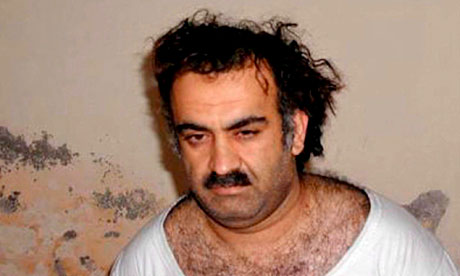
I’ll bet Khalid Sheik Mohammed was a cute child once, but this is the picture of him I’ve seen over and over.

No right-wing terrorists. You also don’t hear the term “right-wing terrorist” very often. In 2009, a report by the Department of Homeland Security called attention to the problem of right-wing violence, and identified “disgruntled military veterans” as targets for recruitment by right-wing hate groups. It quoted a civil rights organization:

large numbers of potentially violent neo-Nazis, skinheads, and other white supremacists are now learning the art of warfare in the [U.S.] armed forces.

The potential recruits were “a small percentage” of veterans, but a small percentage of a large number can still be disturbingly large.

Page was precisely the kind of veteran the report was talking about. But it’s too late for the report’s author (Daryl Johnson) to get credit in DHS, because he’s long gone. The report raised a furor in the right-wing media, which interpreted it as a slander against both veterans and the rising Tea Party movement.

Michelle Malkin wrote in the Washington Times:

It’s no small coincidence that Ms. Napolitano’s agency disseminated the assessment just a week before the nationwide April 15 Tax Day Tea Party protests.

Her column ended: “We are all right-wing extremists now. Welcome to the club.” That message was echoed by Fox News and Republican leaders: Right-wing terrorism was something the Obama administration dreamed up to slander all conservatives.

DHS responded to the furor by dissolving Johnson’s team, and Johnson himself left DHS a year after the report was published.

What I think is going on. There is an underlying narrative in mainstream culture that People Like You are threatened by People Like Them. If a story fits neatly into that frame, then OK, go with it.

But if the obvious interpretation of an event is that People Like You are the threat, that’s a problem. Nobody wants to hear that. And so Juan Cole’s Top Ten differences between White Terrorists and Others includes:

6. White terrorists are random events, like tornadoes. Other terrorists are long-running conspiracies.

 Atlantic’s Conor Friedersdorf puts it like this:

Watching Oak Creek, that subset of Americans was put in a position to realize that a day prior they’d have identified with the terrorist more than his victims. And so they quickly looked away.

Instead, we want to hear that the Threatening One is really not like us after all. He’s not a member of a group; he’s a loner. He’s not acting on beliefs that we share; he’s crazy. And his action is not a one-sided eruption of our hate onto their innocence; he’s a tortured soul who once had the potential for goodness; the suffering he inflicts arises from his own suffering.

The same thing happens on smaller scales. A couple years ago, the director of my church’s religious education program was describing the articles she’d been reading about bullying. They all discussed how to help your child deal with being bullied. “None of them,” she told me, “addressed the possibility that your child might be the bully.”

But the bully is always someone’s child. And no one wants to hear that.

I Read Everything About Paul Ryan So You Don’t Have To

Much ink was spilled this weekend about Paul Ryan. Here are the ten best observations I found:

1. This was Plan B for Romney.

Steve Kornacki:

The most important thing to know about Mitt Romney’s running-mate choice is this: It’s not the move he would have made if the campaign was going the way he hoped it would.

Plan A was to frame the election as Barack Obama vs. Somebody Else, and Mitt all but changed his name to Somebody Else. Beyond a few believe-in-America platitudes, the Romney campaign has been the anti-Obama campaign.

That strategy led to what Ezra Klein called a “policy gap” — not a gap between Obama’s policies and Romney’s policies, but

Obama has proposed policies. Mitt Romney hasn’t. … Romney’s offerings are more like simulacra of policy proposals. They look, from far away, like policy proposals. They exist on his Web site, under the heading of “Issues,” with subheads like “Tax” and “Health care.” But read closely, they are not policy proposals.

Klein gives many examples, including:

On financial regulation, Romney would ‘repeal Dodd-Frank and replace with streamlined, modern regulatory framework.’ That is literally his entire plan. Three years after a homegrown financial crisis wrecked the global economy, the likely Republican nominee for president would repeal the new regulatory architecture and replace it with … something.

Romney’s plan to “repeal and replace” ObamaCare is equally light on the “replace” part. The Romney website lists a lot of virtues his plan will have, but only hints at how it will achieve those virtues.

Until Saturday, everything about the Romney candidacy was fuzzy, even whether or not he supports RomneyCare. He bowed to all the conservative icons during the primary campaign, but his Massachusetts record pointed the other way, and Romney spokesman Eric Fehrnstrom indicated that Romney’s primary commitments might be null and void after the convention:

I think you hit a reset button for the fall campaign. Everything changes. It’s almost like an Etch-A-Sketch. You can kind of shake it up and restart all of over again.

In hindsight, the hole in that strategy is obvious: Not only did this looming betrayal make the base edgy, but Romney’s refusal to define himself let Obama define him as the slash-and-burn financier who destroyed American industry and walked away with all the money.

All summer, Romney has been helpless against the assault. Does he want to make women bear their rapists’ children? Does he want to raise taxes on the middle class? Did he pay any taxes himself? All possible responses would force Mitt to be Somebody, when he really wanted to be Somebody Else.

The results showed up immediately in Romney’s unfavorable rating.

Romney’s overall favorable/unfavorable score remains a net negative – a trait no other modern presumptive GOP presidential nominee (whether Bob Dole, George W. Bush or John McCain) has shared.

And eventually Obama started to pull away in the head-to-head polls.

Time for Plan B.

2. Ryan’s voting record is very, very conservative.

Nate Silver notes that Ryan’s Congressional voting record gives him a DW-Nominate rating “roughly as conservative as Representative Michele Bachmann”. Ryan may not be as physically wild-eyed as Bachmann, but ideologically they’re very similar. That makes him the most ideologically extreme VP candidate from Congress since at least 1900. (See chart below.)

Given Mitt’s fuzziness and Ryan’s high-contrast definition, Ryan’s positions are now the Romney-Ryan positions. The Etch-a-Sketch option is gone.

Those Romney-Ryan policies include privatizing Social Security, turning Medicare into a voucher program, and drastically cutting Medicaid. (Ryan hopes that some magic wand at the state level will create efficiencies, but the Urban Institute estimates some 14 million poor people would lose coverage.)

3. Ryan is both a Catholic and a follower of atheist author Ayn Rand.

He’s very anti-abortion but completely ignores the long series of socio-economic encyclicals that started with Pope Leo’s Rerum Novarum in 1891.

The U.S. Conference of Catholic Bishops wrote letters criticizing the Ryan budget, which Ryan falsely rejected as not representing “all the Catholic bishops”.

Catholics have a real decision to make in this election. Are they single-issue anti-abortion voters? Or does the Sermon on the Mount still count for something?

4.The Ryan pick focuses the election on the deficit.

Matt Yglesias complains:

focusing attention on the big-picture disagreement between Democrats and Republicans about long-term fiscal policy means we won’t be focusing attention on what ought to be the most pressing economic policy issue of our time—mass unemployment and the tragic waste of human and economic potential it represents.

This cuts both ways. On the one hand, it plays into the popular misconception that lowering the deficit would create jobs. (Both Econ 101 and the experience of Britain say that cutting the deficit will destroy jobs.) That favors Romney.

On the other hand, Obama’s balanced plan for dealing with the long-term deficit is much more credible than the Ryan/Romney plan to cut rich people’s taxes even more, increase defense spending, and make up the difference by closing unspecified loopholes and cutting unspecified spending.

Ezra Klein explains how steep those cuts would have to be:

Ryan says that under his budget, everything the federal government does that is not Medicare, Medicaid or Social Security will be cut to less than 3.75 percent of GDP by 2050. That means defense, infrastructure, education, food safety, energy research, national parks, civil service, the FBI — all of it. Right now, that category of spending is 12.5 percent of GDP.

Another way to put 3.75% in context: Romney has already promised to put “a floor of 4 percent of GDP” under the defense budget alone.

5. Ryan’s reputation as a deficit hawk is undeserved.

Ezra Klein:

the real north star of Ryan’s policy record isn’t deficits or spending, though he often uses those concerns in service of his agenda. It’s radically reforming the way the federal government provides public services, usually by privatizing or devolving those public services away from the federal government.

More bluntly: The deficit is just an excuse to shrink government. If the deficit went away, Ryan would rebuild it by cutting rich people’s taxes and letting corporations skim a bigger profit out of public services.

Paul Krugman says Ryan’s budget-sausage contains $4.6 trillion in “mystery meat”: Like Romney, he claims his tax cuts for the rich will be balanced by closing loopholes, but he doesn’t identify any of those loopholes.

We’ve heard this song before: Republicans always claim their tax cuts won’t increase the deficit, but they always do. Reagan’s did, Bush’s did, and Romney’s will too.

They will try to claim that Ryan’s cuts to Medicare, Medicaid, and every other non-defense program are necessary to save our children from the deficit. (MoveOn points out the ways in which the cuts harm our children — like making it harder for them to get an education if their parents aren’t rich.) The election probably hangs on making the public realize that those cuts have nothing to do with the deficit and will instead go straight into the pockets of the rich.

Early focus groups indicate that sale won’t be hard for Obama to make.

6. He’s not as smart as he thinks he is. 

Ryan has benefitted from what President Bush (in another context) called “the soft bigotry of low expectations”. The prevailing media prejudice is for “balance”. But the reality of the last few years has been a reasonable administration facing an opposition that abandoned anything resembling facts or logic in favor of pure obstructionism and open hatred.

How to balance that? Paul Krugman explains:

What these people need is reasonable Republicans. And if such creatures don’t exist, they have to invent them. Hence the elevation of Ryan — who is, in fact, a garden-variety GOP extremist, but with a mild-mannered style — to icon of fiscal responsibility and honest argument, despite the reality that his proposals are both fiscally irresponsible and quite dishonest.

I don’t think Ryan understands this process, so I expect him to be totally floored when the media starts covering him more rigorously and asking reasonable questions.

The Republican rank-and-file also don’t understand. They believe Ryan is really, really smart and expect him to wipe the floor with that doofus Joe Biden.

I think they’ll be surprised.

7. Ryan is a creature of Washington.

Wisconsin reporter John Nichols describes him as “Dick Cheney with nice hair”.

he is a guy who went to Washington as soon as he could, rooted himself in the establishment, got himself elected as soon as he could and became a major player

Joan Walsh offers him as an example of “the fakery at the heart of the Republican project today”.

The man who wants to make the world safe for swashbuckling, risk-taking capitalists hasn’t spent a day at economic risk in his entire life.

If you want to make an Ayn Rand character out of him, Wesley Mouch is a closer match than John Galt. Walsh continues:

guys like Ryan … somehow become the political face of the white working class when they never spent a day in that class in their life. Their only tether to it is their remarkable ability to tap into the economic anxiety of working class whites and steer it toward paranoia that their troubles are the fault of “other” people – the slackers and the moochers, Ayn Rand’s famous “parasites.”

8. He voted for all the budget-busting policies of the Bush administration.

According to the LA Times, Ryan voted for TARP, the unfunded Bush prescription drug benefit, the Iraq War, and (of course) all the Bush tax cuts.

Deficits only became a problem after Obama was elected

9. Obama owns foreign policy now.

Romney and Ryan look good posing in front of a mothballed battleship, but that’s the only qualification either brings to the job of Leader of the Free World. Meanwhile, Obama is the guy who finally got Bin Laden and ended the unpopular Iraq War.

Thomas Schaller observes that until now

at least one candidate on every GOP presidential ticket during the past half-century could boast at least some foreign policy, diplomatic or defense chops.

Foreign Policy’s Joshua Keating comments:

Romney seems to be wagering that foreign policy will not be a major issue in the campaign.

10. Ryan would be the real power in a Romney administration. And if Romney loses, Ryan is already the front-runner for 2016.

When Romney introduced Ryan as “the next president of the United States” Steve Kornacki heard a Freudian slip:

while it will be the former Massachusetts governor who is sworn-in as the 45thpresident if the GOP ticket prevails this November, it will be Ryan who sets the new administration’s policy direction.

The New Republic’s Michael Kazin predicts Ryan would be more powerful than Dick Cheney.

Republicans have never before nominated someone for V.P. in hopes that he, and not the would-be President, would define the critical domestic policies of the entire federal government.

MSNBC’s Alex Wagner agrees:

Republicans envision an administration in which Romney has relegated
himself to a kind of head of state role … with Ryan as the actual head of government

Why? Well, Ryan has a philosophy and a real constituency in the Party and in Congress. He also carries the standard of the Koch brothers. Romney has none of that.

Already on Saturday, Nate Silver tweeted:

If Obama wins, most likely 2016 match-up is: Paul Ryan vs. Hillary Clinton. That would be pretty epic.

Kornacki describes Ryan 2016 as “the Right’s long game”.

But even if Ryan’s budget proves an albatross for Romney and the GOP ticket goes down, it’s not hard to see conservatives rationalizing away the defeat: The problem was Romney couldn’t sell the message – that’s why the next time we need Ryan at the top of the ticket!

After all, right-wingers still haven’t admitted that Palin was a liability to McCain. As Digby put it years ago: “Conservatism cannot fail, it can only be failed.”

The Looming Software Catastrophe

A couple of stories this week don’t seem directly connected, but do suggest a theme: Wednesday, an automatic-trading program at Knight Capital went out of control and spewed “a torrent of faulty trades” onto the stock market for half an hour before any humans at the company figured out how to pull the plug. Knight’s losses are estimated at $440 million, which might kill the firm.

Thursday, a Republican filibuster scuttled the proposed cybersecurity bill, which

would have established optional standards for the computer systems that oversee the country’s critical infrastructure, like power grids, dams and transportation.

The Republican senators filibustered even though the bill had already been watered down to the point of being useless. A cybersecurity expert described the original bill as “all sticks and no carrots”. So when companies protested, a compromise made the sticks voluntary. We wound up with a bill that would allow masochistic corporations to submit to a voluntary binding.

Even that couldn’t pass. (The bill also had privacy and civil-liberty problems, but that’s not what brought it down.)

So here’s what we learned this week:

  • Bad software, even without any apparent malicious intent, can destroy a Wall Street firm in less time than it takes a banker to finish his second martini.
  • Software controls the power grid, oil and gas pipelines, the banking system, and a few other things that terrorists, hacktivists, hostile foreign powers, or joy-riding teen-agers might like to screw up.
  • The most toothless imaginable attempt to establish some security standards is too onerous for Congress’ corporate masters to allow.

What can you conclude from that? I think there’s a trend here that won’t stop until there’s a disaster big enough to scare the pants off everybody. And that means: There will be a disaster big enough to scare the pants off everybody.

The software culture. Our software development culture revolves around promising whiz-bang new features. If you can actually make them work most of the time, that’s even better. If they could fail without taking down the whole system, that would be nice — but hey, nobody’s perfect.

The problem is that security, reliability, and resiliency aren’t “features” that you can add to an already-existing product. They are systemic virtues that have to be designed in from the beginning and supported by a continual process of reporting, error containment, and a system-wide appreciation of rigor. Fundamentally, that’s bureaucratic and slows things down. We hate stuff like that.

That is, we hate it until some rogue application starts losing $15 million a minute. Then, slowing things down starts to sound like a good idea.

And that’s just a screw-up. What could somebody do if they really worked at it? That’s the so-called “digital Pearl Harbor” scenario, where an enemy doesn’t bother with bombs or bullets, it just takes down some key element of our infrastructure.

It could be that, or just a glitch, or some hacker’s joke that gets out of hand. But you can’t build vulnerable systems on top of other vulnerable systems forever and think that nothing is going to happen.

The political culture. Thursday’s vote made it clear that the government is not going to get out in front on this. Congress isn’t going to act until either business or the general public demands it. But how is that going to happen?

The business world doesn’t know how to think about stuff like this. Nobody knows how to estimate the odds of a software disaster, or predict the resulting damage, so there’s no box on a spreadsheet that says how much a firm is risking with its current software. Making a company’s software more secure would entail both a capital cost and an operating cost. What can a CEO compare that to in order to get a return-on-investment estimate? Without that estimate, software security just looks like a voluntary reduction of profit. What CEO is going to sign up for that?

But security could show up on a different part of the spreadsheet: not risk assessment, but marketing. Maybe the public would pay more for a secure product than an insecure one. Or, looking at it a different way, people might choose to locate their a bank or brokerage account at a firm that cared about software security.

But how is that going to work? You have no idea how the magic happens when you log into your bank account, and in the absence of a major catastrophe, you have no way to judge whether one system is more secure than another. You’re certainly not going to pay extra for a security claim you can’t judge.

And financial firms aren’t going to advertise that their risk is lower than somebody else’s, because they don’t want you to think online transactions are risky at all. They’re not going to start talking about security until after the public is scared.

A simple technique for predicting the future. Keep these two principles in mind:

  • A trend will continue until something stops it.
  • Trends that can’t go on forever won’t go on forever.

So if X is the only thing that could possibly stop a trend that can’t go on forever, sooner or later X will happen.

The trend that can’t go on forever is piling vulnerable systems on top of vulnerable systems. And I think I’ve just talked myself into believing that it won’t end until the public gets scared.

So X, in this case, is an event that scares the general public about software security. I can’t tell you what it’s going to be: a nationwide blackout, some unrecoverable loss of financial records, who knows? But it has to be big enough to break through our collective denial.

I also don’t when that’s going to happen. Tomorrow? Five years from now? But if that’s the only way for an unsustainable trend to end, it’s got to happen.

Is That Sandwich Political?

Last week, when I was first tempted to write about Chick-fil-A, it was just another story about a religious-right one-percenter shooting off his mouth. Now, everyone from the Muppets to Sarah Palin is involved, and that waffle fry in your hand has become a weapon in the culture wars. Your gang at the office can’t go out to lunch without first debating politics and religion.

How did we get here?

For decades, Chick-fil-A has been a fast-food chain run by the founding Cathy family, a clan of conservative Christians. The Christian influence was subtle (no hellfire-and-brimstone pamphlets at the door) but real (closed on Sundays, even in food courts).

CfA has long given away a substantial portion of its profits. In recent years, a lot of that money has gone to “pro-family” or “anti-gay” organizations. This wasn’t secret, but it flew under the radar of most Chick-fil-A customers.

Then in June, CfA’s president and son-of-the-founder Dan Cathy went on the Ken Coleman syndicated radio show and said:

I think we’re inviting God’s judgment on our nation when we shake our fist at him and say we know better than you as to what constitutes a marriage. And I pray God’s mercy on our generation that has such a prideful, arrogant attitude that thinks we would have the audacity to redefine what marriage is all about.

[Cathy’s interview runs from 21:30 to 33:30. The religious/political part of the interview starts at 30:00. The quote above is at 31:18.]

The Human Rights Campaign responded with a pledge that went right up to the edge of calling for a boycott:

While I respect Mr. Cathy’s right to his personal opinions, I strongly urge Chick-fil-A to stop using money from customers as part of a larger effort to oppress LGBT Americans. Until then, I will have to reconsider whether I spend my money at Chick-fil-A.

(Other people have since called for a boycott.)

Then the Muppets weighed in:

The Jim Henson Company has celebrated and embraced diversity and inclusiveness for over fifty years and we have notified Chick-fil-A that we do not wish to partner with them on any future endeavors.

CfA struck back by not waiting for “future endeavors”. It pulled Muppet toys out of its meals, recalled toys already distributed, and implied that Muppet toys are unsafe.

And then … oh, I’ll let Gizmodo describe it:

Instead of owning up to the fact that The Jim Henson Company stopped doing business with them because they’re overrun with bigots, the chicken sandwich company appears to have made fake Facebook accounts to defend its honor on the social network.

(CfA has since denied creating social-network sock-puppets, but it’s clear somebody did.)

Then Mike Huckabee declared this Wednesday to be Chick-fil-A Appreciation Day and asked all right-thinking people to eat there. Rick Santorum, Mr. Man-on-Dog himself, agreed.

Not to be outdone by conservative extremists, Boston Mayor Mike Menino wrote a letter to Cathy:

I urge you to back out of your plans to locate [a Chick-fil-A franchise] in Boston.

And the Boston Herald quoted Menino saying:

If they need licenses in the city, it will be very difficult — unless they open up their policies.

A Chicago alderman threatened to block a Chick-fil-A there, and Chicago Mayor Emmanuel and San Francisco Mayor Lee have also been sabre-rattling, though I haven’t seen any specific threats from them.

I wish I could just take the pro-gay side, but nobody is looking particularly good right now. Let me try to sort out what I can and can’t support.

First, I support the freedom of everybody involved:

  • Dan Cathy has the right to say any stupid or bigoted thing he wants.
  • Radio shows have the right to put Cathy on the air.
  • The Cathy family can spend their profits however they please.
  • Any individual personally disgusted by Cathy’s opinions or any company that believes associating with CfA is bad for business has the right to stop dealing with CfA.
  • Cathy’s critics have the right to state their opinions in public. Calling Cathy a bigot does not in any way infringe on his First Amendment rights. When you start making moral judgments in public, you open yourself up to public moral judgment. That’s a free exchange of opinions, not intolerance.

But politicians should use their power carefully. The American Prospect’s Scott Lemieux has it right:

If Chick-fil-A had a history of denying service to people based on their sexual orientation, or discriminating against LGBT employees or job applicants, [Alderman] Moreno’s actions would be entirely justified. But … Cathy’s comments [by themselves] are not a legitimate reason to deny Chick-fil-A a permit.

I mean, do you really want Chicago aldermen vetting the political opinions of business owners? And if you do, what about aldermen in Salt Lake City or Dallas?

Specific stories of CfA discriminating are hard to find, though there is one lawsuit charging that discrimination against women. (A former manager claims she was fired because her boss thought she should be at home with her kids.)

I also want to point out that Ken Coleman’s defense of Cathy on CNN (that he is a good Christian man who is not hateful) has not been borne out by CfA’s actions. Vindictively lying about the safety of Muppet toys and creating fake Facebook identities to spread those lies is not my idea of good Christian behavior.

But none of that answers the really important question: What should you do? Can you still eat at Chick-fil-A in good conscience?

Well, not on Wednesday. After the Huckabee/Santorum nonsense, anybody at a CfA on Wednesday appears to endorse Cathy’s anti-gay opinions.

Beyond that, part of me resents the whole issue: Does everything have to be political? Can’t I just eat lunch?

But another part of me recognizes that it will be a long time before I can walk into a Chick-fil-A without remembering that its president called me “prideful” and “arrogant” on the radio (even though I’d never done anything to him), or that the company intentionally spread a vile rumor to get revenge on the Muppets. And it will be even longer before I can hand over my money without wondering how much of it will be used to take rights away from people I care about.* I expect that will darken my Chick-fil-A experience for some while, probably enough to keep me from going at all.

If that looks like a boycott, well, it’s not a very militant one.

So in general, I’m against balkanizing the economy into liberal and conservative sectors. If you really like Chick-fil-A’s food, I don’t think you should let anybody guilt you out of it (after Wednesday). But if Cathy has left a taste in your mouth that a super-sized Coke won’t wash away, don’t let anybody guilt you about that either.

You feel what you feel, so follow your heart. And enjoy your lunch, wherever you eat.


* I should probably mention that I have personal friends who benefit from same-sex marriage. Last weekend a lesbian couple was showing my wife and I their wedding pictures, which are as adorable as anybody’s. Paging through that album, the whole idea that their marriage is a threat to our marriage, to public morality, or to “the future of humanity” — it just seemed nutty.

Monopoly’s Role in Inequality

For several years I’ve been dipping into the subject of rising inequality, usually in book reviews like this one of Hacker and Pierson’s Winner-Take-All Politics. But all along a mystery has been nagging at me, and I think I’m finally getting to the bottom of it.

Inequality. The basic story is simple: Inequality in the United States has risen dramatically since the mid-70s. And the effect gets more extreme the farther out you go. It isn’t just that the top 10% is pulling away from the bottom 90%. The top .01% is pulling away from the top .1% even faster. The multi-billionaires are pulling away from the mere billionaires. (If you want graphs and numbers, look here.)

Obviously you can’t account for all that with education or competition from China. Maybe those factors explain why unskilled workers are having such a tough time, but they say little about the millionaire/billionaire divergence. Ditto for tax rates. Sure, the rich pay a much lower tax rate than they used to, but the explosive growth in their net worth is much bigger than tax rates can account for, and the mega-rich don’t get a significantly better tax deal than the ordinary rich. (Plus, tax cuts start with Reagan in 1982, not the mid-70s.)

Clearly something has happened to the structure of the market, but I couldn’t figure out exactly what.

Monopoly. Barry Lynn’s book Cornered: The New Monopoly Capitalism and the Economics of Destruction looks like the puzzle piece I was missing. Lynn claims our economy is now full of monopolies and near-monopolies — businesses big enough to dictate terms to their customers and/or suppliers.

In the mid-20th-century industrial economy, you got mega-rich by imitating Henry Ford: You figured out how to make things people wanted for a price they wanted to pay. Now you get mega-rich by building choke-points between producers and consumers.

WalMart exemplifies the current paradigm. WalMart makes nothing, but it is big enough to dictate how its suppliers will make things and what prices they can charge. In many of its rural markets, WalMart also dictates what people can buy. If your product isn’t on WalMart’s shelves, it’s not for sale. (WalMart also drives consolidation elsewhere in the economy, which produces big fees for Wall Street. For example, Procter & Gamble bought Gillette largely to improve its negotiating position with WalMart. In slightly different ways, Amazon and Google are trying to duplicate the WalMart model in the online economy. If your book isn’t on Amazon, it’s not for sale.)

Many near-monopolies are less visible than WalMart or Amazon. Lynn begins his book with the story of a pet-food recall, which suddenly made it obvious that many “competing” brands of pet food were actually all packed in the same factory. And Ford lobbied for the government bailout of “competitors” GM and Chrysler because it feared their common suppliers would go bankrupt. Many markets, Lynn says, are hydras: The countless brands on the shelves are just heads that spring from a common body.

The ends against the middle. Reading Lynn, I’m getting a clearer vision of how markets work. The purest form of market is what you can see at any big farmer’s market: Lots of consumers dealing directly with lots of producers. It’s rare that anybody gets really rich from these interactions, but many small producers have a chance to make a living and become independent.

Obviously the global economy has to be more complicated than that. But markets are created by rules, and the rules can be structured to favor either the ends (producers and consumers) or the middle. Producers and consumers benefit from transparent markets, where the rules force middlemen to treat everyone more-or-less the same.

But markets can also be structured to give middlemen as much freedom as possible. The most profitable way to use that freedom is to create choke-points where a toll can be extracted or one producer can be played off against another. In an opaque market, the way to get rich is not to produce things, but to build middleman power that allows you to dictate terms up and down the supply chain. (I don’t have space to go into it here, but keeping the internet transparent is what net neutrality is about, and why Comcast doesn’t like it.)

In a nutshell, what has happened since the mid-70s is that deregulation of old markets and under-regulation of new markets has made our economy more opaque. The people in the best position to take advantage of this are the very rich. Meanwhile, workers and small businessmen — the middle-class people who actually make stuff and deliver services — lose out. In the short term consumers may win or lose, depending on whether the middlemen’s advantage is in raising or lowering prices. But in the long run consumers lose options, power, and quality.

The most interesting thing politically is how the rhetoric of freedom works. Freedom for the middleman leads to domination of producers and consumers. “Freedom” seldom works out to mean more options for everybody.

One worked-out example. If you’ve watched much cable or satellite TV lately, you probably saw Viacom’s ads against DirectTV, like this one.

If you’re a DirectTV subscriber, Comedy Central (and other Viacom channels) went dark for nine days before the two corporations resolved their dispute, so you had to do without The Daily Show or watch it online.

Here’s the point: Maybe you couldn’t watch Jon Stewart for a week, but the problem had nothing to do with either you or Jon Stewart. He wasn’t asking for a raise; you weren’t balking at the price of watching the Daily Show. But both you and Jon were irrelevant when two giant middlemen had a power struggle.

Each brought a lot of power to the struggle. In most of its markets, DirectTV is the only alternative to the local cable monopoly, while Viacom is one of a handful of megacorps that dominate TV content. (Disney, Time Warner, NBCUniversal, NewsCorp, and CBS are the others. National Amusements owns a big chunk of both Viacom and CBS. Comcast plays both sides of the street, being both a cable monopoly and a partner with GE in NBCUniversal.)

Viacom thought it had the upper hand, so it was demanding a bigger payout from DirectTV and insisting DirectTV carry its new Epix channel. I haven’t sorted out yet who won.

These middlemen outweigh both you and Jon Stewart. If Jon doesn’t work for one of the six big media companies, he can’t reach a major audience. If you don’t deal with either DirectTV or a cable monopoly, your TV choices shrink considerably.

Transparent markets. But it’s not hard to imagine a TV system that works differently: Cable or satellite systems could be common carriers, making a fixed amount whenever they connect a TV producer with a TV consumer. Cable and satellite would still compete, but only by changing that fixed amount or by offering more reliable service to the consumer.

With that kind of middleman transparency, small TV companies could spring up and get their shows seen, so Jon Stewart would have a lot more than six choices. You and Jon would have more power, Viacom and DirectTV less.

Even more interesting is what happens to the profit motive: The way to make money in this transparent system is to create shows people want to watch and deliver them reliably. Wheeling and dealing to amass middleman power wouldn’t accomplish much.

Government regulation would probably be necessary to bring this system about, but it would still be capitalism. The marketplace would just be structured differently, so that the benefits and opportunities of capitalism would accrue to producers and consumers rather than to financiers and empire-builders.

Probably this restructured marketplace would lead to more small companies and fewer megacorps, more millionaires and fewer billionaires.

Picture the same transparent-market principle spreading across the economy: More small businesses, more places to look for jobs, greater variety of products, and more opportunity to go into business for yourself. Less inequality.

Reading Humanae Vitae

You may not have noticed, but we are in the middle of Natural Family Planning Awareness Week. Each year, the Catholic Church dedicates this week to educating its members about acceptable and unacceptable methods of birth control.

By its own admission, the Church hasn’t been doing this very well — particularly in America, where Catholics use the pill, condoms, and other unacceptable methods at the same rates everybody else does. Meanwhile, the acceptable method — so-called “natural family planning”, in which couples keep track of the woman’s fertility cycle and only have sex during the infertile periods — is more-or-less ignored. Huffington Post reports:

A 2011 survey shows that just two percent of American Catholic women at risk of unintended pregnancy rely on the method. And an overwhelming majority of U.S. Catholics reject the church’s ban on artificial birth control.

HP then quotes the lamentations of Bishop Rhoades of Indiana:

Sadly, the majority of Catholics still do not know about Church teachings on married love nor understand why the Church considers artificial contraception immoral. This, tragically, is due to inconsistent education and formation since 1968.

There is, of course, another possibility: Maybe American Catholics know and understand the Church’s position perfectly, but the Church is just wrong.

And that is how Bishop Rhoades and I reach a point of agreement: We both think people should study this issue. That’s why I went back read the papal encyclical letter at the root of it all: Humanae Vitae (Of Human Life), written by Pope Paul VI in 1968.

Like Supreme Court opinions, papal encyclicals make much better reading than you might expect. Like the Court, the Vatican knows that it’s far more effective to persuade than to give orders (even if you retain the right to give orders). So pontiffs typically write in a clear voice that does not go over the heads of ordinary people.

Papal encyclicals can also surprise those of us who know the Catholic Church mainly through it’s public image — a point I made seven years ago when I looked at the stunning (to me, at least) economic liberalism of John Paul II’s Laborem Exercens.

So I came to Humanae Vitae willing to be surprised. But I also came with expectations/prior opinions/biases, which I might as well spell out:

  • I’m generally skeptical of anyone’s attempt to speak for God, no matter what institutional roles they play or how well-intentioned they are. To me, the highest marks of divine inspiration are clarity of thought and surprising simplicity. So if your opinion doesn’t make sense no matter how hard I try to understand it, claiming the authority of God isn’t going to impress me.
  • I’m also skeptical of claims that specific cultural practices are “natural”. I don’t reject the theoretical possibility of finding an authentic “human nature” and a culture that is most in tune with it. But people have an unfortunate tendency to believe that the way they grew up is natural, and that subsequent developments are artificial. (Extreme example: Old folks who think it’s natural to make a phone call but unnatural to text or use Facebook.)

Humanae Vitae considers contraception purely in the setting of a married couple, that being the only setting where the Church considers sex permissible.

It starts well, demonstrating that Pope Paul understood what was at issue. The pro-pill position he considers is not a licentious strawman, but something very similar to what I put forward in my defense of abortion. The Pope asks:

could it not be accepted that the intention to have a less prolific but more rationally planned family might transform an action which renders natural processes infertile into a licit and provident control of birth? Could it not be admitted, in other words, that procreative finality applies to the totality of married life rather than to each single act?

That is followed by a discussion of marriage in general. Unlike my wife and I (who decided to be childless), the Pope believes

[marital] love is fecund. It is not confined wholly to the loving interchange of husband and wife; it also contrives to go beyond this to bring new life into being.

It’s fine if married couples turn out to be infertile — they’re still married — but

each and every marital act must of necessity retain its intrinsic relationship to the procreation of human life. … Men rightly observe that a conjugal act imposed on one’s partner without regard to his or her condition or personal and reasonable wishes in the matter, is no true act of love, and therefore offends the moral order in its particular application to the intimate relationship of husband and wife. If they further reflect, they must also recognize that an act of mutual love which impairs the capacity to transmit life which God the Creator, through specific laws, has built into it, frustrates His design which constitutes the norm of marriage, and contradicts the will of the Author of life.

(It’s this metaphor of God as a “partner” in the conjugal act that Stephen Colbert irreverently lampooned as “a divine and ineffably beautiful three-way”.)

Now, you might think from that passage that any attempt to avoid pregnancy was illicit. But Pope Paul provides an out:

married people may then take advantage of the natural cycles immanent in the reproductive system and engage in marital intercourse only during those times that are infertile, thus controlling birth in a way which does not in the least offend the moral principles which We have just explained.

So understanding the human body well enough to predict when a woman is infertile is “natural”, but understanding it well enough to know that metabolizing certain substances will interrupt the menstrual cycle is “unnatural”. And understanding a man’s role in the process well enough to design an effective condom is “unnatural” too.

You lost me.

The birth control pill — like everything science makes — doesn’t work by invoking demons; it depends on our understanding of natural processes. A process isn’t unnatural just because it wasn’t understood in the Middle Ages.

It may seem unnatural, but that seeming depends on the technology you grew up with. If you grew up hunter-gatherer, plowing and planting seems unnatural. (Shouldn’t a plant’s seeds fall where God drops them?)

Having established his point (to his own satisfaction), the Pope then adds secondary arguments like this: Birth control

could open wide the way for marital infidelity and a general lowering of moral standards. Not much experience is needed to be fully aware of human weakness and to understand that human beings—and especially the young, who are so exposed to temptation—need incentives to keep the moral law, and it is an evil thing to make it easy for them to break that law.

Here, though, the problem is not that the Pill is unnatural, but that it works. If “natural” methods worked just as well, they’d cause the same problems.

The problem here is that the Church has strayed off its turf. I can easily imagine putting forward a moral vision of marriage, sex, and procreation that puts more stress on social, community, and spiritual interests and less on individual convenience. But Humanae Vitae doesn’t do that. Instead, it postulates a natural/unnatural distinction that is itself artificial.

Either nothing about civilization is natural — including our ability to count and chart cycles — or all of it is. There is no point in evolution where “natural” happened or stopped happening.

So yes, Catholics, use this week to educate yourself about the Church’s teaching on contraception. You will find it based on shoddy thinking. To attribute these ideas to God is blasphemous.

Peak Oil? Maybe Not

The hardest thing about living in the reality-based community is that you have to change your mind when new facts emerge. Lately, after a several-year flat period, global oil production has started growing again. The trend has reached the point where people who backed the Peak Oil Theory a few years ago are publicly changing their minds.

Here’s what George Monbiot wrote a few weeks ago in The Guardian:

Some of us made vague predictions, others were more specific. In all cases we were wrong. … Peak oil has not happened and it is unlikely to happen for a very long time. A report by the oil executive, Leonardo Maugeri, published by Harvard University, provides compelling evidence that a new oil boom has begun.

In Foreign Policy, Steve Levine is proclaiming “new age of fossil fuel abundance” and assessing the global winners (the U.S. and a variety of “new petrostates”) and losers (Russia, Venezuela, and OPEC).

My cynical first reaction was to check the sources for phony Exxon-funded think tanks, but that’s not what I’m finding. This looks legit to me.

Economists vs. ecologists. I view peak oil as one more chapter in the decades-long debate between ecologists (who know that in the natural world exponential growth always ends, and so worry that unlimited economic growth makes unsustainable claims on the planet’s resources) and economists (who have two unshakeable beliefs: handling scarcity is exactly what markets are designed to do, and human ingenuity is the one resource we will never run out of).

It’s an asymmetric debate: The economists are almost always right and we muddle along without catastrophe. But catastrophes being what they are, the ecologists only need to be right once. If civilization does go off a cliff someday, it won’t be much comfort to remember all the previous cliffs we avoided.

So a typical ecologist/economist debate goes like this: The ecologist says, “We only have X amount of commodity Y, and we’re using up Z of it every year. So unless we change our ways, it will all be gone in X/Z years, give or take. And if consumption keeps growing exponentially, it will all be gone even faster.” And the economist says, “Chill. In X/Z years we’ll have so many new discoveries, new technologies, and new ways of doing things that it won’t matter.”

Bad bets. The debate starting getting mass-media attention when the Club of Rome published The Limits to Growth in 1972. The report didn’t actually predict the world’s oil would run out by 1992, but that was the easiest headline to write. Those headlines generated a lot of panic, and (needless to say) 1992 came and went a long time ago. Every resource-depletion debate since has included an economist crowing about The Limits to Growth.

The classic economist-beats-ecologist story is the Simon/Ehrlich bet. In 1980, economist Julian Simon made the kind of put-your-money-where-your-mouth-is challenge that probably ought to happen more often: Pick any five commodities you want, Simon offered, and I’ll bet you that in 10 years they’ll be cheaper than they are now. Paul Ehrlich took the bet, picked chromium, copper, nickel, tin, and tungsten — and lost. All five were more plentiful and cost less in 1990, and Ehrlich paid up.

Peak oil. So why did anybody think oil production would peak?

Production from individual oil fields follows a well-established pattern: It starts slow, ramps up as more wells are sunk, then eventually peaks and declines. The production peak usually happens when about half the oil is still in the ground.

In the 1950s, geologist M. King Hubbard asked the question: What if we think of the United States as one big oil field? He used the single-oil-field model to predict U.S. oil production would peak between 1965 and 1970, which it did.

Hubbard extended his model to predict a world peak in 1995, and his protege Kenneth Deffeyes later updated it to get a peak sometime around 2005-2010, which for a while seemed to be accurate. The prediction graphs looked like this:

But recent production has moved above the Hubbard curve. At least for now, the price spike of 2008 seems to have done what the economists say price spikes are supposed to do: encourage conservation and stimulate production.

So now we’re seeing world oil production graphs like this:

(Notice production flattening out from 2005 to 2009.) Meanwhile, the supply of natural gas in the U.S. is booming (thanks mainly to fracking), and the price has collapsed.

Why didn’t the prediction hold? All along, the speculative part of the Peak Oil theory was that you could extrapolate from the well-supported model of oil field depletion to the depletion of oil on the whole planet. The fact that Hubbard did so well with his U.S. peak prediction made that problem seem smaller than it was.

The economists’ argument was always that as the price went up, new fields and production techniques that hadn’t been tried (because they were too expensive) would come into play. The ecologists responded, “Why didn’t that happen in when U.S. production peaked?”

In retrospect, the answer to that question is obvious: It didn’t happen because there was somewhere else to go. When production peaks in one oil field or even one country, the easiest thing to do isn’t to invent new techniques, it’s to take your old techniques somewhere where they still work. But when there’s nowhere to go, you get creative.

Global warming. In some ways, peak oil was a convenient theory for environmentalists: If we need to shift away from oil anyway, then why not deal with global warming at the same time by developing more sustainable energy sources? (Of course, the debate could have gone the other way: If we’re running out of dirty oil, then maybe we should use even dirtier coal.)

Now, environmentalists who worry about civilization’s carbon footprint are on their own; they won’t get any help from the geologists. Monbiot observes:

There is enough oil in the ground to deep-fry the lot of us and no obvious means to prevail upon governments and industry to leave it in the ground.

More and more it looks like that’s what needs to happen: Somebody who owns a king’s ransom of oil in the ground needs to be persuaded to leave it there. How exactly are we going to do that?

The resource we really do seem to be running out of is the atmosphere’s ability to absorb carbon dioxide while maintaining a biosphere productive enough to support a human population now expected to grow beyond 10 billion. That resource is not conveniently expressible as the price of a commodity, so it’s not clear exactly how markets will deal with it.

So the ecologist/economist debate will continue. And the ecologists only have to be right once.

When Centralized Institutions Fail, Is Anarchy an Answer?


Last week I raised the topic of institutional failure: Why is institutional trust and trustworthiness failing more-or-less across the board? Corporations, political parties, the various layers and branches of government, churches, academia, the banking system, the media — none provides a solid base to stand on while we reform the others.

Two leaps. Then I made a leap you might not agree with: Even though each institution has its own failure story, I decided to look for some common cause, which I called a UFT (Unified Fuck-up Theory). I chose a tongue-in-cheek label because I realize I’m getting uncomfortably close to conspiracy-theory territory. (In Valis, Philip Dick wrote, “It certainly constitutes bad news if the people who agree with you are buggier than batshit.”) But the alternative is big-coincidence territory, and I’m not comfortable there either.

I followed that leap with another, which I’ve since come to call the Agatha Christie Hypothesis: If the clues don’t add up, it means that the culprit never made it onto your suspect list. So the common cause is likely to be something we instinctively don’t question.

Chris Hayes went down that path in Twilight of the Elites and pointed his finger at meritocracy. The certainly satisfies the ACH: Literally nobody had been saying “Our problem is that talented, hard-working people get ahead.”

As I laid out in more detail last week, Hayes argues that meritocracy justifies a level of inequality that has created a new ruling class, i.e., the elite have enough power to game the system that there is no longer anything like the level playing field meritocratic theory assumes. As a result, our institutions are run by an entrenched, hyper-competitive, self-serving elite that feels entitled to whatever it can grab. We have re-created the noblesse without the oblige.

In The Leaderless Revolution, former British diplomat Carne Ross adds another unexpected culprit to the suspect list: representative democracy.

Sheep and Shepherds. The basic idea of representative democracy is that a world of sheep and shepherds is fine, as long as sheep get to elect their shepherds. Presumably, the sheep will choose good shepherds, who will stay good because the sheep could replace them.

Ross criticizes this model from both sides: First, the options offered to the people are too limited and too easily manipulated by those with money and power. My favorite expression of this situation comes from the Cake song “Comfort Eagle

Some people drink Pepsi, some people drink Coke.
The wacky morning DJ says democracy’s a joke. 

More prosaically, Benjamin Barber wrote:

We are seduced into thinking that the right to choose from a menu is the essence of liberty, [but] the powerful are those who set the agenda, not those who choose from the alternatives it offers.

In November, for example, the American people will elect either Romney or Obama. How many important issues does that choice take off the table?

Second, the job of “good shepherd” is impossible in such a complex, diverse, inter-connected world. Even with the best intentions, no one can “represent” a nation like the United States or the United Kingdom. The very attempt (as Ross knows from personal experience) leads you to adopt grossly oversimplified worldviews that create more problems than they solve.

Representing the UK at the UN. The stories from Ross’ diplomatic career are worthwhile whether you end up agreeing with his conclusions or not.

The British Foreign Office is an elite Chris Hayes would recognize. A hyper-competitive process selects Ross and a few others out of thousands of applicants.

We were a chosen elite, given to expect that in due course we would become ambassadors and undersecretaries, the most senior exponents of our country’s wishes. I was elated to join this exclusive club and happy to undergo the many compromises membership in this group entailed.

Then the recruits are indoctrinated into the groupthink of the Foreign Office, which affirms the diplomats’ superiority: Only they know the classified information. Only they have unfettered access to the real experts — each other.

Eventually, Ross becomes head of the Middle East section of the British mission to the UN, where he and his American allies design and maintain the trade sanctions against Saddam Hussein’s Iraq — sanctions that were not only based on false assumptions about Iraq’s WMDs, but whose burden fell mainly on the Iraqi poor. Ross now accepts demographers’ calculations that the sanctions caused an “excess mortality rate” of half a million Iraqi children.

In other words, half a million children died. Though Saddam Hussein doubtless had a hand too, I cannot avoid my own responsibility. This was my work; this was what I did.

In what way, Ross now wonders, did he “represent” the people of the United Kingdom? Given the information and responsibility he had, how many of Ross’ sheep would have let hundreds of thousands of Iraqi children die in exchange for a small theoretical increase in their own safety? Might they instead have shown some compassion and courage? And if ordinary citizens of both countries had met in the same room, might they have come up with completely different options?

Rather than a series of gates through which information and power flow, representative democracy has become a series of walls: The people are cut off from their diplomats, and the diplomats in turn are cut off from the foreign peoples their actions affect.

Similar stories could be told in every country, about every aspect of government policy.

Renouncing the pact. So Ross is attacking government from a different side than conservative libertarians do. Libertarian rhetoric focuses on the tyranny of governments interfering with sovereign individuals, and minimizes any collective or social responsibility. “Society” is just a myth that justifies the few ruling the many.

Ross is saying almost the exact opposite: Not only do we have collective responsibilities to do things like take care of the planet, help each other, establish justice, and live together in peace, but those responsibilities are too important to hand off to leaders. He wants us to renounce what he calls “the pact”:

We vote, they act; we get on with our lives, they protect. … For most of us, politics is a spectator sport.

He cites the 2008 Obama campaign. Obama called for and got unprecedented participation from individual citizens. But

The political end of his campaign was not change itself, but for him to be elected to deliver change — a subtle but crucial distinction, and the disjunction at the heart of representative democracy.

Grey anarchy. Ross uses the word anarchy in a positive sense, but he means something subtle by it. Usually we talk about anarchy in a black-or-white way. We have a government or we don’t; anarchy is achieved by overthrowing government and not replacing it.

Ross’ anarchy has more grey in it. Government isn’t evil, just hopelessly inadequate. We need to figure out how to work around government — rather than through it — in order to fulfill our social responsibilities.

If government cannot provide for the stability, safety and just arbitration of our common affairs, who can? The answer is both radical and discomforting. For there is only one alternative if government cannot successfully provide: We must do so ourselves. Self-organized government is one term; another, rather more loaded term, is anarchism.

His model is more the everybody-pitch-in model of Wikipedia than the every-man-for-himself model of conservative libertarianism. Rather than electing the next savior, activists should focus on creating new arenas of interaction and trust where creative self-organization becomes possible.

The goal is to make the leaders become the followers: Rather than change society through politics, directly create social change that the politicians will have to react to.

Methods, not programs. Predictably, Ross’ prescriptions are on the vague side, and are more about methods than programs. (If he said, “Pass my program” he’d be back in the representative democracy model, offering himself as a leader.) He ends with nine principles for action, but unfortunately they take more space to unpack than I have. So I’ll have to do my own summary.

The ideal anarchic action, from Ross’ point of view, is something that will start a wave: It tackles the problem in some small but direct way, other people will see it, and they will be inspired to imitate. It is nonviolent and builds new trustworthy relationships. It will achieve something even if it doesn’t totally catch on. It focuses on those who are suffering most, and asks what they want rather than imposing a solution on them.

Gandhi’s salt march, Rosa Parks not giving up her seat — these are both cited as good examples.

Or maybe we could look at Ross’ current project, which he describes in this interview on the Colbert Report: He’s working an Occupy Wall Street bank.

What Shaving Taught Me About Capitalism

A couple months ago, I ran into an article on TechDirt that linked to another guy’s post on his personal blog, both making the same ridiculous point: Shaving technology hasn’t really improved since World War II.

Anybody who watches sports in real time (when you can’t fast-forward through the commercials) knows this is crazy. For decades, shaving has had a “revolution” every two or three years: disposables, cartridges, comfort strips, double-blade, triple-blade, and now even 5-blade cartridges. Each revolution makes shaving a little more expensive, but it achieves the perfect comfort and safety that the previous revolution fell short of.

Or so the ads say.

But these guys on the internet were saying that all the revolutions were just marketing nonsense, and that I (and just about every other male on the planet) had been taken in by it. Shaving itself hadn’t gotten any safer, easier, or more comfortable since the last few bugs were worked out of the double-edged safety razor, a technology that is more than a century old.

All these “improvements”, they claimed, had only two purposes:

  • to create a patentable technology that would protect the manufacturer from generic competition for another 20 years or so.
  • to provide a marketing gimmick that would make men fork over big bucks for a product no better than one they could buy cheaply.

That couldn’t be right. Could it?

Reclaiming the way of my ancestors. It’s actually not that simple to find out. My local supermarkets and drug stores sell double-edged blades if you look hard enough for them — they get one hook in the whole shaving aisle — but the razors they fit into are nowhere. No worries, though, that’s what the internet is for: I got a perfectly functional razor (in the old butterfly style my Dad used) for about $20. That lone hook in my supermarket carries 5-blade packs for $2. Above it, rows of 8-packs of Gillette Fusion cartridges go for $32.

Do the math: 40 cents apiece vs. $4 apiece. Even for somebody like me (who goes bearded in the cold half of the year) that could add up.

But what about the experience and the quality of shave? You have to hold the handle at a slightly different angle (because the double-edged blades sit perpendicular to the handle rather than being angled like the cartridges), and that takes a day or two to get used to. After that, in my opinion, the “improved” 21st-century razor is no better and might even be worse.

Connoisseur shaving. Once you start browsing through shaving web sites, you quickly discover the other side of the market: straight-razor shaving, like the old-fashioned barbers did before King Gillette (his real name, apparently) invented his double-edged blades. (BTW, it turns out this great American entrepreneur was a utopian Socialist.)

Today, straight-razor shaving is a way for a man to establish his connoisseur identity, and it carries a comparable price tag. A high-class straight razor can set you back hundreds. Then you need a leather strop, and the perfect brush and bowl to mix your special shaving soap, and on and on.

Upper-crust malls have a chain of shops called The Art of Shaving, many of which include a barber chair where a straight-razor professional can demonstrate proper technique.

Does it make a difference? I got the cheap cousin of the classic straight razor — a $19 arm-and-handle that holds half of a double-edged blade. Straight-razor shaving turns out to be like driving a manual transmission or baking a cake from scratch. It takes some learning, there’s a certain satisfaction to mastering it, and even if you never do it again, you’ll have a deeper appreciation of what’s really going on when you shave.

Here’s the deeper appreciation I got: All blade shaving comes down to covering your face with something slick, and then dragging something sharp across it. You can improve by making the slick stuff slicker or the sharp thing sharper, but pretty soon you’ve gone as far as you can go. Beyond that, it’s all marketing.

Profit margins. So let’s review. Shaving has basically been a solved problem for at least half a century. By the 1970s the patents on those solutions had expired, and nothing of importance has been invented since. In a sensible world, all men would know this and the factories would focus on delivering cheap high-quality double-edged razor blades.

That didn’t happen because it wouldn’t have made anybody rich. Since a standardized, patent-expired product like the double-edged razor can be made cheaply by anybody, the profit margin is too small to buy Super Bowl ads or pay stupendous CEO salaries.

So instead, the market has gone two ways. The mass market has kept research labs busy churning out phony “improvements” that generate market-protecting patents and give advertisers something to work with. And vast amounts of money have been spent persuading men (successfully!) that there’s something new worth paying up for and something primitive about the double-edged safety razor.

For men who have caught on to that game, a connoisseur market sells expensive shaving paraphernalia to bolster an overclass identity. So whether you’re a mass-market Gillette-Fusion-type guy or a connoisseur wielding a buffalo-horn-handle Damascus-steel-blade straight razor, you support a market with high profit margins.

Computers, razors, and public schools. This isn’t a personal-care blog, so I didn’t tell you any of that because I think you care about shaving. Instead, I believe there’s a lesson here about capitalism and politics.

Whenever we have a public discussion about the virtues of the free market, we always end up talking about computers. Computers keep getting better and lighter and faster and cheaper because that’s what the market does; it forces everybody to improve or die.

So we’re always promised that if we turn the magic of the free market loose in some new area — if we get rid of public schools, say, and let the market educate our kids, or if we stop regulating healthcare and let hospitals, doctors, and insurance companies compete freely — we’ll see the same incredible progress we’ve seen in computers. Everything will get better and cheaper in ways no one can imagine now.

But how do we know that the education market or the healthcare market won’t turn out to be like shaving? What if, instead of low prices and spectacular improvements, we get high prices funding marketing campaigns that obscure and denigrate the low-profit-margin solutions that already exist and actually make sense?

Realistically, it could go either way. Neither the computer market nor the shaving market is an invention of some political propagandist. Both exist in the same economy.

Capitalism is double-edged that way. Sometimes the market inspires scientists and engineers to build a better mousetrap. But sometimes it’s the advertisers who turn out to be slicker and sharper than the rest of us.

Believe in America, Mitt

Now available on t-shirts. Click the image.

When Mitt Romney wrapped up the Republican nomination in April, I framed the next phase of the campaign in terms of four narratives: pro/anti-Obama and pro/anti-Romney. The anti-Romney narrative was:

You should vote against Romney because he’s not on your side. His policies favor the rich because he’s rich, he’s always been rich, and the rich are the only people he understands or cares about.

In the last few weeks we’ve seen Obama’s people establishing that narrative and Romney’s people floundering to counter it. The threads of that story are Romney killing American jobs while he was at Bain Capital and Romney maneuvering around taxes by running his money through Bermuda, the Cayman Islands, and Switzerland.

When this stuff came up in the Republican primaries, Romney toughed it out by saying his critics were jealous of his successhe did nothing illegal, and he wasn’t going to talk about it.

Those answers worked then for two reasons:

But Romney should fire whoever told him the same answers would work now. The Republican establishment may have whipped Gingrich and Perry into line, but they can’t make Obama back off. And general-election swing voters do see tax evasion as a moral issue. It’s not enough for Romney’s high-priced accountants to follow the letter of the law. When the rich wriggle out of taxes by using special dodges not available to working people, that’s not clever, it’s sleezy.

Plus, it undermines the pro-Romney narrative, which I phrased like this:

This country is going the wrong way and Romney is a smart executive who knows how to turn things around.

Sure, Romney is smart. But is he Steven Jobs smart or Bernie Madoff smart? Swiss bank accounts, Bermuda shell corporations, deals where Romney walks away with all the money and everybody else gets screwed … what does that sound like?

Once you get past first impressions, the argument over Bain turns technical, which is never good for a politician trying to dispel a bad odor. (That’s what Lee Atwater meant when he said, “If you’re explaining, you’re losing” — a line Romney misquoted and apparently doesn’t understand.) Romney’s defense against the job-exporter charge is that Bain outsourced to Mexico and China only after Romney left in 1999 to run the Salt Lake City Olympics. That answer temporarily convinced New York Magazine’s Jonathan Chait, who, in a remarkably balanced analysis, concluded that Obama’s attacks were false … until the next shoe dropped and he had to write an update.

The next shoe was the Boston Globe uncovering filings with the SEC in which Bain listed Romney as CEO up to 2002 and said he made a six-figure salary for what he now claims was a no-show job. Also, when Massachusetts Democrats challenged his residency prior to his 2002 run for governor (partly because Romney had been avoiding state taxes by listing his Utah home as his primary residence), Mitt claimed he was merely “on leave” from Boston-based Bain, making Massachusetts his real home.

So where Romney lives, who he works for, and the location of his money all vary depending on who’s asking and why.

Shifty. Sleezy. And in retrospect, maybe not as clever as he thought.

On Friday, Romney broke out of his bubble and let himself be interviewed by every major news network other than MSNBC. Unfortunately for him, he doesn’t understand the playbook for such situations. Unlike, say, Barack Obama trying to settle the Jeremiah Wright controversy or the Clintons responding to Gennifer Flowers’ charges, Romney offered no deeper insight into himself and no broader frame for the story as a whole. Instead, he just put his own face behind the unconvincing denials his people had already offered.

Two media responses to the Romney interview blitz sum up how ineffective it was. Rachel Maddow (of the spurned MSNBC) laughed at the situation:

And Forbes’ T. J. Walker captured how little Romney had settled in 35 Questions Mitt Romney Must Answer About Bain Capital Before The Issue Can Go Away.

Meanwhile, there’s some evidence that the Bain story is moving the polls in swing states, where Obama is running ads like this one.

But at this stage, the main thing is the narrative, not the polls. Come November, both Romney and Obama will need a closing argument to convince those last few undecideds. That argument will have to build on the stories being established now. “I’m a smart executive” is not going to do the job.