
What should we do when debunking just isn’t enough?
Sometimes inaccurate news stories or false factoids get widely distributed and need to be corrected, like “Obama was born in Kenya” or “Saddam was behind 9-11.” Other times, claims about economics or history need correcting, like “Tax cuts raise revenue.” or “The Civil War wasn’t about slavery.” Debunking such popular misconceptions may not get the attention it deserves in the national media, but it does get covered if you know where to look: Snopes.com specializes in it, newspapers have fact-checking columns, and some news-and-opinion TV shows include regular features like Rachel Maddow’s “Debunction Junction” or Lawrence O’Donnell’s “Rewrite”.
 But then there’s stuff that isn’t just wrong, it’s crazy, like the myths about FEMA concentration camps a few years ago. Debunking the alleged “facts” just doesn’t seem adequate, because people who assess things rationally … well, they wouldn’t have believed the story to begin with, would they? For a story like that, the question that needs an answer isn’t “Is X true?”, but “Are there are really people out there crazy enough to believe X?”
And if there are, what should we do about them? If you’ve ever met such a person and tried to argue, no mere fact-checking column can help you, because the storehouse of pseudo-facts that support the crazy idea is bigger than you can possibly imagine. Each of those then needs its own debunking, and the whole thing goes fractal in a hurry.
So when crazy things ricochet around on my Facebook news feed, it’s often hard to decide what level of attention they deserve. It’s tempting not to take them seriously, but if all the sensible people do that, maybe the insanity will metastasize into delusions popular enough to have real influence on our political process, like the ObamaCare death panels. Maybe by ignoring them, I allow irresponsible politicians to dog-whistle; i.e., to say things that sound innocuous to the general public, but send another message entirely to the part of the population crazy enough to think they’re “in the know” about this. Worse yet, the wider these things spread, the more likely they are to reach the ears of some unstable person who will take violent action, like the guy police apprehended on his way to shoot up the Tides Foundation, a well-meaning organization that Glenn Beck thrust into the center of some big conspiracy theory.
On the other hand, maybe the whole point of craziness is to distract the public from discussing genuine issues, and if I respond I’m just playing along. Craziness has been running high lately — I’ll get into that below — and it’s probably not a coincidence that the news-for-rational-people has been very upsetting to the right-wing fringe lately: The protests in Baltimore — and the sporadic violence that spun out that situation — have emphasized that the police-killing-black-young-men issue is not going away; the black community is justifiably mad as hell and they’re not going to take it any more. The Supreme Court might be on the brink of recognizing marriage equality for gays and lesbians. There might be a peace agreement with Iran. And the second consecutive year of record temperatures makes global warming much harder to deny.
Given all that, how comforting it must be for extremists to create scenarios where the righteousness of their cause is obvious, like if Obama declares martial law in Texas and starts confiscating guns. Insane scenarios like this are the comfort food of far-right politics: They’re not going to happen, but imagining that they could underlines how important your movement must be — the Tyrant will have to bring down the Republic to try to stop us! — and lets you live in a heroic Red Dawn fantasy rather than in the real world, where you’re probably just an ignorant bigot.

With those considerations in mind, I’ve decided that — instead of fact-checking or satirizing — craziness calls for something more along the lines of the Fire Danger scales you see in the national parks. Here’s the scale that makes sense to me:
- Green. The only danger is to your blood pressure if you let yourself pay attention.
- Blue. Laugh. You should probably have heard of this, but if it starts bothering you, let it go.
- Yellow. Somebody you know probably takes this seriously, but it’s not going anywhere. Bookmark a debunking article, and if Cousin Bob tries to get you interested, invite him back into the sane world by sending him the link. (If he replies with a 10-page de-debunking, ignore him. Life is too short.)
- Orange. This has the potential to get out of hand. It’s starting to infiltrate mainstream political discourse, and if the wrong people take it seriously, bad things could happen. Learn the key phrases that indicate someone is infected with this meme. When you hear them, you have a decision to make: Either quietly back away, or draw the topic into the foreground: “Are you really claiming …?” This is the level where it makes sense to start psycho-analyzing: What anxiety is really at the root of this?
- Red. Bad things are already happening, and you hear the craziness from people who are not even crazy, they’re just poorly informed enough to be susceptible. You need to educate yourself and start actively inoculating the people you care about. Extra credit: Is there some way you can take action on the actual anxiety-causing issue?
Given that scale, let’s start evaluating the unusual run of craziness we’ve been having these last few weeks.
1. Jade Helm 15. Wikipedia describes Jade Helm 15 as “a planned United States military training exercise that is scheduled to take place over multiple states in the US from July 15 through September 15, 2015. It will involve U.S. Army Special Operations Command (SOC) with other U.S Armed Forces units in a multi-state exercise that includes Texas, Arizona, New Mexico, Utah and Colorado.“
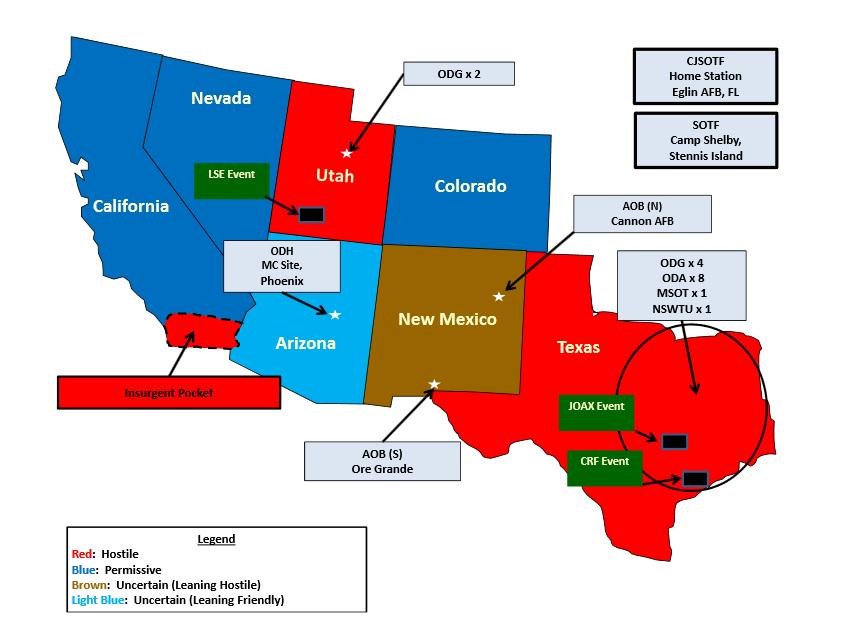
But if you look at it through the eyes of paranoia … well, that’s what makes it such a great crazy theory: It’s hard to argue with because it’s hard for reasonable people to grasp exactly what the threat is supposed to be. Maybe it’s a dry run for the imposition of martial law, or maybe it’s not even a drill, it’s martial law itself, or something else that involves confiscating guns (and secret tunnels under abandoned WalMarts). Because if President Obama were about to launch a coup against his own government, the place he would absolutely have to get under control first is Bastrop, Texas. I mean, if the Red Dawn patriots are anywhere, everybody knows that’s where they’d be.
The New Republic‘s Brian Beutler supplies the needed psychological analysis:
There’s a good amount of mythical and self-important thinking going on here, but there is also a very real sense in which these conservatives conceive of themselves as beleaguered, bent over a barrel by the federal government, living every day at the breaking point. It helps explain why [Senator Ted] Cruz believed a missive about using the Second Amendment as an “ultimate check against government tyranny” would make for a winning fundraising pitch, and why South Carolina Senator Lindsey Graham (also running for president) had to remind him that armed insurrection didn’t work out so well for his state a while back.
But this reasoning collapses without a foil. The secessionist impulse can’t be attributable to the ebbs and flows of social policy alone. If we live our lives on the razor’s edge of rebellion, there must be an equally reactionary adversary somewhere in the middle distance threatening our autonomy. That’s what gives rise to a projection of the kind we’re seeing in Texas today. Without an enemy, real or imagined, threatening our autonomy, we’re not patriots. We’re merely zealots.
Rating: Yellow/orange. It’s tempting to call this one blue, because liberals have gotten a lot of laughs out of it. But numerous Republican officials have responded as if the upset members of their party’s base had a legitimate concern, so it has definitely crossed the line into the mainstream. We can only hope that no wackos are taking this so seriously that they start shooting at our troops this summer. That plan probably wouldn’t work out well for them.
2. Kids posing with the Confederate flag. This one is true: The craziness isn’t in believing the rumor, but in why anybody would do this to begin with. Apparently egged on by some of their parents, eight teens dressed for the prom at Chaparral High in Parker, Colorado took a few minutes to pose for this picture and upload it to the internet. (Media versions of the photo have blurred the teens’ faces to protect them from their own foolishness.)

Denver’s Fox31 quoted a University of Colorado-Denver history professor identifying the flag as “first the Tennessee flag and more importantly the army of Virginia’s battle flag” before becoming the symbol of the KKK after the Civil War.
One of the parents speculated that there was no racist intent involved, but that “in their immaturity they kind of think it’s a sort of a cowboy type of thing.” Other commenters have suggested admiration for a “Southern lifestyle” a la Duck Dynasty.
CNN’s debate between Marc LaMont Hill and Ben Ferguson is instructive. Ferguson (a white conservative) accepts that the kids were probably not trying to offend blacks, and sees this very lack of race-consciousness as a sign of progress.
It may not be race as much as you’re trying to make it into race. It could actually be that there are younger people in America today that are not obsessed about racial issues or being bigoted or racist as you’re implying there are.
And Hill (black) replies, “Yeah, they’re called white people.” His point is that the ability to live without consciousness of race is itself part of white privilege. Blacks are never able to forget that there is a racial divide, or to ignore the possibility that whites might read something offensive into what they do. (I’m trying to picture how this story would play in the media with the races reversed: black kids with guns surrounding a Black Panther or Nation of Islam banner. I find it hard to imagine that pundits would accept a claim of innocent intent or see it as a sign of racial progress.)
Rating: Green, but orange if you have any connection to Chaparral High: If kids are coming out of your school without understanding what that flag really means — particularly when surrounded by whites with guns — you’ve got a problem.
3. Christianity is in danger of being “criminalized”. As unbelievable as it might be to outsiders (who see the Religious Right throwing its weight around all over our society), conservative Christians honestly believe both that they are persecuted and that their persecution is about to take sudden turn towards something truly dark and tyrannical.
 This bizarre notion has been around for many years. In 2005, Janet Fogler published The Criminalization of Christianity: Read this book before it becomes illegal! (If it has become illegal in the subsequent decade, no one has told Amazon.) She in turn attributed the phrase to a speech she heard in 1997: “The ultimate goal of the homosexual movement is the criminalization of Christianity.”
A number of Republican presidential candidates are dog whistling about this idea, as when Ted Cruz said “Religious liberty … has never been more in peril than it is right now.” But Mike Huckabee is explicitly making this looming criminalization one of the themes of his presidential campaign. In a conference call recorded by Right Wing Watch, Huckabee laid it out:
Christian convictions are under attack as never before. Not just in our lifetime, but ever before in the history of this great nation. We are moving rapidly towards the criminalization of Christianity, where it’s not simply going to be that a church’s tax-exempt status is threatened, but more importantly, where [there are] criminal charges for a person who defies the new government norm. … We would be in essence criminals for preaching the scriptural truth about holy marriage.
He justified this fear by citing “numerous cases” across the country of “chaplains in the military being told to put their Bibles away, no longer pray in Jesus name”. (Air Force Chaplain James Bradfield explains the origins of this canard: When soldiers have been ordered to attend a meeting, regulations say the invocation of that meeting — if any — should be non-sectarian. So it is inappropriate to pray in Jesus’s name, or in Allah’s or Buddha’s. In short, the regulation is against forced devotion, not devotion in general or Christian devotion in particular.)
To me, this a classic example of what I have elsewhere called privileged distress: as a favored group loses some of its privileges and is treated more like everyone else, its members imagine that they are being persecuted.
The sad thing is that Huckabee and his ilk are blind to the sense in which Christianity really is being criminalized — by Christians who believe their higher righteousness justifies them in ignoring the laws and Constitutional principles the rest of us have to live by. Scott Roeder, for example, criminalized Christianity when he killed abortionist Dr. George Tiller. Governor Jindal is criminalizing Christianity when he conspires to misappropriate public funds to promote his religious views in the Louisiana public schools. And Huckabee himself is advocating the criminalization of Christianity later in this same conference call, when he urges local government officials to defy court orders to issue marriage licenses to same-sex couples.
Rating: Red. Bad things are already happening. The proponents so-called “religious liberty” bills in the state legislatures often take as given that Christian belief and practice is in some kind of legal danger.
4. Obama is bringing on the Apocalypse. This story, in my opinion, got blown out of proportion. In an interview on a religious-right radio program, Michele Bachmann accused President Obama of helping Iran get nuclear weapons, which spins the world toward disaster. But then she segued into a common Christian belief: that the worse things get, the closer we are to the Second Coming.
To my mind, this is comparable to a point Communists often make: that the worse things get, the closer we are to the Revolution. And Bachmann never completely boiled it down to “Obama is causing the Apocalypse”, as you might assume from the headlines.
I find another clip from this interview more interesting, because it illustrates how the conservative mind uses theories of dark magic to deal with the cognitive dissonance caused by the increasing evidence for climate change: Since President Obama has “in effect, declared war on Israel”, he has invoked the curse in Genesis 12:3 against the United States. The interviewer (Jan Markell) sums up the consequences: “As we speak, they’re severe, from economic issues to some of the weather-related issues: drought on the west coast, unparalleled, unprecedented snowstorms on the east coast.” And Bachmann responds: “It’s my opinion that that is only the very threshold or down payment.”
Rating: Green.
5. Two guys die trying to shoot their way into a Muhammad cartoon contest. Like #2, this one really happened. The American Freedom Defense Initiative — an anti-Muslim group whose president is Pamela Geller — attempted to recreate the Charlie Hebdo situation in Garland, Texas.
They succeeded. Two extremely foolish Muslim extremists took the bait and wounded a security guard. They were gunned down by police and died.
The incident reminds me of high school, where a big guy might start talking trash about a little guy’s Mom or girl friend, hoping he’ll attack and provide an excuse to beat the crap out of him. Yeah, the little guy is wrong to react, but that doesn’t make me root for the big guy either. Larry Wilmore nailed it:
Make no mistake, it is absolutely, unequivocally wrong to shoot people who do things that offend you, but two things can be wrong at the exact same time. Even if Pamela Geller’s argument about free speech is valid, she can still be a dick.
If somebody has a real point they’re trying to make, and if the best way to get that point across is through a cartoon with Muhammad in it, I totally support the right to draw that cartoon no matter how many Muslims it incidentally pisses off. But if pissing off those Muslims is the whole point, I still agree in a legal sense, but my sympathy is limited.
I know it’s Bill Maher’s job to make the New Rules, but here’s one I’d like to propose: If you portray AFDI as innocent victims, you are absolutely forbidden ever to claim that any victim of any crime was “asking for it”. If supermodels want to walk down inner-city sidewalks by themselves at 3 a.m., naked but for solid-gold jewelry, they’re just exercising their right to free expression.
Rating: Red. Craziness really starts to take off when you can provoke a crazy response from the opposite fringe. Eventually you can get into the center-destroying cycle of reprisals I described a decade ago in Terrorist Strategy 101.
6. Obama is promoting a race war so he can cancel the elections. World Net Daily is the New York Times of conspiracy theorists. On its site you can find columnists like Erik Rush, who will “connect the dots” and explain to you what this Baltimore nonsense is really about.
The common denominator, as we have seen illustrated above, in the streets of Ferguson and Baltimore, in the White House and across America: Marxists and militant Muslims working together in a coordinated effort to precipitate circumstances that will eventually “necessitate” the imposition of martial law. …
The operatives in Baltimore are but one contingent of Obama’s Revolutionary Army; illegal immigration and amnesty activists are another, as are various other entitled and protected class groups the political left has cultivated over many years. Effective manipulation of these demographics will be integral in determining whether or not he can successfully turn us all against one another at the appointed time.
Another WND columnist, Morgan Brittany, says “I completely agree” with that Rush column, and elaborates:
I don’t think the chaos in Baltimore “just happened”; I think it was planned and is the next step in the breakdown of our society.
Another piece of the plan is the “over-charging” of the officers who killed Freddy Gray, because when they are inevitably acquitted, Obama’s Marxist/Muslim allies can incite similar riots across the country.
If the verdict is not what they want, perhaps Obama will have to institute martial law to preserve order, form a national police force and postpone the 2016 elections.
Michael Savage knows who will be in that national police force: Obama’s about to “deputize” the Crips and Bloods to “keep order on the streets”.
You’re going to see more race war right up until the Labor Day of 2016 for an obvious reason. … they’re going to take the street garbage and they’re going to take the illegal immigrants and they’re going to warp the entire election.
Rating: Blue. But only because everything from Savage or WND rates as Blue until it gets picked up elsewhere; I’ll upgrade this bit of craziness to Yellow as soon as I see it on Fox.
The Obama-planned-Baltimore theory has potential. If you take as an axiom that white racism in America is ancient history, then these repeated unnecessary police killings of black men and the deep anger they evoke in the black community are profound mysteries. What better explanation could you find?


 To appreciate the full anti-democratic ugliness of the Netanyahu era, read Max Blumenthal’s
  The Weekly Sift