Category Archives: Articles

About Those Emails

On the Right, it is an article of faith that Hillary Clinton’s use of a private email server while she was Secretary of State involves her in crimes that deserve a jail term; either she will be indicted by the FBI or (if not) President Obama somehow is protecting her from indictment. Donald Trump has said “Hillary Clinton has to go to jail.” and “Anything Obama wants, she’s going forward with because you know why? She doesn’t want to go to jail.”

More recently, as it became clear that Clinton would be nominated, some Bernie Sanders supporters began expressing similar hopes: that legal troubles would take Clinton off the board, leaving the nomination for Sanders. Sanders himself has not gone that far, but has urged voters and delegates to “take a hard look” at the report of the State Department Inspector General.

One small place the Clinton/Sanders debate has been playing out is in the comments on this blog, and I have started getting criticism for ignoring or minimizing the issue, particularly the more recent developments. [1] So I thought I’d read the Office of the Inspector General’s report and other well-informed commentary on the Clinton’s emails and report.

What it’s all about. The OIG report says:

Secretary Clinton employed a personal email system to conduct business during her tenure in the United States Senate and her 2008 Presidential campaign. She continued to use personal email throughout her term as Secretary, relying on an account maintained on a private server, predominantly through mobile devices. Throughout Secretary Clinton’s tenure, the server was located in her New York residence.

Instead, she should have used a State Department email account for official business while she was Secretary of State. I don’t think anyone disputes that basic description of the situation. The entire argument is about how serious the issue is.

Separable concerns. The first thing to understand about Clinton’s emails is that there are two separate and more-or-less opposite concerns: security (i.e., keeping information in) and transparency (letting information out).

Most articles about the emails wander from one concern to the other, sometimes irresponsibly. But it makes no sense to jump from an OIG quote about Clinton breaking transparency rules to a charge that she has put the nation’s security at risk. Either, neither, or both might be true, but they are completely different issues.

We won’t know exactly what the FBI is investigating until they tell us, but indications are that they are focused on the security of classified information. If so, then the OIG report is almost a perfect complement: It focuses mainly on transparency; to the extent it discusses security at all, it talks about sensitive-but-unclassified information, which I assume includes things like personnel records.

Transparency. The OIG report is deadly dull to read, because it’s mainly a recent history of record-keeping at the State Department. Clinton is a central figure, but the sweep is much broader.

The report paints a picture of a common bureaucratic problem: The government has good intentions about keeping complete records. Some of those intentions have been written into laws like the Federal Records Act. The National Archives and Records Administration (NARA) has issued government-wide regulations for meeting the legal requirements, and the State Department, like other departments and agencies, has created policies and procedures that (if followed) should fulfill the NARA regulations.

Unfortunately, though, State (like much of the government) never finds the money to create an up-to-date, usable record-keeping system, particularly with regard to modern forms of communication like email. So proper record-keeping is cumbersome, and employees are left with a conflict between following the proper procedures and getting their jobs done.

According to a 2010 U.S. Government Accountability Office (GAO) report, most agencies do not prioritize records management, as evidenced by lack of staff and budget resources, absence of up-to-date policies and procedures, lack of training, and lack of accountability. In its most recent annual assessment of records management, [the National Archives and Records Administration] identified similar weaknesses across the Federal Government with regard to electronic records in particular. NARA reported that 80 percent of agencies had an elevated risk for the improper management of electronic records, reflecting serious challenges handling vast amounts of email, integrating records management functionality into electronic systems, and adapting to the changing technological and regulatory environments.

You might think that just using the State Department email system would be enough to insure compliance, but no.

Several staff mentioned preserving emails by saving them in their Department email accounts. However, as previously noted, NARA regulations state that agencies may only use an electronic mail system to store the recordkeeping copy of electronic mail messages identified as Federal records if that system contains specific features; the current Department email system does not contain these features.

There’s a separate program for making sure emails get properly recorded, but most people don’t use it.

However, prior OIG reports have repeatedly found that Department employees enter relatively few of their emails into the SMART system and that compliance varies greatly across bureaus, in part because of perceptions by Department employees that SMART is not intuitive, is difficult to use, and has some technical problems.

So working around the system in one way or another has been common.

OIG also reviewed an S/ES-IRM report [don’t worry about the acronym, it looks to be State’s information technology office] prepared in 2010 showing that more than 9,200 emails were sent within one week from S/ES servers to 16 web-based email domains, including gmail.com, hotmail.com, and att.net. S/ES-IRM told OIG that it no longer has access to the tool used to generate this particular report. In another instance, in a June 3, 2011, email message to Secretary Clinton with the subject line “Google email hacking and woeful state of civilian technology,” a former Director of Policy Planning wrote: “State’s technology is so antiquated that NO ONE uses a State-issued laptop and even high officials routinely end up using their home email accounts to be able to get their work done quickly and effectively.”

Previous secretaries of state worked around the system in different ways. Colin Powell used a mixture of personal and official email, while Condoleezza Rice didn’t use email at all. (I’m having trouble imagining how you run a department without email, but somehow she managed it.) Clinton defenders who say that Powell did exactly the same thing as Clinton are exaggerating, but it’s true that no previous secretary had found a way to use email while fully complying with the official procedures.

Nobody worked around the system quite as completely as Secretary Clinton did, and in doing so she undoubtedly violated State Department policies. It’s possible she was in violation of a law against removing government records, though she claims the government still had all her correspondence because the people she was writing to were on government servers. (As we’ve seen, NARA wouldn’t consider that adequate.) She has since sent the government printed copies of her business emails, filtering them out from her personal emails, which were on the same server. (Though critics wonder if she filtered properly.)

But departmental policy is not the same as law, so it’s still iffy whether there’s a technical legal violation related to the FRA. Even if there is, prosecuting for it would be unheard of. The OIG report gives the example of an ambassador to Kenya:

the Ambassador continued to use unauthorized systems to conduct official business [after being told not to]. The Department subsequently initiated disciplinary proceedings against him for his failure to follow these directions and for several other infractions, but he resigned before any disciplinary measures were imposed.

That response — no legal charges, but internal discipline that vanishes when someone leaves State — seems to be how these things are typically handled.

Security. Another point that doesn’t get enough attention in the media is that the State Department’s email system does not have sufficient security to allow classified discussions. Classified discussions require use of a different messaging system, which can only be accessed from secure locations. (I’m wondering whether this system is the one whose messages Chelsea Manning released to the world, but I haven’t verified that.)

So, completely independent of whether Clinton’s email files were stored on her personal server or the State Department’s, those files are not supposed to contain classified information. If they do, there’s been a security violation before the email gets to the server.

In other words, if you’re worried about documents stamped TOP SECRET getting attached to emails and winding up on a hard drive in Clinton’s basement, stop. That’s not how State is supposed to operate or did operate.

The potential security violations we’re hearing about are almost all of the incidental or accidental variety: Somebody (usually not Clinton, but the person writing to her) should have known that certain information ought to be classified, but mentioned it in email anyway. [2] Or an email contained information that the State Department considered unclassified at the time, but was later classified by some other agency.

Politics and sources. Before going into detail about specific alleged violations, another thing to understand is that all our windows into the FBI investigation are distorted by politics. The FBI has not issued any official reports on Clinton’s emails and is not briefing the press directly. But it sometimes briefs members of Congress about what it has been finding, and that information sometimes gets leaked to the press.

So most of the news articles about the FBI investigation into Clinton’s emails are based on leaks from Republican congressmen, who may slant their assessments or cherry-pick their quotes because they want to make Clinton look bad. Whenever a story mentions “congressional sources”, that generally means “Republicans”.

As a result, there has been a string of sensational “scoops” that subsequently had to be walked back as more accurate versions came out. (One report that 147 FBI agents were involved in the investigation — making it a Public Enemy #1 scale effort — eventually got reduced to less than 12.) As always, the sensational version sticks in the public mind even after it has been debunked. This is particularly true within the conservative echo chamber.

Recent revelations. This week the The Wall Street Journal published an article (sourced to anonymous “congressional and law-enforcement officials”) describing top-secret information allegedly found on Clinton’s server. These were email exchanges between lower-level State Department officials that got forwarded to Clinton. (I found no claim that Clinton participated in the exchanges.)

The circumstances are worth understanding: The U.S. regularly launches drone strikes in Pakistan without the official consent of the Pakistani government. This fact itself is considered top secret (even though everyone knows it), and plans for specific drone strikes are top secret, for obvious reasons. (If news about the strike got out beforehand, whoever we were trying to attack could get away.)

As you can imagine, the drone program is not popular inside Pakistan. Protests from Pakistani officials got more and more intense, and the State Department was the official channel for receiving these protests. So eventually, officials at State were given prior warning of drone strikes.

The CIA initially chafed at the idea of giving the State Department more of a voice in the process. Under a compromise reached around the year 2011, CIA officers would notify their embassy counterparts in Islamabad when a strike in Pakistan was planned, so then-U.S. ambassador Cameron Munter or another senior diplomat could decide whether to “concur” or “non-concur.” Mr. Munter declined to comment.

Diplomats in Islamabad would communicate the decision to their superiors in Washington. A main purpose was to give then-Secretary of State Clinton and her top aides a chance to consider whether she wanted to weigh in with the CIA director about a planned strike.

Drone strikes are time-sensitive events, because the terrorist leaders they target move around a lot. So if State was going to object, it had to do so quickly. And now we once again run into the limitations of State Department systems.

The time available to the State Department to weigh in on a planned strike varied widely, from several days to as little as 20 or 30 minutes. “If a strike was imminent, it was futile to use the high side, which no one would see for seven hours,” said one official. [3]

Adding to those communications hurdles, U.S. intelligence officials privately objected to the State Department even using its high-side system. They wanted diplomats to use a still-more-secure system called the Joint Worldwide Intelligence Community Systems, or JWICs. State Department officials don’t have ready access to that system, even in Washington. If drone-strike decisions were needed quickly, it wouldn’t be an option, officials said.

So once again, we see people facing a choice between following proper procedures and getting their jobs done. On at least a few occasions, then, discussions about drone strikes happened over insecure email channels.

One such exchange came just before Christmas in 2011, when the U.S. ambassador sent a short, cryptic note to his boss indicating a drone strike was planned. That sparked a back-and-forth among Mrs. Clinton’s senior advisers over the next few days, in which it was clear they were having the discussions in part because people were away from their offices for the holiday and didn’t have access to a classified computer, officials said.

I interpret “cryptic” to mean that the officials tried to be oblique in their references, so that anyone who might intercept the email wouldn’t immediately know what they were talking about. (I picture something like Tony Soprano’s phone conversations, or the ones KGB agents have on The Americans.) This is not considered an acceptable technique for securing classified information, but it seems to have worked.

U.S. officials said there is no evidence Pakistani intelligence officials intercepted any of the low-side State Department emails or used them to protect militants.

The WSJ article also notes that this kind of corner-cutting happens from time to time all over the government.

Several law-enforcement officials said they don’t expect any criminal charges to be filed as a result of the investigation, although a final review of the evidence will be made only after an expected FBI interview with Mrs. Clinton this summer.

One reason is that government workers at several agencies, including the departments of Defense, Justice and State, have occasionally resorted to the low-side system to give each other notice about sensitive but fast-moving events, according to one law-enforcement official.

So: Rules were broken, but not with malicious intent, and apparently without bad consequences. The most serious violations were not by Clinton, but the record of that rule-breaking is on her server and shouldn’t be. If the WSJ article is accurate, prosecuting anyone for these incidents would be highly unusual, and Clinton would not be at the top of the list.


[1] Here’s where I’m coming from: I voted for Sanders in the New Hampshire primary and have been raising many of his signature issues — inequality, campaign finance, etc. — for several years. But I have criticized the anti-Clinton turn in Sanders’ rhetoric. And I have been increasingly disenchanted with his campaign’s tendency to turn the ordinary politics of a presidential contest into a persecution narrative, one that unifies the media, the Democratic Party, election officials, and everybody else who isn’t 100% for Bernie into a sinister Clinton-supporting “Them”.

[2] If you’ve ever worked someplace that handles classified information (I used to and my wife still does), you know that such technical violations of security are not that unusual, because the boundary between what can and can’t be said in certain places to certain people can be hazy. (I’ve heard many face-to-face conversations end with: “But we probably shouldn’t be talking about this.”) Also, while any idiot should know not to mention the names of spies or technical details of weapons systems, a lot of stuff gets classified that really isn’t that important. That kind of information sometimes slides into conversations without anybody noticing.

[3] The article does not speculate about this, but I wonder if the CIA ever gamed the system: By picking particularly inconvenient moments to notify State and leaving very small time windows, they might make it harder for State to interfere with their plans.

What Should “Racism” Mean? Part II.

Republican leaders are disturbed by Trump’s racist comments. But two-thirds of Republican voters don’t think they’re racist at all.


In a week that saw Hillary Clinton became the first woman ever to clinch a major-party nomination, probably more news-network air time got devoted to the effort of Republican leaders to distance themselves from Donald Trump. In the wake of his long series of attacks against the “Mexican” judge overseeing one of the Trump University fraud lawsuits, the word racist came up a lot, and few elected Republicans seemed willing to defend Trump from the charge that it applied to him.

Speaker Paul Ryan described a Trump statement as “the textbook definition of a racist comment.” Republican Senator Mark Kirk withdrew his endorsement of Trump, saying that in view of his recent statements “I cannot and will not support my party’s nominee for president”. Maine’s Senator Susan Collins refused to rule out voting for Clinton. Former senatorial candidate (and major Republican donor) Meg Whitman compared Trump to Hitler and Mussolini. And on and on. The most blistering attack of all came from the previous Republican nominee, Mitt Romney:

I don’t want to see trickle-down racism. I don’t want to see a president of the United States saying things which change the character of the generations of Americans that are following. Presidents have an impact on the nature of our nation, and trickle-down racism, trickle-down bigotry, trickle-down misogyny, all these things are extraordinarily dangerous to the heart and character of America. [1]

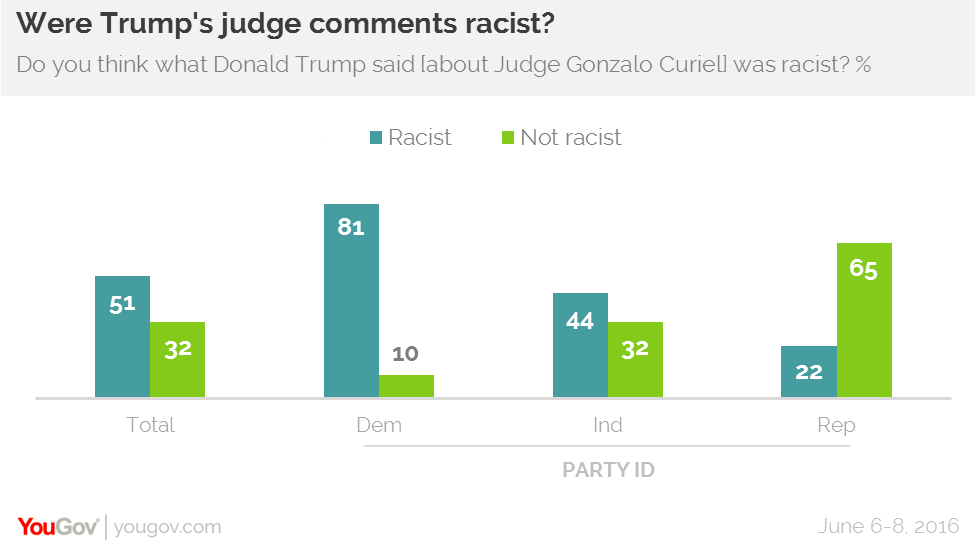
But if the primaries proved anything, it’s that the GOP’s leadership is out of tune with its voters, especially compared to Trump. So when YouGov asked whether Trump’s comments were racist, only 22% of Republicans were reading from Paul Ryan’s textbook, while almost 2/3rds said the comments weren’t racist. By a narrower 43%-39% margin, Republicans said that Trump was right to make those comments. [2]

What could they possibly be thinking?

Trump’s own explanation was far from convincing. In a prepared statement, he argued that his comments had been “misconstrued as a categorical attack against people of Mexican heritage” when actually they were just targeted at Judge Curiel, who apparently had it coming because he didn’t dismiss the Trump U lawsuit.

To me, that’s like yelling “Nigger!” at a black driver who cuts you off in traffic, and then feeling misunderstood when the blacks in your carpool take offense. You didn’t launch a categorical attack on all blacks, you just used a racial insult against one guy who had it coming because he was in your way. Why can’t they see the difference?

I got a better clue from listening to Bill O’Reilly. Wednesday night, Bill challenged Congressman Bill Flores about the Texas Republican’s use of racist.

Do you believe that Donald Trump gets up in the morning and says, “You know what? I don’t like Mexicans, I’m going to go out and try to make them look bad.”? Do you believe that? … Don’t you think it was more about Trump being angry with the judge’s decision in a civil litigation rather than the judge’s ethnicity? … OK, I get your point, but I think you understand mine as well. That you don’t use the R-word unless you are [talking about] David Duke, unless you have got a history of trying to denigrate minorities or other people.

Trump isn’t ex-KKK Grand Wizard David Duke, so he’s not a racist. Even labeling specific quotes as racist (which is all Paul Ryan did; he didn’t call Trump a racist) is apparent going too far. The most O’Reilly would say was that they were “unwise”.

And now we’re back on a topic I covered two years ago in “What Should Racism Mean?“. At that time I reviewed a long list of pseudo-scandals that President Obama had started … by doing things that previous presidents had done without upsetting anybody: put his feet on a White House desk, let a Marine hold his umbrella, send secular Christmas cards, and so on. Similarly, the luxurious White House lifestyle — unchanged from previous administrations — suddenly began inspiring outrage when a black family moved in.

So I raised the question: Is that racist? And I allowed for the possibility that some might not want to call it that.

I sympathize with people who want to reserve racism for Adolf Hitler ordering the Final Solution to the Jewish problem or George Wallace standing in the door to block black students from enrolling at the University of Alabama. The men who lynched Emmett Till or the grand jury that refused to indict them — those people were racists. I get that it doesn’t seem right to put them in the same category with the people who only just realized in 2009 that life in the White House is pretty sweet.

But a problem comes up: If you want to construe racist and racism very narrowly, then what words do you use for people who (for some reason other than conscious willful hatred) just can’t look at a black president or his family the same way they have always looked at white presidents and their families? It’s a thing; it really happens, and it has important political consequences. What do you call it?

The Trump/Curiel situation is similar. Trump is doing something morally objectionable here. He is taking advantage of his fans’ willingness to believe bad things about Mexican-Americans on flimsy or no evidence (just as, when he was pushing Birtherism, he was taking advantage of their willingness to believe bad things about a black president on flimsy or no evidence), in order to either put pressure on a federal judge or explain away why so many people are suing him for fraud.

In other words, once again he is looking at the public’s racial prejudices and saying, “I can make this work for me.” That doesn’t make him Hitler or David Duke, but it’s a despicable act that needs a name. What is it? O’Reilly’s suggestion of unwise doesn’t fill the bill, because there’s no moral component to unwise. Spending $35,000 on a Trump University course is unwise; Trump’s repeated and calculated abuse of Judge Curiel is something altogether different.

And if you are inside the conservative bubble, that “something” has no name. The word that the rest of the country uses — racism — has been declared off-limits and not replaced. And now that there is no way to talk about Trump’s offense, it doesn’t exist. Whatever is wrong with Trump’s statements can no longer be put into words, so they aren’t wrong — at least not to a plurality of Republicans.

George Orwell had this all figured out in the mid-20th century. As he wrote in “The Principles of Newspeak“:

The purpose of Newspeak was not only to provide a medium of expression for the world-view and mental habits proper to the devotees of IngSoc, but to make all other modes of thought impossible. It was intended that when Newspeak had been adopted once and for all and Oldspeak forgotten, a heretical thought — that is, a thought diverging from the principles of IngSoc — should be literally unthinkable, at least so far as thought is dependent on words. Its vocabulary was so constructed as to give exact and often very subtle expression to every meaning that a Party member could properly wish to express, while excluding all other meaning and also the possibility of arriving at them by indirect methods. This was done partly by the invention of new words, but chiefly by eliminating undesirable words and stripping such words as remained of unorthodox meanings, and so far as possible of all secondary meaning whatever. [my italics]

In today’s Newspeak, as spoken by devotees of AmCon, racism has been stripped of all meanings beyond getting up in the morning and saying “I don’t like Mexicans, I’m going to go out and try to make them look bad.” It applies to active white supremacists like David Duke, and no one else.

But if treating a black First Family differently from all white First Families isn’t racism, what is it? If citing a judge’s ethnicity as evidence of his unfitness isn’t racism, what is it?

Unless they’re trying to restrict the language to make these issues “literally unthinkable”, American conservatives owe us some new terminology.


[1] To flesh out what Romney might mean by “trickle-down racism”, look at this report from the Southern Poverty Law Center about how the bigotry in our presidential campaign is showing up in our schools and on our playgrounds.

[2] Among all voters, a 57%-20% majority said Trump was wrong, and a 51%-32% majority said the comments were racist. For some reason YouGov’s headline characterizes that majority as “thin”, but it really isn’t.

Preserving the Cult of the Job Creator

Members of the donor class must accept Trump’s personality cult to maintain their own.


Amazingly, on Wednesday somebody wrote an entire article about the presidential race that said hardly anything about Donald Trump. Even more remarkably, the article was an endorsement of Trump.

It’s true: Home Depot co-founder (and billionaire Jeb Bush donor) Bernie Marcus managed to endorse Trump without mentioning any particular thing he imagines President Trump will do, other than Make America Great Again and take the country in some unspecified “new direction”. No Mexican wall, no Muslim ban or database, no trade war with China, no deportation force rounding up 11 million people, no renegotiating the public debt, no ordering our military to commit war crimes, no nukes for Saudi Arabia. None of the positions Trump has made famous garner a single line.

OK then, maybe Marcus just dislikes Hillary Clinton. But why? That also is a little hard to get a handle on, because his denunciations of Clinton (or maybe President Obama; they’re interchangeable) are vague to the point of vanishing into rhetoric. Clinton will “push the [Supreme] court leftward for generations”, but no specific legal issue explains why Marcus believes that would be bad. Like Obama, Clinton is “hostile to free enterprise” in some unspecified way. Together, Clinton and Obama “have peddled a dangerous sentiment that government can provide for Americans better than the private sector.”

I’d be really interested to find a quote in which either Clinton or Obama actually expressed that sentiment, much less “peddled” it. (As No Democrat Ever said: “Damn this free enterprise system! Why can’t the government just own everything?”) I’ve listened to a lot of speeches from both of them, and I’ve never heard it. [1]

When otherwise intelligent people justify their actions and beliefs with vague claims that don’t stand up to scrutiny, I start to wonder what’s happening under the surface. Something about Clinton, Obama, and Democrats in general pisses Bernie Marcus off. What could it be?

Our main clue is the third major topic in Marcus’ article, one that he discusses at greater length and with more feeling than either Trump or Clinton: Home Depot, and (by inference) himself. In particular: all the wonderful opportunities that it/he has magnanimously provided for others. For example:

One young man started with us at 17 years of age, bringing carts in from the parking lot. Ultimately, he became a regional president. Imagine Americans vilifying this young man, who became a millionaire and earned every penny of it.

Indeed: imagine. You have to imagine, because in reality no one is vilifying Americans for getting ahead by working hard. If anyone were doing that, Marcus could quote them. But no one is, so he has to imagine.

He imagines a lot of other things too. What if the oppressive regulations of “Obama/Clinton-style government” had existed back in the 1970s when his wondrous Home Depot was getting started? Well, a (briefly) small business like his just couldn’t have happened under those conditions, because under Dodd-Frank, bankers would have required a solid balance sheet rather than basing their loan decisions on his “character and determination”. [2]

And Home Depot couldn’t have gone public under Sarbanes-Oxley because … I’m not sure why. IPOs continue to happen. Facebook went public. UnderArmour. Chipotle. But Home Depot wouldn’t have been able to figure it out for some reason.

And that would have been horrible for America because

the risks we took in the 1970s have resulted in millions of jobs – not just at The Home Depot, but at our suppliers, our vendors, and even our customers’ businesses.

This is where I think we start getting to the root of things, because by this point Marcus has left reality completely behind and vanished into self-glorifying mythology.

You see, Marcus may think of himself as a champion of small business and a job creator, but the reality is the exact opposite. Other than WalMart and maybe Amazon [3], I can’t think of any corporation that has destroyed more small businesses than Home Depot.

Whatever Marcus may imagine, Home Depot didn’t create the home-improvement retail market, it captured that market from other businesses that were already serving it.

Not so long ago, hardware stores and electrical supply shops and paint stores and lumber yards were just about all locally owned by businesspeople you could meet and talk to. If you were a tool-loving kind of guy [4] and could scrape some money together, you could start such a business and be your own boss. Now that’s a much dicier proposition — not because of Dodd-Frank or Sarbanes-Oxley or even ObamaCare, but mainly because of Home Depot (and its rival Lowes).

I haven’t done enough research to back this up with numbers, but looking at the merchandise and staff of my local Home Depot, I strongly suspect that (all together) those locally-owned stores of the 1970s employed more people, and probably stocked more American-made products. [5] Looking at the full picture, I’d guess that Home Depot isn’t a job creator at all, especially if we’re talking about American jobs. It’s more of a job destroyer.

So while you can argue that Home Depot captured its markets fair and square (because it provides a larger selection of products at a better price, or for some other reason), you can’t give it credit for millions of jobs, or any jobs at all.

Understanding the job-creator mythology and how divorced it is from reality puts us in a position to explain why Marcus (and so much of the donor class that supported Romney and Bush) has to come around to Trump eventually, even if all his policies and positions are too embarrassing to mention: Republicans have incorporated job-creator mythology into their larger myth of America, while Democrats have not. The reason Marcus and his compatriots think Democrats like Clinton or Obama (or me) are so hostile to “free enterprise” is that we don’t worship them the way they think they deserve to be worshiped.
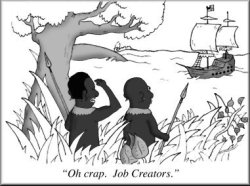
Democrats readily acknowledge that billionaires like Marcus and corporations like Home Depot are currently King of the Hill. But they want to believe that they created the hill.

Republicans are happy to tell them that they did. Democrats, on the other hand, tell the story this way: Business in the United States has always been a game played under certain rules. Under the rules of the 1970s and the decades that followed, Home Depot succeeded and Marcus became a multi-billionaire. We don’t begrudge his success, or the success of his 17-year-old cart-pushing millionaire employee either (assuming that guy really exists). Marcus won the game and captured the prize, so congratulations to him.

[see more Loren Fishman cartoons at https://humoresquecartoons.com/ ]

But we’d like to shift the rules so that in the future the workplace becomes safer and less discriminatory, so that workers don’t have to go bankrupt if they or their children need serious medical care, and so that those cart-pushers who don’t rise to be regional presidents still make a wage that lets them feed their families without food stamps. With those amendments, we want the game to continue, and businesspeople to keep on winning or losing according to how well they play.

Maybe Marcus and his fellow Kings of the Hill would win the game under those rules too, or maybe not. But that doesn’t matter. Either way, it’s not the end of free enterprise. Conversely, restoring the rules of the 1970s or 1950s or 1850s won’t make America great again, whatever great and again mean in that context.

Understandably, though, Bernie Marcus and his friends are not going to come around to the Democratic point of view, no matter how reality-based it is. They see themselves as Gods of the Hill, and view our attempts to landscape the hill as sacrilege. I can only hope that their self-deifying religion is still a minority faith.


[1] Preserving a role for the private sector is kind of the point of ObamaCare: How do you get healthcare to millions more Americans without the government taking over everything, by working through the existing insurance companies, drug companies, hospitals, and clinics? That’s what the conservative Heritage Foundation designed their proto-ObamaCare system to do, way back in 1989.

[2] They also couldn’t have considered his race. I wonder how many black businessmen were getting loans based on their “character and determination” back in the 1970s. I also wonder how much money the banking industry has lost over the years due to lenders making loans unjustified by financial principles. That was a major cause of the S&L crisis of the 1980s. To the extent that current law limits the discretion of federally-insured bankers, it happens for good reasons.

[3] One of my friends recently closed a local bookstore that had existed in the same location since the 1920s. I never heard him complain about government regulation, but Amazon seemed to be a much bigger problem. I suspect a lot of small businesspeople would tell a similar story.

[4] Yeah, you probably did have to be a guy. It was the 70s.

[5] You can argue that retailers sell Chinese products because that’s what’s available, but the big-box stores — especially Walmart — have been instrumental in pushing their suppliers to manufacture overseas.

The Election Is About the Country, Not the Candidates

Citizens shouldn’t let the media make us forget about ourselves.


Judging by the amount of media attention they got, these were the most important political stories of the week: Donald Trump and Bernie Sanders agreed to debate, but then Trump backed out, leading Sanders supporters to launch the #ChickenTrump hashtag. A report on Hillary Clinton’s emails came out. A poll indicated that the California primary is closer than previously thought. Trump’s delegate total went over 50%. Elizabeth Warren criticized Trump, so he began calling her “Pocahontas”. Sanders demanded that Barney Frank be removed as the chair of the DNC’s platform committee. Trump told a California audience that the state isn’t in a drought and has “plenty of water“. Trump accused Bill Clinton of being a rapist, and brought up the 1990s conspiracy theory that Vince Foster was murdered. President Obama said that the prospect of a Trump presidency had foreign leaders “rattled“, and Trump replied that “When you rattle someone, that’s good.” Clinton charged that Trump had been rooting for the 2008 housing collapse. Pundits told us that the tone of the campaign was only going to get worse from here; Trump and Clinton have record disapproval ratings for presidential nominees, and so the debate will have to focus on making the other one even more unpopular.

If you are an American who follows political news, you probably heard or read most of these stories, and you may have gotten emotionally involved — excited or worried or angry — about one or more of them. But if at any time you took a step back from the urgent tone of the coverage, you might have wondered what any of it had to do with you, or with the country you live in. The United States has serious issues to think about and serious decisions to make about what kind of country it is or wants to be. This presidential election, and the congressional elections that are also happening this fall, will play an important role in those decisions.

That’s why I think it’s important, both in our own minds and in our interactions with each other, to keep pulling the discussion back to us and our country. The flaws and foibles and gaffes and strategies of the candidates are shiny objects that can be hard to ignore, and Trump in particular is unusually gifted at drawing attention. But the government of the United States is supposed to be “of the People, by the People, and for the People”. It’s supposed to be about us, not about them.

As I’ve often discussed before, the important issues of our country and how it will be governed, of the decisions we have to make and the implications those decisions will have, are not news in the sense that our journalistic culture understands it. Our sense of those concerns evolves slowly, and almost never changes significantly from one day to the next. It seldom crystallizes into events that are breaking and require minute-to-minute updates. At best, a breaking news event like the Ferguson demonstrations or the Baltimore riot will occasionally give journalists a hook on which to hang a discussion of an important issue that isn’t news, like our centuries-long racial divide. (Picture trying to cover it without the hook: “This just in: America’s racial problem has changed since 1865 and 1965, but it’s still there.”)

So let’s back away from the addictive soap opera of the candidates and try to refocus on the questions this election really ought to be about.

Who can be a real American?

In the middle of the 20th century (about the time I was born), if you had asked people anywhere in the world to describe “an American”, you’d have gotten a pretty clear picture: Americans were white and spoke English. They were Christians (with a few Jews mixed in, but they were assimilating and you probably couldn’t tell), and mostly Protestants. They lived in households where two parents — a man and a woman, obviously — were trying (or hoping) to raise at least two children. They either owned a house (that they probably still owed money on) or were saving to buy one. They owned at least one car, and hoped to buy a bigger and better one soon.

If you needed someone to lead or speak for a group of Americans, you picked a man. American women might get an education and work temporarily as teachers or nurses or secretaries, but only until they could find a husband and start raising children.

Of course, everyone knew that other kinds of people lived in America: blacks, obviously; Hispanics and various recent immigrants whose English might be spotty; Native Americans, who were still Indians then; Jews who weren’t assimilating and might make a nuisance about working on Saturday, or even wear a yarmulke in public; single people who weren’t looking to marry or raise children (but might be sexually active anyway); women with real careers; gays and lesbians (but not transgender people or even bisexuals, whose existence wasn’t recognized yet); atheists, Muslims, and followers of non-Biblical religions; the homeless and others who lived in long-term poverty; folks whose physical or mental abilities were outside the “normal” range; and so on.

But they were Americans-with-an-asterisk. Such people weren’t really “us”, but we were magnanimous enough to tolerate them living in our country — for which we expected them to be grateful.

Providing services for the “real” Americans was comparatively easy: You could do everything in English. You didn’t have to concern yourself with handicapped access or learning disabilities. You promoted people who fit your image of a leader, and didn’t worry about whether that was fair. You told whatever jokes real Americans found funny, because anybody those jokes might offend needed to get a sense of humor. The schools taught white male history and celebrated Christian holidays. Every child had two married parents, and you could assume that the mother was at home during the day. Everybody had a definite gender and was straight, so if you kept the boys and girls apart you had dealt with the sex issue.

If those arrangements didn’t work for somebody, that was their problem. If they wanted the system to work better for them, they should learn to be more normal.

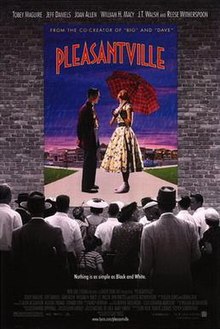
It’s easy to imagine that this mid-20th-century Pleasantville America is ancient history now, but it existed in living memory and still figures as ideal in many people’s minds. Explicitly advocating a return to those days is rare. But that desire isn’t gone, it’s just underground.

For years, that underground nostalgia has figured in a wide variety of political issues. But it has been the particular genius of Donald Trump to pull them together and bring them as close to the surface as possible without making an explicit appeal to turn back the clock and re-impose the norms of that era. “Make America great again!” doesn’t exactly promise a return to Pleasantville, but for many people that’s what it evokes.

What, after all, does the complaint about political correctness amount to once you get past “Why can’t I get away with behaving like my grandfather did?”

We can picture rounding up and deporting undocumented Mexicans by the millions, because they’re Mexicans. They were never going to be real Americans anyway. Ditto for Muslims. It would have been absurd to stop letting Italians into the country because of Mafia violence, or to shut off Irish immigration because of IRA terrorism. But Muslims were never going to be real Americans anyway, so why not keep them out? (BTW: As I explained a few weeks ago, the excuse that the Muslim ban is “temporary” is bogus. If nobody can tell you when or how something is going to end, it’s not temporary.)

All the recent complaints about “religious liberty” fall apart once you dispense with the notion that Christian sensibilities deserve more respect than non-Christian ones, or that same-sex couples deserve less respect than opposite-sex couples.

On the other side, Black Lives Matter is asking us to address that underground, often subconscious, feeling that black lives really aren’t on the same level as white lives. If a young black man is dead, it just doesn’t have the same claim on the public imagination — or on the diligence of the justice system — that a white death would. How many black or Latina girls vanish during a news cycle that obsesses over some missing white girl? (For that matter, how many white presidents have seen a large chunk of the country doubt their birth certificates, or have been interrupted during State of the Union addresses by congressmen shouting “You lie!”?)

But bringing myself back to the theme: The issue here isn’t Trump, it’s us. Do we want to think of some Americans as more “real” than others, or do we want to continue the decades-long process of bringing more Americans into the mainstream?

That question won’t be stated explicitly on your ballot this November, like a referendum issue. But it’s one of the most important things we’ll be deciding.

What role should American power play in the world?

I had a pretty clear opinion on that last question, but I find this one much harder to call.

The traditional answer, which goes back to the Truman administration and has existed as a bipartisan consensus in the foreign-policy establishment ever since, is that American power is the bedrock on which to build a system of alliances that maintains order in the world. The archetype here is NATO, which has kept the peace in Europe for 70 years.

That policy involves continuing to spend a lot on our military, and risks getting us involved in wars from time to time. (Within that establishment consensus, though, there is still variation in how willing we should be to go to war. The Iraq War, for example, was a choice of the Bush administration, not a necessary result of the bipartisan consensus.) The post-Truman consensus views America as “the indispensable nation”; without us, the world community lacks both the means and the will to stand up to rogue actors on the world stage.

A big part of our role is in nuclear non-proliferation. We intimidate countries like Iran out of building a bomb, and we extend our nuclear umbrella over Japan so that it doesn’t need one. The fact that no nuclear weapon has been fired in anger since 1945 is a major success of the establishment consensus.

Of our current candidates, Hillary Clinton (who as Secretary of State negotiated the international sanctions that forced Iran into the recent nuclear deal) is the one most in line with the foreign policy status quo. Bernie Sanders is more identified with strengthened international institutions which — if they could be constructed and work — would make American leadership more dispensable. To the extent that he has a clear position at all, Donald Trump is more inclined to pull back and let other countries fend for themselves. He has, for example, said that NATO is “obsolete” and suggested that we might be better off if Japan had its own nuclear weapons and could defend itself against North Korea’s nukes. On the other hand, he has also recently suggested that we bomb Libya, so it’s hard to get a clear handle on whether he’s more or less hawkish than Clinton.

Should we be doing anything about climate change?

Among scientists, there really are two sides to the climate-change debate: One side believes that the greenhouse gases we are pumping into the atmosphere threaten to change the Earth’s climate in ways that will cause serious distress to millions or even billions of people, and the other side is funded by the fossil fuel industry.

It’s really that simple. There are honest scientific disagreements about the pace of climate change and its exact mechanisms, but the basic picture is clear to any scientist who comes to the question without a vested interest: Burning fossil fuels is raising the concentration of greenhouse gases in the atmosphere. An increase in greenhouse gases causes the Earth to radiate less heat into space. So you would expect to see a long-term warming trend since the Industrial Revolution got rolling, and in fact that’s what the data shows — despite the continued existence of snowballs, which has been demonstrated by a senator funded by the fossil fuel industry.

Unfortunately, burning fossil fuels is both convenient and fun, at least in the short term. And if you don’t put any price on the long-term damage you’re doing, it’s also economical. In reality, doing nothing about climate change is like going without health insurance or refusing to do any maintenance on your house or car. Those decisions can improve your short-term budget picture, which now might have room for that Hawaiian vacation your original calculation said you couldn’t afford. Your mom might insist that you should account for your risk of getting sick or needing some major repair, but she’s always been a spoilsport.

That’s the debate that’s going on now. If you figure in the real economic costs of letting the Earth get hotter and hotter — dealing with tens of millions of refugees from regions that will soon be underwater, building a seawall around Florida, moving our breadbasket from Iowa to wherever the temperate zone is going to be in 50 years, rebuilding after the stronger and more frequent hurricanes that are coming, and so on, then burning fossil fuels is really, really expensive. But if you decide to let future generations worry about those costs and just get on with enjoying life now, then coal and oil are still cheap compared to most renewable energy sources.

So what should we do?

Unfortunately, nobody has come up with a good way to re-insert the costs of climate change into the market without involving government, or to do any effective mitigation without international agreements among governments, of which the recent Paris Agreement is just a baby step in the right direction. And to one of our political parties, government is a four-letter word and world government is an apocalyptic horror. So the split inside the Republican Party is between those who pretend climate change isn’t happening, and those who think nothing can or should be done about it. (Trump is on the pretend-it-isn’t-happening side.)

President Obama has been taking some action to limit greenhouse gas emissions, but without cooperation from Congress his powers are pretty limited. (It’s worth noting how close we came to passing a cap-and-trade bill to put a price on carbon before the Republicans took over Congress in 2010. What little Obama’s managed to do since may still get undone by the Supreme Court, particularly if its conservative majority is restored.)

Both Clinton and Sanders take climate change seriously. As is true across the board, Sanders’ proposals are simpler and more sweeping (like “ban fracking”) while Clinton’s are wonkier and more complicated. (In a debate, she listed the problems with fracking — methane leaks, groundwater pollution, earthquakes — and proposed controlling them through regulation. She concluded: “By the time we get through all of my conditions, I do not think there will be many places in America where fracking will continue to take place.”) But like Obama, neither of them will accomplish much if we can’t flip Congress.

Trump, meanwhile, is doing his best impersonation of an environmentalist’s worst nightmare. He thinks climate change is a hoax, wants to reverse President Obama’s executive orders to limit carbon pollution, has pledged to undo the Paris Agreement, and to get back to burning more coal.

How should we defend ourselves from terrorism?

There are two points of view on ISIS and Al Qaeda-style terrorism, and they roughly correspond to the split between the two parties.

From President Obama’s point of view, the most important thing about battle with terrorism is to keep it contained. Right now, a relatively small percentage of the world’s Muslims support ISIS or Al Qaeda, while the vast majority are hoping to find a place for themselves inside the world order as it exists. (That includes 3.3 million American Muslims. If any more than a handful of them supported terrorism, we’d be in serious trouble.) We want to keep tightening the noose on ISIS in Iraq and Syria, and keep closing in on terrorist groups elsewhere in the world, while remaining on good terms with the rest of the Muslim community.

From this point of view — which I’ve described in more detail here and illustrated with an analogy here — the worst thing that could happen would be for these terrorist incidents to touch off a world war between Islam and Christendom.

The opposite view, represented not just by Trump but by several of the Republican rivals he defeated, is that we are already in such a war, so we should go all out and win it: Carpet bomb any territory ISIS holds, without regard to civilian casualties. Discriminate openly against Muslims at home and ban any new Muslims from coming here.

Like Obama, I believe that the main result of these policies would be to convince Muslims that there is no place for them in a world order dominated by the United States. Rather than a few dozen pro-ISIS American terrorists, we might have tens of thousands. If we plan to go that way, we might as well start rounding up 3.3 million Americans right now.

Clinton and Sanders are both roughly on the same page with Obama. Despite being Jewish and having lived on a kibbutz, Sanders is less identified with the current Israeli government than either Obama or Clinton, to the extent that makes a difference.

Can we give all Americans a decent shot at success? How?

Pre-Trump, Republicans almost without exception argued that all we need to do to produce explosive growth and create near-limitless economic opportunity for everybody is to get government out of the way: Lower taxes, cut regulations, cut government programs, negotiate free trade with other countries, and let the free market work its magic. (Jeb Bush, for example, argued that his small-government policies as governor of Florida — and not the housing bubble that popped shortly after he left office — had led to 4% annual economic growth, so similar policies would do the same thing for the whole country.)

Trump has called this prescription into question.

If you think about it, the economy is rigged, the banking system is rigged, there’s a lot of things that are rigged in this world of ours, and that’s why a lot of you haven’t had an effective wage increase in 20 years.

However, he has not yet replaced it with any coherent economic view or set of policies. His tax plan, for example, is the same sort of let-the-rich-keep-their-money proposal any other Republican might make. He promises to renegotiate our international trade agreements in ways that will bring back all the manufacturing jobs that left the country over the last few decades, but nobody’s been able to explain exactly how that would work.

At least, though, Trump is recognizing the long-term stagnation of America’s middle class. Other Republicans liked to pretend that was all Obama’s fault, as if the 2008 collapse hadn’t happened under Bush, and — more importantly — as if the overall wage stagnation didn’t date back to Reagan.

One branch of liberal economics, the one that is best exemplified by Bernie Sanders, argues that the problem is the over-concentration of wealth at the very top. This can devolve into a the-rich-have-your-money argument, but the essence of it is more subtle than that: Over-concentration of wealth has created a global demand problem. When middle-class and poor people have more money, they spend it on things whose production can be increased, like cars or iPhones or Big Macs. That increased production creates jobs and puts more money in the pockets of poor and middle-class people, resulting in a virtuous demand/production/demand cycle that is more-or-less the definition of economic growth.

By contrast, when very rich people have more money, they are more likely to spend it on unique items, like van Gogh paintings or Mediterranean islands. The production of such things can’t be increased, so what we see instead are asset bubbles, where production flattens and the prices of rare goods get bid higher and higher.

For the last few decades, we’ve been living in an asset-bubble world rather than an economic-growth world. The liberal solution is to tax that excess money away from the rich, and spend it on things that benefit poor and middle-class people, like health care and infrastructure.

However, there is a long-term problem that neither liberal nor conservative economics has a clear answer for: As artificial intelligence creeps into our technology, we get closer to a different kind of technological unemployment than we have seen before, in which people of limited skills may have nothing they can offer the economy. (In A Farewell to Alms Gregory Clark makes a scary analogy: In 1901, the British economy provided employment for 3 million horses, but almost all those jobs have gone away. Why couldn’t that happen to people?)

As we approach that AI-driven world, the connection between production and consumption — which has driven the world economy for as long as there has been a world economy — will have to be rethought. I don’t see anybody in either party doing that.


So what major themes have I left out? Put them in the comments.

Fears of Democratic Disunity: talking myself down

What if the Nevada fracas is a preview of the national convention?


For months, I’ve been reassuring other Democrats that party unity wasn’t going to be a problem. Sure, the Bernie/Hillary rhetoric might sound bad sometimes, but that’s how these things go. When we got to the convention this summer and Hillary proved that she really did have the delegates, Bernie would do the right thing, just like Hillary did in 2008.

It’s easy: Hillary agrees to put some Bernie-like language in the platform (which won’t be that hard for her, since most of his proposals are just more ambitious and optimistic versions of something she’s proposing anyway), maybe some rule changes make things easier for the next insurgent candidate, the VP appeals to people in both camps (Elizabeth Warren would be ideal, but if she wants to stay in the Senate it shouldn’t be that hard to find somebody else), and everybody is happy. In a prime-time speech, Bernie gives his supporters a chance to congratulate themselves on a hard-fought campaign and yell really loud for him one last time, and then he lays out all the common values that make it essential that Clinton become president next January rather than Donald Trump. Everybody winds up on the podium waving their arms and smiling into the national-network cameras as the credits roll.

That could still happen. If I had to bet, I think I’d still say that most of it will happen. But this week for the first time I started to have some real doubts and some real fears. So I started looking into it.

Talking myself down. I’d don’t think she’s done it for years now, but Rachel Maddow’s show used to have a regular “Talk Me Down” feature. For one segment, Rachel would put aside her calm and collected persona and let her fears about something run wild. Then she’d bring on an expert guest to explain to her why that level of panic wasn’t warranted yet.

Sadly, I don’t have a rolodex full of experts I can call to talk me down. So (with some help from publicly available sources) I’m going to have to play both roles. But I think the basic format works for this topic. So I’ll start by letting my fears run.

The Sanders progression. For months now I’ve been watching the Sanders campaign shift its focus. In the beginning, it was a purely positive campaign about the kinds of goals Democrats ought never to lose sight of, whether they seem politically feasible right now or not: health care as a right, protecting democracy against the rule of big money, government infrastructure projects to create full employment, union rights, voting rights, a livable wage for all workers, and affordable education for everyone.

That was the message I was attracted to and ultimately voted for in the New Hampshire primary.

That positive message is still at the Sanders campaign’s core, but little by little it has been joined by an anti-Hillary-Clinton message: She is corrupt and untrustworthy. She is a Republican posing as a Democrat. She is a weak candidate who will lose to Donald Trump. She has taken money from the wrong people, so no matter what she is saying now, ultimately she will do their bidding.

Last summer I went on a Hillary research project, and I didn’t find much support for that vision of her. I came out liking Hillary. I think it’s important to keep pressuring her from the Left, but I expect to be mostly content with a Hillary presidency.

And more recently, a persecution narrative has become a third part of the Sanders campaign: The Democratic Establishment will stop at nothing to give the nomination to Clinton, no matter what the People want.

To a degree, that narrative was justified. For example, the original debate schedule — since adjusted to include more debates — seemed crafted to give unknown candidates as little room as possible to break out. But as the campaign has worn on, everything that didn’t benefit Sanders has become part of the persecution narrative. Sanders did better in open primaries where Independents could vote, so closed primaries — which have existed since the beginning of the primary process many decades ago — were part of the Establishment’s conspiracy. (Caucuses, which are even less democratic than closed primaries, benefited Sanders, so they were not a problem.) Any election-day glitch — even the ones caused by Republican officials, and even if the effect on the Clinton/Sanders race was unclear — was part of the Democratic Establishment’s plot to steal the election for Hillary.

Sometimes rationales flipped overnight, with no apparent soul-searching or justification. Initially, it was a horror that superdelegates might reverse the will of the People (as expressed in the primaries) and give the nomination to Clinton because they thought she was more electable. Then, as it because clear that the People were actually voting for Clinton in larger numbers than Sanders, the Sanders campaign embraced the opposite argument: Superdelegates should reverse the will of the People and give the nomination to Sanders because he is more electable.

Esquire‘s Charles Pierce expresses his opinion on the persecution narrative harshly, but he’s not wrong.

I voted for Bernie Sanders. I even wrote about why I did here at this very shebeen. But if anybody thinks that, somehow, he is having the nomination “stolen” from him, they are idiots.

Nevada. So now we come to Nevada. In the caucuses in February, the voters went for Clinton 53%-47%. But that wasn’t the end of the story, because in Nevada’s arcane process the statewide caucuses just lead to the county conventions, which then lead to the state convention where the delegates to national convention are supposed to be chosen.

The county conventions happened in April, and a combination of lackadaisical organizing by the Clinton campaign and Sanders backers finding an exploitable hole in the rules turned the tables: Now it looked like Sanders would have an advantage going into the May state convention. February’s apparent 20-15 national-convention delegate split for Clinton appeared likely to shrink to 18-17. (Imagine the outcry if everything had been reversed: if Sanders had won in February, but then Clinton supporters found a backdoor way to take some of those delegates away.)

But again, it’s an arcane process. Sanders supporters were entitled to more state-convention delegates than Clinton supporters, but there are rules about credentials. Those rules are available to both campaigns, and it’s a campaign-organizer’s job to make sure than your delegates jump through all the appropriate hoops. At this stage, the Clinton people did a better job than the Sanders people, so at the May 14 state convention, Clinton narrowly had more credentialed delegates than Sanders. The ultimate result was a return to Square One: Clinton will get the 20 national convention delegates it looked like she had won back in February.

There’s been a lot of charge and counter-charge about exactly what went down at the state convention, but the accounts that have the ring of truth to my ear are the ones from Politifact and TPM’s Tierney Sneed. (I also found this on-the-floor view from a Clinton delegate to be enlightening.)

Here’s how it looks to me: After the Sanders campaign leaders in Nevada realized they’d been out-organized by the Clinton people, they decided to bury that fact inside the persecution narrative: The Evil Democratic Establishment had stolen the convention for Clinton. The Sanders campaign had been seeding that ground for months, so their delegates accepted that explanation without question and reacted with an understandable amount of anger. (The insults and threats that expressed that anger were still over the top, though.)

Bernie’s reaction to Nevada didn’t increase my confidence in him. His condemnation of his supporters’ bad behavior seemed perfunctory. (“It goes without saying that I condemn any and all forms of violence, including the personal harassment of individuals.”) The stronger message was that the process is corrupt and his people’s reaction had been justified. Josh Marshall’s response was harsh, but not too different from what I was feeling:

This, as I said earlier, is the problem with lying to your supporters. Sanders is telling his supporters that he can still win, which he can’t. He’s suggesting that the win is being stolen by a corrupt establishment, an impression which will be validated when his phony prediction turns out not to be true. Lying like this sets you up for stuff like happened over the weekend in Nevada.

Or maybe it sets you up for an even bigger mess this summer in Philadelphia.

My fear. Most primary campaigns end the way the Republicans’ just did: As candidates get to a point where they have no credible winning scenario, they drop out. Jeb Bush, Marco Rubio, Ted Cruz … they all got to a point where they couldn’t predict victory with a straight face, so they quit.

Not everybody does that. In 2008, Clinton herself hung on until the last primary before dropping out and endorsing Obama (though that race was considerably closer than this one). Sometimes losing candidates go all the way to the convention, like Ron Paul did in 2012 or Gene McCarthy did in 1968.

When you take a campaign to a convention that is not going to nominate you, you do it for some other reason. Maybe you want to register your protest over an important issue, like the Vietnam War in 1968. Or you might be looking ahead to future elections. (The 1968 Democratic Convention started a process to change the rules that had allowed Humphrey to win the nomination without competing in the primaries. McGovern’s 1972 nomination couldn’t have happened otherwise.) Or maybe you want to use the convention battle as part of your narrative for the next cycle. (Hillary in some sense did that in 2008; her motion to nominate Obama by acclamation, her prime-time speech, and the way she and Bill campaigned for Obama in the fall impressed some Obama supporters — me, for instance — and set her up well for this year’s campaign.)

What I want to believe — and do, most of the time — is that Bernie Sanders is going to the convention looking for the kinds of things Hillary can offer: platform concessions on progressive issues, rules changes that will make the next insurgent candidate more viable, a prime time speech to inspire his supporters to become a long-term movement, and so on.

But after Nevada, I started worrying about something else: What if the thing Bernie wants out of the convention isn’t a concession? What if it’s a fight? What if the culmination he sees for his “political revolution” rhetoric and his narrative of persecution by the Democratic establishment is to have his supporters dragged out of the convention hall by force? That would probably hand the White House to Trump, but it might also rupture the Democratic Party in some way that leads to an overall realignment of the two-party system.

What if that’s the goal?

It’s always like this. Naturally, I’m not the only person to have this worry, or at least this area of worry, so I went looking for how others were dealing with it, in hopes that they might talk me down. Appropriately, one of the people I found was Rachel Maddow, who discussed it on her show Wednesday.

At this point in the primary process, it’s always like this. There is always acrimony and upset between remaining candidates at this part of the race. Parties just do this. It is to be expected. It’s very, very, very rarely fatal.

Making a similar point, Matt Yglesias pulled up video of an extremely harsh exchange between candidates Jerry Brown and Bill Clinton in 1992.

[The Clinton/Sanders contest] feels unusually intense and vicious to many heavy consumers of internet news. Thanks to social media, lots of supporters of both candidates are now spending their free time acting as amateur advocates for their preferred campaign. This makes the race more intense and immediate than many past campaigns, and there has certainly been a lot of name-calling on Twitter.

But the actual campaign has been, by the standards of campaigns, remarkably issue-oriented and low-key compared to past races.

I sort of knew that, but it was helpful to be reminded of just how ugly things got in, say, 2008, before they got better. It turns out that parties don’t just forgive their internal spats, we very often literally forget. So the next time it happens, it’s always like “It’s never been this bad before.”

Once I started remembering, I remembered all the way back to the first year I watched conventions on TV: 1968, when I was 11. Even that year, after Mayor Daley’s “police riot” and the chaos on the streets in Chicago, nearly all of the McCarthy Democrats eventually came home. (The Wallace Southern conservative white Democrats had begun their trek to the Republican Party and weren’t ever coming back, but that was a whole different story, which I’ve told before.) After falling ridiculously far behind in September, Humphrey came back almost all the way, making 1968 one of the closest presidential elections ever.

Both sides have the same scenario in mind. Those recovered memories helped a little, but I didn’t really regain my optimism until I started chasing the links that my Sanders-supporting Facebook friends were posting.

Yes, of course there were some Bernie-or-bust type posts, and some that put the worst possible construction on anything having to do with Clinton or with anybody who isn’t 100% for Sanders. But a lot of the voices are simply asking for “respect”. Sanders’ only supporter in the Senate, Jeff Merkley of Oregon, says:

If you want to bring people together, they have to feel heard and they have to feel respected and well-treated.

And then he sounds remarkably conciliatory:

I believe that once a candidate has a majority of pledged delegates — so not superdelegates, but the pledged delegates — (and) has a majority of the votes cast, that the party will have made its decision and we need to do the hard work of coming together,” he said. “Should Secretary Clinton win these key categories, I think the conversation will begin about how to bring the sides together so we can go into the convention united, go out of the convention even more united, and make sure that this charlatan, this self-promoting charlatan, Donald Trump, does not become president.

A lot of the other Sanders-supporters are mainly just saying that it’s up to Clinton to make the first move. Jason Linkins, for example:

the responsibility of unifying the party falls to the winner of the primary, not the loser. To anyone who thinks otherwise: Come on, now. This is literally the job of the person who becomes the presidential candidate, not the person who is going to be pursuing politics in some other office. An election is not a contest between warring factions, where the winner gets to spend the next four years stunting on the losers. The electoral process will decide which candidate will serve all Americans. And all Americans are owed something, no matter how the votes were cast.

This is how magnanimity works.

The more I read, the more I came to the conclusion that the majority on both sides have the same ideal scenario, the one I talked about in the first section. That seems like a long time ago now, so let me repeat it:

Hillary agrees to put some Bernie-like language in the platform, maybe some rule changes make things easier for the next insurgent candidate, the VP appeals to people in both camps, and everybody is happy. In a prime-time speech, Bernie gives his supporters a chance to congratulate themselves on a hard-fought campaign and yell really loud for him one last time, and then he lays out all the common values that make it essential that Clinton become president next January rather than Donald Trump. Everybody winds up on the podium waving their arms and smiling into the national-network cameras as the credits roll.

But — and here’s the real sticking point right now — large numbers of people on both sides are worried that the other side won’t play its role. Bernie’s supporters are worried that Clinton won’t reach out to them and Clinton’s supporters are worried that Bernie will spurn all offers so that he can stomp away mad.

My reading of this is that we’re all victims of one side or the other of the polarizing propaganda. Hillary won’t reach out because she’s a bought-and-paid-for tool of Wall Street, and Bernie will spit on her attempts to reach out because he’s a neo-Leninist bomb-thrower. The media is fanning both of those flames, because conflict draws eyeballs. (In reading all these stories, it’s important not just to read the selected quotes from campaign spokespeople, but to consider what they were asked, and whether there was any way to answer that question differently.)

But when I forget all that nonsense and re-anchor myself in reality, I wind up where Matt Yglesias is:

The differences between Clinton and Sanders are real and important, but they amount to an argument about whether to try to shift the country a little bit to the left or a lot to the left. Under the circumstances, it would be very odd for it to produce a lasting, unbridgeable divide if earlier elections have not.

Let’s flesh out that analysis by using the minimum wage as a proxy for a long list of issues. Sanders wants a $15 federal minimum wage. Clinton wants a $12 federal minimum wage with higher minimums established by state or local laws in areas with high costs of living. The current federal minimum wage is $7.25. Trump wants no federal minimum wage at all. (“Let the states decide,” he says.)

Is it really going to be that hard for Democrats to come together?

I have no way of knowing what’s going on in the minds of the two candidates right now. Maybe they really are mad at each other, or maybe not. But ultimately, I find it hard to believe that either is going to go against the general will of his or her supporters. And among Hillary supporters right now, I find very little desire to show Bernie who’s boss. Among Bernie supporters, the number who want to burn down the Democratic Party seems pretty small.

We’re due for another two weeks or so of ugliness. But after the last major primaries on June 7, the pressure on both candidates — pressure from their own supporters — to work something out is going to be enormous. So I still think we’re going to get that scene everybody wants: Clinton and Sanders standing together in Philadelphia as the credits roll.

Four False Things You Might Believe About Donald Trump

Election years are always full of false claims and false beliefs. Candidates will tell you that some number — the deficit, unemployment, inflation — is going one way when it’s really going the other way. They’ll say that things are good when they’re bad, or bad when they’re good. They’ll invent scandals about their opponent and deny that their own scandals amount to anything. They’ll find imaginary disasters and injustices lurking in their opponent’s proposals, while making ridiculous claims about the benefits of their own.

That’s par for the course and a lot of it doesn’t matter. Americans are pretty skeptical of political claims, most of which go in one ear and out the other. Often the original disagreement gets lost in a subsequent argument about whether one or the other of the candidates is lying, or whether the media is holding one candidate to a higher standard than the other. Partisan voters find their own side’s case convincing, and the others tune out.

But there’s another kind of falsehood we should pay more attention to: the ones that slip past our filters and get woven into our fundamental image of who a candidate is and what he or she has to offer. Often they aren’t lies, exactly, or aren’t the clear fabrications that fact-checking columns like to expose. They’re more like the illusions and misdirections of stage magic: The card was never really in the deck, and the coin never left the magician’s hand. The magician may never say that it was or it did, while saying dozens of other false things of no particular significance to the illusion. The trick didn’t fool us so much as suggest ways that we could fool ourselves.

So in compiling this list, I completely ignored high-profile arguments like whether President Trump really can build his “big, beautiful wall” or make Mexico pay for it. I ignored all the insults and hyperbole, all the did-he-or-didn’t-he debates about his past, and the I-can’t-believe-he-said-that moments. Instead I looked for misconceptions that have gotten established in his public image, the kinds of things people take for granted while they argue about other things.

I found some. Whether you like Trump or not, your thinking is very likely influenced by one or more of these four false beliefs about him.

Donald Trump is one of America’s top businessmen. Trump himself makes this argument:

I’m running for office in a country that’s essentially bankrupt, and it needs a successful businessman

His critics claim to be appalled that somebody with no experience in public office could become president, but actually that’s fairly common in American history. Usually the outsider is a victorious general, like Eisenhower or Grant or Washington. Nobody has ever gone straight from academia to the presidency, but Democrats have been known to elevate university professors like Daniel Moynihan or Elizabeth Warren to the Senate. And maybe nobody has made the leap from the boardroom to the White House yet, but the idea of a businessman-president is not new. Ross Perot made the most credible third-party run in modern times. In the 1980s, Chrysler President Lee Iacocca was often the subject of presidential speculation. Mitt Romney didn’t like to talk much about his days as governor of Massachusetts (when he passed RomneyCare, the forerunner of ObamaCare) so he mostly ran on his record as a businessman. One of the candidates running against Trump in this year’s primaries, Carly Fiorina, was also coming from the business world.

So choosing one of our top businessmen or businesswomen to be president is actually not that radical a notion.

But is Trump in fact a top businessman? Not really. He’s a businessman, and he’s been OK at it, but he’s not at all the genius he’d like us to think he is.

To start with, he is rich, but not nearly as rich as he claims. He boasts of a $10 billion fortune, but Forbes estimates less than half that, $4.5 billion, and Bloomberg even less, $2.9 billion. Either estimate could be improved if Trump would ever release his tax returns, which is probably the reason he doesn’t. (For comparison, Forbes estimates that another businessman/politician, Mike Bloomberg, is nearly ten times as rich, worth an estimated $38 billion.)

Even $2.9 billion still seems like a lot of money, though, so let’s consider how he got it. Trump inherited a New York real estate empire from his father. The size of his inheritance (in 1974) is not a matter of public record, so estimates vary from $40 million to as high as $200 million. A few years later, in 1978, Business Week estimated Trump’s net worth at $100 million. Max Ehrenfreund observes that if Trump had cashed out then and stashed the money in an S&P 500 index fund, he’d be worth $6 billion today — considerably more than he probably has.

But even that’s not the full story. More than just money, Trump inherited a New York City real estate business and the corresponding connections. And although he talks a lot about his international properties and his diverse business ventures, New York real estate is still the center of his empire. The further he has gotten from his roots — whether it was his bankrupt Atlantic City casino, the Trump Tower Tampa project that collected deposits on luxury condos but went broke without building any of them, or non-real-estate failures like Trump Steaks, the Trump Shuttle, or Trump magazine — the less success he’s had. To the extent that he’s a successful businessman at all, he’s a successful NYC real estate developer.

Now look at the era that his career has spanned. Trump received his inheritance when New York City was bottoming out. In 1975 the city very nearly went bankrupt. Since then, the long-term trend has been dramatically upward. In retrospect, the last 40 years has been a very good time to be in New York City real estate. When the trend is on your side to that extent, you don’t have to be a that good to come out ahead.

For comparison, look at my father. He bought a 160-acre farm for $30,000 in 1950, and when I was dissolving his estate a few years ago, I sold it for $1 million. Did that significant increase reflect my Dad’s deep insight into real estate? Not to disparage my Dad’s intelligence, but no: His career as a farmer happened to fall during an era when the price of farmland went up.

On a larger scale, something similar happened to Trump. While he has engaged in a lot of impressive wheeling and dealing during his career, that activity is probably irrelevant to his wealth, and may even have kept him from being considerably more successful. He’s rich because his Dad was rich, and the business he inherited was destined to do well as long as he didn’t screw it up too badly.

He is financing his own campaign rather than selling out to special interests. Last September, Trump announced on Facebook:

Of course, Trump’s campaign was never completely funded out of his own pocket — there was always the money he collected by selling campaign hats and such, as well as small donations — but none of that invalidated his main point: Nobody bought a Make America Great Again hat or sent him $25 with the idea that they were buying a favor from the next president.

The more interesting question was how that self-financing worked: Trump gave his campaign very little. Instead, he loaned money to his campaign. According to the Sunlight Foundation, as of late February, loans from Trump himself made up 68.7% of the campaign’s funding. Last week, the Wall Street Journal reported: “Mr. Trump lent his campaign $36 million of the $47 million he spent on the primaries through March, with the rest coming mostly from small donations.”

But now that he is heading towards a fall campaign that could cost a billion or more, self-financing is out the window. Trump now has a joint fund-raising agreement with the Republican National Committee, and is pursuing all the big-money donors who usually give to Republican campaigns. A Great America super PAC is also raising money to support Trump’s general-election campaign.

One possibility is that Trump could use big-donor money to pay back the loans he made to the campaign — a sort of retroactive de-self-financing. In other words, money collected from lobbyists and billionaires could go straight into Trump’s pocket. Campaign spokesmen say that won’t happen, but there has also been no move to officially turn the loans into contributions.

In the primary campaign, Trump frequently claimed that big donors own candidates. He said of Ted Cruz: “Goldman Sachs owns him. Remember that folks.” Now he’s looking for a billion dollars from the same people who funded his Republican rivals. To exactly the same extent that they were selling themselves then, he’s selling himself now.

He was against invading Iraq. Trump counters Hillary Clinton’s greater experience as First Lady, Senator, and Secretary of State by claiming to have better judgment. The foremost example he gives is that he spoke out against invading Iraq, while she voted to authorize the invasion.

In a February debate with the other Republican candidates in South Carolina, he said

I’m the only one on this stage that said, “Do not go into Iraq. Do not attack Iraq.” Nobody else on this stage said that. And I said it loud and strong. And I was in the private sector. I wasn’t a politician, fortunately. But I said it, and I said it loud and clear, “You’ll destabilize the Middle East.”

He may remember it that way, but that’s not how it happened. PolitiFact, the Washington Post Fact Checker, and FactCheck.Org have all looked at this claim. PolitiFact rates it False and the WaPo gives its lowest rating, four Pinocchios. FactCheck.Org does not give a simple rating, but provides a timeline of Trump’s statements on the war that begin with support and only come around to opposition later, at about the same time as the rest of the country.

The invasion didn’t begin until March, 2003, but the national debate about authorizing it happenedthe previous fall. Congress passed the authorization resolution (the one Hillary voted for) in October, 2002. In a September, 2002 radio interview, Howard Stern asked Trump “Are you for invading Iraq?” and Trump responded “Yeah, I guess so.”

Like most of the country (and Clinton), Trump eventually soured on the war. But it happened little by little, as is clear from this interview for the August 2004 edition of Esquire. By then, things had started going bad in Iraq: The first battle of Fallujah had been the previous April, and it was starting to be clear that we wouldn’t find the WMDs that had been the most impressive justification for the original invasion. But even this late, Trump didn’t say the invasion was a bad idea, just that he’d have done it better.

Look at the war in Iraq and the mess that we’re in. I would never have handled it that way. Does anybody really believe that Iraq is going to be a wonderful democracy where people are going to run down to the voting box and gently put in their ballot and the winner is happily going to step up to lead the county? C’mon. Two minutes after we leave, there’s going to be a revolution, and the meanest, toughest, smartest, most vicious guy will take over. And he’ll have weapons of mass destruction, which Saddam didn’t have.

What was the purpose of this whole thing? Hundreds and hundreds of young people killed. And what about the people coming back with no arms and legs? Not to mention the other side. All those Iraqi kids who’ve been blown to pieces. And it turns out that all of the reasons for the war were blatantly wrong. All this for nothing!

In short, Trump’s trajectory on Iraq is similar to Clinton’s: At first he supports the war. Then he begins to have doubts about how the Bush administration is handling it. And eventually he comes to believe that it was a bad idea. The major difference between the two candidates is that Clinton admitted her mistake; Trump just replaced those memories with ones where he was right from the get-go.

His Muslim immigration ban is just temporary. A press release in December said Trump was

calling for a total and complete shutdown of Muslims entering the United States until our country’s representatives can figure out what is going on.

Subsequent statements have described the ban as “temporary”. This January TV ad, for example, talked about

a temporary shutdown of Muslims’ entering the United States until we can figure out what’s going on.

“Temporary” is a big part of the ban’s appeal. It’s dubious constitutionally to apply a religious test to immigrants and visitors, and it’s not at all clear how such a ban would work. (If I want to come to America, what proof can I offer that I’m not a Muslim?) But problems are easy to ignore if they’re just temporary.

However, calling something “temporary” doesn’t make it temporary. The Pentagon built gobs of “temporary” buildings during World War II, and so many of them were still in use forty years later that the Military Construction Act of 1983 had to specifically mandate their destruction.

If something is really temporary, it’s end is in sight. Either it has an explicit time limit, or it is tied to some other process that is clearly headed towards termination. (As in: “We’ll come straight home after the football game.”) Trump’s ban isn’t like that.

Picture it this way: Suppose you’re a ninth-grader and your parents are punishing you by taking away your video game access. If they tell you your access is gone for a week, that’s temporary. If they tell you it’s gone “until you start passing your math quizzes again”, that also is temporary (assuming that you can pass those quizzes if you start studying). But if it’s “until you shape up”, with no specifics given about what shape up means, that’s not temporary. They’ve opened the possibility that they may change their minds some time in the future, but that’s about all.

That’s all Trump has offered. Maybe at some point in the future, President Trump will go on TV to say, “OK, I’ve figured out what’s going on, so Muslims can start coming in again.” I have trouble picturing that happening at all, but even if I stretch my imagination, it’s not happening on any predictable schedule.

What Will Republicans Do Now?

Donald Trump will be the presidential nominee of the Republican Party. After his landslide win in Indiana, his last remaining rivals dropped out of the race. So there is no longer any alternative: Donald Trump will be nominated at the Republican Convention in July.

Even though he has led in the polls almost without interruption since last summer, right up until Tuesday a lot of Republicans were still telling themselves it wouldn’t happen. The early theory was that his gaffes would doom him. Then his supporters weren’t serious; when it was time to start marking ballots, they’d either stay home or come back to more sensible choices like Bush or Rubio. Then he had a low ceiling, so his victories were the effect of a splintered field; whoever survived long enough to get him in a one-on-one showdown would win. And finally, he might come into the convention with a lead, but he wouldn’t have a majority and then somehow the Party would unite behind somebody else.

Admittedly, the rest of us were wrong too. Nate Silver certainly. And I was no better: In July, I made the prediction that he’d fade when it came time to spend real money in November or December. As late as April 11 (in the aftermath of Trump’s loss in Wisconsin) I was buying into the low-ceiling theory. Already in late December, I was noticing that I couldn’t generate a convincing scenario where somebody else got nominated. Nonetheless, I struggled against that insight. I mean … Donald Trump?

But das Trumpentrauma is definitely hitting Republican elites harder, because it has exposed their denial about their party. As far back as the rallies for Sarah Palin in 2008 and the Tea Party in 2010, it’s been pretty clear to the rest of us that something ugly was stirring among the GOP rank and file. But Republican insiders ignored all the evidence of racism, misogyny, homophobia, and xenophobia, as well as the rumbles of potential violence. They told themselves they were seeing a patriotic protest against big government or rising debt or some other kind of liberal overreach.

Now their bubble has popped.

Control of the brand. Establishment Republicans thought they were in control of the unreality of Republican discourse. They believed they could raise voter energy by promoting (or at least winking at) conspiracy theories of global warming or gun confiscation or death panels; they could make wild claims about revenue-generating tax cuts or what a sweet deal it is to be poor in America; they could stoke irrational fears about reverse racism and Christian persecution; they could benefit from entirely baseless charges against Obama like birtherism or his Muslim faith or his Communist upbringing — all without worrying that someday they themselves might need to appeal to facts and the kind of understanding that is based on evidence and expert insight.

That’s all untenable now. Donald Trump has ignored everything GOP leaders thought was the essence of their party, and instead embraced the craziness they thought they could control. National Review‘s Yuval Levin called Trump “the least conservative Republican presidential aspirant in living memory”, and the NYT’s Ross Douthat wrote:

Trump has consistently arrayed himself against this vision. True, he paid lip service to certain Reaganite ideas during the primaries — claiming to be pro-life, promising a supply-side tax cut, pledging to appoint conservative judges. But the core of his message was protectionist and nativist, comfortable with an expansive welfare state, bored with religious conservatism, and dismissive of the commitments that constitute the post-Cold War Pax Americana. And Trump’s policy forays since clinching the nomination have only confirmed his post-Reagan orientation. … Reaganite conservatives who help elevate Trump to the presidency, then, would be sleepwalking toward a kind of ideological suicide.

Instead of championing conservative ideology, Trump became an avatar of resentment. His runaway win over “the strongest field of candidates that the Republicans have had in 30 years” proves that resentment is what the Republican Party has really been about in the Obama era.

For months, GOP insiders seemed so sure that they could just call Trump on his apostasy, and that once the voters realized he wasn’t a true conservative they would reject him. But it turned out that Trump wasn’t fooling a conservative primary electorate about his views; it was conservative leaders and pundits who had been fooling themselves about the importance of their ideas. In the era of a black president, bilingual signs, and same-sex marriage, conservative ideology has simply been a way to dress up racial, sexual, and cultural resentment. Conservative sounds so much better than bigot, but in practice the difference has shrinking for a long time.

Family values? Nowhere has this been clearer than in the final showdown between Trump and Ted Cruz. Cruz is literally a preacher’s son, a lifelong believer in Christian theocracy. Trump, by contrast, has openly lived a libertine life that he has never repented. He has regularly traded in his wives as if they were cars, always upgrading to a newer model. (In the most recent case, literally a model.) His anti-abortion position was obviously pasted on for political purposes, and he seemed not to understand the rhetorical nuances of defending it. His praise for the Bible — the only book he acknowledges as better than The Art of the Deal — is similarly cardboard-thin; asking him about his favorite Bible verses was a gotcha question that he had to dodge — until he responded by quoting a verse that doesn’t exist.

And yet, Cruz couldn’t get evangelical voters to pick him over Trump. In the decisive Indiana primary, evangelicals chose Trump over Cruz, 51%-43%, and Trump even got the votes of a third of those who claimed to attend church more than once a week. All through the primaries, so-called “values voters” showed little interest in candidates who shared their values or tried to live by them. Instead, they were looking for someone who would stick it to their enemies.

Ditto on immigration. Deporting the undocumented isn’t about the rule of law, it’s about sticking it to Hispanics. Banning Muslims isn’t about protecting us from terrorism — they’re effing Muslims, who wants them here? Few who claim to care about aborted fetuses actually do; they just want somebody to do something about all these damn empowered women. Get them back on their knees where they belong.

That’s the party that just nominated Donald Trump. If you thought the GOP stood for something else, you’re having a tough time now.

Getting in line. In every nomination cycle, politicians and their supporters say bad things about rivals that they eventually end up supporting. Most famously, George H. W. Bush attacked Ronald Reagan’s “voodoo economic policy” during the 1980 primary campaign, but then accepted his vice presidential nomination that summer.

That’s why many Democrats have been taking Stop Trump or #NeverTrump statements with a grain of salt. Come November, surely, those Republicans would say “OMG! Hillary Clinton!” and endorse Trump. And as predicted, Bob Dole, John Boehner, and Mitch McConnell have gotten in line and welcomed their new overlord, though perhaps with little enthusiasm. Paul Ryan claims to be unsure, but that might be a negotiating tactic. After a planned meeting on Thursday, he might claim to have received the kind of assurances he needs to get on the bandwagon.

Many Republicans up for election, like my own state’s Senator Kelly Ayotte, are trying to have it both ways: express pro forma support while not embracing Trump too closely. Ayotte says that she “supports” Trump but will not “endorse” him, whatever that means. John McCain says, “You have to listen to people that have chosen the nominee of our Republican Party”, but he won’t commit to any joint appearances.

(The Atlantic has a more complete list of which Republicans are where.)

Bells that can’t be unrung. But if you’re planning to come around by November, you start hedging your bets when it becomes clear your favored candidates are losing, and you go silent for a while after the candidate you’re trying to stop becomes the last man standing. You don’t publish something like David Brooks just did:

this is a Joe McCarthy moment. People will be judged by where they stood at this time. Those who walked with Trump will be tainted forever after

In a May 2 piece on RedState.com called “I lied to myself for years about who my allies were. No more.” contributing editor Ben Howe regrets recognizing Trumpists as part of the conservative movement:

When your life becomes politics and you are surrounded by people in the industry, you learn a key term: allies. Allies aren’t friends. They may not even be colleagues. They are simply people that you find enough agreement with on enough issues to not go after each other. … I kept quiet about these allies in new media and in Washington. People who I thought I agreed with only 70% of the time. Which normally is a great reason to consider someone an ally, but not when the other 30% is cringe-inducing paranoia and vapid stupidity.

I chose peace over principle. I chose to go along with those I disagreed with on core matters because I believed we were jointly fighting for other things that were more important.  I ignored my gut and my moral compass.

The result is that, almost to a man, every single person I cringed at or thought twice about, is now a supporter and cheerleader of Donald Trump.

The next day, another RedStater, Leon Wold, wrote “#NeverTrump Means Never Trump. Never Ever.

Over the course of the next few weeks and months and years, as a conservative movement we will spend a great deal of time in self reflection, examining the weaknesses in our movement that allowed a cancer like Trump to flourish in our midst. We will have hard decisions to make about our affiliation with the Republican party, and what we will do with our votes in November. But one thing and one thing only remains certain: Donald Trump will never have our vote. We said it, and we meant it.

And RS founder Erick Erickson even invoked the Great Satan himself:

Republicans owe Bill Clinton an apology for impeaching him over lies and affairs while now embracing a pathological liar and womanizer. That apology will not be forthcoming. In fact, for years Republicans have accused the Democrats of gutter politics and shamelessness. Now the Republicans themselves have lost their sense of shame.

Those are the kinds of statements you can’t walk back. Ditto for Nebraska Senator Ben Sasse, who wrote an open letter to “Those who think both leading presidential candidates are dishonest and have little chance of leading America forward”.

With Clinton and Trump, the fix is in. Heads, they win; tails, you lose. Why are we confined to these two terrible options? This is America. If both choices stink, we reject them and go bigger.

Ted Cruz hasn’t said yet what he’ll do, but the “pathological liar” diatribe he unleashed just before Indiana goes way beyond ordinary political back-and-forth. It’s hard to see how he can embrace Trump and maintain any credibility.

Between now and the convention. A very large number of Republicans — somewhere between a quarter and a third, I’d guess — are conflicted about Trump as their candidate. What a lot of them are looking for now, I think, is cover or maybe permission. Maybe you can oppose Trump like Mitt Romney does, or the Bush family’s example will let you sit this election out without renouncing your Republican identity. Maybe you can follow John McCain and vote for the Party’s nominee, while still withholding enough of your loyalty from Trump himself to keep your integrity unstained. Or maybe, like Chris Christie, you can toss aside everything you’ve stood for in the past just for the sake of being on the winning side.

David Brooks has never struck me as the sharpest pencil in the box, but this time I think he’s got it right: Republicans are facing a Joe McCarthy moment. Between now and July, they have to decide which way to go.

Why You Should Care about Felon Voting Rights

Something important happened in Virginia this week: Governor Terry McAuliffe restored voting rights to Virginia felons who have served their time and completed the subsequent probations. In the age of mass incarceration, that’s a lot of people: more than 200,000 in Virginia alone. Nationally, an estimated 5.85 million people have lost their voting rights because of felony convictions. That’s bigger than the winning margin in every recent presidential election other than 2008.

But the question that probably leaps to mind is: Why would changing that be a good thing? The class of felons includes a lot of bad people, so why do we want more bad people picking our leaders? But felon voting rights are important for both micro and macro reasons.

The individual ex-con. The micro-level reason is that we want an ex-con to have a path back into normal life. (John Oliver did a great segment on this a few months ago. The ex-con’s difficulty re-entering society also made it into pop culture through the recent hit movie Ant-Man.) The old-fashioned notion was that by the time a prisoner got released, he had “paid his debt to society” and everything was square now. But in reality, many ex-cons can only hope for a second-class citizenship, which permanent disenfranchisement symbolizes. And if you can never hope for a normal life, returning to crime becomes more tempting.

Decades ago, you might start over by taking the Jean Valjean approach: Move far away and keep quiet about your criminal history. But in this era of universal databases, the relentless Inspector Javert has been automated: Your past is bound to catch up with you.

Large-scale voter suppression. The macro-level reason is that our criminal justice system is biased, so disenfranchising felons is a way to diminish the voting power of blacks, the poor, and other over-policed segments of society.

The racial difference might be defended if it were solely the result of blacks committing more crimes than whites, but that’s far from the whole story. An ACLU report says:

[R]acial disparities result from disparate treatment of Blacks at every stage of the criminal justice system, including stops and searches, arrests, prosecutions and plea negotiations, trials, and sentencing. Race matters at all phases and aspects of the criminal process, including the quality of representation, the charging phase, and the availability of plea agreements, each of which impact whether juvenile and adult defendants face a potential [life without parole] sentence. In addition, racial disparities in sentencing can result from theoretically “race neutral” sentencing policies that have significant disparate racial effects, particularly in the cases of habitual offender laws and many drug policies, including mandatory minimums, school zone drug enhancements, and federal policies adopted by Congress in 1986 and 1996 that at the time established a 100-to-one sentencing disparity between crack and powder cocaine offenses.

Racial disparities in sentencing also result in part from prosecutors’ decisions at the initial charging stage, suggesting that racial bias affects the exercise of prosecutorial discretion with respect to certain crimes. One study found that Black defendants face significantly more severe charges than whites, even after controlling for characteristics of the offense, criminal history, defense counsel type, age and education of the offender, and crime rates and economic characteristics of the jurisdiction.

Governor McAuliffe invoked the racial issue by comparing felon disenfranchisement to the poll tax, but I think a better comparison is to another Jim Crow relic: literacy tests. The literacy test had a similarly virtuous rationale: Do you want illiterate people picking our leaders? But it was applied in biased ways, and combined with other systemic discrimination (i.e., separate-and-unequal school systems) to keep blacks from voting.

Partisan politics. As so often happens these days, what ought to be a simple good-government argument has gotten swamped by partisan power politics. Blacks overwhelmingly vote Democratic, so Republicans are against anything that enfranchises more of them. (This has the cycle-completing effect of motivating more blacks to vote Democratic.) And so, Kentucky’s Democratic Governor Steven Beshear issued a similar order as he was leaving office, but the incoming Republican Governor Matt Bevin rescinded it before it could take effect. Felon disenfranchisement effects about 1 in 19 Kentuckians, but 1 in 6 blacks.

As Mike Dukakis learned when he became the Willie Horton candidate in 1988, felons (especially black ones) make for bad political optics. And that puts governors on the horns of a dilemma: Like Gov. Besmear, they can wait until they’re leaving office to restore voting rights, when critics can claim that they didn’t dare do it until they were slinking out the door. Or, like Gov. McAuliffe, they can restore rights earlier in their terms, and face the criticism that they are trying to remake their own electorate.

Optics or partisanship aside, though, it’s the right thing to do. We’ll have a hard time tackling the racial biases in our justice system as long as they continue to give one side an advantage on election day.

Beyond Bernie 2016

If Bernie Sanders isn’t going to be president, what happens to the movement that coalesced behind him?


A week ago, on the eve of the New York primary, there was still a plausible scenario in which Bernie Sanders would be inaugurated as president next January: New York had elected Hillary Clinton to the Senate twice, so an upset win there — or maybe even just a photo finish that would keep her from declaring victory until Wednesday morning — would the change the narrative of the campaign in a way that could set Bernie on the road to the White House.

Until that moment, the recent string of Sanders victories could still be written off as the calendar’s fortuitous grouping of several Bernie-friendly contests. But if he won New York, no one could deny that the campaign had seen a real momentum shift. Clinton’s big margins in delegate-rich early states like Texas, Florida, and Ohio might start to seem like old news. The combination of a New York upset, Clinton’s shrinking margin over Sanders in national polls, and Sanders’ advantage in head-to-head match-ups with Republicans might be enough to turn around the polls that showed him trailing in the next round of states (Pennsylvania, Maryland, Connecticut, Rhode Island, and Delaware, which vote tomorrow), shrink Clinton’s pledged-delegate lead to insignificance by the end of the primaries in June, and convince superdelegates that he was the candidate the party needed to unite behind at the Democratic Convention in July.

But that didn’t happen.

Instead, Clinton had a crushing 16-point win in New York and extended her pledged-delegate lead by an estimated 31. Polls show Clinton continuing to hold big leads in Pennsylvania and Maryland, with a smaller lead in Connecticut (and little polling in Rhode Island and Delaware). Even if he could squeak out wins those states, it wouldn’t be enough at this point. To catch up, he needs landslides — a long string of them — and there’s no indication that they’re coming.

Hillary is now virtually certain to go the convention with a sizeable lead in pledged delegates and primary votes. Back when Sanders supporters hoped to win in the primaries and were worried about superdelegates overruling the will of the people, big Bernie-supporting organizations like Democracy for America and Move On committed themselves to the position that the pledged-delegate winner should be the nominee. They would have a hard time walking that back now. And besides, superdelegates (who are precisely the kind of party establishment figures Clinton appeals to) rushing to Sanders has always been hard to picture.

In short, Hillary Clinton is going to be nominated.

What Bernie accomplished. None of that should diminish the impressiveness of what the Sanders campaign has done. A year ago, it might have seemed like a moral victory if Sanders had put up some token resistance in Iowa and New Hampshire — 25% or 30%, maybe — before fading out of the picture altogether. Instead, Bernie has won states in every region but the South, and created moments of real panic inside the Clinton campaign. Rather than a Clinton coronation, the outcome has ended up hanging on a single factor: Sanders’ inability to break through with non-white voters. (The margins Clinton achieved in New York — 75%-25% among blacks and 64%-36% among Latinos — are fairly typical. Sanders and Clinton split New York’s white vote 50-50.)

As a result, Clinton has had to shift left in ways that will be hard to undo. She’s now against the TransPacific Partnership treaty that she had a role in negotiating, and against the Keystone XL pipeline. She’s had to take a stronger position on raising the minimum wage, and to emphasize other progressive parts of her platform that otherwise she might have played down. As leaks from her staff touch off discussions of possible VPs, we’re hearing names like Elizabeth Warren rather than Democrats to Hillary’s right (like several who appear on Democrat Cafe’s list).

In the national conversation, progressive ideas have moved closer to the mainstream. Several of Occupy Wall Street’s points have stopped sounding fringy and are well on their way to becoming common sense:

  • The top 1% have captured too much of our nation’s wealth
  • Their institutional power gives their viewpoint too much influence in the media.
  • Our virtually unregulated campaign finance system makes it too hard for politicians to stand up to them.
  • As a result, their combination of market power and political power rigs the American economy in their favor.

Looking to 2020 or beyond, candidates will have to seriously consider funding their campaigns out of small donations, knowing that they’ll face criticism if they go the Super PAC route instead.

Those are significant accomplishments. So while it’s natural for Sanders supporters to be disappointed in how things are turning out, the campaign has not been a failure.

But where should it go from here?

Scorched Earth? One possibility is that Bernie could go down swinging: Keep hammering at Clinton’s trustworthiness and Wall Street ties; promote a persecution narrative that the process is rigged against him; make the convention as contentious as possible; and either encourage his supporters to vote for a third-party candidate like the Greens’ Jill Stein, or even run himself as an independent.

Some supporters definitely are leaning that way. Susan Sarandon, who has made an online ad for Sanders, told Chris Hayes:

I think Bernie would probably encourage people to [support Hillary if he loses] because he doesn’t have any ego in this thing. But I think a lot of people are, ‘sorry, I just can’t bring myself to’.

The threat that their unwillingness to unite behind Hillary might hand the White House to Donald Trump does not move them: On this episode of The Young Turks, Cenk Uygar argues that Trump is a fascist, so “we can’t roll the dice” on a Trump presidency. But Jimmy Dore pushes back:

Think how strong the left would be. Think how strong — and also, we’d have all the independents and we would pick off Republicans. … I think it would put liberalism over the top. You know how we always say that Americans are liberal but they just don’t know it? I think they would know it.

Getting in line? A second possibility is to do what Hillary Clinton herself did eight years ago: After pushing all the way to the end of the primaries and coming up short, she endorsed Barack Obama in early June. It was not a half-hearted, check-the-box effort: She and Bill worked hard for Obama, in spite of die-hard supporters who tried to organize against him. Bill’s speech was one of the highlights of the 2008 convention.

If Sanders did something similar, if he didn’t just say “Yeah, I guess she’s better than Trump” but toured the country campaigning for the Democratic ticket, that could go a long way to unify the party for the fall.

But Clinton would have to tango as well. If after the convention she acts like Sanders has socialist cooties, or that appearing on a stage with him would threaten her image with moderate swing voters, Bernie could hardly be blamed if he spent the fall doing something else, either campaigning for progressive candidates lower on the ticket or just resting up in Vermont.

Planting seeds? An in-between possibility was outlined by Michael Lerner of Tikkun: Bernie could try to organize his supporters and contributors into a “Tea Party of the left”. (Lerner suggests the name “Love and Justice Party”).

Like the Tea Party, this wouldn’t be an attempt to break the two-party system, but would be an organized faction inside the Democratic Party. Just as Tea Partiers were adamant in voting against Obama in 2012 and understood that Mitt Romney was their only viable option, there would be no doubt that the Love and Justice Party supported Hillary Clinton over Donald Trump. But it would be forming and supporting its own identity rather than merging seamlessly into the Clinton campaign.

At the convention, Sanders delegates could push for changes in the process that would make the Democratic Party more democratic (and presumably more open to a progressive takeover) in future cycles: no superdelegates, no closed primaries, and — even though Bernie did well in them — no caucuses.

For the fall campaign, I picture a message that is honest and authentic: Hillary isn’t everything we want, and we will be watching her like hawks once she takes office. But if you want more people to have access to health care rather than less, if you want to continue talking to Iran rather than bombing it, if you want to expand women’s rights and voting rights and minority rights rather than shrinking them, if you want a higher minimum wage, affordable college, and a job-creating infrastructure program, then Hillary Clinton is the clear choice in this November’s election.

[You can argue that the Greens or an independent Sanders candidacy would represent those positions better, but I think that misses the central point of democracy: It’s not about finding a candidate who agrees with you 100%. If it were, then we should all cast write-in votes for ourselves. Rather than self-expression, democracy is about building favorable governing coalitions.

In a parliamentary system, a vote for Stein would basically be giving her your proxy to negotiate a progressive place in a center-left coalition after the election. But in the American system, voting for Stein means opting out of any possible governing coalition.]

For lower offices, L&J would like some Democrats better than others. Just as Mike Lee and Ted Cruz and Marco Rubio entered office identified as Tea Party Republicans, 2017 could see a class of L&J Democrats come to Washington. Going forward, Democrats who were less progressive than their districts might begin to fear primaries, just as insufficiently conservative Republicans do.

Of course, a Love and Justice Party would lack what the Tea Party has always had bushels of: billionaire cash, the kind of seed money that can go looking for a candidate rather than the other way around. Sanders has proved that millions of liberals will give at least a little money to a campaign that excites them. But can that be turned into a lasting political identity?

Forming a party-within-the-party would test whether Bernie’s network of small donors really can assemble into a billionaire-sized megazord. Would they be willing to go on contributing to build a movement, even in years when there is no election, and when the L&J candidates for the next election haven’t emerged yet?

That’s what the Koch Brothers and their friends do for the Tea Party. Can millions of small donors balance them, year in and year out?

The lesson for 2020. As I said earlier, what Clinton’s victory over Sanders has hinged on is the support she has gotten from blacks and Hispanics. Many Sanders supporters have been frustrated by that, because Sanders’ positions on the issues ought to appeal to non-whites, who are even more likely than whites to be on the wrong side of the rigged economy. At times, that frustration has devolved into condescension: What’s wrong with those people? Why aren’t they smart enough to realize which side their bread is buttered on?

But the problem isn’t with them, it’s with us: Many progressives, Bernie included, have a 2-dimensional view of politics. Everything is about ideology and grand proposals like single-payer healthcare. But the Clintons understand that politics is also about relationships and identities. Hillary is winning this race because, long before the official campaign started, she developed relationships in black and Hispanic communities nationwide. Non-whites felt like they knew her and understood exactly how far they could or could not count on her.

Early in the campaign there was an apparently tangential argument about whether Bernie had been involved in the civil rights movement, which his campaign answered by digging up stories of his work as a student activist at University of Chicago in the 1960s. But like so many of the arguments that make up a campaign, the significance of that one was under the surface. The real question in the minds of black voters, particularly in the South, was: “Why am I only hearing about this guy now that he wants my vote?”

You can argue that the people who asked that question were just ignorant, that Bernie had been on their side for a long time and if they didn’t know about him it was their own fault. But that kind of answer doesn’t win anybody’s support.

The next Bernie. If the next progressive candidate, the one who inherits Bernie’s mantle in 2020 or 2024, is going to win among non-whites, he or she has to start building those relationships now. Over the next eight years, a 2024 wannabe needs to invest significant time and effort in working with blacks and Latinos and Asians on the local issues they care about: pushing their legislative proposals, bringing national publicity to their marches and demonstrations, fund-raising for non-white local candidates, and so on.

That runs counter to an image that Bernie has taken advantage of, one appeals to progressive whites: a man of no particular national ambition who suddenly feels the Hand of Fate upon him and realizes he has to take up leadership of the progressive cause. But a candidate who invokes that Cincinnatus image is just going to repeat Bernie’s failure: He or she is going to represent an ideology, and make proposals non-whites ought to like, but not have built the relationships necessary to win.

As much distaste as we might feel for ambitious office-seekers, and as appealing as a candidate untainted by presidential ambition might be, politics is a real profession that calls for real work and real skills. Building a multi-racial progressive coalition is a long-term political project; it needs real politicians who focus on the job for years at a time, not someone who feels the Hand of Fate the year before the election.

Do We Still Have to Worry About the McGovern Problem?

In the 1990s, Clintonism was all about avoiding the fate of McGovern, Mondale, and Dukakis. Two decades later, is that still an issue?


If you google “Sanders McGovern”, you’ll find a fairly large number of articles debating whether Bernie Sanders is or isn’t the second coming of George McGovern, the anti-establishment, left-leaning Democrat who suffered a historic landslide loss to Richard Nixon in 1972.

Some writers think he is, and Democrats will be setting themselves up for another historic loss if they nominate Bernie. Others think McGovern is such ancient history that bringing him up just shows how stuck in the past the Democratic establishment is. And a few claim that Sanders is McGovern in a good way: A Sanders victory could at long last vindicate McGovern, the way Reagan’s victory vindicated Goldwater.

Reading those articles, I keep recalling a quote from the 19th-century mathematician Karl Friedrich Gauss: “I have had my solutions for a long time, but I do not yet know how I am to arrive at them.” In every case, it looks to me like the author started with a desired conclusion, then looked for ways to justify it.

I think the question deserves something better than that, so I’m going to do the exact opposite: I’m going to write down everything I know about this issue and leave you with a cliffhanger at the end. I’ve thought about this and done some research. In the end, though, I have hopes and I have fears, but certainty escapes me. I can’t promise you that a gamble on Bernie Sanders would win or lose in November. All I can do is draw a clearer picture of what we’d be betting on.

Where I start. I’m a somewhat left-leaning Democrat who also really wants to win in November. If I could snap my fingers and install single-payer health care or a carbon tax, I absolutely would. But I also think ObamaCare is a huge improvement on the health care system we had in 2009, I’m glad we’re finally starting to do something (though not nearly enough) about climate change, and I’m afraid of losing all that under President Trump or Cruz.

I went to one of the early Bernie rallies (in Portsmouth in May) and I definitely felt the Bern when he talked not just about health care and the environment, but also about tough regulations for Wall Street, creating jobs with a big push to rebuild our infrastructure, investing in college for our young people, and reducing the influence that big-money donors have on our political system. The growing inequality of wealth looks to me like a problem that isn’t going to fix itself, and will destroy the American way of life if it goes much further.

But I’m also not willing to sign up for a Charge of the Light Brigade. If asking for the moon means that the voters will give us nothing, and that instead the gradual progress we’ve made under President Obama will be undone, then count me out. If that’s the choice, then more gradual progress under another President Clinton sounds fine to me. On the other hand, if that’s not the choice, if we really could have the kind of revolutionary change Sanders calls for, then I don’t want to leave those possibilities on the table. So I voted for Bernie in the New Hampshire primary, but with similar uncertainty to what TPM’s John Judis is feeling as the Maryland primary approaches.

For me it’s a real question: Is another McGovern-type loss really something to worry about, or is it a Boogie Man we’ve been afraid of for far too long already?

Ultimately, we can’t be certain about the answers unless we run the experiment: nominate Bernie and see what happens. But it ought to at least be possible to sharpen our understanding of the questions, and to know what we’re counting on if we decide to take the chance.

What the McGovern Problem isn’t. Often the McGovern Problem gets stated too simplistically, which makes it easy to shoot down: Democrats can’t run a candidate who’s too liberal. It’s as if the White House were a roller coaster, with a sign outside saying: “You must be at least this conservative to enter.”

If that’s the problem, then liberals are right to refuse it any consideration, because otherwise we give the game away before it starts. Important issues like single-payer or a less belligerent foreign policy are off the table by definition; we’re not even allowed to make our case to the country.

Republicans didn’t accept that lesson from their Goldwater loss in 1964. They continued making their case, and by 1980 the Goldwater wing of the GOP was electing President Reagan.

History shows that American political sensibilities change. Ideas that are “too radical” in one era — even liberal ideas like Social Security or child labor laws or the 40-hour week — can become common sense in the next. Who’s to say that free college or converting the economy to sustainable energy won’t join that list?

Plus, if Democrats can’t talk about what we believe in, the public will quite correctly perceive that we’re hiding something, and even a centrist Democratic ticket will face a suspicious electorate: What aren’t they telling us? What secret socialist agenda are Democrats planning to spring on the country after Inauguration Day?

What the McGovern Problem is. The problem I have in mind is much more specific than just being “too liberal”: Republicans have a tried-and-true game plan for running against liberal Democrats. A bunch of negative stereotypes sit in the public mind waiting to be activated, and they seem to work really well to cut our candidates off at the knees.

So the problem isn’t just that McGovern lost and then Mondale lost and then Dukakis lost. It’s that they lost in almost exactly the same way. There’s a buzzsaw attack waiting in the fall campaign, one that our candidates don’t face in the primaries, because it doesn’t work on a purely Democratic electorate. But we know it’s coming.

The issue that confronts every potential Democratic nominee, the one that gets labeled electability, isn’t “Are you too liberal?” but “Are you marching straight into the buzzsaw?” When the predictable attack comes — the attack you haven’t had to deal with at all in the primaries — will your candidacy survive it?

But even as we consider this question, we need to remember that the Dukakis wipeout was 28 years ago. If you’re one of the young voters whose energy is fueling the Sanders campaign, there hasn’t been a real test of the McGovern Problem — or a Republican presidential landslide — in your lifetime. Maybe the old dragon has lost its teeth by now, and all those gray-haired Hillary voters are quivering in front of shadows on the wall.

How can we know if that’s the case? I think we need to tell the story from the beginning. Then we’ll be in a better position to judge whether it’s ancient history or history that’s about to repeat itself.

It starts with LBJ. If we’re going to decide how relevant McGovern is in 2016, we need to go back a little further, to the last big push for progressive change in America: Lyndon Johnson’s Great Society.

When LBJ assumed the presidency late in 1963, he was riding a wave of national grief over President Kennedy’s assassination. The Democrats already controlled Congress, and then in 1964 the Republicans played into Johnson’s hands by nominating their most polarizing candidate, Barry Goldwater. After a huge landslide with long coattails, LBJ began 1965 with a national mandate and 2-1 majorities in both houses.

He got a lot done. The accomplishments of 1964-1966 make a stunning list, especially from the gridlocked perspective of 2016. The Social Security Act of 1965 created both Medicare and Medicaid in one fell swoop. By itself that was a bigger change than anything that has happened under Obama, but Congress just passed it and moved on. The bill got bipartisan support, wasn’t filibustered, and Johnson didn’t have to spend the rest of his term fighting back attempts to repeal it or block it in the courts.

Jim Crow finally ended: Congress passed the 24th Amendment (that banned poll taxes), the Civil Rights Act, and the Voting Rights Act. Johnson began affirmative action for government jobs by executive order.

He declared War on Poverty: In addition to Medicaid, Johnson created food stamps, and funded urban renewal programs to clean out the slums. When Bill Clinton “ended welfare as we know it” in the 1990s, what we knew was LBJ’s version of welfare.

The backlash. The Vietnam War is usually remembered as Johnson’s undoing, but the backlash against the Great Society would have been a thing regardless. The race riots of the 1960s led to a narrative that blacks were “ungrateful” for Johnson’s anti-poverty programs and the advances in civil rights. The riots combined with rising crime and the Supreme Court’s focus on the rights of defendants to create the impression that criminals were being coddled and government lacked the will to defend public order. The phrase bleeding heart liberal referred to someone who had less sympathy for you than for the ghetto-raised black teen-ager who was mugging you.

School desegregation was finally hitting the North in a big way, leading professional-class whites to flee to the suburbs, and leaving the white working class behind to deal with urban racial conflict. Affirmative action led to the claim that restless blacks were being bought off by giving away the opportunities of working-class whites. (After all, a black kid who got into Harvard through affirmative action wasn’t acing out some legacy admission like a Kennedy.) The phrase limousine liberal referred to well-to-do Democrats who could afford to be idealistic about race and poverty, because they were insulated from the social impact of their programs.

Tax-and-spend liberal didn’t catch on until the Reagan years, but that stereotype also comes from the Great Society backlash: If there was a problem, LBJ was likely to throw money at it. The logic — that we were a rich country with way too many poor people, so we could fix things by moving money around — may seem a little simplistic now, given the complex social dynamics of poverty. (In hindsight, urban renewal  looks especially naive. Its high-rise housing projects quickly became worse than the slums they replaced.) But that’s the kind of thing you can’t know until you’ve tried it.

By 1968, the Democratic Party was badly divided. The only possible unifying figure, Bobby Kennedy, was assassinated. The Chicago convention turned violent. A third-party run by George Wallace split off what in FDR’s day had been “the solid South”. Even in the North, Wallace appealed to the kind of working-class whites who also had once been reliable Democrats (the kind who support Trump now). LBJ’s VP, Hubert Humphrey, split the rest of the vote almost down the middle with Richard Nixon, but Nixon got a slight plurality and an electoral college win.

McGovern/Nixon. George McGovern came to national attention at the 1968 convention as the leader of Bobby Kennedy’s orphaned delegates. By 1972, he was the first candidate to understand the new rules that made the primaries decisive. (Humphrey had gotten the 1968 nomination without ever entering the primaries. 1968 was the last hurrah of the smoke-filled-room era, when party leadership could do pretty much whatever it wanted.) He ran an insurgent campaign that portrayed the existing Democratic establishment as corrupt. That culminated at the 1972 convention, when the McGovern delegates disqualified Mayor Daley’s Illinois delegation in favor of a rebel slate led by Jesse Jackson. (Without the backing of the Daley machine, McGovern managed only 41% of the vote in Illinois in the fall. He won only Massachusetts and the District of Columbia.)

In terms of policy, McGovern wanted to push the Great Society social programs further, while rejecting the militaristic Kennedy/Johnson foreign policy that had led to Vietnam. With Wallace out of the picture (after being wounded in an assassination attempt), Nixon knew that a two-party race depended on capturing the Democrats who had defected to Wallace in 1968. So the key arguments in the campaign came from an organization called Democrats for Nixon.

DfN attacked McGovern on two fronts. First, his defense plan would leave the country dangerously weak.

And second, his social programs would tax working people (pictured as a white male construction worker) and give money to undeserving people (who aren’t pictured, but are easily imagined to be blacks or young white hippies).

Less explicitly, Nixon’s campaign associated McGovern with the counterculture: people who took drugs and despised soldiers and got involved in violent protests. Nixon himself claimed support from the “great silent majority“, people who did their jobs and raised their kids and lived by the old-fashioned American values that the counterculture rejected. The flag and patriotism belonged to conservatives; they were weapons to wield against liberals (literally, in this Pulitzer-winning photo), who should “love it or leave it“.

The anti-liberal formula. By 1976, the Republican Party had been stained by Watergate, and Jimmy Carter, a born-again Navy veteran from Georgia, won by projecting an image very different from McGovern. But Reagan unseated Carter in 1980, and in 1984, Walter Mondale challenged him. Mondale was the candidate of the Democratic establishment, which by this point was the Great Society playing defense. Reagan successfully attacked him as a liberal, and in 1988 Reagan’s VP, George H. W. Bush, ran a similar — and similarly successful — campaign against Mike Dukakis.

By now the anti-liberal attack was a formula based on a few well-defined stereotypes:

  • Liberals won’t protect us from foreign enemies. This is usually phrased in terms of naivety: Liberals want to cut defense spending and avoid military intervention because they foolishly trust treaties and organizations like the UN. They believe our enemies are like us and want to come to mutually beneficial agreements. They don’t understand that our enemies are truly evil and can only be controlled through strength.

For example, Reagan ran this commercial against Mondale. It starts “There’s a bear in the woods. For some people, the bear is easy to see. Others don’t see it at all. Some people say the bear is tame.”

  • Liberals won’t protect us from criminals at home. Again, they are naive about evil. They believe crime is a social problem they can solve with more welfare spending, rather than a moral problem that requires police and jails.

That led to the revolving-door ad Bush used against Dukakis.

  • Liberals don’t believe in America. They’re not patriotic, and they want to retell American history to make us the bad guys. They have no faith in the economic individualism that made this country rich, and keep telling us we should be more like France or Sweden.

Bush painted Dukakis as against the Pledge of Allegiance, and somehow a false rumor circulated that Dukakis’ wife had once burned an American flag.

  •  Liberals want to weaken moral values. The exact content of this attack varies from era to era, depending on what the moral problem of the day is. Abortion is a constant, but there’s also pornography, video games, rock music, drugs, homosexuality, promiscuity, and transgenderism. Usually, this is related somehow to religion, with the implication that whatever religion a liberal claims to practice is actually just a smoke screen that hides an underlying atheism, relativism, nihilism, or hedonism.
  • Liberals think they’re smarter than you are and want to make your decisions for you. Liberals are book-smart but don’t have common sense. They want to tell you who you can hire, which customers you have to serve, what you can drive, what you can eat or drink, how to discipline your children, what words you are allowed to say, and so on. Rhetoric about “the liberal elite” or “political correctness” invokes this stereotype.
  • Liberals want to raise taxes on working people to buy votes from lazy people. Nixon’s construction-worker ad became a paradigm. Mitt Romney’s “47%” hurt him only because it was too explicit. We still hear about “free stuff“, “dependence on government“, and “makers and takers“.

Bill Clinton and the New Democrats. If you didn’t live through it, it’s hard to communicate just how depressing the Dukakis debacle was. Entering the fall campaign, Democrats hadn’t thought of Dukakis as a McGovern-style left-winger. (Jesse Jackson had been the candidate of the party’s left wing, and Dukakis had resisted pressure to pick him as VP.) On the national scene, Dukakis was a fresh face who should have been able to slough off past stereotypes. He didn’t have a big spending program, wasn’t pushing a tax increase, and his Greek-immigrant-pride thing should have shielded him from the patriotism issue. One post-convention poll had Dukakis ahead of Bush 55%-38%.

But when the Republicans unleashed the formulaic anti-liberal attack, Dukakis proved just as vulnerable as McGovern and Mondale. His poll numbers quickly collapsed, and Bush (who had never seemed like a particularly strong candidate) didn’t just win, he romped his way to 426 electoral votes.

After 1988, Democrats had a sense of “What do we have to do?” The answer came from Bill Clinton. You can’t understand Clintonism without grasping that post-Dukakis despair.

Clinton recognized that the problem was as much image as substance: It wasn’t liberalism itself, it was getting tagged with the liberal stereotypes. You had to compromise somewhat, but you could still have broadly progressive values. You couldn’t stop Republicans from throwing the McGovern/Mondale/Dukakis attacks at you, but (like Jimmy Carter in 1976) you could still win if you maintained an image that the stereotypes wouldn’t stick to. Far-right conservatives might still believe them, but the swing voters wouldn’t.

Clinton wasn’t a “Massachusetts liberal” like Dukakis: He was a Southern Baptist with a drawl who easily projected a good-old-boy sensibility. He declared himself to be “a new kind of Democrat”, and he shifted Democratic rhetoric across the board. He “felt our pain”, but always justified his programs as fairness rather than appealing to compassion, and he rooted his case in respect for traditional American values like hard work.

We’ll think of the faith of our parents that was instilled in us here in America, the idea that if you work hard and play by the rules, you’ll be rewarded with a good life for yourself and a better chance for your children. Filled with that faith, generations of Americans have worked long hours on their jobs and passed along powerful dreams to their sons and daughters. Many of us can remember our own parents working long hours on their jobs and then coming home and helping us with our homework. The American dream has always been a better life for people who are willing to work for it.

He also regularly did something infuriating if you found yourself on the wrong end of it. Like the kid who escapes bullying by finding the mob some weaker kid to bully, Clinton escaped the liberal stereotype by projecting it onto other people. A Sister Souljah moment (also sometimes known as hippie punching) is when a center-left politician repudiates someone further to the left as a way of establishing his non-scariness. (The phrase comes from Clinton’s denunciation of a black hip-hop artist.)

Clinton made a career out of stealing Republican issues and putting his own spin on them: Balance the budget? Reform welfare? He’d do it, and if Republicans wanted to oppose him they’d have to move even further to the right. In retrospect, some of Clinton’s “accomplishments” — Don’t Ask Don’t Tell, the Defense of Marriage Act, and his crime bill — can only be defended by observing that something even worse probably would have happened if he hadn’t gotten out in front of a popular movement that was gaining momentum.

He compromised, but he won, and it mattered that he won. That’s why Ruth Bader Ginsburg and Stephen Breyer are on the Supreme Court rather than two more Clarence Thomases. While Clinton sometimes rattled his saber and kept defense spending relatively high, America managed to go eight years without launching a major ground war. He left office with low unemployment, low inflation, a budget surplus — and a 66% approval rating.

Every Democratic presidential nominee since has in one way or another learned from Clinton’s example, and has maneuvered to project a centrist image. (I believe that’s why Obama drops his g’s.) In that time, the Democratic candidate has lost the popular vote only in 2004, and even that election was close.

One measure of the success of the Clinton strategy is that each recent Democratic nominee has been attacked in some way that was uniquely personal, rather than just being fed to the generic liberal-killing buzzsaw. Bill Clinton was “Slick Willy”, Al Gore was so wooden you wouldn’t want to have a beer with him, John Kerry didn’t deserve his medals, and Barack Obama was a shallow celebrity who palled around with terrorists. The too-liberal case was still there, but it didn’t stick for a majority of voters, so Republicans had to try other attacks.

The downside of Clintonism. As George Lakoff and others have often pointed out, there is no centrist worldview. So while stealing Republican issues and hippie-punching figures to your left may put you in a position to rein in something really bad — to turn, say, a constitutional amendment defining marriage into DOMA, which the Supreme Court (with Breyer and Ginsburg in the majority) could later find unconstitutional — along the way you reinforce the overall conservative frame, and marginalize anyone who promotes a liberal frame. That may win elections in the short term, but makes it hard to build a movement.

For example, Obama’s attempt in 2011 to strike a “grand bargain” with John Boehner to cut the long-term deficit was a Clintonian move that backfired: Not only did the bargain not happen, but treating the manufactured 2011 budget crisis as a negotiating opportunity set up the much scarier 2013 game of chicken over the debt ceiling. Obama’s grand-bargain offer legitimized the deficit as a more important concern than creating jobs, as well as the idea that long-term cuts in Social Security and Medicare might be the solution.

Even if you take a Clintonesque incremental view of change, the Democratic Party needs its idealists to produce the long-term vision that gives the party substance. Maybe we will only make progress in small steps, but somebody still needs to provide a clear vision of where we’re trying to go.

So what about Bernie? Remember: whether or not Sanders “is McGovern” isn’t about whether he can be tied to a label like liberal or even socialist. Of course he can. Everybody knows he’s challenging Clinton from the left and has called himself a socialist; that’s baked into his public image already. It hasn’t hurt him yet in those national polls that show him beating Trump and Cruz by margins far larger than Hillary’s. (One recent poll has Sanders beating Trump by 20%.)

The more important questions are first, when Republicans begin attacking him with the tried-and-true formula, will the anti-liberal stereotypes stick? And second, does that still matter the way it did in 1972, 1984, or 1988?

I think several of the stereotypes could stick to Bernie, sometimes fairly and sometimes unfairly.

  • Foreign enemies. So far, Sanders’ entire defense-and-foreign-policy focus has been on what he hasn’t done, wouldn’t do or wouldn’t have done: He wouldn’t have invaded Iraq. He wouldn’t give the NSA such a free hand to gather intelligence on Americans. He wouldn’t torture. He wouldn’t keep Guantanamo open. He doesn’t support defense spending at the current levels, and opposes certain specific weapons systems.

And none of that by itself is a problem. (In fact, I agree with him, and Hillary agrees with a lot of it.) But the majority of Americans are not ready to stop being a superpower. So in a general-election campaign, Sanders will at some point have to pivot back to what he would do: What level of defense spending does he support? What weapons does that buy? What Sanders Doctrine describes the situations where is he willing to use those weapons to defend our country, our allies, or our interests? (Example: Putin decides to conquer the rest of Ukraine. What do you do?)

When he does have to state a positive position on defense, is he then open to a Nixonian attack where a hand sweeps forces off the table? Is he convincing as a possible Commander in Chief, or does he look like Mike Dukakis in a tank?

  • Crime. The problem is similar: So far we’ve heard about the things Sanders wants to undo: He wants to put fewer people in jail. He wants to stop police brutality. And that’s all good: We went overboard both on the War on Drugs and on the scary-black-people image. We’ve been way too eager to interpret dark skin as a predictor of criminality, and to see prison as the solution to our fears, especially the irrational ones.

But crime is also real and has real victims. Americans want to hear that their president is serious about protecting them. Can Bernie provide that assurance? There are two Willie-Hortonish avenues of attack here: violence connected (at least in the public mind) with Black Lives Matter, like the Baltimore riots; and crimes committed by undocumented immigrants (which do exist, even though in general the undocumented are not a big crime risk).

Again, there are answers to such attacks, but (as the Reagan-era adage has it) “If you’re explaining you’re losing.” When somebody shows you a real woman who has been raped by an immigrant, quoting the statistics on immigrant crime is not a compelling response.

  • Tax and spend. Sanders admits that his Medicare-for-all plan would raise middle-class taxes. To be fair, middle-class families would still benefit from his plan, because their healthcare costs should go down by more than their taxes go up. But voters are quicker to believe in taxes than in the benefits they fund. (That’s why ObamaCare was so vulnerable in the 2010 midterm elections.) Plus, not even Sanders’ supporters are comfortable with their taxes going up. And again, if you’re explaining, you’re losing. Look for an ad in which layabouts of various races endorse Bernie and look forward to the benefits they expect from him, while somebody else works thanklessly to clean up after them.
  • Moral values. The problem here is religion. Sanders admits that he is “not particularly religious” and, though a Jew by ethnicity and culture, does not belong to any congregation or synagogue and does not regularly attend services of any type.

That doesn’t kill you in a Democratic primary, and at various times Bernie has spoken about his beliefs in a heartfelt way that works fairly well for a liberal audience: “I think everyone believes in God in their own ways. To me, it means that all of us are connected, all of life is connected, and that we are all tied together.” But to a lot of the country, that Spinoza-like position is just a fancy kind of atheism, and polls consistently show that atheism (moreso than even Islam) is a deal-breaker for many voters.

I picture one of those man-in-the-street interview ads, where somebody says, “He claims to be Jewish, but he sounds like an atheist to me.” That’s a two-fer: Not only does it use the A-word, but it dog-whistles to anti-Semites by reminding them that at best Sanders is a Jew.

  • Thinks he’s smarter than you. Smart is good, if you handle it right. Bill Clinton is a Rhodes scholar. Barack Obama was president of the law review at Harvard. But both of them know how to use their considerable personal charm so as not to seem too smart or too stuck-up about it. Both have that good-teacher ability to answer a question confidently without making the questioner feel stupid.

I don’t see that in Bernie. When challenged, he has a tendency to raise his voice and wag his finger. If I were debating Sanders, I’d be trying to bring out the side of his personality that talked down to Vermont voters in this Q&A event. (“Have you heard of ISIS?” he demands.)

Smarter-than-you is a quality that unlocks other parts of the liberal stereotype. The root Republican message is that they want you to be free to make your own choices in the marketplace, while Democrats want government to choose for you. (Unfortunately, the unregulated marketplace Republicans champion often leaves you with no good choices. What good is a menu of dozens of healthcare plans, if none of the ones you can afford will keep you from going bankrupt if you get sick?) Democrats need to communicate that they appreciate the awesome presumption that regulation involves, and that they will use that power with humility. But when Bernie Sanders thinks he knows the right answer, humility seems far from his mind.

  • Believing in America. A big piece of the Clinton/New Democrat thing was being able to invoke patriotism without sounding fake or hokey. Can Sanders do that? Bernie often compares the U.S. unfavorably to more socialistic European countries like Denmark or France, and if  you dip into the archives, he’s also said good things about Cuba and Nicaragua (when the Sandinistas were in power and the U.S. was funding the opposition). Again, a man-in-the-street ad could be effective: “I wonder why he doesn’t run for president of France?”

Does it still matter? The most convincing point in the Sanders-is-not-McGovern articles is that times have changed. Thom Hartman writes:

Comparing Sanders to McGovern assumes that the country is in a similar state now as it was 44 years ago, and that’s just not true. … [In 1972] the middle class was much larger, and it was doing much better than it is today. And so the older generation voted for Nixon, they voted to keep things on track, because they simply didn’t feel as screwed over as we did in the younger generation.

And Dave Johnson says that the old manipulative tricks won’t work in the Twitter era:

Sanders’ mass appeal, big crowds and enthusiasm in spite of a virtual media blackout shows that America has grown up a lot since 1972. Thanks to the Internet, we are able to communicate past media manipulation and organize. Many people are now well aware of how Republicans use racial and other divisions to misdirect and manipulate people from seeing what is being done to us.

There’s also a demographic argument: The electorate that responded to George Bush’s racist dog whistles in 1988 was much whiter than America is in 2016. When Jerry Falwell’s Moral Majority was organizing against Mondale in 1984, the percentage of Christians was far higher and “Nones” far lower than it is today.

So their argument boils down to this: In a less white, more secular America, where the sufferings of the middle class and the planet are far more apparent, and citizens have better ways to figure out who to vote for than watching 30-second TV ads, the progressive message is more compelling than the old liberal stereotypes. Healthcare as a right, free college, the threat of global warming, and the rest of the Sanders message will overpower the false image of wimpy, naive, America-hating, too-smart-for-their-own-good liberals.

And here, I think we reach the point where the evidence in inconclusive: America is different now, but is it different enough? Quantitative questions — questions that center on “how much” rather than yes or no — are hard to answer without running the experiment. There’s a risk and there’s a reward. How to weigh them against each other is something we all have to decide for ourselves.