Category Archives: Articles

Can I Stop Writing About Paul Ryan Now?

I was going to quote a bunch of long-time Ryan-watchers. But then I realized I am one.


In case you’ve been living in a cave this week: House Speaker Paul Ryan announced that he will not run for re-election this fall, and will leave Congress when his term runs out in January.

Looking through this blog’s archives, I see I’ve actually written quite a bit about Ryan. In 2012 when he was Mitt Romney’s VP candidate, I did a Ryan triology:

A few months prior, I had examined a critique of Ryan’s budget proposals from bishops and theologians out of his own Catholic tradition in “Jesus Shrugged: Why Christianity and Ayn Rand Don’t Mix“.

Later, I covered some of the reports he issued as chair of the House Budget Committee: In 2014, his proposals to replace the Great Society anti-poverty programs led to “Does Paul Ryan Care About Poverty Now?” and “Can Conservatives Solve Poverty?” (In both cases, my answer was no. Ryan’s approach to poverty is doomed by his ideological blinders: Capitalism is perfect, the market is fair, and the rich deserve everything they have, so the only causes of poverty he can recognize are the moral failings of poor people and the disincentives created by government anti-poverty programs.)

By now, justifiably or not, I sort of feel like I get Paul Ryan. Based on that, and on no inside information whatsoever, here’s my take on why he’s leaving Congress: First off, the explanation he gave — that with the passage of the Tax Reform Bill “I have accomplished much of what I came here to do” — is nonsense. Ryan’s main focus has always been on the spending side of the equation, not the taxing side. What he “came here to do” was to reform entitlements and reduce government spending’s slice of the economy. He didn’t come to Washington to do what he has, in fact, done: increase defense spending, leave entitlements largely untouched, and create a huge deficit by cutting taxes.

So what is the reason? Ryan looks ahead and sees that leading the House Republican caucus for the next few years, either as Speaker or as Minority Leader, would be the end of his career. He would have to marshal Republican support behind budgets with trillion-dollar deficits, and decide how far he’s willing to go to protect his party’s president as the investigators circle in and Trump’s behavior becomes increasingly indefensible. Either choice — going down with the ship, or trying to pick exactly the right moment to turn on Trump — would be political suicide. Whatever he did, half the Party would think he’s a toady, and the other half would regard him as a back-stabber.

A related issue is that there is no Republican legislative agenda right now. After Trump was elected, repealing ObamaCare was the central focus. When they finally gave up on a full repeal, the focus shifted to tax cuts. The tax cut bill was signed right before Christmas, and what has Congress been working on since? There was an omnibus spending bill that nobody liked, with a big deficit, no clear focus, and no resolution to a lot of controversial issues like DACA or the Great Wall. And what’s next on the do-big-things agenda: Immigration? Infrastructure? Entitlement reform? Even within the Republican caucus, there’s no consensus on any of those issues. So there will be no legislation.

Now picture being a Republican running for Congress this fall. What’s your message? Keep us in power so that we can do … what exactly? That’s why they’ve shifted to a negative focus: We’ll stop the Democrats from impeaching Trump.

Is that a legacy that will hold up going forward? Ryan is still only 48, and he’s undoubtedly looking forward to 2024 or 2028, by which time he hopes the dust will have settled from whatever happens to Trump. Being remembered as the shield that kept Trump in office as long as possible is not going to play well by then.

On the other side, a few Trump critics speculate that Ryan wants to be in a position to challenge Trump in 2020. But that’s wishful thinking. Fighting a civil war to take the Party back is a fool’s mission; even if he succeeded, the defeated Trumpists would never forgive him. Also, it’s very un-Ryanlike; he’s not the kind of guy who puts down a big bet and rolls the dice. No, Ryan’s time will come after the Party of Trump has crashed and burned on its own. Then, he imagines, he can step forward as the savior who will lead the GOP back to sanity. Better yet, the Party will come to him and beg him to become it’s savior, the way it begged him to become Speaker.

For the next few years, the right place for an ambitious Republican to be is off stage, so that’s where Ryan is going. The only thing I think he might regret is that he may already have waited too long. Leaving in January may not be soon enough to avoid the stain of either sticking by Trump or turning on him.


The other thing I noticed while looking back is that one person has consistently been even harder on Ryan than me: Paul Krugman. And he’s not stopping now. In Friday’s column, he reprised the greatest hits of his Ryan criticism: Ryan was never the “serious policy wonk and fiscal hawk” he played on television. In fact, “the single animating principle of everything Ryan did and proposed was to comfort the comfortable while afflicting the afflicted”. His long-term budget proposals always relied on the “magic asterisks” of unspecified future spending cuts, plus added revenue from closing unspecified future tax loopholes. So the deficit reductions he touted were always “frauds”.

His reputation was based on the “motivated gullibility” and “ideological affirmative action” of pundits who needed to make a show of being even-handed.

Yet the reality of 21st-century U.S. politics is one of asymmetric polarization in many dimensions. One of these dimensions is intellectual: While there are some serious, honest conservative thinkers, they have no influence on the modern Republican Party. What’s a centrist to do? … The narrative required that the character Ryan played exist, so everyone pretended that he was the genuine article.

Ryan hasn’t criticized Trump’s excesses because … why would he? “Principled conservative” was just another mask he wore.

[I]f you ask why Ryan never took a stand against Trumpian corruption, why he never showed any concern about Trump’s authoritarian tendencies, what ever made you think he would take such a stand? Again, if you look at Ryan’s actions, not the character he played to gullible audiences, he has never shown himself willing to sacrifice anything he wants — not one dime — on behalf of his professed principles. Why on earth would you expect him to stick his neck out to defend the rule of law?

Trump’s long-term effect on American democracy: How worried should we be?

If you have been paying attention to the current administration with any sense of skepticism at all, you probably worry about whether President Trump is a threat to American democracy as we have known it. Briefly:

In January, as he marked the first complete year of the Trump administration, Benjamin Wittes characterized this as “banana-republic-type stuff” and commented

His aspirations are as profoundly undemocratic and hostile to the institutions of democratic governance as they have ever been. He announces as much in interview after interview, in tweet after tweet.

And yet, Wittes judged that during Trump’s first year, the response of the rest of the government was “ultimately encouraging”.

Trump simply cannot look back on the last year and be satisfied with the success of his war on the Deep State. His battle to remake it in his image has been largely unavailing—and has come at far greater cost to his presidency than to the institutions he is trying to undermine.

And that is very good news.

So how bad is it really? In other words, the rest of the government has largely remained true to American ideals, and has blocked Trump’s most authoritarian efforts. The courts remain independent, and have struck down several of his most egregious orders. The media has refused to be intimidated, and continues to hold him accountable. Law enforcement has largely — but not entirely — held steadfast against his encroachments on its integrity; so the Mueller investigation continues, and there have been no show trials of high-profile Trump enemies. The military has pushed back against his improper orders, and the intelligence services refuse to simply tell him what he wants to hear, help him subvert the justice system, or propagandize the American people. Even the Republican Congress, while often a lapdog, has occasionally growled: High-profile Republicans have protected Jeff Sessions, and threatened unspecified consequences if Robert Mueller is fired.

So how disturbed should we be? Is Trump simply a bad cold that American democracy will eventually throw off and return to good health? Or is his administration a cancer that our country might fight for a while, but will eventually succumb to? How do we even think rationally about such questions, rather than alternately give in to rosy denial or black despair as the mood strikes us?
Comparable challenges. If we were going to try to think about this like reasonable people, the first question to ask is: When have democracies faced challenges like this before? How did that go? How does our situation compare to theirs?

Trump, after all, is not the first demagogue with authoritarian tendencies to gain popularity in a democratic nation. Sometimes the fever passes, sometimes the nation falls into tyranny (Putin in Russia, Erdogan in Turkey), and some cases look bad but might still be salvageable (Orban in Hungary, Duda in Poland).

He’s not even the first American president to stress our democracy, or to be feared by the opposition as a rising dictator. Just about all our major wartime presidents fit that description: Much of what Lincoln did, including the Emancipation Proclamation, was constitutionally suspect, relying on implicit “war powers” that had never been precisely spelled out before. Wilson jailed Eugene Debs during the World War I, and approved the Palmer Raids against leftists in the postwar red scare. FDR broke the two-term tradition, tried to pack the Supreme Court with allies, and approved the Japanese internment.

We don’t usually think of those presidents as potential autocrats, because in each case subsequent administrations (sometimes under pressure from Congress) pulled back from autocracy, returning to what Wilson’s successor Harding called “normalcy“. Lincoln, Wilson, and Roosevelt all left American government changed, but in each case the expansion of executive power was eventually controlled, sometimes by codifying it in law and sometimes by setting new limits to keep it from happening again.

Nixon was another president who stretched and abused executive power. But he was forced to resign and voters gave the opposition party an overwhelming majority in Congress. Congress then passed the War Powers Act, wrote new campaign finance laws, and increased its oversight of the intelligence services. His presidency became a warning sign rather than a precedent; no subsequent president has justified his actions by claiming Nixon as his example.

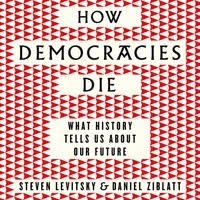
So how does that all work? When does a democracy slide into dictatorship and when does it pull itself back from the brink? If that sounds like a major research project, you don’t have to take it on yourself: Steven Levitsky and Daniel Ziblatt already did in the recent book How Democracies Die. (If Ziblatt’s name is familiar, that might be because in December I tried to infer the lessons How Democracies Die makes explicit from his previous book, Conservative Parties and the Birth of Democracy.)

The importance of norms. Levitsky and Ziblatt’s first point is that the U. S. Constitution contains no magic formula that prevents democracy from failing here. Whatever “American exceptionalism” might mean, it doesn’t give us some kind of immunity from the diseases other democracies are prone to. Numerous countries have modeled their constitutions on ours, and seen democracy fail anyway.

Institutions alone are not enough to rein in elected autocrats. Constitutions must be defended — by political parties and organized citizens, but also by democratic norms. Without robust norms, constitutional checks and balances do not serve as the bulwarks of democracy we imagine them to be.

(Longtime Sift readers will recognize this as a theme I’ve been harping on for years in posts like “Countdown to Augustus” and “Tick, Tick, Tick … the Augustus Countdown Continues“.)

Much of our problem today predates the Trump administration, and stems from the fact that our norms have been sliding for decades. The Senate’s refusal to recognize President Obama’s appointment of Merrick Garland to the Supreme Court, or to respond to it with hearings and a vote, for example, was not explicitly unconstitutional, but was unheard of in all previous American history. Ditto for brinksmanship with the debt ceiling, or the decades-long evolution of the filibuster from a rarely used break-glass-in-case-of-emergency practice to an automatic tactic of minority obstruction. The other branches of government have changed their own norms to deal with Congress’ dysfunction: Presidents issue more sweeping executive orders (like Obama’s DACA), and the Supreme Court reinterprets mis-stated laws (like the Affordable Care Act) that it would once have sent back to Congress for correction.

If you go back to the bulleted list at the top of this post, you’ll notice that hardly any of my complaints about Trump are explicitly constitutional. The Constitution never says that the President can’t order the FBI to investigate the candidate he just defeated, that he can’t tell big whopping lies on a regular basis, or that he has to give the public enough information to judge whether or not he is corrupt. Those aren’t rules, they’re just good practices. That’s how we do things here in America.

Or how we used to do them.

The root norms. It would be easy to fill pages with the norms that Trump is breaking. Our system, for example, has a tradition of decorum. (“Will the distinguished gentleman from Oklahoma yield the floor for a question?”) No previous president has publicly talked about political rivals in such consistently belittling terms as Lyin’ Ted, Crooked Hillary, or Pocahontas.

But rather than list hundreds of specific norms, Levitsky and Ziblatt boil democracy’s essential norms down to two:

  • mutual toleration, “the understanding that competing parties accept one another as legitimate rivals”
  • forbearance, “the idea that politicians should exercise restraint in deploying their institutional prerogatives”

All the others stem from these. American government works well when the parties regard each other as rivals rather than enemies, and exercise their powers according to the Constitution’s underlying spirit, rather than wringing every conceivable advantage out of its words. Democracy is in trouble whenever one party regards the other as fundamentally treasonous, and then uses that opinion to justify pushing the powers of whatever offices it holds to their constitutional limits.

Much of what I’ve been doing in my “Augustus” series is chronicling the tit-for-tat loss of restraint between the parties. Most Americans have no appreciation of how far this could go, so I’ll provide an example: The 12th Amendment specifies that the sealed votes of the Electoral College are sent to the President of the Senate, who counts them “in the presence of the Senate and House of Representatives.” What if the President of the Senate, with the connivance of majorities in both houses, simply miscounted the votes and proclaimed someone else to be president?

There’s no provision for dealing with that scenario — and with innumerable similar situations — because the Founders never anticipated that our political leaders would go that far. And they wouldn’t. Or would they?

The 21st century road to dictatorship. The old model of democratic breakdown was the coup: Caesar illegally taking his army across the Rubicon, seizing Rome, and proclaiming himself Dictator for Life. That was the path of many 20th century dictators like Muammar Gaddafi in Libya or Saddam Hussein in Iraq. But 21st century autocrats have realized the usefulness of maintaining the trappings of democracy.

Vladimir Putin’s Russia, for example, still has elections, rival political parties, and dissident newspapers. Popular opposition leaders, however, have a way of finding themselves in prison or in exile or dead. Ditto for troublesome journalists. When the media empire of oligarch Boris Berezovsky became unreliable, he was forced to leave it behind him and flee the country. After a few years in exile, he was found hanged. When Mikhail Khodorkovsky, once the richest man in Russia, began financing dissident politicians, he went to prison.

It was all legal, of course. (Well, not the assassinations, but no investigator would dare trace them back to Putin.) The men who went to jail were convicted of real crimes (and maybe even committed some of them; it’s hard to reach the top of a corrupt system without breaking a law sometime). Similar stories could be told about Turkey or Hungary or Venezuela. The system resembles the quip variously attributed to either Mark Twain or Emma Goldman: “If voting could change anything, they’d make it illegal.”

Levitsky and Ziblatt use a soccer analogy to map out the steps by which an elected president becomes an autocrat:

  • Capture the referees. In other words, get your people in charge of the judiciary, law enforcement, and intelligence, tax, and regulatory agencies. Anyone who used to be a neutral arbiter must become your partisan. You can do this in the judiciary, for example, by expanding the size of the Supreme Court and appointing your people to the new positions (as Roosevelt tried to do), or by impeaching judges who rule against you (as the Republican-controlled legislature is trying to do in Pennsylvania). (In North Carolina, the gerrymandered Republican majority in the legislature has done court-packing in reverse: It shrunk the size of the State Court of Appeals to prevent the new Democratic governor from filling the open seats.)
  • Sideline star players on the other side. “Opposition politicians, business leaders who finance the opposition, major media outlets, and … religious or other cultural figures” are “sidelined, hobbled, or bribed into throwing the game.” With the referees already in your pocket, the carrots of government contracts and positions, or the sticks of ruinous regulations, taxes, and prosecutions can hollow out the institutions that otherwise might channel public opinion against you.
  • Rewrite the rules in your favor. We were already seeing a lot of rule-rewriting on the state level prior to Trump: Gerrymandering and voter suppression have locked in large Republican majorities in states (like North Carolina) where the voters are more-or-less evenly split between the parties. In last November’s election in Virginia, Democratic candidates for the House of Delegates won the popular vote 53%-44%, but Republicans maintained a 51-49 majority. Combining a biased legal system with a lifetime ban on felon voting (as in Florida, where the Sentencing Project estimates that 20% of adult blacks can’t vote) can sideline a large chunk of the opposition electorate. In countries like Russia, field-tilting rules make it difficult for new parties to form, for genuine opposition candidates to get on the ballot, or for opposition voices to get their message out.

Once the right measures are in place, an aspiring autocrat doesn’t need the traditional trappings of tyranny — gulags, thought crimes, children informing on their parents, secret police breaking down doors in the middle of the night — to act with impunity and stay secure in his job.

Resistance. Unlike a coup, though, the subversion of a once-democratic system takes time. While you are corrupting some of the referees, suborning some opposition leaders, and rewriting some rules, the still-intact parts of the system can rise against you — if enough people recognize what is going on and transcend their previous differences. Putin, you may remember, did not become a dictator overnight.

Also, if a country is lucky — and I think the U.S. might have gotten “lucky” in this way with Trump — the would-be autocrat may not be particularly adept. Margaret Drabble’s metaphor of babies eating their mothers’ manuscripts might apply: “The damage was not, in fact, as great as it appeared at first sight to be, for babies, though persistent, are not thorough.” Trump may be persistent in his aggressions against democracy, but he lacks the discipline to be as effective as he otherwise might.

The rosy path. It’s easy to imagine that someday Trump will leave office peacefully — by choice or otherwise — and afterwards there will be a bipartisan effort to shore up the norms he violated.

Such a thing has happened before. For example, after FDR violated the unwritten rule that presidents should retire after two terms, Congress codified that limit in the 22nd Amendment. As a result, FDR’s four terms didn’t lead to a series of presidents-for-life. As I mentioned before, Nixon’s excesses led to a large Democratic majority in Congress that passed a number of executive-restraining laws.

Something similar could happen after Trump: Congress could mandate good practices that previously were taken for granted, forcing presidents to release their tax returns or hold their assets in blind trusts. Laws could spell out in detail which payments are constitutionally-banned “emoluments”. The wall separating the presidency from the investigative branches of the Justice Department could be strengthened.

Other changes wouldn’t require new laws: Voters could begin insisting again on virtues that Trump lacks, like experience, expertise, and honesty. They could once again value respectful and respectable behavior. Congress could begin taking its oversight role more seriously, rather than abusing or neglecting it depending on whether or not the presidency and Congress are controlled by the same party.

If that’s what happens, then the Trump administration will be like that time you drove home after a few drinks and arrived safely without incident. Yeah, it wasn’t a good idea and you shouldn’t make a habit of it, but ultimately no harm was done.

The dystopian possibility. So far, democracy has been protected by two main forces: The so-called “Deep State” (i.e., career government officials who are more committed to the missions of their organizations than to the orders they receive from the White House) and Trump’s overall unpopularity.

So, for example, career prosecutors — even if they are Republicans — have not been willing to sacrifice their integrity by manufacturing a case against Hillary Clinton, or ignoring evidence against Trump himself, just because he tweets that they should. Career EPA officials are refusing to become pawns of the fossil fuel industry no matter how much Scott Pruitt wants them to. Career economists at the Treasury didn’t concoct a bogus tax-cuts-pay-themselves analysis just because Steve Mnunchin promised they would.

That’s the Deep State in action: It’s not a conspiracy masterminded by some shadowy cabal. It’s the professional integrity of people who believe that their jobs mean more than just a paycheck or their bosses’ approval. (That’s true even in some cases where I disagree with them. I think a lot of CIA and Pentagon people really believe in America’s imperial mission, and in the disasters that will happen if they let down their guard. In their own minds, they are patriots.)

That’s both its strength and its weakness. You can’t kill the Deep State just by finding its leader and bribing, threatening, or imprisoning him or her. But conversely, it has no sense of strategy. It is made up of individuals, and individuals can be worn down. The Deep State has held its own for a little over a year, but can it hold for four years or eight?

If, God forbid, Trump got to replace one or two of the liberals on the Supreme Court, the courts might suddenly become pliable.

Trump’s unpopularity has shored up many institutions of democracy. The media has remained critical, rather than giving in the way it did to George W. Bush after 9-11. Republicans in Congress haven’t expressed much criticism, but they also haven’t cooperated with Trump’s desire to rewrite the rules. (The Senate keeps ignoring his plea to abolish the filibuster, and the idea of changing civil service laws to enable an executive-branch purge, or libel laws to muzzle the press, are non-starters.) Congressional Democrats have stayed unified rather than finding excuses to strike individual compromises. Federal judges have not been afraid to stick their necks out.

All that might change if Trump’s approval rating hovered around 60% rather than 40%, or if it were Democrats who were worrying about losing their jobs this fall rather than Republicans.

Levitsky and Ziblatt review cases where democracy held for a while, and then started to crumble, like Fujimori‘s Peru. It’s not hard to imagine how that could happen here: The predicted Democratic wave fails to materialize in the fall. The economy stays strong, the country avoids any new shooting wars or trade wars, and Trump’s victims — immigrants, Muslims, LGBT people, etc. — remain isolated. Much of the country then starts to say, “What was all that alarmism about?” When Jim Comey or Andrew McCabe winds up in jail, it seems like a one-off case rather than an assault on law enforcement.

Conversely, suppose Democrats overcome gerrymandering and regain control of the House. (It will take at least an 8% margin in the popular vote to do so.) Then laws will not change in Trump’s favor, Congress will investigate and expose excesses, and if Bob Mueller turns up evidence of impeachable offenses, the impeachment process will begin. We’ll be on our way to getting rid of Trump in 2020 (if not sooner), and starting to rebuild what has been torn down.

The crucial year, and the long-term challenge. Levitsky and Ziblatt don’t end with specific predictions, but my impression after reading their book is that 2018 is crucial. Neither complacency about American democracy’s resilience nor hopelessness about turning things around is warranted. The outcome is still undetermined.

In each party, there is a question: Will Democrats put aside their differences in the face of the larger threat, or will they let their factions be played off against each other? In the recent successful campaigns (Lamb in Pennsylvania, Jones in Alabama), they stayed united and won, but the divisions of 2016 are still not healed.

For Republicans, the question is whether their various factions will continue to let themselves be bought off — evangelicals by court appointments, business leaders by tax cuts and deregulation, and so on — or will enough of them come to understand what is really at stake? If they will not join the resistance, will they at least stay on the sidelines?

Long term, both parties need to figure out how to strengthen the norms of forbearance and tolerance, which were in trouble long before Trump arrived on the scene. Unless we can re-establish them, getting past Trump will not solve our problems. His failure, if it happens, might simply be a training example for new and better demagogues.

Why does the Right hate victims?

Attack the Parkland kids? Of course they do.


We’ve seen this script play out before: One or maybe a small group of people suffer a tragedy in their lives, and it motivates them to speak out. They speak for themselves. They speak for those who didn’t survive. They speak for countless people like them who have suffered similar losses. Their voices ring with authenticity, and the public begins to listen.

And then conservatives try to rip the hell out of them.

That’s the story of Ann Coulter and the 9-11 widows. “I’ve never seen people enjoy their husbands’ deaths so much,” she wrote in her book Godless: The Church of Liberalism. “These broads are millionaires, lionized on TV … reveling in their status as celebrities. These self-obsessed women seem genuinely unaware that 9/11 was an attack on our nation and acted as if the terrorist attacks happened only to them.”

It’s the story of Donald Trump, his supporters, and the Khan family. Captain Humayun Khan had rushed at a explosive-laden taxi in Iraq. The driver then detonated prematurely, killing himself and Khan, but sparing the hundreds of soldiers in the mess hall the bomb had been intended for. Khizr and Ghazala Khan appeared at the Democratic Convention to tell Trump that Muslim families like theirs are also Americans, that many of them have paid a high price to be good Americans, and that they do not deserve his bigotry. Trump responded by demeaning their religion and their marriage, saying that Mr. Khan alone spoke to the Convention because “maybe she wasn’t allowed to have anything to say. You tell me.” His supporters (like Roger Stone) went further, claiming that the Khizr Khan was a “Muslim Brotherhood agent”. The honorary Trump campaign co-chair for New York argued to Fox News’ Alan Colmes that Khan was a “terrorist sympathizer“.

It’s the story of Trump and all the women he has molested. They’re liars paid by the Democrats, and besides, they’re too ugly to be assault bait.

After Cleveland police gunned down Tamir Rice, a black 12-year-old playing with a toy gun in his own neighborhood — and did it within seconds of arriving on the scene — a story about his father’s “history of domestic violence” got shared on Facebook over eight thousand times. The Rices aren’t victims, you see, they had it coming.

And Trayvon Martin wasn’t just an innocent teen-ager shot down by an over-zealous neighborhood watch guy, whose death the police didn’t think was worth investigating until the community protested. He wasn’t just a victim of Florida’s ridiculous stand-your-ground law that promotes gun violence. He was a “dope smoking, racist gangsta wannabe“. Even his last purchase — Skittles and a soft drink from a convenience store — became evidence of a drug habit.

No victimization is too trivial to let stand. Remember Ahmed Mohamed, the 14-year-old “Clock Boy” who tried to impress his teacher by showing her the electronic clock he had made, and wound up arrested on suspicion of building a bomb, or maybe a “hoax bomb”, or something? His experience drew attention to the excessive suspicion American Muslims live with every day, so he had to be taken down. The whole event was staged, the conspiracy theorists said. Ahmed intended to get arrested, you see. It was all a plot by his terrorist-supporting father to make their town (Irving, Texas) look bad, because its mayor had been outspoken against the Muslim threat. “For some reason Irving is important to the Islamists,” Glenn Beck speculated to the mayor, who did not dispute the point, replying only that “I would hate to think that’s true.”

If I included attacks on public figures, I could go on forever: John Kerry’s wounds in Vietnam were only “superficial”; that’s why delegates to the Republican Convention wore band-aids with purple hearts on them. Ann Coulter claimed Max Cleland was “lucky” that the accident that cost him three limbs happened in Vietnam, where it would make a better story for a political campaign. Tammy Duckworth, who lost her legs in a helicopter crash in Iraq, doesn’t “stand up” for veterans; when she argues, she “doesn’t have a leg to stand on“. On and on and on.

Sandy Hook. The most direct parallel to the Parkland kids are the Sandy Hook parents. They also were “crisis actors” participating in a “hoax” designed to take away Americans’ guns and pave the way to dictatorship.

Four years on, the genuinely crackpot notion that the attack was a staged hoax — that no one died — has persisted, and the harassment of victims and their families in the name of investigating the idea shows little sign of abating.

A recent Vice News report followed the administrator of the Sandy Hook Hoax Facebook page, as he toured Parkland and tried to project the same theories onto that shooting.

Did people die? I don’t know. But I don’t think what happened here is a genuine calamity. There was something perpetrated here that defies logic, that I think was something done deceitfully to bring about political change. It’s Sandy Hook all over again, if you ask me.

And Sandy Hook parent Lenny Pozner agrees: It’s Sandy Hook all over again.

There’s almost nothing different in the conspiracy theories relating to the Parkland shooting. The hoaxer playbook is immediately finding any inconsistency in any footage that’s being shown online, and then freeze-framing it, and drawing circles and lines and arrows on it, and claiming that this is faked, that’s staged, this person is practicing their lines.

The Parkland kids. So why should anyone be surprised to see them come after the survivors of the Parkland shooting?

Did you see the picture of Emma Gonzalez ripping the Constitution? Or David Hogg giving a Nazi salute? Did you know that Hogg wasn’t really at school during the shooting and made up everything he said about it? Did you see the videos where Gonzales is compared to the Hitler Youth and Hitler’s voice is dubbed over Hogg’s speech at the March for Our Lives?

On top of the fabrications were the insults. Gonzalez is a “skinhead lesbian“. Congressman Steven King went after Gonzalez for wearing a Cuban flag patch on her jacket:

This is how you look when you claim a Cuban heritage yet don’t speak Spanish and ignore the fact that your ancestors fled the island when the dictatorship turned Cuba into a prison camp, after removing all weapons from its citizens; hence their right to self defense. [1]

An aide to a Tampa state representative emailed the Tampa Bay Times that Gonzalez and Hogg “are not students here but actors that travel to various crisis when they happen.” They’re “poor, mushy-brained children” who are “liars” and “soulless”.

These kids have skills. To a surprising extent, though, the teens have been able to hold their own. Leslie Gibson, the Maine state legislature candidate who made the “skinhead lesbian” comment, also called Hogg “a bald-faced liar. Hogg struck back like this:

Who wants to run against this hate loving politician he’s is running UNOPPOSED RUN AGAINST HIM I don’t care what party JUST DO IT.

Maybe rivals just sensed his vulnerability rather than took orders from Hogg, but Gibson fairly quickly picked up both Republican and Democratic opposition, and then dropped out.

Fox News host Laura Ingraham also went after Hogg, needling him for getting rejected by four colleges (like that’s anybody’s business) and accusing him of “whining” about it. Hogg responded by tweeting a list of Ingraham’s largest advertisers. Advertisers started leaving Ingraham’s show, and then she gave a half-hearted apology. When that didn’t work, she took a vacation.

Probably the best response happened when The American Spectator blamed the Parkland kids for bullying the shooter, Nicholas Cruz. (See, they really did have it coming.) Isabelle Robinson wrote an op-ed in the NYT: “I tried to befriend Nicholas Cruz. He still killed my friends.

That kind of skill has just been making the attackers more unhinged. Paul Waldman quotes National Review editor Rich Lowry whining about “The Teenage Demagogues” and how sympathetic they are.

“It is practically forbidden in much of the media to dissent from anything they say,” Lowry says, claiming for the right the status of noble victims, brutally silenced by a system that forbids them to speak their opinions out loud.

But is that true? Tell me: What opinion on the subject of guns has been declared verboten in the current American debate, never to pass the lips of a conservative lest he be banished from the media forever?

… Despite what conservatives say, no one is going to criticize them when they disagree with the Parkland students on any substantive matter. If Rich Lowry argues that the students are wrong and goes on to explain why the minimum age to buy a rifle should remain at 18, no one will respond, “How dare you disagree with those lovely teenagers?”

No, what conservatives are really mad about is that the tactic of demonizing those they disagree with … has, in this case, been taken away from them.

Just politics. It’s tempting to say that this kind of thing is “just politics”. Politics, after all, “ain’t beanbag“. As soon as you step into the arena, you’re fair game.

But revictimizing victims is a strangely one-sided kind of politics. Did the 2008 Democratic Convention make fun of John McCain’s years as a POW? In fact, nobody did that until Trump.

Kate Steinle’s death and the murder trial of her shooter became a focus for anti-immigrant anger. A bill to deny federal grants to sanctuary cities became known as “Kate’s Law“. And yet, I can’t recall a single conspiracy theory about her. No one Trayvoned her, or went after her family for wanting her death to lead to political change. Not trusting my memory, I just googled “Kate Steinle smear” and “Kate Steinle conspiracy theory”. I found nothing. The Wikipedia section on the reactions to her shooting is all about policy, not about bizarre attempts to claim she had it coming, or is still alive somewhere, or maybe never existed in the first place.

Victims-of-immigrant-crime is in fact a whole genre in conservative media. I’ve never heard anyone argue that those victims (or their families) are crisis actors. We argue the statistics of immigrant crime, and question the appropriateness of the remedies conservatives propose. But we leave the victims alone.

So what’s the difference? Why is attacking victims such an important part of conservative rhetoric that when it’s taken away (by victims who are simultaneously too sympathetic and too skilled), they feel that they’re being silenced?

It’s simple: At its root, conservative policy is about giving the powerful even more power. So, by its nature, conservatism is constantly producing victims: When guns are everywhere, people get shot. When you take away health insurance, people die. When you rev up deportations, families get ripped apart. When you restrict food stamps, people go hungry. When you defund food inspectors, people get food poisoning. When you stop policing polluters, people get cancer.

Real people. Innocent people who are just trying to live their lives. People you would sympathize with if you met them.

To be a conservative at all, you have to live in denial of all this: There are no victims. Cuts in government spending don’t impact real people, they just prevent more money from swirling down a drain somewhere. There are no transgender soldiers who just want to serve their country. There are no committed same-sex couples who just want to get married like everybody else. There are no young black men getting shot by police for no reason.

When you deny something, and then somebody tries to make you see it, you get angry. That’s how people are: I was happy in my denial, and then these victims came along and screwed everything up for me. How dare they!

When people get angry, they want to strike back. They want to make the victims go away, or at least to make them stop showing up on TV where they’re hard to ignore.

The basic pattern — denial leads to anger leads to striking back at victims — is human. You can find examples of it across the political spectrum. But denial is much more central to conservatism than to liberalism. So victim-bashing has to be at the center of nearly every issue. When that rhetorical tool is taken away, or made counterproductive, they feel disarmed.


[1] This is bogus in numerous ways. First, Cuba’s gun control isn’t particularly oppressive. There are about 4.8 privately owned guns in Cuba for every 100 residents — not as many as in “free” countries like the U.S. (101) or Yemen (54.8), but more than in such despotic nations as Ireland (4.3) and the Netherlands (3.9). Second, the Cuban flag predates Castro, and is flown or worn by many Cuban Americans. And finally, King is making up special rules for Hispanics that no one applies to Europeans. When I raise a stein for Oktoberfest, nobody shames me for not speaking German.

The Return of the Chicken Hawks

When Donald Trump started staffing his administration, many of us worried about the number of generals he put in high positions: Michael Flynn, John Kelly, Jim Mattis. Chief Strategist Steve Bannon had never made it to general, but his seven years as an officer in the Navy was a key part of his self-image. So many of the other members of the administration were lightweights who had little-to-no knowledge or experience relevant to their jobs: Ben Carson, Betsy DeVos, Rick Perry, Jared Kushner, Ivanka, and Trump himself. It seemed obvious that in a crisis, everybody would be looking for the generals to tell them what to do.

In a country founded on civilian control of the military, pundits wondered, wasn’t that dangerous?

Subsequently, Flynn was fired and replaced by another general, H.R. McMaster. Bannon left. John Kelly moved up from Secretary of Homeland Security to Chief of Staff. When the press referred to “the grown-ups” in the Trump administration, they meant the generals, plus a few other people like Rex Tillerson and Gary Cohn.

In the latest reshuffle, Cohn has been replaced by Larry Kudlow, another lightweight without any real credentials relevant to his job. (He played an economist on TV, but really isn’t one.) Tillerson is gone, replaced by Mike Pompeo. McMaster has been replaced by John Bolton. Kelly’s (always limited) ability to control Trump is fading, and his job either is or isn’t secure, depending on the hour and who you talk to.

In short, the Day of the General seems to be waning, and we are being reminded that there are people more dangerous than generals: chicken hawks.

What is a chicken hawk? A chicken hawk is somebody full of warlike rhetoric who somehow never gets around to experiencing war first-hand. [1] His (they’re not all men, but great majority are) lack of experience doesn’t make him cautious, it insulates his thinking against consequences. He sees the uses of war and dreams of being a Churchill who maneuvers forces on a global scale, but has never understood the real costs of war. He has never learned that a mistake that starts a war is the worst kind of mistake a statesman can make.

At The Week, Joel Mathis points out the danger of having a chicken-hawk president:

The problem with Trump’s pugnaciousness? He’s never had to face consequences for it. There have always been bone spurs, or security guys, or the fact that professional wrestling isn’t real. As far as we know, he’s never started a fight and gotten his nose bloodied for the trouble. Anybody who has experienced that lesson never forgets it. It’s best not learned on the international stage.

A general is a priest of War who has seen what can happen when he calls down the wrath of his god. A chicken hawk has heard glory-filled stories of that god, watched the priests with envy, and longs to unleash that kind of power.

Bush era chicken hawks. The George W. Bush administration was full of chicken hawks, most notably Vice President Dick Cheney, who engineered the Iraq War after artfully maneuvering to avoid the draft during the Vietnam era. (As he told a reporter, “I had other priorities in the ’60s than military service.”) Other notable Iraq War hawks — Paul Wolfowitz, Karl Rove, Richard Perle, Douglas Feith — were also blissfully devoid of military experience. (As Colin Powell’s top assistant Colonel Lawrence Wilkerson put it: “None of these guys ever heard a bullet go by their ears in combat.“)

Some of the loudest Iraq War hawks outside the Bush administration were similarly uninterested in actual fighting, like Bill Kristol, and any number of gung-ho College Republicans who were of the right age to volunteer for the Iraq War, but chose to leave that honor to someone else. (It’s debatable whether Iraq-invasion-promoting columnist Thomas Friedman qualified as a chicken hawk. He never served in the military, but he probably did hear bullets whiz past his ear when he was reporting in Beirut.)

Bush himself avoided Vietnam by somehow getting a coveted spot in a National Guard unit that was never called up (and maybe, depending on who you believe, he just stopped showing up at some point). His military experience was zipping through the clear skies of Texas in a supersonic fighter jet, and he relived that excitement by landing on the USS Lincoln near San Diego so that he could give his famous “Mission Accomplished” speech declaring victory in Iraq.

By contrast, the top general in the Bush administration, Secretary of State Colin Powell, while consistently loyal to administration policy, was not so eager to invade. He was the one who coined what he called the Pottery Barn Rule: “If you break it, you own it.” He also was subsequently more open than most Bush officials about what went wrong and what might be learned from it. Colonel Wilkerson became a critic of the war.

The once and future chicken hawk. Like George W. Bush, John Bolton used the National Guard to avoid Vietnam, a war he supported. Wikipedia fleshes out his subsequent account of his decision:

He wrote in his Yale 25th reunion book “I confess I had no desire to die in a Southeast Asian rice paddy. I considered the war in Vietnam already lost.” In an interview, Bolton discussed his comment in the reunion book, explaining that he decided to avoid service in Vietnam because “by the time I was about to graduate in 1970, it was clear to me that opponents of the Vietnam War had made it certain we could not prevail, and that I had no great interest in going there to have Teddy Kennedy give it back to the people I might die to take it away from.”

But his turning away from personally serving in Vietnam was not part of a more general turning away from war. Bolton was not just part of the crew that maneuvered the country into the Iraq War, he also worked to expand that war.  In “The Untold Story of John Bolton’s Campaign for War with Iran“, The American Conservative charges:

Bolton’s high-profile advocacy of war with Iran is well known. What is not at all well known is that, when he was under secretary of state for arms control and international security, he executed a complex and devious strategy aimed at creating the justification for a U.S. attack on Iran. Bolton sought to convict the Islamic Republic in the court of international public opinion of having a covert nuclear weapons program using a combination of diplomatic pressure, crude propaganda, and fabricated evidence.

Despite the fact that Bolton was technically under the supervision of Secretary of State Colin Powell, his actual boss in devising and carrying out that strategy was Vice President Dick Cheney.

Most of the other Iraq War chicken hawks are in history’s trash can by now. Whether they learned anything from that blunder or not, no one is listening to them any more. But Bolton has now returned to influence, emphatically has not learned a lesson, and does not even admit that invading Iraq was a mistake.

Preventive War. The Iraq War was premised not just on manufactured reports about Saddam’s weaponry, but also on a doctrine of preventive war: If we think a country is developing a threat to us, we should attack it before that threat materializes. [2] Bolton still believes that doctrine. Here’s what he wrote in the WSJ at the end of February:

It is perfectly legitimate for the United States to respond to the current “necessity” posed by North Korea’s nuclear weapons by striking first.

In other words, North Korea is developing weapons that could strike us, so we should treat that as if it were a plan to strike us, and strike them first. Our strike could result in a retaliatory nuclear strike against Seoul or Tokyo, or just a devastating bombardment of Seoul (a city of 25 million) by conventional artillery. But hey, collateral damage. It’s better that cities of our Asian allies get destroyed than our own cities.

In 2015, he advocated a preventive strike against Iran, and scoffed at the possibility of resolving the nuclear issue peacefully.

The inescapable conclusion is that Iran will not negotiate away its nuclear program. Nor will sanctions block its building a broad and deep weapons infrastructure. The inconvenient truth is that only military action like Israel’s 1981 attack on Saddam Hussein’s Osirak reactor in Iraq or its 2007 destruction of a Syrian reactor, designed and built by North Korea, can accomplish what is required. Time is terribly short, but a strike can still succeed.

When Obama got the deal Bolton said was impossible, Bolton denounced it, and has urged Trump to pull out of it. That, of course, takes us back to Square One with regard to Iran’s nuclear program: Either we accept the reality of Iran getting nuclear weapons (as President Bush did with North Korea) or we attack them.

In The Daily Beast, Mark Leon Goldberg characterizes Bolton’s tenure as UN Ambassador in 2005-2006:

The memoir he wrote of his experience at the UN was titled “Surrender is Not an Option.” But Bolton’s time at the UN suggests that, to him, the natural give and take of diplomacy is akin to “surrender” and must be avoided at all costs. Understanding how he performed his job at the UN gives us big clues as to how he might approach the job as National Security Advisor to which he has just been named.

At the United Nations, Bolton demonstrated a profoundly zero-sum view of international relations. Other countries’ gains — no matter how insignificant —  were ipso-facto America’s losses.

In other words, he will reinforce one of Trump’s greatest weaknesses: his inability to see the win/win nature of good diplomacy.

Leading the chorus for war with Iran. As National Security Advisor, Bolton will not have any planes or troops under his direct command. Nor will he have a staff capable of generating attack plans without cooperation from the Pentagon. He chairs the National Security Council; his job is to consolidate the advice of the military, foreign policy, and intelligence establishments and package it for the President. His power rests entirely in his ability to influence the President’s decisions.

That job is particularly important when the President has no expertise or experience of his own. (Dwight Eisenhower, who had already managed half of a global war before he became president, changed NSAs almost every year. It didn’t make a huge difference.) As a tough-talking chicken hawk himself, Trump needs to be surrounded by people who understand the reality of war. Initially, he was, but that is becoming less and less true.

With the possibility of a Trump/Kim summit meeting — I’m still not convinced that’s really going to happen — North Korea is the challenge most people are focused on right now. But another deadline on Iran is also looming: U.S. sanctions on Iran were not repealed after the 2015 agreement; instead (according to the Corker-Cardin law) the President must waive them every 90 days. The current waiver runs out on May 12. If the sanctions on Iran are resumed, the deal that stopped Iran’s march to nuclear weapons will start to unravel.

Trump didn’t want to issue the previous waivers, but he let Tillerson and McMaster push him into doing so. Back in January, he warned that he wanted major changes in the agreement, which during the campaign he had called “one of the most incompetently drawn deals I’ve ever seen“. So far, these demands have led to no additional concessions from the Iranians. [3]

This time around, Tillerson and McMaster are gone. Like Bolton, new Secretary of State Mike Pompeo is an Iran hawk. So is UN Ambassador Nikki Haley. [4] Along with Trump’s own inclinations, this chorus virtually guarantees that the next waiver will not be granted, sanctions will be reimposed, and Iran stop complying with the nuclear deal.

The next question is: What then? During the campaign, Trump’s “America First” slogan seemed to point away from foreign adventurism. [5] He was almost unique among Republican presidential candidates in clearly declaring the Iraq War a mistake. [6] But with no brakes on Iran’s nuclear program, and with Bolton leading the chorus of Pompeo and Haley, war with Iran will be a constantly available option, waiting for the moment when Trump is in a war-making mood.


[1] It’s worth pointing out that I also have never served in the military, observed combat, or even been shot at in civilian life. But I am also cautious about committing someone else to fight on my behalf. When military people tell me that war is hell, and that the outcome is never as predictable as you think, I believe them.

[2] There’s an important distinction between preventive war and preemptive war. Both are examples of striking first, but a preemptive war is much less controversial than a preventive one, because it makes fewer assumptions about an enemy’s intentions. A preemptive strike disrupts a specific imminent attack, while a preventive strike intends to eliminate the possibility that an enemy might eventually attack at some indefinite time and place.

An example helps here: If the U.S. had struck the Japanese fleet just as it got within range of Pearl Harbor, that would have been preemptive: A specific attack was in the works, and our attack would have disrupted theirs. But the Japanese attack itself was preventive. At the time the U.S. had no specific plan to attack Japan. But the Japanese anticipated that the U.S. would eventually go to war to stop Japanese expansion, so they crippled the fleet that would spearhead that war.

When you start a preventive war, you turn your back on the possibility that the attack you claim to be preventing could have been averted in some peaceful way. A key example there is the Cold War: Various American military figures in the 1950s and 60s advocated for a preventive nuclear strike against the USSR. But we didn’t strike that preventive blow, and the nuclear war those men were anticipating never happened anyway.

[3] That’s typical. Trump dislikes all our international agreements and believes he can negotiate better ones, but so far he has not produced any significant new deals. (Wait: Something with South Korea was announced this morning.)

[4] Experts seem to agree that Iran is fulfilling its end of the agreement, so Haley has been moving the goalposts.

The question of Iranian compliance is not as straightforward as many people believe. It’s not just about the technical terms of the nuclear agreement. It requires a much more thorough look.

[5] In an address to Congress a little over a year ago, he implicitly criticized the expense of the Iraq War: “America has spent approximately six trillion dollars in the Middle East, all this while our infrastructure at home is crumbling. With this six trillion dollars we could have rebuilt our country –- twice.”

[6] He considered it such a mistake that he had to rewrite history to portray himself as a war critic from the beginning.

Who are those guys?

a guide to the new faces in the Trump administration


Watching the White House and the major executive departments of government may be making you feel like Dorothy in a perverse version of Oz: “People come and go so quickly here!”

To a certain extent, it’s been that way from the beginning. On the way to the White House, Trump went through three campaign chairmen (Cory Lewandowski, Paul Manafort, Steve Bannon). Chris Christie was supposed to organize the transition, but Mike Pence replaced him only a week after the election. Mike Flynn was already out as National Security Adviser after 23 days.

From that unsettled opening, things never really calmed down. Who can forget, for example, the 10-day reign of Anthony Scaramucci as communications director last July? Rivalries that seemed likely to define the entire Trump administration (Steve Bannon vs. Reince Preibus) are already ancient history.

Recently, though, the churn seems to have speeded up, for a variety of reasons: Rob Porter and David Sorensen left in the middle of domestic abuse scandals. John McEntee was escorted out of the building due to “serious financial crimes” that seem to involve gambling. Nobody has a really good explanation of why Hope Hicks quit, though it’s an interesting coincidence that she refused to answer questions before the House Intelligence Committee the day before her resignation was announced.

We know why Gary Cohn left as Director of the National Economic Council: He had already gotten the tax cut he wanted, and he couldn’t defend Trump’s tariffs. Secretary of State Rex Tillerson was fired via Twitter, for a variety of reasons that probably boiled down to being insufficiently deferential to the Moron in Chief. (Just before he was fired, Tillerson criticized Russia for the poisoning of former double-agent Sergei Skripal in the United Kingdom. It would be ironic if that were a cause, because Tillerson had been criticized for being too sympathetic to Russia, and is even rumored to have gotten his job because the Russians didn’t want Mitt Romney to have it.)

Beyond that, rumors abound: McMaster is about to go, or practically everybody in the cabinet. But one of the things you learn in Fire and Fury is that from Day 1 Trump has constantly talked about firing people, many of whom are still in their jobs (like Jeff Sessions). So a reporter might have numerous well-placed sources saying Trump is talking about firing McMaster, and it might or might not mean anything.

So anyway, who are the new people? And why do I believe they’ll be even worse than the people they replace?

Larry Kudlow, Chief Economic Adviser. This job usually goes to somebody with a Ph.D. in economics and a resume full of articles in econ journals. Kudlow has none of that: He’s predominantly a media personality. His selection follows a pattern of Trump hiring people he’s seen on TV, whether they have any qualifications or not. (It would barely surprise me to hear that Hugh Laurie was going to be Surgeon General.)

Kudow got a BA in history and studied economics and politics at Princeton without finishing his masters. He worked in politics in the 1970s (for Democrats, oddly enough), then found the supply-side economics religion and worked for the Fed and OMB during the Reagan administration. Bear Stearns hired him to be its chief economist in 1987 (so they must have thought he knew something).

He shifted to media in 2001, and by 2001 he was on CNBC (NBC’s business network), co-hosting with Jim Cramer. Cramer split off to start a stock-picking show Mad Money, and Kudlow and Cramer eventually morphed into The Kudlow Report, where he continued to pontificate until Trump tapped him. Ezra Klein comments:

Larry Kudlow, in other words, is a reasonable answer to the question, “How can Trump get more favorable coverage for his economic agenda on cable news?” And to Trump, that may indeed be the central question.

As for his economic philosophy, there are two thing to know about him: He’s for tax cuts in any and all situations, and (like Gary Cohn and unlike Trump) he’s a free-trader who opposed Trump’s tariffs, at least before he took a job at the White House.

The other thing to know is more epistemological: He doesn’t belong to reality-based community. Anything good that happens in the economy is due to tax cuts and free trade (even those actions happened years ago and have been reversed since), and anything bad that happens is due to tax increases and trade restrictions. Those conclusions are pre-ordained and impervious to evidence.

Like many TV pundits, he has made a career out of being very consistently wrong, something you can’t usually get away with on Wall Street. It’s almost impossible to assemble such a consisten record of bad predictions by chance. To be so reliably wrong, you need to base your predictions on a theory that is not just irrelevant to reality, but actively opposed to it, like supply-side economics.

Jonathan Chait’s sums up in “Trump’s New Economic Adviser Lawrence Kudlow Has Been Wrong About Everything for Decades“. The true highlight is from a column Kudlow wrote for National Review in December, 2007: “The Bush Boom Continues“.

There is no recession. Despite all the doom and gloom from the economic pessimistas, the resilient U.S economy continues moving ahead, quarter after quarter, year after year, defying dire forecasts and delivering positive growth. … The Bush boom is alive and well. It’s finishing up its sixth consecutive year with more to come.

Mortgage refinancings were “soaring”, he reported, finding that to be “a very positive, very welcome development”. In fact, the housing bubble had already started to pop months before, and his old firm, Bear Stearns, was four months from bankruptcy. That September, the Lehmann Brothers bankruptcy cascaded through the banking system, triggering the biggest crisis since the Great Depression.

Kudlow is also implicated in the Brownback tax cuts in Kansas, which have devastated that state’s finances and resulted in major cutbacks in schools and roads.

Anyone who has watched Kudlow’s show knows that he talks down to people, and Trump can’t stand to be talked down to, no matter how ignorant he may be on a subject. So unless Kudlow has some one-on-one mode I haven’t seen on TV, I don’t expect him to last long.

Mike Pompeo, moving from CIA Director to Secretary of State. Pompeo isn’t really a new face, but he’s in a new role. He was a congressman from Kansas until Trump made him CIA Director. He served as an Army captain in the Gulf War before getting a law degree. He ran an aerospace company in Wichita, and was a business associate of the Koch brothers. He entered Congress as part of the 2010 Tea Party wave, again with major support from the Kochs.

His known positions relevant to foreign policy include being strongly anti-Muslim, opposing the Iran nuclear deal, supporting the prison at Guantanamo, and denying the scientific evidence on climate change. His position on Russia is a little harder to suss out, but it seems consistent with the House Intelligence Committee: Russia interfered in the 2016 elections, but he doesn’t connect that to Trump. The Russians have been trying to undermine our elections “for decades”, and don’t seem to stand out from other nations. He is concerned “about others’ efforts as well. We have many foes who want to undermine Western democracy.”

Given his ties to virulent Islamophobes like Frank Gaffney, Pompeo will help Trump connect to parts of his base that are too extreme for even Trump to reach out to directly. But I wonder how the Saudis will react to him.

Gina Haspel, CIA Director. Haspel is a career CIA insider, which can be read as either good or bad news. She may be implicated in past CIA sins, and may even be a war criminal. On the other hand, as part of the so-called “Deep State”, she is unlikely to give in to White House pressure to use the CIA politically.

The big issue with Haspel is torture, though part of the initial concern about that seems to be overblown. Pro Publica withdrew some of the most damning claims made about her.

The story said that Haspel, a career CIA officer who President Trump has nominated to be the next director of central intelligence, oversaw the clandestine base where [suspected Al Qaeda leader Abu] Zubaydah was subjected to waterboarding and other coercive interrogation methods that are widely seen as torture. The story also said she mocked the prisoner’s suffering in a private conversation. Neither of these assertions is correct and we retract them. It is now clear that Haspel did not take charge of the base until after the interrogation of Zubaydah ended.

Still at issue is whether Haspel played a role in the decision to destroy the tapes of Zubaydah’s waterboarding, which was illegal. Pro Publica stands by that part of its story.

ProPublica reiterated that after she rose to a new position in the CIA, Haspel urged the agency to destroy 92 videotapes that had documented Zubaydah’s treatment, including dozens of waterboardings and other techniques widely viewed as torture. Those tapes were eventually shredded.

But NPR quotes James Mitchell, who worked with Haspel, saying:

“Gina did not pressure Jose Rodriguez to destroy those tapes.” Mitchell says Rodriguez made that decision on his own, as the CIA’s director of clandestine operations. By that time, Haspel had risen to become his chief of staff.

However, she may have been involved in another torture case. The New York Times reports:

Ms. Haspel arrived to run the prison in late October 2002, after the harsh interrogation of Mr. Zubaydah, a former senior C.I.A. official said. In mid-November, another Qaeda suspect, Abd al-Rahim al-Nashiri arrived. Mr. Nashiri, accused of bombing the U.S.S. Cole, was the man who was waterboarded three times.

The real problem in all these cases is that we just don’t know what she did. Pro Publica quotes CIA spokesman Dean Boyd:

“It is important to note that she has spent nearly her entire CIA career undercover,” Boyd said. “Much of what is in the public domain about her is inaccurate.”

Some of that uncertainty may be resolved in public hearings the Senate will hold before voting on her nomination, but some it undoubtedly will remain classified: Senators will vote on her nomination and claim that they have good reasons for the position they take, but the public won’t be able to judge.

The Conor Lamb Victory: lessons for Democrats

A recount is probably still coming, but it sure looks like Democrat Conor Lamb won a narrow victory in a Pennsylvania congressional district that Trump carried by 19% in 2016, and where Democrats had not even fielded a candidate in 2014 and 2016.

The victory kept alive the expectation of a Democratic wave in this fall’s nationwide elections. Cook Political Report says:

there are 118 Republican-held districts less friendly to the GOP than PA’s 18th CD (R+11), including 17 where the GOP incumbent isn’t running in the fall and an additional vacancy in Ohio’s 12th CD that will be settled by an August 7 special election that could become problematic for Republicans.

Democrats need to flip only 24 seats to gain control of the House. Cook says “of course not” to the theory that Dems could gain 118 seats. (As with Doug Jones in Alabama, part of the victory is due to Democrats just running a better candidate. That won’t happen everywhere.) But their analysis of the entire run of special elections indicates that Democrats are running 9 points (not 11) better than previous results would lead you to expect. If that holds up, it still gives them a huge win in November.

The battle to interpret the race began almost immediately. Republicans, who previously had described Lamb as “far left“, claimed that Lamb had won by looking like a Republican: He criticized Nancy Pelosi, didn’t rail at Trump, didn’t back gun control, supported Trump’s tariffs, and said that his personal beliefs were pro-life. This was a fairly bogus argument, though: Lamb ran against Trump’s tax cut, which was the only major piece of legislation Republicans passed this year; on abortion he says “we defend the law as it is“; the NRA spent money to defeat him; he wants to fix ObamaCare rather than repeal it; and he was more aggressively pro-union than most Democratic candidates.

Progressive and centrist Democrats both began spinning the race as well. Centrists are arguing that Democrats should nominate moderate candidates who can appeal to Republicans fed up with Trump. Progressives are arguing that Lamb’s victory depended on getting a high turnout from the Democratic base, so Democrats need to stand for policies that will energize that base.

It would be nice to have exit polls to help us sort these claims out, but there weren’t any. So both the convince-swing-voters and the turn-out-the-base theories are plausible. We don’t know for sure whether Trump voters changed their minds and voted Democratic, or Clinton voters (or even some who thought Clinton wasn’t liberal enough to vote for) came out to vote while Trump voters stayed home.

In some sense it doesn’t matter, because Lamb’s policy choices play well under both theories: Maybe he got votes from moderate Republicans (like college educated women in Pittsburgh suburbs). Or maybe marginal Republican voters stayed home because Lamb wasn’t scary enough to motivate them to vote against him.

My take on all this shouldn’t surprise anyone who has read what I wrote about Alaska last month and Montana last week: Democrats should run candidates who match their districts. I’m against nationalizing the election around a progressive agenda, like Medicare-for-all or impeachment or banning assault rifles or a $15 minimum wage. But I’m for candidates running against the Democratic establishment in places where the Democratic establishment is unpopular, and I think we need to challenge Democrats who are more conservative than their voters. Just because I like a Conor Lamb in PA-18 doesn’t mean I oppose a progressive challenge to Diane Feinstein. California is a different electorate.

As for what the Democratic Party should stand for, I think it should stand for principles rather than specific pieces of legislation. (OurFuture.org derides this approach as “a list of desirable goals, rather than explicit pledges”. Yes, that’s exactly what I want from the national party. Let local candidates craft their own explicit pledges.) Here’s what I mean: We want more and more people to have health insurance, with universal coverage as the ultimate goal. We want to shift the tax burden back towards the rich and corporations. We want to protect the safety net, fight climate change, invest in education, welcome immigrants and refugees, make our guns laws less crazy, keep government out of Americans’ sexual and reproductive decisions, protect minority rights, and end mass incarceration.

That’s far from “not standing for anything”, and it makes a stark contrast with Republicans, but it also gives local candidates room to adapt to their voters. It makes room for Bernie-ish candidates in liberal districts, but also for candidates like Conor Lamb and Doug Jones. Candidates in Chicago or San Francisco can run on Medicare for All, while candidates in Alabama or rural Pennsylvania can defend Medicaid and ObamaCare.

Beyond that, I draw some more tactical lessons:

  • Democrats in districts that Trump carried don’t have to run against Trump, because Trump is already on everybody’s mind anyway. Anti-Trump resistance voters are going to come out and vote, whether you whip them up or not. Meanwhile, some Trump voters might stay home if you don’t insult or goad them. Best of all is when Trump himself makes the race about Trump, as he did in PA-18: The Democrat focuses on local lunch-pail issues, while Trump talks about himself.
  • The racist/populist vote is probably lost to Democrats (and good riddance), but there’s also a non-racist/populist vote they can get. Lamb’s optics helped him there: He’s a young fresh face who represents you, not an ideology or his party’s establishment.
  • Not everybody needs to have been a captain in the Marines, but new candidates need a non-political backstory. They shouldn’t be poli-sci majors whose resume is a series of congressional-staff jobs.
  • Unions may be a fading force in American politics, but there are places where they still matter. In the same way that Republicans can’t really run away from Trump, I don’t think Democrats can run away from unions. The anti-union vote is going to go against you anyway, so you might as well give pro-union voters some reason to support you.

Alaska as a Red-to-Blue(ish) Model

Hillary Clinton got less than 40% of the vote and Trump won by nearly 15%, but once-solid-red Alaska now has a moderate-independent governor, and one house of its legislature is controlled by a Democrat/Independent alliance. Both the Bernie and Hillary factions in the Democratic Party have something to learn here.


Now that Republicans control the presidency, both houses of Congress, and a sizeable majority of governorships and state legislatures, one of the most contentious arguments in politics concerns how Democrats should try to turn things around. That argument is particularly bitter, because to a large extent it carries over from the Bernie/Hillary contest in the 2016 primaries. Each faction has its own vision of how to win back the country, and sees the other’s vision as a recipe for disaster.

Berners think the problem is voter apathy and the solution is a national progressive agenda for radical change: Medicare for All, a $15 minimum wage, free college, and a massive jobs/infrastructure program. The Democratic Party needs to stand for something, and the something it needs to stand for is the very specific legislative agenda Bernie Sanders ran on. In addition, Democrats need a new, younger image. (Bernie himself may not be young, but his fans are.) We can’t just trot the old war-horses out with a new focus-group-tested message and expect cynical millennials to buy it.

Clintonites look at the independents and moderate Republicans who have been alienated by Trump and see a chance for a broad non-ideological coalition, if Democrats don’t alienate centrist voters by pushing radical progressive policies in districts that historically haven’t supported them. Professional-class white women, for example, have traditionally trended Republican, but they’ve seen the GOP rally around a serial abuser who makes common cause with white supremacists, they believe what the scientists say about climate change, they worry about how their children are going to replicate their success, and they might be ready to say “Enough is enough.” However, that doesn’t mean they’ve suddenly become converts to Denmark-style socialism. Candidates who are too far left might turn them off and leave us stuck with Trump-like conservatives.

Both sides can argue that recent results support them: Berners say that the Clintonite approach has been tried and failed; shifting rightward to occupy an ever-receding center is how we got into this sad position in the first place. Clintonites can ask where the Berner approach has ever worked. Sure, it hasn’t been tried often, but where has it succeeded, other than in places (like Vermont) where Democrats would win anyway? Berner idealism sounds airy to the nuts-and-bolts politicos of the Clintonite establishment: State-by-state, district-by-district, look at the demographics and show me which voters we’re going to turn around.

Recent results. The post-2016 special elections provide fodder for both sides. In general, the elections were held in strongly Republican areas and Democrats did significantly better than in previous cycles. But how and why?

For example, the biggest headline has been Doug Jones’ upset of Roy Moore in the Alabama Senate race: Alabama, one of the reddest states in the nation, now has one senator from each party. Granted, all sorts of special circumstances (i.e., a Republican opponent who started out controversial, and then got credibly accused of sexually pursuing underage girls) had to work in Jones’ favor, but you can spin the final results either way. Jones’ margin came from overcoming voter apathy and rallying the Democratic base in the black neighborhoods of cities like Selma. But the defection of moderate Republicans from Moore was also an important factor, and Jones himself did not run a progressive campaign. On health care, for example, he defended ObamaCare and said abstractly that “healthcare is a right, not a privilege limited to the wealthy“, but he never endorsed Medicare for All. His gun control position was fairly tepid. Economically, he talked about an unspecified “living wage”, but also about “streamlining regulations” for businesses. Some progressives even argued against voting for him.

Jon Ossoff’s defeat in Georgia’s 6th congressional district was similarly spun both ways: Ossoff wasn’t progressive enough, so he lost because “he didn’t stand for anything“. But Georgia-6 is a classic suburban-Republican stronghold that Tom Price had won by 23 points just months before. Narrowing that loss to five points was a huge accomplishment that a Bernie-style progressive, centrists argued, couldn’t have equaled.

Virginia’s state elections were similarly ambiguous. New Governor Ralph Northam ran a centrist nice-guy campaign and won handily (after beating Bernie-endorsed Tom Perriello in the Democratic primary). But downballot elections demonstrated a liberal appeal that was surprising for Virginia, like trangender woman Danica Roem beating a religious conservative who authored a “bathroom bill” targeted at transgender people. Democrats didn’t just pick off competitive swing districts, they won in places where they hadn’t even run candidates in previous elections.

Northern exposure. Now let’s talk about Alaska. If you think about Alaskan politics at all, you probably think it’s dominated by conservative Republicans. Republican Don Young has held the state’s lone House seat since 1973. Senators Lisa Murkowski and Dan Sullivan are both Republicans. (However, Murkowski won as a write-in candidate in 2010 after losing the Republican primary to a more conservative candidate. She won as a Republican again in 2016.) In presidential politics, Alaska is a reliable red state. Democratic candidates rarely even go there, and none has won its 3 electoral votes since Lyndon Johnson in 1964. In 2016, Trump beat Clinton 51%-37%. Nationally, Alaska’s most famous politician is Sarah Palin.

But then there’s this: In 2014, Republican Governor Sean Parnell lost his re-election bid when two other candidates joined forces: Republican-turned-independent Bill Walker ran on a bipartisan ticket with Democrat Byron Mallott as his lieutenant governor. Something similar has happened in the 40-seat Alaska House: 17 Democrats, 2 Independents, and 3 moderate Republicans have formed a majority coalition that made Democrat Bryce Edgmon the Speaker.

More is changing than just party labels. Politico reports:

In the past four years, Alaska has raised its minimum wage, legalized recreational marijuana and passed the strongest universal voter registration bill in the country. Governor Bill Walker—an ex-Republican who has the support of organized labor and most liberals—and the House majority coalition are publicly advocating the introduction of a statewide income tax, a move long thought impossible in Alaska’s notoriously libertarian political climate. [links added]

The gerrymandered Alaska Senate is still solidly Republican, so those changes in the law had to come by referendum. But those referendum victories say something about where the voters are. Trump may have beaten Clinton handily, but at lower levels of politics the state is looking more purple all the time.

How did that happen? Politico credits three young men with engineering the turnaround over the last six years: Jonathan Kreiss-Tomkins (also profiled by Ozy), Forrest Dunbar, and John-Henry Heckendorn. Their strategy doesn’t follow either the Berner or the Clintonite model, though it contains pieces of both. Here are the key elements, as I glean them from several articles.

  • Run everywhere. The typical approach of the Democratic establishment has been to identify key swing districts and focus resources on them, rather than shotgun their efforts all over the map. The exception was Howard Dean’s 50-state strategy, which arguably played a role in the big Democratic wins of 2006 and 2008. (In 2004, Kreiss-Tomkins was a teen-age Deaniac.) Focusing on key districts overestimates the predictability of politics. (No sensible Democrat would have wasted his effort by running for the Senate in Alabama, but Doug Jones did and now he’s a senator.) What’s more, it’s a self-fulfilling prophecy for long-term failure: Every time you fail to run a serious campaign, it becomes harder to argue that the district is winnable in the next election.
  • Think locally. The other half of running everywhere is that you can’t manufacture cookie-cutter candidates in your state (or national) headquarters and expect them to win everywhere. Local candidates need to be able to shape their own messages around the party’s deeper values rather than sell a cast-in-stone national agenda to a district that doesn’t want it. A gun-control candidate, for example, is not going to win in rural Alaska, where almost everybody hunts. (That doesn’t mean you give up on gun control as a party. But you can’t make gun control a litmus test for that district.) Other Democratic values, though, might be viable to those same voters: Alaskan outdoorsmen are in the perfect position to see the impact of climate change and the cost of letting oil companies do whatever they want. A district with few blacks may not care about Black Lives Matter, but the rights of native peoples might be a major issue.
  • Don’t settle for the people who want to run, find the people who ought to run. The biggest mistake of the Democratic establishment is to favor candidates with political experience. They’ve paid their dues and they know how the game is played, but they may not be who the voters are looking for. Kreiss-Tomkins, Dunbar, and Heckendorn put a huge amount of effort into examining individual districts, finding people who are locally admired, and convincing them to run.
  • Where Democrats can’t win, support independents. In some districts, the Democratic brand is so toxic that putting a (D) next to a candidate’s name makes him or her unelectable. In those districts, you want to get the Democrat out of the race and rally around a candidate who can credibly run as an independent. (In Alaska, the AFL-CIO signed on to this strategy, and the Democratic Party ultimately came around.) If the person who would best represent this district used to be a moderate Republican, so be it. Better a candidate who will vote with you on half the issues than far-right candidate who will be against you on everything.
  • Make the nuts-and-bolts of politics as easy as you can for neophyte candidates. There’s a lot to know about running for office that has nothing to do with governing: raising money, getting media attention, organizing events, dealing with election-law paperwork. You can’t recruit new-face candidates unless you can help them leap those hurdles. Ideally, this is what the state and national party organizations would do, but it rarely works out that way. In Alaska, Heckendorn set up a political consulting firm whose mission was to “franchise” a statewide model of how a person without political experience could run for office.

One more thing. I didn’t find any example of Kreiss-Tompkins, Dunbar, or Heckendorn saying exactly this, but to me it fits right in with what they’re doing: Focus on goals, not techniques.

To explain what I mean by that, let’s talk about health care. I happen to support a Medicare-for-All model, but that’s not my primary position. What I care about primarily is the goal, not the technique: When Americans get sick, they should get the medical care they need, and they shouldn’t go bankrupt paying for it.

I support Medicare-for-All because to me it looks like the most effective technique for achieving that goal. But in truth, I don’t really care how it happens, and I don’t think voters do either. The RomneyCare/ObamaCare approach was to build on the existing crazy-quilt of coverage — employer-based insurance, Medicare, Medicaid, government-subsidized exchanges, CHIP, the VA, and so on — and keep expanding it until everybody is covered. If that gets us to the goal, I’m happy. The British approach is essentially the-VA-for-All, with the government running hospitals and hiring doctors. That could work too. When conservatives talk about market-based approaches, I’m skeptical, and I wonder if they’re entering the discussion in good faith. But if they are, I’m listening. If there really is some way the free market can play a role in getting everybody the care they need without forcing people into bankruptcy, I’m open to it.

Summing up. In order to turn things around, the Alaska model says that Democratic Party needs to focus on providing services to people who can win, not on electing its own insiders. It needs to recruit new faces who have their own accomplishments and stories to tell, not run the same people who have lost before. It needs to run everywhere, even in districts that look hopeless, and give local candidates the freedom to shape a message that best represents their districts — even if that message leaves out the word “Democrat”. It needs to project national values and goals, but not tie every candidate to specific pieces of legislation that local voters might hate.

Both Berners and Clintonites will find things to like and things not to like about that strategy. In some races, it will lead to progressive candidates winning by raising millennial fervor. In others, centrist candidates will win by converting former Republicans, like suburban Christian Moms and gun-toting environmentalists. What both factions ought to like about this strategy, though, is that there’s a glimmering example of how it can work.

Does the Exploding Federal Deficit Matter?

Republicans claimed that Obama’s deficits were apocalyptic, but trillion-dollar deficits are fine now that Trump is president. What’s the right level of concern?


In his 2008 stump speech, John McCain used to say that accusing Congress of spending money like a drunken sailor was an insult to drunken sailors. McCain is an old Navy man, the son and grandson of admirals, so he was particularly well positioned to take offense. The line usually got a good laugh.

Out-of-control debt and spending was a standard Republican complaint all through the Obama years. The Tea Party’s original claim to being non-partisan was that they also accused the Bush administration of being wild spenders, abetted by K-Street establishment Republicans as well as Democrats. For almost a decade now, Republicans of all stripes have railed against the deficit. Some dark curse would steal away our economic growth, their economists’ spreadsheet errors told us, if the total national debt ever got close to the annual GDP. As a result, Obama’s budgets turned into an annual game of chicken, the second round of stimulus spending never happened, infrastructure continued to decay, and we were stuck with a sluggish economy that didn’t get unemployment back under 5% until 2016.

But then the Electoral College appointed Trump president, and now the Bush days are back again: Deficits don’t matter. We can cut taxes and raise spending and everything should be fine (until the next Democratic president takes office, at which time the party will be over and the national debt will once again be an existential threat to the Republic). So Obama cut his inherited deficit in half, while Trump is in the process of pushing it back up again. The latest estimate of the FY 2019 deficit is $1.2 trillion, possibly rising to over $2 trillion by 2027. [1] And that doesn’t count the infrastructure plan that Trump plans to release today.

That’s been the pattern since Ronald Reagan: Republicans blow up the deficit, and then pressure Democrats to deal with it — which they’ve done. Presidents are inaugurated in January, inheriting a budget that started in October. Together, Clinton and Obama shaved more than a trillion dollars off the deficits of their entering year. But that was no match for the $1.7 trillion that Reagan and the two Bushes added to their entering deficits.

President entering deficit exiting deficit change
Trump -666 ??? ???
Obama -1413 -666 +747
Bush II +128 -1413 -1541
Clinton -255 +128 +383
Bush I -153 -255 -102
Reagan -79 -153 -74

(Numbers from thebalance.com. Negative numbers are deficits, the lone positive number a surplus.)

The GOP has never owned up to that pattern in its rhetoric, though. As Reagan was entering office, he scolded Congress about runaway debt.

Can we, who man the ship of state, deny it is somewhat out of control? Our national debt is approaching $1 trillion. A few weeks ago I called such a figure, a trillion dollars, incomprehensible, and I’ve been trying ever since to think of a way to illustrate how big a trillion really is. And the best I could come up with is that if you had a stack of thousand-dollar bills in your hand only 4 inches high, you’d be a millionaire. A trillion dollars would be a stack of thousand-dollar bills 67 miles high. The interest on the public debt this year we know will be over $90 billion, and unless we change the proposed spending for the fiscal year beginning October 1st, we’ll add another almost $80 billion to the debt.

So what did he do? He cut taxes, raised defense spending, and never ran an annual deficit less than $100 billion, peaking at $221 billion in FY 1986. In total, he added another $1.4 trillion to the national debt.

Trump is following the same script. In the short run, it’s good politics. Everybody likes a tax cut. If the increased spending means that the defense industry in your area starts hiring again, your local highways get resurfaced, or you don’t have to deal with cuts in Medicare, Social Security, CHIP, or whatever other government program your family relies on, then you’re happy. Compared to something immediate and personal, like whether you have a job or your kids can get the medical treatment they need, the federal deficit seems like an abstract, remote problem.

And yet, it’s hard to escape the nagging feeling that we can’t get something for nothing. If the government keeps spending and stops collecting taxes, it seems like something bad ought to happen eventually. But what?

Bad analogies. One problem we have in thinking about this question is that our national conversation about debt has been polluted by a really bad metaphor: The government’s budget is like your household budget.

The deficits-are-good-politics part of that analogy works. If you’re the budgeter in your household, and you suddenly decide that running up a big debt is no big deal, you can make everybody pretty happy for a while. The kids can get the Christmas presents they want. When nobody feels like cooking, the family can eat at a nice restaurant. That big vacation you’ve dreamed about can happen this summer rather than sometime in the indefinite future. If the job is getting to be too big a hassle, your spouse can just quit. It’s all good.

Until it’s not. Eventually, the household metaphor tells us, the bills will have to be paid, and then bankruptcy looms. And that’s where the analogy breaks down. Your household spending spree can’t go on forever, but it wouldn’t have to end if your bank simply cashed all your checks and never bothered you about the fact that your account is deep in the red. That’s the situation the U.S. government is in: The bank is the Federal Reserve, and it can (and will) simply honor all the checks the government writes.

Pushing the household analogy further, you might ask: But what happens when the bank runs out of money? In the case of the Fed, that can’t happen, because dollars are whatever the Fed says they are. For example, one of the ways the Fed dealt with the financial crisis that began in 2007 is called quantitative easing, which is defined like this:

Quantitative easing is a massive expansion of the open market operations of a central bank. It’s used to stimulate the economy by making it easier for businesses to borrow money. The bank buys securities from its member banks to add liquidity to capital markets. This has the same effect as increasing the money supply. In return, the central bank issues credit to the banks’ reserves to buy the securities. Where do central banks get the credit to purchase these assets? They simply create it out of thin air. Only central banks have this unique power.

Several countries’ central banks did this, but none more aggressively than the Fed, which created $2 trillion just by typing some numbers into its central computers. Since there’s no limit to the number of dollars the Fed can create this way, it can buy as many bonds as Congress wants to authorize. So there’s no limit to what the U.S. government can spend.

Consequently, anybody who talks about the U.S. government going bankrupt is just being hyperbolic. The government can refuse to cover its debts (that possibility is what the debt-ceiling crises of 2011 and 2013 were about), but it can’t be forced into bankruptcy. [2]

So what really goes wrong? You know something has to, because otherwise the government could just make us all rich.

The government’s debt gets financed in two different ways, and they correspond to the two things that can go wrong: high interest rates and inflation.

One way the debt gets financed is that investors buy government bonds. You may own some yourself, and if you have a 401k, probably some of that money is invested in mutual funds that own some government bonds. Banks or corporations with extra cash may hold it in the form of government bonds.

Investors like U.S. treasury bonds because they pay interest. But like every other market, the market for treasury bonds works by supply and demand. If the supply of bonds zooms up (because the government is borrowing more money), they won’t all get bought unless something attracts more investors. In this case, the “something” is higher interest rates. The more the government needs to borrow from investors, the higher the interest rate it will have to pay.

Since the U.S. government can’t go bankrupt, investors would rather loan to it than to just about anybody else. So the only way you or Bill Gates or General Motors can get a loan is to pay more interest rate than the going rate on treasury bonds. So the government borrowing more money can result in everybody paying higher interest rates: Your mortgage rate goes up, your credit-card rate goes up, businesses that want to borrow money to expand have to pay higher interest rates, and so on. If interest rates get high enough, people and businesses will stop borrowing, the ones who can’t cover the higher interest payments will go bankrupt, and the economy will fall into a recession.

The 50-billion-mark note of 1923.

The other way the government deficit gets financed is that the Fed can buy the bonds itself, creating dollars out of thin air to do so. This is the modern-day analog of governments paying their bills by printing money, and it can have the same result as when the German government printed money in the 1920s: inflation. It makes sense: dollars are part of a supply-and-demand system too, so increasing the number of dollars should decrease how much each of them can buy. [3]

Except … Notice that I keep using words like can and should. What makes economics such a hard subject is that simple reasoning like this doesn’t always pan out. Sometimes when the Fed creates more money, the economy just soaks it up. If the economy has unused capacity — if, say, there are idle mines and factories, and unemployed workers who want jobs — the extra money might just bring all that back to life. If more people start working and spending, producing and consuming more goods and services, then the normal function of the economy requires more money. So the money the Fed creates might not cause inflation. And if investors are having trouble finding attractive alternative investments — as they do when economic prospects are iffy for everybody — they might be happy to loan the government more money without a higher interest rate.

In other words, sometimes there really is a free lunch. The government can borrow more money, make a bunch of people happy, and nothing bad happens.

That’s how things played out during the Obama years (and also during Reagan’s administration). The national debt went up substantially, the Fed created trillions of dollars, and yet both interest rates and inflation stayed low. (In Reagan’s case, interest rates were at record highs when he came into office, and went down from there.) Conservative deficit hawks kept predicting that the sky was about to fall on us, but it didn’t. [4]

What about now? The reason we got away with running such big deficits during the Obama years was that the economy was in really bad shape when he took office in 2009. Left to its own devices, the economy looked likely to go into a deflationary cycle, where money stops circulating and suddenly no one can pay their debts: Businesses go bankrupt, so workers lose their jobs and creditors don’t get paid. That causes them to go bankrupt, and the whole vicious cycle builds on itself.

Classic Keynesian economic theory says that the government should run deficits during busts and surpluses during booms. [5] That way the overall debt stays under control and the economy grows without violent swings up and down. That’s what the record $1.4 trillion deficit in FY 2009 (the Bush/Obama transition year) was for: It provided some inflationary pressure to balance the deflationary pressure of the Great Recession. The government played its Keynesian role as the spender of last resort, and so money kept flowing. Without that stimulus, things could have been much worse.

But the situation right now is very different. For the last several months, the unemployment rate has been 4.1%, the lowest it has been since the Goldilocks years of the Clinton administration. We’ve never run a trillion-dollar deficit during a time of economic growth and low unemployment, but we’re about to.

In this situation, we’re unlikely to get the free lunch. The free lunch happens because productive capacity is just sitting there, waiting for new money to bring it to life. If you need more workers, you don’t have to hire them away from somebody else, you can hire them off the unemployment line. When a business increases its orders, its suppliers don’t have to build new plants or pay overtime, they just start running their factories on their regular schedules rather than at a reduced rate.

When the economy is already humming, though, all the increased inputs come at a higher cost. Somewhere there are going to be bottlenecks, places where supply can’t be increased easily, and so that limited supply will go to the highest bidder at an increased cost. Those price increases ripple through the system, and you have inflation.

Inflation hasn’t shown up yet, though interest rates have already started to rise. Back in September, when passing a tax cut still seemed unlikely, rates on the 10-year treasury bond were barely over 2%. Now they’re a little under 3%. The stock market doesn’t submit to interviews, so no one can say exactly why the Dow Jones Index dropped 2800 points in 9 business days. But traders are often citing worries about inflation and interest rates.

Only hindsight will be able to tell us whether the markets are over-reacting. But there is a limit to how much debt the government can pile up without bringing on inflation and high interest rates. We just don’t know what it is.


[1] The last $400 billion on that estimate (the white box in the chart) comes from two temporary changes that Republicans assure us they intend to be permanent: the part of the recent tax bill that benefits individuals and some taxes that were part of the Affordable Care Act that have since be delayed. So Republicans can claim the deficit will only (!) be $1.7 trillion in 2027 if they admit that the long-term tax cut was really just intended for corporations.

[2] Somebody out there is asking: “What about Greece?” During the last decade, the Greek government has had a series of major financial crises that revolved around not being able to finance its national debt. Why won’t that happen to us?

The difference is that Greece doesn’t have a true central bank that controls its own currency. Greece is part of the euro-zone, so when it runs a deficit, it needs to borrow euros. Euros are controlled by the European Central Bank, a pan-European institution that feels no obligation to buy the Greek government’s bonds.

[3] That’s what goes wrong with the government making us all millionaires. The first thing you’d probably do if you became a millionaire is hire somebody to do some cleaning. But the people you’d be trying to hire are now millionaires too, so they’re not going to work for the same rate you’d have paid them before.

In addition to what I’ve described, inflation and interest rates can also interact: If investors expect the dollars they’ll be repaid in the future to be worth less than the dollars they’re loaning out now, they’ll want a higher interest rate to make up the difference. The value of the dollar in other currencies also comes into play: Inflation pushes the value of the dollar down, while higher interest rates prop it up. Things get complicated.

[4] The showdown that led to the 2011 debt-ceiling crisis was foreshadowed by Paul Ryan’s report “The Path to Prosperity“, which called for drastic reductions in government spending.

Government at all levels is mired in debt. Mismanagement and overspending have left the nation on the brink of bankruptcy.
The cause for Ryan’s alarm was the $1.2 trillion deficit in Obama’s proposed FY 2012 budget. That’s virtually identical to the FY 2019 deficit Ryan has voted for.

[5] In 1937, John Maynard Keynes wrote: “The boom, not the slump, is the right time for austerity at the Treasury.” In actual practice, we’ve usually run big deficits during busts and smaller deficits during booms. But the overall principle is the same.

The Nunes Memo: It’s ridiculous and it damages the country, but it might work

It’s hard to parody the right-wing media’s hype of the memo written by House Intelligence Committee Chair Devin Nunes, which was released Friday. Sean Hannity says it constitutes

irrefutable proof of a coordinated conspiracy to abuse power by weaponizing and politicizing the powerful tools of intelligence by top-ranking Obama officials against the Trump campaign, against the Constitution, and against your Fourth Amendment rights. … It proves that the entire basis for the Russia investigation was based on lies that were bought and paid for by Hillary Clinton and her campaign. The Mueller investigation does need to be shut down and the people responsible, who we will name tonight, many need to go to jail.

If that’s what Trump and his defenders need this memo to be, they should never have released it, because as soon as people read it (at 1300 words, it’s about half the length of this article) they’ll see that it doesn’t do any of that. The idea of a shocking memo the Deep State won’t let you see is far more effective than the weak document they actually have.

Why the memo’s argument is weak. In brief, here are the problems with it:

  • The memo insinuates more than it actually says.
  • It is based on classified documents that can’t be checked by the press or the public.
  • A parallel memo written by Democrats who have seen the documents has not been released, and may never be.
  • The facts in the document have been cherry-picked from a larger collection of facts that may not support the memo’s claims.
  • Even if everything claimed in the memo is true, it’s not clear what difference it makes to the Mueller investigation. Nothing in the memo indicates that the Mueller investigation is fundamentally flawed or that its conclusions will not be valid, and certainly nothing justifies Hannity’s claim that “many need to go to jail”.

The fundamental argument of the memo — every point of which is suspect — is that in October, 2016, a FISA warrant to wiretap Carter Page, a foreign policy adviser who had already left the Trump campaign — was obtained under false pretenses. Here are the main points:

  • The Steele dossier, which was partially paid for by the Clinton campaign and the DNC, “formed an essential part” of the FBI’s application to a FISA court. You’d have to see the (still classified) application to know whether this is true. Democrats who have seen the application say it isn’t. People with experience in the FISA system say it’s unlikely: FISA-warrant applications are seldom based on a single source, and standard procedure would be for the FBI to try to verify Steele’s claims themselves rather than simply accept his report. (A piece of the memo that appears to be damning actually is not: “Deputy Director McCabe testified before the Committee in December 2017 that no surveillance warrant would have been sought from the FISC without the Steele dossier information.” If that information was independently verified by the FBI rather than simply trusted, the source is irrelevant. For example, police may not trust an anonymous tip, but if the details check out it may lead to action.) Cato Institute’s Julian Sanchez raises an interesting point: Precisely the falseness of Nunes’ claim might make it hard to refute in public. The application itself might have to stay classified because the other sources might be spies or wiretaps that the Russians don’t know about yet.
  • Neither the original judge, nor any of the three judges who approved 90-day renewals of the warrant, was told who paid Steele. However, they (or s/he; we don’t know whether the renewals went back to the same judge) were told that somebody paid Steele. Given what’s in the dossier, I doubt the judge was shocked to discover later that the somebody was one of Trump’s political opponents. (The Wall Street Journal reports that “the FISA application disclosed that Steele was paid by a law firm working for a major political party.” According to Glenn Simpson’s testimony to two congressional committees, Steele himself might not have known who commissioned his work. He could probably guess, but if so, so could the judge.)  Also, FISA judges can ask questions; they don’t have to accept what is handed to them. So if a judge thought the identity of Steele’s ultimate client mattered, s/he could have asked.
  • Steele was a “less than reliable source”. Until he retired to form a private research firm, he headed the Russia desk at MI-6, the British equivalent of the CIA. Again, Steele’s reliability is only relevant if the FBI, and then the FISA court, simply took Steele’s word at face value, with no other probable cause to be suspicious of Page. We have no reason to believe that they did.
  • Steele was biased against Trump. The memo quotes (in bold type) a Justice Department official who talked to Steele weeks before the election, saying that Steele “was desperate that Donald Trump not get elected and was passionate about him not being president.” The Republican narrative claims that this bias caused him to fabricate evidence that Trump had been compromised by the Russians. However, as a UK citizen, it’s not clear why Steele would start his investigation with a passionate partisan bias against any American politician. The story makes much more sense if the cause-and-effect runs the other way: Steele (whose MI-6 career had centered on battling Russian intelligence) was desperate that Trump not become president because he had seen evidence that Trump was compromised by the Russians.
  • The existence of a parallel investigation of another Trump campaign person, George Papadopoulos, was used to justify the warrant, even though the FBI had no evidence that Page and Papadopoulos were working together. They don’t have to have been working together to make Papadopoulos relevant, because the connection could be on the Russian side. (Josh Marshall: “This strikes me as really obvious.”) The fact that Russian operatives were in touch with one Trump campaign adviser makes it more credible that they’d be in touch with another.

Unsupported assumptions. Now let’s look at the gap between these claims and Hannity’s. The memo doesn’t even claim to prove anything,  it just “raises concerns”. (That’s a wiggle-phrase that will allow Nunes to back away later when this all amounts to nothing.) And to get from these “concerns” to an invalidation of the whole investigation, you have to make a further set of assumptions that the memo doesn’t support at all:

  • The Carter Page FISA warrant is at the root of the whole Mueller investigation. The Nunes memo itself says this isn’t true: “The Papadopoulos information triggered the opening of an FBI counterintelligence investigation in late July 2016”. In other words, the FBI had already been investigating possible collusion between the Russians and the Trump campaign for five months when it applied for the Page FISA warrant.
  • The information in the Steele dossier is false. The Nunes memo does not contain any evidence that undermines Steele’s claims. Much of what’s in the dossier remains unverified, but much of it has turned out to be true, and very little has been proven false.
  • If there is bias at the FBI then the Mueller investigation’s findings will be false. Ultimately, the output of the investigation will be a collection of evidence, expressed in indictments and/or a report to Congress. Whether the investigators were happy or sad as they found facts that were good or bad for Trump won’t matter. Referring to the Trump-criticizing texts that the FBI’s  Peter Strzok and Lisa Page sent back and forth during the course of their office affair (cited by Nunes as demonstrating “a clear bias against Trump and in favor of Clinton”), former federal prosecutor Patrick Cotter commented: “I guess I’d ask how the existence or content of emails between two people at the FBI could possibly change any of the facts. What [former national security adviser Michael Flynn] said matters; the circumstances of his resignation matter; [attorney general Jeff] Sessions’ actions, the facts surrounding Comey’s firing and Mueller’s appointment; all those facts matter. What two people at the FBI not directly involved in any of these events said to each other does not matter.”

On that final point, flash back to the Starr investigation into President Clinton. Kenneth Starr was clearly a political enemy of Clinton; there was not even an appearance of impartiality. And yet, in the end the facts were the facts: The evidence showed that Clinton had an affair with Monica Lewinsky, and it didn’t show any wrongdoing regarding the original subject, the Whitewater deal.

The price of the memo. The Nunes memo gave Trump’s supporters a few days’ worth of talking points, but it damaged the long-term relationship between the intelligence services and Congress. To understand how, you need to appreciate a little history.

After Watergate, Congress began searching for ways to reassert its own power and limit the executive branch, which was seen to have been running out of control even before Nixon. One result was a report issued by the Church Committee into decades of CIA covert actions, which included coups and assassinations. The public outrage that followed led to an increased oversight process involving the House and Senate Intelligence Committees, which get far more information from the CIA, FBI, and other intelligence agencies than Congress previously had access to.

To make that system work, Congress had to overcome the deep skepticism that the intelligence services have about politicians, especially the belief that it is dangerous to share secrets with them, because they will leak those secrets for political advantage. So there are elaborate processes for protecting the secret information the intelligence committees receive.

As always in democratic governance, rules only work if they are surrounded by a penumbra of unwritten norms embodying the spirit behind the rules. In other words, there are things that “just aren’t done”, even if the rules would technically allow them.

The writing and release of the Nunes memo violated these norms. The technical rules were followed: The House Intelligence Committee voted (on party lines) to release the memo.

Under an obscure committee rule to make the classified memo public, which has never been invoked in the panel’s 40-plus-year history, the President now has five days following the vote to decide whether to allow the public release to move forward or object to it.

Trump then OK’d the release, ignoring the pleas of his own appointees, like FBI Director Christopher Wray and Assistant Attorney General Stephen Boyd.

So the rules were followed. But the larger truth is that secrets shared with the House Intelligence Committee were revealed to the public in order for one party to gain a political advantage over the other. The FBI was made to look bad, and can’t defend itself without breaking the law and releasing even more classified information.

Not just the FBI but all the intelligence services saw this happen, and are drawing the appropriate lesson: The House Intelligence Committee is no longer trustworthy. If there’s some secret that really shouldn’t get out, it needs to be hidden from them.

The country will pay a price for this, maybe not this week or next, but down the road.

Will it work? The point of the memo wasn’t to convince reasonable people, because it clearly won’t do that. The memo is not intended to be read, it’s intended to exist, so that claims (like Hannity’s) can be made about it. Trump immediately asserted that the memo “vindicated” him and his often repeated contention that the Mueller investigation is a “witch hunt”. “The FBI,” he tweeted, “became a tool of anti-Trump political actors.” Don Jr. called it “sweet revenge”.

But that’s such obvious BS that even Rep. Trey Gowdy, who led the eighth investigation into Benghazi and so should know a witch hunt when he sees one, isn’t buying it.

There is a Russia investigation without a dossier. So to the extent the memo deals with the dossier and the FISA process, the dossier has nothing to do with the meeting at Trump Tower. The dossier has nothing to do with an email sent by Cambridge Analytica. The dossier really has nothing to do with George Papadopoulos’ meeting in Great Britain. It also doesn’t have anything to do with obstruction of justice.

Another Republican, Senator John McCain issued this statement:

The latest attacks on the FBI and Department of Justice serve no American interests – no party’s, no president’s, only Putin’s. The American people deserve to know all of the facts surrounding Russia’s ongoing efforts to subvert our democracy, which is why Special Counsel Mueller’s investigation must proceed unimpeded. Our nation’s elected officials, including the president, must stop looking at this investigation through the warped lens of politics and manufacturing partisan sideshows. If we continue to undermine our own rule of law, we are doing Putin’s job for him.

The point of the memo is that Trump supporters can say, “The Nunes memo proved …” If you’re not the kind of American who is willing or able to read the memo and assess its claims, that assertion is as convincing as anybody else’s assertion.

In the parallel political universe Dave Neiwert calls “alt America”, Trump is trying to take the government back for the American people, and so is being persecuted by the Deep State. The FBI, the Department of Justice, and even the people Trump himself has appointed to run those institutions, can’t be trusted. The Nunes memo fits right into that world, and will become one of the building blocks of its case.

Rosenstein. The Trump appointee the memo seems to be pointed at is Deputy Attorney General Rod Rosenstein, who appointed Mueller after Attorney General Jeff Sessions recused himself from matters having to do with Russia and the Trump campaign. Rosenstein is overseeing the Mueller investigation, and has whole-heartedly supported the integrity of the investigation in testimony to Congress. If Trump wants to fire Mueller, the order has to pass through Rosenstein.

The Nunes memo doesn’t really accuse Rosenstein of anything, but his name comes up twice: He signed off on one of the FISA warrant applications against Carter Page, and he is mentioned as having worked closely with Bruce Ohr, who was Steele’s contact in the Justice Department. That, apparently, is enough to make him part of the Deep State cabal that needs to be purged. Right-wing media is full of demands that Rosenstein be fired.

Firing Rosenstein, of course, would put Trump one step closer to firing Mueller, or possibly just reining in his investigation or hamstringing it. Three authors at Politico described this plan as “a Saturday Night Massacre in slow motion“. Firing Mueller at this point would invite a response: Republicans in Congress have said it would “be the end of the Trump presidency“, and legions of demonstrators are poised to take to the streets within hours of an announcement of Mueller’s firing.

But what about Rod Rosenstein? What if Rosenstein is replaced by someone who gradually turns the screws until a legitimate investigation is impossible? Where is the tripwire on that path?

If the Trump base is convinced that Rosenstein (in spite of being chosen by Trump) is part of the anti-Trump Deep State cabal, and if Trump can be seen to be giving into their demands by firing Rosenstein, maybe Republicans in Congress make tut-tutting noises, but do nothing. Maybe demonstrators will be harder to galvanize behind a Trump appointee like Rosenstein.

It is a situation that anyone who has studied fascist takeovers in other countries will recognize. Again and again, opponents of the regime are faced with the question: Is this the hill we have to defend? Is the Point of No Return here, or somewhere else?

The Shutdown, DACA, and Immigration: Where We Are

A few hours after last week’s Sift posted, a compromise ending the 3-day government shutdown, at least temporarily, passed the Senate. By evening President Trump had signed it, and federal employees returned to work Tuesday morning.

Here’s what was agreed to:

  • A continuing resolution maintained previous spending levels for another three weeks, until February 8.
  • The Children’s Health Insurance Program was reauthorized for another six years.
  • Three taxes that were part of the Affordable Care Act got delayed for a year: on medical devices, on so-called “Cadillac” health insurance plans, and a general tax on health insurance plans. The expected increase in the deficit is $31 billion.
  • A number of Republican senators agreed to work on a bill to protect the Dreamers from deportation, and Majority Leader Mitch McConnell agreed to let such a bill come to a vote in the Senate.

On the left, many angrily charged that the Democrats had “caved”, and that the Dreamers had been betrayed or abandoned. I don’t see it that way. For the most part I agree with Ezra Klein’s view: that if no larger agreement can be reached in the meantime, Democrats will be in a somewhat better position on February 8 than they were last Monday:

if Democrats do need to shut down the government in three weeks, they’ll do so with the Children’s Health Insurance Program funded for six years, rather than seeing it weaponized against them. That’s a big deal, both substantively and politically.

McConnell’s promise may or may not amount to much in itself, but I think it matters in the public perception. If some kind of DACA compromise can pass the Senate, the House can still kill it, but that will have a price.

What matters in a shutdown. The American public doesn’t like government shutdowns. Government workers and contractors don’t like not getting paid. People who depend on government services don’t like doing without them. Families don’t like being turned away at national parks.

For the two major political parties, it’s not even a zero-sum game; it’s a negative-sum game. A common knee-jerk reaction to a shutdown is to blame both parties and lose a little more faith in American democracy. (In a parliamentary system, failure to fund the government would result in new elections.) The only political justification for causing a shutdown is if you believe that the blame will overwhelmingly be charged to the other party. If that’s true, then it tends to snowball: More and more of the public doesn’t understand why the party that is losing the shutdown doesn’t give in.

How this one was playing out. At the outset, there was good reason to blame the Republicans: They control all three power centers, after all.

What’s more, the main issue on the Democratic side is a popular one: Hardly anybody wants to see the Dreamers deported, which could start happening in March, thanks to Trump’s executive order reversing Obama’s DACA executive order.

The problem is that support for the Dreamers among the general public is shallow. Lots of people sympathize, but not that many are willing to make sacrifices. Worse, Republicans had cynically held CHIP back as a bargaining chip rather than reauthorizing it back in September. No one was really against CHIP, but Ryan and McConnell saw it as something they use in precisely a situation like the one we just had.

So if the shutdown continued, the messaging war looked like it might turn around to favor the Republicans: Democrats were blocking a deal that included CHIP because it didn’t include DACA, so they were hurting kids to help illegal immigrants.

Schumer could see that snowball starting to roll, particularly in red and purple states where Democratic senators have to run for re-election in November, so he got out quickly, before any of the vulnerable Democratic senators felt like they had to defect.

Standing up for something. Schumer’s critics say that the Democrats should have made a stand. The problem with making a stand on a shutdown is that a shutdown doesn’t end in some natural way. Democratic stands on ObamaCare and the Republican tax cut ended: one in victory and the other in defeat. They are issues to take to the voters in 2018.

But a shutdown doesn’t end until somebody gives in, and if the other side is happier with their position than you are with yours, they’re not going to be the ones. So the question becomes: How far are you willing to take this? What if it gets to be March and the Dreamers start getting deported anyway? What if it gets to be June and nobody can go to Yellowstone? What if it’s November and voters are going to the polls? How far?

The endgame, in that scenario, is that Democratic senators defect one-by-one until the Republicans can pass what they want. Schumer didn’t want that.

The next showdown. Instead, he maneuvered, hoping to reach February 8 with a position that would be easier to defend. I think he succeeded at that: CHIP will be off the table. McConnell either will or won’t have allowed a vote on a DACA compromise. If he doesn’t, that’s another simple argument the public can understand: We tried to bargain in good faith, and the other side wouldn’t.

The ideal scenario for Schumer is that a DACA compromise passes the Senate before February 8, hopefully by a wide margin. (In 2013, the Senate passed an immigration bill 68-32.) It’s not clear that McConnell would be against this.

The fate of all immigration compromises is in the House, where they would also pass if they could get to the floor, but the Republican leadership blocks them. That sets up a shutdown demand that I think Democrats can sell: Ryan doesn’t have to support the Senate’s DACA compromise, he just has to let the House vote on it. Let my people vote!

An additional point is that the longer the DACA negotiations stay on the front pages, the more the Republicans undermine their own most popular arguments. What Trump wants in exchange for DACA isn’t just border security, but a sharp reduction in legal immigration, and a shift towards more white immigrants. That supports the Democrats’ main point: The whole issue isn’t about legality, it’s about race. It’s about Making America White Again.

Even if a permanent solution isn’t reached — that’s the current conventional wisdom, which could change —  a deal that prevents deportation temporarily and leaves the ultimate verdict to the 2018 voters is not the worst outcome.

Conclusion. In short, I think Schumer abandoned a losing position in order to set up one with more possibilities. I’m withholding judgment until I see how this plays out.