

Wednesday, CNN devoted its entire primetime schedule to letting voters question ten leading Democratic presidential candidates (the same ten who qualified for the debate this Thursday) about their plans for dealing with climate change. I didn’t spend the full seven hours sitting in front of my TV, but I did read all the transcripts, which you can find here.
I suppose it was naive of me to hope that these townhall Q&A sessions would settle which candidate would be the best president for the climate. You may come away with a different impression, but mine was that none of the candidates eliminated themselves and none stood head-and-shoulders above the others. All agreed that climate change is a serious problem that requires significant action, and that taking that action is going to be difficult. None put forward the fossil-fuel industry talking points that you would hear in a comparable Republican setting: climate change is a hoax, the climate is always changing, nothing can be done to stop the climate from changing, doing anything will be too expensive, or the US should wait for other nations to do something first.
The things they disagreed about were fairly technical: a carbon tax vs. a cap-and-trade system vs. direct government regulation; exactly how much should be budgeted for fighting climate change and where it should come from; whether nuclear power plays any role in our post-fossil-fuel future; how much sacrifice should be expected from the average person; how to mitigate the sacrifices asked of vulnerable populations; and so forth.
In short, any of the ten would contrast strongly with Trump’s positions on the issue. (To the extent that Trump has done anything about climate change, he has opted to make it worse: pulling out of the Paris Accords, trying to roll back Obama’s automobile-gas-mileage standards, rolling back limits on power plants burning coal, rolling back regulations on methane leaks, and so on.) But which of them would be the most effective president for fighting climate change?
Reading the transcripts told me less about the candidates that it did about myself and what I’m looking for. I think that President GoodClimate has to jump several very different hurdles. He or she needs to have:
- a vision
- a plan that carries out the vision
- a message to rally the public behind the vision and the plan
- the ability to leverage the vision, plan, and public support to push Congress to pass the needed legislation and appropriate the needed money
- the ability to use the gravity of the crisis, the example of US action, and US soft power to push other nations into action.
Jumping each hurdle requires a different skill-set; we need a president who can jump them all.
The vision and the plan. The example everyone uses for this is President Kennedy setting the goal of landing a man on the Moon by the end of the decade. Kennedy announced that vision in 1962, and it came to fruition right on schedule in 1969.
The reason this is a good parallel is that Kennedy himself had no idea how to land a man on the Moon, and in fact no one did at the time he set the goal. New techniques and technologies had to be invented for the project to succeed. At the same time, though, he managed to set a goal that was realistic. If he had announced that we would land a man on the Moon by Christmas, it wouldn’t have happened. And when Christmas came and went with no Moon landing, public enthusiasm for the whole project might have waned.
Those advances would not have happened, though, if Kennedy (and President Johnson after him) hadn’t put serious resources into making them happen. Also, the plan involved immediate action as well as speculative research. Project Mercury was already underway, and John Glenn had orbited the Earth earlier that year. When NASA had a serious setback (the cabin fire in 1967 that killed the crew of Apollo 1 during a ground exercise), the country had the tenacity and commitment to continue.
So what I’m looking for in a climate vision and plan aren’t just the most ambitious goals and the highest price tag. The vision and the plan have to ring true in some way that is hard to define. The plan needs to reach beyond what we know how to do right now. (For example: If we’re going to generate much, much more of our electricity from wind and solar, we’ll need better ways to store power on windy and sunny days.) But it can’t reach so far beyond that it loses credibility. And it has to start by ambitiously doing the things that we already know how to do; we can’t twiddle our thumbs and then depend on some magic invention appearing in the nick of time a decade from now.
An aside on cheeseburgers. It’s predictable what’s going to happen when the next president announces his or her X-trillion-dollar climate plan, which also puts limits on the fossil-fuel industry, raises the cost of certain environmentally costly consumer goods, and bans others entirely: Fossil-fuel companies (both in their own voices and by funding unofficial spokesmen behind the scenes) will become advocates for “freedom”, and there will be either a real or astro-turf uprising against this “government overreach”.
You could see this already in the questions in the CNN forum. Several candidates had to answer questions more-or-less like: “Am I still going to be able to eat cheeseburgers?” Plastic straws and incandescent light bulbs also came up. The-government-is-coming-for-your-cheeseburgers has been a very effective pro-carbon argument.
The right answer to this challenge is multi-faceted, and it’s hard to make all the points at once. Part of the answer is to invoke the seriousness of the problem and shame the triviality of the question: Do you really want to condemn your grandchildren to a Mad-Max hellscape so that you can keep eating cheeseburgers, burning inefficient lightbulbs, and using plastic straws? The World War II generation accepted gas-rationing and a number of other artificial hardships to save the world from fascism. Is there nothing you’re willing to give up for future generations?
The second facet is to bring the question back to reality. Yes, the carbon footprint of a cow is much greater than a comparable weight of chickens, or a potato patch. So yes, as a country we need to shift our eating habits so that we consume less beef and dairy. But that doesn’t mean we have to ban cheeseburgers. Maybe a cheeseburger becomes more expensive. Maybe it turns into an occasional treat rather than a staple of your diet. But the government is not coming for your cheeseburgers.
Third, the crimps on your personal lifestyle are going to be a small part of a much bigger change. You’re not going to have to bear the whole sacrifice. This is what Elizabeth Warren was getting at in her answer to the cheeseburger question:
This is exactly what the fossil fuel industry hopes we’re all talking about. That’s what they want us to talk about. … They want to be able to stir up a lot of controversy around your lightbulbs, around your straws, and around your cheeseburgers. When 70 percent of the pollution of the carbon that we’re throwing into the air comes from three industries.
And finally, we’re going to try to be smart about this, so that changes will be as painless as possible. Lightbulbs are actually a good example in this regard. When the Bush administration decided to change the nation’s lightbulbs, it didn’t just ban incandescent bulbs overnight and make us light candles or sit in the dark. The wasteful bulbs are off the shelves now (at least until Trump finds a way to bring them back), but instead we have better bulbs: longer-lasting, cheaper to operate, and so on.
Beto O’Rourke, for example, expressed his confidence in the ingenuity of American farmers and ranchers to produce the same foods with a smaller carbon footprint. (I don’t doubt that he’s right about that, but I question whether it will be enough.) And yes, today’s paper straws aren’t as good as plastic straws. But is it truly beyond the limits of science to make an equally good straw out of paper or some other biodegradable material?
Or take cars. I drive a 100,000-miler hybrid Honda Accord. My current tank of gas is getting over 45 miles per gallon, and that’s not unusual. If government standards had insisted on 45 mpg decades ago, everyone would have been forced to drive underpowered subcompacts. But I don’t suffer from a lack of room or pep in this car. Similarly, today’s all-electric cars won’t take you as far in a day as most of us would like go on a long driving trip. But someday soon they will. A future of electric cars powered by wind and solar doesn’t mean we’ll have to give up on driving the family to Yellowstone.
Rallying support. So anyway, President GoodClimate is going to face well-funded resistance that will appeal to people’s fears and resentments. Combating that is going to require a lot of political skill, simultaneously shaming people out of their petty self-centeredness and inspiring them to take on the challenge of saving the world.
Who’s up to that? Who can create not just a vision and a plan, but a message that raises public enthusiasm around implementing the plan, even if it requires some sacrifice?
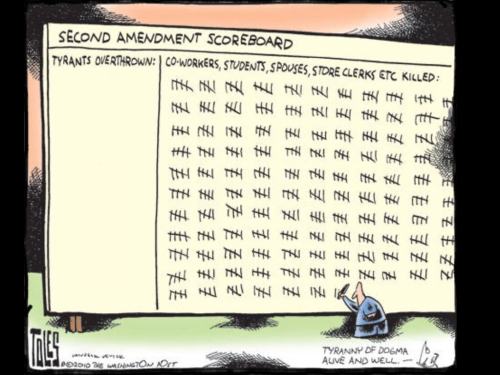
And suppose the public does support the plan. That doesn’t necessarily mean Congress will pass it. We see that now in gun control. Universal background checks (which might have stopped the recent Texas shooting) are ridiculously popular, with 97% support in one recent poll. They’ve been popular for years now, and yet somehow they don’t happen. In Congress, a small, intense, well-funded resistance can overcome broad but lukewarm popular support.
That points to a different kind of political skill, the ability to put together deals that make things happen. We tend to think in either/or terms about this: an inspirational progressive visionary like Sanders or Warren, versus a moderate deal-maker like Biden or Klobuchar. But the next president has to do both.
Tomorrow the world. In a Republican presidential debate in 2015, Marco Rubio said “America is not a planet.” He was making the defeatist point that no one country, not even one as important as the United States, can solve the climate problem by itself. Even if we do everything right, it won’t make any difference if no one else goes along.
This is a common conservative trope: Collective action is impossible and individual action inadequate, so we should just do nothing.
If we buy into that line of thought, though, we condemn the next generation to a world of rising seas, expanding deserts, mass migrations, and war. The tens of thousands of migrants who currently try to cross our borders every month will be nothing compared to the masses we’ll see when much of Bangladesh is underwater and new deserts have appeared in places that now support a booming population. Even within the US, how much hotter can places like Phoenix or Houston get and still be habitable?
Fortunately, the image Rubio evoked — of the US doing everything it can and the rest of the world dragging its feet — is the exact reverse of the truth. In reality, the US is the country holding the world back. Why should India stop burning coal if the US won’t? Europe is way ahead of us in adopting sustainable electric power. Today, the biggest challenge facing environmental activists around the world is how to make change happen without the United States.
So it would be a huge improvement if the next president just went along with what other nations are doing. (If only we could invest in mass transit like China and in solar and wind power like Germany.) But the world needs more than that. The US combination of economic, scientific, and military power makes us uniquely positioned to lead. Until Trump started tearing them up, we had meaningful alliances with most of the other major powers. It would make a huge difference if we could be the world’s good example rather than its bad example.
So even as the next president turns American climate-change policy around, he or she has to be working with the world to raise standards, and to establish trade policies that promote climate-positive action around the world, rather than allowing carbon-pollution to shift to the country with the lowest standards.
The next president can be a rallying figure internationally, as Kennedy was we he said “Ich bin ein Berliner”, or Wilson was when he enunciated his 14 points for ending World War I. Who can do that? The next president also needs to be a negotiator like FDR and an alliance-builder like Truman or Eisenhower. Who can do that?
I don’t know, or at least I don’t know yet. The climate forums have just given me more questions . The answers I’m looking for are only partly contained in the programs the candidates outline on their web sites. They also require evaluating character and talents.
These are harder questions than I had thought, so it’s going to take a bit longer to make up my mind.








 The Weekly Sift