Category Archives: Articles

What Does Trump’s Inner Party Believe?

Like a lot of liberals, I have spent more time than I care to admit thinking about Trump supporters. Who are they? What do they want? What are they thinking? And most of all: How can they possibly support this man?

One reason this task is so difficult is that the Trumpist message is not meant for me. St. Paul was an apostle to the gentiles, but there is no Trumpist apostle to the liberals. No one in the administration is out there translating for me, explaining what parts of the message to take seriously and what parts to ignore. No one is trying to resolve the apparent contradictions, or to make the case that my goals can be achieved by his methods. One symptom of this is White House press secretary Stephanie Grisham, who appears on Fox News, but doesn’t hold briefings for the press in general. (Trump’s previous press secretary, Sarah Huckabee Sanders, has joined Fox News outright.)

As a result, the most widely available version of Trump’s message is the one intended for committed supporters, who already live inside the Fox News alternate reality, where climate change is not real and racism was solved in the 1960s. So if, like me, you live in a world where where Russia (and not Ukraine) meddled in our election, where health insurance companies would happily let people die if they could make bigger profits, and tax cuts don’t pay for themselves — well, there is no message for you. Trump’s world has an Us and a Them, and you’re a Them. You’re never going to be invited in.

The Inner Party. It’s easy (and very human) to reflect this attitude back at them: People support Trump because they’re uninformed and gullible. Or because he appeals to their deplorable passions: racism, sexism, homophobia, xenophobia, or Islamophobia, to use Hillary Clinton’s list. Or because they’re rich and selfish; they just want to pay less tax and stop worrying about how much their industries pollute. Or because they just want power.

And if you look, you can confirm that bias: There certainly are Trump supporters who fit all those descriptions. (I’m not denying that point, so don’t argue it with me.) And I am capable of imagining a movement made up entirely of a cynical core surrounded by gullible and manipulated masses. But I have a test that I run when I’m considering such a theory: I picture it from the other side. If I were in that cynical core, how confident would I be that I could make this plan work?

And the answer in this case is: not very. A conspiracy of pure evil-doers is actually fairly hard to hold together, because the vast majority of people don’t like to think of themselves that way. Once you have a core bigger than a cabal, you need some kind of self-justifying story — not just for the gullible masses, but for your own people. There needs to be an explanation of why you are the good guys and why the things you are doing are right, or at least necessary.

To use Orwellian terms, you need an Inner Party message in addition to your Outer Party message. There are, I assume, lots and lots of Trumpists who understand that the Outer Party message is bullshit. I’m sure that a lot of Evangelicals, for example, realize that Trump’s knowledge of Christianity is superficial at best; that he has lived a life of licentiousness, infidelity, and fraud; and that his current administration is full of corruption. They may say “We are all sinners,” as Jerry Falwell Jr. acknowledges, and explain that Christianity is a religion of forgiveness rather than perfection. But they also know that forgiveness requires repentance, a step Trump has never been willing to take.

Republican politicians, likewise, are not generally stupid or gullible people. Lindsey Graham used to see Trump fairly clearly (and used terms like “loser” and “nut job”). They can’t all be intimidated by Trump’s sway over his base voters, either. Ted Cruz surely remembers Trump’s attacks on his father and wife, and having just won re-election in 2018 (along with ten other GOP senators), he doesn’t have to face the voters again until 2024, by which time everyone may have conveniently forgotten that they ever supported Trump. (George W. Bush was once immensely popular among Republicans, but by the 2008 campaign he had become an unperson.)

A lot of people who support Trump are not ignorant, and they are not all motivated by greed or fear. If this is all hanging together, and it seems to be, there has to be an Inner Party message for such people. What could it be?

The Barr speeches. That’s the context that I put around the recent spate of articles examining two Bill Barr speeches. Both of these speeches were given to what I think of as Inner Party audiences.

  • In October, he spoke to the de Nicola Center for Ethics and Culture at Notre Dame, an organization “committed to sharing the richness of the Catholic moral and intellectual tradition”.
  • In November, he delivered a named annual lecture to the Federalist Society’s 2019 National Lawyers Convention. The Federalist Society is a conservative legal organization that is responsible for vetting Trump’s nominees for federal judgeships.

In short, these are both audiences friendly to the Trump administration, but are not the MAGA-hat-wearing yahoos that show up at Trump’s public rallies. Both groups see themselves as having intellectual heft as well as moral purpose. Neither would be satisfied with a screed of obvious lies or slogans like “Lock her up!” or “Build the Wall!”

So this is what Barr offered them: To the Catholics, he spoke about the impossibility of maintaining  liberty without Christianity. To the Federalists, he advocated for the Presidency to shake itself free from the “usurpations” of Congress and the Judiciary.

The Notre Dame speech. Barr’s Notre Dame speech lays out the problem like this:

Men are subject to powerful passions and appetites, and, if unrestrained, are capable of ruthlessly riding roughshod over their neighbors and the community at large. No society can exist without some means for restraining individual rapacity. But, if you rely on the coercive power of government to impose restraints, this will inevitably lead to a government that is too controlling, and you will end up with no liberty, just tyranny.

On the other hand, unless you have some effective restraint, you end up with something equally dangerous – licentiousness – the unbridled pursuit of personal appetites at the expense of the common good. This is just another form of tyranny – where the individual is enslaved by his appetites, and the possibility of any healthy community life crumbles. …

But what was the source of this internal controlling power? In a free republic, those restraints could not be handed down from above by philosopher kings. Instead, social order must flow up from the people themselves – freely obeying the dictates of inwardly-possessed and commonly-shared moral values. And to control willful human beings, with an infinite capacity to rationalize, those moral values must rest on authority independent of men’s will – they must flow from a transcendent Supreme Being.

This cries out for annotation, which I’ll try to keep short so that I can get on with Barr’s argument: If you wanted a poster boy for “the unbridled pursuit of personal appetites at the expense of the public good”, you could hardly do better than to choose Barr’s boss, President Trump. If you allow corporate persons into the discussion, Exxon-Mobil (which knew the danger of climate change decades ago, but spent millions to keep the public confused about it) or one of the pharmaceutical companies that promoted the opioid crisis would be a good choice.

And unless the “transcendent Supreme Being” decides to express Their authority much more directly than They currently do, God’s will is going to be presented to us through “willful human beings, with an infinite capacity to rationalize”. For example: the Catholic hierarchy, which for decades — perhaps centuries — had no trouble enabling and covering up the sexual misconduct of its priests.

This far I agree with Barr: If a free society is going to work, the public good needs to be supported by moral values freely chosen, rather than rules enforced solely by government power. However, the countries that seem to be doing the best job of maintaining a free society in today’s world are the least religious ones: the Northern European humanist crescent that flows from Finland to Iceland. In the real world, moral values and religion have (at best) a tenuous relationship.

However, Barr takes this relationship as given and proceeds from there: Traditional Christianity is losing its hold on America, and at the same time a number of social ills have gotten worse: births outside of marriage, divorce,

record levels of depression and mental illness, dispirited young people, soaring suicide rates, increasing numbers of angry and alienated young males, an increase in senseless violence, and a deadly drug epidemic.

The causality here is clear to him: All these negative consequences come from an increase in “secularism”. Thomas Edsall offers a counterpoint here: If this were true, you’d expect the worst effects to show up in the most secular parts of society, but this seems not to be the case.

The white working class constituency that would seem to be most immune to the appeal of the cultural left — the very constituency that has moved more decisively than any other to the right — is now succumbing to the centrifugal, even anarchic, forces denounced by Barr and other social conservatives, while more liberal constituencies are moving in the opposite, more socially coherent, rule-following, direction.

Similarly, the highest rates of births outside of marriage are in the Bible Belt states.

Barr continues: Ordinarily, we’d expect the pendulum to swing back towards social conservatism. As people saw the calamitous results of social change, that change would be stopped, and then turned around. But this time is different, because America is not just dealing with the ordinary tides of culture. This time the story has an active villain: people like me, as best I can tell.

[T]he force, fervor, and comprehensiveness of the assault on religion we are experiencing today … is not decay; it is organized destruction. Secularists, and their allies among the “progressives,” have marshaled all the force of mass communications, popular culture, the entertainment industry, and academia in an unremitting assault on religion and traditional values. These instruments are used not only to affirmatively promote secular orthodoxy, but also drown out and silence opposing voices, and to attack viciously and hold up to ridicule any dissenters.

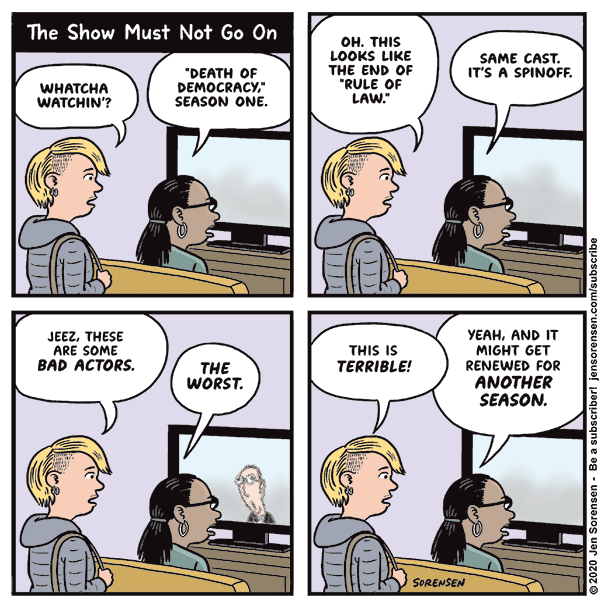
Speaking of ridicule, here how cartoonist Jen Sorensen responded to Barr’s speech:

It is very popular in conservative circles to talk about being “silenced”, despite the awesome wealth and power conservatives command. But the truth doesn’t stretch quite that far: Conservatives, and especially religious conservatives, are used to being the only voices in the room. In the days of mandatory Christian prayer in public schools, there was no equal time for atheists or Buddhists. Gays could be characterized as “deviants”, and women who made their own decisions about sex as “sluts”. Conservative Christians could say these things in public, and no one would respond. No one would dare stand up and say, “Wait, I’m gay, and there’s nothing deviant about it.” or “What happens in my bedroom is none of your business.” No one would strike back and say that the Christian was “judgmental” or “bigoted”.

Now, someone will. Maybe lots of someones. That’s what the Constitution calls “freedom of speech”, but Christians are not used to hearing it. When their opinion is not the last word in a discussion, it seems like persecution to them, even though it’s the normal situation for everyone else.

Barr uses another religious-right buzzphrase when he talks about “a comprehensive effort to drive [our traditional Judeo-Christian moral system] from the public square”. As best I can tell, this refers to another revocation of a special privilege. Christians used to be able to use public resources to promote their point of view: prayers at public events, nativity scenes on the town green, and so on. In recent decades, Christians have often been treated like everyone else and limited to promoting their views with their own resources. (Barr may say “Judeo-Christian”, but when have Jews ever tried to install a Moses-parting-the-Red-Sea model on the town green?) This is quite a come-down, but it is not persecution.

Secular moral values, Barr claims, are different from Christian ones, not just in content but in kind.

Christianity teaches a micro-morality. We transform the world by focusing on our own personal morality and transformation. The new secular religion teaches macro-morality. One’s morality is not gauged by their private conduct, but rather on their commitment to political causes and collective action to address social problems. This system allows us to not worry so much about the strictures on our private lives, while we find salvation on the picket-line. We can signal our finely-tuned moral sensibilities by demonstrating for this cause or that.

This is absurd on both ends: One one side, the anti-abortion movement Barr champions elsewhere in the speech is not a micro-morality; it is an attempt to use the law to constrain the choices of other people. Conservative leaders (Trump, for example) often exhibit horrible personal morality, but they signal their virtue by opposing abortion or gay rights. On the other side of the question, Barr has completely written off a long Catholic social-justice tradition, from Dorothy Day to liberation theology. As Archbishop Hélder Pessoa Câmara once put it, “When I give food to the poor, they call me a saint. When I ask why the poor have no food, they call me a Communist.”

To sum up: Christianity is at war against an active enemy. Secularists are not just trying to live their own lives as best they can, they are working to tear down the transcendent moral order. If they succeed, the result can only be anarchy or tyranny.

The Federalist Society speech. Barr’s Federalist Society speech inadvertently illustrates a point from his Notre Dame speech: Willful human beings have an infinite capacity to rationalize.

The claimed topic of the speech is “originalism”, the legal doctrine that tries to find the meaning of Constitution in the thinking of the Founders. Since the Founders faced a world far different from ours and could barely have imagined the issues of the 21st century, originalism provides boundless fields for rationalization. Like scripturalism in religion, the resulting propositions don’t have to justified on their own merits, because we did not think of them ourselves, but only found them in the texts written by our prophets.

What Barr finds in the Founders’ collective mind in this speech is a vision of executive power unbound by the other two branches of government.

In the orthodox reading of American history, the structure of American government got remade on two occasions: by Lincoln during the Civil War and by FDR during the Depression and World War II. In each case, executive power expanded, and has kept expanding in recent years, reaching the point where a President can unleash a global nuclear holocaust completely on his own authority. In my view, relating the apocalyptic power of today’s Presidency to Hamilton’s praise of “energy in the executive” is insane.

But that’s not how Barr sees it:

In recent years, both the Legislative and Judicial branches have been responsible for encroaching on the Presidency’s constitutional authority. [original emphasis]

Congress has encroached by refusing to rubber-stamp Trump’s unqualified and often corrupt appointees, and also by attempting to exercise oversight of questionable (and again, often corrupt) administration actions.

I do not deny that Congress has some implied authority to conduct oversight as an incident to its Legislative Power. But the sheer volume of what we see today – the pursuit of scores of parallel “investigations” through an avalanche of subpoenas – is plainly designed to incapacitate the Executive Branch, and indeed is touted as such.

In Barr’s view, this is pure harassment. There is nothing unusual in the Trump administration’s actions that invites these investigations. The most he will grant is this:

While the President has certainly thrown out the traditional Beltway playbook, he was upfront about that beforehand, and the people voted for him.

Of course, the people did not vote for him; the Electoral College did. But leave that aside. Fundamentally, the conflicts with Congress arise because, as in the Notre Dame speech, liberals are villains.

In any age, the so-called progressives treat politics as their religion. Their holy mission is to use the coercive power of the State to remake man and society in their own image, according to an abstract ideal of perfection. Whatever means they use are therefore justified because, by definition, they are a virtuous people pursing a deific end. They are willing to use any means necessary to gain momentary advantage in achieving their end, regardless of collateral consequences and the systemic implications. They never ask whether the actions they take could be justified as a general rule of conduct, equally applicable to all sides.

It’s weird to pull this back to the Notre Dame speech, where conservatives treat religion as their politics. What is an illegitimate “abstract ideal of perfection” for liberals becomes the “moral values” of a “transcendent Supreme Being” when conservatives do it. And what is the conservative project, if not to push women and gays back into an Eisenhower Era “abstract ideal of perfection”? What Barr says here in polemic terms about liberals is just the plain and simple truth when applied to the politics of the Notre Dame speech: Barr quite literally is on a “holy mission” to “remake man and society”. He literally, not figuratively, sees himself “pursing a deific end”.

And that conclusion about using “any means necessary to gain momentary advantage” without asking “whether the actions they take could be justified as a general rule of conduct” is a hair-pulling bit of projection. I mean, does Barr think withholding appropriated funds to coerce a foreign government into doing the President a political favor should be a “general rule of conduct”? Should the President routinely declare a state of emergency whenever Congress refuses to appropriate money for his pet projects? Should the Senate routinely refuse to hold hearings on Supreme Court nominees when the President is of a different party?

Conservatives, in Barr’s view, have failed by being too nice.

conservatives tend to have more scruple over their political tactics and rarely feel that the ends justify the means. And this is as it should be, but there is no getting around the fact that this puts conservatives at a disadvantage when facing progressive holy [fire], especially when doing so under the weight of a hyper-partisan media.

His judicial encroachments on executive power are similar: In his view, the number of court orders stopping Trump from doing what he wants has nothing to do with Trump wanting to do illegal things (like discriminate against Muslims or ignore our asylum laws); it’s just harassment.

Also, he sees no judicial power to arbitrate disputes between Congress and the President, like the current cases about the Wall “emergency” or whether Trump can stop his officials from testifying before impeachment hearings. What this means in practice is that the President has whatever powers he says he has. If, say, the President were simply to instruct the Treasury to start writing checks for all kinds of things Congress had never voted on, it would be a gross usurpation of Congress’ power. But what could Congress do about it on its own? It could pass more laws that the President could ignore, and the usurpations would continue.

He concludes with this:

In this partisan age, we should take special care not to allow the passions of the moment to cause us to permanently disfigure the genius of our Constitutional structure. As we look back over the sweep of American history, it has been the American Presidency that has best fulfilled the vision of the Founders. It has brought to our Republic a dynamism and effectiveness that other democracies have lacked. … In so many areas, it is critical to our Nation’s future that we restore and preserve in their full vigor our Founding principles. Not the least of these is the Framers’ vision of a strong, independent Executive, chosen by the country as a whole.

The underlying issue. Ezra Klein brings in this bit of context.

Robert Jones, president of the Public Religion Research Institute, estimates that when Barack Obama took office, 54 percent of the country was white and Christian; by the time he left office, that had fallen to 43 percent. This is largely because young Americans are less white, and less Christian, than older Americans. Almost 70 percent of American seniors are white Christians, compared to only 29 percent of young adults.

In 2018, Americans who claim no religion passed Catholics and evangelicals as the most popular response on the General Social Survey. … [T]he age cohorts here are stark. “If you look at seniors, only about one in 10 seniors today claim no religious affiliation,” Jones told me. “But if you look at Americans under the age of 30, it’s 40 percent.”

That’s at the root of the sense of panic Barr is voicing. This time really is different, because the white Christian majority in America is being lost forever. But Barr portrays this not as a simple changing of the guard, but as the end of a civilization: White Christians must hang onto power, because the alternative is a society without the moral values necessary to maintain a free society.

This, I think, is the essence of the Inner Party message: Trump offers himself as the bulwark against this looming catastrophe. He is the alternative to the too-nice conservatives who have let immigrants keep coming, let liberals secularize the youth, and have been too slow and too tentative about rallying the white Christian vote, stacking the courts with conservative white Christians, and suppressing all other votes. If he cheats in elections, say by getting illegal help from foreign countries, that’s a necessary evil. If he suppresses any attempt to check his power or investigate his corruption, that, too, is a necessary evil. Ultimately, if he loses at the ballot box and has to maintain office by violence, that may be necessary as well, because the alternative is the end of American civilization.

I’ll give Thomas Edsall the last word:

The reality is that Barr is not only selling traditional values to conservative voters, some of whom are genuinely starved for them, he is also marketing apocalyptic hogwash because, for his boss to get re-elected, Trump’s supporters must continue to believe that liberals and the Democratic Party are the embodiment of evil, determined to destroy the American way of life. Relentless pressure to maintain the urgency of that threat is crucial to Trump’s political survival.

And that, I think, is what the Inner Party believes.

An Impeachment Hearing Wrap-Up

Unless Democrats are able to break through the Trump blockade on key witnesses, the Ukraine part of the impeachment hearings ended this week. The Intelligence Committee is preparing its report for the Judiciary Committee, which is responsible for writing articles of impeachment.

Judiciary will almost certainly offer an impeachment resolution with an article on Ukraine. Whether that resolution will be narrowly focused or include additional articles like obstruction of justice (based on Part II of the Mueller Report) or obstruction of Congress (based on the administration’s withholding of evidence and refusal to let officials testify) is still up in the air.

As many people have noted, this investigation has reversed the usual detective story: We knew whodunnit from the beginning. As soon as the White House released the call notes from President Trump’s July 25th phone conversation with Ukrainian President Zelensky, it was obvious that Trump had used the threat of withholding American military aid to pressure Zelensky to announce investigations of “Crowdstrike” (the wacky conspiracy theory that Ukraine and the Democrats framed Russia for interfering in the 2016 election on Trump’s behalf) and “Biden’s son” .

The testimony we’ve heard the last two weeks has mainly done three things:

  • Educated the public on how important US military aid and the public appearance of US support was to Ukraine, which is fighting a war with Russia. Trump really did have Zelensky over a barrel.
  • Detailed just how wide and deep the effort to pressure Ukraine was, and how extremely it differed from the US policy towards Ukraine supported by a large bipartisan majority in Congress. Trump’s lawyer Rudy Giuliani had no official government position, but for months ran a “shadow foreign policy” directly at odds with official US policy. (Fiona Hill put it like this: “[Gordon Sondland] was being involved in a domestic political errand. And we were being involved in national security foreign policy. And those two things had just diverged.”) Official policy wholeheartedly supported Ukraine in its war with Russia; the shadow policy threatened that support in order to create pressure on Ukraine to help Trump’s re-election campaign.
  • Shot down the wide range of unlikely claims by which Trump defenders urged us to ignore what we could see with our own eyes in the call notes. Trump may have spoken in a Mafia-don manner that only hinted at what he wanted, but the Ukrainians and the US personnel involved in the process understood the corrupt bargain Trump was offering. Ambassador Gordon Sondland’s testimony was the most explicit: “Members of this Committee have frequently framed these complicated issues in the form of a simple question: Was there a quid pro quo? As I testified previously, with regard to the requested White House call and White House meeting, the answer is yes. … Everyone was in the loop. It was no secret.”

The fourth key point is what the hearings have not done: challenged the basic narrative of Trump shaking down Zelensky. Republicans weren’t allowed to turn the hearings into a circus by calling witnesses against the Bidens or Crowdstrike, but none of the witnesses they were denied had anything to offer relevant to the shakedown narrative. Similarly, Republican questioning of the witnesses offered distractions from the narrative and denigrated either the witnesses themselves or their knowledge, but offered no exculpatory facts.


It’s really kind of amazing just how crazy the “Crowdstrike” conspiracy theory is.

Most conspiracy theories are built on some real coincidence that the theory baselessly casts in a sinister light, but the most basic element of the Crowdstrike theory is just false: Crowdstrike is a California company that has no Ukrainian connection at all. The “suspicious” founder (Dmitri Alperovitch) is an American citizen who was born in Russia, not Ukraine, and has lived in the US since he was a teen-ager. The other founders are George Kurtz (born in New Jersey) and Gregg Marston (whose biography I haven’t been able to google up, but who is never mentioned as an immigrant in articles about the company’s founding).

In his recent Fox & Friends phone call, Trump referred to Crowdstrike as “a company owned by a very wealthy Ukrainian.” Wikipedia lists Crowdstrike’s major non-founder investors: Google, Telstra, March Capital Partners, Rackspace, Accel Partners, and Warburg Pincus. So Trump’s claim appears to be a pure invention. When challenged by F&F co-host Steve Doocy whether he was “sure” that the mythical DNC email server was in Ukraine, Trump said only “That’s what the word is.”


The weakness of the hearings has been the lack of star witnesses that the public already knows. Unlike the Clinton and Nixon impeachment hearings, Trump has successfully blocked his top officials from testifying. Republicans involved in the hearings have repeatedly denigrated witness testimony as “hearsay”, while supporting Trump in blocking the testimony of witnesses who had more direct contact with the President.

The public deserves to hear from administration officials like acting Chief of Staff Mick Mulvaney, Secretary of State Mike Pompeo, Energy Secretary Rick Perry, former National Security Adviser John Bolton, and Trump lawyer Rudy Giuliani, just to name a few. But they have defied subpoenas under Trump’s instructions.

TPM floats an interesting theory about why Democrats are not pushing the courts to enforce these subpoenas. Everyone agrees that if the cases go to the Supreme Court, they might not be resolved until the Court’s term ends in June, when the 2020 conventions will be looming. But an impeachment trial in the Senate might offer a quicker path to the desired testimony.

Under the Senate’s impeachment rules, the House managers will be able to issue subpoenas whose validity will be adjudicated directly by Chief Justice Roberts, who will preside over the trial. Roberts is the swing vote on the Supreme Court anyway, so going straight to a Senate trial will force him to decide in January rather than June.

There are two major objections to this plan, but both seem answerable. First, by majority vote, the Senate could overrule Roberts’ decisions to issue subpoenas. But that would be a very public vote to suppress evidence, and only a few Republican senators would need to defect to uphold Roberts’ decision. Second, Democrats will have no chance to interview the witnesses before they testify. That may produce some false starts and dead ends, but it will also increase the drama of the televised hearings: No one knows what these witnesses will say.

Yesterday, Adam Schiff was asked about this theory by NBC’s Chuck Todd:

I do think that when it comes to documents and witnesses, that if it comes to a trial, and again we’re getting far down the road here, that the Chief Justice will have to make a decision on requests for witnesses and documents.


Gordon Sondland corroborated David Holmes’ account of a phone call Sondland had with Trump while Sondland and Holmes were in a restaurant in Kyiv, but Trump told Fox & Friends “I guarantee you that never took place.” Holmes and Sondland were under oath. Maybe Trump should go under oath before he contradicts them.

Another tantalizing Sondland revelation: Zelensky “had to announce the investigations. He didn’t actually have to do them, as I understood it.”

This blows up the already far-fetched idea that Trump had a legitimate concern for corruption in Ukraine. (Holmes reports Sondland agreeing with the statement that Trump “doesn’t give a shit about Ukraine“. I know no example anywhere of Trump opposing corruption, unless it involved his political opponents.) Trump wanted Ukrainian investigations as a touchstone for lock-him-up chants against Biden, and was not counting on them finding any actual malfeasance.


According to 538’s polling analysis, support for impeachment has been slowly eroding during the hearings. A small plurality 46%-45% currently supports impeachment. Polls that specify removing the president from office are a virtual tie.


At least the hearings changed one person’s mind: Bret Stephens, the conservative columnist of the NYT, who now thinks Trump should be removed from office even though “This isn’t what I thought two months ago, when the impeachment inquiry began.”

What persuaded him isn’t what Trump did to Ukraine, but to politics in the United States.

we’ve been living in a country undergoing its own dismal process of Ukrainianization: of treating fictions as facts; and propaganda as journalism; and political opponents as criminals; and political offices as business ventures; and personal relatives as diplomatic representatives; and legal fixers as shadow cabinet members; and extortion as foreign policy; and toadyism as patriotism; and fellow citizens as “human scum”; and mortal enemies as long-lost friends — and then acting as if all this is perfectly normal. This is more than a high crime. It’s a clear and present danger to our security, institutions, and moral hygiene.


If people aren’t changing their minds about Trump during these hearings, I hope they are changing their minds about Republicans in general. Because it’s been really clear that the Republicans in the room are acting in bad faith. All the patriotism in the room is coming from the witnesses, because the Republicans, one and all, have chosen Trump over America. Again and again, they make ridiculous arguments that they can’t possibly believe themselves.

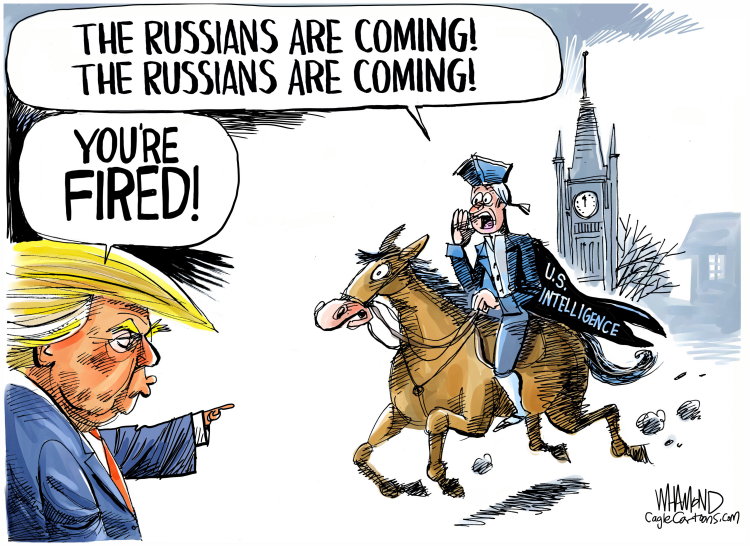
While complaining about the lack of witnesses who spoke to Trump directly, not one of them has asked Trump to let more witnesses testify. Thursday, Fiona Hill called them out for repeating talking points that originate in the Russian security services, and have been refuted by all American intelligence agencies.

Based on questions and statements I have heard, some of you on this committee appear to believe that Russia and its security services did not conduct a campaign against our country — and that perhaps, somehow, for some reason, Ukraine did. This is a fictional narrative that has been perpetuated and propagated by the Russian security services themselves. … Right now, Russia’s security services and their proxies have geared up to repeat their interference in the 2020 election. We are running out of time to stop them. In the course of this investigation, I would ask that you please not promote politically driven falsehoods that so clearly advance Russian interests.

They didn’t care. Devin Nunes in particular just kept repeating those same Russian talking points. So did Trump himself: “Don’t forget. Ukraine hated me. They were after me in the election.” (That was part of a long interview that included “at least 18 false statements“.) And here’s Senator Kennedy of Louisiana yesterday on Fox News Sunday:

CHRIS WALLACE: Senator Kennedy, who do you believe was responsible for hacking the DNC & Clinton campaign? Russia or Ukraine?

KENNEDY: I don’t know. Nor do you.

W: The entire intel community says it was Russia.

K: Right. But it could be Ukraine. Fiona Hill is entitled to her opinion


The goal of the Republican leadership is to make impeachment a party-line vote, with no Republicans crossing over. But I wonder if that might not rebound against them in 2020. That willingness to ignore all the evidence will underline that there are no “reasonable” Republicans. Whatever the candidate in your district might sound like, when push comes to shove, all Republicans are Trump.

Why Can’t I Watch This?

I’ve been waiting for Congress to start the process of impeaching Trump. So why is it so hard to watch?


Fundamentally, the whole point of the Weekly Sift is that I dive deeply into the news so that people with busier lives don’t have to. So I read things like the Mueller Report or Supreme Court’s marriage-equality decisions or the transcripts of presidential debates. I check out neo-Nazi websites to see what they’re up to. I review polls, and examine enough of them to warn everybody not to get too excited about some surprising result that no other pollster can replicate. I keep track of books about the death patterns of democracies or the structure of the American news media.

And then once a week I report back. That schedule is a small revolt against the 24-hour news cycle. If an active shooter is still at large somewhere, you should probably get your updates somewhere else. But an awful lot of the news makes more sense if you take it in week-long chunks rather than five-minute blips. And it often turns out that something seems terribly important for an hour or two, but is not really worth your time at all.

So the impeachment hearings should be right up my alley. I’ve been keeping track of the story ever since the whistleblower report came out, so I know the characters, the basic outline of events, the range of arguments available to both sides, and a bunch of the legal and procedural nuances. The length of the hearings (ten hours Wednesday and eight Friday) makes it unreasonable for most of my readers to watch, so I should watch it for them.

More than that, it’s history. In the two-centuries-and-counting history of the United States, this is only the fourth serious attempt to impeach a president. And rather than some tawdry sex story like the last impeachment, this one is about war and intrigue and world leaders trying to bully each other. It’s about the rule of law, the separation of powers, and whether or not we’ll have a fair election in 2020 (or ever again). This impeachment matters in a way that the Clinton impeachment never really did.

So why can’t I watch this?

I try. I tune in for opening statements and maybe a little of the questioning by counsel. Maybe later in the day I try again and watch five or ten minutes. And then maybe again once more. But I’m making myself do it. I want to turn it off.

To be more specific, I can’t watch these Republicans. This is a problem I have never had before. I disagreed with President Reagan and his followers, but I could watch them. I was pretty sure George W. Bush’s people were lying to me a lot of the time, but I mostly understood where they were coming from, and why they thought they were the good guys. Some of them, I’m pretty sure, were trying to do the best they could with a bad situation (though some weren’t). There was something human in there, something I could empathize with.

I’m not seeing that now.

It seems perfectly clear at this point that Trump did what he is accused of: He withheld aid that Congress had appropriated for Ukraine, for the purpose of pressuring President Zelensky to launch a pretty clearly bogus investigation into Joe Biden, which would do nothing at all to help either Ukraine or the United States, but would work to Trump’s personal political benefit. Withholding the aid would have sabotaged Ukraine in its war against Russia, and even hinting at withholding the aid has harmed Ukraine’s negotiating position with Russia. So Trump has done public harm in an attempt to get private benefit.

It almost worked. Zelensky was within days of announcing the investigations in a CNN interview, but the whistleblower report and Congress’ resulting curiosity about what was going on caused Trump to release the aid, after which Zelensky cancelled the interview.

That’s bad enough, but it looks like there’s even shadier stuff going on in the background. With the President’s blessing, Rudy Giuliani has been running some scam of his own in Ukraine, one we don’t even begin to understand yet. But even without that, we’re looking at a corrupt style of governing, the kind that’s typical in kleptocratic regimes. If all this is OK, then the president should be able to skim personal favors off of all of our foreign aid.

Sad as all that is for America, so far it’s just the story of a simple mistake: The Electoral College elevated a scam artist to the presidency (against the will of the voters, I should point out) and he’s scamming us. It’s an unfortunate state of affairs, but by itself it doesn’t implicate our society or our system of government. In fact, the Founders anticipated stuff like this would happen from time to time. (That’s the nation-sized version of “Momma told me there would be days like this.”) That’s why they built impeachment into the Constitution.

But then the Republicans involved in the current impeachment hearings start to talk, and it’s crystal clear that they have no interest at all in finding out whether Trump has committed crimes, or how bad they are. They just want to make sure that he gets away with them.

That’s what I can’t stand listening to.

I’m old enough to remember the Nixon impeachment, and it wasn’t like this. The iconic Watergate question “What did the President know and when did he know it?” was asked by a Republican, Senator Howard Baker. He wanted to know. By and large, Republicans in Congress wanted to believe the best about Nixon and tried to frame the evidence against him in the best possible light. But they were not accomplices. If the President was guilty, they wanted to know.

These Republicans don’t want to know.

Once you acknowledge the facts of the case, there’s still a debate to be had about how bad this is, and whether it justifies removal from office. There is room to acknowledge that the president did something wrong, something that should never be repeated, without supporting removal. This is the position nearly all Democrats came to in the Clinton impeachment. (The liberal group Move On originated in an online petition saying: “Congress must Immediately Censure President Clinton and Move On to pressing issues facing the country.”) No one argued then that presidents have an absolute right to blow jobs from interns, or that DNA testing is not really a science, or that presidential ejaculations are covered by executive privilege. No one did a Lindsey Graham and just refused to pay attention. (“I’ve written the whole process off. I think this is a bunch of BS.”)

There is a thoughtful way to receive bad news about the leader of your party, and to consider what should be done about it. These Republicans are not doing that.

Instead, they’re ginning up fake controversies to keep their base outraged. They’re asking to call witnesses like Hunter Biden, who has no knowledge of Trump’s Ukraine extortion scheme, and no connection to it at all other than as an intended victim. (The point here is purely to claim some kind of our-scandal/your-scandal equivalence. It’s as if Democrats called Newt Gingrich as a witness in the Clinton impeachment, so that he could be questioned about his own infidelities.) They threaten to violate the laws protecting whistleblowers, and paint Democrats as Stalinists for not allowing them to do so.

In lockstep, these Republicans accept and promote the circular logic of the Trump defense: Testimony from people who didn’t deal with the President directly can’t be taken seriously, but anyone who did deal with the President directly can’t testify. Whether to remove the President for his crimes should be left to the voters, but the voters should not be allowed to learn what those crimes are. Any witnesses who testify against the President (or simply testify to facts the President finds inconvenient) must be opposed to him politically, and so their testimony can be written off as biased.

These Republicans charge that the impeachment process is a sham, but it is they who are making it a sham. By showing no interest in the facts of the case, they are sending a blunt message to the American people: “Nothing the President did matters. We have power and we’re keeping it.”

That’s what I find so hard to watch. I had thought I had prepared myself for this. I had thought I had lost all my illusions about the state of American democracy. But to see so immediately just how far one of America’s two great political parties has fallen, to bear witness to this degradation for hours at a time … it’s sad beyond my ability to process.

So this week, I have failed to adequately sift the news for you. I’ll try again next week, but I don’t know what I can promise.

Religious Freedom for Loganists!

It’s hard for conservative Christians to imagine how their notions of “religious freedom” could ever come back to bite them. So I constructed a thought experiment.

This week, the Trump administration announced a rule change that will allow private adoption and foster-care agencies to receive federal grants while discriminating against LGBTQ families. This is part of a years-long campaign to exempt conservative Christians from discrimination laws, if their desire to discriminate arises from their “sincere religious beliefs”. Making them treat fairly people that they disapprove of, according to this point of view, is a violation of their “religious freedom”.

Regular readers of this blog already know my opinion about this issue: “Religious freedom” used to mean that religious minorities — Jews, Buddhists, atheists — got the same rights as the followers of more popular religions. In recent decades, though, the term has been hijacked and its meaning has flipped: Now it means that conservative Christians have special rights that apply to no one else. (As a humanistic member of a religious tradition with its roots in liberal Christianity, what laws do I get to ignore?)

It’s hard to get the beneficiaries of these special rights to see the problems they cause, though, because they usually can’t imagine being on the other side. If you’re a white, straight, native-born, male Baptist or Catholic (like several conservative members of the Supreme Court) whose religious freedom is going to victimize you?

in the real world, no one’s. So making this point requires constructing thought experiments, and even that gets tricky. I think I finally have one that I like.

Psalm 90:10 says “The days of our years are three score and ten.” Imagine a sect that decides to take that as prescriptive: People aren’t supposed to live past 70. Let’s call these people Loganists. (Critics hung that name on them because of the age discrimination in the movie Logan’s Run. The Loganists themselves hate being called that, because killing people at thirty is just nuts. But the name has stuck.)

Before continuing, let me head off some objections: I understand that the Loganist interpretation depends on taking the scriptural quote out of context, but Christian sects do that all the time. You can’t seriously claim that this is a worse misreading of scripture than many other popular misreadings. Plus, if the issues I’m about to raise would ever go to court, do you want secular judges deciding whose readings of scripture are or aren’t reasonable? Are you certain that your own interpretations would pass muster in such a setting?

Also, I know that the patriarchs of Genesis lived well past 70, and God seemed to approve of that. (Noah, for example, was 600 when God saved him from the Flood.) But dispensationalist Christians hold that God changes the rules from time to time. This is not considered a fringe belief. (For example, God used to approve of polygamy, but most non-Mormon sects believe that he no longer does. Slavery is another issue on which God seems to have changed his mind.)

In every other way, Loganists are totally indistinguishable from other Christians. Absolutely nothing points to them being unserious, and there are many examples of Loganists dying because they refused medical care after they turned 70. It’s clearly their sincere religious belief that people over 70 should not have their lives saved.

Of course, Loganists don’t go out and kill septuagenarians — that would be like murdering gays based on Leviticus 20:13. (Lots of preachers say that should happen, but they don’t go out and do it.) But Loganist healthcare professionals claim that it violates their religious freedom to force them to give lifesaving care to people over 70.

So if you believe that the religious freedom of conservative Christians means that they don’t have to obey anti-discrimination laws — they don’t have to sell cakes to gay couples or provide contraceptives to unmarried women or help gay couples adopt children or even perform an abortion on a woman who will die without it — what about Loganists and age discrimination? Would it be religious persecution to fire a Loganist EMT because he let a elderly patient die? What if he just treated younger people first, because they still have some of their Biblical three-score-and-ten coming, and a 73-year-old happened to die in line?

Why Impeachment is Necessary

If receiving government money means you owe the President a personal favor, we’ve become a different kind of country.


As the House formalized its impeachment inquiry this week, many voices raised a legitimate question: Why put the country through this? Impeachments are divisive, and given Republican control of the Senate (and the proven willingness of Republicans to choose party over country) removing Trump from office seems unlikely, no matter what he may have done.

That question has an answer: If the direct evidence of corruption we’ve seen in the Ukraine case doesn’t produce any response, then as a country we’re saying that we view this kind of presidential behavior as normal and acceptable. Going forward, that collective shrug will make the United States a very different kind of country than it has been before.

Conservatives often raged about Barack Obama’s pledge to “fundamentally transform the United States of America”. (And just as often, liberals have expressed their disappointment at his inability to fulfill that pledge.) But if there are no consequences for his abuses of power, Trump will have succeeded in fundamentally transforming America —  into something much more like a banana republic than the nation the Founders envisioned.

“Do us a favor”. With all the damaging witnesses who have testified to the House Intelligence Committee these past two weeks, it’s important not to lose sight of the fact that the most incriminating words so far came from President Trump himself and were released by the White House. In the rough transcript of his call with President Zelensky of Ukraine, Zelensky asks about buying more anti-tank Javelin missiles, and Trump responds, “I would like you to do us a favor, though.”

The favor is to launch investigations into two matters: “Crowdstrike”, which started “that whole nonsense [that] ended with a very poor performance by Robert Mueller” the previous day, and “The other thing, there’s a lot talk about Biden’s son, that Biden stopped the prosecution and a lot of people want to find out about that so whatever you can do with the Attorney General would be great.”

In other words, in order for Trump to stop blocking the military aid that Congress had already appropriated, Ukraine had to do two things to benefit not the United States, but Trump’s re-election campaign: undermine the basis of the Mueller investigation and tear down the Democrat that the polls have been saying is most likely to defeat Trump in 2020. [1]

Even baseless investigations can be effective. Presuming that these Ukrainian investigations were performed honestly, they would turn up nothing, because their subject matter consists of two conspiracy theories that can’t even be told coherently in any detail. The Wikipedia article on the Crowdstrike theory characterizes it as “multiple disjointed threads of unfounded allegations”. And the reporter who wrote the first Biden-Ukraine story in 2015 describes the Trump version as “upside-down“.

But the ultimate result of these probes doesn’t matter: The investigations into Hillary Clinton’s emails ultimately turned up nothing (beyond the kind of corner-cutting that happened under previous administrations and is also common among Trump’s top advisors, including Jared and Ivanka). But just the fact that Clinton was being investigated lent credibility to Trump’s smears against her and justified the chants of “Lock her up!”

Trump could get similar value out of an investigation of Biden, even if we later discovered it had found nothing. [2]

Beyond Ukraine. So Trump, by his own words, has been caught red-handed in an abuse of power — using his official powers for personal gain. The way we found out — a whistleblower inside the administration had the courage and the patriotism to write up a complaint — seems so fortuitous that it’s easy to imagine that many similar abuses of power have gone unnoticed. [3] Think how easy it would have been to miss this one: Ukraine announces a corruption investigation into the Bidens, and crowds chant “Lock him up!” without realizing that Trump himself started that investigation.

Lots of circumstantial evidence points to the conclusion that this isn’t a unique situation: Trump continues to insist that his side of the Zelensky call is “perfect” and “I did nothing wrong”. So why wouldn’t he do the same thing somewhere else? Plus, his zeal to unmask (and presumably punish) the whistleblower only makes sense as a tactic to intimidate officials who might blow the whistle on other abuses of power. We fortuitously caught him once, demanding a personal favor for a public action. How many other examples are there?

And what if, now that Congress and the public know about this, there is no consequence? No removal from office, no impeachment, no censure, no need for a humiliating public apology? Trump insists that “I did nothing wrong”, and Congress validates that opinion. [4]

Well, then we’ve established that this kind of behavior is OK. There’s no need even to hide it any more, or to limit the occasions for it: If you want Trump to perform his public duty, you need to do him a favor.

So if the State of New York wants the highway funds Congress has appropriated, maybe it should drop its investigation of the Trump Foundation. If Jeff Bezos wants Amazon to compete for a big Pentagon contract, maybe he should rein in The Washington Post, which he also owns. It’s no big deal; Trump just wants a favor. [5]

Lots of countries work this way: Russia under Trump’s role model Vladimir Putin, for example. One thing we can learn from looking at those countries is that corruption tends to trickle down. If Trump can ask for favors before doing his duty, so can officials of lesser power. In a few years, the clerk at your local DMV may expect a tip before processing your driver’s license renewal. That also happens in lots of countries.

Do we want to be one of those countries or not? Underneath all the arguments about process and quid pro quo and so on, that’s the issue Congress will be debating these next few months.


[1] The country/president distinction is one that Chief of Staff Mick Mulvaney tried to skate over in the quid-pro-quo confession he later walked back:

We do that all the time with foreign policy. We were holding money at the same time for — what was it? The Northern Triangle countries. We were holding up aid at the Northern Triangle countries so that they would change their policies on immigration.

Unlike Ukraine, the Northern Triangle example was about trying to mitigate a problem for the country; it wasn’t a favor for Trump himself.

[2] Bill Barr’s investigation — recently upgraded to a “criminal” investigation — into the origins of the Mueller investigation serves a similar purpose. All Barr has to do is keep the investigation going through the 2020 campaign. That will allow Trump to make outrageous claims about what the investigation is finding, which Barr will be duty-bound not to comment on.

Remember the detectives Trump claimed he sent to Hawaii to investigate Barack Obama’s birth certificate? “They cannot believe what they’re finding,” he told NBC. But for some reason he never told us what those unbelievable findings were. I have to wonder if there ever were any detectives.

[3] Josh Marshall makes that case here. In brief: We’ve known for some time — there are several examples in the Mueller Report, just to name one source — that Trump frequently orders his people to break the law. In most of the stories that have reached the public, those people pushed back and refused.

In the Ukraine scheme, though, numerous people realize something is going on that is at best unethical and at worst illegal. And yet the scheme perks along until one guy — one of many, remember — reports it to Congress. Marshall wonders what has been happening in parts of the world where corruption is taken for granted, like Saudi Arabia or the Arab Emirates.

Trump’s willingness has always been a given. That of crooked oligarchies looking for advantage is equally so. The question has been the acquiescence, if not necessarily the connivance, of high level advisors. That is clear now too.

In other words, there is every reason to think, the very strong likelihood that Donald Trump’s corruption and lawlessness has already infected relationships with numerous countries abroad. It’s now just a matter of finding out the details.

[4] That’s why even an impeachment that fails to remove Trump from office will be worth doing, especially if a few Republican senators vote against him. Such a process would show that there is a line somewhere, even if this case didn’t result in punishment.

Behind the scenes, some Republican senators are rumored to be looking for a middle position: coming out against what Trump did, but holding that it’s not an impeachable offense. That’s not an impossible position to defend, but this question needs to be put to them: If not impeachment, what is the proper way to hold Trump accountable? Because doing nothing just says it’s OK.

If Trump were a different kind of person, I could imagine an outcome similar to the Clinton impeachment: He admits to doing wrong, apologizes to the country, and pledges never to do anything like that again. But Trump doesn’t even ask God for forgiveness; he’s not going to ask the country.

[5] You can see this kind of thinking in Trump’s war on California. The state has been a thorn in Trump’s side, participating in as many as 60 lawsuits against his administration’s actions. Trump, in turn, has used the federal government’s regulatory power to target California in numerous ways. The particular issues are often ones that Trump has otherwise shown no interest in, like the environment or homelessness. But he can make California pay a price for opposing him, so he does.

For now, all of this is done in a deniable way. But if the Ukraine scheme is acceptable, then there’s no reason not to be open about the quid pro quos Trump is demanding.

A Liberal View of Intervention

Trump has taken liberals’ no-endless-war rhetoric and gone somewhere ugly with it. How do we take it back?


Like many liberals, I was wrong-footed by President Trump’s abrupt decision to wash his hands of Syria. On the one hand, it sure looks like a dishonorable move that has led to an embarrassing defeat and opened the door to a humanitarian catastrophe.

On the other hand, I also want to see America stop policing the world. I was against invading Iraq and Afghanistan in the first place, and I don’t see any achievable goal in Afghanistan that is worth our continued involvement. In general, I want to see American troops come home from war zones far from our borders. So what was my plan exactly for Syria?

I feel like Trump has stolen my own rhetoric about “endless war” and abused it. But what is the right use of it? And if I’m against Trump’s abandonment of the Kurds, is the only alternative to side with interventionists like Mitch McConnell?

I can’t promise a complete answer here, but let’s try to sort this out as best we can.

Betrayal and surrender. Let’s start with the Kurds , who are among the most persistently short-changed people on Earth. Something like 30-40 million of them live in a more-or-less definable area, but somehow the self-determination wave that swept the world after World War I passed them by. Bulgarians and Czechs got their own states, and by now even Croatia and Azerbaijan are countries, but the Kurds are still divided up among Turkey, Iran, Iraq, and Syria.

And now we’ve screwed them over again. We enlisted them into our fight against the Islamic State, and something like 11,000 of them died in that war. They had managed to carve out an autonomous zone in northeastern Syria, one in which women played an unusually active role, but the connections between that zone and a sometimes-violent Kurdish independence movement in Turkey threatened the authoritarian Erdogan government, which has wanted for years to cross into Syria and crush the Kurdish forces.

What had been stopping them was the presence of a small number of US troops in the area, and the threat of American air power. The Kurds may not be a military match for the second-largest army in NATO, but they are real soldiers, and with control of the skies they could make Turkey pay an unacceptable price. After all, this wasn’t some kind of asymmetric guerilla war, it was an invasion — exactly the kind of thing the American military was built to stop.

And then Trump decided to stand aside. We don’t know for sure what happened on that Trump/Erdogan phone call, but I picture it the way Mitt Romney does: “Turkey may have called America’s bluff.” I imagine Erdogan saying: “We’re coming whether you like it or not” and Trump being cowed into submission.

Trump tried to spin his “ceasefire agreement” (Turkey refuses to call it that) into a victory:

I’m happy to report tremendous success with respect to Turkey. This is an amazing outcome. This is an outcome, regardless of how the press would like to damp it down, this was something they were trying to get for 10 years.

But Trump’s “tremendous success” looks a lot like surrender. The agreement calls for Turkish forces to remain in the territory they have captured, and for our Kurdish allies to turn over their heavy weapons, dismantle their fortifications, and remove their forces from the 20-mile buffer zone Turkey has claimed. The United States will remove its forces from Syria entirely and impose no sanctions on Turkey. So Turkey gets what it wants and pays no price. Turkey may have been trying to get to this point for ten years, but that’s not what the Kurds wanted — or us for that matter.

I also doubt that any of the American troops waiting to be evacuated from Syrian feel victorious. Russians have already occupied one of the bases they left behind, and we destroyed another one with an air strike. Those are the kinds of things that happen when you flee in desperation, not when you win.

McConnell’s internationalist critique.  Friday, Majority Leader Mitch McConnell took the unusual step of publishing an op-ed in the Washington Post to denounce Trump’s Syria policy. Before looking at the content of his article, it’s worth considering what its mere existence tells us: McConnell doesn’t think Trump is listening to him. An influential player like McConnell doesn’t make a public argument if the President is taking his calls and paying attention. For McConnell, going public like this is a last resort, and points to feelings of both frustration and helplessness.

He’s also taking out insurance. If bad things happen because of Trump’s surrender, he doesn’t want to share the blame. So his article is a public marker that says, “I warned everybody.”

Also worth noting: He’s doing his best not to attack the President personally. In fact, the name “Trump” doesn’t appear (though “Obama” does). He focuses on the decision, not the man who made it.

Now to the content. First he makes an abstract defense of America’s military role abroad: Recalling 9/11, he predicts that the threat of ISIS or similar terrorist groups will not stay in the Middle East, and lays out a strategy where America provides strategic leadership, but has allies and so does not have to do all the fighting itself.

Then he assesses the current situation:

The combination of a U.S. pullback and the escalating Turkish-Kurdish hostilities is creating a strategic nightmare for our country. Even if the five-day cease-fire announced Thursday holds, events of the past week have set back the United States’ campaign against the Islamic State and other terrorists. Unless halted, our retreat will invite the brutal Assad regime in Syria and its Iranian backers to expand their influence. And we are ignoring Russia’s efforts to leverage its increasingly dominant position in Syria to amass power and influence throughout the Middle East and beyond.

And his prescription:

We need to use both sticks and carrots to bring Turkey back in line while respecting its own legitimate security concerns. In addition to limiting Turkey’s incursion and encouraging an enduring cease-fire, we should create conditions for the reintroduction of U.S. troops and move Turkey away from Russia and back into the NATO fold.

Finally, he worries that Trump’s desire to pull the US out of “endless wars” will strike next in Afghanistan.

We saw humanitarian disaster and a terrorist free-for-all after we abandoned Afghanistan in the 1990s, laying the groundwork for 9/11. We saw the Islamic State flourish in Iraq after President Barack Obama’s retreat. We will see these things anew in Syria and Afghanistan if we abandon our partners and retreat from these conflicts before they are won.

He closes with “America’s wars will be ‘endless’ only if America refuses to win them.”

In essence, McConnell is restating what has been the conventional wisdom in American foreign policy since World War II. (It lapsed a bit after Vietnam but came back after 9/11.): The world will never leave us alone, so we can’t leave it alone. Threats can arise anywhere, and we need to be ready to oppose them while they’re small and tractable, rather than wait for them to get large enough to strike at our homeland.

My anti-war record. I’d like to stay in an objective-journalist role and quote other people making the case for bringing our troops home from overseas — maybe Elizabeth Warren and Joe Biden, as Atlantic’s Peter Beinart does — but that would be disingenuous: I’ve been making that case myself for years, and I can’t disown it now.

Back in 2005, when I was blogging on Daily Kos under the pseudonym Pericles, I wrote a piece called “Cut and Run” about pulling out of Iraq. At the time, even people who realized that invading Iraq had been a mistake were falling for Colin Powell’s “Pottery Barn Doctrine”: We broke Iraq, so now we had a responsibility to fix it before we left. They admitted that we needed to get out, but in six months or maybe a year or two, after we had stabilized the situation.

The case I made in “Cut and Run” was that we weren’t fixing anything by staying.

What are we fixing? What do we expect to get better if we stay for another year or five years or ten years? I do not intend that question to be rhetorical. If “we are making progress, “as President Bush claimed this week, we ought to be able to measure that progress somehow.

Elsewhere (the link has since died; I need to repost somewhere) I argued that the stay-a-little-longer caucus would never be satisfied: Whenever we left, disaster would ensue, and they would claim vindication. And that is what happened. We stayed another six years, but McConnell (and others) blame Obama’s withdrawal for the rise of ISIS. (If only we’d stayed seven or eight more years rather than six.)

That’s why I’m not satisfied by McConnell’s assurance that he doesn’t want to stay in Afghanistan forever, just until we “win”. I have the same fundamental objection I had many years ago: What does “winning” even mean? If someone would offer a compelling vision of a post-victory Afghanistan, and then describe a path for getting there, reasonable people could argue about whether the outcome is worth the cost.

Instead, we always get the same dystopian vision: If we leave now, something terrible will happen. So when can we leave? Sometime, maybe, but not now. So how many “not nows” make a “forever”?

Is it possible to thread this needle? On the one hand, I am disgusted by what I’m seeing in Syria. On the other, I still don’t want to join McConnell and most of the rest of the foreign-policy establishment in the post-World-War-II intervention consensus.

Looking back, I also find that I’m not against all interventions. I like what President Clinton did in Bosnia: We ended a genocide. And while we (but mostly our European allies) ended up with troops in the area for many years afterward, it was a peace-keeping mission rather than a war-fighting mission. Casualties were minimal.

I regret that we didn’t find some similar way to end the genocide in Rwanda. And I don’t know what to think about Libya. Things haven’t turned out well there, but I can’t feel bad about stopping Qaddafi from killing civilians by the tens of thousands.

So what kind of policy do I want exactly?

I warned you I wouldn’t have a complete answer. I don’t have a doctrine that spells out precisely when the US should or shouldn’t get involved in some distant conflict. (Senator Warren: If you have a plan for that, this would be a good time to reveal it.) All I can offer are some intuitions that I still trust, in spite of it all. Mostly they revolve around coming to a proper understanding of the scope of American power: Being the most powerful nation on Earth gives us some responsibilities. But at the same time we need to be realistic: There are things our military — or military power in general — can’t accomplish. If we try we’ll only make bad situations worse.

So here’s what I think:

We can’t end tyranny in the world, but we should try to prevent genocide. The world is full of bad governments, and sometimes overthrowing them just gets you a worse government, or a failed state that can’t fulfill the responsibilities of a government at all. You can’t create a good government at gunpoint.

What you can do at gunpoint, though, is stop one group of people from slaughtering another. Sometimes the mass murder is a mania that will pass if you can just interrupt it. Some groups will see that — as much as they still hate some other group — the world is not going to stand for a genocide, so they need to come up with some other plan. Other situations may require a longer occupation. But stopping genocide doesn’t require you to rule over people or teach them to govern themselves, just to put limits on them.

There’s hope for a peacekeeping mission, but nation-building hardly ever works. An amazing number of the world’s problem areas, particularly in the Middle East, are “nations” that were created by colonial powers drawing arbitrary lines on a map.

The people in those regions often feel no sense of national loyalty to each other, and the only way they have ever held together as “nations” is under the dominance of some strongman. You can’t turn such places into constitutional democracies just by writing a constitution and having elections.

Don’t misinterpret that: It’s not that some kinds of people aren’t ready for democracy as individuals. When they emigrate to the US or Western Europe, they often make fine citizens. The problem is that democracy requires a sense of mutual loyalty that the residents of places like Iraq and Afghanistan have never developed. And that’s something else you can’t instill at gunpoint.

What you can do at gunpoint, though, is stop them from killing each other.

We can’t kid ourselves about our good intentions. One mistake American interventionists often make is to whitewash our motives. We didn’t go into Iraq and Afghanistan because we wanted to bestow democracy on these oppressed peoples. We invaded Iraq for the oil and Afghanistan because we wanted to get Bin Laden. Building democracy was a story we told ourselves to salve our consciences.

Nothing is as doomed to failure as a mission you didn’t really believe in from the start.

If we examine our real motives before we start an intervention, usually we’ll either realize that we shouldn’t do this at all, or see that the scope of our mission should be much smaller than taking over the whole country.

So what about the Kurds? Our troops in Syria got there because they were fighting ISIS. Once the territory of ISIS had all been retaken, there were two reasons to keep them there: to keep ISIS from reforming, and to prevent either the Turks or the Syrians from attacking the Kurds.

Both of those were peace-keeping missions. We weren’t trying to teach the Kurds how to be a people; they knew that already. They were building their own nation.

One way you can tell the mission was peace-keeping is that war broke out as soon as Trump ordered our troops to stand down.

The Kurds believe that the Turks intend an ethnic cleansing of the area or even a genocide. Trump thinks not, but I guess we’ll see.

Planning. One final note: Even if you believe that our mission in Syria wasn’t worth the cost any more, there’s no excuse for the way Trump handled it.

When we do decide to pull out of a country, we need a withdrawal plan rather than just a tweet announcing our departure. First, we need a plan to get our own people out of the country safely. And second, we need to do right by the people who have helped us, and who will likely be targeted for death after we leave. If nothing else, that means doing something Trump hates to do: welcoming refugees to the United States.

The Leader or the Law?

The impeachment question is coming down to this: Will Republicans honor the Constitution, or usher in a new era of authoritarian rule?


More and more each week, the Trump strategy for avoiding impeachment looks to be a pure power play. He is barely even pretending any more that he hasn’t committed (and isn’t continuing to commit) impeachable offenses. Meanwhile his lawyers are making absurd arguments in court, demanding (and sometimes getting) blind loyalty from Trump-appointed judges.

It’s coming down to this: Will Republicans uphold their oaths of office, or get in line behind the Leader and let the American experiment in democracy end? The key question isn’t “What is right?” or “Who is guilty?” any more. It’s “Whose side are you on?” If there are five pro-Trump votes on the Supreme Court and 34 pro-Trump votes in the Senate, he wins.

And that’s the only way he wins.

In court, Trump’s lawyers are arguing that he has “absolute immunity” from every conceivable kind of legal jeopardy: not just indictments, but also investigations and subpoenas, state and federal alike. Ten days ago, that argument got laughed out of federal appeals court by two judges; the third, a Trump appointee, chose the Leader over the law. [1] Trump’s only hope for victory in his attempts to obstruct congressional investigations is that the five Republican judges on the Supreme Court do the same.

I refuse to believe that Trump’s lawyers can’t come up with any more plausible arguments than this sweeping claim of executive supremacy. Rather, it seems to be their intention to put the question to judges as bluntly as possible: Regardless of the law, are you with us or against us?

It’s not complicated.

Whether subpoenas allow Congress to gather more evidence or not, the rough transcript of the Ukraine phone call is by itself compelling evidence of abuse of power: Trump is using his office to demand a partisan political favor from a foreign leader. The only question at this point is whether that abuse is sufficient to warrant impeachment. [2]

But if the phone call represents a quid pro quo — Ukraine won’t get the weapons it needs to defend itself against Russia unless it does Trump a political favor — then all doubt about impeachability is removed: It’s bribery, which the Constitution specifically calls out as an impeachable offense. So “no quid pro quo” — implausible as that is, given the transcript — has been the mantra of Trump defenders.

But Thursday, acting Chief of Staff Mike Mulvaney openly admitted the quid pro quo. (In Mulvaney’s dual role as the head of OMB, he was responsible for holding up the Ukraine aid package.)

Did [the President] also mention to me the corruption related to the DNC server? Absolutely. No question about it. But that’s it. That’s why we held up the money … I have news for everybody: Get over it. There’s going to be political influence in foreign policy.

Reporters offered several follow-up questions to make sure that Mulvaney had really said what he said — some used the phrase “quid pro quo” in their questions — and he stuck by his claim. Only hours later, after he saw the firestorm his comments evoked, did he try to walk it back, blaming the media for “misconstruing” his confession, and basically telling the world that we hadn’t seen and heard what we saw and heard (and can watch again if we have any doubts).

Meanwhile, the Trump campaign has embraced the claim Mulvaney disavowed. They’re selling a “Get Over It” t-shirt. That kind of Orwellian doublethink has become typical of Trump’s defenders: We didn’t say it, and we’re proud that we did say it.

At the same press conference, Mulvaney announced a blatant violation of the Emoluments Clause of the Constitution: Trump would host the next G-7 meeting at his privately owned resort. That decision got reversed Saturday, after another firestorm, but without any admission that the proposal was criminal. The problem, in Trump’s view, is that people objected to his attempt to enrich himself. [3] If no one objects to his next acts of corruption, he’ll go through with them.

It’s becoming clear that the House will eventually vote articles of impeachment, one of which will be about Ukraine. (Possible others concern the multiple examples of obstruction of justice outlined in the Mueller Report, obstruction of the impeachment inquiry itself, and abundant additional examples of illegal emoluments.) Then the Republicans in the Senate will face a choice: Admit the now obvious fact that Trump has committed impeachable offenses, or choose the Leader over the law.


[1] The Slate article in the link lays out the scope of Judge Rao’s opinion:

there is another, even more disturbing aspect of Rao’s dissent. She wrote, ominously, that “it is unnecessary here to determine the scope of impeachable offenses.” Unnecessary here? It isn’t just unnecessary—it’s impermissible, because the federal judiciary has no constitutional authority to determine “the scope of impeachable offenses.” The Supreme Court has ruled that the Constitution assigns the power of impeachment to the House exclusively, denying the judiciary the ability to meddle in impeachment proceedings. Rao seemed to reject that precedent, instead suggesting that courts can “determine the scope of impeachable offenses” and, by extension, quash an impeachment on the grounds that the charges are not “high crimes and misdemeanors.”

[2] I argue that it is, using standards that I laid out long before the Ukraine affair, because the Ukraine call represents Trump’s attempt to cheat in the 2020 election. When the President’s corruption starts to affect the integrity of the next election, it is extremely cynical to argue that the voters rather than the Senate should remove him.

[3] Trump’s two defenses — that his Doral Resort is the best possible place to hold the G-7, and that he will host the event “at cost” and make no profit — are both absurd.

South Florida in June is a terrible place to be, which is why the Doral has such low occupancy rates then. (I know from personal experience, having attended a conference in Fort Lauderdale one June.) Plus, the Doral bears no resemblance to the kinds of places (typically remote, peaceful, and easily secured) where these events are usually held. It beggars the imagination to think that no place in, say, Hawaii or Maine would be better. For that matter, why not go back to the historic New Hampshire hotel where the Bretton Woods Conference was held in 1944?

And Stephanie Ruhle outlines the tricks Trump could use to funnel government money into his resort without reporting a profit.

The Ukraine Story Runs Deeper Than We Thought

What at first looked like just a phone call has turned out to be a much larger and sleazier operation.


When it first broke, the Ukraine story seemed nice and simple: In a call to Ukrainian President Zelensky, Trump strongly implied that if he wanted American military aid, he should dig up (or invent) dirt on Joe Biden — and also investigate some other conspiracy theory involving the DNC server (and “proving” Putin’s contention that the Russians didn’t really hack it). Unlike the crimes that the Mueller investigation uncovered, it was an easy story to understand, and easy to see why what Trump did was wrong.

Conversely, that simplicity was why Trump supporters didn’t think it was an impeachable offense: It was just a phone call. Trump got a couple of weird ideas into his head, and they happened to spill out while he was talking to somebody. The American aid got released eventually anyway, so let’s just move on.

I have an analogy that I think sums up their thinking. (As far as I know, none of them actually used it, but it would make sense out of the kinds of things a lot of them said.): A married man gets drunk at a party and makes a move on some pretty girl, who manages to get away from him. Sure, his wife should be upset with him, but it’s probably not worth getting a divorce over. Tucker Carlson put it like this:

Donald Trump should not have been on the phone with a foreign head of state encouraging another country to investigate his political opponent, Joe Biden. Some Republicans are trying, but there’s no way to spin this as a good idea. Like a lot of things Trump does, it was pretty over-the-top. … The key question with Trump’s Ukraine call, though, is whether the president’s actions, advisable or not, rise to the level of an impeachable offense. It’s hard to argue they do.

In the two weeks that followed the initial revelation, though, we’ve been finding out that the pressure-Ukraine-for-partisan-favors scheme was way more than just a phone call: In fact, it shaped the whole Ukraine policy of the United States over a period of (at least) months. Our ambassador to Ukraine got recalled because she kept getting in the way. Diplomats up and down the line were rattled about it. Multiple national-security people in the White House were raising their concerns with the White House Counsel’s office about Trump’s Ukraine call, some even before it happened. Career officials at OMB protested that it was illegal to hold up aid Congress had appropriated, and were overruled by a political appointee.

Rudy Giuliani, who has no government job at all and is just Trump’s personal attorney (at least for now), was running a shadow foreign policy, and working with some shady characters to implement it. Two of them were arrested Thursday for funneling foreign money into American political campaigns, including giving $325K to America First Action, a pro-Trump PAC. Rudy himself is reported to be under investigation by the office he used to head: the US Attorney’s office of the Southern District of New York. A goal of that scheme (which apparently pulled in Energy Secretary Rick Perry — wittingly or not — as well as various Republican donors) was to try to get their people installed in the management of Ukraine’s state gas company, in order to “steer lucrative contracts to companies controlled by Trump allies”.

At this point, it’s hard to say just how far the wrongdoing goes. And it raises a question: If you drilled this deep anywhere in the Trump administration, would you strike a similar gusher of corruption?

The difficult task of the House Intelligence Committee, as it works towards preparing at least one article of impeachment for the Judiciary Committee, is to give the American people a sense of the depth of the cesspool it has found, while not losing the simplicity of the original story: We have the rough transcript (from the White House itself) of Trump pressuring a foreign leader to interfere in the 2020 elections.

That’s not right, and something needs to be done about it. But it’s also not all.

Backstabbing the Kurds is Just Trump Being Trump

Who could have predicted that the founder of Trump University would betray people who had faith in him?
Just about anybody who’s been paying attention.


Ever since he came down the escalator and announced his crusade to protect American womenfolk from Mexican rapists, the Donald’s Republican defenders have been singing the same song: You’ve got to let Trump be Trump.

If he says or does something racist, stands up for the poor mistreated Nazis of Charlottesville, slanders federal law enforcement institutions, sides with Putin over US intelligence services, says dozens of things each week that have no basis in reality, is nicer to enemy dictators than to our democratic allies, calls members of Congress traitors or says that they should go back where they came from … well, that’s just who he is. You need to roll with it.

But strangely, they forgot their own advice this week after Trump ordered our troops in Syria to stand aside and let Turkey attack the Kurds. Kurdish troops bore the majority of the burden in the war against ISIS in Syria, whose success Trump has often crowed about. [1] They lost something like 11,000 soldiers while we lost six fighters and two civilians.

But now that Trump believes the battle against ISIS is won [2], what good are they? Turkey’s authoritarian ruler Recep Tayyip Erdoğan — one of those dictators Trump admires — wants to clear them away from his border, where they give hope to his own oppressed Kurdish minority. And Erdoğan doesn’t just have the second-largest army in NATO going for him, he also has Trump Tower Istanbul, and countless future opportunities for ambitious businessmen who play ball. What’s loyalty to our brothers-in-arms compared to that?

Trump Tower Istanbul

But for some reason, Republicans are upset this time. Lindsey Graham, who has been Trump’s biggest sycophant through all his other betrayals, found this one shocking. The Kurds, he said in outrage, had been “shamelessly abandoned”, as if he thinks Trump’s shamelessness is a new development. Liz Cheney found it “impossible to understand why [Trump] is leaving America’s allies to be slaughtered.”

Well, Liz, I can explain it for you: This is who Trump is and who he’s always been. Betraying people who have trusted him is just Trump being Trump.

A trust-is-for-suckers theme runs through Trump’s entire life. Look at Trump University: People who admired his business acumen believed him when he said he could teach them his secrets. He took advantage of their admiration with a fraud that he needed $25 million to settle. In addition to that betrayal of trust, there’s his long history of stiffing the contractors who build his buildings, scamming the taxman, profiting from buildings that never got built, cooking the books at his hotels, refusing to repay bank loans, cheating on all three of his wives, and on and on.

Why would anyone expect him to stand by people who (in his view) have already done everything for him that they’re going to do? In his eyes, that’s a loser move. He’s never shown that kind of loyalty before, so why would he start now?

So here’s what I have to say to Lindsey, Liz, and all the other Republicans who are shocked by Trump’s faithlessness, as if it came out of the blue: One of Trump’s favorite ways to bash immigrants is to recite part of a poem in which a woman saves a poisonous snake, who then bites her. When she asks why, the snake explains:

Oh, shut up, silly woman, said the reptile with a grin.
You knew damn well I was a snake before you took me in.

Maybe when you heard that recitation, you thought he was warning you about MS-13 gangsters. You should have realized that he was telling you about himself.


[1] One of the many good things Trump inherited from President Obama was a strategy for beating the Islamic State. Obama saw that the American people had no appetite for another ground war in the Middle East, and yet the spread of the Islamic State not only destabilized Syria, but threatened everything the US had tried to accomplish in Iraq.

So the Obama administration came up with a plan (announced September 20, 2014) in which we would provide air power, material support, and a relatively small number of troops on the ground, while local groups — most prominently the Kurds — would do the bulk of the killing and dying. The public might not like the idea of having troops in harm’s way in yet another Middle Eastern nation, but as long as not too many of them came home in body bags, the war would stay off the front pages and most of the country would forget it was happening.

By the time Trump started measuring drapes for the Oval Office, three things were clear:

  • Obama’s strategy was working.
  • Trump was going to continue what Obama started, because Obama’s reasoning was still sound: Americans didn’t want a major new war, but they also didn’t want to turn large chunks of Iraq and Syria over to an Islamist caliphate.
  • When Obama’s strategy eventually succeeded, Trump was going to hog all the credit.

Here’s what I wrote two weeks after the 2016 election:

ISIS has been losing territory for some while now. Mosul, its last stronghold in Iraq, is cut off and likely to fall in the next few months. Its de facto capital of Raqqa is under attack in Syria. If events continue on their current path, sometime in 2017 President Trump will be able to declare victory in the territorial struggle, though ISIS will continue to be a significant underground movement. That victory will be the result of Obama’s strategy, but I expect Trump to crow about how “America is winning again.”

It took a little longer than I expected, but played out exactly that way. Here’s what our resident stable genius tweeted in January of this year:

When I became President, ISIS was out of control in Syria & running rampant. Since then tremendous progress made, especially over last 5 weeks. Caliphate will soon be destroyed, unthinkable two years ago.

I know this outcome was not “unthinkable” when Trump took office, because I was thinking it and so were a lot of other people.

[2] It isn’t. The Islamic State has lost its territory, but it still continues as the “significant underground movement” that I and everybody else predicted.

The Atlantic’s national security correspondent Mike Giglio summarizes:

For much of America’s war against the so-called ISIS caliphate, it was clear that the extremist proto-state that ISIS created across Syria and Iraq didn’t stand much chance of lasting. The militants had no way to counter the relentless U.S. air-strike campaign and faced a committed enemy in the U.S.-backed local soldiers who did the bulk of the ground fighting. ISIS, a successor to the al-Qaeda militants who battled U.S. troops during the Iraq War, would one day return to its insurgent roots and go underground. It would ultimately be left to America’s local partners to keep up the pressure and ensure the group’s lasting defeat.

These local soldiers—the Kurds in Syria, the Iraqi military, and various other forces—have already suffered many thousands of casualties. Once the territorial caliphate was defeated, America could have focused on rebuilding them as well as the heavily bombed areas where they are now charged with keeping the peace. As The New York Times reported this summer, ISIS still has as many as 18,000 fighters across Iraq and Syria, many of them organized into sleeper cells and hit teams who carry out ambushes, kidnappings, and assassinations across both countries.

Remember: Al Qaeda never did control territory, but managed to be a quite a nuisance anyway.

More Answers to Impeachment Objections

This post is a follow-up to a similar one last week. As the available information has changed, Trump’s defenses have shifted, and some of the points I made last week have more support now.

But before we get into the excuses and responses, I think it’s important never to lose sight of the heart of the case against Trump. It’s a simple case, which is why his supporters work so hard to obscure it: He’s cheating again.

One thing the Mueller Report made absolutely clear was that Russia cheated for Trump in 2016. Mueller couldn’t prove that the Trump campaign itself was part of the Russians’ criminal conspiracy, but what Russia did is pretty well established at this point. Tucker Carlson and Jared Kushner may try to minimize it as “a few Russian Facebook ads”, but serious crimes were committed: In addition to the illegal social-media campaign help, Russian operatives broke into the DNC’s computers and conspired with WikiLeaks to distribute what they found. That drip-drip-drip of email revelations consistently disrupted the news cycle for the Clinton campaign, and (in such a close election) was almost certainly decisive.

It’s a very real possibility that Trump owes his presidency to Vladimir Putin’s criminal conspiracy.

The essence of the Ukraine and China stories is that Trump is looking for a country to cheat for him in 2020, the way Russia did in 2016. And this time he has more to work with than just a wink-and-nod about sanctions. As president, he can distort all of US foreign policy to bribe or threaten foreign leaders into doing him “favors”.

So the question to be answered in this impeachment is: Are we going to let presidents cheat their way to re-election? And there are only three possible answers.

  • Yes. We’re going to become the kind of banana republic where the full power of the government is devoted to making elections come out the right way.
  • No. We’re going to take the power of the presidency away from Trump so that he can’t use it to cheat his way to a second term.
  • No. We’re not going to remove Trump from office, but we have some other way to stop his cheating and to make sure future presidents don’t follow his example.

I included that third bullet for logical completeness, but I’m still waiting to hear what such an “other way” might be. If someone makes the case that what Trump is doing is wrong but not impeachable, I think the burden is on them to explain how exactly the US is going to avoid the banana-republic scenario.

Anyway, let’s get to what Trump supporters are saying.

Trump is just being Trump. The point of standing on the White House grounds and publicly asking China to investigate the Bidens — coincidentally at a time when Chinese negotiators are about to arrive for trade talks and might be looking for a cheap way to curry favor with him — was to normalize the situation: This isn’t a crime committed in secret (although it was; that’s why Trump’s staff inappropriately locked the transcript down in a computer system meant for secrets about covert operations), it’s just how I roll.

During the 2016 campaign, Trump claimed that he could shoot somebody on 5th Avenue and not only get away with it, but “not lose any voters”. Now we know how he would accomplish that feat: The day after he shot the first guy, he’d shoot somebody else. The day after that he’d shoot two people. And by the end of the week Fox News and Lindsey Graham would be saying: “That’s who Trump is. He shoots people. The country knew that when it elected him.”

But crimes are crimes and abuses of power are abuses of power, no matter where or how often they happen. If “being Trump” means abusing the power of the presidency, then he shouldn’t have that power. Let him go be Trump in private life, or in prison.

Trump just said a bad thing. This related defense is one that Trump’s supporters use a lot: His heart is in the right place, but because he’s not a career politician, he occasionally says things that break protocol. It’s no big deal.

We’ve heard this defense many times. For example, after the Access Hollywood tape came out: You may think you heard Trump confessing to a pattern of sexual assaults, but no; it was just “locker room talk“. And he shouldn’t have used the word pussy. So he said a bad thing, but that’s all there was to the scandal. (And when dozens of women accused him of the same kinds of sexual assaults he had bragged about, they were all lying. Most of them were too ugly to assault anyway.)

Tucker Carlson adapts the he-said-a-bad-thing argument to Ukraine:

Donald Trump should not have been on the phone with a foreign head of state encouraging another country to investigate his political opponent, Joe Biden. Some Republicans are trying, but there’s no way to spin this as a good idea. Like a lot of things Trump does, it was pretty over-the-top. … The key question with Trump’s Ukraine call, though, is whether the president’s actions, advisable or not, rise to the level of an impeachable offense. It’s hard to argue they do.

But as I pointed out above, Carlson does not offer any way out of the banana-republic scenario. He doesn’t propose any consequence that would discourage Trump from doing this again, or doing worse things. Maybe a president shouldn’t abuse his power this way, but … let him.

It was a joke. Remember when the writers of Dallas painted themselves into a corner, and then got out by claiming that the whole previous season was a dream? That’s what “It’s a joke” is for Trump. It’s how he calls backsies. We’d all love to have the power to do that: Imagine if anytime somebody brought up something you shouldn’t have said, you could respond with, “Oh, that was a joke. Where’s your sense of humor?” I’m sure Henry II would have loved to claim that “Will no one rid me of this troublesome priest?” was a joke. But Pope Alexander wasn’t buying it.

Getting back to Trump, he claimed it was a joke in 2016 when he said:

Russia, if you are listening, I hope that you are able to find the 30,000 e-mails that are missing. I think that you will probably be rewarded mightily by our press. Let’s see if that happens.

And here’s the real punch line: It did happen, or at least Russia tried to make it happen.

Russian spies began trying to hack Hillary Clinton’s personal email server on the very day Donald Trump urged the Russian government to find emails Clinton had erased, prosecutors said on Friday.

Putin’s people didn’t get the joke, so they went out and tried to do more illegal hacking. Those effing ex-KGB guys! No sense of humor, any of them.

Even better than being able to claim backsies yourself is having other people do it for you, so your position can remain ambiguous. Whatever you said is either a joke or not a joke, depending on what’s convenient. Right now, Republicans in Congress know they can’t defend what Trump says, so it’s-a-joke has become convenient for them. Marco Rubio started it, saying that Trump’s suggestion that China investigate Biden wasn’t real.

I don’t know if that’s a real request or him just needling the press knowing that you guys are going to get outraged by it. He’s pretty good at getting everybody fired up and he’s been doing that for a while and the media responded right on task.

On yesterday’s talk shows, Senator Roy Blount and Rep. Jim Jordan repeated that excuse. Blount said:

Well I doubt if the China comment was serious to tell you the truth

The important question this time is whether China got the joke. China’s foreign minister did not appear to be laughing when he said:

China will not interfere in the internal affairs of the US, and we trust that the American people will be able to sort out their own problems.

I think Congress should react like the TSA does when you “joke” about having a bomb in your luggage. Unless he’s in an obviously comic setting, like the White House Correspondents Dinner, when the President of the United States says something, the world should take it seriously. If Trump can’t adjust to that situation, he shouldn’t be president.

And BTW: Is there any evidence that Trump even has a real sense of humor? Has anyone ever seen him laugh — except possibly at someone else’s pain or disability?

No quid pro quo. Last week, I answered this by saying that the quid pro quo in Trump’s conversation with Ukrainian president Volodymyr Zelensky was implicit:

It’s impossible to read the transcript of the Ukraine call without immediately recognizing the quid (money for Ukraine’s defense against Russian invaders) and the quo (manufacturing dirt on Joe Biden).

The case for that interpretation got much stronger Thursday when former Special Envoy for Ukraine Kurt Volker testified to Congress, and provided text messages related to the case. For example, Bill Taylor, the acting US ambassador to Ukraine, asked U.S. Ambassador to the EU Gordon Sondland about what he perceived as a quid pro quo:

Taylor asks for further direction: “Are we now saying that security assistance and WH meeting are conditioned on investigations?” Sondland replies: “Call me.”

A few days later Taylor texts:

As I said on the phone, I think it’s crazy to withhold security assistance for help with a political campaign.

And Sondland replies with the White House spin that will turn into its cover story, while again trying to stop Taylor from leaving an evidence trail:

The President has been crystal clear no quid pro quo’s of any kind. The President is trying to evaluate whether Ukraine is truly going to adopt the transparency and reforms that President Zelensky promised during his campaign[.] I suggest we stop the back and forth by text[.]

However, in conversation with Senator Ron Johnson (R-WI), Sondland also expressed his belief that there was a quid pro quo. So Johnson talked to Trump:

Johnson claims he heard from Sondland that this was in fact the policy. However, Johnson adds that he became disturbed by this, and followed up with President Trump himself — who denied any such linkage. “He said—expletive deleted—‘No way. I would never do that. Who told you that?” Johnson told Journal reporters Siobhan Hughes and Rebecca Ballhaus.

But the story doesn’t end there. According to the Milwaukee Journal Sentinel’s Molly Beck, Patrick Marley, and Eric Litke, Johnson said in a separate interview that Trump did say he was considering withholding the aid because he wanted to find out “what happened in 2016.”

Johnson said he asked Trump whether he could tell Ukraine’s president the aid was on the way anyway, to dispel the government’s fears, but “I didn’t succeed.”

Chris Hayes sums up:

The thing that is so damning about these texts is the consciousness of guilt that hangs over them. … They knew what they were doing was wrong, and they were trying to keep it secret. … Not only did they know it was wrong, but they worked on their cover story.

BTW, the format Hayes is experimenting with, of doing his show before a live audience, works really well here. The real editorializing comes from the audience, which laughs at Trump supporters’ ridiculous excuses.

Trump is draining the swamp. His push to investigate Biden is part of his anti-corruption mandate. The Trump campaign makes this point in a TV ad you may have seen.

But Mitt Romney nails him on this:

When the only American citizen President Trump singles out for China’s investigation is his political opponent in the midst of the Democratic nomination process, it strains credulity to suggest that it is anything other than politically motivated.

Other observers have noted that there is at least one other example of Trump caring about corruption: He wanted Hillary Clinton investigated also. CNBC’s Eamon Javers asked the obvious question:

Have you asked foreign leaders for any corruption investigations that don’t involve your political opponents?

Trump bloviated for a while, but could not name any other instances. Trump has picked this trick up from the autocrats he most admires: Putin and Mohammad bin Salman. They both like to manufacture “corruption” cases to take down their rivals.

In general, the drain-the-swamp argument is a joke at this point. Trump’s cabinet is full of lobbyists. He has stood behind obviously corrupt officials like EPA Director Scott Pruitt and Wilbur Ross. He channels public dollars into his private businesses. And in spite of Trump’s claim that his tax plan would “cost me a fortune”, Trump himself is one of the law’s prime beneficiaries. That’s one reason why his tax returns are such tightly held secrets.

To conclude: Washington has gotten much, much swampier since Trump came to town. If you want to drain the swamp, support impeachment.

Democrats are pushing impeachment because they know they can’t defeat Trump in 2020. That’s the case made in that Trump ad. However, all the current polling indicates that the major Democratic candidates — especially Biden — are ahead of Trump by wide margins.

This point makes more sense if you turn it around: Trump is trying to cheat because he knows he can’t win a fair election.

But if Trump is allowed to use the full power of his office to cheat — then yes, Democrats are worried that he’ll win in 2020.