Category Archives: Articles

Why the Carroll verdict might matter

Immediately after a jury in a New York federal court found that Donald Trump had sexually assaulted and then defamed E. Jean Carroll, two reactions popped up everywhere:

  • The verdict constitutes personal vindication for Carroll and vicarious vindication for any woman who has ever felt powerless after being mistreated by a man. While there’s still a long way to go, men — even powerful men — no longer have complete impunity.
  • Politically, it will mean nothing. Members of Trump’s personality cult will double- and triple-down on his “witch hunt” and “persecution by the Deep State” narratives.

That first response seems obviously true to me. But I want to call the second into question. Politically, this might matter, even to people deep inside the right-wing echo chamber. But you’ll only see the effects if you know where to look.

A jury verdict is different. First, let’s talk about why the verdict should matter: As of now, the conclusion that Trump sexually assaulted Carroll and then aggressively lied about it “with actual malice” isn’t just an accusation liberals toss around on Facebook or discuss on left-leaning MSNBC shows. It’s not coming from a blue-state prosecutor looking for votes. It’s the verdict of a jury.

Think about what that means: If you sit nine ordinary people down, impress on them that they have a serious job to do, and then make them consider the evidence in detail, they will unanimously conclude that Carroll’s accusations against Trump are true.

That’s something that never happens on social media or within the information bubbles of either side. In those settings, you can’t make people listen to anything they don’t want to hear. You can’t put together a detailed argument without being pulled down the what-about-Hunter-Biden or it’s-all-a-witch-hunt rabbit holes. If someone answers an accusation with a biting-but-vacuous remark, a Trump-favoring host can end the discussion there, as if there were no conceivable counter-response.

But that’s not how things work in court. In court, the jury had to focus on this case, rather than something Bill Clinton did or didn’t get away with. Both sides had a chance to produce evidence and arguments at whatever length they felt necessary. Jurors had to evaluate witnesses as individual people — not with a general brush-off like “women lie all the time”, but here are Carroll, the two friends she told about the attack, and two other women who say Trump attacked them in similar ways. Listen to their voices, look them in the eye — is this particular woman lying to you right now?

The jury — all six men and three women of them — decided those women were telling the truth, and that Trump (who could have testified in person but didn’t, and was present only through a taped deposition) was lying.

That’s hard to brush off. It should matter. But will it?

Digging in deeper. People who think it won’t point to two reactions: First, Trump’s rivals for the 2024 Republican nomination aren’t jumping on it. Asa Hutchinson said “The jury verdict should be treated with seriousness and is another example of the indefensible behavior of Donald Trump.” But he was the exception. Mike Pence (who styles himself as a defender of Christian moral values) characterized Trump’s sexual assault as “just one more story focusing on my former running mate that I know is a great fascination to members of the national media, but I just don’t think is where the American people are focused.”

In other words: Sure, Trump violently attacked a woman — probably several women — and then lied about it, but shit happens. No big deal. Do you know what eggs cost these days?

And second, consider Trump’s indictment in Manhattan for falsifying business records, which caused his most ardent supporters to dig in deeper. Trump voters from Sarah Longwell’s focus groups said things like this:

When I convened a group of GOP voters the day after Trump’s indictment, their assessment was nearly unanimous: “It’s a complete distraction and it’s a waste of time.” “It’s being blown out of proportion.” “Just ridiculous and a terrible direction for us to go.”

We asked one group whether they had donated to Trump before the indictment. Only three out of nine had, but after the indictment, all nine said they would. None said another indictment or arrest would change their minds. And none thought Trump should drop out.

“As far as a mug shot goes, he’s going to market the hell out of that,” said Chris, a two-time Trump voter from Illinois, imagining a future arrest. “Every one of us is going to buy one of those shirts.” Most hands went up when I asked who would buy one.

How conservatives change their minds. I know what Democrats and Lincoln-Project Republicans would like to see: former Trump voters being confronted by the Carroll verdict and announcing that it has changed their minds. “I used to believe X about Trump, but now that I’ve heard this I have to believe Y.”

Almost no one is saying that, so commentators think the verdict makes no difference.

But that’s not how conservatives change their minds. On the Right, humility is a sign of weakness. (Jesus must have been misquoted about the meek.) So you never admit you were wrong and you never apologize.

And yet, conservative opinions do change occasionally. Sometimes they even reverse.

Think about George W. Bush. In the early days of the Iraq invasion, conservatives were ready to put him on Mount Rushmore. But by 2010 they were complaining that he had never really been a conservative at all. Or Ronald Reagan. For decades after he left office, Reagan was the defining Republican, and his core principles — including an expansive view of American power and free trade — were the core principles of the party. Now, “globalism” and “free trade” are dirty words, and Reagan hardly ever comes up as an example to emulate.

And yet, there was never a come-to-Jesus moment when conservatives repented their previous views and pledged to go a different way. Instead, a conservative sea change happens like this: People who used to be zealots for a particular view go silent for a while. And when they start talking again, they have the opposite view, which they put forward as if they had always believed it.

Segregation. That’s what happened with Jim Crow. From the 1950s through the 1970s, White Evangelicals were staunch opponents of civil rights. Jerry Falwell, for example, responded to the Supreme Court’s decision to integrate public schools like this:

If Chief Justice Warren and his associates had known God’s word and had desired to do the Lord’s will, I am quite confident that the 1954 decision would never have been made. … The facilities should be separate. When God has drawn a line of distinction, we should not attempt to cross that line.

In the 1960s, he railed against Martin Luther King:

In a 1964 sermon, “Ministers and Marchers,” Falwell attacked King as a Communist subversive. After questioning “the sincerity and intentions of some civil rights leaders such as Dr. Martin Luther King Jr., Mr. James Farmer, and others, who are known to have left-wing associations,” Falwell declared, “It is very obvious that the Communists, as they do in all parts of the world, are taking advantage of a tense situation in our land, and are exploiting every incident to bring about violence and bloodshed.”

The true origin of the Religious Right as a political force was not Roe v Wade, as they will tell you now, but the government’s denial of tax-exempt status to the segregated religious schools that had sprung up to offer White parents an all-White option for their children’s education.

Today, however, you will hear none of that from the vast majority of Evangelical preachers. Falwell’s pro-segregation sermons have vanished from his online archives. MLK is revered as an advocate of color-blindness. No one talks about segregated academies any more.

But you will search in vain to find a turning point. There never was a Jeremiah who called out White Evangelical segregationism and convinced the movement to change its ways. Do you know when the Southern Baptist Convention repented for its support of slavery? Not 1866, but 1995, long after all the slave-owners and slave-traders were dead.

Where to look. So if you’re expecting the scales to fall from right-wing eyes, for MAGA followers to suddenly start looking at the evidence and say, “Hey, I was wrong about Trump”, you’re expecting something that never happens. That’s not how conservatives change their minds.

What could happen, though, is that people who have been loud Trump supporters might start talking about other things. Maybe people who have been traveling the country to attend Trump rallies (as if they were Grateful Dead concerts) will realize they have other things to do. Without much fanfare, their Trump flags might come down. (Not because anyone changed their minds about him, of course, but because they got some other flag that they need to find a place for.) And then, some months hence, they will never have been Trump supporters — just as they were never George W. Bush supporters, their fathers never yelled obscenities at Black children integrating the schools, their grandfathers never participated in lynchings, and their more distant ancestors never owned slaves.

“I always knew there was something off about that guy,” they will tell you.

I’m not guaranteeing that such things are happening, but they could be. It is true that Trump’s crowds are shrinking (and have been for a while). Despite all the hoopla, ratings on his CNN town hall were high (3.3 million viewers), but not off the charts. (Joe Biden’s CNN town hall in 2020 had 3.4 million.)

So if you’re wondering about whether your MAGA cousin is reevaluating Trump, don’t ask him. Just listen for the silence.

Does the US have a spending problem?

Compared to other countries, no. But if you think the US should be “exceptional” and that climate change is a hoax, maybe.


As House Republicans get closer and closer to forcing a debt-ceiling crisis that could result in the United States defaulting on commitments it has already written into law, American citizens need to raise their understanding of how all this works. Previously, I’ve written two posts on this theme: The first explained what the debt ceiling is and why we shouldn’t have one at all. (Only the US and Denmark have debt ceilings, and Denmark doesn’t play chicken with theirs. No other country inflicts these kinds of fiscal crises on itself.) The second looked at the history of the US national debt and how it accumulated.

Now it’s time to address the main argument House Republicans are making to justify playing chicken with an economic catastrophe: Sure, the US defaulting on its commitments would be bad, but it’s worse to do nothing, because our ever-increasing spending and debt is pushing us towards an even greater catastrophe.

In other words, a self-inflicted debt-ceiling crisis is the lesser evil. Steve Moore, the Club for Growth founder that Trump tried to appoint to the Federal Reserve Board, puts it like this:

The nation’s good credit standing in the global capital markets isn’t imperiled by not passing a debt ceiling. The much-bigger danger is that Congress does extend the debt ceiling, but without any reforms in the way Congress grossly overspends.

The first part of that claim is obvious nonsense: Not passing a debt ceiling certainly does imperil the US standing in credit markets. But let’s examine the second claim: Not just that the government spends more money than some people would like, but that doing so is pushing us towards a national catastrophe.

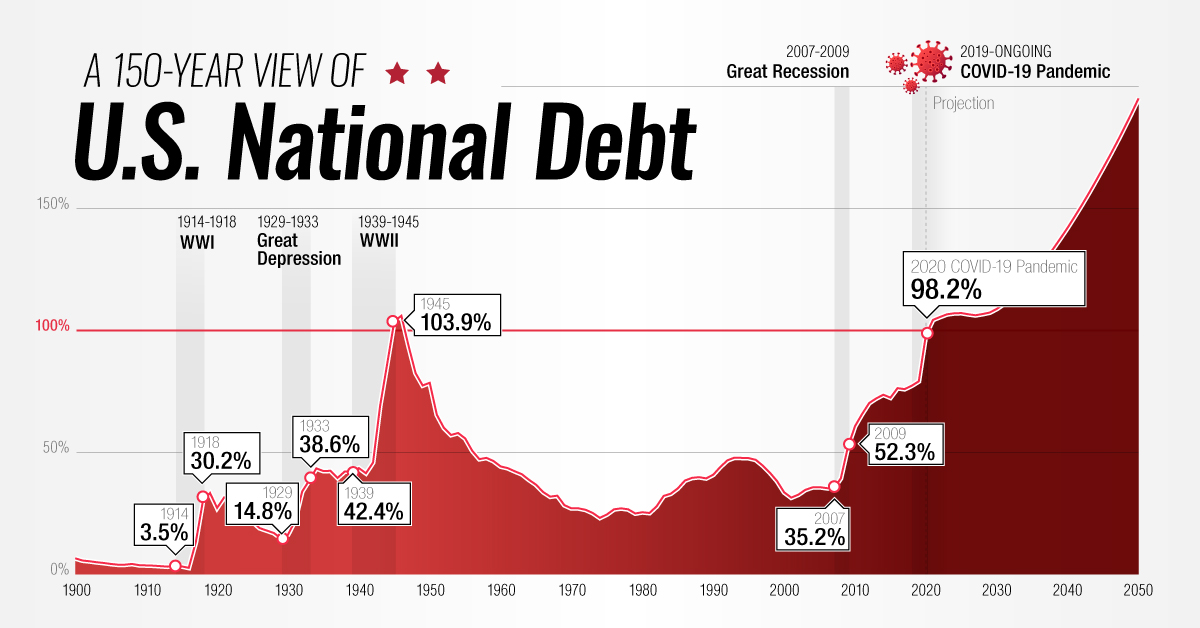
Spending. It’s a matter of simple fact that government spending and debt have gone up considerably — both in absolute terms and as a percentage of our annual GDP — in the late Trump years and since Biden took office. Basically, the Covid pandemic both cut revenue and required enormous government spending to avoid great public suffering while the private sector was largely shut down. The necessity of that deficit spending was a bipartisan conclusion; it happened under both Trump and Biden and was supported in Congress by members of both parties.

(Notice that the extreme right of the graph above is a projection to 2050, not something that has already happened.)

That increase in the debt built on a previous run-up during the Great Recession that started in 2007. Again, the stimulus spending and tax-cutting was bipartisan; it began under Bush and continued under Obama.

But looking forward, the US faces challenges that the two parties see differently. Democrats want the government to spend money on them, while Republicans don’t.

  • Democrats see climate change as a problem that requires a major restructuring of the economy, moving away from fossil fuels and towards energy from sustainable sources. However, climate change is a classic externality — a real cost that falls neither on the producer nor the consumer of fossil fuels — so the market will not make this shift without government intervention. Republicans deny that climate change is a problem.
  • Democrats want to shift healthcare — nearly 1/7th of the economy — from the private sector to the public sector. Medicare began this shift in the 1960s. ObamaCare continued it, and progressives like Bernie Sanders would like to complete it. Republicans would like to stop this shift, if not roll it back.

Abstract debates about “spending” are really about these two issues, plus the perennial question of how good a safety net the US should provide for its poor: Is it enough to keep people from starving in the streets, or should the government guarantee every American a decent life, whether they can find a job or not?

It’s worth noting that the other big government expenditure — defense — is largely bipartisan. In general, progressive Democrats would like to spend less on defense and MAGA Republicans more, but neither party has a consensus for major changes in our military posture in the world.

The politics of spending. The bill House Republicans recently passed reflected these priorities: It agreed to raise the debt ceiling for about a year (at which point we’d go through the same ordeal again), in exchange for

  • capping “discretionary spending” — basically everything but Social Security and Medicare — at FY 2022 levels and letting them increase by only 1% per year.
  • rolling back provisions in the Inflation Reduction Act to subsidize sustainable energy, while increasing production of fossil fuels

plus a few other things. The discretionary spending cap isn’t across-the-board, but also doesn’t specify the cuts. This allows Republicans to dodge when Democrats say they’ve voted to cut some popular program like veterans’ benefits. And of course, every program that gets exempted from the cuts means that deeper cuts will be needed elsewhere.

The White House has been attacking Republicans for proposing cuts to veterans’ care. Republicans in House leadership have responded that no cuts are intended. House Speaker Kevin McCarthy has promised he will protect the military from reductions, though the bill as written does not exclude them. And Kay Granger, the chairwoman of the House Appropriations Committee, has said border security remains a top priority.

This is a feature of our politics that I’ve noted before: The American people don’t really understand where government spending goes, so they support spending cuts in the abstract, while rejecting any specific list of significant cuts.

The two parties maneuver around that phenomenon: Republicans support vague spending “caps” that don’t specifically cut anything in particular, while Democrats try to pin them down. Do they want to cut defense? Veterans benefits? Health care? Education? No, of course not. They just want to cut “spending”.

Is government spending a problem? For Republicans, this is an article of faith, but it’s really not obvious. For example, look at Wikipedia’s list of countries by government spending as a percentage of GDP. (The US total accounts not just for federal spending, but state and local as well.)

As of 2022, the US was not an outlier in either direction, spending about 38% of GDP via government. That’s less that most comparable countries: the UK (45%), Germany (50%), Canada (41%), and France (58%) for example. But it’s also more than Switzerland (34%) and Israel (37%), and almost exactly the same as Australia.

And while government spending has been generally rising over the decades — it was less than 20% of GDP a century ago — the increase doesn’t look precipitous or out of control.

In short, if you argue that the US has a spending problem, what you’re implicitly saying is that we shouldn’t be like other nations. If you regard Germany or France as cautionary tales, then we need to cut spending before we wind up like them. On the other hand, if you envy countries like Denmark (49%), the Netherlands (45%), and Finland (54%) — Finland regularly comes out on top of polls about public happiness — then you can only shake your head at this “out-of-control spending” talk.

The ledger has two sides. So while the “spending problem” is debatable, it is obvious that the national debt is growing. Intuitively this seems bad (though I’ll push discussing how bad it really is off to a later post). But jumping immediately from a debt problem to a spending problem is sleight-of-hand. Spending 38% of GDP (or 50% or even more) through the public sector doesn’t necessarily create debt if we’re willing to pay taxes at that level.

Our debt problem (from the same Wikipedia list) comes from the fact that we’re only paying 33% of GDP in taxes. This is not high by comparison with other countries. South Korea pays 27% and Ireland 23%, but just about every other country we might compare ourselves to pays more: Germany 47%, Canada 41%, the United Kingdom 39%, and so on.

So it’s disingenuous to frame the debt as a national crisis, but take taxes off the table. In particular, the Trump tax cuts went mainly to corporations and the very rich, while adding trillions to the debt over a ten-year period. Most spending cuts are unpopular in themselves, but they’re particularly unpopular when you pair them with tax cuts, as in “We have to kick your cousin off Medicaid so that billionaires can keep the tax cuts Trump gave them.”

The private sector isn’t magic. Much of the debate about government spending is really about whether some necessary expense winds up in the public or private sector. We could, for example, cut government spending overnight just by closing all the public schools. Kids would still need to be educated, and most middle-class-and-above families would find some way to send their own kids to private schools (maybe with help from grandparents). Taxes could go down, but private expenses would go up.

Ditto for Social Security. We could end it an save everybody taxes. But you’d also have to worry about whether your parents or grandparents were starving, and maybe they’d have to move in with you.

All our highways could be toll roads run by private corporations. Taxes could go down, but you’d have to pay tolls.

The point I’m making here is that nothing magic happens when we move an expenditure from the public to the private sector or vice versa. Somebody still has to teach the kids, take care of the sick, and pave the highways. You don’t necessarily save anything just by paying those people out of a different piggy bank.

That observation is going to be important the next time we consider expanding national health care. Conservatives are going to freak out about the massive increase in government spending. “OMG! We can’t afford this!” But if the net effect is that taxes replace health-insurance premiums, we can. That’s the main reason government spending (and taxation) is higher in places like France and Germany: They’re buying stuff through the public sector that we buy through the private sector. People still wind up paying doctors and nurses to take care of them, but the money traverses a different route.

Spending and democracy. Finally, we need to recognize that the current situation results largely from what the American people want: The particular programs the government spends money are popular, while taxes are unpopular. The current spending and taxing levels were passed by the Congress the people elected.

The point of using the debt ceiling as a hostage-taking tactic is to circumvent democracy. Yes, the people did narrowly elect a House Republican majority in 2022, but Republican candidates ran on issues that have largely vanished from the House Republican agenda, like crime. They certainly did not run on a list of spending cuts, and in fact they still have not produced such a list, because they know it would be unpopular.

The American people have also elected a Democratic Senate majority and a Democratic President. (Both of those happened in spite of structural factors that allow Republicans to win without representing a majority of voters, like the small-state bias in the Senate and the Electoral College.) The Republican House should not get to control the agenda simply because they are apparently willing to push the economy’s self-destruct button unless they get their way.

So what should happen? The debt ceiling should play no role, and Congress should work out a budget for next year, adjusting both the taxing and spending sides of the ledger. Republicans should have a bigger say in the next budget than the last one, because they won the House majority. But both parties should publish their budget priorities and see how the American people like them.

So is there a spending problem? Not really. Not by international standards and not compared to what the people want. What the government spends money on may or may not be what you want it to spend money on. But that’s why we have elections.

Laboratories of Autocracy

The 20th-century Supreme Court Justice Louis Brandeis once called the American states “laboratories of democracy”. But recently the red states have been experimenting with something else entirely.


In his 2018 book Reconstructing the Gospel, Christian minister Jonathan Wilson-Hartgrove reflected on one of the paradoxes of religious fervor.

Even as we feel guilty about doing the things we know we ought not to do, and strive to do more of the good we want to do, our very worst sins are almost always things we know to be our Christian duty.

He illustrated the point with examples: the Crusades, the high priests who condemned Jesus, and the Southern “Redeemer” movement, whose violent terrorism ended Reconstruction and inaugurated Jim Crow.

Over and over, Christians support and participate in atrocious evil, not because we choose to do wrong, but because we think we’re doing the right thing — the righteous thing, even.

Not wanting to pick on Christianity, I’ll add some secular examples: the Reign of Terror, Mao’s Cultural Revolution, and the Bush administration’s torture policy. Wilson-Hartgrove is pointing to a human thing, not a uniquely Christian thing. Cruelty is often practiced by people who imagine themselves to be heroes.

Seekins-Crowe. I recalled Wilson-Hartgrove’s observation this week, when Rep. Kerri Seekins-Crowe‘s moving and highly emotional speech went viral.

Seekins-Crowe gave the speech in March, during the debate over Montana’s new law banning gender-affirming care for minors. (The bill passed and was signed Friday by Governor Greg Gianforte.) The main argument against the bill was that it would cost lives. (We’ll get to Rep. Zooey Zephyr’s “blood on your hands” comment later on.) Teens struggling with their gender identity have a high suicide rate; gender-affirming care is often an attempt to save their lives. So banning it may well increase teen suicides.

Seekins-Crowe did not shy away from that argument. She did not scoff at it or trivialize it, but took the bull by the horns. She explained that she had lived for three years with a suicidal daughter, and so she knows that some things are more important than saving your child’s life.

That seems like a brutal summation of her words, so I feel obligated to quote her at length and provide a video.

One of the big issues that we have heard today and we’ve talked about lately is that without surgery the risk of suicide goes way up. Well, I am one of those parents who lived with a daughter who was suicidal for three years. Someone once asked me, “Wouldn’t I just do anything to help save her?” And I really had to think. And the answer was, “No.”

I was not going to give in to her emotional manipulation, because she was incapable of making those decisions and I had to make those decisions for her. I was not going to let her tear apart my family and I was not going to let her tear apart me, because I had to be strong for her. I had to have a vision for her life when she had none, when she was incapable of having [one].

I was lost. I was scared. I spent hours on the floor in prayer. Because I didn’t know that when I woke up if my daughter was going to be alive or not. But I knew that I had to make those right decisions for her so that she would have a precious, successful adulthood.

Monstrous as it is, I can’t watch that video without feeling Seekins-Crowe’s sincerity. She believes what she is saying, and believes that letting her daughter suffer for three years was the right thing to do. (I have no idea how that story came out. After three years, did the daughter stop being suicidal, or just reach adulthood?) And now, she believes that passing this law is the right thing to do. I have little doubt that she would describe it as her Christian duty.

That speech is, I think, an almost perfect distillation of the authoritarian mindset: People who see the world differently than I do are deluded, so I have to be strong enough to make their decisions for them, even if it kills them.

There is, of course, room for debate about when parents ought to overrule their children’s desires. Nearly every parent, at some time or another, has forced a toddler to go to bed, or refused to let one eat all the candy. Those calls get harder as children grow, and I don’t know any clear rule about when someone is old enough to make their own decisions about gender-affirming medical interventions.

But now Seekins-Crowe has taken the next step, and is making “right decisions” for all the parents in Montana, particularly those who might not be “strong” enough to ignore their children’s anguish, or sure enough of their own convictions to close their ears to whatever their children might say. Those “weak” parents need a strong government, full of strong people like Seekins-Crowe herself.

Providing that strength is her Christian duty.

Watching Seekins-Crowe’s speech makes me realize that conservative leaders like Donald Trump and Ron DeSantis have spoiled me, because their villainy is so direct and uncomplicated. I have no doubt that Trump knows he is a grifter, and that he is consciously taking advantage of the people who support him. Likewise, DeSantis knows that critical race theory is not a thing, and that Florida’s librarians and grade school teachers are not grooming children for pedophilia.

If everyone on the other side were like that, life would be simple. But instead the world is full of Abrahams whose willingness to sacrifice Isaac makes them feel closer to their God.

What can we do with them?

I don’t have an answer for that question, so I’m just going to continue talking about the Montana legislature, and red-state governments in Texas and Florida that also gave us insight into authoritarianism this week.

Zooey Zephyr. One thing authoritarians don’t do is tolerate dissent, particularly from people they deem inferior. A few weeks ago, the Tennessee House decided not to tolerate Justin Jones and Justin Pearson, who are Black. The Justins delayed the business of the House for an hour or so by encouraging pro-gun-control demonstrators in the gallery, so they were expelled from office. But the people of their districts put them right back.

This week, the Republican supermajority in the Montana House did something similar to Zooey Zephyr, a trans woman (whose adulthood, in Seekins-Crowe’s terms, must not be “precious” or “successful”). On April 18, during debate on the bill banning gender-affirming care for minors (and several other anti-trans bills), she was blunt:

This body should be ashamed. If you vote yes on this bill and yes on these amendments I hope the next time there’s an invocation, when you bow your heads in prayer, you see the blood on your hands.

In response, the ironically-named Freedom Caucus in the Montana House called for “his” censure because of that “threatening” comment. Majority Leader Sue Vinton responded directly (and self-righteously) to the “shame” comment:

We will not be shamed by anyone in this chamber. We are better than that.

The censure resolution was not immediately taken up, but the Speaker refused to recognize Rep. Zephyr when she rose to speak, and said that he would not do so until Zephyr apologized, which she refused to do.

Last Monday, hundreds of pro-Zephyr demonstrators came to the Capitol. When Zephyr rose and was ignored, they loudly chanted “Let her speak.” The Speaker still did not recognize Zephyr, and the House ground to a halt for half an hour until the demonstrators could be removed. On his way to jail, one demonstrator explained:

In this country you don’t get many rights but one of the things you do get is an elected representative, and 11,000 Montanans are waiting for Zooey Zephyr to speak for them, to represent the interest of trans people in the state who belong in the state as well. It’s not just … the old white men who run the show over here. It’s every single person. Montana is big enough for all of us, and I think it has space for all of us.

Republicans have since inaccurately described the demonstrations as “violent” and “an insurrection”. (I commented two weeks ago on the Right’s practice of breaking words that have been used against them. Ever since January 6 they have been trying to break insurrection through misuse. It falls flat to claim that January 6 was merely a “protest”, so they have been characterizing any liberal protest as an insurrection.)

Zephyr was blamed for this breech of “decorum” (the same offense charged against the Justins). So she was banned from the House floor for the remainder of the session (which ends May 5). The resolution banning her did not also bar her from serving on committees, but all the committees she serves on then had their remaining meetings cancelled.

Like the Justins, Zephyr returned home to a large rally of her supporters. (Remember: “Large” means something different in Montana, where each House district has only about 11,000 people.) Since the legislature only meets in odd-numbered years, her term is effectively over. But she’ll be running for reelection in 2024.

Universities. Another thing authoritarians do not tolerate is an alternative source of institutional authority. That’s why the current crop of red-state authoritarians is working so hard to bring the universities under control. Universities do not wield power directly, but they are recognized sources of authoritative opinion. So they cannot be allowed to remain independent.

A number of German words have already made it into the American vocabulary — zeitgeist, schadenfreude, realpolitik, gestalt, wanderlust. Well, it’s time to learn another one: gleichschaltung, whose root words mean “same circuit”. Originally an engineering term translated as “coordination” or “synchronization”, gleichschaltung was adapted in the 1930s to describe the process of unifying German society and culture under Nazi ideology. Simply controlling the national government wasn’t good enough; the kind of German renewal the Nazis promised could only be accomplished by a unified society whose institutions all pulled in the same direction. So local governments, corporations, unions, professional associations, universities, social clubs, and youth organizations all needed “coordination”.

This week, Texas took a step towards its own gleichschaltung when its Senate passed SB-18, which would eliminate tenure in the state’s universities.

An institution of higher education may not grant an employee of the institution tenure or any type of permanent employment status.

Current tenured faculty are grandfathered in, but no new tenured appointments would be made after September 1. The Texas Tribune claims that the bill “faces an uphill battle at the Texas House”, so perhaps Texas’ university system will be spared for another term or two.

The argument for the bill is primarily political, not educational.

[Lieutenant Governor Dan] Patrick’s push to end tenure in Texas started more than a year ago after some University of Texas at Austin professors passed a nonbinding resolution defending their academic freedom to teach about issues like racial justice. The resolution came as Republicans hinted that they wanted to extend restrictions on how race is discussed in K-12 classrooms, which were approved by the Texas Legislature in 2021, to the state’s public universities.

The resolution outraged Patrick, who accused university professors of “indoctrinating” students with leftist ideas and argued that the state must stop awarding tenure because faculty with the benefit don’t face any repercussions for it.

But that’s precisely the justification for tenure: It allows academics to do their jobs without worrying about offending the politicians currently in power. In a liberal democracy, universities are not supposed to be “coordinated” with the ruling party.

Florida is another state trying to synchronize its educational institutions with government ideology. Governor DeSantis’ Stop WOKE Act created a list of ideas that cannot be taught in Florida public schools, including the state universities. The part affecting the universities has been blocked by a federal judge, whose ruling says:

The First Amendment does not permit the State of Florida to muzzle its university professors, impose its own orthodoxy of viewpoints, and cast us all into the dark.

But acts of the legislature are only one path to gleichschaltung. The governor also has executive power to appoint trustees to university boards. DeSantis’ new trustees are in the process of coordinating New College in Sarasota. At a recent meeting, all five faculty members up for tenure — including three in the supposedly apolitical hard sciences — were rejected, and the faculty chair (who had been broadly criticized for being too accommodating to the new regime) quit.

Disney. I mentioned corporations in the list of things that need to be synchronized with the ruling ideology. Well, after DeSantis passed his Don’t Say Gay law, Disney had the temerity to put out a statement saying that it opposed the law and would continue to work against it through the systems our constitution provides for reversing government actions:

Our goal as a company is for this law to be repealed by the legislature or struck down in the courts, and we remain committed to supporting the national and state organizations working to achieve that.

All in all, it was pretty tepid stuff, but it marked Disney as a company not marching to the DeSantis drum. That led DeSantis to strike at Disney in ways that fell comically flat: A bill to dissolve the special taxing district around Disney World had to be undone when nearby counties noticed they might wind up responsible for about $1 billion in bonds the district had outstanding. Then DeSantis announced a takeover of the board that oversees the district, but was again outsmarted by an agreement Disney signed with the outgoing board.

Now DeSantis is trying to get the legislature to nullify that agreement, and Disney decided it had had enough: It filed a federal lawsuit claiming that DeSantis is illegally retaliating against Disney for speech protected by the First Amendment.

There is no room for disagreement about what happened here: Disney expressed its opinion on state legislation and was then punished by the State for doing so. … This is as clear a case of retaliation as this Court is ever likely to see. …

It is a clear violation of Disney’s federal constitutional rights—under the Contracts Clause, the Takings Clause, the Due Process Clause, and the First Amendment—for the State to inflict a concerted campaign of retaliation because the Company expressed an opinion with which the government disagreed. … In America, the government cannot punish you for speaking your mind.

The reason there’s “no room for disagreement” is that DeSantis didn’t just announce in public that he was abusing state power to punish Disney for making a political statement, he wrote about it in his book. DeSantis clearly could have benefited from the class Stringer Bell taught in The Wire:

Is you taking notes on a criminal f**king conspiracy? What the f**k is you thinking, man?

DeSantis’ defense of his actions is that Disney’s control of the special taxing district around Disney World is an inappropriate merging of state and corporate power, so he is right to take it away. And in the abstract, that may even be true. But legal and even reasonable exercises of government power become unconstitutional when they are used to punish speech protected by the First Amendment, as these actions clearly were.

David French looked up the appropriate legal precedent: O’Hare Towing Service v City of Northlake (1996). Speaking for a 7-2 majority, Justice Kennedy wrote:

If the government could deny a benefit to a person because of his constitutionally protected speech or associations, his exercise of those freedoms would in effect be penalized and inhibited. Such interference with constitutional rights is impermissible.

But in spite of the governing precedent, French is still not entirely sure how the case will come out.

At the beginning of this piece, I said that DeSantis should lose, not that he will lose. Court outcomes are never completely certain, but this much is correct: A Disney defeat would represent a dangerous reversal in First Amendment jurisprudence and cast a pall of fear over private expression.

French is afraid, in other words, that gleichschaltung may already have reached the Supreme Court.

Reflections on driving across America

Why aren’t rural people even crazier than they are?


Over the last month, I’ve driven nearly six thousand miles. My wife and I started in Massachusetts, where we live, and went first to central Illinois, where I grew up. From there we struck out towards Sedona, where the red rocks are, and towards the Georgia O’Keefe landscape of Santa Fe, home of one of my favorite cuisines. On the way home, we saw family in Nashville.

Between those highlights, we strung together a series of roadside attractions, like the otherwise undistinguished corner in Winslow that the Eagles sang about, or the figuratively (but not literally) tasteless Uranus Fudge Factory in Missouri. We considered stopping for many other diversions, like the Superman statue in Metropolis, Illinois, but kept driving. We passed maybe dozens of Route 66 museums, and countless Native American trading posts that seemed far too small to contain all the wonders promised by miles and miles of billboards. My best eating days being behind me, I did not try to win the free 72-ounce steak in Amarillo.

In other words, I have been seeing America, the “real America” that gets lauded at Republican rallies and NRA conventions.

A lot of it struck me as depressing. Through much of the drive, I was plagued by the thought “Why does anybody live here?” Or, more accurately, “Why will anybody live here?”

Of course I knew why people had settled the farm country where I grew up: The soil was rich, the Native Americans had vanished through some process we preferred not to think about, and the Homestead Act had divided the newly empty land into 160-acre plots that an ordinary White man could afford. Thomas Jefferson’s vision of a nation of yeoman farmers — who might never get rich, but would have the independence that comes from owning the land they tilled — was becoming real.

That agricultural land produced surplus, which needed to get to the cities somehow. So there were river ports like Cincinnati and Louisville and (eventually) St. Louis. In return, the farmers needed whatever tools and luxuries they couldn’t produce themselves, so trading posts developed into small towns, where doctors, dentists, lawyers, and accountants could hang a shingle. Eventually you had a real economy.

When industrialization happened, those small towns turned out to be ideal places to site factories. They had transportation, and surplus labor coming off the mechanizing farms. So you had John Deere in Moline, Caterpillar in Peoria, and countless lesser enterprises dotted across the landscape.

In the mid-20th century, it all made a lot of sense. But it doesn’t any more.

For decades I’ve been making the 300-mile drive from Chicago to my hometown, Quincy, Illinois. Quincy itself has been holding steady at around 40,000 people. It’s the biggest thing for 100 miles in any direction, so it has become the regional retail center. It has lost most of the factories I remember from my youth, and the ones that remain employ far fewer people, but there appear to be jobs (of a sort) at the Home Depot and the Walmart. The small hospital where I had pneumonia when I was three is now a sprawling campus that gets bigger every time I visit. Upper-middle-class people from St. Louis or Chicago can retire to Quincy and build mansions, so a number of them do.

Population-wise, it more or less balances out.

But the drive from Chicago goes through a lot of dying towns, ones that are too small or too close to something else to become regional centers. Homestead Act farms have been amalgamated into agribusinesses that support far fewer families. As the countryside depopulates, the towns lose their supermarkets and general stores, and then eventually even their gas stations. Where two or three restaurants used to compete, now there’s maybe enough traffic to support a bar. If you live there and want a gallon of milk, you need to drive a few dozen miles to a regional center like Quincy.

While the voices coming through my satellite radio debated the future impact of artificial intelligence, I was picturing electric robot combines roaming across the endless prairie, powered by automated windmills.

Why will anybody need to live here at all? And if some people want to live here, maybe because their families have lived here for generations, what will they do?

On the way from the fudge factory to Nashville, I resisted the macabre urge to see Cairo (pronounced KAY-ro). Cairo sits at the confluence of the Ohio and the Mississippi, which sounds like it ought to be the site of a great city. St. Louis, Pittsburgh — lots of cities have been founded at the confluence of rivers. The rich, fertile land surrounding Cairo is said to be the source of the region’s nickname “Little Egypt”. As Jacob’s sons made their way to Egypt to escape a Biblical famine, so did the surplus of Little Egypt feed the areas around it.

So Cairo’s original settlers must have had visions of empire. It never quite worked out that way, but the town did prosper as a minor transportation hub, growing to about 15,000 people by the 1920s. Mansions were built there in the late 1800s.

But transportation routes changed. Symbolically, Cairo used to be a stop on the City of New Orleans train made famous by Steve Goodman’s song. But although that train has still not disappeared (as Goodman mournfully envisioned) it doesn’t stop in Cairo any more. Hardly anybody does.

In addition to its economic challenges, Cairo had a history of lynching, and did a bad job managing the racial conflicts of the 1960s. And now the town is down to about 1700 people, barely a tenth of its previous size. The downtown is mostly boarded up.

I grew up picturing ghost towns as artifacts of the western deserts. Mines created boom towns, but then the mines played out and there was no reason to live there any more. As a child, I could not have imagined ghost towns in the farm country, but now I can.

The outlook gets even worse as you go west. Much of the agriculture of the Great Plains is based on pumping water out of the ground, which has gradually depleted aquifers like the Ogallala. Long term, that land won’t even support the robot combines. As far back as 1987, Deborah Epstein Popper and Frank J. Popper were envisioning letting the whole region go back to nature, restoring the “buffalo commons” that existed before the White man came.

Driving through this empty land gives you a lot of time to think, and one of the questions I considered was “What does living in a place with no future do to your outlook on life?”

Of course, the individuals who grow up in these places do have viable paths into the future. They can, for example, do what I did: Get a scholarship to a state university and earn a marketable credential they can cash in somewhere else. In this era of diminishing state education budgets and correspondingly higher student debt, that path is not as smooth as it used to be. But it is still there.

But what if you love your home in more than just a sentimental way? What if the people and the landscape and the way of life has burrowed deep into your soul? What if catching a lifeboat out seems less like an exciting adventure and more like exile?

And what if you’re older? What if you have children and grandchildren you’d dearly love to keep around you, but you know you can’t? For their own sakes, they need to go. And they need to leave you behind.

What does that do to your outlook on the world? Maybe in that situation, you wouldn’t like thinking of yourself as the victim of History’s impersonal forces. Maybe you’d prefer to imagine conspiracies that have stolen your future from you. Maybe those conspiracies would center on your children, on pulling them away from you or turning them against you or making them unrecognizable. Somebody — let’s call them “liberals” (or maybe “Jews”) — wants to make them “woke”, or turn them gay or trans, or replace them with dark-skinned immigrants.

Imagining such things may not give you hope, but at least it gives you someone to blame. Maybe that helps.

Last week I was writing (yet again) about fascism. I observed that the Trumpist brand of fascism isn’t even pretending to offer solutions to its rural supporters. Rather than a new deal, Trump promises vengeance. “I am your retribution,” he has been telling his rallies.

Maybe that’s what passes for “telling it like it is” in certain circles. Once you see that the future is hopeless, then it’s the people making plans and promises who sound like grifters. The “straight talkers” just promise to make other people suffer, which you are confident they can do.

How do we deal with this? I keep coming back to that Obama “Hope” poster. Somehow, we have to address the widespread sense of hopelessness in America without sounding like bigger grifters than Trump is. In a contest of solutions, liberals have it all over conservatives. But if there are no solutions, why not just lash out against the people you hate?

So anyway, I have been to the wilderness and seen a vision. Now I’m trying to get it out of my head so I can get on with life. If I’ve transferred that vision into your head, I apologize.

Why fascism? Why now?

We spend a lot of time thinking about how fascism is rising, but not nearly enough about why.


Week after week, I find myself chronicling the signs of a rising fascism, both in the United States and around the world: the January 6 insurrection (and the attempts to write it off as no big deal), the parallel Bolsonaro riot in Brazil, Governor Abbott’s offer to pardon a conservative for murdering a liberal protester, increasing state violence in India (“politicians are learning that violence can yield political dividends in a country deeply polarized along religious lines”), refusal to accept that electoral defeat can be legitimate, defense of treason if it supports your cause (“Jake Teixeira is white, male, christian, and antiwar. That makes him an enemy to the Biden regime. … Ask yourself who is the real enemy?”), the increasingly cynical abuse of right-wing political and judicial power, combined with a reflexive tolerance for right-wing corruption in high places. And so on. [1]

Examples of rising fascist tendencies easily draw attention and produce fear for the future. But much less attention gets focused on the deeper question: Why is this happening now? Fascism has never been completely stamped out, but for decades it was a fringe phenomenon. By and large, losing parties admitted their defeats, tacked back to the center, and tried to regain majority support rather than disenfranchise the voters who rejected them. Elected officials distanced themselves from violence, treason, and blatantly corrupt allies.

What changed? It can’t just be the fault of one bad leader. How, for example, could Donald Trump or Vladimir Putin be causing a drift towards fascism in Europe or South America or India or Israel?

Recently I happened across two essays that address this question in different ways: science fiction author David Brin’s “Isaac Asimov, Karl Marx, & the Hari Seldon Paradox” and Umair Haque’s “The Truth About Our Civilization’s Fascism Problem Is Even Worse Than You Think“. I don’t intend to broadly endorse either author (especially Haque, who in general seems far too negative and fatalistic for me), but both have insights that strike me as important.

The post-war “miracle”. For both Haque and Brin, the key question isn’t why fascism is rising now, but how it got pushed to the fringe for decades after World War II. Haque explains it like this:

Consider the founding of modern Europe. Its entire idea was to prevent the far right ever rising again. Modern Europe, rebuilt in the ashes of the war, did something remarkable, that led to what later observers like me would call the European Miracle. It took the relatively small amount of investment that America gave it — which was all it had — and used that in a way that was fundamentally new in human history. Instead of spending it on arms, or giving it to elites, it used it rewrite constitutions which guaranteed everything from healthcare to education to transport as basic, fundamental, universal rights.

This was the point of Keynes’ magisterial insight into why the War had happened. Germans, declining into sudden poverty, destabilized by debt, had undergone a political implosion. Economic ruin had had political consequences. The consequences of “the peace” as Keynes said — the peace of World War I, which had been designed to keep Germany impoverished. Fascism erupted as a result. And so after the Second World War, Europe did something bold, unprecedented, and remarkable in all of human history — it offered its citizens these cutting edge social contracts, rich in rights for all, built institutions to enact them, from pension systems to high speed trains, and then formed a political union on top of that, to make sure that peace, this time, remained.

Fascism, in Haque’s view, is a political technique for gathering up the misery of the masses and focusing it on scapegoats rather than solutions. The primary promise of the fascist leader is revenge, which will solve the problems of his followers through some magical process of subtraction rather than addition. Throwing rocks through the windows of Jewish businesses or preventing trans kids from getting gender-affirming care will somehow make your own life better. Break up the families of migrants seeking asylum, and somehow your own inability to care for your sick wife or send your children to college will not hurt so much.

America and England both had fascist movements in the 1930s, but they didn’t catch on like Germany’s. Maybe that was because — even in the depths of the Depression — neither country had Germany-level misery. Neither country experienced quite the sense of failure and loss of hope that made Hitler seem like a compelling way forward.

But Brin points to something else that happened in 1930s America: the New Deal, which confounded Karl Marx’ prediction of ever-increasing dominance by wealthy capitalists, inevitably leading to a revolutionary explosion.

Karl Marx never imagined that scions of wealth – Franklin Delano Roosevelt and his circle – would be persuaded to buy off the workers, by leveling the field and inviting them to share in a strong Middle Class, whose children would then (as recommended by Adam Smith) be able to compete fairly with scions of the rich. 

It was a stunning (if way-incomplete) act of intelligence and resilience that changed America’s path and thus the world’s.

Brin, recalling the lessons of Isaac Asimov’s Foundation series, invokes the Seldon Paradox: “Accurate psychohistorical predictions, once made known, set into effect psychohistorical forces that falsify the prediction.” In this case, American plutocrats like “that smart crook, Joseph Kennedy” took Marx’ predictions seriously and tried to head them off. Brin quotes Kennedy: “I’d rather be taxed half my wealth so the poor and workers are calm and happy than lose it all to revolution.”

Kennedy’s view was far from universal among the American rich, but it did split the forces of plutocracy, enabling the creation of an American safety net.

Post-war Europe took the lesson further, as Haque describes:

What do Europeans enjoy, still, even though it’s teetering now, that Americans don’t? All those rich, sophisticated social contracts, one supposes, which guarantee them everything from high speed transport to cutting edge healthcare.

But there’s more than that. All that creates — or did for a very long time — a feeling that doesn’t exist in America. A sense of community. A kind of peace, which you can readily see in the absence of gun massacres in Europe, even though, yes, there are guns, if not quite so many. Stronger social bonds and ties — Europeans still have friends, and in America, friendship itself has become a luxury. All that matters.

The short description of what Europe achieved is public happiness.

Fascism is born of rage, fear, despair, which drives people into the arms of demagogues, who blame all those woes on hated subhumans, “others” — and so the truest antidote we know of to all that is human happiness itself.

Revenge, not hope. That observation explains one of the great mysteries of current American politics: why the GOP has no governing program. The party has a clear constituency: the non-college White working class, particularly in rural areas. So why are there no plans to do anything for them?

Think about it: expanding Medicaid to save not just the families of the working poor, but rural hospital systems as well; bringing broadband internet to rural areas; raising the minimum wage; shoring up community colleges — those are all Democratic goals that Republicans do their best to block.

It’s not that Republicans have no proposals. The red-state legislatures they control are buzzing with activity: loosening gun laws, taking away women’s bodily autonomy, banning accurate accounts of racism from schools, defunding libraries, and making trans youth invisible, just to name a few.

But how exactly does that help anybody?

Or take that frequent Trump claim that “They’re not after me, they’re after you. I’m just in the way.” Who is after you? How did Trump ever stand in their way? Even a sympathetic NY Post columnist has no answer for that. He spins conspiracy theories of how the Deep State has been out to get Trump from the beginning, but what does any of that have to do with the “you” in Trump’s statement?

What Trump offered “you” was revenge. Those people you hate: the Muslims, the queers, the immigrants, the Blacks, the educated “elite”, and so on. He demeaned them, insulted them, made them suffer. He “owned the libs” and made them hopping mad in ways that you never could have managed on your own..

But he never did anything to improve your life, because that was never the point. It would, in fact, have been counterproductive, because MAGAism needs your misery. If you felt more secure, more hopeful, more capable of dealing with a changing world, then you wouldn’t need revenge any more. And you wouldn’t need Trump.

Beyond the Seldon Paradox. So what happened to public happiness? Now we bounce back to Brin, who quotes a corollary to the Seldon Paradox: After people adjust to dire predictions and cause them to fail, the next generation stops taking the predictions seriously. And then they come true.

In other words, what we are seeing now… a massive, worldwide oligarchic putsch to discredit the very same Rooseveltean social compact that saved their caste and allowed them to become rich… but that led to them surrounding themselves with sycophants who murmur flattering notions of inherent superiority and dreams of harems. Would-be lords, never allowing themselves to realize that yacht has sailed.

In other words: Marx? Who listens to Marx any more? All his nonsense predictions turned out to be laughably false.

So sometime in the 1970s, the plutocratic counter-revolution began. One turning point was the infamous Powell Memo, written in 1971 by future Supreme Court Justice Lewis Powell for the U.S. Chamber of Commerce. The American system of free enterprise, he wrote, was under broad attack from socialist thinkers, and business leaders had been responding with “appeasement, ineptitude and ignoring the problem”. Powell outlined a multi-faceted program to create a new intellectual climate in America, one more favorable to corporate power and the influence of big money.

Within ten years, Ronald Reagan was president, and the United States had embarked on an era of ever-lower taxes on the rich, restrictions on corporate regulation, and union-busting.

And that was the end of the great American middle class. From 1940 through 1980, income growth among the rich had lagged behind the larger public, but after the Reagan Revolution it rapidly made up the difference.

Then and now. A decline in human happiness and hope can lead to a Marxist revolution. (That was one possibility in Weimar Germany as well.) But it also creates opportunities for fascist scapegoating.

So if you don’t feel as successful as your parents were at the same age, and you see even worse prospects waiting for your children, whose fault is that? Maybe it’s the Jews. Maybe it’s the November criminals who stabbed your valiant German soldiers in the back at Versailles. Maybe it’s the decadent culture of big cities like Berlin: the gays, the transvestites, the young people dancing to that African “monkey music” from America.

If only we had a leader strong enough to make them pay.

See the resemblance?

Lessons. So where does that leave us? What lessons can we draw? One lesson is to keep our own resentment tightly focused on the people who deserve it. Working class Americans who see little hope for their children are not our enemies, even if they vote for our enemies. We shouldn’t want revenge on them, we should want them to have better prospects, so that they lose their own need for revenge.

Us against Them is the fascist conversation. We can’t let ourselves be drawn into it.

Our salvation will not come through their misery. Quite the reverse. If we are to be saved, it will have to be through happiness — everyone’s happiness.

And if we’re lucky, maybe some rebel faction of smart plutocrats will come to see the same thing.


[1] Some want to argue about whether to call this worldwide movement “fascism”. I’ve explained why I do, but if you’d rather reserve the word for Hitler, Mussolini, et al, that’s fine. Trump, Orban, and Bolsonaro are certainly not identical to Hitler, Mussolini, and Franco, but I would say that 20th-century fascism differs in some particulars from 21st-century fascism, not that they are completely different animals.

The important thing is that the lack of a word doesn’t lead to an inability to discuss the phenomenon, in the fashion of Orwell’s Newspeak. Simply referring to Trump, Orban, Bolsonaro, Modi, et al as “authoritarians” (as Tom Nichols does) is not nearly specific enough. Any general who stages a successful coup is an authoritarian. But an anti-democratic movement that anoints one segment of the citizenry as the “real” or “true” citizens, and scapegoats the “unreal” or “false” citizens as the cause of all the nation’s problems, justifying discrimination and even violence against them — that’s something more than just “authoritarianism”.

In short, I’d be content to use some other word to carry on a discussion with someone who wants Hitler to be unique. But that word has to capture the full evil of the phenomenon, without diluting it by including anyone who finds democratic governance inefficient.

What we learned from the Trump indictment

If you were hoping for more detail about the DA’s case, you were disappointed. But that doesn’t imply the case against Trump is weak. Now the wheels of justice will grind slowly.


For weeks I’ve been trying not to waste my time (or yours) on speculation, but at last there’s finally something real to talk about.

Donald Trump, a private citizen who no longer has any connection with the presidency, showed up for his arraignment in New York on Tuesday, and his indictment was unsealed. The indictment itself isn’t that interesting: It’s 34 counts of falsifying business records, and each count just lists a record that the DA alleges is false. Like this:

The defendant, in the County of New York and elsewhere, on or about February 14, 2017, with intent to defraud and intent to commit another crime and aid and conceal the commission thereof, made and caused a false entry in the business records of an enterprise, to wit, an entry in the Detail General Ledger for the Donald J. Trump Revocable Trust, bearing voucher number 842457, and kept and maintained by the Trump Organization

The DA also filed a statement of facts, which lays out some of the narrative he’s going to try to prove in court. The high-level description goes like this:

From August 2015 to December 2017, the Defendant orchestrated a scheme with others to influence the 2016 presidential election by identifying and purchasing negative information about him to suppress its publication and benefit the Defendant’s electoral prospects. In order to execute the unlawful scheme, the participants violated election laws and made and caused false entries in the business records of various entities in New York. The participants also took steps that mischaracterized, for tax purposes, the true nature of the payments made in furtherance of the scheme.

That expands into 13 pages of details, with reference to testimony and documents that presumably the prosecution is ready to present in court.

But the DA didn’t go into detail about how the legal logic fits together: What exactly is the “other crime” the indictment keeps referring to? Maybe it’s the violation of federal election law Michael Cohen went to jail for. Maybe it’s some related state election crime. Maybe it’s filing a false tax return. DA Bragg doesn’t need to specify at this point, and he doesn’t.

But the “other crime” is a load-bearing component of the case: Without it, the falsified records are just misdemeanors rather than felonies, and it’s possible that the statute of limitations has already run out on them. (One detail various TV commentators have pointed out: The other crime doesn’t have to have been committed; it only had to be intended. So if the other crime is some kind of tax fraud, it doesn’t matter whether the fraudulent tax forms were actually filed.)

Several commentators interpreted this lack of detail as a flaw in the case, and expressed disappointment at the “weak” indictment. I (and several writers more qualified than I am) interpreted it differently: Bragg isn’t trying to win in public opinion, he’s trying to win in court. So (in contrast to the “speaking indictments” we often got from the Mueller investigation), he’ll reveal his strategy to the defense as he has to, and not before. Undoubtedly, the defense will file a motion challenging the indictment’s legal logic, and then Bragg will have to make an argument. We’ll see then how well his structure holds.

A few other things are clear from the indictment and supporting statement: Trump’s claim that he “did absolutely nothing wrong” is just gaslighting. One claim his lawyers have made in the media is that the $130K payment to Stormy Daniels was personal and not campaign related. But then we run into this:

The Defendant directed Lawyer A [Cohen] to delay making a payment to Woman 2 [Daniels] as long as possible. He instructed Lawyer A that if they could delay the payment until after the election, they could avoid paying altogether, because at that point it would not matter if the story became public. As reflected in emails and text messages between and among Lawyer A, Lawyer B, and the AMI Editor-in-Chief [David Pecker], Lawyer A attempted to delay making payment as long as possible.

If Bragg really has those emails and text messages, the “personal” interpretation goes away: Melania would have been just as upset the day after the election, so the payments are about fooling the voters, not protecting Trump’s marriage.

Also, the steps Trump, Cohen, and Pecker took to hide their actions make it obvious they knew they were up to no good. When Trump reimburses Cohen for the payoffs he’s made, he doubles the amount so that Cohen can declare the payment as income rather than a reimbursement, which might leave a trail back to Trump. After paying taxes on the false “income”, Cohen would have his original payment back. That bit of subterfuge was worth nearly $200K to Trump, so he must have believed he had something to hide.

Another red herring is the idea that the case will come down to whether the jury believes Cohen or Trump. (Since both are habitual liars, such a case couldn’t be “beyond reasonable doubt”.) Cohen (backed up by Pecker) is likely to be the narrator for the evidence presented in documents; his testimony won’t be the substance of the evidence. The jury will have to decide between Trump and the documents, not between Trump and Cohen.

In summary, the case will fall into two parts: The judge will decide the law, and then the jury will decide the facts. The two parts will be practically separate. The judge will decide if the factual claims made by the prosecution would be sufficient to convict Trump of the offenses he’s charged with. If not, the case will be thrown out before it ever reaches the jury. If it does reach the jury, the judge’s instructions will probably tie the facts to the verdict: “If you believe beyond a reasonable doubt that X happened, then you must convict. But if you have reasonable doubt that X is true, then you must acquit.” The jury may not even know about the legal issues the judge has decided.

If DA Bragg has the documents he alludes to in the indictment, then the facts are clear. So if the case reaches the jury, Trump should be convicted.


Criminal justice is a slow process. The prosecution must turn over its evidence to the defense, which then has a chance to review it and possibly ask the judge not to allow some of it. Defense motions about the case (for example, a motion to dismiss the charges for lack of the “other crime”) have to be filed by August 8. The prosecution has until September 19 to respond to those motions, and the judge will announce his decisions on December 4, the next official court date. At that point, the judge would lay out a schedule for the trial, assuming the case is going to trial.

All those dates might be delayed if the motions get appealed up the Supreme Court, as they might.

This means that the trial could be happening during the primary season, with a verdict possible around the time of the conventions. Politically, the process would be smoother if the trial could wrap up before the primaries, so voters could process the verdict rather than media speculation about Trump’s guilt or innocence. But (despite what Trump keeps saying) this isn’t about politics. It’s about the rule of law. So it will happen on its own schedule.

Meanwhile, Trump will try to spin this to his benefit politically, but I have my doubts about how well that’s going to work. This week’s SNL Trump parody was way too on-the-nose.

I am radicalizing against guns

Anger is replacing sadness and hope.
Gun worship is American society’s greatest sickness.
Guns don’t preserve freedom, they threaten it.
And if the Second Amendment won’t allow action, it has to go.


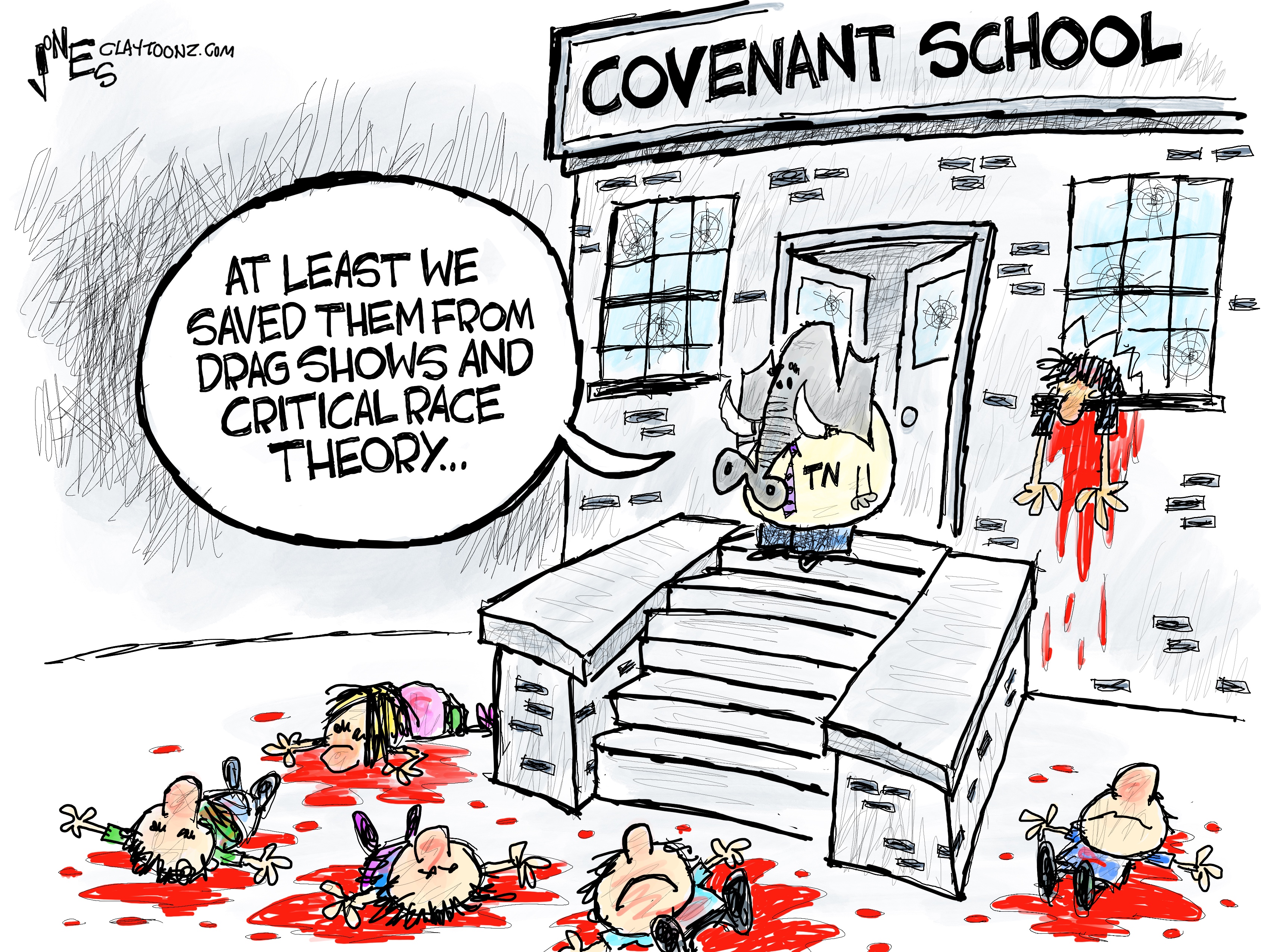
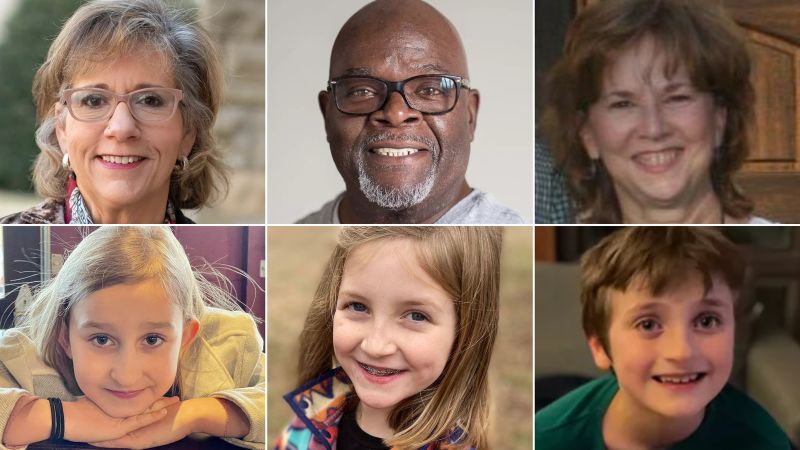
Last Monday, three students and three staff members of the Covenant School in Nashville were killed by a shooter. As you all know, this is not a new phenomenon in America. The Gun Violence Archive says it was the 130th mass shooting in the US in 2023. Gun violence has now replaced auto accidents as the #1 cause of death for children and teens.

But all the same, something about it felt different. At least to me.

Covenant School shooting victims

Earlier school shootings, like Columbine or Sandy Hook or Parkland, left the nation with a sense of horror and sadness. But there was also a tinge of hopefulness: Maybe this would be as far as it goes. Maybe now, at long last, everyone would see that we had to do something about our gun problem.

That hopefulness is gone now. We’ve been through this so many times that the truth has become very clear: Some people will never see. They don’t want to see.

So last Monday, I didn’t feel any hopefulness in myself or see it in others. Instead, what I felt and saw was anger.

Post-Covenant rage. It started right away. Last Monday, Ashbey Beasley jumped in front of the cameras after Nashville police finished briefing the news media on the shooting, and ranted against our national inaction. Beasley and her son had been at the 4th of July parade in Highland Park last summer where a sniper killed seven people, and now she was on vacation in Nashville for another mass shooting.

How is this still happening? Why are our children still dying and why are we failing them? … These mass shootings will continue to happen until our lawmakers step up and pass gun safety legislation.

Rep. Jamaal Bowman of New York, a former middle school principal, was angry too. He stood outside the House chamber and railed at Republican congressman as they walked past.

They’re all cowards! They won’t do anything to save the lives of our children at all! Question them! Force them to respond to the question: “Why the hell won’t you do anything to save America’s children?” And let them explain that all the way up to election day in 2024.

When Kentucky’s gun-worshiping Congressman Thomas Massie stopped to argue with him, saying that schools that arm teachers haven’t had shootings, Bowman didn’t back down.

More guns lead to more deaths. Look at the data. You’re not looking at any data. … Have you ever worked in a school?

Both of these clips went viral as people responded to the justified outrage. Meanwhile, a Republican congressman was also going viral: Tim Burchett from Knoxville, who was fatalistic about gun violence. He acknowledged that the Nashville shooting was a “horrible, horrible situation”, but then said:

We’re not going to fix it. Criminals are going to be criminals. And my daddy fought in the Second World War, fought in the Pacific, fought the Japanese, and he told me, he said, “Buddy,” he said, “if somebody wants to take you out and doesn’t mind losing their life, there’s not a whole heck of a lot you can do about it.”

That caused Daily Show host John Leguizamo to respond with this:

That’s the best you have to offer? You’re a congressman. If you don’t have any ideas for how to keep our kids safe, get the fuck out of the way and go work at a Pinkberry or some shit.

Hundreds, mostly young people, protested at the Tennessee Capitol Thursday.

Meanwhile, in the House, two Democratic lawmakers caused a temporary shutdown when they began yelling, “Power to the people” through a megaphone.

For so long, gun-control advocates have tried to be the soft voice of reason, and to project empathy for the strong feelings of gun advocates. Democratic politicians have treated the issue as a loser. The conventional wisdom said that pro-gun people would vote their convictions, while gun-control advocates wouldn’t. And so politicians who aren’t in the NRA’s pocket have offered only small measures: “Can we at least have background checks on gun sales? Can we at least keep guns away from the mentally ill or people with restraining orders for domestic violence?”

And the answer has inevitably been No.

Republicans are pushing guns more than ever. As the American people have been moving in one direction, Republicans at the state level have been moving in the other.

Tennessee lawmakers have instead moved to make firearms even more accessible, proposing bills this year to arm more teachers and allow college students to carry weapons on campus, among other measures. … In Kentucky, Ohio, Nebraska, Texas and Virginia, Republicans have pushed this year to limit gun-free zones, remove background checks and roll back red-flag laws that seek to remove firearms from those who are a danger to themselves or others.

Even before the recent steps backward, Tennessee was already one of the worst states in the country when it comes to addressing gun violence, ranking 9th in gun deaths per capita. [1] Back in 2017, the minority leader of the Tennessee House, Rep. Mike Stewart, demonstrated just how ridiculous the state’s gun laws were by offering an AK-47 for sale at a downtown lemonade stand. Private gun sales required no background checks then and still don’t. He had bought the assault rifle in a parking lot with no background check and was proposing to sell it the same way.

The sickness of gun worship. But laws are not the whole problem. Arguably, our gun culture is worse. Guns in America are not just tools for self-defense or sport. They are symbols of identity and objects of cult veneration. They are, quite literally, worshiped.

Look at Andy Ogles, the congressman who represents the Covenant School neighborhood. He is not just pro-gun-rights. Here is his family Christmas card. Something well beyond simple second-amendment advocacy is going on here.

When asked whether he regretted that card after the Covenant School shooting, Ogles said: “Why would I regret a photograph with my family exercising my rights to bear arms?”

Let me answer that question for Rep. Ogles: You and your family are endorsing and propagating a deep sickness in our society.

The Ogles family doesn’t just own guns, it chooses them to represent its identity and values. And the guns it highlights are not target pistols or duck-hunting shotguns, they are weapons of war, weapons that are often used to kill people in large numbers.

Apparently, those who hear from the Ogles once a year (on the birthday of the Prince of Peace, who told Peter “all who take the sword shall perish by the sword”) need to know that the Ogles are a gun-toting family. The Ogles could send out a picture of the family volunteering at a soup kitchen, or touring the Grand Canyon, or sitting around the table for a Norman Rockwell Thanksgiving. But no: They are a family of guns. [2]

Ogles is not alone. Rep. Thomas Massie and Rep. Lauren Boebert also display the family arsenal on their Christmas cards. Several Republican members of Congress have been spotted wearing AR-15 pins. I mean, why wear a flag or a cross when you can show your fealty to an instrument of violence that regularly slaughters American children?

Yes, guns are everywhere in America. But our problem goes far beyond that. For a considerable segment of our society, guns have taken on totemic value. They have become idols. [3] Guns symbolize strength, they symbolize freedom. The bigger your gun, the more manly you are.

So it shouldn’t surprise anyone that so many Americans who feel weak and helpless think they need to shoot somebody.

More guns, more death. When Rep. Bowmann told Rep. Massie “More guns lead to more deaths. Look at the data.”, he had the facts on his side. Looking at all the world’s richest countries, the number of guns correlates with the number of gun deaths — and the US is an outlier in both.

Comparing US states yields a weaker correlation (probably because it’s so easy to buy a gun in one state and use it in another), but the guns-lead-to-deaths relationship is still there.

Guns don’t protect freedom. One of the craziest recent statements came from the Michigan Republican Party. Two weeks ago, they tweeted a picture showing a box of wedding rings the Nazis had collected from Holocaust victims. “Before they collected all these wedding rings,” said the meme, “they collected all the guns.”

#History has shown us that the first thing a government does when it wants total control over its people is to disarm them. President Reagan once stated, “if we lose #freedom here, there is nowhere else to escape to. This is the last stand on Earth.” #2A #GOP

When challenged on “trivializing the memory of millions murdered by the Nazis”, the party leadership doubled down.

Considering the history of governments abusing their citizens, the only thing vile is that the Michigan Democratic party is incrementally seeking to disarm citizens. Our #2A rights shall not be infringed! Disarmed Citizens = Government Tyranny[.] #Defend2A.

Again, I’m thinking that the sane part of American society has been way too tolerant of this kind of nonsense. Posting something like this is like wearing a t-shirt that says: “I am stupid. I know nothing about history.” This ought to be pointed out to them whenever they do it.

They don’t seem to realize that the US is not the only country in the world with freedom and democracy. We’re not even the most free or the most democratic. And the other free countries do not have anything like the number of guns we have.

In one recent ranking of countries by the quality of their democracy, the top five countries in the world were Denmark, Norway, Finland, Sweden, and Germany. The US ranked 36th. Another organization ranks countries by civil liberties. Their top five are Switzerland, New Zealand, Denmark, Estonia, and Ireland. The US is 15th.

Now let’s look at the number of guns in civilian hands in those countries. Of the free and democratic countries listed above, Finland has the most guns: 32 per 100 civilians, compared to 120 in the US. Denmark, the only country that is top-five on both lists, has 10 guns per 100 civilians, and its gun laws are much stricter than US laws.

Denmark has one of the strictest – possibly the strictest – gun ownership laws in Europe. The only type of weapon that civilians may own without a licence are air rifles of a calibre of 4.5 mm or less. All other firearms, including gas pistols, alarm weapons and deactivated weapons, require a licence. In Denmark, self-defence is not a legitimate reason for acquiring a weapon, and civilians are never granted a firearm licence for self-defence reasons. The only two reasons for being granted a firearms licence are for sports shooting and hunting purposes. To gain an individual licence, sports shooters are required to have been active members of a sports shooting club for at least two years. Members without a firearms licence may practise their shooting at the firing range of the club to which they belong using the club’s own licensed weapons, but they may not take any of these weapons home. Sport shooting clubs in Denmark currently have approximately 75,000 members; of these, about 20,000 members hold firearms licences. Dynamic sports shooting with semiautomatic rifles, as defined by the International Practical Shooting Confederation, is not allowed in Denmark. To have the right to hold a licence for hunting, individuals must pass an advanced hunting exam, which includes skills on how to handle weapons properly. Although Danish law accepts that hunters use semi-automatic rifles with a magazine capacity of more than two cartridges, hunters may never carry more than two cartridges in their semi-automatic rifles at one time.

So here’s what I say to the Michigan GOP: When the Danish government starts herding its unarmed citizens into concentration camps, let me know. Until then just shut up about guns and tyranny, because you don’t know anything. [4]

Guns threaten freedom. The most popular post in Weekly Sift history is “Not a Tea Party, a Confederate Party“, which posted in 2014 and has over half a million page views. One of the observations I made in that post was that while the Tea Party attributed its ideology to the Founders, most of it actually came from the Confederacy. The true ancestor of the Tea Party wasn’t Samuel Adams or Thomas Jefferson, it was John Calhoun.

Something similar is going on with guns. Today’s gun worshipers fantasize about an armed populace overthrowing a tyrannical government, and they imagine themselves to be descendants of the colonial Minutemen. But that is all fantasy. The Minutemen and other colonial militias were organized openly by local governments, and they were not the primary force that defeated the British. The main force was the army authorized and funded by the Continental Congress and led by General Washington.

The revolution, in short, was a war fought between the army of a local government versus the army of a foreign government. Anti-government partisans played only a minor role.

However, there is an example in America history of armed partisans overthrowing an established government: The white supremacist Redeemer movement that overthrew the interracial democracy established in the South during Reconstruction and replaced it with the Whites-only government of Jim Crow.

Jim Crow didn’t just happen. White Southerners used a campaign of organized terrorism to disrupt elections, kill politicians loyal to the United States, and prevent Black Americans from voting.

The roots of the current militia movement go back to that history, not to the Revolutionary War. Their true ancestor is Nathan Bedford Forrest, not George Washington.

Many gun-owning Americans have a Red Dawn fantasy, in which they take their guns into the hills when Communism overruns the US. The much more likely outcome is that they will be the instruments of tyranny, not its opponents. They will be the Brownshirts of American fascism, as the Oath Keepers and Proud Boys tried to be on January 6.

The Second Amendment. I think the Supreme Court has completely misinterpreted the Second Amendment in recent years, starting with Justice Scalia’s Heller opinion in 2008 and continuing through Justice Thomas’ last year in Bruen. I don’t believe the amendment confers an individual right to bear arms, and I think the words “militia” and “well-regulated” appear in the amendment for a reason. That was the prevailing opinion on the US Supreme Court before 2008.

In short, the prevailing constitutional interpretation of gun rights is exactly what conservatives used to rail against: law created out of nothing by unelected judges.

And things are only getting worse. What Justice Thomas did in Bruen wasn’t just to invalidate a century-old New York state law sharply limiting the concealed carry of handguns. Thomas initiated a whole new standard for evaluating restrictions on guns, and we still don’t know what that standard will lead to. Recently a lower court used it to strike down a law taking guns away from domestic abusers.

One solution would be to reverse what the NRA did: elect sympathetic presidents who will appoint judges to undo the current court’s ideological overreach. That means waiting for the Court’s current majority to retire or die, which could take decades. A quicker option would be to expand the Court, allowing Biden or the next Democratic president to change the majority immediately. That’s radical and sets a dangerous precedent, but the current court is so far out of line that it may be necessary. (As I’ve pointed out many times, the current Court majority has never been based on a popular majority. Trump’s three appointees in particular were nominated by a president who lost the popular vote and were approved by a Republican Senate majority whose members represented far less than half the citizenry.)

But if we’re going for a radical solution, I think there’s a third option to consider: If the Second Amendment really does mean that the individual right to own and carry weapons is unlimited, and is not constrained by situations where it appears to conflict with other basic rights, then the Second Amendment needs to be repealed. I’ve already discussed how I would rewrite the amendment (a post that via Google caught the attention of pro-gun people and got me the most negative comments I’ve ever received). But I think it’s time to stop tip-toeing around the irrational gun nuts in our midst: If the Second Amendment really is a suicide pact, and if the only way it can be interpreted forces us to keep watching children being slaughtered, then it has to go.

That may seem impossible today, but things can change quickly when the American people make up their minds about something. The majority will not stay in the box the radical minority has built for us.

Those who have a more reasonable interpretation of gun rights need to be put on notice. In the long run, if they can’t constrain their lunatic fringe, they’re going to lose all their gun rights. Because Americans will not put up with this forever.


[1] Except for New Mexico, the eight states with more gun deaths per capita also have Republican legislatures. The idea that blue states like New York or Illinois are more violent is just false.

[2] Except for the youngest, who seems to be holding a book rather than a gun. I saw one commenter on Twitter express sympathy for him. He looks like he belongs in a different family, one with sane values.

[3] If any Christian pastors are looking for a sermon topic, let me suggest that one.

[4] As for Hitler and Stalin controlling guns, Salon debunked this myth ten years ago.

Can the anti-woke mob define “woke”?

Does the word still mean anything, or is the whole point to throw around a meaningless buzzword?


The controversy started Tuesday, when conservative author Bethany Mandel’s appearance on The Hill’s “Rising” podcast went viral. Host Briahna Joy Gray asked a question that, in some other circumstance, might have been a softball:

Would you mind defining “woke”? Because it’s come up a couple of times and I just want to make sure we’re on the same page.

As Gray emphasized later, this was not intended as a gotcha.

I wanted to be able to figure out whether I agreed with her on certain points, as I had done earlier in the interview. Alternatively, I want to be able to articulate why we differed on other aspects of her argument without devolving into the typical shouting matches.

Mandel, who claims she spent an entire chapter of her new book Stolen Youth: How radicals are erasing innocence and indoctrinating a generation defining “woke”, floundered. Her humiliation quickly spread across liberal social media, because it appears to illustrate something many of us have been claiming for some while: Woke is the latest in a long series of right-wing pejorative terms like cancel culture and political correctness. Their purpose is not to point to any real ideas, but to identify someone as an enemy. The MAGA base has been trained like Pavlov’s dogs to react to these terms without thinking, so calling something “woke” is just a way to say “sic ’em”.

Amanda Marcotte puts it like this:

The inability to define “woke” is a feature, not a bug. “Woke” is very much meant to be a word that cannot be pinned to a definition. Its emptiness is what gives it so much power as a propaganda term. “Woke” is both everything and nothing. It can mean whatever you need it to mean, and you can deny that it means what it obviously means. The ephemerality of “woke” is what makes it so valuable. “Woke” morphs into being when a right-winger needs to feel outrage and evaporates into thin air should anyone try to ask a rational question about it.

It’s the vagueness of woke that allows it to be used more or less whenever Mr. Burns wants to release the hounds. Silicon Valley Bank collapsed, for example, because it was “woke”. So there’s no need to talk about deregulation or interest rates or risk management or any other headache-producing idea. Instead, we can cut off discussion by invoking unthinking hostility. Woke: bad.

And I’m still trying to figure out why Tucker Carlson thinks M&Ms are woke.

But not all liberals gloried in Mandel’s failure. Center-left commentator Jonathan Chait was more generous.

She may be wrong, but she’s not an idiot. She just froze up on TV. It happens.

Freezing up does happen, particularly to people who are used to writing rather than responding in real time. But the incident also points to something significant: Mandel clearly did not prepare for this question. She anticipated being able to throw the word around without being asked what it means. For comparison, before I started referring to Trump as a fascist, I wrote an article explaining what I mean by that term. I don’t carry all my writings in my head, though, so if you stopped me on the sidewalk and asked for a concise definition of fascist, I might flounder too. But if I were planning to use such an emotive word in an interview, I would anticipate being challenged to define it and would prepare an answer.

Mandel clearly didn’t think that was necessary. That strikes me as telling.

She’s not the first anti-woke warrior to be put on the spot like this. When he was asked in court what woke means, Ron DeSantis’ General Counsel Ryan Newman defined it as: “the belief there are systemic injustices in American society and the need to address them”. That’s a perfectly fine definition a lot of liberals would agree with. The problem for Newman (and DeSantis) is that it doesn’t justify a Pavlovian negative response: Does the DeSantis administration really want to claim that there are no systemic injustices in America, or that (if there are) nothing should be done about them? Is that what all the shouting is about?

The next line of conservative defense is to put aside the gotcha moment — which the viral clip became, whether Gray intended that to happen or not — and get the discussion back on track by producing the answer Mandel should have given. Mandel herself later offered this definition:

A radical belief system suggesting that our institutions are built around discrimination, and claiming that all disparity is a result of that discrimination. It seeks a radical redefinition of society in which equality of group result is the endpoint, enforced by an angry mob.

She avoids Newman’s what’s-so-bad-about-that problem by inserting a bunch of pejorative judgments into her definition. I mean, why not just tell us what wokeness is, and let us judge for ourselves whether it’s radical, angry, or mob-oriented? If you take out the judgments and just include the definitional parts, you wind up with “The belief that group inequality is caused by discrimination that is built into our institutions, and that a fundamental reorganization of society is necessary to correct this problem.” When you think about it, that’s not far from “systemic injustices and the need to address them”. And like Newman’s definition, it also doesn’t capture what the shouting is about.

So we start to see the Scylla and Charybdis a good conservative definition of woke has to navigate between:

  • The definition should mean something.
  • What it means should justify how conservatives have been using the term.

I’ve been looking around, but I haven’t seen one that does both jobs.

Ross Douthat more-or-less gives up on the idea of a concise definition, but instead describes a worldview and a narrative (which he says he doesn’t believe). It starts like this:

What is America all about, at its best? Equality and liberty. What is the left all about, at its best? Transforming those ideals into lived realities.

But this project keeps running into limits, disappointments and defeats. Everywhere you look, terrible disparities persist. And that persistence should force us to look deeper, beyond attempts to win legal rights or redistribute wealth, to the cultural and psychological structures that perpetuate oppression before law and policy begins to play a part. This is what the terminology of the academy has long been trying to describe — the way that generations of racist, homophobic, sexist, and heteronormative power have inscribed themselves, not just on our laws but our very psyches.

And once you see these forces in operation, you can’t unsee them — you are, well, “awake” — and you can’t accept any analysis that doesn’t acknowledge how they permeate our lives.

Up to there, I give him points for accuracy: Yes, those are all things I believe. From there his narrative gets a little more suspect, but what’s really disappointing is his column’s ending: It’s all about feelings.

If you find a lot of this narrative persuasive, even filtered through my conservative mind, then whatever “woke” describes, it probably describes you.

If you recoil from it, welcome to the ranks of the unwoke.

He doesn’t cite any reason to reject the narrative he describes, he just observes that people like him “recoil from it”. Again, this emotional “recoil” doesn’t explain why books have to be banned and drag shows have to be outlawed, or why the state has to intervene to prevent parents, children, and their doctors from assessing their own problems and choosing courses of action. Why can’t Douthat “recoil” over in the corner and leave the rest of us alone?

Douthat at least seems to be writing in good faith. So does Thomas Chatterton Williams, who expresses sympathy for some of what conservatives are trying to capture with wokeness, but eventually reaches a conclusion I can agree with:

But perhaps we can all agree, at bare minimum, to set ourselves the task of limiting our reliance on in-group shorthand, and embracing clear, honest, precise, and original thought and communication. If we want to persuade anyone not already convinced of what we believe, we are going to have to figure out how to say what we really mean.

I am pessimistic that this view will catch on, though, because I don’t think people like Ron DeSantis are interested in “clear, honest, precise, and original thought and communication”. I think they find it far more useful to wield a meaningless term that evokes a Pavlovian response.

A right-wing judge takes aim at medication abortions

Someday soon, a perfectly safe abortion drug could become unavailable nationwide, even in states that defend reproductive rights. That sounds so crazy that most of us have a hard time taking it seriously. (Wasn’t the whole point of reversing Roe to turn the abortion question over to the states?) You hear the claim and then think, “That can’t really be happening.” But it is.

Here’s how it works.

Trump left us a kangaroo federal court. The Amarillo division of the Northern District of Texas has only two federal judges, and one of them, Matthew J. Kacsmaryk, hears 95% of the civil lawsuits. Kacsmaryk is the very model of a Trump judge. He was a lawyer for the right-wing First Liberty Institute until Trump tapped him for a federal judgeship in 2017. Since then, he’s become famous for out-of-the-mainstream legal opinions that are reliably right-wing, but not terribly well reasoned or well rooted in the law.

While on the bench, Kacsmaryk has made a string of controversial rulings: He declared Biden administration protections for transgender workers unlawful; twice ordered the administration to enforce the Trump-era “Remain in Mexico” policy; and attacked Title X, the only federal program designed to provide birth control to low-income and uninsured people.

The beauty of this arrangement, if you’re an right-wing culture warrior, is that Amarillo has become the perfect place to file a controversial suit, particularly if it’s based on ideology rather than law. You’re practically guaranteed to get Kacsmaryk, which means you’re practically guaranteed to win, at least until there’s an appeal. [It’s worth pointing out that political activists on all sides try to venue-shop like this. But nowhere in America is as well-greased for liberals as Amarillo is for conservatives.] And even if you ultimately lose, you still might win for a considerable chunk of time, because Kacsmaryk might issue an injunction that favors you until the Supreme Court gets around to reversing his opinion, which could take months or even years.

That’s what happened when he forced the Biden administration to continue Trump’s remain-in-Mexico immigration plan. The Supreme Court ultimately reversed Kacsmaryk’s decision 6-3. (Yes, that’s how far-right his reasoning was: Not even John Roberts and Brett Kavanaugh were convinced.) Nonetheless, an injunction kept remain-in-Mexico in place for more than a year while the case was under consideration.

That shouldn’t have happened, but both courts above Kacsmaryk, the 5th Circuit Court of Appeals and the Supreme Court, are dominated by conservative judicial activists. They aren’t so unprincipled that they could endorse Kacsmaryk’s ridiculous reasoning, but they have more wiggle room when deciding whether or not to lift a temporary injunction. Both courts used that discretion to screw the Biden administration. (Trump’s requests to set aside injunctions got much more favorable consideration.)

So what is the current case?

Mifepristone. More than half of all abortions in the US are now through medication rather than surgery. That’s bad news from the anti-abortion perspective, because there’s no abortion clinic to picket or shoot up, and it’s easier to smuggle pills into a handmaid’s-tale state than to run an underground surgery clinic in one. So now that Roe v Wade has been reversed and states are outlawing abortion, the pills are the next big target. Friday, Wyoming became the first state to outlaw them.

If you live in a blue state like California or Vermont, you may roll your eyes: Wyoming is like that. But your state guarantees abortion rights, so the effort to limit access couldn’t possibly affect you or the women you care about, right?

Not so fast.

A typical medication abortion combines two drugs: mifepristone and misoprostol. So a coalition of anti-abortion groups and individuals have filed suit to make mifepristone illegal nationwide, claiming that the FDA made a mistake when it declared the drug safe in 2000.

The suit would be laughed out of any legitimate court, for reasons that former Anton Scalia law clerk Adam Unikowsky explains in detail in his blog Adam’s Legal Newsletter:

  • The plaintiffs’ theory of standing is irreconcilable with Supreme Court precedent.
  • The statute of limitations has expired on plaintiffs’ challenge to the FDA’s approval of mifepristone. The plaintiffs claim that the FDA “constructively reopened” that approval in 2016, thus restarting the statute of limitations, but that’s clearly wrong.
  • The plaintiffs did not exhaust their claims, even though a regulation explicitly required them to do so.
  • Although the plaintiffs claim that the FDA’s actions are contrary to the Food, Drug, and Cosmetic Act (FDCA), the plaintiffs have failed to identify any particular provision of the FDCA that the FDA has actually violated.

Problems like that would be fatal to an ordinary lawsuit. But wait, there’s Amarillo, where ordinary legal reasoning doesn’t apply. “What’s Amarillo got to do with anything?” you might ask. The FDA isn’t located in Amarillo and mifepristone isn’t manufactured there. Amarillo appears to have no connection at all to mifepristone. But the venue is appropriate, according to the lawsuit, because one of the suing organizations is located there.

This district and this division are where Plaintiffs Alliance for Hippocratic Medicine, including the doctors of its member associations, and Dr. Shaun Jester are situated and are injured by Defendants’ actions.

AHA appears to be “a front group for the Catholic Medical Association, the Coptic Medical Association of North America, the American College of Pediatricians, the Christian Medical & Dental Associations, and the American Association of Pro-Life Obstetricians and Gynecologists.” It was founded last August, after Roe was reversed in June, apparently for the specific purpose of filing this lawsuit in Amarillo.

And what “injury” are the local doctors alleging? Unikowsky summarizes:

The plaintiff-doctors’ theory of standing is, in a nutshell, that if mifepristone stays on the market, other doctors will prescribe mifepristone to their pregnant patients, the pregnant patients will suffer side effects, and then the patients will switch doctors and come to the plaintiff-doctors. This, in turn, will injure the plaintiff-doctors because it will divert their attention from their other patients, potentially force them to complete “unfinished abortions,” and possibly expose them to malpractice lawsuits. By contrast, if mifepristone is off the market, these women will elect to carry their babies to term (as opposed to seeking surgical abortions), thus preventing the plaintiff-doctors from facing these risks.

If that “injury” sounds a little too roundabout to be credible, that’s because it is. Unikowsky cites Supreme Court rulings that have already rejected similar standing claims.

As for safety, the FDA’s original studies are now backed up by more than two decades of experience, both here and abroad. CNN summarizes:

Data from hundreds of studies and 23 years of approved use has shown that mifepristone is highly safe and effective, according to 12 of the country’s most respected medical associations, including the American College of Obstetricians and Gynecologists and the American Medical Association, which signed an amicus brief in the Texas case.

This medicine combination for abortion is also available in more than 60 other countries.

Since its approval in the US in 2000, there have been 5 deaths associated with mifepristone for every 1 million people who used it, according to the US Food and Drug Administration. That means the death rate is 0.0005%.

Mifepristone’s safety is on par with those of common over-the-counter pain relievers like ibuprofen and acetaminophen, studies show.

Data analyzed by CNN shows that mifepristone is even safer than some of the most common prescription medications. The risk of death from penicillin, an antibiotic used to treat bacterial infections like pneumonia, for example, is four times greater than it is for mifepristone. The risk of death after taking Viagra – used to treat erectile dysfunction – is nearly 10 times higher.

If there actually were a safety issue, you might expect some women’s-health organizations to sign onto the lawsuit, but none have. The suing organizations all have prior religious or political orientations. For some it is right in their name, like the American Association of Pro-Life Obstetricians and Gynecologists and the Christian Medical and Dental Associations. The one whose name sounds like it might be objective, the American College of Pediatricians, isn’t:

The group’s primary focus is advocating against abortion and the adoption of children by gay or lesbian people. It also advocates conversion therapy. … ACPeds has been listed as a hate group by the Southern Poverty Law Center for pushing “anti-LGBTQ junk science”.

Hearings. Kacsmaryk held hearings this week, and seemed open to the plaintiffs’ arguments. Of course, no one can say for certain what he will do until he does it, and perhaps the intense attention his kangaroo court has gotten lately — some protesters have come dressed as kangaroos — will intimidate him into backing off. Ordinarily, I advise readers not to get riled up about events that haven’t happened yet and may not happen. But if Kacsmaryk does what he is expected to do, and issues a nationwide injunction making mifepristone illegal, the effects will be sweeping and instantaneous.

An anti-Kacsmaryk protester dressed in judicial robes and a kangaroo mask.

Ordinarily, when an injunction disrupts an otherwise uneventful status quo, you can expect a higher court to set it aside pending review. But they don’t have to. Higher courts don’t even need to endorse whatever justifications Kacsmaryk offers for his injunction; all they have to do to promote right-wing policies they favor is drag their feet. That would get mifepristone off the market for a year or maybe longer, for no legal reason whatsoever.

If they do, women could still use misoprostol alone to induce an abortion. That is slightly less effective than a smaller dose combined with mifepristone, and causes more discomfort and side effects. (Remember: The most likely way for women to get caught when they induce a medication abortion in a state that bans them is to have side effects that take them to the emergency room.) Worse, misoprostol would then become a single target: Finding a way to ban it could end about half the abortions in the US.

Of course, there’s no legal reason to ban misoprostol, so it ought to be safe. But maybe not in Amarillo, where the law doesn’t matter any more.

Democracy in Israel

One of the countries where democracy is currently in serious trouble is Israel. The Knesset is considering a proposal by Prime Minister Netanyahu to make the Supreme Court inferior to the Knesset; by majority vote the Knesset could reverse court decisions. It would also claim the right to nominate new judges, taking that power away from a less partisan commission.

That may sound like a few technical adjustments, but it undoes a key part of the liberal-democratic social contract, in which majority rule is tempered by an independent judiciary that protects the rights of minorities. Under Netanyahu’s proposal, controlling a parliamentary majority would allow him to do pretty much whatever he wants, possibly including quash a corruption case against him.

Massive numbers of Israelis see this threat, and have been on the streets protesting for weeks. NYT columnist Thomas Friedman describes this as Israel’s “biggest internal clash since its founding”, and argues that American Jews cannot stay neutral.

At a deeper level, the current crisis goes back to a tension that has existed from the beginning: Israel views itself as both a democracy and a Jewish state. Both elements are central to its identity, but they have always fit together uneasily.

This tension is not unique to Israel; it exists whenever a nation thinks of itself as both a democracy and a homeland for a particular ethnic, religious, or cultural group. We can also see it in Orban’s Hungary or Modi’s India, not to mention the Christian nationalist fantasies of the American Right. Democracy insists that all citizens are equal, but the X-homeland vision makes the members of Group X special.

The two identities can coexist without too much friction as long as Group X has a comfortable voting majority and the deal it offers not-X citizens is good enough to win their acquiescence. Historically, and glossing over a lot of counterexamples, the deal in Israel has been that Arab parties are locked out of any ruling coalition in the Knesset, but the judicial system is committed to defend the rights of Palestinian Israelis as individuals.

That tension is also what makes the problem of the occupied territories so intractable: If Israel annexes the territories outright and makes them part of Israeli democracy, the Jewish voting majority is threatened, and the new Palestinian citizens have such a long history of conflict with Israel and with Jewish settlers that many of them could not acquiesce to peaceful membership in a Jewish state. But continuing to rule the territories as an occupying power creates an undemocratic Jew/Arab relationship that can’t help but cross the border into pre-1967 Israel and affect Israeli citizens.

So Netanyahu’s push for the elected government to take control of the courts is not only corrupt (motivated largely by Netanyahu’s personal legal problems) and undemocratic in general (since it undoes the rule of law), but it strikes at the heart of the historical compromise between the Jewish state and Israeli democracy. Going forward, the Jewish voting majority would be empowered to rule unchecked, with regard for the equal rights of non-Jews shrinking into a secondary position, from which it could conceivably vanish entirely.

Ordinarily, I would find myself 100% on the side of democracy and opposed to the homeland vision. That’s how I feel about Christian nationalism in America, as well as Hindu nationalism in India, and so on. But Israel’s unique history muddies things up for me. The lesson many people drew from World War II — and it’s hard to argue that they’re entirely wrong — is that the world needs a Jewish homeland somewhere.

You don’t have to believe that the Jews are God’s chosen people to recognize that they have been chosen to be targets of bigotry again and again. For reasons I don’t fully understand, antisemitism appears to be a unique strain of prejudice. (I wish I knew who to credit for this line, but sometime in the last year or two I heard this explanation of why American Jews should be uneasy with the conspiracy-theory-promoting American Right, even if it purports to be pro-Israel: “Anybody who believes crazy things will eventually believe crazy things about Jews.”)

Even in places where it appears to waning, antisemitism can pop back up. Jews seemed to be gradually assimilating into Germany prior to Nazism. The Bolshevik Revolution had a place for Jewish leaders like Trotsky before antisemitism reasserted itself under Stalin. An American president whose daughter converted after marrying a Jew could nonetheless wink and nod at American Nazis chanting “Jews will not replace us”, and traffic in rhetoric that led a man to massacre Jews in a Pittsburgh synagogue.

So a decade or two ago I might have scoffed at the idea that American Jews would ever need an escape plan or an obvious place to land. I still think it’s unlikely. But unimaginable? I not as sure as I used to be. The world, I think, still needs Israel.

Simultaneously, though, I have no answer for a Palestinian who wonders why he has to be a second-class citizen (or not a citizen at all) in the land where his ancestors have lived for centuries. And while I can’t offer a simple solution to the democracy/homeland tension, I have to believe there’s a better way to protect the Jewish homeland than establishing an Orban-style autocracy-with-democratic-trappings. So I’m rooting for the protesters.