We’re not in a Manichean struggle between two monolithic systems. We’re just deciding where to draw the line between the private and public sectors of our economy.
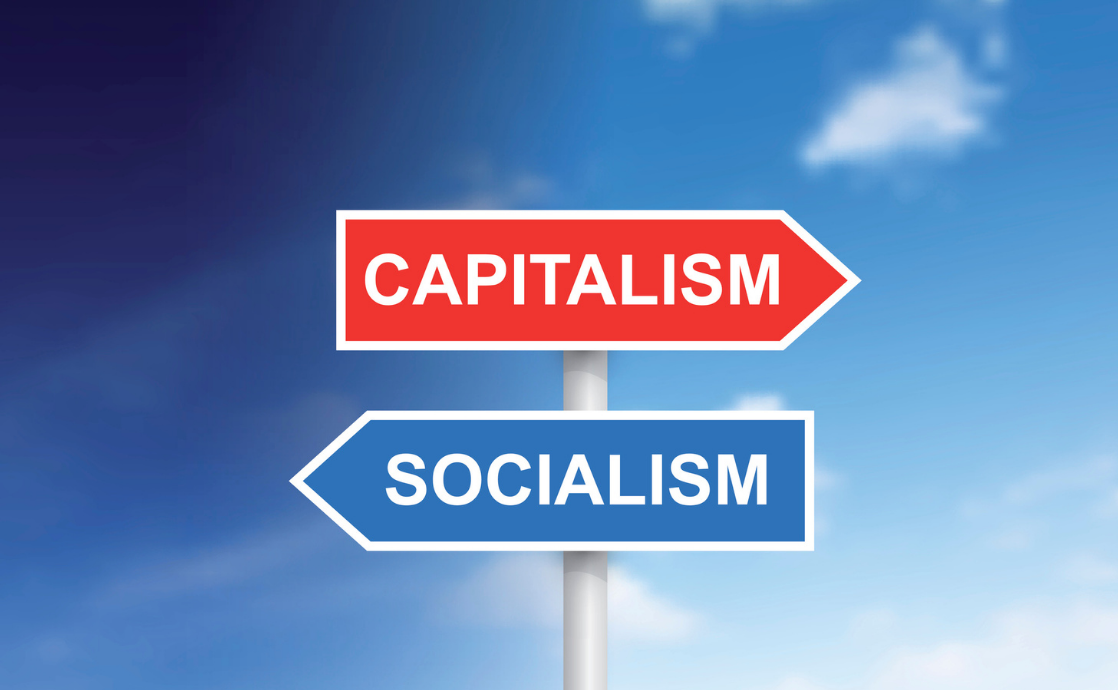
If you believe the headlines in our corporate media or the rhetoric of our political leaders, the United States is at a fork in the road. In one direction lies continued Capitalism, which (depending on who you listen to) will either give us unparalleled prosperity or turn the US into a plantation with a few trillionaire owners and a population of serfs. In the other is Socialism, which has either made Northern Europe a 21st-century Eden or ruined resource-rich Venezuela. [1] President Trump would have you believe that the leftward fork is to Communism, “a mortal threat to American liberty”, as if there were no difference between AOC and Stalin.
The occasion for this argument is the improved outlook for Democratic Socialists within the Democratic Party. Bernie Sanders, Elizabeth Warren, and AOC have been around for years, but last November they were joined by Zohran Mamdani, who was elected Mayor of New York City on a platform of rent control, child care, and free buses. In the New York primary two weeks ago, Mamdani-endorsed challengers defeated two incumbent Democratic congressmen and won the nomination for a third congressional seat. In Colorado a week later, another incumbent Democrat in Congress fell to a progressive challenger, a former senator lost the primary for governor, and sitting Senator John Hickenlooper survived a more serious challenge than anyone saw coming just a year ago.
This has evoked much hand-wringing in the political and economic establishment, particularly from the editorial pages of billionaire-agenda publications like The Wall Street Journal and The Washington Post.
I think we would all do well to take a step back and challenge the frames we’re being given. In reality, we’re not facing a choice between two diametrically opposed futures. And we’re not about to go off a cliff into some radically new economic system.
The United States has always had a mixed economy, with both a public sector and a private sector. And we have always had an argument about where to draw the line between them. In the early-to-mid 1800s, before slavery became the center of our politics, the Whig Party believed in a bigger public sector, with a national bank and more government-funded public works like the Erie Canal. Meanwhile, the Democratic Party of that day was the low-tax party that wanted to keep the public sector as small as possible.
That’s the same debate we’re having now. Our most pro-capitalist politicians don’t propose abolishing the public sector, and our most pro-socialist ones don’t propose abolishing the private sector. No matter who gets elected, your local pizzeria will remain a private business and your fire department a public institution. We’re all just arguing about where the line should be.
For example, currently healthcare is divided between the two sectors. Most, but not all, hospitals are for-profit businesses. Health insurance comes partly through government programs like Medicare, Medicaid, and the Veterans Administration, but also through big corporations like Aetna, Cigna, and United Healthcare. (My personal health insurance is split: I have basic Medicare, but my Medicare supplemental and prescription drug coverage is through private-sector companies.) ObamaCare uses government subsidies to pay for private-sector insurance.
The flagship progressive proposal, Medicare for All, would shift the line to expand the public sector’s role in health insurance. Meanwhile, conservatives want to make Medicaid more like ObamaCare — government subsidies run through private insurance companies. A recent Washington Post op-ed called for abolishing the National Institute of Health and relying almost entirely on the private sector to do our medical research.
Highways and prisons are generally considered part of the public sector. But occasionally a toll road gets leased to a private company. And about 9% of the nation’s prison population is housed in private prisons. Both of those divisions are controversial. Some Americans would like to take the whole sector back under public control. Others would privatize further.
We also argue about how much of the private sector requires government regulation. But these arguments are also about moving lines, not eliminating one side or the other. Our nuclear power plants, for example, are almost entirely owned by private-sector companies. But I can’t think of any serious politician who advocates complete deregulation. Nor does anyone doubt that industries can be stifled by over-regulation.
These are healthy debate to have. Some things are better handled within a market system while others aren’t. Regulation can be either insufficient or stiflingly onerous. It’s not always obvious which is which.
Paul Krugman posts “There Are Very Few Socialists in America“, noting that we are seeing a shift in the use of the word socialism more than an actual change in Americans’ political philosophies.
Why, then, does it look as if socialism is on the rise? Mainly because right-wing propagandists continually smear social democratic policies as socialist, trying to make popular, mainstream policy ideas sound extreme. And some Americans who are basically social democrats in effect respond by saying, “Well, if that’s socialism, I guess I’m OK with socialism.”
This corruption of our political vocabulary makes it difficult to notice real threats. If Mayor Mamdami is a “communist“, how will we sound the alarm when an actual Mao or Lenin appears? [2]
As I read the room, the recent popularity of Democratic Socialists may not even have that much to do with single-payer healthcare or any other policy. Kamala Harris lost in 2024 (and least in my judgment), not so much because of any particular issue, but because voters associated her with the status quo. Status quo Democratic centrism has essentially no answer to growing inequality, or the widespread sense that corporate power is gradually snuffing out individual choice, opportunity, and freedom. The old politics of reaching across the aisle and being willing to compromise isn’t working in an era where gerrymandered districts make representatives fearful only of the extremists in their own party.
Much of the “socialist” vote, like much of the MAGA vote on the Right, is less about ideological commitment than simply a plea to do something different.
If moderate Democrats want to retain control of the party, they need their own vision of what “something different” looks like. Joining the Republicans and the corporate media in scaremongering against Zohran Mamdami isn’t going to cut it. Whatever you think of his plans, at least he wants to do something.
[1] Arguably, Venezuela’s problem isn’t socialism so much as corruption. If you don’t want the US to go the way of Venezuela, your best course is to vote out anyone connected to the unprecedented corruption of the Trump regime.
[2] That’s why I was so careful in 2015 when I started applying the word fascist to Trump and his movement. I made sure to define the term clearly rather than just use it as an insult. I think Trump’s subsequent abuse of government force, attacks on the free press, aggrandizement of executive power, and efforts to suppress non-White voting have validated my usage.
Friday night at Mount Rushmore, President Trump warned the country about Communism, which he portrayed as “a mortal threat to American liberty … the greatest threat to our country”. Listening to him, you might have imagined we were on the verge of a violent revolution, with a Lenin or Mao waiting in the wings to put Elon Musk and Mark Zuckerberg up against the wall.
This week’s featured post invites you to to back away from such extreme rhetoric and ignore the corporate-media panic about Democratic Socialists winning a few primaries. I’m calling it “Capitalism vs. Socialism? Get Serious.” We haven’t come to a T-intersection where we have to go left or right towards one or the other of two diametrically opposed economic systems. Instead, we’re having the age-old American debate about where to draw the line between the public and private sectors of our economy. If you go back to the 1840s, the Whigs wanted more public-works projects like the Erie Canal, while the Democrats wanted low taxes and a government that made no attempt to shape the nation’s economic future.
That argument is as American as apple pie. Both sides are firmly in the center of our political traditions. Medicare for All would move the line in one direction. Privatization would move it in the other. More regulation? Less regulation? It’s a perennial American debate.
And it’s healthy. Don’t let anyone panic you about it. That post should be out maybe around 10 EDT.
The weekly summary has to cover both the end of the Supreme Court term and the 250th birthday celebrations. In particular the Court’s trans-athlete decision raises questions about how Democrats should respond. I’ll also explain how the Washington Post finally lost me as a subscriber (and why it took so long). I’ll try to get that post out by noon.
Trump’s assault on American democracy. In Texas, people who engaged in some fairly normal protest mischief got sentenced to decades in prison because one guy shot at a cop.
Climate change. The European heat wave has caused 1300 excess deaths so far.
Iran War. It’s very hard to tell what’s going on. We have an agreement but we’re still talking. We have a ceasefire but we’re still shooting at each other.
Ukraine.Russian oil refineries keep burning. Russia has a fuel shortage now, in spite of being one of the biggest oil producers in the world. Maybe this war-of-choice wasn’t such a good idea.
This week’s developments
This week everybody was talking about the Supreme Court
The Court made several important decisions this week, all 6-3 votes by the conservative majority. I discuss the two immigration-related ones in the featured post. The bloodstained gavel is a reference to sending refugees back to Haiti and Syria, which the State Department says is unsafe. A third Alito opinion the same day threw out Hawaii’s law requiring people to get permission from property owners to carry concealed weapons on their property.
The gun law had to be evaluated under that standards established in the the 2022 Bruen decision, the one requiring any gun restriction to be consistent with the history and traditions of gun laws in the US. No one really knows what that means, so in practice it turns into the Court’s conservative majority cherry-picking the historical examples that justify the conclusion it wants.
Today’s rulings just came out, so I haven’t looked at them. It appears to be a more mixed bag, with Trump winning some cases and losing others. To be honest, this worries me. Roberts likes to orchestrate the release of rulings in order to give himself cover. If he’s releasing some Trump losses today, I worry about what he has in store next.
The Texas Board of Education clearly understands that this Supreme Court will never enforce the separation of church and state against Christians. The Texas Tribune reports that an extensive list of Bible readings are now part of the K-12 curriculum. Meanwhile, the new standards cut back education about diversity and eliminate material that they think shines a negative light on US history.
They approved a lesson this week that requires students to learn about the Prophet Muhammad in the context of “brutal military campaigns against Jewish and Christian tribes, the normalization of slavery, and the taking of female captives as harem slaves.”
“Let me be very clear: Islam is not a religion,” state Sen. Bob Hall, R-Edgewood, testified before the education board Monday. “It is a totalitarian theocracy, not unlike totalitarian systems of communism, Nazism and globalism.”
Asked if he had ever visited a Muslim-majority country, the senator responded no.
If you live in Texas and are thinking about raising children, you might want to reconsider your choices.
and Democratic primaries in New York
The big news of Tuesday’s Democratic primaries was the defeat of incumbent congressmen Dan Goldman and Adriano Espaillat, by challengers from the left backed by New York City Mayor Zohran Mamdani. Mamdani backed five candidates in the primaries, and they all won. These results were widely trumpeted as advancing the Democratic Socialist wing of the Democratic Party.
Centrist Democrats (in the words of several headlines) “freaked out“. James Carville said on a podcast that he couldn’t be in the same party with some of the Mamdani candidates.
I’m done. I’m not in that fucking political party.
Conversely, Rep. Josh Gottheimer (NJ-5) wrote the Mamdani candidates out of his party.
Many of us believe, as I do, that if you’re a socialist, you’re not a Democrat.
I’m very disappointed in these reactions. I’m a blue-no-matter-who Democrat, and I’m going to stay that way as long as the Republican Party represents fascism. For the last decade, maybe even as far back as the 2000 presidential race (where Ralph Nader’s voters could have tipped the election to Al Gore), I have argued that progressive voters should line up behind moderate Democrats who win the primaries. If you can’t win the Democratic primary, I said, you can’t win the general election. The way to get the progressive candidates you want is to win in the primaries, not to sabotage the moderate Democrats who do.
Well, now progressives are winning primaries in New York and a few other places. This is the way the game is played. The way to change the party is to win primaries.
What’s disturbing in the Carville/Gottheimer response is the attitude of entitlement. The Democratic Party belongs to them, because it just does. Democratic voters have no say in the matter. Rebecca Solnit writes:
It’s weird the way the Democratic alleged leadership (Jeffries too) think that the party is a club with rules rather than something the voters choose. It’s….undemocratic.
It would be one thing if the Democratic Party had a clear philosophical definition, the way that the Republican Party of the 1850s was the anti-slavery party. But one common complaint about the Party in the current era is that it lacks definition. I don’t see any basis for saying that socialists can’t be Democrats.
The Party establishment has made several large mistakes in the last few years. Obama let the big bankers off the hook after the Great Recession of 2008. Biden uncritically kept feeding weapons into the Israeli war machine as it committed genocide in Gaza. Maybe a few others leap to your mind.
Even at its best, the Democratic establishment drifts into nostalgia about the Obama years, as if America would be fine if we could just undo what Trump has done to the country. But Trump rose to power because a lot of Americans already felt left behind. I agree that I’d rather have Obama back than stick with Trump, but it’s not like that was some kind of golden age.
There has to be a reckoning. Leaders who backed those mistakes need to make their case to the voters and face judgment. They aren’t entitled to keep their jobs just because.
and Tulsi Gabbard
Last Sunday, WaPo published an expose about Tulsi Gabbard. In particular, it focused on the Hare Krishna group she was raised in and the influence its leader, Chris Butler, may have had on her while she was in Congress and possibly while she was Director of National Intelligence.
I’ve never been much of a fan of Tulsi Gabbard, either when she was progressive Democrat or a MAGA Republican. But I’m not inclined to pile on to this story, for a number of reasons: First, the accusations in the story are not that extreme; it always seems to be building up to something it never delivers. For many years, some anonymous emailer who seems to be Butler gave Gabbard detailed political advice, including what positions to take and how to defend them. She seems to have taken much of that advice. But WaPo has no evidence, for example, that Gabbard ever discussed classified information with Butler, or that she otherwise abused the power of her various offices for his benefit. Gabbard just had a religious leader whose guidance she took very seriously.
And that brings me to the second reason I’m playing this down: In political stories concerning religion, strangeness often gets misinterpreted as danger. When Barack Obama’s pastor Jeremiah Wright became in issue in the 2008 campaign, clips of Wright’s sermons went viral. To people whose image of church came from mainline White denominations, Wright’s speaking style seemed scary, even though it was perfectly normal in Black churches.
Hare Krishna is strange to many Americans, so the Gabbard/Butler connection seems suspicious in a way that a similarly close connection between Marco Rubio and a Catholic priest would not.
Maybe there is a newsworthy scandal somewhere in the decades-long conversations Gabbard had with Butler. But I haven’t seen it yet.
and you also might be interested in …
To nobody’s surprise, the Bureau of Economic Analysis said inflation was up in May, to 4.1% year-over-year. Even excluding food and energy (i.e., the more volatile parts of the index), it was up 3.4%. The only time since the 1980s that it was higher were 2021 and 2022, when Covid interrupted supply chains.
It’s sad that Trump has made America’s 250th birthday center on himself rather than the country. He undercut the bipartisan America 250 planning committee by creating his own Freedom 250. He opened Freedom 250 with a UFC cage match on his own birthday, then kicked off his Great American State Fair by giving a political speech.
The State Fair itself has become a sad affair, with mostly red states represented and no crowds worth mentioning. The concert fell apart as artists realized they were contributing to Trump’s greater glory.
The Duckpin blog describes how the GASF devolved from something that sounded kind of fun to its current manifestation. Originally it was going to be on the Iowa State Fairgrounds. Then it was going to move from state to state, eventually reaching the National Mall like a musical arriving on Broadway. Then just the National Mall part of the idea survived.
When Trump did kick it off Wednesday night, only about 1000 people showed up, and many of them left while Trump was still speaking. So he lied about it and claimed 45000 people instead.
It didn’t have to be this way. A president with less ego, like Gerald Ford in 1976 or an alternate-timeline President Harris today, could have stayed out of the way and let the country celebrate itself. There might be a real festival happening, with a concert lineup similar to what President Obama arranged to open his presidential center in Chicago on Juneteenth.
Instead, we’re looking at each other and wondering how long the country can go on this way. How much past 250 will “freedom” survive, if it’s still surviving now?
The Supreme Court signs off on Trump’s program to Make America White Again.
Other than openly professing Nazis, the anti-immigrant voices in the US get incensed at the suggestion that what they care about is race. At times they seem to care about anything other than race: disease, election security, jobs, crime, and so on. J. D. Vance has even blamed immigrants for the high cost of housing. Experts dispute the anti-immigration claims in all those areas and are ignored. But O no no, the problem couldn’t be that the vast majority of people coming into the US are black or brown.
Even if you could put all those problems aside (as a decent respect for reality does), there’s still one issue that stands out above all others: respect for the law, and particularly for the laws that control our border. The problem with these people is that they came here without permission and crossed our border without leaving a trace in our systems. We don’t know who’s here, we don’t know who they are, and so on.
Well, the second Trump administration has exposed the lie of that explanation. It has gone after people with temporary protected status (TPS), and it has found excuses to shut the door in the face of legitimate refugees, who our laws and treaties oblige us to protect. (We are accepting refugees this year, but only white ones from South Africa.)
So the shoe has moved to the other foot: It’s not immigrants who are breaking the law, it’s the Trump administration.
But wait until the courts hear about this! We are a nation of laws, and our courts protect even the weakest among us from the strongest. So Haitians and Syrians losing their TPS status sued, charging that Trump’s DHS is violating the law that established TPS. In parallel, an immigrant-rights organization sued to change DHS’s policy preventing refugees from coming to our border and applying for asylum. Lower courts offered at least temporary relief while the cases worked through the system. They did not settle the underlying issues, but ruled that the immigrants were likely to prevail, and so should not have to leave the country before winning their cases. (In the Haitian TPS case, a lower court also found it likely that the Haitians would prevail on the part of their suit that blames the Trump administration’s racial animus for their eagerness to rid the country of Haitian refugees.)
The administration appealed both cases to the Supreme Court, which announced its decision in both cases on Thursday: All the lower court actions were overturned. Hundreds of thousands of refugees will have to return to countries that the State Department says are not safe. Countless others will never get the chance to seek protection in the United States.
But OK, you might think, the Supreme Court doesn’t make policy. It just (in John Roberts’ words) “calls balls and strikes”. Maybe, when a wise court really drills down into the underlying bedrock of law, the refugees are just out of luck.
If you think that, I invite you to read the majority opinions in each case, which were both written by Sam Alito (my least favorite justice). And after you do that, read the dissents by Justices Kagan and Sotomayor.
Both of Alito’s opinions are mockeries of legal reasoning. He had a conclusion to get to, and he got there. He can’t say it in so many words, but he wants to Make America White Again. And the other five conservative justices agreed with him.
At its root, the immigration issue is about race. Nothing else.
Temporary Protected Status. The TPS case is Mullin v Doe, which concerns about 300,000 Haitians and a smaller number of Syrians. All of them are in the United States legally. Temporary protected status (TPS) is a legal designation created by Congress to provide humanitarian aid to people escaping some disaster, either natural or man-made, in their home countries. TPS recipients are allowed to live and work in the United States while they wait for conditions to resolve back home. The program includes no path to citizenship and the TPS residents do not vote. Their status is reviewed periodically by the Department of Homeland Security.
Haitians got this status in 2010 after their country was devastated by an earthquake, while Syrian TPS was a response to the repression of the Assad regime and the disruptions associated with the civil war to overthrow him. According to the Trump regime, their continued presence strains the meaning of the word “temporary”. But the law that established TPS also established a process for terminating it: The DHS secretary, Markwayne Mullin currently, is supposed to consult with relevant government agencies, evaluate what they say, and make a determination about whether that particular country is a safe place to go home to. (Notice: Under the law, the relevant point isn’t whether the original emergency is over, but whether the country is now safe.) Having made an official determination that the country is safe now, the DHS secretary can revoke the TPS status.
Mullin did none of this, which becomes clear if you look at the current State Department advisories on travel. Haiti is under a Level-4 travel advisory: Do Not Travel.
Do Not Travel to Haiti due to the risk of crime, terrorism, kidnapping, unrest, and limited health care.
Non-emergency US government employees and their families were ordered out of Haiti in 2023. Those who stay are not allowed to leave the US embassy “for non-essential reasons due to safety risks”.
Do not travel to Syria for any reason due to the risk of terrorism, unrest, kidnapping, hostage taking, crime, and armed conflict.
That’s what the Trump regime wants to send people back to.
When the government fails to follow procedures laid out by law, it violates the Administrative Procedures Act. That’s the basis for these lawsuits. The Haitians also charged that DHS’s action was at least partially motivated by race, and so violated their equal-protection rights under the 14th Amendment. District courts in New York and D.C. issued a temporary injunction blocking the revocation of TPS status, and a DC appellate court rejected the government’s motion to stay that injunction.
These rulings are not final judgments on the merits of the Haitians’ and Syrians’ claims, but reflected the courts’ judgment that the immigrants would probably win their cases, and that they should not be ejected from the US while those cases are being decided.
Wednesday, the Supreme Court reversed those judgments. While the merits are still not decided, Justice Alito and his five conservative accomplices decided that the government would probably win the cases and so nothing should prevent the government from sending the Haitians and Syrians home in the meantime. So even if the Haitians and Syrians would happen to win their cases somehow, it will be very hard to come back.
Alito’s reasoning rests on one line of the TPS statute, which explicitly bars
judicial review of any determination of the [Secretary of Homeland Security] with respect to the designation, or termination or extension of a designation, of a foreign state.
Read correctly, this is a common-sense provision: DHS is the department Congress designated to make the safe-to-go-home decision, and judges should not substitute their opinions for the DHS secretary’s. But Alito expands this exemption to include the entire DHS decision-making process. Not only is DHS’ conclusion immune from review, but also DHS’ refusal to follow the decision-making process the law lays out. So Alito reads the TPS law to say: “Here’s how you decide whether to withdraw TPS status. But if you ignore what we just said and instead pull a decision out of your butt, no one can do anything about it.” [1]
Alito also slaps down a lower-court finding that the Haitian decision was at least partially based on race, because Alito does not take racism seriously unless the victims are white.
None of the cited statements by either the President or the Secretary was overtly racial, and in substance all expressed policy views that could rest on race-neutral justifications. For example, one may oppose TPS and favor tighter restrictions on immigration for economic or other reasons that have nothing to do with race. And a person without racial bias can provide a harshly unfavorable description of living conditions in some of the countries with TPS designations.
In short, because Trump never said “I hate Black people”, because it’s possible to imagine non-racial motives for his actions if you strain hard enough, and because Haiti actually is a shithole country, the Court should ignore the possible presence of racism here. [2]
Now that it is free to do so, we can anticipate the mother of all ICE raids on Springfield, Ohio and other cities and towns with large TPS populations. The New Republic pictures Springfield becoming the next Minneapolis:
Here’s the thing: If you vote for the ticket that tells you immigrants are eating your pets—the ticket that tells you mass removals are needed to purify and revive the nation and its heartland towns—what you’re actually going to get is social turmoil, violent ethnic purges, and serious economic disruption. If you are upset at the prospect of law-abiding immigrants being violently wrenched from your communities, next time don’t vote for the guys who lied in your faces so viciously about them.
Asylum and the Border. Remember when Bill Clinton wondered what the meaning of is is? Alito’s majority opinion in Mullin v Al Otro Lado is like that, but the two-letter word in question is “in”. What does “in” mean, really?
The Immigration and Nationality Act of 1952 requires immigration officials to inspect every person who “arrives in the United States”, and offer each of them an opportunity to ask for asylum in the United States because they are persecuted in their home country. But what does “arrive in” really mean? If border guards stand on the border and stop migrants while they are still technically in Mexico, have they “arrived in” the United States or not? Can we then ignore our legal and treaty obligations to offer asylum to victims of persecution?
After an elaborate wander through dictionaries and usages, Alito concludes that we can. When Congress tried to codify our obligations under the post-Holocaust Convention on Refugees, it really was that stupid. [3]
Now, back in April I wrote about our broken system of processing asylum claims and what might be done about it, so I understand that there are issues here. But this verbal sleight-of-hand can’t be the way we fix it.
What Alito is doing here is based on a theory of interpretation known as textualism, which is related to originalism. In the abstract it sounds great: We should interpret the words in a law according to the common usage of those words in that era. Who could argue with that?
The problem is that I have never seen this method applied in good faith, just as I have never seen originalism applied in good faith. The textualist/originalist always knows what conclusion s/he is aiming for, and cherry-picks examples of history and usage to get there.
What gets lost is the larger context: Why did Congress pass this law? What problems was it trying to solve? By breaking laws down into individual words, you can ignore all that and come to an interpretation that makes no sense. That’s what Alito has done here.
Why? When you run into such obvious examples of motivated reasoning — and especially when you run into two on the same day by the same author — you have to wonder what the motive is. When such a smokescreen of verbiage is thrown at you, you have to wonder what’s behind the smoke.
I think it’s obvious: racism.
TPS has allowed more than a million brown or black people to come to the United States legally and work here. Many more arrive at our borders and claim asylum — maybe because it takes us years to process such claims and in the meantime they also can live and work in the US.
In some people’s eyes, these programs threaten the identity of the US as a white country. To them, these immigrants “poison the blood of our country“. To get them out, Americans might make up lies about them “eating the dogs, eating the cats“. A government that represents those people might construct outside-the-law justifications to send the one group away and refuse admittance to the other.
And six racially motivated Supreme Court justices might rubber-stamp those justifications.
[1] It’s worth pointing out that during the Biden administration, the Court routinely invented new law (like the “major questions doctrine“) that allowed it to second-guess whatever decisions government agencies made. Now it is ignoring established law in order to preclude lower courts from reviewing decisions made by Republican officials. If the 48th president is a Democrat, we can expect to see the prevailing winds reverse again.
[2] Under Alito’s reasoning, neither Jim Crow nor slavery could be viewed as racial issues. We can imagine race-neutral justifications for either (like a shortage of workers capable of picking cotton, or a revenue shortfall that required a poll tax). And Southern politicians often expressed their great love for their African property. To ignore these statements as having been made in bad faith, and to claim instead that laws were passed out of racial animus — that would violate the deference that courts owe to the executive and legislative branches of the Southern state governments.
[3] If you need a refresher course on how the Holocaust led to post-war laws about refugees and asylum, read Sotomayor’s dissent.
We’re coming to the end of the Supreme Court’s term, so decisions are coming in fast. Thursday we got two particularly upsetting ones, both authored by Sam Alito. In one, people who came to the US legally under the temporary protected status program are going to lose that status and be deported, even though the countries they came from are not safe to return to. This violates the TPS law, but hey, it’s the Trump administration, it’s this Supreme Court, so who cares what the law says?
In the other, Alito twists the meaning of the word “in” to rubber-stamp a Trump policy that keeps refugees from being able to ask for asylum at our border. This also is against the law, but only if you believe the law has some abstract reality and is not whatever the Court claims it is. Those of us who lived through the Clinton impeachments remember parsing “what the meaning of is is”. It’s like that.
So anyway, the featured post will look at both of those decisions and draw the conclusion we’re not supposed to talk about: Both of these cases are really about Making America White Again. That’s the goal of Trump’s immigration policies, and that’s what six Supreme Court justices just gave their blessing to. I’ll try to get that post out by 10 EDT.
The weekly summary is left with a lot to cover: whatever the heck is going on at the Strait of Hormuz, the progressive/moderate sniping in the Democratic Party after progressives ousted two incumbent congresspeople in the New York primaries, the Tulsi Gabbard expose, the Todd Blanche nomination, Texas’ attempt to establish Christianity in its public schools, and a number of other things.
That will probably run a little late today. I’ll try to get it out by 1.
Trump’s assault on American democracy. The attack on California’s elections as “fraud” are a preview of what we’ll see when Trump’s party gets pounded in the fall elections. The charges are a clear example of “truthiness“. No one has any evidence of fraud, but the charges just feel right to the MAGA faithful. “It’s impossible to prove, but I think everybody knows instinctively, something is wrong here,” says Speaker Johnson.
Climate change. The Trump regime continues to pay money to cancel wind-power projects. The total bill has reached $2.5 billion. It’s hard to imagine a more wrong-headed policy.
Iran War. For months commentators have been saying that Trump was losing the war. The agreement he signed to end the war proves he did. Now we get to see whether the US can control Israel and Iran can control Hezbollah, because the Lebanon front is key to maintaining the ceasefire.
Ukraine. The war continues to shift in Ukraine’s favor. The video below of the roof flying off of a Moscow oil refinery is striking. Putin’s war has followed him home.
This week’s developments
This week everybody was talking about Trump’s Versailles Agreement
The full text of the US/Iran memorandum of understanding finally came out. I don’t know what’s more striking: What a bad deal this is for the United States, or how many people are surprised it came out this way. What did they think was going to happen? The phrase that springs to mind is: Play stupid games, win stupid prizes.
Pentagon simulations had consistently demonstrated two reasons for avoiding a war with Iran:
Air power by itself won’t topple the theocracy.
When Iran closes the Strait of Hormuz, we have no effective answer short of a costly land invasion or nuclear war.
We’ve now had four months to watch those two obvious truths play out. Sure, we can destroy a lot of Iranian stuff and kill a lot of their people, while using up a lot of weaponry it will take years for us to replace. But no one in the Trump regime was ever able to explain how destruction and killing by itself could lead to some positive outcome for the US. Wednesday,
Trump said that “the alternative would be a worldwide depression”, arguing that if he had not struck a deal, “the strait [of Hormuz] would never have been opened.”
Of course the Strait was open before Trump attacked, so maybe he could have thought about worldwide depression then. But he didn’t, so he ended up making a number of concessions to Iran in order get it open again. Avoiding a bad outcome is an explanation for why you sign a bad deal, not something to crow about as an accomplishment.
For an example of the kind of military cluelessness that got us into this war, look at WaPo columnist Marc Thiessen’s reaction to the Versailles agreement. He thinks Trump had achieved a “historic victory” on the battlefield, which the peace agreement mysteriously screws up.
What victory is that? Well, we destroyed things and killed people. And if we’d just kept doing that for two more weeks we wouldn’t need an agreement at all.
I have been clearabout my view from the start: Trump would be better off ending the war without a deal, with a final 10-to-14-day bombing campaign that completes the destruction of Iran’s military capabilities — and then declaring victory, ending combat operations and launching a covert effort to arm the Iranian people and help them overthrow the regime in time.
Yep, that’s how war works: You make a target list before the shooting starts, and when you finish it you’ve won. Easy-peasy. Why didn’t anybody think to do that in Vietnam or Afghanistan or Iraq?
and Obama’s new library/museum
When an ex-president who is widely respected and admired throws a party, people show up. Friday, on Juneteenth, the Obama Presidential Center opened in Chicago. Every living president other than Trump was there, along with celebrities like Oprah Winfrey, Steven Spielberg, Tom Hanks, Stephen Colbert, and Dwayne Wade.
The musical line-up put Trump’s Freedom 250 effort to shame: Bruce Springsteen, Stevie Wonder, Common, Christina Aguilera, John Legend, Bono, and others. But the highlight was President Obama himself, who can still give a great speech:
[T]he exhibits here focus not just on policies, but on the shared values that make democracy possible, a belief in the intrinsic dignity and worth of all people, and that no one is above the law or beneath its protection, a belief in checks and balances in our government and an accountability that comes with an independent judiciary and a robust, free press. A belief that our military and law enforcement owe allegiance not to any president or political party, but to the people and our Constitution.
A belief in the peaceful transfer of power after the people have spoken in fair and free elections, recognizing that in a large, complicated society like ours, no group or faction gets its way 100% of the time. And a belief that qualities of character, honesty, integrity, kindness, compassion, a sense of duty and honor, those things matter in our public dealings, just as they do in our private lives.
These are the values and traditions I believe in, and they are not Republican or Democratic values. They’re American values we can all share.
The word “Trump” did not appear in his text. It didn’t have to.
and masculinity
The combination of the UFC bout on the White House lawn, a match winner telling an outrageous lie about Michelle Obama (who wasn’t there and had nothing to do with the event), and neither the White House nor any of the sponsoring corporations making any statement about it afterward — it started a lot of people writing about how the MAGA movement has distorted and corrupted the notion of masculinity. Mitch Jackson comments:
Here is the product Trump and his supporters are selling. Be loud. Be cruel and a male chauvinist. Racism is fine. Mock the weak. Call people names. Shout down anyone who corrects you. Repeat whatever Fox News told you this morning as gospel, even when you know nothing about the subject. Wrap all of it in a red hat and call it manhood. …
Here is what the Trump manosphere salesmen do not want you to know. A man stands tall and tells the truth even when the truth costs him. A man keeps his word. A man protects the people who have no one else to protect them, the kid getting bullied, the worker getting cheated, the stranger getting hounded by a mob. A man stays calm when calm is hard. A man extends his hand to the person everyone else wrote off. Compassion is strength. Empathy is strength. Owning your mistakes out loud is strength. Shouting the loudest in the room has never once made anyone a man. Name calling is the move of a coward who ran out of arguments.
It especially burns me to hear the MAGA imitation of a man called a “cowboy”. I grew up watching westerns on TV, and Mitch Jackson is describing the heroes of those westerns. Ben Cartwright, Matt Dillon — they were the kind of men Jackson is describing. They were nothing at all like Donald Trump.
Here’s a question: If, as right-wing ideology insists, there are only two genders, established by God and unalterably built into our bodies — then why does masculinity require a performance like this? Can’t MAGA males just be men? Why do they have to go to great lengths to perform their masculinity?
But if, on the other hand, gender is at least partly a performance, that opens up a lot of interesting discussions and possibilities.
Another example of MAGA “masculinity”: Italy’s Prime Minister Giorgia Meloni is a right-wing leader who had been one of Trump’s few allies in Europe. Recently there’s been some friction between them after Trump started attacking Pope Leo. (Popes tend to be popular in Italy — who knew?)
She’s also a comparatively young and good-looking female head-of-state who stands out in a graybeard meeting like the recent G-7 in France. So of course Trump had to comment to an Italian TV interviewer about how Meloni “begged” to have her picture taken with him, as (no doubt) all good-looking younger women beg when overwhelmed by his manly presence.
She’s probably happy I talked to her. I didn’t have to talk to her. She begged me to take a picture with her. She wanted a picture with me so badly. I wouldn’t have taken it, but I felt sorry for her.
Meloni, and apparently all of Italy, took offense at this comment. The Italian foreign minister cancelled a trip to the US. Meloni said that Trump had “fabricated” the interaction and said “Italy and I do not beg.”
Trump make something up? Heaven forefend. Just the other day, someone said to him “Sir, you are so honest. You never invent conversations that didn’t happen.” But I think Meloni should count her blessings. At least he didn’t grab her by the pussy.
and the reflecting pool
This is the kind of trivial thing I usually ignore. The $14-or-so million Trump spent to repaint the bottom of the Lincoln Memorial reflecting pool isn’t significant in any fiscal way, and the resulting mess isn’t something I walk past on any regular basis. Even the fact that the job was done on a no-bid contract awarded to somebody Trump had hired at one of his clubs — it’s barely a drop in the bucket of Trump regime corruption.
But the series of incompetent moves — the huge cost overrun, not understanding the biology of algae, awarding the no-bid clean-up contract to another crony, dumping hydrogen peroxide into the pool to kill the algae without realizing it might cause the new layer of paint to peel up, and then blaming all his failures on “vandals” — it’s just too typical of the whole regime. Trump ignores expert opinion, pats himself on the back for his brilliant solution, siphons taxpayers’ money off to insiders, and then blames somebody else when it all goes wrong.
Like the Iran War, in other words. Max Boot comments:
I’m sure Trump will catch the vandals desecrating the Reflecting Pool just about the time that Captain Queeg catches the thieves who absconded with his strawberries.
Sadly, though, law enforcement in the capital now serves the Mad King’s fantasies. People are being arrested for vandalizing the pool, including an ex-Olympian who stopped by in the middle of his morning bike ride. Prediction: None of these cases will go to trial. Either grand juries will refuse to indict or judges will throw the charges out for lack of evidence.
Most stunning video of the week: During a massive Ukrainian drone attack on Moscow Thursday, the city’s largest oil refinery literally flips its lid. The roof is blown off and turns over in the air. Later, it turned out that the refinery wasn’t hit by a drone, but by a misfired Russian anti-drone missile.
Sci-fi TV shows like “For All Mankind” sometimes feature nuclear-powered rockets. Russia has one now, but it’s “wildly expensive and very dangerous”.
Since the Supreme Court reversed Roe v Wade, the number of abortions nationwide has nearly doubled. Nobody knows for sure why, but one possibility is that women in remote areas did not realize before that they could get abortion pills through the mail. NPR reports that even if telehealth clinics are banned from sending mifepristone through the mail, the companion drug misoprostol will work by itself, but with more discomfort.
I’ll repeat something I’ve pointed out before: Christian abortion opponents can stretch certain Bible verses to claim that the prophets would have banned surgical abortion if they’d known about it. But drugs to induce miscarriage are as old as time, and the Bible does not mention them. Mifepristone and misoprostol are just more effective modern versions of folk remedies that go back to the Egyptians.
While there are occasional articles analyzing Trump’s aging, the mainstream media — especially the most important agenda-setting outlets like the New York Times, the Washington Post, and the Wall Street Journal — treated Biden’s age as one of the most important stories in politics, a four-alarm fire that demanded every ounce of attention they could give it. … There’s no way to know for sure [how age has affected Trump’s judgment]. But the nature of Trump’s personalist presidency, in which the entire government is organized around turning his whims into reality and the barest hint of dissent is swiftly punished, makes the question of his age even more important than it was with Biden, who was surrounded by competent people who could run the government even when the president was less engaged than he ought to have been.
Ta-Nehisi Coates’ article in Vanity Fair is headlined: “Did Kamala Harris’s Silence on Gaza Cost Her the White House?“, but it’s also a meditation on the long-standing American conflict between democracy and human rights at home vs. empire abroad.
Gaza is not a betrayal of American democratic tradition but an expression of an American imperial tradition.
Coates describes “survivalist democracy”, when the lesser evil of a leader who protects many groups within America allows many Americans to ignore brutality against the groups left out.
Using solar panels to create needed shade always seemed like a no-brainer to me. Now California has a pilot project to cover its canals with solar panel canopies to avoid evaporation while generating electricity. Next we need to do big retail parking lots.
The schedule of newborn vaccinations has been cut back from 17 to 11. One of the missing vaccines is hepatitis B, a disease which turns chronic in 9 out of 10 infants who catch it.
The monthly food stamp fruit-and-vegetable benefit for small children has been cut from $26 to $10.
About four million people are being pushed off food stamps, many of them parents.
Two million fewer children are covered by Medicaid or CHIP than were at the end of the Biden administration.
A program that bought locally-grown produce for school lunches has been cancelled.
Enforcement of the law guaranteeing an education to children with disabilities has been moved from the Department of Education to the Department of Justice.
The federal government is no longer gathering data that might show the effects of these changes.
He concludes: “I’ve never seen the US harm its children this deliberately.”
The military forces people to live in close quarters that facilitate the spread of disease. Such diseases are often have military significance. The Plague of Justinian in the sixth century (an early version of the Black Death of the Middle Ages) put a stop to the Byzantine Empire’s attempt to reconquer the western territories that had been lost after the fall of Rome.
Requiring vaccines is just military good sense.
and let’s close with something twisted
Occasionally I’ve managed to glimpse a hummingbird before it flitted away. But my eye has never been sharp enough to see one’s extended tongue.
I’ve mentioned before the writer A. R. Moxon and his blog The Reframe. [See endnote 1.] He doesn’t do the weekly news processing I do here, but instead writes the kind of long-form think-pieces that I only get around to occasionally. This week he posted “Winning the Story Game“, where he looks at the way the people at the top of our systems — Elon Musk and Donald Trump particularly — go from lie to lie, crime to crime, and failure to failure without ever being held to account.
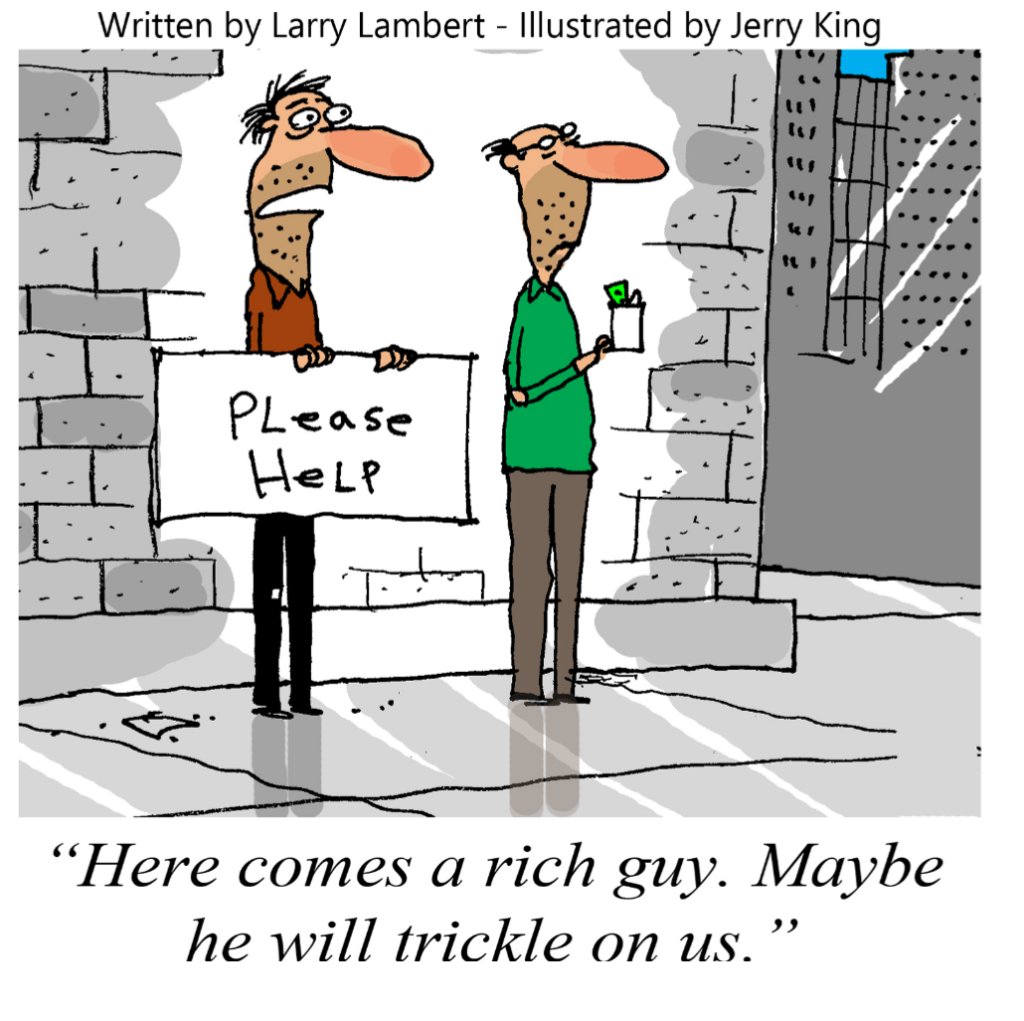
So Elon Musk is about to become the planet’s first trillionaire, I’ve learned. Or he already is one? It’s hard to tell once you’ve reached such levels of cartoon villainy and pretend money. I say “cartoon villainy” because you don’t get a trillion dollars by providing value to humanity, and I hope we’re all savvy enough by now to know that. You get a trillion dollars first by capturing the mechanisms of power and influence that decide what value is and how it is counted, and then by pointing those mechanisms right toward yourself while cutting off as many avenues that don’t point toward you as you can. Corruption and exploitation, in other words.
He describes how Musk became a trillionaire:
by telling lies to the market about what his technology will do and when it will do it, then reaping the rewards of the market’s credulity on his grandiose claims, deploying all the reputation he fraudulently gained in order to hoover up government contracts, using the wealth he gained to acquire genuinely valuable things that other people have actually created [2], and finally corrupting those things to his own benefit and enrichment, all the while never paying any penalty for his mendacity as he simply keeps moving out the delivery dates on the technologic miracles he was obviously never able to deliver, and indeed rarely seems interested in even looking like he is bothering to try. Musk got his final boost into trillionairism on the strength of what sure seems like a fraudulent or at least bogus valuation for the recent IPO of his SpaceX company, propped up on typically grandiose and specious claims, unaccountable market credulity, captured government contracts, and rules changes favoring specious-to-fraudulent valuations, including loosened regulation and mandatory purchases by index funds. Index funds are where most of our retirement accounts are, by the way, so if Musk and his shareholders want to dip out with all their gains, it will be everyone else left holding the bag.
[T]his disrepute doesn’t impact the way our systems of government and finance and influence deal with them. Trump and Musk’s next grandiose claims—about the end of the conflict in Iran, say, or about putting a colony on Mars—will be reported as if it actually news, without the context of their long history of lies, without the assumption that these are just the latest lies. The markets will respond to the claims as if they are based in reality. The justice system will go on ignoring their crimes. The money will keep flowing to them, and to other billionaires, too. And billionaires as a class are increasingly in disrepute, yet the money keeps flowing to them, even as more and more people struggle to survive, even as billionaires get more and more open about their intention to control our bodies and lives, to enslave most of us and devour the rest.
Fewer and fewer people want this, it seems, and yet more and more of us are getting it. There seems to be a fundamental disconnection between the will of the people and the will of our systems of government and finance and influence. This tells me that whatever changes we need to make, they need to be systematic and fundamental—radical, in other words.
Moxon is not the only person to notice this, but he goes on to ask why. And he connects this corruption with the stories we tell ourselves through our popular media: Once our superheroes were selfless beings who felt an inner pressure to use their power responsibly, in service of the people they had the power to rule. [3] But then came the Marvel cinematic universe.
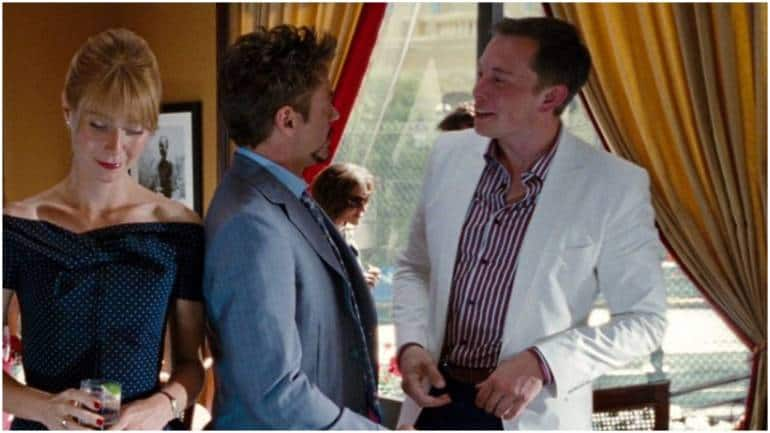
Iron Man aka Tony Stark was the central hero of these dominant stories we told ourselves. He was a capitalist genius billionaire arms dealer who saves the world by single-handedly developing increasingly autonomous mechanized weapons over which he has an ever-increasingly level of personal control, which he deploys throughout the world however he sees fit. I remember when this would describe the villain of most stories, but over the last two decades of our dominant mode of storytelling, Tony Stark was our central hero. His wealth was proof of his goodness; his development of technology was proof of his right to use it; his genius enabled him to make, all by himself, the marvels that brought salvation to the universe, and the creation of those marvels bestowed upon him license to decide how those marvels should be best used. It shouldn’t perhaps surprise us that after a decade or so of this we wound up with Donald Trump and Elon Musk.
Two world-shaping geniuses meet in Iron Man 2. Which one is fictional?
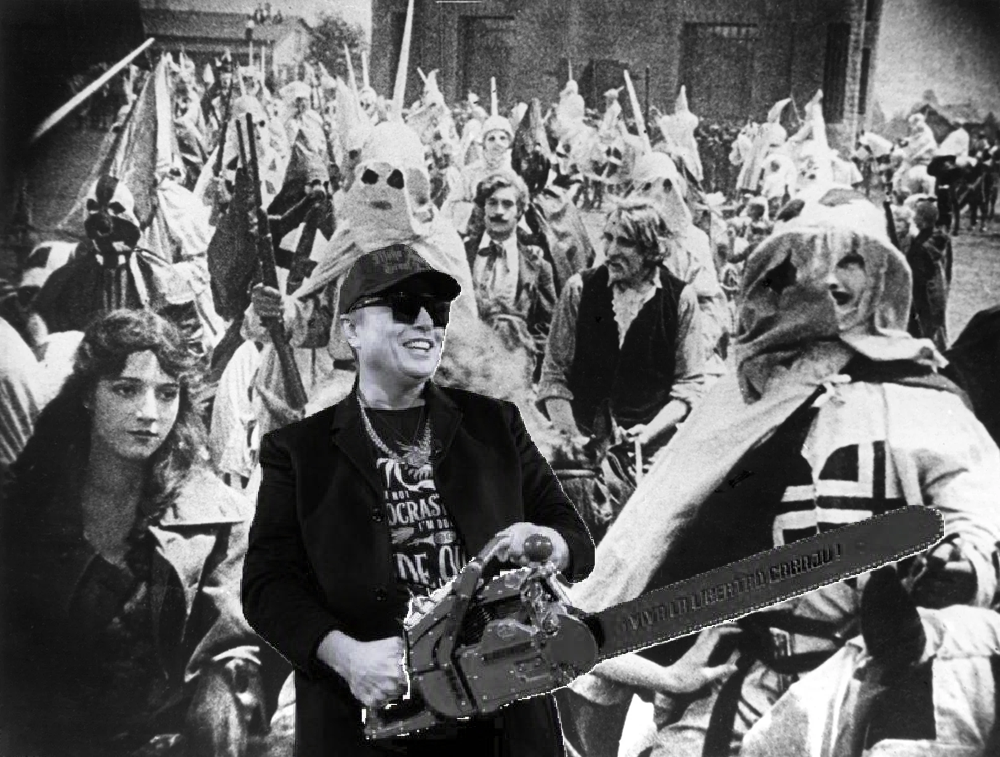
But supremacist story cycles have a way of falling apart eventually, because people start connecting them to the harms they cause. In the first half of the 20th century, a popular story cycle — from The Birth of a Nation to Gone With the Wind — idealized the Confederacy and the Ku Klux Klan that was fighting to restore the South’s former glory. [4] That story falls flat today. [5]
Confederates seceded with an open defense of their right to slavery, but their modern defenders have discovered they can’t tell the story they defend on its own terms. Southern scions of human slavers don’t like being thought of as scions of slavers, these days, and those who serve as Confederate apologists don’t like being thought of as apologists for slavery. These days most racists don’t like being called racists and most supremacists don’t like being understood as supremacists, and most fascists don’t like being called fascists. Instead, they try to cast their critics as the real racists, and those who try to resist their oppression and suppression as the real supremacists, and antifascists are the real fascists. There seems to be a reputational cost that attends their actual beliefs, one they’d rather make others pay, and they seem to know it.
So supremacists have to keep coming up with new stories to justify their dominance. Moxon says we need to get quicker at noticing and undermining these new stories, and get better at coming up with counter-stories of our own. Intriguingly, he claims to be drafting future essays about how to do that.
[1] A book collecting some of his essays, Fighting in the Dark, is coming out in August.
[2] Many people believe that Musk founded Tesla, or maybe even invented its technology. He didn’t.
[3] The idea that changes in superhero myths mark changes in society is something I worked with in my 2010 UU World article “Reclaiming Krypton“. I followed up in 2021 with a blog post “Return to Krypton“.
While I’m mentioning it, let me say that “Return to Krypton” deserves a look. The superhero stories since 2010 focus on an ambivalence about legacy, and point us towards a process of discernment, where we separate the legacies we are grateful for from the legacies we must reject. There are good and bad sides to being, say, Batman’s protege. And that invites us into a discernment process about our American legacy: “I revere this Thomas Jefferson. I revile that one.” Once you enter the debate over whether we should admire Jefferson or be ashamed of him, you’ve oversimplified American history.
In contrast to Musk and Trump, the superhero myths of the 1940s and 1950s gave us “the wise men“, six incredibly influential people who shaped postwar and Cold War American foreign policy. Most were from well-to-do families who gave them elite educations, and Averell Harriman inherited considerable wealth, but none of the six used their public-policy influence to capture billions for themselves. Today, only history buffs can tell you who they were.
[5] Something similar has happened to the old-fashioned cowboys-and-Indians western. Portraying Native Americans as mindless savages just doesn’t work any more. How the West was “won” has become a much more ambiguous tale.
It’s still too soon to tell how the agreement with Iran will play out: Maybe Israel and Hezbollah will scuttle it by continuing to fight. Maybe the gap between the two regime’s interpretations of the terms will grow until the whole thing breaks apart and the war restarts. Or maybe it will go forward as the implied admission of America’s defeat it appears to be.
Other stuff happened this week as well: the Obama Center opened with the kind of all-star line-up Trump dreamed about for his Freedom 250 celebration. The UFC bout on at the White House sparked an online discussion of what masculinity really is or ought to be. The reflecting-pool fiasco continued to the predictable stage of Trump blaming somebody else for it. And Ukrainian President Zelenskyy started making good on his pledge that “If Ukraine burns, Moscow will burn.”
But the featured post has little to do with any of that. Instead, I’ll be pointing you at an essay on A. R. Moxon’s blog The Reframe, where he connects the way our system works to the stories we tell in our mass media. Make a hero out of Tony Stark, he claims, and you’ll wind up with an Elon Musk. The significance of superhero myths is an old interest of mine, so this post resonated with me.
That should be out shortly. I hope to post the weekly summary around noon EDT.
Trump’s assault on American democracy. Our rapidly declining empire has hit its bread-and-circuses phase. For the Mad King’s birthday yesterday, we witnessed the corrupt spectacle of a UFC cage match on the White House lawn.
Climate change. You don’t have to deny scientific data you never collect. So the Trump regime is dismantling our ocean sensors.
Iran war. An agreement was announced yesterday, but we don’t have the text, and the most contentious issues were put off until the next round. If we’re lucky, it will get us back to where we were before Trump launched his ill-fated war.
Ukraine. This week’s update from Phillips O’Brien focuses on Ukraine’s effort to cut Crimea off from Russia. If they succeed, Crimea becomes a drain on Russia’s war effort rather than a strategic asset.
This week’s developments
This week everybody was talking about the Iran agreement
After months of Trump claiming a deal was at hand and Iran saying no, some kind of agreement was announced yesterday and is supposed to take effect Friday. No specific text was released, so I can’t tell you exactly what is in it. We just have to go on what various leaders are saying about it.
Apparently, the Strait of Hormuz will be open again, as it was before the US and Israel attacked Iran. The US will drop its blockade of Iranian ports, so Iran will be able to sell oil as it did before the attack. The US and Iran will be negotiating about the future of Iran’s nuclear program and the fate of the Iranian assets frozen in the US-controlled banking system, as they were doing before the attack. The ceasefire will be extended 60 days and will include Israeli forces in Lebanon, which Israel may not accept.
The obvious question now is: What did we gain from launching this war? Trump and Hegseth have been claiming victory since the first day, but what did we win? Aren’t we just back where we were before we got 15 of our own people and God knows how many Iranian civilians killed, spent hundreds of billions, depleted our stockpile of missiles and other weapons, cost American consumers billions at the gas pump, and disrupted the world economy?
The right comparison is not between today and yesterday’s worst-case scenario. The right comparison is between today and the day before the war began.
And we may not even be back to where we started. There appear to be several points of possible misunderstanding, like this one:
[Iran’s Deputy Foreign Minister Kazem] Gharibabadi said those negotiations [over Iran’s nuclear program] would only begin once Iran can verify that the U.S. has complied with the current agreement, which he said included unfreezing Iranian assets and lifting the naval blockade. U.S. officials, however, said Iranian assets would not be unfrozen until Tehran had demonstrated compliance with the agreement.
Sellers lists the possible issues in the agreement, and offers practical tests for judging them. Example: “does Hormuz return to normal freedom of navigation, or does Iran emerge with a new coercive role over passage?”
Whatever the reality, Trump will spend the next several weeks claiming he got concessions that aren’t in the agreement, in order to tell his base that his claims of victory weren’t lies. Iran will not validate these claims, but we’ll see if they will be content to let Trump do what he does. That would give the world 60 days of breathing space before reality must be faced again.
My best guess: Something like this agrement will eventually take effect, but first it will have to come apart a couple more times. Maybe Israel will scuttle it, or the “memorandum of understanding” will fail to reflect a mutual understanding of its terms. And maybe Trump will just blow it up when his MAGA base starts to accuse him of weakness.
So Elon Musk’s net worth crossed $1 trillion (due to the SpaceX IPO I warned you to avoid last week). And after a bunch of legal flailing by Trump’s puppet board, his name came off the Kennedy Center. (I think.)
Musk’s trillionaire status has sparked debate about what our economic system rewards or doesn’t reward. Exemplars of vast wealth are always controversial, but it seems to me that previous ones gave their fans more to work with than Musk has. If you drove a car, you understood what Henry Ford had done. John D. Rockefeller and Andrew Carnegie represented oil and steel, which anyone could appreciate.
Bill Gates exemplified the personal computer revolution (whether it would have happened without him or not). For better or worse, Jeff Bezos and Sam Walton changed the way we shopped.
But Musk? His fortune is based on dreams of a future that may never come to pass, or may be made real by a competitor rather than Musk himself: self-driving cars, humanoid robots, colonies on Mars. Tesla and Starlink are real, but so far they account for very small parts of the car or communications industries.
But these achievements weren’t enough to make Musk the world’s richest man. His wealth has, instead, historically rested mainly on self-fulfilling faith — investors believing in Musk’s genius have piled into stocks in Musk-controlled companies, and the rising value of these companies has enhanced his reputation for genius.
We have a term for enterprises that look successful because they keep drawing in new investors and keep drawing in new investors because they look successful. They’re called Ponzi schemes. And Elon Musk is basically a human Ponzi scheme. … Which brings me to my final point. The immense human Ponzi scheme that is Elon Musk will eventually collapse.
So, are we living in a second Gilded Age? If only. We surpassed Gilded Age levels of income and wealth inequality decades ago. We’re now in an era of oligarchy in which the power of great wealth and the abuse of that power by a tiny elite eclipse anything we saw in the late 19th and early 20th century. And the super-wealthy themselves are far more lacking in redemptive qualities than their predecessors.
If you really enjoy seeing someone dunk on Musk, follow Will Lockett’s substack. In particular, this post examines the one piece of SpaceX that is supposed to be profitable already: Starlink. But is it really profitable, or do those earnings come from an accounting game enabled by Trump’s Big Beautiful Bill?
Then there’s Musk’s most serious downside: Current Affairs interviews Nicholas Enrich, who has a book out about the destruction of USAID during Musk’s months as head of DOGE. And Musk was involved: He bragged about “feeding USAID into the wood chipper”.
[USAID] was kind of the embodiment of American generosity overseas. We operated under a flag of people shaking hands that said “from the American people”, but it wasn’t just a charity organization. I think that that’s it’s really important. It was an implement of national security. It kept Americans safe from infectious diseases. You know, we had developed a global early warning system, so that countries could detect and respond to infectious diseases before they could potentially threaten us. We built partnerships over decades with countries that enhanced stability and increased American soft power around the world, that really allowed for Americans to thrive in a stable world order for over 60 years.
Enrich gives a few simple examples of threats to national security: When the Ebola outbreak started in Uganda, USAID wanted to screen passengers boarding international flights out, because “that’s how you get an international catastrophe”. The funding was denied. Clinical trials of drugs to fight currently drug-resistant tuberculosis were stopped, creating a risk of new TB strains resistant to those experimental drugs.
Enrich wasn’t prepared for the level of ignorance he encountered from the DOGE people.
There was another political appointee who told me, when I was pushing to restart lifesaving Ebola activities, he told me just that Ebola is a scam.
The first signs of the unfolding disaster were
families that had spent all day walking to a clinic in Sudan—you know, with the USAID logo on it—expecting to get food and medical supplies, seeing that clinic ends up being shuttered and were then forced to go home and then make the heart-wrenching decision of which of their children to feed. And there were pregnant women who were unable to access emergency childbirth services because the ambulance service that provided them was cut off and they ended up perishing. These were just like the initial anecdotal experiences that we started to hear that have since expanded.
Now we’re seeing conservative estimates show that 750,000 people have already died, most of those are children, and that’s within the first year. And unfortunately, what we’re learning is that really this is just the tip of the iceberg. It’s what we’re going to see in the next few years, where new babies who are born are no longer getting the immunizations we used to provide, babies are being born with HIV at high rates in some clinics, where just a year ago those rates were near zero. The impacts of this are going to—we’re not going to see the full effects of them for four years. I mean, I honestly believe that when the dust settles on the Trump administration, his cuts to USAID will end up being a major part of his legacy, because of just how far-reaching those impacts really are.
The Lancet medical journal published a study anticipating the results from a global cut in official development aid (ODA).
Sudden and severe reductions in ODA funding could have catastrophic consequences, with a potential global death toll comparable to—or even exceeding—that of the COVID-19 pandemic. Even modest defunding that simply extends current downward trends is likely to lead to sharp increases in preventable adult and child mortality, potentially resulting in tens of millions of excess deaths in the coming years.
It’s important to understand the full evil of Musk’s actions. For decades, I’ve been hearing conservative rhetoric about how private aid should replace government aid. But not only does Musk (unlike Bill Gates or Warren Buffett) give essentially nothing from his vast wealth to help the world’s least fortunate. (The Musk Foundation has focused on self-dealing with his businesses, and funding schools his children attended.) But he uses his wealth to buy political power, and then uses that power to prevent any help from reaching the poor.
Trump is being as petty as possible about taking his name off the Kennedy Center. Legal challenges went to the last minute, and then a 12-hour extension was granted. After the name came off, they left the tarp up so that no one can see the place where his name was taken down. The tarp serves no purpose but to avoid giving Trump’s enemies the satisfaction of defeating him.
News articles about taking down Trump’s name quote a lot of opinions about whether he deserves such an honor. The answer seems obvious to me, but it’s an irrelevant point: Trump and his puppet board had no power to change the name of the Kennedy Center. Only Congress can do that.
This is typical of a lot of Trump’s legal controversies. Whether what he wants to do is a good idea or not — I usually think not — he gets into trouble because he exceeds his legal powers. The tariffs are a prime example. Whether the US would benefit from higher tariffs is something reasonable people can argue about. But under the law, Trump had no power to impose his tariffs. The right argument to have there isn’t against tariffs, but against dictatorship.
Consider this exchange in the court case about Trump destroying the East Wing of the White House and beginning to build his gilded ballroom. Trump’s DoJ is arguing that courts have no power to intervene.
“If the government decides, very quickly, to bulldoze the Statue of Liberty,” asked Judge Patricia Millett, “[if] the government moved too fast…nothing can be done?”
“I think that’s right, yes,” [DoJ attorney] Roth replied, which, according to ABC News, “sparked audible gasps in the courtroom.”
Now, nothing in the Constitution commits the US government to maintaining the East Wing (or the Statue of Liberty). But under our system of government, such decisions aren’t based on the whims of one man.
Republicans would recognize this truth immediately if the one man were a Democrat. President Obama was denounced (more than once) for putting his feet up on the Resolute Desk. (“The picture of Obama with his feet on the desk in the Oval Office shows that he has never been taught manners. That desk is history and should be treated with respect.”) Imagine if he’d torn down a wing of the White House purely on his own authority.
As if Republicans running for Congress this fall didn’t face enough problems, Speaker Johnson just gave them one more: If he’s still speaker after the elections, he has a plan for Social Security, Medicare, and Medicaid to be “adjusted and fixed“.
We know what this means, because it’s been a staple on the Right for decades: Any government spending that benefits people creates a budget problem. But there is infinitely much money available to pursue wars, cut billionaires’ taxes, and glorify God-Emperor Trump.
In particular, a Heritage Foundation article from 2024 proposes to “fix” Social Security by raising the retirement age to 69 or 70, establishing a “more accurate” (i.e., less generous) inflation metric, and partially privatizing the program.
The ostensible reason to “fix” Social Security is that the SS trust fund will run out of money in the early 2030s. If no other funding is provided by Congress, benefits will be limited to the Social Security taxes that come in, necessitating cuts.
However, the trust fund has always been a bookkeeping device rather than anything real. As Paul Krugman explains, the real question is whether the country wants to keep funding its elders at this level, not whether it can afford to.
and a war crime
Almost since the beginning of the Iran War, Trump has been threatening to commit war crimes. Occasionally, people have debated whether something we’ve done in Iran is a war crime or not. Bombing the girls school, for example, would be a war crime if it had been done intentionally. Attacking bridges and power plants might be war crimes, if the intent was to destroy economic infrastructure rather than impede Iran’s military.
Tuesday, all doubt was removed. After Trump unleashed another round of war-crime threats on Truth Social, this happened:
Well, it’s precisely the kind of disingenuous question that I’m used to from the media, impugning the motives of the folks on our side who are incredibly professional and incredibly effective.
Don Moynihan raises an interesting point about the Supreme Court’s assault on Black representation in Congress. It really comes in two parts:
States can’t intentionally create majority-minority districts because that violates the Court’s “color-blind” interpretation of the Constitution.
States can gerrymander for partisan purposes, which in red states has the effect of eliminating majority-minority districts that might arise naturally, i.e., in urban areas with large minority populations.
Moynihan considers what would happen if both partisan and racial gerrymandering were unconstitutional.
By accepting partisan gerrymandering as a regrettable but inevitable part of American democracy, the courts made racial justifications, rather than broadly democratic justifications, the last basis for maintaining constraint on gerrymandering. So isolated, it became easier to eliminate this last line of defense.
Nothing about this was inevitable. Imagine an alternative scenario, where the courts decided that both racial considerations and partisan gerrymandering were unconstitutional. Commentators like Rubenfeld could still have trumpeted the end of “the racial districting game” but Black and Democratic voters would still have had a realistic chance at representation.
A new analysis at the New York Times by Nate Cohn and Eve Washington adds numbers to the debate. It makes clear how monumental the decision to accept partisan gerrymandering was to blocking a truly colorblind map.
A map that was organized more simply around the non-partisan values of natural geographic settings would preserve a similar number of Democratic and minority-leaning opportunities.
Video of a crime committed by one particular Sudanese asylum-seeker in Southhampton went viral and resulted in an anti-immigrant riot in Belfast. Wired examines the role a far-right youth group played in making the riots happen. The New Yorker has a longer, deeper article on how anti-immigrant politics is spreading in the UK and elsewhere.
Approaching the 10-year anniversary of the Brexit vote, the UK economy is clearly doing worse outside the EU than it would have done remaining inside.
One of the more controversial parts of FISA surveillance law is Section 702, which allows intelligence agencies to monitor the communications of certain foreign nationals, even when they communicate with Americans that the agencies are not supposed to spy on. Section 702 gets reauthorized from time to time, because it’s been too controversial to make permanent.
The tricky point is what the agencies can do with their databases of collected information. Maybe the NSA (say) has no justification to surveil you, but it has your conversations with foreign nationals in its database. Can it search that database for your communications without a warrant, essentially spying on you via its spying on other people?
Anyway, the appointment of Trump attack dog Bill Pulte as acting DNI raised the profile of this issue, and Congress failed to renew the authority when it lapsed last week.
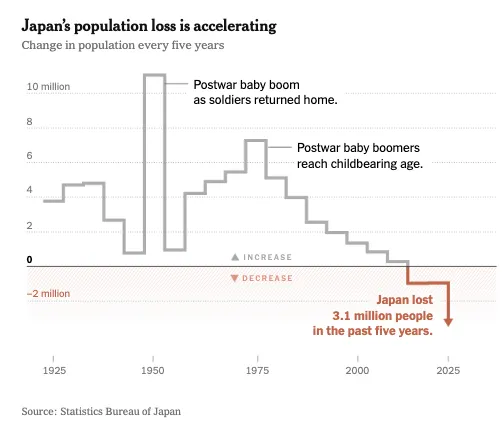
young men aren’t eager to marry, and Japanese women are more than happy to pursue life without them. Marriage rates continue to plummet, along with birth rates. This is less about policy initiatives the government might take than it is due to a wide gender gap in hopes, dreams, aspirations, concepts of family and cultural interests.
But of course, the US is developing similar gender gaps, and a similar (if less extreme) drop in births-per-woman.
Japan is not the exception – rather, it is the avant garde, the cutting edge, the leader the rest of us ought to pay close attention to as it struggles to find the right combination of humanity, gender equity, financing and social policy to care for its elders, encourage its young adults, bridge the political and economic gaps between men and women, and grow its children.
This is an issue conservatives recognize, but their approach is 180 degrees off. The decline in White reproduction is a key part of the Great Replacement conspiracy theory. The true part of the theory is that if our economy continues to create jobs and our people don’t produce children to fill them, immigration is the obvious way to keep the wheels spinning. This will inevitably shift the racial demographics.
But the MAGA approach to increasing fertility is basically to roll the clock back, so that women have fewer choices in life and are essentially forced into motherhood. Garrett suggests another path: Change male culture so that men take more responsibility for children. If men and women see equivalent costs and rewards for raising children, their expectations will begin to align.
If you’re wondering about the current legal situation around Trump’s slush fund for the January 6 criminals, the best summary is here. Two courts are still wrestling with issues related to the fund, and the regime is claiming the courts’ concerns are moot, because the fund isn’t happening. At least one judge wants a written commitment from the Justice Department that the fund really is dead and won’t be revived. We’ll see if DoJ gives that commitment.
a $386 million network of more than 900 instruments funded by the U.S. government’s National Science Foundation (NSF), which has provided real-time data on the world’s oceans for more than a decade. The sensors are distributed across both the Atlantic and Pacific oceans to monitor coastal environments, marine ecosystems, and ocean currents that influence the global climate.
The decision to end OOI, described by the foundation as a “descoping,” will remove nearly all in-water infrastructure located off the states of Alaska, Washington, Oregon and North Carolina, and the Irminger Sea, an area between Iceland and Greenland. The OOI was designed as a 25-to-30-year project specifically to capture long-term climate signals, which scientists say require at least three decades of continuous data to be meaningfully detected. The network has achieved just 10 years of observations.
The simplest way to deny climate change is to refuse to gather data on it.
and let’s close with something precious
“Rare photo of a mother wrench feeding her young. Breathtaking.” – ScottH
His victory has prompted a lot of soul-searching among Democrats, including me. In a cycle when we want to spotlight the moral slime of the Trump administration and the Republican Party in general, we’d like more than ever to have squeaky-clean candidates like James Talarico in Texas. (Imagine being so blameless that when your opponents start lying about you, the best they can come up with is that you might be vegan.)
A lot of the case against Susan Collins is not so much that she is slimy herself, but that she enables slimeballs like Brett Kavanaugh, Donald Trump, and a host of others. She may be “concerned” about their conduct, but when push comes to shove her party can count on her vote. (The “believe women” campaign started with Christine Blasey Ford’s sexual assault accusation against Kavanaugh, which Collins paid lip service to, but ultimately wrote off. She also believed Kavanaugh’s assurances that Roe v Wade was safe, and believed the empty assurances Mitch McConnell gave her in exchange for her vote on the 2017 Trump tax cut. “Believe powerful men” is the actual rule Collins follows.)
So now we have another believe-women situation: a former Platner girlfriend (who happens to be a Republican political operative) says he was violently controlling (but never struck her).
he regularly grabbed her by the shoulders — sometimes hard enough to leave marks — and, on one occasion, yanked her out of a cab by her wrist after an argument when she wanted to stay in the car.
During one argument, she recalled, he twisted her arm behind her back, shoved her into a bedroom and held the door closed from the other side so she couldn’t get out, telling her to remain there until she was “calm.” Eventually, Ms. Fifield said, she fell asleep and left the next morning.
I wish I didn’t have to deal with this, but I do. To what extent am I willing to support a less-than-perfect candidate for the sake of the greater good? I’m inclined to go a long way, given the perilous state our democracy is in if Congress continues to refuse to contain the authoritarian drive of the Trump regime. But I’m aware that MAGA types make similar arguments for tolerating Trump’s moral/legal failings: They grossly exaggerate the harm they think Democrats are doing or would do, and see Trump as the lesser evil.
I also resent that the public only seems to have standards for Democrats. Trump can be a convicted felon, found by a jury to have sexually assaulted a woman, found by numerous courts to have committed fraud, and so on — and none of it matters. Only Democrats have to exhibit good character and live moral lives. In particular, I have no patience for Republicans (and supposedly “liberal” media outlets like the NYT) who find fault with Platner, but have far less to say about Ken Paxton, who is by far the scummier character.
But still, it rankles to be complicit in the racheting down of moral standards in American politics. And consequently it raises the question: If we support Platner, are we just doing what they’re doing?
The most thoughtful article I’ve found on this topic is “Rupture and Repair: When Problematic Figures Ask For Our Support“, written by Jay Kuo for The Big Picture blog. Kuo compares Democrats’ treatment of Platner and Hunter Biden (who is developing something of a following online) to Republicans’ treatment of Paxton and Pete Hegseth.
Several figures from both sides of the political spectrum have raised this very question. Some seek redemption for conduct they acknowledge. Others seek power for conduct they deny. The distance between those two postures turns out to matter enormously, even when the underlying behavior looks similar on the surface.
Kuo proposes a simple test: What if the accusations are true? What does that say about the person’s future conduct, and in particular about how they would use the power they are seeking?
The contrast with Biden and Platner is not that their alleged conduct was less serious than Hegseth’s and Paxton’s, though it objectively is. The contrast is structural. Hegseth’s alleged conduct was directly relevant to the specific institution he was being asked to lead. Paxton’s alleged crimes are the exercise of the very power he is seeking more of. Rather than acknowledge the rupture of trust and seek repair and forgiveness from supporters, they have demanded to be believed over their accusers. Their party, calculating that the political stakes justified the cost, has obliged.
(Kuo’s distinction seems meaningless to Megan McArdle, who sees Platner and Paxton alike as men of low character.) For the moment, let’s put aside the whattaboutism of Hegseth and Paxton, and focus that test on Platner. He got (and later covered) a tattoo that was based on an SS symbol. He posted derogatory things online about women and minorities. He is accused of treating a girlfriend badly and possibly cheating on his current wife. He acknowledges the majority of that behavior, claims ignorance about the symbolism of the tattoo, and denies the violent aspects of the girlfriend’s charges. He casts those events in a narrative in which he was scarred by combat and took some while to work things out.
The question Kuo would have us focus on is: Does anything in Platner’s current life or political positions resonate with a pro-Nazi, anti-woman, or anti-minority past? If something does, he should lose any benefit of the doubt.
What matters most though is not the rupture [of trust] itself but the repair that follows. Character is revealed in the willingness to face the damage, attempt repair and accept that forgiveness is not guaranteed. A child who breaks something and hides it learns only fear and concealment. A child who breaks something, admits it, and works to make it right learns something far more valuable. …
Importantly, repair cannot simply be declared by the person who caused the rupture. And it cannot become a way to sweep aside serious problems, particularly around misogyny and toxic behavior. It has to be tested over time, especially by how seriously a candidate like Platner treats the objections of the people harmed and the concerns of voters still unwilling to trust him.
So the next thing to do is listen to the people most likely to be harmed if Platner has not reformed and is still not who he is claiming to be.
Shay Stewart-Bouley is a Black Mainer who writes about race issues. In her opinion, Platner is nearly unique among Maine’s White politicians in his outreach to non-White and immigrant communities.
I can’t speak to who Graham Platner was when he was posting hurtful things on the internet, but I can say that in the nine months since he launched his campaign, I have seen a white man who has done a lot more community-building across racial lines than the majority of those who judge him—particularly the left-leaning progressives and leftists who are horrified that he has a legitimate shot at becoming the U.S. senator. Most certainly more than the average politician or aspiring politician. The fact that he chooses to build behind closed doors rather than turning BIPOC people into props to redeem himself is also a choice. For those who seek the performative, there is no doubt that a few shots of him speaking with Black and Brown audiences and seeing their reactions would probably steady their nerves—but do photo ops allow for depth and true connection?
… I don’t need a perfect candidate and watching him show up consistently for Maine’s BIPOC community and not use the community to repair his battered image matters to me. In some ways, knowing for months that at any moment he could have chosen to “prove” that he has changed by taking relational moments and turning them into soundbites and photo ops—but he didn’t—reveals a level of integrity that is important to me.
If you want to understand the positive aspects of his candidacy, and why so many Mainers chose to stand by him in the primary, read Sebastian Junger’s “I Just Had Breakfast with Graham Platner“. What comes through in this article is how the constant sniping about details of his past and background serves to divert attention from his message.
The heart and soul of what Platner had to say to me – and to voters – is that American politics are deeply corrupt, and that Democrats are often as bad as Republicans. He went on to say that the true division in this country isn’t between liberals and conservatives but between economic elites and everyone else. These elites, in his opinion, have fomented political divisions to stay in power because their main goal is economic monopoly; politics simply serve that purpose.
Perhaps The New York Times and Washington Post would prefer we not have that discussion. Junger goes on to quote Platner directly:
Here is my real point of contention with the liberal pundit class. Which is that they celebrate the suffering of working people who were tricked into voting for someone that was going to fuck them over. You shouldn’t celebrate that, you should be horrified by it…you should have compassion and empathy. Those people were tricked, they were propagandized, they were lied to. We are all in many ways being exploited and manipulated by the elites. To sit around and say, Ha, ha, you get what you voted for – no, man. Those are people in pain. You don’t laugh at people in pain, you help them, for Christ’s sake.
… The Ukrainians are resisting an armed invasion, and I absolutely support [them]. But I do think it makes it hard to support them when we are also supporting the Saudi regime and the Israelis in Lebanon right now. I’m an internationalist. I believe our foreign policy should be rooted in international institutions that we respect consistently. Vietnam wasn’t good for working Americans. Fucking around in South America in the 1980s was not good for working Americans. The wars in Iraq and Afghanistan were not good for working people. I’d like to see us invest money in the United States rather than in a bloated military apparatus. We have helped set up all these international court systems that are specifically designed to to protect corporate power and capital around the world…why don’t we do that to protect, say, labor rights around the world? [We need alliances so that] if a company flees one country to avoid taxation, other countries will impose the same tax rate.
… Establishment Democrats and normie liberal types love talking about fascism and authoritarianism. They use the words and then nobody does anything to prepare. I do believe these people [in the Trump administration] are fascists and will try to maybe interfere in the elections come November, weaponize or militarize federal law enforcement as a political tool. So, that’s why you have to fucking organize now…just saying so on MSNBC isn’t enough. Talk to the labor unions, talk to the community organizers, start building the mechanisms that we’re going to need. Resistance isn’t magic; it requires time and discipline and energy. The Trump administration is full of incompetent morons; of all the versions of this we can beat, it’s this version. What I’m very much worried about is if we don’t resist and defeat this version now, then the next version is actually competent.
All things considered, is that a point of view I want represented in the Senate? I think it is. You may make your own decision, but I encourage you to take a long look at Platner, and not just respond based on a few headlines in the corporate press.