
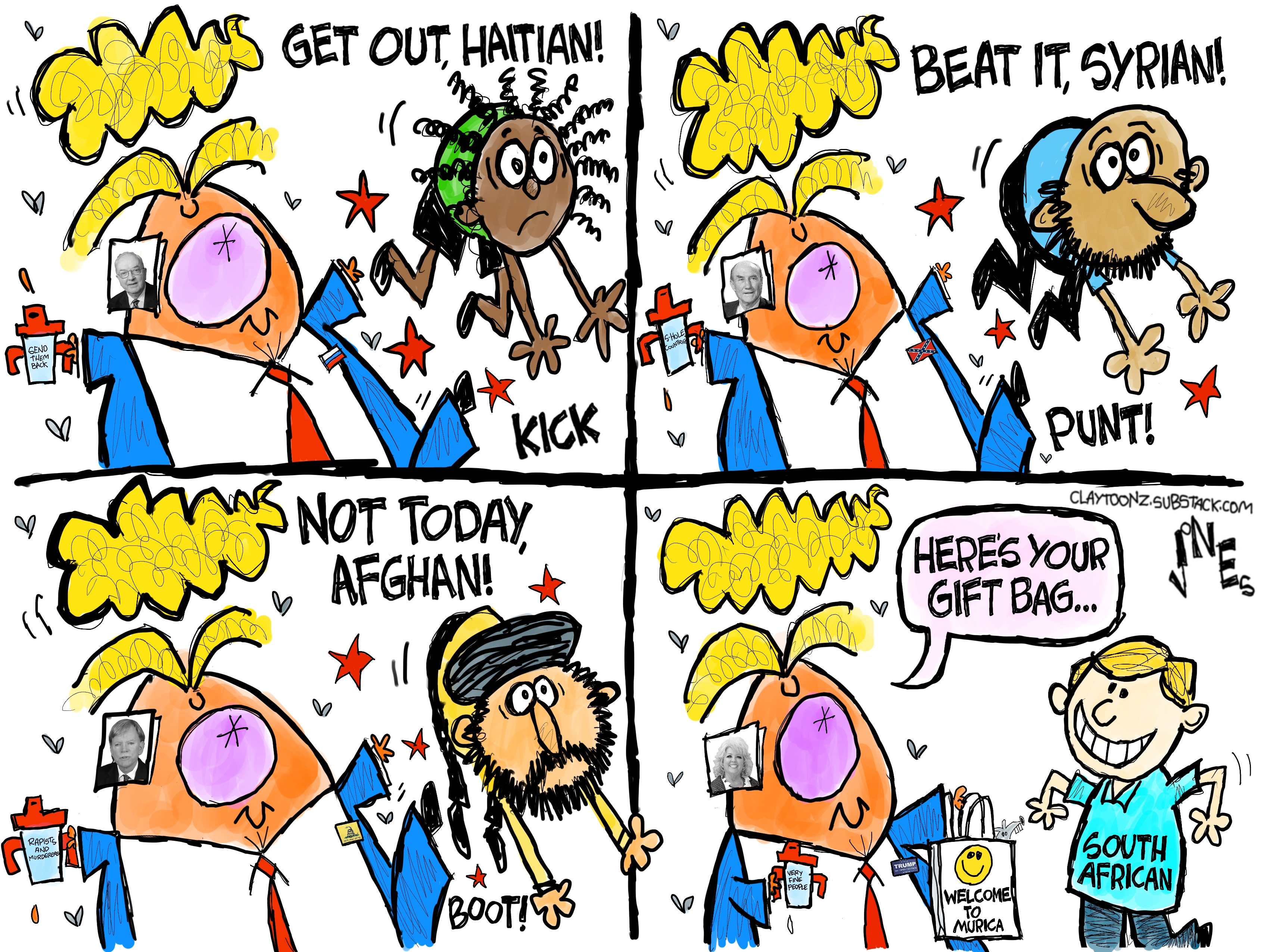
The Supreme Court signs off on Trump’s program to Make America White Again.
Other than openly professing Nazis, the anti-immigrant voices in the US get incensed at the suggestion that what they care about is race. At times they seem to care about anything other than race: disease, election security, jobs, crime, and so on. J. D. Vance has even blamed immigrants for the high cost of housing. Experts dispute the anti-immigration claims in all those areas and are ignored. But O no no, the problem couldn’t be that the vast majority of people coming into the US are black or brown.
Even if you could put all those problems aside (as a decent respect for reality does), there’s still one issue that stands out above all others: respect for the law, and particularly for the laws that control our border. The problem with these people is that they came here without permission and crossed our border without leaving a trace in our systems. We don’t know who’s here, we don’t know who they are, and so on.
Well, the second Trump administration has exposed the lie of that explanation. It has gone after people with temporary protected status (TPS), and it has found excuses to shut the door in the face of legitimate refugees, who our laws and treaties oblige us to protect. (We are accepting refugees this year, but only white ones from South Africa.)
So the shoe has moved to the other foot: It’s not immigrants who are breaking the law, it’s the Trump administration.
But wait until the courts hear about this! We are a nation of laws, and our courts protect even the weakest among us from the strongest. So Haitians and Syrians losing their TPS status sued, charging that Trump’s DHS is violating the law that established TPS. In parallel, an immigrant-rights organization sued to change DHS’s policy preventing refugees from coming to our border and applying for asylum. Lower courts offered at least temporary relief while the cases worked through the system. They did not settle the underlying issues, but ruled that the immigrants were likely to prevail, and so should not have to leave the country before winning their cases. (In the Haitian TPS case, a lower court also found it likely that the Haitians would prevail on the part of their suit that blames the Trump administration’s racial animus for their eagerness to rid the country of Haitian refugees.)
The administration appealed both cases to the Supreme Court, which announced its decision in both cases on Thursday: All the lower court actions were overturned. Hundreds of thousands of refugees will have to return to countries that the State Department says are not safe. Countless others will never get the chance to seek protection in the United States.
But OK, you might think, the Supreme Court doesn’t make policy. It just (in John Roberts’ words) “calls balls and strikes”. Maybe, when a wise court really drills down into the underlying bedrock of law, the refugees are just out of luck.
If you think that, I invite you to read the majority opinions in each case, which were both written by Sam Alito (my least favorite justice). And after you do that, read the dissents by Justices Kagan and Sotomayor.
Both of Alito’s opinions are mockeries of legal reasoning. He had a conclusion to get to, and he got there. He can’t say it in so many words, but he wants to Make America White Again. And the other five conservative justices agreed with him.
At its root, the immigration issue is about race. Nothing else.
Temporary Protected Status. The TPS case is Mullin v Doe, which concerns about 300,000 Haitians and a smaller number of Syrians. All of them are in the United States legally. Temporary protected status (TPS) is a legal designation created by Congress to provide humanitarian aid to people escaping some disaster, either natural or man-made, in their home countries. TPS recipients are allowed to live and work in the United States while they wait for conditions to resolve back home. The program includes no path to citizenship and the TPS residents do not vote. Their status is reviewed periodically by the Department of Homeland Security.
Haitians got this status in 2010 after their country was devastated by an earthquake, while Syrian TPS was a response to the repression of the Assad regime and the disruptions associated with the civil war to overthrow him. According to the Trump regime, their continued presence strains the meaning of the word “temporary”. But the law that established TPS also established a process for terminating it: The DHS secretary, Markwayne Mullin currently, is supposed to consult with relevant government agencies, evaluate what they say, and make a determination about whether that particular country is a safe place to go home to. (Notice: Under the law, the relevant point isn’t whether the original emergency is over, but whether the country is now safe.) Having made an official determination that the country is safe now, the DHS secretary can revoke the TPS status.
Mullin did none of this, which becomes clear if you look at the current State Department advisories on travel. Haiti is under a Level-4 travel advisory: Do Not Travel.
Do Not Travel to Haiti due to the risk of crime, terrorism, kidnapping, unrest, and limited health care.
Non-emergency US government employees and their families were ordered out of Haiti in 2023. Those who stay are not allowed to leave the US embassy “for non-essential reasons due to safety risks”.
Syria is also a Level-4 country:
Do not travel to Syria for any reason due to the risk of terrorism, unrest, kidnapping, hostage taking, crime, and armed conflict.
That’s what the Trump regime wants to send people back to.
When the government fails to follow procedures laid out by law, it violates the Administrative Procedures Act. That’s the basis for these lawsuits. The Haitians also charged that DHS’s action was at least partially motivated by race, and so violated their equal-protection rights under the 14th Amendment. District courts in New York and D.C. issued a temporary injunction blocking the revocation of TPS status, and a DC appellate court rejected the government’s motion to stay that injunction.
These rulings are not final judgments on the merits of the Haitians’ and Syrians’ claims, but reflected the courts’ judgment that the immigrants would probably win their cases, and that they should not be ejected from the US while those cases are being decided.
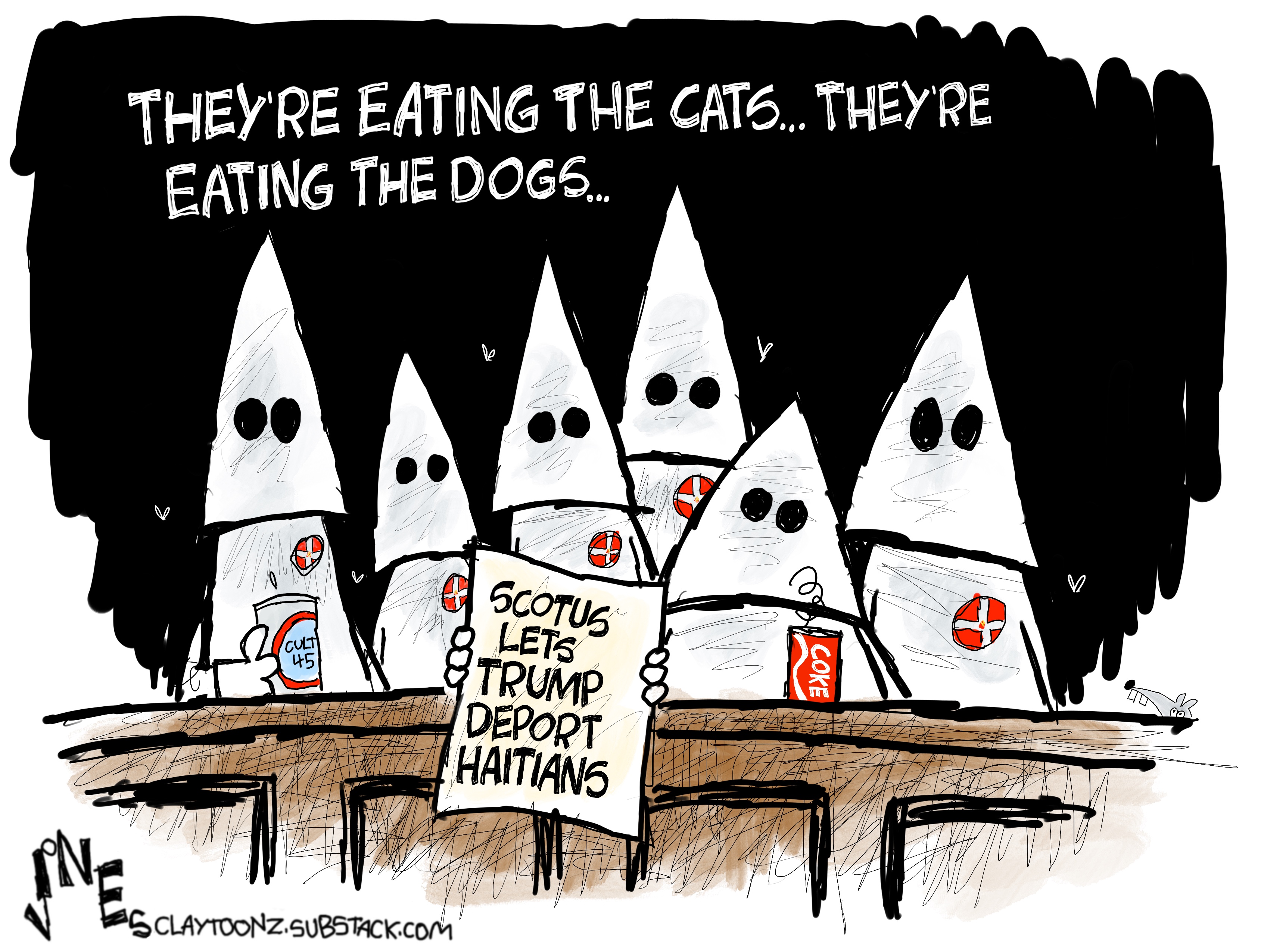
Wednesday, the Supreme Court reversed those judgments. While the merits are still not decided, Justice Alito and his five conservative accomplices decided that the government would probably win the cases and so nothing should prevent the government from sending the Haitians and Syrians home in the meantime. So even if the Haitians and Syrians would happen to win their cases somehow, it will be very hard to come back.
Alito’s reasoning rests on one line of the TPS statute, which explicitly bars
judicial review of any determination of the [Secretary of Homeland Security] with respect to the designation, or termination or extension of a designation, of a foreign state.
Read correctly, this is a common-sense provision: DHS is the department Congress designated to make the safe-to-go-home decision, and judges should not substitute their opinions for the DHS secretary’s. But Alito expands this exemption to include the entire DHS decision-making process. Not only is DHS’ conclusion immune from review, but also DHS’ refusal to follow the decision-making process the law lays out. So Alito reads the TPS law to say: “Here’s how you decide whether to withdraw TPS status. But if you ignore what we just said and instead pull a decision out of your butt, no one can do anything about it.” [1]
Alito also slaps down a lower-court finding that the Haitian decision was at least partially based on race, because Alito does not take racism seriously unless the victims are white.
Recall the context: Trump has referred to Haiti as a “shithole country“. He and J. D. Vance explicitly and knowingly lied about precisely these Haitian TPS residents by claiming “they’re eating the dogs, they’re eating the cats” in Springfield, Ohio.
Alito brushes this off:
None of the cited statements by either the President or the Secretary was overtly racial, and in substance all expressed policy views that could rest on race-neutral justifications. For example, one may oppose TPS and favor tighter restrictions on immigration for economic or other reasons that have nothing to do with race. And a person without racial bias can provide a harshly unfavorable description of living conditions in some of the countries with TPS designations.
In short, because Trump never said “I hate Black people”, because it’s possible to imagine non-racial motives for his actions if you strain hard enough, and because Haiti actually is a shithole country, the Court should ignore the possible presence of racism here. [2]
Now that it is free to do so, we can anticipate the mother of all ICE raids on Springfield, Ohio and other cities and towns with large TPS populations. The New Republic pictures Springfield becoming the next Minneapolis:
Here’s the thing: If you vote for the ticket that tells you immigrants are eating your pets—the ticket that tells you mass removals are needed to purify and revive the nation and its heartland towns—what you’re actually going to get is social turmoil, violent ethnic purges, and serious economic disruption. If you are upset at the prospect of law-abiding immigrants being violently wrenched from your communities, next time don’t vote for the guys who lied in your faces so viciously about them.
Asylum and the Border. Remember when Bill Clinton wondered what the meaning of is is? Alito’s majority opinion in Mullin v Al Otro Lado is like that, but the two-letter word in question is “in”. What does “in” mean, really?
The Immigration and Nationality Act of 1952 requires immigration officials to inspect every person who “arrives in the United States”, and offer each of them an opportunity to ask for asylum in the United States because they are persecuted in their home country. But what does “arrive in” really mean? If border guards stand on the border and stop migrants while they are still technically in Mexico, have they “arrived in” the United States or not? Can we then ignore our legal and treaty obligations to offer asylum to victims of persecution?
After an elaborate wander through dictionaries and usages, Alito concludes that we can. When Congress tried to codify our obligations under the post-Holocaust Convention on Refugees, it really was that stupid. [3]
Now, back in April I wrote about our broken system of processing asylum claims and what might be done about it, so I understand that there are issues here. But this verbal sleight-of-hand can’t be the way we fix it.
What Alito is doing here is based on a theory of interpretation known as textualism, which is related to originalism. In the abstract it sounds great: We should interpret the words in a law according to the common usage of those words in that era. Who could argue with that?
The problem is that I have never seen this method applied in good faith, just as I have never seen originalism applied in good faith. The textualist/originalist always knows what conclusion s/he is aiming for, and cherry-picks examples of history and usage to get there.
What gets lost is the larger context: Why did Congress pass this law? What problems was it trying to solve? By breaking laws down into individual words, you can ignore all that and come to an interpretation that makes no sense. That’s what Alito has done here.
Why? When you run into such obvious examples of motivated reasoning — and especially when you run into two on the same day by the same author — you have to wonder what the motive is. When such a smokescreen of verbiage is thrown at you, you have to wonder what’s behind the smoke.
I think it’s obvious: racism.
TPS has allowed more than a million brown or black people to come to the United States legally and work here. Many more arrive at our borders and claim asylum — maybe because it takes us years to process such claims and in the meantime they also can live and work in the US.
In some people’s eyes, these programs threaten the identity of the US as a white country. To them, these immigrants “poison the blood of our country“. To get them out, Americans might make up lies about them “eating the dogs, eating the cats“. A government that represents those people might construct outside-the-law justifications to send the one group away and refuse admittance to the other.
And six racially motivated Supreme Court justices might rubber-stamp those justifications.
[1] It’s worth pointing out that during the Biden administration, the Court routinely invented new law (like the “major questions doctrine“) that allowed it to second-guess whatever decisions government agencies made. Now it is ignoring established law in order to preclude lower courts from reviewing decisions made by Republican officials. If the 48th president is a Democrat, we can expect to see the prevailing winds reverse again.
[2] Under Alito’s reasoning, neither Jim Crow nor slavery could be viewed as racial issues. We can imagine race-neutral justifications for either (like a shortage of workers capable of picking cotton, or a revenue shortfall that required a poll tax). And Southern politicians often expressed their great love for their African property. To ignore these statements as having been made in bad faith, and to claim instead that laws were passed out of racial animus — that would violate the deference that courts owe to the executive and legislative branches of the Southern state governments.
[3] If you need a refresher course on how the Holocaust led to post-war laws about refugees and asylum, read Sotomayor’s dissent.


Comments
In this article, Dana Milbank describes a “Project 2029” that would include policies a Democratic president could enact under the Unitary Executive and Presidential Immunity that Trump is currently taking advantage of. These could include creating a public option for health insurance, revoking patents on drugs unless the manufacturers lower prices, dismantling DHS, and many others. Electoral-vote.com has a long list which includes things like requiring gun owners to join a “well-regulated militia,” stripping Fox and other conservative outlets of their broadcast licenses on some pretext, and impounding funds for projects in red states.
https://www.electoral-vote.com/evp2026/Items/Jun29-5.html
We should be asking which potential Democratic candidate would be most willing to do this.
Trackbacks
[…] This week’s featured post is “Immigration is about Race“. […]
[…] Immigration is about Race […]
[…] echoes what I wrote last week in “Immigration is about Race“: that the goal here is a nation by and for White people, especially conservative White […]