
A quick convention to replace Platner will raise some long-brewing issues.
So Graham Platner is out. Having overcome a number of past controversies, he finally faced more than he could explain away: This week new and more serious allegations surfaced, just about all his endorsers backed away from him, and he was forced to leave the race for Susan Collins’ Senate seat in Maine.
The usual caveats apply: Platner denies the new charges, and if you really, really want to believe him you can. But an election is not a court of law. Voters would be deciding whether to send him to the Senate, not to prison. So they have a right to demand positive confidence in a man they elevate to positions of power, not just reasonable doubt about his guilt. (If only Susan Collins had applied that standard to Brett Kavanaugh. A social-media meme I haven’t traced to its source says: “Graham Platner doesn’t belong in the Senate. He belongs on the Supreme Court.”)
Before talking about what can or should happen next, let me own up to this: Until this week, I was in favor of giving Platner the benefit of the doubt. He tells a good redemption story: He is basically a good man whose military service left him with PTSD. He then went through a dark period where he drank too much and behaved badly, but he came out the other side.
Like a lot of Maine Democrats (whose accounts I was quoting), I found that story plausible. I lost that gamble.
Next? But that’s not the end of the story. With Platner gone, Maine is left with the question of what happens next. Platner pulled out before the deadline that would have kept his name on the November ballot, so the Maine Democratic Party has until July 27 to name a replacement. They have a convention scheduled for July 25.
One-hundred and one of [the convention delegates] will be Democratic State Committee members and the remaining 500 … [will be] chosen by Democratic county committees at special nominating meetings convened by the county chairs.
So if party insiders want to pick one of their own, they can. But it’s hard to see how a more inclusive process would work, given the time constraints. One hopes the delegates will stay aware of the 154,058 Mainers who voted for Platner in the primary. The party is at least nodding in that direction:
The first candidate deadline is July 15. Candidates will have to declare their intent to run by 5 p.m. to compete at the convention. Among the requirement is a 300-word statement explaining how the candidate will tap the “grassroots energy” in the Democratic base.
In addition to declaring their intent by next Wednesday, candidates will also have to gather at least 500 signatures from registered Democrats by July 21. Included in that requirement is that candidates must obtain 50 signatures from no fewer than eight different counties.
Mainers vs. national pundits. In the national punditry, there’s a lot of hand-wringing that Platner’s debacle has made Susan Collins a shoe-in for reelection and probably doomed Democrats’ chances of taking the Senate.
Maine voices like Neal Gabler are far more sanguine.
So the first thing I would say I have learned these last two days is that the so-called experts in the punditrocracy have no idea what they are talking about. They don’t know Maine, and they don’t know Maine politics. When they say that the selection process is a “mess,” that is just plain wrong. Given the exigencies of the need for a selection and the cramped time frame, the logistics are difficult, but I get no sense of chaos. The process, as it is being formulated and described, seems orderly to me, or as orderly as any can be under these circumstances.
… Second, the so-called experts tell us that there are deep divisions in the party here, that same old cleavage between progressives and moderates, and that schism will likely affect the selection and the prospects for a November victory. The problem with this assessment is that I sense almost no divisions here, especially now that Gov. Mills, who did rile her fellow Dems, is basically off the scene.
Unlike the national Democratic establishment, Gabler sees the state Democratic establishment as basically progressive. The major candidates to replace Platner lack his “charisma”, but are not unknown to Maine voters and are largely on the same page. He has little fear that Democrats will be bitter and divided when they face Collins in November.
The moderate/progressive debate. Even so, the Maine convention is likely to be a microcosm of the debate Democrats are having around the country: In order to control the Senate, Democrats need to pick up four seats. In theory, Maine should be the easiest Republican seat to flip, given that Kamala Harris won Maine 52%-45%. Conversely, if Susan Collins hangs on, the path to a Democratic Senate majority involves flipping some much redder state like Iowa, Texas, or Nebraska.
So delegates have two questions to balance:
- Who do I like?
- Who can win?
Moderate Democrats will tell you that the answer to the second question is obvious: Swing voters are in the center, so a Democrat has to shift to the right to appeal to them.
Progressives argue that this is the old politics. In these polarized times, the number of issue-oriented voters in the center has shrunk considerably. The bigger pool is the disaffected voters, the ones who have lost faith in both parties and believe that no one really cares about them. Trump won in 2016 and 2024 by convincing those voters (falsely) that he did care about them. Rather than real solutions, he offered them scapegoats — immigrants, transfolk, undeserving beneficiaries of DEI or foreign aid, lazy people on welfare, non-Christians, globalists. He would defend you by going after them.
It’s hard to deny that he has gone after them. But it’s also hard to see how that has benefited you. Struggling American families have seen inflation get worse while money gets wasted on another pointless war. Many have lost food stamps and/or health insurance. Jobs are no easier to find.
The right response, progressives argue, is to put forward a bold vision that would make a visible difference in disaffected voters’ lives: child care, guaranteed healthcare, free college. If voters need scapegoats, let’s give them the people who are truly profiting from their distress: the billionaires and their monopolistic corporations. Tinkering around the edges of programs that already exist isn’t going to convince anybody that you’re on their side.
It’s easy to find this debate on social media, or to live in an echo chamber where you hear only one side of it. So far, it doesn’t seem to be a very satisfying or healthy argument: The two sides talk past each other and shout louder rather than engaging each other’s best points.
The two axes. If you want to try to make progress on this argument, I think the first key point is to embrace the two-axis model, which Josh Marshall has been pushing (though mostly behind the TPM firewall).
[T]here are two political spectra in the Democratic party, one that is right/centrist to left and another that is accommodation to fight.
The first axis is the issue-oriented one moderates point to: shoring up ObamaCare vs. Medicare For All, providing more education assistance to needy students vs. free college, and so on.
But the second axis revolves around the question: How serious is the current crisis of democracy? Do we just need to return to the halcyon days before Newt Gingrich’s Contract with America, when Congress debated issues but came up with bipartisan compromises to get things done? Or is Trumpist fascism a bigger threat than that, one that requires more drastic solutions?
Marshall illustrated the tension between the two axes by looking at his own response to the Colorado primary, where incumbent John Hickenlooper faced a challenge from the left. One the one hand, Marshall found himself mostly agreeing with Hickenlooper on policy and believing he had the best chance to hold the seat in the general election.
He seems like a very solid guy. I’m sure I’d like him. But it’s my strong impression that he is very much in the camp of Democratic senators who don’t want to do any of the big necessary things: abolish the filibuster, reform the Supreme Court, fight against encroaching autocracy as opposed to preserve decorum and regular order. In other words, he’s approaching the senate gig as though we were still in the 1990s or perhaps the W. era. To listen to my own oft-repeated arguments, he is the problem.
If you focus on the fight/accommodate axis, Harris’ loss in 2024 wasn’t a matter of being too liberal or not liberal enough. It’s that her rhetoric about Trump’s threat to democracy wasn’t matched by what she proposed to do about it. Trump’s resurgence after January 6 proved that electing a Democrat wasn’t a sufficient solution. A Harris administration wouldn’t end the threat any more than the Biden administration had.
How rank-and-file Democrats lost faith in their leaders. A deeper dive into this issue is Brian Beutler’s “The Insurgency Will Continue Until Morale Improves” which fortunately is not behind a firewall. Beutler lays out a history of missed Democratic opportunities, going back to the 2008 campaign.
What was striking to those of us on the outside was that none of these candidates, and no one else in the race, would even gesture at the most straightforward theory of change: that in a democracy, majorities should govern. In 2008 it was too early to foresee that a corrupt Republican judicial putsch would eventually necessitate farther-reaching democratic reforms. But the legislative crisis was already upon us. If Democrats won the election, and grew their congressional majorities, they should be prepared to change the Senate rules and simply legislate their plans into existence.
But the Harry Reid/Nancy Pelosi Congress colored within the traditional lines. They got ObamaCare passed, but the opportunity for real change vanished. McConnell obstructed everything, and when the Great Recession dragged on, Obama got the blame.
How much more could Obama have accomplished without the filibuster? How much more quickly would we have recovered from the Great Recession if Obama and his majorities could have scaled up stimulus as needed to hasten a return to trend? How much less receptive would progressives have been to Bernie Sanders’s insurgency in a climate of full employment? Would Sanders have even run for president?
Again during Biden’s first two years, Democrats controlled not just the White House but both houses of Congress. And again, little happened. Merrick Garland’s Justice Department delayed investigating Trump, allowing the Supreme Court to run out the clock on his most serious indictments. Voting rights bills died. DC and Puerto Rico wouldn’t become states.
Democracy protection would have to wait. There would be hearings. There would be speeches. But the architecture would not change. The official substantive Democratic response to decades of legislative nullification, the theft of the Supreme Court, and a failed coup would be nothing.
So when Harris tried to raise the alarm about autocracy in 2024, it rang false. It sounded more like political rhetoric than something she really believed.
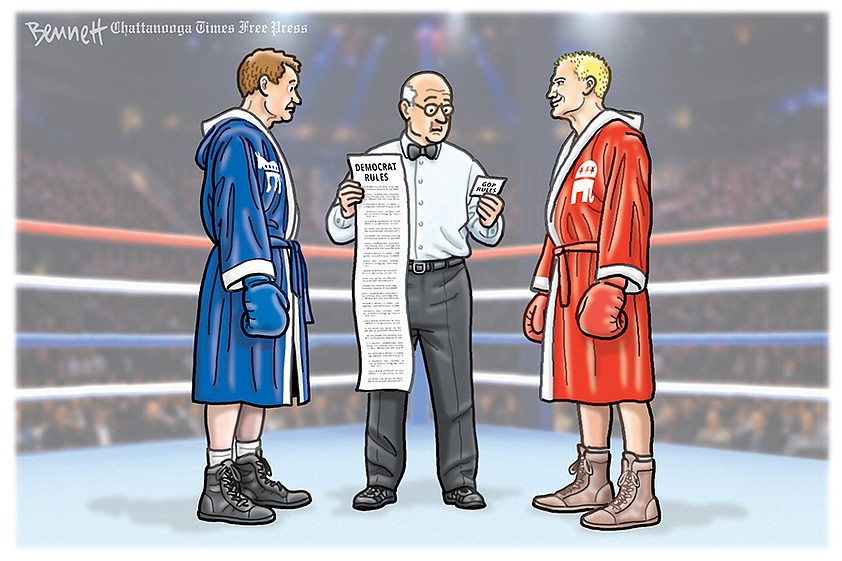
The axes really are orthogonal. The point Marshall keeps making, and that moderate voices like Matt Yglesias refuse to take seriously, is that the two axes really are different. You can take moderate positions on immigration or healthcare or border enforcement or trans rights (if that’s what voters in your state demand), and still advocate that Democrats play the same hardball politics Republicans have been playing for years. You can stop bringing a knife to a gun fight and go all out.
Whoever Maine Democrats nominate, that’s what I really want to hear from them. The old message of “Trust us. Once we get power we’ll put the country back on track” isn’t credible any more.
The economic system is rigged towards the rich and monopoly corporations. The political system is rigged towards Republicans. The Supreme Court has made itself into a super-legislature. Those problems won’t get fixed automatically by putting Democrats into office. Once they get into office, they’ll have to do something about those problems.
Tell me what.


Comments
Excellent assessment. I find myself asking, “What would FDR do?“
Even if we win the Senate, powerful as it is on executive branch appointments and investigatory oversight, its legislative votes will be veto-able and Trump will surely do it. So what we might hold hostage to any workable effect is minimal. The man doesn’t seem to give much of a damn about grass roots constituency politics.
I think the best tacks would be briefly described, understandable grass roots/kitchen table fixes to domestic issues, together with a calculated set of presidential power reversals that give Congress its institutional policy guts back.
Recognizing, however, that although much of today’s governmental miasma is due to fealty to Trump, what his minions have been doing by executive fiats is effectively legislating the long-standing conservative wish list.
To say that the Dems had control in Congress during Biden’s first 2 years is… an overstatement. Let us recall Joe Manchin and Kyrsten Sinema. Most of the things in Doug’s (admirable) list of what could (should) have happened… were DOA because of those two.
I look forward to your essays every week and am grateful for them. I have one minor nit to pick: I think you use “firewall” when you probably really mean “paywall.”
Keep up the good work!
love your work. axes are for chopping wood. axis are imaginary straight line around which objects rotate. damn that spell check. Onward!
The plural of axis is axes.
O jeesh It just struck me wrong. All I could see is an ax🤷♀️Diane E. LeifheitPoint of View StudioArt of the Adirondacks524 State Route 86Paul Smiths, NY 12970518-651-1938www.dianeleifheit.comdeleifheit@gmail.comCheck Website for Studio/Gallery hours.Sign up for my Thumbprints Newsletter for new works, travels, and good newshttps://www.dianeleifheit.com.email-newsletter+ Exhibiting —NorthWind Fine Arts Gallery, Member — 85 Main St. Saranac Lake, NY Ti Arts, Member, Montcalm Street, Ticonderoga, NYDowntown Artist Cellar, Member, Main Street, Malone, NYOn Jul 13, 2026,
Nothing will happen unless the Democrats are willing to get rid of the filibuster if they win a Senate majority. We’re not going to see the kind of filibuster-proof majority again that allowed them to pass the ACA. And I’m not at all sure that the Democrats even want to get rid of it. I know the Republicans don’t, and it’s not just because they’re afraid of what will happen if the Democrats win the trifecta. The filibuster is a great excuse for not passing unpopular legislation. To give one example, the Republican electorate would be fine with a national abortion ban, but Thune knows that would result in a blue tsunami. So it’s much safer to blame the filibuster.
” Trump won in 2016 and 2020 by convincing those voters (falsely) that he did care about them. “
Umm, maybe change that to 2024?
It seems like it’s a race to see which party gets rid of the filibuster. If Republicans do it, they will quickly pass legislation that will lock-in minority rule for at least a generation, likely much longer. If the Democrats do (with a Democratic President), they could establish fair elections that would likely prevent Republicans from holding so much power in the future.
Since Trump has put election control on the table, and the Supreme Court has used lack of legislation as an excuse to let him do so much, the makeup of the House is one key, election fairness is another, and makeup and oversight of the Supreme Court is the third. Significantly expand the House, restore voting rights, and restore integrity to the Supreme Court in order to make those happen, and the Republicans will be forced to back policies people like rather than counting on abuse of the democratic process to get elected.
the cartoon at the top says it all.
I dunno. I feel like this: “You can take moderate positions on immigration or healthcare or border enforcement or trans rights (if that’s what voters in your state demand), and still advocate that Democrats play the same hardball politics Republicans have been playing for years. You can stop bringing a knife to a gun fight and go all out.”
…Sits really uncomfortably along side this, from your 2016 post “Tick Tick Tick – The Augustus Countdown Continues”:
“The historical model I keep invoking is the Roman Republic, which didn’t fall all at once when Julius Caesar crossed the Rubicon or his nephew Octavian became the Emperor Augustus, but had been on such a downward spiral of norm-busting dysfunction for so long (about a century) that it was actually a relief to many Romans when Augustus put the Republic out of its misery. In ‘Countdown’ I pointed out the complexity of that downward trend: ‘About half of the erosion in Rome was done by the good guys, in order to seek justice for popular causes that the system had stymied.'”
Trackbacks
[…] This week’s featured post is “Graham Platner’s exit, and the debate it leads to“. […]
[…] Graham Platner’s exit, and the debate it leads to […]