We remain on indictment watch. Trump has received a target letter from Jack Smith, and has refused the invitation to tell his side of the story to the DC grand jury investigating January 6. An indictment could come any day. It’s tempting to speculate about what that indictment will say, and lots of commentators are giving in to that temptation. As I’ve often said before: Go ahead and speculate if that activity engages you, but you could also just wait and see.
Today’s two featured posts are sort of similar: They both involve me reading a document so you don’t have to. The documents are (1) the new Florida standards for teaching African-American history, and (2) the “Common Sense” booklet outlining the platform of the No Labels Party.
The Florida standards have gotten a lot of well-deserved criticism this week for a couple of egregious lines, but the real problem is in the document as a whole: It wants to tell a no-villains story of American history. So it presents racism as a vague, amorphous, impersonal force, against which heroic Americans of all races have been struggling for centuries. Who exactly they struggled against — other Americans? surely not! — is a big empty spot.
I’ll explain that in more detail in the first featured post, which should be out soon.
A lot of my readers will probably wonder why I’m wasting their (and my) time on No Labels. I believe most of you are on the progressive side of the progressive/moderate split in the Democratic Party, so you’re probably not tempted at all by a group that plans to run to Joe Biden’s right. But the false-equivalence argument that both parties are equally bad appeals to a lot Americans, and I think we’re going to need to understand it during the 2024 campaign.
So the second featured post dives into the No Labels proposals. My conclusion is that their target voter is a moderate Democrat who watches too much Fox News. So they have very real disagreements with MAGA Republicans (about gun control, global alliances, and immigration), and more-or-less imaginary disagreements (about things like the Twitter files, cancel culture, and voter fraud) with Biden. That should be out around 11 EDT.
The weekly summary will cover the actual news (as opposed to speculation) related to Trump’s legal situation, the culture-war skirmishes over “Try That in a Small Town” and the Barbie movie, and a number of consequential things happening in other countries: Russia attacking Ukraine’s wheat exports, Israel preparing to disempower its supreme court, and a few other things. That should be out between noon and 1.
That’s the subject of one featured post. Short version: When climate-related disasters happen one at a time, they’re easy to deny: “We’ve always had floods” or heat waves or hurricanes or whatever. But when several apocalyptic weather events are happening at the same time, it feels qualitatively different. Those of us who care about the future need to jump on this moment. The debate over the existence and seriousness of climate change needs to be over.
and politicizing the NDAA
In 1948, the Senate paved the way for Democratic President Truman to negotiate the treaty that formed NATO by passing the Vandenberg Resolution, named for the Republican Senator who chaired the Foreign Relations Committee, Arthur Vandenberg. At that time, Vandenberg said something that has been quoted many times since: “Politics stops at the water’s edge.”
In other words: Republicans and Democrats might have their partisan struggles, but when it came to defending the country, all that would be put aside. That sentiment has always been more of an aspiration than a hard-and-fast principle, but it was never blatantly rejected until this week, when House Republicans loaded up the annual National Defense Authorization Act (which has to pass if our troops are going to be funded in FY2024, which starts in October) with a long list of culture-war provisions that Democrats in the Senate are bound to reject.
Rep Jeff Jackson (D-NC) explains how this process is supposed to work, and how it actually worked this year within the Armed Services Committee: There’s a behind-the-scenes negotiation to draft a bill that can get broad bipartisan support, and then on the final day the committee has to vote on hundreds of proposed amendments.
On this day, the chair of the committee has a very specific job: It’s to say no to his own party.
Why? Because he knows that some of the amendments his party is proposing are absolute deal-breakers for the minority party and he wants a big bipartisan vote out of committee to give the bill the best chance when it reaches the whole House.
Honestly, he did a pretty good job of knocking away the real grenades that would have blown up the whole thing. He definitely knew what he was doing. He let in just enough of the culture war stuff to satisfy his party without going that step too far that could have sunk it.
So Jackson, a Democrat, praised Chairman Mike Rogers, a Republican, for putting national defense above scoring political points. And while that bill would ban the Pentagon from funding drag shows, along with a few other culture-war provisions of little practical significance, it got out of the committee on a 58-1 vote.
Unfortunately, the bill then went to the House floor, where Speaker McCarthy could not stand up to his party’s radicals. Several amendments passed on party-line votes, turning the NDAA into a culture-war messaging vehicle that will make it much harder for servicewomen (or spouses of people in the armed forces) to get abortions, will eliminate the Pentagon’s office of diversity, equity and inclusion, and end coverage for transgender health care. As a result, the NDAA itself became a near-party-line vote, passing the House 219-210.
Now the Senate will undoubtedly pass a very different bill, setting up a showdown closer to the new-fiscal-year deadline of October 1. In that debate, the defense of the country and its global interests will take a back seat to domestic politics.
Another example of Republicans prioritizing culture wars over national defense is Senator Tuberville’s one-man blockade on military promotions. Ordinarily, promotions pass the Senate en masse by unanimous consent, a process that avoids highly time-consuming votes on individual officers. But Tuberville’s objection makes that impossible, and the result is that the Marine Corps has only an “acting” commandant. Soon several of the Joint Chiefs will need to be replaced as well.
As with the House NDAA vote above, his issue is abortion.
A related story that I didn’t mention there: The saga of Gal Luft, who was supposed to be the House Oversight Committee’s star witness against the Bidens. But he went “missing” before he could testify. And then it turned out that he was on the run from an indictment filed in November, before the GOP had even won control of the House, much less touted Luft for a starring role in their hearings.
He faces eight separate counts, including two charges of making false statements to federal officials, one for conspiracy to violate the Foreign Agents Registration Act, and five counts relating to separate schemes which allegedly involved Luft trying to trade in sanctioned Iranian oil and broker deals for a Chinese firm to supply, among other things, “strike UAVs” to Kenya and anti-tank missile launchers to Libya.
He’s been found and is currently under arrest.
and the Hollywood strike
Most of us aren’t used to thinking of actors or TV/movie writers as workers. We imagine them living lives we can only dream of. And for some of them — though far from the majority — that’s true.
So when the Writers’ Guild of America went on strike May 2, and the Screen Actors’ Guild followed on Wednesday, most of the world’s truck drivers, waitresses, and assembly-line workers probably didn’t feel much instinctive solidarity.
However, there’s a lot to sympathize with here. The issue is a new technology (artificial intelligence) that has the potential to make entire professions obsolete. And the question is: Who’s going to profit from that technology? The dispute parallels issues that played out during the Industrial Revolution centuries ago. Things came out badly for skilled workers then, and it would be a shame if those mistakes got repeated.
One of the myths I was taught about industrialization is that it mechanized repetitive low-skill jobs and created more high-skill jobs. The economist Harry Braverman exploded that myth in his 1974 classic Labor and Monopoly Capital: the degradation of work in the 20th century. In Braverman’s retelling, it was precisely skilled labor that got replaced: weavers, bakers, blacksmiths, cobblers, and craftsmen of all sorts. Their specialized knowledge got designed into machines whose repetitive operations could be overseen by comparatively unskilled workers.
Most of the craftworkers got nothing for their knowledge. A few skilled workers would be observed closely by engineers. When the skills it had taken them years to master had been captured in a machine, they were no longer necessary — and neither were any of their guildsmen. The resulting profits went to the industrialists who owned the machines.
Artificial intelligence could soon do something similar to writers and actors. AI could digest, say, all the romantic comedy scripts ever written (with no payment to their authors), and then be able to fulfill requests like “Write me a rom-com set in Singapore with a rich woman fresh from a messy divorce and an airline pilot.” Another AI might take body-scans of a few real people (maybe they’d be paid for a single day of “labor”) and create a movie in which those “actors” perform the rom-com script.
At the press conference announcing the strike, National Executive Director and Chief Negotiator Duncan Crabtree-Ireland said that the [American Motion Picture and Television Producers]’s proposal for AI “proposed that our background actors should be able to be scanned, get paid for one day’s pay, and their company should own that scan, their image, their likeness and to be able to use it for the rest of eternity in any project they want with no consent and no compensation.”
People trying to break into the creative professions are often desperate and correspondingly ripe for exploitation. One famous example is the comic-book duo of Jerry Siegel and Joe Schuster, who sold the rights to their new Superman character for $130 in 1938.
and Trump’s next indictments
Fulton County District Attorney Fani Willis swore in two new grand juries this week. Georgia grand juries serve for two months. Many of her previous statements indicate that this is the cycle when she will seek to indict Trump for his efforts to interfere in Georgia’s 2020 election.
Jack Smith is investigating many of the same crimes — the fake elector scheme, pressuring election officials (all the way up to VP Mike Pence) to change or throw out the election results — in Georgia as well as other states Trump lost, in addition to his role in inciting the January 6 insurrection. Lots of former federal prosecutors have been speculating that Smith will want to get his own indictment out ahead of Willis.
So we’re on indictment watch again: The Georgia indictment is expected early next month, and Smith could file any day.
In some sense, this would be the “real” indictment. Trump’s constant law-breaking has created a public expectation that ordinary laws don’t apply to him, so the filing-false-business-records charges in New York and the federal stealing-classified-documents charges feel illegitimate even to some people who aren’t part of his personality cult. Those are real laws frequently used against other people, and he’s clearly guilty in both cases. Even in my eyes, though, those charges resemble nailing Al Capone for tax evasion rather than the St. Valentine’s Day Massacre.
But if I had to pick one reason why I want to see Trump in jail rather than back in the White House, it’s that he tried to stay in power after he lost the 2020 election. That’s the greatest breach of faith committed by any president in American history, and it’s the crime he deserves to be judged on.
If you’re wondering what such an indictment might look like, Just Security has a written a “pros memo” based on the evidence that is publicly available. Such memos are typically written by the DoJ (and kept confidential) prior to writing an indictment that will be available to the public. The full document is over 250 pages, but the introduction and executive summary together are just six.
Trump’s lawyers filed for an indefinite delay in the Mar-a-Lago documents case, at least until after the 2024 election. Their filing argues that
there is simply no question any trial of this action during the pendency of a presidential election will impact both the outcome of that election and, importantly, the ability of the Defendants to obtain a fair trial.
If you are innocent and want to be vindicated, you ask for a trial before the election. If you are guilty and want to run on victimization, without being undermined by facts and law, you don’t.
Judge Aileen Cannon is supposed to hear arguments on the trial schedule tomorrow, and should set a trial date (or not) soon. That ruling will tell us a lot about how lenient she intends to be with Trump, who appointed her.
Another confession of guilt, in my view, is the lawsuit Trump filed asking the Georgia Supreme Court to quash the report of the special grand jury that investigated his attempt to steal Georgia’s electoral votes in 2020. If he’s indicted and a trial jury looks at the evidence against him, he’s toast. So he has to get the evidence thrown out.
An innocent candidate would be demanding that all the evidence come out so that he could clear his name as quickly as possible. But all along, Trump’s strategy has been to delay, block witnesses from testifying, and claim that there’s nothing to see here.
and you also might be interested in …
An appellate-court panel has temporarily set aside the crazy injunction a Trump-appointed judge made last week — the one that barred large chunks of the Biden administration from discussing disinformation with social media companies. The order is short and doesn’t explain the panel’s reasoning, but promises an “expedited” hearing for oral arguments.
The Netanyahu government has revived its plan to reduce the independence of the judicial branch, and so protests are starting up again. What could possibly go wrong with a plan to give more power over the courts to a leader facing indictment?
If I asked you to think of some horrible example of gun violence, probably you’d name a school shooting: Uvalde, Sandy Hook — something like that.
But a report in Thursday’s IndyStar calls attention to another kind of shooting that is horrible in a different way: family annihilations, where some guy (men do 94% of family annihilations) wipes out his whole family, usually with a gun, and often (64%) finishes by committing suicide.
There are way more of these than I had ever imagined: 227 in the US since 2020. Texas has the most,
But it’s happening across the U.S., and the number is going up by the year. There were 62 cases in 2020, 61 in 2021, and 72 in 2022. There already were at least 32 in 2023 through the end of April, a pace that could lead to nearly 100 incidents this year. …
The U.S. has three times more family annihilations than Canada, eight times more than Great Britain and 15 times more than Australia, according to The National Institute of Justice. …
A USA TODAY investigation found American children are three times more likely to be shot at home than at school — and the majority of perpetrators are their parents or guardians.
The IndyStar article shifts back and forth between a general description of the problem and an in-depth account of a specific case: 61-year-old Jeffrey Mumper of Bloomington, Indiana killed his wife and two children (pictured below), before killing himself in September, 2020.
If you’re considering supporting RFK Jr. for president, you should watch this video, where he seriously discusses the possibility that the Covid virus was “targeted to attack Caucasians and Black people” while “the people who are most immune are Ashkenazi Jews and the Chinese”.
Kennedy perfectly illustrates a quote I have never been able to track to its source, but I’m sure I didn’t think of it myself: “Anybody who believes crazy things will eventually believe crazy things about Jews.”
In Friday’s NYT, a federal district judge wonders what ever happened to the Supreme Court’s sense of smell. He recounts the kinds of ethical issues that have popped up in his own career: a lawyer has Red Sox tickets he’s not going to use, a man he had awarded disability benefits comes to his office to give him a hand-carved pencil box in gratitude. Neither offer, he believed, was being made with bad intentions. But he turned them down, because
You don’t just stay inside the lines; you stay well inside the lines. This is not a matter of politics or judicial philosophy. It is ethics in the trenches.
He is disturbed that Supreme Court justices seem not to understand this. You turn gifts and favors down not because you can’t find a loophole in the law big enough to squeeze them through, but because they smell bad, and they undermine public faith in the fairness of the judiciary.
George Lakoff (the guy who popularized the notion of “framing” back in the 1990s) gives advice on responding to trolls on social media: Don’t do it. Do this instead.
If you don’t wish to amplify trolls, don’t respond to their posts. Instead, try posting your own proactive message. If you see a post spreading false information about vaccines, you could do your own post that says: “I’ve noticed posts containing false information about vaccine safety. I won’t take the bait by responding, but here are the facts…” Then deliver whatever message you were planning to write as a response to the troll, even if it’s just a link to a news story debunking whatever the troll is saying.
This is how far gone the Right is these days. At the Turning Point USA conference in Florida yesterday, MTG “attacked” President Biden with a long comparison to transformational presidents LBJ (who got Medicare and Medicaid passed) and FDR (Social Security), concluding with this:
LBJ had the Great Society, but Joe Biden had Build Back Better (and he still is working on it): the largest public investment in social infrastructure and environmental programs that is actually finishing what FDR started, then LBJ expanded on, and Joe Biden is attempting to complete.
Democratic Congressman Ted Lieu responds: “Thank you, @RepMTG. More of this, please.”
I have no special animus towards Tom Cruise, and in general I love action movies, but his action-movie series will never be Mission: Impossible to me. The original MI TV series was the polar opposite of a star vehicle: The plan was the star, and it was carried out each week by a rotating collection of perfectly chosen agents with extraordinary-but-not-superhuman abilities.
While I’m on the subject, here’s something I just learned this week: One of the best things about the MI franchise is the catchy beat of its theme song. If you read that beat as Morse code, it’s dash-dash, dot-dot, dash-dash, dot-dot. In other words: MI, MI, MI …
A related point: Cruise will also never be Jack Reacher for me. In the Lee Child novels, Reacher is 6’5″, and the first thing people notice about him is how physically imposing he is. Alan Ritchson, who plays the role in Amazon’s Reacher series, is a much better choice.
It’s getting hard to keep track of all the overlapping climate disasters. In Phoenix, Arizona, the temperature has broken 110 degrees for nearly two weeks running. The waters off the Florida coast are approaching hot-tub hot, and before long, marine heat waves may cover half the world’s oceans. Up north, Canada’s worst wildfire season on record burns on and continues to suffocate American cities with sporadic smoke, which may not clear for good until October. In the Northeast, floods have put towns underwater, erased entire roadways, and left train tracks eerily suspended 100 feet in the air. Also, the sea ice in Antarctica—which should be expanding rapidly right now, because, remember, it’s winter down there—may be losing mass.
Over the last ten or twenty years, we’ve gotten used to a certain pattern of debate about problematic weather.
The immediate threat abates: the heat wave breaks, waters recede, cities clean up, and life more-or-less goes back to normal for a few weeks or months.
Media attention moves on.
For most people, the significance of these blips of bad news is hard to sort out, because both sides have ways of fitting such events into their favored narrative: Either “The clock is continuing to tick down towards a climate apocalypse”, or “Environmentalists keep trying to scare us, but life goes on.”
Trying to break through that endless back-and-forth leads scientifically-minded people to apply statistics: Yes, there have always been natural disasters, but not this often. For example, what used to be a hundred-year flood now comes once a decade, or maybe even sooner.
But statistics can’t solve the public-perception problem, because the people who need to be convinced are precisely the not-scientifically-minded folks, the ones who distrust “experts” and especially distrust mathematical models and other ways of measuring things that they couldn’t have come up with on their own.
In general, non-scientists are only impressed by a statistic if they were already paying attention to it before the latest event. You can see this phenomenon in non-political arenas like sports. In 1998, for example, baseball fans everywhere were fixated on Mark McGwire and Sammy Sosa’s chase after the Ruth/Maris single-season home run record. That’s because every baseball fan already knew that Babe Ruth had hit 60 home runs in 1927 and Roger Maris hit 61 playing a longer season in 1961. McGwire and Sosa were racing towards a finish line that had been marked out for decades.
By contrast, look at the season Aaron Judge had last year: By some accounts, it may be the best season a hitter has ever had. But to make that claim, you have to cite advanced statistical measures that most fans have never heard of and could not calculate for themselves: WAR, OPS+, RV+ and so on. So while every fan recognizes that Judge’s 2022 was a really good year — his 62 home runs surpassed Maris’ 61, which was still the record for the American League — it lacked the drama of 1998, and the best-ever arguments feel like something cooked up after the fact.
The result is that American public opinion on climate change displays the same left/right split that you’ll see on more values-based issues like abortion or affirmative action. As the chart below (from Pew Research) shows, the US is unusual in this regard. In South Korea, climate change is barely a partisan issue at all, and a right-leaning voter in the UK is three times more likely to consider climate change a “major threat” than his American cousin. (If you can explain what’s going on in Israel, where left-leaning voters worry about the climate less than anywhere else in the world, leave a comment.)
This summer’s combination of disasters is an opportunity to break out of this left/right pattern. When one disaster starts before the previous one ends, and record-setting heat in Florida and Texas competes for headlines with unprecedented floods in Vermont and Pennsylvania, we’re in new territory. You don’t need any statistics or expert analysis to recognize that the weather never used to do stuff like this. “Bad things didn’t used to happen this often” is a statistical claim. But “Bad things didn’t used to happen all at once” is something ordinary people can verify through our own experience.
Whatever their political loyalties, just about all Americans must know in their hearts that something is seriously wrong, and that the kinds of predictions that got labeled as “alarmist” or “fear-mongering” a few years ago are starting to come true. We’re no longer talking about projections of problems our grandchildren will face. We’re looking at what’s happening here and now.
Environmental activists and their allied politicians (who are almost all Democrats) need to run with that perception. In the past, the burden has been on them to use expert analysis to explain away the average American’s impression that life was continuing more-or-less normally. But going forward, the tables will have turned: It will be climate deniers who will need to make complicated arguments to explain away the public’s perceived reality.
Going forward, the role of long-term climate models will also change. The point won’t be to make apathetic people worry about the future. Instead, the models will explain to people who are already worried that things are only going to get worse until we make major changes.
Americans also know in their hearts that in the long run it’s more cost effective to prevent disasters than to clean up after them. Yes, it will require substantial investment to convert our economy to renewable energy, to modernize the electrical grid, and shift our consumption patterns away from fossil-fuel intensive products. But those investments will not only create jobs in the present, they’ll save money overall.
And the long-term models will also play another role: As sweeping changes get proposed, we’ll need expert analysis telling the public “This can work.” The models that have been carrying messages of despair could also carry messages of hope.
No, lifelong Republicans have not established a liberal Deep State at the FBI.
In 2021, I raised the question “What makes a good conspiracy theory?” People obviously do conspire to do bad things from time to time, so we shouldn’t reject out of hand every claim that some group of malefactors is conspiring. But can we at least limit ourselves to good conspiracy theories, i.e., ones that at least have a chance to be true?
In that post I identified one clear marker of a bad conspiracy theory: The size of the conspiracy has to keep increasing as more facts come out. The deeper people dig, the larger the conspiracy has to grow to account for all the pieces that don’t fit the original theory. (Really good conspiracy theories, on the other hand, tend to shrink. The better you understand how things work, the more you realize that a few well-placed conspirators really could pull this off.)
With that principle in mind, every time a conspiracy theorist says “They must be in on it too”, you should reevaluate the whole conspiracy. If you would have rejected a massive they’re-all-in-on-it claim at the start, you shouldn’t let yourself drift into accepting one without a good reason.
Lately we’ve been seeing a lot of expansion in the Right’s Biden-crime-family conspiracy theory. Consider David Weiss, the Trump-appointed US attorney that Trump-appointed Attorney General Bill Barr assigned to run the Hunter Biden investigation. Weiss was one of the few Trump US attorneys Biden left in place, probably because it would have looked bad to pick his own guy to investigate his son.
Weiss filed some tax charges and a firearms charge against Hunter, and negotiated a plea deal that most experts say is not out of line with what any defendant in a similar situation could get: repay the taxes and accept two years probation, but don’t go to jail.
“If you are a Trump, you will be prosecuted. If you are a Biden, you will be protected,” said Rep. Wesley Hunt, claiming a double standard in the justice system.
Wray seemed to have a hard time taking such claims seriously.
“The idea that I’m biased against conservatives seems somewhat insane to me given my own personal background,” said Wray, a Republican who served in President George W. Bush’s Justice Department.
Equally insane is the idea that the FBI (in Sean Hannity‘s words) “has now sadly been transformed into nothing short of an arm of the Democratic Party.”
As I’ve explained in the past, there really is a Deep State — an entrenched bureaucracy that resists certain kinds of top-down change — but it arises in a fairly natural way: The reason young people decide to join an organization and commit themselves to it (the way you have to to rise in the ranks) is that the organization’s mission harmonizes with their values.
So if direction from on high conflicts with an organization’s perceived mission, people up and down the chain of command will resist: Items will fall off the agenda, orders will be carried out in ineffective ways, and so on. Probably the resisters don’t even need to conspire, because people at all levels just know that “that’s not how we do things here”.
Top-down pressure can change the culture of an organization, but it requires either consistent attention over a very long time or a large-scale purge of the rank-and-file employees. (Trump is planning such a purge if he gets another term: “MAGA Republicans believe that they will be able to enact their programme only if they first defang the deep state by making tens of thousands of top civil servants sackable. Around 50,000 officials would be newly subject to being fired at will, under a proposed scheme known as Schedule F.”)
Now think about why idealistic young people make a career at the FBI: They want to catch the bad guys. Fundamentally, it’s a rules-and-punishments mindset, which tends to appeal to conservatives. (Stereotypically, liberals are more driven to understand the bad guys, and to figure out why they don’t find places in lawful society.) That’s why law enforcement in general tends to be a bastion of conservatism. (Think about it: When you meet someone and find out that they’re a cop, what expectations do you have about their opinions?)
So yes, there would naturally be a Deep State in the FBI: a conservative Deep State. The fantasy of a liberal Deep State at the FBI, led by lifelong Republicans like Chris Wray and James Comey, is truly nutty.
So what’s the FBI been up to as it investigates Donald Trump? Not persecuting conservatives, but catching the bad guy.
Yesterday I talked to friends who had recently relocated to a summer place in eastern Pennsylvania, where torrential rains have produced deadly flash floods. They came up from Florida, where a heat wave has pushed ocean temperatures into the mid-90s. Apocalyptic weather is pretty much everywhere this summer. You can’t get away from it.
In one of this week’s featured posts, I’ll argue that this summer could be a turning point in the political debate about climate change. Up until now, we have had our weather disasters one-by-one. Sure, there was a hurricane somewhere or a flood or a wildfire, and maybe it seemed unusual in one way or another. But fundamentally, in the perception of the average person, it was nothing new: There have always been hurricanes or floods or wildfires somewhere. You could argue that those disasters were becoming more frequent or more destructive, but in the end that claim would rely on somebody’s statistical analysis. And, face it, large chunks of the public have never trusted statistics.
But this summer is different. “Bad things didn’t used to happen this often” is a statistical claim. But “Bad things didn’t used to happen all at once” is something we can all verify through our own experience. It might change the national debate. That article should appear maybe around 10 EDT.
Another post will come before it. The big news in Congress this week was FBI Director Chris Wray testifying to the House Judiciary Committee. Chairman Jim Jordan and the flying monkeys in the Republican majority treated us to a display of really wacko conspiracy theories. Apparently Wray, a lifelong Republican appointed by Trump, has turned the FBI into “an arm of the Democratic Party”.
This hearing was not such a major event in itself, but it gives me a chance to apply two ideas I’ve discussed on this blog before: How to judge conspiracy theories, and what the “Deep State” really is. That post is just about done and should be out shortly.
The weekly summary still has to cover the House’s abandonment of the bipartisan tradition of the National Defense Authorization Act, the Hollywood strike (which gives me a chance to promote a classic work of Marxist economics), the countdown towards Trump’s next indictments, a heart-rending IndyStar article about family annihilations, and a few other things. I’ll try to get that out by noon.
The next generation will have its own conceptions of liberty. It will interpret the principles of the Constitution, enduring as they are, differently than this generation has interpreted them. Change is unstoppable. And to the extent Bruen and decisions like it try to stop that change, they will not last long. The only question is how long the People will let them remain.
July 4 and 5 weren’t just hot days, and they didn’t just set records for the highest global average temperature ever recorded. They were the hottest days in the last 125,000 years.
And the problem isn’t just the heat, it’s how fast the climate is changing. Here’s the Intergovernmental Panel on Climate Change’s graph of the last 2,000 years’ global temperatures relative to some long-term average.
The speed is important: If the climate changes over thousands or tens of thousands of years, species can migrate and interbreed and adjust. But if the same change happens over 100 years, many will just go extinct.
and court decisions
The featured post covers the injunction against Biden officials communicating with social-media companies, a Mississippi judge’s argument against originalism, and an appellate court letting Tennessee’s ban on gender-affirming care take effect.
In addition, more commentary on last week’s Supreme Court rulings has appeared.
Being an “originalist”, Thomas has to align his interpretation of the 14th Amendment — that it’s colorblind and does not allow race-conscious laws — with the same Congress’ reauthorization of the Freedman’s Bureau to look out for the interests of the former slaves.
To square this circle, Thomas insists that the termfreedmen was a “formally race-neutral category” and a “decidedly underinclusive proxy for race.”
Thomas is correct that not all Blacks in the former Confederacy had been slaves (only about 90%, Serwer says; today, not all Black people are applicants to universities). But since only Black people could have been enslaved, everyone understood that a “freedman” was Black. So Congress did indeed pass a law to help Black people.
[Thomas’] efforts at reconciliation ultimately illustrate the extent to which “originalism” is merely a process of exploiting history to justify conservative policy preferences, and not a neutral philosophical framework.
Which is more or less the same thing I was saying last week.
You might expect that this responsibility to read the text closely would limit the power of judges to insert their own views into the law, but as practiced by the current justices, it does the exact opposite. Understanding how words were commonly understood at some point in the past is a job for historians, and the justices are not historians. Nor do they typically respect the consensus of the people who are historians.
Instead, we are treated to excursions into history that — voila! — always reach the desired result. If you’ve ever delved deeply into history yourself, you should understand how unlikely this is. History, researched honestly, frequently jars your preconceived notions. But the conservative justices are never jarred off their favored course.
Jamelle Bouie points out something significant in John Roberts’ opinions in race cases: He never talks about racism itself.
I want to highlight Chief Justice Roberts’s avoidance of racism as a prime example of “racecraft,” the term coined by the historians Karen and Barbara Fields to describe the transmutation of a set of actions (racism) into a set of qualities or characteristics (race).
Racecraft, the Fieldses write in “Racecraft: The Soul of Inequality in America,” “transforms racism, something an aggressor does, into race, something the target is, in a sleight of hand that is easy to miss.”
Linda Greenhouse takes a long-term look at what John Roberts has accomplished for conservatives:
To appreciate that transformation’s full dimension, consider the robust conservative wish list that greeted the new chief justice 18 years ago: Overturn Roe v. Wade. Reinterpret the Second Amendment to make private gun ownership a constitutional right. Eliminate race-based affirmative action in university admissions. Elevate the place of religion across the legal landscape. Curb the regulatory power of federal agencies.
These goals were hardly new, but to conservatives’ bewilderment and frustration, the court under the previous chief justice, the undeniably conservative William Rehnquist, failed to accomplish a single one of them.
18 years later, Roberts has achieved them all.
In the featured post, I compare the ambiguity of the social-media injunction to that of anti-critical-race-theory laws, where the proposed applications of the law seem at odds with its text, leaving teachers wondering what is actually legal.
The problem is that it’s almost impossible to interpret anti-critical-race-theory laws so that they simultaneously
make sense
apply to something real.
A recent flap in Oklahoma illustrates the point: Given Oklahoma’s anti-CRT law, can schools teach about the Tulsa Massacre of 1921, in which White mobs invaded a prosperous Black suburb, massacred hundreds of people, and burned 35 blocks of buildings?
I would never tell a kid that because of your race, because of the color of your skin, or your gender or anything like that, you are less of a person or are inherently racist. That doesn’t mean you don’t judge the actions of individuals. Oh, you can. Absolutely, historically, you should. ‘This was right. This was wrong. They did this for this reason.’ But to say it was inherent in that because of their skin is where I say that is Critical Race Theory. You’re saying that race defines a person.
Several commentators interpreted Walters as saying that the massacre wasn’t really about race, or at least, that we shouldn’t tell the kids that it was. That would be a crazy point for Walters to be making, but that’s not how I read his words.
To me he seems to be saying that teaching about the massacre only goes wrong if you teach that the White rioters were driven to violence by some inherent flaw in their DNA, i.e., some racist gene that White students in the class likely share. (My initial reading seems consistent with the way Walters followed up: “I am referring to individuals who carried out the crime. They didn’t act that way because they were White, they acted that way because they were racist.”)
So if I make that interpretation, I have to agree with him: Blaming some inescapable quality of whiteness would be a terrible way to teach the massacre. It might even convince some White kids that they are “less of a person” because of “the color of their skin”. So in my interpretation, Walters’ answer passes the “make sense” requirement.
But then we hit the second horn of the dilemma: Has anyone in the entire history of Oklahoma schools ever taught the massacre that way? Has any teacher ever told his or her class that White people are genetically inclined to massacre Black people? I haven’t read every anti-racism book out there, but I’ve read a lot of them. And I’ve never seen anything like that account of white-on-black violence.
Summing up: If you define CRT in such a way that it’s obviously objectionable, then your ban doesn’t ban anything that is actually taught. Conversely, if you define CRT so that it applies to things that are actually taught, then it’s not all that objectionable.
Teachers, principals, and superintendents don’t want to take the risk of interpreting the laws literally, because that means the legislature was just wasting its time and didn’t actually intend to ban anything. And so they are left to imagine what the law will mean in practice, and to self-censor accordingly.
and Moms for “Liberty”
You probably didn’t pay much attention to the Moms For “Liberty” national summit in Philadelphia a little over a week ago, which drew most of the top Republican presidential candidates, including Trump and DeSantis.
One night’s keynote speaker was less famous: right-wing talk show host Dennis Praeger. But I think this quote explains a lot:
God made order out of chaos, and the left is making chaos out of order. The notion that there is no such thing as a male or a female human being is chaos. It is a gigantic lie, but it is more than a lie, it is chaos. … [O]rder reflects God, the Creator.
One of the things I always wonder, when MFL-type people respond with near-violent anger to trans youth or drag queens or some other manifestation of gender ambiguity is “Why do you care?” If somebody you perceive as a guy wants to express his liberty by wearing a skirt or eye shadow, or holding hands with another guy, what’s it to you? How does that ruin your day?
I think the Praeger quote explains it: An authoritarian world with clear rules and clear categories comes with an implicit promise of safety for those who obey and conform. So that nonbinary kid on the subway whose gender you can’t quite identify — it’s not that they’re going to attack you themselves. It’s that they represent a crack in the “safe” world order, a manifestation of Chaos. And as those cracks grow, who can predict what demons will spill into the world?
Of course, obedience and conformity are the exact opposite of the Liberty the group is supposed to stand for. But I guess Moms For Obedience and Conformity just doesn’t have the same ring.
Anyway, this explains how Trump can say weird stuff like “Democrats hate God” — as he did in his conference speech — and not be sedated and sent to a mental ward for his own protection. It’s all part of the “spiritual warfare” that increasingly justifies right-wing violence.
While the movement is not exactly fake, it’s not exactly real, either. Conservatives who argue that this is just a grass roots groundswell are ignoring the deliberate moves made to ramp up this controversy, most notably by Christopher Rufo
Leading anti-wii groups like Moms for Liberty and Parents Defending Education are operated by professional communications folks and seasoned political operatives, but that doesn’t mean they haven’t activated and harnessed actual anger and upset among people on the ground.
Historian Nicole Hammer places them in the tradition of 20th century right-wing women’s groups.
These mothers’ movements, from the WKKK, to massive resistance to Save Our Children, all relied on the image of mothers protecting children. But they were in service of a much larger political project: shoring up traditional hierarchies of race and sexuality. They were about motherhood and education, but as a means to an end. Moms for Liberty operates in precisely the same way, building on this century-long tradition. The book bans, the curricula battles, the efforts to fire teachers and disrupt school board meetings — little here is new.
and you also might be interested in …
Who could have anticipated this? Launching Trump’s “Truth Social” Twitter clone involved a securities fraud that has led to an $18 million civil settlement with the SEC. How does such a straight-shooting, tell-it-like-it-is guy keep winding up in the middle of fraud? Just bad luck, I guess.
The generals note some tactical advantages of electric vehicles: They’re quieter and cooler, so they’ll be harder for the enemy to detect.
But of course, electric jeeps and tanks would also make the world a better place by limiting carbon emissions, and that can’t be tolerated.
Paul Waldman interprets the “Freedom” Caucus’ attempt to expel Marjorie Taylor Greene: Greene and the Caucus have conflicting views on how to gain and wield power.
Soraya Chemaly discusses Josh Hawley’s book on masculinity, which I have not yet steeled myself to read. One trait I’m coming to appreciate in arguments is a willingness to restate what the opponent gets right, as Chemaly does here:
A recent study conducted by Equimundo Center for Masculinities and Social Justice indicates that Hawley’s onto something and identifies the important connection between manhood and a sense of purpose. While boys and men in America are diffusely struggling to understand masculinity and changing gender roles, the study finds, one cohort of boys and men is not struggling to find meaning: those with the most conservative and traditional beliefs.
The challenge, Chemaly rightly (IMO) observes, is to come up with a vision of male purpose that doesn’t assume male dominance, as traditional beliefs do. I mean, me-running-everything is a vision of my purpose that I can easily accept, but I don’t see why anyone else should accept it.
The increasing gender equality of recent decades has upset a vision of male purpose that relies on male dominance. One solution — Hawley’s (though he would probably deny it) — is just to undo it all and let men dominate again. That’s conceptually simple, but I can’t believe there’s nothing better.
and let’s close with something scenic
I love photo contests. It’s not just the beauty or poignancy of the image itself, but also the fantasy of traveling to exotic locations, finding the perfect spot, and knowing exactly when to push the button.
So while I have no idea who Prince Albert II of Monaco is, I am grateful to his foundation for establishing an environmental photography award. This year’s winners were announced last month. Here’s a shot of an ice cave in Iceland.
The Supreme Court’s term ended last week. But there’s still a lot of legal news to discuss.
When the final flurry of Supreme Court decisions came out late last week, you might have expected the legal world to go quiet for a while. Instead, this week
A Trump-appointed judge took a long list of conservative conspiracy theories seriously, and issued an injunction banning large chunks of the executive branch from talking to social media companies. So if somebody puts on a lab coat and makes a YouTube claiming that the whooping cough vaccine turns kids into werewolves, the CDC has to sit on its hands.
WaPo’s Ruth Marcus called attention to a ruling Federal District Court Judge Carlton Reeves of Mississippi made the previous week — a devastating attack on Clarence Thomas’ pro-gun ruling last year in Bruen. In a legal judo move, Reeves applied Bruen as written, ruling in favor of a convicted felon who claims the 1938 federal law barring him from owning guns is unconstitutional. Along the way, Reeves made it clear that he knows how ridiculous his ruling is, but he has to follow the Supreme Court’s lead.
An appeals court overturned an injunction blocking Tennessee’s ban on gender-affirming care for minors. The law went into effect immediately.
Let’s take the three in one-by-one.
Opening the disinformation floodgates. On July 4, a date clearly chosen for its symbolic significance rather than because his court was open, US District Judge Terry Doughty of Louisiana, issued a 155-page memorandum justifying his injunction ordering large chunks of the Biden administration — the White House, State Department, FBI, CDC, et al — to have no contact with social media companies concerning disinformation.
The ruling makes dull reading, because it is mostly a rehash of claims made by the plaintiffs (the states of Louisiana and Missouri and several individuals) about “censorship” by the Biden administration. The judge appears not to have fact-checked at all, and most of the “violations” take the following form:
Somebody posted a provably false claim on social media, containing dangerous misinformation about Covid or vaccines in general, or perhaps falsely attacking election officials in ways likely to provoke violence against them.
Somebody in the government noticed, flagged the post for the platform the claim was posted on, and pointed out that the post violated the company’s own policies.
The company took the post down, and may have sanctioned the poster’s account in some way.
This collection of examples has been spun into a conspiracy theory about the Biden administration’s sinister plot to silence conservative voices on the internet. The judge swallows this theory hook, line, and sinker, and responds accordingly.
The upshot of the injunction (if higher courts let it stand) is that if some video claims that vaccines could turn your child trans, the CDC just has to watch it go viral. Similarly, if a Russian troll farm starts a rumor among Black voters that they can vote over the internet, or that their mail-in ballots are fake and won’t be counted, the Cybersecurity and Infrastructure Security Agency (CISA) can’t do anything to stop the spread.
Given that I can’t recommend reading the judge’s memo itself, the best summary I’ve found is by Mike Masnick at TechDirt. What I like best about his account is that he gives the Devil his due: A few of the issues the judge raises are actually issues and should get public attention.
In particular, there is an issue with government pressuring private companies to do things that would be illegal for the government to do on its own. One form such pressure can take is threatening the companies with changes in the regulations that govern those companies.
There were some examples in the lawsuit that did seem likely to cross the line, including having officials in the White House complaining about certain tweets and even saying “wondering if we can get moving on the process of having it removed ASAP.” That’s definitely inappropriate. Most of the worst emails seemed to come from one guy, Rob Flaherty, the former “Director of Digital Strategy,”
However, most of the examples in the ruling are “made up fantasyland stuff”. And none were remotely as bad Ron DeSantis punishing Disney for speaking out against his Don’t Say Gay law, or Donald Trump threatening Amazon in order to pressure the Bezos-owned Washington Post to give him more favorable coverage. (Those examples are mine, not Masnick’s.)
Doughty seems incredibly willing to include perfectly reasonable conversations about how to respond to actually problematic content as “censorship” and “coercion,” despite there being little evidence of either in many cases … In doing so, Doughty often fails to distinguish perfectly reasonable speech by government actors that is not about suppressing speech, but rather debunking or countering false information — which is traditional counterspeech.
Masnick highlights the example of Dr. Fauci countering misinformation in the anti-lockdown Great Barrington Declaration, which Doughty frames as government censorship. Similarly, the influence of the CDC on social media companies is not an example of government coercion.
I mean, the conversation about the CDC is just bizarre. Whatever you think of the CDC, the details show that social media companies chose to rely on the CDC to try to understand what was accurate and what was not regarding Covid and Covid vaccines. That’s because a ton of information was flying back and forth and lots of it was inaccurate. As social media companies were hoping for a way to understand what was legit and what was not, it’s reasonable to ask an entity like the CDC what it thought.
Finally, he comes to the injunction itself, which has the kind of contradictory vagueness that characterizes so many conservative efforts (like anti-critical-race-theory laws). The injunction includes reasonable-sounding exceptions allowing communication about “criminal activity” or “national security threats” or “threats that threaten the public safety or security of the United States” and a few other things. However, most of the examples the judge casts as violations actually fall into one of his exceptional areas.
It seems abundantly clear that nearly all of the conversations were about legitimate information sharing, but nearly all of it is interpreted by the plaintiffs and the judge to be nefarious censorship. As such, the risk for anyone engaged in activities on the “not prohibited” list is that this judge will interpret them to be on the prohibited list.
So like Florida teachers, Biden-administration officials have no way to know what is legal and what isn’t. And so the injunction will have a chilling effect well beyond its text’s actually meaning.
Lower-court judges are bound to follow the law as decreed by the Supreme Court. They aren’t bound to like it. And so, lost amid the end-of-term flurry at the high court, came another remarkable ruling by U.S. District Judge Carlton W. Reeves of Mississippi.
Reeves declared that the court’s interpretation of the Second Amendment compels the unfortunate conclusion that laws prohibiting felons from having guns violate the Second Amendment. He took a swipe at the conservative justices’ zealous protection of gun rights even as they diminish other constitutional guarantees. And, for good measure, he trashed originalism, now “the dominant mode of constitutional interpretation” of the Supreme Court’s conservative majority.
Reeves explained what forced his hand in making a ruling he clearly finds ridiculous:
Firearm restrictions are now presumptively unlawful unless the government can “demonstrate that the regulation is consistent with this Nation’s historical tradition of firearm regulation.” New York State Rifle & Pistol Ass’n, Inc. v. Bruen
In the case before him, a convicted felon caught with firearms was arguing that a 1938 law permanently banning felons from owning firearms violates his Second Amendment rights.
Reeves accepts the accuracy of the government’s claim that 120 post-Bruen federal court decisions have applied the law without noting such a violation. But …
In none of those cases did the government submit an expert report from a historian justifying felon disarmament. In none of those cases did the court possess an amicus brief from a historian. And in none of those cases did the court itself appoint an independent expert to help sift through the historical record.
Of course, Reeves has not done so either, but that’s OK, because neither did the Supreme Court in its gun-rights cases. Both Scalia in Heller and Thomas in Bruen relied instead on “law office history” that was “selected to “fit the needs of people looking for ammunition in their causes”. He summarizes the problem:
The federal felon‐in‐possession ban was enacted in 1938, not 1791 or 1868—the years the Second and Fourteenth Amendments were ratified. The government’s brief in this case does not identify a “well‐established and representative historical analogue” from either era supporting the categorical disarmament of tens of millions of Americans who seek to keep firearms in their home for self‐defense.
So “the government failed to meet its burden” in claiming that the law is constitutional.
Reeves’ ruling is worth bookmarking, because in contains an excellent history of the shifting interpretations of the Second Amendment. (Some years ago, I explained this difference of opinion by claiming that the Amendment doesn’t have any real meaning any more, so judges forced to interpret it have to make something up.)
But what’s really striking is Reeves’ closing section, which raises a question more people should be asking: Why doesn’t the Supreme Court defend all constitutional rights as zealously as it defends Second-Amendment rights?
In breathing new life into the Second Amendment, though, the Court has unintentionally revealed how it has suffocated other fundamental Constitutional rights. Americans are waiting for Heller and Bruen’s reasoning to reach the rest of the Constitution.
He starts with one obvious example: The Sixth Amendment guarantees all defendants a “speedy trial”. According to the historical record, what did the Founders consider “speedy”? Certainly not five years, which the Court endorsed in Barker v Wingo.
And then there are voting rights, which the Court has found to be “fundamental”, but it has erected much higher barriers to claiming that the government has violated your voting rights than it has set for violations of gun rights.
Maybe the Supreme Court is correct that in this country, to “secure the Blessings of Liberty to ourselves and our Posterity,” the government should have the burden of justifying itself when it deprives people of their constitutional rights. Perhaps the Court is also correct that constitutional rights should be defined expansively. The Court just isn’t consistent about it.
We have one Constitution. All of it is law. It has been enforced today as best as this Judge can discern the Bruen Court’s holding and reasoning. And, one hopes, a future Supreme Court will not rest until it honors the rest of the Constitution as zealously as it now interprets the Second Amendment.
Gender-affirming care. Fourteen states have passed laws banning gender-affirming care for minors. While the science justifying such treatments is far from settled, the majority of current medical opinion goes the other way. Also, by putting its own judgment above that of both doctors and parents, these red states expose the hollowness of the “parents rights” rhetoric they embrace in other contexts.
District court judges in Arkansas, Alabama, Florida, Indiana, Kentucky, and Tennessee have issued injunctions blocking these laws from taking effect. But Saturday was the first time an appellate court weighed in: A panel of Sixth Circuit judges ruled 2-1 to overturn the Tennessee injunction and let the law take effect. The Sixth Circuit also includes Kentucky, but this ruling does not directly effect Kentucky.
The ruling remains preliminary, as the 6th Circuit court plans to issue a full ruling by Sept. 30 after hearing arguments for a full appeal of the ban. In a filing Saturday, the court indicated it would decide the pending Kentucky case alongside Tennessee’s and set an accelerated schedule for briefing on those cases. However the schedule runs into next month and the next regularly scheduled argument session for the 6th Circuit after those deadlines is not until October.
Unless the other appellate courts follow the Sixth Circuit’s example, the issue is likely headed to the Supreme Court.
On many Mondays, I complain in the teaser about how much news there is to cover. This week, though, I have a sense that we’re all waiting for something to happen.
Georgia is widely expected to indict Trump for tampering with its 2020 election, but not until next month. Jack Smith is looking at the same set of facts, but his timetable is unknowable. The standing indictments against Trump in New York and Florida won’t come to trial anytime soon. Meanwhile, the GOP presidential campaign is on, but the first debate won’t happen until late next month, and the first actual votes are half a year away.
Congress is about to come back into session, with lots to get done if it’s going to avoid a government shutdown in October. The Ukraine summer offensive is underway, but there have been no major swings on the battlefield yet. Climate change continues its inexorable grind, with record heat and flooding, but no city-destroying hurricanes at the moment. There are new stories of Clarence Thomas living the high life at the expense of rich “friends”, but when aren’t there?
It’s tempting to take the week off.
Instead, I’m going to write another article about judicial rulings. Last week, the Supreme Court gave me a lot to comment on. But while they’re out of session now, other courts continue to make news. Two rulings stand out, one positively and the other negatively.
The positive news is a remarkable protest against last year’s pro-gun Bruen ruling and the Supreme Court’s originalism in general, written by District Judge Carlton Reeves of Mississippi. Reeves protests the gun-rights ruling by applying it. The subtext of his ruling (dismissing a case against a former felon who owned a gun, in violation of a 1938 federal law) virtually screams “this is stupid, but it’s what I have to do to follow the precedent”. He ends with a plea for the Supremes to apply the same expansive standards to other constitutional rights (like voting) that they’ve applied to gun ownership.
The negative legal news is a Trump-appointed judge’s injunction ordering large swathes of the federal government to have no contact with social media companies. The ruling repeats a litany of alleged examples of the government suppressing conservative speech, with no fact-checking. It takes seriously various conspiracy theories about malign Biden administration intentions, and completely ignores the interest of the government in minimizing the spread of dangerous misinformation.
I’ll cover both in one article, which should be out between 10 and 11 EDT.
The weekly summary will cover the hottest week on record, some things I learned from last week’s Moms For Liberty convention (which I didn’t attend), what a flap in Oklahoma points out about anti-CRT laws, Marjorie Taylor Greene’s exit from the Freedom Caucus, and a few other things. It should appear around 1.
Ignoring race will not equalize a society that is racially unequal. What was true in the 1860s, and again in 1954, is true today: Equality requires acknowledgment of inequality.
This week everybody was talking about the Supreme Court
As usual, and as I predicted last week, the Court saved its most controversial decisions for last. In the featured post, I examined how the Court is throwing off any restraint on its power. For a case-by-case analysis, I’ll refer you to a series of articles by Vox’ Ian Millhiser.
Another angle not covered in the featured post is what happens next. On student loan relief, President Biden has not given up. His Department of Education is working on a new approach based on a different law.
On LGBTQ rights, the ball is in the bigots’ court. As I explained in the featured post, the 303 Creative case was vaporous, so there are no immediate consequences: Maybe Lorie Smith will start her wedding website business and maybe it will discriminate, but who really cares? Her case was a stalking horse for future discrimination, and we’ll have to wait and see what that discrimination entails.
The affirmative action case is immediately consequential if you hope to attend a university in the coming years. The first thing to look for is what each institution’s new admission policy is, and whether they try to achieve the goal of a diverse student body in some other way — say by focusing on class rather than race, or recruiting a more diverse applicant poll, or something else.
Whatever they do, it seems likely that Black and Hispanic enrollment in elite universities and professional schools will drop, at least in the near term.
A few people on my social media feed have suggested an intriguing idea: What if some religion-affiliated university claims that its religious mission requires a diverse student body? How would the Court handle a religious-freedom defense of an affirmative-action admission policy?
“Georgetown, the oldest Catholic and Jesuit university in the nation, was founded on the principle that engagement between people of different faiths, cultures and beliefs promotes intellectual development, an understanding of service and solidarity, and a commitment to the common good,” says Georgetown President John J. DeGioia. “Our Jesuit tradition of education recognizes the value of diversity as necessary to education and in our work to shape future leaders who will make invaluable contributions to our national and global communities.”
At Notre Dame, our Catholic mission compels us to build a class reflecting the diversity of experiences and gifts of the human family. We undertake a comprehensive assessment of applicants, admit talented students with interests and aspirations consonant with our mission, and provide opportunities for a wide range of young people. These commitments are as meaningful today at Notre Dame as they were yesterday. We will study the Supreme Court’s decision and consider any implications for our admissions process as we strive to fulfill our distinctive mission.
In the background of the affirmative action debate is a national sense of disappointment. In the 1960s, it was easy to imagine that our racial caste system needed a legal framework. Once Jim Crow and various other legally enforced discrimination ended, many of us expected things to equalize. In a generation or two, race truly would not matter.
By now it’s obvious that didn’t happen. So we’re seeing a number of possible responses:
Pretend it did happen. This seems to be Chief Justice Roberts’ approach: It’s been such a long time, racism must be over by now.
Blame Black people: We really did level the playing field, so anybody who can’t climb the meritocracy must just lack merit.
Blame White people: Prejudice is so strongly ingrained in Whites that we can’t let Blacks succeed.
Look for structural inertia. Once a caste system takes root, it manifests in more places than just the law. It was naive to think that ending blatant legal discrimination would fix everything.
Personally, I’m a structuralist. White prejudice still persists and still matters; I can see it in myself, for example. But I don’t think the personal prejudices of individual Whites are the main force keeping Black people down.
Some of the best short-form political satire comes from the NYT Pitchbot, which suggests articles for the New York Times to pursue:
Opinion | Without the burden of affirmative action, Harvard can finally become a true meritocracy by Jared Kushner and Robert F. Kennedy Jr.
and Bidenomics
It goes without saying that the Biden administration doesn’t hype itself as often or as well as the Trump administration did. Trump is a natural braggart and showman, while Biden has consistently focused more on governing than on taking credit.
In part, not taking credit is part of Biden’s governing strategy: He has gotten a surprising amount of Republican cooperation on stuff like infrastructure and technology precisely because he leaves the focus on infrastructure and technology rather than making it all about himself. Trump, on the other hand, consistently failed to get programs through Congress, even when his party controlled both houses.
The result is that Biden consistently runs behind Trump in polls about managing the economy, in spite of the fact that Biden’s record is pretty darn good: Trump handed him a terrible economy in 2021, and yet the predicted recession never comes and jobs continue to be created at record rates. Trump’s economic record can be summed up in two lines: Obama left him a growing economy with room to run, and Mitch McConnell let him run big deficits that he would have rejected under a Democratic president. Nothing else about the Trump administration made much economic difference.
But it’s nearly impossible to get reelected without claiming credit for things, so Biden has begun to lay claim to a term Republicans have been using as an insult: Bidenomics.
Bidenomics isn’t just a slogan and a set of graphs. It actually means something that should be popular if people hear its message. Ever since Reagan, the economy has been run under a trickle-down theory: Make sure rich people have lots of money and hope they invest it in things that create jobs. That was the logic of Trump’s tax cut, which went almost entirely to corporations and the rich.
Biden’s vision is to build the economy “from the middle out and the bottom up“. The three legs Bidenomics stands on are: public investment in infrastructure and future oriented industries like sustainable energy; empowering the workforce through training and unionization; and promoting competition through antitrust enforcement.
Pro-science podcaster Skepchick (Rebecca Watson) lines up on the don’t-debate-kooks side of the Peter Hotez/Joe Rogan/RFK Jr. controversy that I discussed last week. In case you imagine RFK Jr. can’t really be that bad, Rebecca summarizes what he said on Rogan’s show (“to which Joe Rogan responded with a pathetic, open-mouthed gape”).
vaccines cause autism, vaccines contain mercury, ivermectin cures COVID, “Big Pharma” “had to destroy” ivermectin to get emergency use authorization for vaccines, all the studies showing no benefit to ivermectin are fake, taking the COVID vaccine makes you “21 percent more likely to die of all causes,” he’s being silenced by “Big Pharma,” and oh yeah, wifi “radiation” ALSO causes autism plus food allergies, asthma, and eczema while “degrad(ing) your mitochondria and (opening) your blood-brain barrier.”
I can understand Democrats worrying about Biden’s age, or wishing the liberal worldview had a more charismatic advocate. But seriously, is that what you want in a president?
and let’s close with something pop cultural
As the Oppenheimer movie opens, let’s flash back to Oppy’s previous pop-culture appearance: his rap battle with Thanos.
You may or may not care about affirmative action, LGBTQ rights, or student debt. But this week’s Supreme Court rulings should disturb you anyway.
Until this week, the final week of its annual term, the Supreme Court seemed to be backing away from the rogue behavior of last year, in which it had repeatedly ignored precedent, invented fanciful readings of history, and generally found excuses to go wherever its right-wing ideology might lead.
Recall that last year, the Court didn’t merely eliminate abortion rights, its logic in Dobbs rejected the doctrine of substantive due process, potentially setting up the elimination of all rights that rely on that doctrine: same-sex marriage, access to birth control, the right of consenting adults to choose their own expressions of sexuality, and many others. In Bruen, it not only threw out a century-old New York State gun control law, it cast doubt on all gun-control laws that are not “consistent with the Nation’s historical tradition of firearm regulation” as Justice Thomas interprets that history. The direct impact of Carson might have been small — a religious school in Maine will get a small amount of state money — but the decision blew a huge hole in the wall between Church and State. Who can say what rude beast will slouch through that hole in the future?
Until this week, the Court seemed to be charting a more moderate course this year. Perhaps, some speculated, it had been stung by the backlash to last year’s rulings. (Dobbs in particular became a major issue in the 2022 midterms, and probably prevented Republicans from regaining control of the Senate. Supreme Court justices are supposed to be above caring about such partisan outcomes, but Chief Justice Roberts clearly does care.) Or perhaps the conservative majority was sensitive to the damage the Court’s reputation has suffered from the exposure of the blatant (and unpunished) corruption of Justices Thomas and Alito.
Maybe, it seemed, this Court wasn’t as bad as we had thought.
I will give myself credit for remaining suspicious. Last week I wrote:
My guess is that Roberts has manipulated the calendar so that the Court’s most controversial decisions will come last. The cases decided recently have been divided between liberal and conservative wins, building up Roberts’ “centrist” credibility.
Unlike last year’s Dobbs decision, though, none of these cases strikes a live wire of American politics. The direct victims of these decisions — Black students hoping to get into a good college (or go to college at all), young people drowning under student debt, and LGBTQ people wanting not to be second-class citizens — are probably not going to swing the 2024 elections the way that previously Republican suburban women swung the 2022 elections by staying home or supporting Democrats. Blacks, the young, and LGBTQ voters are already Democratic constituencies that partisan Republicans (like John Roberts) probably don’t mind pissing off.
So while it’s tempting to dive into the details of each case, point out the dubious logic the majority employs, and quote extensively from the ringing dissents by Justices Sotomayor, Jackson, and Kagan, I think that approach misses the larger story and would probably make many readers’ eyes glaze over. But looking at these three rulings as a whole, and setting them in the context of last year’s decisions, reveals a larger pattern that should disturb everyone: This Court is increasingly untethering itself from all traditional restraints on judicial power.
What limits the Supreme Court? A quick reading of the Constitution might leave you with a modest view of the powers of the Court. The Constitution establishes Congress in Article I, the presidency in Article II, and the judiciary in Article III, giving a hint that the Founders saw it as the least important and least powerful of the three branches of government. While the powers of Congress and the President are spelled out at length, Article III is much shorter, and about half of that space is taken up guaranteeing trial by jury and defining treason.
However, the Constitution left one important power unassigned: Congress writes the laws and the President enforces them, but who says what the law is? When statutes seem to contradict each other or the Constitution, who sorts things out?
The unique property of judicial review is that this power is virtually unchecked by the other branches or by the People. If Congress can muster a supermajority, it can remove justices by impeachment, or it can start the constitutional amendment process. But otherwise, there’s not much anyone can do about the Court’s ruling that some act is unconstitutional. The Court is literally supreme; there is no further appeal.
And in some situations that’s obviously a good thing. Like me, you may think the Court got Bush v Gore wrong. But even I have to admit that somebody has to have the last word on a disputed election. Otherwise we’ll end up fighting in the streets.
In the absence of the usual checks and balances, the Court is restrained by a number of its own traditions:
precedent. The doctrine of stare decisis (literally, “let the decision stand”) requires that in the absence of a clear error, courts are obliged to view each new case through the lens of past decisions. The interpretation of the laws should not change from case to case or judge to judge.
standing. The Court cannot insert itself into every issue on which its majority has an opinion. The Court has to wait until someone brings it a case, and the party bringing the case can’t just be a convenient busybody; the case must be brought by someone who has a direct interest in its outcome.
rules of interpretation. The Court’s rulings cannot be based purely on its own opinions and intuitions. Rulings have to be tied to specific laws, and the way legal terms and phrases are interpreted is also subject to stare decisis.
respect for lower courts. In the absence of clear error, the Court should respect the findings of lower courts. In particular, when lower courts have held extensive hearings on the facts of a case, the Court should not ignore those findings and collect its own facts.
What we’ve seen these last two years, and saw particularly this last week, is an increasing disregard of these constraints. Even Americans who don’t care about this week’s cases (or agree with their outcomes) should find that disturbing. Without these constraints, the Supreme Court comes to resemble the Supreme Leader of Iran — an unelected and unaccountable authority with lifetime tenure that has the power to weigh in wherever it chooses.
Standing. Two of this week’s major cases had standing issues that made them almost laughable. The Court had no business hearing either one.
In the student-loan-forgiveness case, the HEROES Act of 2003 gives the Secretary of Education the power to “waive or modify” the terms of student loans for borrowers affected by a national emergency. The Biden administration proposed to use this law and the declared emergency of the Covid pandemic to forgive up to $20,000 of loans for borrowers making less that $150K a year.
If you don’t owe student loans yourself, or you make more than $150K, you may not care about this policy. You may even think it’s a bad idea; many people do. But how did this issue make it to the Supreme Court? Because the Biden administration was sued by the Republican attorneys general of six states.
But wait: Why are the states anything more than busybodies? They don’t make the loans or collect the payments. What injury do they suffer if the federal government forgives student loans? (And notably, none of the six — or any other state — sued when the Trump administration used the same law and the same emergency to suspend loan repayments in 2020. Their interest is not to redress some injury they’ve suffered, but to thwart the Biden administration.)
In his majority opinion, Chief Justice Roberts accepts a ridiculous argument that Justice Kagan completely demolishes in her dissent: One of the six states, Missouri, had created an independent public corporation, the Missouri Higher Education Loan Authority (MOHELA), to administer student loans. MOHELA contracts with the Department of Education to service loans, and its fees might decrease by $44 million next year if the loan forgiveness goes through. So MOHELA potentially suffers an injury and has standing to sue.
However, as Justice Kagan points out, Missouri is not MOHELA. Missouri created MOHELA to be financially independent, and gave MOHELA its own power to sue, which MOHELA has chosen not to do. MOHELA has not even submitted an amicus brief; it has shown no interest in this case whatsoever.
Is there a person in America who thinks Missouri is here because it is worried about MOHELA’s loss of loan-servicing fees? I would like to meet him. Missouri is here because it thinks the Secretary’s loan cancellation plan makes for terrible, inequitable, wasteful policy. And so too for Arkansas, Iowa, Kansas, Nebraska, and South Carolina. And maybe all of them are right. But that question is not what this Court sits to decide.
In short, the State of Missouri and its conservative attorney general are convenient busybodies that the Court used to insert itself into a public-policy debate that was none of its business. (The justification of its decision was also specious, but we’ll get to that later.)
The challenge to Colorado’s anti-discrimination law was even flimsier: A graphic designer in Colorado (Lorie Smith) has a one-woman corporation (303 Creative) that creates websites for products and events. She wants to start offering wedding-announcement websites, but claims that her “Christian” beliefs will not allow her to work with same-sex couples. This religion-based bigotry, she fears, will put her in violation of Colorado’s anti-discrimination law, so she is seeking an injunction to prevent Colorado from enforcing the law against her.
Picture the situation: Smith currently has no wedding-website-design business, and we don’t know that she ever will. That prospective business has no clients yet, and no same-sex couples are seeking to become its clients. So she has not rejected any same-sex clients, and the State of Colorado has had no occasion to cite her with any violation.
So what’s this case about?
For comparison, it’s as if the Scopes Monkey Trial had taken place after John Scopes merely thought about teaching evolution, or Plessy v Ferguson had gone to the Supreme Court without Homer Plessy ever trying to board the whites-only train car. Maybe Jane Roe could have challenged Texas’ abortion laws as soon as she and her husband started thinking about having sex.
You might also wonder how such a small operator gets such a weak lawsuit all the way to the Supreme Court. (Could you do that if you were imagining starting a business?) It’s simple: Smith’s suit was taken up by the Alliance Defending “Freedom”, which is part of the network of right-wing legal organizations clustered around Leonard Leo, the matchmaker who introduced Justices Thomas and Alito to their billionaire sugar daddies, and spent millions of dark money on ads to block the appointment of Merrick Garland to the Court while pushing for the approval of Justices Gorsuch, Kavanaugh, and Barrett.
From ADF’s Christian-nationalist point of view, the vaporous nature of the case is in fact an advantage. If Smith had actually violated the anti-discrimination law, some same-sex couple would be her victims. They might appear on TV shows and garner sympathy from the general public, which overwhelmingly disapproves of bigotry and discrimination. But instead, ADF can cast Smith as a victim of the state, albeit in a purely theoretical sense.
And since the case has no actual facts, the Court’s majority can frame its hypothetical facts however it wants.
In this case, Colorado seeks to force an individual to speak in ways that align with its views but defy her conscience about a matter of major significance.
Kagan’s dissent disputes that characterization, but who can say? Colorado has not taken any real-world action at all, so whatever it might be “seeking” in some future timeline is open to any conjecture.
In this reality, though, Smith has suffered no injury and has no standing to sue anybody. But none of that matters, because this Court will rule on whatever issues it wants, whether anyone has brought it a legitimate case or not.
Precedent. Other than its direct effect on the lives of millions of American women, including endangering the lives of a not-inconsiderable number of them, the most striking thing about last year’s Dobbs decision was that nothing of significance in the external world had changed since the last time the Court had reviewed abortion rights. But the Court had new justices, so there was a new outcome.
That’s exactly what stare decisis is supposed to prevent.
But OK, you could imagine that was a one-off: Maybe Roe was just an unusually poorly decided case that needed to be reversed. It happens. As Justice Kavanaugh reminded us during the oral arguments in Dobbs, some of the Court’s proudest decisions are reversals of mistakes, like when Brown reversed Plessy’s separate-but-equal ruling.
But the longer we watch this Court, the more obvious it becomes that precedent has lost its power. When precedents can be used to support a desired conclusion, (like Justice Harlan’s reference to a “colorblind constitution”) they are quoted with great respect, though not always in proper context. (Harlan was objecting to race-based rules that maintain the power of the dominant caste, not ones that undermine that power.) But inconvenient precedents are just mistakes to be rectified.
In the affirmative action case, for example, little of legal significance has changed since the Grutter decision of 2003.
In a majority opinion joined by four other justices, Justice Sandra Day O’Connor held that the Constitution “does not prohibit the law school’s narrowly tailored use of race in admissions decisions to further a compelling interest in obtaining the educational benefits that flow from a diverse student body.”
But the composition of the Court has changed since 2003, so O’Connor’s conclusion no longer holds. The benefits of a diverse student body are the same as they were 20 years ago — if anything, they are becoming more significant as the US becomes less white and the world economy more globalized — but today those benefits are, in Chief Justice Roberts’ words “not sufficiently coherent for purposes of strict scrutiny”. Roberts instead constructs a Catch-22: If the needed amount of diversity can be quantified, then it is a quota, which is illegal. But if it can’t, then the concept is too incoherent to constitute a compelling interest.
Roberts won’t say it, but Justice Thomas will:
The Court’s opinion rightly makes clear that Grutter is, for all intents and purposes, overruled.
Respect for lower courts. The affirmative action decision is a daunting read: 237 pages long. One reason it has to be so long is that Roberts’ majority opinion ignores the inconvenient factual findings of the district court, which were upheld by the appellate court. Instead, he pulls facts from the plaintiff’s (SFFA’s) filings and other sympathetic sources, which the dissents then need to refute by compiling their own facts. Sotomayor’s dissent cites examples like this one:
The Court ignores these careful [district court] findings and concludes that Harvard engages in racial balancing because its “focus on numbers is obvious.” Because SFFA failed to offer an expert and to prove its claim below, the majority is forced to reconstruct the record and conduct its own factual analysis. It thus relies on a single chart from SFFA’s brief that truncates relevant data in the record. That chart cannot displace the careful factfinding by the District Court, which the First Circuit upheld on appeal under clear error review.
Roberts never explains why the district court’s findings are unreliable. He just doesn’t like them, so he doesn’t mention them.
Rules of interpretation. The rhetoric of conservative legal scholars is all about strictly constructing the exact text of the laws. Conservative Supreme Court justices often refer to their interpretative technique as “textualism” or “originalism” — the notion that phrases in the laws and the Constitution should be interpreted as they would have been commonly understood at the time the words were written.
You might expect that this responsibility to read the text closely would limit the power of judges to insert their own views into the law, but as practiced by the current justices, it does the exact opposite. Understanding how words were commonly understood at some point in the past is a job for historians, and the justices are not historians. Nor do they typically respect the consensus of the people who are historians.
Instead, we are treated to excursions into history that — voila! — always reach the desired result. If you’ve ever delved deeply into history yourself, you should understand how unlikely this is. History, researched honestly, frequently jars your preconceived notions. But the conservative justices are never jarred off their favored course.
Two of last year’s cases model how this works: Justice Alito justified his Dobbs decision with examples going back to the Middle Ages (because of course we should be guided by medieval views of women’s rights). But when Justice Thomas (writing for Alito as well as himself) overturned a New York gun-control law in Bruen, gun-control history from the 1600s was too early to matter and Wild West gun control too late. Inconvenient laws and rulings from the era Thomas focused on were “outliers” or “clearly erroneous”. And so Thomas also found historical backing for his interpretations.
This week’s student-loan decision presented an example of another “doctrine” that the Court has invented out of whole cloth to increase its own power: the major questions doctrine. The major questions doctrine is violated whenever an executive agency makes a ruling that seems to the Court to be too big for the provision in the law it cites. Congress, the justices decide, couldn’t have intended to put so much power into such a small package.
In other words, major-questions is a way for the Court to second-guess both executive agencies and the text of the laws.
In the student-loan case (which, as I noted above, the Court had no business considering at all), Congress passed the HEROES Act in 2003 to give the Secretary of Education special powers over student loans during a national emergency. It was a sequel to laws passed in 1991 and 2002 that responded to specific emergencies (the Gulf War and 9-11).
Self-evidently, it is the nature of emergencies to be unforeseen, and bigger emergencies will require bigger responses. Congress surely knew this in 2003.
The Covid pandemic was an emergency affecting the entire country, and it justified trillions of dollars in relief spending. But Chief Justice Roberts applies the major-questions doctrine to Covid-related debt cancellation and finds that it is too big. Congress could not have intended to delegate that much power.
He bases this conclusion on nothing in the law itself. Congress could have put a cap on emergency responses or limited them in some other way, but it didn’t.
As Justice Kagan points out in her dissent, Congress may have been unwise to delegate so much power, and the Biden administration’s attempt to use that power could also turn out to be unwise. Voters might have come to that conclusion and disciplined the politicians responsible in future elections.
But voters won’t have to make that judgment, because the Court — based on nothing — has inserted itself into the debate and made that judgment for them.
Conclusion. In short, the text of the law matters — unless it can be explained away with historical hocus-pocus, or unless the Court’s retrospective mind-reading reveals that Congress could not have intended some particular use of the law it wrote. Precedent matters if it can be construed to support what the conservative majority wants to do, but otherwise it is a mistake to be fixed. Standing doesn’t matter at all any more; if the Court wants to weigh in on a topic, it will find a way to do so. And facts? Well, the best cases are ones that have no facts, because they provide the most open fields for judgment.
These are the principles the current Court operates under. If that doesn’t bother you, you haven’t been paying attention. Or maybe you envy the way Iran has structured its government.

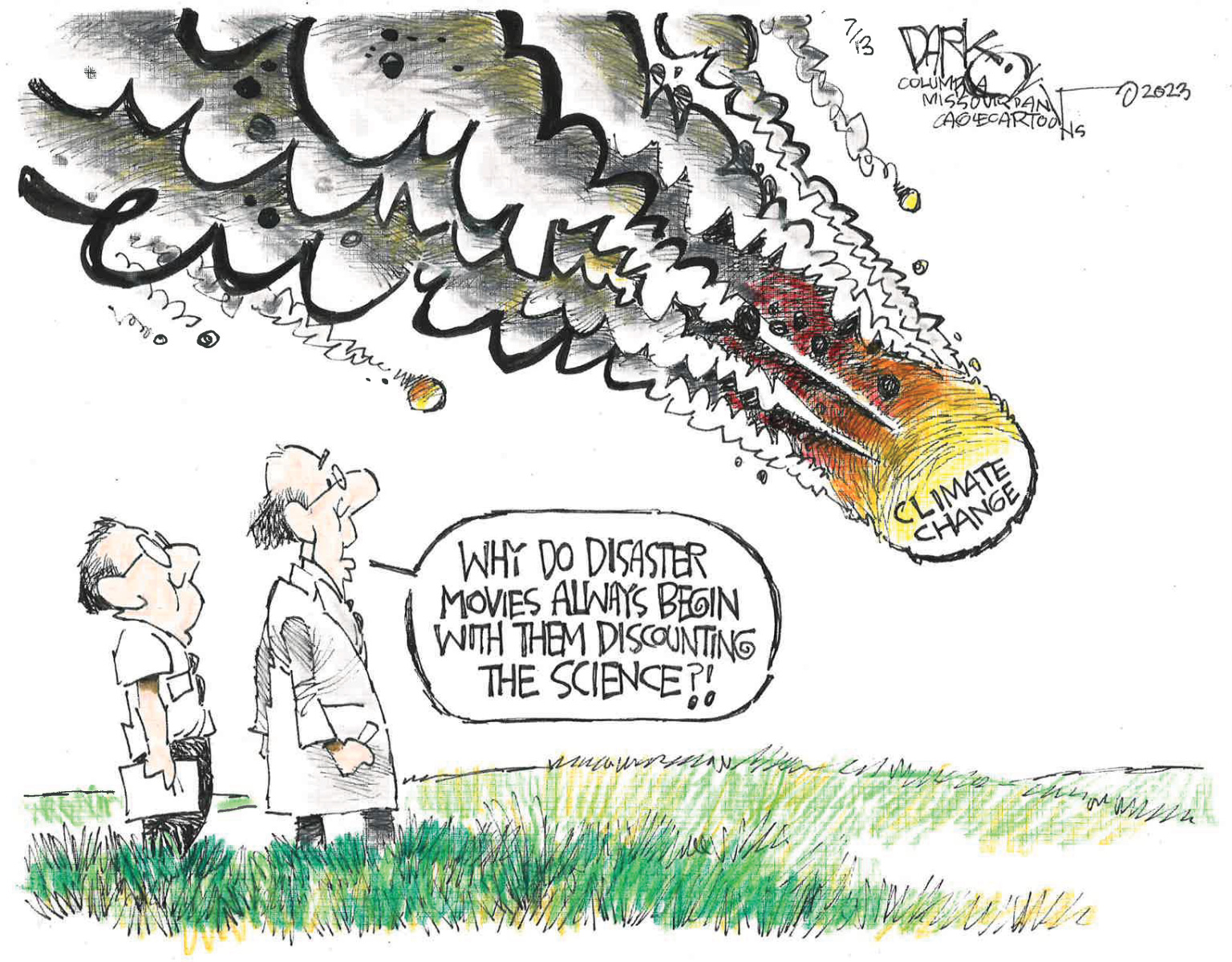

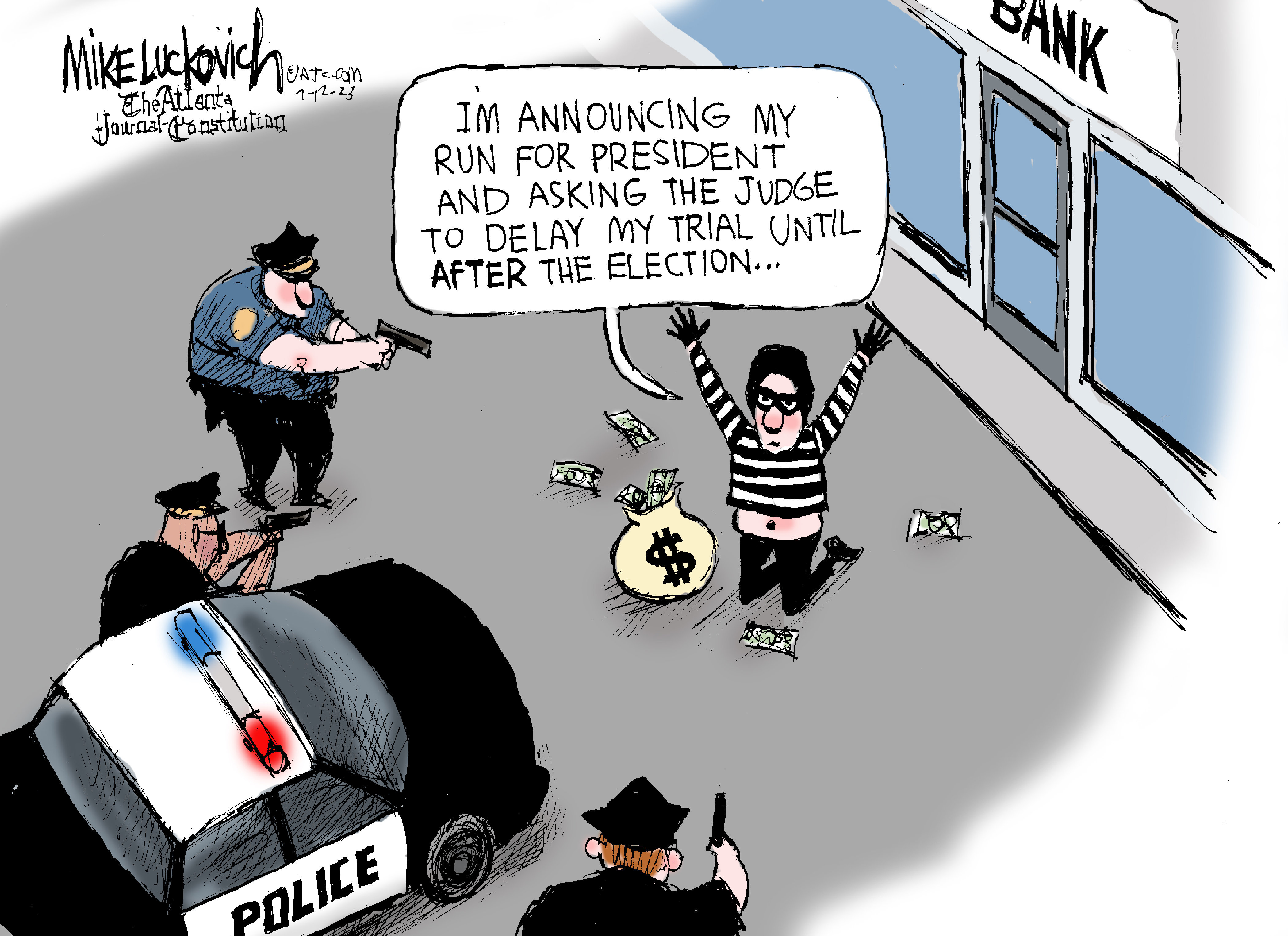
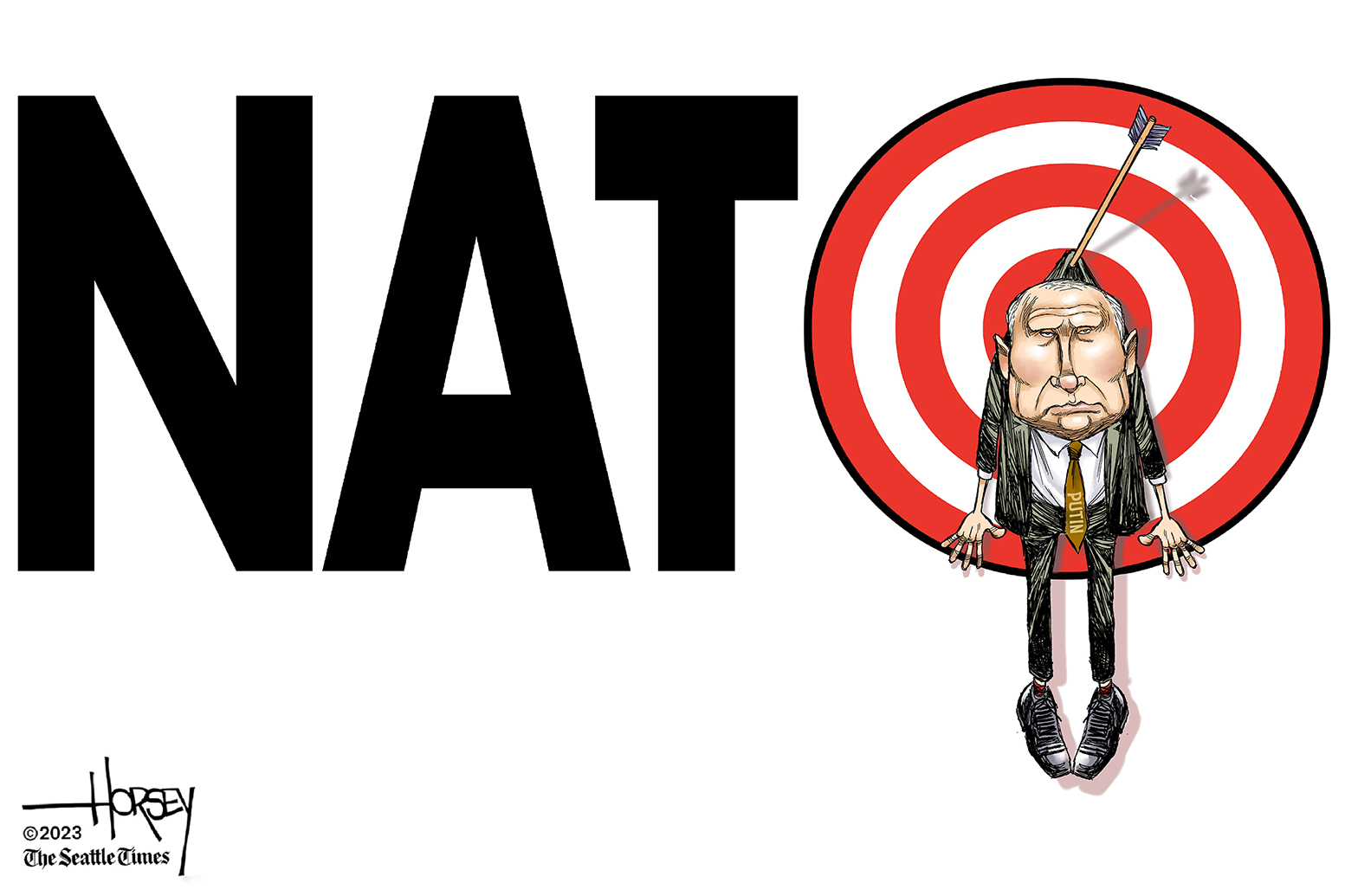

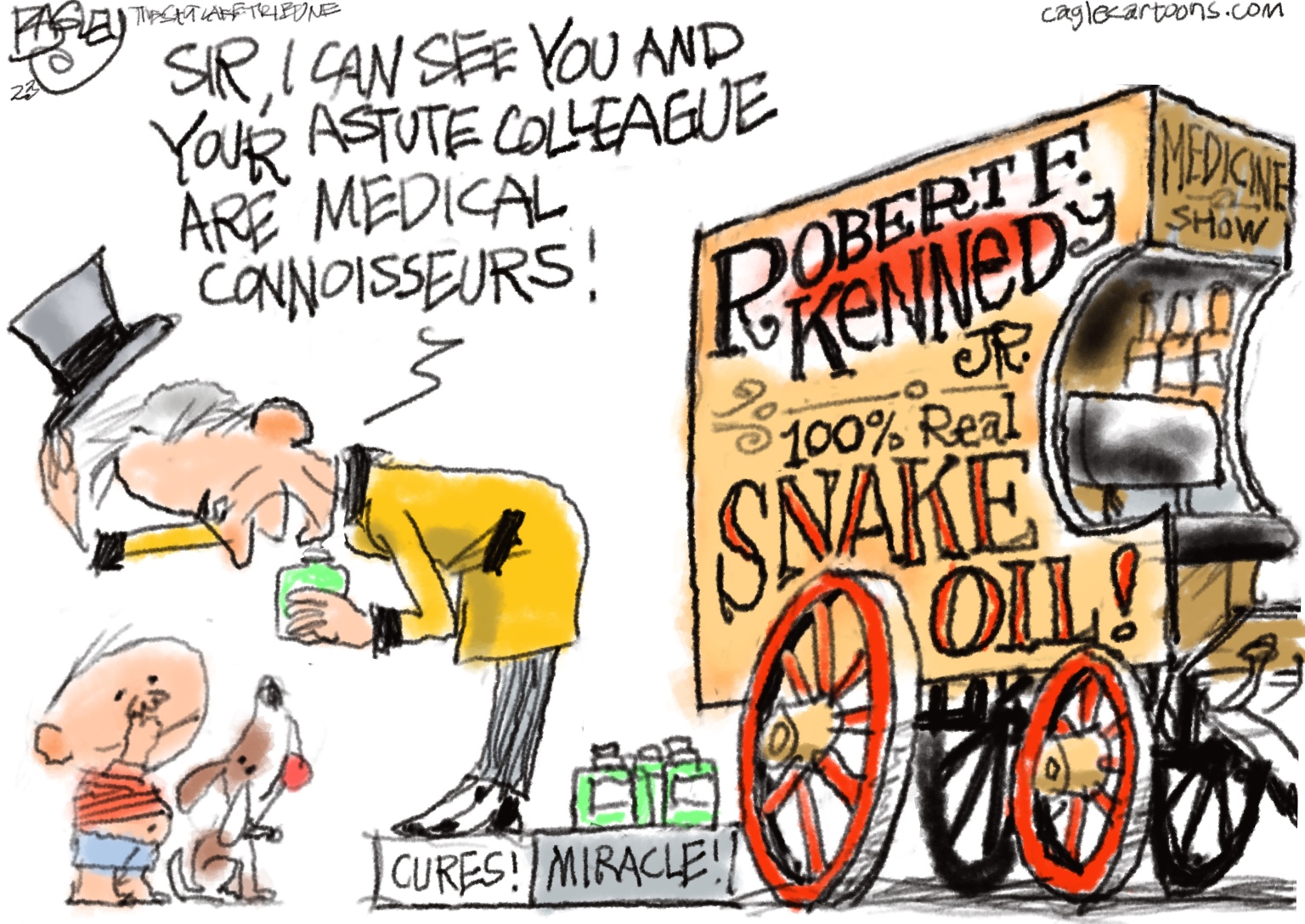

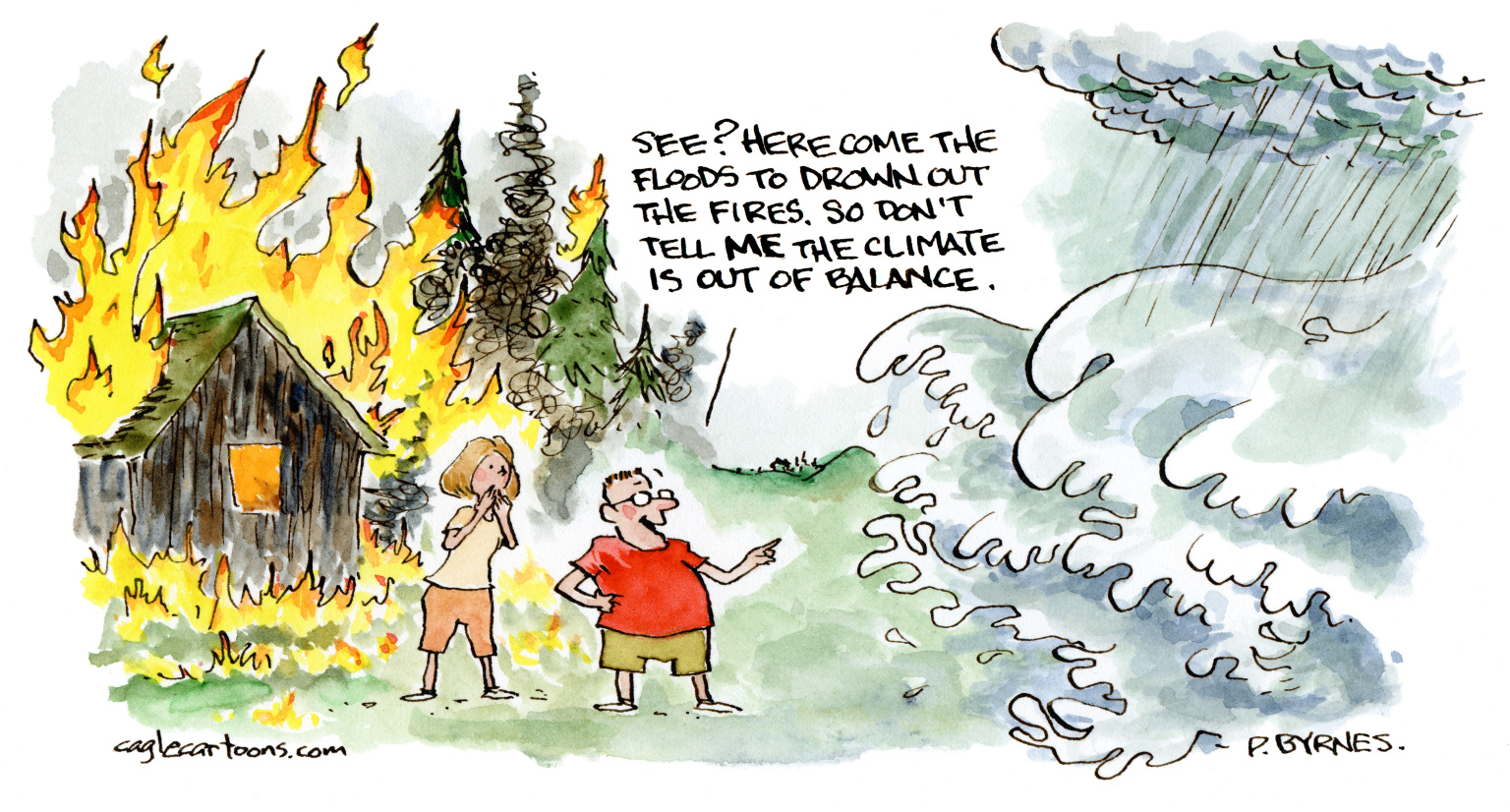
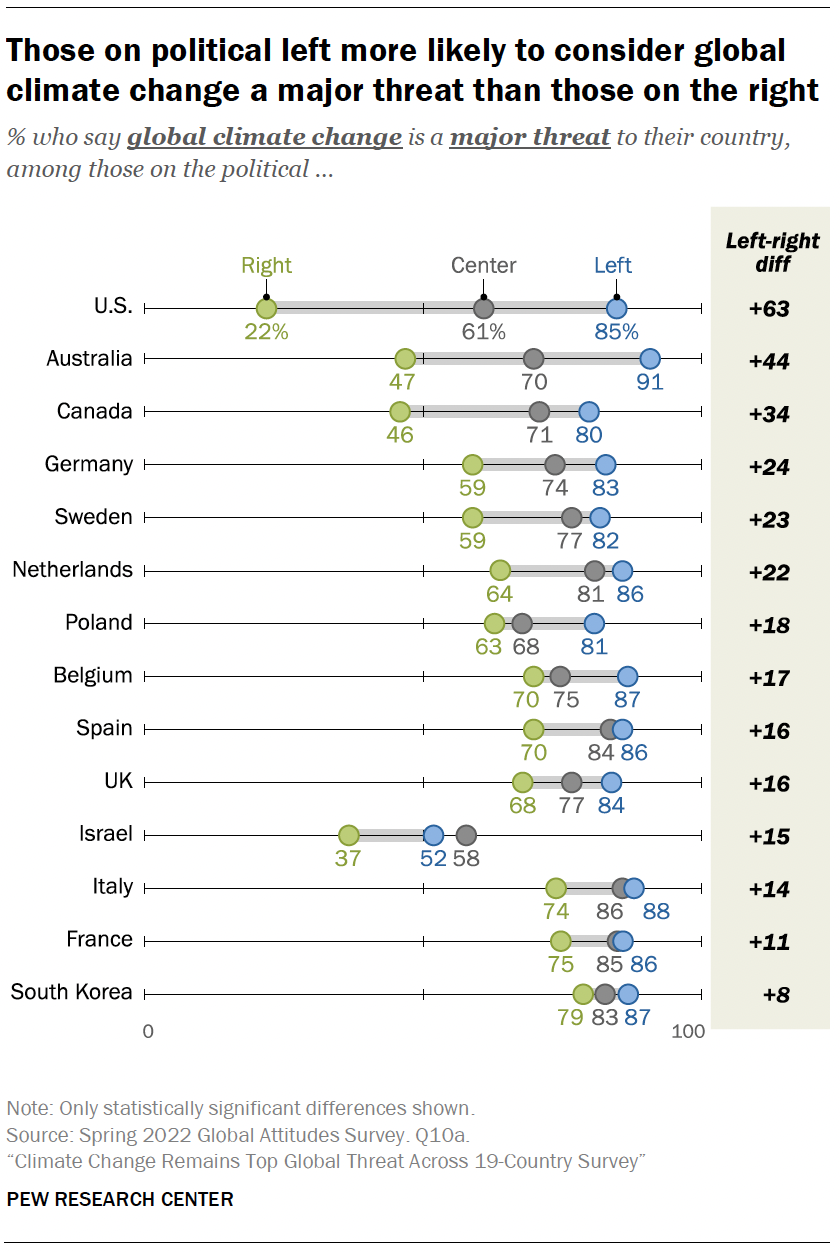
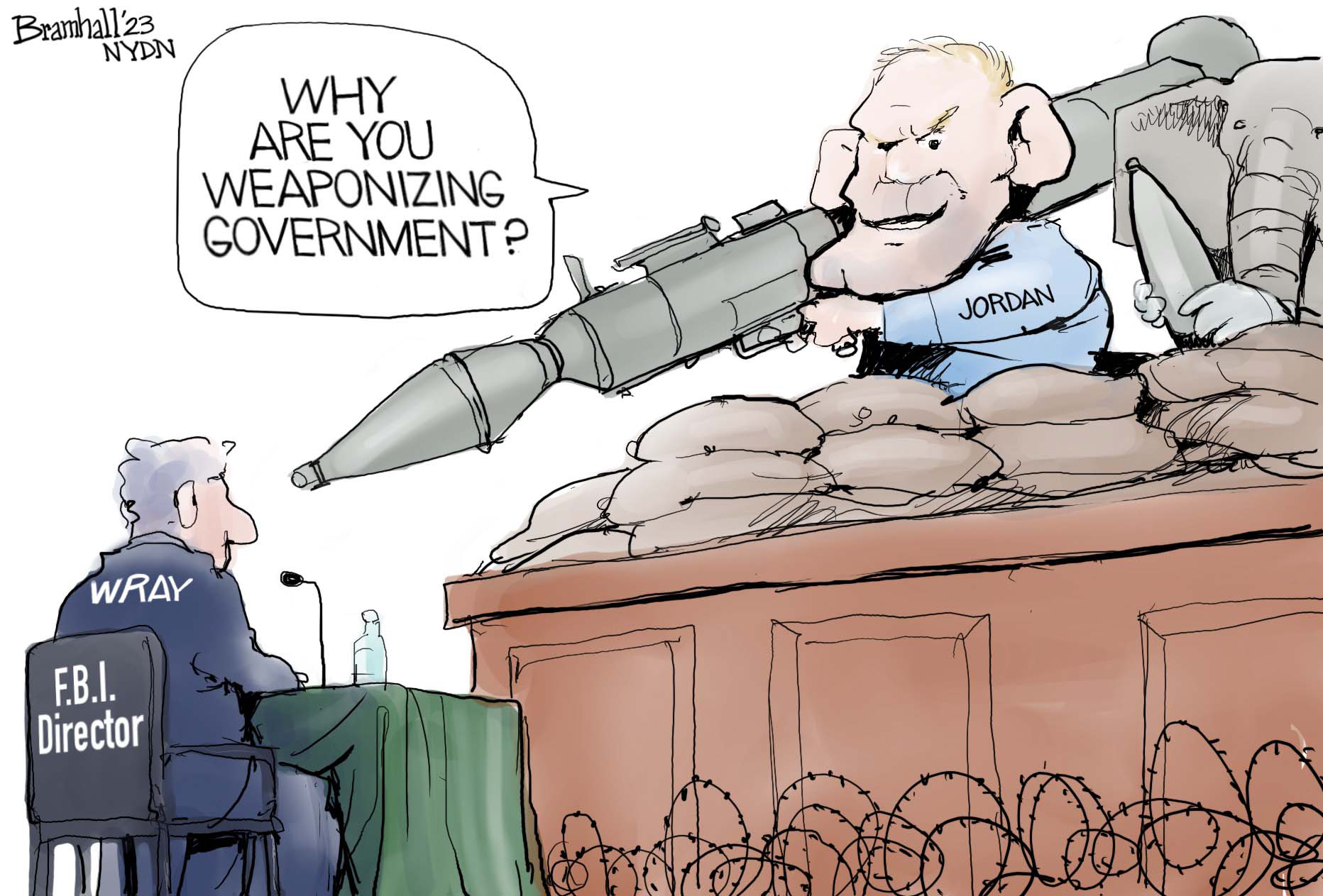



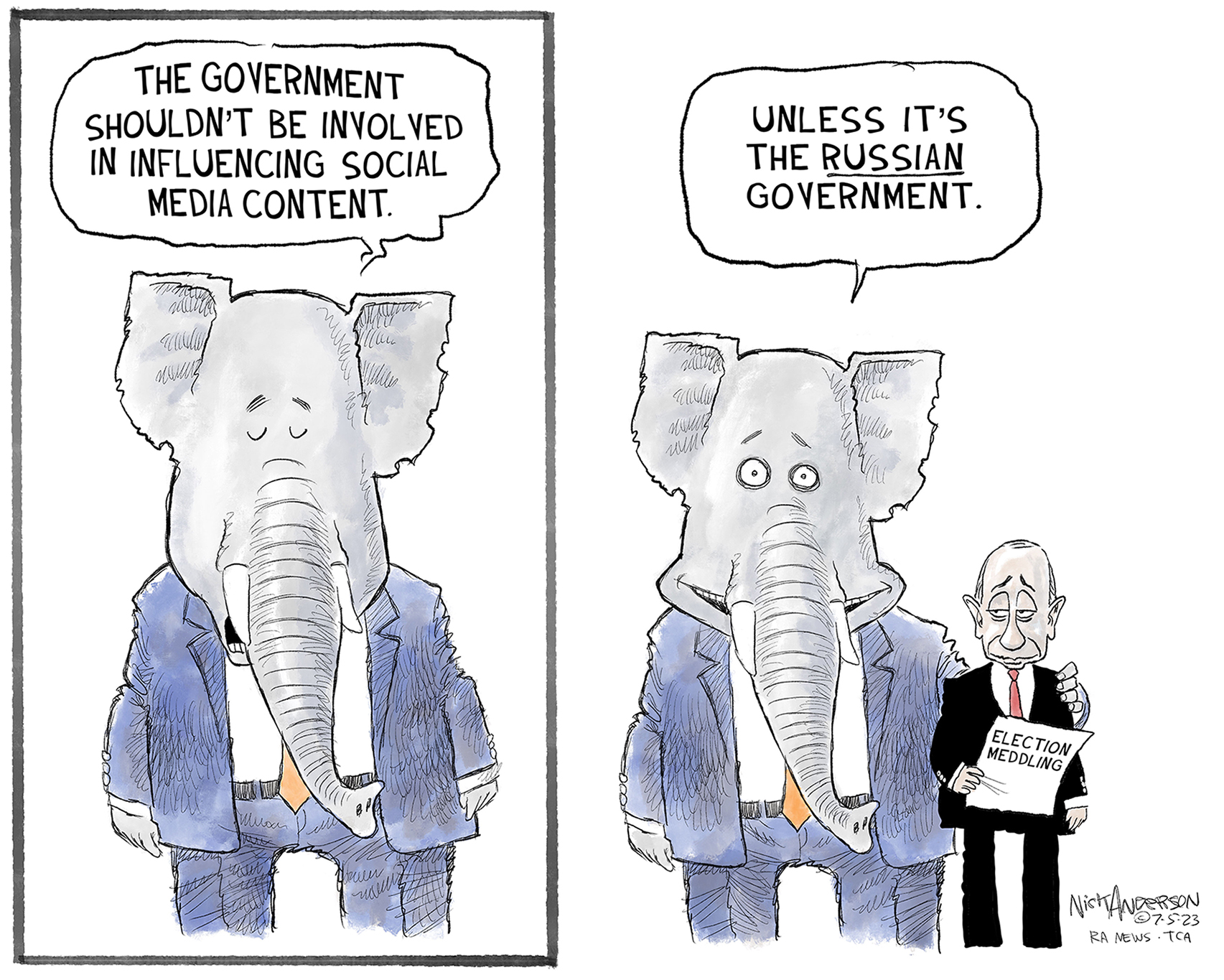
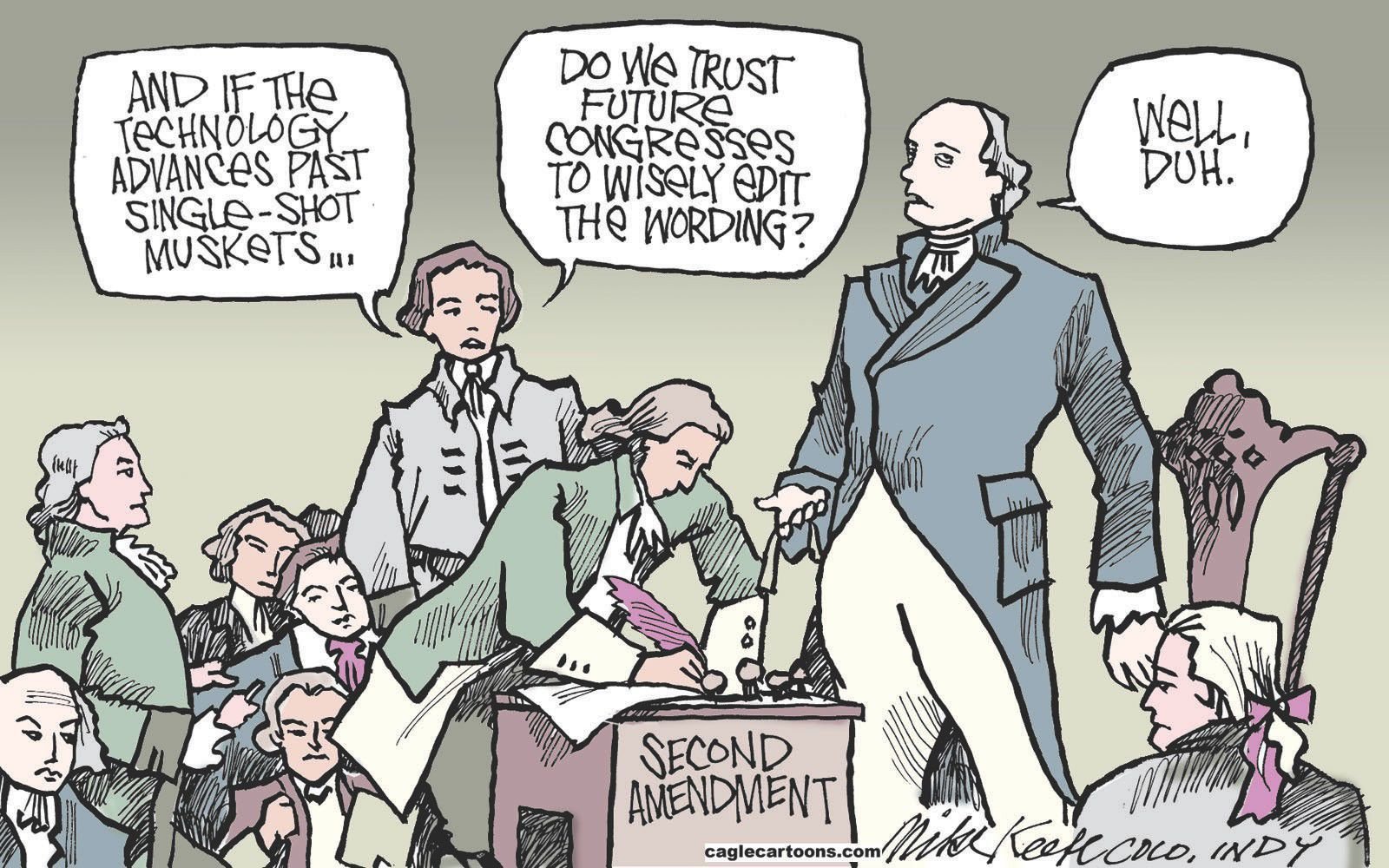
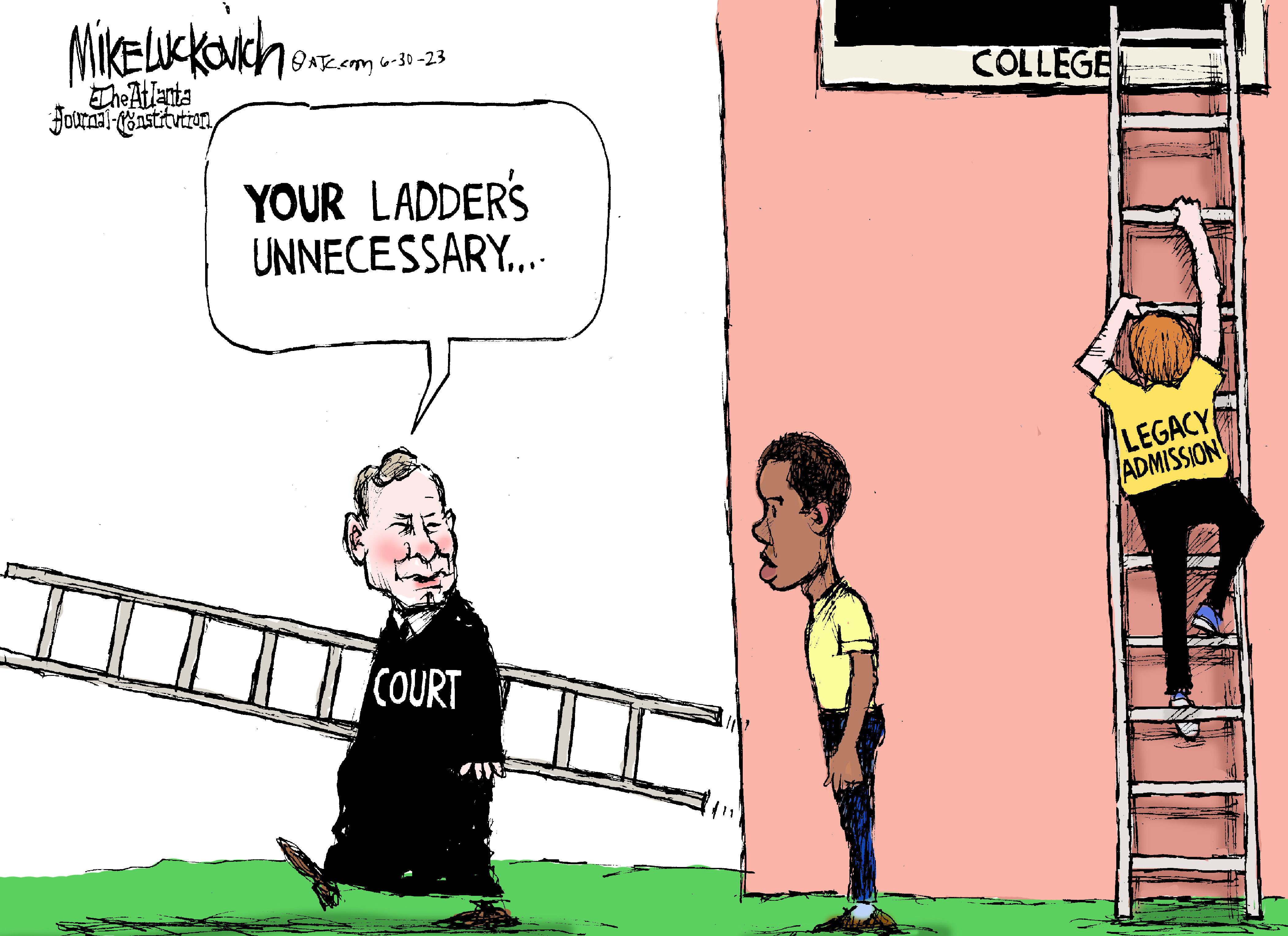
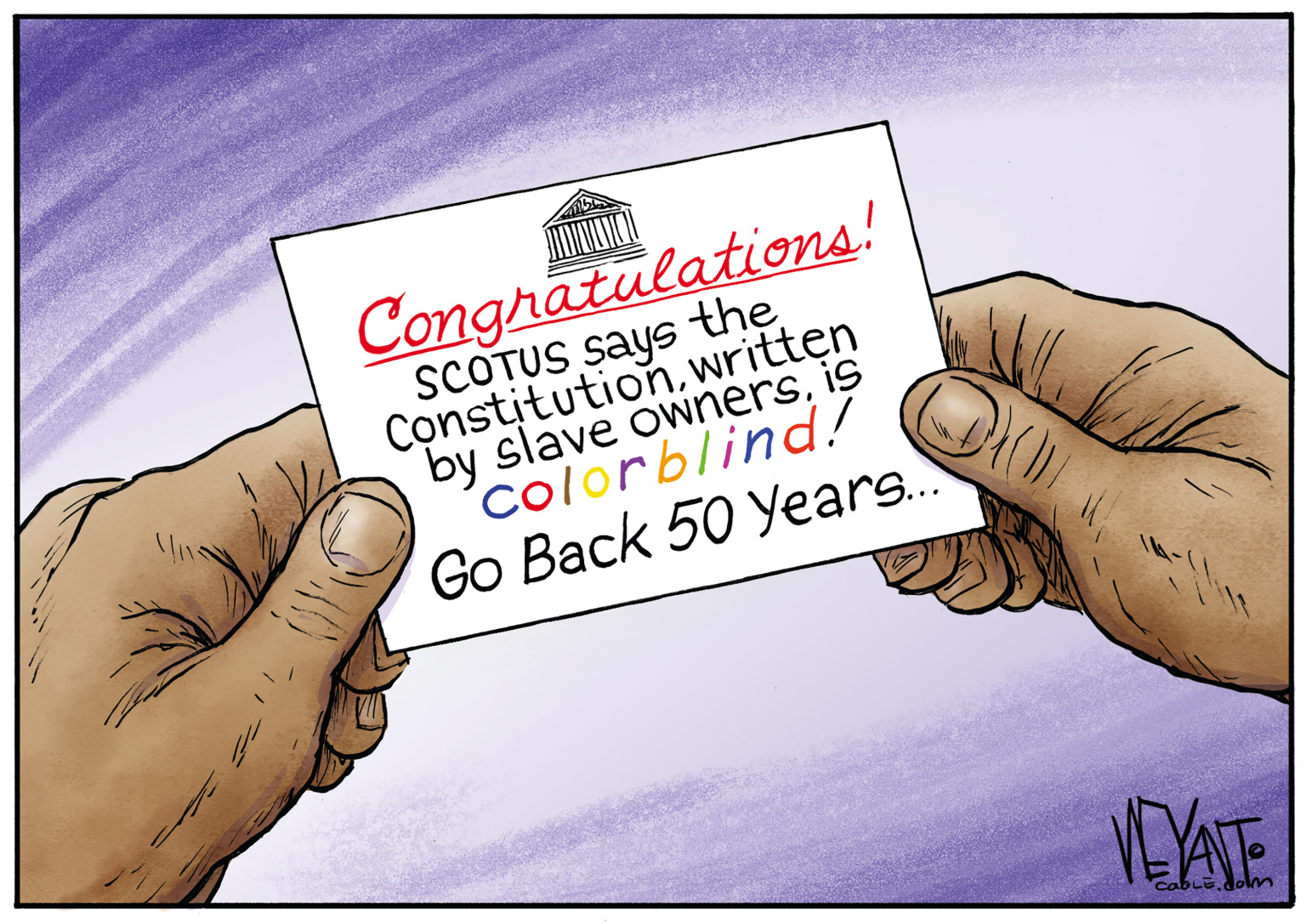

 The Weekly Sift